Archive for the ‘Education – Academics’ Category

The cost of college …

November 1, 2011

Given the uproar from the Occupiers and Campaigner-in-Chief, I got curious about the facts re: college tuitions.

According to the College Board. here’s what it really costs to attend college:

  • Public two-year colleges charge, on average, $2,713 per year in tuition and fees.
  • Public four-year colleges charge, on average, $7,605 per year in tuition and fees for in-state students.
  • Public four-year colleges charge, on average, $19,595 per year in tuition and fees for out-of-state students.
  • Private nonprofit four-year colleges charge, on average, $27,293 per year in tuition and fees.

The College Board adds: “Keep in mind that — due to grants and other forms of financial aid — the actual price the average undergraduate pays for a college education is considerably lower than the published tuition and fees.”

* * * * *
For the record, Georgetown University charges undergrads $40,920 per year in tuition … and about $10,000 in room, board and miscellaneous charges … MBAs pay a couple of bucks short of $50,000 — just for tuition.

Ouch !

>> Latest Posts

Prediction: Obama’s midnight pardons will rock the world.

October 27, 2011

On his current campaign swing, President Obama is throwing around tax payer money to rebuild his base.

Earlier this week it was the Federal refinancing of underwater home loans.  Taxpayers will own any defaults.

Yesterday it was the announcement of an executive order to restructure, cap, and eventually forgive student loans after 20 years of payments.

That one troubles me.

Even CNN acknowledges:

The president’s focus on college loan assistance could also help him with younger voters — generally a core Democratic constituency. In 2008, Obama carried two-thirds of all voters ages 18 to 24, according to national exit polls.

Did you know that a provision of the ObamaCare law was to nationalize student loan programs?  Amazing what you can sneak into a 2,000 page unread law.

Now, the Executive branch (i.e. the Obama administration) has wide, unprecedented latitude to grant, structure and forgive student loans.

Presidents have often issued pardons and waivers during their last hours in office.  Think Bill Clinton pardoning uber-tax evader Marc Rich.

I predict that if Obama gets beat in 2012 – a 50 / 50 bet as things now stand – he will issue the mother of all pardons: forgiveness of all Federally held student loans and maybe, while he’s at it, the forgiveness of all Federally held home loans.

Far-fetched?

I don’t think so, and now, I’m on the record.

>> Latest Posts

Unfit to serve … under 6% qualify for military

October 21, 2011

The  ABC News headline reads

“Nearly one-fourth of the students who try to join the U.S. Army fail its entrance exam”.

That’s true, but it’s only part of the story.

A study by The Education Trust found that 23 percent of recent high school graduates don’t get the minimum score needed on the enlistment test to join any branch of the military.

Here’s the line that caught my eye.

The military exam results are also worrisome because the test is given to a limited pool of people:

Pentagon data shows that 75 percent of those aged 17 to 24 don’t even qualify to take the test because they are physically unfit, have a criminal record or didn’t graduate high school.

Doing the arithmetic, the military is drawing from a pool that only contains 5.75% of those aged 17 to 24.

Holy smokes …

>> Latest Posts

Imagine the NFL if …

October 3, 2011

Interesting analogy from NFL Hall of Famer Fran Tarkenton.

Guess the system he’s describing…

Extracted from WSJ: What if the NFL Played by Different Rules?

Imagine the National Football League in an alternate reality.

Each player’s salary is based on how long he’s been in the league. It’s about tenure, not talent.

The same pay scale is used for every player, no matter whether he’s an All-Pro quarterback or the last man on the roster.

For every year a player’s been in this NFL, he gets a bump in pay. The only difference between Tom Brady and the worst player in the league is a few years of step increases.

And if a player makes it through his third season, he can never be cut from the roster until he chooses to retire, except in the most extreme cases of misconduct.

Of course, he’s talking education and why the union-dominated school systems underperform.

Not a lot of new news, but brings the problem to life.

>> Latest Posts

Enrollments plunge at for-profit colleges …

September 13, 2011

Punch line For-profit colleges are facing a tough test: getting new students to enroll.

Excerpted from WSJ: “Party Ends at For-Profit Schools”

Enrollment at for-profit colleges soared during the recession, amid heavy advertising that appealed to suddenly jobless people needing new skills.

But recently , new enrollments are down by as much as 45%

Why?

Responding to government investigations, a number of for-profit schools including Corinthian, Apollo. and others have tamped down aggressive recruiting … and are  tightening admissions standards.

  • State and federal investigators began turning up the heat last year on for-profit schools as default rates on federally backed student loans began to climb.
  • Even before the enrollment boom, default rates—at 11.6% in 2008, the latest year available— were about double that of public colleges.

Washington Post Co.’s Kaplan Higher Education now requires certain students to participate in a trial program before enrolling and paying tuition.

More fundamental, many students are re-considering their options, including attending community colleges.

The would-be students are questioning the potential pay-off for degrees that can cost considerably more than what’s available at local community colleges.

Surprise, surprise, surprise …

>> Latest Posts

Spend more on education?

September 5, 2011

From a survey reported in the WSJ

When asked “Should the U.S. spend more money on education?” …

65% of the public says “yes” spend more on our schools.

When told that current spending is $12,922 per student annually …

The number drops to only 49% who say they want to pony up more dollars.

When told that higher education spending means higher taxes…

Only 35% support an increase on education spending..

More specifically, a majority doesn’t want to pay more taxes to support their local schools. Only 28% think that’s a good idea.

Bottom line That’s the nation’s debt crisis in a nutshell … if people aren’t reminded that there is no such thing as a free lunch, they can be persuaded to root for higher spending on education … and practically everything else.

If they’re asked to ante in, well, that puts a different paint job on it.

>> Latest Posts

What, you don’t have a master’s degree?

July 27, 2011

Punch line: “Colleges are turning out more graduates than the market can bear, and a master’s is essential for job seekers to stand out”

Excerpted from NYT “The Master’s as the New Bachelor’s

Browse professional job listings and it’s “bachelor’s required, master’s preferred.”

Call it credentials inflation.

Colleges are turning out more graduates than the market can bear, and a master’s is essential for job seekers to stand out

Once derided as the consolation prize for failing to finish a Ph.D. or just a way to kill time waiting out economic downturns, the master’s is now the fastest-growing degree.

The number awarded, about 657,000 in 2009, has more than doubled since the 1980s, and the rate of increase has quickened substantially in the last couple of years.

Nearly 2 in 25 people age 25 and over have a master’s, about the same proportion that had a bachelor’s or higher in 1960.

* * * * *

The degree of the moment is the professional science master’s, or P.S.M., combining job-specific training with business skills.

Many new master’s are in so-called STEM areas — science, technology, engineering and math …  recognizing that not everyone is ivory tower-bound and are drafting credentials for résumé boosting.

* * * * *

So what’s going on here?

Have jobs, “skilled up”?

Or perhaps all this amped-up degree-getting just represents job market “signaling” — the notion that degrees are less valuable for what you learn than for broadcasting your go-get-’em qualities. “Credentialing gone amok.”

“There is definitely some devaluing of the college degree going on. We are going deeper into the pool of high school graduates for college attendance” making a bachelor’s no longer an adequate screening measure of achievement for employers.

>> Latest Posts

U.S. teachers work longest hours in the world … oh, really?

July 6, 2011

According to the WSJ and the Organization for Economic Cooperation and Development:

    • U.S. primary-school teachers spend only 36 weeks a year in the classroom — among the lowest among the countries tracked
    • But, U.S. primary-school teachers spend 1,097 hours a year teaching – the highest among the countries tracked – and well above the OECD average of 786 hours.

image

And, according to the OECD, that’s just the time teachers spend on instruction. Including hours teachers spend on work at home and outside the classroom, American primary-school educators spend 1,913 working in a year.

According to data from the comparable year in a Labor Department survey, an average full-time employee works 1,932 hours a year spread out over 48 weeks (excluding two weeks vacation and federal holidays).

Despite the amount of time that teachers spend working, student achievement in the U.S. remains average in reading and science and slightly below average in math when compared to other nations in a separate OECD report.

* * * * *
Hmmm.

Teachers work an average of almost 11 hours per day when school is in session,

And, teachers put in about as many hours in 36 weeks as “average full-time employees” do in 48 weeks,

Color me skeptical …

* * * * *

Maryland adds ‘environmental literacy’ to HS graduation requirements … huh?

July 1, 2011

Last week, the Maryland state Board of Education approved an environmental literacy graduation requirement: High school seniors in Maryland will have to demonstrate literacy on environmental matters to graduate from now on.

According to the AP, public schools will be required to infuse core subjects with lessons on conservation, smart growth and other environmental topics.

Maybe that’s a good idea, but consider:

According to the Editorial Projects in Education Research Center, only about 74 percent of all students in Maryland graduate from high school with a regular diploma.

Less than 2/3s of Hispanics and African-Americans get a high school diploma.image

The obvious questions:

1) Will the HS graduation rate go up or down when an additional criteria – any criteria – is added?

I’m betting the down side …

2) Recent statistics indicate that a large proportion of HS graduates get their diploma with an adequate foundation in reading, writing and arithmetic.

Shouldn’t attention be laser-focused on those subjects?

3) Seriously, does it matter if inner city kids are schooled in ‘smart growth’?

* * * * *

The one thing that college does …

June 22, 2011

One thing college does do is to keep 25 million students off the unemployment rolls.

That’s according to Bill Gross, co-CEO of PIMCO Bond Funds, on his most recent newsletter: School Daze, School Daze Good Old Golden Rule Days

Gross has jumped on the’ college is worthless’ bandwagon.

He says:

A mind is a precious thing to waste, so why are millions of America’s students wasting theirs by going to college?

  • All of us who have been there know an undergraduate education is primarily a four year vacation interrupted by periodic bouts of cramming or Google plagiarizing,
  • It used to serve a purpose. It weeded out underachievers and proved at a minimum that you could score on an SAT test. Now, it proves that your parents had enough money to hire SAT tutors to increase your score by 500 points.

Now, however, a growing number of skeptics wonder whether it’s worth the time or the cost.

College now is stultifying and outdated – overpriced and mismanaged – with very little value created.

Fact: College tuition is now 4 times as expensive relative to other goods and services as it was in 1985.

Fact: The average college graduate now leaves school with $24,000 of debt and total student loans now exceed this nation’s credit card debt at $1.0 trillion.

Subjective explanation: Universities are run for the benefit of the adult establishment, both politically and financially, not students.

Conclusion:  Students, however, can no longer assume that a four year degree will be the golden ticket to a good job in a global economy that cares little for their social networking skills and more about what their labor is worth on the global marketplace. Our penchant for focusing on liberal arts and  high tech value-added jobs should be modified and redirected.

Solution: Focus on retraining existing unemployed workers and redirecting our future students. Instead of liberal arts, focus on technical education, technical institutes and polytechnics as well as apprenticeship programs.

Allow people with good technical skills but limited college education to earn a decent living.

Read the full newsletter

* * * * *
Ken’s Take: I’ve been doing mucho reading on the subject this summer. None of it is very encouraging,  The education system is a huge national issue.  More to come.

Your thoughts?

* * * * *
Thanks to Tags for feeding this lead

The most popular educational site in the world …

June 14, 2011

No, not the HomaFiles (but we’re trying) … It’s the Khan Academy.

Punch line: This is worth checking out for 2 reasons:

  1. Innovative educational “delivery system”
  2. Lots of 10-minute subject modules that are relevant to MBAs – e.g. finance, econ, stats.

Links follow the excerpt …

* * * * *

Excerpted from Business Week:
Salman Khan: The Messiah of Math

Salman Khan has become a quasi-religious figure in a country desperate for an educational Moses.

His free website, dubbed the Khan Academy, may well be the most popular educational site in the world.

“If you’re teaching math in this country right now, then there’s pretty much no way you haven’t heard of Salman Khan.”

Kahn started by taking math material — both basic and advanced  — and broking it down into little 12-minute lectures  – created on a  Wacom tablet using an electronic pen — feature blackboard-style diagrams and explanatory voice-overs .

Khan groups the concepts into “modules” … all linked to a “knowledge map” that shows how the modules relate to one another, so a math student can pick a path from addition to derivatives.

Some teachers are using the Kahn videos to supplement the classroom..

Teachers using the Khan Academy flip the traditional curriculum; students listen to the lectures at home, on their own time, and work through assignments in class, So, teachers are able to address student issues individually.

From its math roots, Kahn Academy has branched out to a broad array of subject matter, including statistics, finance, economics, and the sciences.

* * * * *
Links to explore the Kahn Academy:

Kahn Academy: Home Page

Kahn Academy Topics Index

Lecture Example: Present Value

Lecture Example Algebra: Worked Problems

* * * * *

Students accumulating credit hours, but not mastering skills …

June 10, 2011

Excerpted from the WSJ:

Big U.S. employers, worried about replacing retiring baby boomers, are … growing bolder about telling educators how to run their business.

Several initiatives have focused on manufacturing and engineering, fields where technical know-how and math and science skills are needed and where companies worry about recruiting new talent.

The National Association of Manufacturers is leading a drive, partly funded by the Bill & Melinda Gates Foundation, to establish standardized curricula at community colleges across the U.S. with the goal of preparing students to qualify for certification in industrial skills ranging from welding to cutting metal and plastics.

The association … said bright students should be encouraged to consider alternatives that lead directly to jobs.

“We need to move aggressively to competency-based education” based on mastery of skills  … rather than on an accumulation of credit hours.

Much of the emphasis is on community colleges and vocational schools because they are affordable and can quickly turn out job candidates.

Employers increasingly are asking community colleges to create custom training programs for specific jobs.

* * * * *

About colleges’ value-to-cost ratio …

June 9, 2011

Everybody knows that college tuition is going thru the roof … pushing college out of reach for many and burdening most of the rest with near-lifelong debt.

USA Today reported recent studies by Rutgers University, Northeastern University professor Andrew Sum and Pew Research found that:

  • The median student loan for graduates from 2006 through 2010 is $20,000
  • Only about three-quarters of college grads younger than 25 were employed …
  • … with over a quarter of those employed working jobs that didn’t require a college degree.
  • 57% of Americans have decided that the value-to-cost ratio for college is lousy.

Ken’s Take: Anybody see a parallel between the Fed gov’t and higher education?  High prices, high debt, low value-to-cost.

Just like peas in a pod …

What the hell happens on campus?

May 26, 2011

That’s the question that authors Richard Arum and Josipa Roksa ask and answer in their book Academically Adrift.

They report:

  • Forty-five percent of students barely tick upward in critical thinking, complex reasoning, and writing after two years of college, and 36 percent don’t budge in those skills after four years.
  • Four-year institutions only graduate about a third of their students in four years, and two-thirds of them in six.
  • Student debt just surpassed the country’s credit-card debt for the first time. It is projected to top $1 trillion this year … For the class of 2011, the mean student-debt burden is nearly $23,000, up 8 percent from a year ago.
  • In the early 1960s, college students spent 40 hours per week on academic work; now they spend only 27 hours per week. In 1961, 67 percent of students said they studied more than 20 hours per week; now only one in five study that much.
  • Miraculously, grades haven’t dropped, despite less study …   students have mastered “the art of college management,” whereby they succeed at “controlling college by shaping schedules, taming professors and limiting workload.”
  • Faculty spend approximately 11 hours per week on advisement and instructional preparation and delivery.” The rest is devoted to research and sundry other professional and administrative tasks.
  • Campus hiring has been devoted to “managerial professionals” specializing in sundry student services. What kind of learning environment is it, after all, without a director of sustainability initiatives?

If increasingly students don’t study, teachers don’t teach, and college employees aren’t primarily concerned with either, it raises the question of what the hell happens on campus.

Well, many students have a grand time during a years-long vacation from real life.

They enjoy state-of-the-art facilities, socialize, and figure how to come away with the credential of a degree in exchange for minimal effort.

Not exactly a formula for efficiency or success.

Source: RCP

Study: Republican profs reward high achievement … here’s the bad news.

May 25, 2011

Yesterday, HomaFIles summarized a study done by economists Talia Bar (Cornell) and Asaf Zussman (Hebrew University) that concluded in the words of economist Mark Perry“ …  highly motivated, high-achieving students should prefer classes from Republican professors because it’s more likely they’ll be rewarded with a really high grade.

That’s good news for highly motivated, high achieving students — all they need to do is take classes from Republican profs.

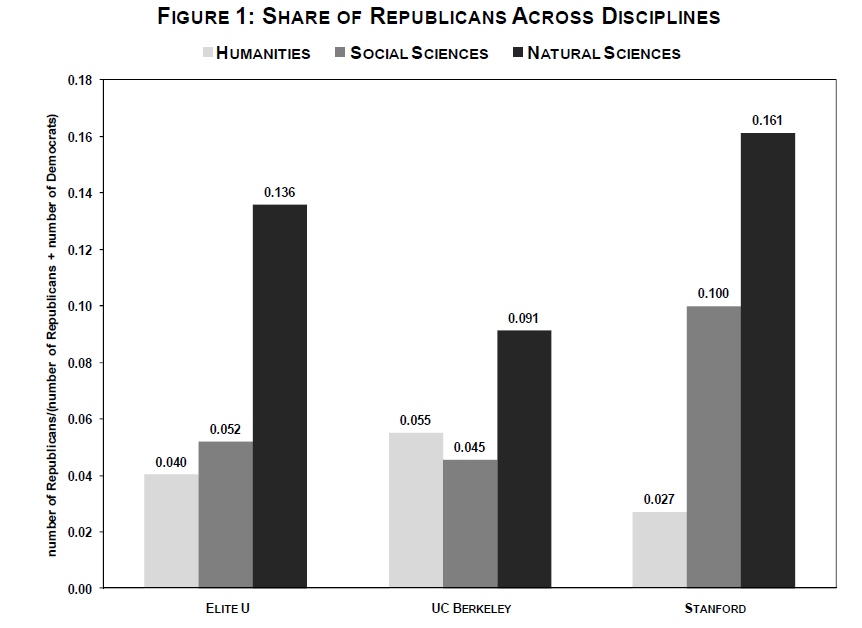
Here’s the bad news: the aren’t many Republican profs around.

From the same  study done by  Bar and Zussman:

  • There are virtually no Republican profs in the “softer” (i.e. more qualitative) disciplines such as the  humanities and social studies
  • Even in “harder” (i.e. more scientific and quantitative) disciplines such as the natural sciences, less than 1 in 5 profs are Republicans.

Ken’s Bet:  Republican profs’ representation in business schools isn’t much higher that it is the natural sciences … go figure.

image

* * * * *

Study: Republican profs reward high achievement more than their Democrat colleagues…

May 24, 2011

Economists Talia Bar (Cornell) and Asaf Zussman (Hebrew University) studied grading tendencies of Republican and Democratic college professors..

Their results are reported in a  forthcoming American Economic Journal article titled “Partisan Grading“.

The highlights:

The evidence suggests that student grades are linked to the political orientation of professors: relative to their Democratic colleagues, Republican professors are associated with a less egalitarian distribution of grades.

That is, the variance of grades is higher in courses taught by Republicans than in courses taught by Democrats. Moreover, in additional analysis we find that relative to their Democratic colleagues, Republican professors tend to assign more very low and very high grades

The differences are highly statistically significant.

The observed pattern is consistent with the hypothesis that Republican professors are associated with … higher returns to student ability.

image

The results suggest that the allocation of grades is associated with the worldview or ideology of professors.

* * * * *

Economist Mark Perry observesOne conclusion here might be that highly motivated, high-achieving students should prefer classes from Republican professors because it’s more likely they’ll be rewarded with a really high grade

… and less motivated, lower-achieving students should prefer classes from Democratic professors, because it’s less likely that they’ll receive a really low grade.

Most Published Research Findings Are False

April 26, 2011

I didn’t say it, the New Yorker magazine did, setting off a buzz in the halls of academia.

The theme of the New Yorker article –- titled “Truth Wears Off” –was that most (academic) research was flawed and not able to be replicated.  This is, the results were at best true under some special circumstances at a specific point in time, but can’t be replicated. At worst, they’re just plain bull.

Hmmm.

Challenging the integrity of publication-driven academics?

Turns out that the New Yorker wasn’t the first mag on the beat.

There was an article in 2005 titled “Why Most Published Research Findings Are False” published in a medical journal that said point blank: “ It can be proven that most claimed research findings are false.”

According to the study, there are several reasons why.

My favorites:

  • Claimed research findings may often be simply accurate measures of the prevailing bias … that is, telling audiences what they want to hear
  • The hotter a scientific field, the less likely the research findings are to be true … that is, rushing to ride the wave
  • The greater the financial and other interests and prejudices in a scientific field, the less likely the research findings are to be true … no kidding?

Geez, if you can’t trust stuff printed in academic journals, what can you trust?

Skating through B-school …

April 25, 2011

Punch line: The NY Times reports that b-school students are slackers … especially those specializing in management and marketing.

Ouch.

* * * * *

From the N.Y. Times

The family of majors under the business umbrella — including finance, accounting, marketing, management and “general business” — accounts for just over 20 percent, or more than 325,000, of all bachelor’s degrees awarded annually in the United States, making it the most popular field of study.

But, all evidence suggests that student “disengagement” is at its worst in  business education.

Business majors spend less time preparing for class than do students in any other broad field: nearly half of seniors majoring in business say they spend fewer than 11 hours a week studying outside class.

Business majors have the weakest gains during the first two years of college on a national test of writing and reasoning skills. And when business students take the GMAT, the entry examination for M.B.A. programs, they score lower than students in every other major.

You’ll hear pervasive anxiety about student apathy, especially in “soft” fields like management and marketing, which account for the majority of business majors.

Scholars in the field point to three sources of trouble.

First,  too many business students chose their majors “by default.”

“Business education has come to be defined in the minds of students as a place for developing elite social networks and getting access to corporate recruiters.”

Second, in management and marketing, no strong consensus has emerged about what students ought to learn or how they ought to learn it.

Third, group assignments — a staple of management and marketing education —  are one of the elements of business that make it easy to skate through college.

A business professor at the University of Denver, studied group projects at his institution and found a perverse dynamic: the groups that functioned most smoothly were often the ones where the least learning occurred. That’s because students divided up the tasks in ways they felt comfortable with. The math whiz would do the statistical work, the English minor drafted the analysis. And then there’s the most common complaint about groups: some shoulder all the work, the rest do nothing.

Without some kind of hard constraint — like the licensure tests that accounting and finance students must face — courses inexorably become less rigorous.

Thanks to GB for feeding the lead.

>> Latest Posts

Budget deal revives DC school vouchers … Dems and DC mayor cry “unfair”

April 11, 2011

Punch line: The budget deal to fund the federal government for the next five months includes money to revive the DC’s school voucher program, which subsidizes private school tuition for needy students with federal funds.

Demonstrating their hypocrisy towards improving the quality of education for inner city kids, some teacher union-backed Dems and the Mayor of DC cry “unfair”.

To whom?  you ask.

The teachers’ union, of course.

The GOP-led House voted to reinstate the DC school voucher program last month. But the bill had little chance to go any further with the Obama administration opposed to vouchers.

However, the Republicans were able to get the initiative included in Friday night’s deal that cut spending by $38.5 billion.

Congress eliminated the voucher program in 2009. Critics of vouchers, including teachers unions, say it draws money away from public schools.

Under the program, which began in 2004, more than 3,700 students, mostly black or Hispanic, have won scholarships which provide up to $7,500 in private-school tuition.

In a Saturday morning tweet, Mayor Vincent Gray called the rider a "shameful violation of our right to govern ourselves."

Gray called on all D.C. residents to voice their opposition to the "colonial status of the District of Columbia."

AP, Budget Deal Revives DC School Voucher Program, April 09, 2011

College students meeting schools’ low (and declining) expectations … less studying, less thinking, higher grades … let’s party.

March 25, 2011

Punch line: A provocative new book, “Academically Adrift: Limited Learning on College Campuses,” makes a strong case that for a large portion of the nation’s seemingly successful undergraduates the years in college barely improve their skills in critical thinking, complex reasoning and writing.

* * * * *

Excerpted from NYT,  College the Easy Way

What are America’s kids actually learning in college?

For an awful lot of students, the answer appears to be not much.

Intellectual effort and academic rigor, in the minds of many of the nation’s college students, is becoming increasingly less important.

“Many students come to college not only poorly prepared by prior schooling for highly demanding academic tasks that ideally lie in front of them, but — more troubling still — they enter college with attitudes, norms, values, and behaviors that are often at odds with academic commitment.”

Students are hitting the books less and partying more.

Easier courses and easier majors have become more and more popular.

Perhaps more now than ever, the point of the college experience is to have a good time and walk away with a valuable credential after putting in the least effort possible.

What many of those students are not walking away with is something that has long been recognized as invaluable — higher order thinking and reasoning skills. They can get their degrees without putting in more of an effort because in far too many instances the colleges and universities are not demanding more of them.

The average amount of time spent studying by college students has dropped by more than 50 percent since the early 1960s.

But a lack of academic focus has not had much of an effect on grade point averages or the ability of the undergraduates to obtain their degrees.

Thirty-six percent of the students said they studied alone less than five hours a week. Nevertheless, their transcripts showed a collective grade point average of 3.16.

The colleges and universities have set up a system so that there are ways to navigate through it without taking difficult courses and still get the credential.”

In their first two years of college, 45 percent of the students made no significant improvement in skills related to critical thinking, complex reasoning and communication.

Many of these young men and women are unable to communicate effectively, solve simple intellectual tasks (such as distinguishing fact from opinion), or engage in effective problem-solving.

“It’s important to get the word out about the lack of academic rigor and intellectual engagement that’s occurring at colleges and universities today.”

Are B-school profs different?

March 24, 2011

Prof. Greg Mankiw of Harvard made headlines a few years ago when he got a million-dollar advance to write an economics textbook.

I just stumbled on this blog post of his … thought it was interesting.

Punch line: Business students force the faculty to think practically

* * * * *

Excerpted from Mankiew Blog, Are B-school economists different?, June 02, 2009

A journalist … mentioned that he was finding that many of his best sources on the financial crisis teach at B schools, not Econ Departments.

I don’t know of any hard data to establish whether journalists are more likely to cite economists in business schools than those in economics departments, but I can believe it might be the case.

On average, economists in business schools have a more practical and empirical approach to the field than do those in economics departments.

Why? I don’t think the answer is … a difference in training.

I think part of the answer is self-selection.

Economists who are naturally more abstract will have a harder time teaching MBAs and will gravitate toward economics departments. The PhD students there will not mind the higher level of abstraction.

By contrast, economists of a more practical and empirical frame of mind will gravitate toward business schools, where their practicality is valued.

Some business schools encourage more practical research. The case studies written by faculty at Harvard Business School are a particularly extreme example. This experience forces the faculty to come down to earth from the rarefied theory that often characterizes economics research.

Finally, the students themselves influence how the faculty thinks.

Faculty who teach PhD students are used to being asked, “How did you derive that first-order condition? “

Faculty who teach MBA students are used to being asked, “Is that really how it works?”

By contrast, the typical MBA student, like the typical journalist, is older and more self-confident; he or she will more likely balk at what seems to be excessive abstraction.

The business students force the faculty to think practically.

Quick: Who to layoff: bad “senior” teachers or good “junior” teachers?

March 23, 2011

Punch line: Teachers’ unions are more interested in protecting their members’ jobs than in the quality of education

According to the WSJ

The steep deficits that states now face mean that teacher layoffs this year are unavoidable. Parents understandably want the best teachers spared. Yet in 14 states it is illegal for schools to consider anything other than a teacher’s length of service when making layoff decisions.

“If layoffs are based only on seniority, that doesn’t help the kids,” said U.S. Education Secretary Arne Duncan in a conference call with reporters. “And particularly doesn’t help the kids who need the most help.”

“Fourteen states have quality-blind layoffs rules but about 40% of all teachers work in those states, and they’re the states with the biggest budget deficits.” In addition to New York, the list includes California, New Jersey, Pennsylvania, Ohio, Illinois and Wisconsin.

The unions that support these laws insist that seniority is the only “fair” way to reduce the teaching work force.

The real problem is the underlying assumption that seniority is a decent proxy for performance.

But, two recent studies on seniority-based layoffs indicate that “only about 20% of the teachers who have the least seniority are also among the least effective teachers in a district. About 80% of the time, there’s a teacher who’s worse that you could have laid off but didn’t because they had more seniority.”

As Secretary Duncan notes, layoffs based on seniority will also remove good teachers from the classrooms where they are most needed.

High-poverty students tend to matriculate at schools where the teachers have less seniority.

While the unions hate school choice for students, they insist on it for teachers.

And senior teachers tend to opt out of high-poverty districts.

The good news is that more and more people now see through the union agenda, even if too many politicians are still on the fence.

In a recent Rasmussen poll, 68% said “teachers’ unions are more interested in protecting their members’ jobs than in the quality of education.”

Georgetown ups rank to #10 …

March 7, 2011

Among undergrad business schools, that is … according to Business Week, up a whopping 13 places to #10.

image

Blessed are the teachers …

March 1, 2011

Snippets from a guy who was both a college prof  and a farmer.  Whole article is worth reading …

Punch line: So far the angry teachers of Wisconsin have not yet won over the public. They have not convinced the majority that, in an age of staggering budget deficits, they — or, indeed, public employees in general — must as a veritable birthright enjoy salary, benefits, and pensions on average far more generous than those of their private-sector counterparts, who make up the majority of taxpayers.

Why do teachers’ unions oppose merit pay? Why should someone who did not join the union still have to pay its dues? Why should the state have to collect the dues from employee paychecks on behalf of the union? Moreover, when these questions are posed amid a landscape of teachers skipping classes to protest, urging students to join them, and soliciting fraudulent doctors’ notes to cover their cancellations of classes — while their supporters in the legislature hide out to prevent a quorum and thereby subvert the democratic process reaffirmed last November — the public becomes further estranged from their cause.

Contrast teaching to, say, farming.  In farming, almost everyone is constantly hustling — welders, independent truckers, contractors. There is no guaranteed income for the day, let alone for life, no pension other than Social Security, and no health benefits of any kind. There is no sick leave for the self-employed. A day with the flu means the amount of work to do the next day doubled. 

For me, teaching was the antithesis of everything brutal in the private sector.  Yes, there were hours spent in the evenings correcting papers, staying long after class to advise students, endless committee work, class planning well beyond the eight-to-five grind, and research over the summer. But all that said, there were benefits, lots of them: guaranteed retirement with a defined pension; generous medical, dental, and vision coverage; and most importantly time off from the classroom. We taught about 16 weeks a semester, counting finals and introductory orientation, or 32 of 52 weeks a year. The other 20 weeks were ours to spend for “prep.” Some did, some did not, especially those who had been teaching the same classes for five or six years.

So what I remember most was our constant rationalization of our lot. In self-righteous fashion we reminded everyone that we were paid only for nine months’ work and that teaching was an art, a noble profession, not a mere job.

I think that we forget how fortunate teachers are in the 21st century, in terms of compensation, hours spent at work, and the general absence of physical danger, at least in comparison to the lineman, the garbage collector, or the interstate trucker. I have met hundreds of teachers who have had only one steady job: teaching. I have seldom met a land-leveler, company field man, or tractor mechanic who had not worked at a half-dozen jobs over his career — and rarely by choice.

Yes, teaching is a noble profession upon which the future of our youth rests. It is not easy, and it is not as lucrative as the law or medicine. Yet in comparison to most workers in the private sector, teachers are, in terms of working conditions and compensation, blessed.

NRO, On Teachers and Others, February 25, 2011

In praise of global residencies …

February 28, 2011

Some timely reading for 2nd year Georgetown MBAs as they jump on planes to start their Global residencies. 

According to the dean of the Darden Graduate School of Business at the University of Virginia …

New research has revealed a sizable gap between what the business world needs and what business schools provide to their students.

The bane of most business school deans is the kind of conversation one has with a CEO who wags his finger and tells you that business schools just aren’t delivering the kind of talent business needs.

Lately, it seems that the CEOs have been telling a story like this: “A recent grad we hired got up to give a presentation to our senior management and had simply no appreciation for the challenges of globalization: no feel for the country or region; no anticipation of corruption or socialism in-country; no grasp of the supply chain difficulties; no appreciation for the differences in rule of law and property rights; and the proposed brand name translated into an unmentionable body part. The pitch was an embarrassment.”

A new report issued by the Association for the Advancement of Collegiate Schools of Business, the leading accreditor of business schools in the world reveals a sizable gap between what the world needs and what management educators do.

  • There are about 12,600 institutions in the world award undergraduate or graduate degrees of some kind in business.
  • Only about 10% of these are accredited as meeting widely accepted expectations of quality.
  • Many of the unaccredited institutions are locally focused, and concentrate in the developed economies.

There is a gap in the curricula of business schools, between the aspiration for global content and the reality.

Most schools — even leading schools — aren’t bringing globalization into the classroom in ways that do justice to the subject or the needs of businesses.

We should do better.

Fortune.  B-Schools: It’s time to globalize, February 25, 2011 

Stop demonizing Wisconsin teachers !

February 25, 2011

Yesterday’s post “Maybe Wisconsin kids are better off with their teachers protesting” seems to have struck a nerve.

From a reader:

“According to your statistics, Wisconsin teachers are 4% better than the nationwide average.  Which is admittedly pretty poor, but I don’t understand why you are attempting to portray them negatively when they in fact appear to be above average.  Also, can we stop ignoring the fact that the teachers are protesting largely in response to the attempt to take away their collective bargaining rights? Education reform is a hugely complicated issue and I fail to see how demonizing a whole states-worth of individuals who spend more time with kids than many parents do is going to make the situation better.”

Here’s my open reply:

First, the Wisconsin teachers are doing a nice job demonizing themselves — by cutting classes and getting fake excuse notes from doctors.  Would that conduct be tolerated from students?  It certainly wouldn’t be tolerated by private companies – employees would be terminated in a heartbeat.  Which, I guess, is why the teachers need collective bargaining – to protect their irresponsible behavior.

Second, it makes me cringe to see anybody doing victory laps over 32% of eighth graders being proficient in reading …  I don’t think that  4% better than the national average is compelling.  Why?

The bottom line: about two out of three Wisconsin eighth graders don’t read proficiently. Ouch.

Time for teachers in Wisconsin – and every place else –  to step up and take responsibility … or at least get a fake note from a roving doctor.


Maybe Wisconsin kids are better off with their teachers off protesting …

February 24, 2011

I would have thought that Wisconsin’s protesting teachers would have anticipated that the spotlight would eventually be turned onto their performance.

Well, it has … and the picture isn’t much to crow about.

According to CNSnews.com

The National Assessment of Educational Progress rates student learning, and says that “Proficient“ represents solid academic performance.

Applying that standard, two-thirds of the eighth graders in Wisconsin public schools cannot read proficiently.

In the National Assessment of Educational Progress tests administered by the U.S. Department of Education in 2009 — the latest year available — only 32 percent of Wisconsin public-school eighth graders earned a “proficient” rating while another 2 percent earned an “advanced” rating. The other 66 percent of Wisconsin public-school eighth graders earned ratings below “proficient.”

The test also showed that the reading abilities of Wisconsin public-school eighth graders had not improved at all between 1998 and 2009 despite a significant increase in the amount of money Wisconsin public schools spent per pupil each year… from $4,956 per pupil in 1998 to 10,791 per pupil in 2008.

Nationwide, only 30 percent of public school eighth graders earned a rating of “proficient” or better in reading, and the average reading score on the NAEP test was 262 out of 500.

In other words, despite the $10,791 that taxpayers were paying to educate students in Wisconsin public schools, two-thirds of eighth graders in those schools showed at best only a “partial mastery of prerequisite knowledge and skills that are fundamental for proficient work” at that grade level.

Oops

Tell me again why they should get “free” health insurance and pensions …

That “lifetime employment” thing will get you every time …

January 28, 2011

Bottom line: State universities and even some private colleges are culling senior faculty members to trim budgets.

That “lifetime employment” thing will get you every time …

* * * * *

BusinessWeek, States Take Aim at Tenured Professors, January 6, 2011

Hundreds of professors at public universities across the U.S. have been coaxed into retirement with offers of as much as two years’ pay.

Faced with 2012 deficits estimated at a total of $140 billion … states are looking to their university systems for savings, even if it means circumventing the once-sacrosanct tenure system.

The buyouts make business sense: Pay for tenured professors averages $117,000 a year at the top 200 U.S. public universities. Annual contracts for replacement instructors cost an average $52,500.

Texas A&M University in College Station persuaded 104 professors to retire.

Even some private colleges and universities, which have cut budgets because of falling endowment returns and rising competition for tuition dollars, are considering culling senior faculty.

At Harvard, retirement incentives were offered to 176 professors 65 or older … 46 of them, with a median age of 70, accepted.

The American Association of University Professors, warns that the departure of the most seasoned professors may prove damaging down the line.

“Experienced and active faculty members who will be leaving and replaced in the short-term are going to be followed by people who are much more transient.”

To be competitive, colleges have to offer profs guaranteed lifetime employment … oh, really?

January 7, 2011

Punch line: The  Olin College of Engineering attracts 140 applicants for every faculty position. And they can even be fired.

* * * * *

Excerpted from WSJ: How to Succeed in Teaching Without Lifetime Tenure

The Franklin W. Olin College of Engineering in Massachusetts opened its doors 10 years ago, does not offer tenure to its faculty.

The president of Olin says that  “There are more important things than permanent employment — like offering students a fulfilling education.”

Olin is showing what’s possible when a school sheds tenure, one of the most antiquated and counterproductive employment anomalies The policy protects laziness and incompetence — and rewards often obscure research rather than good teaching.

But by the 1990s, Olin’s trustees were frustrated with their inability to promote change — particularly in the field of engineering.

And so the Olin board of trustees decided to start over. The trustees laid out their idea for a college, which included creating a “culture of innovation” and thus deciding not to offer faculty tenure.

Students are also engaged in a constant process of evaluating their education: They are asked for extensive feedback about each course, and alumni are surveyed routinely.

Though Olin doesn’t offer lifetime employment, the school’s vision has been appealing enough to attract an average of 140 applicants for every faculty position. In all but three cases, Olin got its top choice to fill each teaching slot.

The passion of the Olin faculty and students is unmistakable.  They’ve become “a community of zealots” — not exactly what you expect from a bunch of engineers.

But then giving up tenure seems to do some strange things to people.

Full article:
http://online.wsj.com/article/SB10001424052748703440004575548320163094444.html?mod=djemEditorialPage_h

What you earn is a function of what you learn …

October 22, 2010

I don’t often quote Bill Clinton (except for “depends on what the meaning of the ‘is’ is”) … but he’s on the mark with this one …

* * * * *

Slate, The Great Divergence: The United States of Inequality, Sept. 8, 2010

Bill Clinton said more than once when he was president, “What you earn is a function of what you learn.”

That had always been true, but Clinton’s point was that at the close of the 20th century it was becoming more true, because computers were transforming the marketplace. A manufacturing-based economy was giving way to a knowledge-based economy that had an upper class and a lower class but not much of a middle class.

The top is occupied by a group  labeled “symbolic analysts.”

These are people who “simplify reality into abstract images that can be rearranged, juggled, or experiment with” using “mathematical algorithms, legal arguments, financial gimmicks, scientific principles, psychological insights,” and other tools seldom acquired without a college or graduate degree.

At the bottom were providers of “in-person services” like waitressing, home health care, and security.

The middle, once occupied by factory workers, stenographers, and other moderately skilled laborers, is disappearing fast.

Did computerization create the Great Divergence?

* * * * *

In the 1950s, at the dawn of the computer age, people first began to worry that automation would bring about mass unemployment.

Computers represented an entirely different sort of new machine.

Previously, technology had performed physical tasks.

Computers were designed to perform cognitive tasks.

Theoretically, there was no limit to the kinds of work computers might eventually perform … “a system of almost unlimited productive capacity which requires progressively less human labor.”

The kinds of jobs computers tend to eliminate are those that require some thinking but not a lot — precisely the niche previously occupied by moderately skilled middle-class laborers.

Consider the sad tale of the bank teller. Over the last 30 years, people pretty much stopped ever stepping into the lobby of their bank; instead, they started using the automatic teller machine outside and eventually learned to manage their accounts from their personal computers or mobile phones.

Contemporary culture is so fixated on the computer revolution that the very word “technology” has become an informal synonym for “computers.”

But before computers we witnessed technological revolutions brought on by the advent of the automobile, the airplane, radio, television, the washing machine, the Xerox machine, and too many other devices to name.

Most of these earlier inventions had much the same effect as the computer—that is, they increased demand for progressively higher-skilled workers.

Full article:
http://www.slate.com/id/2266025/entry/2266508/

Your choice: 4 Corvettes or a college diploma ?

October 7, 2010

Parent’s lament: “It’s like driving a new Corvette to the campus every September, leaving the keys and taking the bus home.”

* * * * *
Excerpted from: RCP, Why Corvettes Cost Less Than College, September 21, 2010

American colleges continue to float in the bubble of economic exceptionalism once occupied by Detroit carmakers.

American median income has grown 6.5 times over the past 40 years, but the cost of attending one’s own state college has ballooned 15 times.

American universities now rake in $40 billion a year more than they did 30 years ago. And most of that money isn’t going for academics.

  • For starters, the money is going to more numerous and more pampered sports teams. Duke University in Durham, N.C., spends over $20,000 a year per varsity golf player. And these squads rarely pay for themselves. There are 629 college football teams, and only 14 make money.
  • The number of administrators per student at colleges has about doubled over 30 years, according to Hacker and Dreifus. Their titles point to such questionable duties as “director for learning communities” and “assistant dean of students for substance education.”
  • Full-time faculty members are being paid more for teaching less. Some elite colleges now offer sabbaticals every third year instead of the traditional seventh. Harvard has 48 history professors, and 20 of them are somewhere else this year.
  • Compensation for college presidents, meanwhile, has soared to corporate CEO levels. Vanderbilt University in Nashville, Tenn., pays its president $1.2 million a year!
  • Universities are also competing to make their on-campus experiences more like a resort than a bookish monastery. Some dorms feature granite counters, kitchens and walk-in closets. Fancy health clubs have replaced musty gyms.

What else are students getting in return for their enormous college bills?

They do receive an education, though the quality doesn’t seem to justify the rising costs.

Bill Gates recently predicted: “Five years from now on the Web for free you’ll be able to find the best lectures in the world. It will be better than any single university.”

A year at a university costs an average $50,000, the Microsoft founder and Harvard dropout said last month. The Web can deliver the same quality education for $2,000.

The market will eventually recognize the out-of-whack economics of today’s “place-based colleges” and intervene. Some day soon, Web alternatives will be a force to be reckoned with.

Full article:
http://www.realclearpolitics.com/articles/2010/09/21/why_corvettes_cost_less_than_college_107241.html

Obama’s professorial credentials …

October 5, 2010

Last week, I questioned Obama’s professorial credentials.

A faithful reader — who is uber-loyal to Obama — provided a link to aUniversity of Chicago media release:

From 1992 until his election to the U.S. Senate in 2004, Barack Obama served as a professor in the Law School.

He was a Lecturer from 1992 to 1996. He was a Senior Lecturer from 1996 to 2004, during which time he taught three courses per year.

Senior Lecturers are considered to be members of the Law School faculty and are regarded as professors, although not full-time or tenure-track.

The title of Senior Lecturer is distinct from the title of Lecturer, which signifies adjunct status. Like Obama, each of the Law School’s Senior Lecturers has high-demand careers in politics or public service, which prevent full-time teaching.

OK, I concede that he taught enough to be “regarded as a professor”.

But, I still don’t like it when folks dis professors as a group.

Dis us individually, please.

Stop dissing professors !

September 30, 2010

The Woodward expose “Obama’s Wars” reportly says that Obama manages more like a professor than a president.

Ouch.

Why insult professors ?

You know, a few of us have real life experience, have managed organizations, have made  decisions, and have gotten rewarded (or penalized) based on outcomes.  Don’t put Obama in our canoe.

By the way, exactly what is Obama’s professorial experience ?

Was he a full-time prof at Chicago teaching for an extended period of time?

Or, was he simply an evening adjunct who taught one course, one time so he could claim resume credit ?

Of course, he hasn’t disclosed the details.

I’m betting the latter …

Regardless, stop dissing profs.

Does college deliver what students (and parents) pay for?

August 24, 2010

Punch line: It is generally true that you get what you pay for, but not necessarily when it comes to higher education.

* * * * *

Excerpted from Washington Post: Colleges come up short on what students need to know, August 15, 2010

A study about the value of a college education has found that in most cases, higher tuitions don’t necessarily don’t deliver a better education –at least when it comes to the basics.

Of the 714 four-year institutions reviewed, only 16 received an A.  Aamong them: Baylor University, City University of New York — Brooklyn College, Texas A&M University, the U.S. Air Force Academy, the U.S. Military Academy, the University of Arkansas and St. Thomas Aquinas.

Public institutions are doing a relatively better job than private schools of ensuring that students receive basic skills and knowledge — and at a considerably lower price.

Both public and private universities are failing to ensure that students cover the important subjects, notably economics and U.S. government or history.

* * * * *

Among the reasons for the void in “the basics” is that many professors prefer research to teaching, and course content often reflects that.

There’s no paucity of subjects to choose from, which is part of the problem.

More courses equals more expense equals higher tuition. The question is whether the offerings are of any value.

Students given so many choices aren’t likely to select what’s good for them.

Given human nature, they’ll choose what’s fun, easy or cool — and not early in the morning or on Fridays.

And, at a time when the cost of higher education is increasingly prohibitive — emphasis tends to focus on status.

Full article:
http://www.washingtonpost.com/wp-dyn/content/article/2010/08/13/AR2010081304468_pf.html

The higher education bubble …

August 12, 2010

According to the Washington Examiner … 

Higher education is in a bubble, one soon to burst with considerable consequences for students, faculty, employers, and society at large.

The past decades’ history of tuition growing much faster than the rate of inflation, with students and parents making up the difference via easy credit, is something that can’t go on forever.  It won’t. 

For the past several decades, colleges and universities have built endowments, played moneyball-style faculty hiring games, and constructed grand new buildings, while jacking up tuitions to pay for things (and, in the case of state schools, to make up for gradually diminishing public support).

That has been made possible by an ocean of money borrowed by students — often with the encouragement and assistance of the universities.

Right now, people are still borrowing heavily to pay the steadily increasing tuitions levied by higher education. 

But that borrowing is based on the expectation that students will earn enough to pay off their loans with a portion of the extra income their educations generate. 

Once people doubt that, the bubble will burst. 

Post-bubble, students are likely to be far more concerned about getting actual value for their educational dollars

Faced with straitened circumstances, colleges and universities will have to look at cutting costs.

Excerpted from Washington Examiner: Further thoughts on the higher education bubble, August 8, 2010 
http://www.washingtonexaminer.com/opinion/columns/Sunday_Reflections/Glenn-Harlan-Reynolds-Further-thoughts-on-the-college-tuition-bubble-100216064.html#ixzz0w6axRS7x

Balancing local budgets on the back of teachers, firemen, and police … huh?

July 13, 2010

Every time a local school tax levy comes to a vote, the shrill is the same: we’ll have to eliminate football, band, and AP classes – those things that parents hold dear.

Borrowing the argument, budget-deficited locales are now claiming that the only way to balance their budgets is to cut policemen, firemen, and teachers.

Q1: Why not cut overpaid paper-shuffling bureaucrats instead ?  We’d never know they’re gone.

Q2: Why not cut back on the oversized pensions and healthcare that gov’t retirees get ? In the old days, I’d say “because a contract is a contract”.  But, once Team Obama disregarded contract law in the GM deal by elevating the claims of unsecured unions over secured bond holders, I say “what contacts ?”

Q3: If teachers have to be cut, why not the underperformers – the ones who aren’t contributing anyway ?  Think the NY public schools “rubber rooms” where officially tagged worthless teachers report each day to read papers, chat on their cells and draw a paycheck.

The WSJ article highlighted below raises an irritating  twist to the story.

In Milwaukee, the teachers union is resisting contract givebacks that teachers are willing to take to save jobs … instead, the union would rather threaten layoffs and count on Obama to rush in with bailout dough to “save teachers’ jobs.” 

Win-win for Milwaukee – lose-lose for fiscally responsible states. 

* * * * *

Excerpted from WSJ: A Case Study in Teacher Bailouts, July 7, 2010

The Obama administration is pressuring Congress to spend $23 billion to rehire the more than 100,000 teachers who have been laid off across the country.

Wisconsin is a microcosm of the union intransigence that’s fueling the school funding crisis in so many cities and states and leading to so many pink slips. It also shows why a federal bailout is a mistake. Milwaukee shows that unions will keep resisting concessions if Washington rides to the rescue.

Because of declining tax collections and falling enrollment, Milwaukee’s school board announced in June that 428 teachers were losing their jobs — including Megan Sampson, who was just awarded a teacher-of-the-year prize.

Yet the teachers union, the Milwaukee Teachers Education Association, had it within its power to avert almost all of the layoffs.

The teachers’ current health plan costs taxpayers $26,844 per family, compared to the typical $14,500 cost for a private employer family plan. The plan does not require teachers to pay any premiums toward the cost of the health plan.

In the spring, the school board offered a new health plan that would reduce costs to $17,172 per family. The plan would have saved money by requiring co-pays.

Shifting teachers to the plan offered by the school board could have saved $47.2 million.

This would have prevented, according to the report, the lay offs of “approximately 480 teachers” — more than the number that ultimately lost their jobs.

But when union officials were presented the option, they chose to allow their members to be dismissed.

Many Milwaukee teachers have been quoted in the local press complaining that union officials never offered them a choice to make health-care concessions, and many say they would have been willing to go with reduced benefits to avoid the firings.

So why were these teachers considered expendable by the people who are supposed to protect their jobs?

The Milwaukee Teachers Education Association was immovable on benefits in part because it placed a bet on its Democratic friends in Washington rushing to the rescue.

Milwaukee’s experience suggests that the $23 billion bailout fund is meant to provide a federal life raft to keep afloat the unsustainable, gold-plated compensation packages that unions negotiated when states and cities were flush with cash.

It is hardly sensible to force taxpayers in Mississippi, Colorado, New Hampshire and elsewhere to step in and save the union’s bacon.

A federal bailout only further entrenches bad policies — especially unaffordable benefit packages — that led to the school funding crisis in the first place and leave every child behind.

Full article:
http://online.wsj.com/article/SB10001424052748704535004575348980568232888.html?KEYWORDS=moore+milwaukee+school

Don’t call me ‘professor’ … or I’ll have to smack you.

February 16, 2010

Sarah Palin: ” … we need a commander in chief, not a professor of law”

Harvard professor, Charles J. Ogletree: ” … a thinly veiled attack on Obama’s race”

The teacher formerly known as Professor Ken Homa: “Say what?”

Apparently, there’s a long history of the salutation “Professor” being a slur … so, students have been dissing me, right ?

* * * * *

Excerpted from Inside Higher Ed Professor in Chief, February 10, 2010

Barack Obama has been called a lot of things since he hit the national stage: Celebrity, elitist and even one who “pals around with terrorists.” But as his poll numbers come back down to earth, and an emboldened conservative movement sharpens its attacks, the label that seems to be sticking to Obama as much as any lately is that of “professor.”

Speaking to Tea Party activists in Nashville last week, Sarah Palin did her part to keep the “professor” dig in circulation.

“They know we’re at war, and to win that war we need a commander in chief, not a professor of law standing at the lectern.”

Obama’s supporters accept his higher education experience as evidence of a thoughtful pragmatism.

But, the “professor” label has just as easily been used as a bristly brush, painting the president as an out of touch dreamer who formed theories in the Ivory Tower that can’t be translated into concrete policies from the White House.

The attacks on Obama reveal longstanding stereotypes about the professoriate that continue to speak to a subsection of the electorate for whom higher education is regarded with skepticism.

“The term academic is often used interchangeably with elitist, so there is this notion that if one is well educated that that person is also an elitist and therefore out of touch with the concerns that everyday people have, as if people who are well educated aren’t everyday people.”

The late William F. Buckley Jr., famously opined that he’d “rather entrust the government of the United States to the first 400 people listed in the Boston telephone directory than to the faculty of Harvard University.”

The term professor is seldom used as a compliment, and instead “implies dry, hectoring, unemotional, self important, all of the negative stereotypes of somebody who is vainly certain of his own superior mental capacities but doesn’t have a human connection.”

It’s no surprise that anti-intellectualism has resonance among some Americans today.  Higher education programs are increasingly moving toward the pre-professional variety, and students and parents inclined to press colleges about how their programs will lead to jobs — not to intellectual growth. In that context, the stereotypical liberal arts professor is ever more marginalized.

Charles J. Ogletree, a Harvard professor says he sees the “professor” label as a thinly veiled attack on Obama’s race.

Calling Obama “the professor” walks dangerously close to labeling him “uppity”.

“The idea is that he’s not one of us … as an African American president, he’s out of place.”

Thomas L. Haskell, a professor emeritus of history at Rice University, agrees that racial bias may be implicit in the attack on Obama’s professorial past.

“For me and a lot of other academic types, we identify with Obama precisely because he is an intellectual. But … John Q. Public may be frightened of these people, especially because this particular intellectual is a black.”

Full article:
http://www.insidehighered.com/news/2010/02/10/obama

"The Lowering of Higher Education in America"

January 4, 2010

TakeAway: Colleges are filled with unserious students learning too little.

Excerpted from WSJ: On Campus, Unprepared, Dec. 22, 2009

It is widely recognized  that the gap between the earnings of high-school graduates and college graduates has become a chasm in recent decades.

So, governments around the world — from China and India to the Middle East — are trying to boost college attendance for their knowledge-hungry populations.

But in the U.S., many students are poorly prepared for college and end up taking remedial courses. And huge numbers fail to graduate.

A few skeptics think that aiming to increase the number of American college graduates is actually a fool’s errand. Most prominent among them is Charles Murray, who in “Real Education” (2008) argued that most young people are just not smart enough to go to college and should be encouraged to take other paths instead, especially vocational training.

Now comes Jackson Toby with “The Lowering of Higher Education in America,” a provocative variation on Mr. Murray’s theme.

Mr. Toby draws on social-science data as well as personal experience — he taught sociology at Rutgers University for 50 years before retiring a few years ago — to decry the intellectual conditions that prevail on the American campus:

  • The easy availability of financial aid to undergraduates who are unqualified for college-level coursework leads to low academic standards.
  • Few students are prepared to meet even the minimal demands of a real college education.
  • Lax college-admission standards give high schools little incentive to push their students harder.
  • Too many undergrads can’t write with minimal competence or understand basic cultural references.
  • Students often take silly, politicized courses, and feel entitled to inflated grades.
  • Most undergrads enjoy a steady diet of extracurricular hedonism while skating through their coursework.

Full article:
http://online.wsj.com/article/SB10001424052748703523504574604443236619168.html?mod=djemEditorialPage

To making serious money, get rejected by a big name school … huh?

December 17, 2009

TakeAway: One of the strongest predictors of post-graduation income is the caliber of the schools that reject you.

* * * * *

Excerpted from WSJ: Weighing the Value of That College Diploma, Dec. 16, 2009

College graduates in general earn at least 60% more than high-school grads on average, both annually and over their lifetimes, and the income gap has been growing over time, says a 2007 report by the College Board.

But, one of the strongest predictors of post-graduation income is the caliber of the schools that reject you.

Researchers found students who applied to several elite schools but didn’t attend them — presumably because many were rejected — are more likely to earn high incomes later than students who actually attended elite schools.

“Evidently, students’ motivation, ambition and desire to learn have a much stronger effect on their subsequent success than average academic ability of their classmates.”

Full article:
http://online.wsj.com/article/SB10001424052748703438404574597952027438622.html

The MBA road to riches … well, maybe for some.

November 3, 2009

Key Takeaway: MBA students hoping their degree will lead to a fat salary right out of school should think again. While career management profiles make them giddy over the fact that the average student makes nearly $100,000, the harsh truth is that few will be rolling in this much dough.

Furthermore, that “prestige” that goes along with your school won’t make much of a difference unless it falls at the very top of the list, and those students will have a slight advantage their entire careers.  Hmmm ….

* * * * *

Excerpted from BusinessWeek “MBA Pay: Riches for Some, Not All” by Anne VanderMey, September 28, 2009

Every incoming student has heard rags-to-riches tales of that gilded certification leading to giant paychecks and even bigger bonuses. But how often do these MBA fairy tales actually come true? According to new research: not as often as you think.

The averages usually reported by schools tell prospective students only part of the story. And numbers outside the averages or ranges can be hard to come by, leaving students to play an uncomfortable guessing game in the shadow of student loans.

Less sunnily, there’s a stark pay divide between graduates from top schools and the average MBA graduate, with the average MBA making only slightly more than half what grads from top programs do starting out. Even more sobering, the vast majority of MBAs—bearing degrees from schools of all stripes, good, bad, and indifferent—will not earn more than $75,000, and only about 4% will exceed the $150,000 mark.

According to PayScale, graduates from the Top 10 programs will make nearly twice as much as the typical MBA. And that pay advantage wears off fast after the Top 10, says Al Lee, PayScale’s director of quantitative analysis. “Outside of the Top 20 [ranked schools], you’re under six figures,” he says. Even worse news for students at lower-ranked programs: “By the time you get out of the Top 30 you’re talking just a small premium over the average school,” Lee says.

“When I’m showing a short list of candidates for a COO role, there’s an automatic quick glance to the education section of everybody’s CV,” he says. Work experience still trumps all, but he says he’s seen cases where degrees from top schools have tipped certain job candidates over the edge. Plus, hiring a Harvard graduate is usually viewed as a safe bet, Travis says, invoking the old maxim, “Executives normally don’t get fired for hiring IBM.”

No matter how you look at it, the fantastic notion of a diploma being an express ticket to a big company’s corner office is probably just that—fantasy.

Edit by JMZ

* * * * *

Full Article
http://www.businessweek.com/bschools/content/sep2009/bs20090928_592028.htm

* * * * *

American Association of University Professors … it’s not an idea-swap group, it’s a union !

October 21, 2009

Ken’s Take: There’s just something about somebody with guaranteed lifetime employment unionizing that strikes me as inappropriate.  Many workers would give up their smoke breaks for a guaranteed job for life.

* * * * *

Excerpted from WSJ: Professors of the World, Unite,  Oct. 17, 2009

Wisconsin tests whether profs will be thinkers or unionists.

Over the past 10 years or so, unions have become an increasingly common presence at colleges and universities. More than 375,000 faculty and graduate students are members of a collective bargaining unit.

In 2008, the American Federation of Teachers announced a joint campaign with the American Association of University Professors to unionize more public universities.

If some professors at the University of Wisconsin at Madison get their way, the first thing a newly minted PhD will learn about is not research or teaching—but union dues. This summer Wisconsin’s Democratic Governor Jim Doyle gave the school’s professors the right to unionize.

If UW Madison goes, expect more academic “free-thinkers” to go over to the union mind set.

Full article:
http://online.wsj.com/article/SB10001424052970204409904574350834263887324.html?mod=djemEditorialPage

* * * * *

Guaranteed lifetime employment … nice work if you can get it.

June 30, 2009

Ken’s Take: One of the reasons that college costs so much is that faculty salaries are the bulk of the costs, many (most) faculty positions are tenured – guaranteed lifetime employment, and many tenured faculty have throttled back or turned off the ignition completely.  Colleges have virtually no way to purge the slackers from the payroll – even in tough economic times. 
* * * * * 

Excerpted from WSJ, Tenure and Academic Freedom, June June 23, 2009

All over the country, colleges and universities are feeling the financial crunch: Endowments are down, students can’t afford to pay tuition, and some state legislatures are even trimming higher-education budgets.

Unfortunately, thanks to the recent ruling of a judge in Colorado, some college administrators have just lost one way to keep their costs under control.

Under the current system at most colleges, some professors many professors have a job for life – that’s “tenure”.  They can technically be fired for gross misbehavior or incompetence. But once they’ve been granted tenure, a university is generally stuck with these teachers. And paying the salaries of tenured professors can add up, especially when a professor may no longer be teaching many classes either because of laziness or lack of student interest in his or her field.

Tenured profs argue thatwithout tenure, they are subject to firing risk if administrator’s or trustee’s dislike for his teaching or research, or for positions taken on public issues. Courts have agreed that “the public interest is advanced more by tenure systems that favor academic freedom over systems that favor flexibility in hiring or firing … by its very nature, tenure promotes a system in which academic freedom is protected.”

But does tenure, as the judge argues, actually protect academic freedom?

To protect academics from arbitrary dismissal, as well as to attract smart people to the profession, schools offered a certain amount of job security.

Some of the courses taught by professors who have sued to protect tenure … are all fields of study (e.g. statistics) that have fairly definitive answers. Faculty members don’t really need the freedom to ask controversial questions in discussing them.

But what about those teachers who are pursuing higher truths? Has tenure really protected their ability to question and research freely? For the most part, no.

The truth is that tenure has served as an instrument of conformity since tenure votes are often glorified popularity contests. Those professors who want tenure and disagree with the prevailing trends in their field — or the political fashions outside of it — know that they must keep their mouths shut for at least the first seven years of their careers.

Harvard professor Harvey Mansfield once famously advised a conservative colleague to wait until he had tenure and only then to “hoist the Jolly Roger.” But few professors are getting around to hoisting the Jolly Roger at all. Either they don’t have a viewpoint that is different from their colleagues, or they’ve decided that if they are going to remain at one place for several decades, they’d rather just get along.

The fact that university professors donated to President Obama’s campaign over John McCain’s by a margin of eight to one is only the tip of the iceberg.

Is tenure to blame for the unanimity of thinking in American universities? It’s hard to tell. But shouldn’t the burden of proof be on the people who want jobs for life?

http://online.wsj.com/article/SB124571593663539265.html#mod=djemEditorialPage

* * * * *

School choice: kids or unions … don’t bet on the kids

May 5, 2009

I’m a big fan of charter schools and vouchers … the latter giving motivated families to send their children to provably better schools. 

Congress — with Obama approval —  is about to kill the demonstrably successful DC voucher program.  Why? Because kids don’t vote but union members do.  Pretty sad.

There are a sprinkling of articles today on the hypocrisy of government reps on the subject.  They boil down to this fundamental argument:

“Some hypocrisies are apparently more equal than others. If, for example, you are a politician who preaches “traditional values” and you get caught in a hotel with a woman who is not your wife, the press is going to have a field day with your tartuffery.

If, however, you are a pol who piously tells inner-city families that public schools are the answer — and you do this while safely ensconcing your own kids in some private haven — the press corps mostly winks.

As strong as the outright opposition may be, perhaps the biggest problem faced by these parents is the Beltway’s complicity in a smarmy double standard. Two weeks ago, the Heritage Foundation highlighted this double standard with the release of a new study showing that members of Congress are sending or have sent their children to private schools …  at a rate that’s more than three times the rate for rest of America.

For Democrats especially, their choice of a private school for their own families tends to make them opponents of choice for others. The bargain the teachers unions offer is this: We won’t fuss about private or parochial schools for your children, provided you don’t help any other kid get the same chance.”

From the Wall Street Journal
http://online.wsj.com/article/SB124147923132785121.html

* * * * *

Want more from the Homa Files?
Click link =>
  The Homa Files Blog

School reform means doing what’s best for kids … unless the unions object, that is.

April 27, 2009

Ken’s Take: I haven’t bought into the line that Pres Obama surrounds himself with good people.  Consider Biden, Geithner, Napolitano for starters.  But, I was enthusiatic re: Arnie Duncan — Obama’s pick for Sec. of Education.  That is, enthusiastic until his first official action: bowing to the teacher’s union and killing the Washington DC school voucher program.  Read on …

* * * * *

Arnie Duncan,  U.S. secretary of education, in a WSJ op-ed:

“When parents recognize which schools are failing to educate their children, they will demand more effective options for their kids.

The only open question is whether or not we have the collective political will to face the hard facts about American education. We must close the achievement gap by pursuing what works best for kids, regardless of ideology. In the path to a better education system, that’s the only test that really matters.”
http://online.wsj.com/article/SB124035679795740971.html

* * * * *

From the Heritage Foundation Daily Wire:

Earlier this month, Duncan sent letters to 200 District of Columbia low-income families informing them that he was taking back the $7,500 in scholarship vouchers that the D.C. Opportunity Scholarship program had previously awarded them.

The evidence is in. The D.C. Opportunity Scholarship program works.

A Department of Education study showed the students in the scholarship program the longest performed at reading level approximately 1.5 to 2 full school years ahead of students who applied but were not lucky enough to be admitted to the program. But instead of “pursuing what works best for kids, regardless of ideology” Duncan did the exact opposite. He moved to kill the program by sending the rescission letters mentioned above.

The Washington Post explained why:

“It’s clear, though, from how the destruction of the program is being orchestrated, that issues such as parents’ needs, student performance and program effectiveness don’t matter next to the political demands of teachers’ unions.”

* * * * *

Want more from the Homa Files?
Click link =>
  The Homa Files Blog

Uh-oh … College endowments plunge… get your checkbook.

January 28, 2009

 Ken’s  Take: (1) On average, colleges apply 4.5% of their endowments to annual operating expenses … so, in most recent years (i.e. excluding 2008), schools were simply reinvesting most of their endowment income … not applying it to operations, (2) Begs the bigger question: why does it cost $25,000 to $50,000 in annual tuition to provide a private college education? Maybe shrinking endowments will get universities to attack their low productivity (of faculty and staff), and wasteful spending (e.g. recent reports on university contributions to the Clinton Library). Not likely, though..Tuition creep has become a way of life, and pretty soon, universities will qualify for more taxpayer funding via TARP or ‘infrastructure rebuilding’.’   …

* * * * *

Excepted from WSJ, “2009 College Endowmwnnts Drop”, Jan. 27, 2009

College endowments have suffered a sharp blow in the financial crisis, with aggregate investment losses of at least $94.5 billion, according to a new survey.

The losses likely understate the severity of the hit schools have taken, since they don’t include losses in illiquid, hard-to-value investments that many schools have loaded up on. .

Some folks have questioned whether schools were hoarding their money at a time when tuitions were placing a heavy burden on middle-class families.

Endowment income is a critical part of budgets at colleges, especially at private schools … which, on average, spend 4.6% of their endowments annually to support operations.  that number is expected to increase to 6% because of endowment losses.

[Colleges Rich and Poor Lose Big]

* * * * *
Want more from the Homa Files?
Click link =>
  The Homa Files Blog

* * * * *

India’s Educom: computers to the classroom

September 30, 2008

Excerpted from  Forbes: “Lesson Plans: Educomp is cashing in by bringing computers to the classroom”,  September 29, 2008

* * * * *  

India is pouring billions more into education each year in a rush to feed its booming economy with well-prepared workers. That spells big opportunities for education businesses … that provide computer-aided lessons in schools. They’re using technology to make education more available–and more interesting–to students across the country. But the company doing the best in this market is Educomp Solutions.

* * * * *

Educomp’s main business is developing and licensing digital lessons, which are uploaded onto servers provided to schools. It also trains teachers (75,000 just in the last quarter), provides vocational training to students with courses such as accounting and marketing, and offers online and in-person tutoring. “We are all about how the education sector can use information technology,” says Shantanu Prakash, the company’s 43-year-old founder and managing director.

In 2005 it began opening private schools with not-for-profit educational trusts, providing the computers, the digital lessons, the books and sometimes the land and building. It aims to start 150 schools in all over the next three years.

Educomp’s big money-maker is Smart Class, a range of interactive digital lessons with animation and graphics that’s marketed mainly to private schools because they have deeper pockets than public schools.

The multimedia lessons–it offers 16,000 so far–are based on the different curricula in place across the country and use 12 of the country’s languages. Lessons feature video images that students can rotate to see from different angles, explaining hard-to-visualize concepts such as the splitting of an atom or the structure of human DNA. Educomp has 400 people developing lessons at three sites, in the New Delhi suburbs of Noida and Gurgaon and in Bangalore.

At one of the private schools it helps run, the PSBB Millennium School in Chennai, seventh-grader Shreya Sreekumar peers into her laptop on a recent morning as her teacher walks her and her 38 classmates through a lesson on the human respiratory system. As they study brightly colored pictures of a larynx and lungs, a potentially dull biology class suddenly becomes much more engaging. “It’s a fun way of learning,” she says. Once the class is done, the teacher sends the homework assignment wirelessly to each student’s laptop.

* * * * *

Educomp is expanding abroad. It entered the U.S. market last November by picking up a 51% stake–for $24.5 million–in an e-learning company called Learning.com, which reaches 2.5 million students in more than 2,000 school districts across the U.S.

* * * * *.

By the Numbers Education in India

$40 bil Size of the private education market.

$68 bil Projected size of the private education market by 2012.

8.9% Share of a middle-class Indian’s monthly budget spent on education.

Source: CLSA.

* * * *

Full article;
http://www.forbes.com/global/2008/0929/047.html?partner=alerts

* * * * *

Want more from the Homa Files?
Click link =>
  The Homa Files Blog

Huh? Most Adults Give Children’s Schools Good or Excellent Ratings

September 29, 2008

Excerpted from Rasmussen Reports:”Most Adults Give Children’s Schools Good or Excellent Ratings”, September 12, 2008

* * * * *

81% of adults rate the performance of their children’s schools as good or excellent. Of that percentage, 47% of adults rate their children’s school as excellent.

Just four percent 4% give their schools poor ratings.

The positive grades span across both men and women, blacks and whites and party affiliation.

* * * * *

However, the majority of adults (52%) think schools place too much emphasis on standardized testing.

* * * * *

When it comes to , 53% say students receive just the right amount of homework …22% say students are assigned too much homework … 21% say they are not assigned enough.

* * * * *

86% believe PE should be required

* * * * *
Full article:
http://www.rasmussenreports.com/public_content/lifestyle/general_lifestyle/most_adults_give_children_s_schools_good_or_excellent_ratings

* * * * *

Want more from the Homa Files?
Click link =>
  The Homa Files Blog

Academia: You can’t make this stuff up …

August 25, 2008

At the University of Memphis there is an Arthur Andersen Chair of Excellence in Accountancy.

At West Virginia University there is a Kmart chair of marketing.

* * * * *

Source: WSJ, “We’re Not All Friedmanites Now”, August 20, 2008
http://online.wsj.com/article/fighting_words.html

* * * * *

Want more from the Homa Files?
Click link =>
  The Homa Files Blog

* * * * *

An HBS Mole Reports …

August 5, 2008


Excerpted from WSJ review of : Ahead of the Curve, Philip Delves Broughton (Penguin Press, 283 pages, $25.95)


Broughton had one of the most desirable jobs in newspapering …  quit and went back to school to study accounting  … at Harvard Business School.


He emerged with an ambivalence toward the HBS brand  … particularly the sense of entitlement for which its students and faculty are famous.  


Most graduate business schools, you might have noticed, award MBAs. HBS, according to the dean, specializes in “transformational experiences.” The dean says that  HBS grads reject so many routine job offers that of course recruiters are going to resent the school.


Broughton was prepared for the number-crunching nerdiness, the intense competitiveness and the unrealistically high levels of self-esteem.  “HBS,” he writes, “had two modes: deadly serious and frat boy, with little in between.”


The future titans of American industry celebrated … with  everyone … dressing as his favorite hip-hop star. … at another party, the men were to dress as women and the women as sluts. . . .


It is the other mode, the serious, non-frat-boy one, that the reader may find more disconcerting.


The jargon-choked faddishness and fatuous therapeutics of pop business books and the modern workplace have seeped into HBS too …  including New Age group bonding games and …a “personal development exercise” called “My Reflected Best Self.”


Even  Broughton …  shows signs of succumbing to a version of Stockholm Syndrome — a hostage identifying, if not with his captors. “I was happy I went.” He knows how to do a regression analysis, and he has learned how to make an Excel spreadsheet do everything but play canasta.


* * * * *

A study by a banking analyst tried to track the American equity markets in relation to the number of HBS graduates who chose to go to work in finance each year. If the figure was less than 10%, the market went up not long after. More than 30% and the market was headed for a crash. In 2006, 42% of the HBS grads went to work in finance. Right on schedule.

* * * * *

Want more from the Homa Files?
 
Click link =>  The Homa Files Blog

* * * * *