Archive for the ‘Financial Crisis’ Category

Markets bounce … Is that a light at the end of the tunnel ?

January 7, 2009

Though light trading volumes may be exaggerating movements and most pundits say a bear market that remains under way, there are some bright signs in the markets …  at least a short-term bounce, if not a turnaround.

* * * * *

Excerpted from WSJ, “Suddenly, a Markets Turnaround”, Jan.  7, 2009

From junk bonds to currencies, mortgages, stocks and commodities, the markets that were most battered in the second half of 2008 are staging rebounds, sometimes of 10% and more from their low points.

The breather comes as the U.S. government continues to push investors toward taking more risk because the returns on risk-free assets like Treasury bonds are extremely low.

The Dow has gained 19.37% from its November low point, and the S&P 500 is up 24.22%.

Still, the fear has ebbed somewhat in the shell-shocked credit markets. Junk bonds have rebounded by over 11% from their low in December … and higher-quality corporate bonds have gained more than 4% amid an increasingly robust calendar of new offerings. Led by GE, at least $6.6 billion in new corporate bonds were offered Tuesday yielding investors well over 6%, compared with Treasury bonds, which yield between 0.1% and 3%.

The Fed has cut interest rates nearly to zero, and by June, the Fed plans to buy $500 billion, or nearly one-tenth of the entire $5 trillion market for good-quality bonds backed by mortgages that conform to standards set by Fannie Mae and Freddie Mac.  The hope is that by midyear the plan will have brought down mortgage rates and sparked enough refinancing that the housing market may bottom, which would give banks more leeway to lend money into the economy. Consumers have already been applying in droves to refinance their mortgages as the average 30-year fixed rate conforming mortgage hovers just over 5%.

The Fed’s buying, which would average out to about $4 billion a day, has already sent spreads in the mortgage market almost back to what traders call “normal.” Before the credit crisis took hold, the yield of an average agency-backed mortgage bond was 1.5 to 1.6 percentage points over comparable Treasury bonds.

After hitting 2.8 percentage points in late November, that spread finished Tuesday at 1.7 percentage points.

Still, many investors and market participants  are concerned about what happens when the Fed help  dries up.

“The government can make mortgages cost 3%, but they can’t improve anyone’s credit score”

Though major indexes’ gains from their November lows so far fit the traditional definition of a bull market, up 20%, few participants are interpreting them that way. Many say the market’s recent.

image

Full article:
http://online.wsj.com/article/SB123128801585159197.html?mod=testMod 

* * * * *

Want more from the Homa Files?
Click link =>
  The Homa Files Blog

Goldman: "Must pay to retain talent to insure continued success" … say, what?

December 24, 2008

Excerpted from IBD, “Bailing Out Bonuses”, December 22, 2008

Amid coast-to-coast cutbacks and layoffs by the thousands, bankers at the center of the financial crisis pay themselves $1.6 billion in taxpayer-funded bonuses .  In addition to the bonuses, they got club dues, financial planners, corporate jet travel, daily limousines and home security systems, courtesy of the taxpayers.

It’s obvious these banker bonuses had no correlation to productivity or performance. In the real world, enterprises provide such benefits only when executives produce results — that is, profits.

Goldman Sachs said it needed to retain and motivate its talent to ensure its “continued success,” not mentioning where this talent is threatening to migrate in a global and industry downturn.

Full article:
http://www.ibdeditorials.com/IBDArticles.aspx?id=314842162013024 

* * * * *

Want more from the Homa Files?
Click link =>
  The Homa Files Blog

Feds in "stand off" over foreclosures … is that bad news or good news ?

December 16, 2008

Excerpted from Business Week, “A Standoff Over How to Rescue the Housing Market”, December 11, 2008

* * * * *

image 
        http://images.businessweek.com/ss/08/12/1211_numbers/2.htm

Without reducing foreclosures and ending the slide in home prices, it will be nearly impossible to stabilize banks and lessen the depth of the recession. And sharply rising unemployment has added new urgency: Last spring, Rod Dubitsky, Credit Suisse’s (CS) head of research for asset-backed securities, projected 6.5 million foreclosures. With unemployment set to top 8% in 2009, he says up to 10 million families may lose their homes.

What’s the best way to stabilize plunging home prices?

Treasury Secretary Hank Paulson and his staff are considering plans to push mortgage rates down to 4.5% in hopes of bringing buyers back into the moribund market.

Democrats—in Congress and on President-elect Barack Obama’s team—seem more set on pressing lenders to renegotiate troubled mortgages. That tack, championed by FDIC head Sheila Bair, is aimed at trimming foreclosures and ending fire sales.

Bair’s plan offers a guarantee to lenders that modify a mortgage so payments are trimmed to 31% of a homeowner’s gross income. If they cut interest rates or stretch out the life of a loan, Washington would cover part of the lender’s losses should a homeowner redefault. Bair says the plan would save 1.5 million homeowners at a cost of $24.4 billion. [Note; lenders would get subsidies only on loans that redefault.]

But conflicting investor interests make it legally tough to modify securitized loans. And new statistics suggest that more than half of loans modified early this year are already at least 30 days past due.

Treasury says it’s studying several options, including the plan to subsidize low rates. Proponents say that by bringing new buyers to the market, the move could help end the pricing slide.   Problem is, low rates would do little for those now facing foreclosure or trapped in homes worth less than their mortgages.

Full article:
http://www.businessweek.com/magazine/content/08_51/b4113030318539.htm?chan=top+news_top+news+index+-+temp_news+%2B+analysis

* * * * *

Ken’s Take:

In rough numbers …

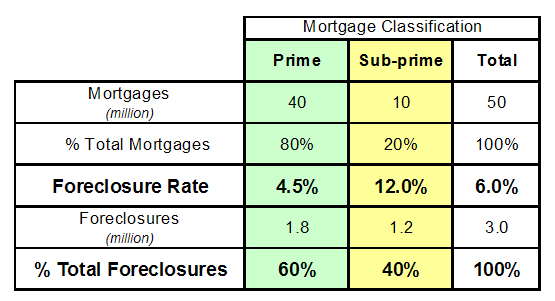
  1. 2/3’s of roughly 125 million households are owner-occupied
  2. 1/3 of owner-occupied households are owned free and clear of any mortgage
  3. 20% of mortgages are sub-prime; most with no down payment; many “under water”
  4. Vast majority  of sub-primes were “unqualified” at fair market (vs. “teaser”) interest rates
  5. 12% of sub-primes are in foreclosure, accounting for 40% of total foreclosures
  6. 50% of foreclosed sub-primes don’t qualify at modified terms (e.g. writing loan down to house’s FMV)
  7. 50% of modified sub-prime loans re-default within 6 months

image

Bottom line: Many of the people being foreclosed on are “occupants” not “owners”.  Help legitimate owners who are going through some tough times; stop delaying the inevitable for the sub-primes — and certainly don’t reward them with deals better than the people who played by rules have.  That’s not fair !

* * * * *

Want more from the Homa Files?
Click link =>
  The Homa Files Blog

The automaker’s specious bankruptcy argument …

December 16, 2008

Excerpted from WSJ, How Destructive Would Bankruptcy Be for Big Three?, December 12, 2008

* * * * *
One of the Big Three’s main arguments for a bailout is that American consumers won’t buy General Motors and Chrysler cars if they are forced into bankruptcy. They would be tainted by a stigma and by worries that warranties and parts wouldn’t be available years down the road if the firms ran the risk of liquidation.

Consumer surveys support this view. One survey of 6000 consumers by CNW Research this summer found that 80% said they would abandon an auto maker if it were to file for bankruptcy.

Does the argument hold up? One way to test it is to look at consumers’ actual behavior. The risk of bankruptcy has obviously risen in the past few months. If bankruptcy is likely to drive consumers away, one might expect to see the market share of GM and Chrysler fall more precipitously as bankruptcy risks rise.

The U.S. market share of the Big Three has been dropping consistently for years, from 74% in the mid-1990s to less than 50% today. But there’s little evidence in the data so far that this longer term pattern has been dramatically amplified by the rising risk of bankruptcy.  

With the whiff of bankruptcy in the air …

Chrysler’s U.S. sales market share has actually risen from 8.7% in July to 11.5% in November, according to  Moody’s Economy.com.

GM’s market share has bounced around but hasn’t dropped below levels hit earlier this year. 

Ford, which isn’t facing an immediate cash crunch, has picked up market share too, rising from 14.2% in July to 16.5% in November.

Of course, sales have been propped up by  fire-sale deals and aggressive fleet sales.  But, that’s not new news.

http://blogs.wsj.com/economics/2008/12/12/how-destructive-would-bankruptcy-be-for-big-three/

* * * * *

Ken’s Take:

1. Is there anyone who doesn’t recognize that the Detroit automakers are hanging by financial threads?  The companies are bankrupt, they’re just not in legal bankruptcy proceedings. If they were, they’d at least stand some chance of restructuring themselves into healthy positions. The current government thinking stands no chance of doing that. 

2. As I’ve said before, they survey results are misleading.  Would somebody be more likely to buy a car from a financially healthy car maker?  Of course.  Would somebody prefer to by from one that is on the brink of financial collapse or one that is in bankruptcy proceedings?  I bet that would be a statistical tie.

* * * * *

Want more from the Homa Files?
Click link =>
  The Homa Files Blog

Feeling pinched these days? Here’s why …

December 16, 2008

Economists estimate households will have lost more than $5 trillion in net worth since the summer of 2007 because of falling home equity and stock prices.

In recent years, households have used their big multiyear wealth gains as a means to afford more debt and as a surrogate form of savings, instead of socking away more of their pay. But by the end of 2008,  They are now more dependent on income growth to finance their spending and saving and less so on credit and wealth.

Source: Business Week
http://www.businessweek.com/magazine/content/08_51/b4113010266237.htm

* * * * *

Ken’s Take: On average, that works out to be about $40,000 per household — or about 80% of median annual household income — i.e. the rough equivalent of an average person being laid of for about a year.  Ouch.

Want more from the Homa Files
Click link =>  The Homa Files Blog

Bush bends, UAW wins big … automakers still bankrupt.

December 15, 2008

Excerpted from IBD, “Rewarding Failure”, December 12, 2008

The proposed $15 billion bailout of the Big Three failed in the Senate for one major reason: Some lawmakers stood up to the unions. But their stand may be moot, since automakers may get the money anyway, even though the idea is wildly unpopular among voters

In addition to major restructuring by the automakers, GOP senators insisted on givebacks by the United Auto Workers. The UAW responded with a resolute “No.” 

Gold-plated union contracts are a big reason for U.S. automakers’ woes (though managerial incompetence at the Big Three also played a role). The average Big Three worker made $73.26 an hour in 2006; the average worker at a foreign transplant, $44.20.

Last year, Toyota made 9.37 million vehicles. GM, virtually the same number. Yet, Toyota made a profit of $38.7 billion on its global operations, or $1,874 per car, while GM lost $38.7 billion, or $4,055 a car, almost entirely due to its operations in the U.S.

* * * * *
Full article:
http://www.ibdeditorials.com/IBDArticles.aspx?id=313977740860863

* * * * *

Want more from the Homa Files?
Click link =>
  The Homa Files Blog

Playing hard ball … UAW says "$75 per hour sounds about right" … what happened to "no more special interests in Washington"?

December 12, 2008

Below are a few highlights from today’s WSJ report on the apparent collapse of the Detroit 3 bailout loan.  My ‘take’ and predictions follow …

* * * * *

Highlights excerpted from WSJ, Rescue Bid for Detroit Collapses in Senate, Dec. 12, 2008

A frantic, last-ditch attempt to forge a relief package for the auto industry collapsed in the U.S. Senate, dealing a giant blow to the immediate hopes of the Big Three.

The talks, which appeared close to a deal several times, broke off due to a sharp partisan dispute over the wages paid to workers at the manufacturing giants.

Republicans demanded the bill be strengthened to exact concessions from the industry. “We simply cannot ask the American taxpayer to subsidize failure”

The initial White House-backed package saying it doesn’t require auto makers and their unions, suppliers, creditors and dealers to make changes needed to return to a sound financial footing.

[Now, both Democrats and the car companies] hope the White House will now relent and allow the Treasury to provide emergency loans from the $700 billion Wall Street fund.

Harry Reid said the Senate would be in recess, and would stand in pro forma session until January, when the new Congress will be convened with stronger Democratic majorities.

After a marathon day of negotiations, top Democrats appeared close to a deal that would toughen the bailout package in a bid to raise Republican support, which had proved an insurmountable stumbling block. The focus of talks was on seeking commitments to restructure the industry’s debt load and bring labor costs in line with wages paid by Toyota and Nissan  in the U.S.

But those talks fell apart after Republicans insisted that wages reach parity in 2009.  Mr. Reid declared talks at an impasse.

Sen. Christopher Dodd, a Connecticut Democrat, complained that Republicans had attempted to turn the wage issue into a political matter about organized labor, instead of making it an “an economic issue.”

The collapse of the talks represents a major defeat for three companies and an auto union that once wielded immense political clout. Even after two appearances in Washington by the GM, Ford and Chrysler CEOs, and a show of solidarity with the UAW, the auto makers were unable to convince many skeptical lawmakers to change their minds and support a bailout.

GM will also discuss plans for its Saturn division. One option includes putting the division into bankruptcy protection, as it is technically a separate entity.

The collapse of the deal raises the stakes for Chrysler and its majority owner, Cerberus Capital. Lawmakers had called for Cerberus to put more money into the company, but Cerberus maintains it can’t because the bylaw of its investment funds prevents it from putting more than a small percentage of its investors’ funds into any single investment.

Full article:
http://online.wsj.com/article/SB122903816924599853.html?mod=testMod

* * * * *

Ken’s Take

  1. There is zero chance that the Detroit 3 can survive with  line workers getting $150,000 per year in salary and benefits.  Yes, it was weak management (in the 1970s, when business was booming and the UAW was striking) that saddled the companies with the problem.  But, there is no imaginable plan that can neutralize a $1,500 to $2,000 per car cost disadvantage.  Adding a  $5,000 battery to each car doesn’t solve the problem — it only exacerbates it.
  2. The problem isn’t “wages”.  The difference in take-home pay between Detroit and the “transplants” is only a couple of dollars.  The problems are gold-plated benefits (about twice as much for the Detroiters,  restrictive work rules that limit flexibility to move workers around (within the plants), and “featherbedding” — paying non-workers. 
  3. This is the issue that will really test Prez-O.  He campaigned, in part, on “no special interests”.  Well, the UAW threw $11 million into his campaign coffers and probably expect some “considerations”.  We’ll see …
  4. My favorite: Cerebus says it can’t throw in more money because of its by-laws.  That is being said at a time that there’s pressure to legislate the re-writing of mortgages and practically every other contract in America.  B.S.  Cerebus knows it’s good money after bad — and they want it to come from taxpayer’s pockets, not their’s.
  5. The “car czar” idea is frighteningly stupid.  Let’s see: the SEC, etc.,  can’t effectively oversee financial companies,  Boards of Directors can’t seem to oversee companies that they’re responsible for …. but, some uber-dude will be able to parachute in, learn a very complex business at warp speed, and — oh yeah — get the UAW in line.  Call me cynical, but I don’t think so.

* * * * *

Ken’s Predictions

  1. Bush will cave and fund the initial stages of this folly … with few “teeth” in the plan except to make the companies promise to “try hard”.
  2. Any teeth that are put in will be relaxed or reversed  on January 21, 2009.  The money will flow from Washington to Detroit, the UAW will prosper, and the Detroit 3 will still be teetering on bankruptcy. 
  3. A car czar will be appointed — the lobbying and politics will be overwhelming — and the poor sap will fail

* * * * *

Want more from the Homa Files?
Click link =>
  The Homa Files Blog

What’s wrong with this statement: “People won’t buy cars from an automaker in bankruptcy”

December 12, 2008

I’ve heard this refrain at least a dozen times on CNBC today.  It’s been repeated so many times that it’s starting to take on the aura of fact.

Let’s dig a little deeper.  Pundits are saying “people who are surveyed say they won’t buy a car from a bankrupt automaker”.

Well, guess what.  The Detroit 3 (or at least GM and Chrysler are bankrupt!

The “fine hair” of difference is whether they go through a “bankruptcy proceeding” that potentially restructures them (and their burdensome union contracts) into a healthier condition.

I’m sure the survey question is — at least implicitly — “would you be more likely to buy a car from a financially healthy automaker or one that is bankrupt?”  Obvious answer, right?

The question should be “would you be more likely to buy a car from an automaker in bankruptcy proceedings, or one that is hanging by its financial finger nails and likely to go into formal bankruptcy in a couple of monthes?”  Rational answer: “none of the above”

What am I missing?

* * * * *
Want more from the Homa Files?
Click link =>
  The Homa Files Blog

Just say "no" … 62.7% oppose Detroit 3 bailout loans … Dems split …Congress says "let's roll"

December 11, 2008
    * * * * *

    image

    http://www.ibdeditorials.com/PollsPopUp.aspx?id=313629919786029

    * * * * *

    Excerpted from Rasmussen Reports,”14% Say Federal Government Will Run Big Three Better”, December 09, 2008

    Nonetheless, Congress and the White House are fast reaching a deal on a bailout plan for the Big Three that many suggest is just a step short of nationalizing the U.S. auto industry since it gives the federal government a say in how the automakers spend their money and what kind of cars they build.

    The short-term loan plan being worked out in Washington calls for the creation of a federal “car czar” who will develop benchmarks by which to measure the automakers’ restructuring and who will have the power to push management, unions, shareholders and others to implement changes

    A longer term bailout plan proposed by President-elect Obama goes even further. “It could mean that the government would mandate, or at least heavily influence, what kind of cars companies make, what mileage and environmental standards they must meet and what large investments they are permitted to make,”

    But only 14% of U.S. voters think the Big Three automakers will run better if they are run by the federal government.

    While voters display little confidence in government control of the automakers, 59% say senior managers of a company should be replaced if taxpayer funding is provided to keep the company afloat.

    Full article:
    http://www.rasmussenreports.com/public_content/business/general_business/just_14_say_federal_government_will_run_big_three_better

    Want more from the Homa Files?
    Click link =>
      The Homa Files Blog

Last comic standing … oops, sorry … I meant "banker"

December 8, 2008

Excerpted from NY Times, “Saluting a Banker in a Year Worth Forgetting”

* * * * *

From the NY Times

It’s like being named the outstanding British soldier of 1776.

The trade publication American Banker unveiled its Banker of the Year award last week: It went to Kenneth D. Lewis, chief of Bank of America.

While Mr. Lewis is a respected executive, 2008 hardly seems like the year for any banker, given how unpopular the industry is these days.

‘One banker observed: ‘He’s a great executive and B. of A.’s a great bank … but it just doesn’t seem like the right time to be dancing in the streets and celebrating banking.”

American Banker said editors  felt they had to laud someone this year.

Its party for the bankers of the year was held Dec. 4 at the Plaza Hotel.

*  * * * *

Added observation

The financial crisis hasn’t been kind to some past honorees.

Kerry Killinger, the 2001 winner, was ousted as CEO of Seattle-based Washington Mutual Inc. in September over disastrous bets on risky mortgages.

The 2005 winner, Ken Thompson, was forced out as CEO of Charlotte-based Wachovia Corp. in June.

In 2006, American Banker gave a Lifetime Achievement award to Countrywide CEO Angelo Mozilo, who gambled on subprime loans and saw his company disintegrating before selling out to Bank of America.

J.P. Morgan Chase & Co. acquired WaMu in September, and Wells Fargo & Co. is buying Wachovia.

Even Bank of America hasn’t come through the crisis unscathed.  Its stock has declined 65% year-to-date.

* * * * *

More from the NY Times:

Corporate executives’ fortunes can fall quickly.

For example, in 2001, Fortune put Enron on its most admired companies list, and Business Week put Tyco International at the top of its best performers list.

Worth magazine placed Jeffrey K. Skilling, the former chief executive of Enron, at No. 2 and L. Dennis Kozlowski, the former chief executive of Tyco, at No. 10 on its list of America’s best chief executives.

Later in 2001, Mr. Skilling resigned as Enron began falling apart. In 2002,Mr. Kozlowski resigned. Both Mr. Skilling and Mr. Kozlowski are now convicted felons.

** * * * *
Full article:
http://query.nytimes.com/gst/fullpage.html?res=9E05E2DA1F38F930A35752C1A96E9C8B63&scp=1&sq=banker+of+the+year&st=nyt

Want more from the Homa Files?
Click link =>
  The Homa Files Blog

A FICA tax holiday? … It’s worth considering.

December 5, 2008

Inspired by IBD, “Bail Out Bill Or Bail Out Joe?”, December 04, 2008

* * * * *

From the article

Nancy Pelosi (wants) another bailout bill in the neighborhood of $500 billion to be ready for President Obama’s signature on Jan. 20.

Rep. Louie Gohmert, R-Texas, has come up with an idea of what to do with that $350 billion, and it involves not rescuing those who have gummed up the works, but relieving the burden on those who have been trying to pull the wagon — suspend FICA and income taxes for two months starting in January 2009.

Gohmert would declare a tax holiday for FICA (Social Security and Medicare) and income taxes.

American taxpayers [a slim majority of adults] pay an average of 25% of their wages in federal income taxes.  [Virtually all American workers pay another 7.25% for FICA — which funds Social Security and Medicare.]

So, in aggregate, Americans pay over $101 billion in income taxes and another $66.5 billion in FICA taxes each month. Two months’ worth is around $332 billion. The employer’s portion of FICA would also be suspended, giving businesses large and small $65 billion in tax relief to expand and hire more workers.

[For an average American family making about $50,000 a year, the FICA tax is about $300 per month — taken directly out of their paychecks.] So, there would be a dramatic increase in take-home pay for the working poor and middle class, and might save more homeowners from bankruptcy and foreclosure.

And, the unspent $350 billion left in the government’s TARP fund could be used to cover the revenue losses in the Treasury, so Social Security and Medicare would not lose a penny.

* * * * *

Ken’s Take

(1) The income tax part is a non-starter for reasons of “fairness” and administration — since withholding doesn’t match perfectly with end-of-year tax liabilities.  Some people have too much withheld and get refunds; some have too little withheld and pay taxes on April 15.

(2) But, I think the the FICA suspension has merit.  Prior to the election, I was opposed to co-mingling income taxes with  “contributions” to the Social Security and Medicare Trust Funds (they’re called “contributions” in the statutes).  But, Obama’s “relief” to the middle class irreversibly lumps them together — folks who don’t pay income taxes get credit checks if they pay so-called payroll taxes. 

(3) So, why not dole out the payroll tax related tax relief in the fastest, administratively easiest way.  Ditch the income tax part of the proposal and suspend FICA for a couple of months. 

I think IBD screwed up the math a bit.  Employers have to match employees’ FICA contributions dollar-for-dollar — so the FICA  free-up would be about $130 billion per month.

The  FICA tax holiday could be extended to 3 or 4 or 5 months by simply capping the monthly “holiday” at, say, $300 per worker so that high income folks don’t get too much of the benefit .

(4) While I still don’t like the co-mingling of income taxes and SS-Medicare contributions, I do like the potential stimulative aspects of the plan: (a) the paycheck effect of the plan would be significant to lower income folks (b) businesses — especially those employing lower and middle income folks get a tax break — which allows them to hire more workers (or stay in business).

(5) Note: this is largely Obama’s middle class tax relief — “rebranding” the philosophically repulsive “refundable tax credits” and adding some tax relief for employers.
 
* * * * *
Full IBD article:
http://www.ibdeditorials.com/IBDArticles.aspx?id=313284571794137 

* * * * *

Want more from the Homa Files?
Click link =>
  The Homa Files Blog

In the new political economy, smart lobbyists will be arriving in hybrids …

December 1, 2008

Excerpted from IBD, “Job One: Wean The Economy Off Of Politics”,  Krauthammer,  November 28, 2008

* * * * * 

We have gone from a market economy to a political economy.

In the old days, if you wanted to get rich, you did it the Warren Buffett way: You learned to read income statements and balance sheets. Today you learn to read political tea leaves.

Today’s extreme stock market volatility is largely a reaction to meta-economic events: political decisions that have vast economic effects. You don’t anticipate Intel’s third-quarter earnings; instead, you guess what side of the bed Henry Paulson will wake up on tomorrow.

We may one day go back to a market economy. Meanwhile,  the two most important implications of our newly politicized economy are the vastly increased importance of lobbying and the massive market inefficiencies that political directives will introduce.

Lobbying used to be about advantages at the margin — a regulatory break here, a subsidy there. Now lobbying is about life and death.

You used to go to New York for capital. Now Wall Street, broke, is coming to Washington. With unimaginably large sums of money being given out, Washington will be subject to the most intense, most frenzied lobbying in American history.

The other kind of economic distortion will come from the political directives issued by newly empowered politicians.

For example, bank presidents are gravely warned by one senator after another about “hoarding” their bailout money. But hoarding is another word for recapitalizing to shore up your balance sheet to ensure solvency. Isn’t pushing money out the window with too little capital precisely the lending laxity that produced this crisis in the first place?

Even more egregious will be the directives to a nationalized Detroit. Sen. Schumer, the noted automotive engineer, has declared “a business model based on gas” to be completely unacceptable. He says,  “We need a business model based on cars of the future: the plug-in hybrid electric car.”

The Chevy Volt, for example? It has huge remaining technological hurdles, gets 40 miles on a charge and will sell for about $40,000, necessitating a $7,500 outright government subsidy. Who but the rich and politically correct will choose that over a $12,000 gas-powered Hyundai?

The new Detroit churning out Schumer-mobiles will make the steel mills of the Soviet Union look the model of efficiency.

* * * * *

Full article:
http://www.ibdeditorials.com/IBDArticles.aspx?id=312760589983880 

* * * * *

Want more from the Homa Files?
Click link =>
  The Homa Files Blog

Glub, glub, glub … mortgages under water.

November 20, 2008

Excerpted from WSJ, “How to Help People Whose Home Values Are Underwater”, Feldstein, November 18, 2008

* * * * *

More than 12 million homeowners now have mortgage debt that exceeds the value of their homes.

That gap is typically already very large. Half of the homeowners with negative equity now owe more than 120% of the value of their homes … on average, that’s about $40,000.

If  house prices continue to fall at the current rate for the next 12 months, as experts generally expect, the median loan-to-value ratio of negative-equity homeowners will increase to more than 135%.

* * * * *

These negative-equity homeowners have an incentive to default because mortgages are generally “no recourse” loans. That means creditors can take the property if the individual defaults, but cannot take other assets or income to make up the difference between the unpaid loan balance and the lower value of the house. As a result, mortgage default rates are now rising rapidly and are expected to go much higher.

* * * * *
Full article:
http://online.wsj.com/article/SB122697004441035727.html

* * * * *

Want more from the Homa Files?
Click link =>
  The Homa Files Blog

Bold Stroke: Get investors to buy buy & rent distressed residential property … here's how & why

November 18, 2008

Some history
In the old days, investors would snatch foreclosed properties at bargain basement prices, rent them out for a couple of years, and bag the profits — paying taxes at capital gains rates.  Housing prices were increasing at a slow steady rate, but that was good enough.  Why? Ordinary income tax rates were high relative to capital gains rates, and gains on the sale of rental property were capital gains.  Investors could deduct depreciation when they owned and rented the property — creating a tax loss that could be applied to ordinary income. In effect, the investors were arbitraging the ordinary income tax rate against the capital gains rates,

Fast forward
Today, there are plenty of cheap properties on the market (think foreclosures).  Why aren’t investors snatching them up?  Well, in part because they fear the housing market hasn’t bottomed out, and in part because the tax laws aren’t as favorable as they used to be.

What happened?  Well, the “paper losses” from depreciation lost some value when rules were established to limit so-called “passive losses”. Then, ordinary income tax rates were slashed, narrowing the gap between ordinary income and capital gains rates.  The incentives to buy and rent property diminished.  Now, Obama plans to raise capital gains rates MORE than ordinary income rates — further diminishing the tax advantages of buying and renting.

The opportunity
Imagine a flood of private capital swooping in to buy distressed residential properties at current market values.  The benefits: takes properties off the market (for awhile) and potentially bids prices up (a little).  After the market stabilizes, the properties “naturally” flow back onto the market at an orderly pace.

How to do it

(1) Allow very accelerated depreciation on rental properties — say, 10 years — to increase the “paper” tax losses

(2) Eliminate passive loss limitations on residential rental property — allowing unlimited rental property losses to be applied to ordinary income (and carried forward, if necessary)

(3) Cut the capital gains tax rate to ZERO on residential property purchased after, say, November 15, 2008 — re-establishing the incentives for investors to buy, rent, and sell

* * * * *

Want more from the Homa Files?
Click link =>
  The Homa Files Blog

Are those Warren Buffett’s fingerprints ?

November 18, 2008

Excerpted from Portfolio.com, “The End of Wall Street”, Lewis, Nov. 14, 2008

* * * * *
“As an investor, Eisman was allowed on the quarterly conference calls held by Moody’s . The C.E.O. even invited Eisman and his team to his office for a visit in June 2007. By then, Eisman was so certain that the world had been turned upside down that he just assumed this guy must know it too. “But we’re sitting there,” Daniel recalls, “and he says to us, like he actually means it, ‘I truly believe that our rating [of sub-prome mortgage backed securities] will prove accurate.’ And Steve shoots up in his chair and asks, ‘What did you just say?’ as if the guy had just uttered the most preposterous statement in the history of finance. He repeated it. And Eisman just laughed at him.”

“With all due respect, sir,” Daniel told the C.E.O. deferentially as they left the meeting, “you’re delusional.”
This wasn’t Fitch or even S&P.

This was Moody’s, the aristocrats of the rating business, 20 percent owned by Warren Buffett.”

* * * * *

Ken’s Take: How come Mr. Buffett gets a pass on this mortgage mess?  Until this article, I hadn’t seen his ownership stake in Moody’s — which rated the toxic assets AAA — mentioned anywhere.

* * * * *

For an “inside baseball” narrative of the sub-prime mortgage backed security mess — the best I’ve seen —
read the full article :
http://www.portfolio.com/news-markets/national-news/portfolio/2008/11/11/The-End-of-Wall-Streets-Boom

Want more from the Homa Files?
Click link =>
  The Homa Files Blog

Must Read: The End of Wall Street

November 17, 2008

Excerpted from Portfolio.com, “The End of Wall Street”, Lewis, Nov. 14, 2008

The era that defined Wall Street is finally, officially over. Michael Lewis, who chronicled its excess in Liar’s Poker, returns to his old haunt to figure out what went wrong.

Fallen bull statue in Wall Street

To this day, the willingness of a Wall Street investment bank to pay me hundreds of thousands of dollars to dispense investment advice to grownups remains a mystery to me. I was 24 years old, with no experience of, or particular interest in, guessing which stocks and bonds would rise and which would fall. The essential function of Wall Street is to allocate capital—to decide who should get it and who should not. Believe me when I tell you that I hadn’t the first clue.

I stumbled into a job at Salomon Brothers in 1985 and stumbled out much richer three years later,The whole thing still strikes me as preposterous—which is one of the reasons the money was so easy to walk away from. I figured the situation was unsustainable. Sooner rather than later, someone was going to identify me, along with a lot of people more or less like me, as a fraud. Sooner rather than later, there would come a Great Reckoning when Wall Street would wake up and hundreds if not thousands of young people like me, who had no business making huge bets with other people’s money, would be expelled from finance.

In the two decades since then, I had been waiting for the end of Wall Street. The outrageous bonuses, the slender returns to shareholders, the never-ending scandals, the bursting of the internet bubble, the crisis following the collapse of Long-Term Capital Management: Over and over again, the big Wall Street investment banks would be, in some narrow way, discredited. Yet they just kept on growing, along with the sums of money that they doled out to 26-year-olds to perform tasks of no obvious social utility.

At some point, I gave up waiting for the end. There was no scandal or reversal, I assumed, that could sink the system.

* * * * *

Meridith Whitney was an obscure analyst of financial firms for Oppenheimer Securities who, on October 31, 2007, ceased to be obscure. On that day, she predicted that Citigroup had so mismanaged its affairs that it would need to slash its dividend or go bust.  Meredith Whitney caused the market in financial stocks to crash.  Her message was clear. If you want to know what these Wall Street firms are really worth, take a hard look at the crappy assets they bought with huge sums of ­borrowed money, and imagine what they’d fetch in a fire sale. The vast assemblages of highly paid people inside the firms were essentially worth nothing.

Now, obviously, Meredith Whitney didn’t sink Wall Street. She just expressed most clearly and loudly a view that was, in retrospect, far more seditious to the financial order than, say, Eliot Spitzer’s campaign against Wall Street corruption. If mere scandal could have destroyed the big Wall Street investment banks, they’d have vanished long ago. This woman wasn’t saying that Wall Street bankers were corrupt. She was saying they were stupid. These people whose job it was to allocate capital apparently didn’t even know how to manage their own.

* * * * *

Hooked ?

For an “inside baseball” narrative of the sub-prime mortgage backed security mess — the best I’ve seen —
read the full article :
http://www.portfolio.com/news-markets/national-news/portfolio/2008/11/11/The-End-of-Wall-Streets-Boom

Want more from the Homa Files?
Click link =>
  The Homa Files Blog

Bold Stroke: Cut capital gains rate on stock … to ZERO … here’s how & why

November 17, 2008

McCain was onto something when he proposed cutting the capital gains rate to 7.5% for the next year or two.  But, he left the idea half-baked and, as usual, didn’t communicate it very well

Here’s my bold stroke:

How:
Cut the capital gains rate to ZERO on stocks (not derivatives or other funky financial products) that are purchased after, say, November 15, 2008 and held for 12 months or until January 1, 2010 — whichever is longer.

Why:
The market seems to be a buying opportunity now, but investors are reluctant to jump in.  Why? Because of fear that (1) the market hasn’t bottomed — lending is stalled, TARP is a mess, earnings are deteriorating (2) Obama hasn’t backed off on his plan to increase capital gains rates.

The 2nd fear is the easiest to fix.  Eliminating the capital gains taxes on “new” stock purchases would tilt the risk-reward equation a bit.  Maybe enough to draw some capital off the sidelines and into the market — boosting stock prices, or at least providing some low-end support.

* * * * *

Want more from the Homa Files?
Click link =>
  The Homa Files Blog

Things are tough all over … Wall Street bonuses fall

November 7, 2008

Excerpted from WSJ, “On Street, the Incredible Shrinking Bonus”, Nov. 4, 2008

* * * * *

Ken’s Qs:

(1) Is it just my imagination or is the market down about 1/3 with most firms crumbled to the ground ?

(2) Wonder why there’s backlash against the top 5% ?

(3) How do these guys sleep at night ?

* * * * *

Among investment bankers who maintain contact with corporate clients but don’t make trading decisions, managing directors could see their bonus fall 50% to between $900,000 and $1.1 million.

Managing directors (who make trading decisions) could see their bonus fall 50% to $750,000 to $950,000. Their base pay is about $200,000 a year.

Bonuses will shrink less in businesses that have held up relatively well. In foreign-exchange trading, a managing director could expect a 15% drop in bonus to $1 million to $1.5 million

Vice presidents with three years of experience could expect a 55% cut in bonus to $200,000 to $250,000, on top of a base of $130,000 to $150,000.

In commodities, where prices surged and then fell, a managing director could see a 25% drop to a bonus of $3.5 million to $4 million.

* * * * *

But at Citigroup.’s Phibro commodities-trading unit, where results topped last year’s performance, Andrew Hall, who runs the unit, is slated to receive compensation for fiscal 2008 topping $125 million, according to people familiar with the firm. Other employees of Phibro, of Westport, Conn., also are getting big payments, these people said.

* * * * *

Source:
http://online.wsj.com/article/SB122593559284203785.html

* * * * *

Want more from the Homa Files?
Click link =>
  The Homa Files Blog

Poor old Warren Buffett

November 4, 2008

Excerpted from AP, “CEOs, famous investors hit hard by market plunge”, Nov. 2, 2008

* * * * *

The Standard & Poor’s 500 stock index, has lost about 36 percent since January, with every single sector – including once thriving energy and utilities – seeing declines of about 20 percent or more.

Such losses in the last year have wiped out an estimated $2 trillion in equity value from 401(k) and individual retirement accounts, nearly half the holdings in those plans. Similar losses are seen in the portfolios of private and public pension plans, which have lost $1.9 trillion, the researchers found.

* * * * *

Here’s something that might provide a bit of solace amid the plunging values in your retirement accounts: Warren Buffett is losing lots of money, too. So are Kirk Kerkorian, Carl Icahn and Sumner Redstone.

And they can’t just blame the market’s downdraft – some did themselves in with badly timed stock purchases or margin calls on shares bought with loans.

* * * * *

The average year-to-date decline is 49 percent for the corporate stock holdings of CEOs .

Topping that list is Buffett, who has seen the value of equity in his company, Berkshire Hathaway, fall by about $13.6 billion, or 22 percent, so far this year, to leave his holdings valued at $48.1 billion.

Oracle founder and CEO Larry Ellison has seen his equity stake fall by $6.2 billion, or about 24 percent, to $20.1 billion.

Rounding out the top five in that study were Microsoft’s Steve Ballmer, whose company equity fell by $5.1 billion to $9.4 billion; Amazon.com’s Jeff Bezos, whose equity fell by $3.6 billion to $5.7 billion; and News Corp.’s Rupert Murdoch, with a $4 billion contraction to $3 billion.

* * * * *

“Fishing isn’t called catching, and investing isn’t just called making money,” Hansen said. “We have to remember that things can go down by a lot.”

* * * * *

Full article:
http://www.forbes.com/feeds/ap/2008/11/02/ap5636866.html?partner=alerts

* * * * *

Want more from the Homa Files?
Click link =>
  The Homa Files Blog

Keep your toxic securities, we’ll take preferred stock …

October 15, 2008

Excerpted from WSJ: “‘Distasteful’ Capital”, Oct. 15, 2008

* * * * * 

The government’s rescue plan moved into a new phase with the announcement that Treasury is injecting $125 billion into the country’s nine largest banks  … as much as $25 billion each for the biggest. Another $125 billion is on the table for other banks that need capital on the same terms offered to the big boys.

Despite the risks, directly recapitalizing the banks is likely to prove a better tool than buying up “troubled assets.” 

Giving banks this additional capital cushion should give them some leeway to sell those assets at market prices without risking insolvency. At the same time, it avoids the vexing problem of how to price securities that the smartest minds in finance are having trouble assigning a value to.

And unlike buying dodgy mortgage paper, recapitalizing banks is something the government has done before and knows how to do, more or less. The FDIC has done so from time to time via open-bank interventions, and the Depression-era Reconstruction Finance Corp. recapitalized thousands of banks in the 1930s.

Under the program, banks that participate will pay 5% interest annually on nonvoting, senior preferred shares issued to Treasury. Treasury will also receive warrants to buy bank stock at the market price at the time of the capital injection. The warrants, equal to 15% of the face value of the preferred shares issued by the bank, offer some possibility of profit for the Treasury without being so dilutive to existing shareholders as to scare away private capital.

* * * * *

Full article:
http://online.wsj.com/article/SB122402721776634391.html

* * * * *

Want more from the Homa Files?
Click link =>
  The Homa Files Blog

More lessons from the financial crisis …

October 15, 2008

Excerpted from Harvard Business Online, “6 Lessons We Should Have Learned Already”, by Paul B. Carroll and Chunka Mui, September 30, 2008

* * * * *

The collapse of Washington Mutual, Wachovia, Lehman Brothers, AIG, Bear Stearns, Merrill Lynch, and others soon to fall stem from discredited strategies that should have been avoided.

Here are six lessons that, had they been learned a decade ago, would have kept us from being in our current mess:

* * * * *

1. It doesn’t work to let dealmakers make all their money up front.

Whether it’s lenders hawking mortgages, bankers pushing bonds, or salespeople closing contracts before the end of the quarter, dealmakers have to have responsibility for the health of those decisions years down the road. Where possible, the individuals who make the deals should also have their compensation depend on the long-term performance of those deals.

Green Tree Financial showed how dangerous it can be to separate up-front fees from long-term responsibility. In the 1990s, Green Tree offered mortgages on mobile homes that made no long-term sense — the mortgages lasted 30 years, while the underlying assets had a useful life of just 10 to 15 years. Yet, because Green Tree employees from the CEO on down had so much of their pay tied to the growth in the number of mortgages, the company churned out flawed loans at an ever-accelerating pace. When problems started to surface, Green Tree actually managed to sell itself to Conseco for almost $6 billion in 1999. Conseco subsequently wrote off all the profits that Green Tree ever recorded and went into bankruptcy proceedings.

Subprime lenders, having missed the Green Tree lesson, likewise became addicted to up-front fees and generated an astonishing number of bad loans that were turned into securities and sold.

2. Risks may correlate more than you think. In other words, a single problem can take you down if it’s severe enough.

Long Term Capital Management thought it had diversified its risks in the 1990s but found its whole portfolio turning sour simultaneously and collapsed in 1998. Having missed that lesson, this time around companies such as Merrill Lynch and WaMu built huge portfolios of mortgage-related securities that relied on historical data suggesting that housing markets were localized — in other words, the market in Denver was independent of the market in Sacramento, which was independent of the market in Pittsburgh. In fact, the credit crunch has clobbered all markets and all classes of lenders.

3. In a crisis, liquidity can disappear overnight.

LTCM thought that, in the event of problems, it could always unwind its positions in orderly fashion. In fact, all buyers disappeared. The same thing happened to Merrill, WaMu and others. The market got so scared so fast that nobody would buy their debt portfolios at almost any price. While Bank of America might have bought Merrill at a bargain for $50B, they also acquired $64B of toxic debt that will eventually mushroom the true cost of the acquisition.

4. It’s incredibly dangerous to buy a business unless you understand it in excruciating detail.

Conseco showed the danger. It had a great record of buying and integrating companies, but they were all in insurance. Conseco didn’t know anything about mortgages. It was so clueless about the problems with Green Tree’s business model that it actually stepped up the mortgage business, right to the point where it collapsed. AIG repeated the mistake when it started offering credit-default insurance on mortgage-backed securities that it didn’t understand. Merrill made this mistake when it decided it could copy Goldman Sachs and invest its own capital in what turned out to be toxic loans. (And Bank of America may have made this mistake when it agreed to buy Merrill, whose retail brokerage operation, investment banking unit and investment portfolio are outside its expertise.) As a colleague of ours says: Don’t assume someone smarter than you will understand the risks you’re taking on.

5. Whenever anyone says they’ve managed to do away with risk, head for the hills.

LTCM said its portfolio was impervious to risk. AIG and others said the same thing about the securities that were built based on subprime mortgages. We’ve no doubt that yet others will be saying the same as they argue for ways to take advantage of others’ mistakes as the current crisis unfolds.

6. Perhaps the greatest lesson of all is that bad strategies can happen to great companies and smart people.

The humility that comes with this lesson should cause the smartest companies and managers to instill process and cultural mechanisms that absorb these lessons and avoid such mistakes in the future by creating a culture of constructive debate and deliberation.

Edit by DAF

* * * * *

Note: The authors researched 2,500 major failures and recently published both the Harvard Business Review article, “Seven Ways to Fail Big” and their book, “Billion-Dollar Lessons: What You Can Learn from the Most Inexcusable Business Failures of the Last 25 Years”.

* * * * *

Full article:
http://conversationstarter.hbsp.com/2008/09/six_lessons_we_should_have_lea.html?cm_mmc=npv-_-WEEKLY_HOTLIST-_-OCT_2008-_-HOTLIST1006

* * * * *

Want more from the Homa Files?
Click link => 
The Homa Files Blog

* * * * *

Financial crisis: history repeating itself ?

October 14, 2008

Source: IBD: “America’s Second Wake-Up Call!”, Oct. 10, 2008
http://www.ibdeditorials.com/IBDArticles.aspx?id=308530236252361

* * * * *

Want more from the Homa Files?
Click link =>
  The Homa Files Blog

Worth reading: Lessons from the financial crisis …

October 9, 2008

Excerpted from RealClearPolitics.com: “Wall Street 101”, Victor Davis Hanson, October 09, 2008

* * * * *

Until the past few weeks, the financial panic was still mostly far away on Wall Street. But not now.

Car loans, mortgages and college financing are suddenly harder to come by. Millions are stuck in houses not worth what is owed on them. Cash-strapped consumers are cutting back. The economy is slowing. Jobs are disappearing. Who wants to open quarterly 401(k) statements only to learn that everything they put away in retirement accounts the past two or three years is gone?

There is plenty of blame to go around. Greedy Wall Street speculators took mega-bonuses even when they knew their leveraged companies were tottering — and someone else would pick up the tab. Crooked or stupid politicians allowed Fannie Mae and Freddie Mac to squander billions, as they raked in campaign donations and crowed about their politically correct support for millions of shaky — and now mostly defaulting — buyers.

The new national gospel became charge now/pay later and speculate, rather than put something away in case of a downturn. To provide more goodies that we hadn’t earned, politicians ignored soaring annual budget deficits and staggering national debt and kept spending.

* * * * *  

But amid the gloom, there are some valuable lessons that we can take away from the Wall-Street panic.

First, cash really is king. For all the talk of a trillion here or billions there, when the crunch came many of these investment houses and their once-strutting managers found themselves with a minus net worth. They were desperate to find liquidity — any money anywhere they could find it. Pedestrian passbook savings accounts proved wiser investments than all the clever hedge funds, derivatives and subprime schemes put together.

Second, wisdom and blue-chip college educations are not quite the same thing. The fools in Washington and New York who blew up Wall Street had degrees from our finest professional schools. [For example, Barney Frank and Franklin Raines are both Harvard Law graduates.] If these guys are our best and brightest, then it is about time we rethink what constitutes wisdom, since an Ivy League law degree certainly seemed no proof of either intelligence or ethics.

Third, we as a nation need to relearn the old notion of shame — as in, “Shame on you!” Firms like Lehman Brothers and Bear Stearns were once responsible Wall Street institutions, built up over decades by sober men. But their far-lesser successors in just a few months have bankrupted these venerable brokerage houses — with seemingly no shame at what they have done to the image of Wall Street.

* * * * *

Americans used to pay their debts. Somewhere in all the blame-gaming about the crooks and liars in New York and Washington, we never hear that real people borrowed real money that they should not have. And they then defaulted on what they owed to others. Walking away from debts may have been understandable, but it was also a violation of trust — and wrong.

Finally, what one makes is no proof of his worth. Almost every head of a Wall Street firm took tens of millions of dollars in bonuses these past few years, as they posted phony profits by borrowing ever more with ever fewer assets. But if financing facilitates the American economy, we should remember that less exotic and remunerative construction — such as farming, manufacturing and mining — is what really powers America.

* * * * *

How odd that all those boring lessons from our grandparents turn out to be true in the globalized, hip 21st century: Save your money. Don’t borrow what you can’t pay back. Look first at a man’s character, not his degrees. And if a promised return on an investment seems too good to be true, it probably is.

* * * * *

Victor Davis Hanson is a classicist and historian at the Hoover Institution, Stanford University,

* * * * *
Full article:
http://www.realclearpolitics.com/articles/2008/10/wall_street_101.html

* * * * *

Want more from the Homa Files?
Click link =>
  The Homa Files Blog

Blame Wal-Mart, not deregulation for the financial mess …

October 7, 2008

Ken’s POV: I’ve been saying — only half in jest — that Wal Mart is at the root of the financial mess.  Not because they’re bad guys, but because they have been able to keep retail prices so low for so long — via efficient logistics and smart procurement, buying lots of low cost goods from off-shore.  Why is that important? Because the Fed trades off inflation and unemployment when it sets interest rates.  When inflation is low, rates can stay low to enable growth.  Wal Mart is big enough that it alone had a major impact suppressing inflation.  Well, prices stayed low and interest rates stayed low, so folks were able to make dumb decisions (higher rates make people think harder about financial decisions, and discourages debt-building). What I was missing was the China Syndrome — the transfer and recycling of wealth from the US to China and back.  Now, that’s a problem.

* * * * *

Excerpted from Wash Post: “Blaming Deregulation”, Sebastian Mallaby, Oct. 6, 2008

* * * * * 

The claim that the financial crisis reflects Bush-McCain deregulation is … only nonsense.

The real roots of the crisis lie in a flawed response to China. Starting in the 1990s, the flood of cheap products from China kept global inflation low, allowing central banks to operate relatively loose monetary policies. But the flip side of China’s export surplus was that China had a capital surplus, too. Chinese savings sloshed into asset markets ’round the world, driving up the price of everything from Florida condos to Latin American stocks.

That gave central bankers a choice: Should they carry on targeting regular consumer inflation, which Chinese exports had pushed down, or should they restrain asset inflation, which Chinese savings had pushed upward? Alan Greenspan’s Fed chose to stand aside as asset prices rose; it preferred to deal with bubbles after they popped by cutting interest rates rather than by preventing those bubbles from inflating. After the dot-com bubble, this clean-up-later policy worked fine. With the real estate bubble, it has proved disastrous.

So the first cause of the crisis lies with the Fed, not with deregulation. If too much money was lent and borrowed, it was because Chinese savings made capital cheap and the Fed was not aggressive enough in hiking interest rates to counteract that. Moreover, the Fed’s track record of cutting interest rates to clear up previous bubbles had created a seductive one-way bet. Financial engineers built huge mountains of debt partly because they expected to profit in good times — and then be rescued by the Fed when they got into trouble.

* * * * * 

Framing the mess as the product of deregulation will make the backlash nastier.

The next president will have to make some subtle choices. In certain areas, markets need to be reformed — by pushing murky “over-the-counter” trades between banks onto transparent exchanges, for example. In other areas, government needs to fix itself — by not subsidizing reckless mortgage lending … Everyone concedes that Fannie and Freddie poured fuel on the fire to the tune of hundreds of billions of dollars.

* * * * *

See the full article for a strong argument re: why “soft” regulation didn’t cause the current mess.
http://www.washingtonpost.com/wp-dyn/content/article/2008/10/05/AR2008100501253_pf.html

* * * * *

Want more from the Homa Files?
Click link =>
  The Homa Files Blog

September Madness – The Wall Street Final Four (bracket attached)

October 3, 2008

For entertainment only … wagering is illegal (unless its on mortgage backed securities)


* * * * *

Want more from the Homa Files?
     Click link =>
  The Homa Files Blog

Fannie Mae and the Vast Bipartisan Conspiracy

September 22, 2008

Excerpted from Slate: “Fannie Mae and the Vast Bipartisan Conspiracy”,  Jack Shafer, Sept. 16, 2008

* * * * *

My POV:

Slate leans left, so I find its revelations particularly note worthy.  Repubs are dirtied by drinking from the lobbying trough.  Dems own the CEOs and folks who raked off the uber-dollars.  A pretty disgusting picture … Read the full article (link below) for names of “bit” players and more context.

* * * *

Article Highlights

The blowup and bailout of Fannie Mae and Freddie Mac by taxpayers was foretold so many times in the last three decades by critics of the two federally chartered and subsidized mortgage giants that not even the data-searching powers of Nexis, Factiva, and Google combined can total them.

The Wall Street Journal editorial page deserves a special commendation for hammering these two outposts of corporate socialism, not that the page’s many warnings over the years helped avert disaster.

Mae and Mac—especially Mae—were just too nurtured by the Washington establishment  — an  “influential network that extends from the highest reaches of the Clinton Administration to the ranks of conservative Republicans on Capitol Hill.”

The bipartisan network provided the essential cover Fannie Mae needed to run its scam.

* * * * *

The key to Fannie Mae’s survival was the patronage operation it ran.  “For years, high-level jobs at Fannie Mae were lucrative prizes for lawyers, bankers and political operatives waiting for their next U.S. government post.”

Now that the jig is up, let’s meet some of the bipartisan warriors who fought for Fannie Mae’s right to plunder.

At the top of the list we must place Franklin D. Raines, chairman and chief executive officer of Fannie Mae from 1998 to 2004. Raines, who served as director of the Office of Management and Budget under President Clinton.  He  was forced to leave Fannie Mae in 2004, when regulators discovered it had broken accounting rules “in an effort to conceal fluctuations in profit and hadn’t maintained adequate risk controls.” The New York Times reported two year ago that regulators “have said that of the $90 million paid to Mr. Raines from 1998 to 2003 at least $52 million—more than half—was tied to bonus targets that were reached by manipulating accounting.” Raines agreed to a $24.7 million settlement with a federal regulator in exchange for charges being dropped, but he admitted no wrongdoing.

Next up is Jamie S. Gorelick,  Deputy Attorney General during the Clinton administration. Although Gorelick had no background in finance, she joined Fannie Mae in 1997 as vice chair and departed in 2003. For her trouble, Gorelick collected a staggering $26.4 million in total compensation, including bonuses.

Republicans also proved willing to serve Fannie Mae. Robert B. Zoellick, current head of the World Bank, has served President Reagan, President Bush 1, and President Bush 2 as a trade representative, deputy secretary of state, deputy secretary of the treasury, deputy chief of staff, and so on. Zoellick’s  title at Fannie was executive vice president in charge of lobbying, public affairs, and affordable housing. According to a July 23, 1997, report in the American Banker, Zoellick “has used his close ties to Republicans in Congress, such as Speaker of the House Newt Gingrich, to defend Fannie Mae from new taxes.”

Moving back across the aisle, let’s say hello to Mr. Democrat James A. Johnson, who ran Fannie Mae from 1991 to 1998, served as vice chairman from 1990 to 1991, and earlier worked as a managing director at Lehman Bros. and for Vice President Walter F. Mondale. He made news earlier this summer when he had to resign as vice-presidential-candidate vetter for Barack Obama “as new details emerged about loans Mr. Johnson received from mortgage lender Countrywide Financial”  Mr. Johnson has made Fannie Mae both a launching pad and a landing strip for officials moving in and out of politics and Government in Washington.” Johnson earned nearly $21 million from Fannie Mae in 1998.

But Fannie Mae is nothing if not ecumenical. According to the Associated Press, Fannie Mae and Freddie Mac have spent $170 million on lobbying in the past decade. “Fannie Mae’s 51-member lobbying stable” includes “former Reps. Tom Downey, D-N.Y., and Ray McGrath, R-N.Y.; Steve Elmendorf, a Democratic political strategist and former congressional aide; and Donald Fierce, a longtime GOP operative. Freddie Mac’s list of 91 lobbyists includes former Reps. Vin Weber, R-Minn., and Susan Molinari, R-N.Y.” The AP notes the Fannie Mae ties enjoyed by McCain campaign manager Rick Davis and Arthur B. Culvahouse Jr., who helped in McCain’s veep search. According to Politico, McCain economic adviser Aquiles Suarez worked as Fannie Mae’s director of government and industry relations, and McCain finance co-chairman Frederic V. Malek spent time on the Freddie Mac board.

* * * * *

The bipartisan Fannie Mae gang appears to have broken few, if any, laws. Their crime was to have practiced—without any thought of the consequences—”access capitalism,” which Michael Lewis defined in the New Republic as “a neat solution for people who don’t have a whole lot to sell besides their access, but who don’t want to appear to be selling their access.”

“The scandal in Washington isn’t what’s illegal. It’s what’s legal.”

“The abiding lesson here is what happens when you combine private profit with government power. You create political monsters that are protected both by journalists on the left and pseudo-capitalists on Wall Street, by liberal Democrats and country-club Republicans.”

* * * * *

Full article:
http://www.slate.com/id/2200160/

* * * * * 

Want more from the Homa Files?
Click link =>
  The Homa Files Blog