Archive for the ‘Health Care / Medical Insurance’ Category

Rasmussen: Majority of Americans trust GOP more on Health Care …

April 13, 2010

Punchline: Voters now trust Republicans more than Democrats on nine out of 10 key issues regularly tracked by Rasmussen Reports

* * * * *

Excerpted from Rasmussen: 53% Now Trust Republicans More Than Democrats on Health Care, Saturday, April 03, 2010

Following the passage of the health care bill, 53% now say they trust Republicans on the issue of health care. Thirty-seven percent (37%) place their trust in Democrats.

A month earlier, the two parties were essentially even on the health care issue.

* * * * *

Which party do you trust more on the following issues?

image
http://www.rasmussenreports.com/public_content/politics/mood_of_america/trust_on_issues

It’s not a fine, it’s not a tax … it’s a "different tax status" … just like being married

April 9, 2010

Remember those 16,000 new IRS agents who will be policing implementation of ObamaCare ?

Well, turns out that they won’t be collecting fines or taxes … they’ll just be reclassifying non-compliers into “alternative tax statuses”.  Whew.

Who comes up with this stuff ?

Here’s a minute of spin worth watching …

Wash Post: The answer was a doozy … “Holy filibuster, Batman”

April 6, 2010

Punchline: I once worked with a guy who sorted managers into two categories: simplifiers and complicators … his view: the former always win.

If ObamaCare is so good and the President is so smart, articulate, and practiced on the subject … why can’t he explain it?

Here’s the Wash Post recap; below are links to the text & video of the President’s answer … and a great summation by Charles Krathammer.

From the Washington Post, “Obama’s 17-minute, 2,500-word response to woman’s claim of being over-taxed”, April 2, 2010

Even by President Obama’s loquacious standards, an answer he gave here in Charlotte on health care was a doozy.

Toward the end of a question-and-answer session with workers at an advanced battery technology manufacturer, a woman asked the president whether it was a “wise decision to add more taxes to us with the health care package”.

“We are over-taxed as it is”. 

Obama started out feisty.

“Well, let’s talk about that, because this is an area where there’s been just a whole lot of misinformation, and I’m going to have to work hard over the next several months to clean up a lot of the misapprehensions that people have.”

He then spent the next 17 minutes and 12 seconds lulling the crowd into a daze.

His discursive answer – more than 2,500 words long — wandered from topic to topic, including commentary on the deficit, pay-as-you-go rules passed by Congress, Congressional Budget Office reports on Medicare waste, COBRA coverage, the Recovery Act and Federal Medical Assistance Percentages (he referred to this last item by its inside-the-Beltway name, “F-Map”). He talked about the notion of eliminating foreign aid (not worth it, he said). He invoked Warren Buffett, earmarks and the payroll tax that funds Medicare (referring to it, in fluent Washington lingo, as “FICA”).

Always fond of lists, Obama ticked off his approach to health care — twice. “Number one is that we are the only — we have been, up until last week, the only advanced country that allows 50 million of its citizens to not have any health insurance,” he said.

A few minutes later he got to the next point, which seemed awfully similar to the first. “Number two, you don’t know who might end up being in that situation,” he said, then carried on explaining further still.

“Point number three is that the way insurance companies have been operating, even if you’ve got health insurance you don’t always know what you got, because what has been increasingly the practice is that if you’re not lucky enough to work for a big company that is a big pool, that essentially is almost a self-insurer, then what’s happening is, is you’re going out on the marketplace, you may be buying insurance, you think you’re covered, but then when you get sick they decide to drop the insurance right when you need it,” Obama continued, winding on with the answer.

Halfway through, an audience member on the riser yawned.

But Obama wasn’t finished. He had a “final point,” before starting again with another list — of three points.

“What we said is, number one, we’ll have the basic principle that everybody gets coverage,” he said, before launching into the next two points, for a grand total of seven.

His wandering approach might not matter if Obama weren’t being billed as the chief salesman of the health-care overhaul. Public opinion on the bill remains divided, and Democratic officials are planning to send Obama into the country to persuade wary citizens that it will work for them in the long run.

It was not evident that he changed any minds at the event.

The audience sat politely, but people in the back of the room began to wander off.

Even Obama seemed to recognize that he had gone on too long. He apologized — in keeping with the spirit of the moment, not once, but twice. “Boy, that was a long answer. I’m sorry,” he said, drawing nervous laughter that sounded somewhat like relief as he wrapped up.

But, he said: “I hope I answered your question.”

Source article:
http://voices.washingtonpost.com/44/2010/04/obamas-17-minute-2500-word-res.html

Video of Obama’s answer:
http://www.youtube.com/watch?v=0Jz6y_16NI8

Text of Obama’s answer:
http://whitehouse.blogs.foxnews.com/2010/04/02/obamas-17-minute-14-second-answer-on-higher-taxes-and-health-care/ 

=> Krauthammer’s rephrasing of the answer:
http://www.wikio.co.uk/video/krauthammer-20-seconds-correct-answer-obama-rant-3041426

Bending the cost curve or just making tax payers bend over ?

April 5, 2010

Punch line: ObamaCare intends to squeeze an extra $1.2 trillion over 10 years from a minority of citizens — the taxpayers.

The key assumption — that tax payers won’t change behavior to contain tax impacts — has been proven to be fallacious in the past, and isn’t likely in the future …

Excerpted from WSJ: The Rich Can’t Pay for ObamaCare, March 30, 2010

President Barack Obama’s new health-care legislation aims to raise $210 billion over 10 years to pay for the extensive new entitlements … by slapping a 3.8% “Medicare tax” on interest and rental income, dividends and capital gains of couples earning more than $250,000, or singles with more than $200,000.

The president also hopes to raise $364 billion over 10 years from the same taxpayers by raising the top two tax rates to 36%-39.6% from 33%-35%, plus another $105 billion by raising the tax on dividends and capital gains to 20% from 15%, and another $500 billion by capping and phasing out exemptions and deductions.

Add it up and the government is counting on squeezing an extra $1.2 trillion over 10 years from a tiny sliver of taxpayers who already pay more than half of all individual taxes.

It won’t work. It never works.

Punitive tax rates on high-income individuals do not increase revenue. Successful people are not docile sheep just waiting to be shorn.

From past experience, these are just a few of the ways that taxpayers will react to the Obama administration’s tax plans:

  • Professionals and companies who currently file under the individual income tax as partnerships, LLCs or Subchapter S corporations would form C-corporations to shelter income, because the corporate tax rate would then be lower with fewer arbitrary limits on deductions for costs of earning income.
  • Investors who jumped into dividend-paying stocks after 2003 when the tax rate fell to 15% would dump dividend paying stocks in favor of tax-free municipal bonds if the dividend tax went up to 23.8% as planned.
  • Faced with a 23.8% capital gains tax, high-income investors would defer realizing gains in taxable accounts until there are offsetting losses.
  • Faced with a rapid phase-out of deductions and exemptions for reported income above $250,000, any two-earner family in a high-tax state could keep their income below that pain threshold by increasing 401(k) contributions, switching investments into tax-free bond funds, and avoiding the realization of capital gains.
  • Faced with numerous tax penalties on added income in general, many two-earner can become one-earner couples, early retirement would become far more popular, executives would substitute perks for taxable paychecks, physicians would play more golf, etc.

In short, the evidence is clear that when marginal tax rates go up, the amount of reported incomes goes down.

Economists call that “the elasticity of taxable income” (ETI), and measure it by examining income tax returns before and after marginal tax rates claimed a bigger slice of income reported to the IRS.

The federal government has embarked on an unprecedented spending spree, granting new entitlements in the guise of refundable tax credits while drawing false comfort from phantom revenue projections that will never materialize.

Full article:
http://online.wsj.com/article/SB10001424052702304370304575151682845921038.html#printMode

CBS News: Majority of Americans “increasing skeptical” and disapprove of ObamaCare …

April 5, 2010

Punchline: More Americans now disapprove of the legislation, and many expect their costs to rise and the quality of their care to worsen; few expect the reforms to help them.

* * * * *

Excerpted from CBS News: Most Americans Remain Against Health Care Overhaul, April 2, 2010

President Obama has continued to tour the country to stump for his new set of reforms  … but, so far, the president’s efforts to build up support for the bill appear to be ineffective.

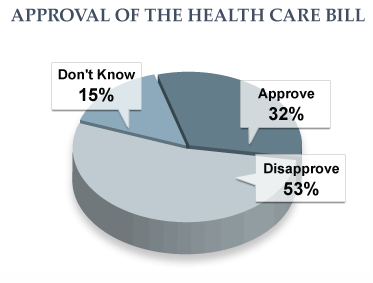
Fifty-three percent of Americans say they disapprove of the new reforms, including 39 percent who say they disapprove strongly. In the days before the bill passed the House, 37 percent said they approved and 48 percent disapproved.

image

Less than 20% of Americans thinks the new health care reforms will help them personally … 36% think the new reforms will hurt them

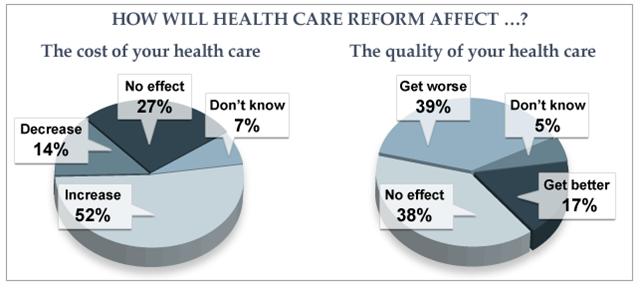
Just over half think the new health care reforms will increase their health care costs, and 39 percent think the quality of their health care will get worse.

image

Only 34 percent of Americans approved of the president’s handling of health care — an all-time low.

Mr. Obama’s overall approval rating also hit an all-time low in this poll at 44 percent, as Americans continue to worry about the economy.

Full article:
http://www.cbsnews.com/8301-503544_162-20001700-503544.html?tag=contentMain;contentBody

Great idea: How about extending SarbOx to Congress ?

April 1, 2010

Several companies have announced mega first quarter earnings charges to reflect the impact of ObamaCare. AT&T’s write-off: a staggering $1 billion.

The accounting is relatively straightforward: the companies have a future liability on their balance sheets — benefit payments to retirees for prescription drugs.  That liability was being partially offset by a favorable tax treatment that’s being eliminated by ObamaCare.  So, the liability has to be restated upward by the amount of the lost tax benefits.  That’s done by a non-cash charge to the P&L that must be recognized as soon as it’s evident.

Now, the Feds want the companies’ CEOs testify and provide evidence of the law’s projected impact.

Almost immediately, House Energy and Commerce Committee Chairman Henry Waxman of California and Rep. Bart Stupak of Michigan, chairman of the Oversight and Investigations panel, announced plans to hold an April 21 hearing on “claims by Caterpillar, Verizon, and Deere that provisions in the new health care reform law could adversely affect their company’s (costs) and ability to provide health insurance to their employees. These assertions appear to conflict with independent analyses, which show that the new law will expand coverage and bring down costs.”
http://blogs.wsj.com/washwire/2010/03/26/companies-charges-prompt-a-hearing/

One can reasonably expect that the Feds will try to browbeat the companies into making the charges go away (after all, its bad publicity) by recognizing that ObamaCare will substantially bend the health care cost curve downward.

Yeah, right.

Under Sarbanes-Oxley, CEOs have to sign off on the integrity of their company’s financial statements under penalty of fines and jail time.

Now, pardon these CEOs if they conclude — like many other folks — that the administrations’s financial projections re: huge cost savings, premium cuts, deficit reductions, etc., are at best uncertain, or at worst complete BS.

If that’s what they conclude  — and if they sign financial statements that are based on the incredible projections —  and if the pie-in-the-sky ObamaCare projections don’t materialize — then they get carted off to jail under Sarb-Ox. Uh-oh.

Perhaps Reps. Waxman and Stupak should have to sign the companies’ financial statements — under penalty of hard time in jail if the ObamaCare benefits don’t materialize.

Thinking more broadly, why not make all Senators and Congressmen who voted for ObamaCare sign statements that they’ll go to jail if the cost curve isn’t bent down, if the deficit isn’t reduced, and if premiums don’t plummet.  They should be willing since they profess to believe and voted accordingly.

Or, thinking even more broadly, why not make our sleazy reps sign similar statements every time they sign a bill with economic consequences.

If not jail time, at least make them forfeit their lucrative government pensions and retirement businesses.

Why not ?

How many government boards, commissions and programs does it take to "not takeover" healthcare ?

April 1, 2010

Answer: At least 159

All being staffed by Fed gov’t employees making 44% more than comparable private sector workers.

All to improve our healthcare and whittle down costs …

* * * * *
Here’s a starter list, right out of the 2,474 page bill, the reconciliation addendum and the Speaker’s amendment.

1. Grant program for consumer assistance offices (Section 1002, p. 37)
2. Grant program for states to monitor premium increases (Section  1003, p. 42)
3. Committee to review administrative simplification standards  (Section 1104, p. 71)
4. Demonstration program for state wellness programs (Section 1201, p.  93)
5. Grant program to establish state Exchanges (Section 1311(a), p. 130)
6. State American Health Benefit Exchanges (Section 1311(b), p. 131)
7. Exchange grants to establish consumer navigator programs (Section  1311(i), p. 150)
8. Grant program for state cooperatives (Section 1322, p. 169)
9. Advisory board for state cooperatives (Section 1322(b)(3), p. 173)
10. Private purchasing council for state cooperatives (Section  1322(d), p. 177)
11. State basic health plan programs (Section 1331, p. 201)
12. State-based reinsurance program (Section 1341, p. 226)
13. Program of risk corridors for individual and small group markets  (Section 1342, p. 233)
14. Program to determine eligibility for Exchange participation  (Section 1411, p. 267)
15. Program for advance determination of tax credit eligibility  (Section 1412, p. 288)
16. Grant program to implement health IT enrollment standards (Section  1561, p. 370)
17 Federal Coordinated Health Care Office for dual eligible  beneficiaries (Section 2602, p. 512)
18. Medicaid quality measurement program (Section 2701, p. 518)
19. Medicaid health home program for people with chronic conditions,  and grants for planning same (Section 2703, p. 524)
20 Medicaid demonstration project to evaluate bundled payments  (Section 2704, p. 532)
21. Medicaid demonstration project for global payment system (Section  2705, p. 536)
22. Medicaid demonstration project for accountable care organizations  (Section 2706, p. 538)
23. Medicaid demonstration project for emergency psychiatric care  (Section 2707, p. 540)
24. Grant program for delivery of services to individuals with  postpartum depression (Section 2952(b), p. 591)
25. State allotments for grants to promote personal responsibility  education programs (Section 2953, p. 596)
26. Medicare value-based purchasing program (Section 3001(a), p. 613)
27. Medicare value-based purchasing demonstration program for critical  access hospitals (Section 3001(b), p. 637)
28. Medicare value-based purchasing program for skilled nursing  facilities (Section 3006(a), p. 666)
29. Medicare value-based purchasing program for home health agencies  (Section 3006(b), p. 668)
30. Interagency Working Group on Health Care Quality (Section 3012, p.  688)
31. Grant program to develop health care quality measures (Section  3013, p. 693)
32. Center for Medicare and Medicaid Innovation (Section 3021, p. 712)
33. Medicare shared savings program (Section 3022, p. 728)
34. Medicare pilot program on payment bundling (Section 3023, p. 739)
35. Independence at home medical practice demonstration program  (Section 3024, p. 752)
36. Program for use of patient safety organizations to reduce hospital  readmission rates (Section 3025(b), p. 775)
37. Community-based care transitions program (Section 3026, p. 776)
38. Demonstration project for payment of complex diagnostic laboratory  tests (Section 3113, p. 800)
39. Medicare hospice concurrent care demonstration project (Section  3140, p. 850)
40. Independent Payment Advisory Board (Section 3403, p. 982)
41. Consumer Advisory Council for Independent Payment Advisory Board  (Section 3403, p. 1027)
42. Grant program for technical assistance to providers implementing  health quality practices (Section 3501, p. 1043)
43. Grant program to establish interdisciplinary health teams (Section  3502, p. 1048)
44. Grant program to implement medication therapy management (Section  3503, p. 1055)
45. Grant program to support emergency care pilot programs (Section  3504, p. 1061)
46. Grant program to promote universal access to trauma services  (Section 3505(b), p. 1081)
47. Grant program to develop and promote shared decision-making aids  (Section 3506, p. 1088)
48. Grant program to support implementation of shared decision-making  (Section 3506, p. 1091)
49. Grant program to integrate quality improvement in clinical  education (Section 3508, p. 1095)
50. Health and Human Services Coordinating Committee on Women’s Health  (Section 3509(a), p. 1098)
51. Centers for Disease Control Office of Women’s Health (Section  3509(b), p. 1102)
52. Agency for Healthcare Research and Quality Office of Women’s  Health (Section 3509(e), p. 1105)
53. Health Resources and Services Administration Office of Women’s  Health (Section 3509(f), p. 1106)
54. Food and Drug Administration Office of Women’s Health (Section  3509(g), p. 1109)
55. National Prevention, Health Promotion, and Public Health Council  (Section 4001, p. 1114)
56. Advisory Group on Prevention, Health Promotion, and Integrative  and Public Health (Section 4001(f), p. 1117)
57. Prevention and Public Health Fund (Section 4002, p. 1121)
58. Community Preventive Services Task Force (Section 4003(b), p. 1126)
59. Grant program to support school-based health centers (Section  4101, p. 1135)
60. Grant program to promote research-based dental caries disease  management (Section 4102, p. 1147)
61. Grant program for States to prevent chronic disease in Medicaid  beneficiaries (Section 4108, p. 1174)
62. Community transformation grants (Section 4201, p. 1182)
63. Grant program to provide public health interventions (Section  4202, p 1188)
64. Demonstration program of grants to improve child immunization  rates (Section 4204(b), p. 1200)
65. Pilot program for risk-factor assessments provided through  community health centers (Section 4206, p. 1215)
66. Grant program to increase epidemiology and laboratory capacity  (Section 4304, p. 1233)
67. Interagency Pain Research Coordinating Committee (Section 4305, p.  1238)
68. National Health Care Workforce Commission (Section 5101, p. 1256)
69. Grant program to plan health care workforce development activities  (Section 5102(c), p. 1275)
70. Grant program to implement health care workforce development  activities (Section 5102(d), p. 1279)
71. Pediatric specialty loan repayment program (Section 5203, p. 1295)
72. Public Health Workforce Loan Repayment Program (Section 5204, p.  1300)
73. Allied Health Loan Forgiveness Program (Section 5205, p. 1305)
74. Grant program to provide mid-career training for health  professionals (Section 5206, p. 1307)
75. Grant program to fund nurse-managed health clinics (Section 5208,  p. 1310)
76. Grant program to support primary care training programs (Section  5301, p. 1315)
77. Grant program to fund training for direct care workers (Section  5302, p. 1322)
78. Grant program to develop dental training programs (Section 5303,  p. 1325)
79. Demonstration program to increase access to dental health care in  underserved communities (Section 5304, p. 1331)
80. Grant program to promote geriatric education centers (Section  5305, p. 1334)
81. Grant program to promote health professionals entering geriatrics  (Section 5305, p. 1339)
82. Grant program to promote training in mental and behavioral health  (Section 5306, p. 1344)
83. Grant program to promote nurse retention programs (Section 5309,  p. 1354)
84. Student loan forgiveness for nursing school faculty (Section  5311(b), p. 1360)
85. Grant program to promote positive health behaviors and outcomes  (Section 5313, p. 1364)
86. Public Health Sciences Track for medical students (Section 5315,  p. 1372)
87. Primary Care Extension Program to educate providers (Section 5405,  p. 1404)
88. Grant program for demonstration projects to address health  workforce shortage needs (Section 5507, p. 1442)
89. Grant program for demonstration projects to develop training  programs for home health aides (Section 5507, p. 1447)
90 Grant program to establish new primary care residency programs  (Section 5508(a), p. 1458)
91. Program of payments to teaching health centers that sponsor  medical residency training (Section 5508(c), p. 1462)
92. Graduate nurse education demonstration program (Section 5509, p.  1472)
93. Grant program to establish demonstration projects for community- based mental health settings (Section 5604, p. 1486)
94. Commission on Key National Indicators (Section 5605, p. 1489)
95. Quality assurance and performance improvement program for skilled  nursing facilities (Section 6102, p. 1554)
96. Special focus facility program for skilled nursing facilities  (Section 6103(a)(3), p. 1561)
97. Special focus facility program for nursing facilities (Section  6103(b)(3), p. 1568)
98. National independent monitor pilot program for skilled nursing  facilities and nursing facilities (Section 6112, p. 1589)
99. Demonstration projects for nursing facilities involved in the  culture change movement (Section 6114, p. 1597)
100. Patient-Centered Outcomes Research Institute (Section 6301, p.  1619)
101. Standing methodology committee for Patient-Centered Outcomes  Research Institute (Section 6301, p. 1629)
102. Board of Governors for Patient-Centered Outcomes Research  Institute (Section 6301, p. 1638)
103. Patient-Centered Outcomes Research Trust Fund (Section 6301(e),  p. 1656)
104. Elder Justice Coordinating Council (Section 6703, p. 1773)
105. Advisory Board on Elder Abuse, Neglect, and Exploitation (Section  6703, p. 1776)
106. Grant program to create elder abuse forensic centers (Section  6703, p. 1783)
107. Grant program to promote continuing education for long-term care  staffers (Section 6703, p. 1787)
108. Grant program to improve management practices and training  (Section 6703, p. 1788)
109. Grant program to subsidize costs of electronic health records  (Section 6703, p. 1791)
110. Grant program to promote adult protective services (Section 6703,  p. 1796)
111. Grant program to conduct elder abuse detection and prevention  (Section 6703, p. 1798)
112. Grant program to support long-term care ombudsmen (Section 6703,  p. 1800)
113. National Training Institute for long-term care surveyors (Section  6703, p. 1806)
114 Grant program to fund State surveys of long-term care residences  (Section 6703, p. 1809)
115. CLASS Independence Fund (Section 8002, p. 1926)
116. CLASS Independence Fund Board of Trustees (Section 8002, p. 1927)
117. CLASS Independence Advisory Council (Section 8002, p. 1931)
118. Personal Care Attendants Workforce Advisory Panel (Section  8002(c), p. 1938)
119 Multi-state health plans offered by Office of Personnel  Management (Section 10104(p), p. 2086)
120. Advisory board for multi-state health plans (Section 10104(p), p.  2094)
121. Pregnancy Assistance Fund (Section 10212, p. 2164)
122. Value-based purchasing program for ambulatory surgical centers  (Section 10301, p. 2176)
123. Demonstration project for payment adjustments to home health  services (Section 10315, p. 2200)
124. Pilot program for care of individuals in environmental emergency  declaration areas (Section 10323, p. 2223)
125. Grant program to screen at-risk individuals for environmental  health conditions (Section 10323(b), p. 2231)
126. Pilot programs to implement value-based purchasing (Section  10326, p. 2242)
127. Grant program to support community-based collaborative care  networks (Section 10333, p. 2265)
128. Centers for Disease Control Office of Minority Health (Section  10334, p. 2272)
129. Health Resources and Services Administration Office of Minority  Health (Section 10334, p. 2272)
130. Substance Abuse and Mental Health Services Administration Office  of Minority Health (Section 10334, p. 2272)
131. Agency for Healthcare Research and Quality Office of Minority  Health (Section 10334, p. 2272)
132. Food and Drug Administration Office of Minority Health (Section  10334, p. 2272)
133. Centers for Medicare and Medicaid Services Office of Minority  Health (Section 10334, p. 2272)
134. Grant program to promote small business wellness programs  (Section 10408, p 2285)
135. Cures Acceleration Network (Section 10409, p. 2289)
136. Cures Acceleration Network Review Board (Section 10409, p. 2291)
137. Grant program for Cures Acceleration Network (Section 10409, p.  2297)
138. Grant program to promote centers of excellence for depression  (Section 10410, p. 2304)
139. Advisory committee for young women’s breast health awareness  education campaign (Section 10413, p. 2322)
140. Grant program to provide assistance to provide information to  young women with breast cancer (Section 10413, p. 2326)
141. Interagency Access to Health Care in Alaska Task Force (Section  10501, p. 2329)
142. Grant program to train nurse practitioners as primary care  providers (Section 10501(e), p. 2332)
143. Grant program for community-based diabetes prevention (Section  10501(g), p. 2337)
144. Grant program for providers who treat a high percentage of  medically underserved populations (Section 10501(k), p. 2343)
145. Grant program to recruit students to practice in underserved  communities (Section 10501(l), p. 2344)
146. Community Health Center Fund (Section 10503, p. 2355)
147. Demonstration project to provide access to health care for the  uninsured at reduced fees (Section 10504, p. 2357)
148. Demonstration program to explore alternatives to tort litigation  (Section 10607, p. 2369)
149. Indian Health demonstration program for chronic shortages of  health professionals (S. 1790, Section 112, p. 24)*
150. Office of Indian Men’s Health (S. 1790, Section 136, p. 71)*
151. Indian Country modular component facilities demonstration program  (S. 1790, Section 146, p. 108)*
152. Indian mobile health stations demonstration program (S. 1790,  Section 147, p. 111)*
153. Office of Direct Service Tribes (S. 1790, Section 172, p. 151)*
154. Indian Health Service mental health technician training program  (S. 1790, Section 181, p. 173)*
155. Indian Health Service program for treatment of child sexual abuse  victims (S. 1790, Section 181, p. 192)*
156. Indian Health Service program for treatment of domestic violence  and sexual abuse (S. 1790, Section 181, p. 194)*
157. Indian youth telemental health demonstration project (S. 1790,  Section 181, p. 204)*
158. Indian youth life skills demonstration project (S. 1790, Section  181, p. 220)*
159. Indian Health Service Director of HIV/AIDS Prevention and  Treatment (S. 1790, Section 199B, p. 258)*

*Section 10221, page 2173 of H.R. 3590 deems that S. 1790 shall be  deemed as passed with certain amendments.

Thanks to JC for feeding the lead

Looks like mandatory health insurance coverage is, well, VOLUNTARY … no kidding

March 31, 2010

Once again, Speaker Pelosi was right “You’ll find out what’s in the bill when we pass it”.

Take the individual mandate: the provision that requires all people carry health insurance — even healthy non-consumers of health case services. They must play for ObamaCare’s fragile economics to work.  You see, it’s these people overpaying for their health insurance (i.e. premiums far exceed claims) that subsidizes the heavy users (i.e. claims far exceed premiums).

More than a dozen states have united to test the constitutionality of the individual mandate, arguing that the Feds can’t compel citizens to buy specific products simply as a condition of citizenship.  Feds argue that they can based on the supremacy (of Fed over states) and commerce (Feds can regulate interstate commerce) clauses in the constitution.

Regardless of how that turns out, there’s an interesting twist: though folks will be asked to ante in tax fines on their 1040s if they haven’t bought health insurance, the bill explicitly bans the IRS from enforcing the law.  There can be no criminal or civil penalties, no liens or seizures (whew, citizen’s big screen TVs are fancy cars out of reach), and no penalties or interests. 

The law is enforced by the ever powerful word “PLEASE”.

* * * * *

Excerpted from Verum Serum, The Individual Mandate Farce, March 25, 2010

One of the more controversial elements of ObamaCare is the mandate for most individuals to purchase insurance beginning in 2014.

Democrats who orchestrated the passage of this bill are mandating not only that the young and healthy obtain insurance, but also that even their most fervent liberal constituents must purchase this coverage from the evil, private insurance industry.

Republicans for their part have focused on the fact that this mandate will be enforced via threat of a financial penalty (or tax), with the added assumption that it is the dreaded IRS which will be enforcing this. And sure enough, it’s already been reported that the IRS anticipates hiring possibly in excess of 15,000 additional personnel to deal with the collection of the individual mandate, and other tax related provisions within the bill.

However, it turns out that the Democrats who crafted this bill hamstrung the ability of the IRS or any other federal agency to enforce or collect on this mandate. Here is what the federal Joint Committee on Taxation had to say about this issue in a report released earlier this week:

Individuals who fail to maintain minimum essential coverage in 2016 are subject to a penalty equal to the greater of: (1) 2.5 percent of household income in excess of the taxpayer’s household income for the taxable year over the threshold amount of income required for income tax return filing for that taxpayer under section 6012(a)(1);67 or (2) $695 per uninsured adult in the household. The fee for an uninsured individual under age 18 is one-half of the adult fee for an adult. The total household penalty may not exceed 300 percent of the per adult penalty ($2,085). The total annual household payment may not exceed the national average annual premium for bronze level health plan offered through the Exchange that year for the household size…

The penalty applies to any period the individual does not maintain minimum essential coverage and is determined monthly. The penalty is assessed through the Code and accounted for as an additional amount of Federal tax owed. However, it is not subject to the enforcement provisions of subtitle F of the Code. The use of liens and seizures otherwise authorized for collection of taxes does not apply to the collection of this penalty. Non-compliance with the personal responsibility requirement to have health coverage is not subject to criminal or civil penalties under the Code and interest does not accrue for failure to pay such assessments in a timely manner.

“Subtitle F of the Code” is the portion of the tax code which grants the IRS the authority to assess and collect taxes.

In other words, as the law is written the federal government has no legal authority to enforce this mandate, nor will it have any recourse to collect any penalties that go unpaid!

This is bad news for those who believe in the merits of the mandate and the bill in general.

Without an effective mechanism of enforcing the individual mandate, the entire system is likely to collapse.

WHY WOULD ANYONE OBTAIN INSURANCE COVERAGE PRIOR TO NEEDING IT? This was already going to be a problem with the relatively low cost of the penalty, but take away any meaningful enforcement of the individual mandate and it is a complete and total joke.

The net result will be an ever increasing shift of healthcare costs on to those who remain in the insurance system (or to tax payers), and possibly even the bankruptcy of the insurance industry.

Nice work guys.

Full article:
http://www.verumserum.com/?p=13582

Anybody see a pattern here ?

March 31, 2010

Hint: phonied-up cost estimates and pay-offs to unions.  Who could have ever imagined ?

Provisions of the health-care law that expand benefits for home-bound elderly, certain early retirees and coal miners will likely cost more than expected, say analysts and even some of the measures’ proponents.

The programs would expand home health services for the elderly and disabled and aid health plans covering retirees too young for Medicare.

The program for home-bound elderly, called Community Living Assistance Services and Supports, or Class, would help keep older people in their homes longer and reduce federal nursing-home expenses.

The provision was supported by several labor unions, which would have a chance to expand their memberships by organizing an expanded corps of home health workers.

The Congressional Budget Office warned last year that the Class program’s own benefits eventually would grow so large that it would drain the government’s finances. “The Class program would inevitably add to future deficits…by more than it reduces deficits in the near term”.

Rep. Frank Pallone (D., N.J.), chairman of the House health subcommittee and a main sponsor of the measure, said those concerns were overblown. “It’s pretty clear the way it’s been set up that it’s self-sustaining,” he said. The legislation requires the government to charge higher premiums if needed, he said.

The second program, to subsidize health-care plans that cover lots of retirees under age 65, will benefit cities and states as well as old-line manufacturing firms. The United Automobile Workers has made the federal reinsurance subsidy a top priority in recent years. Detroit’s unionized auto makers and parts makers have pushed thousands of UAW workers into early retirement as they retrenched in the past decade.

Excerpted from WSJ: Weighing the Cost of New Health Programs, MARCH 29, 2010 http://online.wsj.com/article/SB10001424052748703312504575142143632354272.html?mod=WSJ_hps_MIDDLEThirdNews


Those companies facing healthcare write-offs … damned if they do, damned if don’t.

March 30, 2010

I’m really intrigued by the furor over the companies that have announced mega first quarter earnings charges to reflect the impact of ObamaCare.

Again, this initial flurry of write-offs is pretty cut & dry.

The accounting is straightforward: the companies have a future liability on their balance sheets — future benefit payments to retirees for prescription drugs.  That liability was being partially offset by a favorable tax treatment that’s being eliminated by ObamaCare.  So, the liability has to be restated upward by the amount of the lost tax benefits.  That’s done by a non-cash charge to the P&L that must be recognized as soon as it’s evident.

Now, Reps. Henery Waxman and Bart “Bend over” Stupak have called hearings to hassle CEOs about the write-offs.

Couple of points:

1) These write-offs aren’t new news.  The companies claim that they warned Team Obama that this would happen.

2) The write-offs are required based on GAAP — auditors won’t be able to sign off on financial statements if the lost tax benefits aren’t recognized,

3) Why do Waxman & Stupak think they can cajole or browbeat the CEOs into withholding material information from their financial statements ? 

Do they want the companies to break the law and commit securities violations ?

Even if some of the pie-in-the-sky ObamaCare savings materialize, they are completely irrelevant to this reporting requirement.

(Maybe Stupak thinks he can bag another Executive Order to cover this case).

4) What about companies that face the same situation and don’t recognize the increased future liabilities ? 

The law says they have to record the charges in the quarter that the law is enacted. 

I see shareholder lawsuits galore if they ‘forget’ and — since they are now well informed of the issue — fail to disclose a material change to their financial condition.

This is going to get interesting …

Speaker Pelosi was right: “When we pass it, you ‘ll see what’s in it.” … Just ask AT&T

March 29, 2010

Let’s see, Obama Care is going to save everybody boat loads of money.  Well, maybe not everybody …

* * * * *
Does ObamaCare’s price tag include corporate writedowns?

We’re told this medical miracle will cost us $938 billion over 10 years.

I doubt that sum includes the toll taken this week.

AT&T said it will take a $1 billion charge related to ObamaCare.

Earlier this week, Caterpillar drew first blood (its own), taking a $100 million writedown. The heavy-metal giant provides generous drug benefits to retirees, enticed by tax-free subsidies from the feds; that program now will be taxed.

Cat’s competitor, John Deere says it will take a $150 million hit.

[On Saturday, 3M announced an $80 to $90 million charge.]

Betchya other big companies take hits, too.

That hurts their shareholders (including pension funds for workers that ObamaCare seeks to help).

And, it may prompt companies to cut back on drug benefits for retirees, all due to a new law with the opposite aim.

Excerpted from CNBC: 7 Prickly Questions for ObamaCare, 26 Mar 2010:
http://www.cnbc.com/id/36055365

Obama’s post-healthcare bump … going, going, ….

March 29, 2010

Gone !

This week, the left-leaning media has been trumpeting the bump that Pres Obama and his healthcare plan have gotten from passage of ObamaCare.

Perhaps the high fives were a tad premature.

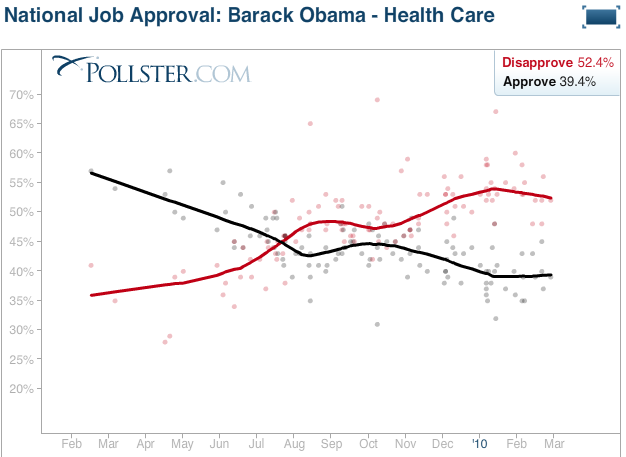
Pollster.com’s poll-of-polls shows that — immediately after the vote — there was a bump of a couple points in people favoring the bill.

The approvers were still in the minority, and disapprovers outnumbered approvers.

But, the approvers number has fallen back to pre-vote levels.

image 
http://www.pollster.com/polls/us/healthplan.php

* * * * *

What about Obama’s approval numbers?

There was a positive bump of about 5 percentage points in the days after the vote.

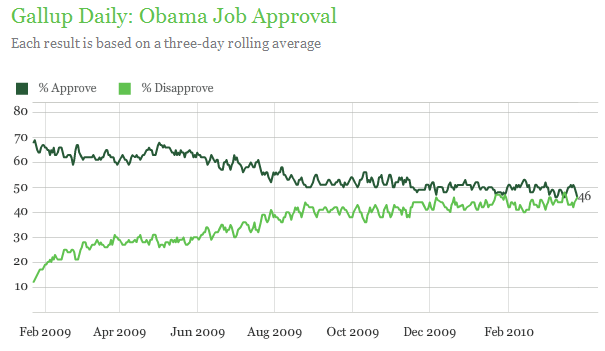
But, the numbers seemed to have turned back around.  According to Gallup, the 5 points are gone  — and the approver and disapprovers are tied at 46% — just as they were before the vote.

Why ? My guess is that the publicity surrounding the enormous corporate write-offs related to the bill is resonating … people may be sensing that ObamaCare isn’t free after all and that they may be the ones paying for it — either by losing benefits or losing their jobs or both.

image 

* * * * *

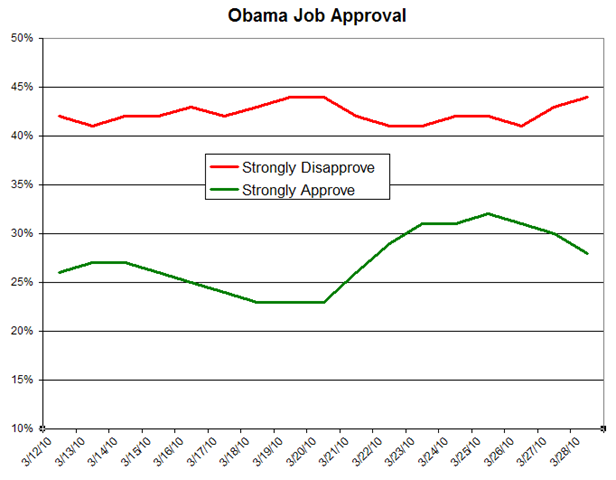
Most interesting (to me) is the movement among folks who strongly approve or disapprove.

There has been a 5 point bump is strong approvers, suggesting that Obama did, in fact, rally his base.

But, the level of strong disapprovers has remained in a pretty tight range and is trending upwards, indicating that few people who opposed ObamaCare before the vote has been won over, and that the intensity of disapproval remains quite high

image
http://www.rasmussenreports.com/public_content/politics/obama_administration/obama_approval_index_history

ObamaCare: Now comes the hard part …

March 26, 2010

Earlier this week, in my post “Dog catches bus”, I made the point that passing the law was the easy part. A couple of days later (than HomaFiles), the NYT is on the case.

Punchline: Now an administration that has demonstrated virtually no implementation capability (think stimulus, foreclosures, GITMO …) has to implement the most complex government program in history.

Keep in mind that 8 years after 9-11 — the official start of the high priority initiative to link our intelligence systems — a guy who was ratted out by his own father boarded an airplane with dynamite in his shorts … a “systemic failure”.  And we’ll get the healthcare system right ???

* * * * *

Excerpted from NY Times:  Now Comes the Hard Part, March 25, 2010

Much as the Iraq war wasn’t over when American forces conquered Baghdad, so health care reform didn’t end when President Obama signed the bill. If carrying out the legislation doesn’t get the same sustained attention that passing it did, then this week’s historic victory will lose much of its luster.

Health care reform, the most ambitious domestic policy initiative of our time, is now law.

The challenges ahead — for putting the existing plan into action — fall into four categories.

DELIVERING THE DELIVERABLES

President Obama promised that some of the benefits of reform would appear in the first year. For starters, within 90 days the Department of Health and Human Services must set up a high-risk pool as a temporary source of insurance for people who have pre-existing conditions.

Some of the new consumer protections will take effect within six months; first, though, federal officials have to translate that law into regulation.

EDUCATING THE PUBLIC

It’s one thing to create a health insurance program and quite another to get people to sign up for it. Today, many more people are eligible for Medicaid than actually enroll.

An aggressive public relations campaign to increase public knowledge and to undertake direct outreach to individuals will be necessary. While states and nonprofit organizations will play vital roles, the federal government will probably have to take the lead.

HANDLING THE INSURERS

The law creates minimum standards for what insurance covers and requires insurers to spend most of their money on actual patient care.

The states will have primary responsibility for enforcing these standards … that won’t be easy.

BENDING THE COST CURVE

Dozens of new initiatives are intended to control, or at least reduce, the cost of medical care. But most of them require work to get up and running.

There are hopes that wider use of electronic medical records can improve quality while reducing expensive duplication.

Studies show we’d save money if we stopped paying for so many treatments that don’t work (or don’t work better than the alternatives). But we can’t start paying for treatments more intelligently without better information about what drugs and procedures do work, not to mention which ones doctors and hospitals already use.

But, somebody first has to set up a standard for the records.  

The Obama administration needs to find the right people to manage these programs.

Full article:
http://www.nytimes.com/2010/03/26/opinion/26cohn.html?adxnnl=1&adxnnlx=1269576282-HyC9Y8xsjBzs0TixBx2Y1w

Slacker insurance: Extending parents coverage to 26 year olds

March 26, 2010

OK, everybody knows that under ObamaCare insurance companies will have to allow parents to cover their “adult children” until age 26:

SEC. 2714. EXTENSION OF DEPENDENT COVERAGE FOR YOUNG PEOPLE UP TO 26TH BIRTHDAY THROUGH PARENTS’ INSURANCE .
(a) In general – A group health plan and a health insurance issuer offering group or individual health insurance coverage that provides dependent coverage of children shall continue to make such coverage available for an adult child (who is not married) until the child turns 26 years of age. [Effective 6 months after enactment.]

The way the media is covering this aspect of the plan, there seems to be a presumption that this is a free-rider program — just add them to the policy and pay the same premium. 

I don’t think so …

If the adult-child (whatever the heck that is) were to buy their own policy, the price would probably be about $5,000. 

It’s hard to imagine that insurance companies will just give $5,000 of extended family coverage for free.

And, I can’t imagine that employers will pick up any part of the tab as an employee benefit — why should they ?

So, parents will have the opportunity to shell out $5,000 to provide each of their adult-children with health insurance.

I predict major outrage when people figure out that that this isn’t a free lunch …

* * * * *

Sidenote:

Married adult-children aren’t covered … but the statute is silent on the children of unmarried adult-children. 

Just watch this one develop …

Grand turnabout: Spit in the Supreme Court’s eye and then …

March 25, 2010

Here’s one to watch …

In his State of the Union address, Obama broke protocol and directly admonished the attending members of the Supreme Court for a recent decision that disappointed him.

Now, several states — 38 at last count, led by Virginia and Idaho — are prepping constitutional appeals to ObamaCare.  One track: claiming that the so-called individual mandates — that impose tax-fines on healthy citizens who opt to go uninsured — is unconstitutional.

I know that judges are supposed to rule strictly on the basis of law and proven evidence.  But, in the final analysis, they’re people — with feelings, emotions, and biases.

We’ll see how they rule when ObamaCare is raised to their level.

The President may rue the night he chose to publicly embarrass them …

CBS Poll: Most Want GOP to Keep Fighting ObamaCare

March 25, 2010

Excerpted from CBS.com: Most Want GOP to Keep Fighting on Health Bill, March 24, 2010

image

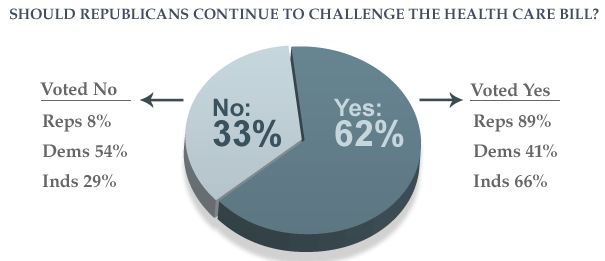
A CBS News poll finds that nearly two in three Americans want Republicans in Congress to continue to challenge parts of the health care reform bill.

The poll finds that 62 percent want Congressional Republicans to keep challenging the bill, while 33 percent say they should not do so. Nearly nine in ten Republicans and two in three independents want the GOP to keep challenging. Even 41 percent of Democrats support continued challenges.

The poll’s findings suggest an improvement in perceptions of the legislation: While 37% approved of it before the vote, 42% approved afterward.

[Ken’s Take: only a 5 pt bump, and 42% is way less than a majority !]

Full article:
http://www.cbsnews.com/8301-503544_162-20001117-503544.html

Bold stroke: Tanning salon tax starts today … no kidding !

March 24, 2010

The tax on union’s Cadillac heath insurance benefits doesn’t kick in until 2018.

The fat cats’ payroll tax on dividends and capital gains doesn’t start until 2013 (whew !).

But, no such reprieve for those evil tanning salons.

According to Bloomberg, indoor tanning salons must start charging customers a 10 percent tax beginning today … the first major reform of the U.S. health-care overhaul signed into law by President Barack Obama.

These guys  sure know how to go for the jugular …

* * * * *

Bloomberg, Health-Care Overhaul Changes to Start Taking Effect This Year
http://www.bloomberg.com/apps/news?pid=20601087&sid=aa32kl.M09T4

Next up: A doctors’ mandate … just wait & see.

March 24, 2010

Every doctor I’ve talked to says he loses mucho money on MediCare and Medicaid patients — that shouldn’t be new news to anyone.

Some tell me that Medicaid patients are especially troublesome because they account for a disproportionate “no shows” — patients who schedule an appointment but don’t post for it.  Why ?  No skin in the game.

ObamaCare is largely funded by containing physician reimbursements on MediCare and Medicaid  … concurrent with swelling the Medicaid rolls by about 15 million people.

In the past, docs have offset their MediCare and Medicaid  losses by, in effect, charging privately insureds more.

So what’s going to happen ?  It’s pretty easy to predict:

  1. The ‘natural’ proportion of gov’t insured patients (MediCare and Medicaid) will increase.
  2. Docs will try to cross subsidize them by increasing privately insured rates.
  3. But, ObamaCare police will cap the private insurance premiums.
  4. So, docs will start restricting the number of gov’t insured patients they treat … some will stop treating gov’t insured patients all together.
  5. Then, ObamaCare police will will call “foul” and mandate that all doctors must treat a minimum number of gov’t insured patients.

Just wait and see … you can smell this one a mile away (from the White House)

Individual healthcare mandates and the 5th amendment …

March 23, 2010

Here’s an interesting twist I haven’t heard from the TV pundits …

Under ObamaCare, everybody has to buy health insurance — even healthy folks who want to opt out.

If you don’t have health insurance, you get fined … most recently, I heard that the fine has been pared down to $250 annually.

How will it be enforced ?

Well, the bill adds over 15,000 IRS agents to police it.

[Analytical note: that means that the new agents have to nail about 6 million scofflaws each year just to cover their comp & benefits … each agent will have to find and nail about one each day]  

This morning, I heard a Congressional shill say that each year — as part of the 1040 process — people will be asked if they are in compliance with law and have health insurance.

If they answer yes, they are asked to provide substantiation.

If they answer no, they have to pay the fine.

Isn’t that self-incrimination?  Isn’t that protected by the 5th amendment ?

If this process works ok for ObamaCare, why not extend it to other areas of the law ?

For example, ask people if they have complied with all speed limits when driving. If they self-incriminate, fine ’em.

Maybe ObamaCare has uncovered a whole new way to raise revenues and offset the deficit …

Stupak’s Price: $726,409 … so much for principle.

March 23, 2010

Right from Stupak’s office … note the date (March 19, 2010) … At least he waited 2 days until he switched his vote from no to yes …  for chump change compared to what Dodd, Landrieu, and the SEIU got … gezz Bart, if you’re going to sell your soul, at least go for some serious money.

image

What do student loans have to do with healthcare ? … and why you should care if you have a student loan.

March 23, 2010

Answer: Nothing … It’s a stretch to lump student loans and healthcare except that the apparent (i.e. unproven, unsubstantiated) savings accruing from nationalizing of student loan programs are needed to make ObamaCare look like it reduces the deficit.

I think there are huge implications — not only to banks, but also to student borrowers.

Here’s a twist: under ObamaCare, the tax-fines are going to be policed by 15,000 additional IRS agents. 

Do you think they’ll add another 15,000 to work collections on student loans ?

I’m betting the over on that one …

* * * * *

Excerpted from USA Today:  Revamped student loan bill tucked into massive health bill, Mar 19, 2010

To satisfy budget requirements and win over skeptical deficit hawks in their own party, Democratic leaders wound up directing a total of $19 billion (of the $61 billion in revenues that the student loan shift would produce over 10 years) to reduce the deficit and help pay for the health care portion of the legislation.

The basic thrust of the legislation, which would derive its $61 billion in savings by shifting all lending from the lender-based (but government-subsidized) Federal Family Education Loan Program to the government’s Direct Loan Program. The lenders have been trying to months to turn lawmakers against the idea of ending their ability to make loans (and the accompanying subsidies), arguing that doing so would kill thousands of jobs.

But on Thursday, they took another approach, directing their ire at the billions of dollars that would go to purposes other than helping students afford college, namely health care.

“Should students be paying for their neighbor’s medical costs? Separate consideration of student loan reform is imperative to ensure that legislation that minimizes job losses and reinvests savings in higher education can be considered.”

The most blatantly political move in the legislation: an exemption that would allow a state-run bank in North Dakota (alone among the states) to continue to offer loans directly to students.

Democratic Congressional aides defended the decision because they said the North Dakota bank is, as a taxpayer-owned agency, essentially a government lender like the federal government, so sustaining its ability to lend is consistent, they argued, with the legislation’s overall goal.

But critics compared the deal to the much-criticized exemption that health care supporters granted to Sen. Ben Nelson of Nebraska to win his key vote for that legislation,

“This ‘Bismarck Bank Job’ provision looks like exactly the sort of backroom deal that makes the American people hate Washington and the whole process that has led to this massive, awful government takeover of our health care.”

Full article:
http://www.usatoday.com/news/education/2010-03-19-IHE-student-loan-measures-in-health-bill19_ST_N.htm

Move over Charlie Brown, Congressman Stupak wants to kick the football …

March 23, 2010

Fool me once, shame on you.

Fool me twice, shame on me.

What about the 3rd, 4th, 5th times ?

Doesn’t Bart Stupak learn ?

To refresh your memory:

  • Back in November, pro-life Rep. Bart Stupak scored what he thought was a victory and the House passed an amendment to its ObamaCare bill limiting the use of tax-payer funds for abortions.
  • But, immediately after the vote, pro-choice Dems expressed confidence that “controversial language on abortion would be stripped from a final healthcare bill” via legislative maneuvering.
  • Then , House Dem leadership told Stupak and his pro-life buddies to take a hike …  because  liberal Dems want the government to fund abortions.
    https://kenhoma.wordpress.com/2010/03/15/why-is-stupak-surprised-that-his-amendment-was-trashed/

Sunday, to get Stupak to vote yes on ObamaCare, the President promised to issue an Executive Order that, in effect, restores the Stupak Amendment to the final bill — after the fact.

Well, a couple of potential bumps in Bart’s road:

  1. The President has to do what he promised … hmmm.
  2. Some legal pundits are saying that the Executive Order has little or no force — the passed law will prevail in high courts
  3. A President can rescind an Executive Order at any time

This time when Lucy pulls the football away, Stupak will have no one but himself to blame.

He’ll deserve to feel more ‘stupid’ than ‘Stupak’.

The biggest loser ? … Yep, the tanning salons get nailed ! … and, here’s who else.

March 22, 2010

The trillion dollar ObamaCare program gets funded roughly half through MediCare cuts — mostly elimination of Medicare Advantage — and half from tax hikes, including …

  • A .9% increase in Medicare payroll taxes on couples with income of more than $250,000 a year.
  • Extension of Medicare payroll taxes (3.8%) to unearned income: dividends, interest, and capital gains.
  • A 10% excise tax on customers of indoor tanning salons.
  • Additional fees on insurance companies, pharmaceutical companies and medical device manufacturers, including $33 billion over ten years on fees on drug makers
  • A tax on individuals without qualifying coverage, maximum penalty set at 2.5% of income
  • An excise tax on high-premium insurance plans, equal to 40% of premiums paid on plans costing more than $27,500 annually for a family, starting in 2018
    http://online.wsj.com/public/resources/documents/st_healthcareproposals_20090912.html

* * * * *

Ken’s Qs:

1) Since I’ve been TurboTaxing my 2009 taxes, I’m curious: Is the magic $200,000 / $250,000 Gross Income, Adjusted Gross Income, or Taxable Income ?  That makes a big difference, and I haven’t seen a single reference clarifying it.  Anybody know ?

2) If some body hits the $200,000 / $250,000 kill point, is is all income taxed at the higher rate, or just marginal income above that rate ? Anybody know ?

3) How can a serious piece of legislation single out tanning salons for extinction — and let the Beverly Hills facelift doctors run free ? (Rhetorical question)

4) I’m still eager to see the 15,000 new IRS agents running around repo’ing big screens from folks who don’t have health insurance ?

5) If the reconciliation bill doesn’t get thru the Senate — does Obama’s deal with the unions — giving them a pass on the Cadillac plans — vaporize ?

This is going to get very interesting as folks understand the implications …

The biggest loser ? … Yep, the tanning salons get nailed ! … and, here's who else.

March 22, 2010

The trillion dollar ObamaCare program gets funded roughly half through MediCare cuts — mostly elimination of Medicare Advantage — and half from tax hikes, including …

  • A .9% increase in Medicare payroll taxes on couples with income of more than $250,000 a year.
  • Extension of Medicare payroll taxes (3.8%) to unearned income: dividends, interest, and capital gains.
  • A 10% excise tax on customers of indoor tanning salons.
  • Additional fees on insurance companies, pharmaceutical companies and medical device manufacturers, including $33 billion over ten years on fees on drug makers
  • A tax on individuals without qualifying coverage, maximum penalty set at 2.5% of income
  • An excise tax on high-premium insurance plans, equal to 40% of premiums paid on plans costing more than $27,500 annually for a family, starting in 2018
    http://online.wsj.com/public/resources/documents/st_healthcareproposals_20090912.html

* * * * *

Ken’s Qs:

1) Since I’ve been TurboTaxing my 2009 taxes, I’m curious: Is the magic $200,000 / $250,000 Gross Income, Adjusted Gross Income, or Taxable Income ?  That makes a big difference, and I haven’t seen a single reference clarifying it.  Anybody know ?

2) If some body hits the $200,000 / $250,000 kill point, is is all income taxed at the higher rate, or just marginal income above that rate ? Anybody know ?

3) How can a serious piece of legislation single out tanning salons for extinction — and let the Beverly Hills facelift doctors run free ? (Rhetorical question)

4) I’m still eager to see the 15,000 new IRS agents running around repo’ing big screens from folks who don’t have health insurance ?

5) If the reconciliation bill doesn’t get thru the Senate — does Obama’s deal with the unions — giving them a pass on the Cadillac plans — vaporize ?

This is going to get very interesting as folks understand the implications …

Dog catches bus! Be careful what you wish for … and other wisdom from Grandma Homa

March 22, 2010

Rarely can I pair two of Grandma Homa’s bromides together …

The dog has, indeed, caught the bus.

I think that Team Obama will soon realize that they accomplished the easy part of their healthcare takeover: getting the lemmings to pull the voting levers.

Now, they have to implemented the largest government program in recent history.  This, from an administration that has shown no implementation capability at all.  Think stimulus; mortgage / foreclosure programs; cash for clunkers, caulkers, etc.; GITMO closing; underwear bombers ratted out by parents.

The only aspects of the program that I can imagine getting implemented are the tax hikes and the elimination of MediCare Advantage since they only require swipes of a pen.

To ObamaCare supporters: I don’t want to hear any whining from you, you got what you wished for …

Reporting live from Saturday’s Tea Party … stuff not on the nightly news

March 22, 2010

Since Georgetown’s hoops season had come to an abrupt end … and since the weather was beautiful … and since I take this healthcare stuff seriously… I went to the Capitol mall to be part of the citizens’  rally.

I’m glad I did.  First, I felt really democratic (small “d”), and second, the experience was very revealing.

Here’s what I saw and heard:

  1. It was a big crowd … filled the entire grass area in front of the Capitol … spilled over some across the street to the Mall.  I’m not a crowd estimator, but I know there were more than the 2,000 people that CNN reported.  There were at least as many people as were at the Verizon Center for the Duke game (my crowd estimating yardstick) … so, the crowd was at least 20,000.
  2. The crowd was very orderly. I only saw one Capitol policeman walking the crowd.  Not a single shouting match or fight or anything like that. I overheard several “where are you from ?” conversations.
  3. The crowd was all sizes and shapes and ages.  The latter surprised me some — I expected an old folks skew — while folks in their 50s were prevalent, there were plenty in there 40s, 30s, and even 20s.
  4. There weren’t any “for pay” organized groups — no conservative equivalents to ACORN or SEIU.  There were plenty of couples, many family groups, and some church groups from around the country.  No organized bus caravans.
  5. I saw several people identifying themselves as nurses and doctors. 
  6. My wife Kathy spotted one logo shirt from a local country club.  Beyond that, there weren’t many readily identifiable “fat cats” in the crowd.  I expected more since they’ll be footing much of the ObamaCare bill. I guess they protest in a different way  [more on that to come]
  7. Big deal: the crowd was all white.  I don’t recollect seeing a single non-white person, except for a doctor who spoke — and claimed to be Obama’s cousin.
  8. The intensity level was VERY high.  Obviously, people who trekked to the rally are more engaged than the average citizen, but I was still struck by the passion in the crowd — individually and collectively. 
  9. The words “civil disobedience” were evident — not prevalent, but evident.  On the Metro heading in, the guy sitting in front of us said “If this thing passes the country will be torn apart by civil disobedience”.  I hadn’t noticed that expression in years.  At the rally, there were signs calling for civil disobedience.  They didn’t spell out what kind of disobedience, they were just planting seeds.
  10. The applause line that got the biggest reaction: Do what Rush advises ‘just deem your taxes paid’. The crowd went nuts.

* * * * *

Here’s what I took away:

  1. The stark reality is that the tax payers who will be funding ObamaCare are  passionately opposed.  Why ? Well, it is their money, and — while they are OK supporting the genuinely down-trodden — they don’t want to carry slackers, drug addicts, and illegals.
  2. The ObamaCare opposition is almost entirely tax payers who consider themselves increasingly victimized by “taxation without (adequate) representation“. They’re frustrated and looking for a meaningful way to channel their emotions — and their money.
  3. My bet: April 15th is going to be an unusually interesting day this year.For sure, there will be protests galore.

    More important, there are plenty of folks scratching deeper this year to “remember” tax deductions and pursue any legal gimmick that can lower their tax payments.  In the past, for some, it wasn’t worth the effort.  But now, it has gotten personal. 

    And, it wouldn’t shock me if a statistically significant number of citizens heed Rush’s call to “deem their taxes paid”. 

    This has the prospects of getting very ugly, very fast.

We’ve Crossed the Rubicon …

March 22, 2010

This guy hits the nail on the head …

Do Democrats realize that we really have crossed the Rubicon?

In the future when the Republicans gain majorities (and they will), the liberal modus operandi will be the model — bare 51% majorities, reconciliation, the nuclear option, talk of deem and pass, not a single Democrat vote — all ends justifying the means in order to radically restructure vast swaths of American economic and social life.

Is someone unhinged at the DNC?

They just blew up any shred of bipartisan consensus when their President polls below 50%, the Democratically-controlled Congress below 20%, and health care reform less than 50%.

Usually unpopular leaders and their unpopular ideas seek the shelter of minority rights and prerogatives.

What will they do when they are in the minority—since they’ve entered the arena, boasted “let the games begin” and shouted “by any means necessary”?

We’ve Crossed the Rubicon
http://pajamasmedia.com/victordavishanson/weve-crossed-the-rubicom/2/

Special Sunday post: Remember when the Congress voted against TARP … before they voted for it.

March 21, 2010

All the pundit chatter is that the healthcare vote is a lock this afternoon.  The logic, Pelosi wouldn’t be calling the vote is she wasn’t certain to muster 216 votes.

Well, last fall, they took TARP to the floor for a vote — believing that they had the votes.  The outcome: it lost.  [See the article below to jog your memory]

Of course, TARP was modified slightly and a second vote was taken.  It passed.

The difference with ObamaCare: if it loses today, any structural modifications will have to go through normal legislative channels — not the hood-winking reconciliation process.  No way it wins straight up.

I put the odds of passage at 80-20 … but want to be on the record, just in case the long odds hit

* * * * *

September 30th, 2008

TARP unexpectedly voted down by US House yesterday

Yesterday the US House of Representatives unexpectedly turned down by a fairly small margin the Troubled Asset Rescue Plan (TARP) put forth by the Treasury.

This quite remarkable twist of events, with all the world watching, has left investors highly uncertain about what comes next.

It is still possible that an amended version of the bill could be brought back to the floor.

At this stage, it is not clear whether major concessions will be necessary, or whether minor changes to the bill would be enough to secure the incremental (mostly Republican) votes necessary for passage.

http://www.mrforex.org/2008/09/30/tarp-unexpectedly-voted-down-by-us-house-yesterday/

“Just because you have insurance doesn’t mean there’s a physician who can (or will) see you.”

March 19, 2010

Punchline: Mitt Romney — the former Massachusetts governor — enacted something very similar to the Obama health plan. It isn’t working well.  Costs are up, folks are gaming the system, and people with insurance can’t get in to see doctors. Uh-oh.

* * * * *

Excerpted from WSJ: The Failure of RomneyCare, March 16, 2010

The Bay State is suffering from what the Massachusetts Medical Society calls a “critical shortage” of primary-care physicians.

As one would expect, expanded insurance has caused an increase in demand for medical services. But there hasn’t been a corresponding increase in the number of doctors.

As a result, many patients are insured in name only: They have health coverage but can’t find a doctor.

Fifty-six percent of Massachusetts internal medicine physicians no longer are accepting new patients.

For new patients who do get an appointment with a primary-care doctor, the average waiting time to see a doctor is 44 days.

As Dr. Sandra Schneider, the vice president of the American College of Emergency Physicians, told the Boston Globe last April, “Just because you have insurance doesn’t mean there’s a [primary care] physician who can see you.”

The difficulties in getting primary care have led to an increasing number of patients who rely on emergency rooms for basic medical services. Emergency room visits jumped 7% between 2005 and 2007.

Officials have determined that half of those added ER visits didn’t actually require immediate treatment and could have been dealt with at a doctor’s office — if patients could have found one.

* * * **

The promise that getting everyone covered would force costs down also is far from being realized.

One third of state residents say that their health costs had gone up as a result of the 2006 reforms.

A typical family of four today faces total annual health costs of nearly $13,788, the highest in the country. Per capita spending is 27% higher than the national average.

Insurance companies are required to sell “just-in-time” policies even if people wait until they are sick to buy coverage. That’s just like the Obama plan.

There is growing evidence that many people are gaming the system by purchasing health insurance when they need surgery or other expensive medical care, then dropping it a few months later.

Some Massachusetts safety-net hospitals that treat a disproportionate number of lower-income and uninsured patients are threatening bankruptcy. They still are treating a large number of people without health insurance, but the payments they receive for uncompensated care have been cut under the reform deal.

Full article:
http://online.wsj.com/article/SB10001424052748703625304575115691871093652.html?mod=djemEditorialPage_h

Consensus of majors polls: Obama is officially "under water" …

March 19, 2010

For the first time in his Presidency, more people disapprove of the job that Obama is doing as president than approve. 

His rating has been “upside down” in right-leaning Rasmussen for awhile. 

Now, the left-leaning and consensus polls agree …

Here are the facts, draw your own conclusion.

(Hint:The bad economy has been a constant, so don’t blame it for recent declines)

* * * *

Pollster.com “poll of polls”: Approve 46.4%, Disapprove 48.8%, Deficit(2.4%)

image
http://www.pollster.com/polls/us/jobapproval-obama.php?xml=http://www.pollster.com/flashcharts/content/xml/Obama44JobApproval.xml&choices=Disapprove,Approve&phone=&ivr=&internet=&mail=&smoothing=&from_date=&to_date=&min_pct=&max_pct=&grid=&points=1&lines=1&colors=Disapprove-BF0014,Approve-000000,Undecided-68228B

* * * * *

RealClearPolitics “poll of polls”: Approve 47.3%, Disapprove 47.8%, Deficit(.5%)

image
image

http://www.realclearpolitics.com/epolls/other/president_obama_job_approval-1044.html

* * * * *

Gallup: Approve 46%, Disapprove 48%, Deficit(2%)

image
http://www.gallup.com/poll/113980/Gallup-Daily-Obama-Job-Approval.aspx

* * * * *

Rasmussen Reports: Strongly Approve 23%, Strongly Disapprove 43%%, Deficit (20%)

image
http://www.rasmussenreports.com/public_content/politics/obama_administration/daily_presidential_tracking_poll

What if doctors and pharmacies stopped taking Medicaid patients ? (Psst, they have already …)

March 18, 2010

Punchline: First, the Mayo Clinic in Arizona stopped accepting Medicare patients.  Now, Walgreens drugstores across the state of Washington won’t take any new Medicaid patients, saying that filling their prescriptions is a money-losing proposition — the latest development in an ongoing dispute over Medicaid reimbursement.

Isolated instances or the start of a trend ? I’ll bet trend …

* * * * *

Excerpted from Seattle Times: Walgreens – no new Medicaid patients, March 17, 2010

Effective April 16, Walgreens drugstores across the state won’t take any new Medicaid patients, saying that filling their prescriptions is a money-losing proposition — the latest development in an ongoing dispute over Medicaid reimbursement.

In a news release, Walgreens said its decision to not take new Medicaid patients stemmed from a “continued reduction in reimbursement” under the state’s Medicaid program, which reimburses it at less than the break-even point for 95 percent of brand-name medications dispensed to Medicaid patents.

Walgreens follows Bartell Drugs, which stopped taking new Medicaid patients last month and Ritzville Drug Company in Adams County announced in November that it would stop participating in Medicaid.

Doug Porter, the state’s director of Medicaid, said Medicaid recipients should be able to readily find another pharmacy because “we have many more pharmacy providers in our network than we need” for the state’s 1 million Medicaid clients.

Fred Meyer and Safeway said their pharmacies would continue to serve existing Medicaid patients and to take new ones, though both expressed concern that the reimbursement rate is too low for pharmacies to make a profit.

Washington was reimbursing pharmacies 86 percent of a drug’s average wholesale price until July, when it began paying them just 84 percent.

“Washington state Medicaid is now reimbursing pharmacies less than their cost of participation,” said Jeff Rochon, CEO of the Washington State Pharmacy Association.

Pharmacies that continue to fill Medicaid prescriptions at the current state reimbursement rate are “at risk of putting themselves out of business altogether,” he said.

Full article:
http://seattletimes.nwsource.com/html/localnews/2011367936_walgreens18m.html

Please stop saying “deficit neutral” !

March 18, 2010

Next to “systemic risk” — which loosely translates to “don’t hold anybody accountable” … my top hair-pulling buzz-phrase is “deficit neutral” … which loosely translates to “there’s a tax increase even bigger than the spending increase” …  clever word-smithing that has people’s eyes largely off the flood of new and increased taxes.

15 reasons why … need more ?

March 18, 2010

From IBD, 15 reasons why a government takeover of the finest medical system in the world makes no sense at all:

1. The people don’t want it!

This should have some bearing on decision-making.  In the latest Rasmussen poll, 53% opposed Obama’s reform while 42% were in favor. More than four in 10 “strongly” opposed; just two in 10 “strongly” favored. This jibes with other surveys.

2. Doctors don’t want it!

A survey of 1,376 practicing physicians found that 45% of all doctors would consider leaving their practices or taking early retirements if the proposed reforms became law … nearly 30% said they’d quit the profession under the plans being considered.

3. Half the Congress doesn’t want it!

Not a single Republican backed the health care bill that cleared the Senate on Christmas Eve 60-39.  The lone Republican “aye” in the House has since switched to “no.”  Adjusting for reps who are no longer in Congress, the House vote today at 216-215 in favor.

Note: Members of Congress have already exempted themselves from whatever they inflict on us.

4. People are happy with the health care they’ve got!

Polls show that 84% of Americans have health insurance and satisfaction rates average 87%.

5. It doesn’t even cover all the people they set out to cover!

Supporters of government-run health care say there are as many as 47 million Americans — 9 million to 10 million of them illegal aliens — without medical insurance. The plans, however, will put only 31 million of the uninsured under coverage.

6. Costs will go up, not down!

Democrats say their plans will cost less than $1 trillion over the first decade, but independent analysts put the cost at $2.5 trillion over the first 10 years.

7. Real cost controls are nowhere to be found!

The Democrats are offering no meaningful tort reform that will help push down the high malpractice insurance premiums that are a burden to doctors and their patients. Nor are they considering any other cost-saving provisions, such as allowing the sale of individual health plans across state lines or easing health insurance mandates.

8. Insurance premiums will rise, not fall!

One goal of nationalizing health care is to lower costs, to bend the spending curve downward. Yet, as Democratic Sen. Dick Durbin acknowledged Wednesday, that won’t be the case.

“Anyone who would stand before you and say, ‘Well, if you pass health care reform, next year’s health care premiums are going down,’ I don’t think is telling the truth,I think it is likely they would go up.”

9. Medicare is already bankrupting us!

The Medicare trust fund, which has unfunded obligations of $37.8 trillion, will be insolvent in 2017.

10. There aren’t enough doctors now!

Last month, 26% of physicians said they had been forced to close, or were considering closing, their solo practices. Providing coverage for an additional 31 million Americans when the number of doctors is shrinking won’t improve our health care.

11. The doctor-patient relationship will be wrecked!

The latest IBD/TIPP Poll, taken just last week, found that Americans, by a wide 48% to 26% margin, believe the doctor-patient relationship will decline if the Democrats’ plan is passed.

12. Medical care will also deteriorate!

IBD/TIPP has also found that 51% of Americans believe care would get worse under government control. … 72% disagreed with administration claims that the government could cover 47 million more people with better-quality care at lower cost.

13. Rationing of care is inevitable!

Health care is not an unlimited resource and must be rationed, either by the individual, providers or government. In Britain and Canada, where the government does the rationing, medical treatment waiting lists are sometimes deadly and quite often excessively long.

14. Private health insurers will be destroyed!

Added mandates and price controls will force many insurers to simply get out of the health plan business because it will no longer be profitable.

15. It’s probably unconstitutional!

One way to help bring down the number of uninsured is to demand that those without coverage buy health plans.  Constitutional scholars say any such mandate would likely draw a legal challenge.

Sourced from IBD: Why Health Bill Makes No Sense, 03/12/2010
http://www.investors.com/NewsAndAnalysis/Article.aspx?id=527217

AP Fact Check: Premiums would rise under Obama plan

March 18, 2010

Punchline: Buyers, beware: President Barack Obama says his health care overhaul will lower premiums by double digits, but check the fine print.

Note: from the left-leaning AP, not FNN.

* * * * * 

Excerpted from Associated Press: Fact Check Premiums would rise under Obama plan, Mar 16, 2010

Visiting a Cleveland suburb this week, the president described how individuals and small businesses will be able to buy coverage in a new kind of health insurance marketplace, gaining the same strength in numbers that federal employees have.

“You’ll be able to buy in, or a small business will be able to buy into this pool,” Obama said.

“And that will lower rates, it’s estimated, by up to 14 to 20 percent over what you’re currently getting. That’s money out of pocket.”

And that’s not all.

Obama asked his audience for a show of hands from people with employer-provided coverage, what most Americans have.

“Your employer, it’s estimated, would see premiums fall by as much as 3,000 percent,” said the president, “which means they could give you a raise.”

A White House press spokesman later said the president misspoke.

* * *

Premiums are likely to keep going up even if the health care bill passes, experts say.

If cost controls work as advertised, annual increases would level off with time. But don’t look for a rollback.

Instead, the main reason premiums would be more affordable is that new government tax credits would help cover the cost for millions of people.

Listening to Obama pitch his plan, you might not realize that’s how it works.

There’s no question premiums are still going to keep going up. There are pieces of reform that will hopefully keep them from going up as fast. But it would be miraculous if premiums actually went down relative to where they are today.”

The statistics Obama based his claims on come from two sources. In both cases, the caveats got left out.

An analysis by the Congressional Budget Office found that large employers would see premium savings of at most 3 percent compared with what their costs would have been without the legislation. That would be more like a few hundred dollars instead of several thousand.

The claim that people buying coverage individually would save 14 percent to 20 percent comes from the same budget office report. But the presidential sound bite fails to convey the full picture.

The budget office concluded that premiums for people buying their own coverage would go up by an average of 10 percent to 13 percent, compared with the levels they’d reach without the legislation. That’s mainly because policies in the individual insurance market would provide more comprehensive benefits than they do today.

The premium reduction of 14 percent to 20 percent that Obama cites would apply only to a portion of the people buying coverage on their own — those who decide they want to keep the skimpier kinds of policies available today. The president usually alludes to that distinction in his health care stump speech, saying the savings would accrue to those people who continue to buy “comparable” coverage to what they have today.

And, those costs would only go down if, in fact, swarms of currently healthy uninsured young people join the risk pool — reducing average payouts and spreading insurance company overhead costs.

Full article:
http://news.yahoo.com/s/ap/20100317/ap_on_bi_ge/us_health_overhaul_fact_check

Uninsureds will be healthier under ObamaCare … not so fast

March 18, 2010

Punchline: the uninsured already receive about 50 percent to 70 percent of the care of the insured from hospitals, clinics and doctors

* * * * *
Excerpted from Newsweek: The Illusion of ‘Reform, March 15, 2010

You probably heard that insuring the uninsured will dramatically improve the nation’s health.

The uninsured don’t get care or don’t get it soon enough. With insurance, they won’t be shortchanged; they’ll be healthier. Simple.

Think again.

Expanding health insurance would result, at best, in modest health gains.

Why ? 

  • many uninsured are fairly healthy — about two-fifths are between 18 and 34;
  • some are too sick to be helped;
  • some have problems rooted in personal behaviors — smoking, diet, drinking or drug abuse; and
  • the uninsured already receive about 50 percent to 70 percent of the care of the insured from hospitals, clinics and doctors.

* * * * *

Whatever their sins, insurers are mainly intermediaries; they pass along the costs of the delivery system.

In 2009, the largest 14 insurers had profits of roughly $9 billion; that approached 0.4 percent of total health spending of $2.472 trillion.

This hardly explains high health costs.

Full article:
http://www.realclearpolitics.com/articles/2010/03/15/obamas_health_proposal_is_the_illusion_of_reform.html

New England Journal of Medicine: "Nearly 1/2 of primary care doctors say they'll leave medicine if healthcare reform bill passes" … talk about something that's being under-reported !

March 17, 2010

Story line:

(1) Dems tout that the AMA supports ObamaCare.  But, the AMA represents less than 25% of doctors, and has a vested interest — they get paid millions by the government to manage “treatment codes” used for reimbursements.

(2) The NEJM surveyed the broader base of doctors and concluded: “A very dramatic decrease in the physician workforce could become a reality as an unexpected side effect of health reform.”

(3) Specifically, almost half of primary-care physicians said that they would either want to leave medicine or that they would be “forced out” by the changes to the system.

(4) The “changes” they cite: more regulations, gov’t coming between them and patients, lower reimbursements, continuing threat of junk law suits.

* * * * *

Details:

According to a survey published in the latest issue of the New England Journal of Medicine:

  • Nearly one-third of all practicing physicians may leave the medical profession if President Obama signs current versions of health-care reform legislation into law …  If a public option were included in the legislation, the number jumps to 45.7%.
  • 46% of primary-care physicians said that they would either want to leave medicine or that they would be “forced out” by the changes to the system.
  • A majority of physicians said health-care reform would cause the quality of American medical care to “deteriorate” and it could be the “final straw” that sends a sizeable number of doctors out of medicine.

“Many physicians feel that they cannot continue to practice if patient loads increase while pay decreases.”

The survey shows that many doctors already find their situations difficult:

  • 36% said that they would not recommend medicine as a profession to others, regardless of whether health-care reform passes;
  • 27% would still recommend medicine as a career, but not if the current reform proposal passes.
  • In total, 63 percent of doctors would not recommend the profession after health-care reform passes.

96 percent of the physicians surveyed  favor of health reform, in some form or fashion … but relatively few are in favor of the current legislation.

* * * * *

But the AMA says doctors are in favor

Congressional Democratic leaders ,have said that doctors favor the bill and are part of an “unprecedented coalition” of doctors rooting for its passage. The claim is based on the American Medical Association’s endorsement of the legislation in Congress.

According to the Bureau of Labor Statistics, in 2008 there were 661,400 physicians and surgeons within the United States. Of that number, 250,000 are members of the American Medical Association (AMA) — and nearly 100,000 of those are medical students.

Full article:
http://cnsnews.com/news/article/62812

* * * * *

Key Findings from thePhysician Survey: Health Reforms Potential Impact on Physician Supply and Quality of Medical Care
New England Journal of Medicine, Mar. – Apr. 2010 

Physician Support of Health Reform in General

  • 62.7% of physicians feel that health reform is needed but should be implemented in a more targeted, gradual way, as opposed to the sweeping overhaul that is in legislation.
  • 28.7% of physicians are in favor of a public option.
  • 3.6% of physicians prefer the “status quo” and feel that the U.S. health care system is best “as is.

Health Reform and Primary Care Physicians

  • 46.3% of primary care physicians (family medicine and internal medicine) feel that the passing of health reform will either force them out of medicine or make them want to leave medicine.

Health Reform, Public Option, and Practice Revenue/Physician Income

  • 41% of physicians feel that income and practice revenue will “decline or worsen dramatically” with a public option.
  • 30% feel income will “decline or worsen somewhat” with a public option.
  • 9% feel income will “improve somewhat” with a public option, and 0.8% feel income will “improve dramatically” with a public option.

Health Reform, Public Option, and Physician Supply

  • 72% of physicians feel that a public option would have a negative impact on physician supply, with 45% feeling it will “decline or worsen dramatically” and 27% predicting it will “decline or worsen somewhat.
  • 24% of physicians think they will try to retire early if a public option is implemented.
  • 21% of physicians would try to leave medicine if a public option is implemented, even if not near retirement age at the time.

Health Reform and Recommending Medicine to Others as a Career

  • 36% of physicians would not recommend medicine as a career, regardless of health reform.
  • 27% would recommend medicine as a career but not if health reform passes.
  • 25% of physicians would recommend medicine as a career regardless of health reform.
  • 12% would not recommend medicine as a career now but feel that they would recommend it as a career if health reform passes

Source:“Physician Survey: Health Reform’s Impact on Physician Supply and Quality of Medical Care,”
The Medicus Firm, http://www.TheMedicusFirm.com

New England Journal of Medicine: "Nearly 1/2 of primary care doctors say they’ll leave medicine if healthcare reform bill passes" … talk about something that’s being under-reported !

March 17, 2010

Story line:

(1) Dems tout that the AMA supports ObamaCare.  But, the AMA represents less than 25% of doctors, and has a vested interest — they get paid millions by the government to manage “treatment codes” used for reimbursements.

(2) The NEJM surveyed the broader base of doctors and concluded: “A very dramatic decrease in the physician workforce could become a reality as an unexpected side effect of health reform.”

(3) Specifically, almost half of primary-care physicians said that they would either want to leave medicine or that they would be “forced out” by the changes to the system.

(4) The “changes” they cite: more regulations, gov’t coming between them and patients, lower reimbursements, continuing threat of junk law suits.

* * * * *

Details:

According to a survey published in the latest issue of the New England Journal of Medicine:

  • Nearly one-third of all practicing physicians may leave the medical profession if President Obama signs current versions of health-care reform legislation into law …  If a public option were included in the legislation, the number jumps to 45.7%.
  • 46% of primary-care physicians said that they would either want to leave medicine or that they would be “forced out” by the changes to the system.
  • A majority of physicians said health-care reform would cause the quality of American medical care to “deteriorate” and it could be the “final straw” that sends a sizeable number of doctors out of medicine.

“Many physicians feel that they cannot continue to practice if patient loads increase while pay decreases.”

The survey shows that many doctors already find their situations difficult:

  • 36% said that they would not recommend medicine as a profession to others, regardless of whether health-care reform passes;
  • 27% would still recommend medicine as a career, but not if the current reform proposal passes.
  • In total, 63 percent of doctors would not recommend the profession after health-care reform passes.

96 percent of the physicians surveyed  favor of health reform, in some form or fashion … but relatively few are in favor of the current legislation.

* * * * *

But the AMA says doctors are in favor

Congressional Democratic leaders ,have said that doctors favor the bill and are part of an “unprecedented coalition” of doctors rooting for its passage. The claim is based on the American Medical Association’s endorsement of the legislation in Congress.

According to the Bureau of Labor Statistics, in 2008 there were 661,400 physicians and surgeons within the United States. Of that number, 250,000 are members of the American Medical Association (AMA) — and nearly 100,000 of those are medical students.

Full article:
http://cnsnews.com/news/article/62812

* * * * *

Key Findings from thePhysician Survey: Health Reforms Potential Impact on Physician Supply and Quality of Medical Care
New England Journal of Medicine, Mar. – Apr. 2010 

Physician Support of Health Reform in General

  • 62.7% of physicians feel that health reform is needed but should be implemented in a more targeted, gradual way, as opposed to the sweeping overhaul that is in legislation.
  • 28.7% of physicians are in favor of a public option.
  • 3.6% of physicians prefer the “status quo” and feel that the U.S. health care system is best “as is.

Health Reform and Primary Care Physicians

  • 46.3% of primary care physicians (family medicine and internal medicine) feel that the passing of health reform will either force them out of medicine or make them want to leave medicine.

Health Reform, Public Option, and Practice Revenue/Physician Income

  • 41% of physicians feel that income and practice revenue will “decline or worsen dramatically” with a public option.
  • 30% feel income will “decline or worsen somewhat” with a public option.
  • 9% feel income will “improve somewhat” with a public option, and 0.8% feel income will “improve dramatically” with a public option.

Health Reform, Public Option, and Physician Supply

  • 72% of physicians feel that a public option would have a negative impact on physician supply, with 45% feeling it will “decline or worsen dramatically” and 27% predicting it will “decline or worsen somewhat.
  • 24% of physicians think they will try to retire early if a public option is implemented.
  • 21% of physicians would try to leave medicine if a public option is implemented, even if not near retirement age at the time.

Health Reform and Recommending Medicine to Others as a Career

  • 36% of physicians would not recommend medicine as a career, regardless of health reform.
  • 27% would recommend medicine as a career but not if health reform passes.
  • 25% of physicians would recommend medicine as a career regardless of health reform.
  • 12% would not recommend medicine as a career now but feel that they would recommend it as a career if health reform passes

Source:“Physician Survey: Health Reform’s Impact on Physician Supply and Quality of Medical Care,”
The Medicus Firm, http://www.TheMedicusFirm.com

Obama’s poster child’s plight revealed to be a crock … would that constitute misinformation ?

March 17, 2010

Ken’s Take: Didn’t anybody smell a rat when Natoma Canfield — the uninsured leukemia letter-writer — couldn’t appear with Obama because she was getting treatment  … at the Cleveland Clinic no less.

Turns out that:

(1) she is getting healthcare (which is different from health insurance)

(2) she is being treated by the prestigious Cleveland Clinic

(3) The Cleveland Clinic says not to worry about the bills …

(4) … because, Natoma already qualifies for Medicaid. 

(5) She hasn’t bothered to sign up … probably too busy writing letters

* * * * *

Excerpted from WTOP / AP: Woman championed by Obama eligible for aid, March 16, 2010

A woman championed as the Obama administration’s emblem for health care reform does not have to choose between her home and her health, according to officials at the Ohio hospital where she is being treated.

With a self-reported annual income of about $6,000, Natoma Canfield is a prime candidate for financial aid in the form of Medicaid – the federal health care program for low-income and disabled people – and charitable assistance.

And the Cleveland Clinic said it has no intention of putting out a lien on Canfield’s house — or letting the billing process interfere with her treatment.

“It appears that I think she’ll be fine,” said Lyman Sornberger, the hospital’s executive director of patient financial services. “By nature of the fact that she was not early on rejected by either program, that’s a key indicator that she will most likely be eligible.”

Despite the grim reality of Canfield’s fight against cancer, hospital officials say it’s not the case that she can have either a home or her health.

Like any patient who walks through the Clinic’s doors without medical coverage, Canfield was immediately assigned an adviser to help assess whether she was eligible for financial aid, hospital officials said.

Canfield said Tuesday that she had just met with her adviser in her hospital room before undergoing a round of chemotherapy in the afternoon.

“I will have to apply for Social Security disability and then something called Medicaid,” she said.

Asked whether she had understood what Medicaid was, she said: “I heard of it but I didn’t really realize what it was.”

Full article:
http://wtop.com/?nid=106&pid=0&sid=1913750&page=1

ERs are overcrowded with the uninsureds … oh, really ?

March 16, 2010

Punchline: If universal coverage makes appointments harder to get (and it will !), emergency room use may increase. That’s called an unintended consequence.

* * * * *
Excerpted from Newsweek: The Illusion of ‘Reform, March 15, 2010

How often have you heard the emergency-room argument?

The uninsured, it’s said, use emergency rooms for primary care. That’s expensive and ineffective. Once they’re insured, they’ll have regular doctors. Care will improve; costs will decline. Everyone wins.

Great argument.

Unfortunately, it’s untrue.

A study by the Robert Wood Johnson Foundation found that the insured account for 83 percent of emergency room visits, reflecting their share of the population.

After Massachusetts adopted universal insurance, emergency room use remained higher than the national average, reports an Urban Institute study.

More than two-fifths of visits represented non-emergencies.

People said it was “more convenient” to go to the emergency room or they couldn’t “get (a doctor’s) appointment as soon as needed.”

If universal coverage makes appointments harder to get, emergency room use may increase.

Full article:
http://www.realclearpolitics.com/articles/2010/03/15/obamas_health_proposal_is_the_illusion_of_reform.html

Novel idea: Listen to your constituents …

March 16, 2010

Punchline: Reps in swing districts can either vote with their constituents or jump off a cliff. Why is that a difficult decision?

* * * * *

Excerpted from WSJ: Swing Districts Oppose Health Reform, Mar 15, 2010 

Democratic leaders cite national polls that show support for individual provisions of the bill as a reason to pass this reform. Yet vulnerable politicians should be warned: Responses to questions about individual benefits, particularly when removed from a cost context, are different from those on the whole bill.

Voters in key congressional districts are clear in their opposition to the proposed health-care reform.

That’s one of the findings of a survey that will be released today by the Polling Company on behalf of Independent Women’s Voice. The survey consisted of 1,200 registered voters in 35 districts represented by members who could determine the outcome of the health-care debate.

The survey shows astonishing intensity and sharp opposition to reform, far more than national polls reflect.

  • For 82% , the heath-care bill is either the top or one of the top three issues for deciding whom to support for Congress next November.
  • 60% want Congress to start from scratch on a bipartisan health-care reform proposal or stop working on it this year.
  • Majorities say the legislation will make them and their loved ones, the economy and the U.S. health-care system worse off.
  • 70% would vote against a House member who votes for the Senate health-care bill with its special interest provisions.
  • 75% disagree that the federal government should mandate that everyone buy a government-approved insurance plan
  • 81% say any reform should focus first on reducing costs.
  • 75% agree that Americans have the right to choose not to participate in any health-care system or plan without a penalty or fine.
  • 60% of the voters surveyed will vote for a candidate who opposes the current legislation and wants to start over.
  • Over 1/3 of respondents say they will actively work against a candidate who votes the wrong way or for the candidate who votes the right way.

That translates into specific concerns with the Senate legislation—and none of these objections would be addressed by the proposed fixes.

Over 70%—indeed in several districts over 80%—of respondents, across party lines, said that the following information made them less supportive:

  • mandates that individuals purchase insurance or face penalties;
  • cuts Medicare Advantage;
  • will force potentially millions to lose existing coverage;
  • will cost an estimated $2.3 trillion over its first 10 years; and it will grant unprecedented new powers to the Health and Human Services secretary.

These are the constituents of the members whose votes will matter most this week. Perhaps, if this republic is still the people’s, those members should heed those they claim to represent.

Full article:
http://online.wsj.com/article/SB10001424052748704416904575121541779736742.html?mod=djemEditorialPage_h

Why is Stupak surprised that his amendment was trashed ?

March 15, 2010

Back in November, pro-life Rep. Bart Stupak scored what he thought was a victory and the House passed an amendment to its ObamaCare bill limiting the use of tax-payer funds for abortions.

Stupak’s language not only prohibits abortion coverage in the public insurance option included in the House bill. It would also prevent private plans from offering coverage for abortion services if they accept people who are receiving government subsidies.

Abortion-rights supporters called it a “de facto” abortion ban and mounted an intense but unsuccessful lobbying campaign against it.

http://thehill.com/blogs/blog-briefing-room/news/66969-senior-dem-confident-stupak-amendment-will-be-stripped

* * * * *

But, immediately after the vote, pro-choice Dems expressed confidence that “controversial language on abortion would be stripped from a final healthcare bill” via legislative maneuvering.

Excerpted from The Hill: Senior Democrat is ‘confident’ that Stupak amendment will be stripped, 11/09/09

A House Democratic leader said Monday she’s “confident” controversial language on abortion will be stripped from a final healthcare bill.

Rep. Debbie Wasserman Schultz (D-Fla.), the Democrats’ chief deputy whip in the House, said that she and other pro-abortion rights lawmakers would work to strip the amendment included in the House health bill that bars federal funding from subsidizing abortions.

“It was extremely painful for me to feel compelled to vote for a bill that contained that kind of restriction on a woman’s ability to make her own reproductive choices,” Wasserman Schultz said.

“We’re all going to be working very hard, particularly the pro-choice members, to make sure that’s the case.”

.

* * * * *
Now, House Dem leadership has told Stupak and his pro-life buddies to take a hike …
Pelosi Calls Stupak’s Bluff on Abortion:

Anti-choice zealot Rep. Bart Stupak (D-Mich) overplayed his hand. House Majority Leader Steny Hoyer announced today that the House Democrats will move forward without a deal on abortion coverage.

Why are they finally telling Stupak to pound sand after endless rounds of negotiations? First off, Pelosi had the strategic advantage of having very little to offer Stupak and his shadowy band of anti-choice Democrats. Second, Stupak’s alleged coalition is looking more like a paper tiger every day.
http://bigthink.com/ideas/19045

* * * * *

And, in the coup de grace, Stupak alledges that Rep. Henry Waxman bluntly told him that liberal Dems want the government to fund abortions.  So there, Bart !
Bart Stupak — the pro-life Democrat leading the charge in the House against passage of the Senate health insurance reform bill — said Friday that Henry Waxman — a key House committee chairman —  told him that Democrats want abortions to be paid by a federally-funded nationalized health insurance system.
http://www.youtube.com/watch?v=-yDtPRSBKyM
.
* * * * *
My questions:
(1) Why is Stupak acting surprised and dismayed by the outcome ?
.
(2) Will Stupak himself cave and vote ‘yes’ ?

My bet: yes …

* * * * *

BTW: Catholic Bishops are OK with the House language, but oppose the Senate language.

“U.S. Conference of Catholic Bishops has said the Senate-passed health care bill fails our moral criteria and must be changed.

The abortion funding problems in the Senate Bill extend well beyond the premium division scheme.

click for details:
http://catholickey.blogspot.com/2010/03/usccb-clarifies-politico-comments-still.html

Will “swing” Congressmen vote their constituents’ will … or the party bosses’ ?

March 15, 2010

The Tarrance Group conducted polling for the districts of eleven Democrats thought to be potential flippers on the final vote on health care reform.

Below are the results for the main question, “do you favor or oppose the health care reform legislation being proposed by President Obama and the Democrats in Congress” , along with the members’ votes on the health care bill the first time around.

In summary, majorities oppose the bill in every district except one (NY-13), most of the opposers strongly oppose the bill.

  • AZ-8 (Giffords, yea): 35% favor, 52% oppose, 46% strongly oppose;
  • CO-4 (Markey, nay): 33% favor, 58% oppose, 51% strongly oppose;
  • IN-9 (Hill, yea): 31% favor, 52% oppose, 44% strongly oppose;
  • NJ-3 (Adler, nay): 34% favor, 57% oppose, 46% strongly oppose;
  • OH-1 (Driehaus, yea): 39% favor, 54% oppose, 48% strongly oppose;
  • OH-16 (Boccieri, nay): 38% favor, 51% oppose, 46% strongly oppose;
  • NV-3 (Titus, yea): 40% favor, 52% oppose, 44% strongly oppose;
  • NY-13 (McMahon, nay): 40% favor, 46% oppose, 37% strongly oppose;
  • NY-24 (Arcuri, yea): 32% favor, 53% oppose, 47% strongly oppose;
  • PA-4 (Altmire, nay): 30% favor, 58% oppose, 47% strongly oppose;
  • PA-10 (Carney, yea): 28% favor, 58% oppose, 47% strongly oppose.

image 

http://www.naw.org/files/TargetCDHealthCareStudyToplines.pdf

Sourced from RCP: How Much Damage Could HC Inflict on Dems?, Mar 10, 2010
http://realclearpolitics.blogs.time.com/2010/03/10/how-much-damage-could-hc-inflict-on-dems/

"The special deals will be taken out !" … just kidding.

March 15, 2010

Nobody should be surprised by this move …

President Barack Obama appears ready to reverse his position and allow unpopular deal-sweetening measures in the hopes of finding Democratic support for legislation.

To clinch support, Obama is backing away from his insistence that senators purge the legislation of a number of lawmakers’ special deals.

Taking a new position, the White House will only object to state-specific arrangements, such as an increase in Medicaid funding for Nebraska, ridiculed as the “Cornhusker Kickback.”  That’s being extended to all states.

The new rule: provisions that could — under prescripted circumstances affect more than one state are OK.

That means deals sought by senators from Montana and Connecticut would be fine — even though last week they were singled out as items Obama wanted removed.

There was resistance, however, from two committee chairman, Democratic Sens. Max Baucus of Montana and Chris Dodd of Connecticut, and the White House has apparently backed down.

Excerpted from AP: Obama heads to Ohio looking for health care votes, Mar 15, 2010 
http://news.yahoo.com/s/ap/20100315/ap_on_bi_ge/us_health_care_overhaul

There are not enough taxpayers in the country or creditors in China to …

March 12, 2010

Punchline: At a time the the country is bursting at the economic seams with high debt and unfunded liabilities, the push is on to up spending by another trillion dollars … and up taxes to cover it.  Bad idea.  This excerpt cuts to the chase.

* * * * *

Excerpted from Forbes: Uncommon Sense – Wrong Bill At The Wrong Time, 03.10.10

Even before President Obama rammed through his trillion-dollar-plus stimulus/bailout packages last year, there was a growing sentiment that the country’s top priority ought to be tackling the entitlement programs whose liabilities are like a swelling aneurysm in the brain of the body politic waiting to rupture.

  • The combined unfunded liabilities of Medicare and Social Security–the federal health care and the pension programs for the elderly — are $107 trillion, seven times the current GDP.
  • Medicaid, the joint federal-state health insurance program, is consuming on average 21% of state budgets, their single biggest ticket item even before ObamaCare dumps another 16 million people into the program, expanding the Medicaid population by 25%.
  • State and local government owe their employees a trillion dollars in pension and other benefits than they have funds to deliver.

There are not enough taxpayers in the country or creditors in China capable of financing all these promises.

* * * * *

Expanding this massive, multifarious entitlement state even more strikes most normal people as sheer lunacy — especially now that it is visibly coming apart at the seams.

  • General Motors and Chrysler–the corporate version of the public welfare state in which unions had negotiated the best wage and pension deals in the free world — have already been forced into a taxpayer-financed bankruptcy.
  • California, America’s most European state, is technically bankrupt, thanks to the ubiquitous influence on the state budget of its public unions and its entitlement spending.
  • The deficits and debt of the so-called European PIGS (Portugal, Italy, Greece and Spain) — the social democracies whose cradle-to-grave welfare policies are the inspiration behind Obama’s programs –are on the brink of bankruptcy. Greece, the most vulnerable of the lot, has a deficit of 12.7% of the GDP–not that much higher than America’s 10.6 %.

ObamaCare could well become President Obama’s Iraq.

It will exacerbate the crisis of the entitlement state, requiring someone else to step forward and clean up the fiscal mess he is creating.

Full article:
http://www.forbes.com/2010/03/09/obamacare-health-democrats-congress-opinions-columnists-shikha-dalmia.html?boxes=opinionschannellighttop

The Invincibles: What to do about the twentysomethings ?

March 12, 2010

Interesting factoid from USA Today:

People in their 20s have the highest uninsured rate of any age group in the country

They make up nearly a third of the 46 million uninsured.

Under the health care overhaul bills, about 10 million lower-income young adults would qualify for Medicaid, or for government subsidies to buy private insurance.

About 5 million young adults will have to buy health care insurance or pay a penalty (aka. a ‘fine’, a ‘tax’) of $695, or 2.5% of their annual income, whichever is higher.

Full article:
http://www.usatoday.com/money/industries/health/2010-03-08-youthhealth08_ST_N.htm

Healtcare’s "12 cent problem" …

March 12, 2010

Ken’s Take: I’m a strong proponent of putting all employer paid benefits — health insurance included — on employees taxable W2s and providing a liberal deduction ( say, the lesser of $5,000 per dependent or the taxpayer’s cash outlay.)  Unfortunately, the UAW and SEIU don’t like the idea …

* * * * *
Excerpted from Washington Post: Obama in the Wilsonian Tradition, March 11, 2010

The bold move that the nation needs is a transition from the irrationality of employer-provided health insurance.

Employer-paid insurance is central to what David Gratzer of the Manhattan Institute calls “the 12 cent problem.”

That is how much of every health care dollar is spent by the person receiving the care.

Hence Americans’ buffet mentality — we paid at the door to the health care feast, so let’s consume all we can.

John McCain had the correct prescription for health care during the 2008 campaign.

He proposed serious change — taxing employer-provided health care as what it indisputably is, compensation, and giving tax credits, including refundable ones, for individuals to purchase insurance.

Instead, ObamaCare will subsidize insurance purchases for families of four earning almost $100,000 a year … a redundant reminder of unseriousness about the nation’s fiscal mismanagement.

Full article:
http://www.realclearpolitics.com/articles/2010/03/11/in_the_wilsonian_tradition_104733.html

The perils of reconciliation … or the upside if you don’t like ObamaCare

March 11, 2010

Candidate Obama pledged not to use reconciliation for healthcare legislation when he was stumping.  So much for campaign promises.

There’s a greater risk to the Dems if they use the process to pass ObamaCare: if the GOP retakes a majority of the Senate, it can use the same process to repeal the legislation.  After all, an unequivocal precedent will have been set.  Oops.

* * * * *

Excerpted from WSJ: The Trouble With ‘Reconciliation’, March 11, 2010

Fear not, sayeth Speaker Pelosi, all will be fixed with the magic dust known as “reconciliation” —a  process that allows budget and spending bills to move through the Senate with 51 votes instead of 60.

But, if Democrats use reconciliation to enact health-care reform, this fight isn’t likely to end this year.

Democrats are resorting to reconciliation because that would allow them to avoid a Republican filibuster.

That leaves Republicans free to use the same process to repeal ObamaCare that Democrats are using to enact it.

It means that for the next several election cycles every GOP Senate candidate can campaign on the promise to be that 51st vote for repeal.

House Democrats would be foolish to trust a process that has deeply alienated the American public. There are lots of reasons for Democrats to worry that voters will punish them for passing this reform.

Full article:
http://online.wsj.com/article/SB10001424052748703701004575113831577327418.html

For every voter who strongly favors ObamaCare, two are strongly opposed … here’s why.

March 11, 2010

Punchline: Most voters believe the current plan will harm the economy, cost more than projected, raise the cost of care, and lead to higher middle-class taxes.

image 
http://www.pollster.com/polls/us/jobapproval-presobama-health.php?xml=http://www.pollster.com/flashcharts/content/xml/USObamaJobPresHealth.xml&choices=Disapprove,Approve&phone=&ivr=&internet=&mail=&smoothing=&from_date=&to_date=&min_pct=&max_pct=&grid=&points=1&lines=1&colors=Disapprove-BF0014,Approve-000000,Undecided-68228B

* * * * *

Here’s Why

Excerpted from WSJ: Why Obama Can’t Move the Health-Care Numbers, March 9, 2010

One of the more amazing aspects of the health-care debate is how steady public opinion has remained. Despite repeated and intense sales efforts by the president and his allies in Congress, most Americans consistently oppose the plan that has become the centerpiece of this legislative season.

In 15 consecutive Rasmussen Reports polls conducted over the past four months, for every person who strongly favors it, two are strongly opposed.

The reason President Obama can’t move the numbers and build public support is because the fundamentals are stacked against him. Most voters believe the current plan will harm the economy, cost more than projected, raise the cost of care, and lead to higher middle-class taxes.

  • 57% of voters believe that passage of the legislation would hurt the economy, while only 25% believe it would help.
  • Voters think reducing spending is more important than reducing the deficit.
  • People simply don’t trust the official projections: 81% of voters say it’s likely the plan will end up costing more than projected.
  • 66% of voters believe passage of the president’s plan will lead to higher deficits
  • 78% say it’s at least somewhat likely to mean higher middle-class taxes.
  • Fifty-nine percent of voters say that the biggest problem with the health-care system is the cost: They want reform that will bring down the cost of care.
  • Only 17% now believe it will reduce the cost of care.
  • For most voters, the notion that you need to spend an additional trillion dollars doesn’t make sense. If the program is supposed to save money, why does it cost anything at all?
  • The overwhelming majority of voters have insurance coverage, and 76% rate their own coverage as good or excellent.
  • Half of these voters say it’s likely that if the congressional health bill becomes law, they would be forced to switch insurance coverage—a prospect hardly anyone ever relishes.

Full article:
http://online.wsj.com/article/SB10001424052748704784904575111993559174212.html

Where the healthcare reform battle has left us …

March 11, 2010

Note that the article is from the Washington Post, not WSJ or IBD.

* * * * *

Excerpted from Wash Post: Obama is Choosing Liberal Divisiveness, March 10, 2010

Whatever the legislative fate of health reform, the Democratic health reformers have

  • Divided Democrats while uniting Republicans,
  • Returned American politics to well-worn ideological ruts,
  • Employed legislative tactics that smack of corruption,
  • Squandered the president’s public standing,
  • Lowered public regard for Congress,
  • Sucked the oxygen from other agenda items,
  • Re-engaged the abortion battle,
  • Produced freaks and prodigies of nature such as a Republican senator from Massachusetts,
  • Raised questions about the continued governability of America,
  • Caused the White House chief of staff to distance himself from the president’s ambitions.

Quite a list of accomplishments.

* * * * *
Early on Obama rejected the one, genuinely bipartisan health reform proposal — made by Sens. Ron Wyden, D-Ore., and Bob Bennett, R-Utah — that would have ended employer-based insurance and given individuals a deduction to buy their own coverage from a menu of private insurance options.

Wyden has turned out to be the ignored prophet of the health debate:

“If you … just pound it through on a partisan vote, you will have people practically as soon as the ink is dry looking to have it repealed.”

Full article:
http://www.realclearpolitics.com/articles/2010/03/10/obama_is_choosing_liberal_divisiveness.html

Sen Durbin overlooked a few points in his defense of trial lawyers and junk lawsuits …

March 10, 2010

During the ObamaCare “Summit Meeting”, Senator Dick Durbin (IL), himself a former medical malpractice lawyer, gave a spirited rebuttal to folks arguing that any cost-cutting health reform must address junk lawsuits.
http://www.youtube.com/watch?v=OKKPgVkfzw4&feature=youtube_gdata

Durbin’s argument revolved around 3 points:

1. Even without new laws capping damages, medical malpractice lawsuits are dropping off dramatically.

He cited a study by the non-profit Kaiser Foundation saying that the number of paid medical malpractice claims has declined by 50 percent over the last two decades.

And between 2003 and 2008, the total amount paid out for medical malpractice claims – across the entire United States – was cut in half, from $8 billion to $4 billion. 

* * * * *

2. The Journal of the American Medical Association says that 100,000 deaths are caused by medical malpractice annually.

Medical malpractice reform will make doctors feel a little bit more insulated from legal liability for their actions and, therefore, will make them a little bit more careless.

The Congressional Budget Office estimates that the extra careless by doctors will result in additional 4,800 medical malpractice deaths a year

* * * * *

3. According to the Congressional Budget Office, the Republican plan for medical malpractice reform will save $5.4 billion dollars a year … which is inconsequential in the context of a health care budget that is $2.5 trillion.

http://www.bostonpersonalinjurylawyerblog.com/2010/02/sen-durbin-demolishes-republic.html 

* * * * *

What Durbin didn’t say

A Massachusetts Medical Society study showed that “the plague of defensive medicine” leads to about 25 percent of doctor referrals, tests and procedures being done for no medical reason. [Ken’s calc: 25% times $2.5 trillion = $625 billion]
http://www.realclearpolitics.com/articles/2010/03/05/the_health_care_bill_is_a_failure.html

* * *
A study published in the November 2009 issue of the Journal of Law & Economics showed that a rise in the cost of medical liability insurance led to more reductions of hours of medical service supplied by older doctors than among younger doctors.
http://www.realclearpolitics.com/articles/2010/03/06/alice_in_medical_care_part_iv_104664.html

* * *

In other words, experienced doctors are leaving the profession, rather than putting up with the hassles and risks, and letting debt-burdened younger docs take over
* * * * *

Ken’s Take: No health care reform can be taken seriously as a cost-cutting initiative unless junk lawsuits are controlled … probably by setting up medical tribunals that protect patient rights while adding sanity to the payouts.