Archive for the ‘Health Care / Medical Insurance’ Category

Excluding murders and auto accidents, the U.S. ranks 1st in life expectancy …

August 19, 2009

Ken’s Take: I guess the answer is fewer doctors, more police …

* * * * *
Excerpted from Chicago Tribune, What’s Scary About Health Care Reform?,  August 16, 2009

Pres Obama says constantly that the United States spends more per person on medical care than any other nation,  but “the quality of our care is often lower, and we aren’t any healthier. In fact, citizens in some countries that spend substantially less than we do are actually living longer than we do.”

It’s true that the United States spends more on health care than anyone else, and it’s true that we rank below a lot of other advanced countries in life expectancy.

Overall Rank / Country / Life expectancy
  3  Japan 82.12  
  7  Australia 81.63  
  8  Canada 81.23 
  9  France 80.98 
10  Sweden 80.86  
11  Switzerland 80.85  
13  Israel 80.73  
19  Italy 80.20 
23  Spain 80.05 
24  Norway 79.95
26  Greece 79.66  
27  Austria 79.50  
30  Netherlands 79.40 
31 Luxembourg 79.33  
32 Germany 79.26 
33 Belgium 79.22  
36 United Kingdom 79.01 
37 Finland 78.97  
40 Korea, South 78.72  
46 Denmark 78.30  
47 Ireland 78.24 
48 Portugal 78.21  
50 United States 78.11

https://www.cia.gov/library/publications/the-world-factbook/rankorder/2102rank.html 

But, the juxtaposition of the two facts, however, doesn’t prove we are wasting our money or doing the wrong things.

It only proves that lots of things affect mortality besides medical treatment.

One big reason our life expectancy lags is that Americans have an unusual tendency to perish in homicides or accidents.

We are 12 times more likely than the Japanese to be murdered and nearly twice as likely to be killed in auto wrecks.

In their 2006 book, “The Business of Health,” economists Robert L. Ohsfeldt and John E. Schneider set out to determine where the U.S. would rank in life span among developed nations if homicides and accidents are factored out. Their answer? If homicides and accidents are factored out, the U.S. is in first place.

That discovery indicates our health care system is doing a poor job of preventing shootouts and drunk driving but a good job of healing the sick.

For example, the U.S. has the highest survival rates for lung, breast, prostate, colon and rectum cancers.

Full article:
http://www.realclearpolitics.com/articles/2009/08/16/whats_scary_about_health_care_reform_97901.html

Re: End-of-life … Bumper sticker says it all …

August 19, 2009

image

* * * * *

What to Do About Pre-existing Conditions

August 18, 2009

Ken’s Take: Last week, I had a couple of posts on this topic. I think this idea – from a Univ. of Chicago finance prof – may be the Rx …

* * * * *

Excerpted from WSJ, What to Do About Pre-existing Conditions, Aug.  13, 2009

If you get sick and then lose your job or get divorced, you lose your health insurance. With a pre-existing condition, new insurance will be ruinously expensive, if you can get it at all. This, the central defect of American health insurance.

The bills being considered in Congress address the pre-existing condition problem by forcing insurers to take everybody at the same price. It won’t work. Insurers will still avoid sick people and treat them poorly once they come. Regulators will then detail exactly how every disease must be treated. Healthy people will pay too much, so we will need a stern mandate to keep them insured. And this step further reduces competition.

Private, competitive insurance markets are a superior way to solve the pre-existing-conditions problem, and the only hope to lower costs.

A truly effective insurance policy would combine coverage for this year’s expenses with the right to buy insurance in the future at a set price.

Today, employer-based group coverage provides the former but, crucially, not the latter.

A “guaranteed renewable” individual insurance contract is the simplest way to deliver both. Once you sign up, you can keep insurance for life, and your premiums do not rise if you get sicker.

The right to future insurance could be transferrable to another company, for example, if you move. You could have the right that your company will pay a lump sum, so that a new insurer will take you, with no change in your premiums.

Full article:
http://online.wsj.com/article/SB10001424052970203609204574316172512242220.html

* * * * *

Ken’s Take II: The rub I see is that people who permanently lose their jobs also lose the employer’s subsidy towards health insurance … and, the full price of a guaranteed renewable individual insurance contract might be out of reach for most people.  Think COBRA.

* * * * *

It’s OK to spend a lot on healthcare … hmmm.

August 17, 2009

Ken’s Take: First time I’ve heard this contrarian point-of-view.  It got me thinking …

* * * * *

Excerpted from WSJ, We Don’t Spend Enough on Health Care, Aug  16, 2009

The basic material needs of human beings are food, clothing and shelter.

The desire for food and clothing drove hunter-gatherer economies and, subsequently, agricultural economies, for millennia.

The Industrial Revolution was driven by the desire for clothing.

The desire for shelter was a major driver of the U.S. economy during the second half of the 20th century and the first several years of the 21st. About one-third of the new jobs created during the latter period were directly or indirectly related to housing,

Once these material needs are substantially met, desire for health care — without which there can be no enjoyment of food, clothing or shelter—becomes a significant, perhaps a principal, driver of the economy.

The health-care industry is a resilient driver of the general economy. Health-care now accounts for 10.4% of nonfarm employment.

The $2.4 trillion Americans spend each year for health care doesn’t go up in smoke. It’s paid to other Americans.

So, the U.S. health-care economy should be viewed not as a burden but as an engine of growth.

The administration’s health-care plan is biased toward bean-counting rather than designed to maximize American physical and mental well-being.

We need to ask ourselves whether there is truly anything more valuable to us than our loved ones and our own health and longevity.
* * * * *
Full article:
http://online.wsj.com/article/SB10001424052970204409904574350810610869756.html 

* * * * *

Improving health care without adding to the deficit … 8 specific ideas

August 17, 2009

Ken’s Take: Best list I’ve seen … from the CEIO of Whole Foods

Extracted from WSJ, The Whole Foods Alternative to ObamaCare, Aug. 11, 2009

Here are eight reforms that would greatly lower the cost of health care for everyone:

  1. Enact tort reform to end the ruinous lawsuits that force doctors to pay insurance costs of hundreds of thousands of dollars per year. These costs are passed back to us through much higher prices for health care.
  2. Equalize the tax laws so that employer-provided health insurance and individually owned health insurance have the same tax benefits. Now employer health insurance benefits are fully tax deductible, but individual health insurance is not. This is unfair.
  3. Remove the legal obstacles that slow the creation of high-deductible health insurance plans and health savings accounts (HSAs). The combination of high-deductible health insurance and HSAs is one solution that could solve many of our health-care problems.
  4. Repeal all state laws which prevent insurance companies from competing across state lines. We should all have the legal right to purchase health insurance from any insurance company in any state and we should be able use that insurance wherever we live. Health insurance should be portable.
  5. Repeal government mandates regarding what insurance companies must cover. These mandates have increased the cost of health insurance by billions of dollars. What is insured and what is not insured should be determined by individual customer preferences and not through special-interest lobbying.
  6. Make costs transparent so that consumers understand what health-care treatments cost. How many people know the total cost of their last doctor’s visit and how that total breaks down? What other goods or services do we buy without knowing how much they will cost us?
  7. Enact Medicare reform. We need to face up to the actuarial fact that Medicare is heading towards bankruptcy and enact reforms that create greater patient empowerment, choice and responsibility.
  8. Revise tax forms to make it easier for individuals to make a voluntary, tax-deductible donation to help the millions of people who have no insurance and aren’t covered by Medicare, Medicaid or the State Children’s Health Insurance Program.

Full article:
http://online.wsj.com/article/SB10001424052970204251404574342170072865070.html?mod=djemEditorialPage

* * * * *

Re: the death panels that won’t exist … here’s a headscratcher

August 14, 2009

Ken’s Note: Pres Obama has tagged “death panels” as  one of the myths and pieces of misinformation being peddled by fishy people.

* * * * *

Wash Post, Obama to Take On Health-Care Critics, Aug 14, 2009 

One of the most inflammatory charges has been that Obama and Democrats were seeking to implement “death panels,” with bureaucrats making decisions about whether elderly or seriously ill patients live or die.

On Thursday, lawmakers working on the Senate version said that provision had been dropped from their proposal.

Full article:
http://www.washingtonpost.com/wp-dyn/content/article/2009/08/13/AR2009081301914.html?hpid=topnews

* * * * *

Let me make sure I’m tracking: the Senate dropped a provision that didn’t exist in the Congressional version.  Sounds fishy to me.  Somebody report it.  Fast !

* * * * *

More on pre-existing conditions …

August 14, 2009

Ken’s Take: In a prior post, I noted that if insurance companies are forced to take folks with previously disqualifying known medical “pre-conditions” into their coverage pools, then premiums are virtually certain to go up for the presumed healthier people in the pool.  Its simple insurance economics.

Stossel (a classmate of mine at Princeton) raises an interesting philosophical point.

* * * * *

Excerted from RCP: Impossible Promise,  John Stossel,  August 5, 2009

The New York Times describes a key part of the House bill: “Lawmakers of both parties agree on the need to rein in private insurance companies by banning underwriting practices that have prevented millions of Americans from obtaining affordable insurance.

Insurers would, for example, have to accept all applicants and could not charge higher premiums because of a person’s medical history or current illness”.

No more evil “cherry-picking.”

No more “discrimination against the sick.

But that’s not insurance. Insurance is the pooling of resources to cover the cost of a possible but by no means certain misfortune befalling a given individual.

Government-subsidized coverage for people already sick is welfare.

We can debate whether this is good, but let’s discuss it honestly.

Calling welfare “insurance” muddies thinking.

Full article:
http://www.realclearpolitics.com/articles/2009/08/05/impossible_promises_97774.html

* * * * *

Ken’s Take II: Somehow, somewhere, folks with pre-existing medical conditions should get coverage for their healthcare.  But the who and the where sure aren’t obvious to me.

* * * * *

Raise your hand if you want to pay higher premiums to cover somebody else’s pre-existing condition.

August 13, 2009

I’m conflicted on this issue.

On one hand, I have sympathy for folks who have been diagnosed with a medical condition, especially if they are sitting without health insurance.

Now, there’s a groundswell that insurance companies should have to take all comers – even those with known pre-exiting conditions.

Here’s the rub: people with disqualifying pre-existing conditions are – by definition – more costly to cover than most of the folks already in the insurance pool. In other word, average medical expenses for people in the pool will increase.

So, the pivotal question is who should pay for the “extra” medical care that the pre-existers require.

Some folks apparently believe that there are no additional expenses, or that there is an insurance fairy who take care of things.

Other folks think the insurance companies should just eat the extra expenses – just paying the extra amounts out of profits.

The reality is that the high cost of covering a pre-exister will be spread across all people in the insurance pool.  In other words, premiums will go up.

So remember, when you cavalierly say “cover all people with pre-existing conditions”, you’re really saying “I’m willing to pay higher insurance premiums so that people with pre-existing conditions get coverage”.

That may be the right answer.  Just don’t whine when your premiums get jacked up.  There are no free lunches.

* * * * *

AARP to President Obama: “What do you mean WE ?”

August 13, 2009

Ken’s Take: You’ve gotta love it when boldface misinformation is peddled at a town hall meeting meant to dispel misinformation …

* * * * *

AP, AARP tells Obama: No health plan endorsement yet, Aug 12, 2009

At the town hall in Portsmouth, N.H., Obama said, “We have the AARP onboard because they know this is a good deal for our seniors.”

He added, “AARP would not be endorsing a bill if it was undermining Medicare.”

AARP says the president went too far Tuesday when he said the seniors lobby had endorsed the legislation pending in Congress.

AARP’s chief operating officer, said, “Indications that AARP has endorsed any of the major health care reform bills currently under consideration in Congress are inaccurate.”

AARP is sensitive to the issue because polls show that Medicare beneficiaries are worried their health care program will be cut. 

He also said, AARP would not endorse a bill that reduces Medicare benefits

Full article:
http://www.google.com/hostednews/ap/article/ALeqM5jKi4TWhreDcA0doTJ6ph9sOAf-QQD9A0V30G1

* * * * *

Ken’s Take II: Wonder if the AMA will bail too ?

* * * * *

More re: tail wagging the healthcare dog …

August 12, 2009

Excerpted from WSJ,  Health Reform and the Polls, Aug. 6, 2009 

According to Rasmussen …

At this point voters are pretty evenly divided on ObamaCare … 47% at least somewhat favor the plan while 49% are somewhat opposed … 35% of independents are in favor of the Democrats’ health-care reform initiative, and 60% are opposed.

Obama’s biggest obstacle is the 68% of voters who rate their health coverage as good or excellent.

* * * * *

74% of voters rate the quality of care they now receive as good or excellent.

68% of American voters have health-insurance coverage they rate good or excellent.

48% of voters rate the U.S. health-care system as good or excellent.

A majority voters are skeptical about the government’s ability to do anything well.

53% believe ObamaCare will increase healthcare costs.

50% fear that if Congress passes health-care reform, it will lead to a decline in the quality of that care.

By a 2-1 margin, voters believe that no matter how bad things are Congress can always make matters worse.

78% believe passage of the current congressional health-care proposals is likely to mean higher taxes for the middle class.

* * * * *

63% of voters agree  “We must make it a priority to give every single American quality affordable health care.”

Only 28% are currently willing to pay higher taxes to achieve that goal.

31% of voters believe young and healthy adults who choose not to buy health insurance should be forced to do so.

Full article:
http://online.wsj.com/article/SB10001424052970204313604574330442429438938.html

* * * * *

Those %^#^%@ health insurance companies … and their “record profits”

August 11, 2009

Obama says health insurance companies are “making record profits, right now.”

Not so fast, Barack.

According to Fortune:

Health insurance companies – as a group — rank #35 in return-on-sales at a measly 2.2% …

,,, and they rank #31 on return-on-assets at 11.1%

Actually, that was last year.  This year, profits are are down 50%.

I guess you can’t let the facts get in the way of a good rallying cry.

* * * * *

Source article:
http://www.politifact.com/truth-o-meter/statements/2009/jul/23/barack-obama/health-insurance-company-turned-profit-not-rec/

Fortune data:
http://money.cnn.com/magazines/fortune/fortune500/2009/performers/industries/profits/

* * * * *

What will happen when you (or your parents) are “shovel ready”?

August 11, 2009

Asserted by IBD:

“State-run medicine is a leading cause of death in Britain and Canada.”

Why?

Because federal bureaucrats make end-of-life healthcare decisions.

That’s why seniors are taking to the streets re: ObamaCare. 

Apparently, they take their own life (and death) quite personally.

http://www.ibdeditorials.com/IBDArticles.aspx?id=334799904390510

* * * * *

Instead of old people, how about rationing care to fat people ?

August 6, 2009

OK, I’ve got a dog in this fight. 

ObamaCare goes after old folks. 

Why not go after the horizontally challenged?

Hmmmm …

* * * * *

According to the Wall Street Journal:

The prevalence of obesity rose 37% between 1998 and 2006.

Obese people spent 42% more than people of normal weight on medical costs in 2006.

* * * * *

According to the National Bureau of Economic Research, the percentage of male citizens who are clinically rated as obese,

Japan 2.8%
France 9.8 %
Germany 14.4%
Canada 17.0%
U.K. 22.7%
U.S. 31.1%

Percentages are similar for females.

Source post:
http://gregmankiw.blogspot.com/

* * * * *

According to the Centers for Disease Control and Prevention:

Overall, about 26 percent of U.S. adults are obese, including …

39% of black women
36% of black Americans
29% of Hispanics 
24% of whites

Source article:
http://www.newser.com/article/d99frjv01/state-by-state-obesity-statistics-show-blacks-have-the-largest-waistlines.html

For the full study (worth browsing):
http://www.cdc.gov/nchs/data/databriefs/db01.pdf

* * * * *

Draw your own conclusion

* * * * *

By the numbers: The healthcare tail that’s wagging the dog …

July 30, 2009

According to recent polls

91% of all Americans have insurance …,

84% of Americans who have health insurance are happy with their coverage….

That means that 76% of all Americans will be concerned about anything that threatens their current coverage.

By a 2-1 margin, Americans want coverage from a private provider rather than the government.

* * * * *

Of those who do not have insurance—and who therefore might be better off under OnamaCare

Approximately one-fifth are illegal aliens …

Nearly three-fifths make $50,000 or more a year and can afford insurance (and most have access to plans)

And just under a third are eligible for Medicaid or other government programs already (but haven’t signed up).

The slice of the uninsured that is left is perhaps about 2% of all American citizens

* * * * *

So, spend $1 trillion and put the world’s greatest health-care system at risk ?  Hmmmm.

Excerpted from: WSJ,  Obama’s Great Health Scare, July 29, 2009
http://online.wsj.com/article/SB10001424052970204619004574318334081271414.html

* * * * *

“If you’re happy with your healthcare plan, you can keep it” … well. not exactly.

July 29, 2009

Now that the proposed healthcare reform bills are available for public consumption, folks are reading the fine print and some disconcerting details are surfacing are surfacing.

Fortune has a nice summary article with some of the “give-ips” …

* * * * *

Fortune, “5 freedoms you’d lose in health care reform”, June 24,2009

“Read the fine print in the Congressional plans and you’ll find that a lot of cherished aspects of the current system would disappear.

  • If you prize choosing your own cardiologist or urologist under your company’s Preferred Provider Organization plan (PPO) …
  • If your employer rewards your non-smoking, healthy lifestyle with reduced premiums,
  • If you love the bargain Health Savings Account (HSA) that insures you just for the essentials, or
  • if you simply take comfort in the freedom to spend your own money for a policy that covers the newest drugs and diagnostic tests

You will lose all of those good things (and more) under the rules proposed in the two bills that herald a health-care revolution”

Full article:
http://money.cnn.com/2009/07/24/news/economy/health_care_reform_obama.fortune/index.htm?postversion=2009072410

* * * * *

A throttle on healthcare costs: too few doctors …

July 29, 2009

Ken’s Take: Whenever my family talks about how the healthcare system is broken, the conversation usually centers on how hard it is to get an appointment to see a doctor.  Turns out, doctors are in short supply – it’s not just an illusion.  And,  healthcare reform proposals add to demand (more people insured to get more services), but don’t add to the supply of doctors and other medical professionals.

Side note: A friend reminded me that MDs are among the 45 million uninsureds – they often comp services to each other, so don’t need garden variety health insurance.  That’s about 1 million out of the 45 million.

* * * * *
Excerpted from USA TODAY, Medical miscalculation creates doctor shortage, March 21,2005

Many Americans may soon face a shortage of physicians that makes it hard to find convenient, quality health care. The shortage will worsen as 79 million baby boomers reach retirement age and demand more medical care unless the nation starts producing more doctors, according to several new studies.

The country needs to train 3,000 to 10,000 more physicians a year — up from the current 25,000 — to meet the growing medical needs of an aging, wealthy nation, the studies say. Because it takes 10 years to train a doctor, the nation will have a shortage of 85,000 to 200,000 doctors in 2020 unless action is taken soon.

The predictions of a doctor shortage represent an abrupt about-face for the medical profession. For the past quarter-century, the American Medical Association and other industry groups have predicted a glut of doctors and worked to limit the number of new physicians.

The nation now has about 800,000 active physicians, up from 500,000 20 years ago. They’ve been kept busy by a growing population and new procedures ranging from heart stents to liposuction.

But unless more medical students begin training soon, the supply of physicians will begin to shrink in about 10 years when doctors from the baby boom generation retire in large numbers.

“Almost everyone agrees we need more physicians … The debate is over how many.”

The United States dramatically expanded the number of doctors being trained in the 1960s and 1970s, creating two new physicians for every one that retired.

Today, new physicians roughly equal the number of doctors retiring. Within a decade, baby boom doctors licensed in the 1960s, 1970s and 1980s will retire in large numbers that will outstrip the 25,000 new doctors produced every year.

The marketplace doesn’t determine how many doctors the nation has, as it does for engineers, pilots and other professions. The number of doctors is a political decision, heavily influenced by doctors themselves.

Congress controls the supply of physicians by how much federal funding it provides for medical residencies — the graduate training required of all doctors.

To become a physician, students spend four years in medical school. Graduates then spend three to seven years training as residents, usually treating patients under supervision at a hospital.

Medicare, which provides health care to the nation’s seniors, also is the primary federal agency that controls the supply of doctors. It reimburses hospitals for the cost of training medical residents.

The government spends about $11 billion annually on 100,000 medical residents, or roughly $110,000 per resident.

In 1997, to save money and prevent a doctor glut, Congress capped the number of residents that Medicare will pay for at about 80,000 a year. Another 20,000 residents are financed by the Veterans Administration and Medicaid, the state-federal health care program for the poor. Teaching hospitals pay for a small number of residents without government assistance.

Demographic changes in the medical profession also contribute to the need for more physicians. Nearly half of new physicians are women, who work an average of 25% fewer hours than male physicians, Cooper says.

Physicians older than 55 work about 15% less than younger doctors.

Most worrisome, the retirement of baby boom physicians means the number of doctors will start falling just as the first baby boomer turns 70 in 2016.

Because physicians are affluent and in short supply, they tend to locate where they want to live — not necessarily where the most patients are.

Particularly scarce are old-fashioned specialists — general surgeons, radiologists, anesthesiologists — who have a wide range of duties.

Doctors gravitate to high-paying practices — such as sports medicine and total body scans — that serve the wealthy and well-insured at the expense of Medicare patients and others.

“This is a desperate situation. And we need to act now because it takes a long time to train a doctor.”

The U.S. stopped opening medical schools in the 1980s because of the predicted surplus of doctors.

Florida State University’s College of Medicine, the first new medical school since 1982, will graduate its first class this year. Arizona, Nevada, California and Florida are considering opening additional medical schools. Other states are considering expanding theirs.

http://www.usatoday.com/news/health/2005-03-02-doctor-shortage_x.htm

* * * * *

Must Read: 10 Questions re: Healthcare Reform

July 28, 2009

Ken’s Take: Why weren’t any of these questions asked at last week’s press conference?

This guy cuts to the chase …

* * * * *

Exreacted from RCP, “10 Questions for Supporters of ObamaCare”, Dennis Prager,  July 28, 2009

1. If Medicare and Medicaid are fiscally insolvent and gradually bankrupting our society, why is a government takeover of medical care for the rest of society a good idea?  Why not simply see how the Democrats can reform Medicare and Medicaid before nationalizing much of the rest of health care?

2. President Obama reiterated this past week that “no insurance company will be allowed to deny you coverage because of a pre-existing medical condition.”  But if any individual can buy health insurance at any time, why would anyone buy health insurance while healthy? Why would I not simply wait until I got sick or injured to buy the insurance? The whole point of insurance is that the healthy buy it and thereby provide the funds to pay for the sick. And if the answer is that the government will now make it illegal not to buy insurance, how will that be enforced? How will the government check on 300 million people? Will  life insurance companies also be forced to sell life insurance to the terminally ill?  

3. Why do supporters of nationalized medicine so often substitute the word “care” for the word “insurance?” it is patently untrue that millions of Americans do not receive health care. Millions of Americans do not have health insurance but virtually every American (and non-American on American soil) receives health care.

4. No one denies that in order to come close to staying within its budget health care will be rationed. But what is the moral justification of having the state decide what medical care to ration?

5.  Given how many lives — in America and throughout the world – American pharmaceutical companies save, and given how expensive it is to develop any new drug, will the price controls on drugs envisaged improve or impair Americans’ health?  While 20 years ago pharmaceuticals were largely developed in Europe, European price controls made drug development an American enterprise. Fifteen of the 20 top-selling drugs worldwide this year were birthed in the United States.

6. Do anyone really believe that private insurance could survive a “public option” … given that private companies have to show a profit and government agencies do not have to – and given that a private enterprise must raise its own money to be solvent and a government option has access to others’
money — i.e., taxes?

7. Why will hospitals, doctors, and pharmaceutical companies do nearly as superb a job as they now do if their reimbursement from the government will be severely cut? Haven’t the laws of human behavior and common sense been repealed here in arguing that while doctors, hospitals and drug companies will make significantly less money they will continue to provide the same level of uniquely excellent care?

8. Given how many needless procedures are ordered to avoid medical lawsuits and how much money doctors spend on medical malpractice insurance, shouldn’t any meaningful “reform” of health care provide some remedy for frivolous malpractice lawsuits?

9. Given how weak the U.S. economy is, given how weak the U.S. dollar is, and given how much in debt the U.S. is in, why would anyone seek to have the U.S. spend another trillion dollars?

10. Contrary to the assertion of President Obama — “we spend much more on health care than any other nation but aren’t any healthier for it” — we are healthier. Our life expectancy with virtually any major disease is longer. And if you do not count deaths from violent crime and automobile accidents, we also have the longest life expectancy. Do you think a government takeover of American medicine will enable this medical excellence to continue?

Full article:
http://www.realclearpolitics.com/articles/2009/07/28/10_questions_for_supporters_of_obamacare_97651.html

* * * * *

Patient: “I need to see the doctor” … Receptionist: “What are you doing 7 weeks from Tuesday at 1:30 ?” … sound familiar?

July 28, 2009

Real case :   Wife Kathy called to get an appointment with a demotologist to have a suspicious mark checked out.  First open slot – mid October… in 10 weeks.

Ken’s Take: So, will cutting pay rates for docs increase or decrease the supply of doctors – who get trained & certified, and who stay in the doctoring business.  Do any of the bills being circulated provide for more seats at existing med schools or funding new medical schools.  Answer: no.

* * * * *

Knowledge@Wharton,  Another Hurdle to Health Care Reform: Too Few General Practice Doctors,  July 22, 2009 

According to a recent survey by Merritt Hawkins, the average wait time to see a family doctor for a routine physical ranged from seven days in Miami to 63 days in Boston.

In eight of 15 metropolitan areas surveyed by the company, it took at least 14 days to be seen by a family physician.

Why ?

The American Association of Medical Colleges (AAMC) projects that … there will be a be a shortage of 124,000 doctors of all types by 2025, although the number could climb to as high as 159,000.

The supply of primary care physicians is already tight in some parts of the country, and finding a general practice doctor will probably become even harder if the pool of insured Americans expands.

“The biggest chokepoint in the health care system will be the availability of primary care doctors,”  … The physician bodies just aren’t there.”

Experts are particularly worried about a dearth of doctors to focus on primary care services, including routine checkups and sick visits. There are already primary care physician shortages

Full article
http://knowledge.wharton.upenn.edu/article.cfm?articleid=2297

* * * * *

Timely Reprise: About all those uninsured folks …

July 27, 2009

Ken’s Take: The subject of “covering the uninsureds” drives me nuts.  First, the pol-preachers are either sloppy and /or very disingenuous with the numbers.  Second, they talk about the uninsureds as a homogeneous group – they’re not.  Third, the only prescription is to throw money at them.

Below is a reprised post from June that breaks down the numbers. 

Note that over 20% of the uninsureds aren’t even U.S. citizens. I’ve seen estimates that roughly half of rhis group are illegal aliens.  Covering these non-citizens – i.e making tax payers reward them with free health insurance –- will run about $70 billion annually – that’s $700 billion over 10 years.  Count me out on that one.

Over 1/3 are folks are emplyed and make enough to afford health insurance – most of these folks have access to company plans but choose not to participate.  Why should tax payers have to throw a single dime towards their health insurance.  That’s nuts.  OK, pressure insurance companies to offer coverage for those who don’t have access to plans.  But, don’t reward them for spending on big screens instead of health insurance.

That leaves about 20 million folks. Most are between jobs.  Remember that COBRA provides access to coverage for 18 moths.  I’m OK giving these folks some subsidy since COBRA can be pretty expensive – in essence, an employer’s contribution.goes away. So, beef up unemployment benefits a bit.

The remainder of uninsureds are, I guess, poor folks.  Since they should qualify for Medicaid, I don’t understand why they’re a problem. Make them get off the couch and sign up for the existing benefits.

Why is “covering the uninsureds” the paramount issue of our time?  I don’t get it.

* * * * *

Reprised post from June 18, 2009

Re: Healthcare … How many “uninsured” Americans are there? Answer: Not 47 million.

Ken’s Take: This isn’t new news, but it continues to be overlooked in the press and in Presidential speeches.  About 1/3 of “uninsureds” aren’t US citizens; about 1/3 are young and gainfully employed who choose to self-insure.  That leaves about 15 million who need to be taken care of.  Why aren’t “they” more truthful with the numbers?

* * * * *

Excerpted from IBD, “The Phantom Uninsured”, June 16, 2009

Team Obama uses the “46 million uninsured” as a reason to nationalize health care. But the Census Bureau says about a fifth of those aren’t U.S. citizens. In fact, a goodly number are illegal aliens.

According to “Income, Poverty, and Health Insurance Coverage in the United States,” a Census Bureau report published last August, of the 45.6 million persons in the U.S. that did not have health insurance at some point in 2007, 9.7 million, or about 21%, were not U.S. citizens.

Also among the uninsured are 17 million Americans who live in households where the annual income exceeds $50,000; 7 million of those without coverage have incomes of $75,000 a year or more. Many of the uninsured are young and healthy (40% are between ages 18 and 34) and at this point in their lives, particularly in this economy, choose to put their dollars elsewhere

“Why the lack of insurance (among people who own homes and computers)? One clue is that 60% reported being in excellent health or very good health.”

For many, being uninsured is a transitory state, since most uninsured Americans are only without coverage for a short time.” In fact, a Census Bureau’s Survey of Income and Program Participation, found  that only 19 million Americans go without insurance for a full year.

Full article:
http://www.ibdeditorials.com/IBDArticles.aspx?id=330042258549199

* * * * *

The Cleveland Clinic business model: gouge the foreigners … works for me

July 24, 2009

Ken’s Take: If the U.S. healthcare system is so bad, why do foreigners from the utopian systems come to the U.S. for critical treatment? 

I like the notion of making them pay list prices – very high list prices – to offset citizen healthcare costs.

Idea: why not put a high tax on healthcare services delivered to non-U.S. citizens ?

* * * * *
WSJ, Replicating Cleveland Clinic’s Success Poses Major Challenges, July 23, 2009

The key to the Cleveland Clinic’s success, many policy makers say, is its integrated approach. Like other so-called multispecialty clinics, the Cleveland Clinic employs its own physicians, creating teams of specialists that collaborate in treating each patient. By contrast, at most traditional community hospitals, doctors remain independent, private practitioners.

The Cleveland Clinic stays profitable by offsetting its losses on Medicare patients with payments from private insurers and thousands of foreign patients who often pay its full list prices. Those prices can be two to three times higher than what U.S. insurance plans negotiate with the clinic.

Full article:
http://online.wsj.com/article/SB124831191487074451.html

* * * * *

Those %#@ Health Insurance Companies … cutting to the chase

July 23, 2009

Yesterday, I posted numbers and an analysis of the profitability of health insurance companies.

Conclusion: They don’t make all that much money, so squeezing them will do little to alleviate spiraling healthcare costs.

Blogger  ‘Consultant Ninja’ – reduced my analysis to a straightforward graphic. 

Much better presentation of the data, same conclusion.


http://www.consultantninja.com/2009/07/us-health-care-costs.html

* * * * *

Timely Reprise – Those %#@ Health Insurance Companies !

July 22, 2009

Earlier this week, President Obama turned on a rhetorical dime and rebranded “healthcare reform” as “insurance reform”.  Attacking insurance companies as profiteers and the root cause of spiraling healthcare costs.

Many naive Americans, will likely buy-in to the pitch .  After all, it’s easy to hate insurance companies since they force us to give up our current doctors in favor of less costly ones, deny us the “right” to have certain procedures done, make us co-pay for drugs and services, and raise our premiums to cover the bloated medical expenses of obese smokers.  Those guys are downright evil, right ?

The argument is standard liberal dribble.  As typical, it falls apart when subjected to factual analysis.

Below is an analysis that I posted last fall.

Bottom line: (1) health insurance companies don’t make all that much money, and (2) if you think that insurance companies deny a lot of procedures and claims, just wait until government rationing of healthcare kicks in.

* * * * *

Originally posted 09-09-08
https://kenhoma.wordpress.com/2008/09/09/health-insurance-those-health-insurance-companies/

* * * * *

In the book Crunch, liberal economist Jared Bernstein criticizes health insurance companies, asserts that:

  • “Other countries with advanced economies save a lot by taking the insurers out of the picture. They employ either single-payer or heavily regulated systems, in which either the government is the exclusive insurer or private insurers must provide specified, the subsidized coverage to all … costs are held down by taking advantage of the huge risk pool — the healthy majority subsidizes the sick minority … and, insurer’s profits are weeded out of the system.”
  • “Private insurers have an incentive to prevent people from getting all the care they think they need.  Insurers are in the for-profit sector, so they spend time and resources trying to avoid making payouts. “

These are oft repeated refrains from folks who advocate government administered universal heath insurance.

* * * * *

I think this argument displays a remarkably shallow understanding of what health insurance companies do, how much money they make, and how they make it.  And. it places a remarkably high level of confidence in government administered programs (think, the FDA chasing down salmonella sources).

* * * * *

First, what is the financial upside if all health insurance companies’ profits are eliminated and put in the national bank as economic cost savings.

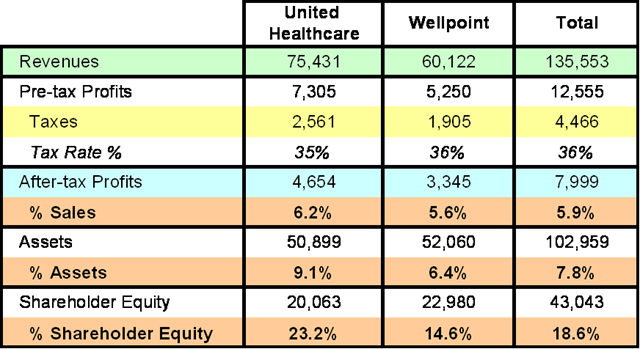
Well, for openers, the health insurance companies — don’t make all that much money.  Consider the 2007 financial results for the two biggest “pure” health insurance companies: United Health Care and Wellpoint.

image

Note that pre-tax profits are about 9% of revenues [12,555 divided by135,553].  About 1/3 of the pre-tax already goes to the government in taxes; about 2/3’s (6% of revenues) drops through to the bottom line.

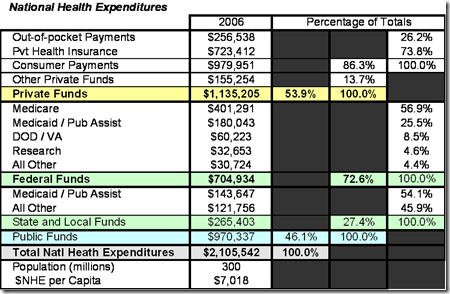
Currently, U.S. health care expenditures are about $2,1 trillion (just over $7,000 per person).  Of that, roughly half is “sourced” from the government via Medicare and Medicaid.  Of the half that is private pay, about 2/3’s ($725 billion ) goes through health insurance companies — the other 1/3 is out of patient’s pockets or “other” (e.g. charitable gifts to medical centers).

image

So, what’s the financial upside if all health care insurers were “disintermediated” and their profits were banked as economic cost savings to the system ?

Well, assuming that the rest of the healthcare insurance companies have profitability profiles comparable to United and Wellpoint — there’s a pre-tax profit of 9% that applies to $725 billion in revenues — or roughly $65 billion dollars.

But wait, the government is already getting about 1/3 of that in taxes.

So, the net gain is at most $40 to $45 billion, or about 2% of the $2.1 trillion in total healthcare spending.  Why “at most” ?

Simple, because it assumes that the government will be able to administer the programs as efficiently as the private companies.  Call me cynical, but I doubt it.

* * * * *

On the second point, that  health insurance companies reject claims and refuse to authorize treatment as a means of boosting their.bottom lines.

Well, that’s at most partially true, and catches the government administration folks in a circular argument.

First, about 1/3 of health  insurance companies’ transactions volume is administrative processing done in support of companies (usually big ones) that choose to self-insure.  That is, the self-insuring companies  take all of the risk, and only pay the insurance companies a fee (that includes profit, of course) for negotiating with health care suppliers and processing transactions  — in conformance with terms, conditions, and rules dictated by the companies.  There are agreed to standards that are enforced.

The other 2/3’s of their transaction volume is strictly premium based.  If more treatments are authorized, costs go up and premiums go up to cover them.   If treatments are denied,  costs go down, and the competitive market pushes premiums down,It’s that simple.

* * * * *

Want more from the Homa Files?
Click link =>
The Homa Files Blog

* * * * *

Improve healthcare by paying doctors less … huh?

July 20, 2009

“As costs explode, Congress will try to wring out ever more “savings” by underpaying doctors and hospitals.”

Full article: WSJ, What’s Up, Docs?, July 20, 2009
http://online.wsj.com/article/SB124804389935663419.html

* * * * *

Ken’s Take

Cutting to the chase, the crux of ObamaCare is (1) to provide tax-payer funded health insurance to 45 million uninsureds — many of them who don’t deserve it (think non-citizens, and young workers who choose to self-insure) (2) to ration medical services, especially among older folks and (3) squeeze doctors’ earnings. 

Frankly, I think doctors deserve to make a lot of money.  Most are pretty smart, all go through rigorous (and expensive) training, all get paid a pittance in their early years as they work round-the-clock as residents and, most important to me, they are gatekeepers to quality of life for me and my loved ones.

Doctors are already being squeezed.

One doctor friend of mine gave up the fight a couple of years ago, quit his practice, and went to work for a pharma company.

Another – a doc who prided himself on providing highly personal care — is now forced to treat 1/3 more patients to maintain his income level. Dr. Welby is being forced to become Dr. McDonald’s.

Still another doc has ‘vertically integrated’.  As payment rates have dropped on her basic services, she started providing services previously done by specialists.  Think OBY-GYN docs doing ultrasounds — lots of them — on pregnant moms. That boosts their income, but pressures the radiologists — who used to do the procedures — to find fill-in business.  A vicious cycle.

Does anybody really think that’s a formula for higher quality, lower cost healthcare?  Seems penny wise, pound foolish to me.

* * * * *

If you can’t trust Walmart, who can you trust?

July 2, 2009

Ken’s Take: Yesterday,  Walmart jumped on the Obamawagon and threw its support behind employer mandated healthcare insurance – the provision that layers additional taxes on any company that doesn’t offer its employees health insurance.

For sure, Walmart isn’t being altruistic.  This is a straightforward strategic-political gambit. 

Walmart already provides health insurance to the majority of its employees – essentially, all full-timers.  They might have to extend coverage to part-timers – or, they might be hoping that part-timers are outboarded from legislation — or, they just hire fewer part-timers (since their advantage over full-timers gets minimized)..

More important, few smaller retailers provide health benefits today.  All of these guys – Walmart’s competitors – will get slammed with higher taxes. In other words, their costs go up, theor margins go down, and Walmart gets a huge competitive advantage.  The small guys won’t be able to compete.

Also, there may be a quid pro quo for Walmart politically. 

Specifically,  if union “card check” gets passed, Walmart will have to be priority one for unionization.  That would be a way bigger problem than employer mandated healthcare insurance. 

My bet: Team Obama prizes the healthcare plan more than card check and cut a deal with Walmart to back off card check. 

Problem for Walmart: administration has a tendency to change rules and break promises.  Could backfire on Walmart.

* * * * *

Excerpted from WSJ, “ Everyday Low Politics” – Wal-Mart buys protection by selling out its competitors”. July 2, 2009

The employer-mandate endorsement falls into the self-interest department. A boost in the minimum wage helps Wal-Mart because most of its workers already earn well over the wage floor, and it hurts smaller, less-profitable competitors that can’t afford to pay more. On health care, an employer mandate will also reduce the margins of their rivals. This is especially true for businesses of a slightly smaller size that cannot insure on the same scale or currently don’t reach the 55% of the 1.4 million Wal-Mart employees who are insured through the company. (Another 40% or so are covered by spouses or the likes of Medicaid.)

The Wal-Mart-Stern-Podesta troika made sure to specify that “shared responsibility” must be “fair and broad in its coverage,” with an emphasis on the latter. The Mom & Pop stores that liberals accuse Wal-Mart of running out of town may get hit hardest. Democrats say they’ll exempt certain small businesses, size details to be determined. But if the mandate is limited to large employers, it won’t reduce the number of uninsured. According to the Kaiser Family Foundation, 99% of firms with more than 200 workers provide health benefits, only 62% of smaller firms.

Businesses are also largely indifferent whether compensation comes in the form of wages or benefits, so an employer mandate — an indirect tax on employment — may cause wages to rise more slowly. Or it may simply mean fewer jobs.

Full article:
http://online.wsj.com/article/SB124649408574683287.html

* * * * *

If you can’t trust Walmart, who can you trust?

July 2, 2009

Ken’s Take: Yesterday,  Walmart jumped on the Obamawagon and threw its support behind employer mandated healthcare insurance – the provision that layers additional taxes on any company that doesn’t offer its employees health insurance.

For sure, Walmart isn’t being altruistic.  This is a straightforward strategic-political gambit. 

Walmart already provides health insurance to the majority of its employees – essentially, all full-timers.  They might have to extend coverage to part-timers – or, they might be hoping that part-timers are outboarded from legislation — or, they just hire fewer part-timers (since their advantage over full-timers gets minimized)..

More important, few smaller retailers provide health benefits today.  All of these guys – Walmart’s competitors – will get slammed with higher taxes. In other words, their costs go up, theor margins go down, and Walmart gets a huge competitive advantage.  The small guys won’t be able to compete.

Also, there may be a quid pro quo for Walmart politically. 

Specifically,  if union “card check” gets passed, Walmart will have to be priority one for unionization.  That would be a way bigger problem than employer mandated healthcare insurance. 

My bet: Team Obama prizes the healthcare plan more than card check and cut a deal with Walmart to back off card check. 

Problem for Walmart: administration has a tendency to change rules and break promises.  Could backfire on Walmart.

* * * * *

Excerpted from WSJ, “ Everyday Low Politics” – Wal-Mart buys protection by selling out its competitors”. July 2, 2009

The employer-mandate endorsement falls into the self-interest department. A boost in the minimum wage helps Wal-Mart because most of its workers already earn well over the wage floor, and it hurts smaller, less-profitable competitors that can’t afford to pay more. On health care, an employer mandate will also reduce the margins of their rivals. This is especially true for businesses of a slightly smaller size that cannot insure on the same scale or currently don’t reach the 55% of the 1.4 million Wal-Mart employees who are insured through the company. (Another 40% or so are covered by spouses or the likes of Medicaid.)

The Wal-Mart-Stern-Podesta troika made sure to specify that “shared responsibility” must be “fair and broad in its coverage,” with an emphasis on the latter. The Mom & Pop stores that liberals accuse Wal-Mart of running out of town may get hit hardest. Democrats say they’ll exempt certain small businesses, size details to be determined. But if the mandate is limited to large employers, it won’t reduce the number of uninsured. According to the Kaiser Family Foundation, 99% of firms with more than 200 workers provide health benefits, only 62% of smaller firms.

Businesses are also largely indifferent whether compensation comes in the form of wages or benefits, so an employer mandate — an indirect tax on employment — may cause wages to rise more slowly. Or it may simply mean fewer jobs.

Full article:
http://online.wsj.com/article/SB124649408574683287.html

* * * * *

Reward healthy lifestyles? … Dems say: NO WAY !

July 1, 2009

Ken’s Take: The Safeway healthcare program – loaded with insurance discounts for people who don’t smoke, watch their weight and cholesterol, and generally live healthier – has gotten mucho press coverage – since it works !

Nonetheless, proposed healthcare reform packages are either silent on healthy lifestyle incentives or explicitly deter them. I guess the logic is that they would discriminate against people who smoke, eat too much, and refuse to walk around the block. My view: those are choices and behaviors, not genetics.  Go ahead and do them, but don’t expect me to subsidize them.

On a related topic: all the proposed healthcare reforms include – explicitly or implicitly – a rationing of healthcare in an person’s final years.  First, how can regulators know when the game clock is about to expire?  Second, shouldn’t Sen. Kennedy – who, incidentally, is old, fat, and a notorious alcohol abuser – walk the talk and start refusing medical treatments ?

* * * * *

WSJ, “Reform Needs Healthy Life Incentives”, Garrington, June 29, 2009

Sen. Kennedy doesn’t want insurers to reward good behavior.

The House Democrat and Kennedy-Dodd proposals do all they can to prevent health-insurance premium rates and coverage terms from reflecting the health status — and thus health-related behavior — of any insured person. Health status would not be permitted to affect coverage decisions, terms or pricing.

Benefit design and marketing of coverage would be regulated in an attempt to keep insurers from rewarding healthier people. Retrospective “risk adjustment” would be employed to reallocate funds from insurers that experience lower medical costs to those with higher costs. If an insurer were to attract relatively more healthy people — or keep more people healthy — it would run the risk of paying some or all of the gains to competitors.

The proposals’ strong aversion to having insurance rates or coverage terms related to health status reflects the view that either the need for health care is immune from individual control, or that a person should not be financially responsible for behavior that contributes to poor health, or both. These views are difficult to reconcile with the consensus that unhealthy behavior contributes significantly to obesity, diabetes, heart disease and cancer, and thus accounts for a substantial proportion of health-care costs.

Regulation that seeks to divorce insurance rates and coverage terms from health status would deter potential innovation that might provide meaningful financial incentives for healthy behavior and lower costs.

Incentives for healthy behavior have traditionally been weak under employer-sponsored health insurance, in part due to federal and state regulation that constrains the ability to reward healthy behavior. Turnover among employees and policy holders also reduces incentives to make long-term investments to promote healthy behavior.

Health-care reform should seek to encourage rather than discourage private innovation to provide incentives for healthy behavior. Safeway’s program offering employee premium discounts related to tobacco use, weight control, blood pressure and cholesterol levels is a good example.

Financial incentives for healthy behavior have the potential to significantly reduce costs without reducing quality.

An aversion to having health-insurance rates and coverage linked to individual behavior may be on the verge of becoming national policy. If that happens, the unintended consequences could be very costly.

* * * * *
Mr. Harrington is professor of health-care management and insurance and risk management at the Wharton School of the University of Pennsylvania

Full article:
http://online.wsj.com/article/SB124623169143066199.html

* * * * *

Raise your hand if you want an appointment with a bad doctor … in a couple of months, that is.

June 30, 2009

Ken’s Take: An interesting irony – current proposals tax company provide health insurance benefits except for union members – and most plans involve paying doctors less – fewer reimbursable services and lower fees. I guess union autoworkers contribute more to society than doctors do.

Begs a couple of rhetorical questions: (1) will lower pay attract better or worse doctors ?  (2) would you rather be treated by a good doctor or a bad doctor ?  (3) how long are you willing to wait to see a bad doctor.

The shallowness of Washington thinking never ceases to amaze.

* * * * *
Prompted by: IBD, “Alice in Medical Care”, Sowell, June 30, 2009

Politicians may talk about “bringing down the cost of medical care,” but they seldom even attempt to bring down the costs. What they bring down is the price– which is to say, they refuse to pay the costs.

We can even refuse to pay for so many doctors. But that just means that we will have to wait longer to see a doctor– as people do in countries with government-run medical systems.

In Canada, 27 percent of the people who have surgery wait four months or more. In Britain, 38 percent wait that long. But only 5 percent of Americans wait that long for surgery.

Surgery may well cost less in countries with government-run medical systems– if you count only the money cost, and not the time the patients have to endure the ailments that require surgery, or the fact that some conditions become worse, or even fatal, while waiting.

A recent report from the Fraser Institute in Canada shows that patients there wait an average of ten weeks to get an MRI, just to find out what is wrong with them. A lot of bad things can happen in 10 weeks, ranging from suffering to death.

Anybody can refuse to pay any cost. But don’t be surprised if you get less when you pay less. None of this is rocket science. But it does require us to stop and think before jumping on a bandwagon.

Full article:
http://www.realclearpolitics.com/articles/2009/06/30/alice_in_medical_care_97231.html

* * * * *

ABC’s loses on a sure bet … “The Philanthropist” and repeats outdraw the Obama healthcare infomercial (ouch!).

June 26, 2009

Ken’s Take: The mainstream media seems to be ignoring it, but virtually nobody watched the Obama healthcare  infomercial on ABC.  Hmmm.

Couple of observations:

(1) Maybe, just maybe, Obama yak-yak fatigue is finally setting in

(2) So, ABC took a hit to it’s journalistic reputation without even getting a swell of viewers,  That should teach the compliant networks a lesson.

(3) Imagine the ratings if Michael Jackson (may he RIP) had died a day earlier than he did

* * * *

From  The Live feed, “ABC’s White House special struggled for viewers”, June 25, 2009

President Obama’s town hall meeting on health care delivered a sickly rating Wednesday evening.

The one-hour ABC News special “Primetime: Questions for the President: Prescription for America” (4.7 million viewers, 1.1 preliminary adults 18-49 rating) had the fewest viewers in the 10 p.m. hour (against NBC’s “The Philanthropist” debut and a repeat of “CSI: NY” on CBS). The special tied some 8 p.m. comedy repeats as the lowest-rated program on a major broadcast network.

The special was shot at the White House and featured the president answering questions about his health care plan. The president’s primary message was that those who like their current insurance will be able to keep it and that taking no action will result in higher health care costs.

The special drew fire from Republican leadership after refusing to allow an official opposition response, or even a paid ad. ABC also interviewed Obama on “Good Morning America” to help promote the special.

ABC points out that “Questions for the President” continued after the local news during late night on “Nightline” (4.3 million) and helped boost the news program to pull more viewers than CBS’ “Late Show” and NBC’s “Tonight Show.”

Source:
http://www.thrfeed.com/2009/06/abcs-white-house-special-struggled-for-viewers.html

* * * * *

ABC’s loses on a sure bet … “The Philanthropist” and repeats outdraw the Obama healthcare infomercial (ouch!).

June 26, 2009

Ken’s Take: The mainstream media seems to be ignoring it, but virtually nobody watched the Obama healthcare  infomercial on ABC.  Hmmm.

Couple of observations:

(1) Maybe, just maybe, Obama yak-yak fatigue is finally setting in

(2) So, ABC took a hit to it’s journalistic reputation without even getting a swell of viewers,  That should teach the compliant networks a lesson.

(3) Imagine the ratings if Michael Jackson (may he RIP) had died a day earlier than he did

* * * *

From  The Live feed, “ABC’s White House special struggled for viewers”, June 25, 2009

President Obama’s town hall meeting on health care delivered a sickly rating Wednesday evening.

The one-hour ABC News special “Primetime: Questions for the President: Prescription for America” (4.7 million viewers, 1.1 preliminary adults 18-49 rating) had the fewest viewers in the 10 p.m. hour (against NBC’s “The Philanthropist” debut and a repeat of “CSI: NY” on CBS). The special tied some 8 p.m. comedy repeats as the lowest-rated program on a major broadcast network.

The special was shot at the White House and featured the president answering questions about his health care plan. The president’s primary message was that those who like their current insurance will be able to keep it and that taking no action will result in higher health care costs.

The special drew fire from Republican leadership after refusing to allow an official opposition response, or even a paid ad. ABC also interviewed Obama on “Good Morning America” to help promote the special.

ABC points out that “Questions for the President” continued after the local news during late night on “Nightline” (4.3 million) and helped boost the news program to pull more viewers than CBS’ “Late Show” and NBC’s “Tonight Show.”

Source:
http://www.thrfeed.com/2009/06/abcs-white-house-special-struggled-for-viewers.html

* * * * *

The Safeway Rx for rising healthcare costs …

June 23, 2009

TakeAways: Safeway’s keys to containing healthcare costs (1) make sure everybody has some “skin in the game” – i.e.  focus on “out of pocket” costs — don’t eliminate them;(2) steep premium discounts for good behavior, e.g. not smoking, weight control; (3) a database of providers and costs so people can shop around.  Works for me …

* * * * *

Excerpted from WSJ, “Mr. Burd Goes to Washington Business will pay for government health care”, June 19, 2009

As recently as 2004, Safeway was suffocating under health-care costs growing at 10% a year. The company blew up the company’s existing health-care structure and replaced it with one that embodied market principles — choice, responsibility, competition and price.

Nearly 80% of the 30,000 nonunion Safeway workers who take part in the program rate it good, very good, or excellent.

The Safeway plan has two main parts that work in tandem.

The first involves giving employees a financial stake in the system. Employees have skin in the game. The company deposits $1,000 each year into a “health reimbursement account,” which workers can use to pay for care. The next $1,000 in expenses is the employee’s responsibility. After that, employees pay 20% of costs up to a $4,000 maximum.

Safeway workers these days treat that first $1,000 carefully, since anything beyond it comes out of their pockets. The company is alive with stories of people who no longer visit the emergency room for routine care but instead call around to doctors to ask prices, and swap information with colleagues. Employees  go on a Web site, punch in a zip code, and get a list of providers and costs. One discovery was that within 30 minutes of its California headquarters routine colonoscopy prices ranged from $700 to $7,000.

The second part of Safeway’s plan was an embrace of the obvious: Healthy people cost less: 75% of health-care costs are the result of four conditions — cardiovascular disease, cancer, diabetes and obesity. The majority of these are preventable. and, for example,an obese employee can require 10 times the number of doctor visits in a year than someone of healthy weight.

Under Safeway’s voluntary “Healthy Measures” program, employees are tested for smoking, weight, blood pressure and cholesterol. Every area they “pass” results in a reduction in their premium, of as much as $1,560 for a family, a year. Those who fail but prove progress can get refunds.

Today, Safeway’s smoking and obesity rates are roughly 70% the national average.

Full article:
http://online.wsj.com/article/SB124536722522229323.html

The simple math of healthcare “reform” …

June 22, 2009

There was sticker shock when the CBO estimated the cost of the proposed healthcare reform package at about $1.6 trillion (over 10 years).

My question: why the shock?  In fact, why any surprise at all?

Think about it …

Total healthcare costs are generally reported to be about $2.1 trillion annually.

The U.S. population is just a bit over 300 million …  so, per capita healthcare costs are about $7,000 per person (which is consistent with most reports).

It’s generally reported that there are approximately 45 million people in the U.S. without health insurance.

So, it follows arithmetically that it costs about $315 billion annually to cover those folks (45 million times $7,000 per person).

Assuming a quick ramp up of the coverage, that’s $3.15 trillion over 10 years (for simplicity, call it $3 billion).

It’s generally reported that about 1/3 of the 45 million uninsureds are not citizens. At the national average, their healthcare expenses would be 1/3 of the $3 trillion, or $1 trillion. 

Policy question:  Who’s in favor of paying higher taxes or boosting the national debt to cover this $1 trillion ?

Also, it’s generally reported that about 1/3 of the 45 million uninsureds are healthy young adults who have access to health insurance and earn enough to pay for it, but opt to self-insure.  Simple economics –  they expect that the insurance will cost them more than their out-of-pocket expenses if they pay their own way.  Of course, they’re gambling that they won’t have any catastrophic medical bills – but, that’s their choice.

Policy question: Should other taxpayers have to foot the bill the bill for these opt-outters?  I don’t think so. 

Policy question: Should the government make them buy insurance? I don’t care – that’s not my problem.

Policy question: Should the opt-otters get health insurance subsidized by other taxpayers?  I don’t think so – they can afford to pay the freight – they just choose not to.

So, what’s left is about 15 million uninsureds … with an associated annual cost of about $105 billion … or a little over $1 trillion for 10 years.

Policy question: Should these ininsureds be covered by other taxpayers?  Even with a hard heart, it’s easy to say yes.

Note: Many of these uninsureds are simply between jobs.  when they find a new job, they’ll have insutance again.

* * * * *

The CBO took a couple of weeks to get 17 million new insureds at a cost of about $1.6 trillion.  The above analysis took all of 10 minutes.  Hmmmm

To cut healthcare costs by 40%, Safeway applies the auto insurance model.

June 19, 2009

TakeAway: By providing employees with financial incentives to stop smoking, lose weight, and control cholesterol levels and blood pressure … Safeway has contained healthcare spending over the past couple of years. 

The principle: reward good behavior … and don’t subsidize bad behavior.

Ken’s Take: Maybe fat folks should pay higher airfares and health insurance premiums.  Hmmm.

* * * * *

Excerpted from WSJ, “How Safeway Is Cutting Health-Care Costs”, June 12, 2009 

Effective health-care reform must meet two objectives: 1) It must secure coverage for all Americans, and 2) it must dramatically lower the cost of health care.

At Safeway we believe that well-designed health-care reform, utilizing market-based solutions, can ultimately reduce our nation’s health-care bill by 40%. The key to achieving these savings is health-care plans that reward healthy behavior.

Safeway’s plan capitalizes on two key insights: (1) 70% of all health-care costs are the direct result of behavior; (2) 74% of all costs are confined to four chronic conditions — cardiovascular disease, cancer, diabetes and obesity … and, 80% of cardiovascular disease and diabetes is preventable, 60% of cancers are preventable, and more than 90% of obesity is preventable.

Safeway has done nothing more than borrow from the well-tested automobile insurance model. For decades, driving behavior has been correlated with accident risk and has therefore translated into premium differences among drivers. Bad driver premiums are not subsidized by the good driver premiums.

As with most employers, Safeway’s employees pay a portion of their own health care through premiums, co-pays and deductibles. The big difference between Safeway and most employers is that we have pronounced differences in premiums that reflect each covered member’s behaviors.  Currently we are focused on tobacco usage, healthy weight, blood pressure and cholesterol levels. Employees are tested for the four measures cited above and receive premium discounts off a “base level” premium for each test they pass. If they pass all four tests, annual premiums are reduced $780 for individuals and $1,560 for families.

At Safeway, we are building a culture of health and fitness.

While comprehensive health-care reform needs to address a number of other key issues, we believe that personal responsibility and financial incentives are the path to a healthier America. By our calculation, if the nation had adopted our approach in 2005, the nation’s direct health-care bill would be $550 billion less than it is today.

Full article:
http://online.wsj.com/article/SB124476804026308603.html#mod=djemEditorialPage

Re: Healthcare … How many “uninsured” Americans are there? Answer: Not 47 million.

June 18, 2009

Ken’s Take: This isn’t new news, but it continues to be overlooked in the press and in Presidential speeches.  About 1/3 of “uninsureds” aren’t US citizens; about 1/3 are young and gainfully employed who choose to self-insure.  That leaves about 15 million who need to be taken care of.  Why aren’t “they” more truthful with the numbers?

* * * * *

Excerpted from IBD, “The Phantom Uninsured”, June 16, 2009

Team Obama uses the “46 million uninsured” as a reason to nationalize health care. But the Census Bureau says about a fifth of those aren’t U.S. citizens. In fact, a goodly number are illegal aliens.

According to “Income, Poverty, and Health Insurance Coverage in the United States,” a Census Bureau report published last August, of the 45.6 million persons in the U.S. that did not have health insurance at some point in 2007, 9.7 million, or about 21%, were not U.S. citizens.

Also among the uninsured are 17 million Americans who live in households where the annual income exceeds $50,000; 7 million of those without coverage have incomes of $75,000 a year or more. Many of the uninsured are young and healthy (40% are between ages 18 and 34) and at this point in their lives, particularly in this economy, choose to put their dollars elsewhere

“Why the lack of insurance (among people who own homes and computers)? One clue is that 60% reported being in excellent health or very good health.”

“For many, being uninsured is a transitory state, since most uninsured Americans are only without coverage for a short time.” In fact, a Census Bureau’s Survey of Income and Program Participation, found  that only 19 million Americans go without insurance for a full year.

Full article:
http://www.ibdeditorials.com/IBDArticles.aspx?id=330042258549199

* * * * *

Who pays for healthcare insurance? … Brush up on your economics before answering.

June 17, 2009

TakeAway: As healthcare costs increase, companies keep the lid on wages.  That’s why takehome pay has been stagnant for so long.  It’s basic economics.

* * * * *

Excerpted from WSJ, “Health Reform and Competitiveness”, June 17, 2009

Employers may write the checks to the insurance companies, but workers still pay for the coverage they get from those employers.

Why? Because the total cost of an employee is what matters to businesses, and fringe benefits are as much a part of compensation as cash wages.

When health costs rise, higher insurance premiums aren’t just lopped out of profits. Instead, nonhealth compensation drops to fund the higher premiums. Or wages rise more slowly than they otherwise would. [That’s why wages have been stagnant for so long.]

The White House Council of Economic Advisers notes exactly this point: If medical spending continues to accelerate, take-home pay will continue to stagnate.

The exceptions are heavily unionized businesses like auto makers that have locked themselves in to gold-plated coverage, especially for retirees. They have a harder time adjusting health costs and wages.

* * * * *

It’s certainly true that the U.S. employer-based insurance system can dampen entrepreneurial spirits. There’s the “job lock” phenomenon, in which employees fear leaving a less productive job because they’re afraid to lose their health benefits.

Another problem is that insurance costs more for small groups than the large risk pools that big corporations assemble, meaning that it’s harder to form new businesses that can offer policies.

Full article:
http://online.wsj.com/article/SB124520327436821723.html

Healthcare “reform” … cost adders are certain … keep your fingers crossed re: the savings

June 16, 2009

Ken’s Take: For sure, 45 million uninsureds  will get government coverage. That includes 15 million non-citizens and 15 million healthy young adults who choose to self-insure now, but will be “mandated” into the program. The cost of adding these folks is a certainty.

What’s far less certain is whether any of the pie-in-the-sky cost reductions – most of which have been tried and failed in the past – will generate offsetting savings.

Still, no talk of real structural changes – e.g. free gov’t run Minute Clinics, tort reform.  Just “evidence based” veils being thrown over healthcare rationing.

* * * * *

Excerpted from IBD, “Wrong-Way Health Care ‘Reform’ Could Actually Increase Spending”, June 12, 2009

Background

The central cause of runaway health spending is clear. Hospitals and doctors are paid mostly on a fee-for-service basis and reimbursed by insurance, either private or governmental.

The open-ended payment system encourages doctors and hospitals to provide more services — and patients to expect them. It also favors new medical technologies, which are made profitable by heavy use.

Unfortunately, what pleases providers and patients individually hurts the nation as a whole.

That’s the crux of the health care dilemma .

* * * * *

The Issue

No doubt the health program that Congress fashions will counter this reality by including some provisions intended to cut costs (“bundled payments” to hospitals, “evidence-based guidelines,” electronic record keeping).

But, the main aim of health care “reform” now being fashioned in Congress is to provide insurance to most of the 46 million uncovered Americans.

This is popular and seems the moral thing to do. After all, hardly anyone wants to be without insurance.

But the extra coverage might actually worsen the spending problem. How much healthier today’s uninsured would be with that coverage is unclear. They already receive health care — $116 billion worth in 2008.

Some is paid by the uninsured themselves (37%), some by government and charities (26%). The remaining “uncompensated care” is either absorbed by doctors and hospitals or shifted to higher private insurance premiums. Some uninsured would benefit from coverage, but others wouldn’t. Either they’re healthy (40% are between ages 18 and 34) or would receive ineffective care.

The one certain consequence of expanding insurance coverage is that it would raise spending. When people have insurance, they use more health services.

* * * * *

Some Stats

A new report from Obama’s own Council of Economic Advisers shows why controlling health costs is so important. If current spending growth continues, the CEA projects that:

Health spending, which was 5% of gross domestic product in 1960 and is reckoned at almost 18% today, would grow to 34% of GDP by 2040 — a third of the economy.

Medicare and Medicaid, the government insurance programs for the elderly and poor, would increase from 6% of GDP now to 15% in 2040 — roughly equal to three-quarters of present federal spending.

Employer-paid insurance premiums for family coverage, which grew 85% in inflation-adjusted terms from 1996 to $11,941 in 2006, would increase to $25,200 by 2025 and $45,000 in 2040.

Full article:
http://www.ibdeditorials.com/IBDArticles.aspx?id=329696969267196

What if Team Obama is wrong about healthcare ?

June 8, 2009

Ken’s Take: I agree that all US citizens should have access to healthcare, and I agree that healthcare spending is out of control.  But,  I really don’t want DMV-like government workers determining what medical services I get, where I get them, and when I get them (if at all).

Below are headlines from a WSJ piece that questions the fundamental assumptions underlying the Obama plan.

Note that neither the Obama plan nor the WSJ ideas address structural change like free (or low charge) clinics to handle routine medical care, or tort reform to minimize frivolus malpractice claims and the redundant services that they induce.

* * * * *

Excerpted from WSJ, “Obama’s Health Cost Illusion”, June 8, 2009

The President’s main case for reform is rooted in false claims and little evidence.

The main White House argument for health-care reform goes something like this: If we spend now on a hugely expensive new insurance program for the middle class, we can save later by reducing overall U.S. health spending.

What if this particular theory turns out to be a political illusion? What if the speculative cost savings never report for duty, while the federal balance sheet is still swamped with new social obligations that will be impossible to repeal? The only possible outcome will be the nationalization of U.S. health markets, which will mean that almost all care will be rationed by politics.

* * *
Since Medicare was created in 1965, U.S. health spending has risen about 2.7% faster than the economy and on current trend would hit 20% of GDP within a decade.

Now the White House claims the magic key is the dramatic variations in per patient health spending among U.S. regions. Often there is no relationship between spending and the quality of care, according to a vast body of academic research.  

But, Richard Cooper, a professor of medicine at the University of Pennsylvania’s Wharton School, has studied regional variation in aggregate health spending, and found that the areas with the highest quality spend the most on medicine.

* * * * *

Obama’s ideas include more health information technology; emphasizing prevention and healthy living; rejiggering reimbursement policies so doctors and hospitals are paid more for quality care; and funding federal research that compares the effectiveness of medical treatments. There is scant evidence that any of them will ever save real money.

* * * * *

According to Team Obama:  “Future increases in spending could be moderated if costly new medical services were adopted more selectively in the future than they have been in the past and if the diffusion of existing costly services was slowed.”

But technological change is the most important driver of health spending. Modern medicine can do so much more than it could in the past, but this costs a lot even as it has bought a lot in extending and improving lives. In a 2001 study, the estimated benefits of lower infant mortality and better treatment of heart attacks “have been sufficiently great that they alone are about equal to the entire cost increase for medical care over time.”

* * * * *
A far better alternative is to increase individual responsibility for medical decisions.

In 1965, the average American paid more than half of his health care out of pocket. Spending has since increased sevenfold, but the amount that consumers pay directly hasn’t even doubled. When people aren’t exposed to the true cost of their care  — they consume more care.

Roughly half of the real increase in U.S. health spending between 1950 and 1990 is due to Medicare and the spread of third-party, first-dollar insurance.

Increasing cost-sharing would discipline the health spending curve and give it a more rational bent. The U.S. health cost “crisis” is that we spend so much without incentives to weigh the costs against the benefits.

Yet the entire Obama agenda is about increasing political, rather than individual, control of the health markets.

Full article http://online.wsj.com/article/SB124442772329993085.html

Gov’t healthcare bureaucrats say: "Stick in up your %#@" … literally

May 19, 2009

Excerpted from WSJ, ” How Washington Rations ObamaCare: a case study in ‘cost-control”, May 19, 2009

Here’s a preview of how health care will be rationed under a nationalized plan with a federal health board making Solomonic decisions based on “comparative effectiveness research”:

Medicare’s central planners decided to deny payment for a new version of one of life’s most unpleasant routine procedures, the colonoscopy.

At issue are “virtual colonoscopies,” or CT scans of the abdomen.

Colon cancer is the second leading cause of U.S. cancer death but one of the most preventable. Found early, the cure rate is 93%, but only 8% at later stages.

Virtual colonoscopies are likely to boost screenings because they are quicker, more comfortable and significantly cheaper than the standard “optical” procedure, which involves anesthesia and threading an endoscope through the lower intestine.

Virtual colonoscopies are endorsed by the American Cancer Society and covered by a growing number of private insurers including Cigna and UnitedHealthcare.

The problem for Medicare is that if cancerous lesions are found using a scan, then patients must follow up with a traditional colonoscopy anyway. Costs would be lower if everyone simply took the invasive route, where doctors can remove polyps on the spot.

As Medicare noted in its ruling, “If there is a relatively high referral rate [for traditional colonoscopy], the utility of an intermediate test such as CT colonography is limited.” In other words, duplication would be too pricey.

One problem is that what “works best” isn’t the same for everyone and invasive procedures are often avoided —  slowing early detection.

Full article:
http://online.wsj.com/article/SB124268737705832167.html

* * * * *
Want more from the Homa Files?
     Click link =>
  The Homa Files Blog

Electronic medical records: huge savings, huge benefits … well, not so fast.

March 16, 2009

Ken’s Take:

The evidence is equivocal, but on balance, I’m a fan of electronic med records.  As a patient, I get frustrated when I have to repeatedly document my medical history — sometimes to multiple people on the same doctor’s visit. But, I think Team Obama severely underestimates the time, effort and resources that will be required to upgrade and integrate the multitude of competing  legacy computer systems in place in hospitals, labs, and doctors’ offices.  It’ll make landing a man on the moon look like a walk in the park.

Also — while I have zero concerns re: the FBI or any other government agencies tapping my phone or rifling through my bank accounts — I do do have concerns about the lack of privacy re: medical records. 

* * * * * *
Excerpted from WSJ, “Obama’s $80 Billion Exaggeration”, March 11, 2009

The flagship of Pres. Obama’s healthcare proposal is the national adoption of electronic medical records — a computer-based system that would contain every patient’s clinical history, laboratory results, and treatments.

This, he said, would save some $80 billion a year, safeguard against medical errors, reduce malpractice lawsuits, and greatly facilitate both preventive care and ongoing therapy of the chronically ill.

Physicians at the Harvard teaching hospitals, where electronic medical records have been in use for years, are dumbfounded, wondering how such dramatic claims of cost-saving and quality improvement could be true. The real-world use of electronic medical records is quite different from such an idealized vision.

To be sure, there are real benefits from electronic medical records. Physicians and nurses can readily access all the information on their patients from a single site. Particularly helpful are alerts in the system that warn of potential dangers in the prescribing of a certain drug for a patient on other therapies that could result in toxicity. But do these benefits translate into $80 billion annually in cost-savings? The cost-savings from avoiding medication errors are relatively small, amounting at most to a few billion dollars yearly..

Other potential cost-savings are far from certain. The impact of medication errors on malpractice costs is likely to be minimal, since the vast majority of lawsuits arise not from technical mistakes like incorrect prescriptions but from diagnostic errors, where the physician makes a misdiagnosis and the correct therapy is delayed or never delivered. There is no evidence that electronic medical records lower the chances of diagnostic error.

In fact, once a misdiagnosis enters into the electronic record, it is rapidly and virally propagated. A study of orthopedic surgeons, comparing handheld PDA electronic records to paper records, showed an increase in wrong and redundant diagnoses using the computer — 48 compared to seven in the paper-based cohort.

But the propagation of mistakes is not restricted to misdiagnoses. Once data are keyed in, they are rarely rechecked with respect to accuracy. For example, entering a patient’s weight incorrectly will result in a drug dose that is too low or too high, and the computer has no way to respond to such human error.

What is clear is that electronic medical records facilitate documentation of services rendered by physicians and hospitals, which is used to justify billing. Doctors in particular are burdened with checking off scores of boxes on the computer screen to satisfy insurance requirements, so called “pay for performance.”

Some have speculated that the patient data collected in national electronic health records will be mined for research purposes to assess the cost effectiveness of different treatments. This analysis will then be used to dictate which drugs and devices doctors can provide to their patients in federally funded programs like Medicare. Americans should decide whether they want to participate in such a national experiment only after learning about the nature of the analysis of their records and who will apply the results to their health care.

All agree skyrocketing health-care costs are a dangerous weight on the economic welfare of the nation. Much of the growing expense is due to the proliferation of new technology and costly treatments. Significant monies are spent for administrative overhead related to insurance billing and payments. The burden of the uninsured who use emergency rooms as their primary care providers, and extensive utilization of intensive care units at the end of life, further escalate costs.

Full article:
http://online.wsj.com/article/SB123681586452302125.html

* * * * *

Want more from the Homa Files?
Click link =>
  The Homa Files Blog

Disruptive innovation: dentists in food stores … hmmm.

January 8, 2009

Excerpted from  Business Week, ” Root Canal? Try Aisle Five”, Oct. 13, 2008

Britain  suffers from a shortage of dentists.

So, in mid-September, British supermarket giant Sainsbury’s opened a dental clinic in one of its Manchester outlets. The in-store office will operate during store hours, including evenings and weekends. Most fees ($29 for a checkup, for instance) won’t exceed those charged by Britain’s national health service.

Earlier this year, at another Manchester store, the chain installed a medical clinic that it plans to replicate at other outlets.

If the dental office’s three-month trial is successful, the company says, it will set up 50 others

Full article:
http://images.businessweek.com/ss/08/10/1002_btw/5.htm

* * * * *

Want more from the Homa Files?
Click link =>
  The Homa Files Blog

Darwin at work: “I don’t have health insurance, but my dogs do.”

January 7, 2009

 Excerpted from Progressive Grocer, “NONFOODS: Financing Fido” by Joseph Tarnowski, December 23, 2008

* * * * *

While today’s economy may be going to the dogs, consumers’ canine friends certainly aren’t feeling it, as shoppers are making sacrifices in their own product choices so their pets can live in the manner to which they’ve become accustomed, according to a recent study by the American Kennel Club.

“In general, people are more dedicated to their dogs than ever before … No doubt dogs bring comfort and stress relief to many people during this difficult time.”

According to the study:

  • 48 percent are purchasing fewer toys, treats, and other nonessential dog supplies
  • 34 percent have begun buying food in bulk.

But …

  • 65 percent of those surveyed said they would switch to eating ramen noodles before switching to a lower-quality dog food.
  • 59 percent said they would color their hair at home so that their pet wouldn’t have to miss an appointment with the groomer.
Some dog owners have even opted to purchase health plans for their dogs over themselves. One survey respondent admitted, “My Cavaliers have health insurance; however, I do not.”

Dedicated pet owners also appear to be consistent in their desire to provide their pets with adequate health care. PetPartners says that sales rates are holding up and owners are renewing their policies in consistently high numbers—an indication that pet owners view pet insurance as a way to manage their pets’ health care costs.

Edit by NRV

Full article:
http://www.progressivegrocer.com/progressivegrocer/content_display/in-print/current-issue/e3if75f39c71ceea0820d23d3d7186a7dbe?pn=2 

* * * * *

Want more from the Homa Files?
Click link =>
The Homa Files Blog


Darwin at work: “I don't have health insurance, but my dogs do.”

January 7, 2009

 Excerpted from Progressive Grocer, “NONFOODS: Financing Fido” by Joseph Tarnowski, December 23, 2008

* * * * *

While today’s economy may be going to the dogs, consumers’ canine friends certainly aren’t feeling it, as shoppers are making sacrifices in their own product choices so their pets can live in the manner to which they’ve become accustomed, according to a recent study by the American Kennel Club.

“In general, people are more dedicated to their dogs than ever before … No doubt dogs bring comfort and stress relief to many people during this difficult time.”

According to the study:

  • 48 percent are purchasing fewer toys, treats, and other nonessential dog supplies
  • 34 percent have begun buying food in bulk.

But …

  • 65 percent of those surveyed said they would switch to eating ramen noodles before switching to a lower-quality dog food.
  • 59 percent said they would color their hair at home so that their pet wouldn’t have to miss an appointment with the groomer.
Some dog owners have even opted to purchase health plans for their dogs over themselves. One survey respondent admitted, “My Cavaliers have health insurance; however, I do not.”

Dedicated pet owners also appear to be consistent in their desire to provide their pets with adequate health care. PetPartners says that sales rates are holding up and owners are renewing their policies in consistently high numbers—an indication that pet owners view pet insurance as a way to manage their pets’ health care costs.

Edit by NRV

Full article:
http://www.progressivegrocer.com/progressivegrocer/content_display/in-print/current-issue/e3if75f39c71ceea0820d23d3d7186a7dbe?pn=2 

* * * * *

Want more from the Homa Files?
Click link =>
The Homa Files Blog


Majority Oppose Government-run National Health Plan … and only 45% of Dems favor it.

December 18, 2008

Excerpted from Rasmussen Reports, December 12, 2008

* * * * *

51% of U.S. voters oppose the creation of a single-payer national health insurance plan overseen by the federal government, 30%  favor it, and 19% are undecided.

45% of Democrats favor a government-run national single-payer plan;  74% of Republicans are against it.

55% of white voters oppose a government-run plan, while a plurality of African-Americans (44%) support it.

61% of liberals favor a national health plan overseen by the government, compared to 30% of moderates and 14% of conservatives.

Married voters — by double digits –are more opposed to a government plan than unmarrieds.

Full article:
http://www.rasmussenreports.com/public_content/business/healthcare/51_oppose_government_run_national_health_plan

* * * * *

Want more from the Homa Files?
Click link =>
  The Homa Files Blog

The $1,500 new car option … (ok, it’s not really an option)

December 3, 2008

GM provides health benefits for a million people today — only a fraction of them actual workers.

These health-care expenses account for over $1,500 of the cost of every GM vehicle.

Common Observation: GM is no longer a car company that provides health benefits, but a health-care company that happens to make cars.

* * * * *
Excerpted from WSJ, “What’s Good for GM Could Be Good for America”, Dec 2, 2008
http://online.wsj.com/article/SB122818153973071061.html 

* * * * *

Want more from the Homa Files?
Click link =>
  The Homa Files Blog

Rising healthcare costs … blame Grandma !

October 23, 2008

Excerpted from McKinsey Quarterly: “Health care costs: A market-based view”, Sept. 2008

* * * * *

In 2007, healthcare expenditures in the US wereover $2 trillion … roughly $7,000 per capita.

Based on 2005 data — which is likely to hold in 2007 — seniors over-consume healthcare — by a lot.

The over 75 crowd accounts for about 4 times the average healthcare spending … and about 6 times  an average  young adult (10-44)

image

Source: US Centers for Mecicare & Medicaid Services

* * * * *
Full article:
http://www.mckinseyquarterly.com/Health_care_costs_A_market-based_view_2201_abstract

* * * * *

Want more from the Homa Files?
Click link =>
  The Homa Files Blog

The health care debate … that isn’t being held

October 14, 2008

Ken’s Take: Coburn & Burr raise good points — especially re: the likely consequences of gov’t controlled health care.  But, even they ignore the biggest issue: we’re spending over $7,000 per capita annually on health care.  Until the costs get contained, we’re just shifting around the burdens of who pays what.

* * * * *

Excerpted from RCP: “Americans Deserve a Real Health Care Debate”, Tom Coburn and Richard Burr, October 10, 2008

* * * * *

The American people have had enough and want the campaigns to confront the real problem: Health care is becoming less affordable and less accessible for millions of middle-class families. While health care premiums have gone up 78 percent from 2001-2007, workers’ earnings have only risen by 19 percent.

* * * * * 

Three core principles. First, a person’s ability to afford health care should not depend on whether they work for an employer who offers health insurance. Second, wealthy Americans with expensive health plans do not deserve a bigger tax benefit than working class Americans. And finally, workers should be able to pick the health care plan that best meets their needs, and they should be able to take it with them when they change jobs.

* * * * *

Our current tax code is fundamentally unfair and regressive. Lower income workers receive the least benefit, while wealthy Americans receive the most. Because tax rules are tied to employment (health care benefits paid for by employers are exempt from income and payroll taxes), if you leave your job, you leave your health care behind. Meanwhile, Americans who purchase their own health insurance generally do not receive a tax benefit.

* * * * *

Government-controlled health care is a seductive message that, in practice, is most cruel to those who can least afford a way out. Much of Europe is moving away from government-control health care.  Countries like the United Kingdom have learned the painful lesson that the only way government can control costs when it is in charge is by rationing care. In the UK, it is not uncommon for women diagnosed with breast caner to wait months for treatment.  Canadians look for health care asylum in the United States, not vice versa. As the Canadian Supreme Court said in a ruling that exposed the inequities of government-controlled health care, “Access to a waiting list is not access to health care.”In short, government-sponsored health care will do for the health care economy what government-sponsored mortgages did to the housing market.

Tom Coburn, M.D. is a U.S. Senator from Oklahoma and Richard Burr is a U.S. Senator from North Carolina.

* * * * *
Full article:
http://www.realclearpolitics.com/articles/2008/10/americans_deserve_a_real_healt.html

* * * * *

Want more from the Homa Files?
Click link =>
  The Homa Files Blog

Getting Real About Health Care

September 18, 2008

Excerpted from Newsweek: “Getting Real About Health Care
It’s not about coverage. It’s about costs.”, Robert J. Samuelson
Sep 6, 2008

* * * * *

Note: There are roughly 45 million uninsudred people in the U.S.  Approximately 1/3 are not legal citizens; approximately 1/3 are in the top 1/2 of wage earners (i.e. over the $50,000 median); approximately 40% are 19 to 34, relatively healthy and, in effect, choose to self-insure.

* * * * *

Summary; Emphasis should be on fundamental restructuring of costs:     more electronic record-keeping, better case management, fewer dubious tests and procedures (i.e. unnecessary, duplicative), contained end-of-life treatment.

* * * * *

Article

46 million Americans … or almost one in seven lack health insurance.

By impressive majorities, Americans regard this as a moral stain. Sen. Ted Kennedy echoed the view of many that health care is a “right” that demands universal insurance. This is a completely understandable view and one that is, I think, utterly wrong.

* * * * *

Health care should be at the top of the agenda. But the central problem is not improving coverage. It’s controlling costs.

In 1960, health care accounted for $1 of every $20 spent in the U.S. economy; now that’s $1 of every $6, and …  it could be $1 of every $4 by 2025.  Ponder that: a quarter of the U.S. economy devoted to health care.

Countless studies have shown that many diagnostic tests, surgeries and medical devices are either ineffective or unneeded.

Greater health spending should not have the first moral claim on our wealth, because its relentless expansion is slowly crowding out other national needs.

For government, higher health costs threaten other programs—schools, roads, defense, scientific research—and put upward pressure on taxes. For workers, increasingly expensive insurance depresses take-home pay, as employers funnel more compensation dollars into coverage. There’s also a massive and undesirable income transfer from the young to the old, accomplished through taxes and the cross-subsidies of private insurance, because the old are the biggest users of medical care.

* * * * *

It is widely assumed that health care, like most aspects of American life, shamefully shortchanges the poor. This is less true than it seems.

Data show that, on average, annual health spending per person—from all private and government sources—is equal for the poorest and the richest Americans. In 2003, it was $4,477 for the poorest fifth and $4,451 for the richest.

The reason: government already insures more than a quarter of the population, including many of the poor. Medicare covers the elderly; Medicaid, many of the poor and their children; SCHIP (State Children’s Health Insurance Program), more children.

Another reason, stems from the skewing of health spending toward the very sick and dying; 10 percent of patients account for two thirds of spending. People in this unfortunate group, regardless of income, get thrust onto a conveyor belt of costly care: long hospital stays, many tests, therapies and surgeries.

* * * * *

That includes the uninsured. In 2008, their care will cost about $86 billion, … The uninsured pay about $30 billion themselves; the rest is uncompensated.

Of course, no sane person wants to be without health insurance, and the uninsured receive less care and, by some studies, suffer abnormally high death rates. But other studies suggest only minor disadvantages for the uninsured.

* * * * *

We need more realism on health care. The trouble with casting medical-care as a “right” is that this ignores how open-ended the “right” should be and how fulfilling it might compromise other “rights” and needs.

What makes people healthy or unhealthy are personal habits, good or bad (diet, exercise, alcohol and drug use); genetic makeup, lucky or unlucky, and age. Health care, no matter how lavishly provided, can only partially compensate for these individual differences.

* * * * *

There is a basic moral and political dilemma that most Americans refuse to acknowledge. What we all want for ourselves and our families—access to unlimited care paid for by someone else—may be ruinous for us as a society.

Sensible limits must somehow be imposed.

* * * * *

The crying need now is not to insure all the uninsured. This would be expensive (an additional $123 billion a year, estimates the Kaiser study) and would provide modest health gains at best since 40% of the uninsured are young (19 to 34) and relatively healthy.

The compelling need now is to limit the runaway increases in spending that make private and government insurance more expensive and may not deliver significant health improvements.

* * * * *

Both McCain and Obama have health-care proposals that …  largely ignore the massive health-care challenge already sitting in the government’s lap: Medicare.

By some studies, 30 percent of Medicare spending may go to unneeded services that do not enhance recipients’ well-being.

Medicare is so large and influential that by altering how it operates, government can reshape the entire health-care system. This would require changes in rules and reimbursements to encourage more electronic record-keeping, better case management, fewer dubious tests and procedures, and a fairer sharing of costs between the young and the old.

The work would be unglamorous and probably unpopular. But if the next president won’t—or can’t—do it, his presidency will fail in one fateful way.

* * * * *

Full article:
http://www.newsweek.com/id/157573

* * * * *

Want more from the Homa Files?
Click link =>
  The Homa Files Blog

Health Care: The Obama Plan

September 16, 2008

Excerpted from WSJ: ” Why Obama’s Health Plan Is Better”, David Cutler, Sept. 16, 2008 

* * * * *
The big threat to growth in the next decade is not oil or food prices, but the rising cost of health care. The doubling of health insurance premiums since 2000 makes employers choose between cutting benefits and hiring fewer workers.

Rising health costs push total employment costs up and wages and benefits down. The result is lost profits and lost wages, in addition to pointless risk, insecurity and a flood of personal bankruptcies.

Sustained growth thus requires successful health-care reform.

* * * * *

Sen. Obama’s proposal

Learning. One-third of medical costs go for services at best ineffective and at worst harmful. Fifty billion dollars will jump-start the long-overdue information revolution in health care to identify the best providers, treatments and patient management strategies.

Rewarding. Doctors and hospitals today are paid for performing procedures, not for helping patients. Insurers make money by dumping sick patients, not by keeping people healthy. Obama proposes to base Medicare and Medicaid reimbursements to hospitals and doctors on patient outcomes (lower cholesterol readings, made and kept follow-up appointments) in a coordinated effort to focus the entire payment system around better health, not just more care.

Pooling. The Obama plan would give individuals and small firms the option of joining large insurance pools. With large patient pools, a few people incurring high medical costs will not topple the entire system, so insurers would no longer need to waste time, money and resources weeding out the healthy from the sick. 

Preventing. In today’s health-care market, less than one dollar in 25 goes for prevention, even though preventive services — regular screenings and healthy lifestyle information — are among the most cost-effective medical services around. Guaranteeing access to preventive services will improve health and in many cases save money.

Covering. Controlling long-run health-care costs requires removing the hidden expenses of the uninsured. The reforms described above will lower premiums by $2,500 for the typical family, allowing millions previously priced out of the market to afford insurance.In addition, tax credits for those still unable to afford private coverage, and the option to buy in to the federal government’s benefits system, will ensure that all individuals have access to an affordable, portable alternative at a price they can afford.

* * * * *

Given the current inefficiencies in our system, the impact of the Obama plan will be profound. Besides the $2,500 savings in medical costs for the typical family, according to our research annual business-sector costs will fall by about $140 billion.

We know these savings are attainable: other countries have them today. We spend 40% more than other countries such as Canada and Switzeraland on health care — nearly $1 trillion — but our health outcomes are no better.

The lower cost of benefits will allow employers to hire some 90,000 low-wage workers currently without jobs because they are currently priced out of the market. It also would pull one and a half million more workers out of low-wage low-benefit and into high-wage high-benefit jobs. Workers currently locked into jobs because they fear losing their health benefits would be able to move to entrepreneurial jobs, or simply work part time.

* * * * *
Mr. Cutler is professor of economics at Harvard and an adviser to Barack Obama’s presidential campaign.

* * * *
Full op-ed:
http://online.wsj.com/article/SB122152292213639569.html#printMode

* * * * *

Want more from the Homa Files?
Click link =>
  The Homa Files Blog

Health Insurance – Those %#@& Health Insurance Companies !

September 9, 2008

In the book Crunch, liberal economist Jared Bernstein criticizes health insurance companies, asserts that:

  • “Other countries with advanced economies save a lot by taking the insurers out of the picture. They employ either single-payer or heavily regulated systems, in which either the government is the exclusive insurer or private insurers must provide specified, the subsidized coverage to all … costs are held down by taking advantage of the huge risk pool — the healthy majority subsidizes the sick minority … and, insurer’s profits are weeded out of the system.”
  • “Private insurers have an incentive to prevent people from getting all the care they think they need.  Insurers are in the for-profit sector, so they spend time and resources trying to avoid making payouts. “

These are oft repeated refrains from folks who advocate government administered universal heath insurance.

* * * * *

I think this argument displays a remarkably shallow understanding of what health insurance companies do, how much money they make, and how they make it.  And. it places a remarkably high level of confidence in government administered programs (think, the FDA chasing down salmonella sources). 

* * * * *

First, what is the financial upside if all health insurance companies’ profits are eliminated and put in the national bank as economic cost savings.

Well, for openers, the health insurance companies — don’t make all that much money.  Consider the 2007 financial results for the two biggest “pure” health insurance companies: United Health Care and Wellpoint.

image

Note that pre-tax profits are about 9% of revenues [12,555 divided by135,553].  About 1/3 of the pre-tax already goes to the government in taxes; about 2/3’s (6% of revenues) drops through to the bottom line.

Currently, U.S. health care expenditures are about $2,1 trillion (just over $7,000 per person).  Of that, roughly half is “sourced” from the government via Medicare and Medicaid.  Of the half that is private pay, about 2/3’s ($725 billion ) goes through health insurance companies — the other 1/3 is out of patient’s pockets or “other” (e.g. charitable gifts to medical centers). 

 image

So, what’s the financial upside if all health care insurers were “disintermediated” and their profits were banked as economic cost savings to the system ?

Well, assuming that the rest of the healthcare insurance companies have profitability profiles comparable to United and Wellpoint — there’s a pre-tax profit of 9% that applies to $725 billion in revenues — or roughly $65 billion dollars.

But wait, the government is already getting about 1/3 of that in taxes.

So, the net gain is at most $40 to $45 billion, or about 2% of the $2.1 trillion in total healthcare spending.  Why “at most” ? 

Simple, because it assumes that the government will be able to administer the programs as efficiently as the private companies.  Call me cynical, but I doubt it.

* * * * *

On the second point, that  health insurance companies reject claims and refuse to authorize treatment as a means of boosting their.bottom lines.

Well, that’s at most partially true, and catches the government administration folks in a circular argument.

First, about 1/3 of health  insurance companies’ transactions volume is administrative processing done in support of companies (usually big ones) that choose to self-insure.  That is, the self-insuring companies  take all of the risk, and only pay the insurance companies a fee (that includes profit, of course) for negotiating with health care suppliers and processing transactions  — in conformance with terms, conditions, and rules dictated by the companies.  There are agreed to standards that are enforced.

The other 2/3’s of their transaction volume is strictly premium based.  If more treatments are authorized, costs go up and premiums go up to cover them.   If treatments are denied,  costs go down, and the competitive market pushes premiums down,It’s that simple.

* * * * *

Want more from the Homa Files?
Click link =>
  The Homa Files Blog

* * * * *

Health Insurance – Is the glass 15% empty or 85% full ?

September 4, 2008

I think that practically everybody agrees all citizens should have access to adequate heath care and that the current system has some major problems re: cost, service-delivery, and insurance coverage.

Universal heath care was the centerpiece of the Clinton – Obama – Edwards campaign platforms during the Democratic primaries, and though the issue seems to have been moved to the back burner in the general election campaigns — in part, having been displaced on the front burner by $4 per gallon gasoline prices — it is embedded in the Democratic platform.

* * * * *

For starters, I get irked that politicos have such a hard time distinguishing between health care (e.g. seeing a doctor, getting into a hospital, getting a prescription filled) and health insurance (i.e. being part of a “risk pool” with healthy folks subsidizing unhealthy ones — and, maybe, having the insurance premiums partially paid by employers or somebody else),

The health insurance part is probably the easier to fix since it just means throwing money at the problem — usually, somebody’s else’s money that gathered up by raising taxes.

The heated debate usually centers on the 45 million uninsured folks in the U.S.  (see yesterday’s post for the official Commerce Dept. data).

Putting that number in context: as of today, the U.S. population is just under 305 million … adding in about 20 million illegal immigrants and the number is 325 million.
http://www.census.gov/main/www/popclock.html

So, the 45 million represent about 15% of the population of folks  living in the U.S..

That means that roughly 85% of the population does have health insurance of one sort or another — usually through employers or the government (Medicare and Medicaid).

It has become  a national pastime to gripe about health insurance premiums going up, co-pays and deductibles going up, coverage being pared back (i.e. the list of participating docs and services covered), and claims processes being confusing and high-hassle.  But, it’s my sense that — adjusting for the naturally stressful nature of the “product” — most people are relatively satisfied with their insurance programs.  Sure, everybody would like to pay less, get more, and get it easier — but on balance, the plans do what they’re supposed to do.

Now, as to the other 15% — the uninsureds.   I’ve seen many estimates that break the 45 million roughly into thirds: 1/3 are illegal immigrants; 1/3 are folks who have access to plans but choose to, in effect, self-insure — they’re typically healthy young-adults, many of whom make over $50,000 per year; and 1/3 “structurally uninsured” — split about equally between poor people with no prospects for private insurance and folks who are simply between jobs.

Call me callous, but I don’t think the first two groups — the illegal immigrants and the voluntarily self-insured — should be considered. 

So, the number goes from 47 million to about the 15 million, or 5% of the population.

Pardon me, but what is all of the fuss about?

Why not just add a Part E to Medicare to cover these folks and move on?  Doesn’t strike me that we should completely upset a system that’s basically working for about 90% of the population …

I must be missing something

* * * * *

Want more from the Homa Files?
Click link =>
  The Homa Files Blog

* * * * *

Heath Care – Some basic facts …

September 3, 2008

In 2006, health care expenditures were  $2.1 trillion (with a “T) … which is about $7,000 per person … up from about $4,500 per person in 2000.

image

* * * * *

Slightly under half (46.1% to be precise) was paid out of public funds — by the Federal or local governments  … 53.9% was “private” pay, either by individuals, health insurance companies, or “other private funds” (e.g. hospital write-offs).

About 1/8th of the $2.1 trillion was paid “out of pocket” by patients (think co-payments and deductibles). Note the downward historical trend.

image
Graphic © 2007 Samuel L. Baker, University of South Carolina

* * * * * 

image 
http://www.cms.hhs.gov/NationalHealthExpendData/02_NationalHealthAccountsHistorical.asp#TopOfPage

* * * * *

Want more from the Homa Files?
Click link =>
  The Homa Files Blog

* * * * *