Archive for the ‘Mktg – Brands’ Category

From soup to nuts: Campbell’s turns to psychology for consumer insights

March 23, 2010

Takeaway: Consumer anxiety commonly runs high when companies discontinue iconic images — last year scores of consumers protested the redesigned Tropicana carton.

In this high-stakes branding game, Campbell’s has sided with science and will soon abandon its widely-recognized red and white labels for a design the company believes will evoke a deeper emotional response from shoppers.

To arrive at this decision, the company employed neuromarketing – an emerging discipline that augments traditional market research with analysis of consumers’ biometric responses to new stimuli.

If successful, Campbell’s approach may provide marketers with powerful new tools for understanding their customers.
 
* * * * *

Excerpt from FastCompany, “Campbell’s Soup Neuromarketing Redux: There’s Chunks of Real Science in That Recipe” by Jennifer Williams, February 22, 2010.

About a week ago, the Campbell’s publicized a bold redesign of its iconic label with the assistance of neuromarketing. Pundits promptly predicted brand suicide, decrying the company for using pseudo-science.

With help from its parter Interscope Research, Campbell’s spent two years studying microscopic changes in skin moisture, heart rate, and other biometrics to see how consumers react to everything from pictures of bowls of soup to logo design.

By the end of a two-year study, more than 1,500 subjects were interviewed and tested using multiple methodologies–which ranged from traditional consumer feedback to cutting edge neuromarketing techniques.

The team used a combination of proprietary micro facial expression analysis obtained by in-store cameras, in-aisle eye tracking and pupilometry, and intercept interviews.

One brand team member explained that the type of cutting edge technology they employed enhanced traditional methods of market research.

An Innerscope researcher explains, “Companies that rely exclusively on traditional measures, focused only at the conscious level, are missing a critical component of what drives purchase behavior. The vast majority of brain processing (75 to 95%) is done below conscious awareness. Because emotional responses are unconscious, it is virtually impossible for people to fully identify what caused them through conscious measures such as surveys and focus groups.”

Many argue that the new label design could just as easily been arrived at by a savvy designer with good instincts. Perhaps. After all, understanding that a steamy bowl of soup is likely to elicit a positive emotional response isn’t much of a leap.

The end result offered many things that savvy design or consumer feedback alone could not have predicted. This fall, consumers can expect their soup shopping to be easier and more emotionally enjoyable than it is with Campbell’s current label. Flavor and style will be easily distinguished, and the familiar red logo will still be there. However, the logo will be smaller and out of the way in the scan and selection process, and the updated images will tap into emotions that consumers already associate with and want to feel about soup.

Was this a case of a mere marketing fad masquerading as science meant to mesmerize corporate clients more than consumers? Campbell’s synchronizing of careful research done by three agencies–research which triangulated two years of data gathering and statistical analysis–looks a lot like genuine science.

Edit by BHC
 
* * * * *

Full Article:
http://www.fastcompany.com/article/rebuttal-pseudo-science-in-campbells-soup-not-so-fast

* * * * *

Increasingly customers ask: what’s in a name?

March 23, 2010

Takeaway: In light of recent economic conditions, consumers are arguably more focused on value than ever before. This, combined with the increasing power of national retailers, now limits consumer products and services companies’ ability to deliver differentiated benefits to customers.

Faced with these new competitive pressures, brand managers must form new strategies for connecting with their customers to reinforce the value of their brand.
 
* * * * *

Excerpt from FastCompany, “Logos Get Lost in the Supermarket, Here’s Why” by Jamey Botter, March 11, 2010.
 
Logorama, the movie comprised entirely of animated logos, recently won the Oscar for best animated short film and is an excellent representation of the technicolor tapestry of branding that our world has become.

What would the world be like if there were no more brands to differentiate products, inspire us, or give us a good feeling about a company or product we’ve never tried before? I’m one who thinks it would be bad for brands to meld together into a homogenized mess, and I see that starting to happen in places. At the rate things are going, someday soon all brands will look like Walmart’s Great Value label.

Why is this happening? It’s partly because value is in great demand now, with unemployment still in double digits throughout parts of the country. It’s also because retailers are putting pressure on manufacturers to differentiate their brands inside their stores, so that a brand doesn’t look and act the same in one store chain as it does in another. If brands fold to this pressure, they become diluted and change what they really stand for. This erodes brand equity with consumers and eventually, retailers decide they don’t need certain brands anymore and can easily outsource the product cheaper themselves to increase their margins. So now those manufacturers are out, and jobs are lost. And so is the brand.

Private label brands grew at twice the rate of national brands over the last decade. Retailers like Walmart, Target and Costco are narrowing consumer selections everyday. Walmart recently took out Glad and Hefty storage bags to give more space to its Great Value brand. Walmart brought Hefty back, only after the company agreed to manufacture its Great Value bags.

That sort of manipulation will continue to happen unless brand managers, strategists, designers and manufacturers stand up to big-box retailers and reinforce the naturally differentiating attributes of their brands. They must build their brands so the retailer depends on them and the manufacturer, like the good old days.

Over the last 100 years, brands have played an important role in our society. The danger of private labels taking over the national branding landscape is the loss of meaning and value in the brands we love, prefer and recognize. Not only do our favorite brands help us distinguish product attributes, they inspire and motivate us, and give us a sense of individualism and choice.

If price is the only thing we as consumers are driven by, then sure, just make all the brands the same, Big Brother. But understand that what starts at retail can mushroom to other industries. Soon, we could all end up buying gas from one brand of gas station. Bank at one brand of bank. Wear clothes from one clothing company because they’re all alike anyway.

Edit by BHC
 
* * * * *
Full Article:
http://www.fastcompany.com/1579214/when-private-labels-take-over-the-world
* * * * *

The curse of Chuck E. Cheese: An epidemic of brawls…

March 12, 2010

Punchline: Law-enforcement officials say “alcohol, loud noise, thick crowds and the high emotions of children’s birthday parties make Chuck E. Cheese restaurants more prone to disputes than other family entertainment venues.”

* * * * *

Excerpted from BrandChannel: Someone Please Save Chuck E. Cheese’s, March 10, 2010

Generally, a strong, popular brand can weather a bad mention in the press. Even a second bit of bad press should be no big deal. However, three, four, or five are cause for alarm. And family dining and entertainment establishment Chuck E. Cheese’s should be alarmed.

The Chuck E. Cheese’s brand name has been turning up in the news with rather disturbing frequency, and each report evokes more of images “jail time” rather than “fun time.” Here is a list of some of the reports from the last few months:

  • “One day, three police incidents at Susquehanna Chuck E. Cheese’s restaurant”
  • “Brawl At Memphis Chuck E. Cheese”
  • “Two Crooks Target Mom At Chuck E. Cheese’s”
  • “Fight breaks out at St. Louis Chuck E. Cheese’s”
  • “Chuck E. Cheese Riot In Tennessee Leaves Several People Facing Charges”
  • “Customers brawl at Toledo Chuck E Cheese”
  • “Brawl breaks out at Chuck E Cheese in Flint Township”
  • “Three Arrested After Greenville Chuck E. Cheese Fight”
  • “Testimony Begins in Chuck E. Cheese Slaying”

“Fights among guests are an issue for all restaurants, but security experts say they pose a particular problem for Chuck E. Cheese’s… Law-enforcement officials say alcohol, loud noise, thick crowds and the high emotions of children’s birthday parties make the restaurants more prone to disputes than other family entertainment venues.” 

Chuck E. seems to be dragging his feet to address the situation.

So far, the only action the brand has taken is to post “rules” in his 530-plus locations:

  • No gang-style apparel.
  • No gang-type conduct or behavior.
  • No weapons, knives, chains, screwdrivers, glass cutters.

* * * * *

Ken’s Take: Gee, woulda thought those rules would have been enough to remedy the situation.  What kind of gang member disrespects a “No” sign ? 

Full article:
http://www.brandchannel.com/home/post/2010/03/10/Someone-Please-Save-Chuck-E-Cheeses.aspx

Re: Brand Image … Is “bulletproof” Tiger out of the woods?

December 1, 2009

Key Takeaway: As more facts become public, will the controversy around Tiger Woods’ recent accident damage his long-term marketability? More likely than not, the answer to that question will be a resounding no.

Woods’ ability to position himself in such a different way than all other golfers (and all other athletes, for that matter) will help keep him atop the appeal list for both fans and sponsors.

Furthermore, the fan that loves Tiger tends to be more forgiving than most. So you better believe the next time Tiger is being given a green jacket, all of Augusta will be cheering him on.

* * * * *

Excerpted from Brandweek, “Tiger Woods’ Image Likely Unharmed by Accident” by Kenneth Hein, November 30, 2009

Smashed up, semi-conscious and bleeding may be how Tiger Woods was discovered three days ago. However, his reputation as a top brand endorser should remain relatively unscathed, according to sports marketing experts.

Allegations of infidelity and other stories that are currently swirling will not greatly affect his abilities as an endorser, said David Schwab, vp, Octagon Sports Marketing’s First Call and managing director of athletes and personalities. “If it’s only a spat and the story is what we’ve seen, then it doesn’t affect him,” Schwab said. “He is unique in terms of his global appeal, size and long-term ability. He’s not like a prime-time actor competing with 30 other competitors. He doesn’t compete with anyone.”

Woods’ target demographic, namely middle- to upper-class males, “tend to be a lot more forgiving,” said Larry McCartney, associate professor of sports marketing at Seton Hall University’s Center for Sport Management. “There are obviously rumors flying around all over the place at the moment, but he’s pretty much bulletproof.”

The only danger for Woods involves any offers that are currently on the table. “Right now if I’m a brand manager negotiating to do a global campaign, do I pull out because maybe it could get worse?” said Sturner. Still, “long term will it hurt? No. Look at Kobe Bryant right now. Look at the other stars that have had worse incidents that have dampened their reputations [and rebounded]. It’s about what happens on the golf course. That will make or break his marketing appeal.”

Edit by JMZ

* * * * *

Full Article:
http://www.brandweek.com/bw/content_display/news-and-features/direct/e3i4c19162f98c24488bb3e623d9707c6ff

Staple brands are stealing the show

October 23, 2009

TakeAway:  The “back-to-the-basics” consumer has given new life to many staple brands, e.g. Campbell’s, Kraft.

But, these brands are quickly finding that consumer purchases should not be taken for granted. 

The competition among staple brands has grown very intense, as consumers now more freely substitute products across categories for their “perfect” purchase.  So, product relevance is more important than ever.

* * * * *

Excerpted from NY Times, “More Ads for Basic Brands as Shoppers Spend Less,” By Stuart Elliott, October 7, 2009

Readers of this week’s People magazine could be excused for believing they were leafing through a Look magazine from 1959. Of the 44 full-page ads in the issue, half are for brands like Campbell’s, Jell-O, Kraft cheese, Lipton tea and Post cereal.

Familiar packaged foods that were once dismissed as dowdy or out of date are regaining their puissance as Americans spend less and eat at home more. While marketers in fields like automobiles, financial services and luxury goods are slashing ad budgets … advertising is being maintained, and in some cases increased, for prosaic mealtime products …

The campaigns are another sign that marketers, in this case food companies, are still scrambling to keep up with the profound changes in consumer behavior caused by the recession …

In many instances, suddenly budget-conscious consumers are switching from more expensive foods and “are discovering the difference they’ve been paying for is not worth it,” said the editor of a daily food industry newsletter …

The growing power of middle-brow meal items was apparent in a decision on Monday by Condé Nast to close the more upscale of its two food magazines, Gourmet, and keep publishing the more mainstream Bon Appétit. “Gourmet was a tough sell to packaged goods advertisers” … 

Venerable foodstuffs are not only looming larger in the media in which they typically appear, they are turning up in unexpected places. The episode of “Saturday Night Live” … featured commercials for a Kellogg’s cereal and Tabasco hot sauce …

And, new products are being introduced under mainstay names like French’s, Hormel, Quaker, Ritz and Wheaties …

Marketers of longtime kitchen favorites agree that as nice as it is to capitalize on nostalgic feelings, they must also meet contemporary needs.

“A lot of times, people are talking about a return to the ’50s,” said EVP and CMO at the Pinnacle Foods Group … “But it’s important we’re going forward in this new environment in a way that’s relevant to today,” she added, “instead of just playing on our history.” …

For many of these brands, said Patty Bloomfield, VP at Northlich, “the good news is people have a very strong feeling” about their quality and remember growing up with them …

As for the future, experts say they believe the back-to-basics shift in consumer sentiment could become permanent even after the economy improves …

Edit by TJS

* * * * *

Full Article
http://www.nytimes.com/2009/10/07/business/media/07adco.html?ref=business

* * * * *

Are you "authentic" … or just a "poser"?

October 14, 2009

TakeAway: “When we say a thing or an event is real, we honor it. But when a thing is made up – regardless of how true it seems – we turn up our noses.”

* * * * *

Excerpted from HBSP : Authenticity – What Consumers Really Want by James H. Gilmore and B. Joseph Pine II

Human beings have always been obsessed with the real and abjured the fake, the phony and the contrived.

In the mid-20th century, Jean-Paul Sartre extended this idea to personality, describing people so confused about their real selves that they lived “inauthentic” lives in self-deceived “bad faith.”

Consumers crave authenticity. If you don’t render authenticity, they will find someone who will, since this need for authenticity is intricately tied to self-image. No one wants to associate with a  “poser.”

* * * * *

Authenticity evolves from experiences and transformations.

Experiences are memorable “inherently personal” events, like when the barista at Starbucks remembers how you like your cappuccino and makes it to order for you.

Transformations help customers change some aspect of themselves. Such offerings – for example, fitness centers or Weight Watchers – let consumers be the sort of people they want to be and feel good about themselves. With each purchase, customers close the gap between reality and aspiration.

* * * * *

The are five “genres” of authenticity:

1. Natural authenticity – An authentic offering must feel natural, raw, of-the-earth, rustic, stripped-down and if possible sustainable, like organic food. For example, coffee beans and natural soaps are commodities, yet Starbucks and the Rocky Mountain Soap Company both render naturally authentic offerings.

2. Original authenticity – An original offering can be new (such as Apple’s iPod), but it can also be old (Coca-Cola) if it stresses its heritage as the first of its kind (“the real thing”).

3. Exceptional authenticity – Any offering can be exceptional, if it is done well, and with feeling. For example, consider the extraordinary services provided by Ritz-Carlton and Southwest Airlines. This doesn’t mean obsequiousness: The salespeople at Apartment Number 9, a Chicago clothing store, will tell you if the puce blazer you’re trying on makes you look fat. They sell not just clothes but also brutal honesty. Make your offering exceptional by stressing uniqueness, adopting a “craft” aesthetic (“good things take time to make”) or being “foreign” relative to the target market.

4. Referential authenticity – A referential offering evokes an “iconic” time, person, group or place. Imagine a Chinese tea ceremony or a visit to a sauna in Finland. If your referential offering is fake, make sure it is a good fake, like the art-filled Bellagio Hotel in Las Vegas, which evokes Bellagio, Italy.

5. Influential authenticity – To have influence, an offering must surpass utility to imply or provoke change. Think of green services, such as “eco-tourism,” or “three-word offerings,” such as “dolphin-safe tuna” or “free-range chickens.”

* * * * *

In Hamlet, Laertes is leaving Elsinore for France when Polonius accosts him. The old man, worried how his son will conduct himself abroad, recites a litany of admonishments that culminates in wisdom both trite and strikingly wise: “This above all,” says Polonius, “to thine own self be true.” In doing that, he continues, “Thou canst not then be false to any man.”

* * * * *

How to seduce women … advice from Pepsi. Huh?

October 14, 2009

Takeaway: PepsiCo’s Amp Energy drink has come out with an iPhone application that gives men tips on how to seduce women.  Huh ?

It’s no surprise that PepsiCos’ brands are moving into the digital space, as most brands nowadays have some sort of Facebook page or iPhone app. But by doing something so gratuitously over-the-top, could Amp’s message harm the image of PepsiCo’s other products? Probably not, since many of their brands have an “edgy, young and fun” positioning.

However, with the information available to consumers, it’s only a matter of time before someone realizes Amp is brought to them by the same company that sells Life cereal. And while Mikey may like the app, we’re not so sure mom will.

* * * * *

Excerpted from BrandWeek, “Pepsi Brand App Comes With NC-17 Rating” by Brian Morrissey, October 9, 2009

PepsiCo’s Amp Energy drink is looking to connect with young men by providing what might be the ultimate utility for the target audience: ways to score with women.

The “Amp Up Before You Score” iPhone application gives dudes various pickup lines and background info through digital flip cards for 24 different types of women, ranging from “rebound girl” to “treehugger” to the now ubiquitous “cougar.”

The app description page on iTunes warns of (promises?) profanity, crude humor and suggestive themes. Amp Energy targets men 18-24.

The Amp app suggests nearby motels, displayed on a Google Map, for rendezvous with married women. For “indie girls,” the app pulls in content from Under the Radar magazine and plots out nearby thrift stores.

Edit by JMZ

* * * * *

Full Article:
http://www.brandweek.com/bw/content_display/news-and-features/digital/e3id3d058ba458918f0aee67a2b41453db2?imw=Y

* * * * *

Follow-up article from WSJ:
http://online.wsj.com/article/SB10001424052748703790404574471522737925470.html?mod=WSJ_hps_MIDDLEForthNews

* * * * *

Some U.S. chocoholics tell Cadbury to “kiss” off … here’s why.

October 12, 2009

TakeAway:  Gasp! Cadbury chocolate sold in the U.S. is not actually Cadbury chocolate…it’s a variation of Hershey’s chocolate!! 

In a highly competitive industry where brand equity and loyalty is so important, it seems a risky business decision to change the formula of your most prized asset – your chocolate. 

A key pillar of consumer loyalty is based in the consistency of the product experience, no matter the time or the place. 

Given the volume of consumer traffic between the U.K. and the U.S., did Cadbury’s think that consumers would not notice the difference in the taste of its famous chocolate? 

* * * * *

Excerpted from WSJ, “What’s in a Name? Not Much for These Fans of Imported Cadbury,” By Joe Barrett and Timothy Martin, September 14, 2009

When Gayle Green has a craving for chocolate … she drives 45 minutes to … stock up on Cadbury chocolates imported from the U.K. …  Ms. Greene could buy American-made Cadbury bars at a grocery store just a few minutes from her house … she wants nothing to do with the stuff made in the U.S. … she says, “You might as well eat a Hershey bar.” …

Some U.S. fans of Cadbury are determined to snub the Americanized version of the chocolate, which is made under license by Hershey Co. … Like Coca-Cola lovers who swear the Mexican-made version of the soda tastes better, hardcore Cadbury fans spend plenty of time in hot chocolate pursuit. They scour the Internet, pester family and friends visiting Europe, and seek out specialty British and Irish stores to get their fix of imported caramel-filled Curly Wurlys … consumers say though the U.S. candy bar’s label looks virtually identical to the U.K. version, the U.K.-made bars are “silkier, smoother and they don’t leave an aftertaste.” …

A Cadbury spokesman said, “Consumer tastes and preferences differ in each market, and accordingly the products sold in different markets vary.” … Hershey has occasionally sent legal notices to stop U.S. shops from selling British-made Cadbury products. Still, the imports can be readily found in many cities. …

Edit By TJS

* * * * *

Full Article
http://online.wsj.com/article/SB125288517883707275.html

* * * * *


Branding in Action: The Power & Danger of Iconography

October 5, 2009

I thought that the video linked below — using the Obama campaign as an example — did a nice job of illustrating the impact of branding — including the supporting ingredients, e.g. distinctive “brand mark”, strong visual presentations, consistent (and ubiquitous) use.

image

The Video Link

WARNING: The politics lean right.  If you lean left, just pay more attention to the branding points being made than to the political points being raised.

It’s worth watching … really !

http://www.youtube.com/watch?v=GdtqtfXdR-c

* * * * *

Leading with their chin: NBC shows marketing savvy in late-night comedy timeslot switch

October 5, 2009

TakeAway: Finally Hollywood can provide us with something other than a Paris Hilton debacle or Speidi controversy.

NBC went back to the basics: giving consumers what they want.

By focusing on people, the ever-important (and often forgotten) node of the 6 P’s, NBC has drastically changed the landscape of late-night television without developing a new, innovative product. It simply realized that it’s core viewers were changing, and acted accordingly.

This demonstrates that it doesn’t always take groundbreaking innovation to create a successful product. The same result can be achieved by simply looking at your existing products and attempting to deliver greater value to the consumer.

* * * * *

Excerpted from Forbes, “Lessons from Leno: Marketers Can Learn From NBC’s Timeslot Switch” by Allen Adamson, September 22, 2009

…the producers knew exactly what they were doing when they decided to shift Leno’s show from its 11 p.m. time slot to 10 p.m. They were making a smart marketing move, one that is an interesting case study in brand management. General Electric-owned NBC, recognizing that good brand management means keeping tabs on what’s important to a core target audience, decided that airing the show an hour earlier would be a great way to hang onto this faithful group of viewers who are probably saying, “Hey, I can watch Leno and be able to get up with the kids at the crack of dawn.” There isn’t a powerful company on the planet where executives believe they no longer have to worry about what matters to their most important consumers. Consumer attitudes change, and the best brands respond. The second important branding effort made by those in charge of the Leno brand was taking a look at the competitive programming landscape and determining that there was an opportunity to offer something different, yet relevant. After considering the lineup of mediocre shows on TV, they saw something right in front of their noses. “Why can’t an already successful late-night television show be on earlier?” Here was a simple brand idea which, with a bit of repackaging, could be made ready for prime time–along with an audience delighted to have it in prime time. Taking a look at your category from a unique point of view, identifying something no one else has seen and doing your homework to determine its relevance to a particular target can give you a real competitive advantage.

Edit by JMZ

* * * * *

Full Article
http://www.forbes.com/2009/09/22/nbc-kanye-tv-cmo-network-allenadamson.html?partner=yahootix


* * * * *


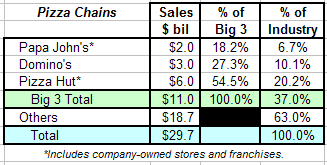
Who sells more pizza: Domino’s, Pizza Hut or Papa John’s?

October 2, 2009

According to Fortune Magazine …

image

http://money.cnn.com/2009/09/22/news/companies/papa_johns_pizza_schnatter.fortune/index.htm

* * * * *

Ken’s Note: I would have bet Domino’s … not for a minute did I think Pizza Hut sold more than Domino’s and Papa John’s combined.

* * * * *

Who sells more pizza: Domino's, Pizza Hut or Papa John's?

October 2, 2009

According to Fortune Magazine …

image

http://money.cnn.com/2009/09/22/news/companies/papa_johns_pizza_schnatter.fortune/index.htm

* * * * *

Ken’s Note: I would have bet Domino’s … not for a minute did I think Pizza Hut sold more than Domino’s and Papa John’s combined.

* * * * *

2009’s Best Global Brands

September 24, 2009

According to consultancy InterBrand …

 .  Top Ten Global Brands in 2009  . 
(and their estimated Brand Asset Value)

  1. Coca-Cola 68,734 ($m)
  2. IBM 60,211 ($m)
  3. Microsoft 56,647 ($m)
  4. GE 47,777 ($m)
  5. Nokia 34,864 ($m)
  6. McDonald’s 32,275 ($m)
  7. Google 31,980 ($m)
  8. Toyota 31,330 ($m)
  9. Intel 30,636 ($m)
  10. Disney 28,447 ($m)

For more, see …

Article:
http://www.interbrand.com/best_global_brands_intro.aspx?langid=1000

Full Report:
http://www.interbrand.com/images/studies/-1_BGB2009_Magazine_Final.pdf

Cool poster with Logos:
http://www.interbrand.com/BGB09/BGB2_POSTER_FRONT.pdf

* * * * *

Tough times all over: The days of the $330 Coach purse could be over…

July 27, 2009

Summary: Adapting to a more frugal consumer, Coach has created the less pricey Poppy line, revamping its product mix to lower its average bag price to $290

* * * * *

Excerpted from Business Week, “Coach’s Poppy Line Is Luxury for Recessionary Times”,June 18, 2009

The Coach brand  brand had emerged from its modest origins in the 1940s to become an emblem of the working woman and then, remarkably, a favorite among the fashion-conscious. It had created the very conceit of affordable luxury.

But, even before the recession Coach had become too expensive. “We have a long history of being a very grounded $200 handbag business,” he says. “Beginning around 2001 we started moving up and became a $300 handbag business. Then we reached $330. And the customer came right with us.  Until we reached our natural limits,” .

So began a nearly yearlong quest to design a line of purses and accessories that could be priced to fit the times without cheapening, or otherwise damaging, Coach’s image.

The resulting collection, which will be introduced in late June, is called Poppy. It’s more youthful, eclectic and spontaneous. The average price will be $260, about 20% less than the usual Coach purse.

The main pieces in the Poppy collection were tested in nine Coach stores and 23 department stores in April and May. And for the first time, Coach let people make online purchases through Facebook. Two $198 bags, the Groovy and the Glam, did better than Coach expected. But one didn’t do quite as well: That was the Spotlight, which sells for $298.

* * * *

Factoids

Coach spends about $5 million annually on that customer research.  It frequently surveys customers about their outlook and tastes; it carefully tests new designs; it measures almost everything.   Every three months it surveys some 20,000 women online about the Coach brand as well as about their economic expectations and spending habits.

Coach’s gross margins had been above 75% for the past five years. But during the recession, as the company has lowered prices at its factory stores, its margins have fallen to 72.4%. By comparison, brands such as Polo Ralph Lauren and Tiffany have margins of less than 60%.

Full article:
http://www.businessweek.com/magazine/content/09_26/b4137040272361.htm

* * * * *

Innovators’ success formula … don’t listen to users

May 12, 2009

Excerpted from HBS Working Knowledge, “Radical Design, Radical Results” by Julia Hanna, February 19, 2009

* * * * *

When furniture designer Herman Miller presented a prototype of its sleek, mesh Aeron chair to a consumer focus group, many asked if they could see a finished, upholstered version.

Innovative product design can be a risky proposition. Yet as consumer purchases become increasingly driven by emotion, the competitive advantage gained by how a product “speaks” to a customer is clear. Just think about how Apple began its resurrection in 1998 with the unthinkable design of computers made of translucent blue, orange, and pink plastic, the original iMac.

Despite the importance of industrial design, little theory exists on how companies might go about creating a successful design strategy.

“Researchers have been investigating technological innovation for decades, but we know almost nothing about how companies manage design innovation.” .

For a study, Profs. Verganti and Dell’Era focused on the Italian furniture industry… they also divided the corresponding sample of 100 manufacturers into innovators and imitators.

Verganti says that design innovation often involves a high degree of uncertainty in terms of market success. “It’s very hard to understand what people want,” he says. “If I make a car that can brake in 10 yards instead of 50, that’s a quantifiable advantage that is easy to understand. But if I decide to create a computer out of translucent, colored plastic, it’s much more subjective. People will love it, or they won’t.”

Focus groups and market research can help to define a product, of course, but Verganti has found that design-driven innovation is not user-centered. Instead, it comes from within the organization. “Rather than being pulled by user requirements,” he wrote recently, “design-driven innovation is pushed by a firm’s vision about possible new product meanings … that could diffuse in society.”

“Apple is a company that is pushed by a vision,” Verganti says. “Steve Jobs has said that the market doesn’t always know what it wants. Companies that do radical innovation do not listen to users; they eventually value market feedback, but first they propose things to the users.”

In the face of this market uncertainty, Verganti has found that companies adopt one of three different strategies:

  1. Launch and see. The company launches a variety of products, and then measures market reaction to each, relying on the selective capability of consumers to determine which products to focus on.
  2. See and launch. The company employs some sort of research process and then launches products based on its findings.
  3. Wait and see. The company allows others to experiment with various products, observes what is most successful, and reacts accordingly.

In Verganti’s study of the Italian furniture industry, one would expect those who wait and see to have the least amount of variety in their product line. After all, if the imitators decide to stand back and observe what is most successful, wouldn’t they choose to copy just a few, choice products? Conversely, it would seem that the innovative companies would probably have higher levels of variety in their products because of the experiments they conduct.

Instead, the results showed just the opposite.

While the cost of experimentation in the furniture industry is relatively low, Verganti and his colleague found that the innovator companies actually used a see and launch strategy, conducting research in order to understand what sort of product language might be most successful. (This research is less of the focus-group variety and more of a broad-based assessment of cultural trends and scenario building.)

“Innovators avoid proposing a wide range of product signs and languages as a way to protect brand identity,” says Verganti. “They tend to adopt strategies that allow customers to easily reconnect specific product signs to their brands.”

In contrast, imitators show a greater variety in their product portfolio. They observe what innovators do and how the market reacts. But the feedback they receive is initially so ambiguous, with several languages coexisting, that they eventually imitate everything.

“The confusion that this creates in the market is called semiotic pollution,” Verganti says. “Imitators can be successful if they wait four or five years to determine what they should produce. But in the beginning it’s not clear which product is the winner. So when it comes to product languages, imitation is a very expensive strategy.”

Do these findings have implications beyond the design-heavy world of the Italian furniture industry? Regardless of the product in question, Verganti believes that companies need to consider the importance of design.

“In every industry, sooner or later, there is a radical change in the language of its products,” he says. “So the point for companies is, do they want to lead the change, or do they want to suffer the change?”

Edit by NRV

Full article:http://hbswk.hbs.edu/item/5850.html

* * * * *

Want more from the Homa Files?
Click link => The Homa Files Blog

Some Brands Never Die: Liquidators License Bankrupt Brand Names

May 6, 2009

Excerpted from New York Times, “Brand Names Live After Stores Close”, by Amy Zipkin, April 14, 2009

* * * * *

In the last year, a string of retailers have gone into bankruptcy — Sharper Image, Linens ’n Things, Circuit City and Fortunoff among them. But while the stores have disappeared, their names live on.

And the companies that have breathed new life into these brand names are, paradoxically, some of the same ones that had led the stores through their dying days — the liquidators.

Liquidators have bought the rights to use the names of Sharper Image, Linens ’n Things and Bombay, the onetime furniture retailer. The liquidators — who prefer to be known as asset recovery specialists — have also expressed an interest in buying the Circuit City and Fortunoff names.

Already, new merchandise with the Sharper Image name is available at retailers like Macy’s, J. C. Penney and Bed, Bath & Beyond. A new Web site for the Linens ’n Things brand, lnt.com, is up and running. In addition to the bedding and bath products the chain was known for, the site also carries toys, pet products and baby accouterments.

Liquidators spent about $175 million to acquire the Sharper Image, Linens ’n Things and Bombay names and predict a billion dollars a year in sales for Sharper Image and Linens ’n Things in each of the next five years.

* * * * *

The value of brand names is being redefined, as “the liquidators are taking the definition of assets and extending them to the brands themselves.” 

The liquidators say they see themselves as brand licensing experts who will receive royalties for the products without the need to pay rent or a sales staff. “It’s not a capital-intensive business. It’s a royalty-driven business. It’s like an annuity.”

Those familiar with intellectual property rights say there is no guarantee that a revived brand will be successful after a retailer has gone under. The brands will compete with others that do not have troubled histories.  Still, with the recession continuing, merchandise with a familiar name may prove attractive to consumers.

Edit by DAF

* * * * *

Full article:
http://www.nytimes.com/2009/04/14/business/14liquidate.html?ref=business&pagewanted=print

* * * * *

Want more from the Homa Files?
Click link => 
The Homa Files Blog

* * * * *

Worked then, so it should work now. Right? … Big Brands Go for “Nostalgia Marketing”

April 29, 2009

Excerpted from New York Times, “Warm and Fuzzy Makes a Comeback”, by Stuart Elliott, April 7, 2009

* * * * *

As the recession continues taking its toll, marketers are trying to tap into fond memories to help sell what few products shoppers are still buying. The time-machine tactics are primarily evoking four decades — the 1950s through the 1980s.

For instance, on April 20 a beverage unit of PepsiCo will begin an eight-week campaign for “throwback” versions of two soft drinks, Pepsi-Cola and Mountain Dew. The packages and formulas, along with advertising and promotions, will evoke the ’60s and ’70s.

The hope is that warm, fuzzy feelings about the past will help make people feel better about the present and future.

“In a time of anxiety, people are seeking out brands they’re comfortable with and they can trust.”

Those taking part in the trend acknowledge a potential pitfall of nostalgic pitches: They could lead consumers to believe a brand or product is outdated and therefore not for them.

* * * * *

Hard times have frequently inspired fond looks in the rear-view mirror. There was a nostalgia boom during World War II, as evidenced by movies like “Meet Me in St. Louis” and songs like “Long Ago and Far Away.”

In the ’60s, the American Tobacco Company, now part of Reynolds American, introduced a filtered version of one of its first national cigarette brands, Sweet Caporal.

In the economic turbulence of the ’70s, there was a fad for nostalgia for the ’50s. The ’60s made a comeback in the ’80s and the ’70s were revived in the ’90s.

Edit by DAF

* * * * *

Full article:
http://www.nytimes.com/2009/04/07/business/media/07adco.html?ref=media&pagewanted=print

* * * * *

Want more from the Homa Files?
Click link => 
The Homa Files Blog

* * * * *

What are Your Friends Worth? … New Research Puts a Price Tag on Your Network

April 24, 2009

Excerpted from BusinessWeek, “Putting a Price on Social Connections”, by Stephen Baker, April 8, 2009

* * * * *

Workers who have strong communication ties with their managers tend to bring in more money than those who steer clear of the boss, according to a new analysis of social networks in the workplace by IBM and Massachusetts Institute of Technology.

The research even assigns a dollar value to e-mail interaction with an employee’s managers. Among the group studied, several thousand consultants at IBM, those with strong links to a manager produced an average of $588 of revenue per month over the norm.

* * * * *

The results represent an early attempt to understand the value of the broadening variety of personal connections afforded by the Web. Users of social media rack up LinkedIn contacts, Facebook friends, and Twitter followers by the hundreds, if not thousands. But figuring out how big a difference all those contacts make in a person’s life, financial or otherwise, is a far murkier matter.

That’s why leading tech companies are hiring economists, anthropologists, and other social scientists to map and classify new types of friendships—and put a value on them.

For example, researchers found that the average e-mail contact was worth $948 in revenue. Using mathematical formulas to analyze the e-mail traffic, address books, and buddy lists of 2,600 IBM consultants over the course of a year, they compared the communication patterns with performance, as measured by billable hours.

* * * * *

In another study, an IBM team analyzes company methods to introduce employees to colleagues they haven’t yet met. The idea is to create new connections within the global workforce and to encourage employees to share knowledge.

One key is to alert people to potential friends and allies at the company. Much the way companies like Netflix and Amazon study past Web-surfing patterns to recommend books and movies, Geyer and his team are digging for signs of shared interests and behaviors among their colleagues.

* * * * *

Research into the networked behavior of employees promises insights about teamwork, innovation, and the transmission of knowledge and ideas within a given company.

The research is at an early stage. But as the economy struggles, more companies are sure to study the company we keep—and even attempt to calculate how much each friendship is worth.

Edit by DAF

* * * * *

Full article:
http://www.businessweek.com/technology/content/apr2009/tc2009047_031301.htm?chan=top+news_top+news+index+-+temp_dialogue+with+readers

* * * * *

Want more from the Homa Files?
Click link => 
The Homa Files Blog

* * * * *

Marketers Step Up Promotions … What Does it Cost the Brand?

April 24, 2009

Excerpted from AdAge, “Deal or No Deal? Cheap Prices Can Maim Your Brand” By Jack Neff, April 06, 2009

* * * * *

Google searches for the term “coupons” last month for the first time surpassed those for “Britney Spears.”

That simple fact drives home what a lot of package-goods marketers already know: What consumers want now is promotion.

But as the industry increasingly gives in to that wish … the question becomes how much marketers can discount without doing permanent damage to their brands …

For sure, the recession  is creating a huge consumer appetite for deals … Package-goods companies seem to be complying. After relative restraint on trade spending in 2008, marketers appear to have stepped on the gas in February. The percentage of volume sold on promotion was up 5.6 percentage points to 38.4%  …

Much as consumers and retailers may want deals, conventional wisdom is they pose a threat to brand health. Numerous studies have shown price promotion erodes brand equity by permanently making consumers more price-sensitive.

Mmarketers will resist cutting prices permanently as long as possible in favor of stepped-up promotion, because temporary deals erode margins less than permanent price cuts.

Promotion can play a positive role for brands in a recession … Promotion that wins a place on retailers’ circulars becomes more important when more consumers are planning purchases at home, as they are now … Realistically, that usually comes at the expense of a temporary price reduction.

Circulars are used about 45% of the time to create shopping lists … “If I’m a marketer, I want to make sure I’m in context of where the list is being made, because right now about 11% of the shopping list is by brand name, and when it is, there’s an 85% chance [the shopper] is going to buy it.”

Edit by SAC

* * * * *

Full Article:
http://adage.com/article?article_id=135800

* * * * *

Want more from the Homa Files?
Click link =>
The Homa Files Blog

Coke Makes An Innocent Investment

April 22, 2009

Excerpted from WSJ, “Coke Teams Up with Socially Focused Smoothie” By Aaron Patrick and Valerie Bauerlein, Apr 8, 2009

* * * * *

Coca-Cola’s investment in British smoothie maker Innocent not only connects the beverage giant to a fast-growing product but also to a company known for good social and environmental behavior.

Coke said this week it will take a minority stake in London-based Innocent, which has quickly become one of Britain’s top brands by marketing its healthy ingredients and social commitment. By giving 10% of its profits to charity and using recycled bottles, Innocent was one of the first consumer brands launched in Britain to develop a big following through ethical marketing.

The investment … speaks to Coke’s continued interest in expanding beyond soft drinks and in owning small stakes in innovative companies … Founded 10 years ago, [Innocent] now has 82% of the U.K. smoothie market …

Innocent cuts a quirky public figure. Some of its trucks are covered in fake grass and daisies. Those trucks are mounted on hydraulics that make them appear to dance, with drop-down windows for giving away samples … The deal’s structure should allow Innocent to keep its funky attitude rather than risk being assimilated into a vast corporate culture whose focus remains carbonated soft drinks. Coca-Cola won’t have any management control over Innocent, but Innocent will share its expertise with the Atlanta-based beverage company …

The Coca-Cola money will be used to expand Innocent’s operations in Europe, where only 25% of European supermarkets sell smoothies … The money will be used to pay for distribution, stocking fees, sales staff and advertising …

While Innocent has run TV- and newspaper-ad campaigns, it has also specialized in less-traditional advertising. One of its ad agencies, Albion, created a board game for schools promoting the health benefits of fruit and vegetables. Some 200,000 people turned up to a Innocent musical concert in London named Fruitstock in 2006 …

Innocent’s charitable giving is also interactive. Volunteers knitted more than 506,000 little hats for smoothie bottles last year, which were then sold, raising £250,000 in proceeds to provide meals, blankets and other help for older people during the winter.

To be sure, Coke has been sporting its good deeds, expanding its recycling plants, reducing water consumption and using environmentally friendly coolants in vending machines and coolers But the 123-year-old company has been known to kill ads that were deemed too edgy and is vastly bigger and more buttoned-up than a closely held newcomer such as Innocent.

Coke appears to be embracing the model of taking a stake rather than buying outright, after previously struggling to integrate niche nonsoda companies … Coke has had more success with its 2001 purchase of Odwalla Inc., a maker of premium refrigerated fruit and vegetable juices whose product line is closest to Innocent’s line.

Innocent’s success helped drive all smoothie sales in the U.K. From 2003 to 2007, smoothie sales in the U.K. rose more than fivefold to £241 million …

Edit by SAC

* * * * *

Full Article:
http://online.wsj.com/article/SB123913675734598167.html

* * * * *

Want more from the Homa Files?
Click link =>
The Homa Files Blog

Tropicana’s Tale of Rebranding Gone Wrong

April 21, 2009

Excerpted from Ad Age, “Tropicana Line’s Sales Plunge 20% Post-Rebranding” By Natalie Zmuda, April 02, 2009

* * * * *

Tropicana’s rebranding debacle did more than create a customer-relations fiasco. It hit the brand in the wallet.

After its package redesign, sales of the Tropicana Pure Premium line plummeted 20% between Jan. 1 and Feb. 22, costing the brand tens of millions of dollars. On Feb. 23, the company announced it would bow to consumer demand and scrap the new packaging … It had been on the market less than two months …

Moreover, several of Tropicana’s competitors appear to have benefited from the misstep, notably Minute Maid, Florida’s Natural and Tree Ripe. Varieties within each of those brands posted double-digit unit sales increases during the period …  As the leader in the category, it makes little sense that Tropicana Pure Premium would see such a drastic sales decline while the category remained relatively flat, industry experts said …

A spokeswoman for Tropicana in an e-mail said, “No dots to connect here.” The company did not respond to further requests for comment.

“It surprises me that their performance is so different from the rest of the category,” said Gary Hemphill … at Beverage Marketing Corp. “It’s a little tough to draw conclusions over such a short period of time. But I would say that’s unusual.”

Mr. Hemphill said typically when a beverage brand undergoes a rebranding it signals increased marketing expenditures and leads to improved performance, at least in the short term. “It gets people to look at the brand again and brings some kind of news and excitement around the brand,” he added.

Tropicana had certainly sought to create excitement around the Pure Premium rebrand, announcing Jan. 8 a “historic integrated-marketing and advertising campaign … designed to reinforce the brand and product attributes, rejuvenate the category and help consumers rediscover the health benefits they get from drinking America’s iconic orange-juice brand.”

Beverage experts were hard pressed to think of another major brand that had pulled the plug on such a sweeping redesign as swiftly as Tropicana. “It’s a black eye when you have to backtrack that quickly … There must be [another example] but nothing comes to mind. [Tropicana] is a big brand, and it was a big restage. This is something that I’m sure they were not happy about.”

While it’s impossible to say whether Tropicana has permanently lost share, as a result of the blunder, competitors are likely taking note. “We think the Minute Maid brand has opportunity for growth, and we’re working hard to make that happen,” said Ray Crockett, a Coca-Cola spokesman.

Edit by SAC

* * * * *

Full Article:
http://adage.com/article?article_id=135735

* * * * *

Want more from the Homa Files?
Click link =>
The Homa Files Blog

Value to consumers…it’s more than price

April 14, 2009

Excerpted from Brandchannel, “Get Back to Basics. Win Back the Trust” by Ted Mininni, March 30, 2009

* * * * *

We’ve seen a number of instances where high-profile brands have violated the trust of consumers lately, eroding confidence and resulting in disastrous consequences. Even if a brand hasn’t violated consumer confidence, if it isn’t actively building trust, it’s likely losing customers. Let’s face it: without trust, there is no consumer loyalty—and, ultimately, there is no business.

Consumers are hungry for values they can put their trust in. Not hype. True value doesn’t just equate to price, mind you. While important to consumers who are tightening their belts, price isn’t the only component of value. These are the values consumers care about: fair pricing, innovation, authenticity, honesty, transparency, customer service and connectivity.

After years of overconsumption, people are learning some hard lessons about debt and economic reversal. Smart marketers understand that if customers are going to part with their hard-earned money now, they’re going to have to be given a reason to believe—a reason to trust in their brands.

Fair Pricing.
With McDonald’s launch of its McCafé ads, the company capitalized on the current consumer mood. Their business proposition: offering quality lattes and cappuccinos without high prices in order to appeal to a large swath of consumers.

Lest anyone think Starbucks can afford to stay above the fray, guess again. A recent Wall Street Journal article dubbed “Starbucks Plays Common Joe” notes a move to “counter the widespread perception that Starbucks is the home of the $4 cup of coffee.” According to the article, “To retrench, (Starbucks) executives began plotting a new strategy to portray the company as offering value.” To prove they’re not too pricey, Starbucks recently launched value-priced breakfasts at US$ 3.95 each.

The move shows how premium brands are trying to reposition themselves for a prolonged economic downturn. “I strongly believe we are going to be in this environment for years,” Howard Schultz, chief executive at Starbucks, said in an interview. “It is a reset of both economic and social behavior.”

Innovation and Service.
Down economy or not, consumers will pony up some of their hard-earned cash for specific brands that “own” innovation. Nintendo, for example, has accomplished what no other game company has: the brand has created acceptance among all age groups and both sexes in a phenomenal way with Wii and its other properties. By finding innovative ways to engage people of all ages, Nintendo defined a new genre of home entertainment at exactly the right time; people are looking for ways to be entertained at home rather than spending a lot of money going out.

In spite of intense competition in the mobile phone category, Nokia continues to take on all comers, owning a staggering global market share—38 percent of the entire category— despite intense competition. By constantly launching new-generation mobile devices, Nokia continues to raise the bar for mobile phones. Other notable brands that continue to win by focusing on quality, innovation, good design and value: IKEA, Samsung, L’Oréal, Volkswagen, Apple, Nike.

When confronted by tough challenges, Hewlett-Packard responded by putting its customers front and center in its product design development. This allowed the company to make service and innovation the focus of its brand revitalization efforts. Its interactive approach, resulting in the kinds of products consumers want, has reinvigorated the brand. And how about total reincarnations? IBM’s transformation from hardware purveyor to customized “business solutions provider” is a great B2B success story.

Trader Joe’s and Wegmans supermarkets excel in customer service, offer quality products and real value, and never shy away from innovation. Both companies have a loyal cadre of shoppers as a result. Let’s hear it for innovation with service…values that customers long for and rarely receive.

Authenticity, Transparency, Honesty.
Take a look at the recent downfall of notable companies, and you’ll find some venerable brands that left these virtues behind. They ran into problems and chose not to be upfront and transparent about it. Rather than stave off bad opinion, their actions had the opposite effect. Unfortunately, it’s easy to find examples everywhere these days, especially in the financial sector. How about AIG? Merrill Lynch? Citibank? When the truth did emerge, badly calculated choices by company management actually made the situation worse.

For the companies that manage to survive, customer perception is greatly diminished since their trust has been abused. Proof once again that when problems crop up, companies need to own up, speak up and take steps to rectify them, or they risk breaking trust with the customer.

On the flip side, over 25 years ago, Stonyfield Farm yogurt took a stand. Working with local farmers, the company pledged itself to support organic milk farming and implement environmentally responsible policies in every aspect of its business. The trust the company has built with its customers is legendary. Stonyfield Farm doesn’t talk about environmentalism in an era of greenwashing; the company walks the walk. Stonyfield Farm went “carbon neutral” in the mid-1990s, produces 100 percent organic products and gives 10 percent of its profits to organizations that “help protect and restore the environment.” It also collects used product packaging so that TerraCycle can “upcycle” it—that is, turn it into new consumer products.

Connectivity.
When Dell launched its Idea Storm social media site recently, the company’s intention was to solicit ideas from consumers and, in the process, foster closer relationships with its customers. “These conversations are going to occur whether you like it or not…do you want to be part of that or not? My argument is you absolutely do. You can learn from that. You can improve your reaction time. And you can be a better company by listening and being involved in that conversation,” Michael Dell said in a BusinessWeek discussion with Jeff Jarvis. Exactly.

Reaching out to customers and allowing them to express themselves in direct conversation with the company might yield some surprising results. Product innovations, valuable dialogue and being able to deal with problems quickly and effectively are no less important. Too many consumers feel as though their ideas and concerns go unheeded; the companies that engage their customers will win.

Positioning brands in alignment with the basic core values that resonate with consumers to build trust is job #1. Smart marketers must prove their brands’ worth and value to increasingly disenfranchised consumers. Win back the trust—and reap the rewards.

Edit by NRV
Full article:
http://www.brandchannel.com/brand_speak.asp?bs_id=215

* * * * *

Want more from the Homa Files?
Click link => The Homa Files Blog

What Brand Would Your Recommend? Apple Tops the List (well, almost)

April 13, 2009

Excerpted from Brandweek, “Apple Has Highest Net Promoter Score” By Todd Wasserman, March 30, 2009

* * * * *

Apple is not only the brand that marketers love the best, but it’s the one that consumers recommend the most, according to new research from Satmetrix, originator of the Net Promoter score.

Apple posted a NetPromoter score of 77%, which means that 83% of respondents would recommend the brand to a friend versus 6% who would not. (The score is calculated by subtracting the latter from the former and is based on a scale of one to 10.) The only “brand” to beat Apple was the USAA, a financial services firm for members of the military.

Satmetrix’s report … narrowed its focus on a few categories, including telecom, financial services and online. Categories like consumer packaged goods were not tested, though … company is considering looking at other such segments in the future.

The overall winners:

1. USAA
2. Apple
3. Amazon.com
4. Costco.com
5. Google
6. Facebook
7. Wikipedia
8. eBay
9.  Craigslist
10. Barnes & Noble (bn.com)

Satmetrix stressed that Costco and Barnes & Noble’s sites were judged separately from their retail operations …

Satmetrix introduced Net Promoter in 2006 after Bain fellow Fred Reichheld developed the metric with the company.  The company and Reichheld believe the score has the highest correlation to buying behavior.

Edit by SAC

* * * * *

Full Article:
http://www.brandweek.com/bw/content_display/news-and-features/direct/e3i1a3d96e3863d2d6cdff085d95d2c1c61?imw=Y

* * * * *

Want more from the Homa Files?
Click link =>
The Homa Files Blog

Coke’s Challenger Brand Hopes to Power over Gatorade

April 6, 2009

Excerpted from Ad Age, “Gator Baiter: Powerade Jabs at Powerhouse,” By Natalie Zmuda, Mar 23, 2009

* * * * *

The billboard shows the vertical half of what appears to be a Gatorade bottle on one side, with the other side open to the bare blue sky. But what might at first be taken for a mistake is explained by the text: “Don’t settle for an incomplete sports drink.” A few feet down the road perches another billboard, this one showing a fully intact bottle of Powerade. It’s tagged: “The complete sports drink.”

It’s a classic challenger strategy, except it comes from one of the world’s biggest marketers, Coca-Cola Co. The company might be a giant when it comes to soda, but in sports drinks, Coke’s Powerade runs in the shadow of PepsiCo’s Gatorade. So in true competitive fashion, the smaller rival is undertaking a bold and innovative print and outdoor effort that positions the category leader as only half the brand Powerade is.

Powerade’s plan is to blitz the market with messaging that Gatorade is an inferior method of hydration, and says it has the science to back it up. Since early last year, Powerade has been in the lab reformulating its trademark sports drink to include four electrolytes — sodium, potassium, calcium and magnesium — lost during exercise. Gatorade’s formula contains just two electrolytes, sodium and potassium

To get its message across, Powerade … developed a clever comparative campaign that pits the brand against PepsiCo’s Gatorade. “They’re the lion in the category, and we wanted to compare what our drink does for you vs. the competition,” Mr. Kahn said. “People associate [Gatorade] with the category. When you’re another brand competing, you want to make sure to give people a point of difference.”

Powerade also … will take over the cover of ESPN The Magazine, marking the first time the publication has mingled editorial properties with advertising on its cover. It will feature a blank flap obscuring half of the cover image but retaining the magazine title. The front of the flap states, “You wouldn’t want an incomplete cover.” And the back of the flap shows half a Gatorade bottle with the text, “Don’t settle for an incomplete sports drink.” Powerade is then held up as the “complete sports drink” on the inside of the front cover …

According to Beverage Digest, Powerade controls 22% of the sports-drink market, while Gatorade has a 77% share … For its part, Gatorade is shrugging off the attack, maintaining that all Powerade has done is create a spinoff of its Gatorade Endurance Formula, developed in 2004 …

Edit by SAC

* * * * *

Full Article:
http://adage.com/article?article_id=135436

* * * * *

Want more from the Homa Files?
Click link =>
The Homa Files Blog

Miller’s New Strategy … Back to the Future

March 31, 2009

Excerpted from WSJ, “Miller Reprises an Old Theme” By David Kesmodel, Mar 20, 2009

* * * * *
Beer giant MillerCoors, seeking to revive its flagging Miller Lite after a string of marketing missteps, is spending more than $100 million on a new campaign that features redesigned cans and bottles and new ads centered on the brand’s familiar theme: “Tastes Great.”

The campaign … is aimed at grabbing market share from leader Anheuser-Busch InBev and its top-selling Bud Light brand. While the new ads don’t attack Bud Light by name, they are clearly designed to persuade consumers that Miller Lite is the better-tasting brew …

Miller Lite, which introduced Americans to light beer in the 1970s, mostly has posted sales declines in recent years, and its performance has worsened under its new owner, a joint venture of SABMiller and Molson Coors Brewing … One problem is that Miller Lite has bounced from one ad strategy to another in recent years. “The brand has lacked a clear identity for so long … They just haven’t been able to find its voice” …

Now, MillerCoors, borrowing a page from Coors Light, says it will convey a consistent and straightforward message about the Miller Lite brand. That message will be built around taste … In a new twist on the “Tastes Great” theme, MillerCoors is rolling out ads that herald its “triple hops” brewing process, in which hops — the flowers that give beer its distinctive bitterness and aroma — are added to the beer at three different stages. The company says this gives the beer its flavor, “balance” and proper level of foam.

Miller Lite’s new “taste protector” cans will likewise tout the process. The cans have a lining on the inside to keep the beer from touching the aluminum, which can cause a metallic taste. The company also will promote new bottles with different labels as well as a “taste protector cap” designed to preserve the taste of the beer …

Highlighting the brand’s brewing process, however, carries the risk of backfiring with consumers, who are increasingly knowledgeable about beer ingredients. Light lagers like Miller Lite, have a low hops content, especially compared with many of the small-batch “craft” beers that are enjoying the industry’s highest growth rates.

“By overtly marketing their multiaddition hopping process, the consumer would presumably expect Miller Lite to be an overtly hoppy beer; it’s not” … MillerCoors also might find it hard to boost Miler Lite sales at the same time Coors Light sales are growing …

Miller Lite dominated the light-beer wars of the 1980s with its famed “Tastes Great, Less Filling” pitch. Miller Lite is now the No. 2-selling light beer in the U.S. after Bud Light, whose sales volume rose less than 1% last year … Coors Light, the nation’s No. 3 light beer, has been enjoying healthier sales growth than either Bud Light or Miller Lite.

MillerCoors won’t disclose how much it plans to spend on the new ad campaign this year, but Mr. England said it would be “well north of $100 million” …

Edit by SAC

* * * * *

Full Article:
http://online.wsj.com/article/SB123750883420290503.html

* * * * *

Want more from the Homa Files?
Click link =>
The Homa Files Blog

How about a stimulus package for brands?

March 26, 2009

Excerpted from Brandchannel.com, “Time for a brand stimulus package” by Kevin Randall, March 16, 2009

* * * * *

In the marketing world, our industry is witnessing a diminishing commitment to long-term brand building. The mission of the moment is driven by the CFO, not the CMO, and calls for cost-cutting and short-term revenue-generating activities represent the only immediate focus.

A weighty and consistent body of historical data shows that marketers will do harm in the short- and long-run to their businesses and brands by knee-jerk budget slashing and running scared.

Hundreds of studies of marketing over ten recessions in the 20th century have concluded that not only did sales and profits decline for brands that cut brand-oriented advertising during the recession, but also that performance continued to lag upon the recovery (“Why it is important to invest in communications during an economic downturn,” IVCA.org, 2009).

Today’s brand leaders would be wise to consider and follow these 7Ps of Branding as a guide for the recession and beyond:

1. Profit
Marketers now have a golden opportunity to profit and establish real competitive advantage by exploiting the current situation. They can increase brand value and market share now relatively more easily and cheaply than during good times. With competitive noise levels reduced it is easier for a brand to stand out in the marketplace. Media costs are more attractive.

2. Persistence
Corporate brand directors need to stay the course by going against the grain and not following the marketing herd. Even if budgets are trimmed in some areas, there should be a core of strategic and tactical activities that endure (the former initiatives tend to be less budget consuming even in good times). Such brand perseverance will provide reassurance during uncertainty to both the existing customer base, an especially critical target now, and to internal stakeholders.

3. Planning
Despite the strong economic headwinds, brand builders should remain committed to pursuing long-term visions and executing plans while selectively and pragmatically improvising marketing tactics. IBM during the recessionary early 1990s and Southwest Airlines after 9/11 are examples of brands that never wavered from their long-range strategic compasses and profited enormously by doing so. These brands did not and do not meander based on quarterly results. The strongest, top-performing brands are built to weather the various storms that come along.

4. Performance
Brands (and their communications) will be judged and rewarded now by delivering on “value” over merely price. Some marketers have and will cut prices. Brand leaders do need to (re)define the value of their offering while not compromising the quality and experience customers expect or need. Harvard Business School professor John Quelch also recommends investing in opportunistic, focused market research since there is a real need to define “performance” and “value” and gauge what is relevant to customers in the shifting environment (“Marketing Your Way Through a Recession,” HarvardBusiness.org, 2008).

5. Positioning
Brand owners must uphold and defend their core positioning and resist the temptation to sacrifice quality, reduce innovation efforts or cut prices. A study of more than 1,000 companies showed that firms that cut manufacturing and administrative functions in a recession did tend to reap the benefits while those that decreased spending on new product development, quality and marketing suffered (“What strategic investments should you make during a recession to gain competitive advantage in the recovery?,” Strategy & Leadership, Profit Impact of Market Strategy [PIMS], Keith Roberts, 2003).

6. People
There needs to be an appreciation of the link between top talent and top-performing brands. Hiring, motivating and keeping the best people (who exemplify the brand) while competitors are pruning overhead is a key source of proprietary advantage. Management guru Jim Collins chronicles the cases of Boeing, Hewlett-Packard and Procter & Gamble, who bucked the trend during tough times by investing in talent (when their rivals were shedding critical human capital) only to thrive and outperform the competition (“Crisis into opportunity,” CNN Money.com, Jim Collins, 2009).

7. Principles
Brand leaders should work with CEOs to make sure their brands and organizations are integrated and that employees internalize and externalize a set of values that don’t change. Valued customers and employees will be more loyal if they are reassured on principles—by the brand and by its chief executive and sponsor. This is especially critical in the B2B world, with its large transactions and numbers of stakeholders involved in the customer experience.

Brands by the numbers

McGraw-Hill analyzed 600 companies from 1980 to 1985. The results showed that B2B firms that maintained or increased their advertising during the 1981-1982 recession averaged significantly higher sales growth—both during the recession and for three years following—than those that eliminated or decreased advertising. By 1985, sales for companies that were aggressive recession advertisers had risen 256 percent over companies that did not maintain their advertising (“US Recession”, McGraw-Hill, 1988).

• A study of 1,000 firms during recessions between 1982 and 1999 identified key differences regarding the strategies of the best and worst performers, with the measure of performance being changes in the company’s market-to-book ratios. Notably, the best performers had increased their marketing and advertising spending not just relative to their competitors, but also compared to their own spending in better times. (“Learning to love recessions,” Richard F. Dobbs, Tomas Karakolev and Francis Malige, McKinsey & Co., 2002).  

Edit by NRV

Full article: http://www.brandchannel.com/brand_speak.asp?bs_id=214

* * * * *

Want more from the Homa Files?
Click link => The Homa Files Blog

Soften your hard edges … with an empathic logo

March 16, 2009

Excerpted from Brandweek, “Grim Times Prompt More Upbeat Logos” By Todd Wasserman, Feb 21, 2009

* * * * * 

As the economy gets uglier, logos are getting prettier. The stolid, angular look of visual trademarks like IBM’s and Bank of America are being supplanted by ones that sport softer, more approachable fonts; multiple colors and natural, child-like symbols.

The latest example of the trend is Kraft. While the food giant’s previous visual treatment was a red, white and blue hexagon, the new one, which the company introduced with great fanfare last week, is in lower-case and sports yellow, green, purple, blue and orange as well …

Designers have a name for the trend: The Google Effect. Many say that Google’s multicolor design and the company’s willingness to tweak its logo for holidays and such have been widely influential.

Ruth Kedar, the woman who designed Google’s logo, agrees … While acknowledging that Google wasn’t the first to tweak its logo … she said the notion was still an anathema to most companies until recently. “The idea that you could modify a brand and play with it was kind of a radical change in branding, going way out of the corporate ID manual” …

Indeed, the Google Effect in this case may have a triple meaning—Google’s introduction of an era of more transparent corporate images and the advancement of the Internet as a medium to showcase logos are also influences. Years ago, logos were designed to be seen on buildings and trucks, but now the primary forum is the Internet where “color restrictions aren’t as much of an issue” …

In regard to transparency, Mike Mitchell, a Kraft rep, said that the company’s new logo is a manifestation of a bottom-up change at the company. The visual treatment, he said, is designed to convey Kraft’s new mantra: “Make today delicious.” It symbolically represents various Kraft products. The triangle shape “is invocative of pizza,” he said.

Most consumers won’t catch those references but instead will walk away with a more positive feeling about the company, said Mitchell.

Cal McAllister, co-founder of Wexly School for Girls, a design firm … said the new logos are a reflection of a desire to at least appear more approachable and transparent. “Everyone is working off the same brief,” he said. “They say, ‘Give me something natural, like a sun or a flower,’ or ‘Make it soft and make it seem friendly …”

Since such sentiment is based on consumer research, McAllister speculated that the gloomy times may be prompting consumers to gravitate to such imagery.

“Because we’re in a tough time and people are getting laid off, I think there’s a subconscious desire to take you back to when you weren’t worried about things like that, which is why we’re seeing these almost hand-drawn logos … And when you see a logo that’s boxy and the edges are hard and sharp, and the company just laid off 10,000 people, you get mad at them. But if it’s a watercolory rounded logo, you feel kind of sorry for them” …

Edit by SAC

* * * * *

Full Article:
http://www.brandweek.com/bw/content_display/news-and-features/direct/e3i6c21c5456af55219d01b2ee3650498cf

* * * * *

Want more from the Homa Files?
Click link =>
The Homa Files Blog

If you can’t fight ’em join ’em … brand names chum it up with private labels

March 6, 2009

Excerpted from WSJ, “Brand-Name Food Makers Woo Retailers With Displays” By J. Jargon and A. Zimmerman, Feb 18, 2009

* * * * *

Seeking to combat stiffer competition from cheaper store brands, big-name food manufacturers, including Kraft Foods Inc. and General Mills Inc., are joining forces with retailers to promote their brands alongside private-label goods.

In the past, big food companies didn’t worry too much about cheaper store brands encroaching on their turf, because consumers were more loyal to name brands and generally believed better quality justified their higher prices. But in recent years, retailers have improved their store brands, often mimicking the innovations that national brands have introduced …

As private-label items have improved and the economy has slowed, many consumers are wondering why they should pay more when they view a store brand as equally or almost as good. Last year, sales of private-label food and other consumer products jumped 10% to $82.9 billion in 2007 … Meanwhile, sales of branded products increased just 2.8%.

Now, brand-name manufacturers are trying to boost sales and defend their market shares in part by working with retailers to create special displays that allow name brands and store brands to share the promotional spotlight. Their strategy acknowledges that the rise of store brands has been a boon to retailers, whose overall sales have slumped and whose gross profit margins on store brands typically exceed those on branded items by 10% to 12%.

General Mills, for example, is using in-store grocery displays to promote “full meal solutions” that include its brands as well as store brands … [For example], A “pizza night” display featured General Mills’ Pillsbury dough with the retailer’s store-brand tomato products.

The new collaboration with retailers comes as Wal-Mart Stores Inc. prepares for a relaunch next month of its own private brand, Great Value, with improved packaging and qualityBy raising the profile of its private label, Wal-Mart could undermine some of the competitive advantage that has set it apart from other food retailers … Gains by private-label products have come largely at the expense of smaller brands. To cut costs and make room for a greater assortment of Great Value products, Wal-Mart has begun removing slower-selling brand names from its shelves …

Until recently, Wal-Mart’s private-label brands didn’t pose much of a threat to branded-food manufacturers. The products’ packaging was lackluster and the quality and consistency of many of them was uneven …

At an analyst meeting last fall, Wal-Mart said it would retool its Great Value line, in an effort to spur sales … The company tested 5,000 Great Value products against national brands and reformulated 1,200 of them.

Edit by SAC

* * * * *

Full Article:
http://online.wsj.com/article/SB123491694183004377.html

* * * * *

Want more from the Homa Files?
Click link =>
The Homa Files Blog

No Saturn? … What about the owner picnics in Tennessee ?

March 4, 2009

Ken’s Take: Talk about blowing a great franchise.  In the 1990s, Saturn had growing cult-like following, often being praised as a brand in the league of  Harley-Davidson.  GM squandered a valuable asset. 

My bet: there’s enough residual brand equity for Saturn to rise from the ashes.  In fact, if I were running GM, Saturn would be the nameplate I’d slap on all hybrid electrics.

* * * * *

Excerpted from WSJ, ” Era Ends as GM Snubs Saturn”, Feb 19, 2009

For years, analysts have urged GM to pare its brands. But GM executives insisted it would be too expensive after spending an estimated $2 billion to wind down Oldsmobile earlier this decade. Yet cutting brands shaves operating costs because each brand requires a certain amount of spending on product development advertising, dealer support and other expenses.

Now, GM is turning its back on Saturn, Pontiac, Saab and Hummer, General Motors Corp. is abandoning a decades-old product strategy that once helped ensure its dominance.

Saturn, Hummer, Saab and Pontiac have all struggled to attract customers. That prompted GM to sell large numbers of them to car-rental concerns, corporate fleet buyers and GM’s own employees. Of the 504,000 vehicles sold under the four brands in 2008, 40% went to fleets and employees. Such sales generally are less profitable than those to consumer buyers.

Of the four brands being cut off, Saturn once held the most promise. GM created the line in 1985 as a completely separate company offering small cars that aimed to compete head-on with Toyota and Honda Motor Co.

Saturns featured dent-resistant plastic bodies, its dealers promised friendly, no-haggling sales and customers were invited to an annual “homecoming” cookout at the Saturn plant in Spring Hill, Tenn. For some customers, buying a Saturn was like joining a club.

But in the 1990s, GM starved Saturn for new products as it tried to revive Oldsmobile. After GM killed Olds, it turned to neglected Saturn. It spent billions to produce a range of new vehicles, many of them derivations of its Opel models from Europe. Some were hits; the Aura sedan was praised by many car reviewers.

* * * * *

Some Saturn dealers now hope that instead of closing the brand, GM will spin it off as a separate company. A team of Saturn dealers is spending 60 days working with GM to evaluate the possibility. These dealers would sell vehicles under the Saturn brand made by other manufacturers, possibly from overseas.

“This is going to be somebody’s low-cost entry to the world’s largest car market.”

* * * * *

Full article:
http://online.wsj.com/article/SB123500373416017943.html?mod=article-outset-box 

* * * * *

Want more from the Homa Files?
Click link =>
  The Homa Files Blog

Let Mr. Clean wash your car …

March 3, 2009

“Excerpted from WSJ, “Mr. Clean Takes Car Wash Gig” By Ellen Byron, February 5, 2009

* * * * *

Now Procter & Gamble Co. wants to wash your car. The giant manufacturer of household staples including Pampers diapers, Crest toothpaste and Gillette razors is forging a new business model: franchising car washes.

To jump-start plans for a nationwide chain of Mr. Clean Car Wash franchises, P&G in December acquired the franchise assets of Atlanta-based Carnett’s Car Wash, which has 14 locations.

“We need to look for new opportunities to allow us to grow,” says Bruce Brown P&G’s chief technology officer. “That isn’t limited to things within our current business model.”

P&G is under mounting pressure to find new sources of revenue growth, particularly as more cash-strapped shoppers think twice about buying its premium-priced products. Wall Street is increasingly skeptical that the mammoth company can garner meaningful gains in its slow-growing product categories and a tough economy.

Procter & Gamble has been quietly experimenting with service businesses in recent years. Since 2007, it has operated two Mr. Clean Car Washes  … Professional car washing, which rings up about $35 billion in sales a year in the U.S. won out as the company’s first major franchise push. “We want to blow this out to a national network of car washes,” Mr. Brown says.

The car-washing business has a handful of competitive advantages … It lacks a dominant national chain, aging baby boomers are reluctant to wash cars themselves and more water-strapped communities are pushing professional car cleaning as a conservation measure …

Procter’s previous attempts at entering the service industry have failed. In 2000, P&G operated a laundry service called Juvian Fabric Care, which it sold in 2003. Other efforts at company-owned stores, including one called Culinary Sol, also fell short …

P&G marketers are also eager to see if Mr. Clean Car Washes dotting roadways will help boost the image and exposure of the overall brand … Unlike most franchise start-ups, which require enormous marketing investment, Mr. Clean Car Washes come with a 51-year-old brand name, which P&G hopes will lure potential franchisees …

P&G, which scrutinizes shoppers down to the seconds it takes to notice a bottle on a store shelf, says it will offer franchisees detailed information about car-wash locations, consumer targeting and advertising response rates …

Edit by SAC

* * * * *

Full Article:
http://online.wsj.com/article/SB123379252641549893.html

* * * * *

Want more from the Homa Files?
Click link =>
The Homa Files Blog

Apple: Life at the top …

February 27, 2009

Excerpted from Fortune, “Five Easy Apple Charts”, by Philip Elmer-DeWitt, January 30, 2009

* * * * *

If a picture is worth a thousand words, here’s five grand worth of Apple news in charts and lists released over the past couple of days.

1. Web Brands. Apple scored No. 10 in Nielson Online’s ranking of the top Web brands based on the number of unique visitors each site drew in December 2008 — which isn’t bad considering Apple.com’s focus is so much narrower than the brands it’s up against.Nielson Web 10

2. Social Brands. The iPhone scored No. 1 — ahead even of its parent company at No. 3 — in the Vitrue 100, a new ranking launched this week by an Atlanta-based marketing company. Vitrue’s list ranks blue chip brands by how often they get mentioned in blogs, photo-sharing sites and such social media entities as Facebook, MySpace and Twitter — presumably a measure of how large these names loom in the minds of an emerging category of early adopters.

Social brands

3. Days to 1 Million. This comes from published sales data to compare the rate at which the leading smartphones achieved the market penetration milestone of 1 million units.

million-sold-graphic-footnote-storm

4. Volume vs. Revenue. This data demonstrates that what matters is not how many smartphones you sell, but how much you make on each sale (includes revenue from other sales beyond phones).

Vol. vs. Rev. (1)

Vol. vs. Rev. (2)

5. Stock Price. Finally, a glance at Apple’s share price, which having suffered a thousand cuts in the past year finally picked up a little traction in the past two weeks.

Edit by DAF

* * * * *

Full article:
http://apple20.blogs.fortune.cnn.com/2009/01/30/five-easy-apple-charts/

* * * * *

Want more from the Homa Files?
Click link => 
The Homa Files Blog

* * * * *

Velveeta: Kraft’s Super Bowl Hero

February 24, 2009

Excerpted from WSJ, “Velveeta Gets Ready to Party” By Julie Jargon

* * * * *

When the Super Bowls rolls around, thousands of women across the country are expected to welcome friends to their homes not just to watch the Super Bowl, but to dip into bowls of Velveeta ultimate queso dip.

For snack-food manufacturers, including Velveeta maker Kraft Foods, there’s no bigger day than the day of the big game, when Americans eat 46% more chips than on a typical Sunday …

Using its database, House Party emailed Internet-savvy women ages 25 to 50, Velveeta’s target market, offering them the chance to host a game-day party featuring Velveeta. Both House Party and Kraft also promoted the offer on their Web sites. More than 15,000 women applied, and 2,500 Velveeta lovers were chosen.

The hostesses, who won’t be paid for their services, get “party packs” containing a 32-ounce package of Velveeta, take-home plastic Velveeta storage containers for 16 guests, a recipe for chili con queso dip — along with the requisite cans of diced tomatoes and green chilies — a spinach dip recipe, a dip bowl, a couple of bags of Ritz toasted chips, snack-bag clips, Velveeta coupons, Kool-Aid and cups. House Party said it couldn’t estimate the value of the party packs.

“We don’t attend the parties; doing that would hamper the authentic nature of it … We give the hosts the materials, but very much let them create the kind of party they want to create.”

Of course, Kraft and House Party hope that the menu will showcase Velveeta, and that hosts and their guests, after sampling the product, will serve it regularly at home, as well as talk up its taste … Kraft doesn’t break out sales of Velveeta, but sales have declined in recent years in the “processed cheese loaf” category, and that Velveeta’s marketing efforts are designed to make sure “Velveeta is relevant to people today.”

After using house parties to promote its Philadelphia cream cheese and Grey Poupon mustard last year, Kraft is using the same approach for Velveeta … The Velveeta push is designed to appeal to budget-conscious consumers … “you can buy twice as much Velveeta as cheddar for the same price” … 

When House Party publicized the chance to host a Velveeta party on its Web site, Angilyn Mathews, a stay-at-home mother of five who lives in South Jordan, Utah, says she knew she had to apply … “It’s like an honor to get picked for the party … When we got the party pack with all the fun things inside, it was like Christmas.”

Edit by SAC

* * * * *

Full Article:
http://online.wsj.com/article/SB123318397635126261.html

* * * * *

Want more from the Homa Files?
Click link =>
The Homa Files Blog

Coca-Cola: Repackaging and Repricing to Increase Value

February 23, 2009

Excerpted from Dow Jones Newswire, “Coke To Push New 99-Cent, 16-Ounce Bottle” by Anjali Cordeiro, January 21, 2009

* * * * *

Coca-Cola Co. (KO) will widen distribution of a new 16- ounce bottle priced at 99 cents in conjunction with the launch of a new marketing campaign called “Open Happiness.”

Coke executives said the new bottle size was launched about three months ago in the Southeast U.S. and is now being rolled out nationwide.

Sales of carbonated soft drinks have weakened in the U.S. as the economy has slowed, pushing beverage makers to test new package sizes and pricing.

The price of 99 cents also highlights the pressure on consumer companies to offer consumers better value for their money.

The company’s new ad campaign for its namesake brand launches this week and will have TV spots on “American Idol” and the upcoming Super Bowl. The campaign will include a focus on packaging and pricing.

Edit by DAF

* * * * *

Full article:
http://money.cnn.com/news/newsfeeds/articles/djf500/200901211404DOWJONESDJONLINE000813_FORTUNE5.htm

* * * * *

Want more from the Homa Files?
Click link => 
The Homa Files Blog

* * * * *

Sharper Image Lives On … well, sort of

February 20, 2009

Excerpted from the New York Times, “Sharper Image Stores Are Dead, but the Brand Goes On”, by Eric Taub, January 18, 2009

* * * * *

The Sharper Image, which filed for bankruptcy protection last February and closed all its stores, was purchased by private investors for $49 million in May. Since then, the company has reconstituted itself (minus the stores) to become a “global lifestyle brand licensor.”

Rather than operate its own Web site, catalog and shops, the company will license products and sell them through third-party retailers. It has struck deals with HoMedics, a manufacturer of health and grooming products, luggage maker EnE and others to produce new products.

The company is also trying a new approach for these difficult times: affordability.

The problem for the original company was that its stores had plenty of lookers but, because of its high prices, not enough buyers.

“Sharper Image was an aspirational brand. While people wanted the products, not enough could afford them. Now we can be in Best Buy, Bed Bath & Beyond and midtiered department stores,” an executive noted.

The new company, which has fewer than 10 employees, kept five of its original product licensees. It currently has the Sharper Image name on 40 furniture and accessory products sold in OfficeMax stores. Its big push will come at the end of this year, when it releases “hundreds” of new, less-expensive products in partnership with 12 unnamed partners.

Edit by DAF

* * * * *

Full article:
http://www.nytimes.com/2009/01/19/technology/companies/19sharper.html?ref=technology&pagewanted=print

* * * * *

Want more from the Homa Files?
Click link => 
The Homa Files Blog

* * * * *

Detroit 3 cut number of brands … oh, no so fast

February 19, 2009

Excerpted from  brandchannel.com, “Detriot’s Big Three: Car Brands a Pile-up ” by Dale Buss, February 9, 2009

* * * * *

The Big 3 are looking to cut costs by eliminating brands, but it’s not quite that simple.  The incremental cost to maintain brands built on common manufacturing platforms may be minimal compared to the cost savings due to higher capacity utilization. Plus there are many other costs incurred by discontinuing brands.

* * * * *

Despite its looming demise, the American auto industry dismissed demands for brand reduction in December 2008. Forced by the federal government into a mea culpa that was supposed to include plans for drastic cost-cutting and other reformative measures, GM was expected to agree to eliminate a handful of its brands.

But GM went no further than admitting it should streamline Pontiac, keep Hummer for sale and maybe ditch Saab. Saturn, GM said, faced an indeterminate future—but only in terms of its ownership, not existentially.

Consider Mercury, too: Everyone has talked down Ford’s secondary brand for decades as unnecessary. But given many chances to dump Mercury, Ford has kept it around.

And as Chrysler is widely considered to be in the most danger of imminent dissolution, only two aspects of the company are given a decent chance of surviving: its minivans and its brands. If Chrysler does go out of business, Jeep and its iconic identification with SUVs probably would survive.

Even the much-damaged Chrysler brand is given some respect in discussions about what a Fiat-Chrysler combination might do with Fiat-designed or -built small cars that could be imported to the United States under their new partnership. Almost invariably, industry experts predict such vehicles would be badged “Chrysler” rather than “Fiat”—a brand that has been missing from the American market for 27 years.

Brands in the auto business are everything…and it’s a much more complex decision to either minimize or kill a brand than most people realize.”

For a variety of reasons – including historic loyalties, production strategies, internal politics and dealer investments – car brands possess a ton of inertia and are very difficult to kill even when there’s a clear business-school case to be made against them.

But profound challenges to Detroit’s automotive brands keep arising. They snuffed out Plymouth and Oldsmobile years ago. And today’s marketplace presents a strong apparent rationale for accelerated brand consolidation in the industry, including share shifts, segment disruption, the demands of developing new models more quickly and the huge costs of supporting a brand with marketing.

Add to that the extremely intensified imperative to cut costs that now is being shouldered by each of the Big Three.

“The rationale for decision-making now isn’t whether brands are strong or not—it’s that the business won’t support them,”

On the surface, it sure looks as though GM will have to say goodbye to some brands. In its business plan unveiled to Congress in December, GM said that it would slash US$ 600 million in marketing spending by 2012. It will reduce its vehicle nameplates to just 40 in 2012, down from 48 this year and 63 in 2004.

And GM told Congress that it will avidly support only half of its eight brands: Chevrolet, Cadillac, Buick and GMC. Those four account for 83 percent of GM’s US vehicle sales and much more than 83 percent of its profits.

Yet in the fine print, congressmen found that GM wasn’t actually as dedicated to brand elimination as first thought. GM CEO Rick Wagoner said that Pontiac will continue as a specialty niche brand within the Buick-GMC division—essentially, what it is now. Saab may go on the sale block along with Hummer, but since most of the brand’s vehicles are sold in Europe, GM’s evaluation of Saab is being done there.

And Saturn, GM executives told Congress, will be the subject of exploration of “alternatives” to a simple termination or sale of the brand, in large part because the company has unique franchise arrangements with Saturn dealers.

Pontiac’s manufacturing and product development already are highly integrated with those of Buick and GMC, so the marginal cost of maintaining Pontiac as a separate brand mainly lies in marketing. And the ongoing integration of Saturn’s lineup with that of Opel, the company’s leading brand in Europe, will help GM continue to build a case for preserving Saturn.

GM also is still smarting from the lessons of Oldsmobile, which it deep-sixed in 2004. First: Beware dealers. GM ended up spending an estimated US$ 2 billion in write-offs and settlements with Olds retailers.

Second, in nixing Oldsmobile, GM voluntarily sacrificed volume in the tens of thousands of units, partly in the expectation that its other brands would recover much of that. The problem was that “they gave up all that volume and it never went anywhere else inside the GM organization,”

The main reason that Mercury has survived has boiled down to the few extra points of market share that it gives Ford and how it helps the company’s overall manufacturing utilization.

At the same time, having to churn out Mercury-badged products as well as Fords “gives higher capacity utilization to Ford’s plants, maybe 95 percent with Mercury—which would be only 80 percent without it,” said David Cole, chairman of the Center for Automotive Research.

Edit by NRV

Full article: http://www.brandchannel.com/start1.asp?fa_id=463

* * * * *

Want more from the Homa Files?
Click link => The Homa Files Blog

Coffee Competition Brews as Consumers Trade Down

February 16, 2009

Excerpted from Ad Age, “Consumers Skip Starbucks for Plain Ol’ Joe” By Emily Bryson York

* * * * *

Americans appear to be cutting back on their Starbucks … survey results reveal that 60% of Americans have scaled back on fancy or expensive coffee in the past six months; 56% report cutting back just since the beginning of the year.

The culprit was overwhelmingly the economy, with 90% of survey respondents saying they are doing so to save money …

Those who have scaled back the most since the beginning of the year … are consumers 45 to 54, with fully half (50.4%) saying they have “cut back a lot” on fancy or expensive takeout coffee … As might be expected, those who had trimmed the expense the most were in the lower of the survey’s income brackets … But salary didn’t appear to be that big a factor among the 92% who said they are cutting back on back on expensive coffee to save money: The percentage was close to even across all income levels, including $75,000-plus.

And these are clearly Starbucks drinkers: Some 43% said they “buy their coffee the most” from Starbucks, followed by “other” at 20%, Dunkin’ Donuts at 19.7%, McDonald’s at 16% and Burger King at 1.3%.

The biggest shift seems to be in mind-set, as latte lovers trade down rather than out of their fancy-coffee fixes by drinking less, going to less-expensive places or brewing at home … This trading down seems to be affecting the coffee giants unevenly. While Starbucks has reported same-store sales down in the mid-single digits, Dunkin’ Donuts has opened more stores …

Harry Balzer, chief industry analyst at NPD Group, said sales of specialty coffee — lattes, cappuccinos and the like — were up 4% in 2008 but down 1% in the fourth quarter, when the economy really started to tank. That represents specialty coffee’s first quarterly decline since 2004 … In the meantime, prospects for low-rung coffee might be picking up. Sensing opportunity, Quick Chek … recently launched an outdoor and radio campaign telling consumers to “Cut spending. Keep drinking.”

While Quick Chek’s coffee sales were up in 2008 because of price increases, the chain’s sales were down by volume … the company is bracing for the arrival of a major competitor: McDonald’s, which is in the process of installing coffee bars in about 14,000 U.S. restaurants, a move virtually guaranteed to reshape the market once more. It will begin national advertising for the McCafe line early this summer.

She predicted that Dunkin,’ Starbucks and Quick Chek all will lose business when that happens. “Their price isn’t significantly lower, but they position themselves as a value offering … People, whether they’re feeling the pinch or not, are thinking differently about their money.”

Edit by SAC

* * * * *

While the actual price of a cup of Joe at Dunkin’, Starbucks or even Quick Chek may not differ significantly consumer perceptions of value do vary, which has the effect of skewing the price/quantity value equation.  So while consumers “trade down” to non-specialty brews they are in effect trading up to brands that they perceive to provide more value.

* * * * *

Full Article:
http://adage.com/article?article_id=133871

* * * * *

Want more from the Homa Files?
Click link =>
The Homa Files Blog

Want a premium brand? Go global.

February 13, 2009

Excerpted from BusinessWeek, “Brands: Moving Overseas to Move Upmarket” by Jack Ewing, September 18, 2008

* * * * *
You could call them David Hasselhoff brands. The onetime star of the TV series Knight Rider resuscitated his showbiz career in the late 1980s with a hit single in Germany, becoming a symbol of unlikely overseas reinvention. Long before Hasselhoff, smart marketers knew that brands could acquire new personalities when they crossed borders.

The brand pros call it “country of origin effect.” For decades products have made a step up in status when they traveled. Heineken, a mainstream brew in the Netherlands, became a premium beer after the Dutch company began exporting it to the U.S. in the 1950s. To Germans, Mercedes is not only a maker of upscale autos but also delivery vans and heavy trucks. But Americans perceive Mercedes as a pure luxury brand—one reason why strategists at parent company Daimler are thinking hard about whether to export the mid-market A-Class and B-Class models to the U.S. They fret the fuel-efficient compact models could dilute the Mercedes image.

Products have to move upscale when they travel in order to justify the higher costs of exporting. But thanks to the Internet and cheap air travel, word gets around if a company overdoes the upgrade. Gap, known for cheap chic in the U.S., failed as a premium brand in Germany. AmBev’s Stella Artois, a distinctly working class brew in Britain, has struggled to achieve the same premium image in the U.S. as Heineken. “If the differences in positioning are too big, you risk destroying the brand,” says Andreas Bauer, a partner at Roland Berger Strategy Consultants who specializes in consumer goods.

The master of overseas reinvention may be Yum! Brands.  The company owns Pizza Hut, KFC, Taco Bell, and several other venerable brands, all of which are surging overseas. KFC is closing stores in the U.S. but has been building them in China at the rate of almost one a day—148 through June, for a total of more than 2,700.

In China and other overseas markets, Pizza Hut is fashionable and booming.  When Cui Tao, a 24-year-old resident, was looking for that special place to take his girlfriend on Valentine’s Day, the choice was obvious: Pizza Hut. They had to wait an hour for a table, and the meal cost more than a quarter of his monthly income, but it was worth it.

Part of the secret, company execs say, is to offer a mix of standards with local favorites. So KFC in China sells not only its trademark fried chicken but also breakfast rice porridge. Pizza Hut in India offers a tandoori topping. “The fast-food and casual dining markets in the U.S. are crowded,” says Graham Allan, president of Yum! international operations. But in places like Brazil or even France, he says, “we still have massive room to grow.” 

Edit by NRV
Full article:
http://www.businessweek.com/magazine/content/08_39/b4101060110428.htm 

* * * * *
Want more from the Homa Files?
Click link => The Homa Files Blog


Who says a cup of latte is 4 bucks? … Starbucks fights back.

February 9, 2009

Ken’s Take: Uh-oh. Premium brands shouldn’t try to shift focus to price … cheapens the brand and plays to the other guy’s advantages. Starbucks is flailing …

* * * * *

Excerpted from WSJ, “Starbucks Plays Common Joe”, Feb. 9, 2009

Starbucks — built a coffee empire on its premium image — wants to convince customers that its drinks aren’t that expensive.

Soon, it’ll be selling discounted pairings of coffee and breakfast food for $3.95, a type of promotion long used at fast-food chains. It’s the first move in an aggressive campaign to counter the widespread perception that Starbucks is the home of the $4 cup of coffee.

The Seattle-based company is training its baristas to tell customers that the average price of a Starbucks beverage is less than $3, and that 90% of Starbucks drinks cost under $4.

For Starbucks, the effort is also an attempt to fend off McDonald’s … whose advertising includes billboards saying “Four bucks is dumb.”

Few companies embody the consumer spending boom of the 1990s and 2000s like Starbucks … it  transformed  coffee from a commodity drink into what he billed as an affordable luxury … but sales have been in steep decline during the recessionary era of penny-pinching … so, executives began plotting a new strategy to portray the company as offering value.

Research uncovered what executives describe as a disconnect between the company’s actual prices and consumers’ perception of those prices.

“The myth of the $4 latte … is not true” … the average price of a Starbucks latte is $3.25 (before tax).

Pinning down the price of the drinks is more difficult than it may seem. The price tag climbs when customers add flavoring or additional shots of espresso, and sales tax also makes the tab higher. Prices also vary depending on the city.

Indeed, the price gap has narrowed  and some sizes and varieties of Starbucks are cheaper than Dunkin’ Donuts coffee when adjusted for size differences. McDonald’s is still cheaper than Starbucks.

Dunkin’ Donuts says, “We believe we are the faster and more affordable alternative” to Starbucks.

McDonald’s says “everyone’s looking to get more from a dollar … our customers know that’s what they’ll get at McDonald’s.”

Asked whether Starbucks is considering simply reducing drink prices: “Today, no. But never say never.”

Full article:
http://online.wsj.com/article/SB123413848760761577.html?mod=testMod#printMode 

* * * * *

Want more from the Homa Files?
Click link =>
  The Homa Files Blog

Value is the name of the game

February 9, 2009

Excerpted from the Progressive Grocer, “Nielsen Consumer Insight Report Offers Ways for Retailers to Navigate Rough Economic Seas“, January 8, 2009

* * * * *

How to Cope During Difficult Economic Times,” a Nielsen Consumer Insight report provides value programs and dramatic cost-reduction strategies to help retailers struggling to attract beleaguered shoppers.

While declines in discretionary expenditures have been taking a toll on low-, mid-, and high-end department stores, select retailers within grocery, dollar, club, and drug stores fared better. Retailers carrying more “need-to-have”, not “nice-to-have,” assortment have registered positive same-store sales growth. 

Consumers — protective of their spending power — learned to trade down to value channels, reduce purchase frequency, move from on-premise consumption to off-premise purchasing, and downscale from premium to mid-tier or value brands.

Fully 40 percent of shoppers think that food and personal care prices have increased over the past three months.

When offered some ideas for coping, consumers expressed a preference for larger sizes with a lower price per serving (47 percent of shoppers) over smaller pack sizes at lower prices (17 percent).

Nielsen research shows that shoppers are increasingly happy with private label products, calling them a good alternative to name brands, at parity with or better than national names on quality criteria, while offering good pricing and value. The social stigma is gone, along with boring generic-looking packaging. Many retailers treat private label and exclusive brands as an integral part of their corporate brand image.

Forecasts call for continuing tough times and economic instability that filters throughout the economy. In short, we can brace for more of the same, and expect existing behaviors to intensify. Shoppers will first meet their basic needs and forgo discretionary purchases.

At-home opportunities will climb. Variety and convenience will take a back seat to value. Trading down will become an acceptable way to stretch budgets. Local sourcing gains traction, not as a green activity, but rather as a strategy for controlling costs, delivering value, and maintaining product freshness.

Edit by NRV

Full article:
http://www.progressivegrocer.com/progressivegrocer/content_display/features/center-store/e3i9953839003c11ce8daf4ca7117546a38?imw=Y 

* * * * *Want more from the Homa Files?
Click link => The Homa Files Blog

The Axe Effect: A Whiff of Truth

February 4, 2009

The Team’s Take:  While a somewhat shallow example, this study shows how products are benefit-based. Axe is more than a physical product.  It is a bundle of emotional and psychological benefits that as this study shows includes not only odor protection, but also self-confidence and the perception of attractiveness. 

* * * * *

Excerpted from AdAge, “Scientists Prove the ‘Axe Effect’ Is Real. Sort of” By Jack Neff, January 07, 2009 * * * * *By now everyone is familiar with ads for Axe deodorant showing women chasing men who use products from the Unilever personal-care brand. And a new study in the U.K. … indicates that there might be a whiff of truth in it. The research found that men who used Lynx deodorant, Axe’s British-brand cousin, were seen as more attractive by females than men who used a “placebo” deodorant with no fragrance … Of course, the findings might not pass everyone’s sniff test, because the women didn’t meet the men face to face, so technically did not smell them … But the research indicates a statistically significant proportion of the women did find Lynx-wearing men more attractive than their non-deodorized peers when they watched 15-second videos the men made describing themselves …

Men also graded their self-confidence before and after the 48-hour [Axe] trial. Those in the unfragranced group showed a slight and gradual decrease in their self esteem, according to Unilever, while those in the fragranced group had a slight boost in their confidence. The confidence gap apparently was what made the difference for the women … “We wanted to know if this confidence would actually translate into anything that’s really brand relevant … And we saw that link, which was a really nice bonus we got out of the study … Deodorant is supposed to make you feel good about yourself and give you confidence in the mating game, which is what Axe says.” One caveat: The Axe effect could evaporate when men open their mouths. Women rated the fragranced men as more attractive when the sound on the videos was off, but had no statistically significant preference when the sound was on. That clearly indicates body language played a decisive role in making the fragranced men more attractive …  “One way you could look at it is that the Axe Effect works as long as you’re very quiet … We shouldn’t tell the guys not to speak. … Inevitably, what you say will also contribute to your overall attractiveness.”

Edit by SAC

* * * * *


Full Article:
http://adage.com/article?article_id=133621

* * * * *

Want more from the Homa Files?
Click link =>
The Homa Files Blog

Brands that win by a nose … huh?.

January 30, 2009

Excerpted from Brandchannel, “Branding by the Nose in Brazil,” By Ana Paula Palombo Terzi

* * * * *

An estimated 80% of brand communication is auditory or visual.  As competition for brand awareness intensifies and the battle for consumer attention becomes increasingly competitive, marketers in Brazil are developing strategies that appeal to another, just as powerful human sense: the sense of smell …

Branding experts have learned to tap into the powerful emotions triggered by the sense of smell…No other sense can revive experiences and recollections so vividly as the sense of smell…But does this olfactory fact present actual, viable and achievable branding opportunities and new areas for the branding industry to explore and benefit from? Absolutely…

Scent branding…is an important and growing marketing segment, particularly in Brazil—a nation and culture known for its sensuality. Scent branding highlights smell as an emotional cue that induces positive behavior, accentuates brand attributes and generates recall—that subconscious action sought by every ambitious brand strategy…

Brazilian brands are now creating their olfactive logo, a scent signature which helps generate brand recall…A wide variety of businesses have been adopting olfactive logos…Brazilian baked goods brand Bauducco also strategized with olfactive marketing to appeal to a younger demographic in Brazil. A chocolate fragrance was diffused into movie theaters at the same time they ran a preview commercial for its signature product, the panettone. The campaign was a success.

Part evidence, part theory and part science, scent marketing demonstrates that the category can be an important component for brand communication and can positively and dramatically impact sales, even though it is still hard to measure a direct correlation with return on investment…

Scent marketing…engages consumers to experience a brand on a deeper level and recall what the brand is offering them. Scent marketing aims to create emotional content and stir these emotions…in a multi-sensorial context that exploits the complex inner workings of the human mind that bind physical sensation with emotions, attitudes and perceptions.

It is not surprising that strategies that capitalize on the full spectrum of human sensuality are finding industry support, and branding success, in Brazil.

Edit by SAC

* * * * *

Full Article:
http://www.brandchannel.com/features_effect.asp?pf_id=453#more

* * * * *

Want more from the Homa Files?
Click link =>
The Homa Files Blog

Dr. Pepper Targets Video Game Junkies

January 30, 2009

Excerpted from the New York Times, “A Drink Backed by a Sports Hero (Wielding a Mean Game Controller)”, by Stephanie Clifford, November 19, 2008

* * * * *

Dr. Pepper announced, for the first time, it is promoting a professional athlete on bottles that it will distribute nationally. But the shaggy-haired athlete on the label is not a traditional sports star: he’s a 21-year-old who has a three-year, $250,000 contract to play video games.

Dr Pepper is featuring the Halo 3 player Tom Taylor, who goes by Tsquared, on the labels, which will appear on about 175 million 20-ounce bottles from January to April.

* * * * *

Video games are hugely popular with young men, who are playing them instead of watching television and reading magazines. Marketers are trying to advertise their products to this group by sponsoring tournaments or placing advertisements within the games themselves. (The Obama presidential campaign, for example, put ads on virtual billboards in the game Burnout Paradise.)

With the new labels, Dr Pepper is trying to grab the attention of gaming fans, who at Major League Gaming are largely men in their teenage years and early 20s.

* * * * *

“The successful marketing of major stars is what sports leagues have always been about,” said Matthew Bromberg, the chief executive of Major League Gaming. “What’s really going on here is for tens of millions of young men, the aspiration to be a pro gamer is the new dream of sports stardom,” he said.

Edit by DAF

* * * * *

Full article:
http://www.nytimes.com/2008/11/19/business/media/19adco.html?ref=technology

* * * * *

Want more from the Homa Files?
Click link => 
The Homa Files Blog

* * * * *

Battling Private Label Rivals with Innovation …

January 28, 2009

Excerpted from BrandWeek,”OTC Drugmakers Seek Cures” by Elaine Wong, November 9, 2008

* * * * *

Makers of branded cold and flu remedies are seeking their own antidotes for flagging sales. But will cash-strapped consumers cough up more money for “innovation?”

Tylenol is launching Tylenol Warming Liquids … that treat cough, sore throat and other cold symptoms via a formulation that delivers a warming sensation…

P&G is introducing Dayquil Plus Vitamin C, which includes 150% of the daily dose of the vitamin in the mix…

Robitussin … is promoting its DM Max mucus relief formula…“Robitussin DM Max has a double dose of mucus-fighting medicine”…

The efforts come as sales of most major OTC brands have declined by low-to mid-single and double digits thanks to advances by private label competitors. Sales of Children’s Tylenol, fell 14.2%…Robitussin’s … medications dropped 8.8%. Private label also prevailed in the tablet and packet category, up 18%…

Meanwhile, retailers have stepped up marketing efforts for their brands. Unlike previous cold/flu seasons … the drugstore is experiencing significant private label growth. The uptick reflects a mix of savvier retail marketing efforts, combined with a smarter and cash-strapped consumer, according to industry analysts.

“It’s the one category where it’s very clear and easy to see that the active ingredients in both national and store brands are identical” … Efforts like these are nothing more than attempts to gain greater market share. Research on vitamin C, in particular, shows no real effect in fighting or preventing colds. “It’s a cheap and easy way to distinguish your product from someone else’s”…

Edit by SAC

* * * * *

OTC drugmakers know the benefits of choosing a private label OTC product with the same ingredients is clear for cash strapped consumers and are using innovation to add value to their products.  The brands must give consumers a reason to purchase their brand over less-expensive labels. This is becoming increasingly difficult as a recent Neilsen study showed that 62% of consumers perceived private label brands to be equal to name brands. 

* * * * *

Full Article:
http://www.brandweek.com/bw/content_display/news-and-features/shopper-marketing/e3i8a864b21b4f19fc5d31ca97a9df8da2f

* * * * *

Want more from the Homa Files?
Click link =>
The Homa Files Blog

Starbucks: Grinding to a halt ?

January 26, 2009

Excerpted from BrandWeek, “Why Starbucks Has Ground To A Halt” by Robert Passikoff, Nov 10, 2008

* * * * *

Maybe you haven’t read Moby-Dick, but you’ve surely read about a character named Starbucks. It’s not a happy tale…most of its brand awareness is based not on the perfect brew, but on ill-considered breakfast sandwiches, falling stock prices, store shutterings and various attempts to boost sagging profits. Of course, Starbucks has by no means disappeared…but the Starbucks brand is facing the danger of obsolescence

The reason for the troubles is that management ignored all the things that made customers loyal to the brand…How could the brand masters in Seattle have let this happen?…Starbucks stores were popular—and packed. So, out went those cool, comfy couches (how better to make way for lines of loyal customers?).

And of course, the service had to get faster, so why take time to grind all those annoying coffee beans? Hand-pulled shots also held up the clock, so they went bye-bye, too…the grinders stopped grinding, the shops lost that nice coffee smell…Vanished along with it was the reward of the custom experience…

In an internal company memo leaked in 2007…Howard Schultz himself admitted the streamlining that enabled the chain to grow to 13,000 units had “watered down” the brand. “Stores no longer have the soul of the past,” Schultz wrote…

Starbucks … had walked away from a successful brand position and a differentiating recreational experience and toward a door marked “Lifestyle Brand”…

Neither categories nor consumers are constant. Reasons for customers’ loyalty change, as do customers themselves. Starbucks failed to remember than the interaction that takes place between customers and categories is not static, but sophisticated and evolutionary. Not only did Starbucks help to create its category, it was responsible for educating the public about using it. Yet as…customers grew more sophisticated, the category morphed…Competition increased. Soon, a Starbucks-comparable mocha latte could be had most anywhere in the United States.

What had once been a treat is now an expectation. That’s exactly why, now, people won’t think twice about walking in for a really swell morning brew—at McDonald’s.

Edit by SAC

* * * * *

Customer satisfaction drives customer loyalty and customer loyalty drives profits.  Starbucks attempts to increase revenue simultaneously had a negative impact on customer satisfaction.  The result? Starbucks profit was down 97% for the most recent quarter vs. 2007 and began closing stores in 2008.  The chain has recently introduced rewards programs to promote customer loyalty and combat this decline. 

* * * * *

Full Article:
http://www.brandweek.com/bw/content_display/current-issue/e3i431ca797a370fbb20c4f3afe57081788?imw=Y

* * * * *

Want more from the Homa Files?
Click link =>
The Homa Files Blog

From Becks to ‘Benz … Quality Drives German Brands

January 22, 2009

Excerpted from BrandChannel “German Engineering Drives Global Brand Success” by Barry Silverstein, November 24, 2008

* * * * *

Of Interbrand’s Top 100 Global Brands in 2008, ten were German brands…Germany itself was ranked the best overall “country brand” in the 2008 Anholt-GfK Roper Nation Brands Index, which measures the world’s perception of each nation as if it were a public brand….The United States, the world’s leading branding powerhouse, ranked seventh…

So what is it about German brands…that is so special? Two words might be all the explanation that’s required: discipline and quality.

German companies are highly disciplined in their approach to creating, introducing and selling brands. They have the ability to consistently produce exceptional-quality products that are of lasting value…Makers of German brands are less interested in competing on price and more on making products of superior quality…

Germany’s brand exports have a long, celebrated history of excellence, regardless of industry segment. The country’s automobile brands are the ones consumers most closely associate with the country’s branding acumen…

There is ample evidence that Germany’s branding power extends beyond automobiles. NIVEA…was voted the most trusted skin care brand in 15 countries… Adidas…is an 80-year-old company that today is a global leader in sports footwear, apparel and accessories…SAP is the world’s largest business software company…

Other well-known global brands, from Bayer to Becks to Boss to Braun are a testament to the fact that Germany is, and will continue to be, a prolific producer of some of the world’s finest products. It’s Germany’s disciplined approach to quality that inspires consumer loyalty to German brands.

Edit by SAC

* * * * *

Whether it is beer or automobiles German brands are perceived to deliver a superior level of quality.  The real strength of German brands however is the consistency in which the brands have deliver on this promise of quality.  Establishing credibility through consistency is essential not only for country brands, but for brands in general.

* * * * *

Full Article:
http://brandchannel.com/start1.asp?fa_id=451

* * * * *

Want more from the Homa Files?
Click link =>
The Homa Files Blog

Private Labels Paying Off

January 20, 2009

Excerpted from the Chicago Tribune, “Shopper Pick Up Store Brands” and “Private Labels Part of Grocer’s Strategy”, both  by Mike Hughlett, November 21, 2008

* * * * *

The economy—a roiling caldron of evaporating jobs and soaring food prices—has caused shoppers to migrate to cheaper store brands at rates not seen since the last recession in 2001 … Back then, they shifted right back to name brands when the economy perked up.

But this time, the shift may be more permanent, potentially benefiting food retailers at the expense of packaged-food manufacturers. Since the last recession, supermarket chains have poured millions into beefing up their private labels, launching new brands, improving packaging and bolstering quality.

* * * * *

Shoppers increasingly find little difference between name brands and store brands, which typically cost 25 percent less. The upshot: When shoppers switch, they may be more likely to leave a name brand behind permanently.

And a successful store brand can lure customers from one chain to another, experts said. The O brand, which Safeway has put on more than 300 organic items, from fresh produce to cookies to frozen pizza, has changed some consumer’s shopping behaviors — giving them less incentive to shop at chains that focus on organic. Says one, “Now I don’t have to go to Whole Foods or Trader Joe’s.”

* * * * *

Store brands are looking and functioning more like name-brand products and are becoming more important to conventional grocery chains as a tool to help battle tough competition from both discounters.

There are myriad reasons for the store-brand offensive. First, supermarkets reap higher gross profit margins on their own brands compared with name brands—about 8 to 10 percentage points higher.

Then, there’s the Wal-Mart factor. The grocery behemoth and other discount grocery concepts continue to snatch market share from higher-price conventional chains. But because private-label products are less expensive, a robust private-label program can improve a traditional grocer’s “price image” to cost-conscious shoppers.

Edit by DAF

* * * * *

Full articles:
http://www.chicagotribune.com/business/chi-fri-private-labels-consumersnov21,0,3045032.story

http://www.chicagotribune.com/business/chi-fri-private-labels-stores-nov21,0,7919897.story


* * * * *

No Downturn for Designer Denim

January 19, 2009

Excerpted from BusinessWeek, “Selling $300 Jeans in a Down Economy”, by Stacy Perman, November 18, 2008

* * * * *

Denim is an $11 billion industry in the U.S. and has been growing at around a 5% to 7% clip in recent years. Premium labels such as Rock & Republic now account for a 7% chunk of the total market. “Consumers will pay $300 for the right pair of jeans. They see it as an investment.”

Moreover, “certain denim brands have made it their focus to be a game-changer. They make you feel really great and you will pay twice as much for those. What they are able to do is get the consumer of many different age segments and deliver on the implied promise that these jeans will make your life better, you will feel better.”

Even in an economic downturn, Cohen calls denim “recession-resistant.” “People are going to make significant changes,” he says. “They don’t have a lot of money in their pockets. They may not buy three pairs, but they will buy one pair and it has to be about who has the right message.”

* * * * *

At the time of Rock & Republic’s debut in 2002, premium jeans (those with price tags that start at $75) were on the rise, and the company acknowledges that their timing was spot on. 

The rest of their success came down to branding and marketing. Following a strategy to create a niche label within a tight space of niche labels, the line was unveiled at fashion shows primed to grab attention. Models careen down the runway drinking beer, flipping the bird at photographers, and lifting their skirts.

At the same time, Rock & Republic worked to heighten interest among consumers and retailers by creating scarcity. When Barneys wanted an exclusive deal to sell his line, they turned the luxury department store down. In the beginning they also turned away Bloomingdale’s. “The ability to say no made our brand.  We had a twofold strategy about where we placed the brand and leverag[ed] its exclusivity.”

* * * * *

If any luxury brand has a shot at staying aloft during this downturn it very well might just be Rock & Republic. “We know very well from our data that strong brands hold up better than weak ones … strong ones have a distinctive position and a real perceived differentiation in the market. Rock & Republic seems to fit that bill even in a fairly competitive market.”

Moreover, one should not underestimate the cachet that Rock & Republic jeans continues to confer on its wearers. “Yacht manufacturers are suffering,” he says. “But let’s face it, someone that is willing to shell out $200 to $300 on jeans is not going to run out to the Gap for their next pair. There is tremendous badge value in this sort of luxury and if Rock & Republic has it, that is what people will buy.”

Edit  by DAF

* * * * *

Full article:
http://www.businessweek.com/smallbiz/content/nov2008/sb20081118_392896.htm?chan=top+news_top+news+index+-+temp_small+business

* * * * *

Want more from the Homa Files?
Click link => 
The Homa Files Blog

So, what happens when a luxury brand drops its prices ?

January 16, 2009

Excerpted from the WSJ, “In Rare Move, Luxury Goods Makers Trim Their Prices in the US”, by R. Dodes and C. Passariello, November 14, 2008

* * * * *

For the first time in recent memory, luxury-goods makers are cutting prices on designer apparel, shoes and handbags in the U.S. market.

With even the biggest spenders starting to scrimp, luxury companies are reversing the industry’s maxim that luxury prices only move up. The cuts range from 8% to 10% on most products sold in the U.S.

But the move isn’t likely to dent the profit margins…because the value of the dollar has increased 28% against the euro since April. Luxury-goods companies don’t disclose margins, but Louis Vuitton is estimated to have a margin of 45 cents on every dollar…The strengthening of the dollar means luxury-goods companies are earning more than they had budgeted on every handbag or piece of clothing sold in dollars.

Luxury-goods executives must walk a fine line when cutting prices… if prices drop precipitously, the perception of a label’s value may also drop… During the recent years, luxury companies often assumed that money was no object for their fans…But luxury makers have acknowledged that a ceiling exists even for exclusive goods…

Edit by SAC

* * * * *

This article is a follow-up to a previous post on marketing luxury brands in lean times. It confirms that even high-end consumers are cutting back spending and likely avoiding conspicuous consumption. As a result, marketers are faced with the challenge of maintaining their premiums and exclusivity while also making sure their brands are accessible and acceptable to purchase in the eyes of the high-end consumer.

* * * * *

Full Article:
http://online.wsj.com/article/SB122662444379126865.html

* * * * *

Want more from the Homa Files?
Click link =>
The Homa Files Blog

What value an acquired brand? It depends …

January 15, 2009

Excerpted from Knowledge @ Emory “The Mystery and Motivation of Valuing Brands in M&A“, November 13, 2008

* * * * *

in 2000 Cadbury Schweppes bought the Snapple brand of drinks, justifying the purchase to its board by saying that Snapple would be a wonderful addition to its product line and could be sold through its established distribution channels. Cadbury could successfully launch this small-town brand into the big time.

Quaker Oats, a previous owner of the Snapple brand, had given the same reasons for wanting to buy the brand—and yet, Quaker had failed to build the Snapple brand to any measure of its aspirations.

Brand valuation takes on a special significance in M&A, when both acquirer and target contribute inherent qualities that fuel brand value. “For example, Procter & Gamble (P&G) acquired Gillette and about 49% of the acquisition was attributed to the Gillette brand.”

Emory researchers. … set out to study the contributing traits of both the target firms and acquiring firms to explain the value given to a brand…They were able to determine the capabilities of both the acquirer and the target and how those, in turn, influence brand value…

Study results show that both acquirer and target marketing capabilities, as well as brand portfolio diversity have positive effects on a target firm’s brand value. Both parties’ capabilities are critical. 

Regarding brand portfolios: “If there’s redundancy in your portfolio, then your valuation is likely to be lower…if you’re acquiring a brand that allows you to get into a whole new market, then your valuation would be much higher.”

“Target firms need to recognize the significance of a firm’s marketing capabilities as well as its brand portfolio diversity…Targets with strong marketing capabilities can negotiate higher prices for their brands because the target’s marketing capabilities provide assurance to the acquirer firms in terms of the future performance of its brand portfolios. Targets with diverse brand portfolios can charge higher prices for their brands because diverse portfolios provide strategic options for the acquirer”…

Edit by SAC

* * * * *
Full article:
http://knowledge.wharton.upenn.edu/article.cfm?articleid=2091
* * * * *
Want more from the Homa Files?
Click link =>
The Homa Files Blog

Some brands die … and some dead ones come back to life

January 13, 2009

Excerpted from Brandchannel, “Brand Darwinism: When & Why Brands Falter & Die” By Barry Silverstein, Dec 22, 2008
* * * * *

Much like living organisms, brands have a lifecycle…While some brands stand the test of time, others fade away soon after they come to market. What happens when it’s time for brands to die, and why?

A primary reason for brand fragility is the very nature of the brand world. Consider this: in 2006, over 20,000 new products were introduced just in the food and beverage category…While many new products may be extensions of an existing brand, imagine the number of new brand names embedded in that statistic… Fewer than 10% of all new products and services produce enough return on a company’s investment to survive past the third year

Despite these enormous challenges, there are timeless brands that not only survive but thrive for decades. These brands remain relevant to consumers, and they consistently capture enough market share to prosper, even in tough economic times. But what about the brands that falter?

Some companies intentionally kill off older or weaker brands as part of their brand strategy. Ice cream maker Ben & Jerry’s is a case in point…the company regularly discontinues ice cream flavors in an effort to keep their stable of brands fresh and relevantBen & Jerry’s may treat the brand lifecycle with irreverence, but marketing managers at other companies who are forced to kill off a brand are likely not amused. After all, they invest considerable corporate resources in the brand launch. And their budgets—or maybe even their jobs—could become vulnerable when a brand dies…

The same kinds of painful decisions will soon by made by recently bailed-out American automobile manufacturers. The Big Three currently market over 100 different car and truck models through 15 different brands in the US…The problem for G.M. and other companies that must eliminate popular, long-standing brands is complex. While consumers may intellectually understand that brands don’t last forever, they get emotionally attached to them…

Another major reason brands die is the continuous upheaval that occurs in the brand world…when business conditions change. One of the most notorious contributors to brand mortality is business mergers and acquisitions…Each time a merger or acquisition occurs, a brand with a history, a significant market presence and a loyal following may disappear…

Whether it is declining sales, poor economic conditions or corporate mergers, brands will continue to die off, and some consumers will grieve their loss.

A recent he latest branding wrinkle is the marketing opportunity dead brands represent. In 2008, for example, Kellogg reintroduced a cookie brand called Hydrox, a competitor to Oreo that was discontinued in 2003…Kellogg may have decided it was less expensive to revive an old cookie brand with name recognition than launch one anew.

Apparently, reintroducing dead brands is a legitimate business…So don’t be surprised if, when a brand dies, you see it come to life again someday.

Edit by SAC

* * * * *
Full Article:
http://www.brandchannel.com/start1.asp?fa_id=455

* * * * *
Want more from the Homa Files?
Click link =>
The Homa Files Blog