Archive for the ‘Politics – General’ Category

The "Supreme" effect of Brown’s win …

January 26, 2010

Pundits have been so riveted on the impact Scott Brown’s election is having on ObamaCare that they are overlooking a bigger deal: Supreme Court appointments … likely to be a relatively frequent happening since the average age of Supreme Court justices is about 90 years old.

Pre-Brown, Pres Obama could name practically any wingnut he wanted when a Supreme Court vacancy occurred … tilting the Court further left. 

Now, #41 can join his GOP colleagues to block anybody designee who leans too far out of the mainstream.

This could come back to haunt Pres Obama since he voted against Alito, saying that he was “qualified but too conservative”. 

Those words will come back to haunt the President.   

Nuts and Creeps … both endangered species

January 22, 2010

Punch line: tax payers are no longer going to tolerate lying, cheating, secret-dealing, ineffective government operatives.

Nelson’s Cornhusker Kickback was a defining moment — even the people of Nebraska — the beneficiaries of the special deal — rejected it as just plain wrong.

Imagine … a constituency that can’t be bought off.

* * * * *

WSJ: The New Political Rumbling Massachusetts may signal an end to old ways of fighting , Peggy Noonan, Jan. 21, 2010

In the 2006 and 2008 elections, and at some point during the past decade, the ancestral war between Democrats and the Republicans began to take on a new look.

If you were a normal human sitting at home … chances are pretty good you came to see the two major parties not as the Dems versus the Reps, or the blue versus the bed, but as the Nuts versus the Creeps.

The Nuts were for high spending and taxing and the expansion of government no matter what. The Creeps were hypocrites who talked one thing and did another, who went along on the spending spree while lecturing on fiscal solvency.

In 2008, the voters went for Mr. Obama thinking he was not a Nut but a cool and sober moderate of the center-left sort.

In 2009 and 2010, they looked at Obama’s general governing attitudes as reflected in his preoccupations — health care, cap and trade — and their hidden, potential and obvious costs, and thought, “Uh-oh, he’s a Nut!”

Which meant they were left with the Creeps.

The contest between the Nuts and the Creeps may be ending.

The Nuts just got handed three big losses, and will have to have a meeting in Washington to discuss whether they’ve gotten too nutty.

But the Creeps have kind of had their meetings — in Virginia, New Jersey and Massachusetts. And what seems to be emerging from that is a new and nonsnarling Republicanism.

We’ll see …

Full article:
http://online.wsj.com/article/SB10001424052748703699204575017503811443526.html?mod=djemEditorialPage

Day-after-pills: Dow 11,000 … rats jumping … Hillary smiling

January 20, 2010

OK, couple of morning after the election thoughts …

Dow Soars

I’m on record with friends and on the blog that the Dow would head to 7,500 if ObamaCare passed … and I expected that it would.

Now that the odds have shifted — at least temporarily — the market should get a huge boost.

I’m not a big Jim Cramer fan, but I agree with him on this one:

Former Barack Obama supporter Jim Cramer on Friday said the stock market would have a huge rally if Scott Brown defeats Martha Coakley in Tuesday’s special senatorial election in Massachusetts.
 http://newsbusters.org/blogs/noel-sheppard/2010/01/17/jim-cramer-brown-win-causes-huge-stock-rally-investors-nervous-about-#ixzz0d9GKbCfp

* * * * *

Rats Jumping Ship

Last week I opined that some Dems might be secretly wishing for a Brown victory since it would take them off the hook re: ObamaCare.  They could let it die without casting a no vote.

Well, Democratic Senator Jim Webb of VA stepped up last night, pointing out the obvious:

In many ways the campaign in Massachusetts became a referendum not only on health care reform but also on the openness and integrity of our government process. It is vital that we restore the respect of the American people in our system of government and in our leaders. To that end, I believe it would only be fair and prudent that we suspend further votes on health care legislation until Senator-elect Brown is seated.
http://tpmdc.talkingpointsmemo.com/2010/01/health-care-comes-to-screeching-halt-sen-webb-no-hcr-votes-until-brown-seated.php

If Webb doesn’t get squashed by Reid and the White House today, watch for a flurry of “save my own hide” defections. 

* * * * *

Hillary Smiles

Soon after Obama’s inauguration, a plugged-in politico friend of mine told me that Hillary expected the Obama presidency to implode and was informally keeping part of her organization in place to be prepared to challenge Obama in 2012.  At the time. I dismissed the possibility as wishful thinking.

Well, now an implosion doesn’t appear to be such a wild possibility.

And, no less the the National Enquirer says:

A furious Michelle Obama has declared war on Oprah Winfrey – saying she has proof the talk-show titan is plotting with Hillary Clinton to take the White House from her husband.
http://www.nationalenquirer.com/michelle_obama_war_with_oprah_hillary_clinton/celebrity/67983

Remember, the Enquirer was right on Tiger and John Edwards. 

Hard to bet against them.

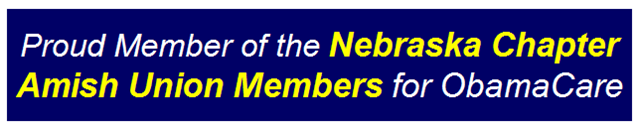
Bumper sticker says it all …

January 18, 2010

image

Mass Senate Race: the real Kennedy factor

January 14, 2010

Scott Brown scored when proclaimed “It’s not teddy Kennedy’s seat, it’s not the Democrats seat, it’s the people’s seat” — nice rhetorical play, for sure.

* * * **

Pundits say that the 3rd party candidate — who happens to be named Kennedy — will sap votes from Brown since their ideology is similar and Kennedy “shows” better than Brown

Pundits are wrong.

Friends know that I often half-joke that I’m not a big fan one man, one vote.  I argue that many voters are completely uninformed on the candidates and issues, so they vote based on precinct boss guidance, candidates’ gender and looks, or name recognition.

My bet: many left leaning Mass voters will pull the voting lever for Kennedy — thinking that they’re voting for a member of the famos clan.  These folks, if they had a clue, would vote for Coakley.

Bottom line: Kennedy factor will help Brown.

Haven’t heard that on TV, have you?

It’s cool to be independent … again.

December 3, 2009

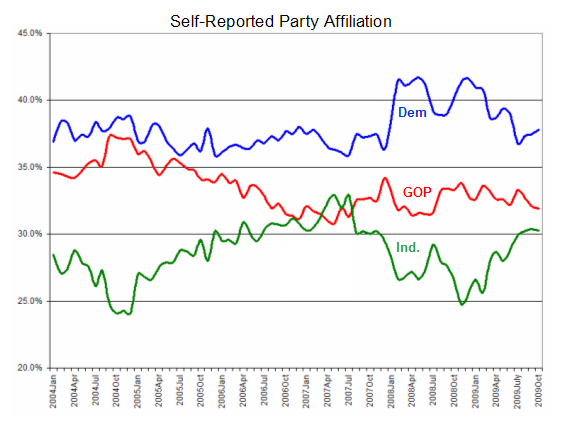
Rasmusssen (and other pollsters) ask people to self-categorize themselves by political party.

I think the trends are pretty interesting:

During the final years of the Bush admin, the mix shifted from the GOP to independents.  Note the near mirror image of the red and green lines on the left half of the chart.

When Obamamania caught traction, the mix shifted from independents to Democrats.  Again, not the near mirror image of the green and blue lines on the right half of the chart.

Now, the mix is shifting again — from Dems to independents.

While Dems still have a statistically significant plurality, the country broken roughly in thirds across Dems, GOP and independents … with independent “swing voters” carrying determining sway.

image

http://www.rasmussenreports.com/public_content/politics/mood_of_america/partisan_trends

The "Pookie Effect" … no, I didn’t make Pookie up.

November 5, 2009

As expected, I got some pushback on yesterday’s election analysis — especially the “Pookie Effect”.

For those who missed the original post, here’s what I said:

The Pookie Factor:  At the risk of  political incorrectness … I know Pres Obama was just trying to be cute with his “get lazy cousin Pookie off the couch and get him to vote”.  I think there was some backlash to the comment.  I know a lot of folks who are repulsed by the thought of lazy cousin Pookie deciding the direction of the country.  Perhaps lazy cousin Pookie should get off the couch and get an education or get a job.
https://kenhoma.wordpress.com/2009/11/04/the-elections-checkbooks-adult-supervision-pookie-and-buyers-remorse/

No, I didn’t make Pookie up (even I CAN’T make that kind of stuff up) and, no, I didn’t just hear it on FoxNews.

My point: Corzine made a big mistake attacking Christy’s heft (pardon the pun).  Similarly, Obama may have inadvertently created a flashpoint issue by invoking Cousin Pookie.

* * * * *

Video Proof

FIrst, here’s the video proof: Obama stumping for failed candidate Deeds in Virginia … at 2 different venues.

http://www.youtube.com/watch?v=-Al6r8ESjAY

http://www.youtube.com/watch?v=j_293EQfM9Y

* * * * *

Print Proof

Here’s  an AP report on CBSNews.com … hardly right wing sources of misinformation.

Excerpted from AP / CBSNews.com: Obama Invokes “Cousin Pookie” to Help Va. Dem, October 27, 2009

(AP )(NORFOLK, Va.) In a last-ditch, against-the-odds effort to help Creigh Deeds win election as governor of Virginia next week, President Obama invoked the assistance of “Cousin Pookie.”

Addressing a campaign rally for Deeds at an arena at Old Dominion University, Mr. Obama used a device that served him well during his presidential campaign – especially before African-American audiences.

“Go out and get your cousin who you had to drag to the polls last November, Cousin Pookie, you go out and get him and you tell him ‘you got to vote again this time.'”

http://www.cbsnews.com/blogs/2009/10/27/politics/politicalhotsheet/entry5427510.shtml

* * * * *

So, who’s Pookie ?

Excerpted from HNIC Reports: “Who is Obama’s ‘Cousin Pookie’?”, March 13, 2007 <== Note the date

In remarks at Brown Chapel in Selma, Ala., Illinois Democratic Sen. Barack Obama made reference to the mysterious Cousin Pookie.

In his sermon Sunday at Brown Chapel in Selma, Ala., Barack Obama declared: “If Cousin Pookie would vote, if Uncle Jethro would get off the couch and stop watching SportsCenter and go register some folks and go to the polls, we might have a different kind of politics.”

It wasn’t the first time the Illinois senator and presidential aspirant has invoked “Pookie” … but for those not in the know, the question remains: Who is this Pookie?

The Obama campaign didn’t respond to requests for details. But Newhouse News Service asked some of America’s best minds on black culture, language and politics.

In their interviews and e-mails, Pookie emerges as a stock character of the black popular imagination, a name that has come to personify the kind of layabout kin who, if endearing, is also a source of some embarrassment and consternation to his more successful relations.

“Pookie means a whole lot of different things; none of them are good.”

Pookie is the kind of ghetto character played by Cedric the Entertainer or Chris Tucker in one of those “Barbershop” or “Friday” movies. In the 1960s and ’70s, he would have gone by Leroy, Tyrone or Otis.

Pookie goes way back, but he has come into his own only in the last decade, as a “metaphor for kin … who everybody knows is just a little trifling and a little lazy.”

“If you get it you get it, and if you don’t, you don’t care.” Kitwana said.

Pookie “may be a kinder, gentler take on Cosby’s reference to, and critique of, Shaniqua and Taliqua (as average black youth).

By referencing Cousin Pookie, he’s showing that he’s comfortable with Pookie without being condescending.

“By invoking the name of someone that might be familiar to a lot of black people, he’s attempting to personalize his appeal.”

How the Rev. Joseph Lowery hears it: The contemporary of Martin Luther King Jr. smiled at the mention of Pookie — not because he was familiar with the reference but because he knew, in context, who was being talked about: any of the hundreds of thousands of African-Americans.

Jethro is Pookie’s white counterpart, and by including him, Obama was making a cross-racial appeal to get off the couch.

http://thehnic.wordpress.com/2007/03/13/who-is-obamas-cousin-pookie/

The elections: Checkbooks, Adult Supervision, Pookie, and Buyer's Remorse …

November 4, 2009

Last night, most pundits reduced the election results to an older, whiter group of voters  taking a stand.

Here’s my take (trying to avoid the usual pundit bromides) …

Checkbooks: I’ve whined often about tax policies that have more than half of adults paying no income taxes, but drawing from the system. My hunch: the mix of voters last nite was disproportionately tax payers who are fed up with the reckless spending and taxation without meaningful representation (think Harry Reid behind closed doors).

Adult Supervision: Some elected officials have to start acting like  adults.  Start showing some sense of fiscal responsibility and stop throwing hizzie fits every time they get challenged.  Recognize that implementation and execution matter.  One of my takes last nite: Bob McDonnell won because he came across as an adult — he carries himself like a governor.

The Pookie Factor:  At the risk of  political incorrectness … I know Pres Obama was just trying to be cute with his “get lazy cousin Pookie off the couch and get him to vote”.  I think there was some backlash to the comment.  I know a lot of folks who are repulsed by the thought of lazy cousin Pookie deciding the direction of the country.  Perhaps lazy cousin Pookie should get off the couch and get an education or get a job. 

Buyer’s Remorse: Many middle-of-the-roaders, frustrated by  or angry at Bush, bought into Obama’s charismatic appeal for change and “coming together”.  My sense: lots of buyer’s remorse.  They got Chicago thugery, expensive rad-left programs, and divisiveness-on- steroids.  Change – yes, but maybe not the the change everybody was hoping for.  This was the first chance for folks to register their views free of recriminations.

It’ll be fun to see how the parties spin the results …

The elections: Checkbooks, Adult Supervision, Pookie, and Buyer’s Remorse …

November 4, 2009

Last night, most pundits reduced the election results to an older, whiter group of voters  taking a stand.

Here’s my take (trying to avoid the usual pundit bromides) …

Checkbooks: I’ve whined often about tax policies that have more than half of adults paying no income taxes, but drawing from the system. My hunch: the mix of voters last nite was disproportionately tax payers who are fed up with the reckless spending and taxation without meaningful representation (think Harry Reid behind closed doors).

Adult Supervision: Some elected officials have to start acting like  adults.  Start showing some sense of fiscal responsibility and stop throwing hizzie fits every time they get challenged.  Recognize that implementation and execution matter.  One of my takes last nite: Bob McDonnell won because he came across as an adult — he carries himself like a governor.

The Pookie Factor:  At the risk of  political incorrectness … I know Pres Obama was just trying to be cute with his “get lazy cousin Pookie off the couch and get him to vote”.  I think there was some backlash to the comment.  I know a lot of folks who are repulsed by the thought of lazy cousin Pookie deciding the direction of the country.  Perhaps lazy cousin Pookie should get off the couch and get an education or get a job. 

Buyer’s Remorse: Many middle-of-the-roaders, frustrated by  or angry at Bush, bought into Obama’s charismatic appeal for change and “coming together”.  My sense: lots of buyer’s remorse.  They got Chicago thugery, expensive rad-left programs, and divisiveness-on- steroids.  Change – yes, but maybe not the the change everybody was hoping for.  This was the first chance for folks to register their views free of recriminations.

It’ll be fun to see how the parties spin the results …

How Beef-Loving Voters Can Get Tofu for President

November 2, 2009

Ken’s Take: This is from my archives – one of my favs.  The original article was inspired by Clinton’s win over elder Bush (the Perot factor), younger Bush’d win over Gore (the Nader factor), and Jesse Ventura’s gov win in Minnesota.

There’s current news in the article since the independent in NJ may allow Corzine to sneak thru, and the Conservative may prevail in NY 23 as the party cadidates split the liberal vote. It’ll be interesting to watch … and (I think), the article is a fun read.

* * * * *
Excerpted from WSJ:  How Beef-Hungry Voters Can Get Tofu for President, March 14, 2003

Those odd ducks who scrutinize returns, calculate how each additional candidate affects the others’ chances and analyze strategic voting are hard at work. I refer, of course, to mathematicians.

Yes, there is a mathematics of elections.

Research has identified various voting systems world-wide in which, paradoxically, becoming more popular can make a candidate lose, abstaining gives your preferred candidate a better chance, and picking a winner means accepting someone a majority of voters don’t want.

This last paradox characterizes the U.S. system of plurality voting (vote for one; the top vote-getter wins). It works fine when there are two candidates, but with three or more, plurality voting can come up short.

For a democracy, the mathematicians’ most robust result is chilling. “It’s surprisingly difficult to identify a voting system that accurately captures the will of the people”.

* * * * *

The Election

So as not to inflame passions with current political examples I’ll illustrate his point with food.

You and two colleagues are planning an office party, and the caterer offers chicken, steak or tofu. You poll 17 invitees:

5 people prefer chicken to steak to tofu.

2 people prefer chicken to tofu to steak.

4 people prefer steak to tofu to chicken.

4 people prefer tofu to steak to chicken.

2 people prefer tofu to chicken to steak.

One organizer tallies the ballots by the plurality method, counting only first-place votes. Chicken wins (7 votes), while steak is last (4 votes).

A second organizer uses “approval voting,” in which voters mark all acceptable choices (everyone’s top two choices are acceptable). Now steak wins with 13, tofu gets 12 and chicken is last with 9.

The third organizer uses a point system that gives their first choices 2 points, second choices 1 and last picks 0. Now tofu wins with 18, steak gets 17, chicken 16.

The ‘winner’ changes with the choice of election procedureAn ‘election winner’ could reflect the choice of an election procedure” rather than the will of the people.

* * * * *

It gets better. Thanks to a mathematical property called nonmonotonicity, in some voting systems, ranking a choice higher can defeat it.

In a plurality-with-runoff system, the two candidates with the most first-place votes face one another in round two.

This time, we invite other departments to our office party, and get this first-round result:

27 prefer chicken to steak to tofu.

42 prefer tofu to chicken to steak.

24 prefer steak to tofu to chicken.

Chicken (27 votes) and tofu (42) reach the runoff. Assuming steak fans maintain their preference and give their second-round votes to tofu, tofu wins the runoff.

That seems fair.

But what if four people in the group of 27 chicken lovers are last-minute converts to vegetarianism and, in round one, prefer tofu to chicken to steak, like the group of 42?

Now steak (24 first-place votes) and tofu (46) make the runoff, in which steak beats tofu 47 to 46. Tofu’s late surge turned its win into a loss.

* * * * *

Such paradoxes tend to occur under specific but far from unusual circumstances.

With plurality voting, the most common is when two centrists face an extremist. The majority splits its vote between the centrists, allowing the fringe candidate to squeak in. In Minnesota’s 1998 governor’s race, Hubert Humphrey got 28% of the vote, Norm Coleman 34% and Jesse Ventura won with 37%, even though most voters ranked him last.

* * * * *

Thanks to such outcomes, scientists say what’s most needed is “a way for voters to register their second and third choices … especially in primaries, where there tends to be a large field.” Both a ranking system (give candidates 4, 3, 2 or 1 point) and approval voting accomplish that.

The U.N. chooses a secretary-general by approval voting. “It is particularly appealing in elections with many candidates … If your favorite candidate is a long shot, you can vote for both him and a candidate with a better chance without wasting your vote on the long shot. Approval voting would do a lot to address the problem of presidential-primary victors not being the choice of most voters.” Approval voting could well make more people (especially supporters of long shots) feel their ballot matters.

Still, no system is perfect. As Nobel-winning economist Kenneth Arrow proved mathematically in 1951, no voting system is guaranteed to be free of paradoxes in a race with three or more candidates, except one — a dictatorship.

"Vote for me because my opponent is too fat" … you gotta love NJ politics.

November 2, 2009

TakeAway: Hacking off fat people just isn’t a good idea !

* * * * *
Excerpted from Chicago Tribune:  Corzine’s Big, Fat Political Mistake, November 1, 2009

The New Jersey governor’s race pits the slim, distance-running, Democratic incumbent Jon Corzine against Republican Chris Christie, who is built for comfort, not for speed.

Corzine ran a TV ad accusing the challenger of “throwing his weight around” to beat traffic tickets, accompanied by footage that did not attempt to conceal Christie’s bulk.

“Mr. Corzine’s campaign is calling attention to his rival’s corpulence in increasingly overt ways,” reported The New York Times a few weeks ago, noting that his “television commercials and Web videos feature unattractive images of Mr. Christie, sometimes shot from the side or backside, highlighting his heft, jowls and double chin.” Meanwhile, Corzine has also made a point of taking part in 5- and 10-kilometer races every chance he gets.

The other day, Christie decided to confront his opponent. No, not by calling him bald, furry-faced and four-eyed, all of which would be understandable retorts. No, he took the high road by daring Corzine to stop the sly digs and say what he’s thinking outright. “If you’re going to do it,” said Christie, “at least man up and say I’m fat.”

By then, though, it had dawned on Corzine that ridiculing excess heft wasn’t good politics — and risked alienating the hordes of voters who are carrying extra pounds.

Nationally, two out of every three adults are overweight or obese — more New Jerseyans look like Christie than look like Corzine, and they probably don’t like being ridiculed by proxy.

Full article:
http://www.realclearpolitics.com/articles/2009/11/01/a_big_fat_political_mistake_98964.html

If there are twice as many conservatives as liberals … why do I feel so lonely?

October 27, 2009

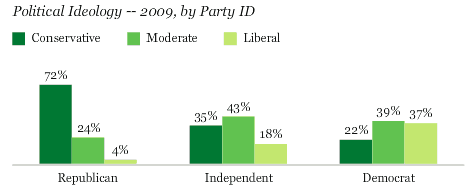
TakeAway: Conservatives continue to outnumber  liberals 2 to 1 in the American populace in 2009.

* * * * *
Excerpted from Gallup: Conservatives Maintain Edge as Top Ideological Group, October 26, 2009

Forty percent of Americans describe their political views as conservative, 36% as moderate, and 20% as liberal. This marks a shift from 2005 through 2008, when moderates were tied with conservatives as the most prevalent group.

image

* * * * *

Changes among political independents appear to be the main reason the percentage of conservatives has increased nationally over the past year: the 35% of independents describing their views as conservative in 2009 is up from 29% in 2008. By contrast, among Republicans and Democrats, the percentage who are “conservative” has increased by one point each.

image


* * * * *

In addition to the increase in conservatism on this general ideology measure, Gallup finds higher percentages of Americans expressing conservative views on several specific issues in 2009 than in 2008.

  • Perceptions that there is too much government regulation of business and industry jumped from 38% in September 2008 to 45% in September 2009.
  • The percentage of Americans saying they would like to see labor unions have less influence in the country rose from 32% in August 2008 to a record-high 42% in August 2009.
  • Public support for keeping the laws governing the sale of firearms the same or making them less strict rose from 49% in October 2008 to 55% in October 2009, also a record high. (The percentage saying the laws should become more strict — the traditionally liberal position — fell from 49% to 44%.)
  • The percentage of Americans favoring a decrease in immigration rose from 39% in June/July 2008 to 50% in July 2009.
  • The propensity to want the government to “promote traditional values” — as opposed to “not favor any particular set of values” — rose from 48% in 2008 to 53% in 2009. Current support for promoting traditional values is the highest seen in five years.
  • The percentage of Americans who consider themselves “pro-life” on abortion rose from 44% in May 2008 to 51% in May 2009, and remained at a slightly elevated 47% in July 2009.
  • Americans’ belief that the global warming problem is “exaggerated” in the news rose from 35% in March 2008 to 41% in March 2009.

Gallup has not recorded heightened conservatism on all major social and political views held by Americans. For instance, attitudes on the death penalty, gay marriage, the Iraq war, and Afghanistan have stayed about the same since 2008.

However, there are no major examples of U.S. public opinion becoming more liberal in the past year.

Full article:
http://www.gallup.com/poll/123854/Conservatives-Maintain-Edge-Top-Ideological-Group.aspx

Ty Cobb goes down to defeat … no, not "that" Ty Cobb

October 16, 2009

TakeAway: Dems have lost a string of  special elections because of national issues that have eroded independent and seniors’ support, and lackluster turnout — especially among minorities, young people, and far-lefters.

* * * * *
Excerpted from WSJ:  Health Care’s Coattails, Oct. 15, 2009

Last week, Republicans captured Albuquerque mayor’s office for the first time in 28 years.

On Tuesday, the GOP won a pair of special elections in Tennessee and Oklahoma, picking up seats held by Democrats for decades.

The reason: Republican intensity and lackluster Democratic turnout.

In Tennessee, Republican businessman Pat Marsh won 56% of the vote to defeat Democrat Ty Cobb. It wasn’t as if Mr. Cobb had a name unknown to voters. His brother Curt had held the seat before resigning to take another government office (and it probably didn’t hurt having the same name as a baseball legend).

But Mr. Cobb attributed his defeat to “national issues . . . the health care issue was the main one.”

A couple of states over, national issues may also have played a role in the GOP capture of an Oklahoma House seat held by Democrats since 1965. Republican Todd Russ won 56% of the vote even though registered Democrats have a two-to-one edge in the district.

The twin victories mean Republicans have captured a total of six state legislative seats from Democrats in special elections this year. The other wins came in Delaware, Texas, New Hampshire and Virginia.

Next up: the VA and NJ governor races in November.

Full article:
http://online.wsj.com/article/SB10001424052748704107204574475292426931168.html?mod=djemEditorialPage#printMode

* * * * *