Archive for the ‘Uncategorized’ Category

Am I the only person on earth who didn’t watch the inauguration?

January 23, 2009

Excerpted from Ad Age, “How We Watched the Inauguration” By A. Hampp and A. Klaassen, Jan 20, 2009

* * * * *

By the time final numbers are crunched President Barack Obama’s inauguration likely will have been watched by more people and on more platforms than virtually any other televised event in U.S. history — including the Super Bowl. This year’s biggest winner: the web, with cable news, social networks and even sports leagues capturing a record share of viewers tuning in and live-blogging online throughout the afternoon.

The early winners in the battle for inauguration-media-coverage supremacy were CNN and Facebook, which teamed up for a unique live-streaming event that integrated CNN.com’s video player with Facebook status updates, so users could update their statuses with up-to-the-second commentary.

According to early data … CNN.com had generated more than 136 million page views, while CNN.com Live had served more than 21.3 million live video streams globally … easily surpassing its previous record of 5.3 million live streams on Election Night …

If CNN and Facebook were the biggest winners in terms of streams served, Starbucks was arguably the biggest winner on the marketing side, as its new video ad aired on CNN.com Live directly after President Obama left the stage. The ad … was a community-outreach “grass-roots initiative” that offered pledge cards and free cups of coffee to consumers who promised to do five hours of community service during 2009 at their local Starbucks between Jan. 21-25 …

Another marketer looking to benefit from Obama mania is Audi, the German automaker, which will sponsor the evening broadcasts’ recap of the swearing in of Mr. Obama on ABC, CBS, NBC; the automaker also ran ads during numerous streamed broadcasts of the event online …

The inauguration was available from multiple sources and on multiple platforms. MobiTV offered live coverage from ABC News, CNBC, C-Span, Fox News and MSNBC on its mobile services. On the web, the inauguration aired on sites as diverse as Major League Baseball’s mlb.com and MySpace, which streamed the inauguration on its MySpace Impact website … 

Other online broadcasters reported early success and record traffic. Hulu streamed live coverage of Fox News. The site wouldn’t report specific streaming numbers, but a spokesman said today’s inauguration “set a new record for us in terms of live streams, ahead of our previous events, which included the presidential debates, the acceptance speech in Grant Park and the Sarah Palin/Joe Biden debate.”

However, Fox is likely to gain a significant increase in new viewers thanks to its syndication on Hulu, which could boost its audience by as many as several million unique visitors. It attracted just more than 5 million to FoxNews.com on Election Night vs. the 10 million to 15 million who watched CNN.com and MSNBC.com.

Edit by SAC

* * * * *

Full Article:
http://adage.com/digital/article?article_id=133920

* * * * *

Want more from the Homa Files?
Click link =>
The Homa Files Blog

Am I the only person on earth who didn't watch the inauguration?

January 23, 2009

Excerpted from Ad Age, “How We Watched the Inauguration” By A. Hampp and A. Klaassen, Jan 20, 2009

* * * * *

By the time final numbers are crunched President Barack Obama’s inauguration likely will have been watched by more people and on more platforms than virtually any other televised event in U.S. history — including the Super Bowl. This year’s biggest winner: the web, with cable news, social networks and even sports leagues capturing a record share of viewers tuning in and live-blogging online throughout the afternoon.

The early winners in the battle for inauguration-media-coverage supremacy were CNN and Facebook, which teamed up for a unique live-streaming event that integrated CNN.com’s video player with Facebook status updates, so users could update their statuses with up-to-the-second commentary.

According to early data … CNN.com had generated more than 136 million page views, while CNN.com Live had served more than 21.3 million live video streams globally … easily surpassing its previous record of 5.3 million live streams on Election Night …

If CNN and Facebook were the biggest winners in terms of streams served, Starbucks was arguably the biggest winner on the marketing side, as its new video ad aired on CNN.com Live directly after President Obama left the stage. The ad … was a community-outreach “grass-roots initiative” that offered pledge cards and free cups of coffee to consumers who promised to do five hours of community service during 2009 at their local Starbucks between Jan. 21-25 …

Another marketer looking to benefit from Obama mania is Audi, the German automaker, which will sponsor the evening broadcasts’ recap of the swearing in of Mr. Obama on ABC, CBS, NBC; the automaker also ran ads during numerous streamed broadcasts of the event online …

The inauguration was available from multiple sources and on multiple platforms. MobiTV offered live coverage from ABC News, CNBC, C-Span, Fox News and MSNBC on its mobile services. On the web, the inauguration aired on sites as diverse as Major League Baseball’s mlb.com and MySpace, which streamed the inauguration on its MySpace Impact website … 

Other online broadcasters reported early success and record traffic. Hulu streamed live coverage of Fox News. The site wouldn’t report specific streaming numbers, but a spokesman said today’s inauguration “set a new record for us in terms of live streams, ahead of our previous events, which included the presidential debates, the acceptance speech in Grant Park and the Sarah Palin/Joe Biden debate.”

However, Fox is likely to gain a significant increase in new viewers thanks to its syndication on Hulu, which could boost its audience by as many as several million unique visitors. It attracted just more than 5 million to FoxNews.com on Election Night vs. the 10 million to 15 million who watched CNN.com and MSNBC.com.

Edit by SAC

* * * * *

Full Article:
http://adage.com/digital/article?article_id=133920

* * * * *

Want more from the Homa Files?
Click link =>
The Homa Files Blog

Online ads … customized on the fly

January 16, 2009

Excerpted from the New York Times, “Web Marketing That Hopes to Learn What Attracts a Click”, by Stephanie Clifford, December 3, 2008

* * * * 
Online advertisers are not lacking in choices: They can display their ads in any color, on any site, with any message, to any audience, with any image.

Now, a new breed of companies is trying to tackle all of those options and determine what ad works for a specific audience. They are creating hundreds of versions of clients’ online ads, changing elements like color, type font, message, and image to see what combination draws clicks on a particular site or from a specific audience.

It is technology that could cause a shift in the advertising world. The creators and designers of ads have long believed that a clever idea or emotional resonance drives an ad’s success. But that argument may be difficult to make when analysis suggests that it is not an ad’s brilliant tagline but its pale-yellow background and sans serif font that attracts customers.

Adisn, based in Long Beach, and Tumri, based in Mountain View, are working both sides of the ad equation. On one, they are trying to figure out who is looking at a page by using a mix of behavioral targeting and content analysis. On the other side, they are assembling an ad on the fly that is meant to appeal to that person.

* * * * *

Adisn’s approach has been to build a database of related words so it can assess the content of a Web site or blog based on the words on its pages.

Adisn then buys space on Web sites, and uses its information to find an appropriate ad to show visitors to those sites. If a visitor views pages about beaches, weather and Hawaii, it might suggest that the visitor is interested in Hawaiian travel.

Based on that analysis, Adisn’s system pulls different components — actors, fonts, background images — to make an ad. For example, it might show an ad with a blue background, an image of a beach, and a text about tickets to Hawaii.

Simple Green, the cleaning brand, began working with Adisn this year to advertise a new line of products called Simple Green Naturals.

“If it’s a woman looking at a kitchen with a stainless steel refrigerator, they can show a stainless steel product.”

* * * * *

Tumri’s approach is slightly different. It creates a template for ads, including slots for the message, the color, the image and other elements.

Unlike Adisn, it does not buy ad space, but lets clients choose and buy space on sites themselves. And rather than building a contextual database, Tumri uses whatever targeting approach advertisers are already using, whether it is behavioral or contextual or demographic, and assembles an ad on the fly based on that information.

“It’s reporting back to the advertiser and agency saying, ‘Guess what? The soccer mom in Indiana likes background three, which was pink, likes image four, which was the S.U.V., and likes marketing message 12, about room, safety and comfort.”

Edit by DAF

* * * * *

Full article:
http://www.nytimes.com/2008/12/03/business/media/03adco.html?_r=1&ref=media&pagewanted=print

* * * * *

Want more from the Homa Files?
Click link => 
The Homa Files Blog

Happy Holidays

December 24, 2008

May your holiday season be peaceful and happy …

Ken 

* * * * *

Want more from the Homa Files?
Click link =>
  The Homa Files Blog

Goldman: "Must pay to retain talent to insure continued success" … say, what?

December 24, 2008

Excerpted from IBD, “Bailing Out Bonuses”, December 22, 2008

Amid coast-to-coast cutbacks and layoffs by the thousands, bankers at the center of the financial crisis pay themselves $1.6 billion in taxpayer-funded bonuses .  In addition to the bonuses, they got club dues, financial planners, corporate jet travel, daily limousines and home security systems, courtesy of the taxpayers.

It’s obvious these banker bonuses had no correlation to productivity or performance. In the real world, enterprises provide such benefits only when executives produce results — that is, profits.

Goldman Sachs said it needed to retain and motivate its talent to ensure its “continued success,” not mentioning where this talent is threatening to migrate in a global and industry downturn.

Full article:
http://www.ibdeditorials.com/IBDArticles.aspx?id=314842162013024 

* * * * *

Want more from the Homa Files?
Click link =>
  The Homa Files Blog

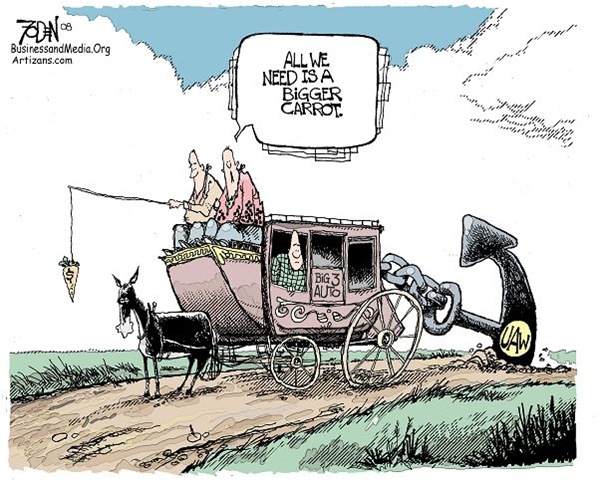
As Detroit burns (figuratively), UAW gets a paid vacation …

December 19, 2008

When Chrysler plants are idled because they are not making vehicles, Chrysler is still required to pay its UAW workers 95 percent of their wages.
http://voices.washingtonpost.com/economy-watch/2008/11/corker_uaw_should_not_be_paid.html?hpid=topnews

image002

* * * * *

Want more from the Homa Files?
Click link =>
  The Homa Files Blog

Letting the Chicken Loose to Understand the Bottom of the Pyramid

December 11, 2008

Excerpted from WSJ, ” McCann Offers Peak Lives of Latin America’s Poor” By Antonio Regaldo, December 8, 2008

* * * * *

During presentations at McCann Worldgroup’s office in Bogotá, Colombia, staffers have taken to letting a chicken loose to hunt and peck around clients’ feet. Racks of potato chips and other products on display in McCann’s Mexico City conference room, which has been designed to look like a bodega…

The point of these exercises: to give big marketers some insight into the lifestyles of Latin America’s low-income consumer…McCann’s move comes as multinational companies increasingly consider such “emerging consumers” as a big opportunity. But these consumers’ tastes, habits and needs remain largely an enigma to global marketers…

McCann’s research is helping Nestlé market Nido Rindes Diario, a brand of fortified powdered-milk product…one of Nestlé’s challenges was to overcome the perception that milk powder is a specialized formula for babies, and too expensive for the whole family to drink. McCann says its research helped position the product…

The idea of targeting low-income consumers may raise some eyebrows. But greater access to industrialized products like deodorant, and packaged food, can improve their physical and “psychological welfare…We do not pretend to be Mother Teresa”…

Advertisers say practical insights into low-income groups are hard to come by. “A lot of people talk about the emerging consumer, the bottom of the pyramid, but no one really has a structured approach…We have to do a lot for ourselves, and sometimes fall on our face doing it.”

In Mexico, Nestlé decided to sell Nido Rindes Diario exclusively through mom-and-pop stores, not supermarkets…That decision came after McCann found that local shopkeepers exert outsize influence in tightly knit, low-income neighborhoods. “It’s the shopkeeper who can recommend or disavow a product,” he says…

Some experts say marketing directly to low-income groups has yet to become a full-blown trend. “Usually multinationals just put out a Mexican version [of their product] that looks as American as possible”…But examples of products tailored to thin pocketbooks are increasing…

Edit by SAC

* * * * *

According to the theory of the bottom of the pyramid, there is a combination of profit opportunity and social responsibility to be had by marketing to consumers at the bottom of the economic pyramid. Critics of the theory argue that the benefits of marketing to this group are overstated and that marketing to this group can be exploitive.  Whether the profit opportunity is real or a mirage, McCann is taking the right steps to help Nestle benefit from this group by working to understand the group’s purchase desire and developing tailored solutions for the market to ensure that consumers are able to access the product.

* * * * *Full Article:


http://online.wsj.com/article/SB122824726034173129.html

* * * * *

Want more from the Homa Files?
Click link =>
The Homa Files Blog

Breaking through all that clutter …

December 8, 2008

Excerpted from The Wall Street Journal “Notice Me: Cutting Through the Clutter” by S. Balasubramnian and P. Bhardwaj, October 20, 2008

* * * * *

It’s hard to cut through the clutter.

Even as customers are constantly bombarded with advertising messages, they are getting progressively better at tuning out the endless stream of come-ons. Companies then typically up the ante and try to out-shout their competitors to draw attention. All of which just leads to more shouting, and everybody is drowned out…

Here are five questions marketers should ask themselves as they craft new strategies to capture customers’ attention in an increasingly noisy marketplace.

* * * * *

Can the marketing stimulus be delivered at a time when the customer has few other distractions?

Marketing messages should target customers at times when they are unoccupied, perhaps even actively seeking some sort of information to process. Consider, for example, an airplane on the landing path into an airport. Sitting upright, with in-flight entertainment and electronic devices switched off, passengers have little to do but to look out of the window and wait for the aircraft to land.

Seeking to capitalize on this opportunity, London-based Ad-Air Group PLC places advertisements flat on the ground over an area as large as five acres alongside flight paths in and out of the world’s busiest airports. Depending on their landing approach, passengers are provided with an unrestricted view of an ad for more than 10 seconds.

* * * * *

Can the marketing message be designed to pique the customer’s curiosity?

Piquing customers’ curiosity can be more effective than inundating them with information. Stimuli that are carefully placed, so that they are encountered in sequence, can be particularly successful at this task…

* * * * *

Can the marketing message piggyback on another brand?

With television and newsprint media being increasingly saturated, marketers need to seek out new and interesting formats and media for their messages.

Goodyear Tire & Rubber Co., for example, has teamed with Addidas AG on a range of motorsport-inspired driving and sports shoes. The soles of these shoes are made of rubber with tread patterns designed by Goodyear. If customers viewed the shoe purely as an Adidas product, Goodyear’s contribution would remain unnoticed. However, the Goodyear brand is prominently displayed on the outsoles of the shoes. The result is that every person wearing the shoes is now a messenger for the Goodyear brand.

* * * * *

Can the product or service occupy a piece of the physical environment that the customer frequently interfaces with?

Consumers today tend to spend inordinate amounts of time interfacing with just a few objects — for many, it is their computer screen at work. Marketers must consider how they can capture the customer’s attention when they interface with these objects. Customers, however, guard access to these objects zealously…

* * * * *

Can your company build into its messaging a consistent stimulus that affects one or more of the five physical senses?

Successful marketing messages excite customers not only when they first encounter them — they ingrain themselves into the customers’ permanent memory. Once a message is embedded, customer resistance to processing it drops when it is encountered in the future…

Not each of these five questions will necessarily generate a great idea for every company. But they do provide a common language for comparing, debating and improving managers’ proposals. 

Edit by SAC

* * * * *
Full article:
http://online.wsj.com/article/SB122427109679945225.html

Want more from the Homa Files?
Click link =>
The Homa Files Blog

Boost your ROI by building your brand ..

November 25, 2008

Excerpted from Brand Channel “Trust as a Tangible Brand Attribute” by Mary Weisnewski, November 3, 2008

* * * * *

How do you transform your company’s core values into a business asset you can see and feel?

Investing in branding is a good start.  Unfortunately, too many companies slow their efforts to a grinding halt after the rollout party to unveil the new website design and hand out pens embossed with the new logo..

.“Investing in brand development is increasingly important to build credibility and differentiate…People are making purchasing decisions based on how closely aligned their values are with an organization and how much they trust what that organization is providing. This is as true whether people are making donations to nonprofits, buying consumer products, or hiring consultants.”

Revealing your organization’s core values by developing an authentic brand platform, then consistently walking the talk of those core values, is the foundation of employee and customer trust and loyalty—both of which directly affect your bottom line.

 * * * * *

Trust is the engine that powers your brand. When a brand delivers consistently on what it says it will do there are tangible results. When the visual brand is aligned consistently with the experience it communicates an honest, reliable organization and there are tangible results. It’s all about building loyalty and long-lasting relationships…

Trust results from a reliable cache of perceptions and experiences, built over time. We think of organizations just like we do people we know. If I have heard of you I am more likely to trust you. If you do what you say you are going to do, my level of trust will increase…

You have to survey, or audit, everyone involved with your organization to find out what they really think and feel about what you’re offering, and listen to their concerns and desires…

What every company really wants, regardless of its size or market niche, is brand equity: tangible results that show a return on investment. When United Way underwent a rigorous brand evaluation in 2003, they discovered that the strong brand was 67 percent of the reason why people chose to invest in the organization.

* * * * *

Making your brand tangible leads to: ongoing affirmation of purpose, organizational alignment, differentiation, stronger relationships and connections, increased recognition; stronger recruitment, and increased ROI.

The bottom line is that a tangible brand is a win-win for your company and your customers…When a brand delivers consistently on its promise there are tangible results. This is true whether your company is just starting out or has a well-known national or international presence….People will pay more for, and choose faster, the experience and peace of mind a healthy brand promises.  

Edit by SAC 

* * * * *
Full article:
http://brandchannel.com/brand_speak.asp?bs_id=205

* * * * *

Want more from the Homa Files?
Click link =>
The Homa Files Blog

Boost your ROI by building your brand ..

November 25, 2008

Excerpted from Brand Channel “Trust as a Tangible Brand Attribute” by Mary Weisnewski, November 3, 2008

* * * * *

How do you transform your company’s core values into a business asset you can see and feel?

Investing in branding is a good start.  Unfortunately, too many companies slow their efforts to a grinding halt after the rollout party to unveil the new website design and hand out pens embossed with the new logo..

.“Investing in brand development is increasingly important to build credibility and differentiate…People are making purchasing decisions based on how closely aligned their values are with an organization and how much they trust what that organization is providing. This is as true whether people are making donations to nonprofits, buying consumer products, or hiring consultants.”

Revealing your organization’s core values by developing an authentic brand platform, then consistently walking the talk of those core values, is the foundation of employee and customer trust and loyalty—both of which directly affect your bottom line.

 * * * * *

Trust is the engine that powers your brand. When a brand delivers consistently on what it says it will do there are tangible results. When the visual brand is aligned consistently with the experience it communicates an honest, reliable organization and there are tangible results. It’s all about building loyalty and long-lasting relationships…

Trust results from a reliable cache of perceptions and experiences, built over time. We think of organizations just like we do people we know. If I have heard of you I am more likely to trust you. If you do what you say you are going to do, my level of trust will increase…

You have to survey, or audit, everyone involved with your organization to find out what they really think and feel about what you’re offering, and listen to their concerns and desires…

What every company really wants, regardless of its size or market niche, is brand equity: tangible results that show a return on investment. When United Way underwent a rigorous brand evaluation in 2003, they discovered that the strong brand was 67 percent of the reason why people chose to invest in the organization.

* * * * *

Making your brand tangible leads to: ongoing affirmation of purpose, organizational alignment, differentiation, stronger relationships and connections, increased recognition; stronger recruitment, and increased ROI.

The bottom line is that a tangible brand is a win-win for your company and your customers…When a brand delivers consistently on its promise there are tangible results. This is true whether your company is just starting out or has a well-known national or international presence….People will pay more for, and choose faster, the experience and peace of mind a healthy brand promises.  

Edit by SAC 

* * * * *
Full article:
http://brandchannel.com/brand_speak.asp?bs_id=205

* * * * *

Want more from the Homa Files?
Click link =>
The Homa Files Blog

McCain: Hoisted on his own pitard?

November 6, 2008

Note: I love that expression.  See below for what it means.

* * * * *

Ken’s Take:

(1) McCain took on enormous political risk when he pushed campaign funding reform (McCain-Finegold).  Wonder how he’s feeling about that today?

(2) In rough numbers, Obama spent about $6 per vote ; McCain spent about $1.50 per vote.

(3) Next election: it’ll cost $1 billion to ante in.

* * * *  *

Excerpted from McClatchy Newspapers, “Obama spent $250 million on TV ads in general election”, Nov. 6, 2008

Beginning in early June, Obama amassed about $364 million for the fall campaign, Federal Election Commission records show. Obama’s campaign reports already show that he raised a record-shattering $668 million since entering the race last year, with some donations yet to be disclosed.

In contrast, McCain was limited to $84.1 million in public money beginning in early September.

Flush with a tidal wave of campaign donations, Barack Obama spent $250 million on television ads … outspending John McCain and the Republican Party combined by as much as $80 million [i.e. over 40% more].  McCain’s campaign spent about $135 million on TV ads, and the RNC kicked in more than $40 million for coordinated or independently produced pro-McCain or anti-Obama television ads. Obama’s ad spending smashed President Bush’s 2004 record of $188 million on TV ads.

* * * * *

Obama’s decision takes away any incentive for congressional Democrats to pass legislation strengthening the public financing law. Any Republican seeking to challenge Obama in four years will have to ask the question, ‘Can I raise $600 million?”  Federal funding “will remain as a safety net for underfunded ‘populist’ candidates,” but won’t be an option for those who want a serious chance of winning.

* * * * *

Full artcile:
http://www.miamiherald.com/news/politics/AP/story/758740.html

* * * * *

Hoisted on his own pitard

From Yahoo Answers:
“The word is really”petard”.  A  petard was a bell shaped metal container filled with explosives. It was used to blow in gates or breach walls. It was lit with a slowly burning fuse, but there was always the danger of a premature explosion – the chance that you would be hoisted (lifted) by your own petard. It comes from Shakespeare and I think the quote is actually “hoist with his own petar.” (Not “on” – that’s just become the common parlance.) Some sources cite petard as deriving from the French word for “fart.” A different kind of explosion!”

http://answers.yahoo.com/question/index?qid=20070815011415AA667i9

* * * * *

Want more from the Homa Files?
Click link =>
  The Homa Files Blog

Marketing – Destroying Starbuck’s Brand Value

November 3, 2008

Excerpted from: “Starbucks: How Growth Destroyed Brand Value” by Prof. John Quelch, HBS Online / BusinessWeek Online

Founder and CEO Howard Schultz had a great concept, and it worked for a while. But too many new stores and diverse products changed the experience … Schultz recognized (that) … “Stores no longer have the soul of the past and reflect a chain of stores vs. the warm feeling of a neighborhood store.”

(Now) Starbucks is a mass brand attempting to command a premium price for an experience that is no longer special. Either you have to cut price (and that implies a commensurate cut in the cost structure) or you have to cut distribution to restore the exclusivity of the brand … Sometimes, in the world of marketing, less is more … Growth targets undermined the Starbucks brand in three ways.

First, the early adopters who valued the club-like atmosphere of relaxing over a quality cup of coffee found themselves in a minority. To grow, Starbucks increasingly appealed to grab and go customers for whom service meant speed of order delivery rather than recognition by and conversation with a barista … many Starbucks veterans have now switched to Peets, Caribou and other more exclusive brands.

Second, Starbucks introduced many new products to broaden its appeal. These new products undercut the integrity of the Starbucks brand for coffee purists. They also challenged the baristas who had to wrestle with an ever-more-complicated menu of drinks. With over half of customers customizing their drinks, baristas hired for their social skills and passion for coffee, no longer had time to dialogue with customers. The brand experience declined as waiting times increased. Moreover, the price premium for a Starbucks coffee seemed less justifiable for grab and go customers as McDonald’s and Dunkin Donuts improved their coffee offerings at much lower prices.

Third, opening new stores and launching a blizzard of new products create only superficial growth … Eventually, the point of saturation is reached and cannibalization of existing store sales undermines not just brand health but also manager morale.

None of this need have happened if Starbucks had stayed private and grown at a more controlled pace. To continue to be a premium-priced brand while trading as a public company is very challenging. Tiffany faces a similar problem. That’s why many luxury brands like Prada remain family businesses or are controlled by private investors. They can stay small, exclusive and premium-priced by limiting their distribution to selected stores in the major international cities. ”

* * * * *

Ken’s Take:

1. Nice synopsis of Starbuck’s current position and challenges.

2. The issue is strategic discipline — not private vs. public ownership.

3. Eventually, you run out of folks who are willing (and able) to shell out $5 for a cup of coffee that keeps losing taste tests to both Mickey D and Dunkin’ Donuts. And, as budgets tighten, brand panache starts to look like wateful spending.

4. Things are likely to go from bad to worse as stores close and Barista “partners” confront job insecutity — so much for kumbaya.

5. Still, you have to hand it to these guys for their spectacular run.

* * * * *

Note: Prof. Quelch wrote a series of cases on Black & Decker marketing, including the classic “B&D Brand Transition”

Source: BusinessWeek Online / Harvard Business Online,
July 9, 2008         For full article:
http://businessweek.com/managing/content/jul2008/ca2008079_888377.htm?chan=top+news_top+news+index_news+%2B+analysis

Thanks to MSB-MBA alum Suhrud Atre for the heads-up on the article

Want more from the Homa Files?
 
Click link =>  The Homa Files Blog


Encore – So, is the U.S. tax system regressive or progressive?

October 30, 2008

Last night, I heard a group of pundits claiming that the US tax system is regressive when payroll taxes (for Medicare and Social Security) are considered.  Huh?

This encore was originally posted on Aug.3, 2008.

* * * * *

OK, I’m officially confused. Is the current U.S. tax system “regressive” – the more you make, the lower your effective rate – or is it  “progressive” – the more you make, the higher your effective rate. 

The politicos and pundits – even the smart ones – seem split on the question.  So, which is it?

* * * * *

Summary

Practically everyone agrees that the U.S. federal income tax structure is progressive (i.e. high earners pay a higher tax rate).  But, the Reagan and Bush tax code changes did make it less progressive than it was in the 1960s; there are some isolated anomalies ( e.g. Warren Buffett and his secretary); and it may be less progressive than some folks want.

The estate tax (a.k.a, “death tax”) is – by definition —  progressive since only the wealthiest 1% of folks who die pay it.

  • Note: there’s a difference between “income” and “wealth” – while high income usually correlates with high wealth, income is a “flow” variable and wealth is a “stock”.

So, any dispute must arise from so-called  “payroll taxes” – the paycheck deductions that fund Social Security and Medicare. 

There is a single rate for Medicare (1.45%) that is applied to all wages; and.there is a single rate for Social Security(6.2%) that is applied to at most $102,000 in wages.  Employers match their employees’ contributions dollar-for-dollar.

  • Note: most economists argue that, in the final analysis, employees bear the full burden of their employer’s matching amounts since employers most likelycover the tax by reducing wages.

Since the same rates are applied to all taxpayers , and since Social Security’s“base earnings” are capped at  $102,000, then payroll taxes are regressive with respect to current earnings.  But – as I’ll demonstrate is future analytical posts – Medicare benefits are the same, regardless of how much a taxpayer contributes (and high earners contribute more than low earners); and Social Security benefits are “coupled” to earnings via a very progressive formula – i.e. high-earners get disproportionately less in benefits.  So, taking into account the benefits received as well as the contributions made, both programs are very progressive.

The bottom line: all of the components are progressive:  federal income taxes, estate taxes, payroll taxes.  So, it logically follows that the combined program is progressive.

In this post, I’ll set-up the issue and provide some references.  In subsequent posts, I’ll provide some numbers and analysis that support the above conclusions..

* * * * *

The Details

The question: Is the current U.S. tax system “regressive” – the more you make, the lower your effective tax rate – or is it  “progressive” – the more you make, the higher your effective tax rate.

Let’s look at the pieces that make up the U.S. tax system..

There’s the estate tax (a.k.a. “death tax”).  It’s clearly progressive since only the richest 1% of folks who die pay it.  As the exclusion levels increase under the Bush plan, fewer dead people have to pay it – making it even more progressive.  When it gets eliminated entirely in 2010, it stops being progressive, but it doesn’t start being regressive.  It just stops.

The estate tax in small potatoes in the overall  tax mix.  The big behemoth is the federalincome tax.  The aggregate statistics  (i.e. looking at the broad population , and not just Warren Buffett and his secretary) are – in my opinion – incontrovertible.  Higher income folks – say the top 50% — pay a higher effective income tax rate and shoulder over 97%l of the federal income tax burden. The federal income tax is progressive.  Period..

Why then, do many really smart, well-intended people say the tax system is regressive and that high earners aren’t paying their fair share?

  • Note: though some people use the terms interchangeably, “regressive” and “fair share” are not synonymous.

First, what some of them are really saying is that the income tax code isn’t as progressive as it used to be (true, but so what?),  or that it isn’t as progressive as the tax code in other countries, say France (true, but — for sure — so what?),  or that it’s not progressive enough based on higher order socio-ethical criteria (very important, but also, quite debatable).

A more structural argument posed by many people is that so-called “payroll taxes” that fund Social Security and Medicare are regressive and tilt the balance of the tax system..

* * * * *

For example, Robert Reich, Bill Clinton’s former Secretary of Labor says:

The fact that “84.6% of all federal taxes are paid by the top 25% of income earners, and over a third are paid by the top 1%, advances a specious argument.

Most Americans pay more in payroll taxes than in income taxes … payroll taxes take a much bigger portion of the paychecks of lower-income Americans than of higher-income.

Viewed as a whole, the current tax system is quite regressive.”

http://economistsview.typepad.com/economistsview/2007/10/robert-reichs-p.html

* * * * *

OK, so parsing Reich’s argument, if the overall system is regressive, and if major parts of the system —  income and estate taxes are progressive – then it logically follow that payroll taxes are both substantial (especially to low-earners) and very regressive.  The culprit is payroll taxes.

* * * * *

The Tax Policy Center  a joint venture of the Urban Institute and Brookings Institution and self-proclaimed non-partisan organization   – explains:

Taken as a whole, the federal tax system is progressive: on average, households with higher incomes pay a larger share of their income in federal tax than do those with lower incomes. In other words, the overall average effective tax rate-total tax paid as a percentage of income-rises as income rises.

But not all taxes within the federal system are equally progressive. The estate tax is the most progressive federal tax. The individual (and corporate) income taxes are also progressive. In contrast, payroll taxes for Social Security and Medicare are regressive, claiming a larger share of income from lower-income than from higher-income households.

For 2008 average effective payroll tax rates are estimated at 8.4 percent for the bottom fifth of income earners, and 10.4 percent for the next fifth, but only 5.7 percent for the top fifth. Households in the top 1 percent will pay an estimated average of only 1.5 percent of their income in payroll taxes.

This regressivity of payroll taxes stems from two factors. First, the Social Security portion of payroll taxes is subject to a cap: in 2008, individuals pay Social Security tax on only their first $102,000 in earnings. Second, higher-income households tend to receive more of their income from sources other than wages, such as capital gains and dividends, which are not subject to the payroll tax.”

http://www.taxpolicycenter.org/briefing-book/background/distribution/progressive-taxes.cfm

* * * * *

The underlying logic of the regressive claim is simple. Take Social Security: A worker gets docked 6.2% on wages up to $102,000.  The rate drops to zero for any wages over $102,000.  So, somebody earning $50,000 has $3,100 deducted from their paycheck [6.2% times $50,000];  somebody earning $102,000 has $6,324 deducted —  a greater amount, but the same 6.2%;  somebody earning $200,000 has $6,324 deducted — the same as the worker earning $102,000, but representing a lower effective rate (3.2%).  The more that somebody earns over the $102,000 maximum, the lower the effective rate. By definition, that’s a regressive tax since the rate declines as income gets higher.  Case closed. Right?

Not so fast.

* * * * *

The Urban Institute gets to the real core of the question:

The payroll tax is very regressive with respect to current income: The average tax rate falls as income rises …  (But) the regressivity of the payroll tax is mitigated to a substantial extent when Social Security and Medicare benefits are considered as well..

http://www.urban.org/publications/1001065.html

* * * * *

In other words, the single payroll tax rate and the cap on taxable earnings combine to make payroll taxes appear regressive when analyzed solely based on current payroll deductions but, the benefits the taxes buy (retirement income and health insurance) are so progressive – i.e. highearners get muchlowerbenefitsperdollarthanlowearners — .that the net effect on tax payers is progressive – very progressive.

* * * * *

A Congressional Joint Economic Committee states the case more directly:

The rapid growth in payroll taxes over the past 40 years has imposed a large burden on working Americans. This burden has fallen disproportionately on low-income workers. However, in the context of a comprehensive tax policy, it is misleading to focus on the short-term burden imposed by payroll taxes without accounting for the future benefits (since) the progressivity of the benefit formulae outweigh the disproportionate burden imposed by the taxes.

As a result, low-wage workers can expect to receive benefits that exceed the sum of their and their employers’ payroll tax contributions. Middle- and high-wage workers, on the other hand, can expect to pay substantially more into the system than they will receive in benefits.

Overall, middle- and high-wage workers subsidize the income and payroll tax liabilities of low-wage workers, leaving most low-wage workers with net negative tax liabilities throughout their lifetimes.

http://www.house.gov/jec/fiscal/tx-grwth/payroll/payroll.htm

* * * * *

>>> Read more

Wendy’s Changes its Target, Leaving the Red Wig Behind

October 28, 2008

Excerpted from the Wall Street Journal “Wendy’s Comes Up With a New Strategic Recipe” by Janet Adamy, September 29, 2009

* * * * *

Wendy’s plans to target older customers, change its value menu and improve items like its french fries as its new owner takes over.

Wendy’s new chief executive, Roland Smith, says the chain plans to market to older customers…Wendy’s has struggled to increase sales and profit since Mr. Thomas died six years ago, and that led directors to put the chain up for sale last year.

In an interview, Roland Smith, president and chief executive of the new Wendy’s/Arby’s Group Inc., said executives plan to reverse the previous’ management team’s strategy of courting 18- to 24-year-olds and will instead aim its marketing at customers ages 24 to 49. A new marketing campaign that focuses on the quality of the chain’s food “is a breath of fresh air from the red-wig campaign,” a more offbeat series of commercials that Wendy’s ran last year featuring young men wearing red wigs, Mr. Smith said.

Mr. Smith said that, like rivals McDonald’s Corp and Burger King Holdings Inc., Wendy’s plans to change its value menu, which includes three items for 99 cents, as it faces higher ingredient and labor costs. He said Wendy’s is considering higher price points for some items and looking at putting different items on the menu…

Mr. Smith acknowledged that Wendy’s hasn’t done a good-enough job of creating products to bolster sales and fend off competitors. After talking to franchisees, he decided that the chain also needs to improve the quality of existing items and emphasize a message of freshness in its marketing. In particular, he wants Wendy’s to offer better french fries, sandwich buns and bacon.

For Wendy’s, one of the keys to increasing its sales and profit will be breaking into the breakfast business…Wendy’s has been serving breakfast at some locations but has yet to hit on a successful strategy. Mr. Smith said the company needs to reformulate some of its breakfast items and improve its coffee, which is made by Procter & Gamble’s Folgers. Wendy’s also is testing espresso drinks in some stores.

Another key to improving sales will be remodeling thousands of Wendy’s restaurants…The credit crunch is likely to make that more difficult for franchisees who need to borrow money to fund the renovations. “It’s going to be tougher to get money to buy stores and rebuild stores”..

Edit by SAC

* * * * * 
Full article:
http://online.wsj.com/article/SB122270629158386159.html

* * * * *

Want more from the Homa Files?
Click link =>
The Homa Files Blog

Pssst – Newest Word-of-Mouth Sites

October 24, 2008

Excerpted from Brandweek “General Mills, Kraft Launch Word of Mouth Networks” by Elaine Wong, October 5, 2008

* * * * *

Recognizing that a consumer’s two cents are well worth their dollars, General Mills and Kraft have both launched new word-of-mouth networks. 

For General Mills, it is “Pssst . . . ,” an online network that gives members the scoop on the latest product news and offerings. The site, pssst.generalmills.com, currently has 100,000 members after a quiet launch last month…Pssst uses an initial survey to help gauge product preferences. Once registered, users can voice their opinions via blog posts, share online coupon offers and recipes, and test new sample kits via the mail…

Kraft, meanwhile, kicked off Kraftfirsttaste.com last week, which lets consumers share the newest coupon and sampling offers, but also includes features such as a member spotlight, product reviews, discussion boards and a photo-sharing tool.

Neither Kraft nor General Mills pays  members to join. Nevertheless, there is still incentive to participate, both companies say. “Consumers today regularly look to each other for recommendations and reviews on everything from books to food to cars, so we wanted to have a platform that enabled and encouraged this type of interaction and engagement,” said Gwen Gray, who heads consumer relationship marketing at Kraft, Northfield, Ill.

These two companies are following the footsteps of Procter & Gamble. P&G launched Tremor, which recruits teen word-of-mouth marketers, in 2001. It followed up with Vocalpoint for moms four years later…Unlike the General Mills and Kraft networks, Tremor and Vocalpoint are separate business units that operate under P&G…

Although these food companies are replicating the P&G model, they are going about it carefully. The registration process for Pssst contains a mandatory “full disclosure” statement that requires the individual to reveal his or her status as a Pssst marketer, a move to ward off potential litigation.

For instance, in 2005, Commercial Alert, a consumer advocacy group, filed a complaint against Tremor with the Federal Trade Commission. At issue was the fact that P&G’s Tremor did not require teens to disclose their marketing status. “Disclosure of that relationship is the difference between honest and creepy,” said Andy Sernovitz, author of Word-of-Mouth Marketing. The General Mills clause is an obvious response to the Tremor-FTC suit, he added.

Sernovitz expects to see more packaged goods companies getting into the space: “We’ll see more and more companies realize that word-of-mouth is not an accident. It’s something you do as a core part of the marketing mix.”

Edit by SAC

* * * * *

Another recent article by Brandweek, “Is Talk Cheap, How Cheap?” discusses attempts made to quantify the costs of generating buzz.  The normal cost per word-of-mouth conversation is currently estimated to be about 50 cents.   This figure is generated by BzzAgent, a word-of-mouth marketing firm,  who arrives at the figure by dividing the number of tracked conversations related to a product by its sales.   While it is remains unclear how to best quantify the ROI for word-of-mouth marketing, it is clear that marketers such as Kraft, General Mills and P&G recognize that there is value in generating buzz. 

* * * * *
Full article:
http://www.brandweek.com/bw/content_display/news-and-features/packaged-goods/e3i2db03fb29d573ec52722456845f5c274?imw=Y

* * * * *

Want more from the Homa Files?
Click link =>
The Homa Files Blog

Companies Bring Agencies Inside

October 24, 2008

Excerpt from Promo Magazine “Companies Establish In-House Ad-Agencies” September 15, 2008

* * * * *

When the Association of National Advertisers asked its members whether they had established in-house ad agencies, 42% said yes.

Cost efficiencies and achieving quicker turnaround times were cited as the reasons…

The various types of role cited were: Creative development, Origination, Creative adaptation, Repurposing of work originally developed by an external agency, Production. In addition, 35% of the marketers with in-house facilities also require the agencies to do some media planning, while 24% are charged with media buying responsibilities, the survey found. 

Despite the general favorable view of the in-house agencies there were some downsides. Some 61% of respondents felt the in-house agencies lacked a depth of strategic thinking. About 50% said that it was challenging to obtain fresh thinking when working with internal teams.

“This study suggests that more and more companies are finding advantages to bringing some capabilities in-house and charging these groups with duties across the board,” Bob Liodice, president and CEO of the ANA, said in a statement… 

Edit by SAC

* * * * *

Full article:
http://promomagazine.com/agencies/news/companies_establishing_ inhouse_ad_agency_0915/

* * * * *

Want more from the Homa Files?
Click link =>
The Homa Files Blog

General Mills Gets A Cereal Boost from Marketing

October 23, 2008

Excerpt from the Ad Age “Cereal Business Gives Boost to General Mills” by Emily Bryson York September 17, 2008  

* * * * *

General Mills reported better-than-expected first-quarter earnings this morning. The company cited particularly strong growth in its cereal business, and said increased marketing investment helped keep its brands top-of-mind… “People are eating more meals at home, and cereal is a quick and healthy option,” Big G President Jeff Harmening said during the call…

The company continued to credit increased consumer marketing spending with much of this success. Ad spending was up 17% in its first fiscal quarter…on top of an 11% increase during the same period last year…

Competitors Kraft and Kellogg have dutifully hiked spending as well, but there has been wide speculation as to when the food industry will begin to show signs of share loss to private labels, or lower ad spending…

Instead of fighting what was expected to be a shift by consumers to lower-priced private-label brands, General Mills CEO Ken Powell said his company is benefiting from consumers seemingly eating out less often and taking more meals at home. (The move away from restaurants appears to have had a positive effect on grocery in general. Kroger reported a 3% increase in second-quarter profit yesterday, citing particular growth in its private-label business.) He said cereal is in a good spot for the current economy, because each serving only costs about 50¢, including milk. 

Edit by SAC

* * * * *

While General Mills earnings may have been better-than-expected, net income dropped 3.6% in the first quarter as it was hit hard by rising commodity prices.  According to a Wall Street Journal article, the cost sugar, oil and other commodities is expected to continue to rise through the rest of the year.  General Mills and other companies were hit particularly hard when efforts to protect against price surges ended up backfiring, particularly with the price of corn and soybeans.  For more information: http://online.wsj.com/article/SB122165181380247655.html

* * * * * 

Full article:
http://adage.com/article?article_id=131057

* * * * *

Want more from the Homa Files?
Click link =>
The Homa Files Blog

Drink Your Vote – Campaign Cola

October 22, 2008

Excerpt from the Saginaw News “Drink to Your Presidential Pick with Campaign Cola” by Cole Waterman September 18, 2008  

* * * * *

Jones Soda Co. has found a way to bottle the enthusiasm fizzing around this year’s historic presidential election.

The Seattle-based company is selling “Campaign Cola,” bottles featuring faces of presidential candidates. Republican John McCain’s “Pure McCain Cola” faces off against Democrat Barack Obama’s “Yes We Can Cola.”

“There are only three areas in the nation it will be sold in, and so far, Obama has outsold McCain, seven to one…On Jones’s promotional Web site, http://www.campaigncola.com, two additional varieties are available — Democrat Hillary Clinton’s “Capitol Hillary Cola” and Republican Ron Paul’s “Ron Paul Revolution Cola.”The site tallies each purchase as a vote, giving minors a way to cast their ballots…

 Edit by SAC

* * * * * 
Full article:
http://www.mlive.com/saginawnews/business/index.ssf/2008/09/drink_to_your_presidential_pic.html
* * * * *

Want more from the Homa Files?
Click link =>
The Homa Files Blog


More lessons from the financial crisis …

October 15, 2008

Excerpted from Harvard Business Online, “6 Lessons We Should Have Learned Already”, by Paul B. Carroll and Chunka Mui, September 30, 2008

* * * * *

The collapse of Washington Mutual, Wachovia, Lehman Brothers, AIG, Bear Stearns, Merrill Lynch, and others soon to fall stem from discredited strategies that should have been avoided.

Here are six lessons that, had they been learned a decade ago, would have kept us from being in our current mess:

* * * * *

1. It doesn’t work to let dealmakers make all their money up front.

Whether it’s lenders hawking mortgages, bankers pushing bonds, or salespeople closing contracts before the end of the quarter, dealmakers have to have responsibility for the health of those decisions years down the road. Where possible, the individuals who make the deals should also have their compensation depend on the long-term performance of those deals.

Green Tree Financial showed how dangerous it can be to separate up-front fees from long-term responsibility. In the 1990s, Green Tree offered mortgages on mobile homes that made no long-term sense — the mortgages lasted 30 years, while the underlying assets had a useful life of just 10 to 15 years. Yet, because Green Tree employees from the CEO on down had so much of their pay tied to the growth in the number of mortgages, the company churned out flawed loans at an ever-accelerating pace. When problems started to surface, Green Tree actually managed to sell itself to Conseco for almost $6 billion in 1999. Conseco subsequently wrote off all the profits that Green Tree ever recorded and went into bankruptcy proceedings.

Subprime lenders, having missed the Green Tree lesson, likewise became addicted to up-front fees and generated an astonishing number of bad loans that were turned into securities and sold.

2. Risks may correlate more than you think. In other words, a single problem can take you down if it’s severe enough.

Long Term Capital Management thought it had diversified its risks in the 1990s but found its whole portfolio turning sour simultaneously and collapsed in 1998. Having missed that lesson, this time around companies such as Merrill Lynch and WaMu built huge portfolios of mortgage-related securities that relied on historical data suggesting that housing markets were localized — in other words, the market in Denver was independent of the market in Sacramento, which was independent of the market in Pittsburgh. In fact, the credit crunch has clobbered all markets and all classes of lenders.

3. In a crisis, liquidity can disappear overnight.

LTCM thought that, in the event of problems, it could always unwind its positions in orderly fashion. In fact, all buyers disappeared. The same thing happened to Merrill, WaMu and others. The market got so scared so fast that nobody would buy their debt portfolios at almost any price. While Bank of America might have bought Merrill at a bargain for $50B, they also acquired $64B of toxic debt that will eventually mushroom the true cost of the acquisition.

4. It’s incredibly dangerous to buy a business unless you understand it in excruciating detail.

Conseco showed the danger. It had a great record of buying and integrating companies, but they were all in insurance. Conseco didn’t know anything about mortgages. It was so clueless about the problems with Green Tree’s business model that it actually stepped up the mortgage business, right to the point where it collapsed. AIG repeated the mistake when it started offering credit-default insurance on mortgage-backed securities that it didn’t understand. Merrill made this mistake when it decided it could copy Goldman Sachs and invest its own capital in what turned out to be toxic loans. (And Bank of America may have made this mistake when it agreed to buy Merrill, whose retail brokerage operation, investment banking unit and investment portfolio are outside its expertise.) As a colleague of ours says: Don’t assume someone smarter than you will understand the risks you’re taking on.

5. Whenever anyone says they’ve managed to do away with risk, head for the hills.

LTCM said its portfolio was impervious to risk. AIG and others said the same thing about the securities that were built based on subprime mortgages. We’ve no doubt that yet others will be saying the same as they argue for ways to take advantage of others’ mistakes as the current crisis unfolds.

6. Perhaps the greatest lesson of all is that bad strategies can happen to great companies and smart people.

The humility that comes with this lesson should cause the smartest companies and managers to instill process and cultural mechanisms that absorb these lessons and avoid such mistakes in the future by creating a culture of constructive debate and deliberation.

Edit by DAF

* * * * *

Note: The authors researched 2,500 major failures and recently published both the Harvard Business Review article, “Seven Ways to Fail Big” and their book, “Billion-Dollar Lessons: What You Can Learn from the Most Inexcusable Business Failures of the Last 25 Years”.

* * * * *

Full article:
http://conversationstarter.hbsp.com/2008/09/six_lessons_we_should_have_lea.html?cm_mmc=npv-_-WEEKLY_HOTLIST-_-OCT_2008-_-HOTLIST1006

* * * * *

Want more from the Homa Files?
Click link => 
The Homa Files Blog

* * * * *

Starbucks: Fewer Baristas to work longer hours …

October 7, 2008

Excerpted from WSJ: “Starbucks Looks to Reduce Labor Costs”, Oct 3, 2008

* * * * *
Starbucks is changing its store worker scheduling system so there will be fewer employees working more hours at its coffee shops. The program aims to reduce the company’s labor costs and improve sales by fostering familiarity between customers and a smaller group of employees.

Starbucks introduced its program about a week ago as part of a broader effort to revive the company amid a slowdown in sales that’s prompted it to shut stores and curb its expansion.

Starbucks’ new program also is intend to address the longtime complaint among some Starbucks baristas, who are paid hourly, that it’s too difficult to secure enough hours on the clock each week. Starbucks, which has not guaranteed full-time hours for non-management store workers, is now creating a full-time description that aims to give those employees at least 32 hours per week.

In test markets, workers liked the program because, in the end, it gave them more regular schedules. He said the labor cost improvements will come from a lower rate of turnover among workers and lower training costs.

* * * * *

Starbucks employs 83,000 people at its U.S. stores. The average Starbucks has about 17 workers.

The Industrial Workers of the World, a union is trying to organize Starbucks workers.

* * * * *
Full article:
http://online.wsj.com/article/SB122307217095003501.html

* * * * *

Want more from the Homa Files?
Click link =>
  The Homa Files Blog

J&J Reacts Fast to Put People First

October 1, 2008

Excerpted from Forbes “J&J Gets Proactive About Bad News” by Lisa LaMotta, September 27, 2008

* * * * *

Sometimes being proactive can be your best bet in countering a bad situation.

In an effort to be transparent, the U.S. Food and Drug Administration has been rigorous in issuing early communications to the public whenever problems, large or small, arise that are even remotely related to a drug. These early communications often come out before the FDA has had time to investigate the underlying cause of the problem, and they can have detrimental effects on a pharmaceutical company and its pipeline.

The latest drug to be part of an early communication is Johnson & Johnson’s Eprex, or epoetin alfa, which is approved for the treatment of anemia and is currently being tested in high doses to treat patients who have had an ischemic stroke. The FDA announced on Friday that it had received preliminary information from a study that J&J is conducting in Germany, which showed patients taking Eprex in high doses, about 40,000 units daily for three days, had a higher incidence of death than those in the placebo group. About 14.0% of the Eprex patients died, compared with 9.0% of the placebo group patients.

J&J is also taking a transparent approach, which seems to have limited the damage to its shares. Its subsidiary Ortho Biotech issued a statement last week informing the FDA of the abnormal occurrences in the data…The FDA has yet to determine the underlying cause of the deaths and whether it’s related to the high doses of Eprex…Shares of J&J were little changed, rising 4 cents, to $69.40.

This hasn’t had a large effect on J&J thus far, but other companies have not been so lucky. Amylin Pharmaceuticals has been under fire for deaths reported by the FDA that were loosely linked to its blockbuster diabetes drug Byetta. While the cause of most of the deaths has been attributed to factors other than Byetta, Amylin’s share price has dropped dramatically, about 39.3% since the news broke in August.

Edit by SAC

* * * * *

In late 1982 Johnson & Johnson recalled over 30 million bottles of Tylenol after several bottles were found laced with cyanide in Chicago, IL.  J&J has been widely praised for its reaction, which included the recall of $100 million worth of product, heavy use of PR, and paid advertising to communicate with consumers followed by reformatted product packaging and heavy use of promotions for the product re-launch.  After dropping from 35% to 8% market share at the time of the incident Tylenol regained its market share within a year. 

The J&J Credo, which speaks to putting its people and consumers first always has guided the company’s decisions since 1943; long before the Tylenol incident of 1982 and through the Eprex situation today.   

* * * * *

Full article:
http://www.forbes.com/2008/09/27/jnj-fda-closer-markets-equity-cx_lal_0926markets34.html

* * * * *

Want more from the Homa Files?
Click link =>
The Homa Files Blog

Who would do best job handling the economy?

September 19, 2008

      From Friday’s Diageo-Hotline tracking poll. 

     Who would do best job handling the economy?

Who would do the best job handling the<br /> economy?

* * * * *

Note: This poll is run by an MSB MBA alum

* * * * *

Want more from the Homa Files?
Click link =>
  The Homa Files Blog

Slash the Price and Sink the Brand

September 19, 2008

Excerpted from Harvard Business Online, “In A Downturn, Discounts Can Be Dangerous”, by Jeff Stibel, August 21, 2008

* * * * *

Often the first thing companies do during a downturn in the economy is reduce prices on their products and services. While it may be necessary in some cases to reduce prices, discounting has its risks. The biggest risk is that it can create a negative long-term perception of a product and a down-channel effect, ultimately leading to market-share erosion.

And discounting can also be dangerous to low-cost providers not focused on brand. Value-minded consumers have long-term memories and it is hard to retain market-share when the economy recovers and you try to raise your prices or eliminate promotions.

In some cases, it may make sense to buck the trend entirely and increase prices. In fact, many companies are taking this counterintuitive approach. To be sure, many are blaming the cost of commodities and these increases will put a strain on short-term growth. But over the long-run this could build brand value. 

There’s no doubt that discounting and sales promotions are a vital sales technique when done correctly. It inspires excitement and creates a call to action. However, when offered at the wrong times–for no other reason than to boost sales–it can cut the other way and create brand deterioration.

* * * * *

Consumers give you their hard-earned money in return for something that meets or exceeds their perceived value. They want to see value and quality in return for their money.

And studies have shown that in many cases, the more people pay, the more value they ascribe to their purchase. Money plays a funny role in the purchase process: it anchors perceived value. If you discount prices during adverse times, consumers may begin to question the original value.

When you discount, you undo the “placebo effect” of higher prices. And this leads to a decaying belief in the value of the product offered. So it may be short-term thinking to devalue a consumer’s perceived value of a product simply to move more merchandise during shifts in the economy.

* * * * *

There are ways around this, of course. Consider the auto industry, typically the first to discount their way out of economic woes. Chrysler recently did something to preserve their price while offering a discount for something that does not affect their brand: gas. Chrysler cleverly took discounting to the next level by offering up a $2.99 gas guarantee for three years on all new car purchases within its fleet. The idea was to subsidize the fuel that goes into the new car, not the MSRP of the car itself.

* * * * *

Consider the long-term consequences for discounting during a recession and the potential for inadvertently re-positioning your brand. If you must, it may be better to focus on something ancillary rather than what your brand truly represents. Because once that veil is pierced, it may be incredibly difficult to go back and reestablish the value proposition to your consumers.

Edit by DAF

* * * * *

Full Article:
http://discussionleader.hbsp.com/stibel/2008/08/in-a-downturn-discounts-can-be.html

* * * * *

Want more from the Homa Files?
Click link => 
The Homa Files Blog

* * * * *

Getting Real About Health Care

September 18, 2008

Excerpted from Newsweek: “Getting Real About Health Care
It’s not about coverage. It’s about costs.”, Robert J. Samuelson
Sep 6, 2008

* * * * *

Note: There are roughly 45 million uninsudred people in the U.S.  Approximately 1/3 are not legal citizens; approximately 1/3 are in the top 1/2 of wage earners (i.e. over the $50,000 median); approximately 40% are 19 to 34, relatively healthy and, in effect, choose to self-insure.

* * * * *

Summary; Emphasis should be on fundamental restructuring of costs:     more electronic record-keeping, better case management, fewer dubious tests and procedures (i.e. unnecessary, duplicative), contained end-of-life treatment.

* * * * *

Article

46 million Americans … or almost one in seven lack health insurance.

By impressive majorities, Americans regard this as a moral stain. Sen. Ted Kennedy echoed the view of many that health care is a “right” that demands universal insurance. This is a completely understandable view and one that is, I think, utterly wrong.

* * * * *

Health care should be at the top of the agenda. But the central problem is not improving coverage. It’s controlling costs.

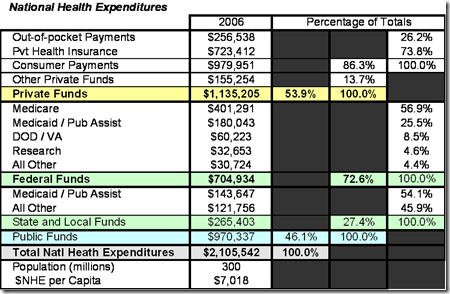
In 1960, health care accounted for $1 of every $20 spent in the U.S. economy; now that’s $1 of every $6, and …  it could be $1 of every $4 by 2025.  Ponder that: a quarter of the U.S. economy devoted to health care.

Countless studies have shown that many diagnostic tests, surgeries and medical devices are either ineffective or unneeded.

Greater health spending should not have the first moral claim on our wealth, because its relentless expansion is slowly crowding out other national needs.

For government, higher health costs threaten other programs—schools, roads, defense, scientific research—and put upward pressure on taxes. For workers, increasingly expensive insurance depresses take-home pay, as employers funnel more compensation dollars into coverage. There’s also a massive and undesirable income transfer from the young to the old, accomplished through taxes and the cross-subsidies of private insurance, because the old are the biggest users of medical care.

* * * * *

It is widely assumed that health care, like most aspects of American life, shamefully shortchanges the poor. This is less true than it seems.

Data show that, on average, annual health spending per person—from all private and government sources—is equal for the poorest and the richest Americans. In 2003, it was $4,477 for the poorest fifth and $4,451 for the richest.

The reason: government already insures more than a quarter of the population, including many of the poor. Medicare covers the elderly; Medicaid, many of the poor and their children; SCHIP (State Children’s Health Insurance Program), more children.

Another reason, stems from the skewing of health spending toward the very sick and dying; 10 percent of patients account for two thirds of spending. People in this unfortunate group, regardless of income, get thrust onto a conveyor belt of costly care: long hospital stays, many tests, therapies and surgeries.

* * * * *

That includes the uninsured. In 2008, their care will cost about $86 billion, … The uninsured pay about $30 billion themselves; the rest is uncompensated.

Of course, no sane person wants to be without health insurance, and the uninsured receive less care and, by some studies, suffer abnormally high death rates. But other studies suggest only minor disadvantages for the uninsured.

* * * * *

We need more realism on health care. The trouble with casting medical-care as a “right” is that this ignores how open-ended the “right” should be and how fulfilling it might compromise other “rights” and needs.

What makes people healthy or unhealthy are personal habits, good or bad (diet, exercise, alcohol and drug use); genetic makeup, lucky or unlucky, and age. Health care, no matter how lavishly provided, can only partially compensate for these individual differences.

* * * * *

There is a basic moral and political dilemma that most Americans refuse to acknowledge. What we all want for ourselves and our families—access to unlimited care paid for by someone else—may be ruinous for us as a society.

Sensible limits must somehow be imposed.

* * * * *

The crying need now is not to insure all the uninsured. This would be expensive (an additional $123 billion a year, estimates the Kaiser study) and would provide modest health gains at best since 40% of the uninsured are young (19 to 34) and relatively healthy.

The compelling need now is to limit the runaway increases in spending that make private and government insurance more expensive and may not deliver significant health improvements.

* * * * *

Both McCain and Obama have health-care proposals that …  largely ignore the massive health-care challenge already sitting in the government’s lap: Medicare.

By some studies, 30 percent of Medicare spending may go to unneeded services that do not enhance recipients’ well-being.

Medicare is so large and influential that by altering how it operates, government can reshape the entire health-care system. This would require changes in rules and reimbursements to encourage more electronic record-keeping, better case management, fewer dubious tests and procedures, and a fairer sharing of costs between the young and the old.

The work would be unglamorous and probably unpopular. But if the next president won’t—or can’t—do it, his presidency will fail in one fateful way.

* * * * *

Full article:
http://www.newsweek.com/id/157573

* * * * *

Want more from the Homa Files?
Click link =>
  The Homa Files Blog

Gimme a break: An AIG winner …

September 18, 2008

American International Group said it paid a $47 million severance package to former Chief Executive Martin J. Sullivan, who “resigned”.

Sullivan, left his position in mid-June after two quarters of record losses at AIG, will receive severance of $15 million, and a bonus of $4 million for the portion of the year he worked, according to a regulatory filing.

Sullivan also will hold on to outstanding equity and long-term cash awards valued at about $28 million, the filing said.

Reference:
http://clipmarks.com/clipmark/C85E7BC6-2172-46E7-B07E-5412446AB182/

* * * * *

Want more from the Homa Files?
Click link =>
  The Homa Files Blog

The sky is falling … or is it ?

September 17, 2008

Excerpted from Washington Post: “Quit Doling Out That Bad-Economy Line”,  Donald Luskin, September 14, 2008

* * * * *

In the past two months, the Post alone has written no fewer than nine times, in news stories, columns and op-eds, that key elements of the economy are the worst they’ve been “since the Great Depression.”

That diagnosis has been applied twice to the housing “slump” and once to the housing “crisis,” to the “severe” decline in home prices, to the “spike” in mortgage foreclosures, to the “change” in the mortgage market and the “turmoil” in debt markets, and to the “crisis” or “meltdown” in financial markets.

* * * * *

Overall, the pessimists are up against an insurmountable reality: In the last reported quarter, the U.S. economy grew at an annual rate of 3.3 percent, adjusted for inflation. That’s virtually the same as the 3.4 percent average growth rate since — yes — the Great Depression.

* * * * * 

Why, then, does the public appear to agree with the media? A recent Zogby poll shows that 66 percent of likely voters believe that “the entire world is either now locked in a global economic recession or soon will be.” Actually, that’s a major clue to what started this thought-contagion about everything being the worst it has been “since the Great Depression”: Politics.

* * * * *

The Mortgage Bankers Association (MBA) database, which allows rigorous apples-to-apples comparisons, only goes back to 1979. It shows that today’s delinquency rate is only a little higher than the level seen in 1985.

According to the MBA, 6.4 percent of mortgages are delinquent to some extent, and 2.75 percent are in foreclosure.

Moreover, MBA data show that today’s foreclosures are concentrated in that small fraction of U.S. homes financed by subprime mortgages. Such homes make up only 12 percent of all mortgages, yet account for 52 percent of foreclosures.

* * * * * *

It is flat-out wrong … that “the personal savings rate is now the lowest it’s been since the Great Depression.” The latest rate, for the second quarter of 2008, is 2.6 percent — higher than the 1.9 percent rate that prevailed in the last quarter of Bill Clinton’s presidency.

* * * * *

According to the latest report from the National Association of Realtors, the median price of an existing home is up 8.5 percent from the low of last February.

And according to the U.S. Census Bureau, the median price of a new home is up 1.3 percent from the low of last December. Home prices may not be at all-time highs — and there are pockets of continuing decline in some urban areas — but overall they’ve clearly stopped going down and have started to recover.

* * * * *

According to the FDIC, there have been a total of 13 bank failures in 2007 and so far into 2008. There were 15 in 1999-2000, the climax of the celebrated era of Clintonian prosperity. And in recession-free 1988-89, there were 1,004 failures — almost an order of magnitude more than today. Since the Great Depression, the average number of bank failures each year has been 94.

* * * * *

From all-time highs last October, the S&P 500 has fallen 20 percent. But that’s nothing by historical standards. Stocks have often fallen more than that over comparable spans of time. Even the present 20-percent loss isn’t what it seems. The damage has been heavily concentrated in the financial sector — banks, investment firms and mortgage companies. If you exclude the financial sector, stocks are off 14.8 percent.

* * * * *

Whatever the political outcome this year, hopefully this will prove to be yet another instance of that iron law of economics and markets: The sentiment of the majority is always wrong at key turning points. And the majority is plenty pessimistic right now. That suggests that we’re on the brink not of recession, but of accelerating prosperity.

Full articel:
http://www.washingtonpost.com/wp-dyn/content/article/2008/09/12/AR2008091202415_pf.html

* * * * *

Want more from the Homa Files?
Click link =>
  The Homa Files Blog

Uh Oh – Higher text message prices …

September 17, 2008

Excerpted from AP:  “Senator examining rising text messaging rates
09.09.08

The Senate Judiciary Committee is asking the nation’s top four wireless carriers to justify the “sharply rising rates” they charge people to send and receive text messages … it is concerned that rising text messaging rates reflect decreasing competition in the wireless business.

(Reportedly) consumers are paying more than 20 cents per message, up from 10 cents in 2005.

All four of the (wireless) companies appear to have adopted identical price increases at nearly the same time. “This conduct is hardly consistent with the vigorous price competition we hope to see in a competitive marketplace”.

* * * * *

European Commission regulators are threatening to impose a cap on roaming fees for text messages sent by Europeans traveling outside of their home nations.

* * * * *
Full article:
http://www.forbes.com/feeds/ap/2008/09/09/ap5405763.html?partner=alerts

* * * * *

Want more from the Homa Files?
Click link =>
  The Homa Files Blog

This picture says at least 1,000 words.

September 16, 2008

This one should have been easy to call …

image 

Great analysis from SMH

* * * * *

Want more from the Homa Files?
Click link =>
  The Homa Files Blog

Doh!: Top eight campaign gaffes

September 12, 2008

Excerpted from Politico.com, “Doh!: Top eight gaffes of the campaign”, by Jim VandeHei and Harry Siegel, September 8, 2008

* * * * *

Here is Politico’s list of the top eight gaffes that are virtually certain to haunt John McCain and Barack Obama until Election Day:

1. “Bitter”

At an April 6 fundraiser in San Francisco, “You go into some of these small towns in Pennsylvania, and like a lot of small towns in the Midwest, the jobs have been gone now for 25 years and nothing’s replaced them…And it’s not surprising then they get bitter, they cling to guns or religion or antipathy to people who aren’t like them or anti-immigrant sentiment or anti-trade sentiment as a way to explain their frustrations.”

Not coincidentally, the small towns in places like Western Pennsylvania and West Virginia are where Obama found the least support in his primary bid.

2. Countless houses

McCain wasn’t able to tell Politico in an interview last month …  “I think—I’ll have my staff get to you, I can’t tell you about that. It’s condominiums where—I’ll have them get to you.”

The slip dovetailed perfectly with a just-launched Democratic bid to counter McCain’s ads painting Obama as a lightweight celebrity with an offensive of their own

The Obama campaign had an attack ad depicting the Republican as wealthy and out of touch with the concerns of ordinary Americans.

3. “Shout out to my pastor”

Obama praised Rev. Jeremiah Wright — of ““God damn America.” —  fame last July while addressing a conference of black clergy members:

“And then I’ve got to give a special shout out to my pastor. The guy who puts up with me, counsels me, listens to my wife complain about me. He’s a friend and a great leader not just in Chicago but all across the country, so please everybody give an extraordinary welcome to my pastor Dr. Jeremiah Wright, Jr., Trinity United Church of Christ.”

The comments seems tailor-made for an attack ad, where they can be juxtaposed with some of Wright’s more inflammatory remarks.

4. Don’t know much about economy

In 2005, McCain told the Wall Street Journal, “I’m going to be honest: I know a lot less about economics than I do about military and foreign policy issues. I still need to be educated.”

As damaging as print quotes can be, it’s video of similar comments that may prove most damaging with voters.

5. “Likable enough”

Obama’s crack at his then-rival during the Jan. 5 primary debate may come back to haunt him.

Clinton was asked a question about voters preferring Obama to her on a personal level, and as she replied, “I’ll try to go on. He’s very likable, I agree with that. I don’t think I’m that bad—“ he interrupted to crack, “You’re likable enough, Hillary.”

Hillatry supporters cringed.

6. “100 years”

McCain’s remark at a January 3 town hall that American troops might stay in Iraq for 100 years had been intended to evoke America’s continued peacetime military presence in countries like Germany and South Korea, but the sound bite endures:

Obama quickly added the line “John McCain wants us to keep troops there for 100 years” into his stump speech, and MoveOn.org aired one of the first significant third-party buys of the cycle, “

7. The “Ones”

“We are the ones we’ve been waiting for. We are the change that we seek. We are the hope of those boys who have little; who’ve been told that they cannot have what they dream; that they cannot be what they imagine.”

Republicans will spend the next two months painting Obama as an empty celebrity with a messianic complex. Expect this Super Tuesday Obama moment to resurface as part of that effort.

8. Computer Illiterate

Politico asked McCain: “Mac or PC?”

“Neither,” McCain replied. “I am a pc illiterate that has to rely on my wife for all of the assistance that I can get.”

Younger, internet-savvy voters were aghast.

* * * * *

Honorable mention: The wives

Michelle Obama — Pride
“For the first time in my adult life I am proud of my country because it feels like hope is finally making a comeback.”

Cindy McCain—The only way to travel
“In Arizona the only way to get around the state is by small private plane.”

* * * * *

Full article (with pictures & videos):
http://dyn.politico.com/printstory.cfm?uuid=3CAF8BF0-18FE-70B2-A8381956A653CBD0

* * * * *

Want more from the Homa Files?
Click link =>
  The Homa Files Blog

* * * * *

Health Care: Wanted – Primary Care Physicians …

September 11, 2008

Excerpted from AP: “Fewer US med students choosing primary care”, Sep 9, 2008

* * * * *

Note:

One of my hot buttons is the way that politicos confuse “health insurance” with “health care”.  It’s relatively easy to throw money at problems.  It’s harder to fix fundamental problems.  This article highlights a fundamental problem. 

* * * * *

The coordinated care provided by primary care doctors can keep costs down by preventing harmful drug interactions, unneeded medical procedures and fragmented specialty care, Goodman said.

Only 2 percent of graduating medical students say they plan to work in primary care internal medicine, raising worries about a looming shortage of the first-stop doctors.The results of a new survey being published Wednesday suggest more medical students, many of them saddled with debt, are opting for more lucrative specialties.

In a similar survey in 1990, the figure was 9 percent.

Paperwork, the demands of the chronically sick and the need to bring work home are among the factors pushing young doctors away from careers in primary care, the survey found.

* * * * *

“I didn’t want to fight the insurance companies”

“Medicare’s fee schedule pays less for office visits than for simple procedures”

Primary care doctors  … “speed to see enough patients to make a reasonable living,” 

* * * * *

It’s hard work taking care of the chronically ill, the elderly and people with complex diseases — “especially when you’re doing it with time pressures and inadequate resources.”

* * * * *

The salary gap may be another reason.

Family medicine had the lowest average salary last year, $186,000, and the lowest share of residency slots filled by U.S. students, 42 percent.

Orthopedic surgery paid $436,000, and 94 percent of residency slots were filled by U.S students.

* * * * *

Meanwhile, medical school is getting more expensive. The average graduate last year had $140,000 in student debt.

* * * * *

A separate study in JAMA suggests graduates from international medical schools are filling the primary care gap.

About 2,600 fewer U.S. doctors were training in primary care specialties — including pediatrics, family medicine and internal medicine — in 2007 compared with 2002.

In the same span, the number of foreign graduates pursuing those careers rose by nearly 3,300.

“Primary care is holding steady but only because of international medical school graduates … and holding steady in numbers is probably not sufficient when the population is growing and aging.”

* * * * *

And as American students lose interest, teaching hospitals will probably become less interested in offering primary care programs.

JAMA called on Congress to create a permanent regulatory commission to encourage training for needed specialties.

U.S. teaching hospitals now receive $10 billion a year from the government to train doctors.

* * * * *

Full article:
http://news.yahoo.com/s/ap/20080909/ap_on_he_me/med_fewer_docs&printer=1;_ylt=AnGPB0GDsuNJ96p_SpCK0D5a24cA

* * * * *

Want more from the Homa Files?
Click link =>
  The Homa Files Blog

Brand Power: The label changes the taste ???

September 11, 2008

Excerpted from “Innovation & Branding”, by Morgan Johnson, SCI Innovation Conference, May 2005

* * * * *

In blind taste tests, beer drinkers perceive little difference among all but exceptional brands. 

image

* * * * *

But, when folks know which brand they’re drinking, taste perceptions diverge markedly.  Hmmm.

image

* * * * *
Source:
http://www.soci.org.uk/SCI/groups/bsg/2005/reports/pdf/MorganJohnson.pdf
* * * * *
Want more from the Homa Files?
Click link =>
  The Homa Files Blog
* * * * *

More proof … the power of "free"

September 10, 2008

Excerpted from Warrillow & Co., “Nothing good in life is free? 65% of small business owners disagree”

In 2002,  small business owners were significantly more interested in discounts for new products, with rewards and free trials competing for distant second and third positions. In a growing economy, like that of 2002, the free trial wasn’t worth the effort for most small business owners. Trial campaigns in strong economic conditions generate reasonable uptake, but generally result in poor conversion to the fee product or service and a lower quality customer over the lifetime of the account.

A 2008 survey … yielded the exact opposite set of preferences from small business owners:

Free trials are now preferred by far over discounts, with rewards dropping to the last position. In the current economy, … free offers are much more broadly applicable and appealing to the average business owner.

* * * * *
Three recommendations to most effectively utilize free trial offers:

  1. Prove your superior service: Free trials get you in the door … high quality service remains the key factor in customers. Sell your company as a whole, in addition to … specific products.
  2. Provide an in-trial assessment: All too often, engagement with the customer during the trial period focuses exclusively on upgrading to a fee product. Create proactive and customized usage analysis … prior to the end of the trial that gives a reasonably unbiased assessment of the product fit for the customer … and recommendations for getting more out of the remaining trial time.
  3. Don’t abandon targeting: Creating a free version doesn’t automatically make your product or service more applicable to business owners outside your target market. Steer clear of blanket offers and focus your efforts on the customers for whom your products have the best fit.

* * * * *
Full article:
http://www.warrillow.com/weeklyNews.aspx

Thanks to Straz (FOK) for the head’s-up

* * * * *

Want more from the Homa Files?
Click link =>
  The Homa Files Blog

Brand Power- Cole vs. Pepsi

September 10, 2008

Excerpted from “Innovation & Branding”, by Morgan Johnson, SCI Innovation Conference, May 2005

* * * * *

TakeAway Point:

In blind taste tests, Pepsi usually edges out Coke. But, when folks know which brand they’re tasting, Coke wins convincingly.

Logical inference: it’s the power of the brand.

* * * * *

image 

Source:
http://www.soci.org.uk/SCI/groups/bsg/2005/reports/pdf/MorganJohnson.pdf

* * * * *

Want more from the Homa Files?
Click link =>
  The Homa Files Blog

* * * * *

Product Innovation: Establishing & maintaining dominance …

September 9, 2008

Excerpted from Strategy & Business, “The Unique Advantage”, by Alexander Kandybin and Surbhee Grover, Aug. 26, 2008

Successful consumer packaged goods (CPG) innovators, those whose new products establish and maintain dominance in the marketplace, tend to focus on seven areas. None of them represents a “silver bullet” on its own, and many of them are common sense, but together they make innovation more difficult to copy and lead to greater returns and higher growth.

1. Technology and patents. New technologies … providie companies with a way to meet new consumer needs, including those that consumers don’t yet know they have.  Patents can sustain a meaningful advantage in the marketplace. 

2. Claims. Claims add substantial value when they are tied exclusively to a product and can be held for a significant period of time.

3. Ingredient synonymy. Arm & Hammer, Planters, and POM Wonderful, respectively, have each carved out an enviable position by becoming virtual synonyms for their category. Such domination affords pricing power for products that are essentially commodities.

4. Unique brand characteristics. Strong brands can build an identity in consumers’ minds that transcends products.

5. Product experience. Successful products have an emotional component that builds a bridge to consumers, becoming part of their lives.

6. Packaging.  Packaging innovation can leverage technology, emphasize unique brand characteristics, enhance the product experience, and in fact prove very difficult to duplicate.

7. Effective vertical integration. [Keeping things “in house” can protect proprietary technologies and “secret sauces” ]

Edit by DAF

* * * * *

Full article:
http://www.strategy-business.com/press/article/08306?pg=all&tid=230

* * * * *

Want more from the Homa Files?
 
Click link =>  The Homa Files Blog

* * * * ** * * * *

Health Insurance – Those %#@& Health Insurance Companies !

September 9, 2008

In the book Crunch, liberal economist Jared Bernstein criticizes health insurance companies, asserts that:

  • “Other countries with advanced economies save a lot by taking the insurers out of the picture. They employ either single-payer or heavily regulated systems, in which either the government is the exclusive insurer or private insurers must provide specified, the subsidized coverage to all … costs are held down by taking advantage of the huge risk pool — the healthy majority subsidizes the sick minority … and, insurer’s profits are weeded out of the system.”
  • “Private insurers have an incentive to prevent people from getting all the care they think they need.  Insurers are in the for-profit sector, so they spend time and resources trying to avoid making payouts. “

These are oft repeated refrains from folks who advocate government administered universal heath insurance.

* * * * *

I think this argument displays a remarkably shallow understanding of what health insurance companies do, how much money they make, and how they make it.  And. it places a remarkably high level of confidence in government administered programs (think, the FDA chasing down salmonella sources). 

* * * * *

First, what is the financial upside if all health insurance companies’ profits are eliminated and put in the national bank as economic cost savings.

Well, for openers, the health insurance companies — don’t make all that much money.  Consider the 2007 financial results for the two biggest “pure” health insurance companies: United Health Care and Wellpoint.

image

Note that pre-tax profits are about 9% of revenues [12,555 divided by135,553].  About 1/3 of the pre-tax already goes to the government in taxes; about 2/3’s (6% of revenues) drops through to the bottom line.

Currently, U.S. health care expenditures are about $2,1 trillion (just over $7,000 per person).  Of that, roughly half is “sourced” from the government via Medicare and Medicaid.  Of the half that is private pay, about 2/3’s ($725 billion ) goes through health insurance companies — the other 1/3 is out of patient’s pockets or “other” (e.g. charitable gifts to medical centers). 

 image

So, what’s the financial upside if all health care insurers were “disintermediated” and their profits were banked as economic cost savings to the system ?

Well, assuming that the rest of the healthcare insurance companies have profitability profiles comparable to United and Wellpoint — there’s a pre-tax profit of 9% that applies to $725 billion in revenues — or roughly $65 billion dollars.

But wait, the government is already getting about 1/3 of that in taxes.

So, the net gain is at most $40 to $45 billion, or about 2% of the $2.1 trillion in total healthcare spending.  Why “at most” ? 

Simple, because it assumes that the government will be able to administer the programs as efficiently as the private companies.  Call me cynical, but I doubt it.

* * * * *

On the second point, that  health insurance companies reject claims and refuse to authorize treatment as a means of boosting their.bottom lines.

Well, that’s at most partially true, and catches the government administration folks in a circular argument.

First, about 1/3 of health  insurance companies’ transactions volume is administrative processing done in support of companies (usually big ones) that choose to self-insure.  That is, the self-insuring companies  take all of the risk, and only pay the insurance companies a fee (that includes profit, of course) for negotiating with health care suppliers and processing transactions  — in conformance with terms, conditions, and rules dictated by the companies.  There are agreed to standards that are enforced.

The other 2/3’s of their transaction volume is strictly premium based.  If more treatments are authorized, costs go up and premiums go up to cover them.   If treatments are denied,  costs go down, and the competitive market pushes premiums down,It’s that simple.

* * * * *

Want more from the Homa Files?
Click link =>
  The Homa Files Blog

* * * * *

Product Innovation: The perils of playing “small ball”

September 8, 2008

Excerpted from Strategy & Business, “The Unique Advantage”, by Alexander Kandybin and Surbhee Grover, Aug. 26, 2008

In mature, slow-growth industries such as food and consumer products … Companies often spend relatively little on R&D, and … their innovation results are marginal.

Much of the problem can be traced to conventional wisdom (that) the secret to growth … is to develop new products based on consumer needs, which are discovered through consumer research and focus groups. And  if a new idea is not great … marketing and advertising can always … turn a so-so concept into a hit.  And the first to market … will capture most of the profits.

This kind of thinking leads to … a long list of line extensions — new flavors of an established soda brand, say — rather than the kind of game-changing innovations that can make a real difference to the bottom line.

New products that stand alone longest in the marketplace, without serious competition, bring in the highest returns.

Meeting consumer needs is a necessary but no longer sufficient condition of sustainable innovation.  Rather than thinking about new products as a way to get customers excited for a little while, companies need to think about their innovation strategy as a way to build a high, hard wall between those customers and their strongest competitors … hifting some investment away from marketing and advertising toward the development of … game-changing new products … that are difficult to copy.  

Higher R&D spending does not guarantee success … (but) a minimum innovation investment is required for breakthrough thinking. Without it, companies tend to fill the pipeline with the “base hits” of line extension … falling into a self-created loop of low investment, low returns, and steady but slow growth … that provides the illusion that the company is succeeding

So, the tendency is for companies to focus on relatively small, often superficial line extensions that can be churned out quickly … but require inflated advertising budgets that reflect a defensive mind-set .. (and divert resources from)  breakthrough innovation … locking companies into a pattern of high marketing spending and a need for endless small launches.

* * * * *

Mature companies also need a strategy for when difficult to copy ideas are in short supply. Here, we suggest defying conventional wisdom about being first to market. If a product can be copied, it’s often more profitable to be the copier.

* * * * *

There will always be a place for line extensions backed with big campaigns and for being first to market. It is possible to gain additional benefits by building scale, amplifying the effects of hard-to-copy innovations by spreading them across multiple products.

* * * * *

It’s even possible to gain scale of a kind with a highly nimble, prolific innovation organization. Launching a steady stream of good ideas, as P&G has done in home products in recent years, can give a brand a reputation for fresh thinking that transcends the individual ideas and translates into market share gains. 

Edit by DAF

* * * * * 

Full article:
http://www.strategy-business.com/press/article/08306?pg=all&tid=230

* * * * *

Want more from the Homa Files?
 
Click link => 
The Homa Files Blog

* * * * *

Sorry, Pal, but You’re Rich

September 8, 2008

Excerpted from Slate, “The deluded business pundits and Obama critics think $250,000 is a middle-class salary”. by Daniel Gross, Aug. 27, 2008

* * * * *

Barack Obama’s tax plan …  promises to improve the nation’s fiscal standing by scaling back tax cuts for people making more than $250,000. Since then, the business pundit class has been griping that people who make $250,000 a year aren’t really wealthy, especially if they live in and around New York; San Francisco; or Washington, D.C.

CNBC’s unscientific online poll found that (surprise!) only 35 percent of respondents believed an income of $250,000 qualified a household for elite rich status.

I have bad news for the over-$250,000 crowd.  I regret to inform you that you are indeed rich.

Income data can surely tell us something. And they tell us that $250,000 puts you in pretty fancy company.

The Census Bureau earlier this week reported that the median household income was $50,223 in 2007 …. So a household that earned $250,000 made five times the median. Only2.245 million U.S. households, the top 1.9 percent, had income greater than $250,000 in 2007. (About 20 percent of households make more than $100,000.)

In dealing with aggregate nationwide numbers, we should of course take account of the significant differences in the cost of living from state to state. But even in wealthy states, $250,000 ain’t bad—it’s nearly four times the median income in wealthy states like Maryland and Connecticut.

But people in Georgetown mansions don’t necessarily compare themselves to fellow Washingtonians in Anacostia. Relative income really works at the neighborhood level. As we know from the work of Cornell economist Robert Frank, people rate their well-being not so much based on how much they make and consume, but on how much they make and consume compared to their neighbors.

It is certainly true that in a few ZIP codes and neighborhoods, brandishing a $250,000 salary is like bringing a knife to a gunfight … But the number of places where $250,000 stretches you is small indeed.  Even in the most exclusive communities where the wealthy congregate, $250,000 is still pretty good coin.

So, don’t tell me you’re not rich.

* * * * *

Full Article URL:
http://www.slate.com/id/2198806/

* * * * *

Want more from the Homa Files?
Click link =>
  The Homa Files Blog

* * * * *

When customers talk smack online …

September 5, 2008

Excerpted from WSJ, “How to Handle ‘IHateYourCompany.com’,” Sep 5, 2008

In recent years, disgruntled consumers have launched hundreds of Web sites to air their grievances — from starbucked.com and ihatestarbucks.com to boycottwalmart.org and againstthewal.com.

…The Internet has become a mecca for disgruntled consumers, creating new challenges for companies accustomed to controlling their message tightly. While companies can’t pull down a negative YouTube video or erase a critical Twitter post, they have more power when it comes to domain names.

That doesn’t mean, however, that they should snap up every domain with a vaguely negative-sounding name and then let them gather dust, according to Internet-strategy consultants. Rather, companies should register or buy just the sites that get the most traffic…

Once they are in control of these domains, companies … (can) use them as a vehicle to solicit feedback from customers. Otherwise, angry customers will …  simply find another site on which to complain about the company…

While some of the gripe sites that remain in the hands of critics have fizzled, others have grown bigger. Take BankofAmericaSucks.com, which was started by (a) former Bank of America customer … after a dispute with the bank over a car loan. It now is home to thousands of postings, and it calls itself the “Official Bank of America consumer opinion site.”

Consumers continue to post complaints on the site…The site is mentioned in numerous blogs and newspaper articles, and appears among the top 15 results on a Google search for “Bank of America.”

Edit by SAC

 * * * * *

Note: In 2005, Forbes created a list of  the 9 angriest corporate hate sites. These sites targeted: KB Homes, PayPal, Allstate Insurance, Microsoft, American Express, Wal-Mart, Verizon, United Airlines and UPS.  While an updated list has not been published it is clear that consumers continue to organize complaints and fuel their hate online. 

* * * * *
Full article:
http://online.wsj.com/article/SB122057760688302147.html?mod=2_1567_topbox

* * * * *

Want more from the Homa Files?
Click link =>
The Homa Files Blog

* * * * *

Marketing: Japanese Super Brands

September 5, 2008

Excerpted from Brand Channel, “More Than a Name: Japanese Super-brands Diversify”, by Barry Silverstein, August 22, 2008

After World War II, Japan reinvented itself and developed into a global economic powerhouse.

Some believe a primary reason for this growth was the Japanese keiretsu system. Essentially, keiretsu were major families of affiliated corporations that had ties to a key bank, which both controlled and provided security to the companies. As a result, companies were “protected” financially, similar to the way Japanese companies protected their employees.

The keiretsu system spawned powerful conglomerates that for a time were insulated from economic woes. But  … “The [keiretsu] system is, in large part, to blame for Japan’s bubble economy of the 1980s that ultimately burst.”

Nonetheless, the keiretsu system was the basis for giant corporations that diversified to an extreme degree. Keiretsu could be vertical, such as Honda and Toyota, or horizontal, such as Mitsubishi and Fuyo (which spawned Canon, Hitachi, Nissan, and Yamaha, among others).

* * * * *

Mitsubishi is an excellent example. Mitsubishi started in 1870 as a shipping company. Today, this global giant has hundreds of companies under its loose umbrella, some of which do not carry the Mitsubishi brand name.

To bring some commonality to Mitsubishi companies, a corporate mark was created. It depicts three connected red diamond shapes. The word “Mitsubishi” is a combination of the Japanese words mitsu (three) and hishi (water chestnut). Hishi is traditionally used to denote a rhombus or diamond shape.

Companies with Mitsubishi in their names include Mitsubishi Chemical Corp., Mitsubishi Electric Corp., Mitsubishi Heavy Industries, Ltd., and Mitsubishi Motors Corp. Mitsubishi companies without Mitsubishi in the name include Kirin Holdings Company, Ltd., Nikon Corp., and Nippon Oil Corp.

* * * * *

Suppose two consumers have very different experiences with Mitsubishi-branded products.

For example, one consumer purchases a Mitsubishi automobile and has a good experience. Another consumer purchases a Mitsubishi television and has a bad experience. Will the first consumer look favorably upon and consider purchasing a television carrying the Mitsubishi brand name? If the second consumer decides to buy a car, will he or she be negatively predisposed toward a Mitsubishi-branded vehicle?

Emotionally, each consumer might transfer the positive or negative experience with the Mitsubishi brand from one product to another. These feelings about the brand could transcend product category.

Rationally, however, if a Mitsubishi-branded product is highly rated in a product category, it deserves consideration. If the consumer had a negative experience with the brand in one category, and wants to make an objective purchase in another product category, this creates a potential dilemma.

* * * * * 

Brand influence in the above example assumes the same consumer is the purchaser of both a car and a television. But what happens when the Japanese super-brand manufactures products with the same brand name in two entirely different and highly specialized categories?

Take Yamaha, for instance. On the one hand, this Japanese super-brand is renowned for musical instruments such as keyboards and drums. On the other hand, Yamaha is just as well known as a brand of motorcycles. Both corporate entities use the Yamaha name and mark.

Only if a musician playing a Yamaha instrument also rides a Yamaha motorcycle will the identical consumer come into contact with the same brand name in these specialized categories.

Nonetheless, the consumer’s experience with the brand in either category could influence overall brand perception. With a positive perception, the consumer thought process might be: “I bought a Yamaha keyboard and it was great… I bet their motorcycles are good, too.”

* * * * *

Bad product experiences not withstanding, brand diversification has another important benefit: Brand recognition can extend a consumer’s receptivity to other products in allied categories.

For example, a satisfied owner of a Honda automobile may seek out other Honda products. That consumer might become a buyer of a Honda motorcycle, a Honda snowblower, a Honda lawn mower, or a Honda outboard motor for a boat. The perceived quality of the Honda vehicle can lead to a satisfied consumer making other related Honda purchases.

While Japanese super-brands are not always regarded as great brand marketers, it is the quality of their products that creates the perception of great brands.

To the credit of the Japanese super-brands, they have almost uniformly built a reputation for quality, regardless of business category. This is one of the attributes that led to Japanese automakers dominating that industry.

* * * * *

Other Asian super-brands have followed the diversification strategy with success. The Korean companies Samsung and LG are good examples.

In some cases, diversifying a single brand name can have a diluting effect and may turn out to be a bad strategy. “Sony’s diversification not only drains the brand’s resources to a great extent but also diverts the brand focus from the core of the brand.”

For the most part, however, Japanese super-brands derive considerable benefit from diversification. In a world of ever-increasing options, a product with a Japanese brand name is often regarded as the best choice.

* * * *

Barry Silverstein is a 25-year advertising and marketing veteran and co-author of The Breakaway Brand (McGraw Hill, 2005).

Full article:
http://www.brandchannel.com/start1.asp?fa_id=437

* * * *

Want more from the Homa Files?
Click link =>
  The Homa Files Blog

* * * * *

Federal Spending – Like a bunch of drunken sailors …

September 5, 2008

So much for fiscal responsibility … ouch !

Charts from the Heritage Foundation.
http://www.heritage.org/research/features/BudgetChartBook/index.html

* * * * *

image

image

image  

 image http://www.heritage.org/research/features/BudgetChartBook/index.html

* * * * *

Want more from the Homa Files?
Click link =>
  The Homa Files Blog

* * * * *

Health Insurance – Is the glass 15% empty or 85% full ?

September 4, 2008

I think that practically everybody agrees all citizens should have access to adequate heath care and that the current system has some major problems re: cost, service-delivery, and insurance coverage.

Universal heath care was the centerpiece of the Clinton – Obama – Edwards campaign platforms during the Democratic primaries, and though the issue seems to have been moved to the back burner in the general election campaigns — in part, having been displaced on the front burner by $4 per gallon gasoline prices — it is embedded in the Democratic platform.

* * * * *

For starters, I get irked that politicos have such a hard time distinguishing between health care (e.g. seeing a doctor, getting into a hospital, getting a prescription filled) and health insurance (i.e. being part of a “risk pool” with healthy folks subsidizing unhealthy ones — and, maybe, having the insurance premiums partially paid by employers or somebody else),

The health insurance part is probably the easier to fix since it just means throwing money at the problem — usually, somebody’s else’s money that gathered up by raising taxes.

The heated debate usually centers on the 45 million uninsured folks in the U.S.  (see yesterday’s post for the official Commerce Dept. data).

Putting that number in context: as of today, the U.S. population is just under 305 million … adding in about 20 million illegal immigrants and the number is 325 million.
http://www.census.gov/main/www/popclock.html

So, the 45 million represent about 15% of the population of folks  living in the U.S..

That means that roughly 85% of the population does have health insurance of one sort or another — usually through employers or the government (Medicare and Medicaid).

It has become  a national pastime to gripe about health insurance premiums going up, co-pays and deductibles going up, coverage being pared back (i.e. the list of participating docs and services covered), and claims processes being confusing and high-hassle.  But, it’s my sense that — adjusting for the naturally stressful nature of the “product” — most people are relatively satisfied with their insurance programs.  Sure, everybody would like to pay less, get more, and get it easier — but on balance, the plans do what they’re supposed to do.

Now, as to the other 15% — the uninsureds.   I’ve seen many estimates that break the 45 million roughly into thirds: 1/3 are illegal immigrants; 1/3 are folks who have access to plans but choose to, in effect, self-insure — they’re typically healthy young-adults, many of whom make over $50,000 per year; and 1/3 “structurally uninsured” — split about equally between poor people with no prospects for private insurance and folks who are simply between jobs.

Call me callous, but I don’t think the first two groups — the illegal immigrants and the voluntarily self-insured — should be considered. 

So, the number goes from 47 million to about the 15 million, or 5% of the population.

Pardon me, but what is all of the fuss about?

Why not just add a Part E to Medicare to cover these folks and move on?  Doesn’t strike me that we should completely upset a system that’s basically working for about 90% of the population …

I must be missing something

* * * * *

Want more from the Homa Files?
Click link =>
  The Homa Files Blog

* * * * *

Succeeding at the Bottom of the Pyramid …

September 4, 2008

Excerpted from Knowledge at INSEAD, “Strong partnership key to success in bottom of the pyramid innovation”, by Grace Segran, August 26, 2008

For those at the ‘bottom of the pyramid’ (BoP), the four billion people or so living on less than two dollars a day, life is hard. Although collectively they have considerable combined purchasing power, they have up to now been traditionally overlooked by businesses.

However, major multinational corporations (MNCs) are now seeing opportunities in developing products for the BoP markets, while making a difference to the lives of the poor people.

“For this concept to work, there needs to be strong collaboration between firms, governments, NGOs (non-governmental organisations) and social entrepreneurs.”

* * * * *

There is often a disconnect between multinationals and those at the bottom of the pyramid

The operations of firms – especially the MNCs – have become rather disconnected or disembedded from local economies.

NGOs tend to know more about the characteristics of local poverty and what is best for the poor people in a specific area, whereas large companies generally have a limited understanding of the situation on the ground.

If BoP products – that is, products specifically developed to address the needs of the low-income segments – do not take into account the local specificities of poverty, they may be useless for the people in a certain district or the project may even have a negative impact on their lives.

* * * * *

Mainstreaming low-income projects and bringing them to a larger scale is one of the main challenges facing companies today.

Unilever’s ‘shakti’ project considered a leading BoP example .  Unilever, developed a range of products for low-income households in remote areas of India. It packaged common household products like shampoo and soap in sachets and sold them door-to-door, helped by so-called ‘shakti ladies’ who make a living from this activity. The ‘shakti’ range now constitutes a significant part of Unilever’s Indian revenues – reportedly nearly 15 per cent.

* * * * *

Bringing such projects to scale is a challenge for several reasons.

First, firms lack the internal capabilities to develop these projects as they require both strong entrepreneurial skills, as well as the ability to understand and address social issues such as access to water, energy, and housing.

Often the firm’s expectations for immediate profit goes against the development of successful BoP projects, the core of which aim to create mutual value for both the firm and the poor. [Economies of sca;e are slow to be realized — if they ever are.]

It requires a substantial amount of effort to transform a small pilot project into a large, mainstream activity. Among their portfolio of business development projects, companies often opt for more profitable projects that can deliver in the short term.

Since BoP projects have strong local links, firms may face difficulties in trying to replicate a successful business model in another geographical area of the same country or to export it to a different country.

“These projects should be local answers to local problems.”

Another challenge is for low-income projects is to demonstrate a significant impact on the lives of the poor. Does it really improve their living conditions? Are the poor getting a fair deal, while their bargaining power in their dealings with firms is rather limited?

* * * * *

Full article:
http://knowledge.insead.edu/PartnershipBottomPyramidInnovation080803.cfm

* * * * *

Want more from the Homa Files?
Click link =>
  The Homa Files Blog

* * * * *

Heath Care – Some basic facts …

September 3, 2008

In 2006, health care expenditures were  $2.1 trillion (with a “T) … which is about $7,000 per person … up from about $4,500 per person in 2000.

image

* * * * *

Slightly under half (46.1% to be precise) was paid out of public funds — by the Federal or local governments  … 53.9% was “private” pay, either by individuals, health insurance companies, or “other private funds” (e.g. hospital write-offs).

About 1/8th of the $2.1 trillion was paid “out of pocket” by patients (think co-payments and deductibles). Note the downward historical trend.

image
Graphic © 2007 Samuel L. Baker, University of South Carolina

* * * * * 

image 
http://www.cms.hhs.gov/NationalHealthExpendData/02_NationalHealthAccountsHistorical.asp#TopOfPage

* * * * *

Want more from the Homa Files?
Click link =>
  The Homa Files Blog

* * * * *

Honda – Finally, fuel efficiency is paying strategic dividends …

September 3, 2008

Excerpted from NY Times, “Honda Stays True to Efficient Driving”, by Bill Vlasic, August 26, 2008

* * * * *

During the glory days of big pickups and sport utility vehicles, one automaker steadfastly refused to join the party.

Despite the huge profits that its competitors were minting by making larger vehicles, Honda Motor never veered from its mission of building fuel-efficient, environmentally friendly cars like its Accord sedan, even when the sentiment was “there’s no return on that.”

But in today’s fuel-conscious automotive market, Honda is reaping the rewards for its commitment.

No major automaker in America is doing better than Honda … While competitors are scrambling to shift their product lineups to build more small vehicles and slash their bloated inventories of trucks, Honda can barely keep up with demand, particularly in the subcompact category.

Sales of its tiny Fit have soared … and Honda accelerated the introduction of the 2009 model, which will go on sale Tuesday.

The Fit’s four-cylinder engine gets 34 miles per gallon in highway driving .

Honda’s focus on fuel efficiency is paying off on the bottom line as well … By comparison, G.M. and Ford have lost billions this year as the market has moved away from the big vehicles that once generated the bulk of their profits. Detroit is moving radically to downsize its vehicle lineups.  Even Honda’s larger Japanese rival, Toyota, is hustling to adjust to the rapidly changing United States market.

Honda’s newest factory, in southern Indiana, is set to begin production of Civic compact cars this fall.

* * * * *

Honda’s focus on fuel efficiency and the environmental impact of its vehicles dates back to the Clean Air legislation of the 1960s and 1970s.  Honda adopted an internal motto — “Blue skies for our children” — as a guideline for future vehicle development.

Honda has posted the highest corporate average fuel economy of any automaker for its overall fleet of vehicles over the last 15 years.

Honda has never aspired to build a full line of trucks and S.U.V.’s.  “Even when the large S.U.V.’s and trucks were big sellers, they did not fit with our philosophy.”

* * * * *

When the new plant goes into production in Indiana, Honda’s North American production capacity will increase to 1.4 million vehicles a year to meet the growing demand for its small cars.

* * * * *

Even with the success of its smallest cars, Honda executives concede that the company has some catching up to do with Toyota in hybrid vehicles.

While Honda offers a hybrid version of the Civic, Toyota’s Prius model is the runaway leader in the category.

But Honda recently announced plans to introduce a five-door, hybrid-only model in North America next year to compete with the Prius. Honda is expected to price the vehicle lower than the Prius to attract younger buyers.

Honda is also planning a two-door, sporty hybrid and a hybrid version of the Fit.

* * * * *

At its headquarters here in Torrance, the vehicle that draws the most attention these days is the company’s hydrogen-powered, fuel-cell vehicle dubbed the FCX Clarity …  it represents the next step for a company committed to clean technology.

* * * * *

Full article:
http://www.nytimes.com/2008/08/26/business/26honda.html?_r=2&oref=slogin&ref=business&pagewanted=print

* * * * *

Want more from the Homa Files?
Click link =>
  The Homa Files Blog

* * * * *

Marketing: Vote for McCain to be your next…potato?

September 3, 2008

Excerpted from Promo Magazine, “McCain Foods Ties Campaign to Presidential Election,” Aug 27, 2008

McCain Foods USA is out with a new marketing ploy that plays off the upcoming presidential election to ramp up product sales.

The campaign…positions McCain Foods’ potatoes as a candidate consumers should consider. The company has high hopes shoppers will connect its name with that of Republican presidential hopeful Sen. John McCain of Arizona as part of its political parody…

On the campaign website (www.mccainpotatoes.com), visitors can ask the “spokespotato” candidate questions and receive immediate responses,…take online polls, find product information and sign up for e-mail updates.

The site…also lets people read humorous responses from McCain Foods on key issues, such as the economy and the environment. For the economy, it says, “When you buy more McCain Potatoes, it creates more jobs. For us. What did you expect? Another stimulus check?”

McCain Foods isn’t the first company to make a marketing ploy off politics. Denny’s Restaurants launch a campaign this year that gets people to “Vote 4 Real” for its breakfast food over fast food competitors.


Picture 1


* * * * *

Full Article: http://promomagazine.com/interactivemarketing/news/mccain_foods_marketing_campaign_0827/

* * * * *

Want more from the Homa Files?
Click link =>
  The Homa Files Blog

* * * * *

Census Details: Number of health uninsureds drops in 2007 …

September 2, 2008

Based on Census data released by the Department of Commerce
August 27, 2008:

* * * * *

At the DNC last week, it was being said that the number of uninsureds had increased by 3 million.

Not true, according to data recently released by the Commerce Dept.

* * * * *

The number of insured people increased by 2.3 million — to almost 300 million total insureds.

The number of uninsureds dropped by about 1.3 million — to 45.657 million.

Of the 45.657 million uninsureds:

  • Almost 10 millions are classified as “not a citizen”;
  • Over 9 million earn more than $75,000 annually;
  • Over 15 million earn more than $50,000 annually;
  • Almost 10 million are classified as “did not work”

Note: categories are not mutually exclusive, so there is some double-counting.

* * * *

image 
image

* * * * *

image

* * * * *

image

* * * * *

Published in  “Income, Poverty, and Health Insurance Coverage in the United States: 2007”, U.S. Department of Commerce, Economics and Statistics Administration

Full report:
http://www.census.gov/prod/2008pubs/p60-235.pdf

* * * * *

Want more from the Homa Files?
Click link =>
  The Homa Files Blog

* * * * *

Random thoughts from Thomas Sowell …

September 2, 2008

Excerpted from “Random Thoughts”, by Thomas Sowell, August 26, 2008

* * * * *

The reason so many people misunderstand so many issues is not that these issues are so complex, but that people do not want a factual or analytical explanation that leaves them emotionally unsatisfied. They want villains to hate and heroes to cheer– and they don’t want explanations that do not give them that.

* * * * *

Although you can block unwanted phone calls from commercial sources, you cannot block automated phone calls from politicians, which will be inundating us this election year. 

* * * * * 

One of the problems with successfully dealing with threats is that people start believing that there is no threat. That is where we are, seven years after 9/11, so that reminding people of terrorist dangers can be dismissed as “the politics of fear”.

* * * * *

There are countries in Europe that would love to have their unemployment rate fall to the 5.7 percent unemployment rate to which ours has risen. Yet those who seem to want us to imitate European economic and social policies never seem to want to consider the actual consequences of those policies.

* * * * *

Full article:
http://www.realclearpolitics.com/printpage/?url=http://www.realclearpolitics.com/articles/2008/08/random_thoughts_3.html

* * * * *

Want more from the Homa Files?
Click link =>
  The Homa Files Blog

* * * * *

Hybrids that go Vroom, Vroom, Vroom …

September 2, 2008

Hybrids are so quiet they actually pose a danger to pedestrians – and especially the blind – who can’t hear the cars approaching.

Reportedly. this is already a concern in many states, particularly on the pedestrian-heavy East coast now joined the debate by fielding its own committee to study the matter.

One company has  designed a system to make hybrid cars produce whatever engine sound the owner might desire.

http://www.motorauthority.com/news/safety/california-studying-ways-to-make-hybrids-louder/

* * * * *      

SACRAMENTO, Calif. (AP) — Electric and hybrid vehicles may be better for the environment, but the California Legislature says they’re bad for the blind.

It has passed a bill to ensure that the vehicles make enough noise to be heard by visually impaired people about to cross a street.

The Association of International Auto Manufacturers Inc., a trade group, is also studying the problem, along with a committee established by the Society of Automotive Engineers. The groups are considering “the possibility of setting a minimum noise level standard for hybrid vehicles.”  

The state Department of Motor Vehicles says more than 300,000 of the vehicles are on state roads. Officials say they don’t keep statistics on pedestrian accidents involving those vehicles.

http://www.manufacturing.net/News-California-Green-Cars-Need-More-Noise.aspx?menuid=284

* * * * * 

Want more from the Homa Files?
Click link =>
  The Homa Files Blog

* * * * *

Number of uninsureds down … not up !

August 29, 2008

Excerpted from USA TODAY, “Census: Uninsured total shrank, incomes rose in 2007”,  Aug. 28, 2008

* * * * *

The number of people without health insurance dropped 1.3 million to 45.7 million. The uninsured fell to 15.3% from 15.8%. The primary reason for decline: More people, especially children, are covered by government-sponsored insurance.

* * * * *

Median household income rose to $50,233 in 2007 after adjusting for inflation. That’s $665 more than a year earlier but still below the peak of 1999. Income in black households rose for the first time since 1999.

Democratic candidate Barack Obama said, “Today’s news confirms what America’s struggling families already know — that over the past seven years, our economy has moved backwards.”

* * * * *

Full article:
http://usatoday.printthis.clickability.com/pt/cpt?action=cpt&title=Census%3A+Uninsured+total+shrank%2C+incomes+rose+in+2007+-+USATODAY.com&expire=&urlID=30607054&fb=Y&url=http%3A%2F%2Fwww.usatoday.com%2Fnews%2Fnation%2Fcensus%2F2008-08-26-census-poverty_N.htm&partnerID=1660

* * * * *

Note: See post “From Clinton to Bush, median real after-tax income is up !” ….  Watch for details re: uninsureds next week.

* * * * *

Want more from the Homa Files?
Click link =>
  The Homa Files Blog

* * * * *

Update: Based on data released this week, it’s official … From Clinton to Bush, after-tax household income is up !

August 29, 2008

In a prior post, I outlined an analysis that showed median real after-tax household income increased from 2000 (the last year of the Clinton presidency) to 2006 (the latest available data).

As luck would have it, the Commerce Dept released 2007 data immediately after my post.  Coincidence?

Median real household income increased in 2007 — for the 3rd consecutive year —  strengthening the argument.

Below is an updated summary of the analysis.

* * * * *

From Clinton to Bush, after-tax household income is up !

It’s bipartisan: all politicians use economic data selectively to make their cases.

Senator Obama has been claiming that median real household income grew under President Clinton, and fell by over $1,000 because of President Bush’s policies. 

Recently reported data from the Commerce Department takes some of the wind out of Obama’s sails. Median real household income increased in 2007 – for the third consecutive year – to $50,223. That compares to an inflation-adjusted $50,553 in 2000 – the last full year of the Clinton era. So, there is, in fact, a decline — $330 or roughly ½ of 1 %. Advantage Obama.

But, median real household income is an incomplete and misleading measure of families’ economic well-being. It doesn’t include some items that contribute to household income and, most important, it doesn’t reflect the impact of income taxes. 

Specifically, Obama’s selected measure of household income — technically called  “money income” — doesn’t include common sources of income such as capital gains.  Based on Tax Federation estimates, when capital gains are counted, the median real household income gap more than goes away.

Even more important, the median real household income measure is misleading because it is pre-tax

Since families can only spend after-tax income,  it is somewhere between disingenuous and intellectually dishonest to ignore tax benefits in year-to-year comparisons.  This is particularly true in this case since the core of the Bush economic program is lower taxes. 

While the Bush tax plan is often demonized as being just for the rich, it also includes substantial benefits for folks in the lowest tax brackets.  For example,  the low bracket marginal income tax rate was cut from 15% to 10% , the personal exemption allowance was increased from $2,900 in 2000 to $3,400 in 2007, and  the standard deduction was increased from $7,350 in 2000 to $10,700 in 2007 (for joint filing married couples).

Median after-tax real household can be estimated by simply running the reported median real household income through each year’s tax tables. 

In 2000, nominal median household money income — unadjusted for inflation — was $41,990.  The Tax Foundation estimates that household capital gains in 2000 were $680, so nominal median household income (including capital gains) was $42,670.

There were an average of 2.6 people per household in 2000, so the estimated allowance for personal exemptions is $7,540 — 2.6 times the $2,900 allowance per personal exemption in 2000.

The standard deduction for married couples filing jointly in 2000 was $7,350 . Subtracting the personal exemptions allowance ($7,540) and the standard deduction ($7,350 ) from the median nominal household income ($42,670),  nets to a taxable income of $27,780. That amount would have fallen within the 15% marginal tax bracket in 2000, so the corresponding income tax liability is $4,167 and estimated median nominal after tax income is $38,503 — $42,670 pre-tax income less $4,167 in taxes. Adjusting for inflation — that is, expressing the answer in 2007 dollars –  estimated median real household after-tax income in 2000 is $46,354.

How does 2007’s median real household after-tax median income rack-up against 2000’s ?

Well, taking into account Bush’s higher personal exemption allowance, the higher standard deduction, and the lower marginal tax rate — the answer reverses.  

Estimated 2007 median real after-tax household income is $47,367. So, from the end of the Clinton administration in 2000 to the latest reported data, median real after-tax household income went up over 2%  – about $1,000 per household. The opposite of Senator Obama’s claim.

Some folks are already saying that 2007 data points aren’t relevant since the economy is in a slump. That argument carries less sway since recent reports that GDP grew by an estimated 3.3% second quarter of 2008.

The bottom-line: real after-tax household income went up between 2000 and 2007, and for Senator Obama’s to continue making claims to the contrary is, in the best light, deceptive.

* * * * *

image

* * * * *

Want more from the Homa Files?
Click link =>
  The Homa Files Blog

* * * * *