Pay your taxes, fool? … Didn’t you know that — according to Harry Reid — “Paying taxes is strictly voluntary”

April 19, 2010

“Paying taxes is strictly voluntary” … so says Harry Reid

Don’t you feel silly for sending in a check yesterday ?

It makes me shiver to think that this guy is the second most powerful person in the country (after Nancy Pelosi)

This is worth watching …

image
http://www.youtube.com/watch?v=R7mRSI8yWwg

Wallet’s are opening … for consumers and advertisers.

April 19, 2010

TakeAway:  Whew.   Consumers are spending again. But this sigh of relief is not heard in the halls of the big CPGs. 

The latest recession provided private-label brands with the momentum needed to overcome consumers’ quality perceptions and induce trial. 

The result: consumers liked or were at least satisfied with the PL products. 

Now that the economy is recovering and consumers have the dough to go back to the brand-name staple goods, companies are hoping that a long-held theory – more advertising will increase market share – will ensure that consumers trade-up for their staple goods.

* * * * *

Excerpted from WSJ, “Consumer-Goods Makers Pour Out Ads,” By Ellen Byron, April 12, 2010

As wary Americans start to crack open their wallets, household-goods makers like Procter & Gamble, Colgate-Palmolive, Kimberly-Clark and Clorox are cranking up their advertising, hoping to coax consumers farther out of their shells.

Amid signs of an improving economy, recent survey data show consumers are more willing to splurge by eating out or buying new shoes, but the same doesn’t necessarily hold for everyday household goods.

“In consumer staples, you saw consumers trade down” to cheaper products due to the recession, and they were “quite satisfied,” says chief executive of Consumer Edge Research.

To lure them back to premium products—and prices—brand-name manufacturers are churning out “new and improved” goods ranging from more-absorbent diapers, to specialized toothpastes to closer-shaving razors. The strategy relies on advertising to get the word out.

That’s one reason the industry’s ad spending is expected to grow in 2010. So far such spending has been running well ahead of 2009 levels, with year-to-year increases for household products of 15% in January and 11% in February …

P&G, the world’s biggest ad spender, plans a 20% increase in “consumer impressions,” or instances when consumers see its ads … and it will introduce 30% more “significant” innovations in products this year, which its CEO describes as the most in his 30-year career at the company …

The big-name marketers face the challenge of overcoming consumers’s newfound thrift. While U.S. sales of household staples have posted middling gains overall, sales of cheaper private label, or store-branded, goods, have risen more sharply.

In the four weeks ended March 20, overall U.S. sales of household and personal products increased 0.2% from a year earlier, compared with a 5.4% gain in private-label sales …

The new spending will test a long-held theory: that boosting a brand’s share of advertising beyond its market share will raise that market share. Among major household products, market share stayed the same or rose 64% of the time over the past 16 quarters when a company’s advertising reach exceeded its market share by 50% or more …

Some experts say winning over consumers will require not just advertising, but a new approach: emphasizing value.

“For many years, any hint of price was a no-no. It was all about generating emotional connections,” says chief brand strategist at consulting firm Portnoy Group:”Now you’re going to have to work harder to convince me that I’m getting much more value by trading up.. You need to show me that I’m getting more for my money, and it’s not frivolous.”

Edit by TJS

* * * * *

Full Article
http://online.wsj.com/article/SB10001424052702304703104575174042139131092.html#mod=todays_us_marketplace

* * * * *


Indonesia begs reconsideration as a top emerging market

April 16, 2010

TakeAway:  The unfortunate truth about emerging markets is that companies cannot make market entry decisions based only on traditional variables such as consumer wealth and spending. 

A country’s operating environment (i.e., the political environment) is a key decision making variable and one that often causes companies to turn away from otherwise appealing markets. 

The good news for Indonesia is that companies are forgiving and are willing to reconsider markets that they previously declined to enter. 

Indonesia’s improved political environment and booming consumer spending will likely put the country back on the radar screens of many large companies.

* * * * *

Excerpted from WSJ, “Brands Bet on Indonesia as Spending Booms,” By Patrick Barta, April 8, 2010

International companies are betting Indonesia will become Asia’s next big consumer market after China and India—in part because of booming jungle outposts like this one.

Here in Samarinda, a coal-mining center on the far eastern edge of Borneo, the population has more than tripled since 2000, and incomes are rising rapidly. Ford has added its first dealership and Honda motorcycle salesmen say they can’t get motorbikes fast enough to keep up with demand.

Variations of that pattern are being repeated across this vast nation … Ford dealers are adding a new showroom nearly every six weeks … CVC Partners agreed to pay more than $770 million for a controlling stake in one of country’s largest retailers, PT Matahari Department Store, which plans to add 150 new outlets …

H.J. Heinz said that Indonesia played a major role in pushing Asia sales, including chili sauces, up 41% last year. It also recently predicted a 23% increase in packaged food spending in Indonesia between 2009 and 2011—a faster rate of growth than India and China, which were expected to grow 20% and 14%, respectively.

With 240 million people, the world’s fourth-largest population behind China, India and the U.S., Indonesia has long promised to be one of the world’s biggest consumer markets. But it has lagged behind other developing nations because of political instability and disappointing growth after the Asian financial crisis of 1997-1998.

That has started to change in the past several years … with a democratically elected government and surging sales of commodities such as coal, natural gas and palm oil to China.

Last year, Indonesia posted the second-highest personal spending growth in Asia, behind China. Private consumption climbed 5.1% compared with 0.4% growth in Asia excluding China …

Unilever’s Indonesian arm, which sells soaps, ice cream and other consumer goods, said in March that 2009 sales shot up 17%—well above previous years and among the fastest rates in the world for Unilever …

Indonesia’s resurgence as a consumer market is the latest evidence that developing Asia, which for years relied primarily on exports for growth, is becoming more self-reliant as it develops a bigger middle class and its own domestic demand.

Indonesia still rates poorly in international indexes measuring corruption and ease of doing business, and many foreign companies remain wary. Income levels are low compared with other emerging markets, with GDP per capita of just $4,000, less than half the level of Brazil—though more than India.

The country also isn’t industrializing as rapidly as China and other emerging markets, which could limit its growth in future years … Even so, “it’s a very strong market” for consumer-spending gains

Powering the rebound, analysts say, is surprising strength in once-ignored second-tier cities, which in some cases are posting growth rates approaching 10% a year, on par with China …

These areas are also benefiting from political reforms after the fall of former dictator Suharto in the late 1990s aimed at decentralizing the country. Such “regional autonomy” reforms, which return more tax revenue to local governments and give them more authority …

Edit by TJS

* * * * *

Full Article
http://online.wsj.com/article/SB20001424052702303591204575169704072987766.html#mod=todays_us_marketplace

* * * * *


The Federal budget … precisely explained in 98 seconds.

April 16, 2010

A former colleague of mine at McKinsey used to to classify people into two groups: simplifiers and complicators.

In most situations, simplifiers are effective … complicators are ineffectual and annoying.

Complicators cannot distinguish between the pertinent and the irrelevant.

Simplifiers know what’s essential and what’s extraneous.  They have the ability to cut to the core of issues and communicate in clear, simple terms.

Here’s an example …

In this short video that’s been viraling, a college student explains the Federal budget and puts President Obama’s proposed budget cuts in context.

It’s a quick tutorial on the Federal budget … and a nice example of communicating effectively by simplifying.

Click pic or link below to view video

image

http://www.wimp.com/budgetcuts/

Thanks to JNH for feeding the lead.

News Flash: Nearly half of US households escape fed income tax … psst, I told you so (July 31, 2008)

April 15, 2010

Last week, there was a flurry of news activity over a report that nearly half of all U.S. households will pay no federal income taxes for 2009.

It was treated as new news.  Geez.

Homa Files were all over this as far back as July 31, 2008. 

For all the wonky facts & a complete analysis see:
Under Obama, Tax Payers Will be a Minority !
https://kenhoma.wordpress.com/2008/10/28/under-obama-tax-payers-will-be-a-minority/

Note: This is the Homa Files post with all-time record for most hits.

 I hate to be an “I told you so” (yeah, right) … but hears the AP report … almost 2 years later.

As President Obama likesto say “Elections have consequences”.

* * * * *

Excerpted from AP: Nearly half of US households escape fed income tax, April 9, 2010

The federal income tax is the government’s largest source of revenue, raising more than $900 billion — or a little less than half of all government receipts .

So, Tax Day is a dreaded deadline for millions, but for nearly half of U.S. households it’s simply somebody else’s problem.

About 47 percent will pay no federal income taxes at all for 2009 … up from 38% in 2007.

Either their incomes were too low, or they qualified for enough credits, deductions and exemptions to eliminate their liability.

In recent years, credits for low- and middle-income families have grown so much that a family of four making as much as $50,000 will owe no federal income tax.

Tax cuts enacted in the past decade have been generous to wealthy taxpayers making them a target for President Barack Obama and Democrats in Congress.

Less noticed were tax cuts for low- and middle-income families, which were expanded when Obama signed the massive economic recovery package last year.

The result is a tax system that exempts almost half the country from paying for programs that benefit everyone, including national defense, public safety, infrastructure and education. It is a system in which the top 10 percent of earners paid about 73 percent of the income taxes collected by the federal government.

The bottom 40 percent, on average, make a profit from the federal income tax … the government sends them a payment. Not just a refund of of excess withholding — so-called “refundable credits”.

“We have almost 50 percent of families who are getting something for nothing.”

Some of the blame goes to former President George Bush.  In 2008, he signed a law providing most families with rebate checks of $300 to $1,200.

Last year, Obama signed the economic recovery law that expanded some tax credits and created others.

Obama’s Making Work Pay credit provides as much as $800 to couples and $400 to individuals. The expanded child tax credit provides $1,000 for each child under 17. The Earned Income Tax Credit provides up to $5,657 to low-income families with at least three children.

There are also tax credits for college expenses, buying a new home and upgrading an existing home with energy-efficient doors, windows, furnaces and other appliances.

Many of the credits are refundable, meaning if the credits exceed the amount of income taxes owed, the taxpayer gets a payment from the government for the difference.

Obama has pushed tax cuts for low- and middle-income families and tax increases for the wealthy, arguing that wealthier taxpayers fared well in the past decade, so it’s time to pay up. The nation’s wealthiest taxpayers did get big tax breaks under Bush, with the top marginal tax rate reduced from 39.6 percent to 35 percent, and the second-highest rate reduced from 36 percent to 33 percent.

But income tax rates were lowered at every income level. The changes made it relatively easy for families of four making $50,000 to eliminate their income tax liability.

Here’s how they do it, according to Deloitte Tax:

The family was entitled to a standard deduction of $11,400 and four personal exemptions of $3,650 apiece, leaving a taxable income of $24,000. The federal income tax on $24,000 is $2,769.

With two children younger than 17, the family qualified for two $1,000 child tax credits. Its Making Work Pay credit was $800 because the parents were married filing jointly.

The $2,800 in credits exceeds the $2,769 in taxes, so the family makes a $31 profit from the federal income tax. That ought to take the sting out of April 15.

Full article:
http://finance.yahoo.com/news/Nearly-half-of-US-households-apf-1105567323.html?x=0&.v=1

* * * * *

Why it matters 

The Tax Foundation — a nonpartisan tax research group – has repeatedly warned that 

“While some may applaud the fact that millions of low- and middle-income families pay no income taxes, there is a threat to the fabric of our democracy when so many Americans are not only disconnected from the costs of government but are net consumers of government benefits.

The conditions are ripe for social conflict if these voters begin to demand more government benefits because they know others will bear the costs.” 

 http://www.taxfoundation.org/research/show/1111.html

Bummer:Waxman melts …

April 15, 2010

I’d cleared my calendar next Wednesday to watch Henry Waxman and his fellow Congressional nitwits grill a blue-ribbon group of uber-CEO’s on FASB rules and how they apply to the increased costs that companies will incur under Obama’s cost-saving healthcare plan. (Yeah, you read that right.)

I wanted to see Waxman order the CEOs to release fraudulent financial statements and “book” some of the pie-in-the-sky cost savings that ObamaCare promises to deliver …

The hearings would have made great theater …

* * * * **

Excerpted from Washington Examiner: Waxman cancels Obamacare CEO hearing, 04/14/10

Chairman Henry Waxman, D-Calif., has cancelled the April 21 subcommittee hearing in which CEOs were to testify about Obamacare.

Waxman had called the hearing in reaction to public statements by several companies — including Verizon, AT&T, and John Deere, among others — that Obamacare would cost them hundreds of millions or even billions of dollars because it laid a new tax on their retiree health benefit payments.

Ever since the passage of the Medicare Prescription Drug benefit, the payments had been subsidized, tax-free, as a way of preventing these companies from dropping enrollees onto the Medicare rolls, where they would cost the government far more.

When Obamacare changed the tax rules, it was quite clear that this would result in huge losses, but President Obama and Democrats had failed to heed warnings to this effect in the run up to Obamacare’s passage last month.

The CEOs, required by law to be honest about earnings projections, re-stated their bottom lines in reaction to Obamacare’s passage, earning the ire of Waxman and other Democrats.

Hearings on this matter would likely have proved an embarrassment to the Democrats and helped drag out discussion of Obamacare’s unexpected ill effects.

Full article:
http://www.washingtonexaminer.com/opinion/blogs/beltway-confidential/Waxman-cancels-health-care-CEO-hearing-90853384.html#ixzz0l7OIE29c

LVHM’s luxury house of brands expands to include hotels

April 15, 2010

TakeAway:   LVMH made an interesting business decision when it decided that opening hotels was the best option to continue its corporate growth. 

Yes, it said that there were no good acquisition targets left in its core business area. 

Yes, it observed that other high-end brands had opened hotels. 

But, the hospitality business is very different from the luxury consumer goods business. 

Although hotels may be a good way for LVMH to expand its presence in the luxury market and provide a new point of sale for its luxury goods, this strategy could require LVMH to devote enormous marketing funds to gain customers in the already-crowded luxury hotel market and could backfire if the hotel experience does not meet customers’ expectations of the LVMH brand.

* * * * *

Excerpted from WSJ, “LVMH Extends Posh Label To New Luxury Resorts,” By Christina Passariello, April 9, 2010

… LVHM, the world’s largest luxury-goods company, said Thursday it will develop resorts using the name of its Bordeaux winery, Cheval Blanc. 

LVMH tested the concept with a first location that opened in the French ski resort Courchevel in 2006. Two more hotels are scheduled to join the chain by 2012 in Oman and Egypt …

The project is “a natural extension of activities in luxury hospitality with Cheval Blanc,” LVMH said in a statement.

Like many top hotel operators, LVMH is limiting its exposure to the volatile hotel industry. It won’t own the real estate or finance construction, but will instead run the resorts under management contract, a similar model to other high-end chains such as The Ritz-Carlton …


The move shows how LVMH is trying to grow without resorting to costly acquisitions. Two years ago, the company pushed the boundaries of its luxury-goods universe to include yachts when it bought Dutch ship builder Royal Van Lent. A few years earlier, LVMH developed a new high-end rum, 10 Cane, instead of buying an existing brand.

LVMH grew throughout the 1990s and until 2001 thanks to expensive acquisitions. But many purchases … haven’t turned into major successes. Now, as the industry leader, there are few targets for LVMH that would have a significant impact on its growth.

LVMH’s hotels will be a showcase for many of its brands. The Cheval Blanc in Courchevel has a Givenchy spa, and visitors can buy its Louis Vuitton and Dior goods in the hotel.

Luxury brands have moved into the hotel business in recent years, looking for new ways to increase their presence …

Edit by TJS

* * * * *

Full Article
http://online.wsj.com/article/SB20001424052702304198004575171680599417158.html#mod=todays_us_marketplace

* * * * *


Panic in Washington: Congress might get a dose of its own ObamaCare medicine … oops

April 14, 2010

Punchline:  More proof that Congress is populated by morons …

A report from the Congressional Research Service found that — because of imprecise language and a possible drafting error in the ObamaCare bill — senators, representatives, and their staffers may end up having their ‘Cadillac’ coverage replaced by everyman’s ObamaCare.

A provision in the bill inadvertently bars members of Congress and congressional staff from taking part in the current federal health employee plan. 

Watch for a legislative fix … via the 51 vote reconciliation process, of course.

* * * * * 

Excerpted from NY Times: Baffled by Health Plan? So Are Some Lawmakers, April 12, 2010

The new health care law will affect almost every American in some way. And, perhaps fittingly if unintentionally, no one may be more affected than members of Congress themselves.

The Congressional Research Service says the law may have significant unintended consequences for the “personal health insurance coverage” of senators, representatives and their staff members.

For example, it says, the law may “remove members of Congress and Congressional staff” from their current coverage, in the Federal Employees Health Benefits Program.

The confusion raises the inevitable question: If they did not know exactly what they were doing to themselves, did lawmakers who wrote and passed the bill fully grasp the details of how it would influence the lives of other Americans?

Representative Jason Chaffetz, Republican of Utah, said lawmakers were in the same boat as many Americans, trying to figure out what the new law meant for them. “If members of Congress cannot explain how it’s going to work for them and their staff, how will they explain it to the rest of America?”

Full article:
http://www.nytimes.com/2010/04/13/us/politics/13health.html?hp

I slept better last nite knowing that Canada is de-nuking.

April 14, 2010

I never have trusted the Canadians … I figure that if you’re willing to toss off your hockey gloves and wail on an opponent at mid-rink, then you’re probaably willing to lob nukes at a neighboring country.

So, I was pleased to hear of Obama’s nuclear coup — getting Canada to scale back its nuclear ambitions.

According to USA Today, in the marquee deal of  Obama’s Nuclear Security Summit,  Canada agreed to a plan to send spent nuclear fuel back to the U.S.
http://content.usatoday.com/communities/theoval/post/2010/04/obama-strikes-nuke-deals-with-mexico-canada-others/1

Let me make sure I understand, we still don’t have agreement in the US where to stash our nuclear waste (not in my backyard, please), but now we’re going to take Canada’s radioactive garbage … and that’s a good deal that will make us safer ?

BTW: Canada doesn’t do nuke weapons.  According to Wikipedia — the Homa Files ultimate reference source — Canada is listed as a nation with the capability (infrastructure, material and experts) to quickly make nuclear weapons … but hasn’t and has never intended to do so.

* * * * *

Is it just me, or does the Nuclear Summit seem like US gun control on steroids?  The good guys agree to restraints … so that the only deadly strike capability rests in the hands of rogue states and terrorists.  I must be missing something …

Japanese food companies look to spice up sales overseas

April 14, 2010

Takeaway: When you’re bored with the game at home, take your show on the road.

This strategy has worked well for Japanese companies for decades. However, foreign markets typically expect high tech products from Japan.

Recently, Japanese food companies have focused their efforts outward as their domestic consumer market stagnates.

As is expected in Japan, these companies face relatively high labor costs, and limited agricultural resources, so will this strategy bring home the bacon, or be put out to pasture?
 

* * * * *

Excerpt from New York Times, “Japanese Food Companies Seek Growth Abroad” by Miki Tanikawa, April 2, 2010.

As birth rates and the consumer market shrink at home, food companies in Japan are increasing the pace of their overseas expansions and trying to improve promotion of their brands.

Analysts say that increasing sales abroad is crucial for manufacturers. To do so, the companies are combining, undertaking joint ventures, cutting production costs and creating strategies for new markets.

“The domestic market is shrinking, deflation is cutting into sales and the sense of crisis is looming stronger and stronger,” said a senior economist at Norinchukin Research Institute in Tokyo.

The sector’s strategy has been twofold. First, Japanese companies have been infiltrating the health food and condiment categories overseas with soy-based products like tofu in countries where few domestic companies can compete.

Second, Japanese producers capitalize on cute Asian-themed characters like koalas and pandas and apply technology to make amusingly shaped treats to attract snack-happy consumers.

The Japanese confectioner Ezaki Glico says its Sofyl yogurts and Yakult fermented-milk drinks contain bacteria that aid digestion, now draws 25.7 percent of its 293 billion yen in annual revenue from overseas units, thanks to 38,000 “Yakult women” who sell the products door to door in Asia and Latin America.

The company says it sells 6.5 billion units of Yakult and Sofyl a year outside Japan. “We want our product to be available virtually everywhere, like Coca-Cola, and make a contribution to the health of people around the world,” said the director for the international department.

Ajinomoto, a leading Japanese food company, with about 1.2 trillion yen in annual revenue, has increased its overseas sales ratio to 31.8 percent, from 22.8 percent, in eight years.

In terms of expansion, Japan’s Asian neighbors offer the biggest opportunities. Countries like Thailand already embrace a Japanese food subculture, and in China, growing numbers of upwardly mobile workers are increasingly inclined to purchase prepared foods and snacks.

The international survey firm Euromonitor says that the Lotte Group, a company in Tokyo that sells products in more than 70 countries, is the leading Asian-owned confectioner, with a 10.3 percent market share. The company, maker of Koala’s March — chocolate-filled koala-shaped cookies — ranks fourth in terms of sales among global companies in the Asian sector excluding Japan — ahead of Nestlé but behind Mars, Perfetti Van Melle and Cadbury.

Despite quality concerns raised by the recent recalls by Toyota Motor, a scandal caused by the sale of expired dairy products and eggs at Fujiya confectionery in 2007 and the Snow Brand food-poisoning fiasco in 2000, Japanese food manufacturers express pride in the country’s technological expertise.

In fact, the sales and marketing strengths of Western food companies far outweigh those of the Japanese. Kraft, for example, has gross sales of $50 billion a year, nearly 10 times as much as Lotte, which grossed about $5 billion in sales in its 2008 financial year.

Analysts and management consultants said that the struggle of the Japanese food companies to keep up with their Western rivals in overseas territories sounded familiar: Japanese companies that have higher-quality products are still sometimes hampered by weak marketing and brand strategies.
 

Managing director in Tokyo for the Boston Consulting Group, said: “Japanese firms may say, ‘We have superior products.’ That alone won’t do. You need sales and personnel who understand the trends of the local market, developers who will take the local taste into account and marketers who can explain the product to the locals on their terms.”

“You need the whole package in order to win,” he said.

Edit by BHC

* * * * *

Full Article:

http://www.nytimes.com/2010/04/03/business/global/03food.html?pagewanted=2&ref=business


TAXES: The triumphant return of the marriage penalty … on steroids this time.

April 13, 2010

Here’s probably the quirkiest part of the selective expiration of the Bush tax cuts that Obama has baked into his budget …

Obama repeatedly promised that individuals earning less than $200,000 — and families earning less than $250,000 wouldn’t see their taxes go up by as much as a dime.

Think about that for a second …

Let’s pretend there’s an unmarried couple (boyfriend and girlfriend, or any other combination) with each individual earning $200,000.

As individuals, if Obama keeps his pledge,  they incur no additional income taxes in 2011 when parts of the Bush tax cuts are allowed to expire, and no additional “payroll taxes” in 2013 when the ObamaCare surcharge goes into effect.

But, if the couple is married and files jointly, they’d have $400,000 of family income and officially be reclassified as “rich people” … uh-oh !

By my count, their marriage penalty would be over $23,000.

Their “base” income taxes would go from $102,285 to $118,340 —  an increase in their effective tax rate from just over 25% to 30%.

                        image

                        image 

Plus, they’d be slapped with the 3.8% payroll tax on all income over $200,000.  That tacks on another $7.600.

That makes their total income tax bill $125,940 — 23% higher than if they were unmarried and filing as individuals.

Now, that’s a marriage penalty !

Rasmussen: Majority of Americans trust GOP more on Health Care …

April 13, 2010

Punchline: Voters now trust Republicans more than Democrats on nine out of 10 key issues regularly tracked by Rasmussen Reports

* * * * *

Excerpted from Rasmussen: 53% Now Trust Republicans More Than Democrats on Health Care, Saturday, April 03, 2010

Following the passage of the health care bill, 53% now say they trust Republicans on the issue of health care. Thirty-seven percent (37%) place their trust in Democrats.

A month earlier, the two parties were essentially even on the health care issue.

* * * * *

Which party do you trust more on the following issues?

image
http://www.rasmussenreports.com/public_content/politics/mood_of_america/trust_on_issues

Used to be "enhanced water" … repositioned as "hangover cure" … now you're talking !

April 13, 2010

TakeAway:  Vitaminwater is prepared to put age-old Markstrat advice …you can bend perceptions but, ultimately, if the product does not deliver, the consumer backlash will be extreme … to the test. 

Cleverly listening to its consumers, Vitaminwater is leveraging a common use of the product – a hangover cure – for its latest advertising push.  But the lack of hard proof behind this claim has brought the ads under scrutiny from the FTC and others.  It will be interesting to watch this new usage occasion for Vitaminwater playout.

* * * * *

Excerpted from WSJ, “Vitaminwater Tries Winking,” By Valerie Bauerlein, April 5, 2010

The new ad campaign for Coca-Cola’s Vitaminwater hints at a use for enhanced waters and sports drinks that is part of conventional wisdom among many college students and young professionals: hangover relief.

The ads debuted during the NCAA March Madness basketball tournament, and are part of Coke’s effort to revitalize the brand … After a decade of fast growth, Vitaminwater’s sales volume slipped 22% last year as price-conscious consumers traded down …

One of the new spots … asserts that Vitaminwater’s purple “Revive” flavor has B vitamins and potassium, and will help rehydrate you after “apparently epic nights.”

Vitaminwater’s head of marketing says that the ad never says the young man has been drinking … “He’s just had a big night … You can take away from that what you wish” …

In these ads, Vitaminwater is tapping into the idea that it’s good to replenish fluids and nutrients, no matter the reason for losing them.

Mass retailers sometimes display enhanced waters or sports drinks beside hand sanitizers and thermometers during cold and flu season. Convenience stores regularly ring up bottles of sports drinks alongside cases of beer.

Alcohol researcher John Brick says there is some science behind the idea that drinks like Vitaminwater improve hangover symptoms

Some sugars help metabolize alcohol, and ingredients such as potassium and electrolytes help re-establish healthy body function …

The FTC, in at least three cases, has brought complaints against companies touting unproven hangover cures in ads …

A spokeswoman for Gatorade, which dominates the sports-drink niche, says Gatorade doesn’t advertise itself as a cure for ailments, even in a tongue-in-cheek way. “We are focused on athletes and fueling athletic performance only,” …

Edit by TJS

* * * * *

Full Article
http://online.wsj.com/article/SB10001424052702303450704575160280077022428.html

* * * * *


Glub-glub … O’s back under water again.

April 12, 2010

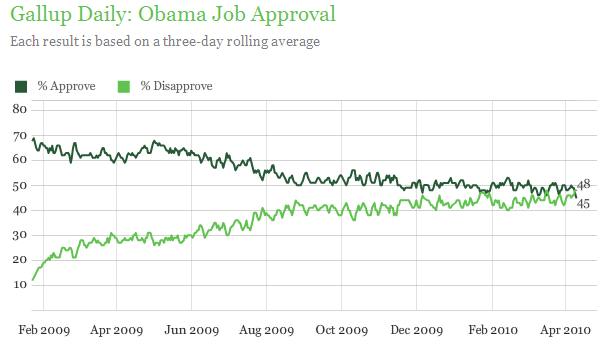
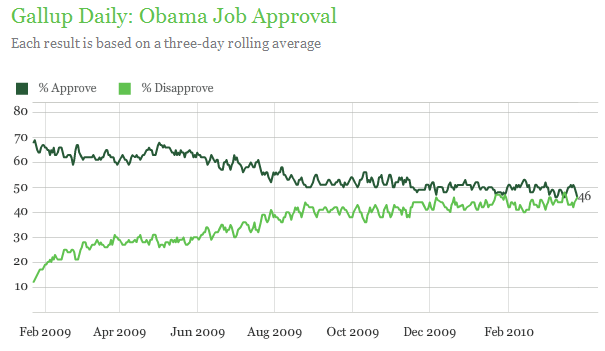
Pres. Obama had a small bounce from the enactment of ObamaCare, but it was very short lived.

Now, Gallup — which leans slightly left — has a plurality of Americans disapproving of the job he’s doing as president — 48% disapproving to 45% approving.

image

http://www.gallup.com/poll/113980/Gallup-Daily-Obama-Job-Approval.aspx

* * * * *

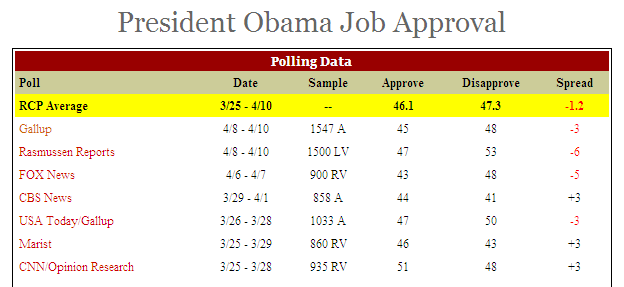
Similarly, the Real Clear Politics “poll-of-polls” has the President upside-down by 1.2 points — 47.3% disapproving, 46.1% disapproving.

image
http://www.realclearpolitics.com/epolls/other/president_obama_job_approval-1044.html

* * * * *

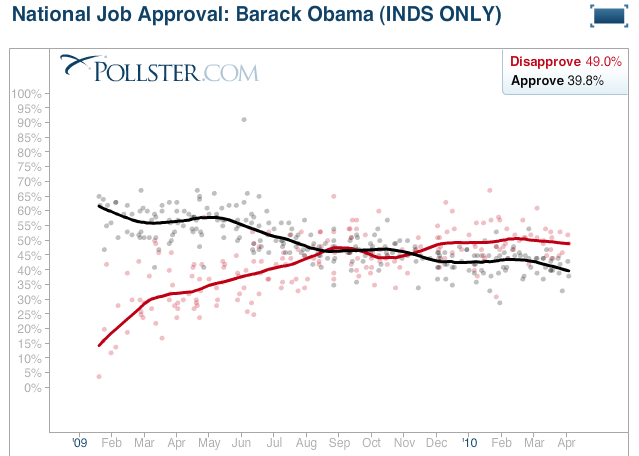
And according to Pollster.com’s poll-of-polls,  Obama’s approval rating among Independents is 9.2 points under water — 39.8% to 49%

image

The Jobs Picture Still Looks Bleak

April 12, 2010

Punchline: Many outsourced jobs will never return, and median income will likely continue to fall. But, the jobs of well-educated Americans, although hardly immune to foreign outsourcing and technological displacement, have been less vulnerable to these trends than the jobs of Americans with fewer years of education.

* * * * *

Excerpted from WSJ: The Jobs Picture Still Looks Bleak, April 12, 2010

The U.S. economy added 162,000 jobs in March. That sounds impressive until you look more closely.

  • At least a third of them were temporary government hires to take the census—better than no job but hardly worth writing home about.
  • The 112,000 real new jobs were fewer than the 150,000 needed to keep up with the growth of the U.S. population.

It’s far better than it was—we’re not hemorrhaging jobs as we did in 2008 and 2009—but the bleeding hasn’t stopped.

  • The economy has shed 8.4 million jobs and failed to create another 2.7 million required by an ever-larger pool of potential workers. That leaves us more than 11 million jobs behind.
  • The number is worse if you include everyone working part-time who’d rather it be full-time, those working full-time at fewer hours, and people who are overqualified for the jobs they’re in.

This means even if we enjoy a vigorous recovery that produces, say, 300,000 net new jobs a month, we could be looking at five to eight years before catching up to where we were before the recession began.

* * * * * 

Outlays from the federal stimulus have already passed their peak, and the Federal Reserve won’t keep interest rates near zero for very long.

And even households whose incomes have returned are likely to be residing in houses whose values haven’t—which means they can’t turn their homes into cash machines as they did before the recession.

Consumers have been shedding their debts like mad—often simply by defaulting on loans — but, their remaining burdens are still heavy. Debt averages $43,874 per American, or about 122% of annual disposable income.

Most Americans’ biggest asset is their homes. The “wealth effect” of the rising stock market is felt mainly by the richest 10%, whose net worth is largely stocks and bonds.

* * * * *

What’s likely to slow the jobs recovery most, however, is the indubitable reality that many of the jobs that have been lost will never return.

The Recession has accelerated a structural shift in the economy that had been slowly building for years.

Companies have used the downturn to aggressively trim payrolls, making cuts they’ve been reluctant to make before.

  • Outsourcing abroad has increased dramatically.
  • Companies have also cut costs by substituting more computerized equipment for labor.

These cost-cutting moves have allowed many companies to show profits notwithstanding relatively poor sales.

Those who have lost their jobs to foreign outsourcing or labor-replacing technologies are unlikely ever to get them back. And they have little hope of finding new jobs that pay as well.

This shift also helps explain why …

  • The unemployment rate for Americans with college degrees is now only 5%
  • It is 10.5% for those with only a high-school degree, and …
  • 15.6% for Americans with less than a high-school diploma.

The jobs of well-educated Americans, although hardly immune to foreign outsourcing and technological displacement, have been less vulnerable to these trends than the jobs of Americans with fewer years of education.

Full article:
http://online.wsj.com/article/SB10001424052702304222504575173780671015468.html

Mavericky Brand Building 101

April 12, 2010

Takeaway: Many folks make fun of her, but does Sarah Palin know more about brand building than we MBAs do?

In a matter of months, and against all odds, Palin built herself into a multi-million dollar national brand with droves of loyal followers. How many classically-trained marketing whizzes can boast the same?

Palin may not be able to see Russia from her house, but marketers take note, she is likely to understand many Americans better than we do. This begs the question: What can we learn from Palin?
 
* * * * *

Excerpt from New York Times, “How Sarah Palin Became a Brand” by David Carr, April 4, 2010.

When Sarah Palin made her debut as the host of “Real American Stories” on Fox News, she described several triumphs of regular people over insurmountable odds, but she missed an obvious one: her own.

After her failed bid for the vice presidency, she was more or less told to head back to Alaska to serve out her term as governor.

Instead, she quit her day job and proceeded to become a one-woman national media empire, with the ratings and lucre to show for it.

With its tales of uplift and pluck, “Real American Stories” trades in the kind of easy sentimentality that provokes eye rolls among those of us who work in media while quickening the pulse and patriotic ardor of almost everyone else. At the beginning of the show, Ms. Palin promised that it would “reaffirm our pioneering spirit and unmatched generosity, here and around the world.”

“It’s not the kind of thing that’s going to excite you guys on the East Coast, but everyone else is dying to hear stories like these,” said one of her representatives.

Beyond her Tea Party theatrics, Palin has tunneled her own route into the public consciousness and gone into the Sarah Palin Across America business. And what a business it is.

She was paid a $1.25 million retainer by HarperCollins. Her book, “Going Rogue,” has sold 2.2 million copies, according to its publisher, and she has another tentatively scheduled for this fall.

She now has an actual television career, including appearances as a pundit on Fox News, her gig as the host of “Real American Stories” four times a year, and a coming eight-part series on TLC called “Sarah Palin’s Alaska,” which will cost, according to some media reports, $1 million an episode.

Other people have crossed the border from politics to media to very good effect — George Stephanopoulos, Patrick Buchanan and Chris Matthews, to name a few — but the transition was far more gradual. Ms. Palin turned on a dime and was a ratings sensation from the word go: her first paid appearance, as a commentator on “The O’Reilly Factor” on Jan. 12, was good for an extra million viewers.

Her appeal doesn’t stop at the red states. When Ms. Palin stopped by to chat with Oprah Winfrey — not exactly friendly territory — the show achieved its biggest ratings in two years.

Ms. Palin didn’t go on the show to run for president as much as to become the next Oprah. And it seems to be working. So what are the rest of us missing?

Back in September 2008, when she was unveiled in St. Paul during the Republican convention, a longtime political reporter told me that her appeal would burn off over time. I wondered about that. I’m from Minnesota, which is sometimes considered the southernmost tip of Alaska, and her way of speaking in credulous golly-gee may have been off-putting to some, but there is a kind of authenticity there that no image handler could conjure.

In Ms. Palin’s America, everyone’s got bootstraps; they just need to have the gumption to find them. And her version is full of plain old folks spending a lot of time overcoming a great deal, including a government that she posits usually intends to do them harm.

She’s also imported the political trick of coming from the outside and ruling from the center. When she sets down the ear piece and leaves the studio lights, even the way she says the word “media” in her speeches — “MEE-dee-uh” — makes it sound like something yucky and foul, a swamp to be avoided at all costs. Unless, of course, you are promoting a show, a book or a cause.

Many observers thought her unwillingness to serve out her term would be fatal to her ambitions, but the fact that governance did not suit her — she resigned as governor back in July — has become a kind of credential.

Ms. Palin still gets a session in the media spanking machine every time she does anything, but the disapproval seems to further cement the support of her loyalists. Ms. Palin may or may not be qualified to represent America around the world, but she certainly represents vast swaths of the American public and has a lucrative new career to show for it.

If we don’t see why, then maybe we deserve the “lamestream media” label she likes to give us.
Edit by BHC
 
* * * * *
Full Article:
http://www.nytimes.com/2010/04/05/business/media/05carr.html?ref=media
* * * * *

TAXES: Funding ObamaCare with a 3.8% non-payroll payroll tax … here’s the impact on your wallet

April 9, 2010

In a prior post, we walked through the impact if Obama selectively lets the parts of the Bush tax cuts expire in 2011 — those parts that effect individuals earning more than $200,000 and couples earning more than $250,000.

In a nutshell, here’s what we concluded …

  • The tax rate on capital gains will go up 5% … and the tax rate on dividends will go up at least 5% (to the capital gains tax rate) and maybe all the way up to ordinary income tax rates.
  • For ordinary income, the effective (not marginal) tax rate increase on ordinary income will be about 1/2% for each $100,000 of taxable income (i.e. ordinary income plus dividends and capital gains) over $200,000.

For example, assume a couple has $200,000 in taxable ordinary income and $100,000 in dividends and capital gains, giving them total taxable income of $300,000.   Their tax hit will be about $6,000 — $5,000 from the increase in dividend and capital gains tax rates (5% X $100,000) and $1,000 from the increase in the effective rate on ordinary income ($300,000 minus $200,000 = $100,000 => 1/2% rate increase times $200,000 = $1,000).  In rough numbers, their income taxes would go from $67,000 to $73,000 — an increase of almost 9% — and their effective tax rate would go from 21% to over 24%.

But, that’s only part of the story.

Remember that the original Senate bill funded roughly 1/2 of ObamaCare from MediCare cuts and roughly 1/2 from an excise tax on employer provided Cadillac health insurance plans — a plan originally teed up by Obama.  When the unions marched on the White House and reminded the President who got him elected, Obama recalibrated upward the threshold defining a Cadillac plan, delayed the implementation of that tax until 2018, and replaced the lost tax revenue with a supplemental 3.8% payroll tax on AGI (Adjusted Gross Income — which includes ordinary income plus dividends and capital gains) over $200,000 — starting in 2013

Technical note:  The base Medicare tax rate is currently applied as a payroll tax on so-called earned income.  Employees pay 1.45% and employers are required to match the 1.45% — for a total of 2.9%.  Under ObamaCare, for “unearned income” — mostly dividends and capital gains — there is no employer per se, so the taxpayer is charged the full 2.9% base … plus, a supplemental .9% was added on for good measure — raising the total to 3.8%

So, comparing 2013 to the current tax rates

  • The tax rate on capital gains will go up 5% … and the tax rate on dividends will go up at least 5% (to the capital gains tax rate) and maybe all the way up to ordinary income tax rates.
  • For ordinary income, the effective (not marginal) tax rate increase on ordinary income will be about 1/2% for each $100,000 of taxable income (i.e. ordinary income plus dividends and capital gains) over $200,000.
  • There is a 3.8% “payroll tax” on all AGI over $200,000 — that includes ordinary income plus dividends and capital gains.

Let’s rework our example …

Again, assume a couple has $200,000 in taxable ordinary income and $100,000 in dividends and capital gains, giving them total taxable income of $300,000.

Their tax hit (versus 2009) will be about $9,800 …

  • $5,000 from the increase in dividend and capital gains tax rates (5% X $100,000)
  • $1,000 from the increase in the effective rate on ordinary income ($300,000 minus $200,000 = $100,000 => 1/2% rate increase times $200,000 = $1,000).
  • $3,800 in additional “payroll taxes” ($300,000 minus $200,000 = $100,000 times 3.8% = $3,800

In rough numbers, their income taxes would go from $67,000 to $76,800 — an increase of almost 15% — and their effective tax rate would go from 21% to over 25.5%.

Keep in mind, that this is just Federal income taxes.  Add on another 5% to 10% for state and local income taxes … then draw your own conclusions re: fairness and effect on the economy. …

* * * * *

Here’s a handy tool for estimating effective tax rates now, and prospectively in 2013.

image


* * * * *

Next up: The triumphant return of the marriage penalty

>> Current Posts

It’s not a fine, it’s not a tax … it’s a "different tax status" … just like being married

April 9, 2010

Remember those 16,000 new IRS agents who will be policing implementation of ObamaCare ?

Well, turns out that they won’t be collecting fines or taxes … they’ll just be reclassifying non-compliers into “alternative tax statuses”.  Whew.

Who comes up with this stuff ?

Here’s a minute of spin worth watching …

Memo to Playboy: Even a bunny knows when to stop …

April 9, 2010

TakeAway:  Playboy’s loyal collectors have followed the brand for decades and some have even dedicated entire wings of their houses to Playboy paraphernalia.

So, you know something has gone really wrong when these loyalists complain about Playboy’s latest category extensions. 

Though it is better to get consumers to switch within a brand franchise, it appears that Playboy has gone beyond the loyalists perceptions of fit.  Maybe Playboy executives need to step back and reacquaint themselves with the loyalists associations to and beliefs about the brand.   

* * * * *

Excerpted from WSJ, “As Playboy Bunny Logo Multiplies, Collectors Are Barely Interested in It,” By Russell Adams, April 5, 2010

Over the past nine months, Playboy has turned its bunny loose, slapping its famous logo on a tanning spray, a disposable lighter, a mattress, a couch and a line of drinks designed to boost the libido.

The new Playboy paraphernalia should be welcome news for Ken Ritchie, who has a wing on his house precisely to hold stuff like this.

Ken has spent most of his adult life collecting and selling Playboy merchandise. For about a decade, he was spending $3,000 a month on paraphernalia … But Mr. Ritchie turns up his nose at what Playboy is selling now.

“These are a lot of silly things that have no connection with Playboy,” Mr. Ritchie says. “How many guys do you think are going to go out and buy navel rings because they’ve been licensed by Playboy? It’s not a must-have item.”

Playboy launched more than a magazine when it put Marilyn Monroe on its inaugural issue in 1953. It created a brand that came to represent a rebel ethos … Over the years Playboy Enterprises has capitalized on it by attaching its logo to nightclubs, cuff links and other trinkets.

As advertising has drained from its magazine, Playboy has come to rely more heavily on its licensing efforts. That’s rankled some core fans, highlighting the delicate task facing Playboy and other struggling magazine companies: how to capitalize on their brands without diminishing their value in the eyes of the people who cherish—and in some cases profit from—them most …

Playboy has been licensing its brand on an array of seemingly random products for decades … However Playboy has sought to usher the brand up-market during the last 20 years … canceled licensing contracts with makers of items such as fuzzy dice and air fresheners and instead targeted high-end apparel and accessories for women.

Playboy’s new CEO … is shifting gears, making expansion of licensing a priority. “I think we might have been a bit more conservative about category expansion previously” …

The CEO acknowledges that it is difficult to expand the high-margin licensing business and please hard-core collectors at the same time. The ubiquity that fuels strong sales is precisely what turns off collectors …

Still, the CEO says Playboy takes pains to determine whether new products will sully its media properties or other products. “So far, we can’t point to an example of a product we’ve licensed that we regret,” …

In February, Playboy reached a deal to outsource its licensing business in Asia, where Playboy-branded apparel has become especially popular among young women.

That doesn’t sit well with male collectors … they are reluctant to put on a Playboy shirt given the growing popularity of Playboy apparel among women. “Now it’s almost too feminine to wear something like that,” …

Edit by TJS

* * * * *

Full Article
http://online.wsj.com/article/SB10001424052748703447104575118051700987106.html

* * * * *


TAXES: What if you're in the minority — folks paying income taxes — and Obama let's the Bush tax cuts expire ?

April 8, 2010

OK, what’s the effect if Obama lets the Bush tax cuts expire? Big hurt or little hurt ?

Here’s a first cut …

* * * * *

Base Case

Assume a married couple earning a combined $250,000 in taxable income.  Their tax liability based the 2009 tax rate schedule would be $60,320 an effective tax rate of 24%

image

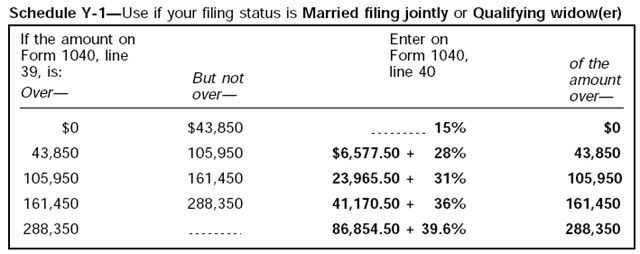
Literally reverting back to the pre-Bush 2000 tax rate schedule, they’d owe $73,048 — a 29% effective tax rate — and a 21% increase over the current tax rates.

image

That’s a big hurt … and probably an unlikely worst case scenario.

* * * * *

Likely Obama Plan

Remember that Obama has often said “not a dime more in taxes for families making less than $250,000″ … and sometimes said the same for individuals making less than $200,000.

In fact, according to the Tax Foundation, the plan outlined in the Obama administration’s budget is to allow:

  • The top tax rate to revert from 35% to 39.6%. 
  • The 33% tax rate to revert to 2001 law (rate of 36%) but the income threshold where that bracket starts will shift up to $250,000 in taxable income (couples) and $200,000 for singles
  • The rate on long-term capital gains to revert to 2001 law (rate of 20%) but only for couples with over $250,000 in AGI the year the gain is realized ($200K threshold for singles)
  • The rate on dividends to be hiked to long-term capital gains rates, i.e. up to 20%, but below ordinary income tax rates.

    Excerpted from Tax Foundation: Fate of Bush Tax Cuts Uncertain As Expiration Approaches, March 25, 2010   http://www.taxfoundation.org/research/show/26062.html

* * * * *

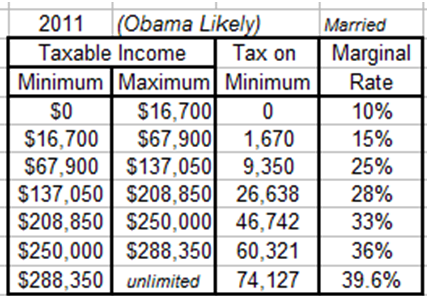
If the Tax Foundation is right, here’s what the brackets would look like for married couples per the Obama budget:

image

If Obama keeps his word on this one, our illustrative couple earning $250,000 won’t pay higher income taxes.

What about their friends who earn more and have more wealth to spread around ?

Well, a couple earning $500,000 would have their tax liability go from $137,500 (an effective tax rate of about 27.5%) —  to $150,000 (an effective tax rate of about 30%) — roughly a 9% increase in their taxes paid.

Draw your own conclusion whether that’s a lot or a little …

Note: This is only the increase due to the tax brackets shift if the Bush tax cuts are allowed to expire … it does not consider:

  • The impact of the likely increase increase in the capital gains tax rate (from 15% to 20%), or the increase in the dividends tax rate (from 15% to either 20% or the ordinary income tax rate)
  •  … or the triumphant return of the marriage penalty (on steroids this time)
  •  … or the 3.8% payroll tax surcharge on AGI over $200,000 (including dividends and capital gains)  to be added in 2013 to pay for ObamaCare. 

I’ll cover capital gains and dividends below … and  the marriage penalty and ObamaCare payroll tax surcharge in subsequent posts.

* * * * *

Estimating your tax hit

Here are some back-of-the-envelope ways to ballpark how much more you’ll be paying in income taxes in 2011 …

If your taxable income (AGI minus deductions) is less than $200,000 (individuals) or $250,000 (couples) — and if Obama keeps his campaign pledge — then your income taxes won’t go up.

If taxable income is over the thresholds …

The tax rate on capital gains will go up 5% … and the tax rate on dividends will go up at least 5% (to the capital gains tax rate) and maybe all the way up to ordinary income tax rates.

For ordinary income, the effective (not marginal) tax rate increase on ordinary income will be about 1/2% for each $100,000 of taxable income (i.e. ordinary income plus dividends and capital gains) over $200,000.

For example, assume a couple has $200,000 in taxable ordinary income and $100,000 in dividends and capital gains, giving them total taxable income of $300,000.   Their tax hit will be about $6,000 — $5,000 from the increase in dividend and capital gains tax rates (5% X $100,000) and $1,000 from the increase in the effective rate on ordinary income ($300,000 minus $200,000 = $100,000 => 1/2% rate increase times $200,000 = $1,000).  In rough numbers, their income taxes would go from $67,000 to $73,000 — an increase of almost 9% — and their effective tax rate would go from 21% to over 24%.

* * * * *

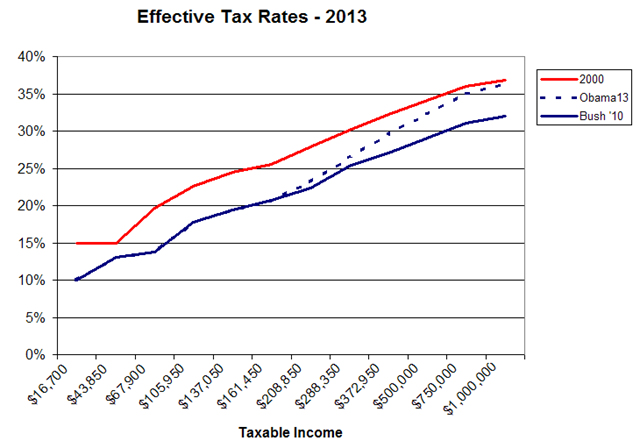
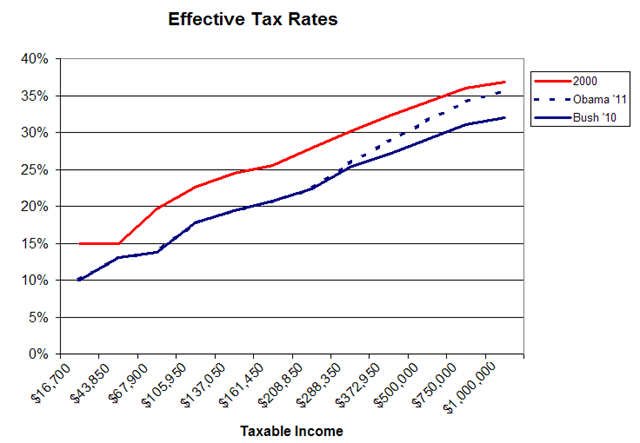
Here’s a handy chart for eyeballing 2011 effective ordinary income tax rates at a range of taxable income levels. 

Technical note: Remember to separate out capital gains and dividends from taxable ordinary income — since they get a 5% hit. But, use total taxable income (ordinary income plues dividends and capital gains ) to estimate the increase in the ordinarary income effective tax rate.

In a subsequent post, I’ll incorporate the ObamaCare 3.8% payroll tax on AGI over $200,000 to be added in 2013 and look at the return of the uber-marriage penalty.

image

* * * * *

Next up: The payroll tax surcharge …  add 3.8% for all income over $200,000

TAXES: What if you’re in the minority — folks paying income taxes — and Obama let’s the Bush tax cuts expire ?

April 8, 2010

OK, what’s the effect if Obama lets the Bush tax cuts expire? Big hurt or little hurt ?

Here’s a first cut …

* * * * *

Base Case

Assume a married couple earning a combined $250,000 in taxable income.  Their tax liability based the 2009 tax rate schedule would be $60,320 an effective tax rate of 24%

image

Literally reverting back to the pre-Bush 2000 tax rate schedule, they’d owe $73,048 — a 29% effective tax rate — and a 21% increase over the current tax rates.

image

That’s a big hurt … and probably an unlikely worst case scenario.

* * * * *

Likely Obama Plan

Remember that Obama has often said “not a dime more in taxes for families making less than $250,000″ … and sometimes said the same for individuals making less than $200,000.

In fact, according to the Tax Foundation, the plan outlined in the Obama administration’s budget is to allow:

  • The top tax rate to revert from 35% to 39.6%. 
  • The 33% tax rate to revert to 2001 law (rate of 36%) but the income threshold where that bracket starts will shift up to $250,000 in taxable income (couples) and $200,000 for singles
  • The rate on long-term capital gains to revert to 2001 law (rate of 20%) but only for couples with over $250,000 in AGI the year the gain is realized ($200K threshold for singles)
  • The rate on dividends to be hiked to long-term capital gains rates, i.e. up to 20%, but below ordinary income tax rates.

    Excerpted from Tax Foundation: Fate of Bush Tax Cuts Uncertain As Expiration Approaches, March 25, 2010   http://www.taxfoundation.org/research/show/26062.html

* * * * *

If the Tax Foundation is right, here’s what the brackets would look like for married couples per the Obama budget:

image

If Obama keeps his word on this one, our illustrative couple earning $250,000 won’t pay higher income taxes.

What about their friends who earn more and have more wealth to spread around ?

Well, a couple earning $500,000 would have their tax liability go from $137,500 (an effective tax rate of about 27.5%) —  to $150,000 (an effective tax rate of about 30%) — roughly a 9% increase in their taxes paid.

Draw your own conclusion whether that’s a lot or a little …

Note: This is only the increase due to the tax brackets shift if the Bush tax cuts are allowed to expire … it does not consider:

  • The impact of the likely increase increase in the capital gains tax rate (from 15% to 20%), or the increase in the dividends tax rate (from 15% to either 20% or the ordinary income tax rate)
  •  … or the triumphant return of the marriage penalty (on steroids this time)
  •  … or the 3.8% payroll tax surcharge on AGI over $200,000 (including dividends and capital gains)  to be added in 2013 to pay for ObamaCare. 

I’ll cover capital gains and dividends below … and  the marriage penalty and ObamaCare payroll tax surcharge in subsequent posts.

* * * * *

Estimating your tax hit

Here are some back-of-the-envelope ways to ballpark how much more you’ll be paying in income taxes in 2011 …

If your taxable income (AGI minus deductions) is less than $200,000 (individuals) or $250,000 (couples) — and if Obama keeps his campaign pledge — then your income taxes won’t go up.

If taxable income is over the thresholds …

The tax rate on capital gains will go up 5% … and the tax rate on dividends will go up at least 5% (to the capital gains tax rate) and maybe all the way up to ordinary income tax rates.

For ordinary income, the effective (not marginal) tax rate increase on ordinary income will be about 1/2% for each $100,000 of taxable income (i.e. ordinary income plus dividends and capital gains) over $200,000.

For example, assume a couple has $200,000 in taxable ordinary income and $100,000 in dividends and capital gains, giving them total taxable income of $300,000.   Their tax hit will be about $6,000 — $5,000 from the increase in dividend and capital gains tax rates (5% X $100,000) and $1,000 from the increase in the effective rate on ordinary income ($300,000 minus $200,000 = $100,000 => 1/2% rate increase times $200,000 = $1,000).  In rough numbers, their income taxes would go from $67,000 to $73,000 — an increase of almost 9% — and their effective tax rate would go from 21% to over 24%.

* * * * *

Here’s a handy chart for eyeballing 2011 effective ordinary income tax rates at a range of taxable income levels. 

Technical note: Remember to separate out capital gains and dividends from taxable ordinary income — since they get a 5% hit. But, use total taxable income (ordinary income plues dividends and capital gains ) to estimate the increase in the ordinarary income effective tax rate.

In a subsequent post, I’ll incorporate the ObamaCare 3.8% payroll tax on AGI over $200,000 to be added in 2013 and look at the return of the uber-marriage penalty.

image

* * * * *

Next up: The payroll tax surcharge …  add 3.8% for all income over $200,000

Government gridlock … you ain’t seen nothing yet.

April 8, 2010

This may be obvious to the rest of the world, but it’s a new revelation to me … there’s no chance of anything material been passed out of Congress for quite awhile.

Why ? It centers on the Dems blatant use the 51-vote reconciliation process on ObamaCare to bypass the super-majority that’s traditional in the Senate.

Here’s a common scenario: The House passes a bill.  Then, the Senate passes a related, but different bill — the differences can be big or little — that doesn’t matter.

Under traditional rules, the two bills get consolidated by a conference committee and then is submitted to a majority vote in the House and a super-majority vote in the Senate.

Under reconciliation rules, the Senate’s super-majority is bypassed and 51 votes carries the day.

So what ?

Bottom line, the initial Senate bill — passed by a super-majority — is meaningless since it can be altered in the conference committee and passed back for a 51-vote reconciliation.

The only way that the minority party in the Senate has any residual clout is if it fillibusters initial bills so they don’t go to conference and reconciliation … or, if the Senate passes a House bill without changes — that wouldn’t be subject to conference and reconciliation. The latter has long odds for any material legislation.

So, expect GOPers to fillibuster just about everything.  Until the November elections, that is. 

Conceivably, the GOP will win back a majority in the Senate — but no way it gets to a super-majority.

So, the tables may get turned, with Dems fillbustering to stop the GOP from reconciling.

Follow all of that ?

The good news, in my opinion, is the likelihood of complete gridlock … for as far as the eye can see. 

1 million government census workers ???

April 8, 2010

Last Friday’s jobs report included 48,000 temporary census workers … less than anticipated given the plan to eventually hire 1 million temporary gov’t workers to service the census.

Prompted a great question from wife Kathy: “Why does it take 1 million people 6 months to count 300 million other people?

Think about it … that’s 300 counted citizens per hired temporary census worker … or each census worker counting about 2 people per day spread over the 6-months’ data collection period.

This, from the same government that’s going to eliminate waste from our healthcare system …  yeah, right.

Encore – Those %#@! Bush Tax Cuts

April 7, 2010

This brief was originally posted July 23, 2008. 

Since expiration of the Bush tax cuts is looming soon, I thought they’re worth another look — just as background 

In subsequent posts, I’ll deal with the likely implications of letting the cuts expire … 

* * * * *

Summary: We’ve all heard the  rants about the cuts in the top bracket rate, capital gains rate, dividend taxes, and estate taxes.

But, when was the last time that your heard a candidate (on either side) or a pundit (O’Reilly included) mention the new 10% bracket, larger and refundable child and earned income credits, negative income taxes, elimination of the marriage tax penalty, or expanded college benefits?

* * * * *

The income tax cuts of 2001 and 2003 are shorthanded by the press and political candidates as “Bush’s tax breaks for the wealthy — who didn’t even want them”, and are blamed for an accelerating polarization of wealth distribution (i.e. rich get richer, poor stay poor).

Warren Buffet says his secretary pays more taxes than he does (really?). McCain says he’ll stay the course. Obama says that he’ll roll back the tax cuts if he’s elected and redistribute them to the “folks who need them the most”.

All of the rhetoric got me thinking.  Somewhat embarrassed, I realized that I didn’t know exactly what was in the Bush tax plan.  (Quick Test: take out a sheet of paper and jot down the tax breaks enacted as part of the Bush plan)

Prompted by curiosity (and a modicum of selfish interest) I did some digging.  Here’s what I found, along with my “take”:

The top marginal income tax rate  was cut from 39.5% to 35% (applied to Taxable Income >$350,000)
– the 36% marginal rate was cut to 33%  (TI > $161,000)
– the 31% marginal rate was cut to 28%  (TI> $77,000)
– the 28% marginal rate was cut to 25%  (TI > $32,000)
…  a clear benefit to the top half of income earners; with the biggest benefit to the highest earners

Capital gains and dividend tax rates were reduced to 15% for high-earners, zero for low earners … more of a benefit to high-earners, but 1/3 of households own stock and more than 1/4 of returns (including many retirees) report dividend income … turned out to be a windfall for hedge funds and private equity via the “carried interest” loophole (more on that in a subsequent post)

A low-income 10% tax rate bracket was introduced … benefit to many low-earners previously in the 15% bracket

Child Care Credit and Earned Income Tax Credit were increased and made refundable … resulting in zero or negative tax due balances for millions of people (note: “refundable” means that any negative tax due is paid to the citizen — a very important policy shift)

Income limits were eliminated on personal exemptions and itemized deductions … the former helps low earners most — since it’s a higher proportion of income; the latter benefits higher earners most — since they are the ones who itemize deductions. (Note: roughly 2/3’s of tax filers take the standard deduction)

Marriage penalty was neutralized … benefits middle-earning couples most

College education benefits were liberalized, e.g. 529 plans, student loan interest deduction, tax-free employer paid tuition … benefits mid- and high-earners most (since their family members disproportionately attend college)

Estate taxes were reduced and to be phased out… only impacts wealthy folks with estates that are big enough to be subject to “death taxes”


* * * * *

Details re: “Bush Tax Plan” – 2001 and 2003

Officially, the first round of Bush tax cuts were codified in the “Economic Growth and Tax Relief Reconciliation Act of 2001” which was approved by the Congressional conference committee on May 25, 2001; signed into law shortly thereafter; but phased in over a several year period.  The key provisions of the law (as reported in the conference committee’s report):
Introduce a 10-percent rate bracket… reducing the rate from 15% to 10% for the first $6,000 of taxable income for single individuals ($7,000 for 2008 and thereafter), $10,000 of taxable income for heads of households, and $12,000 for married couples filing joint returns ($14,000 for 2008 and thereafter).

Reduce individual income tax rates  … from 28 percent, 31percent, 36 percent, and 39.6 percent are phased-down over six years to 25 percent, 28 percent, 33 percent, and 35 percent, effective after June 30, 2001.

click table to make it bigger

Phase-out of Itemized Deductions and Restrictions on Personal Exemptions … by eliminating all limitation on itemized deductions and any restrictions on personal exemptions for all taxpayers by one-third in taxable years beginning in 2006 and 2007, and by two-thirds in taxable years beginning in 2008 and 2009, and by 100% for taxable years beginning after December 31, 2009.

Increase and Expand the Child Tax Credit… Increasing the child tax credit to $1,000, phased-in over ten years. and by making the child credit — subject to certain income limitations — non-taxable and refundable (i.e. payable to the person if the net tax liability is zero),

Provide relief from the “marriage penalty” … by increasing the basic standard deduction for a married couple filing a joint return; by increasing the size of the 15-percent regular income tax rate bracket for a married couple filing a joint return to twice the size of the corresponding rate bracket for an unmarried individual filing a single return.; and by increasing limits on the Earned Income Tax Credit.

Provide Education Benefits… by increasing the annual limit on contributions to education IRAs to $2,000; by expanding the reach of 529 tuition programs; by extending the non-taxibility of employer paid tuition; and by raising income phase out levels for deductability of student loan interest.

Phase-out and Repeal of Estate and Generation-Skipping Transfer Taxes:

* * * * *

In 2003, a second round of tax changes was enacted in the “JOBS AND GROWTH TAX RELIEF RECONCILIATION ACT OF 2003” which:

Accelerated the phase in of the 10% bracket, the reduction in other bracket rates, the child care tax credit, and marriage penalty relief.

Provide reductions in taxes on capital gains and dividends … reducing the 10- and 20-percent rates on capital gains on assets held more than one year to five ( zero, in 2008 ) and 15 percent, respectively. and providing that dividends received by an individual shareholder from domestic and qualified foreign corporations generally are taxed at the same rates that apply to capital gains.

* * * * *

Source Reports
http://www.jct.gov/x-50-01.pdf
http://www.house.gov/jct//x-54-03.pdf

* * * * *

Next up: What if Obama let’s the Bush tax cuts expire ?  You may be surprised …

Quick: Name a player on your favorite baseball team …

April 7, 2010

I bet you could … but President Obama couldn’t.

In a TV interview, he declared the Chicago White Sox to be his favorite baseball team.

Then, he  choked on a soft-toss question: “So, who’s your favorite White Sox player ?”

He couldn’t think of one, so he used the opportunity to inject a little class warfare and declare the Cubs (the Homa family’s favorite team) — simply for “wine sippers”.

Where’s the  teleprompter when you need it ?

P.S. Before anybody asks: All-time favorite Sammie Sosa (he was framed on the steroids rap — and on the bat corking incident); current favorite Aramis Ramirez  (he don’t need no juice to make the ball fly)

Short video … worth a look

How ROIDs can help bulk up profits

April 7, 2010

Key Takeaway: There is no doubt that a company’s marketing strategy and techniques must evolve over time. As consumer needs, desires, and beliefs change, it is important that organizations address these new insights.

ROIDs marketing focuses on four areas that can help enhance your analysis of the traditional P’s of marketing: responsibility marketing, organizational leadership, insights about customers, and digital marketing.

Perhaps when Mark McGwire recently admitted he ‘roided during his career he was just trying to tell us about his savvy marketing knowledge?

* * * * *

Excerpted from Harvard Business Review, “Putting Marketing on ‘ROIDs'” by Dick Patton, March 1, 2010

In conversation after conversation, CEOs, presidents, and CMOs tell me that their companies are looking to marketing to lead the business into the customer-centric future. And in a future that looks vastly different from the past, natural talent no longer suffices. Looking ahead, they say they want to supplement the indispensable four P’s of the traditional marketing mix (product, price, placement and promotion) with some powerful new elements. They describe this potent brew in various ways, but I think its essential ingredients can be summed up in the easily remembered acronym: ROIDs.

  • Responsibility marketing, including social responsibility, green marketing, and sustainability
  • Organizational leadership, requiring marketing to touch as much of the value chain as possible
  • Insights about customers, based on new analytic techniques that replace yesterday’s market research
  • Digital marketing, requiring companies to master an amorphous bundle of fast-changing media 

    All four elements mean bulking up on knowledge, not simply improving marketing technique. In responsibility marketing alone, the required knowledge could range from understanding carbon footprint and endocrine disruptors to microloans and foreign labor practices. Organizational leadership requires knowing how each step in the value chain can add value for customers. Customer insights rely on exacting new disciplines like Web analytics. Digital marketing obviously means understanding an array of digital media, but with social networking it means knowledge of social dynamics, not merely customer behavior.

    Edit by JMZ

    * * * * *

    Full Article:
    http://blogs.hbr.org/cs/2010/03/putting_marketing_on_roids.html

  • TAXES: Read this if you’re married … or if you’re thinking about getting married (or unmarried)

    April 6, 2010

    The Bush tax cuts completely did away with the income tax marriage penalty, right ?

    Au contraire, mon ami. 

    That’s just an urban legend repeated so many times that many have been led to believe it. 

    Me included.

    * * * * *

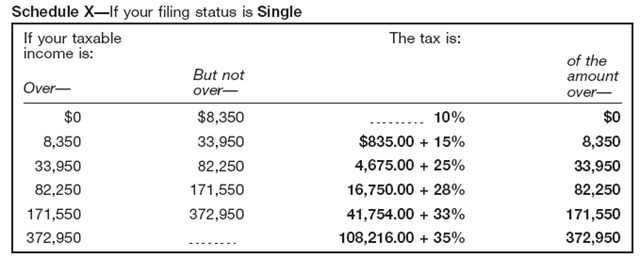
    Let’s go through the numbers with an example:

    Assume a couple — boyfriend and girlfriend (or any other combination of two people) — each earn $100,000 in taxable income.

    According to the 2009 schedule X tax table (individuals), they’d each pay $21,720 if they file separately. 
    (The tax table is at the end of this post if you want to check my arithmetic)

    So, the unmarried couple pays a total of $43,440 in income taxes (2 X $21,720) — that’s an effective tax rate of 21.7%.

    * * * * *

    What if they were married and filed a joint return?

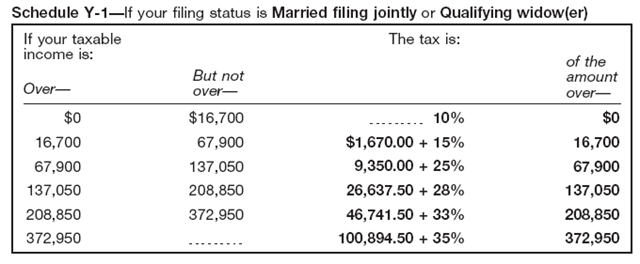
    Well, the good news is that the standard deduction ($11,400) is twice an individual’s standard deduction — it wasn’t until Bush fixed it.  And, their personal exemption amount ($7,300) is double an individual’s (because they’re below the phase out income level).

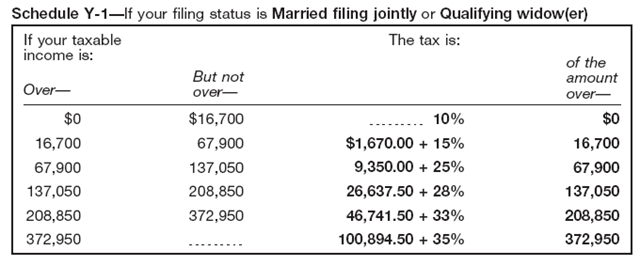
    So, we can just pull their number from the $200,000 taxable income line of the 2009 schedule Y tax table (married filing jointly).

    The answer: their tax liability is $44,277.50 — about 2% higher than if they were unmarried and filing individually.

    Technical note: Married filing separately doesn’t make the problem go away.  You’re either married or your not.

    If you think a 2% difference is just rounding error, let’s move up the tax schedule.

    Assume that he & she (or whatever) each earn $200,000 taxable income.    Their combined income tax liability would be $102,285 if they were unmarried and filing individually, and $110,362 if they were married and filing jointly — a spread of almost 8%.

    For sure, that’s some serious money …

    Technical note: The penalty is relative small at incomes below $50,000 (per person) … and relatively small at very, very high incomes that are taxed mostly at the highest bracket rates.

    Bottom line: The marriage penalty may have been reduced, but it’s still there … and in a later post, I show how it swells when Obama lets parts of the Bush tax cuts expire.

    * * * * * * * * * * * * * * * * * * * * * * * * *

    2009 Tax Rate Schedules

    image

    image

    http://www.unclefed.com/IRS-Forms/taxtables/index.html

    * * * * *

    Next up: Those (expletive deleted) Bush tax cuts …

    Wash Post: The answer was a doozy … “Holy filibuster, Batman”

    April 6, 2010

    Punchline: I once worked with a guy who sorted managers into two categories: simplifiers and complicators … his view: the former always win.

    If ObamaCare is so good and the President is so smart, articulate, and practiced on the subject … why can’t he explain it?

    Here’s the Wash Post recap; below are links to the text & video of the President’s answer … and a great summation by Charles Krathammer.

    From the Washington Post, “Obama’s 17-minute, 2,500-word response to woman’s claim of being over-taxed”, April 2, 2010

    Even by President Obama’s loquacious standards, an answer he gave here in Charlotte on health care was a doozy.

    Toward the end of a question-and-answer session with workers at an advanced battery technology manufacturer, a woman asked the president whether it was a “wise decision to add more taxes to us with the health care package”.

    “We are over-taxed as it is”. 

    Obama started out feisty.

    “Well, let’s talk about that, because this is an area where there’s been just a whole lot of misinformation, and I’m going to have to work hard over the next several months to clean up a lot of the misapprehensions that people have.”

    He then spent the next 17 minutes and 12 seconds lulling the crowd into a daze.

    His discursive answer – more than 2,500 words long — wandered from topic to topic, including commentary on the deficit, pay-as-you-go rules passed by Congress, Congressional Budget Office reports on Medicare waste, COBRA coverage, the Recovery Act and Federal Medical Assistance Percentages (he referred to this last item by its inside-the-Beltway name, “F-Map”). He talked about the notion of eliminating foreign aid (not worth it, he said). He invoked Warren Buffett, earmarks and the payroll tax that funds Medicare (referring to it, in fluent Washington lingo, as “FICA”).

    Always fond of lists, Obama ticked off his approach to health care — twice. “Number one is that we are the only — we have been, up until last week, the only advanced country that allows 50 million of its citizens to not have any health insurance,” he said.

    A few minutes later he got to the next point, which seemed awfully similar to the first. “Number two, you don’t know who might end up being in that situation,” he said, then carried on explaining further still.

    “Point number three is that the way insurance companies have been operating, even if you’ve got health insurance you don’t always know what you got, because what has been increasingly the practice is that if you’re not lucky enough to work for a big company that is a big pool, that essentially is almost a self-insurer, then what’s happening is, is you’re going out on the marketplace, you may be buying insurance, you think you’re covered, but then when you get sick they decide to drop the insurance right when you need it,” Obama continued, winding on with the answer.

    Halfway through, an audience member on the riser yawned.

    But Obama wasn’t finished. He had a “final point,” before starting again with another list — of three points.

    “What we said is, number one, we’ll have the basic principle that everybody gets coverage,” he said, before launching into the next two points, for a grand total of seven.

    His wandering approach might not matter if Obama weren’t being billed as the chief salesman of the health-care overhaul. Public opinion on the bill remains divided, and Democratic officials are planning to send Obama into the country to persuade wary citizens that it will work for them in the long run.

    It was not evident that he changed any minds at the event.

    The audience sat politely, but people in the back of the room began to wander off.

    Even Obama seemed to recognize that he had gone on too long. He apologized — in keeping with the spirit of the moment, not once, but twice. “Boy, that was a long answer. I’m sorry,” he said, drawing nervous laughter that sounded somewhat like relief as he wrapped up.

    But, he said: “I hope I answered your question.”

    Source article:
    http://voices.washingtonpost.com/44/2010/04/obamas-17-minute-2500-word-res.html

    Video of Obama’s answer:
    http://www.youtube.com/watch?v=0Jz6y_16NI8

    Text of Obama’s answer:
    http://whitehouse.blogs.foxnews.com/2010/04/02/obamas-17-minute-14-second-answer-on-higher-taxes-and-health-care/ 

    => Krauthammer’s rephrasing of the answer:
    http://www.wikio.co.uk/video/krauthammer-20-seconds-correct-answer-obama-rant-3041426

    Ball Park Franks turned Oscar Meyer into just another dog

    April 6, 2010

    Key Takeaway: Sometimes taking advantage of a deep consumer insight is all a brand needs to do in order to be the top dog in a category.

    Ball Park Franks, which focused for years on linking their product to the outdoor grilling experience, realized that mom is the one who does the vast majority of hot dog purchasing in the family.

    By concentrating their marketing efforts on mom’s ability to satisfy their family’s cravings for flavorful, high-quality food, Ball Park was able to appeal to both the purchaser and end-user of its product.

    There is no doubt that Ball Park’s profits plumped when they cooked up this strategy.

    * * * * *

    Excerpted from Brandweek, “How Sara Lee’s Ball Park Brand Became the Top Dog” by Elaine Wong, March 28, 2010

    For years, Ball Park was the No. 2 player in hot dogs. That is, until parent company Sara Lee—maker of Hillshire Farm meats and Jimmy Dean breakfast sandwiches—turned to insights, backed by innovation, to take share from and ultimately usurp the lead spot from Kraft competitor Oscar Mayer…The brand’s ascension was informed by research which showed that moms were the primary buyers of the product, but that teenage boys, too, enjoyed eating it.

    Brandweek: At a recent industry conference, you spoke about how Sara Lee is using insights to drive innovation. Give us an example of how that worked for a major brand.

    Philippe Schaillee:

    For many years, we communicated Ball Park through traditional TV and print, primarily to a male audience. We had this character called Frank, and we’d talk about the grilling occasion and that great experience you’d get from [cooking with] Ball Park hot dogs.

    Looking back, I’d say that was [both] intuition and research-based, but it wasn’t really insights- based.

    As we dove much deeper into an understanding of the consumer and shopper, we learned a few things.

    One was that the brand was overindexing with males. They are looking for the heartiness and real quality of a Ball Park hot dog. But [the brand] was also overindexing more with teenage boys than with adult males.

    Once we learned that, we started to look into the shopper of this [brand] and learned that she was really looking for a hearty solution for her teenage son and husband.

    She [wanted something that wasn’t] just a lower quality snack or that would get them into this mindless eating behavior, but something that was solid, yet still fast and convenient. That [discovery] was a breakthrough.

    BW: And then what?

    PS: We decided we had an opportunity to build this platform around “guy foods.”

    However, the person we had to reach out to and that we had to convince from a purchasing behavior perspective was mom.

    So, from an activation perspective, we shifted our spending radically from what, before, was 80 percent against a male target, to 70 percent [to reach] this female shopper, and the other 30 percent was spent against [targeting] teenage boys.

    Our communication to teenage boys, [meanwhile,] was a radical departure from the past.

    Teenage boys watch TV, but they are absolutely not loyal. That is not where we should be spending our money, [nor do they] really read any magazines or newspapers. Where we have to be to reach that target is in the individual gaming and online action sports [arena]…

    We teamed up with a couple of sports spokespersons to build credibility and really ensure that the Ball Park brand would be [engaged in and participating in] the action sport, versus just advertising at [the event].

    As for business results, after having eternally been the No. 2 brand in the hot dog category, we overtook Oscar Mayer about two years ago, and we’ve been growing our share advantage every year.

    When looking at equity parameters like awareness and household penetration, our loyalty metrics are inching up, and we’ve seen that with teenage boys, especially. We’ve moved from being not on their radar screen to more on their radar screen.

    Edit by JMZ

    * * * * *

    Full Article:
    http://www.brandweek.com/bw/content_display/news-and-features/direct/e3ie9fc421daf51cf828daadc047e8488cc?pn=1


    TAXES: ’tis the season, so …

    April 5, 2010

    I figure that attentiveness to income tax issues is probably at a high point as we close in on April 15, so I have loaded several tax-relevant posts for the next several days. 

    Among the topics:

    • Did the marriage penalty really get eliminated?  Answer: no.
    • Where the Bush tax cuts really just for the wealthy?  Answer: no.
    • So what if Obama let’s the Bush tax cuts expire? Answer: uh-oh
    • What about the 3.8% non-payroll payroll tax on dividends and capital gains? Answer: uh-oh (again)
    • What about the marriage penalty? Answer: it gets a dose of steroids
    • So, what’s like to happen … really? Answer: gonna get interesting

    Stay tuned over the next week or so …

    Bending the cost curve or just making tax payers bend over ?

    April 5, 2010

    Punch line: ObamaCare intends to squeeze an extra $1.2 trillion over 10 years from a minority of citizens — the taxpayers.

    The key assumption — that tax payers won’t change behavior to contain tax impacts — has been proven to be fallacious in the past, and isn’t likely in the future …

    Excerpted from WSJ: The Rich Can’t Pay for ObamaCare, March 30, 2010

    President Barack Obama’s new health-care legislation aims to raise $210 billion over 10 years to pay for the extensive new entitlements … by slapping a 3.8% “Medicare tax” on interest and rental income, dividends and capital gains of couples earning more than $250,000, or singles with more than $200,000.

    The president also hopes to raise $364 billion over 10 years from the same taxpayers by raising the top two tax rates to 36%-39.6% from 33%-35%, plus another $105 billion by raising the tax on dividends and capital gains to 20% from 15%, and another $500 billion by capping and phasing out exemptions and deductions.

    Add it up and the government is counting on squeezing an extra $1.2 trillion over 10 years from a tiny sliver of taxpayers who already pay more than half of all individual taxes.

    It won’t work. It never works.

    Punitive tax rates on high-income individuals do not increase revenue. Successful people are not docile sheep just waiting to be shorn.

    From past experience, these are just a few of the ways that taxpayers will react to the Obama administration’s tax plans:

    • Professionals and companies who currently file under the individual income tax as partnerships, LLCs or Subchapter S corporations would form C-corporations to shelter income, because the corporate tax rate would then be lower with fewer arbitrary limits on deductions for costs of earning income.
    • Investors who jumped into dividend-paying stocks after 2003 when the tax rate fell to 15% would dump dividend paying stocks in favor of tax-free municipal bonds if the dividend tax went up to 23.8% as planned.
    • Faced with a 23.8% capital gains tax, high-income investors would defer realizing gains in taxable accounts until there are offsetting losses.
    • Faced with a rapid phase-out of deductions and exemptions for reported income above $250,000, any two-earner family in a high-tax state could keep their income below that pain threshold by increasing 401(k) contributions, switching investments into tax-free bond funds, and avoiding the realization of capital gains.
    • Faced with numerous tax penalties on added income in general, many two-earner can become one-earner couples, early retirement would become far more popular, executives would substitute perks for taxable paychecks, physicians would play more golf, etc.

    In short, the evidence is clear that when marginal tax rates go up, the amount of reported incomes goes down.

    Economists call that “the elasticity of taxable income” (ETI), and measure it by examining income tax returns before and after marginal tax rates claimed a bigger slice of income reported to the IRS.

    The federal government has embarked on an unprecedented spending spree, granting new entitlements in the guise of refundable tax credits while drawing false comfort from phantom revenue projections that will never materialize.

    Full article:
    http://online.wsj.com/article/SB10001424052702304370304575151682845921038.html#printMode

    CBS News: Majority of Americans “increasing skeptical” and disapprove of ObamaCare …

    April 5, 2010

    Punchline: More Americans now disapprove of the legislation, and many expect their costs to rise and the quality of their care to worsen; few expect the reforms to help them.

    * * * * *

    Excerpted from CBS News: Most Americans Remain Against Health Care Overhaul, April 2, 2010

    President Obama has continued to tour the country to stump for his new set of reforms  … but, so far, the president’s efforts to build up support for the bill appear to be ineffective.

    Fifty-three percent of Americans say they disapprove of the new reforms, including 39 percent who say they disapprove strongly. In the days before the bill passed the House, 37 percent said they approved and 48 percent disapproved.

    image

    Less than 20% of Americans thinks the new health care reforms will help them personally … 36% think the new reforms will hurt them

    Just over half think the new health care reforms will increase their health care costs, and 39 percent think the quality of their health care will get worse.

    image

    Only 34 percent of Americans approved of the president’s handling of health care — an all-time low.

    Mr. Obama’s overall approval rating also hit an all-time low in this poll at 44 percent, as Americans continue to worry about the economy.

    Full article:
    http://www.cbsnews.com/8301-503544_162-20001700-503544.html?tag=contentMain;contentBody

    Film execs attempt to strike gold on the silver screen

    April 5, 2010

    Takeaway: 3-D films have drawn customers back into theaters and now film executives are looking to cash in on their captivity.

    After deploying the greatest ticket price increases in recent memory, will these executives bring home the gold, or crumble to the critics?
     
    * * * * *
    Excerpt from Wall Street Journal, “Higher Prices Make Box-Office Debut” by Lauren A.E. Schuker and Ethan Smith, March 24, 2010

    Major U.S. movie-theater chains, seeking to capitalize on the surge in revenues fueled by such 3-D hits as “Avatar” and “Alice in Wonderland,” are imposing some of the steepest increases in ticket prices in at least a decade.
    The increases, in one case as much as 26%, vary from theater to theater, but many cinemas are raising prices most—or even solely—for 3-D showings, which accounted for the vast majority of last year’s 10% jump in domestic box-office sales. 3-D movies accounted for 11% of domestic ticket sales in 2009, up from just 2% in 2008.

    At an AMC theater in a Boston suburb, 3-D ticket prices are jumping more than 20% to $17.50 from $14.50, while the adult admission price for a conventional film will remain at $10.50. A 3-D Imax movie at New York City’s AMC Loews Kips Bay will cost $19.50, up from $16.50.
     
    Their moves come on the heels of a record-setting year at the domestic box office, with revenue surpassing $10 billion for the first time. Movie attendance in the U.S. and Canada grew 5.5% in 2009, to 1.42 billion, the highest level since 2004. Ticket sales so far this year are up nearly 10% from a year earlier.

    Movie theaters typically had charged $2 to $3 extra for 3-D tickets. But the brisk demand for those premium-priced tickets led many exhibitors to believe that they were underpriced.

    About 83% of the record $2.6 billion in ticket sales for “Avatar” came from 3-D and Imax screens. And Walt Disney Co.’s “Alice in Wonderland” also set records when it hit 3-D screens earlier this month.

    While the price increases could boost theater owners’ already buoyant revenues, some industry watchers think the could also spark a consumer backlash. Studios, theater operators and trade groups have long touted films as a bargain, compared with other forms of entertainment, intensifying their pitch during the recession.

    “The U.S. economy isn’t in the greatest shape, and there is definitely risk here in pushing price too far in a weak economy,” said a media analyst.

    Some movie-studio executives expressed concern that the price increases might be too much too soon. “The risk we run is that we will no longer be the value proposition that we as an industry have prided ourselves on,” said a distribution executive at one major studio, who added that he was worried movies would become “a luxury item.”

    Warner Bros. executive said: “Sure, it’s a risky move, but so far charging a $3 or $4 premium has had no effect on consumers whatsoever, so I’m in favor of this experiment to raise prices even more. There may be additional revenue to earn here.”

    Studios are also in a bind. While many are wary of appearing to gouge consumers beset by a weak economy, they are also facing higher costs as they produce more movies in the technology-heavy 3-D format. Though ticket prices are set by theater operators, the proceeds are split roughly 50-50 with movie studios.

    Five major 3-D films are opening in theaters over the next three months, starting this weekend with DreamWorks Animation’s “How to Train Your Dragon.” That rich selection is one reason theater owners chose to raise 3-D ticket prices now. It may also help set consumers’ expectations for future 3-D films.
     
    “This is a truly unique event for the movie industry,” said one industry analyst. “I can’t remember the last time I saw such a major change in ticket pricing.”
      
    Edit by BHC
     

    * * * * *
    Full Article:
    http://online.wsj.com/article/SB10001424052748703312504575142143922186532.html
    * * * * *

    Bernanke puzzled by slow job growth … here’s why, Ben

    April 2, 2010

    It’s a mystery that has puzzled even U.S. Federal Reserve Chairman Ben Bernanke: if the U.S. economy is growing rapidly, why isn’t it creating jobs?

    The Fed and private economists are trying to answer the bigger question of why the labor market shed 8.4 million jobs during this recession. Although the downturn was the deepest since the Great Depression, the job losses were even more severe than most forecasters had predicted based on models that compare economic growth and employment.

    The U.S. unemployment rate is at 9.7 percent, and the consensus view is that it will hold there. Why?

    Bernanke offers two possible explanations: Either the recession was deeper than originally thought … or “productivity gains were greater than we thought they would be when firms were able to cut their work forces and still maintain output.”

    Reuters, The Jobs Puzzle Bernanke Can’t Solve,
    28 Mar 2010
     
    http://www.cnbc.com/id/36031173

    Well, I’ve got the answer for you Ben.

    In fact, HomaFiles laid it out for you in July, 2009 (link to original post is below)

    Here’s the encore presentation …

    * * * * *

    Why private sector jobs won’t be coming back any time soon
    (Hint: it’s called passive aggressive resistance)

    Team Obama thinks that it has corporate America right where it wants it –- under its thumb.

    CEOs and Boards serve at the pleasure of the President, executive compensation is overseen by a Federal czar, product lines are green-dictated by Federal czars and Task Forces, contract law is suspended at will,  bankruptcy laws are changed on the fly — relegating secured creditors behind politically-favored unsecured ones, ineffective government agencies dictate to stumbling companies, unions are given jolts of legislated adrenalin.

    The Administration has empowered itself to sort out good guys from bad guys, to pick marketplace winners and  losers, and to destine survivors and failures, Companies (and individuals) that question government policy are ridiculed, harassed, and punished; those that oppose the policies are squashed faster than decades-old GM or Chrysler dealers.

    Corporate CEOs are quaking in there boots … or are they ?

    Team Obama –- which consistently demonstrates uncanny business naiveté — may be underestimating a staple of organizational behavior: the power of passive aggressive resistance.  Rather than being openly insubordinate when confronted with undesirable tasks — and getting nailed by vindictive superiors –  employees and organizational units will often just procrastinate and work work inefficiently, in effect, pocket vetoing the unpopular orders from above.   In corporate jargon, it’scalled “slow rolling”.

    Sure, corporate chieftains will tell President Obama what he wants to hear, and may even stand next to him on a stage in a faux show of support.  Why risk the rath of a Presidential punishment, especially when there are other ways to skin a cat?

    Specifically, with respect to continuing job cuts and rising unemployment, here’s a theory of the case.

    First, you can’t  let a good crisis go to waste, right?  Businesses always use tough economic times to clean house.   Fat builds in all organizations over time.  In “normal” times, it’s difficult to get rid of dead wood.  Employment laws –  perhaps well-intended originally –- serve to protect slackers by making it cumbersome and difficult to fire anybody.  When the economic tide rolls out, companies have the air cover they need to resize and purge under-performers en masse. The tendency is to cut deep.  If some muscle gets pared too, so be it.  It can be rehabilitated later.

    In typical business cycles, employment is a so-called lagging indicator of an economic rebound.  That is, when the economy starts to recover, jobs are usually added back very slowly.  Why?  Because businesses have a renewed zeal for productivity, they recommit to keeping the fat from building up again, and they want to be sure that the signs of better economic times aren’t false positives.

    Eventually, open positions are filled and capacity — human and physical –  is added to meet increasing demand.  It may take awhile, but the system eventually gets back in balance.

    If the economy is bottoming out now -– as many experts assert –  employment would be expected to start rebounding in 2010.  But, it won’t. Why?

    Because the rules of engagement have changed.  It has become far more costly and risky for companies to restore or enlarge their payrolls.

    For openers, the minimum wage is scheduled to increase by over 10%, making entry level staffing more costly.  Then, there is the risk that “employer mandate” will force companies to expand health insurance coverage or pay fines – again, making labor most costly.  Then, there is the threat of “card check” legislation turbo-boosting  the mass inionization of U.S. businesses .  And now, there’s the evident risk that government will change rules and regulations on political whims, creating an unprecedented level of uncertainty.

    The bottom line: businesses will resist government policies passive aggressively.  Fewer jobs will get added back than history would suggest, and those that get added back will materialize later than past patterns.  Businesses will add jobs as a last resort rather than trying to build capacity ahead of the economic growth curve.  Why should companies  increase their costs and  risks any more than is absolutely necessary ? Companies will continue to off-shore jobs, but will be more clever and clandestine about it, e.g. by vertically disintegrating and simply buying goods and services from 3rd parties.

    Given the Administration’s anti-corporate rhetoric, actions, and proposed game-changing rules, I doubt that many CEOs will be taking on added costs and risks to boost the administration. More likely, they will let unemployment continue to creep up, and will slow roll the process of rehiring.  Corporate chieftains will sit back and watch the President squirm and spin his “4 million jobs – saved or created”.  As Rev. Wright would say “the chickens will have come home to roost”.  Passively aggressive  resistance at its very best.

    Unfortunately, that means we’ll be seeing double digit unemployment for some time – at least through the 2010 Congressional elections.

    https://kenhoma.wordpress.com/2009/07/21/why-private-sector-jobs-wont-be-coming-back-any-time-soon/

    * * * * *

    HIGH ALERT: To the lifeboats … Guam may capsize!

    April 2, 2010

    I got a laugh out this one …

    The pay-off comes right after the geography lesson.

    Keep in mind: the questioner is a US Congressman ( YIPES !)

    Ask yourself: How can the Admiral who is being questioned keep a straight face

    Our government at work …

    http://www.youtube.com/watch?v=zNZczIgVXjg&feature=player_embedded

    Hat tip to Tags for feeding:
    http://chicagoboyz.net/archives/12301.html

    A rose by any other name … Comcast rebrands as Xfinity

    April 2, 2010

    TakeAwayThe Comcast cable guy and his truck are getting a new look.

    With a reputation for poor service and network problems decided a new name might make people forget.

    We’ll see.

    * * * * *

    Excerpted from Philly.com, “Comcast unveils new brand name and logo,” By Bob Fernandez, February 4, 2010

    Comcast  re-branded its TV, Internet, and telephone services as Xfinity  to signal to customers that this isn’t the same old company.

    Comcast will remain as the corporate name, but the company will emphasize Xfinity in advertisements and on 24,000 service trucks and thousands of employee uniforms.

    The new brand name first appeared in Comcast ads, around the time of the Winter Olympics, in Philadelphia and 10 other markets.

    “This is a pretty big moment where we are upgrading every product area … the new name communicates Comcast’s constant product upgrades and innovation.”

    The new brand name … will appear eventually as a logo on the Comcast TV guide and Web sites, and will also appear on customer bills under headings for different services …

    Xfinity seems to position the company to compete with Verizon, which markets its TV and Internet services as FiOS, and AT&T, which uses U-verse …

    This re-branding comes as Comcast has struggled to rebuild its reputation because of poor service and problems with its network that resulted in telephone and Internet outages. Its customer-satisfaction rating is among the lowest in the industry, but it has improved slightly in the last year.

    Comcast spokeswoman said the re-branding was not an attempt to distance the service from the Comcast name. “This is about our product. It is about providing our customers with products that just keep getting better” …

    Comcast tried to keep more customers happy by limiting its cable rate increases to 6.9 million subscribers in late 2009 compared with 16.2 million customers in the fourth quarter of 2008 …

    Comcast has been on a tear by boosting its Internet speeds, offering more TV channels as a result of its digital transition, and is adding features to its new phone service …

    Edit by TJS

    * * * * *

    Full Article
    http://www.philly.com/philly/business/83522972.html

    * * * * *

    Great idea: How about extending SarbOx to Congress ?

    April 1, 2010

    Several companies have announced mega first quarter earnings charges to reflect the impact of ObamaCare. AT&T’s write-off: a staggering $1 billion.

    The accounting is relatively straightforward: the companies have a future liability on their balance sheets — benefit payments to retirees for prescription drugs.  That liability was being partially offset by a favorable tax treatment that’s being eliminated by ObamaCare.  So, the liability has to be restated upward by the amount of the lost tax benefits.  That’s done by a non-cash charge to the P&L that must be recognized as soon as it’s evident.

    Now, the Feds want the companies’ CEOs testify and provide evidence of the law’s projected impact.

    Almost immediately, House Energy and Commerce Committee Chairman Henry Waxman of California and Rep. Bart Stupak of Michigan, chairman of the Oversight and Investigations panel, announced plans to hold an April 21 hearing on “claims by Caterpillar, Verizon, and Deere that provisions in the new health care reform law could adversely affect their company’s (costs) and ability to provide health insurance to their employees. These assertions appear to conflict with independent analyses, which show that the new law will expand coverage and bring down costs.”
    http://blogs.wsj.com/washwire/2010/03/26/companies-charges-prompt-a-hearing/

    One can reasonably expect that the Feds will try to browbeat the companies into making the charges go away (after all, its bad publicity) by recognizing that ObamaCare will substantially bend the health care cost curve downward.

    Yeah, right.

    Under Sarbanes-Oxley, CEOs have to sign off on the integrity of their company’s financial statements under penalty of fines and jail time.

    Now, pardon these CEOs if they conclude — like many other folks — that the administrations’s financial projections re: huge cost savings, premium cuts, deficit reductions, etc., are at best uncertain, or at worst complete BS.

    If that’s what they conclude  — and if they sign financial statements that are based on the incredible projections —  and if the pie-in-the-sky ObamaCare projections don’t materialize — then they get carted off to jail under Sarb-Ox. Uh-oh.

    Perhaps Reps. Waxman and Stupak should have to sign the companies’ financial statements — under penalty of hard time in jail if the ObamaCare benefits don’t materialize.

    Thinking more broadly, why not make all Senators and Congressmen who voted for ObamaCare sign statements that they’ll go to jail if the cost curve isn’t bent down, if the deficit isn’t reduced, and if premiums don’t plummet.  They should be willing since they profess to believe and voted accordingly.

    Or, thinking even more broadly, why not make our sleazy reps sign similar statements every time they sign a bill with economic consequences.

    If not jail time, at least make them forfeit their lucrative government pensions and retirement businesses.

    Why not ?

    How many government boards, commissions and programs does it take to "not takeover" healthcare ?

    April 1, 2010

    Answer: At least 159

    All being staffed by Fed gov’t employees making 44% more than comparable private sector workers.

    All to improve our healthcare and whittle down costs …

    * * * * *
    Here’s a starter list, right out of the 2,474 page bill, the reconciliation addendum and the Speaker’s amendment.

    1. Grant program for consumer assistance offices (Section 1002, p. 37)
    2. Grant program for states to monitor premium increases (Section  1003, p. 42)
    3. Committee to review administrative simplification standards  (Section 1104, p. 71)
    4. Demonstration program for state wellness programs (Section 1201, p.  93)
    5. Grant program to establish state Exchanges (Section 1311(a), p. 130)
    6. State American Health Benefit Exchanges (Section 1311(b), p. 131)
    7. Exchange grants to establish consumer navigator programs (Section  1311(i), p. 150)
    8. Grant program for state cooperatives (Section 1322, p. 169)
    9. Advisory board for state cooperatives (Section 1322(b)(3), p. 173)
    10. Private purchasing council for state cooperatives (Section  1322(d), p. 177)
    11. State basic health plan programs (Section 1331, p. 201)
    12. State-based reinsurance program (Section 1341, p. 226)
    13. Program of risk corridors for individual and small group markets  (Section 1342, p. 233)
    14. Program to determine eligibility for Exchange participation  (Section 1411, p. 267)
    15. Program for advance determination of tax credit eligibility  (Section 1412, p. 288)
    16. Grant program to implement health IT enrollment standards (Section  1561, p. 370)
    17 Federal Coordinated Health Care Office for dual eligible  beneficiaries (Section 2602, p. 512)
    18. Medicaid quality measurement program (Section 2701, p. 518)
    19. Medicaid health home program for people with chronic conditions,  and grants for planning same (Section 2703, p. 524)
    20 Medicaid demonstration project to evaluate bundled payments  (Section 2704, p. 532)
    21. Medicaid demonstration project for global payment system (Section  2705, p. 536)
    22. Medicaid demonstration project for accountable care organizations  (Section 2706, p. 538)
    23. Medicaid demonstration project for emergency psychiatric care  (Section 2707, p. 540)
    24. Grant program for delivery of services to individuals with  postpartum depression (Section 2952(b), p. 591)
    25. State allotments for grants to promote personal responsibility  education programs (Section 2953, p. 596)
    26. Medicare value-based purchasing program (Section 3001(a), p. 613)
    27. Medicare value-based purchasing demonstration program for critical  access hospitals (Section 3001(b), p. 637)
    28. Medicare value-based purchasing program for skilled nursing  facilities (Section 3006(a), p. 666)
    29. Medicare value-based purchasing program for home health agencies  (Section 3006(b), p. 668)
    30. Interagency Working Group on Health Care Quality (Section 3012, p.  688)
    31. Grant program to develop health care quality measures (Section  3013, p. 693)
    32. Center for Medicare and Medicaid Innovation (Section 3021, p. 712)
    33. Medicare shared savings program (Section 3022, p. 728)
    34. Medicare pilot program on payment bundling (Section 3023, p. 739)
    35. Independence at home medical practice demonstration program  (Section 3024, p. 752)
    36. Program for use of patient safety organizations to reduce hospital  readmission rates (Section 3025(b), p. 775)
    37. Community-based care transitions program (Section 3026, p. 776)
    38. Demonstration project for payment of complex diagnostic laboratory  tests (Section 3113, p. 800)
    39. Medicare hospice concurrent care demonstration project (Section  3140, p. 850)
    40. Independent Payment Advisory Board (Section 3403, p. 982)
    41. Consumer Advisory Council for Independent Payment Advisory Board  (Section 3403, p. 1027)
    42. Grant program for technical assistance to providers implementing  health quality practices (Section 3501, p. 1043)
    43. Grant program to establish interdisciplinary health teams (Section  3502, p. 1048)
    44. Grant program to implement medication therapy management (Section  3503, p. 1055)
    45. Grant program to support emergency care pilot programs (Section  3504, p. 1061)
    46. Grant program to promote universal access to trauma services  (Section 3505(b), p. 1081)
    47. Grant program to develop and promote shared decision-making aids  (Section 3506, p. 1088)
    48. Grant program to support implementation of shared decision-making  (Section 3506, p. 1091)
    49. Grant program to integrate quality improvement in clinical  education (Section 3508, p. 1095)
    50. Health and Human Services Coordinating Committee on Women’s Health  (Section 3509(a), p. 1098)
    51. Centers for Disease Control Office of Women’s Health (Section  3509(b), p. 1102)
    52. Agency for Healthcare Research and Quality Office of Women’s  Health (Section 3509(e), p. 1105)
    53. Health Resources and Services Administration Office of Women’s  Health (Section 3509(f), p. 1106)
    54. Food and Drug Administration Office of Women’s Health (Section  3509(g), p. 1109)
    55. National Prevention, Health Promotion, and Public Health Council  (Section 4001, p. 1114)
    56. Advisory Group on Prevention, Health Promotion, and Integrative  and Public Health (Section 4001(f), p. 1117)
    57. Prevention and Public Health Fund (Section 4002, p. 1121)
    58. Community Preventive Services Task Force (Section 4003(b), p. 1126)
    59. Grant program to support school-based health centers (Section  4101, p. 1135)
    60. Grant program to promote research-based dental caries disease  management (Section 4102, p. 1147)
    61. Grant program for States to prevent chronic disease in Medicaid  beneficiaries (Section 4108, p. 1174)
    62. Community transformation grants (Section 4201, p. 1182)
    63. Grant program to provide public health interventions (Section  4202, p 1188)
    64. Demonstration program of grants to improve child immunization  rates (Section 4204(b), p. 1200)
    65. Pilot program for risk-factor assessments provided through  community health centers (Section 4206, p. 1215)
    66. Grant program to increase epidemiology and laboratory capacity  (Section 4304, p. 1233)
    67. Interagency Pain Research Coordinating Committee (Section 4305, p.  1238)
    68. National Health Care Workforce Commission (Section 5101, p. 1256)
    69. Grant program to plan health care workforce development activities  (Section 5102(c), p. 1275)
    70. Grant program to implement health care workforce development  activities (Section 5102(d), p. 1279)
    71. Pediatric specialty loan repayment program (Section 5203, p. 1295)
    72. Public Health Workforce Loan Repayment Program (Section 5204, p.  1300)
    73. Allied Health Loan Forgiveness Program (Section 5205, p. 1305)
    74. Grant program to provide mid-career training for health  professionals (Section 5206, p. 1307)
    75. Grant program to fund nurse-managed health clinics (Section 5208,  p. 1310)
    76. Grant program to support primary care training programs (Section  5301, p. 1315)
    77. Grant program to fund training for direct care workers (Section  5302, p. 1322)
    78. Grant program to develop dental training programs (Section 5303,  p. 1325)
    79. Demonstration program to increase access to dental health care in  underserved communities (Section 5304, p. 1331)
    80. Grant program to promote geriatric education centers (Section  5305, p. 1334)
    81. Grant program to promote health professionals entering geriatrics  (Section 5305, p. 1339)
    82. Grant program to promote training in mental and behavioral health  (Section 5306, p. 1344)
    83. Grant program to promote nurse retention programs (Section 5309,  p. 1354)
    84. Student loan forgiveness for nursing school faculty (Section  5311(b), p. 1360)
    85. Grant program to promote positive health behaviors and outcomes  (Section 5313, p. 1364)
    86. Public Health Sciences Track for medical students (Section 5315,  p. 1372)
    87. Primary Care Extension Program to educate providers (Section 5405,  p. 1404)
    88. Grant program for demonstration projects to address health  workforce shortage needs (Section 5507, p. 1442)
    89. Grant program for demonstration projects to develop training  programs for home health aides (Section 5507, p. 1447)
    90 Grant program to establish new primary care residency programs  (Section 5508(a), p. 1458)
    91. Program of payments to teaching health centers that sponsor  medical residency training (Section 5508(c), p. 1462)
    92. Graduate nurse education demonstration program (Section 5509, p.  1472)
    93. Grant program to establish demonstration projects for community- based mental health settings (Section 5604, p. 1486)
    94. Commission on Key National Indicators (Section 5605, p. 1489)
    95. Quality assurance and performance improvement program for skilled  nursing facilities (Section 6102, p. 1554)
    96. Special focus facility program for skilled nursing facilities  (Section 6103(a)(3), p. 1561)
    97. Special focus facility program for nursing facilities (Section  6103(b)(3), p. 1568)
    98. National independent monitor pilot program for skilled nursing  facilities and nursing facilities (Section 6112, p. 1589)
    99. Demonstration projects for nursing facilities involved in the  culture change movement (Section 6114, p. 1597)
    100. Patient-Centered Outcomes Research Institute (Section 6301, p.  1619)
    101. Standing methodology committee for Patient-Centered Outcomes  Research Institute (Section 6301, p. 1629)
    102. Board of Governors for Patient-Centered Outcomes Research  Institute (Section 6301, p. 1638)
    103. Patient-Centered Outcomes Research Trust Fund (Section 6301(e),  p. 1656)
    104. Elder Justice Coordinating Council (Section 6703, p. 1773)
    105. Advisory Board on Elder Abuse, Neglect, and Exploitation (Section  6703, p. 1776)
    106. Grant program to create elder abuse forensic centers (Section  6703, p. 1783)
    107. Grant program to promote continuing education for long-term care  staffers (Section 6703, p. 1787)
    108. Grant program to improve management practices and training  (Section 6703, p. 1788)
    109. Grant program to subsidize costs of electronic health records  (Section 6703, p. 1791)
    110. Grant program to promote adult protective services (Section 6703,  p. 1796)
    111. Grant program to conduct elder abuse detection and prevention  (Section 6703, p. 1798)
    112. Grant program to support long-term care ombudsmen (Section 6703,  p. 1800)
    113. National Training Institute for long-term care surveyors (Section  6703, p. 1806)
    114 Grant program to fund State surveys of long-term care residences  (Section 6703, p. 1809)
    115. CLASS Independence Fund (Section 8002, p. 1926)
    116. CLASS Independence Fund Board of Trustees (Section 8002, p. 1927)
    117. CLASS Independence Advisory Council (Section 8002, p. 1931)
    118. Personal Care Attendants Workforce Advisory Panel (Section  8002(c), p. 1938)
    119 Multi-state health plans offered by Office of Personnel  Management (Section 10104(p), p. 2086)
    120. Advisory board for multi-state health plans (Section 10104(p), p.  2094)
    121. Pregnancy Assistance Fund (Section 10212, p. 2164)
    122. Value-based purchasing program for ambulatory surgical centers  (Section 10301, p. 2176)
    123. Demonstration project for payment adjustments to home health  services (Section 10315, p. 2200)
    124. Pilot program for care of individuals in environmental emergency  declaration areas (Section 10323, p. 2223)
    125. Grant program to screen at-risk individuals for environmental  health conditions (Section 10323(b), p. 2231)
    126. Pilot programs to implement value-based purchasing (Section  10326, p. 2242)
    127. Grant program to support community-based collaborative care  networks (Section 10333, p. 2265)
    128. Centers for Disease Control Office of Minority Health (Section  10334, p. 2272)
    129. Health Resources and Services Administration Office of Minority  Health (Section 10334, p. 2272)
    130. Substance Abuse and Mental Health Services Administration Office  of Minority Health (Section 10334, p. 2272)
    131. Agency for Healthcare Research and Quality Office of Minority  Health (Section 10334, p. 2272)
    132. Food and Drug Administration Office of Minority Health (Section  10334, p. 2272)
    133. Centers for Medicare and Medicaid Services Office of Minority  Health (Section 10334, p. 2272)
    134. Grant program to promote small business wellness programs  (Section 10408, p 2285)
    135. Cures Acceleration Network (Section 10409, p. 2289)
    136. Cures Acceleration Network Review Board (Section 10409, p. 2291)
    137. Grant program for Cures Acceleration Network (Section 10409, p.  2297)
    138. Grant program to promote centers of excellence for depression  (Section 10410, p. 2304)
    139. Advisory committee for young women’s breast health awareness  education campaign (Section 10413, p. 2322)
    140. Grant program to provide assistance to provide information to  young women with breast cancer (Section 10413, p. 2326)
    141. Interagency Access to Health Care in Alaska Task Force (Section  10501, p. 2329)
    142. Grant program to train nurse practitioners as primary care  providers (Section 10501(e), p. 2332)
    143. Grant program for community-based diabetes prevention (Section  10501(g), p. 2337)
    144. Grant program for providers who treat a high percentage of  medically underserved populations (Section 10501(k), p. 2343)
    145. Grant program to recruit students to practice in underserved  communities (Section 10501(l), p. 2344)
    146. Community Health Center Fund (Section 10503, p. 2355)
    147. Demonstration project to provide access to health care for the  uninsured at reduced fees (Section 10504, p. 2357)
    148. Demonstration program to explore alternatives to tort litigation  (Section 10607, p. 2369)
    149. Indian Health demonstration program for chronic shortages of  health professionals (S. 1790, Section 112, p. 24)*
    150. Office of Indian Men’s Health (S. 1790, Section 136, p. 71)*
    151. Indian Country modular component facilities demonstration program  (S. 1790, Section 146, p. 108)*
    152. Indian mobile health stations demonstration program (S. 1790,  Section 147, p. 111)*
    153. Office of Direct Service Tribes (S. 1790, Section 172, p. 151)*
    154. Indian Health Service mental health technician training program  (S. 1790, Section 181, p. 173)*
    155. Indian Health Service program for treatment of child sexual abuse  victims (S. 1790, Section 181, p. 192)*
    156. Indian Health Service program for treatment of domestic violence  and sexual abuse (S. 1790, Section 181, p. 194)*
    157. Indian youth telemental health demonstration project (S. 1790,  Section 181, p. 204)*
    158. Indian youth life skills demonstration project (S. 1790, Section  181, p. 220)*
    159. Indian Health Service Director of HIV/AIDS Prevention and  Treatment (S. 1790, Section 199B, p. 258)*

    *Section 10221, page 2173 of H.R. 3590 deems that S. 1790 shall be  deemed as passed with certain amendments.

    Thanks to JC for feeding the lead

    Will marketing tactics save NYC airlines from the tyranny of 100

    April 1, 2010

    TakeAway:  The airline game just got a little more interesting. 

    The coveted shuttle routes from Washington to NYC, which were previously dominated by Delta and U.S. Air, are now home to three players – Delta, U.S. Air, and JetBlue. 

    Does this mean that the previous unspoken rules about pricing are going to go out the window? 

    And, the game gets even better because American is going to aggressively challenge Delta on many more routes. 

    Will clever marketing tactics be able to save the day for Delta?  Or is the tyranny of 100 going to result in the slow death of a player?

    Excerpted from WSJ, “American Airlines, JetBlue Swap Landing Rights at JFK, Reagan,” By Nathan Becker, March 31, 2010

    American Airlines it will enhance service at New York City airports and also agreed to partner with JetBlue to offer connections to some of its East Coast flights, setting up a two-way battle for New York business travel.

    American’s plan to bolster New York service will add seven new destinations served by 23 additional flights to and from New York City’s two airports …

    The JetBlue agreement … should create a battle for control of the fragmented New York business travel market, which Delta has set out to “own” through route expansion and marketing deals such as those with the city’s Major League Baseball teams.

    However, Delta is limited by aging facilities at JFK Airport and efforts by regulators to limit its expansion plans at LaGuardia Airport.

    JetBlue will begin flying to Reagan National Airport as it obtained gate rights from AMR in return for rights at JFK airport. JetBlue is tied to the Star Alliance through Deutsche Lufthansa’s stake in the U.S. airline, while American is part of the rival oneworld alliance.

    American also said it plans to expand its marketing efforts to New York travelers and designated a new executive position that will have responsibility for airport operations and “broad oversight” over the company’s New York operations.

    The agreement with JetBlue will allow JetBlue customers “simple connections to American’s international flights and new convenient domestic flight options on JetBlue for American’s customers in and out of New York and Boston.” The partnership will focus on routes into and out of JFK and Boston that “extend and complement each others’ networks.”

    Full Article
    http://online.wsj.com/article/SB10001424052702304252704575155601088251666.html?mod=WSJ_hpp_LEFTWhatsNewsCollection&mg=com-wsj 
    Edit by TJS

    Looks like mandatory health insurance coverage is, well, VOLUNTARY … no kidding

    March 31, 2010

    Once again, Speaker Pelosi was right “You’ll find out what’s in the bill when we pass it”.

    Take the individual mandate: the provision that requires all people carry health insurance — even healthy non-consumers of health case services. They must play for ObamaCare’s fragile economics to work.  You see, it’s these people overpaying for their health insurance (i.e. premiums far exceed claims) that subsidizes the heavy users (i.e. claims far exceed premiums).

    More than a dozen states have united to test the constitutionality of the individual mandate, arguing that the Feds can’t compel citizens to buy specific products simply as a condition of citizenship.  Feds argue that they can based on the supremacy (of Fed over states) and commerce (Feds can regulate interstate commerce) clauses in the constitution.

    Regardless of how that turns out, there’s an interesting twist: though folks will be asked to ante in tax fines on their 1040s if they haven’t bought health insurance, the bill explicitly bans the IRS from enforcing the law.  There can be no criminal or civil penalties, no liens or seizures (whew, citizen’s big screen TVs are fancy cars out of reach), and no penalties or interests. 

    The law is enforced by the ever powerful word “PLEASE”.

    * * * * *

    Excerpted from Verum Serum, The Individual Mandate Farce, March 25, 2010

    One of the more controversial elements of ObamaCare is the mandate for most individuals to purchase insurance beginning in 2014.

    Democrats who orchestrated the passage of this bill are mandating not only that the young and healthy obtain insurance, but also that even their most fervent liberal constituents must purchase this coverage from the evil, private insurance industry.

    Republicans for their part have focused on the fact that this mandate will be enforced via threat of a financial penalty (or tax), with the added assumption that it is the dreaded IRS which will be enforcing this. And sure enough, it’s already been reported that the IRS anticipates hiring possibly in excess of 15,000 additional personnel to deal with the collection of the individual mandate, and other tax related provisions within the bill.

    However, it turns out that the Democrats who crafted this bill hamstrung the ability of the IRS or any other federal agency to enforce or collect on this mandate. Here is what the federal Joint Committee on Taxation had to say about this issue in a report released earlier this week:

    Individuals who fail to maintain minimum essential coverage in 2016 are subject to a penalty equal to the greater of: (1) 2.5 percent of household income in excess of the taxpayer’s household income for the taxable year over the threshold amount of income required for income tax return filing for that taxpayer under section 6012(a)(1);67 or (2) $695 per uninsured adult in the household. The fee for an uninsured individual under age 18 is one-half of the adult fee for an adult. The total household penalty may not exceed 300 percent of the per adult penalty ($2,085). The total annual household payment may not exceed the national average annual premium for bronze level health plan offered through the Exchange that year for the household size…

    The penalty applies to any period the individual does not maintain minimum essential coverage and is determined monthly. The penalty is assessed through the Code and accounted for as an additional amount of Federal tax owed. However, it is not subject to the enforcement provisions of subtitle F of the Code. The use of liens and seizures otherwise authorized for collection of taxes does not apply to the collection of this penalty. Non-compliance with the personal responsibility requirement to have health coverage is not subject to criminal or civil penalties under the Code and interest does not accrue for failure to pay such assessments in a timely manner.

    “Subtitle F of the Code” is the portion of the tax code which grants the IRS the authority to assess and collect taxes.

    In other words, as the law is written the federal government has no legal authority to enforce this mandate, nor will it have any recourse to collect any penalties that go unpaid!

    This is bad news for those who believe in the merits of the mandate and the bill in general.

    Without an effective mechanism of enforcing the individual mandate, the entire system is likely to collapse.

    WHY WOULD ANYONE OBTAIN INSURANCE COVERAGE PRIOR TO NEEDING IT? This was already going to be a problem with the relatively low cost of the penalty, but take away any meaningful enforcement of the individual mandate and it is a complete and total joke.

    The net result will be an ever increasing shift of healthcare costs on to those who remain in the insurance system (or to tax payers), and possibly even the bankruptcy of the insurance industry.

    Nice work guys.

    Full article:
    http://www.verumserum.com/?p=13582

    Anybody see a pattern here ?

    March 31, 2010

    Hint: phonied-up cost estimates and pay-offs to unions.  Who could have ever imagined ?

    Provisions of the health-care law that expand benefits for home-bound elderly, certain early retirees and coal miners will likely cost more than expected, say analysts and even some of the measures’ proponents.

    The programs would expand home health services for the elderly and disabled and aid health plans covering retirees too young for Medicare.

    The program for home-bound elderly, called Community Living Assistance Services and Supports, or Class, would help keep older people in their homes longer and reduce federal nursing-home expenses.

    The provision was supported by several labor unions, which would have a chance to expand their memberships by organizing an expanded corps of home health workers.

    The Congressional Budget Office warned last year that the Class program’s own benefits eventually would grow so large that it would drain the government’s finances. “The Class program would inevitably add to future deficits…by more than it reduces deficits in the near term”.

    Rep. Frank Pallone (D., N.J.), chairman of the House health subcommittee and a main sponsor of the measure, said those concerns were overblown. “It’s pretty clear the way it’s been set up that it’s self-sustaining,” he said. The legislation requires the government to charge higher premiums if needed, he said.

    The second program, to subsidize health-care plans that cover lots of retirees under age 65, will benefit cities and states as well as old-line manufacturing firms. The United Automobile Workers has made the federal reinsurance subsidy a top priority in recent years. Detroit’s unionized auto makers and parts makers have pushed thousands of UAW workers into early retirement as they retrenched in the past decade.

    Excerpted from WSJ: Weighing the Cost of New Health Programs, MARCH 29, 2010 http://online.wsj.com/article/SB10001424052748703312504575142143632354272.html?mod=WSJ_hps_MIDDLEThirdNews


    Diageo’s martini recipe: not just dirty, down & dirty … blame it on the economy.

    March 31, 2010

    Takeaway: During the era of excess, brand cache was largely derived from sky-high prices as carefree consumers enjoyed opportunities to showcase and indulge in their abundances. However, like most businesses, spirit makers now face a ‘new normal.’

    Diageo has found that its customers demand the same style at substantially lower prices and has concluded that many of its premium products have fallen out of fashion.

    In response to this challenge, the company will launch a new ‘cheap chic’ brand of vodka as a direct attack on competitors such as Constellation Brands, which offers more moderately-priced labels.

    Marketers stayed tuned: Is cheap chic here to stay? Or is it a short-term strategy aimed to ease dormant consumers back into the market in hopes that they will trade up to torpid top-shelf titans?
     
    * * * * *

    Excerpt from Wall Street Journal, “New Label, Made in Sweden, Will Go Up Against Constellation’s ‘Cheap Chic’ Svedka Brand” by David Kesmodel, March 24, 2010.
     
    Diageo plans to unveil a Swedish vodka in the U.S. this summer in a direct assault on Constellation’s Svedka, a fast-growing “cheap chic” brand that has stolen market share from Diageo’s Smirnoff and other vodkas.

    The strategy suggests Diageo may not feel confident that the industry will be able to boost prices much in the next 12 to 18 months or begin seeing consumers move back toward upscale brands.

    Diageo’s new Rökk, its first Swedish-made vodka in the U.S., is part of a flurry of new liquor products that the London drinks giant is rolling out in the U.S.

    The new products, many of which are midpriced brands, show how Diageo is trying to appeal to drinkers that are reaching for relatively inexpensive—yet distinctive— brands in the sluggish economy. Many of the moves reflect how times have changed in an industry long focused on introducing upscale brands that tend to carry higher profit margins.

    Vodka is the biggest category in the U.S. spirits industry. Sales of vodka are growing at the second-fastest rate after the much-smaller Irish whiskey segment.

    The industry has engaged in heavy discounting to woo consumers, cutting into revenue for Diageo.

    Svedka, a Swedish import, posted a 34% increase in volume last year, reaching 2.8 million cases, according to Beverage Information Group.

    Rökk will sell for roughly $13 for a 750-milliliter bottle, a similar price to Svedka. Rökk also will compete against such Swedish imports as Absolut, which sells for about $20 and is the No. 2 vodka in the U.S. after Diageo’s Smirnoff.

    Edit by BHC
     
    * * * * *

    Full Article:
    http://online.wsj.com/article/SB10001424052748704211704575139891106275422.html

    * * * * *

    Those companies facing healthcare write-offs … damned if they do, damned if don’t.

    March 30, 2010

    I’m really intrigued by the furor over the companies that have announced mega first quarter earnings charges to reflect the impact of ObamaCare.

    Again, this initial flurry of write-offs is pretty cut & dry.

    The accounting is straightforward: the companies have a future liability on their balance sheets — future benefit payments to retirees for prescription drugs.  That liability was being partially offset by a favorable tax treatment that’s being eliminated by ObamaCare.  So, the liability has to be restated upward by the amount of the lost tax benefits.  That’s done by a non-cash charge to the P&L that must be recognized as soon as it’s evident.

    Now, Reps. Henery Waxman and Bart “Bend over” Stupak have called hearings to hassle CEOs about the write-offs.

    Couple of points:

    1) These write-offs aren’t new news.  The companies claim that they warned Team Obama that this would happen.

    2) The write-offs are required based on GAAP — auditors won’t be able to sign off on financial statements if the lost tax benefits aren’t recognized,

    3) Why do Waxman & Stupak think they can cajole or browbeat the CEOs into withholding material information from their financial statements ? 

    Do they want the companies to break the law and commit securities violations ?

    Even if some of the pie-in-the-sky ObamaCare savings materialize, they are completely irrelevant to this reporting requirement.

    (Maybe Stupak thinks he can bag another Executive Order to cover this case).

    4) What about companies that face the same situation and don’t recognize the increased future liabilities ? 

    The law says they have to record the charges in the quarter that the law is enacted. 

    I see shareholder lawsuits galore if they ‘forget’ and — since they are now well informed of the issue — fail to disclose a material change to their financial condition.

    This is going to get interesting …

    Red Bull’s extreme marketing …soccer in the U.S.?

    March 30, 2010

    TakeAway: When does a marketing playbook need to be adjusted? 

    Red Bull may provide us with an example very soon. 

    The U.S. energy drink category-leader just invested $220M in a struggling MLS team and a massive MLS stadium — an investment in, well, a non-extreme sport that doesn’t exactly match RB’s image.

    Soccer sponsorships have worked in other countries, but in the U.S. professional soccer has yet to generate even a fraction of the following that soccer boasts in the rest of the world. 

    And, it is very unclear how many soccer moms are going to let their young kids embrace this high caffeine drink.

    * * * * *

    Excerpted from WSJ, “Red Bull’s Latest Buzz: New Soccer Stadium,” By Matthew Futterman, March 18, 2010

    There may be easier ways to sell drinks than buying a struggling sports team and building the biggest soccer stadium the country has ever seen atop a former industrial-waste site.

    Yet that’s exactly the playbook Austrian “energy drink” maker Red Bull has been following for the past four years. The strategy will be unleashed this [last] weekend when the $220 million Red Bull Arena opens in Harrison, N.J. …

    The team [New York Red Bulls] and stadium represent the biggest and most visible foreign investment ever made in professional soccer in the U.S.— even as closely held Red Bull had flat revenue and faces challenges from rivals like Monster Energy, distributed by Coke, and Rockstar, distributed by Pepsi.

    “As soon as we decide to take part in a sport, we either do it properly or we don’t do it at all.”

    Still, 15 years into its existence, Major League Soccer boasts just two profitable teams, and a labor dispute with players has jeopardized the current season. The Red Bulls themselves … have been something of a flop …

    The venture is in keeping with the unorthodox marketing moves — including a festival for homemade flying machines and a half-pipe built for Olympic snowboarder Shaun White — Red Bull has become known for since its emergence in Europe in the late 1980s …

    “Edgy marketing is part of this category, and they’re the grand-daddy of energy drinks,” says publisher of Beverage Digest. “They’ve done a great job building their brand both here and in Europe.”

    Red Bull’s brand strength allowed it to outpace the industry last year in the U.S., when the premium-priced energy-drink market was growing at just 0.1% and Red Bull sales were up 1.1% …

    In the U.S., Red Bull has a 33% share of the energy-drink market by dollars, ahead of Coke’s Monster, which has a 27% share and holds second place. But Monster has been gaining with the help of its parent company, as has Pepsi’s Rockstar.

    Red Bull wields its identity as a rebellious category creator, associating itself mostly with activities and athletes that display a mix of courage and daring, such as Shawn White, the snowboarder sometimes known as the “Flying Tomato” for his shoulder-length red hair.

    Other sports stars the company favors include airborne surfers, dirt bikers, skiers, stunt specialists or race-car drivers more obsessed with speed than grounded team-sport athletes.

    It’s rare to see a Red Bull commercial on television — though the brand still gets plenty of play, whether it’s Britney Spears photographed drinking it or Lindsey Vonn sporting its logo on her helmet …

    Within the stadium, the company’s logo —two bulls butting horns in front of a yellow sun—is emblazoned on the lower-deck seats. Where some companies might have plastered billboards throughout the building, Red Bull CEO says the idea is to build his brand through the quality of the experience the arena offers …

    This project was about soccer … And selling caffeinated drinks.

    “Everything that we do is for the value and the image of the brand.”

    Edit by TJS

    * * * * *

    Full Article
    http://online.wsj.com/article/SB10001424052748704059004575127842812699832.html

    * * * * *


    Charity Opportunity … the Juvenile Diabetes Research Foundation

    March 30, 2010

    My son Scott has been named a team captain for Jones Lang LaSalles’s charity walk to benefit the Juvenile Diabetes Research Foundation.

    I think JDRF is a good cause, and I think that Scott is a good guy.

    If you’d like to support the organization — and/or the man —  here’s the link to donate:

    http://walk.jdrf.org/walker.cfm?id=87650991

    * * * * *

    JDRF is a 501c3 organization and all donations are tax deductible

    Juvenile Diabetes Research Foundation
    Capitol Chapter
    1400 K St NW
    Suite 725
    Washington, DC 20005

    Tax ID: EIN#23-1907729

    Speaker Pelosi was right: “When we pass it, you ‘ll see what’s in it.” … Just ask AT&T

    March 29, 2010

    Let’s see, Obama Care is going to save everybody boat loads of money.  Well, maybe not everybody …

    * * * * *
    Does ObamaCare’s price tag include corporate writedowns?

    We’re told this medical miracle will cost us $938 billion over 10 years.

    I doubt that sum includes the toll taken this week.

    AT&T said it will take a $1 billion charge related to ObamaCare.

    Earlier this week, Caterpillar drew first blood (its own), taking a $100 million writedown. The heavy-metal giant provides generous drug benefits to retirees, enticed by tax-free subsidies from the feds; that program now will be taxed.

    Cat’s competitor, John Deere says it will take a $150 million hit.

    [On Saturday, 3M announced an $80 to $90 million charge.]

    Betchya other big companies take hits, too.

    That hurts their shareholders (including pension funds for workers that ObamaCare seeks to help).

    And, it may prompt companies to cut back on drug benefits for retirees, all due to a new law with the opposite aim.

    Excerpted from CNBC: 7 Prickly Questions for ObamaCare, 26 Mar 2010:
    http://www.cnbc.com/id/36055365

    Obama’s post-healthcare bump … going, going, ….

    March 29, 2010

    Gone !

    This week, the left-leaning media has been trumpeting the bump that Pres Obama and his healthcare plan have gotten from passage of ObamaCare.

    Perhaps the high fives were a tad premature.

    Pollster.com’s poll-of-polls shows that — immediately after the vote — there was a bump of a couple points in people favoring the bill.

    The approvers were still in the minority, and disapprovers outnumbered approvers.

    But, the approvers number has fallen back to pre-vote levels.

    image 
    http://www.pollster.com/polls/us/healthplan.php

    * * * * *

    What about Obama’s approval numbers?

    There was a positive bump of about 5 percentage points in the days after the vote.

    But, the numbers seemed to have turned back around.  According to Gallup, the 5 points are gone  — and the approver and disapprovers are tied at 46% — just as they were before the vote.

    Why ? My guess is that the publicity surrounding the enormous corporate write-offs related to the bill is resonating … people may be sensing that ObamaCare isn’t free after all and that they may be the ones paying for it — either by losing benefits or losing their jobs or both.

    image 

    * * * * *

    Most interesting (to me) is the movement among folks who strongly approve or disapprove.

    There has been a 5 point bump is strong approvers, suggesting that Obama did, in fact, rally his base.

    But, the level of strong disapprovers has remained in a pretty tight range and is trending upwards, indicating that few people who opposed ObamaCare before the vote has been won over, and that the intensity of disapproval remains quite high

    image
    http://www.rasmussenreports.com/public_content/politics/obama_administration/obama_approval_index_history

    A sad day in HomaLand: Fox cancels 24 … adios, Jack.

    March 29, 2010

    I’ve pedaled for countless hours on my elliptical distracted from sweat & pain by the adventures of hero, Jack Bauer. 

    It’s like losing a close friend.

    And now, with no new 24 DVDs forthcoming, my family is confronted with a formidable challenge: “What’ll we get Ken for Christmas ?”

    Tick, tick, tick … and done.

    After eight seasons, Fox’s “24” is coming to an end.

    The groundbreaking action drama will air its final real-time episode in May, the victim of a confluence of circumstances: a swelling budget, declining ratings and creative fatigue.

    http://www.thrfeed.com/2010/03/fox-cancels-24.html

    Movie-theater owners reach for the 3-D sky … with prices that is.

    March 29, 2010

    TakeAway:  No business owner wants to/should leave money on the table, but when pricing a new product — especially in a down economy — how soon should you test consumers’ limits?  Movie-theater chain owners think ASAP.  

    * * * * *

    Excerpted from WSJ, “Higher Prices Make Box-Office Debut, By Lauren Schuker and Ethan Smith, March 24, 2010

    Major U.S. movie-theater chains, seeking to capitalize on the surge in revenues fueled by 3-D hits … are imposing some of the steepest increases in ticket prices in at least a decade …

    The increases, in one case as much as 26%, vary from theater to theater, but many cinemas are raising prices most—or even solely—for 3-D showings, which accounted for the vast majority of last year’s 10% jump in domestic box-office sales. 3-D movies accounted for 11% of domestic ticket sales in 2009, up from just 2% in 2008 …

    The price increases come on the heels of a record-setting year at the domestic box office, with revenue surpassing $10 billion for the first time. Movie attendance in the U.S. and Canada grew 5.5% in 2009, to 1.42 billion, the highest level since 2004. Ticket sales so far this year are up nearly 10% from a year earlier.

    Movie theaters typically had charged $2 to $3 extra for 3-D tickets. But the brisk demand for those premium-priced tickets led many exhibitors to believe that they were underpriced …

    While the price increases could boost theater owners’ already buoyant revenues, some industry watchers think the could also spark a consumer backlash. Studios, theater operators and trade groups have long touted films as a bargain, compared with other forms of entertainment …

    A decade ago, the average ticket at a multiplex was $5.39, but prices have edged up between 2.7% to 6.1% a year since then …

    “The U.S. economy isn’t in the greatest shape, and there is definitely risk here in pushing price too far in a weak economy.”

    Some movie-studio executives expressed similar concern that the price increases might be too much too soon. “The risk we run is that we will no longer be the value proposition that we as an industry have prided ourselves on.”

    Some studio executives … expressed support. “The exhibitors are trying to push the needle on ticket prices and see where it ends up … it’s a risky move, but so far charging a $3 or $4 premium has had no effect on consumers whatsoever, so I’m in favor of this experiment to raise prices even more. There may be additional revenue to earn here.”

    Studios are also in a bind. While many are wary of appearing to gouge consumers beset by a weak economy, they are also facing higher costs as they produce more movies in the technology-heavy 3-D format.

    Though ticket prices are set by theater operators, the proceeds are split roughly 50-50 with movie studios …

    Edit by TJS

    * * * * *

    Full Article
    http://www.mediapost.com/publications/?fa=Articles.showArticle&art_aid=114556

    * * * * *


    ObamaCare: Now comes the hard part …

    March 26, 2010

    Earlier this week, in my post “Dog catches bus”, I made the point that passing the law was the easy part. A couple of days later (than HomaFiles), the NYT is on the case.

    Punchline: Now an administration that has demonstrated virtually no implementation capability (think stimulus, foreclosures, GITMO …) has to implement the most complex government program in history.

    Keep in mind that 8 years after 9-11 — the official start of the high priority initiative to link our intelligence systems — a guy who was ratted out by his own father boarded an airplane with dynamite in his shorts … a “systemic failure”.  And we’ll get the healthcare system right ???

    * * * * *

    Excerpted from NY Times:  Now Comes the Hard Part, March 25, 2010

    Much as the Iraq war wasn’t over when American forces conquered Baghdad, so health care reform didn’t end when President Obama signed the bill. If carrying out the legislation doesn’t get the same sustained attention that passing it did, then this week’s historic victory will lose much of its luster.

    Health care reform, the most ambitious domestic policy initiative of our time, is now law.

    The challenges ahead — for putting the existing plan into action — fall into four categories.

    DELIVERING THE DELIVERABLES

    President Obama promised that some of the benefits of reform would appear in the first year. For starters, within 90 days the Department of Health and Human Services must set up a high-risk pool as a temporary source of insurance for people who have pre-existing conditions.

    Some of the new consumer protections will take effect within six months; first, though, federal officials have to translate that law into regulation.

    EDUCATING THE PUBLIC

    It’s one thing to create a health insurance program and quite another to get people to sign up for it. Today, many more people are eligible for Medicaid than actually enroll.

    An aggressive public relations campaign to increase public knowledge and to undertake direct outreach to individuals will be necessary. While states and nonprofit organizations will play vital roles, the federal government will probably have to take the lead.

    HANDLING THE INSURERS

    The law creates minimum standards for what insurance covers and requires insurers to spend most of their money on actual patient care.

    The states will have primary responsibility for enforcing these standards … that won’t be easy.

    BENDING THE COST CURVE

    Dozens of new initiatives are intended to control, or at least reduce, the cost of medical care. But most of them require work to get up and running.

    There are hopes that wider use of electronic medical records can improve quality while reducing expensive duplication.

    Studies show we’d save money if we stopped paying for so many treatments that don’t work (or don’t work better than the alternatives). But we can’t start paying for treatments more intelligently without better information about what drugs and procedures do work, not to mention which ones doctors and hospitals already use.

    But, somebody first has to set up a standard for the records.  

    The Obama administration needs to find the right people to manage these programs.

    Full article:
    http://www.nytimes.com/2010/03/26/opinion/26cohn.html?adxnnl=1&adxnnlx=1269576282-HyC9Y8xsjBzs0TixBx2Y1w