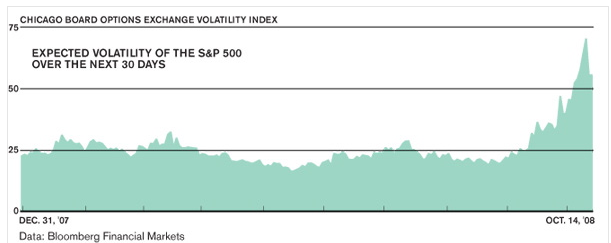
Things are tough all over … Wall Street bonuses fall

November 7, 2008

Excerpted from WSJ, “On Street, the Incredible Shrinking Bonus”, Nov. 4, 2008

* * * * *

Ken’s Qs:

(1) Is it just my imagination or is the market down about 1/3 with most firms crumbled to the ground ?

(2) Wonder why there’s backlash against the top 5% ?

(3) How do these guys sleep at night ?

* * * * *

Among investment bankers who maintain contact with corporate clients but don’t make trading decisions, managing directors could see their bonus fall 50% to between $900,000 and $1.1 million.

Managing directors (who make trading decisions) could see their bonus fall 50% to $750,000 to $950,000. Their base pay is about $200,000 a year.

Bonuses will shrink less in businesses that have held up relatively well. In foreign-exchange trading, a managing director could expect a 15% drop in bonus to $1 million to $1.5 million

Vice presidents with three years of experience could expect a 55% cut in bonus to $200,000 to $250,000, on top of a base of $130,000 to $150,000.

In commodities, where prices surged and then fell, a managing director could see a 25% drop to a bonus of $3.5 million to $4 million.

* * * * *

But at Citigroup.’s Phibro commodities-trading unit, where results topped last year’s performance, Andrew Hall, who runs the unit, is slated to receive compensation for fiscal 2008 topping $125 million, according to people familiar with the firm. Other employees of Phibro, of Westport, Conn., also are getting big payments, these people said.

* * * * *

Source:
http://online.wsj.com/article/SB122593559284203785.html

* * * * *

Want more from the Homa Files?
Click link =>
  The Homa Files Blog

McCain: Hoisted on his own pitard?

November 6, 2008

Note: I love that expression.  See below for what it means.

* * * * *

Ken’s Take:

(1) McCain took on enormous political risk when he pushed campaign funding reform (McCain-Finegold).  Wonder how he’s feeling about that today?

(2) In rough numbers, Obama spent about $6 per vote ; McCain spent about $1.50 per vote.

(3) Next election: it’ll cost $1 billion to ante in.

* * * *  *

Excerpted from McClatchy Newspapers, “Obama spent $250 million on TV ads in general election”, Nov. 6, 2008

Beginning in early June, Obama amassed about $364 million for the fall campaign, Federal Election Commission records show. Obama’s campaign reports already show that he raised a record-shattering $668 million since entering the race last year, with some donations yet to be disclosed.

In contrast, McCain was limited to $84.1 million in public money beginning in early September.

Flush with a tidal wave of campaign donations, Barack Obama spent $250 million on television ads … outspending John McCain and the Republican Party combined by as much as $80 million [i.e. over 40% more].  McCain’s campaign spent about $135 million on TV ads, and the RNC kicked in more than $40 million for coordinated or independently produced pro-McCain or anti-Obama television ads. Obama’s ad spending smashed President Bush’s 2004 record of $188 million on TV ads.

* * * * *

Obama’s decision takes away any incentive for congressional Democrats to pass legislation strengthening the public financing law. Any Republican seeking to challenge Obama in four years will have to ask the question, ‘Can I raise $600 million?”  Federal funding “will remain as a safety net for underfunded ‘populist’ candidates,” but won’t be an option for those who want a serious chance of winning.

* * * * *

Full artcile:
http://www.miamiherald.com/news/politics/AP/story/758740.html

* * * * *

Hoisted on his own pitard

From Yahoo Answers:
“The word is really”petard”.  A  petard was a bell shaped metal container filled with explosives. It was used to blow in gates or breach walls. It was lit with a slowly burning fuse, but there was always the danger of a premature explosion – the chance that you would be hoisted (lifted) by your own petard. It comes from Shakespeare and I think the quote is actually “hoist with his own petar.” (Not “on” – that’s just become the common parlance.) Some sources cite petard as deriving from the French word for “fart.” A different kind of explosion!”

http://answers.yahoo.com/question/index?qid=20070815011415AA667i9

* * * * *

Want more from the Homa Files?
Click link =>
  The Homa Files Blog

The fine difference between a loss and a landslide …

November 6, 2008

Ken’s Take: Does 52-46 really constitute a “landslide” ? 

* * * * *

“Obama ran four points better nationally than John Kerry did in 2004 and 2.5 points better than Al Gore did in 2000. These small changes on the margin meant all the difference between winning and losing [by a “landslide’].

* * * * *
Source: WSJ, “How the President-Elect Did It”, Rove, Nov.  6, 2008
http://online.wsj.com/article/SB122593304225103509.html

* * * * *

Want more from the Homa Files?
Click link =>
  The Homa Files Blog

Oh, those exit polls …

November 6, 2008

Excerpted from WSJ, “How the President-Elect Did It”, Rove, Nov.  6, 2008

* * * * *

For the third election in a row the exit polls were trash.

The raw exit poll numbers forecast an 18-point Obama win.

On average, news organizations (who underwrote the poll) arbitrarily dialed it down to a 10-point Obama edge.

The actual margin was six.

* * * * *
Full article”
http://online.wsj.com/article/SB122593304225103509.html

* * * * *

Want more from the Homa Files?
Click link =>
  The Homa Files Blog

$1.6 billion well spent ?

November 5, 2008

Excerpted from Tech Ticker, Nov. 4, 2008

* * * * *

According to the Center for Responsive Politics, a record $1.6 billion was raised by all Presidential candidates during this interminably long campaign. (The New York Times says the figure could go as high as $2 billion by Election Day.)

What else could $1.6 billion buy ?

  • Health insurance for over 130,000 families of four for one year (based on average cost of $12,000 per family per year, National Coalition on Health Care)
  • Food for 145,000 families of four for one year (based on moderate cost of $9,500 per family per year, USDA)
  • 8 million laptops for the One Laptop Per Child initiative (at $200 each, OLPC)
  • Fill the gas tank of an average car 40 million times (based on car with a 15-gallon tank with gas at $2.60/gallon)
  • Provide a great cable package for 1.3 million households for one year (Time Warner NYC cable/Internet with one premium channel)

Looking at those stats, you’d think there’d be no debate about whether the $1.6 billion was money well spent.

http://finance.yahoo.com/tech-ticker/article/105994/Most-Expensive-Campaign-Ever-What-Else-Could-1.6B-Have-Bought?tickers=%5Edji,%5Egspc,%5Eixic,SPY,DIA,QQQQ,TLTI

* * * * *

Want more from the Homa Files?
Click link =>
  The Homa Files Blog

For the Record: Ken’s Election Predictions

November 4, 2008

OK, here’s what I think is going to happen.  What do you think ?  Post your predictions.

The Election

  1. The popular vote will be fairly close — at most a 3 point differential  — probably 51% Obama to 48% McCain, with 1% to the nuisance candidates.
  2. Of course, the electoral college will be determined in the battleground states.  I think one of two “all or nothing” scenarios are likely : (1) McCain comes up an inch short in most battlegrounds and Obama wins by a landslide, or (2) McCain eeks out wins in all battlegrounds — excluding Colorado, but including Pennsylvania — and McCain wins it. On Saturday Nov.1, I was leaning towards scenaio (1) — an electoral landslide for Obama. Today I’m officially declaring that I think scenario (2) will materialize and McCain will win an upset victory. Why ? Last week’s mini-rally eased some of the Wall Street angst, Catholics are breaking for McCain, “bankrupt the coal industry” woke up Pennsylvania and Ohio, Obama’s Hispanic lead is big but dissipating some,  rurals and white men are coming out of the woodwork, both the NRA and Chamber of Commerce are rallying troops under the radar for McCain, and the GOP’s well-honed micro-marketing turnout machine is quietly at work. 
  3. Dems will get to 57 Senate seats. Al Franken & Elizabeth Dole will both lose.  Ted Stevens will win.

* * * *

The Stock Market

  1. If McCain wins, the Dow will close over 10,000 on Wednesday. 
  2. If Obama wins and the Dems reach 60 Senate seats, the Dow will fall more than 1,000 points on Wednesday — the largest 1-day stock market drop in history — closing below 8,000.
  3. If Obama wins, and the Dems fail to reach a 60 in the Senate, the Dow will close Wednesday below 9,000 — will hit 7,500 before the end of the year — will fight back to around 10,000 — and will hover around 10,000 for a long, long time.

* * * * *

Sure Shots 
  1. If McCain wins, the World will shake its collective head in disgust and  liberals will claim racism, pointing to McCain’s 60% of the white vote while conveniently ignoring Obama’s 90% of the black vote.
  2. If Obama wins, the World will rejoice and the GOP will claim ACORN-induced voter fraud
  3. Regardless who wins, the country will be split down the middle and political  rancor will run high.
  4. Regardless who wins, they’ll claim that Bush left an even worse economic mess than they expected and will start watering down campaign promises.
  5. Regardless who wins, government spending will continue unabated, the deficit will loom large, and the national debt will continue to grow by leaps and bounds.
  6. Regardless who wins, all U.S. combat forces will be out of Iraq by the end of 2009; Afghanistan will be an escalating quagmire ; Osama Bin Laden will not be captured (though he may die of old age).
  7. Regardless who wins, Warren Buffett  will pay a lower tax rate than his secretary in 2009.

* * * **

Random Stuff

  1. If Obama wins, the IOC will give the 2016 Olympics to Chicago.  (thanks to Jamie Estrada, MSB MBA alum for the tip)
  2. If Obama wins, Hillary Clinton will get her coveted Supreme Court seat; if he loses, she’ll be the 2012 Dem candidate for President and win it all.
  3. If Obama loses, Bill Richardson will move to Mexico.
  4. Ted Stevens will resign his Senate post in a plea deal, and — if McCain loses — Gov. Palin will self-appoint to the Senate after punishing the folks who thought  trooper-gate was a clever campaign tactic.
  5. Joe the Plumber will make more that $250,000 — just off his book rights and TV deal.
  6. The 2012 campaign will start tomorrow …

* * * * *

Want more from the Homa Files?
Click link =>
 
The Homa Files Blog


Poor old Warren Buffett

November 4, 2008

Excerpted from AP, “CEOs, famous investors hit hard by market plunge”, Nov. 2, 2008

* * * * *

The Standard & Poor’s 500 stock index, has lost about 36 percent since January, with every single sector – including once thriving energy and utilities – seeing declines of about 20 percent or more.

Such losses in the last year have wiped out an estimated $2 trillion in equity value from 401(k) and individual retirement accounts, nearly half the holdings in those plans. Similar losses are seen in the portfolios of private and public pension plans, which have lost $1.9 trillion, the researchers found.

* * * * *

Here’s something that might provide a bit of solace amid the plunging values in your retirement accounts: Warren Buffett is losing lots of money, too. So are Kirk Kerkorian, Carl Icahn and Sumner Redstone.

And they can’t just blame the market’s downdraft – some did themselves in with badly timed stock purchases or margin calls on shares bought with loans.

* * * * *

The average year-to-date decline is 49 percent for the corporate stock holdings of CEOs .

Topping that list is Buffett, who has seen the value of equity in his company, Berkshire Hathaway, fall by about $13.6 billion, or 22 percent, so far this year, to leave his holdings valued at $48.1 billion.

Oracle founder and CEO Larry Ellison has seen his equity stake fall by $6.2 billion, or about 24 percent, to $20.1 billion.

Rounding out the top five in that study were Microsoft’s Steve Ballmer, whose company equity fell by $5.1 billion to $9.4 billion; Amazon.com’s Jeff Bezos, whose equity fell by $3.6 billion to $5.7 billion; and News Corp.’s Rupert Murdoch, with a $4 billion contraction to $3 billion.

* * * * *

“Fishing isn’t called catching, and investing isn’t just called making money,” Hansen said. “We have to remember that things can go down by a lot.”

* * * * *

Full article:
http://www.forbes.com/feeds/ap/2008/11/02/ap5636866.html?partner=alerts

* * * * *

Want more from the Homa Files?
Click link =>
  The Homa Files Blog

An Oprah Endorsement ROI – Kindle Gets a Bump

November 4, 2008

Excerpted from Ad Age “Kindle Offers Glimpse of ROI on Oprah” by Abbey Klaasen, November 3, 2008 

* * * * *

Since Amazon launched the Kindle, its electronic reader, a year ago, it has created a swarm of dedicated customer advocates. But on Oct. 24 it snagged the most important evangelist in Oprah Winfrey, who said, “I’m telling you, it’s absolutely my new favorite thing in the world.”

Oprah’s Midas touch when it comes to selling books is well-documented, so it seems reasonable that the same would be true for Kindle.

6%: The amount Amazon’s visits were up the day Oprah endorsed Kindle on her show…Amazon is a top-20 internet site — so a 6% bump can translate into hundreds of thousands of visitors.

3.1 MIL: The number of unique visitors to Oprah.com in September, according to Compete. The Kindle endorsement also drove traffic to her site.. 

80%: The percentage of blog posts about Kindle since Oct. 23 that have mentioned Oprah’s endorsement, according to BuzzLogic. About half mentioned the discount Amazon was offering until Nov. 1 — the discount code being oprahwinfrey.  

479%: The bump in search traffic for the word “kindle” the day Oprah threw her support behind the product, according to Google Insights. 

15,458%: The bump in U.S. web traffic from Oprah.com to Amazon.com, per Hitwise, between Oct. 23 and Oct. 24. 

$35.90: How much an Amazon affiliate can earn per Kindle sale, if it is part of the program that shares revenue when a consumer clicks through those links and buys on Amazon. That’s 10% of the purchase price. Oprah could be making a pretty penny on Kindles if she was part of the affiliate program — but she isn’t.  

Edit by SAC  

* * * * *
Full article:
http://adage.com/digital/article?article_id=132194

* * * * *

Want more from the Homa Files?
Click link =>
The Homa Files Blog

An election trend to watch before declaring victory or conceding defeat …

November 3, 2008

I was about to concede on behalf of John McCain today (Sunday).  Then, a number caught my eye.  With other polls hovering around  a 5 or 6 point Obama lead, the IBD-TIPP poll (the most accurate in 2004) showed a continuing closing of the gap — to 2 points.

So, I dug down into the ‘internals’ of the poll.  Lo and behold here’s what I found.

Way back on October 22, I posted “5 Factors to Watch as the Campaigns Close”
https://kenhoma.wordpress.com/2008/10/22/for-the-record-5-factors-to-watch-as-the-campaigns-close/

* * * * *

Catholics were at the top of the list on Oct. 22 :

Catholics

According to IBD/TIPP (the most accurate poll in the 2004 election), Catholics are currently favoring Obama over McCain 47% to 43%
http://ibdeditorials.com/Polls.aspx?id=309299583450546

Ken’s Take: Watch this shift as Catholic bishops remind church goers that the sanctity of life is a fundamental tenet of the Church.  The abortion debate has been back-burnered, watch it heat up

* * * * *

Well, look what’s happened in the past week:

image

Bottom line: According to IBD-TIPP, McCain has gained 7 points among Catholics; Obama is down 6 in the past week and down 9 from his high water mark of 47%.  So, the current gap is 13 and the trend appears to be in McCain’s favor. And, there are still 10% undecideds.

That’s probably why McCain has been spending a lot of time in Pennsylvania — a state with a lot of rural voters who support him and a lot of Catholics who seem to be swinging his way.

How can the trend be explained?  Well, many Catholic bishops have been explicitly clarifying the Church’s standing on some pivotal issues, and a 527 called the GOP Trust has been blanketing swing states with a hard-hitting Rev. Wright TV spot. To view it:  http://nationalrepublicantrust.com/ 

It’ll be interesting to see how this plays out on Tuesday..

* * * * *

Want more from the Homa Files?
Click link =>
  The Homa Files Blog

Bankrupt the coal industry ?

November 3, 2008

Sourced from Newsbusters.com, Nov.2, 2008.  Well-traveled on right-leaning stations and sites this weekend.

* * * * *

Ken’s Take

McCain’s persistence in Pennsylvania has had me scratching my head.  I think the code was broken this weekend. In another post lthis morning, I recount data that seems to indicate a shift in Catholic voters towards McCain (Obama had been leading).  Perhaps even more significant is an audio clip of an interview that Obama gave saying that his energy policy will “bankrupt the coal industry”.  That may be the right answer environmentally, but the wrong answer politically in some swing states that rely on coal for jobs and energy.

Hearing the words is way more powerful than reading the transcript (which is below).
http://www.youtube.com/watch?v=Hdi4onAQBWQ

* * * * *

From Newsbusters

Barack Obama actually flat out told the San Francisco Chronicle (SF Gate) that he was willing to see the coal industry go bankrupt in a January 17, 2008 interview.

The result? Nothing. This audio interview has been hidden from the public…until now. Here is the transcript of Obama’s statement about bankrupting the coal industry:

Obama: ” Let me sort of describe my overall policy.

What I’ve said is that we would put a cap and trade system in place that is as aggressive, if not more aggressive, than anybody else’s out there.

I was the first to call for a 100% auction on the cap and trade system, which means that every unit of carbon or greenhouse gases emitted would be charged to the polluter. That will create a market in which whatever technologies are out there that are being presented, whatever power plants that are being built, that they would have to meet the rigors of that market and the ratcheted down caps that are being placed, imposed every year.

So if somebody wants to build a coal-powered plant, they can; it’s just that it will bankrupt them because they’re going to be charged a huge sum for all that greenhouse gas that’s being emitted.”

Article source:
http://newsbusters.org/node/25829?q=blogs/p-j-gladnick/2008/11/02/hidden-audio-obama-tells-sf-chronicle-he-will-bankrupt-coal-industry

Audio link:
http://www.youtube.com/watch?v=Hdi4onAQBWQ

* * * * *

Want more from the Homa Files?
Click link =>
  The Homa Files Blog

Where McCain & Obama stand on economic issues

November 3, 2008

Source: CNNMoney.com , Oct. 31, 2008
http://finance.yahoo.com/banking-budgeting/article/106069/Your-Money:-McCain-vs.-Obama#1

* * * * *

The best recap I’ve found — gives Obama some ‘benefits of doubt’, but is generally a factual and balanced presentation of the candidates’ positions.  It’s long, but it’s required reading for responsible voters

* * * * *

Budget Deficit

Now that the government has committed over $1 trillion to stabilize the financial system and economic growth is expected to slow, the country’s growing deficits aren’t something the next president can ignore. Yet neither candidate has adequately addressed what changes he would make to accommodate the new fiscal reality. Both men speak of the need to restore fiscal responsibility while in the same breath promising more tax cuts and proposing spending cuts that are hard to achieve.

Obama

Enforce budget rules that would require that new spending be paid for by cuts to other programs or new revenue.
Reduce spending on earmarks to no greater than 2001 levels and require more transparency on such spending.
Help pay for new proposals by drawing down troops in Iraq war, raising taxes on high-income filers and cutting certain corporate loopholes.
“Once we get through this economic crisis … we’re not going to be able to go back to our profligate ways. We’re going to have to embrace a culture and an ethic of responsibility, all of us, corporations, the federal government, and individuals out there who may be living beyond their means.”

McCain

Originally pledged to balance budget by 2013. But McCain adviser now says it will take longer.
Slow growth in Social Security, Medicare and Medicaid spending.
Eliminate funds for pet projects, known as earmarks.
Help pay for tax cuts by creating new jobs in the clean energy sector and developing new automotive technologies, which in turn will boost economic growth.
“Government spending has gone completely out of control; $10 trillion dollar debt we’re giving to our kids, a half-a-trillion dollars we owe China. I know how to save billions of dollars in defense spending. I know how to eliminate programs.”

* * * * *

Economic Crisis Response

Both candidates have proposed measures to help Americans cope with the economic downturn and stock market collapse. McCain’s proposals focus on helping seniors and investors. Obama wants to let savers tap into the retirement plans without early-withdrawal penalties.

Obama

Temporarily allow penalty-free early withdrawals from IRAs and 401(k)s of up to 15% of the balance but not more than $10,000.
Temporarily suspend rule that seniors age 70 1/2 take required annual distribution from retirement account.
Give temporary tax credit of $3,000 in 2009 and 2010 to companies for each new full-time employee it hires in the United States.
Temporarily eliminate taxes on unemployment benefits.
Require financial institutions participating in bailout to put a 90-day moratorium on foreclosures for homeowners “acting in good faith.”
Let federal government lend to state and municipal governments to help counter the budget crunch faced by states due to the mortgage crisis.
“We must move forward, quickly and aggressively, with a middle-class rescue plan that will create jobs, provide relief to families, help homeowners and restore our financial system.”

McCain

Temporarily suspend rule that seniors age 70 1/2 take required annual distribution from retirement account.
Tax withdrawals of up to $50,000 from IRAs and 401(k)s at 10% in 2008 and 2009.
Reduce capital gains tax to 7.5% from 15% for two years.
Increase amount of capital losses that may be used to offset ordinary income to $15,000 from $3,000 for 2008 and 2009.
Temporarily eliminate taxes on unemployment benefits.
Buy bad mortgages and renegotiate loan terms based on current value of home.
Convert failing mortgages into low-interest, FHA-insured loans.
“…I will help to create jobs for Americans in the most effective way a president can do this — with tax cuts that are directed specifically to create jobs, and protect your life savings.”

* * * * *

Wall Street

In the wake of the credit crisis, both candidates have stressed the need for greater transparency and imposing capital requirements on financial institutions.

Obama

Impose liquidity and capital requirements on investment banks.
Streamline regulatory framework of the financial services sector.
Create an oversight commission that would advise the president, Congress and regulators on the health of and risks facing financial markets.
Give Federal Reserve supervisory power over any bank that borrows from it.
“Let me be clear: the American economy does not stand still, and neither should the rules that govern it. The evolution of industries often warrants regulatory reform…”

McCain

Increase capital requirements on financial institutions.
Remove some of the regulatory, accounting and tax impediments to raising capital.
Examine how banks and other firms value assets that exacerbated the credit crunch.
Increase transparency of complex financial instruments.
“Capital markets work best when there is both accountability and transparency. In the case of our current [credit] crisis, both were lacking.”

* * * * *

Mortgage Giant Rescue

Both candidates supported the federal government takeover of the mortgage insurance giants since they’re central to the housing market.

Obama

Wants to void any inappropriate windfall payments to outgoing CEOs and senior management.
Says shareholders should not benefit in takeover.
Had said companies should either operate as goverment agencies or as private businesses.
“I recognize that intervention is necessary to maintain liquidity for the housing market so that homeowners can continue to get affordable mortgages and homes can be bought and sold in neighborhoods across the country.”

McCain

Called for reform of corruption at Fannie Mae and Freddie Mac two years ago.
Wants to clarify and unify regulatory authority of financial institutions, including the mortgage insurers.
“These quasi-public corporations lead our housing system down a path where quick profit was placed before sound finance…And now, as ever, the American taxpayers are left to pay the price for Washington’s failure.

* * * * *

Mortgage Fraud

Both candidates say they want to go after predatory lenders. Obama introduced the STOP FRAUD Act in the Senate and now it’s a part of his platform. McCain called for creating a task force to investigate criminal wrongdoing in the mortgage lending and securitization industry.

Obama

Boost funding for law enforcement programs aimed at housing fraud by $40 million.
Establish new federal criminal penalties for mortgage professionals found guilty of fraud.
Require lending professionals to report suspicious or fraudulent activity.
Establish a database of censured or debarred mortgage professionals, so borrowers can easily check the credentials of lenders.
Establish a standardized estimate of the total annualized cost of a mortgage loan to make it easier for borrowers to compare different loans.
“We must establish stiff penalties to deter fraud and protect consumers against abusive lending practices.”

McCain

Create a Justice Department task force that punishes individuals or firms that defrauded innocent homeowners or forged loan application documents.
Task force would also assist state attorneys general investigating abusive lending practices.
Improve transparency in the lending process so that borrowers know exactly what they are agreeing to.
“Lenders who initiate loans should be held accountable for the quality and performance of those loans and strict standards should be required in the lending process.”

* * * * *

Jobs and Wages

McCain’s plan for turning around the economy focuses on corporate tax policy, while Obama would take a more activist role that includes increasing wages and spending on public works.

Obama

Fund federal workforce training programs and direct these programs to incorporate “green” technologies training.
Raise minimum wage to $9.50 an hour by 2011 and tie future rises to inflation.
Double federal funding for basic research and make R&D tax credit permanent.
Set up $60 billion infrastructure investment bank to help fund public works. Also, create a $25 billion emergency Jobs and Growth Fund to fund other infrastructure projects.
Establish tax credit for companies that maintain or increase the number of full-time workers in America relative to those outside the U.S.
Give a temporary tax credit of $3,000 in 2009 and 2010 to companies for each new full-time employee it hires in the United States.
Temporarily eliminate taxes on unemployment benefits.
Advocate for stronger unionization.
“We will provide incentives to businesses and consumers to save energy and make buildings more efficient. That’s how we’re going to create jobs that pay well and can’t be outsourced.”

McCain

Spur economy and job growth by cutting corporate tax rate and temporarily lowering current rates on dividends and capital gains.
Leave minimum wage at $7.25 an hour, which is where current law will take it to by 2009. Opposed to tying future hikes to inflation rate.
Create tax credit equal to 10% of wages spent on R&D.
Consolidate federal unemployment programs and reform training programs for job seekers.
Temporarily eliminate taxes on unemployment benefits.
“We will build a new system, using the unemployment-insurance taxes to build for each worker a buffer account against a sudden loss of income — so that in times of need they’re not just told to fill out forms and take a number.”

* * * * *

Savings

Obama wants the government to augment low- and middle-income workers’ savings. McCain would help retirees keep their savings.

Obama

Require employers that don’t offer retirement plans to set up IRA-type accounts.
Require companies to automatically enroll their employees in 401(k)s or IRAs.
Provide a federally funded match on retirement savings for families earning below $75,000.
Temporarily suspend mandatory withdrawals from retirements accounts for senior citizens age 70 1/2 and older.
“Personal saving is at an all-time low. A part of the American dream is at risk.”

McCain

Require companies to automatically enroll their employees in retirement plans they offer.
Encourage saving by keeping investment taxes low.
Temporarily suspend mandatory withdrawals from retirements accounts for senior citizens age 70 1/2 and older.
“As president, I intend to act quickly and decisively to promote growth and opportunity. I intend to keep the current low income and investment tax rates.”

* * * * *

Driving

Both candidates want to make every gallon count. Government prizes are pivotal to McCain’s plan, while Obama wants to place more stringent requirements on automakers.

Obama

Double fuel economy standards within 18 years while maintaining current flexibility.
Offer $7,000 tax credit to buyers of plug-in hybrids.
Mandate all new cars be flex-fuel capable.
Provide $4 billion in retooling credits and loans to help domestic manufacturers switch to more fuel-efficient cars.
Aim to get 1 million 150 mile-per-gallon plug-in hybrids on the roads within six years.
Support creation of more transit-friendly communities and level employer commuting assistance for driving and public transit.
“I have a plan to raise the fuel standards in our cars and trucks with technology we have on the shelf today — technology that will make sure we get more miles to the gallon.”

McCain

Raise penalties car companies pay for violating Corporate Average Fuel Economy (CAFE) standards.
Offer $5,000 tax credit for every customer who buys a zero-emission car.
Speed introduction of “flex-fuel vehicles” that can run on ethanol blends and gasoline.
Remove or reduce tariffs on imported ethanol.
Award $300 million prize to the company that can produce a plug-in hybrid battery technology at 30% of current costs, allowing commercial development of plug-in hybrid cars.
“…Our government has thrown around enough money subsidizing special interests and excusing failure. From now on, we will encourage heroic efforts in engineering, and we will reward the greatest success.”

* * * * *

Gas Prices

The candidates agree that consumers need help with sky-high fuel bills, but they have different plans for offering relief.

Obama

Keep gas tax in place.
Keep ethanol tariff to protect domestic industry.
Tax oil profits and use the money to help fund $1,000 rebate checks for consumers hit by high energy costs.
Eliminate oil and gas loopholes.
“I realize that gimmicks like the gas tax holiday and offshore drilling might poll well these days. But I’m not running for president to do what polls well…”

McCain

Repeal the 54-cents-a-gallon tariff on imported ethanol.
Eliminate a current tax break for oil companies, but lower corporate taxes across the board.
“The effect [of a gas tax holiday] will be an immediate economic stimulus — taking a few dollars off the price of a tank of gas every time a family, a farmer, or trucker stops to fill up.”

* * * * *

Fighting Foreclosure

Obama wants the government to step in to help homeowners facing foreclosure. McCain unveiled rescue plan in October debate.

Obama

Allow troubled homeowners to refinance to a loan insured by the Federal Housing Administration.
Require any financial institution participating in Treasury’s Troubled Asset Relief Program to put a 90-day moratorium on foreclosures for homeowners “acting in good faith.”
Create a 10% tax credit for homeowners who do not itemize their taxes.
Create a $10 billion fund to help victims of predatory loans.
Create a separate $10 billion fund to help state and local governments maintain critical infrastructure.
Authorize bankruptcy judges to reduce mortgage principal.
“…If the government can bail out investment banks on Wall Street, then we can extend a hand to folks who are struggling on Main Street.”

McCain

Buy bad mortgages and renegotiate loan terms based on current value of home. Convert failing mortgages into low-interest, FHA-insured loans.
Offer of financial assistance to borrowers contingent upon lending reform.
Provide more funding for community development groups so they can expand their home rescue efforts.
“The United States government will support the refinancing of distressed mortgages for homeowners and replace them with manageable mortgages.”

* * * * *

Personal Taxes

Both candidates favor keeping some or all of the Bush tax cuts in place. Wealthy taxpayers win out under McCain’s plan, while lower-income earners benefit more under Obama’s proposals.

Obama

Leave all tax cuts in place for everyone except couples making more than $250,000 and single filers making more than $200,000. Those high-income groups would see their top two income tax rates revert to 36% and 39.6% from 33% and 35% respectively.
Provide $1,000 tax cut for working couples making less than $250,000.
Introduce other tax breaks for lower and middle-income households.
“We shouldn’t be distorting our tax code to benefit a few powerful interests — we should be insisting that everyone pays their fair share, and when I’m president, they will.”

McCain

Make 2001 and 2003 tax cuts permanent for everyone.
Permanently repeal the Alternative Minimum Tax, the so-called “wealth tax” that threatens the middle class.
“I will…propose…a middle-class tax cut — a phase-out of the Alternative Minimum Tax to save more than 25 million middle-class families as much as $2,000 in a single year.”

* * * * *

Taxing Wealth

McCain would apply a lighter hand to taxes paid by the wealthy than would Obama, who wants to make the tax code more progressive.

Obama

Tax carried interest as ordinary income rather than as an investment gain, thereby subjecting it to much higher tax rates than 15%.
Freeze the exemption amount of estates free from the estate tax at $3.5 million — where it will be in 2009.
Freeze top estate tax rate at 45%.
Raise capital gains and dividend tax rates to 20% from 15% for couples making more than $250,000 and singles making more than $200,000.
“We’ve lost the balance between work and wealth. I will close the carried interest loophole, and adjust the top dividends and capital gains rate…”

McCain

Preserve the 15% tax rate on carried interest – the cut that private equity and hedge fund managers take when the funds they manage make a profit.
Increase the amount of money exempt from the estate tax to $5 million.
Reduce the top estate tax rate to 15% from 55% – where it otherwise will be in 2011 under current law.
Reduce long-term capital gains rate to 7.5% for 2009 and 2010. Keep short-term capital gains and dividend tax rates where they are.
Increase the amount of capital losses which can be used in tax years 2008 and 2009 to offset ordinary income from $3,000 to $15,000.
“Sharply raising taxes on investment is a step in the wrong direction for the competitiveness of U.S. capital markets.”

* * * * *

Taxing Business

McCain is generally considered to be more friendly to Corporate America than is Obama, who wants to increase some companies’ tax bite in a few ways.

Obama

Consider reducing the corporate tax rate in conjunction with closing corporate tax loopholes.
Make R&D credit permanent.
Impose windfall profits tax on oil and gas companies.
Exempt investors from the capital gains tax on their investments in small businesses and startups if they made their investment when a small company was valued below a certain threshold. That threshold has yet to be defined.
Make renewable production credit permanent.
Require companies to verify transactions that have benefits other than their tax benefits.
“…We can’t just focus on preserving existing industries. We have to be in the business of encouraging new ones — and that means science, research and technology.”

McCain

Reduce corporate tax rate to 25% from 35%.
Make R&D credit permanent, but change formula.
Repeal several oil company tax breaks.
Accelerate business expense deductions.
Broaden corporate base.
“Serious reform is needed to help American companies compete in international markets. I have proposed a reduction in the corporate tax rate from the second highest in the world to one on par with our trading partners.”

* * * * *

Small Business

While both candidates promise to help entrepreneurs with friendly tax policies, they differ sharply on how much of the tab for employees’ health insurance and other benefits they expect fledgling businesses to pick up.

Obama

Expand the SBA’s direct-lending Disaster Loan Program to extend loans to companies affected by the economic downturn and credit crunch.
Temporarily eliminate fees and increase the amount guaranteed by the government through the SBA’s 7(a) and 504 programs, which insure lenders against defaults on small business loans.
Extend the stimulus act’s Section 179 tax deduction, which increased the amount businesses can write off on their taxes for capital investments in new equipment, through 2009.
Exempt investors from the capital gains tax on their investments in small businesses and startups if they made their investment when a small company was valued below a certain threshold. That threshold has yet to be defined.
Offer a 50% refundable credit for employee health insurance premiums paid by the employer.
Freeze estate tax rate at 45% and increase exemption to $3.5 million.
“We’ll work, at every juncture, to remove bureaucratic barriers for small and startup businesses.”

McCain

Allow small businesses first-year expensing of new equipment and technology purchases.
Establish a permanent tax credit equal to 10% of what a business spends on wages for research and development.
Issue tax credits to allow individuals to purchase personal, portable health insurance that can move with them from job to job.
Reduce the corporate income tax rate to 25% from 35%.
Cut estate tax rate to 15% and increase exemption to $5 million.
“…I will pursue tax reform that supports the wage-earners and job creators who make this economy run, and help them to succeed in a global economy.”

* * * * *

Free Trade

Both McCain and Obama say they are in favor of free trade. McCain has been a stronger defender of free trade agreements, while Obama has been a more vocal critic.

Obama

Work to renegotiate NAFTA, the free trade agreement with Canada and Mexico.
Opposes the free trade agreements with South Korea and Colombia.
Use trade agreements to spread good labor and environmental standards around the world.
Supports steep tariffs on imports from China if the Chinese keep their currency from rising.
Increase and expand assistance offered to workers who lose jobs due to trade and create flexible education accounts to help workers retrain.
“Allowing subsidized and unfairly traded products to flood our markets is not free trade and it’s not fair. We cannot let foreign regulatory policies exclude American products. We cannot let enforcement of existing trade agreements take a backseat to the negotiation of new ones.”

McCain

Back additional trade agreements and engage in multilateral, regional and bilateral efforts to reduce barriers to trade.
Supports the free trade agreements negotiated with South Korea and Colombia which are now awaiting Senate approval.
Would not threaten to impose tariffs on Chinese imports here if China does not allow the value of its currency, the yuan, to rise against the dollar.
Improve efforts to provide retraining for those who lose their jobs due to imports.
“If I am elected president, this country will honor its international agreements, including NAFTA, and we will expect the same of others. And in a time of uncertainty for American workers, we will not undo the gains of years in trade agreements now awaiting final approval.”

* * * **

Energy Security

The candidates agree on the need to reduce dependence on foreign oil and cut greenhouse gases. Both support a carbon “cap-and-trade” system where companies either pay to pollute or invest in cleaner technology.

Obama

Work to reduce carbon emissions 80% below 1990 levels by 2050.
Invest $150 billion in renewable energy over the next 10 years.
Allow limited amount of offshore drilling.
Require that 10% of nation’s energy comes from renewable sources by 2013.
Aim to reduce nation’s demand for electricity 15% by 2020.
“To bring about real change, we’re going to have to make long-term investments in clean energy and energy efficiency.”

McCain

Work to reduce carbon emissions 60% below 1990 levels by 2050.
Use mix of free market, government incentives and a lower corporate tax rate to foster renewable energy.
Lift ban on offshore drilling.
Commit $2 billion annually to advance clean coal technologies.
Construct 45 new reactors by 2030 as part of a push to expand nuclear power production.
“…When it comes to energy, what we really need is to produce more, use less, and find new sources of power.”

* * * * *

Health Care

McCain would rely most heavily on individuals and the free market to lower costs, while Obama would rely more on government and mandates to make coverage affordable.

Obama

Coverage would be mandatory for children.
Offer an income-based federal subsidy for people who don’t get insurance from an employer or qualify for government plans like Medicaid.
Create a national network of public and private plans for those without other access to insurance.
Require employers to either offer a plan, help pay for employee costs or pay into a national health care network.
“…We need to pass a plan that lowers every family’s premiums, and gives every uninsured American the same kind of coverage that members of Congress give themselves.”

McCain

Coverage would not be mandatory for anyone.
Change how health care subsidies are taxed.
Offer refundable tax credit for anyone who buys health insurance.
Create a federally subsidized state-administered program to offer coverage for low-income people.
“I’ve made it very clear that what I want is for families to make decisions about their health care, not government…”

* * * * *

Medicare

Rising health care costs are pushing Medicare toward an unsustainable long-term deficit nearly 5 times that of Social Security. Both candidates say their efforts to reduce health care costs will help stabilize Medicare. What few Medicare proposals they’ve made aren’t sufficient to address the shortfall, health care experts say.

Obama

Would let government negotiate for Part D drug prices.
Would increase use of generic drugs in Medicare.
Wants to close the coverage gap known as the “doughnut” hole in Part D for reimbursement of prescription drugs.
Favors eliminating subsidies paid to private Medicare Advantage plans.
Wants to legalize importation of some prescription drugs.
“As president, I will reduce costs in the Medicare program by enacting reforms to lower the price of prescription drugs, ending the subsidies for private insurers in the Medicare Advantage program and focusing resources on prevention and effective chronic disease management.”

McCain

Wants wealthy people who are enrolled in the Part D drug coverage program to pay more.
Wants to reform the payment system so health care providers don’t get paid when medical errors or mismanagement occurs.
Favors importing low-cost prescription drugs from Canada.
“People like Bill Gates and Warren Buffett don’t need their prescriptions underwritten by taxpayers. Those who can afford to buy their own prescription drugs should be expected to do so.”

* * * * *

Social Security

To help shore up the system, McCain favors individual accounts and reducing benefit growth. Obama prefers to raise taxes.

Obama

Opposes individual investment accounts.
Against raising retirement age.
Favors increasing the amount that workers making $250,000 or more pay into the system. Considering plan to tax income over $250,000 at between 2% and 4% – half of which would be paid for by the employee and half by the employer.
“We will not privatize Social Security, we will not raise the retirement age, and we will save Social Security for future generations by asking the wealthiest Americans to pay their fair share.”

McCain

Supplement Social Security benefits with individual investment accounts.
Prefers slowing the growth in benefits to raising taxes.
“…You have to go to the American people and say…we won’t raise your taxes. We need personal savings accounts, but we [have] got to fix this system.”

* * * * *

Bankruptcy

Obama wants to reform the bankruptcy process and has proposed changes to help those in financial distress. As a Senator, McCain voted in favor of legislation aimed at curbing the growing number of bankruptcy filings.

Obama

Fast-track bankruptcy process for military families.
Help seniors facing bankruptcy keep their home.
Put pension promises higher on list of debts a bankrupt employer must pay.
Amend bankruptcy laws to protect people trapped in predatory home loans.
“I fought against a bankruptcy reform bill in the Senate that did more to protect credit card companies and banks than to help working people. I’ll continue the fight for good bankruptcy laws as President.”

McCain

Backed 2005 legislation that imposed new costs on those seeking bankruptcy protection.
The law, which Obama opposed, passed the Senate with Democratic support in 2005.

* * * * *

Want more from the Homa Files?
Click link =>
  The Homa Files Blog

Marketing – Destroying Starbuck’s Brand Value

November 3, 2008

Excerpted from: “Starbucks: How Growth Destroyed Brand Value” by Prof. John Quelch, HBS Online / BusinessWeek Online

Founder and CEO Howard Schultz had a great concept, and it worked for a while. But too many new stores and diverse products changed the experience … Schultz recognized (that) … “Stores no longer have the soul of the past and reflect a chain of stores vs. the warm feeling of a neighborhood store.”

(Now) Starbucks is a mass brand attempting to command a premium price for an experience that is no longer special. Either you have to cut price (and that implies a commensurate cut in the cost structure) or you have to cut distribution to restore the exclusivity of the brand … Sometimes, in the world of marketing, less is more … Growth targets undermined the Starbucks brand in three ways.

First, the early adopters who valued the club-like atmosphere of relaxing over a quality cup of coffee found themselves in a minority. To grow, Starbucks increasingly appealed to grab and go customers for whom service meant speed of order delivery rather than recognition by and conversation with a barista … many Starbucks veterans have now switched to Peets, Caribou and other more exclusive brands.

Second, Starbucks introduced many new products to broaden its appeal. These new products undercut the integrity of the Starbucks brand for coffee purists. They also challenged the baristas who had to wrestle with an ever-more-complicated menu of drinks. With over half of customers customizing their drinks, baristas hired for their social skills and passion for coffee, no longer had time to dialogue with customers. The brand experience declined as waiting times increased. Moreover, the price premium for a Starbucks coffee seemed less justifiable for grab and go customers as McDonald’s and Dunkin Donuts improved their coffee offerings at much lower prices.

Third, opening new stores and launching a blizzard of new products create only superficial growth … Eventually, the point of saturation is reached and cannibalization of existing store sales undermines not just brand health but also manager morale.

None of this need have happened if Starbucks had stayed private and grown at a more controlled pace. To continue to be a premium-priced brand while trading as a public company is very challenging. Tiffany faces a similar problem. That’s why many luxury brands like Prada remain family businesses or are controlled by private investors. They can stay small, exclusive and premium-priced by limiting their distribution to selected stores in the major international cities. ”

* * * * *

Ken’s Take:

1. Nice synopsis of Starbuck’s current position and challenges.

2. The issue is strategic discipline — not private vs. public ownership.

3. Eventually, you run out of folks who are willing (and able) to shell out $5 for a cup of coffee that keeps losing taste tests to both Mickey D and Dunkin’ Donuts. And, as budgets tighten, brand panache starts to look like wateful spending.

4. Things are likely to go from bad to worse as stores close and Barista “partners” confront job insecutity — so much for kumbaya.

5. Still, you have to hand it to these guys for their spectacular run.

* * * * *

Note: Prof. Quelch wrote a series of cases on Black & Decker marketing, including the classic “B&D Brand Transition”

Source: BusinessWeek Online / Harvard Business Online,
July 9, 2008         For full article:
http://businessweek.com/managing/content/jul2008/ca2008079_888377.htm?chan=top+news_top+news+index_news+%2B+analysis

Thanks to MSB-MBA alum Suhrud Atre for the heads-up on the article

Want more from the Homa Files?
 
Click link =>  The Homa Files Blog


The runaway train and other musings …

October 31, 2008

Some things to think about ….

* * * * *

“Whoever is elected Tuesday, his freedom in office will be limited. Mr. Obama is out of money and Mr. McCain is out of army, so what might be assumed to be the worst impulses of each — big spender, big scrapper — will be circumscribed by reality.”

“For Mr. Obama, whose mind tends, as intellectuals’ minds do, toward the abstract, it all seems so . . . abstract. And cold. And rather suggestive of radical departures.”

From WSJ,  Obama and the Runaway Train, Oct. 31, 2008
http://online.wsj.com/article/SB122539802263585317.html

* * * * *

“Bush’s failure should not be counted as a failure of markets or capitalism. And even if it were, history shows us that the failures of capitalism are a lot more fun than the absence of capitalism.”

“You know, once upon a time, the stated purpose of taxation was to fund public needs — such as schools and roads — assist those who could not help themselves, defend our security and freedom, and yes, occasionally offer bailouts to sleazy fat cats.

Obama is the first major presidential candidate in memory to assert that taxation’s principal purpose should be redistribution.

The proposition that government should take one group’s lawfully earned profits and hand them to another group — not a collection of destitute or impaired Americans, mind you, but a still-vibrant middle class — is the foundational premise of Obama’s fiscal policy.”

From “If It Redistributes Like a Duck…”, David Harsanyi,
October 31, 2008
http://www.realclearpolitics.com/articles/2008/10/if_it_redistributes_like_a_duc.html

* * * * *

“McCain wants to free up health insurance by beginning to sever its debilitating connection to employment — a ruinous accident of history (arising from World War II wage and price controls) that increases the terror of job loss, inhibits labor mobility and saddles American industry with costs that are driving it (see: Detroit) into insolvency.”

From McCain for President, Part II, Charles Krauthammer, October 31, 2008
http://www.realclearpolitics.com/articles/2008/10/neither_candidate_an_economic.html

* * * * *

Want more from the Homa Files?
Click link =>
  The Homa Files Blog

* * * * *

Is that a bullseye on the back of investors ?

October 31, 2008

Excerpted from US News & World Report, Why Democrats Will Target the Investor Class in 2009, James Pethokoukis, October 30, 2008

* * * * *
There are at least two pretty effective ways to turn someone into a Republican: (1) get them married with kids and (2) get them to invest in the stock market.

That’s why (there) may well bring a concerted and all-out effort by the Obama administration and a Democratically dominated Congress to turn the generally pro-Republican Investor Class into an endangered class by, among other tactics, raising investment taxes and ending the tax preferences for 401(k)’s, IRAs, and other retirement accounts.

Here is the emerging battle plan for Operation Investor Class Rollback:

1) Hike Investment Taxes. Obama wants to raise capital gains taxes even though he has kinda, sorta admitted that it might be bad for the economy and might actually decrease tax revenue to the government. For now, he’s talking about raising the highest cap gains rate by one third to 20 percent, though earlier in the campaign, he floated pushing it as high as 28 percent, a near doubling. With the next administration facing a trillion dollar budget deficit—maybe more—there will certainly be pressure to raise taxes to higher levels than now being suggested.

2) Eliminate 401(k)’s, IRAs, and other retirement plans. Democrats in the House are now talking openly about the longtime liberal dream of repealing the tax advantages of putting money into a 401(k) plan or other tax-advantaged retirement account.  In place of 401(k) plans, they would have workers transfer their dough into government-created “guaranteed retirement accounts” with a 3 percent real return.

Not only would removing the preferential tax treatment of these vehicles raise investment taxes by $100 billion a year and affect Americans making less than $100,000, it would surely prompt many Americans, already shell-shocked by the market’s recent losses, to flee stocks. All this ignores the fact that there are trillions of dollars in American retirement accounts, and abandoning the higher-returning stock market at a probable bottom is classic financial foolishness.

3) Replace private capital with public capital. But wouldn’t a weak stock market hurt the economy by making it tougher to raise investment capital and lessen the return on risk? Surely, it would. But Obama is planning hundreds of billions of dollars of government “investment” in cutting-edge technology, particularly in the energy and healthcare sectors.  Now, the private VC industry is already pouring billions into alternative energy, but Obama thinks that’s not enough and wants Uncle Sam to get in on the action at taxpayer expense.

* * * * *

Bottom line: All this makes smart political sense for Democrats. See, since the mid-1960s, stock ownership in the United States has risen from 10 percent of households to around 50 percent. And that growing Investor Class, a term coined and popularized by CNBC commentator and host Lawrence Kudlow, has helped nudge America evermore to the right.

But now if the Democrats control both the White House and Capitol Hill, look for them to move hard in the other direction, from an Ownership Society to a Government Owns It Society that would perhaps nudge America back to the left.

* * * * *
Full article:
http://www.usnews.com/blogs/capital-commerce/2008/10/30/why-democrats-will-target-the-investor-class-in-2009.html?s_cid=rss:capital-commerce:why-democrats-will-target-the-investor-class-in-2009

* * * * *

Want more from the Homa Files?
Click link =>
  The Homa Files Blog

Pitch Tips: Keys to Wowing an Audience

October 31, 2008

Excerpted from: “Deliver a Presentation Like Steve Jobs – A framework you can use to wow your audience,” by Carmine Gallo,  Business Week. January 25, 2008 

“When Apple CEO Steve Jobs speaks, he raises the bar on presentation skills. While most presenters simply convey information, Jobs also inspires — selling the steak and the sizzle at the same time. I analyzed one of his latest presentation and extracted the 10 elements that you can combine to dazzle your own audiences.”:

1. Set the theme. Once you identify your theme, make sure you deliver it several times throughout your presentation. 

2. Demonstrate enthusiasm. Most speakers have room to add some flair to their presentations. Remember, your audience wants to be wowed, not put to sleep. Next time you’re crafting or delivering a presentation, inject your own personality into it. If you think something is “awesome,” say so. Most speakers get into presentation mode and feel as though they have to strip the talk of any fun. If you are not enthusiastic about your topic, how do you expect your audience to be? 

3. Provide an outline. “There are four things I want to talk about today. So let’s get started…” Open and close each of the sections and make clear transitions in between. Make lists and provide your audience with guideposts along the way. 

4. Make numbers meaningful. Give them perspective, e.g. “one every 15 seconds”, “enough to fill a stadium”, “more than the 3 biggest competitors combined  —  to demonstrate just how impressive they actually are. Numbers don’t mean much unless they are placed in context. Connect the dots for your listeners. 

5. Give ’em an unforgettable moment. This is the part of your presentation that everyone will be talking about. What is the one memorable moment of your presentation? Identify it ahead of time and build up to it. 

6. Create visual slides. Most speakers fill their slides with data, text, and charts.  Inspiring presenters are short on bullet points and big on graphics — simple images and short phrases.  

7. Give ’em a show. Instead of simply delivering information, give your audience a show that  .  Include video clips, demonstrations, and comments from the audience. 

8. Don’t sweat the small stuff. Despite your best preparation, something might go wrong .  Many presenters get flustered over minor glitches. Don’t sweat minor mishaps. Have fun. Few will remember a glitch unless you call attention to it. 

9. Sell the benefit.  Remember that your listeners are always asking themselves, “What’s in it for me?” Answer the question. Don’t make them guess. Clearly state the benefit of every service, feature, or product. 

10. Rehearse, rehearse, rehearse. Take nothing for granted, especially if you’re using multimedia.  Run everything through its paces. A  presentation looks effortless when it is well-rehearsed. 

Carmine Gallo is a communications coach and author of the book “Fire Them Up” . 
http://www.businessweek.com/print/smallbiz/content/jan2008/sb20080125_269732.htm

Want more from the Homa Files?
 
Click link =>  The Homa Files Blog

P&G’s Innovation Culture

October 31, 2008

Excerpted from Strategy + Business, “P&G’s Innovation Culture”
by A.G. Lafley,
Autumn 2008

The heart of a company’s business model should be game-changing innovation. This is not just the invention of new products and services, but the ability to systematically convert ideas into new offerings that alter the very context of the business.

A number of game-changing innovators are operating today, including such household-name enterprises as General Electric,  Nokia, Lego , Apple, Hewlett-Packard, Honeywell, DuPont, and Procter & Gamble.

* * * * * 

Procter & Gamble CEO A.G. Lafley has worked hard to make innovation part of the daily routine and to establish an innovation culture.

Lafley and his team preserved the essential part of P&G’s research and development capability — world-class technologists who are masters of the core technologies critical to the household and personal-care businesses — while also bringing more P&G employees outside R&D into the innovation game.

* * * * *

The critical factors . .. include keeping a laser-sharp focus on the customer; establishing a disciplined, repeatable, and scalable innovation process; creating organizational and funding mechanisms that support innovation; and demonstrating the kind of leadership necessary for profitable top-line growth as well as cost reduction.

* * * * *

When I became CEO of Procter & Gamble in 2000, we were introducing new brands and products with a commercial success rate of 15 to 20 percent. In other words, for every six new product introductions, one would return our investment. This had been the prevailing ratio in our industry, consumer packaged goods, for a long time.

Today, about half of our new products succeed. That’s as high as we want the success rate to be. If we try to make it any higher, we’ll be tempted to err on the side of caution, playing it safe by focusing on innovations with little game-changing potential.

* * * * *

We sold off most of P&G’s food and beverage businesses so we could concentrate on products that were driven by the kinds of innovation we knew best.

* * * * *

We also focused on creating a practice of open innovation: taking advantage of the skills and interests of people throughout the company and looking for partnerships outside P&G. This was important to us for several reasons.

First, we needed to broaden our capabilities.

Second, building an open innovation culture was critical for realizing the essential growth opportunity presented by emerging markets … the days of achieving automatic growth by entering new markets are essentially over.

A third reason for focusing on open innovation had to do with fostering teams. The idea for a new product may spring from the mind of an individual, but only a collective effort can carry that idea through prototyping and launch.

* * * * *

“The Consumer Is Boss”

In the early 2000s, our people were not oriented to any common strategic purpose. We had a corporate mission to meaningfully improve the everyday lives of the customers we served. If 15 seconds with a deodorant or two minutes with a disposable diaper have made a small part of your life a little bit better, then we’ve made a difference.

We expanded our mission to include the idea that “the consumer is boss.” In other words, the people who buy and use P&G products are valued not just for their money, but as a rich source of in­formation and direction. If we can develop better ways of learning from them — by listening to them, observing them in their daily lives, and even living with them — then our mission is more likely to succeed.

We began by clearly and precisely defining the target consumer for each brand, and identifying subgroups of consumers for some brands.

We focused on a few big launches and on innovation that was meaningful to consumers, including distinctive packaging, provocative marketing, and delightful in-store experiences. We also took advantage of our global scale and supply chain to reduce complexity and enable a significantly lower cost structure.

We experimented with new ways to build social connections through digital media and other forms of direct interaction. We designed Web sites to reinforce consumer connections, to better understand consumers’ needs, and to experiment with prototypes.

For example, we show people digitally created alternatives in an onscreen vir­tual world. If the consumers we’re talking to have an idea, we can redesign it immediately and ask them, “Do you like that better? How would you use it?” It allows us to iterate very quickly. In effect, we are building a social system with the purchasers (and potential purchasers) of our products, enabling them to codesign and co-engineer our innovations.

* * * * *

Integrating Innovation

We keep refining our product-launch model — from idea to prototype, to development, to qualification, to commercialization.

Scalability is critical at a company the size of Procter & Gamble. If we can’t scale our processes, they don’t have much value for us. In fact, scalability is often the justification for our existence as a multinational, diversified company.

In fostering this approach and building the social system to support it, the P&G leadership has had to be very disciplined. For instance, we are now set up to see many more new ideas. Last year, the business development group reviewed more than 1,000 external ideas. This year, they’ll see 1,500. We tend to act on about 5 to 7 percent of them.

In the past. Innovation used to travel primarily from developed markets to developing markets. Today, more than 40 percent of our innovation comes from outside the United States.

* * * * *

The Talent Component

P&G used to recruit for values, brains, accomplishment, and leadership.

We still look for these qualities, but we also look for agility and flexibility. We believe the “soft” skills of emotional intelligence — fundamental social skills such as self-awareness, self-fulfillment, and empathy — are needed to complement the traditional IQ skills.

Curiosity, collaboration, and connectedness are easy to talk about but difficult to develop in practice. We have tried to carefully identify and ease out people who are controlling or insecure, who don’t want to share, open up, or learn — who are not curious. And in the process, we have discovered that most of our people are naturally collaborative.

We give our most promising people time in both functional and line positions, because we think our best leaders are great operating leaders and great innovation leaders. We also move people around geographically. We bring people into our Cincinnati headquarters from around the world, and we make a point of moving our headquarters people to our global businesses. Almost all of us have worked outside our home region. Almost all of us have worked in developing or emerging markets. And almost all of us have worked across the businesses.

We have also recently brought in people from outside to enable and stimulate creative thinking. This was unprecedented for a company that has traditionally hired only entry-level people and promoted from within.

Virtually every leading practitioner of our new design capability came from the outside as a mid-career hire. They arrived from BMW, Nike, and some of the best design shops in the world.

* * * * *

The result of P&G’s focus on innovation has been reliable, sustainable growth. Since the beginning of the decade, P&G sales have more than doubled, from $39 billion to more than $80 billion; the number of billion-dollar brands, those that generate $1 billion or more in sales each year, has grown from 10 to 24; the number of brands with sales between $500 million and $1 billion has more than quadrupled, from four to 18. 

* * * * *

Full article:
http://www.strategy-business.com/press/article/08304?pg=all

* * * * *

Want more from the Homa Files?
Click link =>
  The Homa Files Blog

If nations were brands, how would they rank ?

October 31, 2008

Excerpted from Brand Channel “Rating Nation Brands: What Really Counts” by Randall Frost, October 6, 2008

* * * * *

Simon Anholt, a nation branding expert who advises governments on such issues, believes it is unacceptable for governments to spend taxpayers’ and donors’ money on nation branding campaigns if the results can’t be measured, tracked, or made accountable. For that reason, he launched his Nation Brands Index (NBI) in 2005…

The NBI index considers a country’s exports, governance, culture and heritage, people, tourism, and investment and immigration…

According to Anholt, the NBI ranking is not simply a list of the 40 or 50 ‘strongest nation brands’ in the world. Rather, he says, it’s a highly detailed analysis and comparison of 40 or 50 selected countries…

Last August, East West Communications in Washington, D.C., released a competitive ranking of nation brands. Unlike the NBI index, the East West Global Index 200 looks at all 192 UN members, as well as 8 territories, based on how they are perceived in the international media.

According to East West president Thomas Cromwell, the new index tracks 38 major media sources…plus major regional publications that are translated into English and some digitized input from broadcast channels…

Perception Metrics in Ohio conducts the media analyses for East West. According to Brad Snyder of the company,…“What we’re really trying to identify is the brand value by considering the number of mentions, and the tone; we believe both are essential. How much is the country being portrayed positively? And how often is that positive image reinforced? Or is a negative image being presented, and is it hitting home?”…

Both the NBI and East West indexes rank nations by how favourably they are perceived around the world. Because the NBI measures consumer perceptions, however, and East West media perceptions, one would not expect total agreement in the two rankings. But both indexes employ scientifically sound methodologies, so one might anticipate a little more overlap than appears to be the case..

image .

If one considers the top 100 ranked (positively nuanced) countries in the East West index, the ten most frequently media-cited countries are the US, the UK, Australia, France, Japan, Russia, Germany, Italy, Spain and Canada. These countries correspond quite closely to those that have the highest rankings in the NBI index.

One interpretation of this result is that although the media sets the agenda for awareness of countries (what countries people think about), it does not influence what people think of those countries nearly as much…

Professor David Gerstner of Pace University in New York is currently developing yet another nation branding index. Says Gerstner, “Given the increasing importance, attention, and interest in place branding, more nation rankings are likely to appear in the future. The results of these studies are likely to vary. The reason is that, even though they claim to measure the same idea—how attractive or well-regarded a nation is—due to differences in methodologies they are actually measuring different things.”

Edit by SAC

* * * * *
Full article:
http://www.brandchannel.com/start1.asp?fa_id=443

* * * * *

Want more from the Homa Files?
Click link =>
The Homa Files Blog

What happens when you tax the Dolphins ?

October 30, 2008

Excerpted from WSJ: Taxing the Dolphins, Oct.30, 2008

* * * * *  
Don’t think tax rates matter to business decisions?

In July, the Rooney family’s mused about selling part of the Pittsburgh Steelers to avoid the 45% death tax rate.

H. Wayne Huizenga, the owner of the Miami Dolphins, declared earlier this week that he intends to sell up to half his ownership in the NFL franchise before next year. Why? Because as he told a Florida newspaper, Barack Obama “wants to (almost) double the capital gains tax … I’d rather give (the money) to charity.”Obama is in fact proposing to raise the capital gains tax to 20% from 15% — which would be an increase of 33%, but Mr. Huizenga is close enough for IRS work.

* * * * *
We saw a similar tax effect in 1992 when Bill Clinton raised tax rates. The Wall Street crowd accelerated income, bonuses and stock sales to pay the 31% rate, not the expected higher rate. One of those who cashed out in 1992 was Robert Rubin, who would soon join the Clinton Administration.

* * * * *
One economist who observed this tax avoidance was Austan Goolsbee, of the University of Chicago, who is now a top Barack Obama adviser.

In a 1999 paper, “What Happens When You Tax the Rich?,” Mr. Goolsbee wrote that “the higher marginal rates of 1993 led to a significant decline in taxable income.” Many of the superrich were able to change the timing of compensation to avoid paying the higher rates. Mr. Goolsbee concluded this “short term shift” … cost the Treasury revenue it had been anticipating.

* * * * *
Full article:
http://online.wsj.com/article/SB122533091992582863.html

* * * * *

Ken’s Take: It may be “noise” in the system or a reflection of the crowd I’m exposed to, but I hear more and more folks talking about taking capital gains this year, deferring tax deductions until next year, and moving money to tax-free accounts — onshore and offshore.  This behavior — in aggregate —  is going to  be a big deal.  Watch it.

* * * * *

Want more from the Homa Files?
Click link =>
  The Homa Files Blog

Encore – So, is the U.S. tax system regressive or progressive?

October 30, 2008

Last night, I heard a group of pundits claiming that the US tax system is regressive when payroll taxes (for Medicare and Social Security) are considered.  Huh?

This encore was originally posted on Aug.3, 2008.

* * * * *

OK, I’m officially confused. Is the current U.S. tax system “regressive” – the more you make, the lower your effective rate – or is it  “progressive” – the more you make, the higher your effective rate. 

The politicos and pundits – even the smart ones – seem split on the question.  So, which is it?

* * * * *

Summary

Practically everyone agrees that the U.S. federal income tax structure is progressive (i.e. high earners pay a higher tax rate).  But, the Reagan and Bush tax code changes did make it less progressive than it was in the 1960s; there are some isolated anomalies ( e.g. Warren Buffett and his secretary); and it may be less progressive than some folks want.

The estate tax (a.k.a, “death tax”) is – by definition —  progressive since only the wealthiest 1% of folks who die pay it.

  • Note: there’s a difference between “income” and “wealth” – while high income usually correlates with high wealth, income is a “flow” variable and wealth is a “stock”.

So, any dispute must arise from so-called  “payroll taxes” – the paycheck deductions that fund Social Security and Medicare. 

There is a single rate for Medicare (1.45%) that is applied to all wages; and.there is a single rate for Social Security(6.2%) that is applied to at most $102,000 in wages.  Employers match their employees’ contributions dollar-for-dollar.

  • Note: most economists argue that, in the final analysis, employees bear the full burden of their employer’s matching amounts since employers most likelycover the tax by reducing wages.

Since the same rates are applied to all taxpayers , and since Social Security’s“base earnings” are capped at  $102,000, then payroll taxes are regressive with respect to current earnings.  But – as I’ll demonstrate is future analytical posts – Medicare benefits are the same, regardless of how much a taxpayer contributes (and high earners contribute more than low earners); and Social Security benefits are “coupled” to earnings via a very progressive formula – i.e. high-earners get disproportionately less in benefits.  So, taking into account the benefits received as well as the contributions made, both programs are very progressive.

The bottom line: all of the components are progressive:  federal income taxes, estate taxes, payroll taxes.  So, it logically follows that the combined program is progressive.

In this post, I’ll set-up the issue and provide some references.  In subsequent posts, I’ll provide some numbers and analysis that support the above conclusions..

* * * * *

The Details

The question: Is the current U.S. tax system “regressive” – the more you make, the lower your effective tax rate – or is it  “progressive” – the more you make, the higher your effective tax rate.

Let’s look at the pieces that make up the U.S. tax system..

There’s the estate tax (a.k.a. “death tax”).  It’s clearly progressive since only the richest 1% of folks who die pay it.  As the exclusion levels increase under the Bush plan, fewer dead people have to pay it – making it even more progressive.  When it gets eliminated entirely in 2010, it stops being progressive, but it doesn’t start being regressive.  It just stops.

The estate tax in small potatoes in the overall  tax mix.  The big behemoth is the federalincome tax.  The aggregate statistics  (i.e. looking at the broad population , and not just Warren Buffett and his secretary) are – in my opinion – incontrovertible.  Higher income folks – say the top 50% — pay a higher effective income tax rate and shoulder over 97%l of the federal income tax burden. The federal income tax is progressive.  Period..

Why then, do many really smart, well-intended people say the tax system is regressive and that high earners aren’t paying their fair share?

  • Note: though some people use the terms interchangeably, “regressive” and “fair share” are not synonymous.

First, what some of them are really saying is that the income tax code isn’t as progressive as it used to be (true, but so what?),  or that it isn’t as progressive as the tax code in other countries, say France (true, but — for sure — so what?),  or that it’s not progressive enough based on higher order socio-ethical criteria (very important, but also, quite debatable).

A more structural argument posed by many people is that so-called “payroll taxes” that fund Social Security and Medicare are regressive and tilt the balance of the tax system..

* * * * *

For example, Robert Reich, Bill Clinton’s former Secretary of Labor says:

The fact that “84.6% of all federal taxes are paid by the top 25% of income earners, and over a third are paid by the top 1%, advances a specious argument.

Most Americans pay more in payroll taxes than in income taxes … payroll taxes take a much bigger portion of the paychecks of lower-income Americans than of higher-income.

Viewed as a whole, the current tax system is quite regressive.”

http://economistsview.typepad.com/economistsview/2007/10/robert-reichs-p.html

* * * * *

OK, so parsing Reich’s argument, if the overall system is regressive, and if major parts of the system —  income and estate taxes are progressive – then it logically follow that payroll taxes are both substantial (especially to low-earners) and very regressive.  The culprit is payroll taxes.

* * * * *

The Tax Policy Center  a joint venture of the Urban Institute and Brookings Institution and self-proclaimed non-partisan organization   – explains:

Taken as a whole, the federal tax system is progressive: on average, households with higher incomes pay a larger share of their income in federal tax than do those with lower incomes. In other words, the overall average effective tax rate-total tax paid as a percentage of income-rises as income rises.

But not all taxes within the federal system are equally progressive. The estate tax is the most progressive federal tax. The individual (and corporate) income taxes are also progressive. In contrast, payroll taxes for Social Security and Medicare are regressive, claiming a larger share of income from lower-income than from higher-income households.

For 2008 average effective payroll tax rates are estimated at 8.4 percent for the bottom fifth of income earners, and 10.4 percent for the next fifth, but only 5.7 percent for the top fifth. Households in the top 1 percent will pay an estimated average of only 1.5 percent of their income in payroll taxes.

This regressivity of payroll taxes stems from two factors. First, the Social Security portion of payroll taxes is subject to a cap: in 2008, individuals pay Social Security tax on only their first $102,000 in earnings. Second, higher-income households tend to receive more of their income from sources other than wages, such as capital gains and dividends, which are not subject to the payroll tax.”

http://www.taxpolicycenter.org/briefing-book/background/distribution/progressive-taxes.cfm

* * * * *

The underlying logic of the regressive claim is simple. Take Social Security: A worker gets docked 6.2% on wages up to $102,000.  The rate drops to zero for any wages over $102,000.  So, somebody earning $50,000 has $3,100 deducted from their paycheck [6.2% times $50,000];  somebody earning $102,000 has $6,324 deducted —  a greater amount, but the same 6.2%;  somebody earning $200,000 has $6,324 deducted — the same as the worker earning $102,000, but representing a lower effective rate (3.2%).  The more that somebody earns over the $102,000 maximum, the lower the effective rate. By definition, that’s a regressive tax since the rate declines as income gets higher.  Case closed. Right?

Not so fast.

* * * * *

The Urban Institute gets to the real core of the question:

The payroll tax is very regressive with respect to current income: The average tax rate falls as income rises …  (But) the regressivity of the payroll tax is mitigated to a substantial extent when Social Security and Medicare benefits are considered as well..

http://www.urban.org/publications/1001065.html

* * * * *

In other words, the single payroll tax rate and the cap on taxable earnings combine to make payroll taxes appear regressive when analyzed solely based on current payroll deductions but, the benefits the taxes buy (retirement income and health insurance) are so progressive – i.e. highearners get muchlowerbenefitsperdollarthanlowearners — .that the net effect on tax payers is progressive – very progressive.

* * * * *

A Congressional Joint Economic Committee states the case more directly:

The rapid growth in payroll taxes over the past 40 years has imposed a large burden on working Americans. This burden has fallen disproportionately on low-income workers. However, in the context of a comprehensive tax policy, it is misleading to focus on the short-term burden imposed by payroll taxes without accounting for the future benefits (since) the progressivity of the benefit formulae outweigh the disproportionate burden imposed by the taxes.

As a result, low-wage workers can expect to receive benefits that exceed the sum of their and their employers’ payroll tax contributions. Middle- and high-wage workers, on the other hand, can expect to pay substantially more into the system than they will receive in benefits.

Overall, middle- and high-wage workers subsidize the income and payroll tax liabilities of low-wage workers, leaving most low-wage workers with net negative tax liabilities throughout their lifetimes.

http://www.house.gov/jec/fiscal/tx-grwth/payroll/payroll.htm

* * * * *

>>> Read more

AMS: Prius Prices Jacked Up … Surprised?

October 30, 2008

Encore presentation: Originally posted July 31, 2008. 

* * * * *

Excerpted from the WSJ :”Patience Pays When Shopping for a Hybrid” July 30, 2008;

When gasoline prices hit $4 a gallon …  demand for smaller cars — hybrids and Priuses in particular — soared …  the wait for the popular hybrid has grown to roughly three months since May, and prices have climbed steeply, too.

The Prius’s gas mileage averages in the 45-miles-per-gallon range; that’s impressive, but the base price, following a $400 increase in May and a $500 jump that goes into effect Friday, is fairly steep …  if your main goal is to save money by buying less gasoline.

Next month, the basic Prius will start at $22,720. That’s more than … other reasonably fuel-efficient sedans, like the Toyota Camry, Honda Civic, Toyota Corolla, Nissan Altima or Ford Focus.

The (dealer) price has shot up, too … the average Prius now sells for $1,000 to $2,000 above the manufacturer’s suggested retail price.

It’s worth calculating your fuel savings to see how long it will take to make up the price difference.  [See earlier post Hybrid Cars – Tough Sell]

Toyota …  sold about 175,000 of the cars to the U.S. last year …  and expects to offer about the same number this year, largely because it can’t get enough batteries and other components to boost production.

For full article:
http://online.wsj.com/article/SB121738122995795557.html

* * * * *

Thanks to MSB MBA alum Justin Bates for the heads-up

* * * * *

Want more from the Homa Files?
 
Click link =>  The Homa Files Blog

Apple’s secret weapon … controlled distribution

October 30, 2008

Excerpted from  Influential Marketing Blog:.”The Real Secret To Apple’s Success”, Rohit Bhargava ; reported by MarketingProfs.com

* * * * *

At some point just about every marketer is bound to look at something that Apple is doing and wish they could have done it for their own brands.

There is a temptation … to simplify the success of Apple to two things: innovative products and great marketing.

There is a crucial missing third element that most people never talk about  …  they control distribution.

They have their own stores, their own sales people, and their own model for selling their products that cuts out any middleman or competitors completely.

The fact that they control distribution offers many benefits:

Communicates a consistent of messaging – Apple can control their sales force and the messages that they learn to talk about. As a result, everyone tells the same story about their products.

Removes the competition at point of sale – A big issue for many of their competitors is that a customer may come into a store with one product in mind, but can often get steered toward another during the time they are in store. Often they will walk out not with the product they intended to buy, but something that was cheaper, recommended more heavily by the sales staff, or (most frustratingly) another product whose packaging simply was more appealing.

Makes upselling easier – When you walk into an Apple store, everything is Apple branded in some way (even the products manufactured by other companies). As a result, you are in the ultimate upselling situation, where you might pay $45 for a connector cable that would ordinarily cost $5 elsewhere. When you are captive in the store and already spending $499 on a big product, who really cares about another $45, right?

Pricing is controlled – It is virtually impossible to find huge discounts on Apple products (particularly new ones) … if you are setting the places people buy your products, you can also centrally control the price. Not only does this allow for more consistency, it also gives you the ability to include pricing in your marketing materials and ads because you know its the same price everywhere.

* * * * *

Full article:
http://rohitbhargava.typepad.com/weblog/2008/08/the-real-secret.html

* * * * *

Want more from the Homa Files?
Click link =>
  The Homa Files Blog

Encore – Those %#@! Bush Tax Cuts

October 29, 2008

Note: This brief was originally posted July 23, 2008.  Yesterday, Sen. Biden said “Bush’s tax cuts didn’t help the middle class at all.”  Huh?  Sorry, Joe — there were plenty of goodies in there for everybody.  Read on …

* * * * *

Summary: We’ve all heard the  rants about the cuts in the top bracket rate, capital gains rate, dividend taxes, and estate taxes.

But, when was the last time that your heard a candidate (on either side) or a pundit (O’Reilly included) mention the new 10% bracket, larger and refundable child and earned income credits, negative income taxes, elimination of the marriage tax penalty, or expanded college benefits?

* * * * *

The income tax cuts of 2001 and 2003 are shorthanded by the press and political candidates as “Bush’s tax breaks for the wealthy — who didn’t even want them”, and are blamed for an accelerating polarization of wealth distribution (i.e. rich get richer, poor stay poor).

Warren Buffet says his secretary pays more taxes than he does (really?). McCain says he’ll stay the course. Obama says that he’ll roll back the tax cuts if he’s elected and redistribute them to the “folks who need them the most”.

All of the rhetoric got me thinking.  Somewhat embarrassed, I realized Ihat I didn’t know exactly what was in the Bush tax plan.  (Quick Test: take out a sheet of paper and jot down the tax breaks enacted as part of the Bush plan)

Prompted by curiosity (and a modicum of selfish interest) I did some digging.  Here’s what I found, along with my “take”:

The top marginal income tax rate  was cut from 39.5% to 35% (applied to Adjusted Gross Income >$350,000)
– the 36% marginal rate was cut to 33%  (TI > $161,000)
– the 31% marginal rate was cut to 28%  (TI> $77,000)
– the 28% marginal rate was cut to 25%  (TI > $32,000) 
…  a clear benefit to the top half of income earners; with the biggest benefit to the highest earners

Capital gains and dividend tax rates were reduced to 15% for high-earners, zero for low earners … more of a benefit to high-earners, but 1/3 of households own stock and more than 1/4 of returns (including many retirees) report dividend income … turned out to be a windfall for hedge funds and private equity via the “carried interest” loophole (more on that in a subsequent post)

A low-income 10% tax rate bracket was introduced … benefit to many low-earners previously in the 15% bracket

Child Care Credit and Earned Income Tax Credit were increased and made refundable … resulting in zero or negative tax due balances for millions of people (note: “refundable” means that any negative tax due is paid to the citizen — a very important policy shift)

Income limits were eliminated on personal exemptions and itemized deductions … the former helps low earners most — since it’s a higher proportion of income; the latter benefits higher earners most — since they are the ones who itemize deductions. (Note: roughly 2/3’s of tax filers take the standard deduction)

Marriage penalty was neutralized … benefits middle-earning couples most

College education benefits were liberalized, e.g. 529 plans, student loan interest deduction, tax-free employer paid tuition … benefits mid- and high-earners most (since their family members disproportionately attend college)

Estate taxes were reduced and to be phased out… only impacts wealthy folks with estates that are big enough to be subject to “death taxes”


* * * * *

Details re: “Bush Tax Plan” – 2001 and 2003

Officially, the first round of Bush tax cuts were codified in the “Economic Growth and Tax Relief Reconciliation Act of 2001” which was approved by the Congressional conference committee on May 25, 2001; signed into law shortly thereafter; but phased in over a several year period.  The key provisions of the law (as reported in the conference committee’s report):
 
Introduce a 10-percent rate bracket… reducing the rate from 15% to 10% for the first $6,000 of taxable income for single individuals ($7,000 for 2008 and thereafter), $10,000 of taxable income for heads of households, and $12,000 for married couples filing joint returns ($14,000 for 2008 and thereafter).

Reduce individual income tax rates  … from 28 percent, 31percent, 36 percent, and 39.6 percent are phased-down over six years to 25 percent, 28 percent, 33 percent, and 35 percent, effective after June 30, 2001.

click table to make it bigger

Phase-out of Itemized Deductions and Restrictions on Personal Exemptions … by eliminating all limitation on itemized deductions and any restrictions on personal exemptions for all taxpayers by one-third in taxable years beginning in 2006 and 2007, and by two-thirds in taxable years beginning in 2008 and 2009, and by 100% for taxable years beginning after December 31, 2009.

Increase and Expand the Child Tax Credit… Increasing the child tax credit to $1,000, phased-in over ten years. and by making the child credit — subject to certain income limitations — non-taxable and refundable (i.e. payable to the person if the net tax liability is zero),

Provide relief from the “marriage penalty” … by increasing the basic standard deduction for a married couple filing a joint return; by increasing the size of the 15-percent regular income tax rate bracket for a married couple filing a joint return to twice the size of the corresponding rate bracket for an unmarried individual filing a single return.; and by increasing limits on the Earned Income Tax Credit.

Provide Education Benefits… by increasing the annual limit on contributions to education IRAs to $2,000; by expanding the reach of 529 tuition programs; by extending the non-taxibility of employer paid tuition; and by raising income phase out levels for deductability of student loan interest.

Phase-out and Repeal of Estate and Generation-Skipping Transfer Taxes:

click table to make it bigger

* * * * *

In 2003, a second round of tax changes was enacted in the “JOBS AND GROWTH TAX RELIEF RECONCILIATION ACT OF 2003” which:

Accelerated the phase in of the 10% bracket, the reduction in other bracket rates, the child care tax credit, and marriage penalty relief.

Provide reductions in taxes on capital gains and dividends … reducing the 10- and 20-percent rates on capital gains on assets held more than one year to five ( zero, in 2008 ) and 15 percent, respectively. and providing that dividends received by an individual shareholder from domestic and qualified foreign corporations generally are taxed at the same rates that apply to capital gains.

* * * * *

Source Reports
http://www.jct.gov/x-50-01.pdf
http://www.house.gov/jct//x-54-03.pdf


* * * * *

Want more from the Homa Files?
 
Click link =>  The Homa Files Blog

This administration and Congress will be remembered like Herbert Hoover …

October 29, 2008

So says Art Laffer (of Laffer Curve fame) in the  WSJ: The Age of Prosperity Is Over , Art Laffer, Oct.27, 2008.

Here are some snippets.  Full article (link below)  is worth browsing.

* * * * *
Financial panics, if left alone, rarely cause much damage to the real economy, output, employment or production. Asset values fall sharply and wipe out those who borrowed and lent too much, thereby redistributing wealth from the foolish to the prudent.

* * * * *

When markets are free, asset values are supposed to go up and down, and competition opens up opportunities for profits and losses. Profits and stock appreciation are not rights, but rewards for insight mixed with a willingness to take risk. People who buy homes and the banks who give them mortgages are no different, in principle, than investors in the stock market, commodity speculators or shop owners. Good decisions should be rewarded and bad decisions should be punished. The market does just that with its profits and losses.

* * * * *
Taxpayers had nothing to do with either side of (toxic) mortgage transactions. If the house’s value had appreciated, believe you me the overleveraged homeowner and the overly aggressive bank would never have shared their gain with taxpayers.

* * * * *

Housing price declines and their consequences are signals to the market to stop building so many houses, pure and simple.

* * * * *
The government doesn’t create anything; it just redistributes. Whenever the government bails someone out of trouble, they always put someone into trouble, plus of course a toll for the troll. Every $100 billion in bailout requires at least $130 billion in taxes, where the $30 billion extra is the cost of getting government involved.

* * * * *
Some 14 months ago, the projected deficit for the 2008 fiscal year was about 0.6% of GDP. With the $170 billion stimulus package last March, the add-ons to housing and agriculture bills, and the slowdown in tax receipts, the deficit for 2008 actually came in at 3.2% of GDP, with the 2009 deficit projected at 3.8% of GDP.

* * * * *

The net national debt in 2001 was at a 20-year low of about 35% of GDP, and today it stands at 50% of GDP.

* * * * *
Giving more money to people when they fail and taking more money away from people when they work doesn’t increase work.

* * * * *
An improving economy carries with it the prospects of enhanced profitability as well as higher employment, higher wages, more productivity and more output.

Just look at the era beginning with President Reagan’s tax cuts, Paul Volcker’s sound money, and all the other pro-growth, supply-side policies.

Bill Clinton and Alan Greenspan added their efforts to strengthen what had begun under President Reagan. President Clinton signed into law welfare reform, so people actually have to look for a job before being eligible for welfare. He ended the “retirement test” for Social Security benefits (a huge tax cut for elderly workers), pushed the North American Free Trade Agreement through Congress against his union supporters and many of his own party members, signed the largest capital gains tax cut ever (which exempted owner-occupied homes from capital gains taxes), and finally reduced government spending as a share of GDP by an amazing three percentage points (more than the next four best presidents combined).

* * * * *

Whenever people make decisions when they are panicked, the consequences are rarely pretty.

For example, Jimmy Carter’s emergency energy plan, included wellhead price controls, excess profits taxes on oil companies, and gasoline price controls at the pump. The consequences of these actions were disastrous. Just look at the stock market from the post-Kennedy high in early 1966 to the pre-Reagan low in August of 1982. The average annual real return for U.S. assets compounded annually was -6% per year for 16 years. That, ladies and gentlemen, is a bear market.

* * * * *
Full article:
http://online.wsj.com/article/SB122506830024970697.html 

* * * * *

Want more from the Homa Files?
Click link =>
  The Homa Files Blog

Again: Dogbert for President !

October 29, 2008

Dogbert’s tax plan … sound familiar ?

>> Current Posts

Gas is $4 per gallon … car buyers are going 'green' … coincidence ?

October 29, 2008

Excerpted from BrandWeek: “Car Buyers Motivated By ‘Green'”, Sept 23, 2008

* * * * * 

Toyota, Honda and Chevrolet are perceived by consumers as selling the most environmentally friendly and fuel-efficient models, according to a new Eco Watch study from Kelley Blue Book Marketing Research.

The top 10 “green” cars of 2008 are (in order):  Toyota Prius, Honda Civic Hybrid, Smart Fortwo, Nissan Altima Hybrid, Mini Cooper, Ford Escape Hybrid, Honda Fit, Mercedes E320 BlueTec, Toyota Highlander Hybrid and the Chevy Tahoe Hybrid.

* * * * *

60% of respondents reported they were “extremely concerned” or “very concerned” about the environment, citing water and air pollution, global warming and energy shortages as their primary issues.

58% were considering a more fuel-efficient vehicle for their next purchase. On average, they said they would be willing to spend up to $2,600 more on an environmentally friendly vehicle.

57% said they had changed their driving habits.

* * * * *

58% who have already changed the type of vehicle they are planning to buy said they would not go back to their former vehicle of choice even if gas prices were to drop to $1 a gallon.

The alternative-fuel technologies they most favored were hybrid engines, hydrogen fuel cells and natural gas vehicles.

They were most skeptical of biofuel, diesel and battery-electric vehicles.

75% said they wished there were more alternative fuel vehicles in the marketplace to choose from.

* * * * *

A lot of Chevy’s perceptions are based on the Volt, which is being heavily advertised, but  isn’t available in the market.

Hybrids, the alternative fuel technology that has receives the most attention, represent only 1.6% of new car sales

* * * * *

Full article:
http://www.brandweek.com/bw/content_display/news-and-features/automotive-travel/e3i0e4fd2428ec797838e295ef4fcbc08fe

* * * * *

clip_image002

Steps towards bipartisanship … Dancin’ with the stars ?

October 28, 2008

A picture is worth a thousand words …

image
Thanks to MKH for the heads-up

* * * * *

Want more from the Homa Files?
Click link =>
  The Homa Files Blog

Reprise: Under Obama, Tax Payers Will be a Minority !

October 28, 2008


Note: This analysis was originally posted on July 31, 2008.  It’s the post that has gotten the most hits, and the topic is ‘hot’ this week on the talk shows.  So, here’s a flashback .
..

* * * * *

Despite the drumbeat of warnings from various sources, the prospects that a minority of voting age Americans will be paying Federal income taxes under the Obama tax plan doesn’t seem to arouse much visible public anxiety.


Why?


First, for those in the emerging majority that won’t pay any income taxes – or may even be getting government checks for tax credits due – the deal is almost too good to be true.  To them, Obama’s  plan must make perfect sense.  So, why rock the boat? 


Second, some people argue that low-earning people who don’t pay income taxes shoulder a regressive payroll tax burden to cover Medicare and Social Security.  Yeah, but these programs – which are most akin to insurance or forced savings plans — offer specific individual benefits that are directly linked to each wage earner’s contributions.and the benefits phase down quickly as qualifying income increases.  That is, they’re not as regressive as many people argue. 


Third, most of the energetic criticism of Obama’s plan has centered on its redistribution intent — taking over $130 billion of “excess” income from undeserving rich people, and giving it directly to those who earn less and need it more. 

Fourth, most folks just don’t believe that the numbers will really shift enough to create a voting majority of citizens who don’t pay income taxes. They’re wrong.  Very wrong.


Here are the numbers … and why they should bother you.


* * * * *

Today, 41% of voting age adults don’t pay Federal income taxes

Based on the most recent IRS data, slightly more than 200 million out of 225 million voting age Americans filed tax returns.  That means that 25 million adults – presumably low income ones – didn’t file returns and, of course, didn’t pay any income taxes. See notes [1] to [4] below

Of the 200 million voting age filers, approximately 68 million (33% of total filers) owed zero income taxes or qualified for refundable tax credits (i.e. paid negative income taxes). [5]

Add those 68 million to the 25 million non-filers, and non-payers already total 93 million –  41% of voting age adults.

* * * * *

Obama’s Estimates – Make that 49%
Not Paying Federal Income Taxes

Obama says (on his web site) that he will give tax credits up of $1,000 per family ($500 per individual) that will  “completely eliminate income taxes for 10 million Americans”.  And, he says that he will “eliminate income taxes for 7 million seniors making less than $50,000 per year.”  [6]

Taking Obama’s estimates at face value,  the incremental 17 million that he intends to take off the income tax rolls will push  the percentage of non-payers close to 49% of voting age Americans  — within rounding distance to a majority. [7]

* * * * *

And, Obama’s estimates are probably low,
so make the number 55% (or higher)
 

Since Obama’s basic proposal is for tax credits  ($500 per person or $1,000 per family) – not  simply deductions from Adjusted Gross Income (AGI) — they will have a multiplier impact on the amount of AGI that tax filers can report and still owe no taxes.

For example, a childless married couple that files a joint return can currently report about $17,500 in  Adjusted Gross Income (AGI) and owe no income taxes. [8]

Under the Obama Plan,  that couple’s zero-tax AGI is bumped up to $27,500 since their new $1,000 tax credit covers the 10% tax liability on an additional $10,000 of AGI.  And, married couples filing jointly can keep adding about $10,000 to their zero-tax AGI for each qualifying dependent child that they claim. [9]

click table to make it bigger

click table to make it bigger

Based on the 2006 IRS data, approximately 25 million tax returns were filed that reported AGI less than  $27,500 (the post-Obama zero-tax AGI) and required that some income taxes be paid.  [10]

Assuming that 45% of those were for couples filing jointly, they represent  over 22 million adults.  For sure, these 22 million will  come off the tax rolls —  and they alone will be enough to create a non-taxpayer majority (51% of voting age adults),

click to make table bigger

And, there are more folks being pushed off the tax rolls.  About 4.7 million childless individuals earn less than $13,750  (the post-Obama zero-tax AGI for childless individuals), and currently pay some Federal income taxes.   This group will shift  to non-payer status.

So would several million joint filers who can take advantage of the Child Tax Credit to report more than $27,500 and not pay Federal income taxes.

And, some portion of the 7 million Seniors that Obama says will have their taxes eliminated — that is the Seniors couples earning more than $27,500 (but less than $50,000) — and Senior individuals earning more than $13,750 (but less than $50,000).

So, post-Obama, the percentage of non-taxpayers will  easily exceed 55% of voting age adults — a solid majority.  It won’t even be close.

* * * * *

The Bottom Line – Why You Should Worry

An income tax paying minority of voting age adults isn’t just a possibility. Under Obama’s plan, it’s a virtual certainty.  Based on the hard numbers, Obama’s plan will create a new majority — a powerful voting block: non-tax payers. UH-OH.

Again, for those in the emerging majority that won’t pay any income taxes – or may even be getting government checks for tax credits due – the deal is almost too good to be true.  To them, Obama’s  plan must make perfect sense.  Count on their perpetual support for the plan.

But for those in the new minority, watch out if the new majority decides that more government services are needed, or that  $131 billion in income redistribution isn’t enough to balance the scales.

The Tax Foundation — a nonpartisan tax research group – has repeatedly warned that  “While some may applaud the fact that millions of low- and middle-income families pay no income taxes, there is a threat to the fabric of our democracy when so many Americans are not only disconnected from the costs of government but are net consumers of government benefits. The conditions are ripe for social conflict if these voters begin to demand more government benefits because they know others will bear the costs.”  http://www.taxfoundation.org/research/show/1111.html

* * * *  *

Sources & Notes

[1] The Census Bureau reported 217.8 million people age 18 and over; as of July 1, 2003.
http://www.census.gov/Press-Release/www/releases/archives/population/001703.html 
http://www.census.gov/popest/national/files/NST-EST2007-alldata.csv

[2] The IRS reported 138.4 million personal tax returns filed in 2006.
http://www.irs.gov/pub/irs-soi/06in11si.xls

[3] The IRS reported that in 2006, approximately 45% of filed returns were by married couples filing jointly (i.e. 2 adults per return); 55% for individual filers (including ‘married filing separately’ and ‘head of household’).  http://www.irs.gov/pub/irs-soi/06in36tr.xls

[4] Calculation: 138.4 million returns times 1.45 (adults per return) equals 200.7 million adults represented on filed returns

[5]  http://www.irs.gov/pub/irs-soi/06in01fg.xls      http://ftp.irs.gov/pub/irs-soi/06inplim.pdf

[6]  http://www.barackobama.com/issues/economy/#tax-relief

[7]  Analytical note: 93 million plus 17 million equals 110 million divided by 225 million equals 49%.

[8]  Analytical note:  $17,500 less a $10,700 standard deduction, less 2 exemptions at $3,400 each, equals taxable income of zero – so no federal income taxes are due.

[9] Analytical note:  $27,500 less a $10,700 standard deduction, less 2 exemptions at $3,400 each, equals taxable income of $10,000, which at a 10% rate is a $1,000 tax liability that gets offset by the $1,000 Obama credit, reducing the tax liability to zero.

* * * * *

Want more from the Homa Files?
 
Click link =>  The Homa Files Blog

Have it your way … from Sirius-XM

October 28, 2008

Excerpted from AP: “Sirius offers custom, a la carte packages”, 10.02.08

* * * * *

Sirius XM Radio unveiled customized satellite radio programming packages and a pay-per-channel, a la carte option for customers.

The company is offering “Best of Both” packages where former XM customers will be able to get select Sirius  channels, and vice versa. The package costs $16.99 a month. Most subscribers can add the channels without buying a new radio.

XM subscribers will be able to add Sirius personalities and channels such as Howard Stern, Martha Stewart Living Radio, Sirius NFL Radio, Sirius Nascar Radio and Playboy Radio.

Sirius subscribers can add Oprah Winfrey, The Virus featuring Opie and Anthony, XM Public Radio, the PGA Tour and select NBA and NHL games.

Sirius also offers a pay-per-channel option, a first in pay subscription media.

The $6.99 per month package lets consumers pick 50 channels, but does not include live games, races or Howard Stern. Premium channels cost extra and online listening is not available. The monthly rate for the a la carte package is capped at $12.95.

The $14.99 per month a la carte plan includes 100 Sirius channels and select XM channels. Online radio listening is not included but premium channels do not cost extra.

Full article:
http://www.forbes.com/feeds/ap/2008/10/02/ap5501169.html?partner=alerts

* * * * *

Ken’s POV:

Bottom line: a very confusing price plan — probably intentionally so — that bumps prices up about $4 per month.

* * * * *

Want more from the Homa Files?
     Click link =>
  The Homa Files Blog

Wendy’s Changes its Target, Leaving the Red Wig Behind

October 28, 2008

Excerpted from the Wall Street Journal “Wendy’s Comes Up With a New Strategic Recipe” by Janet Adamy, September 29, 2009

* * * * *

Wendy’s plans to target older customers, change its value menu and improve items like its french fries as its new owner takes over.

Wendy’s new chief executive, Roland Smith, says the chain plans to market to older customers…Wendy’s has struggled to increase sales and profit since Mr. Thomas died six years ago, and that led directors to put the chain up for sale last year.

In an interview, Roland Smith, president and chief executive of the new Wendy’s/Arby’s Group Inc., said executives plan to reverse the previous’ management team’s strategy of courting 18- to 24-year-olds and will instead aim its marketing at customers ages 24 to 49. A new marketing campaign that focuses on the quality of the chain’s food “is a breath of fresh air from the red-wig campaign,” a more offbeat series of commercials that Wendy’s ran last year featuring young men wearing red wigs, Mr. Smith said.

Mr. Smith said that, like rivals McDonald’s Corp and Burger King Holdings Inc., Wendy’s plans to change its value menu, which includes three items for 99 cents, as it faces higher ingredient and labor costs. He said Wendy’s is considering higher price points for some items and looking at putting different items on the menu…

Mr. Smith acknowledged that Wendy’s hasn’t done a good-enough job of creating products to bolster sales and fend off competitors. After talking to franchisees, he decided that the chain also needs to improve the quality of existing items and emphasize a message of freshness in its marketing. In particular, he wants Wendy’s to offer better french fries, sandwich buns and bacon.

For Wendy’s, one of the keys to increasing its sales and profit will be breaking into the breakfast business…Wendy’s has been serving breakfast at some locations but has yet to hit on a successful strategy. Mr. Smith said the company needs to reformulate some of its breakfast items and improve its coffee, which is made by Procter & Gamble’s Folgers. Wendy’s also is testing espresso drinks in some stores.

Another key to improving sales will be remodeling thousands of Wendy’s restaurants…The credit crunch is likely to make that more difficult for franchisees who need to borrow money to fund the renovations. “It’s going to be tougher to get money to buy stores and rebuild stores”..

Edit by SAC

* * * * * 
Full article:
http://online.wsj.com/article/SB122270629158386159.html

* * * * *

Want more from the Homa Files?
Click link =>
The Homa Files Blog

91 to nothing … now, that’s a rout !

October 27, 2008

Everybody knows that Barack Obama has strong support in the African American community.  Just how strong?

Well, the IBD/TIPP Oct 26 tracking poll (the most accurate in 2004), reports that among Blacks, 91% intend to vote for Obama and 9% say that they’re undecided.  Doing the arithmetic, that leaves McCain with no votes from that group.  Zero.  Zilch.  Na-da. Hmmm.

From the same poll: Obama is carrying Hispanics 55% to 29% with 16% undecided.  McCain carries whites  51% to 39% with 10% undecided.

McCain is carrying 87% of Republicans.  Obama is carrying 86% of Dems.  Independents go for Obama 43% to 38% with 19% still undecided.

Draw your own conclusions

* * * * *
Source:
http://www.realclearpolitics.com/articles/docs/2008-IBD-TIPP-DAY14.htm

* * * * *

Want more from the Homa Files?
Click link =>
  The Homa Files Blog

Better Behavior, Better for Business

October 27, 2008

Excerpted from BusinessWeek, “Outperforming by ‘Outbehaving'”, by Dov Seidman, October 7, 2008

* * * * *

Previously in business, finding advantage meant differentiating ourselves from the rest of the herd based on the products we produced, the supply chains we used to get our products to market quicker than the competition, and the service we provided to customers. If we outproduced, outsped, and outhustled rival companies, we also outsold them and “overpowered” the marketplace. This advantage was sustainable for longer periods of time in a less connected world, one in which it took competitors longer to catch up.

Today, we live in a hyperconnected world thanks to the explosion of communications technology in the late 20th century. Since hyper-connectivity breeds hyper-transparency, everyone can instantly see what we do and how we do it. As a result, everyone has grown much more interested in how we do what we do. This is especially true of our competitors, who can quickly see, study, and reverse-engineer our best-in-class supply-chain management processes, innovative product designs, and lightning-quick customer response times.

Hyperconnectivity and hypertransparency explain why so-called competitive advantage now lasts only weeks and months when it once endured for years and decades. We’re running out of areas in which we can stand out because previous forms of competitive differentiation are quickly becoming commodities.

What can’t be copied is how the company pursues these strategies.

* * * * *

How a company approaches its decisions and how it executes them is as important as the decisions and actions themselves. It is defined by the extent to which it pursues its aspirations with authenticity, openness, consistency, and with fidelity to its values and principles.

The emergence of how—or behavior as a source of competitive differentiation is evident in the humanization business is experiencing.

On the marketing front, a growing number of companies assert that they are about much more than their products or services—that “much more” translates to people. For example, Johnson & Johnson (JNJ) asserts that “Tylenol is different because of the people who make it.” The product’s site contains video testimonials of workers responsible for the product, who make promises about the care and commitment they pour into their production and quality-assurance processes. Johnson & Johnson seeks to differentiate Tylenol from competing companies not only on the quality of its product, but more so based on the quality of its employees’ behaviors.

The entire “customer experience” movement reflects a similar desire, and it has been embraced by products and services companies alike. Business leaders have realized that customer service no longer suffices as a competitive differentiator, so they focus more time, energy, and investment in the human interaction their employees develop with customers.

Customer service is about how quickly an employee can connect with a customer. Customer experience is about the quality of that connection over time. Customer service is growing increasingly automated thanks to ATMs, interactive voice response (IVR) systems, and online self-service. Customer experience, which is designed to enhance the long-term loyalty of the most valuable customers, requires companies to outbehave their competitors.

* * * * *

Adopting behavior as a governing principle of human endeavor and business can also be difficult because our previous habits of thought and action—all the outs (outmuscle, outfox, outscheme, etc.)—are deeply engrained.

These old habits of behavior allowed us to accumulate power over people through leverage. Our hyperconnectivity has greatly reduced the leverage we can exert over other people, however. In today’s flat and hyperconnected world, power increasingly is derived through people—through relationships, authenticity, transparency, and openness.

Edit by DAF

* * * * *

Full article:
http://www.businessweek.com/managing/content/oct2008/ca2008107_857241.htm?chan=top+news_top+news+index+-+temp_managing

* * * * *

Want more from the Homa Files?
Click link => 
The Homa Files Blog

* * * * *

Online Chatter to Replace Surveys?

October 27, 2008

Excerpt from Ad Age “The End of Consumer Surveys?” September 15, 2008

* * * * *

After issuing dire warnings about the future of consumer surveys, the two biggest advertisers and buyers of market research in the world — Procter & Gamble and Unilever — are linking with the Advertising Research Foundation for an industry effort to embrace online chatter and other naturally occurring feedback like never before…

“I don’t know if we are going to have a choice but to move away from survey research,” said Donna Goldfarb, VP-consumer and market insights for Unilever Americas… “We continue to torture consumers with boring and antiquated search methods,” she said. “What’s holding us back is history and norms…”

To be sure, both companies continue to do plenty of surveys tracking brand-equity metrics for hundreds of brands daily. Ms. Dedeker noted in 2006 her company alone spent $200 million on 600 research vendors…

Yet statements signal a shift in paradigms, and most likely budgets, away from surveys and toward mining insights from blogs, social networks, consumer comments to websites and more, said Joel Rubinson, chief research officer of the ARF…

Though many…have expressed doubts in the past about how well bloggers or participants in social networks represent the broader population, Mr. Rubinson said it’s clear that digital chatter can have useful statistical properties…Clearly, however, traditional survey researchers won’t go away quickly or without a fight…

Campbell, CEO of Millward Brown…noted that “…it’s highly unlikely you’re going to be able to quantify who’s seeing your advertising in any meaningful way by simply listening in on the web.” Big issues that interest almost everyone — such as presidential elections — generate statistically useful web chatter, she said, but household-product brands usually don’t“…

* * * * *

While collecting blogger information is undoubtedly useful for marketers and advertisers, blog comments are likely to be skewed to extremes of opinions.  Either a consumer is posting because of his overwhelming excitement about a product or issue, or equally and possibly more likely because of his extreme distaste for a product or issue.

A recent Pew Internet research study also reveals that only 42% of internet users have read a blog or online journal and only 12% of respondents write their own. While these numbers will likely grow the sample remains too small at this point to have hopes of replacing consumer surveys. 

* * * * *

Full article:
http://adage.com/article?article_id=130964

* * * * *

Want more from the Homa Files?
Click link =>
The Homa Files Blog

Now, what about homeowners?

October 24, 2008

Excerpted from Business Week, The Feds’ Next Step After Rescuing Banks, Oct. 27, 2008

* * * * *
The financial system, perhaps, has been saved. Now, what about homeowners … and the surge in foreclosures.

In 2008 some 1.69 million homeowners will lose their houses — double the rate of two years ago … 3.6 million more foreclosures could pile up through 2012.

So far, attempts to slow the foreclosure epidemic at the center of the crisis have had little impact, despite “voluntary” industrywide efforts to rework troubled mortgages.

The reason: No one has figured out how to untie the Gordian knot created by the mass securitization of mortgage loans. Hundreds of investors may own an interest in the trust that holds any given mortgage. If a loan is reworked, some of those investors would lose more than others. In many cases, mortgage servicers are prohibited from modifying a pool of loans without the consent of two-thirds of the investors; often, the servicers also earn more in foreclosure than in reworking a loan.

null

Full article:
http://www.businessweek.com/magazine/content/08_43/b4105000306170.htm

* * * * *

Ken’s Take: There are roughly 75 million “homes” in the U.S. — approximately 1/3 are owned free and clear of any mortgages — so, 1.69 million means that a little over 2% of homes went into foreclosure in 2008 — double the historical rate of 1% — is that a big number or a little number ?

* * * * *

Want more from the Homa Files?
Click link =>
  The Homa Files Blog

The most avid sports fans live here …

October 24, 2008

Excerpted from MarketingPower-PR Newswire Oct.1 2008

* * * * *

Columbus, OH is the number one sports town in the U.S., according to a recent analysis by sports fan research firm Scarborough Sports Marketing.

The analysis aggregated the avid fans* of the 29 sports measured by Scarborough, including the major leagues, motor sports, college sports, minor leagues, the Olympics.  

Two-thirds (66%) of adults in Columbus are avid sports fans*. Boston, Buffalo and Pittsburgh round-out the top markets for avid sports fans. Nationally, 56% of all adults are avid sports fans.

“Each of the leading sports towns typically has one or two major teams that carry the market. In Columbus, it is college football. The Ohio State Buckeyes football team commands a more concentrated fan base than any other NCAA team . Additionally, the NHL Blue Jackets and the MLS Crew call Columbus home, and the city is surrounded by other major markets with established histories in professional sports — including Cincinnati and Cleveland.

* * * * *

  Market Area, % Fans Rated “Avid” 

image

image

Full article: http://sanantonio.bizjournals.com/sanantonio/prnewswire/press_releases/national/Pennsylvania/2008/10/01/NY36293

* * * * *

Want more from the Homa Files?
Click link =>
  The Homa Files Blog

Pssst – Newest Word-of-Mouth Sites

October 24, 2008

Excerpted from Brandweek “General Mills, Kraft Launch Word of Mouth Networks” by Elaine Wong, October 5, 2008

* * * * *

Recognizing that a consumer’s two cents are well worth their dollars, General Mills and Kraft have both launched new word-of-mouth networks. 

For General Mills, it is “Pssst . . . ,” an online network that gives members the scoop on the latest product news and offerings. The site, pssst.generalmills.com, currently has 100,000 members after a quiet launch last month…Pssst uses an initial survey to help gauge product preferences. Once registered, users can voice their opinions via blog posts, share online coupon offers and recipes, and test new sample kits via the mail…

Kraft, meanwhile, kicked off Kraftfirsttaste.com last week, which lets consumers share the newest coupon and sampling offers, but also includes features such as a member spotlight, product reviews, discussion boards and a photo-sharing tool.

Neither Kraft nor General Mills pays  members to join. Nevertheless, there is still incentive to participate, both companies say. “Consumers today regularly look to each other for recommendations and reviews on everything from books to food to cars, so we wanted to have a platform that enabled and encouraged this type of interaction and engagement,” said Gwen Gray, who heads consumer relationship marketing at Kraft, Northfield, Ill.

These two companies are following the footsteps of Procter & Gamble. P&G launched Tremor, which recruits teen word-of-mouth marketers, in 2001. It followed up with Vocalpoint for moms four years later…Unlike the General Mills and Kraft networks, Tremor and Vocalpoint are separate business units that operate under P&G…

Although these food companies are replicating the P&G model, they are going about it carefully. The registration process for Pssst contains a mandatory “full disclosure” statement that requires the individual to reveal his or her status as a Pssst marketer, a move to ward off potential litigation.

For instance, in 2005, Commercial Alert, a consumer advocacy group, filed a complaint against Tremor with the Federal Trade Commission. At issue was the fact that P&G’s Tremor did not require teens to disclose their marketing status. “Disclosure of that relationship is the difference between honest and creepy,” said Andy Sernovitz, author of Word-of-Mouth Marketing. The General Mills clause is an obvious response to the Tremor-FTC suit, he added.

Sernovitz expects to see more packaged goods companies getting into the space: “We’ll see more and more companies realize that word-of-mouth is not an accident. It’s something you do as a core part of the marketing mix.”

Edit by SAC

* * * * *

Another recent article by Brandweek, “Is Talk Cheap, How Cheap?” discusses attempts made to quantify the costs of generating buzz.  The normal cost per word-of-mouth conversation is currently estimated to be about 50 cents.   This figure is generated by BzzAgent, a word-of-mouth marketing firm,  who arrives at the figure by dividing the number of tracked conversations related to a product by its sales.   While it is remains unclear how to best quantify the ROI for word-of-mouth marketing, it is clear that marketers such as Kraft, General Mills and P&G recognize that there is value in generating buzz. 

* * * * *
Full article:
http://www.brandweek.com/bw/content_display/news-and-features/packaged-goods/e3i2db03fb29d573ec52722456845f5c274?imw=Y

* * * * *

Want more from the Homa Files?
Click link =>
The Homa Files Blog

Companies Bring Agencies Inside

October 24, 2008

Excerpt from Promo Magazine “Companies Establish In-House Ad-Agencies” September 15, 2008

* * * * *

When the Association of National Advertisers asked its members whether they had established in-house ad agencies, 42% said yes.

Cost efficiencies and achieving quicker turnaround times were cited as the reasons…

The various types of role cited were: Creative development, Origination, Creative adaptation, Repurposing of work originally developed by an external agency, Production. In addition, 35% of the marketers with in-house facilities also require the agencies to do some media planning, while 24% are charged with media buying responsibilities, the survey found. 

Despite the general favorable view of the in-house agencies there were some downsides. Some 61% of respondents felt the in-house agencies lacked a depth of strategic thinking. About 50% said that it was challenging to obtain fresh thinking when working with internal teams.

“This study suggests that more and more companies are finding advantages to bringing some capabilities in-house and charging these groups with duties across the board,” Bob Liodice, president and CEO of the ANA, said in a statement… 

Edit by SAC

* * * * *

Full article:
http://promomagazine.com/agencies/news/companies_establishing_ inhouse_ad_agency_0915/

* * * * *

Want more from the Homa Files?
Click link =>
The Homa Files Blog

Rising healthcare costs … blame Grandma !

October 23, 2008

Excerpted from McKinsey Quarterly: “Health care costs: A market-based view”, Sept. 2008

* * * * *

In 2007, healthcare expenditures in the US wereover $2 trillion … roughly $7,000 per capita.

Based on 2005 data — which is likely to hold in 2007 — seniors over-consume healthcare — by a lot.

The over 75 crowd accounts for about 4 times the average healthcare spending … and about 6 times  an average  young adult (10-44)

image

Source: US Centers for Mecicare & Medicaid Services

* * * * *
Full article:
http://www.mckinseyquarterly.com/Health_care_costs_A_market-based_view_2201_abstract

* * * * *

Want more from the Homa Files?
Click link =>
  The Homa Files Blog

Maximizing (transient) shareholder value

October 23, 2008

Excerpted from Business Week: “Put Investors In Their Place”, Clayton M. Christensen and Scott D. Anthony, May  28, 2007

* * * * *

Why pander to people who now hold shares, on average, less than 10 months?

* * * *

The credo that management’s primary obligation is to maximize shareholder value is shaky to begin with, distorts managers’ sense of responsibility, and …  has been rendered obsolete by developments in the capital markets.

How did managers develop this risky fixation? The entreaty to maximize investor value … came from economists. Calculus is a primary analytical tool of microeconomics. At some point, some now-defunct economist seems to have said: “Let us assume that managers’ responsibility is to maximize shareholder value.” Through endless repetition, nearly everyone came to assume that managers are responsible for maximizing shareholder value.

Through the 1960s … the average shareholding period was more than five years. Managers seeking to maximize the long-term strength and growth of their companies could reward these patient shareholders.

But today shares are held, on average, less than 10 months. Should managers really regard such investors, whose investment horizons are so short … as stakeholders whose value they ought to maximize?

* * * * *

Perhaps it is time for companies to adjust the paradigm of management responsibility: “You are investors and speculators, not shareholders, and you temporarily find yourselves holding the securities of our company. You are responsible for maximizing the returns on your investments. Our responsibility is to maximize the long-term value of this company. We will therefore act in the interest of those whose interests coincide with our long-term prospects, namely employees, customers, the communities in which our employees live, and the minority of investors who plan to hold our securities for several years.”

* * * * *

[It’s time to] curb a shareholder value paradigm that has run amok. Well-intentioned, smart managers are systematically destroying companies by failing to take actions they know are right in the long term. Instead of slavishly serving an antiquated and increasingly irrelevant [maximization] function, managers should find ways to reward investors and stakeholders who want innovation, not plunder.

* * * * *

Full article;
http://www.businessweek.com/magazine/content/07_22/b4036100.htm?chan=search

* * * * *

Want more from the Homa Files?
Click link =>
  The Homa Files Blog

Tampa Bay Rays Takes a Play from P&G’s Book

October 23, 2008

Excerpted from AdAge “Tampa Bay Rays get P&G Style Makeover” by Jeremy Mullman, October 6, 2008

* * * * *

Under the guidance of a former Procter & Gamble brand manager, the Tampa Bay Rays have gone through the sort of transformation typical of deodorant sticks and shaving razors. First off, the team got a new name — Devil is gone — and a fresh logo and color scheme, swapping green for blue. A list of “consumer touchpoints” was found via focus-group research and monitored to make sure the ballpark experience is fun for fans.

And a P&G staple — product improvement — was even applied as the team morphed from one of the league’s most hapless teams into perhaps its best young squad. The emergence of fresh stars such as pitcher Scott Kazmir and third baseman Evan Longoria helped the team beat out such annual powerhouses as the Boston Red Sox and New York Yankees to win a division title and playoff berth only a year after finishing dead last. There’s evidence the strategy might be starting to show a glimmer of success. The Rays won their first playoff game last Thursday, and their first two home games are sold out.

But there’s still a long way to go. Sales did climb about 30%, but that put the Rays at only 26th in attendance among the league’s 30 teams — a weak performance, considering they boasted the league’s second-best record…

Mr. Raymond — who worked on fabric softeners and panty liners at P&G — and the team’s other top executives have nevertheless engaged in a Procter-style treatment of their brand, complete with a mantra of five “brand pillars” and 30 carefully monitored consumer touch points that help the team monitor consumer satisfaction. “It’s a lot like what P&G does with brand-equity models,” he said. “We know when our cleaning scores dip or when our security wasn’t helpful enough”…

The team also has taken steps to improve its fan experience by strategizing against the armies of Northeast transplants in the area who flock to the stadium to cheer against the home team whenever the Yankees or Red Sox come to town.

It designated a group of its most hard-core fans to meet with the team’s coaches or players before games to initiate new cheers; gave away cowbells to fans, who bring them back and ring them in droves when opposing players are on the verge of striking out; and even used YouTube-style consumer-generated fan videos on the stadium’s JumboTron.

The result has been a formidable home-field advantage — when the fans actually show up, that is. “Our record is 20-2 in games where we have 30,000 or more fans,” said Mr. Raymond, raising the obvious question of how good the Rays’ record would be if they could draw crowds like that for the other 59 home games.

Edit by SAC

* * * * *
Full article:
http://adage.com/article?article_id=131499

* * * * *

Want more from the Homa Files?
Click link =>
The Homa Files Blog

The 6 drivers of brand credibility …

October 23, 2008

According to Pete Blackshaw of Nielsen, a brand’s credible reputation is driven by 6 factors:

image

Source: Pete Blackshaw http://www.tell3000.com/

* * * * *

Want more from the Homa Files?
Click link =>
  The Homa Files Blog

General Mills Gets A Cereal Boost from Marketing

October 23, 2008

Excerpt from the Ad Age “Cereal Business Gives Boost to General Mills” by Emily Bryson York September 17, 2008  

* * * * *

General Mills reported better-than-expected first-quarter earnings this morning. The company cited particularly strong growth in its cereal business, and said increased marketing investment helped keep its brands top-of-mind… “People are eating more meals at home, and cereal is a quick and healthy option,” Big G President Jeff Harmening said during the call…

The company continued to credit increased consumer marketing spending with much of this success. Ad spending was up 17% in its first fiscal quarter…on top of an 11% increase during the same period last year…

Competitors Kraft and Kellogg have dutifully hiked spending as well, but there has been wide speculation as to when the food industry will begin to show signs of share loss to private labels, or lower ad spending…

Instead of fighting what was expected to be a shift by consumers to lower-priced private-label brands, General Mills CEO Ken Powell said his company is benefiting from consumers seemingly eating out less often and taking more meals at home. (The move away from restaurants appears to have had a positive effect on grocery in general. Kroger reported a 3% increase in second-quarter profit yesterday, citing particular growth in its private-label business.) He said cereal is in a good spot for the current economy, because each serving only costs about 50¢, including milk. 

Edit by SAC

* * * * *

While General Mills earnings may have been better-than-expected, net income dropped 3.6% in the first quarter as it was hit hard by rising commodity prices.  According to a Wall Street Journal article, the cost sugar, oil and other commodities is expected to continue to rise through the rest of the year.  General Mills and other companies were hit particularly hard when efforts to protect against price surges ended up backfiring, particularly with the price of corn and soybeans.  For more information: http://online.wsj.com/article/SB122165181380247655.html

* * * * * 

Full article:
http://adage.com/article?article_id=131057

* * * * *

Want more from the Homa Files?
Click link =>
The Homa Files Blog

For the record: 5 factors to watch as the campaigns close …

October 22, 2008

A couple of numbers have caught my eye in the past couple of days.  They’re not getting much play, but could be “sleepers” for the next couple of weeks.

* * * * *

Catholics

According to IBD/TIPP (the most accurate poll in the 2004 election), Catholics are currently favoring Obama over McCain 47% to 43%
http://ibdeditorials.com/Polls.aspx?id=309299583450546

Ken’s Take: Watch this shift as Catholic bishops remind church goers that the sanctity of life is a fundamental tenet of the Church.  The abortion debate has been back-burnered, watch it heat up

* * * * *

Wealth Distribution

According to Gallup, Americans overwhelmingly — by 84% to 13% — prefer that the government focus on improving overall economic conditions and the jobs situation in the United States as opposed to taking steps to distribute wealth more evenly among Americans.
http://www.rasmussenreports.com/public_content/politics/election_20082/2008_presidential_election/democrats_favor_spreading_wealth_around_gop_disagrees

Ken’s take: Obama’s gaffe to Joe the Plumber seems to have traction — and not just among high-earners.  The candidates’ economic pitches are disbelieved mumbo-jumbo to most folks, so images like Joe communicate with impact.

* * * * *

Middle Class

According to Rasmussen, among middle-income Americans, those earning $40,000 to $100,000 annually, 58% say that McCain (or his defacto surrogate Joe the Plumber) best understands their situation. Just 35% say Obama does.
http://www.rasmussenreports.com/public_content/politics/election_20082/2008_presidential_election/democrats_favor_spreading_wealth_around_gop_disagrees

* * * * *

Ken’s Take: This is a corollary of the wealth distribution factor.  While those to whom wealth is being distributed like the idea, folks at the top and in the middle don’t.  My guess: those in the middle either don’t believe they’ll get any of the loot or still aspire to be in the top bracket.

* * * * *

Iraq

According to a 2008 national survey of independents by TargetPoint Consulting 66% of independent voters believe that the U.S. has an obligation to establish security in Iraq before withdrawing.
http://online.wsj.com/article/SB122445963016248615.html

Ken’s Take: I’m betting this gets some sway in the last days of the campaign.

* * * * *

Mud Slinging

Ken’s Take:

(1) Nothing will stick re: Ayers, but ACORN will elevate as an issue and Rev. Wright will do a reprise to center stage.

(2) The attacks on Joe the Plumber and Cindy McCain (NY Times) will create some backlash.  It will bebarely noticeable until election day.

* * * * *

Want more from the Homa Files?
Click link =>
  The Homa Files Blog

J&J Fights Big With Small Brands

October 22, 2008

Excerpted from AdAge “Small Brands Could be J&J’s Next Big Thing ” by Jack Neff, October 6, 2008

* * * * *

Selling big, heavily extended brands at large retailers has been a cornerstone of success for the personal-care marketers for most of the decade. But as that business model shows signs of fraying, $61 billion Johnson & Johnson increasingly is trying something a lot more entrepreneurial.

In the past year, J&J has quietly ramped up a major assault on direct-response skin-care powerhouse Proactiv with the SkinID brand. The Neutrogena subbrand offers customized acne-fighting and other skin-care products and is sold online…

Clearly, J&J has benefited from the big-brand, big-retailer model up to now. Information Resources Inc. data reported by Deutsche Bank shows the company gaining share in key categories such as acne products, facial moisturizers and cleansers in recent quarters. With global sales estimated by people familiar with the company at $2 billion to $2.5 billion, Neutrogena is neck and neck with other global megabrands, such as Procter & Gamble Co.’s Olay and Unilever’s Dove.

Yet both of those rival brands have slowed within the past year and begun losing share, at least in tracked U.S. channels. And even the biggest brand behemoth in mass, L’Oréal…has begun losing share in cosmetics and hair colorants in the past year…to smaller P&G brands Cover Girl and Clairol…

Should the same fate befall Neutrogena, at least J&J has skin in another game. J&J launched SkinID by “Neutrogena Dermatologics” on a limited basis in April, then ramped up spending behind infomercials featuring former “American Idol” contestant Katharine McPhee starting in May…

As with Proactiv, the products are customized assortments available only by phone or online, but Neutrogena ads bill SkinID products as “twice as effective as Proactiv.” The tack appears to be working, with traffic to skinid.com running at around half the level of traffic to proactive.com after only a few months of all-out effort by J&J…

“We’re revolutionizing skin care through questions to our consumers,” said Cal Schmidt, VP-sales and marketing for J&J unit McNeil Nutritionals, referring to the early stages of SkinID in a talk at an Advertising Research Foundation forum in April. “We are offering our customers specific products tailored to them… And then you have this ongoing dialogue.”

Not to mention ongoing sales. What likely makes the proposition most attractive to Neutrogena is automatic replenishment, which keeps consumers buying and prevents the switching common at a retail shelf…

Edit by SAC

* * * * *

The SkinID brand isn’t J&J’s first attempt at skin-care products for specific skin types.  The company has had success with another smaller brand, Ambi, since it acquired the brand in 2004.  The Ambi brand includes skin-clearing and skin-tone evening products to specifically meet the needs of African, Asian and Latin woman.  As with SkinID.com, the product website, ambi.com also provides skin care advice for consumers and helps them find the product to best meet their skin-care needs.

* * * * *
Full article:
http://adage.com/article?article_id=131485

* * * * *

Want more from the Homa Files?
Click link =>
The Homa Files Blog

Drink Your Vote – Campaign Cola

October 22, 2008

Excerpt from the Saginaw News “Drink to Your Presidential Pick with Campaign Cola” by Cole Waterman September 18, 2008  

* * * * *

Jones Soda Co. has found a way to bottle the enthusiasm fizzing around this year’s historic presidential election.

The Seattle-based company is selling “Campaign Cola,” bottles featuring faces of presidential candidates. Republican John McCain’s “Pure McCain Cola” faces off against Democrat Barack Obama’s “Yes We Can Cola.”

“There are only three areas in the nation it will be sold in, and so far, Obama has outsold McCain, seven to one…On Jones’s promotional Web site, http://www.campaigncola.com, two additional varieties are available — Democrat Hillary Clinton’s “Capitol Hillary Cola” and Republican Ron Paul’s “Ron Paul Revolution Cola.”The site tallies each purchase as a vote, giving minors a way to cast their ballots…

 Edit by SAC

* * * * * 
Full article:
http://www.mlive.com/saginawnews/business/index.ssf/2008/09/drink_to_your_presidential_pic.html
* * * * *

Want more from the Homa Files?
Click link =>
The Homa Files Blog


If You Can’t Beat ‘Em…

October 22, 2008

Excerpted from BusinessWeek, “Can MySpace Save the Major Music Labels?”, by Catherine Holahan, September 12, 2008

* * * * *

The major music labels have made a sharp reversal that may improve their prospects. For years they fought Internet companies for fear that their music would be stolen. Now they’re racing to capitalize on the new opportunities on the Web. “The labels were very reticent to embrace change at a time when it could have actually worked to their advantage,” says eMarketer’s Paul Verna. “Now there’s a sense that they have no choice.”

* * * * *

Meet the record label, version 2.0. After nearly a decade of plunging music sales, the labels are trying to overhaul their traditional business. Instead of just selling recorded music, they want to use music to sell a range of related extras, from online advertising to mobile phones packed with tunes. The new business model puts the Internet at the heart of the industry in an attempt to transform artist Web sites from promotional vehicles into money-making enterprises.

The biggest bet on this new model is MySpace Music. The joint venture between News Corp.’s (NWS) social networking site and the three largest record labels—Universal Music Group, Sony BMG Music Entertainment, and Warner Music—is set to launch in the next few days.

* * * * *

This is the label’s most ambitious push yet to develop online advertising and e-commerce revenues. The labels will have equity stakes in the new venture. They’ll also get a cut of the revenue from ads on artists’ pages, as well as those from music downloads, ring tones, merchandise sales, and concert tickets.

The record industry has been hammered in recent years by online piracy and a dearth of mega-hits, with sales sliding steadily since their peak of $14.6 billion in 1999. Last year was the industry’s worst yet in terms of revenue losses. The total value of digital and traditional sales dropped 12% in 2007, to $10.4 billion, compared with a 4.4% slide the year before.

* * * * *

The idea behind MySpace Music is that it can help generate revenue for artists every day, not just around an album’s release. The venture gives the labels access to MySpace’s global audience of 118 million users and its ad sales team of more than 250 people. It also provides the labels with a prominent venue to pull in audiences and advertisers with new types of non-music content, including music news, behind-the-scenes videos, and artist interviews such as the one with T.I.

Major advertisers are signing up. Industry sources say MySpace Music has signed multimillion-dollar ad deals with McDonald’s (MCD), Toyota Motor (TM), and other major brands for its launch. MySpace is designed to do more than bring in ad revenue, though. It also gives the industry a new channel through which to sell songs, ringtones, T-shirts, and tickets.

* * * * *

MySpace Music may prove to be a model for future ventures on the Net. If the concept works, it could help the labels turn other online hangouts, like the leading social networking site, Facebook, into forums for music sales and related revenues. It could also help demonstrate that the labels will see tangible benefits from new contracts under which they share in advertising, e-commerce, and merchandise sales. “If they do all that, then maybe they can stem the tide of these rapidly falling CD sales and start to see the pie get a little bigger,” says Verna, “But it is definitely a big if.”

Edit by DAF

* * * * *

Full article:
http://www.businessweek.com/print/technology/content/sep2008/tc20080912_717914.htm

* * * * *

Want more from the Homa Files?
Click link => 
The Homa Files Blog

* * * * *

Mr. Toad’s Wild Ride … a.k.a. the stock market

October 21, 2008

Excerpted from Business Week, Oct. 27, 2008

* * * * *

By all measures, market volatility has heightened recently. Tthe spread between daily S&P 500 highs and lows is averaging over 50 points, vs. about 25 points in the first eight months of 2008.  The VIX — an index of S&P volatility — has almost tripled in the past couple of weeks. 

* * * * *

Ken’s Take:  Jacked from financial advisor Dave Ramsey (who probably jacked it from somebody else) –“Hold on tight — you usually don’t get hurt on a roller coaster unless you jump off”

image

 image

Source:
http://images.businessweek.com/ss/08/10/1016_numbers/2.htm

* * * * *

Want more from the Homa Files?
Click link =>
  The Homa Files Blog

Raise your hand if you like Joe the Plumber ?

October 21, 2008

Excerpted from Rasmussen Reports, Oct. 19, 2008

* * * * *

61% of voters have been following news stories of Joe the Plumber somewhat or very closely.

Among those following the story,  58% have a favorable opinion of Joe — 37% unfavorable.

71% of Republicans have a favorable opinion of Joe — 64% of Democrats have an unfavorable view.

Among middle income voters (earning $40,000 a year to $100,000) 52% have a favorable opinion of Joe — 33% unfavorable 

39% of those who earn less than $40,000 a year have a favorable opinion of Joe —  44%  unfavorable.

35% of higher income have a favorable opinion of Joe — 52% unfavorable.

57% of entrepreneurs have a favorable opinion Joe.

* * * * *

Given a choice between the two presidential candidates and Joe, 44% say Obama is the one who best understands the economic realities they face. Twenty-nine percent (29%) named McCain and 19% Joe the Plumber.

Among middle-income Americans, those earning $40,000 to $100,000 annually, 58% say that either McCain or Joe the Plumber best understands their situation. Just 35% say Obama does.

* * * * *

Full article:
http://www.rasmussenreports.com/public_content/politics/election_20082/2008_presidential_election/democrats_favor_spreading_wealth_around_gop_disagrees

* * * * *

Want more from the Homa Files?
Click link =>
  The Homa Files Blog

Bailout: One of the largest tax bills in recent years

October 21, 2008

Excerpted from WSJ: “The Bailout Includes Lots of Treats”,  Tom Herman, Oct. 12, 2008

 
The historic bailout package (includes) relief for millions of taxpayers. The new law “makes almost 300 changes” to the Internal Revenue Code.

Part of the new law prevents many people from being ensnared this year by the alternative minimum tax. Other provisions extend popular tax breaks that expired at the end of last year or were scheduled to disappear after the end of this year.

* * * * *

AMT Quick Fix

If Congress had done nothing, about 26 million people would have been affected this year by the alternative minimum tax, or AMT, up from four million last year, The new law, which includes raising the AMT income-exemption levels for 2008, essentially slaps a patch on the AMT problem.

The AMT is a parallel system to the regular tax system but operates under significantly different rules and can be mind-numbingly complex. For example, under the AMT, you can’t deduct state and local taxes. That’s why among the most common victims of the AMT are people who live in high-tax areas, such as California and New York City, and who make between about $100,000 and $500,000.

Under the new law, the AMT income-exemption level for 2008 rises to $69,950 for married couples who file jointly and $46,200 for most singles.

image
http://tax.cchgroup.com/Legislation/2008-Emergency-Economic-Stabilization-Act.pdf

* * * * *

Some Restored Deductions

The new law also restores deductions for state and local taxes, higher-education tuition and teachers’ school supplies.

Sales-tax deduction: If you itemize your deductions, you can choose to deduct state and local sales taxes, instead of state and local income taxes. You can’t deduct both, however. The sales-tax deduction is especially popular in Florida, Texas, Washington and other states that have no state income tax.

Charitable deductions from IRAs: Congress also revived a popular provision allowing people age 70½ or older to transfer as much as $100,000 a year directly from an IRA to charity without owing income taxes on the money. This transfer is counted toward the taxpayer’s required minimum distribution for the year. Many donors care deeply about this provision.

Non-Itemizers Property Taxes: Lawmakers also extended a provision that helps many people who don’t itemize. It allows them to claim an additional standard deduction for real-estate taxes of as much as $1,000 for joint filers, or $500 for most singles.

* * * * *

Full article:
http://online.wsj.com/article/SB122377122797726287.html?mod=sunday_journal_primary_hs

Comprehensive analysis:
http://tax.cchgroup.com/Legislation/2008-Emergency-Economic-Stabilization-Act.pdf

* * * * *

Want more from the Homa Files?
Click link =>
  The Homa Files Blog

The Wealthy Shifts on Luxury, Optimism, & Politics

October 21, 2008

Excerpted from AdAge “Study:Luxe Loses Luster for Wealthy” by Lucia Moses, October 2, 2008

* * * * *

Fears about personal finances are bubbling over to America’s richest, says a new survey by American Express Publishing and researcher Harrison Group, whose findings bode ill for the already-softening luxury advertising category.

The survey, conducted Sept. 19-23 among 614 consumers with an annual household income of $100,000-plus—the top 10% of America’s families—asked how the market turmoil was affecting respondents’ spending plans…The vast majority of respondents—83%—said they were waiting for items to go on sale before buying.

Luxury is losing favor with this group; the percentage of people who said a little luxury was important in tough times declined to 50% from 61% in June. “What makes the survey a source of concern is that this top 10% represents over 50% of all retail spending,” Jim Taylor, vice chairman of Harrison Group, said in a statement. “It is affluent consumers who have kept the consumer economy afloat and whose purchasing is critical to the coming holiday season.”

Attitudes among the affluent have worsened throughout the year, with 48% of the country’s richest families saying they were worried about running out of money, up from 35% in April. Sixty percent said they believed the economy was in a recession that would last more than a year, up from 55% in June.

Optimism also is on the downswing. Fifty-five percent of respondents indicated they were optimistic about their future, down from 93% in 2005…

The survey also found that the Republican Party is losing its hold on the wealthy. The percentage of the affluent calling themselves Republicans stood at 34% in September, down from 46% in 2006, the survey showed. An equal percentage said they were independent, up from 19% two years ago…findings suggest that the affluent still favor Republican candidate John McCain for president but that there are enough undecided wealthy voters to tip the scales in favor of Democratic hopeful Barack Obama.

Edit by SAC

* * * * * 
Full article:
http://www.brandweek.com/bw/content_display/news-and-features/retail-restaurants/e3id41521fe85d4537f1ae883da0ed6db34?imw=Y

* * * * *

Want more from the Homa Files?
Click link =>
The Homa Files Blog

Guess: Who Favors Spreading Wealth Around ?

October 20, 2008

Excerpted from Rasmussen Reports, Oct.19, 2008

* * * * *

Barack Obama told Joe the Plumber, “When you spread the wealth around, it’s good for everybody.”

* * * * *

44% of voters agree with Obama’s statement — 42% disagree.

69% of Democrats think their candidate is right, but 78% of Republicans disagree.

* * * * * 

A majority of those who earn less than $40,000 a year agree with Obama about spreading the wealth around, while most of those who earn more than that disagree.

Ken’s Note: Approximately 40% of adults pay no income tax or get a refundable credit check; the top 50% of tax filers pay over 97% of all income taxes.  Could it be that those who pay taxes are less inclined towards spreading ?

* * * * *

Entrepreneurs are strongly opposed.

A slight plurality of government employees agree.

63% of voters under 30 agree with Obama’s statement — 33% disagree. A plurality of those over 30 take the opposite view.

* * * * *

A plurality of voters (48%) believes that McCain or Joe the Plumber better understand their situation better than Obama does.

* * * * *

Full article:
http://www.rasmussenreports.com/public_content/politics/election_20082/2008_presidential_election/democrats_favor_spreading_wealth_around_gop_disagrees

* * * * *

Want more from the Homa Files?
Click link =>
  The Homa Files Blog