Campbell’s V8 Dives into Soup

September 9, 2008

Excerpt from Marketing Daily “Campbell’s Launches Latest V8 Extension: Soups” September 8, 2008

The odds that consumers will berate themselves because they “could’ve had a V8” have just gotten slimmer.

Campbell Soup Company, which has expanded V8-branded juices to more than 20 varieties in recent years, is now extending the brand to a product category it knows pretty well: soup…

The product launch will be supported with print and TV spots, both slated to begin mid-September. The tagline is simplicity itself: “Introducing New V8 soups from Campbell’s.”

If successful, the soup line will be another example of Campbell’s mastery of using V8’s clearly defined brand mission–“To help more people get more vegetables, every day”–as the platform for a growing number of products bearing the familiar, trusted, 75-year-old V8 name…

The appeal of the much-pursued “master” or “mega” brand concept is clear: Extending an established brand’s power to more categories and consumers to realize greater sales volume, efficiencies and margins. However, many brands have failed to realize volume and share-of-market goals with extensions.

…Some brands, including V8, have the substantial advantage of being able to offer and market/advertise the same common, core benefit (the benefits of vegetable nutrition) across products…But in other cases–as with the drug category and Tylenol–while the brand personality/trust factor has real value, it’s the specific benefit being sought through a specific drug (long-lasting pain relief for arthritis versus quick pain relief for common headaches) that must be the main focus of each new product’s positioning and marketing strategy under the same brand.

Edit by SAC

* * * * *

Full article:
http://www.mediapost.com/publications/?fa=Articles.showArticle&art_aid=89983

* * * * *

Want more from the Homa Files?
Click link =>
The Homa Files Blog

Idea – Power of Free (from Predictably Irrational)

September 9, 2008

Excerpted from: Predictably Irrational by Dan Ariely, HarperCollins Books, 2008

“Free has a certain gravitational pull – everybody likes something for nothing. Free gives such an emotional charge that people perceive what is being offered as immensely more valuable than it really is.” 

Examples

Opting for a “stripped down”  free checking account  over one with a nominal charge account and a plethera of services; 

Buying 2 of something to get a third one free (even if you don’t need the 2nd or the 3rd ones) ; 

Taking a “no closing costs” mortgage with a higher interest rate; 

Hitting the buffet table for seconds, and thirds, and … 

Snatching up free pens, calendars, koozies … to throw them out when you get home

 
Why?

“Most transactions have an upside and a downside –  when something is free. people forget about the downside.  … humans are intrinsically afraid of loss.  The real lure of free is tied to this fear.  There is no visible possibility of loss when somebody chooses something that’s free.  Of course, that’s not true”  … [since “free” may require a commitment of time, headaches, or disposal fees]. 


Example: Amazon Free Shipping

In the US, Amazon has had great success offering free shipping on orders greater than $25.  Many customers started upsizing their orders (e.g ordering an additional book) just to take advantage of the free shipping offer.

In France, Amazon introduced a comparable program with a token charge for shipping (about 25 cents).  While there was a small uptick in sales, it paled in comparison to the sales increase associated with the totally free shipping program.

In other words, whereas shipping for a quarter – a savings of a couple of bucks – was largely ignored by customers, free shipping generated an enthusiastic response.

“The difference between two cents and one cent is small. 
 The difference between one cent and zero is huge.”  


                                       * * * * * 

Observations

1. The aura of “free” creates a market inefficiency – breaking  buyers’ stream of rationality 

2. Amazon’s free shipping is a compelling real life example. 

3. Lesson: If you’re going to give something away – give it away –  don’t nickel-and-dime into “no man’s land”

 
BTW: Based on my experience, Amzon’s free shipping is often just as fast as it’s regular shipping.  Sure, the items are :”flying standby”, but there is usually space on the truck.

Want more from the Homa Files?
 
Click link =>  The Homa Files Blog

Product Innovation: Establishing & maintaining dominance …

September 9, 2008

Excerpted from Strategy & Business, “The Unique Advantage”, by Alexander Kandybin and Surbhee Grover, Aug. 26, 2008

Successful consumer packaged goods (CPG) innovators, those whose new products establish and maintain dominance in the marketplace, tend to focus on seven areas. None of them represents a “silver bullet” on its own, and many of them are common sense, but together they make innovation more difficult to copy and lead to greater returns and higher growth.

1. Technology and patents. New technologies … providie companies with a way to meet new consumer needs, including those that consumers don’t yet know they have.  Patents can sustain a meaningful advantage in the marketplace. 

2. Claims. Claims add substantial value when they are tied exclusively to a product and can be held for a significant period of time.

3. Ingredient synonymy. Arm & Hammer, Planters, and POM Wonderful, respectively, have each carved out an enviable position by becoming virtual synonyms for their category. Such domination affords pricing power for products that are essentially commodities.

4. Unique brand characteristics. Strong brands can build an identity in consumers’ minds that transcends products.

5. Product experience. Successful products have an emotional component that builds a bridge to consumers, becoming part of their lives.

6. Packaging.  Packaging innovation can leverage technology, emphasize unique brand characteristics, enhance the product experience, and in fact prove very difficult to duplicate.

7. Effective vertical integration. [Keeping things “in house” can protect proprietary technologies and “secret sauces” ]

Edit by DAF

* * * * *

Full article:
http://www.strategy-business.com/press/article/08306?pg=all&tid=230

* * * * *

Want more from the Homa Files?
 
Click link =>  The Homa Files Blog

* * * * ** * * * *

Losing Altitude – Airlines down $5.2 Billion

September 9, 2008

Excerpted from Wired Blog Network “Airlines to Lose $5.2 Billion Worldwide This Year” September 8, 2008

Things keep going from bad to worse for the global airline industry, which has taken such a beating from rising fuel prices that it expects to lose a staggering $5.2 billion dollars this year — with U.S. carriers accounting for almost all of the red ink.

That bit of cheery news comes from the International Air Transit Association, which says “a toxic combination” of sky-high fuel prices and plummeting demand “continues to poison the industry’s profitability.” More than 25 airlines have gone under this year…It’s a stunning turnaround for an industry that saw a $5.6 billion profit in 2007.

The industry attributes its free-fall to the price of oil…fuel bills have jumped $50 billion this year to an estimated $186 billion. Jet fuel now accounts for 36 percent of the industry’s costs, up from 13 percent just six years ago…

The recent drop in fuel prices have brought a measure of relief to the beleaguered industry, but it might be a double-edged sword…

U.S. carriers took the biggest hit, accounting for $5 billion of the projected losses…Don’t expect next year to be any better. Fuel could account for 40 percent of the airlines’ costs next year, and the IATA predicts the industry will lose $4.1 billion in 2009. 

Edit by SAC

* * * * *

Full article:
http://blog.wired.com/cars/2008/09/airline-haters.html

* * * * *

Want more from the Homa Files?
Click link =>
The Homa Files Blog

Health Insurance – Those %#@& Health Insurance Companies !

September 9, 2008

In the book Crunch, liberal economist Jared Bernstein criticizes health insurance companies, asserts that:

  • “Other countries with advanced economies save a lot by taking the insurers out of the picture. They employ either single-payer or heavily regulated systems, in which either the government is the exclusive insurer or private insurers must provide specified, the subsidized coverage to all … costs are held down by taking advantage of the huge risk pool — the healthy majority subsidizes the sick minority … and, insurer’s profits are weeded out of the system.”
  • “Private insurers have an incentive to prevent people from getting all the care they think they need.  Insurers are in the for-profit sector, so they spend time and resources trying to avoid making payouts. “

These are oft repeated refrains from folks who advocate government administered universal heath insurance.

* * * * *

I think this argument displays a remarkably shallow understanding of what health insurance companies do, how much money they make, and how they make it.  And. it places a remarkably high level of confidence in government administered programs (think, the FDA chasing down salmonella sources). 

* * * * *

First, what is the financial upside if all health insurance companies’ profits are eliminated and put in the national bank as economic cost savings.

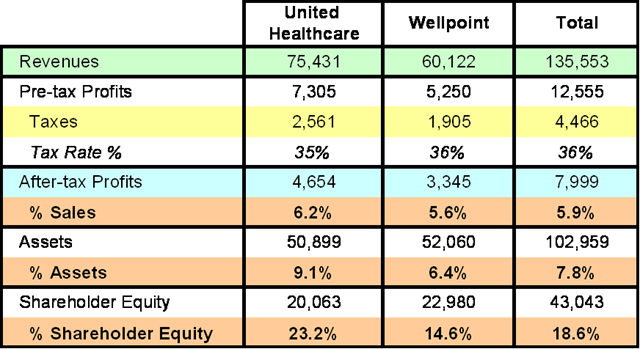
Well, for openers, the health insurance companies — don’t make all that much money.  Consider the 2007 financial results for the two biggest “pure” health insurance companies: United Health Care and Wellpoint.

image

Note that pre-tax profits are about 9% of revenues [12,555 divided by135,553].  About 1/3 of the pre-tax already goes to the government in taxes; about 2/3’s (6% of revenues) drops through to the bottom line.

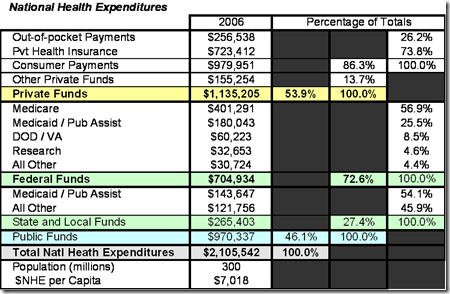
Currently, U.S. health care expenditures are about $2,1 trillion (just over $7,000 per person).  Of that, roughly half is “sourced” from the government via Medicare and Medicaid.  Of the half that is private pay, about 2/3’s ($725 billion ) goes through health insurance companies — the other 1/3 is out of patient’s pockets or “other” (e.g. charitable gifts to medical centers). 

 image

So, what’s the financial upside if all health care insurers were “disintermediated” and their profits were banked as economic cost savings to the system ?

Well, assuming that the rest of the healthcare insurance companies have profitability profiles comparable to United and Wellpoint — there’s a pre-tax profit of 9% that applies to $725 billion in revenues — or roughly $65 billion dollars.

But wait, the government is already getting about 1/3 of that in taxes.

So, the net gain is at most $40 to $45 billion, or about 2% of the $2.1 trillion in total healthcare spending.  Why “at most” ? 

Simple, because it assumes that the government will be able to administer the programs as efficiently as the private companies.  Call me cynical, but I doubt it.

* * * * *

On the second point, that  health insurance companies reject claims and refuse to authorize treatment as a means of boosting their.bottom lines.

Well, that’s at most partially true, and catches the government administration folks in a circular argument.

First, about 1/3 of health  insurance companies’ transactions volume is administrative processing done in support of companies (usually big ones) that choose to self-insure.  That is, the self-insuring companies  take all of the risk, and only pay the insurance companies a fee (that includes profit, of course) for negotiating with health care suppliers and processing transactions  — in conformance with terms, conditions, and rules dictated by the companies.  There are agreed to standards that are enforced.

The other 2/3’s of their transaction volume is strictly premium based.  If more treatments are authorized, costs go up and premiums go up to cover them.   If treatments are denied,  costs go down, and the competitive market pushes premiums down,It’s that simple.

* * * * *

Want more from the Homa Files?
Click link =>
  The Homa Files Blog

* * * * *

Books – Predictably Irrational

September 8, 2008


Predictably Irrational: The Hidden Forces That Shape Our Decisions
by 
Dan Ariely, HarperCollins Books, 2008


Basic Premise:

“Standard economics assumes that people are rational — that they have all the pertinent information about their decisions, that they can calculate the value of the different options they face, and that they are cognitively unhindered in weighing the ramifications of each potential choice”.  That is, that people are capable of making the right decisions for themselves. But, Ariey — and other behavioral economists — observe that “people are really far less rational than standard economic theory assumes.  Moreover, their irrational behaviors are neither random nor senseless. They are systematic, and often repeated, so they are predictable”. For example:

  1. People tend to overvalue stuff that they own … it’s called the “endowment effect”.
  2. Ownership can be real & full, or virtual & partial (e.g. bidding for items on eBay)
  3. The sense of ownership is enhaced by “sweat equity” … the IKEA effect.
  4. Most people will opt for a mid-priced version of a product (over the high or low priced version) … it’s called “aversion to extremes”.
  5. A higher priced pill is perceived to relieve pain more than a lower priced pill … even when they’re the same pills — real or placebos.
  6. People can’t resist the power of free offers … even when they’re not really free.
  7. Many people will travel 15 minutes to save $10 on a $25 item (say, a DVD), but won’t travel 15 minutes to save the same $10 on a higher priced item (say, a car) … even though the time and savings are the same … it’s called the “relativity effect”.
  8. Many people will do jobs (“favors”) for their friends for free — as long as the task is unrelated to their “day job”.
  9. Many people who do favors for others are insulted if they are offered monetarycompensation, but willingly take small gifts for their efforts.
  10. Most people wouldn’t consider taking a few bucks from the petty cash drawer, but many people think it’s ok to jack a pen from their office.
  11. In experiments, most “tempted students cheated on tests … but there was an upper limit — they only cheated “a little bit”.
  12. Students who sign honor pledges on exams are far less likely to cheat … even if their school doesn’t have an honor code 

* * * * * 

The book is a quick, easy read, and the author has a cool web site:
www.predictablyirrational.com


I’ll cite a few of the book’s more interesting examples in subsequent posts.


* * * * * 

Want more from the Homa Files?
 
Click link =>  The Homa Files Blog

* * * * *


Product Innovation: The perils of playing “small ball”

September 8, 2008

Excerpted from Strategy & Business, “The Unique Advantage”, by Alexander Kandybin and Surbhee Grover, Aug. 26, 2008

In mature, slow-growth industries such as food and consumer products … Companies often spend relatively little on R&D, and … their innovation results are marginal.

Much of the problem can be traced to conventional wisdom (that) the secret to growth … is to develop new products based on consumer needs, which are discovered through consumer research and focus groups. And  if a new idea is not great … marketing and advertising can always … turn a so-so concept into a hit.  And the first to market … will capture most of the profits.

This kind of thinking leads to … a long list of line extensions — new flavors of an established soda brand, say — rather than the kind of game-changing innovations that can make a real difference to the bottom line.

New products that stand alone longest in the marketplace, without serious competition, bring in the highest returns.

Meeting consumer needs is a necessary but no longer sufficient condition of sustainable innovation.  Rather than thinking about new products as a way to get customers excited for a little while, companies need to think about their innovation strategy as a way to build a high, hard wall between those customers and their strongest competitors … hifting some investment away from marketing and advertising toward the development of … game-changing new products … that are difficult to copy.  

Higher R&D spending does not guarantee success … (but) a minimum innovation investment is required for breakthrough thinking. Without it, companies tend to fill the pipeline with the “base hits” of line extension … falling into a self-created loop of low investment, low returns, and steady but slow growth … that provides the illusion that the company is succeeding

So, the tendency is for companies to focus on relatively small, often superficial line extensions that can be churned out quickly … but require inflated advertising budgets that reflect a defensive mind-set .. (and divert resources from)  breakthrough innovation … locking companies into a pattern of high marketing spending and a need for endless small launches.

* * * * *

Mature companies also need a strategy for when difficult to copy ideas are in short supply. Here, we suggest defying conventional wisdom about being first to market. If a product can be copied, it’s often more profitable to be the copier.

* * * * *

There will always be a place for line extensions backed with big campaigns and for being first to market. It is possible to gain additional benefits by building scale, amplifying the effects of hard-to-copy innovations by spreading them across multiple products.

* * * * *

It’s even possible to gain scale of a kind with a highly nimble, prolific innovation organization. Launching a steady stream of good ideas, as P&G has done in home products in recent years, can give a brand a reputation for fresh thinking that transcends the individual ideas and translates into market share gains. 

Edit by DAF

* * * * * 

Full article:
http://www.strategy-business.com/press/article/08306?pg=all&tid=230

* * * * *

Want more from the Homa Files?
 
Click link => 
The Homa Files Blog

* * * * *

Sorry, Pal, but You’re Rich

September 8, 2008

Excerpted from Slate, “The deluded business pundits and Obama critics think $250,000 is a middle-class salary”. by Daniel Gross, Aug. 27, 2008

* * * * *

Barack Obama’s tax plan …  promises to improve the nation’s fiscal standing by scaling back tax cuts for people making more than $250,000. Since then, the business pundit class has been griping that people who make $250,000 a year aren’t really wealthy, especially if they live in and around New York; San Francisco; or Washington, D.C.

CNBC’s unscientific online poll found that (surprise!) only 35 percent of respondents believed an income of $250,000 qualified a household for elite rich status.

I have bad news for the over-$250,000 crowd.  I regret to inform you that you are indeed rich.

Income data can surely tell us something. And they tell us that $250,000 puts you in pretty fancy company.

The Census Bureau earlier this week reported that the median household income was $50,223 in 2007 …. So a household that earned $250,000 made five times the median. Only2.245 million U.S. households, the top 1.9 percent, had income greater than $250,000 in 2007. (About 20 percent of households make more than $100,000.)

In dealing with aggregate nationwide numbers, we should of course take account of the significant differences in the cost of living from state to state. But even in wealthy states, $250,000 ain’t bad—it’s nearly four times the median income in wealthy states like Maryland and Connecticut.

But people in Georgetown mansions don’t necessarily compare themselves to fellow Washingtonians in Anacostia. Relative income really works at the neighborhood level. As we know from the work of Cornell economist Robert Frank, people rate their well-being not so much based on how much they make and consume, but on how much they make and consume compared to their neighbors.

It is certainly true that in a few ZIP codes and neighborhoods, brandishing a $250,000 salary is like bringing a knife to a gunfight … But the number of places where $250,000 stretches you is small indeed.  Even in the most exclusive communities where the wealthy congregate, $250,000 is still pretty good coin.

So, don’t tell me you’re not rich.

* * * * *

Full Article URL:
http://www.slate.com/id/2198806/

* * * * *

Want more from the Homa Files?
Click link =>
  The Homa Files Blog

* * * * *

When customers talk smack online …

September 5, 2008

Excerpted from WSJ, “How to Handle ‘IHateYourCompany.com’,” Sep 5, 2008

In recent years, disgruntled consumers have launched hundreds of Web sites to air their grievances — from starbucked.com and ihatestarbucks.com to boycottwalmart.org and againstthewal.com.

…The Internet has become a mecca for disgruntled consumers, creating new challenges for companies accustomed to controlling their message tightly. While companies can’t pull down a negative YouTube video or erase a critical Twitter post, they have more power when it comes to domain names.

That doesn’t mean, however, that they should snap up every domain with a vaguely negative-sounding name and then let them gather dust, according to Internet-strategy consultants. Rather, companies should register or buy just the sites that get the most traffic…

Once they are in control of these domains, companies … (can) use them as a vehicle to solicit feedback from customers. Otherwise, angry customers will …  simply find another site on which to complain about the company…

While some of the gripe sites that remain in the hands of critics have fizzled, others have grown bigger. Take BankofAmericaSucks.com, which was started by (a) former Bank of America customer … after a dispute with the bank over a car loan. It now is home to thousands of postings, and it calls itself the “Official Bank of America consumer opinion site.”

Consumers continue to post complaints on the site…The site is mentioned in numerous blogs and newspaper articles, and appears among the top 15 results on a Google search for “Bank of America.”

Edit by SAC

 * * * * *

Note: In 2005, Forbes created a list of  the 9 angriest corporate hate sites. These sites targeted: KB Homes, PayPal, Allstate Insurance, Microsoft, American Express, Wal-Mart, Verizon, United Airlines and UPS.  While an updated list has not been published it is clear that consumers continue to organize complaints and fuel their hate online. 

* * * * *
Full article:
http://online.wsj.com/article/SB122057760688302147.html?mod=2_1567_topbox

* * * * *

Want more from the Homa Files?
Click link =>
The Homa Files Blog

* * * * *

Marketing: Japanese Super Brands

September 5, 2008

Excerpted from Brand Channel, “More Than a Name: Japanese Super-brands Diversify”, by Barry Silverstein, August 22, 2008

After World War II, Japan reinvented itself and developed into a global economic powerhouse.

Some believe a primary reason for this growth was the Japanese keiretsu system. Essentially, keiretsu were major families of affiliated corporations that had ties to a key bank, which both controlled and provided security to the companies. As a result, companies were “protected” financially, similar to the way Japanese companies protected their employees.

The keiretsu system spawned powerful conglomerates that for a time were insulated from economic woes. But  … “The [keiretsu] system is, in large part, to blame for Japan’s bubble economy of the 1980s that ultimately burst.”

Nonetheless, the keiretsu system was the basis for giant corporations that diversified to an extreme degree. Keiretsu could be vertical, such as Honda and Toyota, or horizontal, such as Mitsubishi and Fuyo (which spawned Canon, Hitachi, Nissan, and Yamaha, among others).

* * * * *

Mitsubishi is an excellent example. Mitsubishi started in 1870 as a shipping company. Today, this global giant has hundreds of companies under its loose umbrella, some of which do not carry the Mitsubishi brand name.

To bring some commonality to Mitsubishi companies, a corporate mark was created. It depicts three connected red diamond shapes. The word “Mitsubishi” is a combination of the Japanese words mitsu (three) and hishi (water chestnut). Hishi is traditionally used to denote a rhombus or diamond shape.

Companies with Mitsubishi in their names include Mitsubishi Chemical Corp., Mitsubishi Electric Corp., Mitsubishi Heavy Industries, Ltd., and Mitsubishi Motors Corp. Mitsubishi companies without Mitsubishi in the name include Kirin Holdings Company, Ltd., Nikon Corp., and Nippon Oil Corp.

* * * * *

Suppose two consumers have very different experiences with Mitsubishi-branded products.

For example, one consumer purchases a Mitsubishi automobile and has a good experience. Another consumer purchases a Mitsubishi television and has a bad experience. Will the first consumer look favorably upon and consider purchasing a television carrying the Mitsubishi brand name? If the second consumer decides to buy a car, will he or she be negatively predisposed toward a Mitsubishi-branded vehicle?

Emotionally, each consumer might transfer the positive or negative experience with the Mitsubishi brand from one product to another. These feelings about the brand could transcend product category.

Rationally, however, if a Mitsubishi-branded product is highly rated in a product category, it deserves consideration. If the consumer had a negative experience with the brand in one category, and wants to make an objective purchase in another product category, this creates a potential dilemma.

* * * * * 

Brand influence in the above example assumes the same consumer is the purchaser of both a car and a television. But what happens when the Japanese super-brand manufactures products with the same brand name in two entirely different and highly specialized categories?

Take Yamaha, for instance. On the one hand, this Japanese super-brand is renowned for musical instruments such as keyboards and drums. On the other hand, Yamaha is just as well known as a brand of motorcycles. Both corporate entities use the Yamaha name and mark.

Only if a musician playing a Yamaha instrument also rides a Yamaha motorcycle will the identical consumer come into contact with the same brand name in these specialized categories.

Nonetheless, the consumer’s experience with the brand in either category could influence overall brand perception. With a positive perception, the consumer thought process might be: “I bought a Yamaha keyboard and it was great… I bet their motorcycles are good, too.”

* * * * *

Bad product experiences not withstanding, brand diversification has another important benefit: Brand recognition can extend a consumer’s receptivity to other products in allied categories.

For example, a satisfied owner of a Honda automobile may seek out other Honda products. That consumer might become a buyer of a Honda motorcycle, a Honda snowblower, a Honda lawn mower, or a Honda outboard motor for a boat. The perceived quality of the Honda vehicle can lead to a satisfied consumer making other related Honda purchases.

While Japanese super-brands are not always regarded as great brand marketers, it is the quality of their products that creates the perception of great brands.

To the credit of the Japanese super-brands, they have almost uniformly built a reputation for quality, regardless of business category. This is one of the attributes that led to Japanese automakers dominating that industry.

* * * * *

Other Asian super-brands have followed the diversification strategy with success. The Korean companies Samsung and LG are good examples.

In some cases, diversifying a single brand name can have a diluting effect and may turn out to be a bad strategy. “Sony’s diversification not only drains the brand’s resources to a great extent but also diverts the brand focus from the core of the brand.”

For the most part, however, Japanese super-brands derive considerable benefit from diversification. In a world of ever-increasing options, a product with a Japanese brand name is often regarded as the best choice.

* * * *

Barry Silverstein is a 25-year advertising and marketing veteran and co-author of The Breakaway Brand (McGraw Hill, 2005).

Full article:
http://www.brandchannel.com/start1.asp?fa_id=437

* * * *

Want more from the Homa Files?
Click link =>
  The Homa Files Blog

* * * * *

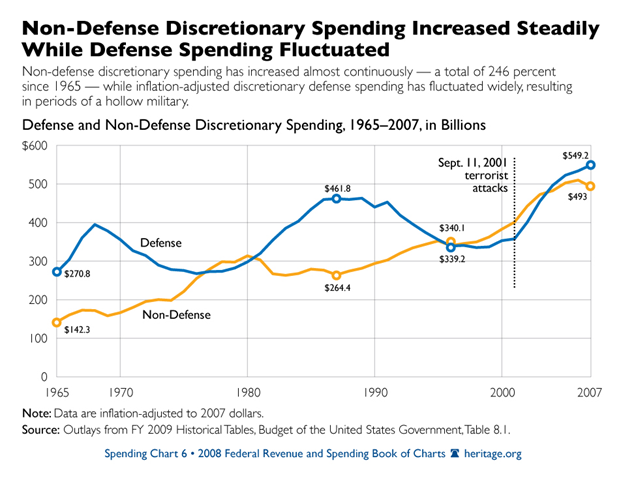
Federal Spending – Like a bunch of drunken sailors …

September 5, 2008

So much for fiscal responsibility … ouch !

Charts from the Heritage Foundation.
http://www.heritage.org/research/features/BudgetChartBook/index.html

* * * * *

image

image

image  

 image http://www.heritage.org/research/features/BudgetChartBook/index.html

* * * * *

Want more from the Homa Files?
Click link =>
  The Homa Files Blog

* * * * *

Health Insurance – Is the glass 15% empty or 85% full ?

September 4, 2008

I think that practically everybody agrees all citizens should have access to adequate heath care and that the current system has some major problems re: cost, service-delivery, and insurance coverage.

Universal heath care was the centerpiece of the Clinton – Obama – Edwards campaign platforms during the Democratic primaries, and though the issue seems to have been moved to the back burner in the general election campaigns — in part, having been displaced on the front burner by $4 per gallon gasoline prices — it is embedded in the Democratic platform.

* * * * *

For starters, I get irked that politicos have such a hard time distinguishing between health care (e.g. seeing a doctor, getting into a hospital, getting a prescription filled) and health insurance (i.e. being part of a “risk pool” with healthy folks subsidizing unhealthy ones — and, maybe, having the insurance premiums partially paid by employers or somebody else),

The health insurance part is probably the easier to fix since it just means throwing money at the problem — usually, somebody’s else’s money that gathered up by raising taxes.

The heated debate usually centers on the 45 million uninsured folks in the U.S.  (see yesterday’s post for the official Commerce Dept. data).

Putting that number in context: as of today, the U.S. population is just under 305 million … adding in about 20 million illegal immigrants and the number is 325 million.
http://www.census.gov/main/www/popclock.html

So, the 45 million represent about 15% of the population of folks  living in the U.S..

That means that roughly 85% of the population does have health insurance of one sort or another — usually through employers or the government (Medicare and Medicaid).

It has become  a national pastime to gripe about health insurance premiums going up, co-pays and deductibles going up, coverage being pared back (i.e. the list of participating docs and services covered), and claims processes being confusing and high-hassle.  But, it’s my sense that — adjusting for the naturally stressful nature of the “product” — most people are relatively satisfied with their insurance programs.  Sure, everybody would like to pay less, get more, and get it easier — but on balance, the plans do what they’re supposed to do.

Now, as to the other 15% — the uninsureds.   I’ve seen many estimates that break the 45 million roughly into thirds: 1/3 are illegal immigrants; 1/3 are folks who have access to plans but choose to, in effect, self-insure — they’re typically healthy young-adults, many of whom make over $50,000 per year; and 1/3 “structurally uninsured” — split about equally between poor people with no prospects for private insurance and folks who are simply between jobs.

Call me callous, but I don’t think the first two groups — the illegal immigrants and the voluntarily self-insured — should be considered. 

So, the number goes from 47 million to about the 15 million, or 5% of the population.

Pardon me, but what is all of the fuss about?

Why not just add a Part E to Medicare to cover these folks and move on?  Doesn’t strike me that we should completely upset a system that’s basically working for about 90% of the population …

I must be missing something

* * * * *

Want more from the Homa Files?
Click link =>
  The Homa Files Blog

* * * * *

Succeeding at the Bottom of the Pyramid …

September 4, 2008

Excerpted from Knowledge at INSEAD, “Strong partnership key to success in bottom of the pyramid innovation”, by Grace Segran, August 26, 2008

For those at the ‘bottom of the pyramid’ (BoP), the four billion people or so living on less than two dollars a day, life is hard. Although collectively they have considerable combined purchasing power, they have up to now been traditionally overlooked by businesses.

However, major multinational corporations (MNCs) are now seeing opportunities in developing products for the BoP markets, while making a difference to the lives of the poor people.

“For this concept to work, there needs to be strong collaboration between firms, governments, NGOs (non-governmental organisations) and social entrepreneurs.”

* * * * *

There is often a disconnect between multinationals and those at the bottom of the pyramid

The operations of firms – especially the MNCs – have become rather disconnected or disembedded from local economies.

NGOs tend to know more about the characteristics of local poverty and what is best for the poor people in a specific area, whereas large companies generally have a limited understanding of the situation on the ground.

If BoP products – that is, products specifically developed to address the needs of the low-income segments – do not take into account the local specificities of poverty, they may be useless for the people in a certain district or the project may even have a negative impact on their lives.

* * * * *

Mainstreaming low-income projects and bringing them to a larger scale is one of the main challenges facing companies today.

Unilever’s ‘shakti’ project considered a leading BoP example .  Unilever, developed a range of products for low-income households in remote areas of India. It packaged common household products like shampoo and soap in sachets and sold them door-to-door, helped by so-called ‘shakti ladies’ who make a living from this activity. The ‘shakti’ range now constitutes a significant part of Unilever’s Indian revenues – reportedly nearly 15 per cent.

* * * * *

Bringing such projects to scale is a challenge for several reasons.

First, firms lack the internal capabilities to develop these projects as they require both strong entrepreneurial skills, as well as the ability to understand and address social issues such as access to water, energy, and housing.

Often the firm’s expectations for immediate profit goes against the development of successful BoP projects, the core of which aim to create mutual value for both the firm and the poor. [Economies of sca;e are slow to be realized — if they ever are.]

It requires a substantial amount of effort to transform a small pilot project into a large, mainstream activity. Among their portfolio of business development projects, companies often opt for more profitable projects that can deliver in the short term.

Since BoP projects have strong local links, firms may face difficulties in trying to replicate a successful business model in another geographical area of the same country or to export it to a different country.

“These projects should be local answers to local problems.”

Another challenge is for low-income projects is to demonstrate a significant impact on the lives of the poor. Does it really improve their living conditions? Are the poor getting a fair deal, while their bargaining power in their dealings with firms is rather limited?

* * * * *

Full article:
http://knowledge.insead.edu/PartnershipBottomPyramidInnovation080803.cfm

* * * * *

Want more from the Homa Files?
Click link =>
  The Homa Files Blog

* * * * *

Heath Care – Some basic facts …

September 3, 2008

In 2006, health care expenditures were  $2.1 trillion (with a “T) … which is about $7,000 per person … up from about $4,500 per person in 2000.

image

* * * * *

Slightly under half (46.1% to be precise) was paid out of public funds — by the Federal or local governments  … 53.9% was “private” pay, either by individuals, health insurance companies, or “other private funds” (e.g. hospital write-offs).

About 1/8th of the $2.1 trillion was paid “out of pocket” by patients (think co-payments and deductibles). Note the downward historical trend.

image
Graphic © 2007 Samuel L. Baker, University of South Carolina

* * * * * 

image 
http://www.cms.hhs.gov/NationalHealthExpendData/02_NationalHealthAccountsHistorical.asp#TopOfPage

* * * * *

Want more from the Homa Files?
Click link =>
  The Homa Files Blog

* * * * *

Honda – Finally, fuel efficiency is paying strategic dividends …

September 3, 2008

Excerpted from NY Times, “Honda Stays True to Efficient Driving”, by Bill Vlasic, August 26, 2008

* * * * *

During the glory days of big pickups and sport utility vehicles, one automaker steadfastly refused to join the party.

Despite the huge profits that its competitors were minting by making larger vehicles, Honda Motor never veered from its mission of building fuel-efficient, environmentally friendly cars like its Accord sedan, even when the sentiment was “there’s no return on that.”

But in today’s fuel-conscious automotive market, Honda is reaping the rewards for its commitment.

No major automaker in America is doing better than Honda … While competitors are scrambling to shift their product lineups to build more small vehicles and slash their bloated inventories of trucks, Honda can barely keep up with demand, particularly in the subcompact category.

Sales of its tiny Fit have soared … and Honda accelerated the introduction of the 2009 model, which will go on sale Tuesday.

The Fit’s four-cylinder engine gets 34 miles per gallon in highway driving .

Honda’s focus on fuel efficiency is paying off on the bottom line as well … By comparison, G.M. and Ford have lost billions this year as the market has moved away from the big vehicles that once generated the bulk of their profits. Detroit is moving radically to downsize its vehicle lineups.  Even Honda’s larger Japanese rival, Toyota, is hustling to adjust to the rapidly changing United States market.

Honda’s newest factory, in southern Indiana, is set to begin production of Civic compact cars this fall.

* * * * *

Honda’s focus on fuel efficiency and the environmental impact of its vehicles dates back to the Clean Air legislation of the 1960s and 1970s.  Honda adopted an internal motto — “Blue skies for our children” — as a guideline for future vehicle development.

Honda has posted the highest corporate average fuel economy of any automaker for its overall fleet of vehicles over the last 15 years.

Honda has never aspired to build a full line of trucks and S.U.V.’s.  “Even when the large S.U.V.’s and trucks were big sellers, they did not fit with our philosophy.”

* * * * *

When the new plant goes into production in Indiana, Honda’s North American production capacity will increase to 1.4 million vehicles a year to meet the growing demand for its small cars.

* * * * *

Even with the success of its smallest cars, Honda executives concede that the company has some catching up to do with Toyota in hybrid vehicles.

While Honda offers a hybrid version of the Civic, Toyota’s Prius model is the runaway leader in the category.

But Honda recently announced plans to introduce a five-door, hybrid-only model in North America next year to compete with the Prius. Honda is expected to price the vehicle lower than the Prius to attract younger buyers.

Honda is also planning a two-door, sporty hybrid and a hybrid version of the Fit.

* * * * *

At its headquarters here in Torrance, the vehicle that draws the most attention these days is the company’s hydrogen-powered, fuel-cell vehicle dubbed the FCX Clarity …  it represents the next step for a company committed to clean technology.

* * * * *

Full article:
http://www.nytimes.com/2008/08/26/business/26honda.html?_r=2&oref=slogin&ref=business&pagewanted=print

* * * * *

Want more from the Homa Files?
Click link =>
  The Homa Files Blog

* * * * *

Marketing: Vote for McCain to be your next…potato?

September 3, 2008

Excerpted from Promo Magazine, “McCain Foods Ties Campaign to Presidential Election,” Aug 27, 2008

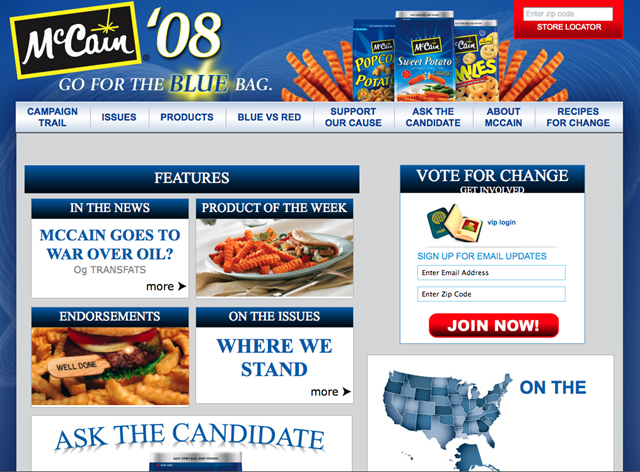
McCain Foods USA is out with a new marketing ploy that plays off the upcoming presidential election to ramp up product sales.

The campaign…positions McCain Foods’ potatoes as a candidate consumers should consider. The company has high hopes shoppers will connect its name with that of Republican presidential hopeful Sen. John McCain of Arizona as part of its political parody…

On the campaign website (www.mccainpotatoes.com), visitors can ask the “spokespotato” candidate questions and receive immediate responses,…take online polls, find product information and sign up for e-mail updates.

The site…also lets people read humorous responses from McCain Foods on key issues, such as the economy and the environment. For the economy, it says, “When you buy more McCain Potatoes, it creates more jobs. For us. What did you expect? Another stimulus check?”

McCain Foods isn’t the first company to make a marketing ploy off politics. Denny’s Restaurants launch a campaign this year that gets people to “Vote 4 Real” for its breakfast food over fast food competitors.


Picture 1


* * * * *

Full Article: http://promomagazine.com/interactivemarketing/news/mccain_foods_marketing_campaign_0827/

* * * * *

Want more from the Homa Files?
Click link =>
  The Homa Files Blog

* * * * *

Census Details: Number of health uninsureds drops in 2007 …

September 2, 2008

Based on Census data released by the Department of Commerce
August 27, 2008:

* * * * *

At the DNC last week, it was being said that the number of uninsureds had increased by 3 million.

Not true, according to data recently released by the Commerce Dept.

* * * * *

The number of insured people increased by 2.3 million — to almost 300 million total insureds.

The number of uninsureds dropped by about 1.3 million — to 45.657 million.

Of the 45.657 million uninsureds:

  • Almost 10 millions are classified as “not a citizen”;
  • Over 9 million earn more than $75,000 annually;
  • Over 15 million earn more than $50,000 annually;
  • Almost 10 million are classified as “did not work”

Note: categories are not mutually exclusive, so there is some double-counting.

* * * *

image 
image

* * * * *

image

* * * * *

image

* * * * *

Published in  “Income, Poverty, and Health Insurance Coverage in the United States: 2007”, U.S. Department of Commerce, Economics and Statistics Administration

Full report:
http://www.census.gov/prod/2008pubs/p60-235.pdf

* * * * *

Want more from the Homa Files?
Click link =>
  The Homa Files Blog

* * * * *

Random thoughts from Thomas Sowell …

September 2, 2008

Excerpted from “Random Thoughts”, by Thomas Sowell, August 26, 2008

* * * * *

The reason so many people misunderstand so many issues is not that these issues are so complex, but that people do not want a factual or analytical explanation that leaves them emotionally unsatisfied. They want villains to hate and heroes to cheer– and they don’t want explanations that do not give them that.

* * * * *

Although you can block unwanted phone calls from commercial sources, you cannot block automated phone calls from politicians, which will be inundating us this election year. 

* * * * * 

One of the problems with successfully dealing with threats is that people start believing that there is no threat. That is where we are, seven years after 9/11, so that reminding people of terrorist dangers can be dismissed as “the politics of fear”.

* * * * *

There are countries in Europe that would love to have their unemployment rate fall to the 5.7 percent unemployment rate to which ours has risen. Yet those who seem to want us to imitate European economic and social policies never seem to want to consider the actual consequences of those policies.

* * * * *

Full article:
http://www.realclearpolitics.com/printpage/?url=http://www.realclearpolitics.com/articles/2008/08/random_thoughts_3.html

* * * * *

Want more from the Homa Files?
Click link =>
  The Homa Files Blog

* * * * *

Hybrids that go Vroom, Vroom, Vroom …

September 2, 2008

Hybrids are so quiet they actually pose a danger to pedestrians – and especially the blind – who can’t hear the cars approaching.

Reportedly. this is already a concern in many states, particularly on the pedestrian-heavy East coast now joined the debate by fielding its own committee to study the matter.

One company has  designed a system to make hybrid cars produce whatever engine sound the owner might desire.

http://www.motorauthority.com/news/safety/california-studying-ways-to-make-hybrids-louder/

* * * * *      

SACRAMENTO, Calif. (AP) — Electric and hybrid vehicles may be better for the environment, but the California Legislature says they’re bad for the blind.

It has passed a bill to ensure that the vehicles make enough noise to be heard by visually impaired people about to cross a street.

The Association of International Auto Manufacturers Inc., a trade group, is also studying the problem, along with a committee established by the Society of Automotive Engineers. The groups are considering “the possibility of setting a minimum noise level standard for hybrid vehicles.”  

The state Department of Motor Vehicles says more than 300,000 of the vehicles are on state roads. Officials say they don’t keep statistics on pedestrian accidents involving those vehicles.

http://www.manufacturing.net/News-California-Green-Cars-Need-More-Noise.aspx?menuid=284

* * * * * 

Want more from the Homa Files?
Click link =>
  The Homa Files Blog

* * * * *

Number of uninsureds down … not up !

August 29, 2008

Excerpted from USA TODAY, “Census: Uninsured total shrank, incomes rose in 2007”,  Aug. 28, 2008

* * * * *

The number of people without health insurance dropped 1.3 million to 45.7 million. The uninsured fell to 15.3% from 15.8%. The primary reason for decline: More people, especially children, are covered by government-sponsored insurance.

* * * * *

Median household income rose to $50,233 in 2007 after adjusting for inflation. That’s $665 more than a year earlier but still below the peak of 1999. Income in black households rose for the first time since 1999.

Democratic candidate Barack Obama said, “Today’s news confirms what America’s struggling families already know — that over the past seven years, our economy has moved backwards.”

* * * * *

Full article:
http://usatoday.printthis.clickability.com/pt/cpt?action=cpt&title=Census%3A+Uninsured+total+shrank%2C+incomes+rose+in+2007+-+USATODAY.com&expire=&urlID=30607054&fb=Y&url=http%3A%2F%2Fwww.usatoday.com%2Fnews%2Fnation%2Fcensus%2F2008-08-26-census-poverty_N.htm&partnerID=1660

* * * * *

Note: See post “From Clinton to Bush, median real after-tax income is up !” ….  Watch for details re: uninsureds next week.

* * * * *

Want more from the Homa Files?
Click link =>
  The Homa Files Blog

* * * * *

Update: Based on data released this week, it’s official … From Clinton to Bush, after-tax household income is up !

August 29, 2008

In a prior post, I outlined an analysis that showed median real after-tax household income increased from 2000 (the last year of the Clinton presidency) to 2006 (the latest available data).

As luck would have it, the Commerce Dept released 2007 data immediately after my post.  Coincidence?

Median real household income increased in 2007 — for the 3rd consecutive year —  strengthening the argument.

Below is an updated summary of the analysis.

* * * * *

From Clinton to Bush, after-tax household income is up !

It’s bipartisan: all politicians use economic data selectively to make their cases.

Senator Obama has been claiming that median real household income grew under President Clinton, and fell by over $1,000 because of President Bush’s policies. 

Recently reported data from the Commerce Department takes some of the wind out of Obama’s sails. Median real household income increased in 2007 – for the third consecutive year – to $50,223. That compares to an inflation-adjusted $50,553 in 2000 – the last full year of the Clinton era. So, there is, in fact, a decline — $330 or roughly ½ of 1 %. Advantage Obama.

But, median real household income is an incomplete and misleading measure of families’ economic well-being. It doesn’t include some items that contribute to household income and, most important, it doesn’t reflect the impact of income taxes. 

Specifically, Obama’s selected measure of household income — technically called  “money income” — doesn’t include common sources of income such as capital gains.  Based on Tax Federation estimates, when capital gains are counted, the median real household income gap more than goes away.

Even more important, the median real household income measure is misleading because it is pre-tax

Since families can only spend after-tax income,  it is somewhere between disingenuous and intellectually dishonest to ignore tax benefits in year-to-year comparisons.  This is particularly true in this case since the core of the Bush economic program is lower taxes. 

While the Bush tax plan is often demonized as being just for the rich, it also includes substantial benefits for folks in the lowest tax brackets.  For example,  the low bracket marginal income tax rate was cut from 15% to 10% , the personal exemption allowance was increased from $2,900 in 2000 to $3,400 in 2007, and  the standard deduction was increased from $7,350 in 2000 to $10,700 in 2007 (for joint filing married couples).

Median after-tax real household can be estimated by simply running the reported median real household income through each year’s tax tables. 

In 2000, nominal median household money income — unadjusted for inflation — was $41,990.  The Tax Foundation estimates that household capital gains in 2000 were $680, so nominal median household income (including capital gains) was $42,670.

There were an average of 2.6 people per household in 2000, so the estimated allowance for personal exemptions is $7,540 — 2.6 times the $2,900 allowance per personal exemption in 2000.

The standard deduction for married couples filing jointly in 2000 was $7,350 . Subtracting the personal exemptions allowance ($7,540) and the standard deduction ($7,350 ) from the median nominal household income ($42,670),  nets to a taxable income of $27,780. That amount would have fallen within the 15% marginal tax bracket in 2000, so the corresponding income tax liability is $4,167 and estimated median nominal after tax income is $38,503 — $42,670 pre-tax income less $4,167 in taxes. Adjusting for inflation — that is, expressing the answer in 2007 dollars –  estimated median real household after-tax income in 2000 is $46,354.

How does 2007’s median real household after-tax median income rack-up against 2000’s ?

Well, taking into account Bush’s higher personal exemption allowance, the higher standard deduction, and the lower marginal tax rate — the answer reverses.  

Estimated 2007 median real after-tax household income is $47,367. So, from the end of the Clinton administration in 2000 to the latest reported data, median real after-tax household income went up over 2%  – about $1,000 per household. The opposite of Senator Obama’s claim.

Some folks are already saying that 2007 data points aren’t relevant since the economy is in a slump. That argument carries less sway since recent reports that GDP grew by an estimated 3.3% second quarter of 2008.

The bottom-line: real after-tax household income went up between 2000 and 2007, and for Senator Obama’s to continue making claims to the contrary is, in the best light, deceptive.

* * * * *

image

* * * * *

Want more from the Homa Files?
Click link =>
  The Homa Files Blog

* * * * *

News: Median household income up in 2007 … again !

August 28, 2008

Based on Census data released by the Department of Commerce
August 27, 2008:

Between 2006 and 2007, real median household income rose 1.3 percent, from $49,568 to $50,233 —a level not statistically different from the 1999 pre-recession income peak.

This was the third annual increase in real median household income.

image

* * * * *

Income inequality decreased between 2006 and 2007, as measured
by the shares of aggregate household income by quintiles.

* * * * *

Published in  “Income, Poverty, and Health Insurance Coverage in the United States: 2007”, U.S. Department of Commerce, Economics and Statistics Administration

Full report:
http://www.census.gov/prod/2008pubs/p60-235.pdf

* * * * *

Note: The analysis I posted earlier today — showing that after-tax median household income increased from Clinton to Bush –was based on 2006 data.  I’ll post the 2000 to 2007 after-tax analysis in the next couple of days

* * * * *

Want more from the Homa Files?
Click link =>
  The Homa Files Blog

* * * * *

From Clinton to Bush, after-tax household income is up !

August 28, 2008

One thing is definitely bipartisan: all politicians take liberties with economic data and use it selectively to make their cases.

Most recently, Senator Obama has been stumping that median real household income grew under President Clinton, and fell by over $1,000 because of President Bush’s policies. 

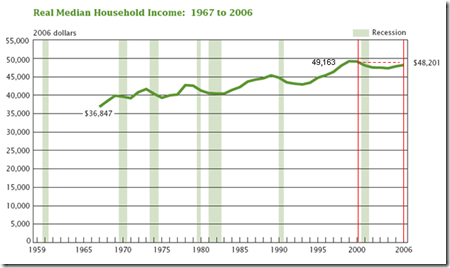
Taken literally, that’s true.  Reported median real household income declined from $49,163 in 2000 (Clinton’s last year in office) to $48,201 in 2006 (the most recently available data).
image
http://www.heritage.org/research/features/BudgetChartBook/index.html

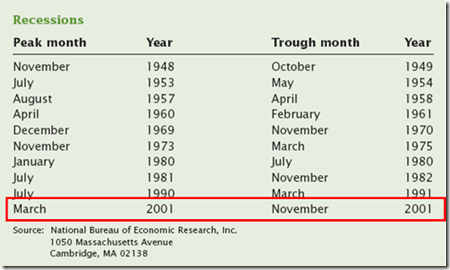
Now, some folks (i.e. Republicans) might argue that the Clinton years’ gains were more attributable to the harvesting of the Reagan tax cuts and a coincidental internet-technology boom.  And, some folks (again, Republicans) might point out that Clinton handed Bush an economy that was, by generally accepted measures, in a the early stages of a recession that was subsequently deepened by the 9/11 crisis and its aftermath.  So, some of Clinton’s apparent gains may have been windfalls, and Bush may have been dealt a bad opening hand.  So be it.  That’s life in the oval office.
image 
http://www.heritage.org/research/features/BudgetChartBook/index.html

* * * * *

Putting aside the debatable qualitative aspects of the change in median real household income, what does the underlying hard data say ?

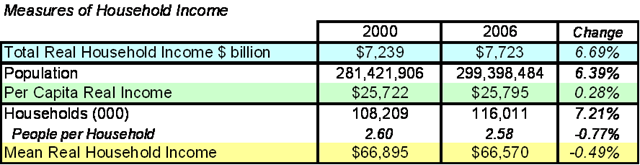
Starting from the very top, aggregate real income — the total income across all households, adjusted for inflation — grew 6.7%  from 2000 to 2006 — going from $7.2 trillion to $7.7 trillion. During that same period, the U.S. population grew 6.4%  — from  281.4 million  in 2000 to 299.4 million in 2006.  So, doing some simple arithmetic, real income per capita was flat from 2000 to 2006 — $25,722 to $25,795.  In other words, real income kept pace with population growth.

During that same period, the number of households grew 7.2%  — faster than population — going from 108.2 million in 2000 to 116.0 million in 2006.  Households got slightly smaller  — 2.58  people per household in 2006, versus 2.60 in 2000.  Why?  Some couples had fewer children, and some households split-up with multiple wage earners forming separate household units.

So, despite an increase in aggregate real income, the average —  mean real household income — declined slightly , going from $66,895 to $66,570. 

image

* * * * *

Importantly, for several reasons, mean real household income isn’t a particularly good criteria.  It is an incomplete and misleading measure of families’ economic well-being.

First, most analysts would agree that when statistical distributions are highly skewed (such as income data with many folks at the bottom and relatively few at the very top), the median  — the 50th percentile mark that splits the population into a top  and a bottom halves —  is a more representative measure than the mean, which is a simple average of all folks. 

So, from a strictly statistical perspective, it makes sense that Obama is touting a median.  The criteria he selects is median real household income — which  dropped from $49,163 in 2000 to $48,201 in 2006.

But, that narrow metric has some glaring flaws: It doesn’t include some items that contribute to household income and, most important, it is pre-tax.  It doesn’t account for  the taxes that the government takes out.

More specifically, median real household income isn’t all inclusive.  The commonly reported measure of household income — the one Obama cites —  is what’s called  “money income” — i.e., wages and transfer payments.  Money income doesn’t include common income items such as capital gains.  By just including capital gains, the median real household income gap between 2000 and 2006 narrows by a third.

 

image 
Note: Capital gains data is from Tax Foundation estimates:
http://www.taxfoundation.org/blog/show/23411.html

* * * * *

And, even more important, the median real household income metric is pre-tax

Since families can only spend after-tax income,  it is somewhere between disingenuous and intellectually dishonest to ignore tax benefits inyear-to-year comparisons.  This is particularly true in this case since the core of the Bush economic program is lower taxes. 

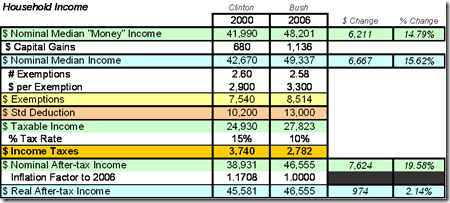
While the Bush tax plan is often demonized as being just for the rich, it also includes substantial benefits for folks in the lowest tax brackets.  For example,  the low bracket marginal income tax rate was cut from 15% to 10% , the personal exemption allowance has been increased from $2,900 in 2000  to $3,300 in 2006, and  the standard deduction has been increased from $10,200 in 2000 to $13,000 in 2006 (for joint filing married couples).

Median after-tax real household income isn’t commonly reported.  But, it can be estimated by simply running the reported median real household income through each year’s tax tables. 

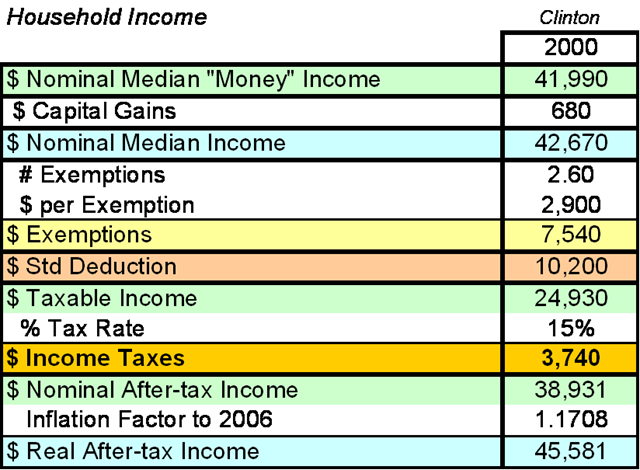
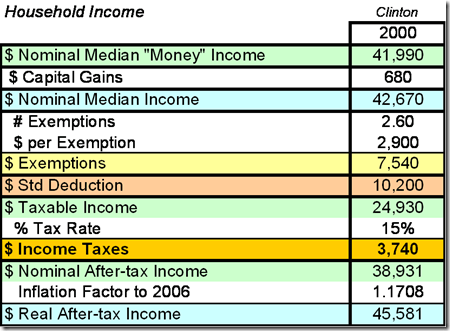
In 2000, nominal median household money income — unadjusted for inflation — was $41,990.  Estimated nominal household capital gains were $680, so nominal median household income (including capital gains) was $42,670.

Since there were an average of 2.6 people per household in 2000, the estimated allowance for personal exemptions would be $7,540 — 2.6 times the $2,900 allowance per personal exemption in 2000.

The standard deduction for married couples filing jointly in 2000 was $10,200. Subtracting the personal exemptions allowance ($7,540) and the standard deduction ($10,200) from the median nominal household income ($42,670),  nets to a taxable income of $24,930. 

Since $24,930 was within the 15% marginal tax bracket in 2000, income taxes — ignoring, for simplicity, any child or earned income tax credits –would be $3,740  and median nominal after tax income would be $38,931.

Adjusting for inflation — that is, expressing the answer in 2006 dollars —  estimated median real household after-tax median income would be $45,581.
image

* * * * *

How does 2006’s median real household after-tax median income rack-up against 2000’s ?

Well, taking into account Bush’s higher personal exemption allowance, the higher standard deduction, and the lower marginal tax rate — 10% versus 15% — the answer reverses !   Median real after-tax household income went up 2%  — about 2% or $1,000 per household — from the end of the Clinton administration in 2000 to the latest reported data (2006). 

For sure, that puts a different paint job on the picture.
image

Note: An excellent  analysis by Gerald Prante of the  Tax Foundation — “Has Real Median Household Income Fallen Since 2000?”  —  traces through the inclusion or exclusion of other income adjustments.  For example, including the imputed value of employer paid health insurance increases the 2006 real advantage by over $700 per household; payroll taxes on the higher income reduces the 2006 advantage by about $200.
 http://www.taxfoundation.org/blog/show/23411.html

* * * * *

Now, some folks  (Democrats) might say that 2006 isn’t relevant since the economy has been in a slump since then. True, but the effect probably isn’t enough to re-reverse the answer.  We’ll see when the data comes out. 

Until then the most reasonable fact-based conclusion is that median real after-tax household income went up between 2000 and 2006, and Senator Obama’s claims are, in their best light, misleading.

* * * * *

Want more from the Homa Files?
Click link =>
  The Homa Files Blog

* * * * *

The true value of campaign promises …

August 28, 2008

Excerpted from Foreign Affairs, “The Next President’s Daunting Agenda”, by Richard Holbrooke, September/October 2008 

* * * * *

It is a well-established historical fact that what candidates say about foreign policy is not always … what they will do if elected. Historians point to a myriad of examples:

  • Franklin Roosevelt’s 1940 promise to not send “your boys . . . into any foreign wars,”
  • Lyndon Johnson’s statements in 1964 that he would not send ground troops to Vietnam,
  • Jimmy Carter’s 1976 campaign pledge to withdraw all U.S. ground troops from South KoreaRichard Nixon’s 1968 references to a nonexistent “secret plan” to get out of Vietnam,
  • Ronald Reagan’s 1980 pledge to upgrade U.S. relations with Taiwan to “official” status,
  • Bill Clinton’s 1992 promises to stand up to the “butchers of Beijing,”
  • George W. Bush’s 2000 call for a “more humble” foreign policy that would never again have the United States involved in “nation building.”

* * * * *

Whatever their ultimate fate, however, campaign positions are key indicators of the priorities and thinking of each candidate as he approaches the most powerful and difficult job in the world. It is therefore valuable to examine them carefully.

* * * * *

Richard Holbrooke was U.S. Ambassador to the United Nations from 1999 to 2001

Full article:
http://www.realclearpolitics.com/articles/2008/08/the_next_presidents_daunting_a.html

* * * * *

Want more from the Homa Files?
Click link =>
  The Homa Files Blog

* * * * *

The sweet congressional retirement plan …

August 28, 2008

I’ve always wondered what retired members of the Congress and Senate got to live on when they retired.  Here’s the scoop:

* * * * *

Members of Congress are eligible for a pension at age 62 if they have completed at least five years of service. (Certain partial pay early options are also available)

The amount of the pension depends on years of service, an accrual rate (2.5%), and the average of the highest three years of salary.

For example, after 30 years of Congressional service and a high-3 average salary of $161,800, the initial annual Civil Service Retirement System (CSRS) pension for a Member who retired in December 2006 at the end of the 109th Congress would be: 
                $161,800 x 30 x .025 = $121,350

Federal law limits the maximum CSRS pension that may be paid at the start of retirement to 80% of the Member’s final annual salary

The average annual pension for members of Congress who have retired under CSRS is $52,464.

Note: It’s unclear whether the qualifier is Congressional Service or civilian government service … both terms are used.

* * * * *

Source:
http://www.senate.gov/reference/common/faq/retirement_for_members.shtml

* * * * *

Want more from the Homa Files?
Click link =>
  The Homa Files Blog

* * * * *

Big oil getting out of low-margin retail …

August 28, 2008

Excerpted from WSJ, “Conoco Plans To Sell Rest of Its Gas Stations”, August 27, 2008

This year, gasoline retailers experienced some of the worst profit margins on record.

Retail gasoline-sales are undergoing dramatic change. Giants such as ConocoPhillips and Exxon Mobil and BP have announced plans to sell or close their retail gasoline outlets.

Now, ConocoPhillips has announced that it will sell the remainder of its 600 company-owned gasoline stations . 

The sale is part of oil companies’ efforts to flee low-margin U.S. retail-gasoline sales and focus on finding new supplies of crude oil.

ConocoPhillips will continue to refine oil into gasoline and sell fuel on a wholesale basis to stations..

Few gas-station owners generate the majority of their income from selling gasoline. Profits come from getting drivers to buy other goods and services, such as food and car washes.

Seattle-based PetroSun West plans to add fresh sandwiches, financial services such as bill-paying, and even dry cleaning, Most of the stations it is buying are located in urban, high-traffic areas along the West Coast, from Seattle to Los Angeles.

Full article:
http://online.wsj.com/article/SB121978249439473837.html?mod=hps_us_whats_news

* * * * *

Want more from the Homa Files?
Click link =>
  The Homa Files Blog

* * * * *

Energy – Why do gas prices move up and down ?

August 27, 2008

In last week’s post “Thinking about $4 per gallon gas”, I wondered why oil companies waited so long to push prices up to $4 — the apparent price that the market will bear — and why they don’t just let the price stick at $4 now that it has been tested.

Chris Hairel , MSB MBA alum, emailed a nice recap of the oil to gas value chain.

Bottom line: cost-plus pricing in a very competitive market.

Worth reading …

* * * * *

The downstream refined products value chain — from crude oil to retail gasoline and other oil-based products — has six segments, each with its own unique industry structure, pricing levers and regulation:

* * * * *

Refineries – the key asset in the business where the object is to maximize the economic value added of the refined products.

Refineries are basically price takers since their company trading group supplies them with crude oil and the projected prices for refined products.

Working with the trading group, the refinery is charged with turning that crude oil into the most profitable collection of products given the quality of the crude and the capabilities of the refinery.

* * * * *

Bulk Markets – The trading group assumes title of the product as it leaves the refinery and arranges transportation to the terminals based on projected demand in the rack (or wholesale market).

Along the way the traders seek to increase the realized price for their products, react to supply disruptions or unexpected demand.

Bulk is a relatively efficient market with good price transparency based on key trading hubs like New York Harbor, Houston and Chicago.

The NYMEX futures market provides a facility for hedging and for paper speculation. Trading parties include oil companies, major users of petroleum products, independent pipeline companies and speculators.

Pricing is market-based and profit-optimized by the traders.

* * * * *

Pipelines – Interstate pipelines with multiple customers are regulated by the Federal Energy Regulatory Commission .

Their tariffs (i.e. prices) are set based on a government sanctioned rate of return. So. pricing is essentially a cost-plus process.

Pipeline owners are not permitted to share information about who else is using the pipeline with their affiliated companies, nor can they give (or take) preferential treatment with respect to supply allocation or delivery scheduling.

* * * * *

Rack Markets and Terminals – Rack markets cover the wholesale market for a city.

Prices in rack markets are set daily for the next day. The marketing group for an oil company looks at demand by channel of trade (i.e. branded, unbranded, spot), recent price history in the area and the supply situation.

The pricing mechanism itself may be based on an index, a cost plus or other model, but there’s some leeway on the decision under certain circumstances. For example, pricing is actually used as a key demand management lever since companies can purposefully price themselves out of the spot or unbranded channel in order to save product for branded customers.

Despite what the pricers do, most transaction pricing  is determined by long term contracts. These contracts usually allow customers to “swing” their volumes. A customer may commit to buying an average of 5,000 gal a day, but the contract management process will look at the monthly volume and divide by 30 – the customer can usually manage their buying pattern to buy more on days when gas is cheap and less when it’s more expensive. .

* * * * *

Secondary Transportation – These are the tanker trucks that move product from the terminal to the retail station. The logistics are typically handled by jobbers or independent marketers that almost always price on a cost-plus basis.

* * * * *

Retail – Retail gas stations typically price on a cost-plus basis with a slim retail margin added on.

The bulk oil stations’ profits isn’t from the gasoline !  Gas is simply the “leader” product that attracts traffic (literally) which often loads up with high margin coffee, soda, cigarettes, etc.

* * * * *

Retail gasoline prices

Retail gasoline prices tend to respond quickly to market forces for 3 reasons: (1) cost-plus pricing, (2) retail competition, and (3) fear of government intervention.

* * * * *

(1) Cost-plus pricing

Since cost-plus pricing is prevalent at all stages of the value chain, refined products’ prices and crude oil prices tend to move together.

Refiners’ margins are often forecasted using what’s called the 3-2-1 spread. Take the price difference between three WTI NYMEX contracts and the sum of two NYMEX gasoline contracts plus one heating oil contract – then trade accordingly.

When crude falls. the entire complex floats down with it since the bulk market is fairly efficient and the downstream segments all use a cost-plus pricing model.

If domestic bulk markets fail to react to lower crude prices, several large players can bring product in from Europe to capture the arbitrage.

Since the vast majority of transactions are priced on a cost-plus basis, companies compete on their ability to “buy right”,  on the efficiency of their operations, and their opportunity for more profitable ancillary sales. .

* * * * *

(2) Retail CompetitionFew prices are signaled to potential customers more visibly than gasoline prices.

There are often 2 or 3 gas stations on a corner,  so consumers are tempted to chose the cheapest one even if it’s only a cent or two cheaper per gallon. The conventional wisdom is that brand loyalty is low. 

The same price pressures evident in the wholesale rack markets since unbranded retailers have the option of buying from multiple terminals. If Shell is less expensive than Exxon on a particular day, Shell gets the sale in the unbranded and spot channels of trade.

* * * * *

(3) Threat of Regulation

A third force is the threat of government action.Pricing through the entire oil value chain is very transparent.  Timely price data available from multiple sources for every segment of the market (DOE data, NYMEX, bulletin board exchanges, broker quotes, daily PLATT and OPUS surveys, AAA retail surveys, etc.).Oil companies generate two-thirds of their profits from crude oil production and refining. The wholesale and retail marketing and distribution parts of the business is generally considered mote of a cost of going business (i.e. overhead) than a profits source.  So, oil companies would rather play it safe (from government regulators) than try to eek out an extra half percentage point of profit at the wholesale or retail level.

* * * * *

Want more from the Homa Files?
Click link =>
  The Homa Files Blog

* * * * *

The Heart of the Economic Mess

August 27, 2008

A liberal view xcerpted from Former Labor Secretayrt bert Reich’s blog 07-25-08:

Most Americans can no longer maintain their standard of living. The only lasting remedy is to improve their standard of living by widening the circle of prosperity.

The basic reality is this: For most Americans, earnings have not kept up with the cost of living …  they are barely higher than they were in the mid-1970s, adjusted for inflation. The income of a man in his 30s is now 12 percent below that of a man his age three decades ago.

This underlying earnings problem has been masked for years as middle- and lower-income Americans found coping mechanisms to live beyond their paychecks:

 The the first coping mechanism was to send more women into paid work … to prop up family incomes. The percentage of American working mothers with school-age children has almost doubled since 1970 — to more than 70 percent.

A second way:  They worked more hours. The typical American now works more than … three decades ago … putting in 350 more hours a year than the average European, more even than the notoriously industrious Japanese.

A third coping mechanism:  They began to borrow …  they turned their homes into piggy banks by refinancing home mortgages and taking out home-equity loans … Now, with the bursting of the housing bubble, the piggy banks are closing.

As a result, typical Americans have run out of coping mechanisms to keep up their standard of living. That means there’s not enough purhasing power in the economy to buy all the goods and services it’s producing. We’re finally reaping the whirlwind of widening inequality and ever more concentrated wealth.

The only way to keep the economy going over the long run is to increase the real earnings of middle and lower-middle class Americans. The answer is not to protect jobs through trade protection … Nor is the answer to give tax breaks to the very wealthy and to giant corporations in the hope they will trickle down to everyone else. We’ve tried that and it hasn’t worked. Nothing has trickled down.

We must … adopt (more) progressive taxes at the federal, state, and local levels. In other words, we must rebuild the American economy from the bottom up. It cannot be rebuilt from the top down.

* * * * *

Want more from the Homa Files?
 
Click link =>  The Homa Files Blog

* * * * *

Just two middle class guys, right ?

August 26, 2008

Just for yuks, here are the candidates most recent financials. 

McCain says it’s all his wife’s money, and what she does with her money is none of our business.  Hmmm.

Obama says he felt the middle class pain until the book deal. 

Question: Don’t Obama’s record high earnings fall into the category of a “windfall”, and shouldn’t his tax rate be at least as high as Exxon’s?

* * * * *

Mccain_tax_returns
http://taxprof.typepad.com/taxprof_blog/2008/04/mccain-releases.html

* * * * *

Obama_tax_returns_2
http://taxprof.typepad.com/taxprof_blog/2008/03/obama-releases.html

* * * * *

Senator and Mrs. McCain have kept their personal finances separate throughout their 27-year marriage. Accordingly, they have for many years filed separate tax returns. However, their home state of Arizona is a community property jurisdiction.  In community property states, individuals maintain a separation of all property brought to the marriage, or inherited during it, but share financial responsibility for other assets acquired through the efforts of each spouse during the marriage. This means that their tax returns report one half of each of their community property income and expenses (such as income each of them earn as salaries, Senator McCain’s book royalties, and expenses attributable to both of them such as charitable contributions from community assets).

http://www.johnmccain.com/mccainfinancial/

* * * * *

Want more from the Homa Files?
Click link =>
  The Homa Files Blog

* * * * *

Campaign: Why It’ll Be Mitt …

August 26, 2008

Romney has the experience — in business, in government.  But, he’s flip-flopped on abortion rights … and, did I mention that he’s a Mormon ?

While pundits say his religious affiliation is a big negative, I disagree.

It has nothing to do with theology.  It has everything to do with demographics and logistics.

Obama will take over 90% the African-American vote (unless McCain lands Colin Powell, in which case, all bets are off).  But, there are relatively few states where Obama’s segment-domination will matter — since most of the states are solidly Democratic anyway.

While the Mormon population is smaller, and concentrated in a few states, some are battleground states that can potentially swing the election: Nevada. Montana, Colorado, New Mexico.  And, there are “statistically significant” Mormon populations in Hawaii, Oregon, Washington — which could conceivably be thrown back into play.

The Mormons are legendary for their focused zeal and executional discipline — as evidenced by their missionary effectiveness.  Can you imagine if that force is thrown behind a get out the vote effort in a few swing states?

And, did I mention Michigan ?

* * * * *

image

* * * * *

Source : http://www.electoral-vote.com/

image

* * * * *

Want more from the Homa Files?
Click link =>
  The Homa Files Blog

* * * * *

Taxes – Middle class cuts or hikes ?

August 26, 2008

Excerpted from IBD, “Obama’s Tax Hikes”, August 22, 2008

When Bill Clinton ran for president in 1992, the centerpiece of his much-touted economic plan was a middle-class tax cut. Once elected, he announced that the deficit was bigger than he thought, so no tax cuts.

Writing in the Wall Street Journal earlier this month, Obama economic advisers Jason Furman and Austan Goolsbee promised: “The Obama plan would cut taxes for 95% of workers and their families with a tax cut of $500 for workers or $1,000 for working couples” on top of “tax cuts for low- and middle-income seniors, homeowners, the uninsured, and families sending a child to college or looking to save and accumulate wealth.”

But what’s touted as tax-cutting hides tax increases for the middle class. According to the American Enterprise Institute’s … “Senator Obama’s proposed ‘tax cuts for the middle class’ are actually marginal rate hikes in disguise.”

The increase happens because Obama phases out the child and dependent-care credit for one-child families in the $30,000-to-$58,000 income range … and because of changes planned for Bill Clinton’s Hope Scholarship Tax Credit.

An “Economists for Obama” Web site calls the AEI findings “deeply dishonest” because their examples (are) “cherry-picked.” AEI responds that Obama’s use of refundability and phase-outs means that “any example will show these kinds of disincentive effects.”

Full article:
http://www.ibdeditorials.com/IBDArticles.aspx?id=304297643560219#

* * * * *

Want more from the Homa Files?
Click link =>
  The Homa Files Blog

* * * * *

A nuanced definition of what’s "rich" …

August 25, 2008

I think that both candidates gave pretty good answers to Rick Warren’s question at Saddleback.

McCain is getting hammered for his $5 million joke (which Paul Krugman of the NY Times acknowledges was a joke).

Going beyond the sound bites and reading the transcript (below), it turns out that it was McCain, not Obama, who gave the more nuanced answer.  Hmmm.

* * * * *

Obama’s  Answer:

REV. WARREN: Okay. Taxes — this is a real simple question. Define “rich.” (Laughter.) I mean, give me a number. Is it 50,000 (dollars)? One hundred thousand (dollars)? Two hundred thousand (dollars)? Everybody keeps talking about who we’re going to tax. How do you define that?

SEN. OBAMA: You know, if you’ve got book sales of 25 million, then you qualify. (Applause.)

REV. WARREN: (Laughs.) I’m not asking about me. (Laughter.)

SEN. OBAMA: Look, here’s how I think about it. Here’s how I think about it, and this is reflected in my tax plan. If you are making $150,000 a year or less as a family, then you’re middle class, or you may be poor. But 150 (thousand dollars) down, you’re basically middle class. Obviously, it depends on region and where you’re living.

REV. WARREN: In this region, you’re poor. (Laughter and applause.)

SEN. OBAMA: I don’t know what housing prices are doing lately. (Applause.) I would argue that if you’re making more than 250,000 (dollars) then you’re in the top 3, 4 percent of this country. You’re doing well. Now, these things are all relative, and I’m not suggesting that everybody who is making over 250,000 (dollars) is living on Easy Street.

* * * * *

McCain’s  Answer:

REV. WARREN: Okay, on taxes, define “rich.” Everybody talks about, you know, taxing the rich but not the poor, the middle class. At what point — give me a number. Give me a specific number. Where do you move from middle class to rich? Is it $100,000? Is it $50,000? Is it $200,000? How does anybody know if we don’t know what the standards are?

SEN. MCCAIN: Some of the richest people I’ve ever known in my life are the most unhappy. I think that rich should be defined by a home, a good job, an education, and the ability to hand to our children a more prosperous and safer world than the one that we inherited.

I don’t want to take any money from the rich. I want everybody to get rich. (Laughter.) I don’t believe in class warfare or redistribution of wealth. But I can tell you, for example, there are small businessmen and women who are working 16 hours a day, seven days a week, that some people would classify as, quote, “rich,” my friends, and want to raise their taxes and want to raise their payroll taxes.

Let’s have — keep taxes low. Let’s give every family in America a $7,000 tax credit for every child they have. Let’s give them a $5,000 refundable tax credit to go out and get the health insurance of their choice. Let’s not have the government take over the health care system in America. (Applause.)

So I think if you’re just talking about income, how about $5 million? (Laughter.) So, no, but seriously, I don’t think you can — I don’t think, seriously, that — the point is that I’m trying to make here, seriously — and I’m sure that comment will be distorted — (laughter) — but the point is, the point is, the point is that we want to keep people’s taxes low and increase revenues.

* * * * *

Technical note: Obama’s 25 million books line (also a joke) is getting a free pass — even though, at $5 per copy, they represent $125 million in income — which is equivalent to $5 million amortized over 25 years.  Hmmm.  Did the candidates jokingly say the same thing ?

* * * * *

Full debate transcript:
http://www.clipsandcomment.com/2008/08/17/full-transcript-saddleback-presidential-forum-sen-barack-obama-john-mccain-moderated-by-rick-warren/

Video:
http://trevinwax.com/2008/08/17/obama-mccain-with-rick-warren-at-saddleback-forum-video/

* * * * *

Want more from the Homa Files?
Click link =>
  The Homa Files Blog

* * * * *

Academia: You can’t make this stuff up …

August 25, 2008

At the University of Memphis there is an Arthur Andersen Chair of Excellence in Accountancy.

At West Virginia University there is a Kmart chair of marketing.

* * * * *

Source: WSJ, “We’re Not All Friedmanites Now”, August 20, 2008
http://online.wsj.com/article/fighting_words.html

* * * * *

Want more from the Homa Files?
Click link =>
  The Homa Files Blog

* * * * *

Taxes – The "Denizens of Richistan"

August 25, 2008

I never agree with ultra-liberal NY Times ranter Paul Krugman. Well, I guess I should never say never.

While I disagree with his conclusions, I think he provides some interesting perspective in this op-ed.

* * * * *

Excerpted from NY Time’s Op-Ed,  “Now That’s Rich”, Paul Krugman, August 22, 2008

Last weekend, Pastor Rick Warren asked both presidential candidates to define the income at which “you move from middle class to rich.”

Mr. Obama answered the question seriously, defining middle class as meaning an income below $150,000.

Mr. McCain, at first, made it into a joke, saying “how about $5 million?” .

The real problem, however, was with the question itself.

When we think about the middle class, we tend to think of Americans whose lives are decent but not luxurious: they have houses, cars and health insurance, but they still worry about making ends meet, especially when the time comes to send the kids to college.

Meanwhile, when we think about the rich, we tend to think about the handful of people who are really, really rich — people with servants, people with so much money that, like Mr. McCain, they don’t know how many houses they own.

The trouble with Mr. Warren’s question was that it seemed to imply that everyone except the poor belongs to one of these two categories: either you’re clearly rich, or you’re an ordinary member of the middle class. And that’s just wrong.

In his entertaining book “Richistan,” Robert Frank of The Wall Street Journal declares … that country is divided into levels, and only the inhabitants of upper Richistan live like aristocrats; the inhabitants of middle Richistan lead ample but not gilded lives; and lower Richistanis live in McMansions, drive around in S.U.V.’s, and are likely to think of themselves as “affluent” rather than rich.

Even these arguably not-rich, however, live in a different financial universe from that inhabited by ordinary members of the middle class: they have lots of disposable income after paying for the essentials, and they don’t lose sleep over expenses, like insurance co-pays and tuition bills, that can seem daunting to many working American families.

Which brings us to the dispute about tax policy.

According to estimates prepared by the nonpartisan Tax Policy Center, those Obama tax increases would fall overwhelmingly on people with incomes of more than $200,000 a year. Are such people rich? Well, maybe not: some of those Mr. Obama proposes taxing are only denizens of lower Richistan, although the really big tax increases would fall on upper Richistan.

* * * *

Full op-ed:
http://www.nytimes.com/2008/08/22/opinion/22krugman.html?_r=1&oref=slogin&pagewanted=print

* * * * *

Want more from the Homa Files?
Click link =>
  The Homa Files Blog

* * * * *

Health Care: Uninsured Spend $30 Billion Out-of-Pocket … Total Tab $209 Billion

August 25, 2008

Excerpted from WSJ,  “Uninsured to Spend $30 Billion”,
August 25, 2008

Americans who lack health insurance will spend about $30 billion out of pocket on medical care this year, but others — mainly the government — will end up covering another $56 billion in costs … The tab to cover all the uninsured would be $208.6 billion — $122.6 billion more than this year’s projected total.

Health-care spending accounted for 16.3% of gross domestic product in 2007, or about $2.2 trillion

The government pays 75%, or $42.9 billion, of the amount uninsured patients can’t pay — through Medicaid, the federal-state health-insurance for the poor and Medicare, the federal program for the elderly and disabled, as well as state and local taxes.

Complicating the measure: Some doctors and hospitals donate time and forgo profit to cover poor people

While many have argued that uncompensated care will translate into higher premiums to patients with private insurance … the study reported that the impact is “very small,” noting that despite an increase in the number of uninsured, hospital spending on uncompensated care has been relatively stable. That is partly because the public hospitals and clinics that most often care for the uninsured often don’t have many privately insured patients to absorb the costs.

image

* * * * *

Full article:   http://online.wsj.com/article/SB121963245880668193.html?mod=hps_us_whats_news

* * * * *

Want more from the Homa Files?
Click link =>
  The Homa Files Blog

* * * * *

Energy – Thinking about $4 per gallon gas …

August 22, 2008

Most folks wonder why the pump price of gas surged this year.

I ask a different question: why didn’t the oil companies — branded by most folks as evil profit grubbers — push the price up into the $4 /gallon  range a year or two ago?

In my pricing course, I harp on a basic point: marketers should be respectful of costs (i.e. never sell stuff below “fully-loaded  cost” plus an acceptable profit), but they MUST price to the market.  That is,  they should determine the price that the market will bear, and then adjust accordingly to maximize profits — taking into account downward sloping demand curves and volume-related cost functions.

It’s starting to look like $4 per gallon gasoline  is about what the market will bear.  That’s the price point where folks started to cutback in gas consumption the past couple of months.

* * * * *

Question: Why did the oil companies wait for the cost of crude to push up gas prices? To me, it seems that the oil companies have actually showed restraint over the past couple of years.

* * * * *

Here’s a crude analysis (pun intended):

Simply divide the price of a barrel of crude over the past couple of years by 42 (since the are 42 gallons per barrel), and compare the result to the retail price of gasoline (which is usually expressed per gallon). 

The difference — gasoline’s “back of the envelope” mark-up over crude prices — is plotted below. 

Note that for the past 9 months, or so, the crude mark-up been about $1 per gallon — at the low end of the historical range.

image

* * * * *

Since the cost of a barrel of crude has skyrocketed over the past couple of years, the percentage mark-up has trended down. Hmmm.

image

* * * * *

Bottom Line:

It certainly looks like the oil companies price gasoline using some sort of  “cost plus” formula. 

I think the oil companies left a lot of profits on the table during the past couple of years — the retail gas market would probably have borne higher prices.

Now, I’m betting that retail gases will be “sticky” — there will be a “ratchet effect” and gas prices will come down proportionately slower than crude oil prices.

And, I predict that if the oil companies get hit with a windfall profits tax, they’ll just pass the tax along into retail gas prices.  Just watch.

* * * * *

Analytical note:

The “real” calculations re: the economics of converting crude oil  into gasoline are way more complicated than the above simple analysis (e.g. only about 1/2 of a barrel of crude is made into gasoline, there are refining and distribution costs, the 1/2 barrel that doesn’t go into gas earns other profits).

My bet: the conclusions drawn from a more precise analysis would be directionally the same, and probably pretty  close to the $1 per gallon — which has a certain memorable ring to it.

* * * * *

Want more from the Homa Files?
Click link =>
  The Homa Files Blog

* * * * *

Brands – Reviving those oldies but goodies …

August 22, 2008

Excerpted from NYT, “Those Shelved Brands Start to Look Tempting”, Aug. 21, 2008

During economic downturns, consumer products marketers takiw stock of brands they already own to see if any can be revived or renewed. It can cost significantly less to bring back a brand — or restore the luster to a faded one — than to develop a new product, because spending huge sums to generate awareness is not necessary.

For instance, in considering a comeback for Eagle snacks, research found that “6 out of 10 adults remember the brand” … Reserve Brands is reintroducing Eagle in stores and vending machines … plans to reintroduce Eagle include new snacks under names like Bursts and Poppers, to “modernize the brand and contemporize it.”

“It would take $300 million to $500 million to recreate that brand awareness today.”

Eagle is among scores of products that marketers abandoned because of declining sales, stronger competitors or a desire to focus on newer brands deemed more contemporary.

Marketers are also taking another look at products that are still in production but have been forgotten or neglected, known as ghost brands or orphan brands.

Makers of such products usually cut advertising budgets in the face of declining sales. That slows sales further, which leads to more budget cuts — creating a downward spiral, difficult to avoid, that can land a ghost or orphan in the netherworld of once-popular, now-deceased trademarks.  

To keep some of its venerable brands fresh — brands like Aleve, Alka-Seltzer, Bayer, Flintstones and One A Day vitamins, and Phillips’ Milk of Magnesia — Bayer HealthCare is pursuing a strategy … focused on “marketing innovation, product innovation and technology innovation.”

For instance, new advertising campaigns for Alka-Seltzer draw on its heritage while at the same time updating brand catch phrases like “I can’t believe I ate the whole thing” and “Try it; you’ll like it.”

There are also new products being brought out under the umbrella of the well-known brands, among them Alka-Seltzer Wake-Up Call, a hangover treatment, and Phillips’ Colon Health, a probiotic supplement in caplet form.

Other older brands may be ripe for revival because “as the population ages, there are certain brands that really resonate with consumers.”

* * * * *

Full article:
http://www.nytimes.com/2008/08/21/business/media/21adco.html?_r=2&adxnnl=1&oref=slogin&ref=business&adxnnlx=1219320567-FO5ND1sKBcpwsKMnC8H6nQ

* * * * *

Want more from the Homa Files?
Click link =>
  The Homa Files Blog

* * * * *

Sometimes the answer is "yes, sir" or "no, sir" …

August 21, 2008

Excerpted from WSJ, “Saddleback: The Inner Game of Politics”, August 21, 2008

* * * * *

The questions Pastor Rick Warren asked:  

Who are the three wisest people you know in your life?

What would be the greatest moral failure in your life?

What does it mean to you to trust in Christ?

What’s the toughest decision you ever had to make?

At what point does a baby get human rights?

Does evil exist?

What about stem cells?

What is your definition of marriage?

* * * * *
Barack Obama clearly has spent more time than is healthy around places like the law schools of Harvard and Chicago, where one learns that a short answer cannot exist.

At Annapolis, John McCain’s school, one learns the answer is often “Yes, sir” or No, sir.”

* * * * *

Ken’s POV: Worth considering when in a job interview … the benefits of clear, direct answers that reveal the “real you” … even if the interviewer doesn’t like the answer.

* * * * *

Full op-ed:
http://online.wsj.com/article/SB121927592113858497.html?mod=todays_columnists

* * * * *

Want more from the Homa Files?
Click link =>
  The Homa Files Blog

* * * * *

We can’t tax our way out of the problem …

August 21, 2008

Excerpted from WSJ, “We Can’t Tax Our Way Out of the Entitlement Crisis”, by R. Glenn Hubbard, August 21, 2008

The spending shortfalls in Social Security and Medicare are large.

According to the Congressional Budget Office, Social Security and Medicare spending left unchecked would, after a generation, consume about 10 percentage points more of GDP than it does today.

Simple arithmetic suggests that with this much more of GDP eaten up by the two programs, all federal taxes on average would have to be raised by more than 50% to make up the shortfall … such a tax increase would reduce long-term GDP growth by about a full percentage point … reversing all of the gains in our long-term growth rate from the productivity boom of the past 15 years.

Large entitlement budgets … cannot be financed with growth-chilling taxes alone. Spending on other areas, including defense but also education, research, etc., must also be adversely affected.

Mr. Obama’s fiscal …  vision is plain enough: a larger welfare state paid for by higher taxes …  leaving open the question of what tax increases are next.

If Mr. Obama is going to increase spending, will he raise the money by higher business taxes instead? He has already distanced himself from John McCain’s call to reduce America’s corporate tax rate, and he is committed to raising tax rates on successful small business owners who pay individual as opposed to corporate income taxes. Does this mean he will raise tax burdens on individuals with annual incomes less than $250,000?

In a June 26 interview  … Mr. Obama said he wanted to roll back the Bush tax cuts for those in the top 5% of incomes — that is, about $145,000 per year. He also voted for the Democrats’ fiscal year 2009 Budget Resolution, which would raise taxes on individuals earning $42,000 or more.

Balancing the federal budget without a tax increase is possible, but will require strong fiscal restraint.

Three actions are essential: (1) reduce entitlement spending growth through some form of means testing; (2) eliminate all nonessential spending in the rest of the budget; and (3) adopt policies that promote economic growth.

This 180-degree difference from Mr. Obama’s fiscal plan forms the basis of Sen. McCain’s priorities for spending, taxes and health care.

* * * * *

Mr. Hubbard, dean of Columbia University Business School, was chairman of the Council of Economic Advisers under President George W. Bush.

Full op-ed:
http://online.wsj.com/article/SB121927694295558513.html?mod=opinion_main_commentaries

* * * * *

Want more from the Homa Files?
Click link =>
  The Homa Files Blog

* * * * *

Pricing Tactics – To increase sales, just drop the dollar sign … huh?

August 21, 2008

Excerpted from WSJ online, “To Get Customers to Spend More, Drop the Dollar Signs”. August 18, 2008

Researchers at Cornell University found that restaurant owners who drop the dollar sign from their menus got clients to spend more — $5.55 more per meal on average, to be exact.

The researchers noted that just seeing the dollar symbol agitated diners so much that they spent less.

Something as simple as how you display prices can have an impact on customer perception and actual sales  …  like that penny-off trick to enhance perceived value  … $9.99  just seems less than 10 bucks.

Source:
http://blogs.wsj.com/independentstreet/2008/08/18/to-get-customers-to-spend-more-drop-the-dollar-signs/

* * * * *

Want more from the Homa Files?
Click link =>
  The Homa Files Blog

* * * * *

About pay grades …

August 20, 2008

Excerpted from the Boston Herald, “Pay grade — an unartful dodge”, by Michael Graham,  August 20, 2008 

“Well, uh, you know, I think that whether you’re looking at it from a theological perspective or, uh, a scientific perspective, uh, answering that question with specificity, uh, you know, is, is, uh, above my pay grade.” – Sen. Barack Obama, on “When does a baby get human rights?”

In 1948, they had Harry Truman and “The buck stops here!”

(In 2004 the got John Kerry and “I voted for it before I voted against it”.)

In 2008, they’ve got Barack Obama and it’s “above my pay grade.”

This is definitely not your grandfather’s Democratic Party.

My grandfather helped push Patton’s tanks across Europe, and one reason for my grandfather’s unshakable party loyalty was his belief that Harry Truman saved his life by dropping the A-bombs on Japan.

If Truman hadn’t made the call – if he’d demurred that such a profound life-and-death decision was “above my pay grade” – my grandfather believed that he and untold thousands of Americans would have died invading the Japanese mainland.

When Obama got the invitation to an evangelical forum hosted by a pro-life pastor, he had to know that issues regarding life and the law were going to come up.

And his prepared answer to the most fundamental question about public policy and abortion (“is the fetus a human being?”) is that it’s “above my pay grade?”

Among phrases that should never be spoken by a guy whose job it is to sit next to the Big, Red Button is “That’s above my pay grade.”

Leaders don’t pass tough questions to the next “pay grade.” They don’t need five minutes to answer yes-or-no questions.

That’s not leadership, that’s politics.

Full editorial:
http://www.bostonherald.com/news/opinion/op_ed/view.bg?articleid=1113869&format=&page=2&listingType=opi#articleFull

* * * * *

Want more from the Homa Files?
Click link =>
  The Homa Files Blog

* * * * *

OTP – Singing the blue state blues …

August 20, 2008

 OTP = Obama Tax Plan

An irony of Senator Obama’s tax plan is that folks in Democratic-leaning Blue electoral states will take the brunt of  proposed tax hikes. 

High-earners are concentrated   in big Democratic strongholds: DC, New Jersey, Maryland, Massachusetts, Connecticut, New York, California, and Illinois. 

Here are a couple of indicators of the level of concentration:

First, the average income of tax filers falling into the top 5% in each state.  As a rough measure, if the average is higher than Obama’s $200,000 – $250,000 income thresholds, then most (or all) of the state’s top 5% will be hit by the Senator’s increased tax rates.

image

* * * * *

A second view is the proportion of top 5% income represented by each state’s top 5%.  The top 10 states — 7 of which are Blue states –account for over 55% of the total.

image

* * * * *

Bottom line:  More Blue state filers than Red state filers will get hit by Obama’s tax increases.  And, there’s nothing they can do about it since their states are unwaveringly Democratic states.

Maybe there is justice in the world.

* * * * *

Source : http://www.electoral-vote.com/

image 

* * * * *

Want more from the Homa Files?
Click link =>
  The Homa Files Blog

* * * * *

Pricing – Airlines bring back "structural" price discrimination …

August 20, 2008

Excerpted from WSJ: “Airlines Revive Minimum Stays On Cheap Fares”, August 19, 2008

One of the craziest aspects of the airline business is that two passengers sitting side-by-side can pay vastly different fares for the same seat — sometimes hundreds of dollars.

Airlines contend business travelers buy a different product.

A business traveler pays more for a seat purchased close to departure because the airline has taken an economic risk to hold that inventory back. And business travelers pay more for tickets with fewer restrictions — you pay a lot for the ability to change or cancel.

* * * * *

Now, get ready for a wave of annoying airline rules requiring you to stay at your destination a minimum number of days or over a Saturday night — if you want the cheapest tickets.

The move is an effort to force (price insensitive) business travelers, who usually need the most flexibility and want to be home on the weekends, to pay more for their flights.

Airlines have increased restrictions on cheap fares by raising overnight requirements, upping what had commonly been only a one-night stay requirement to two and three nights.

Airlines tried to bring back Saturday-night stay requirements earlier this year.  For many years the Saturday-night requirement was a prime tactic airlines used to separate business travelers from leisure customers. The Saturday-night stay forced many business travelers to either pay hundreds of dollars more for each ticket, or to spend an extra night or two on the road to save money. If the choice was a $300 ticket or a $2,000 ticket, many companies would ask travelers to stay over Saturday night at a nice hotel, have a nice meal and still save hundreds.

But the change didn’t stick, mostly because discounters compete on so many routes these days … without onerous restrictions.

(So) business travelers see them as a more-viable alternative as the price gap widens in fares. If big airlines run their prices up too high by making discounted tickets unavailable to business travelers, they risk losing customers. That’s been the history, likely to repeat this fall.

Full article:
http://online.wsj.com/article_print/SB121909457563650833.html

* * * * *

Thanks to Justin Bates, MSB MBA for the heads-up.

* * * * *

Want more from the Homa Files?
Click link =>
  The Homa Files Blog

* * * * *

OTP – Clarifying the clarification …

August 19, 2008

OTP = Obama Tax Plan

Last week Forman & Goolsbee, Senator Obama’s key economic advisers “clarified” the candidate’s tax plan in a WSJ op-ed.

Obama web site:
www.barackobama.com/taxes

Article:
http://online.wsj.com/article_print/SB121867201724238901.html

* * * * *

I may just be in the slow reading group, but Forman & Goolsbee’s “clarification” raised more questions than it provided answers.

* * * * *

Consistent with their op-ed, the Barman web site says “The top two income tax brackets would return to  36% and 39.6%. All other tax brackets would remain as they are today. Obama would work with the Treasury Department to adjust the thresholds of these rates slightly to insure that no married couple making less than $250,000 (or single making less than $200,000) was affected by these changes.”

Currently, the 33% marginal tax bracket (which would go to 36% under Obama) starts at $200,300 for married couples filing jointly, $164,550 for individuals.  So, the “slight” threshold adjustments will need to be about 25% to get them to $250,000 and $200,000 respectively. Perhaps, that’s just a technical detail.  But, it  raises another question.

Since “all other tax brackets would remain as they are today”, families with taxable incomes between $164.550 and $200,000 will see their marginal tax rates drop  from 33% to 28%, or does Obama’s “simplified tax plan” introduce still one more marginal  tax bracket?

* * * * *

With respect to capital gains (and dividends), Obama’s web site says ” Families with incomes below $250,000 will continue to pay the capital gains rates that they pay today. For those in the top two income tax brackets – likewise adjusted to affect only families over $250,000 – Obama will create a new top capital gains rate of 20 percent.”

Perhaps I’m just quibbling over details, but exactly how will this work?

For example, say a family has $300,000 AGI made up of $250,000 in wages and $50,000 in capital gains, and that they have  $51,000 in itemized deductions.  Their taxable income is $249,000.  According to Forman, Goolsbee, and the Obama web site, their marginal tax rate stays at 28% and their capital gains rate stays at 15%.

What if they  only  have $49,000 in itemized deductions? Then, their taxable income is $251,000.  Uh-oh. 

Their marginal tax rate jumps from 28% to 36% (the lower of the top two brackets under the Obama Plan), and, their capital gains rate goes to 20%.  But, what exactly does that mean? Does the 20% rate get applied to all $50,000 of their capital gains, or to just $1,000 of their capital gains — the excess over the $250,000 threshold?

For  Team Obama, this is probably a just another ” technical detail” to be brushed off.  For a taxpayer, it is a 33% difference in the amount of capital gains and dividend  taxes  paid.

Also, note that there is no mention is made regarding “individuals with incomes below $200,000”.  Is that just an oversight, or should one assume that for capital gains (and dividends), individuals are families of size one? 

Regardless, it looks to me like the old marriage penalty is creeping it’s way back into the tax code via the income triggering thresholds.  For tax purposes, married couples may find themselves paying higher dividend and capital gains taxes than their income-comparable single friends.   

* * * * *

Finally, regarding the 12.4% additional payroll taxes on wages over $250,000 with the laughable provision that they’ll start in 10 years – so the next President will have to deal with it.

Currently, Social Security benefits are explicitly coupled (by formula) to employees’ taxed wages which, of course,  determine the employees fixed rate contributions to the Social Security Trust Fund.  Does Obama propose paying high-earners benefits linked to their added contributions, or does he propose redefining the Social Security program by completely de-coupling wages, contributions, and benefits ?

* * * * *

Perhaps Forman and Goolsbee will be  clarifying their clarification.

* * * * *

Want more from the Homa Files?
Click link =>
  The Homa Files Blog

* * * * *

OTP – Tax Plan or Welfare Plan ?

August 19, 2008

Excerpted from the WSJ, “Obama’s Tax Plan Is Really a Welfare Plan”, By Peter Ferrara, August 19, 2008

Barack Obama’s tax plan … proposes to raise marginal rates for just about every federal tax … the top individual income tax rates … would be increased by 13% … the top rates on capital gains and dividends would rise by a third, to 20% …  a permanent federal estate tax, with a top rate of 45% …  a new payroll tax on employers to fund his health-insurance plan … several increases in the corporate income tax, including a new so-called windfall profits tax on oil companies.

(Obama)  also proposes a raft of tax credits that taxpayers can receive if they engage in various government-specified activities.

Moreover, the tax credits would mostly go to those who pay little or nothing in federal income taxes. His trick is to make the tax credits “refundable.” Thus, if the tax credit is for $1,000, but the taxpayer would otherwise only pay $200 in taxes, the government would write a check to the taxpayer for $800. If the taxpayer pays nothing in federal income taxes, the government would pay him the whole $1,000.

In effect, Mr. Obama is proposing to create or expand a slew of government spending programs that are disguised as tax credits. The spending on these programs is then subtracted from the total tax burden, in order to make the claim that his tax plan is a net tax cut overall.

Mr. Obama proposes … having the government pay out $500 to each worker and $1,000 to couples — reminiscent of George McGovern’s 1972 election proposal for the government to send a $1,000 check to everyone … he would provide a $4,000, fully refundable tax credit for college tuition expenses …. he would provide a 10% refundablecredit -to offset mortgage interest payments … and “a new refundable 50 percent health tax credit on employee premiums paid by employers.”

Currently existing tax credits would also become spending programs in the Obama tax program. The Savers Credit would be made fully refundable, and would be expanded … The Child and Dependent Care Tax Credit would be made refundable and expanded … The Earned Income Tax Credit i–  already refundable — .would be expanded 

In short, welfare spending is to be increased by paying more money out to low-income income tax filers.

The latest Congressional Budget Office data shows the bottom 40% of income earners already pays no income taxes. Indeed, they receive a net payment from the federal income tax system — meaning from the taxpayers — equal to 3.8% of all federal income taxes, because of the refundable tax credits under current law. The middle 20% of income earners, the true middle class, pays 4.4% of federal income taxes.

Overall, the bottom 60% of income earners pay less than 1% of federal income taxes on net. When “tax credits” primarily go to this group in the form of checks from the government (rather than a reduction in their tax burden) it is simply an abuse of the language to call the spending a tax cut.

Full article (definitely worth reading):
http://online.wsj.com/article_print/SB121910303529751345.html

* * * * *

Note: Author fails to mention that a majority of voting age citizens won’t be paying any Federal income taxes under Obama

Nothing good is likely to happen when “a majority of voters discover that they can vote themselves largess out of the public treasury.” Commonly attributed to Alexander Tytler (whoever that is)

* * * * *

Self-prop: We were all over this issue a couple of weeks ago.

* * * * *

Want more from the Homa Files?
Click link =>
  The Homa Files Blog

* * * * *

Most companies in the U.S. pay no taxes … Huh ?

August 19, 2008

Excerpted from Bloomberg, “Misleading on Taxes”,  Kevin Hassett, Aug. 18, 2008

Last week, the Government Accountability Office released a report … that led to an Associated Press story with the startling headline, “Most Companies in U.S. Avoid Federal Income Taxes’

House Speaker Nancy Pelosi piled on, arguing that the data revealed a fundamental unfairness in the U.S. system, and called for reform. “When two-thirds of corporations pay no taxes… American workers are forced to pay too much in taxes even as they cope with rising prices and falling wages.”

The problem is, the study showed no such thing.

First, while it is true that 60 percent to 70 percent of companies in the study paid no tax in a given year, there was a big qualification. The study focused on an Internal Revenue Service tax database that included millions and millions of companies. The vast majority of firms in the study were tiny mom- and-pop enterprises.

Why did the tiny mom-and-pop enterprises pay no taxes? Because they didn’t make any money! The study reported that was the reason about 80 percent of the firms in the sample avoided taxes in a given year. How terrible of them.

How can it be that so many small businesses made no money? Companies tended to have no profits because they had large deductions including wages. Hot dog vendors can pay themselves a wage, in which case they have no profits but pay wage taxes, or they can take their money in profits, in which case they pay profits tax. The data suggest they tend to do the former.

Most of them do this for a simple reason: we still have double taxation of dividends. If you are a hot dog vendor in the top tax bracket and you pay yourself $100, then you pay $35 in taxes. If you keep it as profit and then pay it to yourself as a dividend, you pay a $35 corporate tax, and then a 15 percent dividend tax on top of it. Why would anyone choose the latter? To do so would be to pay more taxes voluntarily.

For big corporations, the story is different. The study found that … almost no companies went through the sample period without paying taxes. 

* * * * *

For full column:
http://bloomberg.com/apps/news?pid=20601039&sid=aJHKNW1lro9Y&refer=columnist_hassett

* * * * *

Want more from the Homa Files?
Click link =>
  The Homa Files Blog

* * * * *

Education – When schools fail our kids

August 19, 2008

 Excerpted from the Chicago Tribune,”When schools fail our kids “.
August 17, 2008

When schools fail …  their students are not the only ones who suffer. The rest of us pay the price: a less productive economy and more social ills.

Neither Obama nor McCain have done nearly enough to chart a path to better schools for all. Both have … taken refuge in vagueness.

On many points they display no real disagreement. Both endorse the federal No Child Left Behind Act; both favor spending money to help attract young people to teaching; both promise steps to make college more affordable. While each makes it clear No Child Left Behind needs changes, neither has spelled out in bold detail what he would do differently.

McCain deserves credit for being open to options that would weaken the bureaucracy of the public education industry. He wants to make it easier for people to enter teaching after spending years gaining knowledge in other fields.

McCain also favors expanding a voucher program available to low-income families in Washington, D.C.—the better to create real competition for public schools that lack enough incentive to steer kids toward better outcomes. These are the schools that lamely tolerate … the “soft bigotry of low expectations.”

The Obama campaign … says that funding vouchers … “is hardly a strategy to fix schools throughout this country.”

So where is Obama’s pathbreaking strategy? In his recent speech to the NEA, he endorsed “more accountability” and “higher standards.” No one is against those principles; the trouble is how to achieve them.

He suggests he knows the way by saying, “When our educators succeed, I will not just talk about how great they are. I will reward them for their greatness with better pay and more support.”

But how about when our educators fail? Is he willing to demand not only incentives for good teaching but penalties—reasonably prompt terminations included—for bad teaching? Would he, for example, amend No Child Left Behind to demand that school districts make it less cumbersome to get incompetents out of the classroom or the principal’s office?

He’s given no sign of it. That’s a particular shame because Obama won in the primaries without the support of either major teachers union. Given that he’s not beholden to them, he should be free to embrace remedies that previous Democratic nominees treated as untouchable.

* * * * *

For full editorial:
http://www.chicagotribune.com/news/opinion/chi-0817edit1aug17,0,6811109.story

* * * * *

Want more from the Homa Files?
Click link =>
  The Homa Files Blog

* * * * *

Quick Quiz: What’s the gambling capital of the world?

August 18, 2008

No, it’s not Vegas, and it’s certainly not Atlantic City or Biloxi …  it’s Macau.

According to the WSJ:

The combined gambling revenue for all Macau’s casinos increased 80% to HK$80.6 billion between 2005 and 2007, making it bigger than Atlantic City and the Las Vegas Strip combined.

Source:
http://online.wsj.com/article/SB121901865070348277.html?mod=hps_us_inside_today

* * * * *

* * * * *

Want more from the Homa Files?
Click link =>
  The Homa Files Blog

* * * * *

Economics – Five Ways to Wreck a Recovery

August 18, 2008

Excerpted from Washington Post, “Five Ways to Wreck a Recovery”, by Amity Shlaes, August 18, 2008

Perverse monetary policy was the greatest cause of the Great Depression. But five non-monetary missteps were important in making the Depression great, and the same missteps damaged the global economy as well. While many are thinking about the Depression, few seem concerned about replicating these Foolish Five today:

  1. Giving in to protectionism.
  2. Blaming the messenger (i.e. the stock market)
  3. Increasing taxes in a downturn.
  4. Assuming bigger government will bring back growth.
  5. Ignoring the cost of change.

The proximate danger today is a repeat of the 1970s, not the 1930s. But if lawmakers don’t remember the old missteps, they might find that their new recovery legislation imperils our recovery.

Amity Shlaes is the author of “The Forgotten Man: A New History of the Great Depression” and a senior fellow at the Council on Foreign Relations.

* * * * *

For full op-ed (worth reading):
http://www.washingtonpost.com/wp-dyn/content/article/2008/08/17/AR2008081702079_pf.html

Thanks to Dave Fedlam, MBS-MBA ’09 for the heads-up

* * * * *

Want more from the Homa Files?
Click link =>
  The Homa Files Blog

* * * * *

Under Obama’s tax plan, Buffett will pay a lower rate than his secretary …

August 18, 2008

Obama frequently rants that Warren Buffett’s tax rate is a bit under 18% — while Buffett’s $60,000 per year secretary has to pay 30%.

Among the ironies of the Obama plan –  as “clarified” by Forman and Goolsbee –  is that Buffett will still be paying a lower rate than his secretary. 

By my math, Buffett’s effective  rate will go up to about 22% (mostly due to the 5% bump in the capital gains rate) and his secretary’s rate will come down to 29% (courtesy of the $500 tax credit). 

The gap closes, but the much ballyhooed injustice is still there.

Apparently the plan’s architects fired but missed one of their most conspicuous, self-declared targets.

* * * * *

Want more from the Homa Files?
Click link =>
  The Homa Files Blog

* * * * *