Punch line: Quantitative easing – pumping money into the economy – helps the top 5% who have most of their net worth in stocks & bonds … but does little to help the average man on the street … especially if he doesn’t have a job.
From the Washington Post:
:It is remarkable, really, that Democrats defend the Obama economy by pointing to the rise in the stock market since the president took office.
The Dow Jones was at 8,279.63 when Barack Obama took office. It’s now over 13,500, boast the Democrats.
Swell, the Wall Street crowd rakes it in and the rest of the country is setting records for unemployment, poverty and food-stamp use.
Imagine if the Republicans made such an argument. If a Republican were in office, the left would holler that this is a jobless recovery.

Insightful analysis by Robert Frank of CNBC …
Last month, the Bank of England issued a report that must have made Fed chairman Ben Bernanke squirm.
It said that the Bank of England’s policies of quantitative easing – similar to the Fed’s – had benefited mainly the wealthy.
Specifically, it said that its QE program had boosted the value of stocks and bonds by 26 percent … and that about 40 percent of those gains went to the richest 5 percent of British households.
The latest round of QE announced by Bernanke yesterday has sparked growing controversy about how Fed policy has mainly helped the wealthiest Americans.
One economist says QE “is fundamentally a regressive redistribution program that has been boosting wealth for those already engaged in the financial sector or those who already own homes, but passing little along to the rest of the economy.”
The reason is simple. QE drives up the prices of assets, especially financial assets. And most of the financial assets in America are owed by the wealthiest 5 percent of Americans.
According to Fed data, the top 5 percent own 60 percent of the nation’s individually held financial assets. They own 82 percent of the individually held stocks and more than 90 percent of the individually held bonds.
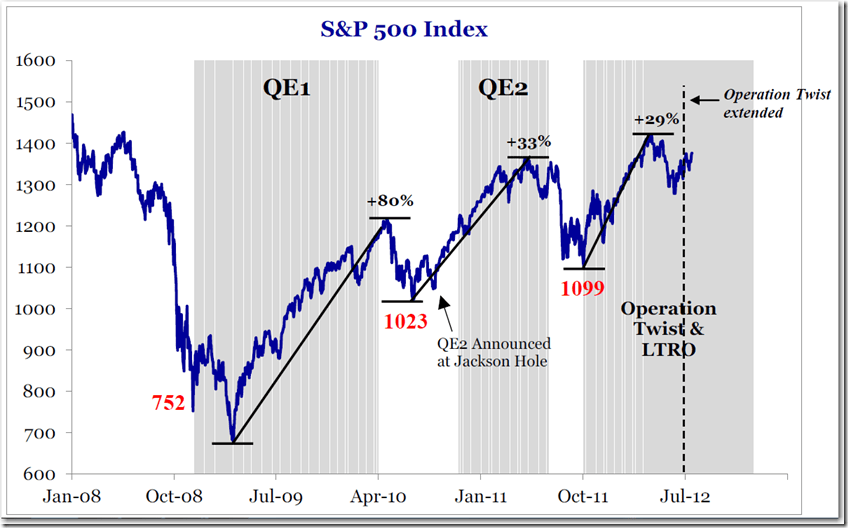
[Thanks to the first two rounds of quantitative easing] the wealthy quickly recovered much of their wealth as stocks doubled in value.
But the rest of the country, which depends on houses and jobs for their wealth, remained stuck in recession.
Most Americans have most of their wealth tied up in their houses (about 50 percent for most).
For the top 5 percent, homes account for only 10 percent of wealth, while financial assets account for between one third and 40 percent.
By boosting the value of financial assets, Fed has helped the economy of Richistan but not the broader United States.
Despite lowered rates, banks remain strict on lending, restricting access to credit for most Americans. The wealthy and the asset-rich, however, will now enjoy even lower rates on their credit.
Low interest rates also penalize savers, and while the wealthy as a group have the largest savings pool in America, they have only about 13 percent of their investible assets in cash, and the rest (more than 85 percent) in stocks, bonds, alternative investments and mutual funds – all of which have benefited from easing.
The critical question, though, is whether putting more profits into the hands of the top 5 percent will really generate jobs for the rest of America. So far, the evidence is not promising.
SHARE THIS POST WITH FRIENDS & FAMILY




 The Homa Files