The election polls results are all over the place.
My take: the election is a dead heat nationally (slight Romney edge in the popular vote) and in key swing states (slight Obama lead in pivotal swing states, lead in electoral votes).
But … the fat lady hasn’t sung yet.
To get a better understanding of the dynamics in play, I dug into this week’s NPR poll.
Why NPR?
Because, if anything, it leans left, so no cookin’ the books for Mitt.
Also, it reported some interesting metrics that provide a basis for some interesting analysis.
- Note: my primary intent is provide a calibrated analytical structure, not a prediction.
= = = = =
Topline Results
First, NPR reports Romney leading Obama by 1 point … 48% to 47% for all respondents … dead heat.
And, 48% + 47% = 95%, so 5% are still undecided, voting for another candidate, or hopelessly confused … or all three.
So, 5 points are arguably up for grabs.
Conventional wisdom says they break mostly for the challenger … advantage Romney.

Looking deeper – into the footnotes, NPR says:
- ALL results are based on 1000 weighted cases, MoE = ±3.10
In other words, Romney’s score could be as high as 51% or as low 45%.
Obama’s score could be as high as 50% and as low as 44%.
Bottom line: Either candidate might be leading … Romney could be leading by as many as 7 points … 51% to 44%.
Or, Obama could be leading by as many as 5 points … 50% to 45%.
That doesn’t tell us much, right?
= = = = =
Independent Voters
Let’s look at the Independent voters (above chart).
Romney leads with independent voters by 12 points … 51% to 39%,
Is that lead statistically significant?
Well, NPR says:
- IND results are based on 309 respondents, MoE = ±5.58 percent.
So, Romney could be as high as 56.5% or as low as 45.5%.
Obama could be as high as 44.5% or as low as 33.5%.
Bottom line: Romney has an unequivocal, statistically significant lead among Independents.
= = = = =
Voter Intensity
Here’s where things get interesting …
NPR asked:
- On a scale of one to ten, with one being “not at all enthusiastic” and ten being “extremely enthusiastic,”
how enthusiastic are you about voting in the Presidential election this November?

In marketing research, there’s a principle called the “top box effect”.
In essence, it says to focus on folks who check the highest level allowed … and pretty much ignore the rest as insignificant.
So, what do the numbers tell us?
Republican “intensity”, i.e. “extremely enthusiastic”, is 76% – 10 percentage points higher than the Dems 66% … and 22% higher than Independents 54%.
That’s a big intensity advantage for the Republicans.
How might it translate to votes?
We need another piece of data and some basic arithmetic.
= = = = =
Turnout Assumption
You’ve probably been hearing the grumbling—mostly from Republicans – that recent surveys have been skewed Democratic … that they implicitly assume that Dems will turnout more than Republicans.
- Of course, the turnout is a function of both party registration (“mix”) and voting propensity. Most surveys of party affiliation peg the Dems & Republicans at about even.
The NPR “mix” is 35% Republicans, 33% Independents, and 31% Republicans.

We’ll test the sensitivity of those numbers later … for now, let’’s use NPR’s assumption.
= = = = =
”Hard Support”
OK, now let’s play with the numbers.
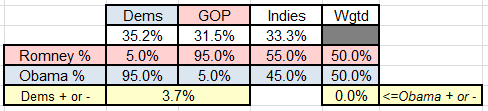
Here’s the summary chart … below, I’ll explain it.

What we’re trying to get to is “Hard Support” … folks who are “intense” (“extremely enthusiastic”) and favor Romney or Obama.
To get at that, we have to look at Republicans, Independents and Democrats separately.
For example, 76% of Republicans are “extremely enthusiastic” … and 96% of Republicans say they’ll vote for Romney.
Multiply those 2 numbers together, and they imply that 73% of Republicans are both “extremely enthusiastic” and inclined to vote for Romney (76% X 96% = 73%).
Since the sample “mix” is 31% Republican, Romney’s hard support from Republicans is equivalent to 22.6% of all voters (since 73% X 31% = 22.6%).
Applying the same calculations to the other classifications (Independent & Democrat) … and the data indicates that of Romney’s total of 48%, 32.9% is “hard support” and 15.2% is “soft support” that is less likely to show up at the polls.
Repeating the process for Obama, the data indicates that of Obama’s total of 47%. 29.1%% is “hard support” and 17.9% is “soft support”.
So what?
Romney has a 3.7 percentage advantage in hard support – the folks who are most likely to show up at the polls.
That’s a statistically significant number, given the polls 3 point margin of error.
Bottom line: If we factor in intensity, Romney has statistically significant advantage.
= = = = =
Another mix scenario
Let’s add one more twist.
What if the mix of Dems and Republicans is roughly equal at 33% … instead of 35% to 31%?

Big change!
Romney’s lead increases to 5.6% percentage points … Romney 50.6% to Obama 45%.
And, Romney’s hard support lead increases to 6.4 percentage points … well outside the margin of error.
= = = = =
Punch line
Yes, the headline number may signal a dead heat … within the margin of error.
But, if you factor in intensity and party mix … the numbers change pretty dramatically.
The Republican’s intensity advantage and lead among Independents seem pretty consistent across polls.
So, the key for Republicans is delivering on the intensity advantage … making sure that the “extremely enthusiastic” Republican & Independent voters turnout to vote.
For Dems, the turnout effort is even more critical since they have to close the intensity gap.
Dems claim that their turnout machine gives it substantial competitive advantage that will close the gap … or more.
I guess we’ll see next Tuesday.
>> Latest Posts
SHARE THIS POST WITH FRIENDS & FAMILY




 The Homa Files