Archive for September, 2008

They just don’t get it … but who are "they" ?

September 30, 2008

Excerpted from The Washington Post, “They Just Don’t Get It”, by Steven Pearlstein, September 30, 2008

* * * * *

The basic problem is that too many people don’t understand the seriousness of the [financial and economic] situation.

Americans fail to understand that they are facing the real prospect of a decade of little or no economic growth because of the bursting of a credit bubble that they helped create and that now threatens to bring down the global financial system.

Politicians worry less about preventing a financial meltdown than about ideology, partisan posturing and teaching people a lesson.

Financiers have yet to own up publicly to their own greed, arrogance and incompetence. And leaders of foreign governments still think that this is an American problem and that they have no need to mount similar rescue efforts in their own countries.

In the coming weeks and months, all of these people will come to understand how deep the hole really is and how we’re all in it together.

* * * * *

Restoring real stability to financial markets will require the kind of systemic approach and extraordinary government interventions that the public has refused to authorize and finance.

In better times, the public might have put aside its reluctance in response to the strong and unified recommendation of political and business leaders.

But it is a measure of how little trust remains in both Washington and Wall Street that voters are willing to risk a serious hit to their wealth and income rather than follow their lead.

Edit by DAF

* * * * *

Full article:
http://www.washingtonpost.com/wp-dyn/content/article/2008/09/29/AR2008092902762.html

* * * * *

Want more from the Homa Files?
Click link => 
The Homa Files Blog

* * * * *

Mr. Romney, please call your office …

September 30, 2008

I didn’t see the Sarah Palin pick coming.  But, I thought it was a masterful coup that added energy and ‘authenticity’ to McCain’s campaign.  I still like that she’s a real person who has a strong value system and a record of achievements.

But, the economy has become the issue.  With McCain and Obama flaunting their economic ignorance with naive talking points,  I find myself wishing McCain had gone boring with Mitt Romney.  He’s the only one of the current batch of politicos who has any idea how the economy works. 

Just my opinion.

* * * * *

Want more from the Homa Files?
     Click link =>
  The Homa Files Blog


Offshore drilling ban to lapse … (I’ll believe it when I see it)

September 30, 2008

Excerpted from CNN Money: “Democrats allow drilling ban to lapse”, September 23, 2008

* * * * *

The Interior Department estimates there are 18 billion barrels of recoverable oil beneath coastal waters now off-limits.

* * * * *

Democrats have decided to allow a quarter-century ban on drilling for oil off the Atlantic and Pacific coasts to expire next week, conceding defeat in a month-long battle with the White House and Republicans set off by $4 a gallon gasoline prices this summer.

Appropriations Committee Chairman David Obey told reporters that a provision continuing the moratorium will be dropped this year from a stopgap spending bill to keep the government running after Congress recesses for the election.

Republicans have made lifting the ban a key campaign after gasoline prices spiked this summer and public opinion turned in favor of more drilling. President Bush lifted an executive ban on offshore drilling in July.

* * * * *

Just last week, the House passed legislation to open waters off the Atlantic and Pacific coasts to oil and gas drilling but only 50 or more miles out to sea and only if a state agrees to energy development off its shore.

Republicans called that effort a sham that would have left almost 90% of offshore reserves effectively off-limits.

* * * * *

Full article:
http://money.cnn.com/2008/09/23/news/economy/offshore_drilling.ap/index.htm?cnn=yes

* * * * *

Want more from the Homa Files?
Click link =>
  The Homa Files Blog

The Numerati – Drilling through the Data

September 30, 2008

Book review excerpted from WSJ: “Drilling Through Data”, September 15, 2008

* * * * *

The Numerati, Stephen Baker, (Houghton Mifflin

* * * * *

The world is buried in data, great banks and drifts of the stuff. In recent years a new technology has emerged: computer programs that will drill through it all to pick out patterns and trends — information that may be useful to marketers, politicians, employers, doctors, matchmakers or national-security analysts.

Such programs are extraordinarily sophisticated, and their creators — the “Numerati” — need to be very clever indeed. Using “data mining,” they seek out veins of useful ore in the mountains of facts that computers accumulate every day.

* * * *
In “The Numerati,” Stephen Baker offers a highly readable and fascinating account of the number-driven world we now live in.

He shows us, for instance, how political consultants, mining databases that track consumer and “lifestyle” preferences, sort us into tribes by behavioral proxy. Cat owner? Likely Democrat. NRA member? Probably Republican. Mailings and phone calls can then be targeted more accurately.

Health professionals, especially when treating older patients, are now monitoring such things as weight, body temperature and pulse by having a computer follow data streams from sensors on clothing or even from sensor-laden “magic carpets” laid around the house. Disturbing patterns prompt the computer to signal a problem.

The Numerati are taking over dating services, too. How do you find that special one in a million? By mining the data of the million. How do you improve your own chances of being found? By the same techniques that companies use to show up first in a Google inquiry — “search engine optimization,” now a flourishing industry.

The Numerati are even mining the output of bloggers, those stream-of-consciousness online diarists and self-promoters. “What makes the blog world especially valuable to marketers,” Mr. Baker writes, is “its unfiltered immediacy.” What do consumers think of your new product? What desires are still not satisfied by products of this kind? You can commission a poll or wait for the sales figures to come in . . . or you can read the blogs. Better yet, you can hire Numerati to write programs that will read them for you, since there are now more than 20 million bloggers in the U.S. alone.

* * * * *

Full article:
http://online.wsj.com/article_print/SB122143747437734337.html

* * * * *

Want more from the Homa Files?
Click link =>
  The Homa Files Blog

Facebook’s Hidden Politics

September 30, 2008

Excerpt from the Wall Street Journal “Facebook Political Ads Test Limits” September 15, 2008 

Political parties and interest groups have long cherry-picked news stories that promote their agenda to feature in campaign ads. But some new ads popping up on Facebook take that tactic to a new level.

“AP Says: Palin Lied,” reads one ad, accompanied by an unflattering photo of the vice presidential candidate. Another ad — accompanied by the same photo — reads, “Washington Post breaks ANOTHER Palin scandal. Charging tax payers for her sleeping at home”…

Clicking on the ads takes visitors straight to a story on the Web sites of those publications…

But none of the publications cited in the ads bought them — or even was aware of them. The buyer — though never identified anywhere on the ads or on the pages that you land on after clicking on them — is the liberal group MoveOn.org. It’s the latest example of fuzziness about who’s behind what when it comes to political ads online…

Facebook says the ads comply with its policies…With Facebook’s self-service advertising system, anybody can log on to the site and create an ad. The site allows advertisers to select the text for the ad as well as a picture and the Web site to point consumers to. Most ads are bought through a cost-per-click model, so advertisers only pay if a person clicks on the ad.

Advertisers can pick specific groups of people who will see their ad, and they bid a certain amount to have their ads shown to target groups.

Edit by SAC

* * * * * 
Full article:
http://online.wsj.com/article_print/SB122143365240034005.html

* * * * *

Want more from the Homa Files?
Click link =>
The Homa Files Blog

Macy’s Gets a Makeover

September 30, 2008

Excerpted from Fortune, “Macy’s Quest for the Fountain of Youth”, by Suzanne Kapner, September 24, 2008

* * * * *

After years of losing ground to the likes of Abercrombie & Fitch in the battle for young and hip shoppers, Macy’s is considering an overhaul of its flagship Herald Square store to lure the under twenty crowd.

It entails relocating junior apparel from the fourth floor to the basement, now known as The Cellar, which would create a club-like atmosphere in the basement, complete with dim lighting and pulsating music – it could be a key part of a strategy to reverse a prolonged sales slump at the department shore giant.

* * * * *

Department stores have for years been losing ground to specialty retailers, which is one reason they are called aging dinosaurs. But the name goes beyond semantics. As department stores fail to attract younger shoppers, their customer base is literally growing older.

Marshal Cohen, the chief industry analyst for market research firm the NPD Group, estimates that department stores have lost 8 percent of their market share since 2003. He attributes a good portion of that decline to the migration of teens and young adults to specialty retailers (Abercrombie, Urban Outfitters, J. Crew, etc.).

* * * * *

By giving teens a separate entrance and their own place to hang out – similar to creating a rec room in the basement – Macy’s is hoping kids will feel less self conscious about shopping where their parents shop.

But should the Herald Square store find success with its subterranean experiment, Macy’s may have difficulty rolling the idea to its other 850 stores nationwide, many of which do not have basements.

* * * * *

Going after the youth market has other risks, notably an alienation of core, older customers. Gap lost its mainstay thirtysomething shopper when it tried to appeal to a younger generation earlier this decade and has been in a tailspin ever since.

Edit by DAF

* * * * *

Full article:
http://money.cnn.com/2008/09/24/news/companies/kapner_macys.fortune/index.htm?postversion=2008092413

* * * * *

Want more from the Homa Files?
Click link => 
The Homa Files Blog

* * * * *

India’s Educom: computers to the classroom

September 30, 2008

Excerpted from  Forbes: “Lesson Plans: Educomp is cashing in by bringing computers to the classroom”,  September 29, 2008

* * * * *  

India is pouring billions more into education each year in a rush to feed its booming economy with well-prepared workers. That spells big opportunities for education businesses … that provide computer-aided lessons in schools. They’re using technology to make education more available–and more interesting–to students across the country. But the company doing the best in this market is Educomp Solutions.

* * * * *

Educomp’s main business is developing and licensing digital lessons, which are uploaded onto servers provided to schools. It also trains teachers (75,000 just in the last quarter), provides vocational training to students with courses such as accounting and marketing, and offers online and in-person tutoring. “We are all about how the education sector can use information technology,” says Shantanu Prakash, the company’s 43-year-old founder and managing director.

In 2005 it began opening private schools with not-for-profit educational trusts, providing the computers, the digital lessons, the books and sometimes the land and building. It aims to start 150 schools in all over the next three years.

Educomp’s big money-maker is Smart Class, a range of interactive digital lessons with animation and graphics that’s marketed mainly to private schools because they have deeper pockets than public schools.

The multimedia lessons–it offers 16,000 so far–are based on the different curricula in place across the country and use 12 of the country’s languages. Lessons feature video images that students can rotate to see from different angles, explaining hard-to-visualize concepts such as the splitting of an atom or the structure of human DNA. Educomp has 400 people developing lessons at three sites, in the New Delhi suburbs of Noida and Gurgaon and in Bangalore.

At one of the private schools it helps run, the PSBB Millennium School in Chennai, seventh-grader Shreya Sreekumar peers into her laptop on a recent morning as her teacher walks her and her 38 classmates through a lesson on the human respiratory system. As they study brightly colored pictures of a larynx and lungs, a potentially dull biology class suddenly becomes much more engaging. “It’s a fun way of learning,” she says. Once the class is done, the teacher sends the homework assignment wirelessly to each student’s laptop.

* * * * *

Educomp is expanding abroad. It entered the U.S. market last November by picking up a 51% stake–for $24.5 million–in an e-learning company called Learning.com, which reaches 2.5 million students in more than 2,000 school districts across the U.S.

* * * * *.

By the Numbers Education in India

$40 bil Size of the private education market.

$68 bil Projected size of the private education market by 2012.

8.9% Share of a middle-class Indian’s monthly budget spent on education.

Source: CLSA.

* * * *

Full article;
http://www.forbes.com/global/2008/0929/047.html?partner=alerts

* * * * *

Want more from the Homa Files?
Click link =>
  The Homa Files Blog

The bailout: Obama’s windfall

September 29, 2008

Strictly my POV:

All of the pundits are saying that the cost of the bailout will hamstring either Obama or McCain — whoever gets elected.  (see http://www.politico.com/news/stories/0908/14027.html)

McCain wouldn’t be able to cut (or hold) taxes;  Obama won’t be able to afford his expensive social programs.  I disagree — especially if Obama’s “$500 for everybody who votes for me” campaign succeeds.

First, Obama will use the cost of the program to justify even more tax increases.  The increases will hit more people and will be bigger.

Second, the $700 billion will become a permanent layer of the national debt.  It will never be paid down.  Any proceeds received from closing, renegotiating or reselling the toxic loans will simply be redeployed to other spending programs.  Think Iraq – it was originally off budget.  Now, there is talk of how to put the $10 billion per month to better use. 

Mark my words.

* * * * *

Want more from the Homa Files?
Click link =>
  The Homa Files Blog

MUST READ: The NY Times called the mortgage crisis … September 30, 1999

September 29, 2008

Excerpted from NY Times: “Fannie Mae Eases Credit To Aid Mortgage Lending”, Steven Holmes, September 30, 1999

* * * * *

September 30, 1999

In a move that could help increase home ownership rates among minorities and low-income consumers, Fannie Mae is easing the credit requirements on loans that it will purchase from banks and other lenders.

The action … will encourage those banks to extend home mortgages to individuals whose credit is generally not good enough to qualify for conventional loans.  

These borrowers whose incomes, credit ratings and savings are not good enough to qualify for conventional loans, can only get loans from finance companies that charge much higher interest rates — anywhere from three to four percentage points higher than conventional loans.

* * * * *

Fannie Mae, the nation’s biggest underwriter of home mortgages, has been under increasing pressure from the Clinton Administration to expand mortgage loans among low and moderate income people and felt pressure from stock holders to maintain its phenomenal growth in profits.

”Fannie Mae has expanded home ownership for millions of families in the 1990’s by reducing down payment requirements,” said Franklin D. Raines, Fannie Mae’s chairman and chief executive officer. ”Yet there remain too many borrowers whose credit is just a notch below what our underwriting has required who have been relegated to paying significantly higher mortgage rates in the so-called subprime market.”

Demographic information on these borrowers is sketchy. But at least one study indicates that 18 percent of the loans in the subprime market went to black borrowers, compared to 5 per cent of loans in the conventional loan market.

* * * * *

In moving, even tentatively, into this new area of lending, Fannie Mae is taking on significantly more risk, which may not pose any difficulties during flush economic times. But the government-subsidized corporation may run into trouble in an economic downturn, prompting a government rescue similar to that of the savings and loan industry in the 1980’s.

”From the perspective of many people, including me, this is another thrift industry growing up around us,” said Peter Wallison a resident fellow at the American Enterprise Institute. ”If they fail, the government will have to step up and bail them out the way it stepped up and bailed out the thrift industry.”

* * * * *

Fannie Mae, the nation’s biggest underwriter of home mortgages, does not lend money directly to consumers. Instead, it purchases loans that banks make on what is called the secondary market. By expanding the type of loans that it will buy, Fannie Mae is hoping to spur banks to make more loans to people with less-than-stellar credit ratings.

Fannie Mae officials stress that the new mortgages will be extended to all potential borrowers who can qualify for a mortgage. But they add that the move is intended in part to increase the number of minority and low income home owners who tend to have worse credit ratings than non-Hispanic whites.

* * * * *

Full article:
http://query.nytimes.com/gst/fullpage.html?res=9C0DE7DB153EF933A0575AC0A96F958260&sec=&spon=&pagewanted=1

* * * * *

Thanks to Chris Wargo, MSB MBA ’05 for the heads-up

* * * * *

Want more from the Homa Files?
Click link =>
  The Homa Files Blog

Young & Cynical vs. Old & Green

September 29, 2008

Excerpt from Marketing Daily “Boomers: The Greenest Generation” September 9, 2008

* * * * * 

While conventional marketing wisdom holds that it’s the idealistic Gen Y shoppers who are most committed to buying products that are less harmful to the environment, a new study finds that baby boomers are the greenest generation.

Both male and female groups 55 years and older are above-average users of environmentally friendly home goods in the U.S…Conversely, men and women from 25 to 34 years are among the “least likely to buy” category, compared to the national average…

One reason that older shoppers may be more committed, says Peter Meyers, ICOM’s marketing vice president, “is that they are spending more time in the store, looking at packaging and reading product claims. They know what they’re buying.”

Another possible explanation, he says, is that Gen Y is simply becoming more cynical, and is more likely not to believe a marketer’s claims.

For marketers to continue to be successful with earth-friendly claims, he says, especially with the economic slowdown, “they’re going to have to start considering price as a key issue, as well as finding ways to back up claims more clearly, to build trust.”

Edit by SAC

* * * * *

Full article:
http://www.mediapost.com/publications/?fa=Articles.showArticle&art_aid=90191

* * * * *

Want more from the Homa Files?
Click link =>
The Homa Files Blog

Huh? Most Adults Give Children’s Schools Good or Excellent Ratings

September 29, 2008

Excerpted from Rasmussen Reports:”Most Adults Give Children’s Schools Good or Excellent Ratings”, September 12, 2008

* * * * *

81% of adults rate the performance of their children’s schools as good or excellent. Of that percentage, 47% of adults rate their children’s school as excellent.

Just four percent 4% give their schools poor ratings.

The positive grades span across both men and women, blacks and whites and party affiliation.

* * * * *

However, the majority of adults (52%) think schools place too much emphasis on standardized testing.

* * * * *

When it comes to , 53% say students receive just the right amount of homework …22% say students are assigned too much homework … 21% say they are not assigned enough.

* * * * *

86% believe PE should be required

* * * * *
Full article:
http://www.rasmussenreports.com/public_content/lifestyle/general_lifestyle/most_adults_give_children_s_schools_good_or_excellent_ratings

* * * * *

Want more from the Homa Files?
Click link =>
  The Homa Files Blog

Who’s Paying for CEO Excess?

September 29, 2008

Excerpted from New York Times, “Need a Job? $17,000 an Hour. No Success Required”, by Nicholas D. Kristof, September 18, 2008

* * * * *

Richard Fuld, the longtime chief of Lehman Brothers, took home nearly half-a-billion dollars in total compensation between 1993 and 2007.

Last year, Mr. Fuld earned about $45 million, according to the calculations of Equilar, an executive pay research company. That amounts to roughly $17,000 an hour to obliterate a firm.

* * * * *

Three decades ago, C.E.O.’s typically earned 30 to 40 times the income of ordinary workers. Last year, C.E.O.’s of large public companies averaged 344 times the average pay of workers.

* * * * *

These Brobdingnagian paychecks are partly the result of taxpayer subsidies. A study released a few weeks ago by the Institute for Policy Studies in Washington* found five major elements in the tax code that encourage overpaying executives. These cost taxpayers more than $20 billion a year.

Edit by DAF

* * * * *

Full article:
http://www.nytimes.com/2008/09/18/opinion/18kristof.html?ref=opinion

*IPS Report, “Executive Excess 2008: How Average Taxpayers Subsidize Runaway Pay”, 
 executiveexcess2008

IPS Site: http://www.ips-dc.org/reports/

* * * * *

Want more from the Homa Files?
Click link => 
The Homa Files Blog

* * * * *

Been paying your mortgage, sucker ?

September 29, 2008

Excerpted from WSJ: “Rescue Includes Steps to Help Borrowers Keep Homes”, Sept. 29, 2008

* * * * *

Ken’s POV: Just imagine a non-citizen investor (e.g. a “flipper”) who lied on his mortgage application, didn’t put any money down  and hasn’t made any monthly payments.  He’ll get his mortgage adjusted.  You won’t

* * * * *
The bailout package includes more aggressive steps to help troubled borrowers keep their homes by requiring the government to do more to reduce loan balances and interest rates.

The bill calls on the government, as the owner of mortgages, mortgage-backed securities and other assets backed by real estate, “to implement a plan that seeks to maximize assistance to homeowners and use its authority to encourage the servicers of underlying mortgages, and considering net present value to the taxpayer, to take advantage of…available programs to minimize foreclosures.”

Such measures could reduce monthly loan payments for homeowners and, in theory, increase the likelihood that borrowers keep up mortgage payments. It could also slow down the growing number of foreclosures.

The modifications are designed so that the payments on a borrower’s mortgage don’t exceed 38% of gross income.

* * * * *
Although the latest plan may evoke anger among taxpayers who pay their mortgages on time, economists say helping those in trouble could benefit all taxpayers by blunting the impact of the financial crisis on the housing market and local communities.

Getting borrowers back on track could help reduce the cost of the bailout to taxpayers. In recent years, troubled loan portfolios have yielded about 32% of book value, compared with more than 87% for loans in which the borrower is current.

* * * * *
There are more questions than answers about how effective the government’s program will be. If the government buys entire loans.

Another crucial unanswered question is how many borrowers will be helped by stepped-up loan-modification efforts. “There’s a great deal of skepticism about the ability of modifications to improve the performance of loans.”

Deutsche Bank recently looked at subprime loans packaged into securities, most of which were modified in 2008. It found that roughly 35% of the loans were at least 60 days past due roughly six months after the modification.

“Investors think these loans will all redefault in a year or a couple of years and the losses will be higher.” Historically, modifications haven’t done that well.

One fear is that if mortgage companies or the government, is too liberal in offering help, more borrowers who might otherwise stay current on their loans will fall behind to get a better deal. “What we don’t want to do is undertake some kind of program that changes the behavior of those many, many people who undertake extraordinary effort to pay their mortgage and make sure they can stay in their home.”

As many as 40% of homeowners, or about 20 million households, will owe more than their home is worth by the time the housing market stabilizes.

[Chart]

* * * * *

Full article:
http://online.wsj.com/article/SB122265697254684627.html?mod=article-outset-box

* * * * *

Want more from the Homa Files?
Click link =>
  The Homa Files Blog

Voter opposition to bailout plan creates an opportunity for McCain … does he have the stones ?

September 29, 2008

* * * * *

According to Rasmussen Reports, only 25% of voters favor the bailout plan.  Obama supporters are most skeptical of it. (More data and the link are below)  All of which creates an bold political opportunity fo McCain — as articulated by Dick Morris.

Note: Probably by the time your read this, the die will have been cast — one way or another.

* * * * *

Excerpt from: “MCCAIN’S TRUMP CARD”, Dick Morris,  New York Post, September 28, 2008

During Friday’s debate, John McCain assiduously and inexplicably avoided using the issue that might have won him the debate and the presidency: opposition to a taxpayer-funded bailout of the financial crisis.

Congress is about to pass – and the president is about to sign – a bill that the American people detest by 2:1 margins. When Americans realize that there is, indeed, an alternative to handing over $700 billion to financial institutions as a reward for their failure, opposition to the idea will swell even further.

The bailout ideas proposed by the House Republicans and trumpeted by former Speaker Newt Gingrich make eminent sense. Indeed, they make so much sense that it is as if the roles of the parties have been reversed. It is the Republicans who are demanding that the banks and financial institutions pay for their own bailout, granting them only a mixture of loans and premium-paid insurance, while the Democrats want to pass the hat among the taxpayers to buy their dirty paper.

In an unusual act of political foresight and skill, the normally dead-headed House Republican leadership has crafted a platform that can carry the party to victory in November. All that remains is for the Party’s candidate – and perhaps even its president and Treasury Secretary – to get on board. McCain can recover at the negotiating table the economy issue he lost in Friday’s debate. He needs to have the courage of his convictions and insist on a bailout without requiring taxpayer-funded purchase of defunct mortgages from failing institutions.

The difference in the bailout plans is, of course, largely cosmetic. Dead paper is dead paper whether it is on the books of the government, purchased from banks, or on the books of the banks, insured by the government. The game is the same: Through loans or grants fund the deficient debt service on the defaulted mortgages until homes can recover their value in the cyclical real estate market.

Loans are politically viable. Purchase of bad debt with tax money is not.

The Democrats and our politically-challenged president have failed to appreciate the difference between spending and lending. Treasury Secretary Paulson can be excused for not realizing it. Politics is not his thing.

But John McCain must realize the crucial distinction and must use his leverage to stop a taxpayer-funded bailout, insisting instead on loans and insurance.

* * * * *

If McCain stands firm, the Democrats will either have to pass the bailout package on their own, without Republican votes, and rely on Bush’s signature on the bill to provide a fig leaf of bipartisanship – or they will have to cave in and pass the Republican package.

Either way, McCain comes out ahead.

If he gets his way, he gets credit for the bailout. If he doesn’t, he can spend the campaign attacking Obama and the Democrats for spending $700 billion of taxpayer money.

If the Democrats don’t adopt either course and play a game of chicken with the Republicans, their Congressional status as the majority party dooms them to taking the blame for any ensuing collapse.

Voters can count. They know that Reid and Pelosi are Democrats and that they control Congress. With this power comes responsibility.

And if the Democrats do nothing – that is they fail to use their majorities to pass a bailout or to cooperate with the Republicans in adopting the GOP version of the package – it is they who will get the blame for the catastrophe which will follow.

The Democrats don’t dare take that chance.

The cards are dealt for John McCain. All he has to do is have the guts to do what he didn’t have the courage to do in the debate: Play the hand.

* * * * *

Full article:
http://www.vote.com/mmp_printerfriendly.php?id=1115

* * * * *

From Rasmussen Reports, Sept. 27, 2008

The more voters learn about the proposed $700-billion taxpayer-backed Wall Street rescue plan, the less they like it.

Just 24% of U.S. voters now favor the plan first proposed by Treasury Secretary Henry Paulson [and modified by Congress] … 50% oppose it, and 25% are undecided.

72% say they have followed stories on [the financial crisis], including 37% who say they have been following the news Very Closely.

* ** * *

House Republicans, who regard the unprecedented government involvement in the financial markets as nothing short of socialism, are demanding significant downsizing of the plan and other changes.

The White House and Democratic leaders argue the plan to buy up bad mortgage debt from private firms is the surest way to free up credit for all Americans, but many GOP legislators fear the potential losses to taxpayers. Congressional Democrats are worried about voter opposition to the plan and don’t want to pass it without significant Republican support.

* * * * *

Both men and women oppose the bailout plan two-to-one. Likely McCain and Obama voters reject the plan by similar margins, although Obama supporters are slightly more skeptical.

* * * * *

Full Report:
http://www.rasmussenreports.com/public_content/business/general_business/support_for_bailout_plan_now_down_to_24

* * * * *

Want more from the Homa Files?
Click link =>
  The Homa Files Blog

Bailout: A checklist of Republican demands …

September 28, 2008

When the deal gets revealed — later today or tomorrow — check to see if the House Repubs had any impact on the final legislation.  If they didn’t, uh-oh.

Here’s a handy checklist of what they wanted.

* * * *

Excerpted from Rasmussen Reports: “A Paulson-Cantor Plan Is a Win-Win for Taxpayers”, Lawrence Kudlow, September 26, 2008

* * * * *

Basically, the House Republicans want a “cleaner” bill with

1. Inclusion of a federal bond insurance guarantee for straight mortgage-backed paper, financed by private-sector insurance premiums. (The “Cantor Plan”)

2. Removal of the ACORN slush fund   [Ken’s POV: Ostensibly, this provision is to provide more affordable housing to certain communities.  That’s the policy that got us into this mess to start with.  ACORN is Obama’s major mobilizer for voter registration.]

3 Removal of the so-called union proxy to run a slate of corporate directors

4. Requirement that all profits from the Treasury rescue mission must be used to reduce the national debt — 100 percent. [Ken’s POV: This is key … otherwise, the $700 billion will become a permanent layer of national debt — with any paydown simply diverted to other programs]

5. Removal of authority to  bankruptcy judges for setting mortgage terms and interest rates  [Ken’s POV: Otherwise, non-citizens who lied on their mortgage apps and never had an ability to repay loans will be getting more favorable terms than their neighbors who played by the rules]

6.  Elimination of the  so-called government equity ownership of banks … because it effectively creates a corporate tax increase on banks at a time when they are struggling.

7. Scaling back the Treasury secretary’s request for $700 billion … or at least phasing it in.

* * * * *

Full article:
http://www.rasmussenreports.com/public_content/political_comentary/commentary_by_lawrence_kudlow/a_paulson_cantor_plan_is_a_win_win_for_taxpayers

* * * * *

Want more from the Homa Files?
Click link =>
  The Homa Files Blog

Flawed logic ? The Real Cost of the Bailout …

September 28, 2008

Excerpted from WSJ: “What’s the Real Cost of the Bailout?”, Sept. 26, 2008

* * * * *

Assume Hank Paulson gets his $700 billion appropriation.  And, assume he then spends it all, immediately, buying up the financial toxic waste that is rapidly destroying the banking system.

How much would that actually “cost” taxpayers?

The Federal government pays just 4.34% interest on long-term, 30-year loans. So the government could borrow this money for 30 years at a cost of just $30 billion in interest per year.

To put that in context, that is about one-fifth of 1% of our gross domestic product. One-fifth of 1%.

* * * * *

Obviously, the story doesn’t just end with the interest cost. When you take out a loan, you’ve got to be able to repay the principal in due course as well.

Let’s take a worst case scenario. Let’s imagine Uncle Sam borrows $700 billion to buy these assets and never gets a single penny of it back. Let’s imagine this paper ends up completely worthless. So instead he has to tap taxpayers to pay off part of the principal every year for 30 years, until the loan is all redeemed.

How much would that cost per year?

Try $42 billion. That’s the interest and principal repayment.

That’s less than one-third of 1% of our annual gross domestic product. That’s the true, annual cost of this bailout. Not $700 billion.

And that’s the worst case scenario. That’s assuming Uncle Sam never gets back one penny on these assets. In reality, the Treasury will certainly get some of its money back and will probably get most.

It may even make a profit. Someone with deep pockets, the ability to borrow long-term money for just 4.34%, and the expertise to analyze today’s distressed mortgage market could make an absolute killing here.

Full article:
http://online.wsj.com/article/SB122245659564179649.html

* * * * *

Ken’s POV

The author’s “worst case” is hardly the worst case. The worst (and most likely) case is that the $700 billion becomes a permanent layer of the national debt, i.e. any potential pay-down just gets diverted incrementally to other spending programs.  If so, the full cost of the program is the value of the perpetual annuity stream of interest payment — which is $700 billion [$30 / 4.34%].

Why is the worst case the most likely?  Think Iraq spending — the $10 billion per month.  It was originally ex-budget. Now, at least one presidential candidate is talking about repatriating the $10 billion per month into domestic spending programs.  Suddenly, ex-budget becomes on-budget.

* * * * *

Want more from the Homa Files?
Click link =>
  The Homa Files Blog

Marketing to hockey moms …

September 26, 2008

Excerpted from BrandChannel.com: “Do Hockey and Soccer Mom Brands Share Goals?”, Abram Sauer, September 11, 2008

* * * * *

Alaska governor Sarah Palin opened a (marketing) debate: Is hockey mom the new millennium’s soccer mom, just as soccer mom was the 1990’s version of the 1980’s super mom? Are soccer moms and hockey moms different? Is the branding that represents them accurate, or are the terms just oversimplified stereotypes?

* * * * * 

There are about 350,000 hockey players under the age of 20 in the US, and that these hockey families have a median household income of nearly US$ 100,000—which is far higher than the national average.

A soccer mom is “most likely married, aged late 20s to early 40s, probably driving an SUV; she works, Some are college graduates and some are not.”

“The demographics of hockey moms and soccer moms are very similar … Hockey moms might have a reputation for being a little tougher—perhaps due to the nature of the sport.”

Celinda Lake — often credited for coining the term “soccer mom” in the 1990s — explains that, despite an average household income of almost US$ 100,000, “Hockey moms are more blue collar than soccer moms,”

The hockey mom demographic is also called “Wal-Mart Moms.”

“Hockey moms’ respond to male communication styles—competitive, assertive, hierarchical, us vs. them. Soccer moms respond to more female communication styles—cooperative, focused on common ground, connecting and sharing values.”

There is a consensus that “hockey mom” has a more blue-collar feel: “Some have gone so far to say that hockey moms are anti-intellectual and worse.”

Paradoxically, the generalization of “soccer moms” has made many women anxious to disassociate themselves from it. 

Often, when you think of a soccer mom, you think of a mom consumed with her kids driving a mini-van. You don’t have pictures of a highly accomplished career woman, or a technologically savvy woman, or a world leader. That’s why the label is so loaded, you associate many attributes to it that may or not be true of a particular woman.

Brands looking to reach these moms need to make solid information readily available: “There’s still a perception out there that soccer moms are only online to email, do a little shopping, and perhaps visit blogs. What they do want is information. Women are going online to research everything from buying a car, to health care insurance, to planning the family vacation. They want a lot of information, not just fluffy celebrity stories.

Women often have more questions than men do, which is another reason she is going online to do research on information she can’t find in the stores or from the sales people. There’s a huge opportunity here for companies to provide answers to her questions. Because even if she shops offline, that search very often begins online.

* * * * *

Full article:
http://www.brandchannel.com/start1.asp?fa_id=440

* * * * *

Want more from the Homa Files?
Click link =>
  The Homa Files Blog

Where do the poor live ?

September 26, 2008

     Interesting info from the Census Department :

image

* * * * *

Want more from the Homa Files?
Click link =>
  The Homa Files Blog

AOL – Trying to win ’em back …

September 26, 2008

Excerpted from WSJ: “AOL Pushes to Win Back Lost Subscribers”, September 10, 2008

* * * * *

Web Portal’s Changes Are a Bid to Keep Up With How People Surf

When AOL in 2006 ditched its subscription service in favor of an advertising-based model, millions of subscribers deserted the site. Now, AOL is making its biggest push yet to win them back.

In a bid to remain relevant, AOL is unveiling a new home page as well as a slew of Web sites aimed at women, pop-culture addicts and parents of gamers.

The revamped AOL.com will for the first time let visitors access email accounts from outside providers like Google and Yahoo and will include updates from major social-networking sites and automatically personalize content for users.

The changes are an effort to recalibrate AOL’s portal model with the way people use the Internet these days.

In recent years, Web traffic has fragmented across thousands of sites and people often use multiple email accounts. But AOL was rooted in an era when most Web surfers did very little actual surfing, choosing instead to remain within the confines of a single gateway (or portal), as they read the latest news headlines, checked their horoscopes, shopped and sent email.

* * * * *

AOL still aims to be a hub of sorts, but one that serves as more of an entry point to the rest of the world than a self-contained content bubble.

Other portals, including Yahoo and Microsoft’s MSN, also provide links to third-party sites, but not access to accounts on other email or social-networking sites. AOL’s new automatic-personalization feature — where a person, for example, who looks at finance sites frequently will see finance content news featured more prominently — is also unique.

* * * * *

The big question is whether the company will be able to translate those new visits into ad dollars.

Anemic ad sales have been a big drag on the earnings. While the rest of the online ad market climbs at a healthy clip — increasing 20% in the U.S. in the second quarter — advertising growth at AOL stalled at 1.5% in the second quarter following four previous quarters of deceleration.

In particular, AOL’s ad sales growth was dragged down by a 14% slump in display ads, graphical ads that border a Web page. These ads typically are the main unit sold on a portal’s home page and can fetch some of the highest prices in the business.

For the past year, (AOL has been talking) about how traffic is not the problem, monetization is. I don’t need to be convinced that traffic can return. I just want to understand how they can convert that traffic to advertising growth.”

In an effort to address that issue, the new AOL.com will start allowing types of ads on the home page that marketers find more desirable. It will prominently feature a photo gallery and video player, which can offer ad formats that are particularly interactive and obtain higher ad rates than other more static ads.

* * * * *

AOL drew 111.4 million unique U.S. visitors in July, down slightly from the 113.9 million people that visited the site during that month last year, according to comScore Media Metrix. But the site is still fourth-largest Web site in the U.S. (by that measure).

With its relaunched home page and new content, AOL is trying to get current visitors to its home page to stay longer and also broaden its appeal.  

The revamp also marks the first major attempt by AOL to integrate Bebo, the third-largest social-networking site, which AOL acquired this year for $850 million.

* * * * * 

Full article:
http://online.wsj.com/article/SB122100183521716953.html?mod=2_1567_middlebox

* * * * *

Want more from the Homa Files?
Click link =>
  The Homa Files Blog

* * * * *

"Paulson’s Folly" or Greatest Deal since "Seward’s Folly") ?

September 25, 2008

* * * * *

Ken’s POV: I never underestimate the government’s core incompetence — its bungling inefficiency — and, philosophically, I hate to see anything get nationalized or socialized.  Nonetheless, I’m becoming a believer in the favorable economics of the Paulson Plan.  This article is the crux of the reason why.

* * * * *

Excerpted from WSJ: “The Paulson Plan Will Make Money For Taxpayers”, Andy Kessler, Sept 25, 2008 

Mr. Kessler, a former hedge-fund manager, is the author of “How We Got Here” (Collins, 2005).

* * * * *

There is a saying on Wall Street that goes, “The market can stay irrational longer than you can stay solvent.”

* * * * *

Warren Buffett is now hoping to make big money on Goldman Sachs.

My analysis suggests that Treasury Secretary Henry Paulson (a former investment banker, no less, not a trader) may pull off the mother of all trades, which could net a trillion dollars and maybe as much as $2.2 trillionfor the United States Treasury.

* * * * *

Wall Street’s bread-and-butter business of investment banking and trading stocks stopped making much money years ago. So investment banks took their enormous capital and at first packaged yield-enhanced, subprime mortgage loans into complex derivatives such as collateralized debt obligations (CDOs). Eventually and stupidly, these institutions owned them for themselves — lots of them, often at 30-to-1 leverage. The financial products were made “safe” by insurance products known as credit default swaps, a credit derivative from companies such as AIG. When housing turned down, the mortgages and derivatives were worth a lot less and no one would lend Wall Street money anymore.

Then the piling on started. Hedge funds could short financial stocks and then bid down the prices of CDOs stuck on Wall Street’s balance sheets. This was pretty easy to do in an illiquid market. Because of the Federal Accounting Standards Board’s mark-to-market 157 rule, Wall Street had to write off the lower value of these securities and raise more capital, diluting shareholders. So the stock prices would drop, which is what the shorts wanted in the first place. It was all legit.

* * * * *

In a weird twist, it’s the government that is set up to win the prize.

Here’s how: As short-term financing dried up, Fannie Mae and Freddie Mac’s deteriorating financials threatened to trigger some $1.4 trillion in credit default swap payments that no one, including giant insurer AIG, had the capital to make good on. So Treasury Secretary Henry Paulson put Fannie and Freddie into conservatorship. This removed any short-term financing hassle. He also put up $85 billion in loan guarantees to AIG in exchange for 80% of the company.

Taxpayers will get their money back on AIG. Fannie and Freddie are a gold mine. For $2 billion in cash up front and some $200 billion in loan guarantees so far, the U.S. government now controls $5.4 trillion in mortgages and mortgage guarantees.

Fannie and Freddie each own around $800 million in mortgage loans, some of them already at discounted values. They also guarantee the credit-worthiness of another $2.2 trillion and $1.6 trillion in mortgage-backed securities. Held to maturity, they may be worth a lot more than Mr. Paulson paid for them. They’re called distressed securities for a reason.

* * * * *

Now Mr. Paulson is pitching Congress for $700 billion or more to buy distressed loans and CDOs from the rest of Wall Street, injecting needed cash onto balance sheets so that normal loans for economic activity can be restored. The trick is what price he will pay.

Firms will haggle, but eventually cave — they need the cash. I am figuring Mr. Paulson could wind up buying more than $2 trillion in notional value loans and home equity and CDOs for $700 billion.

* * * * *

It’s not without risk, but the Feds, with lots of [“patient capital”] and levers, can and will pump capital into the U.S. economy to get it moving again.

  • Future heads of Treasury and the Federal Reserve will be growth advocates — in effect, “talking their book.”
  • A stronger U.S. economy, with its financial players having clean balance sheets, will become a safe haven for capital.
  • Europe is threatened by an angry Russian bear.
  • The Far East, especially China, has its own post-Olympic banking house of cards of non-performing loans to deal with.
  • Interest rates will tick up as the economy expands — a plus for the dollar.
  • A stronger economy driven by industry instead of financials means more jobs, less foreclosures and higher held-to-maturity payouts on this Fed loan portfolio.

* * * * *

My calculations, which assume 50% impairment on subprime loans, suggest it is possible, all in, for this portfolio to generate between $1 trillion and $2.2 trillion — the greatest trade ever. 

The next president gets a heck of a windfall. In the spirit of Secretary of State William Seward’s purchase of Alaska for $7 million in 1867, this week may be remembered as Paulson’s Folly.

Full article:
http://online.wsj.com/article/SB122230704116773989.html

* * * * *

Want more from the Homa Files?
Click link =>
  The Homa Files Blog

From good intentions to a meltdown …

September 25, 2008

Excerpted from IBD: ” Good Intentions Paved The Road To Subprime-Stoked Meltdown”, September 23, 2008

* * * * *

You need to go back — way back — to 1977, and the Jimmy Carter presidency.

It was then, for the best and purest of reasons, that well-meaning members of Congress brought the Community Reinvestment Act “to eliminate the practice of redlining by lending institutions.”

In the 1970s, redlining” was widely seen as the cause of housing disparities between white and black Americans.

The redlining theory: Banks set up shop in low-income areas, took deposits, then lent the funds to richer areas — leaving poor and minority communities starved of housing and capital.

President Carter saw CRA as a way to end the supposed practice of redlining …  nd bringing African-Americans into the American dream.

Unfortunately, this well-intended law eventually led to a housing boom based on shoddy loan practices, a subsequent bust, and the financial mess we are in today.

Initially, the CRA was supposed to not just lend to poor areas, but to do so “consistent with safe and sound lending practices.” That latter key proviso was ignored as CRA was implemented.

The CRA forced banks and savings institutions — then, far more heavily regulated than today — to make loans to poor, often uncreditworthy minority borrowers.

Banks were required to keep extensive records of their minority lending practices. Those that didn’t pass muster could be denied the right to expand their branches, merge with other banks, or boost lending in new markets.

If a community group decided a bank was operating in bad faith, it could affect the bank’s “CRA rating” — the scorecard for how well it was doing as a minority lender.

Banks became pliable, easy targets. No bank CEO wanted to be maumaued as an enemy of the poor.

Later, in the Clinton era, Fannie Mae and Freddie Mac got involved — buying up bad loans from banks, and securitizing them for sale on world markets. The seeds of the subprime meltdown were planted.

As of last year, the homeownership rate among all Americans was 68.1% — up from 63% in 1970. For black Americans, it’s up from just below 42% in 1970 to 47.2% last year. It’s still below 50%, and still the lowest of any minority group.

image

Full editorial:
http://www.ibdeditorials.com/IBDArticles.aspx?id=307061229501695#

* * * * *

Want more from the Homa Files?
Click link =>
  The Homa Files Blog

Of drunken and sober sailors …

September 25, 2008

According to the non-partisan Concerned Citizens Against Goverment Waste ….

Note: A high score means the Senator voted often against wasteful spending; a low means that a Senator voted often for bills that include wasteful spending provisions.

Sen. Barack Obama’s (D-Ill.) 2007 rating was 10 percent, making his lifetime score 18 percent. The 2008 Congressional Pig Book contained 53 earmarks worth $97.4 million for Sen. Obama, including $1,648,850 for the Shedd Aquarium.

Sen. Joe Biden (D-Del.) received the worst possible rating in 2007 with 0 percent, while his lifetime rating is 22 percent. According to the Pig Book, Sen. Biden had 70 earmarks for a total of $119.7 million in fiscal year 2008, including $246,100 for the Grand Opera House in Wilmington.

Sen. John McCain (R-Ariz.) received a score of 100* percent and has a lifetime rating of 88, has never requested nor received a single earmark, and has pledged to veto any spending bill that contains any earmarks.

Source: http://swineline.org/2008/08/28/pork-in-the-presidential-race/

Full report, including specific tax votes and rankings:
http://councilfor.cagw.org/site/DocServer/2007_Senate_Ratings_Final.pdf?docID=3282
 

Summary data below, sorted from high (voted against) to low (voted for)

image

Want more from the Homa Files?
Click link =>
  The Homa Files Blog

Winners & losers in a carbon-lite world …

September 25, 2008

Excerpted from  HBR Green: “Winners and Losers in a Carbon-Constrained World”, Andrew J. Hoffman and John Woody, February 19, 2008

* * * * *

We live in a fossil fuel-based economy. Any alteration in the cost of those resources–both as sources of energy and as raw materials–will alter the competitive dynamics of nearly all sectors of the economy.

And as in any market shift, there will be both risks and rewards, winners and losers. Certain industries, sectors, and companies will feel the impact more than others, but none will remain untouched.

The question to ask is whether your company has an economic opportunity to be green vis-à-vis your competitors; then you must ask how and when you can take advantage of that opportunity. 

The ultimate goal of any good business strategy is to create a measure of control over your future business environment. Consider examining the following three steps as you prepare to develop a (carbon-lite) strategy.

Know your carbon exposure — how potential changes in policy and market price will affect the positioning of your products and services in the months ahead and in the long term.

Take action. Once you know your carbon footprint, reduce it.

Influence the policy-development process. Policies will set the rules of the game and change the competitive landscape, favoring certain actions, companies, and industries.

* * * * *

Some companies are adapting out of near-term operational necessity, others are acting to mitigate long-term strategic vulnerabilities, and the most forward-thinking are devising ways to profit from clean energy and efficient technology.

* * * * *
Full article:
http://www.hbrgreen.org/2008/02/winners_and_losers_in_a_carbon.html

* * * * *

Want more from the Homa Files?
Click link =>
  The Homa Files Blog

Adding Value to Value-Brands

September 25, 2008

Excerpted from The Boston Consulting Group, “Premium Margins from Value Brands”, by  Rolf Bixner, Holger Gottstein, Sharon Marcil, and Just Schurmann, September 2007

* * * * *

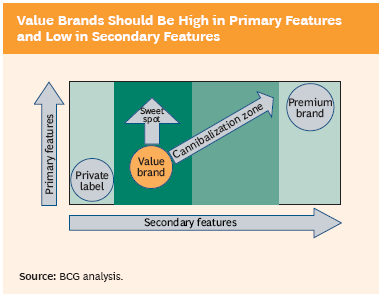
Most companies have found that succeeding with brands in both the value and premium segments without inviting cannibalization can be a tricky balancing act.

To increase sales of their value brands, some companies add features without increasing price–tempting consumers of the premium brand to trade down to the value brand.  The lower-priced, lower-margin brand cannibalizes the higher-priced, higher-margin product, and profits go out the window.

Other companies eliminate features from their value brands in order to attract customers with a lower price–putting these products in competition with generic or private-label products, which often have advantageous cost structures.  The result is a loss of profitability for the value brand.

* * * * *

Consumers seek a particular combination of price and features.  Value-brand customers are interested in and willing to pay for only a very limited set of product features (“primary features”).  Benefits that fall outside this category (“secondary features”) are not, to a value-seeking consumer, worth the price, no matter how desirable they may be to others. Yet those secondary features are very important to primary-brand consumers who are willing to pay for them.

* * * * *

To redesign value brands:

1. Identify the features that value-consumers care about the most and shed the others that add to both the costs and price without providing substantial benefit.

2. Add an “extra portion” of the qualities provided by the primary features

* * * * *

Example:

With personal vehicles, value-conscious consumers prefer extra safety features and good mileage to many of the bells and whistles that drive up cost.

* * * * *

More is not necessarily better, and sometimes it can be worse. It is the quality of the primary features that attracts the value seeker, not the total number of features.

* * * * *

image

Edit by DAF

* * * * *

Full Article:
http://www.bcg.com/impact_expertise/publications/files/Premium_Margins_Sept_2007.pdf

* * * * * 

Want more from the Homa Files?
Click link => 
The Homa Files Blog

* * * * *

The 10 Richest in America

September 25, 2008

Excerpted from Forbes: “The Top 10 Richest”,  October 06, 2008

* * * * *

This year the 10 richest tycoons on The Forbes 400 could buy the bottom 175.

* * * * *
William H. Gates III $57 billion

  • Sells shares each quarter … more than half of fortune is outside Microsoft.
  • The $36 billion Bill & MelindaGates Foundation donates to causes such as fighting hunger in developing countries, improving education in America’s high schools and developing vaccines against malaria, tuberculosis and AIDS.
  • Inflation-adjusted net worth would top $90 billion if he hadn’t given away any cash.

Warren Buffett $50 billion — Investments.

  • Studied under value investing guru Benjamin Graham at Columbia.
  • Berkshire Hathaway holding company invested in insurance (Geico, General Re), jewelry (Borsheim’s), utilities (MidAmerican Energy), food (Dairy Queen, See’s Candies). Also has noncontrolling stakes in Anheuser-Busch , Coca-Cola , Wells Fargo.
  • Iconic investor crowned the world’s richest man in march as Berkshire Hathaway shares ran up 25% between July 2007 and February 2008. Berkshire stock has fallen 15% since, erasing $12 billion
  • Irrevocably earmarked the majority of his Berkshire shares for charity in 2006, mostly to the Bill & Melinda Gates Foundation. Has given $6 billion worth of shares so far.
  • Note: (a) Under the Obama tax plan, he’ll still be paying a lower rate than his secretary (b) By bequeating his estate to the Gates Foundation, he’ll pay zero esrate taxes

Lawrence Ellison $27 billion  — software, Oracle.

  • Database titan continues to buy up would-be competition; more than 40 acquisitions in the past 4 years.
  • Studied physics at U. of Chicago, didn’t graduate.
  • Owns 453-foot Rising Sun; built a smaller leisure boat because superyacht is hard to park.

Jim C. Walton $23.4 billion
S. Robson Walton $23.3 billion
Christy Walton & family $23.2 billion
Alice Walton $23.2 billion

  • Sons, daughter and daughter-in-law of Wal-Mart pioneer Sam Walton (d. 1992)
  • Wal-Mart is world’s largest retailer: 7,300 stores, 2 million employees serve 200 million customers. Sales: $378 billion.
  • Company become eco-friendly through partnership with environmental group Conservation International.

Michael Bloomberg $20 billion — financial services

  • Mayor Mike owns 88% of the financial data and news outfit he founded in 1982.
  • Boston-born son of accountant got engineering degree from Johns Hopkins, M.B.A. from Harvard.
  • Created financial information services firm Innovative Market Systems to sell financial data, analytic tools to Wall Street. Renamed Bloomberg LP 1987; added news service, magazine, cable network, radio station.
  • Spent $74 million to become mayor of New York City in 2001 and $85 million on reelection in 2005.
  • Has given away nearly $800 million to charity in the past 5 years; with Bill Gates, planning to invest hundreds of millions to combat smoking worldwide.

Charles Koch $19 billion
David Koch $19 billion

  • Father, Fred C. Koch (d. 1967), invented method of turning heavy oil into gasoline.Brothers transformed family refining business into America’s largest private company.  
  • Koch Industries has stakes in pipelines, refineries, fertilizer, fibers and polymers, forest and consumer products, chemical technology.
  • Sales last year: $98 billion. Employs 80,000 workers in 60 countries.
  • Charles: studied nuclear and chemical engineering at MIT, cofounder of conservative think tank Cato  David: Chemical engineering degrees from MIT; pledged $100 million to alma mater for cancer research last year. Pledged another $100 million to New York’s Lincoln Center this July.

* * * * *

Full article:
http://www.forbes.com/forbes/2008/1006/046.html?partner=alerts

* * * * *

Want more from the Homa Files?
Click link =>
  The Homa Files Blog

Bailing out Main Street … not so fast

September 24, 2008

Excerpted from RealClear Politics.com:”The Mortgage Mess Began on Main Street”, Steven Malanga, September 24, 2008

* * * * *

Ken’s POV: Should foreclosed speculators be bailed out?  No.  Should folks who lied on their applications get bailed out?  No.  Should folks who made no downpayment — and sometimes no payments at all — be bailed out?  No.  Should folks who couldn’t qualify for conventional loans then (or now) — about 80% of all subprimes — get them at favorable rates now? No.  Should honest, hardworking folks who got duped or are experiencing some extraordinary hardship get relief?  You bet.  Wonder how many of them there are ….

Here are some facts …

* * * * *

Article Extract:

Journalists like simple stories with clear-cut villains who are easy for readers (and journalists themselves) to recognize. And so, as the financial crisis has brought Wall Street to its knees in recent weeks, it’s become so much easier for journalists to cope. Time Magazine, for instance, tells us in its current issue that Wall Street “sold out” America.

It’s easy to forget that this mess began with a heap of bad mortgages made by American consumers who never came within a hundred miles of the card sharps on Wall Street. The inability (and in a good deal of cases, the unwillingness) of these same ordinary Americans to pay back these loans, many of which are sitting in mortgage backed-securities held by institutions around the world, helped tilt us toward this systemic threat to our financial system. And even as we focus on bad bets and lousy leverage ratios on Wall Street, these toxic mortgages continue to unwind, and as they do, we are getting a better look at how they were made—and it’s not pretty.

If it wasn’t clear before, it should be now, that speculation and fraud—much of it on the part of borrowers—were rampant.

* * * * *

The FBI says that reports of suspicious mortgage activity increased by 10-fold from 2001 through 2007.

70 percent of subprime loans that default before they reset (exactly the kind that trouble the market right now) contain some kind of misrepresentation by the borrower, lender or broker, or some combination of the three.

* * * * *

One big category of deception has been so-called ‘no-doc’ loans, where a borrower agrees to pay a slightly higher interest rate in exchange for not documenting his income. Originally designed for the growing number of self-employed workers in America who don’t have ready documentation from an employer, these mortgages became known as ‘liar loans’ because many people without sufficient income used them to qualify for financing they otherwise couldn’t get. One lender that compared what 100 applicants claimed as income on no-doc loans to what they reported to the IRS on their tax returns found that in 60 percent of cases borrowers were exaggerating their income by as much as half.

* * * * *

Fraud reports are most common on properties near the coastlines, that is, in places where there is an enormous amount of speculation and where many purchases are for investment purposes.

Speculators are a big part of the problem. As the housing market rose, more people got into the game of betting on higher prices by purchasing homes which they intended to flip quickly without ever occupying. As this became a popular form of investing, applicants starting lying about their intentions. They were trying to fool developers who grew wary of selling too many homes in new developments to people who would never occupy them, since these are the buyers most likely to walk away from a mortgage when the market turns down. This form of misrepresentation accounts for 20% of mortgage fraud.

* * * * *

Whether they were cheating or not, speculators clearly played a big part in the mortgage mess. The vast majority of delinquent mortgages and homes in foreclosure continue to be in a handful of states where the housing bubble was largest and where speculation was common, led by California and Florida, which together accounted for a whopping 58% of all subprime adjustable rate mortgages that went into foreclosure in the second quarter of this year.

And while the rate of new foreclosures for subprime ARMs in the quarter was a whopping 6.63%, for traditional fixed-rate mortgages, it was only 0.34%.

* * * * *

We seem to have had a generation of mortgage borrowers who at the least didn’t understand the types of loans they were taking out, and at the worst were committing fraud themselves.

* * * * *

References and full article:
http://www.realclearmarkets.com/articles/2008/09/the_mortgage_mess_began_on_mai.html

* * * * *

Want more from the Homa Files?
Click link =>
  The Homa Files Blog

Marketing "green" …

September 24, 2008

Excerpted from MarketingProfs.com: “The Power of Green Lies in Marketers’ Hands”, Jacquelyn Ottman, September 16, 2008

* * * * *
Many people think the power to restore our environment — to curb greenhouse gases, to clean up our air and water, to cut down on precious resources’ ending up in landfills—lies in the hands of technical types like scientists and engineers, even lawyers and legislators ready to clamp down on polluters.

But the real power of green lies in the hands of marketers …  who have the power to design and promote cleaner products and technologies and help consumers evolve to more sustainable lifestyles.

* * * * *

It may be hard to fathom, but over 75% of the environmental impact that a product throws off during its lifetime is determined at the design stage, when, for instance, the materials are chosen, the recyclability of a product is determined, and the amount of toxic chemicals it makes use of is decided.

* * * * *

Consider a toothbrush. Want to lessen its environmental impact? Start by making it out of recycled plastic, plastic made from corn, and educate on how to recycle or compost it. Then make the head replaceable and recyclable, too. Cut down on its packaging by only wrapping the bristly head. Think you’re finished? Not a chance! That’s because the toothbrush is part of a system—the water, the toothpaste, and the box the toothpaste comes in.

* * * * *

Marketers … are the ones who can sell them to mainstream consumers (not just the deep-green consumers who are born predisposed to all things “eco.”)

Take the Toyota Prius. A fine car with a hybrid engine. Premium price, not too likely to be offset by fuel savings. So what gets consumers over the premium-price hump as well as the risk posed by new technology? Answer: A distinctive silhouette that helps owners project their values, on-the-mark advertising that focuses on such direct benefits as super quiet ride and fuel efficiency. And a publicity machine that engenders the priceless support of Hollywood celebrities showing up at the Oscars in a Prius rather than a stretch limo.

* * * * *

We already know how to design homes and offices that use energy sparingly. We already know how to make construction materials and commercial and household furnishings that reduce the threats of indoor air pollution. We know how to design kitchens to make it easy for people to recycle and compost waste. We know how to reuse water from indoor plumbing systems to make lawns and gardens thrive. We know how to grow food using fewer or no chemical pesticides and fertilizers.

Some of these technologies are being embraced by deep-green consumers. But to really make a difference, they need to be embraced by the mainstream.

That’s where marketers can come in. Ask: What will it take to make greener products and behaviors cool? Get all consumers paying the small premiums necessary to bring such products to market?

* * * * *

Look to some recent green marketing history for help.

The Energy Star label is cool. Why? It relies on technology to create products that are highly efficient as well as high quality (read: requiring no trade-off in consumer habits.) A decade’s worth of advertising focusing on such benefits, plus the attendant savings on home and office electric bills, have made the Energy Star label the second most recognized eco-label behind the three chasing arrows denoting recycling.

* * * * *

The Tom’s of Maine line of personal care products, now owned by Colgate-Palmolive, stresses all that consumers desire in today’s personal care offerings: natural (i.e., safe), good-tasting, and trustworthy. How many toothpastes do you know that come with an ingredient statement with a full explanation of each ingredient’s role, as well as a letter from the head of the company?

* * * * *

Jacquelyn A. Ottman advises corporations on strategies for gaining competitive advantage via green marketing and eco-innovation. She is the author of Green Marketing: Opportunity for Innovation.

* * * * *

Full article:
http://www.marketingprofs.com/8/green-power-in-marketers-hands-ottman.asp?adref=znnpbsc398

* * * * *

Want more from the Homa Files?
Click link =>
  The Homa Files Blog

The minority who will be paying income taxes … regardless who wins

September 24, 2008

Excerpted from Tax Foundation: “Both Candidates’ Tax Plans Will Reduce Millions of Taxpayers’ Liability to Zero (or Less) “, Scott  Hodge, September 19, 2008

* * * * *

Ken’s Notes:

1. The statistics below consider only tax filers.  Approximately 20% of adults don’t file returns — presumably since their incomes are zero or below the filing limits.

2.  The impact of the McCain proposal surprised me.  From a tax structure perspective, the plans are a push.  Of course, Obama would layer the health insurance provisions as added spending  (versus reduced revenue).

3.  Isn’t anybody concerned that a minority of citizens will be carrying the entirety of the tax burden ?

* * * * *

Article Summary

Over the past two decades, lawmakers have increasingly turned to the tax system rather than direct spending programs to funnel money to targeted groups of Americans, furthering some social or political goal. As a result, millions of Americans have been effectively removed from the income tax payment system while the tax code has been made more complicated to comply with and more difficult to administer. The tax plans of both the presidential candidates would exacerbate this situation greatly.

* * * * *

1.3 of filers currently pay no income tax

One of the biggest challenges facing both John McCain and Barack Obama in their commitment to provide tax relief to working-class Americans is the simple fact that millions of them already pay no personal income taxes.

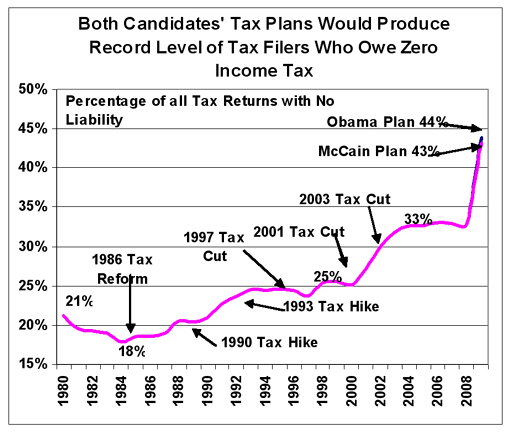
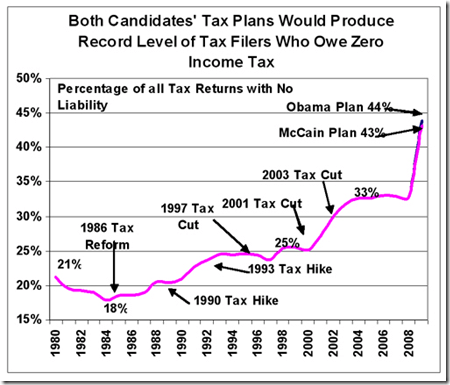
According to the most recent IRS statistics for 2006, some 45.6 million tax filers—one-third of all filers—have no tax liability after taking their credits and deductions. For good or ill, this is a dramatic 57 percent increase since 2000 in the number of Americans who pay no personal income taxes.

* * * * *

Obama or McCain — Essentially a Push (much to my surprise)

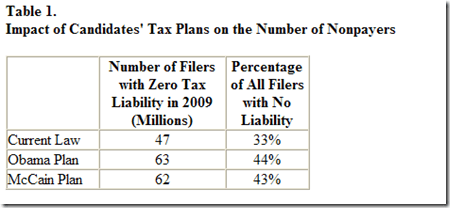
Tax Foundation estimates show that if all of the Obama tax provisions were enacted in 2009, the number of these “nonpayers” would rise by about 16 million, to 63 million overall. If all of the McCain tax proposals were enacted in 2009, the number of nonpayers would rise by about 15 million, to a total of 62 million overall.

* * * * *

Big Issue: Refundable Tax Credits = Negative Income Taxes

The tax code has always contained provisions that reduce the income tax burden for low-income workers, such as the standard deduction, personal exemption, and dependent exemption.

Between 1950 and 1990, the percentage of tax filers whose entire tax liability was wiped out by these provisions averaged 21 percent. Since then, lawmakers have expanded credits—such as the earned income tax credit (EITC)—while creating a plethora of new credits, including the child tax credit, the HOPE credit, lifetime learning credit, and the credit for adoption expenses.

Most tax credits can only reduce a taxpayer’s amount due to zero, but the EITC and the child tax credit were also made refundable, meaning that taxpayers are eligible to receive a check even if they have paid no income tax during the year. Those tax returns have become, in effect, a claim form for a subsidy delivered through the tax system rather than a direct payment from a traditional government program like welfare or farm supports.

* * * * *

As shown in Table 1 below, the Tax Foundation estimates that there will be 47 million tax returns with zero income tax liability in 2009 under current law. That’s one-third of all tax returns, and those 47 million tax returns represent 96 million individuals.

Both the McCain and Obama plans would increase this number by expanding existing tax benefits or creating new ones.

* * * * *

Senator McCain is proposing one expanded provision—the dependent exemption—and one new credit, a $5,000 refundable health care tax credit.

Taken together, the McCain proposals would increase the number of nonpayers by about 15 million, bringing the total number of taxpayers who pay no personal income taxes to 62 million, roughly 43 percent of all tax filers. Almost all of this is due to McCain’s health care credit, which dramatically realigns health care incentives and gives people a powerful motive to buy health insurance. This tax provision has a bigger impact on cutting people’s taxes than any single proposal from either party. 

* * * * *

Obama uses a longer list of smaller tax credit ideas to reduce a similar number of taxpayers’ liability to zero. The Obama plan contains seven new provisions, including a new “Making Work Pay Credit,” a “Universal Mortgage Credit,” and a plan to eliminate income taxes for seniors earning under $50,000. About 16 million people who are currently paying at least a little income tax would see their liability zeroed out, bringing the total to 63 million, or 44 percent of all tax returns.
image


* * * * *

Major structural tax changes enacted during the 1980s contributed greatly to the doubling of nonpayers. Perhaps the most significant was indexing the tax brackets in 1985 to prevent inflation from pushing people into higher tax brackets. Also, the Tax Reform Act of 1986 nearly doubled the personal exemption and replaced the zero-bracket with the basic standard deduction for nonitemizers.

Since the early 1990s, however, lawmakers have increasingly used the tax code instead of government spending programs to funnel money to groups of people they want to reward. Credits have been enacted to subsidize families with children, college students, and purchasers of hybrid cars, just to name a few of the most well known. In terms of tax revenue, the most significant of these socially targeted credits was the $500 per-child tax credit enacted in 1997. The 2001 and 2003 tax bills doubled the value of the credit to $1,000 and added a refundable component.
image


* * * * *

Quite aside from the fact that these refundable credits remove millions from the roster of Americans who support the government by paying the income tax, these credits have some undesirable effects.

Added complexity. The explosion of tax credits has added a tremendous amount of complexity to the tax code, especially for low-income Americans who are the supposed beneficiaries of the programs. The EITC is so complicated that more than three-quarters of those claiming it pay a tax preparer to complete their forms.

Hidden marginal tax rate increases. To withhold the benefit of these credits from “rich people,” the definition of which changes from law to law, each of these credits has a phase-out range—that is, a range of income where the taxpayer has to pay back the credit that he no longer qualifies for. As a result, taxpayers in the phase-out range face unexpectedly high effective marginal tax rates.

Narrowing the tax base.  Expanding existing credits or adding new ones pushes people who used to pay taxes into the nonpayer range, shrinking the tax base and requiring higher taxes on everyone else. Undesirable volatility in federal revenue is the likely result, as the incomes of higher-income taxpayers include more business, dividend, and capital gains income which fluctuate much more wildly than wages.

* * * * *

Full article:
http://www.taxfoundation.org/publications/show/23631.html

* * * * *

Want more from the Homa Files?
Click link =>
  The Homa Files Blog

XM-Sirius still reaching for the sky …

September 24, 2008

Excerpted from WSJ: “Sirius XM Sends Signals of Change”, September 15, 2008

* * * * *

Since the merger of Sirius Satellite Radio Inc. and XM Satellite Radio  in late July, the company’s stock has fallen about 40%, and now trades at less than a dollar. The downward trajectory accelerated last week after the company issued subscriber forecasts that fell below analysts’ expectations and failed to reassure investors about looming debt payments.

CEO Karmazin … says there has been “a tremendous overselling of the stock” and that his company “is heading toward making a bunch of money in the future.”

* * * * *

The merger of Sirius and XM was supposed to build confidence in satellite radio, in which subscribers pay a monthly fee for programming that is delivered through special receivers.

The months ahead will be a crucial proving ground. Sirius XM hopes to regain traction with consumers during the holiday season with its first programming packages and radio receivers that combine the Sirius and XM services.

As an enticement to consumers who tried satellite radio but didn’t stick with it, Mr. Karmazin has considered a plan to reactivate the radios of lapsed subscribers and give them a small selection of programming free of charge. 

The company will soon introduce radios that allow consumers more flexibility in the programming, including a 50-channel plan that costs $6.99 a month. Sometime next year, radios that can play the entire lineup from both Sirius and XM will hit the market.

Starting next month, even those who don’t upgrade their radios will be able to pay an extra $4 a month and get a few “best of” channels from the other company’s service. For example, a current XM subscriber will be able to get Howard Stern and Martha Stewart, now exclusively on Sirius.

* * * * *

Talk-show host Howard Stern’s five-year, $500 million pay package, announced in 2004, included 34.4 million shares payable to him and his agent, Don Buchwald. Then, the shares were worth about $110 million; by the time he joined the company in 2006, they were worth more than $220 million because of the stock’s sharp rise. Today, those shares would be worth $32.6 million.

* * * * *

Full article:
http://online.wsj.com/article/SB122143532408734143.html

* * * * *

Want more from the Homa Files?
Click link =>
  The Homa Files Blog

The Fallacy of 'Green Jobs'

September 23, 2008

Excerpted fro”The Fallacy of ‘Green Jobs'”, by John Stossel,
September 10, 2008

Obama has a great twofer pitch: “green jobs.” …  In one fell swoop he can promise to end unemployment and fix and save the planet from climate change.

“I’ll invest $150 billion over the next decade in affordable, renewable sources of energy — wind power and solar power and the next generation of biofuels; an investment that will lead to new industries and five million new jobs that pay well and can’t ever be outsourced,” (http://tinyurl.com/64szf7).

Politicians always promise that their programs will create jobs. The fallacy is the same in every case: Even if the program creates jobs building bridges or windmills, it necessarily prevents other jobs from being created. This is because government spending merely diverts money from private projects to government projects.

Governments create no wealth. They only move it around while taking a cut for their trouble. Overlooking this fact is known as the broken-window fallacy (http://tinyurl.com/ydasa2). The French economist Frederic Bastiat pointed out that a broken shop window will create work for a glassmaker, but that work comes only at the expense of the cook or tailor the shopkeeper would have patronized if he didn’t have to replace the window.

Creating jobs is not difficult for government officials. Pharaohs created thousands of jobs by building pyramids. Our government could create jobs by paying people to dig holes and then fill them up. Would actual wealth be created? Of course not. It would be destroyed. It’s like arguing the hurricanes create jobs. After all, the destruction is followed by rebuilding. But does anyone seriously believe that replacing destroyed buildings creates wealth?

* * * * *

According to his web site:”Obama will strategically invest $150 billion over 10 years”

Note that word “strategically.” It is there to suggest that Obama knows how best to “invest” the $150 billion. (Of course it is not his money, and he’ll have none of his own at risk, so from his perspective, it won’t really be investment.) But how does he know that the things he names ought to get the money?

Politicians have a lousy record trying to make “strategic investments.” Jimmy Carter’s Synthetic Fuels Corporation cost taxpayers at least $19 billion but failed to give us alternative fuels (http://tinyurl.com/5ex7v5).

Investing is about predicting the future, and the future is always uncertain  … People who have their own money at risk — who face a profit-and-loss test and possible bankruptcy — are much better predictors than people who play with other people’s money. Just compare North and South Korea.

Mistakes are inevitable. Some investments will be errors. Mistakes in the competitive market tend to be on a comparatively small scale. If one company invests in plug-in hybrids and it goes bust, only a relatively few people suffer. The assets of the bankrupt firm pass into more capable hands.

When government makes a mistake, the bureaucracy can’t go bankrupt. Instead, failure twill justify increased appropriations.

If “green jobs” make so much sense, the market will create them. They will be created by private entrepreneurs and venture capitalists.  The best ideas will rise to the top, and green energy will gradually replace coal and oil.

If politicians were serious about creating jobs and cleaner technologies, they would step aside and let the free market go to work.

* * * * *

Full article:
http://www.realclearpolitics.com/articles/2008/09/green_jobs.html
Copyright 2008, Creators Syndicate Inc.

* * * * *

Referenced web site worth browsing:
Foundation for Economic Educatiob
http://www.fee.org/

* * * * *

Want more from the Homa Files?
Click link =>
  The Homa Files Blog

A Bush clone ? The 90% canard …

September 23, 2008

Excerpted from Philadelphia Inquirer: “McCain a Bush clone? These numbers dispute that”. John R. Lott , Univ. of Maryland, Sep. 19, 2008

* * * * *

Does John McCain represent a third Bush term? The Obama campaign claims … that McCain is “no maverick when he votes with Bush 90 percent of the time.”

This week Obama has begun a constant refrain that there is “not a dime worth of difference” between Bush’s and McCain’s views.

Is this the same McCain who drove Republicans nuts on campaign finance, the environment, taxes, torture, immigration and more? Where has McCain not crossed swords with his own party?

As it’s being used, the 90 percent figure, from Congressional Quarterly, is nonsensical. As Washington Post congressional reporter Jonathan Weisman explained, “The vast majority of those votes are procedural, and virtually every member of Congress votes with his or her leadership on procedural motions.

* * * * *

The same measure has Obama voting with Democrats 97 percent of the time.

* * * * *

Fortunately, a number of organizations on the left and right provide useful evaluations on how congressmen and senators vote each year. These conservative and liberal groups pick the votes they care about most and figure out how often lawmakers match up with their positions.

Well-known organizations that rank congressional voting include the American Conservative Union on the right, Americans for Democratic Action on the left, and the nonpartisan National Journal in the middle. The League of Conservation Voters also ranks politicians from an environmentalist position.

These groups’ rankings from 2001 to 2007 paint fairly similar pictures, putting McCain to the left of most Republican senators and to the right of most Democratic senators – though usually much closer to the average Republican.

The American Conservative Union finds that the average Republican senator voted conservatively 85 percent of the time, and that the average Democrat voted conservatively 13 percent of the time. McCain voted conservatively 74 percent of the time.

Although it’s at the opposite end of the political spectrum, Americans for Democratic Action essentially agreed. It found that the average Republican senator voted liberally just over 12 percent of the time, and the average Democrat voted liberally 89 percent of the time. McCain voted liberally 24 percent of the time – twice as frequently as the average Republican.

National Journal found that McCain voted conservatively 59.4 percent of the time from 2001 to 2006.

* * * * *

According to the League of Conservation Voters, John McCain is the ultimate centrist. While the average Republican supported liberal environmentalist positions 13 percent of the time, and the average Democrat supported them 76 percent of the time, McCain’s 44 percent put him in the middle.

Another way to look at these numbers is to see how many of the 99 other senators voted more conservatively than McCain. In 2006, these four groups ranked McCain as the 47th, 46th, 44th and 51st most conservative member of the Senate, respectively.

* * * * *

What issues put McCain well to the left of the average Senate Republican? The American Conservative Union lists a number of specific votes on which he differed from most other Republicans, including:

Taxes. He opposed reducing capital-gains tax rates, eliminating the inheritance tax and lowering income-tax rates.

Environment. He opposed drilling for oil in the Arctic National Wildlife Refuge, supported compliance with the Kyoto global-warming treaty, supported requiring businesses to reduce greenhouse-gas emissions, favored stricter mercury-emission rules for power plants, and supported stricter fuel-efficiency standards.

Other regulations. McCain consistently supported stricter campaign-finance regulations and voted to mandate that handguns be sold only with locks.

* * * * *

In contrast to the very liberal ratings given to Obama, the interest groups find that there are about as many senators to McCain’s right as there are to his left. So, it is a real distortion to claim he is a Bush clone.

* * * * *

Full article:
http://www.philly.com/inquirer/opinion/McCain_a_Bush_clone_These_numbers_dispute_that.html

* * * * *

Want more from the Homa Files?
Click link =>
  The Homa Files Blog

Who is walking the talk ?

September 23, 2008

* * * * *

Note: Last Friday, BHO was making a big point of the fact that women get paid less than men for comparable jobs.  An injustice, for sure.  But, guess what …

* * * * *

Excerpted from DickMorris.com 

7 of Barack Obama’s top 20 Senate staff positions are filled by women — they are paid — on average —  83 cents for each dollar his male staffers are paid

John McCain has 13 women among his top 20 staffers —  they are paid  — on average —  $1.04 for each dollar he pays to his men.

* * * * *

Note: I haven’t verified this info.

* * * * *

Want more from the Homa Files?
Click link =>
  The Homa Files Blog

Stand Out on the Shelf

September 23, 2008

Excerpted from Beverage World “Isn’t That Special?” September 9, 2008 

It may seem like science fiction, but in the not-too-distant future, a beverage bottle might do more than just sit there when you pass it in the grocery aisle.

Several companies around the world are working on this kind of technology right now…breakthrough technology will replace stagnant images and text on a beverage label with digital ones that can be made to flow across the product, presenting information about ingredients, special promotions, or whatever the marketer desires…some pretty impressive technologies are already widely available.

One is called Liquid Lens. It can be used with glass or plastic bottles to make it seem as if an object is floating some 18 inches around the bottle, or inside the bottle…another technology called GWrap can display 3D images and animation on a beverage package. GWrap uses a thin film that contains a series of micro lens arrays that when printed to, or placed over, an interlaced graphic image, displays the eye-catching images…

Another company…Vacumet, is putting the finishing touches on holographic technology that will make it seem as if images are projecting out from the plane of the curvature of, say, a beer bottle…

Among the beverage marketers themselves, Coors stands out as one that has not been afraid to spruce up its packaging portfolio with special effects. Among these has been the Cold Activated Bottle, introduced in 2007. The packaging changes color when the beer is cold enough to drink. Coors says it resulted in a 7 point trend change for the brand…

Edit by SAC

* * * * *

Another big trend in packaging is sustainability.  Many companies are re-working their packaging to use recycled materials and reduce overall waste.  In doing so companies are finding that not only are they able to appeal to consumer preference for “green” products, but also save money.  This year Coca-Cola introduced re-designed its bottle tops that are 24 percent lighter and reduce Coke’s plastic consumption by 4 million pounds a year.

* * * * *
Full article:
http://www.beverageworld.com/content/view/35243/

* * * * *

Want more from the Homa Files?
Click link =>
The Homa Files Blog

Baby Boomers Delay Retirement

September 22, 2008

Excerpted from WSJ: “Baby Boomers Delay Retirement
Declines in Assets Force a Generation to Face New Reality”,
Sept. 22, 2008 
 

* * * * *

In May, 27% of surveyed workers age 45-plus said the economic slowdown had prompted them to postpone plans to retire.

For millions of Americans approaching retirement, events of recent weeks are delivering a clear message: Not so fast. With nest eggs shrinking, housing prices still falling and anxieties about their financial future growing, the oldest members of the baby-boom generation are putting the brakes on plans to leave work.

Most people underestimate how much money they will need for retirements that could easily last two or three decades, and are leaving the work force with nest eggs that are likely to expire long before they do.

Less than one-quarter of workers age 55 and older — just 23% — have savings and investments totaling $250,000 or more. About 60% have less than $100,000.

[Chart]

The average retirement age in the U.S. is 63 — but most investors don’t recognize the benefits from working even just two or three additional years. For example, a 62-year-old with a $100,000 salary and a $500,000 nest egg will see his annual retirement income from investments and Social Security rise by 6% for every additional year he remains in the work force.

Working longer “gives people time to build up their 401(k) balance, can result in a bigger benefit from Social Security, and reduces the amount of time people will have to depend on their savings. “The arguments in favor of working longer are overwhelming.”

“It’s particularly tough if the market gets hit in your early years of retirement. If you’re about to retire and something like this happens, maybe you should stay working.”

Retirees returning to work — is also being played out in the wake of the market turmoil. “I’m trying to go back to work and let our portfolio build back up,” he explained. “We’ve lost such a big amount of money lately, we’re going to get to the point where we can’t recover.”

* * * * *

Full article:
http://online.wsj.com/article/SB122204345024061453.html

Want more from the Homa Files?
Click link =>
  The Homa Files Blog

So What If It's "Green"?

September 22, 2008

Excerpted from Harvard Business Online, “It’s Green, But Will People Want It?”, by Steve Bishop, September 10, 2008

* * * * *

Over the summer, The New York Times reported about the rollout of a relatively new “Milk Jug for a Green Earth.” Now in 189 stores throughout the country, the novel design requires less material to manufacture, and its boxy shape allows the jugs to be stacked closely together, requiring less fuel to transport and less energy to cool. Retailers are even passing on some of the financial savings to consumers.

But not everyone is buying into what seems – at least on paper – like a successful green solution. While the design offers many advantages to retailers, consumers are confronted with a very different experience with a very familiar product. For many, this unexpected user experience is a big turnoff. According to the article, “The jugs have no real spout, and their unorthodox shape makes consumers feel like novices at the simple task of pouring a glass of milk.”

So, how truly successful is this green product? Over the last year, people have tried the jug and responded with a litany of complaints, from leakage problems to its strange look. Not surprisingly, the blogosphere has piled on with still more negative feedback. At this point, the success – and future – of this green product looks risky, even if retailers stand behind it.

The story is a reminder that there are, in fact, two sides to every business equation: a supply-side and a demand-side. A lot of companies have made strides in the more tangible supply-side, but many stop short of adequately addressing both elements. To assure successful green offerings in the marketplace, companies need to also consider the often-overlooked demand-side.

* * * * *

Supply-side Sustainability
By making more product with fewer resources, environmental goals conveniently align with business objectives and pursue bottom-line savings. That serves as a great motivation for companies to change what they put in consumers’ hands. The question it raises, however, is why will people want it?

* * * * *

Demand-side Sustainability
While the supply-side deals with things, demand-side efforts address people, their needs, and what their experiences with green offerings enable. The key is to understand people’s latent and blatant needs, and then to address them with an appropriate solution.

By creating something green that is also desirable and fits into people’s daily lives, environmental goals align with consumers’ personal goals and go after top-line growth. Results can be measured in sales and market-share, two objectives common and desirable to most companies.

* * * * *

Neither the supply- nor the demand-side takes precedence. As we have seen in the milk jug example, addressing the supply-side alone risks creating the green product that no one wants.

To have positive impact on the environment, the business, and people’s lives, both demand and supply need to be considered.  

Edit by DAF

* * * * *

Full article:
http://blogs.harvardbusiness.org/leadinggreen/2008/09/its-green-but-will-people-want.html

* * * * *

Want more from the Homa Files?
Click link => 
The Homa Files Blog

* * * * *

So What If It’s "Green"?

September 22, 2008

Excerpted from Harvard Business Online, “It’s Green, But Will People Want It?”, by Steve Bishop, September 10, 2008

* * * * *

Over the summer, The New York Times reported about the rollout of a relatively new “Milk Jug for a Green Earth.” Now in 189 stores throughout the country, the novel design requires less material to manufacture, and its boxy shape allows the jugs to be stacked closely together, requiring less fuel to transport and less energy to cool. Retailers are even passing on some of the financial savings to consumers.

But not everyone is buying into what seems – at least on paper – like a successful green solution. While the design offers many advantages to retailers, consumers are confronted with a very different experience with a very familiar product. For many, this unexpected user experience is a big turnoff. According to the article, “The jugs have no real spout, and their unorthodox shape makes consumers feel like novices at the simple task of pouring a glass of milk.”

So, how truly successful is this green product? Over the last year, people have tried the jug and responded with a litany of complaints, from leakage problems to its strange look. Not surprisingly, the blogosphere has piled on with still more negative feedback. At this point, the success – and future – of this green product looks risky, even if retailers stand behind it.

The story is a reminder that there are, in fact, two sides to every business equation: a supply-side and a demand-side. A lot of companies have made strides in the more tangible supply-side, but many stop short of adequately addressing both elements. To assure successful green offerings in the marketplace, companies need to also consider the often-overlooked demand-side.

* * * * *

Supply-side Sustainability
By making more product with fewer resources, environmental goals conveniently align with business objectives and pursue bottom-line savings. That serves as a great motivation for companies to change what they put in consumers’ hands. The question it raises, however, is why will people want it?

* * * * *

Demand-side Sustainability
While the supply-side deals with things, demand-side efforts address people, their needs, and what their experiences with green offerings enable. The key is to understand people’s latent and blatant needs, and then to address them with an appropriate solution.

By creating something green that is also desirable and fits into people’s daily lives, environmental goals align with consumers’ personal goals and go after top-line growth. Results can be measured in sales and market-share, two objectives common and desirable to most companies.

* * * * *

Neither the supply- nor the demand-side takes precedence. As we have seen in the milk jug example, addressing the supply-side alone risks creating the green product that no one wants.

To have positive impact on the environment, the business, and people’s lives, both demand and supply need to be considered.  

Edit by DAF

* * * * *

Full article:
http://blogs.harvardbusiness.org/leadinggreen/2008/09/its-green-but-will-people-want.html

* * * * *

Want more from the Homa Files?
Click link => 
The Homa Files Blog

* * * * *

The mortgage mess … in brief

September 22, 2008

Excerpted from Heritage Foundation:”Subprime Mortgage Problems: A Quick Tour Through the Rubble”, by Ronald D. Utt, April 3, 2008

* * * * *

Note: Best recap I’ve found re: the current mortgage mess.

* * * * *
The collapse of the subprime mortgage market in late 2006 set in motion a chain reaction of economic and financial adversity that has since spread to nearly all sectors of the economy, as well as to global financial markets, has created depression-like conditions in the housing market, and has led the American economy to the brink of recession.

In response, many in Congress and the executive branch have proposed a number of new federal spending and credit programs that would greatly expand the role of government in the economy.

* * * * *

How the Problem Started

These problems had their origin in the mid-1990s when mortgage lenders reduced the previously strict financial qualifications needed to acquire a mortgage to buy a house by offering credit-impaired households mortgage loans, albeit at higher interest rates to compensate for the greater risk. Despite the many different forms these mortgages would ultimately assume–no down payment, interest only, negative amortization, etc.–they were designated “subprime” because of the checkered credit histories of the households using them.  Despite the risk associated with these subprime mortgages, many mortgage lenders further relaxed their underwriting standards and in the process introduced even more risk into the system, some of it motivated by fraud and misrepresentation.

As a consequence, the availability of risky loans soared from the late 1990s through 2006. In 2001, newly originated subprime, Alt-A, and home equity lines (seconds) totaled $330 billion and amounted to 15 percent of all residential mortgages. Just three years later, in 2004, these mortgages accounted for almost $1.1 trillion in new loans, equal to 37 percent of the total. Their volume peaked in 2006 when they reached $1.4 trillion and 48 percent of the total. Over a similar period, the volume of mortgage-backed securities (MBS) collateralized by subprime mortgages increased from $18.5 billion in 1995 to $507.9 billion in 2005

In turn, the looser lending standards allowed previously unqualified borrowers to become homeowners, and the homeownership rate soared from the 64 percent range of the 35 years prior to 1995 to an all time high of 69 percent in 2004. While most celebrated this accomplishment, the consequence of lending to riskier borrowers under diminished underwriting standards led to an escalation in the number of loan defaults beginning in 2006, followed by an escalation in the number of foreclosures. Because many of these loans had been repackaged into mortgage-backed securities, the growing default problem soon spread to investors in the national and international financial markets where these instruments were sold.

The first to suffer was the housing market, where new construction and the sales of both new and existing homes plunged. This was soon followed by a decline in home values, which in turn worsened the financial problems in the mortgage market by reducing the value of the collateral securing these loans. As many subprime borrowers now found themselves owning a house worth less than the debt owed on it, the incentive to default increased, and by the end of 2007, more than 17 percent of subprime borrowers had fallen behind in their loan payments.

* * * * *

Implications for the Economy

After reaching the more than 1.7 million new units started in 2005, single-family housing starts in February 2008 fell to a seasonally adjusted annual rate of 707,000 units, less than half the level of production two years earlier. On a year-over-year basis, the decline in starts was 40.4 percent.  Sales of new homes fell precipitously over the same period. After reaching 1,283,000 units in 2005, they fell in February 2008 to a seasonally adjusted annual rate of 590,000, less than half the level of 2005 and down 29.8 percent from February 2007. For existing homes, sales peaked in 2005 at 7,076,000 units, fell to 6.4 million in 2006, and by February 2008 had fallen to a seasonally adjusted annual rate of 5 million, nearly 30 percent below the peak levels of sales during 2005.

After two years of declining activity in the housing market, many are hopeful that the bottom has been reached and that the market will soon revive, but this seems unlikely. The subprime default and foreclosure problems first emerged at a time when the economy was healthy, most borrowers were employed, and housing values were stable or rising. In 2008, home prices and sales are falling, some borrowers may soon confront unemployment, tightened credit standards will exclude many from homeownership, and the number of subprime mortgages resetting to higher payments will be greater than the number that reset in 2006 and 2007.

As a consequence, the homeownership rate is likely to fall from its record levels near 69 percent to something closer to the long-term historic norm of 64 percent. This trend in turn implies a greater number of lost homes coming onto the market at a time when sales are depressed.

* * * * *

Notwithstanding the constituent and lobbyist pressure to do something costly and do it quickly, the history of government intervention in housing markets and the economy has not been one of notable success. .

* * * * *

Full article:
http://www.heritage.org/Research/Economy/wm1881.cfm

* * * * *

Want more from the Homa Files?
Click link =>
  The Homa Files Blog

Fannie Mae and the Vast Bipartisan Conspiracy

September 22, 2008

Excerpted from Slate: “Fannie Mae and the Vast Bipartisan Conspiracy”,  Jack Shafer, Sept. 16, 2008

* * * * *

My POV:

Slate leans left, so I find its revelations particularly note worthy.  Repubs are dirtied by drinking from the lobbying trough.  Dems own the CEOs and folks who raked off the uber-dollars.  A pretty disgusting picture … Read the full article (link below) for names of “bit” players and more context.

* * * *

Article Highlights

The blowup and bailout of Fannie Mae and Freddie Mac by taxpayers was foretold so many times in the last three decades by critics of the two federally chartered and subsidized mortgage giants that not even the data-searching powers of Nexis, Factiva, and Google combined can total them.

The Wall Street Journal editorial page deserves a special commendation for hammering these two outposts of corporate socialism, not that the page’s many warnings over the years helped avert disaster.

Mae and Mac—especially Mae—were just too nurtured by the Washington establishment  — an  “influential network that extends from the highest reaches of the Clinton Administration to the ranks of conservative Republicans on Capitol Hill.”

The bipartisan network provided the essential cover Fannie Mae needed to run its scam.

* * * * *

The key to Fannie Mae’s survival was the patronage operation it ran.  “For years, high-level jobs at Fannie Mae were lucrative prizes for lawyers, bankers and political operatives waiting for their next U.S. government post.”

Now that the jig is up, let’s meet some of the bipartisan warriors who fought for Fannie Mae’s right to plunder.

At the top of the list we must place Franklin D. Raines, chairman and chief executive officer of Fannie Mae from 1998 to 2004. Raines, who served as director of the Office of Management and Budget under President Clinton.  He  was forced to leave Fannie Mae in 2004, when regulators discovered it had broken accounting rules “in an effort to conceal fluctuations in profit and hadn’t maintained adequate risk controls.” The New York Times reported two year ago that regulators “have said that of the $90 million paid to Mr. Raines from 1998 to 2003 at least $52 million—more than half—was tied to bonus targets that were reached by manipulating accounting.” Raines agreed to a $24.7 million settlement with a federal regulator in exchange for charges being dropped, but he admitted no wrongdoing.

Next up is Jamie S. Gorelick,  Deputy Attorney General during the Clinton administration. Although Gorelick had no background in finance, she joined Fannie Mae in 1997 as vice chair and departed in 2003. For her trouble, Gorelick collected a staggering $26.4 million in total compensation, including bonuses.

Republicans also proved willing to serve Fannie Mae. Robert B. Zoellick, current head of the World Bank, has served President Reagan, President Bush 1, and President Bush 2 as a trade representative, deputy secretary of state, deputy secretary of the treasury, deputy chief of staff, and so on. Zoellick’s  title at Fannie was executive vice president in charge of lobbying, public affairs, and affordable housing. According to a July 23, 1997, report in the American Banker, Zoellick “has used his close ties to Republicans in Congress, such as Speaker of the House Newt Gingrich, to defend Fannie Mae from new taxes.”

Moving back across the aisle, let’s say hello to Mr. Democrat James A. Johnson, who ran Fannie Mae from 1991 to 1998, served as vice chairman from 1990 to 1991, and earlier worked as a managing director at Lehman Bros. and for Vice President Walter F. Mondale. He made news earlier this summer when he had to resign as vice-presidential-candidate vetter for Barack Obama “as new details emerged about loans Mr. Johnson received from mortgage lender Countrywide Financial”  Mr. Johnson has made Fannie Mae both a launching pad and a landing strip for officials moving in and out of politics and Government in Washington.” Johnson earned nearly $21 million from Fannie Mae in 1998.

But Fannie Mae is nothing if not ecumenical. According to the Associated Press, Fannie Mae and Freddie Mac have spent $170 million on lobbying in the past decade. “Fannie Mae’s 51-member lobbying stable” includes “former Reps. Tom Downey, D-N.Y., and Ray McGrath, R-N.Y.; Steve Elmendorf, a Democratic political strategist and former congressional aide; and Donald Fierce, a longtime GOP operative. Freddie Mac’s list of 91 lobbyists includes former Reps. Vin Weber, R-Minn., and Susan Molinari, R-N.Y.” The AP notes the Fannie Mae ties enjoyed by McCain campaign manager Rick Davis and Arthur B. Culvahouse Jr., who helped in McCain’s veep search. According to Politico, McCain economic adviser Aquiles Suarez worked as Fannie Mae’s director of government and industry relations, and McCain finance co-chairman Frederic V. Malek spent time on the Freddie Mac board.

* * * * *

The bipartisan Fannie Mae gang appears to have broken few, if any, laws. Their crime was to have practiced—without any thought of the consequences—”access capitalism,” which Michael Lewis defined in the New Republic as “a neat solution for people who don’t have a whole lot to sell besides their access, but who don’t want to appear to be selling their access.”

“The scandal in Washington isn’t what’s illegal. It’s what’s legal.”

“The abiding lesson here is what happens when you combine private profit with government power. You create political monsters that are protected both by journalists on the left and pseudo-capitalists on Wall Street, by liberal Democrats and country-club Republicans.”

* * * * *

Full article:
http://www.slate.com/id/2200160/

* * * * * 

Want more from the Homa Files?
Click link =>
  The Homa Files Blog

Talk about special interests …

September 22, 2008

Excerpted from OpenSecrets.com

Of all the companies making headlines this week, AIG has been the most nonpartisan in its contributions, splitting evenly the $9.7 million it has contributed over time.

Sen. Chris Dodd, chair of the Senate banking committee, has racked up the most from AIG, with a total of $281,400, while Charles Schumer (D-N.Y.), a member of both the Senate Banking, Housing and Urban Affairs Committee and the Senate Finance Committee, takes second with $116,400.

Presidential candidates John McCain and Barack Obama collected $103,000 and $82,600 from AIG, respectively.

Source:
http://www.opensecrets.org/news/2008/09/aig-government-bails-out-a-hea.html

* * * * *

Source: http://www.opensecrets.org/orgs/list.php?order=A

image

image

* * * * *

Worth browsing: Federal Election Campaign Web Site:
 http://www.fec.gov/

* * * *

Want more from the Homa Files?
Click link =>
  The Homa Files Blog

Who would do best job handling the economy?

September 19, 2008

      From Friday’s Diageo-Hotline tracking poll. 

     Who would do best job handling the economy?

Who would do the best job handling the<br /> economy?

* * * * *

Note: This poll is run by an MSB MBA alum

* * * * *

Want more from the Homa Files?
Click link =>
  The Homa Files Blog

Must read: Supporters of both candidates doubt their man is up to the job …

September 19, 2008

Excerpted from WSJ: ” Why It’s Getting Mean”, Peggy Noonan, Sept 19, 2008

* * * * *

My Opinion

This week, a couple of my friends expressed frustration that the financial crisis revealed the obvious —  neither McCain nor Obama — have the slightest clue what’s going on, why it’s going on, and most important, how to fix it.  I’ll bet that a check of their college transcripts shows that neither has even taken Econ 101; their resumes show no business management experience; neither show any instinct for “the game”, neither seem to cope well with complexity and ambiguity.

Peggy Noonan leans right, but is usually pretty balanced (meaning that I often disagree with her).  I think her op-ed really puts a finger on the the pulse.  Highlights below — worth following the link and reading the whole essay.

* * * * *

Article Highlights

The financial crisis changes the entire shape and feel of the presidential election.  It isn’t just bad news; it’s deep bad news that reaches into the heart of widespread national anxiety.

* * * * *
Everyone is afraid—the rich that they will no longer be rich, the poor that they’ll be hit first by the downturn in the “last hired, first fired” sense, the middle class that it will be harder now to maintain their hold on middle-classness

Both the Democrats and the Republicans spent the week treating the catastrophe as a political opportunity. This was unserious. A serious approach might have addressed large questions such as: Was this crisis not, at bottom, a failure of stewardship?

* * * * *
The economic crisis brings a new question, unarticulated so far but there, and I know because when I mention it to people they go off like rockets.

It is: Do you worry that neither of them is up to it? Up to the job in general? Is either Mr. McCain or Mr. Obama actually up to getting us through this and other challenges? I haven’t heard a single person say, “Yes, my guy is the answer.”

* * * * *
The overarching political question: In a time of heightened anxiety, will people inevitably lean toward the older congressional vet, the guy who’s been around forever? Why take a chance on the new, young man at a time of crisis? Wouldn’t that be akin to injecting an unstable element into an unstable environment? There’s a lot at stake.

Or will people have the opposite reaction? I’ve had it, the system has been allowed to corrode and collapse under seven years of Republican stewardship. Throw the bums out. We need change. Obama may not be experienced, but that may help him cut through. He’s not compromised.

* * * * *
A mere hunch in a passing moment: In a time of crisis, confusion and fear, Americans just might, in their practicality, turn back to the old tradition of divided government.

They know the Congress will be Democratic. They assume it will soon be more Democratic. Therefore the president they choose may well be of the other party.

* * * * *
What if neither of them is the right man? What if neither of them is equal to the moment? What if neither party is equal to the moment?

This is not in itself important—who cares what they think, really? But there will be a small impact in terms of tone.

If you are a longtime Obama supporter and are beginning now to admit to deep doubts, you can’t just announce you’ve been wrong for the past year. You’d look like a fool. You cannot speak credibly, or in a way you yourself believe, in rosy support. But what you can do is turn, with new rage, on the guy you’ve at least long opposed. So you ignore Mr. Obama and attack Mr. McCain with new ferocity.

Or, if you have doubts about Mr. McCain, you ignore him and turn your heat on Mr. Obama.

* * * * *

Do you ever have the passing thought that the presidential election doesn’t matter as much as we think?

If you win bad in a 50/50 nation, it makes it really hard to govern. Whoever wins will govern within more of less the same limits, both domestically and internationally.

A New York liberal leaning toward Mr. McCain told me this week he has no fear that Mr. McCain may be a more militant figure than Mr. Obama. We already have two wars, “we’re out of army.” Even if Mr. McCain wanted a war, he said, he couldn’t start one.

I wonder if we follow the election so passionately because we’re afraid. We’re afraid a lot of our national problems are intractable, and the future too full of challenge.

Deep inside we think: Ah, that won’t work either.  We are all making believe this is a life-changing election because we know it’s not a life-changing election.

* * * * *

Full article:
http://online.wsj.com/article/SB122176556077753375.html

* * * * *

Want more from the Homa Files?
Click link =>
  The Homa Files Blog

Slash the Price and Sink the Brand

September 19, 2008

Excerpted from Harvard Business Online, “In A Downturn, Discounts Can Be Dangerous”, by Jeff Stibel, August 21, 2008

* * * * *

Often the first thing companies do during a downturn in the economy is reduce prices on their products and services. While it may be necessary in some cases to reduce prices, discounting has its risks. The biggest risk is that it can create a negative long-term perception of a product and a down-channel effect, ultimately leading to market-share erosion.

And discounting can also be dangerous to low-cost providers not focused on brand. Value-minded consumers have long-term memories and it is hard to retain market-share when the economy recovers and you try to raise your prices or eliminate promotions.

In some cases, it may make sense to buck the trend entirely and increase prices. In fact, many companies are taking this counterintuitive approach. To be sure, many are blaming the cost of commodities and these increases will put a strain on short-term growth. But over the long-run this could build brand value. 

There’s no doubt that discounting and sales promotions are a vital sales technique when done correctly. It inspires excitement and creates a call to action. However, when offered at the wrong times–for no other reason than to boost sales–it can cut the other way and create brand deterioration.

* * * * *

Consumers give you their hard-earned money in return for something that meets or exceeds their perceived value. They want to see value and quality in return for their money.

And studies have shown that in many cases, the more people pay, the more value they ascribe to their purchase. Money plays a funny role in the purchase process: it anchors perceived value. If you discount prices during adverse times, consumers may begin to question the original value.

When you discount, you undo the “placebo effect” of higher prices. And this leads to a decaying belief in the value of the product offered. So it may be short-term thinking to devalue a consumer’s perceived value of a product simply to move more merchandise during shifts in the economy.

* * * * *

There are ways around this, of course. Consider the auto industry, typically the first to discount their way out of economic woes. Chrysler recently did something to preserve their price while offering a discount for something that does not affect their brand: gas. Chrysler cleverly took discounting to the next level by offering up a $2.99 gas guarantee for three years on all new car purchases within its fleet. The idea was to subsidize the fuel that goes into the new car, not the MSRP of the car itself.

* * * * *

Consider the long-term consequences for discounting during a recession and the potential for inadvertently re-positioning your brand. If you must, it may be better to focus on something ancillary rather than what your brand truly represents. Because once that veil is pierced, it may be incredibly difficult to go back and reestablish the value proposition to your consumers.

Edit by DAF

* * * * *

Full Article:
http://discussionleader.hbsp.com/stibel/2008/08/in-a-downturn-discounts-can-be.html

* * * * *

Want more from the Homa Files?
Click link => 
The Homa Files Blog

* * * * *

Don’t know MySpace?

September 19, 2008

Excerpted from MediaPost Publications, “Study: 58% Aren’t Familiar With Social Networking” Sep 5, 2008

* * * * *

Apparently tweeting, friending and linking have not infiltrated popular culture as much as one might think.

A new study from Synovate reveals that well over half (58%) of those surveyed do not know what social networking is. Even more surprising, more than a third of those who do engage are losing interest in it…

The Dutch were most likely to know the term social networking (89%), followed by the Japanese (71%) and Americans (70%).

Popularity of the phenomenon is fading amongst some, according to the study. When asked if they agree with the statement “I am losing interest in online social networking”, 36% of social networkers globally said yes…

The biggest finding, was that social networking is definitely not U.S.-centric. Overall, 26% of all respondents globally are members of social networking sites. This peaked with the Netherlands at 49%, United Arab Emirates (UAE) at 46%, Canada at 44% and the U.S. at 40%…

Edit by SAC

* * * * *

Facebook overcame MySpace this year to become the top social networking site.  According to InternetNews.com, Facebook had 132.1 million unique users in June, while MySpace had 117.6 million.  However, in terms of number of visits and average time spent on the site MySpace bests Facebook.  Which should a marketer prefer?

* * * * *

Full article:
http://www.mediapost.com/publications/?fa=Articles.showArticle&art_aid=89928

* * * * *

Want more from the Homa Files?
 
Click link => 
The Homa Files Blog

Some Simple Arithmetic – Unemployment

September 19, 2008

The “soaring” unemployment rate is about 6%.

There are roughly 225 million adult citizens in the U.S.

So, about 210 million are employed; 15 million aren’t

Frequent reports: 10 to 20 million illegal aliens in the country.

Coincidence?

* * * * *

I know, I know: they’re in crummy jobs that citizens don’t want.

So, 15 million would rather be unemployed ?  Hmmm.

* * * * *

Want more from the Homa Files?
Click link =>
  The Homa Files Blog

Biden: Be a patriot, pay more taxes

September 18, 2008

Excerpted from AP: ” Biden calls paying higher taxes a patriotic act”, September 18, 2008

* * * * *

Democratic vice presidential candidate Joe Biden said Thursday that paying more in taxes is the patriotic thing to do for wealthier Americans. The Republican campaign for president calls the tax increases their Democratic opponents propose “painful” instead of patriotic.

Under the economic plan proposed by Democratic presidential candidate Barack Obama, people earning more than $250,000 a year would pay more in taxes while those earning less — the vast majority of American taxpayers — would receive a tax cut.

Noting that wealthier Americans would indeed pay more, Biden said: “It’s time to be patriotic … time to jump in, time to be part of the deal, time to help get America out of the rut.”

* * * * *
Full article:
ttp://www.realclearpolitics.com/news/ap/politics/2008/Sep/18/biden_calls_paying_higher_taxes_a_patriotic_act.html

* * * * *

Reminder: Boiled down to its essence, Senator Obama’s complicated tax plan reduces to the  redistribution of over $100 billion in income each year by taking an average of about $20,000 in additional annual income taxes from about 5 million people, and redistributing the loot to 200 million others — about $500  per person in annual refundable tax credits.  That’s slightly more than a buck-a-day.

* * * * *

Want more from the Homa Files?
Click link =>
  The Homa Files Blog

Getting Real About Health Care

September 18, 2008

Excerpted from Newsweek: “Getting Real About Health Care
It’s not about coverage. It’s about costs.”, Robert J. Samuelson
Sep 6, 2008

* * * * *

Note: There are roughly 45 million uninsudred people in the U.S.  Approximately 1/3 are not legal citizens; approximately 1/3 are in the top 1/2 of wage earners (i.e. over the $50,000 median); approximately 40% are 19 to 34, relatively healthy and, in effect, choose to self-insure.

* * * * *

Summary; Emphasis should be on fundamental restructuring of costs:     more electronic record-keeping, better case management, fewer dubious tests and procedures (i.e. unnecessary, duplicative), contained end-of-life treatment.

* * * * *

Article

46 million Americans … or almost one in seven lack health insurance.

By impressive majorities, Americans regard this as a moral stain. Sen. Ted Kennedy echoed the view of many that health care is a “right” that demands universal insurance. This is a completely understandable view and one that is, I think, utterly wrong.

* * * * *

Health care should be at the top of the agenda. But the central problem is not improving coverage. It’s controlling costs.

In 1960, health care accounted for $1 of every $20 spent in the U.S. economy; now that’s $1 of every $6, and …  it could be $1 of every $4 by 2025.  Ponder that: a quarter of the U.S. economy devoted to health care.

Countless studies have shown that many diagnostic tests, surgeries and medical devices are either ineffective or unneeded.

Greater health spending should not have the first moral claim on our wealth, because its relentless expansion is slowly crowding out other national needs.

For government, higher health costs threaten other programs—schools, roads, defense, scientific research—and put upward pressure on taxes. For workers, increasingly expensive insurance depresses take-home pay, as employers funnel more compensation dollars into coverage. There’s also a massive and undesirable income transfer from the young to the old, accomplished through taxes and the cross-subsidies of private insurance, because the old are the biggest users of medical care.

* * * * *

It is widely assumed that health care, like most aspects of American life, shamefully shortchanges the poor. This is less true than it seems.

Data show that, on average, annual health spending per person—from all private and government sources—is equal for the poorest and the richest Americans. In 2003, it was $4,477 for the poorest fifth and $4,451 for the richest.

The reason: government already insures more than a quarter of the population, including many of the poor. Medicare covers the elderly; Medicaid, many of the poor and their children; SCHIP (State Children’s Health Insurance Program), more children.

Another reason, stems from the skewing of health spending toward the very sick and dying; 10 percent of patients account for two thirds of spending. People in this unfortunate group, regardless of income, get thrust onto a conveyor belt of costly care: long hospital stays, many tests, therapies and surgeries.

* * * * *

That includes the uninsured. In 2008, their care will cost about $86 billion, … The uninsured pay about $30 billion themselves; the rest is uncompensated.

Of course, no sane person wants to be without health insurance, and the uninsured receive less care and, by some studies, suffer abnormally high death rates. But other studies suggest only minor disadvantages for the uninsured.

* * * * *

We need more realism on health care. The trouble with casting medical-care as a “right” is that this ignores how open-ended the “right” should be and how fulfilling it might compromise other “rights” and needs.

What makes people healthy or unhealthy are personal habits, good or bad (diet, exercise, alcohol and drug use); genetic makeup, lucky or unlucky, and age. Health care, no matter how lavishly provided, can only partially compensate for these individual differences.

* * * * *

There is a basic moral and political dilemma that most Americans refuse to acknowledge. What we all want for ourselves and our families—access to unlimited care paid for by someone else—may be ruinous for us as a society.

Sensible limits must somehow be imposed.

* * * * *

The crying need now is not to insure all the uninsured. This would be expensive (an additional $123 billion a year, estimates the Kaiser study) and would provide modest health gains at best since 40% of the uninsured are young (19 to 34) and relatively healthy.

The compelling need now is to limit the runaway increases in spending that make private and government insurance more expensive and may not deliver significant health improvements.

* * * * *

Both McCain and Obama have health-care proposals that …  largely ignore the massive health-care challenge already sitting in the government’s lap: Medicare.

By some studies, 30 percent of Medicare spending may go to unneeded services that do not enhance recipients’ well-being.

Medicare is so large and influential that by altering how it operates, government can reshape the entire health-care system. This would require changes in rules and reimbursements to encourage more electronic record-keeping, better case management, fewer dubious tests and procedures, and a fairer sharing of costs between the young and the old.

The work would be unglamorous and probably unpopular. But if the next president won’t—or can’t—do it, his presidency will fail in one fateful way.

* * * * *

Full article:
http://www.newsweek.com/id/157573

* * * * *

Want more from the Homa Files?
Click link =>
  The Homa Files Blog

Strategy: Lessons from Obama’s Campaign

September 18, 2008

Excerpted from MSNBC: Obama’s woes have nothing to do with ‘lipstick’, by Howard Fineman,  Sept. 10, 2008

* * * * *

Note: Fineman is a left-leaning political commentator. I thought this piece was an interesting strategic analysis.   Try to put the politics aside — whether you agree or disagree — and pull out the strategy lessons.

* * * * *

For two years, Obama played the golf course of presidential politics with the ice-cold self-assuredness of a Tiger Woods. But since securing the Democratic nomination, he’s made a series of strategic errors that could jeopardize his chances in November.

Here’s my list of his errant shots:

Declining to take federal financing for the general election
This mistake is multi-pronged. Obama stands accused of flip-flopping … appears to have ceded some higher ground to McCain, who, with his public funding, appears slightly more immune to interest groups …  will have to leave the campaign trail more often to headline fundraising events.

Declining McCain’s offer to hold ten town hall debates
When Obama was leading the race in leaps and bounds, he blew off this GOP proposal. Too bad. Had Obama locked in that deal, he would now be able to confront McCain face-to-face about some of the Republicans’ more aggressive … claims.

Failing to go all the way with the Clintons
I know, the Clintons are difficult to deal with and probably hope Obama fails.  They are not eager to do so, but it was still Obama’s task to trap them into displays of political enthusiasm. Obama also neglected to court Clinton fundraisers and supporters in places like Los Angeles. 

The 22-state strategy
For months, the Obama campaign invested advertising time and organizing money in an impressive array of red states that haven’t been on the Democrats’ radar in recent elections … for the most part, it was a waste of assets … He’d be more successful focusing on traditional battlegrounds.

Failing to state a sweeping, but concrete, policy idea
It is not enough to be for change – everybody is, or is trying to be. To make it stick, Obama needed, and needs, to put forth an easy-to-grasp grand proposal, one that would encapsulate what his central message … Instead, he’s got more of a laundry list than an actual rallying cry.

Remaining trapped in professor-observer speak
When you listen to Obama, it sometimes feels like you’re hearing a smart but distant analysis of the political scene. He sounds like a writer or teacher, but not the leader of a political crusade … Voters want an action plan, not an exegesis.

Failing to attack McCain early
Obama was wary of attacking a man who had suffered so much during the Vietnam War – an understandable emotion. But that wariness, combined with Obama’s natural inclination to be seen as the nice guy (one who lets others do the knifing) lead to an unfortunate result. It gave two free months for McCain to build up a head of steam as a war hero, as opposed to … a man beholden to corporate interests and a likely clone of George W. Bush. 

* * * * *

I would be worried that his mistakes have a common thread – pride.

Obama seems to want to do things on his own, and on his own terms. It’s understandable. Obama has his own crowd – from Chicago, from Harvard, and from a new cadre of wealthy, Ivy-educated movers and shakers.

“He’s an arrogant S.O.B.,” one of the latter told me today. “He wants to do it his way, and his way alone.” But politics doesn’t work that way.

* * * * *

Full article:
http://www.msnbc.msn.com/id/26640489/

* * * * *

Want more from the Homa Files?
Click link =>
  The Homa Files Blog

Gimme a break: An AIG winner …

September 18, 2008

American International Group said it paid a $47 million severance package to former Chief Executive Martin J. Sullivan, who “resigned”.

Sullivan, left his position in mid-June after two quarters of record losses at AIG, will receive severance of $15 million, and a bonus of $4 million for the portion of the year he worked, according to a regulatory filing.

Sullivan also will hold on to outstanding equity and long-term cash awards valued at about $28 million, the filing said.

Reference:
http://clipmarks.com/clipmark/C85E7BC6-2172-46E7-B07E-5412446AB182/

* * * * *

Want more from the Homa Files?
Click link =>
  The Homa Files Blog

Tapping the wisdom of workers …

September 18, 2008

Excerpted from WSJ: “Best Buy Taps ‘Prediction Market’- Imaginary Stocks Let Workers Forecast Whether Retailer’s Plans Will Meet Goals”, Sept. 16, 2008

* * * * *

When executives at electronics retailer Best Buy  want to know if a new product or idea is likely to succeed, they can seek the opinion of rank-and-file employees by turning to the company’s “prediction market.”

The market, called TagTrade, allows Best Buy’s workers to trade imaginary stocks based on answers to managers’ questions. The market’s judgment has often proved to be more accurate than the company’s official forecasts.

Associated PressTagTrade is open to all of Best Buy’s 115,000 U.S. employees. The roughly 2,100 of them who choose to participate get $1 million in fake money to trade for a nine-month period. The top trader in the period wins a $200 gift certificate.

* * * * *

Best Buy isn’t the only company using prediction markets as a way to tap the knowledge of front-line employees. Web-search giant Google Inc. uses them to solicit forecasts on everything from how many users its Gmail service will attract to whether products will launch on time. Other companies that have experimented with them include General Electric,Intel Corp. and Microsoft.

Best Buy’s chief executive, Bradbury Anderson, …  drives decision-making down the corporate ladder and information up toward the top. Mr. Anderson says narrowing the gap between management and workers helps to make his company more nimble and responsive to customers, while boosting sales and profits.

* * * * *

Full article:
http://online.wsj.com/article/SB122152452811139909.html#printMode

* * * * *

Want more from the Homa Files?
Click link =>
  The Homa Files Blog

Lessons from the financial crisis

September 17, 2008

Excerpted from WSJ: “We Need Better-Capitalized Institutions”, Sept. 17, 2008

* * * * *

That which does not kill us makes us stronger. Nietzsche may not have been aware of credit default swaps and subprime mortgages when he formulated that worldview, but so it will be with the current crisis. Like the 12 steps of recovery, the financial system is now purging itself of years of excess. How sad that it should have to come at such enormous human and institutional cost.

* * * * *
Important Lessons

First, these losses were foremost a consequence of poor investment decisions. These decisions, driven by a virulent new strain of irrational exuberance, caused theoretically highly sophisticated firms to put hundreds of billions of dollars of poorly conceived and inadequately collateralized securities onto their balance sheets.

In a sense, that’s no different than other bouts of investing euphoria that ended badly, like the dot-com bubble. So for investors, this episode is an important reminder to stay true to conviction rooted in dispassionate analysis and avoid being swept along with the hype, even when it seems painful to watch others making money that you’re not.

* * * * *
Second, risk management was equally poor. These financial institutions are (or were) in many ways giant hedge funds, except that they used far more leverage than almost any hedge fund (and made worse investments).

Stunningly, even with all the warning signs, the most fragile institutions shirked from sufficiently tough medicine — taking in ample new capital, selling off divisions, even merging their firms — that might have preserved value for their shareholders.

* * * * *
Third, the systemic failure extended far beyond government oversight. Apart from experienced and highly paid in-house management, these institutions were each watched over by a flotilla of outside auditors, credit and equity analysts, and rating agencies. Virtually none of them accurately gauged the dangers.

* * * * *

The market is loudly signaling that it wants larger, better-capitalized financial institutions. Even the vaunted Goldman Sachs and the venerable Morgan Stanley may prove too small to remain independent.

For those which emerge, both management and oversight will need to be far tighter. That will be reinforced by a dramatically changed business model.

Instead of highly leveraged banks providing a commodity — money — at razor thin margins, we will have less leveraged institutions providing a scarce resource — money — at more profitable pricing.

* * * * *

Full article:
http://online.wsj.com/article/SB122161101467645853.html

* * * * *

Want more from the Homa Files?
Click link =>
  The Homa Files Blog