Archive for September 11th, 2008

Maybe, just maybe, the answer is $5 million

September 11, 2008

Background: At the Obama-McCain Saddleback debate, the candidates were asked: “What’s rich?” Both gave flip answers.  Obama got a pass, McCain didn’t.  Thinking about it, McCain may have been right.

* * * * * 

Since Saddleback, Senator McCain has been getting repeatedly hammered for his $5 million dollar answer to Rick Warren’s “what’s rich?” question. 

Interestingly, but not surprisingly, Senator Obama got a free pass for his parallel laugh line — even though the annual royalties on 25 million books probably exceed $5 million.  Perhaps. the conversion from books to dollars is sufficiently nuanced that folks didn’t notice.

Even liberal columnist Paul Krugman, acknowledges that McCain was just joking when he flipped the $5 million dollar figure at Pastor Rick. 

In a recent  New York Times op-ed titled “Now, that’s rich”,  Krugman concedes the point and puts it into context.  Specifically, he references the book Richistan by Robert Frank of The Wall Street Journal. According to Krugman, Frank “declares … that country is divided into levels, and only the inhabitants of upper Richistan live like aristocrats; the inhabitants of middle Richistan lead ample but not gilded lives; and lower Richistanis live in McMansions, drive around in S.U.V.’s, and are likely to think of themselves as “affluent” rather than rich.”

Perhaps, the stage-pensive Obama should take pause and reflect on Prof. Krugman’s observations.  Senator McCain gave Senator Obama a huge gift.  No, not the new applause line that Obama keeps repeating in his stump speech. It’s bigger than that.  It’s a clue to attracting — or, at least, to avoid alienating — about 5 million voters who, in a close election, may be what the pollsters call “statistically significant”.

* * * * *

Let me explain.

Boiled down to its essence, Senator Obama’s complicated tax plan reduces to taking an average of about $20,000 in additional annual income taxes from about 5 million people, and redistributing the loot to 200 million others — $500 (or more) per person in annual tax credits. 

Some of the 5 million targeted “givers” earn as low as $200,000; some are in  Warren Buffett’s category, earning $40 million or $50 million or more.  Obama’s plan doesn’t differentiate among them. The freshly minted MBA working 80 high stress hours in a high cost, high tax locale (think, New York or San Francisco) – paying off a hundred grand or more in student loans — just gets lumped in with Bill Gates.

Now, what if Senator Obama were to adopt Senator McCain’s perspective and define “rich” as starting at $5 million ?  What would it take to raise a redistributable $100 billion from them ?

Well, according to recently released IRS data, there were about 41,000 tax returns filed in 2006 with adjustable gross income greater than $5 million.  Those returns averaged over $15 million in AGI and $13.5 million in taxable income.  As a group, the over $5 million crowd accounted for almost $600 billion in annual taxable income.

So, if he wanted to, Obama could leave the folks earning $200,000 to $5 million alone, and raise the $100 billion by introducing an uber-high income tax bracket for everybody reporting more than $5 million — upping their effective tax rates to about to about 37% (from their current 20% effective income tax rate).  To get there would require a 50% top bracket marginal income tax rate (up from 35%).  And, since about 75% of the uber-high-earners income comes from capital gains and dividends, which are insulated from the Alternative Minimum Tax calculations  — the capital gains and dividends rate would have to upped to about 30%, and rolled into the AMT.

* * * * *

Before dismissing the notion out-of-hand, consider that a $5 million top bracket fits in a historical context, and has some well-aged precedents.  

Since 1913, the top bracket income threshold has averaged about $650,000 (unadjusted for inflation), ranging from $29,750 in 1988 (Reagan’s last year)  to, yes,  $5 million (from 1932 to 1941).  In order to fund WWII, the top bracket income threshold was cut in 1941 to $200,000 — which, coincidentally, inflates to about $5 million in 2008 dollars. 

Besides generating a $100 billion redistribution pool, a top bracket with a high rate and high income threshold addresses a few of Senator Obama’s other oft-repeated concerns.  On the campaign trail, Obama often showcases Warren Buffett’s lament that his secretary’s 30% tax rate is higher than his 18%.  That gap only narrows a bit under Senator Obama’s current plan (her’s drops to 29%; his goes to 22%).

Under an uber-income rate bracket structure, the Buffett injustice would remedied, and along with it, private equity and hedge fund loopholes would be closed, and the fattest cats would start paying their fair share despite the holes in the AMT.  Sure, these uber-earners will be tempted to search harder for tax shelters — in the U.S. and offshore — but that’s a risk that Obama says he’s willing to take.

* * * * *

If Senator Obama wanted to moderate the risk somewhat, he could scheme between the extremes by creating multiple new brackets.  Maybe a bracket starting at $500,000 with a 40% marginal rate, a 42.5% bracket starting at $1 million, a 45% bracket starting at $2.5 million, a 47.5% bracket starting at $5 million, and a 50% bracket starting at $10 million.  By my math, this multiple bracket structure would give Senator Obama his $100 billion, too. The point: there are many ways to skin the (fat) cats.

Comedians say that, at their core, many jokes have a ring of truth.  Senator McCain’s $5 million jest may have provided Senator Obama with an out-of-the box idea for rebalancing incomes: deep-drilling the super-rich. The introduction of an uber-income bracket would make Obama’s tax plan more palatable to about 3% of the voting population. And, Mr. Buffett would get his wish come true. In military parlance, I think that’s called friendly-fire.  

* * * * * 

Want more from the Homa Files?
Click link =>
  The Homa Files Blog

* * * * *

Health Care: Wanted – Primary Care Physicians …

September 11, 2008

Excerpted from AP: “Fewer US med students choosing primary care”, Sep 9, 2008

* * * * *

Note:

One of my hot buttons is the way that politicos confuse “health insurance” with “health care”.  It’s relatively easy to throw money at problems.  It’s harder to fix fundamental problems.  This article highlights a fundamental problem. 

* * * * *

The coordinated care provided by primary care doctors can keep costs down by preventing harmful drug interactions, unneeded medical procedures and fragmented specialty care, Goodman said.

Only 2 percent of graduating medical students say they plan to work in primary care internal medicine, raising worries about a looming shortage of the first-stop doctors.The results of a new survey being published Wednesday suggest more medical students, many of them saddled with debt, are opting for more lucrative specialties.

In a similar survey in 1990, the figure was 9 percent.

Paperwork, the demands of the chronically sick and the need to bring work home are among the factors pushing young doctors away from careers in primary care, the survey found.

* * * * *

“I didn’t want to fight the insurance companies”

“Medicare’s fee schedule pays less for office visits than for simple procedures”

Primary care doctors  … “speed to see enough patients to make a reasonable living,” 

* * * * *

It’s hard work taking care of the chronically ill, the elderly and people with complex diseases — “especially when you’re doing it with time pressures and inadequate resources.”

* * * * *

The salary gap may be another reason.

Family medicine had the lowest average salary last year, $186,000, and the lowest share of residency slots filled by U.S. students, 42 percent.

Orthopedic surgery paid $436,000, and 94 percent of residency slots were filled by U.S students.

* * * * *

Meanwhile, medical school is getting more expensive. The average graduate last year had $140,000 in student debt.

* * * * *

A separate study in JAMA suggests graduates from international medical schools are filling the primary care gap.

About 2,600 fewer U.S. doctors were training in primary care specialties — including pediatrics, family medicine and internal medicine — in 2007 compared with 2002.

In the same span, the number of foreign graduates pursuing those careers rose by nearly 3,300.

“Primary care is holding steady but only because of international medical school graduates … and holding steady in numbers is probably not sufficient when the population is growing and aging.”

* * * * *

And as American students lose interest, teaching hospitals will probably become less interested in offering primary care programs.

JAMA called on Congress to create a permanent regulatory commission to encourage training for needed specialties.

U.S. teaching hospitals now receive $10 billion a year from the government to train doctors.

* * * * *

Full article:
http://news.yahoo.com/s/ap/20080909/ap_on_he_me/med_fewer_docs&printer=1;_ylt=AnGPB0GDsuNJ96p_SpCK0D5a24cA

* * * * *

Want more from the Homa Files?
Click link =>
  The Homa Files Blog

Campaign Economics – Never leave $84 million on the table …

September 11, 2008

Excerpted from Newsweek, “Was Obama Right to Opt Out of Public Financing?” Andrew Romano, September 09, 2008

* * * * *

On Sept. 16, Obama will start his evening at a 46,000 square-foot mansion in Beverly Hills, then proceed to the posh Beverly Wilshire hotel. Needless to say, Obama won’t be prospecting for votes  … He’ll be mining for money.

When Obama opted out of public financing- – nlike McCain, who gladly accepted an $84.1 million check from the American taxpayers  — he predicted that his efficient Web-based small-donor money machine would rake in “around or above $300 million” 

The real surprise of this year’s cash chase is that it’s much more competitive than anyone expected.

Take July, for example. While Obama netted a massive $51 million–again clobbering McCain, who racked up $27 million.

The important statistic to look at is the combined amount of cash-on-hand for each candidate and his party. The totals were nearly identical: the Republicans finished the month with $96 million in the bank ($75 million for the RNC, $21 million for McCain) versus $94.3 million for the Democrats ($25.8 million for the DNC, $65.8 million for Obama). In other words, Obama & McCain-were tied.

August didn’t look any rosier for Obama.  The New York Times reported that “the campaign is struggling to meet ambitious fund-raising goals it set for the campaign and the party,” collecting “in June and July far less from Senator Hillary Rodham Clinton’s donors than originally projected” and pushing donors to give more with letters characterizing their recent efforts as “extremely anemic.”

“After a year of telling donors not to contribute to 527 groups, of encouraging strategists not to form them and of suggesting that outside messaging efforts would not be welcome in Obama’s Democratic Party, Obama’s strategists” are now “hoping that Democratic allies”–i.e., 527 groups–“will come to Obama’s aid.”

In terms of cold, hard cash … Obama started September with around $90-$100 million in the bank. The McCain campaign … finished the month with more than $100 million on-hand money that it has now turned over to the RNC. Combined with McCain’s fresh infusion of $84 million in public funds and the $100 million RNC fundraisers expect to raise in September and October, that would leave the GOP with about $300 million at its disposal.

To keep up, Obama and Democrats have to rake in about $100 million a month from now until November 4. That’s $25 million more than their best combined monthly total to date.

In truth, the problem isn’t that Obama doesn’t have enough dinero. He has–and will continue to have–tons, most of which he can invest at his own discretion (unlike McCain, who’s only allowed to direct a small portion of the RNC’s disbursements). Given that Obama is bent on expanding the map — and using its own resources to do it — that’s an important distinction.

The problem is that — compared to his publicly-financed Republican rival — Obama may not have enough money to justify the costs of opting out. While McCain spends the two-month sprint to the finish wooing voters in Ohio, Michigan and Pennsylvania without stopping to replenish his coffers, Obama will have to work harder than ever to keep the cash flow coming. That means more fundraisers … in Beverly Hills or in New Jersey with Bon Jovi … and less time on the trail.

No doubt that … Obama would rather be in Ohio than Beverly Hills, listening to a working mom talk about her economic struggles instead of listening to Barbara Streisand sing. No doubt his political strategists — keenly aware of how the rest of American will interpret Streisand + mansions + Hollywood — would agree. But it isn’t quite working out that way.

* * * * *
Full article:
http://blog.newsweek.com/blogs/stumper/archive/2008/09/09/was-obama-right-to-opt-out-of-public-financing.aspx

* * * * *

Want more from the Homa Files?
Click link =>
  The Homa Files Blog

Segmentation: Unlocking Superior Profitability

September 11, 2008

Excerpted from The Boston Consulting Group, “Consumer Segmentation: A Call To Action”, by Mary Egan and Jean-Manuel Izaret, July, 2008.

* * * * *

Segmentation should be based on a combination of qualitative and quantitative data.

Qualitative research allows a company to explore its category from the consumer’s perspective and learn how consumers think about, shop for, and use its products. The identified behavioral and attitudinal factors the qualitative phase must be supported with a rich set of quantitative data .

*  * * * *

Segmentation should be designed to yield specific business actions that will result in measurable performance.

The segmentation scheme that will have the greatest financial impact can be identified by focusing on three areas: 

1. Category involvement

2. Segment profitability

3. Opportunities for action

* * * * *

Category Involvement:

Assesses the degree to which consumers consider a product category important given their needs, emotional makeup, values, and interests.

  • Most consumers can identify at least a couple of categories for which they have a special affinity. Such shoppers may make up as little as 20% of the consumers in a category but may be responsible for as much as 70-80% of its sales.
  • Sociodemographic segmentations (age, race, income) are mostly inadequate at predicting consumer spending. They may make it easy to identify and track consumers, but they don’t necessarily lead to effective actions.
  • Occasion based segmentation may prove more effective than one that looks at consumer alone.

Implications: Segmentation surveys should focus on category-specific attitudes and avoid general questions not relevant to the category.

The explanatory power of the segmentation comes from the link established between category-specific attitudes and the particular kinds of behavior they produce.

* * * * *

Segment Profitability:

Quantifies profit pools by segment and prioritizes them by looking at the proportion of consumer spending by channel, the frequency of splurging or trading up in the category, and the proportion of buying at full price versus taking advantage of discounts, sales, or promotions.

Even in an uncertain economy, there remains in almost every category a segment of highly involved and highly profitable consumers whose emotional attachment to the category largely insulates it from economizing decisions that consumers make elsewhere to cut back.

* * * * *

Opportunities For Action:

Business actions a company intends to take as a result of the segmentation effort.

Possible levers to improve value creation: pricing and promotional strategies, consumer marketing messages and channels, new products and sub-brands, customer retention strategies, new retail concepts.

Begin with a clear hypothesis about which actions will achieve the company’s objectives and make sure that those actions are addressed in the research design and analysis.

* * * * *

At the very minimum, a segmentation should answer the following questions:

  • – Which consumer segments represent the largest profit pools in our category?
  • – What is our share of wallet across segments today?
  • – How should we prioritize the various growth opportunities within and across segments?
  • – What messages and offerings will command the attention of these consumers?
  • – How can we position our brands for growth against competitors and one another?
  • – What changes should we make in order to increase share among targeted segments?

Edit by DAF

* * * * *

Full article:
http://www.bcg.com/impact_expertise/publications/files/Consumer_Segmentation_July_2008.pdf

* * * * *

Want more from the Homa Files?
 
Click link =>  The Homa Files Blog

* * * * *
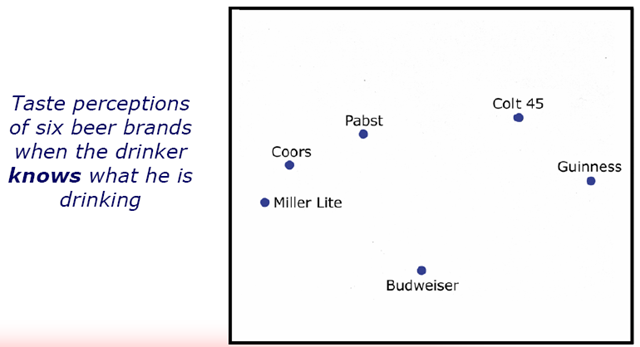
Brand Power: The label changes the taste ???

September 11, 2008

Excerpted from “Innovation & Branding”, by Morgan Johnson, SCI Innovation Conference, May 2005

* * * * *

In blind taste tests, beer drinkers perceive little difference among all but exceptional brands. 

image

* * * * *

But, when folks know which brand they’re drinking, taste perceptions diverge markedly.  Hmmm.

image

* * * * *
Source:
http://www.soci.org.uk/SCI/groups/bsg/2005/reports/pdf/MorganJohnson.pdf
* * * * *
Want more from the Homa Files?
Click link =>
  The Homa Files Blog
* * * * *

Econ – Ownership & the Endowment Effect

September 11, 2008

Excerpted from Predictably Irrational,  Dan Ariely, HarperCollins Books, 2008

“Ownership changes perspective … . once we own something — we fall on with it — and we value it more than other people do.”.

[In technical terms, It’s called the “endowment effect” … owned items accrue “emotional equity”]

Examples:

Social price premium“: Fans holding hot tickets to a big game often require multiples of what buyers are willing to pay to part with the tickets. In effect, owners are pricing in the social value of ownership/ 

IKEA effect“: The more “sweat equity” someone puts into something, the more ownership they feel for it. 

Virtual ownership“: Online auctions make people begin to feel ownership before it’s consummated.  The bidding process itself creates some sense of virtual ownership … so that bidders tend to overbid to avoid “losing” the item. 

Trial periods: Companies comfortably offer 30 day money back guarantees knowing that most people will quickly develop a sense of ownership and attachment … and be reluctant to return items. 

Stubbornness: People who hold deep convictions – from  politics to sports teams — suffer from ownership blindness.  They began to overvalue their ideas, and tend to be rigid and unyielding.

* * * * *

Bottom line: Always try to do transactions — especially big ones — is if you were a non-owner.  Stay dispassionate.

* * * * *

Want more from the Homa Files?
 
Click link =>  The Homa Files Blog