Archive for September 16th, 2008

Median income for intact families at all time high …

September 16, 2008

Excerpted from WSJ: “New Evidence on Taxes and Income”, ARTHUR  LAFFER and STEPHEN MOORE, September 15, 2008

* * * * *

The new Census Bureau data on income and poverty reveal that many of the economic trends in this country are a lot more favorable than America’s detractors seems to think.

In 2007, overall real median family income increased to $50,233, up $600 from 2006. The real median income for intact families — mother and father in the home — rose to $78,000, an all-time high.

* * * * * 

Although incomes fell sharply in the U.S. after the dot-com bubble burst in 2000 (and still haven’t fully recovered), these latest statistics reflect a 25-year trend of upward economic mobility.

To be sure, there has been a massive amount of wealth created in America over the last 25 years. But tax rates were cut dramatically across the income spectrum, for rich and poor alike. The results?

When all sources of income are included — wages, salaries, realized capital gains, dividends, business income and government benefits — and taxes paid are deducted, households in the lowest income quintile saw a roughly 25% increase in their living standards from 1983 to 2005.  This fact alone refutes the notion that the poor are getting poorer. They are not.

* * * * *

Income gains over the last 30 years have been systematically understated due to several factors. These include:

– Fall in people per household. The gains in household income undercount the actual gains per person, because the average number of people living in low-income households has been shrinking. On a per capita basis, the real income gain for low-income households was 44% from 1983 to 2005, about 22% from 1983 to 1992 and about 18% from 1992 to 2002. These are excellent numbers by any measure.

– Earned income tax credit effect. The Earned Income Tax Credit (EITC) is a government payment to low income people who work. Over time the EITC has multiplied the number of poor households that fill out tax forms each year and are thus counted in government income statistics. That’s because to be eligible to receive the refundable EITC, a tax return must be filed.

– We are now statistically counting more poorer families today than we used to. This is a major reason that median and poor household income gains appear to be a lot smaller than they have been in reality. Official tax return data show that in 1983, 19% of returns had zero tax liability; that percentage has climbed steadily, reaching 33% in 2005. (The Tax Policy Center estimates that in 2008 nearly 40% of filers will have no income tax liability.)

– Income mobility. In the U.S., people who had low incomes in 1983 didn’t necessarily have incomes as low a decade later. People in this country have long moved up over time, and this income mobility continues to be true. While some people do remain in the lowest income group, they are the exception.

* * * * *

What is also striking about the data is that the poor today are, in general, not the same people who were poor even a few years ago.

For example, the new Census data find that only 3% of Americans are “chronically” poor, which the Census Bureau defines as being in poverty for three years or more. Many of the people in the bottom quintile of income earners in any one year are new entrants to the labor force or those who are leaving the labor force.

* * * * *

America is still an opportunity society where talent and hard work can (almost always) overcome one’s position at birth or at any point in time. Perhaps the best piece of news in this regard is the reduction in gaps between earnings of men and women, and between blacks and whites over the last 25 years.

Census Bureau data of real income gains from 1980 to 2005 show the rise in incomes based on gender and race. White males have had the smallest gains in income (up 9%), while black females have had by far the largest increase in income (up 79%). White females were up 74% and black males were up 34%. Income gaps within groups are rising, but the gaps among groups are declining.

* * * * *

The evidence is plain that all groups across the income distribution have made solid gains during the last generation.

* * * * *

Full article:
http://online.wsj.com/article_print/SB122143692536934297.html

* * * * *

Want more from the Homa Files?
Click link =>
  The Homa Files Blog

This picture says at least 1,000 words.

September 16, 2008

This one should have been easy to call …

image 

Great analysis from SMH

* * * * *

Want more from the Homa Files?
Click link =>
  The Homa Files Blog
Dumb & Dumber … and campaign implications

September 16, 2008

The facts

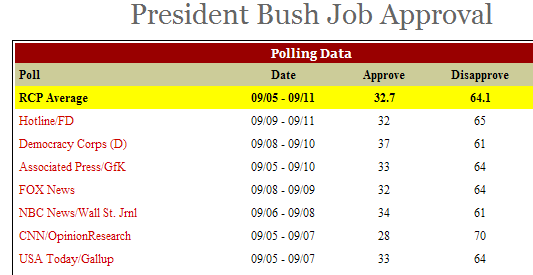
Approximately 1/3 of people approve of the job that Bush is doing.

Only 1/5 of people think approve of the job that Congress is doing.

* * * * *

Question:
Why has McCain become competitive (or arguable gained a lead) in the presidential race ?

Hypothesis:
Bush’s 33% approval rating is usually mocked as overwhelming evidence of his failure as President

Adopting a “glass 1/3 full” perspective, these folks agree with Bush’s policies but may have considered McCain to be off-the -reservation.  Adding Palin to the ticket recast McCain as back on-the-reservation to this 1/3 voting block.  In other words, McCain recaptured the base.

But, McCain distances himself from Bush, claiming that he’ll maintain the “good” from Bush (e.g. low taxes, security) and  fix the “bad” (e.g. spending like a drunken sailor, cronyism, secrecy).  That appeals to folks who disapprove of Bush but don’t want to throw out the baby with the bath water.

* * * * *

Approximately 1/3 of people approve of the job that Bush is doing. 

image 
http://www.realclearpolitics.com/epolls/other/president_bush_job_approval-904.html#polls

* * * * *

Only 1/5 of people think approve of the job that Congress is doing.

w7oqqv

The last time the yearly average for approval of Congress approached this low a level was in 2006, when the Republicans lost majority control of Congress.

The previous occasion was in 1994, when the Republicans wrested control from the Democrats.

In both of these midterm election years, the average congressional approval score was 25%.

However, with an 18% approval rating for Congress in 1992, the Democrats succeeded in holding their majority in Congress. That was a presidential year in which the Democratic candidate, Bill Clinton, won.

Gallup: “Battle for Congress Suddenly Looks Competitive”, September 12, 2008

http://www.gallup.com/poll/110263/Battle-Congress-Suddenly-Looks-Competitive.aspx

* * * * *

Want more from the Homa Files?
Click link =>
  The Homa Files Blog

Many Companies All A-"Twitter"

September 16, 2008

Excerpted from Business Week, “How Companies Use Twitter To Bolster Their Brands”, by Rachel Kin, September 6, 2008

* * * * *

A growing number of companies are keeping track of what’s said about their brands on Twitter . . . using Twitter to do everything from burnish brands to provide customer service. The attention to Twitter reflects the power of new social media tools in letting consumers shape public discussion over brands.

* * * * *

Begun in 2006, Twitter is a pioneer of microblogging, a way for users to keep others informed of their current status by way of text messaging, instant messaging, e-mail, or the Web. While Twitter doesn’t release exact numbers, estimates range from 1 million to 3 million users.

It’s not just audience size that draws brands. People who use the site are likely to hold sway over others. A single Twitter message—known informally as a tweet—sent in frustration over a product or a service’s performance can be read by hundreds or thousands of people. Similarly, positive interaction with a representative of the manufacturer or service provider can help change an influencer’s perspective for the better.

* * * * *

In a July 2008 report, Gartner added microblogging to its list of technologies that will transform business over the next two to five years.

Edit by DAF

* * * * *

Full Article:
http://www.businessweek.com/print/technology/content/sep2008/tc2008095_320491.htm

* * * * *

Want more from the Homa Files?
 
Click link => 
The Homa Files Blog

Marketing: Perspective’s from PepsiCo’s CEO

September 16, 2008

Excerped from WSJ: “PepsiCo CEO Adapts to Tough Climate”,  September 11, 2008

* * * * *

Indra Nooyi, PepsiCo chairman and chief executive, is steering the snack and beverage giant through its biggest challenges in nearly a decade.

Tough economic times are pummeling beverage sales in the U.S., Pepsi’s biggest market. Grain, vegetable-oil and other commodity prices have climbed. Rival Coca-Cola  is out to grab market share from Pepsi in juices and other noncarbonated drinks. .

* * * * *
Indra Nooyi took the helm of PepsiCo in 2006.   She was a major force behind Pepsi’s decision to spin off its Pizza Hut, Taco Bell and KFC restaurants and buy Tropicana, Quaker Oats and other makers of healthy drinks and snacks. Broadening its portfolio has allowed Pepsi to take the lead in the U.S. in the beverages that are growing the fastest: juices, flavored and bottled waters, teas and other drinks.

* * * * *

In an interview, Ms. Nooyi talked about managing in a volatile economic climate while expanding around the globe.

WSJ: Why are beverages being hit harder than snacks by the economic slowdown?

Ms. Nooyi: Beverages are a much more penetrated category … a lot of wastage … people unscrewed their bottle and didn’t finish it all. Now they’re carrying the bottle longer and finishing the beverage.

We haven’t seen this kind of slowdown in convenience-store traffic in 25 years. What you get is the consumer who walks in and picks up a bag of Doritos but can do without the [drink].

* * * * *

WSJ: What can be done to keep beverage sales from slipping further in this economy, and to revive consumer interest in soda?

Ms. Nooyi: You really have to segment your portfolio very, very carefully. You want targeted innovation that grabs the consumer and gives people a reason to buy.

People still love bubbles. We have to give people a reason to come back to cola. We’ve got to romance them.

* * * * *

WSJ: Is PepsiCo international enough?

Ms. Nooyi: Forty percent of our revenue comes from international. Most of our growth is coming from international.  We know that a lot of the growth potential is overseas, and we are going after it aggressively.

* * * * *

WSJ: Do you want to unseat Coke in international beverage sales?

Ms. Nooyi: In the Middle East and parts of Asia, where we are strong, we want to remain very, very strong. Where the market growth is spectacular like China, India, Russia, we are going to keep investing so that when the music stops we have a great shot at being up there as the leader. And then in all the other markets, we want to play the noncarbonated game aggressively.

* * * * *

WSJ: You have talked about tackling obesity. Some people would say it’s insincere or hypocritical for the chairman of a company whose biggest products include Pepsi-Cola, Lay’s and Doritos to do that.

Ms. Nooyi: Why should they think I am being insincere or hypocritical? There is a place for Pepsi, because it tastes great. Potato chips are part of the American diet.

I am extremely proud of our track record. Name me one other company that took out trans fats from all its products without increasing the price of its products — four or five years before anyone else. We’re doing everything possible to shift our portfolio to “better for you” or “good for you” products.

* * * * *

WSJ: Gatorade lost some share last year, and you changed the brand’s management team. How’s it doing now?

Ms. Nooyi: Brands go through ups and downs. Gatorade is an extremely strong brand. I think every five or seven years, you’ve got to change out the approach to the brand, because you need a new boost of energy to think about the next iteration. Brands never die. You only stop reinventing them.

* * * * *

WSJ: How do you keep up with what’s going on in the market and get new ideas for products?

Ms. Nooyi: I do market tours all the time. Every weekend I hop in the car and go somewhere. I listen to kids talk about what they’re consuming, what they’re doing, what they’re not doing.

I read a range of things to keep in touch with cultural and lifestyle trends — the usual business press but also People and Vanity Fair and anything close to the cutting edge of the culture. Even the AARP magazine.

* * * * *

Full article:
http://online.wsj.com/article_print/SB122109233453421645.html

* * * * *

Want more from the Homa Files?
Click link =>
  The Homa Files Blog

Health Care: The Obama Plan

September 16, 2008

Excerpted from WSJ: ” Why Obama’s Health Plan Is Better”, David Cutler, Sept. 16, 2008 

* * * * *
The big threat to growth in the next decade is not oil or food prices, but the rising cost of health care. The doubling of health insurance premiums since 2000 makes employers choose between cutting benefits and hiring fewer workers.

Rising health costs push total employment costs up and wages and benefits down. The result is lost profits and lost wages, in addition to pointless risk, insecurity and a flood of personal bankruptcies.

Sustained growth thus requires successful health-care reform.

* * * * *

Sen. Obama’s proposal

Learning. One-third of medical costs go for services at best ineffective and at worst harmful. Fifty billion dollars will jump-start the long-overdue information revolution in health care to identify the best providers, treatments and patient management strategies.

Rewarding. Doctors and hospitals today are paid for performing procedures, not for helping patients. Insurers make money by dumping sick patients, not by keeping people healthy. Obama proposes to base Medicare and Medicaid reimbursements to hospitals and doctors on patient outcomes (lower cholesterol readings, made and kept follow-up appointments) in a coordinated effort to focus the entire payment system around better health, not just more care.

Pooling. The Obama plan would give individuals and small firms the option of joining large insurance pools. With large patient pools, a few people incurring high medical costs will not topple the entire system, so insurers would no longer need to waste time, money and resources weeding out the healthy from the sick. 

Preventing. In today’s health-care market, less than one dollar in 25 goes for prevention, even though preventive services — regular screenings and healthy lifestyle information — are among the most cost-effective medical services around. Guaranteeing access to preventive services will improve health and in many cases save money.

Covering. Controlling long-run health-care costs requires removing the hidden expenses of the uninsured. The reforms described above will lower premiums by $2,500 for the typical family, allowing millions previously priced out of the market to afford insurance.In addition, tax credits for those still unable to afford private coverage, and the option to buy in to the federal government’s benefits system, will ensure that all individuals have access to an affordable, portable alternative at a price they can afford.

* * * * *

Given the current inefficiencies in our system, the impact of the Obama plan will be profound. Besides the $2,500 savings in medical costs for the typical family, according to our research annual business-sector costs will fall by about $140 billion.

We know these savings are attainable: other countries have them today. We spend 40% more than other countries such as Canada and Switzeraland on health care — nearly $1 trillion — but our health outcomes are no better.

The lower cost of benefits will allow employers to hire some 90,000 low-wage workers currently without jobs because they are currently priced out of the market. It also would pull one and a half million more workers out of low-wage low-benefit and into high-wage high-benefit jobs. Workers currently locked into jobs because they fear losing their health benefits would be able to move to entrepreneurial jobs, or simply work part time.

* * * * *
Mr. Cutler is professor of economics at Harvard and an adviser to Barack Obama’s presidential campaign.

* * * *
Full op-ed:
http://online.wsj.com/article/SB122152292213639569.html#printMode

* * * * *

Want more from the Homa Files?
Click link =>
  The Homa Files Blog