Archive for October, 2008

Its His Turn: Marketing to Dad’s

October 16, 2008

Excerpted from Marketing Daily “Marketing to Today’s Dad Requires New Approaches” by Karlene Lukovitz, September 22, 2008

* * * * *

Many Generation X and Y fathers, in particular, are a new breed who are more involved with their children’s lives and more likely to make day-in, day-out types of product purchases–not just the home electronics or riding lawnmower buys, confirms a new study from Packaged Facts authored by Silver Stork Research.

Marketers looking to reach beyond appealing mostly or only to mothers to tap into this “Dad Factor” need to stop reflexively “thinking pink,” say the analysts. They should gear their brands’ media outreach and benefits positioning to these new fathers–who have a markedly different purchasing behavior than moms…

Who are these new generations of dads? They are less defined by gender stereotypes and see much less of a dividing line between men and women…these dads approach parenthood with a team attitude. Gen X and Y dads are positive, comfortable with their gender, optimistic about being parents …and much more active consumers than dads of previous generations.

* * * * *

Key facts about newer-generation dads and marketing effectively to them, per the report:

Dads are men–meaning that parenthood doesn’t change their overall approach to the world; it just expands it.

Like mothers, fathers’ key concerns regarding their children are education and health…

Dads don’t like to browse and shop, at least when it comes to family-oriented products… However, they do have a propensity to make impulse purchases–an opportunity for marketers.

Electronic media and the Internet are key…

New dads are attracted to products that are practical and solve a problem. They put quality before price…At the same time, marketing should seek to leverage these dads’ appreciation of a humorous element in…and seek to add an element of fun to the products themselves. Fun and play are cornerstones of interaction between these dads and their kids.

Marketing/advertising should reflect these dads’ parental motivations to give their kids what they want, make their kids happy and be perceived as heroes by their children.

Marketing should include images of dads interacting with kids, especially “real” dads/kids, to reflect the more positive, involved image to which younger dads relate… Product packaging should take male-appeal into account…

Including products or product appeals geared to dads within promotions primarily targeting moms can also be effective.

Edit by SAC

* * * * *
Full article:
http://www.mediapost.com/publications/?fa=Articles.showArticle&art_aid=91038

* * * * *

Want more from the Homa Files?
Click link =>
The Homa Files Blog

Keep your toxic securities, we’ll take preferred stock …

October 15, 2008

Excerpted from WSJ: “‘Distasteful’ Capital”, Oct. 15, 2008

* * * * * 

The government’s rescue plan moved into a new phase with the announcement that Treasury is injecting $125 billion into the country’s nine largest banks  … as much as $25 billion each for the biggest. Another $125 billion is on the table for other banks that need capital on the same terms offered to the big boys.

Despite the risks, directly recapitalizing the banks is likely to prove a better tool than buying up “troubled assets.” 

Giving banks this additional capital cushion should give them some leeway to sell those assets at market prices without risking insolvency. At the same time, it avoids the vexing problem of how to price securities that the smartest minds in finance are having trouble assigning a value to.

And unlike buying dodgy mortgage paper, recapitalizing banks is something the government has done before and knows how to do, more or less. The FDIC has done so from time to time via open-bank interventions, and the Depression-era Reconstruction Finance Corp. recapitalized thousands of banks in the 1930s.

Under the program, banks that participate will pay 5% interest annually on nonvoting, senior preferred shares issued to Treasury. Treasury will also receive warrants to buy bank stock at the market price at the time of the capital injection. The warrants, equal to 15% of the face value of the preferred shares issued by the bank, offer some possibility of profit for the Treasury without being so dilutive to existing shareholders as to scare away private capital.

* * * * *

Full article:
http://online.wsj.com/article/SB122402721776634391.html

* * * * *

Want more from the Homa Files?
Click link =>
  The Homa Files Blog

Putting the stock market (and capital gains) in perspective …

October 15, 2008

Historical Perspective

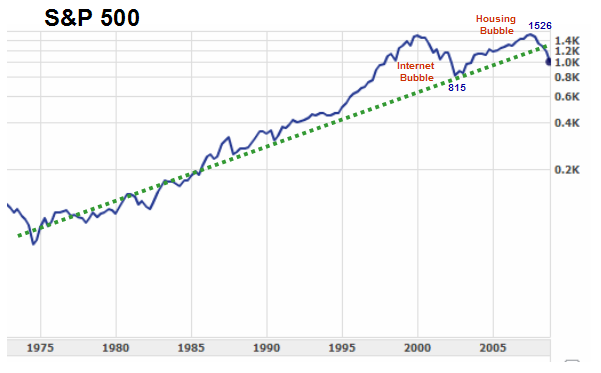
Like most folks, I’ve gotten hammered by the recent market declines.  But yesterday —when Obama said “McCain’s capital gains tax cut won’t have any effect … not even the best investors have to worry about capital gains these days” — it got me thinking “how bad are things, and is Obama right?”  Answer: “not that bad”, and “no”.

Below is historical data for the S&P 500 Index — right off Yahoo Finance.  Since the plot is logarithmic, the straight line represents a constant rate of increase — across 33 years.  Pretty remarkable, right ?  Even considering the past couple of weeks’ battering.  The chart really puts things in perspective. If you compare where we are to 2 artificially high periods — the internet -bubble and the housing bubble — things look pretty bleak.  If you compare where we are to the long run historical trend — we’re only slightly below the trend line.  In other words, right on track.

image

* * * * * *

Capital Gains

What about Obama’s assertion that not even the savviest investors will benefit from a halving of the capital gains rate?

Well, that might or might not be true. It depends on when stocks were bought.  Using the S&P 500 as a proxy for an average stock, if a stock  was bought near the peak of the internet or housing bubbles, it’s probably “under water” with no unrealized capital gains (i.e. capital losses).  McCain’s proposal to allow deductibility of up to $15,000 of losses (up from $3,000) would offset some of the pain.  The average tax benefit of the step-up would be about $2,400 [$12,000 step-up times 20% average effective tax rate equals $2,400].

But, note that a stock that’s been held for about 10 years — e.g. the portfolios of diehard “buy & hold” folks — are “in the money” and have capital gains.  Or, folks who bought into the market after the internet bubble burst may have capital gains.  For example, if somebody bought the S&P Index in Sept. 2002 at 815, they’d be sitting down from the housing bubble peak of 1,500 but — at 1,000 — they’d still have 185 of capital gains.  After McCains 7.5% capital gains tax, that nets to 171; after Obama’s 20%, that nets to 148 — a 16% difference. Hmmm.  I guess the cut in the capital gains tax rate could matter.

More important, McCain’s capital gains tax rate cut is intended to attract capital into the market now — with the prospects of favorable tax treatment when prospective gains are realized.  The increased flow of capital should boost the stock market — which is good for all investors, big and small — and should provide growth capital to businesses — which should help employment.  Win-win.

image

* * * * *

Want more from the Homa Files?
Click link =>
  The Homa Files Blog

Kumbaya ? I don’t think so …

October 15, 2008

Excerpted from WSJ: “Hopes Quickly Fade For a Postpartisan Era”, Seib, Oct. 14, 2008

* * * * *
Idealists once looked at this presidential campaign, between two candidates who fancy themselves as free of conventional party ties, and thought it might produce the election that finally pulls Washington out of the deep rut of partisan divisiveness it fell into in the 1990s … Instead, partisan animosity is growing rather than waning.

Pollster Peter Hart has found some startling new evidence of high tensions. In surveying voters over the weekend, Mr. Hart found that more than a third of each candidate’s supporters say they have grown to “detest (the other candidate) so deeply that they would have a hard time accepting the one they don’t support as president.

* * * * *

It’s starting to appear that the only way for Washington to overcome partisan divides may be if one party — the Democrats, in this case — wins by such commanding margins that it can overpower the other party.
That might be good for efficiency, but it would be bad for building the kind of national consensus that’s desirable to overcome the enormous economic challenges the nation will face after Nov. 4.

(America will) again elect a president whom a sizable chunk of voters somehow consider illegitimate. That may make for good autumn sport, but it’s discouraging for anyone who thought Washington was about to pull out of its divisive partisan ditch.

Full article:
http://online.wsj.com/article/SB122393387064230201.html 

* * * * *

Want more from the Homa Files?
Click link =>
  The Homa Files Blog

More lessons from the financial crisis …

October 15, 2008

Excerpted from Harvard Business Online, “6 Lessons We Should Have Learned Already”, by Paul B. Carroll and Chunka Mui, September 30, 2008

* * * * *

The collapse of Washington Mutual, Wachovia, Lehman Brothers, AIG, Bear Stearns, Merrill Lynch, and others soon to fall stem from discredited strategies that should have been avoided.

Here are six lessons that, had they been learned a decade ago, would have kept us from being in our current mess:

* * * * *

1. It doesn’t work to let dealmakers make all their money up front.

Whether it’s lenders hawking mortgages, bankers pushing bonds, or salespeople closing contracts before the end of the quarter, dealmakers have to have responsibility for the health of those decisions years down the road. Where possible, the individuals who make the deals should also have their compensation depend on the long-term performance of those deals.

Green Tree Financial showed how dangerous it can be to separate up-front fees from long-term responsibility. In the 1990s, Green Tree offered mortgages on mobile homes that made no long-term sense — the mortgages lasted 30 years, while the underlying assets had a useful life of just 10 to 15 years. Yet, because Green Tree employees from the CEO on down had so much of their pay tied to the growth in the number of mortgages, the company churned out flawed loans at an ever-accelerating pace. When problems started to surface, Green Tree actually managed to sell itself to Conseco for almost $6 billion in 1999. Conseco subsequently wrote off all the profits that Green Tree ever recorded and went into bankruptcy proceedings.

Subprime lenders, having missed the Green Tree lesson, likewise became addicted to up-front fees and generated an astonishing number of bad loans that were turned into securities and sold.

2. Risks may correlate more than you think. In other words, a single problem can take you down if it’s severe enough.

Long Term Capital Management thought it had diversified its risks in the 1990s but found its whole portfolio turning sour simultaneously and collapsed in 1998. Having missed that lesson, this time around companies such as Merrill Lynch and WaMu built huge portfolios of mortgage-related securities that relied on historical data suggesting that housing markets were localized — in other words, the market in Denver was independent of the market in Sacramento, which was independent of the market in Pittsburgh. In fact, the credit crunch has clobbered all markets and all classes of lenders.

3. In a crisis, liquidity can disappear overnight.

LTCM thought that, in the event of problems, it could always unwind its positions in orderly fashion. In fact, all buyers disappeared. The same thing happened to Merrill, WaMu and others. The market got so scared so fast that nobody would buy their debt portfolios at almost any price. While Bank of America might have bought Merrill at a bargain for $50B, they also acquired $64B of toxic debt that will eventually mushroom the true cost of the acquisition.

4. It’s incredibly dangerous to buy a business unless you understand it in excruciating detail.

Conseco showed the danger. It had a great record of buying and integrating companies, but they were all in insurance. Conseco didn’t know anything about mortgages. It was so clueless about the problems with Green Tree’s business model that it actually stepped up the mortgage business, right to the point where it collapsed. AIG repeated the mistake when it started offering credit-default insurance on mortgage-backed securities that it didn’t understand. Merrill made this mistake when it decided it could copy Goldman Sachs and invest its own capital in what turned out to be toxic loans. (And Bank of America may have made this mistake when it agreed to buy Merrill, whose retail brokerage operation, investment banking unit and investment portfolio are outside its expertise.) As a colleague of ours says: Don’t assume someone smarter than you will understand the risks you’re taking on.

5. Whenever anyone says they’ve managed to do away with risk, head for the hills.

LTCM said its portfolio was impervious to risk. AIG and others said the same thing about the securities that were built based on subprime mortgages. We’ve no doubt that yet others will be saying the same as they argue for ways to take advantage of others’ mistakes as the current crisis unfolds.

6. Perhaps the greatest lesson of all is that bad strategies can happen to great companies and smart people.

The humility that comes with this lesson should cause the smartest companies and managers to instill process and cultural mechanisms that absorb these lessons and avoid such mistakes in the future by creating a culture of constructive debate and deliberation.

Edit by DAF

* * * * *

Note: The authors researched 2,500 major failures and recently published both the Harvard Business Review article, “Seven Ways to Fail Big” and their book, “Billion-Dollar Lessons: What You Can Learn from the Most Inexcusable Business Failures of the Last 25 Years”.

* * * * *

Full article:
http://conversationstarter.hbsp.com/2008/09/six_lessons_we_should_have_lea.html?cm_mmc=npv-_-WEEKLY_HOTLIST-_-OCT_2008-_-HOTLIST1006

* * * * *

Want more from the Homa Files?
Click link => 
The Homa Files Blog

* * * * *

Another Shift to Digital for P&G

October 15, 2008

Excerpt from Marketing Daily “P&G Eschews TV In Oral-B Pulsonic Intro ” September 12, 2008

* * * * * 

Procter & Gamble is introducing an ultrasonic toothbrush under its Oral-B brand, which includes manual and power toothbrushes for children and adults, oral irrigators, and products like dental floss…

The company will promote with ads and events touting it for its design and performance…Allisa Hammond, a spokesperson for P&G’s Oral Care division, says the marketing campaign for the Pulsonic is “very different than our typical marketing strategy.”

She says the campaign will include digital advertising, public relations, unique, targeted print and in-store displays. But, she says, “we will not be using TV advertising, which is something we normally use in our campaigns. Instead, we wanted to let the design of the toothbrush really stand out, and are relying on influencers such as magazine editors, bloggers, interior fashion designers and unique fashion and design sponsorships to reach this consumer”…

Edit by SAC

* * * * *

Oral-B was one of the surprising consumer product good brands to make an appearance at New York’s Fashion Week.  As the article goes on to note the product spokesperson is an interior designer from “Extreme Home Makeover” and was a feature in the the Kardashian sisters’ runway show.

* * * * *
Full article:
http://www.mediapost.com/publications/?fa=Articles.showArticle&art_aid=90443

* * * * *

Want more from the Homa Files?
Click link =>
The Homa Files Blog

Big Profits from "Inferior" Products

October 15, 2008

Excerpted from Strategy & Business, “A Breakaway Opportunity for “Inferior” Products”, by Leslie Moeller, James Ryan, and Juan Carlos Webster, September 16, 2008

* * * * *
As the difficult economy causes consumers to trade down in their purchases, companies need to adjust their offerings to their customers’ new behavior.

The current economic crisis is creating a “new normal” in consumer buying habits. Before the recent downturn, when consumers tried to save money, they traded down from branded products to private-label or so-called value brands. But they tended to keep buying some form of the product; they continued to pay for the convenience of, say, antibacterial throwaway wipes or gourmet frozen foods. In the current economy, they are not just trading down within a category, but switching to “inferior” products and services — paper towels instead of wipes, washcloths instead of paper towels. In the process, they are raising the value of the type of products and services economists call “inferior goods”: those that attract consumers more when purchasing power declines.

This will require a major shift of focus for many consumer-oriented companies. During the past decade or so, marketers have grown accustomed to the trend known as “premiumization”: Each year, consumers sought out higher-priced and more distinctive products.

Premiumization will never go away completely. But suddenly it has moved to the slow lane. The reason, of course, is the continuing economic downturn.

The impact has not been gentle on premium products, even the relatively inexpensive or everyday kinds. Retail sales figures for the second quarter of 2008 showed declines of 0.7 percent for Target Corporation (versus a gain of 2.7 percent for Wal-Mart Stores Inc., which has much less of a premium focus in its category) and a significant “mid-single-digit” decline for the Starbucks Corporation.

* * * * *

If you can attract consumers to your category from another, the era of inferior products may bring you superior opportunities. Consumer-oriented companies should consider the following options when facing the current economic slowdown:

1. Don’t blindly lower prices to regain volume. Simply reducing prices could well be financially disastrous; it already has been for several casual-dining restaurant chains. Across-the-board price-cutting may lower the price of a $12 meal to $9 or $10, and thus affect the perceived value of, say, Boston Market versus Chipotle, but it will not have any effect on a consumer who is opting for a $5 meal by eating at home.

2. Find the inferior products that will attract consumers as their purchasing power decreases. Introduce a new brand or sub-brand in the categories to which consumers are moving in this downturn. Of course, companies will run the risk of potential cannibalization, but that’s still better than losing customers altogether.

3. Cement consumers to your brand. Once you have attracted consumers to your inferior product, bind them to your brand. Give them an experience that merits repurchase. Think about the products you can trade them up to when the economy starts to recover — for example, the health-conscious, convenient, or premium products that will make them stick to your brand as their incomes increase.

4. Make the new normal feel better. You can help consumers feel good about migrating to inferior goods by enabling them to justify their decisions in terms other than affordability. Toyota Motor Company’s Prius is a great example: Consumers don’t feel bad about trading in their BMW or Escalade, because they are doing their part for the environment; it’s not simply that they can’t afford anything more expensive.

* * * * *

Brand owners and companies that offer products or services to customers across a broad range of price points, and that can manage the cycle, will fare better than those with more focused products and offerings that can’t adapt up- or downstream as consumer choices change.

Edit by DAF

* * * * *
Full article:
http://www.strategy-business.com/li/leadingideas/li00093?pg=all

* * * * *

Want more from the Homa Files?
Click link => 
The Homa Files Blog

* * * * *

Credit Crunch Decaffeinates Coffee Push at McDonalds

October 15, 2008

Excerpted from AdAge “Credit Crunch Takes Bite Out of McDonalds” by Emily Bryson York , September 29, 2008 

* * * * * 

The banking crisis is threatening to take a rather surprising hostage: McDonald’s big-budget coffee rollout.

Tightening credit conditions, which are crimping plans for marketers as diverse as giant General Motors Corp. and relatively small household-products company Method, have prompted Bank of America to halt loans to McDonald’s franchisees. They need the capital to frantically build coffee bars in the chain’s 14,000 locations for what was planned to be an April coffee introduction.

And although it won’t derail the launch altogether, it is likely to delay it nearly into summer — hardly optimal timing for a hot-beverage introduction. It also could force the company to postpone a huge marketing push it’s been planning to support the java drive, as the company generally waits until 60% of its stores have been outfitted to undertake a national ad push. The fast feeder maintains that everything is on track…

Franchisees are spending about $100,000 per store to accommodate the “combined beverage business,” which includes lattes and cappuccinos. Most are seeking loans for the build-out. “As money remains tight, it’s going to be more difficult to get the loans to remodel for the combined beverage strategy,” one franchisee said…

The corporate memo additionally advised that “now is not the time to be shopping for loans based on interest rates,” or to refinance existing debt. It went on to suggest franchisees consider using cash on hand to cover new-equipment costs…

“I think it could very likely slow down the [rollout],” said Darren Tristano, exec VP of Technomic. “That plus the impact that Starbucks has seen in traffic and a decline in sales, I think it probably would be better to slow it down and continue to test it and see how the results are.”

McDonald’s spokesman Bill Whitman, however, said the beverage strategy is “on target and progressing as planned.”

“There continues to be more than sufficient liquidity available to our franchisees to fund capital improvements in their restaurants,” he said, adding that more than 50 national, regional and local lenders are providing financing to U.S. franchisees.

…it seems clear that the company is backpedaling. In July, McDonald’s was expecting the rollout to be completed by April. Earlier this month, Ralph Alvarez, chief operating officer, told analysts at a Bank of America conference that the specialty-coffee rollout should be complete by mid-2009.

Even if that date stays on track, the chain would likely miss the cold-weather window in which hot drinks are said to be the most popular…Another problem will be what to do with the ad calendar…

Edit by SAC

* * * * *
Full article:
http://adage.com/article?article_id=131320

* * * * *

Want more from the Homa Files?
Click link =>
The Homa Files Blog

For the record: Ideas for McCain …

October 14, 2008

Last week I emailed some ideas to Doug Holtz-Eakin — McCain’s chief economic advisor. Why?  Just frustrated.  Waste of time ? Probably. I imagine that it went right to a spam file … and I certainly didn’t get a reply.

Still, since McCain is supposed to unveil some new economic tactics today, I wanted to get my notions on the record.  Interesting to see if any are included.

* * * * *  

    Ken’s Ideas

1) Make the first $100,000 of capital gains tax free for everybody
   (Note: Warren Buffet & other uber-fat cats
              wouldn’t benefit much)
 

2) Make IRA and 401K withdrawals taxable at capital gains rates — not ordinary income rates
    (Note: even though IRAs are down, many are still above water)

3  Make all capital gains from the sale of primary residences tax free … always
    (Note: allows empty-nesters to downsize — currently,
               only 1 primary home sales is cap gains free)
  

4) Allow home mortgage interest to be income tax deductible for the 65% of filers who use the standard deduction.
    (Note: roughly comparable to Obama’s 10% tax credit
              for mortgage interest )
  

5) Give a 1-time stimulus payment to Social Security retirees equal to 1 month their annual SS benefits
    (Note: gets some relief to fixed income Seniors)

6) Shift the payroll tax schedule by by increasing the earnings cap by $25,000 (to $127,000)
    … but give a non-refundable tax credit for payroll taxes on the first $25,000 of earnings.
   (Note: this Out-Obamas Obama)

7) Retroactively impose a draconian 1-time income tax surcharge for 2008 earnings OVER $5 million.
    For example: a 100% surcharge on income over $
     5 million would mean a 70% rate.

   (Note: I realize this isn’t conservative and
     muddies the “no tax” message  … but it
     goes right after the “greedy fat cats”
    Note:  tax changes can be retroactive
… puts responsibility on Dem Congress, this year)
 

* * * * *

Want more from the Homa Files?
Click link =>
  The Homa Files Blog

The health care debate … that isn’t being held

October 14, 2008

Ken’s Take: Coburn & Burr raise good points — especially re: the likely consequences of gov’t controlled health care.  But, even they ignore the biggest issue: we’re spending over $7,000 per capita annually on health care.  Until the costs get contained, we’re just shifting around the burdens of who pays what.

* * * * *

Excerpted from RCP: “Americans Deserve a Real Health Care Debate”, Tom Coburn and Richard Burr, October 10, 2008

* * * * *

The American people have had enough and want the campaigns to confront the real problem: Health care is becoming less affordable and less accessible for millions of middle-class families. While health care premiums have gone up 78 percent from 2001-2007, workers’ earnings have only risen by 19 percent.

* * * * * 

Three core principles. First, a person’s ability to afford health care should not depend on whether they work for an employer who offers health insurance. Second, wealthy Americans with expensive health plans do not deserve a bigger tax benefit than working class Americans. And finally, workers should be able to pick the health care plan that best meets their needs, and they should be able to take it with them when they change jobs.

* * * * *

Our current tax code is fundamentally unfair and regressive. Lower income workers receive the least benefit, while wealthy Americans receive the most. Because tax rules are tied to employment (health care benefits paid for by employers are exempt from income and payroll taxes), if you leave your job, you leave your health care behind. Meanwhile, Americans who purchase their own health insurance generally do not receive a tax benefit.

* * * * *

Government-controlled health care is a seductive message that, in practice, is most cruel to those who can least afford a way out. Much of Europe is moving away from government-control health care.  Countries like the United Kingdom have learned the painful lesson that the only way government can control costs when it is in charge is by rationing care. In the UK, it is not uncommon for women diagnosed with breast caner to wait months for treatment.  Canadians look for health care asylum in the United States, not vice versa. As the Canadian Supreme Court said in a ruling that exposed the inequities of government-controlled health care, “Access to a waiting list is not access to health care.”In short, government-sponsored health care will do for the health care economy what government-sponsored mortgages did to the housing market.

Tom Coburn, M.D. is a U.S. Senator from Oklahoma and Richard Burr is a U.S. Senator from North Carolina.

* * * * *
Full article:
http://www.realclearpolitics.com/articles/2008/10/americans_deserve_a_real_healt.html

* * * * *

Want more from the Homa Files?
Click link =>
  The Homa Files Blog

Financial crisis: history repeating itself ?

October 14, 2008

Source: IBD: “America’s Second Wake-Up Call!”, Oct. 10, 2008
http://www.ibdeditorials.com/IBDArticles.aspx?id=308530236252361

* * * * *

Want more from the Homa Files?
Click link =>
  The Homa Files Blog

Pepsi Targets Eco-Centric Consumers Online

October 14, 2008

Excerpted from Brandweek “Pepsi Ups its Online Eco Efforts” by Kenneth Hein, September 30, 2008  

* * * * * 

Pepsi, today, is launching not one, but two Web sites trumpeting its eco-friendly efforts. PepsiEcoChallenge.com and Pepsirecycling.com both spotlight Pepsi-Cola North America’s slew of sustainability programs.

The more promotional site, Pepsirecycling.com, offers consumers 100 Pepsi Stuff points for taking a quiz about recycling. Points can be redeemed for prizes, like shirts made from recycled materials, and entrance into a sweepstakes for a Smart car. Pepsirecycling.com  offers a myriad of information about recycling as well as origami instructions for used 12-pack cartons.

“We’re putting recycling front and center and giving our customers an incentive to do their part for the environment,” said Victor Melendez, vp-marketing, sustainability for PCNA, Purchase, N.Y., in a statement. “Pepsi has always stood for fun and now we’re channeling that Pepsi spirit into raising environmental awareness.”

PepsiEcoChallenge.com reads more like an interactive brochure that explains how the company is working to save energy and water as well as working to create sustainable packaging… It points out Pepsi is working to reduce its U.S. plants’ water consumption by 20%, electricity usage by 25% and fuel consumption by 25% by 2015.

Because a segment of consumers demand eco-accountability from their favorite brands, such efforts are of increasing importance, said John Sicher, editor of Beverage Digest, Bedford Hills, N.Y. “There is certainly growing interest among consumers in buying products from socially responsible companies,” he said. “It’s important that big companies like Pepsi reach out and show decision makers and decision influencers that they are taking a lead in this.”

Edit by SAC

* * * * * 

Full article:
http://www.brandweek.com/bw/content_display/news-and-features/digital/e3i5452d1396a606a4187805864881b8d0d

* * * * *

Want more from the Homa Files?
Click link =>
The Homa Files Blog

Coke Leads Brand Value Rankings

October 14, 2008

Excerpt from Ad Age “Coke Still No. 1 in Brand Value” by Jean Halliday September 19, 2008  

* * * * *

Coca-Cola is again the world’s most valuable brand, according to Interbrand’s just-released annual list of the Best 100 Global Brands.

While Coke held onto its top slot from last year, IBM, by expanding its services and transitioning out of production, moved up to No. 2, knocking Vista-burdened Microsoft to third…GE was fourth, boosted by its “Ecomagination” communications program, and Nokia fifth.

The brands with the biggest growth in the past 12 months were: Google, up 43%; Apple, up 24%; Amazon, up 19%; retailer Zara, up 15%; and Nintendo, up 13%. Only one brand in the top 20, Citi, saw its brand value fall…Joining the list for the first time are: retailer H&M, taking the No. 22 slot; Thomson Reuters, ranking No. 44; BlackBerry at 73; Ferrari at 93; Marriott at 96; FedEx at 99; and Visa at 100.
Among the five brands with the biggest year-over-year drops in brand value were three financial players: Merrill Lynch, which fell 21%; Morgan Stanley, sliding 16%; and Citi, falling 14%. Gap was down 20%, and Ford dropped 12%.
Strong and weaker brands all use research to try to stay in touch with their customers. But the winning brands can innovate quickly and bring fresh ideas to market, said Mr. Bateman, citing a statement by hockey great Wayne Gretsky as advice to fallen brands: “Skate to where the puck was going, not to where it was.”      

Edit by SAC
* * * * * 
For more information and to see the full list of brand rankings, visit: http://biz.yahoo.com/prnews/080918/ny33972.html?.v=1

* * * * *  

Full article:
http://adage.com/article?article_id=131117

* * * * *

Want more from the Homa Files?
Click link =>
The Homa Files Blog

Obama’s Magic Show

October 13, 2008

Ken’s Take: Obama fans might want to skip this one. McCain fans will wonder why J-Mac can’t rattle this stuff off in debates. Open-minded folks should keep reading.

* * * * *

Excerpted from WSJ: “Obama’s Magic”, Strassel, Oct.10, 2008

* * * * *

And now, America, we introduce the Great Obama! The world’s most gifted political magician! A thing of wonder. Just watch him defy politics, economics, even gravity!

* * * * *
To kick off our show tonight, Mr. Obama will give 95% of American working families a tax cut, even though 40% of Americans today don’t pay income taxes! How can our star enact such mathemagic? How can he “cut” zero? Abracadabra! It’s called a “refundable tax credit.” It involves the federal government taking money from those who do pay taxes, and writing checks to those who don’t. Yes, yes, in the real world this is known as “welfare,” but please try not to ruin the show.

* * * * *
For his next trick, the Great Obama will jumpstart the economy by raising taxes on businesses that are today adrift in a financial tsunami! That will include … small-business owners, and the nation’s biggest employers who currently pay some of the highest corporate tax rates in the developed world. Mr. Obama will, with a flick of his fingers, show them how to create more jobs with less money. It’s simple, really. He has a wand.

* * * * *
Next up, Mr. Obama will re-regulate the economy, with no ill effects whatsoever! Did someone in the audience just shout “Sarbanes Oxley?”  Usher, can you remove that man?

* * * * *

Just watch the Great Obama perform a feat never yet managed in all history. He will create that enormous new government health program, spend billions to transform our energy economy, provide financial assistance to former Soviet satellites, invest in infrastructure, increase education spending, provide job training assistance, and give 95% of Americans a tax (ahem) cut — all without raising the deficit a single penny! And he’ll do it in the middle of a financial crisis. And with falling tax revenues! Voila!

* * * * *
Moving along to a little ventriloquism. Study his mouth carefully, folks: It looks like he’s saying “I’ll stop the special interests,” when in fact the words coming out are “Welcome to Washington, friends!” Wind and solar companies, ethanol makers, tort lawyers, unions, community organizers — all are welcome to feed at the public trough and to request special favors. From now on “special interests” will only refer to universally despised, if utterly crucial, economic players. Say, oil companies. Hocus Pocus!

* * * * *
And for tonight’s finale, the Great Obama will uphold America’s “moral” obligation to “stop genocide” by abandoning Iraq! While teleported to the region, he will simultaneously convince Iranian leaders to peacefully abandon their nuclear pursuits (even as he does not sit down with them), fix Afghanistan with a strategy that does not resemble the Iraqi surge, and (drumroll!) pull Osama bin Laden out of his hat!

* * * * *

We’d also like to thank Mr. McCain for keeping all the focus on himself these past weeks. It has helped the Great Obama to just get on with the show.

* * * * *

Full article:
http://online.wsj.com/article/SB122360618747721991.html

* * * * *

Want more from the Homa Files?
Click link =>
  The Homa Files Blog

Taxes: The 95% illusion … what’s a tax cut?

October 13, 2008

Excerpted from WSJ: ” Obama’s 95% Illusion”, Oct. 13, 2008

* * * * *   
One of Obama’s most potent campaign claims is that he’ll cut taxes for no less than 95% of “working families” … (and cut aggregate income taxes).

How does he conjure this miracle, especially since more than a third of all Americans already pay no income taxes at all? First, by proposing one of the largest tax increases ever on the other 5%.

There are several sleights of hand, but the most creative is to redefine the meaning of “tax cut.”

* * * * *
For Obama , a tax cut is no longer letting you keep more of what you earn. In their lexicon, a tax cut includes tens of billions of dollars in government handouts that are disguised by the phrase “tax credit.”  Obama is proposing to create or expand no fewer than seven such credits for individuals:

  • A $500 tax credit ($1,000 a couple) to “make work pay” that phases out at income of $75,000 for individuals and $150,000 per couple.
  • A $4,000 tax credit for college tuition.
  • A 10% mortgage interest tax credit (on top of the existing mortgage interest deduction and other housing subsidies).
  • A “savings” tax credit of 50% up to $1,000.
  • An expansion of the earned-income tax credit that would allow single workers to receive as much as $1,110 if they are paying child support.
  • A child care credit of 50% up to $6,000 of expenses a year.
  • A “clean car” tax credit of up to $7,000 on the purchase of certain vehicles.

Here’s the political catch. The credits  would be “refundable,” which is Washington-speak for the fact that you can receive these checks even if you have no income-tax liability. In other words, they are an income transfer — a federal check — from taxpayers to nontaxpayers. Once upon a time we called this “welfare.”  Mr. Obama’s genius is to call it a tax cut.

* * * * *
The Tax Foundation estimates that under the Obama plan 63 million Americans, or 44% of all tax filers, would have no income tax liability and most of those would get a check from the IRS each year.

The total annual expenditures on refundable “tax credits” would rise over the next 10 years by $647 billion to $1.054 trillion, according to the Tax Policy Center.  By redefining such income payments as “tax credits,” the Obama campaign also redefines them away as a tax share of GDP. Presto, the federal tax burden looks much smaller than it really is.

There’s another catch: Because Mr. Obama’s tax credits are phased out as incomes rise, they impose a huge “marginal” tax rate increase on low-income workers. The marginal tax rate refers to the rate on the next dollar of income earned. The marginal rate for millions of low- and middle-income workers would spike as they earn more income.

[Review & Outlook]

* * * * *

Full article:
http://online.wsj.com/article/SB122385651698727257.html

* * * * *

Want more from the Homa Files?
Click link =>
  The Homa Files Blog

Ups & downs … Keep Your Money in the Market

October 13, 2008

Excerpted from WSJ: “Keep Your Money in the Market”, Burton Malkiel, Oct. 13, 2008

* * * * *

As the world economy reels under the weight of the worst financial crisis since the Great Depression, we have been left with a broken financial system. Financial institutions around the world have suffered life-threatening, self-inflicted wounds by purchasing over a trillion dollars of complex mortgage-backed securities backed by dodgy loans based on inflated real-estate values.

These assets have been financed with enormous leverage and with short-term debt. Just prior to its “rescue,” Bear Stearns had a debt to equity ratio of over 30 to 1, making it susceptible to a “run on the … shadow banking system” built on derivatives.

The long-run solution to the present crisis must involve substantial deleveraging and a recapitalization of our financial institutions. In the meantime, credit has been essentially frozen and a world-wide recession seems almost inevitable.

* * * * *

Investors should not panic. The best position for investors today is not “fetal and 100% in cash.”

We are not going to have a depression, and we have survived financial crises before.

A century of investing experience, as well as insights from the field of behavioral finance, suggest that investors who bail out of equities during times like these are almost always making the wrong decision.

* * * * *
By all means, young 401(k) investors, and those in their prime earnings years, who are stashing away funds from every monthly paycheck, should stay the course. If you decide to eschew equities during periods of ubiquitous pessimism, you will lose all of the advantage of “dollar cost” averaging (buying more shares when prices are low than when they are high). Asset allocations should be shifted to safer securities over time as the investor ages, but only gradually and on a set schedule as through a “target maturity fund.”

If you are now approaching retirement and failed to move to a more conservative asset allocation, you should not do so now in response to a time of panic. If anything, well diversified investors should, at the end of each year, consider rebalancing to ensure that your portfolio composition remains consistent with the risk level appropriate for your financial circumstances and tolerance for risk. But this is likely to mean shifting into equities and not out of them.

* * * *
We will have a serious recession now, but a 1930s-style depression is highly unlikely. We will not let the money supply decline by 25%, as we did in the ’30s, and automatic stabilizers (like unemployment insurance) are now a significant element of fiscal policy. Don’t forget that the U.S. economy is still the most flexible in the world and our “innovation machine” is alive and well.

No one has consistently made money by selling America short, and I am confident the same lesson is true today.

* * * * *
Mr. Malkiel is a professor of economics at Princeton University and the author of “A Random Walk Down Wall Street,” … he was Ken’s Econ 101 prof, and a faculty reviewer of Ken’s thesis “Money & Stock Prices: An Econometric Study”

* * * * *

Full article:
http://online.wsj.com/article/SB122385741803727333.html

* * * * *

Want more from the Homa Files?
Click link =>
  The Homa Files Blog

Short course: The real cause of the subprime loan mess …

October 13, 2008

Ken’s Take:

Cuts through all of the rhetoric to the root cause: (1) the government “encouraged” bad loans   (2) the government allowed bundling of loans into MBSs (mortgage backed securities)  (3) the government provided an implied guarantee to the MBS bundles via Fannie and Freddie —GSEs ( government sponsored entities)  (4) the MBS bundles were resold up the financial food chain — separating their risk from their origination (5) the MBSs established a platform for very highly leveraged financial derivatives (e.g. CDOs, default swaps)  (6) when home prices peaked, the derivatives lost value and couldn’t support the associated borrowings, creating — in effect — the mother of all margin calls.

Dems are at the root of the problem, but the GOP isn’t blame free.  The Community Reinvestment Plan was a Dem brainchild, Clinton authorized the bundling of subprime loans, and Frank-Dodd-Reid have stopped regulation of Fannie and Freddie.  But, Bush also pushed for “a culture of (home) ownership” and had a GOP Congress until 2006 that should have been able to force greater regulation on Fannie and Freddie.

* * * * *

From IBD: “America’s Second Wake-Up Call!”, Oct. 10, 2008

* * * * *

Do you know the real cause of the out-of-control subprime loan mess that’s creating so much fear and hurting every American?

In 1995, President Clinton mandated new regulations that coerced banks to make significantly more subprime loans to inner-city residents previously viewed as unqualified buyers in high-risk areas. Many subprimes were variable-rate loans made without down payments or documentation of borrowers’ incomes. Banks were rated on how well they complied and faced big fines if they didn’t do what government regulators wanted.

The government’s worst decision was allowing and encouraging banks, for the first time, to bundle these subprime loans in giant packages with prime loans. These packages were then sold to other investors as safe because they were government-sponsored by Fannie Mae and Freddie Mac. The first of these government-encouraged packages came to market in 1997.

For the banks, the loan bundles were profitable because they could be sold quickly and thereby absolve the banks of any risk in the loans they made.

The banks could then use the money to make even more of these lower-quality, government-required loans, and Fannie Mae and Freddie Mac bought them with virtual abandon.

It evolved into a Big Government pyramid scheme . In short, this was yet another well-intended, government-designed and run program that failed miserably and had the usual unintended consequences.

* * * * *

September 2003: Treasury Secretary John Snow, in testimony to the House Financial Services Committee, recommended that Congress enact legislation to create new agency to regulate and supervise financial activities of housing-related government entities to set prudent and appropriate minimum capital requirements.

Rep. Barney Frank, the committee’s ranking member, strongly disagreed, saying: “Fannie Mae and Freddie Mac are not facing any kind of financial crisis . . . . The more people exaggerate these problems, the more pressure there is on these companies, the less we’ll see in terms of affordable housing.”

April 2004: Rep. Barney Frank ignored warnings, accusing the administration of creating an “artificial issue.” “People pay their mortgages,” he told a group of mortgage bankers. “I don’t think we are in any remote danger here. This focus on receivership, I think, is intended to create fears that aren’t there.”

July 2005: Senate Majority Leader Harry Reid rejected legislation on reforming Fannie and Freddie. “While I favor improving oversight by our federal housing regulators to ensure safety and soundness, we cannot pass legislation that would limit Americans from owning homes and harm our economy in the process,” he said.

* * * * *

Full article:
http://www.ibdeditorials.com/IBDArticles.aspx?id=308530236252361

* * * * * *

Want more from the Homa Files?
Click link =>
  The Homa Files Blog

Bad news: Tax-payers on the hook for the bailout … Good news (?): that’s not many people

October 10, 2008

Ken’s Take:  I’ve been railing for awhile on the trend to have a minority of voters incur the full burden of taxes. I think everybody should have some skin in the game.

So, who is paying for the bailout?  Read on …

* * * * *

Excerpted from RealClearPolitics.com: “The Bailout and the Vanishing Taxpayer”, October 08, 2008

* * * * *
We have heard much in the press lately about the American taxpayer being forced to rescue the sharpies on Wall Street from their own greed and irresponsibility. Anti-bailout sentiment cuts “across class lines” on Main Street because “the taxpayers are on the hook for the bad judgment of others,” as the Washington Post put it.

Now for a reality check. Many Americans probably won’t pay a cent of the cost of this bailout.

That’s because a rapidly increasing percentage of U.S. households legally pay no income taxes, and many others pay so little in taxes that they already get back more from the federal government in services than they send to Washington. The number of taxpayers  … is small and shrinking, which is why the only way that the folks on Main Street will pay for this bailout will be if Main Street is where the mansions are in your town.

* * * * *

The declining portion of households who pay taxes is a direct result of policies pursued by both Republicans and Democrats over the last 15 years or so. While deductions and credits have always served to eliminate the tax bill for some low and lower-middle income workers, from 1950 through roughly 1990, the percentage of households with no income tax burden stood constant at slightly more than one-fifth of all filers, according to the Tax Foundation. But since 1990, Washington has added all sorts of tax credits��”subsidizing everything from “lifetime learning” to adoption expenses–that have further reduced the tax tab, and in the process raised the proportion of households with no federal tax liability to 33 percent.

A big culprit in this evolution is the current Bush administration and its tax packages. Although the 2001 and 2003 tax cuts are often criticized as having favored the rich, in fact they were also laden with tax credits benefiting low and middle income families, and as a result, under Bush, the percent of families not paying taxes increased more than under any other president during the last 50 years.

Both presidential candidates would vastly accelerate the trend (from 33% to the mid 40%s).

* * * * *

In the end, how we actually pay for the bailout is just part of the issue. The larger point is that if McCain or Obama follow through with their tax plans, we’ll continue a trend that makes us look more and more like some European social welfare state, where many people have a stake in growing government entitlements, which fewer and fewer taxpayers finance. At some point along that road, change becomes impossible because too many citizens benefit from the system in place, while those who pay the freight for this system try whatever they can, including starting businesses elsewhere, or reducing their output, to avoid the disproportionate tax bite.

* * * * *

Full article:
http://www.realclearmarkets.com/articles/2008/10/the_bailout_and_the_vanishing.html

* * * * *

Want more from the Homa Files?
Click link =>
  The Homa Files Blog

Worth reading: Playing Frisbee on a Precipice

October 10, 2008

Ken’s Take: Peggy Noonan a gifted writer who plays pretty much down the middle and always seems to cut to the core of political issues.   I think this sober analysis is worth reading and pondering.  Here are some highlights.  Full rticle is well worth the time.

* * * * *

Excerpted from WSJ:”Playing Frisbee on a Precipice”, Peggy Noonan, Oct. 10, 2008 

* * * * *

Punch Line: “America’s political class lacks the seriousness this moment demands.”

* * * * *

In parts and pockets of the middle, we have Americans who aren’t thinking about politics because they’re busy trying to imagine what a modern depression would look like and wondering, for the first time ever, if it is possible that they may wind up living in their cars.

Quoting an old comic: “I have enough to live comfortably for the rest of my life, as long as I’m hit by a bus tomorrow.”

* * * * *

In a time of crisis, do you really want one party to control the entire government? Don’t you want one party controlling one power center, and one in charge of the other, with each side tempering the other’s worst impulses?

* * * * *

Both campaigns, in the closing stretch, seem not fully worthy of the moment. We are in crisis—a once-in-a-century event, as we now say. And what we got from the candidates, in this week’s presidential debate, was a bunch of gummy meanderings—smooth, rounded sentences so full of focus-grouped inanities that six minutes in viewers entered a kind of trance in which we almost immediately gave up on trying to wrest meaning from what was being said and instead focused on mere impressions. The look of things. The men on the plane, the pseudo-tough political operatives who surround both candidates, sometimes grouse, in private, that it’s all symbols now, all mood, all about the visual.

But they have some real responsibility here. They send their candidates out to speak such thin gruel, such spat-out porridge, that we are struck dumb, and left daydreaming about the fact that Mr. Obama’s suits are always slate gray and never seem to wrinkle, and Mr. McCain tonight seems like a rabbity forest creature darting amid the hedgerows.

* * * * *

As to what they will do about the crisis, Mr. Obama will raise taxes on the rich and help us weatherize our homes, while Mr. McCain favors “energy independence” and buying up mortgages. On the causes of the crisis they spoke of insufficient regulation, or high spending.

But these were not the great causes. Neither party has clean hands. Or rather, both parties have dirty hands. Here is the truth, spoken by the increasingly impressive Sen. Tom Coburn: “The root of the problem is political greed in Congress. Members . . . from both parties wanted short-term political credit for promoting homeownership even though they were putting our entire economy at risk by encouraging people to buy homes they couldn’t afford. Then, instead of conducting thorough oversight and correcting obvious problems with unstable entities like Fannie Mae and Freddie Mac, members of Congress chose to . . . distract themselves with unprecedented amounts of pork-barrel spending.” That is the truth.

* * * * *

And yet at the debate, when one citizen-questioner invited both candidates to think aloud about the responsibility of our representatives in Washington, they both gently suggested she was cynical.

She was not cynical. She was informed.

Why would anyone trust either candidate to help dig us out of this if they can’t speak frankly about what got us into it?

* * * * *

One had the sense this week that our entire political class is playing Frisbee on the edge of a precipice, that no one is being serious enough, honest enough, that it’s all too revved, too intense, and yet too shallow. I have grown impatient with the strategists from the campaigns, the little blond monsters who go on cable TV to give us their bouncy, aggressive, tendentious talking points. They are like the men on the plane, the gargoyles with BlackBerrys who think the race is about them and their personal win/loss ratio, who think history is their plaything, who stay up with the press in the bar sipping Perrier and calling it seltzer, and who advise their candidates, in essence, to talk down to the voters, to the American people. They treat every crisis as if it is a political fact to be used for gain or loss, and not as a real crisis, something that deserves a response of gravity and seriousness.

It is asking a lot to ask a political animal to be thoughtful, because they find meaning in action. They are propelled through life by the force of their hunger. But now and then you want to see them think. You want to see them speak the truth. This is one of those times.

* * * * *
Full article:
http://online.wsj.com/article/SB122359863551021415.html#articleTabs%3Darticle

* * * * *

Want more from the Homa Files?
Click link =>
  The Homa Files Blog

Brooks Brothers or Big Brother?

October 10, 2008

Excerpted from Strategy & Business, “Web Sales with a Human Touch”, by Edward H. Baker, August 28, 2008

* * * * *

Many e-tailers endeavor to gather as much knowledge as possible about customer behavior and buying habits by aggregating and crunching massive amounts of data on users’ online buying habits. But those are just dry numbers and statistics. The plain truth is that even the most successful, tech-savvy retail Web sites still convert only 1 to 3 percent of visitors into buyers, largely because Web-based salesmanship is such a blunt instrument.

Suppose, however, that you could use the very technological virtues that make e-commerce so potent a sales channel, and bring in the human touch at exactly the moment it would be most effective. How much would that be worth? According to 24/7 Customer, a business process outsourcing firm based in Campbell, CA,  the human touch used in this way can increase online consumer conversion rates by 15 percent or more.

To prove this, 24/7 has developed predictive software called SalesNext that sorts online visitors into hot and cold leads and then makes personalized contact through online chat with the most promising prospects to close the deal.

* * * * *

The flow of consumers from the category of mere visitors to that of actual buyers, in any sales channel, is like liquid passing through a funnel. At a real-world retail outlet, the marketing portion of the funnel at the top is poorly targeted because companies have limited control over who visits a store. The power of the funnel lies at the bottom, where seasoned salespeople convert store visitors into buyers.

However, the top part of the typical e-commerce funnel is potentially very efficient. Advanced Web marketing techniques can target prospects entering the online retail site on the basis of prior Web behavior and other historical data and drive them to items that match their past preferences. But the bottom part of the funnel narrows to a trickle, because most Web sites’ one-size-fits-all consumer experience makes conversion of those visitors into buyers much more difficult.

However, by separating the tire kickers from the hot leads, then chatting with those leads in a way that personalizes their experience and drives them toward a transaction, Web retailers can open up the bottom of the funnel significantly.

* * * * *

Plenty of retail Web sites offer live human-to-human chat with consumers; what distinguishes 24/7 Customer’s approach is its ability to offer chat only to those who might not otherwise buy. Getting to the stage at which a visitor is invited to chat involves a series of filters de­signed to predict which individuals are most likely to buy as a result of a chat, rather than through self- service. After all, there’s no point in needlessly cannibalizing the lower-cost automated channel.

As a visitor browses the Web site, she is evalu­ated on a variety of criteria, including how she was referred to the site, whether she’s visited or bought anything there before, the time of day, the day of the week, her geographical location, and the product category. Equally important is the path a consumer takes through the Web site. If she heads immediately to the spec sheet for a particular digital camera, it’s unlikely that chatting with her will influence her buying decision. But if she appears to be wavering among three different models, a chat just might help her make up her mind.

The goal at this stage is to match likely consumers with likely product choices.

* * * * *

Once a visitor is identified as a hot lead, another filter determines whether to invite him to chat — that is, the program analyzes whether talking to him is virtually the only way to convince him to make a purchase. On one level, deciding who to invite for a chat is a simple scheduling problem: Are there enough agents available to handle the chat? Increasing the number of agents means increasing the number of invitations to chat, which in turn means approaching colder leads who are less likely to end up making a purchase. The colder the lead, the lower the potential profitability.

On a more strategic level, the software must determine the number of agents that will maximize profitability. Further statistical modeling is needed to select the right agent for each consumer, depending on such criteria as the best-performing agent for the product category that individual is looking at.

* * * * *

Now, it’s time to chat. The 24/7 chat format, of course, does not allow for all the nuances any decent salesperson picks up in a face-to-face conversation. It does, however, perform analyses of thousands of chat transcripts, through text mining and data mining, to perfect the techniques that human customer service representatives use to close the sale.

* * * * *

Adobe, the software giant, rolled out SalesNext in July 2007 with excellent results. Since then, the company has seen a 15 percent jump in conversion among consum­ers who chat, says Dawn Monet, senior manager of Adobe’s worldwide call centers. And, she notes, the satisfaction of consumers who use chat is higher than that of both consumers who shop online without chat and those who shop by phone.

Edit by DAF

* * * * *
Full article:
http://www.strategy-business.com/press/article/08313?pg=all&tid=230

* * * * *

Want more from the Homa Files?
Click link => 
The Homa Files Blog

* * * * *

Packaging’s Impact On Waistlines

October 10, 2008

Excerpted from INSEAD Knowledge “Supersizing and downsizing: the impact of changing packaging and portion sizes on food consumption

* * * * *

When it comes to packaging, size matters.

In a research paper, INSEAD Associate Professor of Marketing Pierre Chandon and co-author Nailya Ordabayeva, an INSEAD PhD student, found that changes in the shape of packaging or portions can have a big impact on our consumption patterns.

As consumers, we tend to buy bigger packages or order bigger portions because we believe we’re getting better value. However, this phenomenon leads to overeating and obesity because we fail to notice just how big these portions and packages are and hence underestimate how much we consume. The size and the shape of packaging play a key role in these misperceptions…

For marketers, this means that if a company increases the size of its packaging in one dimension, consumers perceive it to be much larger and so assume they’re getting a better deal and are more likely to buy it. If a company increases the product size by the same volume but the package is expanded in three dimensions – not just one – consumers don’t perceive as big of a change.

This has important consequences for purchase and consumption decisions…“If you want people to order a larger portion, then you should just increase the height because people will notice. If you want to reduce the quantity of your portions, for example if you had higher raw material costs, you should reduce the height, the width and the length because people won’t notice,” Chandon says.

The research is timely because the phenomenon of ‘supersizing’ has swept the US and is now moving to the rest of the world…This trend has had a big impact on how much consumers eat. The supersizing trend is one of the main drivers of the obesity epidemic and packaging is adding to the problem, the study states.

“It’s very easy to be influenced by marketers,” Chandon says. “For example, the size of the package, the size of the meals, even the size of the plates and of the spoons; we know these things have a very strong impact on how much we eat.”

When it comes to eating healthy, people sabotage themselves as well…Chandon’s research shows that, in addition to underestimating how much we eat, when we eat ‘healthier’ meals, we tend to reward ourselves with treats or bigger portions…

One of the other conclusions of the research: downsizing packaging and portions is one of the most effective ways of reducing overeating. Chandon believes there’s a growing market for low calorie, smaller portion products. But manufacturers need to be very clear in their labelling and careful about pricing, because many consumers think smaller portions are less economical. 

Edit by SAC

* * * * * 
Full article:
http://knowledge.insead.edu/SupersizingDownsizing080901.cfm

* * * * *

Want more from the Homa Files?
Click link =>
The Homa Files Blog

Got $85 billion ? Go get a massage …

October 10, 2008

This one speaks for itself.  Only question: arrogance or stupidity ?

* * * * *

After Bailout, AIG Executives Head to Resort

Less than a week after the federal government offered an $85 billion bailout to insurance giant AIG, the company held a week-long retreat for its executives at the luxury St. Regis Resort in Monarch Beach, Calif., running up a tab of $440,000.  The executives spent $200,000 for rooms, $150,000 for meals and $23,000 for the spa.

“They were getting their manicures, their pedicures, massages, their facials while the American people were paying their bills,” thundered Rep. Elijah E. Cummings (D-Md.), of the executive retreat at the Monarch Resort.

* * * * *

In March 2008, when the company’s compensation committee met to award bonuses, Chief Executive Martin Sullivan urged the committee to ignore those losses, which should have slashed bonuses. But the board agreed to ignore the losses from the financial products division and gave Sullivan a cash bonus of over $5 million. The board also approved a new compensation contract for Sullivan that gave him a golden parachute of $15 million.

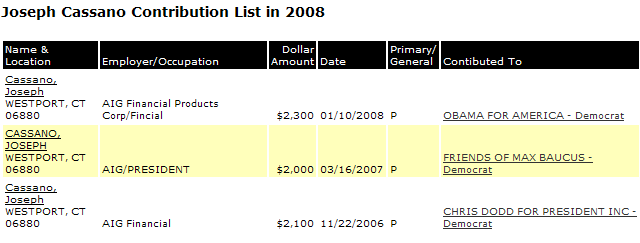
Joseph Cassano, the executive in charge of the company’s troubled financial products division, received more than $280 million over the last eight years. Even after he was terminated in February as his investments turned sour, the company allowed him to keep up to $34 million in unvested bonuses and put him on a $1 million-a-month retainer. He continues to receive $1 million a month.

image

http://www.campaignmoney.com/political/contributions/joseph-cassano.asp?cycle=08

* * * * *

In Dec. 2007, PricewaterhouseCoopers, AIG’s auditor, told the company in March 2008 that the “root cause” of AIG’s problems was that people assessing risk did not have enough access to the financial products division, where the risky investments originated. PWC warned Sullivan that the company “could have a material weakness relating to these area.”  Still, Sullivan expressed confidence to investors.

* * * * *

Thanks to SMH & JMH for the feed.

* * * * *

Want more from the Homa Files?
Click link =>
  The Homa Files Blog

The perils of buying at the peak …

October 9, 2008

Ken’s Take:

1) It never pays to buy at the peak — unless somebody is staking you — and the government is ready with a safety net.

2) Nobody that I know is good as calling the peak.

3) 2005-2007 … 3 years that will live in infamy … with their lessons forgotten by 2012

4) Remember: the mortgage mess is highly concentrated to California, Florida, Nevada, and Arizona.

5) Also remember: 1/3 of 75 million are owned free & clear of any mortgages

* * * * *

[McCain Reshuffles Rescue Deal]

http://online.wsj.com/article/SB122351316270117559.html

* * * * *

Want more from the Homa Files?
Click link =>
  The Homa Files Blog

Worth reading: Lessons from the financial crisis …

October 9, 2008

Excerpted from RealClearPolitics.com: “Wall Street 101”, Victor Davis Hanson, October 09, 2008

* * * * *

Until the past few weeks, the financial panic was still mostly far away on Wall Street. But not now.

Car loans, mortgages and college financing are suddenly harder to come by. Millions are stuck in houses not worth what is owed on them. Cash-strapped consumers are cutting back. The economy is slowing. Jobs are disappearing. Who wants to open quarterly 401(k) statements only to learn that everything they put away in retirement accounts the past two or three years is gone?

There is plenty of blame to go around. Greedy Wall Street speculators took mega-bonuses even when they knew their leveraged companies were tottering — and someone else would pick up the tab. Crooked or stupid politicians allowed Fannie Mae and Freddie Mac to squander billions, as they raked in campaign donations and crowed about their politically correct support for millions of shaky — and now mostly defaulting — buyers.

The new national gospel became charge now/pay later and speculate, rather than put something away in case of a downturn. To provide more goodies that we hadn’t earned, politicians ignored soaring annual budget deficits and staggering national debt and kept spending.

* * * * *  

But amid the gloom, there are some valuable lessons that we can take away from the Wall-Street panic.

First, cash really is king. For all the talk of a trillion here or billions there, when the crunch came many of these investment houses and their once-strutting managers found themselves with a minus net worth. They were desperate to find liquidity — any money anywhere they could find it. Pedestrian passbook savings accounts proved wiser investments than all the clever hedge funds, derivatives and subprime schemes put together.

Second, wisdom and blue-chip college educations are not quite the same thing. The fools in Washington and New York who blew up Wall Street had degrees from our finest professional schools. [For example, Barney Frank and Franklin Raines are both Harvard Law graduates.] If these guys are our best and brightest, then it is about time we rethink what constitutes wisdom, since an Ivy League law degree certainly seemed no proof of either intelligence or ethics.

Third, we as a nation need to relearn the old notion of shame — as in, “Shame on you!” Firms like Lehman Brothers and Bear Stearns were once responsible Wall Street institutions, built up over decades by sober men. But their far-lesser successors in just a few months have bankrupted these venerable brokerage houses — with seemingly no shame at what they have done to the image of Wall Street.

* * * * *

Americans used to pay their debts. Somewhere in all the blame-gaming about the crooks and liars in New York and Washington, we never hear that real people borrowed real money that they should not have. And they then defaulted on what they owed to others. Walking away from debts may have been understandable, but it was also a violation of trust — and wrong.

Finally, what one makes is no proof of his worth. Almost every head of a Wall Street firm took tens of millions of dollars in bonuses these past few years, as they posted phony profits by borrowing ever more with ever fewer assets. But if financing facilitates the American economy, we should remember that less exotic and remunerative construction — such as farming, manufacturing and mining — is what really powers America.

* * * * *

How odd that all those boring lessons from our grandparents turn out to be true in the globalized, hip 21st century: Save your money. Don’t borrow what you can’t pay back. Look first at a man’s character, not his degrees. And if a promised return on an investment seems too good to be true, it probably is.

* * * * *

Victor Davis Hanson is a classicist and historian at the Hoover Institution, Stanford University,

* * * * *
Full article:
http://www.realclearpolitics.com/articles/2008/10/wall_street_101.html

* * * * *

Want more from the Homa Files?
Click link =>
  The Homa Files Blog

Is the mortgage glass 15% empty or 85% full ?

October 9, 2008

Ken’s Take:

1) The headline in the WSJ says “1 in 6 underwater”.  I’m more impressed that almost 85% of home owners owe less than their home is worth, and that almost 1/3 own their houses free and clear — with no mortgage balance at all.

2)  Though home prices have slid 13% in the past year or so, they’re up over 70% since 2000.  That’s not bad appreciation.

3) McCain went long-ball last nite with the mortgage buy-back proposal. Note that Congress enacted a “foundation” bill in July that provides a framework for doing so.

* * * * *

Excerpted from WSJ: “Housing Pain Gauge: Nearly 1 in 6 Owners ‘Under Water’, October 8, 2008

* * * * *

The majority of homeowners still have equity, and even among those who don’t, many continue to make their mortgage payments on time.

In contrast with the 12 million home borrowers estimated to be under water, 64 million have equity in their homes. These include 24 million households who own their homes free and clear, and 40 million whose homes remain worth more than is owed on them.

About 75.5 million U.S. households own the homes they live in. After a housing slump that has pushed values down 30% in some areas, roughly 12 million households, or 16%, owe more than their homes are worth.

The comparable figures were roughly 4% under water in 2006 and 6% last year, Among people who bought within the past five years, it’s worse: 29% are under water on their mortgages.

* * * * *
The result of homeowners being “under water” is more pressure on an economy that is already in a downturn. No longer having equity in their homes makes people feel less rich and thus less inclined to shop at the mall.

And having more homeowners under water is likely to mean more eventual foreclosures, because it is hard for borrowers in financial trouble to refinance or sell their homes and pay off their mortgage if their debt exceeds the home’s value. A foreclosed home, in turn, tends to lower the value of other homes in its neighborhood.  As home values slip, growing numbers of would-be borrowers lack sufficient equity to refinance. The falling values also make mortgage lending look riskier to banks, spurring them to tighten credit standards.

Even for folks with equity in their homes, some borrowers fret that declining prices and tighter lending standards could make it hard for them to tap their equity.

* * * * *

Prices are back to 2003 levels in the San Diego and Boston metropolitan areas, and back to 2004 levels in Las Vegas, Los Angeles, San Francisco, Fort Lauderdale, Fla., and Minneapolis.

Among mortgages on one- to four-family homes, 9.16% were a month or more overdue or were in foreclosure in the second quarter.. That compared with 6.52% a year before and was the highest level since the association began such surveys 39 years ago.

Most mortgages in default were issued in 2006 and 2007, when lending standards were loosest and the housing market was peaking. Many who bought then made small down payments or none, so they had little equity in their homes from the start.

In July, Congress enacted legislation designed to help borrowers who owe more than their homes are worth by allowing them to refinance into a government-backed loan, provided their mortgage company forgives part of their principal. It’s not clear how many borrowers the program will help, because before reducing the principal, lenders would almost always try first to freeze or reduce borrowers’ interest rate to make payments more affordable.

* * * * *

How much pain homeowners feel varies greatly from place to place. The most severe drops in home values are in parts of California, Florida, Nevada, Arizona and other areas where speculation pushed prices up and builders far overestimated demand.

On a national basis, home prices peaked in mid-2006 after rising 86% since January 2000, according to the First American index. Since peaking, that index has fallen 13%.

The declines have made homes more affordable, bringing prices in many areas closer to their long-term relationship to incomes. In the second quarter, the median home price of about $203,000 was 1.9 times average pretax household income. That was close to 1.87 times income for 1985 through 2000, prior to the housing boom.


[Home Economics]

http://online.wsj.com/article/SB122341352084512611.html

* * * * *

Want more from the Homa Files?
Click link =>
  The Homa Files Blog

What's Your Google Score?

October 9, 2008

Excerpted from BusinessWeek, “Making Social Networks Profitable”, by Heather Green, September 25, 2008

* * * * *

Imagine there was one number that could sum up how influential you are. It would take into account all manner of things, from how many people you know to how frequently you talk with them to how strongly they value your opinion. Your score could be compared with that of pretty much anyone in the world.

Maybe it’ll be called your Google number. Google has a patent pending on technology for ranking the most influential people on social networking sites like MySpace and Facebook. In a creative twist, Google is applying the same approach to social networks it has used to dominate the online search business. If this works, it may finally make ads on social networks relevant—and profitable.

The new technology could track not just how many friends you have on Facebook but how many friends your friends have. Well-connected chums make you particularly influential. The tracking system also would follow how frequently people post things on each other’s sites. It could even rate how successful somebody is in getting friends to read a news story or watch a video clip.

* * * * *

How would this improve advertising on social networks? Say there’s a group of basketball fans who spend a lot of time checking out each other’s pages. Their profiles probably indicate that they enjoy the sport. In addition, some might sign up for a Kobe Bryant fan group or leave remarks on each others’ pages about recent games they played or watched. Using today’s standard advertising methods, a company such as Nike would pay Google to place a display ad on a fan’s page or show a “sponsored link” when somebody searches for basketball-related news. With influence-tracking, Google could follow this group of fans’ shared interests more closely, see which other fan communities they interact with, and—most important—learn which members get the most attention when they update profiles or post pictures.

The added information would let Nike both sharpen and expand its targeting while allowing Google to charge a premium for its ad services. If Nike wanted to advertise a new basketball shoe, for example, it could work with Google to plop an interactive free-throw game only on the profile pages of the community influencers, knowing the game would be likely to draw the most attention in these locations. And because the new technique ranks links among groups, Google could also target the ads to broader communities.

“I would pay a premium to get a particular video in front of someone who [shares] with others, and an even bigger premium for a lot of people who would share,” says Ian Schafer, CEO of online ad firm Deep Focus, whose clients include Sean Jean and Universal Music Group.

Edit by DAF

* * * * *

Full article:
http://www.businessweek.com/magazine/content/08_40/b4102050681705.htm?chan=top+news_top+news+index+-+temp_news+%2B+analysis

* * * * *

Want more from the Homa Files?
Click link => 
The Homa Files Blog

* * * * *

Captive Brands Compete Big in Beauty

October 9, 2008

Excerpted from Brand Week “Retailers Rally Behind Their ‘Captive Brands'” by Elaine Wong, September 28, 2008

* * * * *

Retailers have come a long way from the no frills aisle.Rather than marketing store brands as some lesser, cheaper alternative to brand name products, Wal-Mart, Walgreens, CVS and others are increasingly creating and promoting their own “captive brands”… 

Carrying no evidence of the store’s affiliation, these brands, manufactured by a third party and sold exclusively at the chains (hence “captive”), let the retailer command a price similar to brands produced by consumer packaged goods companies like P&G. They also let the retailers gain ground in a category—beauty—for which consumers generally take a dim view of traditional private label brands….

P&G has taken notice. “We treat them just like we do any other competition,” said P&G rep Dave McCracken. “We try to out-innovate anyone, whether it’s a captive or retailer brand or other competition.”…Competition among retailers is driving the captive brand movement, said Walgreens rep Tiffani Bruce. “It’s a way of differentiating. If there’s something we have that other retailers don’t have, it’s an opportunity for us to build loyalty.”
Walgreens created an internal “brand police” to regularly evaluate its product portfolio. “They protect the standard and quality for our brands so we know that we are competing side-by-side with national brands,” Bruce said. “We have limited shelf space so we try our best to pinpoint which brands are resonating well with customers and what needs are being met.”

One reason why the shift has affected beauty care more than other industries is because the category itself is “over-SKU-ed,” said Mike Moriarty…”If you look at the haircare aisle, it has way too much product in it anyway.”  The influx makes it particularly tempting for retailers to introduce their own offerings because they can identify certain niches not yet met by their consumer packaged partners, Moriarty said.Since the retailer ultimately controls the display units, the result is a shelf space war. That’s a circumstance in which captive brands have a distinct advantage…This, however, does not mean that captive beauty brands will eventually displace their branded rivals, CVS’ Pensa said.. 

Edit by SAC

* * * * *  

Full article:
http://www.brandweek.com/bw/content_display/news-and-features/packaged-goods/e3if624dc1ee34cd1b5f24e9d19408550b8?imw=Y

* * * * * 

Want more from the Homa Files?
Click link =>
The Homa Files Blog

McCain goes long-ball with mortgage buyback … warning track or outta here ?

October 8, 2008

Ken’s Mega-Take: McCain rolled this grenade out last night, but didn’t explode it for impact. 

After researching the terms and conditions (below), I think McCain may be on to something.  A potentially good deal for the economy, but not clear to me how many votes it wins. The mortgage mess is concentrated in a few states:  McCain has Arizona locked and has no chance in California; but plan could help in  Florida, Nevada, Ohio. 

Keep in mind that only 75 million homes are “owned”, and 85% of folks are “above water” and making their payments (1/3 of homeowners own their homes free and clear of any mortgages). There could be backlash from honest, hard-working folks who don’t want slackers and cheats bailed out — whether on Wall Street or down-the-street.

* * * * *

Excerpted from Politico.com: “McCain proposes bailout for homeowners”,  10/7/08 

* * * * *

Qualifiers

The McCain “American Homeownership Resurgence Plan ” would be available to mortgage holders that:

1)  live in the home (primary residence only)

2) can prove their creditworthiness at the time of the original loan (no falsifications)

3) provided a down payment

Ken’s Take: Excludes investor-speculators, frauds, and folks who never had any equity in the home … I think the program is limited to the right group

* * * * *

Structure

The new mortgage would be an FHA-guaranteed fixed-rate mortgage at terms manageable for the homeowner.

The direct “cost” of this plan would be roughly $300 billion, the amount of homeowners’ “negative equity” in some homes.

Funds provided by Congress in recent financial market stabilization bill can be used for this purpose; indeed, by stabilizing mortgages, it will likely be possible to avoid some purposes previously assumed needed in that bill.

The plan could be implemented quickly as a result of the authorities provided in the stabilization bill, the recent housing bill, and the U.S. government’s conservatorship of Fannie Mae and Freddie Mac.

Ken’s Take:

1) What if “they” can’t qualify under the revised terms?  What if housing prices continue to decline and the homes go back under water ?

2) The initial cash out flow to buy the loans will be greater than $300 billion … but the eventual “cost” will only be the buy-out of the negative equity.

3) I like the idea of buying a mortgage versus buying a derivative based on a pool of mortgages owned by a trust and serviced by a third party.  At least I can understand where the money is going.

4) Reminder: in July 2008, Congress enacted a program to do just this — save for the government eating the lost equity

5) By my recollection, this is essentially the business that Fannie and Freddie were originally commissioned to transact.

* * * * *

Political Talk

AMERICAN HOMEOWNERSHIP RESURGENCE PLAN

McCain said he will direct his Treasury secretary to implement an American Homeownership Resurgence Plan (McCain Resurgence Plan) to keep families in their homes, avoid foreclosures, save failing neighborhoods, stabilize the housing market and attack the roots of our financial crisis. America’s families are bearing a heavy burden from falling housing prices, mortgage delinquencies, foreclosures and a weak economy.

“It is important that those families who have worked hard enough to finance homeownership not have that dream crushed under the weight of the wrong mortgage. The existing debts are too large compared to the value of housing. For those that cannot make payments, mortgages must be restructured to put losses on the books and put homeowners in manageable mortgages. Lenders in these cases must recognize the loss that they’ve already suffered.

The McCain Resurgence Plan would purchase mortgages directly from homeowners and mortgage servicers, and replace them with manageable, fixed-rate mortgages that will keep families in their homes. By purchasing the existing, failing mortgages, the McCain Resurgence Plan will eliminate uncertainty over defaults, support the value of mortgage-backed derivatives and alleviate risks that are freezing financial markets.”

* * * * *

Source article:
http://www.politico.com/news/stories/1008/14377.html

* * * * *

Want more from the Homa Files?
Click link =>
  The Homa Files Blog

Re: Congress – 59% say "throw ’em all out"

October 8, 2008

Excerpted from Rasmussen Reports, Oct. 6, 2008

* * * * *
Congress was front and center in the national news last week and the American people were far from impressed. Just 11% of voters say Congress is doing a good or an excellent job. If they could vote to keep or replace the entire Congress, 59% of voters would like to throw them all out and start over again.

Today, just 23% have even a little confidence in the ability of Congress to deal with the nation’s economic problems and only 24% believe most Members of Congress understand legislation before they vote on it.

Less than half (49%) believe that the current Congress is better than individuals selected at random from the phone book.

* * * * * 

Despite these reviews, more than 90% of Congress is likely to be elected this November due to an electoral system designed to benefit incumbents. The biggest advantage offered those in the House of Representatives is a process known as Gerrymandering where Congressional Districts are loaded with friendly voters from Representative’s own party. In effect, Members of Congress—working through their state legislature–get to choose their voters rather than letting voters choose their Congressman.

Also aiding incumbents is high name recognition from news coverage, large staffs funded by taxpayers, and other perks.

* * * * * 

When the Constitution was written, the nation’s founders expected that there would be a 50% turnover in the House of Representatives every election cycle. That was the experience they witnessed in state legislatures at the time (and most of the state legislatures offered just one-year terms). For well over 100 years after the Constitution was adopted, the turnover averaged in the 50% range as expected.

In the twentieth century, turnover began to decline. As power and prestige flowed to Washington during the New Deal era, fewer and fewer Members of Congress wanted to leave. In 1968, Congressional turnover fell to single digits for the first time ever and it has remained very low ever since.

Full article:
http://www.rasmussenreports.com/public_content/politics/election_20082/2008_presidential_election/59_would_vote_to_replace_entire_congress

* * * * *

Want more from the Homa Files?
Click link =>
  The Homa Files Blog

Positioning for "Precycling"

October 8, 2008

Excerpted from Brandchannel.com, “Pre-thinking Recycling: the New Eco-Consciousness”, by Claire Ratushny, September 22, 2008

* * * * *

Companies and their marketers should take note of a new consumer trend that has been dubbed “precycling” in some quarters. That’s because it’s all about “pre-thinking recycling”, and it highlights a fundamental shift in consumer values.

Basically, people are opting to pare down and simplify their lives. Many consumers are becoming more selective about the products they purchase. The concept of “excess” is causing revulsion more than ever before, prompting consumers to purchase fewer products, to buy more in bulk, and then to repurpose as much as they can. Even trendsetters are reorienting their lifestyles in an effort to eliminate unnecessary waste.

Hence the notion of pre-thinking recycling. This cuts down on waste and on recycling. Good news for the environment and overflowing landfills, and, over the past couple of years, this trend has been catching fire with more mainstream consumers than ever before.

* * * * *

Examples:

–  45 percent of trendsetters and 14 percent of mainstream consumers have “cut down on bottled water purchases.”

– Many consumers are using canvas shopping bags to avoid plastic, and even cut down on paper bag use.

– Fewer people are subscribing to newspapers, preferring to get their media news online, cutting down on paper.

– Eco-conscious consumers are opting for washable dinnerware again and washable cloth napkins to cut down on paper waste.

* * * * *

At a time when brand loyalties are plummeting, eco-conscious brands are giving consumers reasons to believe.

* * * * *

Illustrating the marketing story of brands that are implementing environmental measures on company websites, product brochures, media outlets and packaging will dovetail with emerging values in the marketplace. They will resonate with consumers.

Selling new value propositions of brands is more important than trying to advertise and sell products through as usual, especially now when the economy is making it hard to do anything as usual. Advertising that continues to push new and improved products, tries to favorably compare with competitive products, or uses price as leading value indicators is increasingly falling on deaf ears.

However, brands and products marketed in an authentic eco-conscious way enable marketers to respond to emerging culturally driven values meaningfully. Companies, large and small, can begin to reposition their brands to be in sync with the communities they are doing business in, and by doing so, to offer greater perceived value to consumers than their competitors do.

The payoff: Consumers are increasingly attuned to supporting the brands that are perceived as doing something positive for the planet because that’s where their values are increasingly headed.

Edit by DAF

* * * * *

Full article:
http://www.brandchannel.com/brand_speak.asp?bs_id=202

* * * * *

Want more from the Homa Files?
Click link => 
The Homa Files Blog

* * * * *

Cheap & Chic Brands Pay Off

October 8, 2008

Excerpted from BrandChannel “Value Store Brands: High-end Taste for Low Spenders” by Barry Silverstein, September 29, 2008

* * * * *

Arguably, the king of cheap chic is US retailer Target. Faced with intense retail competition years ago, Target chose “to reposition itself as a mass merchandiser of affordable chic goods”…While Kmart was approaching bankruptcy and Wal-Mart was dominating the retail market with low prices, Target “successfully associated its name with a younger, hipper, edgier, and more fun image than its competitors. Target is often pronounced in faux French, ‘Tar-zhay,’ to connote its trendy sensibility.”

Target achieved differentiation…This ‘cheap chic’ strategy enabled Target to become a major brand…Target’s strong sales results over the past several years prove that the strategy has paid off…the chain is doing better than many of its competitors, buffered by well-regarded store brands, clever advertising, and novel merchandising.

…One reason Target’s brands have achieved cheap chic status is Target’s emphasis on design. Fashion designers such as Mossimo, Isaac Mizrahi, Philippe Starck, and Sigerson Morrison have developed exclusive lines for Target…These collections have the cachet of name-brand designer merchandise, but at a price point far less than the typical designer-driven brands sold at more expensive retailers.

Other value stores use this strategy. Kmart, for example, sells Jaclyn Smith-branded fashion and Martha Stewart-branded housewares. Sears is currently featuring the exclusive LL Cool Jay Collection. Retailer Kohls has joined in, exclusively marketing Simply Vera Vera Wang, a premium fashion and lifestyle brand, and a Food Network-branded line of kitchen and home goods.

Price-cutting giant Wal-Mart has tried its hand at designer brands as well…Despite these efforts, however, Wal-Mart has not seen significant financial gains from its designer clothing—nor has Wal-Mart been able to match Target’s trendiness…

* * * * *

Target has exerted its cheap chic strategy in another area: upscale foods. Target markets a premium brand called Archer Farms…Archer Farms uses upscale packaging, often depicting full-color product photography on elegant boxes, bottles and jars. As with Target’s other upscale brands, however, the prices are unusually affordable.

Value-priced upscale food is a growing market in its own right. Chains such as US-based Trader Joe’s supermarkets…trade on the consumer’s desire for affordable gourmet products. Trader Joe’s unique differentiator is that…most of the items on its shelves are actually its own store brands. These products are largely specialty items priced considerably below gourmet food stores…

There is already a fair amount of evidence that store brands, chic or not, are seeing a significant uptick in sales because of the economy. In September 2008, Kroger, one of the largest US supermarket chains, reported that its own store brands accounted for a record 26 percent of its fiscal second quarter sale…

* * * * *

Whether it’s fashion, food, or any other product category, cheap chic is clearly a global trend…Global economic conditions are likely to keep the interest in cheap chic brands high. While the average consumer likes trendy merchandise at bargain prices, the wealthy shopper may find cheap chic increasingly attractive as luxury goods become too pricey…

Retailers like Target, who already know how to create and market cheap chic brands, stand to benefit the most. But adopting a cheap chic strategy could help many other retailers insulate themselves from an economic downturn. That would be a welcome development for consumers who don’t want to sacrifice quality design for price.  

Edit by SAC

* * * * *

Full article:
http://www.brandchannel.com/start1.asp?fa_id=442

* * * * *

Want more from the Homa Files?
Click link =>
The Homa Files Blog

Blame Wal-Mart, not deregulation for the financial mess …

October 7, 2008

Ken’s POV: I’ve been saying — only half in jest — that Wal Mart is at the root of the financial mess.  Not because they’re bad guys, but because they have been able to keep retail prices so low for so long — via efficient logistics and smart procurement, buying lots of low cost goods from off-shore.  Why is that important? Because the Fed trades off inflation and unemployment when it sets interest rates.  When inflation is low, rates can stay low to enable growth.  Wal Mart is big enough that it alone had a major impact suppressing inflation.  Well, prices stayed low and interest rates stayed low, so folks were able to make dumb decisions (higher rates make people think harder about financial decisions, and discourages debt-building). What I was missing was the China Syndrome — the transfer and recycling of wealth from the US to China and back.  Now, that’s a problem.

* * * * *

Excerpted from Wash Post: “Blaming Deregulation”, Sebastian Mallaby, Oct. 6, 2008

* * * * * 

The claim that the financial crisis reflects Bush-McCain deregulation is … only nonsense.

The real roots of the crisis lie in a flawed response to China. Starting in the 1990s, the flood of cheap products from China kept global inflation low, allowing central banks to operate relatively loose monetary policies. But the flip side of China’s export surplus was that China had a capital surplus, too. Chinese savings sloshed into asset markets ’round the world, driving up the price of everything from Florida condos to Latin American stocks.

That gave central bankers a choice: Should they carry on targeting regular consumer inflation, which Chinese exports had pushed down, or should they restrain asset inflation, which Chinese savings had pushed upward? Alan Greenspan’s Fed chose to stand aside as asset prices rose; it preferred to deal with bubbles after they popped by cutting interest rates rather than by preventing those bubbles from inflating. After the dot-com bubble, this clean-up-later policy worked fine. With the real estate bubble, it has proved disastrous.

So the first cause of the crisis lies with the Fed, not with deregulation. If too much money was lent and borrowed, it was because Chinese savings made capital cheap and the Fed was not aggressive enough in hiking interest rates to counteract that. Moreover, the Fed’s track record of cutting interest rates to clear up previous bubbles had created a seductive one-way bet. Financial engineers built huge mountains of debt partly because they expected to profit in good times — and then be rescued by the Fed when they got into trouble.

* * * * * 

Framing the mess as the product of deregulation will make the backlash nastier.

The next president will have to make some subtle choices. In certain areas, markets need to be reformed — by pushing murky “over-the-counter” trades between banks onto transparent exchanges, for example. In other areas, government needs to fix itself — by not subsidizing reckless mortgage lending … Everyone concedes that Fannie and Freddie poured fuel on the fire to the tune of hundreds of billions of dollars.

* * * * *

See the full article for a strong argument re: why “soft” regulation didn’t cause the current mess.
http://www.washingtonpost.com/wp-dyn/content/article/2008/10/05/AR2008100501253_pf.html

* * * * *

Want more from the Homa Files?
Click link =>
  The Homa Files Blog

Baby boomers facing economic bust …

October 7, 2008

Excerpted from WSJ: “One in Five Baby Boomers Cuts Retirement Saving”, Oct. 7, 2008

* * * * * *   
One in five middle-aged workers stopped contributing to their retirement plans in the last year, and one in three has considered delaying retirement … the latest evidence that the deteriorating economy and stock market are creating a less-than-golden outlook for the huge tide of baby-boom Americans surging into retirement age. This demographic, born between 1946 and 1964, numbers around 78 million.

About 60% of U.S. workers in the private sector have 401(k) accounts, holding about $3 trillion in assets. Surveys have shown workers don’t put enough into 401(k)s to support their retirements, even as such plans have become the main source of retirement support, surpassing traditional fixed-benefit pensions.

Labor Department statistics also show more Americans over 55 years old are staying in the work force, a sign that many can’t afford to stop working.

Most respondents believe they need to contribute more to their retirement accounts, but those who have stopped are “having trouble making ends meet for basic expenses like food, gas and utilities.”  More people (13%) have been pulling money out of their nest eggs before age 59-1/2, even though such withdrawals bring a tax penalty.

The poll was conducted … before the worst of the stock market’s recent swoon, when retirement accounts were heavily weighted toward stock mutual funds. The turmoil since then might have caused many investors to question the wisdom of plowing funds into investments.

* * * * *

Full article:
http://online.wsj.com/article/SB122333045141409159.html

* * * * *

Want more from the Homa Files?
Click link =>
  The Homa Files Blog

Starbucks: Fewer Baristas to work longer hours …

October 7, 2008

Excerpted from WSJ: “Starbucks Looks to Reduce Labor Costs”, Oct 3, 2008

* * * * *
Starbucks is changing its store worker scheduling system so there will be fewer employees working more hours at its coffee shops. The program aims to reduce the company’s labor costs and improve sales by fostering familiarity between customers and a smaller group of employees.

Starbucks introduced its program about a week ago as part of a broader effort to revive the company amid a slowdown in sales that’s prompted it to shut stores and curb its expansion.

Starbucks’ new program also is intend to address the longtime complaint among some Starbucks baristas, who are paid hourly, that it’s too difficult to secure enough hours on the clock each week. Starbucks, which has not guaranteed full-time hours for non-management store workers, is now creating a full-time description that aims to give those employees at least 32 hours per week.

In test markets, workers liked the program because, in the end, it gave them more regular schedules. He said the labor cost improvements will come from a lower rate of turnover among workers and lower training costs.

* * * * *

Starbucks employs 83,000 people at its U.S. stores. The average Starbucks has about 17 workers.

The Industrial Workers of the World, a union is trying to organize Starbucks workers.

* * * * *
Full article:
http://online.wsj.com/article/SB122307217095003501.html

* * * * *

Want more from the Homa Files?
Click link =>
  The Homa Files Blog

Will Sports Fans Cheer for New Slingbox?

October 7, 2008

Excerpted from The Washington Post “A Lot for Sports Fans to Like, but the New Slingbox Still Isn’t a Slam Dunk” by Rob Pegoraro, September 25, 2008

* * * * *

Watching television on a computer screen is no special achievement these days. Between the free streaming video on the Web and TV downloads at iTunes and elsewhere, you don’t need to work too hard to turn your computer into a replacement for the tube.

But if you can watch your own TV — with your local shows, your team’s games, your recorded programs — on a computer monitor, and do so hundreds of miles from your home, now that’s something else…

That’s the trade-off of the Slingbox, the Web-connected “personal broadcaster” from Sling Media. Today, this division…is introducing the latest Slingbox, a high-definition device that fixes two flaws of earlier versions but can’t do much about some other underlying issues.

The new $299.99 Slingbox Pro-HD, like older models, can take any video input and relay it over the Internet to a computer or smartphone running SlingPlayer software. But with a simple antenna, this model’s digital TV tuner can pull in high-definition broadcasts off the air for free; with enough bandwidth, it can send those programs out in nearly their original quality.

With the player comes an updated SlingPlayer 2.0 that — finally — adds pause, rewind and forward controls. You still can’t record a broadcast, but you can now pause it and zip ahead or behind.

A review unit loaned by the company, running an almost-final version of its software, usually performed those tasks without complaint but still exhibited glitches…

Slingbox owners seem as passionate about these boxes as any group of gadget enthusiasts, in many cases for a simple reason: This is the easiest way to follow their sports teams when they travel or move out of town…

Edit by SAC

* * * * *

Full article:
http://www.washingtonpost.com/wp-dyn/content/article/2008/09/24/AR2008092403037_pf.html

* * * * *

Want more from the Homa Files?
Click link =>
The Homa Files Blog

Oops: Meet me at Katie’s Restaurant …

October 6, 2008

Excerpted form WSJ: “Biden’s Fantasy World”, Oct. 5, 2008

* * * * *

Note: The article outlines several of Biden’s sustentative mis-statements during the debate. The others are way more inportant, but this is my favorite.

* * * * *

Closer to home, the Delaware Senator’s blarney …  invited Americans to join him at “Katie’s restaurant” in Wilmington to witness middle-class struggles.

Just one problem: Katie’s closed in the 1980s. The mistake is more than a memory lapse because it exposes how phony is Mr. Biden’s attempt to pose for this campaign as Lunchbucket Joe.

* * * * *

Full article:
http://online.wsj.com/article/SB122325448093406451.html

* * * * *

TakeAway Point: Grandma Homa used to say “it’s better to not know than to not know that you don’t know”

* * * * *

Want more from the Homa Files?
Click link =>
  The Homa Files Blog

Investor alert: Dump stocks, buy comic books …

October 6, 2008

Excerpted from WSJ: ” When Stocks Tank, Some Investors Stampede to Alpacas and Turn to Drink”,  Oct.3, 2008   

* * * * *

Investors have long turned to hard assets in market downturns, the idea being that if you invest in something real, it won’t disappear, even if its value declines. But analysts say this downturn is different in that real estate, the most traditional safe haven, is also sinking.

Given the gyrations in the financial markets, some investors are abandoning stocks and bonds and seeking refuge in unusual alternatives — parking spaces, for instance, and condos in Peru. Sales of exotic livestock are up. The U.S. Mint has seen a gold-coin rush.

A man in Atlanta, recently bypassed the stock market for liquid assets — $120,000 in champagnes. He bought 400 bottles, mostly 1996 vintage, that he says he plans to “sit on” for 10 or 15 years and then sell at a profit.   “The worst thing that could happen is that I drink all of it.”

Another man did invest in real estate, but not the usual sort. He became landlord of a single parking space in Chicago. He bought a 12-by-20-foot spot in the Field Harbor Parking Garage for $29,000 and rents it out. “The stock market is indicative of a lot of uncertainty. With a parking space, at least you end up with something,” he says.

An auditor in Johnstown, Pa., turned to an unusual farm animal. “I’ve lost a fortune in stocks, and my 401(k) is falling through the floor. I feel comfortable in alpacas,” she says. She invested $56,000 in a small herd that she believes has a better outlook than most mutual funds because of the animals’ breeding potential.

Financial firms are reporting that a growing number of retirees are rolling their money out of ordinary individual retirement accounts — commonly stocks, bonds and mutual funds — and into self-directed IRAs, where almost anything goes. “We’ve had people invest in a cypress farm in Costa Rica, and a condo in Croatia.”

A retired engineer, says he pulled his entire nest egg of nearly $1 million out of stock and bond funds in August and put it into a self-directed IRA. He invested some of the money in his niece’s company — which is building condos in Lima, Peru.  “I can see pictures of the land. I can see steel. I can see people working. When I put my money in a fund, I see a big list of things that don’t sound good.”

In past market downturns he saw people turn to chinchillas, worm farms and super-breeds of rabbits. Emus, too, were big. “Eventually, people got tired of them and just let them go,” he says. “To this day, you’ll be in West Texas and a big emu running wild will just come up next to your car.”

Hard-asset gurus have been advising people to buy bags of pre-1965 U.S dimes and quarters, which are 90% silver and in limited supply.

Some stock-market investors also are turning to superheroes. “There’s kind of a buying frenzy” in vintage comic books. The “Silver Age Comic Book Pricing Index” of 32 frequently traded ’60s comics, was up 14.2% in the 18 months ending in July, while the Standard & Poor’s 500 stock index was down 11%. “Spiderman is going to be here in 20 years — he’s not going away,”

* * * * *
Full article:
http://online.wsj.com/article/SB122298871817500225.html

* * * * *

Want more from the Homa Files?
     Click link =>
  The Homa Files Blog

Brand Wars: Obama vs. McCain

October 6, 2008

Excerpted from BrandChannel: “Brand Obama or Brand McCain ”, Patt Cottingham

* * * * *

Ken’s Note: The full article is interesting reading for marketers.  It’s a non-political run-through of of how the candidates’ “brands” developed — the words, the images, and of course, the logos.

* * * * *

OBAMA LOGO: The Obama Campaign chose an icon that captured the feeling of sunrise over a field of red and white stripes. There is also a subtle “O” for Obama that is in play here though the name Obama is not used in the icon. This makes it a universal logo/icon that anyone can attach their own meaning to. The Obama and Pepsi (far right) logos are both round, youthful, and use the colors red, white, and blue.

image

* * * * *

McCAIN LOGO: The McCain Campaign chose a logo that comes directly out of his family heritage of 3 generations in the US Navy, as well as his war hero status political leader. The colors of blue and gold are US Navy colors, the star icon comes directly out a military reference found on many uniforms indicating rank. The McCain and US Army logos (far right) are traditional, proud, and derived from the military.

image


* * * * *

Full article:
http://www.brandchannel.com/images/papers/443_Presidential_Brands_final_web.pdf

* * * * *

Want more from the Homa Files?
Click link =>
  The Homa Files Blog

Lessons for Brands in a Polarized Economy

October 6, 2008

Excerpted from BrandChannel “Best Global Brands: Lessons Learned” by Jim Thompson, September 17, 2008  

* * * * *

Despite this past week, the year 2008, in general, has been an excellent one for developing nations. China, Brazil, Russia, India and other historically troubled economies continue to enjoy burgeoning middle and upper classes that are spending money on purchases they could not afford in the past.

In contrast, this has not been a good year for developed nations. The United States, and now every country tied to America’s radioactive financial service industry, is suffering because deluded borrowers and irresponsible lenders were circulating money they never actually had.

So, what can Interbrand’s 2008 Best Global Brands report teach us about the world’s top 100 brands in this bipolar global economy? Plenty.

* * * * *

Lesson #1: Brand Engagement is Crucial

Here is how Merrill Lynch positions its brand online:

Merrill Lynch demonstrates its commitments to clients and shareholders through the firm’s emphasis on excellence, integrity and ethical behavior…

Though individual citizens share much of the responsibility, financial services touting a devotion to fiscal responsibility and economic viability failed to maintain brand engagement among their ranks, and the result has been a devastating collapse of trust and shivers of recession that are reverberating across the globe.

Investing in the proper training of employees so they embrace and live corporate brand attributes is a key component of branding, so it is not surprising that myopic financial service brands such as AIG, UBS, and Morgan Stanley have all dropped in Interbrand’s 2008 Best Global Brands rankings…

* * * * *

Lesson #2: Luxury Brands Adjust to the Tides of the Global Economy

…Luxury brands benefit from a consumer-driven psychological buoyancy that allows them to paddle the currents that stir the global economy…

People like nice things. Unfortunately, most of us can’t afford the highest in quality, the finest in elegance, and the sleekest in design. The vast majority of the human race cannot afford a Rolex watch. However, as many economies around the world thrived during the past year, increasing numbers of people came within financial reach of luxury brands…as these demographics become accustomed to nice things, something compelling happens.

Ricca explains, “In a mature economy, a consumer’s self-confidence derives from being discerning rather than merely rich. Subtle details, which add depth to the product experience, are not within reach of the wealthy, but the wealthy cognoscenti.” Indeed, being able to afford Iranian caviar, and being able to deconstruct Iranian caviar, represent two different levels of experience with the luxury-brand lifestyle.

* * * * *

Lesson #3: Know Thyself and Build Trust in Others

Branding communicates a set of values and promises to customers. When a brand delivers on those promises, trust is created, and a relationship based on shared experience and loyalty ensues. That bond is vital to brands, particularly when the economic climate sours and consumers shift their spending habits.

As the 2008 Best Global Brands Executive Summary states, “The uncertainty of a downturn drives consumers to want more for their money and demand a more emotionally rewarding experience for their hard-earned and limited cash.” In such times loyalty often competes with necessity. “It’s no longer a choice between Nike or adidas shoes. The question becomes, ‘Do I buy shoes or an iPod?'”…

Brands that have and continue to consistently build trust with consumers are better off in tough times than brands that seek to capitalize on the latest trend or exploit the sincerity of the moment…

Brands who aren’t true to who they say they are can be more susceptible to outside forces and peer pressure from changing markets and emerging trends. There is a difference between being thoughtful, engaged, and flexible, and simply being something you are not. Like trustworthy.

* * * * *

Lesson #4: Brands are Defining Borders in the Global Economy

…With the incredible expansion of international commerce and advances in transportation over the past 100 years, immigrants—both legal and illegal—have become the blood coursing through today’s economic circulatory system. The phrase “Made in _____” should be expanded to say “Made in _____, by _____.” For example, “Made in the U.S.A., by Mexicans.” …Or even “Made in France, by some Algerians, four Russians, a Brazilian, and nine Saudi Arabians.”

Dr. Häusler explains that when consumers around the globe think of fine “Italian” menswear, they aren’t thinking of Italy, the actual country, at all; they are, in fact, collectively thinking of Italian brands such as Armani, Brioni, and Ermenegildo Zegna…Though particular nations may benefit from the halo effect of these brands, which is certainly warranted, credit should be attributed to the brands for the quality of their products and their admirable unwillingness to compromise the brand values that consistently ensure quality.

* * * * *

Lesson #5: Technology Continues to Empower the Consumer

…Understandably, a brand’s worst nightmare is of being hijacked by disgruntled customers with plenty of attitude, heaps of time, and a high-speed Internet connection.

Brands, however, must respect social networking. Corporations spend millions of dollars on marketing research to understand what their customers, and potential customers, are thinking. With the Internet today, that information is everywhere.

Brands must deal with positive feedback by being grateful, intelligent, and gracious, reaching out to loyal customers and building mutually beneficial relationships with prospective ones. Negative feedback should be treated deftly and honestly, and never create the impression of being defensive, paranoid, or dismissive. How a brand reacts to negative feedback and criticism speaks volumes about its values, ethics, and maturity. Above all, respect the power of pedestrians on the Web…

After all, brands that don’t value input from their customers don’t have much value themselves.

At least that is what online consumers are telling us. 

Edit by SAC

* * * * * 
Full article:
http://www.brandchannel.com/start1.asp?fa_id=441

* * * * *
Want more from the Homa Files?
Click link =>
The Homa Files Blog

Watch out Bud, Pepsi Wants to Win

October 6, 2008

Excerpted from the Wall Street Journal “PepsiCo Seeks to Raise Stakes on Super Bowl Ads” September 24, 2008

* * * * *

When it comes to pumping out Super Bowl ads that score well with viewers, Anheuser-Busch is widely acknowledged to be the master. This year, PepsiCo has a new tactic to steal some of the brewer’s limelight.

The snack-and-beverage company is offering $1 million to anyone who can create a Super Bowl commercial for its Doritos tortilla chip brand that trumps all other ads in viewer rankings during the gridiron matchup…

By dangling a $1 million prize, it hopes to dominate the months of pregame buzz, which many public-relations and ad executives say is far more valuable than winning the myriad Super Bowl ad polls.

This has become a critical way to help offset the high costs of advertising during the Super Bowl. Ad time for this season’s game is selling for about $3 million for 30 seconds, up about 10% from last season.

To top the polls, PepsiCo’s consumer-generated ad would have to outperform the King of Beers, which has won the top spot for the past 10 years in a row, thanks in part to a highly detailed pregame ritual. Its formula involves multiple ad shoots and pregame focus groups around the country to measure viewers’ minute-by-minute reactions to its spots…

Doritos’ marketers are trying to revive the excitement they created at the Super Bowl two seasons ago with a contest inviting consumers to submit their own 30-second ads for the famous triangular chip. It marked the first time marketers used consumer-generated ads at the big game…The contest generated $36 million in free publicity for Doritos before and after the game…

Now, Doritos’ marketers face the challenge of finding an ad that will stand out at a time when consumer-generated advertising is no longer a hot trend.

“The newness that made it special in 2007 is gone — now it’s just another ad,” says Dave Balter, chief executive of BzzAgent, a word-of-mouth media company based in Boston. “They are trying to manufacture buzz”…

Edit by SAC

* * * * *

Full article:
http://online.wsj.com/article/SB122221123298169049.html

* * * * *

Want more from the Homa Files?
Click link =>
The Homa Files Blog

Tax hikes won’t impact you if you’re in the 95% … or will they ?

October 3, 2008

Excerpted from WSJ: “The Tax Issue Still Resonates”, Karl Rove,
Oct. 2, 2008

* * * * *

Conventional wisdom says tax cuts have lost their political power. One reason offered for the alleged decline of tax cuts as a potent issue is that since 2000, tax cuts have taken 13 million filers off of the income tax rolls. Today, one-third of all filers have no federal income tax liability and nearly 40% of all federal income taxes are now paid by the top 1% of taxpayers (60% by the top 5%). The fewer people who are paying taxes, the fewer people who care about tax cuts, or so goes the reasoning.

* * * * *
In a July 2008 Pew Poll, 52% of Americans said it was “difficult to afford” taxes. By comparison, 46% said the same about health care, 49% about home heating/electric bills, and 38% about food.

* * * * *

Obama says that only the top 5% will pay higher taxes under his proposals.

But, nearly three out of every four filers who’ll pay higher taxes under a President Obama are small businesses, the source of most new jobs and growth.

An Urban Institute-Brookings Institution Tax Policy Center study found that 73% of the filers hit by Mr. Obama’s tax increases report business income — i.e., they are small business owners. His tax hikes will affect every worker at those enterprises.

* * * * *

Ken’s POV:

The bottom line is that Obama’s tax hikes won’t impact you unless you work for a big company, a small company, or buy stuff from either big or small companies — who will simply increase prices to offset higher taxes.

* * * * *

Want more from the Homa Files?
     Click link =>
  The Homa Files Blog

Re: Fannie and Freddie – Who said what … and when did they say it ?

October 3, 2008

Excerpted from WSJ: “What They Said About Fan and Fred”,
October  2, 2008

* * * * *

A special word is in order here for Congress. Today we’re running a collection of greatest Member hits in defense of Fannie Mae and Freddie Mac.

The guilty deserve such attention because those two government-sponsored enterprises did so much to turbocharge the credit mania. By providing subsidized rates of return to global investors, they helped fuel the bubble in housing and mortgage-backed securities that is now haunting so many financial institutions.As the quotes make clear, the Members fought furiously against any attempt to make Fan and Fred less dangerous.

The Bush Administration was on the right side of this debate for eight years, as was the late Clinton Treasury. This was a scandal in plain sight that all but a few ignored.

* * * * *

Worst of the Worst

Rep. Barnie Frank: I do think I do not want the same kind of focus on safety and soundness that we have in OCC [Office of the Comptroller of the Currency] and OTS [Office of Thrift Supervision]. I want to roll the dice a little bit more in this situation towards subsidized housing. House Financial Services Committee hearing, Sept. 25, 2003

* * * * *
Worth reading – the complete list of quotes:
http://online.wsj.com/article/SB122290574391296381.html

* * * * *

Want more from the Homa Files?
     Click link =>
  The Homa Files Blog

September Madness – The Wall Street Final Four (bracket attached)

October 3, 2008

For entertainment only … wagering is illegal (unless its on mortgage backed securities)


* * * * *

Want more from the Homa Files?
     Click link =>
  The Homa Files Blog

And, it will save gas …

October 3, 2008

Excerpted from Rasmussen Reports: “53% Think Driving Age Should be 18 or Older”.September 21, 2008

* * * * *
The National Highway Traffic Safety Administration reports that car crashes are the leading cause of death among those between the ages of 15 and 20.  

* * * * *

Just over a week ago, the Insurance Institute for Highway Safety issued a new report urging lawmakers to raise the legal driving age to 18 … 53% of adults nationwide think it’s a good idea … 49% of men like the idea, 67% of women do.

Surprisingly, younger adults seem to take the same opinion as their elders on this question.

* * * * *

When asked which age young adults should be allowed to get behind the wheel, 35% said 18 and 5% said 21.

* * * * *
http://www.rasmussenreports.com/public_content/lifestyle/general_lifestyle/53_think_driving_age_should_be_18_or_older

* * * **

Want more from the Homa Files?
Click link =>
  The Homa Files Blog

Who are all those bloggers?

October 3, 2008

Excerpted from Tech Crunch “State of the Blogosphere…” by Erick Shonfeld September 22, 2008

* * * * *

Technorati, the blog search engine, put out Part I of its…State of the Blogosphere report this week. This year, it conducted a random survey of 1,079 random bloggers to paint a more detailed picture of just who exactly is out there blogging. Technorati has indexed a total of 133 million blogs since 2002. In terms of how many are active, 7.5 million blogs have added a new post during the last four months, and 1.5 million have been updated during the last week.

And the average blog that runs ads, according to Technorati, is actually making money:

Among those with advertising, the mean annual investment in their blog is $1,800, but it’s paying off. The mean annual revenue is $6,000 with $75K+ in revenue for those with 100,000 or more unique visitors per month.

…Who are these bloggers?…The vast majority of all bloggers (79 percent) write about their personal interests…more than half of all bloggers also write about business. While only 12 percent identify themselves as official “corporate bloggers,” a full 46 percent consider themselves “professional bloggers” (meaning that they write about their industries, but not in an official capacity). ..

And blogs continue to be read: blogs in the aggregate now attract 77.7 million unique U.S. visitors per month according to Comscore, nearly double the number of people who visit Facebook…

Edit by SAC

* * * * *

Full article:
http://www.techcrunch.com/2008/09/22/technorati-survey-says-the-average-blog-makes-6000-a-year/

* * * * *

Want more from the Homa Files?
Click link =>
The Homa Files Blog

Paying the piper …

October 2, 2008

Excerpted from WSJ: “Bailing Out Ourselves – Bankers weren’t the only ones who enjoyed the credit mania”, October 2, 2008

* * * * *

“If banks, in spite of every precaution, are sometimes betrayed into giving a false credit to the persons described, they more frequently enable honest and industrious men of small and perhaps of no capital to undertake and prosecute business with advantage to themselves and to the community.”

So wrote Alexander Hamilton in 1790, amid an earlier populist backlash against American bankers. Hamilton didn’t hesitate to use the powers of the Treasury to calm markets amid a speculative panic for the good of the larger community. The U.S. is at another Hamiltonian moment, if Congress has the nerve to act in the national interest.

* * * * *
We are told this is a “bailout for Wall Street.” But if Americans are honest with themselves, they will admit that bankers are far from the only cause of our current predicament.

The U.S. is living through the aftermath of a classic credit mania, one that all of us enjoyed while it lasted. We don’t remember many protests when home prices were rising by 15% a year, or when interest rates stayed at 1% for a year and real interest rates were negative for far longer.

* * * * *
Our point isn’t to absolve Wall Street or Washington — far from it. The point is that credit manias are by their very nature societal, which is why the panics that follow can do so much damage to Americans outside the financial arena. They are part of a larger psychology that sweeps everyone up in euphoria for a time, only to send everyone into a defensive crouch when the credit stops.

The challenge at such a moment is to prevent a panic from becoming a crash that does far more extensive damage. This is where we are now, and this is why the House should pass the bill that passed the Senate last night, even with its flaws. The government needs the power to use public capital to defend and stabilize the financial system. In that sense, we are really bailing out ourselves.

* * * * *
Credit markets are ceasing to function by any normal standard, with banks refusing even to lend to one another, much less to credit-worthy borrowers on Main Street.

Yesterday, the Institute for Supply Management’s manufacturing index reported its largest one-month drop in 24 years. While at 43.5 the index remains above the recession level of 41, the credit vise may soon guarantee one.

* * * * *
Fannie Mae and Freddie Mac … those two government-sponsored enterprises did so much to turbocharge the credit mania. By providing subsidized rates of return to global investors, they helped fuel the bubble in housing and mortgage-backed securities that is now haunting so many financial institutions.

The Bush Administration was on the right side of this debate for eight years, as was the late Clinton Treasury. This was a scandal in plain sight that all but a few ignored.

* * * * *

The Paulson plan isn’t what we would have drawn up. It will not by itself inject capital into troubled banks, and it carries risks in how Treasury will price toxic assets when it buys them. But it is one more policy tool at a time when something needs to be done, and it is the only one currently up for a vote. Passing it won’t by itself revive the banking system, but defeating it will guarantee far more damage to far more Americans.

In this sense, too, the votes this week in Congress are about bailing out our political class from its own embarrassing performance. Americans are anxious, even frightened, about the financial system. They are looking for leaders who will act to defend it.

* * * * *
Full article:
http://online.wsj.com/article/SB122292003161497455.html

* * * * *

Ken’s POV:

The bailout simply closes a loop.  The government ‘encouraged’ lower mortgage loan qualifying criteria with the Dem’s Community Reinvestment initiatives and Bush’e Ownership push.  Now, the government will be stuck holding the bad paper that it thought it was feisting off on the banks.  It would be poetic justice if the government weren’t playing with our money.

* * * * *

Want more from the Homa Files?
     Click link =>
  The Homa Files Blog

Sticking with Your Strategy

October 2, 2008

Excerpted from Harvard Business Online, “Why the Mortgage Meltdown Hasn’t Burned These ‘Square’ Lenders”, by Bill Taylor, September 11, 2008

* * * * *

How do you keep your head when all those around you are losing theirs? This has become a defining challenge for leaders in an age of technology bubbles, private-equity overreach, and, most recently, the mania (and meltdown) in the mortgage market.

What can we learn from this heartache and misery? The most valuable insights come from those few leaders who refused to be seduced by the promises of fast growth and easy profits.

* * * * *

One case in point is Hudson City Bancorp, a 140-year-old company based in Paramus, New Jersey that has managed to avoid the mortgage meltdown and continues to post tremendous results. Business journalists have discovered this quiet little outfit and marveled at its strategic insights. Its shares are up 50 percent since last August, when the credit crisis really kicked in. (A leading index of bank stocks is down 40 percent over the same period).

“Hudson City banks the old-fashioned way,” Newsweek marveled. “It takes deposits and makes mortgages to people who buy homes in which they plan to live. And then it hangs on to” the mortgages, rather than sell them in the secondary market.

Imagine the brilliance! Take deposits. Make sensible loans. Repeat over and over again, until your market cap approaches $10 billion.

The New York Times tried to unpack the secrets of Hudson’s success and offered this analysis: “The bank carefully screened loan applicants to ensure they would be able both to afford a new house and reside there, rather than flip it. And the bank demanded hefty down payments…as a cushion against any sharp drop in home prices, because it planned to hang on to the loans.”

What a formula! Make sure borrowers can afford their loans. Insist that they make a big down payment. Favor owners over speculators.

Hudson City’s mindful approach to banking only looks remarkable because so many established banks lost their minds. ING Direct, a cutting-edge banking innovator, also managed to avoid the march of folly in its industry. The bank avoided the subprime meltdown because it stuck to simple, plain-vanilla mortgages rather than exotic instruments that sounded too good to be true (and were). The bank has written 100,000 mortgages worth $26 billion and has a grand total of 15 foreclosures. Not 15 percent, just 15 mortgages out of 100,000.

* * * * *

These successes speak to one of the unappreciated elements of strategy and creativity:

Sometimes, the most important form of leadership is resisting an innovation that takes hold in your field when that innovation, no matter how popular with your rivals, is at odds with your long-term point of view. The most determined innovators are as conservative as they are unique. They make big strategic bets for the long term and don’t hedge their bets when strategic fashions change.

Edit by DAF

* * * * *

Full article:
http://discussionleader.hbsp.com/taylor/2008/09/why_the_mortgage_meltdown_hasn.html?cm_mmc=npv-_-WEEKLY_HOTLIST-_-SEPT_2008-_-HOTLIST0929

* * * * *

Want more from the Homa Files?
Click link => 
The Homa Files Blog

* * * * *

Building Better Customer Loyalty

October 2, 2008

Excerpted from Wall Street Journal “Rewards that Reward” by Jean Halliday September 17, 2008

* * * * *

Used by businesses for more than 25 years, loyalty programs aim to entice consumers to make repeat purchases by offering them rewards — things like discounts on future purchases or points toward free airline tickets.

Since companies continue to expand them, one would think loyalty programs are powerful tools for boosting market share. Our research indicates many aren’t, at least not as designed.

The biggest problem with loyalty programs, we would argue, is that most retailers adopt a one-size-fits-all approach: They use monetary rewards to encourage repeat purchases. But product discounts won’t change buying behavior in the long run in shoppers who value things like personalized service, convenience or shopping pleasure more. These types of consumers may change their behavior to access the price promotion, but they likely will revert back to their regular brands or buying habits shortly thereafter, resulting in, at best, a temporary change in sales and market share.

Loyalty programs also seem to be mainly of interest to existing customers — the heavier, more frequent, more loyal buyers of the store, who tend to live closer to it…

A more effective way to woo customers and maintain their patronage is to offer them individualized rewards, based on what they value. By offering different types of rewards to different groups of shoppers, companies set themselves apart and give people a reason to keep coming back…

Here is how to build a loyalty program with the best chance of paying off:

Group customers according to purchase motivations…

Increase intrinsic rewards; decrease extrinsic ones…

Determine if customers perceive a loyalty program’s rewards to be valuable…

Weigh other factors that may influence the effectiveness of reward types…

Edit by SAC

* * * * *

Full article:
http://online.wsj.com/article/SB122160028857244783.html

* * * * *

Want more from the Homa Files?
Click link =>
The Homa Files Blog

Krispy Kreme doubles down … huh?

October 2, 2008

Excerpted from Chicago Tribune, “Krispy Kreme looking for hot sales in smaller stores, ice cream in latest turnaround plan”, by Lauren Shepard, September 21, 2008

* * * * *

Krispy Kreme’s signature glazed doughnuts may be best hot, but its sales have been anything but in recent years. Now the chain is hoping that going cold — with its new soft-serve ice cream — will be the catalyst it needs.

The company has been trying to revive its sales for nearly three years, amid a health craze that made its glazed doughnuts an indulgence that many just couldn’t stomach.

Now industry watchers say Krispy Kreme Doughnuts Inc.’s latest turnaround plan — which includes launching the new ice cream as well as opening smaller stores and expanding overseas — still may not be enough to help the chain climb out of its hole.

“They’re trying to reposition themselves as more of a treat concept” that offers consumers desserts and indulgences, said Bob Goldin, executive vice president at food industry research firm Technomic. But “it’ll be hard to argue it’s a growth business” given trends toward eating healthier, he said.

* * * * *

Krispy Kreme will begin opening smaller locations that are less expensive to build than its older “factory store” model that allowed consumers to watch the doughnuts being made.

* * * * *

Another key part of the plan is the company’s new Kool Kreme soft serve, which will be featured with a toppings bar.

Whether the new offering will boost sales remains to be seen, but analysts have yet to be impressed — especially as Krispy Kreme’s competitors are trying to attract health-conscious customers with egg-white sandwiches and whole-grain pastries.

“There’s no question that Americans are changing their attitude about health as a way to add good things to your diet,” said Harry Balzer, vice president of consumer research firm NPD Group.

* * * * *

Regardless of whether it speaks to consumers’ desires, ice cream may not be different enough from other products already on the market. McDonald’s Corp., for example, sells a soft serve treat for less than a dollar in some areas.

“I’m not saying it won’t work, but how are you going to compete against that?” Bob Goldin, executive vice president at food industry research firm Technomic, said. “I just don’t think that’s a product that’s going to carry that well.”

Still, he said, “they’ve got to do something.”

Edit by DAF

* * * * *

Full article:
http://www.chicagotribune.com/business/chi-krispy-creme-ice-cream-sep22,0,5045476.story

* * * * *

Want more from the Homa Files?
Click link => 
The Homa Files Blog

* * * * *

A public relations milestone …

October 1, 2008

* * * * *
“A man claiming to be the spokesman for pirates holding a Ukrainian ship laden with Russian tanks said they wanted $35 million to set it free.”

* * * * *
Full article:
http://www.timesonline.co.uk/tol/news/world/africa/article4836974.ece

* * * * *
Ken’s POV: Since when do pirates have a “spokesman” ?

* * * * *

Want more from the Homa Files?
     Click link =>
  The Homa Files Blog