Archive for March, 2009

Tough week for Warren Buffett …

March 13, 2009

Citing concerns about Berkshire’s  equity and derivatives investments, Fitch stripped Warren Buffett’s Berkshire Hathaway of its ‘AAA’ credit rating …  cutting the insurance and investment company’s issuer default rating by one notch to ‘AA+’.

The downgrade is another setback to Buffett, coming a day after the billionaire lost his position as the world’s richest man to Bill Gates. 

According to Forbes’ annual list. Buffett’s net worth plunged to $37 billion from $62 billion last year, as shares of Berkshire Hathaway fell nearly 50% in 12 months.

http://www.cnbc.com/id/29666975
http://www.forbes.com/2009/03/11/worlds-richest-people-billionaires-2009-billionaires_land.html

* * * * *

Want more from the Homa Files?
Click link =>
  The Homa Files Blog

FLASH ! … The HomaFiles scoops WSJ … by almost one month !

March 13, 2009

Today’s WSJ contains an editorial titled “Obama’s Poll Numbers Are Falling to Earth” by GOP pollster Scott Rasmussen and Dem pollster Doug Schoen.

In summary, they report: “It is simply wrong for commentators to continue to focus on President Barack Obama’s high levels of popularity …  a detailed look at recent survey data shows that … Mr. Obama’s approval rating is dropping and is below where George W. Bush was in an analogous period in 2001 and that . his net presidential approval rating — which is calculated by subtracting the number who strongly disapprove from the number who strongly approve — is just six, his lowest rating to date.”

For the full article, click to:
http://online.wsj.com/article/SB123690358175013837.html

* *  * * *

Ken’s Take:

It will be interesting to see how the press covers this column. My bets:

(1) Fox will loop it; CNN will have commentators debunk it; MSM will ignore it completely

(2) No media will push Rasmussen for the more controversial data nuggets: Obama’s PAI (presedential approval index) is near 100% among blacks, around 70% for Hispanics, and negative for whites; Obama’s PAI is negative among investors and taxpayers; and according to FD/Diageo, support for Obama’s programs is only strong among groups who “know little about them”

(3) Robert Gibbs — fronting for Team Obama — will say that the administration doesn’t pay attention to polls … ducking questions regarding Karl Rove’s revelation that “senior White House staff meet for two hours each Wednesday evening to digest their latest polling and focus-group research.”
http://online.wsj.com/article/SB123682426946303905.html

Also, with two consecutive days of bad polls (yesterday, economists gave Obama and Geithner failing grades for their handling of the economy ), it will be interesting to see how Team Obama — known for its rhetorical offense — plays defense.

* * * * *

Loyal readers of the HomaFiles got a heads-up on this trend almost a month ago. 

On Feb. 17, 2009 — using Rasmussen’s data — we posted  “Uh-oh … is Obama’s star starting to fade ? ”
https://kenhoma.wordpress.com/2009/02/17/uh-oh-is-obamas-star-starting-to-fade/

On March 2, 2009, we posted a follow-up “Uh-oh … Barack-O’s presidential approval index drops to single digit”
https://kenhoma.wordpress.com/2009/03/02/uh-oh-barack-os-presidential-approval-index-drops-to-single-digits/

This Monday — March 9, 2009 — we posted “So really, how strong is Obama’s approval rating ?”
https://kenhoma.wordpress.com/2009/03/09/so-how-strong-is-obamas-approval-rating/

* * * * *

Want more from the Homa Files?
Click link =>
  The Homa Files Blog

81% say Madoff should not keep any of the money ….

March 13, 2009

As part of the plea bargain being worked out, Bernard Madoff  is expected to plead guilty to 11 criminal counts, but he’s angling for his wife Ruth to keep at least $70 million to live on while he’s in jail.

In a Rasmussen survey, 81% of the respondents said that neither of the Madoffs should be permitted to keep any of the ill-gotten money.

Amazingly (to me at least) 5% of the respondents thought Madoff or his wife should be allowed to keep at least some of the money

14% were not sure … or hadn’t heard of Madoff

Ken’s Take:

(1) Man, that guy has got some stones.

(2) Think: those 19% get to vote in Presidential elections …

Full article:
http://www.rasmussenreports.com/public_content/business/general_business/81_say_neither_madoff_nor_his_wife_should_keep_any_money

* * * * *

Want more from the Homa Files?
     Click link =>
  The Homa Files Blog

Even credit card companies are tightening up …

March 13, 2009

Excerpted from WSJ, “Credit Cards Are the Next Credit Crunch”, Whitney, March 10, 2009

Currently, there is roughly $5 trillion in credit-card lines outstanding in the U.S., and a little more than $800 billion is currently drawn upon.

(That compares to total mortgage debt of over $10.5 trillion)

I believe that there will be at least a 57% contraction in credit-card lines. Of the $5 trillion, over $2 trillion of credit-card lines is likely to be cut in 2009, and $2.7 trillion by the end of 2010.

As we return to more realistic underwriting standards, certain borrowers will no longer appear worth the risk, and therefore lines will continue to be pulled from those borrowers.

Lenders have reduced credit lines based upon “zip codes,” or where home price depreciation has been most acute. Such a strategy carries the obvious hazard of putting good customers in more vulnerable liquidity positions simply because they live in a higher risk zip code.

Currently five lenders dominate two thirds of the market. Credit-card lenders are currently playing a game of “hot potato,” in which no one wants to be the last one holding an open credit-card line to an individual or business. While a mortgage loan is largely a “monogamous” relationship between borrower and lender, an individual has multiple relationships with credit-card providers. Thus, as lines are cut, risk exposure increases to the remaining lender with the biggest line outstanding.

* * * * *

Over the past 20 years, Americans have also grown to use their credit card as a cash-flow management tool.

For example, 90% of credit-card users revolve a balance (i.e., don’t pay it off in full) at least once a year, and over 45% of credit-card users revolve every month.

A relatively small portion of U.S. consumers have actually maxed out their credit cards, and most currently have ample room to spare on their unused credit lines. For example, the industry credit line utilization rate (or percentage of total credit lines outstanding drawn upon) was just 17% at the end of 2008.

Full article:
http://online.wsj.com/article/SB123664459331878113.html

* * * * *

Want more from the Homa Files?
Click link =>
  The Homa Files Blog

Remember when getting upgraded to a bigger rental car was, well, an upgrade?

March 13, 2009

Excerpted from Direct, “Thrifty Marketing for Thrifty Times: A Car rental case history” By Ken Magill, Dec 1, 2008

* * * * *

When gas prices skyrocketed this summer, Dollar Thrifty Automotive Group — along with the rest of the car-rental industry — faced a tough marketing challenge: What to do when customers’ demand for economy cars soars and the fleet simply isn’t built to meet that demand.

“Consumer behavior has really changed a lot for us with high gas prices,” says Chris Payne of Dollar Thrifty … “There are road warriors who like to get the best deal they can. [Before gas prices went up] they would reserve a smaller car than they really needed knowing we’d probably sell out and they’d get a bigger car at no extra cost. Now people are saying, ‘Wait a minute — I reserved a smaller car and you want to give me that gas guzzler? Forget it, I don’t want it.’ Four-dollar gas definitely was a tipping point.”

As a result, the company found itself in a rough spot. “You just can’t change your fleet overnight … It’s the same issue the manufacturers have had, where for a while Detroit was pumping out all these SUVs and minivans and everybody thought bigger was better.” Moreover, he says, the cost of cars to rental companies has gone way up, so these firms have been forced to keep their vehicles longer, making fleet changes even more difficult.

“Think about running a business where the cost of your commodity has gone up by 50% twice in the last two years … All the companies have been holding on to cars for from 12 to 14 months. It used to be we’d hold on to them for about nine …”

To overcome the challenge, Dollar Thrifty began running regular e-mail promotions on larger and luxury vehicles … the company’s two brands — Thrifty Car Rental and Dollar Rent a Car — have 1.8 million and 1.3 million opted-in e-mail subscribers, respectively … The average opt-out rate for a Dollar Thrifty mailing is .12% — “which is amazingly low … we’re reaching a very targeted audience … ” Also, he says, the average mailing generates most of its activity within 72 hours and brings in over $1 million in revenue.

“Dollar Thrifty is a perfect example of a company that’s built a successful permission-based marketing program … By providing subscribers with content that’s directly relevant and valuable to them, Dollar Thrifty is able to increase revenue while keeping opt-outs incredibly low” … 

Dollar Thrifty also created a chart to be given to customers at rental counters. With it, customers can cross-reference the gas consumption of smaller vehicles against larger ones and figure out how much more they’d end up spending on an upgrade.

“What we’ve found is that consumers’ perceptions are way out of whack on the gas thing … families of five are showing up having rented an economy car because it was the best price they could find online … They’re forgoing comfort to save a few bucks, but they’re not saving as much as they think. In some cases, they’re literally spending a dollar or two more for the entire rental.”

Anecdotally at least, Payne says the program is working … As of this writing in October when gas prices had dropped, Dollar Thrifty customers remained cost conscious and the chart was still being used.

“It’s still helpful,” Payne says. “People are getting hit in a lot of areas and anything they can do to cut costs, they’ll do …”

Edit by SAC

* * * * *
Full Article:
http://directmag.com/email/1201-thrifty-email-promotions/

* * * * *

Want more from the Homa Files?
Click link =>
The Homa Files Blog

Avoiding the Chardonnay tax & other restaurant price gotchas …

March 13, 2009

Excerpted from WSJ, “10 Ways to Save Money Ordering Wine”, March 7, 2009

Here are 10 insider tactics for not overpaying for wine at restaurants:

1. Skip wine by the glass. Restaurateurs like to make enough on a single glass to pay for a whole bottle … many wines by the glass are poured from bottles that have been open for too long and mistreated after opening … wine bars that specialize in wines by the glass, and keep them well, are a major exception.)

2.  Make sure the wine is from a very recent vintage. Most wines are meant to drink young and fresh and many restaurants, especially informal restaurants, don’t keep their wines in perfect conditions. .

3. Bypass the second-cheapest wine on the list. Restaurateurs know that diners don’t want to appear cheap by ordering the least expensive wine on the list, so they’ll hose you for ordering the second-cheapest. The least expensive is actually a pretty good deal at many places.

4. Scope out the owner’s passion for value. If there are, say, a dozen wines from South Africa on the list and no more than a handful from anywhere else, chances are the owner knows and cares about South African wine — and therefore is more likely to know good values from there.

5. Avoid the Chardonnay tax. Chardonnay is America’s favorite wine. Just about everybody loves it and feels comfortable with it, which is why the Chardonnays on so many lists are grossly overpriced compared to other wines.

6. Never order Santa Margherita Pinot Grigio.  Because so many people like it, it is routinely one of the most outrageously priced wines on the list.  If you stay within your comfort zone, ordering only wines you already know, you will be punished for it, price-wise.  There is value in tasting something new.

7. Don’t ignore house wines, by the bottle or in carafes … more often than not, we have found these lusty and fun.

8. Look for half-price deals.  This trend is sweeping the nation. Look around and you are likely to find a deal like that in your neighborhood.

9. BYOB. Check around for restaurants that allow you to bring your own wine.   More restaurants than ever, eager for business, are relaxing their rules on BYOB and lowering corkage fees. Even some fancy places now are offering special BYOB nights.

10. Check online before you dine to see a  restaurant’s wine list . This will give you more time to study the list to find good values.

* * * * *

No wine is going to seem like a good value to you when you know you could buy it at a local store for half the price or less.

And while personally we wouldn’t do it, we know there are people out there who enjoy bargaining and we’d guess that at least some restaurants would be willing to dicker on the price of more-expensive wines these days.

Full column:
http://online.wsj.com/article/SB123638925101858707.html?mod=djemtastings 

* * * * *

Want more from the Homa Files?
Click link =>
  The Homa Files Blog

Uh-oh … Obama & Geithner get failing grades from economists

March 12, 2009

Ken’s Take: Pres. Obama frequently cites broadscale support from economists.  Let’s see if that line keeps rolling off the teleprompter.

* * * * *
Excerpted from WSJ, ” Obama & Geithner Get Low Grades From Economists”, March 12, 2009

In stark contrast with Pres. Obama’s popularity with the public, he and Treasury Secretary Geithner received failing grades for their efforts to revive the economy from participants in the latest WSJ survey.

A majority of the economists polled said they were dissatisfied with the administration’s economic policies.

On average, they gave the president a grade of 59 out of 100, and  42% of respondents rated Mr. Obama below 60.

Mr. Geithner received an average grade of 51. Federal Reserve Chairman Ben Bernanke scored better, with an average 71.

image

Economists’ main criticism of the Obama team centered on delays in enacting key parts of plans to rescue banks. “They overpromised and underdelivered … The uncertainty is hanging over everyone’s head.”

The economists’ negative ratings mark a turnaround in opinion. In December, before Mr. Obama took office, three-quarters of respondents said the incoming administration’s economic team was better than the departing Bush team. However, Mr. Geithner’s latest marks are lower than the average grade of 57 that former Treasury Secretary Henry Paulson received in January.

Despite the growing criticism elsewhere, the respondents were broadly supportive of the Fed. More than 85% of the economists agreed that the central bank’s proliferating lending programs are well-designed, well-executed and helping the economy. And while grades for Mr. Bernanke remain off of their 2007 highs, the average has stabilized after falling as low as 69 in the November survey.

Amid all the gloom, there is a bright spot: Four-fifths of the economists said now is a good time to buy equities, especially if the investor has a long-term view.

Full article and source data:
http://online.wsj.com/article/SB123671107124286261.html#mod=testMod

* * * * *
Want more from the Homa Files?
     Click link =>
  The Homa Files Blog

It’s payday … and I’ve got a deal for you.

March 12, 2009

Ken’s Take:

(1) Surprised this is new news to consumer goods companies. 

(2) Wouldn’t want to be around a cash strapped senior at the end of the month.  Keep reading to find out why 

* * * * *
Excerpted from WSJ, “Consumer-Goods Makers Heed ‘Paycheck Cycle'” By Anjali Cordeiro, Feb 23, 2009

Makers of household goods and food are paying more attention to the “paycheck cycle” as cash-strapped consumers are showing a tendency to make their largest purchases when their salaries first come in and to cut back as that money runs out.

With more consumers living from paycheck to paycheck, some companies have looked at ways to time their promotions around periods when consumers’ wallets are likely to be well cushioned.

PepsiCo Inc.’s Frito-Lay … has tried “promotions that are different at the beginning of the month than at the end of the month,” CFO Richard Goodman said in a recent interview. “People have more money to spend at the beginning [of the month] and a little less at the end,” he said.

The insight to promote around paychecks came from one of the company’s retailers … That retailer noticed “the strength of the first of the month compared to weakness at the end of the month as people were simply running out of cash” … Early in the month the food and beverage maker started promoting large “multipacks” of snacks sold in the range of $5.98 to $6.98, while near the end of the month it pushed smaller packs that sold for less than $2 … The company’s direct store delivery system, which delivers products directly to retail store shelves, gives it more flexibility on merchandising and promotions.

Consumer purchases can be driven by a paycheck cycle in good times and bad. But the cycle has been heightened in the midst of the U.S. recession and global slowdown. Reaching consumers at the right time and stocking store shelves with the right package size can be key for makers of branded consumer goods …

Kimberly-Clark has watched the paycheck cycle “to make sure we understand it so we have the right things in stock” … The company has seen volume spikes in the first week of the month in its Depend incontinence products business, which is used a lot by senior citizens, who get Social Security checks around that time.

“We want to make sure we’ve got extra inventory, displays set up so we don’t run out of stock at retail … It’s just an understanding of how the consumer wants to buy, so they’ve got the right mix of goods at retail so they are not disappointed.” Consumers have been picking smaller pack sizes rather than the big bundle packs later in the month …

As consumer companies gathered last week at one of the industry’s largest annual conferences, the theme of offering consumers better “value” took center stage. Most consumer makers aren’t cutting list prices for their brands, so finding ways to help consumers stretch paychecks is key. Some companies are rejiggering products to keep prices down and push the value concept …

Heinz is offering consumers larger ketchup bottles that sell at smaller price gaps to private label in the U.S. Meanwhile, Frito-Lay in North America will begin adding 20% more product to take-home bags of its corn-based Tostitos, Fritos, Cheetos and Doritos without increasing the price.

Edit By SAC

* * * * *

Full Article:
http://online.wsj.com/article/SB123535246479645145.html

* * * * *

Want more from the Homa Files?
Click link =>
The Homa Files Blog

Unilver Plays Hardball and Gets Axe'd …

March 12, 2009

Excerpted from WSJ, “Big Grocer Pulls Unilever Items Over Pricing” By C. Rohwedder, A. Patrick, and T. Martin, Feb 11, 2009

* * * * *

A big grocery chain has removed from its Belgian stores about 300 Unilever products that it says are priced too high, a sign of mounting tension between retailers and suppliers as the recession grinds on. The move by Brussles-based Delhaize SA comes just days after Unilever reported strong fourth-quarter profit that was driven in large part by its ability to command big price increases despite the ailing economy.

The banished products include everything from Dove soap and Axe deodorant to a jam brand called Effi … The stare-down shows how fraught relations between retailers and their suppliers are becoming amid the severe slump in consumer spending. Grocery stores across the globe are putting growing pressure on food and drink companies to lower prices or to offer other more favorable termsMeanwhile, consumer-goods companies such as Unilever are struggling with a drop in demand from stores whose customers are trading down to cheaper private-label brands …

Delhaize says its conflict with Unilever is rooted in the supplier’s effort to push a broad range of goods into its stores, including some that the grocer says it would prefer not to stock because they are unpopular. If the supermarket doesn’t buy the whole range of products Unilever has threatened to raise prices by an average of 30% for the remaining items

Unilever wants Delhaize to promise it won’t stop selling Unilever products without consulting the company first, Unilever spokeswoman says. The Anglo-Dutch consumer-goods giant wants to increase prices for Delhaize by an average 2.5% … Delhaize is the only large retailer in Belgium that hasn’t agreed to a price rise this year, she says.

Unilever managed to push through steep price increases in 2008 even though the economic crisis drove down the prices of many commodities. In the fourth quarter, its prices rose more than 9% world-wide. But the company could be about to change strategy. A new chief executive, Paul Polman, said that Unilever will now concentrate on increasing the volume of items it sells, suggesting he may moderate future price increases.

* * * * *

Last month, the chief executive of British retailer Tesco PLC, urged suppliers to pass on to stores the recent drops in commodity and oil prices. “These lower prices need to be fed into the supply chain and passed on to consumers who are under growing financial pressure” … 

Deborah Weinswig, an analyst for Citi believes Wal-Mart’s plans to freshen up its Great Value brand will trigger more price cutting on the national brands sold at Wal-Mart. And if Wal-Mart reduces its national-brand prices, “I think the food retailers will have to follow or they will be at risk of losing market share,” she says.

SuperValu Chairman said during an earnings call last month that the 2009 first half would be a “battle ground” with manufacturers over price. Kroger declined to comment, but Chairman David Dillon said in a conference call on third-quarter earnings that Kroger’s strong private-label program, which accounted for 27% of third-quarter sales, gives the grocer leverage when suppliers approach it about a cost increase.

If national brands won’t lower prices, he added, the store’s private labels “will just pick up even more market share than we have already” …

Edit by SAC

* * * * *

Full Article:
http://online.wsj.com/article/SB123430797027570341.html

* * * * *

Want more from the Homa Files?
Click link =>
The Homa Files Blog

Unilver Plays Hardball and Gets Axe’d …

March 12, 2009

Excerpted from WSJ, “Big Grocer Pulls Unilever Items Over Pricing” By C. Rohwedder, A. Patrick, and T. Martin, Feb 11, 2009

* * * * *

A big grocery chain has removed from its Belgian stores about 300 Unilever products that it says are priced too high, a sign of mounting tension between retailers and suppliers as the recession grinds on. The move by Brussles-based Delhaize SA comes just days after Unilever reported strong fourth-quarter profit that was driven in large part by its ability to command big price increases despite the ailing economy.

The banished products include everything from Dove soap and Axe deodorant to a jam brand called Effi … The stare-down shows how fraught relations between retailers and their suppliers are becoming amid the severe slump in consumer spending. Grocery stores across the globe are putting growing pressure on food and drink companies to lower prices or to offer other more favorable termsMeanwhile, consumer-goods companies such as Unilever are struggling with a drop in demand from stores whose customers are trading down to cheaper private-label brands …

Delhaize says its conflict with Unilever is rooted in the supplier’s effort to push a broad range of goods into its stores, including some that the grocer says it would prefer not to stock because they are unpopular. If the supermarket doesn’t buy the whole range of products Unilever has threatened to raise prices by an average of 30% for the remaining items

Unilever wants Delhaize to promise it won’t stop selling Unilever products without consulting the company first, Unilever spokeswoman says. The Anglo-Dutch consumer-goods giant wants to increase prices for Delhaize by an average 2.5% … Delhaize is the only large retailer in Belgium that hasn’t agreed to a price rise this year, she says.

Unilever managed to push through steep price increases in 2008 even though the economic crisis drove down the prices of many commodities. In the fourth quarter, its prices rose more than 9% world-wide. But the company could be about to change strategy. A new chief executive, Paul Polman, said that Unilever will now concentrate on increasing the volume of items it sells, suggesting he may moderate future price increases.

* * * * *

Last month, the chief executive of British retailer Tesco PLC, urged suppliers to pass on to stores the recent drops in commodity and oil prices. “These lower prices need to be fed into the supply chain and passed on to consumers who are under growing financial pressure” … 

Deborah Weinswig, an analyst for Citi believes Wal-Mart’s plans to freshen up its Great Value brand will trigger more price cutting on the national brands sold at Wal-Mart. And if Wal-Mart reduces its national-brand prices, “I think the food retailers will have to follow or they will be at risk of losing market share,” she says.

SuperValu Chairman said during an earnings call last month that the 2009 first half would be a “battle ground” with manufacturers over price. Kroger declined to comment, but Chairman David Dillon said in a conference call on third-quarter earnings that Kroger’s strong private-label program, which accounted for 27% of third-quarter sales, gives the grocer leverage when suppliers approach it about a cost increase.

If national brands won’t lower prices, he added, the store’s private labels “will just pick up even more market share than we have already” …

Edit by SAC

* * * * *

Full Article:
http://online.wsj.com/article/SB123430797027570341.html

* * * * *

Want more from the Homa Files?
Click link =>
The Homa Files Blog

Here’s a plan: Give California to Mexico … works for me!

March 11, 2009

Excerpted from IBD, “Home A Loan”,  March 06, 2009

A revealing study by researchers at the University of Virginia took a look at foreclosures in all 50 states, 35 metropolitan areas and 236 counties. They found that 66% of potential housing value losses in 2008 and subsequent years may be in California, with another 21% in Florida, Nevada and Arizona, for a total of 87% of national declines.”

What do they have in common? They are Sun Belt states, the location of second homes, investment properties and the playground of flippers who invested in properties hoping to ride the housing bubble to a quick profit. Nevada, California, Arizona and Florida rank first, second, third and fourth in foreclosure activity, together accounting for 55% of foreclosure activity.

One out of 76 homes in Nevada went into foreclosure in January. The figure for California was one out of 173, with Arizona and Florida close behind. In New York state, by contrast, only one out of 2,271 homes went into foreclosure in January.

California had only 10% of the nation’s housing units, but it had 34% of foreclosures in 2008.”

California was vulnerable to foreclosures because the median value of owner-occupied housing in 2007 was 8.3 times the median family income. The national average was only 3.2 times higher than the median family income.

Full article:
http://www.ibdeditorials.com/IBDArticles.aspx?id=321237777275418 

* * * * *

Want more from the Homa Files?
Click link =>
  The Homa Files Blog

A declaration of war ?

March 11, 2009

Excerpted from NY Post, ” Obama’s search for an enemy”, March 8, 2009 

He hasn’t called anyone an “evildoer” or denounced an “axis of evil.” But make no mistake: President Obama is putting together an enemies list.

Strangely, though, those on it are not terrorists or foreign dictators. They are mostly Americans lucky enough to have succeeded through capitalism and democracy.

is criminal, as when he defended his plan for an expanded government push into health insurance as necessary “to keep the private sector honest.”

The Obama administration is on a war footing. Make that a class-war footing.

Obama’s class-war language, most of it written into prepared speeches, looks like selective anger, calculated to stoke public emotion to build support for his expansive agenda.  That agenda, which revolves around a dramatic increase in Washington power, relies on tax hikes on the same successful businesses and individuals he denounces.  First he demonizes them, then he taxes them.

And always, he makes liberal use of bogeymen. On Friday, as he stood before a class of 25 police cadets in Columbus, Ohio, hired with federal stimulus money, the President delivered a standard attack line against unnamed dissenters. “They opposed the very notion that government has a role in ending the cycle of job loss at the heart of this recession,” he said.

Actually, few if any critics advocated doing nothing. But never mind. Being President means you don’t have to let the facts get in the way of a plan to divide and conquer.

* * * * *

The President dismisses the growing perception he is adding to the economic pain. Asked about the markets, Obama waved them off as like a “tracking poll in politics” that “bobs up and down day to day.”

It was a telling moment, for the markets on his watch have moved almost exclusively down. And the 55 million households that hold mutual funds are watching their savings and retirements vanish in great gobs.

Most are decidedly middle class, making them collateral damage of this war.

* * * * *

Full column:
http://www.nydailynews.com/opinions/columnists/goodwin/index.html

* * * * *

Ken’s Take:

(1) Does Obama really think it’s a good idea to alienate the folks who are paying for his programs?  My sense: they’re already starting to fight back — just watch capital outflows from the US in next year or so.

(2) There is a lot of collateral damage …

(3) Wouldn’t you like to see Obama unplugged from the teleprompter for a week or so — just so we could see the real deal in operation?  As son Scott points out to me — the most powerful man in America now is a 27 year old speechwriter …

* * * * *

Want more from the Homa Files?
Click link =>
  The Homa Files Blog

The “Li-ion’s” Share of the Battery Business

March 11, 2009

Excerpted from Strategy & Business, “The Future Is Lithium”, by William J. Holstein, February 3, 2009

* * * * *

The lithium ion battery, which is already widely used in consumer products, is viewed by the auto industry as the next great hope to power future-generation, energy-conscious extended-range electric cars and hybrids. Automakers and their suppliers on three continents are gearing up to determine who will dominate what could be a US$150 billion a year industry by 2030

Companies in Europe, Japan, South Korea, and China have clear leads in perfecting the battery, which can hold far more power for longer periods of time than the nickel metal hydride batteries now in use in hybrids. Whether the United States stays in the race largely depends on the future of the General Motors Corporation and its Chevrolet Volt extended-range electric vehicle. If GM, already on life support from the federal government, is forced into Chapter 11 bankruptcy or liquidation, U.S. prospects for securing a piece of the lithium ion industry could fall by the wayside.

* * * * *

Toyota and GM are eyeing each other’s lithium ion intentions warily. GM was stung by Toyota’s success in the late 1990s with the Prius and is determined to leapfrog that generation of battery technology with a six-foot long, 400-pound lithium ion battery built to last 10 years.

As recently as a year ago, Toyota argued that it was too soon to consider using lithium ion because it was an unproven technology. Some experts believe that Toyota’s conclusion was in part motivated by its huge investment in three factories in Japan that made nickel batteries. “There is only one company that has a stranded cost in nickel and that’s Toyota.”

* * * * *

Lithium ion industry advocates say that the U.S. government could play a pivotal role in determining how much of the battery business will be domestic by allocating to lithium suppliers a chunk of the $25 billion Congress approved for automobile alternative energy research and development. 

However, if the Obama administration spreads the $25 billion throughout the auto industry to the dozens of companies currently involved in alternative propulsion projects, “there’s the potential for the [money] to be so diffused that it wouldn’t do that much good in any one area. As large as that sum sounds, it could become ineffective.”

* * * * *

Of course, any U.S. hopes for securing a chunk of the lithium ion industry would be dashed if GM’s Volt project were to fizzle out because of the automaker’s financial problems.

But even if the Americans don’t make the train, a future with more and more powerful lithium ion batteries is inevitable; after all, the rest of the world is already on board.

Edit by DAF

* * * * *

Full article:
http://www.strategy-business.com/li/leadingideas/li00110?tid=230&pg=all

* * * * *

Want more from the Homa Files?
Click link => 
The Homa Files Blog

* * * * *

Consumers Trade Down, At Least For Now

March 11, 2009

Ken’s Take: Insightful article re: how consumers are (and will) react to the economic downturn.

Key ideas: downward mobility, cautionary spending, renter mentality.

 * * * *

Excerpted from Knowledge @ Wharton, “The Shopper of Tomorrow: Trading Down”, Feb 18, 2009

Attention Shoppers: We no longer have the following items — “a sense of entitlement,” “conspicuous consumption” and “a golden period of luxury.” At least that is the word from Wharton faculty and other experts who point to a new logic that is defining not just what U.S. consumers buy, but how they view the shopping experience.

While shoppers typically pull back during the downward phase of any economic cycle, the severity and uncertainty of today’s crisis is likely to have longer-lasting effects on their attitudes than most slumps, these experts note. Consumers, they suggest, will eventually start spending again, but without the vigor enabled by easy credit in the Roaring 2000s …

Over the next 18 months … consumers will learn to become more frugal and are likely to carry those skills over once the economy recovers. “At some level, everybody has now been schooled about financial markets and overextending one’s credit — something American consumers have been notoriously bad at. We had a habit of not paying a lot of attention to the cost of using borrowed money” …

In the future, shoppers will learn to focus on the value of goods and services … [the] “crazy mindset” is over and shoppers are only willing to pay for what they absolutely need or items that present extraordinary value. … As for the pre-meltdown “go-go times, we will never go back to that, at least not anytime soon.”

According to consumer consultant Paco Underhill … [there] are three consumer segments now, divided not by income levels, but by income security. One group is made up of those who have lost their jobs and are downwardly mobile. For the wife of a Wall Street banker, that could result in the elimination of weekly hair and nail appointments … Those in the second group are not at immediate risk of losing their jobs, but they have friends or family who are out of work. These consumers, he says, are cutting back as a cautionary measureA third group is relatively untouched by the downturn. The individuals in this group have paid off their mortgages and, while their investment portfolios may be down sharply, they still have an adequate cushion. Nonetheless this group is also cutting back because engaging in conspicuous consumption seems like bad manners …

Armendinger points to another impact on shopping patterns — having enough space to store all one’s purchases. U.S. shoppers do seem to lead the world in consumerism, in part because they have enough land to build huge homes and storage units to house all their belongings … In Europe and emerging economies such as India … “You don’t see the Costco mentality of stockpiling toilet paper or huge vats of ketchup, simply because [people] physically don’t have the space.”

Carl Steidtmann, chief economist and director of Deloitte Research emphasizes that the Great Depression, combined with World War II, amounted to a 15-year period of consumer constraint, first because of the economic contraction and then because of rationing for the war effort. He predicts that the current downturn, which began in December 2007, will start to abate by the end of this year, and is not likely to have as great a long-term impact on consumers as the Great Depression.

He also suggests that the most lasting impact of the current downturn may be on homeowners who are severely stressed by mortgage debt. Going forward, he expects more of a “renter mentality” in the housing market, with less emphasis on homeownership as an investment vehicle …


Wharton marketing professor David Reibstein says the current angst about consumer spending reminds him of the periods of recession in 2001 and 1991. At both extremes of any economic cycle — the highs and the lows — conventional wisdom holds that during the highs, everyone feels the status quo will continue, while during the lows, everyone feels that life as we know it has forever changed. “While we’re in the midst of it, there’s always that concern … What’s amazing to me is how resilient we are.”

Reibstein points to the … terror attacks on September 11, 2001, when it seemed no one would ever have the courage to board an aircraft again. By the time the current financial crisis reduced demand, air travel volume had recovered. “It’s going to take a long time for us to get through this because of the severity and depth of this cycle … but once we do, it will be amazing how quickly people do rebound.”

Gradually, he adds, as the recent shocks to the economy are absorbed, people will begin to reinvest and cautiously step up purchases. Confidence will improve even more as job losses stabilize and hiring begins again, he says. “It’s only going to take time.”

Edit by SAC

* * * * *
Full Article:
http://knowledge.wharton.upenn.edu/article.cfm?articleid=2161

* * * * *

Want more from the Homa Files?
Click link =>
The Homa Files Blog

Charities Lose As Airlines Grasp For Profits From Unused Tickets

March 11, 2009

Excerpted from WSJ “Why Fliers Can’t Donate Unused Tickets” By Scott McCartney, Feb 10, 2009

* * * * *

“I was absolutely flabbergasted” by Delta’s response, said Mr. Zizzo … He had the unused tickets after canceling a trip because he and his wife suddenly had to care for an elderly relative.

Delta, like other airlines, says it doesn’t allow name changes on tickets …  Most airlines make their tickets “nontransferable” to protect their fare structures and maintain control of their inventory. Otherwise, entrepreneurs might hoard cheap tickets and then resell them at higher prices closer to departure …

Travelers can fly later on their unused tickets by applying the value of the ticket to another trip to any destination after deducting change fees. But most airlines require the new ticket to be in the original passenger’s name … The restriction means that when plans change, consumers are often left holding nonrefundable tickets they can’t use … many end up getting thrown away.

How many? Airlines won’t say. Airlines don’t break out revenue from “spoiled” tickets and won’t publicly estimate how many tickets are never used … One thing is clear: Spoilage is big enough to allow overbooking of flights — selling more tickets than there are seats on a plane because some customers typically don’t show up.

Industry insiders … suggested that about 2% of all tickets expire unused. One official put the figure as high as 3% of an airline’s revenue … Based on 2007 passenger revenue …  $1.8 billion to $2.7 billion worth of tickets are thrown away each year. Even after change fees, that’s enough to make a major difference for charities.

Organizations such as Make-A-Wish say they would be thrilled to make use of some of those tickets … Airline customers donated millions of frequent-flier miles to Make-A-Wish, resulting in about $3.6 million worth of tickets for 880 families. But the organization had to purchase tickets for 7,790 other wishes granted …

Carriers say they won’t make exceptions for charities, and don’t have any mechanism to convert donated tickets to miles, gift cards or airline vouchers that could be transferred to approved charities … Some carriers said they didn’t have the technology to allow donations; others said that even though they charge change fees, the cost of allowing donations is the main hurdle …

Making airline tickets transferable isn’t a security issue. The TSA says the airline simply has to check passenger manifests against extra-security screening criteria and no-fly watch lists before departure. “TSA does not have a rule directly forbidding the transfer of airline tickets,” a spokesman said …

To Mr. Zizzo, the airline policy doesn’t make sense. “If I don’t use the tickets, they get to put $700 in their pocket,” he said. “With the economy the way it is, it makes sense to use everything available, especially for someone in need.”

Edit by SAC

* * * * *

Full Article:
http://online.wsj.com/article/SB123422727266065699.html

* * * * *

Want more from the Homa Files?
Click link =>
The Homa Files Blog

Obama’s foreclosure plan gets strong support … that is, from folks who don’t know what’s in it

March 10, 2009

Excerpted from  the Diageo/Hotline Poll,   March 5, 2009

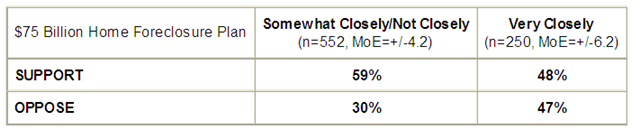
According to the Diageo/Hotline Poll, a majority of voters (56%) support President Obama’s $75 billion home foreclosure plan,

People who know the most about what’s in the package are evenly split on it … the blissfully ignorant (2/3s of the folks polled) support it 2 to 1. 

image 

* * * * *

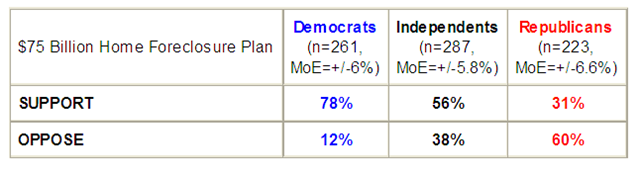
Not surprisingly, support varies widely with party affiliation: Dems favor the package 4 to 1 … GOPs oppose it 2 to 1

image

http://www.diageohotlinepoll.com/documents/diageohotlinepoll/FDDiageoHotlinePoll_topline03.09.pdf

* * * * *

Note: the Diageo/Hotline Poll is managed by an MSB alum: Brent McGoldrick, MBA ’04.  Brent is a VP with Financial Dynamics (FD) and can be reached via email at:
Brent.mcgoldrick@fd.com  

Want more from the Homa Files?
Click link =>
  The Homa Files Blog

“The stock market is just another political tracking poll” … huh?

March 10, 2009

Ken’s Take:

A few weeks ago, a reader replied to one of my posts joking (I think) that Pres. Obama must be shorting the market the way he’s talking and acting.  Suddenly, the reply isn’t sofunny.  There may be method to the madness.  If the stock market impact is most felt by (previously) wealthy folks, hen the decline levels the playing field — a stated Obama goal —  making everybody worse off and more dependent on the government.  Think about it.

Even if you pin all of the stock market drop on Bush, it’s clear that Obama isn’t taking any direct initiative to stem the decline.  The non-stimulus plan is conforming to the Congressional Budget Office’s assessment that it will have little or no impact in 2009.  And, actions that might steady the market — e.g. lower capital gains taxes on stocks bought in 2009 and 2010, restoration of the uptick and short selling rules — are dismissed out of hand as favoring the rich.

* * * * *

Excerpted from NY Post, ” Obama’s search for an enemy”, March 8, 2009 

The President dismisses the growing perception he is adding to the economic pain. Asked about the markets, Obama waved them off as like a “tracking poll in politics” that “bobs up and down day to day.”

It was a telling moment, for the markets on his watch have moved almost exclusively down. And the 55 million households that hold mutual funds are watching their savings and retirements vanish in great gobs.

Most are decidedly middle class, making them collateral damage of this war.

* * * * *

Full column:
http://www.nydailynews.com/opinions/columnists/goodwin/index.html

* * * * *

Want more from the Homa Files?
Click link =>
  The Homa Files Blog

Telecom: Banking on Mobile Banking to be a Killer App …

March 10, 2009

Excerpted from Marketing Daily, “Mobile Banking May Be Telecom’s Killer App” by Aaron Baar, Jan 23, 2009

* * * * *

With increasing consumer familiarity and growing ease of use, mobile applications for financial services companies–particularly banks–could become the new “killer app” for telecommunications.

The number of people banking through a mobile device could hit half a billion worldwide by 2013 … “Mobile financial services have the potential to be bigger than mobile TV and premium mobile content in terms of numbers of subscribers” …

The drive for more and better mobile financial services applications is being fed by consumers who are becoming more accustomed to banking online. “The lowest-hanging fruit are the online customers … That’s one of the only barriers to mobile banking; if you don’t trust online, you won’t trust mobile.”

But just as customers are using online banking for uses beyond simply checking their accounts, they will begin to use their mobile devices for those purposes as well. “The growing parts will be more sophisticated applications like bill payment” … But banks will have to work on making the mobile experiences as simple and user-friendly as the online services.

Increasing numbers of customers–particularly younger ones–are learning to trust the online space for their banking, and mobile will quickly follow. “Generation Y expects mobile to be part of what they’re doing, and banking is no different,” …

In the U.S., the mobile banking leader is Bank of America … The bank launched its mobile service in May 2007, and by the end of 2008 it had 1.5 million subscribers. “It’s a growing segment, and it’s being led by Bank of America” …

Edit by SAC

* * * * *

Full Article:
http://www.mediapost.com/publications/?fa=Articles.showArticle&art_aid=98908

* * * * *

Want more from the Homa Files?
Click link =>
The Homa Files Blog

Airlines Fight For First Class With Food … Umm, umm, good

March 10, 2009

Excerpted from WSJ, “Cooking Up Ways to Improve Steaks on a Plane” By Scott McCartney, Jan 20, 2009

* * * *

Competition for first-class passengers is more heated than ever in the global recession, and sometimes it boils down to whether the soup is hot enough. International airlines are beefing up food spending as a differentiating draw for premium customers — even U.S. airline spending on food has increased recently

U.S. airlines that fly internationally increased their spending on food by 8.5% — the biggest increase in any category besides fuel … The same airlines cut labor expenses and maintenance expenses in the same period and slashed advertising more than 22%.

Many airlines, domestic and international, hire famous chefs to help create in-flight menus and lend cachet to airline food … Profitability for long international flights hinges on selling business-class and first-class tickets for thousands of dollars … Food is a crucial variable.

“Nobody complains about what kind of fuel you buy, but food does get a disproportionate share of comments … Airlines fly the same kind of planes — either a Boeing tube or an Airbus tube. What’s different is the service and the food, and that’s where we try to excel.”

The focus on food may seem a bit bizarre for travelers who usually travel domestically — and in coach. Food service on airlines has soured for many travelers after years of cost-cutting …  Even in first class, meals on many domestic flights are skimpier: Drinks and nuts are the typical offering on shorter trips …

It turns out you can serve a high-quality meal on an airplane, if you know how to overcome the huge obstacles. Because the dry air of a jet cabin dries mouths, taste is diminished in flight. So Singapore and other carriers exaggerate flavors in meals … High-quality airline food is prepared so that it can be reheated hours after its initial cooking …

Today, passengers want flexibility in meal service so they can work, watch fancy entertainment systems and sleep. And just as culinary arts have been raised on the ground, so, too, do passengers expect more from airline food …

Edit by SAC

Full Article:
http://online.wsj.com/article/SB123241509322796411.html

* * * * *

Want more from the Homa Files?
Click link =>
The Homa Files Blog

So really, how strong is Obama’s approval rating ?

March 9, 2009

Reflecting “Main Street”, all polls report that Obama has sky high approval ratings … ranging from the low 60s to the mid-70s.  Pundits are still calling it a mandate for change, and O is certainly rushing through programs as if it were a sweeping mandate.

But, reflecting  “Wall Street”, the Dow and other broad market indices have dropped by about 25% since inauguration day.  True, O inherited the problem, but the market seems to voting “no confidence” on O’s recovery plans and team on the field.

So, what is truth?

I’m a fan of the Rasmussen daily tracking poll — in part, because it reports daily numbers on a consistent basis and because it provides some interesting drill down detail.

Here’s what the latest Rasmussen data says: (see chart below)

Obama’s Total Approval is in the high 50s … down from its high mark right after the inauguration (mid 60s).

Obama’s “top box”  (Strongly Approve) has trended down slightly … from a couple of points over 40 to a point or two under 40.

Obama’s “bottom box” (Strongly Disapprove) has been steadily trending up … from 16 right after the inauguration to its current high at 31.

So, Obama’s Approval Index (Strong Approve minus Strong Disapprove) has dropped to 8 from about its high of 30 right after the inauguration.

See Ken’s Take below the chart  …

image

* * * * *

Ken’s Take:

(1) First, Rasmussen leans right … so, there may be bias in the numbers … I doubt it’s significant

(2) Most market researchers consider Total Approval (Strongly plus Somewhat) to be a very weak measure … they tend to focus on the top box and bottom box extremes … in customer satisfaction studies, the equivalent to Rasmussen’s Presidential Approval Index is called the “Net Influencers Index” … some market researchers brand it to be “the only number you need to know”

(3) Obama’s Total Approval rating is bound to stay high … in part because of his rock hard support among blacks … in part because the more than 50% of folks who don’t pay income taxes have every reason in the world to think his spending programs are awesome — they get gain with no apparent pain

(4) The bottom boxers (Strong Disapprove) are the taxpayers … the increase in Strong Disapprovers is attributable to folks ‘in the middle” who originally were giving Obama the benefit of the doubt — hoping he’d govern from the pragmatic middle — but are becoming disenchanted as he keeps his way left campaign promises.

(5) This could get ugly … pitting the beneficiaries of Obama’s programs against the folks who are paying for them

(6) No pundits seem to have seized on this point yet … let’s see when they catch on

* * * * **

Data from Rasmussen Presidential Approval Tracking Poll, March 9, 2009
http://www.rasmussenreports.com/public_content/politics/obama_administration/obama_approval_index_history

* * * * *

Want more from the Homa Files?
Click link =>
  The Homa Files Blog

Stock funds drew inflow In January … then gave it up in February

March 9, 2009

Ken’s Take: Mutual fund inflows are generally an indicator or market strength.   Chmn Bernanke testified that Jan. inflows were up.  Made me curious re: the actual data.  He forgot to mention that February outflows more than offset January’s inflows. Oops.

* * * * *

Source: IBD, “Stock Funds Drew Inflow In January”, 2/26/2009

In a notable reversal, investors stuffed $9.05 billion into stock funds in January.

It was the first inflow into stock funds since May 2008, after seven straight months of outflow.  January’s net inflow was a sharp U-turn from December’s $20.43 billion outflow.

It was a welcome contrast to January 2008’s net outflow of $43.67 billion. January is one of the biggest inflow months of any year. That’s often when bonuses get invested and retirement accounts get started or funded.

Still, there were indications that the situation deteriorated during February.

The inflow couldn’t make up for the declining stock market in January. Fund assets fell by $191 billion, or 2%, to $9.411 trillion in January from $9.601 trillion the month before. They stood at $11.999 trillion at the end of December 2007.

Stock fund assets fell $269.1 billion, or 7.3%, to $3.439 trillion from $3.708 trillion the prior month. They were $6.521 trillion at the close of 2007.

Early indications were that flows decreased in February. Stock funds gave back $10.6 billion in February through Feb. 24

http://www.investors.com/editorial/IBDArticles.asp?artsec=19&issue=20090226

image

* * * * *

Want more from the Homa Files?
Click link =>
  The Homa Files Blog

Raising prices? … Put the spotlight on value

March 9, 2009

Excerpted from WSJ, “P&G, Others Are Confident Higher Prices Will Stick” By E. Byron and A. Cordeiro, Feb 20, 2009

* * * * *

Chief executives from several big household-products makers voiced confidence they could make higher prices stick, even as the recession ratchets up pressure on retailers and consumers to cut costs.

“Our products don’t deliver value [just] because the prices on the shelves are lower,” A.G. Lafley, chief executive of Procter & Gamble Co., told analysts and investors … Like several other industry executives … Mr. Lafley said his company doesn’t plan to roll back the significant price increases it has made over the past several months.

Pricing has become a contentious issue between retailers and their suppliers, as retailers — desperate to lower prices as consumer spending weakens — want their suppliers to help them foot the bill. But manufacturers such as P&G … argue they need to maintain prices to offset stubbornly high commodity costs, currency fluctuations and lower sales volumes …

Clorox Co. CEO Don Knauss told the conference his company had succeeded recently in imposing additional price increases … Nestlé SA, whose brands include Gerber and Purina, cited higher prices as a factor in the 70% increase in net profit it reported for 2008. And Kimberly-Clark Corp., known for its Scott, Kleenex and Huggies brands, said it would maintain its prices, at least for now, after hefty increases in 2008.

P&G’s Mr. Lafley described the promising sales performance of several new products that command significantly higher prices than established ones in the same P&G product lines … Newly launched Tide Total Care, which claims to make clothes last longer, is priced 60% above the base Tide detergent. Clairol’s Perfect 10 hair color, which touts better color quality and faster results, is 70% pricier than P&G’s basic Clairol Nice ‘N Easy, but aims to tempt women trying to cut back on even costlier hair-salon appointments.

Rather than broadly lowering prices, many household-product manufacturers plan to emphasize the extra benefits they say make their premium-priced products worth the money. In ads for its Charmin brand, P&G focuses on the toilet paper’s durability, saying that means users require fewer sheets. It also advertises … that Olay skin cream outperforms products costing hundreds of dollars …

Continually adding product features — and then advertising heavily to advise shoppers why they should pay more for them — is a critical way manufacturers of branded products drive higher profits and fend off increasing competition from private-label goods.

Indeed, P&G is the world’s biggest spender on advertising, constantly telling consumers that paying more for the company’s paper towels, mouthwash or diapers is worth it … Still, as more consumers cut spending — even on staples such as food — some industry watchers fear the time will come when they are unable or unwilling to pay for product features they can do without. Some observers also worry about the prospect of another “Marlboro Friday,” the day in 1993 when Philip Morris said it would sharply reduce the price of its Marlboro cigarettes to better compete with bargain brands.

The dramatic price cut, in addition to launching a tobacco price war, unleashed a wave of doubt about the value of big brands and their ability to sway consumers to pay more for them …

Mr. Lafley tried to calm concerns about drastic price cutting, arguing that P&G’s brands are still increasing their market share. “I don’t think you are going to see a return to irrational price wars,” he said.

Edit by SAC

* * * * *

Full Article:
http://online.wsj.com/article/SB123508966388628145.html?mod=testMod

* * * * *

Want more from the Homa Files?
Click link =>
The Homa Files Blog

What’s killing the Dow ?

March 6, 2009

Excerpted from WSJ, “Obama’s Radicalism Is Killing the Dow”, Boskin, March 5, 2009

It’s hard not to see the continued sell-off on Wall Street … (and) the realization that our new president’s policies are designed to radically re-engineer the market-based U.S. economy, not just mitigate the recession and financial crisis.

The illusion that Barack Obama will lead from the economic center has quickly come to an end. Instead of combining the best policies of past Democratic presidents — John Kennedy on taxes, Bill Clinton on welfare reform and a balanced budget, for instance — President Obama is returning to Jimmy Carter’s higher taxes and Mr. Clinton’s draconian defense drawdown.

From the poorly designed stimulus bill and vague new financial rescue plan, to the enormous expansion of government spending, taxes and debt somehow permanently strengthening economic growth, the assumptions underlying the president’s economic program seem bereft of rigorous analysis and a careful reading of history.

Unfortunately, our history suggests new government programs, however noble the intent, more often wind up delivering less, more slowly, at far higher cost than projected, with potentially damaging unintended consequences. The most recent case, of course, was the government’s meddling in the housing market to bring home ownership to low-income families, which became a prime cause of the current economic and financial disaster.

On the growth effects of a large expansion of government … the European social welfare states have standards of living permanently 30% lower than ours.

A financial crisis is the worst time to change the foundations of American capitalism.

Full article (worth reading):
http://online.wsj.com/article/SB123629969453946717.html?mod=article-outset-box 

* * * * *

Want more from the Homa Files?
Click link =>
  The Homa Files Blog

What’s the exit plan and “date certain”?

March 6, 2009

On the campaign trail,  anti-surge Candidate O derided Bush for not having an exit plan and a date certain for troop withdrawal from Iraq.

OK, since we’re winning in Iraq and can safely pull the troops out, O can keep his campaign pledge and bring combat troops back in 2010.

Seems that  Afghanistan is way different from Iraq since O authorized a surge in troop strength and is mum on the exit plan and withdrawal date.

Hmmmm.

Question: why not just spray the poppy fields with industrial strength weed killer and bring our men and women home pronto ?

* * * * *

Want more from the Homa Files?
Click link =>
  The Homa Files Blog

If you can’t fight ’em join ’em … brand names chum it up with private labels

March 6, 2009

Excerpted from WSJ, “Brand-Name Food Makers Woo Retailers With Displays” By J. Jargon and A. Zimmerman, Feb 18, 2009

* * * * *

Seeking to combat stiffer competition from cheaper store brands, big-name food manufacturers, including Kraft Foods Inc. and General Mills Inc., are joining forces with retailers to promote their brands alongside private-label goods.

In the past, big food companies didn’t worry too much about cheaper store brands encroaching on their turf, because consumers were more loyal to name brands and generally believed better quality justified their higher prices. But in recent years, retailers have improved their store brands, often mimicking the innovations that national brands have introduced …

As private-label items have improved and the economy has slowed, many consumers are wondering why they should pay more when they view a store brand as equally or almost as good. Last year, sales of private-label food and other consumer products jumped 10% to $82.9 billion in 2007 … Meanwhile, sales of branded products increased just 2.8%.

Now, brand-name manufacturers are trying to boost sales and defend their market shares in part by working with retailers to create special displays that allow name brands and store brands to share the promotional spotlight. Their strategy acknowledges that the rise of store brands has been a boon to retailers, whose overall sales have slumped and whose gross profit margins on store brands typically exceed those on branded items by 10% to 12%.

General Mills, for example, is using in-store grocery displays to promote “full meal solutions” that include its brands as well as store brands … [For example], A “pizza night” display featured General Mills’ Pillsbury dough with the retailer’s store-brand tomato products.

The new collaboration with retailers comes as Wal-Mart Stores Inc. prepares for a relaunch next month of its own private brand, Great Value, with improved packaging and qualityBy raising the profile of its private label, Wal-Mart could undermine some of the competitive advantage that has set it apart from other food retailers … Gains by private-label products have come largely at the expense of smaller brands. To cut costs and make room for a greater assortment of Great Value products, Wal-Mart has begun removing slower-selling brand names from its shelves …

Until recently, Wal-Mart’s private-label brands didn’t pose much of a threat to branded-food manufacturers. The products’ packaging was lackluster and the quality and consistency of many of them was uneven …

At an analyst meeting last fall, Wal-Mart said it would retool its Great Value line, in an effort to spur sales … The company tested 5,000 Great Value products against national brands and reformulated 1,200 of them.

Edit by SAC

* * * * *

Full Article:
http://online.wsj.com/article/SB123491694183004377.html

* * * * *

Want more from the Homa Files?
Click link =>
The Homa Files Blog

Rolling Out the Chevy Volt

March 6, 2009

Excerpted from Washington Post, “GM’s Volt to Debut in Washington, Bay Area”, by Kendra Marr, February 5, 2009

* * * * *

General Motors’ new plug-in electric car, the Chevrolet Volt, will go on sale in Washington and San Francisco first, the automaker announced this week, as it began laying plans to work with area government and power companies to ease the car’s introduction.

The San Francisco Bay Area was an obvious choice to be one of the first plugged-in cities. A warm climate combined with a wealthy, tech-savvy population has boosted sales of the Toyota Prius.

The D.C. region’s relatively high concentration of hybrid vehicles suggested people in this area were also willing to pay more for a vehicle with better fuel economy.

* * * * *

It also helps to have an iconic car like the Volt close to Washington’s power brokers, who will soon be considering additional federal loans for the struggling automaker.

“You want your clean technologies to be very visible and build trust with public policy makers, even if city isn’t the ideal in demographics or in terms of infrastructure.”

“What we’re talking about is signaling to decision makers in Washington that the car is on its way to not just America, but to your garage.”

* * * * *

The goal is to create strategies that make the pricey technology more attractive for Washington drivers, in hopes of eventually ramping up production. High manufacturing volumes means cheaper batteries and cheaper cars.

In addition, the automaker hopes the governments themselves will become early adopters, setting an example by buying large fleets of plug-ins.

Edit by DAF

* * * * *

Full article:
http://www.washingtonpost.com/wp-dyn/content/article/2009/02/04/AR2009020402680_pf.html

* * * * *

Want more from the Homa Files?
Click link => 
The Homa Files Blog

* * * * *

The worse your credit record, the lower your rate … (that's not a typo)

March 5, 2009

Well, Team O announced their mortgage foreclosure plan.

Folks who have — or soon will default on their mortgage commitments will get their loans repriced at 2%, lengthened to 40 years, and then have their loan balance reduced, if necessary, to cram the defaulters down to payments (P&I, insurance, taxes) equal to 31% of their income.

If you’re sitting with pristine credit, banks MIGHT give you 5% to 6% for 30 years with a 10% downpayment.

Default, you get 2%; credit worthy, you get 5%.

Who in the world thinks that’s fair ?

Gov’t fact sheet:
http://blogs.wsj.com/economics/2009/03/04/treasury-loan-modification-guidelines/

* * * * *

Want more from the Homa Files?
Click link =>
  The Homa Files Blog

The worse your credit record, the lower your rate … (that’s not a typo)

March 5, 2009

Well, Team O announced their mortgage foreclosure plan.

Folks who have — or soon will default on their mortgage commitments will get their loans repriced at 2%, lengthened to 40 years, and then have their loan balance reduced, if necessary, to cram the defaulters down to payments (P&I, insurance, taxes) equal to 31% of their income.

If you’re sitting with pristine credit, banks MIGHT give you 5% to 6% for 30 years with a 10% downpayment.

Default, you get 2%; credit worthy, you get 5%.

Who in the world thinks that’s fair ?

Gov’t fact sheet:
http://blogs.wsj.com/economics/2009/03/04/treasury-loan-modification-guidelines/

* * * * *

Want more from the Homa Files?
Click link =>
  The Homa Files Blog

Buffett on home ownership … desirable, but not a primary objective

March 5, 2009

Excerpted from the Berkshire Hathaway 2008 Annual Report

Commentary about the current housing crisis often ignores the crucial fact that most foreclosures do not occur because a house is worth less than its mortgage (so-called “upside-down” loans).

Rather, foreclosures take place because borrowers can’t pay the monthly payment that they agreed to pay. Homeowners who have
made a meaningful down-payment – derived from savings and not from other borrowing – seldom walk away from a primary residence simply because its value today is less than the mortgage.

Instead, they walk when they can’t make the monthly payments.

Home ownership is a wonderful thing … Enjoyment and utility should be the primary motives for purchase, not profit or refi possibilities.

And the home purchased ought to fit the income of the purchaser.

The present housing debacle should teach home buyers, lenders, brokers and government some simple lessons that will ensure stability in the future:

Home purchases should involve an honest-to-God down payment
of at least 10% and monthly payments that can be comfortably handled by the borrower’s income. And, that income should be carefully verified.

Putting people into homes, though a desirable goal, shouldn’t be our country’s primary objective. Keeping them in their homes should be the ambition.

* * * * *

Want more from the Homa Files?
Click link =>
  The Homa Files Blog

California Dreamin’ … Weed, yes … Oil, no.

March 5, 2009

Recent press reports say Golden Staters are considering the legalization of maijuana as a means of increasing state revenues to offset CA’s huge budget deficit.

But, no reported consideration for off-shore oil drilling.  Hmmmm.

According to  a recent study by the American Energy Alliance, an industry research group, developing our offshore energy resources would create in the coming years:

$8.2 trillion in additional GDP.

$2.2 trillion in total new state and federal tax revenues.

1.2 million new jobs at high wages.

$70 billion in added wages (all taxable) to the economy each year.

The much maligned Gov Palin proved that eco-sensitive drilling can bulge state coffers … and cut citizens tax bills.

Pro-weed, anti-oil … that says it all, doesn’t it …

* * * * *
Source of AEA info:
http://www.ibdeditorials.com/IBDArticles.aspx?id=320544753372991

* * * * *

Want more from the Homa Files?
Click link =>
  The Homa Files Blog

Raising capital gains taxes in 2011 … Obama says: take that, Mr. Dow

March 5, 2009

Barack-O is bound and determined to raise capital gains taxes — from 15% to 20%.

I guess that’s because O thinks returns on invested capital aren’t really “earned” and capital gains only accrue to rich folks.

The problem: this ill-timed move is certain to suppress any market rebound that might materialize.  Why?

2011 sounds like a long way off.  But, to qualify for capital gains, an asset has to be held for at least 12 months.  That means that stocks bought next year (after Jan. 1 2010) will be — by definition — subject to the upped capital gains tax rates.  So, their after tax returns will be reduced.

What to do? Buy stocks later this year (2009) and sell them late next year — before the tax rate goes up — and before the sell-off that will certainly occur in Nov-Dec 2010 (as every Tom, Dick & Harry) tries to bail to beat the tax rate increase).

* * * * *

Reminder to Pres Obama: a tanked stock market impacts almost 2/3s of Americans — mostly in 401-Ks

* * * * *
WARNING: This is an econ-political observation, not investment advice.

* * * * *

Want more from the Homa Files?
Click link =>
  The Homa Files Blog

Where in the world is UBL ?

March 5, 2009

During the campaign, Candidate O frequently mocked W for being unable to capture or kill Usama Bin Laden.

Well, O has been Prez for over a month and UBL is still a free man … he didn’t even get a shout out in O’s State of the Nation pitch.

Question 1: Which is more likely capturing UBL or curing cancer? Obama has promised both …

Question 2: Do you think Keith Olberman will start a “days since” counter similar to the ones he had for Bush? I’m betting under on that one

* * * * *

Want more from the Homa Files?
Click link =>
  The Homa Files Blog

Top 30 innovations in the past 30 years …

March 5, 2009

Excerpted from Knowledge@Wharton, “A World Transformed: What Are the Top 30 Innovations of the Last 30 Years?”,
February 18, 2009

A team of Wharton profs, in conjunction with NPR, picked the top 30.  Here they are.  Agree or disagree?

My view: glad EZ-Pass made the list … where’s the 3-point line ?

1. Internet, broadband, WWW (browser and html)
2. PC/laptop computers
3. Mobile phones
4. E-mail
5. DNA testing and sequencing/Human genome mapping
6. Magnetic Resonance Imaging (MRI)
7. Microprocessors
8. Fiber optics
9. Office software (spreadsheets, word processors)
10, Non-invasive laser/robotic surgery (laparoscopy)
11. Open source software and services (e.g., Linux, Wikipedia)
12. Light emitting diodes
13. Liquid crystal display (LCD)
14. GPS systems
15. Online shopping/ecommerce/auctions (e.g., eBay)
16. Media file compression (jpeg, mpeg, mp3)
17. Microfinance
18. Photovoltaic Solar Energy
19. Large scale wind turbines
20. Social networking via the Internet
21. Graphic user interface (GUI)
22. Digital photography/videography
23. RFID and applications (e.g., EZ Pass)
24. Genetically modified plants
25. Bio fuels
26. Bar codes and scanners
27. ATMs
28. Stents
29. SRAM flash memory
30. Anti retroviral treatment for AIDS

http://knowledge.wharton.upenn.edu/article.cfm?articleid=2163 

* * * * *

Want more from the Homa Files?
Click link =>
  The Homa Files Blog

Hyundai: Lose your job? Bring it back …delivers big results

March 5, 2009

Excerpted from New York Times, “Hyundai, Using a Safety Net, Wins Market Share”, by Nick Bunkley, February 5, 2009

* * * * *

In the midst of an industry-wide slump that has pushed some competitors to the brink of bankruptcy, Hyundai spent $3 million to tell Americans watching the Super Bowl how to say its name correctly.

The company’s market share nearly doubled last month as sales rose 14 percent, the largest year-over-year increase that any big automaker has posted in the United States since last May.

* * * * *

One reason for the jump in January appears to be Hyundai’s new marketing strategy of promising to let buyers return their vehicles, at no cost in most cases and with no penalty to their credit rating, if they lose their job or income within a year.

“To their credit, they struck at the core of what’s bothering people, and that’s obviously uncertainty . . . It’s just the fear and the uncertainty that’s holding people back.”

“It gives them a whole new audience — people for whom it would have never popped up on their shopping list.”

* * * * *

Sales of the Hyundai Sonata, a full-size sedan that costs less than $20,000, surged 85 percent in January, making it one of the country’s top-selling vehicles. And Hyundai sold more passenger cars last month than Chrysler, which has four times as many dealers.

Edit by DAF

* * * * *

Full article:
http://www.nytimes.com/2009/02/05/business/media/05auto.html?_r=2&ref=business&pagewanted=print

* * * * *

Want more from the Homa Files?
Click link => 
The Homa Files Blog

* * * * *


Maybe the glass is, say, 90% full …

March 4, 2009

Ken’s Take: The financial crisis is serious, and is hurting all of us — some more than others.  But, do we really need to panic and throw trillions of dollars against the problem without much forethought re: unintended future consequences?  Time to step back and take a deep breath. This article is on target …

* * * * *

Excerpted from IBD, “Depression Or Just An End To Affluence?”, Hanson, February 26, 2009

Given all the bad financial news, we are in a funny sort of way.

Our spiraling national deficit is being financed by China, Japan and other overseas concerns at almost no interest — saving the U.S. trillions of dollars in debt-service costs.

Nearly 93% of those Americans in the work force are still employed. The difference between what the banks pay out in interest on depositors’ savings and what they charge borrowers for loans is one of the most profitable in recent memory.

The sudden crash in energy prices may be hurting Iran, the Gulf monarchies, Russia and Venezuela. Yet Americans, who import 60% of their transportation fuel, along with natural gas, have been given about a half-trillion-dollar annual reprieve.

The reduced price of energy could translate into more than $1,500 in annual savings for the average driver, and hundreds of dollars off the heating and cooling bills for the homeowner.

For the vast majority of Americans with jobs, the fall in prices for almost everything from food to cars has, in real dollars, meant an actual increase in purchasing power.

The loss in value of home equity is serious for those who need to relocate for work or want to downsize and move to an apartment or a retirement community. But when averaged over the last decade, real estate still shows a substantial annual increase in value.

Moreover, the vast majority of American homeowners — well over 90% — meet their mortgage payments. They have no plans to flip their homes for profit. For them, the fact that they have lost paper equity, or even owe more than their homes are currently appraised at, is scary — but not equivalent to a depression.

Most are confident that after a few years their houses will appreciate again. As for now, working young couples have a chance to buy a house that they couldn’t have just two years ago.

The same holds true for many retirement accounts whose decline is terrible for those retirees who count on drawing out each month what they put away or must cash out their depleted accounts at vastly reduced value.

But the majority of working Americans are not yet pulling out their sinking retirement funds. Most are still putting away pretax money each month, apparently confident that within a few years their portfolios will return to their former value.

Some are even consoled that they are now buying mutual funds at rock-bottom prices rather than investing in sky-high investments at the peak of a bull market.

Many people are hurting. Yet to go to the local Wal-Mart is to see late-model cars in the parking lots and plenty of cell phones, iPods and BlackBerrys among the shoppers. Carts are stuffed with consumer goods, lots of food and Easter confections.

So are we in a depression that justifies a vast redefinition of government and a massive takeover of the private sector? Not quite.

What we are witnessing instead is a sharp downturn from the most affluent era in the history of civilization. For the last two decades, we borrowed and spent as if there were no tomorrow. Now we are living in that tomorrow of cutting back and making do.

Full article – worth reading:
http://www.ibdeditorials.com/IBDArticles.aspx?id=320545175132723* * * * *

Want more from the Homa Files?
Click link =>
  The Homa Files Blog

As the Dow keeps dropping, O is running out of people to blame.

March 4, 2009

Excerpted from WSJ, “The Obama Economy”, March 3, 2009
  
As 2009 opened, three weeks before Barack Obama took office, the Dow Jones Industrial Average closed at 9034 on January 2, its highest level since the autumn panic. Yesterday the Dow fell another 4.24% to 6763, for an overall decline of 25% in two months and to its lowest level since 1997. The dismaying message here is that President Obama’s policies have become part of the economy’s problem.

It’s become clear that Mr. Obama’s policies are slowing, if not stopping, what would otherwise be the normal process of economic recovery. From punishing business to squandering scarce national public resources, Team Obama is creating more uncertainty and less confidence — and thus a longer period of recession or subpar growth.

In the last two months … the economy has received no great new outside shock.

What is new is the unveiling of Mr. Obama’s agenda and his approach to governance. 

One negative revelation has been the way he has chosen to spend his scarce resources on income transfers rather than growth promotion. Most of his “stimulus” spending was devoted to social programs, rather than public works, and nearly all of the tax cuts were devoted to income maintenance rather than to improving incentives to work or invest.

The market has notably plunged since Mr. Obama introduced his budget last week, and that should be no surprise. The document was a declaration of hostility toward capitalists across the economy. 

His assault on business and investors is delaying a recovery and ensuring that the expansion will be weaker than it should be when it finally does arrive.  The result has been a capital strike.

Full article:
http://online.wsj.com/article/SB123604419092515347.html

* * * * *

Want more from the Homa Files?
Click link =>
  The Homa Files Blog

Closing the hedge fund barn door … after the hedgers escape with the loot

March 4, 2009

Finally, something out of the Obama brain trust that I agree with …

“Managers at private-equity firms, real-estate investment trusts and other investment partnerships (e.g. hedge funds) would pay an additional $24 billion in taxes over the next decade. Currently, most pay taxes at the 15% capital-gains rates on the bulk of their compensation, which comes in the form of something called “carried interest,” which entitles them to a share of the firm’s profits. Because it isn’t a return on an investment they actually made, many tax experts argue it is more akin to a fee or salary for their services. Mr. Obama’s budget would require most investment managers to pay ordinary income taxes on that income.”

Note: Larry Kudlow, conservative economist (with whom I usually agree), said on CNBC: “Worst possible action he can imagine”

* * * * *

Source: WSJ, “Business Braces for a Big Hit”, Feb 27, 2009
http://online.wsj.com/article/SB123569739787189001.html

* * * * *

Want more from the Homa Files?
Click link =>
  The Homa Files Blog

Question: What happens when there’s no wealth to redistribute?

March 4, 2009

Obama’s grand plan is centered on taking money  from the rich and either spending it like a drunken sailor or giving it away to folks unburdened by work.

Well, the financial crisis has vaporized mucho wealth and cut the number of mega-earners. 

Anybody with any serious money and a brain must be plotting how to shelter earnings and wealth from taxes — either because they loath taxes in general, or because they’re not fans of the Obama-Reid-Pelosi spending spree.

Question: So, if there are fewer rich people, and if the remaining rich people shelter their dough or pull a Geithner and just forget to pay taxes …  what will Obama redistribute ?

My bet: The definition of rich will start sliding down the scale.  We’ll all be rich — at least in the eyes of the tax collector.  Hide your wallet.

* * * * *

Want more from the Homa Files?
Click link =>
  The Homa Files Blog

Charities take another hit … a big hit

March 4, 2009

Charitable giving is down because of the bad economy and tanked stock market.

Now, President Obama’s proposed budget cuts the income tax deduction for charitable contributions.

But, only for rich people — those who do the lion’s share of charitable giving.

Sounds anti-social, so why’s he doing it?

Simple, Obama believes that government can do a better job than individuals channeling money to the “right” causes.  You can’t trust individuals to give to the right causes, can you?

* * * * *

Want more from the Homa Files?
Click link =>
  The Homa Files Blog

No Saturn? … What about the owner picnics in Tennessee ?

March 4, 2009

Ken’s Take: Talk about blowing a great franchise.  In the 1990s, Saturn had growing cult-like following, often being praised as a brand in the league of  Harley-Davidson.  GM squandered a valuable asset. 

My bet: there’s enough residual brand equity for Saturn to rise from the ashes.  In fact, if I were running GM, Saturn would be the nameplate I’d slap on all hybrid electrics.

* * * * *

Excerpted from WSJ, ” Era Ends as GM Snubs Saturn”, Feb 19, 2009

For years, analysts have urged GM to pare its brands. But GM executives insisted it would be too expensive after spending an estimated $2 billion to wind down Oldsmobile earlier this decade. Yet cutting brands shaves operating costs because each brand requires a certain amount of spending on product development advertising, dealer support and other expenses.

Now, GM is turning its back on Saturn, Pontiac, Saab and Hummer, General Motors Corp. is abandoning a decades-old product strategy that once helped ensure its dominance.

Saturn, Hummer, Saab and Pontiac have all struggled to attract customers. That prompted GM to sell large numbers of them to car-rental concerns, corporate fleet buyers and GM’s own employees. Of the 504,000 vehicles sold under the four brands in 2008, 40% went to fleets and employees. Such sales generally are less profitable than those to consumer buyers.

Of the four brands being cut off, Saturn once held the most promise. GM created the line in 1985 as a completely separate company offering small cars that aimed to compete head-on with Toyota and Honda Motor Co.

Saturns featured dent-resistant plastic bodies, its dealers promised friendly, no-haggling sales and customers were invited to an annual “homecoming” cookout at the Saturn plant in Spring Hill, Tenn. For some customers, buying a Saturn was like joining a club.

But in the 1990s, GM starved Saturn for new products as it tried to revive Oldsmobile. After GM killed Olds, it turned to neglected Saturn. It spent billions to produce a range of new vehicles, many of them derivations of its Opel models from Europe. Some were hits; the Aura sedan was praised by many car reviewers.

* * * * *

Some Saturn dealers now hope that instead of closing the brand, GM will spin it off as a separate company. A team of Saturn dealers is spending 60 days working with GM to evaluate the possibility. These dealers would sell vehicles under the Saturn brand made by other manufacturers, possibly from overseas.

“This is going to be somebody’s low-cost entry to the world’s largest car market.”

* * * * *

Full article:
http://online.wsj.com/article/SB123500373416017943.html?mod=article-outset-box 

* * * * *

Want more from the Homa Files?
Click link =>
  The Homa Files Blog

Is That Ad Targeting You? Web Ad Aim Improves

March 4, 2009

Excerpted from WSJ, “More Web Ads Improve Their Aim” By J. Vascellaro and E. Steel, Feb 5, 2009

* * * * *

As marketers scale back their ad budgets, some new technologies that make it easier for marketers to track the impact of their online advertising are gaining ground.

Products based on these technologies — such as customized ads that show different products to different users, Web ads hidden inside links in text, and online coupons — are part of what is called “performance-driven advertising.” That’s because the products aim to improve and more precisely measure how a particular ad performs.

While no one format is likely to emerge as a silver bullet for marketers seeking to use their ad dollars more efficiently, the advertising industry is betting on these technologies to increase online advertising spending …

Internet retailer Overstock.com is becoming a big user of performance-driven ad products. The company is planning to spend about 20% of its overall marketing budget for this year, on personalized ads from Choicestream, which makes product-recommendation software, says Overstock Chief Executive Patrick Byrne.

To devise the personalized ads … Choicestream relies on data the retailer provides about what customers browse and purchase on its site. Choicestream uses the data to select what personalized products and offers to insert into Overstock ads as they appear to potential customers browsing the Web … While Overstock hasn’t had much luck with online display advertising in the past, the new, personalized ads drove a sevenfold increase in clicks on the ads and a threefold increase in sales relative to other display ads

Internet giant Yahoo and Teracent … offer customized ad products similar to Choicestream’s … Companies like Choicestream, Yahoo and Teracent hope to steal some thunder from search advertising, which remains one of the biggest and fastest-growing ad formats. Since search ads are related to what a person is searching for on the Web, consumers often find them more relevant than other ads, and advertisers typically find them more cost effective.

But as budgets tighten, other formats that can prove they are worth their price are gaining momentum too. Coupons Inc., which makes software to help companies create and distribute online coupons … has seen a recent surge in interest from advertisers looking for more cost-effective online marketing options …

Committed revenue for the year at Vibrant, which creates in-text ads, has doubled from a year ago … In-text ads appear when a computer user hover a mouse over links that appear in the text on a Web page.

The new ad formats are winning over some big marketers. Over the past year, auto maker Chrysler, whose brands include Dodge and Jeep, has shifted its online-ad spending away from lifestyle sites to sites … toward performance-driven products like Vibrant’s in-text ads. Chrysler is also continuing to spend on search ads …

Chrysler says the shift has paid off: The percentage of total retail sales attributed to online leads rose two percentage points in 2008 from the prior year.

Edit by SAC

* * * * *

Full Article:
http://online.wsj.com/article/SB123379182761749823.html

* * * * *

Want more from the Homa Files?
Click link =>
The Homa Files Blog

To support home prices, cut the mortgage interest deduction … huh ?

March 3, 2009

This stuff just keeps getting wackier and wackier …

“The budget came with a painful and unexpected surprise:

After 2010, American households making over $250,000 would see the rate at which they can deduct mortgage-interest payments and other items from their taxes reduced to 28% from the current 35%, costing them $318 billion over 10 years.”

Question: Will that help or hurt home real estate prices?

Also taking this hit: tax deductions charitable contributions.  Guess NFPs will just have to grovel (more) to the government bureaucrats.

* * * * *

Source: WSJ, “Taxes Test Obama’s Support Among Higher-Income Voters”, Feb 27, 2009
http://online.wsj.com/article/SB123570454670090115.html

* * * * *

Want more from the Homa Files?
Click link =>
  The Homa Files Blog

Salvaging Team O’s Mortgage Foreclosure Plan

March 3, 2009

Most taxpayers support giving aid to workers who lost their jobs to the sputtering economy, but they are livid about Team Obama’s plan to stem foreclosures by rewarding irresponsible borrowers with extraordinary government subsidies. 

Obama’s brain trust appears  blinded by their politicized sense of social justice and so enamored with the elegance of their mortgage math that they miss the fundamental holes in their plan. While their intentions may be good, they lose sight of the forest in the trees.

The good news is that Team Obama’s problematic program can probably be salvaged —  by simply tightening the program’s qualifying criteria and changing the basis for determining the taxpayer subsidy going to distressed borrowers.

First, consider program qualification criteria.  Even Team Obama agrees that only mortgages on owner occupied primary residences should qualify.  That eliminates speculators, flippers, and vacation homes.  It also eliminates rental housing provided by  investor-landlords, but so be it.

Going a step further, why not explicitly limit the program to people who have a history of filing U.S. tax returns?  That would limit the program to  legal U.S. residents with proven (and determinable) earnings potential.

FDIC Chairman Sheila Bair … told public radio that it would be “simply impractical” to review old mortgage applications and try to distinguish between honest and dishonest borrowers.

Not so, Ms. Bair.  Simply set fair but tight qualifying criteria  based on the borrower’s past mortgage repayment history.

Rather than trying to qualitatively evaluate a borrower’s level of financial responsibility and good faith, they should look quantitatively at the borrower’s actual behavior.   For example:

Did the borrower make a down payment from his own resources? If not — if he made no down payment or funded one with a second home loan — then he doesn’t really have much of an ownership stake.

If the borrower had an ARM, did he make all payments before his ARM was adjusted upward? If not, it’s hard to blame his financial  fix on deceptive loan practices.

Did the borrower make at least a year or two of loan payments before defaulting? If not,  he doesn’t have much equity in the house — financial or psychological.

The point is that there are non-disputable behavioral metrics that can be used to sort “owners” from “occupants” and responsible borrowers who may have been duped from outright deadbeats.

Similarly, for those who qualify, Team Obama should determine the  level of any government subsidies based on the borrower’s past mortgage repayment history, not income.

Team Obama’s plan pressures lenders to bring a borrower’s payment to income ratio down to 38% by cutting interest rates or principal. Then, taxpayers share the cost (dollar-for-dollar with the lender) of bringing that ratio down to 31%. 

In other words, the borrower gets a taxpayer subsidy equal to 3.5% of his income.   So, a guy in an American average $200,000 home who earns $35,000 gets a $1,250 annual taxpayer subsidy.  Plus, he gets a $1,000 annual incentive rebate (for 5 years) if he does the right thing and makes his payments. That boosts his taxpayer subsidy up to the equivalent of a 6.5% refundable income tax credit — “earned” by defaulting on a mortgage.

Team Obama sees great beauty in that arrangement.  Many taxpayers do not. 

As an alternative, why not scale any taxpayer subsidy based on past mortgage payments made rather than proportionate income?  That is, give borrowers credit for having demonstrated good faith in the past by having made payments before their ARMs exploded or the economy imploded?

Illustratively, consider this rule: add the borrower’s down payment to the sum of P&I payments he made against the mortgage, then divide that total by 12 (or some other equalizing factor) and use the result as the basis for his subsidy.

For example, assume that a good faith guy earning $35,000 buys a $210,000 home with $10,000 down and makes $5,000 in P&I payments before his  teaser rate ARM gets upped to an unexpectedly high (and unreachable)  payment level.  Give the guy $15,000 in good faith ownership credit, and allow him a maximum taxpayer subsidy of $1,250 per year — the same as Team Obama’s income based subsidy.

Now, assume that a bad faith guy, also earning $35,000, buys a comparable $210,000 home with no money  down and makes a couple of payments totaling $2,400 before starting to skip payments.  Give this guy $2,400 in good faith ownership credit, and allow him a maximum  taxpayer subsidy of $200 per year — a much smaller subsidy reflecting his proven irresponsibility.  If that’s enough to get him to the 31% payment to income ratio, that would be fine.  ut, it’s not, so too bad.

The numbers are arbitrary, but the guiding principle is not: don’t help deadbeats. do help people who have demonstrated good faith and responsibility, but have run into hard times. 

Keying the maximum  taxpayer subsidy to a borrower’s past payment history has an added benefit: it provides help to the guy who has made years of on-time payments before getting laid off.  Since his near-term income is zero, Team Obama’s income based subsidy would provide him with no help.  That’s not fair.

The bottom line is that the plan proposed by President Obama is seriously flawed and, understandably, has aroused taxpayer ire.  But, if Team Obama shows some flexibility (and some rational creativity), the plan can be salvaged to rally taxpayer support for helping responsible but distressed  home owners.

* * * * *

Want more from the Homa Files?
Click link =>
  The Homa Files Blog

Is Obama intentionally driving the market down ?

March 3, 2009

Excerpted from CNBC, “Stop Trading!: Obama: Enemy of Stocks?”,  March 2,2009

Mad Money host Jim Cramer is worried that the same shareholder-unfriendly approach the White House took toward Medicare … could hurt the Pentagon (defense related) as well.

“We’ve got to get over the idea that you can make money on the long side with Obama,” Cramer said.  “That has proven to be very difficult.”

Cramer recommended instead that investors preserve cash and assume a protective stance against any future White House moves.

Full article:
http://www.cnbc.com/id/29468637

* * * * *

Want more from the Homa Files?
Click link =>
  The Homa Files Blog

Still sympathetic re: foreclosures? … then read this

March 3, 2009

Excerpted from WSJ, “Call Them Irresponsible”, March 2, 2009

Rewarding those who put the ‘liar’ in liar loans …

At the height of the housing boom, Americans were pulling $300 billion each year out of their home equity

Since 2005, cash-out refinancings have represented a third of all mortgage originations in the United States.

Close to half of subprime mortgages were cash-out refis … meaning that borrowers were converting to more risky mortgages, typically with higher monthly payments.

According to Freddie Mac, most of its refinancings have resulted in larger loan amounts in every quarter since the middle of 2004.

Full article:
http://online.wsj.com/article/SB123595305743805193.html

* * * * *

Want more from the Homa Files?
Click link =>
  The Homa Files Blog

Go Beyond Demographics to Really Understand Your Customer

March 3, 2009

Excerpted from Harvard Business Publishing, “It’s Not Who Your Customers Are, It’s How They Behave”, by Peter Merholz, February 11, 2009

* * * * *

Businesses cannot exist without customers, so it’s sadly ironic that many, if not most, businesses, actually understand so little about them.

As a company grows, a smaller and smaller percentage of the staff interacts with the customers. In fact, those folks on the “front line” (think call centers, service counters, retail stores) are typically among the lowest-paid and have the least authority.

Meanwhile, back at headquarters fundamental decisions are made with extremely limited information about customers. There, understanding the customer is often considered someone else’s responsibility, because, “we have a department for that.”

No department has a complete view of the customer, however, and so in place of true understanding are models and frameworks that attempt to describe the customer. Many companies don’t go beyond demographics and market segmentation. While it’s helpful to know how they break down by age, sex, income, region, and other easily measurable characteristics, there’s actually very little you can actually do with that information.

In order to become customer experience-driven, you need to go beyond who your customers are, and understand what they do.

* * * * *

Case Example: A large national bank with a sophisticated demographic model, but didn’t understand what cinched the deal.

Initial efforts focused on the “goal” of buying a product and outlining the steps that people took to achieve that goal.

And in doing so, there was evidence of an underlying motivational layer of emotion that actually guided their decisions. Buying financial products is challenging, because unlike physical goods, it’s hard to define what you want ahead of time. At Best Buy, you can point to a 52″ television and say, “something like that.” You can’t do that with a loan or a line of credit.

So what happened was that while people appeared to engage in the appropriate steps to make a purchase decision, because they couldn’t articulate an end state, they were simply going through the motions and would never commit.

We realized that customers must satisfy three sets of requirements — functional (does the product meet my basic needs); intellectual (through comparison, am I confident I’m getting the best deal); and, crucially, emotional (could I have a relationship with this bank?).

The bank wanted to drive all applications for new products online, but the customer research analysis made clear the importance of maintaining a quality cross-channel experience.

Edit by DAF

* * * * *

Full article:
http://blogs.harvardbusiness.org/merholz/2009/02/its-not-who-your-customers-are.html?cm_mmc=npv-_-WEEKLY_HOTLIST-_-FEB_2009-_-HOTLIST0218

* * * * *

Want more from the Homa Files?
Click link => 
The Homa Files Blog

* * * * *

Let Mr. Clean wash your car …

March 3, 2009

“Excerpted from WSJ, “Mr. Clean Takes Car Wash Gig” By Ellen Byron, February 5, 2009

* * * * *

Now Procter & Gamble Co. wants to wash your car. The giant manufacturer of household staples including Pampers diapers, Crest toothpaste and Gillette razors is forging a new business model: franchising car washes.

To jump-start plans for a nationwide chain of Mr. Clean Car Wash franchises, P&G in December acquired the franchise assets of Atlanta-based Carnett’s Car Wash, which has 14 locations.

“We need to look for new opportunities to allow us to grow,” says Bruce Brown P&G’s chief technology officer. “That isn’t limited to things within our current business model.”

P&G is under mounting pressure to find new sources of revenue growth, particularly as more cash-strapped shoppers think twice about buying its premium-priced products. Wall Street is increasingly skeptical that the mammoth company can garner meaningful gains in its slow-growing product categories and a tough economy.

Procter & Gamble has been quietly experimenting with service businesses in recent years. Since 2007, it has operated two Mr. Clean Car Washes  … Professional car washing, which rings up about $35 billion in sales a year in the U.S. won out as the company’s first major franchise push. “We want to blow this out to a national network of car washes,” Mr. Brown says.

The car-washing business has a handful of competitive advantages … It lacks a dominant national chain, aging baby boomers are reluctant to wash cars themselves and more water-strapped communities are pushing professional car cleaning as a conservation measure …

Procter’s previous attempts at entering the service industry have failed. In 2000, P&G operated a laundry service called Juvian Fabric Care, which it sold in 2003. Other efforts at company-owned stores, including one called Culinary Sol, also fell short …

P&G marketers are also eager to see if Mr. Clean Car Washes dotting roadways will help boost the image and exposure of the overall brand … Unlike most franchise start-ups, which require enormous marketing investment, Mr. Clean Car Washes come with a 51-year-old brand name, which P&G hopes will lure potential franchisees …

P&G, which scrutinizes shoppers down to the seconds it takes to notice a bottle on a store shelf, says it will offer franchisees detailed information about car-wash locations, consumer targeting and advertising response rates …

Edit by SAC

* * * * *

Full Article:
http://online.wsj.com/article/SB123379252641549893.html

* * * * *

Want more from the Homa Files?
Click link =>
The Homa Files Blog

Uh-oh … Barack-O's presidential approval index drops to single digits

March 2, 2009

According to Rasmussen’s most recent poll (Sunday March 1):

38% strongly approve of the job Obama is doing as President

29% strongly disapprove of the job Obama is doing as President

The difference (8 points) is what Rasmussen calls the Presidential Approval Index. (PAI)

For the first time, Obama’s overall PAI is down to single digits.

For reference, his PAI was +30 just after the inauguration.

57% of Republicans strongly disapprove of the job Obama is doing as President — that’s up 14 points since his budget was announced last Thursday.

Over 90% of African-Americans strongly approve of the job Obama is doing as President

Among non-African-Americans, 31% strongly approve, 33% strongly disapprove … giving Obama a PAI of minus 2 among non-African-Americans.

http://www.rasmussenreports.com/public_content/politics/obama_administration/daily_presidential_tracking_poll

* * * * *

Ken’s Observation:

(1) Obama and his spokespeople say that neither the Dow nor opinionpolls   influence their decisions and actions.  The former has been evident for awhile.  We’ll see on the latter.

(2) I wish Rasmussen broke the data between taxpayers and non-taxpayers

* * * * *

Want more from the Homa Files?
Click link =>
  The Homa Files Blog

Obama’s Mortgage Plan … Just how much do deadbeats get rewarded ? Answer: LOTS !

March 2, 2009

For the record, I’m all for giving aid to folks laid off because of the sputtering economy.  But, like many others, I’m livid about Obama’s plan to reward irresponsible borrowers with extraordinary government subsidies. 

Frankly, I think Obama’s brain trust is so blinded by their politicized sense of social justice and so enamored with the elegance of their mortgage math that they miss the more fundamental implications of their own plan.

Below is an example of how the plan works.  The highlights …

Lenders will be encouraged to reduce P&I payments to 38% of the borrowers earnings by adjusting the loans payback period, the interest rate,  or the loan balance (i.e. the principal) — or all three.

Think about that for a second.  The government is encouraging (forcing ?) lenders to give different borrowers different prices for their product (i.e. mortgages) based on the borrowers ability to pay (ignoring other accumulated debts and using their current level of earnings as a proxy for ability to pay).  That’s called “price discrimination” and in most businesses, it is illegal to offer different prices to customers in the “same class of trade”.

Legalities aside, adjusting the payback period, say from 30 to 40 years has minimal impact on P&I payments.  At the extreme, the payback period could be stretched forever.  That’s called an interest-only loan, and under its terms, a borrower never pays back the loan.  Most people think that’s a bad idea.

What about cutting the rate to something in the range of 5%? 

If the loan is currently hanging with a predatory rate (say, 10% or more), cutting the interest rate to a fairer market rate probably makes sense. 

But, what if a rate cut to prevailing fair market rates isn’t enough?  Well, the lender could reduce the interest rate further, say to 3% or 4%. 

In other words, the lender could offer an “upside down risk-adjusted rate”.  Usually, a more credit worthy borrower is rewarded with a lower interest rate (think “prime”) that reflects the high likelihood that the loan will be repaid.  Giving favorable rates to the least credit worthy borrowers (i.e. ones who have already defaulted) defies any reasonable economic or financial logic.

Or, the lender can simply write-off some of the money owed.  Most people think that’s a very bad idea.  After all, the borrower made a legal and moral commitment to pay the loan back.  Why should they be let of the hook ?

Still, let’s pretend that the lender can find a way to get the borrowers payments and earnings in alignment at the magic 38% ratio.

In comes Team Obama. To provide the borrower with a softer financial cushion, the government drives the payment to income ratio down to 31% — splitting the incremental subsidy with the lender.  

In other words, the lender reduces the borrower’s annual P&I payments by 3.5% of the borrower’s income and taxpayers kick in 3.5% of the borrower’s income.

Think about that for a second.  The lender is pressured to give an even more favorable price to one  its least credit worthy customers and we, the taxpayers, reward the borrower with the equivalent of a 3.5% refundable tax credit — earned by simply having bought a house beyond his means and defaulting on his loan obligation.  Team Obama sees beauty in that arrangement. Many taxpayers don’t.

But wait, it gets worse.  The borrower qualifies for a “good boy” incentive — $1,000 per year for up to 5 years — if he makes timely payments.  So, for a defaulting borrower earning $50,000 per year, there’s an extra 2% kicker from the taxpayers — boosting the taxpayers’ subsidy to the equivalent of a 5.5% refundable tax credit.

That, my friends, is a big reward for acting irresponsibly.

* * * * *
Obama’s Mortgage  Foreclosure Plan – An Example

Consider the following case: Skipper earns $35,000 annually and buys a $205,000 home with no money down, signing up for an ARM that starts at a teaser priced 5% with a 30 year payback term.  His initial P&I payments are about $1,100 per month.  That’s right at the government’s magic ratio of 38% payment to earnings ratio, so Skipper is classified as a responsible buyer.

A year or two later,  the ARM gets bumped up to 8% (per the written mortgage contract).  Let’s assume that Skipper’s loan balance went down to $200,000 over the period (a liberal assumption that works to his advantage).  Skipper’s P&I payments get upped to about $1,500 per month — that’s $17,765 annually, or over 50% of his annual earnings.

Skipper’s in a bind and defaults on his mortgage. 

Enter Team Obama.

First, they pressure the lender to reduce Skipper’s rate to get him back into the 38% payment to earnings ratio.  Even though Skipper has proven beyond a shadow of a doubt that he’s a credit risk, the lender sucks it up and cuts his rate to a credit worthy borrower’s 5%.  That gets his annual P&I payments back down to about $13,000.

Then, to provide Skipper with an economic cushion, Team O moves to cut Skipper’s payment to a more secure 31% of his income — that is, to reduce his P&I payments to about $10,500 per year.  (note: itdoesn’t matter whether the reduction comes thru principal reduction or interest rate cut — the economics are the same). And, team O offers to split the $2,500 difference — lender paying half and taxpayers paying half.

Finally, Team O offers Skipper a $1,000 annual bonus (for 5 years)  if he doesn’t default again.

Let’s recap the bidding:

First, the lender gives unreliable Skipper a loan at “prime” rates.

Second, the lender subsidizes Skipper with a $1,250 reduction in annual P&I payments

Finally, we taxpayers give Skipper a $2,250 annual subsidy ,,, the equivalent of a 6.4% refundable tax credit … which Skipper earned by buying too expensive of a house and defaulting on his mortgage.

Does that sound like a good idea?

* * * * *

Want more from the Homa Files?
Click link =>
  The Homa Files Blog

Closing those offshore tax loopholes … and the unintended consequences

March 2, 2009

Pres O says that he’ll go after US companies that take advantage of tax loopholes to ship American jobs offshore.

I assume that he’s talking about the “loophole” that says companies pay taxes on profits where they are realized.  For example, if a company has a subsidiary in Aruba, its subsidiary pay’s income taxes in Aruba … not in the US.  Conversely, if an Arubian company has a subsidiary operating in the US, its US subsidiary would pay US income taxes (but not Arubian taxes).  That’s standard operations around the world. No double taxation of income.

Pres O can’t possibly be thinking of double taxing US corporations.  If he is, companies can simply reincorporate offshore … and only pay US taxes on money made by its US subsidiary operations … just like foreign companies (think Nestle, Unilever) do now.  Certainly, the US government won’t try to tax Nestle on its Swiss earnings, right?  what would be the difference?

Pushing companies out of the US just doesn’t seem like a bright idea to me …

* * * * *

Want more from the Homa Files?
Click link =>
  The Homa Files Blog