Archive for August, 2009

A stock-market crash is akin to an automobile crash … and other ways to cope with losing money

August 31, 2009

Excerpted from WSJ: The Mistakes We Make—and Why We Make Them. Aug. 23, 2009

Most investors are intelligent people, neither irrational nor insane.

But behavioral finance tells us we are also normal, with brains that are often full and emotions that are often overflowing. And that means we are normal smart at times, and normal stupid at others.

The trick, therefore, is to learn to increase our ratio of smart behavior to stupid. And since we cannot (thank goodness) turn ourselves into computer-like people, we need to find tools to help us act smart even when our thinking and feelings tempt us to be stupid.

  • Investors tend to think about each stock we purchase in a vacuum, distinct from other stocks in our portfolio. We are happy to realize “paper” gains in each stock quickly, but procrastinate when it comes to realizing losses.Why?

    Because while regret over a paper loss stings, we can console ourselves in the hope that, in time, the stock will roar back into a gain. By contrast, all hope would be extinguished if we sold the stock and realized our loss. We would feel the searing pain of regret. So we do pretty much anything to avoid that pain—including holding on to the stock long after we should have sold it. Indeed. 

    Successful professional traders … establish “sell disciplines” that force them to realize losses even when they know that the pain of regret is sure to follow.

  • Goldman Sachs is faster than you. individual investors should never enter a race against faster runners by trading frequently on every little bit of news (or rumors) … Instead, simply buy and hold a diversified portfolio. Banal? Yes. Obvious? Yes. Typically followed? Sadly, no. Your ability to predict next year’s investment winner is no better than your ability to predict next week’s lottery winner. A diversified portfolio of many investments might make you a loser during a year or even a decade, but a concentrated portfolio of few investments might ruin you forever.
  • Wealth makes us happy, but wealth increases make us even happier.John found out today that his wealth fell from $5 million to $3 million. Jane found out that her wealth increased from $1 million to $2 million. John has more wealth than Jane, but Jane is likely to be happier. This simple insight underlies Prospect Theory, developed by Daniel Kahneman and Amos Tversky. Happiness from wealth comes from gains of wealth more than it comes from levels of wealth. While gains of wealth bring happiness, losses of wealth bring misery.
  • A stock-market crash is akin to an automobile crash. We check ourselves. Is anyone bleeding? Can we drive the car to a garage, or do we need a tow truck?

    We must check ourselves after a market crash as well. Suppose that you divide your portfolio into mental accounts: one for your retirement income, one for college education of your grandchildren, and one for bequests to your children.

    Now you can see that the terrible market has wrecked your bequest mental account and dented your education mental account, but left your retirement mental account without a scratch. You still have all the money you need for food and shelter, and you even have the money for a trip around the country in a new RV.

    You might want to affix to it a new version of the old bumper sticker: “I’ve only lost my children’s inheritance.”

  • Ask yourself whether the market damaged your financial security or only deflated your ego. If the market has damaged your financial security, then you’ll have to save more, or spend less.But don’t worry about your ego. In time it will inflate to its former size.

Full article:
http://online.wsj.com/article/SB10001424052970204313604574326223160094150.html

* * * * *

Final Notice: You owe $38,225.04 … actually, a little more than that by the time you read this.

August 31, 2009

Kinda says it all, doesn’t it ?

* * * * *

image

* * * * *

For realtime Federal Debt tracking:
U.S. National Debt Clock
http://www.brillig.com/debt_clock/

* * * * *

How Facebook Ruins Friendships

August 31, 2009

Ken’s Take: A increasingly common view, not limited to old-schoolers …

* * * * *

Excerpted from WSJ:  How Facebook Ruins Friendships, Aug. 26, 2009 

Here’s where you and I went wrong: We took our friendship online. First we began communicating more by email than by phone. Then we switched to “instant messaging” or “texting.” We “friended” each other on Facebook, and began communicating by “tweeting” our thoughts—in 140 characters or less—via Twitter.

All this online social networking was supposed to make us closer. And in some ways it has. Thanks to the Internet, many of us have gotten back in touch with friends from high school and college, shared old and new photos, and become better acquainted with some people we might never have grown close to offline.

But there’s a danger here, too. If we’re not careful, our online interactions can hurt our real-life relationships.

* * * * *

“You’re a narcissist”

I’m tired of loved ones who claim they are too busy to pick up the phone, or even write a decent email, yet spend hours on social-media sites, uploading photos of their trips and parties, posting quirky one-liners or sending coded messages via song lyrics.

The problem is much greater than which tools we use to communicate. It’s what we are actually saying that’s really mucking up our relationships.

Amidst all this heightened chatter, we’re not saying much that’s interesting, folks.  “Why is your life so frickin’ important and entertaining that we need to know? It’s called narcissism.”

* * * * *

“This is something I just didn’t need to know”

Consider, for example, how people you know often seem different online—not just gussied up or more polished, but bolder, too, displaying sides of their personalities you have never seen before.

In all that information you’re posting about your life—your vacation, your kids, your promotions at work, even that margarita you just drank—someone is bound to find something to envy or hate or use against you.

“Facebook prolongs the period it takes to get over someone, because you have an open window into their life, whether you want to or not … You see their updates, their pictures and their relationship status.”

Facebook can also be a mecca for passive-aggressive behavior. “Suddenly, things you wouldn’t say out loud in conversation are OK to say because you’re sitting behind a computer screen.”

* * * * *

What to Do

First, watch your own behavior, asking yourself before you post anything: “Is this something I’d want someone to tell me?”

Second, remember that the world is watching. “Is this really something I want the world to know about me?”

Third,  positively reward others, responding only when they post something interesting, ignoring them when they are boring or obnoxious. (Commenting negatively will only start a very public war.)

[Fourth, keep your circle of “friends” small,.  Think about limiting it to, well, your real friends.”]

Full article:
http://online.wsj.com/article/SB10001424052970204660604574370450465849142.html

* * * * *

Pres Obama makes history again … well, almost.

August 31, 2009

According to the LA Times …

The president’s job approval rating slipped to 50% in the latest Gallup Poll, reaching that point more quickly than all but two of his predecessors did.

President Ford slipped below 50% in his third month; President Clinton hit the mark in his fourth month.

It took President Eisenhower five years to fall below 50%. It took Presidents George H.W. Bush and George W. Bush each about three years. It took Presidents Johnson and Nixon more than two years.

Full article:LA Times, Obama’s job approval rating falls to new low, Aug 28,2009
http://www.latimes.com/news/nationworld/nation/la-na-obama-poll28-2009aug28,0,7306834.story

* * * * *

image

http://www.realclearpolitics.com/epolls/other/president_obama_job_approval-1044.html

* * * * *

Cutting to the chase on death panels and living wills …

August 27, 2009

Good insight from Charles Krauthammer:

“My own living will, which I have always considered more a literary than legal document, basically says: “I’ve had some good innings, thank you. If I have anything so much as a hangnail, pull the plug.”

I’ve never taken it terribly seriously because unless I’m comatose or demented, they’re going to ask me at the time whether or not I want to be resuscitated if I go into cardiac arrest. The paper I signed years ago will mean nothing.

And if I’m totally out of it, my family will decide, with little or no reference to my living will.

Except for the demented orphan, the living will is quite beside the point.

The one time it really is essential is if you think your fractious family will be only too happy to hasten your demise to get your money.

That’s what the law is good at — protecting you from murder and theft.

But that is a far cry from assuring a peaceful and willed death

Excerpted from: The Truth About Death Counseling, August 21, 2009
http://www.realclearpolitics.com/articles/2009/08/21/lets_be_honest_about_death_counseling_97982.html

* * * * *

“To know where I stand, look at my advisers”

August 27, 2009

Ken’s Take: Candidate Obama frequently said that folks can partially evaluate the kind of president that he’s be by looking at the advisers surrounding him.  Usually, the statement was in the context of the economy, and the advisers were people like Warren Buffett and Paul Volcker.

What if the rule rule is applied to his health care advisers?  Gives a glimpse as to how healthcare rationing will work under ObamaCare.

Some may find the principles appropriate.  Some may find them scary.

I’m in the latter group.

* * * * *

President Obama & His Health Care Advisors:

Last February funds were slipped into the stimulus bill to implement Obamacare by creating two England-type rationing boards. Staffing for this plan is in place already. Below are the players:

Dr. Ezekiel Emanuel

  • Named to two key positions: health-policy advisor at the OMB and a member of the Federal Council on Comparative Effectiveness Research.
  • In 1996, he wrote health services should not be guaranteed to persons “who are irreversibly prevented from being or becoming participating citizens,” specifically mentioning patients with dementia.
  • On March 19, Emanuel was appointed to the Federal Coordinating Council on Comparative Effectiveness Research to begin the design of a federal system for withdrawing care from those deemed unworthy of treatment. Emanuel describes his method of “Complete Lives System” which “produces a priority curve on which individuals aged between roughly 15 and 40 years get the most substantial chance, whereas the youngest and oldest people get chances that are attenuated.”

Dr. Peter Singer

  • He espouses a “quality-of-life” ethic that is contrary to the traditional Judeo-Christian “sanctity-of-life” ethic.
  • He maintains that those who suffer handicaps have less quality-of-life, and are thus less deserving of healthcare.
  • He argues that Individuals with an “insufficiently developed consciousness” actually fall below the plane of personhood. For example, with a Down syndrome baby parents should be free to kill the child up to 2 years after birth. He rationalizes that because newborn humans lack morally significant properties, their destruction is in no way intrinsically wrong.
  • In the first edition of his Practical Ethics he stated that “not … everything the Nazis did was horrendous; we cannot condemn euthanasia just because the Nazis did it … The notion that human life is sacred just because it’s human is medieval.”

Dr. David Blumenthal

Named the national coordinator for health-information technology

He  recommends slowing medical innovation and research to control health spending.

He advocates that doctors will be compelled to take “advantage of embedded clinical decision support” (a euphemism for computers instructing doctors) for “appropriate and cost effective care.”

* * * * *

Source:
http://www.defendyourhealthcare.us/

For glimpse into “health insurance portability”, look at COBRA’s strangle hold …

August 26, 2009

OK, everybody seems to agree that an employee should be able to take his / her healthcare insurance with them if they change jobs or lose their jobs.  It’s called “portability”.  That way, no worry about discontinuous coverage or those pesky pre-existing conditions.

Not so fast.

Yeah, on the surface, portability provides coverage continuity.  But, it may be more apparent than real.

Getting the insurance companies to keep people in the group pools is one thing.  Paying the premiums is another – especially since the former employer won’t be paying the bulk of the premiums.

For a dose of reality, consider COBRA.

Companies (really, their insurance companies) are required by the Consolidated Omnibus Budget Reconciliation Act 0f 1986 (COBRA) to offer departing employees a chance to keep medical insurance if the laid-off workers pay their own premiums.

But, only 1 in 10 departing employees take the COBRA coverage.

Why?

The company stops paying towards the insurance, the individual has to pay the full amount – plus, usually a small administrative adder.

The resulting premiums are high … very high … beyond the reach of most departing employees.

Uh-oh.


image

Business Week, Why Being Laid Off Is Tougher These Days, July 30, 2009
http://www.businessweek.com/magazine/content/09_32/b4142061715525.htm

* * * * *

COBRA details:
http://www.dol.gov/ebsa/pdf/cobraemployee.pdf

* * * * *

An irony of SEC fines … double jeopardy for shareholders ?

August 26, 2009

The story

Gotcha: “B of A to pay $33M fine over Merrill bonuses”

On August 3,  the Securities and Exchange Commission filed charges  against Bank of America for misleading investors about billions of dollars in bonuses paid to top executives at Merrill Lynch following its purchase of the brokerage giant.

The SEC simultaneously announced that it would settle with the Charlotte, N.C.-based lender, who will pay a penalty of $33 million as a result.

Regulators alleged that Bank of America failed to disclose plans to as much as $5.8 billion in bonuses for fiscal year 2008 in its proxy statement. Instead, Bank of America told shareholders that Merrill had agreed not to pay year-end performance bonuses, according to the SEC.

“Failing to disclose that a struggling company will pay out billions of dollars in performance bonuses obviously violates that duty and warrants the significant financial penalty imposed by today’s settlement,” Robert Khuzami, Director of the SEC’s division of enforcement, said in a statement.

http://money.cnn.com/2009/08/03/news/companies/bank_of_america_sec/index.htm?postversion=2009080315

The Question 

Who really pays fines imposed by the SEC?

Think about it …

B of A misleads shareholders by failing to disclose material information.

Shareholders lose money as B of A stock drops.

SEC fines B of A for misleading shareholders.

B of A pays a fine to the SEC.

Where did the fine’s funds come from?

You guessed it, shareholder’s equity.

So, in the final analysis, shareholders pay a fine for having been mislead.

… and I thought double jeopardy was illegal.

Hmmm.

Note: This one is even more interesting since taxpayers own a chunk of B of A.

So, taxpayers are paying a fine to themselves.

Our government at work …


* * * * *

Raise your hand if you want to pay $850 higher health insurance premiums to cover in vitro fertilization ?

August 25, 2009

Some interesting factoids from a noted Harvard professor …

* * * * *

Through the Medicare and Medicaid programs and state government regulations, it sets the prices paid to providers, determines who is covered for what in its insurance plans, and requires that certain benefits are included in insurance policies.

But, some consumers may not want expensive ‘Cadillac’ health plans that pay for acupuncture, fertility treatments or hairpieces …

The government of Massachusetts, for example, requires 52 benefits, including in vitro fertilization, a benefit that raises the price of every family’s health insurance by $850 or so.

But, some consumers may not want expensive ‘Cadillac’ health plans that pay for acupuncture, fertility treatments or hairpieces …

* * * * *

Despite the government’s regulation of the prices, coverage, and benefits in Medicare, the program has incurred a $38 trillion liability – a sum equivalent to nearly three years of the nation’s Gross Domestic Product.

The country’s 87 private insurers’ general and administrative expenses are 5 percent, a percentage lower than Medicare’s.

40 percent of doctors refuse to see Medicaid recipients due to its stringent provider payment rates.  Increasingly, physicians refuse to see Medicare enrollees too, for similar reasons.

To compensate for the government’s shortfall in payments to providers, enrollees in private health insurance have been forced to pay about $90 billion more annually.

* * * * *

Source: RCP, Government Should Get Back to the Basics on Health Care, August 22, 2009
Regina E. Herzlinger, McPherson Professor at Harvard Business School and author of “Who Killed Health Care?’(McGraw Hill, 2007)http://www.realclearpolitics.com/articles/2009/08/22/government_should_get_back_to_the_basics_on_health_care_97986.html

* * * * *

Mission accomplished: Bank the $100 million in line-by-line spending cuts.

August 25, 2009

Three months ago, President Barack Obama ordered his cabinet secretaries to find $100 million in budget cuts for the current fiscal year to emphasize the point that he, too, was serious about belt-tightening.

I missed the report when it came out.

The answer: Agencies overachieved, cutting $102 million – roughly 0.006% of the estimated federal deficit.

* * * * *

From Bizblog, Obama Completes $100 Million Budget Cut, July 29, 2009

The list of 77 spending cuts, which the White House is calling “the $100 million savings challenge,” reflects the vastness of government — and its vast inefficiency…

The Air Force has proposed replacing its specially formulated jet fuel with commercial aviation fuel, which it will top up with some military additives. That will save nearly $52 million next year, when the program begins.

The Office of Thrift Supervision, a division of the Treasury, identified unused phone lines costing $320,000.

By increasing the number of soldiers traveling on each airplane chartered for rest-and-relaxation leave, the Army will save $18 million in the next few months.

The Navy will save $5 million a year by deleting inactive Internet accounts.

The Justice Department will save $573,000 through fiscal 2010 by setting up its printers and copiers to use both sides of the paper.

By emailing some documents instead of printing them out, the Department of Homeland Security will save $318,000.

Both Homeland Security and the National Highway Traffic Safety Administration have pledged to take the same step that has sent the newspaper industry into a tailspin: They will start getting their news online free, rather than renew their subscriptions. Homeland Security will save $47,160.

The Coast Guard realized that maintenance schedules for its 1,800 small boats assumed they were for recreational use such as water-skiing or bass-fishing. By adjusting maintenance schedules to reflect what the Coast Guard actually does, the agency discovered it can save $2 million a year.

The Federal Emergency Management Agency is going to save $3.8 million by refurbishing and reusing or selling its emergency trailers — like the ones provided to people displaced by hurricanes — instead of ditching them.

Congratulations – great job, Obama. You are the cost cutting president, indeed.

http://bizblogger.blogspot.com/2009/07/obama-completes-100-million-budget-cut.html

* * * * *
See also:
http://online.wsj.com/article/SB124882436513388423.html

For the official report with all cuts:
http://www.whitehouse.gov/omb/assets/blog/admin_savings_appendix_–_final.pdf

* * * * *

Forget the cola wars … now, it’s Big Carl vs. Big Mac in “the burger wars” ..

August 25, 2009

Ken’s Take: (1) Nice example of “judo marketing” – leveraging a much bigger competitor’s strength. (2) the mobile diner shows some marketing cahones (3) never, ever say that you’re not concerned about what competitors are doing – just riles them up (4) even if you say you’re not concerned, be concerned and counter-punch

Excerpted from WSJ: Hardee’s, Carl’s Hope to Steer Angus Eaters. Aug 19, 2009 

The burger wars are heating up, with the Hardee’s and Carl’s Jr. chains taking aim at McDonald’s Corp. with a taste challenge and an attack on Big Mac.

In September, Hardee’s and Carl’s Jr. restaurants will offer mail-in refunds to customers who claim to like a McDonald’s Angus burger better than a Carl’s Jr. ‘Six Dollar Angus Burger ‘ — which actually costs $3.99 –or a $3.49 Hardee’s Angus Thickburger.

The chief executive of CKE Restaurants — the parent of both Hardee’s and Carl’s Jr. —  said that McDonald’s national rollout last month of $3.99 Angus burgers “gave us the perfect opportunity” to change a perception among consumers that burgers at Carl’s Jr. and Hardee’s cost more than those at McDonald’s.

Moreover, feeling that the McDonald’s Angus burger was a copycat of CKE’s Angus burgers, Carl’s Jr.  is introducing the Big Carl, to go up against the Big Mac.

The Big Carl contains seven ounces of beef, compared to the Big Mac’s 3.2 ounces, and costs $2.49, about 50 cents less than a Big Mac, depending on the city.

“After they so blatantly copied our burgers, we felt it was fair play.” 

The Big Carl burger will be backed by a snarky marketing campaign. One television commercial begins with a parody of the Big Mac jingle followed by a voice from Carl’s Jr. saying, “We’ve got a jingle, too. Double the meat. Double the cheese. Less money. La La La La La.”

One day next month, the company will park a Carl’s Jr. mobile diner outside McDonald’s restaurants in Los Angeles and offer to swap McDonald’s customers’ Big Macs for Big Carls.

CKE could have a hard time making a dent in its large rival. With 14,000 U.S. stores, McDonald’s dwarfs CKE, which has 1,082 Carl’s Jr. restaurants and 1,713 Hardee’s in the U.S.

Hardee’s sells different types of Thickburgers, the biggest of which is the Monster Thickburger, which tips the scales at 1,420 calories and 108 grams of fat. McDonald’s Bacon and Cheese Angus burger weighs in with 790 calories and 39 grams of fat.

McDonald’s isn’t worried about CKE’s efforts. “It’s flattering that there’s so much attention around us … our Angus third pounder is a great burger and I’m not too concerned about what other folks are doing.”

Full article:
http://online.wsj.com/article/SB125064285111841883.html?mod=djemMM

* * * * *

Deficit estimate upped 28% to $9 trillion … that’s trillion with a “t”

August 24, 2009

Late Friday afternoon – after the weekly new cycle – Team Obama admitted that the CBO and external economists are right: the projected 10 year budget deficit looks ,ore like $ 9 trillion than $ 7 trillion. 

I guess the administration thinks the $ 2 trillion difference – a whopping 28% increase – is simply “rounding error”.

* * * * *

Reuters, Obama to raise 10-year deficit to $9 trillion,  Aug 21, 2009

The Obama administration will raise its 10-year budget deficit projection to approximately $9 trillion from $7.108 trillion in a report next week, a senior administration official told Reuters on Friday.

The higher deficit figure, based on updated economic data, brings the White House budget office into line with outside estimates and gives further fuel to President Barack Obama’s opponents, who say his spending plans are too expensive in light of budget shortfalls.

The White House took heat for sticking with its $7.108 trillion forecast earlier this year after the Congressional Budget Office forecast that deficits between 2010 and 2019 would total $9.1 trillion.

The White House budget office will also lower its deficit forecast for this fiscal year, which ends September 30, to $1.58 trillion from $1.84 trillion next week after removing $250 billion set aside for bank bailouts.

Record-breaking deficits have raised concerns about America’s ability to finance its debt and whether the United States can maintain its top-tier AAA credit rating.

Treasury markets have been worried all year about the mounting deficit. The United States relies on large foreign buyers such as China and Japan to cheaply finance its debt, and they may demand higher interest rates if they begin to doubt that the government can control its deficits.

“It’s one of those underlying pieces of news that is liable to haunt the bond market at some point in the future.”

Many economists think it is unlikely the government will curtail spending, which means taxes would have to go up to cover the rising costs.

Higher taxes, of course, could slow economic recovery and growth.

Source article:
http://www.reuters.com/article/newsOne/idUSTRE57K4XE20090821

* * * * *

Note: the $9 trillion doesn’t include the proposed $1 trillion cost of ObamaCare. Ouch.

* * * * *

Mandating that everybody carries health insurance … so, how’s that going to work?

August 24, 2009

I’m in favor of mandating that everybody carry catastrophic health insurance. 

For example, forcing a young, healthy adult to carry insurance to cover the possibility of unexpected serious illness or accident makes perfect sense to me.

I’m indifferent re: making them carry basic coverage for run-of-the-mill maladies like the occasional sore throat.  If they want to self-insure on those incidents, so be it.

What most puzzles me is how Team Obama plans to enforce the health insurance mandate. 

How will the people without insurance be identified?  How much will the fines be?  What if they can’t afford the fines?

For example, what about illegal immigrants?  (Note: despite the rhetoric to the contrary, they are in the 47 million uninsureds). The government (national and local) refuses to enforce employment laws or to check immigration status upon arrest (for non-immigration crimes). 

Will we profile folks,  stop them and ask them to present their insurance cards?  I doubt it.

So, when and where will folks have to provide proof of insurance?

For mortgages, lenders require proof of home insurance.

For auto insurance, it happens when cars are registered (though people can lie), and when there’s a traffic violation.

But for health insurance, what’s the mechanism that will be put in place?

I can’t imagine any practical way of enforcing the law … and the pontificators certainly haven’t served any up. My bet: it’ll be in the ERs when people show up for treatment – which, of course, they will get.

If anybody knows the answer, please post a reply.

* * * * *

One idea: require proof of health insurance coverage at the voting booth …

* * * * *

Networking basics … from an MSB MBA alum.

August 24, 2009

Jen Folsom – one of my fav MSB MBA alums* —   is the DC Metropolitan area Director of Momentum Resources, a boutique staffing firm specializing in placing professionals in flexible and reduced hours positions with smart organizations.

Most of her candidates are working mothers, seeking a more positive work-life balance, but she also works with many fathers.

Her 5 minute pitch on networking is worth listening to …

* Note: I know that I’m not supposed to have favorites, but her twin boys named their stuffed animals Captain & Skipper … that’s special !


Also see:
http://www.heelsconnect.com/portal/index.php?option=com_content&view=article&id=207:featuring-jennifer-folsom&catid=38:featured-workingwomen&Itemid=66

* * * * *

Every big idea that works is marked by simplicity and clarity …

August 21, 2009

Ken’s Take: I admire the way Peggy Noonan writes – even when I disagree with her positions. In this article, regardless of your POV on ObamaCare, there’s a powerful, portable lesson on leadership and rhetoric …

* * * * *

Excerpted from WSJ:  Pull the Plug on ObamaCare, Peggy Noonan, Aug 21, 2009 

Every big idea that works is marked by simplicity, by clarity.

You can understand it when you hear it, and you can explain it to people.

Social Security: Retired workers receive a public pension to help them through old age.

Medicare: People over 65 can receive taxpayer-funded health care.

Welfare: If you have no money and cannot support yourself, we will help as you get back on your feet.

These things are clear. I understand them. You understand them.

The president’s health-care plan is not clear, and I mean that not only in the sense of “he hasn’t told us his plan.” I mean it in terms of the voodoo phrases, this gobbledygook, this secret language of government that no one understands—”single payer,” “public option,” “insurance marketplace exchange.”

No one understands what this stuff means, nobody normal.

And when normal people don’t know what the words mean, they don’t say to themselves, “I may not understand, but my trusty government surely does, and will treat me and mine with respect.”

They think, “I can’t get what these people are talking about. They must be trying to get one past me. So I’ll vote no.”

Full article:
http://online.wsj.com/article/SB10001424052970204884404574362971349563340.html

* * * * *

Ken’s Take II: Biz world examples from my B&D experience:

1) At one point, B&D power tools were being one-upped by Makita – a Japanese “encroacher”.  The prevailing internal strategic mantra became “Kill Makita”.  Very clear. Very emotive.  Very personal.  Compare that to trite, amorphous slogans like “Commitment to Excellence”

2) Best product name I was ever associated with was the “automatic shut-off iron”.  The name itself conveyed the product benefits in a very emotive way.

That’s what I mean by “portability” of a concept …

* * * * *

Ironic twists as Hurricane Bill heads for Bermuda

August 21, 2009

1) Bill & Hillary Clinton are vacationing in Bermuda.  Imagine Hillary dealing with 2 Hurricane Bills simultaneously.

2) Wouldn’t it be justice delivered if the 4 terrorists who got relocated from Gitmo to Bermuda got their clocks cleaned ?

* * * * *

How Is America Going To End? The top 144 scenarios.

August 21, 2009

From Slate magazine ….

Here’s a sampling:

1. Electromagnetic Pulse: A nuclear weapon detonated at high elevation could knock out the country’s electrical infrastructure, sending us back to the Stone Age. The congressional EMP Commission says an electromagnetic pulse “is one of a small number of threats that can hold our society at risk of catastrophic consequences.”

2. Foreign Invasion: The Red Dawn scenario: A hostile alliance of foreign powers dispatches a team of elite combat troops to America. They launch a coordinated assault with thousands of paratroopers on key military and communications installations, dealing the U.S. government a fatal blow.

3. Russia Hits the Button: Nobel Prize-winning physicist Steven Weinberg says the United States should fear “a mistaken attack on our country by the huge Russian arsenal of nuclear weapons.” As recently as 1995, a “retaliatory” nuclear strike was barely averted when Russian officials figured out at the last second that what they thought was an enemy strike was really a craft launched to monitor the Northern lights.

4. Loose Nukes: Taliban fighters wrest nuclear weapons from a destabilized Pakistan. Or al-Qaida acquires a small arsenal of nukes from a disintegrating Russia. The nonstate actors launch against the United States in an attack exponentially worse than 9/11.

5. Dirty Bombs: Terror groups armed with “radiological dispersal devices”—a cocktail of radioactive material and garden-variety explosives—launch coordinated attacks in a dozen major cities. The attacks destabilize the government and break our spirit. The terrorists win.

6. Abandonment: After a series of devastating attacks, Washington admits it can no longer protect large swaths of the nation. The United States contracts to a smaller core that’s easier to defend.

7. Suicidal Tyrant: An Ahmadinejad-like figure strikes at the heart of the Great Satan, launching nuclear weapons at major American cities and pushing the country to anarchy.

8. Internal Guerrilla Warfare: Smugglers and street gangs join forces to contest the authority of the U.S. government—first along the Mexican border and later in pockets of major cities—in order to maintain control of lucrative illicit markets.

9. Mercenary Armies: As in the seventh season of 24, a military contractor goes rogue and attacks the United States. Not even Jack Bauer can save us.

10. Space Attacks: A coalition of malevolent nations with hyper-advanced space programs strikes at the United States from the outer limits, disrupting all of our communications and rendering our conventional Army powerless.

11. Information War: A rogue state, terror organization, or group of malevolent hackers takes down America’s infrastructure by infiltrating every system that’s controlled by computers: television stations, traffic signals, telecommunications, the stock market, the power grid. As seen in Live Free or Die Hard.

12. Push-Button Warfare: Nanoscale production allows anyone to make tanks and flying drones with the press of a button. With sophisticated weaponry available to all, the nation-state ceases to be an important entity.

13. Peak Oil: Petroleum production reaches terminal decline. Oil becomes too expensive to extract, and alternative energies can’t maintain our fossil-fuel-dependent lifestyle. The developed world goes kaput, with gas-happy America leading the way to the gutter.

14. Peak Water: The overpopulated, overheated Southwest runs out of H20, instigating mass migration to Canada.

15. Overpopulation: A spike in birth rates—or massive levels of immigration—increases the population of the United States to 1 billion. America doesn’t have the carrying capacity to support its new crush of citizens, and a die-off ensues.

For #16 to #144, go to the full article:
http://www.slate.com/id/2223285/sidebar/2223286/

* * * * *
Thanks to Jim C for the lead.

* * * * *

Backlash against Whole Foods … just because CEO proposed healthcare alternatives

August 20, 2009

On Aug. 11, the CEO of Whole Foods wrote a WSJ op-ed advocating 8 specific proposals for really reforming healthcare.
https://kenhoma.wordpress.com/2009/08/17/improving-health-care-without-adding-to-the-deficit-8-specific-ideas/

Among his proposals: tort reform, equalized tax treatment of company-paid and private health insurance premiums, continuing health savings accounts, and access to  insurance across state lines.

Unfortunately (for Whole Foods), most of his ideas aren’t part of ObamaCare since they impact trial lawyers and / or unions.

Most unfortunate, he failed to include a government run insurance option as one of his eight proposals. 

Big mistake.

So, Whole Foods is now subject to a boycott.

Talk about angry mobs …

* * * * *

Whole Foods Boycotted by Liberals for CEO’s Anti-Obama Health Care Position
http://www.politicsdaily.com/2009/08/19/whole-foods-boycotted-by-liberals-for-ceos-anti-obama-health-ca/

The grocery store Whole Foods is facing a boycott organized by liberal activists because the CEO opposes President Obama’s health care reform proposals.

The company’s chief executive, John Mackey, wrote a Wall Street Journal op-ed on health care that has roiled the liberal blogosphere and prompted calls for a boycott.

“While we clearly need health-care reform, the last thing our country needs is a massive new health-care entitlement that will create hundreds of billions of dollars of new unfunded deficits and move us much closer to a government takeover of our health-care system,” Mackey wrote in the WSJ.

“Instead, we should be trying to achieve reforms by moving in the opposite direction — toward less government control and more individual empowerment.”

The boycott leaders are organizing via the Huffington Post.

To me, it’s pretty basic: Mackey is working to oppose things I believe in, so I should stop giving him money,” wrote Ben Wyskida, who also works for the liberal magazine, The Nation. In a column titled “Why I’m Done with Whole Foods,” he said: “Mackey has confirmed for me that my money is going to support deregulation of the insurance industry, lies about the current health care proposal, and a crusade to lecture people who can’t access or can’t afford healthy food. I’m just not going to go there.”

* * * * *

How long do you wait in line to checkout at the supermarket?

August 20, 2009

Well, if you live in DC, you wait the longest – over 8 minutes on average. 

Best solution isn’t to pick moving lines  … it’s to move to St. Louis.

Here are the numbers.  Below are some ‘so what’ points.

 [ Average wait times in grocery-store lines, in minutes]

Excerpted from WSJ,  Justice — Wait for It — on the Checkout Line, Aug 19, 2009 

While Americans spend relatively little time in queues, a wait they perceive as too long or unjust could curtail repeat purchases.

The simplest way to reduce wait time is also the most expensive: adding more employees.

Instead, some retailers and fast-food restaurants have gone the way of banks and airports, shuttling customers into a single line where the person in front goes to the next open cash register.

Other retailers are dabbling in technological upgrades to improve the waiting experience with updates on wait times or pleasant distractions.

But the primary goal often isn’t a reduction in wait time.  Instead, retailers are appealing to consumers’ sense of justice by ensuring no one is served after another customer who arrives later.

“Supermarkets are one of the last major service industries in the country where you don’t have single, serpentine lines.”

Waiting research has attempted to quantify how qualitative factors can affect shoppers’ estimates of time in line and their reaction to that time. Customers overestimate their wait times by 23% to 50%.

When it comes to customer satisfaction, time isn’t of the essence; fairness is. Many studies have shown how frustrating it is for customers to see others get served faster.

Supermarket lines may not be the longest, just the most loathed. Two years ago, in 20 out of 25 major U.S. cities, the average wait time at grocery stores was under five minutes.

Many supermarkets address that tension with express lanes for shoppers with few items, so that they don’t have to wait for lengthy transactions. In other words, supermarkets are thereby treating their best customers – who buy the most —  the worst.

Nearly half of supermarkets have some form of self-checkout. But these systems are usually outnumbered by traditional cash registers and often slowed by customers’ unfamiliarity with barcode scanning.

Full article :
http://online.wsj.com/article/SB125063608198641491.html

* * * * *

Excluding murders and auto accidents, the U.S. ranks 1st in life expectancy …

August 19, 2009

Ken’s Take: I guess the answer is fewer doctors, more police …

* * * * *
Excerpted from Chicago Tribune, What’s Scary About Health Care Reform?,  August 16, 2009

Pres Obama says constantly that the United States spends more per person on medical care than any other nation,  but “the quality of our care is often lower, and we aren’t any healthier. In fact, citizens in some countries that spend substantially less than we do are actually living longer than we do.”

It’s true that the United States spends more on health care than anyone else, and it’s true that we rank below a lot of other advanced countries in life expectancy.

Overall Rank / Country / Life expectancy
  3  Japan 82.12  
  7  Australia 81.63  
  8  Canada 81.23 
  9  France 80.98 
10  Sweden 80.86  
11  Switzerland 80.85  
13  Israel 80.73  
19  Italy 80.20 
23  Spain 80.05 
24  Norway 79.95
26  Greece 79.66  
27  Austria 79.50  
30  Netherlands 79.40 
31 Luxembourg 79.33  
32 Germany 79.26 
33 Belgium 79.22  
36 United Kingdom 79.01 
37 Finland 78.97  
40 Korea, South 78.72  
46 Denmark 78.30  
47 Ireland 78.24 
48 Portugal 78.21  
50 United States 78.11

https://www.cia.gov/library/publications/the-world-factbook/rankorder/2102rank.html 

But, the juxtaposition of the two facts, however, doesn’t prove we are wasting our money or doing the wrong things.

It only proves that lots of things affect mortality besides medical treatment.

One big reason our life expectancy lags is that Americans have an unusual tendency to perish in homicides or accidents.

We are 12 times more likely than the Japanese to be murdered and nearly twice as likely to be killed in auto wrecks.

In their 2006 book, “The Business of Health,” economists Robert L. Ohsfeldt and John E. Schneider set out to determine where the U.S. would rank in life span among developed nations if homicides and accidents are factored out. Their answer? If homicides and accidents are factored out, the U.S. is in first place.

That discovery indicates our health care system is doing a poor job of preventing shootouts and drunk driving but a good job of healing the sick.

For example, the U.S. has the highest survival rates for lung, breast, prostate, colon and rectum cancers.

Full article:
http://www.realclearpolitics.com/articles/2009/08/16/whats_scary_about_health_care_reform_97901.html

How (and why) consumers drive American innovation …

August 19, 2009

Excerpted from “Consumers Drive American Innovation”,  John Quelch,  Marketing KnowHow, March 31, 2009

Marketing, a distinctly American expertise, has of encouraged consumers to be venturesome and to welcome innovation.

The willingnes of American consumers to adopt new products, new processes and new services more rapidly than consumers in other countries may be the most important of all enablers of entrepreneurship and innovation in America.

Why is the American consumer more venturesome? Six factors come to mind.

Wealth. The average American consumer has more disposable income than his counterparts in most other countries. There is therefore money available, with easy credit historically fueling the fire, to risk on new things and new experiences. And the secondary market, from the flea auction to eBay, is well developed so the consumer does not necessarily lose everything if disappointed.

Mobility. American consumers relocate more than most. What they own, how they dress, what they do. In other words their consumption behavior, becomes an important signaling device to attract efficiently the right set of new friends and acquaintances. It’s not so much a matter of keeping up with the Jones’s; it’s a matter of quickly identifying the Jones’s like you.

Immigration. The prevalence of immigrants among America’s successful entrepreneurs is well-documented. But the same curiosity and openness to new things also characterizes consumer demand in the American melting pot.

Independence. The American frontier tradition and the sheer number of Americans promotes an attention to individual differentiation that is less prevalent in more conformist and homogeneous societies. Among 300 million curious consumers, it is possible for almost any innovation to find a viable niche market.

Recognition. Americans are not overly concerned or burdened by history. Many live for today or for the next new thing. Early adopters and lead users of new products are listened to and applauded. Their opinions are sought on the Internet. They can accelerate adoption of a new product or kill it. The American maverick commands more influence than the European eccentric.

Technology. Americans understand that innovation is the key to growth and wealth in a global economy where knowledge travels at lightspeed over the Internet. America’s economic strength is based on innovation. Proud parents take their children to science fairs, new electronic gizmos dominate Christmas gift sales, and senior citizens find renewed connectivity with far-flung families by going on line. Americans know technology adds value to daily life.

Bottom line: Venturesome consumers have an appetite for innovation …

Full article:
http://blogs.harvardbusiness.org/quelch/2009/03/how_consumers_drive_american_i.html

Re: End-of-life … Bumper sticker says it all …

August 19, 2009

image

* * * * *

C4C … here’s the “incremental analysis”

August 18, 2009

Most reports tout the Cash for Clunkers programs as a runaway success.

In fact, about 250,000 C4C deals were transacted in a week or two – fully utilizing the budgeted $1 billion – at an average rebate of about $4,000.

But …

Marketing promotions should always be evaluated on an incremental basis.  That is, how many sales were induced over and above what would have happened any way.

Car authority J.D. Power and Associates thinks that most of the cars purchased through the C4C program were simply sales that would have happened this year but were pulled ahead a few months. The company thinks that as few as 20% of the cars bought in the program are really new sales to the market. That means that as many as 80% of the cars would have been sold this year anyway. Edmunds.com, which tracks vehicles pricing and buying data, agrees. They say: “when the public thought that the program would cease after the first billion dollars was spent, they rushed to dealerships.By Aug. 20, we could be back to pre-clunker sales levels.”

So what ?

Well, from a marketing analysis perspective, the full cost of a program should be assigned to the incremental sales.  So, the $1 trillion should be allocated across 50,000 incremental car sales (20% times 250,000).  That’s about $20,000 per incremental sale. 

Recast, phase 1 of C4C took 250,000 clunkers off the road by, in effect, giving away 50,000 new, more fuel efficient cars.

Worth it? 

You decide.

* * * * *

See Business Week, Cash for Clunker Interest Slows, August 14, 2009
http://www.businessweek.com/autos/autobeat/archives/2009/08/cash_for_clunke_10.html

* * * * *

What to Do About Pre-existing Conditions

August 18, 2009

Ken’s Take: Last week, I had a couple of posts on this topic. I think this idea – from a Univ. of Chicago finance prof – may be the Rx …

* * * * *

Excerpted from WSJ, What to Do About Pre-existing Conditions, Aug.  13, 2009

If you get sick and then lose your job or get divorced, you lose your health insurance. With a pre-existing condition, new insurance will be ruinously expensive, if you can get it at all. This, the central defect of American health insurance.

The bills being considered in Congress address the pre-existing condition problem by forcing insurers to take everybody at the same price. It won’t work. Insurers will still avoid sick people and treat them poorly once they come. Regulators will then detail exactly how every disease must be treated. Healthy people will pay too much, so we will need a stern mandate to keep them insured. And this step further reduces competition.

Private, competitive insurance markets are a superior way to solve the pre-existing-conditions problem, and the only hope to lower costs.

A truly effective insurance policy would combine coverage for this year’s expenses with the right to buy insurance in the future at a set price.

Today, employer-based group coverage provides the former but, crucially, not the latter.

A “guaranteed renewable” individual insurance contract is the simplest way to deliver both. Once you sign up, you can keep insurance for life, and your premiums do not rise if you get sicker.

The right to future insurance could be transferrable to another company, for example, if you move. You could have the right that your company will pay a lump sum, so that a new insurer will take you, with no change in your premiums.

Full article:
http://online.wsj.com/article/SB10001424052970203609204574316172512242220.html

* * * * *

Ken’s Take II: The rub I see is that people who permanently lose their jobs also lose the employer’s subsidy towards health insurance … and, the full price of a guaranteed renewable individual insurance contract might be out of reach for most people.  Think COBRA.

* * * * *

Marketing to retiring boomers …

August 18, 2009

For many Boomers “aging is not about the inevitable end, but rather about the evolving self.”

It seems this age group is redefining retirement as “a time of growth when identity is broadened, expressed, and completed through consumption.”

Researchers scoured the current literature on aging and lifestyle, observed seniors in a wide range of communities and life situations, and concluded that a boomer retirement is:

  • A dynamic life stage full of self-evolution and identity work.
    Marketing hint: Emphasize making a mark, leaving a legacy (take heed, nonprofits).
  • A culture in which “identity experimentation” is increasingly acceptable and common.
    Hint: Keep it in mind as you market that those in this age group are rediscovering their true selves. “It’s finally time for me!”
  • A culture that emphasizes staying busy and traveling.
    Hint: Forget frailty. Assume they’re tough and ready to explore!
  • A time when consumers favor consumption.
    Hint: Don’t rule out any product as not fitting this generation. They’re ready to buy—once they’re shown a little respect.

Don’t treat today’s seniors like they’re old and frail. Instead, market to them as the vital, active individuals they think are.

Extracted from: Marketing Profs, Now Is the Time for Me, Baby!, July 29, 2009

Source: “Consumer Identity Renaissance: The Resurgence of Identity-Inspired Consumption in Retirement,” by Hope Jensen Schau, Mary C. Gilly and Mary Wolfinbarger. Journal of Consumer Research, 2009.

* * * * *

It’s OK to spend a lot on healthcare … hmmm.

August 17, 2009

Ken’s Take: First time I’ve heard this contrarian point-of-view.  It got me thinking …

* * * * *

Excerpted from WSJ, We Don’t Spend Enough on Health Care, Aug  16, 2009

The basic material needs of human beings are food, clothing and shelter.

The desire for food and clothing drove hunter-gatherer economies and, subsequently, agricultural economies, for millennia.

The Industrial Revolution was driven by the desire for clothing.

The desire for shelter was a major driver of the U.S. economy during the second half of the 20th century and the first several years of the 21st. About one-third of the new jobs created during the latter period were directly or indirectly related to housing,

Once these material needs are substantially met, desire for health care — without which there can be no enjoyment of food, clothing or shelter—becomes a significant, perhaps a principal, driver of the economy.

The health-care industry is a resilient driver of the general economy. Health-care now accounts for 10.4% of nonfarm employment.

The $2.4 trillion Americans spend each year for health care doesn’t go up in smoke. It’s paid to other Americans.

So, the U.S. health-care economy should be viewed not as a burden but as an engine of growth.

The administration’s health-care plan is biased toward bean-counting rather than designed to maximize American physical and mental well-being.

We need to ask ourselves whether there is truly anything more valuable to us than our loved ones and our own health and longevity.
* * * * *
Full article:
http://online.wsj.com/article/SB10001424052970204409904574350810610869756.html 

* * * * *

Improving health care without adding to the deficit … 8 specific ideas

August 17, 2009

Ken’s Take: Best list I’ve seen … from the CEIO of Whole Foods

Extracted from WSJ, The Whole Foods Alternative to ObamaCare, Aug. 11, 2009

Here are eight reforms that would greatly lower the cost of health care for everyone:

  1. Enact tort reform to end the ruinous lawsuits that force doctors to pay insurance costs of hundreds of thousands of dollars per year. These costs are passed back to us through much higher prices for health care.
  2. Equalize the tax laws so that employer-provided health insurance and individually owned health insurance have the same tax benefits. Now employer health insurance benefits are fully tax deductible, but individual health insurance is not. This is unfair.
  3. Remove the legal obstacles that slow the creation of high-deductible health insurance plans and health savings accounts (HSAs). The combination of high-deductible health insurance and HSAs is one solution that could solve many of our health-care problems.
  4. Repeal all state laws which prevent insurance companies from competing across state lines. We should all have the legal right to purchase health insurance from any insurance company in any state and we should be able use that insurance wherever we live. Health insurance should be portable.
  5. Repeal government mandates regarding what insurance companies must cover. These mandates have increased the cost of health insurance by billions of dollars. What is insured and what is not insured should be determined by individual customer preferences and not through special-interest lobbying.
  6. Make costs transparent so that consumers understand what health-care treatments cost. How many people know the total cost of their last doctor’s visit and how that total breaks down? What other goods or services do we buy without knowing how much they will cost us?
  7. Enact Medicare reform. We need to face up to the actuarial fact that Medicare is heading towards bankruptcy and enact reforms that create greater patient empowerment, choice and responsibility.
  8. Revise tax forms to make it easier for individuals to make a voluntary, tax-deductible donation to help the millions of people who have no insurance and aren’t covered by Medicare, Medicaid or the State Children’s Health Insurance Program.

Full article:
http://online.wsj.com/article/SB10001424052970204251404574342170072865070.html?mod=djemEditorialPage

* * * * *

Tweets that pay … Twitter as a Business Tool

August 17, 2009

Ken’s Take: I’m still not convinced …

* * * * *
F
orbes.com, Twenty-One Top Twitter Tips,  07.31.09

Twitter: Silly time waster? Sure. Powerful business tool? You bet.

Twitter–that curious, strangely addictive social-networking technology that facilitates torrents of truncated messages among millions of users. But how can you make money with it? After all, how much can you accomplish in 140 characters or less?

There are myriad ways Twitter can have an impact, and not just as a marginal marketing tool … for everything from boosting sales and scouting talent, to conducting market research and raising capital.

1. Coupon Campaigns 
Dell tweets links to coupons at Dell Outlet’s Facebook page, which shoppers use during checkout at Dell.com.

2. To-Go Sales Channel 
Patrons of the Coffee Groundz, a popular Houston java joint, can tweet in their orders

3. Viral Marketing 
London-based do-it-yourself Web site builder Moonfruit gave away 11 Macbook Pro computers and 10 iPod Touches. Contestants had to tweet using the hashtag #moonfruit. (Hashtags collate Twitter responses.) Nearly a month after the contest ended, traffic to Moonfruit’s Web site is up 300%. Sales were up 20% this month, more than paying off the $15,040.80 investment.

4. “Conversational” Marketing
Online shoe-retailer Zappos doesn’t market on Twitter–it talks. A small army of 436 Zappos employees use Twitter to “humanize the company”.

5. Artful Customer Service
Comcast uses Twitter to help 200 to 300 subscribers a day with issues ranging from sporadic Internet service to errant e-mails.

6. Focus Groups
“There is a major element of Twitter that’s about listening and learning.”   “Twitter is a leading indicator.”  Collecting the information is as simple as searching for references to your company. “Think of Twitter as the canary in the coal mine.”

7. (Very) Direct Sales
The Roger Smith Hotel in New York City uses search.twitter.com to troll for customers. Those who book a room after a Twitter referral get a 10% discount off the lowest-rate rooms.

8. Poaching Customers
Twitter experts advise companies on how to spy on their competition and to swoop in with a better service or discount.  Using a free application, such as TweetDeck, a company can set up a permanent search for all permutations of its competitor’s name, as well as words that convey dissatisfaction (“sucks” or “hate”).

9. News Feed (aka, the “dumb pipe”)
Twitter is ultimately about conversation, but it can be a one-way blast mechanism, too. Google compiles and links to content the company posts elsewhere. “Our blog network is the primary way we put out information, and then we have the Twitter layer on top of it … we publish an article and automatically tweet it,”

10. Customer Expectation Management
Bad things happen– it’s how you condition customers to deal with it that counts. Jet Blue tweets flight delays. In April, when a Stanley Cup broadcast was interrupted, cable provider Comcast used Twitter to immediately inform its subscribers that the culprit was a lightning storm, and that transmission would soon be restored.

11. Targeted Content
All the save-the-planet talk notwithstanding, your friendly neighborhood NASCAR fan is unlikely to plunk down for a Prius. Ford Motor gets that, which is why it uses separate Twitter accounts for sustainable products (@FordDriveGreen) and its gas-guzzling Ford Mustang (@FordMustang). “We’ve segmented Twitter into niches.”

12. Mobile Marketing
Food trucks tweet their location from iPhones to let customers know where they will be.

13. Corralling Eyeballs
During last year’s NBA Eastern Conference Finals between the Cleveland Cavaliers and the Orlando Magic, Turner Broadcasting linked social-media feeds into its home page.

14. Call for Change
Several Web sites allow users to generate petitions through Twitter. People tweet the petition with a link back to the host Web site, where it can be “signed” by logging in with your Twitter credentials.

15. Vendor Selection
Twitter can snag customers, but how about suppliers?   Tweeting that you’re about to visit a city can scare up discount offers from hotels, bus companies and other travel-services providers.

16. Conflict Resolution
Got an unresolved dispute with a company? Tweet it.  Calls may go inreturned, but with a public tweet, at least100,000 people see it within 30 seconds.” That gets action.

17. Internal Communication (With A Marketing Kicker)
IBM researchers across the globe use Twitter to flesh out their big ideas, if only in dribs and drabs.

18. Employee Recruitment 
Recruiters use Twitter and other social media. An automated program can send prospects a direct message whenever a position opens up. ,Using Twitter as a recruitment tool can cut the cost of online job boards.

19. “Tweet-Ups”
RedWire, an online collaboration provider, uses Twitter to spread the word about Wired Wednesdays, a weekly gathering of entrepreneurs looking to share ideas.
2© Research
Hedge funds have long tried to get an edge by using computer programs to scan news sources for nuggets of information.

21. Raising Capital
As in the physical world, no one likes to be solicited for contributions online. Some nonprofits encourage people to … tweet what they were grateful for, and compile the responses … with a link back to their sites, where users had the option of contributing money,

Full article:
http://www.forbes.com/2009/07/31/top-twitter-tips-entrepreneurs-technology-twitter.html

Thanks to Mike for the heads-up.

* * * * *

Re: the death panels that won’t exist … here’s a headscratcher

August 14, 2009

Ken’s Note: Pres Obama has tagged “death panels” as  one of the myths and pieces of misinformation being peddled by fishy people.

* * * * *

Wash Post, Obama to Take On Health-Care Critics, Aug 14, 2009 

One of the most inflammatory charges has been that Obama and Democrats were seeking to implement “death panels,” with bureaucrats making decisions about whether elderly or seriously ill patients live or die.

On Thursday, lawmakers working on the Senate version said that provision had been dropped from their proposal.

Full article:
http://www.washingtonpost.com/wp-dyn/content/article/2009/08/13/AR2009081301914.html?hpid=topnews

* * * * *

Let me make sure I’m tracking: the Senate dropped a provision that didn’t exist in the Congressional version.  Sounds fishy to me.  Somebody report it.  Fast !

* * * * *

More on pre-existing conditions …

August 14, 2009

Ken’s Take: In a prior post, I noted that if insurance companies are forced to take folks with previously disqualifying known medical “pre-conditions” into their coverage pools, then premiums are virtually certain to go up for the presumed healthier people in the pool.  Its simple insurance economics.

Stossel (a classmate of mine at Princeton) raises an interesting philosophical point.

* * * * *

Excerted from RCP: Impossible Promise,  John Stossel,  August 5, 2009

The New York Times describes a key part of the House bill: “Lawmakers of both parties agree on the need to rein in private insurance companies by banning underwriting practices that have prevented millions of Americans from obtaining affordable insurance.

Insurers would, for example, have to accept all applicants and could not charge higher premiums because of a person’s medical history or current illness”.

No more evil “cherry-picking.”

No more “discrimination against the sick.

But that’s not insurance. Insurance is the pooling of resources to cover the cost of a possible but by no means certain misfortune befalling a given individual.

Government-subsidized coverage for people already sick is welfare.

We can debate whether this is good, but let’s discuss it honestly.

Calling welfare “insurance” muddies thinking.

Full article:
http://www.realclearpolitics.com/articles/2009/08/05/impossible_promises_97774.html

* * * * *

Ken’s Take II: Somehow, somewhere, folks with pre-existing medical conditions should get coverage for their healthcare.  But the who and the where sure aren’t obvious to me.

* * * * *

Presidential Legacies …

August 14, 2009

image
FDR: The New Deal


image 
LBJ: The Great Society


image 
BHO: Cash For Clunkers

* * * * *

Raise your hand if you want to pay higher premiums to cover somebody else’s pre-existing condition.

August 13, 2009

I’m conflicted on this issue.

On one hand, I have sympathy for folks who have been diagnosed with a medical condition, especially if they are sitting without health insurance.

Now, there’s a groundswell that insurance companies should have to take all comers – even those with known pre-exiting conditions.

Here’s the rub: people with disqualifying pre-existing conditions are – by definition – more costly to cover than most of the folks already in the insurance pool. In other word, average medical expenses for people in the pool will increase.

So, the pivotal question is who should pay for the “extra” medical care that the pre-existers require.

Some folks apparently believe that there are no additional expenses, or that there is an insurance fairy who take care of things.

Other folks think the insurance companies should just eat the extra expenses – just paying the extra amounts out of profits.

The reality is that the high cost of covering a pre-exister will be spread across all people in the insurance pool.  In other words, premiums will go up.

So remember, when you cavalierly say “cover all people with pre-existing conditions”, you’re really saying “I’m willing to pay higher insurance premiums so that people with pre-existing conditions get coverage”.

That may be the right answer.  Just don’t whine when your premiums get jacked up.  There are no free lunches.

* * * * *

AARP to President Obama: “What do you mean WE ?”

August 13, 2009

Ken’s Take: You’ve gotta love it when boldface misinformation is peddled at a town hall meeting meant to dispel misinformation …

* * * * *

AP, AARP tells Obama: No health plan endorsement yet, Aug 12, 2009

At the town hall in Portsmouth, N.H., Obama said, “We have the AARP onboard because they know this is a good deal for our seniors.”

He added, “AARP would not be endorsing a bill if it was undermining Medicare.”

AARP says the president went too far Tuesday when he said the seniors lobby had endorsed the legislation pending in Congress.

AARP’s chief operating officer, said, “Indications that AARP has endorsed any of the major health care reform bills currently under consideration in Congress are inaccurate.”

AARP is sensitive to the issue because polls show that Medicare beneficiaries are worried their health care program will be cut. 

He also said, AARP would not endorse a bill that reduces Medicare benefits

Full article:
http://www.google.com/hostednews/ap/article/ALeqM5jKi4TWhreDcA0doTJ6ph9sOAf-QQD9A0V30G1

* * * * *

Ken’s Take II: Wonder if the AMA will bail too ?

* * * * *

UG2BK … No, I’m not !

August 13, 2009

As text-messaging shorthand becomes increasingly widespread in emails, text messages and Tweets,  a working knowledge of text-speak is becoming de rigueur.

NetLingo.com says there are more than 2,000 shorthand texting terms and counting

Here’s a sampling of some of the most common ones: .

  • UG2BK . . .You got to be kidding
  • GBTW. . . .Get back to work
  • NMP . . . . Not my problem
  • PIR . . . . . Parent in room
  • GFTD. . . . Gone for the day
  • FYEO. . . . For your eyes only
  • BI5 . . . . . Back in five minutes
  • DEG . . . . Don’t even go there
  • BIL . . . . . Boss is listening
  • PAW. . . . Parents are watching
  • 99 . . . . .  Parents are no longer watching
  • PCM . . . . Please call me
  • IMS. . . . . I am sorry
  • TOY. . . . . Thinking of you
  • KUTGW. . . Keep up the good work
  • CID . . . . . Consider it done
  • FWIW. . . . For what it’s worth
  • HAND . . . Have a nice day
  • IAT . . . . . I am tired
  • NRN . . . . No response necessary
  • 4COL. . . . For crying out loud
  • WRUD. . . What are you doing
  • LMIRL. . . Let’s meet in real life
  • ^5 . . . . . High five

Excerpted from WSJ,Quick! Tell Us What KUTGW Means, Aug 6, 2009 
http://online.wsj.com/article/SB10001424052970203674704574328920789548170.html

* * * * *

More re: tail wagging the healthcare dog …

August 12, 2009

Excerpted from WSJ,  Health Reform and the Polls, Aug. 6, 2009 

According to Rasmussen …

At this point voters are pretty evenly divided on ObamaCare … 47% at least somewhat favor the plan while 49% are somewhat opposed … 35% of independents are in favor of the Democrats’ health-care reform initiative, and 60% are opposed.

Obama’s biggest obstacle is the 68% of voters who rate their health coverage as good or excellent.

* * * * *

74% of voters rate the quality of care they now receive as good or excellent.

68% of American voters have health-insurance coverage they rate good or excellent.

48% of voters rate the U.S. health-care system as good or excellent.

A majority voters are skeptical about the government’s ability to do anything well.

53% believe ObamaCare will increase healthcare costs.

50% fear that if Congress passes health-care reform, it will lead to a decline in the quality of that care.

By a 2-1 margin, voters believe that no matter how bad things are Congress can always make matters worse.

78% believe passage of the current congressional health-care proposals is likely to mean higher taxes for the middle class.

* * * * *

63% of voters agree  “We must make it a priority to give every single American quality affordable health care.”

Only 28% are currently willing to pay higher taxes to achieve that goal.

31% of voters believe young and healthy adults who choose not to buy health insurance should be forced to do so.

Full article:
http://online.wsj.com/article/SB10001424052970204313604574330442429438938.html

* * * * *

Brace yourself for higher healthcare premiums … (unless you live in NY or NJ)

August 12, 2009

Ken’s Take: Article cuts to the chase on 2 critical reform issues: guaranteed coverage and community rating … both of which will push up premiums for folks who currently have health insurance …

Excerpted from WSJ, The Truth About Health Insurance, Aug 12, 2009

9 out of 10 people under 65 are covered by their employers, most of which cover all employees and charge everyone the same rate.

The tax code subsidizes private insurance only when it is sponsored by an employer

* * * * *

President Obama’s horror stories are about the individual insurance market, where some 15 million people buy coverage outside of the workplace.

The individual market is relatively small and its turnover rate is very high. Most policyholders are enrolled for fewer than 24 months as they move between jobs, making it difficult for insurers to maintain large risk pools to spread costs.

If you develop an expensive condition such as cancer or heart disease, and then get fired or divorced or your employer goes out of business — then individual insurance is going to be very expensive if it’s available.

* * * * *

By forcing insurers to cover anyone at any time (“guaranteed coverage”) and at nearly uniform rates … many people will buy insurance only when they need medical care. This raises the cost of insurance for everyone else, in particular those who are responsible enough to buy insurance before they need it; they end up paying even higher premiums. 

Another proposed reform known as "community rating" imposes uniform premiums regardless of health condition. This also blows up the individual insurance market, by making it far more expensive for young, healthy or low-risk consumers to join pools — if they join at all. And if the healthy don’t join risk pools, then premiums go up for everyone and insurers have little choice but to reduce their risk by refusing to cover those who have a high chance of getting sick, such as people with a history of cancer.

New York, New Jersey and Massachusetts have both community rating and guaranteed issue. And, no surprise, they have the three most expensive individual insurance markets among all 50 states, with premiums roughly two to three times higher than the rest of the country.

In 2007, the average annual premium in New Jersey was $5,326 for singles and in New York $12,254 for a family, versus the national average of $2,613 and $5,799, respectively. ObamaCare would impose New York-type rates nationwide.

* * * * *

ObamaCare would impose on all 50 states rules that have already proven to be failures in numerous states.

Because these mandates would raise the cost of insurance, ObamaCare would then turn around and subsidize individuals to buy the insurance that the politicians made more expensive. Only in government could such irrationality be sold as "reform."

* * * * *
Full article
http://online.wsj.com/article/SB10001424052970204908604574332293172846168.html?mod=djemEditorialPage

* * * * *

Uh-oh … Cash for Clunkers sputtering ?

August 12, 2009

Ken’s Take: Maybe I was mistaken when I said I was mistaken …

* * * **
Excerted from CNNMoney.com, Interest in Cash for Clunkers sputters, August 11, 2009

After sparking an initial rush to showrooms, the Cash for Clunkers program seems to be running out of fuel.

Interest in Cash for Clunkers has fallen 15% since its peak, and the number of people planning to buy cars could fall to pre-Clunkers levels by next week, an auto research group said.

Under the Clunkers program, vehicles purchased after July 1 are eligible for refund vouchers worth $3,500 to $4,500 on traded-in cars with a fuel economy rating of 18 miles per gallon or less.

The program ran through its initial $1 billion in its first week,leading lawmakers to approve an additional $2 billion in funding.

But interest in the program peaked on July 29, and demand has waned, according to the report from Edmunds.com.

The report, which cited Internet shopping data, said if current trends continue, auto purchase intent will fall back to pre-Cash for Clunker levels by August 20.

The original money set aside for “created a Gold Rush mentality where consumers hurried to take advantage before funding ran out.”

The additional $2 billion in funding removed the urgency to participate.

Full article:
http://money.cnn.com/2009/08/11/autos/cash_for_clunkers_interest_declines/?postversion=2009081114

* * * * *

Those %^#^%@ health insurance companies … and their “record profits”

August 11, 2009

Obama says health insurance companies are “making record profits, right now.”

Not so fast, Barack.

According to Fortune:

Health insurance companies – as a group — rank #35 in return-on-sales at a measly 2.2% …

,,, and they rank #31 on return-on-assets at 11.1%

Actually, that was last year.  This year, profits are are down 50%.

I guess you can’t let the facts get in the way of a good rallying cry.

* * * * *

Source article:
http://www.politifact.com/truth-o-meter/statements/2009/jul/23/barack-obama/health-insurance-company-turned-profit-not-rec/

Fortune data:
http://money.cnn.com/magazines/fortune/fortune500/2009/performers/industries/profits/

* * * * *

“On Sale” at Tiffany … doesn’t sound right, does it ?

August 11, 2009

The downturn has forced the likes of Tiffany, Chloé, and Chanel to quietly lower prices, a strategy that could tarnish their glitzy brands.

For example, Business Week reports that Tiffany quietly nudged down prices for engagement rings —one of its biggest sellers — by about 10%. Salespeople tell customers about the reductions, but otherwise there’s no publicity, no signs.

The dilemma that Tiffany and other purveyors of luxury goods face is how to use price cuts to woo customers without tarnishing their brands.

Executives are well aware of the need to woo today’s frugal buyers while trying to maintain tomorrow’s prestige. Some have chosen to be discreet by refusing to advertise sales or by e-mailing “exclusive” offers to select clients.

Retail experts argue that price cuts could prove to be perilous for luxury retailers. “The losers [in this recession] will be the ones who destroyed their brand by discounting them”

Excerpted from: Business Week, In Luxury Sector, Discounting Can Be Dangerous, July 23, 2009
http://www.businessweek.com/magazine/content/09_31/b4141049551979.htm

* * * * *

Trading in American clunkers … for new Toyota rides

August 11, 2009

According to the Department of Transportation …

Top Trade-Ins Under Cash for Clunkers

1.  Ford Explorer
2.  Ford F150 Pickup 2WD
3.  Jeep Grand Cherokee 4 WD
4.  Jeep Cherokee 4 WD
5.  Dodge Caravan/Grand Caravan

Top New Car Purchases: Cash for Clunkers

1.  Toyota Corolla
2.  Ford Focus FWD
3.  Honda Civic
4.  Toyota Prius
5.  Toyota Camry 

Draw your own conclusion …

* * * * *

What will happen when you (or your parents) are “shovel ready”?

August 11, 2009

Asserted by IBD:

“State-run medicine is a leading cause of death in Britain and Canada.”

Why?

Because federal bureaucrats make end-of-life healthcare decisions.

That’s why seniors are taking to the streets re: ObamaCare. 

Apparently, they take their own life (and death) quite personally.

http://www.ibdeditorials.com/IBDArticles.aspx?id=334799904390510

* * * * *

More jobs lost, unemployment rate goes down … now, how can that be?

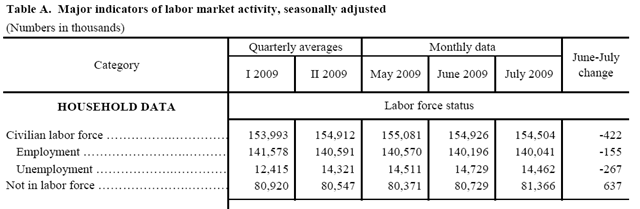
August 10, 2009

Actually, it’s quite simple.

About 155,000 fewer people were employed in July.

But, according to the BLS, the labor force contracted by 422,000 people. 

The bulk of the “contraction” were unemployed people who  “got discouraged that there were no jobs available for them” and stopped looking for work … 

The discouraged “contractors” get dropped from  both the numerator and the denominator of the unemployment rate calculation. 

So, net unemployment increased by 267,000 people  … but the unemployment rate improved from 9.5% to 9.4%.

If the discouraged folks were still looking, the rate would have increased to about 9.6%

Geez.

image

* * * * *
Lowlights

The number of long-term unemployed (those jobless for 27 weeks or more) rose by 584,000 over the month to 5.0 million.

1 in 3 unemployed persons were jobless for 27 weeks or more.

There were 796,000 discouraged workers in July, up by 335,000 over the past 12 months.

Full BLS Report
http://www.bls.gov/news.release/pdf/empsit.pdf

* * * * *

Is 1/10 of 1% a little or a lot ? … According to the NY Times, it depends who’s president …

August 10, 2009

Great “catch” by Byron York of the Washington Examiner …

* * * * *
The front page of Sunday’s New York Times is filled with hope about the nation’s economic situation.  The lead story, reporting a decline in the unemployment rate from 9.5 percent in June to 9.4 percent in July, begins by declaring that, “The most heartening employment report since last summer suggested on Friday that a recovery was under way — and perhaps gathering steam.”

* * * * *

The Times hasn’t always been so optimistic when it comes to one-tenth-of-a-point declines in the unemployment rate.  On this very day in 1992, in the midst of the presidential campaign between George H.W. Bush and Bill Clinton, the government also reported that the unemployment rate ticked downward by one tenth of a point, , edging down to 7.7 percent from 7.8 percent,”and the Times’ treatment was far more restrained:

Even though the number of jobs actually went up in July 1992 (as opposed to the decline of 247,000 jobs in July 2009), the 1992 Times reported that the economic news “gave no suggestion that the economic recovery was breaking out of its painfully slow pace or, more important, that the job growth was picking up enough to push the unemployment rate down significantly … and the improvement is not enough to signal a stronger economic recovery .”

As it turned out, the one-tenth-of-a-point drop in the unemployment rate in July 1992 signaled the end of the increase in the jobless rate.

* * * * *

Source article:
Washington Examiner, “NY Times touts economic momentum, recovery; in 1992, not so much”, York, 08/08/09
http://www.washingtonexaminer.com/opinion/blogs/beltway-confidential/Times-touts-economic-momentum-recovery-in-1992-not-so-much-52781412.html

* * * * *


Stick a keg in the fridge … now, that’s innovation!

August 10, 2009

Among the Latest Innovations From Major Brewers Fighting for Business in a Jammed, Sluggish Market

MillerCoors  has begun testing the sale of $20 draft-beer systems for consumers to drink at home, part of a string of new products and package innovation from beer giants grappling for market share in a crowded, slow-growing industry.

The 1.5-gallon boxed product, which is designed to fit into refrigerators for drinkers to consume periodically, rather than for one-time party use.

Sales of major U.S. beer brands are struggling as some recession-weary consumers drink less or switch to cheaper brews.

Despite a new ad campaign this year aimed at revitalizing the brand, Miller Lite’s retail sales fell 7.5% by volume.

Sister brew Coors Light, on the other hand, continues to post sales gains. Analysts attribute its long-running success in part to innovations in packaging, such as “cold-activated bottles,” whose labels turn blue when the beer inside cools to a certain temperature.

MillerCoors’s new Home Draft systems are meant to be placed upright in a refrigerator, which will keep the beer fresh for about 30 days. The price per ounce is roughly 15% higher than for an 18-pack of the same beer.

The product, which is recyclable, is aimed at the 30% of beer drinkers who say they prefer draft beer to the bottled or canned variety.

“We’re really trying to meet that occasion when you just got back from work and want to reward yourself,” rather than “the party occasion,” he said.

Excerpted from WSJ, MillerCoors Tests a Draft-Beer Box for the Fridge, July 29, 2009
http://online.wsj.com/article/SB124882355717088341.html

* * * *

Name a government agency that works … here’s one if you’re stumped.

August 7, 2009

DARPA – the Defense Advanced Research Projects Agency — is the Defense Dept.’s famous research branch.

Created at the height of the Cold War to bolster U.S. military technology following the Soviet Union’s Sputnik satellite launch, the agency has a long history of innovation.

Most famously, DARPA’s researchers first linked together computers at four locations in the early 1960s to form the ARPANET, a computer network for researchers that was the core of what eventually grew into the Internet.

Other breakthroughs have fueled big advances in commercial areas , including:

  • GPS
    DARPA co-funded the original satellites used for GPS in 1960. By the 1980s its research helped miniaturize GPS receivers, making them portable and inexpensive enough for use in everything from automobiles to cell phones.
  • COMPUTER MOUSE
    An agency-sponsored researcher named Douglas Engelbart invented the now ubiquitous device in 1964. The original model was made of wood and had a single button.
  • INTERNET
    DARPA developed the military network, the ARPANET, from which the Internet later emerged. Launched with four connected sites in 1969, it eventually linked universities and think tanks before an international network was commercialized in the mid-1990s.
  • UNIX
    In the 1960s, the agency funded the further development of the computer operating system known as UNIX, which remains in widespread use today by Hewlett-Packard, IBM, Sun Microsystems, and others.
  • PARALLEL COMPUTING
    In the 1990s, DARPA funded research into a technology that breaks apart highly complex problems into pieces and solves them in parallel. It is now commonly employed in high-performance computing.

Excerpted from Business Week, Can the Military Find the Answer to Alternative Energy?, July 23, 2009
http://www.businessweek.com/magazine/content/09_31/b4141032537895.htm

Who needs Monster if you’ve got LinkedIn and Tweeter ?

August 7, 2009

Punch line: Online job-search and headhunting is changing rapidly, and frontrunner Monster is losing ground to CareerBuilderLinkedIn, and even Twitter

* * * * *

Excerpted from: Business week, Recruiting: Enough to Make a Monster Tremble, June 25, 2009

US Cellular used to spend up to $4 million a year to post jobs and screen résumés through the three heavyweights of online job search—Monster, CareerBuilder, and Yahoo! HotJobs.

But with the 2009 recruiting budget slashed to $1 million and 2,500 openings to fill, the wireless carrier’s director of talent acquisition ditched the big job boards and instead inked a deal with social networking site LinkedIn. For an annual fee of $60,000, US Cellular now has access to the network’s 42 million members, many of whom are employed—the so-called passive candidates that recruiters covet, since conventional wisdom is the best people already have jobs. Using LinkedIn, USC recruiters made a hire in 30 days for a position that typically takes six months to fill.

For Monster, the growing appeal of LinkedIn to recruiters is just one more headache to contend with. Other social media sites, such as Facebook and Twitter, are also becoming popular destinations for employers. And niche sites such as TheLadders and BlueSteps, both of which target high earners, are gaining followers among recruiters and job seekers alike.

While traffic to Monster is up because of the growing ranks of the newly unemployed, its share of job listings among the big three has declined from nearly 40% in December 2007 to 34% in May. Monster has lowered prices for some key customers and hired 130 salespeople—a 31% increase—to win back business. In January, Monster unveiled a cleaner site that, among other things, reduced the number of steps required to upload a résumé from 20 to 4. A career-mapping feature shows job hunters how they can transfer from one field to another.

Monster’s next step is to address the one-size-fits-all nature of Monster’s site, which gets about 12 million unique visitors a month. It’s rolling out “contextual search” technology that distinguishes between, say, someone who went to Harvard and someone who lives on Harvard Avenue.

Perhaps Monster’s biggest threat comes from LinkedIn, a six-year-old social networking site with a distinctly professional bent.  For $7,000 per user at a client company, hiring managers get a customized LinkedIn Web site, or “dashboard,” and souped-up search capability so they can reach out to qualified candidates

Twitter is also gaining traction in the realm of job search. Kara Nickels got an e-mail one morning from an insurance industry client that needed 40 lawyers immediately for a big document review. The legal recruiter quickly sent a message—or “tweet”—to her 150 followers, which was re-twittered by legal blogs that follow her. By the time she arrived at her Chicago office, Nickels had 10 replies and filled every post by lunch. “With job boards it takes a couple days before people look,” she says. “But Twitter is immediate. I’ll still use the job boards, but if you don’t use social media now, you’re behind the curve.”

http://www.businessweek.com/magazine/content/09_27/b4138043180664.htm

Instead of old people, how about rationing care to fat people ?

August 6, 2009

OK, I’ve got a dog in this fight. 

ObamaCare goes after old folks. 

Why not go after the horizontally challenged?

Hmmmm …

* * * * *

According to the Wall Street Journal:

The prevalence of obesity rose 37% between 1998 and 2006.

Obese people spent 42% more than people of normal weight on medical costs in 2006.

* * * * *

According to the National Bureau of Economic Research, the percentage of male citizens who are clinically rated as obese,

Japan 2.8%
France 9.8 %
Germany 14.4%
Canada 17.0%
U.K. 22.7%
U.S. 31.1%

Percentages are similar for females.

Source post:
http://gregmankiw.blogspot.com/

* * * * *

According to the Centers for Disease Control and Prevention:

Overall, about 26 percent of U.S. adults are obese, including …

39% of black women
36% of black Americans
29% of Hispanics 
24% of whites

Source article:
http://www.newser.com/article/d99frjv01/state-by-state-obesity-statistics-show-blacks-have-the-largest-waistlines.html

For the full study (worth browsing):
http://www.cdc.gov/nchs/data/databriefs/db01.pdf

* * * * *

Draw your own conclusion

* * * * *

What’s driving the stock market higher? …. Here’s an analysis you won’t see on CNBC (continued)

August 6, 2009

A loyal reader replied to my original post “ You’re too focused on Obama’s disapproval ratings”, the market is reacting in a “normal” way to a Democratic president. He referenced a Forbes article by investment guru Ken Fisher.

The Obama Effect. Ken Fisher, 06.03.09
http://www.forbes.com/forbes/2009/0622/wall-street-stocks-obama-portfolio-strategy.html

“Wall Street marks down stocks before a Democrat takes office–before, in fact, he is even elected. After the inauguration there’s a good chance for a rebound.

With Democratic politicians the big fear is about how antibusiness and anticapitalist they will be.

Obama says lots of stupid, scary things. That fear hit markets early in the election cycle (and early after inauguration).

But once  in office the overwhelming motivation of a left-of-center President slowly morphs toward getting reelected.

Achieving that means pandering more to the independent voters and liberal Republicans, less to the Democratic power base.

Obama’s concern now is the recession and the job creators that can take us out of it. That means slowly backing off soak-the-rich, anticorporate talk over time.

The reverse happens with Republicans. They come in riding high expectations for pro-business, pro-growth policies–and inevitably disappoint investors as they drift away from their power base. Optimism fades, depressing stocks.”

* * * * *
Ken’s Take: Rather than contradicting my original point (market buoyed as O’s disapproval increases), I think Fisher’s observation supports it. 

Though O is in battle mode now to push through Cap & Tax and nationalized healthcare, the market is assuming that the increasing opposition (as indicated in the disapproval numbers) will make him come to his senses and move to the middle, i.e. start to act more like a “normal” Democratic president. 

My prediction stands: if O fends off the opposition now, stays way left, and gets C&T and ObamaCare … the market will tank.  We’ll see.

* * * * *

Thanks to Mike for the feedback.

* * * * *

How do you know a successful new car when you see it ?

August 6, 2009

 Ken’s Take: This article is specific to the auto industry but the general principles are applicable to most businesses.

* * * * *

Excerpted from: WSJ, The Auto Industry’s Comeback, July 29, 2009

The future of any car company is built on the relative success of its new cars.

Between now and 2014 there will be approximately 250 launches of either all-new or significantly redesigned new cars in the U.S.

* * * * *

What constitutes a successful launch?

First,  focus on the true indicators of how well a launch is going. Sales reports are not enough. What are the cars actually selling for at retail? Do the vehicles require incentives? Are dealers earning a profit? How are the residual values holding?

Second, the company must deliver a high-quality product if sales are to be sustained. Getting things right from the start has become the price of admission. Even the most subtle mistakes—like user-unfriendly technology—can kill off an otherwise promising product.

Third, the vehicle must have appeal. Owner delight with the design, content, layout and performance can be objectively measured. Attributes such as drivability, instrument panel layout can make the buyer an advocate and give the launch momentum.

Fourth, the products must have durability and reliability. It takes about three years to get a good reading on how the consumer feels about these two qualities. But we do know there is a direct relationship between a brand’s reputation for reliability and durability and its performance. So part of the assessment should include a look at the reputation of the brand. Where the reputation is strong, the launch gets a boost.

Fifth, while manufacturers launch cars, dealers sell them. The dealer’s willingness to put his best sales people on the new product, advertise vigorously, finance, carry and merchandise (a fancy word for trick out) the requisite inventory is all a reflection of the dealer’s confidence in the franchise. Brands that enjoy a high level of dealer confidence and exclusive dealership facilities have a more effective channel for launching a new vehicle.

 Full article:
http://online.wsj.com/article/SB10001424052970204886304574308202570479912.html

* * * * *

What’s driving the stock market higher? …. Here’s an analysis you won’t see on CNBC.

August 5, 2009

I think the recent stock market run-up is largely attributable to Pres. Obama’s declining approval ratings … and the numbers seem to corroborate the conclusion (chart below plots O’s disapproval rating vs the DJIA).

Specifically, when O’s approval dropped below 55% (i.e. disapproval increased above 45%) in late June, the market started a big rally.  Of course, correlation doesn’t necessarily connote causation.  So, what’s the explanation?

Simple.  The market is scared to death of Cap & Tax, Trillion $ Government Healthcare, and astronomical national debt.  As O’s approval flags, odds go against T&C and ObamaCare.  The market is factoring in severely watered down initiatives … or a long, long delay in the legislative process.

Pay close attention to O’s approval ratings and public support for ObamaCare.  If those two related metrics gain renewed traction, the market will stall – and probably will tank again.  Just watch.

image

* * * * *