Archive for October, 2009

Must read: "Americans feel increasingly disheartened, and our leaders don’t even notice."

October 30, 2009

Ken’s Take: I’ve said many times before that I love reading Peggy Noonan — even though I don’t always agree with her .  (For my more  liberal friends, keep in mind that she was onboard the Obama train in ’08.)

What she’s always able to do is dive down beneath the superficial and get to the core — the philosophical and emotive stuff that most other analysts miss.  She invariably provokes my thinking … and, she’s a wonderful writer to boot.

* * * * *

Excerpted from WSJ: We’re Governed by Callous Children, Oct. 29, 2009 

The new economic statistics put growth at a healthy 3.5% for the third quarter. We should be dancing in the streets. No one is, because no one has any faith in these numbers.

Waves of money are sloshing through the system, creating a false rising tide that lifts all boats for the moment. The tide will recede. The boats aren’t rising, they’re bobbing, and will settle.

No one believes the bad time is over. No one thinks we’re entering a new age of abundance. No one thinks it will ever be the same as before 2008.

Economists, statisticians, forecasters and market specialists will argue about what the new numbers mean, but no one believes them, either. Among the things swept away in 2008 was public confidence in the experts.

* * * * *

The biggest threat to America right now is not government spending, huge deficits, foreign ownership of our debt, world terrorism, two wars, potential epidemics or nuts with nukes.

The biggest long-term threat is that people are becoming and have become disheartened, that this condition is reaching critical mass, and that it afflicts most broadly and deeply those members of the American leadership class who are not in Washington, most especially those in business.

It is a story in two parts. The first: “They do not think they can make it better.”

The most sophisticated Americans, experienced in how the country works on the ground, can’t see a way out.

This is historic. This is something new in modern political history … Americans are starting to think the problems we are facing cannot be solved.

Part of the reason is that the problems—debt, spending, war—seem too big.

But a larger part is that our federal government, from the White House through Congress, and so many state and local governments, seems to be demonstrating every day that they cannot make things better.

They are not offering a new path, they are only offering old paths—spend more, regulate more, tax more in an attempt to make us more healthy locally and nationally. And in the long term everyone—well, not those in government, but most everyone else—seems to know that won’t work.

* * * * *

And so the disheartenedness … of even those who have something.

This week the New York Post carried a report that 1.5 million people had left high-tax New York state between 2000 and 2008, more than a million of them from even higher-tax New York City. They took their tax dollars with them—in 2006 alone more than $4 billion.

You know what New York, both state and city, will do to make up for the lost money. They’ll raise taxes.

I talked with an executive this week.   He was thoughtful, reflective about the big picture. He talked about all the new proposed regulations on industry. Rep. Barney Frank had just said on some cable show that the Democrats of the White House and Congress “are trying on every front to increase the role of government in the regulatory area.”

The executive said of Washington: “They don’t understand that people can just stop, get out. I have friends and colleagues who’ve said to me ‘I’m done.’ ” He spoke of his own increasing tax burden and said, “They don’t understand that if they start to tax me so that I’m paying 60%, 55%, I’ll stop.”

Government doesn’t understand that business in America is run by people, by human beings.

Mr. Frank must believe America is populated by high-achieving robots who will obey whatever command he and his friends issue.

But of course they’re human, and they can become disheartened. They can pack it in, go elsewhere, quit what used to be called the rat race and might as well be called that again since the government seems to think they’re all rats.

***
And here is the second part of the story.

While Americans feel increasingly disheartened, their leaders evince a mindless callousness.

It is a curious thing that those who feel most mistily affectionate toward America, and most protective toward it, are the most aware of its vulnerabilities, the most aware that it can be harmed. They don’t see it as all-powerful, impregnable, unharmable. The loving have a sense of its limits.

When I see those in government, both locally and in Washington, spend and tax and come up each day with new ways to spend and tax—health care, cap and trade, etc.—I think: Why aren’t they worried about the impact of what they’re doing? Why do they think America is so strong it can take endless abuse?

They don’t feel anxious, because they never had anything to be anxious about. They grew up in an America surrounded by phrases—”strongest nation in the world,” “indispensable nation,” “unipolar power,” “highest standard of living”—and they are not bright enough, or serious enough, to imagine that they can damage that, hurt it, even fatally.

We are governed at all levels by America’s luckiest children, sons and daughters of the abundance, and they call themselves optimists but they’re not optimists—they’re unimaginative.

They don’t have faith, they’ve just never been foreclosed on.

They are stupid and they are callous, and they don’t mind it when people become disheartened. They don’t even notice.

Full article:
http://online.wsj.com/article/SB10001424052748703363704574503631430926354.html?mod=djemEditorialPage

Squandering hope … the politics of blame & attack.

October 30, 2009

Excerpted from Weekly Standard: Obamaland – Squandering hope, channeling Nixon, 10/29/2009

The transition from campaigning to governing has not been kind to President Obama.

As a candidate he spoke of hope, change and ending the polarization of the past; he promised to bring people together; he pledged a new style of civil political engagement; he sought to lift us as a people above surly partisan warfare.

As president, he sucked the veracity from these hopes.

Maybe this was the plan all along. Politicians often say one thing and do another.

Or perhaps, he succumbed to inexorable forces and patterns that swallow every idealistic elected official trying to navigate the Washington swamp.

Whatever the reason, Obama has fallen short of those lofty aspirations.

After ten months in office a clear pattern has emerged. Instead of hope and change, it’s blame and attack.

Obama rarely gives a speech about a pressing national problem–the economy, health care, the budget deficit–without blaming Republicans or former president George W. Bush.

For many Americans it’s getting old. It makes the president look small and petty. Does he want America’s respect or its pity?

Attack is the other side of this strategy.

Playing Chicago-style politics comes naturally to this White House, populated with a cadre of former Obama for president staffers and others steeped in the tactics of the permanent campaign. And they don’t merely assault an enemies list. “We routinely hear about phone calls from the president’s staff to congressional Democrats expressing White House dissatisfaction if someone says anything out of line with Obama’s policies,” a senior congressional aide told me.

The gap between the president’s campaign rhetoric compared to his governing style creates a harsh cognitive dissonance and a toll in the polls.

And the slide will likely persist as the White House continues to force its vision of change on a country that lacks consensus in many areas.

Full article:
http://www.weeklystandard.com/Content/Public/Articles/000/000/017/132koltj.asp?pg=2

At home, Dos Equis says “no mas” to Corona …

October 30, 2009

TakeAway:  Unimaginative marketing, poor portfolio mix, and inattentive product management have caused Femsa, Mexico’s historic beer market leader, to lose 12% market share and drop to a distant second place in the Mexican domestic beer market. 

* * * * *

Excerpted from WSJ, “Beer’s Glory Days Fade at Femsa,Leaving Brewer Eyeing Options,” By Jose De Cordoba and David Kesmodel, October 19, 2009

The Dos Equis beer ad campaign, “The Most Interesting Man in the World,” has gone viral in the U.S., helping to boost sales of the Mexican import.

But in Mexico, few consumers have ever heard the suave gentleman’s voice … and Femsa’s beer market share has dropped … 

Lack of marketing imagination at home is one reason why Femsa, the company that makes Dos Equis, has been overtaken south of the border by archrival Grupo Modelo SAB, maker of Corona beer …

In the past two decades, Femsa—which makes Sol, Tecate, Indio, and Bohemia as well as Dos Equis—has seen its share of Mexico’s beer market fall to 43% from a once-dominant 55%. Modelo overall has a 57% share, with its Corona brand accounting for 31% on its own.

Femsa recently acknowledged it was contemplating selling its beer business or making a strategic alliance with one of the world’s brewing giants …

Analysts say a key reason Femsa is considering teaming up with a bigger brewer is that the landscape of the beer business has changed rapidly. Increasingly, the global market is dominated by giants such as Anheuser-Busch InBev, and SABMiller … Family-run Femsa has annual beer sales of about $4 billion, compared with roughly $35 billion and $21 billion at Anheuser-Busch InBev and SABMiller, respectively.

And last year, when InBev bought Anheuser-Busch … it took over Anheuser-Busch’s 50% non-controlling stake in Grupo Modelo, giving Femsa’s rival a new deep-pocketed uncle …

Femsa has partners of its own, but the scale is much smaller …

Although Femsa’s beer business has been lagging, the company is doing well in its two other main business lines: soft drinks and convenience stores. Last year, it had operating profits of $2B on revenue of $15B … in the last decade, revenue and profits have surged seven fold …

Mr. Fernandez, the current CEO who took the helm at Femsa in 1995 … has placed less emphasis on beer … he has a love affair with his two new babies, Coca-Cola and Oxxo … has put much of his focus on the OXXO convenience stores … It’s by far the largest convenience store chain in Mexico … three times the number of all its competitors combined.

OXXO has played a key role in defending Femsa’s market share, as it provides points of sale for Femsa’s beers. Indeed, some analysts fear Femsa’s share of the beer market would have fallen much more had it not been for the support from OXXO stores and worry Femsa’s share of the beer market could fall further once OXXO reaches a saturation point.

In Mexico, Femsa is known for being efficient in brewing and sales, but has struggled to develop expertise in marketing. “They are still trying to find the right portfolio mix, which brands to push in which markets,” said an analyst with Barclays Capital …

Edit by TJS

* * * * *

Full Article
http://online.wsj.com/article/SB10001424052748704112904574477272483981410.html?mod=article-outset-box

* * * * *


Marketing that goes down the toilet … literally.

October 30, 2009

TakeAway:  Very little is off limits anymore when it comes to marketing. 

Making all marketers proud, the “adults wipes segment”  is getting more graphic and more descriptive.  YIPES.

I’m a proponent of good benefits advertisng, but this one makes me very, very queasy.

* * * * *

Excerpted from NYTimes, “Adult Toilet Training, From Madison Ave.,” By Andrew Adam Newman, October 20, 2009

Toilet tissue advertising traditionally has featured fluffy clouds, cherubic toddlers and Mr. Whipple … But the ads remained steadfastly oblique about what consumers do after they tear along the perforated line.

With the prevalence these days of commercials for erectile dysfunction drugs and risqué network programming, however, tissue brands also are growing more frank … 

Cottonelle just launched a new commercial and a new Web site, CottonelleInstitute.com, to highlight not just the brand’s Aloe & E toilet paper but also its new flushable moist wipes … With both products, the brand is breaking with tradition, trumpeting not softness but rather that it is “dermatologically tested” for sensitive skin.

“Dry toilet paper is generally thought of as being a functional product, and a lot of brands in the category talk about strength and softness,” said a brand manager for Cottonelle wipes. “But we are reframing the Cottonelle brand as a personal care brand, which is a much more emotional space.”

… and the brand is pitching both rolls and wipes in one advertisement, in the hope of increasing the use of wipes, which are purchased by only 25 percent of households, many of which use them only on what she called “select usage occasions” … 

Getting adults to use more wipes in the bathroom … requires marketers to engage in a sort of toilet training with grown-ups, and Cottonelle and other brands apparently think cultural taboos have relaxed enough to do exactly that …

The wipes segment has been fast growing with only modest marketing support … and marketers say the growth of wipes does not cannibalize sales of toilet paper, because consumers tend to use them not as a replacement but an added step …

Charmin also is pitching its wipes … as complementary to rolls, and has launched a new campaign … that includes a video “product demo” …

“It’s a pretty straightforward way of speaking to consumers and letting them know how best to use the products together to get cleaner,” said a Charmin brand manager. “To my knowledge it is the most clearly that we have laid it out so far.”

Edit by TJS

* * * * *

Full Article
http://www.nytimes.com/2009/10/20/business/media/20adco.html?ref=media

* * * * *

If you’re young and you’re healthy … get out your wallet.

October 29, 2009

TakeAway: According to a detailed modeling of insurance rates, private insurance premiums could triple under ObamaCare.  Oops.

* * * * *

Excerpted from WSJ: The WellPoint Revelation, Oct. 28, 2009 

How will ObamaCare affect insurance premiums in the private health-care markets?

Despite indignant Democratic denials, the near-certainty is that their plan will cause costs to rise across the board.

WellPoint mined its own actuarial data to model ObamaCare in the 14 states where it runs Blue Cross plans.

In all of the 14 states WellPoint scrutinized, ObamaCare would drive up premiums for the small businesses and individuals who are most of WellPoint’s customers. (Other big insurers, like Aetna, focus on the market among large businesses.)

Young and healthy consumers will see the largest increases—their premiums would more than triple in some states—though average middle-class buyers will pay more too.

What distinguishes the Wellpoint study is its detailed rigor.

Take Ohio, where a young, healthy 25-year-old living in Columbus can purchase insurance from WellPoint today for about $52 per month in the individual market. WellPoint’s actuaries calculate the bill will rise to $79 because Democrats are going to require it to issue policies to anyone who applies, even if they’ve waited until they’re sick to buy insurance. Then they’ll also require the company to charge everyone nearly the same rate, bringing the premium to $134. Add in an extra $17, since Democrats will require higher benefit levels, and a share of the new health industry taxes ($6), and monthly premiums have risen to $157, a 199% boost.

Meanwhile, a 40-year-old husband and wife with two kids would see their premiums jump by 122%—to $737 from $332—while a small business with eight employees in Franklin County would see premiums climb by 86%.

It’s true that the family or the individual might qualify for subsidies if their incomes are low enough, but the business wouldn’t qualify … And even if there are subsidies, the new costs the bill creates don’t vaporize. They’re merely transferred to taxpayers nationwide—or financed with deficits, which will be financed eventually with higher taxes.

For the average small employer premiums would rise by 94%  in Indianapolis, 91% in St. Louis and 53% in Milwaukee.

A family of four with average health in those same cities would all face cost increases of 122% buying insurance on the individual market.

And it’s important to understand that these are merely the new costs created by ObamaCare — not including the natural increases in medical costs over time from new therapies and the like.

Apparently health care isn’t one huge free lunch in which everyone gets better insurance while paying less.

http://online.wsj.com/article/SB10001424052748703567204574499034177212064.html?mod=djemEditorialPage
Happy ending for Northwest flight that overshot Minneapolis …

October 29, 2009

MINNEAPOLIS – The mystery surrounding the Northwest Airlines flight that strayed 150 miles from its intended destination was resolved today as Northwest reported that the two pilots for the flight were never in the cockpit to begin with.

“We found them safe at home, hiding in a box,” said Northwest spokesperson Carol Foyler.  “We’re just glad that this story had a happy ending.”

Despite the positive resolution to the pilots’ drama, Northwest said they were moving forward on a number of safety measures, such as banning the computer game Guitar Hero in the cockpit.


Source: The Borowitz Report
http://www.borowitzreport.com/article.aspx?ID=7067

Looking for a”B-list” celeb to pitch your product … click here.

October 29, 2009

TakeAway:    Brands can find reasonably priced, celebrity sponsors within 96 hours on brandaffinity.com.  What used to be a long and painful process is now quick and easy…and cheap(er). Whether it works to drive sales is another question …

* * * * *

Excerpted from NYTimes, “A Place Where Sponsors Sign Athletes,” By Stuart Elliott, October 19, 2009

Marketers have been playing a new, more cautious game when it comes to signing athletes as endorsers, winnowing their rosters of jocks peddling products to proven performers with national — or international — profiles …

The rising costs of signing athletic talent to build brands … have made advertisers wary of rookies, single-game sensations, one-season stars or even talents with local appeal.

So what is a player like Drew Brees, the quarterback of the New Orleans Saints, to do? He is no slacker, to be sure, but neither is his surname Manning.

Mr. Brees and his representative … have signed with a company called Brand Affinity Technologies, which offers a Web site (brandaffinity.net) as a one-stop-shopping opportunity for advertisers seeking star power in more efficient, and affordable, forms …

Brand Affinity’s goal is to automate the process by which marketers offer contracts to athletes, along with the process by which ads featuring those endorsers are created and produced. The Web site promises that those transactions will take no more than 96 hours …

That fast pace … “reduces risk and provides flexibility, because you’re not tied into long-term deals” … “We can change out the talent very quickly” …

In addition to the agreements with the athletes, Brand Affinity has signed deals … for online ads; … for billboards, signs and posters; … for radio commercials; … for print and Internet ads …

In addition to athletes, Brand Affinity matches marketers with actors and other celebrities … and may expand into the realm of musicians and bands …

Edit by TJS

* * * * *

Full Article
http://www.nytimes.com/2009/10/19/business/media/19adcol.html?ref=media

* * * * *

Attention K-Mart shoppers … oops, I mean Walmart.

October 29, 2009

TakeAway: Maintaining profitable prices while growing market share requires a delicate balance that many companies struggle to find.

Not HP – through a series of cost savings and operational efficiency initiatives, HP is capturing market share while achieving superior profit margins.

Taking notes, Mr. Dell ?.

* * * * *

Excerpted from WSJ, “H-P Wields Its Clout to Undercut PC Rivals,” By Justin Scheck, September 25, 2009

Hewlett-Packard is using the dismal technology market to bolster its position as the world’s largest personal-computer maker.

For example: a $298 laptop to be sold at Wal-Mart

Since the economy slumped last fall, H-P has gained market share by lowering prices of its consumer PCs to undercut rivals … And while the profit margin in H-P’s PC business has fallen, it hasn’t suffered as much as rivals.

H-P has used its enormous sales volume to demand cheaper prices from suppliers and contract manufacturers. It’s also taken advantage of an improved supply chain to quickly design and deliver new, less expensive PCs …

The price cutting has pushed H-P’s PC division operating-profit margins to 4.6% in late July from 5.7% a year ago. But it’s still better than Dell’s estimated 4.3% margin  …

Dell is ceding market share rather than drastically lowering prices to match H-P. “If we don’t think there is going to be profitable growth, there are some situations where we won’t take part,” said a Dell spokesman. H-P’s market share jumped to nearly 20% of global PC shipments in the second quarter, up from 18.5% a year earlier, according to IDC. In the same period, Dell’s share fell by about two percentage points to 13.7% …

Edit by TJS

* * * * *

Full Article
http://online.wsj.com/article/SB125374794515235743.html

* * * * *

Good customer service is “one and done”

October 29, 2009

HBR, What Service Customers Really Want, by Dave Dougherty and Ajay Murthy. Sept 2009

On average, 40% of customers who suffer through bad experiences stop doing business with the offending company.

Recent research demonstrates that when customers contact companies for service, they care most about two things:

(1) Is the frontline employee knowledgeable?

(2) Is the problem resolved on the first call?

Yet those factors often aren’t even on customer-service managers’ dashboards.

Most service centers continue to measure time on hold and minutes per call. Such metrics encourage agents to hurry through calls—resulting in
just the kind of experience customers dislike.

And, these alienated customers often disappear without the slightest warning.

image

What ever happened to "I love New York" ?

October 28, 2009

TakeAway: A new study says high taxes are driving people away from NY … especially NYC.

* * * * *

Excerpted from WSJ: Escape from New York, Oct. 28, 2009

An old saying goes that the time to live in New York is when you’re young and poor, or old and rich—otherwise, you’re better off somewhere else. .

Between 2000 and 2008, the Empire State had a net domestic outflow of more than 1.5 million, the biggest exodus of any state, with most hailing from New York City.

The departures have perilous budget consequences, since they tend to include residents who are better off than those arriving. Statewide, departing families have income levels 13% higher than those moving in, while in New York County (home of Manhattan) the differential was 28% .

In 2006 alone, that swap meant the state lost $4.3 billion in taxpayer income. Add that up from 2001 through 2008, and it translates into annual net income losses somewhere near $30 billion.

According to the Tax Foundation, between 1977 and 2008, New York has ranked first or second in the country for its state-local tax burden compared to the U.S. average.

That pattern is consistent with the annual migration patterns, showing that highly taxed and economically lackluster states were most likely to end up in residents’ rear view mirrors. According to the annual study by United Van Lines, states like New York, New Jersey, Michigan and Illinois have been big losers in recent years.

Greener pastures that drew New Yorkers included states like Florida, North Carolina and Pennsylvania.

Liberals continue to insist that they can raise taxes ever higher without any effect on behavior, but the New York study is one more piece of evidence that this is a destructive illusion.

Full article:
http://online.wsj.com/article/SB10001424052748703574604574499772371161800.html?mod=djemEditorialPage
Medicare’s cost advantage … real or illusory … and, so what ?

October 28, 2009

Ken’s Take: I would like to see more real economics in the public option debate.   A fundamental question: though counter-intuitive, does the gov’t run more efficient healthcare insurance programs than private industry?

Here are some facts … more “takes” follow.

Private insurers’ profits (included in administrative costs) explain some of Medicare’s cost advantage.

But profits represent only 3% of the insurance industry’s revenues.

* * * * *

By some estimates, Medicare’s administrative costs are only 3% of spending compared with 13% or more for private insurers. So, a government run healthcare plan is widely presumed to enjoy an advantage in overhead.

As for administrative expenses, any advantage for the public plan is exaggerated, say critics. Part of the gap between private insurers and Medicare is statistical illusion: Because Medicare recipients have higher average health expenses ($10,003 in 2007) than the under-65 population ($3,946), its administrative costs are a smaller share of total spending. A public plan, with younger members, wouldn’t enjoy this advantage.

* * * * *

The main advantage of a public plan would be the congressionally mandated requirement that hospitals and doctors be reimbursed at Medicare’s rates — as much as 30% lower than rates paid by private insurers.

With such savings, the public plan could charge much lower premiums and attract lots of customers.

Excerpted from IBD: Promise Of The Public Plan Is A Mirage,  10/23/2009
http://www.investors.com/NewsAndAnalysis/Article.aspx?id=510101

Ken’s Take:

(1) I’ve argued before that the private health insurers don’t really make that much money.  The industry ranks #35 among major industry groupings, and the 3% rate is far downscale.  Since private insurers handle about 1/2 of all healthcare spending — using the above 3% number — if you eliminate all private healthcare profits, the “savings” would be about $30 billion annually. That’s statistically significant but — in my opinion — not compelling.

(2) At first blush — again, using the above numbers — the gov’t admin advantage (3% to 13%) is significant.  First, assuming that the number of transactions handled is proportional to the dollars of healthcare expenses  — then the 3% to 13% advantage carries thru ona transaction basis. Even when you “normalize” the data per patient Medicare seems to have an advantage — Medicare administers a subscriber for $300 per year ($10,000 times 3%) versus $500 per year for private insurers ($4,000 times 13%).  That’s significant.

What’s going on?  My bet: scale economies.  While some private healthcare insurers seem big, their size pales in comparison to the government programs.  Why? Because of the limits on selling insurance across state lines.  There are something like 1,500 private insurance programs.  All have admin staffs, computer systems, etc. 

My conclusion: there are way too many private insurers, not too few.  Consolidate that industry down to a handful of companies, and Medicare’s admin cost advantage would disappear — practically overnite.

(3) I’ve also pointed out the vicious cycle that’ll occur if doctors are squeezed with reimbursement rates far below “market prices” and sometimes below cost.  Eventually, the private plans get snuffed, and more important, the base of healthcare suppliers — docs and hospitals will shrink.  That means rationing.

* * * **

Like advertising, half of all healthcare spending is wasted. Yeah, but …

October 28, 2009

Ken’s Take: Keep in mind that (1) medical tort reform isn’t even on the negotiating table, (2) much of the “billing & administration” is feeding the Medicare / Medicaid systems, and (3) they’ve been chasing the same fraud dollars for decades.

* * * * *

Excerpted from Reuters: US Health Care Wastes Up to $800 Billion a Year, Oct 26,2009

The U.S. healthcare system wastes between $505 billion and $850 billion every year, according to a report from Thomson Reuters – Healthcare Analytics.

One example — a paper-based system that discourages sharing of medical records accounts for 6 percent of annual overspending.

“It is waste when caregivers duplicate tests because results recorded in a patient’s record with one provider are not available to another or when medical staff provides inappropriate treatment because relevant history of previous treatment cannot be accessed,” the report reads.

Some other findings in the report from Thomson Reuters:

  • Unnecessary care such as the overuse of antibiotics and lab tests to protect against malpractice exposure makes up 37 percent of healthcare waste or $200 to $300 a year.
  • Fraud makes up 22 percent of healthcare waste, or up to $200 billion a year in fraudulent Medicare claims, kickbacks for referrals for unnecessary services and other scams.
  • Administrative inefficiency and redundant paperwork account for 18 percent of healthcare waste.
  • Medical mistakes account for $50 billion to $100 billion in unnecessary spending each year, or 11 percent of the total.
  • Preventable conditions such as uncontrolled diabetes cost $30 billion to $50 billion a year.
  • Wasteful use of emergency rooms due to a lack of primary care doctors.

“The average U.S. hospital spends one-quarter of its budget on billing and administration, nearly twice the average in Canada.”

“American physicians spend nearly eight hours per week on paperwork and employ 1.66 clerical workers per doctor, far more than in Canada.”

Source article:
http://www.cnbc.com/id/33477157#

Falcon wasn’t inside that Colorado balloon, but there was a valuable cargo … here’s proof.

October 28, 2009

How could all of the mainstream media outlets miss this one ?

* * * * *

In the air …

image001

On the ground …

image002

Pop !

image003

Ring, ring, ring … want a couple of bucks off?

October 28, 2009

TakeAway:  Mobile coupons delivered directly  to  smartphones are catching on, spurring impulse purchases. 

* * * * *

Excerpted from CNBC, “Coupons Via Cellphone: Whipping Up the Impulse Buy,” By Christina Cheddar Bank, October 15, 2009

To date, the concept of receiving coupons on your cell phone has been more theory than practice. This is despite a resurgence in coupon use and an increasing dependence on cell phones.

But with the focus on mobile coupons as a marketing tool on the rise, is the industry heading to an inflection point? A new Harris interactive survey … of more than 2,000 adults … found that 42 percent of those who were between 18 and 34 years old, and 33 percent of those 35 to 44 years old are at least somewhat interested in receiving opt-in alerts on their cell phones for specials at their favorite establishments …

This type of technology is even more impressive when one considers how many purchases consumers make on the fly … 9-in-10 Americans have made an impulse purchase when they were out shopping in a store based on a sale or a special that was going on around where they were … Among adults who own a cell phone, nearly a quarter — some 22 percent — make this type of purchase at least once per week or more often …

1020 Placecast  has designed a system to use digital marketing and mobile devices in an attempt to drive consumers to specific locations.  Using their systems, a restaurant or retailer can send an alert to a customer’s phone whenever the person is nearing its location

Coupons.com … developed applications for the Apple’s iPhone and other devices to help consumers sort through coupons and pair them with their grocery lists … also trying out a system that allows shoppers to browse through coupon offerings on its Web site, then load the offers on to a key tag. Once at the store, shoppers can wave their key tags over the scanner during checkout in order to get the credit.

Both companies caution this is still early days for these technologies.

However, with the number of smartphone users on the rise … penetration is about 15 percent in the U.S. today (about 40 million phones) … most forecasts call for that number to at least double by the end of 2011 … coupled with the yet untapped interest, there may be significant opportunities for a technology that is simple enough for consumers to understand and appreciate …

Still, at this time, the reality is there is still more buzz about mobile coupons than people actually using these offers. But as retailers look to hone in on how they can improve relationships with their customers it seems the demand for this type of service is there.

Edit by TJS

* * * * *

Full Article
http://www.cnbc.com/id/33244923

* * * * *

If there are twice as many conservatives as liberals … why do I feel so lonely?

October 27, 2009

TakeAway: Conservatives continue to outnumber  liberals 2 to 1 in the American populace in 2009.

* * * * *
Excerpted from Gallup: Conservatives Maintain Edge as Top Ideological Group, October 26, 2009

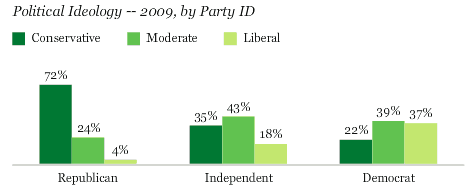
Forty percent of Americans describe their political views as conservative, 36% as moderate, and 20% as liberal. This marks a shift from 2005 through 2008, when moderates were tied with conservatives as the most prevalent group.

image

* * * * *

Changes among political independents appear to be the main reason the percentage of conservatives has increased nationally over the past year: the 35% of independents describing their views as conservative in 2009 is up from 29% in 2008. By contrast, among Republicans and Democrats, the percentage who are “conservative” has increased by one point each.

image


* * * * *

In addition to the increase in conservatism on this general ideology measure, Gallup finds higher percentages of Americans expressing conservative views on several specific issues in 2009 than in 2008.

  • Perceptions that there is too much government regulation of business and industry jumped from 38% in September 2008 to 45% in September 2009.
  • The percentage of Americans saying they would like to see labor unions have less influence in the country rose from 32% in August 2008 to a record-high 42% in August 2009.
  • Public support for keeping the laws governing the sale of firearms the same or making them less strict rose from 49% in October 2008 to 55% in October 2009, also a record high. (The percentage saying the laws should become more strict — the traditionally liberal position — fell from 49% to 44%.)
  • The percentage of Americans favoring a decrease in immigration rose from 39% in June/July 2008 to 50% in July 2009.
  • The propensity to want the government to “promote traditional values” — as opposed to “not favor any particular set of values” — rose from 48% in 2008 to 53% in 2009. Current support for promoting traditional values is the highest seen in five years.
  • The percentage of Americans who consider themselves “pro-life” on abortion rose from 44% in May 2008 to 51% in May 2009, and remained at a slightly elevated 47% in July 2009.
  • Americans’ belief that the global warming problem is “exaggerated” in the news rose from 35% in March 2008 to 41% in March 2009.

Gallup has not recorded heightened conservatism on all major social and political views held by Americans. For instance, attitudes on the death penalty, gay marriage, the Iraq war, and Afghanistan have stayed about the same since 2008.

However, there are no major examples of U.S. public opinion becoming more liberal in the past year.

Full article:
http://www.gallup.com/poll/123854/Conservatives-Maintain-Edge-Top-Ideological-Group.aspx

Hey, Mr. Prez … Here’s a way to fund about 1/2 of your healthcare package.

October 27, 2009

Did you know …

TARP will expire on December 31, unless Geithner exercises his authority to extend it to next October.

Right now, Geithner is sitting on over $300 billion of uncommitted TARP funds, thanks in part to bank repayments. Treasury believes it has the authority to spend that returned money on new adventures in housing or other parts of the economy.

Since the TARP has largely ignored its designated mission — buying up bad mortgages and their derivatives — and has evolved into a $700 billion all-purpose political slush fund, why not simply declare success and throw the money at insuring the uninsureds?

Hmmm …. 

* * * * *

HiLites from WSJ: Rolling up the TARP, Oct.  27, 2009 

Historians will debate TARP’s role in ending the financial panic of 2008, but today there is little evidence that the government needs or can prudently manage what has evolved into a $700 billion all-purpose political bailout fund.

TARP quickly became a Treasury tool to save failing institutions without imposing discipline (Citigroup) and even to force public capital onto banks that didn’t need it. This stigmatized all banks as taxpayer supplicants and is now evolving into an excuse for the Federal Reserve to micromanage compensation.

Even with the banks, TARP has been a double-edged sword. While its capital injections saved some banks, its lack of transparency created uncertainty that arguably prolonged the panic.

By stating expressly that the ‘healthy’ institutions would be able to increase overall lending, Treasury created unrealistic expectations about the institutions’ conditions and their ability to increase lending.”

TARP was then redirected well beyond the financial system into $80 billion in “investments” for auto companies. These may never be repaid but served as a lever to abuse creditors and favor auto unions.

TARP also bought preferred stock in struggling insurers Lincoln and Hartford, though insurance companies are not subject to bank runs and pose no “systemic risk.” They erode slowly as customers stop renewing policies.

TARP also became another fund for Congress to pay off the already heavily subsidized housing industry by financing home mortgage modifications. Not one cent of the $50 billion in TARP funds earmarked to modify home mortgages will be returned to the Treasury, says the Congressional Budget Office.

TARP’s Congressional Oversight Panel warns that the entire taxpayer pot could be converted into subsidies. They are especially concerned about expanding the foreclosure prevention programs that have been failing by every measure.

The political class has twisted TARP into a fund to finance its pet programs and constituents, and the faster it fades away, the better for taxpayers and the financial system.

Full article:
http://online.wsj.com/article/SB10001424052748704224004574489740879074028.html?mod=djemEditorialPage

* * * * *

On B of A and Merrill …

The government also endangered one of the banks that they considered healthy at the time.

According to Fed documents, the government viewed BofA as well-capitalized, but officials believed that its tangible common equity would fall to dangerously low levels if it had to absorb the sinking Merrill.

In other words, by insisting that BofA buy Merrill, Messrs. Paulson and Bernanke were spreading systemic risk by stuffing a failing institution into a relatively sound one.

And they were stuffing an investment bank into one of the nation’s largest institutions whose deposits were guaranteed by taxpayers. BofA would later need billions of dollars more in TARP cash to survive that forced merger, and when that news became public it helped to extend the overall financial panic.

Full article:
http://online.wsj.com/article/SB10001424052748704224004574489740879074028.html?mod=djemEditorialPage

When You Apologize – Make It Count!

October 27, 2009

Ken’s Take: In a prior post, I cited some research that proved it’s good business for companies to apologize to customers they’ve wronged — that an apology goes way further than, say, a discount on the next purchase.

I also made a passing reference to how important apologies are in personal life, too.

Following the links in the original article, I stumbled on these “8 simple principles” for making a meaningful apology …

Nothing relieves the pain caused by a mistake quite so effectively as a genuine and unconditional apology.

There is simply no way to state strongly enough what a difference it can make in relationships.

The problem with most apologies is that they’re “CPI”  — Cheap, Premature, and Incomplete — “I’m sorry if I hurt you.” “Whatever it was that I did, I apologize.”

Here are some simple principles that can make an apology more meaningful.

  1. Understand first, then apologize. Make sure you really understand what has happened and what part you played in it.
  2. Talk to everybody involved. It’s not enough that you apologize to the person you hurt directly. You need to apologize as well to the people who know what you did. 
  3. Be specific  … so it’s clear that you understand your mistake.
  4. Apologize unambiguously. Say you’re sorry, and  be careful not to qualify it at all. That’s why “I’m sorry if I hurt you” and “I don’t know what I’ve done, but I apologize” don’t cut it.
  5. Describe how your mistake has affected you. You may realize, for example, that someone you care about deeply has trouble trusting you now. If so, you need to describe that as part of your apology.
  6. Outline the steps you’re taking to avoid similar mistakes in the future. Concentrate on actual behaviors that other people should be able to observe. Then, walk the talk.
  7. Affirm yourself. If you don’t think you’re the kind of person who sets out to hurt people, you need to say so.  You need to state in clear and explicit terms that you think you’re a better person than this behavior would indicate. You need to describe how you plan to demonstrate that over the days and weeks ahead.
  8. Ask for forgiveness — but don’t  press for it quickly. You may even need to ask the other person explicitly not to forgive you too quickly so that forgiveness, when given, will be complete.

* * * **

Warning: just because the principles are simple doesn’t make them easy to apply.

For most of us, they represent a fundamentally different behavior, and changing behavior always feels awkward and uncomfortable at first.

* * * * *

Excerpted from “Apologize – and Make It Count!”

What does Obama do way more often than Bush ?

October 27, 2009

If you guessed fund-raising events, you’re right.  But, more importantly …

President Barack Obama has only been in office for just over nine months, but he’s already hit the links as much as President Bush did in over two years.

CBS’ Mark Knoller — an unofficial documentarian and statistician of all things White House-related — wrote on his Twitter feed that, “Today – Obama ties Pres. Bush in the number of rounds of golf played in office: 24. Took Bush 2 yrs & 10 months.”

This news comes on the heels of the news that Obama played golf with a woman — chief domestic policy adviser Melody Barnes — for the first time since taking office.

Source: Politico, President Obama ties George W. Bush on golf, 10/25/09
http://www.politico.com/click/stories/0910/obama_ties_bush_on_golf.html

Gut check: what are Americans’ core values ?

October 26, 2009

Ken’s Take: If you buy the premise that  Americans’ core values are individual choice, personal accountability, and rewards for ambition then the rest of the argument falls neatly into place. 

My question: These days, how pervasive and strong are these core values ?

Call me cynical, but I’m starting to think that too many folks would rather leave their decisions to other, blame others for their irresponsibility and claim entitlement without ambition.

More ‘Take’ follows …

* * * * *

Excerpted from: WSJ, Why Government Health Care Keeps Falling in the Polls. Oct 25, 2009

Regardless of how President Barack Obama’s health-care agenda plays out in Congress, it has not been a success in public opinion. Opposition to ObamaCare has risen all year.

We continue to hear both sides of the health-care debate argue about particulars of insurance markets, the deficit impacts of reform, and the minutiae of budgetary assumptions. These arguments, while important, do not address the deeper issues involved.

Public resistance stems from the sense that the proposed reforms do violence to three core values of America’s free enterprise culture: individual choice, personal accountability, and rewards for ambition.

First, Americans recoil at policies that strip choices from citizens and pass them to bureaucrats. ObamaCare systematically does so. The current proposals in Congress would effectively limit choice across the entire spectrum of health care: What kind of health insurance citizens can buy, what kind of doctors they can see, what kind of procedures their doctors will perform, what kind of drugs they can take, and what treatment options they may have.

Second, Americans believe we should be responsible for the consequences of our actions. Many citizens bitterly view the auto and Wall Street bailouts as gifts to people who took imprudent risks, imperiled the entire economic system, and now appear to be walking away from the mess. Similarly, Americans are cold to a health-care system that effectively rewards individuals for waiting to get insurance until they get sick—subsidizing their coverage by taxing those who responsibly carry insurance in good times and bad.

Third, ObamaCare discourages personal ambition. The proposed reforms will institute a set of government mandates, price controls and other strictures that will make highly trained specialists, drug researchers and medical device makers less valued now and in the future. Americans understand that when you take away the incentive to make money while saving lots of lives, the cures, therapies and medical innovations of tomorrow may never be discovered.

Full article:
http://online.wsj.com/article/SB10001424052748704335904574495131591949574.html?mod=djemEditorialPage

* * * * *

More Ken’s Take: I think the resistance is more fundamental: everybody wants uninsured citizens to get healthcare– just so they don’t personally have to fund it. 

The 50% of people who pay income taxes don’t want their rates goosed up; Seniors don’t want Medicare cut; Juniors don’t want to buy health insurance that they don’t need; Union members don’t want to pay taxes on their gold-plated plans; Companies don’t want to pay higher taxes — unless they can pass them on to consumers.

It’s as simple as that.

About that 4 year old who bought her 1st home and got the $8,000 tax credit … call me suspicious

October 26, 2009

Ken’s Take: The finding of extensive fraud in the new home owners’s tax credit program can not possibly surprise anybody. But, I am a bit startled by the magnitude — likely to be in the billions when the dust settled.

Just wait until the analysis is done on Cash for Clunkers.  My bet: will make this look like chump change.

* * * * *

Excerpted from WSJ: Home-Buyer Credit Tempts Tax Cheats, Oct. 23, 2009

The Treasury tax-oversight office told Congress that “tens of thousands of people” submitted suspicious — and possibly fraudulent — claims for a federal tax credit meant for first-time home buyers. 

The credit, adopted as part of the February stimulus bill, modified and expanded on a tax credit that was first passed by Congress in 2008. The current credit is available only to first-time buyers who purchased a primary residence since April 9, 2008. The full credit is available to individuals with incomes of less than $75,000 and $150,000 for married couples.

The IRS is conducting more than 100,000 examinations that could require filers to give back the credit and pay civil penalties.

At least 19,000 filers who hadn’t bought homes claimed $139 million in tax credits and were reimbursed.

An additional 74,000 tax-credit claims, valued at $500 million, for people who previously owned a home. 

More than 500 people under the age of 18, including a 4-year-old child, also had their names on applications for the credit, which has no minimum-age requirement. Most of the claims involving children were made by parents who purchased a home but were ineligible for the credit because their incomes were too high.

The authorities blamed a lack of safeguards, including lack of documentation requirements, for the extent of the problems.

* * * * *

Rep. Charles Boustany Jr. (R., La.) said the problems show the dangers in creating refundable tax credits that give money to filers even if they didn’t owe any taxes. “Every time Congress creates a new refundable credit…the incentive for fraud is magnified,” he said.

The credit’s main sponsor, Sen. Johnny Isakson (R., Ga.), said he is “cautiously optimistic” that an extension — with procedural safeguards added — can move in the Senate next week. “Just because someone used fraud [to claim the credit] doesn’t mean the credit is a bad idea, it means there are some bad folks running around,” he said.

* * * * *

Full article:
http://online.wsj.com/article/SB125622884824101553.html

Why It Pays to Apologize …

October 26, 2009

Ken’s Take: In personal life, apologies can clear the conscience and “clear the air”.

In business, apologies make for good customer relations …

* * * * *

Excerpted from Business Week, Why It Pays to Apologize, Oct. 12, 2009

What’s the best way for a company to disarm a disgruntled customer? A simple apology beats a cash rebate, according to a new study.

Researchers at Britain’s Nottingham School of Economics worked with a large German wholesaler that sells goods on eBay, tracking the lukewarm or negative comments posted on the site by the company’s customers over six months.

They then responded to the 632 complaints—about defective salt shakers, say, or the late delivery of a leather belt.

Half of the e-mailed responses offered a brief apology. Half offered instead a “goodwill gesture” of a small cash rebate (from $3 to $8). All the e-mails asked the customers to remove the comments they had posted online. For those offered the rebate, it was a condition of receiving the cash.

The result?

About 45% of customers who received an apology withdrew their so-so or negative ratings, compared with 21% of those offered money to do so.

It’s worth noting that the e-mailed apologies were effective even though they were brief and impersonal — and asked for something in return.

Why?

Despite the suspicions people might harbor, “apologies trigger a biological instinct to forgive that is hard to overcome.”

http://www.businessweek.com/magazine/content/09_41/c4150btw802994.htm

* * * * *

Tomorrow: Getting personal – 8 principles for making your apologies count …

Customer product reviews: the good, the bad, and the ugly

October 24, 2009

TakeAway: Brands are opening up more dialogues between company and consumer.

Social networking sites, blogs, and online forums have all given consumers an outlet to review anything and everything.

Companies are learning that it is best if these conversations take place on sites where they can use positive and negative feedback to improve their product offerings. Consumers are also seem to appreciate openness and honesty from companies, and hearing both the good and bad helps build that trust.

So maybe bad news isn’t all that bad, as long as there’s some good to balance it out.

* * * * *

Excerpted from MarketingWeek, “Even negative views improve brand image” by Joe Fernandez, September 10, 2009

Brands that open up an honest dialogue with consumers by using online channels to encourage positive and negative feedback are best placed to build trust and ultimately improve sales figures.

Procter & Gamble announced last month that it would start using consumer reviews on its brand sites for the first time. The FMCG company now lets people post their views on its Head & Shoulders and Ariel websites about how the products perform.

Customer endorsements are important tools for any marketer. They can help brands distinguish themselves from competitors, boosting sales and keeping the tills ringing.

Customers, in turn, use other people’s advice and reassurance to help them make purchase decisions. In the past decade, the emergence of online feedback on etail sites, blogs and forums has provided consumers with more resources than ever to base their decision-making on.

The days of spontaneity and blind purchases are long gone. Retailers and etailers are seeing the benefits of talking to customers, and being open has both positives and negatives as part of the overall brand experience.

Producing a dialogue with customers rather than the usual corporate diatribe means that the customer feels valued. Customer loyalty starts with a problem and a voice in the wilderness. If you listen and respond positively, you not only save the sale, you win the customer for life and many of their friends forever too.

Edit by JMZ

* * * * *

Full Article:
http://www.marketingweek.co.uk/even-negative-views-improve-brand-image/3004270.article

* * * * *

The AMA gets double-crossed … surprise, surprise, surprise.

October 23, 2009

Ken’s Take:

For the record: I’m totally against “bending the cost curve” by cutting doctors pay !

The press reports — and my doctor friends confirm — that Medicare reimbursement rates are 15% to 25% below the prices paid by private insurance companies for comparable services.

In many (most?) instances, the Medicare reimbursements are below the doctors’ fully loaded costs.  Said differently — doctors often (usually ?) lose money on Medicare patients.

As a result, popular doctors (i.e. good ones who have an earned reputation and a “full panel” of patients) restrict the number of Medicare patients they treat — sometimes simply refusing to accept Medicare patients at all. Only newbies and unpopular doctors who have excess “capacity” smack their lips when they see Medicare patients coming through the door.  To these doctors, Medicare is to healthcare as Priceline is to airlines — a way to generate some revenue off a perishable asset — the doctor’s available time -to-treat.

To give the appearance of controlling runaway Medicare costs, Congress put bills in place that automatically cut Medicare reimbursement rates from year to year. Under current law, doctors face a 21.5 percent cut in Medicare fees in 2010 and then annual 5 percent cuts for several years.

Recognizing that lower rates would just decrease the number of doctors seeing Medicare patients, Congress has gotten in the habit of overriding the cuts each year — sometimes increasing them. (Note: I think that’s a good thing).

The healthcare reform legislation is supposed to fix the problem by at least freezing reimbursement rates for an extended period (maybe forever).  This “sweetener” is what got the AMA to buy in and publicly support ObamaCare.

The problem: the freeze costs about $25 billion annually — or about $250 billion over 10 years.  That’s an amount that pushes ObamaCare costs over $1 trillion (for 10 years) — that seems to be a number that everybody gags on.

So, Reid tried to outboard the freeze from the healthcare package and pass it as a run of the mill deficit spending program to be enacted immediately.

To Reid’s surprise, some Dems got uneasy with the ploy and voted against it.

So, either the freeze gets put into ObamaCare, bloating its cost — or reimbursement rates go down, understandably angering the AMA — or Congress punts the issue as a post-reform clean-up matter.

I’m betting on the latter.

P.S. I’m also betting that ObamaCare will have provisions mandating that doctors treat some minimum number of Medicare patients — even if the reimbursement rates are below cost.  Just watch … 

* * * * *

Here are a couple of links with details on Reid’s failed gambit.

The Hill, Miscalculation delivers loss on Medicare doc fix for Majority Leader Reid, Oct. 21 2009
http://thehill.com/homenews/senate/64221-miscalculation-delivers-loss-for-reid-on-doc-fix

WSJ, Temporary Beltway Sanity – The doctor fix blows up in the Senate, no thanks to the AMA. Oct. 22, 2009
http://online.wsj.com/article/SB10001424052748704597704574487622368301370.html

Book wars … Walmart tells Amazon "Take that !"

October 23, 2009

TakeAway:  Wal-Mart just took price-leadership to a new level; consumers are enjoying discounts up to 74% on best-selling books.  Many criticize this price war for its negative impact on the book supply chain and publisher pricing power.  At the same time, some see this price war as an opportunity to attract a whole new batch of readers.

* * * * *

Excerpted from WSJ, “Book Price War Escalates,” By Jeffrey Trachtenberg and Brian Blackstone, October 17, 2009

Book publishers are worried they and retail chains could be caught in the cross fire as Amazon.com and Wal-Mart ratchet up their price war over online book sales.

Wal-Mart triggered the online skirmish Thursday when it began selling its 10 most anticipated hardcovers for $10 apiece when pre-ordered on its Web site. Amazon matched the offer hours later and Wal-Mart then chopped its price to $9. Friday morning Amazon had matched the price … Late Friday afternoon, Wal-Mart dropped its price a penny, to $8.99.

The discount applies to popular books such as Mr. King’s “Under the Dome” … which carries a $35 price tag but is available on Amazon and Walmart.com for $9, a discount of 74%.

Walmart.com CEO said that the retailer “will go as low as we need to” to underscore Walmart.com’s intent to be a low-price leader online … Publishers are receiving its customary wholesale price from Wal-Mart and Amazon … “Publishers aren’t subsidizing this in any way,” … 

The nation’s two largest bookstore chains, Barnes & Noble and Borders, each operate their own online retail sites. Neither is matching the prices now being offered by Walmart.com or Amazon …

Publishers said they feared the online pricing could hurt small independent book sellers and big retail chains …

Chief executive of Perseus Books Group … said the price wars will help sales in the short run but create problems if they continue. “When your product is treated as a loss leader, it lowers its perceived value,” he said. “If you are taking margin out of the supply chain, it will eventually put pressure on everyone in that chain.” …

If the industry’s top books continue to be sold for $9 online … it will be increasingly difficult for publishers to launch what he described as “the writers of tomorrow,” because the book market may have narrowed significantly …

Some executives said privately they doubted that the two retailers could afford to maintain the price strategy in the long term, unless they could offset losses on the discounted books with more traffic in other parts of their stores …

But some fear a long-term price degradation. The price war is “eroding the economy of the book,” … what will happen if big retailers try to force publishers to slash their own prices.

Despite the worrying news out of the U.S., the mood isn’t all gloom and doom. The price cuts may lead to a flood of new readers on the market, some executives said. In addition, digital books offer opportunities to include new video and audio content in books.

Edit by TJS

* * * * *

Full Article
http://online.wsj.com/article/SB10001424052748704322004574477050954174722.html?mod=WSJ_hps_LEFTWhatsNews

* * * * *

Staple brands are stealing the show

October 23, 2009

TakeAway:  The “back-to-the-basics” consumer has given new life to many staple brands, e.g. Campbell’s, Kraft.

But, these brands are quickly finding that consumer purchases should not be taken for granted. 

The competition among staple brands has grown very intense, as consumers now more freely substitute products across categories for their “perfect” purchase.  So, product relevance is more important than ever.

* * * * *

Excerpted from NY Times, “More Ads for Basic Brands as Shoppers Spend Less,” By Stuart Elliott, October 7, 2009

Readers of this week’s People magazine could be excused for believing they were leafing through a Look magazine from 1959. Of the 44 full-page ads in the issue, half are for brands like Campbell’s, Jell-O, Kraft cheese, Lipton tea and Post cereal.

Familiar packaged foods that were once dismissed as dowdy or out of date are regaining their puissance as Americans spend less and eat at home more. While marketers in fields like automobiles, financial services and luxury goods are slashing ad budgets … advertising is being maintained, and in some cases increased, for prosaic mealtime products …

The campaigns are another sign that marketers, in this case food companies, are still scrambling to keep up with the profound changes in consumer behavior caused by the recession …

In many instances, suddenly budget-conscious consumers are switching from more expensive foods and “are discovering the difference they’ve been paying for is not worth it,” said the editor of a daily food industry newsletter …

The growing power of middle-brow meal items was apparent in a decision on Monday by Condé Nast to close the more upscale of its two food magazines, Gourmet, and keep publishing the more mainstream Bon Appétit. “Gourmet was a tough sell to packaged goods advertisers” … 

Venerable foodstuffs are not only looming larger in the media in which they typically appear, they are turning up in unexpected places. The episode of “Saturday Night Live” … featured commercials for a Kellogg’s cereal and Tabasco hot sauce …

And, new products are being introduced under mainstay names like French’s, Hormel, Quaker, Ritz and Wheaties …

Marketers of longtime kitchen favorites agree that as nice as it is to capitalize on nostalgic feelings, they must also meet contemporary needs.

“A lot of times, people are talking about a return to the ’50s,” said EVP and CMO at the Pinnacle Foods Group … “But it’s important we’re going forward in this new environment in a way that’s relevant to today,” she added, “instead of just playing on our history.” …

For many of these brands, said Patty Bloomfield, VP at Northlich, “the good news is people have a very strong feeling” about their quality and remember growing up with them …

As for the future, experts say they believe the back-to-basics shift in consumer sentiment could become permanent even after the economy improves …

Edit by TJS

* * * * *

Full Article
http://www.nytimes.com/2009/10/07/business/media/07adco.html?ref=business

* * * * *

CNN says "President Obama’s high job approval ratings continue" … ABC, CBS agree. Gallup respectfully disagrees — big time.

October 22, 2009

Ken’s Take:

I’m an avid follower of political polls.  So, the other nite when a CNN reporter said that President Obama’s high job approval ratings were still holding, it aroused my curiosity.  After all, that’s not what I recollected seeing in the polls.

My first stop: www.RealClearPolitics.com — a site that tracks polls and combines them into a “poll of polls”.

Here’s the headline on RCP:
Gallup: Obama Suffers Worst Quarter Drop in Approval Since 1953

Barack Obama has suffered the worst quarterly decline in his public approval rating of any elected president in the post-World War II era.

Obama’s average quarterly approval rating has slipped from 62 percent in the second quarter to 52.9 percent in the third quarter, according to Gallup polling.

That 9 percentage point decline is twice the amount of any other post-war elected president.

No other elected president has declined more than 5 points since 1953. 

Obama suffered the bulk of his decline in late summer, though the media was slow to notice or note.

Since summer, Obama has stabilized and generally bobbed a sliver above the 50 percent mark.

Among all presidents since WWII, Obama’s third quarter approval rating is above only Bill Clinton and Gerald Ford. Clinton averaged 48 percent in the third quarter of 1993. Ford averaged 39 percent during his 1975 third quarter.

Gallup reports that Obama’s latest quarterly average ranks 144th, or in the 44th percentile, for all post-war presidents during any quarter.

http://realclearpolitics.blogs.time.com/2009/10/21/poll-obama-worst-decline-in-approval-since-wwii/

It gets even more interesting.

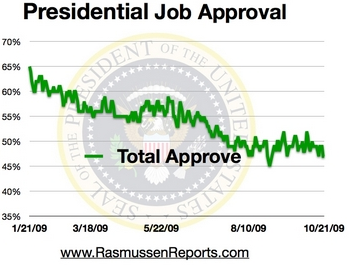
RCP says that the current average rating across major polls is 52.4%.  CNN reports  55%.  Hmmm.

Interestingly, CBS reports a higher number — 56% and ABC reports a still higher 57%.  Three mainstream media shops reporting the 3 highest numbers in the sample.  Double hmmm.

The 2 surveys generally considered the most objective are Gallup — which leans a little bit left — and Rasmussen — which leans right.

Gallup reports 50%; Rasmussen calls it 47%.

So, three mainstream networks average about 7 points more than the 3rd party sources.  I’d call that statistically significant.  And, I don’t call it a coincidence …

BTW: note that Fox reports 49% — between Rasmussen & Gallup.  I didn’t throw Fox in with either group since some folks question their objectivity and they’ve been stripped by the WH of their “news network” status.

* * * * *

The Data

image
http://www.realclearpolitics.com/epolls/other/president_obama_job_approval-1044.html

* * * * * *

Note that both Gallup and Rasmussen show a decline in job approval from the high 60%s to 50% plus or minus a little. 

Gallup bounces around a little above 50%,’ Rasmussen a little below 50%.

image
http://www.gallup.com/poll/113980/gallup-daily-obama-job-approval.aspx

image 
http://www.rasmussenreports.com/public_content/politics/obama_administration/daily_presidential_tracking_poll

* * * * *

The number I like to watch is Rasmussen’s PAI — Presidential Approval Index — the difference between the % of people who strongly approve and the 5 who strongly disapprove.

Early on, Obama’s PAI was as high as plus 30%.  Now, it’s down to minus 13% — with 27% strongly approving and 40% strongly disapproving.  That means that almost 80% of the folks who disapprove, strongly disapprove.  That’s a high intensity factor.

image
http://www.rasmussenreports.com/public_content/politics/obama_administration/daily_presidential_tracking_poll

* * * **

DVDs … going the way of the 8-track.

October 22, 2009

TakeAway:  Surprise surprise … DVDs are no longer worth the floor space. 

Now, Wal-mart has essentially crushed this product in one fell swoop.  When you leave it up to retailers to force product evolution, chances are that it is too late.

* * * * *

Excerpted from WSJ “Wal-Mart Scales Back DVD Displays” By Nat Worden, October 5, 2009

Wal-Mart accounts for nearly a third of DVD retail sales in the U.S. … But, as part of a larger effort to clean up its aisles and appeal to higher-end shoppers, Wal-Mart is doing away with display cases to promote the latest hot movie titles.

The move comes as major film studios are reeling from declines in revenue from DVD sales as consumers turn to low-cost rental services and digital downloads for home movies …

“We think the new strategy implies Wal-Mart no longer sees DVDs and Blu-ray discs as traffic drivers” .

The change to its DVD selling strategy is part of a larger merchandising overhaul the company calls “Project Impact,” in which it has been devoting more shelf space to top-selling products and cutting back on items that linger.

The discount giant also is trying to spruce up its image and cut back on clutter in its aisles, like corrugated displays for DVDs, in hopes that it can attract a more upscale shopper …

Meanwhile, Wal-Mart and other major retailers, along with several fast-food chains, have been adding low-cost DVD rental kiosks, such as Redbox, near store entrances … And studios have cut deals with services like Netflix …

Edit by TJS

* * * * *

Full Article
http://online.wsj.com/article/SB125470337132563199.html?mod=WSJ_hps_sections_tech

* * * * *

Ignoring its product problems, GM attempts to boost sales via distribution increases

October 22, 2009

TakeAways: (1) When you give buyers a chance to bid low on your product, they will.  (2) If your  product sucks, they’ll bid low … real low.

Welcome to the era of Government Motors.

* * * * *

Excerpted from WSJ, “GM, eBay End Online Sales Effort” By Geoffrey Fowler, Scott Morrison, and Sharon Terlep, September 30, 2009

General Motors is ending a seven-week experiment to sell new cars in California with eBay as many dealers report the online marketplace didn’t help sell more vehicles and led shoppers to offer low-ball prices … but the program did generate customer interest … and customer leads …

The program launched … as part of an effort to make car shopping more convenient …

The experience illustrates why car retailing, which involves peculiarities such as franchised dealers with exclusive territories and the tradition of haggling in person, makes an odd fit for the Web, where consumers expect to comparison shop for the lowest price …

The promotion didn’t allow customers to bid against each other, like they do in typical eBay auctions. Rather, they could click “Buy It Now” to purchase a car at a preset price, or send an offer to a dealer … the ridiculously low offers forced staff to sift through bids that were highly unlikely to result in sales …

Maybe GM and eBay should have done more to set appropriate expectations among shoppers, many of whom had no idea where to start their price negotiations.

Edit by TJS

* * * * *

Full Article
http://online.wsj.com/article/SB125423429407549391.html#mod=todays_us_marketplace

* * * * *

Declaring war … on the U.S. Chamber of Commerce?

October 21, 2009

Ken’s Take: Unemployment — likely to be the 2010 election’s issue — is almost 10% and shows no sign of abating.  So what does Team Obama decide to do? Put the U.S. Chamber of Commerce — the most prominent representative of business — on its enemies list for failure to support some of the administration’s policies. 

Who, pray tell, does the administration think is ultimately going to do the hiring that’s going to get unemployment down?

My real life business friends tell me that they’re were already going to move slowly hiring people back because of “political risk” — the uncertainties re: higher taxes, increased healthcare burdens, and wage controls.  I’d think that hacking-off these folks  would just slow the hire-back process even more … keep unemployment levels high … and hang a political millstone around Dems necks next year,

We’ll see …

* * * * *

Excerted from: Politico, White House plan: Neuter the Chamber, October 19, 2009

The White House and congressional Democrats are working to marginalize the Chamber of Commerce — the powerful business lobby opposed to many of President Barack Obama’s first-year priorities.

Democrats in Congress have been angered by the Chamber’s attacks on the House climate change bill and its staunch opposition to the creation of a consumer financial protection agency, a centerpiece of the administration’s financial regulatory reform efforts.

Chamber officials say the White House is scapegoating the Chamber and other trade associations as a way of dividing the business community, a move that could help the administration make headway on health care reform, climate change legislation and regulatory reform.

“When they launch a frontal assault against free enterprise and the Chamber of Commerce, I can guarantee it is not lost on any trade association executives or staff in this town.”

Administration officials give significantly more attention to the Business Roundtable, an association of chief executive officers of leading U.S. companies.

And some Democrats in the House say they are … overlooking the national Chamber in favor of local organizations in their districts.

The Democrats’ assault on the Chamber is not without risk. While neutralizing the Chamber would amount to a major tactical victory for the administration, anything less could backfire — infuriating and energizing a well-funded foe with ties to business in virtually every community in the country.

Full article:
http://dyn.politico.com/printstory.cfm?uuid=6A5B11C3-18FE-70B2-A873536030768679

American Association of University Professors … it’s not an idea-swap group, it’s a union !

October 21, 2009

Ken’s Take: There’s just something about somebody with guaranteed lifetime employment unionizing that strikes me as inappropriate.  Many workers would give up their smoke breaks for a guaranteed job for life.

* * * * *

Excerpted from WSJ: Professors of the World, Unite,  Oct. 17, 2009

Wisconsin tests whether profs will be thinkers or unionists.

Over the past 10 years or so, unions have become an increasingly common presence at colleges and universities. More than 375,000 faculty and graduate students are members of a collective bargaining unit.

In 2008, the American Federation of Teachers announced a joint campaign with the American Association of University Professors to unionize more public universities.

If some professors at the University of Wisconsin at Madison get their way, the first thing a newly minted PhD will learn about is not research or teaching—but union dues. This summer Wisconsin’s Democratic Governor Jim Doyle gave the school’s professors the right to unionize.

If UW Madison goes, expect more academic “free-thinkers” to go over to the union mind set.

Full article:
http://online.wsj.com/article/SB10001424052970204409904574350834263887324.html?mod=djemEditorialPage

* * * * *

Would you be on Facebook if it wasn’t free?

October 21, 2009

TakeAway: Facebook has been massively successful enlisting posters … but far less successful making money. Which raises an obvious question: why not charge for the service?

* * * * *

Excerpted from Business Week: How Facebook Could Cash in on Its Upscale Fans, Oct 12, 2009

Nielsen says that 17% of the time people spend surfing the Internet is devoted to social sites, up 6% from a year earlier. No doubt, the quick and addictive status updates posted daily by users of Facebook and Twitter have something to do with the increase.

Facebook is the king of social networking. But the site is stuck with an old business model that may prevent it from turning the increasing affluence of its users into profits. Simply put: Facebook should charge, says BusinessWeek blogger Douglas MacMillan.

A recent study by Nielsen Claritas that divides 200,000-plus participants into three segments based on affluence showed that 25% of the top tier were more likely to use Facebook than the bottom tier. In the lowest segment, 37% were more likely to use MySpace.

Not only has Facebook won over many younger users of MySpace but it has introduced social networking to people in their 20s, 30s, 40s, and older. As the Nielsen Claritas study hints, these users have jobs and bank accounts, and might be willing to shell out a few bucks a month for an increasingly valuable tool.

Facebook has shot down the idea of charging all of its members. But the site may have plans to put a price tag on services, such as offering to print the millions of photos people upload to the site. It could also charge a nominal fee, like $1 per month, to let members avoid ads.

The company reports positive cash flow and talks up bold advertising initiatives. But is it building a business that taps the deep pockets of its users?

http://www.businessweek.com/magazine/content/09_41/c4150executive737881_page_3.htm
http://www.businessweek.com/the_thread/blogspotting/archives/2009/09/facebook_users.html

* * * * *

First Cash for Clunkers … now, Carts for Clubbers.

October 20, 2009

Ken’s Take: This stuff keeps getting nuttier and nuttier. 

Half-baked ideas with shoddy implementation doesn’t strike me as a (cart) path to success.

* * * * *

Excerpted from WSJ:Cash for Clubbers – Congress’s fabulous golf cart stimulus, Oct. 17, 2009

Thanks to the federal tax credit to buy high-mileage cars that was part of President Obama’s stimulus plan, Uncle Sam is now paying Americans to buy that great necessity of modern life, the golf cart.

The federal credit provides from $4,200 to $5,500 for the purchase of an electric vehicle, and when it is combined with similar incentive plans in many states the tax credits can pay for nearly the entire cost of a golf cart. 

The golf-cart boom has followed an IRS ruling that golf carts qualify for the electric-car credit as long as they are also road worthy. These qualifying golf carts are essentially the same as normal golf carts save for adding some safety features, such as side and rearview mirrors and three-point seat belts. They typically can go 15 to 25 miles per hour.

The IRS has also ruled that there’s no limit to how many electric cars an individual can buy, so some enterprising profiteers are stocking up on multiple carts while the federal credit lasts, in order to resell them at a profit later. 

Roger Gaddis of Ada Electric Cars in Oklahoma said earlier this year. “Is that about the coolest thing you’ve ever heard?”

If this keeps up, it’ll soon make more sense to retire and play golf than work for living.

Full article:
http://online.wsj.com/article/SB10001424052748704107204574473724099542430.html

* * * * *

All we really want: Status, Certainty, Autonomy, Relatedness, and Fairness …

October 20, 2009

TakeAway: Neuroscience research is revealing the social nature of the high-performance workplace. Perhaps the greatest challenge facing leaders of business or government is to create the kind of atmosphere that promotes status, certainty, autonomy, relatedness, and fairness.

* * * * *

Excerpted from Strategy+Business, Managing with the Brain in Mind, Issue 56, Autumn 2009

The human brain is a social organ.

Its physiological and neurological reactions are directly and profoundly shaped by social interaction.

“Most processes operating in the background when your brain is at rest are involved in thinking about other people and yourself.”

So, the brain experiences the workplace first and foremost as a social system.  Most people who work in companies learn to rationalize or temper their reactions; they “suck it up,” as the common parlance puts it. But they also limit their commitment and engagement.

* * * * *

Many studies now show that the brain equates social needs with survival.

For example, being hungry and being ostracized activate similar neural responses.Recently, researchers have documented that the threat response is often triggered in social situations, and it tends to be more intense and longer-lasting than the reward response.  

Because the threat response uses up oxygen and glucose from the blood, they are diverted from other parts of the brain, including the working memory function, which processes new information and ideas. This impairs analytic thinking, creative insight, and problem solving; in other words, just when people most need their sophisticated mental capabilities, the brain’s internal resources are taken away from them.

When leaders trigger a threat response, employees’ brains become much less efficient.

* * * * * 

Five particular qualities minimize the threat response status, certainty, autonomy, relatedness, and fairness (SCARF).

Status and Its Discontents

Humans are constantly assessing how social encounters either enhance or diminish their status.

Research shows that when people realize that they might compare unfavorably to someone else, the threat response kicks in, releasing cortisol and other stress-related hormones.

The mere phrase “Can I give you some advice?” puts people on the defensive because they perceive the person offering advice as claiming superiority.

A Craving for Certainty

When an individual encounters a familiar situation, his or her brain conserves its own energy by shifting into a kind of automatic pilot: it relies on long-established neural connections in the basal ganglia and motor cortex that have, in effect, hardwired this situation and the individual’s response to it.

This makes it easy to do what the person has done in the past, and it frees that person to do two things at once; for example, to talk while driving.

But the minute the brain registers ambiguity or confusion — if, for example, the car ahead of the driver slams on its brakes — the brain flashes an error signal. With the threat response aroused and working memory diminished, the driver must stop talking and shift full attention to the road.

Of course, uncertainty is not necessarily debilitating. Mild uncertainty attracts interest and attention: New and challenging situations create a mild threat response, increasing levels of adrenalin and dopamine just enough to spark curiosity and energize people to solve problems.

The Autonomy Factor

Studies show that the degree of control available to an animal confronted by stressful situations determines whether or not that stressor undermines the ability to function.

A perception of reduced autonomy — for example, because of being micromanaged — can easily generate a threat response.

When an employee experiences a lack of control, or agency, his or her perception of uncertainty is also aroused, further raising stress levels.

By contrast, the perception of greater autonomy increases the feeling of certainty and reduces stress.

Relating to Relatedness

Fruitful and healthy relationships require trust and empathy.

But in the brain, the ability to feel trust and empathy about others is shaped by whether they are perceived to be part of ateam.

Conversely, the human threat response is aroused when people feel cut off from social interaction.

Loneliness and isolation are profoundly stressful.

Playing for Fairness

The perception that an event has been unfair generates a strong response in the limbic system, stirring hostility and undermining trust.

As with status, people perceive fairness in relative terms, feeling more satisfied with a fair exchange that offers a minimal reward than an unfair exchange in which the reward is substantial.

The cognitive need for fairness is so strong that some people are willing to fight and die for causes they believe are just — or commit themselves wholeheartedly to an organization they recognize as fair.

* * * * *

Remember SCARF: status, certainty, autonomy, relatedness, and fairness.

* * * * *

Full article:
http://www.strategy-business.com/article/09306?pg=all

* * * * *

So, will social networking sites ever make money ?

October 20, 2009

TakeAway: Social networking sites may be popular, but they’re still not profitable …

* * * * *

Excerpted from: Knowledge@Wharton, Early Tremors: Is It Time for Another Social Network Shakeout?, October 14, 2009

Experts predict a shakeout in the social networking market.  Why? Consumers only have time for so many social networking sites and are likely to gravitate where they already have friends.

What’s unclear is where social networking goes from here. Experts say there’s still a lot of growth left in the sector, but a round of consolidation, reinvention and restructuring is likely in the not-too-distant future. “Clearly, social networking has caught on in a great way, but there’s still a lot of uncertainty about where all of this will wind up. The market is very dynamic.”

The upcoming round of consolidation may include a good bit of reinvention as social networking sites tinker with business models.

“The big question today is: How will social networking and social media sites monetize themselves? Turning themselves into social commerce sites will be very difficult.”

Most companies in the social networking space are still experimenting with ways to generate revenue. The Holy Grail: Highly personalized advertising and word of mouth marketing.

Social networking companies could sell applications (like Apple’s iTunes Store does), aggregate massive audiences for advertisers or target high-value consumers that are coveted by Madison Avenue. Another option: Sell behavioral data to advertisers. Smaller players can target groups that are highly coveted by marketers.

Other social networks are focusing on business uses and providing tools for advertisers and any company that wants to monitor its brand. Most social networks are likely to develop models that revolve around serving so-called “enterprise customers” — companies looking for intelligence about their products and reputation.

Indeed, the focus on business intelligence could help some of the smaller social networks thrive. For instance, LinkedIn has a recruiter product for human resources professionals, designed to find “passive candidates,” or people not actively looking for jobs who could be good hires. LinkedIn charges a fee per user for the recruiting service and counts Allstate, eBay, Logitech and Kaiser Permanente as customers.  

The real trick will be finding the balance between privacy and profit.  In 2007, Facebook launched a service called Beacon that was designed to track users’ activity on external sites and deliver more targeted ads. After privacy complaints, Facebook continued to tweak Beacon before ultimately shutting it down in September.

What’s likely to emerge is a social networking market where there are multipurpose sites that have vast economies of scale, like Facebook and MySpace, and niche players, like LinkedIn, that find profitable business models. “People will go with the large social networking sites, but there will be very niche communities that will also be successful. The companies in the middle will be squeezed.”

* * * * *

According to comScore’s August data, the top three social networking sites in the current U.S. market are Facebook, MySpace and Twitter.

Facebook (which launched in 2004) is number one, with year-over-year growth of 125%.  Facebook had more than 92 million unique visitors in August in the U.S., and now serves more than 300 million people worldwide.

MySpace, which is increasingly focused on becoming an entertainment portal as well as a social networking site, is in flux, but is still the second-largest social networking site. MySpace had 64.2 million unique users in August, down from 75.5 million in August 2008

In third place sits Twitter, launched in 2006, which had 20.8 million unique users in August — up 1,773% from a year ago.

* * * * *

Full article:
http://knowledge.wharton.upenn.edu/article.cfm?articleid=2354

* * * * *

Tax breaks for pets … Lord, just take me now.

October 19, 2009

Ken’s Take: I say, only for pets who are in the country legally …

* * * * *

The Survey Says

According to Rasmussen …

25% of voters nationwide favor a proposal that would allow pet owners to deduct up to $3,500 for “qualified pet-care expenses” for household pets.

A proposal known as the HAPPY (Humanity and Pets Partnered Through the Years) Act was introduced in Congress earlier this year. (Details are below)

Women like the tax break more than men.

Most voters under 30 favor the approach, but their elders strongly disagree.

Democrats are more than twice as likely to favor the pet-care tax deduction than Republicans.

Full article:
http://www.rasmussenreports.com/public_content/politics/general_politics/october_2009/25_favor_tax_deduction_for_pet_expenses

* * * * *

The Details

Excerpted from NOLA.com: Capitol Hill considers tax breaks for pet owners, October 13, 2009

Legislators in Washington — with support from animal rights groups — are considering a bill that pairs tax cuts and pet ownership.

The Humanity and Pets Partnered Through the Years Act — called the HAPPY Act — aims at helping current pet owners in these tough economic times and also hopes to encourage pet adoption through attractive incentives.

With more attention being paid to the fate of pets whose owners lose their homes, interest is growing on Capitol Hill and beyond about how the government can respond.

“Taking care of pets does cost money, and during the dramatic decline of people’s income and the shaky economy, any possibility of assisting people in meeting those costs should be looked at.”

The bill includes tax breaks not only for cats and dogs, but also for legally owned exotic pets.

Considering the costs of keeping pets, which varies between about $650 a year on average for a cat and almost $900 a year on average for a dog, a tax break would be nice for many New Orleans pet owners. A cap of $3,500 would be put on the tax break per person.

* * * * *

According estimates from The Humane Society, 39 percent of American households own at least one dog, and 38 percent own at least one cat. As many as 62 percent U.S. households own a pet.

* * * * *
Excerpted from NOLA.com: Capitol Hill considers tax breaks for pet owners, October 13, 2009
http://www.nola.com/pets/index.ssf/2009/10/capitol_hill_considers_tax_bre.html

Marriott gets a wake-up call …

October 19, 2009

Punch Line: Shaken by the plunge in travel, the hotel giant presses ahead with a makeover: freshening its look, trying new brands, and preparing a successor to the patriarch.

* * * * *

Excerpted from CnnMoney, Marriott gets a wake-up call, June 25, 2009

The recession has hit Marriott’s financial results like a rock band visiting a hotel room. In the first quarter of 2009, revenues were $2.5 billion, a 15% year-over-year decline, and net income was $87 million, a 28% drop.

To fill more rooms, Marriott is offering free nights and discounted rates. You can stay at a brand-new JW Marriott in Medan, Indonesia, for just $85 a night, or book a room at a Marriott beach resort and casino in Curaçao for $120.

Cutting expenses is another option.

Next time you order breakfast at a Marriott, you may notice something new about the bacon. Instead of being served in identical six-inch strips, it now comes in an assortment of sizes. That’s because senior executives of Marriott, after sampling four or five varieties of bacon in a blind taste test, found that an irregular cut, which costs less, tastes just as good as the rectangular slices traditionally served in the company’s hotels.

Guests may also notice that Marriott has replaced Häagen-Dazs ice cream with the less expensive Edy’s brand. (The company says Edy’s, which isn’t as dense, is also easier to scoop at banquets.)

Breakfast buffets offer fewer varieties of fruit.

Even Ritz-Carlton is trimming expenses, curbing opening hours for spas and restaurants.

No cost-cutting move got more attention than Marriott’s decision to eliminate automatic delivery of newspapers to guest rooms. The company estimates that it will deliver 50,000 fewer papers every day, or 18 million a year, an unwelcome development in the reeling newspaper industry. “In this economic climate, it isn’t responsible to keep giving guests something they don’t want,” Marriott says. “You’d see guests come out of the room and step on the newspaper, and they weren’t even picking it up.”

Meanwhile, Marriott has been making over its brands, which needed sprucing up.

A couple of years ago Robin Uler, the company’s chief creative officer, took Bill Marriott Jr. to dinner at Prime One Twelve, a high-end steak house in Miami’s South Beach. Noisy and crowded, with wood floors, contemporary décor, and a menu to match, the place was hopping despite its high prices. Then they returned to the Marriott restaurant across the street, which was dead. “So do you still want carpets and booths far away from one another with no noise?” she asked him.

Lobbies in many Marriotts are morphing into “great rooms” with free Wi-Fi, where modular furniture can be arranged for meetings, socializing, or casual dining. “An empty lobby is not an inviting place to be,” Sorenson says. “The great room is about bringing back life.” If hotel guests spend a few extra dollars on a latte or a glass of wine instead of sitting in their rooms, all the better. Ideo, a cutting-edge consulting firm, helped Marriott redesign public spaces as well as guest rooms for Courtyards and TownePlace Suites.

Marriott is also getting outside advice as it prepares to enter the hotly contested category of boutique hotels, where Starwood’s W, the hip Monaco chain, and several independents have grabbed market share at lofty room rates. Edition, Marriott’s new brand, expects to open five hotels next year, with boutique guru Schrager and Bill Marriott Jr., both famously detail-oriented, collaborating on design.

Full article:
http://money.cnn.com/2009/06/22/news/companies/marriott_hotels_makeover.fortune/?postversion=2009062508

* * * * *

The smartest dog in America?

October 19, 2009

I report, you decide …

WARNING: Fido leans right … very right.

Turn your computer’s sound on …
 
then click the picture or the link.

image 

http://www.youtube.com/watch?v=XivhwO_zWWg

* * * * *

A ban on big screen TVs … only in California.

October 16, 2009

Ken’s Take: I really like this idea.  Why?  Frees up $$$ so folks can buy healthcare insurance … instead of me buying it for them.

* * * * *
From the San Francisco Business Times: California looks to limit big screen TVs, October 14, 2009

California may ban some types of big screen televisions because they use too much power.

The state’s energy commission has proposed limits on big screen plasma and liquid crystal TV sets. The move is supported by power utilities and opposed by electronics industry groups.

A vote by the commission could happen as early as Nov. 4. If the rules pass, they’ll take effect in two phases, the first in 2011 and the second, tougher level, in 2013, and would reduce energy consumption by 49 percent, the commission said.

These types of televisions use lots of power, as much as a refrigerator in some cases.

“The standards would improve the energy efficiency of televisions without affecting the quality of the television, ” said the commission. It also said the technology needed to improve the energy efficiency of sets already exists.

About 1,000 types of televisions already meet the stringent standards, the commission said.

http://sanfrancisco.bizjournals.com/sanfrancisco/stories/2009/10/12/daily42.html?ana=e_bjtt

Only in California, but maybe it’ll spread …

* * * * *

When Hillary Clinton is more popular than you are …

October 16, 2009

According to Gallup …

Hillary Clinton lost the 2008 Democratic presidential nomination to Barack Obama, but in one respect she now ranks ahead of Obama.

The president’s current favorable rating of 56% is down 22 percentage points since January.

Over the same time span, Clinton’s favorable rating has changed little, and now, at 62%.

Advantage: Mrs. Clinton.

image

Source: Gallup, Hillary Clinton Now More Popular Than Barack Obama October 15, 2009
http://www.gallup.com/poll/123665/Hillary-Clinton-More-Popular-Barack-Obama.aspx

* * * * * *

Boys will be boys … and that can be very profitable

October 16, 2009

TakeAway: Can anybody keep the attention of young males today? Maybe not, but that won’t stop us from trying.

Disney’s acquisition of Marvel is just the latest case of a company going after this fickle and easily-distracted segment.

You can’t blame Disney, however, as this segment has the potential to contribute greatly to overall profitability.

That is, as long as they finish their chores.

* * * * *

Excerpted from BusinessWeek, “Disney’s Marvel Deal and the Pursuit of Boys” By Tom Lowry and Ronald Grover, September 10, 2009

The U.S. has 30 million males aged 5 to 19, and capturing their attention with a TV show, movie, or magazine article is a boon to advertisers. Boys (or their parental proxies) are ravenous consumers who spend billions each year on apparel, toys, and video games.

Big Media, faced with the loss of auto and financial advertising, is charging hard at this elusive demographic.

Exhibit A: Walt Disney’s $4 billion acquisition of Marvel Entertainment and all its superheroes.

Besides attracting more boys and balancing out Disney’s big following among girls, the Mouse House believes the Marvel acquisition will bolster Disney XD, a channel it is now using to target boys.

Edit by JMZ

* * * * *

Full Article
http://www.businessweek.com/magazine/content/09_38/b4147066139865.htm?chan=innovation_branding_top+stories

* * * * *

Ty Cobb goes down to defeat … no, not "that" Ty Cobb

October 16, 2009

TakeAway: Dems have lost a string of  special elections because of national issues that have eroded independent and seniors’ support, and lackluster turnout — especially among minorities, young people, and far-lefters.

* * * * *
Excerpted from WSJ:  Health Care’s Coattails, Oct. 15, 2009

Last week, Republicans captured Albuquerque mayor’s office for the first time in 28 years.

On Tuesday, the GOP won a pair of special elections in Tennessee and Oklahoma, picking up seats held by Democrats for decades.

The reason: Republican intensity and lackluster Democratic turnout.

In Tennessee, Republican businessman Pat Marsh won 56% of the vote to defeat Democrat Ty Cobb. It wasn’t as if Mr. Cobb had a name unknown to voters. His brother Curt had held the seat before resigning to take another government office (and it probably didn’t hurt having the same name as a baseball legend).

But Mr. Cobb attributed his defeat to “national issues . . . the health care issue was the main one.”

A couple of states over, national issues may also have played a role in the GOP capture of an Oklahoma House seat held by Democrats since 1965. Republican Todd Russ won 56% of the vote even though registered Democrats have a two-to-one edge in the district.

The twin victories mean Republicans have captured a total of six state legislative seats from Democrats in special elections this year. The other wins came in Delaware, Texas, New Hampshire and Virginia.

Next up: the VA and NJ governor races in November.

Full article:
http://online.wsj.com/article/SB10001424052748704107204574475292426931168.html?mod=djemEditorialPage#printMode

* * * * *

10 years ago … when the Dow first broke thru the 10,000 barrier … versus now.

October 15, 2009

Remember when the Dow hit 10,000 in 1999?

CNBC put together an interesting “then & now” re: what was happening then and what’s happening now.

Worth browsing … will make you smile (and moan).

http://www.cnbc.com/id/33309699/

* * * * *

Should fat people pay more for health insurance?

October 15, 2009

I received several “you’re heartless” comments when I suggested that healthcare should be rationed to fat people (instead of rationing it to old people).
https://kenhoma.wordpress.com/2009/08/06/instead-of-old-people-how-about-rationing-care-to-fat-people/

Well, on a variant to the theme, a number of state insurance plans penalize smokers already.  In January of this year, Alabama became the first state to charge overweight employees more for their health insurance coverage, and North Carolina plans to place state employees who are overweight in a more expensive health insurance plan beginning in July 2011.

A new Rasmussen Reports national telephone survey finds that 50% support a plan that makes government workers who smoke pay more for their health insurance, and 30% favor making overweight government workers pay more for health coverage.

* * * * *

Factoids

70% of Americans said they opposed a national tax on all non-diet soft drinks to combat obesity.

41% of Americans describe themselves as overweight.

49% of adults say they exercise one to three times per week, and over half say their workout lasts at least 30 minutes.

18% of Americans smoke cigarettes … 34%) don’t smoke now but used to http://www.rasmussenreports.com/public_content/politics/current_events/healthcare/october_2009/30_say_overweight_workers_should_pay_more_for_health_insurance

* * * * *

$25 times a lot of bags equals … well, a lot of money.

October 15, 2009

TakeAway: From baggage to blankets, à la carte charges are becoming significant revenue sources for airlines

* * * * *

Excerpted from Business Week, For Airlines, Fees Become Lifelines, October 12, 2009

Just a few years ago air travel was simple: Buy a ticket, fly. But as airlines hunt for new revenues to help them weather the recession, their goal is to make fares just one piece of the travel experience. Whether it’s a fleece-blanket-and-travel-pillow set or a can of soda, the airline cabin has become a bazaar, and the selling has only just begun.

Ancillary revenues—products and services airlines can sell à la carte—are becoming a vital financial lifeline for airline balance sheets amid weak travel demand. For some airlines, more than 20% of 2008 revenue come from ancillary sources. 

Airlines argue that they have little choice: Low fares do not cover their costs, and charging for products and services represents one of their few options for survival. “The airlines have been in negative returns since the days of Orville and Wilbur [Wright].” 

Passengers could be forgiven for wondering where the new charges might end. Is air travel destined to be dominated by ultra-spartan flights, such as those pioneered in Europe by Ryanair ?  Ryanair has even proposed installing credit-card-operated toilets.

Carriers are learning that some fees are more palatable to travelers than others. Checked luggage is one of the most successful new revenue sources—the top 10 U.S. airlines collected $670 million in bag fees in the second quarter. American led the way in June 2008 with a $15 fee to check a first bag, and nearly every other U.S. carrier has matched that.

image

While it may take time to adjust to the new reality, consumers could ultimately benefit. With an à la carte approach, fliers will no longer be subsidizing products or services they don’t use.

Full article:
http://www.businessweek.com/magazine/content/09_41/b4150064773617.htm

* * * * *

Starbucks plays the value card … say, what ?

October 15, 2009

TakeAway:  For a company that has increased the price of its latte exponentially each time the price of milk rose by a penny, it is very intriguing to see Starbucks aggressively offering a coffee value play.  Will a high volume, low margin gain from an extension of its market footprint be able to turn this company around … we’ll see.

* * * * *

Excerpted from WSJ, “Starbucks Takes New Road With Instant Coffee,” By Julie Jargon, September 30, 2009

Starbucks aims to convince Americans and Canadians that its new Via instant coffee is comparable to its brewed product

Via is part of a strategy to provide value for customers who can’t or don’t want to splurge on a regular coffee purchase. One packet of the instant variety produces a cup of coffee for less than $1. Via costs $2.95 for a three-pack and $9.95 for a 12-pack …

Portability will be an important selling point. As such, Via will be available in stores such as REI and Office Depot … Via will be available for purchase on domestic United Airlines flights longer than two hours …

Starbucks doesn’t plan to enter traditional grocery stores until sometime next year … In traditional supermarkets, Starbucks will go up against Nestlé, maker of Nescafe Taster’s Choice, which already is running ads attacking Via.

Starbucks is launching its own ad campaign on television — a rare move for a company that has traditionally stuck to print ads and social-networking sites for its marketing.  The initial commercials will promote a “taste challenge” that will take place at Starbucks stores … “We’re convinced a majority of people won’t be able to tell the difference” …

The idea for developing an instant coffee has been brewing at Starbucks for 20 years … The company, which has struggled amid the recession as customers have either forgone Starbucks visits or purchased less expensive coffee drinks, expects its entry into the $21 billion global instant-coffee market to be a huge opportunity to boost sales …

Edit by TJS

* * * * *

Full Article
http://online.wsj.com/article/SB125418430092348015.html?mod=djemMM

* * * * *

Mayo Clinic’s "perfect model": turn away Medicare & Medicaid patients … oops.

October 14, 2009

TakeAway: Critics Say Move Shows That Facility Is Not a Model for Health-Care Reform

* * * * *

Excerpted from Washington Post, Mayo Clinic Faulted for Limiting Medicare Patients, October 13, 2009 

The renowned Mayo Clinic is no longer accepting some Medicare and Medicaid patients, raising new questions about whether it is too selective to serve as a model for health-care reform.

The White House has repeatedly held up for praise Mayo and other medical centers, many of which are in the Upper Midwest, that perform well in Dartmouth College rankings showing wide disparities in how much hospitals spend on Medicare patients.

Mayo announced late last week that its flagship facility in Rochester, Minn., will no longer accept Medicaid patients from Nebraska and Montana. The clinic draws patients from across the Midwest and West, but it will now accept Medicaid recipients only from Minnesota and the four states that border it. As it is, 5 percent of Mayo’s patients in Rochester are on Medicaid, well below the average for other big teaching hospitals, and below the 29 percent rate at the other hospital in town.

Separately, the Mayo branch in Arizona — the third leg of the Mayo stool, with the Rochester clinic and one in Florida — put out word a few days ago that under a two-year pilot program, it would no longer accept Medicare for patients seeking primary care at its Glendale facility. That facility, with 3,000 regular Medicare patients, will continue to see them for advanced care — Mayo’s specialty — but those seeking primary care will need to pay an annual $250 fee, plus fees of $175 to $400 per visit.

Mayo officials said Monday that the two moves were “business decisions” that had grown out of longstanding concerns about what it sees as underpayment by Medicare and Medicaid.

The officials said they were not meant to influence the national reform debate, in which Mayo has also been advocating against the creation of a government-run insurance option. But they said the moves were indicative of the need for the Medicare payment reforms it has been pushing in Washington.

http://www.washingtonpost.com/wp-dyn/content/article/2009/10/12/AR2009101202803_pf.html

* * * * *

Are you "authentic" … or just a "poser"?

October 14, 2009

TakeAway: “When we say a thing or an event is real, we honor it. But when a thing is made up – regardless of how true it seems – we turn up our noses.”

* * * * *

Excerpted from HBSP : Authenticity – What Consumers Really Want by James H. Gilmore and B. Joseph Pine II

Human beings have always been obsessed with the real and abjured the fake, the phony and the contrived.

In the mid-20th century, Jean-Paul Sartre extended this idea to personality, describing people so confused about their real selves that they lived “inauthentic” lives in self-deceived “bad faith.”

Consumers crave authenticity. If you don’t render authenticity, they will find someone who will, since this need for authenticity is intricately tied to self-image. No one wants to associate with a  “poser.”

* * * * *

Authenticity evolves from experiences and transformations.

Experiences are memorable “inherently personal” events, like when the barista at Starbucks remembers how you like your cappuccino and makes it to order for you.

Transformations help customers change some aspect of themselves. Such offerings – for example, fitness centers or Weight Watchers – let consumers be the sort of people they want to be and feel good about themselves. With each purchase, customers close the gap between reality and aspiration.

* * * * *

The are five “genres” of authenticity:

1. Natural authenticity – An authentic offering must feel natural, raw, of-the-earth, rustic, stripped-down and if possible sustainable, like organic food. For example, coffee beans and natural soaps are commodities, yet Starbucks and the Rocky Mountain Soap Company both render naturally authentic offerings.

2. Original authenticity – An original offering can be new (such as Apple’s iPod), but it can also be old (Coca-Cola) if it stresses its heritage as the first of its kind (“the real thing”).

3. Exceptional authenticity – Any offering can be exceptional, if it is done well, and with feeling. For example, consider the extraordinary services provided by Ritz-Carlton and Southwest Airlines. This doesn’t mean obsequiousness: The salespeople at Apartment Number 9, a Chicago clothing store, will tell you if the puce blazer you’re trying on makes you look fat. They sell not just clothes but also brutal honesty. Make your offering exceptional by stressing uniqueness, adopting a “craft” aesthetic (“good things take time to make”) or being “foreign” relative to the target market.

4. Referential authenticity – A referential offering evokes an “iconic” time, person, group or place. Imagine a Chinese tea ceremony or a visit to a sauna in Finland. If your referential offering is fake, make sure it is a good fake, like the art-filled Bellagio Hotel in Las Vegas, which evokes Bellagio, Italy.

5. Influential authenticity – To have influence, an offering must surpass utility to imply or provoke change. Think of green services, such as “eco-tourism,” or “three-word offerings,” such as “dolphin-safe tuna” or “free-range chickens.”

* * * * *

In Hamlet, Laertes is leaving Elsinore for France when Polonius accosts him. The old man, worried how his son will conduct himself abroad, recites a litany of admonishments that culminates in wisdom both trite and strikingly wise: “This above all,” says Polonius, “to thine own self be true.” In doing that, he continues, “Thou canst not then be false to any man.”

* * * * *

How to seduce women … advice from Pepsi. Huh?

October 14, 2009

Takeaway: PepsiCo’s Amp Energy drink has come out with an iPhone application that gives men tips on how to seduce women.  Huh ?

It’s no surprise that PepsiCos’ brands are moving into the digital space, as most brands nowadays have some sort of Facebook page or iPhone app. But by doing something so gratuitously over-the-top, could Amp’s message harm the image of PepsiCo’s other products? Probably not, since many of their brands have an “edgy, young and fun” positioning.

However, with the information available to consumers, it’s only a matter of time before someone realizes Amp is brought to them by the same company that sells Life cereal. And while Mikey may like the app, we’re not so sure mom will.

* * * * *

Excerpted from BrandWeek, “Pepsi Brand App Comes With NC-17 Rating” by Brian Morrissey, October 9, 2009

PepsiCo’s Amp Energy drink is looking to connect with young men by providing what might be the ultimate utility for the target audience: ways to score with women.

The “Amp Up Before You Score” iPhone application gives dudes various pickup lines and background info through digital flip cards for 24 different types of women, ranging from “rebound girl” to “treehugger” to the now ubiquitous “cougar.”

The app description page on iTunes warns of (promises?) profanity, crude humor and suggestive themes. Amp Energy targets men 18-24.

The Amp app suggests nearby motels, displayed on a Google Map, for rendezvous with married women. For “indie girls,” the app pulls in content from Under the Radar magazine and plots out nearby thrift stores.

Edit by JMZ

* * * * *

Full Article:
http://www.brandweek.com/bw/content_display/news-and-features/digital/e3id3d058ba458918f0aee67a2b41453db2?imw=Y

* * * * *

Follow-up article from WSJ:
http://online.wsj.com/article/SB10001424052748703790404574471522737925470.html?mod=WSJ_hps_MIDDLEForthNews

* * * * *

Companies are cutting costs … that’s a good thing, right?

October 13, 2009

Ken’s Take: I think that the realization is setting in that businesses have — partially out of necessity — cut back their bloated cost structures — big time.  Short run, it’s out of necessity — just to survive.  Medium run, the skinnier cost structures will provide profit leverage when sales start to bounce back.  Long-run, companies are will be better positioned to compete.

The downside: there’s little realistic hope for a quick turnaround in unemployment.  Companies will be slow to add back to their payrolls — especially given the increased political risk from government intervention, wage controls, and health care taxes and penalties.

If 10% unemployment is the 2010 over/under, I’m taking over.

* * * * *

Excerpted from WSJ: Cost Cuts Lift Profits But Hinder Economy, Oct. 13, 2009

Corporate America is showing better-than-expected profits, but the accompanying optimism belies deep worries among company executives about the strength of the economic recovery.

In an ominous sign for the economy, much of the profit is being eked out through cost cuts. Executives say they are hesitant to reinvest such profits into their businesses. With large portions of their factories, fleets and warehouses sitting idle, some say they probably won’t see reason to do so for a year or more.

That means job growth and any significant rise in business spending could be a long time coming.

That creates a chicken-and-egg problem at a time when the unemployment rate is already nearly 10%: Without more jobs, U.S. consumers will have a hard time increasing their spending; but without that spending, businesses might see little reason to start hiring.

Already, the economy is being starved of investment it needs to spark growth. Net private investment, which includes spending on everything from machine tools to new houses, minus depreciation, fell to … the lowest level since at least 1947.

“Things have stabilized, but we’re trying to be extremely cautious and not anticipate the recovery before it occurs …we’re looking to cut back as much as possible.”

And while companies are finding the credit-market thaw is making it easier to borrow money they would need to expand, many are stashing these funds rather than spending them. Of the 100 largest bond issues globally this year, only seven listed expansion, investment, capital expenditures or research and development as the purpose of the money-raising.

In industries ranging from apparel to heavy machinery, executives say they don’t yet have enough faith in the recovery to take significant risks.

One big obstacle: Many industries have excess capacity that, even if the economy perks up, will take many months to absorb.

The cautious mood is reflected in companies’ new orders for nondefense capital goods such as computers, trucks and office furniture, which in August were down … about 20% from the same month a year earlier.

“The politicians want people to think things are getting better, because a better mood feeds a turnaround. Things are getting better, but compared to what.”

Full article:
http://online.wsj.com/article/SB125539122868481389.html?mod=WSJ_hps_LEFTWhatsNews

* * * * *

An early indicator of GOP “energy” …

October 13, 2009

Note: I was in Albuquerque last week when the election took place.  MSB MBA alum Jamie Estrada – who is very active in New Mexico politics – was our personal trip adviser.  Besides telling us where to eat, he was the first to point out the implications of the ABQ mayoral election.

Specifically, GOPers are re-energized and many Obama supporters – especially minorities and college folks – aren’t turning out for the non-Obama elections.  An interesting trend that will be retested in the VA and NJ governor elections next month.

* * * * *

Excerpted from WSJ: The Sun Rises in the West, John Fund, Oct 9, 2009 

Enthusiasm counts for a lot in politics.

In 2008, Republican voter turnout was down in part because of the unpopularity of the Bush administration, while Barack Obama brought many excited new voters to the polls.

But now President Obama’s approval rating is hovering around 50% and Republicans appear energized in opposition to his plans.

An early sign of electoral trouble for Democrats may have come this week in Albuquerque – a city that accounts for more than a quarter of New Mexico’s population — where Democratic Mayor Marty Chavez was defeated for a third consecutive term by Republican businessman R.J. Berry.

Mr. Berry — a contractor and state legislator — ran on a platform of fighting crime and reducing regulations on small business. He becomes the first Republican elected to the mayor’s post since 1981— almost 30 years ago.

The GOP tide also created the first City Council with a Republican majority in anyone’s memory.

The election was also notable because, for the first time, local voters were required to show a photo ID to poll workers. The law worked smoothly and the
city’s election machinery functioned well, with no allegations of fraud for the first time in many years.

* * * * *