Archive for November, 2009

The healthcare bills … get out your wallets !

November 30, 2009

There are so many numbers being thrown around re: healthcare costs and the proposed ObamaCare proposals that’s it’s easy to lose the forest in the trees.

Here’s what you need to know … in round numbers.

First, U.S. healthcare expenditures average a bit over $7,000 per capita.

There are roughly 47 million uninsureds – but that number includes, for example, illegal immigrants who Pres. Obama says won’t be covered.  The proposed Senate bill covers 30 million uninsureds.

So, by simple arithmetic, the annual gross cost to cover the 30 million is about $210 billion – 30 million times $7,000.

Now, it starts to get tricky.

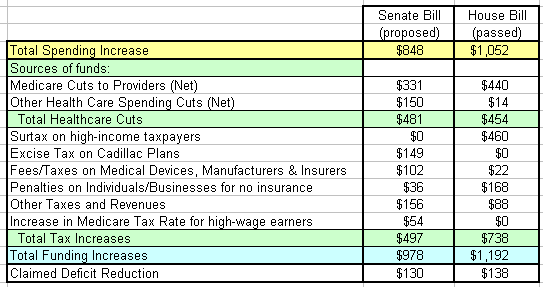
Reid proposes a $848 bullion increase in government healthcare spending over 10 years; Pelosi passed a bill north of $1 trillion across 10 years. (See chart below)

But, both bills delay the start of benefits for 4 years, so there are only 6 years of benefits in the 10 year projections.

The implication: Reid’s bill costs about $140 billion per year once it’s up & running;  Pelosi’s bill costs about $165 billion. For simplicity, we’ll strike an average and round down to $150 billion.

Now, $150 billion is less than the $210 billion it costs to cover 30 million uninsureds ar $7,000 a pop.  How can that be?

Well, some of the newly covered uninsureds will be paying their own way — in total or in part.   For example, some healthy young folks who can afford health insurance but make an economically rational choice to self-insure.  They’ll be “mandated” to buy insurance – and fined or jailed if they don’t.  Other folks will get taxpayer subsidized insurance but – based on means tests – will have to pay part of the premiums. 

My take: the spending estimates are probably reflective of what the bills say – the projections “haircut” the costs of the 30 million uninsureds and add in the costs of building and running the forthcoming government bureaucracy (think electronic medical records and thousands of watchdogs and claims processors pirated from the DMV and IRS).

That’s the spending.  How will it be paid for?

In round numbers, they’re talking about $1 Trillion of new spending … financed about 1/2 from heathcare cuts (mostly MediCare) – and about 1/2 from higher taxes. 

Taxes are projected to go up about $50 to $75 billion per year.  Healthcare cuts are estimated to be about $50 billion per year. (Keep in mind that the tax increases and healthcare cuts start immediately, benefits are delayed until year 5).

So, over the first 10 years, the early-starting cuts and taxes balance out against the late-starting benefits to the uninsureds … and even provide some excess taxes to pay down the deficit. (yeah, right !)

But, what happens each year, starting in year 5 when the benefits begin?

Well, based on the above calculations, the are $150 billion per year in increased spending, but only $100 billion per year in compensating healthcare cuts and tax increases.

Oops.

Looks like another $50 billion in healthcare cuts (i.e. rationing) and tax increases are coming down the pike.

That, my friends is all you need to know.

* * * * *

Here’s a simple “sources & uses” statement.  All numbers in billions.  Read ‘em and weep …

             Click to enlarge
image
http://www.taxfoundation.org/blog/show/25527.html
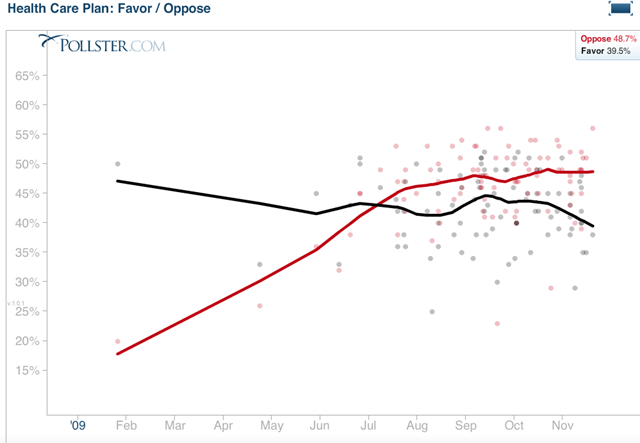
Support for healthcare plans drops below 40% …

November 30, 2009

Based on Pollster.com’s “poll of polls”, almost half the country opposes the proposed healthcare plan(s) … and fewer than 4 in 10 folks favor it (or “them”).

Still, our elected representatives in DC keep pushing forward any way, to legislate “the will of the people”.

Anybody see a contradiction in there ?

image
http://www.pollster.com/polls/us/healthplan.php

Netflix: What happens when DVDs meet 8-tracks in the junk heap?

November 30, 2009

TakeAway:  Through effective consumer management and distribution strategies, Netflix has changed the rules of the movie rental business and managed to fend off competitors along the way. 

However, as the game continues to evolve and Netflix’s distribution advantages become obsolete, will its subscription/information-based consumer loyalty model enable sustained success?

* * * * *

Excerpted from Knowledge@Wharton, “Netflix: One Eye on the Present and Another on the Future,” October 28, 2009

In a year when DVD sales are falling and studios are facing major shakeups … Hollywood is beginning to look a lot like one of its own slasher films … however, there is at least one success story in the movie industry: Netflix.

… Netflix made a splash in the movie rental business by offering an online subscription model with a flat monthly fee for unlimited rentals and no late charges. Since then, despite a recession, fierce competition and the emergence of online video delivery, the company continues to thrive … Netflix is now in a race to transition to a business model focused on streaming content online …

In 2008 Netflix introduced a “Watch Instantly” service that allows consumers to stream movies on their home computers. Since then, the company has forged a bevy of partnerships to embed its Watch Instantly service in television sets and game consoles …

Netflix CEO said the company’s goals were simple: Grow revenue, subscribers and earnings while expanding into streaming content … 

However, Netflix’s DVD business faces intense competition from companies ranging from Apple (iTunes) to Blockbuster to Redbox … and … Netflix’s video streaming model is under fire from powerful rivals … YouTube … But it’s not as though competition is anything new for Netflix. So-called “Netflix killers” have surfaced repeatedly in the last decade … but they haven’t been able to stop Netflix’s momentum …

Netflix has proven its doubters wrong repeatedly, but it is unclear how the balancing act between the company’s old and new business models will play out …

For now movie rental sales figures are playing to Netflix’s advantage … DVD rentals have held up well as consumers opt for cheaper forms of entertainment … Particular strategies have helped Netflix maintain its lead, including:  1) Keeping one eye on the road and one eye on the turn ahead … 2) Employing a subscription model … 3) Moving quickly to stay ahead …

The longer Netflix can maintain its old model while investing in its digital streaming business, the better off it will be. Rivals can’t easily emulate the company’s distribution centers and information systems that allow it to deliver DVDs within one business day to 97% of its subscribers … And, the company’s physical assets have created a “moat” around the Netflix business model …

Digital distribution lowers the barriers to compete with Netflix …

Edit by TJS

* * * * *

Full Article
http://knowledge.wharton.upenn.edu/article.cfm?articleid=2367

* * * * *

Post-Thanksgiving reflections …

November 27, 2009

We received this from a friend on T-Day.  Several passages resonated with me.  Worth reading, even when it’s not Thanksgiving

* * * * *

I Believe… That just because two people argue, doesn’t mean they don’t love each other, and just because they don’t argue, doesn’t mean they do love each other.  

I Believe… That we don’t have to change friends if we understand that friends change.  

I Believe… That no matter how good a friend is, they’re going to hurt you every once in a while and you must forgive them for that.    

I Believe… That true friendship continues to grow, even over the longest distance. Same goes for true love.    

I Believe… That it’s taking me a long time to become the person I want to be.  

I Believe… That you should always leave loved ones with loving words. It may be the last time you see them.  

I Believe… That you can keep going long after you think you can’t.  

I Believe… That we are responsible for what we do, no matter how we feel.  

I Believe…. That either you control your attitude or it controls you.    

I Believe… That heroes are the people who do what has to be done when it needs to be done, regardless of the consequences.  

I Believe… That money is a lousy way of keeping score.  

I Believe… That my best friend and I can do anything, or nothing, and have the best time.    

I Believe… That sometimes the people you expect to kick you when you’re down, will be the ones to help you get back up.    

I Believe… That sometimes when I’m angry I have the right to be angry,  but that doesn’t give me the right to be cruel.  

I Believe… That maturity has more to do with what types of experiences you’ve had, and what you’ve learned from them…..and less to do with how many birthdays you’ve celebrated.    

I Believe… That it isn’t always enough to be forgiven by others. Sometimes, you have to learn to forgive yourself.  

I Believe… That no matter how bad your heart is broken the world doesn’t stop for your grief.    

I Believe… That our background and circumstances may have influenced who we are, but we are responsible for who we become.  

I Believe… Two people can look at the exact same thing and see something totally different.  

I Believe… That your life can be changed in a matter of hours by people who don’t even know you.  

I Believe… That even when you think you have no more to give, if a friend cries out to you…….you will find the strength to help.  

I Believe… That credentials on the wall do not make you a decent human being.    

I Believe… That the people you care about most in life are taken from you too soon.  

I Believe…. That the happiest of people don’t necessarily have the best of everything; They just make the most of everything.      

I thank God for all the wonderful people who help us through-out the journey of life.

Rationing? What rationing ?

November 25, 2009

TakeAway: The flap over breast cancer screening has provided a fascinating insight into life under ObamaCare.

* * * * *

Excerpt from WSJ: Liberals and Mammography, Nov.24, 2009

The political left supports medical rationing even as it disavows that any such thing is happening.

No sooner had the Health and Human Services Department’s U.S. Preventative Services Task Force recommended against mammography for women under 50 than Secretary Kathleen Sebelius rushed to say don’t worry.

The New York Times, ran at least four much-ado-about-nothing items even as it endorsed the reduced screening.

What’s really going on here is that the left knows its designs will require political rationing of care, but it doesn’t want the public to

Americans will simply have to accept that the price of government-run health care in the name of redistributive justice is that patients and their doctors must bow to the superior wisdom of HHS task forces.

http://online.wsj.com/article/SB10001424052748704779704574552320222125990.html

Just in case you thought the housing crisis was behind us …

November 25, 2009

Just in case you thought the housing crisis was behind us … some factoids:

Underwater Mortgages

Most U.S. homeowners still have some equity, and nearly 24 million owner-occupied homes don’t have any mortgage.

But, the proportion of U.S. homeowners who owe more on their mortgages than the properties are worth has swelled to about 23%.

Nearly 10.7 million households had negative equity in their homes.

5.3 million U.S. households are tied to mortgages that are at least 20% higher than their home’s value.

Homeowners in Nevada, Arizona, Florida and California are more likely to be deeply under water. In Nevada, for example, nearly 30% of borrowers owe 50% or more on their mortgage than their home is worth.

More than 40% of borrowers who took out a mortgage in 2006 — when home prices peaked — are under water.

Even recent bargain hunters have been hit: 11% of borrowers who took out mortgages in 2009 already owe more than their home’s value.

* * * * *

Mortgage Delinquencies

About 7.5 million households were 30 days or more behind on their mortgage payments or in foreclosure.

Mortgage troubles are not limited to the unemployed. About 588,000 borrowers defaulted on mortgages last year even though they could afford to pay — more than double the number in 2007.

* * * * *

House Sales & Starts

Sales of previously occupied homes in October jumped 10.1% from September to a seasonally adjusted annual rate of 6.1 million, the highest since February 2007.

Realtors reported that home sales in October were up 24% from a year earlier.

The number of homes listed for sale nationwide was 3.57 million at the end of October, down 3.7% from a month earlier.

Jittery home builders and bad weather led to a 10.6% drop in new home starts in October.

Excerpt from WSJ: One in Four Borrowers Is Under Water, Nov. 24, 2009
http://online.wsj.com/article/SB125903489722661849.html?mod=WSJ_hps_LEADNewsCollection

Why doesn’t Pro-Choice extend to mammograms and pap smears?

November 25, 2009

I don’t get it.

Liberal Dems (think Rep. Wasserman-Schultz from Florida) assert that women have the “right” to a tax payer funded elective abortion.  

I disagree with her, but that’s not my point.

Last week, guidelines were announced (and pulled back) that would limit government reimbursements for mammograms and pap smears.

If a women has a right to choose what happens to her body when it comes to abortions, shouldn’t she have the right to choose a potentially life saving diagnostic test? 

Why should the government say yes to the former, and no or maybe to the latter?

Anybody else notice the irony ?

Wanna double shareholder returns? … Try "organic" growth through focused innovation.

November 25, 2009

HBR: Focus Intensely on a Few Great Innovation Ideas, by Georg von Krogh and Sebastian Raisch, Oct 2009

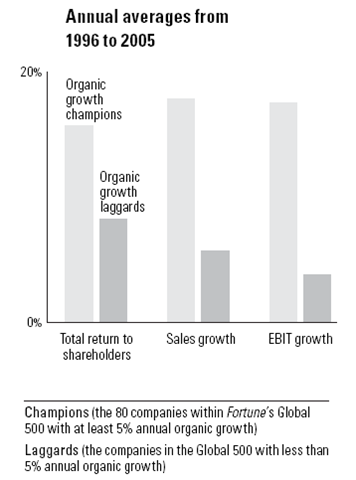
The global companies that are the most successful at achieving growth through innovation (as opposed to acquisitions) tend to devote their energies to a small number of breakthrough ideas. They select the initiatives with the greatest market potential and marshal their resources to develop them.

The organic-growth champions do more than focus on breakthrough ideas. They also put innovation at the top of the agenda, work across functional and divisional boundaries, and empower employees with an entrepreneurial mind-set.

Obviously, pursuing dozens of innovations is less expensive than developing thousands. But it also requires an intense focus on picking winners and commercializing them.

In a study of organic-growth champions— including GE, BMW, Nestlé, and Samsung— researchers at the Center for Organizational Excellence in Switzerland found that the firms’ shareholder returns were almost double those of the other Global 500 companies (which had lower rates of organic growth).

Procter & Gamble focuses its R&D on just eight to 10 core technologies, and Nestlé  … allocates large budgets to the 10 most promising innovations.

image

* * * * *

When it comes to profits, smart guys node a lot !

November 24, 2009

Takeaway: Companies that invest in power nodes, or sources of strength and leverage, have an increased likelihood of earning extraordinary profits.

Accordingly, classically trained strategists understand the potency of a brand, the power of relationships, and the advantage of captive markets. However, two new power nodes have quietly emerged.

Those who understand them well will likely rise to a level of strategic importance in their firms and thereby establish a power node of their own.

What can aikido and hubs do for you?

* * * * *

Excerpt from Strategy+Business, “The Most Powerful Paths to Profits,” by Mia de Kuijper, November 16, 2009.

In the 1990s, AT&T still controlled a huge share of the lines, hardware, and software required to deliver long-distance networking and telephone services to businesses and consumers. With minimal competition, the telecom giant could charge deliciously high rates for its services. The company’s vast network infrastructure amounted to what is called a power node: a source of strength or leverage that the company could reliably use to effortlessly dominate its market and fend off rivals.

In AT&T’s case, the power node was its preeminent stake in a network. But a power node can also be a coveted brand, a skill, a set of industry relationships, a process, a customer base with switching costs, regulatory protection, or access to resources. In short, it can be anything that a company depends on to influence financial outcomes.

The power nodes listed above have been around for a while, however two power nodes are strikingly novel.

The aikido asset power node is named after the Japanese martial art that exploits the energy of an opposing force. The key to aikido assets is being able to perceive and move with the momentum of the network. In the current information environment, it is no longer useful to “push” advertising and marketing messages to consumers. Most customers reach out for information they need on their own. If they find a source that they like, they tell other customers. They use search engines, which tend to drive large numbers of people to the most popular sources. 

Companies whose power node is based on the aikido approach are skilled in new forms of marketing. They “sow seeds,” tossing out many messages at minimal cost; Frito-Lay, for example, continually puts new flavors and packaging in the marketplace. These companies conduct surveillance, continually analyzing their digital media to see which messages are catching on.  And they react very quickly to what they learn from the networks, introducing or discontinuing products almost instantaneously. This may require the rapid retooling of sourcing, manufacturing, and distribution functions as they shift from one product to another.

Hubs are people or products that attract viewers, clients, buyers, or users in part because others are drawn to them as well; hubs are among the most effective power nodes imaginable in a transparent economy. Hubs represent the ability to become the beneficiary of self-reinforcing popularity.

The first Harry Potter book took off rapidly because friends recommended it to friends. It became a hub as others wanted to know what was driving people to read it. The existence of this hub ensured the popularity of the rest of the series. The transparency and immediacy of communications added momentum. Companies that can heighten the allure of their products this way, triggering attachment and emerging as hubs, will have a tremendously valuable power node.

When hub dynamics are at work, products or ideas that are ahead stay ahead for a long time.

That explains why Microsoft and Yahoo have not been able to catch up with Google in search volume. But because hubs are not a winner-take-all phenomenon, Google’s rivals have sizable numbers of users, leaving some room for market share to eventually turn against Google if a competitor comes up with a product that itself becomes a preferred hub. Microsoft hopes to exploit this opening with Bing, its new search engine.

Edit by BHC

* * * * *

Full Article
http://www.strategy-business.com/article/09412?pg=all

* * * * *

How many Palin books does it take to outsell 4 of Barack’s?

November 24, 2009

Botton line: Interesting analysis of the first week economics of Going Rogue — both to Palin and to others in the media.

Obvious answer to the headline question: one. 

* * * * *

Excerpted from The Daily Beast: Palin’s Gold Mine, Nov. 22, 2009

Did you hear that Sarah Palin has a book out? 

Sarah Palin sold 300,000 copies of Going Rogue on its first day of sale.

The book is No. 1 on Amazon, ahead of both Stephen King’s new novel, Under the Dome, and Dan Brown’s The Lost Symbol. Any way you carve it, Going Rogue looks to be a $12 million goldmine.  

Going Rogue is going gangbusters, and it looks like both Palin and her publisher, HarperCollins, are going to make some serious money off of it.

According to industry insiders, Palin got a $7 million advance for her book. She’s earning a royalty rate of 15 percent, which means she makes $4.35 per book sold, and therefore needs to sell all 1.6 million books that have printed to earn out her advance.

As a frame of reference, Nielsen BookScan reports that in 2008, the four books published by  Barack Obama between 2004 and fall 2008 sold a combined 912,000 copies.

http://blog.nielsen.com/nielsenwire/consumer/obama-books-out-sell-mccain-titles-in-2008/

On the media front, Palin was of particular value to  Oprah Winfrey this week. Oprah averages 6.8 million viewers. According to The New York Times, Palin’s appearance was Oprah’s best in two years, reeling in 8.7 million viewers.

There’s no way to argue with it: This was a triumphant week for the brand called Sarah Palin.

Given that people either think she’s a Godsend or a national joke—there’s really no in-between—it’s difficult to think that her popularity could be rising. But it certainly isn’t falling.

Whatever she’s selling, there are millions of people who are going to be buying. 

Full article:
http://www.thedailybeast.com/blogs-and-stories/2009-11-19/palins-gold-mine/?cid=hp:mainpromo7

About your bold strategic move … how is your competitor likely to respond (if he does)?

November 24, 2009

TakeAway: How to assess a competitor’s response to your strategic moves?  Game theory is often too complex and too assuming to fit the real world.  Intuitive-based war gaming is often skewed by personal biases and hidden agendas.

So, McKinsey proposes a practical approach to predicting competitive behavior that “stays close to the theoretical rigor and accuracy of game theory but is as easy to apply.

A prior post outlined why — at least 1/3 of the time — competitors do not respond at all to their rivals’ strategic moves .

This post outlines what moves — if any — a competitor might actively consider and most likely choose.

” * * * *

Excerpted from HBR: Predicting Your Competitor’s Reaction, by Coyne and Horn, April 2009

 
The McKinsey approach involves distilling all possible analyses of a rival’s response to a particular strategic move into a sequential
consideration of three questions, the first of which is “Will the competitor react at all?”

Once it is concluded that a competitive response is likely, it’s time to project the the nature of the response. Specifically, (1) What options will the competitor actively consider? and (2) Which option will the competitor most likely choose?

Although competitors may discuss many response options, they seriously investigate only a small number.

Even if companies consider multiple response options, most will have a clear preference for one or two.

And, the most common option competitors analyzed was “the single most obvious counteraction” (e,g. introducing a me-too product or matching a price change).

Of the options your adversary seriously considers, he will choose the one that is most effective (according to his analytic technique) within the constraints of his trade-off between short-term and long-term pain.

And, managers find it difficult to trade the certainty of short-term expense for the uncertainty of long-term gain.

To understand how competitors will respond to your move, evaluate the situation in their terms — not yours.

Companies often mistakenly assume that everyone measures success in the same way. This explains why many of our clients claim that their competitors are “irrational.”

Ask yourself: has your competitor chosen this moment to take leave of his senses? Or is he simply pursuing a strategy that looks poor according to your preferred measures but looks very clever according to his?

Most companies use simple, short-term measures.

In our survey, only about 15% of respondents used NPV to evaluate their options; 37% focused on market share; 38%  focused on earnings.

And again,  managers usually find it difficult to trade the certainty of short-term expense for the uncertainty of long-term gain.

* * * * *

Bottom line: A rigorous analysis of competitors’ behavior doesn’t have to involve a lot of math and talk of Nash equilibria.

The key is to focus on understanding how a competitor actually behaves rather than on the theory of how everyone should behave.

By studying your competitor’s past behavior and preferences, you can estimate the likelihood of his responding at all, identify the responses he is likely
to consider, and evaluate which will have the biggest payoff according to his criteria.

This information can give you an accurate idea of what your competitor is likely to do when you make a strategic move.

* * * * *

Resurrect the 90% tax on bonuses — not for AIG — for Goldman.

November 23, 2009

I’m a life-long hard core capitalist. 

But, Goldman Sachs is shaking my belief structure.

They were at center stage in the financial meltdown,

They ran to the gov’t for a rescue package — even if they didn’t need the money, they took it  — and they solicited and got a favorable redesignation as a bank.

They reaped a windfall when Paulson & crew refused to extend comparable advantages to other financial culprits.

Now, they have the audacity to pay themselves mind-boggling reward bonuses.  Even their asleep-at-the-switch shareholders are whining.

WSJ: Goldman Holders Miffed at Bonuses:
Some Investors in the Stock Urge That More of the Riches Be Passed Along to Them
http://online.wsj.com/article/SB10001424052748704533904574545981008841004.html

Last year, reacting to some AIG bonus payouts, Congress toyed around with a  90% tax rate on bonuses to TARP supported companies.

WSJ: House Passes Bonus Tax Bill: 90% Hit Would Affect Major Banks
http://online.wsj.com/article/SB123745823318182841.html

At the time, I argued that the tax code shouldn’t be used for punitive purposes, that contracts are contracts, and that execs should be paid to the terms of their contracts even if there were unintended consequences, e.g. big bonuses for poor performance. 

I’ve changed my mind. 

A 90% punitive tax on the Goldman bonuses strikes me as just about right.

Dante must have a special place in his Inferno for these soul-less knuckleheads.

Pitch like a pro … how Steve Jobs does it.

November 23, 2009

TakeAway:  If you can’t effectively communicate your thoughts then your thoughts are essentially worthless.  Below, find Your guide for how to knock your next presentation out of the park.

* * * * *

Excerpted from Washington Post, “Seven secrets of a Steve Jobs presentation,” By Carmine Gallo, November 4, 2009

Apple CEO Steve Jobs is considered one of the greatest corporate storytellers on the world stage … he has transformed the typical dull, plodding, technical presentation into a theatrical experience. Here are his 7 techniques for … inspiring his audience … wow your employees, customers, investors, and, oh yeah, your profs … 

  • Sell dreams, not products … It’s important to have great products, of course, but passion, enthusiasm and emotion will set you apart.
  • Create Twitter-like headlines … If you can’t describe your product or service in 140 characters, keep refining.
  • Introduce the antagonist … great brands and religions have something in common: the idea of vanquishing a shared enemy. Creating a villain allows the audience to rally around the hero–you.
  • Stick to the rule of three … the human brain can only absorb three or four “chunks” of information at any one time …
  • Strive for simplicity … It’s difficult to find 10 words on a dozen Apple slides. Most of Steve Jobs’ slides are visual–photographs or images … Jobs tells the Apple story; his slides complement the story …
  • Reveal a “Holy Smokes” moment … There is always one moment in a Steve Jobs presentation that is the water cooler moment … These showstoppers are completely scripted ahead of time … everyone who watched it–and those who read about–seem to recall …
  • Share the stage … Your audience craves variety. Give it to them. They also want to see teamwork. Show it to them.

Edit by TJS

* * * * *

Full Article
http://views.washingtonpost.com/leadership/leadership_playlist/2009/11/seven-secrets-of-a-steve-jobs-presentation.html?wpisrc=newsletter

* * * * *

Moving forward in uncertain times … 4 success factors.

November 23, 2009

Excerpted from: HBR, How to Get Unstuck, by Rita Gunther McGrath and Ian C. MacMillan, May 2009

A lot of businesspeople seem to be frozen in the headlights, paralyzed by uncertainty, fear of failure, and lack of trust.

In studying how leaders prevail in uncertain times, we’ve observed four practices you can use to get yourself, your people, and your firm moving again.

1. Decrease uncertainty.

  • Rather than wait until you can clearly see the entire route to a distant goal, focus on getting to the next bend.
  • Identify a series of near-term goals that can serve as checkpoints along the way, indicating your progress and illuminating the best way forward.
  • As you proceed down the path, you can stop, change direction, or continue on the same trajectory, depending on what you learn en route to each checkpoint.

This approach is cost-effective and reduces risk because only relatively small investments are required to move from one milestone to the next and because it reveals false starts early.

2. Reduce the fear of failure.

  • People fear failing, particularly in a downturn, when they think any misstep might cost a job.
  • As a result,they tend to freeze because it appears that the easiest way to avoid failing is to do nothing.
  • To spur action, shift your emphasis from cutting the rate of failure to minimizing the cost of failure.
  • To reduce people’s anxiety, give them permission to be wrong but not to make expensive mistakes.

Silicon Valley’s famous discipline—fail fast, fail cheap, and move on—applies here.

3. Hedge your bets.

In some cases, the shortest route to the goal involves investing in simultaneous experiments whose outcomes are mutually exclusive: Try A, B, and C in tandem; whichever succeeds first necessarily negates the others.

4. Create momentum.

Once you’ve settled on a course, two further steps can give the final push needed to get moving:

First, remember that the more uncertain things are, the more people prefer to stick with comfortable and predictable routines. Leaders need to insist on substantial, coordinated changes that depart from obsolete practices and make business-as-usual impossible.

Second, they need to defang or otherwise neutralize the people who persist in resisting change.

* * * * *

BINGO! I was just a week ahead of the curve …

November 20, 2009

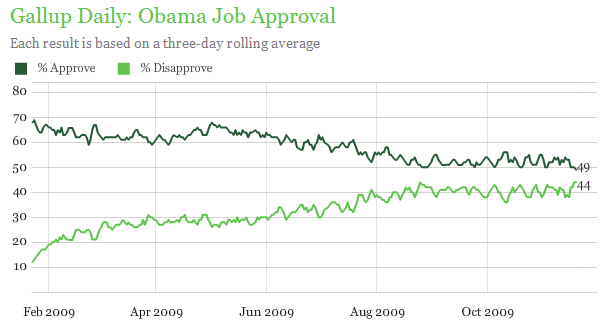
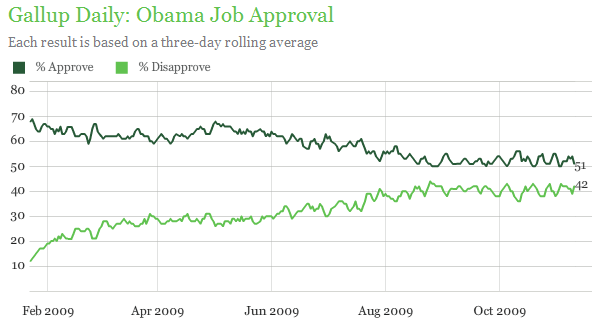
I had predicted that — last Friday — Obama’s job approval would drop below 50% on the slightly left-leaning Gallup survey.

Well, it didn’t happen last Friday, but it did today … I was just off by a week.

As a technical stock trader would say, a resistance level may have been broken …

image
http://www.gallup.com/poll/113980/Gallup-Daily-Obama-Job-Approval.aspx

Turning off the Independents …

November 20, 2009

OK, some will dismiss these numbers because they come from the FoxNews – Opinion Dynamics survey.  But, the results are consistent with many other polls.

The bottom line: a minority of registered voters 46%)  now approve of the job that President Obama is doing  … Dem support remains sky high at 85%, and GOP support is at a rock bottom 15%.  That’s not news.

The news is that only 1 in 3 Independents approve  … that’s down from 2 in 3 back in June.

image
http://www.foxnews.com/projects/pdf/111909_ObamaPoll.pdf

* * * * *

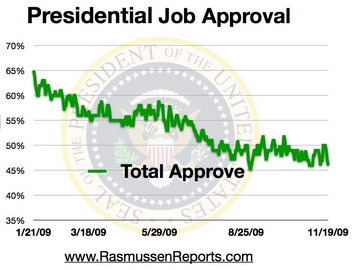
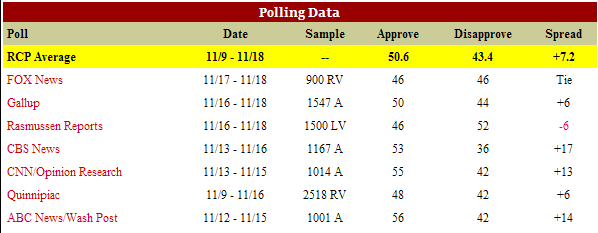
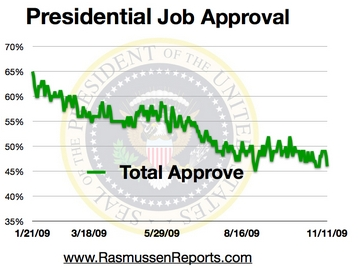
Gallup has Obama at 50% approval; Rasmussen has him at 46%.

image

* * * * *

Interestingly, 3 left-leaning TV networks (ABC, CBS, CNN) average Obama’s approval at 55%.

image 
http://www.realclearpolitics.com/epolls/other/president_obama_job_approval-1044.html

* * * * *

I missed last week when I predicted that Obama would fall below 50% in the Gallup Survey.  Keep your eye on today’s Gallup numbers …

Right product, right place, right time … or else

November 20, 2009

TakeAway:  Distribution is half the battle for marketers.  If you can’t get enough of the right product, in the right place, at the right time, you will lose sales regardless of the quality of your product. 

Whirlpool took advantage of the recent slowdown to reexamine its distribution system and, as a result, is now enjoying an array of benefits, including $350M+ in savings a year.

* * * * *

Excerpted from WSJ, “Whirlpool Cleans Up Its Delivery Act,” By Joe Barrett, September 24, 2009 

After raw materials, distribution is one of the biggest single costs at Whirlpool, which needs to get bulky products like dishwashers and clothes dryers from factories to customers quickly …

In 2005, the company’s supply chain system was a hodgepodge of warehouses, transport depots and factory-distribution centers. Retailers often had to wait five to 10 days to get new washing machines or other appliances.

Whirlpool undertook a four-year program to build a state-of-the-art distribution system from scratch … The effort is already producing results, allowing Whirlpool to reduce its annual inventory by about $250 million a year and to deliver products in 48 to 72 hours. Whirlpool is also saving costs — about $100 million a year because of improved efficiency …

Whirlpool’s logistics makeover shows how a recession can leave the biggest, best capitalized companies better positioned than ever to scoop up both market share and profits as the economy rebounds …

The company’s ordering and delivery functions used to be located in separate divisions, complicating coordination and resulting in costly mistakes when Whirlpool made too much of a certain product.  The distribution system often had to soak up excess inventory …

The core of Whirlpool’s program was replacing 41 outdated sites with 10 huge regional distribution centers that used high-tech warehouse management systems and upgraded vehicles that could handle a variety of products.  Now, when trucks deliver appliances from the company’s factories to a distribution center, the merchandise is sorted according to how quickly it is likely to leave. Slower-moving goods, such as certain high-end refrigerators or stoves, are deposited in the center of the building, while fast-moving dryers and washing machines are closer to the loading docks.

The facilities are laid out in quadrants, with most of the products arranged in identical order four times in the same building. That way drivers can access everything they need without going from one end of the building to another …

There are still reduced sales because of the recession, but there are lower than expected inventories thanks to the logistics overhaul …

Edit by TJS

* * * * *

Full Article
http://online.wsj.com/article/SB125366529324132457.html

* * * * *

Who’s more impulsive — men or women ?

November 20, 2009

Excerpted from MarketingProfs.com, It’s All in the Presentation, Oct. 28, 2009

The key factors (category and customer characteristics, and in-store customer activity) that boost, or kill, impulse shopping:

Customers with coupons make fewer unintended purchases. The more focused a customer is on a specific purchase that will save money, the less likely she is to add more to her cart.

Customers who shop more frequently buy fewer items. They may focus more on immediately needed items, and spend less time in-store per visit.

Women tend to impulse-buy more than men. When Mom says, “Pick up some milk,” Dad picks up some milk, and leaves.

Shoppers who shop more aisles make more unplanned purchases. It’s simple: The more they see, the more likely they are to buy.

In-store displays provide the biggest boost to impulse shopping. Cool displays attract attention—and encourage purchases.

* * * * *

Based on these findings:

Consider store layout. “Consumers should be encouraged to shop as many aisles as possible (in general) and be exposed to as many product categories and in-store displays as possible (in particular).”

Mix things up. “Products that are frequently purchased (e.g., milk) should be placed in locations that will lead consumers past as many other categories as possible, or [be] displayed next to less-frequently purchased products.”

Decorate. “Making the shopping experience as pleasant as possible will increase time spent in the store”—and add to the likelihood of an impulse buy. Merchants who make the in-store experience more fun (and more lengthy)  stand the best chance of moving product.

Source: “The Interplay Among Category Characteristics, Customer Characteristics, and Customer Activities on In-Store Decision Making,” by J. Jeffrey Inman, Russell S. Winer and Rosellina Ferraro. Journal of Marketing, 2009.

* * * * *
http://www.marketingprofs.com/news/customer-behavior/index.asp?nlid=1456&cd=dmo121&adref=NciW4A9

How many Americans does it take to make nine pairs of work boots?

November 19, 2009

Bottom line: “No matter how hard or imaginatively the Administration spins, the reality is that the stimulus has been the economic bust that critics predicted it would be.”

And, “they” want another $1 trillion to whack the healthcare system.

Somebody tell these guys that respect and credibility are earned …

* * * * *

Excerpted from WSJ: The Phantom Jobs Stimulus, Nov. 19, 2009

How many Americans does it take to make nine pairs of work boots?

According to the White House’s recovery.gov site, an $890 shoe order for the Army Corps of Engineers, courtesy of the stimulus package, created nine new jobs at Moore’s Shoes & Services in Campbellsville, Kentucky.

The job-for-a-boot plan may not be American productivity at its best.

But such stories go a ways toward explaining how the Administration has come up with 640,329 jobs “created/saved” by the American Recovery Act as of October 30.

  • Head Start in Augusta, Georgia claimed 317 jobs were created by a $790,000 grant. In reality, the money went toward a one-off pay hike for 317 employees.
  • One Alabama housing authority claimed that a $540,071 grant would create 7,280 jobs … only 14 were created.
  • In some cases, Recovery Act funds went to nonexistent Congressional districts, such as the 26th in Louisiana or the 12th in Virginia.
  • Up to $6.4 billion went to imaginary places in America.

When asked about the overstatements, Ed Pound, the director of communications for the Obama Administration’s recovery.gov, said, “Who knows, man, who really knows.”

That’s a confidence builder, isn’t it?

Full article:
http://online.wsj.com/article/SB10001424052748704204304574544063776158046.html?mod=djemEditorialPage

Repeat after me: time is money, time is money, time is …

November 19, 2009

TakeAway: When it comes to designing products and services, companies would do well to keep in mind the old saying “time is money.”

* * * * *

Excerpted from WSJ: Beat the Clock – How companies can use time to their competitive advantage, October 26, 2009

History suggests that by helping consumers save time or more fully enjoy the time they spend doing something, companies could gain a competitive advantage that could lead to higher sales and profits. Consider the success of innovations such as fast-food restaurants, automated-teller machines and countless labor-saving appliances.

Consumers are continually searching for new offerings that might allow them to do more in less time, and they are growing  less tolerant of organizations that waste their time—say, by keeping them on hold too long or providing poor service.


* * * * *

There are 3 ways that firms can turn time into a source of competitive advantage.

  1. They can help consumers do things faster by, for example, making a product easier to buy, use or throw away.
  2. They can make the time involved in using a product or service more pleasurable.
  3. Or they can design offerings that empower people to choose the mix of time and value that is right for them.

* * * * *

Managing Time as a Price Paid

… and get the price down.

  • Doing It for Them. One simple approach is to help people get more than one thing done at a time. The Roomba vacuum from iRobot Corp., for instance, seeks to get the time-cost associated with the use of a vacuum down to zero by working automatically once it has been turned on. Roomba’s promise is that it “cleans routinely so you don’t have to,” freeing up the customer to do something else.
  • Picking Up the Pace. In many cases, consumers just want to get things done faster. The fast-food industry made it possible to purchase a meal in just a few minutes when it pioneered the drive-through window. Other businesses took note: Today, drive-through services exist at banks, coffee shops, pharmacies, liquor stores, and even at certain wedding chapels in Las Vegas.
  • Shrinking the Commitment. The expression “I’d like to do x, but I just don’t have the time” is uttered with great frequency. A solution is to reduce the “size” of the time needed to complete a task. Examples include speed dating and “lunchtime face-lifts” that takes 30 minutes.
  • Ending the Wait. Getting people out of line also allows companies to reduce the price of time in their offerings. Whole Foods Market Inc. instituted a bank-style checkout system at grocery stores in Manhattan, where customers form two to three big lines and move to one of the more than 30 registers per store as they open up. While this process can make the lines that feed into the registers look frighteningly long, it actually gets large crowds through the store more quickly, the company says.

* * * * *

Managing Time as Product

In our survey of North American consumers,  70% agreed or strongly agreed that they would be “willing to spend more time doing product or service labor” if companies “could figure out how to make the experience more satisfying or engaging.”

The family dinner is an example of something that lends itself well to rethinking time-as-product. Studies have shown that many families wish they could eat more meals together, but they are overwhelmed by the amount of work it takes to get a home-cooked meal on the table.

* * * * *

Giving Customers the Choice

It can be difficult to determine whether a customer is interested in saving time or enjoying it more at any given moment. So some companies are putting the “time dial” in their customers’ hands, allowing them to switch dynamically from fast to slow, depending on their feeling of time pressure at a particular moment.

The evolution of self-service technologies illustrates some of the simplest examples of this approach. 

Online retailer Blue Nile Inc. employs the “choice” strategy when it comes to selling diamond-engagement rings. In many cases, the time cost involved in buying a diamond ring isn’t in favor of the buyer — often a young man making a once-in-a-lifetime purchase. Whether he shops at a diamond warehouse or a high-end retailer, he is likely to find the process of eyeing even a few product samples through a jeweler’s loupe time-consuming and unfulfilling, and to feel pressure to make a difficult and expensive decision in a hurry.

With Blue Nile, the proverbial shopper in his pajamas can spend as much or as little time as he wants researching the diamonds—by cut, size and many other criteria—online. From there, he can shop for particular settings or rings, pricing out the products with a variety of options. Once he has reviewed his choices, his purchase can be quickly executed. Throughout, the purchaser is in control of his time and the pressure is off to hurry a decision.

While critics originally said this business model was doomed to fail, because people wouldn’t go online to buy a product whose sentiment is supposed to “last forever,” the company says diamond engagement rings now account for 70% of its overall sales, and it estimates it has a 4.5% share of the U.S. engagement-ring market.

***
Consumer attitudes about time are a moving target, and companies must constantly reset their sights.

Tasks that were once seen as easy are now often viewed as burdensome, such as renting videos from a brick-and-mortar store when movies are available for purchase digitally at home.

Full article:
http://online.wsj.com/article/SB10001424052970204038304574145390833891688.html?mod=djemMM#printMode

Distinguishing between customers’ nice-to-haves and gotta-haves …

November 19, 2009

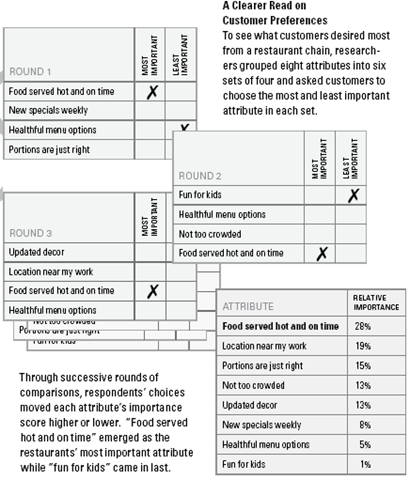
Excerpted from: HBR, What Do Customers Really Want?, by Almquist & Lee, April 2009

Most customer-preference rating tools used in product development today are blunt instruments, primarily because consumers have a hard time articulating their real desires.

Asked to rate a long list of product attributes on a scale of 1 (“completely unimportant”) to 10 (“extremely important”), customers are apt to say they want many or even most of them.

To crack that problem, companies need a way to help customers sharpen the distinction between “nice to have” and “gotta have.”

Some companies are beginning to pierce the fog using a research technique called “Maximum Difference Scaling.” which requires customers to make a sequence of explicit trade-offs.

  • Researchers begin by amassing a list of product or brand attributes—typically from 10 to 40— that represent potential benefits.
  • Then they present respondents with sets of four or so attributes at a time, asking them to select which attribute of each set they prefer most and
    least.
  • Subsequent rounds of mixed groupings enable the researchers to identify the standing of each attribute relative to all the others by the number of times customers select it as their most or least important consideration.

A popular restaurant chain recently used MaxDiff to understand why its expansion efforts were misfiring. In a series of focus groups and preference surveys, consumers agreed about what they wanted: more healthful meal options and updated decor.

But, using MaxDiff showed that prompt service of hot meals and a convenient location were far more important to customers than healthful items and modern furnishings, which ended up well down on the list.

The best path forward was to improve kitchen service and select restaurant sites based on where customers worked.

image 
* * * * *

FOX is biased … but MSNBC isn’t … huh ?

November 18, 2009

… and Comedy Central is “investigative journalism”.  So says one of the President’s closest advisers.

Excerpted from Bloomberg.com, Obama Aide Dunn Renews Criticism of Fox, Hails Jon Stewart, Nov. 14 2009

President Barack Obama’s outgoing communications director, Anita Dunn, renewed her attacks against Fox News as she praised the “investigative journalism” of Comedy Central’s Jon Stewart and said MSNBC isn’t a biased cable news network.

After the controversy between the White House and Fox News erupted, Karl Rove, former President George W. Bush’s political adviser, said that cable news channel MSNBC had a left-leaning bias.

Dunn disputed that contention, saying MSNBC is a “different kind of a network”. 

http://www.bloomberg.com/apps/news?pid=20601070&sid=aBRJYGPAmOoo

Are “great” companies great … or just lucky?

November 18, 2009

Excerpted from: HBR, Are “Great” Companies Just Lucky?, by Michael E. Raynor, Mumtaz Ahmed, and Andrew D. Henderson, April 2009

Studies that examine high-performing companies to uncover the reasons for their success are both popular and influential.

They’re the basis of the insights behind best sellers like In Search of Excellence and Good to Great.

But there’s a problem: The “great” companies from which these studies draw their conclusions are mostly just lucky.  Many of the “great” companies cited are, in fact, nothing special. 

A firm is remarkable only when its performance is so unlikely that systemic variation alone cannot account for its results. Most success studies don’t address this fact, relying instead on the “self-evident” nature of exceptional performance.

To understand how lucky some firms might get because of systemic variation alone, we ran simulations that gave us a picture of how firms might do if they differed only in their luck.  Then, we compared actual results with simulated results, which allowed us to determine which firms had delivered performance so
unlikely that it was probably due to something remarkable about them.

Using this method, we evaluated 287 allegedly high-performing companies in 13 major success studies.

We found that only about one in four of those firms was likely to be remarkable; the rest were indistinguishable from mediocre firms catching lucky
breaks.

By our method, even in the study with the best hit rate, only slightly more than half the high performers had profiles
that were credibly attributable to something special about the firms. In short, what qualifies as remarkable performance is anything
but self-evident.

This doesn’t mean you should necessarily dismiss the advice offered in success studies. But, success studies should be treated not as how-to manuals but as sources of inspiration and fuel for introspection.

* * * * *

Cruisin’ the Net for luxury & fashion … the marketing power of the Web

November 18, 2009

TakeAway:  This is another big victory for online retailers.  Anyone in fashion who does not take them seriously should think again.

* * * * *

Excerpted from WSJ, “From the Runway to Your Laptop,” By Christina Binkley, October 1, 2009

At the D&G runway show in Milan last week, the CEOs of Saks, Neiman Marcus and Bergdorf Goodman were relegated to second-row and third-row seats. In front of them, sitting primly in the first row, was the CEO of online retailer Yoox.com.

The moment—coming as the super-sexy women’s styles for next spring pranced down Milan’s runways—marked a shake-up in an ultra-hierarchical world. The privileged treatment of a digital-media figure showed that luxury fashion is ready to introduce styles to the public in new ways … 

Front rows are reserved for those most important to a brand’s success … In past years, Yoox CEO sometimes borrowed tickets to shows from other guests. But in the past year, Yoox has expanded its business of creating online stores for luxury brands such as D&G … and for Jil Sander … and this season, Yoox CEO has been invited to too many shows …

The warm welcome extends to bloggers. While the New York shows have been inviting some bloggers for a few seasons now, many of Europe’s luxury houses have been slower to allow bloggers into the shows. But two days after the D&G event … four surprised bloggers found themselves seated in coveted spots near the queen of fashion …

Luxury brands have long been leery of the pedestrian Internet, a place where consumers coldly compare prices while forgoing attentive service … But online luxury sites like Net-a-Porter.com proved that many women would do just that. Now, Yoox … is running online stores for brands including Bally, Valentino, Pucci, and Marni …

This season, Twitter and Facebook are littered with fashion brands—including Louis Vuitton and Burberry—testing how social-media sites might benefit them … A number of brands have tried streaming their shows live on the Internet …

Designers feel that the Internet offers the possibility of talking directly to customers …

Edit by TJS

* * * * *

Full Article
http://online.wsj.com/article/SB20001424052748704471504574445222739373290.html#mod=todays_us_personal_journal

* * * * *

Snookered: about that abortion funding amendment

November 17, 2009

Rep. Bart Stupak, an avid pro-lifer, led the effort to get the PelosiCare bill amended to specifically exclude funding of abortions.

When the amendment passed, about 40 Dem pro-lifers became comfortable voting for the bill,

Even before the ink dried, the pro-choicers went on the attack.  Dem leaders quelled the couter-insurrection by hinting that the provision would be stricken when the Senate and House bills went “to conference”.

Now, according to Axlerod (on Fox News nonetheless), Pres. Obama will aid and abet stripping abortion language from any healthcare bill.  In doing so, the president would be heeding the call of abortion rights supporters like Planned Parenthood that have called the White House their “strongest weapon” in keeping such restrictions out of the bill.

* * * * *

Question #1: Didn’t Stupak smell this one coming? 

Answer: No.  He assumed a certain honor among thieves.

Silly boy.

* * * * *

Question #2: Why did he Congressional GOPers vote in favor of the Stupak Amendment?  If they had voted no and it failed to pass, then the Dem pro-lifers would have voted against the bill.

Answer: Reportedly, GOP pro-lifers gave Stupak their word that they’d vote in favor of the amendment and didn’t want to go back on their word.

Silly boys (and girls)

* * * * *

Full article:
http://www.foxnews.com/politics/2009/11/15/axelrod-signals-obama-try-strip-abortion-language-health-care/

Snookered: Drug makers agree to lower prices … after they raise them.

November 17, 2009

Bottom line: I wondered why pharma companies got in the ObamaCare canoe and promised cutting prices by $8 billion. 

The answer should have been obvious: all for show. 

They’re hustling to inflate prices to establish a much higher base from which they can back out the “cuts”. 

In other words, the post-reform prices will be right where they had planned them before the faux show of ObamaCare support.

Imagine that … Team Obama getting snookered,

* * * * *

Excerpted from NY Times: Drug Makers Raise Prices in Face of Health Care Reform, November 15, 2009

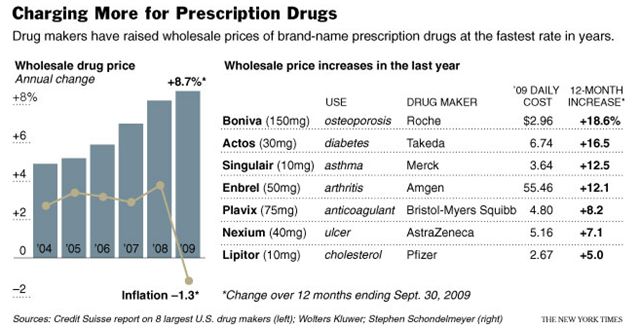
Even as drug makers promise to support Washington’s health care overhaul by shaving $8 billion a year off the nation’s drug costs after the legislation takes effect, the industry has been raising its prices at the fastest rate in years.

The industry stands to gain about 30 million customers with drug insurance from the legislation pending in Congress. But the industry also faces the prospect of tougher negotiations from both public and private buyers as the government tries to squeeze savings out of the health system.

In the last year, the industry has raised the wholesale prices of brand-name prescription drugs by about 9 percent, according to industry analysts. That will add more than $10 billion to the nation’s drug bill, which is on track to exceed $300 billion this year. By at least one analysis, it is the highest annual rate of inflation for drug prices since 1992.

Drug makers say they have valid business reasons for the price increases. Critics say the industry is trying to establish a higher price base before Congress passes legislation that tries to curb drug spending in coming years.

There was a similar pattern of unusual price increases after Congress added drug benefits to Medicare a few years ago, giving tens of millions of older Americans federally subsidized drug insurance. Just as the program was taking effect in 2006, the drug industry raised prices by the widest margin in a half-dozen years.

The drug companies say they are having to raise prices to maintain the profits necessary to invest in research and development of new drugs as the patents on many of their most popular drugs are set to expire over the next few years.

The drug industry has actively opposed some of the cost-cutting provisions in the House legislation, which passed Nov. 7 and aims to cut drug spending by about $14 billion a year over a decade.

But the drug makers have been proudly citing the agreement they reached with the White House and the Senate Finance Committee chairman to trim $8 billion a year — $80 billion over 10 years — from the nation’s drug bill by giving rebates to older Americans and the government.

But this year’s price increases would effectively cancel out the savings from at least the first year of the Senate Finance agreement. And some critics say the surge in drug prices could change the dynamics of the entire 10-year deal.

image 
http://www.nytimes.com/imagepages/2009/11/16/business/16drugprices_graphic.html

Full article:
http://www.nytimes.com/2009/11/16/business/16drugprices.html

“Adoption velocity” and abandonment: Here today, gone tomorrow …

November 17, 2009

TakeAway: Some research indicates that — counter-intuitively — products which catch on too quickly may end up being less successful overall.

* * * * *

Excerpted from Knowledge@Emory, The Long-term Downside of Overnight Success,  September 16, 2009  

Marketers may dream of coming up with a product that skyrockets in popularity as soon as it is introduced to the public.

Research, however, indicates that products which catch on too quickly may end up being less successful overall.

* * * * *

There are patterns in “cultural adoption and abandonment.” 

“We often see products, ideas and behaviors catch on and spread like wildfire. But we know less about why once-popular things become unpopular.”

“Most managers want their products to catch on faster, but our analysis suggests that this might not always be the best strategy. If something catches on too quickly, it might not only have a shorter lifespan, but may also end up being less successful overall. Faster adoption may hurt product success.”

Fads tend to be viewed negatively: “If people think that sharply increasing [popularity] will be short lived, they may avoid such items to avoid doing something that may later be seen as a flash in the pan.”

The research into the adoption and abandonment challenges some assumptions about the diffusion of a message and its saturation in the population, which is an important concept in marketing.

As a message spreads — or diffuses — through a population, it reaches more potential adopters. However, diffusion models typically assume a set target population size. But, a group may continually renew itself. Other factors, beyond diffusion and saturation, must be involved: “Adoption velocity is one such factor.”

Conventional wisdom would hold that if a message diffused through a population quickly, more potential adopters would be reached, improving the prospects for widespread adoption. “The effect of adoption velocity on the cumulative number adopters … shows that adoption velocity has a negative effect on the cumulative number of adopters.”

For example, in the music industry, new artists who bolt to the top of sales charts, often realize lower overall sales than those whose popularity grows more slowly. “This seemingly counterintuitive finding has important implications. One is that faster adoption is not only linked to faster abandonment, but may also hurt overall success.”

The research fits into the growing literature about “cultural dynamics.” By “more closely examining the psychological processes behind individual choice and cultural transmission, deeper insight can be gained into the relationship between individual (micro) behavior and collective (macro) outcomes such as cultural success.” 

Advertising might lead to fast adoption of a product, but the popularity of the product or service advertised might decline when that support dies off or switches to a substitute. “Importantly, though, results suggest that independently of its cause, a quick rise in popularity may have an accelerating effect on abandonment … as such, we anticipate that there will be an inherent tendency for items that have been adopted quickly to decline faster, even in cases where advertising persists.”

‘This is here today, gone tomorrow.'”

Full article:
http://knowledge.emory.edu/article.cfm?articleid=1266

* * * * *

When does a $1 burger make sense ?

November 17, 2009

Got this provocative email from one one of my son’s friends:

Mr. H – As patriarch of the “First Family” of the $1 menu, I wanted to bring your attention to this article. 

It appears that suspicions may have been correct –   The $1 McDouble cheeseburger is literally a LOSS LEADER. 

Who is right Burger King or their franchisees?  Why charge an unprofitable price?

Below is the article.  Far below is Ken’s Take.

* * * * *

Excerpted from AP: Food fight: Burger King franchisees sue chain, Nov.13, 2009

Restaurants, especially fast-food chains, have been slashing menu prices because of the poor economy. Executives hope the deeply discounted deals will bring in diners who are spending less when they eat out, or opting to stay home altogether.

But, Burger King franchisees sued the hamburger company this week over its $1 double cheeseburger promotion, saying they’re losing money on the deal and the company can’t set maximum menu prices.

A group that represents more than 80 percent of Burger King’s U.S. franchise owners, said the $1 promotion forces restaurant owners to sell the quarter-pound burger with at least a 10-cent loss.

The $1 double cheeseburger typically costs franchisees at least $1.10 — That includes about 55 cents for the cost of the meat, bun, cheese and toppings.

The remainder typically covers expenses such as rent, royalties and worker wages.

“New math, or old math, the math just doesn’t work.”

When the $1 double cheeseburger was announced this fall, an analyst said it could increase restaurant visits by as much as 20 percent, but that as much as half of the gain recorded from increased traffic could be lost because customers were spending less when they ordered food.

Copyright © 2009 The Associated Press. All rights reserved.
http://www.google.com/hostednews/ap/article/ALeqM5hLeKv3ns6qUW8InI9h7yHYvgzHZwD9BUB0181

* * * * *

Ken’s Take:

  1. So, the franchisees just want to cede the “value” position to Mickey D ?  Not a wise move.
  2. Why a loss leader ?  Because it draws traffic — and most customers complement the loss leader with another high margin product — e.g. soda, or fries.
  3. Technical note: the franchisee’s should be thinking about the $1 burger in terms of “incremental profitability” — incrementally, they’re still making 45 cents on each burger — the employees are still going to be there, the rent’s still going to be paid, and the lights are still going to being using electricity whether the burger is sold or not … only way the franchisee loses is through “dilution” — if a dude who would have paid 2 bucks for a burger anyway gets one for $1

Bottom line: Franchisees should fire their lawyers and flip some burgers.

Doing OK … except on the economy, Afghanistan, the deficit and, oh yeah, healthcare.

November 16, 2009

Bottom line: Rasmussen & Schoen say that unless Obama changes his approach and starts governing in a more fiscally conservative, bipartisan manner, the independents that provided his margin of victory in 2008 and gave the Democrats control of Congress will likely swing back to the Republicans, putting Democratic control of Congress in real jeopardy.

* * * * *

Excerpted from WSJ: Obama Is Losing Independent Voters, Rasmussen & Schoen, Nov. 14, 2009

Obama’s approval among likely voters has dropped to the low-50s in most polls, and the most recent Rasmussen Reports poll of likely voters shows him slightly below the 50% mark. This is a relatively low rating for new presidents.

A CNN poll released Nov. 6 found that 47% of Americans believe the top issue facing the country is the economy, while only 17% say its health care. However, the bulk of the president’s efforts over the past six months have been not on the economy but on health care, an issue in which he continues to draw negative ratings.

In a Rasmussen Reports poll taken after the House of Representatives passed health-care reform by the narrowest of margins last Saturday night, 54% of likely voters say they are opposed to the Pelosi plan with only 45% in favor …   58% of unaffiliated voters,oppose the bill.

The CNN poll also shows that in addition to health care, a majority of Americans disapprove of how Mr. Obama is handling the economy, Afghanistan, Iraq, unemployment, illegal immigration and the federal budget deficit. Put simply, there isn’t a critical problem facing the country on which the president has positive ratings.

An NBC/Wall Street Journal poll conducted from Oct. 22-25 found that the president’s personal ratings have suffered a similar decline. His rating for being honest and straightforward has fallen eight points from January to 33% and his rating for being firm and decisive has fallen 10 points to 27%.

Even more fundamentally, a Washington Post/ABC News poll conducted from Oct. 15-18 shows that the president has now reached a point where less than a majority of Americans believe he will make the right decisions for the country.

A Rasmussen Reports poll released Oct. 26 shows that only one-third of likely voters believe the stimulus package has helped the economy.

This week’s Rasmussen Reports poll shows  49% of respondents blame Mr. Bush for the economy and 45% blame Mr. Obama. By the beginning of next year, the problems of America will be Mr. Obama’s problems, and references to his predecessor will increasingly fall on deaf ears.

* * * * *

Deficit reduction and reining in spending are critically important priorities for the vast majority of the electorate. Indeed, according to a Rasmussen Reports Poll conducted at the end of last month, voters say deficit reduction is most important and health care is a distant second.

Obama has found himself in a false and arguably artificial conundrum on health care, with the two alternatives being his bill with a public option and a trillion-dollar price tag, or no bill at all. While the failure to pass a health-care bill could be devastating for his administration, polling suggests that ramming through an expensive bill with a public option (potentially using procedural techniques in the Senate) could divide America and not improve his standing with the public.

Voters would like to see compromises on key elements of health care to reduce costs, while the Democrats’ plan has appeared to focus largely on expanding coverage.

There is a clear, bipartisan majority who favor a less costly bill that incrementally increases coverage, provides insurance reform involving pre-existing conditions, and experiments with tort reform and competition across state lines.

* * * * *

Full article:
http://online.wsj.com/article/SB10001424052748704402404574525543109875438.html?mod=djemEditorialPage

About your bold strategic move … will your competitors even notice?

November 16, 2009

TakeAway: How to assess a competitor’s response to your strategic moves?  Game theory is often too complex and too assuming to fit the real world.  Intuitive-based war gaming is often skewed by personal biases and hidden agendas.

So, McKinsey proposes a practical approach to predicting competitive behavior that “stays close to the theoretical rigor and accuracy of game theory but is as easy to apply.

” * * * *

Excerpted from HBR: Predicting Your Competitor’s Reaction, by Coyne and Horn, April 2009

The McKinsey approach involves distilling all possible analyses of a rival’s response to a particular strategic move into a sequential
consideration of three questions:

  1. Will the competitor react at all?
  2. What options will the competitor actively consider?
  3. Which option will the competitor most likely choose?

The first step in analyzing competitor reaction, therefore, is to address the likelihood of no reaction.

To determine this, you must ask four subquestions. If the answer to any of them is no, the chances of a response are low.

1. Will your rival see your actions?
Even if an action appears obvious to you, your competitor may not recognize it.

First, most companies rely on incomplete data to assess changes in the marketplace, e.g. market research that only survey certain segments, markets, or channels.

Second, if your strategic move will affect several of your competitor’s business units, it may not register as significant to any one unit and so may be
overlooked.

2. Will the competitor feel threatened?
Even if your competitor sees your actions, he may not feel threatened—and, accordingly, will not think that mounting a response is
worth the expense and distraction.

That is, the competitor may not consider the strategic move to be statistically significant to their in place plan.

3. Will mounting a response be a priority?
Your adversary probably already has a full agenda before you make a move. On it are product launches, marketing campaigns, reorganizations,
major acquisitions, plant openings, and cost reduction efforts—some or all of which must be curtailed in order to react to your move.

Therefore, to the degree that your adversary has already committed to plans that will fully occupy his attention, he will be reluctant to shift priorities.

4. Can your rival overcome organizational inertia?
Even if top management wants to react, the organization as a whole may resist.

First, if reacting requires the company to make major organizational changes, it is very unlikely to do so unless the threat is immediate and deadly.

Second, managers are generally reluctant to abandon their success formula, and if they decide to go ahead and make a change, they are very poor at doing so.

Third, companies have great difficulty mounting a response that requires the cooperation of third parties, which may not share their sense of urgency.

For example:

In the late 1980s, a small U.S. pizza delivery chain called Papa John’s noticed a change in consumers’ perception of the quality of Pizza Hut and Domino’s (the top two chains) and used the opportunity to create a differentiated value proposition captured in the slogan, “Better ingredients. Better pizza.”

Papa John’s expanded rapidly throughout the 1990s and became the third largest pizza chain in the country, while the two bigger rivals stagnated.

Unable to mobilize their franchises around quality until the threat became undeniable, the big chains did not respond with better pizzas of their own until 2000.

* * * * *

Punch line: Competitors do not respond to their rivals’ moves at least 1/3 of the time.

* * * * *

Upcoming: What if your competitor does respond ?

* * * * *

To sell more books … lose the index … huh ?

November 16, 2009

Bottom line: Self-obsessed Beltway politicos have (another) beef with Sarah Palin’s book “Going Rogue.”

Excerpted from WSJ: Once a Rogue, Always a Rogue, Nov.  13, 2009

Political types in Washington make a show of turning up their noses at actually buying and reading books such as “Going Rogue.”

But familiar faces can regularly be spotted in store aisles anyway scanning for their names in the index.

Sarah Palin’s book won’t have an index, denying Beltway habitués the instant gratification of knowing whether they are included.

Instead, political and media types who want to know if they figure in accounts of her conflicts with the McCain campaign or with major news media personalities such as Katie Couric will actually have to buy the book and at least skim it.

* * * * *

Publishing a political book without an index was pioneered a dozen years ago by John Brady, author of “Bad Boy: The Life and Politics of Lee Atwater,” a biography of the controversial master of negative campaigning who advised the first President Bush’s 1988 election bid.

Mr. Brady’s intent was to boost sales.

For scholars and other serious readers he offered a copy of the index to anyone who sent him a stamped, self-addressed envelope.

His ploy worked exactly as intended …  some people reportedly  bought the book just to see if they were mentioned  in it..

Full article:
http://online.wsj.com/article/SB10001424052748703683804574533840931957188.html?mod=djemEditorialPage

So, will digital medical records “bend the cost curve” … in the right direction?

November 13, 2009

Ken’s Take: As a a digital kinda guy — who worked with a start-up that digitized med records —  I’m naturally in favor of electronic medical records.

But,   I am a bit concerned about privacy issues and how gov’t will use my info.

Further, I’ve watched my doc struggle while inputting data to an online system and I’ve had digital prescriptions get lost and “corrupted” in cyberspace.  So, the below article struck a chord.

Now, I’m officially ambivalent on the subject. Anybody have a strong point-of-view

* * * * *

Excerpted from RCP: Government by Holiday Inn Express, October 27, 2009

Starting during the campaign, President Obama touted digital medical records to reduce errors, improve care, and cut costs. More than $19 billion of stimulus funds were earmarked for it.

But when the Washington Post examined the matter, they discovered that digital records not only fail to produce the promised benefits, they actually reduce efficiency and cause errors.

The digital systems currently available give physicians too much information. Pages upon pages of digital information document every conceivable ailment a patient might have.

Doctors have difficulty wading through all of the unnecessary data to reach the critical information.

One emergency room physician at a hospital that had adopted a digital system complained, “It’s been a complete nightmare. I can’t see my patients because I’m at a screen entering data . … Physician productivity and satisfaction have fallen off a cliff.”

Some hospitals have adopted digital systems only to abandon them.

Full article:
http://www.realclearpolitics.com/articles/2009/10/27/government_by_holiday_inn_express_98882.html#

Deep thoughts …

November 13, 2009

Another worth-reading editorial by Peggy Noonan in today’s WSJ.  Subject is Obama’s “deliberative” process re: Afghanistan.

I thought the following thoughts had relevance beyond Afghanistan and politics.

Thought can be harder than action, weighing plans as hard as choosing and executing one of them. A question of consequence deserves pondering.

All often depends on the outcome. If a long pondered decision is sound and ends in success, history will not say the decision-maker was indecisive and Hamlet-like. If the decision results in failure, history will not celebrate a decision-maker’s wonderfully cerebral deliberative style.

The country’s mood now is intensely bottom-line. Americans aren’t concerned about Afghanistan because they are swept by democratic feeling and certain world peace will be enhanced if Afghans are able to vote in honest elections. They aren’t driven only by indignation that the Afghan government is corrupt, which it is.  And Americans aren’t motivated primarily by concern about Afghanistan’s inadequate infrastructure. They’re concerned about their own.

WSJ, Just the Facts, Mr. President, Nov. 12, 2009
http://online.wsj.com/article/SB10001424052748703683804574531950422058942.html?mod=djemEditorialPage

Market segmentation is so yesterday … today, it’s self-selected “tribes”

November 13, 2009

TakeAway:  The power of the Web is undeniable.  It gives companies access to consumers in ways never thought possible.  Companies enjoy the luxury of leveraging online consumer groups for product development feedback, buzz generation, etc. 

Now, companies are flipping their segmentation strategies upside down and using consumer data gathered from the Web to build their segmentation strategies.  And, these companies are realizing cost and accuracy benefits.

* * * * *

Excerpted from Strategy & Business, “The Promise of “Self Segmentation”,” By Nick Wreden, October 5, 2009

… Today, a community-based approach to segmentation — which is both less expensive and more effective than the traditional methodologies based on customer relationship management (CRM) systems — is becoming possible …

Self-segmentation provides a foundation for leveraging customer experience and input … The rise in social networks and online communities, combined with the new era of the Web-empowered consumer … consumers are increasingly segmenting themselves into communities, based on common characteristics, passions, interests, or needs. Such “self-segmentation” is likely to be much more accurate and reflective of consumers’ attributes …

Companies can now bind themselves to consumer communities of interest or “tribes,” … such self-selected communities not only reflect consumers’ true interests but also involve their connection to others with the same passions. This opens the door to fostering brand ambassadors, enabling customer collaboration, and facilitating word-of-mouth cross-fertilization …

Since relevant communities represent self-selected groups who share one or more interests, marketers can substantially reduce the costs, time, and toil required to identify, and segment, qualified prospects … and the communities provide a better guide to potential purchasing behavior …

Interactions within communities represent an ideal listening post, enabling marketers to glean direct insights without the filter of market research …

Engaged participants can provide product development guidance and identify shortcomings in service or other areas to help a company improve its brand …

Companies can utilize three approaches to leverage self-segmented communities — engaging with social networks, tracking online communication behavior, and mass customization …

Segmentation is vital as mass marketing slips into irrelevancy, with information overload causing consumers to block out many corporate communications … But CRM-based market segmentation can be expensive, complex, one-dimensional, and static. It fails to accommodate the multidimensional nature of consumers … It leads to top-down initiatives that view potential customers as targets to be blitzed with campaigns, ambushed with messages, and subjected to guerrilla marketing.

In this new era of branding, companies must focus on ethnic, cultural, religious, sports, or other segments, not markets. This pivot could be achieved through CRM systems, but self-segmented communities of interest provide a more effective alternative. Such communities can provide fast, low-cost market research, generate ideas and feedback about new offerings, help improve corporate and customer-to-customer service, strengthen relationships, provide an early warning system about problems, and promote favorable word-of-mouth. It all starts with finding communities united by a passion or an interest, and talking with them, not at them.

Edit by TJS

* * * * *

Full Article
http://www.strategy-business.com/article/00004?pg=all

* * * * *

Electronic medical records … the next Manhattan Project ?

November 12, 2009

I thought that this reply (which was posted yesterday by Chris Hairel — an MSB MBA alum) was quite insightful. 

Bottom line: we’re talking a Manhattan Project with savings (if any) far down the road)

A nationwide electronic medical records system  represents the largest and most complex IT project in history.

There are several hundred government agencies, almost two thousand insurers, tens of thousands service and equipment providers, over 300 million patients with more than a billion records.

There are no data standards currently defined.

There are no security protocols in place.

Much of the data from paper notes and the rest must be converted from one electronic format to another.

It takes well run private companies 2 or 3 years or more to do an ERP or portal program. These are projects in controlled environments with processes and data that are much less complex than the human body and a stakeholder group several orders of magnitude less than the US health care system. 

The National Health Service in the UK has had huge cost over runs and lost a prime contractor due to poor governance over data and metrics.

The IRS is years behind on their new audit system. The FAA has been after a new ATC system since the Reagan administration.  

[Ken’s Note: Integration of our intelligence systems is still an incomplete work in progress — as evidenced by the Maj. Nassan slip-up that led to the Fort Hood massacre.]

Electronic health records won’t drive savings for quite a while – and certainly not by 2015 as currenlty promised in the government estimates.

* * * * *

Prediction re: Prez O’s Job Approval … Today will be a milestone.

November 12, 2009

Let’s go out on a limb …

I”m posting this @ 7:59 a.m. and predicting that today’s the day that President Obama’s job approval — as measured by Gallup, a respected, slightly left leaning polling org — will drop below 50% for the first time.  If so, that’ll be a very big deal.

Why?

Major reason: yesterday’s number was 51% (chart below); today will be the first rating that fully reflects Saturday night’s healthcare vote (since Gallup is a 3-day moving average).

Secondary reason: backlash to the way the administration is handling the Afghanistan decision and the Fort Hood massacre.

Reason for confidence: Rassmussen — a slightly right leaning polling org — tends to lead Gallup by a day or two.  Rasmussen has Obama’s job approval down to 46% (chart below).

Note: Rasmussen posts around 9:30 am; Gallup in mid-afternoon.

We’ll see …

* * * * *

Gallup

image
http://www.gallup.com/poll/113980/Gallup-Daily-Obama-Job-Approval.aspx

* * * * *

Rasmussen

image
http://www.rasmussenreports.com/public_content/politics/obama_administration/obama_approval_index_history

If it doesn’t walk like a duck and quack like a duck, what the heck is it?

November 12, 2009

TakeAway: When companies develop innovative products and services that don’t obviously fit into established categories, managers need to help people understand what comparison to make. Without that step, potential customers might just walk away wondering, “What is it?”

* * * * *
Excerpted from NY Times, It’s Brand New, but Make It Sound Familiar, October 4, 2009

GLANCE through a photo album of early automobiles and you’ll find an eclectic assortment of vehicles, including three-wheeled machines and bicycle-like contraptions. You’d be hard-pressed to identify many as cars.

Early consumers were confused, too, until innovators finally converged on a carriage-like design and coined the term “horseless carriage” in the 1890s, giving a clear point of comparison. More than 100 years later, we can learn from their example.

Humans instinctively sort and classify things. It’s how we make sense of a complex world.

So when companies develop innovative products and services that don’t obviously fit into established categories, managers need to help people understand what comparison to make. Without that step, potential customers might just walk away wondering, “What is it?”

* * * * * 

As a starting point, it helps to understand some basic traits of behavior. When people encounter something they don’t recognize, they make sense of it by associating it with something familiar.

“The category signals not only a set of features to expect, but at a more basic level, when and how you should use the novel item.”

Companies can benefit by using comparisons to create expectations that best match an innovation’s strengths.

Problems can arise if consumers can’t place innovations into familiar categories. Consider the introduction of the Segway, the high-tech motorized scooter, “Nobody was quite sure what it was … There was no clear analogy, so people had no idea how to use it.”

* * * * *

Finding the right label is only one of the many ways organizations can influence the way consumers categorize a product. They can also experiment with the product’s shape, packaging, pricing and retail store placement.

* * * * *

As innovative products are introduced, category boundaries are continually shifting and new categories emerging. In some ways, the auto industry is going through a transformation that harks back to the 1800s.

Today’s consumers are confronted with an impressive assortment of new vehicles, including electric models with three wheels and others with designs that just don’t look like what we expect a car to look like.

Will electric vehicles be broadly accepted? And which models will be most popular? The answers may well depend on the associations that automakers try to imprint on consumers.

Full article:
http://www.nytimes.com/2009/10/04/business/04proto.html?sq=segway&st=cse&scp=1&pagewanted=print

The "Costs" of Medical Care …

November 11, 2009

Ken’s Take: Economists are trained to focus on “real” costs. 

One of my major complaints about the current healthcare “reforms” is that — except for electronic medical records — there are, for all practical purposes, no structural changes proposed.  No gov’t clinics, no additional medical schools, no tort reform. 

Just more money being thrown at the problem and more obfuscation of real costs.

* * * * *

Excerpted from RCP: The “Costs” of Medical Care, Thomas Sowell, November 3, 2009

We are incessantly being told that the cost of medical care is “too high”– either absolutely or as a growing percentage of our incomes.

But nothing that is being proposed by the government is likely to lower those costs, and much that is being proposed is almost certain to increase the costs.

There is a fundamental difference between reducing costs and simply shifting costs around, like a pea in a shell game at a carnival.

Costs are not reduced simply because you pay less at a doctor’s office and more in taxes– or more in insurance premiums, or more in higher prices for other goods and services that you buy, because the government has put the costs on businesses that pass those costs on to you.

Costs are not reduced simply because you don’t pay them. Letting old people die would undoubtedly be cheaper than keeping them alive– but that does not mean that the costs have gone down. It just means that we refuse to pay the costs. Instead, we pay the consequences. There is no free lunch.

Despite all the demonizing of insurance companies, pharmaceutical companies or doctors for what they charge, the fundamental costs of goods and services are the costs of producing them.

If highly paid chief executives of insurance companies or pharmaceutical companies agreed to work free of charge, it would make very little difference in the cost of insurance or medications.

If doctors’ incomes were cut in half, that would not lower the cost of producing doctors through years of expensive training in medical schools and hospitals, nor the overhead costs of running doctors’ offices.

What it would do is reduce the number of very able people who are willing to take on the high costs of a medical education when the return on that investment is greatly reduced and the aggravations of dealing with government bureaucrats are added to the burdens of the work.

In short, reducing doctors’ income is not reducing the cost of medical care, it is refusing to pay those costs. Like other ways of refusing to pay costs, it has consequences.

http://www.realclearpolitics.com/articles/2009/11/03/the_costs_of_medical_care_98986.html

The “Costs” of Medical Care …

November 11, 2009

Ken’s Take: Economists are trained to focus on “real” costs. 

One of my major complaints about the current healthcare “reforms” is that — except for electronic medical records — there are, for all practical purposes, no structural changes proposed.  No gov’t clinics, no additional medical schools, no tort reform. 

Just more money being thrown at the problem and more obfuscation of real costs.

* * * * *

Excerpted from RCP: The “Costs” of Medical Care, Thomas Sowell, November 3, 2009

We are incessantly being told that the cost of medical care is “too high”– either absolutely or as a growing percentage of our incomes.

But nothing that is being proposed by the government is likely to lower those costs, and much that is being proposed is almost certain to increase the costs.

There is a fundamental difference between reducing costs and simply shifting costs around, like a pea in a shell game at a carnival.

Costs are not reduced simply because you pay less at a doctor’s office and more in taxes– or more in insurance premiums, or more in higher prices for other goods and services that you buy, because the government has put the costs on businesses that pass those costs on to you.

Costs are not reduced simply because you don’t pay them. Letting old people die would undoubtedly be cheaper than keeping them alive– but that does not mean that the costs have gone down. It just means that we refuse to pay the costs. Instead, we pay the consequences. There is no free lunch.

Despite all the demonizing of insurance companies, pharmaceutical companies or doctors for what they charge, the fundamental costs of goods and services are the costs of producing them.

If highly paid chief executives of insurance companies or pharmaceutical companies agreed to work free of charge, it would make very little difference in the cost of insurance or medications.

If doctors’ incomes were cut in half, that would not lower the cost of producing doctors through years of expensive training in medical schools and hospitals, nor the overhead costs of running doctors’ offices.

What it would do is reduce the number of very able people who are willing to take on the high costs of a medical education when the return on that investment is greatly reduced and the aggravations of dealing with government bureaucrats are added to the burdens of the work.

In short, reducing doctors’ income is not reducing the cost of medical care, it is refusing to pay those costs. Like other ways of refusing to pay costs, it has consequences.

http://www.realclearpolitics.com/articles/2009/11/03/the_costs_of_medical_care_98986.html

PRs more challenging since profit has become a 4-letter word …

November 11, 2009

TakeAway:  In an age where company reputation is playing an increasingly important role in sales generation and growth, the decline of traditional business media could cause big problems for marketers.  Companies must now take the laboring oar and find creative ways to ensure that their preferred message makes it to the consumer.

* * * * *

Excerpted from Strategy & Business, “What a Declining Business Media Means to CEOs” By William Holstein, September 28 2009

The business media is mired in deep economic crisis … the surviving business magazines are much thinner … Newspapers are suspending publication of stand-alone business sections and downgrading their coverage … Even at relatively healthy business news outlets, there is a decline in the quality of business coverage …

One might argue that the weakened state of business media doesn’t matter much … But the consequences for business decision makers are three-fold, and grave.

First, it means that business coverage could become more negative toward profit and enterprise than it is today … Criticism of corporations will be less nuanced, less aware of context, and less insightful. Competent, complacent, and craven companies — or divisions within companies — will all be tarred with the same brush.

Second, the decline in business journalism gives corporate decision makers less of a platform to display and test their own company’s strategy. “It means that there are fewer opportunities for a CEO to get his or her story into the media,” says CNN …

But perhaps the worst effect is the most subtle: Corporate leaders now have fewer opportunities to learn from one another’s experience, or even to know what’s going on in their regions and industries …

What specifically should a corporate leader do differently in this environment? The first priority is to maintain the visible public presence of his or her own company — to build its reputation as a reliable entity, in a time when the integrity of many companies has come under scrutiny …

Meanwhile, it’s more important than ever for CEOs to develop core communications messages that go beyond the issue of profitability and stock price. GE has been very effective with its Ecomagination campaign. Companies must define the way they appear in the world at large …

Edit by TJS

* * * * *

Full Article
http://www.strategy-business.com/article/00003?gko=83b3c

* * * * *

360-degree competition from private-label products

November 11, 2009

TakeAway: Whether it’s due to the economy or consumers’ general frustration with price inflation, private label products are booming.

Accordingly, more and more companies are offering private label products in an attempt to steal sales from their branded counterparts.

Now, this battle has moved from the stores to the Internet. Consumers’ appetite for value is spurring Amazon’s move into the private label business.

* * * * *

Excerpted from WSJ,”Amazon Is Selling Designs Of Its Own,” By Geoffrey Fowler, September 21, 2009

Amazon.com is quietly expanding its private-label business in a bid to diversify away from its online bookstore roots and become more like a general retailer.

After starting with private-label patio furniture in 2004, Amazon has since added its own housewares, including a steamer, frying pan and chopping block … the latest: a wooden chopping block …

Amazon doesn’t say what percentage of its $19 billion in annual sales are from its private-label business, but it already sells more than 1,000 products that are manufactured at its request … this underscores how far the company has moved beyond books, CDs and DVDs …

The company has developed private-label products when it felt customers’ needs weren’t being met by the rest of its catalog … developing private-label products has required new skills for the company, such as managing quality control and meeting product safety regulations. But online feedback from customers who leave product reviews helps the company make improvements…

The company won’t disclose profit margins for its private-label merchandise but it is clear that the effort wouldn’t be feasible if it weren’t for Amazon’s economies of scale …

Private labels are popular with many traditional retailers because they can provide higher profit margins by cutting out the middleman in the supply chain … online-only retailers have been slower to adopt private-label brands because they lack the expertise to design products, and lack a physical store presence to introduce a new brand …

The private-label strategy isn’t without its problems. In particular, Amazon’s own products may conflict with the products and merchants that the company already hosts on its site …

Edit by TJS

* * * * *

Full Article
http://online.wsj.com/article/SB125323090208821381.html?mod=djemMM

* * * * *

It's in the bill … hard time for the voluntarily uninsured.

November 10, 2009

Failure to buy health insurance in the just-passed health care bill could get you five years in jail with a $250,000 fine.

Under sections 7201 and 7203 of  Pelosi’s bill, Americans who don’t maintain acceptable health insurance coverage and who choose not to pay a fine/tax of up to 2.5% of income are subject to fines of up to $250,000 and imprisonment of up to five years.

http://www.investors.com/NewsAndAnalysis/Article.aspx?id=511806

The good news: once incarcerated, these felons get full healthcare … for free.

Do twentysomethings who choose to self-insure understand that they’re going to be subsidizing us old folks ?  Might work …

It’s in the bill … hard time for the voluntarily uninsured.

November 10, 2009

Failure to buy health insurance in the just-passed health care bill could get you five years in jail with a $250,000 fine.

Under sections 7201 and 7203 of  Pelosi’s bill, Americans who don’t maintain acceptable health insurance coverage and who choose not to pay a fine/tax of up to 2.5% of income are subject to fines of up to $250,000 and imprisonment of up to five years.

http://www.investors.com/NewsAndAnalysis/Article.aspx?id=511806

The good news: once incarcerated, these felons get full healthcare … for free.

Do twentysomethings who choose to self-insure understand that they’re going to be subsidizing us old folks ?  Might work …

Cash 4 Clunkers … or, make that Cash for a new Hummer … geez.

November 10, 2009

TakeAway: Under Cash for Clunkers, some owners of large pickups cashed in old trucks for between $3,500 and $4,500 toward new Hummer H3 SUVs that got only 16 mpg.        

Source: Associated Press: Clunker pickups traded for new pickups, Nov 4, 2009

The most common deals under the government’s $3 billion Cash for Clunkers program, aimed at putting more fuel-efficient cars on the road, replaced old Ford or Chevrolet pickups with new ones that got only marginally better gas mileage.

The single most common swap — which occurred more than 8,200 times — involved Ford F150 pickup owners who took advantage of a government rebate to trade their old trucks for new Ford F150s. The fuel economy for the new trucks ranged from 15 mpg to 17 mpg based on engine size and other factors, an improvement of just 1 mpg to 3 mpg over the clunkers.

Owners of thousands more large old Chevrolet and Dodge pickups bought new Silverado and Ram trucks, also with only barely improved mileage in the middle teens,.

Those deals helped the Ford F150 and Chevy Silverado — along with Ford’s Escape midsize SUV — climb into the Top 10 most-popular vehicles purchased with the government rebates. The most common truck-for-truck and truck-for-SUV deals totaled at least $911 million.

* * * * * 

In scores of deals, the government reported spending a total of $562,500 in rebates for new cars and trucks that got worse or the same mileage as the trade-ins — in apparent violation of the program’s requirements.

More than 95,000 of the new vehicles purchased under the program — or about one in seven — got less than 20 mpg, according to the data.

Plenty of consumers bought relatively low-mileage trucks and SUVs with the help of government checks.

Full story:
http://news.yahoo.com/s/ap/20091104/ap_on_bi_ge/us_cash_for_clunkers

* * * * *

On the plus side:

Popular high-mileage commuter cars including the Toyota Corolla, Honda Civic, Toyota Camry and Ford Focus also were among the Top 10 most popular new vehicles bought under the four-week program, with 105,280 of those models sold for a total of about $2 billion.

Time for a makeover: the future of brand managers

November 10, 2009

Takeaway: If you are pursuing a career as a brand manager, your role may be very different than you imagined.

A report that will soon be released by Forrester will provide a redefinition of what a brand manager should be. Their groundbreaking finding: marketers should get back to marketing. Beyond focusing solely on your product, you should really get into the mind of your consumers and appeal to their needs and desires.

And with the rise of digital media, targeting specific segments can be done with more precision than ever before.

The report also claims that decisions really need to be performance-oriented, with more reliance on research and analytics.

Hmmm, recommending a focus on people and performance? It looks like those extra P’s we learned about in Markstrat were well worth it.

* * * * *

Excerpted from AdAge, “Why It’s Time to Do Away With the Brand Manager” by Jack Neff, October 12, 2009

Managing a brand has always been a slightly odd concept, given that consumers are the real arbiters of brand meaning, and it’s become increasingly outmoded in today’s two-way world. That’s why a new report is going to recommend changing the name “brand manager” to “brand advocate,” and fundamentally changing marketer organizations in response to the onset of the digital age.

The report, due out next week from Forrester, finally puts the onus on marketers to change their structures — a welcome conclusion for media owners and agencies who keep hearing how they should change, but often complain that their clients have done little to shift their organizations to cope with an increasingly complex world of media fragmentation and rising retailer and consumer power.

Among the specific recommendations in its report, “Adaptive Brand Marketing: Rethinking Your Approach to Branding in the Digital Age,” Forrester suggests “brand advocates” be responsible for rapid adaptations of global brand platforms and programs, charging centralized global brand strategists with ensuring what local managers do conforms with the brand equity and strategy.

It also advocates recognizing the brand isn’t the only organizational structure that’s important for multibrand companies, but that structures aimed at marketing to demographic or other segment cohorts are equally important. And it also maintains that marketing executives should think less about anchoring annual plans around one or two big hits and more about doing many smaller things quickly and adapting based on real-time consumer feedback and other data.

He believes marketers in the digital age need to be more “numerate,” with more training in research and analytics even if they still rely on staff for help. Marketers today need to balance art and science, he believes, not unlike architects, musicians or cinematographers.

Key to any change, the former Tide brand manager said, is a return to marketing as the focus of brand management, “rather than one of six things a brand manager does.”

“So much of [brand managers’] time is subsumed by internal management, and so much of the creative process and planning is outsourced to agencies and other parties,” Forrester’s Ms. Bradner said. Brand advocates, she said, “really need to be in charge of the heart and soul of what the brand stands for. It does move you off the generalist track to be more of a pure marketer.”

Edit by JMZ

* * * * *

Full Article:
http://adage.com/cmostrategy/article?article_id=139593

* * * * *

When you let folks down, spit out the words: "I’m sorry"

November 10, 2009

Ken’s Take: Here are two very different stories re: how companies respond when they let customers down.. AT&T tries to slick over the problem.  Cox Cable steps up, takes responsibility, and offer a couple of freebies to ease the pain.

* * * * *

AT&T 

“AT&T customers have been complaining for months about dropped calls, spotty service, delayed text and voice messages and slow download speeds for the iPhone”.

In response, AT&T produced a three-minute YouTube video in which it appears that a spokesperson called “Seth the Blogger Guy” will address concerns from a large number of unhappy customers.

“Look, we see the discussions on the Web,” he says, “on blogs, on Twitter, on Facebook. So we thought it would be a good idea to take what’s being said head-on.”

So far, so good, but Seth quickly loses his focus by:

  • Describing the huge demands placed on networks by smartphone usage
  • Congratulating AT&T for its role in expanding the smartphone market
  • Detailing the extraordinary efforts to facilitate a smooth rollout for the iPhone’s MMS feature (which had yet to be released when the video was made, and about which no customers had complained.)

Nearly two minutes into the presentation, Seth finally gets to the point.

“So what are we doing about it?” he says. “Well, put simply, we’re working around the clock to enhance and expand out network to meet these challenges.”

He concludes by telling viewers what AT&T plans to do and how much it plans to spend, but fails to offer concrete timelines, or much else that would matter to a customer frustrated by terrible service.

More important to consider is what Seth left out: He never says what customers really want to hear … sorry.'”

Source Marketing Profs: Sorry Seems to Be the Hardest Word, Nov. 5,2009
http://www.marketingprofs.com/short-articles/1412/sorry-seems-to-be-the-hardest-word/?adref=NmiF1B9

* * * * *

Cox Cable

Background: On Wed, Nov. 4 Cox had a massive system outage in Northern Virginia that lasted most of the nite.  As luck would have it, that turned out to be the nite that the Yankees beat the Phillies to win the World Series.  Lots of disappointed sportsfans.

Here’s how Cox responded.  I think they did a pretty good job …. considering.

An email from Cox NOVA’s General Manager:

We let you down. You expected to turn on your television and sit down to watch the game or your favorite Wednesday night show. That probably didn’t happen and I apologize for that.

Some of our most vital equipment took a significant power hit, and when rebooted, much like a home computer, it did not come back on line properly.

In spite of tremendous effort on the part of our best people, that reboot process took several hours and frankly, probably ruined your night. As your neighbor, I experienced the same in my home.

We are committed to you, our valued customer, and nothing is more important than rebuilding your trust in us by taking action to make things right.

First, we’re going to credit your residential account with a free month of digital gateway service.  The credit will be automatically applied to your account, no need for you to do anything. We also hope you will take advantage of a free video On DEMAND movie .

While such an outage has not occurred in the history of Cox NOVA, we take this very seriously and are already working to ensure higher reliability of our video network as we completely review processes and emergency procedures so that you can enjoy your your TV service uninterrupted.

We appreciate having you as a customer. It’s important to us. My thanks for allowing us to serve you,

Janet Barnard
SVP and General Manager
Cox Communications

* * * * *

Bad things happen when you confuse "price" with "cost" … here’s an example.

November 9, 2009

I often harp to my students that it’s a cardinal sin to confuse revenue with profits, or to confuse price with cost.  Here’s an example of the latter — in the context of the current healthcare debate.

Excerpted fron IBD: Misconceptions That Mar Medical Care, 11/06/2009
From the book “Applied Economics” by Thomas Sowell.

A number of confusions plague discussions of the economics of medical care.

A confusion between prices and costs has allowed politicians to claim to be able to bring down the cost of health care, when in fact they only bring down the individual patient’s out-of-pocket costs paid to doctors, hospitals, and pharmacies.

The costs themselves are not reduced in the slightest when additional money to pay for these costs is collected in taxes or insurance premiums and routed through either government or private bureaucracies.

Most proposals to “bring down the cost” of medical care pay little or no attention to the actual cost of creating pharmaceutical drugs, training medical students, or building and equipping hospitals.

To the extent that the government imposes some form of price control by refusing to pay doctors, hospitals or pharmaceutical companies as much as they would receive through supply and demand in a free market, that does not lower the costs either.

It simply means that the government refuses to pay all those costs — and such refusals to pay costs have a centuries-old track record of leading to a reduction in the amount supplied, whether what has been subject to price controls has been housing, gasoline, food or other goods and services.

Medical treatment has been no exception. The reduction in the supply of doctors, hospitals or pharmaceutical drugs may be quantitative, qualitative or both.

In Britain, with one of the oldest government-run health systems and therefore one which has long since gone past stage one, there have been such difficulties in getting enough British doctors that there have been large and chronic importations of foreign doctors, many from Third World countries whose qualifications standards are not always up to those in more affluent countries.

As for pharmaceutical drugs, countries which have succumbed to the politically attractive policy of keeping drug prices low by fiat, or by ineffective patent protection, have had much lower rates of discovery of major new medications than does the United States, which has been left to supply a disproportionate share of the world’s major new medications.

Various organized groups in a position to bargain for lower medical charges or lower drug prices — government agencies, health insurers or large health maintenance organizations, for example — may receive preferential prices, but the total costs do not go away and have to be paid by somebody.

One consequence is a multitiered set of prices for the same medical treatment or the same medication, with the highest prices of all being paid by patients who do not have health insurance, do not belong to a health maintenance group, and are not covered by any government program.

In short, misconceptions of the economic function of prices lead not only to price controls, with all their counterproductive consequences, but also to organized attempts by various institutions, laws and policies to get most of the costs reflected in prices paid by somebody else.

For society as a whole, there is no somebody else.

Full article:
http://www.investors.com/NewsAndAnalysis/Article.aspx?id=511637

Marketers’ new best friends …

November 9, 2009

TakeAway:  Are apps the next best thing to a Web site?  Some say yes! 

With consumers becoming more and more reliant on their cellphones as an information resource, apps are positioned to be a key tool to drive trial, loyalty, and cross-sales. 

* * * * *

Excerpted from NY Times, “What Do All These Phone Apps Do? Mostly Marketing,” By Roy Furchgott, October 4, 2009

Useful applications are seen as a gold mine for building brands.

Stanley Works, the hand tool maker, iPhone App turns the phone into a level …The company does not know if the iPhone app drove a single sale or fostered any brand loyalty. But based on the 400,000 downloads, Stanley declared the iPhone level a resounding success and is now looking for other tool apps … Other companies are experimenting as well …

Behind the land rush to apps is a belief that they may be some of the cleverest advertising devised. They are advertisements that people voluntarily choose to watch and share with friends. Some apps are even consulted in store aisles when customers decide what to buy. “Apps have a huge advantage,” said a mobile market analyst … “You had to take a step to get it; you are already half sold.”

When people open an app, they give it full attention, which helped drive MasterCard’s decision to follow its A.T.M. locator app with one that would show shoppers nearby stores that offer discounts to MasterCard users.

Apps also give the company a chance to sell cardholders on more services. “It allows consumers to engage with the brand every day,” said SVP for mobile digital marketing at MasterCard …

Novelty apps have had the most downloads, research shows, use of them fades quickly …

Current thinking is that utilities that people use repeatedly are the most effective …

Edit by TJS

* * * * *

Full Article
http://www.nytimes.com/2009/10/05/technology/05apps.html?ref=media

* * * * *

After $787 billion, an we stand much more stimulation?

November 9, 2009

The current refrain: almost 1 million jobs saved or created.  Yeah, right.

The chart says it all …

image
http://online.wsj.com/article/SB10001424052748704795604574519602476681352.html?mod=djemEditorialPage

More Pookie backlash … the obligatory bumper sticker.

November 9, 2009

It was only a matter of time …

image