Archive for November 12th, 2009

Electronic medical records … the next Manhattan Project ?

November 12, 2009

I thought that this reply (which was posted yesterday by Chris Hairel — an MSB MBA alum) was quite insightful. 

Bottom line: we’re talking a Manhattan Project with savings (if any) far down the road)

A nationwide electronic medical records system  represents the largest and most complex IT project in history.

There are several hundred government agencies, almost two thousand insurers, tens of thousands service and equipment providers, over 300 million patients with more than a billion records.

There are no data standards currently defined.

There are no security protocols in place.

Much of the data from paper notes and the rest must be converted from one electronic format to another.

It takes well run private companies 2 or 3 years or more to do an ERP or portal program. These are projects in controlled environments with processes and data that are much less complex than the human body and a stakeholder group several orders of magnitude less than the US health care system. 

The National Health Service in the UK has had huge cost over runs and lost a prime contractor due to poor governance over data and metrics.

The IRS is years behind on their new audit system. The FAA has been after a new ATC system since the Reagan administration.  

[Ken’s Note: Integration of our intelligence systems is still an incomplete work in progress — as evidenced by the Maj. Nassan slip-up that led to the Fort Hood massacre.]

Electronic health records won’t drive savings for quite a while – and certainly not by 2015 as currenlty promised in the government estimates.

* * * * *
Prediction re: Prez O’s Job Approval … Today will be a milestone.

November 12, 2009

Let’s go out on a limb …

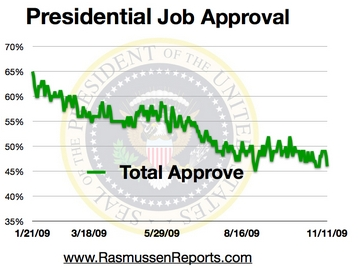
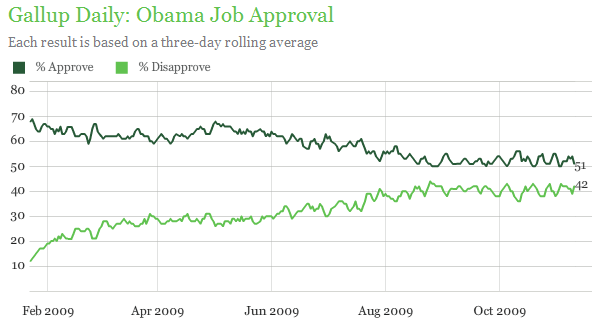
I”m posting this @ 7:59 a.m. and predicting that today’s the day that President Obama’s job approval — as measured by Gallup, a respected, slightly left leaning polling org — will drop below 50% for the first time.  If so, that’ll be a very big deal.

Why?

Major reason: yesterday’s number was 51% (chart below); today will be the first rating that fully reflects Saturday night’s healthcare vote (since Gallup is a 3-day moving average).

Secondary reason: backlash to the way the administration is handling the Afghanistan decision and the Fort Hood massacre.

Reason for confidence: Rassmussen — a slightly right leaning polling org — tends to lead Gallup by a day or two.  Rasmussen has Obama’s job approval down to 46% (chart below).

Note: Rasmussen posts around 9:30 am; Gallup in mid-afternoon.

We’ll see …

* * * * *

Gallup

image
http://www.gallup.com/poll/113980/Gallup-Daily-Obama-Job-Approval.aspx

* * * * *

Rasmussen

image
http://www.rasmussenreports.com/public_content/politics/obama_administration/obama_approval_index_history

If it doesn’t walk like a duck and quack like a duck, what the heck is it?

November 12, 2009

TakeAway: When companies develop innovative products and services that don’t obviously fit into established categories, managers need to help people understand what comparison to make. Without that step, potential customers might just walk away wondering, “What is it?”

* * * * *
Excerpted from NY Times, It’s Brand New, but Make It Sound Familiar, October 4, 2009

GLANCE through a photo album of early automobiles and you’ll find an eclectic assortment of vehicles, including three-wheeled machines and bicycle-like contraptions. You’d be hard-pressed to identify many as cars.

Early consumers were confused, too, until innovators finally converged on a carriage-like design and coined the term “horseless carriage” in the 1890s, giving a clear point of comparison. More than 100 years later, we can learn from their example.

Humans instinctively sort and classify things. It’s how we make sense of a complex world.

So when companies develop innovative products and services that don’t obviously fit into established categories, managers need to help people understand what comparison to make. Without that step, potential customers might just walk away wondering, “What is it?”

* * * * * 

As a starting point, it helps to understand some basic traits of behavior. When people encounter something they don’t recognize, they make sense of it by associating it with something familiar.

“The category signals not only a set of features to expect, but at a more basic level, when and how you should use the novel item.”

Companies can benefit by using comparisons to create expectations that best match an innovation’s strengths.

Problems can arise if consumers can’t place innovations into familiar categories. Consider the introduction of the Segway, the high-tech motorized scooter, “Nobody was quite sure what it was … There was no clear analogy, so people had no idea how to use it.”

* * * * *

Finding the right label is only one of the many ways organizations can influence the way consumers categorize a product. They can also experiment with the product’s shape, packaging, pricing and retail store placement.

* * * * *

As innovative products are introduced, category boundaries are continually shifting and new categories emerging. In some ways, the auto industry is going through a transformation that harks back to the 1800s.

Today’s consumers are confronted with an impressive assortment of new vehicles, including electric models with three wheels and others with designs that just don’t look like what we expect a car to look like.

Will electric vehicles be broadly accepted? And which models will be most popular? The answers may well depend on the associations that automakers try to imprint on consumers.

Full article:
http://www.nytimes.com/2009/10/04/business/04proto.html?sq=segway&st=cse&scp=1&pagewanted=print