Archive for December, 2009

Best jobs … according to Money Mag

December 8, 2009

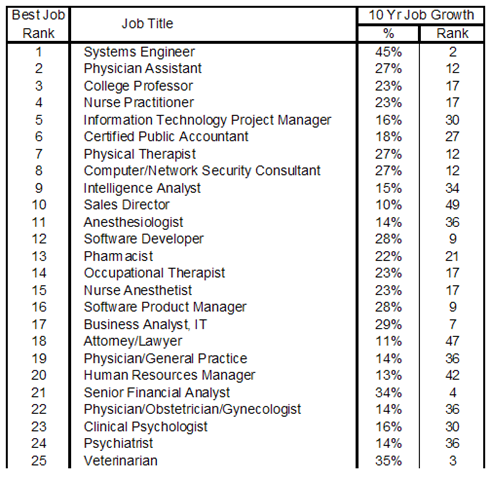
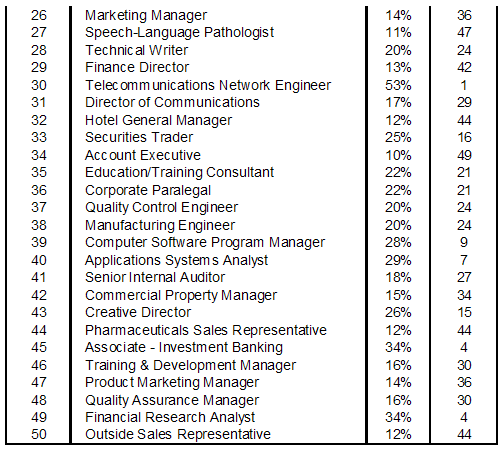
Each year, Money Magazine ranks the best jobs … based on job content and employment growth prospects.

Here’s the 2009 list … Marketing Manager is #26 — ahead of all Finance jobs !

image

image

Full article:
http://money.cnn.com/magazines/moneymag/bestjobs/2009/full_list/index.html

Creating demand … by tapping non-customers.

December 8, 2009

Ken’s Take: “Blue Ocean” Strategists say to stop competing head-on in established markets and refocus on uncontested part of markets — the wide open, blue ocean.  A critical componect of a blue ocean strategy is to “unlock” non-customers …

* * * * *

From the folks at the Blue Ocean Institute …

Traditional strategic thinking looks to capture a greater share of existing demand. But companies can reach beyond existing demand to unlock demand from non-customers, too.

The key is to understand the three tiers of non-customers who buy opportunistically  … or  refuse to buy  …or are unaware of the product offering.

First-tier non-customers are closest to the existing market. They are the buyers who minimally purchase an industry’s offering out of necessity but are mentally
non-customers. They are waiting to jump ship and leave as soon as an alternative is spotted. These are potentially “soon-to-be” non-customers.  But, if they are offered a step-up in value, they can be retained … and may even increase their purchases.

Second-tier non-customers are people who consciously refuse an company’s offerings. These are buyers who have recognized an company’s offerings as an
option to fulfill their needs but have opted against them. These are “refusing” non-customers.

Third-tier non-customers are furthest from the existing market. They are non-customers who have never thought of a company’s offerings as an option. These are “unexplored” non-customers.

* * * * *

The key question to ask: “What are the factors keep non-customers out of the market … and what can be done to pull them into the market?”

Start by by focusing on the key commonalities – not differences – across these non-customers and existing customers to gain insight into how to create demand among these non-customers.

* * * * *

Pres. Obama "bends the curve" … and that’s not good news (for him)

December 7, 2009

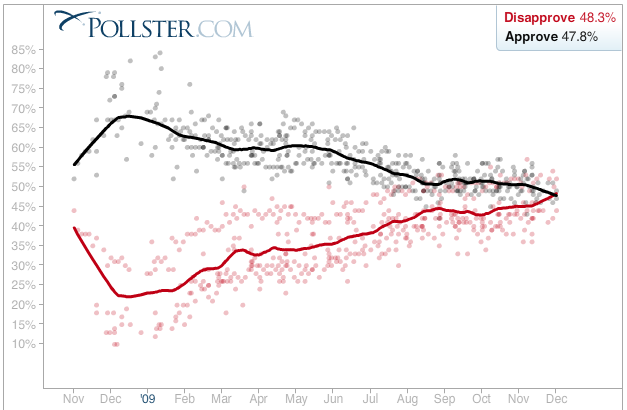
Well, on Sunday, the curves crossed for the first time during the Obama administration.

Based on the Polster.com “poll of polls” — more people disapprove of the job Obama is doing as President than approve.

The approve-disapprove curves have been on a collision course for awhile.  Now they’ve passed through what stock technicians would call a resistance level. 

Next critical number would be if disapproval passes through 50% — indicating that a majority, not just a plurality, disapprove.

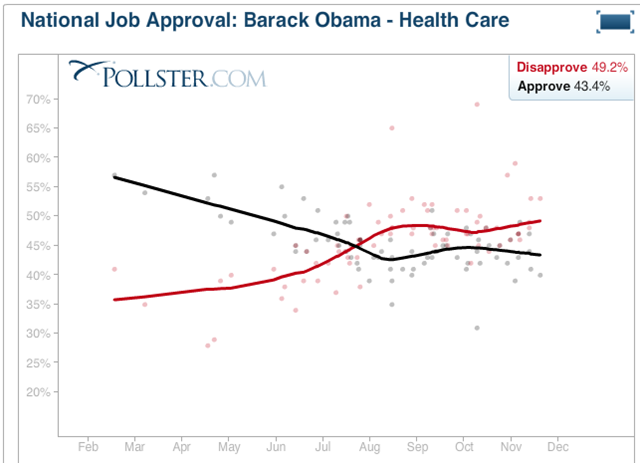
[Healthcare Reform results are below]

image

http://www.pollster.com/polls/us/jobapproval-obama.php?xml=http://www.pollster.com/flashcharts/content/xml/Obama44JobApproval.xml&choices=Disapprove,Approve&phone=&ivr=&internet=&mail=&smoothing=&from_date=&to_date=&min_pct=&max_pct=&grid=&points=1&lines=1&colors=Disapprove-BF0014,Approve-000000,Undecided-68228B

* * * * *

Self-explanatory, right ?

image
http://www.pollster.com/polls/us/jobapproval-presobama-health.php?xml=http://www.pollster.com/flashcharts/content/xml/USObamaJobPresHealth.xml&choices=Disapprove,Approve&phone=&ivr=&internet=&mail=&smoothing=&from_date=&to_date=&min_pct=&max_pct=&grid=&points=1&lines=1&colors=Disapprove-BF0014,Approve-000000,Undecided-68228B

Here’s why I’m so laid back …

December 7, 2009

OK, I’ve never been accused of being too laid back — or, come to think of it,  laid back at all.

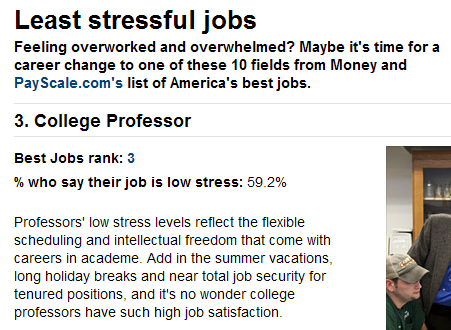
Imagine what I’d be like if I were still in a pressure-cooker job …

* * * * *

From Money Mag and PayScale.com:

image

image

http://money.cnn.com/galleries/2009/moneymag/0910/gallery.bestjobs_leaststress.moneymag/3.html

Full article:
http://money.cnn.com/magazines/moneymag/bestjobs/2009/full_list/index.html

GE’s “Reverse Innovation” … no, it doesn’t mean going retro.

December 7, 2009

TakeAway: For decades, GE has sold modified Western products to emerging markets. Now, to preempt the emerging giants, it’s trying the reverse.

* * * * *

From WSJ:” GE CEO Touts ‘Reverse Innovation’ Model”, Sept 22, 2009 

To better compete in emerging markets and elsewhere, General Electric is is changing its method of innovation and developing products in low-cost countries, such as China and India, then distributing them worldwide.

Two products – a $1,000 handheld electrocardiogram device and a portable, personal-computer-based ultrasound machine that sells for about $15,000 – are examples of GE’s “reverse innovation.”

They were originally developed for markets in emerging countries and are now being sold in the U.S., a contrast from the past when GE and many other industrial companies created products in the U.S., then adapted them for global sales.

The new business model allows the company to expand into emerging countries and keep firms there from creating similar products, then expanding sales to the U.S.

“Success in developing countries is a prerequisite for continued vitality in developed ones.”

For reverse innovation to work, product developers must be based and managed in the local market, and when the products are sold globally, they may need to be sold at lower prices even if they cannibalize higher-margin products in rich countries.

GE now has more than a dozen “local growth teams” in China and India.

Full article:
http://online.wsj.com/article/SB125364544835231531.html?ru=yahoo&mod=yahoo_hs

* * * * *

From the HBS article:

Two myths must be shattered:

Myth #1: Emerging economies will largely evolve in the same way that wealthy economies did.

The reality is, developing countries aren’t following the same path and could actually jump ahead of developed countries because of their greater willingness to adopt breakthrough innovations.

With far smaller per capita incomes, developing countries are more than happy with high-tech solutions that deliver decent performance at an ultralow cost—a 50% solution at a 15% price.

Myth #2: Products that address developing countries’ special needs can’t be sold in developed countries because they’re not good enough to compete there.

The reality here is, these products can create brand new markets in the developed world — by establishing dramatically lower price points or pioneering new applications.  And, technology often can be improved until it satisfies more demanding customers.

* * * * *

Local Growth Team (LGT) model,  is based on five critical principles.

1. Shift power to where the growth is.
Without autonomy, the LGTs will become pawns of the global business and won’t be able to focus on the problems of customers in emerging markets. Specifically, they need the power to develop their own strategies, organizations, and products.

2. Build new offerings from the ground up.
Given the tremendous gulfs between rich countries and poor ones in income, infrastructure, and sustainability needs, reverse innovation must be zero-based. These wide differences cannot be spanned by adapting global products.

3. Build LGTs from the ground up, like new companies.
Zero-based innovation doesn’t happen without zero-based organizational design. GE’s organizational “software”— its hiring practices, reporting structures, titles, job descriptions, norms for working relationships, and power balances between functions—all evolved to support glocalization. LGTs need to rewrite the software.

4. Customize objectives, targets, and metrics.
Innovation endeavors are, by nature, uncertain. It’s more important to learn quickly by efficiently testing assumptions than to hit
the numbers. So the relevant metrics and standards for LGTs—the ones that resolve the critical unknowns—are rarely the same as
those used by the established businesses.  The new business model emphasized training, offered online guides, designed simpler
products, created built-in presets for certain tasks, and tracked customer satisfaction to gauge success.

5. Have the LGT report to someone high in the organization.
LGTs cannot thrive without strong support from the top. The executive overseeing the LGT has three critical roles: mediating conflicts between the team and
the global business, connecting the team to resources such as global R&D centers, and helping take the innovations that the team develops into rich countries. Only a senior executive in the global business unit, or even its leader, can accomplish all of that.

* * * * *

Help Wanted, No Private Sector Experience Required

December 4, 2009

This analysis — reported by AEI and sourced to JP Morgan researchers — examines the prior private sector experience of the cabinet officials since 1900 that one might expect a president to turn to in seeking advice about helping the economy.

It includes secretaries of State, Commerce, Treasury, Agriculture, Interior, Labor, Transportation, Energy, and Housing & Urban Development, and excludes Postmaster General, Navy, War, Health, Education & Welfare, Veterans Affairs, and Homeland Security—432 cabinet members in all.

obamacabinet
AEI, Help Wanted, No Private Sector Experience Required, November 25, 2009
http://blog.american.com/?p=7572

In the Obama administration over 90 percent of the players’ prior experience was in the public sector, academia, or law practices. Virtually no “business experience” per se.

* * * * *

Ken’s Take:

(1) Quibble with the numbers, but directionally the conclusion fits — which is why the Faux Stimulus didn’t work, why the spending is out of control, why there’s sloppy implementation (think Cash for Clunkers), and why businesses refuse to rebuild their payrolls.

(2) Note that the analysis was sourced to JP Morgan. I’ve heard from my sources that off-the-record boardroom commentaries re: the Obama administration has turned very, very negative.  But, public commentary is constrained by fear of vindictive government retribution (think pay caps, voiding of contracts, etc.).  Surprised me that JPM is associated with the analysis.

(3) Liberal blogs have marshalled to debunk the 10% number for Obama’s advisers.  Their rebuttals are laughable — largely claiming that private sector experience includes having had a parent who had a real job. having been a lawyer with at least one private sector client, having run a campaign, or having been a university administrator.  For example, here are a couple of my favorites:

Vice President Joe Biden – Private experience:  Yes.   Biden’s father worked in the private sector his entire life — unsuccessfully for a critical period.  Biden attended a private university’s law school (Syracuse), and operated a successful-because-of-property-management law practice for three years before winning election to the U.S. Senate.   Running a campaign is a private business, too — and Biden’s first campaign was masterful entrepreneurship.

Secretary of Interior Kenneth L. Salazar – Private sector experience: Yes. Besides a distinguished career in government, as advisor and Cabinet Member with Colorado Gov. Roy Romer, Salazar was a successful private-practice attorney from 1981 to 1985, and then again from 1994 to 1998 when he won election as Colorado’s Attorney General.    Salazar’s family is in ranching, and he is usually listed as a “rancher from Colorado.”

Secretary of Labor Hilda L. Solis – Private sector experience:  Yes.   Solis’s father was a Teamster and union organizer who contracted lead poisoning on the job; her mother was an assembly line worker for Mattel Toys.  She overachieved in high school and ignored her counselor’s advice to avoid college, and earned degrees from Cal Poly-Pomona and USC.  She held a variety of posts in federal government before returning to California to work for education and win election to the California House and California Senate, and then to Congress.

Secretary of Education Arne Duncan – Private sector experience:  Yes.  Duncan earned Academic All-American honors in basketball at Harvard.  His private sector is among the more unusual of any cabinet member’s, and more competitive.  Duncan played professional basketball: “From 1987 to 1991, Duncan played professional basketball in Australia with the Eastside Spectres of the [Australian] National Basketball League, and while there, worked with children who were wards of the state. He also played with the Rhode Island Gulls and tried out for the New Jersey Jammers.”  Since leaving basketball he’s worked in education, about four years in a private company aiming to improve education.

To verify the above examples — and for a few more chuckles — check out
http://timpanogos.wordpress.com/2009/11/26/obamas-well-qualified-cabinet-conservatives-hoaxed-by-j-p-morgan-chart-that-verifies-prejudices/

Freakin’omics: What Spitzer can teach Tiger …

December 4, 2009

Eliott Spitzer (a.k.a. “Client–9”) raised eyebrows when it was leaked that he paid a pro $4,500 for a night of transgression(s). 

At the time, $4,500 a pop sounded like a lot of money to most folks.

Well, Tiger Woods, has taken the game to a new level.

The Daily Beast reports that the beleaguered golfer is negotiating an immediate $5 million “sorry” payment to his wife — and revising her prenup to give her a “retention bonus” of $55 million more to stay with him two more years.

Let’s see.  The tramp that went public says she and Tiger “got together” about 20 times.  There’s speculation that there were at least 2 other Tiger-pleasers  in play. Let’s assume that Tiger teed off 20 times with each of them, too.

OK, $60 million  divided by 60 “dates” …

Holy smoke … $1 million a shot !!!!

Now, that’s  freakin’omics.

* * * * *
P.S.  Since we’re talking incentive pay and retention bonuses, shouldn’t the Fed pay czar have a crack at the deal?
* * * * *
Source article:
http://www.thedailybeast.com/blogs-and-stories/2009-12-03/new-details-on-tigers-prenup/?cid=hp:mainpromo1
* * * * *
PROMISE: This is my last Tiger post …

Kraft and Cadbury … a bittersweet mix.

December 4, 2009

Takeaway: On a day where Advanced Marketing Strategy students were asked to come up with the appropriate bid for Dewey the Cat, it is fitting to revisit the seemingly sweet Kraft hostile bid for Cadbury that quickly turned sour.

While this deal makes business sense, as Kraft will be able to more easily penetrate emerging markets and take advantage of scale economies, the inability of both sides to agree on the proper value of Cadbury struck this deal down.

A falling Kraft share price makes the deal even less attractive to Cadbury shareholders today. Who knows, maybe if Kraft had utilized discovery driven planning to determine the value of the acquisition, it could have induced shareholders to bite the cheese…

* * * * *

Excerpted from BusinessWeek, “Kraft: Is Cadbury the Missing Global Ingredient?” by Ben Steverman, November 9, 2009

If you boil down the motivations behind Kraft Foods’ (KFT) hostile bid for Cadbury (CBY), you reach an undeniable fact: People all over the world love candy, gum, and chocolate.

Because confections have little store-brand competition and sales stay steady even during downturns, food companies such as Kraft envy Cadbury’s profit margins. A further factor makes them envy its growth prospects: Candy travels well.

Cadbury: access to emerging economies

Kraft macaroni-and-cheese may be an American favorite, but it won’t necessarily catch on in China or India. Sweets are different. Around the world, “candy seems to attract consumers who want to try new things,” Van Horn says.

Cadbury has built a global business with access to the emerging economies that Kraft wants to penetrate.

The question, however, is how much Kraft is willing to pay for all this. On Nov. 9, Kraft submitted a hostile bid for Cadbury on the same terms as a September offer that was rejected. The offer valued Cadbury at £9.8 billion, or $16.4 billion in cash and stock. But because the value of Kraft’s shares has been falling, the offer of 717 British pence per share was worth about 4% less than it was two months ago.

Shareholder Buffett: Don’t overpay

On the one hand, a Cadbury acquisition would bring benefits to Kraft. But Kraft has said it doesn’t want to pay so much that it risks its credit rating or dividend. On Nov. 9, Standard & Poor’s said that Kraft’s credit rating remains on “creditwatch with negative implications,” due to the bid.

Kraft’s bid has encountered resistance in Britain from those who don’t want to see a U.S. buyer for a treasured company. One Cadbury heir has called Kraft “an American plastic cheese company.”

By combining her company with Cadbury, Kraft Chairman and Chief Executive Irene Rosenfeld would achieve the size and global reach to compete with such rivals as Nestlé (NESN). She says the new company could find $625 million in savings and synergies and would help Kraft better access markets in India, South Africa, and Mexico.

Economies of scale in food businesses

“Purchasing Cadbury would fast-forward Kraft’s bid to build a larger emerging-market presence and would no doubt offer an infrastructure [in key countries] that would take years to build and perfect on its own,” wrote Stifel Nicolaus (SF) analyst Christopher Growe on Nov. 9.

Size is an advantage in the food business, where economies of scale can be significant, says Steven Rogé, portfolio manager at R.W. Rogé & Co. Size also helps a company negotiate with giant retailers and suppliers. “In an age when you’re trying to sell to the Wal-Marts (WMT) of the world, you need size and scale,” Rogé says.

The dealmaking will test the future of Kraft’s growth strategy as it determines the value of Cadbury’s global reach and lucrative confection brands. Meanwhile, Cadbury shareholders must decide if they’re willing to risk a loss in stock price to keep the company independent.

Edit by JMZ

* * * * *

Full Article:
http://www.businessweek.com/investor/content/nov2009/pi2009119_839315.htm

A sharp stick in the "I" …

December 4, 2009

Sports coaches refrain that there’s no “I” in “Team” … every management communications coach cautions against the arrogant and isolating effect of using “I” instead of “we”.

Appears somebody missed that class …

* * * * *

Excerpted from WSJ: Obama Redeclares, Peggy Noonan, Dec. 3, 2009

There was too much “I” in Obama’s speech at West Point.

George H.W. Bush famously took the word “I” out of his speeches—we called them “I-ectomies” — because of a horror of appearing to be calling attention to himself.

Mr. Obama is plagued with no such fears.

“When I took office . . . I approved a long-standing request . . . After consultations with our allies I then . . . I set a goal.”

That’s all from one paragraph.

Further down he used the word “I” in three paragraphs an impressive 15 times.

“I believe I know” “I have signed” “I have read” “I have visited.”

I, I—ay yi yi. This is a man badly in need of an I-ectomy.

Full article:
http://online.wsj.com/article/SB10001424052748704007804574574311658007036.html

Timing is everything … Tiger offers Barack 10 tips … on what exactly?

December 3, 2009

First, I’m NOT one of the people who is tired of the Tiger Woods’ accident and affairs coverage.  My opinion: no such thing as too much coverage of this one.

Second, in great irony, el Tigre and President Obama share the cover of the already printed January issue of Golf Digest with a cover story titled, “10 Tips Obama Can Take From Tiger.” 

Jokesters are having a blast conjecturing on the 10 tips.  You don’t have to go much beyond the cover to get a few chuckles.  The other feature stories “How to Outsmart Your Buddies” and, my favorite “Load It and Let It Go”. You just can’t make this stuff up. 

golf digest cover tiger woods obama
http://www.examiner.com/x-20836-Celebrity-Fitness-and-Health-Examiner~y2009m12d1-Tiger-Woods-Golf-Digest-Cover-10-Tips-Obama-Can-Take-From-Tiger

(Clean) Tiger Jokes

This is the first time Tiger hit a tree and a water hazard on the same drive.

What’s the difference between a car and a golf ball? Tiger can drive a ball 300 yards.

What were Tiger Woods and his wife doing out at 2.30 in the morning? They went clubbing.

Tiger was representing Nike: Just do it !

Elin found out he’s not a Tiger, he’s a Cheetah.

It’s cool to be independent … again.

December 3, 2009

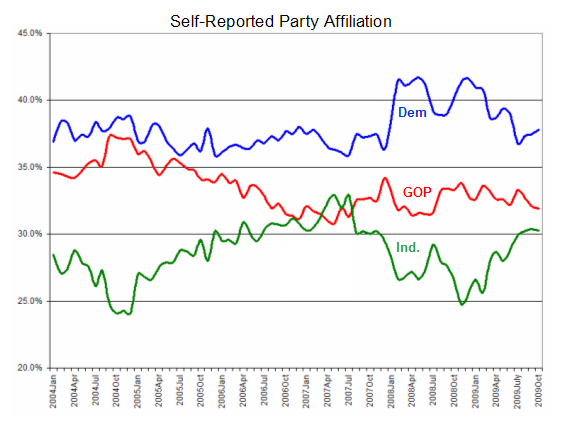
Rasmusssen (and other pollsters) ask people to self-categorize themselves by political party.

I think the trends are pretty interesting:

During the final years of the Bush admin, the mix shifted from the GOP to independents.  Note the near mirror image of the red and green lines on the left half of the chart.

When Obamamania caught traction, the mix shifted from independents to Democrats.  Again, not the near mirror image of the green and blue lines on the right half of the chart.

Now, the mix is shifting again — from Dems to independents.

While Dems still have a statistically significant plurality, the country broken roughly in thirds across Dems, GOP and independents … with independent “swing voters” carrying determining sway.

image

http://www.rasmussenreports.com/public_content/politics/mood_of_america/partisan_trends

Shopping therapy saves the day … yeah, right.

December 3, 2009

TakeAway:  Shopping therapy is not a new concept but asserting that it will carry the consumer economy through this recession is quite brazen. 

To what degree does our emotional connection with or satisfaction from a product overrule our rationale behavior, especially during a recession?

* * * * *

Excerpted from WSJ, “The Bonhomie of Buying,” By Laura Vanderkam, November 1, 2009

As the economy tanked last year, pundits claimed that we were entering a new age of frugality. We would stop shopping and learn to “use it up, wear it out, make it do or do without” …

There was just one problem with this prediction: Given how much money is riding on the consumer economy, legions of people now spend their lives figuring out how to make the buying experience more alluring … “We probably know as much about the behavior of the human shopper in its natural habitat, the mall, the grocery, or the department store, as we do about the activities of any species of animal in the wild.”

Now former Esquire editor Lee Eisenberg adds his own take, examining why modern Americans find shopping so irresistible … “Shoptimism” aims to offer a novel view on the big idea of buying and selling … Eisenberg approaches consumer culture as an anthropologist … He turns up some interesting tidbits.

Black Friday shoppers … say that they’re battling the crowds on behalf of themselves rather than shopping for loved ones …

The brains of tight-fisted folks react to high prices in the same way they do to physical pain.

We absorb advertising messages so well that—in a world saturated with PC Guy vs. Mac Dude ads—we actually perform better on creativity tests after being cued by references to Apple products …

Brands are losing their vice grip as shoppers figure out that generic items are often made in the same factories as branded ones and retailers manage to turn their private labels into desirable goods …

* * * * *

The overarching argument inherent in this book: Shopping, in modern America, is fundamentally an optimistic activity.

While our shopping habits are easily manipulated, they are not quite as irrational as critics like to believe. For most of us shopping … really does make us feel better.

We buy because it “confers instant membership in a community.” We buy “to express ourselves.” Most important, we buy because “buying is fun, sociable, and diverting …”

If a sweater or an iPod can do that, … then no wonder, recession or not, it’s hard to keep Americans out of the stores.

Edit by TJS

* * * * *

Full Article
http://online.wsj.com/article/SB10001424052748703399204574505382492105704.html

* * * * *

Cash for a Clunker? … GM’s gov’t-selected CEO gets the heave-ho.

December 2, 2009

In March, Pres. Obama and his “car czar” axed GM’s CEO Rick Waggoner and appointed  Fritz’ Henderson to replace him, change the organizational culture, and save the company.

Oops.

On Tuesday, the GM board forced Henderson to resign, and initiated a search for his successor.

Good luck.   

Bringing in new blood is likely to be pretty hard since the company’s major shareholder (Uncle Sam) is capping pay offers, and restricting bonuses. 

The paradox: GM needs somebody with great judgement … and anybody who would take the job is disqualified based on that criteria alone.

http://online.wsj.com/article/SB10001424052748703735004574570370686365390.html?mod=article-outset-box

The Manhattan Declaration … gaining traction ?

December 2, 2009

Conservative Christians – who mostly sat out the 2008 election—seem to have gotten a second wind. 

The Manhattan Declaration – issued a couple of weeks ago by a group of Catholic and evangelical Christian leaders – focuses on “traditional values”:

(1) the sanctity of human life, (2) the dignity of marriage as the conjugal union of husband and wife, and (3) the rights of conscience and religious liberty.

If you thought the “culture wars” were over, think again …

* * * * *
Manhattan Declaration – Summary

Christians, when they have lived up to the highest ideals of their faith, have defended the weak and vulnerable and worked tirelessly to protect and strengthen vital institutions of civil society, beginning with the family.

Orthodox, Catholic, and evangelical Christians are uniting to reaffirm fundamental truths about justice and the common good, and to call upon our fellow citizens, believers and non-believers alike, to join us in defending them.

These truths are (1) the sanctity of human life, (2) the dignity of marriage as the conjugal union of husband and wife, and (3) the rights of conscience and religious liberty.

These truths are foundational to human dignity and the well-being of society … and they are increasingly under assault from powerful forces in our culture.

Human Life

Although the protection of the weak and vulnerable is the first obligation of government, the lives of the unborn, the disabled, and the elderly are ever more threatened. 

We pledge to work unceasingly for the equal protection of every innocent human being at every stage of development and in every condition.

Marriage

Marriage is the original and most important institution for sustaining the health, education, and welfare of all.  But, the institution of marriage, is already wounded by  the false and destructive belief that marriage is all about romance and other adult satisfactions … leading to promiscuity,infidelity and divorce.

Marriage is about the unique character and value of acts and relationships whose meaning is shaped by their aptness for the generation, promotion and protection of life.

Marriage is not a “social construction,” but is rather an objective reality—the covenantal union of husband and wife—that it is the duty of the law to recognize, honor, and protect. 

Where marriage erodes, social pathologies rise.

Religious Liberty

Freedom of religion and the rights of conscience are gravely jeopardized.  Attacks on religious liberty are dire threats not only to individuals, but also to the institutions of civil society including families, charities, and religious communities.

The health and well-being of such institutions provide an indispensable buffer against the overweening power of government and is essential to the flourishing of every other institution … on which society depends. 

Full summary: 
http://manhattandeclaration.org/images/content/ManhattanDeclarationSummary.pdf


It’s not what you know, but who you know … on your social network, that is.

December 2, 2009

Takeaway: Marketers have long used online media to manage their company’s reputation with consumers. However, in an effort to more precisely select and target profitable customers they have now turned the looking glass around on the consumer.

By analyzing the online behaviors and social networks of their customers, marketers believe they can determine who has been naughty and who has been nice.

In this world of increased transparency, who will come a-wassailing in your virtual neighborhood this holiday season?

* * * * *

Excerpt from Fast Company, “How Rapleaf Is Data-Mining Your Friends Lists to Predict Your Credit Risk,” by Lucas Conley, November 16, 2009.

They say you can tell a lot about a person by the company they keep. By now, you probably already know your behavior on social networking sites like Twitter and Facebook can get you fired, evicted, and even arrested–but what about your friends’ behavior? Upon reviewing your social networking friend list, the data-mining firm Rapleaf says it can help predict which ads you’ll pay attention to and whether or not you’re a worthwhile risk for a credit card or a loan–all without hacking into any accounts or breaking any laws.

Until recently, such data has largely been applied towards reputation management, helping brands, advertising agencies, and public relations firms hear what we’re saying about them. But as the volume of consumer data has grown, and the technology employed to gather, sift, and analyze it has advanced, organizations are turning the tables, asking what the data says about us. There is mounting evidence suggesting that your friends influence everything from your weight to your happiness.

Seventy percent of U.S. consumers claim they “definitely would not” allow advertisers to track their online behavior–even if they were to remain anonymous. It is therefore unlikely that consumers will react favorably to businesses monitoring and ranking their social footprints.

Rapleaf only aggregates publicly available information, and allows customers to opt out or register “to discover what information about you is available online and to edit your Internet footprint.” Rapleaf claims it is making ecommerce faster, cheaper, and easier for consumers and businesses alike.

By accessing its database of nearly 380 million consumer email profiles, banks, retailers, and anti-fraud firms, Rapleaf can quickly confirm legitimate customers and weed out scammers, cutting verification costs and improving the user experience. “Companies spend as much as $100 getting customers to their site. The goal is to filter out the bad people and keep as many good people as possible,” Rapleaf says.

Beyond simply helping verify your identity, Rapleaf claims information about your friends’ behavior can be used to better predict your behavior. For one company, Rapleaf adapted ads based on friends’ responses, ultimately tripling the click-through rate. Rapleaf’s Web site even suggests that clients “use friend networks to enhance … credit scoring.” Rapleaf explains: “Say someone would have been rejected for a credit card, but their social graph says their friends are good payers. Instead of saying ‘Rats, we couldn’t give this guy the card,’ they’ll be approved.”

“Social networking is part of the advertising-supported Internet,” he says. “It’s one of the free services we all enjoy. Now people are becoming aware there is a cost.”

Edit by BHC

* * * * *

Full Article: http://www.fastcompany.com/blog/lucas-conley/advertising-branding-and-marketing/company-we-keep

* * * * *

Your health insurance premiums will go down $2,500 … Not !

December 1, 2009

Candidate Obama said repeatedly that his healthcare reforms would bring down family insurance premiums by $2,500.
http://blogs.wsj.com/health/2008/07/23/parsing-obamas-promise-to-lower-insurance-premiums-by-2500/

The CBO analysis of the Reid Senate bill concludes that many folks premiums will go up, not down.

Oops.

* * * * *

Excerpted from Washington Post Online, CBO: Senate health plan will increase some premiums — and expand coverage, Nov. 30, 2009

The Senate’s plan to overhaul the health insurance system would increase premiums in the individual market … and six in 10 families would have their premium payments subsidized, congressional budget analysts said.

By 2016, two years after the Senate reforms are to take effect, the CBO projected that premiums for 32 million people in the individual insurance market would be driven as much as 30 percent higher because insurance companies would be required to offer better coverage than they do now.

But that increase would be partially offset by lower costs for insurers, who would have access to a new pool of younger, healthier customers who might previously have gone without insurance.

The result: Nongroup premiums on average would increase by about 13 percent compared with current law, to $5,800 for individuals and $15,200 for family coverage. But the CBO predicts that 57 percent of purchasers in that market would also be receiving federal subsidies that would cover roughly two-thirds of that cost, leaving them paying 60 percent less for insurance than if the legislation were not enacted.

But Republican Senate leader Mitch McConnell said: “At the beginning of the health care debate, we were told that this trillion-dollar experiment would lower premiums for American families.And yet just this morning, the independent Congressional Budget Office provided an analysis showing that the Democrat bill will actually increase premiums for American families.So a bill that’s being sold as a way to reduce costs actually drives them up.”

“The bottom line is this: after 2,074 pages and trillions more in government spending, massive new taxes and a half-trillion dollars in cuts to Medicare for seniors, most people will end up paying more or seeing no significant savings.”

Full article:
http://voices.washingtonpost.com/capitol-briefing/2009/11/cbo_senate_health_plan_will_in.html

“Open Enrollment” … finally, I actually looked at my health insurance costs … you should, too!

December 1, 2009

I’m embarrassed to admit that, in the past, I just hadn’t given much thought to my company provided health care insurance.

The premiums – or more precisely, my share of the premiums – seemed reasonable, our docs were on the plan, and the plan covered our needs fairly. Every year, I simply continued the coverage I had in place the prior year.

Since I’ve gotten deep into the health care reform fiasco, I was more diligent this year.

Below is what I found, and far below are some observations re: Cadillac insurance plans.

* * * * *

The Plans

My employer offers 3 plans that are relatively comparable in coverage.  See the chart below for premium details.

The 3 plans differ slightly in co-pays, deductibles, limits, etc., but I concluded that the differences aren’t “statistically significant”. (Note: I didn’t even consider the lowest cost alternative – a Kaiser HMO).

image

First, note that – depending on the specific plan — my employer pays somewhere between 59% and 77% of the total premiums – employees pay between 41% and 23%.   I’m told that the split is comparable to most company plans – with the COMPANIES paying at least half of the premiums, often more, sometimes much more.

The shocker was the range in total premiums by carrier – for roughly equivalent coverage.  For example, the UHS premium for a couple ($15,376) is more than $6,000 higher (almost 70%) than the premium from CareFirst Blue Shield ($9,088).

Note that there’s a modest “marriage penalty”.  The total premiums for a couple are more than twice the individual premiums – by about 10%.

If you’re going to have kids, you might as well have a lot of them.  The family rate is 3 times the individual rate, regardless of the number of children in the family.  Hmmmm.

On balance, the premium levels are about what I expected.  Per capita health care expenditures average a bit over $7,000 – pretty much in line with UHS – the high cost provider.

I’d been riding along with United Healthcare (UHS).  I knew they were premium priced, but I didn’t realize by how much. Ouch.  My shiny new CareFirst card is in the mail, and my projected 2010 disposable pay is plus $4,000 … not bad.

Teaching point: Do the homework when selecting healthcare insurance plans.  There’s serious money involved.

* * * * *

Cadillac Plans

Company paid premiums are not subject to income taxes.  I think that’s unfair (to folks paying 100% of their policy’s premiums), and arbitrary (it sure looks like compensation).  I’m all for rolling company paid premiums into W-2s,  giving taxpayers an exclusion – say, $3,000 for individuals, $6,000 for couples, $10,000 for families, and then income-taxing the balance.

While the approach is different (largely to “hide the weenie”), I agree with the spirit of the Senate bill.  Taxing Cadillac plans can raise some money, and might start to cap the upside on coverage.  In effect, the folks getting the best health care benefits have to ante in to support folks who get none or relatively little.  Seems fair to me.

The Senate proposal is to levy a 40% tax on the excess of premiums over $8,500 a year for individuals or $23,000 for families.  If anything, the levels – which were set to outboard lucrative union plans  —  are too low – probably by a factor of 2 based on my company plans.

Side note: I haven’t heard or seen anything that distinguishes between premiums paid by individuals and premiums paid by companies.  Obviously, premiums paid by an employee aren’t wages to be taxed.

A portrait in black & white…

December 1, 2009

Last week, Gallup reported that Pres. Obama’s approval rating has dipped below 50%.  That is, less than half of the country approves of the job he’s doing as president.  That’s less than the percentage of folks who voted for him, and 17 points lower than his inaugural approval rating.

image

Among the telling — but largely unreported trends — is Obama’s sharp drop-off among whites.  While his approval rating by blacks has stayed sky high — above 90% — his approval rating among whites has gone down from 61% to 39% — a 22 point drop. Ouch.

To diffuse any racial undertones, Gallup points out that  Bill Clinton averaged 55% job approval during his presidency, including 52% among whites … and 82% among blacks” … leading them to conclude: “One reason Obama may have maintained support among blacks is their overwhelming affiliation with the Democratic Party.”

Is that an elephant I see in the middle of the room ?

image

http://www.gallup.com/poll/124484/Obama-Approval-Slide-Finds-Whites-Down-39.aspx?CSTS=alert

image

Extra mayo, please: extending the product life cycle

December 1, 2009

Takeaway: As Americans have tightened their budgets throughout the current recession, the relatively mature mayonnaise market has experienced significant growth.

Sensing a large jump in top-of-mind awareness, Unilever has been making a strong push of its Hellman’s brand to take advantage of the rise of brown-baggers.

With the economy hopefully turning around, the brand is now in a classic dilemma of figuring out how to extend the product life cycle.

Their plan: pushing the “real” ingredients that make up mayo and give it the mystique of the secret ingredient you’ve had in your pantry that can enhance all dishes, from appetizer to dessert.

Creating new uses for a product is a tremendous way to extend that product life cycle; just ask Arm & Hammer. And with Thanksgiving just around the corner, maybe Hellman’s can continue to grow…one clogged artery at a time.

* * * * *

Excerpted from BrandWeek, “The Mayo Clinic” by Elaine Wong, November 7, 2009

Thanks to the recessionary rise of eating at home and brown-bagging lunches for the office, mayo is no longer the staid standby in the back of the kitchen cupboard. And so sales growth — any sales growth — is welcome news for the folks who work in Hellmann’s nondescript office park in Englewood Cliffs. But Fish’s efforts raise some hard questions, among them: As the recession lifts, will mayo’s popularity fade once more? Will vigorous marketing be enough to overcome the market’s vicissitudes? And, in these health-conscious times, is it even possible to overcome the fact that mayonnaise is among the fattiest foods on the market?

Nonetheless, Fish is confident he can get fat-conscious, weight-obsessed Americans to eat more of the stuff. He plans to do that through a combination of creating more uses for the condiment and through the nostalgia sell — appealing to consumers who long to recreate the good-old days of meat and potatoes and other so-called “real food.”

“Remember,” Fish says, “Hellmann’s has always been made with eggs, oil and vinegar.” It’s the sort of message that purists would appreciate — and there seem to be a growing number of those. They’re the sort who devour books by culinary journalist Michael Pollan, and who thrust Julia Child’s half-century-old Mastering the Art of French Cooking back into best seller status in the wake of the film Julie & Julia.

Fish’s approach is on full display in this month’s “Hellmann’s real holiday helpings” campaign, which stars chef Bobby Flay. The Food Network personality is appearing in print and online ads touting Hellmann’s as an essential component in family-oriented, Thanksgiving meals. Ads from OgilvyEntertainment show Flay cooking alongside mothers and their kids. (It is Hellmann’s contention that involving children in the cooking process renders them more willing to eat the results. Plus, introducing them to mayo can’t hurt, either.)

“Recipes that require you to go to the grocery store and buy 10 new things that you didn’t happen to have is asking a lot of people,” Fish says. “This isn’t the time to be asking people to go the extra mile.” If mom is cooking and happens to have a jar of Hellmann’s around, she won’t have to go that extra mile at all.

At the same time, much of Fish’s strategy also hinges on getting home cooks to consider Hellmann’s mayo as their “secret sauce — that special something that I’ve done that you don’t know about that makes this dish taste so good,” he said. “We know from research that consumers love recipes with a secret ingredient in them,” Longfield adds. And mayonnaise, in this instance, does the trick.

Unilever has, in fact, been a staunch proponent of the “real food” movement. The basic line of reasoning is that consumers are more likely to buy goods from companies who can readily tell their ingredients’ stories. And Unilever’s not alone. In introducing Select Harvest, for instance, The Campbell Soup Co. touted it as a soup line “made from only ingredients that people can readily recognize.” Haagen-Dazs also has a line called Five named after the ice cream’s total list of ingredients.

Americans might not like the idea of fat, but they’re still willing to accept it. As the resurgence of Julia Child’s landmark French cookbook proved, Americans’ fear of fat seems secondary to their appreciation of honest and wholesome foods — many of which have lots of fat.

But how long would the good news last? With economists having just declared the recession officially over, it’s only a matter of time before brown-bagging it for lunch will lose its retro cool and families will again go out to eat for dinner. In fact, according to senior associate brand manager Jessica Teilborg, “the biggest competitor we deal with every day is out-of-home dining.”

Edit by JMZ

* * * * *

Full Article:
http://www.brandweek.com/bw/content_display/news-and-features/direct/e3i8875589fada415ac765d6617882ef4b3

* * * * *


Re: Brand Image … Is “bulletproof” Tiger out of the woods?

December 1, 2009

Key Takeaway: As more facts become public, will the controversy around Tiger Woods’ recent accident damage his long-term marketability? More likely than not, the answer to that question will be a resounding no.

Woods’ ability to position himself in such a different way than all other golfers (and all other athletes, for that matter) will help keep him atop the appeal list for both fans and sponsors.

Furthermore, the fan that loves Tiger tends to be more forgiving than most. So you better believe the next time Tiger is being given a green jacket, all of Augusta will be cheering him on.

* * * * *

Excerpted from Brandweek, “Tiger Woods’ Image Likely Unharmed by Accident” by Kenneth Hein, November 30, 2009

Smashed up, semi-conscious and bleeding may be how Tiger Woods was discovered three days ago. However, his reputation as a top brand endorser should remain relatively unscathed, according to sports marketing experts.

Allegations of infidelity and other stories that are currently swirling will not greatly affect his abilities as an endorser, said David Schwab, vp, Octagon Sports Marketing’s First Call and managing director of athletes and personalities. “If it’s only a spat and the story is what we’ve seen, then it doesn’t affect him,” Schwab said. “He is unique in terms of his global appeal, size and long-term ability. He’s not like a prime-time actor competing with 30 other competitors. He doesn’t compete with anyone.”

Woods’ target demographic, namely middle- to upper-class males, “tend to be a lot more forgiving,” said Larry McCartney, associate professor of sports marketing at Seton Hall University’s Center for Sport Management. “There are obviously rumors flying around all over the place at the moment, but he’s pretty much bulletproof.”

The only danger for Woods involves any offers that are currently on the table. “Right now if I’m a brand manager negotiating to do a global campaign, do I pull out because maybe it could get worse?” said Sturner. Still, “long term will it hurt? No. Look at Kobe Bryant right now. Look at the other stars that have had worse incidents that have dampened their reputations [and rebounded]. It’s about what happens on the golf course. That will make or break his marketing appeal.”

Edit by JMZ

* * * * *

Full Article:
http://www.brandweek.com/bw/content_display/news-and-features/direct/e3i4c19162f98c24488bb3e623d9707c6ff

There’s still hope for MBAs …

December 1, 2009

TakeAway:  There is no doubt that the hiring environment is less than ideal for MBAs … all MBAs. 

However, there is hope.  Companies appear to be hiring but students must be a little more flexible and patient than in the past.

* * * * *

Excerpted from BusinessWeek, “MBAs Confront a Savage Job Market,” By Anne VanderMey, October 29, 2009

Adam Rosenberg did everything right. He got into a good school. He landed a great internship. He was even vice-president of two MBA clubs and a graduate teaching fellow. But when it came time for companies to hire this year, the 2009 graduate … was surprised to find out how little it all mattered … 

He’s not alone … MBA students have found themselves facing what schools say is the worst hiring season they’ve ever seen.

According to the latest data … 16.5% of job-seeking students from the top 30 MBA programs did not get even one offer … three months after graduation. Last year that was true of just 5% of students. And … starting pay was down … For many programs, it marked the first time since the tech bubble burst that salaries didn’t increase. Signing bonuses, too, fell both in value and quantity …

One factor that made this recession different was that it hit MBA students where it hurt the most, with thousands of high-paying finance jobs going up in smoke …

The most successful schools this year were able to direct students who were shut out of investment banking and consulting into different industries … Rather than holding on to their hopes of working on Wall Street, students looked at their other skill sets …

A few sectors have been able to pick up some of the slack. Health care, energy, government, and nonprofit hiring are holding up particularly well …

Much of the hiring happened months later than normal. Many companies shifted from hiring on an academic schedule, which requires the stability to sign on new employees almost half a year before they show up to work, to hiring on an as-needed basis—often making offers much later in the year …

Early signs this year don’t point to a swift recovery for the class of 2010. Some believe the coming months will be even worse. That means many students will end up taking jobs they might not otherwise have considered or returning to industries they came to business school to get out of. That could be both good and bad news for this recession’s new grads.

Some students will discover jobs in new fields, try entrepreneurship, or travel to new countries. Instead of gravitating to a few companies that dominate recruiting, many schools say students are going to boutique firms or startups where they might be the only MBA hire that year … Students are opening their minds to new things …

Edit by TJS

* * * * *

Full Article
http://www.businessweek.com/bschools/content/oct2009/bs20091029_862211.htm

* * * * *