Archive for February 22nd, 2010

President’s "strong approvers" hits new low …

February 22, 2010

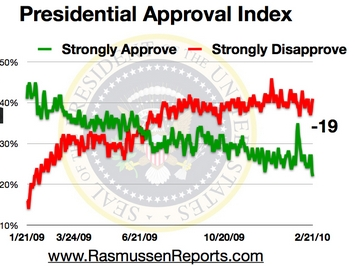
The Rasmussen Reports daily Presidential Tracking Poll for Sunday February 21 shows that 22% of the nation’s voters Strongly Approve of the way that Barack Obama is performing his role as President. That is the lowest level of strong approval yet recorded for this President.

Forty-one percent (41%) Strongly Disapprove giving Obama a Presidential Approval Index rating of -19.

The Approval Index has been lower only on one day during Barack Obama’s thirteen months in office (see trends). The previous low came on December 22 as the Senate was preparing to approve its version of the proposed health care legislation.

The current lows come as the President is once again focusing attention on the health care legislation.

http://www.rasmussenreports.com/public_content/politics/obama_administration/daily_presidential_tracking_poll

image

My take on the Stimulus …

February 22, 2010

The Washington Post says:

PRESIDENT OBAMA’S argument with Republicans over the effectiveness of the $862 billion American Recovery and Reinvestment Act — a.k.a., the stimulus bill — is not an easy one for him to win.

With unemployment at 9.7 percent, he has to make the counterfactual case that things would be even worse if he and congressional Democrats had not administered this dose of deficit-financed tax cuts and spending.

It does not help him that joblessness is well above what it was when the act went into effect a year ago — and higher than the administration predicted it would be after a year of stimulus.

Nevertheless, at its core, the president’s argument is correct.

You cannot inject $300 billion — an amount equal to about 2 percent of U.S. gross domestic product — into the economy without stimulating some short-run economic activity that would not have occurred otherwise.

But, the precise number of jobs that this additional demand “saved or created” —  is not provable.

Nor is it simple to disentangle the Recovery Act’s impact from the trillions of dollars worth of support from other sources, mostly the Federal Reserve.

But it’s churlish to assert flatlythat “not one net job” has been created. The country is better off because of the bill.

http://www.washingtonpost.com/wp-dyn/content/article/2010/02/18/AR2010021804662.html

* * * * *

Ken’s Take

No surprise, I wasn’t a big fan of the bailouts or the fiscal stimulus program.  And, suffice it to say, empirical evidence hasn’t given me any reason to jump on the wagon now.

Here’s are the key points that framesmy thinking:

  • Christine Romer – chair of the President’s Council of Economic Advisers — made her academic reputation on research that convincingly proved that fiscal stimulus doesn’t work.  Her recent conversion makes me a tad suspicious, to say the least.
  • Adding almost $1 trillion to the national debt — the price tag of the stimulus when all the dust settles — is simply a transfer of resouces out of the private sector (eventually) to the public sector (now).  In other words, there will be a subsequent depressing effect on the economy.
  • A big chunk of the stimulus money (around $120 billion) went to extending unemployment benefits, food stamps, etc.  On one hand, I’m ok with helping  folks in tough times.  On the other hand, is it any surprise that the BLS reports record numbers of unemployed people who have stopped looking for work.  It’s called moral hazard, and economists have written about it for decades.
  • About 1/3 of the stimulus was “tax relief for 95% of workers”.  That’s true (I guess), but what was it?  Obama’s $400 rebate checks.  First, evidence seems to suggest that many folks used the money to pay off bills —  that’s certainly not stimulative.  And, I don’t understand why taxpayers (like me) should be paying off somebody else’s overextended credit card balance.  Even if you look at the tax rebate as a stimulant, how much stimulating can a person do with an extra buck-a-day in their wallet?
  • Another chunk of the stimulus actually went towards jobs.  As near as I can tell, about 3/4  of that (around $150 billion) went to preserving the jobs of government workers in states and locales that were spending way beyond their means.  Again, why should folks from fiscally responsibile places bail out some irresponsible local governments, fund marginal teachers hanging on (maybe they should be fired), and preserve bloated government bureaucracies?  I don’t get it.
  • Now, we’re down to the spending on things like roads and bridges and turtle crossings and fast trains between Disneyland and the Mirage (about $50 billion in total).  Even if those are all good things , the administrtion’s numbers say that the bill is over $100,000 for each associated job.  Give me a break.
  • Finally, they said: “Give us $787 billion and we’ll keep unemployemnt uner 8%”.  They didn’t do it.  Period.  Don’t give me “jobs saved or created” — they set the metric and failed to achieve it.

That’s my POV …

Woulda been different if he was the head of a union …

February 22, 2010

This is great from a couple of different angles:

First, the headline at Drudge “OUT THE BACK DOOR DALAI; DON’T SLIP ON THE GARBAGE!”

Second, the picture itself … a living poster re: how to disrespect a guest.

continued below the picture

image
http://www.gettyimages.co.nz/detail/96834730/AFP

Third, the picture’s caption.

“Exiled Tibetan spiritual leader the Dalai Lama (L) walks out the doors of the Palm Room of the White House  after meeting with US President Barack Obama.”

Note that it IDs the Dalai as the guy on the left.  But, the guy on the left looks like Chin Ho Kelly from Hawaii-Five-O not the Dalai.  The Dalai is the guy in the middle … right ?

Rating Tiger's apology against "8 Simple Principles" …

February 22, 2010

OK, here’s the essence of what el Tigre said:

Standing at a lectern and speaking from a script in a slow, deliberate voice, Mr. Woods said,

“I was unfaithful. I had affairs, I cheated. What I did is not acceptable and I am the only person to blame.”

“I want to say to each of you, simply and directly, I am deeply sorry for my irresponsible and selfish behavior.”

http://online.wsj.com/article/SB10001424052748703787304575075051038318196.html?mod=WSJ_hp_mostpop_read

Reaction to his pitch was mixed.  Some saw it as sincere, some saw it as a control freak’s robotic infomercial — the first step to winning back endorsement deals. 

Tiger Woods must stop being a control freak

As always, Tiger Woods sought control on Friday morning.

His scripted apology for marital infidelity offered an unprecedented view of this idol in remorse, choking up, talking about healing himself through Buddhism, taking responsibility for selfishness. 

Fundamentally, though, he remained a hermetically sealed champ, making the statement entirely on his own terms, surrounded by a hand-picked audience, speaking as if from a pulpit, and correctly assuming that the media would lap up every unchallenged syllable. The 13-minute speech will pass a humility test only if graded on a steep curve.

Will his fall from corporate grace, his descent from the family-man pedestal, take his game down, too?

Woods has spent the bulk of his life, and all of his professional years, in a bubble of adulation.  He took for granted that his fans and his colleagues on the PGA Tour would behave like nobles in a Tudor court, genuflecting to a king whose power left them richer than they could have imagined and more intimidated than they cared to admit.

Now, those fans and fellow golfers routinely speak of him with either pity or disdain

 http://www.sfgate.com/cgi-bin/article.cgi?f=/c/a/2010/02/20/SPVR1C4GJ3.DTL#ixzz0gAosmPCx

Bottom line: some bought in, some didn’t.

This is how Woods ended his statement: “Finally, there are many people in this room, and there are many people at home, who believed in me. Today I want to ask for your help; I ask you to find room in your heart to one day believe in me again.”

Whew, that’s a tall order. Believe in what?

The squeaky-clean Tiger Woods whom people believed in does not exist.

All that’s left is the two-faced, womanizing, narcissist Tiger Woods.

http://www.philly.com/inquirer/opinion/20100220_Editorial__What_is_there_to_believe_.html

How do you think Tiger did?  Awhile ago, I stumbled on “8 simple principles” for making a meaningful apology.  A nice grading key …

* * * * *

Nothing relieves the pain caused by a mistake quite so effectively as a genuine and unconditional apology.

There is simply no way to state strongly enough what a difference it can make in relationships.

The problem with most apologies is that they’re “CPI”  — Cheap, Premature, and Incomplete — “I’m sorry if I hurt you.” “Whatever it was that I did, I apologize.”

Here are some simple principles that can make an apology more meaningful.

  1. Understand first, then apologize. Make sure you really understand what has happened and what part you played in it.
  2. Talk to everybody involved. It’s not enough that you apologize to the person you hurt directly. You need to apologize as well to the people who know what you did.
  3. Be specific  … so it’s clear that you understand your mistake.
  4. Apologize unambiguously. Say you’re sorry, and  be careful not to qualify it at all. That’s why “I’m sorry if I hurt you” and “I don’t know what I’ve done, but I apologize” don’t cut it.
  5. Describe how your mistake has affected you. You may realize, for example, that someone you care about deeply has trouble trusting you now. If so, you need to describe that as part of your apology.
  6. Outline the steps you’re taking to avoid similar mistakes in the future. Concentrate on actual behaviors that other people should be able to observe. Then, walk the talk.
  7. Affirm yourself. If you don’t think you’re the kind of person who sets out to hurt people, you need to say so.  You need to state in clear and explicit terms that you think you’re a better person than this behavior would indicate. You need to describe how you plan to demonstrate that over the days and weeks ahead.
  8. Ask for forgiveness — but don’t  press for it quickly. You may even need to ask the other person explicitly not to forgive you too quickly so that forgiveness, when given, will be complete.

* * * **

Warning: just because the principles are simple doesn’t make them easy to apply.

For most of us, they represent a fundamentally different behavior, and changing behavior always feels awkward and uncomfortable at first.

* * * * *

Excerpted from “Apologize – and Make It Count!”