Archive for April, 2011

Line drawn in sand: Obama won’t show transcripts … 3 reasons why he should.

April 29, 2011

OK, Trump got the birth certificate out of hiding.

Now, he’s pushing for Obama to reveal his college transcripts.

Go, Donald.

I’d like to see the transcripts for 3 reasons:

1) The liberal media hounded Bush for his transcripts. Why? Because they would prove that Bush was dumb.

Well, turned out that Bush didn’t challenge for valedictorian, but he was a B-C student. 

And, oh yeah, when John Kerry – intelligentsia personified – had to cough up his transcripts, it was revealed that dumb old Bush had better grades.

Hmmm.

Which leads directly to reason #2.

2)  Valerie Jarrett – one of O’s hitwoman – said yesterday:

“He’s almost 50 years old and he’s president of the United States and I don’t think anybody would debate his intelligence and so now we need to get serious … let’s just get serious and get back to focusing on what’s important,”

Sorry, Valerie, but I’m unimpressed with his intellect.

I’ve worked with dozens of people with more compelling intellects.

To be more specific, have you noticed the number of “ums” and “ahs” when the teleprompter is turned off?  Or, have you noticed how often the unplugged Obama steps in “it”.  Think: “cops acted stupidly” or “just go buy a hybrid van”.   To me, those are indicators of how well (or how poorly) a guy thinks on his feet.  Pure intellect – not dramatic reading skills.

I’d love to see him debate Paul Ryan on the budget mano-a-mano … or see him go one-on-one with Newt Gingrich on practically any issue. He’d get mopped.

Neither will happen, so if he flashes a string of straight As on a transcript, I’ll get off the case.

And, finally …

3) I’m curious re: how many courses the dude has taken in economics or business. 

The over/under is one … and I’ve taken the under on a couple of bets.  I can’t collect until the transcripts are made public.

So, I hope that the Trumpster keeps razzing Obama from bench until we see the transcripts …

* * * * *

P.S. to Valerie: “focusing on what’s important” … Isn’t the Oprah interview already in the can? Gimme a break.

For max effectiveness, place your commercials in a program’s “sweet spot” …

April 29, 2011

TakeAway:  New research done from viewership of shows on DVRs have found that — depending on the type of show — certain placement of the ad leads to better returns for recall and remembering of the ad.  

* * * * *

Excerpted from AdAge, “Finding the ‘Sweet Spot’ for ads in your favorite TV shows” by Brian Steinberg , April 11, 2011

Analysis of second-by-second viewing data from Tivos/DVRs suggests that shows have a  “sweet spot” for advertisers — a particular moment where commercials running in the program were more effective and received better by the audiences watching them?

Among the findings…:

  • Attention paid to the ads accompanying initial segments of many CBS procedurals — including “CSI: Miami,” “NCIS” and “Criminal Minds” — is more substantial than that accorded ad breaks during other parts of the programs. …CBS’s programming is consumed …by viewers wanting to sample the opening segment of the show. …where a crime is committed (and, oftentimes, comes with gore or violence) and viewers are likely trying to see if they like the set-up or if they’ve seen the episode in the past, ….
  • Viewers of NBC’s “Law & Order: SVU” paid the most attention during the last ad break in the show.
  • Heavy attention is paid to different moments in different sitcoms. Viewers of ABC’s “Modern Family” and NBC’s “30 Rock” paid the most attention during the last ad breaks in the programs (which often come before quick, funny segments that run alongside credits), while viewers of CBS’s “Big Bang Theory” paid the most attention to the first ad break in the half-hour comedy.
  • Viewers pay the most attention to the last ad break of many serial dramas … the ad breaks that precede segments in which networks tantalize viewers by offering scenes from the next episode.

Studies also indicate that DVR users tend to focus more intently on the show they’ve recorded and may not multitask.

Edit by HH

* * * * *

Carnival barkers cry ‘foul’ over Obama’s derogatory reference.

April 29, 2011

When President Obama released his birth certificate on Wednesday morning, he remarked: “We’re not going to be able to solve our problems if we get distracted by sideshows and carnival barkers.”

In the process, Obama ended up starting a new controversy  — with America’s carnival barkers

According to the Huffington Post:

Many in the carnival community were not amused by the mention of their industry.

The editor of Carnival Warehouse.com, a website dealing with the industry, thought the president should be more sensitive about singling out groups when making disparaging comments.

“I think what Obama said is the same type of stereotype that has been placed on African Americans.”

“You wouldn’t expect those comments from someone who is a minority and has faced prejudice.”

Citing need for focus, Obama releases birth certificate … then jets to Chicago to tape Oprah

April 27, 2011

Yielding to the Trumpster, President Obama finally coughed up his official birth certificate,

Why now?

Citing the serious economic challenges that face the nation and the need to stay focused , Obama said:

“We do not have time for this silliness. We’ve got better stuff to do. I’ve got better stuff to do. We’ve got big problems to solve.”

Then, getting back to the serious business of being the President, Obama boarded Air Force 1.

According to USA Today: 

It’s a busy travel day for President Obama, who left this morning for Chicago and a taping of Oprah Winfrey’s talk show. First lady Michelle Obama will also appear on the program that airs Monday.

Then it’s off to New York City, where Obama speaks at three fundraisers for the Democratic National Committee.

The president is scheduled to return to the White House after midnight.

USA Today, Obama’s day: Oprah and the Big Apple, April 27, 2011

Thank goodness that the silliness is over and the man can focus on the important issues again.

Obama’s union paybacks … tell me again why companies aren’t hiring.

April 27, 2011

During GM’s faux-bankruptcy proceedings, the Obama administration forced a law-evading reprioritization of claims: secured creditors were pushed down the totem pole – below unsecured UAW members.

That was an omen of things to come.

This week, there have been two government salvos fired.

First, the pro-union NLRB filed suit against Boeing, claiming that they were trying to escape the unions in Washington by building a plant in South Carolina – a right to work state.

The redress the NLRB is seeking: make Boeing close the new SC plant (which cost over $2 billion), fire the non-union workers, and hire union workers in Washington.

The NY Times thinks that’s a nice idea.

Are you kidding me?

Today, the NLRB announced that it’s filing suits against the states of Arizona and South Dakota.

Their crime?

Citizens in those state voted to preserve the use of secret ballots in union elections.

Unions (and Obama) want “card check”.

English translation: no secret ballots … rather, a union thug gets to look over a workers shoulder to check on the way he’s filling out his ballot.

All is the spirit of accuracy, of course.

Wonder why companies aren’t hiring …

Take that, Starbucks … McDonalds coffee drinkers are more loyal.

April 27, 2011

TakeAway: A new study found that fickle coffee drinkers are more loyal to Mickey D’s than they are to Starbucks or Dunkin Donuts. 

Winning customers and keeping them loyal is increasingly important for restaurant chains in the U.S. With little room for expansion, difficulty attracting diners hurt by the economic downturn and pressure from rising commodity costs, competitors are focused on battling for market share.

* * * * *

Excerpted from WSJ, “Tracking the Loyalty of Coffee Drinkers By Julie Jargon, April 14, 2011

The contest for coffee drinkers intensified about three years ago, when McDonald’s introduced specialty coffee drinks nationwide.

Now, in addition to Egg McMuffins and hash browns, McDonald’s customers can order cappuccinos, lattes and mochas, while Starbucks and Dunkin’ Donuts have added a variety of breakfast foods to their menus.

Coffee sales at Starbucks, which garners the bulk of its revenue from beverages, still outstrip those at McDonald’s, which claims 6% of its U.S. revenue from coffee drinks.

McDonald’s may be more attractive because it generally offers lower prices than its rivals.

For example, in Chicago McDonald’s charges $1 for any size of brewed coffee, while the smallest size at Dunkin’ costs 75 cents more, and 50 cents more at Starbucks.

Edit by AMW 

* * * * *

About all those billionaire loopholes …

April 26, 2011

Since tax hikes are back in the news, I’ve been poking away at the data – just to try to understand – and to separate fact from fiction.

First stop: a look at deductions.

Below is a recap of AGI, and taxable income – right from the IRS site. The difference between the two is made up of deductions and exemptions – the so-called “loopholes”.

Note that millionaires – defined as tax filers with AGIs > $1 million – only shelter about 10% of their AGI.  Sure, that accounts for a pile of dollars, but I expected the number to be a lot higher.

Also note that for low income folks, taxable income is a very small portion of their AGI.  Said differently, practically all of their AGI is sheltered by exemptions and the standard deduction. That’s not surprising.

In the middle brackets, tax filers are sheltering about 1/3 of their AGI in exemptions, and deductions such as mortgage interest, local taxes and charitable contributions.

My bet: those are the folks who will get caught in the crossfire when deductions get eliminated.

image

About those millionaire & billionaire tax rates … now, this is interesting.

April 26, 2011

I’ve been doing some data searching to understand all of the gibberish being spouted about tax rates (from both the left and the right).

Here’s the scoop.

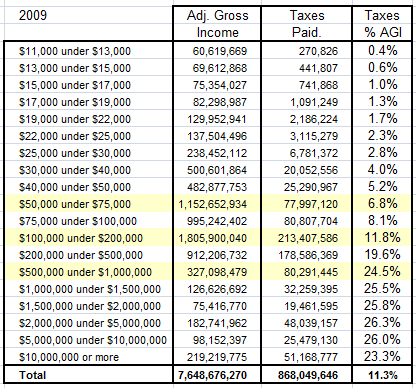
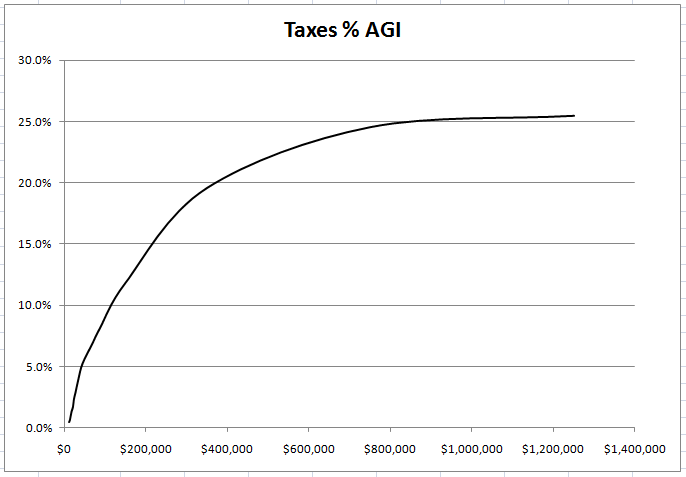
Below is a graph showing the actual taxes paid (per the IRS site) divided by AGI (adjusted gross income) across income ranges (the way the IRS reports them).  Below the graph is the tabular data.

Note that:

Rates are ‘average’ at 11.8% between $100,000 and $200,000.

The rates move up quickly to about 20% of AGI in the range between $200,000 and $500,000

Then – and this is where things get interesting — starting at about $750,000 in income, the % of AGI paid in taxes hits about 25% and hangs there. 

  • Note: On the table you can see that there’s a very small dip in the percentage for folks reporting more than $10 million – probably because of a high proportion of cap gains and dividends.

Again, these numbers are right off the IRS site … they’re not confused by tax tables or annoying reports that Warren Buffet pays less than his secretary.  They’re not zero as ‘progressives’ would lead us to believe …  and they’re not 100% as ‘conservatives’ would lead to believe.  The fact-based answer: 25%.

So what?

Reasonable people can differ (a little) on what rate constitutes a person’s “fair share”.

My view: 25% sounds about right.

What do you think?

image

image

Most Published Research Findings Are False

April 26, 2011

I didn’t say it, the New Yorker magazine did, setting off a buzz in the halls of academia.

The theme of the New Yorker article –- titled “Truth Wears Off” –was that most (academic) research was flawed and not able to be replicated.  This is, the results were at best true under some special circumstances at a specific point in time, but can’t be replicated. At worst, they’re just plain bull.

Hmmm.

Challenging the integrity of publication-driven academics?

Turns out that the New Yorker wasn’t the first mag on the beat.

There was an article in 2005 titled “Why Most Published Research Findings Are False” published in a medical journal that said point blank: “ It can be proven that most claimed research findings are false.”

According to the study, there are several reasons why.

My favorites:

  • Claimed research findings may often be simply accurate measures of the prevailing bias … that is, telling audiences what they want to hear
  • The hotter a scientific field, the less likely the research findings are to be true … that is, rushing to ride the wave
  • The greater the financial and other interests and prejudices in a scientific field, the less likely the research findings are to be true … no kidding?

Geez, if you can’t trust stuff printed in academic journals, what can you trust?

Grab your wallet … Ticketmaster going to “dynamic pricing”.

April 26, 2011

Punch line: Ticketmaster  plans to develop “dynamic pricing” systems that would adjust the cost of sports and concert tickets in response to demand, a strategy airlines and hotels have long used to maximize profits …  TM expects sports teams  to adopt the new system before concert promoters or Broadway producers.

* * * * *

Excerpted from WSJ, Ticketmaster to Tie Prices to Demand 

Dynamic pricing a key element in Ticketmaster’s strategy to revive sales of concert tickets, which have been stagnant or declining for years.

Last year was brutal for the concert industry, with ticket sales plunging 12% despite a modest decline in average prices. Recent price drops follow more than a decade of steady increases, a trend that helped mask fundamental problems.

“2010 taught us we have real challenges as an industry,” Mr. Hubbard said. “One of them is pricing.”

A frustration throughout the concert industry: the best seats appear to be consistently priced below what fans are willing to pay, leading to a multibillion-dollar “secondary market” in which scalpers can reap profits by reselling tickets above face value.

At the same time, he said, 40% of concert tickets sit unsold industry-wide, meaning that the ostensibly cheap seats for many shows are simply not cheap enough.

Thanks to JD for feeding the lead

Groupon rejects Google’s $6 billion offer … so, here come daily-deals from Google. Let the games begin.

April 26, 2011

TakeAway: After having its acquisition bid rebuffed by Groupon, Google is  launching its own daily-deal service offering, Google Offers, in NYC, the Bay area, and Portland.  Google aims to snatch market share from Groupon (No. 1) and LivingSocial (No. 2) … 

Ken’s Bet: Google will be a force in this market and hug Groupon for rejecting its almost $6 billion offer …

* * * * *

Excerpted from WSJ, “Google’s Groupon Rival Launches in NYC, Bay Area,” , April 21, 2011

Google’s rival to daily-deal services such as Groupon and LivingSocial, called Google Offers, officially launched today in New York City, the Bay Area and Portland.

Like its competitors … Google Offers will alert consumers to local-business deals on things like restaurant meals, promising “50% off or more” than the regular price “at places you’ll love.” …

Google Offers, which became public in January, comes several months after Google failed to acquire Groupon for more than $5 billion.  Meanwhile, Groupon is planning a public offering of its shares later this year …  between $15 billion and $20 billion.

… a Google spokeswoman said, “Today we launched a marketing campaign inviting Portlanders to sign up for a test of Google Offers — to get great deals delivered right to their inboxes. Offers is part of an ongoing effort at Google to make new services that give consumers great deals while helping connect businesses with customers in new ways.”

Edit by KJM

Re: gas prices … President mocks (other) politicians and their 3-point plans … and offers up his 4-point plan

April 25, 2011

In his weekly radio address, speaking on fast rising gas prices, Obama said:

“Whenever gas prices shoot up, like clockwork, you see politicians racing to the cameras, waving three-point plans for two dollar gas.”

Literally in the next paragraph, he offered up his 4-point plan.

  • Safe and responsible production of oil at home
  • Rooting out cases of fraud or manipulation in the oil markets
  • Ending the subsidies given to oil and gas companies
  • Investing in tomorrow’s clean, renewable energy sources: hybrids and electric cars

Whew!

Finally a game-changing 4-point plan … albeit with a couple of holes:

  • Domestic production … Obama has capitalized on the BP blowout to stop practically all new US domestic oil production
  • Fraud & abuse … just like the fraud & abuse being rooted out of the healthcare system.  I’ll take the under bet.
  • Oil company subsidies … strip the oil companies of subsidies and they’ll lower prices at the pump …  hmmm, so that’s how business works
  • Electric cars … birth to date, about 1,000 Chevy Volts have been sold.  Not exactly the iPad adoption rate.

Ken’s Plan: Start drilling, release strategic reserves and, most important, stop devaluing the dollar.

Skating through B-school …

April 25, 2011

Punch line: The NY Times reports that b-school students are slackers … especially those specializing in management and marketing.

Ouch.

* * * * *

From the N.Y. Times

The family of majors under the business umbrella — including finance, accounting, marketing, management and “general business” — accounts for just over 20 percent, or more than 325,000, of all bachelor’s degrees awarded annually in the United States, making it the most popular field of study.

But, all evidence suggests that student “disengagement” is at its worst in  business education.

Business majors spend less time preparing for class than do students in any other broad field: nearly half of seniors majoring in business say they spend fewer than 11 hours a week studying outside class.

Business majors have the weakest gains during the first two years of college on a national test of writing and reasoning skills. And when business students take the GMAT, the entry examination for M.B.A. programs, they score lower than students in every other major.

You’ll hear pervasive anxiety about student apathy, especially in “soft” fields like management and marketing, which account for the majority of business majors.

Scholars in the field point to three sources of trouble.

First,  too many business students chose their majors “by default.”

“Business education has come to be defined in the minds of students as a place for developing elite social networks and getting access to corporate recruiters.”

Second, in management and marketing, no strong consensus has emerged about what students ought to learn or how they ought to learn it.

Third, group assignments — a staple of management and marketing education —  are one of the elements of business that make it easy to skate through college.

A business professor at the University of Denver, studied group projects at his institution and found a perverse dynamic: the groups that functioned most smoothly were often the ones where the least learning occurred. That’s because students divided up the tasks in ways they felt comfortable with. The math whiz would do the statistical work, the English minor drafted the analysis. And then there’s the most common complaint about groups: some shoulder all the work, the rest do nothing.

Without some kind of hard constraint — like the licensure tests that accounting and finance students must face — courses inexorably become less rigorous.

Thanks to GB for feeding the lead.

>> Latest Posts

GM’s Volt need a jolt …

April 22, 2011

One of Gov’t Motor’s main focuses has been the Obama-sponsored Chevy Volt, but …

  • Consumer Reports says GM’s hybrid “just doesn’t make a lot of sense.” … ouch.
  • More important, it isn’t selling — only 1,210 Volts have sold this year through the end of March … double ouch

In technical marketing jargon, the dogs ain’t eating the dogfood …

Full article: NY Post, ‘Government motors’ is still a lemon, April 18, 2011

LivingSocial Gains on Groupon … but analysts say neither may be a long-term bet.

April 22, 2011

TakeAway:  Today, LivingSocial — the No. 2 player in the rapidly expanding market for online discounts — is still David battling Goliath (i.e. Groupon).

But the great chasm between the companies is narrowing, as the upstart gains more subscribers and collects more cash.  At the same time, it is trying to differentiate its brand.

* * * * *

Excerpted from the NYTimes, “In Race With Groupon, LivingSocial Raises $400 Million By Evelyn Rusli, April 4, 2011

In recent months, LivingSocial, which like its larger competitor serves daily deals to subscribers based on their location, has started to roll out new features. LivingSocial Instant, a mobile application that delivers time-sensitive discounts to users on the go, is a product that is currently only available in the Washington, D.C., area, where the company is based.  It has also introduced Escapes, a dedicated page for travel deals, an area on which Groupon has not focused heavily.

In its marketing campaigns, the company retains a youthful attitude with an “approachable sophistication,” said the company’s vice president for marketing.

Since the beginning of 2011, LivingSocial’s staff has roughly doubled to 1,300 employees, scattered across 250 markets in about a dozen countries. The number of LivingSocial subscribers now exceeds 26 million, about a third of Groupon’s audience.

One deal in January, a national promotion for a discount Amazon gift card for $10, attracted 1.3 million purchases in one day, or about $13 million in sales. Those returns surpassed Groupon’s first national deal with Gap in August, which generated about $11 million.  By the CEO’s estimates, LivingSocial is on track to reach 400 markets in 2011, with a staff of 3,000 people. In the last few weeks, he has also doubled his revenue goal, to $1 billion.

But as LivingSocial’s statistics climb, some analysts warn the industry may not have a big upside over the long term.

Several local vendors have publicly expressed dissatisfaction with daily deal services, which often attract discount-seekers instead of repeat visitors.

Edit by AMW

>> Current Posts

Gov’t Motors’ shares hit new low… even gov’t is bailing

April 21, 2011

Where are the lemon laws when you need them?

Here’s a shocker: even a reconstituted company that’s stuck with the UAW doesn’t do very well.

GM had been showing some life, largely on the back of fuel guzzling pick-ups and SUVs.  But, increasing gas prices have (again) slowed that market down.

Surprise, surprise, surprise.

* * * * *

Excerpted from WSJ: U.S. Hurries to Sell GM Stake, April 19, 2011,

The U.S. government plans to sell a significant share of its remaining stake in GM. this summer despite the disappointing performance of the auto maker’s stock.

A sale within the next several months would almost certainly mean U.S. taxpayers will take a loss on their $50 billion rescue of the Detroit auto maker in 2009.

To break even, the U.S. Treasury would need to sell its remaining stake — about 500 million shares—at $53 apiece.

GM closed at $29.59 in trading Tuesday, hitting a new low since its $33-a-share November initial public offering.

image

Analysts say that GM shares have been hurt by rising fuel prices, industry production disruptions and management turnover.

GM share price could become further depressed after investors holding bonds of the now-bankrupt “old-GM” receive warrants and stock for existing GM shares. That will happen April 21.

Pizza, pizza … recent trends.

April 21, 2011

A new Rasmussen Reports national survey reports …

  • 18% of American Adults say they eat pizza at least once a week
  • 3% eat pizza more than once a week
  • 17% rarely or never eat pizza 
  • Adults ages 30 to 49 eat pizza more regularly than those in other age groups
  • 26% of Americans age 50 and older say they rarely or never touch the stuff.

Among those who eat pizza …

  • 58% have a favorable opinion of Pizza Hut … 18%  Very Favorable
  • 54% have a favorable opinion of opinion Papa John’s … 20% Very Favorable
  • 48% have a favorable opinion of Domino’s … 8% Very Favorable opinion.

The last time they ate pizza, the respondents …

  • 25% made the pizza at home
  • 23% picked it up to eat at home
  • 16% ate it at a restaurant
  • 15% had it delivered.

Getting hungry?  I am …

Uh-oh: GAO dogs turned loose on ObamaCare

April 20, 2011

Punch line: Buried in the $38.5 billion (or, was it $526 million) budget reduction compromise were provisions for the GAO to start looking at ObamaCare’s waivers, effect on insurance premiums, and “comparative effectiveness” panels.

* * * * *

According to Michael Barone writing in RealClearPolitics

The Continuing Resolution (i.e. budget) covering the rest of fiscal year 2011 … contains some details that threaten ObamaCare

Most important, the CR requires the General Accounting Office to conduct an audit of the waivers from the Democrats’ health care bill that are being issued in large numbers by the secretary of health and human services.

This will raise an uncomfortable question. If Obamacare is so great, why are so many trying to get out from under it? And, more specifically, why are so many Democratic groups trying to get out from under it?

The fact is that HHS Secretary Kathleen Sebelius has granted more than 1,000 waivers from Obamacare. Many have been granted to labor unions.  One was granted to the entire state of Maine.

The GAO has also been ordered to produce audits on the effect of Obamacare on health insurance premiums. This is likely to reveal that the president did not keep his promise that you could keep your current health insurance if you want to.

And there will be an audit of the comparative effectiveness bureaucracy established in the 2009 stimulus package. Comparative effectiveness is supposedly an objective study of which medical techniques are most effective. But anyone who looks closely finds that the experts are constantly changing their minds, which suggests that this is more alchemy than science — and maybe political favoritism, as well.

All of which tends to undercut the thrust of Obama’s obviously-aimed-at-the-2012-campaign message: We can continue to fund Medicare and Medicaid indefinitely if we just tax rich people a little more.

RCP, President Whatever Finds Things Not Going His Way, April 18, 3011

I agree with Barney Frank … did I really say that?

April 20, 2011

Punch line: Rep. Barney Frank says the Administration is  ‘wasting time’ with online poker crackdown

From TheHill.com

The Obama administration is wasting time and resources by targeting online poker sites, according to Rep. Barney Frank (Mass.), the senior Democrat on the House Financial Services Committee.

“What an incredible waste of resources.”

Frank mocked the seizures as the administration “protecting the public from the scourge of inside straights,” and lamented that the Justice Department is more focused on prosecuting online poker sites than those responsible for the mortgage crisis and financial meltdown.

Go after the people responsible for empty houses, not full houses.”

The crackdown has disrupted the lives of the thousands of individuals that rely on online poker for part or all of their income.

That group includes not only professional gamblers but also programmers who create analytics and other tools as well as the backers who finance many of the full-time players.

About those corporate tax loopholes …

April 19, 2011

Punch line: After adjusting for so-called “loopholes” and consolidating all tax returns, U.S. companies (including GE)  pay 40% higher income taxes than foreign-based companies.

How do you spell competitiveness?

According to Portfolio.com

American businesses have long complained that our 35 percent corporate tax rate — the second-highest in the developed world—makes them less competitive globally.

Critics respond that most U.S. corporations pay much less than that to Uncle Sam — in General Electric’s case, reportedly nothing — because of various loopholes.

The Business Roundtable released a study on the average effective tax rates for the world’s 2,000 largest corporations. The effective tax rate is the share of global pretax income that actually is paid in taxes to various levels of government in the U.S. and abroad.

The study, conducted by PricewaterhouseCoopers, found that U.S. corporations paid an average effective tax rate of 27.7 percent from 2006 to 2009, compared with an average of 19.5 percent for foreign-based corporations.  The U.S. effective tax rate was the sixth-highest among the 61 countries that are home to large corporations, behind Japan, Morocco, Italy, Indonesia, and Germany. 

Thanks to SMH for feeding the lead

Tanning salons say thanks to S&P …

April 19, 2011

Can you imagine the amount of government scrutiny and pressure that will be laser-focused on S&P after the ratings agency responded to Obama’s “in your eye” speech by putting the United States of America on a rightly deserved credit watch?

It’ll be interesting to watch what Moody’s does.  On one hand, Moody’s completely missed the mortgage meltdown, so I’d expect them to be conservative and follow suit.

On the other hand, Obama’s BFF —  Warren “Please let me pay more taxes” Buffett — owns a big stake of Moody’s.  So, I’d expect some respectful crony capitalism.

For now, the tanning salons are finally out of the spotlight. 

First, the poker sites … now S&P.

Been a good week for the salons …

Carlsberg Beer: “Brand recognition is good, but sales are better” … call in the brand repo guys

April 19, 2011

TakeAway: Carlsberg Beer is repositioning its brand and widening its distribution channels to boost sales in the competitive beer market.

* * * * *

Excerpted from BrandChannel.com, “Carlsberg calls for New Brand Positioning,” by Barry Silverstein, April 5, 2011

Carlsberg, arguably one of the world’s premium beer brands, is getting its most significant makeover since the beer’s origination in 1847…

In the beer category, the world’s four largest brewers account for over half the global market for beer. Denmark’s Carlsberg is number four, behind Anheuser-Busch InBev, SAB Miller, and Heineken…

Khalil Younes, SVP of Global, Sales, Marketing and Innovation, says, “Carlsberg is a fantastic brand, but the brand has even more potential that can be cultivated…

Carlsberg is introducing a new tagline that the company says will celebrate the brand’s heritage and values, while connecting it with today’s “active, adventurous” generation of beer drinkers.

The brand proposition encourages consumers to ‘step up and do the right thing,” rewarding themselves with a Carlsberg for their deeds. Hence the tagline: “That calls for a Carlsberg.”…

The Carlsberg logo…has been refreshed and modernized. The Danish Royal crown has been made more simple and distinctive. The dominant green has been made more vibrant.

The brand’s logo now carries three elements: the Brewer’s Star, the Hope Leaf, and the inclusion of “Copenhagen 1847,” indicating where and when the beer was first brewed… New packaging is currently being rolled out this year across all 140 markets…

Carlsberg’s CEO says that while Carlsberg’s famous green logo is known all over the world, its sales simply do not measure up to its brand recognition.

“Although international recognition is good, it is not enough. We are investing significantly in the Carlsberg brand, widening our distribution channels and making every effort to get closer to our customers and consumers.”

The company says “by 2015, Carlsberg anticipates that the Carlsberg brand will have doubled its profits.”

Really? Well if it happens, that definitely calls for a Carlsberg.

Edit by KJM


Fewer are working … instead, they’re asking for more from those who do. Uh-oh.

April 18, 2011

According to  USA TODAY

The share of the population that is working fell to its lowest level in three decades. 

Only 45.4% of Americans had jobs in 2010, the lowest rate since 1983 and down from a peak of 49.3% in 2000.

The bad economy, an aging population and a plateau in women working are contributing to changes that pose serious challenges for financing the nation’s social programs.

Job troubles appear to have slowed a trend of people working later in life, putting more pressure on Social Security.

“No matter how wealthy you are, you have a problem if half the population is not working and depending on those who are.”

“Seismic event”: Feds “call” poker sites … Tanning salons sigh relief

April 18, 2011

Punch line: After whacking tanning salons with higher taxes, the Obama administration has turned its guns on another culture-crippling endeavor: online poker.

Porous borders: no problem.

Online poker: must be stopped.

If it weren’t so funny, it would be sad.

* * * * *

According to the WSJ:

Eleven people, including the founders of three of the largest online poker companies doing business in the U.S., have been charged in the largest crackdown on Internet poker by U.S. authorities.

Those charged Friday include the online poker websites PokerStars, Full Tilt Poker and Absolute Poker.

The charges set up a long-awaited showdown between the sites, which claim millions of U.S. players and billions in revenue, and the federal government, which has long alleged that their operations are illegal.

Federal prosecutors have targeted the three largest online poker companies doing business in the U.S., charging their founders with money laundering and bank fraud and seizing five of the companies’ domain names.

This is seismic,” said James Kilsby, an editor for Gambling Compliance, a website which tracks regulatory issues. “It’s a game changer.”

* * * * *

The charges are likely to disrupt a fragile ecosystem that involves millions of players in the United States who play poker for money.

PokerScout, a website that tracks online poker, estimates that almost 2 million people played poker for money in the U.S. last year, representing $16 billion in wagers.

Why work when you can just wait for the mailman?

April 15, 2011

Punch line: Men are disappearing from the workplace in ways that don’t always register on the official unemployment rate 

Excerpted from Business Week, The Hidden Job Crisis for American Men, April 7, 2011

The March jobs report released on Apr. 1 seemed like the best in years. Behind the headlines, though, statistics on jobs are far less encouraging.

Yes, job growth has picked up somewhat. Yet an equally important reason for the lower jobless rate is that many people, men in particular, have simply given up looking for work and are no longer counted among the unemployed.

Some sit at home. Rather than paying taxes on labor income, they are drawing government benefits, or relying on family and friends for support.

There is an ominous trend of disengagement for male workers that stretches back six decades. The share of American men aged 16 to 64 who are employed has fallen, from nearly 85 percent in the early 1950s to less than 65 percent now.

A Bureau of Labor Statistics study found that many older workers who lose jobs never go back to work again. Of those aged 55-64 who were displaced from 2007 through 2009, 21 percent were out of the labor force as of January 2010.

Typically the unemployment rate stays flat or even rises when the economy begins to recover. People reenter the labor force. There is no flood of reentrants this time, at least not yet.

P&G Sheds Pringles, its Last Food Brand

April 15, 2011

TakeAway:  In announcing the sale of Pringles to Diamond Foods for $2.35B, P&G concluded what had been a tumultuous, sometimes zany, 50-year experiment in engineered food.  P&G also refocused on its core product lines.

* * * * *

Excerpted from the NYTimes, “Once a Great Flop, Now Sold for Billions By Andrew Martin, April 5, 2011

The company’s expertise in edible oils was used widely by the potato chip industry in the 1950s and 1960s, and shaped the invention of Pringles. Company officials still aren’t sure how the chips got their name.  Pringles are basically dehydrated potato flakes that are rolled and then fried, but they were not universally loved initially.  The product was such a dud in its early years that some called for P&G to dump the brand. The brand did not take off until the company tweaked the flavor in 1980 and introduced the “Fever for the Flavor of Pringles” advertising campaign.  By the late 1990s, Pringles had become a $1 billion a year brand.

The sale of Pringles was not unexpected, as Procter has refocused its attention on the core businesses of beauty, grooming and household care.

In the 1950s, roughly 25% of the company’s sales were in food, particularly in shortening and other cooking oils.  But P&G lacked a distribution network to ship perishable bags of chips to grocery stores, so it directed its researchers to come up with a longer-lasting chip that could be distributed with P&G’s existing distribution network.  P&G wanted to create a perfect chip to address consumer complaints about broken and stale chips and air in the bags.

Officially, Pringles are called crisps rather than chips, the result of a long-ago fracas between competitors and regulators over what could be called a potato chip.

Edit by AMW 

* * * * *

Con job: Gross = $38.5 billion, Net = $352 million … Boehner should resign!

April 14, 2011

The National Journal Reports

A Congressional Budget Office analysis of the fiscal 2011 spending deal that Congress will vote on Thursday concludes that it would cut spending this year by less than one-one hundredth of what both Republicans or Democrats have claimed.

A comparison prepared by the CBO shows that the omnibus spending bill, advertised as containing some $38.5 billion in cuts, will only reduce federal outlays by $352 million below 2010 spending rates. The nonpartisan budget agency also projects that total outlays are actually some $3.3 billion more than in 2010, if emergency spending is included in the total.

The astonishing result, according to CBO, is the result of several factors: increases in spending included in the deal, especially at the Defense Department; decisions to draw over half of the savings from recissions, cuts to reserve funds, and mandatory-spending programs; and writing off cuts from funding that might never have been spent.

* * * * *

Ken’s Take: Either Boehner was in on the con, or he’s so stupid that he was had.

Either way, he should resign as Speaker of the House,

That’s what I think …

BHO declares war on the wealthy (again) …

April 14, 2011

In yesterday’s pitch, the President reaffirmed his position that the makers should give more of their $$$ to the takers.

That’s one he can win, since there are increasing number of takers.

Robert Samuels points out in Newsweek:

We in America have created suicidal government; the threatened federal shutdown and stubborn budget deficits are but symptoms.

By suicidal, I mean that government has promised more than it can realistically deliver and, as a result, repeatedly disappoints by providing less than people expect or jeopardizing what they already have. But government can’t easily correct its excesses, because Americans depend on it for so much that any effort to change the status arouses a firestorm of opposition that virtually ensures defeat.

Government’s very expansion has brought it into disrepute, paralyzed politics and impeded it from acting in the national interest.

For example, the Census Bureau reports that in 2009 almost half (46.2 percent) of the 300 million Americans received at least one federal benefit:

  • 46.5 million, Social Security;
  • 42.6 million, Medicare;
  • 42.4 million, Medicaid;
  • 36.1 million, food stamps;
  • 12.4 million, housing subsidies.

There are a lot of voters in the stack …

Another reason that New Yorkers are glad they don’t live in Alaska …

April 14, 2011

State & Local tax rates.

New data from the Census Bureau showcases the usual suspects on the list of high tax states.

I’m glad I’m domiciled in Virginia.

image

http://www.taxfoundation.org/research/show/27181.html

LaHood: “I wouldn’t want anybody in my family driving a Chevy Cruze”

April 13, 2011

Just dreaming …

Remember when the Secretary of Transportation took to the airwaves to to tell people not to buy or drive Toyotas because they were unsafe?

Turned out that the problem was an auto service guy sticking the wrong floor mat in a car and a couple of folks hitting the accelerator instead of the brake.

But, since the gov’t owned GM —  one of Toyota’s main competitors —  LaHood just let it fly.

Now the plot thickens.

The Chevy Cruze is being recalled because its steering wheel comes off.

That’s right. it steering wheel can become detached.

No driver error.  No servicing mistake.

The steering wheel comes off.

Oops.

Do you think LaHood will issue another driver’s alert?

I’m betting ‘no’.

Not sure what to get? How about an experiential gift card?

April 13, 2011

TakeAway: People are starting to turn away from stuff and turn to experiences and memories.

The rise of “experiential gift cards” has shown that you can do more with just an old gift card. Gone are the days of unwanted toasters or even gift cards to stores you don’t frequent. 

Gift cards loaded with a value that covers a variety of different activities are becoming the new rage.

* * * * *

Excerpted from AdAge, “New Gift-Card Trend Swaps Stuff for ‘Social Capital'” , March 28, 2011

“Experiential gift cards” …are becoming more popular, because they allow creativity for the giver and flexibility for the recipient.

“People aren’t looking for ‘stuff’ anymore, they’re looking for experiences,” … You can post pictures of your African-safari experience, but you can’t put up a picture of your Mercedes. That’s tacky.”

Smartbox offers gift-card boxes that retail from $49 to $369 … Inside the box is the card, of course, but also a book of the possible choices for such experiences as dinner for two in New York City (50 choices for $99); adventures like white-water rafting and surfing in California (100 choices for $69); and upscale getaways in the Great Lakes (35 choices for $369).

Experiential gifts, … are relatively nascent in the U.S. compared to the other places in the world such as the U.K. and Australia.

“In the U.S., this is really new, especially at retail, …The growth is really happening now”

Smartbox …has pushed out an aggressive public-relations campaign and more recently begun spreading its message via social media. …partnership with Zagat Smartbox Table for Two, and was marketed at Valentine’s Day with PR and a social-media promotion. …

“All happiness research points to the fact that it’s not the things you have that make you happy, it’s the experiences you have,” …”The lag in experience gifts and the lag in consumers recognizing it was an option surprised me, but marketers are catching on now.”

Gift experiences have the added bonus of making the giver more memorable. You won’t remember who gave you socks or a sweater, but you’ll probably recall who gave you an experience where a memory was created,…”A gift is a connection between me and you, and things have far less meaning than experiences.”

Edit by HH


About those 800,000 non-essential gov’t employees …

April 12, 2011

Perhaps the biggest win from last week’s possible government shut-down is that (apparently) all gov’t departments had to scrub their employment lists to classify employees as essential or non-essential.

Now, if gov’t were a business, somebody (think Jack Welch – or, better yet, Chainsaw Al Dunlop) would start scouring the list … to re-classify some of the non-essentials to ‘former employees’.

I’m taking the under on that bet.

The non-essentials will likely continue doing their non-essential “work” … on our dollar.

Ouch.

What do Houston, Newark, and Dallas have in common?

April 12, 2011

Answer: high air fares.

Great analysis in one of the New York Times blogs

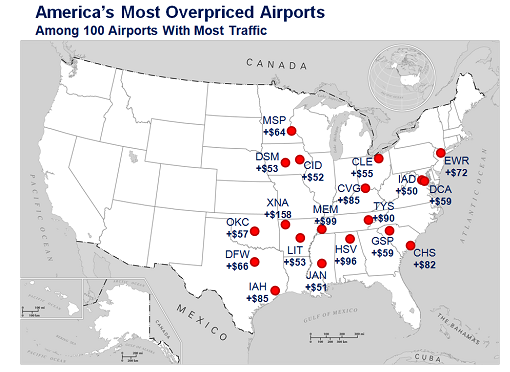
The writer wanted to figure out why, say, an average passenger flying out of Newark Liberty Airport pays about 25 percent more than someone flying out of John F. Kennedy International for an equivalent seat on an equivalent flight.

So, he cranked some nums re: airline pricing, and sorted airports as ‘relatively overpriced’ or ‘competitively priced’.

He modeled airport prices based on distance to destinations,  size of market (how much ‘traffic’),  and competitive structure – i.e. the market share at the origin and destination airports held collectively by the five “legacy carriers” (United, American, Delta, Continental and US Air); the market share held by Southwest Airlines; and the market share held by the largest single carrier at that airport (for instance, Delta and its affiliates are responsible for about 66 percent of all traffic at Atlanta).

He concluded that prices are higher where:

  • Legacy airlines dominate an airport
  • Southwest has a large share as opposed to other low-cost carriers like AirTran and JetBlue.
  • One airline dominates an airport, regardless of whether it is a legacy carrier or a low-cost one.

Here are overpriced airports:

image

image

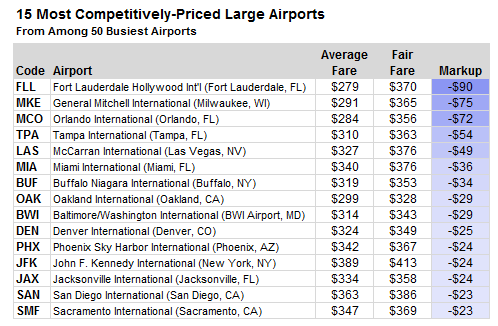
For ‘competitively priced’ airports, the “unifying theme”  is that many are warm-weather vacation destinations, like Las Vegas and pretty much anywhere in Florida.

Why?

Leisure travelers are more price-sensitive than business travelers since they, not their company, are paying for the ticket. To keep them flying, prices have to be relatively low,

Here are the bargains:

image

A very clever analysis … Worth reading the details:
http://fivethirtyeight.blogs.nytimes.com/2011/04/06/which-airports-have-the-most-unfair-fares/

Thanks to BM for feeding the lead.

Budget deal revives DC school vouchers … Dems and DC mayor cry “unfair”

April 11, 2011

Punch line: The budget deal to fund the federal government for the next five months includes money to revive the DC’s school voucher program, which subsidizes private school tuition for needy students with federal funds.

Demonstrating their hypocrisy towards improving the quality of education for inner city kids, some teacher union-backed Dems and the Mayor of DC cry “unfair”.

To whom?  you ask.

The teachers’ union, of course.

The GOP-led House voted to reinstate the DC school voucher program last month. But the bill had little chance to go any further with the Obama administration opposed to vouchers.

However, the Republicans were able to get the initiative included in Friday night’s deal that cut spending by $38.5 billion.

Congress eliminated the voucher program in 2009. Critics of vouchers, including teachers unions, say it draws money away from public schools.

Under the program, which began in 2004, more than 3,700 students, mostly black or Hispanic, have won scholarships which provide up to $7,500 in private-school tuition.

In a Saturday morning tweet, Mayor Vincent Gray called the rider a "shameful violation of our right to govern ourselves."

Gray called on all D.C. residents to voice their opposition to the "colonial status of the District of Columbia."

AP, Budget Deal Revives DC School Voucher Program, April 09, 2011

Major business school reviewing “enrollment procedures and criteria”

April 11, 2011

The following email was recently sent by the Dean of Northwestern’s Kellogg School of Management.

In a nutshell: oops !

Subject: Message from the Dean

Dear Kellogg community –

I wanted to personally write to you about a situation that has received some attention.

During a visit to the U.S. two months ago, Khamis Gaddafi, son of Muammar Gaddafi, attended a non-degree executive course at Kellogg from Feb. 9 – 11 at the Allen Center.

The U.S. State Department was aware of his visit, which occurred prior to the uprising in Libya and before the recent, very troubling allegations against him surfaced.

Our community shares a commitment to respecting human dignity and the integrity of our learning environment.

The Office of the Dean plans to actively review all of our enrollment procedures and criteria, and will determine any changes that need to be made.

Dean, Kellogg School of Management
Northwestern University

Bottom line: Sons of tyrants will no longer be given admissions preference.

My, how the world is changing.

Thanks to RM for feeding the lead.

“The budget process shouldn’t be used to advance a social agenda” … oh, really?

April 8, 2011

President Obama – concerned that ObamaCare might be defunded —  is ranting that “The budget process shouldn’t be used to advance a social agenda.”

And, I haven’t heard any pundits call him on the obvious hypocrisy:

ObamaCare was passed using a Senate scheme called “reconciliation” so that it could be passed by a simple majority.

You may remember Harry Reid wrangling with the Senate parliamentarian over the rules.

You see, by Senate rules, reconciliation can ONLY be applied to budget matters.

Somehow, ObamaCare was ruled to be a budget matter requiring only a simple majority.

I guess ObamaCare isn’t a social agenda item when it’s passed, only when it’s being defunded.

Go figure …

Want to sell more to men? Just follow these 5 steps

April 8, 2011

TakeAway: As men shop more and more,retailers need to make them feel comfortable in their stores,  Here’s how …

* * * * *

Excerpted from AdAge, “How to Connect With the Heart and Mind of the Male Shopper” by Simon Goodall, March 29, 2011

Men are shopping more than ever. In 2002, 64% bought their own clothes; four years later that number was 84%, according to GQ. Around one-third of primary shoppers for groceries reportedly are now men. Yet 40% of men feel unwelcome in retail stores, we have found.

… all of the suggestions below should be seen as statements of how men are, on average, more likely to behave than their female counterparts. It’s important to understand why they shop…

1. Men need to demonstrate their mastery of shopping.

Men like doing things they can do well. And hate doing things they aren’t good at. …they have never had the opportunity to learn how to be a good shopper. …empower him to demonstrate his mastery …and he will come away feeling he has done a good job.

Amazon has enabled millions of men to master buying music. Consumer reviews and lists provide what he needs to feel confident about his choices…

2. Performance is emotional.

Men want to know how products perform. Reasons to believe are truly reasons to buy. Performance provides a kind of “emotional functionality.” It helps men feel that their choice is more efficient, powerful or technologically advanced. Performance is the way to a man’s heart.

3. Men don’t browse, they carry out reconnaissance.

…when men find themselves popping into a computer store or surfing through 3-D-TV reviews online, they are not browsing — they are carrying out important reconnaissance. Perhaps that explains the drift from generalist to specialist stores. They need someone available to assist with their purchases… they seek out expert advisers and technological proof during their research.

…personalization also plays to the fact that men are more willing to pay for products and brands that are customized to their needs….

4. Men want products that reflect their progress in the world.

Sixty-eight percent of millennial men and more than 50% of Gen X men state a preference for brands that “show I have good taste,” … men are more likely to seek out brands that offer exclusivity; have market-leading position; suggest to others that they are successful; and have a “members-only feel,” … proof of quality and their good taste in the details….

5. Men want sanctuaries where they can be men again.

… the majority of men still do not view shopping as a leisure activity, perhaps because it still carries connotations of femininity. Yet the resurgence of traditional barbershops and emergence of male beauty zones suggests a boom in retail experiences that create a sanctuary for maleness…

So what’s key to winning his heart, mind and wallet? Understand the underlying emotional motivations for why men shop.

Edit by HH


87% agree: “A debt problem is a failure of leadership” … but, there’s a surprise twist

April 7, 2011

Yesterday, Freedomworks (a conservative org) released the results of a survey on the debt and deficit.

Folks were asked: Do you agree or disagree with the following statement?

“The fact that we are here today to debate raising America’s debt limit is a sign of leadership failure.

It is a sign that the U.S. Government can’t pay its own bills. It is a sign that we now depend on ongoing financial assistance from foreign countries to finance our Government’s reckless fiscal policies…

Increasing America’s debt weakens us domestically and internationally.

Leadership means that ‘the buck stops here.’

Instead, Washington is shifting the burden of bad choices today onto the backs of our children and grandchildren.

America has a debt problem and a failure of leadership. Americans deserve better.” 

A resounding 87% of the respondents agreed with the statement.

The percentage dropped to the high 50s when the statement was identified with its speaker: Sen. Barack Obama, Congressional Record, S.2237-8, 3/16/06

Four more years …

April 7, 2011

President Obama – or, as some are calling him “Present Obama” – launched his 2012 campaign.

Worth spending a minute watching this …

Obama: 4 more years

Unilever: “We can make your arm pits sexy …”

April 7, 2011

TakeAway:  Since practically everybody uses deodorant, marketers need to devise new features or grab sales from rivals. 

Winning over new customers is particularly difficult, however. Some 50% of deodorant buyers reported using the same brand in the last 12 months.

* * * * *

Excerpted from the WSJ, “Unilever Tackles the Ugly Underarm By Ellen Byron, March 30, 2011

Unilever’s new angle on selling deodorant to women is a product that claims to make underarms not only odor-free but prettier. 

Dove Ultimate Go Sleeveless, which hits U.S. stores this week, claims its formula of specialized moisturizers will give women better-looking underarms in five days.

UGS was inspired by Unilever research that found 93% of women consider their armpits unattractive. 

Magazines and talk shows pour out the tips on how women can improve plenty of body parts, from legs to midriffs to fingernails. But little attention — or advice — has been brought to armpits.

Some 62% of the women surveyed said they suffer underarm skin problems like breakouts, discoloration or itchiness, according to research at Unilever. Nearly half said they have been embarrassed enough by the condition of their underarms that they have changed clothes.

Promoting a problem that consumers don’t necessarily realize they have is a frequently used but risky approach.

“Any marketer has to be careful of appearing to create a problem that doesn’t really exist  … You can suffer a backlash if you do that.”

Edit by AMW

* * * * *

70,000 children will die … oh, really.

April 6, 2011

When I was a kid, the local school board would biennially warn that football, the band, the honors program and hot lunches would be cut unless a levy was passed to boost real estate taxes.

I remember that – even as a kid – it sounded like a bunch of bull.

Sometimes the levies passed.  Sometimes they didn’t.

Regardless of the vote, the stadium lights still glowed brighton Friday nights, the smart kids still got their honors courses, and the cafeteria kept serving up hot slop.

Here is today’s equivalent of football, band, honors and lunches:

According to the Daily Kos, USAID Administrator Rajiv Shah testified before the House Appropriations State and Foreign Ops subcommittee that “Adopting H.R. 1 (the budget passed by the GOP House) would lead to 70,000 kids dying.”

Geez.

It’s not even enough these days to warn of seniors eating dog food, schools being shuttered, etc.

Nope. The bidding is up to 70,000 kids dying.

Only children and seniors programs can be cut.

Everything else is more essential, more critical.

Except that is, for the $100 to $200 billion in wasteful spending that the GAO reported last month:

WSJ, Billions in Bloat Uncovered in Beltway, March 1, 2011

A GAO report uncovered billions of dollars in wasteful spending by the U.S. government due to duplicate work done by dozens of overlapping agencies on redundant and  ineffective federal programs

For example, the U.S. government has 15 different agencies overseeing food-safety laws, more than 20 separate programs to help the homeless and 80 programs for economic development.

The agency found 82 federal programs to improve teacher quality; 80 to help disadvantaged people with transportation; 47 for job training and employment; and 56 to help people understand finances.

The report took particular aim at government funding for surface transportation, including the building of roads and other projects, which the administration has made a major part of its push to update the country’s infrastructure. The report said five divisions within the Department of Transportation account for 100 different programs that fund things like highways, rail projects and safety programs.

The report chided the government over encouraging federal agencies to purchase plug-in hybrid vehicles while having policies that agencies reduce electricity consumption. It said government agencies have purchased numerous vehicles that run on alternative fuels only to find many gas stations don’t sell alternative fuels. This has led government agencies to turn around and request waivers so they didn’t have to use alternative fuels.

The GAO identified between $100 billion and $200 billion in duplicative spending.

GAO’s prior recommendations have generally been ignored or postponed by federal agencies and lawmakers, particularly when they could require difficult political votes.

Hmmm.

Just not hearing a lot about that report this week …

* * * * *

To see the full report, click the pic.

image

Click here if you ‘like’ Google’s ‘plus one’ feature …

April 6, 2011

TakeAway: Google’s making  another attempt to break into into the social web by creating a “plus one” feature for its search results.

Much like on Facebook, you will be able to share your likes as well as see other people in your network of contacts’ and the things they like. 

* * * * *

Excerpted from AdAge, “Google Adds Own ‘Like’ Button in Foray Into Social Search” , March 30, 2011

Google‘s take on the “like” button — the “plus-one” —  to make search more social, and to combat the growing dominance of Facebook.

Google will allow users to vote plus-one on search results and to share that preference in Gchat, Gmail, Google Reader, Buzz and, soon, Twitter.

This is the first time Google has added a direct social signal into search results.

Over time, Google will integrate the plus-one into the search algorithm itself so human votes will have an impact search ranking.

“Injecting a social layer into the algorithmic search is key to relevance… 35,000 results in less than 3 milliseconds. It’s meaningless, but if you can sort through those by people who have given a social signal and those rise to the top, it can only enhance the user experience.”

The question is whether Google can keep bad actors from gaming the plus-one system for fun or for profit. Google, to its credit, has a lot of experience filtering out attempts to game its algorithms..

Edit by HH

When GE really does file its tax return …

April 5, 2011

A week or two ago, the NY Time’s dropped a bombshell of a story.

The headline,  “GE’s Strategies Let It Avoid Taxes Altogether”:

The reported “facts”: GE reported worldwide profits of $14.2 billion, and said $5.1 billion of the total came from its operations in the United States. Its American tax bill? None. In fact, G.E. claimed a tax benefit of $3.2 billion.

Hmmm.

According to Reuters, it turns out that GE hasn’t actually filed its tax return for 2010 yet, and when it does it will pay some unknown amount in US income taxes.

The ultimate conclusion is likely to be the same, but it looks like the Times got some of facts wrong.

Oh my.

Buy more of my products and I’ll make a small donation to charity … if I remember.

April 5, 2011

TakeAway: As many people rally around Japan, companies must walk a fine line when combining a brand message with an expression of sympathy. 

As consumers become increasingly skeptical of cause-related marketing and celebrities, organizations and major marketers have to balance trying to help without appearing to exploit the tragedy for profits. 

* * * * *

Excerpted from the WSJ, Cause-Tied Marketing Requires Care” By Emily Steel, March 21, 2011

Microsoft’s Bing learned that lesson early on. The search engine created a backlash when it posted a message on Twitter, offering to donate $1 to Japan’s relief efforts each time someone forwarded its message.  The missive set off a firestorm of complaints from Twitter users, who accused Bing of using the tragedy as a marketing opportunity. Within hours, the company responded. “We apologize the tweet was negatively perceived. Intent was to provide an easy way for people to help Japan. We have donated $100,000.”

Marketers have to be especially careful when they create programs that commit them to donate a portion of their proceeds if someone makes a purchase, some ad executives say. 

Still, several retailers are deploying this strategy.  U.S. sushi chain SushiSamba said that through the end of March it will give 100% of the proceeds of a special $12 sushi roll to relief efforts. 

Other marketers are giving their customers benefits in exchange for making donations. American Airlines and Continental Airlines said they would reward donors with bonus airline miles. 

Many companies have chosen to stick to straight donations, instead. Wal-Mart, P&G, Coca-Cola and Walt Disney are among more than 100 corporations across the globe that have committed to donate a total of more than $151 million in cash and other products or services thus far.

Marketers are promoting the initiatives through public relations, their own websites and social networking. While companies often want consumers to know about their efforts, few are launching ad campaigns to avoid any criticism of their intentions.

As relief efforts continue, companies’ motives are likely to be less altruistic, ad experts say. “The first people that do it probably have their heart and head in the right place,” Mr. Adamson says. “But as you go further along, more people try to jump on the band wagon. Doing good becomes less substantial and more of an attention grab.”

Edited by AMW

* * * * *

Whatever happened to Obama’s vow of a line-by-line budget review?

April 4, 2011

As Sen. Schumer and the other caucus-instructed Dems rant about $60 billion in gov’t spending cuts being “extreme” – “likely to kill over 70,00 children” — don’t you wonder what ever happened to Obama’s pledge to go through the budget line by line to eliminate wasteful spending?

To refresh memories, here is an excerpt from news reports dated November 2008:

President-elect Barack Obama vowed today to get rid of federal programs that no longer make sense and run others in a more frugal way to make Washington work in tough economic times.

Obama said that to make the needed investments to create jobs, “we also have to shed the spending we don’t need.”

“In these challenging times, when we are facing both rising deficits and a sinking economy, budget reform is not an option. It is an imperative,” Obama said. “We cannot sustain a system that bleeds billions of taxpayer dollars on programs that have outlived their usefulness, or exist solely because of the power of a politicians, lobbyists, or interest groups. We simply cannot afford it. This isn’t about big government or small government. It’s about building a smarter government that focuses on what works. That is why I will ask my new team to think anew and act anew to meet our new challenges…. We will go through our federal budget – page by page, line by line – eliminating those programs we don’t need, and insisting that those we do operate in a sensible cost-effective way.”

Spending restraint is even more important with the federal deficit expected to top $1 trillion in 2009 — more than double the previous record. And that’s before an economic stimulus package that could cost upwards of $500 billion over two years.

Obama vows line-by-line budget review, November 25, 2008

I figure there are over 50,000 lines (and over 6,000 earmarks) for the President to review.

And, the GAO recently reported that they spotted over $200 billion in gov’t agency duplications and redundancies – sometimes, more than 50 departments doing exactly the same job … and often doing it ineffectively.

Think President Obama has his reading glasses on and a sharp pencil in his hand?

I’m betting no …

Pepsi (and everybody else) goes retro …

April 4, 2011

TakeAway: Many brands are finding that the best way to come up with a new product is to make a retro version of the old product.

Pepsi, Heinz, Hostess have all incorporated “throwback, retro” design and products into the line up. 

Studies shown that Millennials relate particularly well to retro items as it gives them a feeling of authenticity.

* * * * *

Excerpted from MediaPost, “More Retro Action: Heinz, Hostess Follow Pepsi” by Karlene Lukovitz, March 22, 2011

Everything old is new again in the world of marketing — although these days, “old” can sometimes mean the 1990s.

One week after PepsiCo made retro versions of Pepsi, Mountain Dew and Doritos a permanent part of the brands’ lineups, Heinz Ketchup is readying a collector’s edition glass bottle with a retro label, and Hostess is featuring ’70s brand characters and bringing back Twinkies’ original banana filling recipe.

These developments come a week after PepsiCo announced that it is making sugar-formulated (no high-fructose corn syrup), retro-packaged Throwback versions of Pepsi and Mountain Dew … permanent, year-round parts of the brands’ portfolios.

The retro phenomenon — also being seen in a wide variety of nonfoods categories (think Nike’s Playoff Air Jordan 13 Retro athletic shoe and Disney’s revival of the “Tron” franchise) — is being driven primarily by marketers’ realization of the power of “authenticity” among Millennials, in particular.

Retro is very cool with 20-somethings, because it ties in with their desire for simpler, cleaner, more authentic lives. … they see nostalgia as a way to differentiate themselves.”

“Millennials thrive on interconnectedness, but highly value authenticity, particularly ‘real’ ingredients as opposed to ‘chemical stews.’

At the same time, boomers feel a rose-colored yearning for the days when life was less complex.”

Edit by HH

A Nation of Takers, Not Makers

April 1, 2011

Consider these depressing statistics:

More Americans work for the government than in manufacturing, farming, fishing, forestry, mining and utilities combined..

Today in America there are nearly twice as many people working for the government (22.5 million) than in all of manufacturing (11.5 million).

This is an almost exact reversal of the situation in 1960, when there were 15 million workers in manufacturing and 8.7 million collecting a paycheck from the government.

WSJ, We’ve Become a Nation of Takers, Not Makers,  April 1, 2011

Georgetown’s “chronic unwillingness to come together” … huh?

April 1, 2011

Be honest.

If Bush had misspoken like this, mass media would have gone nuts.

But, since the Orator-in-Chief said it, it got buried.

Here’s one recap I found:

During his speech at Georgetown University yesterday… he took a slap at his host.

Obama said, “You also happen to go to a school that for a long time has suffered from a chronic unwillingness to come together and make tough choices.”

Oops.

Seems that the smartest man on the planet just flubbed a line on the teleprompter.

In fact, the President’s speech read, “you go to school IN A TOWN that, for a long time has suffered…”

In other words, he was attempting to insult Washington, not the university.

Perhaps, he should listen to what he reads …

Just me, or is that package smaller than it used to be.

April 1, 2011

TakeAway: As businesses anticipate rising raw materials costs, consumers are beginning to encounter shrinking food packages. 

With unemployment still high, companies have tried to camouflage price increases by selling their products in smaller packages. 

Most companies reduce products quietly, hoping consumers are not reading labels too closely.  However, there could be some backlash as consumers wise up.

* * * * *

Excerpted from the NYTimes, “Food Inflation Kept Hidden in Tinier Bags By Stephanie Clifford and Catherine Rampell, March 28, 2011

In every economic downturn in the last few decades, companies have reduced the size of some products, disguising price increases and avoiding comparisons on same-size packages, before and after an increase. Each time, the marketing campaigns are coy; this time, the smaller versions are “greener” (packages good for the environment) or more “portable” (little carry bags for the takeout lifestyle) or “healthier” (fewer calories).  Trying to keep customers from feeling cheated, some companies are introducing new containers that, they say, have terrific advantages — and just happen to contain less product.

“Consumers are generally more sensitive to changes in prices than to changes in quantity,” John Gourville, a marketing professor at Harvard Business School, said. “And companies try to do it in such a way that you don’t notice, maybe keeping the height and width the same, but changing the depth so the silhouette of the package on the shelf looks the same. Or sometimes they add more air to the chips bag or a scoop in the bottom of the peanut butter jar so it looks the same size.”

Kraft is introducing “Fresh Stacks” packages for its Nabisco Premium saltines and Honey Maid graham crackers. Each has about 15 percent fewer crackers than the standard boxes, but the price has not changed. Kraft says that because the Fresh Stacks include more sleeves of crackers, they are more portable and “the packaging format offers the benefit of added freshness,” said a Kraft spokesman.  Similarly, P&G is expanding its “Future Friendly” products, which it promotes as using at least 15 percent less energy, water or packaging than the standard ones.  “They are more environmentally friendly, that’s true — but they’re also smaller,” said Paula Rosenblum, managing partner for retail systems research at Focus.com, an online specialist network. “They announce it as great new packaging, and in fact what it is is smaller packaging, smaller amounts of the product,” she said.

Or marketers design a new shape and size altogether, complicating any effort to comparison shop. The unwrapped Reese’s Minis, which were introduced in February, are smaller than the foil-wrapped Miniatures. They are also more expensive — $0.57 an ounce at FreshDirect, versus $0.37 an ounce for the individually wrapped.

In the culture of thinness, smaller may be a selling point. It lets retailers honestly claim, for example, that a snack package contains fewer calories — without having to change the ingredients a smidge.  “For indulgences like ice cream, chocolate and potato chips, consumers may say ‘I don’t mind getting a little bit less because I shouldn’t be consuming so much anyway,’ ” said Professor Gourville. “That’s a harder argument to make with something like diapers or orange juice.”  But even while companies blame the recession for smaller packages, they rarely increase sizes in good times, he said.  Once the economy rebounds, he said, a new “jumbo” size product typically emerges, at an even higher cost per ounce. Then the gradual shrinking process of all package sizes begins anew, he said.

Edit by AMW