Archive for October 15th, 2012

HOT: If capital gains tax rates go up 8.8%, how much will after-tax capital gains go down?

October 15, 2012

Another HOT: Homa Online Tutorial

This is a relatively simple financial math question that most people I’ve asked have gotten wrong.

Answers have ranged from less than 8.8% – since only capital gains are being taxed (huh?) … 8.8% – because that’s how much the marginal rate is going up … to more than 8.8% – “otherwise you wouldn’t be asking the question”.

First, what’s magic about 8.8%?

Well, Obama says he’ll jack capital gains tax  rates from 15% to 20% … and ObamaCare has a 3.8 non-payroll payroll tax on investment income starting in 2013.

So, if Obama is elected and he keeps his promise … the effective capital gains tax rate goes from 15% to 23.8% … a delta of 8.8%.

That 8.8% increase will cut after-tax capital gains by 10.35% !

OK, let’s run thru the math.

click for the Homa Online Tutorial
image

* * * * *

Recap

Assume that you bought a stock for $750 and sold it for $1,000 … netting a $250 pre-tax gain.

If the capital gains tax is 15%, you pay $37.50 in taxes … netting you, after taxes, $212.50.

If the capital gains tax is 23.8%, you pay $59.50 in taxes … netting you, after taxes, $190.50.

The difference, is $22 ($212.50 less $190.50 … or simply, 8.8% times $250).

So the percentage drop in after-tax net gains is 10.35% ($22 divided by $212.50)

Note that that percentage stays constant at 10.35% regardless of the size of the gain —  in absolute or relative to proportionate cost basis.

That’s not a coincidence, it’s math.

With a capital gains tax rate of 15%, the after tax gain is simply 1 minus the tax rate times the nominal gain … 1 minus 15% is 85%.

With a capital gains tax rate of 23.8%, the after tax gain is simply 1 minus that tax rate times the nominal gain … 1 minus 23.8% is 76.2%.

The difference is still 8.8%, but the denominator of the change ratio is is 85%, not 100% … and, 8.8% divided by 85% is 10.35%.

Again, that answer is generalizable … not specific to this example.

Q.E.D.

* * * * *
Advanced Financial Math Question

How much will after-tax ROI go down if capital gains tax rates are increased by 8.8%?

Hint: The math is more complicated than the above example, because the answer depends on the cost basis of the stock relative to its current market value.

I’ll give the answer is a later post.

>> Latest Posts

Why the stock market is still hanging on …

October 15, 2012

The economy is sluggish, corporate guidance has turned a bit bearish, but the stock market is still at high levels.

What’s up?

Well, broadly speaking, it’s the QE3 effect – the Fed is flooding the marketing with money again, keeping interest rates low.

Remember the low interest rates may be good for borrowers, but are awful for investors looking for more-or-less fixed incomes with some modicum of security.

More specifically, starting in 2011, benchmark Treasury rates (e.g the 5-year T-Bond) have been below the broad market dividend yield – represented by the S&P 500 Dividend yield’.

image

* * * * *
And, the spread has been widening recently – in favor of stock dividends

image

* * * * *
Bottom line: money flows to the best returns … it’s basic finance.

Thanks to SMH for feeding the lead

>> Latest Posts

Who employs more people – the government or “goods producing” industries?

October 15, 2012

Easy question since you know I wouldn’t ask if the answer wasn’t government.

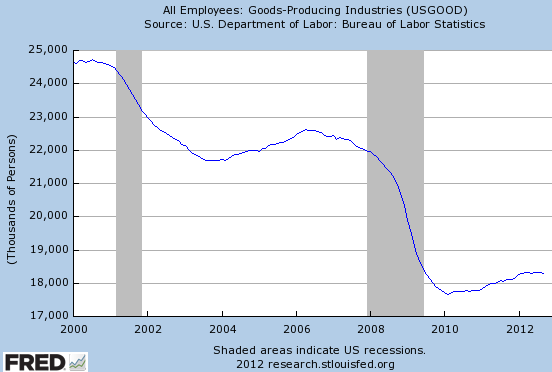
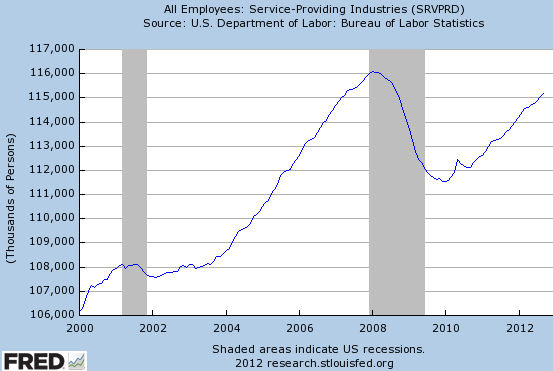
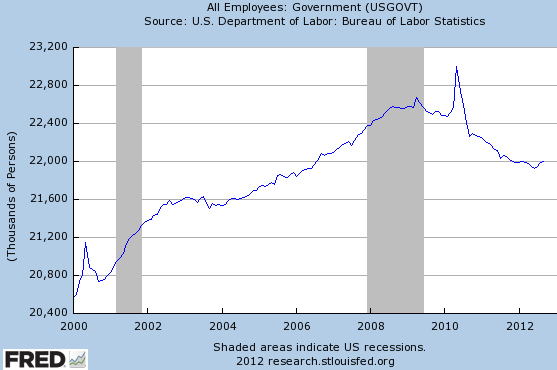
Answer: There are about 22 million government workers … only about 18.5 million in producing goods.

The below charts are quite revealing.

  • Now, almost 75% are employed in service-providing industries … up about 10 million since 2000 … virtually all of the jobs added from the recession’s trough.
  • Goods-producing declined about 7 million from 2000 to the recent recession (i.e. Bush’s watch) … about 500,000 have been restored since the recession’s trough.
  • Gov’t added about 2 million (about 10%) from 2000 to 2010 … about 500,000 – largely temp census workers — have been squeezed out in the past couple of years.

Bottom line: An economy dominated by services and gov’t … not new news, but the severity of the skew surprised me… and, it’s hard to hang all this on Obama – Bush’s fingerprints are all over the trends.

image

image

image

>> Latest Posts

Soc Media: Time to get on Pinterest (even you, boys)

October 15, 2012

Punch line: Pinterest users spend more than Facebook or Twitter users.  As brands are trying to understand how to connect social media to sales, Pinterest offers a way to do that.

* * * * *

Excerpted from branchannel.com’s “Facebook Drives More Traffic to Retail, But Pinterest Users Spend More”

While Facebook dominates in socially-driven shopping, Pinterest is driving the highest average spending per online shopping session.

image.axd

RichRelevance … analyzed nearly 700 million shopping sessions to benchmark the performance of Facebook, Twitter and Pinterest as drivers of traffic to retail sites.

“Every social network promises a new way of connecting consumers with retailers and brands,” stated Diane Kegley, “However, the big take-away from our research is that not all channels in the social space are created equal.”

Key findings include:

Facebook dominates as a source of traffic: Shoppers who click-through account for the overwhelming majority of shopping sessions at nearly 86% (85.8%), followed by Pinterest (11.3%) and Twitter (2.9%).

Shoppers who started at Facebook browse more and buy more often — nearly seven pages per visit vs. nearly three for Twitter and just over four from Pinterest and purchase somewhat more frequently (conversion rates of 2.63%) than Pinterest (.93%) or Twitter (1.09%).

Pinterest is driving more revenue per session – nearly double that of other social channels: While shoppers who come to retail sites from Facebook and Twitter purchase more often, Pinterest users spend dramatically more than either ($168.83 average order value vs. $94.70 for Facebook and $70.84 for Twitter).

“As retailers and brands continue to sort out how to take advantage of social networks, this infographic provides great insight into better understanding the nuances of each channel, how they resonate with consumers and how marketers can take advantage of each in their own unique way,” adds Kegley.

Edit by BJP

>> Latest Posts

Working in your jammies … it’s catching on.

October 15, 2012

Punch line: Since it can save costs and improve employee satisfaction, working from home is predicted to accelerate in the coming years.

* * * * *

Excerpted from Fast Company Co.EXIST, “The Future Of Working From Home”

4257109318_ac20e00889_z

It seems that a new study comes out every day touting the benefits of working remotely.

It’s a trend that’s good for workers’ psyches and the environment–more people working from home means fewer car trips, and fewer people in the office allows companies to scale down to smaller spaces that use fewer resources. And if you don’t like it, well, too bad–a new survey from Citrix Systems found that the movement is speeding up. Among the highlights [from the survey]:

  • The IT executives surveyed believe that by 2020 there will be seven desks for every 10 office workers.
  • That ratio will be even lower–six desks for every 10 workers–in telecommuting-friendly countries like the U.S., the U.K., Singapore, and the Netherlands.
  • 24% of companies have adopted mobile work styles … That number will balloon to 83% by mid 2014.

There are generational differences, to be sure. But, … there are many people who want to work remotely, and age has nothing to do with it.

Edit by JDC

>> Latest Posts