Archive for February, 2014

Flashback: Michelle’s commencement speech rocks …

February 28, 2014

Yesterday, President Obama announced a  public-private partnership designed to provide economic and educational opportunities to young men and boys of color through commitments from foundations, business leaders and public officials.

He didn’t speak to the deterioration of family structures, the dominuation of  religion in kid’s lives, the toxic influence of bad-boy rappers, etc., so I’m not optimistic. But, I’m rooting for him on this one.

Brought back memories of a post from last May, praising Michelle Obama.

Here’s a flashback…

=====

I haven’t been a big Michelle Obama fan.

Never recovered from her “first time I’m proud to be an American” snit … and totally turned off by her hypocritical  lifestyle of the rich & famous routine.

Biggest deal: I’ve oft said that she and her husband have squandered an opportunity to talk frankly to black kids in a way that only they can.

They’ve got the cred to push family values, individual responsibility and the importance of education.

Except for a few lines in a few speeches, they’ve come up prtetty empty.

That is, until last week when the First Lady gave a great commencement address at Bowie State University.

image

She  encouraged the graduates  to promote the importance of education in the black community.

According to the Washington Post, she layered a tough-love cultural commentary with statistics …  one in three African American students drop out of high school  … only one in five African Americans between the ages of 25 and 29 have a college degree.

Here are a couple of the high impact sound bites from her speech:

(more…)

Nums: Are women still at a disadvantage in the workplace?

February 27, 2014

According to a  WSJ poll

“Women in large numbers believe they face more discrimination in the workplace than in other situations.”

image

= = = = =
The “disadvantages” include lower pay than men …

(more…)

$$$: How much do MBA interns get paid?

February 26, 2014

According to Business Week, top school MBAs haul in an average of about $1,750 per week for their summer internships.

At HBS, the median is $7,000 per month … that’s about $1,650 per week … which annualizes to about $90k.

Of course, there’s wide variation based on the school and the industry.

Note that Kellogg –- a general management and marketing school – tops the list

image

* * * * *
Follow on Twitter @KenHoma            >> Latest Posts

MBA: Career-switching is back in fashion …

February 25, 2014

According to Business Week: “More MBA grads are switching careers as the job market improves.”

image

Here are the details …

(more…)

The “Dirty Jobs” guy nails it …

February 24, 2014

Following up on our salute to garbage men last week …

Mike Rowe is the host of “Dirty Jobs” … a series on the Discovery Channel that reports on jobs that many (most?) people wouldn’t touch.

He’s not an economist, but he certainly has a perspective on jobs.

His: view: “employers are desperate for people willing to learn a “useful skill” and work hard.

But, many unskilled unemployeds shun jobs that are “Beneath them” … even if the jobs pay the rent and are stepping stones to better jobs.

It’s a great country that liberates them from jobs they might not like, right?

Video clip is worth watching …

click to view 90 second video

image

=====
Back to the garbage men: a reader forwarded an interesting link

Triumph of the trashmen: Landing a gig on D.C. truck is hard to do and they stay on the job a long time

Nutshell: Though wages are modest (~$35,000) and the job is dirty, job security is high, benefits are good … including (for gov’t trash guys) a short work day.

* * * * *
Follow on Twitter @KenHoma             >> Latest Posts

Air fares: Public weighs in …

February 24, 2014

According to a YouGov.com survey reported by  NBC News  …

Survey says: 4 in 10 Americans  wouldn’t mind being publicly weighed at the airport.

image
Source

The results suggest that a once-unthinkable concept of differential fares based on size could become a fact of life for fliers.

Here are some verbatims:

(more…)

Odds: Are casinos really that smart?

February 21, 2014

Harrah’s is a poster child for “predictive analytics” … using hard numbers to make good decisions.

image

Why then – asks the IO Creative Group of tiny York, PA – did the Las Vegas big boy casinos lose over one billion dollars.

According to IOCG, casinos attendance is up, their hotel stays are up, their night club business is up, restaurant and bar sales are up.

How could their profits be down by one billion dollars???

It is because of their belief that new customers were in order – which attracted a lot more customers who are completely NOT PROFITABLE.

These new Vegas fans sleep all day, party all night and do not gamble. They don’t shop nor do they utilize the services and amenities of the buildings.

Vegas became married to the idea that their money should be invested in attracting new younger, hipper, sexier customers and they achieved that.

What they failed to do was to invest in their current very profitable customers who were actually making them money.

Casinos got caught up in the “shiny object syndrome” —  the need to go after something new when their most profitable market was already right in front of them.

When they were going after completely new markets, they should have been further investing in the one they already had.

* * * * * *

IOCG offers up a couple of ways to increase current customer “monetization”:

(more…)

Salute: High praise for garbagemen … really!

February 20, 2014

Last week, Pelosi. et. al., were lauding how ObamaCare was “liberating millions of Americans from the burden of working at jobs they don’t like.”

Simple thesis: just hang on the couch and let taxpayers foot the bill for your food, phone and, now, health insurance.

Why work?

image

Right when I  was about to get terminally discouraged, I decided to go fetch our mail … on one of those windy, below-zero days.

At the mailbox, my faith in the American spirit was refreshed.

(more…)

What happens when the minimum wage is raised?

February 19, 2014

President Obama is pushing to raise the minimum wage to $10.10 per hour.

Interesting play

$10.10 … not $10.

Why?

To make folks think that he thought about it … that $10.10 is some kind of magical optimum.

Putting that silliness aside, the rationale is well-intended: get low-earners closer to a “living wage”

The major argument against the move is econ 101 … and empirical evidence.

The below chart – from AEI’s Mark Perry —  cuts to the chase.

image

The chart plots the level of the Federal minimum wage against the number of percentage points that the teenage unemployment rate is over the all-inclusive unemployment rate.

Implicitly, the analysis assumes that the bulk of minimum wage jobs go to teens … and, measuring the differential (instead of the gross rate) normalizes to the overall state of the economy.

The conclusion is stark: when you raise the minimum wage you lose jobs.

Period.

But, some folks argue that economic life is better for the minimum wagers who retain their jobs.

Not so fast …

(more…)

Bad day at he office? … Blame Joe Banks.

February 18, 2014

I wasn’t that into the Olympics until the U.S. Men’s speed skaters started blaming their poor performance on new space-age uniforms supplied by Under Armour.

image

Here’s my take on the situation:

(more…)

MBA Pay: European & Asian schools catch the U.S. …

February 17, 2014

According to research reported in BusinessWeek

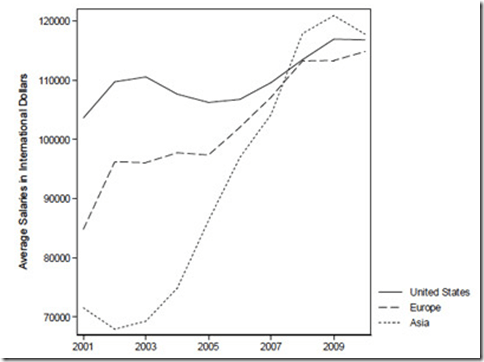
MBA grads pay at business schools in Europe and Asia increased dramatically in the past couple of years.

Adjusted for local purchasing power, European and Asian MBAs have essentially caught up to U.S. MBAs.

To avoid distortions between countries, the pay levels are stated in “international dollars” that have been adjusted for purchasing power parity.

image

The researchers attributed the pay growth in Europe to the growing demand for MBAs in Europe and the geographic proximity of highly ranked European programs to the key labor markets they serve.

Why has MBA pay in the U.S. apparently stalled?

(more…)

Bias: How you do depends on who interviewed before you …

February 13, 2014

According to the HBR Daily Stat …

MBA applicants may be at a disadvantage if they interview on a day when several others have already received positive evaluations

Specifically, the 4th Great MBA applicant interviewed on a given day Is less likely to get a high interview score

image

Study results and what to do about them …

(more…)

Gotcha: Using your own genes against you …

February 12, 2014

 NPR says …

“Getting the results of a genetic test can be a bit like opening Pandora’s box … you might learn that you’re likely to develop an incurable disease later on in life.”

There’s a federal law that’s supposed to protect people from having their own genes used against them, the Genetic Information Nondiscrimination Act, or GINA.

Under GINA, it’s illegal for health insurers to raise rates or to deny coverage because of someone’s genetic code.

image

But the law has a loophole: It only applies to health insurance.

Some insurance can be denied or priced high because of a person’s DNA.

Here’s an example … and a prediction.

(more…)

Work: Maynard G. Krebs was just ahead of his time …

February 11, 2014

Last week, the CBO reported that 2.5 million people will likely quit their jobs to cash in on ObamaCare subsidies and other government programs.

That brought to mind a famous TV philosopher … Maynard G. Krebs.

image

In the late 1950s and early 1960s. there was a popular TV show called “The Many Loves of Dobie Gillis” … it feature a bon vivant girl-chaser (Dobie) and his beatnik friend Maynard G, Krebs (played by Bob Denver who was Gilligan on Gilligan’s Island).

  • Technical note to younger readers: a beatnik was a self-proclaimed member of the “beat generation” – think early day hippies and slackers.

Maynard had a philosophy of life that wasn’t exactly work-inclined.

In fact, whenever Maynard would hear the word “work” he’s have an immediate reflex action…..

(more…)

“Liberating workers to pursue other activities” … say, what?

February 10, 2014

Hopefully everybody has heard about the CBO report that estimates 2.5 million current workers will either intentionally cut the number of hours they work, or quit work altogether in order to qualify for ObamaCare subsidies.

That estimate is up threefold from the CBO study that was used to justify ObamaCare economics.

Hmmm.

image
Read the full CBO Report

=====

Today I’ll try to stick to the technical aspects of the CBO Report…


First, the literal CBO finding:

The reduction in CBO’s projections of hours worked represents a decline in the number of full-time-equivalent workers of about 2.0 million in 2017, rising to about 2.5 million in 2024.

The decline in fulltime-equivalent employment stemming from the ACA will consist of some people not being employed at all and other people working fewer hours.

The estimated reduction stems almost entirely from a net decline in the amount of labor that workers choose to supply, rather than from a net drop in businesses’ demand for labor, so it will appear almost entirely as a reduction in labor force participation and in hours worked.

English translation: the unemployment rate will decline because there will be fewer workers in the labor force.

That’s one way to fix an unemployment problem.

=====

Why the original CBO miss?

The CBO notes that their earlier projection – supportive of ObamaCare – recognized these labor force dynamics, but underestimated them (by a factor of 3).

Why the new upward revisions?

There are several reasons for the difference in the former and current estimates:

CBO has now incorporated into its analysis additional channels through which the ACA will affect labor supply, reviewed new research about those effects, and revised upward its estimates of the responsiveness of labor supply to changes in tax rates.

English translation: Oops, dropped the ball … nothing changed in the world, just our view of the world.

=====

What new research?

What the CBO is referring to is work done by University of Chicago economist Casey Mulligan. Prof. Mulligan’s work isn’t “new”, though.  He was touting it before ObamaCare was enacted.

Putting that technical point aside, the WSJ says that the CBO’s intellectual conversion is directly attributable to Mulligan’s ideas.

Mr. Mulligan’s premise is what economists call “implicit marginal tax rates“.

ObamaCare make work less financially valuable for lower-income Americans.

Because the insurance subsidies are tied to income and phase out as cash wages rise, some people will have the incentive to remain poorer in order to continue capturing higher benefits.

Another way of putting it is that taking away benefits has the same effect as a direct tax, so lower-income workers are discouraged from climbing the income ladder by working harder, logging extra hours, taking a promotion or investing in their future earnings through job training or education.

Specifically, as the CBO put it in their report:

For some people, the availability of exchange subsidies under the ACA will reduce incentives to work both through a substitution effect and through an income effect.

The income effect arises because subsidies increase available resources — similar to giving people greater income — thereby allowing some people to maintain the same standard of living while working less.

The substitution effect arises because subsidies decline with rising income (and increase as income falls), thus making work less attractive.

As a result, some people will choose not to work or will work less — thus substituting other activities for work.

English translation: Workers will be liberated from their personal responsibilities to earn a living and support themselves.

Is this a great county or what?

* * * * *
Follow on Twitter @KenHoma                         >> Latest Posts

Nums: Ask why … not just how many.

February 7, 2014

Some highlights from an HBR article:  The Hidden Biases in Big Data

These days the business and management science worlds are focused on how large datasets can decode consumers’ behavior patterns … enabling marketers to laser-target high potential prospects with finely-honed messages, offers, and “attention”.

“Big data” … becomes problematic when it adheres to “data fundamentalism” … the notion that correlation always indicates causation, and that massive data sets and predictive analytics always reflect objective truth … that  “with enough data, the numbers speak for themselves.”

image

Big data has hidden biases in both collection methods and analysis …

(more…)

Gotcha: Geez, you can’t even trust used car salesmen …

February 6, 2014

Few things are more attractive than those that are unavailable or in scarce supply.

Tell someone that they can’t have something, and they will be much more likely to desire it.

image

Here’s the way at least one used car salesman plays the scarcity game …

(more…)

Gotcha: Man, that was a fast yellow light …

February 5, 2014

Might not be your imagination.

In some locales, city-fathers are shortening the duration of yellow caution lights – you know, going from green to red.

Why?

Simple.  To increase the odds that you get ticketed by a red light “safety” camera.

image

According to a News 10 TV report,  in Tampa, the yellow light duration was reduced by a fraction of a second at intersections with red light cameras.

The result: red light tickets and their accompanying revenue more than doubled.

Red light cameras generated more than $100 million in revenue last year in approximately 70 Florida communities,

What’s the impact on traffic safety?

(more…)

Gotcha: Soon, speed cams will be so yesterday …

February 4, 2014

Speed cams are bad … AAA has done audits revealing that 1 in 10 tickets issued by them are in error … with drivers having little recourse since only  the cameras are are presumed innocent until proven guilty.

Yep, they’re bad, but …

Imagine all speed limits being tightly enforced … 24 X 7.

Scary thought, right?

image

Here’s what will replace the speed cam … and disrupt our lives.

(more…)

Is 20 million a big number or a little number?

February 3, 2014

When 5 or 6 million folks who like their health insurance, lost their health insurance … the Administration pooh-poohed the number as a “small sliver”.

Hmmm.

Let’s try another angle …

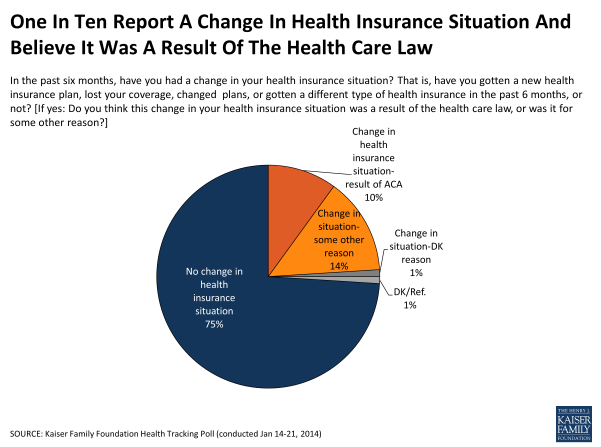
The Kaiser Family Foundation reports that 1 in 10 Americans think that ObamaCare has impacted them directly.

That’s about 30 million folks


image


And, was the impact good or bad?

(more…)