In this and a couple of preceding and subsequent posts, I’m excerpting the 13 reasons from:
Why We Make Mistakes, Joseph T. Hallinanm, Broadway Books 2009

Today, we add reason #5 to the list: the myth of multi-tasking…
In this and a couple of preceding and subsequent posts, I’m excerpting the 13 reasons from:
Why We Make Mistakes, Joseph T. Hallinanm, Broadway Books 2009
Today, we add reason #5 to the list: the myth of multi-tasking…
In this and a couple of subsequent posts, i’ll be excerpting the 13 reasons from:
Why We Make Mistakes, Joseph T. Hallinanm, Broadway Books 2009

Today, the first 4 reasons on the list …
HITS: HomaFiles’s Ideas To Share
For decades cognitive psychologists has characterized folks as being either left brain dominant – logical – or right brain dominant – creative.
Browse the lists below and pick your dominant brain side – left or right.

= = = = =
So what? What to do?
= = = = =
OK, here’s a test for you …

Rank the the following by the odds that somebody who is in the group or who is exposed to the risk is likely to die.
Make #1 the highest risk of dying in the next year; make #7 the lowest risk circumstance
And the answer is …
In a prior post Effective problem-solving … the five key skills, we isolated 5 key problem solving skills.

Let’s drill down on #1 …
* * * * * *
(1) Identify core issues quickly
One of my observations was drawn for the Center for Creative Leadership which has found that : “Managers faced with a complex problem typically end up solving the wrong problem.”
How can that be? What explains the misses?
Based on my experiences, there are 4 at least 4 frequently encountered stumbling blocks that managers often encounter.
* * * * *
So, how to jump over these stumbling blocks?
Here are some suggestions …
* * * * *
Follow on Twitter @KenHoma >> Latest Posts
Earlier this year, I had the opportunity to kick-off the MSB Consulting Club’s pioneering extracurricular series on problem-solving.
My overall message was that there are 5 key problem-solving skills that consulting firms are looking for …

* * * * *
Here are some of the Homa-isms that framed each of the skills (more…)
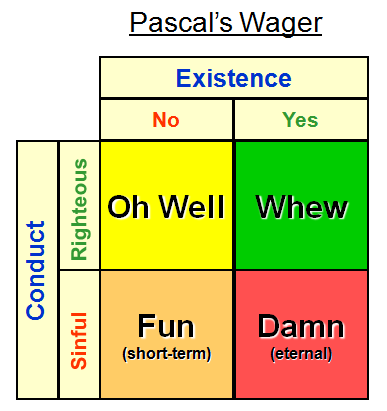
One of the few things I remember from Philosophy 101 is Pascal’s Wager.
In a nutshell, it says that God may or may not exist … and we all have the choice to live righteously or sinfully.
Naturally, that creates a 2 X 2 matrix …
If you choose to live on the wild side and God exists … uh oh.
If you choose to live a clean life, you score big if God exists … and don’t have much downside if she doesn’t.
I often find Pascal’s Wager to be a practical decision-making prop.
Follow on Twitter @KenHoma >> Latest Posts
Found this browsing through some old files.
My students know that I think conceptual frameworks are important.
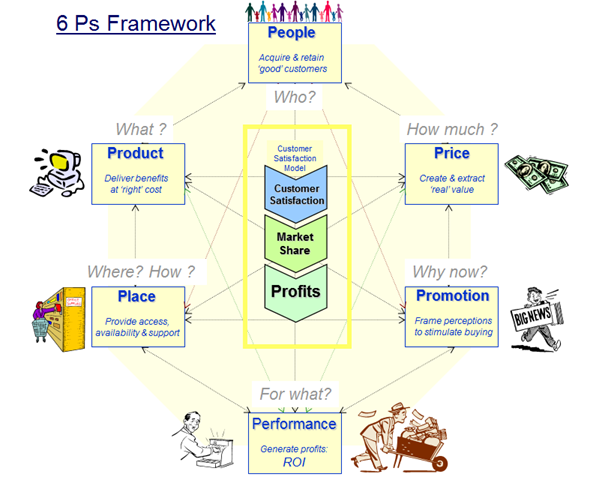
This article might have been my inspiration …
(more…)
HITS: HomaFiles’s Ideas To Share
For decades cognitive psychologists has characterized folks as being either left brain dominant – logical – or right brain dominant – creative.
Browse the lists below and pick your dominant brain side – left or right.
= = = = =
So what? What to do?
= = = = =
One key problem solving skill is identifying core issues quickly.
In a prior post, we explored why “Managers faced with a complex problem typically end up solving the wrong problem” …. and suggested some remedies.
Continuing that discussion …
Recognize that the number of core business problems is not infinite … though variants abound.
More specifically, in my opinion, the defining conceptual structure of most business problems is the same … and is captured in the PAR Framework.
PAR stands for Potential – Action – Results … companies take action against identified market potential to secure results … which, in most cases, are measured as profits.

A business problem – or case interview question — usually centers on one of the PAR components … with the other 2 providing a basis for resolution.
For example, if profits (the “R”) are down, the question is whether it’s due to market conditions (the “P”) or the company’s actions (the (“A”).
Or, the question may be how to respond (the “A”) to a change in market or competitive conditions (the “P”) … and what results to expect for alternative responses.
Or, the question may be what markets to enter (the “P”) in what way (the “A”) … to achieve what results.
The takeaway point: the PAR Framework provides a ready structure for getting your arms around common business problems.
Punch line: For some folks who predicted a Romney win over Obama, it was simply heart over head.
For others, it may have been the favorite-long shot bias
= = = = =
In gambling and economics, there’s an observed phenomenon favorite-long shot bias.

On average, bettors tend to overvalue “long shots” and undervalue favorites.
That is, in a horse race where one horse is given odds of 2-to-1, and another 100-to-1, the true odds might for example be 1.5-to-1 and 300-to-1 respectively.
Betting on the “long shot” is therefore a much worse proposition than betting on the favorite.
Various theories exist to explain why people willingly bet on such losing propositions, such as risk-loving behavior, or simply inaccurate estimation.
The effect is called “anchoring” … and it’s a well known cognitive bias.
When somebody is “primed” with a number, they will tend to internalize it and sub-consciously anchor their minds on the number.
Any estimates they then make are more often than not fine tuning adjustments around the anchor point.
“Any number that you are asked to consider as a possible solution to an estimation problem will induce an anchoring effect.”
For example, researchers consistently find that home appraisals and offer bids are invariably influenced by listing prices … even if objective, professional agents are involved … and even if they’re explicitly told to ignore the listing price.
Anchoring effects explain why, for example, arbitrary rationing is an effective marketing ploy.
A few years ago, supermarket shoppers in Sioux City, Iowa, encountered a sales promotion for Campbell’s soup at about 10% off the regular price.
On some days, a sign on the shelf said limit of 12 per person.
On other days, the sign said no limit per person. Shoppers purchased an average of 7 cans when the limit was in force, twice as many as they bought when the limit was removed.
Anchoring is not the sole explanation.
Rationing also implies that the goods are flying off the shelves, and shoppers should feel some urgency about stocking up.
But we also know that the mention of 12 cans as a possible purchase
So, to boost sales, tell customers that there’s a limit on the number of items they can buy.
They’ll get anchored on the limiting number … and often buy up to the limit.
The same effect occurs when products are priced as multiples … say, 3 for $6.
Shoppers will tend to buy 3, even if the retailer is only charging $2 each regrdless of how many are sold.
Excerpted from Kahneman, Thinking, Fast and Slow
Simple answer: more folks are reading the Homa Files.
A more complex answer is offered by James Flynn is his book “Are We Getting Smarter? Rising IQ in the 21st Century”.
Here’s an excerpt from the WSJ review …

* * * * *
From the early 1900s to today, Americans have gained three IQ points per decade.
In 1910, scored against today’s norms, our ancestors would have had an average IQ of 50 to 70.
Our mean IQ today is 130 to 150, depending on the test.
Our ancestors weren’t dumb compared with us, of course. They had the same practical intelligence and ability to deal with the everyday world that we do.
Our lives are utterly different from those led by most Americans before 1910.
The average American went to school for less than six years and then worked long hours in factories, shops or agriculture.
The only artificial images they saw were drawings or photographs.
Aside from basic arithmetic, nonverbal symbols were restricted to musical notation (for an elite) and playing cards.
Their minds were focused on ownership, the useful, the beneficial and the harmful.
Rising IQ scores show how the modern world, particularly education, has changed the human mind itself and set us apart from our ancestors.
Our ancestors lived in a much simpler world, and most had no formal schooling beyond the sixth grade.
Modern people do so well on these tests because … we are the first of our species to live in a world dominated by categories, hypotheticals, nonverbal symbols and visual images that paint alternative realities.
A century ago, people mostly used their minds to manipulate the concrete world for utilitarian advantage.
Our minds now tend toward logical analysis of abstract symbols.
Today we tend to classify things … take the hypothetical seriously …and easily discern symbolic relationships.
Since 1950, there have been large gains on vocabulary and information.
More words mean that more concepts are conveyed.
More information means that more connections are perceived.
Better analysis of hypothetical situations means more innovation.
A greater pool of those capable of understanding abstractions, more contact with people who enjoy playing with ideas, the enhancement of leisure— all of these developments have benefited society.
Our mental abilities have grown, simply enough, through a wider acquaintance with the world’s possibilities.
Thanks to AR for feeding the lead.
HITS: HomaFiles’ Ideas To Share
Earlier this week, I had the opportunity to kick-off the MSB Consulting Club’s pioneering extracurricular series on problem-solving.
My overall message was that there are 5 key problem-solving skills that consulting firms are looking for …
* * * * *
Here are some of the Homa Quotes that set-up each of the skills …
(1) Identify core issues quickly
(2) Generate testable hypotheses
(3) Gather and analyze facts efficiently
(4) Craft creative, practical solutions
(5) Syndicate support and mobilize
* * * * *
In subsequent posts, we’ll dig a little deeper into each of the 5 essential skills.
Here’s an encore HOT – Homa Online Tutorial – straight from the classroom to you via the HomaFiles.
* * * * *
I sometimes get asked: Can problem-solving be learned or is hardwired into people’s DNA?
My view: DNA can help (e.g. raw brainpower can help) but “ordinary” folks can become adept problem-solvers.
How?
By internalizing models i.e. simplifying frameworks) and protocols (i.e. analytical methods) … and applying them in a variety of contexts.
In doing so, the “devices” can be stored sub-consciously and retrieved consciously to solve problems.
That’s called intuition.

According to a study reported in LiveScience, a bride’s cold feet at the wedding altar is a strong predictor of divorce.

When researchers asked the newlyweds, “Were you ever uncertain or hesitant about getting married?”
While men were more likely to have cold feet, their wives’ reservations better predicted future problems.
Newlywed wives who had doubts about getting married before their wedding were two-and-a-half times more likely to divorce four years later than wives without these doubts.
In 36 percent of couples, both partners said they had no doubts before the wedding, and of those, just 6 percent got divorced by the four-year mark.
Among couples in which the wife or both spouses reported premarital doubts, 20 percent got divorced.
“Do the doubts go away when you have a mortgage and two kids? Don’t count on that.”
Here’s another HOT – Homa Online Tutorial – straight from the classroom to you via the HomaFiles.
* * * * *
I sometimes get asked: Can problem-solving be learned or is hardwired into people’s DNA?
My view: DNA can help (e.g. raw brainpower can help) but “ordinary” folks can become adept problem-solvers.
How?
By internalizing models i.e. simplifying frameworks) and protocols (i.e. analytical methods) … and applying them in a variety of contexts.
In doing so, the “devices” can be stored sub-consciously and retrieved consciously to solve problems.
That’s called intuition.
The following is a three question Cognitive Reflection Test (CRT), a sort of mini IQ test. Give it a try.
Actually, the CRT doesn’t purport to measure intelligence in any meaningful sense.
Rather, it’s a test of willingness to think things through and check your answers.
All three items are gotcha questions to which the first incident occurs to just about everyone is wrong.
Scroll down for answers …
If you got two or three of the questions right you are “reflective”– that’s good.
If you got none or one right, you’re “impulsive”. You can draw your own conclusion on that one. In fact since you’re impulsive, you probably have already have.
Source: Priceless, William Poundstone, Hill and Wang Books, 2010
* * * * *
Answers: 5 cents, 5 minutes, 47 days
In this and a couple of preceding and subsequent posts, i’ll be excerpting the 13 reasons from:
Why We Make Mistakes, Joseph T. Hallinanm, Broadway Books 2009
Today, we finish the list.
* * * * * *
The errors we make can be explained through 13 lessons:
1. We look but don’t always see.
2. We all search for meaning.
3. We connect the dots.
4. We wear rose-colored glasses.
5. We can walk and chew gum — but not much else.
6. We’re in the wrong frame of mind.
7. We skim.
8. We like things tidy.
9. Men shoot first.
10. We all think we’re above average.
* * * * *
11. We’d rather wing it.
Over time, winging it just doesn’t work. Knowledge and deliberate practice do.
When performed correctly, prolonged, deliberate practice produces a large body of specialized knowledge in the mind of the person doing the practice.
Having this large body of knowledge allows an expert to quickly recognize patterns that other people don’t.
12. We don’t constrain ourselves.
One way to reduce errors is by introducing constraints. Essentially, these constraints are simple mental aids that keep us on the right track by limiting our alternatives
13. The grass does look greener.
Researchers have found that when it comes to well-being, neither social states, education, income, marital status, nor religious commitment accounts for more than about 3 percent of the variance in people’s reported levels of well-being.
Nonetheless, it’s human nature to overvalue the unknown and, in the process, chase elusive dreams that turn out to be less fulfilling than what we have.
All done …
In this and a couple of preceding and subsequent posts, i’ll be excerpting the 13 reasons from:
Why We Make Mistakes, Joseph T. Hallinanm, Broadway Books 2009
Today, we add reason #10 to the list.
* * * * * *
The errors we make can be explained through 13 lessons:
1. We look but don’t always see.
2. We all search for meaning.
3. We connect the dots.
4. We wear rose-colored glasses.
5. We can walk and chew gum — but not much else.
6. We’re in the wrong frame of mind.
7. We skim.
8. We like things tidy.
9. Men shoot first.
* * * * *
10. We all think we’re above average.
Most of us hate to think of ourselves as average. So we walk around with the private conceit that we are above average, and in that conceit lies the seeds of many mistakes.
“Calibration” measures the differences between actual and perceived abilities. If you’re as good as you think you are, then you are said to be well calibrated. If you are not as good as you think you are, then you are said to be poorly calibrated.
Most of us tend to be poorly calibrated when it comes to important skills, like those we need to perform our jobs.
Corrective feedback is a powerful way to shape human behavior. In situations where overconfidence is high.
But, feedback is often low in quantity, in quality, or in both.
* * * * *
Next up: We finish the list …
In this and a couple of preceding and subsequent posts, i’ll be excerpting the 13 reasons from:
Why We Make Mistakes, Joseph T. Hallinanm, Broadway Books 2009
Today, we add reason #9 to the list.
* * * * * *
The errors we make can be explained through 13 lessons:
1. We look but don’t always see.
2. We all search for meaning.
3. We connect the dots.
4. We wear rose-colored glasses.
5. We can walk and chew gum — but not much else.
6. We’re in the wrong frame of mind.
7. We skim.
8. We like things tidy.
* * * * *
9. Men shoot first.
Aspects of our personalities predispose many of us toward certain kinds of errors. Overconfidence is a leading source of human error and, across a wide field of endeavors.
Both men and women have been shown to be overconfident. However, men, as a rule, tend to be more overconfident than women are, and this difference explains much about the kinds of mistakes men and women make.
When men and women are asked to estimate their IQs, men, on average, will give higher estimates than women will. However, men aren’t as smart as they think they are; their IQs turn out to be lower than they had guessed. Women, on the other hand, turn out to be smarter than they think they are; their IQs are, on average, higher than their estimates. In other words, men overestimate their IQs and women underestimate theirs.
Throughout their lives, for example, men report having more confidence about their sense of direction than women do — even though there is little evidence that they actually have a better sense of direction.
When it comes to making mistakes, women appear to be harder on themselves than men are.
* * * * *
Next up: We’re all above average … yeah, right.
In this and a couple of preceding and subsequent posts, I’m excerpting the 13 reasons from:
Why We Make Mistakes, Joseph T. Hallinanm, Broadway Books 2009
Today, we add reasons 6, 7 and 8 to the list.
* * * * * *
The errors we make can be explained through 13 lessons:
1. We look but don’t always see.
2. We all search for meaning.
3. We connect the dots.
4. We wear rose-colored glasses.
5. We can walk and chew gum — but not much else.
* * * * *
6. We’re in the wrong frame of mind.
How we frame an issue can greatly affect our response to it.
In situations where we expect a loss, we are prone to take risks. However, when we are considering gains, we become more conservative; we simply want to hold on to a sure thing. This pattern seems to stem, in part, from the human approach to risk perception.
Many factors can affect the way we frame our decisions. One of the least obvious factors is time. When the consequences of our decisions are far off, we are prone to take bigger gambles. However, when consequences are more immediate, we become more conservative.
7. We skim.
We rely on context to guide our perception of everyday events. The better we are at something, the more likely we are to skim.
However, this ability comes with a trade-off: Accuracy is sacrificed, and details are overlooked. As something becomes familiar, we tend to notice less.
We see things not as they are, but as we assume they ought to be. This ingrained behavior can cause us to overlook not only small things, but some things that are startlingly large.
8. We like things tidy.
The process of retelling a story in our own narrative style places certain constraints on what we recall, and these constraints guide our reconstruction of events.
If we tell a story in a funny way, for example, we’re likely to leave out certain details or maybe even add a few of our own making. In this process, a story doesn’t simply become a vision of the original event, it becomes the event; it is the way we remember it.
* * * * *
Next up: Men shoot first …
In this and a couple of preceding and subsequent posts, I’m excerpting the 13 reasons from:
Why We Make Mistakes, Joseph T. Hallinanm, Broadway Books 2009
Today, we add reason #5 to the list.
* * * * * *
The errors we make can be explained through 13 lessons:
1. We look but don’t always see.
2. We all search for meaning.
3. We connect the dots.
4. We wear rose-colored glasses.
* * * * *
5. We can walk and chew gum — but not much else.
Whether we’re on foot or behind the wheel, our attention is continually being divided by the tasks we try to juggle, such as listening to iPods, talking on cell phones, and tapping away on BlackBerrys.
Most of us believe our brains can work in the same way that computers multitask. Although multi-tasking has become a hallmark of the modern workplace, it is also one of the great myths of the modern age. We may think we are focusing on several activities at once, but our attention is actually jumping back and forth between tasks.
Not even a computer, by the way, can multitask; it actually switches back and forth between several tasks several times per second, thus presenting the illusion that all of the tasks are being performed at once.
Our minds provide us with the same illusion.
the gains we think we make by multitasking are often illusory. This is because the brain slows down when it has to juggle tasks.
Switching from task to task also creates other problems. One such problem is that we forget what we are doing — or planned to do. In some cases, the forgetting rate can be as high as 40 percent.
Another cost to multitasking is downtime. When we’re working on one thing and are interrupted, it takes us a while to refocus on what we were originally working on.
Workplace studies have found that it takes up to 15 minutes for us to regain a deep state of concentration after a distraction, such as a phone call.
Divided attention can also produce a dangerous condition known as inattentional blindness. In this condition, it is possible for an individual to look directly at something and still not see it.
One example, driver distraction, is now considered a much more frequent cause of auto accidents than safety officials once believed. When switching from task to task, drivers need downtime to recover.
* * * * *
Next up: Wrong frame of mind …
In this and a couple of subsequent posts, i’ll be excerpting the 13 reasons from:
Why We Make Mistakes, Joseph T. Hallinanm, Broadway Books 2009
Today, the first 4 reasons on the list
* * * * * *
When it comes to making mistakes, the cause is overwhelmingly attributed to human error.
Whether it’s airplane crashes (70 percent), car crashes (90 percent), or workplace accidents (90 percent), humans are usually to blame.
However, in many cases, our mistakes are not entirely our fault. All of us are afflicted with certain systemic biases in the way we see, remember, and perceive the world around us, and these biases make us prone to commit certain types of errors.
The errors we make can be explained through 13 lessons:
1. We look but don’t always see.
When it comes to human error, this kind of mistake is so common that researchers have given it its own nickname: “a looked but didn’t see” error. When we look at something — or at someone — we think we see all there is to see. But we don’t. Often times, we miss important details, some small and some larger.
2. We all search for meaning.
A recent poll of 3,000 people found that one-fourth of them couldn’t remember their own phone numbers, and two-thirds couldn’t recall the birthdays of more than three friends or family members.
When it comes to hiding places, people also mistakenly believe that the more unusual a hiding place is, the more memorable it will be. However, the opposite is actually true: Unusualness actually makes a hiding place more forgettable. The key to a good hiding place is making a quick connection between the thing being hidden and the place in which it is hidden.
The same holds for passwords. While associated meanings may make them easier to hack, they’re certainly more memorable if they have personal meaning.
3. We connect the dots (prematurely).
The moment we experience a flicker of recognition, the brain does something similar to connecting the dots that we didn’t know it was connecting. These types of subtle connections are very powerful — and very common.
Once we “see” a pattern developing we hurry it to its logical conclusion — sometimes erroneously — regardless of contrary indicators that may surface.
4. We wear rose-colored glasses.
Hindsight isn’t 20/20.
In remembering our own actions, we all tend to wear rose-colored glasses. Without intentionally trying to distort the record, we are prone to recalling our own words and deeds ina light that is more favorable than an objective record would show.
In fact, the tendency to see and remember in self-serving ways is so ingrained in us — and so subtle — that we often have no idea that we’re doing it.
* * * * *
Next up: The myth of multi-tasking …


 The Homa Files