Archive for the ‘Retailing’ Category

Wal-mart goes back for the future … more EDLPs

March 29, 2011

TakeAway:  Wal-Mart lost sight of what made it a retail giant: every day low prices.

In an attempt to reverse its US sales slump, the company is abandoning its recent focus on upscale shoppers to instead refocus on low prices.

In a crowded mass retail segment, differentiating with the lowest prices just might get Wal-Mart back on track.

* * * * *

Excerpted from brandchannel, “Wal-Mart Tries to Find Its Way Back,” by Dale Buss, March 22, 2011

It’s one thing for a brand to recognize the error of its ways and attempt to return to what made people love it in the first place. But it’s quite another thing to complete the journey successfully.

Walmart, America’s largest retailer, is finding out that truth about branding these days. It is mired in its worst U.S. sales slump ever, kept there for now by the chain’s inability to return to its roots as a basic purveyor of value-priced merchandise after an ill-considered move upscale.

[According to] Bill Simon, Wal-Mart corporate’s new U.S.-stores chief … Walmart stores are returning to the Every Day Low Prices formula that traditionally powered its sales growth, and also restoring broader selection.

“I think we tried to stretch the brand a little too far,” Simon said.

In short, Walmart realized that its core customers… liked the feel of stores so full of attractively priced merchandise that it could barely be contained on the shelves. A couple of years ago, under Project Impact, Walmart had stripped selection and focused on a clean-store look in an effort to attract upscale shoppers. But that group proved a fickle lot.

Now, in a new advertising campaign breaking next month, Walmart will highlight its decades-old emphasis on low pricing by poking fun at competitors … who use the sort of “high-low” strategy it just abandoned. …

Edit by DMG

For sale: Diamond ring … $1 million … free shipping (I think)

March 28, 2011

From Costco, of course … complementing their strategic thrust into wedding gear and services.

Move fast … only one in stock at this price.

image

In store service goes virtual … and, oh yeah, help yourself.

March 28, 2011

TakeAway: Digital bar code scanning is being utilized in stores to help customers learn more about the product, watch videos, price shop, and even help make an online purchase. 

Home Depot has taken to this strategy to provide another way for customers to get tips and help especially for those in the digital world often unwilling to ask for help but would rather just look it up or do it themselves.  

* * * * *

Excerpted from Internet Retailer, “The Home Depot customers get a Quick Response from mobile bar codes” by Katie Deatsch, March 22, 2011

… Home Depot long emphasized its jovial sales staff that is eager to offer product information and tips in stores. Now the retailer is taking that help to the mobile realm.

… a series of ads incorporating QR, or Quick Response, two-dimensional bar codes that smartphone owners can scan using an app tied to a smartphone’s camera to access product ratings and reviews, how-to guides, product videos and a web page on which they can make a purchase.

… Shoppers …will be able to access information like product demos and instruction videos, relevant accessories, buying guides, project guides, and an option to purchase online. …

… Home Depot … will be able to track the scans via Scanbuy bar code system analytics to better gauge customers’ interests, view locations of scans and more…

“… customers already using mobile devices to assist in the purchasing process, and now Home Depot is embracing this technology to more closely connect our stores and customers to our digital content…”

Bar code scanning may lend itself to products such as home furnishings that can have many complex features and are often installed by do-it-yourselfers.

… enables shoppers to scan…codes on Ralph Morris products for more information about the line as well as to gain access to post-sale help such as information on how to install the Randolph Morris products.

Other retailers using bar code scanning to promote their brands. …Macy’s Inc. last month launched a QR bar code scanning marketing program …that lets in-store shoppers use a mobile device …to access videos about the designers and brands. …provide consumers with tips and information on the latest trends, and advice and inspiration from celebrity style icons via 30-second films delivered to a phone.


Edit by HH


* * * * *

A Subway stop on every corner …

March 10, 2011

The marketing principle: Ubiquitous distribution.  Coke wants to always be within arm’s reach of every person. That’s ubiquity.

Now, Subway wants to be in every nook & cranny – anywhere somebody might yearn for a sandwich.

Punch line:  It’s official: the Subway sandwich chain has surpassed McDonald’s Corp. as the world’s largest restaurant chain, in terms of units.

At the end of last year, Subway had 33,749 restaurants worldwide, compared to McDonald’s 32,737.

Subway just opened its 1,000th location in Asia, including its first in Vietnam.

There are almost 8,000 Subways in unusual locations. “The non-traditional is becoming traditional.”

Subway has achieved its rapid growth, in part, by opening outlets in non-traditional locations such as an automobile showroom in California, an appliance store in Brazil, a ferry terminal in Seattle, a riverboat in Germany, a zoo in Taiwan, a Goodwill store in South Carolina, a high school in Detroit and a church in Buffalo, New York.

“We’re continually looking at just about any opportunity for someone to buy a sandwich, wherever that might be. The closer we can get to the customer, the better.”

McDonald’s is still the leader when it comes to sales. The burger chain reported $24 billion in revenue last year.

Excerpted from WSJ,  Subway Runs Past McDonald’s Chain , March 8, 2011

PSA: “Weddings by Costco” … why not?

March 9, 2011

HomaFiles is a non-commercial site that doesn’t accept advertising and doesn’t endorse specific products.

But, if we did, you can bet that “Weddings by Costco” would be in our strike zone.

Costco has sold coffins for years … ‘bout time they fot into weddings.

Be sure to email to a friend who’s getting married …

image

Uh-oh … the recession hits Wal-Mart as consumers change their buying ways.

March 8, 2011

TakeAway: Wal-Mart, the world’s largest retailer, has had seven consecutive quarters of declining same-store sales. 

A variety of factors contributed to this, including new shopping habits, strong competitors and a loss of some “fill-in” trips.

* * * * *

Excerpted from WSJ, “U.S. Sales At Wal-Mart Show Decline” By Stephanie Clifford, February 22, 2011

As the Christmas season approached, Wal-Mart Stores said it was fixing the problems in its United States division. It hired new executives, added merchandise that it had cut, and fought with Target and other competitors to provide the lowest prices over the holidays.

Company executives and analysts said consumers seemed to have changed their ways during the recession, and that has persisted into the sluggish recovery.

New shopping habits, like using less credit, relying more on month-to-month cash and buying in smaller packages, have hampered Wal-Mart’s ability to climb out of the sales slump. 

In addition, while consumers are still using Wal-Mart for big shopping trips, they are visiting drugstores and dollar stores for in-between purchases.

In the fourth quarter of 2010, the problems stemmed from several areas. Toy sales were down in American stores, though Wal-Mart had aggressively promoted prices and added back toys to its aisles. Apparel continued to be a problem. 

And in consumables — basics like toilet paper and soap — Wal-Mart said its prices and sizes were a problem for shoppers who continued to be on tight budgets.

Edit by AMW

* * * * *

Keep your Bud, gimme a Walgreen’s … huh?

February 10, 2011

TakeAway: Cheap beer is nothing new, but private label beer is not so common.

But now, Walgreens is introducing its line of Big Flats lager across 4,600 stores.

As if AmBev and MillerCoors didn’t have enough to worry about, there might be some more competition among those companies’ low-end offerings.

* * * * *

Excerpted from brandchannel, “Walgreens Offers Private-Label Beer,” by Jennifer Sokolowsky, January 31, 2011

Drugstores are the place to go to get your cough drops and allergy tablets, and now they are the places to pick up another kind of medicine — the self-medicating kind found in alcoholic beverages.

Duane Reade is luring Brooklyn hipsters by offering high-end bottled beer and fresh beer on tap to go in Williamsburg.

Now Walgreens is going in a completely different direction: offering its own private-label beer at the low end of the price scale.

Quietly introduced in mid-December, Walgreens now offers Big Flats 1901 lager in more than 4,600 of the chain’s 7,655 locations, according to the Chicago Tribune.

Big Flats 1901 may be labeled “premium brew,” but its price is anything but premium at about 50 cents a can, or $2.99 for a six-pack, though prices may vary by region. …

Walgreens is surely betting that those who come in looking for cheap beer will probably leave with something else as well — and that those who come in for something else just might not be able to resist leaving with some cheap beer. …

Edit by DMG


* * * * *

Uniqlo’s Push to New Markets

January 7, 2011

TakeAway: Looking to become the world’s leading clothing retailer, Uniqlo plans to move into the fast-growing Indian and Brazilian markets and to vastly expand its presence in China, where the number of stores are intended to leapfrog those in Japan by 2020.

The retailer quickly is becoming a template for the rest of corporate Japan, faced with the twin obstacles of shrinking domestic demand and a dearth of Japanese leaders with the know-how and language skills needed to lead a push into global markets.

* * * * *

Excerpted from WSJ, “Uniqlo Plans for a Global Push” By Mariko Sanchanta, December 20, 2010

Fast Retailing’s fashion focus, however, is different from its competitors (e.g. Zara and H&M): It sells casual, affordable basics, such as fleece jackets, jeans and its Heat Tech line of thermal underwear. "We don’t make clothes that you throw away after one season."

In its home market, where Fast Retailing derives the bulk of its revenue, the company has caused a buzz by breaking with many of the conventions of Japanese businesses. Fast has said English must be spoken at all business meetings where foreigners are present, that all email correspondence must be written in English by 2012 and that the number of its foreign employees will overtake Japanese workers by 2015.

"Our advantage is that we are a Japanese brand, which is known for good quality and design, and we are closer in proximity to the Asian countries."

"In China, we will grow organically without alliances or collaborations. There are no Chinese companies that can do a better job there than us. . . . We won’t be striving to increase our store count in Japan by that much going forward."

Uniqlo is forecast to have 844 stores in Japan and 76 in China by the end of August. By 2020, Uniqlo aims to have 1,000 stores in China through organic growth alone. Zara had 60 stores in China as of Oct. 31.

Analysts said that with more than 800 stores in Japan, the market is saturated and consumers are reining in their spending. "Overall purchase sizes [in Japan] have been going down, but Japanese consumers have been increasing the frequency of their visits to stores in some categories. People want to spend less on each visit," said Brian Salsberg, head of McKinsey & Co.’s retail-and-consumer group in Japan.

The company admits that it still has a lot to learn, particularly from rivals. "We can learn from H&M and Zara by looking at the speed with which they launch new stores. They are very courageous to open new stores, whether they succeed or not. We, in contrast, are very cautious with what we do," he said.

Edit by AMW

* * * * *

Full Article:
http://online.wsj.com/article/SB10001424052748704368004576028453572446140.html

* * * * *

Target Gets Fresh with Mommies

January 3, 2011

TakeAway: Target has been aggressively marketing its fresh food offerings this year in a major nationwide campaign, which includes direct mail, billboards, television, radio and vehicle wraps, among other elements.

The ads focus in part on the three daily meals that could be put together with a trip to the store, and the company hopes its efforts will resonate with mothers, who are a prime target of the campaign.

* * * * *

Excerpted from NYTimes, “Shopping at Target?  Now You Can Pick Up a Dozen Eggs” By Tanzina Vega, December 16, 2010

While Target has carried snack foods like potato chips and soft drinks for years, the company has expanded to include fresh groceries like steak, chicken, eggs and apples. So far, 350 of the 1,752 Target stores nationwide have been reformatted to include the new food layout, and the company expects to add the arrangement to additional stores at the rate of about 400 a year.

While the fresh food offerings will include items similar to what a customer can find in a grocery store, “The concept is built around the notion of fill-in trips and convenience trips. There’s a real need for convenient and affordable grocery options.”

Target stocked fresh food items alongside local products like Turkey Hill ice cream, Ellio’s Pizza and Herr’s potato chips.

To market the concept, the company ran ads in local newspapers, used direct mail and placed door hangers on homes. It also used “guerrilla tactics,” like distributing 10,000 samples of produce on the streets of Philadelphia using branded bicycles and trucks with the Target bull’s-eye logo and “Get Fresh Philadelphia!” messages.

The look of the campaign incorporates Target’s bold red lettering against a white background with fruits and vegetables splashed across the layout.

Edit by AMW

* * * * *

Full Article:
http://www.nytimes.com/2010/12/17/business/media/17adco.html?_r=2&ref=media

* * * * *

Grocery stores learn some new tricks

December 14, 2010

TakeAway: The improved lighting in the produce section of your grocery store isn’t just for aesthetics.  

It’s part of a concerted effort by grocery stores to drive sales of healthier food that consumers say they want.

Studies indicate lighting alone can increase sales nearly 30%.  Expect these practices to become more widespread.

* * * * *

Excerpted from NPR, “Nudging Grocery Shoppers Toward Healthy Food,” by April Fulton, November 8, 2010

Grocery stores are not necessarily designed to help customers choose the healthiest food. Signs and specials advertise chips and soda, and the coupons are usually for the pre-packaged, processed foods advertised by big brand-name companies with deep pockets. …

Some stores are getting wise to shoppers’ desires to eat better, as well as the challenges they face in doing so. Some are subtly shifting the focus to healthier products by using the same marketing tricks the large food companies and restaurants have used for years. …

Brian Wansink, the co-director of the Cornell Center for Behavioral Economics in Child Nutrition Programs, says grocery store sales goals are compatible with public health goals. …

He’s done a lot of research on produce and found that there are small things stores can do that will help them move a lot more volume of the healthy stuff.

Take product placement and soft, focused lighting, for example. Items that are highlighted in this way — even if they aren’t on sale — sell about 30 percent more, Wansink says. They just look more appealing than products under harsh, overhead fluorescent lights.

Smells can be used as an enticer, rather than just “fanning them out of the building,” as many stores do …

The danger with these marketing tools is in going overboard, bombarding people with public health messages about how they should eat better. If people feel persuaded, they will resist, Wansink says. Stores have got to make the shoppers feel like it’s their choice. …


Edit by DMG


* * * * *

Full Article
http://www.npr.org/templates/story/story.php?storyId=131074210

* * * * *

Christmas coming early this year?

November 12, 2010

TakeAway: Now that Halloween is over, retailers are embarking on the mad dash to December 25. 

The sluggish economy is raising the stakes for the Christmas shopping season. Some retailers and marketers, worried that uncertainty among shoppers might increase as the weeks go by, hope to pull demand forward by moving up the start of their pitches.

* * * * *

Excerpted from NYTimes, “For Marketers, Christmas Started Last Month” By Stuart Elliott, October 31, 2010

In consumer electronics, “people are getting out there earlier,” said Best Buy’s SVP for U.S. marketing. One reason is increased comparison shopping and another is new products, such as e-readers, tablets and 3-D TV sets.  To “emotionally engage consumers” who will be more deliberate about where they shop, Best Buy will run two holiday campaigns at once.

“The consumer at large is still very cautious about spending and very purposeful about how to plan gift-giving.

The holiday is about celebration and family and giving, but saving is just as much a hallmark.”

Some retailers are playing up the traditional rather than the promotional aspects of Christmas shopping.

For instance, Barneys New York plans to bring to life its theme for 2010, “Have a foodie holiday,” with windows at its flagship store on Madison Avenue that pay tribute to chefs, such as Bobby Flay and Rachael Ray.

However, the profusion of Christmas campaigns runs the risk of wearing out shoppers who may at some point tire of all the Santas and candy canes.

Of course, when it comes to Christmas, one beverage truly stands out: Coca-Cola, which has been running campaigns with holiday themes since the 1930s. The Coca-Cola Company will begin its 2010 campaign this month, varying the introductory date by market. Never mind those concerned about ads that make it seem that the holiday arrives too soon. Coca-Cola worries about it ending too early – it wants to keep Christmas going through the first week of January.

Edit by AMW

* * * * *

Full Article:
http://www.nytimes.com/2010/11/01/business/media/01adco.html?src=busln

* * * * *

Nook Kids a Potential Niche

November 9, 2010

TakeAway: Barnes & Noble, intent on winning over a new generation of readers and growing its market, is launching a digital collection of more than 12,000 books under the name Nook Kids. 

Nook Kids represents a crucial effort by the nation’s largest bookstore chain to establish itself with children and their parents (a.k.a gatekeepers) as a digital e-book leader.

* * * * *

Excerpted from the Wall Street Journal, “B&N Aims E-Books at Kids” By Jeffrey A. Trachtenberg, October 25, 2010

The works, aimed at children 3 to 8 years old, include picture books, novels and a selection of enhanced editions of classics.  At the core of those efforts is the Nook, the bookseller’s electronic reader, which competes with such devices as Amazon’s Kindle and the iPad.

One of the unusual features of the Nook Kids venture is that Barnes & Noble has struck publishing deals with more than 15 children’s book publishers to create enhanced digital editions of classic titles.

Publishers say they like that the enhanced titles are engaging but restrained. "When you’re starting with a book that has been a best seller for many years, a beloved book, you need to be subtle," said the president and publisher of HarperCollins Children’s Books.

Edit by AMW

* * * * *

Full Article:
http://online.wsj.com/article/SB10001424052702304354104575568741495194492.html

* * * * *

Dollar stores debate – thriving or hurting ?

October 11, 2010

Last week, we posted a seemingly innocuous excerpt from the NY Times about how dollar stores are thriving in the weak economy.

Got lightning fast feedback from a loyal Homa Files reader that an opinion to the contrary appeared in the WSJ:

Dollar stores have been all the rage in these penny-pinching times. But their growth prospects may be dimming.

The discount space is looking increasingly crowded. The three-biggest dollar stores, including Dollar Tree Inc., already have roughly a combined 20,000 locations in the U.S.

More troubling, the squeeze on dollar stores’ core, lower-end shoppers, is getting worse.

That is likely to put pressure on margins. Bargain prices on food, drinks and other “consumables” may get customers in the door, but discount retailers rely on higher-margin discretionary purchases for profit growth. Sales in the fiscal fourth quarter were strongest in the low-margin consumables category.

A weak economy mightn’t turn out to be quite the gold mine for dollar stores that many investors seem to think.

WSJ, Weak Economy Saps Dollar Stores’ Strength, Sept.  29, 2010
http://online.wsj.com/article/SB10001424052748704791004575520322560873584.html

Googling the topic revealed a debate in process on the topic.

Most notably, Jim Cramer – who has apparently been touting dollar stores on Mad Money – responded immediately to the WSJ story.  His verbatim comments:

“Never ever let a negative headline scare you out of the stock with a good long term story.

Case and point, last week the Wall Street Journal ran what may be the most absurd headline I’ve seen in ages, “Weak Economy Saps Dollar Stores’ Strength”.

I thought it was a comedy routine since Dollar Stores do well in a weak economy as a cash strapped consumer trades down the cheap stuff…..”

http://www.madmoneyrecap.com/madmoney_nightlyrecap_101006_3.htm

Ken’s Take: Dollar stores are either thriving or hurting … or just keeping pace … who the heck knows.

Thanks to RMM for feeding the lead

Registers Are Ringing … at the Dollar Stores, that is.

October 8, 2010

TakeAway: As people make fewer costly shopping trips to stock their pantries and increasingly can only afford inexpensive items in small quantities, stores are scrambling for the once-ignored low-end customer.

Some customers at Wal-Mart and the major dollar chains have such modest budgets that the retailers report upticks in spending at the beginning of the month, when government benefit checks and many paychecks come through.

Some of the stores have even managed to reach some middle-income shoppers, by increasing products from well-known brands such as Hanes, Quaker Oats and Nabisco. 

* * * * *

Excerpted from the New York Times, “Stores Scramble to Accommodate Budget Shoppers” By Stephanie Clifford,September 22, 2010

Dollar stores have shown the biggest gain in shopper visits over the last year out of all the retailers that sell basic consumer goods. Manufacturers are racing to package more affordable versions of products common at those stores, and other budget retailers, feeling the loss of customers, are trying to duplicate their success.

 Wal-Mart, the world’s largest retailer, is adding thousands of items to its shelves, including inexpensive ones, and is asking dollar-store suppliers to create small, under-a-dollar packages for its stores, too.

 In areas with high unemployment, Wal-Mart is grouping together its less than $1 items in a clear challenge to the dollar stores. About a quarter of Wal-Mart’s stores are beginning to offer items for under $1, such as a four-pack of toilet paper, boxes containing just a few garbage bags and single rolls of paper towels.

The dollar stores have best been able to capitalize on the downmarket trend because of strategies they embraced during the recession, when the stores kept things cheap and expanded their merchandise.

During the recession, Wal-Mart pulled back on very inexpensive products, suppliers said, to make the stores look less cluttered and to appeal to shoppers who might be testing out that retailer instead of, say, Target. That decision has it now playing catch-up.

The dollar stores have found creative ways to keep their prices low. When commodity costs rose for suppliers, for example, the dollar stores asked them to decrease the number of sandwich bags in a box or pushed them to come up with a cheaper version of the products.

Edit by AMW

* * * * *

Full Article:
http://www.nytimes.com/2010/09/22/business/22dollar.html?_r=1&th&emc=th 

* * * * *

Leveraging a "P": Wal-Mart Expands Its Reach via FedEx

October 1, 2010

TakeAway: Wal-Mart is experimenting with allowing customers to buy merchandise online and have it delivered for free to urban FedEx locations in a bid to boost sales in big cities where the retailer has little to no store presence.

A perfect example of one of the 6Ps – placement!

* * * * *

Excerpted from the Wall Street Journal, “Wal-Mart Uses FedEx to Expand Urban Push” By Miguel Bustillo,September 20, 2010

This summer, Wal-Mart started tests in Los Angeles and Boston to allow customers to direct purchases made on Walmart.com to FedEx Office outlets at no cost, mimicking a Wal-Mart offering called Site to Store that lets online buyers send items to the retailer’s stores for free.

Wal-Mart has no stores in Boston and two in Los Angeles, but FedEx has many locations in both. Wal-Mart is still collecting feedback from the tests.

Some retail experts said it seemed like an inevitable next step for the retailer, which has struggled to expand into America’s largest cities amid political opposition from labor unions. Wal-Mart is searching for new ways to spark domestic growth without needing to invest in real estate.

Wal-Mart also is pursuing younger urban shoppers, who don’t think twice about making big purchases online.

The partnership could allow FedEx to capitalize on its locations near college campuses it inherited when it acquired Kinkos in 2004.

Edit by AMW

* * * * *

Full Article:
http://online.wsj.com/article/SB10001424052748704416904575501790739176042.html

* * * * *

Less isn’t always more … just ask Walmart.

September 15, 2010

TakeAway: Walmart’s merchandising strategy called Project Impact knocked thousands of items off the retailer’s shelves and cleared the aisles of promotional merchandise.

And, the retailer has moved to give regional and store managers more power over what their stores carry and how merchandise gets displayed.

Both  programs will have a major impact on a host of marketers over the next year. 

A few brands are immediate winners, though many of the category resets that will add back thousands of items won’t occur until early 2011.

* * * * *

Excerpted from AdvertisingAge, “Walmart’s Merchandising Shift Has Five Brands Dancing in Aisles” By Jack Neff,September 13, 2010 

The program to reinvigorate growth at Walmart always focused on 10 words.

Seven remain operative, including “Save Money.  Live Better”, the slogan adopted in 2007, and “Fast, Friendly, Clean,” which refers to efforts to improve the store environment and shopping experience. 

Three — referring to the “Win, Play, Show” merchandising and assortment strategy — have been tossed out of the lexicon, according to several people familiar with the matter.   “Win, Play, Show,” reduced assortments widely and often let price leadership over competitors narrow or disappear entirely in the “Play” and “Show” categories.

Reversal of that, along with return of merchandise to aisles, or so-called “Action Alley,” is having the biggest impact on brands.

Among the beneficiaries so far, according to people familiar with the matter:

HEFTY ONEZIP: Along with Glad, it got eradicated from the food-bag aisle after a Walmart category review last year. Starting in April, it got a small amount of space back, and more recently it has fully regained its shelf space.  

PAMPERS: Since Pampers isn’t distributed at Costco or big dollar chains Dollar General and Family Dollar, Walmart takes on added importance for the brand. It’s one reason P&G is widely believed to “over-index” at Walmart, and why it should broadly benefit from increased display space at the giant retailer. 

WISK: This detergent brand had been booted from retailers in the recent years and hanging on to distribution in only around 10% of Walmart stores. Timing proved fortuitous, as Wisk was planning a formula upgrade and major marketing push for August just as Walmart was relaxing its assortment stance. The result is full national distribution for Wisk.  

ELMER’S GLUE: Timing is everything, and the decision to open up “Action Alleys” again in many stores just in time for back-to-school season put this staple of the season in high-traffic areas. 

CHEX MIX: A reset of the snack section recently has brought the item-count for this General Mills brand from three up to eight. 

Edit by AMW

* * * * *

Full Article:
http://adage.com/article?article_id=145845


Never Say Never to Wal-Mart

September 2, 2010

TakeAway:

Seventh Generation specialty products will now be available at Wal-Mart (and its broad, mainstream audience), as Wal-Mart boosts its “green” efforts by winning over a company that said it would never sell there. 

“We now believe that we can have a bigger impact by partnering with Wal-Mart than by shunning it.” 

Seventh Generation lowered prices across the portfolio so that they cost as much as or only slightly more than the leading national brand. 

To justify its decision, Seventh Generation explains that Wal-Mart’s social and environmental targets were specific and its reports seemingly transparent.

* * * * *

Excerpted from WSJ, “Adversary’s Clean Start with Wal-Mart” by Ellen Byron, July 26, 2010

For years, Seventh Generation Inc. co-founder Jeffrey Hollender liked to say “hell would freeze over” before his company’s environmentally friendly household products would be sold by Wal-Mart Stores . He feels differently now.

Starting next month, Seventh Generation staples, including laundry detergent, dish soap, all-purpose sprays and disinfectant wipes, will be sold in about 1,500 Wal-Mart stores.

Five years ago, the world’s largest retailer began setting goals to reduce its energy consumption, cut waste and introduce more sustainable products.

To be sure, selling green products is also increasingly lucrative.

While many shoppers switched to cheaper labels during the recession, sales of household products billed as environmentally friendly have held up relatively well despite their premium prices. 

  • Sales of green household and laundry cleaning products rose to $557 million last year, having more than tripled since 2005.
  • Green products are still a niche category, however, representing only about 3% of the overall $19.9 billion household cleaners and laundry market.

Seventh Generation’s change of heart toward Wal-Mart came gradually.

Seventh Generation and Wal-Mart are both members of the Sustainability Consortium, a group of manufacturers, retailers, nongovernmental organizations and government officials that is developing tools and strategies to evaluate the environmental and social impacts of products’ lifecycles.

“Wal-Mart can move quicker than probably any government on the planet.”

Edit by AMW

* * * * *

Full article: http://online.wsj.com/article/SB10001424052748704421304575383271764631764.html?mod=dist_smartbrief

Blockbuster: Dead man walking ?

March 4, 2010

Question: when was the last time your were in a Blockbuster?

* * * * *

Excerpted from Business Week: Blockbuster Plots a Remake, Feb. 24, 2010  

With its traditional video-rental business under assault, Blockbuster  has brought in restructuring advisers, looking to buy yet more time to remake itself in the face of new rivals and technologies.

Blockbuster’s plight comes amid major shifts in how people rent and watch movies. Consumers are now getting movies through Redbox, a unit of Coinstar  that operates $1-a-night movie-vending machines in grocery stores and McDonald’s outlets.

Netflix mail-order and online rental service has also stolen Blockbuster customers. Consumers are also watching movies and TV shows through on-demand cable services and electronic gadgets such as Apple Inc.’s iPod.

Blockbuster has adjusted its business, outlining plans to close nearly 1,000 stores out of roughly more than 5,000 world-wide.

As the movie-rental business has evolved, Blockbuster has moved into other video-watching services, such as its own mail-order service, DVD rental kiosks and a digital on-demand service, but it remains far behind its major competitors in those areas.

Blockbuster reaps licensing fees from NCR Corp., which rolled out about 2,500 Blockbuster Express branded vending machines last year and plans to have up to 10,000 DVD kiosks by the end of this year. Blockbuster’s kiosk presence is much smaller than that of Redbox, which has more than 22,000 vending machines.

Blockbuster’s mail-order service has about 1.6 million subscribers, compared with Netflix’s roughly 12 million.

There’s skepticism whether Blockbuster can realize enough value from new business offerings in time to offset declines at its traditional brick-and-mortar outlets.

“If they can’t build a profitable stores operation, then there is no Blockbuster. It’s real simple. If traffic doesn’t pick up by mid-year, we may just kiss this whole story good-bye. We got a dead-man-walking situation here.”

image

Full article:
http://online.wsj.com/article/SB10001424052748703503804575083792463467472.html?mod=WSJ_hps_LEFTWhatsNews

Home Depot: Leveraging its “late mover advantage” … huh?

March 1, 2010

Once heralded for its in-store customer service, Home Depot cost-reduced itself into 2nd place in the retailing category it created.

Now, it tries leverage it “late mover advantage”.  Say what ?

* * * * *

Excerpted from WSJ: Home Depot Undergoes Renovation, Feb. 24, 2010

Home Depot is regaining momentum after belatedly tackling its biggest fix-it task to date: remodeling itself.

The world’s largest home improvement chain  is redesigning the way it ships merchandise to stores, answers customers’ questions, and showcases its wares on the Internet.

The goal is to improve productivity and expand profits by revamping a slew of business practices that never changed during the company’s mushrooming growth in the 1980s and 1990s, and that look primitive compared to current trends in retailing.

The most dramatic change is that Home Depot is phasing out the antiquated practice of having suppliers send dozens of half-empty trucks directly to its more than 2,200 stores.

A network of “rapid deployment” warehouse centers being completed this year will combine shipments, trim costs and cut truck trips to stores by up to 50%. That will let more of Home Depot’s orange-apron-wearing workers shift from shipping docks to store aisles, in hopes of tackling a festering reputation for bad service.

Home Depot is claiming a “late-mover” advantage will allow it to avoid the costly mistakes that other retailers made modernizing operations.

Home Depot executives concede that the company’s supply chain still won’t be state of the art after the upgrade, though it will be a big step forward.

To tackle the perception that Home Depot workers are always too busy to help customers, the company is spending $60 million on hand-held devices that will help workers check on the spot if something is in stock.

Communication was also a problem at Home Depot. Mr. Ellison said he was stunned to discover that store managers were drowning in hundreds of emails from headquarters.

So Mr. Ellison says he cut it to one email a week, on Monday, and set up a hotline for managers to complain if the edict is violated.

In addition to its supply chain fixes, Home Depot is waking up to the Internet after being embarrassed that Amazon.com — which sells more drills online than Home Depot. Now the company is building a site that not only sells what stores do, but features do-it-yourself videos to help customers with projects. “We’re now building a site that fixes people’s problems.”

Full article:
http://online.wsj.com/article/SB10001424052748704188104575083081020924838.html?mod=WSJ-hps-LEFTWhatsNews

Family Jewels: Blue Nile invests and expands during downturn

February 25, 2010

Blue Nile — self-proclaimed “man’s best friend” — has taken it up a notch …

* * * * *

Business Week: How Four Rookie CEOs Handled the Great Recession – DIAMONDS ARE FOREVER, February 18, 2010

Diane M. Irvine had no time to celebrate getting the chief executive job at online jewelry retailer Blue Nile. Hours after her appointment in February 2008 she had to tell investors that sales from the previous holiday season had been worse than expected—and the credit crunch would probably mean a dreadful next year.

Blue Nile was selling luxury goods in what was probably the worst economy in 75 years,  Adding to the challenge of waning consumer demand were diamond prices, which remained at boom-year levels.

Irvine had to come up with a plan, and fast.

She surprised many by using the recession as an excuse to go on the offensive and gain market share. 

Blue Nile had an edge on brick-and-mortar jewelry brands like Tiffany’s and Zales in a downturn because it required little overhead and virtually no inventory.

Competitors would struggle and close stores; Blue Nile would invest and expand.  

Irvine doubled down on technology that would help bring in new customers. Blue Nile’s site underwent a year-long revamp, adding new tools to help buyers search for diamonds by budget, shape, and quality.

The new CEO also pushed into overseas markets, tweaking the Web site to accept 23 different forms of currency.

Credit was a barrier to many potential sales. So the Seattle company joined up with Bill Me Later (the company eBay would later acquire) to offer customers no-interest financing for six months on large purchases.

Irvine’s offensive is beginning to pay off. Fourth-quarter revenues increased, by 20%.

Meanwhile, three of the top traditional jewelry retailers have filed for bankruptcy, and competitor Zale appears poised for a major restructuring.

Full article:
http://www.businessweek.com/magazine/content/10_09/b4168032766715.htm?campaign_id=magazine_related

Hey, where’s my favorite deodorant ?

February 18, 2010

Bottom line: As retailers adjust to tight-fisted shoppers, many stores are shrinking the number of name-brand products on their shelves.

Don’t be shocked if you can’t find your favorite salad dressing or mouthwash on your next trip to Wal-Mart.

* * * * *

CNNMoney.com, Dumped! Brand names fight to stay in stores, Feb. 16, 2010 

Large retailers — including Wal-Mart, the world’s biggest — are wrestling with having too many types of brand-name products.

At the same time, shoppers are buying less and looking for bargains.

So unless a particular brand is a top seller in its category, it’s getting knocked off the shelf — and sometimes getting replaced by a cheaper store brand.

For example, Wal-Mart recently removed Glad and Hefty-branded storage bags from shelves, replacing them with its own lower-priced Great Value brand.

Those categories at greatest risk of losing brands are everyday-type purchases such as household products, toiletries and food staples.

These are also categories in which retailers have aggressively pushed their own house brands.

Moves such as this are significant given Wal-Mart’s heavyweight status in the retail industry.

“Any change that Wal-Mart makes with its product assortment has enormous implications for the entire industry.”

Wal-Mart is not the only one doing this,  leading drug store chains, including CVS and Walgreens, grocers such as Kroger, and Wal-Mart’s rival discounter, Target, are also looking to simplify their store shelves.

In good economic times, product variety is a must for retailers. But in down times, when shoppers aren’t buying much, variety can be a burden.

“I think the feeling is that as these companies keep extending their [product] lines, it’s only causing confusion for shoppers and not really driving them to buy more products.”

“If you walk into a Wal-Mart or another large retail chain, there are so many products on shelves that it does make it harder to shop.”

Besides cutting clutter, industry experts say Wal-Mart and other retailers are looking for more lucrative deals from suppliers on both prices and advertising.

“Perhaps one consideration in which product to cut is based on which company gives [Wal-Mart] the best deal.”

“In this recession, consumers have certainly become less discriminating with what they buy. Consumers have rushed to value prices, and they are buying generic brands.”

Retailers’ own brands have grown their market share by between 2% to 6% … and 77% of consumers who traded down to less expensive private label products are happy with their decision.

Full article:
http://money.cnn.com/2010/02/15/news/companies/walmart_dropping_brands/index.htm

Busted. Marketers’ grocery store tactics revealed

January 5, 2010

TakeAway:  As manufacturers and retailers strategize to squeeze pennies out of our now incredibly cost-conscious consumers, it appears the consumers are starting to catch on.

* * * * *

Excerpted from New Jersey Business, “Savvy marketing ploys can cost unwitting grocery shoppers plenty,” The Associated Press, November 06, 2009

If you ever leave the grocery store with a slight sense of bewilderment at what you’ve just bought, you are not alone.

Despite the utilitarian look of most grocers’ shelves, careful science goes into deciding how to display the thousands of items each store carries and how to make them appeal to consumers.

Marketers tug shoppers toward items they did not intend to buy … with package design, shelf placement, tie-ins and temporary price cuts …

Marketers have put more thought into grocery stores than any other type of store because they see an opportunity in the monotony of shopping for necessities …

For a bundle of 30 products that would cost an “impulsive” shopper $288 … research found a “savvy” shopper would pay just $166 at the same grocery store. In addition to guarding against marketing ploys, the savvy consumer tracked down coupons, used a store bonus card and chose the most economical sizes …

Here’s what to watch for next time you head out for groceries.

1. END OF THE AISLE: Marketers pay grocers dearly to put their wares on the end of each aisle shelves because products there can sell 30 percent more …

2. EYE-LEVEL, EYES OPEN: … Shoppers look straight ahead or, at most, from side to side, as they shop. So products on shelves at eye level often cost more than their lower-shelf siblings …

3. MORE CAN BE LESS: … One in four times a smaller version of a product was cheaper per serving …

4. D-I-Y CARROT STICKS: … convenience can be pricey.

5. DON’T PICK THEIR NUMBER: … Be wary of … the buy-five-for-$5 type. You usually don’t have to buy all five to get the promotional price …

6. THAT ONE LAST THING: The items in the display by the cash register are always marked up …

7. REMEMBER THE TRIED AND TRUE: … Buy store brands, which can be even more economical than shopping at warehouse clubs …

Edit by TJS

* * * * *

Full Article
http://www.nj.com/business/index.ssf/2009/11/savvy_marketing_ploys_can_cost.html

* * * * *

Wal-mart and Amazon put a bullseye on Target.

December 22, 2009

TakeAway:  Wal-mart, Amazon, and Target didn’t want to just lose money on books, they decided to lose money on DVDs too. 

The latest price wars to lure consumers during the holidays may cause irreversible long-term damage.

* * * * *

Excerpted from WSJ, “Online Price War Moves to DVDs As Discounters Compete for Sales,” By Miguel Bustillo and Ann Zimmerman, November 6, 2009

Wal-Mart extended its holiday price war into new territory Thursday by slashing online prices on 10 hotly anticipated DVDs … to $10.

Within hours, Amazon and Target matched some of Wal-Mart’s online prices on pre-orders of the DVDs, and Wal-Mart lowered its price by a penny to $9.99, reprising the scuffle that broke out last month when Wal-Mart launched an aggressive $10 book promotion …

Like the book war … the DVD battle resulted in prices that guaranteed the retailers would lose money on the movies. However, promotions to sell new movie releases close to or below cost in order to drive customer traffic are already common in retailing …

Though Wal-Mart, Amazon and Target always compete feverishly with aggressively priced promotions, the latest skirmishes, heading into a holiday season in which recession-scarred consumers are searching for bargains, have been especially cutthroat.

Despite involving just a handful of titles, the book war aroused strong passions in the publishing industry. Some worried that it would set troublesome new customer expectations on bestseller prices and even affect the amount of future advances publishers could afford to pay writers.

The American Booksellers Association last month asked the Department of Justice to determine if it constituted “illegal predatory pricing,” arguing independent book stores wouldn’t be able to compete.

The book prices were so low that the retailers placed limits on the number of copies customers could purchase.

Edit by TJS

* * * * *

Full Article
http://online.wsj.com/article/SB20001424052748704013004574518210171023536.html#mod=todays_us_marketplace

* * * * *

Who’s more impulsive — men or women ?

November 20, 2009

Excerpted from MarketingProfs.com, It’s All in the Presentation, Oct. 28, 2009

The key factors (category and customer characteristics, and in-store customer activity) that boost, or kill, impulse shopping:

Customers with coupons make fewer unintended purchases. The more focused a customer is on a specific purchase that will save money, the less likely she is to add more to her cart.

Customers who shop more frequently buy fewer items. They may focus more on immediately needed items, and spend less time in-store per visit.

Women tend to impulse-buy more than men. When Mom says, “Pick up some milk,” Dad picks up some milk, and leaves.

Shoppers who shop more aisles make more unplanned purchases. It’s simple: The more they see, the more likely they are to buy.

In-store displays provide the biggest boost to impulse shopping. Cool displays attract attention—and encourage purchases.

* * * * *

Based on these findings:

Consider store layout. “Consumers should be encouraged to shop as many aisles as possible (in general) and be exposed to as many product categories and in-store displays as possible (in particular).”

Mix things up. “Products that are frequently purchased (e.g., milk) should be placed in locations that will lead consumers past as many other categories as possible, or [be] displayed next to less-frequently purchased products.”

Decorate. “Making the shopping experience as pleasant as possible will increase time spent in the store”—and add to the likelihood of an impulse buy. Merchants who make the in-store experience more fun (and more lengthy)  stand the best chance of moving product.

Source: “The Interplay Among Category Characteristics, Customer Characteristics, and Customer Activities on In-Store Decision Making,” by J. Jeffrey Inman, Russell S. Winer and Rosellina Ferraro. Journal of Marketing, 2009.

* * * * *
http://www.marketingprofs.com/news/customer-behavior/index.asp?nlid=1456&cd=dmo121&adref=NciW4A9

Book wars … Walmart tells Amazon "Take that !"

October 23, 2009

TakeAway:  Wal-Mart just took price-leadership to a new level; consumers are enjoying discounts up to 74% on best-selling books.  Many criticize this price war for its negative impact on the book supply chain and publisher pricing power.  At the same time, some see this price war as an opportunity to attract a whole new batch of readers.

* * * * *

Excerpted from WSJ, “Book Price War Escalates,” By Jeffrey Trachtenberg and Brian Blackstone, October 17, 2009

Book publishers are worried they and retail chains could be caught in the cross fire as Amazon.com and Wal-Mart ratchet up their price war over online book sales.

Wal-Mart triggered the online skirmish Thursday when it began selling its 10 most anticipated hardcovers for $10 apiece when pre-ordered on its Web site. Amazon matched the offer hours later and Wal-Mart then chopped its price to $9. Friday morning Amazon had matched the price … Late Friday afternoon, Wal-Mart dropped its price a penny, to $8.99.

The discount applies to popular books such as Mr. King’s “Under the Dome” … which carries a $35 price tag but is available on Amazon and Walmart.com for $9, a discount of 74%.

Walmart.com CEO said that the retailer “will go as low as we need to” to underscore Walmart.com’s intent to be a low-price leader online … Publishers are receiving its customary wholesale price from Wal-Mart and Amazon … “Publishers aren’t subsidizing this in any way,” … 

The nation’s two largest bookstore chains, Barnes & Noble and Borders, each operate their own online retail sites. Neither is matching the prices now being offered by Walmart.com or Amazon …

Publishers said they feared the online pricing could hurt small independent book sellers and big retail chains …

Chief executive of Perseus Books Group … said the price wars will help sales in the short run but create problems if they continue. “When your product is treated as a loss leader, it lowers its perceived value,” he said. “If you are taking margin out of the supply chain, it will eventually put pressure on everyone in that chain.” …

If the industry’s top books continue to be sold for $9 online … it will be increasingly difficult for publishers to launch what he described as “the writers of tomorrow,” because the book market may have narrowed significantly …

Some executives said privately they doubted that the two retailers could afford to maintain the price strategy in the long term, unless they could offset losses on the discounted books with more traffic in other parts of their stores …

But some fear a long-term price degradation. The price war is “eroding the economy of the book,” … what will happen if big retailers try to force publishers to slash their own prices.

Despite the worrying news out of the U.S., the mood isn’t all gloom and doom. The price cuts may lead to a flood of new readers on the market, some executives said. In addition, digital books offer opportunities to include new video and audio content in books.

Edit by TJS

* * * * *

Full Article
http://online.wsj.com/article/SB10001424052748704322004574477050954174722.html?mod=WSJ_hps_LEFTWhatsNews

* * * * *

DVDs … going the way of the 8-track.

October 22, 2009

TakeAway:  Surprise surprise … DVDs are no longer worth the floor space. 

Now, Wal-mart has essentially crushed this product in one fell swoop.  When you leave it up to retailers to force product evolution, chances are that it is too late.

* * * * *

Excerpted from WSJ “Wal-Mart Scales Back DVD Displays” By Nat Worden, October 5, 2009

Wal-Mart accounts for nearly a third of DVD retail sales in the U.S. … But, as part of a larger effort to clean up its aisles and appeal to higher-end shoppers, Wal-Mart is doing away with display cases to promote the latest hot movie titles.

The move comes as major film studios are reeling from declines in revenue from DVD sales as consumers turn to low-cost rental services and digital downloads for home movies …

“We think the new strategy implies Wal-Mart no longer sees DVDs and Blu-ray discs as traffic drivers” .

The change to its DVD selling strategy is part of a larger merchandising overhaul the company calls “Project Impact,” in which it has been devoting more shelf space to top-selling products and cutting back on items that linger.

The discount giant also is trying to spruce up its image and cut back on clutter in its aisles, like corrugated displays for DVDs, in hopes that it can attract a more upscale shopper …

Meanwhile, Wal-Mart and other major retailers, along with several fast-food chains, have been adding low-cost DVD rental kiosks, such as Redbox, near store entrances … And studios have cut deals with services like Netflix …

Edit by TJS

* * * * *

Full Article
http://online.wsj.com/article/SB125470337132563199.html?mod=WSJ_hps_sections_tech

* * * * *

The “Wal-Mart of the web” … Amazon’s KSFs.

October 7, 2009

KSF= Key Success Factors

* * * * *

From BrandChannel, Nimble Amazon Thrives In Recession, September 22, 2009

Having conquered the online book market, reports the New York Times, “Amazon is set to cross a significant threshold” to become the Wal-Mart of the web.

By the end of 2009, Amazon’s worldwide sales of general merchandise will exceed the books, music and movies Amazon is known for.

“Amazon’s expansion strategy has allowed it, almost alone among retailers, to thrive during the recession, even while its own media business has stagnated*”

While Amazon’s marketing has helped transition customers into seeing it as more than a bookstore, back-end innovation is the real engine of the company’s successful expansion.

In Amazon’s huge merchandise warehouses, “every product, shelving unit, forklift, roller cart and employee badge … has a bar code.” The company has an “almost magical business model in terms of inventory management”

Amazon builds engagement with purchase recommendations, wish lists, customer reviews and free shipping.

According to Interbrand — a brand consultancy , the company’s success shows “why you are best off not owning a retail footprint in a recession“: its flexibility lifted it past struggling and fallen competitors like Borders and Circuit City.

Full article:
http://www.brandchannel.com/home/post/2009/09/22/Nimble-Amazon-Thrives-In-Recession.aspx

* * * * *

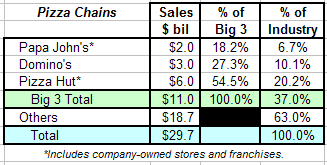
Who sells more pizza: Domino’s, Pizza Hut or Papa John’s?

October 2, 2009

According to Fortune Magazine …

image

http://money.cnn.com/2009/09/22/news/companies/papa_johns_pizza_schnatter.fortune/index.htm

* * * * *

Ken’s Note: I would have bet Domino’s … not for a minute did I think Pizza Hut sold more than Domino’s and Papa John’s combined.

* * * * *

Who sells more pizza: Domino's, Pizza Hut or Papa John's?

October 2, 2009

According to Fortune Magazine …

image

http://money.cnn.com/2009/09/22/news/companies/papa_johns_pizza_schnatter.fortune/index.htm

* * * * *

Ken’s Note: I would have bet Domino’s … not for a minute did I think Pizza Hut sold more than Domino’s and Papa John’s combined.

* * * * *

Marketers' challenge: making shopping easy for cranky old folks.

September 18, 2009

Excerpted from WSJ, Seeing Store Shelves Through Senior Eyes, Sep 14, 2009

The number of adults aged 65 and older will reach 71.5 million people by 2030, twice their number in 2000 and representing nearly 20% of the total U.S. population. As baby boomers turn 65 years old beginning in 2011, they are expected to spend an additional $50 billion over the next decade on consumer products in the U.S.,

Current store layouts present challenges for elderly shoppers, experts say. Worsening eyesight makes finding items more frustrating, arthritis complicates browsing and reduced balance intensifies the strain of stooping or reaching for products.

So, some marketers are donning glasses that blur their vision, slip un-popped popcorn into their shoes, wear gloves and adjust tape that binds their thumbs to their palms …  an exercise designed to help them better understand the physical challenges facing elderly shoppers.

Some of the ways marketers are helping seniors cope:

Morgan Stanley, recommends that financial advisers ensure report colors and office lighting are friendly to elderly eyes.

Drug-store chain Rite Aid is revising its private-label goods with bigger typefaces on packaging.

Family Dollar is weighing new lighting and shelf labels.

Walgreen plans to install call buttons near heavy merchandise like bottled water and laundry detergent in some stores. It also will put magnifying glasses on store shelves.

Many retailers offer nearby parking spaces  and manageable carts.

Full article:
http://online.wsj.com/article/SB125288402995807243.html

* * * * *

Marketers’ challenge: making shopping easy for cranky old folks.

September 18, 2009

Excerpted from WSJ, Seeing Store Shelves Through Senior Eyes, Sep 14, 2009

The number of adults aged 65 and older will reach 71.5 million people by 2030, twice their number in 2000 and representing nearly 20% of the total U.S. population. As baby boomers turn 65 years old beginning in 2011, they are expected to spend an additional $50 billion over the next decade on consumer products in the U.S.,

Current store layouts present challenges for elderly shoppers, experts say. Worsening eyesight makes finding items more frustrating, arthritis complicates browsing and reduced balance intensifies the strain of stooping or reaching for products.

So, some marketers are donning glasses that blur their vision, slip un-popped popcorn into their shoes, wear gloves and adjust tape that binds their thumbs to their palms …  an exercise designed to help them better understand the physical challenges facing elderly shoppers.

Some of the ways marketers are helping seniors cope:

Morgan Stanley, recommends that financial advisers ensure report colors and office lighting are friendly to elderly eyes.

Drug-store chain Rite Aid is revising its private-label goods with bigger typefaces on packaging.

Family Dollar is weighing new lighting and shelf labels.

Walgreen plans to install call buttons near heavy merchandise like bottled water and laundry detergent in some stores. It also will put magnifying glasses on store shelves.

Many retailers offer nearby parking spaces  and manageable carts.

Full article:
http://online.wsj.com/article/SB125288402995807243.html

* * * * *

What’s your core value? Take your choice: fidelity or convenience.

September 17, 2009

TakeAway: In this adaptation from his new book, Trade-Off: Why Some Things Catch On, and Others Don’t author Kevin Maney explains the tension between two key qualities — fidelity and convenience — and how a great brand fell into the trap of becoming too familiar got caught in a no-man’s-land between them.

For a brand like Starbucks, familiarity and ubiquity are deadly.

* * * * *

Fortune, How Starbucks lost its ‘fidelity’, September 16, 2009

We constantly, in our everyday lives, make trade-offs between fidelity and convenience.

Those trade-offs, and how they affect business, help explain why Starbucks  hit a wall in 2007 — and why CEO Howard Schultz is still struggling to get his company’s mojo back.

Fidelity [as in high-fidelity] is the total experience of something.

At a rock concert, for example, it’s not just the quality of the sound, which often isn’t as good as listening to a CD on a home stereo, but also everything else going on, like the crowd around you and the social cache of later telling people you saw the band live.

Convenience is how easy it is to get what you want. That includes whether it’s readily available, whether it’s easy to do or use, and how much it costs. If something is less expensive, it’s naturally more convenient because it’s easier for more people to get it.

Consumers are willing to give up convenience for great fidelity, or ditch fidelity for great convenience.

But anything that offers just so-so fidelity and so-so convenience falls into a no-man’s-land of consumer apathy that I call the fidelity belly. That’s where music CDs, newspapers, and desktop Windows-based PCs find themselves today.

* * * * *

Remarkably, the most successful products and services tend to be either high in fidelity or high in convenience — one or the other, but not both. In fact, products attempting to be both typically end up with a confused brand, like if McDonald’s tried to do gourmet meals.

This impossible place of both fidelity and convenience is something I call the fidelity mirage. And Starbucks chased it big-time.

After a decade of stupendous success, Starbucks ran into trouble in 2007.

Starbucks, during its heyday, was all about fidelity.

It was all about creating a high-fidelity experience that was greater than just the coffee … “a taste of romance” and “an oasis — a small escape during a day when so many other things are beating you down.”.

And the products Starbucks served?  Once Starbucks arrived on the scene, it suddenly seemed boring to walk into a deli or a Dunkin’ Donuts and just order coffee with cream and sugar.

Starbucks had a special aura. The green label on a cardboard cup made the coffee it held seem better. Holding that Starbucks coffee cup, being seen in a Starbucks, and being enough of a regular that you knew your favorite complex beverage combination off the top of your head conferred a bit of identity. And for all of this, Starbucks charged premium prices.

As coffee goes, there was essentially nothing convenient about Starbucks. You had to travel to a store, wait in line, and pay exorbitant prices for a product you could make at home or in the office for relatively nothing.

Then. Starbucks launched aggressive expansion plans.

If you build fidelity, the temptation is to then pursue growth. But that growth can lead to the very thing that can kill a high fidelity brand: familiarity.

“Once Starbucks became ordinary, it was committing suicide.”

Starbucks carpet-bombed the world with its franchises. In 1998, the world was populated with 1,886 Starbucks stores. Ten years later, there were 16,226.

The Starbucks brand was extended to ice cream, packaged beverages, and a record label. 

Starbucks Schultz blessed it all, convinced that Starbucks could be everywhere and still be special.

Starbucks started with high fidelity — a unique, a feel-good experience that conferred upon its customers a sense of identity.  

But the expansion plans went in the opposite direction, toward high convenience — making Starbucks  available at every moment.

Convenience acts like anti-matter to fidelity. The more convenient something becomes — the easier it is to get — the more its aura dissipates.

The more convenient something becomes, the less that item identifies its owner as someone unique and special.

For Starbucks, excessive convenience dragged down the brand and made it commonplace.

On the flip side, Starbucks could not achieve genuine convenience.  

The prices of Starbucks’ products were too high, and the lines were toolong, too slow moving. Making fancy customized drinks like frappuccinos tied up the baristas, causing back-ups. Customers realized that if they were looking for a quick, good-enough cup of coffee, it was easier to go to McDonald’s or 7-Eleven, and save a few bucks.

Starbucks’ customers reacted predictably.

Despite more Starbucks around than ever before, people started veering away. 

People looking for convenience saw less reason to pay Starbucks’ prices.

People looking for aura and identity turned back to smaller chains or independent local coffee shops.

When anything — a brand, a rock band, a style of clothing — becomes popular with a huge mass market, the cool people increasingly find it uncool, and look for something new.

In February 2007, founder Howard Schultz deplored “the watering down of the Starbucks experience” and “the commoditization of our brand.”

He immediately began reaching backward, toward Starbucks’ high-fidelity core to “go back to our roots and reaffirm our leadership position as the world’s highest-quality purveyor of specialty coffee.”

First, he shut down 7,000 Starbucks stores for three hours so 135,000 baristas could learn how to correctly make a Starbucks espresso.

Second, Schultz announced that 600 Starbucks outlets in the United States would close — the first time Starbucks backed away from its drive for convenience.

This year, Starbucks got so desperate to win back its premium position, it started opening “stealth” stores — Starbucks-owned stores minus the Starbucks name, meant to mimic small, independent, high-fidelity coffee shops.

* * * * *

For a brand like Starbucks, familiarity and ubiquity are deadly.

The aura and identity Starbucks once had is gone for most Americans.

It doesn’t mean people will stop going to Starbucks. But it does mean people will be less inclined to seek out Starbucks.

Coffee purveyors that are more convenient (like McDonald’s or 7-Eleven) or are perceived as higher fidelity (independent coffee shops or smaller chains) will have an easier time competing against Starbucks than they used to.

* * * * *

Full article:
http://money.cnn.com/2009/09/16/news/companies/kevin_maney_starbucks.fortune/index.htm?postversion=2009091612

* * * * *

Hollywood’s Newest Concern? A Big Red Vending-Machine

April 17, 2009

Excerpted from LA Times, “Redbox’s $1 vending-machine video rentals worry movie studios” By Dawn C. Chmielewski, March 30, 2009

* * * * *

The hottest thing in movie rentals is as old as the Coke machine — and just as red. Redbox movie kiosks are popping up by the thousands in supermarkets, drugstores, restaurants and convenience stores around the country. The kiosks stock DVDs that rent for $1 a day, a remainder-bin price that is less than a cup of coffee at Starbucks.

For all the talk about the Internet, Wi-Fi and cellphones becoming the new gateways to watch movies and wiping out the corner Blockbuster, a ubiquitous vending machine the size of a refrigerator is becoming a growing concern to Hollywood.

Consumers are pulling DVDs out of the Redbox kiosks in record numbers, undermining longtime economics that have propped up the movie business — and in the process triggered a backlash from a major studio that sought to cut off Redbox’s supply of hot new DVDs …

Redbox operates nearly 12,900 kiosks throughout the U.S. — four times as many locations as Blockbuster — and plans to introduce 7,100 more by the end of the year … Consumers rent a DVD from the machine using their credit or debit cards, which enables Redbox to charge an additional day’s rental if the DVD is not returned within a 24-hour period. A typical kiosk can earn significant coin: about $50,000 annually in revenue per machine in operation after three years.

Blockbuster … started rolling out its own DVD-vending kiosks last summer … “We have been watching very carefully as they have progressed … We think it is very consistent with what Blockbuster does, which is to provide convenient access” to home entertainment.

The discount DVD rental business worries Hollywood movie studios because of fears that it is undercutting DVD sales, which dropped 13% in the fourth quarter … DVD sales historically have been how the studios earn a profit on movies, because ticket sales are barely enough to offset production and marketing costs. Some studios believe that consumers will forgo buying DVDs if they have a cheap option to rent movies …

The kiosks caught on, especially in supermarkets, where they catch customers’ eyes as they push their grocery carts through the checkout counters.

The combination of errands to fill the cupboard and rent movies, as well as the consistent flow of customers, turned out to be advantageous … “It’s a regularity of traffic, and the biggest single place people are going after the supermarket is to their homes,” Redbox’s Kaplan said. “Consumers tend not to rent DVDs when they’re not going home” …

Video industry analyst Adams estimates that the kiosk rental market, which totaled $519 million last year, will reach $1.4 billion in five years — or about one-fourth of Blockbuster’s 2008 revenue.

“You could view that as directly competitive” with Blockbuster, Adams said. “It’s a cheaper option, and during a recession people embrace it.”

Edit by SAC

* * * * *

Full Article:
http://www.latimes.com/business/la-fi-cotown-redbox30-2009mar30,0,3496501.story?track=rss

* * * * *

Want more from the Homa Files?
Click link =>
The Homa Files Blog

Why Zara Stays Strong as Other Retailers Slip

April 8, 2009

Excerpted from WSJ, “Zara Grows as Retail Rivals Struggle” By Cecilie Rohwedder, Mar 26, 2009

* * * * *

Defying the recession with its cheap-and-chic Zara clothing chain, Spanish retailer Inditex SA posted strong sales gains that show how low prices and a rapid response to fashion trends are enabling it to challenge Gap for top ranking among global clothing vendors.

The improved results highlight how Zara’s formula continues to work even in the economic downturn. The chain specializes in lightning-quick turnarounds of the latest designer trends at prices tailored to the young — about $27 an item.

While apparel chains in the U.S., Europe and Asia are struggling and closing stores, Inditex reported a 10% sales gain and higher gross margin, which already exceeds many rivals. A fast logistics system allows it to get clothes from drawing boards to stores in less than two weeks, compared with an industry average of nine months. Its lean inventory and fast shipments allow it to avoid profit-damaging markdowns.

Revenue hit €10.41 billion ($14 billion) for the fiscal year … up from €9.44 billion in 2007. Annual profit was flat at €1.25 billion, but the company said it expects same-store sales to increase this year. The company’s gross margin rose slightly to 56.8%, reflecting the lean inventories.

In contrast, San Francisco-based Gap, the largest independent clothing retailer by revenue, last month posted a 23% decline in full-year sales … It plans a modest 50 new stores this fiscal year. Gap’s gross margin rose, but to 37.5% …

In recent years, Inditex has become known as a low-priced alternative to designer boutiques. Zara stores sit on some of the world’s glitziest shopping streets — including New York’s Fifth Avenue, near the flagship stores of leading international fashion brands — which make its moderate prices stand out.

“Inditex gives people the most up-to-date fashion at accessible prices, so it is a real alternative to high-end fashion lines … Gap, Benetton and others haven’t been alternatives because they sell more basic styles.”

The chain keeps profits high by avoiding advertising and by building a low-cost perception. That is helping as shoppers trade down from higher priced chains … While competitors are resorting to deep discounting, Inditex isn’t. “We prefer to stick to our commercial policy even in the current environment,” said Marcos Lopez, capital-markets director at Inditex … “The key driver in our stores is the right fashion. Price is important, but it comes second.”

In the short term, Inditex must still weather the uncertainty over how long and how deep the economic slowdown will be in Spain and Western Europe, which together make up 79% of its sales.

Edit by SAC

* * * * *

Full Article:
http://online.wsj.com/article/SB123801606310041287.html

* * * * *

Want more from the Homa Files?
Click link =>
The Homa Files Blog

Watch Out Wal-Mart, Best Buy Prepares for Battle

March 25, 2009

Excerpted from WSJ, “Best Buy Confronts Newer Nemesis” By Miguel Bustillo, March 16, 2009

* * * * *

Finally victorious over longtime archrival Circuit City Stores Best Buy  is now gearing up to fight an even more powerful foe: Wal-Mart.

Leading the challenge will be Brian Dunn, the company’s chief operating officer … His new strategy is to head off Wal-Mart Stores Inc.’s brutal price competition by giving consumers something the discounter cannot: more interactive stores, where customers can step into the world of a new videogame or see their faces captured by a high-definition video camera, instead of trolling aisles stacked with merchandise.

Analysts expect Best Buy to pick up at least half of the business of Circuit City, which closed its doors earlier this month, a victim of management and sales miscues as well as the recession.

Mr. Dunn won’t have time to celebrate. Wal-Mart has ratcheted up its once-tiny selection of big-brand television sets, videogames and mobile phones to become a fierce contender … Best Buy remains well ahead of Wal-Mart in U.S. electronics sales, but Wal-Mart is gaining in critical growth areas such as flat-panel TV sets … By contrast, Best Buy’s sales have shrunk during the recession, and it has cut inventory to compensate, perhaps too sharply …

At a meeting of store managers from the Southwest earlier this month, managers complained to Mr. Dunn that they had lost sales of flat-panel TVs because of a lack of inventory, a sore point for the chief operating officer … Mr. Dunn hopes to leapfrog growing competition from Wal-Mart by transforming the retailer’s stores into lively showrooms for the latest gadgets …

Focusing on showmanship and service to combat Wal-Mart’s low-price draw is risky in a recession where consumers are clamoring for no-frills bargains. But Mr. Dunn said he intends to win customers by matching Wal-Mart on prices, and then offering something more, building on Best Buy’s existing strategy of helping customers navigate increasingly complicated technology. The key will be making the most of Best Buy’s tech-savvy sales force, he said …

Mr. Dunn hasn’t always agreed with some of the ground-breaking changes at Best Buy; most notably, he opposed the 1989 decision to do away with commissioned sales in favor of salaried staff, which was widely opposed by sales workers who feared losing income. He now concedes it was the most important shift in company history, lowering worker costs and changing the core model of electronics retailing. Best Buy expanded across the U.S., and Circuit City eventually followed by eliminating sales commissions …

Right now, retailing needs leaders who can guide companies through troubled times, not visionaries, said Advance Auto Parts Inc. Chief Executive Darren Jackson, a former Best Buy vice president …  “Brian is someone who can still command respect from the rank and file.”

Edit by SAC

* * * * *

Full Article:
http://online.wsj.com/article/SB123715878814235117.html?mod=djemMM

* * * * *

Want more from the Homa Files?
Click link =>
The Homa Files Blog

Trading down … from Target to Walmart

March 16, 2009

Excerpted from WSJ, ” Wal-Mart’s Trickle-Down Economics”, March 5, 2009 

The economic crisis is compelling shoppers to dig ever deeper for bargains.

Wal-Mart Stores and Target both stand to benefit from trade-down purchases, but even price-matching can’t trump Wal-Mart’s reputation for value.

Target has been matching Wal-Mart’s prices on identical items in local markets for over 10 years. That’s 20,000 to 30,000 of the roughly 80,000 products in a store.

But Wal-Mart’s image as a bastion of value may be helping it steal traffic, causing customers to purchase items that they could otherwise buy at Target for the same cost.

Target also carries more expensive variations on items such as apparel that consumers are passing over. And more than half of Wal-Mart’s products are regular purchases such as food and personal-care products, while that is about a third of Target’s mix.

Full article:
http://online.wsj.com/article/SB123628850444943445.html

* * * * *

Want more from the Homa Files?
Click link =>
  The Homa Files Blog

Unilver Plays Hardball and Gets Axe’d …

March 12, 2009

Excerpted from WSJ, “Big Grocer Pulls Unilever Items Over Pricing” By C. Rohwedder, A. Patrick, and T. Martin, Feb 11, 2009

* * * * *

A big grocery chain has removed from its Belgian stores about 300 Unilever products that it says are priced too high, a sign of mounting tension between retailers and suppliers as the recession grinds on. The move by Brussles-based Delhaize SA comes just days after Unilever reported strong fourth-quarter profit that was driven in large part by its ability to command big price increases despite the ailing economy.

The banished products include everything from Dove soap and Axe deodorant to a jam brand called Effi … The stare-down shows how fraught relations between retailers and their suppliers are becoming amid the severe slump in consumer spending. Grocery stores across the globe are putting growing pressure on food and drink companies to lower prices or to offer other more favorable termsMeanwhile, consumer-goods companies such as Unilever are struggling with a drop in demand from stores whose customers are trading down to cheaper private-label brands …

Delhaize says its conflict with Unilever is rooted in the supplier’s effort to push a broad range of goods into its stores, including some that the grocer says it would prefer not to stock because they are unpopular. If the supermarket doesn’t buy the whole range of products Unilever has threatened to raise prices by an average of 30% for the remaining items

Unilever wants Delhaize to promise it won’t stop selling Unilever products without consulting the company first, Unilever spokeswoman says. The Anglo-Dutch consumer-goods giant wants to increase prices for Delhaize by an average 2.5% … Delhaize is the only large retailer in Belgium that hasn’t agreed to a price rise this year, she says.

Unilever managed to push through steep price increases in 2008 even though the economic crisis drove down the prices of many commodities. In the fourth quarter, its prices rose more than 9% world-wide. But the company could be about to change strategy. A new chief executive, Paul Polman, said that Unilever will now concentrate on increasing the volume of items it sells, suggesting he may moderate future price increases.

* * * * *

Last month, the chief executive of British retailer Tesco PLC, urged suppliers to pass on to stores the recent drops in commodity and oil prices. “These lower prices need to be fed into the supply chain and passed on to consumers who are under growing financial pressure” … 

Deborah Weinswig, an analyst for Citi believes Wal-Mart’s plans to freshen up its Great Value brand will trigger more price cutting on the national brands sold at Wal-Mart. And if Wal-Mart reduces its national-brand prices, “I think the food retailers will have to follow or they will be at risk of losing market share,” she says.

SuperValu Chairman said during an earnings call last month that the 2009 first half would be a “battle ground” with manufacturers over price. Kroger declined to comment, but Chairman David Dillon said in a conference call on third-quarter earnings that Kroger’s strong private-label program, which accounted for 27% of third-quarter sales, gives the grocer leverage when suppliers approach it about a cost increase.

If national brands won’t lower prices, he added, the store’s private labels “will just pick up even more market share than we have already” …

Edit by SAC

* * * * *

Full Article:
http://online.wsj.com/article/SB123430797027570341.html

* * * * *

Want more from the Homa Files?
Click link =>
The Homa Files Blog

Unilver Plays Hardball and Gets Axe'd …

March 12, 2009

Excerpted from WSJ, “Big Grocer Pulls Unilever Items Over Pricing” By C. Rohwedder, A. Patrick, and T. Martin, Feb 11, 2009

* * * * *

A big grocery chain has removed from its Belgian stores about 300 Unilever products that it says are priced too high, a sign of mounting tension between retailers and suppliers as the recession grinds on. The move by Brussles-based Delhaize SA comes just days after Unilever reported strong fourth-quarter profit that was driven in large part by its ability to command big price increases despite the ailing economy.

The banished products include everything from Dove soap and Axe deodorant to a jam brand called Effi … The stare-down shows how fraught relations between retailers and their suppliers are becoming amid the severe slump in consumer spending. Grocery stores across the globe are putting growing pressure on food and drink companies to lower prices or to offer other more favorable termsMeanwhile, consumer-goods companies such as Unilever are struggling with a drop in demand from stores whose customers are trading down to cheaper private-label brands …

Delhaize says its conflict with Unilever is rooted in the supplier’s effort to push a broad range of goods into its stores, including some that the grocer says it would prefer not to stock because they are unpopular. If the supermarket doesn’t buy the whole range of products Unilever has threatened to raise prices by an average of 30% for the remaining items

Unilever wants Delhaize to promise it won’t stop selling Unilever products without consulting the company first, Unilever spokeswoman says. The Anglo-Dutch consumer-goods giant wants to increase prices for Delhaize by an average 2.5% … Delhaize is the only large retailer in Belgium that hasn’t agreed to a price rise this year, she says.

Unilever managed to push through steep price increases in 2008 even though the economic crisis drove down the prices of many commodities. In the fourth quarter, its prices rose more than 9% world-wide. But the company could be about to change strategy. A new chief executive, Paul Polman, said that Unilever will now concentrate on increasing the volume of items it sells, suggesting he may moderate future price increases.

* * * * *

Last month, the chief executive of British retailer Tesco PLC, urged suppliers to pass on to stores the recent drops in commodity and oil prices. “These lower prices need to be fed into the supply chain and passed on to consumers who are under growing financial pressure” … 

Deborah Weinswig, an analyst for Citi believes Wal-Mart’s plans to freshen up its Great Value brand will trigger more price cutting on the national brands sold at Wal-Mart. And if Wal-Mart reduces its national-brand prices, “I think the food retailers will have to follow or they will be at risk of losing market share,” she says.

SuperValu Chairman said during an earnings call last month that the 2009 first half would be a “battle ground” with manufacturers over price. Kroger declined to comment, but Chairman David Dillon said in a conference call on third-quarter earnings that Kroger’s strong private-label program, which accounted for 27% of third-quarter sales, gives the grocer leverage when suppliers approach it about a cost increase.

If national brands won’t lower prices, he added, the store’s private labels “will just pick up even more market share than we have already” …

Edit by SAC

* * * * *

Full Article:
http://online.wsj.com/article/SB123430797027570341.html

* * * * *

Want more from the Homa Files?
Click link =>
The Homa Files Blog

Retailers Fashion Ways to Cut Costs

March 2, 2009

Excerpted from WSJ “Fashioning Ways to Hold Down Prices,” February 3, 2009, By Nicholas Casey

* * * * *

After steep discounting on its tops, khakis and jeans ate into its margins last year, American Eagle Outfitters  is trying to reengineer the way it produces clothes.

It hopes to recalibrate its costs with moves that involve everything from changing where a garment is made (fewer Chinese factories and more Indian villages) to how it’s shipped (less use of air freight) to how it looks (no patterned pockets in many jeans).

Many retailers fear they will be forced into still more rounds of price cuts as the economy continues to sputter. “Eighty percent off is the new normal” …

Other teen chain stores are also growing wary of slipping prices. Abercrombie & Fitch which has tried markdowns since the holidays, says its brand would be harmed if it tarnished its high-end image with more price cutting. And Aéropostale says it’s looking to timed promotions to drive traffic rather than lowering price tags for good …

American Eagle hopes to cut its manufacturing costs significantly. Recently, the company began moving some production out of China, where wages are on the rise, and into cheaper labor markets in Cambodia and Vietnam … But shifting to less costly production carries its own risks … China is still tops in manufacturing talent and “there are definitely quality issues that are coming up” in places like Vietnam and Cambodia …

Even the way stores get their merchandise is evolving. In past years, distribution centers replenished each store’s clothes garment by garment. This year, the company is bundling many of its lines in prepackaged kits that include a small, two mediums, two larges and an extra large — a set that can go directly from the delivery truck to a display table.

American Eagle plans to entice its customers with brighter colors, hipper silhouettes and ruffles on women’s tops for spring. But it’s cutting out a few things it hopes its teen customers won’t miss: the ribbon that lines the waistband of its khakis, for example, and the color pattern on the material used for its jean pockets.

Changing pockets and eliminating ribbon saves only eight to 10 cents a garment, the company says. But eliminating relatively invisible features allows designers to add hip, visible details — like embroidery on the back pockets of denim jeans — that are more likely to lead to sales.

While it seeks savings, American Eagle has to be careful not to cut too much. Swamped by low-end competitors like Old Navy, the specialty retailer realizes “we can’t be the cheapest in the mall … If they wash it twice and it falls apart, they’ll say it’s not a good shirt,” he says. “There’s a fine line between price and value” … 

Edit by SAC

* * * * *

Full Article:
http://online.wsj.com/article/SB123362245399041753.html?mg=com-wsj

* * * * *

Want more from the Homa Files?
Click link =>
The Homa Files Blog

Get those frugal consumers to buy something …

February 26, 2009

Excerpted from BusinessWeek, “How to Win Frugal Consumers and Influence Them to Buy”, by Susan Berfield, January 29, 2009

* * * * *

For a while, Paco Underhill of the consulting firm, Envirosell, has been telling merchants that there are no new customers, which is his way of saying that stores must get better at persuading existing customers to purchase more. He has also noticed that people more often make decisions about what to buy when they’re out shopping, not before. This gives stores an opportunity: If they can compellingly present information about merchandise they might exert greater influence on consumers.

* * * * *

In better times, when people selected an item from the shelf, they usually purchased it. Now the average amount of time shoppers spend in the aisles is increasing, by around 20% as they read labels more carefully. That sounds like it might be a good thing for retailers. But Underhill says people are more frequently discarding items in other parts of the store, particularly near the cash register. “They are trading out or experiencing buyer’s remorse,” he says.

Then there is the matter of choice: Underhill says some shoppers can’t deal with it, and if the item isn’t a necessity, they’ll just walk away. “Merchants have to take some control over the consumer’s eye,” he says. “Put up a sign that says ‘Our Best Seller’ or ‘Our Best Student Computer.'”

* * * * *

Underhill and I go shopping at Whole Foods, a retailer known for trying to entice shoppers with “good stories” about its products. A large sign over the red kale and rainbow chard is titled “Why Buy Organic.” The explanation is probably too long for most people to read, he says, but that’s O.K. It’s meant to make shoppers feel they’re buying something valuable, maybe doing something virtuous.

A small sign stuck into a pile of Russian Banana fingerling potatoes reads “How cute are these?” Underhill loves it. “These are more expensive than Idaho potatoes, so they’re trying to find creative ways of getting you to trade up or try something new.”

* * * * *

When Underhill talks to his clients about signs, he is concerned with what he calls the dropout rate, or the percentage of people who don’t read through an important piece of information.

Underhill’s work for a spice maker is an excellent case in point. The company had designed a pricey display for supermarkets, and the prototype categorized the bottles as spices, extracts, essences, or flavorings, and had no noticeable effect on sales. The distinctions the company was making were meaningless to shoppers. “Who cares what it is? What it does to food, how it tastes and smells, are all that counts.”

Edit by DAF

* * * * *

Full article:
http://www.businessweek.com/magazine/content/09_06/b4118045670299.htm?chan=top+news_top+news+index+-+temp_news+%2B+analysis

* * * * *

Want more from the Homa Files?
Click link => 
The Homa Files Blog

* * * * *

Retailers racing to the bottom with discount prices …

February 24, 2009

Excerpted from Reuters, “”Full price” to take on new meaning in 2009″, by Martinne Geller, January 16, 2009

* * * * *

Department stores and apparel retailers may have bid farewell to the idea of selling merchandise at full price after taking brutal markdowns during the U.S. 2008 holiday season.

In November and December, consumers were treated to unprecedented discounts on even the most prestigious brands to spur purchases in the recession.

Retail executives now fear they have trained consumers to shop only when there are discounts, prolonging the squeeze on their profit margins. With no major buying holidays between now and the back-to-school season, analysts say consumers could even put off shopping for six months or more.

* * * * *

A likely strategy is for retailers to lower initial prices to lure shoppers. That could decrease the need to later mark down unsold goods dramatically, analysts said.

Industry analysts expect clothes will come on the market in 2009 about 20 percent lower in price than they did last year, and in some cases, as much as 40 to 50 percent lower.

A smart pricing strategy is key to preserving brand cachet this year.  “I don’t think retailers can survive with a 50-percent-off sign,” he said.

* * * * *
Retailers are engaging in a “race to the bottom” in terms of pricing, and the economic downturn pits high-end store chains against a growing cadre of lower-cost rivals.  Though higher-end chain J Crew, for example, is striving to sell its clothes at full price, they are “adjusting prices right now” in certain lines, admitting that opening prices were “too high.”

Edit by DAF

* * * * *

Full Article:
http://www.guardian.co.uk/business/feedarticle/8271675

* * * * *

Want more from the Homa Files?
Click link => 
The Homa Files Blog

* * * * *

Advertising moves from TV and mags… to store aisles

February 13, 2009

Excerpted from Strategy+Business, “Major Media in the Shopping Aisle” by M.Egol and C. Vollmer, Jan 12, 2009

* * * * *

Marketers are using digital and video technology to reach shoppers at the moment that matters most … During the last few years, marketers, retailers, and media companies have intensified efforts to increase the impact of in-store advertising and make it a bigger part of the marketing mix …

A few numbers make it easier to see the growth potential of in-store media. Advertising spending in traditional media … grew by less than 2% annually during 2006 and 2007. But spending for online advertising grew by more than 20% annually … This shift reflects marketers’ desire for greater targeting, interaction with consumers, and measurability — all qualities offered by in-store media.

A similarly significant trend is the movement away from so-called measured media, such as advertising … to “below-the-line” marketing categories such as promotions, loyalty programs, word-of-mouth, events, and any form of retail store display or shopper marketing

Within the realm of below-the-line marketing, in-store advertising promises to attract substantial marketing dollars, for a number of reasons. First … Since people make most purchase decisions at the shelf, in-store advertising allows marketers to reach them just before the “first moment of truth”, when they pick up the product. Second, in-store advertising can increase the effectiveness of the rest of a marketing campaign, “activating” promotions and sponsorships by making them click in consumers’ minds …

Today, marketers can run ads on in-store video networks spanning thousands of screens in retail stores … these ads reach more consumers than the major broadcast networks [and] can increasingly be targeted to a specific aisle in the store …

The money to fuel in-store advertising’s dramatic growth will come from several sources … The growth in in-store advertising does not rep­resent a zero-sum game; it often signifies an expan­sion in the overall pie … True, some of this spend­ing has come at the ex­pense of traditional television budgets or out-of-home budgets for non-digital ads, such as static billboards, but a significant share is incremental …

* * * *

For the promise of in-store advertising to be realized, several challenges need to be addressed.

Targeting Today, the same ad is typically broadcast to every aisle across a chain. But some retailers are experimenting with in-store video advertising that achieves a level of personalization and focus unmatched by broadcast and cable TV, because messages can be customized by store aisle, time of day, and neighborhood to better target specific shopping occasions …

Quality of engagement … To counter the perception that the higher production values of home television make brands look better than retail store displays ever could, in-store video ad networks will need to develop research that demonstrates the ad recall and influence of their campaigns. They will need to show that the ads have an impact on consumers; that they are complementary to ads running on traditional broadcast and cable TV; and that they can represent an essential part of an integrated campaign …

AccountabilityUntil recently, there were no standard metrics for audience delivery that could serve as the currency to negotiate ad sales contracts or to optimize the performance of campaigns … Although existing research efforts are helpful in demonstrating the value of in-store media, they don’t provide the systematic, standard sets of metrics that are available for more established media …

Brand integration. Finally, there is significant potential for CPG manufacturers to integrate their brands more effectively into the store. Video ads, for example, may refer consumers to other products, in the same way that Amazon.com currently suggests complementary titles to its book buyers. Marketers can also weave product placements into programming to provide indirect celebrity endorsement.

* * * * *

Some factors inhibiting the potential of in-store advertising are already being addressed … But this is not enough to engender an in-store revolution. The entire marketing and media ecosystem needs to tackle three key priorities.

First, marketers and their partners must create a programming model tailored to the retail environment … Marketers need to improve the way they frame their message … a better solution lies in creating programming that is developed specifically for retail stores …

Second, marketers and their partners need to better use in-store marketing efforts to upgrade promotions and analytics

Third, integrating in-store media with the broader marketing mix will require some organizational change. Marketing organizations need to break down the traditional walls between divisions and work more directly with a diverse set of agency and media partners … It also needs to be easier for marketers to buy ad inventory by region, rather than by store or by chain … Players across the ecosystem will also need to find a common way to track and demonstrate results …

As companies address these challenges, in-store advertising will become a more valued and widespread component of marketing campaigns. Indeed, the global market for in-store video advertising is poised to take off. Leaders who take the initiative and invest in the right combination of assets and capabilities stand to reap significant rewards …

Edit by SAC

* * * * *

Full Article:
http://www.strategy-business.com/resiliencereport/resilience/rr00066?tid=230&pg=all

* * * * *

Want more from the Homa Files?
Click link =>
The Homa Files Blog

Luxury brands get Sak’ed …

February 10, 2009

Excerpted from WSJ, “Saks Upends Luxury Market With Strategy to Slash Prices” By V. O’Connell and R. Dodes, Feb 9, 2009

* * * * *
When Saks Fifth Avenue slashed prices by 70% on designer clothes before the holiday season even began, shoppers stampeded …
Saks’s deep, mid-November markdowns were the first tug on a thread that’s now unraveling long-established rules of the luxury-goods industry. The changes are bankrupting some firms, toppling longstanding agreements on pricing and distribution, and destroying the very air of exclusivity that designers are trying to sell.

The problem Saks faced last November is one that haunts the U.S. economy as a whole: From car makers to home builders, companies are stuck with inventories that are far too fat.  Saks’s risky price-cut strategy was to be one of the first to discount deeply, rather than one of the last. Managing high-fashion inventory is tricky. Clothing can go out of style in just months, so stores don’t want to keep it around. But cut prices too soon or too deeply, and shoppers start to expect it …

Pressured by Saks, and hit by the worst holiday season in almost 40 years, rivals including Neiman Marcus Group Inc. and Barneys New York slashed prices, too. They cut much more deeply and aggressively than usual … That, in turn, clobbered smaller boutiques …

Saks’s maneuver marked an open abandonment of the longstanding unwritten pact between retailers and designers over when, and to what extent, to cut prices. Those old rules boiled down to this: Leave the goods at full price at least two months, and don’t do markdowns until the very end of the season.

That worked fine in the good times. Demand was high, and so were everyone’s profit margins. But Saks’s surprise discounting forced companies and brands that have their own retail operations … to follow suit or forfeit sales. Giving designers a heads-up wasn’t an option, Saks says, without risking that rival department stores get wind of its strategy …

* * * * *

Perhaps the biggest consequence is that customers are now questioning the entire premise of luxury goods: Why pay top dollar today if big markdowns could be coming tomorrow? … Designers are starting to fight back … Some are thinking about splitting their product lines or withholding some top items from department stores in order to feature them in their own stores … Diane von Furstenberg says another solution might involve producers leasing space in department stores

Mr. Sadove [Sak’s CEO] says he’s working on damage control with designers … Still, he and Mr. Frasch, defend their actions, saying they needed to swiftly fix a big problem that no one saw coming … The change happened “over as short a period of time as you can possibly imagine” … The result: a huge disconnect between Saks’s inventory and shoppers’ appetite …

So [Sadove] floated the idea of deep price cuts. Some colleagues urged drawing the line at 50%. But Mr. Frasch felt strongly that wouldn’t be enough … Their decision: A 70%-off sale would be used, but only in a worst-case scenario, if sales kept declining and shoppers remained bored by less eye-popping 40% rollbacks.

Extreme discounting of luxury goods is perilous. Not only does it potentially leave your best customers feeling duped for paying full price, it also erases fat profit margins of 50% or more … Part of the problem is the designers’ own fault. Over the past 15 years, their products have become so ubiquitous — Gucci is sold in airport, Hermes has mall shops — it’s undermining the image of exclusivity. In a January survey of rich shoppers … roughly half of high-net-worth consumers said luxury brands are becoming commoditized; 64% said they were overpriced …

In hindsight, Saks executives say they may have cut too much in some areas. “We didn’t need to do what we did in accessories” … High-end shoes and handbags would probably have sold out, even at higher prices, because shoppers see them as more practical wardrobe updates than another new outfit …

This year, Saks is spending about 20% less on merchandise to keep inventories lower, but Mr. Frasch acknowledges the number is only a guess. The luxury-goods business is “absolutely flying blind,” … Mr. Sadove, agrees. “One of the big questions that people are asking,” he says, is: “Will people ever buy at full price again?”

Edit by SAC

* * * * *

Full Article:
http://online.wsj.com/article/SB123413532486761389.html?mod=testMod

* * * * *

Want more from the Homa Files?
Click link =>
The Homa Files Blog

Luxury brands get Sak'ed …

February 10, 2009

Excerpted from WSJ, “Saks Upends Luxury Market With Strategy to Slash Prices” By V. O’Connell and R. Dodes, Feb 9, 2009

* * * * *
When Saks Fifth Avenue slashed prices by 70% on designer clothes before the holiday season even began, shoppers stampeded …
Saks’s deep, mid-November markdowns were the first tug on a thread that’s now unraveling long-established rules of the luxury-goods industry. The changes are bankrupting some firms, toppling longstanding agreements on pricing and distribution, and destroying the very air of exclusivity that designers are trying to sell.

The problem Saks faced last November is one that haunts the U.S. economy as a whole: From car makers to home builders, companies are stuck with inventories that are far too fat.  Saks’s risky price-cut strategy was to be one of the first to discount deeply, rather than one of the last. Managing high-fashion inventory is tricky. Clothing can go out of style in just months, so stores don’t want to keep it around. But cut prices too soon or too deeply, and shoppers start to expect it …

Pressured by Saks, and hit by the worst holiday season in almost 40 years, rivals including Neiman Marcus Group Inc. and Barneys New York slashed prices, too. They cut much more deeply and aggressively than usual … That, in turn, clobbered smaller boutiques …

Saks’s maneuver marked an open abandonment of the longstanding unwritten pact between retailers and designers over when, and to what extent, to cut prices. Those old rules boiled down to this: Leave the goods at full price at least two months, and don’t do markdowns until the very end of the season.

That worked fine in the good times. Demand was high, and so were everyone’s profit margins. But Saks’s surprise discounting forced companies and brands that have their own retail operations … to follow suit or forfeit sales. Giving designers a heads-up wasn’t an option, Saks says, without risking that rival department stores get wind of its strategy …

* * * * *

Perhaps the biggest consequence is that customers are now questioning the entire premise of luxury goods: Why pay top dollar today if big markdowns could be coming tomorrow? … Designers are starting to fight back … Some are thinking about splitting their product lines or withholding some top items from department stores in order to feature them in their own stores … Diane von Furstenberg says another solution might involve producers leasing space in department stores

Mr. Sadove [Sak’s CEO] says he’s working on damage control with designers … Still, he and Mr. Frasch, defend their actions, saying they needed to swiftly fix a big problem that no one saw coming … The change happened “over as short a period of time as you can possibly imagine” … The result: a huge disconnect between Saks’s inventory and shoppers’ appetite …

So [Sadove] floated the idea of deep price cuts. Some colleagues urged drawing the line at 50%. But Mr. Frasch felt strongly that wouldn’t be enough … Their decision: A 70%-off sale would be used, but only in a worst-case scenario, if sales kept declining and shoppers remained bored by less eye-popping 40% rollbacks.

Extreme discounting of luxury goods is perilous. Not only does it potentially leave your best customers feeling duped for paying full price, it also erases fat profit margins of 50% or more … Part of the problem is the designers’ own fault. Over the past 15 years, their products have become so ubiquitous — Gucci is sold in airport, Hermes has mall shops — it’s undermining the image of exclusivity. In a January survey of rich shoppers … roughly half of high-net-worth consumers said luxury brands are becoming commoditized; 64% said they were overpriced …

In hindsight, Saks executives say they may have cut too much in some areas. “We didn’t need to do what we did in accessories” … High-end shoes and handbags would probably have sold out, even at higher prices, because shoppers see them as more practical wardrobe updates than another new outfit …

This year, Saks is spending about 20% less on merchandise to keep inventories lower, but Mr. Frasch acknowledges the number is only a guess. The luxury-goods business is “absolutely flying blind,” … Mr. Sadove, agrees. “One of the big questions that people are asking,” he says, is: “Will people ever buy at full price again?”

Edit by SAC

* * * * *

Full Article:
http://online.wsj.com/article/SB123413532486761389.html?mod=testMod

* * * * *

Want more from the Homa Files?
Click link =>
The Homa Files Blog

Battling Private Label Rivals with Innovation …

January 28, 2009

Excerpted from BrandWeek,”OTC Drugmakers Seek Cures” by Elaine Wong, November 9, 2008

* * * * *

Makers of branded cold and flu remedies are seeking their own antidotes for flagging sales. But will cash-strapped consumers cough up more money for “innovation?”

Tylenol is launching Tylenol Warming Liquids … that treat cough, sore throat and other cold symptoms via a formulation that delivers a warming sensation…

P&G is introducing Dayquil Plus Vitamin C, which includes 150% of the daily dose of the vitamin in the mix…

Robitussin … is promoting its DM Max mucus relief formula…“Robitussin DM Max has a double dose of mucus-fighting medicine”…

The efforts come as sales of most major OTC brands have declined by low-to mid-single and double digits thanks to advances by private label competitors. Sales of Children’s Tylenol, fell 14.2%…Robitussin’s … medications dropped 8.8%. Private label also prevailed in the tablet and packet category, up 18%…

Meanwhile, retailers have stepped up marketing efforts for their brands. Unlike previous cold/flu seasons … the drugstore is experiencing significant private label growth. The uptick reflects a mix of savvier retail marketing efforts, combined with a smarter and cash-strapped consumer, according to industry analysts.

“It’s the one category where it’s very clear and easy to see that the active ingredients in both national and store brands are identical” … Efforts like these are nothing more than attempts to gain greater market share. Research on vitamin C, in particular, shows no real effect in fighting or preventing colds. “It’s a cheap and easy way to distinguish your product from someone else’s”…

Edit by SAC

* * * * *

OTC drugmakers know the benefits of choosing a private label OTC product with the same ingredients is clear for cash strapped consumers and are using innovation to add value to their products.  The brands must give consumers a reason to purchase their brand over less-expensive labels. This is becoming increasingly difficult as a recent Neilsen study showed that 62% of consumers perceived private label brands to be equal to name brands. 

* * * * *

Full Article:
http://www.brandweek.com/bw/content_display/news-and-features/shopper-marketing/e3i8a864b21b4f19fc5d31ca97a9df8da2f

* * * * *

Want more from the Homa Files?
Click link =>
The Homa Files Blog

Where America buys wine … and some recommendations

November 21, 2008

Excerpted from WSJ, “Costco Cabernets”, Nov. 15, 2008

* * * * *

10% of all the money that Americans spend on wine at stores in the U.S.  is spent at warehouse club stores.

Costco has become America’s wine store.  In the U.S., Costco warehouse-club stores sold more than 75 million bottles of wine for$1.1 billion, making it the nation’s top retailer of wine.

After a slow start, Wal-Mart is trying to catch up. More than 2,000 of its stores now have beer and wine licenses and of the 594 Sam’s Club stores, 453 sell wine.  

* * * * *

Some Cabernets — carried at the clubs — recommended by the authors:

J. Lohr Winery Estates “Seven Oaks” 2006 (Paso Robles). $11.52. Good/Very Good. Best value.
Pleasant and grapey, with some acidity and blackberry fruit. Nicely dry finish, with some herbs and pepper. Well-balanced. This will be drunk merrily. We didn’t like the 2004.

Charles Krug Winery 2005 (Yountville, Napa Valley). $20.99. Very Good.
Lovely dark color, with cedar on the nose. Ripe, dark fruit, excellent tannins and some aging potential. A complete wine, with layers of flavor — Bordeaux-like structure and rich California fruit.

Simi Winery 2005 (Alexander Valley). $20.48.Very Good. 
Looks rich and even smells like ripe, chewy fruit, with blackberries, blueberries and savory spices of the kind we’d put into stuffing. Earthy, with good tannins and a little bit of bittersweet chocolate. Big, rich, friendly wine.  

Raymond Vineyard & Cellar “Reserve” 2005 (Napa Valley). $22.99. Very Good.
Lovely fruit and nicely dry. Tastes classy, with some structure and even a hint of tobacco, like a fine Bordeaux. A wine of some stature, appropriate to a fine meal.

Sterling Vineyards 2005 (Napa Valley). $20.86. Good/Very Good.
Crisp, clean and nicely acidic. Mouth-watering, with some minerals and a nice little bite at the end. Good with food because it’s not too heavy. John thought it was thin; Dottie thought it was simply restrained.

Full article:
 http://online.wsj.com/article_email/SB122669984967629523-lMyQjAxMDI4MjE2NjYxOTY5Wj.html

Want more from the Homa Files?
Click link =>
  The Homa Files Blog

"Believe"??? Battered Retailers Holding on to Hope

November 21, 2008

Excerpted from the Washington Post, “Tapping Into Shoppers’ Psyches: Battered Retailers Turning to Sentimental Sales Pitches”, by Ylan Q. Mui, November 11, 2008

* * * * *

The economic downturn is rattling U.S. shoppers as their wallets shrink and credit dries up. Retailers, who just reported their worst October in decades, fear disaster. The battle for customers — and survival — is on, and stores have little margin for error. With Wal-Mart dominating the race to rock-bottom prices, those who can’t compete must get creative.

* * * * *

“Believe,” says Macy’s.

Peter Sachse, president of Macy’s Corporate Marketing, said executives began brainstorming the idea shortly after Christmas last year: Believe in Santa, believe in goodness, believe your 401(k) will one day bounce back. Believe in Macy’s. Sachse said the theme felt even more relevant as the economy began to falter.

“It is this stable thing out there in this maelstrom that is going on around the consumer,” he said. “I think it’s going to strike a chord in America.”

* * * * *

Surely, the thinking goes, some shoppers must need relief from wallowing in their economic misery. Women’s clothing chain Talbots is hoping they’ll want to escape to private parties at its stores.

At these “hostess events,” a loyal customer throws the party, and the store shuts down to the public. The company provides hors d’oeuvres, drinks and, in some cases, even a stylist to help women update their looks. All the hostess has to do is bring her friends and their charge cards. Apparently, they are.

About 70 parties have been held so far, with 60 to 200 shoppers at each event, she said. Talbots is expected to roll them out to all its stores by the first week of December. The parties are supposed to build relationships between shoppers and employees, which the retailer hopes will translate into higher sales.

* * * * *

But it remains to be seen whether warm and fuzzy feelings translate into bottom-line growth during a year of financial crisis. Darrell Rigby, a partner at consulting firm Bain & Co., said many shoppers are on tight budgets this year and may not be swayed by their psyches.

“Economic downturns have a way of turning consumer purchasing hierarchies upside down,” he said. “Self-actualization and esteem-building don’t seem nearly as important as taking care of basic needs.”

* * * * *

It’s a lesson that Target has learned as sales have slumped at stores open at least a year, a key measure of a retailer’s health. Target became a cultural icon with its stylish, eye-catching ads and cheap-chic clothes, which make up as much as 22 percent of its revenue. But as shoppers cut back on such indulgences, Target found its message veered off-key.

So this Christmas, it is spotlighting gifts that cost less than $25, such as vintage board games and makeup brushes. It quickly matched Wal-Mart’s move last month to sell several popular toys for $10 or less. Recent TV ads feature the slogan “A new day. A new way to save” and price is more prominent at new signs in the stores.

“We are emphasizing value in all communications with our guests,” Target chief executive Gregg Steinhafel said in a recent meeting with analysts.

* * * * *

Although price cuts are welcome news for consumers, they eat away at retailers’ profit margins. To keep its budget in line, Target has also cut its payroll and employee overtime. It plans to open only 70 stores next fiscal year and fewer the following year.

According to Piper Jaffray analyst Jeffrey Klinefelter, fighting the price war will be costly to retailers but that those who do not enter the fray risk losing sales.

“We do not expect the consumer to trade up this season,” he wrote, “especially in the midst of significant economic uncertainty.”

Edit by DAF

* * * * *

Full article:
http://www.washingtonpost.com/wp-dyn/content/article/2008/11/10/AR2008111002331_pf.html

* * * * *

Want more from the Homa Files?
Click link => 
The Homa Files Blog

* * * * *

Credit Crunch Decaffeinates Coffee Push at McDonalds

October 15, 2008

Excerpted from AdAge “Credit Crunch Takes Bite Out of McDonalds” by Emily Bryson York , September 29, 2008 

* * * * * 

The banking crisis is threatening to take a rather surprising hostage: McDonald’s big-budget coffee rollout.

Tightening credit conditions, which are crimping plans for marketers as diverse as giant General Motors Corp. and relatively small household-products company Method, have prompted Bank of America to halt loans to McDonald’s franchisees. They need the capital to frantically build coffee bars in the chain’s 14,000 locations for what was planned to be an April coffee introduction.

And although it won’t derail the launch altogether, it is likely to delay it nearly into summer — hardly optimal timing for a hot-beverage introduction. It also could force the company to postpone a huge marketing push it’s been planning to support the java drive, as the company generally waits until 60% of its stores have been outfitted to undertake a national ad push. The fast feeder maintains that everything is on track…

Franchisees are spending about $100,000 per store to accommodate the “combined beverage business,” which includes lattes and cappuccinos. Most are seeking loans for the build-out. “As money remains tight, it’s going to be more difficult to get the loans to remodel for the combined beverage strategy,” one franchisee said…

The corporate memo additionally advised that “now is not the time to be shopping for loans based on interest rates,” or to refinance existing debt. It went on to suggest franchisees consider using cash on hand to cover new-equipment costs…

“I think it could very likely slow down the [rollout],” said Darren Tristano, exec VP of Technomic. “That plus the impact that Starbucks has seen in traffic and a decline in sales, I think it probably would be better to slow it down and continue to test it and see how the results are.”

McDonald’s spokesman Bill Whitman, however, said the beverage strategy is “on target and progressing as planned.”

“There continues to be more than sufficient liquidity available to our franchisees to fund capital improvements in their restaurants,” he said, adding that more than 50 national, regional and local lenders are providing financing to U.S. franchisees.

…it seems clear that the company is backpedaling. In July, McDonald’s was expecting the rollout to be completed by April. Earlier this month, Ralph Alvarez, chief operating officer, told analysts at a Bank of America conference that the specialty-coffee rollout should be complete by mid-2009.

Even if that date stays on track, the chain would likely miss the cold-weather window in which hot drinks are said to be the most popular…Another problem will be what to do with the ad calendar…

Edit by SAC

* * * * *
Full article:
http://adage.com/article?article_id=131320

* * * * *

Want more from the Homa Files?
Click link =>
The Homa Files Blog

Brooks Brothers or Big Brother?

October 10, 2008

Excerpted from Strategy & Business, “Web Sales with a Human Touch”, by Edward H. Baker, August 28, 2008

* * * * *

Many e-tailers endeavor to gather as much knowledge as possible about customer behavior and buying habits by aggregating and crunching massive amounts of data on users’ online buying habits. But those are just dry numbers and statistics. The plain truth is that even the most successful, tech-savvy retail Web sites still convert only 1 to 3 percent of visitors into buyers, largely because Web-based salesmanship is such a blunt instrument.

Suppose, however, that you could use the very technological virtues that make e-commerce so potent a sales channel, and bring in the human touch at exactly the moment it would be most effective. How much would that be worth? According to 24/7 Customer, a business process outsourcing firm based in Campbell, CA,  the human touch used in this way can increase online consumer conversion rates by 15 percent or more.

To prove this, 24/7 has developed predictive software called SalesNext that sorts online visitors into hot and cold leads and then makes personalized contact through online chat with the most promising prospects to close the deal.

* * * * *

The flow of consumers from the category of mere visitors to that of actual buyers, in any sales channel, is like liquid passing through a funnel. At a real-world retail outlet, the marketing portion of the funnel at the top is poorly targeted because companies have limited control over who visits a store. The power of the funnel lies at the bottom, where seasoned salespeople convert store visitors into buyers.

However, the top part of the typical e-commerce funnel is potentially very efficient. Advanced Web marketing techniques can target prospects entering the online retail site on the basis of prior Web behavior and other historical data and drive them to items that match their past preferences. But the bottom part of the funnel narrows to a trickle, because most Web sites’ one-size-fits-all consumer experience makes conversion of those visitors into buyers much more difficult.

However, by separating the tire kickers from the hot leads, then chatting with those leads in a way that personalizes their experience and drives them toward a transaction, Web retailers can open up the bottom of the funnel significantly.

* * * * *

Plenty of retail Web sites offer live human-to-human chat with consumers; what distinguishes 24/7 Customer’s approach is its ability to offer chat only to those who might not otherwise buy. Getting to the stage at which a visitor is invited to chat involves a series of filters de­signed to predict which individuals are most likely to buy as a result of a chat, rather than through self- service. After all, there’s no point in needlessly cannibalizing the lower-cost automated channel.

As a visitor browses the Web site, she is evalu­ated on a variety of criteria, including how she was referred to the site, whether she’s visited or bought anything there before, the time of day, the day of the week, her geographical location, and the product category. Equally important is the path a consumer takes through the Web site. If she heads immediately to the spec sheet for a particular digital camera, it’s unlikely that chatting with her will influence her buying decision. But if she appears to be wavering among three different models, a chat just might help her make up her mind.

The goal at this stage is to match likely consumers with likely product choices.

* * * * *

Once a visitor is identified as a hot lead, another filter determines whether to invite him to chat — that is, the program analyzes whether talking to him is virtually the only way to convince him to make a purchase. On one level, deciding who to invite for a chat is a simple scheduling problem: Are there enough agents available to handle the chat? Increasing the number of agents means increasing the number of invitations to chat, which in turn means approaching colder leads who are less likely to end up making a purchase. The colder the lead, the lower the potential profitability.

On a more strategic level, the software must determine the number of agents that will maximize profitability. Further statistical modeling is needed to select the right agent for each consumer, depending on such criteria as the best-performing agent for the product category that individual is looking at.

* * * * *

Now, it’s time to chat. The 24/7 chat format, of course, does not allow for all the nuances any decent salesperson picks up in a face-to-face conversation. It does, however, perform analyses of thousands of chat transcripts, through text mining and data mining, to perfect the techniques that human customer service representatives use to close the sale.

* * * * *

Adobe, the software giant, rolled out SalesNext in July 2007 with excellent results. Since then, the company has seen a 15 percent jump in conversion among consum­ers who chat, says Dawn Monet, senior manager of Adobe’s worldwide call centers. And, she notes, the satisfaction of consumers who use chat is higher than that of both consumers who shop online without chat and those who shop by phone.

Edit by DAF

* * * * *
Full article:
http://www.strategy-business.com/press/article/08313?pg=all&tid=230

* * * * *

Want more from the Homa Files?
Click link => 
The Homa Files Blog

* * * * *

Cheap & Chic Brands Pay Off

October 8, 2008

Excerpted from BrandChannel “Value Store Brands: High-end Taste for Low Spenders” by Barry Silverstein, September 29, 2008

* * * * *

Arguably, the king of cheap chic is US retailer Target. Faced with intense retail competition years ago, Target chose “to reposition itself as a mass merchandiser of affordable chic goods”…While Kmart was approaching bankruptcy and Wal-Mart was dominating the retail market with low prices, Target “successfully associated its name with a younger, hipper, edgier, and more fun image than its competitors. Target is often pronounced in faux French, ‘Tar-zhay,’ to connote its trendy sensibility.”

Target achieved differentiation…This ‘cheap chic’ strategy enabled Target to become a major brand…Target’s strong sales results over the past several years prove that the strategy has paid off…the chain is doing better than many of its competitors, buffered by well-regarded store brands, clever advertising, and novel merchandising.

…One reason Target’s brands have achieved cheap chic status is Target’s emphasis on design. Fashion designers such as Mossimo, Isaac Mizrahi, Philippe Starck, and Sigerson Morrison have developed exclusive lines for Target…These collections have the cachet of name-brand designer merchandise, but at a price point far less than the typical designer-driven brands sold at more expensive retailers.

Other value stores use this strategy. Kmart, for example, sells Jaclyn Smith-branded fashion and Martha Stewart-branded housewares. Sears is currently featuring the exclusive LL Cool Jay Collection. Retailer Kohls has joined in, exclusively marketing Simply Vera Vera Wang, a premium fashion and lifestyle brand, and a Food Network-branded line of kitchen and home goods.

Price-cutting giant Wal-Mart has tried its hand at designer brands as well…Despite these efforts, however, Wal-Mart has not seen significant financial gains from its designer clothing—nor has Wal-Mart been able to match Target’s trendiness…

* * * * *

Target has exerted its cheap chic strategy in another area: upscale foods. Target markets a premium brand called Archer Farms…Archer Farms uses upscale packaging, often depicting full-color product photography on elegant boxes, bottles and jars. As with Target’s other upscale brands, however, the prices are unusually affordable.

Value-priced upscale food is a growing market in its own right. Chains such as US-based Trader Joe’s supermarkets…trade on the consumer’s desire for affordable gourmet products. Trader Joe’s unique differentiator is that…most of the items on its shelves are actually its own store brands. These products are largely specialty items priced considerably below gourmet food stores…

There is already a fair amount of evidence that store brands, chic or not, are seeing a significant uptick in sales because of the economy. In September 2008, Kroger, one of the largest US supermarket chains, reported that its own store brands accounted for a record 26 percent of its fiscal second quarter sale…

* * * * *

Whether it’s fashion, food, or any other product category, cheap chic is clearly a global trend…Global economic conditions are likely to keep the interest in cheap chic brands high. While the average consumer likes trendy merchandise at bargain prices, the wealthy shopper may find cheap chic increasingly attractive as luxury goods become too pricey…

Retailers like Target, who already know how to create and market cheap chic brands, stand to benefit the most. But adopting a cheap chic strategy could help many other retailers insulate themselves from an economic downturn. That would be a welcome development for consumers who don’t want to sacrifice quality design for price.  

Edit by SAC

* * * * *

Full article:
http://www.brandchannel.com/start1.asp?fa_id=442

* * * * *

Want more from the Homa Files?
Click link =>
The Homa Files Blog