Surprise, surprise: It’s the wealthy that drive retail sales … so, tax ‘em to improve the economy … huh ?

June 16, 2010

A new poll from Gallup (chart below) confirms that consumers who make more than $90,000 account for practically all of the periodic variation in consumer spending.

Upper-income Americans’ self-reported spending averages about $120 per day – about twice the spending level of those making less than $90,000.

Note that lower income spending is practically flatlined at $60 per day. Makes sense since most of the spending is on necessities (or at least I hope so).

But, upper income spending ranges plus or minus 20% – from about $100 per day when times are perceived to be tougher, to $145 per day when optimism reigns.

Couple of implications …

These days, gov’t programs (e,g, via Obama’s dollar-a-day “make work pay” tax rebate) don’t move the needle on lower income spending … not even the dollar-a-day seems to flow through.

Higher taxes on the wealthy drive them to the lower limit of their spending ($100 per day) … from their higher limit ($145 per day). 

Impact on the recovery?  Draw your own conclusion …

image

Source article: WSJ, Wealthy Are the Only Ones Spending, June 11, 2010
http://blogs.wsj.com/economics/2010/06/10/wealthy-are-the-only-ones-spending/

Roof leaking? … Then bulldoze the neighborhood.

June 16, 2010

Couple of takes from last nights speech ….

* * * * *

Probably just me, but the President just didn’t look right in the venue.  It reminded me of student-government day when the Class Prez got to be Mayor of Maple Heights for a day. 

Or, maybe it was the lack of a doting throng of pressers and supporters.  Just didn’t seem right.

* * * * *

I’m glad the WH leaked that last night’s address would be a shameless pivot to Cap & Tax – oops, I mean Cap & Trade.  Otherwise I would have screamed.

After a couple of minutes of necessary Gulf spill foreplay, it was …  bang ! … go for the order: 

The roof is leaking badly, so it’s time to bulldoze the neighborhood and rebuild with most costly homes (Fannie financed, of course).

* * * * *

I cringe every time Obama mentions the Nobel prize winning Secretary of Energy. 

1) Doesn’t the President know that many folks considered his Nobel Peace Prize to be laughable?  Where exactly has peace broken out ?

2) I forget, was Chou’s prize in petroleum engineering or something else relevant? 

3) What exactly has the dude done so far? Looks to me like the oil is still gushing and heading towards shore …

* * * * *

I didn’t hear any references to the Governors who have stepped up to make things happen.

Why no mention Salazar (it’s his arena), Napolitano (“it’s a matter of national security”), Holder (lien on them and put ‘em in jail), or the head of FEMA (whoever that might be).  Weren’t they dispatched to manage the mess?

There still isn’t an organization structure – staffed by capable managers – that can get control of the situation.

* * * * *

Unprecedented” has replaced “paradigm” as my most dreaded word …

Stop right there, professor … proof of citizenship, please !

June 16, 2010

Now it’s personal …

I was suspected of crossing a border to illegally access government-provided services.

Yes, your mild mannered (usually) man of the classroom … suspected of unlawful conduct.

So, an intimidating officer of the state demanded to see an ID and proof of citizenship.

Really !

OK, it wasn’t the U.S.- Mexico border … it was the Maryland-Virginia border.

The services that I was allegedly attempting to use illegally: use of the “Anne Arundel County landfill and recycling center” (a.k.a. the local dump).

That’s right.  In order to throw a couple of big cardboard boxes into the recycling grinder, I had to show my driver’s license and to produce proof of Anne Arundel County, Maryland residency.  Fortunately, I may be the only person driving around with paid real estate tax bills in my glove compartment.

Think about it.

Maryland is a state that – for example – reportedly looks the other way when it comes to admitting illegal immigrants into public schools and allows them to pay in-state tuitions at colleges.  No harm, no foul.

But, the line gets drawn in the sand at the local dump.

I didn’t mind showing my ID docs, but the situation certainly did make me scratch my head …

Flashback: Help Wanted, No Private Sector Experience Required

June 15, 2010

Have you noticed that Salazar and Napolitano haven’t been getting much Gulf face time these days ?

Have you noticed that – except for Coast Guard Admiral Allen – nobody from Team O has a clue how to take charge of the situation ?

All completely predictable from the Team O resumes – all lawyers, academics, and political hacks – nobody who has run anything but a campaign.

Here’s a flashback to last December that saw this one coming.  Only suspense was what the ‘event’ would be.

* * * * *

Originally posted December 4, 2009:
https://kenhoma.wordpress.com/2009/12/04/help-wanted-no-private-sector-experience-required/

This analysis — reported by AEI and sourced to JP Morgan researchers — examines the prior private sector experience of the cabinet officials since 1900 that one might expect a president to turn to in seeking advice about helping the economy.

It includes secretaries of State, Commerce, Treasury, Agriculture, Interior, Labor, Transportation, Energy, and Housing & Urban Development, and excludes Postmaster General, Navy, War, Health, Education & Welfare, Veterans Affairs, and Homeland Security—432 cabinet members in all.

obamacabinet
AEI, Help Wanted, No Private Sector Experience Required, November 25, 2009
http://blog.american.com/?p=7572

In the Obama administration over 90 percent of the players’ prior experience was in the public sector, academia, or law practices. Virtually no “business experience” per se.

* * * * *

Ken’s Take:

(1) Quibble with the numbers, but directionally the conclusion fits — which is why the Faux Stimulus didn’t work, why the spending is out of control, why there’s sloppy implementation (think Cash for Clunkers), and why businesses refuse to rebuild their payrolls.

(2) Note that the analysis was sourced to JP Morgan. I’ve heard from my sources that off-the-record boardroom commentaries re: the Obama administration has turned very, very negative.  But, public commentary is constrained by fear of vindictive government retribution (think pay caps, voiding of contracts, etc.).  Surprised me that JPM is associated with the analysis.

(3) Liberal blogs have marshalled to debunk the 10% number for Obama’s advisers.  Their rebuttals are laughable — largely claiming that private sector experience includes having had a parent who had a real job. having been a lawyer with at least one private sector client, having run a campaign, or having been a university administrator.  For example, here are a couple of my favorites:

Vice President Joe Biden – Private experience:  Yes.   Biden’s father worked in the private sector his entire life — unsuccessfully for a critical period.  Biden attended a private university’s law school (Syracuse), and operated a successful-because-of-property-management law practice for three years before winning election to the U.S. Senate.   Running a campaign is a private business, too — and Biden’s first campaign was masterful entrepreneurship.

Secretary of Interior Kenneth L. Salazar – Private sector experience: Yes. Besides a distinguished career in government, as advisor and Cabinet Member with Colorado Gov. Roy Romer, Salazar was a successful private-practice attorney from 1981 to 1985, and then again from 1994 to 1998 when he won election as Colorado’s Attorney General.    Salazar’s family is in ranching, and he is usually listed as a “rancher from Colorado.”

Secretary of Labor Hilda L. Solis – Private sector experience:  Yes.   Solis’s father was a Teamster and union organizer who contracted lead poisoning on the job; her mother was an assembly line worker for Mattel Toys.  She overachieved in high school and ignored her counselor’s advice to avoid college, and earned degrees from Cal Poly-Pomona and USC.  She held a variety of posts in federal government before returning to California to work for education and win election to the California House and California Senate, and then to Congress.

Secretary of Education Arne Duncan – Private sector experience:  Yes.  Duncan earned Academic All-American honors in basketball at Harvard.  His private sector is among the more unusual of any cabinet member’s, and more competitive.  Duncan played professional basketball: “From 1987 to 1991, Duncan played professional basketball in Australia with the Eastside Spectres of the [Australian] National Basketball League, and while there, worked with children who were wards of the state. He also played with the Rhode Island Gulls and tried out for the New Jersey Jammers.”  Since leaving basketball he’s worked in education, about four years in a private company aiming to improve education.

To verify the above examples — and for a few more chuckles — check out
http://timpanogos.wordpress.com/2009/11/26/obamas-well-qualified-cabinet-conservatives-hoaxed-by-j-p-morgan-chart-that-verifies-prejudices/

Where’s Red Adair when you need him ?

June 15, 2010

This is a retro post for my higher mileage readers …

Watching the BP spill gives me a touch of nostalgia.

Remember in the old days – whenever an oil well caught fire or “blew out” — the SOS went out to Red Adair – a legend in capping distressed oil wells.

Adair became world notable as an innovator in the highly specialized and extremely hazardous profession of extinguishing and capping blazing, erupting oil well blowouts, both land-based and offshore.

Over his long career he battled more than 2,000 land and offshore oil well, natural gas well, and similar spectacular fires.

He gained global notability in 1962, when he tackled a fire at a gas field in the Sahara nicknamed the Devil’s Cigarette Lighter, a 450-foot (137 m) pillar of flame.

In 1977, he and his crew (including Asger “Boots” Hansen) contributed in mending the biggest oil well blowout ever to have occurred in the North Sea (and the 2nd largest offshore blowout worldwide, in terms of volume of crude oil spilled).

Adair died August 7, 2004, so BP couldn’t call him this time.

Isn’t there another Red Adair out there someplace who can swoop in and save the day ?

Bio excerpts from Wikipedia – the Homa Family wagering bible:
http://en.wikipedia.org/wiki/Red_Adair

* * * * *

Red Adair, The Legend
http://www.redadair.com/hisstory.html

Red Adair, oil-well firefighter, dies at 89
Texas businessman revolutionized science of burning wells
http://www.msnbc.msn.com/id/5641205/

Don’t call me ‘Chevy’ … my name is Chevrolet

June 15, 2010

GM thinks the name Chevy causes brand confusion – that some dolts don’t know it’s short for Chevrolet.

I guess that these guys have never ordered a Coke — a.k.a. Coca-Cola.

Talk about swimming upstream … unnecessarily. 

* * * * *

CNNMoney.com: GM dumps Chevy for Chevrolet, June 10, 2010

General Motors has banned the use of the Chevy name in all of its corporate communications.

From now on, the bow-tie brand will go by its proper name, Chevrolet.

It’s OK if you still call your car a Chevy. It’s just that GM won’t.

According to GM:  the use of two different names for one car brand — Chevy and Chevrolet — can cause confusion abroad.

While Chevy is a popular nickname for the brand in the U.S. and Canada, it’s not used in any of the other 130 or so countries where the brand is sold.

Customers in other countries who want to learn more about Chevrolet and come across the name Chevy on a U.S.-based Web site might think it refers to a separate brand.

A memo that was sent out to GM employees even asked them not to use the Chevy name in conversation. However, the ban on speaking the two-syllable word won’t be strictly enforced.

Existing advertising and corporate communications won’t be changed, he added, but the rule will be enforced in any materials produced from here on out.

* * * * *

Founded in 1911 as the Chevrolet Motor Co., Chevrolet was named for founding partner Louis Chevrolet, an early race car driver.

Full article:
http://money.cnn.com/2010/06/10/autos/gm_no_chevy/

Cutting healthcare costs by cutting the more effective programs … huh ?

June 14, 2010

Punch line: The trillion dollar cost of ObamaCare is reportedly funded 1/2 by tax increases and 1/2 by Medicare cuts.

Of the $500 billion in Medicare cuts, 1/2 is cuts in waste & fraud (yeah, right !) and 1/2 by program cuts — the majority of which comes from killing Medicare Advantage – an HMO option to Medicare run by private insurance companies.

The idiocy: Medicare Advantage is a cheaper alternative – about 2% lower cost than traditional Medicare.

Not the way we did it in the companies where I worked …

* * * * *

WSJ: Farewell, Medicare Advantage, June 11, 2010

Medicare Advantage gives almost one of four seniors private insurance options, and Democrats are about to cut its funding by some $136 billion over the next decade.

The Congressional Budget Office says these cuts will cause enrollment to drop by 35%, the Administration’s own Medicare actuaries predict 50%, and both outfits take for granted that benefits will also decline.

Dems loathe Medicare Advantage because it sanctions the private choices that might eventually liberate the U.S. health market from government control . They also want to raid Advantage to finance their new subsidies.

Here’s the rub.

According to the Medicare Payment Advisory Commission, the Advantage HMOs that serve 15% of all seniors in Medicare cost on average two percentage points less for the same benefits than the traditional Medicare program.

Using government data, the insurer trade group AHIP estimates that Advantage beneficiaries in California spend 30% fewer days in the hospital than fee for service, 23% fewer days in Nevada.

These successes and others have come about because Advantage allowed insurers and providers to collaborate, pay for value and coordinate care.

These successes are threatening to politicians because they are a model for true Medicare reform, which would reduce the health-care powers that Congress has exercised for nearly a half-century and let patients decide.

This terror explains why Democrats are so intent on killing Medicare Advantage, and on blaming someone else for destroying a program that millions of seniors prefer.

The President knows this, so he and his fellow Democrats are gearing up to blame these cuts on . . . insurers, rather than on their own policies.

They desperately want to dodge any near-term blame when seniors who use Advantage start to lose its benefits. Ergo, blame insurers first.

Full article:
http://online.wsj.com/article/SB10001424052748703302604575295021352835874.html?mod=WSJ_Opinion_AboveLEFTTop

Thanks to JJP for feeding the lead.

* * * * *
From the Homa Files archive:
Medicare Advantage saves money … so cut it to save money. Huh?
https://kenhoma.wordpress.com/2009/09/25/medicare-advantage-saves-money-so-cut-it-to-save-money-huh/

Those who can’t do, teach … those who can’t teach, blog … ouch !

June 14, 2010

A WSJ ‘Best of the Web’ caught my eye.

Title: “Those Who Can’t Teach, Blog”

For obvious reasons, it made me cringe a bit.

Turned out that it had nothing to do with folks like me. 

It was reporting on a Philly HS teacher who took a political disagreement with a student public on her blog.

Whew !

But it did make me think …

* * * * *

WSJ: Those Who Can’t Teach, Blog, June11, 2010  
http://online.wsj.com/article/SB10001424052748703509404575300600624245226.html?mod=WSJ_Opinion_MIDDLETopOpinion

Those who can’t do, teach … those who can’t teach, blog … ouch !

June 14, 2010

A WSJ ‘Best of the Web’ caught my eye.

Title: “Those Who Can’t Teach, Blog”

For obvious reasons, it made me cringe a bit.

Turned out that it had nothing to do with folks like me. 

It was reporting on a Philly HS teacher who took a political disagreement with a student public on her blog.

Whew !

But it did make me think …

* * * * *

WSJ: Those Who Can’t Teach, Blog, June11, 2010  
http://online.wsj.com/article/SB10001424052748703509404575300600624245226.html?mod=WSJ_Opinion_MIDDLETopOpinion

Going where no Starbucks coffee could go before.

June 14, 2010

TakeAway: The ubiquity of Starbucks stores, combined with management resistance to further de-value the Starbucks “experience,” has left few opportunities for continued domestic growth of the Starbucks brand. 

To provide growth opportunities for shareholders, Starbucks will roll out a second brand, Seattle’s Best Coffee, targeting the mass-market crowd. 

In addition to distribution in fast-food outlets, supermarkets and coffee houses, Seattle’s Best will be sold in c-stores, coffee carts, and vending machines, places Howard Schultz would never consider for the Starbucks brand.

If successful, the venture will put Starbucks on the offensive against its fast-food rivals while minimizing cannibalization of Starbucks-brand sales.

* * * * *

Excerpted from WSJ, “Starbucks Targets Regular Joes,” by Kevin Helliker, May 12, 2010 

In a counterattack against its lower-priced fast-food rivals, Starbucks Corp. plans to roll out a second coffee brand.

By autumn, Seattle’s Best Coffee … will be sold in about 30,000 fast-food outlets, supermarkets and coffee houses. … Eventually … the brand will also be sold in convenience stores, drive-through kiosks, coffee carts, vending machines and mobile trucks. …

The new push by Starbucks is a response to the invasion of the specialty-coffee market by McDonald’s Corp., Dunkin’ Donuts and other fast-food chains, which offer espresso-based drinks at lower prices than Starbucks.

Starbucks has struggled to expand beyond a limited menu and a largely morning clientele.

… executives unveiled a new logo for Seattle’s Best, along with a new motto: “Great Coffee Everywhere.” The motto reflects the Starbucks theory that the success of McDonald’s and others in selling coffee has created a fresh opportunity to sell a mass-market brand.

Associating Starbucks with a product sold from vending machines could … damage the brand’s upscale image. And it could cannibalize Starbucks customers. …

But Seattle’s Best is intended to appeal to just this sort of Starbucks critic. For those who find Starbucks coffee too strong-tasting, Seattle’s Best is promoting the “smoothness” of its blend …. For those turned off by the prices and ambiance at Starbucks stores, Seattle’s Best is touted as “unpretentious.” …  

Pricing will vary widely. … Seattle’s Best beans will cost consumers less than Starbucks-brand beans but more than conventional brands …

Seattle’s Best helped pioneer the specialty coffee-house concept when it opened its first store in Seattle 40 years ago. … When Starbucks acquired it in 2003, Seattle’s Best had about 50 stores and a sizable supermarket presence, particularly in flavored beans, a lucrative category that Starbucks never entered.

Perhaps the most radical feature of the Starbucks strategy calls for selling Seattle’s Best from vending machines. Vending-machine coffee has long been regarded as a last resort, … But Seattle’s Best engineers have developed a coffee-making machine that Starbucks predicts will improve that image. …

Edit by DMG

* * * * *

Full Article
http://online.wsj.com/article/SB10001424052748703565804575238584204665378.html

* * * * *

You’ll understand what’s in it when we pass it …

June 11, 2010

Pelosi argued that once ObamaCare was passed, folks would see what was in it and rally to support it.

Seems that the opposite is occurring: as reality gets unveiled folks are jumping off the canoe …

The reasons: bad economics and aversion to so-called social democracy’.

* * * * *

Excerpted from RCP: Refusing the Entitlement Lollipop, May 28, 2010

After a brief bump, support for Democratic health reform has declined.

According to a recent Rasmussen poll, 63 percent of voters support repeal of the law, the highest level since passage.

On the theory that the distribution of lollipops usually doesn’t provoke riots of resentment, opposition to the health entitlement requires explanation.

First, the economic case for Democratic health reform has been weak, contrived, even deceptive.

Recent events in Congress make the point. Two months after passing a law that supporters claimed would reduce federal deficits, largely through Medicare cuts, the House is moving toward a temporary “doctor fix” that would add tens of billions in Medicare costs.

The economic arguments for reform — that it would reduce the deficit and health inflation — were questionable from the beginning. Now they have been revealed as absurd.

Second, Americans are troubled with health reform, not because they lack knowledge of its provisions, but because they are uncomfortable with social democracy.

  • When entitlements began in America, they were mainly focused on the elderly (through Social Security and Medicare) and the poor and disabled (through Aid to Families with Dependent Children and Medicaid).
  • Benefits for the middle class were largely given through tax deductions for mortgage interest and the purchase of health coverage by businesses.
  • America eventually retreated from some entitlement commitments to the poor because they involved a moral hazard — discouraging work and responsibility.
  • Entitlements for the elderly have remained a strong, national consensus.

The idea of a middle-class entitlement to health care, achieved through an individual mandate, subsidies and aggressive insurance regulation, seems to change the nature of American society.

Entitlements in the Obama era are no longer a decent provision for the vulnerable; they are intended for citizens at every stage of life.

Americans resist taking this lollipop precisely because America is not Europe

http://www.realclearpolitics.com/articles/2010/05/28/refusing_the_entitlement_lollipop_105762.html

Unleashing millions of entrepreneurs …

June 11, 2010

Tom “World is Flat” Friedman laments that there are now a dirth of start-ups which ultimately fuel any economy.

Here’s his Rx …

* * * * *

NYT: A Gift for Grads: Start-Ups, Thomas L. Friedman, June 8, 2010

Good jobs — in bulk — don’t come from government. They come from risk-takers starting businesses — businesses that make people’s lives healthier, more productive, more comfortable or more entertained, with services and products that can be sold around the world. You can’t be for jobs and against business.

A surprising number of entrepreneurs and innovators have told me they had voted for Obama, and an equally surprising number of them now tell me they’re unhappy.

I think part of the business community’s complaint about Obama has merit.

This administration is heavily staffed by academics, lawyers and political types. There is no senior person who has run a large company or built and sold globally a new innovative product.

And that partly explains why this administration has been mostly interested in pushing taxes, social spending and regulation — not pushing trade expansion, competitiveness and new company formation. Innovation and competitiveness don’t seem to float Obama’s boat.

How can we unleash millions of entrepreneurs.

Curtis Carlson, the chief executive of SRI International, the Silicon Valley-based innovation specialists says he would create a cabinet position exclusively for promoting innovation and competitiveness. “Secretary Newco” would be focused on pushing through initiatives — including lower corporate taxes for start-ups, reducing costly regulations (like Sarbanes-Oxley reporting for new companies), and expanding tax breaks for research and development to make it cheaper and faster to start new firms.

I’d also cut the capital gains tax for any profit-making venture start-up from 15 percent to 1 percent.

I want our best minds to be able to make a killing from starting new companies rather than going to Wall Street and making a killing by betting against existing companies.

Full article:
http://www.nytimes.com/2010/06/09/opinion/09friedman.html

When was the last time you got bumped from an overbooked flight ?

June 11, 2010

Answer: Probably a long, long time ago.

About 1 in every 5,000 passengers … about 100,000 people each year.

Doesn’t sound like a lot to me.

Still, the Feds are up in arms about it.

* * * * *

WSJ: Auctions for Overbooking, June 8, 2010

The Department of Transportation has announced new rules for airlines to compensate passengers who are involuntarily bumped from an oversold flight.

The feds want to raise payments for those involuntarily bumped to $600 from $400 for short delays and to as high as $1,300 from $800 for lengthy delays.

We have a better idea — or, more precisely, the late economist Julian Simon had one 30 years ago.

In the 1970s, Simon proposed an auction system in which airlines would offer passengers on overbooked flights a gradually rising reward for giving up their seat.

For example, if 115 passengers showed up for a flight with 100 seats, the airline would start to offer, say, a $300 voucher to passengers who agreed to take a later flight. If there weren’t enough takers at $300, the airline would increase the offer to $400, then $500, a free round trip ticket, etc., until 15 passengers volunteered.

Auctions like this are highly efficient ways of allocating a scarce resource.

Starting with American Airlines in the late 1970s, a version of the proposal was widely adopted. Studies demonstrated that airlines saved money and the rate of bumping was reduced by more than 80%.

So why are there still so many involuntary bumpings?

Because many airlines offer one take-it-or-leave-it deal — say, a $500 voucher — and if there are not enough takers, the random bumping begins.

A real auction would prevent this and optimize the welfare of all parties. Those who take the payment for a later flight are better off because they have freely chosen this option. Passengers who cannot afford at nearly any price to miss the scheduled flight are guaranteed a seat.

The airlines also benefit because an auction may save them money over a set price or a government penalty.

Full article:
http://online.wsj.com/article/SB10001424052748703303904575293011757655060.html?mod=WSJ_Opinion_LEADTop

Perceptual Differences: Is 68 cents per day enough to “buy” seniors’ support ?

June 10, 2010

In marketing, there’s a concept called a “perceptual difference”.

The basic notion is that something has to be sufficiently different from a comparative benchmark in order to make a difference in the way people think about it.

For example, throwing an extra 1/2 ounce of Cheerios into a 14 ounce box probably doesn’t pass the perceptual difference test. It adds to the cost of the product, but probably doesn’t motivate buyers to pay more for it.

Increasing the contents by, say 20%, probably does .  Folks are likely to notice.  Whether they’re willing to pay more for the super-size is another question …

Which brings us to Pres Obama’s push to win seniors over to his health care plan.

Keep in mind that roughly half ObamaCare’s comes from $500 billion in Medicare cuts – half from cutting waste & fraud (yeah, right) and half by eliminating Medicare Advantage – a step-up HMO version of Medicare.

$500 billion passes the perceptual difference test, and seniors are taking the cuts personally.

To partially offset the cuts, ObamaCare is “filling the doughnut hole” in Bush’s prescription drug plan – a program that supplemented Medicare to cover seniors’ prescriptions – but only up to a certain amount – and then kicked back in for extraordinary prescription drug users. The gap between “a certain amount” and “extraordinary – designed to suppress unnecessary prescriptions “at the margin” – is the “doughnut hole”.

To close the doughnut hole, Obama is sending each Medicare senior a check for $250 – the equivalent of 68 cents per day. Hardly a perceptual difference.

Does the administration really think that 68 cents a day will get old folks to think that $500 billion in cuts is good for them ?

* * * * *

Side note: The notion of perceptual differences also provides an explanation for why Obama doesn’t get credit for his “tax cut to 95% of workers”.  His “making work pay” program paid out a max of $400 to workers – that’s a little over $1 per day.  A significant perceptual difference ?

Draw your own conclusion.

ESPN Zones: Going … going … gone !

June 10, 2010

ESPN found it increasingly challenging to operate the sports-themed restaurants and will be closing ESPN Zones five of its seven ESPN Zone locations: Baltimore, Chicago, New York, Las Vegas and Washington.  Locations in Los Angeles and Anaheim will stay open.

ESPN Zone, an arcade-style restaurant used as a brand extension for the popular sports network, becomes a victim of the economic downturn, where consumers increasingly cut back on visits to restaurants. 

WSJ: Disney to Close Most ESPN Zone Restaurants, June 9, 2010 
http://online.wsj.com/article/SB10001424052748703890904575296690000235662.html?mod=WSJ_hps_MIDDLEForthNews

Rent vs. Buy: The rule of 15

June 10, 2010

Punch line: If the annual rent for a home is less than 1/15th of a comparable home’s market value … rent, don’t buy.

* * * * *

Excerpted from WSJ: A Fresh Look at Rent vs. Buy, June3, 2010

Is it cheaper to buy, or to rent?

The cross-over point is about 15 times annual rent.

In other words, as a rough rule of thumb, homes are probably fairly valued in a city when they cost about 15 times a year’s rent.

So, for example, if you’re paying $10,000 a year to rent a place, think twice about buying a home that costs more than $150,000.

So what’s the multiple in New York right now?

The average two-bedroom condo or townhouse in New York city costs about 32 times as much to buy as it does to rent.

Other major markets over 20 times include Seattle (24 times), San Francisco (22 times) and Portland, Ore. (22 times).

On the other hand Miami list prices are now about eight times annual rents. Phoenix is about 10 times and Las Vegas about 11.

Note: a cut-off point at 15 times rents may be on the low side … it assumes you’re only going to stay in your home for the typical seven years. If you stay a lot longer, the transaction costs of buying and selling become less and less important. That makes owning more attractive – hence a higher multiple.

The cult of homeownership makes no sense. If renting is much cheaper than buying, think seriously about it.

Full article:
http://online.wsj.com/article_email/SB10001424052748703561604575282910161870380-lMyQjAxMTAwMDAwNDEwNDQyWj.html


A Spillover Effect: Lessons in crisis management

June 9, 2010

OK, let’s do a a brief recap re the oil spill response:

(1) Ignore the problem and hope it will go away

(2) Clearly (and repeatedly) assign blame to the “Bs”: Bush & BP

(3) Ratchet up the rhetoric: “Put your boot on their throat”

(4) Focus on the money: make ’em pay every dime

(5) Call in experts with no experience in deep water drilling to second guess

(6) Express empathy (at the Paul McCartney concert)

(7) Send in Eric Holder to start a criminal probe

Hmmm … not by the textbook, but might work …

* * * * *

Quick Shots from: How Washington Just Worsened the Gulf Oil Spill, June 3, 2010

President Obama made BP’s problem worse, and in so doing has worsened the problems facing not only the administration but also the unfortunate residents of the Gulf of Mexico.

He dispatched Attorney General Eric Holder to initiate a high-profile criminal investigation into the BP’s behavior.

In two other areas where human error can have disastrous consequences — medical practice and airline operations—it has become clear that in the essential task of finding out what happened and how to prevent it, a crucial tool is the absence of an immediate criminal or civil penalties investigation.

The reason is simple. In diagnosing and fixing errors, information is at a premium, and the faster it is found and used, the better.

  • The National Transportation Safety Board investigates airline crashes, and possesses neither the power to regulate nor to punish. As the NTSB itself emphasizes, “To ensure that Safety Board investigations focus only on improving transportation safety, the Board’s analysis of factual information and its determination of probable cause cannot be entered as evidence in a court of law.” Bolstered immeasurably by the airlines’ innate desire to avoid accidents, domestic airline fatality rates have steadily declined nearly to the vanishing point.
  • In medicine, the current tort system does not promote open communication to improve patient safety. On the contrary, it jeopardizes patient safety by creating an intimidating liability environment. Studies consistently show that health care providers are understandably reticent about discussing errors, because they believe that they have no appropriate assurance of legal protection. This reticence, in turn, impedes systemic and programmatic efforts to prevent medical errors. 

“Because that information is typically embedded in a mass of details that can only be untangled by experts — often the same experts who could be implicated in civil or criminal litigation — it is counterproductive to have those experts thinking about how to avoid severe penalties while also trying to uncover the best that science offers.”

Who said that ? 

The authors were an astute pair of lawyer-politicians: Hillary Rodham Clinton and Barack Obama.

* * * * *

Full article:
http://american.com/archive/2010/june-2010/how-washington-just-worsened-the-gulf-oil-spill

Hey you – vacationer – show me your papers !

June 8, 2010

Here’s a twist of irony on the Arizona illegal immigration dust-up …

My son and daughter-in-law recently took advantage of some bargain travel rates and vacationed in Mexico.

When their flight arrived back in DC, they had to:

1) Fill out a form stating their citizenship and declaring whether they were carrying stashes of livestock, yucca plants or pesos.

2) Present their passports to customs agents

3) Answer a couple of clarifying questions (e.g. purpose of trip) after their passports’ bar codes were scanned to pull up their profiles from the Fed data base.

Hmmm.

Two lifelong American citizens flying back from a Mexican vacation into a city that’s several hundred miles away from the Mexican border … a city that’s not reputed to be high on the illegal immigration standings.  They have to jump thru hoops to re-enter the country.

But if – instead of a direct flight from Cancun to DC – they had come by truck across the Rio Grande, there would have been public outrage if they were asked to show an ID.

Is it just me, or is that nuts ?

Why are employers on strike ?

June 7, 2010

Last week, the Feds reported that 441,000 jobs were added to the economy.  That’s good news.

If fact, it’s “the best news” President Obama has heard in awhile.

How do we know ?  Because he said so.

But, 411,000 of the 441,000 were temporary census workers – hired to chase down folks who didn’t return their paper survey forms. That’s bad news.

It means that private employers added less than 1,000 jobs per state.

The WSJ coined the situation “Employers on Strike” (see article hi-lites below)

As usual, the Homa Files were a couple of months ahead of the biz press.

In early February we called it passive aggressive behavior:

Real business guys tell me that they are, in fact, holding off hiring until “things settle down” in the economy.

Further, they fear draconian reprisals from Team O if they show any resistance to the anti-business initiatives or rhetoric.

They might be the next industry to be tax-jacked, punitively regulated, or publicly scorned as eco-dangerous, socially-negligent, wealth hoarding profiteers.

So how can businesses fight back against Team O?

Easy.  Just ‘recast’ each potential new hire as a vote for Obama’s policies … and refuse to pull the lever.

It’s called passive aggressive behavior.

Why unemployment will stay high … at least until after the 2010 elections.
https://kenhoma.wordpress.com/2010/02/01/why-unemployment-will-stay-high-at-least-until-after-the-2010-elections/

Now, we can make two sure-shot predictions:

(1) Businesses — large and small – will contain hiring until after the Nov. elections when the legislative “spill” is contained.

(2) The Census will run into unexpected procedural issues (i.e. “systemic failures”) that will require even more Census workers kept on the gov’t payroll even longer.

* * * * *
Excerpted from WSJ: Employers on Strike, June 5, 2010

Congress keeps giving business reasons not to hire. Almost everything Congress has done in recent months has made private businesses less inclined to hire new workers.

  • ObamaCare imposes new taxes and mandates on private employers.
  • Congress raised the minimum wage to $7.25, pricing more workers out of jobs.
    Note: The teen unemployment rate rose to 26.4% in May, and for those between the ages of 25 and 34 it rose to 10.5%. These should be some of the first to be hired in an expansion because they are relatively cheap and have the potential for large productivity gains as they add skills.
  • The “jobs” bill that the House passed last week expands jobless insurance to 99 weeks.
    Note: Empirical evidence suggests that lengthening unemployment insurance prolongs unemployment
  • The “jobs” bill raised taxes by $80 billion on small employers and U.S-based corporations.
  • On January 1, Congress is set to let taxes rise on capital gains, dividends and small businesses.

None of the above are incentives to hire more Americans.

If the administration wants this to be more than a jobless recovery, it should drop its government-creates-wealth illusions and start asking why so many private employers remain on strike.

Full article:
http://online.wsj.com/article/SB10001424052748704764404575286831965692578.html?mod=djemEditorialPage_h

"What are your weaknesses ?"

June 7, 2010

Predictably, the NY Times praised President Obama’s press conference last week.

After all, he fessed up to a mistake and admitted that he was wrong — something Bush would never do. 

What did he do wrong?

“I was too trusting of the information that we were getting from BP.”

That reminds me of a typical job interview question “What are your weaknesses ?”

Classic answer: “Sometimes I get impatient with people who don’t share my high quality standards”.

Isn’t it a breath of fresh air when people can step-up and be self-critical.

* * * * *

P.S. Don’t give the above answer in a job interview or your candidacy will be squashed before your very eyes.

Muhammad Ali or Floyd Patterson ?

June 4, 2010

This caught my eye because I frequently use the characterization in references that somebody can (or can not) take a punch.

For me, it’s shorthand for how a person deals with unexpected adversity and criticism.

It’s a gauge of character …

* * * * *

David Axelrod was reportedly concerned about candidate Obama’s “willingness and ability to put up with something never before experienced on a sustained basis: criticism. I don’t know if you are Muhammad Ali or Floyd Patterson when it comes to taking a punch.”
 http://www.politicsdaily.com/2010/05/27/obama-the-thin-skinned-president/

  • Note to non-sporters and young folks, Ali could – Patterson couldn’t

Last week, there were none too flattering characterizations of Obama floating around: thin-skinned, defensive, whiney, blame shifting … and one TV pundit quipped “America wants a president, not a princess”.

Paraphrasing MLK: A person’s true character is revealed in not times of prosperity, but in times of adversity

* * * * *


Stand up if you want to be leaner & live longer … no kidding.

June 4, 2010

Public enemy No. 1 in today’s workplace: the office chair .

Americans sit an average of almost 9 hours per day … but. the spine wasn’t meant to stay for long periods in a seated position … especially in a typical office chair.

* * * * *

Quick Takes from Bloomberg Business Week: Your Office Chair Is Killing You, April 29, 2010

“Short of sitting on a spike, you can’t do much worse than a standard office chair.” 

New research in the diverse fields of epidemiology, molecular biology, biomechanics, and physiology is converging toward a startling conclusion: Sitting is a public-health risk.

“People with obesity have a natural predisposition to be attracted to their chair.”

Lean people, on average, stand for two hours longer than their counterparts.

“If you’re standing around and puttering, you recruit specialized muscles designed for postural support that never tire … they’re unique in that the nervous system recruits them for low-intensity activity and they’re very rich in enzymes.”

  • One enzyme, lipoprotein lipase, grabs fat and cholesterol from the blood, burning the fat into energy while shifting the cholesterol from LDL (the bad kind) to HDL (the healthy kind).
  • When you sit, the muscles are relaxed, and enzyme activity drops by 90% to 95%, leaving fat to camp out in the bloodstream. Within a couple hours of sitting, healthy cholesterol plummets by 20%.

Older people who move around have half the mortality rate of their peers.

Frequent TV and Web surfers (sitters) have higher rates of hypertension, obesity, high blood triglycerides, low HDL cholesterol, and high blood sugar, regardless of weight.:

Full article:
http://www.businessweek.com/print/magazine/content/10_19/b4177071221162.htm

This has been the toughest year and a half since the 1930s … oh really ?

June 3, 2010

Every promoted business manager faces challenges that were rolled to him by his predecessor.

From my consulting days, I know that all companies think that they’re competing in the most challenging industries, at the most challenging times, against the most formidable foes ever.

Effective managers read the cards they were dealt and craft the strategies and tactics required to remediate the issues and leverage the jewels.

Ineffective managers just whine about the weak hands they were given, remorse over unkindly “shocks”, and focus on ducking blame.  In business they don’t last very long.

* * * * *

Excerpted from Politics Daily: Obama, the Thin-Skinned President
http://www.politicsdaily.com/2010/05/27/obama-the-thin-skinned-president/

In a fundraising event for Sen. Barbara Boxer, President Obama repeated his constant refrain:

“Let’s face it: this has been the toughest year and a half since any year and a half since the 1930s.”

Really, now?

  • Worse than the period surrounding December 7, 1941 and September 11, 2001?
  • Worse than what Gerald Ford faced after the resignation of Richard Nixon and Watergate, which constituted the worse constitutional scandal in our history and tore the country apart?
  • Worse than what Ronald Reagan faced after Jimmy Carter (when interest rates were 22 percent, inflation was more than 13 percent, and Reagan faced something entirely new under the sun, “stagflation”)?
  • Worse than 1968, when Bobby Kennedy and Martin Luther King, Jr. were assassinated and there was rioting in our streets?
  • Worse than what LBJ faced during Vietnam — a war which eventually claimed more than 58,000 lives?
  • Worse than what John Kennedy faced in the Bay of Pigs and in the Cuban Missile Crisis, when we and the Soviet Union edged up to the brink of nuclear war?
  • Worse than what Franklin Roosevelt faced on the eve of the Normandy invasion?
  • Worse than what Bush faced in Iraq in 2006, when that nation was on the edge of civil war, or when the financial system collapsed in the last months of his presidency?
  • Worse than what Truman faced in defeating imperial Japan, in reconstructing post-war Europe, and in responding to North Korea’s invasion of South Korea?

In Obama’s eyes, he is always the aggrieved, always the violated, always the victim of some injustice.

He is America’s virtuous and valorous hero, a man of unusually pure motives and uncommon wisdom, under assault by the forces of darkness.

It is all so darn unfair.

Or maybe a man who was as unprepared to be president as any man in our lifetime — has over the last 16 months shown that he is overmatched by events.

Source: “Obama, the Thin-Skinned President”
http://www.politicsdaily.com/2010/05/27/obama-the-thin-skinned-president/

Sharpen your pencil, there’s a Walmart truck at your loading dock.

June 3, 2010

Punch line: Walmart is starting to pick-up merchandiser at suppliers docks — rather than have the stuff shipped to WMT distribution centers for subsequent redistribution to stores. Three reasons:

(1) WMT can usually move the stuff cheaper because deals in economical full truck loads and has highly productive logistic processes in place

(2) WMT has the clout to command price reductions that may exceed the suppliers cost cuts

(3) For sure, suppliers will allocate more of their fixed costs to WMT competitors who don’t have the scale, interest or capability to do their own picck-ups

* * * * *

Excerpted from BBW: Why Wal-Mart Wants to Take the Driver’s Seat, May 27, 2010

Wal-Mart, the world’s largest retailer, has become famous — and at times infamous — for the power it wields over its suppliers … to create environmentally friendly packaging and exclusive product sizes, and to participate in joint advertising promotions.

Now, Wal-Mart wants to take over U.S. transportation services from suppliers in an effort to reduce the cost of hauling goods.

The goal: to handle suppliers’ deliveries in instances where Wal-Mart can do the same job for less, then use those savings to reduce prices in stores.

Wal-Mart believes it has the scale to allow it to ship everything from dog food to lawn chairs more efficiently than the companies that produce the goods.

Manufacturers would compensate Wal-Mart by giving the retailer lower wholesale prices for the goods it transports.

Until now, suppliers made most deliveries to Wal-Mart’s distribution centers. The retailer then used its fleet of 6,500 trucks and 55,000 trailers to ferry goods between the regional centers and individual stores. Under the new program Wal-Mart will pick up products directly from manufacturers’ facilities.

That will allow Wal-Mart to carry more per truck and improve on-time delivery rates … and give it  more sway in negotiating fuel prices, thanks to its larger purchasing volume.

The price cuts Wal-Mart is seeking are twice as much as the cost of transporting goods in some cases. In two instances, Wal-Mart asked for a 6 percent reduction in the price it pays for products based on its own cost calculation, while suppliers estimated the actual expense was equal to about 3 percent, the people say.

One side effect of the Wal-Mart plan is that consumer-product manufacturers may face increased transportation costs on deliveries to other retailers as they lose economies of scale on their own delivery fleets.

Suppliers may have to go along with the plan even if their other remaining transport expenses rise because Wal-Mart is so big.

The bottom line: By attempting to take over the transportation from its suppliers, Wal-Mart hopes to achieve efficiencies to cut its own prices.

Full article:
http://www.businessweek.com/magazine/content/10_23/b4181017589330.htm?chan=magazine+channel_news+-+companies+%2B+industries

“We’re too broke to be this stupid”

June 2, 2010

Punch line: Beleaguered taxpayers may finally put a stop to the sheer waste of government spending …  Why?  There’s no choice !

* * * * *

Excerpted from Macleans:: We’re too broke to be this stupid, Mark Steyn, May 27, 2010

Back in 2008, a reader wrote to advise me to lighten up, on the grounds that “we’re rich enough to afford to be stupid.”

Two years later, we’re a lot less rich. In fact, many Western nations are, in any objective sense, insolvent. 

It no longer matters whether you’re intellectually in favour of European-style social democracy: simply as a practical matter, it’s unaffordable.

In any advanced society, there will be a certain number of dysfunctional citizens either unable or unwilling to do what is necessary to support themselves and their dependents.

What to do about such people? Ignore the problem? Attempt to fix it?

The former nags at the liberal guilt complex, while the latter is way too much like hard work.

So the easiest “solution” to the problem is to throw public money at it.

Since the Second World War, the hard-working middle classes have transferred historically unprecedented amounts of money to the unproductive sector in order not to have to think about it. We were rich enough that we could afford to be stupid.

To be “poor” in the 21st-century West is not to be hungry and emaciated but to be obese.  When Michelle Obama turned up to serve food at a soup kitchen, its poverty-stricken clientele snapped pictures of her with their cellphones.

In one-sixth of British households, not a single family member works. They are not so much without employment as without need of it.

At a certain level, your hard-working bourgeois understands that the bulk of his contribution to the treasury is entirely wasted. It’s one of the basic rules of life: if you reward bad behaviour, you get more of it.

According to a Fox News poll earlier this year, 65 per cent of Americans understand that the government gets its money from taxpayers, but 24 per cent think the government has “plenty of its own money without using taxpayer dollars.”

There is almost nothing the state won’t pay for. A much-mocked mayor in Doncaster, England, announced a year or two back that he wanted to stop funding for the Gay Pride parade on the grounds that, if they’re so damn proud of it, why can’t they pay for it? He was soon forced to back down.

“Green jobs” is just another of those rich-enough-to-be-stupid scams. The Spanish government pays over $800,000 for every “green job” on a solar-panel assembly line. This money is taken from real workers with real jobs at real businesses whose growth is being squashed.

The social compact of the postwar era cannot hold. Across the developed world, a beleaguered middle class is beginning to understand that it’s no longer that rich. At some point, it will look at the sheer waste of government spending, the other shoe will drop, and it will decide that it no longer wishes to be that stupid.

Full article:
http://www2.macleans.ca/2010/05/27/were-too-broke-to-be-this-stupid/

The power of branding: Ally Bank

June 2, 2010

Have you seen any of the clever commercials promoting Ally Bank?

The ads show a con man  banker taking advantage of innocent children with the equivalent of typical bank practices (e.g. teaser offers, high service fees, misleading fine print).

My opinion: the campaign is very effective positioning Ally as a fair, customer-oriented bank.

Embarrassed to admit that I thought Ally was a new bank, or maybe an obscure one that I just hadn’t heard of …

Then today I picked up on an incidental mention in the WSJ:

Keeping GM alive, albeit in shrunken form, was an expensive undertaking for America’s taxpayers: about $65 billion in all, if one counts government aid to the company’s former financial arm, formerly GMAC, now renamed Ally Bank.
http://online.wsj.com/article/SB10001424052748704113504575264641145227612.html?mod=djemEditorialPage_h

How did I miss that one ?

Below is a recap of the rebranding announcement.

Re-branding is usually done out of necessity.

Sometimes an acquiring company loses the right to use a brand name  — think GE household appliances to Black & Decker.

In those instances, you see references back to the old brand – think Brinks Home Security is now Broadview Security – to transfer some of the old brand equity to the new brand.

But, who would want to be associated with GMAC these days?

So, you see Ally signaling that it’s new from scratch with no references to its original branding.

Worked on me !

* * * * *

Excerpted from USA Today: GMAC Bank re-brands itself as Ally Bank, 5/15/2009

The banking arm of ailing auto finance company GMAC is taking on a new name, hoping to smooth its image and entice new customers as it works to drive deposit growth.

GMAC has since been trying to expand its consumer banking offerings to offset sharp declines in new vehicle loan and home mortgage originations.

GMAC Bank has become Ally Bank, which will offer a variety of savings products, including no-penalty certificates of deposits, online savings accounts and money market accounts.

“We are launching a new brand with a new approach of treating customers with total transparency.”

The company settled on the name Ally after extensive interviews with customers.

“The name Ally aptly fit the character of the brand”

The re-branding of the bank, a unit of GMAC Financial Services, is a clear effort to distance itself from its troubled parents, GM and GMAC. 

Full article:
http://www.usatoday.com/money/industries/banking/2009-05-15-ally-gmac-bank_N.htm

Bush was dumb … Obama is smart.

June 1, 2010

This caught my attention last week during the press conference, and was reported in the WSJ’s “Best of the Web”.

An interesting illustration of the the way mass media cut Bush no slack, but constantly gives Obama a pass …

  • Headline #1:
    With Recession Looming, Bush
    Tells America to ‘Go Shopping More’

    ThinkProgress.org, Dec. 20, 2006
  • Headline #2:
    Obama: Go to Gulf Beaches;
    Most Still Open, Clean

    Associated Press, May 27, 2010

The prevailing commentary to #1:

Freakin’ moron, that was the same advice you gave us after 9-11.

What an AMAZING grasp of economics you have!!!!

The prevailing commentary to #2:

With the summer tourist season about to start, Obama provided timely encouragement to Americans.

He emphasized that they can help people along the Gulf by continuing to visit their communities and beaches.

Hmmm …

* * * * *

See the Best of the Web post titled “The Thinker”
http://online.wsj.com/article/SB10001424052748704596504575272542364164212.html?mod=djemEditorialPage_h

What does $1 trillion (plus or minus) get you these days ?

June 1, 2010

Answer: If perception is reality, then not much.

Stimulus spending has far exceeded $1 trillion (don’t forget Fed actions and bailouts).

Since the 3 to 4 million jobs saved or created was discarded as a metric, we’ve got look elsewhere for performance measurements.

How about how people assess the effect of Obama’s economic programs on them personally ?

Left-leaning CBS conducted a poll and found that:

  • More people think Obama’s economic programs have hurt (18%), rather than helping them (13%)
  • Less than 1 in 4 Dems think Obama’s economic programs have helped them
  • The vast majority — 68% – think Obama’s economic programs have had no effect on them

So, taking the most favorable view, people think that a trillion dollars in added debt has bought us, well, nothing.

Oops.

image
http://www.cbsnews.com/htdocs/pdf/poll_052510.pdf?tag=contentMain;contentBody

The difference between price and value …

June 1, 2010

In my courses, I try to emphasize the difference between price and value.

The Sestak affair provides a memorable (I hope) example.

Background: Fed law prohibits offering something of value to someone to impact the outcome of an election. There seems to be common agreement on that.

Obama’s lawyers’ written explanation tried to parse around the law: Yes, there was an offer, but the position offered was to be uncompensated. So, no violation.

Big mistake.

Even accepting their explanation, Sestak was offered something of value: prestige, access to the President, etc. 

Just because something is free  (i.e. uncompensated) doesn’t mean that it doesn’t have value.

Think about it: the Administration’s argument boils down to having a former President offer Sestak nothing to drop out of the Senate race … ‘nothing’ usually isn’t a strong incentive for changed behavior.

* * * * *

Another example: I’m doing this blog post on WordPress.  I pay nothing to use WordPress’ software and storage … but they provide me with enormous value.

Milestone: US National Debt ticks past $13 Trillion on the debt clock …

May 28, 2010

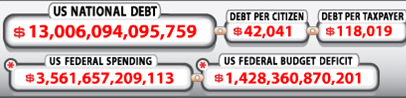
According to the US Nation Debt Clock, a milestone was achieved this week:

The US National Debt is now officially more than $13 Trillion.

* * * * *

To put the Debt number in perspective:

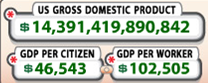
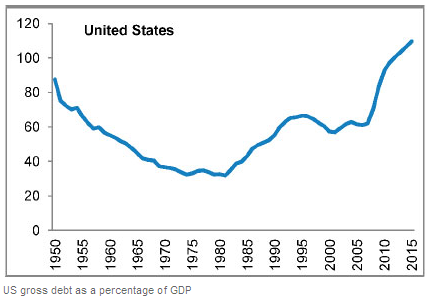
(1) It’s already equal to over 90% of annual GDP

(2) It’s heading higher by almost $1.5 Trillion annually at current tax and spending rates

(3) If you’re in the half of the population that pays income taxes, your share of the US Debt is almost $120,000

image 

image 

image

http://www.usdebtclock.org/

Hawaii Five-0 … still more to the story.

May 28, 2010

I’ve got to walk back my story that CBS was doing a great job web marketing by sending rapid-fire replies to my original 5-0 post … with promo language like “the show will rock”.

Turns out that CBS had nothing to do with the replies.

Yesterday, I received this:

Oh, my!  I have to laugh at your comment that the Hawaii Five O posts came from the CBS web marketing team. 

FYI, each of those posters is a big Alex O’Loughlin fan who simply sought to answer the questions you posed. 

We are very in tune with Alex’s career and post in many, many different sites not just yours.

As a marketing guy, I guess I automatically gave too much credit, too soon to, well, other marketing guys.

Live and learn …

Pricing Baseball Tickets Like Airline Seats .. uh-oh.

May 28, 2010

For years, I’ve agreed that sports teams were pricing themselves out-of-reach for the average family. 

“Face value” on tickets staggers me.  Dealing with scalpers males me nervous.

Now, those worlds are starting to coincide: teams getting higher prices by acting like scalpers.

Play ball.

* * * * *

Excerpted from Bloomberg Business Week:Pricing Baseball Tickets Like Airline Seats, May 20, 2010

Software helps the S.F. Giants price baseball games in much the same way airlines manage seat prices to keep planes full.

The software crunches numbers on dozens of variables (e.g. the weather, the pitchers, the teams’ records, the rivalry, day of week, time if day, StubHub market price) to determine prices that will get fans into the stands and generate the highest revenue. 

Ticket prices used to be fixed before spring training; now, they’re adjusted almost daily.

The Giants say that revenues are up 12% this season and attendance has jumped 7%, even as the league has seen a slight decline.

Expect the entire league to adopt market-based pricing … and watch it spread to other sports and entertainment. 

“There’s big money out there in lost revenue from mispricing.”

Full article:
http://www.businessweek.com/magazine/content/10_22/b4180039348750.htm

The Sestak predicament: somebody’s gotta be lying … uh-oh.

May 27, 2010

Long ago, Congressman Joe Sestak said that he was offered a high ranking position in the Obama administration if he’d step aside rather than challenging Sen. Specter in the Dem primary.

Of course, Obama folks denied the claim.

Issue would have faded … but Sestak screwed things up by staying in the race and winning.

Why is that a problem?

Well, it gives the GOP a ‘”can’t lose” issue.

I see  only 3 options:

(1) Obama folks continue playing rope-a-dope and the issue stays alive … seeming sinister and begging the question what are they hiding ?

(2) Obama folks “prove” that Sestak is fabricating the story … and, who wants to elect a Senator who gets caught lying from the get-go?

(3) Sestak names names and gives details of the offer … which causes legal problems for the administration.  Why ? It’s reported to be a Federal felony to tamper with an election – and to bribe somebody to drop out of an election is, well, tampering. 

I expect option(1) to prevail. so if the GOP wins a majority of either the Senate or Congress in Nov., expect investigative hearings on this issue to be high on the agenda. 

Hope so – they’ll be fun to watch and might keep our elected reps distracted from their spending bills.

I’ll have a burger, hold the hot dog …

May 27, 2010

Punch line: The conventional wisdom is that red meats have higher saturated fat and cholesterol levels which increase heart  attack risk. 

The good news:  a new study suggests that a juicy burger isn’t a heart-attack-on-a-plate after all.

The bad news: hot dogs, bacon and sausage are still no-no’s.

Badest of the bad: there was a TV special on the least healthy restaurant foods served in America … my favorites: a place in NJ serves deep fried hot dogs and a place in Tennessee serves deep fried burgers … both had lines running down the street ala Georgetown Cupcakes.

* * * * *

Excerpted from WSJ: A Guilt-Free Hamburger, MAY 18, 2010

A new study from Harvard suggests that the heart risk long associated with red meat comes mostly from processed varieties such as bacon, sausage, hot dogs and cold cuts — and not from steak, hamburgers and other non-processed cuts.

The finding is surprising because both types of red meat are high in saturated fat, a substance believed to be partly responsible for the increased risk of heart disease. But the new study raises the possibility that when it comes to meat, at least, the real bad actor may be salt. Processed meats generally have about four times the amount of salt as unprocessed meats.

The findings suggest that people, especially those already at risk of heart problems or with high blood pressure, should consider reducing consumption of bacon, processed ham, hot dogs and other packaged meats that have a high salt content. Salt increases blood pressure, a major risk factor for cardiovascular disease.

None of this suggests that steak is a new health food. While red meat wasn’t linked to an increased risk of heart disease in the study, it didn’t lower it either.

The American Meat Institute Foundation took issue with the findings, saying they conflict with national dietary guidelines. “The body of evidence clearly demonstrates that processed meat is a healthy part of a balanced diet.”

Full article:
http://online.wsj.com/article_email/SB10001424052748704314904575250570943835414-lMyQjAxMTAwMDEwOTExNDkyWj.html

Congress yells “fire” … then starts dousing with dollars.

May 26, 2010

Earlier this week, the President is unveiled a new line-item veto proposal to “rein in wasteful spending and hold Congress accountable.”

Concurrently Congress was putting the finishing touches on another $200 bullion faux-stimulus bill … that contains some of the hidden costs of ObamaCare and emergency relief to bond traders and racetrack operators.

This mega-spending is exempt from pay-as-you-go because it’s all emergency spending (huh?) and exempt from the line item veto since it hasn’t been enacted (and wouldn’t be applied to this junk any way).

I’m not sure if this stuff should be classified under “hope” or “change” …

* * * * *

Excerpted from WSJ: American Jobbery Act,  May 25, 2010

The House plans to vote this week on $190 billion in new spending, $134 billion of which it won’t even pretend to pay for.

  • Note: “pay as you go” doesn’t apply to anything that is considered an emergency

The biggest item is $65 billion to prevent a 21% cut in Medicare physician reimbursements … complemented with $24 billion to help states pay the exploding tab for Medicaid

  • Note: remember how ObamaCare was going to cut healthcare costs ?  Oops … just kidding.

There’s  $47 billion to extend unemployment insurance to nearly two full years.

  • Note: economic studies consistently find that extending unemployment benefits tends to, well extend unemployment.

The rest is a grab bag of political payoffs, corporate welfare and transfer payments: including subsidies for municipal bond traders, cotton farmers, yarn producers, sheep growers, Hawaiian sugar cane cooperatives, motor sports businesses, renewable energy firms, the steel lobby, and so on.

  • WSJ Note: Any industry that doesn’t get a tax credit or other handout in this bill should fire its lobbyist.

image

Of course, taxes will  increase to partially fund this new spending.

  • There’s a new 24 cent a barrel tax on oil companies because Congress says the industry’s profits are excessive.
  • U.S. multinational companies would pay a higher tax rate on their overseas income.
  • Managers of private equity and venture capital firms will see their tax rate on carried interest rise to as high as 35% from 15% today.

Full article:
http://online.wsj.com/article/SB10001424052748704113504575264532051783298.html?mod=djemEditorialPage_h

“Madam, we’ve already identified what you are, we’re just haggling over the price”

May 26, 2010

As a result of the Arizona dust-up …

Senators Kyl and McCain proposed a ‘shore up the borders’ plan that called for deploying 6,000 National Guard troops to the U.S.- Mexico border.

President Obama was reportedly non-responsive to the request during a meeting with the Senators, then immediately after the meeting, his office issued a press release saying 1,200 NG troops would be deployed to border patrol.

I know Rahm & Axelrod are brilliant politicians, but I don’t get it.

By committing any NG troops, President Obama is conceding that AZ is right and border security is an issue.

If he had deployed 6,000 troops he could have said “OK, I gave you what you wanted on border security … now let’s move on to comprehensive reform.”

Why didn’t he? 

Couldn’t be the money since spending is never an issue …

Reminds me of the old W.C. Fields joke: “Madam, we’ve already identified what you are, we’re just haggling over the price.”

Five-0 follow-up … a lesson in web marketing

May 26, 2010

In the past week, we published 2 posts that inadvertently demonstrated a point ….

One of the posts was: CBS goes retro … and I’m a happy man (for reference the original post and link are below).

Almost immediately, we got a couple of reply posts:

  • You got the first 2 right and the guy on the right is McGarrett played by Alex O’Loughlin and the girl is Kono. Yeah you heard me… CBS is reinventing…
  • The guy on the right, Alex O’Loughlin (pronounced O’Locklin) is Steve McGarrett and the character of Kono is now female and played by Grace Park – check out the new series on CBS this fall, a sure-fire hit!
  • McGarrett  is Alex O’Loughlin, the guy you thought was Kono. Kono is now the girl you see. This cast rocks! Alex is a babe and a great actor,too! He will rock as McGarrett!

Notice any similarity in the replies?

Another data point: none of the replies came from a Homa Files subscriber.

Hmmm ….

Conclusion: hats off to CBS for web marketing … they’ve got agents crawling the net for Five-0 references and posting clever replies – veiled as coming from ‘ordinary’ people — to promote the show.

Maybe CBS read our post from a few days prior that cover Search Engine Optimization – how to get your blog post noticed:

Obama, Rush, sex … what’s the connection ?
https://kenhoma.wordpress.com/2010/05/20/obama-rush-sex-whats-the-connection/

Lesson: May shock you, but some web feedback may be nothing more than company-sourced promotion … caveat reader.

Final Note: Kono – a girl ?  Is nothing sacred ?

* * * * *

Original post

CBS goes retro … and I’m a happy man.
https://kenhoma.wordpress.com/2010/05/25/cbs-goes-retro-and-im-a-happy-man/

My 3 favorite TV shows of all time are 24, Mannix, and Hawaii Five-0.

So, my pulse elevated when I read that next year’s program line-up at CBS includes  a reinvention of Hawaii Five-O,”the tropical police series that was a top-ten CBS program in the early 1970s”.”

Below is a pic of the cast.  Guy on the left must be Danny (originally played by James MacArthur), guy in the middle must be Chin-Ho Kelly (originally played by Kam Fong) and the guy on the right must be Kono (originally played by a dude named Zulu).

image
Left to right: Scott Caan, Daniel Dae Kim, Alex O’Loughlin and Grace Park in the new ‘Hawaii-Five-O’ series.

But, the cast picture begs two questions:

(1) Where’s McGarrett ?

(2) What’s with the girl ?

All I can say is “Book him, Danno !”

* * * * *
WSJ: Playing It Safe: New CBS Lineup Includes Crime Dramas, Remake, May 19, 2010 http://online.wsj.com/article/SB10001424052748704912004575252683905115498.html?mod=djemMM_t

Prying eyes: gov’t hones in on your financial transactions …

May 25, 2010

The was (and is) broadscale opposition to the Patriot Act provisions that let Feds listen in to phone chats.  But, not much whining about the Feds getting their  hands on all of our health and financial records. 

ObamaCare gives the Feds access to individual health records (though they promise they won’t do anything ontoward with them) ,,,  and the new Financial Reform ductates more detailed accounting of financial transactions.

And, oh yeah, there’ll be 15,000 more IRS agents …

* * * * *

Excerpted from cnnMoney.com: Stealth IRS changes mean millions of new tax forms, May 21, 2010

The 1099 is a catch-all series of IRS documents used to report non-wage income from a variety of sources like contract work, dividends, earned interest and pension distributions.

There’s  massive expansion of requirements for businesses to file 1099 tax forms that was hidden in the 2,409-page health reform bill, but it’s just one piece of a years-long legislative stealth campaign to create ways for the federal government to track down unreported income and close the so-called “tax gap”.

The federal government loses an estimated $300 billion each year from the “tax gap” between what individuals and businesses owe and what they actually pay.

A new 1099-K aims to shine a light on a currently hard-to-track payment stream: credit cards.

Starting in 2011, financial firms that process credit or debit card payments will be required to send their clients, and the IRS, an annual form documenting the year’s transactions. It applies to all payment processors, including Paypal, Amazon.com, and others that service very small businesses.

The 1099 changes attached to the health care reform bill massively expand the requirements for filing the “1099-Misc” form, which companies use for recording payments to freelance workers and other individual service providers.

Until now, payments to corporations have been exempt from 1099 rules, as have payments for the purchase of goods.

Starting in 2012, all business payments or purchases that exceed $600 in a calendar year will need to be accompanied by a 1099 filing.

In essence, the 1099-Misc is having its role changed from a form for tracking off-payroll employment to one that must accompany virtually any sizeable business transaction.

Full article:
http://money.cnn.com/2010/05/21/smallbusiness/1099_deluge/index.htm

Senior moments: Senators say “Let’s regulate ATMs” … now, somebody tell them what they are.

May 25, 2010

Congress seems willing to regulate a lot of stuff that they don’t understand.

Hard to imagine somebody flummoxed  (<= one of my favorite words)  by ATMs has got a grasp on Credit Default Swaps … go figure.

* * * * *

Excerpted from Washington Post: Aging Congress flummoxed by ATMs,  May 21, 2010

Sen. Tom Harkin (D-Iowa) has long pushed an amendment to limit those pesky and expensive transaction fees at automated teller machines, but his fellow senators didn’t go along with the idea this week.

One possible explanation: Quite a few of Harkin’s aging colleagues appear to have little or no contact with the decades-old technology of cash machines.

  • Sen. Ben Nelson (D), for example, told the Omaha World-Herald this week that he has never once used an ATM, relying on bank tellers instead.
  • Sen. Mike Johanns (R), has used his ATM card fewer than five times.
  • Sen. Charles E. Grassley (Iowa), the ranking Republican on the Finance Committee has a bank card but doesn’t use it for cash.

The remarks also appear to provide further evidence of cloistered politicians and a generation gap in the halls of an aging Congress.

The average age of members is among the highest of any Congress in the past century

  • The average age of senators is 63.1 years, which is three years higher than it was four years ago;
  • The average for the House was 57.2 years, which is up by two years.
  • The Senate’s longest-serving member, Robert C. Byrd (D-W.Va.), is 92.

* * * * *

Factoids

The first ATMs appeared in the United States in 1969 … there are more than 1.7 million machines worldwide.

Over 90%  percent of consumers use an ATM … about 60 percent of consumers use their bank’s ATM up to five time a month … ,12 percent use it at least 10 times a month.

Most banks barely break even on ATM fees — free customer withdrawals are typically paid for with charges to noncustomers …  but about half the ATMs in the country are operated by independent, for profit ATM operators.

Full article:
http://www.washingtonpost.com/wp-dyn/content/article/2010/05/20/AR2010052003613.html?wpisrc=nl_tech

CBS goes retro … and I’m a happy man.

May 25, 2010

My 3 favorite TV shows of all time are 24, Mannix, and Hawaii Five-0.

So, my pulse elevated when I read that next year’s program line-up at CBS includes  a reinvention of Hawaii Five-O,”the tropical police series that was a top-ten CBS program in the early 1970s”.”

Below is a pic of the cast.  Guy on the left must be Danny (originally played by James MacArthur), guy in the middle must be Chin-Ho Kelly (originally played by Kam Fong) and the guy on the right must be Kono (originally played by a dude named Zulu).

image 
Left to right: Scott Caan, Daniel Dae Kim, Alex O’Loughlin and Grace Park in the new ‘Hawaii-Five-O’ series.

But, the cast picture begs two questions:

(1) Where’s McGarrett ?

(2) What’s with the girl ?

All I can say is “Book him, Danno !”

* * * * *
WSJ: Playing It Safe: New CBS Lineup Includes Crime Dramas, Remake, May 19, 2010 http://online.wsj.com/article/SB10001424052748704912004575252683905115498.html?mod=djemMM_t

For the politics of intimidation … look for the union label.

May 24, 2010

Much has been written about the alliance between unions and gov’t.

It’s simple: gov’t adds more and more unionized gov’t jobs … most with above market pay rates, near certain lifetime employment and oversized end-of-career pensions.

In gratitude, the unions turn out the vote … and rough up opponents … apparently with de facto immunity from the press and police.

Things are getting ugly …

* * * * *

Excerpted from WSJ: Tea Parties vs. Unions in November, May 21, 2010

Elections this month have enhanced the political clout of two groups widely separated on the political spectrum.

The tea party movement stands to play an outsize role in the fall elections now that outsider Rand Paul has swept Kentucky’s GOP Senate primary.

Democrats are fearful of the Tea Party’s grass-roots enthusiasm

The rise of the tea party makes Democrats even more dependent on organized labor. Unions provided the muscle for Democrats to win a key special election in Pennsylvania for the late Jack Murtha’s seat. The AFL-CIO alone sent out 80,000 mailers on behalf of Democrat Mark Critz, along with 100,000 robocalls.

In Arkansas, unions decided to make an example of Blanche Lincoln after she opposed the “card check” bill that limits the use of secret ballots in union elections. Unions, especially the Service Employees International Union, spent more than $3 million against her.

And, some SEIU members have ratcheted up violence against political “enemies”.

Lastweek, 500 screaming, placard-waving SEIU members and allies surrounded the home of a Bank of America exec. Police refused to intervene for fear of inciting the crowd.

Watch the video and ask yourself how you’d like your house – with kids inside – surrounded by these wingnuts

image

Full article:
http://online.wsj.com/article/SB10001424052748703559004575256323526178094.html?mod=djemEditorialPage_h

Maybe Arizona should just adopt Mexico’s immigration laws …

May 24, 2010

Those who have read the Arizona law (i.e. not Holder, Napolitano, et. al.) are pointing out that:

(1) The law simply provides an enforcement mechanism for established U.S. Federal law – no new restrictions are added

(2) Racial profiling is explicitly banned in the AZ law – but not in Federal immigration laws

(3) According to Pres Calderon himself, the AZ law is way softer than Mexican immigration laws (transcript below)

So, why all the fuss ?

* * * * *

New York Post: The Mexico model, May 23, 2010

Mexican President Felipe Calderon repeatedly teed off on the new Arizona law that makes illegal immigration a state crime and requires aliens to show documentation should a cop request it. 

Calderon moaned that many immigrants “still live in the shadows, and at times, like in Arizona, face discrimination.”

He said the law “introduces a terrible idea using racial profiling as a basis for law enforcement.”

Then he went on CNN.

Asked Wolf Blitzer: “If people want to come [into Mexico] from Guatemala or Honduras or El Salvador or Nicaragua, they can just walk in?”

No,” responded Calderon. “They need to fulfill a form. They need to establish their right name. We analyze if they [don’t have] a criminal [record].”

Do Mexican police go around asking for papers of people they suspect are illegal immigrants?” asked Blitzer.

Of course,” said Calderon.

“If somebody sneaks in from Nicaragua or some other country in Central America,” continued Blitzer, “they wind up in Mexico, they can go get a job?

No, no,” Calderon replied. “If somebody [does] that without permission, we send back — we send them back.”

Full article:
http://www.nypost.com/p/news/opinion/editorials/the_mexico_model_2DyxJuFroueHqDGXMzB04K

Taster’s Choice: Nescafe whoops Starbucks’ Via …

May 24, 2010

Punch line: Starbucks decided to go downmarket with Via instant coffee and now finds itself in a street brawl with the potential to knife Starbucks premium image. 

* * * * *

Excerpted from BrandChannel: Nescafe Calls Starbucks’ Instant Coffee Bluff,  November 19, 2009

Under pressure from Dunkin’ Donuts and McDonald’s, and with its brand value in decline, Starbucks introduced Via instant coffee with an in-store taste-test promotion intended to prove that the new instant can’t be told apart from the store brew.

Starbucks competing against store brands ?

Not the usual way to maintain a brand that was built upon premium-quality coffee and the idea that Starbucks stores are America’s “third place” (after home and work).

To counter Via, Nescafé is setting up sampling stations for a taste tests of their own: Nescafe vs. Via. 

The Nescafe mantra: “A lot of hype. OR a lot of flavor.”

According to Nescafe, they’re winning convincingly.

Ouch.

Nescafé stands as a reminder and a warning: you can always take your brand down and compete on the low end.

But don’t expect your new competitors to take it lying down.

* * * * *

Full article:
http://www.brandchannel.com/home/post/Nescafe-Calls-Starbucks-Instant-Coffee-Bluff.aspx

The Sarbox burden …

May 21, 2010

Punch line: Senators  Hutchison (R., Texas) and Landrieu (D., La.) have offered an amendment to exempt companies with less than $150 million of shares held by the public from “internal-controls” audits – the most onerous of Sarbox impositions.

Ken’s Take: I was wondering when somebody would step up and highlight that Sarbox did nothing to stop or slow the 2008 financial meltdown …

* * * * *

Excerpted from WSJ: The No-Cost Stimulus, May 18, 2010

Sarbox, the Beltway’s previous attempt at financial-regulatory reform, was intended to improve the information investors receive about public companies.

The law did nothing to prevent poor disclosure at companies like Lehman Brothers but it did saddle the U.S. economy with billions in unexpected costs.

The SEC estimates that the average public company pays more than $2 million per year complying with the law’s Section 404.

The SEC admits that compliance burdens fall disproportionately on smaller companies.

These audits are piled on top of the traditional financial audit, and on top of a company’s own internal-controls review.

The result is that going public in the U.S., once the dream of entrepreneurs world-wide, has for too many company founders become something to avoid.

Full article:
http://online.wsj.com/article/SB10001424052748703315404575250693201556662.html?mod=djemEditorialPage_h

When is candy not candy ?

May 21, 2010

Punch line: States want to cut deficits by taxing candy. That’s not as easy as it sounds …

* * * * *

Excerpted from WSJ: Candy Taxes Struggle to Define Candy, May 17, 2010

Many states don’t tax food – which  considered is essential.  Taxing food might push the poor toward malnourishment or unhealthy eating.

The food exemption has traditionally extended to candy and soda.

As they struggle with budget deficits, states from New York to Washington are looking to candy and soda taxes to help bridge the gap. .

More than a dozen states have passed or proposed some sort of candy or soda tax in the 2010 legislative session, and most of them are bound to face some sort of confusion.

The hard part: defining candy.

The distinction between candy and food can be hard to pin down.

  • In Washington, a new candy tax will apply to Butterfinger candy bars, yet Kit-Kat wafers remain excise free (this because the law exempts foods with flour in them).
  • in Colorado, Kit-Kats go untaxed, but Twix bars face levies.
  • In Illinois, retailers in Chicago are unsure if Twix Bars — some of which contain flour and peanut butter — are food or candy.

Bottom line: one man’s food is another man’s candy …

Full article:
http://blogs.wsj.com/economics/2010/05/17/candy-taxes-struggle-to-define-candy/

IMF says: “US has more to do than any other country … to bring its debt back towards sustainable levels”

May 20, 2010

The UK Telegraph says: “The  US faces one of biggest budget crunches in world”

The crux of the Telegraph’s argument:

1) Under the Obama administration’s current fiscal plans, the national debt in the US will climb to above 100% of GDP by 2015 – a far steeper increase than almost any other country.

image

image


2) The US has a higher debt (relative to GDP) and a far shorter maturity of government debt than most other countries.  Said differently, the US must rollover its increasing debt more frequently – and is, therefore, vulnerable to increasing rates and variations in demand (e.g. what if China stops buying US debt ?).

image image

3) Bottom line (according to the IMF’s projections),  the US has more to do than any other country in the developed world (apart from Japan) when it comes to bringing its debt back towards sustainable levels.

* * * * *

Full article:
http://blogs.telegraph.co.uk/finance/edmundconway/100005702/us-faces-one-of-biggest-budget-crunches-in-western-world-imf/

Full IMF Report:
http://www.imf.org/external/pubs/ft/fm/2010/fm1001.pdf

image

* * * * *

Obama, Rush, sex … what’s the connection ?

May 20, 2010

Punch line: Online, article headlines have to be descriptive and direct when they show up in mobile and RSS feeds … and they have to contain key words that play to search engine algorithms.  It’s called ‘search engine optimization’.

* * * * *

Excerpted from NYT: Taylor Momsen Did Not Write This Headline,  May 16, 2010

People who worry that Web headlines dumb down public discourse are probably right.

Headlines in newspapers and magazines were once written with readers in mind, to be clever or catchy or evocative.

Now headlines are just there to get the search engines to notice. It’s called SEO — search engine optimization.

A story about whether the president would play golf with Rush Limbaugh might be headlined: “Obama Rejects Rush Limbaugh Golf Match and Says ‘He Can Play With Himself.’ ”

It would be a digital mega-hit: two highly searched proper nouns followed by a smutty entendre, a headline that both the red and the blue may be compelled to click, and the readers of the site can have a laugh while the headline delivers great visibility out on the Web.

But the need to attract attention from computer-generated algorithms sometimes makes the headlines seem like a machine thought them up as well …  it leads to a sameness that can make all the information seem as if it were generated by the same traffic-loving robot.

Full article:
http://www.nytimes.com/2010/05/17/business/media/17carr.html?ref=business

Let’s defy history and tax our way to a stable economic footing … NOT !

May 19, 2010

Punch lines:

(1) In a year or two, the US national debt will be larger than the annual output of the US economy (i.e. debt > 100% GDP) … up from 60% in the prior decade.

image

(2) Empirical evidence demonstrates that increases in marginal tax rates won’t collect ‘revenues’ more than 20% of GDP … since the dwindling number of tax payers change their behavior to minimize their tax bite.

Hauser’s Law (below) is a great piece of economic analysis …

* * * * *

Excerpted from WSJ: The Revenue Limits of Tax and Spend, May 17, 2010

Washington has adopted the Greek model of debt, dependency, devaluation and default.

Prospects for restraining runaway U.S. debt are even poorer than they appear.

Based on President Obama’s fiscal 2011 budget, the Congressional Budget Office (CBO) estimates a deficit that starts at 10.3% of GDP in 2010 … then narrows to 5.6% in 2020.

As a result the net national debt (debt held by the public) will more than double to 90% by 2020 from 40% in 2008.  

And, these debt estimates are incomplete and optimistic. They do not include deficit spending resulting from the new health-insurance legislation. And, as usual, they ignore the unfunded liabilities of social insurance programs.

The revenue numbers rely on increased tax rates beginning next year resulting from the scheduled expiration of the Bush tax cuts. The feds assume a relationship between the economy and tax revenue that is divorced from reality.

Six decades of history have established that increases in federal tax rates, particularly if targeted at the higher brackets, produce no additional revenue. For politicians this is truly an inconvenient truth: conventional methods of forecasting tax receipts from increases in future tax rates are prone to over-predict revenue.

The chart below shows how tax revenue has grown over the past eight decades along with the size of the economy.

image

Note the close proportionality between revenue and GDP since World War II, despite big changes in marginal tax rates in both directions.

Known as “Hauser’s Law”  the relationship reveals an upper limit for federal tax receipts at about 19% of GDP.

Why the limit?

The tax base … represents a living economic system that makes its own collective choices.

In a tax code of 70,000 pages there are innumerable ways for high-income earners to seek out and use ambiguities and loopholes. The more they are incentivized to make an effort to game the system, the less the federal government will get to collect.

Changes in marginal tax rates do not make a perceptible difference to the ratio of revenue to GDP.

* * * * *

Full article:
http://online.wsj.com/article/SB10001424052748704608104575217870728420184.html?mod=WSJ_hps_MIDDLEFifthNews


Is it live or is it Memorex ?

May 19, 2010

Punch line: Some dead (and nearly dead) brands — called “zombies” — still have high residual awareness that can be leveraged for relatively low cost comebacks – and extended to adjacent categories …

* * * * *
Excerpted from Business week: Imation Brings Dead Brands Back to Life, April 1, 2010

You might think a brand is dead when stores stop selling it. Imation doesn’t think so.

Imation initially made its name on floppy disks (remember them ? ) — then became the world’s largest seller of recordable compact discs.

The company knows that consumers are skipping past data-storage media like compact discs and putting their data on flash memory, where Imation is only a minor player, or on the Net.

So, Imation has spent the last couple of years acquiring so-called “zombie brands” and leveraging their built-in consumer awareness to reincarnate them.

For example, remember Memorex and TDK?  Most consumers do.

That’s why Imation is reviving them to expand into low- and high-end audio gear Imation is using Memorex and TDK to move into higher-margin products.

Memorex was a ghost of its former self when Imation bought it in 2006 for $330 million. Sales of blank audio cassettes had been declining since Sony’s CD-playing Discman came out in 1991.  Memorex dropped its signature TV ads, with their “Is it live or is it Memorex?” tagline, more than 30 years ago. And yet, research surveys showed that 95% of U.S. consumers knew the name, even among people in their 30s.

Imation came up with new product categories to refresh the Memorex brand.

Today Imation is selling Memorex-branded iPod accessories, digital photo frames, DVD players, MP3 players, karaoke machines, and TVs at retailers such as Wal-Mart Stores  and Target.

The company unveiled a new Memorex collection of Wii accessories. Imation is also bringing back another relic from the predigital age, TDK, as a high-end line of stereo gear.

The company plans to sell speakers, turntables, and other audio gear costing as much as $500 under the label TDK brand.

Imation says: “The combination of having good solid technology along with a portfolio of brands and a goal of differentiation is going to set us apart.”

Full article:
http://www.businessweek.com/magazine/content/10_15/b4173064270743.htm?chan=innovation_branding_top+stories

‘Ridiculous finger-pointing’ or ‘systemic failure’ … it’s in the eye of the beholder, I guess.

May 18, 2010

Last week, President Obama lambasted BP, TransOcean and Halliburton for “ridiculous finger-pointing” that he “didn’t appreciate”.

Ridiculous finger-pointing ? 

Hmmm.

So, the President points his finger at, well, finger-pointers.  That in itself is funny, isn’t it ?

From a guy who then went to a fundraising event where he proceeded to point his finger (again) at Pres. Bush for everything except the Bubonic Plague.

From a guy whose department heads in State, Homeland Security, NSA, CIA, FBI all pointed their fingers at the others – to duck blame for the Xmas underwear bomber.

In that case, the finger pointing was legitimized as characterizing a “systemic failure”. 

Translation: it was nobody’s responsibility – certainly not the President’s.

Why didn’t BP, TransOcean and Halliburton just claim the oil well blast & leak was simply a systemic failure ?  Then, maybe, the President wouldn’t have pointed his finger at them for finger pointing !