It’s how you ask the question …

December 9, 2009

Another great analysis from Pollster.com.

Focus is on Presidental Approval Ratings, but the findings are generalizable to other surveys, e.g. customer satisfaction.

* * * * *

From Pollster.com:

Most pollsters offer just two answer categories: “Do you approve or disapprove of the way Barack Obama is handling his job as president?”

Rasmussen’s question prompts for four: “How would you rate the job Barack Obama has been doing as President … do you strongly approve, somewhat approve, somewhat disapprove, or strongly disapprove of the job he’s been doing?”

Rasmussen has long asserted that the additional “somewhat” approve or disapprove options coax some respondents to provide an answer that might otherwise end up in the “don’t know” category.

Rasmussen conducted an experiment to test that argument.

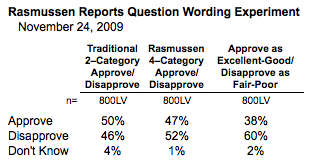
They administered three separate surveys of 800 “likely voters, each involving a different version of the Obama job approval rating: (1) the traditional two category, approve or disapprove choice, (2) the standard Rasmussen four-category version and (3) a variant used by Zogby and Harris, that asks if the president is doing an excellent, good, fair or poor job.

The table below collapses the results into two categories; excellent and good combine to represent “approve,” fair and poor combine to represent “disapprove.”

image

In general, smaller don’t know percentages tend to translate into larger disapproval percentages. The 4-category Rasmussen version shows a smaller “don’t know” (1% vs. 4%) and a much bigger disapprove percentage (52% vs 46%) compared to the standard 2-category question.

The approve percentage is only three points lower on the Rasmussen version (47%) than the traditional question (50%).

The Rasmussen experiment shows an even bigger discrepancy between the approve percentage on the two-category questions (50%) and the much lower percentage obtained by combining excellent and good (38%).

* * * * *

Generalizing the findings: To increase “data discrimination” when doing customer sat polling, use 4 categories and and focus on the “very” categories at the extremes.  That’s where the real info is …

Is there bias in presidential approval polling … you bet !

December 8, 2009

Below is an analysis by Pollster.com that lays out the “House Effect” — more pejoratively known as “polling bias” — of the many survey organizations that report Presidential Approval Ratings.

Pollsters at the top tend to be more favorable to Pres. Obama (some very favorable); those at the bottom tend to be less favorable.

[See Ken’s Take and an important UPDATE at the bottom of this post]

2009-12-01_HouseFX-approve.png
http://www.pollster.com/blogs/why_is_rasmussen_so_different.php

* * * * *

Ken’s Take:

(1) Note that the mainstream media outlets (ABC, WP, CNN, CBS, NYT, AP) hold the top slots.  Hmmm.

(2) Note that FOX is smack dab on the median.   Pollster emphasizes that the line that corresponds with the zero value is NOT a measure of “truth” or an indicator of accuracy. It’s simply a “normalizing” measure — in effect, a median value.  TakeAway: sure seems fair & balanced.

(3) Quant jocks generally attribute the differences to methodology or samples.  For example, Rasmussen is an automated phone survey — and people tend to be less hesitant with negative responses when dealing with an automaton than they are when answering to a humanoid.

Regarding samples, less favorable surveys tend to sample likely voters, not all adults.  Critics argue that minorities and young adults are under-represented when the cut is likely to vote.

(4) A bigger deal, in my opinion, is that sampling tries to get a representative number of Dems and GOPs.  My bet: surveys at the top over-sample Dems and the ones at the bottom over-sample GOPs.

(5) Regardless of the specific poll, the conclusion: country is divided down the middle … plus or minus some random noise.

* * * * *

UPDATE

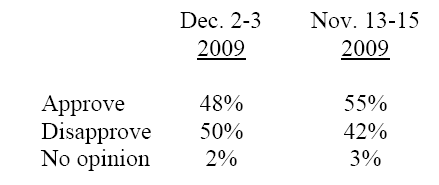
CNN — #2 in favorable leaning to the President — released new poll results on Fri. Dec. 4.

During November, President Obama’s approval dropped from 55% to 48%.

* * * * *

Question: Do you approve or disapprove of the way Barack Obama is handling his job as president?

image

For the full CNN survey results:
http://i2.cdn.turner.com/cnn/2009/images/12/04/rel18a.pdf

The looming Medicaid tsunami …

December 8, 2009

TakeAway: A vast expansion of the Medicaid program — without adequate risk-adjusted reimbursement rates — will impose unsustainable costs on healthcare providers.

* * * * *

Excerpted from WSJ:  Health Reform Could Harm Medicaid Patients, Dec. 4, 2009 

Both the House and Senate health-care reform bills call for a large increase in Medicaid—about 18 million more people will begin enrolling in Medicaid under the House bill starting in 2013.

A flood of new patients will be seeking health services, many of whom have never seen a doctor on more than a sporadic basis. Some will also have multiple and costly chronic conditions. And almost all of them will come from poor or disadvantaged backgrounds.

Johns Hopkins’  Priority Partners handles Medicaid patients under a capitated system — that is, it receives a set payment per individual per month from the state.

Over time, we’ve developed the ability to manage the care of these individuals in a way that is both cost effective and that provides them with quality care. We’ve done it by tapping into our extensive delivery system, which includes four hospitals, a nursing home, the largest community-based primary care group in Maryland, and much more.

We’ve hit above-national benchmarks on all clinical quality measures, reduced monthly costs for patients with substance abuse and highly complex medical needs, and 70% of our patients tell us they’re satisfied with our care.

The key fact is that for years the state did not cover all the costs our Medicaid program incurred. As a result of new patients whose costs were not completely covered by the state, Priority Partners lost $57.2 million from 1997 to 2005.

We stanched the losses by ensuring that the payment from the state was appropriately risk adjusted to match the health conditions of our members, and by investing heavily in primary-care and care-management and disease-management programs.

Yet this past year the losses began again, because the state expanded the program’s eligibility to 116% of the federal poverty level up from 40%.

So we are struggling with a large group of new patients—about 30,000 people. Today, like in the late 1990s, a health-care surge is overwhelming our managed-care system. The capitated rate for the new beneficiaries is not yet risk-adjusted. Priority Partners has lost a devastating $15 million in just nine months.

Congress can help, or at least learn from our experience to use the reform legislation to bend the cost curve if it encourages other states to institute and appropriately fund capitated systems that allow capable providers to adjust payments based on risk. The key is that federal support to states for Medicaid must appropriately adjust rates to match the risk of providing health care to the group of people who are covered by Medicaid.

The Senate bill would increase eligibility for Medicaid to those who make 133% or less of the federal poverty level. The Kaiser Family Foundation reports there are 308,000 people who meet that threshold in Maryland.

Even if only half of those individuals seek Medicaid coverage, such a large expansion would likely have an excruciating impact on the state’s budget.

Without an understanding by policy makers of what a large Medicaid expansion actually means, and without delivery-system reform and adequate risk-adjusted reimbursement the current health-care legislation will have catastrophic effects on those of us who provide society’s health-care safety-net.

In time, those effects will be felt by all of us.

Full article:
http://online.wsj.com/article/SB10001424052748703939404574567981549184844.html?mod=djemEditorialPage

Best jobs … according to Money Mag

December 8, 2009

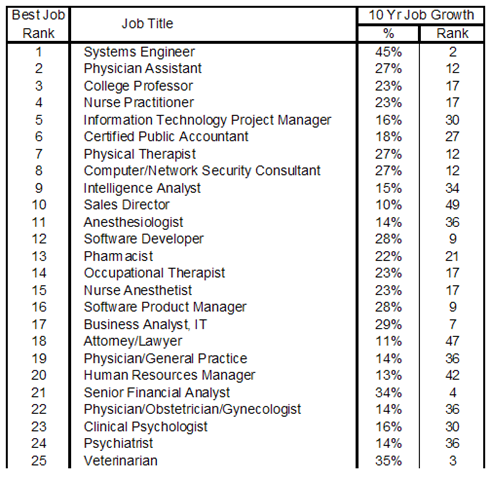
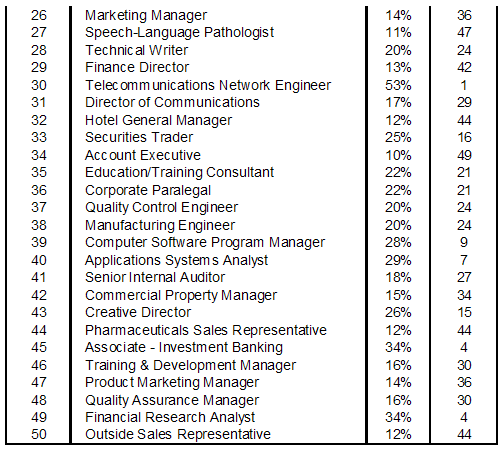
Each year, Money Magazine ranks the best jobs … based on job content and employment growth prospects.

Here’s the 2009 list … Marketing Manager is #26 — ahead of all Finance jobs !

image

image

Full article:
http://money.cnn.com/magazines/moneymag/bestjobs/2009/full_list/index.html

Creating demand … by tapping non-customers.

December 8, 2009

Ken’s Take: “Blue Ocean” Strategists say to stop competing head-on in established markets and refocus on uncontested part of markets — the wide open, blue ocean.  A critical componect of a blue ocean strategy is to “unlock” non-customers …

* * * * *

From the folks at the Blue Ocean Institute …

Traditional strategic thinking looks to capture a greater share of existing demand. But companies can reach beyond existing demand to unlock demand from non-customers, too.

The key is to understand the three tiers of non-customers who buy opportunistically  … or  refuse to buy  …or are unaware of the product offering.

First-tier non-customers are closest to the existing market. They are the buyers who minimally purchase an industry’s offering out of necessity but are mentally
non-customers. They are waiting to jump ship and leave as soon as an alternative is spotted. These are potentially “soon-to-be” non-customers.  But, if they are offered a step-up in value, they can be retained … and may even increase their purchases.

Second-tier non-customers are people who consciously refuse an company’s offerings. These are buyers who have recognized an company’s offerings as an
option to fulfill their needs but have opted against them. These are “refusing” non-customers.

Third-tier non-customers are furthest from the existing market. They are non-customers who have never thought of a company’s offerings as an option. These are “unexplored” non-customers.

* * * * *

The key question to ask: “What are the factors keep non-customers out of the market … and what can be done to pull them into the market?”

Start by by focusing on the key commonalities – not differences – across these non-customers and existing customers to gain insight into how to create demand among these non-customers.

* * * * *

Pres. Obama "bends the curve" … and that’s not good news (for him)

December 7, 2009

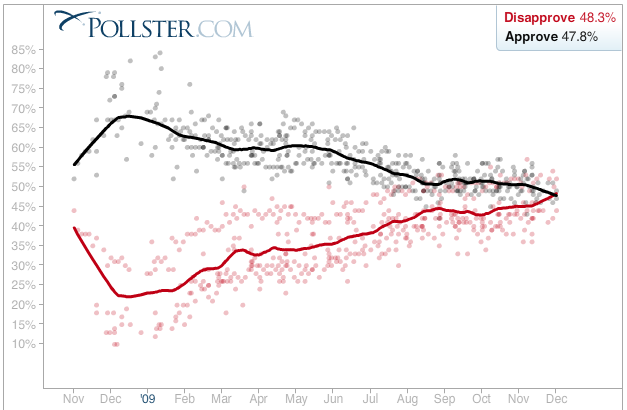
Well, on Sunday, the curves crossed for the first time during the Obama administration.

Based on the Polster.com “poll of polls” — more people disapprove of the job Obama is doing as President than approve.

The approve-disapprove curves have been on a collision course for awhile.  Now they’ve passed through what stock technicians would call a resistance level. 

Next critical number would be if disapproval passes through 50% — indicating that a majority, not just a plurality, disapprove.

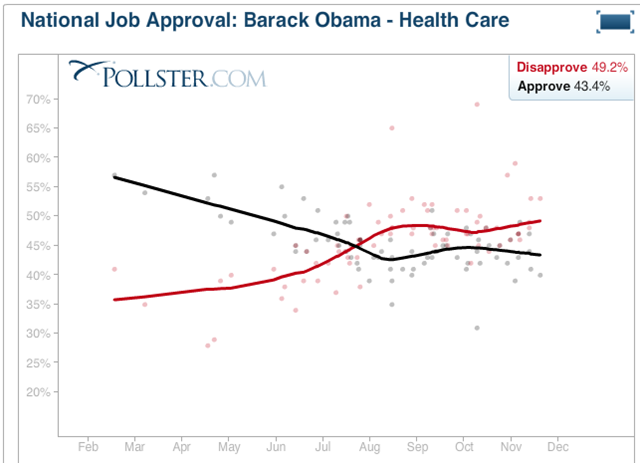
[Healthcare Reform results are below]

image

http://www.pollster.com/polls/us/jobapproval-obama.php?xml=http://www.pollster.com/flashcharts/content/xml/Obama44JobApproval.xml&choices=Disapprove,Approve&phone=&ivr=&internet=&mail=&smoothing=&from_date=&to_date=&min_pct=&max_pct=&grid=&points=1&lines=1&colors=Disapprove-BF0014,Approve-000000,Undecided-68228B

* * * * *

Self-explanatory, right ?

image
http://www.pollster.com/polls/us/jobapproval-presobama-health.php?xml=http://www.pollster.com/flashcharts/content/xml/USObamaJobPresHealth.xml&choices=Disapprove,Approve&phone=&ivr=&internet=&mail=&smoothing=&from_date=&to_date=&min_pct=&max_pct=&grid=&points=1&lines=1&colors=Disapprove-BF0014,Approve-000000,Undecided-68228B

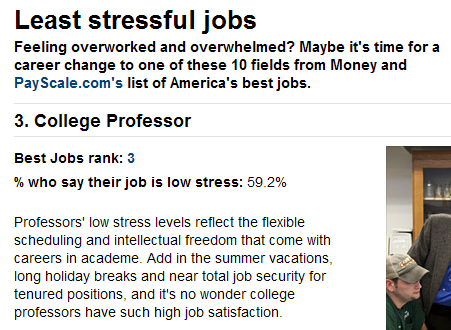
Here’s why I’m so laid back …

December 7, 2009

OK, I’ve never been accused of being too laid back — or, come to think of it,  laid back at all.

Imagine what I’d be like if I were still in a pressure-cooker job …

* * * * *

From Money Mag and PayScale.com:

image

image

http://money.cnn.com/galleries/2009/moneymag/0910/gallery.bestjobs_leaststress.moneymag/3.html

Full article:
http://money.cnn.com/magazines/moneymag/bestjobs/2009/full_list/index.html

GE’s “Reverse Innovation” … no, it doesn’t mean going retro.

December 7, 2009

TakeAway: For decades, GE has sold modified Western products to emerging markets. Now, to preempt the emerging giants, it’s trying the reverse.

* * * * *

From WSJ:” GE CEO Touts ‘Reverse Innovation’ Model”, Sept 22, 2009 

To better compete in emerging markets and elsewhere, General Electric is is changing its method of innovation and developing products in low-cost countries, such as China and India, then distributing them worldwide.

Two products – a $1,000 handheld electrocardiogram device and a portable, personal-computer-based ultrasound machine that sells for about $15,000 – are examples of GE’s “reverse innovation.”

They were originally developed for markets in emerging countries and are now being sold in the U.S., a contrast from the past when GE and many other industrial companies created products in the U.S., then adapted them for global sales.

The new business model allows the company to expand into emerging countries and keep firms there from creating similar products, then expanding sales to the U.S.

“Success in developing countries is a prerequisite for continued vitality in developed ones.”

For reverse innovation to work, product developers must be based and managed in the local market, and when the products are sold globally, they may need to be sold at lower prices even if they cannibalize higher-margin products in rich countries.

GE now has more than a dozen “local growth teams” in China and India.

Full article:
http://online.wsj.com/article/SB125364544835231531.html?ru=yahoo&mod=yahoo_hs

* * * * *

From the HBS article:

Two myths must be shattered:

Myth #1: Emerging economies will largely evolve in the same way that wealthy economies did.

The reality is, developing countries aren’t following the same path and could actually jump ahead of developed countries because of their greater willingness to adopt breakthrough innovations.

With far smaller per capita incomes, developing countries are more than happy with high-tech solutions that deliver decent performance at an ultralow cost—a 50% solution at a 15% price.

Myth #2: Products that address developing countries’ special needs can’t be sold in developed countries because they’re not good enough to compete there.

The reality here is, these products can create brand new markets in the developed world — by establishing dramatically lower price points or pioneering new applications.  And, technology often can be improved until it satisfies more demanding customers.

* * * * *

Local Growth Team (LGT) model,  is based on five critical principles.

1. Shift power to where the growth is.
Without autonomy, the LGTs will become pawns of the global business and won’t be able to focus on the problems of customers in emerging markets. Specifically, they need the power to develop their own strategies, organizations, and products.

2. Build new offerings from the ground up.
Given the tremendous gulfs between rich countries and poor ones in income, infrastructure, and sustainability needs, reverse innovation must be zero-based. These wide differences cannot be spanned by adapting global products.

3. Build LGTs from the ground up, like new companies.
Zero-based innovation doesn’t happen without zero-based organizational design. GE’s organizational “software”— its hiring practices, reporting structures, titles, job descriptions, norms for working relationships, and power balances between functions—all evolved to support glocalization. LGTs need to rewrite the software.

4. Customize objectives, targets, and metrics.
Innovation endeavors are, by nature, uncertain. It’s more important to learn quickly by efficiently testing assumptions than to hit
the numbers. So the relevant metrics and standards for LGTs—the ones that resolve the critical unknowns—are rarely the same as
those used by the established businesses.  The new business model emphasized training, offered online guides, designed simpler
products, created built-in presets for certain tasks, and tracked customer satisfaction to gauge success.

5. Have the LGT report to someone high in the organization.
LGTs cannot thrive without strong support from the top. The executive overseeing the LGT has three critical roles: mediating conflicts between the team and
the global business, connecting the team to resources such as global R&D centers, and helping take the innovations that the team develops into rich countries. Only a senior executive in the global business unit, or even its leader, can accomplish all of that.

* * * * *

Help Wanted, No Private Sector Experience Required

December 4, 2009

This analysis — reported by AEI and sourced to JP Morgan researchers — examines the prior private sector experience of the cabinet officials since 1900 that one might expect a president to turn to in seeking advice about helping the economy.

It includes secretaries of State, Commerce, Treasury, Agriculture, Interior, Labor, Transportation, Energy, and Housing & Urban Development, and excludes Postmaster General, Navy, War, Health, Education & Welfare, Veterans Affairs, and Homeland Security—432 cabinet members in all.

obamacabinet
AEI, Help Wanted, No Private Sector Experience Required, November 25, 2009
http://blog.american.com/?p=7572

In the Obama administration over 90 percent of the players’ prior experience was in the public sector, academia, or law practices. Virtually no “business experience” per se.

* * * * *

Ken’s Take:

(1) Quibble with the numbers, but directionally the conclusion fits — which is why the Faux Stimulus didn’t work, why the spending is out of control, why there’s sloppy implementation (think Cash for Clunkers), and why businesses refuse to rebuild their payrolls.

(2) Note that the analysis was sourced to JP Morgan. I’ve heard from my sources that off-the-record boardroom commentaries re: the Obama administration has turned very, very negative.  But, public commentary is constrained by fear of vindictive government retribution (think pay caps, voiding of contracts, etc.).  Surprised me that JPM is associated with the analysis.

(3) Liberal blogs have marshalled to debunk the 10% number for Obama’s advisers.  Their rebuttals are laughable — largely claiming that private sector experience includes having had a parent who had a real job. having been a lawyer with at least one private sector client, having run a campaign, or having been a university administrator.  For example, here are a couple of my favorites:

Vice President Joe Biden – Private experience:  Yes.   Biden’s father worked in the private sector his entire life — unsuccessfully for a critical period.  Biden attended a private university’s law school (Syracuse), and operated a successful-because-of-property-management law practice for three years before winning election to the U.S. Senate.   Running a campaign is a private business, too — and Biden’s first campaign was masterful entrepreneurship.

Secretary of Interior Kenneth L. Salazar – Private sector experience: Yes. Besides a distinguished career in government, as advisor and Cabinet Member with Colorado Gov. Roy Romer, Salazar was a successful private-practice attorney from 1981 to 1985, and then again from 1994 to 1998 when he won election as Colorado’s Attorney General.    Salazar’s family is in ranching, and he is usually listed as a “rancher from Colorado.”

Secretary of Labor Hilda L. Solis – Private sector experience:  Yes.   Solis’s father was a Teamster and union organizer who contracted lead poisoning on the job; her mother was an assembly line worker for Mattel Toys.  She overachieved in high school and ignored her counselor’s advice to avoid college, and earned degrees from Cal Poly-Pomona and USC.  She held a variety of posts in federal government before returning to California to work for education and win election to the California House and California Senate, and then to Congress.

Secretary of Education Arne Duncan – Private sector experience:  Yes.  Duncan earned Academic All-American honors in basketball at Harvard.  His private sector is among the more unusual of any cabinet member’s, and more competitive.  Duncan played professional basketball: “From 1987 to 1991, Duncan played professional basketball in Australia with the Eastside Spectres of the [Australian] National Basketball League, and while there, worked with children who were wards of the state. He also played with the Rhode Island Gulls and tried out for the New Jersey Jammers.”  Since leaving basketball he’s worked in education, about four years in a private company aiming to improve education.

To verify the above examples — and for a few more chuckles — check out
http://timpanogos.wordpress.com/2009/11/26/obamas-well-qualified-cabinet-conservatives-hoaxed-by-j-p-morgan-chart-that-verifies-prejudices/

Freakin’omics: What Spitzer can teach Tiger …

December 4, 2009

Eliott Spitzer (a.k.a. “Client–9”) raised eyebrows when it was leaked that he paid a pro $4,500 for a night of transgression(s). 

At the time, $4,500 a pop sounded like a lot of money to most folks.

Well, Tiger Woods, has taken the game to a new level.

The Daily Beast reports that the beleaguered golfer is negotiating an immediate $5 million “sorry” payment to his wife — and revising her prenup to give her a “retention bonus” of $55 million more to stay with him two more years.

Let’s see.  The tramp that went public says she and Tiger “got together” about 20 times.  There’s speculation that there were at least 2 other Tiger-pleasers  in play. Let’s assume that Tiger teed off 20 times with each of them, too.

OK, $60 million  divided by 60 “dates” …

Holy smoke … $1 million a shot !!!!

Now, that’s  freakin’omics.

* * * * *
P.S.  Since we’re talking incentive pay and retention bonuses, shouldn’t the Fed pay czar have a crack at the deal?
* * * * *
Source article:
http://www.thedailybeast.com/blogs-and-stories/2009-12-03/new-details-on-tigers-prenup/?cid=hp:mainpromo1
* * * * *
PROMISE: This is my last Tiger post …

Kraft and Cadbury … a bittersweet mix.

December 4, 2009

Takeaway: On a day where Advanced Marketing Strategy students were asked to come up with the appropriate bid for Dewey the Cat, it is fitting to revisit the seemingly sweet Kraft hostile bid for Cadbury that quickly turned sour.

While this deal makes business sense, as Kraft will be able to more easily penetrate emerging markets and take advantage of scale economies, the inability of both sides to agree on the proper value of Cadbury struck this deal down.

A falling Kraft share price makes the deal even less attractive to Cadbury shareholders today. Who knows, maybe if Kraft had utilized discovery driven planning to determine the value of the acquisition, it could have induced shareholders to bite the cheese…

* * * * *

Excerpted from BusinessWeek, “Kraft: Is Cadbury the Missing Global Ingredient?” by Ben Steverman, November 9, 2009

If you boil down the motivations behind Kraft Foods’ (KFT) hostile bid for Cadbury (CBY), you reach an undeniable fact: People all over the world love candy, gum, and chocolate.

Because confections have little store-brand competition and sales stay steady even during downturns, food companies such as Kraft envy Cadbury’s profit margins. A further factor makes them envy its growth prospects: Candy travels well.

Cadbury: access to emerging economies

Kraft macaroni-and-cheese may be an American favorite, but it won’t necessarily catch on in China or India. Sweets are different. Around the world, “candy seems to attract consumers who want to try new things,” Van Horn says.

Cadbury has built a global business with access to the emerging economies that Kraft wants to penetrate.

The question, however, is how much Kraft is willing to pay for all this. On Nov. 9, Kraft submitted a hostile bid for Cadbury on the same terms as a September offer that was rejected. The offer valued Cadbury at £9.8 billion, or $16.4 billion in cash and stock. But because the value of Kraft’s shares has been falling, the offer of 717 British pence per share was worth about 4% less than it was two months ago.

Shareholder Buffett: Don’t overpay

On the one hand, a Cadbury acquisition would bring benefits to Kraft. But Kraft has said it doesn’t want to pay so much that it risks its credit rating or dividend. On Nov. 9, Standard & Poor’s said that Kraft’s credit rating remains on “creditwatch with negative implications,” due to the bid.

Kraft’s bid has encountered resistance in Britain from those who don’t want to see a U.S. buyer for a treasured company. One Cadbury heir has called Kraft “an American plastic cheese company.”

By combining her company with Cadbury, Kraft Chairman and Chief Executive Irene Rosenfeld would achieve the size and global reach to compete with such rivals as Nestlé (NESN). She says the new company could find $625 million in savings and synergies and would help Kraft better access markets in India, South Africa, and Mexico.

Economies of scale in food businesses

“Purchasing Cadbury would fast-forward Kraft’s bid to build a larger emerging-market presence and would no doubt offer an infrastructure [in key countries] that would take years to build and perfect on its own,” wrote Stifel Nicolaus (SF) analyst Christopher Growe on Nov. 9.

Size is an advantage in the food business, where economies of scale can be significant, says Steven Rogé, portfolio manager at R.W. Rogé & Co. Size also helps a company negotiate with giant retailers and suppliers. “In an age when you’re trying to sell to the Wal-Marts (WMT) of the world, you need size and scale,” Rogé says.

The dealmaking will test the future of Kraft’s growth strategy as it determines the value of Cadbury’s global reach and lucrative confection brands. Meanwhile, Cadbury shareholders must decide if they’re willing to risk a loss in stock price to keep the company independent.

Edit by JMZ

* * * * *

Full Article:
http://www.businessweek.com/investor/content/nov2009/pi2009119_839315.htm

A sharp stick in the "I" …

December 4, 2009

Sports coaches refrain that there’s no “I” in “Team” … every management communications coach cautions against the arrogant and isolating effect of using “I” instead of “we”.

Appears somebody missed that class …

* * * * *

Excerpted from WSJ: Obama Redeclares, Peggy Noonan, Dec. 3, 2009

There was too much “I” in Obama’s speech at West Point.

George H.W. Bush famously took the word “I” out of his speeches—we called them “I-ectomies” — because of a horror of appearing to be calling attention to himself.

Mr. Obama is plagued with no such fears.

“When I took office . . . I approved a long-standing request . . . After consultations with our allies I then . . . I set a goal.”

That’s all from one paragraph.

Further down he used the word “I” in three paragraphs an impressive 15 times.

“I believe I know” “I have signed” “I have read” “I have visited.”

I, I—ay yi yi. This is a man badly in need of an I-ectomy.

Full article:
http://online.wsj.com/article/SB10001424052748704007804574574311658007036.html

Timing is everything … Tiger offers Barack 10 tips … on what exactly?

December 3, 2009

First, I’m NOT one of the people who is tired of the Tiger Woods’ accident and affairs coverage.  My opinion: no such thing as too much coverage of this one.

Second, in great irony, el Tigre and President Obama share the cover of the already printed January issue of Golf Digest with a cover story titled, “10 Tips Obama Can Take From Tiger.” 

Jokesters are having a blast conjecturing on the 10 tips.  You don’t have to go much beyond the cover to get a few chuckles.  The other feature stories “How to Outsmart Your Buddies” and, my favorite “Load It and Let It Go”. You just can’t make this stuff up. 

golf digest cover tiger woods obama
http://www.examiner.com/x-20836-Celebrity-Fitness-and-Health-Examiner~y2009m12d1-Tiger-Woods-Golf-Digest-Cover-10-Tips-Obama-Can-Take-From-Tiger

(Clean) Tiger Jokes

This is the first time Tiger hit a tree and a water hazard on the same drive.

What’s the difference between a car and a golf ball? Tiger can drive a ball 300 yards.

What were Tiger Woods and his wife doing out at 2.30 in the morning? They went clubbing.

Tiger was representing Nike: Just do it !

Elin found out he’s not a Tiger, he’s a Cheetah.

It’s cool to be independent … again.

December 3, 2009

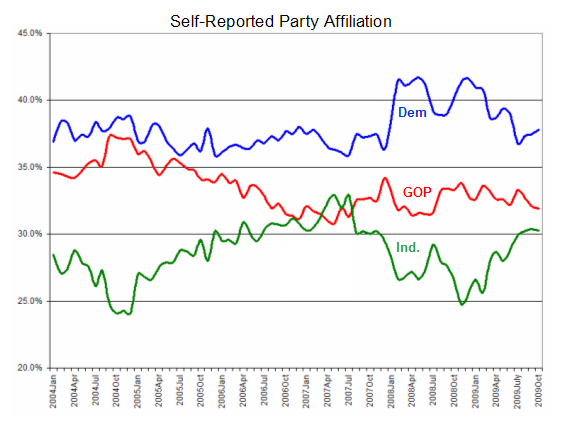
Rasmusssen (and other pollsters) ask people to self-categorize themselves by political party.

I think the trends are pretty interesting:

During the final years of the Bush admin, the mix shifted from the GOP to independents.  Note the near mirror image of the red and green lines on the left half of the chart.

When Obamamania caught traction, the mix shifted from independents to Democrats.  Again, not the near mirror image of the green and blue lines on the right half of the chart.

Now, the mix is shifting again — from Dems to independents.

While Dems still have a statistically significant plurality, the country broken roughly in thirds across Dems, GOP and independents … with independent “swing voters” carrying determining sway.

image

http://www.rasmussenreports.com/public_content/politics/mood_of_america/partisan_trends

Shopping therapy saves the day … yeah, right.

December 3, 2009

TakeAway:  Shopping therapy is not a new concept but asserting that it will carry the consumer economy through this recession is quite brazen. 

To what degree does our emotional connection with or satisfaction from a product overrule our rationale behavior, especially during a recession?

* * * * *

Excerpted from WSJ, “The Bonhomie of Buying,” By Laura Vanderkam, November 1, 2009

As the economy tanked last year, pundits claimed that we were entering a new age of frugality. We would stop shopping and learn to “use it up, wear it out, make it do or do without” …

There was just one problem with this prediction: Given how much money is riding on the consumer economy, legions of people now spend their lives figuring out how to make the buying experience more alluring … “We probably know as much about the behavior of the human shopper in its natural habitat, the mall, the grocery, or the department store, as we do about the activities of any species of animal in the wild.”

Now former Esquire editor Lee Eisenberg adds his own take, examining why modern Americans find shopping so irresistible … “Shoptimism” aims to offer a novel view on the big idea of buying and selling … Eisenberg approaches consumer culture as an anthropologist … He turns up some interesting tidbits.

Black Friday shoppers … say that they’re battling the crowds on behalf of themselves rather than shopping for loved ones …

The brains of tight-fisted folks react to high prices in the same way they do to physical pain.

We absorb advertising messages so well that—in a world saturated with PC Guy vs. Mac Dude ads—we actually perform better on creativity tests after being cued by references to Apple products …

Brands are losing their vice grip as shoppers figure out that generic items are often made in the same factories as branded ones and retailers manage to turn their private labels into desirable goods …

* * * * *

The overarching argument inherent in this book: Shopping, in modern America, is fundamentally an optimistic activity.

While our shopping habits are easily manipulated, they are not quite as irrational as critics like to believe. For most of us shopping … really does make us feel better.

We buy because it “confers instant membership in a community.” We buy “to express ourselves.” Most important, we buy because “buying is fun, sociable, and diverting …”

If a sweater or an iPod can do that, … then no wonder, recession or not, it’s hard to keep Americans out of the stores.

Edit by TJS

* * * * *

Full Article
http://online.wsj.com/article/SB10001424052748703399204574505382492105704.html

* * * * *

Cash for a Clunker? … GM’s gov’t-selected CEO gets the heave-ho.

December 2, 2009

In March, Pres. Obama and his “car czar” axed GM’s CEO Rick Waggoner and appointed  Fritz’ Henderson to replace him, change the organizational culture, and save the company.

Oops.

On Tuesday, the GM board forced Henderson to resign, and initiated a search for his successor.

Good luck.   

Bringing in new blood is likely to be pretty hard since the company’s major shareholder (Uncle Sam) is capping pay offers, and restricting bonuses. 

The paradox: GM needs somebody with great judgement … and anybody who would take the job is disqualified based on that criteria alone.

http://online.wsj.com/article/SB10001424052748703735004574570370686365390.html?mod=article-outset-box

The Manhattan Declaration … gaining traction ?

December 2, 2009

Conservative Christians – who mostly sat out the 2008 election—seem to have gotten a second wind. 

The Manhattan Declaration – issued a couple of weeks ago by a group of Catholic and evangelical Christian leaders – focuses on “traditional values”:

(1) the sanctity of human life, (2) the dignity of marriage as the conjugal union of husband and wife, and (3) the rights of conscience and religious liberty.

If you thought the “culture wars” were over, think again …

* * * * *
Manhattan Declaration – Summary

Christians, when they have lived up to the highest ideals of their faith, have defended the weak and vulnerable and worked tirelessly to protect and strengthen vital institutions of civil society, beginning with the family.

Orthodox, Catholic, and evangelical Christians are uniting to reaffirm fundamental truths about justice and the common good, and to call upon our fellow citizens, believers and non-believers alike, to join us in defending them.

These truths are (1) the sanctity of human life, (2) the dignity of marriage as the conjugal union of husband and wife, and (3) the rights of conscience and religious liberty.

These truths are foundational to human dignity and the well-being of society … and they are increasingly under assault from powerful forces in our culture.

Human Life

Although the protection of the weak and vulnerable is the first obligation of government, the lives of the unborn, the disabled, and the elderly are ever more threatened. 

We pledge to work unceasingly for the equal protection of every innocent human being at every stage of development and in every condition.

Marriage

Marriage is the original and most important institution for sustaining the health, education, and welfare of all.  But, the institution of marriage, is already wounded by  the false and destructive belief that marriage is all about romance and other adult satisfactions … leading to promiscuity,infidelity and divorce.

Marriage is about the unique character and value of acts and relationships whose meaning is shaped by their aptness for the generation, promotion and protection of life.

Marriage is not a “social construction,” but is rather an objective reality—the covenantal union of husband and wife—that it is the duty of the law to recognize, honor, and protect. 

Where marriage erodes, social pathologies rise.

Religious Liberty

Freedom of religion and the rights of conscience are gravely jeopardized.  Attacks on religious liberty are dire threats not only to individuals, but also to the institutions of civil society including families, charities, and religious communities.

The health and well-being of such institutions provide an indispensable buffer against the overweening power of government and is essential to the flourishing of every other institution … on which society depends. 

Full summary: 
http://manhattandeclaration.org/images/content/ManhattanDeclarationSummary.pdf


It’s not what you know, but who you know … on your social network, that is.

December 2, 2009

Takeaway: Marketers have long used online media to manage their company’s reputation with consumers. However, in an effort to more precisely select and target profitable customers they have now turned the looking glass around on the consumer.

By analyzing the online behaviors and social networks of their customers, marketers believe they can determine who has been naughty and who has been nice.

In this world of increased transparency, who will come a-wassailing in your virtual neighborhood this holiday season?

* * * * *

Excerpt from Fast Company, “How Rapleaf Is Data-Mining Your Friends Lists to Predict Your Credit Risk,” by Lucas Conley, November 16, 2009.

They say you can tell a lot about a person by the company they keep. By now, you probably already know your behavior on social networking sites like Twitter and Facebook can get you fired, evicted, and even arrested–but what about your friends’ behavior? Upon reviewing your social networking friend list, the data-mining firm Rapleaf says it can help predict which ads you’ll pay attention to and whether or not you’re a worthwhile risk for a credit card or a loan–all without hacking into any accounts or breaking any laws.

Until recently, such data has largely been applied towards reputation management, helping brands, advertising agencies, and public relations firms hear what we’re saying about them. But as the volume of consumer data has grown, and the technology employed to gather, sift, and analyze it has advanced, organizations are turning the tables, asking what the data says about us. There is mounting evidence suggesting that your friends influence everything from your weight to your happiness.

Seventy percent of U.S. consumers claim they “definitely would not” allow advertisers to track their online behavior–even if they were to remain anonymous. It is therefore unlikely that consumers will react favorably to businesses monitoring and ranking their social footprints.

Rapleaf only aggregates publicly available information, and allows customers to opt out or register “to discover what information about you is available online and to edit your Internet footprint.” Rapleaf claims it is making ecommerce faster, cheaper, and easier for consumers and businesses alike.

By accessing its database of nearly 380 million consumer email profiles, banks, retailers, and anti-fraud firms, Rapleaf can quickly confirm legitimate customers and weed out scammers, cutting verification costs and improving the user experience. “Companies spend as much as $100 getting customers to their site. The goal is to filter out the bad people and keep as many good people as possible,” Rapleaf says.

Beyond simply helping verify your identity, Rapleaf claims information about your friends’ behavior can be used to better predict your behavior. For one company, Rapleaf adapted ads based on friends’ responses, ultimately tripling the click-through rate. Rapleaf’s Web site even suggests that clients “use friend networks to enhance … credit scoring.” Rapleaf explains: “Say someone would have been rejected for a credit card, but their social graph says their friends are good payers. Instead of saying ‘Rats, we couldn’t give this guy the card,’ they’ll be approved.”

“Social networking is part of the advertising-supported Internet,” he says. “It’s one of the free services we all enjoy. Now people are becoming aware there is a cost.”

Edit by BHC

* * * * *

Full Article: http://www.fastcompany.com/blog/lucas-conley/advertising-branding-and-marketing/company-we-keep

* * * * *

Your health insurance premiums will go down $2,500 … Not !

December 1, 2009

Candidate Obama said repeatedly that his healthcare reforms would bring down family insurance premiums by $2,500.
http://blogs.wsj.com/health/2008/07/23/parsing-obamas-promise-to-lower-insurance-premiums-by-2500/

The CBO analysis of the Reid Senate bill concludes that many folks premiums will go up, not down.

Oops.

* * * * *

Excerpted from Washington Post Online, CBO: Senate health plan will increase some premiums — and expand coverage, Nov. 30, 2009

The Senate’s plan to overhaul the health insurance system would increase premiums in the individual market … and six in 10 families would have their premium payments subsidized, congressional budget analysts said.

By 2016, two years after the Senate reforms are to take effect, the CBO projected that premiums for 32 million people in the individual insurance market would be driven as much as 30 percent higher because insurance companies would be required to offer better coverage than they do now.

But that increase would be partially offset by lower costs for insurers, who would have access to a new pool of younger, healthier customers who might previously have gone without insurance.

The result: Nongroup premiums on average would increase by about 13 percent compared with current law, to $5,800 for individuals and $15,200 for family coverage. But the CBO predicts that 57 percent of purchasers in that market would also be receiving federal subsidies that would cover roughly two-thirds of that cost, leaving them paying 60 percent less for insurance than if the legislation were not enacted.

But Republican Senate leader Mitch McConnell said: “At the beginning of the health care debate, we were told that this trillion-dollar experiment would lower premiums for American families.And yet just this morning, the independent Congressional Budget Office provided an analysis showing that the Democrat bill will actually increase premiums for American families.So a bill that’s being sold as a way to reduce costs actually drives them up.”

“The bottom line is this: after 2,074 pages and trillions more in government spending, massive new taxes and a half-trillion dollars in cuts to Medicare for seniors, most people will end up paying more or seeing no significant savings.”

Full article:
http://voices.washingtonpost.com/capitol-briefing/2009/11/cbo_senate_health_plan_will_in.html

“Open Enrollment” … finally, I actually looked at my health insurance costs … you should, too!

December 1, 2009

I’m embarrassed to admit that, in the past, I just hadn’t given much thought to my company provided health care insurance.

The premiums – or more precisely, my share of the premiums – seemed reasonable, our docs were on the plan, and the plan covered our needs fairly. Every year, I simply continued the coverage I had in place the prior year.

Since I’ve gotten deep into the health care reform fiasco, I was more diligent this year.

Below is what I found, and far below are some observations re: Cadillac insurance plans.

* * * * *

The Plans

My employer offers 3 plans that are relatively comparable in coverage.  See the chart below for premium details.

The 3 plans differ slightly in co-pays, deductibles, limits, etc., but I concluded that the differences aren’t “statistically significant”. (Note: I didn’t even consider the lowest cost alternative – a Kaiser HMO).

image

First, note that – depending on the specific plan — my employer pays somewhere between 59% and 77% of the total premiums – employees pay between 41% and 23%.   I’m told that the split is comparable to most company plans – with the COMPANIES paying at least half of the premiums, often more, sometimes much more.

The shocker was the range in total premiums by carrier – for roughly equivalent coverage.  For example, the UHS premium for a couple ($15,376) is more than $6,000 higher (almost 70%) than the premium from CareFirst Blue Shield ($9,088).

Note that there’s a modest “marriage penalty”.  The total premiums for a couple are more than twice the individual premiums – by about 10%.

If you’re going to have kids, you might as well have a lot of them.  The family rate is 3 times the individual rate, regardless of the number of children in the family.  Hmmmm.

On balance, the premium levels are about what I expected.  Per capita health care expenditures average a bit over $7,000 – pretty much in line with UHS – the high cost provider.

I’d been riding along with United Healthcare (UHS).  I knew they were premium priced, but I didn’t realize by how much. Ouch.  My shiny new CareFirst card is in the mail, and my projected 2010 disposable pay is plus $4,000 … not bad.

Teaching point: Do the homework when selecting healthcare insurance plans.  There’s serious money involved.

* * * * *

Cadillac Plans

Company paid premiums are not subject to income taxes.  I think that’s unfair (to folks paying 100% of their policy’s premiums), and arbitrary (it sure looks like compensation).  I’m all for rolling company paid premiums into W-2s,  giving taxpayers an exclusion – say, $3,000 for individuals, $6,000 for couples, $10,000 for families, and then income-taxing the balance.

While the approach is different (largely to “hide the weenie”), I agree with the spirit of the Senate bill.  Taxing Cadillac plans can raise some money, and might start to cap the upside on coverage.  In effect, the folks getting the best health care benefits have to ante in to support folks who get none or relatively little.  Seems fair to me.

The Senate proposal is to levy a 40% tax on the excess of premiums over $8,500 a year for individuals or $23,000 for families.  If anything, the levels – which were set to outboard lucrative union plans  —  are too low – probably by a factor of 2 based on my company plans.

Side note: I haven’t heard or seen anything that distinguishes between premiums paid by individuals and premiums paid by companies.  Obviously, premiums paid by an employee aren’t wages to be taxed.

A portrait in black & white…

December 1, 2009

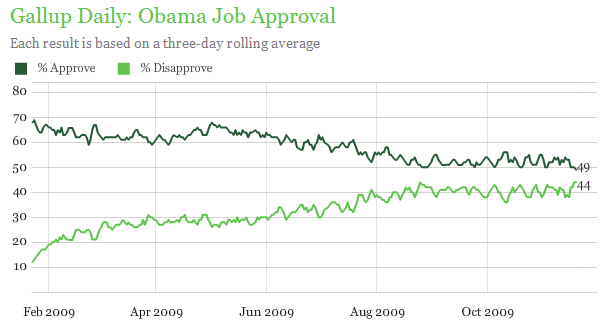
Last week, Gallup reported that Pres. Obama’s approval rating has dipped below 50%.  That is, less than half of the country approves of the job he’s doing as president.  That’s less than the percentage of folks who voted for him, and 17 points lower than his inaugural approval rating.

image

Among the telling — but largely unreported trends — is Obama’s sharp drop-off among whites.  While his approval rating by blacks has stayed sky high — above 90% — his approval rating among whites has gone down from 61% to 39% — a 22 point drop. Ouch.

To diffuse any racial undertones, Gallup points out that  Bill Clinton averaged 55% job approval during his presidency, including 52% among whites … and 82% among blacks” … leading them to conclude: “One reason Obama may have maintained support among blacks is their overwhelming affiliation with the Democratic Party.”

Is that an elephant I see in the middle of the room ?

image

http://www.gallup.com/poll/124484/Obama-Approval-Slide-Finds-Whites-Down-39.aspx?CSTS=alert

image

Extra mayo, please: extending the product life cycle

December 1, 2009

Takeaway: As Americans have tightened their budgets throughout the current recession, the relatively mature mayonnaise market has experienced significant growth.

Sensing a large jump in top-of-mind awareness, Unilever has been making a strong push of its Hellman’s brand to take advantage of the rise of brown-baggers.

With the economy hopefully turning around, the brand is now in a classic dilemma of figuring out how to extend the product life cycle.

Their plan: pushing the “real” ingredients that make up mayo and give it the mystique of the secret ingredient you’ve had in your pantry that can enhance all dishes, from appetizer to dessert.

Creating new uses for a product is a tremendous way to extend that product life cycle; just ask Arm & Hammer. And with Thanksgiving just around the corner, maybe Hellman’s can continue to grow…one clogged artery at a time.

* * * * *

Excerpted from BrandWeek, “The Mayo Clinic” by Elaine Wong, November 7, 2009

Thanks to the recessionary rise of eating at home and brown-bagging lunches for the office, mayo is no longer the staid standby in the back of the kitchen cupboard. And so sales growth — any sales growth — is welcome news for the folks who work in Hellmann’s nondescript office park in Englewood Cliffs. But Fish’s efforts raise some hard questions, among them: As the recession lifts, will mayo’s popularity fade once more? Will vigorous marketing be enough to overcome the market’s vicissitudes? And, in these health-conscious times, is it even possible to overcome the fact that mayonnaise is among the fattiest foods on the market?

Nonetheless, Fish is confident he can get fat-conscious, weight-obsessed Americans to eat more of the stuff. He plans to do that through a combination of creating more uses for the condiment and through the nostalgia sell — appealing to consumers who long to recreate the good-old days of meat and potatoes and other so-called “real food.”

“Remember,” Fish says, “Hellmann’s has always been made with eggs, oil and vinegar.” It’s the sort of message that purists would appreciate — and there seem to be a growing number of those. They’re the sort who devour books by culinary journalist Michael Pollan, and who thrust Julia Child’s half-century-old Mastering the Art of French Cooking back into best seller status in the wake of the film Julie & Julia.

Fish’s approach is on full display in this month’s “Hellmann’s real holiday helpings” campaign, which stars chef Bobby Flay. The Food Network personality is appearing in print and online ads touting Hellmann’s as an essential component in family-oriented, Thanksgiving meals. Ads from OgilvyEntertainment show Flay cooking alongside mothers and their kids. (It is Hellmann’s contention that involving children in the cooking process renders them more willing to eat the results. Plus, introducing them to mayo can’t hurt, either.)

“Recipes that require you to go to the grocery store and buy 10 new things that you didn’t happen to have is asking a lot of people,” Fish says. “This isn’t the time to be asking people to go the extra mile.” If mom is cooking and happens to have a jar of Hellmann’s around, she won’t have to go that extra mile at all.

At the same time, much of Fish’s strategy also hinges on getting home cooks to consider Hellmann’s mayo as their “secret sauce — that special something that I’ve done that you don’t know about that makes this dish taste so good,” he said. “We know from research that consumers love recipes with a secret ingredient in them,” Longfield adds. And mayonnaise, in this instance, does the trick.

Unilever has, in fact, been a staunch proponent of the “real food” movement. The basic line of reasoning is that consumers are more likely to buy goods from companies who can readily tell their ingredients’ stories. And Unilever’s not alone. In introducing Select Harvest, for instance, The Campbell Soup Co. touted it as a soup line “made from only ingredients that people can readily recognize.” Haagen-Dazs also has a line called Five named after the ice cream’s total list of ingredients.

Americans might not like the idea of fat, but they’re still willing to accept it. As the resurgence of Julia Child’s landmark French cookbook proved, Americans’ fear of fat seems secondary to their appreciation of honest and wholesome foods — many of which have lots of fat.

But how long would the good news last? With economists having just declared the recession officially over, it’s only a matter of time before brown-bagging it for lunch will lose its retro cool and families will again go out to eat for dinner. In fact, according to senior associate brand manager Jessica Teilborg, “the biggest competitor we deal with every day is out-of-home dining.”

Edit by JMZ

* * * * *

Full Article:
http://www.brandweek.com/bw/content_display/news-and-features/direct/e3i8875589fada415ac765d6617882ef4b3

* * * * *


Re: Brand Image … Is “bulletproof” Tiger out of the woods?

December 1, 2009

Key Takeaway: As more facts become public, will the controversy around Tiger Woods’ recent accident damage his long-term marketability? More likely than not, the answer to that question will be a resounding no.

Woods’ ability to position himself in such a different way than all other golfers (and all other athletes, for that matter) will help keep him atop the appeal list for both fans and sponsors.

Furthermore, the fan that loves Tiger tends to be more forgiving than most. So you better believe the next time Tiger is being given a green jacket, all of Augusta will be cheering him on.

* * * * *

Excerpted from Brandweek, “Tiger Woods’ Image Likely Unharmed by Accident” by Kenneth Hein, November 30, 2009

Smashed up, semi-conscious and bleeding may be how Tiger Woods was discovered three days ago. However, his reputation as a top brand endorser should remain relatively unscathed, according to sports marketing experts.

Allegations of infidelity and other stories that are currently swirling will not greatly affect his abilities as an endorser, said David Schwab, vp, Octagon Sports Marketing’s First Call and managing director of athletes and personalities. “If it’s only a spat and the story is what we’ve seen, then it doesn’t affect him,” Schwab said. “He is unique in terms of his global appeal, size and long-term ability. He’s not like a prime-time actor competing with 30 other competitors. He doesn’t compete with anyone.”

Woods’ target demographic, namely middle- to upper-class males, “tend to be a lot more forgiving,” said Larry McCartney, associate professor of sports marketing at Seton Hall University’s Center for Sport Management. “There are obviously rumors flying around all over the place at the moment, but he’s pretty much bulletproof.”

The only danger for Woods involves any offers that are currently on the table. “Right now if I’m a brand manager negotiating to do a global campaign, do I pull out because maybe it could get worse?” said Sturner. Still, “long term will it hurt? No. Look at Kobe Bryant right now. Look at the other stars that have had worse incidents that have dampened their reputations [and rebounded]. It’s about what happens on the golf course. That will make or break his marketing appeal.”

Edit by JMZ

* * * * *

Full Article:
http://www.brandweek.com/bw/content_display/news-and-features/direct/e3i4c19162f98c24488bb3e623d9707c6ff

There’s still hope for MBAs …

December 1, 2009

TakeAway:  There is no doubt that the hiring environment is less than ideal for MBAs … all MBAs. 

However, there is hope.  Companies appear to be hiring but students must be a little more flexible and patient than in the past.

* * * * *

Excerpted from BusinessWeek, “MBAs Confront a Savage Job Market,” By Anne VanderMey, October 29, 2009

Adam Rosenberg did everything right. He got into a good school. He landed a great internship. He was even vice-president of two MBA clubs and a graduate teaching fellow. But when it came time for companies to hire this year, the 2009 graduate … was surprised to find out how little it all mattered … 

He’s not alone … MBA students have found themselves facing what schools say is the worst hiring season they’ve ever seen.

According to the latest data … 16.5% of job-seeking students from the top 30 MBA programs did not get even one offer … three months after graduation. Last year that was true of just 5% of students. And … starting pay was down … For many programs, it marked the first time since the tech bubble burst that salaries didn’t increase. Signing bonuses, too, fell both in value and quantity …

One factor that made this recession different was that it hit MBA students where it hurt the most, with thousands of high-paying finance jobs going up in smoke …

The most successful schools this year were able to direct students who were shut out of investment banking and consulting into different industries … Rather than holding on to their hopes of working on Wall Street, students looked at their other skill sets …

A few sectors have been able to pick up some of the slack. Health care, energy, government, and nonprofit hiring are holding up particularly well …

Much of the hiring happened months later than normal. Many companies shifted from hiring on an academic schedule, which requires the stability to sign on new employees almost half a year before they show up to work, to hiring on an as-needed basis—often making offers much later in the year …

Early signs this year don’t point to a swift recovery for the class of 2010. Some believe the coming months will be even worse. That means many students will end up taking jobs they might not otherwise have considered or returning to industries they came to business school to get out of. That could be both good and bad news for this recession’s new grads.

Some students will discover jobs in new fields, try entrepreneurship, or travel to new countries. Instead of gravitating to a few companies that dominate recruiting, many schools say students are going to boutique firms or startups where they might be the only MBA hire that year … Students are opening their minds to new things …

Edit by TJS

* * * * *

Full Article
http://www.businessweek.com/bschools/content/oct2009/bs20091029_862211.htm

* * * * *

The healthcare bills … get out your wallets !

November 30, 2009

There are so many numbers being thrown around re: healthcare costs and the proposed ObamaCare proposals that’s it’s easy to lose the forest in the trees.

Here’s what you need to know … in round numbers.

First, U.S. healthcare expenditures average a bit over $7,000 per capita.

There are roughly 47 million uninsureds – but that number includes, for example, illegal immigrants who Pres. Obama says won’t be covered.  The proposed Senate bill covers 30 million uninsureds.

So, by simple arithmetic, the annual gross cost to cover the 30 million is about $210 billion – 30 million times $7,000.

Now, it starts to get tricky.

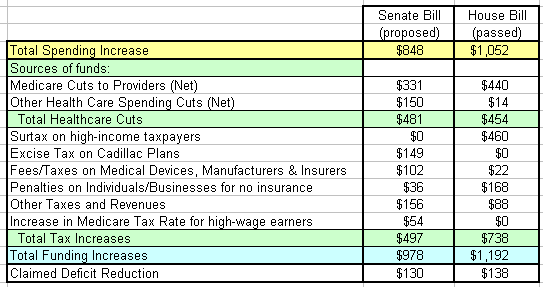
Reid proposes a $848 bullion increase in government healthcare spending over 10 years; Pelosi passed a bill north of $1 trillion across 10 years. (See chart below)

But, both bills delay the start of benefits for 4 years, so there are only 6 years of benefits in the 10 year projections.

The implication: Reid’s bill costs about $140 billion per year once it’s up & running;  Pelosi’s bill costs about $165 billion. For simplicity, we’ll strike an average and round down to $150 billion.

Now, $150 billion is less than the $210 billion it costs to cover 30 million uninsureds ar $7,000 a pop.  How can that be?

Well, some of the newly covered uninsureds will be paying their own way — in total or in part.   For example, some healthy young folks who can afford health insurance but make an economically rational choice to self-insure.  They’ll be “mandated” to buy insurance – and fined or jailed if they don’t.  Other folks will get taxpayer subsidized insurance but – based on means tests – will have to pay part of the premiums. 

My take: the spending estimates are probably reflective of what the bills say – the projections “haircut” the costs of the 30 million uninsureds and add in the costs of building and running the forthcoming government bureaucracy (think electronic medical records and thousands of watchdogs and claims processors pirated from the DMV and IRS).

That’s the spending.  How will it be paid for?

In round numbers, they’re talking about $1 Trillion of new spending … financed about 1/2 from heathcare cuts (mostly MediCare) – and about 1/2 from higher taxes. 

Taxes are projected to go up about $50 to $75 billion per year.  Healthcare cuts are estimated to be about $50 billion per year. (Keep in mind that the tax increases and healthcare cuts start immediately, benefits are delayed until year 5).

So, over the first 10 years, the early-starting cuts and taxes balance out against the late-starting benefits to the uninsureds … and even provide some excess taxes to pay down the deficit. (yeah, right !)

But, what happens each year, starting in year 5 when the benefits begin?

Well, based on the above calculations, the are $150 billion per year in increased spending, but only $100 billion per year in compensating healthcare cuts and tax increases.

Oops.

Looks like another $50 billion in healthcare cuts (i.e. rationing) and tax increases are coming down the pike.

That, my friends is all you need to know.

* * * * *

Here’s a simple “sources & uses” statement.  All numbers in billions.  Read ‘em and weep …

             Click to enlarge
image
http://www.taxfoundation.org/blog/show/25527.html

Support for healthcare plans drops below 40% …

November 30, 2009

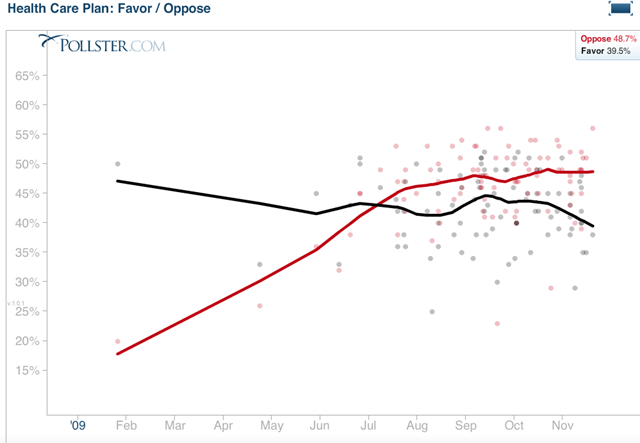
Based on Pollster.com’s “poll of polls”, almost half the country opposes the proposed healthcare plan(s) … and fewer than 4 in 10 folks favor it (or “them”).

Still, our elected representatives in DC keep pushing forward any way, to legislate “the will of the people”.

Anybody see a contradiction in there ?

image
http://www.pollster.com/polls/us/healthplan.php

Netflix: What happens when DVDs meet 8-tracks in the junk heap?

November 30, 2009

TakeAway:  Through effective consumer management and distribution strategies, Netflix has changed the rules of the movie rental business and managed to fend off competitors along the way. 

However, as the game continues to evolve and Netflix’s distribution advantages become obsolete, will its subscription/information-based consumer loyalty model enable sustained success?

* * * * *

Excerpted from Knowledge@Wharton, “Netflix: One Eye on the Present and Another on the Future,” October 28, 2009

In a year when DVD sales are falling and studios are facing major shakeups … Hollywood is beginning to look a lot like one of its own slasher films … however, there is at least one success story in the movie industry: Netflix.

… Netflix made a splash in the movie rental business by offering an online subscription model with a flat monthly fee for unlimited rentals and no late charges. Since then, despite a recession, fierce competition and the emergence of online video delivery, the company continues to thrive … Netflix is now in a race to transition to a business model focused on streaming content online …

In 2008 Netflix introduced a “Watch Instantly” service that allows consumers to stream movies on their home computers. Since then, the company has forged a bevy of partnerships to embed its Watch Instantly service in television sets and game consoles …

Netflix CEO said the company’s goals were simple: Grow revenue, subscribers and earnings while expanding into streaming content … 

However, Netflix’s DVD business faces intense competition from companies ranging from Apple (iTunes) to Blockbuster to Redbox … and … Netflix’s video streaming model is under fire from powerful rivals … YouTube … But it’s not as though competition is anything new for Netflix. So-called “Netflix killers” have surfaced repeatedly in the last decade … but they haven’t been able to stop Netflix’s momentum …

Netflix has proven its doubters wrong repeatedly, but it is unclear how the balancing act between the company’s old and new business models will play out …

For now movie rental sales figures are playing to Netflix’s advantage … DVD rentals have held up well as consumers opt for cheaper forms of entertainment … Particular strategies have helped Netflix maintain its lead, including:  1) Keeping one eye on the road and one eye on the turn ahead … 2) Employing a subscription model … 3) Moving quickly to stay ahead …

The longer Netflix can maintain its old model while investing in its digital streaming business, the better off it will be. Rivals can’t easily emulate the company’s distribution centers and information systems that allow it to deliver DVDs within one business day to 97% of its subscribers … And, the company’s physical assets have created a “moat” around the Netflix business model …

Digital distribution lowers the barriers to compete with Netflix …

Edit by TJS

* * * * *

Full Article
http://knowledge.wharton.upenn.edu/article.cfm?articleid=2367

* * * * *

Post-Thanksgiving reflections …

November 27, 2009

We received this from a friend on T-Day.  Several passages resonated with me.  Worth reading, even when it’s not Thanksgiving

* * * * *

I Believe… That just because two people argue, doesn’t mean they don’t love each other, and just because they don’t argue, doesn’t mean they do love each other.  

I Believe… That we don’t have to change friends if we understand that friends change.  

I Believe… That no matter how good a friend is, they’re going to hurt you every once in a while and you must forgive them for that.    

I Believe… That true friendship continues to grow, even over the longest distance. Same goes for true love.    

I Believe… That it’s taking me a long time to become the person I want to be.  

I Believe… That you should always leave loved ones with loving words. It may be the last time you see them.  

I Believe… That you can keep going long after you think you can’t.  

I Believe… That we are responsible for what we do, no matter how we feel.  

I Believe…. That either you control your attitude or it controls you.    

I Believe… That heroes are the people who do what has to be done when it needs to be done, regardless of the consequences.  

I Believe… That money is a lousy way of keeping score.  

I Believe… That my best friend and I can do anything, or nothing, and have the best time.    

I Believe… That sometimes the people you expect to kick you when you’re down, will be the ones to help you get back up.    

I Believe… That sometimes when I’m angry I have the right to be angry,  but that doesn’t give me the right to be cruel.  

I Believe… That maturity has more to do with what types of experiences you’ve had, and what you’ve learned from them…..and less to do with how many birthdays you’ve celebrated.    

I Believe… That it isn’t always enough to be forgiven by others. Sometimes, you have to learn to forgive yourself.  

I Believe… That no matter how bad your heart is broken the world doesn’t stop for your grief.    

I Believe… That our background and circumstances may have influenced who we are, but we are responsible for who we become.  

I Believe… Two people can look at the exact same thing and see something totally different.  

I Believe… That your life can be changed in a matter of hours by people who don’t even know you.  

I Believe… That even when you think you have no more to give, if a friend cries out to you…….you will find the strength to help.  

I Believe… That credentials on the wall do not make you a decent human being.    

I Believe… That the people you care about most in life are taken from you too soon.  

I Believe…. That the happiest of people don’t necessarily have the best of everything; They just make the most of everything.      

I thank God for all the wonderful people who help us through-out the journey of life.

Rationing? What rationing ?

November 25, 2009

TakeAway: The flap over breast cancer screening has provided a fascinating insight into life under ObamaCare.

* * * * *

Excerpt from WSJ: Liberals and Mammography, Nov.24, 2009

The political left supports medical rationing even as it disavows that any such thing is happening.

No sooner had the Health and Human Services Department’s U.S. Preventative Services Task Force recommended against mammography for women under 50 than Secretary Kathleen Sebelius rushed to say don’t worry.

The New York Times, ran at least four much-ado-about-nothing items even as it endorsed the reduced screening.

What’s really going on here is that the left knows its designs will require political rationing of care, but it doesn’t want the public to

Americans will simply have to accept that the price of government-run health care in the name of redistributive justice is that patients and their doctors must bow to the superior wisdom of HHS task forces.

http://online.wsj.com/article/SB10001424052748704779704574552320222125990.html

Just in case you thought the housing crisis was behind us …

November 25, 2009

Just in case you thought the housing crisis was behind us … some factoids:

Underwater Mortgages

Most U.S. homeowners still have some equity, and nearly 24 million owner-occupied homes don’t have any mortgage.

But, the proportion of U.S. homeowners who owe more on their mortgages than the properties are worth has swelled to about 23%.

Nearly 10.7 million households had negative equity in their homes.

5.3 million U.S. households are tied to mortgages that are at least 20% higher than their home’s value.

Homeowners in Nevada, Arizona, Florida and California are more likely to be deeply under water. In Nevada, for example, nearly 30% of borrowers owe 50% or more on their mortgage than their home is worth.

More than 40% of borrowers who took out a mortgage in 2006 — when home prices peaked — are under water.

Even recent bargain hunters have been hit: 11% of borrowers who took out mortgages in 2009 already owe more than their home’s value.

* * * * *

Mortgage Delinquencies

About 7.5 million households were 30 days or more behind on their mortgage payments or in foreclosure.

Mortgage troubles are not limited to the unemployed. About 588,000 borrowers defaulted on mortgages last year even though they could afford to pay — more than double the number in 2007.

* * * * *

House Sales & Starts

Sales of previously occupied homes in October jumped 10.1% from September to a seasonally adjusted annual rate of 6.1 million, the highest since February 2007.

Realtors reported that home sales in October were up 24% from a year earlier.

The number of homes listed for sale nationwide was 3.57 million at the end of October, down 3.7% from a month earlier.

Jittery home builders and bad weather led to a 10.6% drop in new home starts in October.

Excerpt from WSJ: One in Four Borrowers Is Under Water, Nov. 24, 2009
http://online.wsj.com/article/SB125903489722661849.html?mod=WSJ_hps_LEADNewsCollection

Why doesn’t Pro-Choice extend to mammograms and pap smears?

November 25, 2009

I don’t get it.

Liberal Dems (think Rep. Wasserman-Schultz from Florida) assert that women have the “right” to a tax payer funded elective abortion.  

I disagree with her, but that’s not my point.

Last week, guidelines were announced (and pulled back) that would limit government reimbursements for mammograms and pap smears.

If a women has a right to choose what happens to her body when it comes to abortions, shouldn’t she have the right to choose a potentially life saving diagnostic test? 

Why should the government say yes to the former, and no or maybe to the latter?

Anybody else notice the irony ?

Wanna double shareholder returns? … Try "organic" growth through focused innovation.

November 25, 2009

HBR: Focus Intensely on a Few Great Innovation Ideas, by Georg von Krogh and Sebastian Raisch, Oct 2009

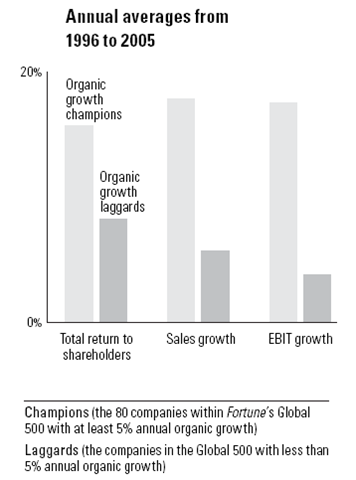
The global companies that are the most successful at achieving growth through innovation (as opposed to acquisitions) tend to devote their energies to a small number of breakthrough ideas. They select the initiatives with the greatest market potential and marshal their resources to develop them.

The organic-growth champions do more than focus on breakthrough ideas. They also put innovation at the top of the agenda, work across functional and divisional boundaries, and empower employees with an entrepreneurial mind-set.

Obviously, pursuing dozens of innovations is less expensive than developing thousands. But it also requires an intense focus on picking winners and commercializing them.

In a study of organic-growth champions— including GE, BMW, Nestlé, and Samsung— researchers at the Center for Organizational Excellence in Switzerland found that the firms’ shareholder returns were almost double those of the other Global 500 companies (which had lower rates of organic growth).

Procter & Gamble focuses its R&D on just eight to 10 core technologies, and Nestlé  … allocates large budgets to the 10 most promising innovations.

image

* * * * *

When it comes to profits, smart guys node a lot !

November 24, 2009

Takeaway: Companies that invest in power nodes, or sources of strength and leverage, have an increased likelihood of earning extraordinary profits.

Accordingly, classically trained strategists understand the potency of a brand, the power of relationships, and the advantage of captive markets. However, two new power nodes have quietly emerged.

Those who understand them well will likely rise to a level of strategic importance in their firms and thereby establish a power node of their own.

What can aikido and hubs do for you?

* * * * *

Excerpt from Strategy+Business, “The Most Powerful Paths to Profits,” by Mia de Kuijper, November 16, 2009.

In the 1990s, AT&T still controlled a huge share of the lines, hardware, and software required to deliver long-distance networking and telephone services to businesses and consumers. With minimal competition, the telecom giant could charge deliciously high rates for its services. The company’s vast network infrastructure amounted to what is called a power node: a source of strength or leverage that the company could reliably use to effortlessly dominate its market and fend off rivals.

In AT&T’s case, the power node was its preeminent stake in a network. But a power node can also be a coveted brand, a skill, a set of industry relationships, a process, a customer base with switching costs, regulatory protection, or access to resources. In short, it can be anything that a company depends on to influence financial outcomes.

The power nodes listed above have been around for a while, however two power nodes are strikingly novel.

The aikido asset power node is named after the Japanese martial art that exploits the energy of an opposing force. The key to aikido assets is being able to perceive and move with the momentum of the network. In the current information environment, it is no longer useful to “push” advertising and marketing messages to consumers. Most customers reach out for information they need on their own. If they find a source that they like, they tell other customers. They use search engines, which tend to drive large numbers of people to the most popular sources. 

Companies whose power node is based on the aikido approach are skilled in new forms of marketing. They “sow seeds,” tossing out many messages at minimal cost; Frito-Lay, for example, continually puts new flavors and packaging in the marketplace. These companies conduct surveillance, continually analyzing their digital media to see which messages are catching on.  And they react very quickly to what they learn from the networks, introducing or discontinuing products almost instantaneously. This may require the rapid retooling of sourcing, manufacturing, and distribution functions as they shift from one product to another.

Hubs are people or products that attract viewers, clients, buyers, or users in part because others are drawn to them as well; hubs are among the most effective power nodes imaginable in a transparent economy. Hubs represent the ability to become the beneficiary of self-reinforcing popularity.

The first Harry Potter book took off rapidly because friends recommended it to friends. It became a hub as others wanted to know what was driving people to read it. The existence of this hub ensured the popularity of the rest of the series. The transparency and immediacy of communications added momentum. Companies that can heighten the allure of their products this way, triggering attachment and emerging as hubs, will have a tremendously valuable power node.

When hub dynamics are at work, products or ideas that are ahead stay ahead for a long time.

That explains why Microsoft and Yahoo have not been able to catch up with Google in search volume. But because hubs are not a winner-take-all phenomenon, Google’s rivals have sizable numbers of users, leaving some room for market share to eventually turn against Google if a competitor comes up with a product that itself becomes a preferred hub. Microsoft hopes to exploit this opening with Bing, its new search engine.

Edit by BHC

* * * * *

Full Article
http://www.strategy-business.com/article/09412?pg=all

* * * * *

How many Palin books does it take to outsell 4 of Barack’s?

November 24, 2009

Botton line: Interesting analysis of the first week economics of Going Rogue — both to Palin and to others in the media.

Obvious answer to the headline question: one. 

* * * * *

Excerpted from The Daily Beast: Palin’s Gold Mine, Nov. 22, 2009

Did you hear that Sarah Palin has a book out? 

Sarah Palin sold 300,000 copies of Going Rogue on its first day of sale.

The book is No. 1 on Amazon, ahead of both Stephen King’s new novel, Under the Dome, and Dan Brown’s The Lost Symbol. Any way you carve it, Going Rogue looks to be a $12 million goldmine.  

Going Rogue is going gangbusters, and it looks like both Palin and her publisher, HarperCollins, are going to make some serious money off of it.

According to industry insiders, Palin got a $7 million advance for her book. She’s earning a royalty rate of 15 percent, which means she makes $4.35 per book sold, and therefore needs to sell all 1.6 million books that have printed to earn out her advance.

As a frame of reference, Nielsen BookScan reports that in 2008, the four books published by  Barack Obama between 2004 and fall 2008 sold a combined 912,000 copies.

http://blog.nielsen.com/nielsenwire/consumer/obama-books-out-sell-mccain-titles-in-2008/

On the media front, Palin was of particular value to  Oprah Winfrey this week. Oprah averages 6.8 million viewers. According to The New York Times, Palin’s appearance was Oprah’s best in two years, reeling in 8.7 million viewers.

There’s no way to argue with it: This was a triumphant week for the brand called Sarah Palin.

Given that people either think she’s a Godsend or a national joke—there’s really no in-between—it’s difficult to think that her popularity could be rising. But it certainly isn’t falling.

Whatever she’s selling, there are millions of people who are going to be buying. 

Full article:
http://www.thedailybeast.com/blogs-and-stories/2009-11-19/palins-gold-mine/?cid=hp:mainpromo7

About your bold strategic move … how is your competitor likely to respond (if he does)?

November 24, 2009

TakeAway: How to assess a competitor’s response to your strategic moves?  Game theory is often too complex and too assuming to fit the real world.  Intuitive-based war gaming is often skewed by personal biases and hidden agendas.

So, McKinsey proposes a practical approach to predicting competitive behavior that “stays close to the theoretical rigor and accuracy of game theory but is as easy to apply.

A prior post outlined why — at least 1/3 of the time — competitors do not respond at all to their rivals’ strategic moves .

This post outlines what moves — if any — a competitor might actively consider and most likely choose.

” * * * *

Excerpted from HBR: Predicting Your Competitor’s Reaction, by Coyne and Horn, April 2009

 
The McKinsey approach involves distilling all possible analyses of a rival’s response to a particular strategic move into a sequential
consideration of three questions, the first of which is “Will the competitor react at all?”

Once it is concluded that a competitive response is likely, it’s time to project the the nature of the response. Specifically, (1) What options will the competitor actively consider? and (2) Which option will the competitor most likely choose?

Although competitors may discuss many response options, they seriously investigate only a small number.

Even if companies consider multiple response options, most will have a clear preference for one or two.

And, the most common option competitors analyzed was “the single most obvious counteraction” (e,g. introducing a me-too product or matching a price change).

Of the options your adversary seriously considers, he will choose the one that is most effective (according to his analytic technique) within the constraints of his trade-off between short-term and long-term pain.

And, managers find it difficult to trade the certainty of short-term expense for the uncertainty of long-term gain.

To understand how competitors will respond to your move, evaluate the situation in their terms — not yours.

Companies often mistakenly assume that everyone measures success in the same way. This explains why many of our clients claim that their competitors are “irrational.”

Ask yourself: has your competitor chosen this moment to take leave of his senses? Or is he simply pursuing a strategy that looks poor according to your preferred measures but looks very clever according to his?

Most companies use simple, short-term measures.

In our survey, only about 15% of respondents used NPV to evaluate their options; 37% focused on market share; 38%  focused on earnings.

And again,  managers usually find it difficult to trade the certainty of short-term expense for the uncertainty of long-term gain.

* * * * *

Bottom line: A rigorous analysis of competitors’ behavior doesn’t have to involve a lot of math and talk of Nash equilibria.

The key is to focus on understanding how a competitor actually behaves rather than on the theory of how everyone should behave.

By studying your competitor’s past behavior and preferences, you can estimate the likelihood of his responding at all, identify the responses he is likely
to consider, and evaluate which will have the biggest payoff according to his criteria.

This information can give you an accurate idea of what your competitor is likely to do when you make a strategic move.

* * * * *

Resurrect the 90% tax on bonuses — not for AIG — for Goldman.

November 23, 2009

I’m a life-long hard core capitalist. 

But, Goldman Sachs is shaking my belief structure.

They were at center stage in the financial meltdown,

They ran to the gov’t for a rescue package — even if they didn’t need the money, they took it  — and they solicited and got a favorable redesignation as a bank.

They reaped a windfall when Paulson & crew refused to extend comparable advantages to other financial culprits.

Now, they have the audacity to pay themselves mind-boggling reward bonuses.  Even their asleep-at-the-switch shareholders are whining.

WSJ: Goldman Holders Miffed at Bonuses:
Some Investors in the Stock Urge That More of the Riches Be Passed Along to Them
http://online.wsj.com/article/SB10001424052748704533904574545981008841004.html

Last year, reacting to some AIG bonus payouts, Congress toyed around with a  90% tax rate on bonuses to TARP supported companies.

WSJ: House Passes Bonus Tax Bill: 90% Hit Would Affect Major Banks
http://online.wsj.com/article/SB123745823318182841.html

At the time, I argued that the tax code shouldn’t be used for punitive purposes, that contracts are contracts, and that execs should be paid to the terms of their contracts even if there were unintended consequences, e.g. big bonuses for poor performance. 

I’ve changed my mind. 

A 90% punitive tax on the Goldman bonuses strikes me as just about right.

Dante must have a special place in his Inferno for these soul-less knuckleheads.

Pitch like a pro … how Steve Jobs does it.

November 23, 2009

TakeAway:  If you can’t effectively communicate your thoughts then your thoughts are essentially worthless.  Below, find Your guide for how to knock your next presentation out of the park.

* * * * *

Excerpted from Washington Post, “Seven secrets of a Steve Jobs presentation,” By Carmine Gallo, November 4, 2009

Apple CEO Steve Jobs is considered one of the greatest corporate storytellers on the world stage … he has transformed the typical dull, plodding, technical presentation into a theatrical experience. Here are his 7 techniques for … inspiring his audience … wow your employees, customers, investors, and, oh yeah, your profs … 

  • Sell dreams, not products … It’s important to have great products, of course, but passion, enthusiasm and emotion will set you apart.
  • Create Twitter-like headlines … If you can’t describe your product or service in 140 characters, keep refining.
  • Introduce the antagonist … great brands and religions have something in common: the idea of vanquishing a shared enemy. Creating a villain allows the audience to rally around the hero–you.
  • Stick to the rule of three … the human brain can only absorb three or four “chunks” of information at any one time …
  • Strive for simplicity … It’s difficult to find 10 words on a dozen Apple slides. Most of Steve Jobs’ slides are visual–photographs or images … Jobs tells the Apple story; his slides complement the story …
  • Reveal a “Holy Smokes” moment … There is always one moment in a Steve Jobs presentation that is the water cooler moment … These showstoppers are completely scripted ahead of time … everyone who watched it–and those who read about–seem to recall …
  • Share the stage … Your audience craves variety. Give it to them. They also want to see teamwork. Show it to them.

Edit by TJS

* * * * *

Full Article
http://views.washingtonpost.com/leadership/leadership_playlist/2009/11/seven-secrets-of-a-steve-jobs-presentation.html?wpisrc=newsletter

* * * * *

Moving forward in uncertain times … 4 success factors.

November 23, 2009

Excerpted from: HBR, How to Get Unstuck, by Rita Gunther McGrath and Ian C. MacMillan, May 2009

A lot of businesspeople seem to be frozen in the headlights, paralyzed by uncertainty, fear of failure, and lack of trust.

In studying how leaders prevail in uncertain times, we’ve observed four practices you can use to get yourself, your people, and your firm moving again.

1. Decrease uncertainty.

  • Rather than wait until you can clearly see the entire route to a distant goal, focus on getting to the next bend.
  • Identify a series of near-term goals that can serve as checkpoints along the way, indicating your progress and illuminating the best way forward.
  • As you proceed down the path, you can stop, change direction, or continue on the same trajectory, depending on what you learn en route to each checkpoint.

This approach is cost-effective and reduces risk because only relatively small investments are required to move from one milestone to the next and because it reveals false starts early.

2. Reduce the fear of failure.

  • People fear failing, particularly in a downturn, when they think any misstep might cost a job.
  • As a result,they tend to freeze because it appears that the easiest way to avoid failing is to do nothing.
  • To spur action, shift your emphasis from cutting the rate of failure to minimizing the cost of failure.
  • To reduce people’s anxiety, give them permission to be wrong but not to make expensive mistakes.

Silicon Valley’s famous discipline—fail fast, fail cheap, and move on—applies here.

3. Hedge your bets.

In some cases, the shortest route to the goal involves investing in simultaneous experiments whose outcomes are mutually exclusive: Try A, B, and C in tandem; whichever succeeds first necessarily negates the others.

4. Create momentum.

Once you’ve settled on a course, two further steps can give the final push needed to get moving:

First, remember that the more uncertain things are, the more people prefer to stick with comfortable and predictable routines. Leaders need to insist on substantial, coordinated changes that depart from obsolete practices and make business-as-usual impossible.

Second, they need to defang or otherwise neutralize the people who persist in resisting change.

* * * * *

BINGO! I was just a week ahead of the curve …

November 20, 2009

I had predicted that — last Friday — Obama’s job approval would drop below 50% on the slightly left-leaning Gallup survey.

Well, it didn’t happen last Friday, but it did today … I was just off by a week.

As a technical stock trader would say, a resistance level may have been broken …

image
http://www.gallup.com/poll/113980/Gallup-Daily-Obama-Job-Approval.aspx

Turning off the Independents …

November 20, 2009

OK, some will dismiss these numbers because they come from the FoxNews – Opinion Dynamics survey.  But, the results are consistent with many other polls.

The bottom line: a minority of registered voters 46%)  now approve of the job that President Obama is doing  … Dem support remains sky high at 85%, and GOP support is at a rock bottom 15%.  That’s not news.

The news is that only 1 in 3 Independents approve  … that’s down from 2 in 3 back in June.

image
http://www.foxnews.com/projects/pdf/111909_ObamaPoll.pdf

* * * * *

Gallup has Obama at 50% approval; Rasmussen has him at 46%.

image

* * * * *

Interestingly, 3 left-leaning TV networks (ABC, CBS, CNN) average Obama’s approval at 55%.

image 
http://www.realclearpolitics.com/epolls/other/president_obama_job_approval-1044.html

* * * * *

I missed last week when I predicted that Obama would fall below 50% in the Gallup Survey.  Keep your eye on today’s Gallup numbers …

Right product, right place, right time … or else

November 20, 2009

TakeAway:  Distribution is half the battle for marketers.  If you can’t get enough of the right product, in the right place, at the right time, you will lose sales regardless of the quality of your product. 

Whirlpool took advantage of the recent slowdown to reexamine its distribution system and, as a result, is now enjoying an array of benefits, including $350M+ in savings a year.

* * * * *

Excerpted from WSJ, “Whirlpool Cleans Up Its Delivery Act,” By Joe Barrett, September 24, 2009 

After raw materials, distribution is one of the biggest single costs at Whirlpool, which needs to get bulky products like dishwashers and clothes dryers from factories to customers quickly …

In 2005, the company’s supply chain system was a hodgepodge of warehouses, transport depots and factory-distribution centers. Retailers often had to wait five to 10 days to get new washing machines or other appliances.

Whirlpool undertook a four-year program to build a state-of-the-art distribution system from scratch … The effort is already producing results, allowing Whirlpool to reduce its annual inventory by about $250 million a year and to deliver products in 48 to 72 hours. Whirlpool is also saving costs — about $100 million a year because of improved efficiency …

Whirlpool’s logistics makeover shows how a recession can leave the biggest, best capitalized companies better positioned than ever to scoop up both market share and profits as the economy rebounds …

The company’s ordering and delivery functions used to be located in separate divisions, complicating coordination and resulting in costly mistakes when Whirlpool made too much of a certain product.  The distribution system often had to soak up excess inventory …

The core of Whirlpool’s program was replacing 41 outdated sites with 10 huge regional distribution centers that used high-tech warehouse management systems and upgraded vehicles that could handle a variety of products.  Now, when trucks deliver appliances from the company’s factories to a distribution center, the merchandise is sorted according to how quickly it is likely to leave. Slower-moving goods, such as certain high-end refrigerators or stoves, are deposited in the center of the building, while fast-moving dryers and washing machines are closer to the loading docks.

The facilities are laid out in quadrants, with most of the products arranged in identical order four times in the same building. That way drivers can access everything they need without going from one end of the building to another …

There are still reduced sales because of the recession, but there are lower than expected inventories thanks to the logistics overhaul …

Edit by TJS

* * * * *

Full Article
http://online.wsj.com/article/SB125366529324132457.html

* * * * *

Who’s more impulsive — men or women ?

November 20, 2009

Excerpted from MarketingProfs.com, It’s All in the Presentation, Oct. 28, 2009

The key factors (category and customer characteristics, and in-store customer activity) that boost, or kill, impulse shopping:

Customers with coupons make fewer unintended purchases. The more focused a customer is on a specific purchase that will save money, the less likely she is to add more to her cart.

Customers who shop more frequently buy fewer items. They may focus more on immediately needed items, and spend less time in-store per visit.

Women tend to impulse-buy more than men. When Mom says, “Pick up some milk,” Dad picks up some milk, and leaves.

Shoppers who shop more aisles make more unplanned purchases. It’s simple: The more they see, the more likely they are to buy.

In-store displays provide the biggest boost to impulse shopping. Cool displays attract attention—and encourage purchases.

* * * * *

Based on these findings:

Consider store layout. “Consumers should be encouraged to shop as many aisles as possible (in general) and be exposed to as many product categories and in-store displays as possible (in particular).”

Mix things up. “Products that are frequently purchased (e.g., milk) should be placed in locations that will lead consumers past as many other categories as possible, or [be] displayed next to less-frequently purchased products.”

Decorate. “Making the shopping experience as pleasant as possible will increase time spent in the store”—and add to the likelihood of an impulse buy. Merchants who make the in-store experience more fun (and more lengthy)  stand the best chance of moving product.

Source: “The Interplay Among Category Characteristics, Customer Characteristics, and Customer Activities on In-Store Decision Making,” by J. Jeffrey Inman, Russell S. Winer and Rosellina Ferraro. Journal of Marketing, 2009.

* * * * *
http://www.marketingprofs.com/news/customer-behavior/index.asp?nlid=1456&cd=dmo121&adref=NciW4A9

How many Americans does it take to make nine pairs of work boots?

November 19, 2009

Bottom line: “No matter how hard or imaginatively the Administration spins, the reality is that the stimulus has been the economic bust that critics predicted it would be.”

And, “they” want another $1 trillion to whack the healthcare system.

Somebody tell these guys that respect and credibility are earned …

* * * * *

Excerpted from WSJ: The Phantom Jobs Stimulus, Nov. 19, 2009

How many Americans does it take to make nine pairs of work boots?

According to the White House’s recovery.gov site, an $890 shoe order for the Army Corps of Engineers, courtesy of the stimulus package, created nine new jobs at Moore’s Shoes & Services in Campbellsville, Kentucky.

The job-for-a-boot plan may not be American productivity at its best.

But such stories go a ways toward explaining how the Administration has come up with 640,329 jobs “created/saved” by the American Recovery Act as of October 30.

  • Head Start in Augusta, Georgia claimed 317 jobs were created by a $790,000 grant. In reality, the money went toward a one-off pay hike for 317 employees.
  • One Alabama housing authority claimed that a $540,071 grant would create 7,280 jobs … only 14 were created.
  • In some cases, Recovery Act funds went to nonexistent Congressional districts, such as the 26th in Louisiana or the 12th in Virginia.
  • Up to $6.4 billion went to imaginary places in America.

When asked about the overstatements, Ed Pound, the director of communications for the Obama Administration’s recovery.gov, said, “Who knows, man, who really knows.”

That’s a confidence builder, isn’t it?

Full article:
http://online.wsj.com/article/SB10001424052748704204304574544063776158046.html?mod=djemEditorialPage

Repeat after me: time is money, time is money, time is …

November 19, 2009

TakeAway: When it comes to designing products and services, companies would do well to keep in mind the old saying “time is money.”

* * * * *

Excerpted from WSJ: Beat the Clock – How companies can use time to their competitive advantage, October 26, 2009

History suggests that by helping consumers save time or more fully enjoy the time they spend doing something, companies could gain a competitive advantage that could lead to higher sales and profits. Consider the success of innovations such as fast-food restaurants, automated-teller machines and countless labor-saving appliances.

Consumers are continually searching for new offerings that might allow them to do more in less time, and they are growing  less tolerant of organizations that waste their time—say, by keeping them on hold too long or providing poor service.


* * * * *

There are 3 ways that firms can turn time into a source of competitive advantage.

  1. They can help consumers do things faster by, for example, making a product easier to buy, use or throw away.
  2. They can make the time involved in using a product or service more pleasurable.
  3. Or they can design offerings that empower people to choose the mix of time and value that is right for them.

* * * * *

Managing Time as a Price Paid

… and get the price down.

  • Doing It for Them. One simple approach is to help people get more than one thing done at a time. The Roomba vacuum from iRobot Corp., for instance, seeks to get the time-cost associated with the use of a vacuum down to zero by working automatically once it has been turned on. Roomba’s promise is that it “cleans routinely so you don’t have to,” freeing up the customer to do something else.
  • Picking Up the Pace. In many cases, consumers just want to get things done faster. The fast-food industry made it possible to purchase a meal in just a few minutes when it pioneered the drive-through window. Other businesses took note: Today, drive-through services exist at banks, coffee shops, pharmacies, liquor stores, and even at certain wedding chapels in Las Vegas.
  • Shrinking the Commitment. The expression “I’d like to do x, but I just don’t have the time” is uttered with great frequency. A solution is to reduce the “size” of the time needed to complete a task. Examples include speed dating and “lunchtime face-lifts” that takes 30 minutes.
  • Ending the Wait. Getting people out of line also allows companies to reduce the price of time in their offerings. Whole Foods Market Inc. instituted a bank-style checkout system at grocery stores in Manhattan, where customers form two to three big lines and move to one of the more than 30 registers per store as they open up. While this process can make the lines that feed into the registers look frighteningly long, it actually gets large crowds through the store more quickly, the company says.

* * * * *

Managing Time as Product

In our survey of North American consumers,  70% agreed or strongly agreed that they would be “willing to spend more time doing product or service labor” if companies “could figure out how to make the experience more satisfying or engaging.”

The family dinner is an example of something that lends itself well to rethinking time-as-product. Studies have shown that many families wish they could eat more meals together, but they are overwhelmed by the amount of work it takes to get a home-cooked meal on the table.

* * * * *

Giving Customers the Choice

It can be difficult to determine whether a customer is interested in saving time or enjoying it more at any given moment. So some companies are putting the “time dial” in their customers’ hands, allowing them to switch dynamically from fast to slow, depending on their feeling of time pressure at a particular moment.

The evolution of self-service technologies illustrates some of the simplest examples of this approach. 

Online retailer Blue Nile Inc. employs the “choice” strategy when it comes to selling diamond-engagement rings. In many cases, the time cost involved in buying a diamond ring isn’t in favor of the buyer — often a young man making a once-in-a-lifetime purchase. Whether he shops at a diamond warehouse or a high-end retailer, he is likely to find the process of eyeing even a few product samples through a jeweler’s loupe time-consuming and unfulfilling, and to feel pressure to make a difficult and expensive decision in a hurry.

With Blue Nile, the proverbial shopper in his pajamas can spend as much or as little time as he wants researching the diamonds—by cut, size and many other criteria—online. From there, he can shop for particular settings or rings, pricing out the products with a variety of options. Once he has reviewed his choices, his purchase can be quickly executed. Throughout, the purchaser is in control of his time and the pressure is off to hurry a decision.

While critics originally said this business model was doomed to fail, because people wouldn’t go online to buy a product whose sentiment is supposed to “last forever,” the company says diamond engagement rings now account for 70% of its overall sales, and it estimates it has a 4.5% share of the U.S. engagement-ring market.

***
Consumer attitudes about time are a moving target, and companies must constantly reset their sights.

Tasks that were once seen as easy are now often viewed as burdensome, such as renting videos from a brick-and-mortar store when movies are available for purchase digitally at home.

Full article:
http://online.wsj.com/article/SB10001424052970204038304574145390833891688.html?mod=djemMM#printMode

Distinguishing between customers’ nice-to-haves and gotta-haves …

November 19, 2009

Excerpted from: HBR, What Do Customers Really Want?, by Almquist & Lee, April 2009

Most customer-preference rating tools used in product development today are blunt instruments, primarily because consumers have a hard time articulating their real desires.

Asked to rate a long list of product attributes on a scale of 1 (“completely unimportant”) to 10 (“extremely important”), customers are apt to say they want many or even most of them.

To crack that problem, companies need a way to help customers sharpen the distinction between “nice to have” and “gotta have.”

Some companies are beginning to pierce the fog using a research technique called “Maximum Difference Scaling.” which requires customers to make a sequence of explicit trade-offs.

  • Researchers begin by amassing a list of product or brand attributes—typically from 10 to 40— that represent potential benefits.
  • Then they present respondents with sets of four or so attributes at a time, asking them to select which attribute of each set they prefer most and
    least.
  • Subsequent rounds of mixed groupings enable the researchers to identify the standing of each attribute relative to all the others by the number of times customers select it as their most or least important consideration.

A popular restaurant chain recently used MaxDiff to understand why its expansion efforts were misfiring. In a series of focus groups and preference surveys, consumers agreed about what they wanted: more healthful meal options and updated decor.

But, using MaxDiff showed that prompt service of hot meals and a convenient location were far more important to customers than healthful items and modern furnishings, which ended up well down on the list.

The best path forward was to improve kitchen service and select restaurant sites based on where customers worked.

image 
* * * * *

FOX is biased … but MSNBC isn’t … huh ?

November 18, 2009

… and Comedy Central is “investigative journalism”.  So says one of the President’s closest advisers.

Excerpted from Bloomberg.com, Obama Aide Dunn Renews Criticism of Fox, Hails Jon Stewart, Nov. 14 2009

President Barack Obama’s outgoing communications director, Anita Dunn, renewed her attacks against Fox News as she praised the “investigative journalism” of Comedy Central’s Jon Stewart and said MSNBC isn’t a biased cable news network.

After the controversy between the White House and Fox News erupted, Karl Rove, former President George W. Bush’s political adviser, said that cable news channel MSNBC had a left-leaning bias.

Dunn disputed that contention, saying MSNBC is a “different kind of a network”. 

http://www.bloomberg.com/apps/news?pid=20601070&sid=aBRJYGPAmOoo

Are “great” companies great … or just lucky?

November 18, 2009

Excerpted from: HBR, Are “Great” Companies Just Lucky?, by Michael E. Raynor, Mumtaz Ahmed, and Andrew D. Henderson, April 2009

Studies that examine high-performing companies to uncover the reasons for their success are both popular and influential.

They’re the basis of the insights behind best sellers like In Search of Excellence and Good to Great.

But there’s a problem: The “great” companies from which these studies draw their conclusions are mostly just lucky.  Many of the “great” companies cited are, in fact, nothing special. 

A firm is remarkable only when its performance is so unlikely that systemic variation alone cannot account for its results. Most success studies don’t address this fact, relying instead on the “self-evident” nature of exceptional performance.

To understand how lucky some firms might get because of systemic variation alone, we ran simulations that gave us a picture of how firms might do if they differed only in their luck.  Then, we compared actual results with simulated results, which allowed us to determine which firms had delivered performance so
unlikely that it was probably due to something remarkable about them.

Using this method, we evaluated 287 allegedly high-performing companies in 13 major success studies.

We found that only about one in four of those firms was likely to be remarkable; the rest were indistinguishable from mediocre firms catching lucky
breaks.

By our method, even in the study with the best hit rate, only slightly more than half the high performers had profiles
that were credibly attributable to something special about the firms. In short, what qualifies as remarkable performance is anything
but self-evident.

This doesn’t mean you should necessarily dismiss the advice offered in success studies. But, success studies should be treated not as how-to manuals but as sources of inspiration and fuel for introspection.

* * * * *

Cruisin’ the Net for luxury & fashion … the marketing power of the Web

November 18, 2009

TakeAway:  This is another big victory for online retailers.  Anyone in fashion who does not take them seriously should think again.

* * * * *

Excerpted from WSJ, “From the Runway to Your Laptop,” By Christina Binkley, October 1, 2009

At the D&G runway show in Milan last week, the CEOs of Saks, Neiman Marcus and Bergdorf Goodman were relegated to second-row and third-row seats. In front of them, sitting primly in the first row, was the CEO of online retailer Yoox.com.

The moment—coming as the super-sexy women’s styles for next spring pranced down Milan’s runways—marked a shake-up in an ultra-hierarchical world. The privileged treatment of a digital-media figure showed that luxury fashion is ready to introduce styles to the public in new ways … 

Front rows are reserved for those most important to a brand’s success … In past years, Yoox CEO sometimes borrowed tickets to shows from other guests. But in the past year, Yoox has expanded its business of creating online stores for luxury brands such as D&G … and for Jil Sander … and this season, Yoox CEO has been invited to too many shows …

The warm welcome extends to bloggers. While the New York shows have been inviting some bloggers for a few seasons now, many of Europe’s luxury houses have been slower to allow bloggers into the shows. But two days after the D&G event … four surprised bloggers found themselves seated in coveted spots near the queen of fashion …

Luxury brands have long been leery of the pedestrian Internet, a place where consumers coldly compare prices while forgoing attentive service … But online luxury sites like Net-a-Porter.com proved that many women would do just that. Now, Yoox … is running online stores for brands including Bally, Valentino, Pucci, and Marni …

This season, Twitter and Facebook are littered with fashion brands—including Louis Vuitton and Burberry—testing how social-media sites might benefit them … A number of brands have tried streaming their shows live on the Internet …

Designers feel that the Internet offers the possibility of talking directly to customers …

Edit by TJS

* * * * *

Full Article
http://online.wsj.com/article/SB20001424052748704471504574445222739373290.html#mod=todays_us_personal_journal

* * * * *

Snookered: about that abortion funding amendment

November 17, 2009

Rep. Bart Stupak, an avid pro-lifer, led the effort to get the PelosiCare bill amended to specifically exclude funding of abortions.

When the amendment passed, about 40 Dem pro-lifers became comfortable voting for the bill,

Even before the ink dried, the pro-choicers went on the attack.  Dem leaders quelled the couter-insurrection by hinting that the provision would be stricken when the Senate and House bills went “to conference”.

Now, according to Axlerod (on Fox News nonetheless), Pres. Obama will aid and abet stripping abortion language from any healthcare bill.  In doing so, the president would be heeding the call of abortion rights supporters like Planned Parenthood that have called the White House their “strongest weapon” in keeping such restrictions out of the bill.

* * * * *

Question #1: Didn’t Stupak smell this one coming? 

Answer: No.  He assumed a certain honor among thieves.

Silly boy.

* * * * *

Question #2: Why did he Congressional GOPers vote in favor of the Stupak Amendment?  If they had voted no and it failed to pass, then the Dem pro-lifers would have voted against the bill.

Answer: Reportedly, GOP pro-lifers gave Stupak their word that they’d vote in favor of the amendment and didn’t want to go back on their word.

Silly boys (and girls)

* * * * *

Full article:
http://www.foxnews.com/politics/2009/11/15/axelrod-signals-obama-try-strip-abortion-language-health-care/

Snookered: Drug makers agree to lower prices … after they raise them.

November 17, 2009

Bottom line: I wondered why pharma companies got in the ObamaCare canoe and promised cutting prices by $8 billion. 

The answer should have been obvious: all for show. 

They’re hustling to inflate prices to establish a much higher base from which they can back out the “cuts”. 

In other words, the post-reform prices will be right where they had planned them before the faux show of ObamaCare support.

Imagine that … Team Obama getting snookered,

* * * * *

Excerpted from NY Times: Drug Makers Raise Prices in Face of Health Care Reform, November 15, 2009

Even as drug makers promise to support Washington’s health care overhaul by shaving $8 billion a year off the nation’s drug costs after the legislation takes effect, the industry has been raising its prices at the fastest rate in years.

The industry stands to gain about 30 million customers with drug insurance from the legislation pending in Congress. But the industry also faces the prospect of tougher negotiations from both public and private buyers as the government tries to squeeze savings out of the health system.

In the last year, the industry has raised the wholesale prices of brand-name prescription drugs by about 9 percent, according to industry analysts. That will add more than $10 billion to the nation’s drug bill, which is on track to exceed $300 billion this year. By at least one analysis, it is the highest annual rate of inflation for drug prices since 1992.

Drug makers say they have valid business reasons for the price increases. Critics say the industry is trying to establish a higher price base before Congress passes legislation that tries to curb drug spending in coming years.

There was a similar pattern of unusual price increases after Congress added drug benefits to Medicare a few years ago, giving tens of millions of older Americans federally subsidized drug insurance. Just as the program was taking effect in 2006, the drug industry raised prices by the widest margin in a half-dozen years.

The drug companies say they are having to raise prices to maintain the profits necessary to invest in research and development of new drugs as the patents on many of their most popular drugs are set to expire over the next few years.

The drug industry has actively opposed some of the cost-cutting provisions in the House legislation, which passed Nov. 7 and aims to cut drug spending by about $14 billion a year over a decade.

But the drug makers have been proudly citing the agreement they reached with the White House and the Senate Finance Committee chairman to trim $8 billion a year — $80 billion over 10 years — from the nation’s drug bill by giving rebates to older Americans and the government.

But this year’s price increases would effectively cancel out the savings from at least the first year of the Senate Finance agreement. And some critics say the surge in drug prices could change the dynamics of the entire 10-year deal.

image 
http://www.nytimes.com/imagepages/2009/11/16/business/16drugprices_graphic.html

Full article:
http://www.nytimes.com/2009/11/16/business/16drugprices.html