The simple math of healthcare “reform” …

June 22, 2009

There was sticker shock when the CBO estimated the cost of the proposed healthcare reform package at about $1.6 trillion (over 10 years).

My question: why the shock?  In fact, why any surprise at all?

Think about it …

Total healthcare costs are generally reported to be about $2.1 trillion annually.

The U.S. population is just a bit over 300 million …  so, per capita healthcare costs are about $7,000 per person (which is consistent with most reports).

It’s generally reported that there are approximately 45 million people in the U.S. without health insurance.

So, it follows arithmetically that it costs about $315 billion annually to cover those folks (45 million times $7,000 per person).

Assuming a quick ramp up of the coverage, that’s $3.15 trillion over 10 years (for simplicity, call it $3 billion).

It’s generally reported that about 1/3 of the 45 million uninsureds are not citizens. At the national average, their healthcare expenses would be 1/3 of the $3 trillion, or $1 trillion. 

Policy question:  Who’s in favor of paying higher taxes or boosting the national debt to cover this $1 trillion ?

Also, it’s generally reported that about 1/3 of the 45 million uninsureds are healthy young adults who have access to health insurance and earn enough to pay for it, but opt to self-insure.  Simple economics –  they expect that the insurance will cost them more than their out-of-pocket expenses if they pay their own way.  Of course, they’re gambling that they won’t have any catastrophic medical bills – but, that’s their choice.

Policy question: Should other taxpayers have to foot the bill the bill for these opt-outters?  I don’t think so. 

Policy question: Should the government make them buy insurance? I don’t care – that’s not my problem.

Policy question: Should the opt-otters get health insurance subsidized by other taxpayers?  I don’t think so – they can afford to pay the freight – they just choose not to.

So, what’s left is about 15 million uninsureds … with an associated annual cost of about $105 billion … or a little over $1 trillion for 10 years.

Policy question: Should these ininsureds be covered by other taxpayers?  Even with a hard heart, it’s easy to say yes.

Note: Many of these uninsureds are simply between jobs.  when they find a new job, they’ll have insutance again.

* * * * *

The CBO took a couple of weeks to get 17 million new insureds at a cost of about $1.6 trillion.  The above analysis took all of 10 minutes.  Hmmmm

To cut healthcare costs by 40%, Safeway applies the auto insurance model.

June 19, 2009

TakeAway: By providing employees with financial incentives to stop smoking, lose weight, and control cholesterol levels and blood pressure … Safeway has contained healthcare spending over the past couple of years. 

The principle: reward good behavior … and don’t subsidize bad behavior.

Ken’s Take: Maybe fat folks should pay higher airfares and health insurance premiums.  Hmmm.

* * * * *

Excerpted from WSJ, “How Safeway Is Cutting Health-Care Costs”, June 12, 2009 

Effective health-care reform must meet two objectives: 1) It must secure coverage for all Americans, and 2) it must dramatically lower the cost of health care.

At Safeway we believe that well-designed health-care reform, utilizing market-based solutions, can ultimately reduce our nation’s health-care bill by 40%. The key to achieving these savings is health-care plans that reward healthy behavior.

Safeway’s plan capitalizes on two key insights: (1) 70% of all health-care costs are the direct result of behavior; (2) 74% of all costs are confined to four chronic conditions — cardiovascular disease, cancer, diabetes and obesity … and, 80% of cardiovascular disease and diabetes is preventable, 60% of cancers are preventable, and more than 90% of obesity is preventable.

Safeway has done nothing more than borrow from the well-tested automobile insurance model. For decades, driving behavior has been correlated with accident risk and has therefore translated into premium differences among drivers. Bad driver premiums are not subsidized by the good driver premiums.

As with most employers, Safeway’s employees pay a portion of their own health care through premiums, co-pays and deductibles. The big difference between Safeway and most employers is that we have pronounced differences in premiums that reflect each covered member’s behaviors.  Currently we are focused on tobacco usage, healthy weight, blood pressure and cholesterol levels. Employees are tested for the four measures cited above and receive premium discounts off a “base level” premium for each test they pass. If they pass all four tests, annual premiums are reduced $780 for individuals and $1,560 for families.

At Safeway, we are building a culture of health and fitness.

While comprehensive health-care reform needs to address a number of other key issues, we believe that personal responsibility and financial incentives are the path to a healthier America. By our calculation, if the nation had adopted our approach in 2005, the nation’s direct health-care bill would be $550 billion less than it is today.

Full article:
http://online.wsj.com/article/SB124476804026308603.html#mod=djemEditorialPage

Dusting Facebook pages for “friendprints” …

June 18, 2009

Ken’s Take:  As I continue to learn about Facebook and other social networking sites, three things strike me: (1) they are great places to share pictures (2) some people don’t have enough to do (note: at least I can claim that I’m doing “research” for marketing strategy classes) (3) people post some pretty indiscriminate stuff – some of which can / will come back to haunt them. 

I’m most  intrigued by the increased use of “behavioral profiling”  and “friendprinting” .

Behavioral profiling mines posted nuggets for ‘triggers’ and ‘patterns’. 

For example, all of the free email sites sift through a person’s emails looking for key words that might signal a propensity towards a particular category of products.  A guy who constantly shares sports tidbits with friends may coincidentally (?) start seeing a lot of pop-ups for odds & scores sites.

Friendprints are analytical inferences drawn from a person’s posted friends and associations. 

For example, if friends are profiled as being grads of good colleges, then it’s a reasonable inference that the person travels with a good crowd.  So what?  Well, ‘good crowds’ may spend more on certain things and may be more credit worthy.  It’s not proof, but provides clues.

What if — for privacy — a person ‘hides’ their friends list.  Well, a logical inference is that they’re hiding something.  A red flag for credit raters, prospective employers. and friends & family. Hmmmm.

And, as more friends lists get hidden, the marketing value of social networking sites diminishes.  Double hmmmm.

Below are highlights from the article on the general topic of privacy in social networking that got me thinking.

* * * * *

From Knowledge@Wharton, “Leaving ‘Friendprints’: How Online Social Networks Are Redefining Privacy and Personal Security”, June 10, 2009

People [say] privacy [is] important to them, yet they engage in behaviors that indicate a remarkable lack of concern.

Privacy thresholds vary by individual and  those boundaries are being tested by social networking.

The information people post, when combined with new technologies for gathering and compiling data, can create a fingerprint (or “friendprints” -like pattern of behavior … that can be decoded for both legitimate and illegitimate purposes..

Third-party applications (e.g. think credit scoring systems)can take data outside of the friendly confines of a social networking site and combine it with data from other sources (e.g. inter-site linking) to piece together enough information to “define” a person.

For example, just a person’s name and birth date — routinely found on a Facebook profile — can be a useful starting point for an identity thief.

The line between professional networking on a site such as LinkedIn, and social networking on sites such as Facebook, has become very thin.  Many Facebook users might create a more casual persona for themselves on that site than they would on LinkedIn, where they would include nothing but professional information. But both sites can be seen by potential employers and clients

And what about the person you don’t really know who wants to be your friend because you have some friends in common?  That new friend may just be mining your social circle for information. As networks grow and more friends of friends (and their friends) are accepted by users, it’s unclear who can be trusted.

“Though it is not difficult to sign up under an alias, it is extraordinarily difficult to change one’s friends and family.”

Full article:
http://knowledge.wharton.upenn.edu/article.cfm?articleid=2262

Re: Healthcare … How many “uninsured” Americans are there? Answer: Not 47 million.

June 18, 2009

Ken’s Take: This isn’t new news, but it continues to be overlooked in the press and in Presidential speeches.  About 1/3 of “uninsureds” aren’t US citizens; about 1/3 are young and gainfully employed who choose to self-insure.  That leaves about 15 million who need to be taken care of.  Why aren’t “they” more truthful with the numbers?

* * * * *

Excerpted from IBD, “The Phantom Uninsured”, June 16, 2009

Team Obama uses the “46 million uninsured” as a reason to nationalize health care. But the Census Bureau says about a fifth of those aren’t U.S. citizens. In fact, a goodly number are illegal aliens.

According to “Income, Poverty, and Health Insurance Coverage in the United States,” a Census Bureau report published last August, of the 45.6 million persons in the U.S. that did not have health insurance at some point in 2007, 9.7 million, or about 21%, were not U.S. citizens.

Also among the uninsured are 17 million Americans who live in households where the annual income exceeds $50,000; 7 million of those without coverage have incomes of $75,000 a year or more. Many of the uninsured are young and healthy (40% are between ages 18 and 34) and at this point in their lives, particularly in this economy, choose to put their dollars elsewhere

“Why the lack of insurance (among people who own homes and computers)? One clue is that 60% reported being in excellent health or very good health.”

“For many, being uninsured is a transitory state, since most uninsured Americans are only without coverage for a short time.” In fact, a Census Bureau’s Survey of Income and Program Participation, found  that only 19 million Americans go without insurance for a full year.

Full article:
http://www.ibdeditorials.com/IBDArticles.aspx?id=330042258549199

* * * * *

Vital Friends: The People You Can’t Afford To Live Without.

June 17, 2009

From the summer reading pile.  I do it so you don’t have to …

Vital Friends: The People You Can’t Afford To Live Without, Tom Roth, Gallup Press, 2006

Ken’s Take: Below is all you need to know from the book. The “8 roles of vital friends” were pretty interesting. Which role(s) do you play?  Which do each of your vital friends play?

* * * * *

Summary

Each person needs a few very deep friendships to thrive — the magic number seems to be three or four.

What matters most is not the number of friends, but the quality of the friendships.

A vital friend is someone who measurably improve your life. Ask yourself: “if this person were no longer around, would my overall satisfaction with life decrease?”

We expect the other person in a relationship to meet our every need. We expect them to do several things to uphold his or her end of the relationship. We expect them to be able to do it all. Then, we’re disappointed when we discover that they do only a few things very well.

The trick is to focus on those things that our friend does well — the strengths that complement our weaknesses. Focus on the ways that your friends contribute to your life, not on the ways that they disappoint you.

There are eight vital roles that close friends might play. Some may play only one; few play several: none play them all. Ask yourself: what role does this friend play?  what role do you play for him / her?

1.  Builder
2.  Champion
3.  Collaborator
4.  Companion
5.  Connector
6.  Energizer
7.  Mind Opener
8.  Navigator

* * * * *

1. Builder

builders are great motivators,always pushing you towards the finish line. They continually invest in your development and genuinely want you to succeed — even if it means they have to go out on a limb for you. Builders are generous with their time as they help you see your strengths and use them productively. When you want to think about how you can do more of what you already do well, talk to a Builder. Much like the best coaches and managers, these are the friends who lead you to achieve more each day. And great Builders will not compete with you. They figure out how their talents can complement yours. If you need a catalyst for your personal or professional growth, stay close to a Builder.


2. Champion

Champions stand up for you and what you believe in. They are the friends who sing your praises. Every day, this makes a difference in your life. Not only do they praise you in your presence, the Champion also “has your back” — and will stand up for you when you’re not around. They accept you for the person you are, even in the face of resistance. Champions are loyal friends to whom you can share things in confidence. They have a low tolerance for dishonesty. You can count on them to accept what you say, without judging, even when others do not.  Champions are your best advocates. When you succeed, they are proud of you, and they share it with others. Champions thrive on your accomplishments and happiness. When he needs someone to promote your cause, look to Champion.


3. Collaborator

A Collaborator is a friend with similar interests — the basis for many great friendships. You might share a passion for sports, hobbies, religion, work, politics, food, Visa, movies, or books. In many cases, you belong to the same groups or share affiliations. When you talk with a Collaborator, you are on familiar ground, and this can serve as the foundation for lasting relationship. Indeed, in those conversations, you often find that you have similar ambitions in life. Looking for someone who can relate to your passions? Find a Collaborator.


4. Companion

A Companion is always there for you, whatever the circumstances. When something big happens in your life — good or bad — this is one of the first people you call. At times, a true companion will even sense where you are headed — your thoughts, feelings, and actions — before you know it yourself. Companions take pride in your relationship and they will sacrifice for your benefit. They are the friends for whom you might literally put your life on the line. If you’re searching for friendship that can last a lifetime, look no further than a Companion.


5. Connector

A Connector is a bridge builder will to get what you want. Connectors get to know you — and then introduce you to others. These are the people you socialize with regularly. Friends who play the role of a Connector are always inviting you to lunch, dinner, drinks, and other gatherings where you can meet new people. This extends your network dramatically and gives you access to newfound resources. When you need something — a job, doctor.. friend, or a date — a Connector points you in the right direction. They seem to know everyone. If you need to get out more or simply want to widen your circle of friends or business associates, a Connector can help.


6. Energizer

Energizers are your fun friends who will always give you a boost. You have more positive moments when you are with these friends. Energizers are quick to pick you up when you are down — and can make a good day great. They are always saying and doing things that make you feel better. Energizers have a remarkable ability to figure out what gets you going. When you’re around these friends, you smile a lot more. You’re more likely to laugh in the presence of an Energizer. If you want to relax and have a good time or need to get out of a rut, call an Energizer.


7. Mind Opener

Mind Openers are the friends who expand your horizons and encourage you to embrace new ideas, opportunities, cultures, and people. They challenge you to think in innovative ways and help you create positive change. Mind Openers know how to ask good questions, and this makes you more receptive to ideas. When you are around a Mind Opener you are unguarded and express opinions aloud, especially controversial ones that you might not be comfortable sharing with other friends. These friends broaden your perspective on life and make you a better person. If you need to challenge the conventional wisdom or shake up the status quote, spend a few hours talking with a Mind Opener.


8. Navigator

Navigators are the friends who give you advice and keep you headed in the right direction. You go to them when you need guidance, and they talk through the pros and cons with you until you find an answer. In a difficult situation, you need a Navigator by your side. They help you see a positive future and keep things grounded in reality. Any time you are at a crossroads and need help making a decision, you can look to a Navigator. They help you know who you are — and who you are not. They are the ideal friends to share your goals and dreams with, and when you do, you’ll continue to learn and grow. When you ask Navigators for direction they help you reach your destination.

* * * * *

Miscellaneous Tidbits

During her teenage years, we spend nearly 1/3 of our time with friends. For the rest of our lives the average time spent with friends is less than 10%.

If your best friend has a very healthy diet, where five times as likely to have a very healthy diet yourself.

Marital satisfaction is 5 times more dependent on the quality of a couple’s friendship than on physical intimacy.

* * * * *

Who pays for healthcare insurance? … Brush up on your economics before answering.

June 17, 2009

TakeAway: As healthcare costs increase, companies keep the lid on wages.  That’s why takehome pay has been stagnant for so long.  It’s basic economics.

* * * * *

Excerpted from WSJ, “Health Reform and Competitiveness”, June 17, 2009

Employers may write the checks to the insurance companies, but workers still pay for the coverage they get from those employers.

Why? Because the total cost of an employee is what matters to businesses, and fringe benefits are as much a part of compensation as cash wages.

When health costs rise, higher insurance premiums aren’t just lopped out of profits. Instead, nonhealth compensation drops to fund the higher premiums. Or wages rise more slowly than they otherwise would. [That’s why wages have been stagnant for so long.]

The White House Council of Economic Advisers notes exactly this point: If medical spending continues to accelerate, take-home pay will continue to stagnate.

The exceptions are heavily unionized businesses like auto makers that have locked themselves in to gold-plated coverage, especially for retirees. They have a harder time adjusting health costs and wages.

* * * * *

It’s certainly true that the U.S. employer-based insurance system can dampen entrepreneurial spirits. There’s the “job lock” phenomenon, in which employees fear leaving a less productive job because they’re afraid to lose their health benefits.

Another problem is that insurance costs more for small groups than the large risk pools that big corporations assemble, meaning that it’s harder to form new businesses that can offer policies.

Full article:
http://online.wsj.com/article/SB124520327436821723.html

Homeowners are fatter than renters … and other downsides of owning a home.

June 16, 2009

TakeAway: Now that the housing bubble has burst and owned homes have lost their luster as piggybanks, more attention is being placed on the non-financial aspects of owning a home. 

The obvious: more chores mean less time for socializing. 

The shocker: homeowners are, on average, fatter.   Hmmmm.

* * * * *

Excerpted from Knowledge @ Wharton, “You Think Owning a Home Will Make You Happy? Don’t Be Too Sure”, June 10, 2009

For generations, the conventional wisdom  is that owning a home is the cornerstone of the American Dream, the foundation for a happy family life and long-term financial security. “On average people like living in zip codes with a higher median housing value so they can live in reflected glory.”

Now, a new research paper challenges that conventional wisdom …   while homeowners do experience significant joy, they also face more aggravation, spend less time with friends and are even heavier than renters living in comparable homes.

Past research into the mood of homeowners showed that people felt a sense of pride and comfort in having their name on a deed. But, once the data are controlled for a range of variables, owning a home appears to deliver no more happiness than signing a monthly rent check.

“Our perception that homeowners are better off than renters might be fueled only by casual observations. The conventional wisdom might not hold up so well when you look at the data carefully.”

Obviously, the bursting of the housing bubble has led to a good deal of stress — both financial and psychological.

Even in a period of optimism about housing as a financial investment, homeownership does not necessarily represent the fulfillment of a dream. “Overall, there is little evidence that homeowners are happier by any of the following definitions: life satisfaction, overall mood, overall feeling, general moment-to-moment emotions and affect at home. The average homeowner, however, consistently derives more pain (but no more joy) from a house and home.”

The study focused on the intensity of 10 feelings : Impatient, Competent/Confident, Tense/Stressed, Happy, Depressed/Blue, Interested/Focused, Affectionate/Friendly, Calm/Relaxed, Irritated/Angry … and created a created a net measure of mood.  

It is clear that homeowners derive as much pain from their home that is similar in magnitude and significance to the joy they gain from homeownership.

Even after controls are applied for financial insecurity — often cited  as the main negative of homeownership — homeowners report more pain associated with their home … it is simply not true that homeowners are happier because they enjoy greater self-esteem and a greater sense of control in their lives.

The average homeowner tends to spend less time on active leisure or with friends, experiences more negative feelings during time spent with friends, derives less joy from love and relationships and is also less likely to enjoy being with people.  Average homeowners spend 4% to 6% less time interacting with friends and neighbors

Adding insult to injury, the average homeowner tended to be 12 pounds heavier.

Full article:
http://knowledge.wharton.upenn.edu/article.cfm?articleid=2257

Healthcare “reform” … cost adders are certain … keep your fingers crossed re: the savings

June 16, 2009

Ken’s Take: For sure, 45 million uninsureds  will get government coverage. That includes 15 million non-citizens and 15 million healthy young adults who choose to self-insure now, but will be “mandated” into the program. The cost of adding these folks is a certainty.

What’s far less certain is whether any of the pie-in-the-sky cost reductions – most of which have been tried and failed in the past – will generate offsetting savings.

Still, no talk of real structural changes – e.g. free gov’t run Minute Clinics, tort reform.  Just “evidence based” veils being thrown over healthcare rationing.

* * * * *

Excerpted from IBD, “Wrong-Way Health Care ‘Reform’ Could Actually Increase Spending”, June 12, 2009

Background

The central cause of runaway health spending is clear. Hospitals and doctors are paid mostly on a fee-for-service basis and reimbursed by insurance, either private or governmental.

The open-ended payment system encourages doctors and hospitals to provide more services — and patients to expect them. It also favors new medical technologies, which are made profitable by heavy use.

Unfortunately, what pleases providers and patients individually hurts the nation as a whole.

That’s the crux of the health care dilemma .

* * * * *

The Issue

No doubt the health program that Congress fashions will counter this reality by including some provisions intended to cut costs (“bundled payments” to hospitals, “evidence-based guidelines,” electronic record keeping).

But, the main aim of health care “reform” now being fashioned in Congress is to provide insurance to most of the 46 million uncovered Americans.

This is popular and seems the moral thing to do. After all, hardly anyone wants to be without insurance.

But the extra coverage might actually worsen the spending problem. How much healthier today’s uninsured would be with that coverage is unclear. They already receive health care — $116 billion worth in 2008.

Some is paid by the uninsured themselves (37%), some by government and charities (26%). The remaining “uncompensated care” is either absorbed by doctors and hospitals or shifted to higher private insurance premiums. Some uninsured would benefit from coverage, but others wouldn’t. Either they’re healthy (40% are between ages 18 and 34) or would receive ineffective care.

The one certain consequence of expanding insurance coverage is that it would raise spending. When people have insurance, they use more health services.

* * * * *

Some Stats

A new report from Obama’s own Council of Economic Advisers shows why controlling health costs is so important. If current spending growth continues, the CEA projects that:

Health spending, which was 5% of gross domestic product in 1960 and is reckoned at almost 18% today, would grow to 34% of GDP by 2040 — a third of the economy.

Medicare and Medicaid, the government insurance programs for the elderly and poor, would increase from 6% of GDP now to 15% in 2040 — roughly equal to three-quarters of present federal spending.

Employer-paid insurance premiums for family coverage, which grew 85% in inflation-adjusted terms from 1996 to $11,941 in 2006, would increase to $25,200 by 2025 and $45,000 in 2040.

Full article:
http://www.ibdeditorials.com/IBDArticles.aspx?id=329696969267196

What’s next, a tax on each sip of office coffee?

June 15, 2009

Ken’s Take: Taxing every dollar earned by the evil top 1% doesn’t come close to funding the current government spending spree.  First, it’ll be tax gimmicks like this; then higher rates – much higher rates – for the 49% of workers who pay income taxes.  It’s going to get ugly.

* * * * *

From the WSJ, “The IRS Phones Home”, June 15, 2009

With federal spending in 2009 at 28% of the economy and deficits heading north, Democrats are eyeing tax increases on everything from soft drinks to electricity to health benefits to charitable contributions. The IRS is even contemplating a new tax on the use of business cellphones.

The IRS believes that some percentage of the costs incurred by employees using company-provided wireless devices should count as a “fringe benefit” and thus be subject to taxation. Since workers inevitably end up taking personal calls or emails, the thinking goes, it’s only fair that they pay for the privilege. The IRS suggests that businesses automatically assign 25% of annual phone expenses as a taxable liability.

What’s next? Maybe a per-cup tax on office coffee, or targeting furtive visits to ESPN or Hulu on the office PC? Or maybe taxing use of the company washroom.”

Full article:
http://online.wsj.com/article/SB124501952511913563.html

Ken makes the big time: cited in Wikipedia … what can possibly be better than that?

June 15, 2009

It was pointed out to me (by a Homa Files reader in the U.K.) that my posts have earned the ultimate external validation: cited in Wikipedia as part of George W. Bush’s bio.  (Look under “economic policies” and check out footnote 79)

Here’s the link to the article.
http://en.wikipedia.org/wiki/George_W._Bush

After Wiki, all else will pale in comparison

At the DMV, don’t even think about smiling …

June 12, 2009

Summary:  A couple of weeks ago, Kathy ( my wife ) went to the Virginia DMV to get her driver’s license renewed. When she sat down to have her picture taken, the DMV person politely told her to wipe the smile off her face.

No joke. It is a new policy that is being enforced. To find out why, keep reading…

* * * * *

Excerpted from the Washington Post, “As if It Needed to, Virginia Bans Smiles at the DMV”,  May 28, 2009

Few places in Virginia are as draining to the soul and as numbing to the buttocks as the branch offices of the Department of Motor Vehicles. And yet, until recently, smiling was still permitted there.

No more. As part of the DMV’s effort to develop super-secure driver’s licenses and foolproof identification cards, the agency has issued a smile ban, directing customers to adopt a “neutral expression” in their portraits, thereby extinguishing whatever happiness comes with finally hearing one’s number called.

The driver’s license photo, it seems, is destined to look like a mug shot.

DMV officials say the smile ban is for a good cause. The agency would like to develop a facial recognition system that could compare customers’ photographs over time to prevent fraud and identity theft.

“The technology works best when the images are similar, so to prepare for the possibility of future security enhancements, we’re asking customers to maintain a neutral expression.”


As for DMV patrons in Virginia, there is further cause for disappointment beyond the anti-smile rule. With the new system, state residents can no longer get their licenses and identification cards on the same day as their visits.

Instead, licenses and identification cards are now processed at a central facility in the southern Virginia city of Danville, then mailed to the customer’s address a few days later. The new cards are loaded with security features, including tactile lettering, secondary photos and anti-tampering measures, and they will be phased in as state residents renew their licenses and ID cards.

Nationwide, 37 motor vehicle agencies use facial recognition technologies.

http://www.washingtonpost.com/wp-dyn/content/article/2009/05/27/AR2009052703627_pf.html

At the DMV, don’t even think about smiling …

June 12, 2009

Summary:  A couple of weeks ago, Kathy ( my wife ) went to the Virginia DMV to get her driver’s license renewed. When she sat down to have her picture taken, the DMV person politely told her to wipe the smile off her face.

No joke. It is a new policy that is being enforced. To find out why, keep reading…

* * * * *

Excerpted from the Washington Post, “As if It Needed to, Virginia Bans Smiles at the DMV”,  May 28, 2009

Few places in Virginia are as draining to the soul and as numbing to the buttocks as the branch offices of the Department of Motor Vehicles. And yet, until recently, smiling was still permitted there.

No more. As part of the DMV’s effort to develop super-secure driver’s licenses and foolproof identification cards, the agency has issued a smile ban, directing customers to adopt a “neutral expression” in their portraits, thereby extinguishing whatever happiness comes with finally hearing one’s number called.

The driver’s license photo, it seems, is destined to look like a mug shot.

DMV officials say the smile ban is for a good cause. The agency would like to develop a facial recognition system that could compare customers’ photographs over time to prevent fraud and identity theft.

“The technology works best when the images are similar, so to prepare for the possibility of future security enhancements, we’re asking customers to maintain a neutral expression.”


As for DMV patrons in Virginia, there is further cause for disappointment beyond the anti-smile rule. With the new system, state residents can no longer get their licenses and identification cards on the same day as their visits.

Instead, licenses and identification cards are now processed at a central facility in the southern Virginia city of Danville, then mailed to the customer’s address a few days later. The new cards are loaded with security features, including tactile lettering, secondary photos and anti-tampering measures, and they will be phased in as state residents renew their licenses and ID cards.

Nationwide, 37 motor vehicle agencies use facial recognition technologies.

http://www.washingtonpost.com/wp-dyn/content/article/2009/05/27/AR2009052703627_pf.html

What’s a friend worth? … Not to you, to marketers, that is.

June 11, 2009

Ken’s Take: Part of my summer research, I’m trying to learn more about the the marketing power of search engines (i.e. Google) and social networking sites (e.g. Facebook, LinkedIn). As a proponent of the Customer Lifetime Value methodologies, I’m intrigued by the “value of a (networked) friend”. 

Below are highlights from a Business Week article on the subject.  Short on answers, but sets up the problem …

* * * * *

Excerpted from Business Week, “Learning, and Profiting, from Online Friendships”, May 21, 2009

Friendships aren’t what they used to be. Practically every hand we shake and every business card we exchange can lead to an invitation, sometimes within minutes, for a “friendship” on LinkedIn or Facebook.

What do these relationships say about us and the people in our networks? Companies armed with rich new data and powerful computers are beginning to explore these questions. They’re finding that digital friendships speak volumes about us as consumers and workers, and decoding the data can lead to profitable insights.

Companies are working fast to figure out how to make money from the wealth of data they’re beginning to have about our online friendships.Calculating the value of these relationships has become a defining challenge for marketers.  They’re finding that if our friends buy something, there’s a better-than-average chance we’ll buy it, too. It’s a simple insight but one that could lead to targeted messaging in an age of growing media clutter.

An immense new laboratory of human relations is taking shape. Millions of us are playing, working, flirting, and socializing online.  —. The network behavior of 295 million e-mailers and legions of the 200 million Facebook users is producing oceans of data, 

A critical finding: “The value of most information has collapsed to zero. The only scarce resource is attention.”   This has created what many call the “Attention Economy.”

The easiest way is to get tips from friends. They’re our trusted sources. At least a few of them know us better than any algorithm ever could. Little surprise, then, that the companies most eager to command our attention are studying which friends we listen to.

Statistically, friends tend to behave alike. A couple of years ago researchers at Yahoo found that if someone clicked on an online ad, the people on his or her instant chat buddy list, when served the same ad, were three to four times more likely than average to click on it. It makes sense. Friends share interests.

But it raised lots of questions. Which types of friends have the most meaningful correlations with each other? People have always confided in a small circle of intimates, often only two or three. They’ve also had wider circles of experts for specific advice, whether on cars or cooking. Then there’s a broader circle of acquaintances whose opinions count far less but who can still generate buzz about a new restaurant or senatorial candidate.

By studying patterns of interactions on networks, researchers are working to predict which friends we trust and which we pay attention to in each area of our lives. A research scientist at Facebook, has perhaps the greatest lab in history for studying friendship. He can study social media communications including wall posts, shared photos, pokes, and friend requests among 200 million people.

For all its popularity, Facebook has yet to prove itself as an advertising platform. Visitors, it seems, focus on their friends and pay scant attention to ads. Few click on them, and advertisers pay pennies for page views. Consequently, Facebook, with its estimated revenue of $300 million this year, brings in scarcely a dime a month per member.

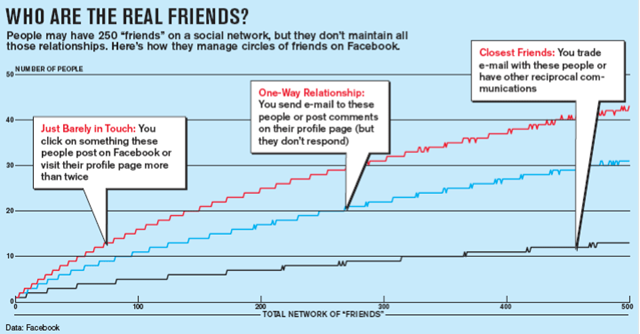
An average Facebook user with 500 friends actively follows the news on only 40 of them, communicates with 20, and keeps in close touch with about 10. Those with smaller networks follow even fewer.

image

What can this teach advertisers? People don’t pay much attention to most of their online friends. By focusing campaigns on people who interact with each other, they’ll likely get better results.

In an industry where the majority of ads go unclicked, even a small boost can make a big difference. In one market test, tailoring offers based on friends’ responses helped lift the average click rate from 0.9% to 2.7%. Although 97.3% of the people surfed past the ads, the click rate still tripled.

All of networked humanity mingles in avast marketplace, trading information, creating alliances, doing favors. We may not think of our connections in such mercantile terms. But for business and individuals alike, the value in online friendship is a central focus.

Full article:
http://www.businessweek.com/magazine/content/09_22/b4133032573293.htm?chan=magazine+channel_in+depth

Jumping over the limbo bar …

June 11, 2009

Back on Feb. 16, I suggested a stake in the ground for measuring the success of Team Obama’s stimulus spending –- namely,  the 8% to 8.5% unemployment rate that economists were predicting under a “do nothing” scenario. 

Well, now that unemployment has blown past 9%, the “saved or created” math is getting pretty creative to say the least …  and the shaky argument “it would have been even worse” is taking center stage.

Below is a reprise of the original post.

* * * * *

Obama’s team sets the stimulus bar at limbo level …”,

Obama says the trillion dollar pork-laden, faux stimulative program will “save or create up to 4 million jobs”.

Last week, I pointed out that “up to” provides mucho definitional cover by itself, but that the serious wiggle room comes from “jobs saved” — a comparison against some fabricated “what if” number.

Well, the fabricated “what if” number is already being planted:

Austan Goolsbee, one of Obama’s chief economic advisers, says  he’ll consider the effort successful if the worst scenarios don’t come to pass, “if by the end of 2009 we aren’t looking at GDP numbers that are huge negatives, if unemployment rises to the 8% range rather than the 11% that some are predicting.”

I can’t find any non-Obama paid economist saying 11%.  Most economists are saying that the unemployment rate will peak in the range of 8 to 8.5% if we do nothing.  Apparently, Team Obama is prepared to declare success (i.e. claim millions of jobs saved) is the stimulus plan does about as well as doing nothing. The jobs saved will be calculated against a disaster scenario that they’ll specify, thank you.

In other words, a victory party is guaranteed …

* * * * *
Reference for Goolsbee quote:
http://money.cnn.com/2009/02/13/news/economy/easton_economicteam.fortune/index.htm?postversion=2009021310

Original post:
https://kenhoma.wordpress.com/2009/02/16/obamas-team-sets-the-stimulus-bar-at-limbo-level/

Brand equity moves to the fast lane … Penske buys Saturn

June 10, 2009

Ken’s Take:  I’ve posted a couple of times that I think GM made a huge mistake by failing to capitalize on the early brand success of Saturn … and that Government Motors blundered by ditching the brand  instead of using it as the umbrella brand for eco-cars. 

It will be interesting to see how well Penske is able to leverage the Saturn brand. 

My bet: Saturn will flourish, GM’s stable of passe brands will continue to fade.

* * * * *

Excerpted from Business Week, “Penske to Buy Saturn from GM”, June 5, 2009

Roger Penske , a legendary figure in auto racing, is about to take on a decidedly less racy piece of Detroit.  Penske will buy GM’s Saturn brand of passenger cars and SUVs .… The racing legend and car-dealership magnate – who owns 310 retail automotive franchises and 25 collision repair centers — will have other automakers build the vehicles while he handles sales, service, and marketing … the brand that 25 years ago was supposed to transform GM.

GM Chairman Roger Smith first unveiled the Saturn idea in November 1983, describing it as a revolutionary new way to build and sell small cars in America. But the project was slow to develop and the brand did not officially launch until 1990. It featured the well-known tagline: “A different kind of car company.”

GM hoped Saturn would lure younger buyers away from imports with smaller, hipper cars. The new factory in Spring Hill had more flexible work rules than traditional GM plants. But despite the cult-like following that grew up around Saturn, the brand never made money for GM. The factory stopped making Saturns in 2007 .

“This is still a good business and we are going to make it better,” Penske says.

Penske’s auto businesses run the gamut from exclusive distribution of the tiny Smart cars in the U.S. for Daimler-Benz to worldwide car and truck dealerships representing 40 different brands.

Despite boasting one of the most honored sedans on the road today, the Aura, and the highly acclaimed Outlook SUV, Saturn’s overall sales have been falling.

The unit has been a thorn in GM’s side for years. It started out with a bang, created from scratch in the 1980s to compete with Japanese small cars and inject entrepreneurial spirit into a lethargic company. Its cars were sold in upgraded dealerships that fostered a sense of community; thousands of customers would flock each year for a reunion at the Saturn factory in Spring Hill, Tenn.

But GM starved the brand of competitive new products throughout the 1990s. By the time management tried to reinvigorate Saturn with new car designs after 2000, the brand’s image had taken a huge hit.

“When Saturn launched in the 1980s, it was the new, new thing, with the best dealer service and no-haggle pricing that put customers at ease,  But in recent years, it has just been another GM division, operating the same as Chevy or Pontiac, with nothing to differentiate it and a marketing message that keeps changing, so that people haven’t been able to get a handle on what the brand is supposed to be.”

Saturn sales are down almost 60% this year, worse than most other brands. Consumer demand has waned, especially since GM made it clear earlier this year that it would sell the brand. At the current pace, fewer than 100,000 Saturns will sell this year. The brand, said Penske, should be able to rebound toward the 200,000 level it enjoyed, on average, during the last five years. 

Penske thinks he can change that. “We will be able to bring totally fresh and unique product to Saturn, and we can leverage what is still an excellent dealer network and the fact that we have no legacy costs to worry about”.

As romantic as owning a car company sounds, Penske rattled off more rational reasons for buying the business from GM. He pointed to the fact that some 3.5 million Saturn customers have vehicles on the road today, meaning that he can count on steady demand for parts. Also, Saturn’s more than 300 dealers have modern, up-to-date facilities and sell only Saturn vehicles. “It is incredibly valuable to have an established business like this without all the legacy costs GM had to worry about covering.” 

First off, he won’t own any manufacturing plants. All production will be outsourced.  Saturn will continue to buy today’s vehicles from GM for at least two years. Penske will talk to other auto manufacturers in Europe and Asia about supplying new products after that.   Auto companies have far more manufacturing capacity than they need, so all would be eager to add Saturn’s current sales volume to their factories. “Our success has been with handling the business that is closest to the customer, so I don’t want us to get into our own manufacturing business.”

As Penske looks to replace models … he will solicit designs from that company—or perhaps from a contracted design studio—for a plan that differentiates the vehicle from any the manufacturer is selling under its own name. 

Full article:
http://www.businessweek.com/bwdaily/dnflash/content/jun2009/db2009065_956038.htm?chan=top+news_top+news+index+-+temp_news+%2B+analysis

There is a precedent for Government Motors … AMTRAK

June 9, 2009

Summary: According to Rasmussen. only 26% of Americans applaud the GM bailout.  (For reference,  17% favor boycotting GM cars as a form of protest.}

Why the low level of support?  Perhaps because folks older than Obama remember a similar experience with Amtrak.  Amtrak was supposed to turn a tidy profit,  but taxpayers are still sinking billions of dollars into Amtrak—almost 40 years after buying it.

Economist James Langenfeld says the bailout of GM will be an even bigger disaster.

* * * * *

Excerpted from The daily Beast,  “Is GM the New Amtrak?”. James Langenfeld,  June 5, 2009

Both Congress and the Obama administration apparently believe a bailout is best for GM, and that “what’s good for General Motors” is still good for America. So we taxpayers appear to be on the brink of owning most of GM. Do we know what we are buying, how long we will own it, and what it will really cost? Perhaps we can learn some lessons from another government owned company, the National Rail Passenger Corporation—aka Amtrak. The Amtrak experience raises many issues about the future of GM.

In the 1960s, private railroads wanted to dump their unprofitable intercity passenger service and concentrate on their more-profitable freight service. So in 1971 the U.S. government obliged them by creating Amtrak.

The talk then was all about becoming profitable, but the reality has been anything but. Amtrak is now 38 years old, and shows no sign of moving out of the taxpayer’s house.

The government gives Amtrak about $1.5 billion per year, not including an additional $1.3 billion from the recently passed American Recovery and Reinvestment Act. These figures may seem small compared to the $50 billion recently plowed into GM, but Amtrak subsidies amount to $85,000 a year for each Amtrak employee, or about $35 every time Amtrak sells a ticket.

Bottom line: It costs taxpayers about $1.40 for every $1 of revenue Amtrak takes in.

President Obama and his administration seem to understand that creating another Amtrak is not promising. They speak in one voice about not wanting to run a car company, not planning on micromanaging the company, and selling the government’s stake as soon as possible. All good thoughts, but these same officials cannot provide any timetable for getting out the car business.

Moreover, there are early signs that GM may have many of the same problems that Amtrak has faced and we may very well end up with GMtrak. 

http://www.thedailybeast.com/blogs-and-stories/2009-06-05/is-gm-the-new-amtrak/?cid=bs:archive4
Dr. James Langenfeld is a director at the economics consulting firm LECG and teaches at Loyola University Chicago. Previously he was a senior economist at General Motors and an analyst at Amtrak.

Hmmm … Obama’s PAI goes from plus 10 to zero in a week

June 8, 2009

Last Monday, I posted that Rasmussen – the daily tracking poll that I follow – reported Obama’s PAI (Presidential Approval Index – the difference between likely voters who “strongly approve” and those who “strongly disapprove”) soared to +10,.  That is, 34% strongly approved, 24% strongly disapproved.  Pundits attributed the gain – up from low single digits – to a Sotomayer “bounce”.

Well, last Friday’s Rasmussen Report pegged Obama’s PAI at zero – 34% strongly approved, 34% strongly disapproved.  A huge change. 

While the polling data may just be statistical noise,  some pundits point to the GM deal – which is only favored by about 1 in 4 people – and, the President’s Mid East tour – which gave Iran the OK for “peaceful” nuclear development and, seemed to some, to throw Israel under the bus.

Over the weekend, Obama’s PAI bounced back a little to +3 – 35% to 32%.

The PAI’s underlying demographics are interesting (and under-reported):

Obama’s PAI is plus 66 among blacks (65% to 4%), plus 13 among “others” (38% to 25%), and minus 8 among whites (29% to 37%).

Obamas’ PAI among Dems is a sky-high plus 54 (64% to 10%), minus 11 among Independents (23% to 34%), and minus 47 among GOPers (10% to 67%).

Rasmussen pegs Obama’s overall approval – the sum of strongly and somewhat approve – at 53%.

Hmmmm …. Key groups to watch: the Independents and “others”

* * * * *

Statistical note: Rasmussen surveys “likely voters”.  Polls that broaden the sample to “registered voters” or “all adults” tend to be more favorable to President Obama.

http://www.rasmussenreports.com/public_content/politics/obama_administration/daily_presidential_tracking_poll

What if Team Obama is wrong about healthcare ?

June 8, 2009

Ken’s Take: I agree that all US citizens should have access to healthcare, and I agree that healthcare spending is out of control.  But,  I really don’t want DMV-like government workers determining what medical services I get, where I get them, and when I get them (if at all).

Below are headlines from a WSJ piece that questions the fundamental assumptions underlying the Obama plan.

Note that neither the Obama plan nor the WSJ ideas address structural change like free (or low charge) clinics to handle routine medical care, or tort reform to minimize frivolus malpractice claims and the redundant services that they induce.

* * * * *

Excerpted from WSJ, “Obama’s Health Cost Illusion”, June 8, 2009

The President’s main case for reform is rooted in false claims and little evidence.

The main White House argument for health-care reform goes something like this: If we spend now on a hugely expensive new insurance program for the middle class, we can save later by reducing overall U.S. health spending.

What if this particular theory turns out to be a political illusion? What if the speculative cost savings never report for duty, while the federal balance sheet is still swamped with new social obligations that will be impossible to repeal? The only possible outcome will be the nationalization of U.S. health markets, which will mean that almost all care will be rationed by politics.

* * *
Since Medicare was created in 1965, U.S. health spending has risen about 2.7% faster than the economy and on current trend would hit 20% of GDP within a decade.

Now the White House claims the magic key is the dramatic variations in per patient health spending among U.S. regions. Often there is no relationship between spending and the quality of care, according to a vast body of academic research.  

But, Richard Cooper, a professor of medicine at the University of Pennsylvania’s Wharton School, has studied regional variation in aggregate health spending, and found that the areas with the highest quality spend the most on medicine.

* * * * *

Obama’s ideas include more health information technology; emphasizing prevention and healthy living; rejiggering reimbursement policies so doctors and hospitals are paid more for quality care; and funding federal research that compares the effectiveness of medical treatments. There is scant evidence that any of them will ever save real money.

* * * * *

According to Team Obama:  “Future increases in spending could be moderated if costly new medical services were adopted more selectively in the future than they have been in the past and if the diffusion of existing costly services was slowed.”

But technological change is the most important driver of health spending. Modern medicine can do so much more than it could in the past, but this costs a lot even as it has bought a lot in extending and improving lives. In a 2001 study, the estimated benefits of lower infant mortality and better treatment of heart attacks “have been sufficiently great that they alone are about equal to the entire cost increase for medical care over time.”

* * * * *
A far better alternative is to increase individual responsibility for medical decisions.

In 1965, the average American paid more than half of his health care out of pocket. Spending has since increased sevenfold, but the amount that consumers pay directly hasn’t even doubled. When people aren’t exposed to the true cost of their care  — they consume more care.

Roughly half of the real increase in U.S. health spending between 1950 and 1990 is due to Medicare and the spread of third-party, first-dollar insurance.

Increasing cost-sharing would discipline the health spending curve and give it a more rational bent. The U.S. health cost “crisis” is that we spend so much without incentives to weigh the costs against the benefits.

Yet the entire Obama agenda is about increasing political, rather than individual, control of the health markets.

Full article http://online.wsj.com/article/SB124442772329993085.html

Higher MPGs, More Miles Driven … hmmm

June 5, 2009

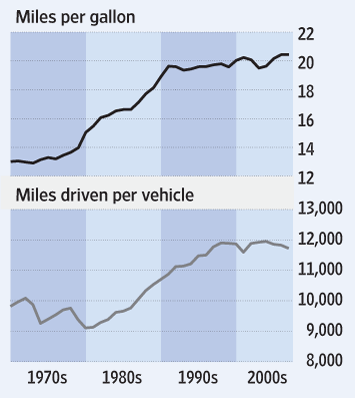
Ken’s Take: A couple analyses I did last summer suggested that people drive more when they get higher MPG from their vehicles … largely (or completely) offsetting the efficiency gain.

image

http://online.wsj.com/article/SB124338431100556717.html?mod=djemalert

Here are a couple of articles citing studies going back to the 19th century that draw the same conclusion.

* * * * *

Excerpted from Heritage Foundation, “Why the Government’s CAFE Standards for Fuel Efficiency Should Be Repealed, not Increased”, July 11, 2001

Clearly, the CAFE program has failed to accomplish its purposes. Consumption has not decreased.

As fuel efficiency improves, consumers have generally increased their driving, offsetting nearly all the gains in fuel efficiency.

Advocates of higher CAFE standards argue that increasing miles per gallon will reduce gas consumption. What they fail to mention is the well-known “rebound effect”–greater energy efficiency leads to greater energy consumption.

As more fuel-efficient vehicle costs less to drive per mile, so vehicle mileage increases.

Since 1970, the United States has made cars almost 50% more efficient; in that period of time, the average number of miles a person drives has doubled.
http://www.heritage.org/Research/EnergyandEnvironment/BG1458.cfm

* * * * *

Interesting Historical Perspective

Excerpted from WSJ: “The rebound effect: Conservation Wastes Energy,”  May 17, 2001

Way back in the 19th century, English economist Stanley Jevons embarked on a study of coal and its consumption. He was intrigued by the introduction of James Watt’s new, efficient steam engine, which began replacing older, more energy-hungry engines.

Jevons found that in Scotland (Watt’s native land), coal consumption was initially reduced by one-third. But in the ensuing years of 1830 to 1863, there was a tenfold increase in consumption. Why? The engines were so much cheaper to run that people used them far more than they ever would have before. Greater efficiency had produced more energy use, not less.

The same arguments apply to government-mandated energy efficiencies today.

Since 1970, the U.S. has made cars almost 50% more efficient; in that period of time, the average number of miles a person drives has doubled. Studies show that when consumers buy more energy-efficient air conditioners, they run them longer because it still costs the same amount.

Consumers, in short, spend to the size of their billfolds.

And that is the failing of government-led demand reduction.

There is only one thing that convinces Americans that they should conserve — market prices. Only when gas prices start to pinch will Americans drive less or hunt for smaller cars.
http://www.opinionjournal.com/columnists/kstrassel/?id=95000484

* * * * *
Want more from the Homa Files?
     Click link =>
  The Homa Files Blog

Dear friends networking on cheap phones … works for me.

June 5, 2009

Excerpted from WSJ, “Networking Sites Extend Reach:  Handset Makers Ramp Up Ways to Tap Broader Cellphone Market” by Amol Sharma and Jessica E. Vascellaro, May 28, 2009

Social-networking sites like Facebook and MySpace are popular services on high-end cellphones like the iPhone and the BlackBerry. But extending their reach to the broader wireless market has been challenging, because most basic phones tend to have clunky Web browsers and can’t support fancy software. Now, handset makers and wireless carriers are ramping up efforts to tap the mass market.

Manufacturers such as INQ Mobile Ltd. and Samsung Electronics Co. are rolling out midrange cellphones tailored to social-networking software, with some features of smart phones but lower prices.  Carriers including AT&T Inc. and Sprint Nextel Corp. are trying to improve access to the services by upgrading browsers on regular cellphones and integrating Web-based applications …they are trying to improve access to the services via the Web, which allows users to perform tasks they can’t perform with text messaging, such as viewing a friend’s profile. Sprint, for example, will soon begin selling the Samsung Exclaim, which will include one-click access to simplified, preloaded software applications for Facebook, MySpace and Twitter. It will sell in the U.S. for less than $100 after a rebate, the company said. AT&T is undertaking a project to overhaul its mobile home page, better integrate search and use an advanced browser…

Social networks, including MySpace and Facebook, are helping wireless carriers tailor their services to mass-market phones…


Edit by TJS

* * * * *

Full Article:
http://online.wsj.com/article/SB124345957503159855.html

* * * * *

Want more from the Homa Files?
Click link =>
The Homa Files Blog


What’s private equity without equity? hmmm…

June 4, 2009

When money was cheap and freely available, private equity firms were among  the (unregulated) darlings of wall Street.  My, how times have changed.

KKR – one of the biggies – was (is) planning an IPO. business overview.  So, they provided a public overview last weekend. 

CNBC reports:

KKR had an adjusted pre-tax loss of $1.19 billion in 2008 while its assets under management dropped by 11 percent.

The firm still has $15 billion in capital it has yet to invest in deals, but …  “Given that private equity can’t get financing for deals of more than $2 billion if they’re lucky, it could be a while until KKR works off all that capital. PE firms exists to raise money for new funds, reap the fees from those funds and quickly deploy and return the capital raised. … It’s fair to say that right now the model isn’t working that well.”

And KKR has mucho unrealized losses from the investments it made during the LBO crazed days of 2005-2007.  For example,

“Its deal to acquire First Data in September of 2007 which cost $2.325 billion is now worth almost a billion less at $1.395 billion

The world’s biggest private equity deal, the acquisition of TXU has seen the value of KKR’s equity stake decline by exactly 50 percent from $1.817 billion to $908 million.”

And it all seemed so easy …

Full article: 
http://www.cnbc.com/id/31049647

Ken’s take: The fall of GM … 3 critical mistakes.

June 3, 2009

Lots has been reported, and everybody has their point-of-view re: why GM slid from arguably the best run company in the world to bankruptcy.

Ken’s Take: the situation boils down to 3 critical mistakes: (1) making fatal concessions to the UAW in the 1970s (2) cost-cutting brands via shared models  (3) failure to leverage the Saturn brand. 

Each in turn …

* * * * *

(1) Making fatal concessions to the UAW in the 1970s

The issue: GM signed generous labor deals during the 1970s, including the right to retire after 30 years with full pension and benefits, partly because it believed the contracts would cripple its smaller competitors, Ford and Chrysler. Then along came Honda, Nissan and Toyota, which didn’t have to deal with labor contracts at all. That was the beginning of the agonizing decline.
http://online.wsj.com/article/SB124389995447074461.html

Ken’s Take: It’s popular to castigate the GM management as insular and weak-kneed.  But, in the early 1970s, GM had a commanding market share and the Japanese brands were starting to gain traction with serious cars (i.e. stepped up from the early, cheap compact models).  The UAW picked GM as its target company in negotiations, got militant and threatened to strike.  A strike at that time would’ve given the Japanese brands a clear shot at accelerating their market development efforts.  And, at the time, healthcare was relatively inexpensive and pensions were seemingly a long way off.  So, management caved – making a largely unretractable and unsustainable deal with the union.

* * * * *

(2) Cost-cutting brands via shared models 

The Issue:

While Henry Ford invented mass manufacturing, GM’s long-time president and chairman of the board, Alfred P. Sloan Jr., developed mass marketing: a “car for every purse and purpose,” as he put it in the company’s 1924 annual report. This meant a hierarchy of brands ranging from practical Chevrolets to prestigious Cadillacs.  GM’s strategy of offering a multiplicity of brands started to fray in the 1980s. To cut costs, GM began stocking its makes with nearly identical cars. That blurred the differences between brands and made it hard for consumers to tell a Chevy from a Pontiac or a Buick.
http://online.wsj.com/article/SB124390025302374483.html

Ken’s Take: Using multiple brands to niche a market is a common strategy – and one that was very successful for GM over decades.  The problem: each brand needs critical mass – enough “scale” to justify the separate overhead structures (think brand-specific plants, separate R&D centers) and to support cost-effective production.  As GM lost share to the foreign brands, their scale economies deteriorated – lower sales in aggregate and by brand.  Rather than dropping brands, GM tried to cost reduce itself out of the problem – taking product quality risks and marketing tweaked models (with shared components) under different brand names.  The result: a blurring of brand images that undermined the niche strategies.

* * * * *

(3) Failure to leverage the Saturn brand

The issue: To confront the rising threat from foreign auto makers, GM in 1985 created an entirely new brand, Saturn, at a cost of several billion dollars. It was set up as a separate car company whose mission was to win back customers who had defected to foreign makes.
http://online.wsj.com/article/SB124390025302374483.html

Ken’s Take: I differ with most pundits on this one.  They generally say that introducing Saturn was a blunder and good riddance to the brand.  I think Saturn was a brilliant concept that was simply underleveraged.  Again, think back in history.  GM was trying to develop a radically new brand –- produced in Japanese-like factories (i.e. quality oriented with fewer union constraints), sold through a separate “no haggle” dealer network that promoted product not price,  and supported with cult-like marketing (think Harley Davidson).  Initially, Saturn was a huge success – remember the much ballyhooed customer picnics at the Tennessee manufacturing plant.  But, there wasn’t a second wave of product to sustain momentum. Rather GM started dumping tweaked models into the Saturn line too. 

I think Saturn was  the platform for GM’s future, but they blew it – homogenizing it back into the GM operations and mindset. 

In fact, I’m surprised that the Saturn brand isn’t being retained to market eco-friendly Obamamobiles.  I bet the brand name still has some cachet, and a standalone dealer network – experienced in selling product not price — could be route for selling electric cars.

* * * * *

That’s my take …

KEH

Quick: How many members does Facebook have ?

June 2, 2009

Ken’s Take: I finally joined one of the social networking sites -– mostly to see pictures of my granddaughter.  I wouldn’t describe myself as hooked – but my interest in the social networking phenomenon is elevated -– so, I’ve been doing some digging.  Here’s the first post.

* * * * *

Excerpted from AudioTech Trends, May 2009

Some stats

Facebook  has 125 million members worldwide. 

On a typical day, MySpace adds 250,000 members, and draws 4.5 billion page views.

Google purchased YouTube for $1.65 billion. 

News Corp bought MySpace for $580 million. 

Microsoft purchased just 1.6 percent of Facebook for $240 million.

* * * * *

Social networking sites usually fall into one of five categories: 

The egocentric sites, such as MySpace and Facebook, allow a user to create a profile and develop a network of friends.  They are also a medium for creating a new identity — or multiple identities — and for the publication of songs, videos, photographs, writing, or other artistic expression.

Community-based networks bring together people of the same race, religion, or nation.  They tend to mirror real-world communities. BlackPlanet, for example, is a site for African Americans. 

Opportunistic social sites, such as LinkedIn, attract members who want to leverage the Web for business reasons, such as people looking for work, managers seeking job candidates, or free-lance consultants looking for clients.

Passion-centric networks are organized around a hobby or pursuits of some sort, such as people who like dogs or restore antique cars.  Almost any hobby or specialty can spawn such a site.

Media-sharing sites, such as YouTube and Flickr, exist so that people can share videos and photos.  They are more about the content than about interaction.

Source article:
http://www.trends-magazine.com/trend.php/Trend/1914/Category/42

Fewer people really listen to hip-hop … surprised ?

June 2, 2009

Excerpted from DickMorris.com, “Obama’s War on Talk Radio”, May 25, 2009

The newest data from Arbitron, the company charged with measuring the size of radio audiences, suggests that listenership to hip hop, inner city, and minority radio has been overstated in the past and that the popularity of conservative talk radio has been under-reported.

This conclusion comes from the company’s decision to dispense with the Stone Age way it has been measuring radio audiences – by hand written diaries based on listener memory – with modern machines which automatically record what the person is listening to and for how long.

Arbitron is the company tasked with rating radio listenership.  The equivalent of the Neilson television ratings, its measurements of audience share are revered like Scripture by station managers, owners, and advertisers.

Traditionally, Arbitron relied on hand written diaries.  Since the diaries were based on memory, they were often faulty.  So Arbitron availed itself of new technology in launching its Portable People Meter (PPM) – a cell phone sized unit the listener wears on his or her belt which automatically notes what station they are tuning in and when they switch or stop.

The PPM measurements concluded that hip hop, urban rock, and minority-oriented radio stations reached fewer listeners and for shorter periods of time than the diaries had indicated.  It found that talk radio had a larger listenership.

What is really at work here is an effort by the FCC to stack the deck to help … minority stations earn higher advertising revenues than those to which their real market share would entitle them. 

New York and New Jersey sued Arbitron alleging discrimination in its choice of the sample charged with wearing the PPMs. 

Now the FCC is launching its own investigation. The FCC’s acting Chairman — Michael J. Copps — announced an investigation of Arbitron’s radio measuring technology called the Portable People Meter.  

* * * * *
Want more from the Homa Files?
     Click link =>
  The Homa Files Blog

Your cellphone will keep you connected … with companies trying to sell you something.

June 2, 2009

Summary: The jargon is “mobile marketing” — marketers placing ads, coupons, reminders, and links in and around your cellphone apps.  It’s the next wave of innovative marketing and will spread quickly.  Why? Because it seems to work.

* * * * *

Excerpted from Business Week, “Pandora: Unleashing Mobile Phone Ads: Kraft, Nike, and others are getting results advertising on Pandora’s mobile music service. Is cell-phone marketing finally taking off?” By Tom Lowry, May 21, 2009

It’s just a matter of time until mobile marketing will take off in the U.S.  … for two reasons: Web-surfing smartphones are selling briskly even in a downturn, and applications for those gadgets … are proliferating.

People are spending a lot more time playing games, watching TV, and shopping on their phones. That’s what marketers call engagement, a fancy way of saying people are paying attention. Companies, of course, prize that, so they’re looking for mobile applications that are a good fit for their brands.

Which brings us to Pandora, a nine-year-old, free online service that lets users design “radio stations” based on their musical preferences. Since Pandora launched a mobile edition two years ago, it has signed up 6 million people…That has prompted the likes of Best Buy, Dockers, Target, and Nike to buy ads on Pandora and experiment with what remains a cheap advertising medium

“Marketers, especially consumer brands, have to take mobile seriously now. You have to be where your customer works, lives, and plays.”

Pandora has become a test bed because people who use the service tend to spend a lot of time playing around with it. They are constantly creating stations, rating songs, and scrolling through playlists to find artists they don’t know … on average subscribers use the mobile service about 90 minutes a day (though there are no independent numbers).

Advertisers are trying out Pandora in myriad ways. Sometimes it’s as a direct marketing tool. Domino’s, for example, puts up ads that urge people to call in for a pizza directly from their phones.

Other companies are using coupons. Docker’s offered a 20% discount if visitors went to the brand’s site and entered a promotional code .

Some companies prompt users to watch movie clips where their products are featured prominently.

If one thing has surprised advertisers, it’s how avidly consumers are responding. Target says 27% more people clicked on its ad for the release of Christina Aguilera’s greatest hits CD last fall than on any other mobile Web campaign. The ad urged users to visit a site where they could get a free Aguilera ringtone and buy the album…

Sonos, which sells home music systems, just wrapped up a campaign on Pandora. DeAnna Wassom, Sonos’ senior marketing director, says she has never seen better customer response in her 20 years in the business. The ads asked people to click through to a promotional video. Typically, only 1% to 2% of people click on ads overall. But nearly 5% clicked in this case…and almost 40% of those clicking watched the entire video. During the campaign, nearly twice as many people asked to be put on Sonos’ e-mail list as those signing up on the company’s regular site.

Most brands have no clue how to market on mobile devices. Many try to do too much, including making sites so technologically flashy that they crash phones. The key is to keep it simplebuild special mobile sites, because regular ones don’t translate well to supersmall screens.

Edit by TJS

* * * * *

Full Article:
http://www.businessweek.com/magazine/content/09_22/b4133052597112.htm

* * * * *

Want more from the Homa Files?
Click link =>
The Homa Files Blog


OK, OK … Obama got a PAI bounce

June 1, 2009

What a difference a week makes.  I gleefully report when Obama’s PAI dips into the low single digits.

But, to be even handed, I have to fess up when he builds support.

This weekend, Rasmussen (the only poll I believe in) reports that 36% of the nation’s voters now Strongly Approve of the way that Obama is performing his role as President … 26% Strongly Disapprove  … giving Obama a Presidential Approval Index rating of +10  … up from +1 last weekend. 

My hunch: the Sotomayer pick solidified Hispanics support.  Certainly wasn’t going all in on GM …


image

http://www.rasmussenreports.com/public_content/politics/obama_administration/daily_presidential_tracking_poll

Re: the economy, keep your eyes on bondholders and bond buyers …

May 29, 2009

Ken’s Take: Team Obama thought it was a good idea to screw Chrysler bondholders (secured creditors) un favor of the UAW (unsecured “junior” creditors), and has assumed that investors (mostly the Chinese) would continue soaking up US Treasury bonds to fund the current spending spree. 

Now, Treasury bond yields are soaring.  A function of the massive amount of debt being put on the books, and the realization that the rules re: the security of bond offerings is subject to government whims.  This is going yo become a big story …

* * * * *

Excerpted from WSJ: “The Bond Vigilantes”, May 28, 2009

Treasury yields leapt again yesterday at the long end, with the 10-year note climbing above 3.7%, its highest close since November. Treasury yields had stayed low, and the dollar had remained strong,

As risk aversion subsides, and investors return to corporate bonds and other assets, investors are now calculating the risks of renewed dollar inflation.

They have cause to be worried, given Washington’s astonishing bet on fiscal and monetary reflation. The Obama Administration’s epic spending spree means the Treasury will have to float trillions of dollars in new debt in the next two or three years alone.

No wonder the Chinese and other dollar asset holders are nervous. They wonder — as do we — whether the unspoken Beltway strategy is to pay off this debt by inflating away its value.

The surge in the 10-year note is especially notable because its rate helps to determine mortgage lending rates, and the Fed is desperate to keep mortgage rates low to reflate the housing market,.

Full article
http://online.wsj.com/article/SB124347148949660783.html

AOL down to 6.3 million dial-up subscribers … (none of whom are loyal readers of the Homa Files)

May 29, 2009

Ken’s Take: AOL was sitting on a golden goose … one that still generates about $1.5 billion in annual subscription revenue.

AOL.com and related properties claim over 100 million unique visitors each month  —   that’s about 1 of every 3 US citizens.

Was a great business … still is a good business … but slipping away.

* * * * *

Excerpted from Standard.net, ” AOL reboot? “, May 24, 2009

The dial-up Internet service was AOL’s backbone. At its peak, in 2002, AOL had 26.7 million dial-up subscribers. Even as recently as 2006, dial-up was a $5.78 billion business for AOL.

But consumers have flocked to speedier offerings. Last year AOL’s Internet access revenue was down to $1.93 billion, and now AOL counts just 6.3 million dial-up subscribers.

AOL’s various online properties averaged 106 million unique U.S. visitors each month during the first quarter. That ranked AOL fourth; Google, Yahoo and Microsoft Corp. were first, second and third.

But AOL was the only member of this Web top four to see a year-over-year drop in traffic in the first three months of the year. It had averaged 110 million visitors in the first quarter of 2008.

And while AOL’s operating income totaled $150 million in the first quarter, that was a 47 percent fall from the year-ago quarter.

Full article:
http://www.standard.net/live/business/174069

* * * * *
Want more from the Homa Files?
     Click link =>
  The Homa Files Blog

Remember the mortgage loan modifications that were supposed to slow foreclosures?

May 28, 2009

Ken’s Take:  Wasn’t a fan of the rush to modify deadbeats’ loans to “keep then in their homes” … pointed out several times that most of these folks made no downpayment and never built any equity in the homes.  They aren’t “owners”, they’re simply “occupants”.  No surprise that the modification program had little impact.

* * * * *

Excerpted from WSJ: “Foregone Foreclosures”, MAY 27, 2009

A central tenet of Washington economic policy for the past three years has been that the key to ending the recession is stopping mortgage foreclosures, whatever the cost.

Well, a new study shows that … mortgages are continuing to sour at a rate nearly as fast as they can be modified.

Fitch Ratings looked at mortgages bundled into securities between 2005 and 2007 and managed by some 30 mortgage companies. Fitch found that a conservative projection was that between 65% and 75% of modified subprime loans will fall delinquent by 60 days or more within 12 months of having been modified to keep the borrowers in their homes.

Even loans whose principal was reduced by as much as 20% were still redefaulting in a range of 30% to 40% after 12 months.

The reasons for the high redefault rate aren’t surprising. Many of the borrowers never could afford these homes in the first place.  And, and as home prices continue to fall in some markets, borrowers remain underwater and many of them simply walk away from the home and thus redefault.

This study has to come as a blow to the Federal Deposit Insurance Corporation, which has invested a great deal of political capital in the modification thesis.

On the evidence so far, the mortgage modification fervor has been a giant political exercise with little impact on housing prices.

http://online.wsj.com/article/SB124338503008056785.html#printMode

* * * * *
Want more from the Homa Files?
     Click link =>
  The Homa Files Blog

Uh-oh … Obama’s PAI slips to the lowest since inauguration … down to one slim point

May 27, 2009

According to the Rasmussen Survey reported on Tuesday, May 26, 2009

31% of the nation’s voters now Strongly Approve of the way that Barack Obama is performing his role as President.

30% Strongly Disapprove of the way that Barack Obama is performing his role as President.

The Presidential Approval Index (PAI) is calculated by subtracting the number who Strongly Disapprove from the number who Strongly Approve.

So, Obama’s a Presidential Approval Index rating is +1. That’s the lowest positive rating yet received by the new President (

image

I\Rasmussen notes that it will take several more days to determine whether these low ratings are merely statistical noise or a reflection of shifting perceptions.

Full article:
http://www.rasmussenreports.com/public_content/politics/obama_administration/daily_presidential_tracking_poll
* * * * *
Want more from the Homa Files?
     Click link =>
  The Homa Files Blog

Great moments in transparency: Recovery.gov

May 26, 2009

Ken’s Take: Did anybody really expect that the pork-laden, faux stimulus package would be “transparent”? 

* * * * *
According to USA TODAY:

Although President Obama has vowed that citizens will be able to track “every dime” of the $787 billion stimulus bill, a government website dedicated to the spending won’t  be complete until next spring — halfway through the program,

Recovery.gov now lists programs being funded by the stimulus money, but provides no details on who received the grants and contracts.

The site currently lists total amounts available and already spent — as of last week, $72.2 billion available and $15.4 billion spent. There’s also an interactive map showing allocations for each state.

After the first data become available in October, the plan’s watchdog board will wait six to nine months for the White House Office of Management and Budget to issue new guidance on how far down the spending chain the money must be tracked.

People accustomed to getting easily searchable information quickly could be frustrated …  

Executives at Onvia, which collects government contracting information for its clients, are skeptical that recovery.gov can meet the administration’s stated goals.  “It’s really, really hard.”

Full article:
http://www.usatoday.com/tech/news/techpolicy/2009-05-06-stimulus_N.htm

* * * * *
Want more from the Homa Files?
     Click link =>
  The Homa Files Blog

Obamamobiles: Second order effects and unintended consequences

May 22, 2009

Ken’s Take: One of my criticisms of Team Obama is their unwillingness (or inability) to think beyond proclamations and “first steps”.  Think: close Gitmo, so where to put them.?  

Same applies to the arbitrary raising of CAFE standards, which is guaranteed to cost lives, and arguably, will increase pollution — at least in the short-run.

If you want to cut gas consumption, slap on a gas tax — that’ll get people driving fewer miles — fewer miles = less gas, fewer deaths.

* * * * *
Excerpted from WSJ, “Light Cars Are Dangerous Cars “,  May 22, 2009

Obama’s new CAFE rules could impose substantial costs in terms of urban air pollution and human life.

The great irony of Mr. Obama’s fuel efficiency proposals is that they may worsen emissions of these harmful gases.

In today’s automobile fleet, the majority of the pollution comes from the oldest, dirtiest cars. In fact, the dirtiest 10% of the cars account for more than 50% of smog and carbon monoxide. The dirtiest one-third of the fleet accounts for more than 80% of the pollution.

By the White House’s own calculation, the new rules will  increase the average price of a new car by $1,300. Herein lies the problem.

If you raise the price of new cars, people will buy fewer of them or, at a minimum, put off the purchase for a year or so while they drive the old clunker for a few thousand more miles. And fewer new cars means more pollution, which can cause significant health problems.

The Obama fuel efficiency plan may also contribute to a significant increase in highway deaths as vehicles are required to quickly meet the new CAFE standard and will likely become lighter in weight as a result.

An NRC study estimated that  between 1,300 and 2,600 motor vehicle crash deaths per year would not have occur if cars were as heavy as they were in 1976.

It is likely that down-weighting of cars will be an important means of meeting the new standard. And one result again could be highway deaths that might otherwise not have occurred.

One might argue, this “death effect” would not be the case if everyone drove smaller cars … but, nearly half of all car crashes  are one-vehicle crashes. Put another way: If your car hits a tree or a post or a bridge abutment, you are most certainly better off in a larger car.

Full article:
http://online.wsj.com/article/SB124294901851445311.html#mod=djemEditorialPage
* * * * *
Want more from the Homa Files?
     Click link =>
  The Homa Files Blog

The difference between pep rallies and touchdowns …

May 21, 2009

Is it just me, or is Team Obama having trouble getting the ball (make that balls) into the end zone?

Let’s start small: Roland Burris.  Team Obama called on him to do the right thing and resign.  Well, Sen. Burris is still alive and well and  casting votes.

On bigger issues:

Has the rate of foreclosures slowed? Nope.  Last month was they wre the highest ever.

Have toxic assets been taken off any bank books?  Nope.  Just a bunch of jockeying for position in the public-private partnerships.

Is credit flowing again? Nope.  Despite lots of money being pumped into the system, credit is tight — very tight.

Has the economy been stimulated? Except for the tenuous logic of “jobs saved”, it sure doesn’t seem like it.

Are GM and Chrysler on the road to automaker viability? Please, get serious.

Is Gitmo shutting down?  Well, Congressional Dems seem to be saying no.

Are our troops coming home?  Nope.  Iraq’s still on the Bush timetable, and Afghanistan (the “right war”) is shaping up as a quagmire (as it was for the Russians).

My conclusion: campaigning is way easier than governing.  The issues are way more complex that the soundbites.  It’s way easier to talk a good game than to play a good game.

Bold proclamations are motivating, but eventually, you gotta put some points on the board.

* * * * *
Want more from the Homa Files?
     Click link =>
  The Homa Files Blog

Tougher CAFE Standards … and Behavioral Economics

May 20, 2009

OK, put one in the win column: Pres. Obama fiated that passenger cars must get almost 40 MPG by 2016 … cutting dependence on foreign oil and lowering greenhouse gases.

Not so fast.

Key questions: will Americans flock to buy premium priced mini-cars that have, shall we say, safety issues?

The price premium will be taxed away — take it to the bank that there will be a taxpayer subsidy for the purchase of Obamamobiles to neutralize the economic disadvantages (and make Obama Motors Inc. look like it’s turning a profit).

My opinion, the safety issue looms large.  There’ll be plenty of SUVs on the road for the next couple of years.  In a collision, Smart cars aren’t going to look that smart.  (Note: most policy makers think only of major metro areas, not  the open roads — where hybrids have insignificant fuel advantages).

Unmentioned in the press today, is the question: will higher MPGs actually cut gas consumption.  That’s not obvious to me   Gas consumption is a function of MPG and miles driven.  Past history says that when MPG goes up, people drive more.  Why not?  They can stretch their fuel budget further.

So, how to reduce gas consumption and emissions?  The proven answer is a gas tax.  Works in Europe.  When gas prices got to $4 in the U.S., folks slowed down and drove less. 

Sure, a gas tax would be a political challenge.  But, isn’t Obama supposed to be the agent of bold strokes and meaningful change.

If yes, why is he simply recycling and an old idea that probably won’t make a whit of difference?

* * * * *
Want more from the Homa Files?
     Click link =>
  The Homa Files Blog

Marketing Budget Cuts At the Box Office

May 20, 2009

Excerpted from LA Times, “Studios struggle to rein in movie marketing costs” By Claudia Eller, Apr 20, 2009

* * * * *

You know times are getting tough in the movie business when an entourage of studio executives, instead of flying by private jet to Sacramento to attend a screening, is forced to ride-share … Along with hosting fewer lavish premiere parties, curtailing newspaper advertisements and restricting the number of agencies that produce trailers, the Hollywood studios are struggling to get a grip on the movie industry’s equivalent of the pork barrel earmark: marketing budgets.

And like an entitlement program that can’t be axed, Hollywood isn’t having much success … Studio executives contend that if they want to get out the word to the public about their movies, they have to pony up … “Every film launch is a new-product release …we can’t jeopardize successfully opening these pictures” …

One bit of good news is that the depressed economy has apparently not stopped people from going to movie theaters. Ticket sales are up 17.3% this year from a year earlier, and attendance is up 15.6%.

As the studios have flooded theaters in recent years with an increased number of releases, they have been forced to spend more on marketing as they jostle for the attention of moviegoers. Although studios have begun to reduce the numbers of films they make and squeeze the fees they pay talent, marketing costs have largely escaped the scythe.

After falling from a peak of $40 million in 2003, the average marketing cost for a studio picture popped back up again to $36 million in 2007

But executives say it’s hard to know exactly where to trim marketing costs because they fear spending too little could hurt a movie’s chances at the box office. A picture basically gets one shot to make a mark on opening weekend; if it doesn’t gain traction with audiences, it will be knocked out of the way on subsequent weekends by the next films opening up behind it … As a result, when it comes to cutting marketing costs, the studios have been largely confined to trimming the edges …

Buying commercial time to advertise a movie on network and cable TV remains the biggest marketing expense for the studios … Despite the recession, studios still spent as much as $3 million for each 30-second spot for 10 movies … that aired on the Super Bowl telecast in February.

For the same reason, companies defend their multimillion-dollar Super Bowl ads because of the huge audience the game delivers — about 100 million viewers — and argue that they can’t afford to cut back on network TV ads, even though viewership is declining …

One major contributor to rising marketing costs is the fragmentation of media, which makes it harder to reach an audience. The long-ago three TV network era has given way to an abundance of broadcast and cable channels and Internet sites …

With no end in sight for the recession or the economic pressure that the studios are under to shore up their bottom lines, marketing costs may finally get the same scrutiny as movie production budgets.

“Marketing is really an integral part of this business and always has been as far back as the barkers who used to stand out in front of the nickelodeon theaters and try to get people to come in … we just have to be smarter about it and try to get as much bang for our buck as we can.”

Edit by SAC

* * * * *

Full Article:
http://www.latimes.com/business/la-fi-ct-movies20-2009apr20,0,4008012.story?track=rss

* * * * *

Want more from the Homa Files?
Click link =>
The Homa Files Blog

Anybody concerned about the national debt ?

May 19, 2009

Ken’s Take: Next to the government just flat out wasting money, my worry is the burgeoning debt.  Some debt – ok.  But, staggering levels not ok.

When I ask students why they’re unfazed, they admit that the sums are so large that “it’s more like Monopoly money” or”payback is so far off that’s it’s not worth worrying about”.

Somebody is eventually going to have to pay the piper …

* * * * *

Excerpted from IBD, “Why No Focus On Huge Ongoing Debt?”,
May 15, 2009

Since 1961 the federal budget has run deficits in all but five years. But the resulting government debt has consistently remained below 50% of GDP; that’s the equivalent of a household with $100,000 of income having a $50,000 debt. Adverse economic effects, if any, were modest.

From 2010 to 2019, Team Obama projects deficits totaling $7.1 trillion; that’s atop the $1.8 trillion deficit for 2009.

By 2019, the ratio of publicly held federal debt to gross domestic product (GDP, or the economy) would reach 70%, up from 41% in 2008.

The CBO, using less optimistic economic forecasts, raises these estimates. The 2010-19 deficits would total $9.3 trillion; the debt-to-GDP ratio in 2019 would be 82%.

By CBO’s estimates, interest on the debt as a share of federal spending will double between 2008 and 2019, from 8% of the total to 16%.

One reason Obama is so popular is that he has promised almost everyone lower taxes and higher spending. The president doesn’t want to confront Americans with choices between lower spending and higher taxes — or, given the existing deficits, perhaps less spending and more taxes.

Closing future deficits with either tax increases or spending cuts would require gigantic changes.

Full article:
http://www.ibdeditorials.com/IBDArticles.aspx?id=327285979616580

* * * * *
Want more from the Homa Files?
     Click link =>
  The Homa Files Blog

Gov’t healthcare bureaucrats say: "Stick in up your %#@" … literally

May 19, 2009

Excerpted from WSJ, ” How Washington Rations ObamaCare: a case study in ‘cost-control”, May 19, 2009

Here’s a preview of how health care will be rationed under a nationalized plan with a federal health board making Solomonic decisions based on “comparative effectiveness research”:

Medicare’s central planners decided to deny payment for a new version of one of life’s most unpleasant routine procedures, the colonoscopy.

At issue are “virtual colonoscopies,” or CT scans of the abdomen.

Colon cancer is the second leading cause of U.S. cancer death but one of the most preventable. Found early, the cure rate is 93%, but only 8% at later stages.

Virtual colonoscopies are likely to boost screenings because they are quicker, more comfortable and significantly cheaper than the standard “optical” procedure, which involves anesthesia and threading an endoscope through the lower intestine.

Virtual colonoscopies are endorsed by the American Cancer Society and covered by a growing number of private insurers including Cigna and UnitedHealthcare.

The problem for Medicare is that if cancerous lesions are found using a scan, then patients must follow up with a traditional colonoscopy anyway. Costs would be lower if everyone simply took the invasive route, where doctors can remove polyps on the spot.

As Medicare noted in its ruling, “If there is a relatively high referral rate [for traditional colonoscopy], the utility of an intermediate test such as CT colonography is limited.” In other words, duplication would be too pricey.

One problem is that what “works best” isn’t the same for everyone and invasive procedures are often avoided —  slowing early detection.

Full article:
http://online.wsj.com/article/SB124268737705832167.html

* * * * *
Want more from the Homa Files?
     Click link =>
  The Homa Files Blog

Shocker: Folks against hiking gas taxes to push fuel efficient cars

May 19, 2009

Ken’s Take: Virtually all economists agree that the way to shift people to hybrids and other fuel efficient vehicles is to impose a large gas tax — say, $2 per gallon.  That’s what the UK does now. 

I’d agree with the economists, except that I know the Feds would just waste the money. 

Predictabilty, most people — make that ‘almost all’ — think that hiking gas taxes is a very bad idea.  In other words, it’s political suicide.

* * * * * 

According to Rasmussen:

Only 22% of Americans are willing to spend more to buy an energy-efficient hybrid car to help the environment. Even last October, after record high prices at the pump, just 37% said they were more likely to buy a hybrid car than they were a year earlier.

* * * * *

Given last year’s record-high gasoline prices and the still-fluctuating price at the pump, most Americans aren’t interested in the government tacking on any more, even in the name of fuel efficiency.

Just 10% of adults think the federal government should increase the tax on gasoline by a large amount as a way of encouraging people to buy more fuel-efficient cars … 81% oppose a large tax hike for that purpose, and 8% don’t know.

Americans also took a dim view of another car-focused tax when it was proposed earlier this year. Seventy-three percent (73%) rejected the idea of taxing drivers based on how many miles they drive to help fund the building and repair of roads and bridges. Only 18% supported a mileage tax.

In April of last year, 60% of Americans favored suspending the federal gas tax completely for the summer to offset soaring gas prices.

Full article:
http://www.rasmussenreports.com/public_content/business/gas_oil/81_oppose_gas_tax_hike_to_encourage_sales_of_more_efficient_cars

* * * * *

Want more from the Homa Files?
Click link =>
  The Homa Files Blog

From marketing ROI to AMP: the free ride is over …

May 19, 2009

Excerpted from Brandchannel, “Achieving Accountable Marketing: Six Critical Value Levers Must Be Pulled” by Michael Dunn, April 13, 2009

* * * * *

Senior management continues to push marketers to demonstrate a strong return on investment, demanding more accountability and evidence that marketing investment is driving business growth.

It requires marketers to demonstrate disciplined planning, rigorous tracking and evaluation and, above all, continuous improvement in performance. They must also show cause and effect, quickly diagnose the root causes of any spending performance issues and make timely, fact-driven decisions to improve returns.

Call it accountable marketing performance (AMP), a goal that requires six “value levers” to be pulled effectively.

1. Strategy
This critical lever sets up a series of choices that inform most of the subsequent activities across the other levers. It encompasses a series of decisions about strategic marketing choices:

  • With which set or sets of customers does your company have the best business opportunities?
  • What are the most achievable behavioral responses from these target groups?
  • What unique benefits, attributes and ideas are most likely to elicit the desired behavioral response?
  • What specific brand or business challenges are standing in the way?

Getting smart and shared answers to these questions requires a fact-based foundation involving customer segmentation and targeting, customer-driven analysis, pathway modeling, brand equity modeling and purchase funnel analysis. When combined with equally valid qualitative insights and intuitive thinking, you create a strategic value proposition that is worth its weight in gold.

2. Content
The strategic foundation must be translated into compelling, engaging and medium-appropriate messaging ideas. The best content platforms originate from a magical combination of strategic insight and creative expression and connect in authentic yet emotionally compelling ways.

Most companies rely heavily on external agency partners at this lever. But it’s the best collaborative partnerships that inspire great work, and great content ideas can come from anywhere—agencies, similarly briefed internal teams pursuing independent and somewhat competitive paths, or single contributors who find inspiration on a walk or in the shower. Whatever the source, smart companies validate multiple messaging ideas with robust testing before deploying them across a full-scale creative campaign.

3. Marketing Vehicles
Effective vehicle choices should enable your messages to reach and connect with audiences in a timely, relevant, cost-effective and multi-platform way. But you must understand where your audiences interact with media or media-enabled experiences as well as their openness to receiving messages in that setting. You must understand the optimal strategic applications of each vehicle, their trade-offs and the underlying economics.

The wrong choices can endanger accountable marketing. You risk failure by mismatching vehicles with marketing objectives or audiences, or by having inadequate coverage across the mix. It’s equally dangerous to fail to weigh the underlying economics and potential revenue response dynamics. Finally, balance between new and traditional media is a must.

4. Investment Levels
This value lever should diagnose whether the overall marketing investment amount is too high or too low vis-à-vis the intrinsic financial return characteristics of the proposed marketing activities in relation to strategic marketing objectives. It also helps determine whether the amount invested in particular vehicles, programs or activities is too high, too low or just appropriate relative to intrinsic return characteristics and those of alternative investment options.

But it’s complicated. Marketing program returns are not static. Changes in brand maturity levels or competitive intensity can impact program-level returns. Changing media habits and changing cost dynamics of various vehicles can affect their returns. Nor are returns always linear. Despite such challenges, there’s considerable upside potential to this lever.

5. In-Market Execution
Great content still needs a great delivery mechanism; execution diligence ensures that your marketing content and your delivery mechanisms work together harmoniously.

Many tactical decisions underpin a successful and cost-effective campaign. Planning requires choices about reach and frequency, geographic coverage, and scheduling in light of insights around seasonality, purchase frequency and key decision points in the purchase cycle across all types of programs. Be warned: if poor in-market execution prevails, your failures may well be amplified in an embarrassingly public way through Web-based channels.

6. Fixed Cost Management
This lever aims for improved cost efficiency and effectiveness through both cost cutting and cost containment. Your fixed cost base depends on your mix of marketing programs and can account for 20 percent to 60 percent of the overall marketing budget. And savings can be redeployed into programs that may improve overall effectiveness.

This value lever requires applying a purchasing or procurement manager mindset. One way to start is by understanding the ratio of “working” to “non-working” spend on the fixed costs of marketing program production. If this ratio is off, try selectively applying strategic sourcing principles to pay a little less for what you buy, redefine some core programs so they can be executed more cost-effectively or re-engineer overall processes to reduce costs without compromising quality.

Accountable marketing performance is an achievable goal. By focusing on and unlocking the power of the six critical value levers, the marketing organization will prove its value to the business as a whole as the creative yet rational source of future growth.

Edit by NRV

Full article:
http://www.brandchannel.com/brand_speak.asp?bs_id=216

* * * * *

Want more from the Homa Files?
Click link => The Homa Files Blog

Taxes going up? Call the movers (for your goods or your money or both)

May 18, 2009

Ken’s Take: Soaking the rich to cover governmental deficits has become the cure of choice — both Federally and in in high deficit states.   And, budget projections assume that the rich folks will just bend over — stay where they are, report the same earnings and just suck it up.

The problem is “behavioral economics” — when the game changes, people adjust to rearrange the gameboard to their best advantage.  To adjust to higher marginal rates people of means often shift income to lower tax alternatives (low tax locales, tax-free investments).  So, the taxing body (states or Feds) don’t end up realizing much of the anticipated gains.

Below are highlights from an article that spells out the effect …

* * * * *
Excerpted from WSJ, “Soak the Rich, Lose the Rich”, May 18, 2009

Americans know how to use the moving van to escape high taxes.

Here’s the problem for states that want to pry more money out of the wallets of rich people. It never works because people, investment capital and businesses are mobile: They can leave tax-unfriendly states and move to tax-friendly states.

Americans are more sensitive to high taxes than ever before. The tax differential between low-tax and high-tax states is widening, meaning that a relocation from high-tax California or Ohio, to no-income tax Texas or Tennessee, is all the more financially profitable both in terms of lower tax bills and more job opportunities.

From 1998 to 2007, more than 1,100 people every day including Sundays and holidays moved from the nine highest income-tax states such as California, New Jersey, New York and Ohio and relocated mostly to the nine tax-haven states with no income tax, including Florida, Nevada, New Hampshire and Texas. We also found that over these same years the no-income tax states created 89% more jobs and had 32% faster personal income growth than their high-tax counterparts.

There are three unintended consequences from states raising tax rates on the rich.

First, some rich residents sell their homes and leave the state;

Second, those who stay in the state report less taxable income on their tax returns; and

Third, some rich people choose not to locate in a high-tax state.

Since many rich people also tend to be successful business owners, jobs leave with them or they never arrive in the first place.

Full article:
http://online.wsj.com/article/SB124260067214828295.html

* * * * *
Want more from the Homa Files?
     Click link =>
  The Homa Files Blog

Gallup: Poll: Majority of Americans 'pro-life'

May 18, 2009

Ken’s Take: Skirting the philosophical issues, I find this interesting from a political perspective.  I thought it was odd that a majority of Catholics voted for Obama given the clarity of his position on abortion rights and his track record of votes on the issue.

A few weeks after the inauguration, there was some chatter from the pulpit of our church about abortion — stimulated, I think, by Obama’s early exec directives to fund overseas abortions, etc.  Iy was as is pro-life Catholics were surprised that Obama really was pro-abortion rights.

At the time. I wondered whether there would be any backlash in the polls.  None seemed to materialize until this poll.  Why?  Apparently, the media attention surrounding the Notre Dame speech caused some folks — notably Catholics — to do a gut check.

* * * * *

Reported in the Washington Times:

According to a Gallup poll released May 15 —  a majority of  Americans now say they are “pro-life” than “pro-choice”.  Specifically, A majority of respondents 51 percent are against the practice of abortion, while 42 percent classified themselves as being pro-choice.

image

“This is the first time a majority of U.S. adults have identified themselves as pro-life since Gallup began asking this question in 1995”

The findings represent “a significant shift from a year ago,” when 50 percent of the respondents were pro-choice and 44 percent pro-life.

61 percent of Democrats say they are pro-choice and 33 percent are pro-life

70 percent of Republicans say they are pro-life and 26 percent are pro-choice

In 2008, half of women were pro-choice; now the number stands at 44 percent.

Among men, the findings are more pronounced: 49 percent identified themselves as pro-choice a year ago; the number fell to 39 percent this year. A clear majority of men 54 percent are now pro-life, compared with 46 percent a year ago.

It seems a change in the White House has prompted the change of heart. The president’s position has been the most radical pro-abortion of any American president.

“With the first pro-choice president in eight years already making changes to the nation’s policies on funding abortion overseas, expressing his support for the Freedom of Choice Act, and moving toward rescinding federal job protections for medical workers who refuse to participate in abortion procedures,”

Excerpted from Wash Times
http://www.washingtontimes.com/news/2009/may/16/poll-more-americans-pro-life/print/

* * * * *
Want more from the Homa Files?
     Click link =>
  The Homa Files Blog

Gallup: Poll: Majority of Americans ‘pro-life’

May 18, 2009

Ken’s Take: Skirting the philosophical issues, I find this interesting from a political perspective.  I thought it was odd that a majority of Catholics voted for Obama given the clarity of his position on abortion rights and his track record of votes on the issue.

A few weeks after the inauguration, there was some chatter from the pulpit of our church about abortion — stimulated, I think, by Obama’s early exec directives to fund overseas abortions, etc.  Iy was as is pro-life Catholics were surprised that Obama really was pro-abortion rights.

At the time. I wondered whether there would be any backlash in the polls.  None seemed to materialize until this poll.  Why?  Apparently, the media attention surrounding the Notre Dame speech caused some folks — notably Catholics — to do a gut check.

* * * * *

Reported in the Washington Times:

According to a Gallup poll released May 15 —  a majority of  Americans now say they are “pro-life” than “pro-choice”.  Specifically, A majority of respondents 51 percent are against the practice of abortion, while 42 percent classified themselves as being pro-choice.

image

“This is the first time a majority of U.S. adults have identified themselves as pro-life since Gallup began asking this question in 1995”

The findings represent “a significant shift from a year ago,” when 50 percent of the respondents were pro-choice and 44 percent pro-life.

61 percent of Democrats say they are pro-choice and 33 percent are pro-life

70 percent of Republicans say they are pro-life and 26 percent are pro-choice

In 2008, half of women were pro-choice; now the number stands at 44 percent.

Among men, the findings are more pronounced: 49 percent identified themselves as pro-choice a year ago; the number fell to 39 percent this year. A clear majority of men 54 percent are now pro-life, compared with 46 percent a year ago.

It seems a change in the White House has prompted the change of heart. The president’s position has been the most radical pro-abortion of any American president.

“With the first pro-choice president in eight years already making changes to the nation’s policies on funding abortion overseas, expressing his support for the Freedom of Choice Act, and moving toward rescinding federal job protections for medical workers who refuse to participate in abortion procedures,”

Excerpted from Wash Times
http://www.washingtontimes.com/news/2009/may/16/poll-more-americans-pro-life/print/

* * * * *
Want more from the Homa Files?
     Click link =>
  The Homa Files Blog

Maryland Throws Out Minimum Pricing

May 18, 2009

Excerpted from WSJ, “State Law Targets ‘Minimum Pricing'” By Joseph Pereira, Apr 28, 2009

* * * * *

In a move that could lead to lower prices for consumers across the country, Maryland has passed a law that prohibits manufacturers from requiring retailers to charge minimum prices for their goods.

The law, which takes effect Oct. 1, takes aim at agreements that many manufacturers have been forcing on retailers, requiring them to charge minimum prices on certain products. The practice has surged since a controversial 2007 U.S. Supreme Court ruling that no longer makes such agreements automatically illegal under federal antitrust law.

Under the new state law, retailers doing business in Maryland — as well as state officials — can sue manufacturers that impose minimum-pricing agreements. The law also covers transactions in which consumers in Maryland buy goods on the Internet, even when the retailer is based out of state. That could potentially affect manufacturers throughout the country.

Minimum-pricing agreements keep retail profit margins higher, which in turn keeps retailers from pressuring manufacturers to lower the wholesale prices they pay for those goods. Suppliers also think that eliminating pricing competition can help retailers spend more money promoting their products to consumers. But certain retailers — particularly online ones — that attract customers because of low prices say the agreements stifle competition and gouge consumers.

Maryland’s legislation is one of a series of recent initiatives aimed at circumventing the Supreme Court decision … “Today there are an estimated 5,000 companies that have implemented minimum-pricing policies, much of it happening in the wake of the Supreme Court decision.”

One company with a minimum-pricing policy is Kolcraft Enterprises Inc., a supplier of bassinets and strollers sold by Wal-Mart Stores Inc … Kolcraft requires retailers to charge a minimum price of $159.99 for its Contours Classique 3-in-1 Bassinet. Wal-Mart’s price is $169.88. The price dictated by Kolcraft for its Options Tandem Stroller is $219.99; Wal-Mart charges $219.98.

The agreement states that the policy is intended, among other things, “to protect all Kolcraft and Kolcraft-licensed brands from diminution.”

Without such legislation, retailers had little hope of prevailing against a manufacturer who requires minimum pricing. “One must show that a manufacturer basically has greater than a 30% market share … and few manufacturers wield such market power in the U.S.


Edit by SAC

* * * * *

Full Article:
http://online.wsj.com/article/SB124087840110661643.html

* * * * *

Want more from the Homa Files?
Click link =>
The Homa Files Blog

A junk food tax ? … This stuff gets nuttier by the day

May 15, 2009

Ken’s Take: Does anybody really believe that the current and prospective gov’t spending spree won’t force broad based tax increases?  Rather than hit the problem head on with individual income tax boosts, Washington appears to be going the indirect route — raising business taxes (aka “closing loopholes), capping & trading, and taxing products and services.  The indirect taxes get passed along to individuals via price increases, so businesses — not government — end up looking (emphasis on “looking”) like the bad guys.

* * * * *

From IBD, “Ill-Conceived Taxes”, May 14 

Rather than cut back on other programs, the Washington solution is to raise new taxes. To fund health care, the Senate Finance Committee is thinking about placing levies on soft drinks, alcoholic beverages, cigarettes, health savings accounts and junk food, and taxing, for the first time, employer-provided health care benefits.

The public needs to understand that it will be paying more for goods and services in return for national health care. Grocery bills will be higher; that bottle of wine that should go with dinner might have to be left on the store shelf instead; a cold Coke on a hot summer day would be a rare luxury rather than a frequent pleasure;guilty indulgences could simply become unaffordable to many.

Full article:
http://www.ibdeditorials.com/IBDArticles.aspx?id=327108098260411

* * * * *

Want more from the Homa Files?
Click link =>
  The Homa Files Blog

Ad agency: "We think you should put the CEO in the commercial" … CEO to ad agency: "You’re hired"

May 15, 2009

Excerpted from Brandchannel, “Risky Business: When Personalities Promote Brands” by Mya Frazier, April 20, 2009

* * * * *

Including marketers—or any other employee for that matter—as brand representatives in marketing campaigns raises a bevy of questions, especially considering the propensity for real people to get into trouble.

Think Kate Moss snorting cocaine in a British tabloid and the immediate scrubbing out by H&M, Chanel and Burberry of the supermodel’s image in ads. Or consider Kobe Bryant. Or Michael Vick. Or Michael Phelps. The list of brand representatives falling prey to their own humanity goes on and on. It’s why fictional brand icons, from the Pillsbury Doughboy to Tony the Tiger, remain so popular in the history of advertising.

By branding around execs and other employees, brands might save money… however, CEOs and marketers are not the most trusted people these days.

It’s certainly arguable that the inclusion of employees is an inherently risky venture, though perhaps not in the trainwreck style of Moss.

The popularity of celebrity spokesmen (think William Shatner for Priceline.com or Dennis Haysbert for Allstate) remains relatively steady, perhaps for the degree of separation from the company. After all, if a scandal erupts, most consumers understand that despite being held up as the personification of the brand, the celebrity isn’t the brand.

However, using a marketer or other employee is an entirely different beast. It’s the ultimate merger of person and brand. They embody the company more completely simply by being an employee. He or she also bears a level of responsibility and accountability for corporate actions, especially a brand’s environmental impact, particularly if the campaign carries a green message.

That’s perhaps why when employees such as marketers are held up publicly as the stewards of a brand, critics are even more emboldened to attack.

The inclusion of “real” people—such as Apple’s Steve Jobs, Sprint’s Gary Foresee or the Body Shop’s late Anita Roddick—arguably brings a level of authenticity to ad campaigns in a way the no-name commercial actor can’t. But striking the right tone is not easy.

“Consumers demand more authentic connections with brands. Authenticity is one of the six drivers of brand credibility in my book. Transparency is another one, and in a transparent environment consumers can quickly vet out what the CEO believes and stands for anyway, so the executive might as well be proactive.” 

Building trust, of course, is key. And when claims of going green are made, consumers can sense when brand representatives are coloring the truth.

Edit by NRV

Full article:http://www.brandchannel.com/start1.asp?fa_id=474

* * * * *

Want more from the Homa Files?
Click link => The Homa Files Blog

Tax Increases Could Kill the Recovery … and, oh yeah, will hit your pocketbook.

May 14, 2009

Ken’s Take: Anybody who thinks that they’ll be untouched by massive tax hikes is likely to be disappointed.  Somebody has to pay for the current and proposed spending binge — and there just aren’t enough rich guys making enough money to foot the bill.  Secure your wallet.

* * * * *

According to economist Martin Feldstein: 

The barrage of tax increases proposed in President Barack Obama’s budget could, if enacted by Congress, kill any chance of an early and sustained recovery.

Even if the proposed tax increases are not scheduled to take effect until 2011, households will recognize the permanent reduction in their future incomes and will reduce current spending accordingly. Higher future tax rates on capital gains and dividends will depress share prices immediately and the resulting fall in wealth will cut consumer spending further. Lower share prices will also raise the cost of equity capital, depressing business investment in plant and equipment.

The Obama budget calls for tax increases of more than $1.1 trillion over the next decade.

Mr. Obama’s biggest proposed tax increase is the cap-and-trade system of requiring businesses to buy carbon dioxide emission permits. The nonpartisan Congressional Budget Office (CBO) estimates that the proposed permit auctions would raise about $80 billion a year and that these extra taxes would be passed along in higher prices to consumers. Anyone who drives a car, uses public transportation, consumes electricity or buys any product that involves creating CO2 in its production would face higher prices.

CBO says … that the cap-and-trade price increases resulting from a 15% cut in CO2 emissions would cost the average household roughly $1,600 a year, ranging from $700 in the lowest-income quintile to $2,200 in the highest-income quintile. But while the cap-and-trade tax rises with income, the relative burden is greatest for low-income households. According to the CBO, households in the lowest-income quintile spend more than 20% of their income on energy intensive items (primarily fuels and electricity), while those in the highest-income quintile spend less than 5% on those products.

The next-largest tax increase:  increasing the tax rates on the very small number of taxpayers with incomes over $250,000. The revenue estimates don’t  take into account the extent to which the higher marginal tax rates would cause those taxpayers to reduce their taxable incomes — by changing the way they are compensated, increasing deductible expenditures, or simply earning less — it overstates the resulting increase in revenue.

The third major tax increase: changing the taxation of foreign-source income. While some extra revenue could no doubt come from ending the tax avoidance gimmicks that use dummy corporations in the Caribbean, most of the projected revenue comes from disallowing corporations to pay lower tax rates on their earnings in countries like Germany, Britain and Ireland. The purpose of the tax change is not just to raise revenue but also to shift overseas production by American firms back to the U.S. by reducing the tax advantage of earning profits abroad.

But, bringing production back to be taxed at the higher U.S. tax rate would raise the cost of capital and make the products less competitive in global markets. American corporations will therefore have an incentive to sell their overseas subsidiaries to foreign firms. That would leave future profits overseas, denying the Treasury Department any claim on the resulting tax revenue. And new foreign owners would be more likely to use overseas suppliers than to rely on inputs from the U.S. The net result would be less revenue to the Treasury and fewer jobs in America.

Excerpted from WSJ. May 13, 2009:
http://online.wsj.com/article/SB124217336075913063.html#mod=djemEditorialPage

* * * * *

Want more from the Homa Files?
Click link =>
  The Homa Files Blog

"Hyperlocal": A New Model for Online News?

May 14, 2009

Excerpted from New York Times, “‘Hyperlocal’ Web Sites Deliver News Without Newspapers”, by Claire Cain Miller and Brad Stone, April 13, 2009

* * * * *

A number of Web start-up companies are creating so-called hyperlocal news sites that let people zoom in on what is happening closest to them, often without involving traditional journalists.

The sites collect links to articles and blogs and often supplement them with data from local governments and other sources. They might let a visitor know about an arrest a block away, the sale of a home down the street and reviews of nearby restaurants.

Internet companies have been trying to develop such sites for more than a decade, in part as a way to lure local advertisers to the Web. But the notion of customized news has taken on greater urgency as some newspapers have stopped printing and with the news business being in “a difficult time period right now, between what was and what will be.”

* * * * *

Of course, like traditional media, the hyperlocal sites have to find a way to bring in sufficient revenue to support their business. And so far, they have had only limited success selling ads. 

One problem is that the number of readers for each neighborhood-focused news page is inherently small. “Advertisers want that kind of targeting, but they also want to reach more people, so there’s a paradox.”

* * * * *

One of the most ambitious hyperlocal sites is EveryBlock, which has created sites for 11 American cities, including New York, Seattle, Chicago and San Francisco.

It fills those sites with links to news articles and posts from local bloggers, along with data feeds from city governments, with crime reports, restaurant inspections, and notices of road construction and film shoots.

That raises the question of what these hyperlocal sites will do if newspapers, a main source of credible information, go out of business. “They rely on pulling data from other sources, so they really can’t function if news organizations disappear.”

But many hyperlocal entrepreneurs say they are counting on a proliferation of blogs and small local journalism start-ups to keep providing content.

Edit by DAF

* * * * *

Full article:
http://www.nytimes.com/2009/04/13/technology/start-ups/13hyperlocal.html?ref=media&pagewanted=print

* * * * *

Want more from the Homa Files?
Click link => 
The Homa Files Blog

* * * * *


Uh-oh … Burn rate on Social Security and Medicare Programs accelerates.

May 13, 2009

Ken’s Take: It was widely report yesterday that updated projections show that the Social Security Trust Fund will run out by 2037, and that the Medicare Trust Fund will be insolvent by 2017. 

Note that the emphasis is on the recession’s lost jobs (fewer workers chipping in payroll taxes) and the need for heathcare reform (which I thought was going to increase the budget).

Also note that Bush tried to address these entitlements and was repulsed by Congress — which doesn’t want to tackle this “3rd rail” issue … and Obama’s “Make Work Pay” refundable tax credit is justified as a credit against payroll taxes which fund SS and Medicare.  Let’s see, if you’ve got a shortfall and you pay less in, wouldn’t you expect the shortfall to get bigger ?

* * * * *

From ABC News:

The forecasts for Social Security and Medicare trust funds have worsened this past year under the weight of the recession … the Social Security trust fund will run out by 2037, four years earlier than last year’s report had predicted, while the Medicare hospital trust fund will be insolvent by 2017, two years earlier than projected last year.

Both entitlement programs are suffering due to rising unemployment,…  beginning in 2011, a “demographic tsunami”of nearly 80 million retiring baby boomers only exacerbates the problems.

Social Security Commissioner Michael Astrue … said now was not time to panic, describing the reports as “some disappointing but not unexpected news.”

“We should be neither casual nor hysterical about the revised insolvency dates,” Astrue said. “The Social Security system is sound and will weather this recession.”

Ken says: Sounds like DIck Fuld right before the Lehman collapse, doesn’t it?.

http://abcnews.go.com/Business/Politics/story?id=7571108&page=1

* * * * *

Want more from the Homa Files?
Click link =>
  The Homa Files Blog

Web Marketers Face Privacy Challenge in Europe

May 13, 2009

Excerpted from New York Times, “Use of Web Tracking Tool Raises Privacy Issue in Britain”, by Kevin J. O’Brien, April 15, 2009

* * * * *

The European Commission threatened Britain with sanctions for allowing an Internet service provider to use a new advertising technology to track the Web movements of customers.

The case could become a test for the limits of ads that aim at online behavior. Supporters of the practice say it has the potential to transform advertising by allowing marketers to show Internet users only ads that are considered relevant to them, based on their surfing habits.

But the technique has come under scrutiny because of concern that personal privacy could be violated as companies seek more specific data on individual users. 

Many companies involved in Internet advertising, including Google and other social networking services, use behavioral targeting. But because this new technology, “Phorm”, receives actual Web-use records from service providers, it says its technology is more accurate.

An Internet association that has led the protest against Phorm in Britain, Open Rights Group in London, said the government had ignored European law to accommodate businesses interested in developing lucrative Internet advertising models.

Edit by DAF

* * * * *

Full article:
http://www.nytimes.com/2009/04/15/business/global/15privacy.html?_r=2&ref=business&pagewanted=print

* * * * *

Want more from the Homa Files?
Click link => 
The Homa Files Blog

* * * * *

WH says "no new jobs this year" … how un-stimulating !

May 12, 2009

Extracted from IBD, “What About Jobs?”, May 11, 2009

One of President Obama’s campaign pledges was to “create or save” more than three million jobs in his first two years in office — not all that ambitious considering the economy has created 1.5 million jobs annually since 1980.

K-Note: That claim morphed to “save or create 3.5 million jobs” via the $750 billion stimulus.

As of May 1, just $29 billion in stimulus spending, or about 3.7% of the total, had gone out. In a $14 trillion economy, that’s nothing.

The new White House economic forecast contains more than one stunning revelation. Tops on our list is that no net new jobs are expected this year, even as the economy recovers.

Now, Christina Romer, chairwoman of the White House Council of Economic Advisors, says don’t expect any new jobs this year — and that unemployment could reach 9.5%, up from the current 8.9%, even though she expects the economy to grow 3.5% in the fourth quarter.

Full article:
http://www.ibdeditorials.com/IBDArticles.aspx?id=326933960257860

* * * * *

Want more from the Homa Files?
Click link =>
  The Homa Files Blog