Colts Set New Bar for Stadium Sponsorship: "The Appliance Zone"?!?!

January 27, 2009

Excerpted from the New York Times, “Stadium Sponsorship Grows to New Levels”, by Stephanie Clifford, December 10, 2008

* * * * *

Along with the usual signs from advertisers, the new Indianapolis Colts stadium features a hallway filled with dishwashers, refrigerators and washing machines, brought to football fans by the retailer HH Gregg, which is based in Indianapolis.

It is the latest frontier in stadium sponsorship, showing how far sports teams are willing to go to attract marketing dollars.

At the stadium, there are gasoline pumps in the north gate area, sponsored by Lucas Oil, airplane seats in the AirTran Airways food court in the northwest section and cars in the northeast corner, sponsored by Chevrolet. The Indiana law firm of Baker & Daniels sponsors the club lounges at the western end of the stadium, and Advantage Health Solutions, a medical plan, sponsors the club lounges at the eastern end. Sprint sponsors the east gate, Huntington Bank the west, and Hhgregg the south.

“In today’s world of a very crowded advertising marketplace, it’s very important for facilities to provide the brands and companies they’re associating with a lot more than just signs and tickets, but there is a fine balance of not having it be so overcommercialized that it turns the consumer off from your brand.”

That wem to be a legitmate concern in the new Colts stadium’s “appliance zone” .

* * * * *

The New York Yankees, New York Mets and Minnesota Twins are among teams offering high-profile sponsorship deals at their new stadiums.

A Mets sponsorship has drawn particular attention. The team sold the field’s naming rights to Citigroup for $400 million over 20 years — and Citigroup is currently getting $300 billion in backing and investments from the federal government. Two New York city council members pointedly suggested that Citi Field be renamed Citi/Taxpayer Field.

Edit by DAF

* * * * *

Full article:
http://www.nytimes.com/2008/12/11/business/media/11adco.html?ref=business&pagewanted=print

* * * * *

Want more from the Homa Files?
Click link => 
The Homa Files Blog

* * * * *

Do birds of a feather buy the same things ?

January 27, 2009

Excerpted from Ad Age, “Can Social Networks Predict What You’ll Buy?” by Abbey Klaassen, November 17, 2008

* * * * *

Those stalking the social-networking field are betting that birds of a feather don’t just flock together — they buy together too.

There’s emerging evidence that mapping the online relationships among consumers…can be just as valuable as traditional targeting and segmentation in predicting how people will respond to marketing messages…

“It may well be that direct communication between people is a better indicator of deep similarity than any demographic or geographic attributes”…

In one way, the concept is almost the opposite of collaborative filtering. Instead of associating unconnected consumers through their similar preferences and behaviors, it associates consumers who are already connected and share values and beliefs, a concept called homophily

Several firms are hoping social-connection mapping will create a more valuable ad experience in social networks…

SocialMedia.com has developed a relationship-targeting technology called FriendRank using data from social-network applications…to construct a sense of where consumers’ strongest online relationships lie … It serves ads within social-network environments and incorporates the explicit associations between two people into its creative. A typical ad might have a call to action or question that is then sent to 10 of their friends. Should they interact with it, it will be sent to their networks, and so on and so on.

“Our thesis all along has been: Ads have to become social themselves…They can’t just be traditional web ads on top of social networks.”

Edit by SAC

* * * * *

The influence of social networks on purchase decisions could provide significant insights to marketers and advertisers.  However, it is unclear how credible these start-up technologies are in their ability to predict the influence of relationships on purchases. A specific barrier that exists is in the tendency for social network users to “Friend” or “Link in” with many people with whom they rarely communicate, and thus are unlikely to influence or be influenced by.  Among the many firms that are analyzing this social network to purchase relationship, FriendRank seems to be on the right track of first understanding where consumers strongest relationships lie. 

* * * * * 

Full Article:
http://adage.com/digital/article?article_id=132582

* * * * *

Want more from the Homa Files?
Click link =>
The Homa Files Blog

Quick Takes from the Weekend … Geithner, Stimulus, Infrastructure

January 26, 2009

Is it just me, or is this stuff getting nuttier and nuttier by the day?

The very same people who are railing that the TARP hasn’t worked (I agree), say that Geithner (one of the plan’s key architects) needs to be confirmed because he’s the best man for the job (really?) and provides needed continuity (for a plan that they say isn’t working).  Huh?

Geithner — who will head IRS as Treasury Secretary — testified that he does his own  taxes using TurboTax (that’s good, I guess) and blames the software package for not prompting him that he needed to pay self-employment taxes.  And not a single Senator burst out laughing.

I really do think that cheating on your taxes is disqualifying for a job heading up the IRS.

* * * * *

The Congressional Budget Office says that less than 25% of the proposed stimulus package will impact 2009.

Geithner’s answer: 1/3 are refundable tax credits.  When it was pointed out that less than 12% of last year’s tax rebate checks provided any stimulus to the economy, Geithner replied “yes, but that will just be the first installment of a continuing program that (candidate) Obama promised the people”.  So, if it doesn’t stimulate, why’s it in a stimulus package?

* * * * *
Conservative critics are having a field day with some of the specifics, e.g. “aid to contraception clinics”.  An administration spokesperson said that part of the stimulus plan is geared to rebuilding the U.S.  infrastructure … and that the infrastucture is both physical (like bridges) and social.  Talk about Trojan horses. 

* * * * *

On the plus side, critics are opposed to the gov’t replacing much of its auto fleet with new cars.  I like that idea since it’s immediate, helps the auto industry, and can get some more fuel efficient cars on the road (provided that the replaced cars are taken out of service).

Also, there’s much opposition to sweetening unemployment payouts and food stamp programs.  Even if they are usually subject to abuse and usually become permanent entitlements, I say that it’s worth the price to help folks who are really struggling.

* * * * *

Want more from the Homa Files?
Click link =>
  The Homa Files Blog

Recession Batters Law Firms … a silver lining ?

January 26, 2009
    Excerpted from WSJ, “Recession Batters Law Firms”, Triggering Layoffs, Closings, Jan. 26, 2009

    * * * * *

    “Law firms are not the kind of companies that do well in adversity”

    After upending a succession of U.S. industries, the recession has arrived for U.S. law firms, which have long seen themselves as partially insulated from economic downturns. Profits, on average, were down 8% to 12% across the industry last year, after 15 years of consistent profit growth. Throughout the industry, business has dropped off in such key practice areas as mergers, public offerings, and corporate finance. Litigation, often counted on to carry firms through downturns, has become less profitable as clients increasingly settle big cases, forgo lawsuits altogether, or pressure firms to discount their fees

    Pay cuts and layoffs are becoming commonplace …   New York legal giant Cravath, Swaine & Moore announced it was reducing year-end bonuses for junior lawyers, and that it wouldn’t raise its billing rates in 2009 …  Latham , one of the nation’s highest-grossing firms, said that associates would not get raises in 2009 — a move followed by many other firms.

    The glimmers of hope (for lawyers): Some practice areas, such as bankruptcy, are robust … [and, the new administration is tight with trial lawyers}.

    Full article (with an interesting case study):
    http://online.wsj.com/article/SB123292954232713979.html?mod=testMod * * * * *

    Want more from the Homa Files?
    Click link =>
      The Homa Files Blog

Managing the customer experience … from "delight" to "good enough"

January 26, 2009

Excerpted from the McKinsey Quarterly, “Maintaining the Customer Experience”, by Adam Braff and John C. DeVine, December 2008

* * * * *

Stinting on customer service is a common and sometimes costly response to tough economic times. By managing the customer experience more rigorously, companies can maintain quality while still saving money.

How can consumer businesses make necessary investments in service while facing the pressure on revenues and costs? One key is to minimize wasteful spending while learning to invest in the drivers of satisfaction. Specifically, companies should challenge their beliefs about service and test those beliefs analytically. Many will discover that long-held but seldom-reviewed assertions about what customers really want are wrong.

* * * * *

Consider service levels, specifically average time-to-answer, which is one of the most common metrics used in call centers. Companies that closely manage the customer experience have taken a rigorous approach to resetting service levels and, in some cases, are saving money without degrading them or customer satisfaction. In short, these companies have carefully measured the “breakpoints” to find their customers’ true sensitivity to service level changes.

One company, a wireless telecommunications services provider, found that its customers had two breakpoints at X and Y seconds on a call; answering the phone immediately (less than X seconds) produced delight, while leaving customers on hold for longer (more than Y seconds) produced strong dissatisfaction (exhibit). Although customers were fairly indifferent to service levels between X and Y, the company’s average time to answer was only loosely managed between these two points.


image


The company considered raising service levels to the “delight breakpoint” or reducing them to just above the “patience threshold.” Customer-lifetime-value economics pointed to the second option: relaxing service levels but guarding against crossing the patience threshold. The drop in customer satisfaction was negligible, but the savings in staffing were significant, and the company ended up saving more than $7 million annually.

* * * * *

Other good places to look for potential overinvestment include marketing campaigns (for example, offering to move a customer to a cheaper rate plan regardless of whether the customer says cost is a problem) and excessive use of bill credits and adjustments. The business case for these “customer delight treatments” can include unrealistic assumptions about how they will increase customer referrals and retention. And often, there is no business case.

Finding these savings requires rigor in customer experience analytics: the collection of customer-level data, matching survey responses to actual behavior, and statistical analysis that differentiates to the extent possible between correlation and causation. It also requires a willingness to question long-held internal beliefs reinforced through repetition by upper management.

Edit by DAF

* * * * *

Full article:
http://www.mckinseyquarterly.com/article_print.aspx?L2=16&L3=14&ar=2259

* * * * *

Want more from the Homa Files?

Starbucks: Grinding to a halt ?

January 26, 2009

Excerpted from BrandWeek, “Why Starbucks Has Ground To A Halt” by Robert Passikoff, Nov 10, 2008

* * * * *

Maybe you haven’t read Moby-Dick, but you’ve surely read about a character named Starbucks. It’s not a happy tale…most of its brand awareness is based not on the perfect brew, but on ill-considered breakfast sandwiches, falling stock prices, store shutterings and various attempts to boost sagging profits. Of course, Starbucks has by no means disappeared…but the Starbucks brand is facing the danger of obsolescence

The reason for the troubles is that management ignored all the things that made customers loyal to the brand…How could the brand masters in Seattle have let this happen?…Starbucks stores were popular—and packed. So, out went those cool, comfy couches (how better to make way for lines of loyal customers?).

And of course, the service had to get faster, so why take time to grind all those annoying coffee beans? Hand-pulled shots also held up the clock, so they went bye-bye, too…the grinders stopped grinding, the shops lost that nice coffee smell…Vanished along with it was the reward of the custom experience…

In an internal company memo leaked in 2007…Howard Schultz himself admitted the streamlining that enabled the chain to grow to 13,000 units had “watered down” the brand. “Stores no longer have the soul of the past,” Schultz wrote…

Starbucks … had walked away from a successful brand position and a differentiating recreational experience and toward a door marked “Lifestyle Brand”…

Neither categories nor consumers are constant. Reasons for customers’ loyalty change, as do customers themselves. Starbucks failed to remember than the interaction that takes place between customers and categories is not static, but sophisticated and evolutionary. Not only did Starbucks help to create its category, it was responsible for educating the public about using it. Yet as…customers grew more sophisticated, the category morphed…Competition increased. Soon, a Starbucks-comparable mocha latte could be had most anywhere in the United States.

What had once been a treat is now an expectation. That’s exactly why, now, people won’t think twice about walking in for a really swell morning brew—at McDonald’s.

Edit by SAC

* * * * *

Customer satisfaction drives customer loyalty and customer loyalty drives profits.  Starbucks attempts to increase revenue simultaneously had a negative impact on customer satisfaction.  The result? Starbucks profit was down 97% for the most recent quarter vs. 2007 and began closing stores in 2008.  The chain has recently introduced rewards programs to promote customer loyalty and combat this decline. 

* * * * *

Full Article:
http://www.brandweek.com/bw/content_display/current-issue/e3i431ca797a370fbb20c4f3afe57081788?imw=Y

* * * * *

Want more from the Homa Files?
Click link =>
The Homa Files Blog

What Really Lies Behind the Financial Crisis?

January 23, 2009

Published: January 21, 2009 in Knowledge@Wharton

Ken’s Take: Jeremy Siegel (a heavyweight finance prof) dismisses gov’t programs that encouraged sub-prime mortgage lending and pins the tail on investment banks, etc., that undermanaged a few “smart guys” who took large, over-leveraged bets on assets that had fatal levels of hidden risks.  His value add: pointed out that when IBs were privately held they managed risk more prudently because they were playing with their own money.  After going public, they were playing with shareholders’ money …

I think he underestimates the impact of “action one” — the origination of fundamentally bad loans.  But, I hadn’t heard the argument that public ownership of IBs enabled the problem.

* * * * *
What was the true cause of the worst financial crisis the world has seen since the Great Depression? Was it excessive greed on Wall Street? Was it mark-to-market accounting? The answer is none of the above, says Jeremy Siegel, a professor of finance at Wharton. While these factors contributed to the crisis, they do not represent its most significant cause.

While angry investors and taxpayers are anxiously looking to assign blame for the current state of the economy, it’s important to know not only which factors led to the meltdown, but which ones did not. The government programs encouraging home-buying by low- and middle-income families and short-selling of financial stocks — which was halted for a time last fall — have little to do with the crisis on Wall Street.

* * * * *

Betting the house on mortgage backed securities

Here is the primary reason: Financial firms bought, held and insured large quantities of risky, mortgage-related assets on borrowed money.

The irony is that these financial giants had little need to hold these securities; they were already making enormous profits simply from creating, bundling and selling them.

“During dot-com IPOs of the early 1990s, the firms that underwrote the stock offerings did not hold on to those stocks … They flipped them. But in this case, the financial firms decided mortgage-backed securities were good assets to hold. That was their fatal flaw.”

There was a massive failure, not only by traders, but by CEOs of financial firms, their risk management specialists and the major rating agencies to recognize that an unprecedented housing-price bubble began building after 2000.

Their faulty reasoning was that the inability of homeowners to pay their mortgages — and the consequent foreclosures — would not pose a threat to their mortgage-backed securities. They believed that as long as home prices kept rising, the underlying value of the real estate would provide a hedge against the risk of such defaults.

They failed to realize that this reasoning was based on the assumption that home prices would go in just one direction — up. In fact, these assets became enormously risky once the housing bubble burst and home prices began their inevitable decline.

* * * * *
Under-managing the (few) smartest guys in the room

Many troubled banks and insurers continued to prosper in almost every other aspect of their businesses right up to the 2008 meltdown. The exception was the billions of dollars in mortgage-backed securities that they bought and held on to or insured even after U.S. home prices went into a free-fall more than two years ago.

AIG —  the insurer that received an $85 billion federal rescue package last September — is a prime example. Some 95% of its business units were profitable when the company collapsed. “AIG has 125,000 employees … Basically, 80 of them tanked the firm. It was the New Products Division, which had an office in London and a small branch office in Connecticut. They came up with the idea of insuring mortgage-backed assets, and nobody at the top decided it wasn’t a good idea. So they bet the house — and the company went under.”

Ultimately, the buck stops with corporate CEOs who didn’t ask hard enough questions about the risks posed by mortgage-backed assets.

* * * * *
Playing with other people’s money

Firms like Lehman Brothers, Bear Stearns and Morgan Stanley  survived the much more severe Great Depression of the 1930s but collapsed during 2008. Why? One reason: back then, these firms were organized as partnerships. In such an organizational structure, the partners would have to risk their own capital. When the partnerships were reorganized as widely held public companies, however, they no longer had such constraints. “Back when it was a partnership, you had your life invested in that company.” Investment banks began making higher-return but higher-risk investments in recent years as public ownership increased.

* * * * *

By many important measures, the economy is not nearly as battered as it was during the early 1980s, when unemployment, inflation, and interest rates were all considerably higher than they are today. Stocks — as evaluated by their price-to-earnings ratios — are undervalued to the point where they could draw enough investors to spark a recovery before the end of 2009.

* * * * * 

Full article:
http://knowledge.wharton.upenn.edu/article.cfm?articleid=2148#

* * * * *

Want more from the Homa Files?
Click link =>
  The Homa Files Blog

Am I the only person on earth who didn't watch the inauguration?

January 23, 2009

Excerpted from Ad Age, “How We Watched the Inauguration” By A. Hampp and A. Klaassen, Jan 20, 2009

* * * * *

By the time final numbers are crunched President Barack Obama’s inauguration likely will have been watched by more people and on more platforms than virtually any other televised event in U.S. history — including the Super Bowl. This year’s biggest winner: the web, with cable news, social networks and even sports leagues capturing a record share of viewers tuning in and live-blogging online throughout the afternoon.

The early winners in the battle for inauguration-media-coverage supremacy were CNN and Facebook, which teamed up for a unique live-streaming event that integrated CNN.com’s video player with Facebook status updates, so users could update their statuses with up-to-the-second commentary.

According to early data … CNN.com had generated more than 136 million page views, while CNN.com Live had served more than 21.3 million live video streams globally … easily surpassing its previous record of 5.3 million live streams on Election Night …

If CNN and Facebook were the biggest winners in terms of streams served, Starbucks was arguably the biggest winner on the marketing side, as its new video ad aired on CNN.com Live directly after President Obama left the stage. The ad … was a community-outreach “grass-roots initiative” that offered pledge cards and free cups of coffee to consumers who promised to do five hours of community service during 2009 at their local Starbucks between Jan. 21-25 …

Another marketer looking to benefit from Obama mania is Audi, the German automaker, which will sponsor the evening broadcasts’ recap of the swearing in of Mr. Obama on ABC, CBS, NBC; the automaker also ran ads during numerous streamed broadcasts of the event online …

The inauguration was available from multiple sources and on multiple platforms. MobiTV offered live coverage from ABC News, CNBC, C-Span, Fox News and MSNBC on its mobile services. On the web, the inauguration aired on sites as diverse as Major League Baseball’s mlb.com and MySpace, which streamed the inauguration on its MySpace Impact website … 

Other online broadcasters reported early success and record traffic. Hulu streamed live coverage of Fox News. The site wouldn’t report specific streaming numbers, but a spokesman said today’s inauguration “set a new record for us in terms of live streams, ahead of our previous events, which included the presidential debates, the acceptance speech in Grant Park and the Sarah Palin/Joe Biden debate.”

However, Fox is likely to gain a significant increase in new viewers thanks to its syndication on Hulu, which could boost its audience by as many as several million unique visitors. It attracted just more than 5 million to FoxNews.com on Election Night vs. the 10 million to 15 million who watched CNN.com and MSNBC.com.

Edit by SAC

* * * * *

Full Article:
http://adage.com/digital/article?article_id=133920

* * * * *

Want more from the Homa Files?
Click link =>
The Homa Files Blog

Am I the only person on earth who didn’t watch the inauguration?

January 23, 2009

Excerpted from Ad Age, “How We Watched the Inauguration” By A. Hampp and A. Klaassen, Jan 20, 2009

* * * * *

By the time final numbers are crunched President Barack Obama’s inauguration likely will have been watched by more people and on more platforms than virtually any other televised event in U.S. history — including the Super Bowl. This year’s biggest winner: the web, with cable news, social networks and even sports leagues capturing a record share of viewers tuning in and live-blogging online throughout the afternoon.

The early winners in the battle for inauguration-media-coverage supremacy were CNN and Facebook, which teamed up for a unique live-streaming event that integrated CNN.com’s video player with Facebook status updates, so users could update their statuses with up-to-the-second commentary.

According to early data … CNN.com had generated more than 136 million page views, while CNN.com Live had served more than 21.3 million live video streams globally … easily surpassing its previous record of 5.3 million live streams on Election Night …

If CNN and Facebook were the biggest winners in terms of streams served, Starbucks was arguably the biggest winner on the marketing side, as its new video ad aired on CNN.com Live directly after President Obama left the stage. The ad … was a community-outreach “grass-roots initiative” that offered pledge cards and free cups of coffee to consumers who promised to do five hours of community service during 2009 at their local Starbucks between Jan. 21-25 …

Another marketer looking to benefit from Obama mania is Audi, the German automaker, which will sponsor the evening broadcasts’ recap of the swearing in of Mr. Obama on ABC, CBS, NBC; the automaker also ran ads during numerous streamed broadcasts of the event online …

The inauguration was available from multiple sources and on multiple platforms. MobiTV offered live coverage from ABC News, CNBC, C-Span, Fox News and MSNBC on its mobile services. On the web, the inauguration aired on sites as diverse as Major League Baseball’s mlb.com and MySpace, which streamed the inauguration on its MySpace Impact website … 

Other online broadcasters reported early success and record traffic. Hulu streamed live coverage of Fox News. The site wouldn’t report specific streaming numbers, but a spokesman said today’s inauguration “set a new record for us in terms of live streams, ahead of our previous events, which included the presidential debates, the acceptance speech in Grant Park and the Sarah Palin/Joe Biden debate.”

However, Fox is likely to gain a significant increase in new viewers thanks to its syndication on Hulu, which could boost its audience by as many as several million unique visitors. It attracted just more than 5 million to FoxNews.com on Election Night vs. the 10 million to 15 million who watched CNN.com and MSNBC.com.

Edit by SAC

* * * * *

Full Article:
http://adage.com/digital/article?article_id=133920

* * * * *

Want more from the Homa Files?
Click link =>
The Homa Files Blog

A Tough Sell: McDonald’s Targets Moms

January 23, 2009

Excerpted from Washington Post, “McDonald’s Courts Moms As Fast-Food Emissaries: Chain Enlists Its Toughest Customers to Talk Up Menu’s Healthful Side “, by Michael S. Rosenwald, November 20, 2008

* * * * *

The only obstacle between kids and their french fries: Mom.  “They are probably one of the most victimized foods,” says McDonald’s nutrition director.

Plausible reason: A medium order of fries at McDonald’s, besides the delectable taste, includes 380 calories, 270 milligrams of sodium and a color preservative called sodium acid pyrophosphate. But McDonalds points out that fries are rich in potassium and are “a really good source of fiber.”

One mom replies, “Once you throw them in grease, you kind of ruin it.”

Another says, “Potassium is good in bananas.”

* * * * *

But McDonald’s thinks it has a positive case to make and has recruited mothers to go behind the scenes of the company’s operations, meet senior executives and then communicate what they see via the Web, along with appearing in video of their travels.

The idea behind the company’s Quality Correspondents program: If McDonald’s can win over moms by showcasing food quality (the eggs in Egg McMuffins are real) and highlighting healthful options, the company can brighten its image at a crucial time in the arc of the fast-food industry. Customers, bombarded with news about food recalls, are paying more attention to safety, quality and ingredients — despite still not wanting to wait very long for their lunch. The message takes on heightened importance now, as strapped parents bargain in their heads over whether a McDonald’s meal can take the place of higher-priced options.

McDonald’s executives are betting that if they can shatter myths about the company’s food — a slaughterhouse visit shows chickens being handled humanely but also proves McNuggets contain chicken — and display an obsessiveness with food safety and quality to a select group of moms, the message will trickle through society.

“When people are asked to define who they trust and who they believe, the answer is people like themselves, not journalists and not academics.”

Edit by DAF

* * * * *

Full article:
http://www.washingtonpost.com/wp-dyn/content/article/2008/11/19/AR2008111903618_2.html?sid=ST2008111903624&s_pos

* * * * *

Want more from the Homa Files?
Click link => 
The Homa Files Blog

Talk about rewarding failure … How about free housing for mortgage defaulters ? … Here’s the math

January 22, 2009

There are plenty reasons to object to the recent groundswell of support for modifying distressed mortgages (badly delinquent or already in foreclosure) by slashing rates, lengthening payback periods, and writing off part of the loan balance if a home is under water (i.e. the loan balance is greater than the market value of the home.  The latter provision — forgiving part of the loan because housing prices have fallen is particularly troublesome.

First, there’s the moral issue: when somebody borrows money, they accept both a legal and a moral responsibility to pay it back.  Whether or not the collateral they posted retains its value is irrelevant.  Brokerage houses don’t write-down clients’ margin accounts because the stock market tanked.  Banks don’t write-down auto loans if a borrower totals their car.

If that argument doesn’t carry sway, consider this: under reasonably realistic assumptions, folks who default on their mortgages and get government induced loan modifications may, in effect, get their housing for free for an extended period.  Here’s the math.

Assume the Subprime Sam “buys” a home for $150,000 with no downpayment.  After making a couple of payments, he stiffs the bank.  Property values fall in his neighborhood — say, by 25%.

In the old days, the bank would have simply foreclosed on the loan and booted Sam out of the house.  Not so fast these days.

Instead, the Feds “encourage” the lender to modify the loan — say, by lowering the mortgage rate to 4.5%, by lengthen the term to 40 years, and by reducing the loan balance to the current fair market value of the house. 

Let’s say that Sam’s house dropped by the 25% neighborhood average and has a current $112,500 fair market value.

The bank writes off $37,500 of the original $150,000 loan, and Sam’s monthly mortgage payment drops to $500 — less than half of what he used to pay. (Trust me on the math).

Now, things get interesting,

If Sam is an typical mortgage loan “modifiee”, then — based on empirical data — there is at least a 40% chance that he’ll default on the loan again — within 6 months.  That is, unless housing prices fall more — in which case, Sam is virtually certain to default again and walk away from the home and his mortgage obligation.

Let’s be positive, though, and assume that Sam takes his debt seriously this time, and that real estate prices bottom and start to creep up again.

For the sake of argument, let’s pretend that home values claw their way back up.  Let’s pretend that — in around 7 years — Sam’s  house is worth the original $150,000 again.  (Note: that’s a home inflation rate of less than 5% annually — maybe a bit optimistic, but not wildly so)

And, let’s pretend that Sam sells the house then and walks away with about $40,000 —  $150,000 from the sale, less the roughly $110,000 he’d still owe on his loan. (Note: Principal pay-down is minimal during the early years of a 40 year mortgage).

Now, over that time period, Sam made 80 monthly mortgage payments of $500 each — totaling about $40,000

So, Sam pitched in zero down payment and $40,000 in mortgage payments — then, he netted $40,000 on the sale. Presto.  Free housing for about 7 years.

Of course, home prices might stay in the dumper and Sam may end up “out of pocket” for his housing.

But, that’s only fair.  Especially since his mortgage payments are less than half of his non-defaulting neighbor’s, and since the bank had to write-off $37,500 to get the whacky process rolling.

Talk about unintended consequences and moral hazard …

* * * * *

Want more from the Homa Files?
Click link =>
  The Homa Files Blog

The economics that Barack-O inherited … (and other presidents before him)

January 22, 2009

Nice recap by the WSJ.  Summary data is below. 

For more a clearer image and very cool interactive graphics:
http://online.wsj.com/article/SB123249848926800519.html?mod=testMod#project%3DINHERIT09%26articleTabs%3Dinteractive

image

click for bigger image


* * * * *

Want more from the Homa Files?
Click link =>
  The Homa Files Blog

From Becks to ‘Benz … Quality Drives German Brands

January 22, 2009

Excerpted from BrandChannel “German Engineering Drives Global Brand Success” by Barry Silverstein, November 24, 2008

* * * * *

Of Interbrand’s Top 100 Global Brands in 2008, ten were German brands…Germany itself was ranked the best overall “country brand” in the 2008 Anholt-GfK Roper Nation Brands Index, which measures the world’s perception of each nation as if it were a public brand….The United States, the world’s leading branding powerhouse, ranked seventh…

So what is it about German brands…that is so special? Two words might be all the explanation that’s required: discipline and quality.

German companies are highly disciplined in their approach to creating, introducing and selling brands. They have the ability to consistently produce exceptional-quality products that are of lasting value…Makers of German brands are less interested in competing on price and more on making products of superior quality…

Germany’s brand exports have a long, celebrated history of excellence, regardless of industry segment. The country’s automobile brands are the ones consumers most closely associate with the country’s branding acumen…

There is ample evidence that Germany’s branding power extends beyond automobiles. NIVEA…was voted the most trusted skin care brand in 15 countries… Adidas…is an 80-year-old company that today is a global leader in sports footwear, apparel and accessories…SAP is the world’s largest business software company…

Other well-known global brands, from Bayer to Becks to Boss to Braun are a testament to the fact that Germany is, and will continue to be, a prolific producer of some of the world’s finest products. It’s Germany’s disciplined approach to quality that inspires consumer loyalty to German brands.

Edit by SAC

* * * * *

Whether it is beer or automobiles German brands are perceived to deliver a superior level of quality.  The real strength of German brands however is the consistency in which the brands have deliver on this promise of quality.  Establishing credibility through consistency is essential not only for country brands, but for brands in general.

* * * * *

Full Article:
http://brandchannel.com/start1.asp?fa_id=451

* * * * *

Want more from the Homa Files?
Click link =>
The Homa Files Blog

How much of a discount? Depends on how much you're worth.

January 22, 2009

Excerpted from WSJ “Marketers Reach Out to Loyal Customers” by Emily Steel, November 26, 2008

* * * * *

With the critical holiday-sales season at hand, there’s a new character joining Santa and his elves on the advertising circuit: the analytics geek…Marketers…are mining their customer databases and reaching out to loyal consumers with targeted ads, instead of relying on the traditional yuletide blitz.

Rather than create one TV commercial or send out a single, shotgun email promotion, uneasy retailers…are tapping statistical models and other technologies to send specific consumers promotions based on what is potentially on their shopping lists…

Persuading a satisfied customer to return is cheaper than attracting a new one…in the struggle to do more with less, that concept is becoming even more important. Acquiring a new customer costs about five to seven times as much as maintaining a profitable relationship with an existing customer…

Sears and Ogilvy have developed a system to identify the categories of merchandise Sears customers have purchased in the past and to measure the chance that they will buy those sorts of items again this season. That helps Sears determine the type of emails and point-of-sale offers to aim at individual customers. When customers buy an item online, Sears confirms the purchase with an email including a promotion tied to that product. A person who buys a new appliance at Sears.com might get an email offering a deal on the store’s extended-warranty program.

Sears is even offering customers differing discounts based on its predictions about the value those customers will bring to the company in the long term.

Companies have long tracked the habits of their consumers, but they have been overwhelmed by the reams of data they collect. Only fairly recently has the technology become sophisticated enough to allow marketers to link all the data points together — and work effectively with their advertising partners to leverage that data in ad campaigns…

Even if marketers get closer to predicting what’s on consumers’ wish lists, it’s going to be a tough sell, with people strapped for cash. Growth in e-commerce sales has already slowed significantly this year…

Edit by SAC

* * * * *

It is clear that marketers can benefit from targeting customers based on Customer Lifetime Value (CLTV).    This is especially important for retailers facing a challenging economic situation with trimmed advertising budgets and customers who are cutting their spending.  The retailers that take advantage of the technology available to more accurately calculate CLTV and then target the more profitable customers have a better chance at a profitable holiday season. 

* * * * *

Full Article:
http://online.wsj.com/article/SB122766322705958805.html?mod=article-outset-box

* * * * *

Want more from the Homa Files?
Click link =>
The Homa Files Blog

Simpler shades show big savings for Unilever

January 21, 2009

Excerpted from AdAge “Unilever Sees Green With Pared-Down Color Palette” By Jack Neff, December 01, 2008

* * * * *

Somewhere over the rainbow lies $5 billion in savings for the package-goods industry.

Using a color-harmonization program Unilever is reducing the more than 100 hues it uses on its spreads and dressings packaging in Europe to six. Unilever’s hope is to save tens or eventually even hundreds of millions of dollars a yearthe initial savings for Unilever in Europe amount to $13 million to $26 million…

Advancements in printing, which have added as many as four additional colors to the old four-color process, have helped make such moves possible, reducing the need for specialized or “spot” colors to get the right look — or close to it.

There’s even a potential environmental benefit…Cost savings and waste reduction come from buying inks on a greater scale, creating far less ink and packaging waste in the process of doing changeovers, and from producing final packaging because reduced complexity can improve quality and consistency…

“Basically, eight out of 10 marketers couldn’t tell the difference between their old packaging and the new packaging once we converted it…The team was, quite frankly, blown away with the results…”

But the approach isn’t for everyone. Savings are much bigger for the largest, most diverse package-goods companies with the most complexity in their packaging lineups.

Edit by SAC

* * * * *

Unilever’s efforts to reduce color hues will likely go unnoticed by consumers, but will certainly be noticed by brand managers looking to cut costs.  The effort is a great example of a small, yet significant change that is friendly to both the environment and the corporate wallet.  

* * * * *

Full Article:
http://adage.com/article?article_id=132885

* * * * *

Want more from the Homa Files?
Click link =>
The Homa Files Blog

Domino’s beams pizza to consumers … well, almost.

January 21, 2009

Excerpted from Marketing Daily “Domino’s Lets TiVo Users Order Pizza Via TV”  by Nina M. Lentini, November 17, 2008 

* * * * *

Why get up? Now, couch potatoes who subscribe to TiVo can order a Domino’s Pizza through the service…

Say you’re watching “Monday Night Football” and an ad for Domino’s Pizza shows up. Right there, as you view the ad and hear your tummy growl, you can click through, order the pizza and have it at your home in about a half hour…  

Domino’s is targeting TiVo subscribers as well as potential subscribers…This includes a special tag in its TV ads that TiVo servers can recognize, thereby allowing the click-through during the ad’s broadcast. Also, at TiVo “central” or the service’s “home page,” where subscribers can view their shows…one of the top five options will be: Order a pizza from Domino’s…

TiVo will tout Domino’s Pizza and the fact that it can be ordered through the service in its subscriber emails and billing statements. In addition, TiVo’s sales force is touting educational and training material to push the fact of this innovation…

Edit by SAC 

* * * * *

While Domino’s has taken to TiVo, Papa John’s is luring Facebook fans with free pizza.  Papa John’s current promotion promises a free pizza to fans who join its Facebook page.  Both pizza makers have had used internet ordering for some time now, but are continually looking for ways to break through the clutter.  Papa John’s also offers text message ordering.  In the words of a Domino’s VP of Marketing from this article, “The only thing better is if we could actually beam the pizza to the consumer.”

* * * * *

Full Article:
http://www.mediapost.com/publications/?fa=Articles.showArticle&art_aid=94922

* * * * *

Want more from the Homa Files?
Click link =>
The Homa Files Blog

New Year, New Tax Rules … here are highlights

January 20, 2009

Excerpted from WSJ, “Wealthy Likely to Benefit Most From 2009 Tax Changes”, Jan 6, 2009

Social Security taxes. The maximum amount of earnings subject to Social Security taxes rose to $106,800, up 4.7% from $102,000 in 2008.

AMT:  Unless lawmakers do something to pass relief from the alternative minimum tax,  tens of millions of Americans will have to pay higher taxes for 2009.

Estate Tax Exemption: Starting Jan. 1, the basic federal estate-tax exemption jumped to $3.5 million from $2 million in 2008. Transfers from one spouse to the other typically remain tax-free.  During the campaign, then-Sen. Obama proposed retaining the $3.5 million exclusion amount and the 45% top rate in coming years.

Exempt Gifts: The annual gift-tax exclusion rose to $13,000, up $1,000 from 2008. This means you can give as much as $13,000 this year to anyone you wish, or to as many people as you want, without having to worry about taxes or even having to file any forms with the Internal Revenue Service. It’s a simple way to help others and reduce the size of your taxable estate. You can give even more than that by paying directly for someone else’s tuition or medical expenses. Just be sure to pay the institution directly.

Retirement savings: The maximum amount that someone under age 50 can contribute to a 401(k) plan for 2009 rose to $16,500 from $15,500. Those 50 or older can put away an additional $5,500 this year, for a total of $22,000, up from $20,500.

Standard Deductions: The basic standard deduction for joint filers for the 2009 tax year will be $11,400, up from $10,900 for 2008. For singles, the amount for 2009 will be $5,700, up from $5,450.

Stealth taxes. These refer to laws that increase taxes owed by millions of upper-income Americans without actually raising the official tax rates. They’re known as stealth taxes because they’re often complex and difficult to detect.  For the 2009 tax year, most taxpayers will begin to lose some of the value of itemized deductions if their adjusted gross income exceeds $166,800, up from $159,950 in 2008.

* * * * *

[Many Taxpayers Stand to Gain From New Laws]

Source:
http://online.wsj.com/article/SB123128601819059077.html

* * * * *

Want more from the Homa Files?
Click link =>
  The Homa Files Blog

Private Labels Paying Off

January 20, 2009

Excerpted from the Chicago Tribune, “Shopper Pick Up Store Brands” and “Private Labels Part of Grocer’s Strategy”, both  by Mike Hughlett, November 21, 2008

* * * * *

The economy—a roiling caldron of evaporating jobs and soaring food prices—has caused shoppers to migrate to cheaper store brands at rates not seen since the last recession in 2001 … Back then, they shifted right back to name brands when the economy perked up.

But this time, the shift may be more permanent, potentially benefiting food retailers at the expense of packaged-food manufacturers. Since the last recession, supermarket chains have poured millions into beefing up their private labels, launching new brands, improving packaging and bolstering quality.

* * * * *

Shoppers increasingly find little difference between name brands and store brands, which typically cost 25 percent less. The upshot: When shoppers switch, they may be more likely to leave a name brand behind permanently.

And a successful store brand can lure customers from one chain to another, experts said. The O brand, which Safeway has put on more than 300 organic items, from fresh produce to cookies to frozen pizza, has changed some consumer’s shopping behaviors — giving them less incentive to shop at chains that focus on organic. Says one, “Now I don’t have to go to Whole Foods or Trader Joe’s.”

* * * * *

Store brands are looking and functioning more like name-brand products and are becoming more important to conventional grocery chains as a tool to help battle tough competition from both discounters.

There are myriad reasons for the store-brand offensive. First, supermarkets reap higher gross profit margins on their own brands compared with name brands—about 8 to 10 percentage points higher.

Then, there’s the Wal-Mart factor. The grocery behemoth and other discount grocery concepts continue to snatch market share from higher-price conventional chains. But because private-label products are less expensive, a robust private-label program can improve a traditional grocer’s “price image” to cost-conscious shoppers.

Edit by DAF

* * * * *

Full articles:
http://www.chicagotribune.com/business/chi-fri-private-labels-consumersnov21,0,3045032.story

http://www.chicagotribune.com/business/chi-fri-private-labels-stores-nov21,0,7919897.story


* * * * *

The Numbers Don’t Lie: Competing on Analytics

January 20, 2009

Excerpted from Knowledge@Emory, “The Value and Benefits of Competing on Analytics”, November 13, 2008

* * * * * 

A lot of companies collect data. But it’s the ability to analyze and strategically act on that data that matters, notes Thomas Davenport, the author of the best-seller Competing on Analytics: The Science of Winning.. Most companies use data in a supporting role—not as the strategic weapon it can be.

At a time when competing companies offer similar products and have access to the same technologies analytical customer-facing processes are some of the only areas where businesses can differentiate themselves. “Analytical competitors” mine their data for every sliver of information it offers and then utilize that information in strategic ways. Firms like Harrah’s, Marriott  and Google that use analytical tools in a strategic manner are raising the bar in their industries when it comes to things like customer service, supply chain management and marketing.

* * * * *

Companies are taking their metrics—marketing metrics, sales metrics and service metrics—and using them, among other things, to segment, cross-sell, forecast, target and study drivers of satisfaction. Rather than looking at what happened, companies are able to predict more precisely what will happen and to better understand how and why it happened. Decisions are based on facts, not hunches or incomplete information.

Historically there’s been as much “art” in advertising and marketing as there has been “science.” Davenport argues that science is more likely to be correct than “art,” and adds that science enables a company to experiment on a small scale before committing a slew of resources to a huge marketing campaign or program.

* * * * *

Example: Harrah’s

In order to attract and retain customers, Harrah’s uses analytical tools not only to identify profitable customers, but to pinpoint its customers most likely to be wooed by competitors. Through well-designed marketing campaigns—created around information the analytical tools delivered—Harrah’s marketing methods can be strategically aimed at keeping those customers.

Analytical tools allowed the entertainment company to create a well-defined profile of its best customer, developing a beefed-up customer relationship management system anchored by a centralized data warehouse filled with pertinent information about how Harrah’s customers interact with the company. And given this information, Harrah’s marketing efforts are tailored to attract its different constituencies.

For instance, Harrah’s customers who live within driving distance of a casino receive different offers than those who do not. Frequent visitors to the casino in New Orleans are likely to receive different offers than frequent customers in Las Vegas or St. Louis. Harrah’s only targets customers likely to respond to such offers and it has more than 80 different segments for each marketing campaign.

One of the reasons Harrah’s has been so successful, notes Davenport, is because they focused on “one thing early” when it came to analytics. In Harrah’s case that “one thing” was customer loyalty. “In terms of marketing, companies need to think about target areas and about what they’re trying to accomplish,” adds Davenport. According to information available on Harrah’s website, nearly 50 percent of the company’s revenue is driven by marketing and the company’s analytical efforts have helped boost the company’s bottom line.

* * * * *

In studying companies that use analytics successfully, Davenport crafted what he calls “The Ladder of Analytical Marketing Targets”—essentially a best practice guide. First up, build a centralized customer database so that the company can get a comprehensive idea about its customers. The company can then treat “different customers differently” and respond appropriately to a customer’s activity. Companies can keep track of who got what and better manage their marketing campaigns—to the point of personalizing them. Via predictive modeling, companies can answer with much more certainty what customers are likely to do next given what they’ve already done. As a result, companies can make real time, customized offers that make sense to their customers.

Edit by DAF

* * * * *

Full article:
http://knowledge.emory.edu/article.cfm?articleid=1193#

* * * * *

Want more from the Homa Files?
Click link => 
The Homa Files Blog

* * * * *

$1 trillion down, $1 trillion to go …

January 19, 2009

Goldman Sachs economists estimate that financial institutions and investors world-wide will ultimately realize $2 trillion in losses on U.S. loans, but have recognized only half those losses so far.

Note: roughly half of the projected write-offs are residential mortgages.  Good news: “only” $234 billion in commercial real estate.

image

Source: WSJ, “U.S. Plots New Phase in Banking Bailout”, Jan. 17, 2009
http://online.wsj.com/article/SB123214588361091677.html

* * * * *

Want more from the Homa Files?
Click link =>
  The Homa Files Blog

No Downturn for Designer Denim

January 19, 2009

Excerpted from BusinessWeek, “Selling $300 Jeans in a Down Economy”, by Stacy Perman, November 18, 2008

* * * * *

Denim is an $11 billion industry in the U.S. and has been growing at around a 5% to 7% clip in recent years. Premium labels such as Rock & Republic now account for a 7% chunk of the total market. “Consumers will pay $300 for the right pair of jeans. They see it as an investment.”

Moreover, “certain denim brands have made it their focus to be a game-changer. They make you feel really great and you will pay twice as much for those. What they are able to do is get the consumer of many different age segments and deliver on the implied promise that these jeans will make your life better, you will feel better.”

Even in an economic downturn, Cohen calls denim “recession-resistant.” “People are going to make significant changes,” he says. “They don’t have a lot of money in their pockets. They may not buy three pairs, but they will buy one pair and it has to be about who has the right message.”

* * * * *

At the time of Rock & Republic’s debut in 2002, premium jeans (those with price tags that start at $75) were on the rise, and the company acknowledges that their timing was spot on. 

The rest of their success came down to branding and marketing. Following a strategy to create a niche label within a tight space of niche labels, the line was unveiled at fashion shows primed to grab attention. Models careen down the runway drinking beer, flipping the bird at photographers, and lifting their skirts.

At the same time, Rock & Republic worked to heighten interest among consumers and retailers by creating scarcity. When Barneys wanted an exclusive deal to sell his line, they turned the luxury department store down. In the beginning they also turned away Bloomingdale’s. “The ability to say no made our brand.  We had a twofold strategy about where we placed the brand and leverag[ed] its exclusivity.”

* * * * *

If any luxury brand has a shot at staying aloft during this downturn it very well might just be Rock & Republic. “We know very well from our data that strong brands hold up better than weak ones … strong ones have a distinctive position and a real perceived differentiation in the market. Rock & Republic seems to fit that bill even in a fairly competitive market.”

Moreover, one should not underestimate the cachet that Rock & Republic jeans continues to confer on its wearers. “Yacht manufacturers are suffering,” he says. “But let’s face it, someone that is willing to shell out $200 to $300 on jeans is not going to run out to the Gap for their next pair. There is tremendous badge value in this sort of luxury and if Rock & Republic has it, that is what people will buy.”

Edit  by DAF

* * * * *

Full article:
http://www.businessweek.com/smallbiz/content/nov2008/sb20081118_392896.htm?chan=top+news_top+news+index+-+temp_small+business

* * * * *

Want more from the Homa Files?
Click link => 
The Homa Files Blog

An unequal playing field … Big really is better … much better!

January 19, 2009

Excerpted from McKinsey Quarterly, “Using ‘Power Curves’ to Assess Industry Dynamics”, by Michele Zanini, November, 2008

* * * * *

Major crises and downturns often produce shakeouts that redefine industry structures. However, these crises do not fundamentally change an underlying structural trend: the increasing inequality in the size and performance of large companies.

The past decade has seen the rise of many “mega-institutions”—companies of unprecedented scale and scope—that have steadily pulled away from their smaller competitors. What has received less attention is the striking degree of inequality in the size and performance of even the mega-institutions themselves.

Plotting the distribution of net income among the global top 150 corporations in 2005, for example, doesn’t yield a common bell curve, which would imply a relatively even spread of values around a mean. The result instead is a “power curve,” which, unlike normal distributions, implies that most companies are below average. Such a curve is characterized by a short “head,” comprising a small set of companies with extremely large incomes, and drops off quickly to a long “tail” of companies with a significantly smaller incomes.

* * * * *

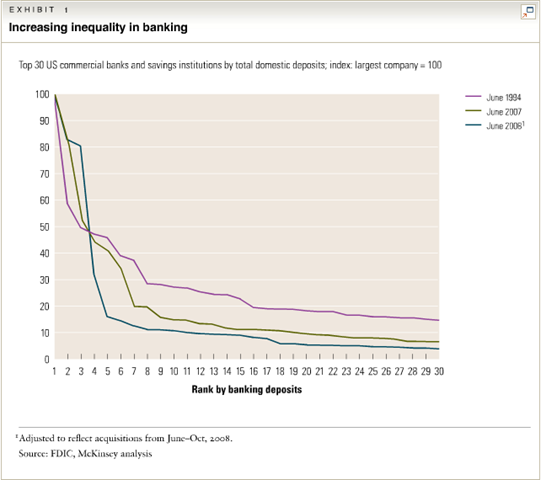
Exhibit 1 shows the top 30 US banks and savings institutions in June 1994, 2007, and 2008, measured by their domestic deposits. The exhibit shows that inequality has been increasing from 1994 (when the number-ten bank was roughly 30 percent of the size of the largest one) to 2008 (when it was only 10 percent as large as the first-ranked institution). It also shows how in 2008, the financial crisis accelerated the growth of the top five compared with the other banks in the top ten as the largest financial institutions took advantage of their relatively healthy balance sheets and absorbed banks in the next tier.

image

* * * * *

Power curves are also promoted by intangible assets—talent, networks, brands, and intellectual property—because they can drive increasing returns to scale, generate economies of scope, and help differentiate value propositions. Exhibit 2 shows a significant degree of inequality, across the board, in the size and performance of companies in a number of sectors we researched. But the more labor- or capital-intensive sectors, such as chemicals and machinery, have flatter curves than intangible-rich ones, such as software and biotech.

image

* * * * *

The fact that industry structures and outcomes appear to be distributed this way opens up an intriguing new field of research into the strategic implications. Notably, the extreme outcomes that characterize power curves suggest that strategic thrusts rather than incremental strategies are required to improve a company’s position significantly.

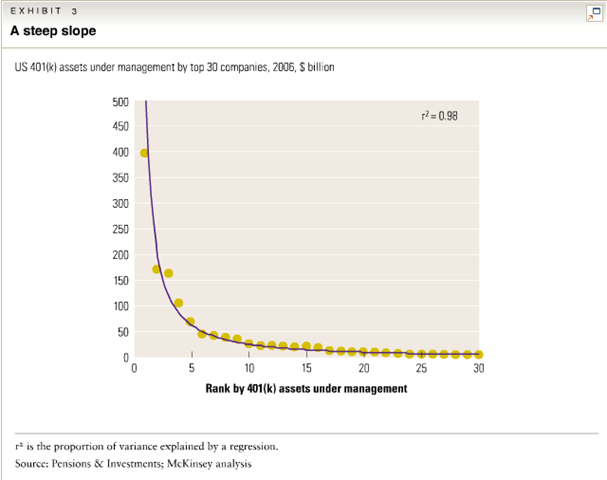
Consider the retail mutual-fund industry, for example. The major players sitting atop this power curve (Exhibit 3) have opportunities to extend their lead over smaller players by exploiting network effects, such as cross-selling individual retirement accounts (IRAs), to a large installed base of 401(k) plan holders as they roll over their assets. The financial crisis of 2008 may well boost this opportunity further as weakened financial institutions consider placing their asset-management units on the block to raise capital.


image

* * * * *

Unlike the laws of physics, power curves aren’t immutable. But their ubiquity and consistency suggest that companies are generally competing not only against one another but also against an industry structure that becomes progressively more unequal. For most companies, this possibility makes power curves an important piece of the strategic context. Senior executives must understand them and respect their implications.

Edit by DAF

* * * * *
Full article:
http://www.mckinseyquarterly.com/Strategy/Growth/Using_power_curves_to_assess_industry_dynamics_2222 

* * * * *

Want more from the Homa Files?
Click link => 
The Homa Files Blog

* * * * *

When is a phone like a credit card ?

January 17, 2009

Excerpted from AdAge, “Banks Can Keep Customers, Make Money With Mobile” by Rita Chang, Jan 5, 2009
* * * * *
Bankers who want to cut customer churn and make money should look no further than the mobile device in their pockets,.

Generally, banks have largely viewed the channel as a way to generate savings by diverting customer service away from call centers or interactive voice response. But at some point, they have to look beyond saving overhead and use mobile as a revenue generator.

A big piece of that will depend on the adoption of near-field communication (NFC) payments…What are NFC payments? It’s when a phone can be used to pay for a transaction because it has an on-board commerce chip that can talk with a receiving chip inside a point-of-sale device.

NFC is made for speedy, high-volume transactions…because all consumers have to do is tap their phone against a reader and input a password, which is quicker than using cash…Each time credit is used, the issuing bank gets a cut of the total transaction.

The market isn’t quite there in the U.S. yet, as the phones supporting these transactions are not available…Still, today banks should be looking at mobile as another channel that consumers can use to interact with it, in addition to the ATMs, phone and online — essentially deepening their relationships and averting defection…

Edit by SAC
* * * * *
Full Article:
http://adage.com/digitalnext/article?article_id=133568
* * * * *

Want more from the Homa Files?
Click link =>
The Homa Files Blog

To stem foreclosures, you have to “cram down” loan balances … NOT !!!

January 16, 2009

If you’re up to speed on the proposals to modify mortgages to stop foreclosures, scroll down to  Loan Modification Math …

Background:

There seems to be momentum to “keeping people in their homes” by modifying the bulk of the 4.6 million mortgages that are currently in foreclosure or payment delinquent for longer than 90 days.

There have already been some voluntary lender efforts to modify distressed mortgages by lowering interest rates or extending the term of the mortgages (say, from 30 to 40 years).  Generally, the programs haven’t generated many modified loans … and for the loans that have been modified, about 40% become delinquent again within 6 months. (Note: I’ve seen ranges on this number from 35% to over 50%).

So, the Feds are pushing lenders to sweeten the mortgage modification packages.  Specifically, there’s talk of a broadscale government program that would pare mortgage interest rates to 4.5%.  And, there seems to be support for “cram downs” — having lenders reduce the principal loan balances to the current fair market value of the homes collateralizing the loans.  That is, if a defaulting loan is on a home that is “below water” — i.e. loan balance is greater than the home’s market value — the lender writes off the difference and issues a revised mortgage at the home’s market value.

These proposals strike me as both naive and very problematic.  In this and subsequent posts, I’ll summarize why I think cram downs are a bad idea.

* * * * *

Loan Modification Math

A frequent pundit refrain is that “you can’t get there with just rate and term adjustments — you have to reduce the loan balance to keep these loans out of foreclosure.”  Not surprisingly, there’s a lot of hand-waving but few numbers.

For the record, here’s how the math works.

Say, a person buys a home for $150,000 with no downpayment (as is typical with sub-primes), a 10% mortgage interest rate (maybe a bit low for sub-prime loans), and a 30 year term.  The monthly mortgage payment — for principal and interest — would be $1,269.

If the interest rate on the loan is cut to 4.5%, the monthly payment would drop by over 40% to $752.

If the interest rate is cut to 4.5% and the loan’s payback period is extended from 30 to 40 years, then the  monthly payment would drop to $666.  That’s about half of the original monthly payment! {Note: If the starting interest were more than 10%, the new payment would be more than half off).

Apparently, some politicos think that cutting the payment in half isn’t enough to make a difference.  So, they propose that lenders accept “cram downs” and reduce loan balances.

Let’s assume that the home’s fair market value fell by 25% since the time of purchase.  That would mean writing off $37,500 of the loan balance and reissuing it with a $112,500 balance.

If the interest rate is cut to 4.5%, the loan’s payback period is extended from 30 to 40 years, and the principal balance is reduced to $112,500, then the monthly payment drops to $499.  That’s less than 40% of the original monthly mortgage payment — a discount of more than 60%.

Are these folks serious ???

Cutting the mortgage rate in half for a defaulter — while keeping the hardworking, creditworthy folks next door at the full rate — is morally bankrupt.  Especially when the defaulter didn’t legitimately qualify for the loan by any reasonable underwriting standards … and is equally likely to default again.

What about the hardworking guy who has made payments for years but but just got got laid off in the tough economy?  Well, the half-payment may even be too much for him to handle.  Unfortunate, but true.  I say the bank (and Feds) should give that guy plenty of breathing space (e.g. suspend payments for 6 months).

In a subsequent post, I’ll show how government largesse might even give a defaulter free housing under the proposed plan.  This stuff gets nuttier by the day …

* * * * *

Technical Stuff

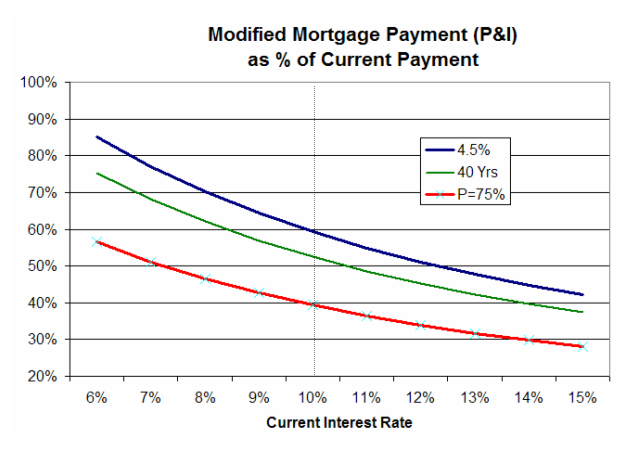
Below is a graphical display of the above math.  The top line is reducing the interest rate to 4.5%; the middle line reduces the interest rate to 4.5% and extends the term to 40 years; the bottom line reduces the interest rate to 4.5%, extends the term to 40 years, and writes off 25% of the loan balance.

The takeaway: within a representative range of original interest rates, modified mortgage payments can be roughly halved by simply cutting the interest rate to 4.5% and extending the loan term to 40 years.

image

* * * * *

Want more from the Homa Files?
Click link =>
  The Homa Files Blog

Maybe some taxes really are regressive …

January 16, 2009

In several prior posts, I demonstrated that the core of the US tax system — income taxes and payroll taxes (i.e. Social Security and Medicare) — are progressive.  That is, when all pay-ins and pay-outs are considered, high earners pay a higher proportion of their earnings in taxes.  Apparently I did overlook one very regressive tax …

* * * * *

Excerpted from IBD, “Will The Poor Feel Tax Pinch From Stimulus?”, Malkinn, Jan 14, 2009

Congress is rushing this week to impose massive tax hikes of at least 61 cents on every cigarette pack sold in America, in addition to new increases on other tobacco products … a  punitive tax increases on the poor.

How so? Health surveys show that smokers are more likely to be blue-collar workers, minorities and have less than a high school education.

Tobacco taxes take a 50 times larger share of income from those earning less than $20,000 than those earning more than $200,000.

Put another way: Families making less than $30,000 per year pay more than half of all taxes paid on cigarettes, while families making more than $60,000 pay only 14%.

That’s the dictionary definition of regressive, not progressive.

Full article:
http://www.ibdeditorials.com/IBDArticles.aspx?id=316826618344159 

* * * * *

Want more from the Homa Files?
Click link =>
  The Homa Files Blog

Riviving the auto industry by smashing gas guzzlers into a tiny cubes …. hmmm, might work

January 16, 2009

Ken’s Take: some good  ideas that I haven’t seen other places … the notion of Feds buying gas guzzlers and smashing them to into cubes certainly qualifies as ‘out of the box’ thinking

* * * * *

Excerpted from IBD, “Revival Of U.S. Automaking Awaits If UAW Will Follow Toyota Model”, Morici, January 13, 2009

General Motors and Chrysler are on the anvil of history. United Auto Workers President Ron Gettelfinger holds the hammer and will determine whether they emerge more competitive or shattered in pieces and sold to foreign investors.  Eventually, Washington will tire of their begging, they will march through bankruptcy, and their factories will be sold off to Japanese, Korean, European and Chinese automakers.

* * * * *

At U.S.-based Toyota factories, workers receive about $25 dollars an hour and good health care benefits. But they don’t retire at 50 after 30 years or get as much time off and huge severance packages. Toyota does not endure the medieval work rules and job classifications imposed by UAW contracts.

Most other Americans would be happy to get Toyota pay, benefits and working conditions. 

* * * * *

Over the last two decades, Japan has kept the yen at least 30% undervalued against the dollar, and this provided Toyota with an average subsidy of at least $2,000 on every car it sold in the United States.

The Federal Reserve has dramatically reduced U.S. interest rates, and the yen has risen closer to its true market value against the dollar. Japanese officials appear poised to again intervene directly in currency markets to restore Toyota’s unfair advantage, and Washington should take whatever steps are necessary to head off such Japanese protectionism.

* * * * *

In addition, Washington should take assertive steps to encourage production of fuel-efficient vehicles in the U.S. and create a strong export industry.

Washington could offer incentives to car buyers to trade in gas guzzlers for more fuel-efficient vehicles — the newer and the bigger the clunker and the more fuel-efficient the replacement, the more dollars the car buyer would receive if the guzzler is destroyed.

Washington could provide substantial product development assistance to U.S.-based … battery makers and other suppliers to accelerate the production of innovative, high-mileage cars.

The condition for assistance would be that beneficiaries do their R&D and first large production runs in the United States, and share their patents at a reasonable cost with other companies manufacturing in the United States.

Finally, individual Americans should open their minds. Many are considering trading in trucks and SUVs for sedans and are naturally attracted to the Toyota Camry and similar import brands. Visit a Ford or Chevy showroom and test drive a Fusion or Malibu and be pleasantly surprised. Those are high-quality, affordable and reliable vehicles.

Washington is giving Detroit a second chance, and Americans should give its cars a second look.

Full article:
http://www.ibdeditorials.com/IBDArticles.aspx?id=316741420675724 

* * * * *

Want more from the Homa Files?
Click link =>
  The Homa Files Blog

Online ads … customized on the fly

January 16, 2009

Excerpted from the New York Times, “Web Marketing That Hopes to Learn What Attracts a Click”, by Stephanie Clifford, December 3, 2008

* * * * 
Online advertisers are not lacking in choices: They can display their ads in any color, on any site, with any message, to any audience, with any image.

Now, a new breed of companies is trying to tackle all of those options and determine what ad works for a specific audience. They are creating hundreds of versions of clients’ online ads, changing elements like color, type font, message, and image to see what combination draws clicks on a particular site or from a specific audience.

It is technology that could cause a shift in the advertising world. The creators and designers of ads have long believed that a clever idea or emotional resonance drives an ad’s success. But that argument may be difficult to make when analysis suggests that it is not an ad’s brilliant tagline but its pale-yellow background and sans serif font that attracts customers.

Adisn, based in Long Beach, and Tumri, based in Mountain View, are working both sides of the ad equation. On one, they are trying to figure out who is looking at a page by using a mix of behavioral targeting and content analysis. On the other side, they are assembling an ad on the fly that is meant to appeal to that person.

* * * * *

Adisn’s approach has been to build a database of related words so it can assess the content of a Web site or blog based on the words on its pages.

Adisn then buys space on Web sites, and uses its information to find an appropriate ad to show visitors to those sites. If a visitor views pages about beaches, weather and Hawaii, it might suggest that the visitor is interested in Hawaiian travel.

Based on that analysis, Adisn’s system pulls different components — actors, fonts, background images — to make an ad. For example, it might show an ad with a blue background, an image of a beach, and a text about tickets to Hawaii.

Simple Green, the cleaning brand, began working with Adisn this year to advertise a new line of products called Simple Green Naturals.

“If it’s a woman looking at a kitchen with a stainless steel refrigerator, they can show a stainless steel product.”

* * * * *

Tumri’s approach is slightly different. It creates a template for ads, including slots for the message, the color, the image and other elements.

Unlike Adisn, it does not buy ad space, but lets clients choose and buy space on sites themselves. And rather than building a contextual database, Tumri uses whatever targeting approach advertisers are already using, whether it is behavioral or contextual or demographic, and assembles an ad on the fly based on that information.

“It’s reporting back to the advertiser and agency saying, ‘Guess what? The soccer mom in Indiana likes background three, which was pink, likes image four, which was the S.U.V., and likes marketing message 12, about room, safety and comfort.”

Edit by DAF

* * * * *

Full article:
http://www.nytimes.com/2008/12/03/business/media/03adco.html?_r=1&ref=media&pagewanted=print

* * * * *

Want more from the Homa Files?
Click link => 
The Homa Files Blog

So, what happens when a luxury brand drops its prices ?

January 16, 2009

Excerpted from the WSJ, “In Rare Move, Luxury Goods Makers Trim Their Prices in the US”, by R. Dodes and C. Passariello, November 14, 2008

* * * * *

For the first time in recent memory, luxury-goods makers are cutting prices on designer apparel, shoes and handbags in the U.S. market.

With even the biggest spenders starting to scrimp, luxury companies are reversing the industry’s maxim that luxury prices only move up. The cuts range from 8% to 10% on most products sold in the U.S.

But the move isn’t likely to dent the profit margins…because the value of the dollar has increased 28% against the euro since April. Luxury-goods companies don’t disclose margins, but Louis Vuitton is estimated to have a margin of 45 cents on every dollar…The strengthening of the dollar means luxury-goods companies are earning more than they had budgeted on every handbag or piece of clothing sold in dollars.

Luxury-goods executives must walk a fine line when cutting prices… if prices drop precipitously, the perception of a label’s value may also drop… During the recent years, luxury companies often assumed that money was no object for their fans…But luxury makers have acknowledged that a ceiling exists even for exclusive goods…

Edit by SAC

* * * * *

This article is a follow-up to a previous post on marketing luxury brands in lean times. It confirms that even high-end consumers are cutting back spending and likely avoiding conspicuous consumption. As a result, marketers are faced with the challenge of maintaining their premiums and exclusivity while also making sure their brands are accessible and acceptable to purchase in the eyes of the high-end consumer.

* * * * *

Full Article:
http://online.wsj.com/article/SB122662444379126865.html

* * * * *

Want more from the Homa Files?
Click link =>
The Homa Files Blog

Stop foreclosures: Keep people in "their" homes … huh?

January 15, 2009

Background

There seems to be momentum to “keep people in their homes” by modifying the bulk of the 4.6 million mortgages that are currently in foreclosure or payment delinquent for longer than 90 days.

There have already been some voluntary lender efforts to modify distressed mortgages by lowering interest rates or extending the term of the mortgages (say, from 30 to 40 years).  Generally, the programs hadn’t generated many modified loans … and for the loans that have been modified, about 40% become delinquent again within 6 months. (Note: I’ve seen ranges on this number from 35% to over 50%).

So, the Feds are pushing lenders to sweeten the mortgage modification packages.  Specifically, there’s talk of a broadscale government program that would pare mortgage interest rates to 4.5%.  And, there seems to be support for “cram downs” — having lenders reduce the principal loan balances to the current fair market value of the homes collateralizing the loans.  That is, if a defaulting loan is on a home that is “below water” — i.e. loan balance is greater than the home’s market value — the lender writes off the difference and issues a revised mortgage at the home’s market value.

These proposals strike me as both naive and very problematic.  Here’s another take on why these loan modification programs are generally bad ideas, and why cram downs, specifically, are a bad idea.

* * * * *

Ken’s Take: Keep people in”their” homes … huh? 

The underlying premise of the proposed loan modifications —  “keep people in their homes” — is logically flawed

The overwhelming majority of foreclosures are investor-speculators and sub-primers — people with shaky credit ratings and undocumented incomes who put little or no money down when they “bought” their homes, who often made few if any mortgage payments — not even making a rounding error dent in their principal loan balances, and who have seen home prices slide in their neighborhood — putting their loan “under water”. 

Said differently, most of the mortgage delinquencies and foreclosures are on people who have no equity in the homes — they never did if they didn’t make a downpayment or a couple of years of mortgage payments and, in most cases, they have “negative equity” — since they owe more than the the homes are worth on the open market.

Bottom line: these folks are “occupants” not “owners” — unless they get credit for some sort of squatter’s rights.  There may be some legitimate reasons for enabling them to stay in the homes — but there’s no way that the homes are their homes.

In the next couple of posts, I’ll walk thru the economics: what crams downs aren’t even necessary, and the “free housing” moral hazard.  

* * * * *

Want more from the Homa Files?
Click link =>
  The Homa Files Blog

Quick: How many people does it take to feed the IRS ?

January 15, 2009

Each year, the IRS publishes roughly 70,000 pages of forms, publications, schedules, instructions and rules … that’s equivalent to 25 volumes of administrative and legal guidance books that take up nearly nine feet of shelf space

There have been 3,250 changes to the tax code since 2001, more than 500 of them in 2008 alone. 

Americans (individuals, company employees, tax firms) expend 7.6 billion hours preparing, submitting, and answering questions about tax filings …. the time is split about 50 / 50 on individual and company returns.

“If tax compliance were an industry, it would be one of the largest in the United States. The ‘tax industry’ requires the equivalent of 3.8 million full-time workers.” 

In 2006, corporations and individuals spent $193 billion to comply with the tax code … some estimates go as high as $265 billion.

60% of taxpayers pay professionals … 22% of taxpayers buy tax prep software (e.g. TurboTax, TaxCut).

On average, individual tax payers spend about 20 hours each on tax filing and end up overpaying by more than $600 per return

* * * * * 

Excerpted from IBD, “Change We Need”, January 13, 2009
http://www.ibdeditorials.com/IBDArticles.aspx?id=316743763302078 

* * * * *

Want more from the Homa Files?
Click link =>
  The Homa Files Blog

Consumer choice modeling … how people decide to buy

January 15, 2009

Excerpted from Strategy+Business, “Tracking the Elusive Consumer”, by John Jullens and Gregor Harter, Novermber 11, 2008

* * * * *
Consumer choice modeling … offers a better understanding of consumer preferences:
 
  • What does the consumer want?
  • Why do individuals prefer one product or service over another?
  • How, precisely, do most consumers make their purchasing decisions?

Recent work on the art and science of consumer behavior has refined, updated, and strengthened an analytical tool known as consumer choice modeling, initially developed in the 1960s by Daniel McFadden, a winner of the 2000 Nobel Prize in economics.

Simply put, this model examines the personal reasons for individual choices and provides techniques researchers can use to measure and predict those choices. By exploring why individuals make specific trade-offs among various product options, consumer choice modeling can determine the features that people in different economic and demographic strata are looking for and how much they are willing to pay.

* * * * *

Originally, this technique suffered from a lack of sophistication. A typical implementation involved asking respondents to react to lengthy paper-and-pencil surveys offering a series of preconfigured and static product or service possibilities. Although some insight about consumer preferences was typically evinced, it was often shallow, limited by researchers’ inability to dynamically change the direction of the questioning on the basis of the responses.

However, advances in experimental designs and information technology now allow researchers to better approximate the shopping experience when asking questions by adjusting product choices in reaction to a person’s answers. By analyzing the responses from a representative sample of consumers (or potential future customers), researchers can produce econometric models that depict the relative weighting of specific product features and price points.

* * * * *

Early in 2007, Booz & Co.applied consumer choice modeling to identify and measure the drivers of demand for mobile phones. One example::  Apple’s iPhone.

Long before the iPhone’s launch,  the Booz  model correctly predicted that it would be the most attractive overall offering to consumers despite its high price tag. 

Booz  surveyed more than 1,800 consumers by simulating the actual mobile phone purchasing process and asking people to compare their existing package with alternatives.

For example, owners of low-cost Sharp handsets running on pay-as-you-go carriers such as Virgin Mobile or Boost Mobile were offered a U$100-plus Samsung phone with Nextel service and a $250-plus LG phone with Verizon’s network. Respondents were asked, “If these two packages were your only alternatives, which one would you choose: Samsung/Nextel, LG/ Verizon, or neither?” and “If Samsung/Nextel were your only option, would you purchase it or continue to use your current package?”

The majority of the low-end and midlevel consumers were highly commodity driven. Other than by offering an attractive handset price, it is almost impossible to convince an individual to change his or her current mobile phone package. In fact, further analyses revealed that one-third of U.S. consumers are unwilling to change their wireless package, no matter how much the handset price is lowered.

* * * * *

Of all phone users, owners of low-end handsets made by the Nokia  value their phone package the least. Consequently, these consumers are the most willing to switch to another carrier and handset — an opportunity for competitors to attack Nokia’s base by producing a low-cost package with a function or two that outpaces the relatively plain Nokia product.

The consumer choice model also revealed that owners of handsets made by Sony Ericsson , which tend to be highly designed, full-featured products, care much more than Nokia users about functionality, usage range, and purchase location (they prefer to buy their packages at stores that offer personal attention, rather than at Costco or Circuit City, for example). And although these customers, too, are price conscious, they’re willing to pay a premium to have their preferences met. A service provider could use these findings to target Sony Ericsson owners with a slightly less expensive offering that in all other ways matches their current package.

* * * * *

Consumer choice modeling also has the ability to predict the impact of future products and services on the market. Booz  simulated the characteristics of “the ideal high-end phone” as consumers viewed it. From this, the survey gleaned that three primary factors — feature, design, and brand — are of paramount value to consumers considering a higher-priced model. These factors, of course, were exactly what Apple focused on in developing its blockbuster iPhone, launched in July 2007.

Significantly, as the model predicted, Apple stumbled when it came to price, which the survey showed matters at all levels of cell phone purchases.

At a price point of $599 for an eight-gigabyte phone, the research forecasted that Apple would have difficulty reaching a significant portion of the high-end market. But the same research suggested that performance would improve quickly as soon as Apple cut prices. In fact, that is precisely what happened: In September 2007, Apple discounted the phone by $200, and sales rose well over 1,000 percent in the succeeding quarter from sales in the prior three-month period. And in June 2008, CEO Steve Jobs announced a much faster eight-gigabyte iPhone — using AT&T’s state-of-the-art 3G network — for only $199, a move that further aligned Apple’s pricing with that of its peers and that will almost certainly improve the product’s market share.

* * * * *

Consumer choice modeling yields valuable insights for demand-driven strategy development by providing customer value segmentation maps, measuring market share impact of new product–service combinations, and assessing overall brand equity. Perhaps most important, choice modeling can reveal sa­lient differences between managers’ beliefs about customers’ needs and preferences and customers’ actual needs and preferences. For managers seeking reliable feedback on how customers view their products and services, consumer choice modeling provides a rigorous way to turn customer-driven feedback into profitable and sustainable tactics for retaining or capturing market share.

Edit by DAF

* * * * *
Full article:
http://www.strategy-business.com/resiliencereport/resilience/rr00064?pg=2

* * * * *

Want more from the Homa Files?
Click link => 
The Homa Files Blog

* * * * *

What value an acquired brand? It depends …

January 15, 2009

Excerpted from Knowledge @ Emory “The Mystery and Motivation of Valuing Brands in M&A“, November 13, 2008

* * * * *

in 2000 Cadbury Schweppes bought the Snapple brand of drinks, justifying the purchase to its board by saying that Snapple would be a wonderful addition to its product line and could be sold through its established distribution channels. Cadbury could successfully launch this small-town brand into the big time.

Quaker Oats, a previous owner of the Snapple brand, had given the same reasons for wanting to buy the brand—and yet, Quaker had failed to build the Snapple brand to any measure of its aspirations.

Brand valuation takes on a special significance in M&A, when both acquirer and target contribute inherent qualities that fuel brand value. “For example, Procter & Gamble (P&G) acquired Gillette and about 49% of the acquisition was attributed to the Gillette brand.”

Emory researchers. … set out to study the contributing traits of both the target firms and acquiring firms to explain the value given to a brand…They were able to determine the capabilities of both the acquirer and the target and how those, in turn, influence brand value…

Study results show that both acquirer and target marketing capabilities, as well as brand portfolio diversity have positive effects on a target firm’s brand value. Both parties’ capabilities are critical. 

Regarding brand portfolios: “If there’s redundancy in your portfolio, then your valuation is likely to be lower…if you’re acquiring a brand that allows you to get into a whole new market, then your valuation would be much higher.”

“Target firms need to recognize the significance of a firm’s marketing capabilities as well as its brand portfolio diversity…Targets with strong marketing capabilities can negotiate higher prices for their brands because the target’s marketing capabilities provide assurance to the acquirer firms in terms of the future performance of its brand portfolios. Targets with diverse brand portfolios can charge higher prices for their brands because diverse portfolios provide strategic options for the acquirer”…

Edit by SAC

* * * * *
Full article:
http://knowledge.wharton.upenn.edu/article.cfm?articleid=2091
* * * * *
Want more from the Homa Files?
Click link =>
The Homa Files Blog

From economic crisis to moral crisis …

January 14, 2009

There are plenty reasons to object to the recent groundswell of support for modifying distressed mortgages (badly delinquent or already in foreclosure) by slashing rates, lengthening payback periods, and writing off part of the loan balance if a home is under water (i.e. the loan balance is greater than the market value of the home).  I find the latter provision — forgiving part of the loan because housing prices have fallen — to be particularly troublesome.

Let’s start with the moral issue:

When somebody borrows money, they accept both a legal and a moral responsibility to pay it back. 

A lender may require collateral to mitigate the riskiness of a loan, but the posting of collateral doesn’t relieve borrowers of their repayment obligations.  

If the collateral that is posted loses some or all of its market value,that’s a bad break for the lender.  But, the lender is still entitled to get its money paid back.

For example, when folks buy stocks on margin, they are borrowing money from a brokerage house and posting stocks as collateral.  If the stocks tank, the brokerage houses don’t altruistically write down the loan balance.  They sell off the borrowers’s stocks to cover the loan balance.

If somebody totals their car (i.e. value goes to zero), the bank doesn’t simply write off the auto loan.  Nope, the borrower is still on the hook — even if the insurance company stiffs them.

So, why should a home mortgage get written down when the real estate market stumbles and homes drop in market value?  It just doesn’t make sense morally.

Skipping on a debt is skipping on a debt.  Period.

* * * * *

The liberal politicos’ response is that we have a moral responsibility to keep people in their homes during rough economic times.  As I’ve said a few times already, most of these folks are occupants, not owners.  They have no equity in the homes, and in most instances — with no money down and interest only payments — they never did.  These aren’t “their” homes we’re talking about …

In subsequent posts, I’ll give the economic arguments against writing down mortgage loan balances.  I’ll even show how mortgage defaulters are likely to be rewarded with free housing if their loan balances are written down.  Talk about moral hazard …. 

* * * * *

Want more from the Homa Files?
Click link =>
  The Homa Files Blog

Go green or go broke… your choice !

January 14, 2009

Excerpted from Brandweek, “Go Green Or Else!” By Elaine Wong, Dec 2, 2008

* * * * *

Environmental legislation and climate changes could eat up as much as 47% of packaged goods companies’ profits by 2018 if they don’t adopt long-term sustainability measures  …

A report, Rattling Supply Chains … addresses long-term profitability of the packaged goods industry. The findings are based on “future analysis” of how much certain commodities will go up, including oil, cereal, soy and palm oil, and how they will fare under certain environmental, governmental policy and climate situations. The term used to describe these hypothetical scenarios is “ecoflation.”

Companies that can reduce their reliance on materials like plastic or paper, through sustainability initiatives, can cut costs when economic pressures cause price increases…Companies can expect a reduction of anywhere from 13 to 31 percent in earnings by 2013… if adequate sustainability measures are not taken….

Companies like P&G and Nestle have already implemented sustainability strategies. Nestle is placing more emphasis on sourcing materials locally to cut down on transportation. Meanwhile, P&G is cross-leveraging research and design teams across different brand categories…

These are just a few examples of the extent to which many companies have considered going green. Oftentimes, retooling a supply chain to be more sustainable involves “rethinking the product itself … It has as much to do with improving business practices as it does with improving environmental practices. In fact, the two go hand-in-hand.”

Edit by SAC

* * * * *

Investing in sustainability reduces costs, but it can also have the added benefit of encouraging consumers to buy your product.  According to a recent IRI report, 50% of consumers consider sustainability efforts when purchasing consumer product goods.  Indicating that neither the product, nor the people (consumer) can be separated from the sustainability process.

* * * * *
Full Article:
http://www.brandweek.com/bw/content_display/news-and-features/packaged-goods/e3i726f0f4961487c61bd28d01ac0630121?imw=Y

* * * * *

Want more from the Homa Files?
Click link =>
The Homa Files Blog

But how "green" is it … really?

January 14, 2009

Excerpted from the New York Times, “Consumers Want, and Are Skeptical About, Eco-Electronics”, by Joe Hutsko, December 10, 2008

* * * * *
Among other findings from a survey released today by the Consumer Electronics Association, an industry group representing computer and gadget manufacturers, 89 percent of consumers said that energy efficiency would be a factor in choosing their next television — even as less than half of thepeople surveyed said they’re generally able to make sense of the environmental attributes attached to electronics on the market.

“One of the greatest challenges certainly is consumer confusion about what ‘green’ means”. The lack of a universally recognized means to measure a product’s “greenness” makes it difficult for consumers to find information at the point of purchase.

* * * * *

– While 74 percent of consumers polled say companies should do more to protect the environment, only 17 percent feel familiar with the environmental reputation and philosophy of companies who make and sell electronics.

– More than 50 percent of consumers believe some companies overstate the environmental friendliness of their products in order to sell more–not always believing what they see or read about eco-friendly products.

38 percent said they were confused by the eco-friendly messages. Roughly 51 percent of respondents said they don’t 

Edit by DAF

* * * * *
Full article:
http://greeninc.blogs.nytimes.com/2008/12/10/consumers-want-and-are-skeptical-about-eco-electronics/?pagemode=print

* * * * *
Want more from the Homa Files?
Click link => 
The Homa Files Blog

Uncertainty Fuels Airline Price Cuts

January 14, 2009

Excerpted from the Miami Herald, “Airlines cutting prices to stay aloft during recession, ” By Harry Weber, Jan 7, 2009


* * * * *  

A wave of fare sales has spread across the airline industry…as the weak economy continues to put pressure on carriers to fill seats even after they drastically reduced capacity and some expressed willingness to cut more.

Many experts and even executives at some airlines had expected that after deep capacity cuts went into effect starting in September, the number of fare sales going forward would be fewer and farther between. But fuel prices have come down significantly, and the weak economy has eroded demand for air travel…

It’s not unusual for airlines to announce fare sales in January…but what’s different for several carriers this year is that the discounts are for travel extending as late as April, May or June..The sales last January were typically for travel through March, he said.

Seaney said he believes uncertainty in the economy is the reason for the change…A handful of major carriers and discount carriers have launched fare sales since Dec. 31. Others are expected to follow with sales of their own, or to at least match discounts offered by rivals on competitive routes…

Discount carrier AirTran Airways said Tuesday it was offering a nationwide sale with one-way fares starting as low as $39…”We are uncertain about the economy and we are trying to build business on the books for the winter and spring,’

Edit by SAC


Full Article:
http://www.miamiherald.com/business/nation/story/840842.html
* * * * *

Want more from the Homa Files?

Click link =>
The Homa Files Blog

The economic crisis in a nutshell …

January 13, 2009

Ken’s Take: This guy has really cut through to the essence of the economic crisis. Of course, problem identification is always easier than problem solution.

Still, simply memorize the following synopsis and you’ll impress folks at cocktail parties

* * * * *

This economic crisis consists of three parts:

  • Mountains of bad loans, which are weighing down banks and other financial institutions
  • Rapid retrenchment by businesses, which is causing them to cut jobs and investment
  • Trillions of dollars in excess consumer debt, which is forcing households to cut back on spending.

These three factors together are feeding on each other:

  • Because banks are lending less, it’s harder for businesses and consumers to spend.
  • Because businesses are cutting workers so quickly, loan defaults are rising and it’s harder for consumers to pay back debt, and
  • Because consumer debt has risen from 96% of disposable income in 2000 to 130% of disposable income today, Americans are completely maxed out.
  • As a result, any job cuts immediately mean more loan defaults.

Excerpted from Business Week, Why Big Tax Cuts Are Essential, January 10, 2009
http://www.businessweek.com/the_thread/economicsunbound/archives/2009/01/why_big_tax_cut.html?chan=top+news_top+news+index+-+temp_news+%2B+analysis

* * * * *

Want more from the Homa Files?
Click link =>
The Homa Files Blog

Michigan wants $2 billion for batteries … makes sense

January 13, 2009

Excerpted from WSJ: “UAW, Bondholder Talks Slow GM’s Revamp”, Jan.Y 13, 2009

Michigan Gov. Granholm … is looking to offer big incentives to car-battery companies and other suppliers to that industry to locate in her state.

Ms. Granholm said that as much as $2 billion in aid to the battery industry could be included in a stimulus package from the Obama administration.

Batteries have been one of the biggest hurdles for U.S.-based electric and hybrid vehicle manufacturers. Lithium-ion car batteries are made in volume in Japan, Korea and China, and auto makers have been concerned that if battery supplies tighten, Asian car makers will dominate access to the technology.

Full article:
http://online.wsj.com/article/SB123178365916774153.html

* * * * *
Ken’s Take: Batteries are the key (and most costly) component in hybrid electric cars.  Currently, virtually no car-power batteries are made in the US.  It’s strategically critical that they are.  Otherwise, we trade one foreign dependency for another.

Reminder: Virtually no lithium is mined in the US.  Most comes from South America: Argentina, Chile, and Bolivia.

* * * * *

Want more from the Homa Files?
Click link =>
  The Homa Files Blog

Selling power, speed, and sex … (to utilitarians)

January 13, 2009

Excerpted from Marketing Daily, “Mintel To Mad Ave: Can The Sexy Car Ads” by Karl Greenberg, December 4, 2008

* * * * *
Most consumers don’t see their cars as a chariot of the gods, a freedom machine, a wheeled camel for Lawrence of Arabia, an automatic chick/hunk magnet, or portable fountain of youth.
Instead, they view their vehicles simply as functional and safe for getting around…

Mintel says its survey of car owners suggests that what most people actually feel behind the wheel, regardless of the name on the sheet metal is: responsible and practical, not sexy or powerful…Mintel asked consumers: “How do you feel when you are driving?” Three of the top four feelings chosen by respondents had to do with utility and security, per the firm, with 46% saying they felt “responsible”; 40% saying “safe”; and 37% saying they felt “practical.”

The more amorphous sentiments started further down, with 39% saying “happy” was the thing they felt behind the wheel…near the bottom of the list landed “powerful,” “fast,” and “sexy.” The bottom of the list was “rich”…60% believe the main purpose of a vehicle is to get from point A to point B…

“We found that for most people, driving a car or truck does not make them feel sexy, fast or powerful…The problem is that the auto industry is built on selling power, speed and sex. Those images are dynamic, but they don’t necessarily resonate with the majority of utilitarian, safety-focused drivers.”

Mintel also found that the top information sources that people use when researching new vehicles are word-of-mouth, car dealer brochures, consumer buying guides and the Internet.

Edit by SAC

* * * * *

If car ads are meant to convey the “behind the wheel feeling,” they are missing the mark according to Mintel’s new study.  Most ads feature fast, sexy cars gliding around winding roads rather than practical, responsible drivers running daily errands safely.  However it is not clear from this study whether the “feeling behind the wheel” is motivating purchase.  While a driver may seek to feel safe and responsible behind the wheel ,the same driver may want the exterior of the car to scream fast, sexy and powerful.

* * * * *

Full Article:
http://www.mediapost.com/publications/?fa=Articles.showArticle&art_aid=96019

* * * * *

Want more from the Homa Files?
Click link =>
The Homa Files Blog

Some brands die … and some dead ones come back to life

January 13, 2009

Excerpted from Brandchannel, “Brand Darwinism: When & Why Brands Falter & Die” By Barry Silverstein, Dec 22, 2008
* * * * *

Much like living organisms, brands have a lifecycle…While some brands stand the test of time, others fade away soon after they come to market. What happens when it’s time for brands to die, and why?

A primary reason for brand fragility is the very nature of the brand world. Consider this: in 2006, over 20,000 new products were introduced just in the food and beverage category…While many new products may be extensions of an existing brand, imagine the number of new brand names embedded in that statistic… Fewer than 10% of all new products and services produce enough return on a company’s investment to survive past the third year

Despite these enormous challenges, there are timeless brands that not only survive but thrive for decades. These brands remain relevant to consumers, and they consistently capture enough market share to prosper, even in tough economic times. But what about the brands that falter?

Some companies intentionally kill off older or weaker brands as part of their brand strategy. Ice cream maker Ben & Jerry’s is a case in point…the company regularly discontinues ice cream flavors in an effort to keep their stable of brands fresh and relevantBen & Jerry’s may treat the brand lifecycle with irreverence, but marketing managers at other companies who are forced to kill off a brand are likely not amused. After all, they invest considerable corporate resources in the brand launch. And their budgets—or maybe even their jobs—could become vulnerable when a brand dies…

The same kinds of painful decisions will soon by made by recently bailed-out American automobile manufacturers. The Big Three currently market over 100 different car and truck models through 15 different brands in the US…The problem for G.M. and other companies that must eliminate popular, long-standing brands is complex. While consumers may intellectually understand that brands don’t last forever, they get emotionally attached to them…

Another major reason brands die is the continuous upheaval that occurs in the brand world…when business conditions change. One of the most notorious contributors to brand mortality is business mergers and acquisitions…Each time a merger or acquisition occurs, a brand with a history, a significant market presence and a loyal following may disappear…

Whether it is declining sales, poor economic conditions or corporate mergers, brands will continue to die off, and some consumers will grieve their loss.

A recent he latest branding wrinkle is the marketing opportunity dead brands represent. In 2008, for example, Kellogg reintroduced a cookie brand called Hydrox, a competitor to Oreo that was discontinued in 2003…Kellogg may have decided it was less expensive to revive an old cookie brand with name recognition than launch one anew.

Apparently, reintroducing dead brands is a legitimate business…So don’t be surprised if, when a brand dies, you see it come to life again someday.

Edit by SAC

* * * * *
Full Article:
http://www.brandchannel.com/start1.asp?fa_id=455

* * * * *
Want more from the Homa Files?
Click link =>
The Homa Files Blog

Breathing life into the death tax … Obama’s fires first tax increase shot

January 12, 2009

Summary:  Under the Bush tax plan, death taxes — formally known as estate taxes — are due to expire in 2010.  But, President-elect Barack Obama and congressional leaders plan to move soon to repeal the move and keep the estate tax  at current levels.

Ken’s Take: Except for family owned businesses, this move is mostly symbolic (from the standpoint of tax collection).  Few estates are subject to the tax (especially since the stock and real estate markets tanked) , and there are plenty of tax maneuvers for minimizing the taxes paid.  The impact on family businesses that are being passed along to the next generation are huge.  I don’t understand why they don’t simply get carved out of the tax grab.

But, this news has the potential to move the markets — down, of course.  It’s proof positive that Obama is still intent on cranking up taxes.  It’ll start with the uber-rich, but with trillion dollar deficits, it’ll spread like wild fire. Just watch.

Sidenote: Despite what Team Obama will claim, canceling a programmed tax reduction ai a tax increase ! 

Here are some highlights from the source article.

* * * * *

Excerpted from WSJ, Obama Plans to Keep Estate Tax, Jan 12, 2009  

The Democratic stance on the estate tax contrasts with Mr. Obama’s reluctance to press forward with his campaign pledge to raise income-tax rates on top earners, which he worries could have an adverse economic impact during a recession.

Under the Obama plan detailed during the campaign, the estate tax would be locked in permanently at the rate and exemption levels that took effect this year. That would exempt estates of $3.5 million — $7 million for couples — from any taxation. The value of estates above that would be taxed at 45%. If the tax were returned to Clinton-era levels, it would exclude $1 million from taxation with the rest taxed at 55%.

In making their case for the restoration, Democrats contend that such a large additional tax break … would increase the deficit … wouldn’t have any impact on the economy … and would help the the affluent who already have benefited handsomely from the Bush tax cuts.

They also reason that if they don’t act now, it will be politically harder to go ahead with their plan to resurrect the estate tax once it has disappeared.

For small-business groups ,,,the emerging Democratic plan marks a stark defeat.

At the level proposed in the Obama policy, all but the largest estates — fewer than 2% of annual deaths — would escape taxation.

* * * * *

The estate tax was enacted in the early 20th century as a levy on wealth and inherited assets. It was later amended to allow a spouse to avoid the tax.

Initial efforts to repeal the estate tax — cleverly coined a “death tax” — was backed by affluent families such as the Mars candy family, the Gallo wine family and the heirs of the Campbell’s soup fortune. 

But sharp divisions in the coalition emerged between the super rich and the merely rich. Business groups have sought a measure of certainty with an estate tax that is free of graduated timelines or sunset provisions, with the largest possible tax exemption — $10 million, or $20 million per couple. The rate of taxation above that level was of little concern, since virtually every small business would be exempt from taxation.

Yet the super affluent who began the movement wanted the lowest possible rate, since even a $10 million exemption would leave the bulk of their estates subject to tax.

“The very wealthy, in their quest to reduce their exposure, made proposals that threw the small-business community overboard.” 

Full article:
http://online.wsj.com/article/SB123172020818472279.html

* * * * *

Want more from the Homa Files?
Click link =>
  The Homa Files Blog

Fannie moves to speed “short sales”

January 12, 2009

Background:  In the housing market, a short sale occurs when a home is resold for less than the outstanding balance on the home’s mortgage.  Either the seller has to make up the difference, or the lender has to write-off the short portion of the loan. Of course, most sellers aren’t able to make the lender whole, so either the lender bites the bullet or forecloses — hoping to sell the property at a higher price.  That’s not likely these days either.

Ken’s Take: This is a good move by Fannie — reflecting the realities of the market.  More posts this week on the mortgage market and Fed proposals re: foreclosures.

* * * * *

Excerpted from AP, Fannie Mae tests ‘short sale’ program, January 9, 2009

Real estate agents nationwide have complained about how long it takes for a lender to sign off on a short sale, often derailing the deal and leading a homeowner into foreclosure.

So, Fannie Mae — the  mortgage giant — is testing a new program aimed at reducing the number of foreclosures by pre-approving sales where homeowners sell houses for less than the amount owed on them.

The company will determine an acceptable listing price for a so-called “short sale” even before a buyer has been found.

Fannie Mae wants to make the short sale as fast and easy as possible so distressed homeowners can avoid foreclosure.

Full article:
ttp://www.businessweek.com/ap/financialnews/D95JTMFG1.htm 

* * * * *

Want more from the Homa Files?
Click link =>
  The Homa Files Blog

Marketing 101 … for Web 2.0

January 12, 2009

Excerpted from WSJ, “The Secrets of Marketing in Web 2.0” By S. Parise, P. Guinan, and B. Weinberg, Dec 15, 2008

* * * * *

For marketers, Web 2.0 offers a remarkable new opportunity to engage consumers…But most companies still don’t appear to be well versed in this area. So here’s a look at the principles we arrived at — and how marketers can use them to get the best results.

Don’t just talk at consumers — work with them throughout the marketing process. A leading greeting-card company…set up an online community — a site where it can talk to consumers and the consumers can talk to each other. The company solicits opinions on aspects of card design and on ideas for gifts and their pricing. It also asks the consumers to talk about their lifestyles and even upload photos of themselves, so that it can better understand its market…the online community is much faster and cheaper than the traditional focus groups and surveys used in the past…

Give consumers a reason to participate. Consumers have to have some incentive to share their thoughts, opinions and experiences…One lure is to make sure consumers can use the online community to network among themselves on topics of their own choosing. That way the site isn’t all about the company, it’s also about them…Other companies provide more-direct incentives: cash rewards or products…Still others offer consumers peer recognition…recognition not only encourages participation, but also has the benefit of allowing both the company and the other members of the community to identify experts on various topics…

Listen to — and join — the conversation outside your site. Consumers tend to trust one another’s opinions more than a company’s marketing pitch. And there is no shortage of opinions online. The managers we interviewed accept that this content is here to stay and are aware of its potential impact — positive or negative — on consumers’ buying decisions. So they monitor relevant online conversations among consumers and, when appropriate, look for opportunities to inject themselves into a conversation or initiate a potential collaboration…

Resist the temptation to sell, sell, sell. Many marketers have been trained to bludgeon consumers with advertising — to sell, sell, sell anytime and anywhere consumers can be found. In an online community, it pays to resist that temptation. When consumers are invited to participate in online communities, they expect marketers to listen and to consider their ideas. They don’t want to feel like they’re simply a captive audience for advertising, and if they do they’re likely to abandon the community…

Don’t control, let it go. In an online community, every company needs balance between trying to steer the conversation about its products and allowing the conversation to flow freely. In general, though, managers believe that companies are better off giving consumers the opportunity to say whatever is on their minds, positive or negative…The more that consumers talk freely, the more a company can learn about how it can improve its products and its marketing.

Find a ‘marketing technopologist.’ So who should direct a company’s forays into Web 2.0 marketing?…We coined the term marketing technopologist for a person who brings together strengths in marketing, technology and social interaction…”someone with the usual M.B.A. consultant’s background, strong interest in psychology and sociology, and good social-networking skills throughout the organization.”

Embrace experimentation. One Web 2.0 strategy does not fit all…Blogs, wikis and online communities are among the tools that companies are most commonly using for marketing, but there are other ways to reach consumers…For instance, many companies have long used instant messaging on their Web sites to allow shoppers to chat with customer-service representatives…

Edit by SAC

* * * * *

While the Marketing 101 principles are sure to evolve for Web 2.0 the above mentioned principles provide a good foundation for marketers looking to take advantage ever changing world of the web.

* * * * *

Full Article:
http://online.wsj.com/article/SB122884677205091919.html

* * * * *

Want more from the Homa Files?
Click link =>
The Homa Files Blog

Give me a jolt of Reb-A … but please, no calories

January 12, 2009

Excerpted from Ad Age, “Coke, Pepsi Jump on Zero-Cal Sweetener Reb-A” By Natalie Zmuda, Dec 18, 2008

* * * * *

A new zero-calorie sweetener could boost the beverage industry — if only it can figure out how to market products containing the ingredient.

Coca-Cola and PepsiCo are rolling out products this month that will feature proprietary versions of Rebaudioside A, known as Reb-A.

Advertising messages are almost certain to take a variety of forms, and the products themselves could lead to confusion among consumers.

While consumers are accustomed to “diet” drinks containing a single calorie or none at all — and some of these new Reb-A products are likely to fill that bill — other products will have some calories …

In addition, there are two brand benefits to consider for marketing…some of the new beverages will likely be marketed as lower calorie, while others will be promoted as all natural. “The marketing and messaging is probably not going to be uniform…There’s not one single way of marketing these new beverages.”

Marketing efforts are likely to focus on education and sampling efforts to hook consumers…”In this case, because the ingredient is the differentiation of the product, it will be important to educate consumers about the value and the benefit of the sweetener…The key is to get people to get out and try these products and see for themselves that the products have a superior taste”…

It is unlikely Reb-A will find its way into flagship brands such as Diet Coke or Diet Pepsi…

A survey found that 22% of consumers are extremely interested in trying beverages using the sweetener…42% of those surveyed said they are not interested in trying beverages with Reb-A. Those consumers cited a myriad of issues ranging from safety and health concerns to taste to a preference for sugar…

Edit by SAC

* * * * *

Beverage marketers would be wise to consider the same factors for Reb-A that technology innovations must overcome to ensure product adoption. 

These factors outlined by Everret Roger in Diffusion of Innovations are:

  • Relative advantage over existing options,
  • Compatibility with existing values, simplicity in being understood,
  • Simplicity — easy to understand and to use
  • Trialability on a low risk basis, and 
  • Observability —  the degree to which the innovation is conspicuous to others. 

The biggest hurdle for beverage marketers may be in Reb-A’s simplicity.  While it’s relative advantage in being all-natural is clear, consumers must understand this benefit for it to have value. 

* * * * *
Full Article:
http://adage.com/print?article_id=133410

* * * * *

Want more from the Homa Files?
Click link =>
The Homa Files Blog

Go green … or your employer may tax you.

January 9, 2009

Excerpted from Business Week,”Steering Workers Into the Green Lane”, Oct 27, 2008

Employers are getting more eco-car conscious. And not just new-guard and crunchy-granola companies like Google, Ben & Jerry’s, and Timberland.

Health-care company Abbott Laboratories, which provides its sales staff with some 6,000 vehicles, is revamping its mileage-­reimbursement rules as part of a bid to make its fleet more carbon neutral.

Now, all sales reps reimburse Abbott for personal use of company cars at 17.3¢ a mile. But starting in January 2009, those choosing SUVs instead of sedans will pay 72.3¢.

The new “tax” appears to be working. With 75% of orders in for about 2,000 new vehicles, 48% of reps are requesting sedans, vs. 25% for 2008. SUV orders are at 29%, down from 44%. Hybrids? At 18%, up from 6%.

Full article:
http://images.businessweek.com/ss/08/10/1016_btw/6.htm

* * * * *

Want more from the Homa Files?
Click link =>
  The Homa Files Blog

Audi on the Big Screen … a (relatively) cheap way to promote

January 9, 2009

Excerpted from BusinessWeek, “Audi: Putting Its Models in Movie Roles”, by Ron Grover, November 27, 2008

* * * * *

These are rough times for car companies.  So what’s a car company to do? Hit the movies, that’s what. 

The hot car in Hollywood, these days, is an Audi. In the past few years, it’s hard to go to your local multiplex without seeing that four-ring insignia staring back at you. In this spring’s blockbuster Iron Man, the carmaker had three vehicles in starring roles, including the superhot Audi R8 speedster. And when the action film Transporter 3 opens on Nov. 26, car chase fans will get to see a nearly two-hour commercial for the Audi luxury sedan A8 as it outruns police, outmaneuvers a truck by riding on two wheels, and flies through the air to land on a speeding train—all without so much as losing a hubcap.

* * * * *

Product placement isn’t exactly new in Hollywood, but you have to hand it to the automaker, which has gone into overdrive to go gear-shift to gear-shift with better-known brands that for years have hogged much of the screen time. Audi has done its best to crash just about every awards party in town. They have a fleet of sleek cars at the ready to lend to stars and directors.

It’s all part of the Audi plan to target mega-events, especially as traditional media splinters and audiences dissipate. Earlier this year, the carmaker spent the requisite $2.7 million for a Godfather-spoofing Super Bowl spot, which shows a man waking up in his bed to find the sawed-off grille of a rival luxury car—and ends with the apparent perpetrator speeding off in an R8.

* * * * *

Rumors have always abounded that companies pay hefty sums to get their cell phones, soft drinks, computers, and cars onto the screen. As for money changing hands, Audi steadfastly denies it pays for script time but acknowledges it will occasionally spend hefty amounts to “help promote any flick with which it’s associated.”

Edit by DAF

* * * * *

Full article:
http://www.businessweek.com/technology/content/nov2008/tc20081126_092112.htm?chan=top+news_top+news+index+-+temp_companies

* * * * *

Want more from the Homa Files?
Click link => 
The Homa Files Blog

* * * * *

Even in a recession, companies still paying big bucks for potential blockbusters.

January 9, 2009
Excerpted from WSJ, “Blockbuster or Bust” by Anita Elberse, January 4, 2009

* * * * *

Amid the worst economic crisis to hit the United States in decades, publishing executives are still making what many see as outrageous gambles on new manuscripts.

With double-or-nothing daring, most large media firms make outsized investments to acquire and market a small number of titles with strong hit potential, and bank on their sales to make up for middling performance in the rest of their catalogs.

Given the constantly shifting tastes of consumers, it is extremely difficult to forecast demand for a new title. The one useful indicator is its resemblance to an existing bestseller. This similarity is an indicator that’s evident to any editor or publisher who sees the proposal … triggering competitive bidding situations.

When a publisher spends an inordinate amount on an acquisition, it will do everything in its power to make that project a market success. Most importantly, this means supporting the book with higher-than-average marketing, advertising and distribution support.  With such high stakes and money tied up in a few big projects in the pipeline, the need to score big becomes more pressing, and the process repeats itself. The result is a spiral of ever-increasing bets on the most promising concepts, creating a “blockbuster trap.”

But what would happen if a publisher decided to stop making large bids and systematically walked away from the most sought-after — and therefore expensive — new properties?

First, agents would stop sending such a publisher their most promising book proposals, the most talented editors and other creative talent would leave to work for a publisher that would let them pursue the projects they thought had the highest chances of success, and firing up the publisher’s sales reps would be a major challenge.

In most media markets, support from the biggest retailers is decisive. A significant share of books is bought on impulse, so significant shelf space and room on display tables (“pile ’em high and watch ’em fly” tactics) are particularly important. Book retailers like Borders and Barnes & Noble want to see evidence that a book is worthy of their scarce resources. They like nothing better than to know that a book publisher … is planning an extensive marketing campaign. 

Consumers prefer blockbusters. Because they are inherently social, people find value in reading the same books and watching the same movies that others do. This is true even in today’s markets where, thanks to the Internet, buyers have easy access to millions and millions of titles. Compounding this tendency is the fact that media products are what economists call “experience goods”: that is, shoppers have trouble evaluating them before having consumed or experienced them. Unable to judge a book by its cover, readers look for cues as to its suitability for them, and find it very useful to hear that “Dewey” is “a ‘Marley & Me’ for cat lovers.” In much the same way that potential publishers do, readers value resemblances to past favorites.

Edit by NRV

Full article:
http://online.wsj.com/article/SB123093737793850127.html

* * * * *

By the way: Saw Marley & Me over the break — a major disappointment.  ALL of the funny scenes are in the trailer and TV commercial.  Marley was undisciplined and unlovable, Owen Wilson is a dufass (grossly miscast as a reporter), and Jennifer Aniston is showing some serious mileage.  Even a shot of Oxyglobin wouldn’t have saved Marley or the movie. Wait for it on free TV.

Want more from the Homa Files?
Click link =>
The Homa Files Blog

Sony cuts consumers' stress by banning discounting … say, what ?

January 9, 2009

Excerpted from the New York Times, “For Sony, No Discounts Means Stress-Free Shopping”, by Saul Hansell, November 20, 2008

* * * * *

Eliminating price competition among retailers for high-end cameras and TVs is a great benefit for consumers — so say Sony executives .

Sony bans retailers from discounting Sony’s Alpha digital camera line, its more expensive televisions and some other high-end products. They claim that by having the price for these products be the same at all retailers, they eliminate stress for buyers.

“Consumers don’t have to worry about whether I can get a better deal at retailer A or retailer B. Everybody gets the best deal.” Stores can now compete on other attributes, like education and support.

* * * * *

A quick scan of photography blogs does not find much gratitude for all the stress that Sony has saved camera buyers. On a blog dedicated to Sony’s cameras, some posters complain about the price of cameras and accessories increasing by hundreds of dollars. The program has been controversial, even among electronics dealers

* * * * *

Sony is increasing promotions in retail stores, but was not cutting the prices it planned for the holiday season. “There was value planned in the product,” said Sony execs, “That value is there. Whether consumers will take advantage of it is another question. But we don’t think that dropping the price alone will add traffic.”

Edit by DAF

Sony cuts consumers’ stress by banning discounting … say, what ?

January 9, 2009

Excerpted from the New York Times, “For Sony, No Discounts Means Stress-Free Shopping”, by Saul Hansell, November 20, 2008

* * * * *

Eliminating price competition among retailers for high-end cameras and TVs is a great benefit for consumers — so say Sony executives .

Sony bans retailers from discounting Sony’s Alpha digital camera line, its more expensive televisions and some other high-end products. They claim that by having the price for these products be the same at all retailers, they eliminate stress for buyers.

“Consumers don’t have to worry about whether I can get a better deal at retailer A or retailer B. Everybody gets the best deal.” Stores can now compete on other attributes, like education and support.

* * * * *

A quick scan of photography blogs does not find much gratitude for all the stress that Sony has saved camera buyers. On a blog dedicated to Sony’s cameras, some posters complain about the price of cameras and accessories increasing by hundreds of dollars. The program has been controversial, even among electronics dealers

* * * * *

Sony is increasing promotions in retail stores, but was not cutting the prices it planned for the holiday season. “There was value planned in the product,” said Sony execs, “That value is there. Whether consumers will take advantage of it is another question. But we don’t think that dropping the price alone will add traffic.”

Edit by DAF

Disguising price increases … Is it just me, or is that package smaller than it used to be ?

January 9, 2009

Excerpted from the Minneapolis Star Tribune, “Freshly squeezed: The ever shrinking box and carton” by Chris Serres, December 2, 2008

* * * * *

In the past year, thousands of small, almost imperceptible changes swept through the grocery aisles where American families shop each day.

The indented bottom of a Skippy peanut butter jar got more indented, turning an 18-ounce jar into a 16.3-ounce one. Ice cream containers shrank by one-quarter of a quart. And for breakfast, a jug of Tropicana orange juice got 7 ounces lighter while that box of Froot Loops lost more than 2 ounces.

Shoppers without a keen eye and a willingness to read the fine print on labels might have missed what has happened: Food manufacturers were downsizing packages, while keeping prices the same, as they passed on higher food costs to consumers.

According to a recent analysis by Nielsen Co., about 30 percent of all packaged goods have “lost content” over the past year. This at a time when U.S. grocery bills are rising — up 7.5 percent in October vs. the same month a year ago — at the fastest rate in 18 years.

What began as a response to rising fuel and ingredient costs has become institutionalized at many companies. At General Mills, for example, cost-cutting is so embedded that the company even has its own intimidating term for it: “Holistic Margin Management.”

It’s not always about shrinking packages, which can account for as much as 75 percent of a product’s cost. Even seemingly small changes in a package’s design can mean millions of dollars in annual savings — lessening pressure to raise prices to cover costs.

There is an entire science behind packaging reductions, enlightened by a long list of unsuccessful changes.  

For instance, food manufacturers know consumers react more to changes in height than width, so cereal boxes often get thinner before they get shorter.

Once a product changes, buyers often forget the previous size, creating a new standard.

When PepsiCo reduced the size of its Tropicana orange juice jug by 7 ounces, it touted the container’s “new ergonomic design” and easy-to-open snap cap. Yet consumer advocates argued the new features were really meant to distract from the reduced weight.

“This is the packaging equivalent of three-card monte … by changing several factors at the same time, food companies disguise the fact that you’re getting less for the same price.”

One reason food companies have gotten away with downsizing without alienating shoppers is that over the decades fewer people are preparing meals at home. So they pay less attention to measurements on packages, said John Gourville, a marketing professor at Harvard Business School.

“The reality is, people pay more attention to prices than sizes … and the food companies know it.”

“You can take an ounce out here and an ounce out there, and maybe people won’t notice,” he said. “But if you do it repeatedly, and people are only getting three servings per cereal box, then people are much more likely to say, ‘What’s going on here?’ And it gets harder and harder to do.”  

Edit by NRV

Full article:
http://www.startribune.com/business/35343634.html 

* * * * *

Ken’s Take: You have to sort this marketing approach into 3 parts: (1) more effective packaging — e.g. more merchandising impact, better ergonomics (2) cost-cutting — e.g. more efficient use of volume and space, and (3) higher prices — e.g. on a per ounce basis.  Re: the latter — it is usually easier to raise “unit prices”  by resizing than by changing the price “per package” 

* * * * *

Want more from the Homa Files?
Click link => The Homa Files Blog