Now, a MAJORITY of states are suing to have ObamaCare ruled unconstitutional …

January 19, 2011

Six more states – Iowa, Ohio, Kansas, Wyoming, Wisconsin and Maine — are joining Florida’s federal lawsuit challenging ObamaCare’s constitutionality.

That puts the number at 26 – a majority of states.

Hmmm … I guess they’re not swayed by “adult children” free-riding  on parents’ policies.

South Florida Business Journal, Six states join health care reform challenge, January 18, 2011

My favorite winter radio announcement …

January 19, 2011

Roads were icy in DC yesterday, so on the way into Georgetown I heard my favorite weather-related announcement:

“Only essential Federal employees need to report today; non-essential employees may take liberal leave”

Raises an obvious question: why do non-essential government employees ever need to report?

Sounds like a cost reduction opportunity to me … nice place to start the belt tightening … get rid of the slackers who self-identify as “non-essential”.

Why not?

The perils of moral hazard …

January 19, 2011

According to conservative economist Thomas Sowell …

“Moral hazard” is an insurance term.

People behave differently when they are insured from the way they behave when they are not insured.

For example, people whose cars are insured may not be as cautious as other people are about what kinds of neighborhoods they park their car in.

Similarly, when taxpayer-subsidized government insurance policies protect people against flood damage, more people are willing to live in places where there are greater dangers of flooding.

Often these are luxury beach front homes with great views of the ocean.

So what if they suffer flood damage once every decade or so, if Uncle Sam is picking up the tab for restoring everything?

More than 25,000 properties have received government flood insurance payments more than four times.

Over a period of 28 years, more than 4,000 properties received government insurance payments exceeding the total value of the property.

If a property is located in a dangerous place, repeated damage can easily add up to more than the property is worth, especially if the property is damaged and then later wiped out completely.

Excerpted from RCP: “Moral Hazard” in Politics, August 27, 2010
http://www.realclearpolitics.com/articles/2010/08/27/moral_hazard_in_politics_106909.html

Can you put my name on that M&M?

January 19, 2011

TakeAway: Fostering innovation for a decades old candy isn’t easy.

To come up with some new ideas, Mars implemented an innovation initiative.

The result – a new business unit making customized M&Ms.

* * * * *

Excerpted from Bloomberg Businessweek, “How Mars Built a Business,” by Jessie Scanlon, December 28, 2009

“There is little reason for an individual to have a computer in their home,” Ken Olsen, the president and founder of the Digital Equipment, famously said in 1977. As Olsen’s quote suggests, predicting demand for new, innovative products and services can be difficult, in part because many of the traditional methods of market testing—using historical data to forecast sales, for instance, or asking customers in a focus group to compare a new product with an existing, competing one—aren’t well-suited to the innovation process

This was the dilemma that Dan Michael, then R&D director for Mars‘ M&Ms brand, faced in 2000. He and his research team at the advanced R&D lab in Hackettstown, N.J., had an idea: to make customizable M&Ms printed with the word or image of a customer’s choosing. …

Michael and team needed to convince management there could be a market for customized candies. To do that, they had to reinvent the development process—and the role of marketing within it.

Mars had recently launched an innovation initiative called Pioneer Week. Select research teams were given a modest budget and 90 days to build a trial production line, after which the new product would be made available to Mars’ 65,000 employees. “The teams were allowed to bypass some of the testing normally associated with product development,” says Marc Meyer, a professor at Northeastern University’s College of Business in Boston, who has studied the company.

The internal trial provided critical marketing feedback: The four-pound minimum order size was too big, and customers wanted colored candy and “party favor” packaging options.

Setting the price was another challenge. For the internal launch, the team chose $12 a pound, $4 more than the retail price for standard M&Ms. Since then, according to Cass, the price has changed four or five times.

Ready to take it to the next level, the team began selling My M&Ms, as the custom candies are now known, to the public through a small link from the main M&M Web site in March 2004. Without any marketing blitz, sales took off. That’s also when the team began to do more serious customer research. …

In 2006, Mars’ My M&Ms experiment became a formal business unit called Mars Direct. …

Edit by DMG


* * * * *

Full Article
http://www.businessweek.com/innovate/content/dec2009/id20091217_120646.htm

* * * * *

The “Apple Effect” … What if Apple stock stalls? … or slides?

January 18, 2011

Steve Jobs’ announced leave of absence reminded me of a chat I had with one of my sons a couple of weeks ago.  He casually observed that Apple stock seemed to be the common denominator across mutual funds that were beating the market averages.

Point 1:  Apple stock is up nearly 80% since last February — and more than 400% since its 2009 low —the stock has single-handedly guaranteed that my portfolio has outperformed the major averages.

Point 2: A whopping 71% of Apple’s stock is owned by institutions.  That compares to 52% for GE and 49% for Exxon Mobil.  Fidelity & Vanguard own almost 10% of Apple’s stock.  Five institutions – adding State Street, TRP and Blackrock – push the number to almost 20%.

Point 3: For some big funds, Apple is a huge part of total holdings: it’s almost 12% of Janus 20 and almost 7% of Fidelity’s Contrafund.

Raises a couple of interesting questions:

1) How much of the market run-up the past year or so can be attributed to Apple – directly or indirectly?  It has to be statistically significant.

2) What happens if the funds that have ridden Apple’s stock rise decide it’s time to cash out?

Given the concentration among a few big hitters, things could  interesting …

Data from Yahoo Finance 

image 

image

Crime … it’s simple economics.

January 18, 2011

According to conservative economist Thomas Sowell, for some, a life of crime may be a series of rational economic choices:

  • Given the Low Educational and IQ levels of many who become career criminals, crime may well be their best paying option.
  • Crime is one of those occupations, like sports and entertainment, in which a relatively few at the top achieve very high incomes, while most of those who enter the occupation received very low incomes.
  • For example, many ordinary young sellers of drugs on the street live at home with their mothers, often in public housing projects — clearly not an indication of affluence — but the lavish lifestyles of drug kingpins attract many young people into the occupation, in hopes of rising to the lofty level.
  • Changes in crime rates reflect rational reactions to the cost of criminals expect to pay both in punishment inflicted by law enforcement system and the risk of being harmed by their intended victims.
  • Burglary rates tend to be affected by the proportion of homeowners who have guns in their homes. For example the burglary rate in Britain is much higher than it is in the United States. And, when the Atlanta suburb of Kennesaw passed an ordinance requiring households to keep a firearm in their homes, residential burglaries dropped by 89%
  • Another example of the Rationality of Criminals Is the Response to the unusual American Institution of the private bail bondsman a system used by only one other country, the Philippines. Criminals who use bail bondsman, usually show up for their court dates because they know the consequences can be severe.
  • When the criminals in a given area belong to a crime syndicate, their activities are restrained by the organized crime leaders who have to take a wider repercussions into account. A syndicate may restrict the amount of crime to keep law enforcement from ratcheting up their efforts.
  • Ironically both law enforcement and organized crime tend to reduce the total amount of crime in a specific area


Applied Economics, Thomas Sowall, Basic Books, 2010  Chapter 2

Dial Puts Crystals in Your Laundry

January 18, 2011

TakeAway: Dial hit it big in 2009 with Purex Complete 3-in-1, which combines detergent, fabric softener and an antistatic treatment in a single laundry sheet. 

Now, for the new year, Dial is seeking to score a second success by bringing Purex Complete Crystals Softener to the United States.  The softener is in crystal form, meant to replace liquids and sheets.

* * * * *

Excerpted from NYTimes, “Laundry Products Put Into Yet Another Form” By Stuart Elliott, January 5, 2011  

The product is being billed as “a purer way to get laundry that smells clean and fresh for weeks.” It is making its way this month onto the shelves of American grocery, drug and mass-merchandise stores, priced around $4 to $7 for a 28-ounce package that can be used for 32 loads of laundry.

The campaign will include, in addition to television and print advertising, discount coupons, online ads, ads in stores and an extensive presence in social media. For instance, a group of so-called mom bloggers, whom Dial describes as Purex Insiders, have received samples of Purex Complete Crystals to write about on their blogs.  To help sell consumers on the idea that Purex is more than just prosaic laundry products, the campaign for Purex Complete Crystals ends with a word, “Purextraordinary” that also appeared in the campaign to introduce the 3-in-1 laundry sheets.  The idea is that there would be a brand story of continual innovation,” said Dan Fietsam, chief creative officer at Energy BBDO, “a substantial innovation story in a category that isn’t known for a lot of innovation.”  A commercial for Purex Complete Crystals plays up its distinctive differences, among them that the product is to be added to the washer with the laundry at the beginning of the wash cycle rather than placed in the dispenser for liquid softener.

“In this recession, we learned consumers are looking for value,” said Eric Schwartz, vice president for United States laundry care marketing at Dial, “but ‘value’ doesn’t mean just low price.”  The word “value” can also mean “products that work differently.”

Dial tested the laundry sheets under names besides Purex, in case consumers said they associated the brand only with lower-price mainstay products like liquid detergent.  But “we found our brand is more extendable than we expected,” Mr. Schwartz said, so 3-in-1 and Crystals are part of a new Purex Complete line.  It can cost less to market a new product under a familiar brand name than to try to make shoppers aware of a name they have not heard before.

Edit by AMW

* * * * *

Full Article:
http://www.nytimes.com/2011/01/06/business/media/06adco.html?ref=media
 

* * * * *

Should gov’t employees get pay cuts?

January 17, 2011

That’s the question, and a recent Rasmussen Reports national telephone survey found that:

  • 40% of Adults favor a 10% pay cut for all state employees to help reduce state spending
  • 41% oppose a 10% across-the-board pay cut
  • 19% are not sure

A pretty even split, but digging deeper:

  • 60% of entrepreneurs favor a 10% pay cut for public employees
  • A plurality (45%) of private company workers favor a 10% pay cut
  • 75% of those employed by the government do not favor a pay cut.

Flipping the numbers: 1 in 4 government employees think their pay should be cut.

Hmmm.

P.S. Note that they’re called government “employees”, not “government workers”.

Double hmmm.

Exceprted from:
http://www.rasmussenreports.com/public_content/business/jobs_employment/january_2011/many_favor_cutting_pay_benefits_of_state_employees

When it comes to Under Armour bet ‘over’ …

January 17, 2011

TakeAway: Under Armour started slowly, but wants “to be a legitimate number two [after Nike] in the basketball market, and that may take time.” 

To get there, CEO Plank focuses on a set of principles for success – “Passion,” “Vision” and “People.”  He also abides by what he calls the “four pillars of greatness:

  1. Build a great product
  2. Tell a great story
  3. Service the business
  4. Build a great team.

* * * * *

Excerpted from Knowledge@Wharton, “Under Armour’s Kevin Plank: Creating ‘the Biggest, Baddest Brand on the Planet’” By Suzanne Vranica, January 5, 2011  

Plank says: “Great companies have to manage the cadence of what they do.  Every great brand is like a great story. Every commercial we run, every product we make, is like a chapter in that book. If we don’t manage the cadence, though, we will get too far ahead of ourselves.”

“Organic growth is happening everywhere,” Plank noted. “Our object cannot be to try to convince 25-year-olds to change brands, though that is always something good. But now 8-, 9- and 10-year-olds have a relationship with Under Armour [and say] it is their brand. I tell them that their great-great grandfather [bought products from] the guys from Germany [Adidas] and their grandfather grew up with the guys from Oregon [Nike]. But you will grow up with Under Armour.”  Accordingly, Plank has gone after young athletes to become the faces of Under Armour because they have great potential for marketing into the futurePlank also likes his team young. He said the average age of his more than 3,000 employees is 32, “and we want to keep [the work environment] young and fresh.” Under Armour’s advertisements tend to include young athletes in action – competing in extreme sports “X Games” events, snowboarding, soccer, wall-climbing, ultimate fighting and beach volleyball.

Plank plans to solidify the company’s growth in the women’s sports apparel market, which he said now accounts for about 30% of sales. He is also looking to create more of a presence for the brand in Europe and Asia – an effort that will take time because the company has to break into the soccer and, to a lesser extent, basketball markets.

Under Armour’s advertising makes full use of two of Plank’s favorite slogans – often together: “We must protect this house” and “We will.”  Protecting the brand ensures consumer respect, and Plank believes the company must work hard to continually improve.  In fact, he says “we have not yet built our defining product at Under Armour. We are not living in the past. Our larger competitors are 20 times our size. There is running room all over.”

Edit by AMW

* * * * *

Full Article:
http://knowledge.wharton.upenn.edu/article.cfm?articleid=2665

* * * * *

When is insurance not insurance ?

January 17, 2011

According to conservative economist Thomas Sowell:

Insurance is, at it’s core, a pooling of risk.

“But, political Incentives make it rational to mandate insurance coverage on things they would not be covered by insurance on purely economic grounds, since those things are not a matter of risk.

For example, the cost of an annual medical checkup is not a risk, since is known in advance that these checkups occur once a year.

To have health insurance covers annual checkups is like having automobile insurance cover annual state inspection checks or routine oil changes.

But, because of the stronger emotions involved in medical issues, annual health checkups are more readily depicted as a good thing — and therefore justified as part of a government mandate.”

Source:Applied Economics, Basic Books, 2009

Trapped !

January 14, 2011

A friend send me an article about the current economic challenges.

The author turned a phrase that caught my attention:

“Capital and technology are mobile, labor isn’t.”

He was making a globalization point, but it holds domestically, too.

Now, as somebody who made 13 job-related moves, I almost glossed over the point.

My parents told me that – in the real old days – folks moved from the coal mining area of Pennsylvania to Detroit  (autos) and Pittsburgh-Cleveland (steel) because that’s where the jobs were. I guess labor was mobile then.

So, I always wondered why folks in Detroit didn’t pack up and head for Texas when the car companies started to crater.

I guess the usual answer is friends & family and an odd geographic comfort factor.

These days, lots of folks – even if they want to move — are tied down geographically since they can’t sell their houses.

So, labor is even more  immobile, and we don’t just need jobs, we need jobs in places like Detroit.

Might happen ..

CPGs “Slim Down” with their Consumers

January 14, 2011

TakeAway: From PepsiCo to Kraft Foods to Campbell Soup Co., makers of some of America’s most well-known products are trimming the calories and content when it comes to package sizes. 

ConsumerReports.org listed examples of household and grocery products that have decreased in size, thanks to packaging shrinks, in part due to rising commodity and energy costs.

* * * * *

Excerpted from Forbes CMO Network, “What? America’s Favorite Brands Are Slimming Down, Too?” By Elaine Wong, January 4, 2011

Häagen-Dazs’s ice cream container went from 16 to 14 ounces, a reduction of 12.5 percent. ConAgra Foods’ Hebrew National franks are now 11—not 12—ounces. Even household products are not immune: anti-chafing gel Lanacane is now 99 and not 113 grams (12.4% difference).  Kraft sliced the weight of its 2% Milk Singles and Fat Free Singles from 16 to 14.7 ounces last May.

Package shrink is not a new tactic to either the consumer or manufacturer (including private label companies).  Indeed, it has been going on for a while, most frequently during times when ingredient costs are soaring high. And calorie-conscious consumers, newly refreshed from their 2011 vows, might actually have something small to cheer about. After all, smaller amounts of product might, hopefully, lead to smaller waistlines. But in this day and age of social and digital media, when today’s cost-conscious consumer is much more smartly trained to detect such downsizes, even if unannounced, can such maneuvers actually hurt advertisers?

Robert Passikoff, CEO and founder of Brand Keys, a New York-based consultancy that specializes in brand engagement and loyalty, says most definitely yes. Social media’s prevalence and transparency aside, consumers, over the last two decades, have just become smarter shoppers, and such changes, even if subtle, aren’t likely to go unnoticed.  Consumers, especially in today’s tough economy, are more likely to balk if such increases get passed along in the form of price hikes.

Though most instances of package shrink happen stealthily, some marketers, such as PepsiCo, make it up by publicly announcing the changes to make sure consumers weren’t surprised. Such was the case when the company’s Tropicana brand announced that it was reducing the packaging on one of its most popular orange juice cartons by about 8 percent, in addition to raising the price, to cope with a severe citrus crop loss in March.

Regardless, some consumers are bound to complain as Consumer Reports found that some instances of package shrink were as high as 20 percent. Procter & Gamble’s Ivory dish detergent, which went from 30 to 20 ounces, was one.

Edit by AMW

* * * * *

Full Article:
http://blogs.forbes.com/elainewong/2011/01/04/americas-favorite-brands-are-slimming-down-too/


* * * * *

Senate’s Sgt. of Arms: “The problem is our country’s murder rate.”

January 13, 2011

Interesting interview yesterday.

Interviewer was trying to goad the Senate’s Sergeant of Arms — who is responsible for Senators’ security – into saying (a) the shooting was politically motivated, and (b) Senators & Congressional reps should get more security.

He didn’t take the bait.

Rather, he said: “Put the situation in context.  We have about 15,000 murders in the U.S. annually.  That’s the problem we should be focusing on.”

In fact, there were 15,241 reported murders in 2009 … which works out to about 40 each day.

The Baltimore-Washington Metro areas average about 1 murder per day.

In 2009, Baltimore’s homicide rate ranked the highest among the nation’s cities with a population of more than 500,000 … 37 homicides per 100,000 residents … ahead of Detroit’s 34 per 100,000 residents.

DC ranked third, with about 31 killings per 100,000 residents.

No other city with a population of more than 500,000 came close; Philadelphia had the next highest rate, with 22 homicides per 100,000 people.

Raises a couple of interesting questions:

(1) While the Tucson killings are a tragedy, for sure, what about the other 15,235?

(2) Why no outrage that the region around the White House has the highest murder rate in the country?

* * * * *

Side note:  The last congressman to be attacked by a gunman was California Rep. Leo Ryan, murdered at the Jonestown massacre in Guyana in 1978, 32 years ago.
http://www.realclearpolitics.com/articles/2011/01/13/systematic_assassinations_not_part_of_our_politics_108518.html

* * * * *

Source statistics:
http://www.disastercenter.com/crime/uscrime.htm
http://www.disastercenter.com/crime/dccrime.htm
http://www.disastercenter.com/maryland/crime/4850.htm
http://articles.baltimoresun.com/2009-06-03/news/0906020063_1_baltimore-decline-in-homicides-city-homicide-rate

Madison Avenue’s Predictions for 2011 Ads

January 13, 2011

TakeAway: Ads have begun to make consumers work harder during the past few years.  More companies are incorporating technology into their marketing to make their promotions stand out and forcing consumers to engage with pitches in new ways.

* * * * *

Excerpted from WSJ, “Ad Execs Gaze Into 2011 Crystal Ball” By Suzanne Vranica, January 3, 2010

Souped-Up Mobile Ads: As marketers spend more on mobile ads, experts predict the ads will start to contain more elements beyond basic images and text.  “The big thing in mobile ads this coming year will be the ability to directly buy products from within brand ads,” says Eric Litman, chief executive of Medialets Inc., a mobile-ad firm based in New York.

Virtual Product Demos: Companies increasingly will introduce products with technology that creates a virtual feel for a product—such as test-driving a car.

TV Apps:
Marketers have blanketed Apple’s app store with branded mobile apps, from store finders to games. Charmin offers an app that lets consumers find clean restrooms. This year couch potatoes can expect branded applications to make their way to the TV.

Brands Get Fit:
More marketers will look to sponsor lifestyle activities, such as running, triathlons and yoga. “Those sports tie to a macrotrend in individual consumers being focused on fitness and wellness,” says Kevin Adler, president of sports-marketing consulting firm Engage Marketing Inc. Going Long:

Over the past few years, shorter ads have risen in popularity as marketers trimmed their pitches to match consumers’ dwindling attention spans. But longer ads will make a comeback, thanks to new technologies, such as Internet enabled TV’s, Microsoft Corp.’s Xbox, Apple TV and interactive features coming from cable operators, says Alan Cohen, chief executive of the U.S operations of OMD, a media buying firm.  “Creative agencies will be developing deep, long-form content as consumers engage in marketers brands as they do their favorite TV shows,” he says.

Big Government:

The ad business has seen plenty of legislation and federal oversight, including the Federal Trade Commission’s recent call for the development of a “do not track” system that would enable consumers to avoid having their activities monitored online. There is more to come.  Look for a tougher hand in areas such as Internet privacy and food advertising directed to children. Getting Real:

Brands will be more honest and open about their products as companies seek to develop deeper relationships with consumers on sites such as Facebook, says Andrew Keller, CEO of Crispin Porter + Bogusky.

Ringing Up Jingles:
Jingles—short songs used in commercials for decades—began to resurface last year, a trend that is expected to pick up steam this year. “Coming out of the Depression in the ’30s, happy music became very important,” says Susan Credle, U.S. chief creative office at Leo Burnett.Edit by AMW

* * * * *

Full Article:
http://online.wsj.com/article/SB10001424052970204204004576050141843811676.html

* * * * *

The problem with growth stocks …

January 12, 2011

No idea whether the body of research supports the conclusion, but the article caught my attention …

* * * * *

The history of the stock market is not kind to investors who chase growth stocks.

Over the long haul, study after study has shown that so-called growth stocks tend, on average, to fare poorly. For each winning stock, there are many costly losers.

Indeed, some analyses argue that investors have typically done better investing in the beaten-down stocks that everyone hates than they have in the glamorous ones everyone loves.

That’s because unloved stocks tend to be so cheap, and expectations so low, that positive surprises can come quite easily.

With go-go glamour stocks, the reverse is true. Even a single disappointment can get punished severely.

WSJ, Is This the Peak for Netflix?, Dec. 24, 2010
http://online.wsj.com/article/SB10001424052748703548604576037920087686958.html?mod=WSJ_hp_mostpop_read

Want to protest big government? … Then give to charities.

January 12, 2011

Punch line: Charitable gifts are a cheerful protest vote against the growing state.

Translation: since charitable donations are tax deductible, folks can divert money from the Fed coffers to causes of their choosing.

It’s a win-win-win.  Charities get money to operate, the Feds get less money to waste, and the contributors can feel that they did  good in two ways – by supporting worthwhile causes and constraining our free-spending Congress.

Explains why Buffett pledges his dough to Gates’ Foundation and why, generally, conservatives give way more to charity than liberals.

From the WSJ …

Your intuition might tell you that people who favor government redistribution of wealth care most about the less fortunate and would give more to charity.

But the data tell a different story.

A large, nonpartisan survey asked people about both redistributive beliefs and charitable giving. It found that those who were against higher levels of government redistribution of wealth privately gave four times as much money, on average, as people who were in favor of redistribution. This is not all church-related giving; they also gave about 3.5 times as much to nonreligious causes. Anti-redistributionists gave more even after correcting for differences in income, age, religion and education.

Obviously, not all charity has ideological connotations — nor should it.

But for many, especially at this time of year, giving is a cheerful, productive protest vote against the growing state.

WSJ, Tea Partiers and the Spirit of Giving, Dec. 24, 2010
 
http://online.wsj.com/article/SB10001424052748704774604576036010174911064.html?mod=WSJ_newsreel_opinion

First, it was the artist formerly known as Prince. Now, it’s …

January 12, 2011

STARBUCKS !

Remember when Prince decided to chuck his name and start going by a symbol ? Many folks thought it a bizarre move.

Apparently Starbucks thought it was a stroke of brilliance.

The Seattle-based coffee giant unveiled a simpler logo (below) that no longer includes the green circle that says “Starbucks coffee.” The iconic mermaid inside the circle is now larger

The company says the move is preparatory to it becoming more of a consumer packaged-goods company.

“Even though we have been and always will be a coffee company and retailer, it’s possible we’ll have other products with our name on it and no coffee in it.”

Already, the move has generated some backlash.

Some folks have accused the company of arrogance for losing their name … others think the mermaid is sexist or sexy – a blade that cuts 2 ways.

[0105starbucks]

http://online.wsj.com/article/SB10001424052748704405704576063940765196656.html?mod=WSJ_hp_MIDDLENexttoWhatsNewsThird

“It’s raining. Brother, can you spare me an umbrella?

January 11, 2011

As usual, Thomas Sowell hits the nail on the head.

Why should responsible taxpayers bail out fiscally irresponsible non-taxpayers (and fiscally irresponsible states)?

Excerpts from RCP: Saving” the Housing Market, January 4, 2011

Sometimes, some people are especially deserving.

But this cannot be said about those who borrowed money to buy homes that they could not afford, or who borrowed against the equity in their homes, and now find that what they owe is more than the home is worth.

If anyone is especially deserving, it is those who had the common sense to avoid taking on bigger financial obligations than they could handle, but who are now expected to pay as taxpayers for other people’s irresponsibility.

No doubt some people who are facing foreclosures might have been able to continue making their mortgage payments if they had not lost their jobs.

But since when were we all guaranteed never to lose our jobs?

People used to put money aside “for a rainy day.” But now people who have spent like there are no rainy days are supposed to have the taxpayers pay to give them an umbrella.

What about the people who saved and put their money in a bank?

Those who blithely say that the banks ought to modify the mortgage terms to accommodate people who are behind in making their monthly payments forget that, however “rich” a bank may be, most of its money actually belongs to vast numbers of depositors, most of whom are not rich.

Those depositors deserve to get the best return on their money that supply and demand can offer.

Why should people who save be sacrificed for the benefit of those who spent more than they could afford?

http://www.realclearpolitics.com/articles/2011/01/04/saving_the_housing_market_108421.html

How loud is a rock concert ?

January 11, 2011

The Decibel (dB) scale measures noise in objective terms.

On the Decibel scale, each 10 points [dB(A)] added represents 10 times as much sound.

For example; 70 dB(A), is not 17% louder, but ten times as loud as 60 dB(A).

  • Threshold of human hearing: 0 dB(A)
  • Soft whisper: 20 dB(A)
  • Refrigerator: 50 dB(A)
  • Normal conversation: 60 dB(A)
  • Dishwasher running: 55-70 dB(A)
  • Busy street traffic: 70 dB(A )
  • Car interior: 75 dB(A)
  • Vacuum cleaner: 80 dB(A)
  • Common home stereo: 80 dB(A)
  • Lawn mower: 90 dB(A)
  • Rock concert: 110 dB(A)

http://library.rusbiz.com/article_index.html?cat=123&id=34092&seo_name=Quiet_Air_Purifier_-_What_You_Should_Know_Before_Purchase

Tata Auto asks: What if the bottom of the pyramid thinks cheap stuff is, well, cheap stuff?

January 11, 2011

TakeAway: India’s middle class is enormous but still relatively poor.

With the world’s cheapest car, the Nano, Tata Motors thought that large segment was finally accessible.

But Tata forgot that the Nano comes with more than a low price, it also comes with the stigma of driving the world’s cheapest car.

* * * * *

Excerpted from Washington Post, “India’s Tata Nano, ‘the world’s cheapest car,’ struggles to move ahead,” by Emily Wax, January 3, 2011

When the Tata Nano – known as the world’s cheapest car – zipped out of factories in 2009, it was praised as an example of Indian innovation in cost-cutting. It quickly became a cult hit … [b]ut today, sales are so slow that the $2,200 Nano is barely seen on Indian roads. …

The podlike vehicle dubbed “the people’s car” has also suffered from … poor marketing and competition from a flood of slightly more expensive cars made by companies such as General Motors India and Maruti Suzuki. Those companies have launched aggressive campaigns aimed at India’s growing young families and call-center workers, with claims that their cars are better made and more reliable.

… the low sticker price, which was predicted to be Nano’s selling point … has also contributed to its downfall.

For India’s newly middle class, owning a car is the ultimate sign of status, and the Nano is synonymous with something cheap, said Ashish Masih, assistant editor of India’s edition of What Car? Magazine. …

Many of the top-selling automobiles fall into a sweet spot of under $7,000, industry experts say. …

… at the Nano factory in India’s western state of Gujarat, about 7,000 cars are parked in the open, and just 509 cars were sold from the plant to dealers in November, according to the Society of Indian Automobile Manufacturers.

The lagging interest in the Nano comes at a time when India’s auto industry as a whole is enjoying record sales, with a reported a 33 percent growth from April to October 2010, compared to the same period in 2009, according to a study by SIAM.

Tata Motors is trying to revive the Nano’s fortunes. Debasis Ray, head of corporate communications for the company, said it has launched a comprehensive marketing push and added a free four-year manufacturer’s warranty. …

Edit by DMG


* * * * *

Full Article
http://www.washingtonpost.com/wp-dyn/content/article/2011/01/03/AR2011010302721.html

* * * * *

Fuzzy math: About that remarkable drop in the unemployment rate …

January 10, 2011

Let’s see, the BLS reports 100k jobs added in Dec. –– pushing the unemployment rate down from 9.8% to 9.4% – giving Obama & Goolsbee fodder to crow that their economic programs are “clearly working”.

Hmmm.

According to the BLS data set, in Nov. there were 238.715 million non-institutionalized civilians age 16 and over … 153.950 of them were participating in the labor force by either being employed or actively looking for work … that’s a 64.5% participation rate, down from 64.9% in May.

Of the 153.950 million … 138.909 (90.2%) were employed, 15.041 (9.8% – rounded up from 9.77%) were unemployed.

Then the BLS reported that about 100k jobs were added in Dec.

OK, let’s do the math.

138.909 million employed in Nov. plus 100k jobs added in Dec. equals 139.009 employed in Dec. …  which divided by 153.950 participants equals 90.3% employed … or, flipping the numbers, 9.7% unemployed … down from the rounded 9.8% in Nov.

But, the Feds say unemployment went from 9.8% to 9.4% … how can that be?

Simple.

First, the unemployment number comes from a different source: household surveys vs. employer surveys.

The household survey says that 297k jobs were added … 3 times what the employers say they added.

OK,  let’s recalculate.

138.909 million employed in Nov. plus 297k jobs added in Dec. equals 139.206 employed in Dec. …  which divided by 153.950 participants equals 90.4% employed … or, flipping the numbers, 9.6% unemployed … down from the rounded 9.8% in Nov. and the 9.7 based on the employer data.

But, the Feds say unemployment went down to 9.4% … where’s the other .2% ?

Simple.

260k unemployed people who were previously participating in the labor force by at least looking for work got sufficiently discouraged (or distracted by Xmas) that they stopped looking for jobs … so the labor pool denominator dropped to 153,690.

Let’s re-do the math one more time.

138.909 million employed in Nov. plus 297k jobs added in Dec. (according to the household survey) equals 139.206 employed in Dec. …  which divided by 153.690 participants equals 90.6% employed … or, flipping the numbers, 9.4% unemployed … down from the rounded 9.8% in Nov.

Presto.

Bottom line: if government policies can simply discourage another 7 million people enough that they stop looking for work, we’ll have the unemployemnt problem fixed.

“It starts with the product …”

January 10, 2011

TakeAway: Consumers are still cash-strapped, but that hasn’t stopped Ford from selling more cars. The company’s sales were up 19% last month, and its year-to-date sales increased 21% versus the last year.  Ford’s secret?  “It all starts with product.”  Because without product, there’s nothing to market!

* * * * *

Excerpted from Forbes, “Ford: How To Maintain A Sales Streak In Tough Times” By Elaine Wong, November 5, 2010

Ford’s VP of U.S. marketing, sales and service describes how Ford is tapping into social media and consumer trends toward vehicle customization, fuel efficiency and higher product quality to drive sales in an economic downturn.

Ford’s product development team has been focused on their four pillars – quality, green, safety and smart. The sales and marketing team  has done a lot of work to transform the image of Ford to being not just a company that makes the bestselling truck [F-Series] in America for 33 years or the Mustang, but a company that delivers products that are fun to drive.

Ford has a program called Drive One 4 UR School, where thousands of dealers help support local high schools, many of which are under a lot of financial stress. Fundraisers give people a chance to test drive new products. People aren’t naturally inclined to go to the dealer to get a new car when they go to a school event, but if they’re test driving it to help raise funds for their school and as part of a no-pressure environment, they may reconsider.

Ford is continuing its “rant” style of advertising when launching its new campaign for the F-150.  The ads cut through the clutter, have great recall among consumers and, if imitation is the sincerest form of flattery, more kinds of advertising with the “rant” style are being used in Iots of other commercials.

Edit by AMW

* * * * *

Full Article:
http://www.forbes.com/2010/11/05/ford-sales-strategy-economy-social-media-elaine-wong-cmo-network_print.html

* * * * *

To be competitive, colleges have to offer profs guaranteed lifetime employment … oh, really?

January 7, 2011

Punch line: The  Olin College of Engineering attracts 140 applicants for every faculty position. And they can even be fired.

* * * * *

Excerpted from WSJ: How to Succeed in Teaching Without Lifetime Tenure

The Franklin W. Olin College of Engineering in Massachusetts opened its doors 10 years ago, does not offer tenure to its faculty.

The president of Olin says that  “There are more important things than permanent employment — like offering students a fulfilling education.”

Olin is showing what’s possible when a school sheds tenure, one of the most antiquated and counterproductive employment anomalies The policy protects laziness and incompetence — and rewards often obscure research rather than good teaching.

But by the 1990s, Olin’s trustees were frustrated with their inability to promote change — particularly in the field of engineering.

And so the Olin board of trustees decided to start over. The trustees laid out their idea for a college, which included creating a “culture of innovation” and thus deciding not to offer faculty tenure.

Students are also engaged in a constant process of evaluating their education: They are asked for extensive feedback about each course, and alumni are surveyed routinely.

Though Olin doesn’t offer lifetime employment, the school’s vision has been appealing enough to attract an average of 140 applicants for every faculty position. In all but three cases, Olin got its top choice to fill each teaching slot.

The passion of the Olin faculty and students is unmistakable.  They’ve become “a community of zealots” — not exactly what you expect from a bunch of engineers.

But then giving up tenure seems to do some strange things to people.

Full article:
http://online.wsj.com/article/SB10001424052748703440004575548320163094444.html?mod=djemEditorialPage_h

Uniqlo’s Push to New Markets

January 7, 2011

TakeAway: Looking to become the world’s leading clothing retailer, Uniqlo plans to move into the fast-growing Indian and Brazilian markets and to vastly expand its presence in China, where the number of stores are intended to leapfrog those in Japan by 2020.

The retailer quickly is becoming a template for the rest of corporate Japan, faced with the twin obstacles of shrinking domestic demand and a dearth of Japanese leaders with the know-how and language skills needed to lead a push into global markets.

* * * * *

Excerpted from WSJ, “Uniqlo Plans for a Global Push” By Mariko Sanchanta, December 20, 2010

Fast Retailing’s fashion focus, however, is different from its competitors (e.g. Zara and H&M): It sells casual, affordable basics, such as fleece jackets, jeans and its Heat Tech line of thermal underwear. "We don’t make clothes that you throw away after one season."

In its home market, where Fast Retailing derives the bulk of its revenue, the company has caused a buzz by breaking with many of the conventions of Japanese businesses. Fast has said English must be spoken at all business meetings where foreigners are present, that all email correspondence must be written in English by 2012 and that the number of its foreign employees will overtake Japanese workers by 2015.

"Our advantage is that we are a Japanese brand, which is known for good quality and design, and we are closer in proximity to the Asian countries."

"In China, we will grow organically without alliances or collaborations. There are no Chinese companies that can do a better job there than us. . . . We won’t be striving to increase our store count in Japan by that much going forward."

Uniqlo is forecast to have 844 stores in Japan and 76 in China by the end of August. By 2020, Uniqlo aims to have 1,000 stores in China through organic growth alone. Zara had 60 stores in China as of Oct. 31.

Analysts said that with more than 800 stores in Japan, the market is saturated and consumers are reining in their spending. "Overall purchase sizes [in Japan] have been going down, but Japanese consumers have been increasing the frequency of their visits to stores in some categories. People want to spend less on each visit," said Brian Salsberg, head of McKinsey & Co.’s retail-and-consumer group in Japan.

The company admits that it still has a lot to learn, particularly from rivals. "We can learn from H&M and Zara by looking at the speed with which they launch new stores. They are very courageous to open new stores, whether they succeed or not. We, in contrast, are very cautious with what we do," he said.

Edit by AMW

* * * * *

Full Article:
http://online.wsj.com/article/SB10001424052748704368004576028453572446140.html

* * * * *

That sound you don’t hear is the rush to electric cars …

January 6, 2011

Interesting article in Business Week titled “Electric Cars Get Charged for Battle” … worth reading.

Here are a couple of points that caught my eye …

P.S. Is it just me, or has Business Week been swinging left since being bought by Bloomberg?

* * * * *

After 10 years as the world leader in hybrids, Toyota has never sold more than 187,000 Priuses in the U.S. in a year.

  • Prius sales peaked in 2007, just before the financial meltdown, and have dropped since then as fuel prices retreated.

Nissan manufactures its own batteries in a joint venture with NEC, and they account for roughly half the cost of the car,

78% of drivers go less than 40 miles daily; 95% drive fewer than 100 miles a day.

The best guess  is that 80 percent of charging will take place at home.

  • Charging an electric car with a standard 120-volt outlet can take up to 18 hours; 5 to 8 hours to charge one with a more powerful 240-volt outlet.
  • But, buying a 240-volt charger requires contacting a utility to see if the neighborhood transformer can handle the load, getting a contractor to install the 240-volt charger in your garage, and having the city inspect it.
  • It can cost anywhere from a few hundred dollars to $3,000 and take a month or two.

There are 106,000 gas stations coast to coast in the U.S. … 13,000 public chargers are expected to be in the ground by the end of 2011;

  • Cracker Barrel restaurant chain recently announced that it would install chargers at 24 of its interstate locations
    Question: Think Cracker Barrel & electric cars attract the same demongraphics?* 

Nissan sorted potential launch markets according to three main criteria.

  • (1) places that had EV incentives left over from the late 1990s-early 2000s.
  • (2) places with a high density of hybrid customers. (Of the early Leaf buyers, almost half have owned Priuses.)
  • (3) states where the local utilities were willing to upgrade their grids if needed.

Wave One: Washington, Oregon, California, Arizona, Tennessee, Texas, and Hawaii.

Business Week, Electric Cars Get Charged for Battle, December 29, 2010
http://www.businessweek.com/magazine/content/11_02/b4210048400234.htm

* Thanks to JMH for question

New Year’s resolutions spells trouble for at least one business …

January 6, 2011

From the Leno monologue …

The top things people give up for the new year are junk food, alcohol, smoking, and gambling.

So basically, people are giving up on 7-Eleven.

Facebook overtakes Google

January 6, 2011

TakeAway: What once seemed improbable became inevitable in 2010: Facebook is more popular than Google.

While search engines like Google aren’t going away anytime soon, Facebook will become more than a secondary component of many marketing strategies.

* * * * *

Excerpted from Washington Post, “Facebook passes Google as most popular site on the Internet, two measures show,” by Ylan Mui and Peter Whoriskey, December 28, 2010

This may go down as the year that social networking trumped searching as America’s favorite online pastime.

In 2010, Facebook pushed past Google to become the most popular site on the Internet for the first time … It … marks another milestone in the ongoing shift in the way Americans spend their time online, a social change that profoundly alters how people get news and interact with one another …

According to Experian Hitwise, Facebook jumped to the top spot after spending last year in third place and the year before ranked ninth. The company found that 8.9 percent of unique online visits were to Facebook this year, compared with Google’s 7.2 percent. Meanwhile, ComScore, another firm that calculates Web traffic, said Facebook is on track in 2010 to surpass Google for the first time in number of pages viewed. Each unique visit to a site can result in multiple page views. …

Consumers use Google to get to other places, but they log on to Facebook to stay. That helped Facebook account for roughly a quarter of online page views in November, significantly outpacing Google, Hitwise said.

But there is one key area in which Facebook has yet to surpass Google: revenue. The search giant recorded nearly $24 billion in sales this year. Several news reports put Facebook’s revenue at $800 million in 2009, and the company is expected to bring in about a billion dollars this year – though how profitable Facebook is remains in question. …

Edit by DMG


* * * * *

Full Article
http://www.washingtonpost.com/wp-dyn/content/article/2010/12/30/AR2010123004645.html

* * * * *

‘‘Repealing the Job-Killing Health Care Law Act’’

January 5, 2011

Weighing in about 2,500 pages shorter than the ObamaCare monstrosity, the Congressional bill to repeal ObamaCare – called the Repealing the Job-Killing Health Care Law Act – is 2 pages long and is posted for public viewing already – a week before the vote.

Pretty catchy name …

In the cross hairs: Private-sector union workers aiming at public employee unions …

January 5, 2011

Punch line: Private-sector union workers are beginning to notice that their job prospects are at risk from public-employee union contracts

* * * * *

Excerpts from WSJ: Labor’s Coming Class War, Jan. 4, 2011

Some may be missing the first stirrings of a true American class war: between workers in government unions and their union counterparts in the private sector.

In this recession, for example, construction workers are suffering from unemployment levels roughly double the national rate. They are relearning, the hard way, that without a growing economy, all the labor-friendly laws and regulations in the world won’t keep them working.

What’s more, “blue-collar union workers are beginning to appreciate that the generous pensions and health benefits going to their counterparts in state and local government are coming out of their pockets …  they are beginning to understand the dysfunctional relationship between collective bargaining for government employees and their own job prospects.”

  • In NJ, 40% of  iron workers are out of work—and they know that unless the high-tax state gets its fiscal house in order, the only work they’ll find will be in Texas.
  • In NY, the unemployment rate for members of the  Building and Construction Trades Council of Greater New York is running at 20%.

In some ways, this new appreciation for the private sector is simply back to the future. FDR, for example, warned in 1937 that collective bargaining “cannot be transplanted into the public service.”

These days the two types of worker inhabit two very different worlds.

In the private sector, union workers increasingly pay for more of their own health care, and they have defined contribution pension plans such as 401(k)s. In this they have something fundamental in common even with the fat cats on Wall Street: Both need their companies to succeed.

By contrast, government unions use their political clout to elect those who set their pay: the politicians.

In exchange, these unions are rewarded with contracts whose pension and health-care provisions now threaten many municipalities and states with bankruptcy.

In response to the crisis, government unions demand more and higher taxes. Which of course makes people who have money less inclined to look to those states to make the investments that create jobs for, say, iron workers, electricians and construction workers.

Full article:
http://online.wsj.com/article/SB10001424052748704111504576060092978223976.html?mod=WSJ_Opinion_LEADTop

Corn flakes, floating soap, disposable handkerchiefs, potato chips and …

January 5, 2011

TakeAway: Some of today’s most common products became hits because their manufacturers, or in many cases ordinary consumers, noticed unplanned uses for them.

* * * * *

Excerpted from Forbes, “Inventions That Were Accidents” By Elaine Wong, December 23, 2010

They say that necessity is the mother of invention. But sometimes pure chance is.

  • Kellogg’s Corn Flakes came about when two brothers forgot to properly store wheat and then noticed that it came out as flakes when later processed. They soon applied the same procedure to other types of grain. 
  • Procter & Gamble, which started as a candle- and soap-making company, discovered by chance that its Ivory soap could be made to float – a quality that somehow communicated “clean” to consumers – when an employee left the mixture for it churning and went to lunch. Air seeped in, but the resulting cakes of soap were shipped out anyway. Americans loved the new, floating cleanser. 
  • Kleenex was originally developed for removing cold cream. Ernest Mahler, the head of research at Kimberly-Clark, had hay fever and started using the tissue as a disposable handkerchief. The consumer goods company then began advertising it as “the handkerchief you can throw away.” Sales doubled, and Kleenex went on to become, and remain, the world’s top facial tissue.
  • Sometimes, inventions arise in a moment of frustration or anger. That happened when George Crum, a restaurant cook, sliced up potatoes as thin as possible to serve to a customer displeased with the way his spud was cooked. The result was the world’s first potato chip.

Edit by AMW

* * * * *

Full Article:
http://www.forbes.com/2010/12/23/ten-accidental-inventions-leadership-cmo-network-common.html

* * * * *

Companies & the market are doing fine, but employment is stalled … here’s one explanation.

January 4, 2011

Punch line: Corporate profits are up. Stock prices are up. But, companies aren’t hiring.

Here’s one theory of the case… they are — but not in the U.S.

Excerpted from AP, Where are the jobs? For many companies, overseas, Dec 29, 2010

Corporate profits are up. Stock prices are up. So why isn’t anyone hiring?

Actually, many American companies are — they’re hiring overseas, where sales are surging. Sales in international markets are growing at least twice as fast as domestically. Demand has grown dramatically this year in emerging markets like India, China and Brazil.

The trend helps explain why unemployment remains high in the United States, even though companies are performing well and the stock market is booming.

But the jobs are going elsewhere. American companies have created 1.4 million jobs overseas this year, compared with less than 1 million in the U.S.

In recent years, though, those jobs have become more sophisticated — think semiconductors and software, not toys and clothes.

Companies will go where there are fast-growing markets and big profits.”

With the future looking brighter overseas, companies are building there, too.

  • Caterpillar, maker of the signature yellow bulldozers and tractors, has invested in three new plants in China in just the last two months to design and manufacture equipment.
  • DuPont — known as one of the most innovative American companies of the 20th century –now sells less than a third of its products in the U.S.
  • Coca-Cola — of Coke’s 93,000 global employees, less than 13 percent were in the U.S. in 2009, down from 19 percent five years ago.

Harvard Business School Dean Nitin Nohria worries that the trend could be dangerous. He says that if U.S. businesses keep prospering while Americans are struggling, business leaders will lose legitimacy in society. He exhorted business leaders to find a way to link growth with job creation at home.

Other economists, like Columbia University’s Sachs, say multinational corporations have no choice, especially now that the quality of the global work force has improved. Sachs points out that the U.S. is falling in most global rankings for higher education while others are rising.

Full article:
http://www.google.com/hostednews/ap/article/ALeqM5iFY0R9agrMVljqtaB6ccsILSKd3Q?docId=771fbe245e624cbd95ab5a49122dd701

Thanks to SMH for feeding the lead

Wanna be a CMO? … Then, start crafting your ‘mosaic’

January 4, 2011

TakeAway: One of the major trends among global top marketing talent is that the concept of traditional brand marketers is giving way to an emerging breed of “mosaic” marketers. 

The mosaic marketer may be someone who has worked in several international markets or across different marketing or functional disciplines such as classical brand management, customer/channel marketing, retail, luxury and customer relationship management.

Focus on the P&L…sound familiar, Advance Mark Strat guys?

* * * * *

Excerpted from AdAge, “How to Become a CMO” By Marie Han Silloway, December 8, 2010  

Given this new reality, we believe there are seven critical competencies necessary for CMOs to succeed in this playing field:

1. Be a visionary, creative thinker
See what others don’t see, resulting in a stronger consumer and commercial proposition.

Example: When P&G launched one of their shampoo brands for women in China in the early 1990’s, the brand director was agile enough to launch single use sachets (trial size packages) in addition to regular bottles. They understood that female consumers holding down blue collar jobs in factories did not want to buy large amounts of shampoo. Typically, the factories had common shower facilities and they did not want to share their ‘good’ shampoo with others. Hence the sachets were not only affordable, but removed the embarrassment of refusing to share their nice shampoo.

2. Communicate effectively in and out of the region

Example: Dermot Boden, CMO of LG Electronics, is a 23-year veteran from the consumer healthcare world who’s worked across 20 countries, such as the U.K., the Philippines, U.S., Brazil  and Japan. LG wanted someone from a different industry, but with some Asia experience, and Dermot’s mandate was to work with the team to establish and elevate the marketing to world class levels. to shift the focus from product to consumer, and to lead the way to building a stronger relationship with consumers.  It was actually a huge change-management agenda requiring Dermot to understand the state of LG’s marketing across all of their global markets and know how to communicate effectively, respectfully and with finesse about raising the marketing bar.

3. Handle a complex portfolio across diverse markets
A diverse brand portfolio requires thoughtful investment strategies that take into account operational needs and restrictions of the market. As a result, the new breed of CMOs must be visionary but also able to balance innovation with commercial practicalities.

4. Focus on the P&L
Marketing will receive more and more operational and bottom line targets.

5. Be organizationally savvy
In a common pitfall, executives don’t invest enough time building “bridges” within the organization. In the field, it’s the relationships that lead to trust that will get you the test market you want or the focus that you need to make an initiative successful. At headquarters, it’s the relationship and trust that gets the budget approved or the KPI blessed.

6. Develop talent
The CMO needs to develop a culture that values talent and must know how to build a flexible team that can anticipate rapid market changes. Marketing is one of the hardest functions to develop competencies for because of the depth and breadth of strategy, innovation, lateral thinking and international perspective required.  In particular, exposure to international markets, growth markets, mature markets, religious and culturally diverse markets.

7. Speak another language
Some clients have recognized the role that Asia plays in leading innovation in certain categories and have built global R&D centers to drive innovation out of Asia in cosmetics, personal care products, food and beverage, apparel design and even sports such as Badminton. 
Speaking the local language enables one to connect with the local market and teams in a way that no other can.

Edit by AMW

* * * * *

Full Article:
http://adage.com/print?article_id=147510
 

* * * * *


Why the flap over end-of-life consultations?

January 3, 2011

Last week’s disclosure that MediCare will now gladly reimburse doctors for annual chats with patients re: the desirability calling it a day and heading for heaven has revived the death panel uproar.

Why?

First, to put the flap in context: ObamaCare doesn’t fundamentally restructure healthcare delivery  …  it just rearranges the flow of money and patients.

  • Folks who are already covered by insurance plans will pay higher premiums to cover the costs of folks on the margin who were previously denied coverage (pre-conditions, adult children)
  • Healthy folks (mostly young adults) who previously opted to self-insure (i.e. to not buy insurance because they are health & cocky and conclude that they don’t need health insurance), will be forced to buy insurance that they will underutilize (because they are healthy) …  to subsidize high cost, unhealthy insurance plan members (who will take out more than they put in).
  • Healthcare will be throttled to old folks –- who consume a lot of healthcare in their last years — to save MediCare $$$ that will fund healthcare for the folks who are currently uninsured.

The current uproar revolves around the latter provisions.

While end of life consultations don’t really represent death paneling, they are a significant step in that direction — they are a form of soft rationing that – in concept — allows patients to voluntarily opt out of end of life medical services. 

Some argue that’s a slippery slope.

What if doctors are incentivized by the Feds to skew the conversations towards terminal strategies? Or, what if doctors are incentivized to hush-up available life prolonging options?

Then, the soft rationing begins to harden. 

Can you imagine the Feds incentivizing doctors to promote terminal treatment options or the gov’t refusing to reimburse for near end of life procedures for certain ‘unworthy’ patients.  Hmmm.

To some people, that starts to sound like death panels.

And, that’s why there’s an uproar.

Target Gets Fresh with Mommies

January 3, 2011

TakeAway: Target has been aggressively marketing its fresh food offerings this year in a major nationwide campaign, which includes direct mail, billboards, television, radio and vehicle wraps, among other elements.

The ads focus in part on the three daily meals that could be put together with a trip to the store, and the company hopes its efforts will resonate with mothers, who are a prime target of the campaign.

* * * * *

Excerpted from NYTimes, “Shopping at Target?  Now You Can Pick Up a Dozen Eggs” By Tanzina Vega, December 16, 2010

While Target has carried snack foods like potato chips and soft drinks for years, the company has expanded to include fresh groceries like steak, chicken, eggs and apples. So far, 350 of the 1,752 Target stores nationwide have been reformatted to include the new food layout, and the company expects to add the arrangement to additional stores at the rate of about 400 a year.

While the fresh food offerings will include items similar to what a customer can find in a grocery store, “The concept is built around the notion of fill-in trips and convenience trips. There’s a real need for convenient and affordable grocery options.”

Target stocked fresh food items alongside local products like Turkey Hill ice cream, Ellio’s Pizza and Herr’s potato chips.

To market the concept, the company ran ads in local newspapers, used direct mail and placed door hangers on homes. It also used “guerrilla tactics,” like distributing 10,000 samples of produce on the streets of Philadelphia using branded bicycles and trucks with the Target bull’s-eye logo and “Get Fresh Philadelphia!” messages.

The look of the campaign incorporates Target’s bold red lettering against a white background with fruits and vegetables splashed across the layout.

Edit by AMW

* * * * *

Full Article:
http://www.nytimes.com/2010/12/17/business/media/17adco.html?_r=2&ref=media

* * * * *

Perspective on Federal revenues (aka “taxes) …

January 3, 2011

Interesting chart from Heritage, referenced in a Forbes article …

Couple of takeaways:

As the headline says, Fed revenues have tripled since 1965 … that’s about 3% per annum … pretty much in line with GDP growth.

No big news there.

I added the line connecting 1965 and 2010 … note the 2 recent bulges above the long-term trend line … the first courtesy of the Clinton tax hikes and the dot-com bubble …  the 2nd courtesy of the Bush tax cuts and the housing bubble.

What’s common?

Fed revs jumped during the bubbles … but, rather than the Feds treating the inflows as “found money”, they treated it as a permanent change in the revenue stream and poured it into spending programs … all of which are now apparently untouchable.

Hmmm.

image

>> Latest Posts

Food Trucks Serve Up Branding, Not Just Lunch

December 30, 2010

TakeAway:  Pairing a brand’s message with a food truck has been increasingly employed in recent months, with major advertisers using trucks as rolling sandwich boards while advertising agencies issue the call to independent food truck operators to participate in brand-sponsored events.

Food trucks have grown in popularity in major cities, and advertisers now see them as a vehicle for delivering their message directly to consumers.

* * * * *

Excerpted from NYTimes, “Marketers Discover Trucks Can Deliver More Than Food” By Tanzina Vega, November 28, 2010

When the Heavenly Mountain Resort in Lake Tahoe, Nevada, wanted to promote its ski passes this season, it bypassed the usual advertising media like billboards, radio and print ads and instead chose a truck filled with snow cones driven by two improv actors to publicize its message.  For Heavenly, the idea to distribute snow cones from a truck was simple: “We’re going to give you a little bit of the mountain..”  

The challenge with buying traditional media is “paying for eyeballs of people who have no interest in what you’re trying to sell.”

But some brands prefer to create their own food truck instead of hiring an independent operator. To promote its new product, Heinz Dip & Squeeze Ketchup, the H.J. Heinz Company bought a used truck and added a custom kitchen. The truck was then branded with a custom wrapping that displayed the “Heinz Ketchup Road Trip” message along with the related Twitter handle and Facebook page address.  At each stop, visitors get a free serving of Ore-Ida crinkle cut fries or Ore-Ida sweet potato fries and a packet of the Dip & Squeeze Ketchup.  The company will also give away promotional T-shirts to people who have participated in one of the social media parts of the campaign.

Most food trucks, corporate or not, use social media tools like Twitter to post their location to their followers, and now Zagat, the restaurant guide, has gotten into the game. In early November, Zagat announced a food truck Web site that features a map with the location of the food trucks that it partners with. They are also conducting a survey of the best food trucks in New York.

Edit by AMW

* * * * *

Full Article:

http://www.nytimes.com/2010/11/29/business/media/29truck.html?_r=1&nl=todaysheadlines&emc=a210

* * * * *

Merry Christmas …

December 25, 2010

… from the Homa Family.

image
Jess,Scott, Anna, Kathy, Ken, Jay. Meghan

About the rich … and the impact of taxes

December 24, 2010

Great analysis presented in the WSJ.

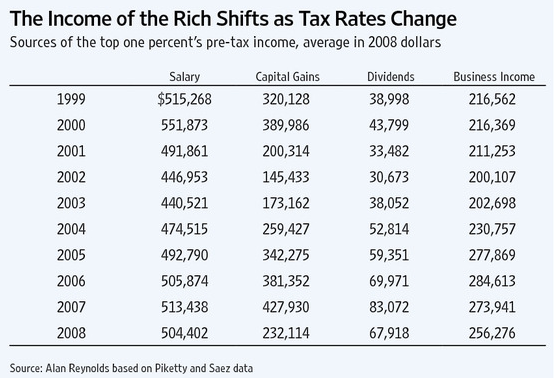
Key is the chart below which takes official IRS data for the top 1% of pre-tax-earners, adjusts for inflation (by stating all years in constant 2008 dollars), and breaks income into it’s components

image

The key points:

1) Business income is roughly 25% of reported income

2) Average inflation-adjusted salary has stayed pretty flat.

3) Until the crash in 2008, capital gains grew … note: cap gains tax rates were reduced in 2003 .. coincidence?

4) Similarly, dividends increased after the dividend tax rate was cut to 15% … another coincidence?

The mega-point of the analysis is that behavioral economics is alive and well … dink with marginal rates and folks will simply shift income … causing an inverse relationship between marginal tax rates and tax receipts.

Just do the the math.

* * * * *

Full article is a worthwhile read:
WSJ,Taxes and the Top Percentile Myth, Dec.  23, 2010
http://online.wsj.com/article/SB10001424052748703581204576033861522959234.html?mod=djemEditorialPage_h

Pucker up with Nivea in Times Square for NYE

December 24, 2010

TakeAway: Surely there is no moment when more Americans lock lips than at midnight on Dec. 31, when a kiss marks the New Year, and that is why Nivea Lip Care ties its biggest marketing effort of the year to New Year’s Eve. 

Nivea is a natural fit as a sponsor, just as Waterford Crystal is for the crystal ball that descends on Times Square for the countdown.

* * * * *

Excerpted from NYTimes, “For New Year’s Eve, the Tie-Ins Erupt” By Andrew Adam Newman, December 13, 2010

For the third consecutive year, Nivea is an official sponsor of the New Year’s Eve celebration in Times Square, and along with sponsoring a stage called the Nivea Kiss Platform, it will hand out about 30,000 samples of lip balm to revelers in the hours before the countdown.

“The brand is based on the insight that something wonderful happens when skin touches skin and humans connect, and the New Year’s Eve kiss sets the tone for the new year to come,” said Magnus Jonsson, vice president for marketing at Beiersdorf, parent company for Nivea.

This year, Nivea also is holding a contest on its Facebook page where couples in long-distance relationships vie for a chance to win a free trip to New York to be reunited in Times Square on New Year’s, with two couples who garner the most votes on Facebook winning.

Nearly as prominent as the ball are the numerals that light up to mark the dawning year, and Duracell is hoping to become similarly synonymous. For the third consecutive November, the brand set up what it calls the Duracell Power Lab in Times Square, which consists of four stationary bikes that when pedaled charge batteries that will subsequently be used to light the sign.  This year the bikes are housed in a trailer that for the rest of the year will be deployed to disaster areas, where it will provide charging stations for items including cellphones, laptops, and rechargeable batteries.  “We talk a lot about people trusting Duracell when it just has to work,” said its marketing director. When the numerals light up, “it’s that one iconic moment of the holiday season when millions of people are watching and it’s a great association for Duracell batteries being trusted in an important moment.”

The Times Square Alliance estimates that one million people attend the New Year’s Eve festivities. A Trylon Strategic Media Relations study commissioned by the group pegged the international audience at more than one billion.

Edit by AMW

* * * * *

Full Article:
http://www.nytimes.com/2010/12/14/business/media/14adco.html?ref=media

* * * * *

Dems establish some bad precedents … that’ll come back to haunt them.

December 23, 2010

Gotta give the Dems a hat-tip for pushing to the limits of the rules to cram their agenda in.

First, it was using the budget reconciliation process to pass ObamaCare.

Then, came the lamest of lame duck Congresses pushing through some debatable (but not debated or amended) legislative initiatives.

Note: I don’t have a clue whether the START Treaty is a good idea or a bad idea … but for the first time in U.S. history, a treaty is being ratified by lame duckers.  That sure sounds fishy, doesn’t it?

Now, the FCC – working though “executive authority” – implements rules to regulate the internet.  Rules that courts and legislatures have deemed inappropriate use of FCC powers.

Dems are feeling pretty proud about the way they’re using the system to their advantage.

But, as Grandma Homa used to say “what goes around comes around”.

Just wait until the GOP uses the same tactics.

The squealing will be intense.

Microsoft tries to stay relevant

December 23, 2010

TakeAway: As personal computing moves away from desktops and laptops to smartphones and tablets, Microsoft has yet to establish a foothold in either.

Its new smartphone platform offers the best chance get to gain market share but there are some steep challenges to overcome.

Developers don’t want to develop apps for the platform until sales justify doing so, but people won’t buy Windows 7 phones without compelling apps.

Not only that, but the platform won’t work on Verizon until next year, when Verizon is expected to launch the iPhone.

* * * * *

Excerpted from Bloomberg Businessweek, “Microsoft is Pinning Its Hopes on Windows Phone 7,” by Peter Burrows and Dina Bass, October 14, 2010

In an interview shortly after he unveiled Microsoft’s new Windows Phone 7 mobile software on Oct. 11, Chief Executive Officer Steve Ballmer declared a new era for Microsoft. “This is a big launch for us—a big, big launch,” he boomed.

Ballmer, never known for understatement, may be lowballing this one. Gartner expects smartphone sales to surpass PCs in 2012. Microsoft remains immensely profitable thanks to its aging PC monopoly, and it will remain so even if it never figures out the smartphone market. …

By almost any measure, Microsoft is nearly out of the mobile game. Its market share fell to 5 percent from 22 percent in 2004, says Gartner. Customer satisfaction of Windows smartphones is 24 percent, according to ChangeWave Research; it’s 74 percent for iPhones and 65 percent for handsets powered by Google’s Android. …

… With Apple and Google each activating more than 200,000 customers a day, according to those companies, handset makers, carriers, and app makers have far larger audiences than Microsoft offers. …

… While AT&T and T-Mobile will offer Windows Phone 7 devices, the software won’t work with Sprint or Verizon Wireless until next year. (Apple’s AT&T-only iPhone may be on Verizon by then.) …

Holding share in such a fast-growing market could require sales of about 20 million units in 2011, no easy feat. That’s how many iPhones Apple sold in its debut year. …

Microsoft’s to-do list doesn’t end with Windows Phone 7. It has no tablet software that can match the iPad. Failing in smartphones would be bad. Failing in tablets, which users expect to run office software, would be catastrophic …

* * * * *

Full Article
http://www.businessweek.com/magazine/content/10_43/b4200042877975.htm?campaign_id=magazine_related

* * * * *

2010’s Most Memorable Product Launches

December 23, 2010

TakeAway: In today’s mass production age, so many new products hit the shelves that most go unnoticed.  Schneider Associates, a Boston-based public relations and market communications firm, compiles an annual list of the year’s most memorable new product launches.  Here are the top ten to keep in mind.

* * * * *

Excerpted from Forbes, “The Most Memorable Product Launches Of 2010” By Elaine Wong, December 3, 2010

This year Apple came in first with the introduction of its iPad tablet computer. Forty-two percent of consumers named it as one of the products they most remembered out of the flurry of new launches that came between October 2009 and September 2010.

Tech brands overall had a heavy presence, with new introductions, such as Microsoft’s Windows 7 (No. 2), Motorola’s Droid smartphone release (No. 4) and Samsung’s 3-D TV (No. 8) among the most recalled new offerings on consumers’ minds this year.

Sales aside, a product launch that’s effortlessly recalled by the public proves that marketers – and their brands – have staying power. Plus, with about 250,000 new products launched globally each year, creating one that stands out can be pretty tough. Consider, too, that the typical failure rate of new product launches can be anywhere in the 85% to 95% range, according to Mintel.

Rolling out a product that appeals to an audience that uses social media to chat about new things can help make it a hit. That’s what Kimberly-Clark did when it rolled out Huggies Little Movers Jeans (No. 9) this year. This limited-edition offering is a diaper with a denim-like style. Mommy bloggers loved them.

For some marketers, thumbing a nose at conventional wisdom can work. KFC did this by ripping the bun off its fat-soaked Double Down sandwich (tied for No. 10). That’s two pieces of chicken – fried or grilled – serving as the one and only cover between an indulgent bacon, cheese and secret sauce center combo.

Food companies, on the other hand, tapped into recession-weary consumers’ hunger for quick, cheap eats. Among the hits: McDonald’s Real Fruit Smoothies (No. 5) and Mars’ Pretzel M&Ms (No. 3). The latter was a simple spin on an idea, but it satisfied Americans’ craving for a sweet, simple treat in an economic downturn.

Edit by AMW

* * * * *

Full Article:
http://www.forbes.com/2010/12/03/most-memorable-products-leadership-cmo-network.html

* * * * *


Oregon hikes tax rates … and tax receipts (predictably) go down.

December 22, 2010

Remember when Charlie Gibson stunned Candidate Obama by pointing out that when capital gains tax rates go up,capital gains tax receipts go down? It was obviously new news to Obama who countered: “But, it should be done for fairness”.

Continues to amaze me that our crack legislators confuse “tax rates” with “tax revenue” … and refuse to accept the repeated empirical evidence that they are inversely related.

Excerpted from WSJ, Ducking Higher Taxes, Dec 21, 2010…

Oregon raised its income tax on the richest 2% of its residents last year to fix its budget hole, but now the state treasury admits it collected nearly one-third less revenue than the bean counters projected.

Oregon’s liberal voters ratified a tax increase on individuals making more than $250,000 and another on businesses … no doubt feeling good about their “shared sacrifice.”

Congratulations. After the tax was raised “income tax and other revenue collections began plunging steeply.  Instead of $180 million collected last year from the new tax, the state received $130 million.

One reason revenues are so low is that about one-quarter of the rich tax filers seem to have gone missing. The state expected 38,000 Oregonians to pay the higher tax, but only 28,000 did. Funny how that always happens.

All of this is an instant replay of what happened in Maryland in 2008 when the legislature in Annapolis instituted a millionaire tax. There roughly one-third of the state’s millionaire households vanished from the tax rolls after rates went up.

http://online.wsj.com/article/SB10001424052748704034804576026233823935442.html?mod=WSJ_Opinion_AboveLEFTTop

The Evolution of Focus Groups

December 22, 2010

TakeAway:  Arguing that focus groups were never really all that effective in the first place, agencies and research facilities have introduced a variety of methods aimed at shaking up the traditional focus group approach. 

Young & Laramore, an Indianapolis-based agency, frequently runs what the company president calls “friendship groups.”

That’s when the company will tap one consumer and ask that individual to recruit two or three others from his/her social circle. The assumption is that one is more likely to be comfortable in an experimental setting when with others in one’s social network.

* * * * *

Excerpted from Forbes, “From Focus Groups to ‘Friend’ Groups” By Elaine Wong, November 19, 2010

In these situations, researchers can tell when participants are sharing “secrets with each other, you can catch them winking their eyes or exchanging signals with each other, and you dig into that and find out what’s up.”

Contrast that with the conventional focus group model, in which the scenario in question usually runs something like this: A packaged goods company, retailer or marketer, let’s say, asks an agency or research partner to recruit a panel of consumers with whom to test new products, packaging or ideas. These groups, which can range anywhere from six to 12 or more in number, then gather in a “sterile” room, as many agency execs describe it. A moderator then runs through a list of questions and records participants’ responses while researchers in the back room watch. Such procedures are routine, boring, not to mention long—one session can last 90 minutes—and yield few, if any, new insights.

One catalyst driving the push is the proliferation of social media mining tools, which allow companies to test and tweak new go-to-market strategies in real time and without the need for an actual focus group.

To avoid the typical, ho-hum answers, one company, The New England Consulting Group, uses a methodology called Super Groups, which involves finding the extreme, “lunatic fringes” of a consumer set. Talking to those who are not your average consumer ensures that you get not-so-average—and in some cases, off the chart—results. Several agency executives also brought up the idea of “conflict groups,” when “you recruit and mix people who love something [with] others who hate it or [bring together] passionate lovers of two different brands,” explains an Arnold executive.

Efficiency aside, the historical focus group also posed other problems. One is the gap between what people think and how they later act. Consumers may rationalize their shopping or buying behaviors, but emotion, rather than reason, is often a big driver of these decisions.

Edit by AMW

* * * * *

Full Article:

http://blogs.forbes.com/elainewong/2010/11/19/from-focus-groups-to-friend-groups/

* * * * *


Bumps ahead for gov’t gravy train …

December 21, 2010

Honestly, excluding the military and first-responders, what’s your view of government employees? 

How many fulfilling experiences have you had with the IRS,  the DMV, the tax assessor’s office, the planning board, etc. ?  My bet: not many.

In the old days, most folks got annoyed but gave passes because they thought the inefficient bureaucrats weren’t getting paid very much.

Recent news reports have burst those myths: revealing high pay relative to private sector employees and outrageous benefits packages.

For sure, the next couple of years will have spotlights shining on government employees and their candidate-contributing unions.

Blue states (think NY, CA, IL) will get hit particularly hard now that fiscally responsible red states are refusing to bail them out.

Since the unions won’t budge, expect higher state taxes and cuts in services …   

Compared with many sectors that have suffered grievously from the slump — housing, automobiles, finance — state and local governments have been relatively sheltered.

One reason is President Obama’s  “stimulus” packages … have provided about $158 billion to states.

As these transfers dwindle … local governments may be less lucky. They rely on property taxes for about a third of their revenues, and because property appraisals are done every few years, “the decline in house prices implies that collections will probably fall in the coming years.”

The truly bad news lies in the future with massive retiree pension and health benefits that haven’t been prefunded. How big are the shortfalls? All estimates are huge … the gaps are about $3 trillion for states and almost $600 billion for localities.

Whatever the ultimate costs, they threaten future levels of public services.

The generous benefits encourage workers to retire in their late 50s or early 60s after 25 years of service. The health benefits typically provide coverage until retirees qualify for Medicare at 65.

To pay for unfunded benefits, either government services must either be cut or taxes raised.

So support for schools, police, roads and other state and local activities is undermined by careless — or corrupt — bargains between politicians and their public-worker unions.

Promises of generous future retirement benefits were expedient contract sweeteners, with most costs conveniently deferred. Even when pension contributions were supposed to be made, they were often reduced or postponed when budgets were tight.

If these arrangements look familiar, they should. The U.S. auto industry adopted the same model; the costs helped bankrupt General Motors and Chrysler.

RCP,Cheating Our Children (Again), December 20, 2010
http://www.realclearpolitics.com/articles/2010/12/20/cheating_our_children_again_108288.html

Sun Drop taking aim at Mountain Dew

December 21, 2010

TakeAway: Sun Drop’s owner is taking direct aim at Mountain Dew, the fourth-most popular soda in the U.S. after Coke, Pepsi and Diet Coke.   

Mountain Dew dominates the “citrus” category with an 84.3% share, heavily marketed by Pepsi to teens through sponsorships of extreme sports and through advertising that’s embedded into videogames.

* * * * *

Excerpted from WSJ, “Bigger Splash Planned for a Niche Citrus Soda” By Valerie Bauerlein, December 9, 2010

Sun Drop – which has been around since 1928 – has a rabid following in the handful of mainly Southern states where it’s currently sold. The drink was once pitched by the Nas car legend Dale Earnhardt. Families have shipped it off to soldiers serving in Afghanistan; fans swap recipes for holiday turkey with Sun Drop glaze. Made with orange juice and packing more caffeine than Mountain Dew, it is sometimes used as a mixer with hard liquor.

Its expansion is part of Dr Pepper Snapple’s strategy to fortify consumer interest in flavored sodas, a non-cola segment of the soft drink industry in which the company specializes. Cola sales have fallen to 55.4% of the U.S. soda market in 2009 from 60.5% in 1999, according to Beverage Digest, an industry publication. At the same time, sales of Dr Pepper, Crush, and other brands Dr Pepper Snapple owns have grown.

To reach Sun Drop’s target market of 15- to 17-year-olds, Dr Pepper Snapple developed a revenue-sharing agreement with Viacom Inc.’s MTV network. MTV’s new Scratch marketing arm has designed the drink’s advertising and image, down to a redesign of the can that will be appear in January. The network also will feature Sun Drop in MTV programming, including reality shows such as “The Real World.”

Some analysts have cooled to Dr Pepper Snapple shares, saying the company has improved operations but has little prospect for growth, since the company long ago sold the rights to its brands internationally.

The company said it sees potential nonetheless in the growing appetite for its flavored drinks because carbonated soft drinks is a fairly stagnant, slightly declining category.

Edit by AMW

* * * * *

Full Article:
http://online.wsj.com/article/SB10001424052748704447604576007841967430316.html

* * * * *

Billionaires pledge charitable deductions … to do good and duck taxes.

December 20, 2010

Last week, 17 more billionaires signed on to the Giving Pledge and declared their intention to give away to charitable organizations at least 50 percent of their wealth. The initiative is being spearheaded by Buffett and Gates.

To call me cynical about the pledge would be an understatement.

I see it as a clever way for them to dodge estate taxes taxes (while whining about how they are undertaxed) and maintain their power … even from the grave.

I’d like to see how much money they’d throw in the pot if they had to do it with after-tax dollars.  That would be a nice sincerity test.

I was surprised to see the Huffington Post raise some issues about the billionaires’ pledge …

Huff Post, Why We Should Dial Down Our Enthusiasm for the Giving Pledge, December 15, 2010

Last week, 17 more billionaires signed on to the Giving Pledge and declared their intention to give away to charitable organizations at least 50 percent of their wealth. The initiative is being spearheaded by Warren Buffett and Bill and Melinda Gates.

I applaud the Gates family and Mr. Buffett for being willing to challenge their peers and to lead by example. Their effort will surely lead to an increase in giving among billionaires and others. I do, however, have some concerns.

There are three important reasons to keep our enthusiasm for the Giving Pledge in check.

First, the pledge is likely to have an extremely small impact on total giving, especially in the first few years. The problem is, the money is going to trickle out over a very long period of time, and it will represent only a very small upward tick in total charitable giving. Billionaires who take the pledge commit to giving half their wealth to charity at some point during their lifetimes, or at their deaths. Some people on the list are quite elderly, but others are likely to spread their giving out over the next 50 years.

My guess is that most of the money will wind up in university or foundation endowments, with only about 5 percent of the asset base getting spent on charitable purposes each year in perpetuity. Clearly, the Giving Pledge will not be a major factor in sparking a much hoped-for rebound from the drop in giving that has decimated many nonprofits these last two years.

Second, little of the money is likely to benefit the most under-served populations. And third, giving by billionaires has typically been limited in its effectiveness and has dangerous implications for democratic decision-making.

Wealthy donors don’t tend to prioritize lower-income communities, communities of color or other marginalized groups as beneficiaries of their giving. Instead, they tend to give to nonprofits that they patronize, such as cultural institutions and their alma maters.

Wealthy donors give to places “where they spend their leisure time” and that only 10 percent of charitable contributions actually benefit the poor. 

Third, giving by billionaireshas dangerous implications for democratic decision-making.

http://www.huffingtonpost.com/aaron-dorfman/the-giving-pledge_b_796159.html

English translation of “dangerous implications for democratic decision-making”: if people start making personal decisions about where their money should be directed -– partially subsidized by tax advantages—then the Feds have less money at their disposal to direct as they (the Feds) see fit.

Oh my …

Profile: Just-in-Time Consumer

December 20, 2010

TakeAway:  The recent recession has left in its wake a deeply changed shopper: the just-in-time consumer. Manufacturers and retailers report that people are buying less, more frequently, and are determined to keep cash on hand. Executives peddling wares from canned goods to cashmere say the shift in consumption habits is prompting them to change how they produce, package, price and deliver their goods.

* * * * *

Excerpted from WSJ, “The Just-in-Time Consumer” By Ellen Byron, November 23, 2010

So far, the impact of just-in-time buying on the corporate bottom line is mixed. Smaller unit sizes, for example, generally mean higher prices—and therefore higher profit margins for manufacturers.  Still, the phenomenon is so new it hasn’t shown up broadly in earnings. A Kimberly-Clark spokeswoman notes that potentially higher profits on smaller packages can be offset by higher manufacturing costs.

And companies are still reeling from lower sales volumes that began in 2008 with what some dub “pantry deloading.” Over the past two years, the number of items kept in American pantries has fallen about 20%, according to a recent survey. Consumers are also cutting back on the range of goods they stock.

The new shopping behavior is having a big effect on club stores, the ultimate pantry-filling destinations, which offer low prices but require bulk purchases. Some, including Costco and BJ’s, have reported increased shopping-trip frequency and decreased transaction sizes. To adjust, some discounters are rethinking their businesses. BJ’s began courting new customers two years ago to expand its membership, including smaller households and empty-nesters. It began shrinking its package sizes, in part to lure shoppers more interested in weekly purchases than monthly stock-ups. Now, the chain sells cartons of 18 eggs, instead of only five-dozen egg packages. It offers two containers of margarine of nearly two pounds each instead of only five-pound buckets.  The margarine change alone resulted in 46% more members who bought margarine.  BJ’s is trying to make its stores more attractive and change promoted items to encourage more frequent visits.

The changes at retail are often prompted by manufacturers. This summer, Del Monte began reducing the number of canned fruits and vegetables in multi-packs sold at club stores—and advising other retailers to reduce the number of cans required to qualify for a discount. The company realized consumers were more worried about overall cost, even if it meant a higher cost per can.

Just-in-time consumption is also disrupting long-established purchase cycles, including the annual back-to-school shopping ritual.  Shoppers of high-end discretionary products are shifting to just-in-time buying as well.

Edit by AMW

* * * * *

Full Article:

http://online.wsj.com/article/SB10001424052748704865704575610452319977706.html?mod=WSJ_business_LeftSecondHighlights

* * * * *

Omnibus Bill’s defeat is a big blow to ObamaCare … here’s why.

December 17, 2010

Obama and Reid almost got away with it.

At the last minute – in the lamest of lame duck session – Reid tried to push through a $1.1 trillion Federal budget.

The public uproar centered on the process (more backroom dealing), the magnitude (another $1 trillion), and the earmarks (over 6,000 and more than $8 billion).

Yep, it was a stick in the eyes of voters … I think Reid liked that.

But, Reid had to pull the bill last nite … accepting that he didn’t have the votes to pass it.

Interesting, because most of the uproar was just a distraction.

Bottom line, the budget that finally gets passed next year will be right around $1 trillion … you can make bank on that.

And, it’ll contain tons of wasteful spending … it’ll just be harder to find since it won’t be tagged “earmarks”.

So what’s the big deal ?

In my opinion, the omnibus bill was just a Trojan Horse.

Inside it was more than $1 billion funding for ObamaCare … to continue building the enforcement infrastructure.

There’s no way that the newbies arriving in DC will build that into the budget.  Many have declared that “defunding” ObamaCare is one of their top priorities.

That’s why Obama didn’t step forward and tell Reid to stop the foolishness re: spending and earmarks.

He couldn’t … he was getting the biggest earmark of them all.

Losing that, coupled with the states’ legal fight over the constitutionality of ObamaCare … 2011 will be a challenging year for ObamaCare as it’s supporters fight for $$$ and try to convince the courts that’ it’s legal.

Obama cites harsh rhetoric creating gulf with biz execs … their’s not his!

December 17, 2010

Here’s one from the “say what?” file …

At Wednesday’s CEO Summit, execs told Obama that

“ … an overwhelming majority of those in business believe the administration is hostile, with little or no understanding of how this saps the “animal spirits” required for taking risks on expansions and start-ups.”
http://www.ft.com/cms/s/0/1e56086c-0882-11e0-80d9-00144feabdc0.html#axzz18Gn2QqtQ

OK, that’s not new news to most of us.

The President’s rebuttal:

“ …  the president expressed his frustration about the apparent disconnect between productive talks with the executives, and the harsh rhetoric directed at the administration by the business lobbyists they employ.”http://www.ft.com/cms/s/0/ea11431a-087b-11e0-80d9-00144feabdc0.html#axzz18GoEJFOK

After 2 years of vilifying virtually every company (except Google) with the harshest rhetoric on the planet, the President says the problem is biz talking trash about him.

You gotta be kidding me.

Ironic that the fate of his presidency is now largely in the hands of those who he has trash talked.

See FT, Only business can put Obama back on top, December 15 2010
http://www.ft.com/cms/s/0/1e56086c-0882-11e0-80d9-00144feabdc0.html#axzz18Gn2QqtQ

My bet: the execs will continue to sit on cash and slow roll the hiring process.

Why?

They just don’t trust the guy …