Archive for the ‘Mktg – Pricing’ Category

Creative marketing: Mickey D goes from “free” to “almost free” …

December 2, 2011

San Fran parents said kids were pressuring them to buy non-nutritious happy meals to get the free toys.

So, the San Fran city council passed a  law making it illegal for fast food chains to include free toys in happy meals.

According to the Wash Post, McDonald’s crafted a creative workaround: for 10 cents, patrons can buy a toy to go along with a happy meal.

10 cents isn’t “free” it’s “almost free”.

The kicker: all the dimes all go to charity – the Ronald McDonald Houses.

The downside: consumer behavior is such that there’s a big fall off in demand when a price is raised from free to almost free.

So, Ronald McDonald Houses probably won’t get much money from the program

>> Latest Posts

Buffett says: “The airline business is unusually treacherous” … no bleep, Warren.

December 1, 2011

With American Airlines filing for bankruptcy, seem like a good time to dust off a slide I use in my class re: airlines revenue management practices.

My students hear often that I think airlines are pricing masters.

Which begs a question: why is their profitability so low?

Warren Buffett’s answer:

“A great management in that business will not necessarily get a great result …

In the airlines, you have a huge amount of capacity … something close to a commodity product with high fixed costs and no marginal costs

Since that extra seat doesn’t cost you anything, the temptation to sell it at a terrible price is overwhelming.”

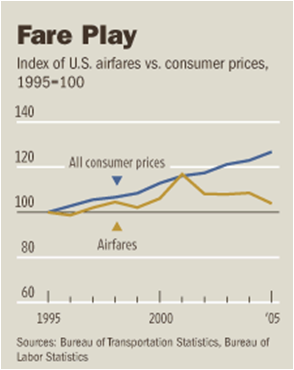
As a result, inflation-adjusted air fares have been essentially flat for decades.

image

Even extra baggage fees can’t save the day …

>> Latest Posts

The perils of ‘free’ … Netflix tries to divide and reconquer … bet the under.

September 28, 2011

Punch line: Netflix tried to ‘seed’ their steaming video business with an irresistible offer: free.  But, customers revolted when asked to pay.Now, trying to be clever, Netflix is trying corporate fission: breaking into 2 parts.

I’m betting the under …

* * * * *
Excerpted from the Atlantic, by Megan McArdle:
The Qwikster and the Dead

Netflix admits that they’d really messed up the transition when they announced the end of free streaming, and that in order to fix it, they  decided to more decisively split their DVD and streaming services.

The DVD part will now be called “Qwikster” and have its own website; the streaming service will retain the Netflix brand.

The internet’s collective reaction sits somewhere between foaming rage, and an enormous collective “What the hey, Netflix?”

It’s so bizarre.. What problem does this solve?

Netflix does have a huge problem.

The company never wanted to be in the mail-order DVD service long-term; it’s not a good business.

Redbox was threatening to carve off the casual users, leaving them with the high-traffic movie buffs who don’t make them money.

Plus any idiot can see that the future is likely to be in painlessly streaming movies over the internet, not putting physical discs in little envelopes and mailing them.

The fact that the Postal Service is near bankruptcy tells you a lot about the viability of business models based on mailing things.

The problem is that they tried to build their streaming service by giving it away for free, as an add-on to their snail-mail service.

This was a good way to add customers.

But the history of the internet indicates that once you convince people something is supposed to be free, or close to it, you will have a devilishly hard time getting them to pay for it.

Unfortunately, users had been conditioned to expect unlimited free ice cream; they didn’t like having to pay for it.

Subscriptions dropped instead of rising.

Netflix stock went into a  rapid decline.

image

So I understand that Netflix was in a bad place.

But I don’t understand how Qwikster solves any of these problems.

It doesn’t improve their bargaining position with the content providers.

It doesn’t soothe angry customers who don’t like having to pay for stuff they used to get for free.

Thanks to Tags for feeding the lead.

>> Latest Posts

Ketchup? That’ll be extra, monsieur.

September 27, 2011

In marketing jargon, it’s called “unbundled pricing” … charging a price for a base product and then charging separately for add-ons.

In concept, price unbundling allows suppliers to flash lower base prices to potential buyers … and enables buyers to only pay for the specific product features that they want.

The downside: unbundling highlights the price of the add-on … which folks may have previously perceived to be free.  Think airlines charging for bags

Another case in point: a family member just got back from Europe …. where he was dismayed that McDonald’s was charging extra for ketchup.

For McDonald’s, it’s a way to to list a lower burger price.

For non-ketchup eater, it’s a way to save money … not paying the ‘hidden price’ for something that they don’t use.

For ketchup users?

Well, it certainly feels like Mickey D is screwing them.

Thanks to SMH for feeding the lead.

>> Latest Posts

Marketers reshape how college teams price & sell tickets …

August 10, 2011

Punch line: Colleges that are able to fill their football stadiums and basketball arenas are starting to price differentially – charging more for “hot” games.

But, the bulk of colleges are having trouble filling seats and are outsourcing ticket sales to aggressive outside organizations (think, “Boiler Room”)

* * * * *
Excerpted from USA Today

The “Haves” – Differentiated Pricing

Schools with overwhelming ticket demand are leveraging it as never before in an effort to boost revenue.

Notre Dame, for example, is varying football ticket prices by opponent for the first time this season. Games against Michigan State, Southern California and Boston College are $80; that’s $10 more than tickets for games against South Florida, Air Force and Navy.

The “Have Nots” – Outsourced Selling

“For years and years, if you put up enough billboards and sent out enough brochures, people would show up” at college games.

There not only was no need to be pushy in order to sell tickets to college games, there also was a fear of offending donors and deep-rooted fan bases by allowing non-profit colleges to have even the appearance of a chase-every-possible-dollar, professional sports business.

But, “colleges, for many years, were almost in an arms race for who could have the most seats — and they were able to fill those seats, for the most part. That has changed. … Most schools across the country have an issue with their football and/or their basketball seating demand vs. their seating capacity.”

Observers attribute this supply-demand imbalance to a combination of the tough economy, high gas prices and advances in high-definition television that have improved home viewing.

An empty seat leaves money on the table and  is a cancer to your brand.”

Hence, the rise in outsourcing

The number of schools outsourcing proactive, full-time ticket-selling operations to companies like Aspire, IMG, and Monumental S&E has recently skyrocketed.

The typical setup: 12 to 14 full-time staffers working on commission, each making 80 to 100 phone calls a day from a database of school-connected names.

“Get potential customers to talk about their love of the school. Seek referrals and new leads. Above all, make sales — and get psyched about making sales. Every time a staffer makes a sale, they ring a bell. Staffers who don’t ring the bell enough get fired.

  • Note: Georgetown uses Monumental Sports and Entertainment

>> Latest Posts

JetBlue’s all-you-can-fly promotion …

August 3, 2011

Punch line: To “hook” business folks traveling in & out of Boston. JetBlue is offering BluePass – a 3 month  all-you-can-fly promotional price.

From The Economist …

JetBlue selling “BluePass” allowing unlimited travel

JetBlue announced a promotion called “BluePass” that will allow travellers unlimited flights in a three-month span for one fixed price.

The three-month promotional period runs from August 22nd to November 22nd.

Travellers have three plans to choose from:

  1. Three months of unlimited travel between JetBlue’s Boston hub and any JetBlue city, all for $1,999.
  2. Three months of unlimited travel between JetBlue’s Boston hub and any of 13 selected JetBlue cities (non west of Chicago), this time for $1,499.
  3. Three months of unlimited travel between JetBlue’s Long Beach, California hub and any of nine selected JetBlue cities (non east of Chicago) for $1,299.

BluePass is targeted squarely at frequent business travellers, which seems likely given the pricing and the “Get Down to Business” promotional tagline

* * * * *

Right now, most airline pricing schemes are the kind that annoy travelers, not the kind that offer greater flexibility and customization.

It would be great if JetBlue’s offer starts to alter that dynamic. ZipCar, the popular American car-sharing firm, does a much better job than the airlines do of offering pricing plans to fit every need.

Ken’s Take: “All-you-can eat-plans” often push suppliers up against their capacity constraints and end up disappointing customers – think AOL’s unlimited monthly dial-up program.

At least JetBlue is time-limiting, and location-restricting the offer so they’re not stuck with it if it blows up on them.

Thanks to Tags for feeding the lead

>> Latest Posts

Grab your wallet … Ticketmaster going to “dynamic pricing”.

April 26, 2011

Punch line: Ticketmaster  plans to develop “dynamic pricing” systems that would adjust the cost of sports and concert tickets in response to demand, a strategy airlines and hotels have long used to maximize profits …  TM expects sports teams  to adopt the new system before concert promoters or Broadway producers.

* * * * *

Excerpted from WSJ, Ticketmaster to Tie Prices to Demand 

Dynamic pricing a key element in Ticketmaster’s strategy to revive sales of concert tickets, which have been stagnant or declining for years.

Last year was brutal for the concert industry, with ticket sales plunging 12% despite a modest decline in average prices. Recent price drops follow more than a decade of steady increases, a trend that helped mask fundamental problems.

“2010 taught us we have real challenges as an industry,” Mr. Hubbard said. “One of them is pricing.”

A frustration throughout the concert industry: the best seats appear to be consistently priced below what fans are willing to pay, leading to a multibillion-dollar “secondary market” in which scalpers can reap profits by reselling tickets above face value.

At the same time, he said, 40% of concert tickets sit unsold industry-wide, meaning that the ostensibly cheap seats for many shows are simply not cheap enough.

Thanks to JD for feeding the lead

What do Houston, Newark, and Dallas have in common?

April 12, 2011

Answer: high air fares.

Great analysis in one of the New York Times blogs

The writer wanted to figure out why, say, an average passenger flying out of Newark Liberty Airport pays about 25 percent more than someone flying out of John F. Kennedy International for an equivalent seat on an equivalent flight.

So, he cranked some nums re: airline pricing, and sorted airports as ‘relatively overpriced’ or ‘competitively priced’.

He modeled airport prices based on distance to destinations,  size of market (how much ‘traffic’),  and competitive structure – i.e. the market share at the origin and destination airports held collectively by the five “legacy carriers” (United, American, Delta, Continental and US Air); the market share held by Southwest Airlines; and the market share held by the largest single carrier at that airport (for instance, Delta and its affiliates are responsible for about 66 percent of all traffic at Atlanta).

He concluded that prices are higher where:

  • Legacy airlines dominate an airport
  • Southwest has a large share as opposed to other low-cost carriers like AirTran and JetBlue.
  • One airline dominates an airport, regardless of whether it is a legacy carrier or a low-cost one.

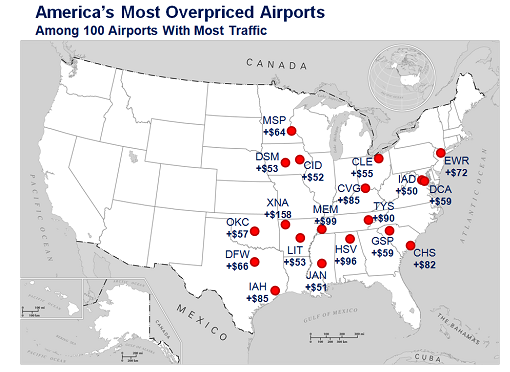
Here are overpriced airports:

image

image

For ‘competitively priced’ airports, the “unifying theme”  is that many are warm-weather vacation destinations, like Las Vegas and pretty much anywhere in Florida.

Why?

Leisure travelers are more price-sensitive than business travelers since they, not their company, are paying for the ticket. To keep them flying, prices have to be relatively low,

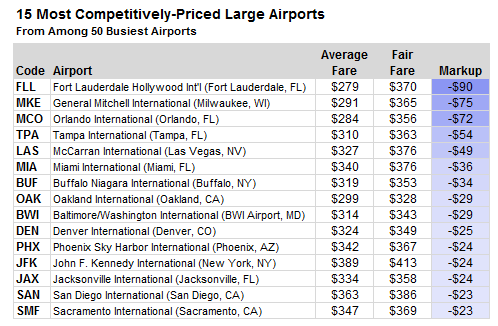
Here are the bargains:

image

A very clever analysis … Worth reading the details:
http://fivethirtyeight.blogs.nytimes.com/2011/04/06/which-airports-have-the-most-unfair-fares/

Thanks to BM for feeding the lead.

How much does a ‘for sale’ home’s list price matter?

March 25, 2011

Answer: a lot … it’s the psychological effect called anchoring.

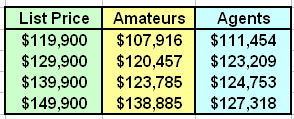
For example, researchers asked both professional real estate agents and man-off-the-street amateurs to predict the final selling price of a house.

They were all told that the current tax appraisal value of the house was $135,000.

Then, each respondent was told that the house was listed in one of four prices — ranging from $119,900 to $149,900.

The researchers found a clear positive correlation between list prices and predicted sale prices.

The amateur is responded more to the differences in list prices and the professionals — but even the pros and a $15,000 spread that can only be attributed to the differences in the list prices.

Bottom line: if you’re selling a home beach for the sky with your list price; if you’re buying a home try to ignore the list price and focus on more fundamental values like tax assessments and comparable sales

image

Source: Priceless, William Poundstone, Hill and Wang Books, 2010

Walk clockwise around grocery stores !

March 24, 2011

Why?

Because you’ll save money.

Researchers have discovered that “shoppers open their wallets wider when moving through a store in a counter-clockwise direction.”

On average, they spend $2 more per visit.

Why??

One theory is that most shoppers are right handed … and like most basketball players, they go to their right better…. so, impulse items stocked to their right along “walls of value” are easier to grab and throw in the cart.

If you are right handed, walk clockwise and the “wall of values” will on your left,  and will be less tempting.

Source: Priceless, William Poundstone, Hill & Wang, 2010, p.149

That menu — it’s playing with your mind … is it a profit scheme?

March 22, 2011

You bet it is …

In his book, Priceless: The Myth of Fair Value (and How to Take Advantage of It), author William Poundstone dissects the marketing tricks built into menus—for example, how something as simple as typography can drive you toward or away from that $39 steak.

1. The Upper Right-Hand Corner
That’s the prime spot where diners’ eyes automatically go first.

Restaurants often use it to highlight a tasteful, expensive pile of food.

2. Pictures

Generally, pictures of food are powerful motivators but also menu taboos — mostly because they’re used in downscale chains like Chili’s and Applebee’s.

Red Lobster ditched pics when it started trying to inch upscale

3. The “Anchor”
The highest priced item on the menu may not ever get ordered.  That’s ok.  It’s purpose is to make everything else near it look like a relative bargain.

4. In The Vicinity
The restaurant’s high-profit dishes tend to cluster near the anchor.  They’re items at prices that seem comparatively modest (when compared to the anchor).. They’re the items the restaurant really wants you to buy.

5. Columns Are Killers
It’s a big mistake for restaurants to list prices in a straight column. “Customers will go down and choose from the cheapest items.”

Consultants say to omit “leader dots” that connect the dish to the price; and to drop dollar signs, decimal points, and cents

6. The Benefit Of Boxes
“A box draws attention and, usually, orders.

When you see an item in a box, think “high margin”

7. Menu Siberia
That’s where low-margin dishes that the regulars like end up. They’re there, but relatively easy-to-miss  … or so the restaurant hopes..

8. Bracketing
A regular trick …  it’s when the same dish comes in different sizes.

Because youre never sure of the portion size, you’re tempted to to trade up … especially from small to “regular” size.

* * * * *

Excerpted from Priceless: The Myth of Fair Value (and How to Take Advantage of It), to be published in January by Hill & Wang, an imprint of Farrar, Straus & Giroux. © 2010 by William Poundstone.
http://nymag.com/restaurants/features/62498/

Oh, just pay whatever you feel is fair …

February 8, 2011

TakeAway: Pay-what-you-want experiments have yielded some interesting results.

When consumers pay what they feel is fair for the benefits received, there is no excess value ceded to them.

However, consumers are probably less likely to take advantage of this arrangement when the stakes are low, like in the study below.

* * * * *

Excerpted from NPR, “  Can Allowing Customers to Pay as They Wish Increase Profits?by Jess Jiang, January 19, 2011

Do you pay more when you can pay what you want? Yes, according to a recent study published in the journal Science.

… a group of researchers from the University of California wanted to test how letting people pay what they want could work for other businesses. The researchers took photos of over 100,000 people on a roller coaster ride at an amusement park. Then they split people into two groups. Group A could buy the photo for a fixed price, and Group B could pay what they wanted.

The results — people who paid what they wished bought more photos— 8 times more, and these same people also spent more money per photo.

Then, the researchers added a second-dimension, charity. Half of the participants in each group were told that some of the revenue would go to charity. Although the number of sales in both group A and B remained roughly the same, purchasers who paid as they wished spent much more money when they were told charity was involved.

As for what they want people to take away from the study, the researchers point to company ethics, “our study suggests a method in which the pursuit of social good does not undermine the pursuit of profit.”

Edit by DMG

* * * * *

CPGs “Slim Down” with their Consumers

January 14, 2011

TakeAway: From PepsiCo to Kraft Foods to Campbell Soup Co., makers of some of America’s most well-known products are trimming the calories and content when it comes to package sizes. 

ConsumerReports.org listed examples of household and grocery products that have decreased in size, thanks to packaging shrinks, in part due to rising commodity and energy costs.

* * * * *

Excerpted from Forbes CMO Network, “What? America’s Favorite Brands Are Slimming Down, Too?” By Elaine Wong, January 4, 2011

Häagen-Dazs’s ice cream container went from 16 to 14 ounces, a reduction of 12.5 percent. ConAgra Foods’ Hebrew National franks are now 11—not 12—ounces. Even household products are not immune: anti-chafing gel Lanacane is now 99 and not 113 grams (12.4% difference).  Kraft sliced the weight of its 2% Milk Singles and Fat Free Singles from 16 to 14.7 ounces last May.

Package shrink is not a new tactic to either the consumer or manufacturer (including private label companies).  Indeed, it has been going on for a while, most frequently during times when ingredient costs are soaring high. And calorie-conscious consumers, newly refreshed from their 2011 vows, might actually have something small to cheer about. After all, smaller amounts of product might, hopefully, lead to smaller waistlines. But in this day and age of social and digital media, when today’s cost-conscious consumer is much more smartly trained to detect such downsizes, even if unannounced, can such maneuvers actually hurt advertisers?

Robert Passikoff, CEO and founder of Brand Keys, a New York-based consultancy that specializes in brand engagement and loyalty, says most definitely yes. Social media’s prevalence and transparency aside, consumers, over the last two decades, have just become smarter shoppers, and such changes, even if subtle, aren’t likely to go unnoticed.  Consumers, especially in today’s tough economy, are more likely to balk if such increases get passed along in the form of price hikes.

Though most instances of package shrink happen stealthily, some marketers, such as PepsiCo, make it up by publicly announcing the changes to make sure consumers weren’t surprised. Such was the case when the company’s Tropicana brand announced that it was reducing the packaging on one of its most popular orange juice cartons by about 8 percent, in addition to raising the price, to cope with a severe citrus crop loss in March.

Regardless, some consumers are bound to complain as Consumer Reports found that some instances of package shrink were as high as 20 percent. Procter & Gamble’s Ivory dish detergent, which went from 30 to 20 ounces, was one.

Edit by AMW

* * * * *

Full Article:
http://blogs.forbes.com/elainewong/2011/01/04/americas-favorite-brands-are-slimming-down-too/


* * * * *

Testing the pricing waters

October 18, 2010

TakeAway: Companies that sell consumer mainstays are rolling out price increases in a collective test of America’s economic strength and in response to higher raw-material costs.

If consumers are willing to pay more, it could indicate the economy is turning a corner, but also serve as a warning that inflation could spiral.

If consumers balk at higher prices, though, it would represent a setback and could pinch corporate profits. Some companies could be forced to backtrack with discounts if sales falter.

* * * * *

Excerpted from Wall Street Journal, “Gingerly, Retailers Try to Pass Along Higher Costs” By Liam Pleven,October 2, 2010

The ability of companies to sustain such price increases may sway how the Federal Reserve views the health of the economy, and potentially figure in its decision on whether another big round of stimulus is needed. The country’s low rate of inflation was cited by the Fed last month as a main reason the central bank is considering further steps to juice the economy.

Companies say some labor costs are rising, particularly for overseas manufacturing, and point to rising commodities prices. Commodities typically make up less of a company’s costs, but prices have risen sharply, with cotton up 38% this year, coffee up 33% and rubber up 17%.

Some firms successfully increased prices earlier in the year, with little or no discernible impact on inflation. The 6% increase that Goodyear began rolling out for consumer tires follows on another 6% rise in June. The firm cited higher raw-material costs.

But many other firms held off on charging more even though the recession technically ended more than a year ago, because they were concerned about a consumer backlash and losing sales to rivals.

Still, some companies are dipping their toes in the water daintily, targeting specific products.

Starbucks, for instance,  is raising prices on “labor-intensive and larger-sized beverages,” but maintaining or lowering the price of a regular cup of coffee in most markets.

Edit by AMW

* * * * *
Full Article:
http://online.wsj.com/article/SB10001424052748704029304575526331692863238.html?mod=WSJ_hpp_sections_business

* * * * *

Adults Only: A Trojan horse or a Trojan for horses ?

July 19, 2010

Hate to drag HomaFiles down to this level, but this one is too good to pass up.

Punch line: Since introducing its Magnum line of plus-size condoms,  industry leader Trojan’s market share and profits have surged.

* * * * *

From Psychology Today …

Few marketers are as fortunate as condom makers, whose customers are glad to pay a premium for a product that isn’t really much bigger or better.

Trojan markets its Magnum line of condoms as “Bigger than most condoms …  designed to fit those that find normal condoms too constricting.”

Oh, yes, and then there are Magnum XL’s … an upsell version.

It’s easy to see why men fall for this particular sales pitch.

“The Magnum brand is viewed as a positive lifestyle badge and positive symbol … men are proud to show they carry a Magnum condom — the large size carries a certain cachet.”

The economics:  A box of 12 regular Trojans retails for around $5.99; a box of 12 Magnums or Magnum XLs is $7.99. That’s a 33 percent premium.

Trojan confesses that it’s hard to imagine Magnum buyers doing the math … and since Magnum condoms are only 3/10 of an inch longer than regular Trojans – and since XLs are the the same length as Magnums … all of the condoms cost about the same to make, so the Magnum’s price premium is pure profit.

As an academic observer notes: “I think the concept of having more sizes is a step forward for the industry … But you could never market them as small, medium and large, because no one would buy the small.”

Excerpted from Behavioral Economics: Monetizing the Male Ego, April 28, 2010
http://www.psychologytoday.com/blog/priceless/201004/monetizing-the-male-ego

* * * * *

Factoids

Trojan, including Magnum, commands 75 percent of the condom market, with No. 2 Durex commanding 14 percent.

The company claims Magnum is the most popular condom among African-Americans, citing internal research that indicates they account for 22 percent of all condom purchases but 40 percent of Magnum purchases.

http://www.nytimes.com/2010/04/28/business/media/28adco.html?_r=1&ref=business

Next time you open a menu … spot how they’re playing with your mind.

July 15, 2010

In his new book, Priceless: The Myth of Fair Value (and How to Take Advantage of It), author William Poundstone dissects the marketing tricks built into menus—for example, how something as simple as typography can drive you toward or away from that $39 steak.

1. The Upper Right-Hand Corner
That’s the prime spot where diners’ eyes automatically go first.

Restaurants often use it to highlight a tasteful, expensive pile of food.

2. Pictures

Generally, pictures of food are powerful motivators but also menu taboos — mostly because they’re used in downscale chains like Chili’s and Applebee’s.

Red Lobster ditched pics when it started trying to inch upscale

3. The “Anchor”
The highest priced item on the menu may not ever get ordered.  That’s ok.  It’s purpose is to make everything else near it look like a relative bargain.

4. In The Vicinity
The restaurant’s high-profit dishes tend to cluster near the anchor.  They’re items at prices that seem comparatively modest (when compared to the anchor).. They’re the items the restaurant really wants you to buy.

5. Columns Are Killers
It’s a big mistake for restaurants to list prices in a straight column. “Customers will go down and choose from the cheapest items.”

Consultants say to omit “leader dots” that connect the dish to the price; and to drop dollar signs, decimal points, and cents

6. The Benefit Of Boxes
“A box draws attention and, usually, orders.

When you see an item in a box, think “high margin”

7. Menu Siberia
That’s where low-margin dishes that the regulars like end up. They’re there, but relatively easy-to-miss  … or so the restaurant hopes..

8. Bracketing
A regular trick …  it’s when the same dish comes in different sizes.

Because youre never sure of the portion size, you’re tempted to to trade up … especially from small to “regular” size.

* * * * *

Excerpted from Priceless: The Myth of Fair Value (and How to Take Advantage of It), to be published in January by Hill & Wang, an imprint of Farrar, Straus & Giroux. © 2010 by William Poundstone.
http://nymag.com/restaurants/features/62498/

Pricing magic: the power of a “decoy”

July 13, 2010

In a classic pricing study, researchers assigned quality levels ranging from zero to 100 to unbranded beers (think wine ratings).

For the first test a  “regular” beers was scored a 50 and offered for $1.80 per bottle, and a premium beer – scored at 70 – was offered at $2.60 per bottle.

Survey respondents opted for the premium by about 2 to 1.

In a second test, a “cheap” beer– scored at 40 out of 100 and priced at $1.60 — was added to the mix.

Though no respondent picked the cheap beer, there was a mix change.  Suddenly, the regular — now the mid-priced beer – was picked by more people..

Hmmm.

In a third test, the cheap beer was replaced by a super-premium – scored at 75 and priced at $3.40.

Now, nobody picked the regular (which was the “low end” of the 3 picks) … only 10% picked the super-premium …. 90% picked the premium.

So, by adding a “decoy” – a product that isn’t ultimately bought but which sets a high-end price impression in people’s mind – the researchers were able to get respondents to “step up” from regular to premium – and increase the “price realization” of the regular and premium beers by 16%.

The theory of the case: “Aversion to extremes” … often, people conclude that the cheapest product is, well, a cheap product … and that the highest priced product may not deliver enough added benefits to justify its higher price.  So, the safe bet is to buy the mid-priced product.

That’s pricing magic, for sure.

image

Perceptual Differences: Is 68 cents per day enough to “buy” seniors’ support ?

June 10, 2010

In marketing, there’s a concept called a “perceptual difference”.

The basic notion is that something has to be sufficiently different from a comparative benchmark in order to make a difference in the way people think about it.

For example, throwing an extra 1/2 ounce of Cheerios into a 14 ounce box probably doesn’t pass the perceptual difference test. It adds to the cost of the product, but probably doesn’t motivate buyers to pay more for it.

Increasing the contents by, say 20%, probably does .  Folks are likely to notice.  Whether they’re willing to pay more for the super-size is another question …

Which brings us to Pres Obama’s push to win seniors over to his health care plan.

Keep in mind that roughly half ObamaCare’s comes from $500 billion in Medicare cuts – half from cutting waste & fraud (yeah, right) and half by eliminating Medicare Advantage – a step-up HMO version of Medicare.

$500 billion passes the perceptual difference test, and seniors are taking the cuts personally.

To partially offset the cuts, ObamaCare is “filling the doughnut hole” in Bush’s prescription drug plan – a program that supplemented Medicare to cover seniors’ prescriptions – but only up to a certain amount – and then kicked back in for extraordinary prescription drug users. The gap between “a certain amount” and “extraordinary – designed to suppress unnecessary prescriptions “at the margin” – is the “doughnut hole”.

To close the doughnut hole, Obama is sending each Medicare senior a check for $250 – the equivalent of 68 cents per day. Hardly a perceptual difference.

Does the administration really think that 68 cents a day will get old folks to think that $500 billion in cuts is good for them ?

* * * * *

Side note: The notion of perceptual differences also provides an explanation for why Obama doesn’t get credit for his “tax cut to 95% of workers”.  His “making work pay” program paid out a max of $400 to workers – that’s a little over $1 per day.  A significant perceptual difference ?

Draw your own conclusion.

Sharpen your pencil, there’s a Walmart truck at your loading dock.

June 3, 2010

Punch line: Walmart is starting to pick-up merchandiser at suppliers docks — rather than have the stuff shipped to WMT distribution centers for subsequent redistribution to stores. Three reasons:

(1) WMT can usually move the stuff cheaper because deals in economical full truck loads and has highly productive logistic processes in place

(2) WMT has the clout to command price reductions that may exceed the suppliers cost cuts

(3) For sure, suppliers will allocate more of their fixed costs to WMT competitors who don’t have the scale, interest or capability to do their own picck-ups

* * * * *

Excerpted from BBW: Why Wal-Mart Wants to Take the Driver’s Seat, May 27, 2010

Wal-Mart, the world’s largest retailer, has become famous — and at times infamous — for the power it wields over its suppliers … to create environmentally friendly packaging and exclusive product sizes, and to participate in joint advertising promotions.

Now, Wal-Mart wants to take over U.S. transportation services from suppliers in an effort to reduce the cost of hauling goods.

The goal: to handle suppliers’ deliveries in instances where Wal-Mart can do the same job for less, then use those savings to reduce prices in stores.

Wal-Mart believes it has the scale to allow it to ship everything from dog food to lawn chairs more efficiently than the companies that produce the goods.

Manufacturers would compensate Wal-Mart by giving the retailer lower wholesale prices for the goods it transports.

Until now, suppliers made most deliveries to Wal-Mart’s distribution centers. The retailer then used its fleet of 6,500 trucks and 55,000 trailers to ferry goods between the regional centers and individual stores. Under the new program Wal-Mart will pick up products directly from manufacturers’ facilities.

That will allow Wal-Mart to carry more per truck and improve on-time delivery rates … and give it  more sway in negotiating fuel prices, thanks to its larger purchasing volume.

The price cuts Wal-Mart is seeking are twice as much as the cost of transporting goods in some cases. In two instances, Wal-Mart asked for a 6 percent reduction in the price it pays for products based on its own cost calculation, while suppliers estimated the actual expense was equal to about 3 percent, the people say.

One side effect of the Wal-Mart plan is that consumer-product manufacturers may face increased transportation costs on deliveries to other retailers as they lose economies of scale on their own delivery fleets.

Suppliers may have to go along with the plan even if their other remaining transport expenses rise because Wal-Mart is so big.

The bottom line: By attempting to take over the transportation from its suppliers, Wal-Mart hopes to achieve efficiencies to cut its own prices.

Full article:
http://www.businessweek.com/magazine/content/10_23/b4181017589330.htm?chan=magazine+channel_news+-+companies+%2B+industries

Pricing Baseball Tickets Like Airline Seats .. uh-oh.

May 28, 2010

For years, I’ve agreed that sports teams were pricing themselves out-of-reach for the average family. 

“Face value” on tickets staggers me.  Dealing with scalpers males me nervous.

Now, those worlds are starting to coincide: teams getting higher prices by acting like scalpers.

Play ball.

* * * * *

Excerpted from Bloomberg Business Week:Pricing Baseball Tickets Like Airline Seats, May 20, 2010

Software helps the S.F. Giants price baseball games in much the same way airlines manage seat prices to keep planes full.

The software crunches numbers on dozens of variables (e.g. the weather, the pitchers, the teams’ records, the rivalry, day of week, time if day, StubHub market price) to determine prices that will get fans into the stands and generate the highest revenue. 

Ticket prices used to be fixed before spring training; now, they’re adjusted almost daily.

The Giants say that revenues are up 12% this season and attendance has jumped 7%, even as the league has seen a slight decline.

Expect the entire league to adopt market-based pricing … and watch it spread to other sports and entertainment. 

“There’s big money out there in lost revenue from mispricing.”

Full article:
http://www.businessweek.com/magazine/content/10_22/b4180039348750.htm

Subscribers tell cellphone companies: Take your 2-year contracts and shove ‘em

May 18, 2010

Bottom line: Folks aren’t giving up their cell phones in a tough economy, but they are looking harder at hidden fees and charges for unused minutes.  More are opting for “by the drink” plans – so that they only pay for what they use.

* * * * *

Excerpted from AP:  Wireless users opt for service without commitment, May 14, 2010

Together, the seven largest U.S. wireless carriers added just 230,000 contract subscribers in the first quarter. That’s negligible compared to their entire customer base of 280 million.

Prepaid service, meanwhile, attracted about 3.1 million new subscribers to the seven largest carriers in the quarter.

This marks a sharp reversal of trends. In the same quarter just two years ago, the comparable carriers added 3 million subscribers under contract, and 2.3 million to prepaid plans.

The carriers that rank third and fourth in the U.S. by subscriber numbers, Sprint Nextel and T-Mobile USA, are losing contract customers. No. 1 Verizon Wireless and No. 2 AT&T are still adding contract customers, but at the lowest numbers in more than five years.

* * * * *

Wireless subscribers have been making a big shift away from two-year contracts toward “prepaid” cell phone service, which often costs less and does not require contracts … even though contracts are needed to get popular phones such as the iPhone and the Droid.

One out of every five Americans with a cellphone had a prepaid plan at the end of 2009. In some markets, up to 30% of subscribers are on prepaid plans.

Unlike contract plans that bill subscribers each month for the services they used the previous month, prepaid services traditionally let subscribers buy minutes in advance for around 10 cents to 20 cents each. When the minutes are used up, people “refill” their accounts as needed.

For years, such plans were marketed primarily to people who did not have the credit to qualify for plans with contracts. But as the recession forced more people to cut costs, prepaid service appealed to a broader slice of the market, and prepaid services responded by offering better deals.

Now it’s possible to make unlimited calls and text messages on a prepaid plan for $45 a month – half of what it costs a customer with a contract on Verizon Wireless.

  • The prepaid market heated up in January 2009, when Sprint began offering a prepaid plan with unlimited minutes for $50 a month under its Boost Mobile brand.
  • Tracfone, a unit of Mexico’s America Movil SA, countered with Straight Talk, which provides unlimited calling for $45 per month on Verizon Wireless’ network, sold exclusively by Wal-Mart Stores Inc.
  • MetroPCS and Leap, which sells service under the Cricket brand, have responded by eliminating add-on fees for taxes and roaming, effectively cutting prices. The price war looks like it will continue.
  • Sprint and Wal-Mart Stores Inc. announced a trial of another prepaid plan: Common Cents, which is designed for people who don’t use their phones much. Calls will cost 7 cents per minute.

The popularity of text messaging is also making some people move away from contract plans that provide a big bucket of monthly minutes that may not get used.

* * * * *

Full article:
http://www.washingtonpost.com/wp-dyn/content/article/2010/05/14/AR2010051401345_pf.html

Cherry Coke is so yesterday … now, add a shot of whatever to your Coke

May 12, 2010

Coke is trying to boost its fountain business (in restaurants, etc.) by letting people add a shot of flavors to its drinks – kinda like Starbucks does.

Remember when Coke changed the basic formulation? Folks balked at New Coke. 

So, let’s dink with flavors some more and confuse people re: what a Coke tastes like.

Might work … but I resisted headlining this “adding fizz to the soda biz”.

The soda business is in need of some innovation.

Sales volume in the U.S. has slipped steadily for the past five years, and fell 2.1% in 2009 to 9.42 billion cases.

Fountain sales, which make up about a quarter of soft-drink volume, slipped 2.7%.

Coca-Cola hopes a new high-tech soda fountain will add some life to listless soft-drink sales by letting restaurant-goers mix up 104 different drinks, creating inventions such as Caffeine-Free Diet Raspberry Coke.

Coke is the giant of the fountain business, with 70% of the U.S. market.

A key to Coke’s strategy is to sell more sodas when people are dining out, presumably with family and friends.

The Freestyle is a wireless device, capable of beaming back information that helps Coke realize that sales of non-caffeinated drinks skyrocket after 3 p.m., or that a particular restaurant will need a concentrate shipment by the next week, based on usage patterns.

Although Coke is charging more for a Freestyle machine than for a traditional soda fountain, the company expects restaurants will ultimately raise the price of a drink by about 10 cents.

Excerpted from WSJ: Coke Goes High-Tech to Mix Its Sodas, May 10, 2010
http://online.wsj.com/article/SB10001424052748703612804575222350086054976.html?mod=djemMM_t

Expiration dates are for wimps …

May 7, 2010

Takeaway: Traditionally, grocers ascribed one of two categories to their food – fresh or stale – and any inventory in the latter category was discarded.

However, some retailers have recently discovered that their customers see residual value in older food and online grocers are selling these items to consumers with a lower willingness to pay than the average shopper.

As marketers maximize profits by finding new markets for these perishables, one must wonder who’s hanging out at the far end of the demand curve.
 
* * * * *
Excerpt from FastCompany, “Questionable Trend of the Week: Expired Grocery Food Trading” by Ariel Schwartz, January 22, 2010.

Fresh groceries are just so expensive. Perhaps that’s why sites that sell out-of-date items have become so popular. One British site reported a whopping 500% increase in sales from December 2008 to the same time in 2009. Most of the goods sold on these discount sites are past their “best-before dates” but not the “use-by” dates, and have been bought at knocked-down prices from wholesalers, suppliers and supermarkets.

Once consumers get past the “ick” factor, they’ll discover that expired Hershey’s chocolate or canned tuna tastes the same as the fresh stuff. Expired food is cheap, too — some analysts estimate that customers save 75% compared to average retail prices.

So far, it seems like the trend is limited to the U.K., but the U.S. has the same problem with expired-but-good food being tossed into the trash on a daily basis. Would you turn down a slightly expired cart of groceries if it would save much-needed cash?
Edit by BHC
 
* * * * *
Full Article:
http://www.fastcompany.com/blog/ariel-schwartz/sustainability/questionable-trend-week-out-date-grocery-food-trading
* * * * *

If you’re looking for profit, don’t overlook the power of pricing

May 3, 2010

Key Takeaway: There are many ways to drive profitability for your brand. While line extensions, increased unit sales, and cost reductions may increase the ever-important bottom line, pricing strategies may be the most overlooked options.

A sound pricing strategy has the potential to improve profitability more than other tactics, as any change in price will inevitably trickle all the way down to the organization’s overall profits.

By knowing your market, establishing target prices, and giving consumers options at different price points, you will have the potential to improve profits for your existing brand or line your new business up for success.

* * * * *

Excerpted from Businessweek, “Effective Pricing Strategies to Improve Profits” by Tapan Bhatt, April 19, 2010

Current turmoil in the financial markets, highly competitive markets, and downward pressure on product prices strain the profits of companies both large and small. Now more than ever, companies must turn to the most influential, yet overlooked driver of profits: active price management.

Improve price responsiveness. To prevent margin erosion, companies should continuously fine-tune pricing across products and services so that it aligns with prevailing market conditions. Communicating prices across the network of sales reps, partners, and distributors also arms teams with the pricing data they need to compete effectively.

Address low-margin business. Companies can accurately identify low-margin business and associated root causes to make informed decisions as to whether certain deals make strategic sense despite low profitability. This way corrective action can be taken if needed.

Tighten cost-to-serve recovery. Tough economic times demand tighter cost-to-serve policies. Companies can classify customers into categories such as “strategic” and “opportunistic” to ensure appropriate cost-to-serve recovery for opportunistic customers while serving the needs of strategic customers.

Set granular pricing. Rather than using an ad hoc approach, companies should set prices and negotiation guidance according to different customer segments. Segment-specific pricing considers factors such as customer perception of product value, prevailing market conditions, and position vs. competitors.

Control “maverick” selling. The absence of guidelines on pricing negotiation, or the ability to enforce them, creates substantial variability in negotiation outcomes. Companies can increase negotiation consistency and improve margins by establishing target prices, approval levels, and floors.

Edit by JMZ

* * * * *

Full Article:
http://www.businessweek.com/smallbiz/tips/archives/2010/04/effective_prici.html

How low can you go

April 20, 2010

TakeAway:  If it’s possible to lower price, Wal-mart usually leads the way. 

And it has done it, again.  Wal-Mart, seeking to firmly establish itself as a price leader, has cut prices. 

The move serves two purposes – block competition from other discount retailers and retain middle-class consumers, who are now feeling more financially stable and may consider upgrading to Kohl’s or Target.

Of course, Wal-Mart plans to preserve its margins by simply passing the cost of lower prices onto its suppliers.

* * * * *

Excerpted from WSJ, “Wal-Mart Bets On Reduction In Prices,” By Miguel Bustillo and Timothy Martin, April 9,2010

Wal-Mart is cutting prices on thousands of products in an aggressive campaign to reinforce its reputation as a discount leader, as the company seeks to reverse months of slowing U.S. sales.

The world’s largest retailer was a rare beneficiary of the economic slump, as bargain-hungry Americans … flocked to its supercenters from supermarkets and specialty clothing stores.

But Wal-Mart’s sales from U.S. stores open a year or more have edged lower recently, while other retailers have started to see an uptick in consumers’ discretionary spending. That suggests to some analysts that Wal-Mart is having trouble hanging on to middle-class shoppers.


Wal-Mart says that it isn’t so. Its executives attribute the chain’s slowing sales to a general decline in food and electronics prices …

The company says it believes that, despite growing consumer optimism, many Americans will continue to struggle in the months ahead. So, it is cutting prices this week on roughly 10,000 items, mostly food and other staples …

“We felt we needed to increase the intensity and excitement with our customer, especially the feeling that Wal-Mart has great deals.”

Wal-Mart is publicizing its price cuts with a barrage of placards in the aisles of its 3,700 U.S. stores and a media campaign describing how the company’s cost-cutting moves …

Wal-Mart expects to expand its price cuts with help from suppliers. The chain is encouraging them to reduce what they charge Wal-Mart in exchange for having it spotlight their products as part of its price “rollback” …

Retailing experts question how effective the strategy will be in lifting Wal-Mart’s sales, since consumers already regard the chain as a low-price leader.

Though the company may get a modest near-term sales boost, the cuts are more likely to intensify the loyalty of shoppers who came to Wal-Mart during the recession … “This will make customers say, ‘if I go back to Kohl’s and Kroger I may be missing deals at Wal-Mart.’ ”

Despite its sales slowdown, Wal-Mart has continued to post solid profits, in part due to widening margins. Some analysts believe that gives the retailer room to cut prices without sacrificing profit. Getting suppliers to share the costs of the price reductions would also mute the impact on its bottom line …

The price reductions could help Wal-Mart fend off a growing list of no-frills competitors, such as the U.S. branch of Germany’s Aldi discount grocery chain and variety stores such as Dollar General, which are nipping away at Wal-Mart’s less-affluent core customers.

Yet whether Wal-Mart is committed to pushing the envelope on pricing as it did in the days of its late founder or is merely hyping promotions as it pursues a more margin-driven strategy, is the question the industry is asking …

Edit by TJS

* * * * *

Full Article
http://online.wsj.com/article/SB20001424052702304198004575172271682347064.html#mod=todays_us_marketplace

* * * * *


Film execs attempt to strike gold on the silver screen

April 5, 2010

Takeaway: 3-D films have drawn customers back into theaters and now film executives are looking to cash in on their captivity.

After deploying the greatest ticket price increases in recent memory, will these executives bring home the gold, or crumble to the critics?
 
* * * * *
Excerpt from Wall Street Journal, “Higher Prices Make Box-Office Debut” by Lauren A.E. Schuker and Ethan Smith, March 24, 2010

Major U.S. movie-theater chains, seeking to capitalize on the surge in revenues fueled by such 3-D hits as “Avatar” and “Alice in Wonderland,” are imposing some of the steepest increases in ticket prices in at least a decade.
The increases, in one case as much as 26%, vary from theater to theater, but many cinemas are raising prices most—or even solely—for 3-D showings, which accounted for the vast majority of last year’s 10% jump in domestic box-office sales. 3-D movies accounted for 11% of domestic ticket sales in 2009, up from just 2% in 2008.

At an AMC theater in a Boston suburb, 3-D ticket prices are jumping more than 20% to $17.50 from $14.50, while the adult admission price for a conventional film will remain at $10.50. A 3-D Imax movie at New York City’s AMC Loews Kips Bay will cost $19.50, up from $16.50.
 
Their moves come on the heels of a record-setting year at the domestic box office, with revenue surpassing $10 billion for the first time. Movie attendance in the U.S. and Canada grew 5.5% in 2009, to 1.42 billion, the highest level since 2004. Ticket sales so far this year are up nearly 10% from a year earlier.

Movie theaters typically had charged $2 to $3 extra for 3-D tickets. But the brisk demand for those premium-priced tickets led many exhibitors to believe that they were underpriced.

About 83% of the record $2.6 billion in ticket sales for “Avatar” came from 3-D and Imax screens. And Walt Disney Co.’s “Alice in Wonderland” also set records when it hit 3-D screens earlier this month.

While the price increases could boost theater owners’ already buoyant revenues, some industry watchers think the could also spark a consumer backlash. Studios, theater operators and trade groups have long touted films as a bargain, compared with other forms of entertainment, intensifying their pitch during the recession.

“The U.S. economy isn’t in the greatest shape, and there is definitely risk here in pushing price too far in a weak economy,” said a media analyst.

Some movie-studio executives expressed concern that the price increases might be too much too soon. “The risk we run is that we will no longer be the value proposition that we as an industry have prided ourselves on,” said a distribution executive at one major studio, who added that he was worried movies would become “a luxury item.”

Warner Bros. executive said: “Sure, it’s a risky move, but so far charging a $3 or $4 premium has had no effect on consumers whatsoever, so I’m in favor of this experiment to raise prices even more. There may be additional revenue to earn here.”

Studios are also in a bind. While many are wary of appearing to gouge consumers beset by a weak economy, they are also facing higher costs as they produce more movies in the technology-heavy 3-D format. Though ticket prices are set by theater operators, the proceeds are split roughly 50-50 with movie studios.

Five major 3-D films are opening in theaters over the next three months, starting this weekend with DreamWorks Animation’s “How to Train Your Dragon.” That rich selection is one reason theater owners chose to raise 3-D ticket prices now. It may also help set consumers’ expectations for future 3-D films.
 
“This is a truly unique event for the movie industry,” said one industry analyst. “I can’t remember the last time I saw such a major change in ticket pricing.”
  
Edit by BHC
 

* * * * *
Full Article:
http://online.wsj.com/article/SB10001424052748703312504575142143922186532.html
* * * * *

Diageo’s martini recipe: not just dirty, down & dirty … blame it on the economy.

March 31, 2010

Takeaway: During the era of excess, brand cache was largely derived from sky-high prices as carefree consumers enjoyed opportunities to showcase and indulge in their abundances. However, like most businesses, spirit makers now face a ‘new normal.’

Diageo has found that its customers demand the same style at substantially lower prices and has concluded that many of its premium products have fallen out of fashion.

In response to this challenge, the company will launch a new ‘cheap chic’ brand of vodka as a direct attack on competitors such as Constellation Brands, which offers more moderately-priced labels.

Marketers stayed tuned: Is cheap chic here to stay? Or is it a short-term strategy aimed to ease dormant consumers back into the market in hopes that they will trade up to torpid top-shelf titans?
 
* * * * *

Excerpt from Wall Street Journal, “New Label, Made in Sweden, Will Go Up Against Constellation’s ‘Cheap Chic’ Svedka Brand” by David Kesmodel, March 24, 2010.
 
Diageo plans to unveil a Swedish vodka in the U.S. this summer in a direct assault on Constellation’s Svedka, a fast-growing “cheap chic” brand that has stolen market share from Diageo’s Smirnoff and other vodkas.

The strategy suggests Diageo may not feel confident that the industry will be able to boost prices much in the next 12 to 18 months or begin seeing consumers move back toward upscale brands.

Diageo’s new Rökk, its first Swedish-made vodka in the U.S., is part of a flurry of new liquor products that the London drinks giant is rolling out in the U.S.

The new products, many of which are midpriced brands, show how Diageo is trying to appeal to drinkers that are reaching for relatively inexpensive—yet distinctive— brands in the sluggish economy. Many of the moves reflect how times have changed in an industry long focused on introducing upscale brands that tend to carry higher profit margins.

Vodka is the biggest category in the U.S. spirits industry. Sales of vodka are growing at the second-fastest rate after the much-smaller Irish whiskey segment.

The industry has engaged in heavy discounting to woo consumers, cutting into revenue for Diageo.

Svedka, a Swedish import, posted a 34% increase in volume last year, reaching 2.8 million cases, according to Beverage Information Group.

Rökk will sell for roughly $13 for a 750-milliliter bottle, a similar price to Svedka. Rökk also will compete against such Swedish imports as Absolut, which sells for about $20 and is the No. 2 vodka in the U.S. after Diageo’s Smirnoff.

Edit by BHC
 
* * * * *

Full Article:
http://online.wsj.com/article/SB10001424052748704211704575139891106275422.html

* * * * *

Movie-theater owners reach for the 3-D sky … with prices that is.

March 29, 2010

TakeAway:  No business owner wants to/should leave money on the table, but when pricing a new product — especially in a down economy — how soon should you test consumers’ limits?  Movie-theater chain owners think ASAP.  

* * * * *

Excerpted from WSJ, “Higher Prices Make Box-Office Debut, By Lauren Schuker and Ethan Smith, March 24, 2010

Major U.S. movie-theater chains, seeking to capitalize on the surge in revenues fueled by 3-D hits … are imposing some of the steepest increases in ticket prices in at least a decade …

The increases, in one case as much as 26%, vary from theater to theater, but many cinemas are raising prices most—or even solely—for 3-D showings, which accounted for the vast majority of last year’s 10% jump in domestic box-office sales. 3-D movies accounted for 11% of domestic ticket sales in 2009, up from just 2% in 2008 …

The price increases come on the heels of a record-setting year at the domestic box office, with revenue surpassing $10 billion for the first time. Movie attendance in the U.S. and Canada grew 5.5% in 2009, to 1.42 billion, the highest level since 2004. Ticket sales so far this year are up nearly 10% from a year earlier.

Movie theaters typically had charged $2 to $3 extra for 3-D tickets. But the brisk demand for those premium-priced tickets led many exhibitors to believe that they were underpriced …

While the price increases could boost theater owners’ already buoyant revenues, some industry watchers think the could also spark a consumer backlash. Studios, theater operators and trade groups have long touted films as a bargain, compared with other forms of entertainment …

A decade ago, the average ticket at a multiplex was $5.39, but prices have edged up between 2.7% to 6.1% a year since then …

“The U.S. economy isn’t in the greatest shape, and there is definitely risk here in pushing price too far in a weak economy.”

Some movie-studio executives expressed similar concern that the price increases might be too much too soon. “The risk we run is that we will no longer be the value proposition that we as an industry have prided ourselves on.”

Some studio executives … expressed support. “The exhibitors are trying to push the needle on ticket prices and see where it ends up … it’s a risky move, but so far charging a $3 or $4 premium has had no effect on consumers whatsoever, so I’m in favor of this experiment to raise prices even more. There may be additional revenue to earn here.”

Studios are also in a bind. While many are wary of appearing to gouge consumers beset by a weak economy, they are also facing higher costs as they produce more movies in the technology-heavy 3-D format.

Though ticket prices are set by theater operators, the proceeds are split roughly 50-50 with movie studios …

Edit by TJS

* * * * *

Full Article
http://www.mediapost.com/publications/?fa=Articles.showArticle&art_aid=114556

* * * * *


Cruise lines find that a rising tide lifts all boats

March 24, 2010

Takeaway: Recent passenger counts demonstrate that consumers are setting sail during the economic recovery. Though the cruise industry is rebounding nicely, it has been able to attract passengers through discount programs enabled by lower labor and fuel costs.

In the coming months, many cruise lines plan to test higher prices. Given the competitiveness of the travel and entertainment category, many marketers may be anxious to learn whether this pricing strategy sinks or swims.
 
* * * * *

Excerpt from Wall Street Journal, “Can Cruise Industry Catch Pricing Wave” by Kelly Evans, March 23, 2010.

If any industry should have been a relic of the boom, cruise lines, with their tricked-out “floating malls” catering to the whims and indulgences of consumers, were a likely contender.

Yet after a difficult 18 months, the industry is seeing a fairly impressive rebound in demand, a telling sign of the mind-set of U.S. consumers. That is bolstering the top line for operators like Carnival, which analysts expect Tuesday to report that revenue for the three-month period ending in February rose to $3.1 billion, up 8% from a year earlier.

Now comes the hard part, regaining some pricing power. Carnival announced across-the-board price rises of about 5% that took effect Monday. Norwegian said it will raise fares as much as 7% beginning April 2.

Whether these increases stick will speak volumes about how willing consumers are to spend in the absence of deep discounts. It also will show if the cruise industry has found clear sailing, after battling its way through the ravages of the recession.

Carnival, the world’s largest operator with some 82 ships and 10 different brands, is one of several lines that reported record bookings during the winter, historically the busiest time of year for the industry.

While cruise lines have discounted to lure passengers, sharply lower fuel and labor costs have dulled some of the pain. As those costs begin to rebound, and a strengthening U.S. dollar hurts competitiveness, operators like Carnival will become more dependent on higher prices to prop up margins.

And even if consumers are looking more resilient, many still are value-driven and so may be turned off by higher fares.

If that turns out to be the case, Carnival’s stock, which has doubled over the past 16 months, could face rough sailing.

Edit by BHC
 
* * * * *
Full Article:
http://online.wsj.com/article/SB10001424052748704841304575138161384844590.html?mod=WSJ_hps_MIDDLESecondNews

Price hikes cause an avalanche in the U.S. beer market

February 4, 2010

TakeAway:  Despite significant volume declines and loud protest and cries for help from retailers, the biggest U.S. beer brewers continue to increase prices. 

It could be that the big brewers are trying to capitalize on the fact that consumers seem willing to pay higher prices for beer (evidence:  craft beers, typically the more expensive beers, posted great numbers).  However, the value proposition of craft beers is very different from that of mass market beers, and consumers are willing and able to pay a premium for the added benefits that craft beers offer. 

What benefits have mass market brewers added to their value proposition to close this gap and warrant price increases?

* * * * *

Excerpted from WSJ, “Slump Has Beer Makers Over a Barrel,” By David Kesmodel. January 21, 2010

U.S. beer sales volumes fell 2.2% last year, the highest rate since the 1950s, with demand worsening late in the year … The decline, the industry’s first since 2003, raises demands for industry leaders Anheuser-Busch InBev and MillerCoors to come up with better advertising and to rethink recent price increases …

But they must tread carefully, balancing price moves against a need to drive profits in the wake of the mergers that created the two.

The two giants increased prices by about 5% last year, fresh off InBev’s acquisition of Anheuser-Busch and the move by SABMiller and Molson Coors Brewing to combine U.S. operations. Those increases, along with a weak job market and lackluster advertising, contributed to the sales drop …

Some retailers are pushing back against the industry’s price increases and calling for a new approach to marketing. “We need cost decreases or we think there will be declines in domestic beer purchases in total,” said a 7-Eleven spokeswoman. 7-Eleven unsuccessfully has sought lower prices from Anheuser and MillerCoors …

Anheuser and MillerCoors, which control nearly 80% of U.S. beer sales, posted strong profit gains in the first nine months of 2009, buoyed by higher prices and cost cuts that followed the 2008 mergers.

But longer-term, they’ll need to restore sales-volume growth because cost cuts and price hikes will be harder to come by …

“When you raise prices that much, there are going to be consequences,” said an analyst with Deutsche Bank. He said brewers failed to come up with a blockbuster new product akin to Anheuser’s 2008 success with Bud Light Lime.

While the U.S. economy showed signs of improvement in the second half of 2009, beer volumes cooled further. SABMiller said Tuesday that unit sales from distributors to retailers fell 3.6% in the fourth quarter, the weakest result since MillerCoors was formed. SABMiller cited a “challenging industry and economic environment.”

Anheuser, the No. 1 player in the U.S. by sales, and MillerCoors, No. 2, have signaled price increases this year in the range of 2% to 3%, said editor of industry newsletter Beer Marketer’s Insights.  Deutsche Bank analyst’s say they expects large retailers to insist that brewers offer more promotions to spur demand, resulting in pricing not “much better than flat.”

Anheuser posted a 2.1% decline in shipments last year, its biggest drop since 1976 … MillerCoors … had a 1.9% drop. Large suppliers specializing in imported beers fared worse, with Crown Imports showing a 5% drop. The small-batch “craft” beer industry continued to represent an industry bright spot, with the biggest among the craft brewers, Boston Beer, showing a 1.7% increase.

Edit by TJS

* * * * *

Full Article
http://www.mediapost.com/publications/?fa=Articles.showArticle&art_aid=114556

* * * * *


Slow and steady wins the pricing game

January 26, 2010

Key Takeaway: We all know that a pricing increase, when performed properly, has the potential to exponentially increase profits.

As the economy begins to pick up, it will be important for companies to extract greater value out of their current portfolio, which may be heavily discounted.

The most effective price-increasing strategy may be “Steadily Decreasing Discounting” (SDD), which was found to increase both sales and profitability for the companies using this method. Unlike typical strategies, SDD involves slowly raising prices from the sale price back to the initial level rather than all at once.

This will continually create incentive for a consumer to purchase the product right now, and won’t leave the consumer with a sense of regret if she missed the lowest price.

* * * * *

Excerpted from NACS Online, “Study: Retailers Can Increase Profits by Changing Pricing Strategy” by The University of Miami School of Business Administration, January 7, 2010

The University of Miami School of Business Administration released results of a study this week that shows retailers can substantially increase sales and profits if they increase the price of a sale item to its original cost in gradual steps rather than in one swift move.

Over a 30-week field study, the school reported a 200 percent increase in sales and a 55 percent increase in profits by using this strategy, which it calls “Steadily Decreasing Discounting” or “SDD.”

“SDD starts like Hi-Lo pricing in that you have a big sale, but the main difference comes after the initial sale when you progressively increase the price back to its regular level versus in one shot,” explained Michael Tsiros, an associate professor and chair of the Marketing Department at the University of Miami School of Business and the study’s lead author. “By doing so, SDD avoids a key problem of the Hi-Lo strategy – the big dive in sales at the end of the promotion that results from people stocking up on the item during the promotion or because they perceive the price to be too high because it was recently much lower.”

“SDD could be particularly effective in the current economic downturn,” Tsiros said. “Many retailers have been offering discounts of 60 percent or even 80 percent, and stores can’t offer those prices forever. But if they bring prices back up in increments, consumers will have time to adjust.”


Edit by JMZ

* * * * *

Full Article:
http://www.nacsonline.com/NACS/News/Daily/Pages/ND0107107.aspx

How much to pay for an Apple?

January 7, 2010

Teaching point: It’s always easier to lower a product’s price than to raise it.  That’s called the “ratchet effect”.  So, it often makes sense try launch at a high price to ‘skim’ the market.  If the market resists, cut the price until you hit the sweet spot.

A blizzard of speculation is building over Apple’s as-yet-unconfirmed release of a tablet computer.

Among other things, the tablet is expected to offer e-books and TV programs. Apple has been trying to get TV networks to license their programming for a subscription service planned as part of a revamp of iTunes, presumably with the tablet in mind.

Assuming the talk is correct, it is hard to see the device proving immediately attractive to the mass market given a price expected somewhere between $500 and $900.

The iPhone wasn’t a big seller when it first released at $499 and $599. Apple quickly lowered that to $399.

But it was only when Apple renegotiated its deal with AT&T, cutting the price for the cheapest model to $199, that sales really took off.

The iPhone will remain Apple’s growth engine for the company for a while yet.

WSJ: Apple’s Hard-to-Swallow Tablet, Dec. 30, 2009
http://online.wsj.com/article/SB10001424052748703510304574626213985068436.html?mod=djemMM

Wal-mart and Amazon put a bullseye on Target.

December 22, 2009

TakeAway:  Wal-mart, Amazon, and Target didn’t want to just lose money on books, they decided to lose money on DVDs too. 

The latest price wars to lure consumers during the holidays may cause irreversible long-term damage.

* * * * *

Excerpted from WSJ, “Online Price War Moves to DVDs As Discounters Compete for Sales,” By Miguel Bustillo and Ann Zimmerman, November 6, 2009

Wal-Mart extended its holiday price war into new territory Thursday by slashing online prices on 10 hotly anticipated DVDs … to $10.

Within hours, Amazon and Target matched some of Wal-Mart’s online prices on pre-orders of the DVDs, and Wal-Mart lowered its price by a penny to $9.99, reprising the scuffle that broke out last month when Wal-Mart launched an aggressive $10 book promotion …

Like the book war … the DVD battle resulted in prices that guaranteed the retailers would lose money on the movies. However, promotions to sell new movie releases close to or below cost in order to drive customer traffic are already common in retailing …

Though Wal-Mart, Amazon and Target always compete feverishly with aggressively priced promotions, the latest skirmishes, heading into a holiday season in which recession-scarred consumers are searching for bargains, have been especially cutthroat.

Despite involving just a handful of titles, the book war aroused strong passions in the publishing industry. Some worried that it would set troublesome new customer expectations on bestseller prices and even affect the amount of future advances publishers could afford to pay writers.

The American Booksellers Association last month asked the Department of Justice to determine if it constituted “illegal predatory pricing,” arguing independent book stores wouldn’t be able to compete.

The book prices were so low that the retailers placed limits on the number of copies customers could purchase.

Edit by TJS

* * * * *

Full Article
http://online.wsj.com/article/SB20001424052748704013004574518210171023536.html#mod=todays_us_marketplace

* * * * *

When does a $1 burger make sense ?

November 17, 2009

Got this provocative email from one one of my son’s friends:

Mr. H – As patriarch of the “First Family” of the $1 menu, I wanted to bring your attention to this article. 

It appears that suspicions may have been correct –   The $1 McDouble cheeseburger is literally a LOSS LEADER. 

Who is right Burger King or their franchisees?  Why charge an unprofitable price?

Below is the article.  Far below is Ken’s Take.

* * * * *

Excerpted from AP: Food fight: Burger King franchisees sue chain, Nov.13, 2009

Restaurants, especially fast-food chains, have been slashing menu prices because of the poor economy. Executives hope the deeply discounted deals will bring in diners who are spending less when they eat out, or opting to stay home altogether.

But, Burger King franchisees sued the hamburger company this week over its $1 double cheeseburger promotion, saying they’re losing money on the deal and the company can’t set maximum menu prices.

A group that represents more than 80 percent of Burger King’s U.S. franchise owners, said the $1 promotion forces restaurant owners to sell the quarter-pound burger with at least a 10-cent loss.

The $1 double cheeseburger typically costs franchisees at least $1.10 — That includes about 55 cents for the cost of the meat, bun, cheese and toppings.

The remainder typically covers expenses such as rent, royalties and worker wages.

“New math, or old math, the math just doesn’t work.”

When the $1 double cheeseburger was announced this fall, an analyst said it could increase restaurant visits by as much as 20 percent, but that as much as half of the gain recorded from increased traffic could be lost because customers were spending less when they ordered food.

Copyright © 2009 The Associated Press. All rights reserved.
http://www.google.com/hostednews/ap/article/ALeqM5hLeKv3ns6qUW8InI9h7yHYvgzHZwD9BUB0181

* * * * *

Ken’s Take:

  1. So, the franchisees just want to cede the “value” position to Mickey D ?  Not a wise move.
  2. Why a loss leader ?  Because it draws traffic — and most customers complement the loss leader with another high margin product — e.g. soda, or fries.
  3. Technical note: the franchisee’s should be thinking about the $1 burger in terms of “incremental profitability” — incrementally, they’re still making 45 cents on each burger — the employees are still going to be there, the rent’s still going to be paid, and the lights are still going to being using electricity whether the burger is sold or not … only way the franchisee loses is through “dilution” — if a dude who would have paid 2 bucks for a burger anyway gets one for $1

Bottom line: Franchisees should fire their lawyers and flip some burgers.

Attention K-Mart shoppers … oops, I mean Walmart.

October 29, 2009

TakeAway: Maintaining profitable prices while growing market share requires a delicate balance that many companies struggle to find.

Not HP – through a series of cost savings and operational efficiency initiatives, HP is capturing market share while achieving superior profit margins.

Taking notes, Mr. Dell ?.

* * * * *

Excerpted from WSJ, “H-P Wields Its Clout to Undercut PC Rivals,” By Justin Scheck, September 25, 2009

Hewlett-Packard is using the dismal technology market to bolster its position as the world’s largest personal-computer maker.

For example: a $298 laptop to be sold at Wal-Mart

Since the economy slumped last fall, H-P has gained market share by lowering prices of its consumer PCs to undercut rivals … And while the profit margin in H-P’s PC business has fallen, it hasn’t suffered as much as rivals.

H-P has used its enormous sales volume to demand cheaper prices from suppliers and contract manufacturers. It’s also taken advantage of an improved supply chain to quickly design and deliver new, less expensive PCs …

The price cutting has pushed H-P’s PC division operating-profit margins to 4.6% in late July from 5.7% a year ago. But it’s still better than Dell’s estimated 4.3% margin  …

Dell is ceding market share rather than drastically lowering prices to match H-P. “If we don’t think there is going to be profitable growth, there are some situations where we won’t take part,” said a Dell spokesman. H-P’s market share jumped to nearly 20% of global PC shipments in the second quarter, up from 18.5% a year earlier, according to IDC. In the same period, Dell’s share fell by about two percentage points to 13.7% …

Edit by TJS

* * * * *

Full Article
http://online.wsj.com/article/SB125374794515235743.html

* * * * *

Book wars … Walmart tells Amazon "Take that !"

October 23, 2009

TakeAway:  Wal-Mart just took price-leadership to a new level; consumers are enjoying discounts up to 74% on best-selling books.  Many criticize this price war for its negative impact on the book supply chain and publisher pricing power.  At the same time, some see this price war as an opportunity to attract a whole new batch of readers.

* * * * *

Excerpted from WSJ, “Book Price War Escalates,” By Jeffrey Trachtenberg and Brian Blackstone, October 17, 2009

Book publishers are worried they and retail chains could be caught in the cross fire as Amazon.com and Wal-Mart ratchet up their price war over online book sales.

Wal-Mart triggered the online skirmish Thursday when it began selling its 10 most anticipated hardcovers for $10 apiece when pre-ordered on its Web site. Amazon matched the offer hours later and Wal-Mart then chopped its price to $9. Friday morning Amazon had matched the price … Late Friday afternoon, Wal-Mart dropped its price a penny, to $8.99.

The discount applies to popular books such as Mr. King’s “Under the Dome” … which carries a $35 price tag but is available on Amazon and Walmart.com for $9, a discount of 74%.

Walmart.com CEO said that the retailer “will go as low as we need to” to underscore Walmart.com’s intent to be a low-price leader online … Publishers are receiving its customary wholesale price from Wal-Mart and Amazon … “Publishers aren’t subsidizing this in any way,” … 

The nation’s two largest bookstore chains, Barnes & Noble and Borders, each operate their own online retail sites. Neither is matching the prices now being offered by Walmart.com or Amazon …

Publishers said they feared the online pricing could hurt small independent book sellers and big retail chains …

Chief executive of Perseus Books Group … said the price wars will help sales in the short run but create problems if they continue. “When your product is treated as a loss leader, it lowers its perceived value,” he said. “If you are taking margin out of the supply chain, it will eventually put pressure on everyone in that chain.” …

If the industry’s top books continue to be sold for $9 online … it will be increasingly difficult for publishers to launch what he described as “the writers of tomorrow,” because the book market may have narrowed significantly …

Some executives said privately they doubted that the two retailers could afford to maintain the price strategy in the long term, unless they could offset losses on the discounted books with more traffic in other parts of their stores …

But some fear a long-term price degradation. The price war is “eroding the economy of the book,” … what will happen if big retailers try to force publishers to slash their own prices.

Despite the worrying news out of the U.S., the mood isn’t all gloom and doom. The price cuts may lead to a flood of new readers on the market, some executives said. In addition, digital books offer opportunities to include new video and audio content in books.

Edit by TJS

* * * * *

Full Article
http://online.wsj.com/article/SB10001424052748704322004574477050954174722.html?mod=WSJ_hps_LEFTWhatsNews

* * * * *

Which is your scarcest asset: time or money?

October 9, 2009

TakeAway:  In today’s economy, motivating consumers to pull the trigger and purchase (now) is job one for most marketers. 

Sometimes, the answer may be as simple as changing the brand message to emphasize time instead of money … or vice versa.

If buyers are “experiential”, focus on time; if they’re “possessive”, focus on money.

* * * * *

Excerpted Knowledge@Wharton, “Time vs. Money:  Analyzing Which One Rules Consumer Choices, ” September 16, 2009

Pick up a magazine or turn on the TV and prepare for a flood of marketing messages about how you spend your time and money … Yet with all this talk of time and money, little is known about how consumers’ attitudes and behaviors are influenced by a product’s association with these concepts …

A new paper … argues that when companies weigh whether to go for an ad campaign with a time or a money theme, they should be aware that each evokes strong reactions from consumers …

Emphasis on time … typically leads to more favorable consumer attitudes and purchasing decisions because … time is less fungible than money … and people feel less accountable for how they spend their time because it can be more difficult to measure than monetary outlays. These two characteristics — fungibility and ambiguity — are important differentiators in how consumers think about time and money …

When money matters … for the prestige possession, subjects reported greater feelings of personal connection when they were primed to recall the money spent on the product …  those who highly valued the mere possession of the product had more favorable attitudes when prompted to consider the money involved in the purchase … 

Ultimately, the researchers conclude: “Brands can cultivate consumer relationships by first considering how consumers most identify with the product (through experience or possession) and then highlighting either their time or money spent accordingly.” … 

Edit by TJS

* * * * *

Full Article
http://knowledge.wharton.upenn.edu/article.cfm?articleid=2341

* * * * *

The Power of Free (Again) … In the Air, Wi-Fi Gets a Ho-Hum Reception

September 9, 2009

Ken’s Take: A nice example of PVP concepts in action: (1) The recurring power of free – charge even a minimal amount and demand falls – a lot.  (2) Differentiated pricing – in this case, by distance.  (3) Morphing from “by the drink” to subscriptions.

* * * * *

WSJ, In the Air, Wi-Fi Gets a Ho-Hum Reception, Aug. 27, 2009

More than 500 airliners are flying around the U.S. with wireless Internet access up and running, but airlines are finding that the technology that they hope will bring new revenues may be more like in-flight meals: People gobbled up food when it was free, but they find it a lot less appetizing when they have to pay.

Airlines and in-flight Wi-Fi providers say usage has been strong and is growing as more travelers sign up for the service and find it on more flights.

But usage drops off considerably when travelers must pay for the service.

Alaska Airlines even tested charging just $1. The result: a lot fewer laptops, BlackBerrys and iPhones signed on.

Most U.S. airlines with Wi-Fi are using a service called Gogo from Aircell LLC, which built a network of cellular towers across the country.

Aircell is already testing lower prices and rolling out longer service plans. The service is priced now at $12.95 for flights longer than three hours; $9.95 for flights under three hours but more than 90 minutes, and $5.95 for flights shorter than 90 minutes.

Usage is higher on long-haul flights and has steadily increased as more travelers register for the service—making it easier to sign on during subsequent flights without entering credit-card numbers and other information.

Virgin America says about 12% to 15% of passengers across its fleet are using the service. That’s likely higher than industry averages since Virgin America has a high proportion of cross-country flights in its schedule—plus, the airline offers power ports at all seats, making it easier to use Wi-Fi.

On average, 8% to 10% of travelers need to pay for Internet access for the service providers to be profitable within five years. That may be hard to do because a large percentage of U.S. domestic flights are shorter than two hours, when travelers are least likely to pay for Web access in the air.

For many business travelers, staying online will make hours in the air more productive (and rob some road warriors of a respite from electronic leashes).

Aircell, which is adding about 100 planes a month, thinks pricing will move more toward subscriptions, with travelers buying packages of five flights or more and companies directly buying the service for their business travelers.

Full article:
http://online.wsj.com/article/SB10001424052970203706604574374571364228440.html

* * * * *

Hey, Southwest … what happened to free luv?

September 3, 2009

Warning: Ken is hacked !  Really hacked!

Last week, SWA got nailed for using uncertified maintenance parts on its 737s. Bad news, but I can live with that … you gotta take some risks, right?

But, this SWA policy change is personal since (a) I’m cheap and (b) I’ve gotten the “fast-trigger online check in” down to a science. 

I just may cancel my SWA Freq Flyer credit card …

* * * * *

What has Ken so upset ?

Southwest Airlines will begin charging $10 to some passengers looking to board its aircraft before others.

For the extra $10 fee each way, passengers can reserve their boarding spot while buying their ticket.

Under the Dallas-based low-fare carrier’s current policy, passengers can begin to check in 24 hours prior to their flight. Passengers who check in the earliest get to board first.

A Southwest  spokeswoman  said the new option allows passengers to not have to worry about checking themselves in.

While many airlines have been charging passengers fees for beverages and baggage, Southwest has aggressively marketed its “no frills” consumer policies to set itself apart. What sets this option apart?  Southwest’s passengers have a choice of paying the $10 fee.

“These are opportunities that customers can have the option of taking advantage of, instead of being forced to pay the additional fee,” she added.

Washington Business Journal, Southwest Airlines adds $10 fee to reserve boarding spot, September 2, 2009
http://washington.bizjournals.com/washington/stories/2009/08/31/daily56.html?ed=2009-09-02&ana=e_du_pub

* * * * *

“On Sale” at Tiffany … doesn’t sound right, does it ?

August 11, 2009

The downturn has forced the likes of Tiffany, Chloé, and Chanel to quietly lower prices, a strategy that could tarnish their glitzy brands.

For example, Business Week reports that Tiffany quietly nudged down prices for engagement rings —one of its biggest sellers — by about 10%. Salespeople tell customers about the reductions, but otherwise there’s no publicity, no signs.

The dilemma that Tiffany and other purveyors of luxury goods face is how to use price cuts to woo customers without tarnishing their brands.

Executives are well aware of the need to woo today’s frugal buyers while trying to maintain tomorrow’s prestige. Some have chosen to be discreet by refusing to advertise sales or by e-mailing “exclusive” offers to select clients.

Retail experts argue that price cuts could prove to be perilous for luxury retailers. “The losers [in this recession] will be the ones who destroyed their brand by discounting them”

Excerpted from: Business Week, In Luxury Sector, Discounting Can Be Dangerous, July 23, 2009
http://www.businessweek.com/magazine/content/09_31/b4141049551979.htm

* * * * *

Outback’s $9.99 menu lures budget-strapped boomers …

July 30, 2009

Disclaimer: I’m not unbiased.  Outback is the Homa family restaurant of choice for fancy family meals.

Ken’s Take:  It’s always risky to move away from your traditional value proposition.  Outback is known for a quantity not quality.  Reducing the quantity – even with a commensurate cut in prices – could alienate core customers (like me).

Note that customers get lured in by the lower prices, but end up spending about the same amount as before.  Another marketing triumph, right ?

* * * * *

Business Week, The Leaner Baby Boomer Economy, July 23, 2009

[Hit by the recession], Outback Steakhouse  … reduced menu prices and offered smaller cuts of beef at Outback to maintain margins … and has gone on an ad blitz pushing the more modest portions for $9.99. This is obviously a tricky balancing act at Outback, where a big slab of meat was the chain’s main attraction.

The good news, says Chief Branding Officer Jody Bilney, is that people who order the less expensive entrées typically end up buying dessert or more alcohol, so the average ticket is still about $19 per person.

Full article – includes vignettes on BMW, Starwood Hotels and others:
http://www.businessweek.com/magazine/content/09_31/b4141026524433.htm

* * * * *

Microsoft tries again … with Windows 7 @ intro prices

July 10, 2009

Ken’s Take: It’s almost incomprehensible that a company with Microsoft’s tech savvy and  heft could have blown it as badly as they did with Vista.  For their sake, Windows 7 had better be an acclaimed product. You can only shoot and miss so many times.

The intro pricing expense makes sense except the $10 discount is simply leaving money on the table.  Do they really think that it will motivate any incremental purchases?

* * * * *

Excerpted from WSJ, Microsoft Plans Lure for Windows 7, June 26, 2009

The product

Windows 7 is a critical test of whether Microsoft can polish the reputation of its operating system after Windows Vista suffered early technical problems.

While Windows remains by far the most dominant software for running PCs, Vista’s problems were exploited relentlessly by Apple  in marketing campaigns for Macintosh computers. Macs have gained market share steadily over the past few years.

So far, early reviews of test versions of Windows 7 have been favorable.

* * * * *

The pricing

Microsoft announced a plan to encourage pc users to move to a much anticipated new version of its operating system, Windows 7 …  scheduled for release in late October.

Until July 11, consumers can preorder an upgrade copy of Windows 7 Home Premium through retailers for $49.99.

Most new PCs coming out starting in October will have Windows 7 preinstalled.

Any consumers who buy new PCs running its current Windows Vista operating system from now until Jan. 31 will receive free upgrades to Windows 7. 

For consumers who bought PCs prior to the free upgrade program, Microsoft said it will charge $119.99 for Windows 7 Home Premium — expected to be the most popular version for consumers — instead of the $129.99 upgrade price for the comparable version of Windows Vista.

Full article:
http://online.wsj.com/article/SB124593802040653741.html#mod=testMod

* * * * *

Maryland Throws Out Minimum Pricing

May 18, 2009

Excerpted from WSJ, “State Law Targets ‘Minimum Pricing'” By Joseph Pereira, Apr 28, 2009

* * * * *

In a move that could lead to lower prices for consumers across the country, Maryland has passed a law that prohibits manufacturers from requiring retailers to charge minimum prices for their goods.

The law, which takes effect Oct. 1, takes aim at agreements that many manufacturers have been forcing on retailers, requiring them to charge minimum prices on certain products. The practice has surged since a controversial 2007 U.S. Supreme Court ruling that no longer makes such agreements automatically illegal under federal antitrust law.

Under the new state law, retailers doing business in Maryland — as well as state officials — can sue manufacturers that impose minimum-pricing agreements. The law also covers transactions in which consumers in Maryland buy goods on the Internet, even when the retailer is based out of state. That could potentially affect manufacturers throughout the country.

Minimum-pricing agreements keep retail profit margins higher, which in turn keeps retailers from pressuring manufacturers to lower the wholesale prices they pay for those goods. Suppliers also think that eliminating pricing competition can help retailers spend more money promoting their products to consumers. But certain retailers — particularly online ones — that attract customers because of low prices say the agreements stifle competition and gouge consumers.

Maryland’s legislation is one of a series of recent initiatives aimed at circumventing the Supreme Court decision … “Today there are an estimated 5,000 companies that have implemented minimum-pricing policies, much of it happening in the wake of the Supreme Court decision.”

One company with a minimum-pricing policy is Kolcraft Enterprises Inc., a supplier of bassinets and strollers sold by Wal-Mart Stores Inc … Kolcraft requires retailers to charge a minimum price of $159.99 for its Contours Classique 3-in-1 Bassinet. Wal-Mart’s price is $169.88. The price dictated by Kolcraft for its Options Tandem Stroller is $219.99; Wal-Mart charges $219.98.

The agreement states that the policy is intended, among other things, “to protect all Kolcraft and Kolcraft-licensed brands from diminution.”

Without such legislation, retailers had little hope of prevailing against a manufacturer who requires minimum pricing. “One must show that a manufacturer basically has greater than a 30% market share … and few manufacturers wield such market power in the U.S.


Edit by SAC

* * * * *

Full Article:
http://online.wsj.com/article/SB124087840110661643.html

* * * * *

Want more from the Homa Files?
Click link =>
The Homa Files Blog

Price Only One Part of the Value Proposition …So Say Companies Trying to Raise Prices

May 8, 2009

Excerpted from New York Times, “With Shoppers Pinching Pennies, Some Big Retailers Get the Message”, by Stuart Elliott, April 13, 2009

* * * * *

As shoppers remain reluctant to open their wallets, stores are still scrambling to adjust advertising and marketing strategies to play up the value aspects of what they sell. Even as retail sales data for March suggested improving results at some chains, consumers are hesitating to buy much beyond groceries, gasoline, vitamins and candy.

Much of the focus on value defines the term in a way that will resonate with choosy shoppers. Value can mean more than low prices, but with unemployment high — and consumer confidence low — many are fixating on cost.

* * * * *

That is reflected by a change in approach at Home Depot, which introduced a campaign that carries the theme “More saving. More doing.” The theme replaced one used since 2003, “You can do it. We can help.”

J. C. Penney, whose campaign carries the theme “Every day matters,” recently added phrases to its ads like “Style, quality and price matter.”

Whole Foods Market is promoting the lower prices of its private-label brand, 365 Everyday Value, in regional ads with headlines like “Sticker shock, but in a good way” and “No wallets were harmed in the buying of our 365 Everyday Value products.”

* * * * *

Target, the discount retailer, began running a value campaign on April 5 in newspapers in 19 major markets. The headlines asked, “Why pay more for more?” The campaign seeks to explain the value proposition within the longtime ad theme, “Expect more. Pay less.”

In May, Target plans to advertise with “a whole new articulation” of the promise inherent in the “Expect more. Pay less” theme.

Before the recession, Target “fell into a trap,” and was “not doing as much as we should have been doing” with the “Pay less” part of the theme.

As the principal Target rival, Wal-Mart Stores, made hay with ads carrying the theme “Save money. Live better,” ads for Target played up the stylishness of merchandise or featured the designers behind its apparel and home furnishings.

“‘Expect more’ is the true differentiating play for Target if Wal-Mart owns price. The right price is only the beginning of the conversation.

Edit by DAF

* * * * *

Full article:
http://www.nytimes.com/2009/04/13/business/media/13adcol.html?ref=media&pagewanted=print

* * * * *

Want more from the Homa Files?
Click link => 
The Homa Files Blog

* * * * *

iTunes Price Strategy Shifts … Oh no, please don’t make me pay for the (bleep) tracks on the album.

May 1, 2009

Excerpted from WSJ, “Music Labels Push Extras with iTunes Pass” By Ethan Smith, Apr 15, 2009

* * * * *

Record companies, weary of scraping by on 99-cent song downloads and dwindling CD sales, are trying to dress up and reimagine their most profitable product — the album — to woo music fans on Apple Inc.’s iTunes Store.

On Tuesday, Sony Corp.’s Epic Records plans to release a $17 iTunes “pass” for pop band the Fray. The pass delivers songs, video footage and photos, but spaces out the offering over several weeks in the hope of holding consumers’ attention and justifying the premium price …

Apple plans several more subscription-style passes in the coming weeks.The offer is part of a broader strategy among record labels as they try to adapt to a retail landscape now dominated by the iTunes Store, which has become the world’s largest music retailer.

While iTunes has thrown the music industry a lifeline by getting listeners to pay for a product that many had been getting free via illegal file-sharing, it also has created a new set of problems for record labels. The vast majority of iTunes sales are for single-song downloads, while higher-priced album sales have dwindled. Record companies are desperate to find ways, including re-pricing songs, to hook consumers on bigger-ticket products that deliver higher margins.

The release of the Fray’s iTunes pass comes the same day that song prices on the iTunes Store are set for an overhaul. Instead of the longstanding across-the-board price of 99 cents, songs will be priced on a three-tiered system, with new releases or hits costing $1.29, and older tunes at 69 cents. Those occupying the middle ground will still cost 99 cents.

The four major-label groups have been calling for such a shift so they can make more money on their most sought-after releases. But even so, many in the recorded-music industry view consumers’ gravitation to song-by-song downloads as a major economic problem. Among other things, major labels can’t sustain their global marketing and physical distribution infrastructures with transactions that net them pennies apiece …

Though CD sales still account for around 80% of retail music sales in the U.S., they have fallen 20.3% this year alone … Adding in digitally downloaded albums, sales are down 13.5%, compounding a 45% decline in album sales since 2000 …

One downside to the pass idea: It’s something of a grab bag. Fans don’t know exactly what they’ll get. Still, the price isn’t that much more than the cost of many full albums …

Apple has begun offering fans other incentives to trade up from individual songs to full albums. A feature introduced in 2007 called “complete my album” allows a buyer to apply money spent on individual songs toward the cost of the full album it came from …

Eddy Cue, the Apple VP who oversees iTunes, says that “once [an album] gets out the door, you can’t update it, you can’t refresh it, you can’t do anything to it.” But the add-ons allow music companies to keep it new for a longer period.

Edit by SAC

* * * * *

Full Article:
http://online.wsj.com/article/SB123906011712694965.html

* * * * *

Want more from the Homa Files?
Click link =>
The Homa Files Blog

Marketers Step Up Promotions … What Does it Cost the Brand?

April 24, 2009

Excerpted from AdAge, “Deal or No Deal? Cheap Prices Can Maim Your Brand” By Jack Neff, April 06, 2009

* * * * *

Google searches for the term “coupons” last month for the first time surpassed those for “Britney Spears.”

That simple fact drives home what a lot of package-goods marketers already know: What consumers want now is promotion.

But as the industry increasingly gives in to that wish … the question becomes how much marketers can discount without doing permanent damage to their brands …

For sure, the recession  is creating a huge consumer appetite for deals … Package-goods companies seem to be complying. After relative restraint on trade spending in 2008, marketers appear to have stepped on the gas in February. The percentage of volume sold on promotion was up 5.6 percentage points to 38.4%  …

Much as consumers and retailers may want deals, conventional wisdom is they pose a threat to brand health. Numerous studies have shown price promotion erodes brand equity by permanently making consumers more price-sensitive.

Mmarketers will resist cutting prices permanently as long as possible in favor of stepped-up promotion, because temporary deals erode margins less than permanent price cuts.

Promotion can play a positive role for brands in a recession … Promotion that wins a place on retailers’ circulars becomes more important when more consumers are planning purchases at home, as they are now … Realistically, that usually comes at the expense of a temporary price reduction.

Circulars are used about 45% of the time to create shopping lists … “If I’m a marketer, I want to make sure I’m in context of where the list is being made, because right now about 11% of the shopping list is by brand name, and when it is, there’s an 85% chance [the shopper] is going to buy it.”

Edit by SAC

* * * * *

Full Article:
http://adage.com/article?article_id=135800

* * * * *

Want more from the Homa Files?
Click link =>
The Homa Files Blog

Fixed Fee Flexibility – Firms Change Pricing Strategies

April 20, 2009

Excerpted from WSJ, “Firms Try Alternative to Hourly Fees” By Simona Covel, Apr 2, 2009

* * * * *

For decades, marketing firms, accountants and other professional-service companies have all billed nearly the same way — by the hour, or, on occasion, with long-term contracts. But the recession is chipping away at that tradition, with companies forced to adopt performance-based pay and fixed prices in an effort to retain and attract clients.

The billing changes affect a broad swath of businesses, including marketing, advertising, accounting and recruiting. Even a few law firms have recently begun to talk about moving away from the billable hour, a hallmark of the legal-fee structure.

In recent months, advertising and communications company Button Worldwide began offering its clients an alternative to its regular billing after a few clients requested that the company cut monthly retainers for continuing work … Instead of a retainer, Button clients could use a pay-for-performance model where the company earns money only if it secures publicity for a client …

As the economy wavered this past summer, clients of Geary Interactive Inc. began balking at the $100 to $135 hourly rates charged by the digital marketing agency. To please clients and attract new ones, the agency started reducing its fees on a case-by-case basis — with a twist. 

The reduced fees are now approximately $80 per hour, but Geary added a contractual bonus to be paid at the end of a certain time period if its marketing campaigns met or exceeded a client’s goalsThe move also has meant a shift for a staff often accustomed to thinking about longer-term goals such as brand development. “There’s a higher sense of urgency,” Mr. Roell says …  

Edit by SAC
* * * * *
Full Article:
http://online.wsj.com/article/SB123862458936679977.html

* * * * *
Want more from the Homa Files?
Click link =>
The Homa Files Blog

The power of FREEconomics

April 16, 2009

Excerpted from Knowledge@Wharton, “How About Free? The Price Point That Is Turning Industries on Their Heads”, March 4, 2009

* * * * *

There’s an old joke about a businessman who gives away his products. A customer asks: “How do you make money doing that?” He answers: “I make it up on volume.”

It’s nonsensical, yes. But a funny thing has happened: Giving away the product has become a legitimate business model on the Internet and even beyond. And it’s been getting increased attention. Author Chris Anderson will publish a new book in July titled, Free: The Past and Future of a Radical Price. Anderson, the editor of Wired and a former Economist reporter, also wrote the 2006 book, The Long Tail, in which he observed how companies such as Amazon.com and Netflix were thriving by offering gigantic catalogs of products that each sell in small quantities. Today, those companies are among the few thriving through a recession.

Anderson isn’t alone in exploring what has been dubbed “freeconomics.” Venture capitalist Fred Wilson of Union Square Ventures popularized the term “freemium” to describe an emergent business model — popular among online service and software companies — of acquiring users en masse with a free offering but charging for an enhanced version in hopes of subsidizing the free usage.

But what is really new here? After all, “free” has been around “probably since the beginning of business,” says Z. John Zhang, a Wharton marketing professor who has authored books on pricing strategy. “You go to a supermarket and they give you free samples and then you buy a whole box. Some bars let women go in for free and they charge the men. ‘Free’ is one of the most powerful words in marketing. It truly motivates people. If you see ‘free,’ even if you don’t want it, you’re going to get it. Marketers will take every opportunity to use that word.”

Bending the Demand Curve

Indeed, the appeal of “free” has been shown to be so extraordinary that it bends the demand curve. “The demand you get at a price of zero is many times higher than the demand you get at a very low price,” says Kartik Hosanagar, a Wharton professor of operations and information management who studies pricing and technology. “Suddenly demand shoots up in a nonlinear fashion.” Josh Kopelman, a venture investor and entrepreneur who founded Half.com, has written about what he dubbed “the penny gap.” Even charging one cent for something dramatically lessens the demand [generated at] zero cents.

It’s no surprise that many companies have worked “free” into their offers in a number of different ways. “Cosmetics are never on sale. They say, ‘Buy this at regular price and get a free gift.’ That protects the normal price,” says Wharton marketing professor Stephen J. Hoch. Adobe gives away its Adobe Reader software for displaying documents that use the company’s PDF electronic document format, but charges corporations for the Adobe Acrobat software needed to create the documents. “If you charge for both, the software will never take off,” states Hosanagar.

Of course, products and services offered for free aren’t really free; they’re just paid for in another way. Cross-subsidies have been a selling strategy for ages, the classic example being Gillette’s move a century ago to sell razors cheaply to create demand for expensive blades, long before printer makers adopted a similar strategy with printers and their supplies.

Then there are two-sided markets, which derive revenue from two sets of customers. In those, “whichever side is more price inelastic [less sensitive to price changes], that’s the side you want to charge more [for],” says Zhang. In the case of “Ladies’ Nights,” he says, establishments may increase overall revenue by letting women in for free to attract more males — who are price inelastic in that their desire to be there will not be greatly affected by entrance price.

Newspapers traditionally have charged readers as well as the advertisers who want to reach those readers. For years, however, some types of publications have been given away to readers for free, with publishing costs supported by advertisers. But the profusion of free content online has made reader demand extremely elastic — suddenly sensitive to any price above zero — and many publishers are fumbling with revised models, including cross-selling. The Wall Street Journal, for example, now sells wine to readers at wsjwine.com, Zhang notes.

What’s new, of course, is the Internet, which makes the marginal cost of delivering one more product close to zero. As Anderson explains in a February Wall Street Journal article, “Digital goods — from music to Wikipedia — can be produced and distributed at virtually no marginal cost … making price a race to the bottom.” Add in easier sourcing online of cheap products and materials, and the Internet means cost is evaporating from the system and opportunities for free offers have exploded.

Beyond minimizing distribution costs, the Internet has fostered other distinct trends that have pushed prices and consumer expectations toward zero. Two-way markets become more sophisticated online — Google is able to offer web searches for free by matching advertisers to what people appear to be seeking: Search for cars, get some car ads. “Some of these transactions could not be done before, because transaction costs for matching an advertiser with a consumer were too high,” says Hosanagar. This has inspired online firms, such as Google, Yahoo and Facebook, to take advantage of the nonlinear allure of “free” to build giant audiences in hopes of future revenues, even in cases where revenues from ads or other sources are not covering the cost of the free service.

Other factors also have been at play. On the web there’s little financial barrier to set up a store, an information site or blog, and compete with established players who may have high fixed costs and brick-and-mortar investments. This easy entry into markets has played a role in creating what BusinessWeek called the “free-labor economy.” People are putting together elaborate and sometimes useful sites at no cost other than time. Simultaneously, digital technology has enabled easy copying of copyrighted materials — music, movies, photos and news articles — that are or were products of traditional industries. The result of all this has been a change in consumer expectations. A “culture of free” has emerged — there are a lot of things for which people simply don’t expect to pay.

Consumers’ sense of entitlement to free content online “has had catastrophic effects — meaning both large and quick — that I don’t think anyone would have predicted,” says Hoch. “It’s had a yet unknown catastrophic effect on the news. It’s had a catastrophic effect on music. Clearly the concept that you can make it up in volume is bogus, because you can’t. Music CD sales have gone from $13 billion in the U.S. to about $7 billion since 2001 while legal digital downloads generated about $1.5 billion in sales.” 

“Right now, newspapers are doing things that level the playing field, bringing themselves down to the level of lower-quality competition. They should move to the high-end and exploit their advantages and distinctions.” Isaacson advocates for a system that makes it easy for readers to pay small “micropayments” online for the articles they view. But that’s easier said than done. The sort of online micropayments Isaacson and others advocate have a poor track record, in large part because the psychology of the “penny gap” is hard to overcome. It’s especially difficult because people have come to expect a vast selection of no-cost news online. “The last thing you want to do is get people addicted to free. If you’re going to go free, you ought to expect that it is going to be the price forever,” says Hoch. “If you’re going to be a low price seller,” he adds, “you sure as hell better have low costs.”

More Software Apps, Fewer People

The effects of the free culture online have had a hard impact on offline businesses. Many jobs once done by people are turning into software applications, Anderson says. “Your cranky tax accountant has morphed into free TurboTax online, your stockbroker is now a trading web site and your travel agent is more likely a glorified search engine.”

Companies have experimented and struggled with a wide spectrum of pricing strategies. Some see hope in the “freemium” model, giving away a basic version of a product, but charging for premium features. Yahoo lets tens of thousands of fantasy football players participate in its online leagues for free every season, then lures them into paying for real-time game statistics or player scouting reports. Every tax season, companies — including H&R Block and Intuit — offer free basic online tax filing, but charge for more complicated returns. Newspaper web sites have grappled with the question of what content to give away and what to lock up in areas that readers must pay to see.

Some businesses have been especially creative. In 2007, the rock band Radiohead offered its album In Rainbows as a download for a “pay what you want” price. Research firm ComScore estimated 38% of people downloading the album paid an average of $6. A later release of the album as a physical CD sold more copies than the band’s prior two CDs.

“A business needs to adapt its revenue models to new technology,” says Zhang. Not everyone can compete against free, but there are still creative ways — more ways now than ever — to employ the strategy. 

“The problem is in thinking the business model of your industry is ordained forever,” says Werbach. “Business isn’t static, and it’s less static today than it’s ever been. The great challenge the Internet poses is that it makes it possible to very quickly shift the allocation of money in certain industries. It’s not easy to go through that kind of transformation, but that’s life. Successful companies are the ones that appreciate that.”

Edit by NRV
Full article
:
http://knowledge.wharton.upenn.edu/article.cfm?articleid=2169

* * * * *

Want more from the Homa Files?
Click link => The Homa Files Blog

Value to consumers…it’s more than price

April 14, 2009

Excerpted from Brandchannel, “Get Back to Basics. Win Back the Trust” by Ted Mininni, March 30, 2009

* * * * *

We’ve seen a number of instances where high-profile brands have violated the trust of consumers lately, eroding confidence and resulting in disastrous consequences. Even if a brand hasn’t violated consumer confidence, if it isn’t actively building trust, it’s likely losing customers. Let’s face it: without trust, there is no consumer loyalty—and, ultimately, there is no business.

Consumers are hungry for values they can put their trust in. Not hype. True value doesn’t just equate to price, mind you. While important to consumers who are tightening their belts, price isn’t the only component of value. These are the values consumers care about: fair pricing, innovation, authenticity, honesty, transparency, customer service and connectivity.

After years of overconsumption, people are learning some hard lessons about debt and economic reversal. Smart marketers understand that if customers are going to part with their hard-earned money now, they’re going to have to be given a reason to believe—a reason to trust in their brands.

Fair Pricing.
With McDonald’s launch of its McCafé ads, the company capitalized on the current consumer mood. Their business proposition: offering quality lattes and cappuccinos without high prices in order to appeal to a large swath of consumers.

Lest anyone think Starbucks can afford to stay above the fray, guess again. A recent Wall Street Journal article dubbed “Starbucks Plays Common Joe” notes a move to “counter the widespread perception that Starbucks is the home of the $4 cup of coffee.” According to the article, “To retrench, (Starbucks) executives began plotting a new strategy to portray the company as offering value.” To prove they’re not too pricey, Starbucks recently launched value-priced breakfasts at US$ 3.95 each.

The move shows how premium brands are trying to reposition themselves for a prolonged economic downturn. “I strongly believe we are going to be in this environment for years,” Howard Schultz, chief executive at Starbucks, said in an interview. “It is a reset of both economic and social behavior.”

Innovation and Service.
Down economy or not, consumers will pony up some of their hard-earned cash for specific brands that “own” innovation. Nintendo, for example, has accomplished what no other game company has: the brand has created acceptance among all age groups and both sexes in a phenomenal way with Wii and its other properties. By finding innovative ways to engage people of all ages, Nintendo defined a new genre of home entertainment at exactly the right time; people are looking for ways to be entertained at home rather than spending a lot of money going out.

In spite of intense competition in the mobile phone category, Nokia continues to take on all comers, owning a staggering global market share—38 percent of the entire category— despite intense competition. By constantly launching new-generation mobile devices, Nokia continues to raise the bar for mobile phones. Other notable brands that continue to win by focusing on quality, innovation, good design and value: IKEA, Samsung, L’Oréal, Volkswagen, Apple, Nike.

When confronted by tough challenges, Hewlett-Packard responded by putting its customers front and center in its product design development. This allowed the company to make service and innovation the focus of its brand revitalization efforts. Its interactive approach, resulting in the kinds of products consumers want, has reinvigorated the brand. And how about total reincarnations? IBM’s transformation from hardware purveyor to customized “business solutions provider” is a great B2B success story.

Trader Joe’s and Wegmans supermarkets excel in customer service, offer quality products and real value, and never shy away from innovation. Both companies have a loyal cadre of shoppers as a result. Let’s hear it for innovation with service…values that customers long for and rarely receive.

Authenticity, Transparency, Honesty.
Take a look at the recent downfall of notable companies, and you’ll find some venerable brands that left these virtues behind. They ran into problems and chose not to be upfront and transparent about it. Rather than stave off bad opinion, their actions had the opposite effect. Unfortunately, it’s easy to find examples everywhere these days, especially in the financial sector. How about AIG? Merrill Lynch? Citibank? When the truth did emerge, badly calculated choices by company management actually made the situation worse.

For the companies that manage to survive, customer perception is greatly diminished since their trust has been abused. Proof once again that when problems crop up, companies need to own up, speak up and take steps to rectify them, or they risk breaking trust with the customer.

On the flip side, over 25 years ago, Stonyfield Farm yogurt took a stand. Working with local farmers, the company pledged itself to support organic milk farming and implement environmentally responsible policies in every aspect of its business. The trust the company has built with its customers is legendary. Stonyfield Farm doesn’t talk about environmentalism in an era of greenwashing; the company walks the walk. Stonyfield Farm went “carbon neutral” in the mid-1990s, produces 100 percent organic products and gives 10 percent of its profits to organizations that “help protect and restore the environment.” It also collects used product packaging so that TerraCycle can “upcycle” it—that is, turn it into new consumer products.

Connectivity.
When Dell launched its Idea Storm social media site recently, the company’s intention was to solicit ideas from consumers and, in the process, foster closer relationships with its customers. “These conversations are going to occur whether you like it or not…do you want to be part of that or not? My argument is you absolutely do. You can learn from that. You can improve your reaction time. And you can be a better company by listening and being involved in that conversation,” Michael Dell said in a BusinessWeek discussion with Jeff Jarvis. Exactly.

Reaching out to customers and allowing them to express themselves in direct conversation with the company might yield some surprising results. Product innovations, valuable dialogue and being able to deal with problems quickly and effectively are no less important. Too many consumers feel as though their ideas and concerns go unheeded; the companies that engage their customers will win.

Positioning brands in alignment with the basic core values that resonate with consumers to build trust is job #1. Smart marketers must prove their brands’ worth and value to increasingly disenfranchised consumers. Win back the trust—and reap the rewards.

Edit by NRV
Full article:
http://www.brandchannel.com/brand_speak.asp?bs_id=215

* * * * *

Want more from the Homa Files?
Click link => The Homa Files Blog

Hate Overdraft Fees? You’re Not Alone …

April 9, 2009

Excerpted from WSJ, “Consumers Vent on Overdraft Fees” By Kelly Evans, Mar 26, 2009

* * * * *

In recent years, overdraft fees made billions of dollars for banks, but only worsened the hangover for a debt-addicted nation. Now, amid an overhaul of financial institutions and their services, consumers are seizing their moment to cry foul.

The Federal Reserve ends a public comment period this month to determine whether banks’ current handling of overdraft fees needs to be changed. In the process, its Web site has become a sounding board for Americans’ frustration with all things banking, from billion-dollar bailouts to the average $27 fine for overdrawing on an account

Overdraft fees usually work like this: A customer makes a purchase … but doesn’t realize his account doesn’t have enough for the transaction. Rather than decline his card or alert him, the bank allows the transaction to proceed, so [the consumer] isn’t aware that his account is negative — or that he has incurred a $35 overdraft fee — until he checks his balance online …

Most banks and credit unions automatically sign customers up for what they call overdraft “protection,” that allows — rather than blocks — purchases and ATM withdrawals that overdraw their bank accounts. For this service, the institutions charge customers fees ranging from $10 to $38 per overdraft …

Some 86% of banks the FDIC surveyed had overdraft programs in place in 2006, and three-quarters automatically enrolled customers in such programs. The survey also found overdraft fees were most common among young adults, ages 18 to 25, and low-income accounts. A separate analysis … shows banks and credit unions earned $36.7 billion in consumer overdraft revenue last year, about three-quarters of their total service charge income

People … say this isn’t fair. They want the option either to opt out of the service altogether or to be told when they’re about to make a purchase that will overdraw their accounts and incur a fee … others also object that when several purchases happen simultaneously, banks process the largest ones first, so that each subsequent smaller charge incurs a fee.

The Fed is considering a number of different approaches, ranging from no change in current practices to requiring banks to give notification on every purchase that would result in an overdraft, but many institutions say the latter isn’t realistic … others say the only real option is to allow customers to opt entirely in or entirely out of overdraft service. Those who opt out would see their cards declined on those purchases exceeding the amount available in their checking accounts …

[However] it isn’t clear how much ramped-up regulation would benefit consumers, especially if it prompts banks to cover the cost of new regulation and make up for the lost fee income by restricting debit-card usage or imposing fees elsewhere, such as on free checking accounts … “Somewhere or another these costs have to be covered,” said William Cooper, chief executive of TCF Bank … it could mean the end of free checking … “Then everyone will end up paying for it.”

Edit by SAC

* * * * *

Full Article:
http://online.wsj.com/article/SB123803178615743761.html?mod=article-outset-box

* * * * *

Want more from the Homa Files?
Click link =>
The Homa Files Blog