Archive for the ‘Obama Administration’ Category

The case for focus … on the the financial crisis, that is.

March 17, 2009

Excerpted from IBD, ” Friendly Fire Shows Obama Losing Focus”, Barone, March 13, 2009

Driven by Rahm Emanuel’s advice to “never let a serious crisis go to waste”,  Pres. Obama continues to assert that we can solve our economic problems only by advancing national health insurance, a cap-and-trade system to reduce greenhouse gases, and the end of secret ballots in unionization elections.

But, none of the issues … was in any way a cause of the financial crisis.

We did not have a housing bubble collapse because we don’t have a national health insurance program.

We don’t have toxic waste clogging the balance sheets of the banks and other financial institutions because of carbon emissions.

The Bush tax cuts were not a proximate cause of the giant public debt being run up under the Toxic Assets Relief Program or the 2009 stimulus package.

Perhaps the President should heed Warren Buffett’s advice  to “pay attention to the first thing on your platter : the financial crisis”.

Full column: 
http://www.ibdeditorials.com/IBDArticles.aspx?id=321836253252674 

* * * * *

Want more from the Homa Files?
Click link =>
  The Homa Files Blog

Pity the baby boomers …

March 16, 2009

Excerpted from cnbc.com, “Market Meltdown Amplifies Baby Boomer Worries”, 03 Mar 2009

If losing one’s job weren’t enough to worry about in this recession, for many Americans there’s the added angst of being able to afford one’s retirement.

And that may help explain why the seemingly relentless declines in home and stock prices have ravaged consumer confidence.

The depth of that damage … household wealth in the fourth quarter, … was some 12 percent below what it was during its peak in the third quarter of 2007.  The decline in wealth is the greatest on record.

Thus far, the median price of a home is down more than 20 percent from $219,000 at the market peak in 2007 to $170,000 in January.

Stock prices, however, have fallen twice as much, some 50 percent, from their October 2007 peak.

And while a greater percentage of Americans are homeowners than investors and thus the average household’s wealth is more defined by real estate than investments, the investment outlook is still a major force.

In 2008, 47 percent of all households, or some 54.5 million, participated in the market through equity or bond ownership .., 65 million.people participate in defined contribution (DC) retirement savings plans, such as 401(k)s.

The value of those holdings has shrunk considerable. Americans held $15.9 trillion in retirement assets at the end of the third quarter of 2008, accounting for 35 percent of all household financial assets.

At the end of the second quarter of 2007, right before the credit crunch first bit, the value of those holdings was $17.4 trillion.

In the current environment, the huge losses in the stock market may actually have a larger psychological effect than those of the housing market because of the more frequent reminders; the declines are measured daily and weekly, not just monthly, like housing.

While major stock market indices are at 12-year lows; existing single family home prices are a mere six-year low.

“Economic advisors are worried about the stock market because it is part of the puzzle, and it’s almost as if the politicians don’t care what the stock market is doing,”

Some say the President’s stated desire to raise the tax on dividends and capital gains from 15 to 20 percent … sent a negative message to Wall Street, even if it was consistent with his campaign comments.

What’s more, a higher capital gains rate may not pay off if investors continue to lose money because stock prices head ever lower.

Economists don’t expect the President to identify with investors the way he does with homeowners …

Full article:
http://www.cnbc.com/id/29471950

* * * * *

Want more from the Homa Files?
Click link =>
  The Homa Files Blog

Electronic medical records: huge savings, huge benefits … well, not so fast.

March 16, 2009

Ken’s Take:

The evidence is equivocal, but on balance, I’m a fan of electronic med records.  As a patient, I get frustrated when I have to repeatedly document my medical history — sometimes to multiple people on the same doctor’s visit. But, I think Team Obama severely underestimates the time, effort and resources that will be required to upgrade and integrate the multitude of competing  legacy computer systems in place in hospitals, labs, and doctors’ offices.  It’ll make landing a man on the moon look like a walk in the park.

Also — while I have zero concerns re: the FBI or any other government agencies tapping my phone or rifling through my bank accounts — I do do have concerns about the lack of privacy re: medical records. 

* * * * * *
Excerpted from WSJ, “Obama’s $80 Billion Exaggeration”, March 11, 2009

The flagship of Pres. Obama’s healthcare proposal is the national adoption of electronic medical records — a computer-based system that would contain every patient’s clinical history, laboratory results, and treatments.

This, he said, would save some $80 billion a year, safeguard against medical errors, reduce malpractice lawsuits, and greatly facilitate both preventive care and ongoing therapy of the chronically ill.

Physicians at the Harvard teaching hospitals, where electronic medical records have been in use for years, are dumbfounded, wondering how such dramatic claims of cost-saving and quality improvement could be true. The real-world use of electronic medical records is quite different from such an idealized vision.

To be sure, there are real benefits from electronic medical records. Physicians and nurses can readily access all the information on their patients from a single site. Particularly helpful are alerts in the system that warn of potential dangers in the prescribing of a certain drug for a patient on other therapies that could result in toxicity. But do these benefits translate into $80 billion annually in cost-savings? The cost-savings from avoiding medication errors are relatively small, amounting at most to a few billion dollars yearly..

Other potential cost-savings are far from certain. The impact of medication errors on malpractice costs is likely to be minimal, since the vast majority of lawsuits arise not from technical mistakes like incorrect prescriptions but from diagnostic errors, where the physician makes a misdiagnosis and the correct therapy is delayed or never delivered. There is no evidence that electronic medical records lower the chances of diagnostic error.

In fact, once a misdiagnosis enters into the electronic record, it is rapidly and virally propagated. A study of orthopedic surgeons, comparing handheld PDA electronic records to paper records, showed an increase in wrong and redundant diagnoses using the computer — 48 compared to seven in the paper-based cohort.

But the propagation of mistakes is not restricted to misdiagnoses. Once data are keyed in, they are rarely rechecked with respect to accuracy. For example, entering a patient’s weight incorrectly will result in a drug dose that is too low or too high, and the computer has no way to respond to such human error.

What is clear is that electronic medical records facilitate documentation of services rendered by physicians and hospitals, which is used to justify billing. Doctors in particular are burdened with checking off scores of boxes on the computer screen to satisfy insurance requirements, so called “pay for performance.”

Some have speculated that the patient data collected in national electronic health records will be mined for research purposes to assess the cost effectiveness of different treatments. This analysis will then be used to dictate which drugs and devices doctors can provide to their patients in federally funded programs like Medicare. Americans should decide whether they want to participate in such a national experiment only after learning about the nature of the analysis of their records and who will apply the results to their health care.

All agree skyrocketing health-care costs are a dangerous weight on the economic welfare of the nation. Much of the growing expense is due to the proliferation of new technology and costly treatments. Significant monies are spent for administrative overhead related to insurance billing and payments. The burden of the uninsured who use emergency rooms as their primary care providers, and extensive utilization of intensive care units at the end of life, further escalate costs.

Full article:
http://online.wsj.com/article/SB123681586452302125.html

* * * * *

Want more from the Homa Files?
Click link =>
  The Homa Files Blog

Does $1.3 million per new job sound high to you? … Economists rip stimulus plan

March 16, 2009

Excerpted from WSJ, “Old Europe Is Right on Stimulus”, March 12, 2009

A recent study by a trans-Atlantic team of four economists subjected the Administration’s stimulus to the most recent Keynesian scholarship.

The White House estimates of 3.6 million new jobs is based on an “Old Keynesian” model on the impact of government spending, while the new models adjust for the rational behavioral response to the stimulus by businesses and consumers.

What the four economists found is that the Administration’s estimates for stimulus growth were six times as high as they could produce under a modern Keynesian simulation. By their estimates, the stimulus would produce, at most, 600,000 jobs and add perhaps 0.6% to GDP at its peak.

For those keeping score at home, that’s $1.3 million in spending per job … and pushes the US deficit over 60% of GDP

image

The Administration is already worried that its stimulus will come up short … and the outside intellectual godfathers of the Obama plan are denying paternity.

Full article:
http://online.wsj.com/article/SB123681403239101741.html

* * * * *
Want more from the Homa Files?
     Click link =>
  The Homa Files Blog

Help Wanted: Apply US Treasury Dept … why Geithner can’t staff up

March 16, 2009

Noticed that Secretary Geithner hasn’t been able to fill many direct report slots in the Treasury Department.   Hmmm. Wonder why ?

There’s the obvious: some folks don’t want to sign up with a guy who got caught ducking  his income taxes, who has stumbled in his initial prime time showings, and who has, at best, a 50/50 shot of being at Team Obama’s Christmas party.

More subtle: A high ranking finance person from real world ops — say, Jamie Dimon from JP Morgan Chase — would bring with him a team of tested, trusted stars — a cadre of key people who already buy in to his philosophy and way of doing business.

Geithner doesn’t have that expedient luxury.  He can only bring some fellow geeks from the Fed, or start the drawn out process of recruitment, selection, indoctrination, etc.  Which gets back to the obvious point — who’d want the jobs ?

* * * * *
Want more from the Homa Files?
     Click link =>
  The Homa Files Blog

Told you so … Charities revolt to O’s tax hikes

March 16, 2009

Ken’s Take: We were on this one early last week.  O’s strategy: nationalize funding of NFPs … let government, not individuals, decide which charities are worthy.

* * * * *

Excerpted from WSJ, ” The Charity Revolt Liberals oppose a tax hike on rich donors”, March 10, 2009 
  
Among those shocked by President Obama’s 2010 budget, the most surprising are the true-blue liberals who run most of America’s nonprofits, universities and charities. How dare he limit tax deductions for charitable giving!

They’re afraid they’ll get fewer donations, but they should be more concerned that Mr. Obama’s policies will shove them aside in favor of the New Charity State.

His budget proposes to raise the top personal income tax rate to 39.6% in 2011 from 35%, and the 33% rate to 36% while reducing the tax benefit from itemized deductions for the top two brackets to 28% from 35% and 33%, respectively. The White House estimates the deduction reduction will yield $318 billion in revenue over 10 years.

Some worry that the tax change “could be a disincentive to some donors.”

In 2006, Americans gave $186.6 billion to charity, more than 40% from those in the highest tax bracket.

A back of the envelope calculation by the Tax Policy Center, a left-of-center think tank, estimates the Obama plan will reduce annual giving by 2%, or some $9 billion.

Americans of all income levels have long given generously, notably in the 1980s as income tax rates fell and the economy boomed. Over the last five decades, American giving overall has hardly deviated from 2% of personal income

The White House may have underestimated the power of the liberal nonprofit lobby. The charity deduction cut is the only one of the President’s many tax increases that Democrats on Capitol Hill have publicly criticized. Politics hath no fury like a rich liberal scorned.

Full editorial:
http://online.wsj.com/article/SB123664427493678121.html

* * * * *

Want more from the Homa Files?
Click link =>
  The Homa Files Blog

FLASH ! … The HomaFiles scoops WSJ … by almost one month !

March 13, 2009

Today’s WSJ contains an editorial titled “Obama’s Poll Numbers Are Falling to Earth” by GOP pollster Scott Rasmussen and Dem pollster Doug Schoen.

In summary, they report: “It is simply wrong for commentators to continue to focus on President Barack Obama’s high levels of popularity …  a detailed look at recent survey data shows that … Mr. Obama’s approval rating is dropping and is below where George W. Bush was in an analogous period in 2001 and that . his net presidential approval rating — which is calculated by subtracting the number who strongly disapprove from the number who strongly approve — is just six, his lowest rating to date.”

For the full article, click to:
http://online.wsj.com/article/SB123690358175013837.html

* *  * * *

Ken’s Take:

It will be interesting to see how the press covers this column. My bets:

(1) Fox will loop it; CNN will have commentators debunk it; MSM will ignore it completely

(2) No media will push Rasmussen for the more controversial data nuggets: Obama’s PAI (presedential approval index) is near 100% among blacks, around 70% for Hispanics, and negative for whites; Obama’s PAI is negative among investors and taxpayers; and according to FD/Diageo, support for Obama’s programs is only strong among groups who “know little about them”

(3) Robert Gibbs — fronting for Team Obama — will say that the administration doesn’t pay attention to polls … ducking questions regarding Karl Rove’s revelation that “senior White House staff meet for two hours each Wednesday evening to digest their latest polling and focus-group research.”
http://online.wsj.com/article/SB123682426946303905.html

Also, with two consecutive days of bad polls (yesterday, economists gave Obama and Geithner failing grades for their handling of the economy ), it will be interesting to see how Team Obama — known for its rhetorical offense — plays defense.

* * * * *

Loyal readers of the HomaFiles got a heads-up on this trend almost a month ago. 

On Feb. 17, 2009 — using Rasmussen’s data — we posted  “Uh-oh … is Obama’s star starting to fade ? ”
https://kenhoma.wordpress.com/2009/02/17/uh-oh-is-obamas-star-starting-to-fade/

On March 2, 2009, we posted a follow-up “Uh-oh … Barack-O’s presidential approval index drops to single digit”
https://kenhoma.wordpress.com/2009/03/02/uh-oh-barack-os-presidential-approval-index-drops-to-single-digits/

This Monday — March 9, 2009 — we posted “So really, how strong is Obama’s approval rating ?”
https://kenhoma.wordpress.com/2009/03/09/so-how-strong-is-obamas-approval-rating/

* * * * *

Want more from the Homa Files?
Click link =>
  The Homa Files Blog

Uh-oh … Obama & Geithner get failing grades from economists

March 12, 2009

Ken’s Take: Pres. Obama frequently cites broadscale support from economists.  Let’s see if that line keeps rolling off the teleprompter.

* * * * *
Excerpted from WSJ, ” Obama & Geithner Get Low Grades From Economists”, March 12, 2009

In stark contrast with Pres. Obama’s popularity with the public, he and Treasury Secretary Geithner received failing grades for their efforts to revive the economy from participants in the latest WSJ survey.

A majority of the economists polled said they were dissatisfied with the administration’s economic policies.

On average, they gave the president a grade of 59 out of 100, and  42% of respondents rated Mr. Obama below 60.

Mr. Geithner received an average grade of 51. Federal Reserve Chairman Ben Bernanke scored better, with an average 71.

image

Economists’ main criticism of the Obama team centered on delays in enacting key parts of plans to rescue banks. “They overpromised and underdelivered … The uncertainty is hanging over everyone’s head.”

The economists’ negative ratings mark a turnaround in opinion. In December, before Mr. Obama took office, three-quarters of respondents said the incoming administration’s economic team was better than the departing Bush team. However, Mr. Geithner’s latest marks are lower than the average grade of 57 that former Treasury Secretary Henry Paulson received in January.

Despite the growing criticism elsewhere, the respondents were broadly supportive of the Fed. More than 85% of the economists agreed that the central bank’s proliferating lending programs are well-designed, well-executed and helping the economy. And while grades for Mr. Bernanke remain off of their 2007 highs, the average has stabilized after falling as low as 69 in the November survey.

Amid all the gloom, there is a bright spot: Four-fifths of the economists said now is a good time to buy equities, especially if the investor has a long-term view.

Full article and source data:
http://online.wsj.com/article/SB123671107124286261.html#mod=testMod

* * * * *
Want more from the Homa Files?
     Click link =>
  The Homa Files Blog

A declaration of war ?

March 11, 2009

Excerpted from NY Post, ” Obama’s search for an enemy”, March 8, 2009 

He hasn’t called anyone an “evildoer” or denounced an “axis of evil.” But make no mistake: President Obama is putting together an enemies list.

Strangely, though, those on it are not terrorists or foreign dictators. They are mostly Americans lucky enough to have succeeded through capitalism and democracy.

is criminal, as when he defended his plan for an expanded government push into health insurance as necessary “to keep the private sector honest.”

The Obama administration is on a war footing. Make that a class-war footing.

Obama’s class-war language, most of it written into prepared speeches, looks like selective anger, calculated to stoke public emotion to build support for his expansive agenda.  That agenda, which revolves around a dramatic increase in Washington power, relies on tax hikes on the same successful businesses and individuals he denounces.  First he demonizes them, then he taxes them.

And always, he makes liberal use of bogeymen. On Friday, as he stood before a class of 25 police cadets in Columbus, Ohio, hired with federal stimulus money, the President delivered a standard attack line against unnamed dissenters. “They opposed the very notion that government has a role in ending the cycle of job loss at the heart of this recession,” he said.

Actually, few if any critics advocated doing nothing. But never mind. Being President means you don’t have to let the facts get in the way of a plan to divide and conquer.

* * * * *

The President dismisses the growing perception he is adding to the economic pain. Asked about the markets, Obama waved them off as like a “tracking poll in politics” that “bobs up and down day to day.”

It was a telling moment, for the markets on his watch have moved almost exclusively down. And the 55 million households that hold mutual funds are watching their savings and retirements vanish in great gobs.

Most are decidedly middle class, making them collateral damage of this war.

* * * * *

Full column:
http://www.nydailynews.com/opinions/columnists/goodwin/index.html

* * * * *

Ken’s Take:

(1) Does Obama really think it’s a good idea to alienate the folks who are paying for his programs?  My sense: they’re already starting to fight back — just watch capital outflows from the US in next year or so.

(2) There is a lot of collateral damage …

(3) Wouldn’t you like to see Obama unplugged from the teleprompter for a week or so — just so we could see the real deal in operation?  As son Scott points out to me — the most powerful man in America now is a 27 year old speechwriter …

* * * * *

Want more from the Homa Files?
Click link =>
  The Homa Files Blog

Obama’s foreclosure plan gets strong support … that is, from folks who don’t know what’s in it

March 10, 2009

Excerpted from  the Diageo/Hotline Poll,   March 5, 2009

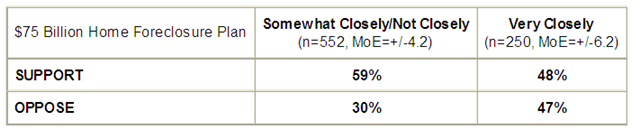
According to the Diageo/Hotline Poll, a majority of voters (56%) support President Obama’s $75 billion home foreclosure plan,

People who know the most about what’s in the package are evenly split on it … the blissfully ignorant (2/3s of the folks polled) support it 2 to 1. 

image 

* * * * *

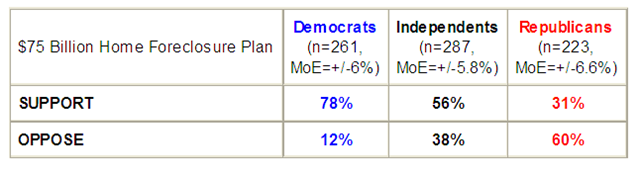
Not surprisingly, support varies widely with party affiliation: Dems favor the package 4 to 1 … GOPs oppose it 2 to 1

image

http://www.diageohotlinepoll.com/documents/diageohotlinepoll/FDDiageoHotlinePoll_topline03.09.pdf

* * * * *

Note: the Diageo/Hotline Poll is managed by an MSB alum: Brent McGoldrick, MBA ’04.  Brent is a VP with Financial Dynamics (FD) and can be reached via email at:
Brent.mcgoldrick@fd.com  

Want more from the Homa Files?
Click link =>
  The Homa Files Blog

“The stock market is just another political tracking poll” … huh?

March 10, 2009

Ken’s Take:

A few weeks ago, a reader replied to one of my posts joking (I think) that Pres. Obama must be shorting the market the way he’s talking and acting.  Suddenly, the reply isn’t sofunny.  There may be method to the madness.  If the stock market impact is most felt by (previously) wealthy folks, hen the decline levels the playing field — a stated Obama goal —  making everybody worse off and more dependent on the government.  Think about it.

Even if you pin all of the stock market drop on Bush, it’s clear that Obama isn’t taking any direct initiative to stem the decline.  The non-stimulus plan is conforming to the Congressional Budget Office’s assessment that it will have little or no impact in 2009.  And, actions that might steady the market — e.g. lower capital gains taxes on stocks bought in 2009 and 2010, restoration of the uptick and short selling rules — are dismissed out of hand as favoring the rich.

* * * * *

Excerpted from NY Post, ” Obama’s search for an enemy”, March 8, 2009 

The President dismisses the growing perception he is adding to the economic pain. Asked about the markets, Obama waved them off as like a “tracking poll in politics” that “bobs up and down day to day.”

It was a telling moment, for the markets on his watch have moved almost exclusively down. And the 55 million households that hold mutual funds are watching their savings and retirements vanish in great gobs.

Most are decidedly middle class, making them collateral damage of this war.

* * * * *

Full column:
http://www.nydailynews.com/opinions/columnists/goodwin/index.html

* * * * *

Want more from the Homa Files?
Click link =>
  The Homa Files Blog

So really, how strong is Obama’s approval rating ?

March 9, 2009

Reflecting “Main Street”, all polls report that Obama has sky high approval ratings … ranging from the low 60s to the mid-70s.  Pundits are still calling it a mandate for change, and O is certainly rushing through programs as if it were a sweeping mandate.

But, reflecting  “Wall Street”, the Dow and other broad market indices have dropped by about 25% since inauguration day.  True, O inherited the problem, but the market seems to voting “no confidence” on O’s recovery plans and team on the field.

So, what is truth?

I’m a fan of the Rasmussen daily tracking poll — in part, because it reports daily numbers on a consistent basis and because it provides some interesting drill down detail.

Here’s what the latest Rasmussen data says: (see chart below)

Obama’s Total Approval is in the high 50s … down from its high mark right after the inauguration (mid 60s).

Obama’s “top box”  (Strongly Approve) has trended down slightly … from a couple of points over 40 to a point or two under 40.

Obama’s “bottom box” (Strongly Disapprove) has been steadily trending up … from 16 right after the inauguration to its current high at 31.

So, Obama’s Approval Index (Strong Approve minus Strong Disapprove) has dropped to 8 from about its high of 30 right after the inauguration.

See Ken’s Take below the chart  …

image

* * * * *

Ken’s Take:

(1) First, Rasmussen leans right … so, there may be bias in the numbers … I doubt it’s significant

(2) Most market researchers consider Total Approval (Strongly plus Somewhat) to be a very weak measure … they tend to focus on the top box and bottom box extremes … in customer satisfaction studies, the equivalent to Rasmussen’s Presidential Approval Index is called the “Net Influencers Index” … some market researchers brand it to be “the only number you need to know”

(3) Obama’s Total Approval rating is bound to stay high … in part because of his rock hard support among blacks … in part because the more than 50% of folks who don’t pay income taxes have every reason in the world to think his spending programs are awesome — they get gain with no apparent pain

(4) The bottom boxers (Strong Disapprove) are the taxpayers … the increase in Strong Disapprovers is attributable to folks ‘in the middle” who originally were giving Obama the benefit of the doubt — hoping he’d govern from the pragmatic middle — but are becoming disenchanted as he keeps his way left campaign promises.

(5) This could get ugly … pitting the beneficiaries of Obama’s programs against the folks who are paying for them

(6) No pundits seem to have seized on this point yet … let’s see when they catch on

* * * * **

Data from Rasmussen Presidential Approval Tracking Poll, March 9, 2009
http://www.rasmussenreports.com/public_content/politics/obama_administration/obama_approval_index_history

* * * * *

Want more from the Homa Files?
Click link =>
  The Homa Files Blog

What’s killing the Dow ?

March 6, 2009

Excerpted from WSJ, “Obama’s Radicalism Is Killing the Dow”, Boskin, March 5, 2009

It’s hard not to see the continued sell-off on Wall Street … (and) the realization that our new president’s policies are designed to radically re-engineer the market-based U.S. economy, not just mitigate the recession and financial crisis.

The illusion that Barack Obama will lead from the economic center has quickly come to an end. Instead of combining the best policies of past Democratic presidents — John Kennedy on taxes, Bill Clinton on welfare reform and a balanced budget, for instance — President Obama is returning to Jimmy Carter’s higher taxes and Mr. Clinton’s draconian defense drawdown.

From the poorly designed stimulus bill and vague new financial rescue plan, to the enormous expansion of government spending, taxes and debt somehow permanently strengthening economic growth, the assumptions underlying the president’s economic program seem bereft of rigorous analysis and a careful reading of history.

Unfortunately, our history suggests new government programs, however noble the intent, more often wind up delivering less, more slowly, at far higher cost than projected, with potentially damaging unintended consequences. The most recent case, of course, was the government’s meddling in the housing market to bring home ownership to low-income families, which became a prime cause of the current economic and financial disaster.

On the growth effects of a large expansion of government … the European social welfare states have standards of living permanently 30% lower than ours.

A financial crisis is the worst time to change the foundations of American capitalism.

Full article (worth reading):
http://online.wsj.com/article/SB123629969453946717.html?mod=article-outset-box 

* * * * *

Want more from the Homa Files?
Click link =>
  The Homa Files Blog

What’s the exit plan and “date certain”?

March 6, 2009

On the campaign trail,  anti-surge Candidate O derided Bush for not having an exit plan and a date certain for troop withdrawal from Iraq.

OK, since we’re winning in Iraq and can safely pull the troops out, O can keep his campaign pledge and bring combat troops back in 2010.

Seems that  Afghanistan is way different from Iraq since O authorized a surge in troop strength and is mum on the exit plan and withdrawal date.

Hmmmm.

Question: why not just spray the poppy fields with industrial strength weed killer and bring our men and women home pronto ?

* * * * *

Want more from the Homa Files?
Click link =>
  The Homa Files Blog

The worse your credit record, the lower your rate … (that’s not a typo)

March 5, 2009

Well, Team O announced their mortgage foreclosure plan.

Folks who have — or soon will default on their mortgage commitments will get their loans repriced at 2%, lengthened to 40 years, and then have their loan balance reduced, if necessary, to cram the defaulters down to payments (P&I, insurance, taxes) equal to 31% of their income.

If you’re sitting with pristine credit, banks MIGHT give you 5% to 6% for 30 years with a 10% downpayment.

Default, you get 2%; credit worthy, you get 5%.

Who in the world thinks that’s fair ?

Gov’t fact sheet:
http://blogs.wsj.com/economics/2009/03/04/treasury-loan-modification-guidelines/

* * * * *

Want more from the Homa Files?
Click link =>
  The Homa Files Blog

The worse your credit record, the lower your rate … (that's not a typo)

March 5, 2009

Well, Team O announced their mortgage foreclosure plan.

Folks who have — or soon will default on their mortgage commitments will get their loans repriced at 2%, lengthened to 40 years, and then have their loan balance reduced, if necessary, to cram the defaulters down to payments (P&I, insurance, taxes) equal to 31% of their income.

If you’re sitting with pristine credit, banks MIGHT give you 5% to 6% for 30 years with a 10% downpayment.

Default, you get 2%; credit worthy, you get 5%.

Who in the world thinks that’s fair ?

Gov’t fact sheet:
http://blogs.wsj.com/economics/2009/03/04/treasury-loan-modification-guidelines/

* * * * *

Want more from the Homa Files?
Click link =>
  The Homa Files Blog

Raising capital gains taxes in 2011 … Obama says: take that, Mr. Dow

March 5, 2009

Barack-O is bound and determined to raise capital gains taxes — from 15% to 20%.

I guess that’s because O thinks returns on invested capital aren’t really “earned” and capital gains only accrue to rich folks.

The problem: this ill-timed move is certain to suppress any market rebound that might materialize.  Why?

2011 sounds like a long way off.  But, to qualify for capital gains, an asset has to be held for at least 12 months.  That means that stocks bought next year (after Jan. 1 2010) will be — by definition — subject to the upped capital gains tax rates.  So, their after tax returns will be reduced.

What to do? Buy stocks later this year (2009) and sell them late next year — before the tax rate goes up — and before the sell-off that will certainly occur in Nov-Dec 2010 (as every Tom, Dick & Harry) tries to bail to beat the tax rate increase).

* * * * *

Reminder to Pres Obama: a tanked stock market impacts almost 2/3s of Americans — mostly in 401-Ks

* * * * *
WARNING: This is an econ-political observation, not investment advice.

* * * * *

Want more from the Homa Files?
Click link =>
  The Homa Files Blog

Where in the world is UBL ?

March 5, 2009

During the campaign, Candidate O frequently mocked W for being unable to capture or kill Usama Bin Laden.

Well, O has been Prez for over a month and UBL is still a free man … he didn’t even get a shout out in O’s State of the Nation pitch.

Question 1: Which is more likely capturing UBL or curing cancer? Obama has promised both …

Question 2: Do you think Keith Olberman will start a “days since” counter similar to the ones he had for Bush? I’m betting under on that one

* * * * *

Want more from the Homa Files?
Click link =>
  The Homa Files Blog

As the Dow keeps dropping, O is running out of people to blame.

March 4, 2009

Excerpted from WSJ, “The Obama Economy”, March 3, 2009
  
As 2009 opened, three weeks before Barack Obama took office, the Dow Jones Industrial Average closed at 9034 on January 2, its highest level since the autumn panic. Yesterday the Dow fell another 4.24% to 6763, for an overall decline of 25% in two months and to its lowest level since 1997. The dismaying message here is that President Obama’s policies have become part of the economy’s problem.

It’s become clear that Mr. Obama’s policies are slowing, if not stopping, what would otherwise be the normal process of economic recovery. From punishing business to squandering scarce national public resources, Team Obama is creating more uncertainty and less confidence — and thus a longer period of recession or subpar growth.

In the last two months … the economy has received no great new outside shock.

What is new is the unveiling of Mr. Obama’s agenda and his approach to governance. 

One negative revelation has been the way he has chosen to spend his scarce resources on income transfers rather than growth promotion. Most of his “stimulus” spending was devoted to social programs, rather than public works, and nearly all of the tax cuts were devoted to income maintenance rather than to improving incentives to work or invest.

The market has notably plunged since Mr. Obama introduced his budget last week, and that should be no surprise. The document was a declaration of hostility toward capitalists across the economy. 

His assault on business and investors is delaying a recovery and ensuring that the expansion will be weaker than it should be when it finally does arrive.  The result has been a capital strike.

Full article:
http://online.wsj.com/article/SB123604419092515347.html

* * * * *

Want more from the Homa Files?
Click link =>
  The Homa Files Blog

Closing the hedge fund barn door … after the hedgers escape with the loot

March 4, 2009

Finally, something out of the Obama brain trust that I agree with …

“Managers at private-equity firms, real-estate investment trusts and other investment partnerships (e.g. hedge funds) would pay an additional $24 billion in taxes over the next decade. Currently, most pay taxes at the 15% capital-gains rates on the bulk of their compensation, which comes in the form of something called “carried interest,” which entitles them to a share of the firm’s profits. Because it isn’t a return on an investment they actually made, many tax experts argue it is more akin to a fee or salary for their services. Mr. Obama’s budget would require most investment managers to pay ordinary income taxes on that income.”

Note: Larry Kudlow, conservative economist (with whom I usually agree), said on CNBC: “Worst possible action he can imagine”

* * * * *

Source: WSJ, “Business Braces for a Big Hit”, Feb 27, 2009
http://online.wsj.com/article/SB123569739787189001.html

* * * * *

Want more from the Homa Files?
Click link =>
  The Homa Files Blog

Question: What happens when there’s no wealth to redistribute?

March 4, 2009

Obama’s grand plan is centered on taking money  from the rich and either spending it like a drunken sailor or giving it away to folks unburdened by work.

Well, the financial crisis has vaporized mucho wealth and cut the number of mega-earners. 

Anybody with any serious money and a brain must be plotting how to shelter earnings and wealth from taxes — either because they loath taxes in general, or because they’re not fans of the Obama-Reid-Pelosi spending spree.

Question: So, if there are fewer rich people, and if the remaining rich people shelter their dough or pull a Geithner and just forget to pay taxes …  what will Obama redistribute ?

My bet: The definition of rich will start sliding down the scale.  We’ll all be rich — at least in the eyes of the tax collector.  Hide your wallet.

* * * * *

Want more from the Homa Files?
Click link =>
  The Homa Files Blog

Charities take another hit … a big hit

March 4, 2009

Charitable giving is down because of the bad economy and tanked stock market.

Now, President Obama’s proposed budget cuts the income tax deduction for charitable contributions.

But, only for rich people — those who do the lion’s share of charitable giving.

Sounds anti-social, so why’s he doing it?

Simple, Obama believes that government can do a better job than individuals channeling money to the “right” causes.  You can’t trust individuals to give to the right causes, can you?

* * * * *

Want more from the Homa Files?
Click link =>
  The Homa Files Blog

Salvaging Team O’s Mortgage Foreclosure Plan

March 3, 2009

Most taxpayers support giving aid to workers who lost their jobs to the sputtering economy, but they are livid about Team Obama’s plan to stem foreclosures by rewarding irresponsible borrowers with extraordinary government subsidies. 

Obama’s brain trust appears  blinded by their politicized sense of social justice and so enamored with the elegance of their mortgage math that they miss the fundamental holes in their plan. While their intentions may be good, they lose sight of the forest in the trees.

The good news is that Team Obama’s problematic program can probably be salvaged —  by simply tightening the program’s qualifying criteria and changing the basis for determining the taxpayer subsidy going to distressed borrowers.

First, consider program qualification criteria.  Even Team Obama agrees that only mortgages on owner occupied primary residences should qualify.  That eliminates speculators, flippers, and vacation homes.  It also eliminates rental housing provided by  investor-landlords, but so be it.

Going a step further, why not explicitly limit the program to people who have a history of filing U.S. tax returns?  That would limit the program to  legal U.S. residents with proven (and determinable) earnings potential.

FDIC Chairman Sheila Bair … told public radio that it would be “simply impractical” to review old mortgage applications and try to distinguish between honest and dishonest borrowers.

Not so, Ms. Bair.  Simply set fair but tight qualifying criteria  based on the borrower’s past mortgage repayment history.

Rather than trying to qualitatively evaluate a borrower’s level of financial responsibility and good faith, they should look quantitatively at the borrower’s actual behavior.   For example:

Did the borrower make a down payment from his own resources? If not — if he made no down payment or funded one with a second home loan — then he doesn’t really have much of an ownership stake.

If the borrower had an ARM, did he make all payments before his ARM was adjusted upward? If not, it’s hard to blame his financial  fix on deceptive loan practices.

Did the borrower make at least a year or two of loan payments before defaulting? If not,  he doesn’t have much equity in the house — financial or psychological.

The point is that there are non-disputable behavioral metrics that can be used to sort “owners” from “occupants” and responsible borrowers who may have been duped from outright deadbeats.

Similarly, for those who qualify, Team Obama should determine the  level of any government subsidies based on the borrower’s past mortgage repayment history, not income.

Team Obama’s plan pressures lenders to bring a borrower’s payment to income ratio down to 38% by cutting interest rates or principal. Then, taxpayers share the cost (dollar-for-dollar with the lender) of bringing that ratio down to 31%. 

In other words, the borrower gets a taxpayer subsidy equal to 3.5% of his income.   So, a guy in an American average $200,000 home who earns $35,000 gets a $1,250 annual taxpayer subsidy.  Plus, he gets a $1,000 annual incentive rebate (for 5 years) if he does the right thing and makes his payments. That boosts his taxpayer subsidy up to the equivalent of a 6.5% refundable income tax credit — “earned” by defaulting on a mortgage.

Team Obama sees great beauty in that arrangement.  Many taxpayers do not. 

As an alternative, why not scale any taxpayer subsidy based on past mortgage payments made rather than proportionate income?  That is, give borrowers credit for having demonstrated good faith in the past by having made payments before their ARMs exploded or the economy imploded?

Illustratively, consider this rule: add the borrower’s down payment to the sum of P&I payments he made against the mortgage, then divide that total by 12 (or some other equalizing factor) and use the result as the basis for his subsidy.

For example, assume that a good faith guy earning $35,000 buys a $210,000 home with $10,000 down and makes $5,000 in P&I payments before his  teaser rate ARM gets upped to an unexpectedly high (and unreachable)  payment level.  Give the guy $15,000 in good faith ownership credit, and allow him a maximum taxpayer subsidy of $1,250 per year — the same as Team Obama’s income based subsidy.

Now, assume that a bad faith guy, also earning $35,000, buys a comparable $210,000 home with no money  down and makes a couple of payments totaling $2,400 before starting to skip payments.  Give this guy $2,400 in good faith ownership credit, and allow him a maximum  taxpayer subsidy of $200 per year — a much smaller subsidy reflecting his proven irresponsibility.  If that’s enough to get him to the 31% payment to income ratio, that would be fine.  ut, it’s not, so too bad.

The numbers are arbitrary, but the guiding principle is not: don’t help deadbeats. do help people who have demonstrated good faith and responsibility, but have run into hard times. 

Keying the maximum  taxpayer subsidy to a borrower’s past payment history has an added benefit: it provides help to the guy who has made years of on-time payments before getting laid off.  Since his near-term income is zero, Team Obama’s income based subsidy would provide him with no help.  That’s not fair.

The bottom line is that the plan proposed by President Obama is seriously flawed and, understandably, has aroused taxpayer ire.  But, if Team Obama shows some flexibility (and some rational creativity), the plan can be salvaged to rally taxpayer support for helping responsible but distressed  home owners.

* * * * *

Want more from the Homa Files?
Click link =>
  The Homa Files Blog

Is Obama intentionally driving the market down ?

March 3, 2009

Excerpted from CNBC, “Stop Trading!: Obama: Enemy of Stocks?”,  March 2,2009

Mad Money host Jim Cramer is worried that the same shareholder-unfriendly approach the White House took toward Medicare … could hurt the Pentagon (defense related) as well.

“We’ve got to get over the idea that you can make money on the long side with Obama,” Cramer said.  “That has proven to be very difficult.”

Cramer recommended instead that investors preserve cash and assume a protective stance against any future White House moves.

Full article:
http://www.cnbc.com/id/29468637

* * * * *

Want more from the Homa Files?
Click link =>
  The Homa Files Blog

Uh-oh … Barack-O's presidential approval index drops to single digits

March 2, 2009

According to Rasmussen’s most recent poll (Sunday March 1):

38% strongly approve of the job Obama is doing as President

29% strongly disapprove of the job Obama is doing as President

The difference (8 points) is what Rasmussen calls the Presidential Approval Index. (PAI)

For the first time, Obama’s overall PAI is down to single digits.

For reference, his PAI was +30 just after the inauguration.

57% of Republicans strongly disapprove of the job Obama is doing as President — that’s up 14 points since his budget was announced last Thursday.

Over 90% of African-Americans strongly approve of the job Obama is doing as President

Among non-African-Americans, 31% strongly approve, 33% strongly disapprove … giving Obama a PAI of minus 2 among non-African-Americans.

http://www.rasmussenreports.com/public_content/politics/obama_administration/daily_presidential_tracking_poll

* * * * *

Ken’s Observation:

(1) Obama and his spokespeople say that neither the Dow nor opinionpolls   influence their decisions and actions.  The former has been evident for awhile.  We’ll see on the latter.

(2) I wish Rasmussen broke the data between taxpayers and non-taxpayers

* * * * *

Want more from the Homa Files?
Click link =>
  The Homa Files Blog

Obama’s Mortgage Plan … Just how much do deadbeats get rewarded ? Answer: LOTS !

March 2, 2009

For the record, I’m all for giving aid to folks laid off because of the sputtering economy.  But, like many others, I’m livid about Obama’s plan to reward irresponsible borrowers with extraordinary government subsidies. 

Frankly, I think Obama’s brain trust is so blinded by their politicized sense of social justice and so enamored with the elegance of their mortgage math that they miss the more fundamental implications of their own plan.

Below is an example of how the plan works.  The highlights …

Lenders will be encouraged to reduce P&I payments to 38% of the borrowers earnings by adjusting the loans payback period, the interest rate,  or the loan balance (i.e. the principal) — or all three.

Think about that for a second.  The government is encouraging (forcing ?) lenders to give different borrowers different prices for their product (i.e. mortgages) based on the borrowers ability to pay (ignoring other accumulated debts and using their current level of earnings as a proxy for ability to pay).  That’s called “price discrimination” and in most businesses, it is illegal to offer different prices to customers in the “same class of trade”.

Legalities aside, adjusting the payback period, say from 30 to 40 years has minimal impact on P&I payments.  At the extreme, the payback period could be stretched forever.  That’s called an interest-only loan, and under its terms, a borrower never pays back the loan.  Most people think that’s a bad idea.

What about cutting the rate to something in the range of 5%? 

If the loan is currently hanging with a predatory rate (say, 10% or more), cutting the interest rate to a fairer market rate probably makes sense. 

But, what if a rate cut to prevailing fair market rates isn’t enough?  Well, the lender could reduce the interest rate further, say to 3% or 4%. 

In other words, the lender could offer an “upside down risk-adjusted rate”.  Usually, a more credit worthy borrower is rewarded with a lower interest rate (think “prime”) that reflects the high likelihood that the loan will be repaid.  Giving favorable rates to the least credit worthy borrowers (i.e. ones who have already defaulted) defies any reasonable economic or financial logic.

Or, the lender can simply write-off some of the money owed.  Most people think that’s a very bad idea.  After all, the borrower made a legal and moral commitment to pay the loan back.  Why should they be let of the hook ?

Still, let’s pretend that the lender can find a way to get the borrowers payments and earnings in alignment at the magic 38% ratio.

In comes Team Obama. To provide the borrower with a softer financial cushion, the government drives the payment to income ratio down to 31% — splitting the incremental subsidy with the lender.  

In other words, the lender reduces the borrower’s annual P&I payments by 3.5% of the borrower’s income and taxpayers kick in 3.5% of the borrower’s income.

Think about that for a second.  The lender is pressured to give an even more favorable price to one  its least credit worthy customers and we, the taxpayers, reward the borrower with the equivalent of a 3.5% refundable tax credit — earned by simply having bought a house beyond his means and defaulting on his loan obligation.  Team Obama sees beauty in that arrangement. Many taxpayers don’t.

But wait, it gets worse.  The borrower qualifies for a “good boy” incentive — $1,000 per year for up to 5 years — if he makes timely payments.  So, for a defaulting borrower earning $50,000 per year, there’s an extra 2% kicker from the taxpayers — boosting the taxpayers’ subsidy to the equivalent of a 5.5% refundable tax credit.

That, my friends, is a big reward for acting irresponsibly.

* * * * *
Obama’s Mortgage  Foreclosure Plan – An Example

Consider the following case: Skipper earns $35,000 annually and buys a $205,000 home with no money down, signing up for an ARM that starts at a teaser priced 5% with a 30 year payback term.  His initial P&I payments are about $1,100 per month.  That’s right at the government’s magic ratio of 38% payment to earnings ratio, so Skipper is classified as a responsible buyer.

A year or two later,  the ARM gets bumped up to 8% (per the written mortgage contract).  Let’s assume that Skipper’s loan balance went down to $200,000 over the period (a liberal assumption that works to his advantage).  Skipper’s P&I payments get upped to about $1,500 per month — that’s $17,765 annually, or over 50% of his annual earnings.

Skipper’s in a bind and defaults on his mortgage. 

Enter Team Obama.

First, they pressure the lender to reduce Skipper’s rate to get him back into the 38% payment to earnings ratio.  Even though Skipper has proven beyond a shadow of a doubt that he’s a credit risk, the lender sucks it up and cuts his rate to a credit worthy borrower’s 5%.  That gets his annual P&I payments back down to about $13,000.

Then, to provide Skipper with an economic cushion, Team O moves to cut Skipper’s payment to a more secure 31% of his income — that is, to reduce his P&I payments to about $10,500 per year.  (note: itdoesn’t matter whether the reduction comes thru principal reduction or interest rate cut — the economics are the same). And, team O offers to split the $2,500 difference — lender paying half and taxpayers paying half.

Finally, Team O offers Skipper a $1,000 annual bonus (for 5 years)  if he doesn’t default again.

Let’s recap the bidding:

First, the lender gives unreliable Skipper a loan at “prime” rates.

Second, the lender subsidizes Skipper with a $1,250 reduction in annual P&I payments

Finally, we taxpayers give Skipper a $2,250 annual subsidy ,,, the equivalent of a 6.4% refundable tax credit … which Skipper earned by buying too expensive of a house and defaulting on his mortgage.

Does that sound like a good idea?

* * * * *

Want more from the Homa Files?
Click link =>
  The Homa Files Blog

Closing those offshore tax loopholes … and the unintended consequences

March 2, 2009

Pres O says that he’ll go after US companies that take advantage of tax loopholes to ship American jobs offshore.

I assume that he’s talking about the “loophole” that says companies pay taxes on profits where they are realized.  For example, if a company has a subsidiary in Aruba, its subsidiary pay’s income taxes in Aruba … not in the US.  Conversely, if an Arubian company has a subsidiary operating in the US, its US subsidiary would pay US income taxes (but not Arubian taxes).  That’s standard operations around the world. No double taxation of income.

Pres O can’t possibly be thinking of double taxing US corporations.  If he is, companies can simply reincorporate offshore … and only pay US taxes on money made by its US subsidiary operations … just like foreign companies (think Nestle, Unilever) do now.  Certainly, the US government won’t try to tax Nestle on its Swiss earnings, right?  what would be the difference?

Pushing companies out of the US just doesn’t seem like a bright idea to me …

* * * * *

Want more from the Homa Files?
Click link =>
  The Homa Files Blog

Was Tuesday student government day?

February 27, 2009

Figured out what was really bothering me Tuesday night … and this time, I’m bi-partisan.

Both Obama & Jindal are smart but playing way over their experience levels.

One is the class “cool dude” who can win over the ladies and sell anything to the guys; the other is the class geek — call for homework help, but don’t elect homecoming king. 

Neither is ready to play in the bigs quite yet … especially in the most important, most challenging exec slot on earth.

Wasn’t there someone between Obama and John “Grandpa Munster” McCain  to lead us through this mess?

* * * * *

Want more from the Homa Files?
Click link =>
  The Homa Files Blog

Foreclosures hurt all property values … NOT !

February 26, 2009

Ken’s Take: Obama keeps claiming that foreclosures have a debilitating economic impact on practically all homes prices.  That’s just not true.

First, U.S. foreclosures are concentrated in only a handful of states: AZ, CA, NV, FL, and MI … and within a handful of overbuilt, price-bubbled communities within those states.

Second, the evidence suggests that homes need to be immediately proximate to — i.e. within a couple of blocks of — a high number of foreclosures for there to be any significant impact.  In other words, foreclosures in California don’t impact home values in New York.

Third, even if homes are proximate to foreclosures, the impact on home values is minimal and short-lasting, unless there has been a significant economic causal shock in the community (e.g. an auto plant closing)

Bottom line: stopping foreclosures will only help those being foreclosed upon — most of whom deserve to be foreclosed upon.

* * * * *
Below is a summary of the article’s context.  See the source article for the analysis.

Excerpted from Weekly Standard, “Obama’s Fuzzy Housing Numbers”, Feb 24,2009

If President Obama is to sell his mortgage bailout plan to the public, an important argument will be his claim that preventing foreclosures actually helps all homeowners by preventing housing prices from dropping:

“This plan will not save every home, but it will give millions of families resigned to financial ruin a chance to rebuild,” Mr. Obama told a crowd here, in one of the communities hardest hit by the housing crisis. “It will prevent the worst consequences of this crisis from wreaking even greater havoc on the economy. And by bringing down the foreclosure rate, it will help to shore up housing prices for everyone.”

The claim that the program helps “shore up housing prices for everyone” has been frequently repeated by administration officials. Housing and Urban Development Secretary Donovan elaborated on the point:

And in all, this will help, as I said, 3 to 4 million families. But let’s be clear: This will also help millions of other families, as well. Recent research shows that neighboring homes to foreclosed homes lose as much as 9 percent of their value. So people who are not in danger of foreclosure still are suffering from nearby foreclosures. This will help those families, as well. Our estimates are that the average home — not the average home in foreclosure, but the average home across the country will gain $6,000 in value relative to had this plan not been put in place.

The president, the administration, and its advocates can promote any mortgage relief plan they choose on whatever basis they wish. But any claims that there is evidence that bailing out the mortgages of particular individuals helps all property owners is simply not supported by any real research and should be viewed with great skepticism.

Read the full analysis – with numbers and sources:
http://www.weeklystandard.com/weblogs/TWSFP/2009/02/obamas_fuzzy_housing_numbers_1.asp

* * * * *

Want more from the Homa Files?
Click link =>
  The Homa Files Blog

If you make less than $250,000 your taxes won’t go up! … yeah, right … continued

February 26, 2009

Ken’s Take: In yesterday’s post, I argued that fully taxing the top 2% wouldn’t come close to paying for Barack-O’s programs.  A day later, here’s the WSJ analysis.  Slightly different numbers, same conclusion.

* * * * *

Excerpted from WSJ, “The 2% Illusion  – Take everything they earn, and it still won’t be enough”, Feb 26 2009

President Obama has laid out the most ambitious and expensive domestic agenda since LBJ, and now all he has to do is figure out how to pay for it. On Tuesday, he left the impression that we need merely end “tax breaks for the wealthiest 2% of Americans,” and he promised that households earning less than $250,000 won’t see their taxes increased by “one single dime.”

This is going to be some trick. Even the most basic inspection of the IRS income tax statistics shows that raising taxes on the salaries, dividends and capital gains of those making more than $250,000 can’t possibly raise enough revenue to fund Mr. Obama’s new spending ambitions.

In 2006, roughly 3.8 million filers had adjusted gross incomes above $200,000 in 2006. (That’s about 7% of all returns; the data aren’t broken down at the $250,000 point.) These people paid about $522 billion in income taxes, or roughly 62% of all federal individual income receipts. The richest 1% — about 1.65 million filers making above $388,806 — paid some $408 billion, or 39.9% of all income tax revenues, while earning about 22% of all reported U.S. income.

As a thought experiment, let’s go all the way. A tax policy that confiscated 100% of the taxable income of everyone in America earning over $500,000 in 2006 would only have given Congress an extra $1.3 trillion in revenue. That’s less than half the 2006 federal budget of $2.7 trillion and looks tiny compared to the more than $4 trillion Congress will spend in fiscal 2010. Even taking every taxable “dime” of everyone earning more than $75,000 in 2006 would have barely yielded enough to cover that $4 trillion.

The bottom line is that  Obama is selling the country on a 2% illusion.  Taxes on the not-so-rich will need to rise as well.

Mr. Obama is very good at portraying his agenda as nothing more than center-left pragmatism. But pragmatists don’t ignore the data. And the reality is that the only way to pay for Mr. Obama’s ambitions is to reach ever deeper into the pockets of the American middle class.

Full article:
http://online.wsj.com/article/SB123561551065378405.html

* * * * *

Want more from the Homa Files?
Click link =>
  The Homa Files Blog

The Stimulus: Obama’s missed opportunity … to do something right (and maybe great)

February 26, 2009

Ken’s Take: Sameulson is a left-leaning economist, which should give him some broad credibility. I think his analysis is right on target.  Below are highlights.  Full article is well worth reading.

* * * * *
Excerpted from IBD, “Stimulus Needs More Power At Front End” Samuelson, February 20, 2009

Judged by his own standards, President Obama’s $787 billion economic stimulus program is deeply disappointing.

Given his dire warnings (about the economy), you’d expect the stimulus package to focus almost exclusively on reviving the economy. It doesn’t, and for that Obama bears much of the blame. His politics compromised the program’s economics. Look at the numbers.

* * * **

The Congressional Budget Office estimates that about $200 billion will be spent in 2011 or later — after it would do the most good. For starters, there’s $8 billion for high-speed rail …  the design and construction will occupy many years. It’s not a quick stimulus.

Then there’s $20.8 billion for improved health information technology — more electronic records and the like. Probably most people regard this as desirable, but here, too, changes occur slowly. The CBO expects only 3% of the money ($595 million) to be spent in fiscal 2009 and 2010.

The peak year of projected spending is 2014 at $14.2 billion.

Consider the retrofitting of federal buildings to make them more energy-efficient.  Obama says “We’re creating jobs immediately.”  Yes — but not many. The stimulus package includes $5.5 billion for overhauling federal buildings. The CBO estimates that only 23% of that would be spent in 2009 and 2010.

* * * * *

Worse, the economic impact of the stimulus is already smaller than advertised. The package includes a “patch” for the alternative minimum tax. This protects many middle-class Americans against higher taxes and, on paper, adds $85 billion of “stimulus” in 2009 and 2010.

One problem: “It’s not stimulus … Congress was going to do it anyway. They do it every year.” Strip out the AMT patch, and the stimulus drops to about $700 billion, with almost 30% spent after 2010.

The stimulus package offers only modest relief to states. Using funds from the stimulus, states might offset 40% of their looming deficits,. The effect on localities would probably be less.

The stimulus provides most funds to states through specific programs. There’s $90 billion more for Medicaid, $12 billion for special education, $2.8 billion for various policing programs. There’s a big downside: “Temporary” spending hikes for specific programs … will be harder to undo, worsening the long-term budget outlook. The major outcome:  more power centralized in Washington.

* * * * *

No one knows the economic effects of all this; estimates vary. But Obama’s political strategy stunts the impact from what it might have been.

By using the stimulus for unrelated policy goals, spending will be delayed and diluted.

Politics cannot be removed from the political process. But here, partisan politics ran roughshod over pragmatic economic policy. Even the token concessions (including the AMT provision) to some Republicans weakened the package.

Obama is gambling that his flawed stimulus will seem to work well enough that he’ll receive credit for restarting the economy — and not be blamed for engineering a colossal waste.

* * * * *
Full article:
http://www.ibdeditorials.com/IBDArticles.aspx?id=320024639130404

* * * * *

Want more from the Homa Files?
Click link =>
  The Homa Files Blog

Why the market continues to sink …

February 25, 2009

Excerpted from IBD, “Is It Any Wonder The Market Continues To Sink?”,  February 20, 2009

* * * * *

Last Oct. 13, in trying to explain why the market had sold off 30% in six weeks, we acknowledged that the freeze-up of the financial system was a big concern. But we cited three other factors as well:

• The imminent election of “the most anti-capitalist politician ever nominated by a major party.”

• The possibility of “a filibuster-proof Congress led by politicians who are almost as liberal.”

• A “media establishment dedicated to the implementation of a liberal agenda, and the smothering of dissent wherever it arises.”

No wonder, we said then, that panic had set in.

* * * * *

Today, as the market continues to sell off , we wish we had a different explanation. But it still looks, as we said four months ago, “like the U.S., which built the mightiest, most prosperous economy the world has ever known, is about to turn its back on the free-enterprise system that made it all possible.”

How else would you explain all that’s happened in a few short weeks? How else would you expect the stock market, where millions cast daily votes and which is still the best indicator of what the future holds, to act when:

• Newsweek blares from its cover “We Are All Socialists Now

• A $700 billion bank bailout, $75 billion to refinance bad mortgages, $50 billion for the automakers, and as much as $2 trillion in loans from the Fed and the Treasury fail to build confidence in our free-enterprise system.

Talk of “nationalizing” U.S.’ troubled major banks comes not just from tarnished Democratic Sen. Chris Dodd,  from Republicans like Sen. Lindsey Graham , and former Fed chief Alan Greenspan.

• A stimulus bill laden with huge amounts of spending on pork and special interests is the best our Congress can come up with to get the economy back on track. Economists broadly agree that the legislation has little stimulative power, and in fact will be a drag on economic growth for years to come. Throwing hundreds of billions of dollars at profligate state governments and programs — such as $4.2 billion for “neighborhood stabilization activities” and $740 million to help viewers switch from analog to digital TV— has investors shaking their heads.

• A $75 billion bailout for 9 million Americans who face foreclosure, regardless of how they got into financial trouble, is the government’s answer to the housing crunch. Many Americans who have scrupulously kept up with payments are steaming at the thought of subsidizing those who’ve been profligate or irresponsible. And. recent data shows that as much as 55% of those who get foreclosure aid end up defaulting anyway

Energy solutions ranging from the expansion of offshore drilling and the development of Alaska’s bountiful arctic oil reserves to developing shale oil in America’s Big Sky country, tar-sands crude in Canada and coal that provides half the nation’s electric power, are taken off the table.

•• Trade protectionism passes as policy, even amid the administration’s lip service to free trade. Congress’ vast stimulus bill and its “Buy American” provisions limit spending to U.S.-made products and will drive up costs, limit choices and alienate key allies. Already, several European partners have begun raising barriers.

• A 1,000-plus page stimulus bill is bulled through Congress with not a single member of Congress reading it before passage.

Business leaders are demonized. Yes, there are bad eggs out there like the Madoffs and Stanfords. But most CEOs are hugely talented, driven, highly intelligent people who make our corporations the most productive in the world and add trillions of dollars of value to our economy.

• Words like “catastrophe,” “crisis” and “depression” are coming from the mouth of the newly elected president, rather than words of hope and optimism. Instead of talking up America’s capabilities and prospects, he talks them down — the exact opposite of our most successful recent president, Ronald Reagan, who came in vowing to restore that “shining city on a hill.”

* * * * *

All this in barely a month’s time. And to think that more of the same is on the way seems to be sinking in. Investors are watching closely and not caring for what they see. Sooner or later, the market will rally — but not without good reason to do so.

Full article:
http://www.ibdeditorials.com/IBDArticles.aspx?id=320027936229029

* * * * *

Want more from the Homa Files?
Click link =>
  The Homa Files Blog

How much hope can the market withstand ? … Update

February 24, 2009

For folks who like to keep score:

The Dow closed at 8,228 on inauguration day.

The Dow closed at 7,114 yesterday (Feb. 23, 2009)

A decline of 1,114 points (13.5%) for the presidency to date.

* * * * *

The Dow dropped 382 points on the day that Geithner’s speech bombed.

The Dow dropped 298  points on the day that Obama signed the non-stimulus package (the first day that the market was open after the bill was passed).

The Dow dropped 468  points on the days after Obama announced his mortgage modification plan.

The total decline since recovery initiatives were mobilized 1,114 points

* * * * *

Fasten your seat belt for Obama’s announcement of his intention to increase in the capital gains tax rate in 2010.

Keep the change …

* * * * *

Want more from the Homa Files?
Click link =>
  The Homa Files Blog

The slippery slope of setting prices based on ability to pay.

February 23, 2009

Imagine walking into a car dealer, seeing a shiny new sedan on the floor, asking the salesman “what’s its price?”, and having the salesman ask you how much money you earn.  You answer $80,000 and he says “half a year’s pay — $40,000.”

As you stand pondering, you overhear the salesman talking to another customer about an identical car. That customer says he only earns $50,000 per year.  So, the salesman quotes him $25,000 — half of his annual pay.

Sound absurd ?  It should because its commercially and legally problematic  The practice is called price discrimination based on ability to pay, and any merchant who tried it would probably be stoned by the public while being hauled off to court.

This technicality didn’t faze Team Obama in the development of their mortgage foreclosure plan.  In fact, price discrimination based on ability to pay is the plan’s central operating principle.

Consider the example that Team Obama circulated on the day the President unveiled the plan.  A person (call him Able) is holding a $220,000 mortgage at 6.5% with a 30 year payback term.  Able’s principal and interest payment is about $1,370 per month, or $16,365 per year.

Team Obama’s magic ratio of payment to income is 31%, so if Able earns more than $53,000 then he doesn’t qualify for a government induced loan modification. Let’s assume Able makes just over $53,000 and doesn’t qualify.

Able’s neighbor (call him Skipper) lives in an identical home with an identical $220,000 mortgage at the same terms – 6.5% for 30 years.  But, Skipper only makes $40,000 per year and is falling behind on his payments.

Enter Team Obama’s loan modifiers.  Since Skipper only makes $40,000, Team Obama says that he should only be expected to pay $12,400 — 31% of his income — towards his mortgage.  No problem. The lender – subsidized by the dwindling number of taxpayers – just lowers Skipper’s interest rate to about 4% (3.93% to be precise) and he’s officially modified.  And, if Skipper doesn’t start skipping payments again, he gets a check for $1,000 for each of the next 5 years.  Is this a great country, or what?

Let’s look at Skipper’s loan modification another way.  Assume that the lender holds the interest rate constant at 6.5% — the same rate that Able is paying.  How can the lender get Skipper’s payment down to $12,400 ?  Simple.  Write off about $53,000 of Skipper’s principal balance — getting it down to about $167,000 – which amortized over 30 years at 6.5% crams the annual payments down to the magic 31%.

In other words, Able and Skipper bought the identical houses at the same prices.  Because Skipper didn’t earn enough to make the payments, the lender, in effect, gave him a $53,000 price rebate to make it affordable.  We taxpayers then give him an additional $5,000 rebate if he makes his reduced mortgage payments.  So, Skipper gets the house for $162,000.

Able – since he is able to pay — gets no rebate. He still owns his house at the original price — $220,000.

Whether Skipper’s mortgage is repriced by adjusting the interest rate or by reducing the outstanding principal balance, the economics are the same.  It is price discrimination based on a buyer’s ability to pay – a morally bankrupt tactic that should be illegal if it’s not.

Otherwise, why not sell cars that way?  Or for that matter, why not force all merchants to price all their goods proportionate to customers’ incomes?  Why should I have to pay the same price for a can of Coke as Warren Buffet does?  That’s not fair, is it?

* * * * *

Want more from the Homa Files?
Click link =>
  The Homa Files Blog

Foreclosures will NOT hurt your neighborhood’s property values … (unless you live in CA, FL, AZ, NV, MI)

February 23, 2009

Ken’s Take: This is a very insightful, must read analysis … one of many that Team Obama seems to have missed.

Big idea: Federal subsidies to bailout delinquent homeowners will not often involve helping “neighbors” but rather those who live thousands of miles away, mainly in just five states: California, Florida, Arizona, Nevada, and Michigan. 

In truth, Obama’s “Homeowner Affordability and Stability Plan” compels taxpayers in most states to help those in just a few.  And,there is neither evidence nor logic that suggests a drop in property values in those 5 states impact property values in the other 45 states. 

Foreclosures aren’t a national problem — they’re an isolated regional problem and, of course, a personal problem for overstretched borrowers.

* * * * *

Excerpted from NY Post, “The Foreclosure Five”, Reynolds, Feb 21, 2009

When President Obama discusses his $275 billion mortgage bailout, he talks as if it was a national problem, caused by a national decline in home prices. “We must stem the spread of foreclosures and falling home values for all Americans,” he says.

But there is no national market for homes and no national price for homes. Instead, most of the United States will pay for the folly of few.

The beneficiaries of taxpayer charity will be highly concentrated in just five states – California, Nevada, Arizona, Florida and Michigan. That is not because the subsidized homeowners are poor (Californians with $700,000 mortgages are not poor), but because they took on too much debt, often by refinancing in risky ways to “cash out” thousands more than the original loan. Nearly all subprime loans were for refinancing, not buying a home.

* * * * *

Foreclosure Rates

One out of 76 homes in Nevada went into foreclosure in January, for example, compared with one out of 173 in California, with Arizona and Florida close behind.

But,nationwide, foreclosures fell 10% in January, to one out of every 466 homes … in the 25th ranked “median” state,  only one out of 949 homes was in foreclosure – just one-tenth of 1% … in New York, by contrast, only 1 out of 2,271 homes went into foreclosure … in Vermont, foreclosures amounted to just one out of 51,906 homes

* * * * *

Home Prices

As of the third quarter of 2008,  home prices were still higher than a year before in 18 states, and down less than 2% in a dozen others. Double-digit declines in home prices were confined to just four states – surprise, every one of the Foreclosure Five except Michigan.

Even though California home prices fell 20.8% over the year ending in the fall of 2008, however, they were still 50% higher than they were just five years ago.

* * * * *

Underwater Mortgages

Obama is particularly interested in mortgages that are underwater – that is, larger than the value of the home.

But again, this varies enormously by state. The state with the tenth highest percentage of underwater mortgages, Texas, has the same 16.5% underwater as the so-called national average. The other 40 states have a below-average percentage of homes that are worth less than their mortgages, which means the mean average is not at all typical of most states.

Only 4.4% of New York mortgages are underwater, not even a tenth as many as in Nevada.

Full article:
http://www.nypost.com/seven/02212009/postopinion/opedcolumnists/the_foreclosure_five_156287.htm?&page=0 

* * * * *

Want more from the Homa Files?
Click link =>
  The Homa Files Blog

Angry renters say “Don’t bail out Bob …”

February 23, 2009

Excerpted from Angryrenter.com

All we hear these days is whining from reckless home borrowers and their banks.

But did you know that renters are 32 percent of American households? And that homes in foreclosure are less than 2 percent?

So why is Congress rushing to bailout high-flying borrowers and their lenders with our tax dollars?

Unfortunately, renters aren’t as good at politics as the small minority of homeowners (and their bankers) who are in trouble. We don’t have lobbyists in Washington, DC. We don’t get a tax deduction for our rent and we don’t get sweetheart government loans.

Quite simply, we are just Angry Renters. And now it is our time to be heard: no government bailouts!

To sign the Angry Renter’s petition, go to Angryrenter.com

* * * * *

Short video, worth watching:
http://www.youtube.com/watch?v=UOaDrM3rMXs 

* * * * *

Want more from the Homa Files?
Click link =>
  The Homa Files Blog

CNBC’s Rick “the Plumber” Santelli asks: Raise your hand if you want to pay some deadbeat’s mortgage

February 20, 2009

On air yesterday, Rick Santelli — a CNBC reporter — lashed out at Obama’s stimulus and mortgage plans.

Live on the floor of the CBOE, Santelli asked  folks: ” How many of you people want to pay for your neighbor’s mortgage (because they) don’t pay their bills? Raise their hand. (no hands raised, lots of booing) President Obama, are you listening?”

The video was looping on cable yesterday and rcord-setting on YouTube and other video sites. Link is below if you haven’t seen it.

* * * * *

Ken’s Take:Santelli’s rant was a Joe the Plumber moment. 

Rick the Reporter captured the frustration of the more than 90% of Americans — mostly tax payers — who work hard, live within their means, pay their bills, etc. 

Even Obama admits that sub-prime mortgages are only 12% of all mortgages but more than 50% of all foreclosures.  He wants responsible folks  to kick in to provide sweet deals to irresponsible deadbeats.  

I don’t think that’s going to fly.  My hunch: Santelli has started an avalanche.

This may be Obama’s “New Coke” moment — a misread American tastes …

* * * * *

This will get you fired up (unless you’re behind on your mortgage on have your hand out).
http://www.youtube.com/watch?v=bEZB4taSEoA

* * * * *

Want more from the Homa Files?
Click link =>
  The Homa Files Blog

Uh-oh … is Obama’s star starting to fade ?

February 17, 2009

Ken’s Take: The press constantly points to Obama’s 60% approval rating.  That’s good, but drilling down: since inauguration day, total approval is down 5 points, strong approval is down 7 points, strong disapproval is up 10 points, and the approval index (strongly approve minus strongly disapprove) is  down to 11 from it’s high at 30.  He got a pop from the nationally televised press conference, but it faded quickly.

* * * * *

Excerpted from Rasmusssen Reports, February 14, 2009

Overall, 60% of voters say they at least somewhat approve of the President’s performance so far   … that’s down 5 points from 65% just after the inauguration.

37% strongly approve of the President’s performance so far … that’s down 7 points from 44% just after the inauguration

26% strongly disapprove of the President’s performance so far … that’s up 10 points from 16% just after the inauguration

48% of Republican voters nationwide now voice such a negative opinion, up from 29% in the first polling after inauguration day.

85% of African-American voters strongly approve of the President’s performance so far … 30% of white voters do 

66% of political liberals strongly approve of the President’s performance while 50% of conservatives Strongly Disapprove.

Obama’s Presidential Approval Index (the differ3nce between the strongly approve and strongly disapprove) is now 11, down from 28 just after the inauguration

image

* * * * *

49% of Americans trust their own judgment on economic matters more than they trust the President’s judgment … two-thirds of voters trust their own judgment more than the average member of Congress.

* * * * *

Source article:
http://www.rasmussenreports.com/public_content/politics/obama_administration/obama_approval_index_history

* * * * *

Want more from the Homa Files?
Click link =>
  The Homa Files Blog

Save Elkart … buy an RV

February 10, 2009

Pres Obama brought tears to people’s eyes last night reporting back from his touch-and-go photo op in Elkart, Indiana.

Portraying Elkhart as Anytown, U.S.A., Obama emphasized that Elkhart’s unemployment rate has soared to over 15% and implied that the pork-laden stimulus package would fix that fast.

No reporter asked how that might happen.

You see, Elkart is a one or two industry town — depending on whether you count “manufactured housing” (i.e. trailers) and RVs (think Winnebago) as one industry or two.

Since many trailer park folks miss “prime” by a couple of points, the credit crunch is a problem.  Since RVs get about 5 MPG, high gas prices tends to dampen demand.

Does Pres Obama plan to breathe life back into credit-risky trailers and eco-unfriendly RVs? Or, does he plan on the laid off unionized factory workers picking up shovels to work on road crews?

It’ll be fun following Elkhart’s revival over the next couple of months.

For the record, I’m betting under on this one.

* * * * *

Want more from the Homa Files?
Click link =>
  The Homa Files Blog

* * * * *

“Up to 4 million jobs created or saved”

February 10, 2009

Call me cynical, but Pres Obama’s promise of  “up to 4 million jobs created or saved” sounds like a pretty soft metric to me.

First, there’s the “up to” part.  So, if the final answer is, say 2 million, the metric is made.

But, the real weasle room is in the “created or saved”.  What exactly is a saved job?  How do you know one when you see it?

My bet: For the next year or two, we’ll be hearing that Bush’s failed policies left the economy in even worse shape than anyone imagined and we’ll get bombarded with TARP-like claims that things would have been even worse without the added spending.  Jobs will continue to evaporate, but at a slower rate than some made up “what if” number.

For sure, we’ll have saved up to 4 million jobs.

* * * * *

Want more from the Homa Files?
Click link =>
  The Homa Files Blog

My Take: Another mis-step … delaying the announcement of the bank bailout plan

February 9, 2009

According to Obama’s economic adviser Lawrence Summers,  Barack-O decided to delay unveiling the administration’s new bank bailout plan until Tuesday, in an effort to keep Washington’s focus on the stimulus package now before Congress.

In other words: to keep the spotlight on the President’s prime time press conference tonight.

My prediction: the market will tank today because of the bank plan delay — the delay prolongs uncertainty and creates doubt that the administration — with an avowed policy of “big & fast” over “deliberate & right” —  has figured out what to do.

All the chatter today will be about the market slide and bank plan.  Maybe that’s the strategy — take people’s eyes off the (un)stimulus package.

WSJ article:
http://online.wsj.com/article/SB123410527886060705.html?mod=article-outset-box

* * * * *

Want more from the Homa Files?
Click link =>
  The Homa Files Blog

Things change: Terrorist "renditions" – bad by Bush, ok by Obama

February 6, 2009

Ken’s Take: Under Bush, terrorist renditioning was dirtier than dirt.  A clear violation of terrorists rights.  Now, it’s ok.  Hmmmm.

* * * * *
Excerpted from LA Times, “Obama preserves renditions as counter-terrorism tool”, February 1, 2009 

The CIA’s secret prisons are being shuttered. Harsh interrogation techniques are off-limits. And Guantanamo Bay will eventually go back to being a wind-swept naval base on the southeastern corner of Cuba.

But even while dismantling these programs, President Obama left intact an equally controversial counter-terrorism tool.

Under executive orders issued by Obama recently, the CIA still has authority to carry out what are known as renditions, secret abductions and transfers of prisoners to countries that cooperate with the United States.

Current and former U.S. intelligence officials said that the rendition program might be poised to play an expanded role going forward because it was the main remaining mechanism — aside from Predator missile strikes — for taking suspected terrorists off the street.

The Obama administration appears to have determined that the rendition program was one component of the Bush administration’s war on terrorism that it could not afford to discard.

The decision underscores the fact that the battle with Al Qaeda and other terrorist groups is far from over and that even if the United States is shutting down”

“In some ways, [rendition] is the worst option,” the former official said. “If they are in U.S. hands, you have a lot of checks and balances, medics and lawyers. Once you turn them over to another service, you lose control.” the prisons, it is not done taking prisoners.

The decision to preserve the program did not draw major protests, even among human rights groups. Leaders of such organizations attribute that to a sense that nations need certain tools to combat terrorism.

Full article:
http://www.latimes.com/news/nationworld/washingtondc/la-na-rendition1-2009feb01,0,1822531,full.story 

* * * * *

Want more from the Homa Files?
Click link =>
  The Homa Files Blog

Uh-oh … the perils of becoming president

February 4, 2009

According to the Rasmussen Reports, President Obama’s approval index (the % of people strongly approving of the job he’s doing less the % of people strongly disapproving of the job he’s doing) is down by half since inauguration day — from 30% to 15%.  Hmmmmm.

image

http://www.rasmussenreports.com/public_content/politics/obama_administration/daily_presidential_approval_index

* * * * *

Want more from the Homa Files?
Click link =>
  The Homa Files Blog