“Adoption velocity” and abandonment: Here today, gone tomorrow …

November 17, 2009

TakeAway: Some research indicates that — counter-intuitively — products which catch on too quickly may end up being less successful overall.

* * * * *

Excerpted from Knowledge@Emory, The Long-term Downside of Overnight Success,  September 16, 2009  

Marketers may dream of coming up with a product that skyrockets in popularity as soon as it is introduced to the public.

Research, however, indicates that products which catch on too quickly may end up being less successful overall.

* * * * *

There are patterns in “cultural adoption and abandonment.” 

“We often see products, ideas and behaviors catch on and spread like wildfire. But we know less about why once-popular things become unpopular.”

“Most managers want their products to catch on faster, but our analysis suggests that this might not always be the best strategy. If something catches on too quickly, it might not only have a shorter lifespan, but may also end up being less successful overall. Faster adoption may hurt product success.”

Fads tend to be viewed negatively: “If people think that sharply increasing [popularity] will be short lived, they may avoid such items to avoid doing something that may later be seen as a flash in the pan.”

The research into the adoption and abandonment challenges some assumptions about the diffusion of a message and its saturation in the population, which is an important concept in marketing.

As a message spreads — or diffuses — through a population, it reaches more potential adopters. However, diffusion models typically assume a set target population size. But, a group may continually renew itself. Other factors, beyond diffusion and saturation, must be involved: “Adoption velocity is one such factor.”

Conventional wisdom would hold that if a message diffused through a population quickly, more potential adopters would be reached, improving the prospects for widespread adoption. “The effect of adoption velocity on the cumulative number adopters … shows that adoption velocity has a negative effect on the cumulative number of adopters.”

For example, in the music industry, new artists who bolt to the top of sales charts, often realize lower overall sales than those whose popularity grows more slowly. “This seemingly counterintuitive finding has important implications. One is that faster adoption is not only linked to faster abandonment, but may also hurt overall success.”

The research fits into the growing literature about “cultural dynamics.” By “more closely examining the psychological processes behind individual choice and cultural transmission, deeper insight can be gained into the relationship between individual (micro) behavior and collective (macro) outcomes such as cultural success.” 

Advertising might lead to fast adoption of a product, but the popularity of the product or service advertised might decline when that support dies off or switches to a substitute. “Importantly, though, results suggest that independently of its cause, a quick rise in popularity may have an accelerating effect on abandonment … as such, we anticipate that there will be an inherent tendency for items that have been adopted quickly to decline faster, even in cases where advertising persists.”

‘This is here today, gone tomorrow.'”

Full article:
http://knowledge.emory.edu/article.cfm?articleid=1266

* * * * *

When does a $1 burger make sense ?

November 17, 2009

Got this provocative email from one one of my son’s friends:

Mr. H – As patriarch of the “First Family” of the $1 menu, I wanted to bring your attention to this article. 

It appears that suspicions may have been correct –   The $1 McDouble cheeseburger is literally a LOSS LEADER. 

Who is right Burger King or their franchisees?  Why charge an unprofitable price?

Below is the article.  Far below is Ken’s Take.

* * * * *

Excerpted from AP: Food fight: Burger King franchisees sue chain, Nov.13, 2009

Restaurants, especially fast-food chains, have been slashing menu prices because of the poor economy. Executives hope the deeply discounted deals will bring in diners who are spending less when they eat out, or opting to stay home altogether.

But, Burger King franchisees sued the hamburger company this week over its $1 double cheeseburger promotion, saying they’re losing money on the deal and the company can’t set maximum menu prices.

A group that represents more than 80 percent of Burger King’s U.S. franchise owners, said the $1 promotion forces restaurant owners to sell the quarter-pound burger with at least a 10-cent loss.

The $1 double cheeseburger typically costs franchisees at least $1.10 — That includes about 55 cents for the cost of the meat, bun, cheese and toppings.

The remainder typically covers expenses such as rent, royalties and worker wages.

“New math, or old math, the math just doesn’t work.”

When the $1 double cheeseburger was announced this fall, an analyst said it could increase restaurant visits by as much as 20 percent, but that as much as half of the gain recorded from increased traffic could be lost because customers were spending less when they ordered food.

Copyright © 2009 The Associated Press. All rights reserved.
http://www.google.com/hostednews/ap/article/ALeqM5hLeKv3ns6qUW8InI9h7yHYvgzHZwD9BUB0181

* * * * *

Ken’s Take:

  1. So, the franchisees just want to cede the “value” position to Mickey D ?  Not a wise move.
  2. Why a loss leader ?  Because it draws traffic — and most customers complement the loss leader with another high margin product — e.g. soda, or fries.
  3. Technical note: the franchisee’s should be thinking about the $1 burger in terms of “incremental profitability” — incrementally, they’re still making 45 cents on each burger — the employees are still going to be there, the rent’s still going to be paid, and the lights are still going to being using electricity whether the burger is sold or not … only way the franchisee loses is through “dilution” — if a dude who would have paid 2 bucks for a burger anyway gets one for $1

Bottom line: Franchisees should fire their lawyers and flip some burgers.

Doing OK … except on the economy, Afghanistan, the deficit and, oh yeah, healthcare.

November 16, 2009

Bottom line: Rasmussen & Schoen say that unless Obama changes his approach and starts governing in a more fiscally conservative, bipartisan manner, the independents that provided his margin of victory in 2008 and gave the Democrats control of Congress will likely swing back to the Republicans, putting Democratic control of Congress in real jeopardy.

* * * * *

Excerpted from WSJ: Obama Is Losing Independent Voters, Rasmussen & Schoen, Nov. 14, 2009

Obama’s approval among likely voters has dropped to the low-50s in most polls, and the most recent Rasmussen Reports poll of likely voters shows him slightly below the 50% mark. This is a relatively low rating for new presidents.

A CNN poll released Nov. 6 found that 47% of Americans believe the top issue facing the country is the economy, while only 17% say its health care. However, the bulk of the president’s efforts over the past six months have been not on the economy but on health care, an issue in which he continues to draw negative ratings.

In a Rasmussen Reports poll taken after the House of Representatives passed health-care reform by the narrowest of margins last Saturday night, 54% of likely voters say they are opposed to the Pelosi plan with only 45% in favor …   58% of unaffiliated voters,oppose the bill.

The CNN poll also shows that in addition to health care, a majority of Americans disapprove of how Mr. Obama is handling the economy, Afghanistan, Iraq, unemployment, illegal immigration and the federal budget deficit. Put simply, there isn’t a critical problem facing the country on which the president has positive ratings.

An NBC/Wall Street Journal poll conducted from Oct. 22-25 found that the president’s personal ratings have suffered a similar decline. His rating for being honest and straightforward has fallen eight points from January to 33% and his rating for being firm and decisive has fallen 10 points to 27%.

Even more fundamentally, a Washington Post/ABC News poll conducted from Oct. 15-18 shows that the president has now reached a point where less than a majority of Americans believe he will make the right decisions for the country.

A Rasmussen Reports poll released Oct. 26 shows that only one-third of likely voters believe the stimulus package has helped the economy.

This week’s Rasmussen Reports poll shows  49% of respondents blame Mr. Bush for the economy and 45% blame Mr. Obama. By the beginning of next year, the problems of America will be Mr. Obama’s problems, and references to his predecessor will increasingly fall on deaf ears.

* * * * *

Deficit reduction and reining in spending are critically important priorities for the vast majority of the electorate. Indeed, according to a Rasmussen Reports Poll conducted at the end of last month, voters say deficit reduction is most important and health care is a distant second.

Obama has found himself in a false and arguably artificial conundrum on health care, with the two alternatives being his bill with a public option and a trillion-dollar price tag, or no bill at all. While the failure to pass a health-care bill could be devastating for his administration, polling suggests that ramming through an expensive bill with a public option (potentially using procedural techniques in the Senate) could divide America and not improve his standing with the public.

Voters would like to see compromises on key elements of health care to reduce costs, while the Democrats’ plan has appeared to focus largely on expanding coverage.

There is a clear, bipartisan majority who favor a less costly bill that incrementally increases coverage, provides insurance reform involving pre-existing conditions, and experiments with tort reform and competition across state lines.

* * * * *

Full article:
http://online.wsj.com/article/SB10001424052748704402404574525543109875438.html?mod=djemEditorialPage

About your bold strategic move … will your competitors even notice?

November 16, 2009

TakeAway: How to assess a competitor’s response to your strategic moves?  Game theory is often too complex and too assuming to fit the real world.  Intuitive-based war gaming is often skewed by personal biases and hidden agendas.

So, McKinsey proposes a practical approach to predicting competitive behavior that “stays close to the theoretical rigor and accuracy of game theory but is as easy to apply.

” * * * *

Excerpted from HBR: Predicting Your Competitor’s Reaction, by Coyne and Horn, April 2009

The McKinsey approach involves distilling all possible analyses of a rival’s response to a particular strategic move into a sequential
consideration of three questions:

  1. Will the competitor react at all?
  2. What options will the competitor actively consider?
  3. Which option will the competitor most likely choose?

The first step in analyzing competitor reaction, therefore, is to address the likelihood of no reaction.

To determine this, you must ask four subquestions. If the answer to any of them is no, the chances of a response are low.

1. Will your rival see your actions?
Even if an action appears obvious to you, your competitor may not recognize it.

First, most companies rely on incomplete data to assess changes in the marketplace, e.g. market research that only survey certain segments, markets, or channels.

Second, if your strategic move will affect several of your competitor’s business units, it may not register as significant to any one unit and so may be
overlooked.

2. Will the competitor feel threatened?
Even if your competitor sees your actions, he may not feel threatened—and, accordingly, will not think that mounting a response is
worth the expense and distraction.

That is, the competitor may not consider the strategic move to be statistically significant to their in place plan.

3. Will mounting a response be a priority?
Your adversary probably already has a full agenda before you make a move. On it are product launches, marketing campaigns, reorganizations,
major acquisitions, plant openings, and cost reduction efforts—some or all of which must be curtailed in order to react to your move.

Therefore, to the degree that your adversary has already committed to plans that will fully occupy his attention, he will be reluctant to shift priorities.

4. Can your rival overcome organizational inertia?
Even if top management wants to react, the organization as a whole may resist.

First, if reacting requires the company to make major organizational changes, it is very unlikely to do so unless the threat is immediate and deadly.

Second, managers are generally reluctant to abandon their success formula, and if they decide to go ahead and make a change, they are very poor at doing so.

Third, companies have great difficulty mounting a response that requires the cooperation of third parties, which may not share their sense of urgency.

For example:

In the late 1980s, a small U.S. pizza delivery chain called Papa John’s noticed a change in consumers’ perception of the quality of Pizza Hut and Domino’s (the top two chains) and used the opportunity to create a differentiated value proposition captured in the slogan, “Better ingredients. Better pizza.”

Papa John’s expanded rapidly throughout the 1990s and became the third largest pizza chain in the country, while the two bigger rivals stagnated.

Unable to mobilize their franchises around quality until the threat became undeniable, the big chains did not respond with better pizzas of their own until 2000.

* * * * *

Punch line: Competitors do not respond to their rivals’ moves at least 1/3 of the time.

* * * * *

Upcoming: What if your competitor does respond ?

* * * * *

To sell more books … lose the index … huh ?

November 16, 2009

Bottom line: Self-obsessed Beltway politicos have (another) beef with Sarah Palin’s book “Going Rogue.”

Excerpted from WSJ: Once a Rogue, Always a Rogue, Nov.  13, 2009

Political types in Washington make a show of turning up their noses at actually buying and reading books such as “Going Rogue.”

But familiar faces can regularly be spotted in store aisles anyway scanning for their names in the index.

Sarah Palin’s book won’t have an index, denying Beltway habitués the instant gratification of knowing whether they are included.

Instead, political and media types who want to know if they figure in accounts of her conflicts with the McCain campaign or with major news media personalities such as Katie Couric will actually have to buy the book and at least skim it.

* * * * *

Publishing a political book without an index was pioneered a dozen years ago by John Brady, author of “Bad Boy: The Life and Politics of Lee Atwater,” a biography of the controversial master of negative campaigning who advised the first President Bush’s 1988 election bid.

Mr. Brady’s intent was to boost sales.

For scholars and other serious readers he offered a copy of the index to anyone who sent him a stamped, self-addressed envelope.

His ploy worked exactly as intended …  some people reportedly  bought the book just to see if they were mentioned  in it..

Full article:
http://online.wsj.com/article/SB10001424052748703683804574533840931957188.html?mod=djemEditorialPage

So, will digital medical records “bend the cost curve” … in the right direction?

November 13, 2009

Ken’s Take: As a a digital kinda guy — who worked with a start-up that digitized med records —  I’m naturally in favor of electronic medical records.

But,   I am a bit concerned about privacy issues and how gov’t will use my info.

Further, I’ve watched my doc struggle while inputting data to an online system and I’ve had digital prescriptions get lost and “corrupted” in cyberspace.  So, the below article struck a chord.

Now, I’m officially ambivalent on the subject. Anybody have a strong point-of-view

* * * * *

Excerpted from RCP: Government by Holiday Inn Express, October 27, 2009

Starting during the campaign, President Obama touted digital medical records to reduce errors, improve care, and cut costs. More than $19 billion of stimulus funds were earmarked for it.

But when the Washington Post examined the matter, they discovered that digital records not only fail to produce the promised benefits, they actually reduce efficiency and cause errors.

The digital systems currently available give physicians too much information. Pages upon pages of digital information document every conceivable ailment a patient might have.

Doctors have difficulty wading through all of the unnecessary data to reach the critical information.

One emergency room physician at a hospital that had adopted a digital system complained, “It’s been a complete nightmare. I can’t see my patients because I’m at a screen entering data . … Physician productivity and satisfaction have fallen off a cliff.”

Some hospitals have adopted digital systems only to abandon them.

Full article:
http://www.realclearpolitics.com/articles/2009/10/27/government_by_holiday_inn_express_98882.html#

Deep thoughts …

November 13, 2009

Another worth-reading editorial by Peggy Noonan in today’s WSJ.  Subject is Obama’s “deliberative” process re: Afghanistan.

I thought the following thoughts had relevance beyond Afghanistan and politics.

Thought can be harder than action, weighing plans as hard as choosing and executing one of them. A question of consequence deserves pondering.

All often depends on the outcome. If a long pondered decision is sound and ends in success, history will not say the decision-maker was indecisive and Hamlet-like. If the decision results in failure, history will not celebrate a decision-maker’s wonderfully cerebral deliberative style.

The country’s mood now is intensely bottom-line. Americans aren’t concerned about Afghanistan because they are swept by democratic feeling and certain world peace will be enhanced if Afghans are able to vote in honest elections. They aren’t driven only by indignation that the Afghan government is corrupt, which it is.  And Americans aren’t motivated primarily by concern about Afghanistan’s inadequate infrastructure. They’re concerned about their own.

WSJ, Just the Facts, Mr. President, Nov. 12, 2009
http://online.wsj.com/article/SB10001424052748703683804574531950422058942.html?mod=djemEditorialPage

Market segmentation is so yesterday … today, it’s self-selected “tribes”

November 13, 2009

TakeAway:  The power of the Web is undeniable.  It gives companies access to consumers in ways never thought possible.  Companies enjoy the luxury of leveraging online consumer groups for product development feedback, buzz generation, etc. 

Now, companies are flipping their segmentation strategies upside down and using consumer data gathered from the Web to build their segmentation strategies.  And, these companies are realizing cost and accuracy benefits.

* * * * *

Excerpted from Strategy & Business, “The Promise of “Self Segmentation”,” By Nick Wreden, October 5, 2009

… Today, a community-based approach to segmentation — which is both less expensive and more effective than the traditional methodologies based on customer relationship management (CRM) systems — is becoming possible …

Self-segmentation provides a foundation for leveraging customer experience and input … The rise in social networks and online communities, combined with the new era of the Web-empowered consumer … consumers are increasingly segmenting themselves into communities, based on common characteristics, passions, interests, or needs. Such “self-segmentation” is likely to be much more accurate and reflective of consumers’ attributes …

Companies can now bind themselves to consumer communities of interest or “tribes,” … such self-selected communities not only reflect consumers’ true interests but also involve their connection to others with the same passions. This opens the door to fostering brand ambassadors, enabling customer collaboration, and facilitating word-of-mouth cross-fertilization …

Since relevant communities represent self-selected groups who share one or more interests, marketers can substantially reduce the costs, time, and toil required to identify, and segment, qualified prospects … and the communities provide a better guide to potential purchasing behavior …

Interactions within communities represent an ideal listening post, enabling marketers to glean direct insights without the filter of market research …

Engaged participants can provide product development guidance and identify shortcomings in service or other areas to help a company improve its brand …

Companies can utilize three approaches to leverage self-segmented communities — engaging with social networks, tracking online communication behavior, and mass customization …

Segmentation is vital as mass marketing slips into irrelevancy, with information overload causing consumers to block out many corporate communications … But CRM-based market segmentation can be expensive, complex, one-dimensional, and static. It fails to accommodate the multidimensional nature of consumers … It leads to top-down initiatives that view potential customers as targets to be blitzed with campaigns, ambushed with messages, and subjected to guerrilla marketing.

In this new era of branding, companies must focus on ethnic, cultural, religious, sports, or other segments, not markets. This pivot could be achieved through CRM systems, but self-segmented communities of interest provide a more effective alternative. Such communities can provide fast, low-cost market research, generate ideas and feedback about new offerings, help improve corporate and customer-to-customer service, strengthen relationships, provide an early warning system about problems, and promote favorable word-of-mouth. It all starts with finding communities united by a passion or an interest, and talking with them, not at them.

Edit by TJS

* * * * *

Full Article
http://www.strategy-business.com/article/00004?pg=all

* * * * *

Electronic medical records … the next Manhattan Project ?

November 12, 2009

I thought that this reply (which was posted yesterday by Chris Hairel — an MSB MBA alum) was quite insightful. 

Bottom line: we’re talking a Manhattan Project with savings (if any) far down the road)

A nationwide electronic medical records system  represents the largest and most complex IT project in history.

There are several hundred government agencies, almost two thousand insurers, tens of thousands service and equipment providers, over 300 million patients with more than a billion records.

There are no data standards currently defined.

There are no security protocols in place.

Much of the data from paper notes and the rest must be converted from one electronic format to another.

It takes well run private companies 2 or 3 years or more to do an ERP or portal program. These are projects in controlled environments with processes and data that are much less complex than the human body and a stakeholder group several orders of magnitude less than the US health care system. 

The National Health Service in the UK has had huge cost over runs and lost a prime contractor due to poor governance over data and metrics.

The IRS is years behind on their new audit system. The FAA has been after a new ATC system since the Reagan administration.  

[Ken’s Note: Integration of our intelligence systems is still an incomplete work in progress — as evidenced by the Maj. Nassan slip-up that led to the Fort Hood massacre.]

Electronic health records won’t drive savings for quite a while – and certainly not by 2015 as currenlty promised in the government estimates.

* * * * *

Prediction re: Prez O’s Job Approval … Today will be a milestone.

November 12, 2009

Let’s go out on a limb …

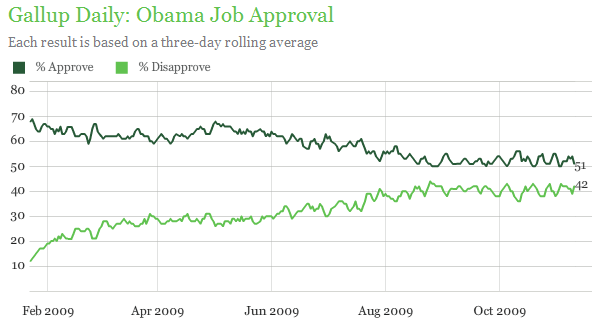
I”m posting this @ 7:59 a.m. and predicting that today’s the day that President Obama’s job approval — as measured by Gallup, a respected, slightly left leaning polling org — will drop below 50% for the first time.  If so, that’ll be a very big deal.

Why?

Major reason: yesterday’s number was 51% (chart below); today will be the first rating that fully reflects Saturday night’s healthcare vote (since Gallup is a 3-day moving average).

Secondary reason: backlash to the way the administration is handling the Afghanistan decision and the Fort Hood massacre.

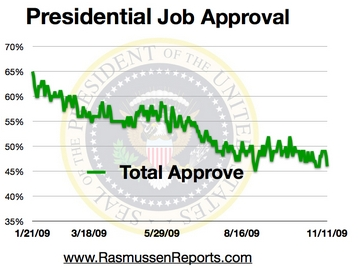
Reason for confidence: Rassmussen — a slightly right leaning polling org — tends to lead Gallup by a day or two.  Rasmussen has Obama’s job approval down to 46% (chart below).

Note: Rasmussen posts around 9:30 am; Gallup in mid-afternoon.

We’ll see …

* * * * *

Gallup

image
http://www.gallup.com/poll/113980/Gallup-Daily-Obama-Job-Approval.aspx

* * * * *

Rasmussen

image
http://www.rasmussenreports.com/public_content/politics/obama_administration/obama_approval_index_history

If it doesn’t walk like a duck and quack like a duck, what the heck is it?

November 12, 2009

TakeAway: When companies develop innovative products and services that don’t obviously fit into established categories, managers need to help people understand what comparison to make. Without that step, potential customers might just walk away wondering, “What is it?”

* * * * *
Excerpted from NY Times, It’s Brand New, but Make It Sound Familiar, October 4, 2009

GLANCE through a photo album of early automobiles and you’ll find an eclectic assortment of vehicles, including three-wheeled machines and bicycle-like contraptions. You’d be hard-pressed to identify many as cars.

Early consumers were confused, too, until innovators finally converged on a carriage-like design and coined the term “horseless carriage” in the 1890s, giving a clear point of comparison. More than 100 years later, we can learn from their example.

Humans instinctively sort and classify things. It’s how we make sense of a complex world.

So when companies develop innovative products and services that don’t obviously fit into established categories, managers need to help people understand what comparison to make. Without that step, potential customers might just walk away wondering, “What is it?”

* * * * * 

As a starting point, it helps to understand some basic traits of behavior. When people encounter something they don’t recognize, they make sense of it by associating it with something familiar.

“The category signals not only a set of features to expect, but at a more basic level, when and how you should use the novel item.”

Companies can benefit by using comparisons to create expectations that best match an innovation’s strengths.

Problems can arise if consumers can’t place innovations into familiar categories. Consider the introduction of the Segway, the high-tech motorized scooter, “Nobody was quite sure what it was … There was no clear analogy, so people had no idea how to use it.”

* * * * *

Finding the right label is only one of the many ways organizations can influence the way consumers categorize a product. They can also experiment with the product’s shape, packaging, pricing and retail store placement.

* * * * *

As innovative products are introduced, category boundaries are continually shifting and new categories emerging. In some ways, the auto industry is going through a transformation that harks back to the 1800s.

Today’s consumers are confronted with an impressive assortment of new vehicles, including electric models with three wheels and others with designs that just don’t look like what we expect a car to look like.

Will electric vehicles be broadly accepted? And which models will be most popular? The answers may well depend on the associations that automakers try to imprint on consumers.

Full article:
http://www.nytimes.com/2009/10/04/business/04proto.html?sq=segway&st=cse&scp=1&pagewanted=print

The "Costs" of Medical Care …

November 11, 2009

Ken’s Take: Economists are trained to focus on “real” costs. 

One of my major complaints about the current healthcare “reforms” is that — except for electronic medical records — there are, for all practical purposes, no structural changes proposed.  No gov’t clinics, no additional medical schools, no tort reform. 

Just more money being thrown at the problem and more obfuscation of real costs.

* * * * *

Excerpted from RCP: The “Costs” of Medical Care, Thomas Sowell, November 3, 2009

We are incessantly being told that the cost of medical care is “too high”– either absolutely or as a growing percentage of our incomes.

But nothing that is being proposed by the government is likely to lower those costs, and much that is being proposed is almost certain to increase the costs.

There is a fundamental difference between reducing costs and simply shifting costs around, like a pea in a shell game at a carnival.

Costs are not reduced simply because you pay less at a doctor’s office and more in taxes– or more in insurance premiums, or more in higher prices for other goods and services that you buy, because the government has put the costs on businesses that pass those costs on to you.

Costs are not reduced simply because you don’t pay them. Letting old people die would undoubtedly be cheaper than keeping them alive– but that does not mean that the costs have gone down. It just means that we refuse to pay the costs. Instead, we pay the consequences. There is no free lunch.

Despite all the demonizing of insurance companies, pharmaceutical companies or doctors for what they charge, the fundamental costs of goods and services are the costs of producing them.

If highly paid chief executives of insurance companies or pharmaceutical companies agreed to work free of charge, it would make very little difference in the cost of insurance or medications.

If doctors’ incomes were cut in half, that would not lower the cost of producing doctors through years of expensive training in medical schools and hospitals, nor the overhead costs of running doctors’ offices.

What it would do is reduce the number of very able people who are willing to take on the high costs of a medical education when the return on that investment is greatly reduced and the aggravations of dealing with government bureaucrats are added to the burdens of the work.

In short, reducing doctors’ income is not reducing the cost of medical care, it is refusing to pay those costs. Like other ways of refusing to pay costs, it has consequences.

http://www.realclearpolitics.com/articles/2009/11/03/the_costs_of_medical_care_98986.html

The “Costs” of Medical Care …

November 11, 2009

Ken’s Take: Economists are trained to focus on “real” costs. 

One of my major complaints about the current healthcare “reforms” is that — except for electronic medical records — there are, for all practical purposes, no structural changes proposed.  No gov’t clinics, no additional medical schools, no tort reform. 

Just more money being thrown at the problem and more obfuscation of real costs.

* * * * *

Excerpted from RCP: The “Costs” of Medical Care, Thomas Sowell, November 3, 2009

We are incessantly being told that the cost of medical care is “too high”– either absolutely or as a growing percentage of our incomes.

But nothing that is being proposed by the government is likely to lower those costs, and much that is being proposed is almost certain to increase the costs.

There is a fundamental difference between reducing costs and simply shifting costs around, like a pea in a shell game at a carnival.

Costs are not reduced simply because you pay less at a doctor’s office and more in taxes– or more in insurance premiums, or more in higher prices for other goods and services that you buy, because the government has put the costs on businesses that pass those costs on to you.

Costs are not reduced simply because you don’t pay them. Letting old people die would undoubtedly be cheaper than keeping them alive– but that does not mean that the costs have gone down. It just means that we refuse to pay the costs. Instead, we pay the consequences. There is no free lunch.

Despite all the demonizing of insurance companies, pharmaceutical companies or doctors for what they charge, the fundamental costs of goods and services are the costs of producing them.

If highly paid chief executives of insurance companies or pharmaceutical companies agreed to work free of charge, it would make very little difference in the cost of insurance or medications.

If doctors’ incomes were cut in half, that would not lower the cost of producing doctors through years of expensive training in medical schools and hospitals, nor the overhead costs of running doctors’ offices.

What it would do is reduce the number of very able people who are willing to take on the high costs of a medical education when the return on that investment is greatly reduced and the aggravations of dealing with government bureaucrats are added to the burdens of the work.

In short, reducing doctors’ income is not reducing the cost of medical care, it is refusing to pay those costs. Like other ways of refusing to pay costs, it has consequences.

http://www.realclearpolitics.com/articles/2009/11/03/the_costs_of_medical_care_98986.html

PRs more challenging since profit has become a 4-letter word …

November 11, 2009

TakeAway:  In an age where company reputation is playing an increasingly important role in sales generation and growth, the decline of traditional business media could cause big problems for marketers.  Companies must now take the laboring oar and find creative ways to ensure that their preferred message makes it to the consumer.

* * * * *

Excerpted from Strategy & Business, “What a Declining Business Media Means to CEOs” By William Holstein, September 28 2009

The business media is mired in deep economic crisis … the surviving business magazines are much thinner … Newspapers are suspending publication of stand-alone business sections and downgrading their coverage … Even at relatively healthy business news outlets, there is a decline in the quality of business coverage …

One might argue that the weakened state of business media doesn’t matter much … But the consequences for business decision makers are three-fold, and grave.

First, it means that business coverage could become more negative toward profit and enterprise than it is today … Criticism of corporations will be less nuanced, less aware of context, and less insightful. Competent, complacent, and craven companies — or divisions within companies — will all be tarred with the same brush.

Second, the decline in business journalism gives corporate decision makers less of a platform to display and test their own company’s strategy. “It means that there are fewer opportunities for a CEO to get his or her story into the media,” says CNN …

But perhaps the worst effect is the most subtle: Corporate leaders now have fewer opportunities to learn from one another’s experience, or even to know what’s going on in their regions and industries …

What specifically should a corporate leader do differently in this environment? The first priority is to maintain the visible public presence of his or her own company — to build its reputation as a reliable entity, in a time when the integrity of many companies has come under scrutiny …

Meanwhile, it’s more important than ever for CEOs to develop core communications messages that go beyond the issue of profitability and stock price. GE has been very effective with its Ecomagination campaign. Companies must define the way they appear in the world at large …

Edit by TJS

* * * * *

Full Article
http://www.strategy-business.com/article/00003?gko=83b3c

* * * * *

360-degree competition from private-label products

November 11, 2009

TakeAway: Whether it’s due to the economy or consumers’ general frustration with price inflation, private label products are booming.

Accordingly, more and more companies are offering private label products in an attempt to steal sales from their branded counterparts.

Now, this battle has moved from the stores to the Internet. Consumers’ appetite for value is spurring Amazon’s move into the private label business.

* * * * *

Excerpted from WSJ,”Amazon Is Selling Designs Of Its Own,” By Geoffrey Fowler, September 21, 2009

Amazon.com is quietly expanding its private-label business in a bid to diversify away from its online bookstore roots and become more like a general retailer.

After starting with private-label patio furniture in 2004, Amazon has since added its own housewares, including a steamer, frying pan and chopping block … the latest: a wooden chopping block …

Amazon doesn’t say what percentage of its $19 billion in annual sales are from its private-label business, but it already sells more than 1,000 products that are manufactured at its request … this underscores how far the company has moved beyond books, CDs and DVDs …

The company has developed private-label products when it felt customers’ needs weren’t being met by the rest of its catalog … developing private-label products has required new skills for the company, such as managing quality control and meeting product safety regulations. But online feedback from customers who leave product reviews helps the company make improvements…

The company won’t disclose profit margins for its private-label merchandise but it is clear that the effort wouldn’t be feasible if it weren’t for Amazon’s economies of scale …

Private labels are popular with many traditional retailers because they can provide higher profit margins by cutting out the middleman in the supply chain … online-only retailers have been slower to adopt private-label brands because they lack the expertise to design products, and lack a physical store presence to introduce a new brand …

The private-label strategy isn’t without its problems. In particular, Amazon’s own products may conflict with the products and merchants that the company already hosts on its site …

Edit by TJS

* * * * *

Full Article
http://online.wsj.com/article/SB125323090208821381.html?mod=djemMM

* * * * *

It's in the bill … hard time for the voluntarily uninsured.

November 10, 2009

Failure to buy health insurance in the just-passed health care bill could get you five years in jail with a $250,000 fine.

Under sections 7201 and 7203 of  Pelosi’s bill, Americans who don’t maintain acceptable health insurance coverage and who choose not to pay a fine/tax of up to 2.5% of income are subject to fines of up to $250,000 and imprisonment of up to five years.

http://www.investors.com/NewsAndAnalysis/Article.aspx?id=511806

The good news: once incarcerated, these felons get full healthcare … for free.

Do twentysomethings who choose to self-insure understand that they’re going to be subsidizing us old folks ?  Might work …

It’s in the bill … hard time for the voluntarily uninsured.

November 10, 2009

Failure to buy health insurance in the just-passed health care bill could get you five years in jail with a $250,000 fine.

Under sections 7201 and 7203 of  Pelosi’s bill, Americans who don’t maintain acceptable health insurance coverage and who choose not to pay a fine/tax of up to 2.5% of income are subject to fines of up to $250,000 and imprisonment of up to five years.

http://www.investors.com/NewsAndAnalysis/Article.aspx?id=511806

The good news: once incarcerated, these felons get full healthcare … for free.

Do twentysomethings who choose to self-insure understand that they’re going to be subsidizing us old folks ?  Might work …

Cash 4 Clunkers … or, make that Cash for a new Hummer … geez.

November 10, 2009

TakeAway: Under Cash for Clunkers, some owners of large pickups cashed in old trucks for between $3,500 and $4,500 toward new Hummer H3 SUVs that got only 16 mpg.        

Source: Associated Press: Clunker pickups traded for new pickups, Nov 4, 2009

The most common deals under the government’s $3 billion Cash for Clunkers program, aimed at putting more fuel-efficient cars on the road, replaced old Ford or Chevrolet pickups with new ones that got only marginally better gas mileage.

The single most common swap — which occurred more than 8,200 times — involved Ford F150 pickup owners who took advantage of a government rebate to trade their old trucks for new Ford F150s. The fuel economy for the new trucks ranged from 15 mpg to 17 mpg based on engine size and other factors, an improvement of just 1 mpg to 3 mpg over the clunkers.

Owners of thousands more large old Chevrolet and Dodge pickups bought new Silverado and Ram trucks, also with only barely improved mileage in the middle teens,.

Those deals helped the Ford F150 and Chevy Silverado — along with Ford’s Escape midsize SUV — climb into the Top 10 most-popular vehicles purchased with the government rebates. The most common truck-for-truck and truck-for-SUV deals totaled at least $911 million.

* * * * * 

In scores of deals, the government reported spending a total of $562,500 in rebates for new cars and trucks that got worse or the same mileage as the trade-ins — in apparent violation of the program’s requirements.

More than 95,000 of the new vehicles purchased under the program — or about one in seven — got less than 20 mpg, according to the data.

Plenty of consumers bought relatively low-mileage trucks and SUVs with the help of government checks.

Full story:
http://news.yahoo.com/s/ap/20091104/ap_on_bi_ge/us_cash_for_clunkers

* * * * *

On the plus side:

Popular high-mileage commuter cars including the Toyota Corolla, Honda Civic, Toyota Camry and Ford Focus also were among the Top 10 most popular new vehicles bought under the four-week program, with 105,280 of those models sold for a total of about $2 billion.

Time for a makeover: the future of brand managers

November 10, 2009

Takeaway: If you are pursuing a career as a brand manager, your role may be very different than you imagined.

A report that will soon be released by Forrester will provide a redefinition of what a brand manager should be. Their groundbreaking finding: marketers should get back to marketing. Beyond focusing solely on your product, you should really get into the mind of your consumers and appeal to their needs and desires.

And with the rise of digital media, targeting specific segments can be done with more precision than ever before.

The report also claims that decisions really need to be performance-oriented, with more reliance on research and analytics.

Hmmm, recommending a focus on people and performance? It looks like those extra P’s we learned about in Markstrat were well worth it.

* * * * *

Excerpted from AdAge, “Why It’s Time to Do Away With the Brand Manager” by Jack Neff, October 12, 2009

Managing a brand has always been a slightly odd concept, given that consumers are the real arbiters of brand meaning, and it’s become increasingly outmoded in today’s two-way world. That’s why a new report is going to recommend changing the name “brand manager” to “brand advocate,” and fundamentally changing marketer organizations in response to the onset of the digital age.

The report, due out next week from Forrester, finally puts the onus on marketers to change their structures — a welcome conclusion for media owners and agencies who keep hearing how they should change, but often complain that their clients have done little to shift their organizations to cope with an increasingly complex world of media fragmentation and rising retailer and consumer power.

Among the specific recommendations in its report, “Adaptive Brand Marketing: Rethinking Your Approach to Branding in the Digital Age,” Forrester suggests “brand advocates” be responsible for rapid adaptations of global brand platforms and programs, charging centralized global brand strategists with ensuring what local managers do conforms with the brand equity and strategy.

It also advocates recognizing the brand isn’t the only organizational structure that’s important for multibrand companies, but that structures aimed at marketing to demographic or other segment cohorts are equally important. And it also maintains that marketing executives should think less about anchoring annual plans around one or two big hits and more about doing many smaller things quickly and adapting based on real-time consumer feedback and other data.

He believes marketers in the digital age need to be more “numerate,” with more training in research and analytics even if they still rely on staff for help. Marketers today need to balance art and science, he believes, not unlike architects, musicians or cinematographers.

Key to any change, the former Tide brand manager said, is a return to marketing as the focus of brand management, “rather than one of six things a brand manager does.”

“So much of [brand managers’] time is subsumed by internal management, and so much of the creative process and planning is outsourced to agencies and other parties,” Forrester’s Ms. Bradner said. Brand advocates, she said, “really need to be in charge of the heart and soul of what the brand stands for. It does move you off the generalist track to be more of a pure marketer.”

Edit by JMZ

* * * * *

Full Article:
http://adage.com/cmostrategy/article?article_id=139593

* * * * *

When you let folks down, spit out the words: "I’m sorry"

November 10, 2009

Ken’s Take: Here are two very different stories re: how companies respond when they let customers down.. AT&T tries to slick over the problem.  Cox Cable steps up, takes responsibility, and offer a couple of freebies to ease the pain.

* * * * *

AT&T 

“AT&T customers have been complaining for months about dropped calls, spotty service, delayed text and voice messages and slow download speeds for the iPhone”.

In response, AT&T produced a three-minute YouTube video in which it appears that a spokesperson called “Seth the Blogger Guy” will address concerns from a large number of unhappy customers.

“Look, we see the discussions on the Web,” he says, “on blogs, on Twitter, on Facebook. So we thought it would be a good idea to take what’s being said head-on.”

So far, so good, but Seth quickly loses his focus by:

  • Describing the huge demands placed on networks by smartphone usage
  • Congratulating AT&T for its role in expanding the smartphone market
  • Detailing the extraordinary efforts to facilitate a smooth rollout for the iPhone’s MMS feature (which had yet to be released when the video was made, and about which no customers had complained.)

Nearly two minutes into the presentation, Seth finally gets to the point.

“So what are we doing about it?” he says. “Well, put simply, we’re working around the clock to enhance and expand out network to meet these challenges.”

He concludes by telling viewers what AT&T plans to do and how much it plans to spend, but fails to offer concrete timelines, or much else that would matter to a customer frustrated by terrible service.

More important to consider is what Seth left out: He never says what customers really want to hear … sorry.'”

Source Marketing Profs: Sorry Seems to Be the Hardest Word, Nov. 5,2009
http://www.marketingprofs.com/short-articles/1412/sorry-seems-to-be-the-hardest-word/?adref=NmiF1B9

* * * * *

Cox Cable

Background: On Wed, Nov. 4 Cox had a massive system outage in Northern Virginia that lasted most of the nite.  As luck would have it, that turned out to be the nite that the Yankees beat the Phillies to win the World Series.  Lots of disappointed sportsfans.

Here’s how Cox responded.  I think they did a pretty good job …. considering.

An email from Cox NOVA’s General Manager:

We let you down. You expected to turn on your television and sit down to watch the game or your favorite Wednesday night show. That probably didn’t happen and I apologize for that.

Some of our most vital equipment took a significant power hit, and when rebooted, much like a home computer, it did not come back on line properly.

In spite of tremendous effort on the part of our best people, that reboot process took several hours and frankly, probably ruined your night. As your neighbor, I experienced the same in my home.

We are committed to you, our valued customer, and nothing is more important than rebuilding your trust in us by taking action to make things right.

First, we’re going to credit your residential account with a free month of digital gateway service.  The credit will be automatically applied to your account, no need for you to do anything. We also hope you will take advantage of a free video On DEMAND movie .

While such an outage has not occurred in the history of Cox NOVA, we take this very seriously and are already working to ensure higher reliability of our video network as we completely review processes and emergency procedures so that you can enjoy your your TV service uninterrupted.

We appreciate having you as a customer. It’s important to us. My thanks for allowing us to serve you,

Janet Barnard
SVP and General Manager
Cox Communications

* * * * *

Bad things happen when you confuse "price" with "cost" … here’s an example.

November 9, 2009

I often harp to my students that it’s a cardinal sin to confuse revenue with profits, or to confuse price with cost.  Here’s an example of the latter — in the context of the current healthcare debate.

Excerpted fron IBD: Misconceptions That Mar Medical Care, 11/06/2009
From the book “Applied Economics” by Thomas Sowell.

A number of confusions plague discussions of the economics of medical care.

A confusion between prices and costs has allowed politicians to claim to be able to bring down the cost of health care, when in fact they only bring down the individual patient’s out-of-pocket costs paid to doctors, hospitals, and pharmacies.

The costs themselves are not reduced in the slightest when additional money to pay for these costs is collected in taxes or insurance premiums and routed through either government or private bureaucracies.

Most proposals to “bring down the cost” of medical care pay little or no attention to the actual cost of creating pharmaceutical drugs, training medical students, or building and equipping hospitals.

To the extent that the government imposes some form of price control by refusing to pay doctors, hospitals or pharmaceutical companies as much as they would receive through supply and demand in a free market, that does not lower the costs either.

It simply means that the government refuses to pay all those costs — and such refusals to pay costs have a centuries-old track record of leading to a reduction in the amount supplied, whether what has been subject to price controls has been housing, gasoline, food or other goods and services.

Medical treatment has been no exception. The reduction in the supply of doctors, hospitals or pharmaceutical drugs may be quantitative, qualitative or both.

In Britain, with one of the oldest government-run health systems and therefore one which has long since gone past stage one, there have been such difficulties in getting enough British doctors that there have been large and chronic importations of foreign doctors, many from Third World countries whose qualifications standards are not always up to those in more affluent countries.

As for pharmaceutical drugs, countries which have succumbed to the politically attractive policy of keeping drug prices low by fiat, or by ineffective patent protection, have had much lower rates of discovery of major new medications than does the United States, which has been left to supply a disproportionate share of the world’s major new medications.

Various organized groups in a position to bargain for lower medical charges or lower drug prices — government agencies, health insurers or large health maintenance organizations, for example — may receive preferential prices, but the total costs do not go away and have to be paid by somebody.

One consequence is a multitiered set of prices for the same medical treatment or the same medication, with the highest prices of all being paid by patients who do not have health insurance, do not belong to a health maintenance group, and are not covered by any government program.

In short, misconceptions of the economic function of prices lead not only to price controls, with all their counterproductive consequences, but also to organized attempts by various institutions, laws and policies to get most of the costs reflected in prices paid by somebody else.

For society as a whole, there is no somebody else.

Full article:
http://www.investors.com/NewsAndAnalysis/Article.aspx?id=511637

Marketers’ new best friends …

November 9, 2009

TakeAway:  Are apps the next best thing to a Web site?  Some say yes! 

With consumers becoming more and more reliant on their cellphones as an information resource, apps are positioned to be a key tool to drive trial, loyalty, and cross-sales. 

* * * * *

Excerpted from NY Times, “What Do All These Phone Apps Do? Mostly Marketing,” By Roy Furchgott, October 4, 2009

Useful applications are seen as a gold mine for building brands.

Stanley Works, the hand tool maker, iPhone App turns the phone into a level …The company does not know if the iPhone app drove a single sale or fostered any brand loyalty. But based on the 400,000 downloads, Stanley declared the iPhone level a resounding success and is now looking for other tool apps … Other companies are experimenting as well …

Behind the land rush to apps is a belief that they may be some of the cleverest advertising devised. They are advertisements that people voluntarily choose to watch and share with friends. Some apps are even consulted in store aisles when customers decide what to buy. “Apps have a huge advantage,” said a mobile market analyst … “You had to take a step to get it; you are already half sold.”

When people open an app, they give it full attention, which helped drive MasterCard’s decision to follow its A.T.M. locator app with one that would show shoppers nearby stores that offer discounts to MasterCard users.

Apps also give the company a chance to sell cardholders on more services. “It allows consumers to engage with the brand every day,” said SVP for mobile digital marketing at MasterCard …

Novelty apps have had the most downloads, research shows, use of them fades quickly …

Current thinking is that utilities that people use repeatedly are the most effective …

Edit by TJS

* * * * *

Full Article
http://www.nytimes.com/2009/10/05/technology/05apps.html?ref=media

* * * * *

After $787 billion, an we stand much more stimulation?

November 9, 2009

The current refrain: almost 1 million jobs saved or created.  Yeah, right.

The chart says it all …

image
http://online.wsj.com/article/SB10001424052748704795604574519602476681352.html?mod=djemEditorialPage

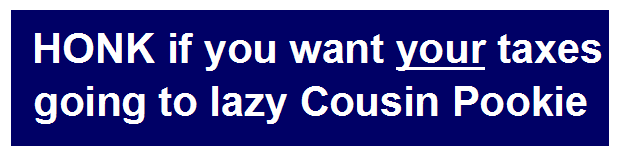
More Pookie backlash … the obligatory bumper sticker.

November 9, 2009

It was only a matter of time …

image

So, preventative healthcare and disease screenings save money … right ?

November 9, 2009

Ken’s Take: Since I’m in the prime group for prostate cancer — and since a couple of friends have been detected and treated (successfully) — I’ve been a fan of PSA tests.  But, I’ve had 3 docs try to talk me out of getting the tests.  Here’s their rationale … which raises a broader question re: preventative healthcare.

* * * * *

Excerpted from RCP: Government by Holiday Inn Express, October 27, 2009 

Another silver bullet the administration has peddled is preventive care.

Everyone knows that a timely PSA test will detect prostate cancer at an early and treatable phase thus saving the patient’s life and saving money, right?

Not exactly. The test is obviously worthwhile for that individual. But testing all men for prostate cancer — an overwhelming majority of whom will never get the disease — is expensive.

If more and more of us are tested for more and more diseases — even accounting for some illnesses found early — health spending will rise, not fall.

Further complicating the picture, the National Cancer Society has announced that the benefits of cancer screenings, particularly for breast and prostate cancers, have been oversold. They aren’t saving very many lives, but they are causing needless tests and surgeries.

Full article:
http://www.realclearpolitics.com/articles/2009/10/27/government_by_holiday_inn_express_98882.html#

From the exit polls … more warning shots from tax payers

November 6, 2009

Currently, less than 1/2 of adults pay income taxes.  That causes undeniable pressures. 

Those who don’t pay income taxes want tax rates raised (on those who do pay) and want more and more freebies from the gov’t. 

Those who do pay are starting to say “I don’t think so”. 

Watch this trend big time in 2010.

The GOP victories reveal fissures in the coalition that elected Barack Obama.

In the election results and the exit polls there are clear signs that the Obama majority coalition has splintered.

Mr. Obama benefited last year from a big turnout of young voters, who backed him by a 66% to 32% margin. This year young voters formed only about half as large a percentage of the electorate in Virginia and New Jersey as they did in 2008, and in Virginia they voted about as Republican as their elders.

Economically, the Obama majority was a top-and-bottom coalition. The Democratic ticket carried voters with incomes under $50,000 and over $200,000, and lost those in between.

As the shrewd liberal analyst Thomas Edsall has noted, there’s a tension between what these groups want.

High earners in non-Southern suburbs have been voting Democratic since the mid-1990s largely because of their liberal views on cultural issues;

Low earners vote Democratic because they want more government money shoveled their way.

Tuesday’s elections suggest those whose money gets shoveled are having second thoughts about this odd-couple coalition.

Excerpted from WSJ: Tuesday’s Biggest Loser: the Union Agenda, Nov 4, 2009 
http://online.wsj.com/article/SB10001424052748704013004574515681098665524.html?mod=djemEditorialPage

Q&D testing of "killer assumptions" … If you can’t GET the data, then CREATE it.

November 6, 2009

TakeAway: By becoming skilled at experimentation, innovators can gain a competitive edge.

STRATEGY & INNOVATION, Not-So-Risky Business, September 16, 2009

* * * **

By systematically attacking the most critical unknowns with tailored, low-cost experiments, innovators can systematically “de-risk” their strategies and thereby increase their chances of success while lowering the associated investment cost.

Systematically testing “killer assumptions” with quick experiments can create the data otherwise not available in market research reports but necessary to move forward to the next step, whether that step is doubling down, re-vectoring, or folding.

This type of approach is generally most critical when data doesn’t exist in market research or other reports, but rather exists in behavior that hasn’t yet happened or outcomes that can only be learned in market. In other words, if you can’t GET the data, then CREATE it through market experiments.

In other words, the goal is to run early experiments up front to gain critical pieces of information that can enable re-vectoring early and increase odds of success at a lower price tag.

“Test and learn” is the mantra. Invest a little and learn a lot is the approach.

And, the prizes over time come in the shape of lower investment costs, more innovation opportunities, and higher odds of success. Again, just remember “invest a little, learn a lot.”
* * * * *
The first step is detailing “killer assumptions” by assessing risk, confidence, testability:

  • How important is it for this assumption to be true?
  • How confident are we in this assumption?
  • How easy would it be to test this assumption?

Then, start experimenting …

* * * * *
The best experiments:

  • Isolate the variables being tested and keep it to one (or perhaps two) at a time
  • Keep the experimentation quick & dirty (Q&D) … not elaborate or expensive

Get out of the lab and office and into the “real world
* * * * *
Armed with information from experiments, make one of three immediate choices:

  1. Double down and continue to the next assumption,
  2. Re-vector and accordingly re-assess the killer assumptions involved,
  3. Determine that it is time to cut your losses and fold.

* * * * *

Full article
http://www.innosight.com/innovation_resources/article.html?id=842

* * * * *

Hot off the press: reinventing the print media business

November 6, 2009

Key Takeaway: Let’s face it, the good ol’ days of print media are long behind us. Cuts in advertising budgets, lower subscription numbers, and this thing called the Internet have all severely damaged profitability for newspapers and magazines. All is not lost, however, as these publications have a large opportunity to tap into the digital space. Unfortunately, most have not figured out how to do this successfully (or at least profitably). This change in strategy must be accompanied by new tactics that get to the core of good strategic marketing:

1) Develop intimate relationships with your readers. Find a segment, target them, and give them exactly what they want.
2) Generate revenue beyond advertising and circulation. Your online content should leave the reader willing to pay more for customized material.
3) Reinvent the content delivery model. Focus on your core strengths, put your efforts into those segments or sections, and get rid of all the fluff that doesn’t drive revenue.
4) Innovate with new products and pricing models. Deliver content to readers in new and exciting ways that will enhance their experience.

It seems simple, but it sure is tough to explain to those newspapers that the digital world isn’t so black and white…

* * * * *

Excerpted from Strategy + Business “Reinventing Print Media: Four new strategies offer a path to future profits for today’s troubled newspaper and magazine companies” by Matthew Egol, Harry Hawkes, and Greg Springs, August 27, 2009

Severe cutbacks in conventional advertising — even when subscriptions or newsstand sales are robust — are slicing deeply into publishers’ revenues and shredding profitability. And it has affected print more than any other medium: Although overall advertising revenues fell by mid-single digits in 2008, newspapers, consumer magazines, and business-to-business trade publications saw print advertising declines of two to three times that. Performance has worsened so far in 2009.

Marketers have accelerated shifts in spending away from paid advertising to other priorities — including their own Web sites, in-store marketing, loyalty programs, and word-of-mouth campaigns — and they aren’t likely to switch back. Spending on this type of “below the line” marketing (the industry term for categories other than paid media advertising) already represents three-quarters of most marketing budgets, having grown faster than paid media since well before the current recession.

The second long-term trend devastating print profitability is the rise of digital media. Print has been hardest hit by this shift, since print ad pages are priced at a significant premium over other kinds of advertising, and marketers have been slower to cut broadcast and cable TV ad spending because of the value they place on sight, sound, and motion for brand campaigns.

Only a few print publications, such as the Wall Street Journal, the Financial Times, and the Economist, are successfully charging for their content online. They are all specialized and oriented toward business professionals.

A second approach — moving entirely online without charging for content (shedding the costs of paper and distribution and counting on online advertising to make up for the loss of print revenues) — has also had little success.

A growing body of research — tracking media companies that are succeeding in the new marketing environment and leading marketers who have successfully pursued innovative new digital strategies — suggests that at least four strategies are available for the media company of the future.

The first strategy is to develop deeper relationships with readers around targeted interest areas. Premium online environments, built on rich, exclusive content and applications, can enable print players to develop a still more intimate relationship with their readers.

The second strategy is to tap into revenue streams beyond advertising and circulation. Among print media companies, two players that have innovated new models very successfully are Meredith and IDG. Meredith has built a marketing solutions business that is estimated at more than US$200 million in revenues, fueled in part by multiple acquisitions of targeted digital agencies for custom content creation, database marketing, and word-of-mouth campaigns.

The third strategy is to reinvent the content delivery model (with a particular focus on lowering costs) and to emphasize a “profitable core” of unique and brand-defining material. Identifying the profitable core requires thinking freshly about the zones or editions of a newspaper or magazine and eliminating sections that do not drive significant readership or advertising revenue.

The fourth success strategy for the media company of the future is to innovate with new products and pricing models. Among these areas of innovation, digital video is increasingly important – in large part because of advertiser preference for video as part of brand-building investments.

Edit by JMZ

* * * * *

Full Article
http://www.strategy-business.com/article/09308?gko=2c407&cid=enews20090929

* * * * *

The "Pookie Effect" … no, I didn’t make Pookie up.

November 5, 2009

As expected, I got some pushback on yesterday’s election analysis — especially the “Pookie Effect”.

For those who missed the original post, here’s what I said:

The Pookie Factor:  At the risk of  political incorrectness … I know Pres Obama was just trying to be cute with his “get lazy cousin Pookie off the couch and get him to vote”.  I think there was some backlash to the comment.  I know a lot of folks who are repulsed by the thought of lazy cousin Pookie deciding the direction of the country.  Perhaps lazy cousin Pookie should get off the couch and get an education or get a job.
https://kenhoma.wordpress.com/2009/11/04/the-elections-checkbooks-adult-supervision-pookie-and-buyers-remorse/

No, I didn’t make Pookie up (even I CAN’T make that kind of stuff up) and, no, I didn’t just hear it on FoxNews.

My point: Corzine made a big mistake attacking Christy’s heft (pardon the pun).  Similarly, Obama may have inadvertently created a flashpoint issue by invoking Cousin Pookie.

* * * * *

Video Proof

FIrst, here’s the video proof: Obama stumping for failed candidate Deeds in Virginia … at 2 different venues.

http://www.youtube.com/watch?v=-Al6r8ESjAY

http://www.youtube.com/watch?v=j_293EQfM9Y

* * * * *

Print Proof

Here’s  an AP report on CBSNews.com … hardly right wing sources of misinformation.

Excerpted from AP / CBSNews.com: Obama Invokes “Cousin Pookie” to Help Va. Dem, October 27, 2009

(AP )(NORFOLK, Va.) In a last-ditch, against-the-odds effort to help Creigh Deeds win election as governor of Virginia next week, President Obama invoked the assistance of “Cousin Pookie.”

Addressing a campaign rally for Deeds at an arena at Old Dominion University, Mr. Obama used a device that served him well during his presidential campaign – especially before African-American audiences.

“Go out and get your cousin who you had to drag to the polls last November, Cousin Pookie, you go out and get him and you tell him ‘you got to vote again this time.'”

http://www.cbsnews.com/blogs/2009/10/27/politics/politicalhotsheet/entry5427510.shtml

* * * * *

So, who’s Pookie ?

Excerpted from HNIC Reports: “Who is Obama’s ‘Cousin Pookie’?”, March 13, 2007 <== Note the date

In remarks at Brown Chapel in Selma, Ala., Illinois Democratic Sen. Barack Obama made reference to the mysterious Cousin Pookie.

In his sermon Sunday at Brown Chapel in Selma, Ala., Barack Obama declared: “If Cousin Pookie would vote, if Uncle Jethro would get off the couch and stop watching SportsCenter and go register some folks and go to the polls, we might have a different kind of politics.”

It wasn’t the first time the Illinois senator and presidential aspirant has invoked “Pookie” … but for those not in the know, the question remains: Who is this Pookie?

The Obama campaign didn’t respond to requests for details. But Newhouse News Service asked some of America’s best minds on black culture, language and politics.

In their interviews and e-mails, Pookie emerges as a stock character of the black popular imagination, a name that has come to personify the kind of layabout kin who, if endearing, is also a source of some embarrassment and consternation to his more successful relations.

“Pookie means a whole lot of different things; none of them are good.”

Pookie is the kind of ghetto character played by Cedric the Entertainer or Chris Tucker in one of those “Barbershop” or “Friday” movies. In the 1960s and ’70s, he would have gone by Leroy, Tyrone or Otis.

Pookie goes way back, but he has come into his own only in the last decade, as a “metaphor for kin … who everybody knows is just a little trifling and a little lazy.”

“If you get it you get it, and if you don’t, you don’t care.” Kitwana said.

Pookie “may be a kinder, gentler take on Cosby’s reference to, and critique of, Shaniqua and Taliqua (as average black youth).

By referencing Cousin Pookie, he’s showing that he’s comfortable with Pookie without being condescending.

“By invoking the name of someone that might be familiar to a lot of black people, he’s attempting to personalize his appeal.”

How the Rev. Joseph Lowery hears it: The contemporary of Martin Luther King Jr. smiled at the mention of Pookie — not because he was familiar with the reference but because he knew, in context, who was being talked about: any of the hundreds of thousands of African-Americans.

Jethro is Pookie’s white counterpart, and by including him, Obama was making a cross-racial appeal to get off the couch.

http://thehnic.wordpress.com/2007/03/13/who-is-obamas-cousin-pookie/

Bulls 83, Bucks 81 … what’s the significance ?

November 5, 2009

Please help me understand … President Obama back-burnered Afghanistan, the economy, and healthcare … and spent all of last weekend stumping for John Corzine … his 4th & 5th trips to NJ on Corzine’s behalf.  And, he crossed the Potomac 3 times for campaign appearances with Deeds.

But, according to his press secretary, he was disinterested in the results … had his eyes glued to Tuesday nite’s Bulls vs Bucks basketball game … didn’t even look in on  the election results.

Does anybody — and I mean ANYBODY — believe that ?

Sometimes, I’ve fallen asleep before the end of a Sunday nite football game … but I’ve never tuned out a game that I was playing in.

* * * **

Source: Politico, Tuned out – Obama ‘not watching returns’, 11/04/09

Hours after urging reporters not to draw sweeping conclusions from Tuesday’s gubernatorial elections in New Jersey and Virginia, White House press secretary Robert Gibbs told POLITICO President Barack Obama wasn’t even keeping an eye on the results.

“He’s not watching returns,” Gibbs said.

But while Obama may not have been following Tuesday’s returns, he and Vice President Joe Biden campaigned repeatedly for candidates in all three of the night’s key races.

As recently as Sunday, Obama stumped in New Jersey for incumbent Gov. Jon Corzine, who has struggled in an uphill battle for reelection against former U.S. Attorney Chris Christie, a Republican.

On Monday, Biden visited New York’s 23rd congressional district to appear at an event for Democratic congressional candidate Bill Owens, who was running against Conservative Party nominee Doug Hoffman.

Both Obama and Biden made stops in Virginia for Democratic gubernatorial candidate Creigh Deeds.

Full article:
http://www.politico.com/politico44/perm/1109/tuned_out_c3071f29-4d59-43b7-bd9d-60b15b03a038.html

Add some pop to your resume …

November 5, 2009

Excerpted from: EditorialEmergency.com, Resume as Personal Branding

TakeAway: Your resume needs to do more than rehash old job descriptions; it needs to get the attention of overburdened employers. 

“If they don’t ‘get’ you after reading your resume — skimming it, if you want the truth — you haven’t effectively differentiated, or branded, yourself.”

* * * * *

Do you really think the folks doing the hiring will find you memorable because you’re a “self-starter?”

Will you separate yourself from the pack by claiming to be a “results-oriented professional?”

Here are “Ten Boilerplate Phrases That Kill Resumes“:

  • Cross-functional teams
  • More than [x] years of progressively responsible experience
  • Superior (or excellent) communication skills
  • Strong work ethic
  • Met or exceeded expectations
  • Proven track record of success
  • Works well with all levels of staff
  • Team player
  • Bottom-line orientation

While we’re at it, let’s add the strangely ubiquitous jargon “thought leader” .

* * * * *

So how do you stand out from the crowd?

Forget about listing every job you’ve ever had in strict reverse-chronological order. Do indicate the years you were with each employer, but make sure the “experience” entries most aligned with your current career goals come first. This is sometimes called a “functional” resume. It’s arranged by order of importance. Sacrificing strategy to chronology is so 20th century.

Don’t make them Google it. Unless your prior employers, clients and partners are so well known that clarifying what they do would be ridiculous, provide a pithy description: Fortress of Solitude, a boutique entertainment-marketing firm. Lithwick, Stahl and Osterman, a financial consultancy. Green’s Greens, the Upper Midwest’s leading distributor of frozen vegetables. If the HR manager has to search for info because you didn’t provide it, consider yourself deleted.

Use vocabulary cherry-picked from the listing for the job you want. Large firms frequently depend on computers to sift resume submissions; the software sorts for keywords that match the listing. Include those keywords in your resume to penetrate the machines’ defenses so you can work your magic on some HUMAN eyeballs.

Rely on compelling stories, not old clichés about your “strong work ethic.  Use (brief) anecdotes to illustrate your productivity, your efficiency, your indispensability. Give life to the tale of your 11th-hour campaign pitch (illustrated by nothing more than stick-figure sketches), which won your outfit a $12 million contract with ActiVision.

Remember that personal branding extends to file names. When submitting your resume electronically, don’t name the file ‘resume,’ or even ‘resume 2009,’– you might as well title it ‘I don’t really want this job.’  File name equals full name (yours).”

* * * * *

Source articles:
http://www.editorialemergency.com/content/view/325/76
http://www.marketingprofs.com/news/marketing-inspiration/index.asp?nlid=1339&cd=dmo121&adref=NmiF1A9The

* * * * *

Brainstorming strategic assumptions …

November 5, 2009

Question: What are the “killer assumptions” that underlie your strategy? 

STRATEGY & INNOVATION, Not-So-Risky Business, September 16, 2009

* * * * *

Start by asking:

Consumer:
Who is the end user?
What are they willing to pay?
Will they have to change their behavior?

Solution:
What constitutes “good enough”?
What are the technical challenges?
Are there logical external partners?
Do we have/need IP protection?

Profit System:
What price makes sense?
What do we expect in terms of trial/repeat purchase?
What capital investment is required?
What marketing support will be needed to launch?

Channel:
Who are the necessary channel partners?
Are they willing to push the solution?
What incentives are required?

Competition:
Who are they?
How do we expect them to respond?
How quickly?
What impact would it have?

Organization:
Do we have the capabilities required?
Are resource allocation processes conducive to success?
Will we gain buy-in from key internal constituents?

Upside:
How scalable is the solution?
What are the stepping stones to the broader opportunity?
How will we achieve longer-term competitive advantage?
 
* * * **
Full article:
http://www.innosight.com/innovation_resources/article.html?id=842

* * * * *

How do you say “Mmm, Mmm, Good” in Russian ?

November 5, 2009

TakeAway:  As the simple meals category grows, soup faces greater competition for a share of your plate.  Campbell’s is making important changes to its products to adapt to consumer needs and win your loyalty (when your budget is not your key decision factor).

* * * * *

Excerpted from BusinessWeek, “Campbell’s: Not About to Let the Soup Cool,” By Matthew Boyle, September 17, 2009

In tough times, comfort sells. And few brands evoke a warm and fuzzy feeling more than Campbell’s … The cost-conscious climate has been a boon for soup sales, which rose 5% in the U.S. in fiscal 2009 … That performance launched Campbell Soup into the ranks of the top 100 brands, where it joined food giants Kellogg, H.J. Heinz, and Nestlé.

But as the recession recedes, Campbell’s will need to prove that its name still resonates with American consumers, many of whom will venture back into restaurants once the economy improves. To stay on top, Campbell’s is launching new products, recasting old favorites, and aggressively pushing into emerging markets …

Consider Campbell’s Chunky line of soups. Last year the company neglected the brand, focusing instead on Select Harvest … Select Harvest became one of the top food launches of 2008. But Chunky suffered as a result … Now Campbell’s is revamping Chunky … the company wants to make the soup more nutritious without sacrificing its perceived heartiness …

China and Russia present a bigger opportunity and challenge for Campbell’s. The two countries account for more than half the world’s consumption of soup. But nearly all of it is homemade. If the company can capture just 3% of the at-home consumption … the size of the business would equal that of the U.S. …

To break into those markets, Campbell’s has been conducting extensive on-the-ground research over the past few years, interviewing thousands of consumers in Russia alone … Their findings led them to develop a broth-like product that Russians can use as a base for their own soups. Next year the company will sell 14 different soups in the country, up from three this year

Edit by TJS

* * * * *

Full Article
http://www.businessweek.com/magazine/content/09_39/b4148060517726.htm

* * * * *

The elections: Checkbooks, Adult Supervision, Pookie, and Buyer's Remorse …

November 4, 2009

Last night, most pundits reduced the election results to an older, whiter group of voters  taking a stand.

Here’s my take (trying to avoid the usual pundit bromides) …

Checkbooks: I’ve whined often about tax policies that have more than half of adults paying no income taxes, but drawing from the system. My hunch: the mix of voters last nite was disproportionately tax payers who are fed up with the reckless spending and taxation without meaningful representation (think Harry Reid behind closed doors).

Adult Supervision: Some elected officials have to start acting like  adults.  Start showing some sense of fiscal responsibility and stop throwing hizzie fits every time they get challenged.  Recognize that implementation and execution matter.  One of my takes last nite: Bob McDonnell won because he came across as an adult — he carries himself like a governor.

The Pookie Factor:  At the risk of  political incorrectness … I know Pres Obama was just trying to be cute with his “get lazy cousin Pookie off the couch and get him to vote”.  I think there was some backlash to the comment.  I know a lot of folks who are repulsed by the thought of lazy cousin Pookie deciding the direction of the country.  Perhaps lazy cousin Pookie should get off the couch and get an education or get a job. 

Buyer’s Remorse: Many middle-of-the-roaders, frustrated by  or angry at Bush, bought into Obama’s charismatic appeal for change and “coming together”.  My sense: lots of buyer’s remorse.  They got Chicago thugery, expensive rad-left programs, and divisiveness-on- steroids.  Change – yes, but maybe not the the change everybody was hoping for.  This was the first chance for folks to register their views free of recriminations.

It’ll be fun to see how the parties spin the results …

The elections: Checkbooks, Adult Supervision, Pookie, and Buyer’s Remorse …

November 4, 2009

Last night, most pundits reduced the election results to an older, whiter group of voters  taking a stand.

Here’s my take (trying to avoid the usual pundit bromides) …

Checkbooks: I’ve whined often about tax policies that have more than half of adults paying no income taxes, but drawing from the system. My hunch: the mix of voters last nite was disproportionately tax payers who are fed up with the reckless spending and taxation without meaningful representation (think Harry Reid behind closed doors).

Adult Supervision: Some elected officials have to start acting like  adults.  Start showing some sense of fiscal responsibility and stop throwing hizzie fits every time they get challenged.  Recognize that implementation and execution matter.  One of my takes last nite: Bob McDonnell won because he came across as an adult — he carries himself like a governor.

The Pookie Factor:  At the risk of  political incorrectness … I know Pres Obama was just trying to be cute with his “get lazy cousin Pookie off the couch and get him to vote”.  I think there was some backlash to the comment.  I know a lot of folks who are repulsed by the thought of lazy cousin Pookie deciding the direction of the country.  Perhaps lazy cousin Pookie should get off the couch and get an education or get a job. 

Buyer’s Remorse: Many middle-of-the-roaders, frustrated by  or angry at Bush, bought into Obama’s charismatic appeal for change and “coming together”.  My sense: lots of buyer’s remorse.  They got Chicago thugery, expensive rad-left programs, and divisiveness-on- steroids.  Change – yes, but maybe not the the change everybody was hoping for.  This was the first chance for folks to register their views free of recriminations.

It’ll be fun to see how the parties spin the results …

Wine better watch its back

November 4, 2009

TakeAway:  Slowly but surely, historical barriers to entry into different food categories are crumbling. 

What was once seen as sacred pairing – wine and cheese – is now an optional pairing. 

Beer is determined to expand its usage occasions to include cheese, and consumers are buying in. 

By gaining support from industry organizations and restaurants, the beer/wine pairing is gaining credibility, creating awareness, and educating consumers.  Go beer.

* * * * *

Excerpted from WSJ, “Trouble Brews for Wine; Cheese Chooses Beer,” By Davide Berretta, September 25, 2009

After wrestling for a spot on the gourmet drink list, beer is trying to push deeper into wine territory: right by the cheese platter …

The beer and cheese combination has long been a staple in Belgian cuisine, but in recent years, the pairing of beer and cheese has gained legitimacy even in wine-obsessed Italy — where beer is hardly the default drink to accompany fine dining …

For brewers, teaming up with cheese is part of a campaign to show that beer is as sophisticated as Bordeaux, not just a tipple associated with student parties and sports bars. The idea is to “bring it up at the same level as wine” …

Slow Food, for one, is putting its clout behind the beer-and-cheese combo. At the nonprofit group’s Cheese 2009 — a biannual international fair held in the northern Italian region that shares a border with cheese superpower, France — cheese lovers and producers from around the world tasted dozens of varieties, with beer helping wash down the food in addition to the usual wine … Slow Food is eager to give more attention to artisanal brews, and has elevated beer’s role from bit player to supporting actor …

Part of the appeal comes from the fact that beer and cheese are part of a common farm cycle. In the 19th century, Belgian monks would brew beer, feeding their cows the leftover barley husks. The cows’ milk yielded cheese that the monks — many of them vegetarians — liked to munch while enjoying their beers …

The owner of New York’s Beer Table, a gourmet beer bar … has been serving beer and cheese since opening the bar a year and a half ago, says consumer palates have warmed quickly to the pairing, such as his proposed meeting of Swiss cheese with Swiss Rebetez beer … “A year ago, it was a new experience for everybody we presented it to,” Mr. Philips says. “Now just one in 10 are surprised.”

But beer fans still have a long way to go if they want to convince the public that suds are a worthy partner for cheese, especially in France …

Edit by TJS

* * * * *

Full Article
http://online.wsj.com/article/SB125383275067639085.html

* * * * *

Death taxes just won’t die …

November 4, 2009

Note:  This is intended primarily for Homa Files more “mature” readers.  But, may be relevant for younger folks with rich relatives who are on their last legs …

* * * * *
Source: WSJ: State Death Taxes Are the Latest Worry, Oct 31, 2009
http://online.wsj.com/article/SB125694593227919879.html

With the federal estate tax disappearing for most people, state death taxes have emerged as a surprise new worry.

This year, the federal exemption rose to $3.5 million per individual, or as much as $7 million per married couple. At the current level, only 5,500 estates a year are federally taxable.

The problem is that most states with estate or inheritance taxes haven’t raised exemptions to match the federal limits. That means thousands of taxpayers who now escape the federal levy could still get hit with a state death tax.

As a result, tax advisers are tweaking bypass trusts that allow married couples to maximize exemptions from state taxes. They are advising taxpayers where to retire in order to pare or eliminate estate taxes.

“In the past, many people hardly gave state death taxes a thought … now they are shocked at how expensive mistakes can be.”

Adding insult to injury, Congress is talking about eliminating the federal deduction for state estate taxes. That would affect only wealthy taxpayers whose estates still exceed $3.5 million per individual.

“States are in such dire straits that most without these taxes would like to have one, and nobody who has one will let it go.”

Seventeen states and the District of Columbia currently impose estate taxes. Eight states have inheritance taxes, which are levied on heirs, not estates. Maryland and New Jersey have both.

Compared to the uniform federal tax, state taxes are a crazy quilt. In many states with inheritance taxes, rates are tied to how closely the heir is related to the late donor. Iowa and Kentucky exempt both spouses and children who inherit property, while Nebraska treats only transfers to spouses as tax-free.

Advisers say taxpayers are most likely to be tripped up by states that used to conform to the federal exemption but haven’t raised it at the same rate.

As a result, married couples in states with lower exemptions — such as New York, Oregon, Minnesota and Massachusetts (all $1 million) or Illinois ($2 million) — are setting up “bypass” trusts in wills even if they no longer need them for federal taxes.

Here’s how bypass trusts work: At the death of the first spouse, assets go into a trust that the survivor can draw on if necessary. When the second spouse dies, the remaining assets in the bypass trust pass tax-free to heirs, preserving the value of both individual exemptions.

Put another way, if a married couple lives in a state with a $1 million individual exemption, a bypass trust would let them to pass as much as $2 million tax-free to heirs.

“Without the proper trusts … a couple in New York with $2 million in assets might pay an unnecessary $100,000.”

* * * * *

The issue is figuring out the “domicile” of a taxpayer. Domicile is a much broader idea than the mere residency test that often determines where someone pays income tax.

Although one determinant of domicile is the amount of time spent in a state, it also may look at where a taxpayer votes, has church and club memberships, registers a car or even has a burial plot.

This means that a taxpayer could live in estate-tax-free Florida, California or Texas and even spend most of his time there. But if he keeps an apartment in New York or a summer home on Cape Cod and has other ties to the area, he might be considered to be domiciled there.

In the worst case, a taxpayer could be domiciled in more than one state and owe taxes to each.


image

The intensity factor …

November 3, 2009

Ken’s Take: Marketers talk about the “top box” effect when evaluating customer loyalty. A repeated finding: only customers who are “very satisfied” are likely to stay loyal — not those who are simply “satisfied”.  In all customer surveys (and political polls) keep your eye on the folks who are “very” …

* * * * *

Excerpted from WSJ: In Vote, Watch the Intensity Factor, Nov. 3, 2009

Polls can measure many things, but one thing they have a hard time getting at is intensity: Yes, people will tell a pollster whom they prefer in a campaign, but do they feel so strongly about their choice that they’ll actually go out to vote?

Only elections can answer the intensity question.

Last year, Barack Obama and his Democrats owned the intensity factor. Lately it has seemed to lie with the Republicans.

Anger is a great motivator, and there’s plenty of anger on the GOP side over Democratic plans for health care and government spending.

* * * * *

Heading into Tuesday, the intensity factor takes on a quite different form in each of the big races:

New Jersey: A Quinnipiac University poll released Monday shows Mr. Christie ahead of Gov. Corzine, 42% to 40%, with 12% for Mr. Daggett. Perhaps more important, it shows the extent of the two major candidates’ unpopularity. Some 40% of those surveyed said they had an unfavorable view of Mr. Christie, and a whopping 53% had an unfavorable view of Gov. Corzine.

Virginia: The polls suggest a dispirited Democratic base and a fired-up Republican one. A poll shows 94% of Republicans planning to vote for their candidate, compared with 85% of Democrats planning to vote for their’s.

http://online.wsj.com/article/SB125718836927523405.html?mod=WSJ_hps_MIDDLEFifthNews

* * * * *

Another Example: Healthcare Reform

Discord is all but certain if ObamaCare in anything like its present form is enacted.

A majority, or at least a large plurality, of Americans oppose it.

Their opposition is raw and intense, as we’ve learned from the spate of contentious town-hall meetings held by Democratic members of Congress last summer.

A Washington Post/ABC News poll of Oct. 19 confirmed the obvious: Far more Americans “strongly” oppose ObamaCare (36%) than “strongly” support it (26%).

Excerpted from WSJ :Major Congressional Reforms Demand Bipartisan Support, Nov. 2, 2009
http://online.wsj.com/article/SB10001424052748703932904574511263515975366.html

The MBA road to riches … well, maybe for some.

November 3, 2009

Key Takeaway: MBA students hoping their degree will lead to a fat salary right out of school should think again. While career management profiles make them giddy over the fact that the average student makes nearly $100,000, the harsh truth is that few will be rolling in this much dough.

Furthermore, that “prestige” that goes along with your school won’t make much of a difference unless it falls at the very top of the list, and those students will have a slight advantage their entire careers.  Hmmm ….

* * * * *

Excerpted from BusinessWeek “MBA Pay: Riches for Some, Not All” by Anne VanderMey, September 28, 2009

Every incoming student has heard rags-to-riches tales of that gilded certification leading to giant paychecks and even bigger bonuses. But how often do these MBA fairy tales actually come true? According to new research: not as often as you think.

The averages usually reported by schools tell prospective students only part of the story. And numbers outside the averages or ranges can be hard to come by, leaving students to play an uncomfortable guessing game in the shadow of student loans.

Less sunnily, there’s a stark pay divide between graduates from top schools and the average MBA graduate, with the average MBA making only slightly more than half what grads from top programs do starting out. Even more sobering, the vast majority of MBAs—bearing degrees from schools of all stripes, good, bad, and indifferent—will not earn more than $75,000, and only about 4% will exceed the $150,000 mark.

According to PayScale, graduates from the Top 10 programs will make nearly twice as much as the typical MBA. And that pay advantage wears off fast after the Top 10, says Al Lee, PayScale’s director of quantitative analysis. “Outside of the Top 20 [ranked schools], you’re under six figures,” he says. Even worse news for students at lower-ranked programs: “By the time you get out of the Top 30 you’re talking just a small premium over the average school,” Lee says.

“When I’m showing a short list of candidates for a COO role, there’s an automatic quick glance to the education section of everybody’s CV,” he says. Work experience still trumps all, but he says he’s seen cases where degrees from top schools have tipped certain job candidates over the edge. Plus, hiring a Harvard graduate is usually viewed as a safe bet, Travis says, invoking the old maxim, “Executives normally don’t get fired for hiring IBM.”

No matter how you look at it, the fantastic notion of a diploma being an express ticket to a big company’s corner office is probably just that—fantasy.

Edit by JMZ

* * * * *

Full Article
http://www.businessweek.com/bschools/content/sep2009/bs20090928_592028.htm

* * * * *

That TV show on obesity … well, it sold a ton of ads.

November 3, 2009

TakeAway:  There’s emerging evidence that consumers pay more attention to advertisements that speak to their specific interests. 

So, broadcasters, inspired by this finding, are rearranging their programs and leveraging this cause-based program line-up to lure advertisement dollars.

* * * * *

Excerpted from WSJ, “NBC Universal Tees Up Cause-Related Shows,” By Suzanne Vranica, October 19, 2009

With ad spending still in the doldrums, NBCU has won some extra business by offering marketers the chance to hitch their products to programs promoting a cause, health, or social issue.

NBCU is creating issue programs across its broadcast, cable and online properties … and is touting these issue packages as a way for marketers to better target ads and product placements.

Advertisers and media buyers say choosing programs with a unifying theme, and airing ads based on that theme, lets them better direct their advertising to consumers interested in a particular topic and helps get viewers to pay closer attention to ads … 

NBCU’s latest issue: health and wellness, with a focus on obesity

This issue allows NBCU to piggyback on one of the few areas of marketing that has continued to grow despite the weak economy. Spending on cause sponsorships in the U.S. is expected to increase 3.1% this year to $1.57 billion … and is expected to grow faster than sports and arts sponsorships …

President of NBCU Women & Lifestyle Entertainment Networks, says the company has gotten “significant incremental” revenue from its health, environmental and women’s packages “heading toward” $100 million, on top of what it gets from the ordinary sale of ad time … The ad packages benefit NBCU because attracting ad revenue is a perennial problem for its broadcast network NBC … but NBC has had to make compromises to woo advertisers, such as being more open to working marketer’s brands into its shows and putting its stars in their ads

Edit by TJS

* * * * *

Full Article
http://online.wsj.com/article/SB20001424052748704112904574477872926288910.html#mod=todays_us_marketplace

* * * * *

How Beef-Loving Voters Can Get Tofu for President

November 2, 2009

Ken’s Take: This is from my archives – one of my favs.  The original article was inspired by Clinton’s win over elder Bush (the Perot factor), younger Bush’d win over Gore (the Nader factor), and Jesse Ventura’s gov win in Minnesota.

There’s current news in the article since the independent in NJ may allow Corzine to sneak thru, and the Conservative may prevail in NY 23 as the party cadidates split the liberal vote. It’ll be interesting to watch … and (I think), the article is a fun read.

* * * * *
Excerpted from WSJ:  How Beef-Hungry Voters Can Get Tofu for President, March 14, 2003

Those odd ducks who scrutinize returns, calculate how each additional candidate affects the others’ chances and analyze strategic voting are hard at work. I refer, of course, to mathematicians.

Yes, there is a mathematics of elections.

Research has identified various voting systems world-wide in which, paradoxically, becoming more popular can make a candidate lose, abstaining gives your preferred candidate a better chance, and picking a winner means accepting someone a majority of voters don’t want.

This last paradox characterizes the U.S. system of plurality voting (vote for one; the top vote-getter wins). It works fine when there are two candidates, but with three or more, plurality voting can come up short.

For a democracy, the mathematicians’ most robust result is chilling. “It’s surprisingly difficult to identify a voting system that accurately captures the will of the people”.

* * * * *

The Election

So as not to inflame passions with current political examples I’ll illustrate his point with food.

You and two colleagues are planning an office party, and the caterer offers chicken, steak or tofu. You poll 17 invitees:

5 people prefer chicken to steak to tofu.

2 people prefer chicken to tofu to steak.

4 people prefer steak to tofu to chicken.

4 people prefer tofu to steak to chicken.

2 people prefer tofu to chicken to steak.

One organizer tallies the ballots by the plurality method, counting only first-place votes. Chicken wins (7 votes), while steak is last (4 votes).

A second organizer uses “approval voting,” in which voters mark all acceptable choices (everyone’s top two choices are acceptable). Now steak wins with 13, tofu gets 12 and chicken is last with 9.

The third organizer uses a point system that gives their first choices 2 points, second choices 1 and last picks 0. Now tofu wins with 18, steak gets 17, chicken 16.

The ‘winner’ changes with the choice of election procedureAn ‘election winner’ could reflect the choice of an election procedure” rather than the will of the people.

* * * * *

It gets better. Thanks to a mathematical property called nonmonotonicity, in some voting systems, ranking a choice higher can defeat it.

In a plurality-with-runoff system, the two candidates with the most first-place votes face one another in round two.

This time, we invite other departments to our office party, and get this first-round result:

27 prefer chicken to steak to tofu.

42 prefer tofu to chicken to steak.

24 prefer steak to tofu to chicken.

Chicken (27 votes) and tofu (42) reach the runoff. Assuming steak fans maintain their preference and give their second-round votes to tofu, tofu wins the runoff.

That seems fair.

But what if four people in the group of 27 chicken lovers are last-minute converts to vegetarianism and, in round one, prefer tofu to chicken to steak, like the group of 42?

Now steak (24 first-place votes) and tofu (46) make the runoff, in which steak beats tofu 47 to 46. Tofu’s late surge turned its win into a loss.

* * * * *

Such paradoxes tend to occur under specific but far from unusual circumstances.

With plurality voting, the most common is when two centrists face an extremist. The majority splits its vote between the centrists, allowing the fringe candidate to squeak in. In Minnesota’s 1998 governor’s race, Hubert Humphrey got 28% of the vote, Norm Coleman 34% and Jesse Ventura won with 37%, even though most voters ranked him last.

* * * * *

Thanks to such outcomes, scientists say what’s most needed is “a way for voters to register their second and third choices … especially in primaries, where there tends to be a large field.” Both a ranking system (give candidates 4, 3, 2 or 1 point) and approval voting accomplish that.

The U.N. chooses a secretary-general by approval voting. “It is particularly appealing in elections with many candidates … If your favorite candidate is a long shot, you can vote for both him and a candidate with a better chance without wasting your vote on the long shot. Approval voting would do a lot to address the problem of presidential-primary victors not being the choice of most voters.” Approval voting could well make more people (especially supporters of long shots) feel their ballot matters.

Still, no system is perfect. As Nobel-winning economist Kenneth Arrow proved mathematically in 1951, no voting system is guaranteed to be free of paradoxes in a race with three or more candidates, except one — a dictatorship.

Why is the White House mad at Edmunds … and not at me ? It’s just not fair !

November 2, 2009

Gotta admit, I’m a  bit hacked off.

This week, Team O turned its Chicago guns on Edmunds.com for reporting that “each vehicle sold with a CARS-program assist actually cost taxpayers more than $24,000”.

Source: The New Ledger, The White House Attacks Edmunds for Reaching Politically Uncomfortable Conclusion on Cash for Clunkers, Oct 30, 2009
http://newledger.com/2009/10/the-white-house-attacks-edmunds-for-reaching-politically-uncomfortable-conclusion-on-cash-for-clunkers/

Why am I hacked?  Because we  were all over this one in the Homa Files more than 2 months ago — on August 18.  (The post and the prove-it link are below.)

Shouldn’t somebody be mad at the HomaFiles, too ?

* * * * *

Original post: The Homa Files, C4C … here’s the “incremental analysis”, August 18, 2009
https://kenhoma.wordpress.com/2009/08/18/c4c-heres-the-incremental-analysis/

Most reports tout the Cash for Clunkers programs as a runaway success.

In fact, about 250,000 C4C deals were transacted in a week or two – fully utilizing the budgeted $1 billion – at an average rebate of about $4,000.

But …

Marketing promotions should always be evaluated on an incremental basis.  That is, how many sales were induced over and above what would have happened any way.

Car authority J.D. Power and Associates thinks that most of the cars purchased through the C4C program were simply sales that would have happened this year but were pulled ahead a few months. The company thinks that as few as 20% of the cars bought in the program are really new sales to the market. That means that as many as 80% of the cars would have been sold this year anyway. Edmunds.com, which tracks vehicles pricing and buying data, agrees. They say: “when the public thought that the program would cease after the first billion dollars was spent, they rushed to dealerships.By Aug. 20, we could be back to pre-clunker sales levels.”

So what ?

Well, from a marketing analysis perspective, the full cost of a program should be assigned to the incremental sales.  So, the $1 trillion should be allocated across 50,000 incremental car sales (20% times 250,000).  That’s about $20,000 per incremental sale.

Recast, phase 1 of C4C took 250,000 clunkers off the road by, in effect, giving away 50,000 new, more fuel efficient cars.

Worth it?

You decide.

* * * * *

"Vote for me because my opponent is too fat" … you gotta love NJ politics.

November 2, 2009

TakeAway: Hacking off fat people just isn’t a good idea !

* * * * *
Excerpted from Chicago Tribune:  Corzine’s Big, Fat Political Mistake, November 1, 2009

The New Jersey governor’s race pits the slim, distance-running, Democratic incumbent Jon Corzine against Republican Chris Christie, who is built for comfort, not for speed.

Corzine ran a TV ad accusing the challenger of “throwing his weight around” to beat traffic tickets, accompanied by footage that did not attempt to conceal Christie’s bulk.

“Mr. Corzine’s campaign is calling attention to his rival’s corpulence in increasingly overt ways,” reported The New York Times a few weeks ago, noting that his “television commercials and Web videos feature unattractive images of Mr. Christie, sometimes shot from the side or backside, highlighting his heft, jowls and double chin.” Meanwhile, Corzine has also made a point of taking part in 5- and 10-kilometer races every chance he gets.

The other day, Christie decided to confront his opponent. No, not by calling him bald, furry-faced and four-eyed, all of which would be understandable retorts. No, he took the high road by daring Corzine to stop the sly digs and say what he’s thinking outright. “If you’re going to do it,” said Christie, “at least man up and say I’m fat.”

By then, though, it had dawned on Corzine that ridiculing excess heft wasn’t good politics — and risked alienating the hordes of voters who are carrying extra pounds.

Nationally, two out of every three adults are overweight or obese — more New Jerseyans look like Christie than look like Corzine, and they probably don’t like being ridiculed by proxy.

Full article:
http://www.realclearpolitics.com/articles/2009/11/01/a_big_fat_political_mistake_98964.html

McKinsey’s “enduring” strategy frameworks … Check this out !

November 2, 2009

McKinsey consultants are in the process of constructing an interactive site with tutorials on core strategic analysis frameworks.

Below is a snapshot of the current “map” of frameworks .. those in green are active; those in blue or black are under development.

To access the site, go to http://tinyurl.com/n75fea

A great resource for current students and alums …


image

 http://tinyurl.com/n75fea

CPG market tests … experimenting "outside the box".

November 2, 2009

TakeAway: Big test markets are very old school.  Today, test marketing is done through “alternative venues”.

* * * * *

Innosight, STRATEGY & INNOVATION, Thinking Outside the (Big) Box, September 16, 2009

Market experimentation in CPG often requires thinking “outside the (big) box (store)”.

The results of tests run in alternative channels can offer evidence to support (or refute) launch in the traditional and concept refinement in advance of such a launch.

Further, in many cases these channels can represent not only a venue for experimentation but also an early or alternate form of distribution.

The bottom line? Don’t focus on volume when running experiments.

Rather, focus intently on speed, affordability, connecting directly with consumers, and concept refinement.

* * * * *

6 out-of-the-box alternatives: the company store, a virtual launch, TV direct response, product sampling services, small retailers and temporary pop shops.
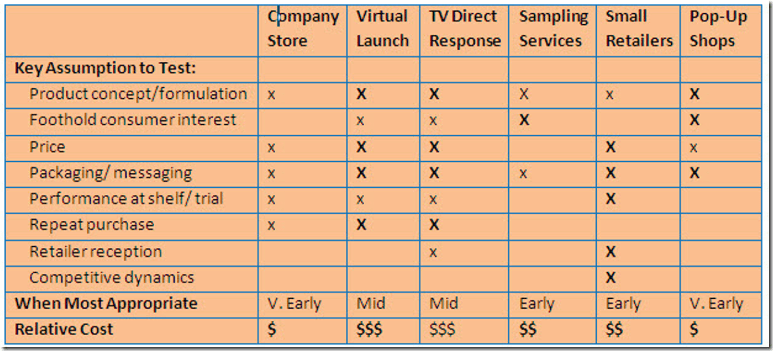
image

1. Give It a Spot in the Company Store
Offering a new product internally can enable a good-enough approach across several dimensions (i.e., packaging, messaging). The price tag is cheap, and the testing can happen very quickly. Overall, to get an early read on consumer appetite for a new idea, the company store offers a lot of advantages.

2. Leverage Cyberspace with a Virtual Launch
Want to bypass the retail channel altogether when testing a concept? The Internet enables manufacturers to conduct small-scale launches that do just that by setting up simple websites with order-taking and fulfillment capabilities.

Virtual launches offer a lot of other advantages when testing assumptions around new concepts.

First, such launches enable rapid testing of consumer response to formulation, packaging, and branding
without the crippling cost of a full-scale launch.

Second, such launches can create buzz as they can attract early adopters, bloggers, Twitter and Facebook users, and even the increasing numbers of
mainstream press who are listening to these channels.

Third, manufacturers are able to gather valuable consumer information not possible through traditional channels, including feedback (i.e., comment
boxes, chat boards), purchase behaviors (i.e., trial vs. repeat), and customer characteristics (i.e., location, demographics).

P&G has been very active in its experimentation with virtual launches with products including Crest Whitestrips, Pampers Change ‘N Go, Swash by Tide, and Align GI.

In the case of Crest Whitestrips, a virtual launch on whitestrips.com and in select dental offices generated unexpectedly high sales ($23 million from August 2000 to May 2001) and led to an acceleration of the retail launch timeline.

3. Reach for the TV Waves with Direct Response
Along the same lines as the virtual launch, television can offer a unique placement opportunity for manufacturers seeking input on product, pricing, trial/repeat, marketing, messaging, and a host of other product dimensions.

These channels are typically most applicable for more complex or new-to-market products benefiting from such a high-touch sales model.

The two most common alternatives are home shopping networks (i.e., QVC) and infomercials.

Home shopping networks offer a captive audience, live product demonstration, and rich data analytics. This combination enables rapid iteration of messaging based on near real-time sales data.

QVC, for example, boasts an 80+ million household audience to its 24/7 storefront.

Infomercials offer similar advantages to home shopping networks, with a twist.

First, longer formats make them even more applicable for complicated sales models (i.e., devices, new platforms of products, new categories).

Second, higher investment costs in the form of production make them more appropriate for later-stage tests versus a home shopping placement.

Infomercials have also served as stepping stones for many products that have gone on to reach broader audiences. Looking for examples? Think of products like OxiClean (now distributed broadly in FDM channels, and Proactiv available online and through kiosks.

4. Consider Sampling Services
Sampling services often cater to early adopters seeking the newest products on the market. While these solutions do not offer insight on pricing or at-the-shelf behavior, they do offer manufacturers the opportunity to glean valuable early perspectives on certain dimensions (i.e., formulation, packaging, marketing) before a product is ready for the mass market.

Other advantages of such services include being quick to launch, having built-in consumer bases, and incorporating a feedback protocol.

5. Remember that Good Things Come in Small Boxes
Sometimes a more traditional shelf setting is required. In these types of situations, small independent retail outlets can provide a great alternative for under
the radar testing of new products.

For personal care products, spas and salons can provide very relevant data points.

For food products, self-serve restaurants, gourmet stores, or health food stores are a good bet.

For beverages, bodegas or self-serve restaurants get the job done.

All of these settings can provide consumer insights similar to the traditional channel shelf in a smaller scale experiment, often with the added advantage of providing feedback from the proprietor or salesperson.

6.Get Focus Fast with a Pop-Up Shop
Have a defined sense of your foothold consumer but unsure if the concept will resonate?

Setting up a “pop-up shop” in close proximity of your target audience can quickly provide valuable insights at a low price tag.

Think broadly and you’ll surely find that appropriate venues can be found for almost all consumer segments.

Interested in college kids? Try a university campus or bookstore.

Aiming at athletes? Outside a gym might be a good bet.

Have your sights on parents of young kids? A community fair will surely provide a captive audience.

Urban youth? Hit the local basketball courts.

Another twist on the physical pop-shop is to leverage a vending kiosk or a mobile truck offering.

A recent, interesting example of this type of approach is the Coke Freestyle beverage dispenser. Through this novel vending machine, Coke is able to offer over 100 different varieties of beverages (i.e., soda, tea, juice and water) by combining different “micro-doses” from about 30 cartridges in the machine.

Yes, the concept offers mass customization and drives much greater choice for the consumer. Beyond that, however, the machine offers Coke the opportunity to experiment with different flavors and beverages and to get instant feedback on consumer uptake by geography through RFID technology
present on the cartridge.

This type of vending experiment offers enormous cost savings versus the traditional approach of testing a concept by bottling and pushing through the traditional distribution channel to separate winners from losers.
* * * * *

Full article:
http://www.innosight.com/innovation_resources/article.html?id=843

* * * * *

Must read: "Americans feel increasingly disheartened, and our leaders don’t even notice."

October 30, 2009

Ken’s Take: I’ve said many times before that I love reading Peggy Noonan — even though I don’t always agree with her .  (For my more  liberal friends, keep in mind that she was onboard the Obama train in ’08.)

What she’s always able to do is dive down beneath the superficial and get to the core — the philosophical and emotive stuff that most other analysts miss.  She invariably provokes my thinking … and, she’s a wonderful writer to boot.

* * * * *

Excerpted from WSJ: We’re Governed by Callous Children, Oct. 29, 2009 

The new economic statistics put growth at a healthy 3.5% for the third quarter. We should be dancing in the streets. No one is, because no one has any faith in these numbers.

Waves of money are sloshing through the system, creating a false rising tide that lifts all boats for the moment. The tide will recede. The boats aren’t rising, they’re bobbing, and will settle.

No one believes the bad time is over. No one thinks we’re entering a new age of abundance. No one thinks it will ever be the same as before 2008.

Economists, statisticians, forecasters and market specialists will argue about what the new numbers mean, but no one believes them, either. Among the things swept away in 2008 was public confidence in the experts.

* * * * *

The biggest threat to America right now is not government spending, huge deficits, foreign ownership of our debt, world terrorism, two wars, potential epidemics or nuts with nukes.

The biggest long-term threat is that people are becoming and have become disheartened, that this condition is reaching critical mass, and that it afflicts most broadly and deeply those members of the American leadership class who are not in Washington, most especially those in business.

It is a story in two parts. The first: “They do not think they can make it better.”

The most sophisticated Americans, experienced in how the country works on the ground, can’t see a way out.

This is historic. This is something new in modern political history … Americans are starting to think the problems we are facing cannot be solved.

Part of the reason is that the problems—debt, spending, war—seem too big.

But a larger part is that our federal government, from the White House through Congress, and so many state and local governments, seems to be demonstrating every day that they cannot make things better.

They are not offering a new path, they are only offering old paths—spend more, regulate more, tax more in an attempt to make us more healthy locally and nationally. And in the long term everyone—well, not those in government, but most everyone else—seems to know that won’t work.

* * * * *

And so the disheartenedness … of even those who have something.

This week the New York Post carried a report that 1.5 million people had left high-tax New York state between 2000 and 2008, more than a million of them from even higher-tax New York City. They took their tax dollars with them—in 2006 alone more than $4 billion.

You know what New York, both state and city, will do to make up for the lost money. They’ll raise taxes.

I talked with an executive this week.   He was thoughtful, reflective about the big picture. He talked about all the new proposed regulations on industry. Rep. Barney Frank had just said on some cable show that the Democrats of the White House and Congress “are trying on every front to increase the role of government in the regulatory area.”

The executive said of Washington: “They don’t understand that people can just stop, get out. I have friends and colleagues who’ve said to me ‘I’m done.’ ” He spoke of his own increasing tax burden and said, “They don’t understand that if they start to tax me so that I’m paying 60%, 55%, I’ll stop.”

Government doesn’t understand that business in America is run by people, by human beings.

Mr. Frank must believe America is populated by high-achieving robots who will obey whatever command he and his friends issue.

But of course they’re human, and they can become disheartened. They can pack it in, go elsewhere, quit what used to be called the rat race and might as well be called that again since the government seems to think they’re all rats.

***
And here is the second part of the story.

While Americans feel increasingly disheartened, their leaders evince a mindless callousness.

It is a curious thing that those who feel most mistily affectionate toward America, and most protective toward it, are the most aware of its vulnerabilities, the most aware that it can be harmed. They don’t see it as all-powerful, impregnable, unharmable. The loving have a sense of its limits.

When I see those in government, both locally and in Washington, spend and tax and come up each day with new ways to spend and tax—health care, cap and trade, etc.—I think: Why aren’t they worried about the impact of what they’re doing? Why do they think America is so strong it can take endless abuse?

They don’t feel anxious, because they never had anything to be anxious about. They grew up in an America surrounded by phrases—”strongest nation in the world,” “indispensable nation,” “unipolar power,” “highest standard of living”—and they are not bright enough, or serious enough, to imagine that they can damage that, hurt it, even fatally.

We are governed at all levels by America’s luckiest children, sons and daughters of the abundance, and they call themselves optimists but they’re not optimists—they’re unimaginative.

They don’t have faith, they’ve just never been foreclosed on.

They are stupid and they are callous, and they don’t mind it when people become disheartened. They don’t even notice.

Full article:
http://online.wsj.com/article/SB10001424052748703363704574503631430926354.html?mod=djemEditorialPage

Squandering hope … the politics of blame & attack.

October 30, 2009

Excerpted from Weekly Standard: Obamaland – Squandering hope, channeling Nixon, 10/29/2009

The transition from campaigning to governing has not been kind to President Obama.

As a candidate he spoke of hope, change and ending the polarization of the past; he promised to bring people together; he pledged a new style of civil political engagement; he sought to lift us as a people above surly partisan warfare.

As president, he sucked the veracity from these hopes.

Maybe this was the plan all along. Politicians often say one thing and do another.

Or perhaps, he succumbed to inexorable forces and patterns that swallow every idealistic elected official trying to navigate the Washington swamp.

Whatever the reason, Obama has fallen short of those lofty aspirations.

After ten months in office a clear pattern has emerged. Instead of hope and change, it’s blame and attack.

Obama rarely gives a speech about a pressing national problem–the economy, health care, the budget deficit–without blaming Republicans or former president George W. Bush.

For many Americans it’s getting old. It makes the president look small and petty. Does he want America’s respect or its pity?

Attack is the other side of this strategy.

Playing Chicago-style politics comes naturally to this White House, populated with a cadre of former Obama for president staffers and others steeped in the tactics of the permanent campaign. And they don’t merely assault an enemies list. “We routinely hear about phone calls from the president’s staff to congressional Democrats expressing White House dissatisfaction if someone says anything out of line with Obama’s policies,” a senior congressional aide told me.

The gap between the president’s campaign rhetoric compared to his governing style creates a harsh cognitive dissonance and a toll in the polls.

And the slide will likely persist as the White House continues to force its vision of change on a country that lacks consensus in many areas.

Full article:
http://www.weeklystandard.com/Content/Public/Articles/000/000/017/132koltj.asp?pg=2

At home, Dos Equis says “no mas” to Corona …

October 30, 2009

TakeAway:  Unimaginative marketing, poor portfolio mix, and inattentive product management have caused Femsa, Mexico’s historic beer market leader, to lose 12% market share and drop to a distant second place in the Mexican domestic beer market. 

* * * * *

Excerpted from WSJ, “Beer’s Glory Days Fade at Femsa,Leaving Brewer Eyeing Options,” By Jose De Cordoba and David Kesmodel, October 19, 2009

The Dos Equis beer ad campaign, “The Most Interesting Man in the World,” has gone viral in the U.S., helping to boost sales of the Mexican import.

But in Mexico, few consumers have ever heard the suave gentleman’s voice … and Femsa’s beer market share has dropped … 

Lack of marketing imagination at home is one reason why Femsa, the company that makes Dos Equis, has been overtaken south of the border by archrival Grupo Modelo SAB, maker of Corona beer …

In the past two decades, Femsa—which makes Sol, Tecate, Indio, and Bohemia as well as Dos Equis—has seen its share of Mexico’s beer market fall to 43% from a once-dominant 55%. Modelo overall has a 57% share, with its Corona brand accounting for 31% on its own.

Femsa recently acknowledged it was contemplating selling its beer business or making a strategic alliance with one of the world’s brewing giants …

Analysts say a key reason Femsa is considering teaming up with a bigger brewer is that the landscape of the beer business has changed rapidly. Increasingly, the global market is dominated by giants such as Anheuser-Busch InBev, and SABMiller … Family-run Femsa has annual beer sales of about $4 billion, compared with roughly $35 billion and $21 billion at Anheuser-Busch InBev and SABMiller, respectively.

And last year, when InBev bought Anheuser-Busch … it took over Anheuser-Busch’s 50% non-controlling stake in Grupo Modelo, giving Femsa’s rival a new deep-pocketed uncle …

Femsa has partners of its own, but the scale is much smaller …

Although Femsa’s beer business has been lagging, the company is doing well in its two other main business lines: soft drinks and convenience stores. Last year, it had operating profits of $2B on revenue of $15B … in the last decade, revenue and profits have surged seven fold …

Mr. Fernandez, the current CEO who took the helm at Femsa in 1995 … has placed less emphasis on beer … he has a love affair with his two new babies, Coca-Cola and Oxxo … has put much of his focus on the OXXO convenience stores … It’s by far the largest convenience store chain in Mexico … three times the number of all its competitors combined.

OXXO has played a key role in defending Femsa’s market share, as it provides points of sale for Femsa’s beers. Indeed, some analysts fear Femsa’s share of the beer market would have fallen much more had it not been for the support from OXXO stores and worry Femsa’s share of the beer market could fall further once OXXO reaches a saturation point.

In Mexico, Femsa is known for being efficient in brewing and sales, but has struggled to develop expertise in marketing. “They are still trying to find the right portfolio mix, which brands to push in which markets,” said an analyst with Barclays Capital …

Edit by TJS

* * * * *

Full Article
http://online.wsj.com/article/SB10001424052748704112904574477272483981410.html?mod=article-outset-box

* * * * *


Marketing that goes down the toilet … literally.

October 30, 2009

TakeAway:  Very little is off limits anymore when it comes to marketing. 

Making all marketers proud, the “adults wipes segment”  is getting more graphic and more descriptive.  YIPES.

I’m a proponent of good benefits advertisng, but this one makes me very, very queasy.

* * * * *

Excerpted from NYTimes, “Adult Toilet Training, From Madison Ave.,” By Andrew Adam Newman, October 20, 2009

Toilet tissue advertising traditionally has featured fluffy clouds, cherubic toddlers and Mr. Whipple … But the ads remained steadfastly oblique about what consumers do after they tear along the perforated line.

With the prevalence these days of commercials for erectile dysfunction drugs and risqué network programming, however, tissue brands also are growing more frank … 

Cottonelle just launched a new commercial and a new Web site, CottonelleInstitute.com, to highlight not just the brand’s Aloe & E toilet paper but also its new flushable moist wipes … With both products, the brand is breaking with tradition, trumpeting not softness but rather that it is “dermatologically tested” for sensitive skin.

“Dry toilet paper is generally thought of as being a functional product, and a lot of brands in the category talk about strength and softness,” said a brand manager for Cottonelle wipes. “But we are reframing the Cottonelle brand as a personal care brand, which is a much more emotional space.”

… and the brand is pitching both rolls and wipes in one advertisement, in the hope of increasing the use of wipes, which are purchased by only 25 percent of households, many of which use them only on what she called “select usage occasions” … 

Getting adults to use more wipes in the bathroom … requires marketers to engage in a sort of toilet training with grown-ups, and Cottonelle and other brands apparently think cultural taboos have relaxed enough to do exactly that …

The wipes segment has been fast growing with only modest marketing support … and marketers say the growth of wipes does not cannibalize sales of toilet paper, because consumers tend to use them not as a replacement but an added step …

Charmin also is pitching its wipes … as complementary to rolls, and has launched a new campaign … that includes a video “product demo” …

“It’s a pretty straightforward way of speaking to consumers and letting them know how best to use the products together to get cleaner,” said a Charmin brand manager. “To my knowledge it is the most clearly that we have laid it out so far.”

Edit by TJS

* * * * *

Full Article
http://www.nytimes.com/2009/10/20/business/media/20adco.html?ref=media

* * * * *

If you’re young and you’re healthy … get out your wallet.

October 29, 2009

TakeAway: According to a detailed modeling of insurance rates, private insurance premiums could triple under ObamaCare.  Oops.

* * * * *

Excerpted from WSJ: The WellPoint Revelation, Oct. 28, 2009 

How will ObamaCare affect insurance premiums in the private health-care markets?

Despite indignant Democratic denials, the near-certainty is that their plan will cause costs to rise across the board.

WellPoint mined its own actuarial data to model ObamaCare in the 14 states where it runs Blue Cross plans.

In all of the 14 states WellPoint scrutinized, ObamaCare would drive up premiums for the small businesses and individuals who are most of WellPoint’s customers. (Other big insurers, like Aetna, focus on the market among large businesses.)

Young and healthy consumers will see the largest increases—their premiums would more than triple in some states—though average middle-class buyers will pay more too.

What distinguishes the Wellpoint study is its detailed rigor.

Take Ohio, where a young, healthy 25-year-old living in Columbus can purchase insurance from WellPoint today for about $52 per month in the individual market. WellPoint’s actuaries calculate the bill will rise to $79 because Democrats are going to require it to issue policies to anyone who applies, even if they’ve waited until they’re sick to buy insurance. Then they’ll also require the company to charge everyone nearly the same rate, bringing the premium to $134. Add in an extra $17, since Democrats will require higher benefit levels, and a share of the new health industry taxes ($6), and monthly premiums have risen to $157, a 199% boost.

Meanwhile, a 40-year-old husband and wife with two kids would see their premiums jump by 122%—to $737 from $332—while a small business with eight employees in Franklin County would see premiums climb by 86%.

It’s true that the family or the individual might qualify for subsidies if their incomes are low enough, but the business wouldn’t qualify … And even if there are subsidies, the new costs the bill creates don’t vaporize. They’re merely transferred to taxpayers nationwide—or financed with deficits, which will be financed eventually with higher taxes.

For the average small employer premiums would rise by 94%  in Indianapolis, 91% in St. Louis and 53% in Milwaukee.

A family of four with average health in those same cities would all face cost increases of 122% buying insurance on the individual market.

And it’s important to understand that these are merely the new costs created by ObamaCare — not including the natural increases in medical costs over time from new therapies and the like.

Apparently health care isn’t one huge free lunch in which everyone gets better insurance while paying less.

http://online.wsj.com/article/SB10001424052748703567204574499034177212064.html?mod=djemEditorialPage