Which is your scarcest asset: time or money?

October 9, 2009

TakeAway:  In today’s economy, motivating consumers to pull the trigger and purchase (now) is job one for most marketers. 

Sometimes, the answer may be as simple as changing the brand message to emphasize time instead of money … or vice versa.

If buyers are “experiential”, focus on time; if they’re “possessive”, focus on money.

* * * * *

Excerpted Knowledge@Wharton, “Time vs. Money:  Analyzing Which One Rules Consumer Choices, ” September 16, 2009

Pick up a magazine or turn on the TV and prepare for a flood of marketing messages about how you spend your time and money … Yet with all this talk of time and money, little is known about how consumers’ attitudes and behaviors are influenced by a product’s association with these concepts …

A new paper … argues that when companies weigh whether to go for an ad campaign with a time or a money theme, they should be aware that each evokes strong reactions from consumers …

Emphasis on time … typically leads to more favorable consumer attitudes and purchasing decisions because … time is less fungible than money … and people feel less accountable for how they spend their time because it can be more difficult to measure than monetary outlays. These two characteristics — fungibility and ambiguity — are important differentiators in how consumers think about time and money …

When money matters … for the prestige possession, subjects reported greater feelings of personal connection when they were primed to recall the money spent on the product …  those who highly valued the mere possession of the product had more favorable attitudes when prompted to consider the money involved in the purchase … 

Ultimately, the researchers conclude: “Brands can cultivate consumer relationships by first considering how consumers most identify with the product (through experience or possession) and then highlighting either their time or money spent accordingly.” … 

Edit by TJS

* * * * *

Full Article
http://knowledge.wharton.upenn.edu/article.cfm?articleid=2341

* * * * *

Ten Fatal Flaws That Derail Leaders

October 8, 2009

HBR, Ten Fatal Flaws That Derail Leaders, by Jack Zenger and Joseph Folkman, June 2009

Poor leadership in good times can be hidden, but poor leadership in bad times is a recipe for disaster.

Based on research, here are the qualities of the worst leaders:

1. Lack energy and enthusiasm.
They see new initiatives as a burden, rarely volunteer, and fear being overwhelmed.
They  “suck all the energy out of any room.”

2. Accept their own mediocre performance.
They overstate the difficulty of reaching targets so that they look good when they achieve them.
They live by the mantra “Underpromise and overdeliver.”

3. Lack clear vision and direction.
They believe their only job is to execute. 
Like a hiker who sticks close to the trail, they’re fine until they come to a fork.

4. Have poor judgment.
They make decisions that colleagues and subordinates consider to be not in the organization’s best interests.

5. Don’t collaborate.
They avoid peers, act independently, and view other leaders as competitors. As a result, they are set adrift by the very people whose insights and support they need.

6. Don’t walk the talk.
They set standards of behavior or expectations of performance and then violate them.
They’re perceived as lacking integrity.

7. Resist new ideas.
They reject suggestions from subordinates and peers. Good ideas aren’t implemented, and the organization gets stuck.

8. Don’t learn from mistakes.
They may make no more mistakes than their peers, but they fail to use setbacks as opportunities for improvement, hiding their errors and brooding about
them instead.

9. Lack interpersonal skills.
They make sins of both commission (they’re abrasive and bullying) and omission (they’re aloof, unavailable, and reluctant to praise).

10. Fail to develop others.
They focus on themselves to the exclusion of developing subordinates, causing individuals and teams to disengage.

* * * * *

Marketing tools: peer pressure and social influence …

October 8, 2009

Ken’s Take: Spawned by books like Freakonomics and Predictably Irrational, behavioral economics is hot … 

* * * * *

BrandChannel, Sacramento Water District Leverages Peer Pressure, Sep. 15, 2009 

People aren’t always rational.

This insight, familiar to brand managers, is the basis of behavioral economics, which uses psychological insights to predict these sometimes illogical choices.

The impact of peer pressure is a popular recent topic among behavioral economists.

Behavioral economists are developing ways to get patients to take their medications (pill containers that trigger e-mail alerts when opened) and testing the effectiveness of marketing promotions (optimal purchase levels for “free” shipping to drive upsell).

Marketers are using social tools like Facebook to allow teens to identify with their brands, hoping to influence their fans’ peers.

As for the most effective methods of social influence, not all forms are equal.

While we put greatest trust in people we know, trust in virtual strangers has reached a surprisingly high level. Marketers who capitalize on this, by offering consumers the chance to rate their products, find that they are more trusted than companies who don’t allow ratings.

Full article:
http://www.brandchannel.com/home/post/2009/09/15/Sacramento-Water-District-Gives-Marketers-Lesson-In-Harnessing-Peer-Pressure.aspx

* * * * *

Trenchcoat marketing … it’s not what you think.

October 8, 2009

BrandChannel, Can BurberrySpace Help Reposition A Luxury Fashion Brand?, September 17, 2009

Burberry, intent on holding onto its recently upgraded cutting-edge image, will launch its own social networking site.

The site, Art Of The Trench, will feature user-submitted pictures of people sporting the brand’s famous trench coat.

Burberry’s goal is to strengthen ties with existing customers while attracting new faces — younger consumers they hope will be inclined to spend disposable income on luxury items.

The premium site is another step in Burberry’s campaign to reclaim its brand as a classic label with a twist of cool, after years of knockoffs and thuggish associations had morphed it into “checks for chavs.”

But do the kids really want Facebook for trenchcoats?

Burberry hopes so.

If the brand’s Facebook page — currently boasting over 666,000 fans — is any indication, their updated, traditional-meets-hip brand may turn out to be a good social networker.

Full article:
http://www.brandchannel.com/home/post/2009/09/17/Can-BurberrySpace-Help-Reposition-A-Luxury-Fashion-Brand.aspx

* * * * *

Count employer paid health insurance premiums as income … Why not?

October 7, 2009

TakeAway: Seems obvious to me that health insurance premiums paid by employers should be counted as W-2 income, with income tax deductiblility (or credits) of, say, $5,000 per person with a max of $15,000 per family.  Helps out the folks who don’t have access to company paid premiums and stops the gold-plated programs from bloating healthcare spending.

* * * * *
From DC Examiner: Democrats Win Lobbyists but Lose Basic Reforms, October 1, 2009

The Democrats are having trouble passing convoluted and plainly imperfect health care bills. Maybe they would be better off going back to basics.

All of the current healthcare proposals build a makeshift addition to the health insurance system that grew out of a tax law decision made during World War II.

That decision was to give a preference to employer-provided health insurance: The cost of insurance would be deductible for employers and would not be counted as income for employees.

The system insulates health care consumers from costs, with the result that insurance costs have recently crowded out wage increases.

The tax preference is steeply regressive. High-earning employees with gold-plated, employer-provided health insurance get deductions that are worth many thousands of dollars.

Those without employer-provided health insurance, or low-earners who are among the 40 percent of earners who do not pay income tax, get exactly zero. If a Republican Congress had designed such a system, it would be attacked as a favor to the rich, and rightly so.

During the 2008 campaign, Barack Obama attacked John McCain’s proposal for equalizing the tax treatment of employer-provided and non-employer-provided health insurance, and so it would be embarrassing for him to advocate such a change.

More determining, labor unions, a strong Democratic constituency, want to maintain the current system because they have obtained very expensive policies for their members. But with only 8 percent of private-sector workers in unions, it seems clear that basic reforms would do more for low-earners and ordinary Americans than the Democrats’ current plans.

* * * * *

Full article:
http://www.realclearpolitics.com/articles/2009/10/01/democrats_win_lobbyists_but_lose_basic_reforms_98526.html

* * * * *

“Synchronous Lateral Excitation” … risky, but not what you’re thinking.

October 7, 2009

TakeAway: In finance, actions can be both individually prudent and collectively disastrous. It’s called “synchronous lateral excitation”, and it explains the credit crunch of 2008 – 2009.

* * * * *

Excerpted from New Yorker: Rational Irrationality – The real reason that capitalism is so crash-prone, John Cassidy, October 5, 2009

On June 10, 2000, Queen Elizabeth II opened the high-tech Millennium Bridge, which traverses the River Thames from the Tate Modern to St. Paul’s Cathedral.

Thousands of people lined up to walk across the new structure, which consisted of a narrow aluminum footbridge surrounded by steel balustrades projecting out at obtuse angles. Within minutes of the official opening, the footway started to tilt and sway alarmingly, forcing some of the pedestrians to cling to the side rails. Some reported feeling seasick.

The authorities shut the bridge, claiming that too many people were using it. The next day, the bridge reopened with strict limits on the number of pedestrians, but it began to shake again. Two days after it had opened, with the source of the wobble still a mystery, the bridge was closed for an indefinite period.

Some commentators suspected the bridge’s foundations, others an unusual air pattern.

The real problem was that the designers of the bridge, who included the architect Sir Norman Foster and the engineering firm Ove Arup, had not taken into account how the footway would react to all the pedestrians walking on it. When a person walks, lifting and dropping each foot in turn, he or she produces a slight sideways force.

If hundreds of people are walking in a confined space, and some happen to walk in step, they can generate enough lateral momentum to move a footbridge—just a little. Once the footway starts swaying, however subtly, more and more pedestrians adjust their gait to get comfortable, stepping to and fro in synch. As a positive-feedback loop develops between the bridge’s swing and the pedestrians’ stride, the sideways forces can increase dramatically and the bridge can lurch violently.

The investigating engineers termed this process “synchronous lateral excitation,” and came up with a mathematical formula to describe it.

What does all this have to do with financial markets? Quite a lot.

Most of the time, financial markets are pretty calm, trading is orderly, and participants can buy and sell in large quantities.

Whenever a crisis hits, however, the biggest players—banks, investment banks, hedge funds—rush to reduce their exposure, buyers disappear, and liquidity dries up.

Where previously there were diverse views, now there is unanimity: everybody’s moving in lockstep.

“The pedestrians on the bridge are like banks adjusting their stance and the movements of the bridge itself are like price changes,” Shin wrote. And the process is self-reinforcing: once liquidity falls below a certain threshold, “all the elements that formed a virtuous circle to promote stability now will conspire to undermine it.” The financial markets can become highly unstable.

This is essentially what happened in the lead-up to the Great Crunch of 2008.

http://www.newyorker.com/reporting/2009/10/05/091005fa_fact_cassidy?printable=true

Factoids: How Medicare Works …

October 7, 2009

Ken’s Take:  It’s still not obvious to me how putting the screws to doctors will “fix” the healthcare situation …

* * * * *

Medicare’s price controls already pay only 83 cents on the private dollar.

* * * * *

Congress decides each year how much it wants to spend on doctors, period.

If one area of medicine receives a larger slice of this pie, another must accept a smaller one.

The portion sizes are determined using a formula known as Relative Value Units, or RVUs. Medicare assigns an RVU to each of 7,500 billable services—in 2008, a colonoscopy earned 5.64 of these units, a hip replacement 37.66.

Then it multiplies a doctor’s total RVUs by some dollar factor, currently about $36, and cuts a check.

* * * * *

Source: WSJ, The War on Specialists Oct. 6, 2009
http://online.wsj.com/article/SB10001424052748704471504574443472658898710.html?mod=djemEditorialPage#printMode

* * * * *

The “Wal-Mart of the web” … Amazon’s KSFs.

October 7, 2009

KSF= Key Success Factors

* * * * *

From BrandChannel, Nimble Amazon Thrives In Recession, September 22, 2009

Having conquered the online book market, reports the New York Times, “Amazon is set to cross a significant threshold” to become the Wal-Mart of the web.

By the end of 2009, Amazon’s worldwide sales of general merchandise will exceed the books, music and movies Amazon is known for.

“Amazon’s expansion strategy has allowed it, almost alone among retailers, to thrive during the recession, even while its own media business has stagnated*”

While Amazon’s marketing has helped transition customers into seeing it as more than a bookstore, back-end innovation is the real engine of the company’s successful expansion.

In Amazon’s huge merchandise warehouses, “every product, shelving unit, forklift, roller cart and employee badge … has a bar code.” The company has an “almost magical business model in terms of inventory management”

Amazon builds engagement with purchase recommendations, wish lists, customer reviews and free shipping.

According to Interbrand — a brand consultancy , the company’s success shows “why you are best off not owning a retail footprint in a recession“: its flexibility lifted it past struggling and fallen competitors like Borders and Circuit City.

Full article:
http://www.brandchannel.com/home/post/2009/09/22/Nimble-Amazon-Thrives-In-Recession.aspx

* * * * *

The housing-foreclosure problem hasn’t gone away …

October 6, 2009

Ken’s Take: Mortgage defaults and housing prices are still a big problem, though they seem to have been pushed to a back burner.

In his WSJ essay, Economist Martin Feldstein has the diagnosis right, but the prescription wrong …

* * * * *

Some Facts

  • More than three million homes are now in serious default (nonpayment for 90 days or more) or foreclosure, nearly double the number a year ago.
  • Sales of properties in foreclosure or serious default made up one third of all home sales in May and June.
  • So far only about 200,000 mortgages have been modified this way, far fewer than the administration’s goal of modifying three million mortgages.
  • Nearly half of all modified mortgages go into default within six months.
  • Today one-third of all homes with mortgages have mortgage debt that exceeds the value of the home. Among these homeowners, half of the loan-to-value ratios exceed 130%.

* * * * *

Feldstein’s Remedy

Borrowers should get relief now, and the banks should get a guarantee down the road.

An epidemic of mortgage defaults and foreclosures is threatening the economic recovery. The problem is serious and getting worse.

There are two separate but mutually reinforcing reasons for the surge in defaults and foreclosures: the reduced affordability of mortgage payments and the high loan-to-value ratios of many houses.

The United States, unlike almost every other country, mortgages are effectively no-recourse loans. If a homeowner defaults, the creditor can take the house but is unable to take other assets or income to make good on the remaining unpaid mortgage balance. No-recourse mortgages increase foreclosures, resulting in more properties being thrown on the market, and lead to an excess decline in house prices.

The risk remains of a continuing downward spiral of house prices.

The administration should work with creditors and homeowners to reduce the principal on mortgages that are at risk of default.

Here’s how such a plan might work in a way that homeowners and creditors could both welcome, that is fair to taxpayers, and that would help the economy:

Any homeowner with a loan-to-value ratio over 120% could apply for a reduction in his mortgage balance. The government and the creditor would then share equally in the cost of writing the loan balance down to 120% of the value of the home. But the homeowner who opts for this write-down would be obliged to convert the remaining mortgage to a loan with full recourse that could not be discharged in bankruptcy. The bank gets a more legally secure loan

Slowing the downward spiral of house prices will protect the solvency of the banks and the net worth of households. The failure to do that could mean a deeper and longer recession that imposes much higher costs to the government.

http://online.wsj.com/article/SB10001424052970204908604574330883957532854.html?mod=djemEditorialPage

* * * * *

Ken’s Rx: Create a more robust rental market of single family homes by providing tax incentives to investor-landlords – e.g. no cap gains taxes, accelerated depreciation, application of cap losses to offset earned income.  That would bolster prices – albeit, artificially – and provide affordable housing  — albeit, sans ownership.  I’ll detail the plan in a subsequent post.

* * * * *

MBA Trends … women and NFPs on the rise.

October 6, 2009

Business Week, B-School: The View at the Gate, Sept. 14, 2009

From the annual applicant survey by QS World MBA Tour, a London-based group that holds MBA fairs globally:

Women now make up 46% of worldwide MBA candidates, more than ever before.

U.S. programs still rank first in popularity,

But “partly because of the U.S. visa situation, more foreign students have shifted to looking at countries in Europe and Asia for schooling.”

Candidates’ stated preference is for a one-year MBA (44%) over a two-year program (43%), a first in the survey’s 11-year history.

There has been a doubling of applicants from the nonprofit sector — to 6% from 3% in 2008.

The percentage of those naming nonprofit work as a career goal: 6.4% vs. 3.8% last year.

Starting a business is the No. 1 post-MBA career goal.

At #2, financial services, almost as popular as it was last year. “The sector is traditionally the big absorber of MBAs,” he says. “And the salary and bonuses are still so high that it’s alluring, despite fact that there are fewer jobs.”

Full article:
http://www.businessweek.com/magazine/content/09_37/c4146btw881806_page_2.htm

* * * * *

The housing glut … peaking, but still high — very high.

October 6, 2009

There are still a record number of houses on the market — 9.4 months’ worth of existing homes for sale, according to NAR data.

The backlog is usually under six months.

And, based on current and projected delinquencies, nearly seven million housing units will eventually enter foreclosure … that could add 1.35 years’ worth of inventory to the market.

[housing supply]

Source: WSJ: Housing Recovery Obstacle: So Many Houses, Sept 24, 2009http://online.wsj.com/article/SB125374552378835617.html#mod=WSJ_hpp_MIDDLENexttoWhatsNewsTop

* * * * *

MillerCoors heading into fantasyland … fantasy football, that is.

October 6, 2009

TakeAway: Beer brands want to be top-of-mind when fantasy football managers are pretending to be savvy general managers

MillerCoors has implemented an online platform that will contain a Coors Light interface while the faux manager is on his team page.

And, MillerCoors wants to be involved with all the touch points of a fantasy sports manager, and is now targeting sports blogs.

Well, at least their product will get your mind off the fact that you passed up on Drew Brees. Or it could help you cope with the fact that you aren’t a real GM.

* * * * *

Excerpted from AdAge, “Coors Light Runs Fantasy Football Advertising Blitz” By Jeremy Mullman, September 14, 2009

Coors Light is betting big on fantasy football.

MillerCoors’ flagship brand, which is the official beer sponsor of the National Football League, is rolling out a raft of new deals in and around fantasy-sports sites for the coming season.

Coors Light had previously had a presence in the sport via NFL.com, but this year it has added a series of new platforms, including deals with WaterCooler, Yardbarker and the Fantasy Sports Ventures network.

The reasons for the marketer’s enthusiasm for the category are twofold: (1) It is convinced that the brand’s core drinkers play the game in droves, and (2) the amount of user data those sites collect gives the brewer a far-greater degree of certainty that it’s ads are being seen by legal-age drinkers, so it won’t have to deal with the sort of backlash that has hounded past online ventures by brewers, such as Anheuser-Busch’s Bud.TV.

How safe? Consider that WaterCooler’s FanSection — a fantasy-football platform that’s integrated into Facebook — is able to use the social network’s user data to determine if players are 21 or older. If they are, they get a version of the game that’s literally coated in Coors, even down to the branded trash-talking modules that accompany game results that are displayed in players’ Facebook news feeds (and, as such, are viewable by all of their friends).

Edit by JMZ

* * * * *

Full Article
http://adage.com/article?article_id=139005

* * * * *

Branding in Action: The Power & Danger of Iconography

October 5, 2009

I thought that the video linked below — using the Obama campaign as an example — did a nice job of illustrating the impact of branding — including the supporting ingredients, e.g. distinctive “brand mark”, strong visual presentations, consistent (and ubiquitous) use.

image

The Video Link

WARNING: The politics lean right.  If you lean left, just pay more attention to the branding points being made than to the political points being raised.

It’s worth watching … really !

http://www.youtube.com/watch?v=GdtqtfXdR-c

* * * * *

Cash for Clunkers: Preliminary post-mortem …

October 5, 2009

Ken’s Take: The core question re: the effectiveness of C4C is whether the program created incremental demand for cars or simply paid people to shift likely demand earlier. Initial results are coming in … synopsis: ouch !

* * * * *

Excerpted from WSJ: One of Washington’s all-time dumb ideas, Oct. 4, 2009

Remember “cash for clunkers,” the program that subsidized Americans to the tune of nearly $3 billion to buy a new car and destroy an old one?

Last week U.S. automakers reported that new car sales for September, the first month since the clunker program expired, sank by 25% from a year earlier. Sales at GM and Chrysler fell by 45% and 42%, respectively. Ford was down about 5%.

Some 700,000 cars were sold in the summer under the program as buyers received up to $4,500 to buy a new car they would probably have purchased anyway, so all the program seems to have done is steal those sales from the future. Exactly as critics predicted.

Burton Abrams and George Parsons of the University of Delaware added up the total benefits from reduced gas consumption, environmental improvements and the benefit to car buyers and companies, minus the overall cost of cash for clunkers, and found a net cost of roughly $2,000 per vehicle. Rather than stimulating the economy, the program made the nation as a whole $1.4 billion poorer.

In the category of all-time dumb ideas, cash for clunkers rivals the New Deal brainstorm to slaughter pigs to raise pork prices. The people who really belong in the junk yard are the wizards in Washington who peddled this economic malarkey.

* * * * *

http://online.wsj.com/article/SB10001424052748703628304574453280766443704.html?mod=djemEditorialPage#printMode

* * * * *

Leading with their chin: NBC shows marketing savvy in late-night comedy timeslot switch

October 5, 2009

TakeAway: Finally Hollywood can provide us with something other than a Paris Hilton debacle or Speidi controversy.

NBC went back to the basics: giving consumers what they want.

By focusing on people, the ever-important (and often forgotten) node of the 6 P’s, NBC has drastically changed the landscape of late-night television without developing a new, innovative product. It simply realized that it’s core viewers were changing, and acted accordingly.

This demonstrates that it doesn’t always take groundbreaking innovation to create a successful product. The same result can be achieved by simply looking at your existing products and attempting to deliver greater value to the consumer.

* * * * *

Excerpted from Forbes, “Lessons from Leno: Marketers Can Learn From NBC’s Timeslot Switch” by Allen Adamson, September 22, 2009

…the producers knew exactly what they were doing when they decided to shift Leno’s show from its 11 p.m. time slot to 10 p.m. They were making a smart marketing move, one that is an interesting case study in brand management. General Electric-owned NBC, recognizing that good brand management means keeping tabs on what’s important to a core target audience, decided that airing the show an hour earlier would be a great way to hang onto this faithful group of viewers who are probably saying, “Hey, I can watch Leno and be able to get up with the kids at the crack of dawn.” There isn’t a powerful company on the planet where executives believe they no longer have to worry about what matters to their most important consumers. Consumer attitudes change, and the best brands respond. The second important branding effort made by those in charge of the Leno brand was taking a look at the competitive programming landscape and determining that there was an opportunity to offer something different, yet relevant. After considering the lineup of mediocre shows on TV, they saw something right in front of their noses. “Why can’t an already successful late-night television show be on earlier?” Here was a simple brand idea which, with a bit of repackaging, could be made ready for prime time–along with an audience delighted to have it in prime time. Taking a look at your category from a unique point of view, identifying something no one else has seen and doing your homework to determine its relevance to a particular target can give you a real competitive advantage.

Edit by JMZ

* * * * *

Full Article
http://www.forbes.com/2009/09/22/nbc-kanye-tv-cmo-network-allenadamson.html?partner=yahootix


* * * * *


Wanna see the doctor? … Come back in a couple of months

October 2, 2009

Ken’s Take: This is my big beef with the healthcare system — the long waits to get appointments, and then the long waits to get seen on appointed days.

* * * * *

Regarding the availability of health care:

74% of those in the U.S. meet for scheduled doctors appointments within four weeks, while only 42% of British and 40% of Canadians do.

Only 10% of Americans wait longer than two months, while 33% of Brits and 42% of Canadians wait that long.

On average, doctors say neurosurgery should be performed within 5.8 weeks, but in Canada it takes about 31 weeks.

Orthopedic surgery should be within 11 weeks, but in Canada it takes 37 weeks.

Hmmm … think about it.

* * * * *

From WSJ: “ObamaCare is hazardous to your health”, Sept 24, 2009
http://online.wsj.com/article/SB10001424052970204488304574433343630176378.html?mod=djemEditorialPage

* * * * *

RIP: Saturn – a new (make that dead) car company …

October 2, 2009

Ken’s Take: I seem to be the solitary mind thinking that GM should keep the Saturn brand and distribution network and use them for sale and distribution of electric and hybrid cars.  Seems like a perfect fit to me.

* * * * *

Excerpted from WSJ: Collapse of Penske Deal Spells End For Saturn, Oct. 1, 2009

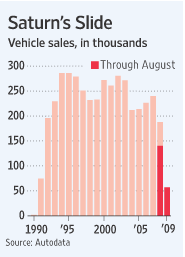
A deal to save GM’s Saturn brand fell through after former race-car driver Roger Penske unexpectedly abandoned a bid to buy its network of dealers, prompting GM to say it would shut the operation down.

It also likely will add Saturn’s 350 dealers to the thousands of U.S. auto retailers that are closing in the car industry’s worst downturn since World War II.

The novel bid to create a car company that didn’t build cars fell apart when Penske Automotive Group failed to secure a related agreement to have France’s Renault SA supply autos for dealers to sell when GM stopped building Saturns in about two years.

For Saturn, it likely means the end of the road for a quirky brand that analysts believe never made money in its 19-year history. GM created Saturn in an attempt to better compete against Japanese auto makers such as Toyota Motor Corp.

Saturn won loyal fans who liked its customer-friendly image and no-haggle sales policy.

But GM produced few new Saturn models in the 1990s and, despite a flurry of critically acclaimed cars added this decade, it never met its sales targets.

The chance of another buyer stepping in to purchase Saturn is remote.

Saturn will wind down by October 2010 under agreements GM already made with the brand’s dealers. Many of the dealerships are expected to close before that deadline. GM remains in talks to sell Saab and Hummer, and is shutting down Pontiac.

GM said earlier this year that Saturn, Hummer and Saab generated an average annual pretax loss of $1.1 billion a year. The moves leave GM with four brands: Chevrolet, Cadillac, Buick and GMC.

image

Full article:
http://online.wsj.com/article/SB125434260817353567.html?mod=WSJ_hps_LEFTWhatsNews#printMode

* * * * *

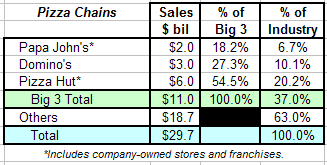
Who sells more pizza: Domino's, Pizza Hut or Papa John's?

October 2, 2009

According to Fortune Magazine …

image

http://money.cnn.com/2009/09/22/news/companies/papa_johns_pizza_schnatter.fortune/index.htm

* * * * *

Ken’s Note: I would have bet Domino’s … not for a minute did I think Pizza Hut sold more than Domino’s and Papa John’s combined.

* * * * *

Who sells more pizza: Domino’s, Pizza Hut or Papa John’s?

October 2, 2009

According to Fortune Magazine …

image

http://money.cnn.com/2009/09/22/news/companies/papa_johns_pizza_schnatter.fortune/index.htm

* * * * *

Ken’s Note: I would have bet Domino’s … not for a minute did I think Pizza Hut sold more than Domino’s and Papa John’s combined.

* * * * *

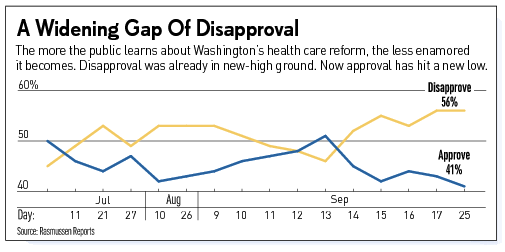
Majority Rule? … Forget about it !

October 1, 2009

As Congress moves forward, threatening use of the arcane “reconciliation” process to ram a bill in before T-Day … a simple question: aren’t “they” supposed to be representing “us”?

image

http://www.investors.com/NewsAndAnalysis/Article.aspx?id=507336

* * * * *

Facebook ready to prove its not a waste of time.

October 1, 2009

TakeAway:  We have all been told by our agencies that we must have a presence in social networks, yet, to date, there has been little to no evidence that advertising in these spaces will produce results.  Finally, Facebook has finally decided to give us what we have been longing for – data to prove that advertising on its site is worth it.

* * * * *

Excerpted from WSJ, “Facebook Sets Deal to Provide Ad Data to Nielsen” By Jessica Vascellaro, September 23, 2009

Facebook. plans to announce a deal with online measurement company Nielsen in a step to address advertisers’ frustration with measuring how ads perform on the social network. 

Under the partnership, Facebook will begin polling its users about some of the display ads it runs on its site, such as a banner promoting a movie release then will provide that data, including responses from those who didn’t see an ad, to Nielsen, which will package it for advertisers …

The partnership is the latest sign of Facebook’s growing clout in the ad world … Facebook had a 9.1% share of display-ad views in the U.S. in July, up from 6.8% in January … that put it in second place behind Yahoo and ahead of Microsoft Corp. and AOL …

In recent months, Facebook has launched new ad formats that prompt people to take an action — such as a forthcoming ad that allows people to sign up to receive a free sample of what’s being advertised.

It has also overhauled a tool that allows brands to build pages to communicate with their fans and has rolled out a targeted-ad feature that gives advertisers more control and guarantees over who sees their ads …

Sony Pictures … recently tested the new Nielsen polling service for ads promoting its newest movies … in each case, the polls showed a “significant increase” in awareness based on the ads …

Edit by TJS

* * * * *

Full Article
http://online.wsj.com/article/SB125356656635628897.html

* * * * *

Build your own electric car … my friend did !

October 1, 2009

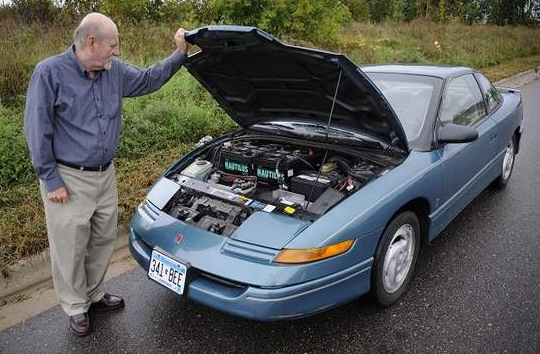
Ken’s Take: A friend of mine recently finished cobbling together — from scratch — an electric car.  Gotta love it when somebody walks the talk … instead of just talking.  Way to go Brian.

* * * * *

From the St. Cloud Minnesota Times:

For Brian Darovic, filling up his car is as simple as plugging in a toaster — and almost as inexpensive.

Darovic of Sartell recently converted his car from a standard, gas-powered vehicle to an electric, battery-powered vehicle.
“Sure, you could buy a GM Volt next year for $40,000,” Darovic said. “But are you going to be spending $40,000 on a car next year? I’m not.”

Though electric car conversion kits are available for between $10,000 and $15,000, Darovic was determined to build it from scratch.

He found a 1994 Saturn and spent more than a year on the project. He sketched designs and then removed the vehicle’s engine, fuel tank, exhaust system and radiator. They were replaced with an electric motor, 12 batteries and a device that controls the motor speed.

The project cost between $9,000 and $10,000, not including labor.

The car covers about 25 miles per charge with a top speed of 60 mph. But Darovic expects to reach 40 miles per charge after he finishes fine-tuning the vehicle.

Darovic estimates his Voltessa will cost about $1 per charge or a little more than 2 cents per mile.

Electric cars are also low maintenance. Tires, brakes, shock absorbers, lights, horn, radio, seats, glass and body work remain the same as those of a gasoline-fueled engine.

But there is no more need for oil changes, antifreeze, belts, exhaust systems or tune-ups. Electric motors are essentially zero maintenance and last the life of the vehicle.

While Darovic had experience working with cars, he said the conversion process is simple enough for those with less experience. “Just about anybody could do it. It’s not rocket science.” 

As demand increases and costs decrease, electric cars are likely to become more affordable. For those that don’t want to wait, converting an existing vehicle to electric power offers a cost-effective solution for today.

http://www.sctimes.com/article/20090926/NEWS01/109260013&referrer=FRONTPAGECAROUSEL

image

* * * * *

In praise of health insurance companies …

September 30, 2009

WSJ: Health Co-Ops Aren’t the Answer, Sept. 28, 2009

Private health insurers perform many complex and hard-to-replicate functions.

They issue policies and accept financial risks associated with the costs of providing care.

They perform actuarial analyses to track costs and price policies.

They design different benefit structures to meet varying needs.

They select, contract with, and monitor the quality of thousands of hospitals and doctors and other professionals who provide the services covered by their policies.

They assess evidence for which technologies and treatments provide value, and provide information to assist millions of individuals and employers with a range of health-care and health coverage issues

Most plans, especially the best ones, assist with coordination of care and management of chronic conditions, and help consumers save money and time by guiding them to better health decisions.

Typically, all of this is facilitated by highly sophisticated and expensive information systems, and many trained nurses and physicians.

“It took decades and billions of investment dollars, with some of the most sophisticated business minds, to build today’s major health insurance companies”.

* * * * *

If we want greater competition for today’s health plans to drive down costs,  revise the ground rules and create a competitive landscape across the nation for existing companies.

Start by allowing health plans to compete across state lines. Because of restricted competition, in a large number of states only one or two plans dominate the market.

Reduce the number of mandated benefits states impose on plans. They drive costs 20%-30% higher than they might be.

Encourage health plans to negotiate more aggressively than they do now with hospital monopolies that exist in many local areas.

Promote benefit designs that offer more affordable coverage, such as policies with higher deductibles and health savings accounts that foster greater consumer engagement and healthy behaviors.

A “public option” by any other name—including health-care co-op—just won’t fly. The real competitive force will come from putting more dollars into individuals’ hands and fewer into insurers’ hands, and by fostering true competition among existing insurers.

* * * * *

Full article:
http://online.wsj.com/article/SB10001424052970204488304574429481529233414.html?mod=djemEditorialPage

* * * * *

Keep the change: An excise tax on ‘caloric’ soft drinks … gimme a break.

September 30, 2009

TakeAway:  The latest headache for beverage marketers – the government has decided that adding an extra tax on sweetened beverages will help Americans lose weight and, thus, reduce health care costs .  Consumer goods companies are already taking deliberate measures to increase the health profile of product offerings.  Is government intervention necessary to help consumers make good food choices? At what point is it up to consumers to make healthy food choices?

* * * * *

Excerpted from WSJ, “New Report Argues For Tax on Soft Drinks” By Betsy McKay and Valerie Bauerlein, September 16, 2009

A report published … by the New England Journal of Medicine … called for an excise tax of a penny per ounce on caloric soft drinks and other beverages that contain added sweeteners such as sucrose, high-fructose corn syrup or fruit-juice concentrates. Such a tax could reduce calorie consumption from sweetened beverages by at least 10% and generate revenue that governments could use to fund health programs, the authors said … “Escalating health-care costs, and the rising burden of diseases related to poor diet, create an urgent need for solutions, thus justifying government’s right to recoup costs.” … The latest report joins a growing drumbeat of calls for taxes on soft drinks and other sweet beverages, which some health experts compare to calls in earlier years for cigarette taxes …

Beverage-industry executives vehemently oppose the idea, which experts say would result in significant price increases … “A penny per ounce would have a seriously negative impact on the industry, as it could potentially raise prices on key packages by 40% to 50%,” said John Sicher, editor and publisher of Beverage Digest …

Currently, 33 states have sales taxes on soft drinks, but the taxes are too low to affect consumption and the revenues are not earmarked for health programs, the new report said.

Edit By TJS

* * * * *

Full Article
http://online.wsj.com/article/SB10001424052970204518504574417380680508354.html

* * * * *

Ken’s Take: How about taxing people by the pound – say, $10 per year per pound over the national height-weight guidelines?  Why just attack old people?  Let’s go after the heavies, too.

* * * * * *


Apple set to compete with Nintendo and Sony

September 30, 2009

TakeAway: MSBers: Remember back in MarkStrat when we learned that a “Direct Hit” targeting strategy was better than a “Tweener” strategy?

Apple seems to feel the same way about the iPod touch.

Kind of caught in no man’s land (not as cheap as the iPod nano, not as awe-inspiring as the iPhone), Steve Jobs and his crew have decided to position the touch against Nintendo DS and Sony PSP as a portable video game player.

Their advantage? How about competitive prices on hardware, cheaper games with a wider selection, and, oh yeah, that delicious-looking fruit with a bite taken out of it.

* * * * *

Excerpted from Forbes, “Steve Jobs Takes Aim At Competitors” By Brian Caulfield, September 9, 2009

Steve Jobs was there . A tablet computer was not.

Jobs, however, did drag out a big bag of pain for Nintendo, Sony and Cisco from wherever he has been hiding this year.

The nastiest move: tacking a video camera onto Apple’s iPod nano.

Cisco’s Flip camera, by contrast, starts at $149 for a device with half the storage and no music player. In short: “We’re going to lower the price from $149 to free,” Jobs said.

Jobs also slashed the price of the iPod touch to $199 as he unveiled a new ad that positions the tiny touch-screen tablet as a Nintendo DS killer. The new tag line for the commercial Apple will soon be using to carpet bomb the competition: “next-level fun.”

Apple was eager to make unflattering comparisons between the Sony PSP and Nintendo DS.

Apple’s  pitch: Apple’s games are cheaper; the iPhone and iPod touch’s built-in App Store makes buying games more convenient; and Apple has more of them. Apple now offers 21,178 games, compared to 3,680 available for the Nintendo DS and 607 for Sony’s PSP.

Edit by JMZ

* * * * *

Full Article
http://www.forbes.com/2009/09/09/ipod-iphone-apple-technology-enterprise-steve-jobs_print.html

* * * * *

Your choice: health reform or jail !

September 29, 2009

Ken’s Take: The IRS says it will fine or jail you for not paying Obama’s mandate levy.

So, we let thugs free because of jail overcrowding and budget constraints but incarcerate folks who refuse to buy health insurance? 

You just can’t make this stuff up …

* * * * *


WSJ:  Rhetorical Tax Evasion, Sept. 29, 2009 

The Baucus bill includes the so-called individual mandate, along with what he calls a $1,900 “excise tax” if you don’t buy health insurance.

It had been as much as $3,800 but Dems reduced the amount last week to minimize the political sticker shock.

And, lo, it turns out that if you don’t pay that tax, the IRS could punish you with a $25,000 fine or up to a year in jail, or both.

Under questioning last week, Tom Barthold, the chief of staff of the Joint Committee on Taxation, admitted that the individual mandate would become a part of the Internal Revenue Code and that failing to comply would be a “criminal” act. The willful failure to file would be a simple misdemeanor, punishable by the $25,000 fine or jail time under Section 7203 — statute covering tax evasion.

* * * * *

In the 1994 health-care debate, the CBO called the individual mandate “an unprecedented form of federal action.”

The government has never before required people to buy any good or service as a condition of lawful residence in the United States.”

* * * * *

Full article:
http://online.wsj.com/article/SB10001424052748704471504574439243760133458.html?mod=djemEditorialPage

* * * * *

Reprise: Rallying private capital to stabilize the housing market.

September 29, 2009

According to the WSJ:

While policymakers are beginning to unwind some of the other emergency programs extended to financial markets during the financial crisis, housing remains a weak spot that some view as too fragile to survive without significant government backing.

The Obama administration is close to committing as much as $35 billion to help beleaguered state and local housing agencies continue to provide mortgages to low- and moderate-income families,
http://online.wsj.com/article/SB125409967771945213.html?mod=WSJ_hps_LEFTWhatsNews

I have a better idea.  Below is a reprised post from November 2008 with my plan for handling part of the foreclosure problem and getting housing back on track. 

* * * * *

Ken’s Plan Summary: (1) eliminate ALL of the capital gains taxes on residential property that is bought from now until, say, December 31, 2010 and held for at least 18 months, (2) allow these “qualified residential properties”, if they are rented, to be depreciated for tax purposes at an aggressively accelerated rate (say, over 5 or 10 years) to generate high non-cash tax losses, and (3) allow ALL tax losses generated by these “qualified residential rental properties” to offset owners’ taxable ordinary income with no “passive loss’ limitations, thereby reducing their federal income tax liability.

The positive results are practically guaranteed.  Nonetheless, I haven’t even heard the ideas mentioned.  Guess the politically correct folks in DC don’t read the Homa Files.

* * * * *

From HomaFiles archive, “Big Idea: Rallying private capital to stabilize housing prices”, November 23, 2008.

A stark reality of the current mortgage crisis is that there have been — and will continue to be – an unprecedented and destabilizing number of foreclosures that need to be absorbed into the housing market.  Until they are, home prices will continue to slide and the crisis will persist..

To date, most of the government’s programmatic emphasis has focused on mitigating the financial pressures on lending institutions and investors who funded bad loans, by injecting supplementary capital (loans or preferred stock purchases), or by buying toxic securities..  Some political rhetoric has centered on preventing distressed citizens from “losing their homes”, but few substantive steps have been taken.  Why?

First, once a mortgage has been “securitized” – as most have been — there are contractual limitations on possible loan modifications.   In these instances, mortgage “servicers” have their hands tied.  They are only empowered to collect payments and foreclose on non-payers, with very little latitude between the extremes.

Second, there is the proverbial elephant in the middle of the room.  Many so-called home owners are – truth be told — really “occupants” not “owners”.  Some have no equity in the homes.  Some never did – even before housing prices crashed, submerging loan balances under water.   Many wouldn’t qualify today for restructured loans under the most liberal of terms – e.g. lowered interest rates, extended payment periods, reduced principle balances (to the current fair market value of the homes).  Whether the people legitimately qualified for their initial loans is irrelevant.  Whether their initial loan terms were predatory is also largely irrelevant. Objectively, the low bar is whether they can foot the bill for a restructured mortgage.  The emerging evidence seems to suggest that many – maybe most – can’t.

That leads to an inescapable conclusion: regardless of what remedial government bailouts are enacted – the housing market will continue to be flooded with foreclosures.

So, a pivotal economic policy question is how to get the foreclosed properties off the market and into the hands of private owners (i.e. not onto the government’s asset rolls), and how to keep them there until they can be remarketed at an orderly pace and higher prices.

Three straightforward changes to the income tax code – throwbacks to yesteryear — could provide the necessary financial incentives to rally private capital back into the housing market to buy, hold, and rent foreclosed homes: (1) eliminate ALL of the capital gains taxes on residential property that is bought from now until, say, December 31, 2010 and held for at least 18 months, (2) allow these “qualified residential properties”, if they are rented, to be depreciated for tax purposes at an aggressively accelerated rate (say, over 5 or 10 years) to generate high non-cash tax losses, and (3) allow ALL tax losses generated by these “qualified residential rental properties” to offset owners’ taxable ordinary income with no “passive loss’ limitations, thereby reducing their federal income tax liability.

For example, assume that an investor buys a foreclosed home for $200,000 and rents it out at a price that simply breaks even on a cash flow basis.  That is, the rental price just covers interest, taxes, insurance, maintenance, etc.  Assuming a 5-year accelerated depreciation schedule, the rental would generate an annual non-cash tax loss of $40,000 that could be used to offset the investor’s ordinary income.  If the investor were in the Obama-boosted 39.6% marginal tax bracket, that ordinary income offset could save the investor almost $16,000 in federal income taxes each year that the property is held and rented.  If the home were then resold – say, in 3 years for $250,000 –  the investor would book $170,000 in capital gains (the $50,000 home price increase, plus the $120,000 in depreciation claimed against ordinary income when the property was being rented), but the investor would owe no capital gains taxes.

Such a program potentially offers several benefits: (1) it would entice private capital to buy (and hold) foreclosures and other distressed residential property, (2) it would likely provide affordable rental housing to people (maybe the current occupants of the homes) who realistically can’t and shouldn’t shoulder the costs of home ownership , and (3) it might take some of the sting out of President-elect Obama’s proposed tax hikes.

It’s a win-win solution to part of a thorny problem.

Original post:
https://kenhoma.wordpress.com/2008/11/25/big-idea-rallying-private-capital-to-stabilize-housing-prices/
© K.E. Homa 2008

* * * * *

Want more from the Homa Files?
Click link =>
The Homa Files Blog

What’s the #1 skill that MBA recruiters are looking for ?

September 29, 2009

TakeAway:  MBA schools and students frequently forget that no matter how book smart one is, if one cannot effectively communicate that knowledge with others and drive action … that knowledge does little good. 

So, the answer: communications skills.

* * * * *

Excerpted from Insead Knowledge, “Communicating Your Way To The Top,” September 18, 2009

Good communication skills outrank other core business competencies as the number one skill for corporate recruiters looking to hire MBA graduates.

That conclusion comes not from communications specialists, but from an organization that has all the relevant data at its fingertips, The Graduate Management Admission Council (GMAC) …

This is no one-off effect. Communication skills have been consistently ranked in the top three in the last few years and this is not the first year they have been the number one requirement …

Communication is held in such high regard by recruiters … because people today expect to be communicated with on a regular basis and … communication cuts across all levels …

One of the tools of communicating is the ever-popular presentation. However, as commonplace as they may be, …  few have perfected the art of delivering a memorable and effective presentation … a few pointers to offer: first, assess the audience, preferably weeks ahead of the event. Find out who your audience is and what they will be expecting from you. Then you can fine-tune your presentation to make sure you hit the right notes …

Second, good stage presence is another clincher to an effective presentation. This encompasses knowing exactly how to command attention from the audience through body language, eye contact, and moving around the stage instead of standing behind the lectern.

Third, avoid … ‘death by PowerPoint’, basically using a standardized deck of slides, irrespective of context and audience … your story has got to come first, then you produce your slides to support your story … the slides need to be clear and concise … short and simple … visually interesting and entertaining.

Edit by TJS

* * * * *

Full Article
http://knowledge.insead.edu/contents/Communication-skills-steveknight-090918.cfm?vid=305

* * * * *

Transferring wealth from you to me … I kinda like that idea.

September 28, 2009

Ken’s Take: By the law of averages, most HomaFiles readers are younger than Homa.  So, if these guys are right, maybe the proposed health care “reforms” make sense.

* * * * *

Excerpted from WSJ: ‘Reform’ Is Income Redistribution, Sept.  27, 2009

Congress is contemplating changes … that would create a massively unfair form of income redistribution and create incentives for many not to buy health insurance at all.

Let’s start with basics: Insurance protects against the risk of something bad happening.

When your house is on fire you no longer need protection against risk. You need a fireman and cash to rebuild your home. But suppose the government requires insurers to sell you fire “insurance” while your house is on fire and says you can pay the same premium as people whose houses are not on fire. The result would be that few homeowners would buy insurance until their houses were on fire.

The same could happen under health insurance reform.

Here’s how: President Obama proposes to require insurers to sell policies to everyone no matter what their health status. By itself this requirement, called “guaranteed issue,” would just mean that insurers would charge predictably sick people the extremely high insurance premiums that reflect their future expected costs. But if Congress adds another requirement, called “community rating,” insurers’ ability to charge higher premiums for higher risks will be sharply limited.

Thus a healthy 25-year-old and a 55-year-old with cancer would pay nearly the same premium for a health policy.  But the 25-year-old … would pay significantly more than needed to cover his expected costs.

Like the homeowner who waits until his house is on fire to buy insurance, younger, poorer, healthier workers will rationally choose to avoid paying high premiums now to subsidize insurance for someone else. After all, they can always get a policy if they get sick.

* * * * *

To avoid this outcome, most congressional Democrats and some Republicans would combine guaranteed issue and community rating with the requirement that all workers buy health insurance—that is, an “individual mandate.”

But the combination of a guaranteed issue, community rating and an individual mandate means that younger, healthier, lower-income earners would be forced to subsidize older, sicker, higher-income earners.

And because these subsidies are buried within health-insurance premiums, the massive income redistribution is hidden from public view and not debated.

* * * * *

There are wiser and more equitable ways to ensure that every American has access to affordable health insurance, including high risk pools and taxpayer-funded vouchers subsidized for those who are both poor and sick.

Medicaid, charity care, and uncompensated care provided by hospitals cover some of these costs today. These solutions are imperfect, but so are the reforms being proposed in Congress.

* * * * *

Full article:
http://online.wsj.com/article/SB10001424052970204488304574434933462691154.html

* * * * *

A123’s Systems’ IPO is a big deal … here’s why.

September 28, 2009

Ken’s Take: A123’s Systems’ IPO is a big deal for 2 reasons:

(1) A successful IPO has to be a good sign for the market

(2) Virtually all batteries for hybrid and electric cars are made outside the U.S. — mostly in Japan and Korea.  So, a shift to hybrids would still make the U.S. dependent on foreign sources for the cars’ power supply.  Domestic sources of batteries is critical for energy independence.

But note: lithium — the primary component of most rechargeable batteries — is almost entirely mined outside the U.S.   For more details, see the February 26, 2009 HomaFiles post “Batteries are the key weapon in the battle for energy independence … too bad we’re losing the weapons race.” 
https://kenhoma.wordpress.com/2009/02/26/batteries-are-the-key-weapon-in-the-battle-for-energy-independence-too-bad-were-losing-the-weapons-race/

* * * * *

MarketWatch, A123 Systems jolts IPO market,  Sept. 24, 2009

Lithium ion battery maker draws strong interest

A123 Systems’ newly minted shares jumped 50% in their stock market debut as Wall Street placed its bets behind the government-subsidized maker of lithium-ion batteries for the growing electric car market. On Aug. 6, A123 won $249 million in federal stimulus funds, which the company plans to use to build factories for making batteries.

A123 drew interest from IPO investors as a way to tap into new technology. The company raised $378 million in its debut on the Nasdaq.

* * * * *

A123 Systems, an eight-year-old battery builder launched by engineers from the Massachusetts Institute of Technology, has yet to turn a profit. The company reported a loss of $40.7 million on revenue of $42.9 million in the six months ended June 30.

The company carries marquee investors in its list of principal shareholders, including General Electric , Qualcomm Inc. , Motorola Inc. and North Bridge Venture Partners.

Not only a provider for electric cars, A123 Systems develops and manufactures advanced lithium-ion batteries and battery systems for the electric grid services and consumer markets as well.

* * * * *

A123 said in its IPO filing that the number of hybrid electric, plug-in hybrid and electric cars is expected to grow from 19 models in 2009 at an annual production rate of at least 20,000 vehicles to more than 150 models in 2014 and more than 200 models in 2019.

A.T. Kearney projects the market will grow to about $21.8 billion by 2015 and $74.1 billion by 2020, stoked by governmental regulation, emerging powertrain technology and rising consumer demand.

* * * * *

Full article:
http://www.marketwatch.com/story/story/print?guid=FEC91852-2BEC-4821-A6C2-F3BD67C61B7A

* * * * *

The world is filling fast with "Fameballs"? … Wanna be one?

September 28, 2009

Ken’s Take: The use of minor or would-be celebs is a growing trend in advertising. Aspiring “fameballs” — well-known, if at all, simply for wanting to be famous — are generally poised, presentable, and vaguely familiar … and they’re cheap, as endorsers go.  And, the ‘role modeling’ seems to be pentrating pop culture.  Uh-oh.
http://www.brandchannel.com/home/post/2009/09/23/Minor-Celeb-Endorsements-Trip-Up-Sony-BMW.aspx

* * * * *

Fameball:  Minor-celebrities whose fame snowballs because journalists cover what they think other people want them to cover. In “real life”, people who crave attention and and try to create buzz about themselves.

* * * * * 

From gawker.com : So You Want to Be a Fameball?, Apr 9 2009

Fameballdom is an organic process. This guide will help your effort to become ubiquitous and despicable:

Here’s what you DO need to be a fameball:

An unquenchable desire for fame: Obviously. It is what drives all fameballs.

Shamelessness: Your desire for fame must be greater than that voice in your head screaming, “Stop; you look like an idiot.”

A lack of redeeming talents: This isn’t the Nobel Prize, okay? If you’re a shameless fame whore but you also, say, cured cancer, one could argue that your talent is being properly appreciated. This will not do.

An abundance of non-redeeming talents: These may include, but are not limited to: oversharing, self-regard, delusions of grandeur, superficial physical attractiveness, a ridiculous distinctive personal fashion trademark, the ability to talk about oneself without end, conspicuously false modesty, and sluttiness and/or man-whorishness.

Sounds easy, right? Wrong!

Any of the following things can kill a fameball trajectory fast.

Growing a conscience: It can happen to the worst of them. Instant death.

A desire for meta-fameballdom rather than actual fameballdom: This is the key mistake that people make when they beg for adoration and coverage. We’re talking to you, lady (or gent) who keeps posting pictures of yourself as the life of the hot party.

You see, while we do grow and cultivate fameballs, it’s absolutely essential that those fameballs are not seeking our approval; they must dream of stardom (even micro-stardom) in the outside world, not simply with a knowing wink from gawkers. A fameball’s famelust must be their undoing, not their doing. If you’re deserving, the world will find you

Being a one-trick pony: Lots of people do embarrassing fameball-like things from time to time. But do they have the staying power to keep plumbing ever-greater depths of self-abasement? Only the greatest do.

Full article:
http://gawker.com/5205794/so-you-want-to-be-a-fameball

* * * * *

Medicare Advantage saves money … so cut it to save money. Huh?

September 25, 2009

Ken’s Take: Apparently, when it comes to healthcare reform,  squeezing corporate profits is more important than saving money …

* * * * *

From WSJ, A preview of coming political health-care attractions, Sept 22, 2009

The Baucus Bill slashes $123 billion over the next decade from Dems-hated Medicare Advantage program – meaning that many (all?) seniors may lose this coverage.

Why do the Dems hate it?

Because profiteering insurers are “overpaid.”

Seniors like it is because private insurers focus on quality and preventive care and try to manage benefits, as opposed to simply paying bills.

In fact, one-fourth of beneficiaries have chosen it over traditional fee-for-service Medicare.

A new study finds that seniors on Advantage … spent 30% fewer days in hospitals over fee-for-service patients.

http://online.wsj.com/article/SB10001424052970204488304574427200839672342.html#mod=article-outset-box

* * * * *

If Sports Ruled the World …

September 25, 2009

Ken’s Take: Nuts.  Being a sports freak, I wish I had conjured this analogy.

In posts, I’ve mused that the willy-nilly changes in laws — and their contextual application — are injecting “political risk” into business — corporate and personal. 

Bankruptcy laws are ignored (e.g. the UAW cutting the line in front of secured creditors), contracts are ignored (e.g. exec comp pacts), tax laws are changed retroactively, closed legal cases are re-opened when political winds shift.

The question my biz friends are asking: “how can my company commit major investments — human and financial capital — if we’re not sure what the rules will be.”

That’s one of the reasons that the economic recovery will be jobless.  Adding payroll just isn’t worth the risk of game-changing shifts in the rules and their interpretation. 

* * * * *

Excerpted from WSJ, If Sports Ruled the World, Sept 17, 2009

in the primal world of sports we are all strict constructionists, even as we agree that a discreet judge would have given Serena’s foot fault a pass.

While we all know what the rules are in sports, no one knows anymore what the rules are in real life.

The Austrian novelist Peter Handke reduced the fine line separating freedom from foul to a novel’s title: “The Goalie’s Anxiety at the Penalty Kick.”

This is why we watch sports. Not just to see the thrill of victory and the agony of defeat, but because it is the one world left with clear rules abided by all.

(Some esthetes would chime in that this is why they listen to classical music where structure rules.)

Compared to sports (and classical music), real life has become constant chaos.

While we all know what the rules are in the sports, no one knows anymore what the rules are in real life.

Not in politics, law, the bureaucracies, commerce, finance or Federal Reserve policy.

Boston lawyer Harvey Silverglate argues in a forthcoming book, “Three Felonies a Day,” that federal law has become such a morass that people in business routinely violate statutes without a clue. Modern law lacks what sports provides lucidity.

The utopia most people want: a rules-based life, with wiggle room.

* * * * *

Full article:
http://online.wsj.com/article/SB10001424052970204518504574416774102132370.html?mod=djemEditorialPage

* * * * *

Let’s play 20 questions … ok, how about 5 questions?

September 24, 2009

From Hugh Hewitt of the Washington Examiner …

Here are five questions every sponsor of any version of Obamacare ought to be obliged to answer — in detail:

1. Can you specify, at least to the level of tens of millions, exactly where will the $300 billion in cuts to Medicare proposed by president come from?

2. The president and his allies agree that the cost of Medicare Advantage programs will have to increase for seniors. By how much will Medicare Advantage premiums increase?

3. The president and his allies agree that some Medicare services will have to be cut. Which Medicare services will have to be cut?

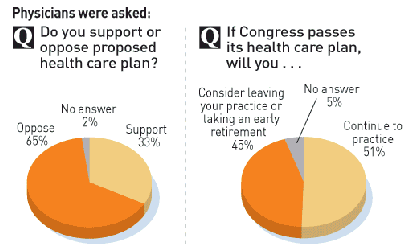
4. Forty-five percent of doctors responding to a recent Investors Business Daily/TIPP poll responded that if Obamacare passed, they would consider quitting or retiring. Even if the number of disgruntled doctors is overstated — by a factor of 2 or or 5 —  wouldn’t the number of doctors who do retire early or quit out of disgust  make the delivery of health care much more difficult than it already is?

5. If the U.S. health system is so bad, how do you explain why the five-year survival rate of women with breast cancer in the United States is higher than that of women in Great Britain and the five-year survival rate for American men with any form of cancer is much higher than the same survival rate among all European men.

Hmmm.

Washington Examiner, “Obamacare is to Medicare what ACORN is to Children’s Protective Services”, September 21, 2009
http://www.washingtonexaminer.com/opinion/columns/Obamacare-is-to-Medicare-what-ACORN-is-to-Children_s-Protective-Services-8268673-59983347.html

* * * * *

Ah-ha … How Big Bro will catch the willfully uninsureds.

September 24, 2009

Ken’s Take: I’ve been asking how the folks who choose voluntarily to self-insure and buy big screens instead of health insurance will be caught in the act.  Here’s the answer .  More “take” below”.

Heritage Foundation, The Policy Is The Problem. September 21, 2009

Individual Mandates:

Starting in 2013, almost everyone who does not have coverage would be required to purchase health insurance at a minimum level to be specified in the bill.

Any individual who fails to buy health insurance will be forced to pay a tax by the Internal Revenue Service. Depending on your income and family status the new tax would be as low as $750 per person and as high as $3,800 per family.

In order to enforce these provisions, the Baucus bill would require individuals, health insurers, employers, and government health agencies to report detailed health insurance information on all Americans to the IRS, adding significant administrative costs and reducing privacy protections.

Full article:
http://blog.heritage.org/2009/09/21/morning-bell-the-policy-is-the-problem/

* * * * *

More Ken’s Take: So, companies submit confirmations that a person (i.e. social security number) is insured.  The confirmations are matched against the IRS files (social security numbers with income) and exceptions are reported out to the health reform fine collectors who go knocking on doors to collect fines and / or repo the big screens.

Might work … yeah, right.

* * * * *

2009’s Best Global Brands

September 24, 2009

According to consultancy InterBrand …

 .  Top Ten Global Brands in 2009  . 
(and their estimated Brand Asset Value)

  1. Coca-Cola 68,734 ($m)
  2. IBM 60,211 ($m)
  3. Microsoft 56,647 ($m)
  4. GE 47,777 ($m)
  5. Nokia 34,864 ($m)
  6. McDonald’s 32,275 ($m)
  7. Google 31,980 ($m)
  8. Toyota 31,330 ($m)
  9. Intel 30,636 ($m)
  10. Disney 28,447 ($m)

For more, see …

Article:
http://www.interbrand.com/best_global_brands_intro.aspx?langid=1000

Full Report:
http://www.interbrand.com/images/studies/-1_BGB2009_Magazine_Final.pdf

Cool poster with Logos:
http://www.interbrand.com/BGB09/BGB2_POSTER_FRONT.pdf

* * * * *

What if folks who don’t have health insurance just don’t want it?

September 23, 2009

Excerpted from NY Post, ObamaCare: Losing everyone, Sept 21, 2009

The latest data from Scott Rasmussen’s poll of those who lack health insurance indicates that they’re starting to turn skeptical about the Obama plan. It’s supposed to help them, yet they back ObamaCare by only 58 percent to 35 percent — and only 30 percent support it strongly.

More to the point, only 35 percent feel it will improve the quality of their health care — and, by 41-26, they feel the cost of their care will go up, not down, under the plan.

Having the uninsured — the stated object of Obama’s compassion — turn against his reform would be the most lethal cut of all.

* * * * *

Requiring everyone to buy insurance will impose a massive tax on all who now are uninsured. The Congressional Budget Office projects that it would force the middle-income uninsured to pay on average more than 15 percent of their income.

CBO estimates that … an individual earning $32,400 a year would have to pay $4,100 in premiums before getting any subsidy.

With deductibles and co-payments, he’d have to shell out $5,600 a year, or 17.3 percent of his income.

A family of four, making $80,000 a year, would have to pay about $10,500 in premiums alone — with deductibles and co-payments, up to $15,000 or just under 20 percent of income.

And if they don’t buy insurance, they’ll face federal fines that begin to approach these same premium levels. They won’t be able to buy what they truly need — catastrophic-only coverage at a lower premium — that won’t satisfy ObamaCare’s “minimum insurance” mandate.

* * * * *

Full article:
http://www.nypost.com/p/news/opinion/opedcolumnists/obamacare_losing_everyone_GMoSJylS0ZJLsQAtWEVKyN

* * * * *

The experience gap: have any Presidential advisers run a business … or, for that matter, held a real job?

September 23, 2009

Excerpted from RCP, Saving A Million Jobs at $787,000 Per Job, September 14, 2009

The White House Council of Economic Advisers is lead by three presidential appointees. Currently, these are Christina Romer, Austan Goolsbee, and Cecilia Rouse.

According to their biographies on the Council web site, these people have never held jobs outside of academia. Their positions at Princeton, Berkeley, and the University of Chicago were protected by lifetime tenure. Unemployment, to them, is a theory that cannot become a personal reality. What in their backgrounds makes them experts on the subject of job creation?

  • They never had to meet a payroll.
  • They never had to raise money to fund their businesses from skeptical investors.
  • They never bet their life savings on their own business judgment. They never had to scramble to pay off a banker who called in a loan.
  • They never had to decide whether to take a calculated risk to expand their workforce hoping to take market share from a fierce competitor.
  • They never had to make a judgment call on whether or not to launch an unproven new product.
  • They never had to manage a reduction in force, explaining to employees that their jobs have been eliminated because the tax and regulatory burdens imposed by some new law forced them to cut costs.
  • They never lost business to a government-subsidized competitor whose cost of capital was vastly lower than theirs.
  • They never had to grease the palms of politicians offering constituent services to resolve a bureaucratic hangup caused by the labyrinthine government approvals these selfsame politicians inflict on many businesses.
  • They never had to deal with a missed sales forecast caused by an economy so roiled by capricious and uncertain fiscal policy that frightened customers were holding back orders.
  • They never had to deal with a key supplier that unexpectedly went bankrupt because their source of credit dried up as dollars got sucked out of the commercial economy into government debt.
  • They never had to negotiate with angry landlords after being forced to shut down a business destroyed by spurious mass-manufactured class action lawsuits.
  • They never had to stand up in front of disappointed investors to explain why they lost money that had been entrusted to them.
  • And you can be sure that none of them ever fell on their face and had to pick themselves up, dust themselves off, and decide whether it was worth going through all of the joys described above to take another shot at building a business from scratch.

They are prize winning experts in macroeconomics. They are ambitious, articulate, well connected, and brilliant.

But, what qualifies these people to work as high level apparatchiks of a governing class determined to manage the businesses of others?

Long after these experts return to their sinecures in academia to train another generation of economists on the wisdom of central planning and Keynesian pump priming, it’s we and our children and our grandchildren who will be paying the price.

Full article:
http://www.realclearmarkets.com/articles/2009/09/14/saving_one_million_jobs_at_787000_per_job_97404.html

* * * * *

Wanna know what cyber-folks are saying about you? Try Google Alerts.

September 23, 2009

Stumbled on an interesting web tool :

Google Alerts notifies you via email when your name shows up on the Web, and it provides links to the reference sites so you can see exactly what’s being said.

It’s a great way to stay on top of all cyberspace references to your name.

You can receive alerts in real time or in daily or weekly digests.

Register  alerts at www.google.com/alerts

To improve search accuracy,   put your name in quotes (e.g., “ken homa”) when you establish your alerts.

* * * * *

Google Alerts aren’t restricted to your name and personal info.

You can to track Web postings related to your area of expertise, (e.g. marketing strategy”), sports teams (“chicago bears”), professional contacts (“warren buffett”), etc.

* * * * *

For other Web and Tweet tracking tools:
http://www.marketingprofs.com/9/tools-tracking-measuring-evaluating-personal-brand-online-arruda.asp?adref=znnpbsc4499

* * * * *

A tax on healthy risk-takers … are they kidding?

September 22, 2009

Ken’s Take: I’ve asked before (1) How will mandate evaders get caught?  and (2) What will the Feds do if the evaders have already spent their incomes and are deep in hock? How will the fines be collected? By repo’ing uber-sized big screen TVs?

These guys ask if such mandates are even constitutional.

Talk about shoddy staff work …

* * * * *

Excerpted from WSJ: Mandatory Insurance Is Unconstitutional, Sept. 18, 2009

Under Sen. Max Baucus’s most recent plan, people who do not maintain health insurance for themselves and their families would be forced to pay an “excise tax” —roughly comparable to the cost of insurance coverage under the new plan.

Beginning in 2013, individuals would be required to have health insurance. Individuals and families who do not have insurance for more than three months in a given year would be subject to an annual excise tax of $750 and $1,500, respectively, if their income is below 300% of the federal poverty line (or $66,150 for a family of four). Tax penalties for individuals and families with incomes above that would be $950 and $3,800. The excise tax would be waived for Native Americans and individuals and families whose health-insurance costs would be more than 10% of their annual income.

The majority of those impacted are young people who forgo insurance precisely because they do not expect to need much medical care. When they do, these uninsured pay full freight, often at premium rates, thereby actually subsidizing insured Americans.

Without the mandate, the entire thrust of the new regulatory scheme—requiring insurance companies to cover pre-existing conditions and to accept standardized premiums—would produce dysfunctional consequences. It would make little sense for anyone, young or old, to buy insurance before he actually got sick.

The mandate’s real justifications are even more cynical and political. Making healthy young adults pay billions of dollars in premiums into the national health-care market is the only way to fund universal coverage without raising substantial new taxes.

In effect, this mandate would be one more giant, cross-generational subsidy—imposed on generations who are already stuck with the bill for the federal government’s prior spending sprees.

But a “tax” that falls exclusively on anyone who is uninsured is a penalty beyond Congress’s authority. If the rule were otherwise, Congress could evade all constitutional limits by “taxing” anyone who doesn’t follow an order of any kind—whether to obtain health-care insurance, or to join a health club, or exercise regularly, or even eat your vegetables.

Full article:
http://online.wsj.com/article/SB10001424052970204518504574416623109362480.html?mod=djemEditorialPage

* * * * *

If it walks like a tax, and quacks like a tax, it’s a …

September 22, 2009

Ken’s Take: I don’t have a stake in this issue, but it’s fun to watch it reveal itself.  Gotta admit that Obama-logic makes me dizzy sometimes.  Maybe he’s just way smarter than I am … oe maybe he’s just making this stuff up as he goes.

* * * * *

Excerpted from WSJ, Obama’s Nontax Tax, Sept. 21, 2009

On his round of five Sunday talk shows President Obama revealed a great deal about his philosophy of government and how he defines a tax increase.

Under Max Baucus’s Senate bill that Mr. Obama supports, everyone would be required to buy health insurance or else pay a penalty as high as $3,800 a year. George Stephanopoulos posed the obvious question about this kind of coercion when “the government is forcing people to spend money, fining you if you don’t [buy insurance]. . . . How is that not a tax?”

“Well, hold on a second, George,” Mr. Obama replied. “Here’s what’s happening. You and I are both paying $900, on average—our families—in higher premiums because of uncompensated care. Now what I’ve said is that if you can’t afford health insurance, you certainly shouldn’t be punished for that. That’s just piling on. If, on the other hand, we’re giving tax credits, we’ve set up an exchange, you are now part of a big pool, we’ve driven down the costs, we’ve done everything we can and you actually can afford health insurance, but you’ve just decided, you know what, I want to take my chances.  And then you get hit by a bus and you and I have to pay for the emergency room care, that’s . . .”

“That may be,” Mr. Stephanopoulos responded, “but it’s still a tax increase.”

Mr. Obama: “No, but—but, George, you—you can’t just make up that language and decide that that’s called a tax increase.”

“I don’t think I’m making it up,” Mr. Stephanopoulos said. He then had the temerity to challenge the Philologist in Chief, with an assist from Merriam-Webster. He cited that dictionary’s definition of “tax”—”a charge, usually of money, imposed by authority on persons or property for public purposes.”

Mr. Obama: “George, the fact that you looked up Merriam’s Dictionary, the definition of tax increase, indicates to me that you’re stretching a little bit right now.”

The CBO estimates that the Senate’s individual mandate will result in new revenues of some $20 billion over 10 years because some people will choose to opt out of ObamaCare. If that $20 billion doesn’t count as tax revenue, then what is it?

Under Mr. Obama’s definition, all taxes can be justified in the name of providing some type of service, however wasteful. It turns out the President thinks a health-care tax is not a tax if he thinks the tax is for your own good. His problem is that the individual mandate really is a tax, but the President doesn’t want voters to think of it that way, because taxes are unpopular

* * * **

[Fact: uncompensated care accounts for about only 2.2% of national health spending today.]

* * * * *

Full article:
http://online.wsj.com/article/SB10001424052970204488304574425294029138738.html?mod=djemEditorialPage

* * * * *

Great moments in marketing … an old guy pitches GM’s “bring it back” guarantee … huh?

September 22, 2009

Ken’s Take: I don’t usually take positions on ads, but I can’t resist on this one.  More “Take” below…

* * * **

BrandChannel, Should GM and Citi CEOs Take To The Airwaves?, September 17, 2009

With consumer confidence low, GM plans to reform its image and resuscitate itsbrands.

Two months after declaring bankruptcy, GM has rolled out a new ad campaign featuring government-appointed chairman Ed Whitacre.

In a 60-second spot, Whitacre declares the brand revived, and goes so far as to brag, “We win.”

The ad shows Whitacre walking through what looks to be GM research and development, shiny new cars decorating the scenery. Whitacre invites consumers to test a new GM model — though none are shown — and promises them a 60-day-money-back guarantee if not fully satisfied.

GM seems to be taking a gamble by personalizing its products with the very leaders the public holds responsible for their failure. Consumers may dismiss the ads as just more lies and empty promises. On the other hand, they may find the sight of executives stepping up to the plate a refreshing act of responsibility.

GM has made a miscalculation: Consumers are looking for action, not words.

GM should spotlight their fleet of competitive vehicles in advertisements. Instead, they’re undermining the quality of their product by placing the spotlight on their 60-day-money-back guarantee.

Full article (with a link to the commercial):
http://www.brandchannel.com/home/post/2009/09/17/GM-and-Citigroup-unveil-new-ad-campaigns-to-resuscitate-brands.aspx

* * * * *

Sidenote:

“Ad agencies can do a real disservice to clients by pitching CEO ads. It’s an easy way to land a client, because it’s very flattering to the CEO. And most CEOs have big enough egos that they cannot imagine appearing in the ads might be a bad idea. They just think the agency is brilliant for recognizing their own brilliance.”

* * * * *

Ken’s Take II: (1) My wife literally asked “who’s the old guy?  He looks almost dead.”  Perhaps Whitacre thinks he reeks credibility. I bet most folks find him more creepy than credible.  (2) Re: substance: I disagree with the article.  It’s a bold move to shift product quality risk from consumers back to the company — where it belongs  (3) Re: unintended consequences: How many folks will simply take 60 day joy rides in GM cars? Hmmm

* * * * *

Fun on the Magothy: 2nd Annual MSB-MBA-GMA Fall Outing

September 22, 2009

Here’s the link to some pics from the 2009 Fall outing.  Great weather, great food, great fun.

http://picasaweb.google.com/profkenhoma/HomaPHOTOs09092009MSBGMA2009Outing#5383966163003763698 

http://picasaweb.google.com/profkenhoma/HomaPHOTOs09092009MSBGMA2009Outing#5383966163003763698

Stuff the ballot box for Ada Polla — an MSB MBA alum.

September 21, 2009

After getting her MSB MBA in 2004, Ada Polla launched a business: Alchimie Forever skin care. 

The business has been a runaway success, and Ada  has been nominated as one of 5 finalists for “Best Emerging Entrepreneur” by Entrepreneur Magazine.

This Entrepreneur Magazine award goes to the finalist who receives the most online votes.

Ada has continued to be a strong supporter of MSB, so let’s reciprocate and give her our support.

* * * * *

It’s fast and simple.  One online vote per email address
(yes, you can technically vote more than once).

Here is the link:
www.entrepreneur.com/e2009/vote/emerging.php

Voting ends on October 12th.

As they say in Chicago: vote early, vote often, and spread the word.

* * * * *

Buffett: Rock Star of American Capitalism …

September 21, 2009

A summary of a gushing biography of the Oracle from Omaha …

Excerpted from Knowledge@Emory,  Buffett: Rock Star of American Capitalism, September 16, 2009

Warren Buffett’s rock star status is evident from the fact that each year tens of thousands of fans from all over the world travel to Omaha, Nebraska, to listen to him speak at his company Berkshire Hathaway’s shareholder meeting.

Alice Schroeder’s insightful biography titled, The Snowball: Warren Buffett and the Business of Life … seeks to explain how Buffett became one of the world’s richest men and why he is admired for his business ethics and for uniquely pledging most of his money to philanthropy.

Buffett’s annual letters to shareholders … analyze good and bad businesses, give examples of managers who treat customers and employees fairly while also making good profits, and expose accounting tricks that fool many investors. One of Buffett’s letters pointed out that rich people like him should be made to pay a higher tax rate than wage earners like his secretary.

Buffett’s most important act has been to donate much of his wealth to the Gates Foundation, to be spent over 20 years mainly on health care and education. As he states: “The idea of passing wealth from generation to generation so that hundreds of your descendants can command the resources of other people simply because they came from the right womb flies in the face of a meritocratic society.” Also, unlike most other philanthropists, Buffett has not set up a foundation nor paid for buildings at hospitals or museums to try to perpetuate his name.

Rational Money Machine

Buffett had spent $15.4 million to buy 46% of Berkshire, With Berkshire stock recently around $87,200, Buffett has grown his wealth nearly 3,000-fold in some 30 years.

This massive capital accumulation is based on an investment discipline he learned from Benjamin Graham. Buffett’s approach to investment involves using seventh grade math and common sense to analyze a company’s underlying economics; buying a business not a stock; ignoring the fluctuations of the stock market; and, most importantly, maintaining a margin of safety. Of course, the mathematical magic of compounding gains over time have also helped Berkshire Hathaway multiply its wealth.

Buffett’s three rules of portfolio management are: 1) Don’t lose money; 2) Don’t forget rule one and 3) Don’t go into debt.

He attracts talented people to work, partner and deal with him due to his honesty, fairness, letting them do their job without interference and crediting them for success.

Right Side of the Edge

Buffett criticizes the high fees charged by investment managers, especially of hedge and private equity funds. Yet, Buffett himself accumulated much of his initial capital from the fees he charged a hedge fund-type partnership, pocketing half the gains over 4%.

Some of Buffett’s investments for his partnership were also made based on the expectation that managements would buy back his stock at a higher price. In

Buffett has argued for the expensing of stock options, which many chief executives liberally give as incentives and bonuses to themselves, other managers and employees. Only in 2002, going against the views of most CEOs, Buffett found the time was right to push Coke’s board to make it the first major company to expense stock options. 

Buffett draws a token $100,000 annual salary from Berkshire and awards himself or other managers no stock options, grants or warrants.

Personal and Family Life

Buffett owns no fancy houses, cars or yachts. He wears cheap clothes, craves hamburgers, French fries and cherry Coke and appears awkward in social situations. Buffet also spends hours playing bridge online, enjoys golf, handball and table tennis and plays the ukulele. He is a showman who avoids confrontation and hides his true opinions behind coy remarks, if being blunt may hurt his business or other relationships.        

Since Buffett was consumed with his work, he had little extra time for his wife and three kids. “While he was friendly with his kids, he hadn’t really gotten to know them” while they were growing up at home in Omaha. On occasion Buffett’s secretary blocked even his family’s access to him, not on explicit but on implicit orders, a typical Buffett method of operating.

His wife wanted him to stop being consumed with making more money once he had made his initial millions. His actions that led his wife to leave their home in Omaha are the major regret of Buffett’s life: “If you get to my age in life and nobody thinks well of you, I don’t care how big your bank account is, your life is a disaster.”

Unlike most other capitalists, Buffett believes that children should not inherit money just because of the lottery of their birth. He says children should be left “enough money so that they feel they could do anything, but not so much that they could do nothing.”

Buffett’s views:  capitalists: should give their money back to society, to which he believes they owe their wealth in the first place,

“Buffett always avoided or limited his time with anyone he feared might criticize him.”

As Buffett has often noted, the American economy in the second half of the twentieth century provided the ideal environment – lots of wet snow and a long hill to roll and grow his snowball — for someone of his skills, temperament and personality to become immensely wealthy.

Full article:
http://knowledge.emory.edu/article.cfm?articleid=1267

* * * * *

Is the “Oracle of Omaha” over-rated ?

September 21, 2009

cnbc.com, The Oracle of Oma-Hype? , Sep 14, 2009

Clint Goodrich …  went from horse racing to futures trading—both occupations require focus and brutal tenacity. He  trades for some high net worth clients. His investments have averaged 22 percent gains a year over the last five years, and while he took a beating in the fourth quarter last year (who didn’t?), this year he’s up nearly 32 percent.

Goodrich thinks Buffett isn’t much of an oracle:

I think Warren Buffett is overrated. My thinking is a collective of many years of watching and listening to everyone in the media lionize this guy. As a trader and manager of money, I follow the money, literally. Clearly he’s not some stooge. He’s been successful, is shrewd and lived in the same Omaha house since 1955. However, a few simple insights into his track record leave me a little cold and not so convinced about his title “World’s Greatest Investor”.

If you bought one share in BRK.A at the “open” on Sept 10, 1999 you spent $62,500. On Sept 9, 2009 that same share was worth $97,900 on the “open”, an increase over 10 years of $35,400 (+56.64 percent appreciation), or an average simple return of +5.66 percent per year. To me, this is historically just a reasonable rate of return on a 30-year U.S. Treasury Bond, and certainly a less than spectacular rate of appreciation for someone titled “The World’s Greatest Investor”. Oh, and by the way, a 30-year U.S. Treasury is guaranteed.

Mr. Buffett is that he demonizes traders and calls derivatives “weapons of financial mass destruction”, when he himself holds some of the largest derivative positions in the world! It’s OK for him to hold derivatives but not others?

He missed the tech run, he lost billions in his US dollar position, and he apparently had no inkling of the financial crash that swept the markets in the fall of ’08 through the spring of ’09.

In general, he’s a buy and hold forever guy with a seemingly blind eye to taking profits and looking for the next opportunity. What is up with not letting go of a position, taking the profit and moving on?

Of course, the weak point in my argument would be, that so far…..he has more money than I do. But hey, that’s what makes a market!

Full post:
http://www.cnbc.com/id/32841601/site/14081545

* * * * *

Toyota powers up … more ads, more hybrids.

September 21, 2009

Reuters – CNBC.com, Toyota Plans $1 Billion Marketing, More Hybrids, 17 Sep 2009

Toyota landed three models among the top 10 sold in the recent “Cash for Clunkers” incentive program by the U.S. government.

Now, Toyota is preparing a $1 billion marketing campaign — 30 percent to 40 percent more than the company typically spends in the quarter — to boost U.S. sales in the fourth quarter, while also expanding its line of hybrid models under the Prius name.

The $1 billion will include a media campaign, as well as buyer and dealer incentives, including sweeteners for leasing.

Word of the media blitz comes less than a week after General Motors announced its own media campaign, in large part aimed at recapturing consumers who believe Toyota and other foreign automakers make better products.

Toyota executives said the company planned to sell 500,000 to 600,000 hybrid vehicles globally by the end of 2009.

Full article:
http://www.cnbc.com/id/32903880

* * * * *

Ouch: 45% Of Doctors Would Consider Quitting If Congress Passes Health Care Overhaul

September 18, 2009

Ken’s Take: If you think it’s hard to get in to see a doctor now, just wait …

* * * * *

IBD, 45% Of Doctors Would Consider Quitting If Congress Passes Health Care Overhaul, September 15, 2009

Two of every three practicing physicians oppose the medical overhaul plan under consideration in Washington, and hundreds of thousands would think about shutting down their practices or retiring early if it were adopted, a new IBD/TIPP Poll has found.

The poll contradicts the White House claims that the medical profession is behind the proposed overhaul.

* * * * *

Major findings included:

• Two-thirds, or 65%, of doctors say they oppose the proposed government expansion plan. This contradicts the administration’s claims that doctors are part of an “unprecedented coalition” supporting a medical overhaul.

• 45%, said they “would consider leaving their practice or taking an early retirement” if Congress passes the plan the Democratic majority and White House have in mind.

image

* * * **

More than 800,000 doctors were practicing in 2006, the government says. Projecting the poll’s finding onto that population, 360,000 doctors would consider quitting. The number of doctors is already lagging population growth. From 2003 to 2006, the number of active physicians in the U.S. grew by just 0.8% a year, adding a total of 25,700 doctors.

The U.S. today has just 2.4 physicians per 1,000 population — below the median of 3.1 for members of the Organization for Economic Cooperation and Development, the official club of wealthy nations.

A recent study from the Association of American Medical Colleges found steadily declining enrollment in medical schools since 1980. The study found that, just with current patient demand, the U.S. will have 159,000 fewer doctors than it needs by 2025.

Full article:
http://www.ibdeditorials.com/IBDArticles.aspx?id=337909690110379

* * * * *

Marketers' challenge: making shopping easy for cranky old folks.

September 18, 2009

Excerpted from WSJ, Seeing Store Shelves Through Senior Eyes, Sep 14, 2009

The number of adults aged 65 and older will reach 71.5 million people by 2030, twice their number in 2000 and representing nearly 20% of the total U.S. population. As baby boomers turn 65 years old beginning in 2011, they are expected to spend an additional $50 billion over the next decade on consumer products in the U.S.,

Current store layouts present challenges for elderly shoppers, experts say. Worsening eyesight makes finding items more frustrating, arthritis complicates browsing and reduced balance intensifies the strain of stooping or reaching for products.

So, some marketers are donning glasses that blur their vision, slip un-popped popcorn into their shoes, wear gloves and adjust tape that binds their thumbs to their palms …  an exercise designed to help them better understand the physical challenges facing elderly shoppers.

Some of the ways marketers are helping seniors cope:

Morgan Stanley, recommends that financial advisers ensure report colors and office lighting are friendly to elderly eyes.

Drug-store chain Rite Aid is revising its private-label goods with bigger typefaces on packaging.

Family Dollar is weighing new lighting and shelf labels.

Walgreen plans to install call buttons near heavy merchandise like bottled water and laundry detergent in some stores. It also will put magnifying glasses on store shelves.

Many retailers offer nearby parking spaces  and manageable carts.

Full article:
http://online.wsj.com/article/SB125288402995807243.html

* * * * *

Marketers’ challenge: making shopping easy for cranky old folks.

September 18, 2009

Excerpted from WSJ, Seeing Store Shelves Through Senior Eyes, Sep 14, 2009

The number of adults aged 65 and older will reach 71.5 million people by 2030, twice their number in 2000 and representing nearly 20% of the total U.S. population. As baby boomers turn 65 years old beginning in 2011, they are expected to spend an additional $50 billion over the next decade on consumer products in the U.S.,

Current store layouts present challenges for elderly shoppers, experts say. Worsening eyesight makes finding items more frustrating, arthritis complicates browsing and reduced balance intensifies the strain of stooping or reaching for products.

So, some marketers are donning glasses that blur their vision, slip un-popped popcorn into their shoes, wear gloves and adjust tape that binds their thumbs to their palms …  an exercise designed to help them better understand the physical challenges facing elderly shoppers.

Some of the ways marketers are helping seniors cope:

Morgan Stanley, recommends that financial advisers ensure report colors and office lighting are friendly to elderly eyes.

Drug-store chain Rite Aid is revising its private-label goods with bigger typefaces on packaging.

Family Dollar is weighing new lighting and shelf labels.

Walgreen plans to install call buttons near heavy merchandise like bottled water and laundry detergent in some stores. It also will put magnifying glasses on store shelves.

Many retailers offer nearby parking spaces  and manageable carts.

Full article:
http://online.wsj.com/article/SB125288402995807243.html

* * * * *