
* * * * *
* * * * *
Most reports tout the Cash for Clunkers programs as a runaway success.
In fact, about 250,000 C4C deals were transacted in a week or two – fully utilizing the budgeted $1 billion – at an average rebate of about $4,000.
But …
Marketing promotions should always be evaluated on an incremental basis. That is, how many sales were induced over and above what would have happened any way.
Car authority J.D. Power and Associates thinks that most of the cars purchased through the C4C program were simply sales that would have happened this year but were pulled ahead a few months. The company thinks that as few as 20% of the cars bought in the program are really new sales to the market. That means that as many as 80% of the cars would have been sold this year anyway. Edmunds.com, which tracks vehicles pricing and buying data, agrees. They say: “when the public thought that the program would cease after the first billion dollars was spent, they rushed to dealerships.By Aug. 20, we could be back to pre-clunker sales levels.”
So what ?
Well, from a marketing analysis perspective, the full cost of a program should be assigned to the incremental sales. So, the $1 trillion should be allocated across 50,000 incremental car sales (20% times 250,000). That’s about $20,000 per incremental sale.
Recast, phase 1 of C4C took 250,000 clunkers off the road by, in effect, giving away 50,000 new, more fuel efficient cars.
Worth it?
You decide.
* * * * *
See Business Week, Cash for Clunker Interest Slows, August 14, 2009
http://www.businessweek.com/autos/autobeat/archives/2009/08/cash_for_clunke_10.html
* * * * *
Ken’s Take: Last week, I had a couple of posts on this topic. I think this idea – from a Univ. of Chicago finance prof – may be the Rx …
* * * * *
Excerpted from WSJ, What to Do About Pre-existing Conditions, Aug. 13, 2009
If you get sick and then lose your job or get divorced, you lose your health insurance. With a pre-existing condition, new insurance will be ruinously expensive, if you can get it at all. This, the central defect of American health insurance.
The bills being considered in Congress address the pre-existing condition problem by forcing insurers to take everybody at the same price. It won’t work. Insurers will still avoid sick people and treat them poorly once they come. Regulators will then detail exactly how every disease must be treated. Healthy people will pay too much, so we will need a stern mandate to keep them insured. And this step further reduces competition.
Private, competitive insurance markets are a superior way to solve the pre-existing-conditions problem, and the only hope to lower costs.
A truly effective insurance policy would combine coverage for this year’s expenses with the right to buy insurance in the future at a set price.
Today, employer-based group coverage provides the former but, crucially, not the latter.
A “guaranteed renewable” individual insurance contract is the simplest way to deliver both. Once you sign up, you can keep insurance for life, and your premiums do not rise if you get sicker.
The right to future insurance could be transferrable to another company, for example, if you move. You could have the right that your company will pay a lump sum, so that a new insurer will take you, with no change in your premiums.
Full article:
http://online.wsj.com/article/SB10001424052970203609204574316172512242220.html
* * * * *
Ken’s Take II: The rub I see is that people who permanently lose their jobs also lose the employer’s subsidy towards health insurance … and, the full price of a guaranteed renewable individual insurance contract might be out of reach for most people. Think COBRA.
* * * * *
For many Boomers “aging is not about the inevitable end, but rather about the evolving self.”
It seems this age group is redefining retirement as “a time of growth when identity is broadened, expressed, and completed through consumption.”
Researchers scoured the current literature on aging and lifestyle, observed seniors in a wide range of communities and life situations, and concluded that a boomer retirement is:
Don’t treat today’s seniors like they’re old and frail. Instead, market to them as the vital, active individuals they think are.
Extracted from: Marketing Profs, Now Is the Time for Me, Baby!, July 29, 2009
Source: “Consumer Identity Renaissance: The Resurgence of Identity-Inspired Consumption in Retirement,” by Hope Jensen Schau, Mary C. Gilly and Mary Wolfinbarger. Journal of Consumer Research, 2009.
* * * * *
Ken’s Take: First time I’ve heard this contrarian point-of-view. It got me thinking …
* * * * *
Excerpted from WSJ, We Don’t Spend Enough on Health Care, Aug 16, 2009
The basic material needs of human beings are food, clothing and shelter.
The desire for food and clothing drove hunter-gatherer economies and, subsequently, agricultural economies, for millennia.
The Industrial Revolution was driven by the desire for clothing.
The desire for shelter was a major driver of the U.S. economy during the second half of the 20th century and the first several years of the 21st. About one-third of the new jobs created during the latter period were directly or indirectly related to housing,
Once these material needs are substantially met, desire for health care — without which there can be no enjoyment of food, clothing or shelter—becomes a significant, perhaps a principal, driver of the economy.
The health-care industry is a resilient driver of the general economy. Health-care now accounts for 10.4% of nonfarm employment.
The $2.4 trillion Americans spend each year for health care doesn’t go up in smoke. It’s paid to other Americans.
So, the U.S. health-care economy should be viewed not as a burden but as an engine of growth.
The administration’s health-care plan is biased toward bean-counting rather than designed to maximize American physical and mental well-being.
We need to ask ourselves whether there is truly anything more valuable to us than our loved ones and our own health and longevity.
* * * * *
Full article:
http://online.wsj.com/article/SB10001424052970204409904574350810610869756.html
* * * * *
Ken’s Take: Best list I’ve seen … from the CEIO of Whole Foods
Extracted from WSJ, The Whole Foods Alternative to ObamaCare, Aug. 11, 2009
Here are eight reforms that would greatly lower the cost of health care for everyone:
Full article:
http://online.wsj.com/article/SB10001424052970204251404574342170072865070.html?mod=djemEditorialPage
* * * * *
Ken’s Note: Pres Obama has tagged “death panels” as one of the myths and pieces of misinformation being peddled by fishy people.
* * * * *
Wash Post, Obama to Take On Health-Care Critics, Aug 14, 2009
One of the most inflammatory charges has been that Obama and Democrats were seeking to implement “death panels,” with bureaucrats making decisions about whether elderly or seriously ill patients live or die.
On Thursday, lawmakers working on the Senate version said that provision had been dropped from their proposal.
Full article:
http://www.washingtonpost.com/wp-dyn/content/article/2009/08/13/AR2009081301914.html?hpid=topnews
* * * * *
Let me make sure I’m tracking: the Senate dropped a provision that didn’t exist in the Congressional version. Sounds fishy to me. Somebody report it. Fast !
* * * * *
Ken’s Take: In a prior post, I noted that if insurance companies are forced to take folks with previously disqualifying known medical “pre-conditions” into their coverage pools, then premiums are virtually certain to go up for the presumed healthier people in the pool. Its simple insurance economics.
Stossel (a classmate of mine at Princeton) raises an interesting philosophical point.
* * * * *
Excerted from RCP: Impossible Promise, John Stossel, August 5, 2009
The New York Times describes a key part of the House bill: “Lawmakers of both parties agree on the need to rein in private insurance companies by banning underwriting practices that have prevented millions of Americans from obtaining affordable insurance.
Insurers would, for example, have to accept all applicants and could not charge higher premiums because of a person’s medical history or current illness”.
No more evil “cherry-picking.”
No more “discrimination against the sick.
But that’s not insurance. Insurance is the pooling of resources to cover the cost of a possible but by no means certain misfortune befalling a given individual.
Government-subsidized coverage for people already sick is welfare.
We can debate whether this is good, but let’s discuss it honestly.
Calling welfare “insurance” muddies thinking.
Full article:
http://www.realclearpolitics.com/articles/2009/08/05/impossible_promises_97774.html
* * * * *
Ken’s Take II: Somehow, somewhere, folks with pre-existing medical conditions should get coverage for their healthcare. But the who and the where sure aren’t obvious to me.
* * * * *
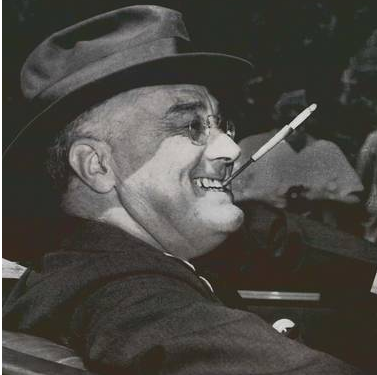
FDR: The New Deal

LBJ: The Great Society

BHO: Cash For Clunkers
* * * * *
I’m conflicted on this issue.
On one hand, I have sympathy for folks who have been diagnosed with a medical condition, especially if they are sitting without health insurance.
Now, there’s a groundswell that insurance companies should have to take all comers – even those with known pre-exiting conditions.
Here’s the rub: people with disqualifying pre-existing conditions are – by definition – more costly to cover than most of the folks already in the insurance pool. In other word, average medical expenses for people in the pool will increase.
So, the pivotal question is who should pay for the “extra” medical care that the pre-existers require.
Some folks apparently believe that there are no additional expenses, or that there is an insurance fairy who take care of things.
Other folks think the insurance companies should just eat the extra expenses – just paying the extra amounts out of profits.
The reality is that the high cost of covering a pre-exister will be spread across all people in the insurance pool. In other words, premiums will go up.
So remember, when you cavalierly say “cover all people with pre-existing conditions”, you’re really saying “I’m willing to pay higher insurance premiums so that people with pre-existing conditions get coverage”.
That may be the right answer. Just don’t whine when your premiums get jacked up. There are no free lunches.
* * * * *
Ken’s Take: You’ve gotta love it when boldface misinformation is peddled at a town hall meeting meant to dispel misinformation …
* * * * *
AP, AARP tells Obama: No health plan endorsement yet, Aug 12, 2009
At the town hall in Portsmouth, N.H., Obama said, “We have the AARP onboard because they know this is a good deal for our seniors.”
He added, “AARP would not be endorsing a bill if it was undermining Medicare.”
AARP says the president went too far Tuesday when he said the seniors lobby had endorsed the legislation pending in Congress.
AARP’s chief operating officer, said, “Indications that AARP has endorsed any of the major health care reform bills currently under consideration in Congress are inaccurate.”
AARP is sensitive to the issue because polls show that Medicare beneficiaries are worried their health care program will be cut.
He also said, AARP would not endorse a bill that reduces Medicare benefits
Full article:
http://www.google.com/hostednews/ap/article/ALeqM5jKi4TWhreDcA0doTJ6ph9sOAf-QQD9A0V30G1
* * * * *
Ken’s Take II: Wonder if the AMA will bail too ?
* * * * *
Excerpted from WSJ, Health Reform and the Polls, Aug. 6, 2009
According to Rasmussen …
At this point voters are pretty evenly divided on ObamaCare … 47% at least somewhat favor the plan while 49% are somewhat opposed … 35% of independents are in favor of the Democrats’ health-care reform initiative, and 60% are opposed.
Obama’s biggest obstacle is the 68% of voters who rate their health coverage as good or excellent.
* * * * *
74% of voters rate the quality of care they now receive as good or excellent.
68% of American voters have health-insurance coverage they rate good or excellent.
48% of voters rate the U.S. health-care system as good or excellent.
A majority voters are skeptical about the government’s ability to do anything well.
53% believe ObamaCare will increase healthcare costs.
50% fear that if Congress passes health-care reform, it will lead to a decline in the quality of that care.
By a 2-1 margin, voters believe that no matter how bad things are Congress can always make matters worse.
78% believe passage of the current congressional health-care proposals is likely to mean higher taxes for the middle class.
* * * * *
63% of voters agree “We must make it a priority to give every single American quality affordable health care.”
Only 28% are currently willing to pay higher taxes to achieve that goal.
31% of voters believe young and healthy adults who choose not to buy health insurance should be forced to do so.
Full article:
http://online.wsj.com/article/SB10001424052970204313604574330442429438938.html
* * * * *
Ken’s Take: Article cuts to the chase on 2 critical reform issues: guaranteed coverage and community rating … both of which will push up premiums for folks who currently have health insurance …
Excerpted from WSJ, The Truth About Health Insurance, Aug 12, 2009
9 out of 10 people under 65 are covered by their employers, most of which cover all employees and charge everyone the same rate.
The tax code subsidizes private insurance only when it is sponsored by an employer
* * * * *
President Obama’s horror stories are about the individual insurance market, where some 15 million people buy coverage outside of the workplace.
The individual market is relatively small and its turnover rate is very high. Most policyholders are enrolled for fewer than 24 months as they move between jobs, making it difficult for insurers to maintain large risk pools to spread costs.
If you develop an expensive condition such as cancer or heart disease, and then get fired or divorced or your employer goes out of business — then individual insurance is going to be very expensive if it’s available.
* * * * *
By forcing insurers to cover anyone at any time (“guaranteed coverage”) and at nearly uniform rates … many people will buy insurance only when they need medical care. This raises the cost of insurance for everyone else, in particular those who are responsible enough to buy insurance before they need it; they end up paying even higher premiums.
Another proposed reform known as "community rating" imposes uniform premiums regardless of health condition. This also blows up the individual insurance market, by making it far more expensive for young, healthy or low-risk consumers to join pools — if they join at all. And if the healthy don’t join risk pools, then premiums go up for everyone and insurers have little choice but to reduce their risk by refusing to cover those who have a high chance of getting sick, such as people with a history of cancer.
New York, New Jersey and Massachusetts have both community rating and guaranteed issue. And, no surprise, they have the three most expensive individual insurance markets among all 50 states, with premiums roughly two to three times higher than the rest of the country.
In 2007, the average annual premium in New Jersey was $5,326 for singles and in New York $12,254 for a family, versus the national average of $2,613 and $5,799, respectively. ObamaCare would impose New York-type rates nationwide.
* * * * *
ObamaCare would impose on all 50 states rules that have already proven to be failures in numerous states.
Because these mandates would raise the cost of insurance, ObamaCare would then turn around and subsidize individuals to buy the insurance that the politicians made more expensive. Only in government could such irrationality be sold as "reform."
* * * * *
Full article
http://online.wsj.com/article/SB10001424052970204908604574332293172846168.html?mod=djemEditorialPage
* * * * *
Ken’s Take: Maybe I was mistaken when I said I was mistaken …
* * * **
Excerted from CNNMoney.com, Interest in Cash for Clunkers sputters, August 11, 2009
After sparking an initial rush to showrooms, the Cash for Clunkers program seems to be running out of fuel.
Interest in Cash for Clunkers has fallen 15% since its peak, and the number of people planning to buy cars could fall to pre-Clunkers levels by next week, an auto research group said.
Under the Clunkers program, vehicles purchased after July 1 are eligible for refund vouchers worth $3,500 to $4,500 on traded-in cars with a fuel economy rating of 18 miles per gallon or less.
The program ran through its initial $1 billion in its first week,leading lawmakers to approve an additional $2 billion in funding.
But interest in the program peaked on July 29, and demand has waned, according to the report from Edmunds.com.
The report, which cited Internet shopping data, said if current trends continue, auto purchase intent will fall back to pre-Cash for Clunker levels by August 20.
The original money set aside for “created a Gold Rush mentality where consumers hurried to take advantage before funding ran out.”
The additional $2 billion in funding removed the urgency to participate.
Full article:
http://money.cnn.com/2009/08/11/autos/cash_for_clunkers_interest_declines/?postversion=2009081114
* * * * *
Obama says health insurance companies are “making record profits, right now.”
Not so fast, Barack.
According to Fortune:
Health insurance companies – as a group — rank #35 in return-on-sales at a measly 2.2% …
,,, and they rank #31 on return-on-assets at 11.1%
Actually, that was last year. This year, profits are are down 50%.
I guess you can’t let the facts get in the way of a good rallying cry.
* * * * *
Source article:
http://www.politifact.com/truth-o-meter/statements/2009/jul/23/barack-obama/health-insurance-company-turned-profit-not-rec/
Fortune data:
http://money.cnn.com/magazines/fortune/fortune500/2009/performers/industries/profits/
* * * * *
The downturn has forced the likes of Tiffany, Chloé, and Chanel to quietly lower prices, a strategy that could tarnish their glitzy brands.
For example, Business Week reports that Tiffany quietly nudged down prices for engagement rings —one of its biggest sellers — by about 10%. Salespeople tell customers about the reductions, but otherwise there’s no publicity, no signs.
The dilemma that Tiffany and other purveyors of luxury goods face is how to use price cuts to woo customers without tarnishing their brands.
Executives are well aware of the need to woo today’s frugal buyers while trying to maintain tomorrow’s prestige. Some have chosen to be discreet by refusing to advertise sales or by e-mailing “exclusive” offers to select clients.
Retail experts argue that price cuts could prove to be perilous for luxury retailers. “The losers [in this recession] will be the ones who destroyed their brand by discounting them”
Excerpted from: Business Week, In Luxury Sector, Discounting Can Be Dangerous, July 23, 2009
http://www.businessweek.com/magazine/content/09_31/b4141049551979.htm
* * * * *
According to the Department of Transportation …
Top Trade-Ins Under Cash for Clunkers
1. Ford Explorer
2. Ford F150 Pickup 2WD
3. Jeep Grand Cherokee 4 WD
4. Jeep Cherokee 4 WD
5. Dodge Caravan/Grand Caravan
Top New Car Purchases: Cash for Clunkers
1. Toyota Corolla
2. Ford Focus FWD
3. Honda Civic
4. Toyota Prius
5. Toyota Camry
Draw your own conclusion …
* * * * *
Asserted by IBD:
“State-run medicine is a leading cause of death in Britain and Canada.”
Why?
Because federal bureaucrats make end-of-life healthcare decisions.
That’s why seniors are taking to the streets re: ObamaCare.
Apparently, they take their own life (and death) quite personally.
http://www.ibdeditorials.com/IBDArticles.aspx?id=334799904390510
* * * * *
Actually, it’s quite simple.
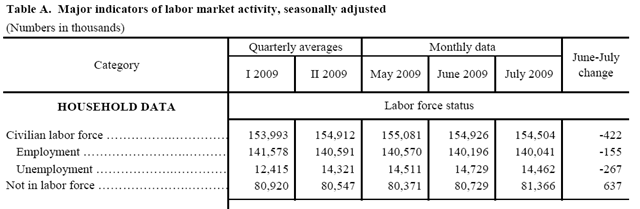
About 155,000 fewer people were employed in July.
But, according to the BLS, the labor force contracted by 422,000 people.
The bulk of the “contraction” were unemployed people who “got discouraged that there were no jobs available for them” and stopped looking for work …
The discouraged “contractors” get dropped from both the numerator and the denominator of the unemployment rate calculation.
So, net unemployment increased by 267,000 people … but the unemployment rate improved from 9.5% to 9.4%.
If the discouraged folks were still looking, the rate would have increased to about 9.6%
Geez.
* * * * *
Lowlights
The number of long-term unemployed (those jobless for 27 weeks or more) rose by 584,000 over the month to 5.0 million.
1 in 3 unemployed persons were jobless for 27 weeks or more.
There were 796,000 discouraged workers in July, up by 335,000 over the past 12 months.
Full BLS Report
http://www.bls.gov/news.release/pdf/empsit.pdf
* * * * *
Great “catch” by Byron York of the Washington Examiner …
* * * * *
The front page of Sunday’s New York Times is filled with hope about the nation’s economic situation. The lead story, reporting a decline in the unemployment rate from 9.5 percent in June to 9.4 percent in July, begins by declaring that, “The most heartening employment report since last summer suggested on Friday that a recovery was under way — and perhaps gathering steam.”
* * * * *
The Times hasn’t always been so optimistic when it comes to one-tenth-of-a-point declines in the unemployment rate. On this very day in 1992, in the midst of the presidential campaign between George H.W. Bush and Bill Clinton, the government also reported that the unemployment rate ticked downward by one tenth of a point, , edging down to 7.7 percent from 7.8 percent,”and the Times’ treatment was far more restrained:
Even though the number of jobs actually went up in July 1992 (as opposed to the decline of 247,000 jobs in July 2009), the 1992 Times reported that the economic news “gave no suggestion that the economic recovery was breaking out of its painfully slow pace or, more important, that the job growth was picking up enough to push the unemployment rate down significantly … and the improvement is not enough to signal a stronger economic recovery .”
As it turned out, the one-tenth-of-a-point drop in the unemployment rate in July 1992 signaled the end of the increase in the jobless rate.
* * * * *
Source article:
Washington Examiner, “NY Times touts economic momentum, recovery; in 1992, not so much”, York, 08/08/09
http://www.washingtonexaminer.com/opinion/blogs/beltway-confidential/Times-touts-economic-momentum-recovery-in-1992-not-so-much-52781412.html
* * * * *
Among the Latest Innovations From Major Brewers Fighting for Business in a Jammed, Sluggish Market
MillerCoors has begun testing the sale of $20 draft-beer systems for consumers to drink at home, part of a string of new products and package innovation from beer giants grappling for market share in a crowded, slow-growing industry.
The 1.5-gallon boxed product, which is designed to fit into refrigerators for drinkers to consume periodically, rather than for one-time party use.
Sales of major U.S. beer brands are struggling as some recession-weary consumers drink less or switch to cheaper brews.
Despite a new ad campaign this year aimed at revitalizing the brand, Miller Lite’s retail sales fell 7.5% by volume.
Sister brew Coors Light, on the other hand, continues to post sales gains. Analysts attribute its long-running success in part to innovations in packaging, such as “cold-activated bottles,” whose labels turn blue when the beer inside cools to a certain temperature.
MillerCoors’s new Home Draft systems are meant to be placed upright in a refrigerator, which will keep the beer fresh for about 30 days. The price per ounce is roughly 15% higher than for an 18-pack of the same beer.
The product, which is recyclable, is aimed at the 30% of beer drinkers who say they prefer draft beer to the bottled or canned variety.
“We’re really trying to meet that occasion when you just got back from work and want to reward yourself,” rather than “the party occasion,” he said.
Excerpted from WSJ, MillerCoors Tests a Draft-Beer Box for the Fridge, July 29, 2009
http://online.wsj.com/article/SB124882355717088341.html
* * * *
DARPA – the Defense Advanced Research Projects Agency — is the Defense Dept.’s famous research branch.
Created at the height of the Cold War to bolster U.S. military technology following the Soviet Union’s Sputnik satellite launch, the agency has a long history of innovation.
Most famously, DARPA’s researchers first linked together computers at four locations in the early 1960s to form the ARPANET, a computer network for researchers that was the core of what eventually grew into the Internet.
Other breakthroughs have fueled big advances in commercial areas , including:
Excerpted from Business Week, Can the Military Find the Answer to Alternative Energy?, July 23, 2009
http://www.businessweek.com/magazine/content/09_31/b4141032537895.htm
OK, I’ve got a dog in this fight.
ObamaCare goes after old folks.
Why not go after the horizontally challenged?
Hmmmm …
* * * * *
According to the Wall Street Journal:
The prevalence of obesity rose 37% between 1998 and 2006.
Obese people spent 42% more than people of normal weight on medical costs in 2006.
* * * * *
According to the National Bureau of Economic Research, the percentage of male citizens who are clinically rated as obese,
Japan 2.8%
France 9.8 %
Germany 14.4%
Canada 17.0%
U.K. 22.7%
U.S. 31.1%
Percentages are similar for females.
Source post:
http://gregmankiw.blogspot.com/
* * * * *
According to the Centers for Disease Control and Prevention:
Overall, about 26 percent of U.S. adults are obese, including …
39% of black women
36% of black Americans
29% of Hispanics
24% of whites
Source article:
http://www.newser.com/article/d99frjv01/state-by-state-obesity-statistics-show-blacks-have-the-largest-waistlines.html
For the full study (worth browsing):
http://www.cdc.gov/nchs/data/databriefs/db01.pdf
* * * * *
Draw your own conclusion
* * * * *
A loyal reader replied to my original post “ You’re too focused on Obama’s disapproval ratings”, the market is reacting in a “normal” way to a Democratic president. He referenced a Forbes article by investment guru Ken Fisher.
The Obama Effect. Ken Fisher, 06.03.09
http://www.forbes.com/forbes/2009/0622/wall-street-stocks-obama-portfolio-strategy.html
“Wall Street marks down stocks before a Democrat takes office–before, in fact, he is even elected. After the inauguration there’s a good chance for a rebound.
With Democratic politicians the big fear is about how antibusiness and anticapitalist they will be.
Obama says lots of stupid, scary things. That fear hit markets early in the election cycle (and early after inauguration).
But once in office the overwhelming motivation of a left-of-center President slowly morphs toward getting reelected.
Achieving that means pandering more to the independent voters and liberal Republicans, less to the Democratic power base.
Obama’s concern now is the recession and the job creators that can take us out of it. That means slowly backing off soak-the-rich, anticorporate talk over time.
The reverse happens with Republicans. They come in riding high expectations for pro-business, pro-growth policies–and inevitably disappoint investors as they drift away from their power base. Optimism fades, depressing stocks.”
* * * * *
Ken’s Take: Rather than contradicting my original point (market buoyed as O’s disapproval increases), I think Fisher’s observation supports it.
Though O is in battle mode now to push through Cap & Tax and nationalized healthcare, the market is assuming that the increasing opposition (as indicated in the disapproval numbers) will make him come to his senses and move to the middle, i.e. start to act more like a “normal” Democratic president.
My prediction stands: if O fends off the opposition now, stays way left, and gets C&T and ObamaCare … the market will tank. We’ll see.
* * * * *
Thanks to Mike for the feedback.
* * * * *
Ken’s Take: This article is specific to the auto industry but the general principles are applicable to most businesses.
* * * * *
Excerpted from: WSJ, The Auto Industry’s Comeback, July 29, 2009
The future of any car company is built on the relative success of its new cars.
Between now and 2014 there will be approximately 250 launches of either all-new or significantly redesigned new cars in the U.S.
* * * * *
What constitutes a successful launch?
First, focus on the true indicators of how well a launch is going. Sales reports are not enough. What are the cars actually selling for at retail? Do the vehicles require incentives? Are dealers earning a profit? How are the residual values holding?
Second, the company must deliver a high-quality product if sales are to be sustained. Getting things right from the start has become the price of admission. Even the most subtle mistakes—like user-unfriendly technology—can kill off an otherwise promising product.
Third, the vehicle must have appeal. Owner delight with the design, content, layout and performance can be objectively measured. Attributes such as drivability, instrument panel layout can make the buyer an advocate and give the launch momentum.
Fourth, the products must have durability and reliability. It takes about three years to get a good reading on how the consumer feels about these two qualities. But we do know there is a direct relationship between a brand’s reputation for reliability and durability and its performance. So part of the assessment should include a look at the reputation of the brand. Where the reputation is strong, the launch gets a boost.
Fifth, while manufacturers launch cars, dealers sell them. The dealer’s willingness to put his best sales people on the new product, advertise vigorously, finance, carry and merchandise (a fancy word for trick out) the requisite inventory is all a reflection of the dealer’s confidence in the franchise. Brands that enjoy a high level of dealer confidence and exclusive dealership facilities have a more effective channel for launching a new vehicle.
Full article:
http://online.wsj.com/article/SB10001424052970204886304574308202570479912.html
* * * * *
I think the recent stock market run-up is largely attributable to Pres. Obama’s declining approval ratings … and the numbers seem to corroborate the conclusion (chart below plots O’s disapproval rating vs the DJIA).
Specifically, when O’s approval dropped below 55% (i.e. disapproval increased above 45%) in late June, the market started a big rally. Of course, correlation doesn’t necessarily connote causation. So, what’s the explanation?
Simple. The market is scared to death of Cap & Tax, Trillion $ Government Healthcare, and astronomical national debt. As O’s approval flags, odds go against T&C and ObamaCare. The market is factoring in severely watered down initiatives … or a long, long delay in the legislative process.
Pay close attention to O’s approval ratings and public support for ObamaCare. If those two related metrics gain renewed traction, the market will stall – and probably will tank again. Just watch.

* * * * *
Ken’s Take: I’m still betting under on this one …
* * * * *
According to the WEJ …
Ssome analysts are predicting that new car sales could hit 15 million in 2012 because …
Conceivably, streamlined car manufacturers are positioned to make serious money when the market turns up.
* * * * *
Excerpted from: WSJ, The Auto Industry’s Comeback, July 29, 2009
http://online.wsj.com/article/SB10001424052970204886304574308202570479912.html
* * * * *
Summary: The recession is starving the government of tax revenue, just as the president and Congress are piling a major expansion of health care and other programs on the nation’s plate and struggling to find money to pay the tab. The deep recession is reducing incomes, wiping out corporate profits and straining government programs.
Ken’s Take: There will be no talk of slowing spending … marginal rates will go up (for more than the top 1%) … the economy will stall (again)
* * * * *
Excerpted from: AP ENTERPRISE, Biggest tax revenue drop since 1932, Aug. 3, 2009
Tax receipts are on pace to drop 18 percent this year, the biggest single-year decline since the Great Depression, while the federal deficit balloons to a record $1.8 trillion.
The last time the government’s revenues were this bleak, the year was 1932 in the midst of the Depression.
* * * * *
While much of Washington is focused on how to pay for new programs such as overhauling health care — at a cost of $1 trillion over the next decade — existing programs are feeling the pinch, too.
* * * * *
The future of current programs — not to mention the new ones Obama is proposing — will depend largely on how fast the economy recovers from the recession’.
Full article:
http://www.google.com/hostednews/ap/article/ALeqM5ibGXhJv-N7Qg6nh-nQpPOgJRTgugD99RMD200
* * * * *
Ken’s Take: Don’t blame me ! My personality is derived from my body chemistry.
Perhaps, this is how marriage blood tests should be applied …
* * * * *
From: The Numerati, Stephen Baker, Haughton Mifflin, 2008
In the late 1990s, researchers began looking into the biology of personality: the genes, neurotransmitters, and specifically, the hormones.
A theory emerged at four different hormones — estrogen, testosterone, dopamine, serotonin – mold personalities.
People with lots of dopamine are likely to be “Explorers” — optimistic risk takers. Explore issues words like excite, spirit, dream, fire, and search. Explorers have a tendency to fly off in different directions the minute they get bored. They get into relationships fast, wonder how they got there, and then try to weasel their way out.
Serotonin breeds “builders” who tend to be calm and organized and work well in groups. Builders have a tendency to talk about law, honor, limits, and honesty. Builders like to keep finances in order, map out vacations, and make sure the cats get their latest battery of rabies shots.
People brimming with testosterone — two thirds of whom are men — our “directors”. They are analytical, logical, and often musical. Directors focused largely on the physical world and over use words like aim, measure, strong, and hard. They also talk a lot about “thinking.”
People high in estrogen are at the “negotiators.” They are verbal and intuitive, and a good people skills. Negotiators talked about links, bonds, love, team, and participation. Negotiators are smooth talking, problem solvers who patched together friendships.
* * * * *
When it comes to relationships,
* * * * *
Ken’s Take: Don’t blame me ! My personality is derived from my body chemistry.
Perhaps, this is how marriage blood tests should be applied …
* * * * *
From: The Numerati, Stephen Baker, Haughton Mifflin, 2008
In the late 1990s, researchers began looking into the biology of personality: the genes, neurotransmitters, and specifically, the hormones.
A theory emerged at four different hormones — estrogen, testosterone, dopamine, serotonin – mold personalities.
People with lots of dopamine are likely to be “Explorers” — optimistic risk takers. Explore issues words like excite, spirit, dream, fire, and search. Explorers have a tendency to fly off in different directions the minute they get bored. They get into relationships fast, wonder how they got there, and then try to weasel their way out.
Serotonin breeds “builders” who tend to be calm and organized and work well in groups. Builders have a tendency to talk about law, honor, limits, and honesty. Builders like to keep finances in order, map out vacations, and make sure the cats get their latest battery of rabies shots.
People brimming with testosterone — two thirds of whom are men — our “directors”. They are analytical, logical, and often musical. Directors focused largely on the physical world and over use words like aim, measure, strong, and hard. They also talk a lot about “thinking.”
People high in estrogen are at the “negotiators.” They are verbal and intuitive, and a good people skills. Negotiators talked about links, bonds, love, team, and participation. Negotiators are smooth talking, problem solvers who patched together friendships.
* * * * *
When it comes to relationships,
* * * * *
I still don’t get it, but obviously I was wrong when I bet under on Cash for Clunkers (C4C). I disn’t think it would generate much showroom traffic, let alone sales.
Bit by all reports, C4C is the hottest promotion since Hoover UK almost bankrupted itself by offering free plane tickets with the purchase of a vacuum cleaner.
Where did I go wrong ?
First, I assumed that the $4,500 government rebate was just a replacement for a trade in allowance. So, only real clunkers – worth less than $4,500 as a trade – would be advantaged.
Second, I assumed that clunkers were being driven by downscale folks who didn’t have the scratch for brand new rides – who bought used cars and drove them until they died. These folks, I thought, wouldn’t be able to step-up to buy new cars.
Apparently, many rich folks make their teenage or college kids drive hand-me-down cars – maybe to humble them. Dealers are saying that these are the clunkers being traded in. So, the kids get fancy new bumpers for their Obama ‘08 stickers.
Third, and most important, I underestimated naturally pent-up demand. According to an analysis by Edmunds.com “in any given month 60,000 to 70,000 “clunker-like” deals happen with no government program in place .. over 100,000 buyers put their purchases on hold waiting for the program to launch.”
OK, I missed on the program’s initial take-up, but I still see problems:
1) Reports say that the bulk of deals are for non-Detroit brands. Oops.
2) Easy prediction: fraud will be prevalent, e.g. clunkers showing up on used car lots instead of scrap heaps.
3) It’ll be hard to go off the needle. Over the past few years, auto companies have tried – with only modest success – to wean the market off deep price rebates.
Let’s see what happens when taxpayer-funded discounts end. Hmmm.
Maybe they won’t. Ouch.
Even so, gotta admit that it makes me smile to see the President touting Cash for Clunkers as his administration’s hallmark stimulus initiative. That alone is worth a couple of billion dollars.
* * * * *
Source for Edmunds data
http://online.wsj.com/article/SB10001424052970204619004574324350084909302.html?mod=djemEditorialPage
* * * * *
The Numerati, Stephen Baker, Haughton Mifflin, 2008
Ken’s Take: I read it so you don’t have to.
I was really excited when the TV show “Numbers” launched. Being a quant guy, I thought the concept of solving crimes by using math analysis had a ring to it. Disappointment set in (for me) when they started focusing on the characters and their relationships instead of the numbers. Oh well.
I was equally as excited about the prospects for The Numerati … and about equally as disappointed. Nice topic, but way too superficial.
The central premise of the book is good: prolific data accumulation (including mucho private data), integration of massive data sets, high speed data access and processing, sophisticated statistical models and data mining algorithms, and an increasing number of uses and users … is making all facets of life more and more numbers based.
* * * * *
Specifically, Baker provides some anecdotal examples of numbers-in-use:
Bottom line: For businesses, quant analytics used to provide a competitive edge. Now, they are required just to compete.
For individuals, kiss privacy good-by and expect to be increasingly targeted with customized products and promotions.
“These statistical tools are going to be quietly assuming more and more power in our lives. We might as well grab the controls and use them for our own interests.”
* * * * *
Ken’s Take: Understandably, the focus on home prices tends to be on the recent month-to-month and year-to-year changes – since that’s what hits people’s net worth. There appear to be some signs that some markets are bottoming out.
Usually lost in the shuffle is the fact that longer term, say back to 2000, housing prices in many (most?) markets have shown “healthy” annualized increases – even after adjusting for the market crash. For example, current housing prices in the DC market translate to an annualized inflation rate of about 6% since 2000.
Of course, that isn’t much consolation to folks who bought their houses during the boom period.
* * * * *
Annualized since 2000
The Case Shiller indices have a base value of 100 in January 2000. So a current index value of 150 translates to a 50% appreciation rate since January 2000 for a typical home located within the metro market.

* * * * *
Monthly and Annual Changes
Source: WSJ, Case-Shiller July 2009 update, July 29,2009
The S&P/Case-Shiller home-price indexes, a closely watched gauge of U.S. home prices, posted their first month-to-month increase in nearly three years in May, but annual weakness continued. (See charts below)
Las Vegas and Phoenix continued to posted the largest monthly and annual declines. Phoenix is down 55% from its peak in June 2006, while Las Vegas is off 53% from its highest level.
* * * * *


Full article and interactive chart:
http://blogs.wsj.com/economics/2009/07/28/a-look-at-case-shiller-numbers-by-metro-area-july-2009-update/
* * * * *
Ken’s Take: Lots is written on how to be innovative. This is a nice checklist of frequently used methods …
* * * * *
Extracted from WSJ, “In Search of Innovation”, Bessant, June 23, 2009
When companies try to come up with new ideas, they too often look only where they always look. That won’t get them anywhere.
If you want to understand why some companies lack innovative ideas, think about the man who can’t find his car keys.
His friend asks him why he’s looking for the keys under the lamppost when he dropped them over on the lawn. “Because there’s more light over here,” the man explains.
Innovative ideas, however, don’t really come from nowhere. Instead, they are typically at the edge of a company’s radar screen, and sometimes a bit beyond: trends in peripheral industries, unserved needs in foreign markets, activities that aren’t part of the company’s core business.
In other words, they have to look away from the lamppost.
None of this is easy to do. But companies that succeed may just recognize the next great opportunity, or looming threat, before their competitors do.
Here are nine examples of practices with the potential to produce a company’s eureka moment.
BUILD SCENARIOS
Many companies use teams of writers with diverse perspectives to create complex scenarios of what future markets may look like. The writers try to imagine detailed opportunities and threats for their companies, partners and collaborators. An oil company that wants to explore energy opportunities in cities of the future, for example, might want to work on scenarios with writers from construction, water and utility-management companies.
SPIN THE WEB
A few companies have created Web sites that act as literal marketplaces of ideas. InnoCentive.com is a site where people and companies look for help in solving scientific and business challenges. Posters of challenges sometimes offer cash rewards for solutions: Amounts have ranged from $5,000 to $1 million. Problem solvers can be professionals, retired scientists, students or anyone who can answer a problem that has stumped a company’s own researchers.
ENLIST LEAD USERS
Ideas and insights from so-called lead users can be the starting point for new markets, products and services.
Lead users are innovators themselves. They tend to be people working in or using products in a specific market who are frustrated by the tools, goods or services currently available and yearn for something better. Many medical devices, for example, originate from sketches drawn by surgeons, surgical nurses and other medical staff who feel driven to experiment with new ideas because current products aren’t meeting their needs. They are often supportive, and tend to tolerate product failures as part of a process that helps bring about improvements.
DEEP DIVE
Interest has surged in market research that uses detailed, firsthand observation to learn more about consumers’ needs or wants. Deep diving is one of many terms used to describe the approach, which resembles an anthropological study in the way researchers immerse themselves in the lives of the target consumers.
Such approaches can help uncover underserved or unserved markets and give clues to new directions and new frames in which to search for innovative ideas.
PROBE AND LEARN
Some companies design probe-and-learn strategies that study opportunities in segments of markets the company isn’t active or strong in. This strategy goes further than deep diving by actively experimenting with new ideas in a new context. The experiments might not always work, but they will give valuable insight about future directions of markets.
MOBILIZE THE STAFF
By engaging more of its own workers in the search for innovation, a company can broaden its vision. For example, the duties of procurement, sales or finance groups can be expanded to include learning about trends they encounter that ordinarily might be considered not of primary interest to the company.
CATER TO ENTREPRENEURS
Innovation can bubble up inside a company as well—when the organization follows practices that favor it.
Clear policies that reserve blocks of time for scientists or engineers to explore their own ideas have worked well at some companies. At 3M Co., based in St. Paul, Minn., scientists can spend 15% of their time on projects they dream up themselves, and the company has set procedures to take bright ideas forward, including grants and venture funding. Google Inc. takes a similar approach, allowing researchers to devote 20% of their schedules to play time, pursuing their own ideas and projects.
It helps to have an established pathway to make sure the best new ideas get taken forward. In some cases, informal networking has pushed innovations to the forefront—below the radar screen of formal corporate systems.
START A CONVERSATION
Sometimes innovations arise when different departments talk to each other. But what’s the best way to start the conversation?
Many companies set up so-called communities of practice, which are typically internal Web sites where employees are encouraged to share knowledge and skills important to the company.
BREED DIVERSITY
Close, long-term relationships—depending too much on the same customers, partners or suppliers for innovation ideas—can reinforce old ways of doing things and make changing a frame of reference difficult.
Some companies seek innovation partners with whom they wouldn’t normally work, and who might bring a fresh perspective. Some companies are also recruiting staff with very different perspectives to spice up their knowledge mix e.g. experienced entrepreneurs. Such characters aren’t afraid to challenge corporate perspectives and to make waves. As one manager put it, they create a little grit to stimulate the oyster to produce pearls.
full article:
http://online.wsj.com/article/SB10001424052970204830304574133562888635626.html
* * * * *
According to recent polls …
91% of all Americans have insurance …,
84% of Americans who have health insurance are happy with their coverage….
That means that 76% of all Americans will be concerned about anything that threatens their current coverage.
By a 2-1 margin, Americans want coverage from a private provider rather than the government.
* * * * *
Of those who do not have insurance—and who therefore might be better off under OnamaCare …
Approximately one-fifth are illegal aliens …
Nearly three-fifths make $50,000 or more a year and can afford insurance (and most have access to plans)
And just under a third are eligible for Medicaid or other government programs already (but haven’t signed up).
The slice of the uninsured that is left is perhaps about 2% of all American citizens
* * * * *
So, spend $1 trillion and put the world’s greatest health-care system at risk ? Hmmmm.
Excerpted from: WSJ, Obama’s Great Health Scare, July 29, 2009
http://online.wsj.com/article/SB10001424052970204619004574318334081271414.html
* * * * *
Disclaimer: I’m not unbiased. Outback is the Homa family restaurant of choice for fancy family meals.
Ken’s Take: It’s always risky to move away from your traditional value proposition. Outback is known for a quantity not quality. Reducing the quantity – even with a commensurate cut in prices – could alienate core customers (like me).
Note that customers get lured in by the lower prices, but end up spending about the same amount as before. Another marketing triumph, right ?
* * * * *
Business Week, The Leaner Baby Boomer Economy, July 23, 2009
[Hit by the recession], Outback Steakhouse … reduced menu prices and offered smaller cuts of beef at Outback to maintain margins … and has gone on an ad blitz pushing the more modest portions for $9.99. This is obviously a tricky balancing act at Outback, where a big slab of meat was the chain’s main attraction.
The good news, says Chief Branding Officer Jody Bilney, is that people who order the less expensive entrées typically end up buying dessert or more alcohol, so the average ticket is still about $19 per person.
Full article – includes vignettes on BMW, Starwood Hotels and others:
http://www.businessweek.com/magazine/content/09_31/b4141026524433.htm
* * * * *
Now that the proposed healthcare reform bills are available for public consumption, folks are reading the fine print and some disconcerting details are surfacing are surfacing.
Fortune has a nice summary article with some of the “give-ips” …
* * * * *
Fortune, “5 freedoms you’d lose in health care reform”, June 24,2009
“Read the fine print in the Congressional plans and you’ll find that a lot of cherished aspects of the current system would disappear.
You will lose all of those good things (and more) under the rules proposed in the two bills that herald a health-care revolution”
Full article:
http://money.cnn.com/2009/07/24/news/economy/health_care_reform_obama.fortune/index.htm?postversion=2009072410
* * * * *
Ken’s Take: Whenever my family talks about how the healthcare system is broken, the conversation usually centers on how hard it is to get an appointment to see a doctor. Turns out, doctors are in short supply – it’s not just an illusion. And, healthcare reform proposals add to demand (more people insured to get more services), but don’t add to the supply of doctors and other medical professionals.
Side note: A friend reminded me that MDs are among the 45 million uninsureds – they often comp services to each other, so don’t need garden variety health insurance. That’s about 1 million out of the 45 million.
* * * * *
Excerpted from USA TODAY, Medical miscalculation creates doctor shortage, March 21,2005
Many Americans may soon face a shortage of physicians that makes it hard to find convenient, quality health care. The shortage will worsen as 79 million baby boomers reach retirement age and demand more medical care unless the nation starts producing more doctors, according to several new studies.
The country needs to train 3,000 to 10,000 more physicians a year — up from the current 25,000 — to meet the growing medical needs of an aging, wealthy nation, the studies say. Because it takes 10 years to train a doctor, the nation will have a shortage of 85,000 to 200,000 doctors in 2020 unless action is taken soon.
The predictions of a doctor shortage represent an abrupt about-face for the medical profession. For the past quarter-century, the American Medical Association and other industry groups have predicted a glut of doctors and worked to limit the number of new physicians.
The nation now has about 800,000 active physicians, up from 500,000 20 years ago. They’ve been kept busy by a growing population and new procedures ranging from heart stents to liposuction.
But unless more medical students begin training soon, the supply of physicians will begin to shrink in about 10 years when doctors from the baby boom generation retire in large numbers.
“Almost everyone agrees we need more physicians … The debate is over how many.”
The United States dramatically expanded the number of doctors being trained in the 1960s and 1970s, creating two new physicians for every one that retired.
Today, new physicians roughly equal the number of doctors retiring. Within a decade, baby boom doctors licensed in the 1960s, 1970s and 1980s will retire in large numbers that will outstrip the 25,000 new doctors produced every year.
The marketplace doesn’t determine how many doctors the nation has, as it does for engineers, pilots and other professions. The number of doctors is a political decision, heavily influenced by doctors themselves.
Congress controls the supply of physicians by how much federal funding it provides for medical residencies — the graduate training required of all doctors.
To become a physician, students spend four years in medical school. Graduates then spend three to seven years training as residents, usually treating patients under supervision at a hospital.
Medicare, which provides health care to the nation’s seniors, also is the primary federal agency that controls the supply of doctors. It reimburses hospitals for the cost of training medical residents.
The government spends about $11 billion annually on 100,000 medical residents, or roughly $110,000 per resident.
In 1997, to save money and prevent a doctor glut, Congress capped the number of residents that Medicare will pay for at about 80,000 a year. Another 20,000 residents are financed by the Veterans Administration and Medicaid, the state-federal health care program for the poor. Teaching hospitals pay for a small number of residents without government assistance.
Demographic changes in the medical profession also contribute to the need for more physicians. Nearly half of new physicians are women, who work an average of 25% fewer hours than male physicians, Cooper says.
Physicians older than 55 work about 15% less than younger doctors.
Most worrisome, the retirement of baby boom physicians means the number of doctors will start falling just as the first baby boomer turns 70 in 2016.
Because physicians are affluent and in short supply, they tend to locate where they want to live — not necessarily where the most patients are.
Particularly scarce are old-fashioned specialists — general surgeons, radiologists, anesthesiologists — who have a wide range of duties.
Doctors gravitate to high-paying practices — such as sports medicine and total body scans — that serve the wealthy and well-insured at the expense of Medicare patients and others.
“This is a desperate situation. And we need to act now because it takes a long time to train a doctor.”
The U.S. stopped opening medical schools in the 1980s because of the predicted surplus of doctors.
Florida State University’s College of Medicine, the first new medical school since 1982, will graduate its first class this year. Arizona, Nevada, California and Florida are considering opening additional medical schools. Other states are considering expanding theirs.
http://www.usatoday.com/news/health/2005-03-02-doctor-shortage_x.htm
* * * * *
Ken’s Take: Why weren’t any of these questions asked at last week’s press conference?
This guy cuts to the chase …
* * * * *
Exreacted from RCP, “10 Questions for Supporters of ObamaCare”, Dennis Prager, July 28, 2009
1. If Medicare and Medicaid are fiscally insolvent and gradually bankrupting our society, why is a government takeover of medical care for the rest of society a good idea? Why not simply see how the Democrats can reform Medicare and Medicaid before nationalizing much of the rest of health care?
2. President Obama reiterated this past week that “no insurance company will be allowed to deny you coverage because of a pre-existing medical condition.” But if any individual can buy health insurance at any time, why would anyone buy health insurance while healthy? Why would I not simply wait until I got sick or injured to buy the insurance? The whole point of insurance is that the healthy buy it and thereby provide the funds to pay for the sick. And if the answer is that the government will now make it illegal not to buy insurance, how will that be enforced? How will the government check on 300 million people? Will life insurance companies also be forced to sell life insurance to the terminally ill?
3. Why do supporters of nationalized medicine so often substitute the word “care” for the word “insurance?” it is patently untrue that millions of Americans do not receive health care. Millions of Americans do not have health insurance but virtually every American (and non-American on American soil) receives health care.
4. No one denies that in order to come close to staying within its budget health care will be rationed. But what is the moral justification of having the state decide what medical care to ration?
5. Given how many lives — in America and throughout the world – American pharmaceutical companies save, and given how expensive it is to develop any new drug, will the price controls on drugs envisaged improve or impair Americans’ health? While 20 years ago pharmaceuticals were largely developed in Europe, European price controls made drug development an American enterprise. Fifteen of the 20 top-selling drugs worldwide this year were birthed in the United States.
6. Do anyone really believe that private insurance could survive a “public option” … given that private companies have to show a profit and government agencies do not have to – and given that a private enterprise must raise its own money to be solvent and a government option has access to others’
money — i.e., taxes?
7. Why will hospitals, doctors, and pharmaceutical companies do nearly as superb a job as they now do if their reimbursement from the government will be severely cut? Haven’t the laws of human behavior and common sense been repealed here in arguing that while doctors, hospitals and drug companies will make significantly less money they will continue to provide the same level of uniquely excellent care?
8. Given how many needless procedures are ordered to avoid medical lawsuits and how much money doctors spend on medical malpractice insurance, shouldn’t any meaningful “reform” of health care provide some remedy for frivolous malpractice lawsuits?
9. Given how weak the U.S. economy is, given how weak the U.S. dollar is, and given how much in debt the U.S. is in, why would anyone seek to have the U.S. spend another trillion dollars?
10. Contrary to the assertion of President Obama — “we spend much more on health care than any other nation but aren’t any healthier for it” — we are healthier. Our life expectancy with virtually any major disease is longer. And if you do not count deaths from violent crime and automobile accidents, we also have the longest life expectancy. Do you think a government takeover of American medicine will enable this medical excellence to continue?
Full article:
http://www.realclearpolitics.com/articles/2009/07/28/10_questions_for_supporters_of_obamacare_97651.html
* * * * *
Real case : Wife Kathy called to get an appointment with a demotologist to have a suspicious mark checked out. First open slot – mid October… in 10 weeks.
Ken’s Take: So, will cutting pay rates for docs increase or decrease the supply of doctors – who get trained & certified, and who stay in the doctoring business. Do any of the bills being circulated provide for more seats at existing med schools or funding new medical schools. Answer: no.
* * * * *
Knowledge@Wharton, Another Hurdle to Health Care Reform: Too Few General Practice Doctors, July 22, 2009
According to a recent survey by Merritt Hawkins, the average wait time to see a family doctor for a routine physical ranged from seven days in Miami to 63 days in Boston.
In eight of 15 metropolitan areas surveyed by the company, it took at least 14 days to be seen by a family physician.
Why ?
The American Association of Medical Colleges (AAMC) projects that … there will be a be a shortage of 124,000 doctors of all types by 2025, although the number could climb to as high as 159,000.
The supply of primary care physicians is already tight in some parts of the country, and finding a general practice doctor will probably become even harder if the pool of insured Americans expands.
“The biggest chokepoint in the health care system will be the availability of primary care doctors,” … The physician bodies just aren’t there.”
Experts are particularly worried about a dearth of doctors to focus on primary care services, including routine checkups and sick visits. There are already primary care physician shortages
Full article
http://knowledge.wharton.upenn.edu/article.cfm?articleid=2297
* * * * *
Ken’s Take: The subject of “covering the uninsureds” drives me nuts. First, the pol-preachers are either sloppy and /or very disingenuous with the numbers. Second, they talk about the uninsureds as a homogeneous group – they’re not. Third, the only prescription is to throw money at them.
Below is a reprised post from June that breaks down the numbers.
Note that over 20% of the uninsureds aren’t even U.S. citizens. I’ve seen estimates that roughly half of rhis group are illegal aliens. Covering these non-citizens – i.e making tax payers reward them with free health insurance –- will run about $70 billion annually – that’s $700 billion over 10 years. Count me out on that one.
Over 1/3 are folks are emplyed and make enough to afford health insurance – most of these folks have access to company plans but choose not to participate. Why should tax payers have to throw a single dime towards their health insurance. That’s nuts. OK, pressure insurance companies to offer coverage for those who don’t have access to plans. But, don’t reward them for spending on big screens instead of health insurance.
That leaves about 20 million folks. Most are between jobs. Remember that COBRA provides access to coverage for 18 moths. I’m OK giving these folks some subsidy since COBRA can be pretty expensive – in essence, an employer’s contribution.goes away. So, beef up unemployment benefits a bit.
The remainder of uninsureds are, I guess, poor folks. Since they should qualify for Medicaid, I don’t understand why they’re a problem. Make them get off the couch and sign up for the existing benefits.
Why is “covering the uninsureds” the paramount issue of our time? I don’t get it.
* * * * *
Reprised post from June 18, 2009
Ken’s Take: This isn’t new news, but it continues to be overlooked in the press and in Presidential speeches. About 1/3 of “uninsureds” aren’t US citizens; about 1/3 are young and gainfully employed who choose to self-insure. That leaves about 15 million who need to be taken care of. Why aren’t “they” more truthful with the numbers?
* * * * *
Excerpted from IBD, “The Phantom Uninsured”, June 16, 2009
Team Obama uses the “46 million uninsured” as a reason to nationalize health care. But the Census Bureau says about a fifth of those aren’t U.S. citizens. In fact, a goodly number are illegal aliens.
According to “Income, Poverty, and Health Insurance Coverage in the United States,” a Census Bureau report published last August, of the 45.6 million persons in the U.S. that did not have health insurance at some point in 2007, 9.7 million, or about 21%, were not U.S. citizens.
Also among the uninsured are 17 million Americans who live in households where the annual income exceeds $50,000; 7 million of those without coverage have incomes of $75,000 a year or more. Many of the uninsured are young and healthy (40% are between ages 18 and 34) and at this point in their lives, particularly in this economy, choose to put their dollars elsewhere
“Why the lack of insurance (among people who own homes and computers)? One clue is that 60% reported being in excellent health or very good health.”
“For many, being uninsured is a transitory state, since most uninsured Americans are only without coverage for a short time.” In fact, a Census Bureau’s Survey of Income and Program Participation, found that only 19 million Americans go without insurance for a full year.
Full article:
http://www.ibdeditorials.com/IBDArticles.aspx?id=330042258549199
* * * * *
Ken’s Take: Since Rasmussen was first to report Obama’s approval below 50%, his methodology is being questioned by mainstream media. Below is a pretty clear explanation.
Bottom line: Rasmussen samples likely voters instead of all adults and distinguishes between ‘strong’ and ‘somewhat’ approval (and disapproval).
* * * * *
From RCP,Obama Upside Down, July 24th, 2009
Rasmussen officially becomes the first poll to show the President with an upside-down approval rating. The pollster has him at 49% approve, 51% disapprove today. Rasmussen’s polls are typically spot-on in the end, but he’s been a consistent outlier on the approval rating issue.
Part of this is that Rasmussen samples likely voters, while most pollsters are sampling adults or registered voters right now. Likely voters typically skew Republican by a few points. On the one hand, it is difficult to screen for likely voters this early on, but on the other hand, this could be something of a preview of whether things will go when other pollsters begin imposing likely voter screens.
The other thing is that Rasmussen gives for options: Strongly approve, strongly disapprove, somewhat approve, and somewhat disapprove. It may well be the case that, given a simple “approve/disapprove” rubric, many people who somewhat disapprove of the job Obama is doing are unwilling to give a complete “disapprove” answer. By adding the “somewhat” nuance, Rasmussen may be nudging voters into the “disapprove” camp.
One final thought: Rasmussen typically has fewer undecideds than other pollsters. It may be that people who somewhat approve or somewhat disapprove of the President are more likely to describe themselves as “undecided.” Pushed away from the “undecided” option, these voters may then choose the “somewhat disapprove” or “somewhat approve” option; it may be that, for now, the undecideds are leaning away from Obama. This would make sense, given the general sense of approval that has surrounded Obama’s first six months, there may be a large chunk of the populace that simply isn’t willing to voice disapproval of him right now.
At any rate, an unwelcome milestone for the President.
Source article:
http://realclearpolitics.blogs.time.com/2009/07/24/obama-upside-down/
* * * * *
Summary: Adapting to a more frugal consumer, Coach has created the less pricey Poppy line, revamping its product mix to lower its average bag price to $290
* * * * *
Excerpted from Business Week, “Coach’s Poppy Line Is Luxury for Recessionary Times”,June 18, 2009
The Coach brand brand had emerged from its modest origins in the 1940s to become an emblem of the working woman and then, remarkably, a favorite among the fashion-conscious. It had created the very conceit of affordable luxury.
But, even before the recession Coach had become too expensive. “We have a long history of being a very grounded $200 handbag business,” he says. “Beginning around 2001 we started moving up and became a $300 handbag business. Then we reached $330. And the customer came right with us. Until we reached our natural limits,” .
So began a nearly yearlong quest to design a line of purses and accessories that could be priced to fit the times without cheapening, or otherwise damaging, Coach’s image.
The resulting collection, which will be introduced in late June, is called Poppy. It’s more youthful, eclectic and spontaneous. The average price will be $260, about 20% less than the usual Coach purse.
The main pieces in the Poppy collection were tested in nine Coach stores and 23 department stores in April and May. And for the first time, Coach let people make online purchases through Facebook. Two $198 bags, the Groovy and the Glam, did better than Coach expected. But one didn’t do quite as well: That was the Spotlight, which sells for $298.
* * * *
Factoids
Coach spends about $5 million annually on that customer research. It frequently surveys customers about their outlook and tastes; it carefully tests new designs; it measures almost everything. Every three months it surveys some 20,000 women online about the Coach brand as well as about their economic expectations and spending habits.
Coach’s gross margins had been above 75% for the past five years. But during the recession, as the company has lowered prices at its factory stores, its margins have fallen to 72.4%. By comparison, brands such as Polo Ralph Lauren and Tiffany have margins of less than 60%.
Full article:
http://www.businessweek.com/magazine/content/09_26/b4137040272361.htm
* * * * *
The Rasmussen Reports daily Presidential Tracking Poll for Friday shows that 49% of voters say they at least somewhat approve of the President’s performance. Fifty-one percent (51%) disapprove.
Today marks the first time his overall approval rating has ever fallen below 50% among Likely Voters nationwide.
30% of the nation’s voters now Strongly Approve of the way that Barack Obama is performing his role as President. Thirty-eight percent (38%) Strongly Disapprove giving Obama a Presidential Approval Index rating of -8 .
Just 25% believe that the economic stimulus package has helped the economy.
Fifty-three percent (53%) now oppose the Congressional health care reform package. That’s up eight points over the past month.

* * * * *
,
Ken’s Take: If the U.S. healthcare system is so bad, why do foreigners from the utopian systems come to the U.S. for critical treatment?
I like the notion of making them pay list prices – very high list prices – to offset citizen healthcare costs.
Idea: why not put a high tax on healthcare services delivered to non-U.S. citizens ?
* * * * *
WSJ, Replicating Cleveland Clinic’s Success Poses Major Challenges, July 23, 2009
The key to the Cleveland Clinic’s success, many policy makers say, is its integrated approach. Like other so-called multispecialty clinics, the Cleveland Clinic employs its own physicians, creating teams of specialists that collaborate in treating each patient. By contrast, at most traditional community hospitals, doctors remain independent, private practitioners.
The Cleveland Clinic stays profitable by offsetting its losses on Medicare patients with payments from private insurers and thousands of foreign patients who often pay its full list prices. Those prices can be two to three times higher than what U.S. insurance plans negotiate with the clinic.
Full article:
http://online.wsj.com/article/SB124831191487074451.html
* * * * *
As usual, I have a different take on Obama’s press conference remark that Cambridge Mass. police acted “stupidly” by arresting a prominent black academic just because he was being disorderly.
Most press reports describe that statement as an “off the cuff” remark. I doubt it. Obama’s prior press conference outted the administration’s careful selection of questioners and their likely (or assured) questions. The mere fact that the question was last in the press conference leads me to conclude that it was orchestrated, and that the President’s answer was deliberate.
Why?
Though Obama campaigned as a grand uniter, he governs as a divider – rewarding folks he deems good guys (i.e. those who agree with him), and punishing those he considers bad guys (i.e. those who disagree with him).
RealClearPolitics observes “Obama maintains the strong support of his base … he continues to be the most polarizing modern president.”
http://www.realclearpolitics.com/articles/2009/07/23/obamas_public_support_cracking_at_6_months_97574.html
Cutting to the chase: Obama’s overall approval rating is 94% among blacks.
But 40% of whites and “others” strongly disapprove of his performance as president.
And, though his total approval among blacks remains sky high, the approval intensity is dropping. Shortly after the inauguration, over 80% of blacks strongly approved of his performance as president. That number has slipped down to 64% – still high, but eroding.
My take: Obama is a win at all costs guy. With his overall approval ratings falling and his chaotic healthcare plan faltering, he is going back to the well – revving up his core constituency – getting their intensity level back up – framing issues as “us” versus “them”. Watch that theme spill over to the healthcare debate.
Though I think he was trying to be clever, it looks like the gambit failed. Most news shows led with the “stupid white cop” story – pushing healthcare to the backburner – and stoking even greater polarization. Not good.
As the expression goes: “Too clever by half.”
* * * * *
Liberty & Tyranny, Mark Levin, Threshhold editions, 2009
13 weeks as #1 on the NY Times best seller list … w/o a NY Times review or author appearances on mainstrean TV
Ken’s Take: A tightly argued case – he’s obviously a (former) lawyer. Not much new news for card-carrying conservatives. I recommend the book for liberals – not because it will change your minds, but because it’s an efficient synopsis of conservative thinking. Know thy enemy.
* * * *
Highlights
Levin is constitutional scholar and former lawyer turned conservative radio talk show host. He’s quite animated on his show, so I was surprised that his book was very thoughtful. In summary, it lays out the body of conservative logic, tying it back directly to the Constitution.
He basic thesis is that liberal progressives – who he refers to as “statists” — consider the state (i.e. government – especially the federal government) to be supreme. Constitutional conservatives – he argues – consider the individual to be supreme. Preserving the rights of individuals is liberty; subordination of the rights to the is tyranny.
So, Levin argues:
For rights bestowed from a higher authority (i.e. God) — because the Constitution says so.
For faith, arguing that the establishment clause doesn’t foreclose mean that religion must be hidden and dismissed.
For states rights, saying that (1) the Constitution was meant to limit federal jurisdiction (2) that the diversity of wants, needs, and means requires it, and (3) that ‘mobility’ among locales let’s citizens situate in places most compatible with their interests (e.g move to Florida if you don’t like income taxes)
For the free market, arguing that it is the economic mechanism that promotes self-worth, self-sufficiency, shared values, and honest dealing.
Against taxes, except those that generate the revenue required to support the government’s constitutional activities (e.g. defence & security).
Against “enviro-statism” (e.g. cap & trade), asserting that the costs are usually far understated – for example, banning DDT eliminated a carcinogen, but also caused the incidence of malaria to re-surge and cause millions of deaths – especially in undeveloped areas.
For legal immigration, but against illegal immigration, including citizenship by birth, “chain” immigration (i.e. spousal citizenship), and sanctuary cities.
Though Levin offers a list of remedial actions — his Conservative Manifesto – it’s composed mostly of the usual list of suspects. Ideas that caught my eye are: term limits for judges (vs. lifetime appointments), sun-setting all Federal agencies (i.e. require that they be reestablished each budget cycle), and replacement of the current income tax system with a “fair” or flat tax.
* * * * *


 The Homa Files