Dems: “An inefficiently distributed base of voters”

October 20, 2010

An interesting election snippet that caught my eye …

“The Democratic Party has “an inefficiently distributed base of voters.”

It “consists mostly of union workers, upscale urban liberals and minority voters, many of whom are clustered in highly Democratic districts.”

In many other districts, Democratic candidates depend on “independents and soft partisans,” the very voters who have defected from the Obama coalition of 2008.

If Democrats lose control of the House by a small number of seats, this might be condign punishment for a practice they favor  — racial gerrymandering.

It concentrates African-American voters in majority-minority districts in order to guarantee the election of minority candidates.

George F. Will: An election of historic significance
http://www.unionleader.com/article.aspx?headline=George+F.+Will%3A+An+election+of+historic+significance&articleId=289c83e0-246d-46a2-aaa6-701321cf476f

What are women talking about?

October 20, 2010

TakeAway: Women consumers are an formidable force, shaping how billions of marketing dollars are spent annually.

However, getting a deep view of their market influence, especially in a digital and social age, has been hard to come by.  A new monthly brand index aims to change that.

Women drive 85% of all consumer purchases (often by being unofficial brand ambassadors) and talk about brands constantly – about 92 per week.

* * * * *
Excerpted from Brandweek, “Women’s Top Brands Listed” By Jim Cooper,September 27, 2010

A new monthly brand index that’s designed to be a comprehensive measure of the 25 brands most important to women compiles online search data, social media buzz data and online chatter.

Brands that used new media in their marketing mix were some of the biggest movers on the list. Gap, for example, which moved from No. 44 to No. 17 in August, offered a discount incentive to shoppers that checked in through Foursquare. Pizza Hut also offered a discount via Foursquare in August and saw its rank hit No. 60 from No. 73.

Brands with recently launched social initiatives also had solid gains on the index. Starbucks moved to No. 33 from No. 59 with a boost from buzz about an in-store donation program to help rebuild neighborhoods in New Orleans. And Olive Garden hit No. 92 from No. 145 with the news that it had raised $6 million for the Lymphoma and Leukemia Society through its Pasta for Pennies program.

Edit by AMW

* * * * *
Full Article:
http://www.brandweek.com/bw/content_display/news-and-features/direct/e3i386774579db7c2033a69ab0af09f5664?pn=1

* * * * *

Folks don’t think clearly when they’re scared …

October 19, 2010

Interesting blurb from Newsweek …

Obama said Saturday evening in remarks at a small Democratic fundraiser:

“Part of the reason that our politics seems so tough right now and facts and science and argument does not seem to be winning the day all the time is because we’re hardwired not to always think clearly when we’re scared.

Obama Clings Again! Blames “Scared” Voters.
http://www.newsweek.com/blogs/kausfiles/2010/10/17/obama-clings-again-blames-scared-voters.html

Point 1: True.  Every athlete knows that people perform worst when they’re in a state of panic. Every student who has taken a test knows that, too.

Point 2: Obama was clearly talking about the scared, dumb voters who haven’t seen the light and may — in their panic — pull the lever for a Repunlican in 2 weeks.

Question: Has the President looked in a mirror recently?

Maybe he doesn’t consider facts and science when he’s scared …

That would explain wacky moves like picking a fight with business, generally, and the US Chamber of Commerce. specifically.

To conform with ObamaCare, Boeing cuts employee health benefits …

October 19, 2010

Punch line: Boeing is joining the list of companies that say the new health care law has downsides for their workers and is paring its plan.

Ken’s Take:

(1) Last week, McDonald’s and 30 other companies got waivers from ObamaCare … let’s see how long it takes for Boeing to get their waiver.

(2) Boeing has a huge cluster on employees in Washington state … the Senate battle in Washington is close … incumbent Patty Murray voted for ObamaCare … bet this becomes an issue.

* * * * *

According to AP …

“The newly enacted health care reform legislation, while intended to expand access to care for millions of uninsured Americans, is also adding cost pressure as requirements of the new law are phased in over the next several years.”

The Boeing plan is more generous than what its closest competitors offer, and the company was concerned it would get hit with the new “Cadillac” health plans tax under the law.

“We want to manage our costs so this tax doesn’t apply to our plan.”

Boeing said annual deductibles and copayments will increase for all its plans next year.

Deductibles, the share of medical costs that employees pay annually before their plan kicks in, will go up to $300 for individuals, an increase of $100. For families, the new deductible will be $900, an increase of $300.

In addition, Boeing is instituting a copayment of 10 percent after the deductible has been met. The copayment will rise to 20 percent in 2012.

Full article: AP, Citing health care law, Boeing pares employee plan, Oct 18, 2010
http://news.yahoo.com/s/ap/20101018/ap_on_bi_ge/us_health_costs_boeing

When it comes to consumer choice … less can be more.

October 19, 2010

TakeAway: Many companies take the approach that giving customers more choices is better.

But, there’s only so much information the human brain can process.

Recent research highlights that giving consumers fewer choices can provide a competitive edge.

* * * * *
Excerpted from Strategy + Business, “A Better Choosing Experience,” by Sheena Iyengar & Kanika Agrawal, September 27, 2010

When Baskin-Robbins opened in 1953, its line of 31 flavors — one for every day of the month — was a novelty. At the time, such variety was unheard of, and Baskin-Robbins used it to stand out from other chains. …

Today it seems obvious to offer consumers more choice — but the experience is no longer a novelty, or nearly as much fun. …

Consumers have grown accustomed to having a lot of choice, and many people still express a strong desire for having more options. But that doesn’t make it a good idea. There are neurological limits on humans’ ability to process information, and the task of having to choose is often experienced as suffering, not pleasure.

That is why, rather than helping consumers better satisfy their preferences, the explosion of choice has made it more difficult overall for people to identify what they want and how to get it. Thus, if the market for your product is saturated with choice, you can’t gain a competitive edge by dumping more choices into the mix. … You can design a more helpful form of choice.

The goal of a new approach to choice should not be to manipulate consumers into making choices that aren’t right for them, but rather to collaborate in a way that benefits both of you. …To accomplish this, here are four actions you can take:

  1. Cut the number of options.
  2. Create confidence with expert or personalized recommendations.
  3. Categorize your offerings so that consumers better understand their options.
  4. Condition consumers by gradually introducing them to more-complex choices.

Offered together, these actions can distinguish your company. Rather than trapping people in a morass of alternatives, you’ll be one of those rare companies whose offerings rise to the top by raising customer spirits. …

Each of these forms of customer engagement can be technologically enabled, for example, through online networks or social media. But the heart of this method lies in better design of the shopping experience, fueled by better awareness of human capabilities. …

From the outset, your design shows them that you understand how they think and respect their desire for both control and simplicity. The message is clear: In the short run, you are helping them navigate a bewildering and even debilitating world of options. In the long run, you are inviting them to choose you.

Edit by DMG

* * * * *
Full Article
http://www.strategy-business.com/article/00046?gko=13ead

* * * * *

Musings: “Hey dude, why are you snapping your fingers ?”

October 18, 2010

3 variants of a very old joke:

Original
A dazed guy is standing on a street corner snapping his fingers.  Curious guy approaches and asks “Hey dude, why are you snapping your fingers ?”  Dazed guy answers: “To keep away elephants”.  Curious guy says: “There aren’t any elephants around here.” Finger snapper says: “See.  It works.”

Recent Past Version
A President is standing on a street corner ordering troops to Iraq.  Curious guy approaches and asks “Hey dude, why are you ordering troops to Iraq ?”  Troop-sender answers: “To avert another terrorist attack”.  Curious guy says: “There haven’t been any terrorist attacks since 9-11.”  President says: “See.  It works.”

Current
A President is standing on a street corner spending like a drunken sailor.  Curious guy approaches and asks “Hey dude, why are you spending like a drunken sailor ?”  Free-spender answers: “To avert an economic depression”.  Curious guy says: “There’s no depression around here.”  President says: “See.  It works.”

Hmmm.

Why are only 2 of these counter-factuals considered far fetched by the media?

Shocker: Facebook caught selling your name to advertisers … along with your friends’ names … and your friends’ friends’ names … and …

October 18, 2010

Ever wonder how Facebook and its app partners makes money?

Well the obvious has become clear.

Get people to self-select into interest groups … gather their contact info … then figure out who they hang with … then sell that very precise targeting info to marketers.

Ca-ching…

According to the WSJ …

Top-Ranked Applications Transmit Personal IDs

Many of the most popular applications, or “apps,” on the social-networking site Facebook have been transmitting identifying information — in effect, providing access to people’s names and, in some cases, their friends’ names — to dozens of advertising and Internet tracking companies.

WSJ, Facebook in Privacy Breach,  Oct. 18, 2010
http://online.wsj.com/article/SB10001424052702304772804575558484075236968.html?mod=WSJ_hps_LEADNewsCollection

Worth reading … though it’s probably too late to secure your personal info.

Now, even black bloggers raise some doubts …

October 18, 2010

According to the ultra right leaning New York Times

The President held a special session at the White House for black bloggers.  He told them:

“Black blogs reach the part of our audience that’s not be watching ‘Meet the Press’ — not that there’s anything wrong with ‘Meet the Press.’ I’m just saying that, you know, it might be a different demographic,” he added, stirring a few laughs from the group.

Strikes me as a minority analogy to low income whites “grabbing for their guns and bibles”.

Seems that it had that effect on some in the audience …

Jack and Jill Politics (a black oriented blog) wrote that the feeling among some who attended Monday’s gathering was  that they were being used for political expediency.

“We essentially told the White House that we are not willing to be ‘pimped,’”

The guy certainly has a way with words, doesn’t he ?

* * * * *
New York Times, White House Meeting for Black Journalists, October 13, 2010
http://mediadecoder.blogs.nytimes.com/2010/10/13/white-house-summit-for-black-journalists-doesnt-stay-off-the-record-for-long/

To see the video:
http://www.realclearpolitics.com/video/2010/10/14/obama_blacks_probably_dont_watch_meet_the_press.html

Testing the pricing waters

October 18, 2010

TakeAway: Companies that sell consumer mainstays are rolling out price increases in a collective test of America’s economic strength and in response to higher raw-material costs.

If consumers are willing to pay more, it could indicate the economy is turning a corner, but also serve as a warning that inflation could spiral.

If consumers balk at higher prices, though, it would represent a setback and could pinch corporate profits. Some companies could be forced to backtrack with discounts if sales falter.

* * * * *

Excerpted from Wall Street Journal, “Gingerly, Retailers Try to Pass Along Higher Costs” By Liam Pleven,October 2, 2010

The ability of companies to sustain such price increases may sway how the Federal Reserve views the health of the economy, and potentially figure in its decision on whether another big round of stimulus is needed. The country’s low rate of inflation was cited by the Fed last month as a main reason the central bank is considering further steps to juice the economy.

Companies say some labor costs are rising, particularly for overseas manufacturing, and point to rising commodities prices. Commodities typically make up less of a company’s costs, but prices have risen sharply, with cotton up 38% this year, coffee up 33% and rubber up 17%.

Some firms successfully increased prices earlier in the year, with little or no discernible impact on inflation. The 6% increase that Goodyear began rolling out for consumer tires follows on another 6% rise in June. The firm cited higher raw-material costs.

But many other firms held off on charging more even though the recession technically ended more than a year ago, because they were concerned about a consumer backlash and losing sales to rivals.

Still, some companies are dipping their toes in the water daintily, targeting specific products.

Starbucks, for instance,  is raising prices on “labor-intensive and larger-sized beverages,” but maintaining or lowering the price of a regular cup of coffee in most markets.

Edit by AMW

* * * * *
Full Article:
http://online.wsj.com/article/SB10001424052748704029304575526331692863238.html?mod=WSJ_hpp_sections_business

* * * * *

Must Read: Home Depot founder says "Stop Bashing Business, Mr. President"

October 15, 2010

This will the the buzz on the talk shows today.

Ken Langone was one of the 3 founders of Home Depot.

His Punch Line: “If we tried to start The Home Depot today, it’s a stone cold certainty that it would never have gotten off the ground.”

Highlights are below.  Worth reading the whole piece.

* * * * *

Excerpted from WSJ: Stop Bashing Business, Mr. President, Ken Langone, Oct.15, 2010 

Your insistence that your policies are necessary and beneficial to business is utterly at odds with what you and your administration are saying elsewhere. You pick a fight with the U.S. Chamber of Commerce, accusing it of using foreign money to influence congressional elections, something the chamber adamantly denies.

Your U.S. attorney in New York, Preet Bahrara, compares investment firms to Mexican drug cartels and says he wants the power to wiretap Wall Street when he sees fit.

And you drew guffaws of approving laughter with your car-wreck metaphor, recently telling a crowd that those who differ with your approach are “standing up on the road, sipping a Slurpee” while you are “shoving” and “sweating” to fix the broken-down jalopy of state.

Your short-sighted wavering—between condescending encouragement one day and hostile disparagement the next — creates uncertainty that, as any investor could tell you, causes economic paralysis. That’s because no one can tell what to expect next.

          * * * * *

If we tried to start Home Depot today, under the kind of onerous regulatory controls that you have advocated, it’s a stone cold certainty that our business would never get off the ground, much less thrive.

Rules against providing stock options would have prevented us from incentivizing worthy employees in the start-up phase—never mind the incredibly high cost of regulatory compliance overall and mandatory health insurance.

Still worse are the ever-rapacious trial lawyers.

          * * * * * 

Meantime, you seem obsessed with repealing tax cuts for “millionaires and billionaires.”

I stand behind no one in my enthusiasm and dedication to improving our society and especially our health care.

[I’m willing to pay higher taxes.] Just make sure that money actually reduces federal spending and isn’t simply shifted elsewhere.

I guarantee you that many millionaires and billionaires will gladly forego government benefits — as my wife and I already do when we forward those checks each month to charity.

Full article:
http://online.wsj.com/article/SB10001424052748704361504575552080488297188.html

Dems losing "guys who spend nights wearing funny hats"

October 15, 2010

A couple of interesting election snippets that caught my eye …

* * * * *

“Forget about Big Business moving away from us,” said one administration official, “we’re losing the Kiwanis Club guys who own a small business and spend their nights wearing those funny hats.

They’re independents and we need them but all the class warfare stuff seems to have pushed them away.”

Daily Beast, Obama Secretly Courts Big Business, by Charlie Gasparino
http://www.thedailybeast.com/blogs-and-stories/2010-10-14/how-obama-secretly-courts-big-business/2/

* * * * *

“The Democratic Party has “an inefficiently distributed base of voters.”

It “consists mostly of union workers, upscale urban liberals and minority voters, many of whom are clustered in highly Democratic districts.”

In many other districts, Democratic candidates depend on “independents and soft partisans,” the very voters who have defected from the Obama coalition of 2008.

If Democrats lose control of the House by a small number of seats, this might be condign punishment for a practice they favor and that Republicans have cynically encouraged — racial gerrymandering.

It concentrates African-American voters in majority-minority districts in order to guarantee the election of minority candidates.

George F. Will: An election of historic significance
http://www.unionleader.com/article.aspx?headline=George+F.+Will%3A+An+election+of+historic+significance&articleId=289c83e0-246d-46a2-aaa6-701321cf476f

Dems losing “guys who spend nights wearing funny hats”

October 15, 2010

A couple of interesting election snippets that caught my eye …

* * * * *

“Forget about Big Business moving away from us,” said one administration official, “we’re losing the Kiwanis Club guys who own a small business and spend their nights wearing those funny hats.

They’re independents and we need them but all the class warfare stuff seems to have pushed them away.”

Daily Beast, Obama Secretly Courts Big Business, by Charlie Gasparino
http://www.thedailybeast.com/blogs-and-stories/2010-10-14/how-obama-secretly-courts-big-business/2/

* * * * *

“The Democratic Party has “an inefficiently distributed base of voters.”

It “consists mostly of union workers, upscale urban liberals and minority voters, many of whom are clustered in highly Democratic districts.”

In many other districts, Democratic candidates depend on “independents and soft partisans,” the very voters who have defected from the Obama coalition of 2008.

If Democrats lose control of the House by a small number of seats, this might be condign punishment for a practice they favor and that Republicans have cynically encouraged — racial gerrymandering.

It concentrates African-American voters in majority-minority districts in order to guarantee the election of minority candidates.

George F. Will: An election of historic significance
http://www.unionleader.com/article.aspx?headline=George+F.+Will%3A+An+election+of+historic+significance&articleId=289c83e0-246d-46a2-aaa6-701321cf476f

Buy me, I’m the underdog …

October 15, 2010

TakeAway: Americans love to root for the underdog.

New research shows that this tendency is applicable to marketing.

In a difficult economic environment, marketers have been leveraging underdog brand perceptions where feasible to gain consumer favorability.

* * * * *

Excerpted from HBS Working Knowledge, “The Consumer Appeal of Underdog Branding,” by Martha Lagace, September 13, 2010

Picture the Jamaican bobsled team going for the gold at the Winter Olympics.

Or competitors in what seem fundamentally unbalanced battles: the Chicago Cubs versus the New York Yankees, Apple versus Microsoft, and Southwest Airlines versus United.

In the public eye, the weaker party is often more attractive. Why?

The reason might be an increasing willingness on the part of consumers to identify with the underdog. In today’s economically difficult times, it appears, underdog brands are gaining psychological, and real, power in the marketplace. …

“Today, underdog brand biographies are being used by both large and small companies and across categories …. Even large corporations, such as Apple and Google, are careful to retain their underdog roots in their brand biographies.” …

“Through a series of experiments, we show that underdog brand biographies are effective in the marketplace because consumers identify with the disadvantaged position of the underdog and share their passion and determination to succeed when the odds are against them.”

Marketers can use underdog narratives to positively affect consumers’ perceptions of and purchase of brands …

The common themes that link … underdog biographies are

  1. a disadvantaged position in the marketplace versus a “top dog,” a well-endowed competitor with superior resources or market dominance, and
  2. tremendous passion and determination to succeed despite the odds.  

Brand managers need to consider the credibility of the underdog narrative for the firm.

Many brands emphasize their underdog roots, but if they are later acquired by large corporations, it diminishes the credibility of their underdog brand biographies.

Brands such as Ben & Jerry’s and Snapple have been criticized by consumers once they were acquired by large corporations. …

Edit by DG

* * * * *
Full Article
http://hbswk.hbs.edu/item/6351.html

* * * * *

Dem Governor sums up ObamaCare …

October 14, 2010

Ken’s Take: Pretty well sums up my point of view … nice that coverage got expanded, but no structural change to the system … just moves money (and paper) around … and jams gov’t bureaucrats in the middle of a very personal process.

* * * * *
Excerpted from the National Review …

Tennessee governor Phil Bredesen, a Democrat who was once on the Obama administration’s short list for the job of Health and Human Services secretary, has called the Affordable Care Act “a stunning disappointment.”

“The problem isn’t that we expanded coverage,” Bredesen writes in his new book “Fresh Medicine,” referring to the millions of uninsured and under-insured people who can now either buy insurance with the help of federal vouchers and the creation of state health exchanges.

“The problem was expanding coverage is about all we did.”

It’s “about all we did,” because Bredesen thinks that expanded entitlement saddles an already burdened federal government drowning in red ink with additional – and expensive – obligations.

Government loves complexity, rules and red tape, but we may have outdone ourselves this time,” Bredesen writes.

“Reform offered a chance to clean up the baroque system we have created over the years, reduce bureaucracy, lower administrative cost and give clarity and focus to a major part of where we spend our taxpayers’ money.

“Instead, we created more complexity, more regulations and the need for more bureaucracy.”

Dem Governor: Obamacare a ‘Stunning Disappointment’, October 12, 2010
http://www.nationalreview.com/corner/249550/dem-governor-obamacare-stunning-disappointment-daniel-foster

About those folks whose taxes Obama wants to raise …

October 14, 2010

An interesting factoid from the Tax Foundation …

The scorned “wealthy” taxpayers — those earning more than $200 – $250k — work an average of 48.1 hours per week … those earning less than that amount dodge Obama’s tax arrow — they work an average of 38.8 hours per week.

In other words, on average, the wealthy tax targets work about 20% more hours than the Obama-classified non-wealthy.

Makes sense to punish them for working harder, right ?

* * * * *

Tax Foundation Fiscal Fact, No. 247,  September 22, 2010
http://www.taxfoundation.org/files/ff247.pdf

Harley gets some gray hairs …

October 14, 2010

TakeAway: Times are tough at Harley-Davidson, but not just because of the economy.

The guy who comes to mind when you think of a Harley owner is getting too old to ride.

Even worse, there are not enough younger potential customers who want a Harley because it’s not as exclusive as it used to be.

* * * * *
Excerpted from Fortune, “Harley-Davidson’s aging biker problem,” by Alex Taylor, September 17, 2010

Harley-Davidson was the feel-good turnaround story of the 1990s and then the poster-boy for brand values in the 2000s. How often did you read that Harley was the only consumer brand whose customers were so loyal they wore the company’s logo tattooed on their chest?

But after expanding exuberantly in the last decade, Harley has fallen on hard times. Now it is struggling against a foe that not even cost-cutting nor brand loyalty can overcome: demographics. Its current owners are getting old, and not enough younger ones are coming up behind them.

Harley’s core customer is a middle-aged white American male, a group that will contract in the coming decade. …

Bumpy roads are nothing new for Harley. … Fighting back at what it perceived as unfair competition [from Japanese manufacturers], the company won an anti-dumping ruling from the International Trade Commission in 1982, and President Reagan imposed a 45% additional tariff on super heavyweight Japanese bikes.

Given an opening, Harley used the opportunity provided by the tariffs to regroup. … Harleys became a cult item; Harley dealers packed extra charges onto list prices and compiled waiting lists for prospective customers. By the late 1990s, certain models were back-ordered for two years.

After resisting the temptation to expand, Harley belatedly added production capacity and grandiosely predicted sales would reach 400,000 by 2007. But with ample supply, Harleys began to lose their cachet. Sales peaked in 2006 at 349,000. …

Harley’s famous brand couldn’t buffer it from the downturn once owning a Harley stopped being cool.

… Harley survived earlier economic downturns when other discretionary consumer durables slumped because Harleys were in short supply. As it built capacity to meet demand, Harley became just another manufacturer, vulnerable to a cyclical economy. In the fourth quarter of 2009, it suffered its first quarterly loss in 16 years.

The days when Harleys were a fashion accessory are likely over. …The challenge for Harley-Davidson in 2010 is to adjust to the new normal.

Edit by DMG

* * * * *

Full Article
http://money.cnn.com/2010/09/17/autos/harley_davidson_fall.fortune/index.htm

* * * * *

A perspective on job growth and failed policies

October 13, 2010

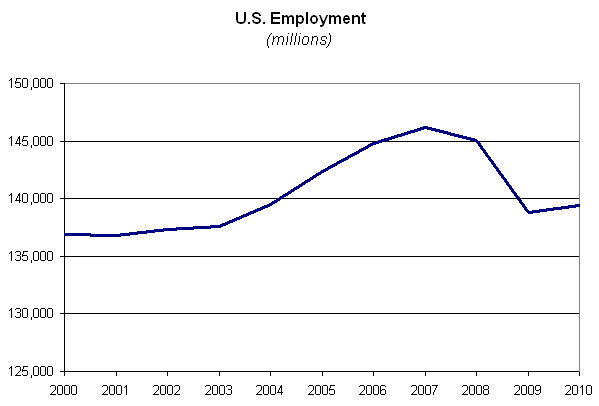
Here’s a chart of total US employment from 2000 to today.

image

A couple of observations;

  • Employment was flat from 2000 to 2003 … remember the bursting of the dot com bubble and the 9-11 terrorist attacks ?
  • There was strong employment growth between 2003 and 2007 …  remember the Bush tax cuts of 2001 and 2003? … hmmm
  • The financial collapse in 2008 reversed practically all of the prior 5 year gains … resulting in a net ‘no gain’ during the Bush years

So, when the Dems talk about the failed policies of the prior 10 years, exactly what are they talking about?

Hard to make a case that the Bush tax cuts creamed the economy.  To the contrary, looks like they created strong job growth.

Obviously, the culprit is the financial crisis – a mix of the disastrous housing policy (think Fannie & Freddie) …  and loose regulation of mortgage backed securities and derivatives.

Bush shares blame for the Fannie and Freddie fiasco … but blame for that is easily spread across the Clinton a administration and the Congress (i.e. Barney Frank, Chris Dodd).

OK, you can taint Bush with loose financial regulation and enforcement.

But, fin-reg does little to address the egregious security & derivative transgressions … and nothing has been done with Fannie & Freddie.

The main “Bush policy” being targeted by Dems are the tax cuts – of which less than 20% were “for the wealthy” – doesn’t look to me like they’re job killers.  Go figure.

Sierra Mist Goes Au Naturel

October 13, 2010

TakeAway: PepsiCo has renamed and repackaged its lemon-lime soda to Sierra Mist Natural and introduced a new campaign to reflect the beverage’s more natural ingredients.

The new tagline: “The soda nature would drink if nature drank soda.”  Perhaps, a bit of a stretch …

* * * * *
Excerpted from Brandweek, “PepsiCo Pitches Sierra Mist Natural” By Elaine Wong,September 21, 2010

According to PepsiCo, the reformulated soda contains no preservatives or artificial flavors and is now made with real sugar instead of high fructose corn syrup.

 The commercials communicate Sierra Mist Natural’s new positioning by showing a variety of “nature experts” – rocks, trees and a rainbow – craving for the product.

 Major beverage companies such as PepsiCo and Coca-Cola have traditionally spent more marketing their cola brands, but now they’re turning their attention to growing consumer demand for natural products.

In fact, “natural” is a top priority when it comes to carbonated soft drinks.

The campaign aims to get the message across by positioning Sierra Mist Natural as the “hero” in each of the scenarios and using humor.

Edit by AMW

* * * * *

Full Article:
http://www.brandweek.com/bw/content_display/news-and-features/direct/e3i430e0ec60c443f0944fff88b91feabeb

* * * * *

"Don’t make me look bad, now” …

October 12, 2010

Delivering a rallying  speech at historically black Bowie State University in Maryland a few days ago, the president got downright personal: “Don’t make me look bad, now.”

It’s not easy to convert exhaustion into enthusiasm. But if Obama doesn’t want to look bad, that’s what he has to do.

Washington Post, Need to Translate into Votes, Oct. 12, 2010
http://www.realclearpolitics.com/articles/2010/10/12/will_need_translate_to_votes_107522.html

Whatever happened to hope and change ?

Obama’s latest rally-shout isn’t exactly “win for for the Gipper”, is it ?

“Don’t make me look bad” is one of his current campaign themes … along with bashing Boehner (who ?), Rove, Gillespie (who ?), the US Chamber of Commerce (huh ?), oil companies, banks, big pharma, insurance companies, etc.

Then, after telling the crowds to “buck up” and get to work for their local Dem candidates, he headed for the links.

President Obama hit the golf course Saturday for what, by CBS News’s Mark Knoller’s calculation, was his 52nd such outing since taking office.

The Hill, Obama hits links for 52nd golf day, 10/09/10
http://thehill.com/blogs/blog-briefing-room/news/123511-obama-hits-links-for-52nd-golf-day

Guess he hasn’t heard the management mantra: “Walk the talk.”

* * * * *
BTW: How does one “buck up”?

“Hey dude, why are you snapping your fingers ?”

October 12, 2010

3 variants of a very old joke:

Original
A dazed guy is standing on a street corner snapping his fingers.  Curious guy approaches and asks “Hey dude, why are you snapping your fingers ?”  Dazed guy answers: “To keep away elephants”.  Curious guy says: “There aren’t any elephants around here.” Finger snapper says: “See.  It works.”

Current
A President is standing on a street corner spending like a drunken sailor.  Curious guy approaches and asks “Hey dude, why are you spending like a drunken sailor ?”  Free-spender answers: “To avert an economic depression”.  Curious guy says: “There’s no depression around here.”  President says: “See.  It works.”

Recent Past Version
A President is standing on a street corner ordering troops to Iraq.  Curious guy approaches and asks “Hey dude, why are you ordering troops to Iraq ?”  Troop-sender answers: “To avert another terrorist attack”.  Curious guy says: “There haven’t been any terrorist attacks since 9-11.”  President says: “See.  It works.”

Hmmm.

Why are only 2 of these counter-factuals considered far fetched by the media?

Better president — Obama or Bush ?

October 12, 2010

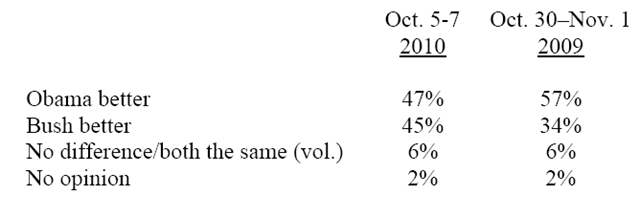
Bottom line : According to a CNN poll, public perceptions are a tie — within the margin of statistical error — … Obama 47%, Bush 45% Question and numbers below.

Commentary form UK’s Telegraph says it all:

Yes, President Bush, America does miss you

The CNN poll is of course deeply humiliating for the White House, especially coming just three and a half weeks before the November mid-terms. George W. Bush’s resurgence is in large part due to mounting opposition to the Obama’s presidency’s left-wing agenda, but it is also spurred by Obama’s image as an out of touch, aloof and elitist president, divorced from economic and political reality on the ground.

A lot of Americans frankly miss the down-to-earth and significantly warmer leadership style promoted by President Bush, as well as his unfailing sense of optimism and heart-felt pride in America on the world stage. You certainly won’t ever find Bush apologising for his country or extending the hand of friendship to her enemies.

And when Bush’s memoir “Decision Points” is published on November 9th, I’m in no doubt it will storm The New York Times’ bestseller list riding a new wave of nostalgia for his time in office. George W. Bush is back in fashion with a vengeance, in marked contrast to his increasingly unpopular successor in the White House.

Telegraph, Yes, President Bush, America does miss you, October 8th, 2010 
http://blogs.telegraph.co.uk/news/nilegardiner/100058215/yes-president-bush-america-does-miss-you/

* * * * *
Question: All in all, do you think Barack Obama has been a better president than George W. Bush, or do you think Bush was a better president than Obama has been?

image

http://i2.cdn.turner.com/cnn/2010/images/10/08/rel14a.pdf

Gillette offers a new – cheap – shave … in India, that is.

October 12, 2010

TakeAway:

Gillette’s newest shaving system has just one blade, a light plastic handle and a sharply lower price.  The Gillette Guard will hit stores – in India – next week and costs 15 rupees, or 34 cents, and uses blades that cost five rupees, or 11 cents.

P&G’s goals are to first bring more consumers into Gillette and then try to lock them in to future purchases. 

To develop the Guard, P&G used target costing– starting with what consumers can afford and then adjust the features and manufacturing processes to meet the target.

* * * * *

Excerpted from Wall Street Journal, “Gillette’s Latest Innovation in Razors: the 11-Cent Blade” By Ellen Byron,October 1, 2010

The Guard reflects P&G’s aggressive push into emerging markets for new customers and growth. That focus is forcing P&G to be more modest on scale and more flexible on price.

Gillette commands about 70% of the world’s razor and blade sales, but it lags behind rivals in India and other developing markets, mainly because those consumers can’t afford to buy its flagship products.

Gillette Guard is aiming to lure users of double-edge razors, about 400 million men in India, according to P&G estimates. In India, a brand called Super-Max holds the lead in double-edge blades, which cost roughly 1.5 to 2 rupees, which is half of the cost of even Gillette Guard.

The need to grow in emerging markets is pushing P&G to change its product-development strategy. In the past, P&G would sell basically the same premium products in developing countries, where only the wealthiest consumers could afford them. To reach more consumers, P&G changed course by creating pared-down products specifically designed to be less expensive.

P&G has a lot of ground to make up in India, where it estimates just 10% of men who shave use Gillette blades, compared with about 50% world-wide. Its plan is to get men to start using its products and then upgrade them as India’s economy grows.

Edit by AMW

* * * * *

Full Article:
http://online.wsj.com/article/SB10001424052748704789404575524273890970954.html?mod=WSJ_hps_LEFTWhatsNews

* * * * *

About the private sector job growth that Obama is touting …

October 11, 2010

The BLS reported that that private sector added 64,000 in September.

Point 1: ADP reported that the private sector cut 39,000 jobs in September … hmmm … one says up, one says down … wonder if the BLS chief got any ‘context’ from the White House ? … remember when the the CBO director got an invitation to the Oval Office when his healthcare numbers weren’t coming out right ?
http://blogs.abcnews.com/politicalpunch/2009/07/republicans-assail-president-obama-meeting-with-congressional-budget-office-director-as-inappropriat.html

Point 2: Accepting the BLS number and putting it into perspective: there are roughly 120 million folks employed in the private sector, so 64,000 represents about  1/20th of 1 percent … better than a negative number, and better than nothing … but not by much …it means that the private sector is adding jobs at the galloping rate of about 1/2% annually … nothing to brag about
(64,000 / 120,000,000 = 0.053% X 12 = .64%)

Point 3: The BLS reports a 9.6% unemployment rate Gallup reports 10.1% … double hmmm

Ken’s Prediction: On the Friday after the election, the meager apparent jobs gain will be revised downward  and the unemployment rate will be revised up.  Just watch …

Dollar stores debate – thriving or hurting ?

October 11, 2010

Last week, we posted a seemingly innocuous excerpt from the NY Times about how dollar stores are thriving in the weak economy.

Got lightning fast feedback from a loyal Homa Files reader that an opinion to the contrary appeared in the WSJ:

Dollar stores have been all the rage in these penny-pinching times. But their growth prospects may be dimming.

The discount space is looking increasingly crowded. The three-biggest dollar stores, including Dollar Tree Inc., already have roughly a combined 20,000 locations in the U.S.

More troubling, the squeeze on dollar stores’ core, lower-end shoppers, is getting worse.

That is likely to put pressure on margins. Bargain prices on food, drinks and other “consumables” may get customers in the door, but discount retailers rely on higher-margin discretionary purchases for profit growth. Sales in the fiscal fourth quarter were strongest in the low-margin consumables category.

A weak economy mightn’t turn out to be quite the gold mine for dollar stores that many investors seem to think.

WSJ, Weak Economy Saps Dollar Stores’ Strength, Sept.  29, 2010
http://online.wsj.com/article/SB10001424052748704791004575520322560873584.html

Googling the topic revealed a debate in process on the topic.

Most notably, Jim Cramer – who has apparently been touting dollar stores on Mad Money – responded immediately to the WSJ story.  His verbatim comments:

“Never ever let a negative headline scare you out of the stock with a good long term story.

Case and point, last week the Wall Street Journal ran what may be the most absurd headline I’ve seen in ages, “Weak Economy Saps Dollar Stores’ Strength”.

I thought it was a comedy routine since Dollar Stores do well in a weak economy as a cash strapped consumer trades down the cheap stuff…..”

http://www.madmoneyrecap.com/madmoney_nightlyrecap_101006_3.htm

Ken’s Take: Dollar stores are either thriving or hurting … or just keeping pace … who the heck knows.

Thanks to RMM for feeding the lead

Gallup pegs unemployment @ 10.1% … says "expect BLS report to understate"

October 8, 2010

There are 3 main sources of unemployment data: ADP, Gallup, and the BLS, with the latter — the gov’t number — comes out today.

This week, ADP report that 39,000 private sector jobs were lost in Sept.

Now, Gallup is reporting a .7% rise in the unemployment rate to 10.1%, and an increase in the underemployment rate to 18.8%. Charts and link below.

So, the Recovery Summer Tour — showcasing the trillion dollar faux stimulus program — started with unemployment at 9.6%, and ends with the rate at 10.1%.

Some recovery …

Gallup says that most of the job losses came in the last 2 weeks of the month and probably won’t be reflected in today’s BLS numbers … they’ll show up in a revision that comes — you guessed it — 3 days after the mid-term elections. 

Hmmm.

image

image

” The government’s final unemployment report before the midterm elections is based on job market conditions around mid-September. Gallup’s modeling of the unemployment rate is consistent with Tuesday’s ADP report of a decline of 39,000 private-sector jobs, and indicates that the government’s national unemployment rate in September will be in the 9.6% to 9.8% range. This is based on Gallup’s mid-September measurements and the continuing decline Gallup is seeing in the U.S. workforce during 2010.

However, Gallup’s monitoring of job market conditions suggests that there was a sharp increase in the unemployment rate during the last couple of weeks of September. It could be that the anticipated slowdown of the overall economy has potential employers even more cautious about hiring.”

http://www.gallup.com/poll/143426/Gallup-Finds-Unemployment-September.aspx

Either they don’t know how business works, or they just don’t care … here’s more evidence

October 8, 2010

According to the WSJ …

The issue: 2011 tax-withholding tables.

Treasury officials must release the tables, which determine the take-home pay of millions of wage-earners, by mid-November because it takes payroll processors weeks to adjust their systems before Jan. 1.

But congressional leaders recently postponed voting on taxes until after the election and lawmakers don’t reconvene until Nov. 15.

The Senate is scheduled to take up several nontax issues when it returns and is expected to leave for Thanksgiving soon after, possibly pushing a vote on taxes into December.

Treasury officials’ most obvious option is the least attractive. If they publish tables based on expiration of the Bush tax cuts, which occurs Jan. 1, millions of low- and middle-income taxpayers who have paid little or no income taxes for a decade would likely see increases in January.

It’s estimated that higher withholding could take up to $10 billion a month out workers’ pockets due to higher tax rates alone.

Excerpted from WSJ: Delays to Tax Tables May Dent Paychecks, Oct. 7, 2010
http://online.wsj.com/article/SB10001424052748704689804575535861229293800.html?mod=WSJ_hps_LEFTWhatsNews

It’s those shades of gray that are keeping you from making a decision …

October 8, 2010

Excerpted fro WSJ: Why So Many People Can’t Make Decisions, Sept. 27, 2010

Some people meet, fall in love and get married right away. Others can spend hours in the sock aisle at the department store, weighing the pros and cons of buying a pair of wool argyles instead of cotton striped.

Seeing the world as black and white, in which choices seem clear, or shades of gray can affect people’s path in life, from jobs and relationships to which political candidate they vote for, researchers say.

image

People who often have conflicting feelings about situations — the shades-of-gray thinkers — have more of what psychologists call ambivalence, while those who tend toward unequivocal views have less ambivalence.

High ambivalence may be useful in some situations, and low ambivalence in others.

And although people don’t fall neatly into one camp or the other, in general, individuals who tend toward ambivalence do so fairly consistently across different areas of their lives.

Now, researchers have been investigating how ambivalence, or lack of it, affects people’s lives, and how they might be able to make better decisions.

Overall, thinking in shades of gray is a sign of maturity, enabling people to see the world as it really is. It’s a “coming to grips with the complexity of the world.”

If there isn’t an easy answer, ambivalent people, more than black-and-white thinkers, are likely to procrastinate and avoid making a choice. 

People with a strong need to reach a conclusion in a given situation tend to black-and-white thinking, while ambivalent people tend to be more comfortable with uncertainty.

Because of their strongly positive or strongly negative views, black-and-white thinkers tend to be quicker at making decisions than highly ambivalent people.

Ambivalent people, on the other hand, tend to systematically evaluate all sides of an argument before coming to a decision. They scrutinize carefully the evidence that is presented to them, making lists of pros and cons, and rejecting overly simplified information. 

http://online.wsj.com/article/SB10001424052748703694204575518200704692936.html?mod=WSJ_hp_mostpop_read

Registers Are Ringing … at the Dollar Stores, that is.

October 8, 2010

TakeAway: As people make fewer costly shopping trips to stock their pantries and increasingly can only afford inexpensive items in small quantities, stores are scrambling for the once-ignored low-end customer.

Some customers at Wal-Mart and the major dollar chains have such modest budgets that the retailers report upticks in spending at the beginning of the month, when government benefit checks and many paychecks come through.

Some of the stores have even managed to reach some middle-income shoppers, by increasing products from well-known brands such as Hanes, Quaker Oats and Nabisco. 

* * * * *

Excerpted from the New York Times, “Stores Scramble to Accommodate Budget Shoppers” By Stephanie Clifford,September 22, 2010

Dollar stores have shown the biggest gain in shopper visits over the last year out of all the retailers that sell basic consumer goods. Manufacturers are racing to package more affordable versions of products common at those stores, and other budget retailers, feeling the loss of customers, are trying to duplicate their success.

 Wal-Mart, the world’s largest retailer, is adding thousands of items to its shelves, including inexpensive ones, and is asking dollar-store suppliers to create small, under-a-dollar packages for its stores, too.

 In areas with high unemployment, Wal-Mart is grouping together its less than $1 items in a clear challenge to the dollar stores. About a quarter of Wal-Mart’s stores are beginning to offer items for under $1, such as a four-pack of toilet paper, boxes containing just a few garbage bags and single rolls of paper towels.

The dollar stores have best been able to capitalize on the downmarket trend because of strategies they embraced during the recession, when the stores kept things cheap and expanded their merchandise.

During the recession, Wal-Mart pulled back on very inexpensive products, suppliers said, to make the stores look less cluttered and to appeal to shoppers who might be testing out that retailer instead of, say, Target. That decision has it now playing catch-up.

The dollar stores have found creative ways to keep their prices low. When commodity costs rose for suppliers, for example, the dollar stores asked them to decrease the number of sandwich bags in a box or pushed them to come up with a cheaper version of the products.

Edit by AMW

* * * * *

Full Article:
http://www.nytimes.com/2010/09/22/business/22dollar.html?_r=1&th&emc=th 

* * * * *

What if the rich leave the building ?

October 7, 2010

I think this is the fatal flaw in Obama’s class-warfare tax plan.

Initially, high earners will push their tax deductions to the absolute limit (no, I don’t think they’re doing that now).

…  then they’ll just re-create tax shelter devices reminiscent of the pre-Reagan days (e.g. rental properties; gas, oil, timber partnerships)

…  and finally, they’ll take their bank accounts to safe havens.

A couple of vignettes bring the dynamics to life.

* * * * *

According to FBN’s John Stossel …

New York billionaire Tom Golisano isn’t stupid.

With $3,000 and one employee, he started a business that processes paychecks for companies. He created 13,000 jobs.

Then New York state hiked the income tax on millionaires.

“It was the straw that broke the camel’s back,” he says.

“Not that I like to throw the number around, but my personal income tax last year would’ve been $13,800 a day. Would you like to write a check for $13,800 a day to a state government, as opposed to moving to another state where there’s no state income tax or very low state income tax?

He established residence in Florida, which has no personal income tax.

* * * * *

Maryland created a special tax on rich people that was supposed to bring in $106 million. Instead, the state lost $257 million.

Former Gov. Robert Ehrlich, who is running again for his old job, says: “It reminds me of Charlie Brown. Charlie Brown was always surprised when Lucy pulled the football away. And they’re always surprised in Washington and state capitals when the dollars never come in.”

Some of Maryland’s rich left the state.

“They’re out of here. These people aren’t stupid,” Ehrlich says.

* * * * *

Donald Trump, who knows something about making money, says of course the rich will leave when hit with higher taxes.

“I know these people,” he told me.

They’re international people. Whether they live here or live in a place like Switzerland doesn’t really matter to them.”

You haven’t left, I told him.

“I haven’t left yet. … Look, the rich people are going to leave. And other people are going to leave. You’re going to end up with lots of people that don’t produce. And then that’s the spiral. That’s the end.”

* * * * *

Excerted from John Stossel, Taxing the Rich, September 29, 2010
http://www.realclearpolitics.com/articles/2010/09/29/taxing_the_rich_107350.html

Your choice: 4 Corvettes or a college diploma ?

October 7, 2010

Parent’s lament: “It’s like driving a new Corvette to the campus every September, leaving the keys and taking the bus home.”

* * * * *
Excerpted from: RCP, Why Corvettes Cost Less Than College, September 21, 2010

American colleges continue to float in the bubble of economic exceptionalism once occupied by Detroit carmakers.

American median income has grown 6.5 times over the past 40 years, but the cost of attending one’s own state college has ballooned 15 times.

American universities now rake in $40 billion a year more than they did 30 years ago. And most of that money isn’t going for academics.

  • For starters, the money is going to more numerous and more pampered sports teams. Duke University in Durham, N.C., spends over $20,000 a year per varsity golf player. And these squads rarely pay for themselves. There are 629 college football teams, and only 14 make money.
  • The number of administrators per student at colleges has about doubled over 30 years, according to Hacker and Dreifus. Their titles point to such questionable duties as “director for learning communities” and “assistant dean of students for substance education.”
  • Full-time faculty members are being paid more for teaching less. Some elite colleges now offer sabbaticals every third year instead of the traditional seventh. Harvard has 48 history professors, and 20 of them are somewhere else this year.
  • Compensation for college presidents, meanwhile, has soared to corporate CEO levels. Vanderbilt University in Nashville, Tenn., pays its president $1.2 million a year!
  • Universities are also competing to make their on-campus experiences more like a resort than a bookish monastery. Some dorms feature granite counters, kitchens and walk-in closets. Fancy health clubs have replaced musty gyms.

What else are students getting in return for their enormous college bills?

They do receive an education, though the quality doesn’t seem to justify the rising costs.

Bill Gates recently predicted: “Five years from now on the Web for free you’ll be able to find the best lectures in the world. It will be better than any single university.”

A year at a university costs an average $50,000, the Microsoft founder and Harvard dropout said last month. The Web can deliver the same quality education for $2,000.

The market will eventually recognize the out-of-whack economics of today’s “place-based colleges” and intervene. Some day soon, Web alternatives will be a force to be reckoned with.

Full article:
http://www.realclearpolitics.com/articles/2010/09/21/why_corvettes_cost_less_than_college_107241.html

Kodak tries to hang on …

October 7, 2010

TakeAway: For years Kodak’s photo kiosks received little traffic as people decided that they’d rather print at home or keep their photos in digital form.

Now Kodak has caught on that consumers are interesting in specialty printing, such as collages, so the company is updating its kiosks for this functionality.

It’s an insight that the company hopes will change its stodgy brand association into something more cutting edge.  But there’s a catch.  You have to buy a mat or a frame.

* * * * *

Excerpted from Brandchannel, “Kodak Touts Innovations at Photokina,” by Barry Silverstein, September 21, 2010

Kodak, a brand name that may find it a major challenge to shake its association with conventional photography, is doing everything it can to become a hip, socially aware digital photography provider. …

Kodak’s latest entry into the “cool, hot and worthy” category was unveiled this week … The company’s new retailer photo kiosk “automatically enlarges, shrinks, crops, aligns and arranges as many as 13 images on one print.”

… The new “collage option” software will be introduced in December at some 5,000 CVS stores in the US.

There is one catch … The consumer is required to purchase a mat, or a frame with a mat, along with the collage. …

“Most creative collage systems in the market don’t really take the presentation into account — you create the collage but then you have to mount or frame it. Kodak is taking it all the way to the wall,” …

While traditional photo prints have dropped in popularity because of digital photography, specialty printing is now booming for that very same reason.

Specialty sales of such items as posters, postcards and t-shirts made from digital images have increased from $738 million in 2006 to $1.3 billion last year.

Clearly, Kodak is looking to create its own “Kodak moment” and ride the wave with specialty photography products of its own.

Edit by DMG

* * * * *

Full Article
http://www.brandchannel.com/home/post/2010/09/21/Kodak-Photokina-Collage.aspx

* * * * *

The uber-rich speak: Gates (the father) says rich should pay more taxes …

October 6, 2010

I’ve often expressed my chagrin over Warren Buffet’s pontificating that his taxes are too low and so all high earners should pay more taxes.

Now Bill Gates’s father has jumped on the bandwagon and is helping fund support for a new millionaire’s tax in Washington state.

He riles me more than Buffet.  At least Buffet created his pile of gold.  This guy’s major claim to fame is providing young Bill with some DNA.  Now, he lives a lavish life as part of young Bill’s live-in posse. 

Give me a break …

And, oh yeah, before you tell me how philanthropic Buffet and Gates are, remember (1) most of their gifts are forthcoming when they die — allowing to retain the the power of their wealth until they’re long gone, and (2) all of their giving is specifically directed to causes they care about, and managed by members of their posse. 

Why don’t they just turn over their accumulated wealth to the the government right now?

Answer: they’d lose their power as super-rich guys … and even they know that most of the money would be wasted on wacky, ineffective programs.

* * * * *

According to Art Laffer in the WSJ …

It’s one thing to believe in bad policy. It’s quite another to push it on others.

But Mr. Gates Sr.— a retired lawyer— is now trying to have his way with the people of the state of Washington.

Mr. Gates Sr. has personally contributed $500,000 to promote a statewide proposition on Washington’s November ballot that would impose a brand new 5% tax on individuals earning over $200,000 per year and couples earning over $400,000 per year. An additional 4% surcharge would be levied on individuals and couples earning more than $500,000 and $1 million, respectively.

If Mr. Gates Sr. and his son feel so strongly about taxing the rich, they should simply give the state a chunk of their own money and be done with it. Leave the rest of Washington’s taxpayers alone.

The 11 states where income taxes were adopted over the past 50 years are: Connecticut (1991), New Jersey (1976), Ohio (1971), Rhode Island (1971), Pennsylvania (1971), Maine (1969), Illinois (1969), Nebraska (1967), Michigan (1967), Indiana (1963) and West Virginia (1961).

Each and every state that introduced an income tax saw its share of total U.S. output decline. Some of the states, like Michigan, Pennsylvania and Ohio, have become fiscal basket cases. As the nearby chart shows, even West Virginia, which was poor to begin with, got relatively poorer after adopting a state income tax.

WSJ, The Bill Gates Income Tax,  OCTOBER 5, 2010
http://online.wsj.com/article/SB10001424052748703882404575520241519315372.html?mod=WSJ_Opinion_LEADTop

Lululemon’s Ambassadors wear their loyalty on their sleeves … literally !

October 6, 2010

TakeAway: Upstart retailer Lululemon Athletica, a Vancouver-based maker and retailer of athletic wear, enlists fitness instructors as “ambassadors” to distinguish itself from sportswear giants who typically hire high-priced sports celebrities to model their outfits. 

Lululemon spends almost nothing on advertising beyond occasional print ads in yoga and running magazines; instead, ambassadors receive up to $1,000 of free apparel in return for modeling it for their clients. 

Word of mouth is certainly powerful.

I* * * * *

Excerpted from The Wall Street Journal, “Lululemon Grows Fast on a Slim Budget” By Kevin Helliker, September 13, 2010

Lululemon belongs to an emerging class of retailers focused primarily on designing, making and selling athletic wear to women—and grabbing growing shares of the estimated $15 billion market for women’s fitness attire. 

The companies’ believe that traditional sportswear giants have treated female athletes as an afterthought resonates with many women.

Even amid the recession, Lululemon’s high-priced apparel is selling briskly.

The company has expanded its roster of ambassadors to include running, spinning and resistance-training gurus, including some men.

In keeping with the peace-and-love ethos of yoga, Lululemon publicly describes its primary purpose as promoting good health and well-being rather than making profit.

The company says it offers free yoga classes in its stores to introduce people to yoga’s stress-relieving benefits, not to sell clothes.

Similarly, the company says its ambassador program offers vital feedback on new apparel from fitness experts.


Edit by AMW

* * * * *

Full Article:
http://online.wsj.com/article/SB10001424052748703960004575481890366935552.html#printMode

* * * * *

From a high of 91% to a low of 12% …

October 5, 2010

Most media reports highlight President Obama’s average job approval.

A recent Gallup survey reports Presidential Approval across major segments and blocs.

Some highlights:

  • Blacks 91 %, Hispanics 55%, Whites 36%
  • 18 to 29 year olds 57%, over 65 year olds 28%
  • East coasters 52%, Southerners 41%
  • Income < $24,000 51%,  income $60,000 to $90,000 43%
  • Dems 79%, GOP 12% 

wvpdkfnsgesg06umyqcesw.gif

http://www.gallup.com/poll/143354/Obama-Approval-Averages-September.aspx?utm_source=alert&utm_medium=email&utm_campaign=syndication&utm_content=morelink&utm_term=Politics

Obama’s professorial credentials …

October 5, 2010

Last week, I questioned Obama’s professorial credentials.

A faithful reader — who is uber-loyal to Obama — provided a link to aUniversity of Chicago media release:

From 1992 until his election to the U.S. Senate in 2004, Barack Obama served as a professor in the Law School.

He was a Lecturer from 1992 to 1996. He was a Senior Lecturer from 1996 to 2004, during which time he taught three courses per year.

Senior Lecturers are considered to be members of the Law School faculty and are regarded as professors, although not full-time or tenure-track.

The title of Senior Lecturer is distinct from the title of Lecturer, which signifies adjunct status. Like Obama, each of the Law School’s Senior Lecturers has high-demand careers in politics or public service, which prevent full-time teaching.

OK, I concede that he taught enough to be “regarded as a professor”.

But, I still don’t like it when folks dis professors as a group.

Dis us individually, please.

Puttin’ on the Ritz

October 5, 2010

TakeAway: Responding to the sharp decline in rates consumers will pay for luxury hotels during economic hard times, Ritz-Carlton will join airlines, credit-card companies, and many other hotel chains in offering a loyalty program to its customers. 

“Ritz-Carlton Rewards” will let guests earn free nights at other hotels.

The high-end chain had long held that its customers weren’t interested in anything as pedestrian as “points,” but the recession has hit luxury hotels even harder than the rest of the industry.

The new points program is one of a number of actions taken at Ritz hotels to try to attract more business and leisure travelers.

* * * * *

Excerpted from the Wall Street Journal, “Ritz Carlton Bows to Recession, Adds Rewards” By Alexandra Berzon,September 14, 2010


“We always said in the early days, we’re not going to give you a toaster, we’re going to give you service,” said Ritz President and Chief Operating Officer Herve Humler. “That was part of the philosophy.”

The occupancy problems for luxury hotels have been compounded by what is known within the hotel industry as the “AIG effect“: Corporations that were the beneficiaries of taxpayer dollars or were laying off workers were criticized by politicians for booking expensive conferences in luxury resorts, and so they started to pull back. Recently, that problem has begun to ease slightly.

Even before the recession, the Ritz found it necessary to make changes in its high-class veneer, becoming more relevant for younger generations that were put off by the traditionally stiff service at many of its hotels.

That led to such changes as making the greetings from staff members less scripted, adding more technology to the rooms and removing the traditional piano and harp players from the lobbies in favor of, in some cases, pop music.

After spending years studying whether to include Ritz in its loyalty program, Marriott executives said that focus groups in the last year and a half began to show that customers were demanding enticements, particularly in Asia where Ritz is expanding. 

The company designed the new loyalty program to keep it separately branded from the general Marriott points program, Marriott Rewards, which has more than 30 million members who can earn points, which can be redeemed at any Marriott hotel as well as several airline partners.


Ritz’s top competitor, Four Seasons, has no plans to implement a loyalty program.

Edit by AMW

* * * * *

Full Article:
http://online.wsj.com/article/SB10001424052748704190704575490113861298350.html

* * * * *

High taxes? … At least you don’t live in New York or Hawaii …

October 4, 2010

 According to Bloomberg …

High-income residents of New York City and President Barack Obama’s home state of Hawaii would have the highest marginal tax rates in the U.S. if Congress adopts the president’s proposal to increase taxes for top earners, a study found.

State, local and federal levies would result in a top 50.8 percent rate on high-income New York City residents. Affluent Hawaiians would pay 49.7 percent. Residents of California, Vermont, Maryland and New York round out the five states with the heaviest burdens, with top federal- state rates of 49.4 percent, 48.8 percent, 48.6 percent and 48.4 percent, respectively.

States rounding out the top 10 are Maine, Minnesota, Idaho, North Carolina and Ohio.

* * * * * 

Separately, IRS data shows 80 percent of those facing higher taxes under Obama earn between $200,000 and $500,000. An analysis by the congressional Joint Committee on Taxation in August concluded their taxes would increase on average by $532 a year.

* * * * *

Source:
http://www.bloomberg.com/news/2010-09-22/new-york-hawaii-top-earners-face-highest-tax-under-obama-plan-study-says.html

Playing chicken with the economy …

October 4, 2010

According to the WSJ …

If he Bush Tax Cuts are allowed to expire at year-end per current law, after-tax income for every working American would be reduced.

According to the Tax Policy Center, the average reduction in after-tax income would be 3.3% .

Do the math:

94% of income goes to consumption, and consumption is 70% of gross domestic product.

All else being equal, if the Bush tax cuts don’t get extended, that’s a 2.3% hit to 2011 GDP.

In other words, a certain double dip.

The Trade and Tax Doomsday Clocks, Oct. 4, 2010 
http://online.wsj.com/article/SB10001424052748704116004575521822940983434.html?mod=djemEditorialPage_h

"Young People and Minorities Are All the President Has Left"

October 4, 2010

That’s the headline on the National Journal’s new poll of Americans, conducted with the Pew Research Center.

Digging into the details:

  • Obama still retains support among voters under 30 , but even there his excellent or good job rating is only 45%, as opposed to 47% who rate him fair or poor.
  • His worst numbers are with voters aged 50 to 64, only 34% of whom rate him positively.
  • Minority voters are still solidly behind the president, with 76% of blacks expressing approval. A majority of Hispanic voters also still approve.
  • Among non-Hispanic whites, the bottom has dropped out. Only 30% score Obama positively, with 66% rating him fair or poor.
  • White women who are college graduates give Obama a 39% positive job rating; 31% of white men with a similar educational background do.
  • Only 31% of white women without a college degree rate the president well; only 22% of men without a college degree .

WSJ, For Obama, Even the Good News Is Bad, Sept. 30, 2010
http://online.wsj.com/article/SB10001424052748704116004575522160145340470.html?mod=WSJ_Opinion_MIDDLETopOpinion


Spend Real Money on…Fake Money?

October 4, 2010

TakeAway: Starting September 5, Target will offer Facebook Credits gift cards. 

With 500 million members, Facebook expects many to purchase the cards and use them on their favorite social games, applications and virtual goods. 

Target jumped on board, expecting the markets for online gaming and digital music to continue to grow.  For some potential cross-promotion, Target also has more than 1.5 million fans on its Facebook page.

What ever happened to good old conversation or handwritten letters, anyway?

* * * * *

Excerpted from USA Today, “Target to sell Facebook Credits gift cards” By Jon Swartz, September 2, 2010

The new Facebook gift cards will be available in values of $15, $25 and $50 at all of Target’s 1,750 retail stores and at Target.com. Two or three more national retailers will start selling the cards in coming months.

This will be the first time Facebook has had any presence in a retail store. Facebook already has an arrangement with online-payment services PayPal and MOL to purchase Facebook Credits.

More than 200 million people play free social games on Facebook each month, according to Facebook. And many of them are beginning to spend money on premium goods and services associated with those games.  By year’s end, Facebook expects to have gift card credits available for its thousands of games. At least 19 games on Facebook have more than 10 million active users a month.

 Facebook’s entry into the growing prepaid gift card market could prove lucrative. The domestic prepaid gift card market is expected to reach $86.2billion this year, compared with $80.6billion in 2009, according to Mercator Advisory Group.

Edit by AMW

* * * * *

Full Article:
http://www.usatoday.com/tech/news/2010-09-01-target01_ST_N.htm

* * * * *

Clyburn says: “GOP majority would waste time, create gridlock”

October 1, 2010

House Majority whip James Clyburn warned other Dems this week that the GOP — if they win a majority in the House — would waste Congress’ time with hearings into whether the Obama was really born in Hawaii.
 http://thehill.com/blogs/blog-briefing-room/news/121059-rep-clyburn-gop-majority-will-issue-birther-subpoenas-against-ob

My take:

  1. His comment comes during the week that the House committee was entertained by Stephen Colbert’s stand-up testimony.
  2. I like it when the Congress wastes time … means they’re not causing any real damage.
  3. I am concerned that Congress adjourned with unfinished business, e.g. steroids in baseball, the BCS play-off sytem.
  4. Is that Clyburn’s best shot re: why Dems should be elected ??? 

They don’t like his policies, but they still like him … oh yeah ?

October 1, 2010

The refrain that ‘Obama is still personally popular’ is repeated so often — especially in the mainstream media — that it’s treated as a universal truth.

Unfortunately (for Obama) the facts don’t support the contention.

Based on the latest WSJ-NBC poll :

  • 47% of people feel positively towards Obama … 29% very positively
  • The 47% is down from 64% on Inauguration Day
  • 41% of people feel negatively towards Obama … 27% very negatively
  • The 41% is up from 19% on Inauguration Day

My take:

  • People started out liking him, but …
  • Less than half now feel positively towards the guy
  • Numbers correlate pretty well with his job approval

Question: how would you feel if half the people who knew you felt negatively about you ?

Bummed, right ?

So why do the pundits keep saying he’s one popular dude ?

I must be missing something …

http://online.wsj.com/public/resources/documents/WSJNBCPoll09282010.pdf

Leveraging a "P": Wal-Mart Expands Its Reach via FedEx

October 1, 2010

TakeAway: Wal-Mart is experimenting with allowing customers to buy merchandise online and have it delivered for free to urban FedEx locations in a bid to boost sales in big cities where the retailer has little to no store presence.

A perfect example of one of the 6Ps – placement!

* * * * *

Excerpted from the Wall Street Journal, “Wal-Mart Uses FedEx to Expand Urban Push” By Miguel Bustillo,September 20, 2010

This summer, Wal-Mart started tests in Los Angeles and Boston to allow customers to direct purchases made on Walmart.com to FedEx Office outlets at no cost, mimicking a Wal-Mart offering called Site to Store that lets online buyers send items to the retailer’s stores for free.

Wal-Mart has no stores in Boston and two in Los Angeles, but FedEx has many locations in both. Wal-Mart is still collecting feedback from the tests.

Some retail experts said it seemed like an inevitable next step for the retailer, which has struggled to expand into America’s largest cities amid political opposition from labor unions. Wal-Mart is searching for new ways to spark domestic growth without needing to invest in real estate.

Wal-Mart also is pursuing younger urban shoppers, who don’t think twice about making big purchases online.

The partnership could allow FedEx to capitalize on its locations near college campuses it inherited when it acquired Kinkos in 2004.

Edit by AMW

* * * * *

Full Article:
http://online.wsj.com/article/SB10001424052748704416904575501790739176042.html

* * * * *

Stop dissing professors !

September 30, 2010

The Woodward expose “Obama’s Wars” reportly says that Obama manages more like a professor than a president.

Ouch.

Why insult professors ?

You know, a few of us have real life experience, have managed organizations, have made  decisions, and have gotten rewarded (or penalized) based on outcomes.  Don’t put Obama in our canoe.

By the way, exactly what is Obama’s professorial experience ?

Was he a full-time prof at Chicago teaching for an extended period of time?

Or, was he simply an evening adjunct who taught one course, one time so he could claim resume credit ?

Of course, he hasn’t disclosed the details.

I’m betting the latter …

Regardless, stop dissing profs.

About Obama’s attacks on John Boehner …

September 30, 2010

I’m not a big John Boehner fan, but from the get-go, Obama’s personal attacks on the House Minority Leader  struck me as one of the Administration’s wackiest campaign tactics.

Based on the latest WSJ-NBC poll :

  • 50% don’t know who John Boehner is …
  • Of those that do know who he is … 28% view him favorably, 34% view him unfavorably, 38% have no opinion on him.
  • Combined, over 2/3s (69%) either don’t know who Boehner is or have no opinion of him.

Why would you focus an attack on a guy that nobody knows ?

I must be missing something …

http://online.wsj.com/public/resources/documents/WSJNBCPoll09282010.pdf

Pizza Hut searches for (internal) stars …

September 30, 2010

TakeAway: Pizza Hut has created a new ad campaign that moves from a pricing war with rivals Domino’s and Papa John’s to differentiation purely based on branding through employee spokespeople. 

There is no mention of deals or new-product offerings, and the ads seem to be working.

* * * * *

Excerpted from AdAge, “Pizza Hut Makes Its Staff the Stars in Brand-Focused Campaign” By Rupal Parekh,September 20, 2010

There are signs that Pizza Hut is beginning to gain some ground on category leader Domino’s, which has 18.4% of the market compared to Pizza Hut’s 15%. Domino’s marketing strategy – something akin to “our pizza was gross, but we fixed the recipe” – was working to some degree. Domino’s posted historic same-store sales increases earlier this year of 14.4% vs. Pizza Hut’s 6%, but in the second quarter, Pizza Hut led same-store sales with an 8% lift.

Pizza Hut’s CMO said: “We just need to incite the consumer to pull up the emotional side of the brand and the high-quality products we provide…Our brand stands for quality already…we have no need to denigrate the brand in order to get people to engage with it.”

That Pizza Hut is turning employees into spokespeople makes it one of several brands (including Nationwide Insurance, Best Buy and BP)

in the past year that have tried to personalize their companies by using homegrown marketing talent, perhaps not coincidentally, while struggling with the recession.

While it’s not a goal of the campaign, the youthful skew could help connect with what Kurt Kane, VP-brand advertising at Pizza Hut, earlier this year told Ad Age is one of two of Pizza Hut’s core consumer groups, families and young adults.

Edit by AMW

* * * * *

Full Article:

http://adage.com/article?article_id=145981

* * * * *

Ready to pull the lever for Mitch Who ?

September 29, 2010

A couple of tidbits from the Politico-GWU poll that’s been getting some play on the talk shows …

35% strongly approve of Pres Obama’s job performance; 45% strongly disapprove  … an 10 point gap.

But, 47% strongly approve of Mr. Obama “as a person”  … leading pundits to consistently conclude that he remains personally popular but his policies are unpopular.

That’s true … 46% personal approval is higher than 39% job approval.

But, my question: anybody notice that less than half of folks strongly approve of him as a person.

That doesn’t strike me as remarkably “still popular”.

* * * * *

75% of the people surveyed don’t know who Mitch Daniel’s — governor of Indiana —  is.

When asked: who would you vote for in the next Presidential election: Obama or Daniels … Obama wins 38% to 26%.

Since more people are willing to vote for Daniels than know who he is, it says that some (many ?) people will vote for anybody who isn’t Obama.

Hmmm …

* * * * *

Of MSNBC’s powerhouse prime time line-up:

  • 42% don’t know who Keith Olberman is.
  • 55% don’t know Rachel.Maddow
  • 70% don’t know Ed Shultze 

Source:
http://www.politico.com/static/PPM156_bg_41_questionnaire.html

When a tree falls in the woods … update.

September 29, 2010

Today the President continues his campaign tour to rally his exhausted (Velma’ Hart’s word) and ignorant (Kerry’s word) base …  and get them to buck up (Biden’s words) and get out of their chairs (paraphrasing O’s words).

Interesting tactic.

Now, instead of insulting Bush & Boehner, top Dems are insulting voters.

Might work …

* * * * *

Have you noticed that crowds for Obama’s events are a lot thinner these days.

Here’s an example …

Six weeks before the mid-term elections, President Obama couldn’t fill the ballroom at the Roosevelt Hotel, despite cheap tickets on offer.

And then he was met by hecklers.

Event organizers had to reach down to the D list to fill a room to listen to him.

Most of the low rollers arrived early to see President Obama up close and personal.

Tickets for the general reception at the Roosevelt Hotel in New York were only $100.

Some bought tickets for $50 from their desperate Democratic committeeman.

Some bought the same day.

Source: The Daily Beast, Obama’s Fire Sale
http://www.thedailybeast.com/blogs-and-stories/2010-09-23/obamas-fire-sale/?cid=bs:archive23

I guess some of the mojo is gone, huh ?

More important,  is anybody listening to these 2-a-day speeches the President is giving ?

They’re kind of a blur, aren’t they ?

Kenmore – Sear's jewel – gets modern.

September 29, 2010

TakeAway: By any measure Kenmore has been successful over a long period of time. 

Even in today’s intensely competitive home appliance market, it has managed to stay on top across all major appliance categories. 

Now, the brand is being  overhauled in an effort to modernize.

With customer-focused innovations geared toward a new generation, including appliances that transmit data over a phone line in order to troubleshoot, the brand seems likely to stay on top for the foreseeable future.

* * * * *

Excerpted from Brandchannel, “Kenmore – A classic appliance brand gets a makeover,” by Barry Silverstein, August 17, 2010

There was a time in the annals of American retailing when Sears ruled the universe in both mail order and store sales. While that era is long gone, the venerable Kenmore brand, originally associated with Sears, has maintained its independent leadership position in household appliances.

First introduced on a laundry appliance in 1927 … The brand’s awareness factor is legendary. Today, more people in the United States buy Kenmore than any other appliance brand, one in every three American homes contains a Kenmore appliance, and Kenmore ranks number one or number two in every major appliance category.

Even its rivals know the unshakeable power of the brand — Frigidaire, LG and Whirlpool all manufacture products that are sold under the Kenmore name.

But Kenmore has not rested on its laurels

The trick, of course, is to modernize the brand while retaining and enhancing its long-standing reputation. … that involves four primary areas:

1. “Premium customer touch points,” such as higher quality handles and knobs that are both elegant and ergonomic.
2. “Premium technology,” including user-friendly interfaces such as color-touch LCD displays that are advanced but intuitive and easy to use.
3. Streamlined modern design.
4. New logo and custom font, as well as a new sound palette on select products.

… Kenmore announced an additional innovation called Kenmore Connect, a technology designed to speed up appliance repairs. Kenmore machines with problems have the ability to transmit data over a toll-free phone line for review by company representatives. …

Product design isn’t the only area getting a … makeover. … Kenmore launched an interactive “Kenmore Live Studio” in Chicago. The studio is equipped with cameras that broadcast video via the Internet and includes demonstrations by chefs, presentations, and unveilings of new products that can be shared in real time on the brand’s Facebook page. …

Obviously, Kenmore is making a concerted effort to gain relevancy with a whole new generation of consumers.
Edit by DMG

* * * * *
Full Article
http://www.brandchannel.com/features_profile.asp

* * * * *

Kenmore – Sear’s jewel – gets modern.

September 29, 2010

TakeAway: By any measure Kenmore has been successful over a long period of time. 

Even in today’s intensely competitive home appliance market, it has managed to stay on top across all major appliance categories. 

Now, the brand is being  overhauled in an effort to modernize.

With customer-focused innovations geared toward a new generation, including appliances that transmit data over a phone line in order to troubleshoot, the brand seems likely to stay on top for the foreseeable future.

* * * * *

Excerpted from Brandchannel, “Kenmore – A classic appliance brand gets a makeover,” by Barry Silverstein, August 17, 2010

There was a time in the annals of American retailing when Sears ruled the universe in both mail order and store sales. While that era is long gone, the venerable Kenmore brand, originally associated with Sears, has maintained its independent leadership position in household appliances.

First introduced on a laundry appliance in 1927 … The brand’s awareness factor is legendary. Today, more people in the United States buy Kenmore than any other appliance brand, one in every three American homes contains a Kenmore appliance, and Kenmore ranks number one or number two in every major appliance category.

Even its rivals know the unshakeable power of the brand — Frigidaire, LG and Whirlpool all manufacture products that are sold under the Kenmore name.

But Kenmore has not rested on its laurels

The trick, of course, is to modernize the brand while retaining and enhancing its long-standing reputation. … that involves four primary areas:

1. “Premium customer touch points,” such as higher quality handles and knobs that are both elegant and ergonomic.
2. “Premium technology,” including user-friendly interfaces such as color-touch LCD displays that are advanced but intuitive and easy to use.
3. Streamlined modern design.
4. New logo and custom font, as well as a new sound palette on select products.

… Kenmore announced an additional innovation called Kenmore Connect, a technology designed to speed up appliance repairs. Kenmore machines with problems have the ability to transmit data over a toll-free phone line for review by company representatives. …

Product design isn’t the only area getting a … makeover. … Kenmore launched an interactive “Kenmore Live Studio” in Chicago. The studio is equipped with cameras that broadcast video via the Internet and includes demonstrations by chefs, presentations, and unveilings of new products that can be shared in real time on the brand’s Facebook page. …

Obviously, Kenmore is making a concerted effort to gain relevancy with a whole new generation of consumers.
Edit by DMG

* * * * *
Full Article
http://www.brandchannel.com/features_profile.asp

* * * * *