Archive for November, 2009

So, preventative healthcare and disease screenings save money … right ?

November 9, 2009

Ken’s Take: Since I’m in the prime group for prostate cancer — and since a couple of friends have been detected and treated (successfully) — I’ve been a fan of PSA tests.  But, I’ve had 3 docs try to talk me out of getting the tests.  Here’s their rationale … which raises a broader question re: preventative healthcare.

* * * * *

Excerpted from RCP: Government by Holiday Inn Express, October 27, 2009 

Another silver bullet the administration has peddled is preventive care.

Everyone knows that a timely PSA test will detect prostate cancer at an early and treatable phase thus saving the patient’s life and saving money, right?

Not exactly. The test is obviously worthwhile for that individual. But testing all men for prostate cancer — an overwhelming majority of whom will never get the disease — is expensive.

If more and more of us are tested for more and more diseases — even accounting for some illnesses found early — health spending will rise, not fall.

Further complicating the picture, the National Cancer Society has announced that the benefits of cancer screenings, particularly for breast and prostate cancers, have been oversold. They aren’t saving very many lives, but they are causing needless tests and surgeries.

Full article:
http://www.realclearpolitics.com/articles/2009/10/27/government_by_holiday_inn_express_98882.html#

From the exit polls … more warning shots from tax payers

November 6, 2009

Currently, less than 1/2 of adults pay income taxes.  That causes undeniable pressures. 

Those who don’t pay income taxes want tax rates raised (on those who do pay) and want more and more freebies from the gov’t. 

Those who do pay are starting to say “I don’t think so”. 

Watch this trend big time in 2010.

The GOP victories reveal fissures in the coalition that elected Barack Obama.

In the election results and the exit polls there are clear signs that the Obama majority coalition has splintered.

Mr. Obama benefited last year from a big turnout of young voters, who backed him by a 66% to 32% margin. This year young voters formed only about half as large a percentage of the electorate in Virginia and New Jersey as they did in 2008, and in Virginia they voted about as Republican as their elders.

Economically, the Obama majority was a top-and-bottom coalition. The Democratic ticket carried voters with incomes under $50,000 and over $200,000, and lost those in between.

As the shrewd liberal analyst Thomas Edsall has noted, there’s a tension between what these groups want.

High earners in non-Southern suburbs have been voting Democratic since the mid-1990s largely because of their liberal views on cultural issues;

Low earners vote Democratic because they want more government money shoveled their way.

Tuesday’s elections suggest those whose money gets shoveled are having second thoughts about this odd-couple coalition.

Excerpted from WSJ: Tuesday’s Biggest Loser: the Union Agenda, Nov 4, 2009 
http://online.wsj.com/article/SB10001424052748704013004574515681098665524.html?mod=djemEditorialPage

Q&D testing of "killer assumptions" … If you can’t GET the data, then CREATE it.

November 6, 2009

TakeAway: By becoming skilled at experimentation, innovators can gain a competitive edge.

STRATEGY & INNOVATION, Not-So-Risky Business, September 16, 2009

* * * **

By systematically attacking the most critical unknowns with tailored, low-cost experiments, innovators can systematically “de-risk” their strategies and thereby increase their chances of success while lowering the associated investment cost.

Systematically testing “killer assumptions” with quick experiments can create the data otherwise not available in market research reports but necessary to move forward to the next step, whether that step is doubling down, re-vectoring, or folding.

This type of approach is generally most critical when data doesn’t exist in market research or other reports, but rather exists in behavior that hasn’t yet happened or outcomes that can only be learned in market. In other words, if you can’t GET the data, then CREATE it through market experiments.

In other words, the goal is to run early experiments up front to gain critical pieces of information that can enable re-vectoring early and increase odds of success at a lower price tag.

“Test and learn” is the mantra. Invest a little and learn a lot is the approach.

And, the prizes over time come in the shape of lower investment costs, more innovation opportunities, and higher odds of success. Again, just remember “invest a little, learn a lot.”
* * * * *
The first step is detailing “killer assumptions” by assessing risk, confidence, testability:

  • How important is it for this assumption to be true?
  • How confident are we in this assumption?
  • How easy would it be to test this assumption?

Then, start experimenting …

* * * * *
The best experiments:

  • Isolate the variables being tested and keep it to one (or perhaps two) at a time
  • Keep the experimentation quick & dirty (Q&D) … not elaborate or expensive

Get out of the lab and office and into the “real world
* * * * *
Armed with information from experiments, make one of three immediate choices:

  1. Double down and continue to the next assumption,
  2. Re-vector and accordingly re-assess the killer assumptions involved,
  3. Determine that it is time to cut your losses and fold.

* * * * *

Full article
http://www.innosight.com/innovation_resources/article.html?id=842

* * * * *

Hot off the press: reinventing the print media business

November 6, 2009

Key Takeaway: Let’s face it, the good ol’ days of print media are long behind us. Cuts in advertising budgets, lower subscription numbers, and this thing called the Internet have all severely damaged profitability for newspapers and magazines. All is not lost, however, as these publications have a large opportunity to tap into the digital space. Unfortunately, most have not figured out how to do this successfully (or at least profitably). This change in strategy must be accompanied by new tactics that get to the core of good strategic marketing:

1) Develop intimate relationships with your readers. Find a segment, target them, and give them exactly what they want.
2) Generate revenue beyond advertising and circulation. Your online content should leave the reader willing to pay more for customized material.
3) Reinvent the content delivery model. Focus on your core strengths, put your efforts into those segments or sections, and get rid of all the fluff that doesn’t drive revenue.
4) Innovate with new products and pricing models. Deliver content to readers in new and exciting ways that will enhance their experience.

It seems simple, but it sure is tough to explain to those newspapers that the digital world isn’t so black and white…

* * * * *

Excerpted from Strategy + Business “Reinventing Print Media: Four new strategies offer a path to future profits for today’s troubled newspaper and magazine companies” by Matthew Egol, Harry Hawkes, and Greg Springs, August 27, 2009

Severe cutbacks in conventional advertising — even when subscriptions or newsstand sales are robust — are slicing deeply into publishers’ revenues and shredding profitability. And it has affected print more than any other medium: Although overall advertising revenues fell by mid-single digits in 2008, newspapers, consumer magazines, and business-to-business trade publications saw print advertising declines of two to three times that. Performance has worsened so far in 2009.

Marketers have accelerated shifts in spending away from paid advertising to other priorities — including their own Web sites, in-store marketing, loyalty programs, and word-of-mouth campaigns — and they aren’t likely to switch back. Spending on this type of “below the line” marketing (the industry term for categories other than paid media advertising) already represents three-quarters of most marketing budgets, having grown faster than paid media since well before the current recession.

The second long-term trend devastating print profitability is the rise of digital media. Print has been hardest hit by this shift, since print ad pages are priced at a significant premium over other kinds of advertising, and marketers have been slower to cut broadcast and cable TV ad spending because of the value they place on sight, sound, and motion for brand campaigns.

Only a few print publications, such as the Wall Street Journal, the Financial Times, and the Economist, are successfully charging for their content online. They are all specialized and oriented toward business professionals.

A second approach — moving entirely online without charging for content (shedding the costs of paper and distribution and counting on online advertising to make up for the loss of print revenues) — has also had little success.

A growing body of research — tracking media companies that are succeeding in the new marketing environment and leading marketers who have successfully pursued innovative new digital strategies — suggests that at least four strategies are available for the media company of the future.

The first strategy is to develop deeper relationships with readers around targeted interest areas. Premium online environments, built on rich, exclusive content and applications, can enable print players to develop a still more intimate relationship with their readers.

The second strategy is to tap into revenue streams beyond advertising and circulation. Among print media companies, two players that have innovated new models very successfully are Meredith and IDG. Meredith has built a marketing solutions business that is estimated at more than US$200 million in revenues, fueled in part by multiple acquisitions of targeted digital agencies for custom content creation, database marketing, and word-of-mouth campaigns.

The third strategy is to reinvent the content delivery model (with a particular focus on lowering costs) and to emphasize a “profitable core” of unique and brand-defining material. Identifying the profitable core requires thinking freshly about the zones or editions of a newspaper or magazine and eliminating sections that do not drive significant readership or advertising revenue.

The fourth success strategy for the media company of the future is to innovate with new products and pricing models. Among these areas of innovation, digital video is increasingly important – in large part because of advertiser preference for video as part of brand-building investments.

Edit by JMZ

* * * * *

Full Article
http://www.strategy-business.com/article/09308?gko=2c407&cid=enews20090929

* * * * *

The "Pookie Effect" … no, I didn’t make Pookie up.

November 5, 2009

As expected, I got some pushback on yesterday’s election analysis — especially the “Pookie Effect”.

For those who missed the original post, here’s what I said:

The Pookie Factor:  At the risk of  political incorrectness … I know Pres Obama was just trying to be cute with his “get lazy cousin Pookie off the couch and get him to vote”.  I think there was some backlash to the comment.  I know a lot of folks who are repulsed by the thought of lazy cousin Pookie deciding the direction of the country.  Perhaps lazy cousin Pookie should get off the couch and get an education or get a job.
https://kenhoma.wordpress.com/2009/11/04/the-elections-checkbooks-adult-supervision-pookie-and-buyers-remorse/

No, I didn’t make Pookie up (even I CAN’T make that kind of stuff up) and, no, I didn’t just hear it on FoxNews.

My point: Corzine made a big mistake attacking Christy’s heft (pardon the pun).  Similarly, Obama may have inadvertently created a flashpoint issue by invoking Cousin Pookie.

* * * * *

Video Proof

FIrst, here’s the video proof: Obama stumping for failed candidate Deeds in Virginia … at 2 different venues.

http://www.youtube.com/watch?v=-Al6r8ESjAY

http://www.youtube.com/watch?v=j_293EQfM9Y

* * * * *

Print Proof

Here’s  an AP report on CBSNews.com … hardly right wing sources of misinformation.

Excerpted from AP / CBSNews.com: Obama Invokes “Cousin Pookie” to Help Va. Dem, October 27, 2009

(AP )(NORFOLK, Va.) In a last-ditch, against-the-odds effort to help Creigh Deeds win election as governor of Virginia next week, President Obama invoked the assistance of “Cousin Pookie.”

Addressing a campaign rally for Deeds at an arena at Old Dominion University, Mr. Obama used a device that served him well during his presidential campaign – especially before African-American audiences.

“Go out and get your cousin who you had to drag to the polls last November, Cousin Pookie, you go out and get him and you tell him ‘you got to vote again this time.'”

http://www.cbsnews.com/blogs/2009/10/27/politics/politicalhotsheet/entry5427510.shtml

* * * * *

So, who’s Pookie ?

Excerpted from HNIC Reports: “Who is Obama’s ‘Cousin Pookie’?”, March 13, 2007 <== Note the date

In remarks at Brown Chapel in Selma, Ala., Illinois Democratic Sen. Barack Obama made reference to the mysterious Cousin Pookie.

In his sermon Sunday at Brown Chapel in Selma, Ala., Barack Obama declared: “If Cousin Pookie would vote, if Uncle Jethro would get off the couch and stop watching SportsCenter and go register some folks and go to the polls, we might have a different kind of politics.”

It wasn’t the first time the Illinois senator and presidential aspirant has invoked “Pookie” … but for those not in the know, the question remains: Who is this Pookie?

The Obama campaign didn’t respond to requests for details. But Newhouse News Service asked some of America’s best minds on black culture, language and politics.

In their interviews and e-mails, Pookie emerges as a stock character of the black popular imagination, a name that has come to personify the kind of layabout kin who, if endearing, is also a source of some embarrassment and consternation to his more successful relations.

“Pookie means a whole lot of different things; none of them are good.”

Pookie is the kind of ghetto character played by Cedric the Entertainer or Chris Tucker in one of those “Barbershop” or “Friday” movies. In the 1960s and ’70s, he would have gone by Leroy, Tyrone or Otis.

Pookie goes way back, but he has come into his own only in the last decade, as a “metaphor for kin … who everybody knows is just a little trifling and a little lazy.”

“If you get it you get it, and if you don’t, you don’t care.” Kitwana said.

Pookie “may be a kinder, gentler take on Cosby’s reference to, and critique of, Shaniqua and Taliqua (as average black youth).

By referencing Cousin Pookie, he’s showing that he’s comfortable with Pookie without being condescending.

“By invoking the name of someone that might be familiar to a lot of black people, he’s attempting to personalize his appeal.”

How the Rev. Joseph Lowery hears it: The contemporary of Martin Luther King Jr. smiled at the mention of Pookie — not because he was familiar with the reference but because he knew, in context, who was being talked about: any of the hundreds of thousands of African-Americans.

Jethro is Pookie’s white counterpart, and by including him, Obama was making a cross-racial appeal to get off the couch.

http://thehnic.wordpress.com/2007/03/13/who-is-obamas-cousin-pookie/

Bulls 83, Bucks 81 … what’s the significance ?

November 5, 2009

Please help me understand … President Obama back-burnered Afghanistan, the economy, and healthcare … and spent all of last weekend stumping for John Corzine … his 4th & 5th trips to NJ on Corzine’s behalf.  And, he crossed the Potomac 3 times for campaign appearances with Deeds.

But, according to his press secretary, he was disinterested in the results … had his eyes glued to Tuesday nite’s Bulls vs Bucks basketball game … didn’t even look in on  the election results.

Does anybody — and I mean ANYBODY — believe that ?

Sometimes, I’ve fallen asleep before the end of a Sunday nite football game … but I’ve never tuned out a game that I was playing in.

* * * **

Source: Politico, Tuned out – Obama ‘not watching returns’, 11/04/09

Hours after urging reporters not to draw sweeping conclusions from Tuesday’s gubernatorial elections in New Jersey and Virginia, White House press secretary Robert Gibbs told POLITICO President Barack Obama wasn’t even keeping an eye on the results.

“He’s not watching returns,” Gibbs said.

But while Obama may not have been following Tuesday’s returns, he and Vice President Joe Biden campaigned repeatedly for candidates in all three of the night’s key races.

As recently as Sunday, Obama stumped in New Jersey for incumbent Gov. Jon Corzine, who has struggled in an uphill battle for reelection against former U.S. Attorney Chris Christie, a Republican.

On Monday, Biden visited New York’s 23rd congressional district to appear at an event for Democratic congressional candidate Bill Owens, who was running against Conservative Party nominee Doug Hoffman.

Both Obama and Biden made stops in Virginia for Democratic gubernatorial candidate Creigh Deeds.

Full article:
http://www.politico.com/politico44/perm/1109/tuned_out_c3071f29-4d59-43b7-bd9d-60b15b03a038.html

Add some pop to your resume …

November 5, 2009

Excerpted from: EditorialEmergency.com, Resume as Personal Branding

TakeAway: Your resume needs to do more than rehash old job descriptions; it needs to get the attention of overburdened employers. 

“If they don’t ‘get’ you after reading your resume — skimming it, if you want the truth — you haven’t effectively differentiated, or branded, yourself.”

* * * * *

Do you really think the folks doing the hiring will find you memorable because you’re a “self-starter?”

Will you separate yourself from the pack by claiming to be a “results-oriented professional?”

Here are “Ten Boilerplate Phrases That Kill Resumes“:

  • Cross-functional teams
  • More than [x] years of progressively responsible experience
  • Superior (or excellent) communication skills
  • Strong work ethic
  • Met or exceeded expectations
  • Proven track record of success
  • Works well with all levels of staff
  • Team player
  • Bottom-line orientation

While we’re at it, let’s add the strangely ubiquitous jargon “thought leader” .

* * * * *

So how do you stand out from the crowd?

Forget about listing every job you’ve ever had in strict reverse-chronological order. Do indicate the years you were with each employer, but make sure the “experience” entries most aligned with your current career goals come first. This is sometimes called a “functional” resume. It’s arranged by order of importance. Sacrificing strategy to chronology is so 20th century.

Don’t make them Google it. Unless your prior employers, clients and partners are so well known that clarifying what they do would be ridiculous, provide a pithy description: Fortress of Solitude, a boutique entertainment-marketing firm. Lithwick, Stahl and Osterman, a financial consultancy. Green’s Greens, the Upper Midwest’s leading distributor of frozen vegetables. If the HR manager has to search for info because you didn’t provide it, consider yourself deleted.

Use vocabulary cherry-picked from the listing for the job you want. Large firms frequently depend on computers to sift resume submissions; the software sorts for keywords that match the listing. Include those keywords in your resume to penetrate the machines’ defenses so you can work your magic on some HUMAN eyeballs.

Rely on compelling stories, not old clichés about your “strong work ethic.  Use (brief) anecdotes to illustrate your productivity, your efficiency, your indispensability. Give life to the tale of your 11th-hour campaign pitch (illustrated by nothing more than stick-figure sketches), which won your outfit a $12 million contract with ActiVision.

Remember that personal branding extends to file names. When submitting your resume electronically, don’t name the file ‘resume,’ or even ‘resume 2009,’– you might as well title it ‘I don’t really want this job.’  File name equals full name (yours).”

* * * * *

Source articles:
http://www.editorialemergency.com/content/view/325/76
http://www.marketingprofs.com/news/marketing-inspiration/index.asp?nlid=1339&cd=dmo121&adref=NmiF1A9The

* * * * *

Brainstorming strategic assumptions …

November 5, 2009

Question: What are the “killer assumptions” that underlie your strategy? 

STRATEGY & INNOVATION, Not-So-Risky Business, September 16, 2009

* * * * *

Start by asking:

Consumer:
Who is the end user?
What are they willing to pay?
Will they have to change their behavior?

Solution:
What constitutes “good enough”?
What are the technical challenges?
Are there logical external partners?
Do we have/need IP protection?

Profit System:
What price makes sense?
What do we expect in terms of trial/repeat purchase?
What capital investment is required?
What marketing support will be needed to launch?

Channel:
Who are the necessary channel partners?
Are they willing to push the solution?
What incentives are required?

Competition:
Who are they?
How do we expect them to respond?
How quickly?
What impact would it have?

Organization:
Do we have the capabilities required?
Are resource allocation processes conducive to success?
Will we gain buy-in from key internal constituents?

Upside:
How scalable is the solution?
What are the stepping stones to the broader opportunity?
How will we achieve longer-term competitive advantage?
 
* * * **
Full article:
http://www.innosight.com/innovation_resources/article.html?id=842

* * * * *

How do you say “Mmm, Mmm, Good” in Russian ?

November 5, 2009

TakeAway:  As the simple meals category grows, soup faces greater competition for a share of your plate.  Campbell’s is making important changes to its products to adapt to consumer needs and win your loyalty (when your budget is not your key decision factor).

* * * * *

Excerpted from BusinessWeek, “Campbell’s: Not About to Let the Soup Cool,” By Matthew Boyle, September 17, 2009

In tough times, comfort sells. And few brands evoke a warm and fuzzy feeling more than Campbell’s … The cost-conscious climate has been a boon for soup sales, which rose 5% in the U.S. in fiscal 2009 … That performance launched Campbell Soup into the ranks of the top 100 brands, where it joined food giants Kellogg, H.J. Heinz, and Nestlé.

But as the recession recedes, Campbell’s will need to prove that its name still resonates with American consumers, many of whom will venture back into restaurants once the economy improves. To stay on top, Campbell’s is launching new products, recasting old favorites, and aggressively pushing into emerging markets …

Consider Campbell’s Chunky line of soups. Last year the company neglected the brand, focusing instead on Select Harvest … Select Harvest became one of the top food launches of 2008. But Chunky suffered as a result … Now Campbell’s is revamping Chunky … the company wants to make the soup more nutritious without sacrificing its perceived heartiness …

China and Russia present a bigger opportunity and challenge for Campbell’s. The two countries account for more than half the world’s consumption of soup. But nearly all of it is homemade. If the company can capture just 3% of the at-home consumption … the size of the business would equal that of the U.S. …

To break into those markets, Campbell’s has been conducting extensive on-the-ground research over the past few years, interviewing thousands of consumers in Russia alone … Their findings led them to develop a broth-like product that Russians can use as a base for their own soups. Next year the company will sell 14 different soups in the country, up from three this year

Edit by TJS

* * * * *

Full Article
http://www.businessweek.com/magazine/content/09_39/b4148060517726.htm

* * * * *

The elections: Checkbooks, Adult Supervision, Pookie, and Buyer's Remorse …

November 4, 2009

Last night, most pundits reduced the election results to an older, whiter group of voters  taking a stand.

Here’s my take (trying to avoid the usual pundit bromides) …

Checkbooks: I’ve whined often about tax policies that have more than half of adults paying no income taxes, but drawing from the system. My hunch: the mix of voters last nite was disproportionately tax payers who are fed up with the reckless spending and taxation without meaningful representation (think Harry Reid behind closed doors).

Adult Supervision: Some elected officials have to start acting like  adults.  Start showing some sense of fiscal responsibility and stop throwing hizzie fits every time they get challenged.  Recognize that implementation and execution matter.  One of my takes last nite: Bob McDonnell won because he came across as an adult — he carries himself like a governor.

The Pookie Factor:  At the risk of  political incorrectness … I know Pres Obama was just trying to be cute with his “get lazy cousin Pookie off the couch and get him to vote”.  I think there was some backlash to the comment.  I know a lot of folks who are repulsed by the thought of lazy cousin Pookie deciding the direction of the country.  Perhaps lazy cousin Pookie should get off the couch and get an education or get a job. 

Buyer’s Remorse: Many middle-of-the-roaders, frustrated by  or angry at Bush, bought into Obama’s charismatic appeal for change and “coming together”.  My sense: lots of buyer’s remorse.  They got Chicago thugery, expensive rad-left programs, and divisiveness-on- steroids.  Change – yes, but maybe not the the change everybody was hoping for.  This was the first chance for folks to register their views free of recriminations.

It’ll be fun to see how the parties spin the results …

The elections: Checkbooks, Adult Supervision, Pookie, and Buyer’s Remorse …

November 4, 2009

Last night, most pundits reduced the election results to an older, whiter group of voters  taking a stand.

Here’s my take (trying to avoid the usual pundit bromides) …

Checkbooks: I’ve whined often about tax policies that have more than half of adults paying no income taxes, but drawing from the system. My hunch: the mix of voters last nite was disproportionately tax payers who are fed up with the reckless spending and taxation without meaningful representation (think Harry Reid behind closed doors).

Adult Supervision: Some elected officials have to start acting like  adults.  Start showing some sense of fiscal responsibility and stop throwing hizzie fits every time they get challenged.  Recognize that implementation and execution matter.  One of my takes last nite: Bob McDonnell won because he came across as an adult — he carries himself like a governor.

The Pookie Factor:  At the risk of  political incorrectness … I know Pres Obama was just trying to be cute with his “get lazy cousin Pookie off the couch and get him to vote”.  I think there was some backlash to the comment.  I know a lot of folks who are repulsed by the thought of lazy cousin Pookie deciding the direction of the country.  Perhaps lazy cousin Pookie should get off the couch and get an education or get a job. 

Buyer’s Remorse: Many middle-of-the-roaders, frustrated by  or angry at Bush, bought into Obama’s charismatic appeal for change and “coming together”.  My sense: lots of buyer’s remorse.  They got Chicago thugery, expensive rad-left programs, and divisiveness-on- steroids.  Change – yes, but maybe not the the change everybody was hoping for.  This was the first chance for folks to register their views free of recriminations.

It’ll be fun to see how the parties spin the results …

Wine better watch its back

November 4, 2009

TakeAway:  Slowly but surely, historical barriers to entry into different food categories are crumbling. 

What was once seen as sacred pairing – wine and cheese – is now an optional pairing. 

Beer is determined to expand its usage occasions to include cheese, and consumers are buying in. 

By gaining support from industry organizations and restaurants, the beer/wine pairing is gaining credibility, creating awareness, and educating consumers.  Go beer.

* * * * *

Excerpted from WSJ, “Trouble Brews for Wine; Cheese Chooses Beer,” By Davide Berretta, September 25, 2009

After wrestling for a spot on the gourmet drink list, beer is trying to push deeper into wine territory: right by the cheese platter …

The beer and cheese combination has long been a staple in Belgian cuisine, but in recent years, the pairing of beer and cheese has gained legitimacy even in wine-obsessed Italy — where beer is hardly the default drink to accompany fine dining …

For brewers, teaming up with cheese is part of a campaign to show that beer is as sophisticated as Bordeaux, not just a tipple associated with student parties and sports bars. The idea is to “bring it up at the same level as wine” …

Slow Food, for one, is putting its clout behind the beer-and-cheese combo. At the nonprofit group’s Cheese 2009 — a biannual international fair held in the northern Italian region that shares a border with cheese superpower, France — cheese lovers and producers from around the world tasted dozens of varieties, with beer helping wash down the food in addition to the usual wine … Slow Food is eager to give more attention to artisanal brews, and has elevated beer’s role from bit player to supporting actor …

Part of the appeal comes from the fact that beer and cheese are part of a common farm cycle. In the 19th century, Belgian monks would brew beer, feeding their cows the leftover barley husks. The cows’ milk yielded cheese that the monks — many of them vegetarians — liked to munch while enjoying their beers …

The owner of New York’s Beer Table, a gourmet beer bar … has been serving beer and cheese since opening the bar a year and a half ago, says consumer palates have warmed quickly to the pairing, such as his proposed meeting of Swiss cheese with Swiss Rebetez beer … “A year ago, it was a new experience for everybody we presented it to,” Mr. Philips says. “Now just one in 10 are surprised.”

But beer fans still have a long way to go if they want to convince the public that suds are a worthy partner for cheese, especially in France …

Edit by TJS

* * * * *

Full Article
http://online.wsj.com/article/SB125383275067639085.html

* * * * *

Death taxes just won’t die …

November 4, 2009

Note:  This is intended primarily for Homa Files more “mature” readers.  But, may be relevant for younger folks with rich relatives who are on their last legs …

* * * * *
Source: WSJ: State Death Taxes Are the Latest Worry, Oct 31, 2009
http://online.wsj.com/article/SB125694593227919879.html

With the federal estate tax disappearing for most people, state death taxes have emerged as a surprise new worry.

This year, the federal exemption rose to $3.5 million per individual, or as much as $7 million per married couple. At the current level, only 5,500 estates a year are federally taxable.

The problem is that most states with estate or inheritance taxes haven’t raised exemptions to match the federal limits. That means thousands of taxpayers who now escape the federal levy could still get hit with a state death tax.

As a result, tax advisers are tweaking bypass trusts that allow married couples to maximize exemptions from state taxes. They are advising taxpayers where to retire in order to pare or eliminate estate taxes.

“In the past, many people hardly gave state death taxes a thought … now they are shocked at how expensive mistakes can be.”

Adding insult to injury, Congress is talking about eliminating the federal deduction for state estate taxes. That would affect only wealthy taxpayers whose estates still exceed $3.5 million per individual.

“States are in such dire straits that most without these taxes would like to have one, and nobody who has one will let it go.”

Seventeen states and the District of Columbia currently impose estate taxes. Eight states have inheritance taxes, which are levied on heirs, not estates. Maryland and New Jersey have both.

Compared to the uniform federal tax, state taxes are a crazy quilt. In many states with inheritance taxes, rates are tied to how closely the heir is related to the late donor. Iowa and Kentucky exempt both spouses and children who inherit property, while Nebraska treats only transfers to spouses as tax-free.

Advisers say taxpayers are most likely to be tripped up by states that used to conform to the federal exemption but haven’t raised it at the same rate.

As a result, married couples in states with lower exemptions — such as New York, Oregon, Minnesota and Massachusetts (all $1 million) or Illinois ($2 million) — are setting up “bypass” trusts in wills even if they no longer need them for federal taxes.

Here’s how bypass trusts work: At the death of the first spouse, assets go into a trust that the survivor can draw on if necessary. When the second spouse dies, the remaining assets in the bypass trust pass tax-free to heirs, preserving the value of both individual exemptions.

Put another way, if a married couple lives in a state with a $1 million individual exemption, a bypass trust would let them to pass as much as $2 million tax-free to heirs.

“Without the proper trusts … a couple in New York with $2 million in assets might pay an unnecessary $100,000.”

* * * * *

The issue is figuring out the “domicile” of a taxpayer. Domicile is a much broader idea than the mere residency test that often determines where someone pays income tax.

Although one determinant of domicile is the amount of time spent in a state, it also may look at where a taxpayer votes, has church and club memberships, registers a car or even has a burial plot.

This means that a taxpayer could live in estate-tax-free Florida, California or Texas and even spend most of his time there. But if he keeps an apartment in New York or a summer home on Cape Cod and has other ties to the area, he might be considered to be domiciled there.

In the worst case, a taxpayer could be domiciled in more than one state and owe taxes to each.


image

The intensity factor …

November 3, 2009

Ken’s Take: Marketers talk about the “top box” effect when evaluating customer loyalty. A repeated finding: only customers who are “very satisfied” are likely to stay loyal — not those who are simply “satisfied”.  In all customer surveys (and political polls) keep your eye on the folks who are “very” …

* * * * *

Excerpted from WSJ: In Vote, Watch the Intensity Factor, Nov. 3, 2009

Polls can measure many things, but one thing they have a hard time getting at is intensity: Yes, people will tell a pollster whom they prefer in a campaign, but do they feel so strongly about their choice that they’ll actually go out to vote?

Only elections can answer the intensity question.

Last year, Barack Obama and his Democrats owned the intensity factor. Lately it has seemed to lie with the Republicans.

Anger is a great motivator, and there’s plenty of anger on the GOP side over Democratic plans for health care and government spending.

* * * * *

Heading into Tuesday, the intensity factor takes on a quite different form in each of the big races:

New Jersey: A Quinnipiac University poll released Monday shows Mr. Christie ahead of Gov. Corzine, 42% to 40%, with 12% for Mr. Daggett. Perhaps more important, it shows the extent of the two major candidates’ unpopularity. Some 40% of those surveyed said they had an unfavorable view of Mr. Christie, and a whopping 53% had an unfavorable view of Gov. Corzine.

Virginia: The polls suggest a dispirited Democratic base and a fired-up Republican one. A poll shows 94% of Republicans planning to vote for their candidate, compared with 85% of Democrats planning to vote for their’s.

http://online.wsj.com/article/SB125718836927523405.html?mod=WSJ_hps_MIDDLEFifthNews

* * * * *

Another Example: Healthcare Reform

Discord is all but certain if ObamaCare in anything like its present form is enacted.

A majority, or at least a large plurality, of Americans oppose it.

Their opposition is raw and intense, as we’ve learned from the spate of contentious town-hall meetings held by Democratic members of Congress last summer.

A Washington Post/ABC News poll of Oct. 19 confirmed the obvious: Far more Americans “strongly” oppose ObamaCare (36%) than “strongly” support it (26%).

Excerpted from WSJ :Major Congressional Reforms Demand Bipartisan Support, Nov. 2, 2009
http://online.wsj.com/article/SB10001424052748703932904574511263515975366.html

The MBA road to riches … well, maybe for some.

November 3, 2009

Key Takeaway: MBA students hoping their degree will lead to a fat salary right out of school should think again. While career management profiles make them giddy over the fact that the average student makes nearly $100,000, the harsh truth is that few will be rolling in this much dough.

Furthermore, that “prestige” that goes along with your school won’t make much of a difference unless it falls at the very top of the list, and those students will have a slight advantage their entire careers.  Hmmm ….

* * * * *

Excerpted from BusinessWeek “MBA Pay: Riches for Some, Not All” by Anne VanderMey, September 28, 2009

Every incoming student has heard rags-to-riches tales of that gilded certification leading to giant paychecks and even bigger bonuses. But how often do these MBA fairy tales actually come true? According to new research: not as often as you think.

The averages usually reported by schools tell prospective students only part of the story. And numbers outside the averages or ranges can be hard to come by, leaving students to play an uncomfortable guessing game in the shadow of student loans.

Less sunnily, there’s a stark pay divide between graduates from top schools and the average MBA graduate, with the average MBA making only slightly more than half what grads from top programs do starting out. Even more sobering, the vast majority of MBAs—bearing degrees from schools of all stripes, good, bad, and indifferent—will not earn more than $75,000, and only about 4% will exceed the $150,000 mark.

According to PayScale, graduates from the Top 10 programs will make nearly twice as much as the typical MBA. And that pay advantage wears off fast after the Top 10, says Al Lee, PayScale’s director of quantitative analysis. “Outside of the Top 20 [ranked schools], you’re under six figures,” he says. Even worse news for students at lower-ranked programs: “By the time you get out of the Top 30 you’re talking just a small premium over the average school,” Lee says.

“When I’m showing a short list of candidates for a COO role, there’s an automatic quick glance to the education section of everybody’s CV,” he says. Work experience still trumps all, but he says he’s seen cases where degrees from top schools have tipped certain job candidates over the edge. Plus, hiring a Harvard graduate is usually viewed as a safe bet, Travis says, invoking the old maxim, “Executives normally don’t get fired for hiring IBM.”

No matter how you look at it, the fantastic notion of a diploma being an express ticket to a big company’s corner office is probably just that—fantasy.

Edit by JMZ

* * * * *

Full Article
http://www.businessweek.com/bschools/content/sep2009/bs20090928_592028.htm

* * * * *

That TV show on obesity … well, it sold a ton of ads.

November 3, 2009

TakeAway:  There’s emerging evidence that consumers pay more attention to advertisements that speak to their specific interests. 

So, broadcasters, inspired by this finding, are rearranging their programs and leveraging this cause-based program line-up to lure advertisement dollars.

* * * * *

Excerpted from WSJ, “NBC Universal Tees Up Cause-Related Shows,” By Suzanne Vranica, October 19, 2009

With ad spending still in the doldrums, NBCU has won some extra business by offering marketers the chance to hitch their products to programs promoting a cause, health, or social issue.

NBCU is creating issue programs across its broadcast, cable and online properties … and is touting these issue packages as a way for marketers to better target ads and product placements.

Advertisers and media buyers say choosing programs with a unifying theme, and airing ads based on that theme, lets them better direct their advertising to consumers interested in a particular topic and helps get viewers to pay closer attention to ads … 

NBCU’s latest issue: health and wellness, with a focus on obesity

This issue allows NBCU to piggyback on one of the few areas of marketing that has continued to grow despite the weak economy. Spending on cause sponsorships in the U.S. is expected to increase 3.1% this year to $1.57 billion … and is expected to grow faster than sports and arts sponsorships …

President of NBCU Women & Lifestyle Entertainment Networks, says the company has gotten “significant incremental” revenue from its health, environmental and women’s packages “heading toward” $100 million, on top of what it gets from the ordinary sale of ad time … The ad packages benefit NBCU because attracting ad revenue is a perennial problem for its broadcast network NBC … but NBC has had to make compromises to woo advertisers, such as being more open to working marketer’s brands into its shows and putting its stars in their ads

Edit by TJS

* * * * *

Full Article
http://online.wsj.com/article/SB20001424052748704112904574477872926288910.html#mod=todays_us_marketplace

* * * * *

How Beef-Loving Voters Can Get Tofu for President

November 2, 2009

Ken’s Take: This is from my archives – one of my favs.  The original article was inspired by Clinton’s win over elder Bush (the Perot factor), younger Bush’d win over Gore (the Nader factor), and Jesse Ventura’s gov win in Minnesota.

There’s current news in the article since the independent in NJ may allow Corzine to sneak thru, and the Conservative may prevail in NY 23 as the party cadidates split the liberal vote. It’ll be interesting to watch … and (I think), the article is a fun read.

* * * * *
Excerpted from WSJ:  How Beef-Hungry Voters Can Get Tofu for President, March 14, 2003

Those odd ducks who scrutinize returns, calculate how each additional candidate affects the others’ chances and analyze strategic voting are hard at work. I refer, of course, to mathematicians.

Yes, there is a mathematics of elections.

Research has identified various voting systems world-wide in which, paradoxically, becoming more popular can make a candidate lose, abstaining gives your preferred candidate a better chance, and picking a winner means accepting someone a majority of voters don’t want.

This last paradox characterizes the U.S. system of plurality voting (vote for one; the top vote-getter wins). It works fine when there are two candidates, but with three or more, plurality voting can come up short.

For a democracy, the mathematicians’ most robust result is chilling. “It’s surprisingly difficult to identify a voting system that accurately captures the will of the people”.

* * * * *

The Election

So as not to inflame passions with current political examples I’ll illustrate his point with food.

You and two colleagues are planning an office party, and the caterer offers chicken, steak or tofu. You poll 17 invitees:

5 people prefer chicken to steak to tofu.

2 people prefer chicken to tofu to steak.

4 people prefer steak to tofu to chicken.

4 people prefer tofu to steak to chicken.

2 people prefer tofu to chicken to steak.

One organizer tallies the ballots by the plurality method, counting only first-place votes. Chicken wins (7 votes), while steak is last (4 votes).

A second organizer uses “approval voting,” in which voters mark all acceptable choices (everyone’s top two choices are acceptable). Now steak wins with 13, tofu gets 12 and chicken is last with 9.

The third organizer uses a point system that gives their first choices 2 points, second choices 1 and last picks 0. Now tofu wins with 18, steak gets 17, chicken 16.

The ‘winner’ changes with the choice of election procedureAn ‘election winner’ could reflect the choice of an election procedure” rather than the will of the people.

* * * * *

It gets better. Thanks to a mathematical property called nonmonotonicity, in some voting systems, ranking a choice higher can defeat it.

In a plurality-with-runoff system, the two candidates with the most first-place votes face one another in round two.

This time, we invite other departments to our office party, and get this first-round result:

27 prefer chicken to steak to tofu.

42 prefer tofu to chicken to steak.

24 prefer steak to tofu to chicken.

Chicken (27 votes) and tofu (42) reach the runoff. Assuming steak fans maintain their preference and give their second-round votes to tofu, tofu wins the runoff.

That seems fair.

But what if four people in the group of 27 chicken lovers are last-minute converts to vegetarianism and, in round one, prefer tofu to chicken to steak, like the group of 42?

Now steak (24 first-place votes) and tofu (46) make the runoff, in which steak beats tofu 47 to 46. Tofu’s late surge turned its win into a loss.

* * * * *

Such paradoxes tend to occur under specific but far from unusual circumstances.

With plurality voting, the most common is when two centrists face an extremist. The majority splits its vote between the centrists, allowing the fringe candidate to squeak in. In Minnesota’s 1998 governor’s race, Hubert Humphrey got 28% of the vote, Norm Coleman 34% and Jesse Ventura won with 37%, even though most voters ranked him last.

* * * * *

Thanks to such outcomes, scientists say what’s most needed is “a way for voters to register their second and third choices … especially in primaries, where there tends to be a large field.” Both a ranking system (give candidates 4, 3, 2 or 1 point) and approval voting accomplish that.

The U.N. chooses a secretary-general by approval voting. “It is particularly appealing in elections with many candidates … If your favorite candidate is a long shot, you can vote for both him and a candidate with a better chance without wasting your vote on the long shot. Approval voting would do a lot to address the problem of presidential-primary victors not being the choice of most voters.” Approval voting could well make more people (especially supporters of long shots) feel their ballot matters.

Still, no system is perfect. As Nobel-winning economist Kenneth Arrow proved mathematically in 1951, no voting system is guaranteed to be free of paradoxes in a race with three or more candidates, except one — a dictatorship.

Why is the White House mad at Edmunds … and not at me ? It’s just not fair !

November 2, 2009

Gotta admit, I’m a  bit hacked off.

This week, Team O turned its Chicago guns on Edmunds.com for reporting that “each vehicle sold with a CARS-program assist actually cost taxpayers more than $24,000”.

Source: The New Ledger, The White House Attacks Edmunds for Reaching Politically Uncomfortable Conclusion on Cash for Clunkers, Oct 30, 2009
http://newledger.com/2009/10/the-white-house-attacks-edmunds-for-reaching-politically-uncomfortable-conclusion-on-cash-for-clunkers/

Why am I hacked?  Because we  were all over this one in the Homa Files more than 2 months ago — on August 18.  (The post and the prove-it link are below.)

Shouldn’t somebody be mad at the HomaFiles, too ?

* * * * *

Original post: The Homa Files, C4C … here’s the “incremental analysis”, August 18, 2009
https://kenhoma.wordpress.com/2009/08/18/c4c-heres-the-incremental-analysis/

Most reports tout the Cash for Clunkers programs as a runaway success.

In fact, about 250,000 C4C deals were transacted in a week or two – fully utilizing the budgeted $1 billion – at an average rebate of about $4,000.

But …

Marketing promotions should always be evaluated on an incremental basis.  That is, how many sales were induced over and above what would have happened any way.

Car authority J.D. Power and Associates thinks that most of the cars purchased through the C4C program were simply sales that would have happened this year but were pulled ahead a few months. The company thinks that as few as 20% of the cars bought in the program are really new sales to the market. That means that as many as 80% of the cars would have been sold this year anyway. Edmunds.com, which tracks vehicles pricing and buying data, agrees. They say: “when the public thought that the program would cease after the first billion dollars was spent, they rushed to dealerships.By Aug. 20, we could be back to pre-clunker sales levels.”

So what ?

Well, from a marketing analysis perspective, the full cost of a program should be assigned to the incremental sales.  So, the $1 trillion should be allocated across 50,000 incremental car sales (20% times 250,000).  That’s about $20,000 per incremental sale.

Recast, phase 1 of C4C took 250,000 clunkers off the road by, in effect, giving away 50,000 new, more fuel efficient cars.

Worth it?

You decide.

* * * * *

"Vote for me because my opponent is too fat" … you gotta love NJ politics.

November 2, 2009

TakeAway: Hacking off fat people just isn’t a good idea !

* * * * *
Excerpted from Chicago Tribune:  Corzine’s Big, Fat Political Mistake, November 1, 2009

The New Jersey governor’s race pits the slim, distance-running, Democratic incumbent Jon Corzine against Republican Chris Christie, who is built for comfort, not for speed.

Corzine ran a TV ad accusing the challenger of “throwing his weight around” to beat traffic tickets, accompanied by footage that did not attempt to conceal Christie’s bulk.

“Mr. Corzine’s campaign is calling attention to his rival’s corpulence in increasingly overt ways,” reported The New York Times a few weeks ago, noting that his “television commercials and Web videos feature unattractive images of Mr. Christie, sometimes shot from the side or backside, highlighting his heft, jowls and double chin.” Meanwhile, Corzine has also made a point of taking part in 5- and 10-kilometer races every chance he gets.

The other day, Christie decided to confront his opponent. No, not by calling him bald, furry-faced and four-eyed, all of which would be understandable retorts. No, he took the high road by daring Corzine to stop the sly digs and say what he’s thinking outright. “If you’re going to do it,” said Christie, “at least man up and say I’m fat.”

By then, though, it had dawned on Corzine that ridiculing excess heft wasn’t good politics — and risked alienating the hordes of voters who are carrying extra pounds.

Nationally, two out of every three adults are overweight or obese — more New Jerseyans look like Christie than look like Corzine, and they probably don’t like being ridiculed by proxy.

Full article:
http://www.realclearpolitics.com/articles/2009/11/01/a_big_fat_political_mistake_98964.html

McKinsey’s “enduring” strategy frameworks … Check this out !

November 2, 2009

McKinsey consultants are in the process of constructing an interactive site with tutorials on core strategic analysis frameworks.

Below is a snapshot of the current “map” of frameworks .. those in green are active; those in blue or black are under development.

To access the site, go to http://tinyurl.com/n75fea

A great resource for current students and alums …


image

 http://tinyurl.com/n75fea

CPG market tests … experimenting "outside the box".

November 2, 2009

TakeAway: Big test markets are very old school.  Today, test marketing is done through “alternative venues”.

* * * * *

Innosight, STRATEGY & INNOVATION, Thinking Outside the (Big) Box, September 16, 2009

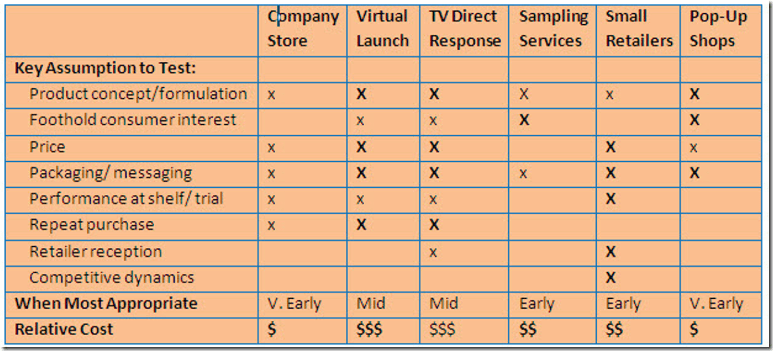
Market experimentation in CPG often requires thinking “outside the (big) box (store)”.

The results of tests run in alternative channels can offer evidence to support (or refute) launch in the traditional and concept refinement in advance of such a launch.

Further, in many cases these channels can represent not only a venue for experimentation but also an early or alternate form of distribution.

The bottom line? Don’t focus on volume when running experiments.

Rather, focus intently on speed, affordability, connecting directly with consumers, and concept refinement.

* * * * *

6 out-of-the-box alternatives: the company store, a virtual launch, TV direct response, product sampling services, small retailers and temporary pop shops.
image

1. Give It a Spot in the Company Store
Offering a new product internally can enable a good-enough approach across several dimensions (i.e., packaging, messaging). The price tag is cheap, and the testing can happen very quickly. Overall, to get an early read on consumer appetite for a new idea, the company store offers a lot of advantages.

2. Leverage Cyberspace with a Virtual Launch
Want to bypass the retail channel altogether when testing a concept? The Internet enables manufacturers to conduct small-scale launches that do just that by setting up simple websites with order-taking and fulfillment capabilities.

Virtual launches offer a lot of other advantages when testing assumptions around new concepts.

First, such launches enable rapid testing of consumer response to formulation, packaging, and branding
without the crippling cost of a full-scale launch.

Second, such launches can create buzz as they can attract early adopters, bloggers, Twitter and Facebook users, and even the increasing numbers of
mainstream press who are listening to these channels.

Third, manufacturers are able to gather valuable consumer information not possible through traditional channels, including feedback (i.e., comment
boxes, chat boards), purchase behaviors (i.e., trial vs. repeat), and customer characteristics (i.e., location, demographics).

P&G has been very active in its experimentation with virtual launches with products including Crest Whitestrips, Pampers Change ‘N Go, Swash by Tide, and Align GI.

In the case of Crest Whitestrips, a virtual launch on whitestrips.com and in select dental offices generated unexpectedly high sales ($23 million from August 2000 to May 2001) and led to an acceleration of the retail launch timeline.

3. Reach for the TV Waves with Direct Response
Along the same lines as the virtual launch, television can offer a unique placement opportunity for manufacturers seeking input on product, pricing, trial/repeat, marketing, messaging, and a host of other product dimensions.

These channels are typically most applicable for more complex or new-to-market products benefiting from such a high-touch sales model.

The two most common alternatives are home shopping networks (i.e., QVC) and infomercials.

Home shopping networks offer a captive audience, live product demonstration, and rich data analytics. This combination enables rapid iteration of messaging based on near real-time sales data.

QVC, for example, boasts an 80+ million household audience to its 24/7 storefront.

Infomercials offer similar advantages to home shopping networks, with a twist.

First, longer formats make them even more applicable for complicated sales models (i.e., devices, new platforms of products, new categories).

Second, higher investment costs in the form of production make them more appropriate for later-stage tests versus a home shopping placement.

Infomercials have also served as stepping stones for many products that have gone on to reach broader audiences. Looking for examples? Think of products like OxiClean (now distributed broadly in FDM channels, and Proactiv available online and through kiosks.

4. Consider Sampling Services
Sampling services often cater to early adopters seeking the newest products on the market. While these solutions do not offer insight on pricing or at-the-shelf behavior, they do offer manufacturers the opportunity to glean valuable early perspectives on certain dimensions (i.e., formulation, packaging, marketing) before a product is ready for the mass market.

Other advantages of such services include being quick to launch, having built-in consumer bases, and incorporating a feedback protocol.

5. Remember that Good Things Come in Small Boxes
Sometimes a more traditional shelf setting is required. In these types of situations, small independent retail outlets can provide a great alternative for under
the radar testing of new products.

For personal care products, spas and salons can provide very relevant data points.

For food products, self-serve restaurants, gourmet stores, or health food stores are a good bet.

For beverages, bodegas or self-serve restaurants get the job done.

All of these settings can provide consumer insights similar to the traditional channel shelf in a smaller scale experiment, often with the added advantage of providing feedback from the proprietor or salesperson.

6.Get Focus Fast with a Pop-Up Shop
Have a defined sense of your foothold consumer but unsure if the concept will resonate?

Setting up a “pop-up shop” in close proximity of your target audience can quickly provide valuable insights at a low price tag.

Think broadly and you’ll surely find that appropriate venues can be found for almost all consumer segments.

Interested in college kids? Try a university campus or bookstore.

Aiming at athletes? Outside a gym might be a good bet.

Have your sights on parents of young kids? A community fair will surely provide a captive audience.

Urban youth? Hit the local basketball courts.

Another twist on the physical pop-shop is to leverage a vending kiosk or a mobile truck offering.

A recent, interesting example of this type of approach is the Coke Freestyle beverage dispenser. Through this novel vending machine, Coke is able to offer over 100 different varieties of beverages (i.e., soda, tea, juice and water) by combining different “micro-doses” from about 30 cartridges in the machine.

Yes, the concept offers mass customization and drives much greater choice for the consumer. Beyond that, however, the machine offers Coke the opportunity to experiment with different flavors and beverages and to get instant feedback on consumer uptake by geography through RFID technology
present on the cartridge.

This type of vending experiment offers enormous cost savings versus the traditional approach of testing a concept by bottling and pushing through the traditional distribution channel to separate winners from losers.
* * * * *

Full article:
http://www.innosight.com/innovation_resources/article.html?id=843

* * * * *