Archive for December, 2009

Mayor Bloomberg boils down the healthcare bill … in 2 sentences !

December 31, 2009

Key Point: NYC Mayor Michael Bloomberg — a supporter of healthcare reform — criticizes the bill’s lack of transparency, sensibility, and consequences

* * * * *

Many who have long touted health care reform are turning up their noses at the final product.

Michael Bloomberg, New York’s independent mayor, told “Meet the Press” over the weekend:

I have asked congressperson after congressperson. Not one can explain to me what’s in the bill, even in the House version … And so for them to vote on a bill that they don’t understand whatsoever, really, you’ve got to question how — what kind of government we have.”

The mammoth 2,100-page health care bill passed by the Senate “makes no sense whatsoever — not to conservatives, not to liberals, not to anyone.”

“Rather than reform a system that everyone agrees is a failure, it will subsidize that system and compel participation in it.”  

Mr. Bloomberg added that his own reading of the Senate bill led him to conclude that it would blow a hole in the New York State budget and force closure of perhaps 100 health clinics.

Excerpted from WSJ: Like Mushrooms, Health Care ‘Reform’ Flourishes in the Dark, Dec. 28, 2009
http://online.wsj.com/article/SB10001424052748703278604574624230633163104.html?mod=djemEditorialPage

Nelson’s political right-to-life threatened by a Cornhusker Rebellion …

December 31, 2009

Everybody in earth orbit knows that Sen Ben Nelson of Nebraska sold his right-to-life principles for a couple of hundred million dollars and cast the deciding vote for ObamaCare.  Apparently, he expected Nebraskans to savor the Medicaid bribe he took on their behalf.  Oops.

It looks like the Nebraska senator’s health-care vote may have killed him politically.

A new Rasmussen Reports poll — the first state-wide poll since the controversial deal he cut in exchange for his deciding vote on the Senate health care bill –shows that if he were running for re-election today, Mr. Nelson would lose to Nebraska’s GOP Governor David Heineman by a stunning 61% to 30%.

Only three years ago, Mr. Nelson won his current term with a solid 64% of the vote.

Clearly, the senator’s fall in public esteem is a direct reaction to his having voted for the health care bill as part of a deal in which Nebraska was exempted from the costs of new federal Medicaid mandates.

The ObamaCare bill was already unpopular enough in Nebraska but became even more so when state residents discovered they would be saddled with it anyway, plus exposed to national ridicule over Mr. Nelson’s sweetheart deal.

Now 53% strongly oppose the bill, while another 11% somewhat oppose it.

Only 17% favor the deal that Mr. Nelson struck in order to vote for the bill.

But the poll also shows a path to redemption.

Asked how they would vote in the 2012 election if Senator Nelson changed his vote and prevented the health care bill from becoming law, Nebraska voters give Governor Heineman a lead of only 47% to 37% … that simply reversing his health-care vote immediately reduces Mr. Nelson’s deficit by two-thirds.

“The poll suggests the anger of Nebraska voters is deep and unusually intense, and not likely to dissipate quickly.”

No doubt it was precisely his concern about the unpopularity of the bill back home that prompted Mr. Nelson to hedge his bets when he announced he would support it — he made clear at the time he might not vote for it again if the final compromise between House and Senate versions tilts too far to the left.

Given the shocking slump in his standing back home, Mr. Nelson might like to keep those remarks handy during the coming weeks as the two bills are hammered together.

Source: WSJ, Ben Nelson’s Purgatory, Dec. 30, 2009
http://online.wsj.com/article/SB10001424052748704152804574628591826272498.html?mod=djemEditorialPage

Ken’s Bet: Nebraska voters are just teasing Nelson with the ray of hope if he changes his vote.  The voters seem more principled than the Senator and smart enough to know that if he betrayed their trust once, he’ll do it again.  In 2013, Nelson will be a high paid lobbyist or Obama’s Ag Secretary.

If you’re unhappy, move to a state with lower taxes …

December 30, 2009

Punch line: States with the highest taxes also rank as the unhappiest.

* * * * *

WSJ: Are Taxes the Root of Unhappiness?, Dec. 29, 2009

Does living in a blue state make people blue?

It seems so, according to a new study in Science magazine  … New Yorkers — with high taxes, traffic congestion, cold weather, and poor schools — are the unhappiest people in America and their neighbors in Connecticut come in a close second, followed by Michigan, Indiana, New Jersey, California, and Illinois.

And the happiest states? Drum roll, please…Louisiana, Hawaii, Florida, Tennessee, and Arizona.

Eight of the ten happiest states lean right while eight of the ten unhappiest tilt left.

The people who say they’re satisfied with their lives aren’t just delusional or overly optimistic, and people who say they’re unsatisfied aren’t just pessimists. People have legitimate reasons to be happy or unhappy.

And well, high taxes seem to be a big reason—ostensibly an even bigger reason than weather given that California is one of the unhappiest states and inclement Louisiana is the happiest.

According to the Tax Foundation 2008 analysis, three of the top five unhappiest states—New York, Connecticut and New Jersey — have the highest state-local tax burdens.

On the other hand, four of the top five happiest states—Louisiana, Florida, Tennessee and Arizona — are among the states with the lowest state-local tax burdens. True, correlation doesn’t prove causation, and high taxes alone don’t always make people miserable, but there’s something going on here.

In states with high property, income, and sales taxes like New York, people have less money to spend on other things that make them happy. They have less money to spend on vacations, hobbies, home improvements, eating out and child care. Another problem may be that people receive a low return on their tax dollars.

People are least happy in states that impose high taxes but don’t provide matching public benefits (e.g. good highways to relieve congestion and reduce commute times). It’s in states where taxes disproportionately subsidize public employee pensions and entitlement programs, but don’t much improve the general public’s quality of life, that people are most unhappy.

This intuitively makes sense. If you’re paying more than a third of your income in taxes, as many New Yorkers do, then you expect to realize the benefits from your hard-earned tax dollars. You expect quality schools, good roads, low crime rates, and quick commutes. You expect your local and state governments to be responsive to your needs, not to the cash flows of entrenched public employee unions and other special interests.

Many liberal state governments like those in Albany, Trenton and Sacramento are spending more and more on entitlement programs and public employee pensions, racking up more and more debt, and imposing more and more taxes to pay for it all –while ignoring their taxpayers’ needs.

Taxpayers, however, aren’t just getting unhappy. They’re getting out. United Van Lines’ 2009 annual study shows that New York, New Jersey, Michigan and Illinois are among the states with the highest outbound migration while Alabama and Tennessee are among the states with the highest inbound migration.

This doesn’t bode well for high-spending, high-tax states like New York where outbound migrants’ income is 13% greater than that of inbound migrants. In 2006, this differential meant a loss of $4.3 billion in taxpayer income for the state.

Taxes may not be the root of all unhappiness, but they do result in some very sad citizens.

Full article (with stats explanation)
http://online.wsj.com/article/SB10001424052748703278604574624743612652998.html?mod=djemEditorialPage

When you adjust stock gains for inflation … uh-oh !

December 29, 2009

TakeAway: Adjusted for inflation, the Dow would have to rise 28% just to get back to 1999 levels.

* * * * *

Excerpted from WSJ: Adjusted for Inflation, Dow’s Gains Are Puny, Dec. 28, 2009

Stock analysts sometimes like to note that the Dow today is worth 27 times its value at its 1929 pre-crash peak, meaning that even if you bought at the worst moment, your stock still would be way up over time. In inflation-adjusted terms, however, the Dow today is only a little over twice its 1929 peak.

Many investors realize that stocks have been among the worst investments of the past decade. But they may not realize quite how bad the decade was, because most people forget about the effects of inflation.

Despite its 2009 rebound, the Dow Jones Industrial Average today stands at just 10520.10, no higher than in 1999. And that is without counting consumer-price inflation.

In 1999 dollars, the Dow is only at about 8200 and would have to rise another 28% or so to return to 1999 levels. Using today’s dollars and starting at 10520.10, the Dow would have to surpass 13460 to get back to its 1999 level in real, inflation-adjusted terms.

image

All of this might be enough to put investors off stocks entirely, until they consider the long-term alternatives.

Measured over the 1978-2008 period, rather than over just one decade, stock performance in real-real terms actually is better than that of just about any other major investment class: 4.5% a year. Stocks’ ability to keep up with inflation over the very long haul may be their best selling point.

In real-real terms, stocks did better over that period than municipal bonds (2.5% a year), long-term government bonds (2% a year) and corporate bonds (0.2% a year).

Real-real home prices were unchanged over those 30 years.

Both short-term government bonds and commodities suffered losses.

Full article:
http://online.wsj.com/article/SB10001424052748703991304574621903850508632.html?mod=WSJ_hps_MIDDLEThirdNews

Just can’t seem to get the ball into the end zone …

December 29, 2009

Ken’s Take: Even “Cash for Caulkers” seems stalled. Imagine what implementation of the complicated healthcare program will be like.  My bet: It won’t be pretty. 

* * * * *

Excerpted from LA Times: Obama’s ambitions outpace his effectiveness, by Doyle McManus, December 27, 2009

Obama has turned out to be masterful at launching new policies but inconsistent at getting them to work.

His presidency is threatened to fall into a worrisome pattern:

  1. The announcement of a lofty goal,
  2. The delegation of implementation to second-rank officials,
  3. A missed deadline or two,
  4. Last-minute intervention by the president to rescue the effort from collapse,
  5. And, finally, mixed results …
  6. … followed by a statement claiming victory.

Full article:
http://www.latimes.com/news/opinion/commentary/la-oe-mcmanus27-2009dec27,0,3930020.column

* * * * *

Another Holiday Season Message: The Shameful Decline of Shame

December 28, 2009

Ken’s Take: Worth reading and internalizing … especially during the holiday season …

* * * * *

Excerpted from Richmond Times-Dispatch: The Shameful Decline of Shame, by Robin Beres, December 27, 2009

Webster’s New World College Dictionary defines shame as a painful feeling of having lost the respect of others because of the improper behavior, incompetence, etc. of oneself or another; or as a dishonor or disgrace.

Britney Spears, Paris Hilton, and Lindsay Lohan have all gotten rich (or richer) from behaving like tramps. As we are treated to an unending series of newscasts on their panty-free nights out, their homemade sex tapes, and trashy photography shoots, the media glorify these women for being nothing more than what Americans once referred to as sluts.

Gov. Eliot Spitzer was caught fooling around on his wife with a high-priced escort;  Spitzer’s replacement, David Paterson, quickly admitted to numerous affairs — as well as marijuana and cocaine use; when South Carolina governor Mark Sanford’s dalliance with his sultry soul mate became public, he opted to remain as governor; and, oh yeah, how about that Tiger Woods?

It seems that — even outside the steamy world of celebrity sex-capades — shame has become an outmoded concept.

Being judgmental or critical of actions that are immoral or wrong is now considered politically incorrect.

  • No longer is there any shame in staying on welfare or having a child out of wedlock.
  • There is no shame in being just a mediocre student in school.
  • Elbows on the dinner table and interrupting are accepted.
  • People rudely talk on their cells and text any time, any place.
  • Screaming at someone in public is OK.
  • We put up with crude, even filthy, language.
  • We teach our kids that self-esteem is something entitled simply because one exists.

Perhaps a little old-fashioned shame could serve us well.

This is not to advocate a return to the harsh judgments of yesteryear. No one wants to see someone tarred and feathered for making poor choices or behaving badly — but perhaps just a wee touch of accountability could have some positive effects.

Edmund Burke wrote: “shame keeps watch so that virtue is not wholly extinguished from the heart.

Since we don’t have the great number of stern nuns around anymore to chastise our bad behavior, perhaps it is up to us to start acting like grown-ups and demand better behavior from our politicians, our celebrities, and even ourselves.

Full article:
http://www2.timesdispatch.com/rtd/news/opinion/commentary/article/ED-BERES27_20091225-192807/313566/

Christmas 2009 – 45 Lessons in Life

December 23, 2009

This short slide show was sent to me by a friend. 

It really resonated with me, so I thought I’d share it with you.

Merry Christmas and Happy New Year to all !
back with you after the New Year

* * * * *
click picture or link below to launch
then click to advance slides
( best with audio on)
image

https://homafiles.info/wp-content/uploads/2009/12/45lesonsinlife-091118003935-phpapp02.pps

Unintended consequences? About limiting insurance companies to 20% of premiums on admin and comp …

December 23, 2009

Reid thinks he was really clever with the ObamaCare provision that limits insurance companies to spending 20% or less of premiums collected on SG&A — sales, general & admin costs — including exec comp.

Ken’s Bet: It’ll cause healthcare costs and premiums to go up.  Here’s why …

Assume that Acme Insurance currently collects $7.5 million in premiums — pays out $5.25 million to healthcare providers (docs, hospitals, pharmacies, etc.) — and spends $2.25 million (30%) on SG&A.

Reid thinks his rule will cut premiums by about $1 million — thanks to a roughly $1 million cut in SG&A.

WRONG !

Here’s a more likely outcome:

Acme holds its SG&A constant and simply starts selling more liberal plans (maybe all the way up to the Cadillac limit) to force fit within the 20% limit — for example, Acme charge $11.25 million in premiums to cover $9 million in payouts ( lower co-pays & deductibles, more botox) and allow $2.25 of SG&A (20% of $11.25).

PRESTO!

Rather than healthcare costs coming down and premiums getting reduced, premiums and healthcare expenditures go up by 50% … SG&A stays the same … insurance execs still drive fancy cars.

Ken’s Take: The DC boneheads have zero conception of how businesses run …

Reprise: The looming Medicaid tsunami …

December 23, 2009

I posted this a couple of weeks ago —  an editorial by the head of Johns Hopkins. 

His view: A vast expansion of the Medicaid program — without adequate risk-adjusted reimbursement rates — will impose unsustainable costs on healthcare providers.

With the Senate bill on its way to passage, it’s worth a re-read — a prediction of what’s to come from somebody who knows.

* * * * *
Excerpted from WSJ:  Health Reform Could Harm Medicaid Patients, Dec. 4, 2009 

Both the House and Senate health-care reform bills call for a large increase in Medicaid—about 18 million more people will begin enrolling in Medicaid under the House bill starting in 2013.

A flood of new patients will be seeking health services, many of whom have never seen a doctor on more than a sporadic basis. Some will also have multiple and costly chronic conditions. And almost all of them will come from poor or disadvantaged backgrounds.

Johns Hopkins’  Priority Partners handles Medicaid patients under a capitated system — that is, it receives a set payment per individual per month from the state.

Over time, we’ve developed the ability to manage the care of these individuals in a way that is both cost effective and that provides them with quality care. We’ve done it by tapping into our extensive delivery system, which includes four hospitals, a nursing home, the largest community-based primary care group in Maryland, and much more.

We’ve hit above-national benchmarks on all clinical quality measures, reduced monthly costs for patients with substance abuse and highly complex medical needs, and 70% of our patients tell us they’re satisfied with our care.

The key fact is that for years the state did not cover all the costs our Medicaid program incurred. As a result of new patients whose costs were not completely covered by the state, Priority Partners lost $57.2 million from 1997 to 2005.

We stanched the losses by ensuring that the payment from the state was appropriately risk adjusted to match the health conditions of our members, and by investing heavily in primary-care and care-management and disease-management programs.

Yet this past year the losses began again, because the state expanded the program’s eligibility to 116% of the federal poverty level up from 40%.

So we are struggling with a large group of new patients—about 30,000 people. Today, like in the late 1990s, a health-care surge is overwhelming our managed-care system. The capitated rate for the new beneficiaries is not yet risk-adjusted. Priority Partners has lost a devastating $15 million in just nine months.

Congress can help, or at least learn from our experience to use the reform legislation to bend the cost curve if it encourages other states to institute and appropriately fund capitated systems that allow capable providers to adjust payments based on risk. The key is that federal support to states for Medicaid must appropriately adjust rates to match the risk of providing health care to the group of people who are covered by Medicaid.

The Senate bill would increase eligibility for Medicaid to those who make 133% or less of the federal poverty level. The Kaiser Family Foundation reports there are 308,000 people who meet that threshold in Maryland.

Even if only half of those individuals seek Medicaid coverage, such a large expansion would likely have an excruciating impact on the state’s budget.

Without an understanding by policy makers of what a large Medicaid expansion actually means, and without delivery-system reform and adequate risk-adjusted reimbursement the current health-care legislation will have catastrophic effects on those of us who provide society’s health-care safety-net.

In time, those effects will be felt by all of us.

Full article:

http://online.wsj.com/article/SB10001424052748703939404574567981549184844.html?mod=djemEditorialPage

Online marketing from a Hollywood hot shot: just another prank, or a breakthrough for the bottom line?

December 23, 2009

Takeaway: The latest breakthrough in online innovation has come from a rather unsuspecting source: Hollywood playboy Ashton Kutcher. He’s taken his act to the web, and has lured an entourage of prominent consumer brands along with him.

Kutcher’s new format merges traditional entertainment, advertising, and social networking into a seamless product. The programming has attracted droves of viewers, and companies like Pepsi and Nestlé believe that this format will enable them to drive deeper levels of customer engagement.

In the crowded world of webertainment one other characteristic sets this pied piper apart from the other online media moguls – he’s intensely profit-focused.

* * * * *

Excerpt from Fast Company, “Mr. Social: Ashton Kutcher Plans to Be the Next New-Media Mogul,” by Ellen McGirt, Issue 141, December, 2009.

Ashton Kutcher, best known for his eight seasons as Michael Kelso on That ’70s Show, and on his hit MTV show Punk’d, is using his media company, Katalyst, to pioneer a new kind of business bridging Hollywood, technology, and Madison Avenue.

Kutcher and his partner, Jason Goldberg, spent the better part of two years courting the wizards of Silicon Valley, converting them from teachers and skeptics to friends and allies. For all their pranks, Katalyst can claim one thing most other social-media businesses can’t – profitability.

It’s not just talk. Some 3.9 million people follow Kutcher on Twitter, and he has nearly 3.3 million Facebook fans. Those numbers have helped attract corporate clients including Nestlé, Pepsi, and Kellogg.

Katalyst series, HQ, illuminates what Kutcher’s production company wants to become – not just a home for his television and movie projects but also a go-to source for brands looking to deploy what’s called “influencer marketing,” a hybrid of entertainment content, advertising, and online conversation that finds its audience via video, animation, Twitter, blogs, texts, and mobile. “Entertainment is a dying industry,” says Kutcher. “We’re a balanced social-media studio, with revenue streams from multiple sources” – film, TV, and now digital. “For the brand stuff, we’re not replacing ad agencies but working with everyone to provide content and the monetization strategies to succeed on the Web.”

Kutcher is not exactly the image of a business visionary, but he intends to become the first next-generation media mogul, using his own brand as a springboard.

Still, even if Kutcher turns out to be more style than substance and Katalyst doesn’t become the next big thing, Kutcher’s experiment points toward a new model for the evolving media business.

What the Katalyst team is planning, he says, is simple – make entertaining stuff, give it to people where they already are, let them have some fun with it, and mix in brand messaging. And because of the viral nature of the Web, each new consumer is cheaper to win than the last one. “We know how to gain and activate and retain an audience,” Kutcher says. “We create social networks for brands.”

This is the way things are going, says Netscape founder Marc Andreessen. “Katalyst is way out on the leading edge in terms of thinking this stuff through,” he says. Katalyst steps into the gap left by ad agencies that gave up on the Web after the dotcom bust. “Banner ads aren’t going to cut it,” he says. “And media companies have not been creative or aggressive about making products designed for engagement marketing. Now that’s changing, giving brand advertisers a new way and reason to buy.”

It is Katalyst’s work with Pepsi on something called DEWmocracy that may best illustrate the model Kutcher & Co. is after. The first iteration of DEWmocracy was a reasonably successful promotion – a destination site with an animated film made by actor Forest Whitaker, where fans could pick the next Mountain Dew flavor. For the second iteration, chief marketing officer for Pepsi says, “Katalyst had new ideas about where we could find value in the social-media space and how to mobilize large groups of people.” The campaign, which runs through early 2010, lets people pick not only the flavor, name, color, and label of new sodas but eventually the in-store merchandising and the ad agency, in an online bake-off. Fans can also submit their own ads. “My theory is, you have to engage the constituency and let them be the voice of the brand,” says Kutcher. “I help connect people to the Mountain Dew brand so they can be creative with it.”

Mountain Dew’s Facebook fan page grew fivefold at the launch, but the big win is inside Pepsi. “A lot of senior managers at consumer brands feel like their role is to control the communications around a brand,” a Pepsi executive explains. They are uncomfortable with the transparency of social media because “people will say negative things about you.” What makes him happiest about DEWmocracy, he says, is “the competency we’re building throughout the organization in using these new tools. It’s a symbol of what’s possible within brand marketing at Pepsi.”

Kutcher and Goldberg acknowledge that Katalyst today is still primarily a film-production studio. And not all on that end is going swimmingly. Its most recent Kutcher vehicle, Spread, earned a pathetic $250,000 in the United States. For 2010, Kutcher has two major features coming out, and Katalyst is producing an experimental film that could easily flop. “We’re taking a big risk, but we’re all about learning,” says Goldberg.

Edit by BHC

* * * * *

Full Article: http://www.fastcompany.com/magazine/141/want-a-piece-of-this.html?#

* * * * *

Save the planet … eat Fluffy !

December 23, 2009

One View: “Everyone should work out their own environmental impact. I should be allowed to say that I walk instead of using my car and that I don’t eat meat, so why shouldn’t I be allowed to have a little cat to alleviate my loneliness?”

And, another …

* * * * *
Excerpted from AFP: Polluting pets: the devastating impact of man’s best friend,  Dec 20, 2009

According to the book “Time to Eat the Dog: The Real Guide to Sustainable Living”, man’s best friend could be one of the environment’s worst enemies, according to a new study which says the carbon pawprint of a pet dog is more than double that of a gas-guzzling sports utility vehicle.

A medium-sized dog eats around 164 kilos (360 pounds) of meat and 95 kilos of cereal a year.

Combine the land required to generate its food and a “medium” sized dog has an annual footprint of 0.84 hectares (2.07 acres) — around twice the 0.41 hectares required by a 4×4 driving 10,000 kilometres (6,200 miles) a year, including energy to build the car.

“Owning a dog really is quite an extravagance, mainly because of the carbon footprint of meat.”

Other animals aren’t much better for the environment.

Cats have an eco-footprint of about 0.15 hectares, slightly less than driving a Volkswagen Golf for a year.

“If pussy is scoffing ‘Fancy Feast’ — or some other food made from choice cuts of meat — then the relative impact is likely to be high.” 

“If, on the other hand, the cat is fed on fish heads and other leftovers from the fishmonger, the impact will be lower.”

Two hamsters equate to a plasma television and even the humble goldfish burns energy equivalent to two mobile telephones.

And pets’ environmental impact is not limited to their carbon footprint, as cats and dogs devastate wildlife, spread disease and pollute waterways, the Vales say.

With a total 7.7 million cats in Britain, more than 188 million wild animals are hunted, killed and eaten by feline predators per year, or an average 25 birds, mammals and frogs per cat.

Likewise, dogs decrease biodiversity in areas they are walked, while their feces cause high bacterial levels in rivers and streams, making the water unsafe to drink, starving waterways of oxygen and killing aquatic life.

And cat poop can be even more toxic than doggy doo — owners who flush their litter down the toilet ultimately infect sea otters and other animals with toxoplasma gondii, which causes a killer brain disease.

As with buying a car, humans are also encouraged to take the environmental impact of their future possession/companion into account.

But the best way of compensating for that paw or clawprint is to make sure your animal is dual purpose, the Vales urge. Get a hen, which offsets its impact by laying edible eggs, or a rabbit, prepared to make the ultimate environmental sacrifice by ending up on the dinner table.

“Rabbits are good, provided you eat them.”

Full article:
http://news.yahoo.com/s/afp/20091220/lf_afp/lifestyleclimatewarminganimalsfood

* * * * *

Thanks to Coop for stringing the lead

Going for the capillaries (and not the jugular): Nailing the tanning salons

December 22, 2009

There was an interview on one of the biz shows yesterday — a poor stiff who owned a couple of tanning salons.

They guys was pale .  (Pardon the pun) 

He said: “life savings in the salons … eeking out a living … getting slammed by the recession since tanning is as discretionary as spending gets … was stunned to hear about the 10% tax … will probably have to shut down”

When asked “Were your lobbyists asleep at the switch?”, he answered “Are you kidding, what lobbyists?”

Maybe it’s a good idea to shut down tanning salons — frankly, I don’t have a point of view on that one.

But, raises a couple of questions:

1) How much tax revenue will be raised via the tanning salon tax if all the tanning salons close?

2) Is it right for the full force of the government to come down on a piddly business like tanning salons?

3) Why not tatoo parlors?  Or, funnel cake stands?  Or, (fill in the blank)

Hands off Wall Street, big insurance, big pharma, etc., but nail the tanners … Geez.

Scratch your head before clicking thru to any of these sites …

December 22, 2009

From a compendium of the worst unintentional website url addresses:

1. A site called ‘Who Represents‘ where you can find the name of the agent that represents a celebrity. Their domain name… wait for it… is
www.whorepresents.com

2. Experts Exchange, a knowledge base where programmers can exchange advice and views at
www.expertsexchange.com

3. Looking for a pen? Look no further than Pen Island at
www.penisland.net

4. Need a therapist? Try Therapist Finder at
www.therapistfinder.com

5. Then of course, there’s the Italian Power Generator company…
www.powergenitalia.com

6. And now, we have the Mole Station Native Nursery, based in New South Wales:
www.molestationnursery.com

7. If you’re looking for computer software, there’s always
www.ipanywhere.com

8. Welcome to the First Cumming Methodist Church. Their website is
www.cummingfirst.com

9. Then, of course, there’s these brainless art designers, and their whacky website:
www.speedofart.com

10. Want to holiday in Lake Tahoe? Try their brochure website at
www.gotahoe.com

* * * * *
Source article:
http://independentsources.com/2006/07/12/worst-company-urls/

Thanks to Butchy for stringing the lead.

Why can't Americans make things? Two words: business school

December 22, 2009

Excerpted from The New Republic, Upper Mismanagement: Why can’t Americans make things? Two words: business school, December 18, 2009

The business schools had their own incentives to channel students into high-paying fields like finance, thanks to the rising importance of school rankings, which heavily weighted starting salaries. The career offices at places like Harvard, Stanford, and Chicago institutionalized the process—for example, by making it easier for Wall Street outfits and consulting firms to recruit on campus.

A recent Harvard Business School case study about General Electric shows that the company had so much trouble competing for MBAs that it decided to woo top graduates from non-elite schools rather than settle for elite-school graduates in the bottom half or bottom quarter of their classes.

No surprise then that, over time, the faculty and curriculum at the Harvards and Stanfords of the world began to evolve. “If you look at the distribution of faculty at leading business schools, they’re mostly in finance. …  Business schools are responsive to changes in the external environment.”

Which meant that, even if a student aspired to become a top operations man (or woman) at a big industrial company, the infrastructure to teach him didn’t really exist.

In fairness, all that financial expertise we’ve been churning out hasn’t been a complete waste (much as it may seem that way today).

Many of the financial restructurings of the ‘80s and ‘90s made the economy more efficient and competitive.

Likewise, it would be ludicrous to suggest that simply changing the culture of business schools would single-handedly revive U.S. manufacturing. 

But, it’s hard to believe that American manufacturing has a chance of recovering unless business schools start producing people who can run industrial companies, not just buy and sell their assets. And we’re pretty far away from that point today.

Full post:
http://www.tnr.com/article/economy/wagoner-henderson?page=0,1

* * * * *

Thanks to Laj for the lead

Wal-mart and Amazon put a bullseye on Target.

December 22, 2009

TakeAway:  Wal-mart, Amazon, and Target didn’t want to just lose money on books, they decided to lose money on DVDs too. 

The latest price wars to lure consumers during the holidays may cause irreversible long-term damage.

* * * * *

Excerpted from WSJ, “Online Price War Moves to DVDs As Discounters Compete for Sales,” By Miguel Bustillo and Ann Zimmerman, November 6, 2009

Wal-Mart extended its holiday price war into new territory Thursday by slashing online prices on 10 hotly anticipated DVDs … to $10.

Within hours, Amazon and Target matched some of Wal-Mart’s online prices on pre-orders of the DVDs, and Wal-Mart lowered its price by a penny to $9.99, reprising the scuffle that broke out last month when Wal-Mart launched an aggressive $10 book promotion …

Like the book war … the DVD battle resulted in prices that guaranteed the retailers would lose money on the movies. However, promotions to sell new movie releases close to or below cost in order to drive customer traffic are already common in retailing …

Though Wal-Mart, Amazon and Target always compete feverishly with aggressively priced promotions, the latest skirmishes, heading into a holiday season in which recession-scarred consumers are searching for bargains, have been especially cutthroat.

Despite involving just a handful of titles, the book war aroused strong passions in the publishing industry. Some worried that it would set troublesome new customer expectations on bestseller prices and even affect the amount of future advances publishers could afford to pay writers.

The American Booksellers Association last month asked the Department of Justice to determine if it constituted “illegal predatory pricing,” arguing independent book stores wouldn’t be able to compete.

The book prices were so low that the retailers placed limits on the number of copies customers could purchase.

Edit by TJS

* * * * *

Full Article
http://online.wsj.com/article/SB20001424052748704013004574518210171023536.html#mod=todays_us_marketplace

* * * * *

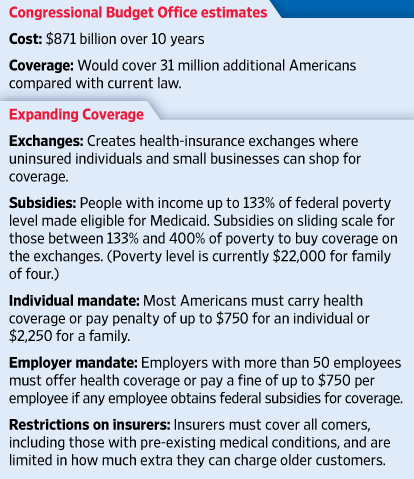
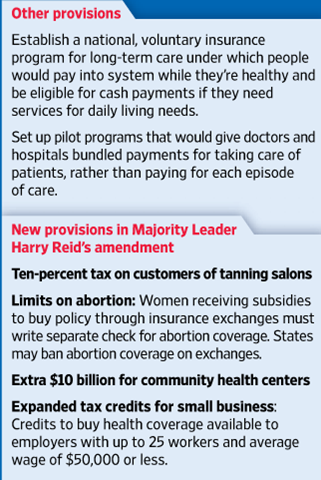
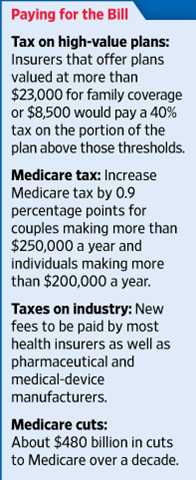
Key provisions of the Senate healthcare bill ..

December 21, 2009

Below is the WSJ’s summary.

Big deals:

  • Roughly $50 billion per year each from tax increases and Medicare cuts
  • Massive expansion of Medicaid … estimated 1/2 of the newly insured
  • Roughly 10 million “young healthies” who self-insure mandated to buy insurance
  • .9% increase in Medicare taxes if over $250,000
  • Excise tax on Cadillac insurance plans (except for longshoremen)
  • $10 billion for community health centers

Ken’s Favorite: 10% tax on tanning salons

Pay-offs for votes:

  • Nebraska, Louisiana, Vermont and Massachusetts are getting more federal help with Medicaid than other states. In the case of Nebraska — represented by Sen. Ben Nelson, who’s providing the critical 60th vote for the legislation to pass — the federal government is picking up 100 percent of the tab of a planned expansion of the program, in perpetuity.
  • Florida’s beneficiaries of Medicare Advantage plans — the private managed-care plans within Medicare —  will have their benefits grandfathered in thanks to a provision tailored by Sen. Bill Nelson.
  • Longshoremen were added to the list of workers in high-risk professions who are shielded from the full impact of a proposed new tax on high-value insurance plans.

 From the WSJ: 

image

image image
http://online.wsj.com/public/resources/documents/info-enlargePic07.html?project=imageShell07&bigImage=wsj_healthpol091220.gif&h=569&w=959&title=WSJ.COM&thePubDate=20080826

Can’t blame Bush for this one …

December 21, 2009

The politics of healthcare reform are simply amazing. 

Over 3/4s of Americans are reasonably satisfied with their healthcare insurance and the healthcare they receive — and they expect taxes to go up, insurance premiums to go up, and healthcare to get worse with longer waits and more denied services. 

Still, the Senate passed — on a straight party line vote — a law that roughly 2 out of 3 Americans oppose. 

Now they — the Democrats in general and Pres. Obama specifically — “own” the healthcare system.  Rightly or wrongly, every premium increase, every delayed doctor’s appointment, every service denied, etc., will be chalked up to ObamaCare.  Turnabout is fair play !

* * * * *
Excerpted from RCP: Democrats Risk Another Jacksonian Moment, December 21, 2009

Democratic leaders are courting disaster with this health care bill. With it, they’ve moved their questionable wheelings and dealings from the margins to the center of American life. Consider some of the special deals:

Nebraska, Louisiana, Vermont and Massachusetts are getting more federal help with Medicaid than other states. In the case of Nebraska — represented by Sen. Ben Nelson, who’s providing the critical 60th vote for the legislation to pass — the federal government is picking up 100 percent of the tab of a planned expansion of the program, in perpetuity.

Florida’s beneficiaries of Medicare Advantage plans — the private managed-care plans within Medicare —  will have their benefits grandfathered in thanks to a provision tailored by Sen. Bill Nelson.

Longshoremen were added to the list of workers in high-risk professions who are shielded from the full impact of a proposed new tax on high-value insurance plans.

We might be on the verge of another Jacksonian moment: a time when the people awake from their slumber, angrily exercise their sovereign authority, and mercilessly fire the leaders who have for too long catered to the elites rather than average people.

In true Jacksonian fashion, the country fired the Republicans in 2006 and 2008 because they bungled the war in Iraq and allowed the economy to sink into recession.

The people might soon have another Jacksonian moment, and fire these equally useless Democrats for hampering the recovery, exploding the deficit, and playing politics with health care.

The fact that the President can’t find a single Republican vote out of more than 200 potential supporters is a strong indication that this is a bad bill.

Ben Nelson sits in the middle of the Senate. He could be a Democrat or a Republican. If he were a Republican, but everything else about him were the same, would he have voted for this? Of course not. That should tell you everything you need to know about this bill: partisanship and pay-offs. 

Full article:
http://www.realclearpolitics.com/horseraceblog/2009/12/democrats_risk_another_jackson_1.html

What’s the best part of this story? … “Drunk 4-Year-Old Steals Christmas Presents”

December 21, 2009

Here are the choices:

  1. Beer in hand
  2. Wearing a dress
  3. Dad in jail
  4. Safety devices on doors
  5. Jacked the presents
  6. “An honest mistake
  7. Add your own …

* * * * *

Source: WTVC-TV, Chattanooga, Tenn.,  December 16, 2009

A 4-year-old boy, beer in hand, is accused of stealing Christmas presents from his neighbors.

April Wright, 21 years old, is currently going through a divorce with her husband who is in jail. 

She says she is not sure how her 4-year-old managed to get out of the house, open a beer, and steal the neighbors presents from under their tree. 

Now she’s just glad he’s okay and says she won’t let it happen again.

The child, Hayden, was found at 1:45 am Tuesday, wandering the streets of his neighborhood.  In a police reports, officers said he was wearing a little girl’s dress and drinking a beer. The police report says the child had to be taken to the hospital to be treated for alcohol consumption.

Wright says she woke up that night at 1:45 am and panicked when she discovered Hayden was gone.  She says she put safety devices on all the doors so her kids couldn’t get out, but Hayden was able to break the safety device off the doorknob and get outside.

The Hamilton County Sheriff’s Office report says Hayden rang the doorbell a few houses down and the neighbor answered, finding the child holding a partially consumed 12-ounce beer.

But it doesn’t stop there. The report said Hayden then snuck into a neighbor’s house through an unlocked front door, and stole five wrapped Christmas gifts.  One was a girl’s brown dress which Hayden was wearing when police found him.

“Kids do things like this and it’s out of your control. You can do the best you can as a mother, but everyone makes mistakes. It was an honest mistake,” Wright said.

http://www.newschannel9.com/news/year-987196-old-christmas.html

Thanks to Lo for stringing the lead

Avatar … a guaranteed hit … well, maybe not “guaranteed”.

December 21, 2009

TakeAway:  Success in the movie industry is a bit of a chicken and egg scenario. 

Movie houses must spend money on marketing in order for consumers to know about the movie; however, movie houses do not want to spend too much money on marketing because it eats into their profits. 

Now, the movie industry has access to ratings based on buzz and word-of-mouth ratings to help inform its ongoing marketing investments and gauge the potential success of a movie.

* * * * *

Excerpted from WSJ, “‘Avatar’ Seeks Out a Mega-Audience,” By Lauren A.E. Schuker and Ethan Smith, December 11, 2009

Market research suggests mixed levels of interest among potential audiences for the extravagant 3-D sci-fi picture “Avatar,” raising the stakes for the backers of one of the most expensive movies ever made.

Twentieth Century Fox says it is counting on strong word-of-mouth and positive reviews from critics to recoup its investment in the movie, which hits theaters next Friday.

The film, which uses pioneering 3-D technology and computer graphics, is one of the most highly anticipated releases to come out of Hollywood in years.

But production costs on “Avatar” … are likely to exceed $300M … Fox is spending around $150 million more on marketing the movie globally …


That means that the movie has to be nothing short of a mega-blockbuster in order to make its money back. As a result, there’s hyperfocus on the latest advance research, or “tracking,” of potential audiences.

Nielsen’s tracking data … indicate that “Avatar” is hewing closely to patterns established by successful films …


While male audiences are showing increased interest and awareness in “Avatar,” female moviegoers are less enthusiastic, with negative attitudes toward the film growing among women under 25.

One distinct bright spot for “Avatar” is that many key metrics—including “unaided awareness” of the movie—have improved as the movie’s release date approaches …

Studios use tracking research, which polls domestic audiences on their awareness of and interest in seeing movies, in order gauge the effectiveness of marketing efforts. The data can be helpful in forecasting a given movie’s opening weekend performance. But predicting a movie’s ultimate box office total is much more difficult.

If a film generates strong word-of-mouth buzz and positive reviews from critics, it can often outperform early estimates …

In some areas, the Nielsen research … shows “Avatar” coming in below similar sci-fi action movies. For instance, roughly a week before release, the data show audiences are demonstrating slightly less “definite interest” in the film than they did at the same point with “Iron Man,” which grossed nearly $100 million opening weekend and more than $300 million at the domestic box office.

“Avatar” is currently scoring slightly behind 2007’s “Transformers” in the crucial “unaided awareness” category. “Transformers” took in $70 million on its opening weekend.

In comparison, tracking data for the movie “2012,” released last month, showed strong interest among both women and men. That film went on to gross $150 million in the U.S. and more than three times that internationally.

“Tracking is light for a title of this magnitude,” says Jeff Bock, a box-office analyst at Exhibitor Relations, referring to “Avatar.”

That said, Mr. Bock adds, “If the reviews are good, that will help encourage older audiences that aren’t quite sold on 3-D yet…. Then you can get that older demographic to see the film, that’s what Fox and Jim Cameron need to make this a hit across the board.”

In the first U.S. review of “Avatar,” posted online Thursday evening, the Hollywood Reporter raved, predicting “Fox will see more than enough grosses world-wide to cover its bet on Cameron.”

Edit by TJS

* * * * *

Full Article
http://online.wsj.com/article/SB10001424052748704193004574588421216055200.html

* * * * *

About the Cadillac excise tax …

December 18, 2009

Ken’s Take: I’m a big fan of the so-called Cadillac tax — not because it hacks off the unions (that’s a lucky strike by-product) — but because it it about the only vehicle being discussed that might contain some healthcare costs. 

In fact, I’m an advocate of putting all company paid premiums on W-2s and then allowing taxpayers reasonable deductions for health insurance premiums (say, $5,000 per person).

And, as a political junkie, I love when WH spokepeople contradict each other, e.g. Summers: recession is over”, Romer: “no, it’s not”.  Here’s another example …

* * * * * *

Excerpted from WSJ: White House v. White House,  Dec.18, 2009 

The ad hoc arguments that WH spokesmen use to put out one healthcare political fire invariably contradict those they’re using to put out another.

Among labor’s complaints is a 40% excise tax on high-cost insurance plans, given that union-negotiated benefits are more generous than average.

So Jason Furman, the deputy economic director, declared that this so-called Cadillac tax “will affect only a small portion of the very highest cost health plans — a total of 3% of premiums in 2013.”

But wait: White House budget director Peter Orszag has been emphasizing the excise tax as critically important in the cost-control stone soup that he’s been trying to sell.

As he put it earlier this month, “You’re creating an incentive for plans for employers to design their plans in such a way that they’re under that threshold. . . . You’re creating an incentive to slow the growth rate in private health costs.”

So a tax that applies to 3% of premiums is going to reshape the entire health-care market? These guys can’t even get their blog posts straight.

The White House brain trust seems to have been placed in a blind trust, and is finding it so hard to make a coherent case.

* * * * *

Mr. Furman used to advocate policies that really would make a difference, by “helping consumers become more cost conscious about their health-care choices,” as he put it in a 2007 Brookings paper. He estimated that increasing cost-sharing could lower total health spending from 13% to 30%.

Full article:
http://online.wsj.com/article/SB10001424052748704238104574602191760050978.html?mod=djemEditorialPage

Use virtual currency to buy virtual gifts … that's the Xmas spirit !

December 18, 2009

Key Takeaway: Looking to find a way to help increase customer interaction with your brand while, at the same time, take advantage of the social media boom?

The secret to answering these crucial questions may be through the use of virtual currency.

The social media crowd, especially women, tend to love the notion of virtual currency that can be used to obtain coupons and promotions, purchase virtual gifts for friends, or simply advance their game progress. Brand managers, if successful, could potentially turn the gift of virtual currency into a real-money transaction.

Take that, Monopoly!

* * * * *

Excerpted from BrandWeek, “Women Clicking to Earn Virtual Dollars” by Stacy Straczynski, November 10, 2009

Women are jumping at the chance to earn online points and virtual dollars, according to a new report from online marketing firm Q Interactive. The survey, released at this week’s Social Media World Forum, found that 78 percent of women who play social media games clicked on an ad or signed up for a promotion to earn virtual currency.

“One of the primary ways marketers can leverage [social media] interaction is through virtual currency,” said Matt Wise, president Q Interactive. “If you take a look at some of the big game platforms, like Zynga, they comment that a third of their revenue is generated by lead generation, which is advertisers and brands interacting with consumers.”

“It talks to the fact that women are interacting with these games,” said Wise. “If you can create a positive brand experience, it’s an excellent way to weave advertisements into a game because you’ve got the attention of the consumers. . . . It’s a positive experience for the consumer and keeps the consumer engaged in the game by getting more virtual points and ideally playing some more.”

Women mainly attributed their virtual currency usage to advance in their games (37.7 percent) or give virtual gifts (17.3 percent), while many (39.7 percent) use it for both. Recipients claimed that using virtual currency was “fun” and “addictive” (33 percent) and they enjoyed being able to give gifts (25 percent), as well as advance in their games (24 percent). Virtual currency also sparked feelings of competitiveness (8 percent) and personal wealth (8 percent).

Top social media games on Facebook for Nov. 10 were Farmville, Causes, Café World, Mafia Wars and Aquarium, according to AppData.com, which tracks daily metrics and trends for Facebook applications.

Edit by JMZ

* * * * *

Full Article:
http://www.brandweek.com/bw/content_display/news-and-features/direct/e3i8d89a411d4e37fb51572ae37de27a3cf

* * * * *

Use virtual currency to buy virtual gifts … that’s the Xmas spirit !

December 18, 2009

Key Takeaway: Looking to find a way to help increase customer interaction with your brand while, at the same time, take advantage of the social media boom?

The secret to answering these crucial questions may be through the use of virtual currency.

The social media crowd, especially women, tend to love the notion of virtual currency that can be used to obtain coupons and promotions, purchase virtual gifts for friends, or simply advance their game progress. Brand managers, if successful, could potentially turn the gift of virtual currency into a real-money transaction.

Take that, Monopoly!

* * * * *

Excerpted from BrandWeek, “Women Clicking to Earn Virtual Dollars” by Stacy Straczynski, November 10, 2009

Women are jumping at the chance to earn online points and virtual dollars, according to a new report from online marketing firm Q Interactive. The survey, released at this week’s Social Media World Forum, found that 78 percent of women who play social media games clicked on an ad or signed up for a promotion to earn virtual currency.

“One of the primary ways marketers can leverage [social media] interaction is through virtual currency,” said Matt Wise, president Q Interactive. “If you take a look at some of the big game platforms, like Zynga, they comment that a third of their revenue is generated by lead generation, which is advertisers and brands interacting with consumers.”

“It talks to the fact that women are interacting with these games,” said Wise. “If you can create a positive brand experience, it’s an excellent way to weave advertisements into a game because you’ve got the attention of the consumers. . . . It’s a positive experience for the consumer and keeps the consumer engaged in the game by getting more virtual points and ideally playing some more.”

Women mainly attributed their virtual currency usage to advance in their games (37.7 percent) or give virtual gifts (17.3 percent), while many (39.7 percent) use it for both. Recipients claimed that using virtual currency was “fun” and “addictive” (33 percent) and they enjoyed being able to give gifts (25 percent), as well as advance in their games (24 percent). Virtual currency also sparked feelings of competitiveness (8 percent) and personal wealth (8 percent).

Top social media games on Facebook for Nov. 10 were Farmville, Causes, Café World, Mafia Wars and Aquarium, according to AppData.com, which tracks daily metrics and trends for Facebook applications.

Edit by JMZ

* * * * *

Full Article:
http://www.brandweek.com/bw/content_display/news-and-features/direct/e3i8d89a411d4e37fb51572ae37de27a3cf

* * * * *

News Flash: Blizzard Dumps Snow on Copenhagen as Leaders Battle Warming

December 17, 2009

You just can’t make this stuff up …

* * * * *

Blizzard Dumps Snow on Copenhagen as Leaders Battle Warming  Bloomberg, Dec. 17, 2009

World leaders flying into Copenhagen today to discuss a solution to global warming will first face freezing weather as a blizzard dumped 10 centimeters (4 inches) of snow on the Danish capital overnight.

[Note: In an average Dec.,  Copenhagen gets 2.1 inches of snow]

“Temperatures will stay low at least the next three days,” Henning Gisseloe, an official at Denmark’s Meteorological Institute, said today by telephone, forecasting more snow in coming days. “There’s a good chance of a white Christmas.”

Delegates from 193 countries have been in Copenhagen since Dec. 7 to discuss how to fund global greenhouse gas emission cuts. U.S. President Barack Obama will arrive before the summit is scheduled to end tomorrow.

Denmark has a maritime climate and milder winters than its Scandinavian neighbors.

Copenhagen hasn’t had a white Christmas for 14 years, and only had seven last century.

Temperatures today fell as low as minus 4 Celsius (25 Fahrenheit).

DMI defines a white Christmas as 90 percent of the country being covered by at least 2 centimeters of snow on the afternoon of Dec. 24.
http://www.bloomberg.com/apps/news?pid=email_en&sid=a5wStc0K6jhY

image

News flash: 1 out of 3 is NOT a "consensus" … duh, it's not even a majority.

December 17, 2009

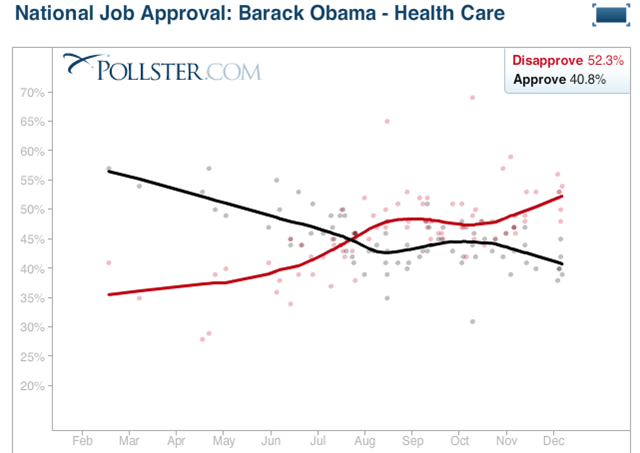
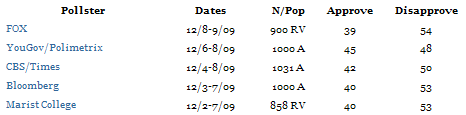
Though the WH claims broad based support for the proposed healthcare plan, the numbers just don’t seem to sync with the pronouncements.

From the newly released NBC /WSJ survey:

From what you have heard about Barack Obama’s health care plan, do you think his plan is a good idea or a bad idea?

32% Good idea
47% Bad idea
17% No opinion

http://www.pollster.com/blogs/us_national_survey_nbcwsj_1211.php

* * * * *

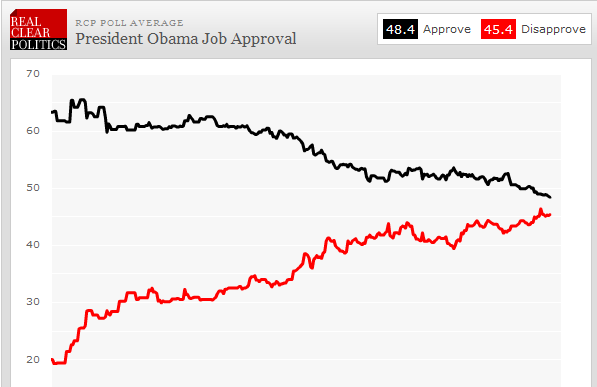
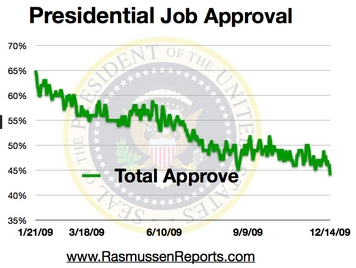
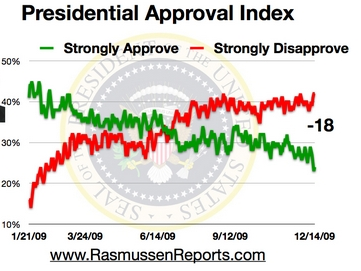
For the first time, less than half of Americans approved of the job President Barack Obama was doing. 

This marks a steeper first-year fall for this president than his recent predecessors, and a place in history with the worst ratings of any president at the end of his first year.
http://online.wsj.com/article/SB10001424052748704541004574600002289276662.html

50% Feel positively towards Obama in Dec., 68% in March

47% Approve of job Obama is doing, 46% Disapprove

33% Country moving in Right Direction, 55% Wrong Track

Democrats’ Blues Grow Deeper in New Poll, Dec. 17, 2009
http://online.wsj.com/article/SB126100346902694549.html 

* * * * *

Some miscellaneous results:

22% Approve of job Congress is doing,  68% Disapprove

38% Congressional rep deserves to be reelected, 49% Give new person a chance

55% Support increasing troop levels in Afghanistan, 39% Oppose

23% Global climate change has been established as a serious problem

15% Feel positively towards Tiger Woods, 42% Unfavorably

http://www.pollster.com/blogs/us_national_survey_nbcwsj_1211.php

If people were cars, healthcare would be fixed …

December 17, 2009

TakeAway: The problem with health care is not that we can’t afford insurance. The problem is that we can’t afford health care.

* * * * *

Excerpted from Reason: The Problem is Cost of Care – Understanding America’s dysfunctional health care system, December 10, 2009

The U.S. has the world’s most expensive health care, $8,000 per person per year, eating up 16 percent of our GDP.

There are many ways of paying these costs, of course, ranging from private insurance such as Blue Cross to public insurance such as Medicare. Many people pay out of their pockets, and local and state taxpayers pick up the rest.

The problem is that health care costs have increased at an annual rate double, or more than double, the rate of inflation for the last two decades.

Right now, our attempts at reform are doomed by a law of accounting physics: Insurance can’t cost less than the health care it insures.  That means that subsidizing insurance likely makes the problem worse.  

Consider: I have car insurance. But my insurance doesn’t pay for oil changes.

Instead, I go down to the Happy Lube, without an appointment, get a diagnosis of the needs of my car, and choose services based on a price list published online.

Now, if I fail to get my car’s oil changed, or to perform other needed services, the engine will be damaged. That’s expensive to fix, but my insurance does not cover the costs. I bear the costs, so I care for the engine.

Health care is a little different.

Many of us have “engines,” or other parts, that may not work very well, especially as we grow older.

Things happen that may not be our fault, and even if they are we’d like to be able to buy some insurance against the worst consequences, the catastrophic injuries or illnesses that are part of every human society. The problem is that how we pay affects how much we pay.

Again, compare it to car insurance, for two people.

Imagine neither of us has to pay for our car repairs, from accidents or engine wear. We can go to the garage as often as we like, and get whatever service we want, for free.

The car repair shop can charge our insurance whatever they want, because insurance pays everything. An oil change would bill out at $600; an alignment would bill our insurance $2,200, with another $800 tacked on to pay for micro-digital wheel axis imaging.  

Of course, the services aren’t really free. At the end of every year, we sum the total repair costs for both people, and each of us pays half of that total.  

The cost of that free car care would be enormous, because of all the unnecessary and overly expensive charges. Of course, the government could subsidize the final bill; would that help? The answer is no, for two clear reasons.

First, having the government (meaning taxpayers) subsidize the total would do nothing to reduce the runaway cost increases. Buyers won’t shop around if they don’t know or care about real costs. Subsidies mean I don’t pay if I spend, and I don’t save if I’m frugal.

Second, let’s expand the example from two people (each paying half) to 300 million people getting free care (but paying an equal share of total costs). We have met the public option, and it is us! Once we are all paying ourselves, there is no one else to hit up to help with the costs. We are simply taking each person’s money in taxes, then giving some of it back in subsidies. There is no saving, even to individuals.

The French economist, Frederic Bastiat, diagnosed the problem long ago when he said, “The public option is the conceit that each of us should have free health care at the expense of all of us.”

The solution is out there, but it will require a fundamental change in the way we think.

Competition among insurers, without decreases in underlying medical costs, may actually harm people through bad service and arbitrary denial of claims.

Instead, we need competition among medical providers, just like oil change services now.

LASIK surgery, one of the few areas of medical services open to competition and listed prices, has fallen in cost by 70 percent or more in the last 15 years. And quality has gone up dramatically.

Walk-in clinics and fee-for-service arrangements for check-ups, or simple diagnoses like strep throat or  infected thumbs, are already widely available, cost relatively little, and require no appointment.

Subsidizing insurance is a terrible idea. But that is the main focus of the health care reform bills passed by the House, and now being considered in the Senate.

Why pin all our hopes on an approach that can’t possibly succeed?

Full article:
http://reason.com/archives/2009/12/10/the-problem-is-cost-of-care

You said you were satisfied … so why did you leave me ?

December 17, 2009

Takeaway: Many companies dedicate thoughtful efforts to understanding the voice of their customer, but few successfully convert these insights into actions.

In a back-to-basics move, some companies like Charles Schwab have abandoned their elaborate surveys and complicated research models to place the feedback responsibility on an obvious source – their front line employees.

* * * * *

Excerpt from Harvard Business Review, “Closing the Customer Feedback Loop,” by Rob Markey, Fred Reichheld, Andreas Dullweber, December 1, 2009.

When Charles Schwab came out of retirement to retake the helm of his firm in 2004, the business was struggling. “We had lost our connection with our clients, and that had to change,” he confessed to shareholders in the annual report. Schwab responded by implementing a new customer feedback system to reestablish the connection with his customers. In 2008, the firm saw its revenues increase by 11% and the scores that customers gave the company jump by 25%. During a time when the financial services industry was being rocked by turbulence, Schwab clients entrusted $113 billion in net new assets to the firm, and the number of new brokerage accounts increased by 10%.

Every day, managers at each of Schwab’s 306 branch offices and five call centers call customers who gave their site a low service rating. Schwab credits this outreach program as an integral part of the company’s new focus on direct customer feedback that was responsible for turning around the company.

Most companies devote a lot of energy to listening to the voice of the customer, but few of them are very happy with the outcome of the effort. Elaborate satisfaction surveys that involve proprietary research models can be expensive to conduct and slow to yield findings. Once delivered, their findings can be difficult to convert into practical actions. Additionally, most customers who end up defecting to another business have declared themselves “satisfied” or “very satisfied” in such surveys not long before jumping ship.

Instead of building elaborate, centralized customer research mechanisms, some firms begin their feedback loop at the front line. Employees working there receive evaluations of their performance from the people best able to render an appraisal—the customers they just served. The employees then follow up with willing customers through one-on-one conversations. The objective is to understand in detail what the customers value and what the front line can do to deliver it better. Over time, companies compile the data into a baseline of the customer experience, which they draw upon to make process and policy refinements.

The strongest feedback loops do more than just connect customers, the front line, and a few decision makers in management. They keep the customer front and center across the entire organization. One approach that works well across a range of industries is the Net Promoter Score (NPS), which immediately categorizes all customers into one of three groups—promoters, passives, and detractors. This allows employees throughout a company to see right away whether a customer experience was a success or a failure, and why.

NPS is generated by asking customers a single question, “How likely would you be to recommend this company or product to a friend or a colleague?” Respondents giving marks of 9 or 10 are promoters, the company’s most devoted customers. Those scoring their experience 7 or 8 are passives, and those scoring it from 0 to 6 are detractors. NPS is the percentage of promoters minus the percentage of detractors. Customers are then asked to describe why they would be likely or unlikely to recommend the company. The insights gathered from their answers enable employees to quickly identify issues that create detractors, and the actions required to address them.

Edit by BHC

* * * * *

Full Article
http://hbr.harvardbusiness.org/2009/12/closing-the-customer-feedback-loop/ar/1

* * * * *

To making serious money, get rejected by a big name school … huh?

December 17, 2009

TakeAway: One of the strongest predictors of post-graduation income is the caliber of the schools that reject you.

* * * * *

Excerpted from WSJ: Weighing the Value of That College Diploma, Dec. 16, 2009

College graduates in general earn at least 60% more than high-school grads on average, both annually and over their lifetimes, and the income gap has been growing over time, says a 2007 report by the College Board.

But, one of the strongest predictors of post-graduation income is the caliber of the schools that reject you.

Researchers found students who applied to several elite schools but didn’t attend them — presumably because many were rejected — are more likely to earn high incomes later than students who actually attended elite schools.

“Evidently, students’ motivation, ambition and desire to learn have a much stronger effect on their subsequent success than average academic ability of their classmates.”

Full article:
http://online.wsj.com/article/SB10001424052748703438404574597952027438622.html

Digitizing the healthcare market … one doc at a time.

December 16, 2009

Bottom line: Why not fix what’s broken rather than just creating mayhem ?

* * * * * 

Excerpted from WSJ: Health Care’s ‘Radical Improver’, Dec. 12, 2009

Choice & Rationing

For all the talk about expanding coverage, the real problem is that “You can’t buy what you want.”

(Politicians are) living in this alternate universe where there’s no such thing as a market in health care and they don’t understand why one might be remotely useful.”

The profound problem with U.S. health care is that there’s “no landscape of choices, or choosers.” Due to the complexity of America’s third-party laundromat for health dollars—your doctor’s clerical staff bills your treatment to an insurance company picked by your employer, and it pays him with your money via premiums or foregone wages—”few doctors in America know the actual value of the services they render.”

The government imposes standardized rules and mandates with no concern for how much they will cost or who will bear the burden. Given the choice, consumers might decide on cheaper policies that cover some services but not others, or decide to run more risk.

Another way of putting it is that if the politicians have their way, “everyone will have access to transportation, and it will be a black Escalade, with spinners. That’s it. There’s no Hyundais, no bicycles, no nothing.”

And that’s scandalously unfair. “These poor people who clip the things off the backs of cans to make the tomatoes cheaper are subsidizing the hypochondriac who gets his shoulder done with an arthroscope because it clicks when he serves at tennis.”

Under ObamaCare, Mr. Bush says, “everyone is going to get health care according to the wise-men benefit panel, who will tell you exactly what it is, and then they’ll run out of money, so every year the wise panel will just squish the benefit a little. People will start to say, well, that’s not going to work for me.”

Central health planning won’t have any longevity, and eventually people “will start leaking out into the [private] market once we run out of money.”

* * * * *

A Digital Revolution ?

Now, most transactions are conducted on paper. Few people really understand how to navigate the dense and bewildering coding rules for dozens of different insurers or the fee schedules for government payers like Medicaid. Claims were denied with no explanation or vaporized in purgatory.

One reason the digital revolution has so far passed over the health sector is sheer bad product. The adoption of EMR in health systems across the country has been dogged by cumbersome interfaces, error propagation and other drawbacks.

Much of the the nearly $47 billion in stimulus cash the White House has budgeted to prime the pump for health IT adoption is going to legacy software companies, with code that was written in the ’70s.  They’re getting federally sponsored life support.

The irony is that … the status quo for all its flaws is capable of organic change and real progress without the blunt-force trauma Congress is likely to inflict. Or in spite of it.

Athena is one of the country’s most innovative health IT firms. Its core business helps doctors manage their practices and get paid, but the larger purpose of the company, is to try to shore up health care’s resemblance to a normal market.

Athena designed a program to digitize records and automate billing. It now colonizes the wilderness of paperwork and habitual financial chaos that defines running a doctors office, and it is also moving into clinical record-keeping for individual patients. Some 15,000 physicians in 43 states use Athena as a virtual office, a number that is growing at an annual 30% clip.

It is a massive logistical undertaking. Athena’s main facility is housed in a decommissioned World War II arsenal on the Charles, where 30,000 pounds of paper is processed every month, most of the tonnage being paper checks.

Incredibly, doctors also receive on average 1,185 faxes each month—mostly lab results—and those are handled too.

State Medicaid programs, by the way, are easily the worst payers. In New York, for instance, claims must be tendered on a dead-tree form instead of electronically and in blue ink—black is grounds for rejection—and then go on to spend a full 161 days, or almost a half year, in accounts receivable.

While streamlining this disorder frees up time for the company’s clients to treat patients, it also throws off vast data, which are fed in central servers, aggregated and analyzed.

This “athenanet” system is among the few health-tech offerings based on “cloud computing”—in the sense that the applications are accessed on the Web, instead of a computer’s hard drive, allowing constant updates and refinements. If a regulation changes or an insurer adjusts a payment policy, it is reflected on athenanet almost in real time; on the clinical side, the program can adapt at the same rapid pace as medicine itself.

Full article:
http://online.wsj.com/article/SB10001424052748704240504574586260904799386.

Healthcare reform … historic firsts … uh-oh.

December 16, 2009

Excerpted fron RCP: The Liberals’ Weaselly Panic, by Rich Lowry, December 15, 2009 

President Obama and Harry Reid can rightly claim to be making history.

If he passes health-care reform, they’ll depend on a series of historic “firsts.”

  • It’d be the first time Congress had passed a major new entitlement program without bipartisan support;
    [Unless you count the Congressional dude from Louisiana.]
  • It’d be the first time it passed such a program without popular support;
    [A CNN poll last week found the public against it by a nearly 2-1 margin.]
  • It’d be the first time that such a large-scale program would be passed without anybody knowing (or particularly caring) what’s in it.
    [This is bipartisanship Harry Reid style – nontransparency for everyone. Who needs openness and legislative details when you’re remaking one-sixth of the economy?’

Full article:
http://www.realclearpolitics.com/articles/2009/12/15/the_liberals_weaselly_panic_99557.html

There’s nothing like a good fight when it comes to boosting the bottom line

December 16, 2009

Takeaway: A healthy dose of discord may be just what the doctor ordered when it comes to promoting innovation and achieving profitability within an organization.

Companies recruit employees for the diversity of their backgrounds, so why do these recruits so often transform into bobble-head yes-men?

Let’s face it, we all love a good round of Kumbaya, but effective MBAs should aim to be selectively disruptive in order to deliver real value to their employers.

* * * * *

Excerpt from Harvard Business Review, “How to Pick a Good Fight,” by Saj-nicole A. Joni and Damon Beyer, December 1, 2009.

The effort to eliminate discord at the firm had backfired. Lehman’s board of directors and management team became too agreeable—and too loyal, content to follow even when they knew better. In 2007 and 2008, numerous signals indicated that the firm was heading into a crisis, but insiders who paid attention to them were afraid to point out the elephant in the room. Nobody wanted to disrupt the peace.

The problem is that a peaceful, harmonious workplace can be the worst possible thing for a business, according to consultancy eePulse, which conducts in-depth surveys that measure employee engagement. Complacency, in fact, is the single greatest predictor of poor company performance. The second greatest predictor is an environment in which employees are overwhelmed. In the first case, employees are reluctant to rock the boat. In the second, the level of employee satisfaction is low and the amount of dysfunctional fighting is high. In both situations, low energy levels and fear of political fallout curb action that might address any looming crisis. At Lehman, many alums told us, raising difficult questions could kill your career.

Most leadership experts argue that the best way to manage change is to create alignment, but our research indicates that for large-scale change or innovation initiatives, a healthy dose of dissent is usually just as important. Within an acceptable range of competition and tension, science shows, dissent will fire up more of an individual’s brain, stimulating more pathways and engaging more creative centers. In short, more of what makes people unique, innovative, and passionate is available for use.

Many successful companies are known for their stressful work environments. Microsoft, in its early days, had one of the most contentious, high-strung, and fast-paced corporate cultures in the United States. Bill Gates and Steve Ballmer were famous for yelling at people. Food distributor Sysco, an unusually successful company built on roll-ups and acquisitions, dismisses district managers who don’t meet annual productivity targets—a pretty tough standard for an operating company with thin margins. Market leaders Goldman Sachs and McKinsey are notoriously competitive, hard-driving places to work. Not places you’d go if you were looking for polite and equal regard for all voices.

So it’s time to stop candy-coating what’s taught to executives and their direct reports. It’s time to stop pretending that conflict-free teamwork is the be-all and end-all of organizational life. It’s time to own up to the truth that the right balance of alignment and competition is what pushes individuals and groups to do their best. It’s time to push employees into the right fights.

Let’s be clear—alignment is important. But the purpose of alignment is not harmonious agreement. It is to sustain an organization’s ability to fight for what really matters, and to pull everyone together again once the fight is resolved.


Edit by BHC

* * * * *

Full Article
http://hbr.harvardbusiness.org/2009/12/how-to-pick-a-good-fight/ar/1

* * * * *

There’s nothing like a good fight when it comes to boosting the bottom line

December 16, 2009

Takeaway: A healthy dose of discord may be just what the doctor ordered when it comes to promoting innovation and achieving profitability within an organization.

Companies recruit employees for the diversity of their backgrounds, so why do these recruits so often transform into bobble-head yes-men?

Let’s face it, we all love a good round of Kumbaya, but effective MBAs should aim to be selectively disruptive in order to deliver real value to their employers.

* * * * *

Excerpt from Harvard Business Review, “How to Pick a Good Fight,” by Saj-nicole A. Joni and Damon Beyer, December 1, 2009.

The effort to eliminate discord at the firm had backfired. Lehman’s board of directors and management team became too agreeable—and too loyal, content to follow even when they knew better. In 2007 and 2008, numerous signals indicated that the firm was heading into a crisis, but insiders who paid attention to them were afraid to point out the elephant in the room. Nobody wanted to disrupt the peace.

The problem is that a peaceful, harmonious workplace can be the worst possible thing for a business, according to consultancy eePulse, which conducts in-depth surveys that measure employee engagement. Complacency, in fact, is the single greatest predictor of poor company performance. The second greatest predictor is an environment in which employees are overwhelmed. In the first case, employees are reluctant to rock the boat. In the second, the level of employee satisfaction is low and the amount of dysfunctional fighting is high. In both situations, low energy levels and fear of political fallout curb action that might address any looming crisis. At Lehman, many alums told us, raising difficult questions could kill your career.

Most leadership experts argue that the best way to manage change is to create alignment, but our research indicates that for large-scale change or innovation initiatives, a healthy dose of dissent is usually just as important. Within an acceptable range of competition and tension, science shows, dissent will fire up more of an individual’s brain, stimulating more pathways and engaging more creative centers. In short, more of what makes people unique, innovative, and passionate is available for use.

Many successful companies are known for their stressful work environments. Microsoft, in its early days, had one of the most contentious, high-strung, and fast-paced corporate cultures in the United States. Bill Gates and Steve Ballmer were famous for yelling at people. Food distributor Sysco, an unusually successful company built on roll-ups and acquisitions, dismisses district managers who don’t meet annual productivity targets—a pretty tough standard for an operating company with thin margins. Market leaders Goldman Sachs and McKinsey are notoriously competitive, hard-driving places to work. Not places you’d go if you were looking for polite and equal regard for all voices.

So it’s time to stop candy-coating what’s taught to executives and their direct reports. It’s time to stop pretending that conflict-free teamwork is the be-all and end-all of organizational life. It’s time to own up to the truth that the right balance of alignment and competition is what pushes individuals and groups to do their best. It’s time to push employees into the right fights.

Let’s be clear—alignment is important. But the purpose of alignment is not harmonious agreement. It is to sustain an organization’s ability to fight for what really matters, and to pull everyone together again once the fight is resolved.


Edit by BHC

* * * * *

Full Article
http://hbr.harvardbusiness.org/2009/12/how-to-pick-a-good-fight/ar/1

* * * * *

Why I don’t let students grade themselves …

December 15, 2009

Under tough interrogation by Oprah, President Obama scored his job performance at B+ … A- if the healthcare monstrosity gets passed.

Doing pretty good, right ?

Well, not according to the most recent polls.

* * * * *

The most recent RealClearPolitics  poll of polls has only 48.4% of Americans approving of the job Obama is doing. 

image http://www.realclearpolitics.com/epolls/other/president_obama_job_approval-1044.html

* * * * *

The most recent Rasmussen survey  — which leans a bit right and tends to lead the other polls — has only 44% of likely voters approving of Obama’s job performance.

image
http://www.rasmussenreports.com/public_content/politics/obama_administration/daily_presidential_tracking_poll

* * * * *

And, on what I believe to be the most indicative measure — Rasmussen says that only 24% strongly approve of Obama’s performance, while 42% strongly disapprove.  A deficit gap of 18 points.

image
http://www.rasmussenreports.com/public_content/politics/obama_administration/daily_presidential_tracking_poll

An open letter to Sen. Mark Warner …

December 15, 2009

I received the following “personal” email from Sen. Mark Warner (D-VA).

Ken —

I wanted to take just a moment of your time to provide an update on my efforts to improve the Senate health care reform bill.

I led 10 other Senate freshmen on Tuesday in announcing a package of amendments which will we believe will encourage a broader — and quicker — shift toward a more innovative, 21st Century health care system.

[couple of paragraphs of talking points]

I was elected to bring common-sense reforms to government. I will only support a final bill if I am convinced it will lower the deficit, drive down health care costs over the long term, and improve the value and quality of the health care Virginians receive.

Thanks,
Mark Warner

Since I don’t think he reads my emails to him, I thought I’d give you a peek at my reply.

Mark —

I have 3 questions for you:

(1) When you ran a company, did you run debt ratios comparable to those you’re now foisting on American taxpayers?

(2) Aren’t you supposed to be representing the people of Virginia? 

According to the most recent Rasmussen survey, 54% of Virginians oppose the health care plan proposed by the president and congressional Democrats … 85% of them (46% of the total) strongly oppose the proposed healthcare plan.

(3) Do you think the 28% of Virginians who strongly favor the proposed health care proposal will be enough to re-elect you? 

Please stop voting like a lemming and keep your commitment to bring “common-sense reforms to government”.

Thanks,

Ken Homa

I’ll keep you in the loop when “Mark” replies.

* * * * *

Rasmussen Reports

54% in Virginia Oppose Health Care Plan, December 09, 2009

A new Rasmussen Reports survey of Virginia voters finds that 54% oppose the health care plan proposed by the president and congressional Democrats … 85% of them (46% of the total) strongly oppose the proposed healthcare plan.

Forty-five percent (45%) favor the plan …  only about 1 in 4 people in the total sample strongly favor the plan.

http://www.rasmussenreports.com/public_content/politics/general_state_surveys/virginia/54_in_virginia_oppose_health_care_plan

P&G going after the bottom of the pyramid

December 15, 2009

TakeAway:  The bottom of the pyramid represents two-thirds of the world’s population yet only a fraction of the world’s income. 

But don’t be fooled, this market can be very profitable. 

With the right combination of volume and capital efficiency, and a focus on economic profit, companies will be rewarded.

P&G has a bullseye on the BOP

* * * * *

Excerpted from NYTimes, “P.& G. Sees the World as Its Client,” By Leslie Wayne, December 12, 2009

Add close to 548,000 new customers a day. Every day. For the next five years.

That is the goal Procter & Gamble’s new chief executive, has been promoting in recent weeks and that will be an important benchmark for his tenure …

The consumer products giant has to keep expanding its reach beyond its core markets of the United States, Western Europe and Japan, and start winning over new customers in places like Nigeria, India and Somalia, and is taking on steep challenges.

One is that its rivals Unilever and Colgate have long had a presence in many of these far-flung countries, so much so that they are called walled cities within the industry because of the difficulties new competitors face in penetrating these new markets.

“It will be a knife fight, it will be brutal,” said an industry analyst … “It will be fought in shampoo, detergent, deodorant, and Unilever and Colgate won’t roll over.”

The other big challenge is how a company that built itself on selling premium products at premium prices can shift to selling an array of low-priced products for consumers who often live on only a few hundred dollars a month or less.

In some cases, potential customers do not use many of P.& G.’s products and may even have to be taught how to do so …

Sales from developing countries are doubling every four years. Today, sales from developing markets represent 32 percent of P.& G.’s $78 billion in annual revenue, up from 23 percent four years ago.  Unilever and Colgate, though, already get about 45 percent of their sales from emerging markets.

Today, P.& G. has annual sales of $25 billion from developing countries, compared with $8 billion eight years ago. Procter already operates in 80 countries, selling its wares everywhere — large superstores in cities and tiny storefronts in remote villages …

The pitch from P.& G. executives … Americans spend about $110 a year per capita on Procter’s products. The worldwide per-capita figure is $12. In Mexico, the number is $20; it’s less than $3 in China and less than $1 in India.

The goal is to get the per-capita numbers in China and India to look like Mexico’s. If that were to happen … sales at P.& G. would increase by $40 billion …

Of course, customers in developing countries have little money to spend. And getting Procter’s goods to small towns and villages is a difficult logistical challenge …

Products, too, have to be adjusted. P.& G. has had to break down products like shampoos and soaps into smaller and less expensive sizes …

“There may be one billion new customers,” said Deutsche Bank. “But it is a question of the price per customer and what they can buy. How can you maintain profit margins when you are trying to sell small shampoos or little bars of soap in deepest India or sub-Saharan Africa?”

Procter has come up with marketing efforts that are decidedly different than those in the United States and other more developed countries.

Many infants, for instance, simply go without diapers, which means that P.& G. goes to hospitals and mobile clinics to demonstrate the use of diapers. Because the cost of diapers are often an issue and because children and parents often share the same family bed, P.& G. is promoting diaper use only at nighttime …

Edit by TJS

* * * * *

Full Article
http://www.nytimes.com/2009/12/12/business/global/12procter.html?_r=1&scp=3&sq=procter&st=cse

* * * * *

Democracy in action: “Damn the will of the people!” … say, what?

December 14, 2009

Elections have consequencesyou elected us (hah-hah) …  now, we’ll do what we damn well please (because we’re way smarter and way more moral than you are) … and, oh yeah, we won’t even let you see what we’re doing (you can’t handle the truth)

That’s what the politicians seem to be saying these days.

Practically every poll — save for ones fabricated by NBC, CBS, ABC — say the same thing: a CLEAR MAJORITY of Americans DISAPPROVE of current ObamaCare plans. RealClearPolitics’ poll of polls have the approve-disapprove split approaching 2/3s – 1/3.

Do the Washington nitwits really think that there won’t be mayhem and backlash if they ram in their half-baked programs?

Go figure.

image

image

http://www.pollster.com/polls/us/jobapproval-presobama-health.php?xml=http://www.pollster.com/flashcharts/content/xml/USObamaJobPresHealth.xml&choices=Disapprove,Approve&phone=&ivr=&internet=&mail=&smoothing=&from_date=&to_date=&min_pct=&max_pct=&grid=&points=1&lines=1&colors=Disapprove-BF0014,Approve-000000,Undecided-68228B

image
http://www.realclearpolitics.com/epolls/other/obama_and_democrats_health_care_plan-1130.html#polls

Good work if you can get it … Is the Federal pay czar asleep at the switch … or, what?

December 14, 2009

Bottom line: Now, I’m less worked up about the Goldman bonuses.  At least those guys work more than 37-1/2 hours a week … with emphasis added to the word “work”.

* * * * *
Excerpted from: USA TODAY For feds, average pay $30,000 over private sector, Dec. 8, 2009 

The number of federal workers earning six-figure salaries has exploded.

Excluding the White House, Congress, the Postal Service, intelligence agencies and uniformed military personnel,there are more than 2 million federal employees.  

One of every five Federal employees makes a salary of more than $100,000 —  before overtime pay, bonuses and benefits are counted. For example, in the Transportation Department, 1,690 employees have salaries above $170,000.

[Note that even USA Today says “makes”, not “earns”.]

The average federal worker’s pay is $71,206, compared with $40,331 in the private sector.

 [Note that if 2 million Federal employees’ average pay was cut back to the private sector average, it would free up $60 billion per year … roughly equal to the tax hikes hikes and /or Medcare cuts being proposed to fund ObamaCare … hmmm] 

Key reasons for high pay:

Pay hikes. Then-president Bush recommended — and Congress approved — across-the-board raises of 3% in January 2008 and 3.9% in January 2009. President Obama has recommended 2% pay raises in January 2010. Most federal workers also get longevity pay hikes — called steps — that average 1.5% per year.

[OK.  Back out 10.4% in “Bush’s fault” pay increases, and the average Federal employee only snags 58% more than a private sector worker.  Feel better?]

New pay system. Congress created a new National Security Personnel System for the Defense Department to reward merit, in addition to the across-the-board increases. The merit raises, which started in January 2008, were larger than expected and rewarded high-ranking employees.

[In other words, they get paid more because they get paid more.  Huh?]

Pay caps eased. Many top civil servants are prohibited from making more than an agency’s leader. But if Congress lifts the boss’ salary, others get raises, too. 

[To repeat, they get paid more because they get paid more.] 

Specialized skills. The federal workforce is highly paid because the government employs skilled people such as scientists, physicians and lawyers.

[Quick fix: Lose the lawyers.] 

Full article:
http://www.usatoday.com/printedition/news/20091211/1afedpay11_st.art.htm?loc=interstitialskip&POE=click-refer

Need a chuckle today ?

December 14, 2009

Making the email rounds … at least one will make you chuckle. Guaranteed.

**********************************************************
The first product to have a bar code was Wrigley’s gum.
image008

Question: Was that a good thing?
********************************************************
Donkeys kill more people annually than plane crashes or shark attacks.
image006
TakeAway: Watch your ass.
************************************************************
You burn more calories sleeping than you do watching television.
image007
Best case: Fall asleep in front of the TV,
**************************************************************
The King of Hearts is the only king WITHOUT A MOUSTACHE
image009
Question: Any Queens have a moustache?
*************************************************************
Most dust particles in your house are made from DEAD SKIN!
image012image013
Solution: Don’t let your skin die.
*****************************************************************
The first owner of the Marlboro Company and the first ‘Marlboro Man’ both died of lung cancer.
image014
Observation: Maybe there is justice in the world.
******************************************************************
Dentists have recommended that a toothbrush be kept at least six (6) feet away from a toilet to avoid airborne “particles” resulting from the flush.
image019
Solution: Move the toilet.
***************************************************
Turtles can breathe through their butts.
image020
Observation: I know some people that seem to talk thru their butts …

* * * *

Thanks to James W.  for the source material

Now, this is funny … Jon Stewart on counting jobs saved or created.

December 11, 2009

I haven’t been a big Jon Stewart fan, but he may have started to win me over with this clip.

WARNING: for mature audiences.

click picture or link below to view

image

http://vodpod.com/watch/2655813-the-daily-show-with-jon-stewartamerican-idle?pod=

Got Blue Cross – Blue Shield? … Then get out your wallet if ObamaCare passes.

December 11, 2009

TakeAway: Another study predicts higher insurance prices.  The culprit: adverse selection.

* * * * *

Excerpted from WSJ: Blue Cross Blue Patients, Dec 5, 2009

The Blue Cross Blue Shield Association has found that premiums in the individual market will rise on average by 54% over the status quo, which translates into an extra $3,341 a year for families and $1,576 for singles.

The Congressional Budget Office also found this week that ObamaCare will boost premiums in the individual market by as much as 13%. But the White House called that a triumph because the higher costs will be offset by taxpayer subsidies that will be transferred to the federal balance sheet.

The Blue Cross study is in fact more precise than CBO’s because it is based on real market data, rather than modeling assumptions. The association mined the actuarial data from its six million individual or small-business policies, nearly one-eighth of those sold in the U.S.

Lo and behold, Blue Cross found costs will rise if Democrats force insurers to cover anyone who applies and then limit how much insurers are allowed to charge based on age or health condition. Economists call this adverse selection; people will wait until they’re sick to buy coverage, and the Democratic rules make it perfectly rational for them to do so. 

The reality is that all health-care costs are ultimately borne by consumers, whether through more expensive premiums, lower wages or higher taxes.

The regulatory schemes favored by Democrats can’t change that law of economics …

Full article:
http://online.wsj.com/article/SB10001424052748704007804574574170859847850.html?mod=djemEditorialPage

Google: potentially a great tactic, almost always a poor strategy

December 11, 2009

Key Takeaway: As a brand manager, your marketing mix will most always consist of an online strategy. A simple solution may be to maximize your brand’s visibility on Google.

While this may be a successful tactic, it should not represent the entire online strategy.

Remember to always focus on how your consumer gathers information about your product; this may lead you to further explore other online avenues.

Your online strategy should be a means for customers to further understand and interact with your brand, not simply a way for the masses to be bombarded with a link to its website.

* * * * *

Excerpted from ClickZ “Google is Not a Strategy” by Robin Neifeld, December 2, 2009

Google isn’t a strategy, or even an e-marketing strategy.

Google is a tremendously robust search partner for marketers, but it’s one partner in the tactical execution of search, where search may be one of the channels used in an overall e-marketing strategy.

If you’re ever tempted to believe that covering brand, product, category, long tail terms, or even the content network on Google means you’re effectively reaching the active Internet universe, you’re mistaken.

By limiting your reach to Google’s reach, you’re still neglecting more than you’re finding and missing whole aspects of the consumer — or B2B — experience online.

Some people are still attached to alternate engines or use some combination of engines. They also search in industry vertical engines, especially in a B2B environment.

A growing segment of the population shops online, and the number and diversity of comparison shopping engines have grown to meet their needs.

Nearly everyone searches, but not everyone uses Google, or uses Google exclusively. Even if you’re wed to search as a singular tactic, try to include more search partners.

…an electronics product decision maker might start with search, follow an ad or social media link, or they might visit retail sites to view options and pricing. Almost certainly a large portion of them will utilize consumer shopping engines to get deals, coupon sites to take advantage of promotions, and technology communities to get the insiders’ reviews and ratings. They might also utilize their own networks through LinkedIn, Facebook, Twitter, or other avenues to solicit advice from trusted sources. An effective strategy in this case would need to be broader than search and even shopping engines to include contextually relevant placements, a content strategy, and social media to make sure your product was in the considered set.

If your digital strategy is limited to those who already know to search for you in some form, then your strategy is limited in many ways. Smart marketers use search and a number of other avenues to supply their audiences with the answers to their stated or implied questions. It’s a grievous mistake to assume that all users are alike or that all users are in the same stage of their discovery or buying cycle.

Edit by JMZ

* * * * *

Full Article:
http://www.clickz.com/3635781

Oh my god, am I becoming a populist? … I'm ok on raising a tax.

December 10, 2009

The punch lines

(1) “The House raises taxes on carried interest”

(2) Obama says “we’re proposing a complete elimination of capital gains taxes on small business investment” for one year.

* * * * *

Ken’s Take:

(1) Oh, those poor private equity guys.  The taxation of so-called carried interest is complicated, but reduces down to the fact that private equity firms have enjoyed a massive tax break for years.  Whether that tax break has fueled innovation and growth or simply lined the pockets of the equitists is subject to debate. My view: more the latter than the former.  So, I say: go get ’em.

(2) From a personal standpoint, I favor low or no capital gains taxation.  Why not?  I have some horses in that race.

But, for the life of me, I can’t figure out how a 1-year suspension of small business capital gains taxes helps small businesses and promotes hiring. 

What appreciated assets is a typical small business going to sell in the next 12 months that would qualify for a gain?  Except for small financial firms that hold and trade securities and family farms that are passing down generationally,  I can’t figure out how small businesses benefit from this move.

Does seem that — if we have any appreciated assets — we should all become small businesses and sell them in 2010.

If somebody can explain this to me, please hit the reply button … I must be missing something.

* * * * *

Excerpted from WSJ: Zero to 35 in 24 Hours, Dec.10, 2009 

On Tuesday, Mr. Obama announced that “we’re proposing a complete elimination of capital gains taxes on small business investment” for one year.

On Wednesday, the House voted to change the capital gains rate for venture capitalists, private equity fund managers and managers of real-estate and oil-and-gas partnerships. But rather than eliminating the tax, the House more than doubled it, moving the tax rate to 35% from 15% by reclassifying such gains as ordinary income.

The new 35% rate applies to what is known as “carried interest,” which is income that only materializes if fund managers wisely invest the fund’s capital and only after other investors in the fund have benefited. Venture and private equity fund managers already pay normal income taxes on their regular salary derived from management fees. The carried interest, no sure thing, represents a capital gain on a successful investment and has therefore been taxed that way.

Some argue that partnerships should be taxed just like other corporations before money is distributed to partners. We think that’s a reasonable argument in the context of lowering the 35% U.S. corporate tax rate to something remotely competitive in the world economy. By itself, this tax increase is simply a drag on investment and job growth.

Mr. Obama now has a chance to respond with similar speed and show his commitment to lower capital-gains taxes on start-up investments. A Statement of Administration Policy condemning the House bill would discourage the Senate from making a similar mistake.

Full article: 
http://online.wsj.com/article/SB10001424052748704240504574586274278223030.html?mod=djemEditorialPage

Oh my god, am I becoming a populist? … I’m ok on raising a tax.

December 10, 2009

The punch lines

(1) “The House raises taxes on carried interest”

(2) Obama says “we’re proposing a complete elimination of capital gains taxes on small business investment” for one year.

* * * * *

Ken’s Take:

(1) Oh, those poor private equity guys.  The taxation of so-called carried interest is complicated, but reduces down to the fact that private equity firms have enjoyed a massive tax break for years.  Whether that tax break has fueled innovation and growth or simply lined the pockets of the equitists is subject to debate. My view: more the latter than the former.  So, I say: go get ’em.

(2) From a personal standpoint, I favor low or no capital gains taxation.  Why not?  I have some horses in that race.

But, for the life of me, I can’t figure out how a 1-year suspension of small business capital gains taxes helps small businesses and promotes hiring. 

What appreciated assets is a typical small business going to sell in the next 12 months that would qualify for a gain?  Except for small financial firms that hold and trade securities and family farms that are passing down generationally,  I can’t figure out how small businesses benefit from this move.

Does seem that — if we have any appreciated assets — we should all become small businesses and sell them in 2010.

If somebody can explain this to me, please hit the reply button … I must be missing something.

* * * * *

Excerpted from WSJ: Zero to 35 in 24 Hours, Dec.10, 2009 

On Tuesday, Mr. Obama announced that “we’re proposing a complete elimination of capital gains taxes on small business investment” for one year.

On Wednesday, the House voted to change the capital gains rate for venture capitalists, private equity fund managers and managers of real-estate and oil-and-gas partnerships. But rather than eliminating the tax, the House more than doubled it, moving the tax rate to 35% from 15% by reclassifying such gains as ordinary income.

The new 35% rate applies to what is known as “carried interest,” which is income that only materializes if fund managers wisely invest the fund’s capital and only after other investors in the fund have benefited. Venture and private equity fund managers already pay normal income taxes on their regular salary derived from management fees. The carried interest, no sure thing, represents a capital gain on a successful investment and has therefore been taxed that way.

Some argue that partnerships should be taxed just like other corporations before money is distributed to partners. We think that’s a reasonable argument in the context of lowering the 35% U.S. corporate tax rate to something remotely competitive in the world economy. By itself, this tax increase is simply a drag on investment and job growth.

Mr. Obama now has a chance to respond with similar speed and show his commitment to lower capital-gains taxes on start-up investments. A Statement of Administration Policy condemning the House bill would discourage the Senate from making a similar mistake.

Full article: 
http://online.wsj.com/article/SB10001424052748704240504574586274278223030.html?mod=djemEditorialPage

Just consider it tough love …

December 10, 2009

Anti-ObamaCare groups have started running ads in swing states (Louisiana, Arkansas, Maine) targeted at healthy young adults who currently choose to self-insure for healthcare — that is, they realize that healthcare insurance is — for them — way most costly than just “paying retail” for the limited healthcare services they use.

Under ObamaCare, all of these folks will be “mandated” (i.e. forced) to buy health insurance.  If the insurance costs more than 12% of their earnings, then they get taxpayer subsidies to close the gap. 

The ads hit the point that these young healthies will — in effect — be subsidizing the folks whose healthcare expenses exceed their premiums.

* * * * *

Click arrow to watch


UK banker’s face 50% added tax on big bonuses … and, I’m cheering.

December 10, 2009

I’m becoming a populist on this issue.  You just shouldn’t be able to keep lotto winnings when other taxpayers pay for your ticket. These nitwits have no conscience.

* * * * *

Excerpted from WSJ: Banks’ Bonuses Hit by 50% Levy in U.K., Dec. 10, 2009  

The U.K. slapped banks with a 50% tax on some bonuses they pay to individuals, in perhaps the most aggressive move yet by a government to rein in banking compensation after the financial crisis.

The tax  is an effort by the ruling Labour Party to address public anger over bank bonus pay ahead of next year’s general election.

The U.K. bonus tax will be paid by banks on discretionary individual bonuses that exceed £25,000 ($41,000).

For instance, if a bank pays an individual a bonus of £30,000, it would pay a 50% tax on the £5,000 portion over the threshold.

The individual’s income tax wouldn’t be affected.

The government says the driving idea behind the tax is to end the banking industry’s culture of compensating risk-takers and to push down bonuses so that banks retain more capital and step up lending.

Treasury chief Alistair Darling said “If they insist on paying substantial rewards, I am determined to claw money back for the taxpayer,” he said.

But the new tax applies only to discretionary and not contractual bonuses. Banks will avoid the charge, then, for payments to any banker whose bonuses are guaranteed by contract. Banks operating in the U.K. plan to pay about $6 billion in bonuses this year, about $1 billion of which is discretionary, as opposed to bonuses guaranteed to bankers by contract.

In addition to the new tax on pay, bankers will be hit by an increase on income tax. Those who earn above £150,000 are already set to see their tax rate rise to 50% from 40% in April.

“Sending out a message that the U.K. does not welcome high earners will be music to the ears of rival global financial centers.”

Full article:
http://online.wsj.com/article_email/SB126035896213083357-lMyQjAxMDI5NjAwOTMwNTk4Wj.html

Remember when Howard Stern was hot?

December 10, 2009

TakeAway:  In AMS, we discussed XM-Sirius’s strategy.  Now, it looks like XM Sirius is shifting its focus from growth to profitability … even if it means “trading down” its on air personalities.  Adios, Howard ?

* * * * *

Excerpted from WSJ, “Howard Stern Rethinks Radio Gig,” By Sarah McBride, December 9 2009

Sirius XM Radio recently succeeded in reversing a troublesome decline in its subscribers. Now it is facing a possible decline in its star wattage.

“I don’t think I’m going to be re-signing,” said Howard Stern … 

At the time Stern signed, it appeared to be money well spent. Sirius trailed erstwhile rival XM, which then had four times the number of customers. Hiring Mr. Stern instantly put Sirius in the public eye and helped bring the company millions of subscribers …

But Sirius doesn’t need Mr. Stern in the way it did five years ago.

Its brand is established—in no small part thanks to Mr. Stern’s rocket-fueled on-air persona—and its one-time competitor, XM, is now merged into Sirius.

Sirius has other star performers—including its latest addition, comedian Rosie O’Donnell—who draw fewer subscribers than Mr. Stern but also help establish buzz. As of Sept. 30, the combined companies have 18.5 million subscribers, up slightly from the prior quarter but down from a high of 19 million at the end of 2007.

While Sirius likely would lose some subscribers if Mr. Stern left, over the past year XM has placed more of an emphasis on achieving operating profitability than on growth. And Mr. Stern’s compensation represents a significant expense …

Moreover, Sirius’s stock price, which was trading at $3.67 the day Mr. Stern signed, has fallen sharply since then, to around 60 cents. The decline means signing Mr. Stern at a similar rate of compensation would dilute shareholders’ stakes, cut into cash, or both …

And Mr. Stern doesn’t need Sirius as much as before, either. Five years ago, his formula of bawdy, envelope-pushing entertainment ran against the prevailing national zeitgeist, as public indignation over indecency ran high. Moving off regulated airwaves seemed like Mr. Stern’s best option.

Now, Mr. Stern likely could land a spot back on traditional airwaves. He is a proven ratings winner whose advertisers largely stuck with him throughout his difficulties, and some radio company would find a way to put him back on the air …

Edit by TJS

* * * * *

Full Article
http://online.wsj.com/article/SB20001424052748704825504574584022873284710.html#mod=todays_us_section_b

* * * * *

Why companies aren’t hiring …

December 9, 2009

Thomas Sowell — a conservative economist — has a skill for reducing complex issues down to their essence.

Bottom line: Government mandates (e.g. added healthcare burdens) and uncertainty are and will continue to keep companies from hiring.

* * * * *
Excerpted from RCP: Jobs or Snow Jobs?, December 8, 2009

What does it take to create a job? It takes wealth to pay someone who is hired, not to mention additional wealth to buy the material that person will use.

Government creates no wealth. Government takes wealth from others, whether by taxation, selling bonds or imposing mandates.

However it is done, transferring wealth is not creating wealth.

When government uses transferred wealth to hire people, it is essentially transferring jobs from the private sector, not adding to the net number of jobs in the economy.

Destroying some jobs while creating other jobs does not get you very far, except politically. But politically is what matters to politicians, even if their policies needlessly prolong a recession or depression.

In reality, many things that politicians do reduce the number of jobs.

Politicians who mandate various benefits that employers must provide for workers gain politically by seeming to give people something for nothing. But making workers more expensive means that fewer are likely to be hired.

During an economic recovery, employers can respond to an increased demand for their companies’ products by hiring more workers– creating more jobs– or they can work their existing employees overtime. Since workers have to be paid time-and-a-half for overtime, it might seem as if it would always be cheaper to hire more workers. But that was before politicians began mandating more benefits per worker.

When you get more hours of work from the existing employees, you don’t need to pay for additional mandates, as you would have to when you get more hours of work by hiring new people. For many employers, that makes it cheaper to pay for overtime.

The data show that overtime hours have been increasing in the economy while more people have been laid off.

There is another way of reducing the cost of government-imposed mandates. That is by hiring temporary workers, to whom the mandates do not apply.

The number of temporary workers hired has increased for the fourth consecutive month, even though there are millions of unemployed people who could be hired for regular jobs, if it were not for the mandates that politicians have imposed.

Constant government experiments with new bright ideas is another common feature of Obama’s “change”. The uncertainty that this unpredictable experimentation generates makes employers reluctant to hire.

Full article:
http://www.realclearpolitics.com/articles/2009/12/08/jobs_or_snow_jobs_99443.html

Somebody has to finish last … and it’s CNN.

December 9, 2009

Question: If FOX is so bad, why are so many people watching ?  Here are the nums …

* * * * *
Excerpted from RCP: CNN is Missing Dobbs, December 2nd, 2009

Could things get any worse for CNN? Apparently, the answer is ‘yes.’

The pioneering and once dominant leader in cable news has been hemorrhaging viewers for some time and earlier this year suffered the indignity of slipping to last place among cable news networks, behind even its sister network Headline News.

Now come the November Nielsen ratings showing that the surprise departure of Lou Dobbs has cost the network even more viewers.

After Dobbs announced his resignation on air on Wednesday November 11, CNN suffered a 25% decline among all viewers in Dobbs’ 7pm time slot, and a 26% decline among adults 25-54.

Meanwhile – surprise, surprise – CNN’s competition in the 7pm slot at FOX News, The FOX Report with Shephard Smith, scored its highest rated month of the year in November with more than 2.1 million total viewers.

CNN’s fall after Dobbs’ departure also allowed MSNBC’s Hardball with Chris Matthews to eke its way into second place 7 pm slot in November with 672,000 total viewers.

And, CNN’s golden boy Anderson Cooper is fading in the ratings.  His numbers have slipped significantly through the past year. His 10 p.m. show, “Anderson Cooper 360,” has declined 62% in total viewers from November 2008. Last month, in Cooper’s time slot, Fox News’ “On the Record” attracted an average viewership of 1.9 million while “360” averaged 672,000; repeats of MSNBC’s “Countdown” and HLN’s Nancy Grace show averaged 655,000 and 458,000, respectively.

http://realclearpolitics.blogs.time.com/2009/12/02/cnn-missing-dobbs/

* * * * *

Excerpted from NYT: CNN Drops to Last Place Among Cable News Networks, October 26, 2009

CNN  hit a new competitive low with its prime-time programs in October, finishing fourth – and last – among the cable news networks with the audience that all the networks rely on for their advertising.

CNN’s programs were behind not only Fox News and MSNBC, but even its own sister network HLN (formerly Headline News.) Three of its four shows between 7 and 11 p.m. finished fourth and last among the cable news networks. That was the first time CNN had finished that poorly with its prime-time shows.

Individually, the CNN shows were beaten resoundingly by all the Fox News programs.

CNN averaged 202,000 viewers between the ages of 25 and 54 – the group that television news organizations use as their basis of success because of their advertising sales. That was far behind the dominant leader, Fox News, which averaged 689,000.

The only CNN show from 7 p.m. to 10 p.m. that did not finish last was Larry King, which was third, ahead of the new Joy Behar show on HLN. Mr. King averaged 224,000 and Ms. Behar 181,000. But Sean Hannity’s show on Fox News had a huge lead with 659,000 viewers in that age group. Second was Rachel Maddow on MSNBC with 242,000.

Bill O’Reilly on Fox News continued his long dominance with the biggest numbers of any host, 881,000 viewers. Mr. Olbermann, with his first-run program, was second with 295,000. Close behind was the first edition of Ms. Grace’s show with 269,000. Campbell Brown on CNN trailed with only 162,000.

CNN released a statement Monday saying, “CNN’s ratings are always going to be more dependent on the news environment, much more so than opinion-based programming especially in prime time.”

http://mediadecoder.blogs.nytimes.com/2009/10/26/cnn-drops-to-last-place-among-cable-news-networks/

It’s how you ask the question …

December 9, 2009

Another great analysis from Pollster.com.

Focus is on Presidental Approval Ratings, but the findings are generalizable to other surveys, e.g. customer satisfaction.

* * * * *

From Pollster.com:

Most pollsters offer just two answer categories: “Do you approve or disapprove of the way Barack Obama is handling his job as president?”

Rasmussen’s question prompts for four: “How would you rate the job Barack Obama has been doing as President … do you strongly approve, somewhat approve, somewhat disapprove, or strongly disapprove of the job he’s been doing?”

Rasmussen has long asserted that the additional “somewhat” approve or disapprove options coax some respondents to provide an answer that might otherwise end up in the “don’t know” category.

Rasmussen conducted an experiment to test that argument.

They administered three separate surveys of 800 “likely voters, each involving a different version of the Obama job approval rating: (1) the traditional two category, approve or disapprove choice, (2) the standard Rasmussen four-category version and (3) a variant used by Zogby and Harris, that asks if the president is doing an excellent, good, fair or poor job.

The table below collapses the results into two categories; excellent and good combine to represent “approve,” fair and poor combine to represent “disapprove.”

image

In general, smaller don’t know percentages tend to translate into larger disapproval percentages. The 4-category Rasmussen version shows a smaller “don’t know” (1% vs. 4%) and a much bigger disapprove percentage (52% vs 46%) compared to the standard 2-category question.

The approve percentage is only three points lower on the Rasmussen version (47%) than the traditional question (50%).

The Rasmussen experiment shows an even bigger discrepancy between the approve percentage on the two-category questions (50%) and the much lower percentage obtained by combining excellent and good (38%).

* * * * *

Generalizing the findings: To increase “data discrimination” when doing customer sat polling, use 4 categories and and focus on the “very” categories at the extremes.  That’s where the real info is …

Is there bias in presidential approval polling … you bet !

December 8, 2009

Below is an analysis by Pollster.com that lays out the “House Effect” — more pejoratively known as “polling bias” — of the many survey organizations that report Presidential Approval Ratings.

Pollsters at the top tend to be more favorable to Pres. Obama (some very favorable); those at the bottom tend to be less favorable.

[See Ken’s Take and an important UPDATE at the bottom of this post]

2009-12-01_HouseFX-approve.png
http://www.pollster.com/blogs/why_is_rasmussen_so_different.php

* * * * *

Ken’s Take:

(1) Note that the mainstream media outlets (ABC, WP, CNN, CBS, NYT, AP) hold the top slots.  Hmmm.

(2) Note that FOX is smack dab on the median.   Pollster emphasizes that the line that corresponds with the zero value is NOT a measure of “truth” or an indicator of accuracy. It’s simply a “normalizing” measure — in effect, a median value.  TakeAway: sure seems fair & balanced.

(3) Quant jocks generally attribute the differences to methodology or samples.  For example, Rasmussen is an automated phone survey — and people tend to be less hesitant with negative responses when dealing with an automaton than they are when answering to a humanoid.

Regarding samples, less favorable surveys tend to sample likely voters, not all adults.  Critics argue that minorities and young adults are under-represented when the cut is likely to vote.

(4) A bigger deal, in my opinion, is that sampling tries to get a representative number of Dems and GOPs.  My bet: surveys at the top over-sample Dems and the ones at the bottom over-sample GOPs.

(5) Regardless of the specific poll, the conclusion: country is divided down the middle … plus or minus some random noise.

* * * * *

UPDATE

CNN — #2 in favorable leaning to the President — released new poll results on Fri. Dec. 4.

During November, President Obama’s approval dropped from 55% to 48%.

* * * * *

Question: Do you approve or disapprove of the way Barack Obama is handling his job as president?

image

For the full CNN survey results:
http://i2.cdn.turner.com/cnn/2009/images/12/04/rel18a.pdf

The looming Medicaid tsunami …

December 8, 2009

TakeAway: A vast expansion of the Medicaid program — without adequate risk-adjusted reimbursement rates — will impose unsustainable costs on healthcare providers.

* * * * *

Excerpted from WSJ:  Health Reform Could Harm Medicaid Patients, Dec. 4, 2009 

Both the House and Senate health-care reform bills call for a large increase in Medicaid—about 18 million more people will begin enrolling in Medicaid under the House bill starting in 2013.

A flood of new patients will be seeking health services, many of whom have never seen a doctor on more than a sporadic basis. Some will also have multiple and costly chronic conditions. And almost all of them will come from poor or disadvantaged backgrounds.

Johns Hopkins’  Priority Partners handles Medicaid patients under a capitated system — that is, it receives a set payment per individual per month from the state.

Over time, we’ve developed the ability to manage the care of these individuals in a way that is both cost effective and that provides them with quality care. We’ve done it by tapping into our extensive delivery system, which includes four hospitals, a nursing home, the largest community-based primary care group in Maryland, and much more.

We’ve hit above-national benchmarks on all clinical quality measures, reduced monthly costs for patients with substance abuse and highly complex medical needs, and 70% of our patients tell us they’re satisfied with our care.

The key fact is that for years the state did not cover all the costs our Medicaid program incurred. As a result of new patients whose costs were not completely covered by the state, Priority Partners lost $57.2 million from 1997 to 2005.

We stanched the losses by ensuring that the payment from the state was appropriately risk adjusted to match the health conditions of our members, and by investing heavily in primary-care and care-management and disease-management programs.

Yet this past year the losses began again, because the state expanded the program’s eligibility to 116% of the federal poverty level up from 40%.

So we are struggling with a large group of new patients—about 30,000 people. Today, like in the late 1990s, a health-care surge is overwhelming our managed-care system. The capitated rate for the new beneficiaries is not yet risk-adjusted. Priority Partners has lost a devastating $15 million in just nine months.

Congress can help, or at least learn from our experience to use the reform legislation to bend the cost curve if it encourages other states to institute and appropriately fund capitated systems that allow capable providers to adjust payments based on risk. The key is that federal support to states for Medicaid must appropriately adjust rates to match the risk of providing health care to the group of people who are covered by Medicaid.

The Senate bill would increase eligibility for Medicaid to those who make 133% or less of the federal poverty level. The Kaiser Family Foundation reports there are 308,000 people who meet that threshold in Maryland.

Even if only half of those individuals seek Medicaid coverage, such a large expansion would likely have an excruciating impact on the state’s budget.

Without an understanding by policy makers of what a large Medicaid expansion actually means, and without delivery-system reform and adequate risk-adjusted reimbursement the current health-care legislation will have catastrophic effects on those of us who provide society’s health-care safety-net.

In time, those effects will be felt by all of us.

Full article:
http://online.wsj.com/article/SB10001424052748703939404574567981549184844.html?mod=djemEditorialPage