Archive for September, 2010

Stop dissing professors !

September 30, 2010

The Woodward expose “Obama’s Wars” reportly says that Obama manages more like a professor than a president.

Ouch.

Why insult professors ?

You know, a few of us have real life experience, have managed organizations, have made  decisions, and have gotten rewarded (or penalized) based on outcomes.  Don’t put Obama in our canoe.

By the way, exactly what is Obama’s professorial experience ?

Was he a full-time prof at Chicago teaching for an extended period of time?

Or, was he simply an evening adjunct who taught one course, one time so he could claim resume credit ?

Of course, he hasn’t disclosed the details.

I’m betting the latter …

Regardless, stop dissing profs.

About Obama’s attacks on John Boehner …

September 30, 2010

I’m not a big John Boehner fan, but from the get-go, Obama’s personal attacks on the House Minority Leader  struck me as one of the Administration’s wackiest campaign tactics.

Based on the latest WSJ-NBC poll :

  • 50% don’t know who John Boehner is …
  • Of those that do know who he is … 28% view him favorably, 34% view him unfavorably, 38% have no opinion on him.
  • Combined, over 2/3s (69%) either don’t know who Boehner is or have no opinion of him.

Why would you focus an attack on a guy that nobody knows ?

I must be missing something …

http://online.wsj.com/public/resources/documents/WSJNBCPoll09282010.pdf

Pizza Hut searches for (internal) stars …

September 30, 2010

TakeAway: Pizza Hut has created a new ad campaign that moves from a pricing war with rivals Domino’s and Papa John’s to differentiation purely based on branding through employee spokespeople. 

There is no mention of deals or new-product offerings, and the ads seem to be working.

* * * * *

Excerpted from AdAge, “Pizza Hut Makes Its Staff the Stars in Brand-Focused Campaign” By Rupal Parekh,September 20, 2010

There are signs that Pizza Hut is beginning to gain some ground on category leader Domino’s, which has 18.4% of the market compared to Pizza Hut’s 15%. Domino’s marketing strategy – something akin to “our pizza was gross, but we fixed the recipe” – was working to some degree. Domino’s posted historic same-store sales increases earlier this year of 14.4% vs. Pizza Hut’s 6%, but in the second quarter, Pizza Hut led same-store sales with an 8% lift.

Pizza Hut’s CMO said: “We just need to incite the consumer to pull up the emotional side of the brand and the high-quality products we provide…Our brand stands for quality already…we have no need to denigrate the brand in order to get people to engage with it.”

That Pizza Hut is turning employees into spokespeople makes it one of several brands (including Nationwide Insurance, Best Buy and BP)

in the past year that have tried to personalize their companies by using homegrown marketing talent, perhaps not coincidentally, while struggling with the recession.

While it’s not a goal of the campaign, the youthful skew could help connect with what Kurt Kane, VP-brand advertising at Pizza Hut, earlier this year told Ad Age is one of two of Pizza Hut’s core consumer groups, families and young adults.

Edit by AMW

* * * * *

Full Article:

http://adage.com/article?article_id=145981

* * * * *

Ready to pull the lever for Mitch Who ?

September 29, 2010

A couple of tidbits from the Politico-GWU poll that’s been getting some play on the talk shows …

35% strongly approve of Pres Obama’s job performance; 45% strongly disapprove  … an 10 point gap.

But, 47% strongly approve of Mr. Obama “as a person”  … leading pundits to consistently conclude that he remains personally popular but his policies are unpopular.

That’s true … 46% personal approval is higher than 39% job approval.

But, my question: anybody notice that less than half of folks strongly approve of him as a person.

That doesn’t strike me as remarkably “still popular”.

* * * * *

75% of the people surveyed don’t know who Mitch Daniel’s — governor of Indiana —  is.

When asked: who would you vote for in the next Presidential election: Obama or Daniels … Obama wins 38% to 26%.

Since more people are willing to vote for Daniels than know who he is, it says that some (many ?) people will vote for anybody who isn’t Obama.

Hmmm …

* * * * *

Of MSNBC’s powerhouse prime time line-up:

  • 42% don’t know who Keith Olberman is.
  • 55% don’t know Rachel.Maddow
  • 70% don’t know Ed Shultze 

Source:
http://www.politico.com/static/PPM156_bg_41_questionnaire.html

When a tree falls in the woods … update.

September 29, 2010

Today the President continues his campaign tour to rally his exhausted (Velma’ Hart’s word) and ignorant (Kerry’s word) base …  and get them to buck up (Biden’s words) and get out of their chairs (paraphrasing O’s words).

Interesting tactic.

Now, instead of insulting Bush & Boehner, top Dems are insulting voters.

Might work …

* * * * *

Have you noticed that crowds for Obama’s events are a lot thinner these days.

Here’s an example …

Six weeks before the mid-term elections, President Obama couldn’t fill the ballroom at the Roosevelt Hotel, despite cheap tickets on offer.

And then he was met by hecklers.

Event organizers had to reach down to the D list to fill a room to listen to him.

Most of the low rollers arrived early to see President Obama up close and personal.

Tickets for the general reception at the Roosevelt Hotel in New York were only $100.

Some bought tickets for $50 from their desperate Democratic committeeman.

Some bought the same day.

Source: The Daily Beast, Obama’s Fire Sale
http://www.thedailybeast.com/blogs-and-stories/2010-09-23/obamas-fire-sale/?cid=bs:archive23

I guess some of the mojo is gone, huh ?

More important,  is anybody listening to these 2-a-day speeches the President is giving ?

They’re kind of a blur, aren’t they ?

Kenmore – Sear's jewel – gets modern.

September 29, 2010

TakeAway: By any measure Kenmore has been successful over a long period of time. 

Even in today’s intensely competitive home appliance market, it has managed to stay on top across all major appliance categories. 

Now, the brand is being  overhauled in an effort to modernize.

With customer-focused innovations geared toward a new generation, including appliances that transmit data over a phone line in order to troubleshoot, the brand seems likely to stay on top for the foreseeable future.

* * * * *

Excerpted from Brandchannel, “Kenmore – A classic appliance brand gets a makeover,” by Barry Silverstein, August 17, 2010

There was a time in the annals of American retailing when Sears ruled the universe in both mail order and store sales. While that era is long gone, the venerable Kenmore brand, originally associated with Sears, has maintained its independent leadership position in household appliances.

First introduced on a laundry appliance in 1927 … The brand’s awareness factor is legendary. Today, more people in the United States buy Kenmore than any other appliance brand, one in every three American homes contains a Kenmore appliance, and Kenmore ranks number one or number two in every major appliance category.

Even its rivals know the unshakeable power of the brand — Frigidaire, LG and Whirlpool all manufacture products that are sold under the Kenmore name.

But Kenmore has not rested on its laurels

The trick, of course, is to modernize the brand while retaining and enhancing its long-standing reputation. … that involves four primary areas:

1. “Premium customer touch points,” such as higher quality handles and knobs that are both elegant and ergonomic.
2. “Premium technology,” including user-friendly interfaces such as color-touch LCD displays that are advanced but intuitive and easy to use.
3. Streamlined modern design.
4. New logo and custom font, as well as a new sound palette on select products.

… Kenmore announced an additional innovation called Kenmore Connect, a technology designed to speed up appliance repairs. Kenmore machines with problems have the ability to transmit data over a toll-free phone line for review by company representatives. …

Product design isn’t the only area getting a … makeover. … Kenmore launched an interactive “Kenmore Live Studio” in Chicago. The studio is equipped with cameras that broadcast video via the Internet and includes demonstrations by chefs, presentations, and unveilings of new products that can be shared in real time on the brand’s Facebook page. …

Obviously, Kenmore is making a concerted effort to gain relevancy with a whole new generation of consumers.
Edit by DMG

* * * * *
Full Article
http://www.brandchannel.com/features_profile.asp

* * * * *

Kenmore – Sear’s jewel – gets modern.

September 29, 2010

TakeAway: By any measure Kenmore has been successful over a long period of time. 

Even in today’s intensely competitive home appliance market, it has managed to stay on top across all major appliance categories. 

Now, the brand is being  overhauled in an effort to modernize.

With customer-focused innovations geared toward a new generation, including appliances that transmit data over a phone line in order to troubleshoot, the brand seems likely to stay on top for the foreseeable future.

* * * * *

Excerpted from Brandchannel, “Kenmore – A classic appliance brand gets a makeover,” by Barry Silverstein, August 17, 2010

There was a time in the annals of American retailing when Sears ruled the universe in both mail order and store sales. While that era is long gone, the venerable Kenmore brand, originally associated with Sears, has maintained its independent leadership position in household appliances.

First introduced on a laundry appliance in 1927 … The brand’s awareness factor is legendary. Today, more people in the United States buy Kenmore than any other appliance brand, one in every three American homes contains a Kenmore appliance, and Kenmore ranks number one or number two in every major appliance category.

Even its rivals know the unshakeable power of the brand — Frigidaire, LG and Whirlpool all manufacture products that are sold under the Kenmore name.

But Kenmore has not rested on its laurels

The trick, of course, is to modernize the brand while retaining and enhancing its long-standing reputation. … that involves four primary areas:

1. “Premium customer touch points,” such as higher quality handles and knobs that are both elegant and ergonomic.
2. “Premium technology,” including user-friendly interfaces such as color-touch LCD displays that are advanced but intuitive and easy to use.
3. Streamlined modern design.
4. New logo and custom font, as well as a new sound palette on select products.

… Kenmore announced an additional innovation called Kenmore Connect, a technology designed to speed up appliance repairs. Kenmore machines with problems have the ability to transmit data over a toll-free phone line for review by company representatives. …

Product design isn’t the only area getting a … makeover. … Kenmore launched an interactive “Kenmore Live Studio” in Chicago. The studio is equipped with cameras that broadcast video via the Internet and includes demonstrations by chefs, presentations, and unveilings of new products that can be shared in real time on the brand’s Facebook page. …

Obviously, Kenmore is making a concerted effort to gain relevancy with a whole new generation of consumers.
Edit by DMG

* * * * *
Full Article
http://www.brandchannel.com/features_profile.asp

* * * * *

About the $30 billion added stimulus … Did anybody bother to ask small businesses or their banks ?

September 28, 2010

Punch line: Yesterday, the President was touting his next great stimulus package — ostensibly to help small businesses.

But, the $30 billion small community business lending program faces a big challenge: many of the community banks and businesses it’s supposed to help don’t want it.

* * * * * 

The legislation contains a mix of tax cuts and credits aimed at helping small businesses. The centerpiece of the bill is an effort to make billions of dollars available to community banks for loans to small businesses.

It seems like a simple effort to unclog a credit pipeline that has been blocked since the financial meltdown two years ago.

But interviews with community bankers, as well as small business owners, show a reluctance to participate.

Bank executives say their customers don’t want loans, even at low interest rates, because the sluggish economy has chilled expansion plans.

Some say the federal money isn’t worth it because they fear it will come with too many strings attached, too much regulatory oversight, and too much uncertainty.

“The rules can be changed any time.”

“We have taken a strategic decision not to have our primary regulator, the government, also be a partner in our bank.”

The fears stem from what happened under TARP, the Troubled Asset Relief Fund, formed at the height of the financial meltdown to pump money into banks. Banks that accepted TARP money had to later cut dividends to shareholders and limit compensation to top executives. They were also penalized for early repayment.

Banks said they already has enough capital to meet the paltry demand for loans.

“Our business customers are mired in uncertainty and are reluctant to invest in their businesses”

91% of small business owners surveyed said all their credit needs were met. Only 4 percent cited a lack of financing as their top business problem.

Plans for capital spending were at a 35-year low.

“The crucial questions facing business owners are does it make sense to make an investment right now, and will it generate positive returns?”

“Many of our clients, business owners, put their projects on ice in 2008 because their job number one is to see their company through to the other side of this economic crisis.” 

Source: Associated Press:
http://apnews.myway.com/article/20100925/D9IEME2G0.html

The problem is that there aren’t enough rich people to soak …

September 28, 2010

According to the WSJ …

Claiming to tax only the rich has always been more political strategy than fiscal realism.

IRS tax data show that you could have taken 100% of the taxable income of every American who earned more than $500,000 in the boom year of 2006 and still only have raised $1.3 trillion in revenue.

That amount would not have closed the budget deficit in either of the last two fiscal years.

Liberals know that the only way to pay for their spending plans is by soaking the middle class—because that’s where the real money is.

But, they pretend they can finance a European-style entitlement state by taxing only the rich because they know that soaking the middle class is unpopular.

* * * * *

WSJ, The Democratic Tax Retreat, Sept. 25, 2010
http://online.wsj.com/article/SB10001424052748704523604575511863393295260.html?mod=WSJ_Opinion_LEADTop

SABMiller refocuses on “organic” … organic growth, not ingredients.

September 28, 2010

TakeAway: Beer giant SABMiller, revamping its business model in an effort to stimulate growth, is asking the top managers in its 75 countries to focus on “organic growth” and far less on acquisitions operations restructuring..

Former “MarkStratians,” rejoice!  Indeed, marketing matters.in driving organic growth.

* * * * *

Excerpted from the Wall Street Journal, “SABMiller Refocuses On Sales, Marketing” By David Kesmodel,September 17, 2010 

SABMiller announced the shift away from a decentralized structure this week to managers at the brewer’s global leadership conference. The change is aimed at boosting sales and profits from existing operations, after many years in which SABMiller generated much of its growth from acquisitions. SABMiller executives – who essentially have acted as local CEOs – now will concentrate on building brands and gaining shelf space at bars and stores.

SABMiller, the second-largest brewer by sales after Anheuser, is streamlining its business by centralizing back-office finance, human resources and manufacturing systems and parts of its supply chain.

SABMiller and other beer giants are trying to build on the strong sales-volume growth they’re seeing in emerging economies such as China, while adjusting prices and trimming costs to offset slower growth or declines in markets such as the U.S. and much of Europe.

Edit by AMW

* * * * *

Full Article:
http://online.wsj.com/article/SB10001424052748703440604575496284288649798.html

* * * * *

The downside risk of raising taxes on the rich … by the numbers

September 27, 2010

The President sound bites that extending the Bush Tax Cuts “to the wealth” will “cost” $700 billion.

Let’s take his number at face value, but put it in context …

The $700 billion — based on conventional, but odd gov’t accounting — is a 10 year projection. 

The annual impact is $70 billionand that’s making the unlikely assumption that folks won’t employ strategies to mitigate the tax hit.

The $70 billion equates to about less than 1/2% of GNP … which is sluggishly running at about $14.5 trillion. 

Generally, economists expect that raising taxes on the rich will hurt the recovery since — according to the Tax Policy Center — about $400 billion of small business income in hit and since the rich account for almost a quarter of all consumer spending.

If GNP drops by 2.5%, the apparent tax revenue increase would disappear … tax revenues would be the same as prior to the tax increase.

So, the pivotal question is: will the decline in consumption by the rich (again, 1/4 of consumer spending) be substantial enough to drive a reduction  in GDP ? 

I’m betting “yes”.

Taking another perspective … what about the impact on unemployment ?

Mark Zandi — one of the Dems’ poster-child economists — says that raising taxes on the rich would cost 770,000 jobs

The current unemployment rate of 9.6% equates to about 15 million people unemployed.

In other words, bumping the tax rate on the rich is likely to increase the unemployment rate by about .5% — to over 10% if all other things are held constant.

Is $70 million of best case tax revenue worth bumping the unemployment rate by .5% ? 

Keep in mind that the $70 billion is against a national debt that’s running over $13 trillion

So, the decision reduces to increasing the unemployment rate by .5% to over 10%  in order to (maybe) cut the national debt by about .5% per year .  The latter is a big ‘maybe’ since politicos would have to avoid the temptation to just spend the windfall on more goofy programs  …  and since ‘the rich’ would have to avoid the natural tendency to  change their behavior to duck taxes or to cut spending  — which would utltimately cut tax revenues.

Doesn’t sound like a good bet to me …

* * * * *

Sources:

Washington Post, The Problem With Sound-Bite Economics, September 20, 2010
http://www.realclearpolitics.com/articles/2010/09/20/the_economic_blame_game_107220.html

US Debt Clock
http://www.usdebtclock.org/

Even if Obama gets his way, Buffett will still have a lower tax rate than his secretary …

September 27, 2010

Whine, whine whine.

Warren Buffett says raise taxes on folks making more than $200,000 because he pays a lower tax rate than his secretary and he wants to pay more.

Music to Obama’s ears … and an anecdotal rationale for allowing all of Bush’s high-end tax cuts to expire.

Problem: Even if the Bush tax cuts are allowed to expire, Warren will still be paying a lower rate than his secretary.

Consider the generic uber-wealthy case …

Obama’s proposal would allow the top marginal tax rates of 33 percent and 35 percent to revert to 36 percent and 39.6 percent next year. Phase-outs for deductions and exemptions would also be reinstated, pushing the rate higher.

Tax rates on dividends and capital gains would increase to 20 percent from 15 percent.

The top marginal rates also don’t reflect the overall tax the highest earners pay, especially when most of the income comes from capital gains or dividends.

The 400 highest-earning U.S. households reported an average of $345 million of income in 2007, while their average tax rate fell to 16.6 percent, the lowest in almost 20 years.

Almost three-quarters of the highest earners’ income was in capital gains and dividends taxed at a 15 percent rate.

Of the 400 earners, 289 paid a total effective federal tax rate of 20 percent or less in 2007.

http://www.bloomberg.com/news/2010-09-22/new-york-hawaii-top-earners-face-highest-tax-under-obama-plan-study-says.html

Buffett’s income is practically all capital gains.

So, Obama’s plan will nick him an additional 5% … but since his rate will be the 20% capital gains tax rate, it’ll still probably be below his secretary’s rate.

I propose a super-uber tax bracket: for folks with huge  portfolios —  say, in excess of $5 billion — every dollar of earnings over $250,000 — ordinary income, cap gains, and dividends — gets turned over to the government each year with no recourse.

Bingo.  Problem solved.

Remember when Nokia was the dominant mobile phone manufacturer ?

September 27, 2010

TakeAway: Once upon a time Nokia was the dominant mobile phone manufacturer.  However, it lost sight of one of the critical components of a successful marketing strategy: people.

Rather than objectively applying an understanding of customer needs into its products and marketing programs, Nokia was content to assume that what customers wanted in the past would remain the same.

So while others like Apple and RIMM developed smart phones with innovations that excited customers, Nokia did nothing and has paid dearly for it. 

It’s trying to get back on track, but it might be too late.

* * * * *

Excerpted from Bloomberg Businessweek, “How Nokia Fell From Grace,” by Matthew Linn, August 15, 2010

What was the most successful European company of the 1990s? Easy: Nokia. The Finnish mobile-phone manufacturer captured the emerging market for mobile phones and built the industry’s most powerful brand. Its handsets virtually defined the industry from the time it launched its first GSM phone … in 1992. From 1996 to 2001 its revenues increased almost fivefold, and by 1998 it was the world’s biggest mobile manufacturer. In 2005 it sold its billionth handset …

Now, what’s the most disappointing company of the 2000s? Easy again: Nokia. The company has been in steep decline—a point underscored by its Sept. 10 announcement that it was hiring its first non-Finn as chief executive officer. …

Since Apple introduced its iPhone in January 2007, Nokia shares have fallen 49 percent. In a ranking of global brands by Millward Brown Optimor this year, Nokia was No. 43, having dropped 30 places in 12 months. …

Recognizing the scale of its challenges, Nokia hired Stephen Elop, the Canadian head of Microsoft’s business unit, to turn the company around. Everyone will wish him well. … if the guy knows so much about phones, he’s kept it a secret. Microsoft has never made any progress in that industry.

The cruel truth is that for all its residual market share, Nokia looks like a has-been. The company misread the way the mobile-phone industry was merging with computing and social networking. And it’s probably too late to turn that around.

There are uncomfortable lessons here. First, success is not a sinecure. Nokia got to the top of its industry quickly. Once there, it became complacent. … Nokia worried about hanging onto market share rather than creating innovative products that excite customers. Second, Nokia was unwilling to challenge itself. The company clung to the idea that handsets were mainly about calling people. It failed to notice that they were just as much about checking your e-mail, finding a good restaurant, and updating your Twitter page. …

Edit by DMG

* * * * *

Full Article
http://www.businessweek.com/magazine/content/10_39/b4196007421255.htm

* * * * *

Those ungrateful CEOs …

September 24, 2010

An economic recovery depends on the private sector … and the private sectors is run by CEOs.

Does the Prez really think that demonizing business leaders is a way to get their support?

Interesting article in the New Republic.

Here are some snippets …

* * * * *

From the New Republic …

Valerie Jarrett, the president’s chief liaison to the business community stresses: “Our goal is to foster an environment where companies invest and innovate and grow and expand their employment base in a way that will be good for the country and good for business.”

The business community has spent the past few months locked in an increasingly public squabble with the administration.

Alternately sounding like an outraged populist and a free-market cheerleader, Obama’s balancing act serves mostly to confuse people. He is bashed simultaneously as a market-hating socialist and as a bloodless elitist, uninterested in the suffering of regular Americans. This betwixt-and-between stance is Obama’s trademark brand of thoughtful, noncommittal pragmatism.

To connect with business chieftains at their annual gathering in Washington. the president came with a teleprompter and a prepared speech that was more lecture than invitation to engage. He said his piece, took no questions, and decamped with impolitic alacrity — leaving behind a roomful of disgruntled chief executives still anxious about the White House’s policy aims and unaccustomed to such high-handed treatment. Far from feeling courted, or even understood, some members felt they’d been used as props.

Obama officials, in turn, suggested business was being overly sensitive, unrealistic in its demands, and more than a little ungrateful for all that government had done to stave off an economic apocalypse

There is, in the words of one Democratic strategist, “a cultural dissonance” at work here.

“I don’t think anything will honestly happen before the election to change the dynamic,” says one administration official. “The business community by and large is sitting and waiting and hoping that we learn a lesson in the election.”

New Republic: Executive Indecision – Obama and the CEOs: He loves them, he loves them not,  September 10, 2010 http://www.tnr.com/article/politics/magazine/77394/obama-and-the-ceos-executive-indecision?passthru=Yzc1MWI5ODI2NjFiMWI2MTA3YjdlNDFmZDNjYzIzZjQ

Regarding the dismal economy, as Woody Allen would say …

September 24, 2010

Dems say spend, spend, spend.

GOP says cut, cut, cut.

Reminds me of a Woody Allen quote:

“More than any other time in history, mankind faces a crossroads.

One path leads to despair and utter hopelessness.

The other, to total extinction.

Let us pray we have the wisdom to choose correctly.”

Woody Allen, Speech to Graduates, circa 1979
http://www.quotedb.com/quotes/1761

McDonald’s: Getting minorities to "love it"

September 24, 2010

TakeAway: Years ago when McDonald’s niche offerings to Hispanics on the west coast overperformed with the general market, the company realized it was on to something. 

Now, rather than develop ads and menu choices geared towards the broad, general market, McDonald’s has developed a strategy of appealing to minorities and hoping the message will catch on with a broader demographic

While this is a very different approach than most companies take, as the demographics of the U.S. continue to change, this strategy is sure to be copied. 

* * * * *

Excerpted from Bloomberg Businessweek, “Ethnic Marketing: McDonald’s Is Loving It,” by Burt Helm, July 8, 2010

The music industry has long sold black culture to white Americans. Now McDonald’s is doing much the same. It’s taking cues from African Americans, Hispanics, and Asians to develop menus and advertising in the hopes of encouraging middle-class Caucasians to buy smoothies and snack wraps as avidly as they consume hip-hop and rock ‘n’ roll.

The ethnic consumer tends to set trends,” says Neil Golden, McDonald’s U.S. chief marketing officer. “So they help set the tone for how we enter the marketplace.” Golden says preferences gleaned from minority consumers shape McDonald’s menu and ad choices, which are then marketed to all customers.

The fast-food giant’s strategy is a departure from the way companies typically market to American households. Usually, a company works with an agency to develop advertising aimed at the general market, then turns to boutique multicultural agencies to create versions tailored to blacks, Hispanics, or Asians. McDonald’s still creates ads specially tailored to minority groups, as it has for over 30 years, but minorities exert an increasingly influential role in its mainstream advertising as well. The company thinks they provide early exposure to new trends. …

Its low prices have helped fuel McDonald’s recent strong performance, even as the rest of the restaurant industry struggles to recover from the recession. But Golden says his minority-shapes-majority marketing strategy is paying off, too. U.S. sales rose 1.5 percent in the first three months of the year

Golden says he first discovered how dramatically minority tastes can influence mainstream preferences when he oversaw McDonald’s marketing in the U.S. West in the 1990s. His team had developed products aimed at Hispanics called the “Fiesta Menu,” … “But [the Fiesta menu] overperformed in the general market.”

Golden went on to create a strategy for the U.S. business that he calls “Leading with Ethnic Insights.” … marketers are asked to imagine how they would sell a product if the U.S. population were only African American, Hispanic, or Asian. They look for differences to McDonald’s general market plan.

That sensitivity has already influenced new products. The fruit combinations in McDonald’s latest smoothies, for instance, reflect taste preferences in minority communities. And when the company started heavily advertising coffee drinks last year, the ads emphasized the indulgent aspects of sweeter drinks like mochas, a message that resonated with blacks, says Golden. …

Edit by DMG

* * * * *

Full Article
http://www.businessweek.com/magazine/content/10_29/b4187022876832.htm

* * * * *

Ending the Bush Tax Cuts will hurt small businesses … so, outboard them.

September 23, 2010

This week, a series of ‘angles’ on the debate to kill or keep the Bush Tax Cuts …

Again, I’m for extending all of the Bush Tax Cuts, and I don’t like helping the Dems with their messaging.  But …

The GOP’s constant sound bite is that that letting any of the Bush Tax Cuts expire would hurt investors and small businesses.

The Dems say that only 3% of all small businesses report Schedule C business income on their 1040s.

The GOP counters that the 3% accounts for 43% all small business income.

 The Tax Policy Center estimates that higher business taxes would affect 725,000 returns with about $400 billion of business income. Some of these are partnerships of doctors, lawyers and accountants. Others are contractors, restaurant owners, florists and plumbers.

http://www.realclearpolitics.com/articles/2010/09/20/the_economic_blame_game_107220.html

Score the point for the GOP.

So, why don’t the Obamatrons just cap Schedule C  income at, say, 25%.

That would take that issue off the table.

And, before you say ‘would be too complicated’ … remember that typical 1040s treat ordinary income, dividends, and capital gains at different rates already.

Jersey Boys pulls professor out of Five-O funk …

September 23, 2010

I’ve been slowed all week by my lingering disappointment over the Hawaii Five-O premiere — which, incidentally, drew almost 14 million viewers.

I’m pleased to report a bounceback.  Trekked into NYC yesterday to finally see Jersey Boys.  Man, was it good — nice storyline and great oldies.  The 2-1/2 hours flew by.

If you haven’t seen it, you should — even if you’re too young to know who the Four Seasons are.

Predictive analysis: the way of the future

September 23, 2010

TakeAway: The tools available to marketers to help determine the best course of action for specific customers are becoming more powerful. 

While the Excel spreadsheet is the typical tool of choice to help make decisions, IBM has a comprehensive suite of tools that focuses on predictive analysis. 

By better understanding individual customer’s needs, these tools can help deliver more targeted promotions that result in an increased ROI.

* * * * *

Excerpted from Brandchannel, “How Marketers Use Predictive Analysis to Target Their Branding Efforts,” by Barry Silverstein, August 5, 2010

Brand marketers know they must leverage the power of social media, but they face a dilemma: How do they truly measure social media’s effectiveness? This leads to an even larger issue: Given the use of multiple media in an integrated way, how do marketers understand what media combination is really working?

To answer those questions, more brand marketers are turning to predictive analysis

Brandchannel had the … opportunity to discuss the topic with Dr. Michael Haydock, global analytics leader for IBM’s Business Analytics & Optimization Practice. …

Interestingly … even chief marketing officers responsible for budgets of $1 billion or more typically use only spreadsheets to analyze their expenditures. That’s fine for looking at past programs and what’s happening now – but it gets far more difficult when these executives must make smarter decisions; specifically, determining how to make their marketing investment work harder going forward.

That takes analysis, and a lot of it. Haydock’s … approach is to break a client’s customer file into clusters based on what he calls “feature vectors” … These … are used to describe customer behavior and predict what customers might do next. … each customer is scored for his or her propensity to buy

When it comes to social media … most brand marketing organizations still view social media and traditional media separately, … predictive analysis can draw a connection between the two. For example, if a customer sees a television ad and then uses a smartphone to visit a website, it’s important to look at that customer contact cycle and understand the ROI of the total program.

A particularly intriguing application of predictive analysis is something IBM calls the “Next Best Action Program.” Haydock says the program offers marketers the ability to analyze the customer touches made through any channel and then establish a relevant “conversation”

In essence, the program literally determines the next best action to take with every customer on an individualized basis. …

Ultimately, the value of predictive analysis to marketers is getting an intimate understanding of each customer’s needs, and delivering more relevant promotions that are better targeted. The end result: a superior ROI on the company’s marketing investment.


Edit by DMG

* * * * *

Full Article
http://www.brandchannel.com/features_effect.asp?pf_id=510

* * * * *

For the next cocktail party: Some (sad) housing factoids …

September 23, 2010

According to the WSJ …

  • New home sales, pending home sales, and mortgage applications are down to a 13-year low
  • New home prices have fallen by an average of 30%, reducing home occupancy cost to 15% of family incomes, down from the conventional 25%.
  • About 11 million residential properties have mortgage balances that exceed the home’s value.
  • The total inventory of homes and the shadow inventory of 3.7 million empty (foreclosed) homes.
  • Eight million home loans are in some state of delinquency, default or foreclosure.
  • Another eight million homeowners are estimated to have mortgages representing 95% or more of the value of their homes, leaving them with 5% or less equity in their homes and thus vulnerable to further price declines.
  • If prices fall another 5% to 10%, an estimated 40% of American homeowners with mortgages in excess of the value of their homes.
  • Under the Home Affordable Modification Program, half of the borrowers have been redefaulting within 12 months, even after monthly payments were cut by as much as 50%.
  • A well-balanced housing market has a supply of about five to six months. These days the inventory backlog has surged to about a 12½ months’ supply. This explains why average sale prices have been declining for so many months. The high end of the market, in particular, is under great pressure.
  • Household formation (marriages) is also shrinking now, down to an annual rate of about 600,000, compared to net household formation in excess of a million annually during the bubble years.
  • $6 trillion of home equity value has disappeared, a loss that has had a devastating effect on consumer confidence, retirement savings and current spending.
  • Every 1% decline in home prices today lowers household wealth by approximately $170 billion …  and, each dollar lost in housing wealth lowers consumption by 5 cents.
  • A million-plus fewer homes are being built on on an annual basis from the peak years of the housing boom … with five people or more working on each home, we have permanently lost over five million jobs in residential construction.

Source: WSJ: The Recession and the Housing Drag, Sept 21, 2010 
http://online.wsj.com/article/SB10001424052748703989304575503752698078816.html?mod=WSJ_Opinion_LEADTop

What's the hurt if from Obama's tax hikes if you make more than $250,000 but less than $500,000

September 22, 2010

This week, a series of ‘angles’ on the debate to kill or keep the Bush Tax Cuts …

First, a couple of context points: I think all of the Bush Tax Cuts should be extended and, I’m not in the business of hepling the Dems with their messaging.  But …

According to the nonpartisan Tax Policy Center, the average taxpayer earning $200,000 to $500,000, will be socked an additional $988 if Obama jacks tax rates on “the wealthiest” Americans.

True, it’s more than pocket change, but it’s not going to threaten anybody’s lifestyle.

I wonder why Obamatrons aren’t highlighting the under $1,000 number to settle down the ‘almost rich’ who are collateral damage in his class attack?

* * * * *

Data source: L,A, Times, The tax cut debate, September 15, 2010
http://www.latimes.com/news/opinion/editorials/la-ed-taxes-20100915,0,6983741.story

Summers going, going ….

September 22, 2010

gone !

Not the season, the Obama econ adviser … the third to jump ship … along with budget director Orzag and Christine “8%” Romers.

Two points:

1) If the Stimulus is working as well as Obama and Biden say, why aren’t these folks sticking around for the applause ?

2) At Monday’s twn hall, the President was asked specifically if Summers or Geithner would be replaced … he answered “no pesonnel decisions have been made” … do you think (a) decision was made yesterday, or (b) Obama didn’t know, or (c) the President wasn’t answering truthfully ?

http://online.wsj.com/article/SB10001424052748704129204575506281087034608.html?mod=WSJ_hps_LEFTTopStories

What the heck is so funny about "being completely exhausted"?

September 22, 2010

If you haven’t seen this clip from Obama’s town hall … you’ve got to see it to believe it.

Summary: an African-American lady who describes herself as a middle class Obama supporter says that she’s exhausted defending the President and his ineffective policies.

Couple of points:

1) Note the President’s smirk when she’s asking her question?  I still can’t figure out what he thought was so funny.

2) His answer laid out “some of the things wI’m doing to help you” … e.g. health coverage for preconditions … none of which materially  impacted this lady

3) On the Monday  talk shows, Obamatrons were already saying she was a GOP plant … watch the wrath of the mainstream media come down on this lady … like they did on Joe the Plumber

I think this clip will have a noticeable impact on the Novemeber elections … she puts a face to buyer’s remorse … and can’t be dismissed as a Tea Party wingnut.

* * * * *

Click link or picture to view:
http://www.youtube.com/watch?v=b5GqYtrSzAo&feature=player_embedded

http://www.youtube.com/watch?v=b5GqYtrSzAo&feature=player_embedded

Coca-Cola: You’re Still the One

September 22, 2010

TakeAway:  Coca-Cola, IBM and Microsoft again scored highly in this year’s Interbrand ranking of the 100 Best Global Brands.

Among other highlights, BP fell off the list (not a surprise, given the oil spill) and Hewlett-Packard jumped into the top 10 for the first time.

* * * * *

Excerpted from the AdWeek, “Coke Tops List of Global Brands” By Todd Wasserman,September 16, 2010 

The list, based on “a unique methodology analyzing the many ways a brand touches and benefits an organization, from attracting top talent to delivering on customer expectation,” according to Interbrand, showed some big movers over the course of 2009-2010.

But in some cases, brands seemed to weather crises well. Toyota, No. 11 on the list, lost 16 percent of its value after its recall PR disaster earlier this year. However, it only fell three places. Goldman Sachs, despite its well-publicized troubles, actually rose from No. 38 to No. 37.

The biggest winners were tech brands, which seemed to withstand the economic times particularly well.

For example, Google’s brand value jumped 36 percent, making it a solid No. 4, while Intel (7) and HP (10) had a strong showing, as did Apple (17).

For the full ranking and explanation, go to http://www.interbrand.com/en/best-global-brands/best-global-brands-2008/best-global-brands-2010.aspx.

Edit by AMW

* * * * *

Full Article:
http://www.adweek.com/aw/content_display/news/client/e3ic5827d475c9bb4365c4421ee4830c228

* * * * *

Coca-Cola: You’re Still the One

September 22, 2010

TakeAway:  Coca-Cola, IBM and Microsoft again scored highly in this year’s Interbrand ranking of the 100 Best Global Brands.

Among other highlights, BP fell off the list (not a surprise, given the oil spill) and Hewlett-Packard jumped into the top 10 for the first time.

* * * * *

Excerpted from the AdWeek, “Coke Tops List of Global Brands” By Todd Wasserman,September 16, 2010 

The list, based on “a unique methodology analyzing the many ways a brand touches and benefits an organization, from attracting top talent to delivering on customer expectation,” according to Interbrand, showed some big movers over the course of 2009-2010.

But in some cases, brands seemed to weather crises well. Toyota, No. 11 on the list, lost 16 percent of its value after its recall PR disaster earlier this year. However, it only fell three places. Goldman Sachs, despite its well-publicized troubles, actually rose from No. 38 to No. 37.

The biggest winners were tech brands, which seemed to withstand the economic times particularly well.

For example, Google’s brand value jumped 36 percent, making it a solid No. 4, while Intel (7) and HP (10) had a strong showing, as did Apple (17).

For the full ranking and explanation, go to http://www.interbrand.com/en/best-global-brands/best-global-brands-2008/best-global-brands-2010.aspx.

Edit by AMW

* * * * *

Full Article:
http://www.adweek.com/aw/content_display/news/client/e3ic5827d475c9bb4365c4421ee4830c228

* * * * *

From the "fool me once" file: Business PACs shift $$$ to the GOP

September 22, 2010

According to data from the Center for Responsive Politics …

  • Business PACs gave 52% of their $72.2 million in total donations to Republican candidates from January through July. In the same period of 2009, corporate PACs had sent 59% of their $64 million in campaign contributions to Democratic candidates,
  • Overall, big banks, securities firms and other financial-services companies gave 55% of $18.5 million in campaign donations to Republicans in the January-through-July period. That’s a reversal from the same period last year, when they gave 65% of PAC donations to Democrats.
  • PACs that are run by labor unions give an overwhelming share of their donations to Democrats. Sixteen of the top 20 PAC donors to Democrats so far this election are operated by labor unions.  None of the top 20 PAC donors to Republicans have been labor unions in the current election cycle.

WSJ, Corporate Political Giving Swings Toward the GOP, Sept 21, 2010 
http://online.wsj.com/article/SB10001424052748703989304575503933125159928.html?mod=WSJ_hps_MIDDLETopStories

“Cash for clunkers” … CLUNK !

September 21, 2010

From the WSJ …

Earlier this year, Christina Romer, the former chairman of the Council of Economic Advisers, wrote that cash for clunkers was an example of “very nearly the best possible countercylical fiscal policy in an economy suffering from temporarily low aggregate demand.”

Economists Atif Mian of the University of California Berkeley and Amir Sufi of the University of Chicago have examined “cash for clunkers,” the $2.85 billion program that subsidized consumers to buy new cars and destroy older ones.

Their conclusion: The program “had no long run effect on auto purchases.”

It did juice sales during its two-month run last summer, by about 360,000 cars, but then it quickly hurt sales by about the same amount, in effect stealing purchases from the future.

The program was a wash in a mere seven months.

Messrs. Mian and Sufi caution that …  if this is the result from the “best possible” stimulus program — per Ms. Romer — the impact of the others must have been awful.

Excerpted from WSJ: Stimulus for Clunkers, Sept. 20, 2010
http://online.wsj.com/article/SB10001424052748703904304575497903033602826.html?mod=WSJ_Opinion_AboveLEFTTop

Punked: Why did they even name it “Hawaii Five-O” ?

September 21, 2010

They got me.

I stayed up late to watch the “new Hawaii Five-O” last night.

Loyal readers know that I’m a BIG fan of the original series — which, incidentally, was the crime show with the longest run until Law & Order cam around.

So, I was counting the days until the premiere.

Here is a complete list of similarities between the old and the new show:

  • The theme song is the same and the shows are venued in Hawaii
  • Both have characters named McGarrett, Danny, Chin Ho, and Kono (though fat Kono is now a girl) 
  • Both chase down bad guys (though Wo Fat was nowhere to be seen)
  • They slipped in a “book ’em Danno” … but just to poke fun at the original

End of list.

There wasn’t a single reference to “Five-O” during the first episode, and no running up and down the steps of the Iolani Palace..  Bummer.

My biggest beef: the main characters were all smart alecs.  They had a certain Bart Simpson  feel to them.  The  original team was composed of serious cops.

The plot and action were ok last nite.  The show may make it as a run-of-the-mill action series since the casting was done with one criteria: sex appeal.  The team may be just hot enough to keep the younger demos watching.

My constant whine last nigt was “why did they call it Hawaii Five-O ?” 

It was a cross between identity theft and false advertising.

My bet: we  old guys who wanted to see “Five-O” will be turning in early on Monday nights …

It’s time to upgrade your Gatorade

September 21, 2010

TakeAway: Since its inception, Gatorade sales have increased every year.  However, with a tough economy and intense competition, sales have decreased for the first time in Gatorade’s history.

To right the ship, Gatorade is introducing a revamped product line closely aligned with a versioning strategy

Not only will there be three different types of Gatorade for the main product line, but there will be a similar “pro” series for serious athletes. 

It’s been a winning strategy for software, but will it work for sports drinks?

* * * * *

Excerpted from Brandchannel, “Gatorade Focuses Brand on Athletes with G-Series Pro,” by Dale Buss, August 14, 2010

Gatorade took a huge step in the revitalization of its brand today by revealing a new structure for its mainstream product line, the G Series … and … “G-Series Pro” products … for serious athletes.

Gatorade’s chief marketing officer, Sarah Robb O’Hagan, shared the rationale behind the new brand architecture …

Gatorade “is a formidable franchise,” … “But we haven’t had the right performance the last few years.” …

Despite being one of PepsiCo’s most profitable brands, Gatorade lost significant sales volume last year for the first time ever because of financial pressures on consumers — most of that loss … going to lower-priced carbonated soft drinks and even to tap water. Gatorade also had lost market share over the years to a proliferation of other better-for-you beverage types and products, and to its own shift in emphasis to “lifestyle” rather than hard-core athletic consumers. …


Gatorade’s new product-line structure carries the “G” branding in the next logical step with the G Series. G Series 01 Prime is positioned as “pre-game fuel” and an “energy to start” beverage for consumption before athletic activity; 02 Perform drinks include the brand’s pre-existing Gatorade Thirst Quencher line and G2, a low-cal Gatorade for hydration during activities; and 03 Recover drinks include 10 to 20 grams of protein per serving to help body recovery from exertion.

The G-Series Pro line, which is to be carried exclusively in the U.S. in GNC’s 5,500 stores, uses the same functional logic. “But this is a line that has only been available to elite athletes in pro locker rooms for the last 15 years,” O’Hagan explained to analysts. “For the first time we’re choosing to commercialize them and take them to the consumer.” …


The brand’s presentation today to analysts went a long way toward answering questions about Gatorade’s future. The crucial next step: executing the new rationale so that consumers develop a thirst for Gatorade — and keep coming back.


Edit by DMG

* * * * *

Full Article
http://www.brandchannel.com/home/post/2010/09/14/Gatorade-Overhauls-Brand-Architecture.aspx

* * * * *

"Giving millionaires $100,000 more each year" … oh, really ?

September 20, 2010

This week, a series of ‘angles’ on the debate to kill or keep the Bush Tax Cuts …

The President’s constant sound bite the past week was that extending the Bush Tax Cuts to ‘the wealthiest Americans’ would be “giving $100,000 to each  millionaire”.

Not so fast.

According to the Tax Policy Center:

  • Folks with precisely $1 million in taxable income would pay about $11,000 more under Obama’s scheme than they would if the Bush tax cuts were extended. 
  • The top 0.1% — those with average incomes of $8.4 million — would pay $310,000 more under Obama’s proposal.

Bottom line: the average is obviously skewed by a relatively few uber-earners.

So, instead of going after garden variety fat cats, why not go after the obese cats ?

I say, add a few uber-high-end brackets … say,

  • Over $500,000 gets nicked, 37.5%;
  • Over $1,000,000 gets dinged 40%
  • Over $5 million pays 45%, etc.
  • Warren Buffett pays 99.6% and stops whining about how he’s undertaxed

Such a scheme would potentially get the dollars (empasis on ‘potentially’ — more on that in a later post) … while impacting the fewest taxpayers.

Seems like a democratic thing to do, doesn’t it ?

* * * * *

Data source:L,A, Times, The tax cut debate, September 15, 2010
http://www.latimes.com/news/opinion/editorials/la-ed-taxes-20100915,0,6983741.story

Xerox to Its Clients: “Lend Me Your Icons”

September 20, 2010

TakeAway: Xerox takes a risk with borrowed-interest advertising. 

What if people who see their new ads featuring some of their clients remember Marriott’s customer service pitch rather than Xerox? 

Xerox says, “We think because these clients are being seen in an unusual space that it will make people look twice. We think the risk is offset by the power of the creative and the relevance of the message in the marketplace.” 

Time will tell…

* * * * *

Excerpted from blogs.forbes.com, “Xerox Hopes Other Brands Help New Ads Shine” By Melanie Wells,September 1, 2010

It can be difficult for B-to-B companies to create lapel-grabbing advertising. Xerox hopes to get around that in its biggest ad effort in decades by featuring clients, such as P&G and Target. Some ads feature their well-recognized brand icons shown doing Xerox-related work, such as invoicing or digitizing documents. The campaign tagline: “Ready for Real Business.” The campaign will feature 20 companies that use Xerox products or services by the end of 2011. Companies featured in the initial TV and print ads include Marriott Hotels & Resorts; Ducati, the motorcycle maker; and the University of Notre Dame. Xerox admits some companies it approached weren’t comfortable lending their brands to this campaign, other executives liked the idea of having their icons appear in media where Xerox advertises but consumer-focused companies do not. CEO Ursula Burns “picked up the phone [to fellow CEOs], saying ‘Would you be interested in being in this campaign?’” Edit by AMW* * * * *

Full Article:
http://blogs.forbes.com/melaniewells/2010/09/01/xerox-brands-ad-campaign/


* * * * *

Larry Summers: “Better uses for the $700 billion”

September 17, 2010

Obama econ advicer was asked by CNBC about the tax hike on the so-called wealthy taxpayers.

Keep in mind that Obama’s rap is that “we can’t afford to keep tax rates for the weathy where they are now” … implying that the money would go towards deficit reduction.

Well, Summers blew it.

His answer: “There are better uses for the money”

He clarified: maybe more targeted tax breaks or stimulative spending.

Deficit reduction didn’t make his list.

Oops …

The CNBC shills didn’t follow-up on the obvious slip.

Consumer de-leveraging … by the numbers.

September 17, 2010

Total consumer credit outstanding fell 0.1 percent in July, marking the 20th monthly decline in the past 22 months.

Top-tier borrowers retain access to credit, but these lower-risk consumers continue to impose austerity measures as they de-leverage in the wake of the recession.

At the same time, less creditworthy borrowers have been substantially cut off from credit due to high levels of lender risk aversion.

Bottom line: Tighter Consumer Credit Poses Headwind To Recovery

Ken’s Note: And the impact of FinReg hasn’t been felt yet.  It’s called unintended consequences …

Source: Marcus & Millichap
http://blog.marcusmillichap.com/2010/09/14/tighter-consumer-credit-poses-headwind-to-recovery/

Where to invest: United States, Russia, Venezuela ? … or, none of the above?

September 17, 2010

Punch line: Washington’s shakedown of BP may cause other multinationals to flee to a more hospitable haven: Canada.

Side note:  I’ve often said that the discarding of established bankruptcy / contract law to pay off the UAW before GM’s secured creditors was a defining moment for US commerce.  So, the BP action shouldn’t have surprised anyone.

* * * * *

Excerpted from The Globe: The great drain, August 26, 2010          

Assume you are a big-name international resource producer, maybe an oil company.

From the following selection, choose two countries where you would most want to operate:  Canada, United States, Russia, Venezuela, Bolivia and Ecuador.       

That’s easy.

You’d pick the first two, because the others have had scant regard for  the rule of law.

At one point or another, each has been accused of expropriation or other  acts of aggression toward foreign investors.

Since you are accountable to your shareholders,  you strike those countries off your list.                            

Today, however, you might want to strike the United States off the list, too.

The  response of the Obama White House and Congress to the BP oil leak in the Gulf of Mexico is  sure to have foreign investors trembling.

As the damage claims roll in like a hurricane, BP  has become the world’s biggest ATM.

BP never expected to pay the ultimate price for the sub-sea blowout.

That’s because of the 1990 Oil Pollution Act  placed a $75-million liability cap on monetary damages payable to public and private
parties (except where negligence was proven).                        

In BP’s case, that cap was quickly deemed null and void.

In short, the U.S. government dictated financial responsibility in a politically  driven way well before blame for the leak had been determined in a court of law.

BP’s now massive liability may downgrade the world’s view that the United States is  an investment haven.

America’s loss could be Canada’s gain.

Full article:
http://www.theglobeandmail.com/report-on-business/rob-magazine/the-great-drain/article1683458/

Thanks to JWC for feeding the lead

Repositioning: Making the Old New Again at Ethan Allen

September 17, 2010

TakeAway: Ethan Allen has launched a new ad campaign, which aims to convince consumers that they don’t have to splurge on lots of furniture to create a stylish home. 

The home furnishings retailer is introducing a series of TV, print, online and direct mail ads with a recessionary pitch. 

Ads position Ethan Allen as an “aspirational” and “attainable” brand through slogans like:

A great room starts with a great piece.” And: “Relax. You don’t have to do it all at once.”

* * * * * 

KEH Note: Is it just me or are those slogans a bit ‘odd’? 

* * * * *

Excerpted from Brandweek, “Ethan Allen Pitches ‘Attainable’ Furniture” By Elaine Wong,September 9, 2010

The new campaign is part of the company’s strategy to reposition itself with younger consumers.

Americans in their 40s, 50s and 60s currently make up the brand’s core demographic.

But Ethan Allen is looking to connect with consumers in their 30s and 40s, who also have some discretionary income to spend.  Market research revealed that many consumers previously thought of the brand as unaffordable.

A 30-second spot, titled “Falling,” shows a woman falling slowly backwards in a bare room. As she leans back—as if to sit—a comfortable cushioned chair appears and she takes in the moment. A voiceover coaxes, “Get that one piece right, and the rest of the room will just fall into place,” as other furniture appears in the room.

The ads give Ethan Allen a contemporary twist. “Like a lot of classic American brands, [Ethan Allen has] become so well known that people’s perceptions of them become somewhat out of date,”

The campaign positions the brand as “elegant, yet approachable . . . and a little more modern than you might have thought.”

Edit by AMW

* * * * *

Full Article:
http://www.brandweek.com/bw/content_display/news-and-features/retail-restaurants/e3iff28983151fb56b19121e78b5ff9467c


* * * * *

Netflix’s steady stream of product offerings

September 16, 2010

TakeAway: One of the keys to a company’s long-term success is developing new products or services that create value for high potential markets

Rather than remain content with its status as the leader in DVD rentals, a strategy that did not work well for Blockbuster, Netflix is constantly developing new ways to deliver its services and expand its offerings. 

As technology improves and consumer preference shifts toward online streaming, Netflix has been able to thrive and add new subscribers by forging relationships with companies like Apple and Epix that respectively provide hardware to deliver Netflix’s content and license content to Netflix.

This latest deal with Apple will help ensure that Netflix continues to deliver increased value to its customers even as the DVD rental market continues to decline.

* * * * *

Excerpted from WSJ, “Netflix Adds Polish With Apple,” by Nick Wingfield, September 2, 2010

Apple Inc.’s decision to include a streaming video service from Netflix Inc. is another sign the DVD rental company may be able to weather a shift to Internet video that is challenging other companies across the entertainment landscape.

Apple … said a new, cheaper version of its Apple TV set-top box … will feature the streaming Netflix service … [T]he relationship could further establish Netflix as a mainstay in electronics devices that deliver Web content to the living room.

Netflix … for several years has been cutting deals with game console makers, television manufacturers and Blu-ray disc makers to include software in their products that provide access to the Netflix streaming service. It has similar apps that run on iPhones and iPads. In total … more than 100 different electronics devices can now access the Netflix streaming service. …

The company says the convenience of its Internet service has helped Netflix expand overall subscriptions. They jumped 42% to 15 million members in the second quarter from 10.6 million a year ago. The company says 61% of Netflix members watched at least 15 minutes of its streaming video during that period, up from 37% the prior year. …

Netflix has defied predictions of its demise again and again over its 13-year history. It has weathered challenges in its DVD rental business from much bigger companies including Wal-Mart Stores Inc., Amazon.com Inc. and Blockbuster Inc. Both Wal-Mart and Amazon ended up getting out of the DVD rental-by-mail business. Blockbuster, meanwhile, has struggled to transform itself, warning investors that it could file for Chapter 11 bankruptcy protection. …

Edit by DMG

* * * * *
Full Article
http://online.wsj.com/article/SB10001424052748704791004575466051763313276.html

* * * * *

What happens when you raise capital gains tax rates?

September 16, 2010

Answer: Based on history, aggregate tax revenues go down.

If you run into President Obama, whisper in his ear, please.

* * * * *

Remember this exchange, from a 2008 primary debate, between Obama and ABC News’s Charlie Gibson:

Gibson: You have . . . said you would favor an increase in the capital gains tax. As a matter of fact, you said on CNBC, and I quote, “I certainly would not go above what existed under Bill Clinton,” which was 28%. It’s now 15%. That’s almost a doubling, if you went to 28%. But actually, Bill Clinton, in 1997, signed legislation that dropped the capital gains tax to 20%.

Obama: Right.

Gibson: And George Bush has taken it down to 15%.

Obama: Right.

Gibson: And in each instance, when the rate dropped, revenues from the tax increased; the government took in more money. And in the 1980s, when the tax was increased to 28%, the revenues went down.

So why raise it at all, especially given the fact that 100 million people in this country own stock and would be affected?

Obama: Well, Charlie, what I’ve said is that I would look at raising the capital gains tax for purposes of fairness.

WSJ : Best of the Web,  ‘The Bush Tax Increase’ , August 31,2010
http://online.wsj.com/article/SB10001424052748703467004575463772860827634.html?mod=WSJ_Opinion_MIDDLETopOpinion

First Germany, now Britain … austerity is becoming cool.

September 15, 2010

Punch line: Germany pitched austerity over spending sprees … appears that the UK may be catching ‘austerity fever’.

Any chance the US catches it?

* * * * *

From Slate …

Austerity is being touted as the solution to Britain’s economic woes.

On Oct. 20, the government will announce $128 billion worth of spending cuts, and many seem positively excited about it. 

“We will be able to look our children and grandchildren in the eye and say we did the best for them.”

“We have run up debts, despoiled the planet, and allowed too many of our institutions to wither.”

By contrast, the government’s forthcoming austerity budget will value “long-termism” over “short-termism” and eliminate “the dead weight of our debt, and our failings” so that future generations can flourish.

Nobody is talking about austerity in America.

On the contrary, Republicans are still gunning for tax cuts, and Democrats are still advocating higher spending.

Politicians use euphemisms about “eliminating waste” or “making government more efficient,” as if no one had ever thought of doing that before.

You just don’t hear anyone in America talking about cuts in Medicare, Medicaid, or Social Security, the biggest budgetary items

In Britain, by contrast, everything is on the table: pensions, housing benefit, disability payments, tax breaks.

Source: Slate, Why are the British so excited about spending cuts and austerity measures?, Sept. 13, 2010
http://www.slate.com/id/2267165/

Is there already a glut of homes for rent?

September 15, 2010

I’ve been advocating tax changes to induce private capital to buy up distressed residential properties and rent them for at least a couple of years.

This article caught my eye …

Says it’s already a big trend – without tax incentives.

* * * * *

Excerpted from: Real Estate Channel, Will Growing Rental Trends Undermine U.S. Home Sales?, 08/23/10

There is a far-reaching change occurring now which threatens housing markets around the country.

There is a “psychology change” in the mind of consumers: 76% now believe that renting is a better option than buying in the current real estate market

* * * * *

As early as the summer of 2005, the slowdown in speculative buying in the hottest metros caused a flood of investor-owned homes to hit the rental market. 

Many of these homes became rentals because the investor was unable to flip the property

The glut of rental homes in bubble markets such as Phoenix had caused rents to plunge to half the cost of owning that same home by the beginning of 2008. 

Many rental properties were attracting “displaced homeowners”. 

What happens after a single-family foreclosure is that “the family moves into a rental house down the street.”  The irony is that the home they are moving into may also be a foreclosure that had been bought by an investor.

The attraction of renting now is boosted by the growing vacancy rate for both houses and apartments. 

With nationwide vacancy rates now well over 10%, it is extremely difficult for a landlord to even consider raising rents. 

Since roughly 25% of all home sales are currently going to investors paying cash, large numbers of homes will continue to be thrown onto the rental market. 

http://www.realestatechannel.com/us-markets/residential-real-estate-1/real-estate-news-rent-versus-buy-a-home-david-neithercut-equity-residential-wall-street-journal-homes-for-rent-condos-for-rent-national-apartment-association-3040.php

Less isn’t always more … just ask Walmart.

September 15, 2010

TakeAway: Walmart’s merchandising strategy called Project Impact knocked thousands of items off the retailer’s shelves and cleared the aisles of promotional merchandise.

And, the retailer has moved to give regional and store managers more power over what their stores carry and how merchandise gets displayed.

Both  programs will have a major impact on a host of marketers over the next year. 

A few brands are immediate winners, though many of the category resets that will add back thousands of items won’t occur until early 2011.

* * * * *

Excerpted from AdvertisingAge, “Walmart’s Merchandising Shift Has Five Brands Dancing in Aisles” By Jack Neff,September 13, 2010 

The program to reinvigorate growth at Walmart always focused on 10 words.

Seven remain operative, including “Save Money.  Live Better”, the slogan adopted in 2007, and “Fast, Friendly, Clean,” which refers to efforts to improve the store environment and shopping experience. 

Three — referring to the “Win, Play, Show” merchandising and assortment strategy — have been tossed out of the lexicon, according to several people familiar with the matter.   “Win, Play, Show,” reduced assortments widely and often let price leadership over competitors narrow or disappear entirely in the “Play” and “Show” categories.

Reversal of that, along with return of merchandise to aisles, or so-called “Action Alley,” is having the biggest impact on brands.

Among the beneficiaries so far, according to people familiar with the matter:

HEFTY ONEZIP: Along with Glad, it got eradicated from the food-bag aisle after a Walmart category review last year. Starting in April, it got a small amount of space back, and more recently it has fully regained its shelf space.  

PAMPERS: Since Pampers isn’t distributed at Costco or big dollar chains Dollar General and Family Dollar, Walmart takes on added importance for the brand. It’s one reason P&G is widely believed to “over-index” at Walmart, and why it should broadly benefit from increased display space at the giant retailer. 

WISK: This detergent brand had been booted from retailers in the recent years and hanging on to distribution in only around 10% of Walmart stores. Timing proved fortuitous, as Wisk was planning a formula upgrade and major marketing push for August just as Walmart was relaxing its assortment stance. The result is full national distribution for Wisk.  

ELMER’S GLUE: Timing is everything, and the decision to open up “Action Alleys” again in many stores just in time for back-to-school season put this staple of the season in high-traffic areas. 

CHEX MIX: A reset of the snack section recently has brought the item-count for this General Mills brand from three up to eight. 

Edit by AMW

* * * * *

Full Article:
http://adage.com/article?article_id=145845


Encore – Those %#@! Bush Tax Cuts

September 14, 2010

This Homa FIles brief was originally posted July 23, 2008. It’s long, … loaded with with pivotal facts.

Since expiration of the Bush tax cuts is looming soon, I thought they’re worth another look — just as background 

On the campaign trail, candidate Obama broad-brushed all of the Bush tax cuts as “for the wealthy”.

Now, OMB estimates that extending the Bush tax cuts in their entirety would cost $3.7 trillion over 10 years … of that amount over 80% goes to folks making less than $200,000 – $250,000 annually.

In other words, over 80% of the Bush tax cuts for the wealthy went to Obama-defined “non-wealthy” folks — some of whom pay income taxes, and some of whom don’t. 

* * * * *

Summary: We’ve all heard the  rants about the cuts in the top bracket rate, capital gains rate, dividend taxes, and estate taxes.

But, when was the last time that your heard a candidate (on either side) or a pundit (O’Reilly included) mention the new 10% bracket, larger and refundable child and earned income credits, negative income taxes, elimination of the marriage tax penalty, or expanded college benefits?

* * * * *

The income tax cuts of 2001 and 2003 are shorthanded by the press and political candidates as “Bush’s tax breaks for the wealthy — who didn’t even want them”, and are blamed for an accelerating polarization of wealth distribution (i.e. rich get richer, poor stay poor).

Warren Buffet says his secretary pays more taxes than he does (really?). McCain says he’ll stay the course. Obama says that he’ll roll back the tax cuts if he’s elected and redistribute them to the “folks who need them the most”.

All of the rhetoric got me thinking.  Somewhat embarrassed, I realized that I didn’t know exactly what was in the Bush tax plan.  (Quick Test: take out a sheet of paper and jot down the tax breaks enacted as part of the Bush plan)

Prompted by curiosity (and a modicum of selfish interest) I did some digging.  Here’s what I found, along with my “take”:

The top marginal income tax rate  was cut from 39.5% to 35% (applied to Taxable Income >$350,000)
– the 36% marginal rate was cut to 33%  (TI > $161,000)
– the 31% marginal rate was cut to 28%  (TI> $77,000)
– the 28% marginal rate was cut to 25%  (TI > $32,000)
…  a clear benefit to the top half of income earners; with the biggest benefit to the highest earners

Capital gains and dividend tax rates were reduced to 15% for high-earners, zero for low earners … more of a benefit to high-earners, but 1/3 of households own stock and more than 1/4 of returns (including many retirees) report dividend income … turned out to be a windfall for hedge funds and private equity via the “carried interest” loophole (more on that in a subsequent post)

A low-income 10% tax rate bracket was introduced … benefit to many low-earners previously in the 15% bracket

Child Care Credit and Earned Income Tax Credit were increased and made refundable … resulting in zero or negative tax due balances for millions of people (note: “refundable” means that any negative tax due is paid to the citizen — a very important policy shift)

Income limits were eliminated on personal exemptions and itemized deductions … the former helps low earners most — since it’s a higher proportion of income; the latter benefits higher earners most — since they are the ones who itemize deductions. (Note: roughly 2/3′s of tax filers take the standard deduction)

Marriage penalty was neutralized … benefits middle-earning couples most

College education benefits were liberalized, e.g. 529 plans, student loan interest deduction, tax-free employer paid tuition … benefits mid- and high-earners most (since their family members disproportionately attend college)

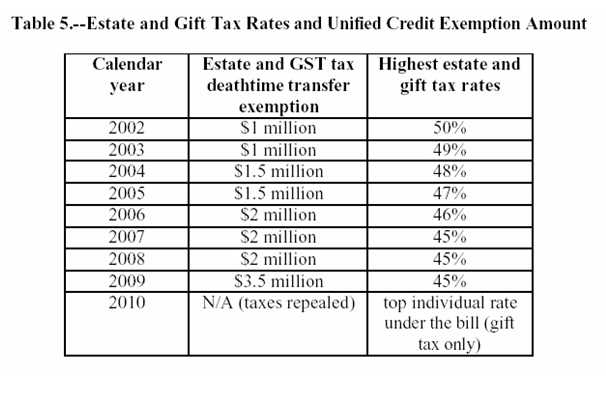
Estate taxes were reduced and to be phased out… only impacts wealthy folks with estates that are big enough to be subject to “death taxes”


* * * * *

Details re: “Bush Tax Plan” – 2001 and 2003

Officially, the first round of Bush tax cuts were codified in the “Economic Growth and Tax Relief Reconciliation Act of 2001″ which was approved by the Congressional conference committee on May 25, 2001; signed into law shortly thereafter; but phased in over a several year period.  The key provisions of the law (as reported in the conference committee’s report):
Introduce a 10-percent rate bracket… reducing the rate from 15% to 10% for the first $6,000 of taxable income for single individuals ($7,000 for 2008 and thereafter), $10,000 of taxable income for heads of households, and $12,000 for married couples filing joint returns ($14,000 for 2008 and thereafter).

Reduce individual income tax rates  … from 28 percent, 31percent, 36 percent, and 39.6 percent are phased-down over six years to 25 percent, 28 percent, 33 percent, and 35 percent, effective after June 30, 2001.

click table to make it bigger

Phase-out of Itemized Deductions and Restrictions on Personal Exemptions … by eliminating all limitation on itemized deductions and any restrictions on personal exemptions for all taxpayers by one-third in taxable years beginning in 2006 and 2007, and by two-thirds in taxable years beginning in 2008 and 2009, and by 100% for taxable years beginning after December 31, 2009.

Increase and Expand the Child Tax Credit… Increasing the child tax credit to $1,000, phased-in over ten years. and by making the child credit — subject to certain income limitations — non-taxable and refundable (i.e. payable to the person if the net tax liability is zero),

Provide relief from the “marriage penalty” … by increasing the basic standard deduction for a married couple filing a joint return; by increasing the size of the 15-percent regular income tax rate bracket for a married couple filing a joint return to twice the size of the corresponding rate bracket for an unmarried individual filing a single return.; and by increasing limits on the Earned Income Tax Credit.

Provide Education Benefits… by increasing the annual limit on contributions to education IRAs to $2,000; by expanding the reach of 529 tuition programs; by extending the non-taxibility of employer paid tuition; and by raising income phase out levels for deductability of student loan interest.

Phase-out and Repeal of Estate and Generation-Skipping Transfer Taxes:
* * * * *

In 2003, a second round of tax changes was enacted in the “JOBS AND GROWTH TAX RELIEF RECONCILIATION ACT OF 2003” which:

Accelerated the phase in of the 10% bracket, the reduction in other bracket rates, the child care tax credit, and marriage penalty relief.

Provide reductions in taxes on capital gains and dividends … reducing the 10- and 20-percent rates on capital gains on assets held more than one year to five ( zero, in 2008 ) and 15 percent, respectively. and providing that dividends received by an individual shareholder from domestic and qualified foreign corporations generally are taxed at the same rates that apply to capital gains.

* * * * *

Source Reports
http://www.jct.gov/x-50-01.pdf
http://www.house.gov/jct//x-54-03.pdf

About half of small business income to be hit with higher taxes …

September 14, 2010

Punch line: Obama’s plan to raise top marginal rates is holding back the very people who should be leading the economic recovery.

Ken’s Q: Why doesn’t Obama just declare that a separate rate will apply to business income reported on 1040s?  That would neutralize this issue.

* * * * *

According to the WSJ …

The President has called for the permanent extension of the Bush tax cuts for singles with incomes below $200,000 and married couples with incomes below $250,000, but has proposed that most of the tax cuts for households with higher incomes be allowed to expire.

To buttress this position, the president and his supporters have repeatedly asserted that the expiration of these cuts will have little impact, because they affect only about 3% of the wealthiest Americans, people who “can afford it.”

House Speaker Nancy Pelosi repeatedly flips the number around and says that the planned tax increases would exempt “98% of American families and about 97% of small businesses.”

The 3% figure, which is computed from IRS data, is based on simply counting the number of returns with any pass-through business income. 

But, according to IRS data, fully 48% of the net income of sole proprietorships, partnerships, and S corporations reported on tax returns went to households with incomes above $200,000 in 2007.

That’s the number to look at, not the 3%.

And, the evidence is clear that lifting the top rates will hamper the business investment upon which our nation’s prosperity depends.

Research studies have consistently found that increasing progressivity of the tax code discourages entrepreneurs from starting new businesses.

Excerpted from WSJ: The Small Business The 97% Fallacy, Sept. 3, 2010
http://online.wsj.com/article/SB10001424052748703959704575454061524326290.html?mod=WSJ_Opinion_LEADTop

What the 2010 Census May Mean for Marketers

September 14, 2010

TakeAway:  The 2010 Census results will likely reveal the Hispanic market’s growing influence and help marketers understand they need to start focusing on this huge demographic change.  Few people realize that Hispanics are influencing the general market more than vice-versa.

* * * * *

Excerpted from AdvertisingAge, “A Look at the Numbers Behind America’s Huge Demographic Shift” By Chiqui Cartagena, August 31, 2010

With the arrival of Hispanic Heritage month, people in the media and marketing worlds have already started to talk about what the new Census results could reveal next year.  This is the key point: It’s not about the Hispanic market, it about how these demographic shifts are affecting the so-called general consumer market.

 It wasn’t really until the 2000 Census that the dominance of Hispanics became a “new phenomenon.”  By the end of 2010, there will be 30% more Hispanics (50 million) than there will be African Americans (38 million) in this country. 

 Hispanics will continue to be a driving force behind America’s changing face, not so much through immigration but rather by births, with 60% of the U.S. Hispanic market growth coming from the natural births.

So, what does this mean to you?

  • Any marketing plan targeting youths must take into account Hispanics.
  • Marketing plans must take into account that Hispanics live in multi-generational households, therefore it is critical to understand how different generations influence each other.
  • The influence of the Hispanic market goes beyond the traditional states. Over 30 markets saw the Hispanic population increase by more than 100,000 persons in the past 10 years.
  • U.S. born Hispanics will require marketing campaigns that take into account their unique cultural background. It is critical to develop marketing campaigns that go beyond language and place of birth.

Edit by AMW

* * * * *

Full Article:
http://adage.com/bigtent/post?article_id=145653

* * * * *

Boehner blinks … or doe he ?

September 13, 2010

 Obama says he only wants to extend 80% of the Bush cuts — only for families earning less than $250,000.

Speaking at a White House press conference, Obama accused Republicans of “holding middle-class tax relief hostage” by insisting that all of the tax cuts passed under President Bush be extended. He called out Congressman John Boehner as the main culprit.

On Sunday talk shows, GOP Leader Boehner — fresh off his Obama-induced rise to national attention — seemed to sell out the 3% of folks who pay almost half of all income taxes: 

WSJ, Boehner Opens Door in Tax Talks SEPTEMBER 12, 2010

The top House Republican said Sunday that he would support legislation that extended tax cuts for the middle class but not the wealthy if that was the only option, an apparent concession to Democrats that was met with skepticism from the White House.
http://online.wsj.com/article/SB10001424052748703897204575487904204238046.html?mod=WSJ_WSJ_US_News_5

What’s up?

Here’s my take …

Now, 80% of the Bush tax breaks — which candidate Obama said were all “for the wealthy” — get renewed — probably permanently, without any sunset provisioning.  And, GOP is off the hook for “holding the middle class hostage”. My bet: Obama wanted them to stop the middle class tax breaks — so he could say that he was keeping a campaign pledge and have an addition $3 trillion to throw against his spending spree.

Then, GOP wins the House and immediately passes a bill to extend the Bush tax cuts for investors and business owners — i.e. “the wealthy”.

Either Obama OKs the extension — selling out his base — or, more likely, he vetoes the bill and owns the results if the economy continues to stagger. Neither are good options for the President.

Biggest question is how they sort out the capital gains, dividends and estate tax rates.

We’ll see …

What per cent of Americans “always or usually” live from pay check to pay check ?

September 13, 2010

Answer:

Recent polls show that 61%of Americans “always or usually” live from pay check to pay check … up from 49% in 2008.

Source:
http://www.ft.com/cms/s/0/44d4b1c4-b52f-11df-9af8-00144feabdc0.html

Don’t change that channel.

September 13, 2010

TakeAway: With so many entertainment choices, TV faces tough competition for the attention of viewers. Even when people do watch TV, more than a third of viewers skip over commercials. 

For marketers deciding how to promote their brands, this can be troubling because TV commercials are very expensive to produce and air. 

Now, new research has examined how to keep viewers from changing the channel during commercials. 

In a very different approach than traditionally used, researchers discovered that “pulsing” repeated, brief images of the brand can significantly reduce the likelihood that viewers will “zap” it.

* * * * *

Excerpted from HBS Working Knowledge, “Improving Brand Recognition in TV Ads,” by Julia Hanna, June 7, 2010

Advertisers pay millions of dollars to air TV ads that, by some estimates, more than a third of viewers skip over with digital VCRs or by switching channels or tuning out altogether.

New research by HBS professor Thales S. Teixeira offers a simple, inexpensive solution to help marketers hold on to some of those consumer eyeballs. …

Teixeira and his coauthors show that “pulsing” repeated, brief images of the brand can significantly reduce the likelihood that viewers will zap it, as opposed to showing the brand for long periods of time at the beginning or end of the ad. …


Theories abound as to the most effective strategy for crafting a TV commercial … There are also ideas about placing the brand early in the commercial, late (the so-called mystery approach), or early and late.

“The days when you could tell a consumer what to do are long gone,” says Teixeira. “In the 1960s, the brand was onscreen all the time with a direct message: ‘Drink a Coke,’ for instance. Today, people are searching for valuable information that is relevant to them. They also want to be entertained, and the ‘hard sell’ that turns them off can be at the level of simply presenting the brand’s logo for more than a few seconds.” …

The dilemma is that our findings show that brand images cause people to zap,” Teixeira says. “But they’re a necessary evil; without the brand, viewers can’t identify what is being sold. So how do you make an ad that includes the brand without causing a high level of zapping?” …


Taken alone, brand presence automatically increases commercial avoidance. But … changing the pattern of brand exposure (without decreasing the total amount of time the brand is shown) can lower zapping rates, and that a “pulsing” strategy in which the brand is inserted briefly and intermittently throughout the commercial is most effective, resulting in an average decreased zapping of 8 to 10 percent. …


From a managers’ perspective, altering the commercials to mimic a pulsing strategy is a virtually cost-free fix for a significant payoff, with zapping rates for some commercials reduced by as much as 25 percent in a lab experiment. If a company is paying to advertise on prime-time television during a show with an estimated 5 million viewers, 50 to 60 percent of those viewers (2.5 to 3 million people) can be lost with usual zapping rates; as many as 1 million could be recaptured by using the pulsing strategy. …


Will these findings influence how advertisers craft their ads in the future? Teixeira notes that there is already some evidence of pulsing in ads, as in the award-winning “The Happiness Factory” for Coca-Cola, and various automobile commercials that briefly show the brand logo of a car from various angles as it maneuvers a winding road. …


Edit by DMG

* * * * *

Full Article
http://hbswk.hbs.edu/item/6322.html

* * * * *

The nation’s infrastructure is crumbling … oh, really ?

September 10, 2010

The collapse of the Minneapolis bridge a couple of years ago was, indeed, a disaster.  One that prompted hysteria about the sad shape of all roads and bridges in the U.S. 

At the time, I thought “over-reaction”.

In fact, I can’t recollect hearing about any major bridge collapses since

Sure, I’d like pot holes filled and more lanes on the DC Beltway … but is the infrastructure perilously crumbling?

Here’s an interesting twist …

* * * * *

Excerpted from RCP: Can You Smell What Obama’s Cooking?, September 8, 2010

President Obama unveiled “an exhilarating new plan” that will not only “jump-start” job creation but also fund and rebuild the “crumbling” infrastructure of the United States.

Have you noticed that the infrastructure always is “crumbling” in news stories and presidential speeches — if less regularly in the real world.

For those of you who drive, though, a recent Reason Foundation study measures the condition and cost-effectiveness of roads — including deficient bridges, urban traffic congestion, fatality rates, pavement condition, etc. — and finds that roads haven’t been in better shape at any time in the past 19 years.

Full article:
http://www.realclearpolitics.com/articles/2010/09/08/can_you_smell_what_obamas_cooking_107057.html

John who? … Somebody explain this to me, please.

September 10, 2010

Yesterday in Cleveland –– actually, Parma – a suburb that Clevelanders have made fun of for decades, since the days of Ernie “Ghoulardi” Anderson and Tim Conway –- a feisty President Obama turned attack dog and called out House Minority Leader John Boehner nine times.

Forget that it was unseemly for the President to do it.

The odd attack must have left most people scratching their heads, wondering “Who the heck is John Boehner?”

Think about it.

Less than 2/3s of Americans can identify the sitting Vice President .  (Note: that’s giving credit for people who think it’s Hillary Clinton or Joe Somebody)

Less than 30% of the public knows who Chief Justice John Roberts is. (see chart below)

A CNN poll released the day of Obama’s speech slots Boehner between Biden and Roberts — 55% either have never heard of Boehner or have no opinion about him.

So why would Obama elevate and attack somebody who is unknown to the majority of Americans?

I must be missing something …

* * * * *

Note: Accoding to Pew, more than 1 in 4 Americans don’t know that ObamaCare was passed … and they get to vote … that’s scary !

image

http://pewresearch.org/pubs/1668/political-news-iq-update-7-2010-twitter-tarp-roberts

Bending the cost curve … well, maybe not … oops, again.

September 10, 2010

A report by federal number-crunchers casts fresh doubt on Democrats’ argument that the health-care law would curb the sharp increase in costs over the long term,

“The health-care overhaul enacted last spring won’t significantly change national health spending over the next decade compared with projections before the law was passed”.

U.S. health spending is projected to rise 9.2% in 2014, up from the 6.6% projected before the law took effect.

image

WSJ, Health Outlays Still Seen Rising, Sept. 8, 2010
http://online.wsj.com/article/SB10001424052748704362404575480161749608830.html?mod=djemalertNEWS

Men only: dance moves guaranteed to attract the ladies …

September 10, 2010

Excerpted from: Digital Journal, Study: Certain male dance moves attract women, Sept. 8, 2010

Researchers in the UK have discovered what moves women find attractive while watching men dance.

The study used computerized 3D avatar figures to see what “key movement areas of the male dancer’s body influence female perceptions.”

There were eight “movement variables” that the women found to be either good or bad in a male dancer, including the size and variability of neck, torso, left shoulder and wrist movement – and the right knee’s speed of movement.

The women liked seeing “large and varied movements involving the neck and torso.”

“The dance moves may form honest signals of a man’s reproductive quality, in terms of health, vigor or strength.”

“This is the first study to show objectively what differentiates a good dancer from a bad one.

If a man knows what the key moves are, he can improve his chances of attracting females.”

Watch the video at:
http://www.digitaljournal.com/article/297221