Archive for December, 2010

Food Trucks Serve Up Branding, Not Just Lunch

December 30, 2010

TakeAway:  Pairing a brand’s message with a food truck has been increasingly employed in recent months, with major advertisers using trucks as rolling sandwich boards while advertising agencies issue the call to independent food truck operators to participate in brand-sponsored events.

Food trucks have grown in popularity in major cities, and advertisers now see them as a vehicle for delivering their message directly to consumers.

* * * * *

Excerpted from NYTimes, “Marketers Discover Trucks Can Deliver More Than Food” By Tanzina Vega, November 28, 2010

When the Heavenly Mountain Resort in Lake Tahoe, Nevada, wanted to promote its ski passes this season, it bypassed the usual advertising media like billboards, radio and print ads and instead chose a truck filled with snow cones driven by two improv actors to publicize its message.  For Heavenly, the idea to distribute snow cones from a truck was simple: “We’re going to give you a little bit of the mountain..”  

The challenge with buying traditional media is “paying for eyeballs of people who have no interest in what you’re trying to sell.”

But some brands prefer to create their own food truck instead of hiring an independent operator. To promote its new product, Heinz Dip & Squeeze Ketchup, the H.J. Heinz Company bought a used truck and added a custom kitchen. The truck was then branded with a custom wrapping that displayed the “Heinz Ketchup Road Trip” message along with the related Twitter handle and Facebook page address.  At each stop, visitors get a free serving of Ore-Ida crinkle cut fries or Ore-Ida sweet potato fries and a packet of the Dip & Squeeze Ketchup.  The company will also give away promotional T-shirts to people who have participated in one of the social media parts of the campaign.

Most food trucks, corporate or not, use social media tools like Twitter to post their location to their followers, and now Zagat, the restaurant guide, has gotten into the game. In early November, Zagat announced a food truck Web site that features a map with the location of the food trucks that it partners with. They are also conducting a survey of the best food trucks in New York.

Edit by AMW

* * * * *

Full Article:

http://www.nytimes.com/2010/11/29/business/media/29truck.html?_r=1&nl=todaysheadlines&emc=a210

* * * * *

Merry Christmas …

December 25, 2010

… from the Homa Family.

image
Jess,Scott, Anna, Kathy, Ken, Jay. Meghan

About the rich … and the impact of taxes

December 24, 2010

Great analysis presented in the WSJ.

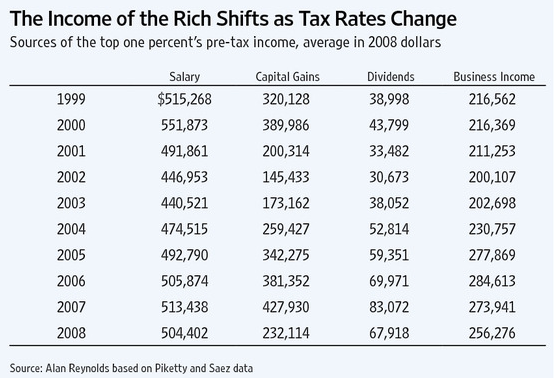
Key is the chart below which takes official IRS data for the top 1% of pre-tax-earners, adjusts for inflation (by stating all years in constant 2008 dollars), and breaks income into it’s components

image

The key points:

1) Business income is roughly 25% of reported income

2) Average inflation-adjusted salary has stayed pretty flat.

3) Until the crash in 2008, capital gains grew … note: cap gains tax rates were reduced in 2003 .. coincidence?

4) Similarly, dividends increased after the dividend tax rate was cut to 15% … another coincidence?

The mega-point of the analysis is that behavioral economics is alive and well … dink with marginal rates and folks will simply shift income … causing an inverse relationship between marginal tax rates and tax receipts.

Just do the the math.

* * * * *

Full article is a worthwhile read:
WSJ,Taxes and the Top Percentile Myth, Dec.  23, 2010
http://online.wsj.com/article/SB10001424052748703581204576033861522959234.html?mod=djemEditorialPage_h

Pucker up with Nivea in Times Square for NYE

December 24, 2010

TakeAway: Surely there is no moment when more Americans lock lips than at midnight on Dec. 31, when a kiss marks the New Year, and that is why Nivea Lip Care ties its biggest marketing effort of the year to New Year’s Eve. 

Nivea is a natural fit as a sponsor, just as Waterford Crystal is for the crystal ball that descends on Times Square for the countdown.

* * * * *

Excerpted from NYTimes, “For New Year’s Eve, the Tie-Ins Erupt” By Andrew Adam Newman, December 13, 2010

For the third consecutive year, Nivea is an official sponsor of the New Year’s Eve celebration in Times Square, and along with sponsoring a stage called the Nivea Kiss Platform, it will hand out about 30,000 samples of lip balm to revelers in the hours before the countdown.

“The brand is based on the insight that something wonderful happens when skin touches skin and humans connect, and the New Year’s Eve kiss sets the tone for the new year to come,” said Magnus Jonsson, vice president for marketing at Beiersdorf, parent company for Nivea.

This year, Nivea also is holding a contest on its Facebook page where couples in long-distance relationships vie for a chance to win a free trip to New York to be reunited in Times Square on New Year’s, with two couples who garner the most votes on Facebook winning.

Nearly as prominent as the ball are the numerals that light up to mark the dawning year, and Duracell is hoping to become similarly synonymous. For the third consecutive November, the brand set up what it calls the Duracell Power Lab in Times Square, which consists of four stationary bikes that when pedaled charge batteries that will subsequently be used to light the sign.  This year the bikes are housed in a trailer that for the rest of the year will be deployed to disaster areas, where it will provide charging stations for items including cellphones, laptops, and rechargeable batteries.  “We talk a lot about people trusting Duracell when it just has to work,” said its marketing director. When the numerals light up, “it’s that one iconic moment of the holiday season when millions of people are watching and it’s a great association for Duracell batteries being trusted in an important moment.”

The Times Square Alliance estimates that one million people attend the New Year’s Eve festivities. A Trylon Strategic Media Relations study commissioned by the group pegged the international audience at more than one billion.

Edit by AMW

* * * * *

Full Article:
http://www.nytimes.com/2010/12/14/business/media/14adco.html?ref=media

* * * * *

Dems establish some bad precedents … that’ll come back to haunt them.

December 23, 2010

Gotta give the Dems a hat-tip for pushing to the limits of the rules to cram their agenda in.

First, it was using the budget reconciliation process to pass ObamaCare.

Then, came the lamest of lame duck Congresses pushing through some debatable (but not debated or amended) legislative initiatives.

Note: I don’t have a clue whether the START Treaty is a good idea or a bad idea … but for the first time in U.S. history, a treaty is being ratified by lame duckers.  That sure sounds fishy, doesn’t it?

Now, the FCC – working though “executive authority” – implements rules to regulate the internet.  Rules that courts and legislatures have deemed inappropriate use of FCC powers.

Dems are feeling pretty proud about the way they’re using the system to their advantage.

But, as Grandma Homa used to say “what goes around comes around”.

Just wait until the GOP uses the same tactics.

The squealing will be intense.

Microsoft tries to stay relevant

December 23, 2010

TakeAway: As personal computing moves away from desktops and laptops to smartphones and tablets, Microsoft has yet to establish a foothold in either.

Its new smartphone platform offers the best chance get to gain market share but there are some steep challenges to overcome.

Developers don’t want to develop apps for the platform until sales justify doing so, but people won’t buy Windows 7 phones without compelling apps.

Not only that, but the platform won’t work on Verizon until next year, when Verizon is expected to launch the iPhone.

* * * * *

Excerpted from Bloomberg Businessweek, “Microsoft is Pinning Its Hopes on Windows Phone 7,” by Peter Burrows and Dina Bass, October 14, 2010

In an interview shortly after he unveiled Microsoft’s new Windows Phone 7 mobile software on Oct. 11, Chief Executive Officer Steve Ballmer declared a new era for Microsoft. “This is a big launch for us—a big, big launch,” he boomed.

Ballmer, never known for understatement, may be lowballing this one. Gartner expects smartphone sales to surpass PCs in 2012. Microsoft remains immensely profitable thanks to its aging PC monopoly, and it will remain so even if it never figures out the smartphone market. …

By almost any measure, Microsoft is nearly out of the mobile game. Its market share fell to 5 percent from 22 percent in 2004, says Gartner. Customer satisfaction of Windows smartphones is 24 percent, according to ChangeWave Research; it’s 74 percent for iPhones and 65 percent for handsets powered by Google’s Android. …

… With Apple and Google each activating more than 200,000 customers a day, according to those companies, handset makers, carriers, and app makers have far larger audiences than Microsoft offers. …

… While AT&T and T-Mobile will offer Windows Phone 7 devices, the software won’t work with Sprint or Verizon Wireless until next year. (Apple’s AT&T-only iPhone may be on Verizon by then.) …

Holding share in such a fast-growing market could require sales of about 20 million units in 2011, no easy feat. That’s how many iPhones Apple sold in its debut year. …

Microsoft’s to-do list doesn’t end with Windows Phone 7. It has no tablet software that can match the iPad. Failing in smartphones would be bad. Failing in tablets, which users expect to run office software, would be catastrophic …

* * * * *

Full Article
http://www.businessweek.com/magazine/content/10_43/b4200042877975.htm?campaign_id=magazine_related

* * * * *

2010’s Most Memorable Product Launches

December 23, 2010

TakeAway: In today’s mass production age, so many new products hit the shelves that most go unnoticed.  Schneider Associates, a Boston-based public relations and market communications firm, compiles an annual list of the year’s most memorable new product launches.  Here are the top ten to keep in mind.

* * * * *

Excerpted from Forbes, “The Most Memorable Product Launches Of 2010” By Elaine Wong, December 3, 2010

This year Apple came in first with the introduction of its iPad tablet computer. Forty-two percent of consumers named it as one of the products they most remembered out of the flurry of new launches that came between October 2009 and September 2010.

Tech brands overall had a heavy presence, with new introductions, such as Microsoft’s Windows 7 (No. 2), Motorola’s Droid smartphone release (No. 4) and Samsung’s 3-D TV (No. 8) among the most recalled new offerings on consumers’ minds this year.

Sales aside, a product launch that’s effortlessly recalled by the public proves that marketers – and their brands – have staying power. Plus, with about 250,000 new products launched globally each year, creating one that stands out can be pretty tough. Consider, too, that the typical failure rate of new product launches can be anywhere in the 85% to 95% range, according to Mintel.

Rolling out a product that appeals to an audience that uses social media to chat about new things can help make it a hit. That’s what Kimberly-Clark did when it rolled out Huggies Little Movers Jeans (No. 9) this year. This limited-edition offering is a diaper with a denim-like style. Mommy bloggers loved them.

For some marketers, thumbing a nose at conventional wisdom can work. KFC did this by ripping the bun off its fat-soaked Double Down sandwich (tied for No. 10). That’s two pieces of chicken – fried or grilled – serving as the one and only cover between an indulgent bacon, cheese and secret sauce center combo.

Food companies, on the other hand, tapped into recession-weary consumers’ hunger for quick, cheap eats. Among the hits: McDonald’s Real Fruit Smoothies (No. 5) and Mars’ Pretzel M&Ms (No. 3). The latter was a simple spin on an idea, but it satisfied Americans’ craving for a sweet, simple treat in an economic downturn.

Edit by AMW

* * * * *

Full Article:
http://www.forbes.com/2010/12/03/most-memorable-products-leadership-cmo-network.html

* * * * *


Oregon hikes tax rates … and tax receipts (predictably) go down.

December 22, 2010

Remember when Charlie Gibson stunned Candidate Obama by pointing out that when capital gains tax rates go up,capital gains tax receipts go down? It was obviously new news to Obama who countered: “But, it should be done for fairness”.

Continues to amaze me that our crack legislators confuse “tax rates” with “tax revenue” … and refuse to accept the repeated empirical evidence that they are inversely related.

Excerpted from WSJ, Ducking Higher Taxes, Dec 21, 2010…

Oregon raised its income tax on the richest 2% of its residents last year to fix its budget hole, but now the state treasury admits it collected nearly one-third less revenue than the bean counters projected.

Oregon’s liberal voters ratified a tax increase on individuals making more than $250,000 and another on businesses … no doubt feeling good about their “shared sacrifice.”

Congratulations. After the tax was raised “income tax and other revenue collections began plunging steeply.  Instead of $180 million collected last year from the new tax, the state received $130 million.

One reason revenues are so low is that about one-quarter of the rich tax filers seem to have gone missing. The state expected 38,000 Oregonians to pay the higher tax, but only 28,000 did. Funny how that always happens.

All of this is an instant replay of what happened in Maryland in 2008 when the legislature in Annapolis instituted a millionaire tax. There roughly one-third of the state’s millionaire households vanished from the tax rolls after rates went up.

http://online.wsj.com/article/SB10001424052748704034804576026233823935442.html?mod=WSJ_Opinion_AboveLEFTTop

The Evolution of Focus Groups

December 22, 2010

TakeAway:  Arguing that focus groups were never really all that effective in the first place, agencies and research facilities have introduced a variety of methods aimed at shaking up the traditional focus group approach. 

Young & Laramore, an Indianapolis-based agency, frequently runs what the company president calls “friendship groups.”

That’s when the company will tap one consumer and ask that individual to recruit two or three others from his/her social circle. The assumption is that one is more likely to be comfortable in an experimental setting when with others in one’s social network.

* * * * *

Excerpted from Forbes, “From Focus Groups to ‘Friend’ Groups” By Elaine Wong, November 19, 2010

In these situations, researchers can tell when participants are sharing “secrets with each other, you can catch them winking their eyes or exchanging signals with each other, and you dig into that and find out what’s up.”

Contrast that with the conventional focus group model, in which the scenario in question usually runs something like this: A packaged goods company, retailer or marketer, let’s say, asks an agency or research partner to recruit a panel of consumers with whom to test new products, packaging or ideas. These groups, which can range anywhere from six to 12 or more in number, then gather in a “sterile” room, as many agency execs describe it. A moderator then runs through a list of questions and records participants’ responses while researchers in the back room watch. Such procedures are routine, boring, not to mention long—one session can last 90 minutes—and yield few, if any, new insights.

One catalyst driving the push is the proliferation of social media mining tools, which allow companies to test and tweak new go-to-market strategies in real time and without the need for an actual focus group.

To avoid the typical, ho-hum answers, one company, The New England Consulting Group, uses a methodology called Super Groups, which involves finding the extreme, “lunatic fringes” of a consumer set. Talking to those who are not your average consumer ensures that you get not-so-average—and in some cases, off the chart—results. Several agency executives also brought up the idea of “conflict groups,” when “you recruit and mix people who love something [with] others who hate it or [bring together] passionate lovers of two different brands,” explains an Arnold executive.

Efficiency aside, the historical focus group also posed other problems. One is the gap between what people think and how they later act. Consumers may rationalize their shopping or buying behaviors, but emotion, rather than reason, is often a big driver of these decisions.

Edit by AMW

* * * * *

Full Article:

http://blogs.forbes.com/elainewong/2010/11/19/from-focus-groups-to-friend-groups/

* * * * *


Bumps ahead for gov’t gravy train …

December 21, 2010

Honestly, excluding the military and first-responders, what’s your view of government employees? 

How many fulfilling experiences have you had with the IRS,  the DMV, the tax assessor’s office, the planning board, etc. ?  My bet: not many.

In the old days, most folks got annoyed but gave passes because they thought the inefficient bureaucrats weren’t getting paid very much.

Recent news reports have burst those myths: revealing high pay relative to private sector employees and outrageous benefits packages.

For sure, the next couple of years will have spotlights shining on government employees and their candidate-contributing unions.

Blue states (think NY, CA, IL) will get hit particularly hard now that fiscally responsible red states are refusing to bail them out.

Since the unions won’t budge, expect higher state taxes and cuts in services …   

Compared with many sectors that have suffered grievously from the slump — housing, automobiles, finance — state and local governments have been relatively sheltered.

One reason is President Obama’s  “stimulus” packages … have provided about $158 billion to states.

As these transfers dwindle … local governments may be less lucky. They rely on property taxes for about a third of their revenues, and because property appraisals are done every few years, “the decline in house prices implies that collections will probably fall in the coming years.”

The truly bad news lies in the future with massive retiree pension and health benefits that haven’t been prefunded. How big are the shortfalls? All estimates are huge … the gaps are about $3 trillion for states and almost $600 billion for localities.

Whatever the ultimate costs, they threaten future levels of public services.

The generous benefits encourage workers to retire in their late 50s or early 60s after 25 years of service. The health benefits typically provide coverage until retirees qualify for Medicare at 65.

To pay for unfunded benefits, either government services must either be cut or taxes raised.

So support for schools, police, roads and other state and local activities is undermined by careless — or corrupt — bargains between politicians and their public-worker unions.

Promises of generous future retirement benefits were expedient contract sweeteners, with most costs conveniently deferred. Even when pension contributions were supposed to be made, they were often reduced or postponed when budgets were tight.

If these arrangements look familiar, they should. The U.S. auto industry adopted the same model; the costs helped bankrupt General Motors and Chrysler.

RCP,Cheating Our Children (Again), December 20, 2010
http://www.realclearpolitics.com/articles/2010/12/20/cheating_our_children_again_108288.html

Sun Drop taking aim at Mountain Dew

December 21, 2010

TakeAway: Sun Drop’s owner is taking direct aim at Mountain Dew, the fourth-most popular soda in the U.S. after Coke, Pepsi and Diet Coke.   

Mountain Dew dominates the “citrus” category with an 84.3% share, heavily marketed by Pepsi to teens through sponsorships of extreme sports and through advertising that’s embedded into videogames.

* * * * *

Excerpted from WSJ, “Bigger Splash Planned for a Niche Citrus Soda” By Valerie Bauerlein, December 9, 2010

Sun Drop – which has been around since 1928 – has a rabid following in the handful of mainly Southern states where it’s currently sold. The drink was once pitched by the Nas car legend Dale Earnhardt. Families have shipped it off to soldiers serving in Afghanistan; fans swap recipes for holiday turkey with Sun Drop glaze. Made with orange juice and packing more caffeine than Mountain Dew, it is sometimes used as a mixer with hard liquor.

Its expansion is part of Dr Pepper Snapple’s strategy to fortify consumer interest in flavored sodas, a non-cola segment of the soft drink industry in which the company specializes. Cola sales have fallen to 55.4% of the U.S. soda market in 2009 from 60.5% in 1999, according to Beverage Digest, an industry publication. At the same time, sales of Dr Pepper, Crush, and other brands Dr Pepper Snapple owns have grown.

To reach Sun Drop’s target market of 15- to 17-year-olds, Dr Pepper Snapple developed a revenue-sharing agreement with Viacom Inc.’s MTV network. MTV’s new Scratch marketing arm has designed the drink’s advertising and image, down to a redesign of the can that will be appear in January. The network also will feature Sun Drop in MTV programming, including reality shows such as “The Real World.”

Some analysts have cooled to Dr Pepper Snapple shares, saying the company has improved operations but has little prospect for growth, since the company long ago sold the rights to its brands internationally.

The company said it sees potential nonetheless in the growing appetite for its flavored drinks because carbonated soft drinks is a fairly stagnant, slightly declining category.

Edit by AMW

* * * * *

Full Article:
http://online.wsj.com/article/SB10001424052748704447604576007841967430316.html

* * * * *

Billionaires pledge charitable deductions … to do good and duck taxes.

December 20, 2010

Last week, 17 more billionaires signed on to the Giving Pledge and declared their intention to give away to charitable organizations at least 50 percent of their wealth. The initiative is being spearheaded by Buffett and Gates.

To call me cynical about the pledge would be an understatement.

I see it as a clever way for them to dodge estate taxes taxes (while whining about how they are undertaxed) and maintain their power … even from the grave.

I’d like to see how much money they’d throw in the pot if they had to do it with after-tax dollars.  That would be a nice sincerity test.

I was surprised to see the Huffington Post raise some issues about the billionaires’ pledge …

Huff Post, Why We Should Dial Down Our Enthusiasm for the Giving Pledge, December 15, 2010

Last week, 17 more billionaires signed on to the Giving Pledge and declared their intention to give away to charitable organizations at least 50 percent of their wealth. The initiative is being spearheaded by Warren Buffett and Bill and Melinda Gates.

I applaud the Gates family and Mr. Buffett for being willing to challenge their peers and to lead by example. Their effort will surely lead to an increase in giving among billionaires and others. I do, however, have some concerns.

There are three important reasons to keep our enthusiasm for the Giving Pledge in check.

First, the pledge is likely to have an extremely small impact on total giving, especially in the first few years. The problem is, the money is going to trickle out over a very long period of time, and it will represent only a very small upward tick in total charitable giving. Billionaires who take the pledge commit to giving half their wealth to charity at some point during their lifetimes, or at their deaths. Some people on the list are quite elderly, but others are likely to spread their giving out over the next 50 years.

My guess is that most of the money will wind up in university or foundation endowments, with only about 5 percent of the asset base getting spent on charitable purposes each year in perpetuity. Clearly, the Giving Pledge will not be a major factor in sparking a much hoped-for rebound from the drop in giving that has decimated many nonprofits these last two years.

Second, little of the money is likely to benefit the most under-served populations. And third, giving by billionaires has typically been limited in its effectiveness and has dangerous implications for democratic decision-making.

Wealthy donors don’t tend to prioritize lower-income communities, communities of color or other marginalized groups as beneficiaries of their giving. Instead, they tend to give to nonprofits that they patronize, such as cultural institutions and their alma maters.

Wealthy donors give to places “where they spend their leisure time” and that only 10 percent of charitable contributions actually benefit the poor. 

Third, giving by billionaireshas dangerous implications for democratic decision-making.

http://www.huffingtonpost.com/aaron-dorfman/the-giving-pledge_b_796159.html

English translation of “dangerous implications for democratic decision-making”: if people start making personal decisions about where their money should be directed -– partially subsidized by tax advantages—then the Feds have less money at their disposal to direct as they (the Feds) see fit.

Oh my …

Profile: Just-in-Time Consumer

December 20, 2010

TakeAway:  The recent recession has left in its wake a deeply changed shopper: the just-in-time consumer. Manufacturers and retailers report that people are buying less, more frequently, and are determined to keep cash on hand. Executives peddling wares from canned goods to cashmere say the shift in consumption habits is prompting them to change how they produce, package, price and deliver their goods.

* * * * *

Excerpted from WSJ, “The Just-in-Time Consumer” By Ellen Byron, November 23, 2010

So far, the impact of just-in-time buying on the corporate bottom line is mixed. Smaller unit sizes, for example, generally mean higher prices—and therefore higher profit margins for manufacturers.  Still, the phenomenon is so new it hasn’t shown up broadly in earnings. A Kimberly-Clark spokeswoman notes that potentially higher profits on smaller packages can be offset by higher manufacturing costs.

And companies are still reeling from lower sales volumes that began in 2008 with what some dub “pantry deloading.” Over the past two years, the number of items kept in American pantries has fallen about 20%, according to a recent survey. Consumers are also cutting back on the range of goods they stock.

The new shopping behavior is having a big effect on club stores, the ultimate pantry-filling destinations, which offer low prices but require bulk purchases. Some, including Costco and BJ’s, have reported increased shopping-trip frequency and decreased transaction sizes. To adjust, some discounters are rethinking their businesses. BJ’s began courting new customers two years ago to expand its membership, including smaller households and empty-nesters. It began shrinking its package sizes, in part to lure shoppers more interested in weekly purchases than monthly stock-ups. Now, the chain sells cartons of 18 eggs, instead of only five-dozen egg packages. It offers two containers of margarine of nearly two pounds each instead of only five-pound buckets.  The margarine change alone resulted in 46% more members who bought margarine.  BJ’s is trying to make its stores more attractive and change promoted items to encourage more frequent visits.

The changes at retail are often prompted by manufacturers. This summer, Del Monte began reducing the number of canned fruits and vegetables in multi-packs sold at club stores—and advising other retailers to reduce the number of cans required to qualify for a discount. The company realized consumers were more worried about overall cost, even if it meant a higher cost per can.

Just-in-time consumption is also disrupting long-established purchase cycles, including the annual back-to-school shopping ritual.  Shoppers of high-end discretionary products are shifting to just-in-time buying as well.

Edit by AMW

* * * * *

Full Article:

http://online.wsj.com/article/SB10001424052748704865704575610452319977706.html?mod=WSJ_business_LeftSecondHighlights

* * * * *

Omnibus Bill’s defeat is a big blow to ObamaCare … here’s why.

December 17, 2010

Obama and Reid almost got away with it.

At the last minute – in the lamest of lame duck session – Reid tried to push through a $1.1 trillion Federal budget.

The public uproar centered on the process (more backroom dealing), the magnitude (another $1 trillion), and the earmarks (over 6,000 and more than $8 billion).

Yep, it was a stick in the eyes of voters … I think Reid liked that.

But, Reid had to pull the bill last nite … accepting that he didn’t have the votes to pass it.

Interesting, because most of the uproar was just a distraction.

Bottom line, the budget that finally gets passed next year will be right around $1 trillion … you can make bank on that.

And, it’ll contain tons of wasteful spending … it’ll just be harder to find since it won’t be tagged “earmarks”.

So what’s the big deal ?

In my opinion, the omnibus bill was just a Trojan Horse.

Inside it was more than $1 billion funding for ObamaCare … to continue building the enforcement infrastructure.

There’s no way that the newbies arriving in DC will build that into the budget.  Many have declared that “defunding” ObamaCare is one of their top priorities.

That’s why Obama didn’t step forward and tell Reid to stop the foolishness re: spending and earmarks.

He couldn’t … he was getting the biggest earmark of them all.

Losing that, coupled with the states’ legal fight over the constitutionality of ObamaCare … 2011 will be a challenging year for ObamaCare as it’s supporters fight for $$$ and try to convince the courts that’ it’s legal.

Obama cites harsh rhetoric creating gulf with biz execs … their’s not his!

December 17, 2010

Here’s one from the “say what?” file …

At Wednesday’s CEO Summit, execs told Obama that

“ … an overwhelming majority of those in business believe the administration is hostile, with little or no understanding of how this saps the “animal spirits” required for taking risks on expansions and start-ups.”
http://www.ft.com/cms/s/0/1e56086c-0882-11e0-80d9-00144feabdc0.html#axzz18Gn2QqtQ

OK, that’s not new news to most of us.

The President’s rebuttal:

“ …  the president expressed his frustration about the apparent disconnect between productive talks with the executives, and the harsh rhetoric directed at the administration by the business lobbyists they employ.”http://www.ft.com/cms/s/0/ea11431a-087b-11e0-80d9-00144feabdc0.html#axzz18GoEJFOK

After 2 years of vilifying virtually every company (except Google) with the harshest rhetoric on the planet, the President says the problem is biz talking trash about him.

You gotta be kidding me.

Ironic that the fate of his presidency is now largely in the hands of those who he has trash talked.

See FT, Only business can put Obama back on top, December 15 2010
http://www.ft.com/cms/s/0/1e56086c-0882-11e0-80d9-00144feabdc0.html#axzz18Gn2QqtQ

My bet: the execs will continue to sit on cash and slow roll the hiring process.

Why?

They just don’t trust the guy …

HTC builds a name, and profits for itself

December 17, 2010

TakeAway: In a short period of time, HTC has risen from a nameless contract manufacturer to the world’s market leader in Android phones.

With Android sales growing faster than iPhone sales, HTC is well-positioned to grow even more.

Such a position has given HTC more clout, and more profits than it could ever earn as a brandless company.

* * * * *

Excerpted from Bloomberg Businessweek, “A Former No-Name from Taiwan Builds a Global Brand,” by Bruce Einhorn, October 28, 2010

 HTC, a brand virtually unknown in the U.S. two years ago, is the market leader in Android phones—the one segment of the market that’s growing faster than Apple’s iPhone. …

… with a market cap of 552 billion Taiwan dollars ($18 billion) the company is now the third-most-valuable Taiwanese technology company … HTC launched the first Android smartphone in 2008 … and has a 39 percent share of that market globally. Thanks to the success with Android … analysts expect sales to soar 78 percent this year, according to data compiled by Bloomberg. That’s far better than rivals Apple, Nokia, Research In Motion, and Samsung Electronics. …

HTC is an unlikely Android leader. When the company got its start in 1997, it manufactured personal digital assistants for Compaq. HTC followed the tried-and-true Taiwanese outsourcing formula of designing and manufacturing gadgets for other companies without a brand name of its own. … In 2002 … Microsoft awarded HTC a contract to make smartphones, and the manufacturer quickly became the world’s top producer of Windows phones. …

Even as the Microsoft business was growing, [the CEO] worried that a brandless HTC would forever remain a low-margin manufacturer of commodity products. … In 2007, the year Apple … [HTC] decided to move away from the anonymous contract-manufacturing business. Last year, HTC spent $100 million on a fourth-quarter marketing blitz, and … will spend up to $400 million this year. The company is now the world’s fourth-largest smartphone manufacturer after Nokia, RIM, and Apple, according to IDC.

HTC’s rise to the top tier of handset makers has given it more clout with partners … [and] wireless operators are more willing than before to work with HTC on technology and marketing plans. …

Edit by DMG


* * * * *

Full Article
http://www.businessweek.com/magazine/content/10_45/b4202037166312.htm?chan=rss_topStories_ssi_5

* * * * *

Whatever happened to Obama’s vow of a line-by-line budget review?

December 16, 2010

As Reid & Company rush through a  $1.1 Trillion (with a “T”) pork-laden, Xmas Eve budget, don’t you wonder what ever happened to Obama’s pledge to go through the budget line by line to eliminate wasteful spending?

To refresh memories, here is an excerpt from news reports dated November 2008:

President-elect Barack Obama vowed today to get rid of federal programs that no longer make sense and run others in a more frugal way to make Washington work in tough economic times.

Obama said that to make the needed investments to create jobs, “we also have to shed the spending we don’t need.”

“In these challenging times, when we are facing both rising deficits and a sinking economy, budget reform is not an option. It is an imperative,” Obama said. “We cannot sustain a system that bleeds billions of taxpayer dollars on programs that have outlived their usefulness, or exist solely because of the power of a politicians, lobbyists, or interest groups. We simply cannot afford it. This isn’t about big government or small government. It’s about building a smarter government that focuses on what works. That is why I will ask my new team to think anew and act anew to meet our new challenges…. We will go through our federal budget – page by page, line by line – eliminating those programs we don’t need, and insisting that those we do operate in a sensible cost-effective way.”

Spending restraint is even more important with the federal deficit expected to top $1 trillion in 2009 — more than double the previous record. And that’s before an economic stimulus package that could cost upwards of $500 billion over two years.

Obama vows line-by-line budget review, November 25, 2008
http://www.boston.com/news/politics/politicalintelligence/2008/11/obama_vows_line.html

I figure there are over 50,000 lines (and over 6,000 earmarks) in Reid’s budget.

Think President Obama has his reading glasses on and a sharp pencil in his hand?

I’m betting no …

Call centers aren’t just cost centers

December 16, 2010

TakeAway: Many consumers have effectively become unreachable to marketers.

Choosing not to receive email, direct mail or phone calls, businesses are looking for ways to connect with these customers.

Toward this end, many companies are re-orienting customer service call centers to do sales pitches.

* * * * *

Excerpted from Advertising Age, “Why Marketers are Turning Call Centers into Profit Centers,” by Michael Bush, December 13, 2010

Next time you’re on the line with a call center complaining about a product not working properly, don’t be surprised if you’re not rushed off the phone in record speed. The interactions between consumers and call center reps are evolving from hurried griping sessions to extended sales pitches and consultation meetings.

In fact, more and more marketers are looking to turn their call centers into revenue generating centers, according to a new study by Portrait Software, a provider of customer interaction optimization software. A number of factors are driving this shift but none more significant than the challenge of reaching consumers when a growing number of them are opting out of direct mail and email and opting into do-not-call lists. The study shows that 69% of large business-to-consumer marketers view their call centers as “business critical revenue generators.”

Jeff Nicholson, VP of product marketing at Portrait Software, said … “If you take a deep look into the existing customer bases of many marketers one of the largest segments they have are the unreachables,” …

“These customers have opted out of email, unsubscribed or added their name to a do-not-call list. Considering what that does to the potential for increasing the customer lifetime value and the potential to reach out and retain customers it’s dramatic. But when you have people calling into your call centers, in some cases this can be your only opportunity to service that customer, cross-sell them or get them to un-opt out.” …

Edit by DMG


* * * * *

Full Article
http://adage.com/article?article_id=147618

* * * * *

Memo to GOP: Watch out for the old reconciliation play.

December 15, 2010

As Yogi would say, “It’s not over until it’s over”.

Why do I think that the proposed tax scheme (oops, I meant “compromise”) may offer a Christmas surprise.

OK, the Senate passed a bill with all of the compromise provisions included.

What if the lame duck, Dem-controlled House passes a variant that, say for the sake of illustration, resets the death tax to 55% with a relatively low exclusion (say, $1 million)?

Won’t happen, right?

The modified law will get blocked in the Senate, right?

Not so fast.

Remember the devious reconciliation play that was used to ram ObamaCare through? Allowed a modified bill to be passed by a simple majority of Senators (all Dems).

What if the House passes a slightly modified tax bill, and the Dem majority in the Senate decides that a simple majority reconciliation process is appropriate?

Bingo.  The GOP “wins” vanish from the bill.

Check ! and Mate !

Remember, it happened on ObamaCare … one of the biggest pieces if legislation in the country’s history …. which was opposed – then and now – by a majority of voters.

The difference this time? A bunch of lame-duckers will be punching in their votes.

Don’t put it past them.

What do these taxes have in common ?

December 15, 2010

OK, here’s the list:

Sales Tax
School Tax
Liquor Tax
Luxury Tax
Excise Taxes
Property Tax
Cigarette Tax
Medicare Tax
Inventory Tax
Real Estate Tax
Well Permit Tax
Fuel Permit Tax
Inheritance Tax
Road Usage Tax
CDL license Tax
Dog License Tax
State Income Tax
Food License Tax
Vehicle Sales Tax
Gross Receipts Tax
Social Security Tax
Service Charge Tax
Fishing License Tax
Federal Income Tax
Building Permit Tax
IRS Interest Charges
Hunting License Tax
Marriage License Tax
Corporate Income Tax
Personal Property Tax
Accounts Receivable Tax
Recreational Vehicle Tax
Workers Compensation Tax
Watercraft Registration Tax
Telephone Usage Charge Tax
Telephone Federal Excise Tax
Telephone State and Local Tax
IRS Penalties (tax on top of tax)
State Unemployment Tax (SUTA)
Federal Unemployment Tax (FUTA)
Telephone Minimum Usage Surcharge Tax
Telephone Federal Universal Service Fee Tax
Gasoline Tax (currently 44.75 cents per gallon)
Utility Taxes Vehicle License Registration Tax
Telephone Federal, State and Local Surcharge Taxes
Telephone Recurring and Nonrecurring Charges Tax

Answer: Not one of these taxes existed 100 years ago.

At the time, our nation was the most prosperous in the world, we had no national debt, and we had the largest middle class in the
world.

Hmmmm

Old timers say: “What unemployment?”

December 15, 2010

A recent Fortune article — quoting Jason Levin, an MSB MBA alum — cites employment bright spots for college grads and and gray haired folks …

Punch line: The November unemployment rate for people 55 and older is lower than for any younger age group, welcome news for a group that often worries about being shut out of jobs by age bias.

Scratch the surface of November’s disappointing unemployment statistics, and you find yet more evidence that, while joblessness plagues almost every stratum of society, not everyone is affected in quite the same way.

With unemployment hovering around 5% for people with college degrees, about half the rate for the population as a whole, education is clearly a big factor.

Age is another.

Consider: The November unemployment rate for people 55 and older, at 7.3%, is lower than for any younger age group.

That’s all welcome news for a group that often worries about being shut out of jobs by age bias, or by what some call “the O word” (for “overqualified”).

Still, Russell points out, not all the numbers are cause for celebration. The average job hunter over 55, for instance, is still out of work for about 45 weeks, or three white-knuckle months longer than the average for those under 55.

Older people may take longer to find work for a variety of reasons, says Jason Levin, a senior account executive at career site Vault.com. “Bear in mind that these tend to be more experienced and more sophisticated candidates” than their wet-behind-the-ears counterparts, he notes, so “negotiations over salary and benefits may take longer. They may also have more savings to rely on while they look for exactly the right opportunity.”

Levin, for one, isn’t surprised that overall employment is rising for this group. “Companies that cut way back all through the recession are starting to realize that they need highly qualified people to get the work done,” he observes. “Older managers understand nuance and hierarchies. They have accumulated a lot of wisdom, and they know how to run projects.” He adds: “Experience matters. It will always matter.”

One subtle advantage that more mature job seekers have, adds Levin: “They know how to craft a well-thought-out handwritten note. At this time of year, that means holiday cards with actual stamps on them. If you want to make an impression, that’s worth 100 emails. The personal touch never gets old.”

Fortune, Over 55 and unemployed? Finally a bit of good news, December 8, 2010
http://management.fortune.cnn.com/2010/12/08/over-55-and-unemployed-finally-a-bit-of-good-news/

Good News: Corps accumulating cash and increasing dividends

December 14, 2010

OK, the headline has the gist of the story. Here’s the meat.

  1. The WSJ reported that companies are sitting on almost $2 trillion in cash reserves … the largest cash share of corp assets since 1959.
    http://online.wsj.com/article/SB10001424052748703766704576009501161973480.html?mod=WSJ_hp_LEFTWhatsNewsCollection
  2. GE – a corporate bell cow, raised its dividend for the second time this year … reported a healthy balance sheet, cited an optimistic near tern sentiment, and declared an intention to distribute 45% of profits as dividends.  Analysts expect many companies to follow suit.

    ”A senior analyst at S&P, said the big factor for investors this year is that companies largely have stopped cutting their dividends. Next year, he expects over half the S&P 500 to raise their payouts.”
    http://online.wsj.com/article/SB10001424052748704457604576011561050926064.html?ru=yahoo&mod=yahoo_hs

    Disclaimer: I hold a bunch of GE stock and I am totally biased re: the company.

  3. As part of the extension of the Bush tax cuts, the tax rate on dividends stays at 15% for high-earners and zero for low earners.  So, dividends will continue to be welcome on an after-tax basis.

    Technical note: The double-taxation of dividends – at the corp level and at the individual level — is stupid.  The tax rate should be zero.

  4. As dividends go up, so do stock prices … which increases individuals’ net worth … in their Schwab accounts, in IRAs, in 401Ks, in pension accounts, etc. … some pundits are predicting the S&P will go to 1,450.

    ”The Fed’s data, known as the “flow of funds” report, show that the net worth of U.S. households increased to $54.9 trillion in the third quarter, up from $53.7 trillion in the second quarter, as rising stock-market wealth more than offset declining home values.”
    http://online.wsj.com/article/SB10001424052748703766704576009501161973480.html?mod=WSJ_hp_LEFTWhatsNewsCollection

  5. As net worth goes up, consumer confidence goes up … consumers can use the “new found money” to finish cleaning up their balance sheets … and eventually, will start spending again.  That’s good.

There’s reason to be optimistic …

Grocery stores learn some new tricks

December 14, 2010

TakeAway: The improved lighting in the produce section of your grocery store isn’t just for aesthetics.  

It’s part of a concerted effort by grocery stores to drive sales of healthier food that consumers say they want.

Studies indicate lighting alone can increase sales nearly 30%.  Expect these practices to become more widespread.

* * * * *

Excerpted from NPR, “Nudging Grocery Shoppers Toward Healthy Food,” by April Fulton, November 8, 2010

Grocery stores are not necessarily designed to help customers choose the healthiest food. Signs and specials advertise chips and soda, and the coupons are usually for the pre-packaged, processed foods advertised by big brand-name companies with deep pockets. …

Some stores are getting wise to shoppers’ desires to eat better, as well as the challenges they face in doing so. Some are subtly shifting the focus to healthier products by using the same marketing tricks the large food companies and restaurants have used for years. …

Brian Wansink, the co-director of the Cornell Center for Behavioral Economics in Child Nutrition Programs, says grocery store sales goals are compatible with public health goals. …

He’s done a lot of research on produce and found that there are small things stores can do that will help them move a lot more volume of the healthy stuff.

Take product placement and soft, focused lighting, for example. Items that are highlighted in this way — even if they aren’t on sale — sell about 30 percent more, Wansink says. They just look more appealing than products under harsh, overhead fluorescent lights.

Smells can be used as an enticer, rather than just “fanning them out of the building,” as many stores do …

The danger with these marketing tools is in going overboard, bombarding people with public health messages about how they should eat better. If people feel persuaded, they will resist, Wansink says. Stores have got to make the shoppers feel like it’s their choice. …


Edit by DMG


* * * * *

Full Article
http://www.npr.org/templates/story/story.php?storyId=131074210

* * * * *

U.S. close to losing Aaa credit rating …

December 14, 2010

As you read this, keep in mind that Moody’s (a Warren Buffet company), rated billions of dollars of mortgage backed securities AAA …

Moody’s warned Monday that it could move a step closer to cutting the U.S. Aaa rating if President Obama’s tax and unemployment benefit package becomes law.

The plan agreed to by President Obama and Republican leaders last week could push up debt levels, increasing the likelihood of a negative outlook on the United States rating in the coming two years, the ratings agency said.

A negative outlook, if adopted, would make a rating cut more likely over the following 12-to-18 months.

For the United States, a loss of the top Aaa rating, reduces the appeal of U.S. Treasuries, which currently rank as among the world’s safest investments.

“From a credit perspective, the negative effects on government finance are likely to outweigh the positive effects of higher economic growth.”

Moody’s May Cut US Rating on Tax Package, 13 Dec 2010
http://www.cnbc.com/id/40641123

“Gotta run… my wife’s waiting”

December 13, 2010

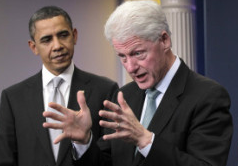
Bill Clinton’s press conference on Friday was amazing in several respects.

  1. Though the guy is a convicted liar, he is so engaging as a speaker that it’s hard not to get sucked it by him. My head was nodding yes to tax credits for windmills.  Yipes.
  2. No notes, no teleprompter, no ums & ahs, no name calling, no whining … he acted kinda like a President.
  3. In control … wouldn’t let Barry take back the podium … Obama had to lean across him to speak into the mic … talk about symbolism.
  4. Kept the audience engaged for an hour … and left the reporters wanting more                   

Most amazing was Obama’s clutzy exit.

  1. Unfazed by the fact that this is the most important domestic economic  issue of the moment … gotta run.
  2. Not to call Putin or Petraeus … to meet up with Michelle for Friday date nite … “We’ve got 2 holiday parties to attend” … are you kidding me?
  3. Left Clinton in charge … of the press conference … and symbolically, of the economy.

Watch the video — it’s a hoot:
http://www.realclearpolitics.com/video/2010/12/10/obama_ditches_tax_cut_presser_after_bill_clinton_takes_control.html

The Clinton gambit may get Dems votes for the tax plan, but it has its downside.

It highlighted just how unprepared and ineffective Obama is, and even made folks like me yearn for Clinton again.

Obama’s lucky Clinton can’t run again.

But wait, there’s another Clinton in the wings.

Uh-oh for O.

                      image

Social Security is going bust … so, cut he amount of money coming in … huh?

December 13, 2010

I’m surprised that it took over a week for this obvious uh-oh to get publicized …

The Deficit Reduction Commission concluded that Social Security (and Medicare) were going bankrupt and needed to be modified to get the Fed debt down.  Their idea: start retirement later.

Within hours of the published recommendation, the crack Obama and GOP negotiators agreed to cut payroll taxes to stimulate the economy.  In case they don’t know it, “payroll taxes” are the contributions that are supposed to fund SS and MediCare.

With a time delay, some folks are figuring out that putting less money into a program that’s going bankrupt means that it’ll go bankrupt faster.

President Barack Obama’s plan to cut payroll taxes by 1/3 for a year would provide big savings for many workers but …  could jeopardize the retirement program’s finances.

Social Security is funded by a 6.2 percent payroll tax on the first $106,800 earned by a worker. The tax is matched by employers. The package negotiated by Obama would reduce the tax paid by workers to 4.2 percent for 2011. Employer rates would stay unchanged.

Obama administration officials say that a payroll tax cut is an efficient way to stimulate the economy by immediately increasing take home pay for about 155 million workers.

The government would borrow about $112 billion to make Social Security whole.

Advocates and some lawmakers worry that relying on borrowed money to fund Social Security could eventually force it to compete with other federal programs for scarce dollars, leading to cuts.

Associated Press, Social Security advocates fear payroll tax cut, Dec 12, 2010
http://news.yahoo.com/s/ap/20101212/ap_on_bi_ge/us_payroll_tax_holiday

No kidding …

Buying Designer Duds on TV at 3 am? Don’t Mind If I Do…

December 13, 2010

TakeAway: TV shopping is thriving at a time when, by many accounts, it should have died under a crush of new online competition.

High-end fashion designers are flocking to sell their first mass collections on the air, entering a space once dominated by obscure exercise equipment and dowdy tchotchkes. 

While traditional retailers have had to contend with a fickle consumer, TV-shopping sales this year have been robust.

* * * * *

Excerpted from WSJ, “The Golden Age of TV Shopping” By Elizabeth Holmes, November 11, 2010

QVC and HSN dominate the business, with sales last year of $7.4 billion and $2 billion, respectively. Each reaches just under 100 million U.S. households and broadcasts live 24 hours a day, every day of the year except Christmas.

One surprising source of support: online shopping. The Internet has helped make consumers more willing to buy merchandise without first seeing or touching it in a store.

The model also benefits from the data the networks gather on their shoppers, which allow for carefully targeted marketing. Viewers convey their opinions when they call in to pay, through calls on the air and via website reviews . HSN even keeps track of sales by the minute, which helps it to evaluate its designers and hosts and to adjust its sales pitch. As each segment is filmed, producers can watch a monitor that shows the number of items sold and other data, including the number of callers waiting to buy the item.

TV-shopping networks’ proximity to customers is a big draw for high-end apparel designers, many of whom rethought their businesses during the recession. As retailers cut inventories, designers became more open to other sales channels. The average price of an item sold on HSN is around $60, but the influx of high-end designers is helping to push the average price higher. HSN also adopted a softer selling style pitched to more-upscale customers. Rather than using high-pressure tactics, it emphasizes making the item seem desirable—in an entertaining way—by showing how a garment drapes on a model, for instance.

The proposition wasn’t risk-free for the designers. Adding a new outlet could upset the department stores that account for a big chunk of their sales, and cheaper goods could potentially tarnish their image.

Edit by AMW

* * * * *

Full Article:
http://online.wsj.com/article/SB10001424052748703805004575606463489605440.html?mod=djemMM_t

* * * * *

How much $$$ makes a millionaire ?

December 10, 2010

I find that the rhetoric about extension of the Bush tax cuts demonstrates the economic ignorance of most of our elected officials..

Sen. Chuck Schumer and Sen. Barbara “Don’t call me M’am” Boxer are running around screaming that how extending the high bracket tax breaks is “simply giving undeserved tax breaks to millionaires and billionaires”.

Yes indeed, the high bracket includes some millionaires and billionaires.

Here’s the rub: it includes way more people who aren’t millionaires or billionaires.

The high end brackets start at $250,000.

In 2008, according to the IRS, about 138 million people filed tax returns.

Of the 138 million, approximately 2.8 million (2% of total returns) reported AGI greater than $250,000.

354,093 tax payers  — 12.8% of the 2.8 million high bracketers – reported AGI greater than $1 million.

In other words, almost 9 out of 10 tax payers in the vilified high brackets earn less than $1 million.

Hmmm.

Now, anybody who has taken a business or economics course knows that there is a difference between wealth and earnings.  (Note – this group doesn’t include many Congressmen, Senators, or members of the Administration).

Earnings are a “flow” and wealth is a “stock”.

Think water flowing into a pool. The accumulated water in the pool is liquid wealth.

Now, some people who earn more than $1 million spend it all  They accumulate no meaningful wealth. They’re not really millionaires.  They’re wasteful  idiots.

And, some people who earn less than $1 million annually, practice thrift and savings … and accumulate more than $1 million.

Obviously, these people are evil millionaires and should be penalized for not spending like a drunken Congressman.  They should be taxed high every year and then have their wealth confiscated when they die.

Huh?

My take: Schumer and Boxer wouldn’t know a millionaire if they saw one – unless they were just looking around the Senate. Then, the odds would be in their favor.

IRS Data:
http://www.irs.gov/pub/irs-soi/06in23ar.xls

FT asks: “Are all MBA students narcissistic … or just most of them?”

December 10, 2010

Financial Times, The narcissistic world of the MBA student,  November 7, 2010

Success requires ambition, drive and the persistence and resilience to overcome setbacks and to work constantly on weaknesses.

But, the current generation of business school students entering the workforce have

  • a remarkable sense of entitlement
  • a reluctance to face honest feedback and the consequences of one’s actions
  • an unwillingness to acknowledge and engage in the competition that characterizes organizational life.

A recent meta-analysis found that between 1982 and 2009 there was a dramatic increase in narcissistic personality traits among MBA students – in part characterized by

  • an inability to take the perspective of others
  • a dependence on others for affirmation
  • a tendency to value oneself regardless of real achievements
  • a quest for constant praise.

Even if students didn’t arrive at the leading business schools already narcissistic, orientation activities would soon make them so.

One of the first things they are told is how accomplished and wonderful they are.

And the result of all of this coddling …  criticism is as likely to beget quitting as any efforts to improve.

Business schools must make changes to affect the pernicious culture of entitlement and narcissism.

Unemployment rate jumps … but, at least, we survived ‘recovery summer’ … and a trillion dollars of tax cuts are coming.

December 9, 2010

The chart below is worth a thousand words … so, I’ll just add a couple:

  • The optimistic bars a couple of months ago were all of the Census Dept jobs
  • The recent negative bars were, in fact, Obama’s “Recovery Summer”
  • Maybe a trillion dollars in tax cuts will reverse the trend … oh my. 

image

Kraft Tells Kids and Adults Like to “Say Cheese!”

December 9, 2010

TakeAway: Kraft continues to build on the momentum of its Macaroni & Cheese , which is enjoying a sales boom as a result of consumers’ focus on economical comfort foods. 

The latest news is the rollout of a new logo and contemporized package designs featuring a “noodle smile” intended to elicit positive emotions and memories associated with the iconic, 73-year-old brand.

* * * * *

Excerpted from Marketing Daily, “Kraft Mac & Cheese Gets New, Unified Look” By Karlene Lukovitz, Dec 6, 2010

The smile is the key element in a new, cross-portfolio visual identity. The new look began to appear on Kraft’s new Homestyle mac and cheese line and smaller-volume products within the brand’s portfolio over the summer, but is just starting to be seen on the flagship Blue Box line. The new package design will be fully rolled out by first-quarter 2011.

Both the noodle smile and its use as a unifying element in the logo now being used across the brand portfolio reflect consumer research. “Smiles, joy and happiness” were consumers’ key associations for the brand, and they also made it clear that in their minds, the three product lines then within the portfolio – Macaroni & Cheese Dinner, Deluxe and the microwaveable products originally named Easy Mac Cups – as a single mac and cheese brand.

“We had been treating them separately, but we recognized through consumers that there was a huge opportunity to accelerate the long-term, sustainable growth of this key Kraft brand by treating it as an iconic mega-brand,” said Kraft’s North America senior marketing director of meals.

In addition to the logo, this unified approach spurred a name change for the microwaveable cups, to Kraft Macaroni & Cheese Dinner Cups. Those products, launched in 2006, are now generating over $100 million in sales, according to the Chicago Tribune.

The consumer branding research also ultimately helped inform the current “You know you love it” integrated campaign that was launched in May and focuses on tapping the sales potential for adult consumption of the brand’s products.  The Homestyle line launched this past spring, which includes breadcrumbs and is more akin to the “home-made”-like mac and cheese versions served in restaurants, also emerged from this broadened strategy.

Edit by AMW

* * * * *

Full Article:
http://www.mediapost.com/publications/?fa=Articles.showArticle&art_aid=140566

* * * * *

Where the high earners live … on average, that is.

December 8, 2010

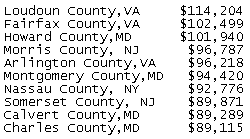
Based on 2009 Census Dept data, 7 of the 10 U.S. counties with the highest median incomes are located in the DC metro area.

image

The old Fed government ‘halo’ is shining …

A very soft sell from Ikea in China

December 8, 2010

TakeAway: Even though the average Chinese consumer can’t afford most of the furniture in Ikea, the company is encouraging potential customers to spend a lot of time in its stores.

Eventually when individual purchasing power catches up to China’s macroeconomic growth, the company hopes to be top-of-mind for that new bed or sofa.

* * * * *

Excerpted from Bloomberg Businessweek, “In Ikea’s China Stores, Loitering Is Encouraged,” by Michael Wei, October 28, 2010

Yang Shuqi paces the aisles of an Ikea store in Beijing, looking for a “small bed with toys.” She’s not planning to buy one—her grandson Beibei just needs to take a nap.

Unfortunately on this Saturday afternoon, every bed in the 43,000-square-meter (463,000-square-foot) store is occupied, with some children and adults fast asleep under the covers.

Managers at the Swedish furniture retailer don’t mind. They figure that the more customers choose to relax in its Western-style showrooms or grab a cheap snack at the in-store restaurants, the more likely they’ll be to make a purchase once their incomes catch up with their aspirations. …

Ikea plans to more than double the number of its stores on the mainland by 2015, to 18, on a bet that incomes in China will continue growing at a fast clip. (Per-capita gross domestic product has more than tripled in the past decade alone). …

Market researcher Euromonitor International expects China’s home-furnishings market to surge 17 percent this year, to $28 billion. “Government stimulus spending and favorable policies toward retailing and consumer lending have encouraged overall retail growth in China,” says Alex Liu, a Euromonitor analyst in Shanghai. Ikea, which has been in China since 1998, doesn’t break out sales for the country; Euromonitor figures the Swedish retailer has the biggest share of China’s home-furnishings market, at about 7 percent.

Even after years of record-breaking economic growth, however, China’s per-capita gross national income ranked 120th by purchasing power last year, according to the World Bank. So, for now, there’s a lot more looking than buying for many Ikea visitors. At the Beijing store, Xu Nan, a 22-year-old college student, had one of her friends snap a photo of her lounging on a black Vreta sofa that sells for 7,999 yuan ($1,197)—the equivalent of one-third of China’s annual per-capita GDP. …

Edit by DMG


* * * * *

Full Article
http://www.businessweek.com/magazine/content/10_45/b4202022164114.htm

* * * * *

When you’re transacting on line … here’s a security tip.

December 8, 2010

On web sites  that require a password, make sure the web address (URL) starts with “https://” not “http://”.

The “S” in https means “secure”.

Without the “S”, you risk having your password stolen.

Don’t risk it.

The potentially fatal flaw in the tax compromise … for the GOP, that is.

December 7, 2010

This morning, the GOP is crowing and the mass media headlines are reading: “Republicans achieve top goal in Obama tax-cut plan”.
http://news.yahoo.com/s/ap/20101207/ap_on_bi_ge/us_tax_cuts

My take – which I haven’t heard from any pundit yet – is that the GOP fell for a trap.

Interestingly, I don’t think that Team Obama even realizes what it got in the deal.

First, because of the layered tax breaks to low earners, high earners will be paying an even higher proportion of the country’s total income tax tax take.

More important, Obama is one step closer to institutionalizing a tax scheme that has a majority of voters paying zero income taxes (or less).

Think about it: the majority gets to demand more government programs that they don’t pay a cent towards.  I think that’s scary.  Very scary..

* * * * *

See the analysis that I originally posted on July 31, 2008 during the run-up to the election.

It proves the point (ahead of its time)  that less than half of all voters pay any income taxes if / when Obama’s tax scheme is adopted.

It’s the Homa Files post that continues to get the most hits, and the topic is ‘hot’ this week because of the plan to continue the Bush tax cuts.  So, here’s a flashback .

HomaFiles: “My #1 tax beef: Under the Team Obama tax plan, a majority of voters will be paying zero income taxes (or less)”
https://kenhoma.wordpress.com/2009/04/16/my-1-tax-beef-under-the-team-obama-tax-plan-a-majority-of-voters-will-be-paying-zero-income-taxes-or-less/

Millennials say “red” or “white” … or a Miller Lite

December 7, 2010

TakeAway: 70 million millennials’ (loosely defined as those born between 1980 and 2000) taste for adventure, quirkiness and convenience will drive the market in the coming decade.

They are taking up wine at an earlier age than Gen X-ers and will buy wine just about anywhere – including the corner convenience store.

Moreover, 20 million of them have yet to turn 21, meaning they will become an even more powerful force. 

Experts say millennials, as opposed to other generations, have no fear of asking for wine advice, but a lot of them seek it from Facebook friends and on Twitter – which is leading winemakers to invest in social media.

* * * * *

Excerpted from AdAge, “Millennials: the Great White Hope for Wine Industry” By E.J. Schultz, December 6, 2010

Wine marketers have only recently started zeroing in on the market, as opposed to other lifestyle brands which have been tracking the generation for many years.  The most recent player is 7-Eleven, which convened a focus group of millennials before launching its latest line of proprietary wines about two weeks ago. The brand, called Cherrywood Cellars, is priced at $7.99 to $8.99 to lure young adult drinkers whom the convenience store chain says might be watching their wallets more closely than Gen X-ers and baby boomers during the economic downturn.

Although beer remains the beverage of choice for millennials, accounting for 42% of their alcoholic drinks, wine captures 20% — up from 13% for Gen Xers when they were a similar age 10 years ago, according to Nielsen. Drinkers tend to shift to spirits and wine as they get older. If that trend holds, wine will account for 26% of all alcoholic drinks consumed by all U.S. generations in 10 years, up from 24% today, while beer will fall from 41% to 38%, according to Nielsen.

The test for marketers is to gain loyalty from young drinkers whose tastes are only now emerging. For some wine companies, that means putting members of the generation in charge of their brands. At Treasury Wine Estates in Napa, for instance, a 26-year-old is a member of a team of 20- and 30-somethings planning the national launch early next year of Sledgehammer, which is targeting the male millennial market.  Marketed as a “no-fuss” wine, the brand “eschews really traditional wine speak” like “this smells of cherries and berries and that type of thing.”  But the wine will also seek to subtly educate the new generation of wine drinkers, possibly using booklets of wine facts presented in a way that’s “funny and sarcastic.”

Some companies have formed special millennial divisions, such as The Wine Group, maker of Franzia, whose Underdog Wine Merchants unit is enjoying big success with Cupcake Vineyards. The brand was the 14th-best-selling wine for the four-week period ending Oct. 31, with sales jumping 250%.

Still, marketers risk overplaying their hand if they reach out too aggressively to the generation, known for its suspicion of overt selling tactics. For instance, some industry executives are noticing a backlash against trendy, edgier wine labels.

Edit by AMW

* * * * *

Full Article:
http://adage.com/article?article_id=147474

* * * * *


SF Fed says “Obama Stimulus created (or saved) 2 million jobs … but they were costly and transient.

December 6, 2010

According to wonk site e21 …

The economists at San Francisco Federal Reserve bank just completed a major study of the Obama Stimulus.

The results suggest that the program did result in 2 million jobs “created or saved” by March 2010.  That’s less than the 3.5 million that Obama-Biden promised and touted.

More alarming,  they found that by August of this year, net job creation was statistically indistinguishable from zero.

Translation: They were all temporary jobs that have gone away already.

Taken at face value, this would suggest that the stimulus program (with an overall cost of $814 billion) worked only to generate temporary jobs at a cost of over $400,000 per worker.

Further, they concluded that even if the stimulus had in fact generated this level of employment as a durable outcome, it would still have been an extremely expensive way to generate employment.

Source article:
http://www.economics21.org/blog/outcome-stimulus-and-burden-proof

SF Fed Report:
http://www.frbsf.org/publications/economics/papers/2010/wp10-17bk.pdf

Finding “Good Targets” in the Digital Age

December 6, 2010

TakeAway:  To find the “best” customer targets, marketers need to include digital and social behaviors into the profitability equation.

In addition to revenue measures such as lifetime value, current spending in category in dollars, current brand share, number and types of products or services purchased, and brand switching history/potential, there are also several other characteristics that make one customer more valuable than another because s/he’s easier to get and keep, as well as engage as co-marketers.

* * * * *

Excerpted from AdAge, “How to Define a ‘Good Target’ in the Digital Age” By Kevin Clancy and Peter Krieg, November 17, 2010

Marketers have to integrate traditional and digital paid advertising with “owned” properties such as the brand’s website, as well as traditional and social “earned” media such as news articles and tweets in a way that gets them the biggest bang for their marketing dollar.

To separate the “best” from the rest, marketers need to find customers who are:

Less price sensitive. Unless you’re Walmart and want to grab share among the folks who put price above all other brand considerations, price insensitivity is another important indication of a buyer’s value to a brand and one particularly relevant these days.

Struggling with big problems. The bigger the problem your brand can solve, the bigger the market response.

Interested in new products and services from the brand. Introducing new products and services can generate the kind of organic growth companies crave. So why not ensure that new products and services will generate bottom-line growth by narrowing in on the customers most interested in considering the latest offerings from a brand or company? Apple’s pretty much got this one down.

Will advocate for your brand. The greater the level of influence a buyer has among her social networks, the more a brand’s marketing ROI will benefit.

Socially connected on the web. Because of the speed and number of tools available to customers to spread information about product and services online, word-of-mouth activity is even more important to capture in a digital environment. The more active and engaged a customer is with different social media, the more valuable he can be to a brand. Ford chose 100 20-something YouTube storytellers who’d developed a fan community of their own and gave them a Fiesta for six months. Each month they shared their experiences on YouTube, Flickr, Facebook and Twitter. Ford received 50,000 requests for information on Fiesta – almost entirely from new-to-Ford customers – and sold 10,000 units in the first six days of sales.

Rather than look at each of these things separately, though, marketers can and should bring together all of these “proxies for profitability” with financial data to calculate a single measure of value.

From an operational standpoint, then, marketers need to look for customers who are:

Distinct in terms of needs and wants. The more homogeneous and anticipated a target group’s needs and wants, the easier time marketers will have developing compelling positioning and messaging that breaks through in traditional and digital channels.

Relevant to traditional and digital communications decisions. Get a sense of how high-value customers use traditional, digital and social-media communications throughout the pre- and post-purchase process, and in particular, how they like to interact with a brand within different communication channels.

Findable in syndicated media databases. The “best” communications channels – either current or prospective – are the ones with a disproportionate number of high-value customers.

Edit by AMW

* * * * *

Full Article:

http://adage.com/cmostrategy/article?article_id=147155

* * * * *

Who got stimulated ?

December 3, 2010

Answer: the Federal government bureaucracy.

Here are some facts that will make you cringe.

Between December 2007, when the Great Recession began, and last July …

  • The private sector lost 7,837,000 jobs (down 6.8 percent).
  • Local-government employment dropped 128,000 positions (minus 0.9 percent).
  • State governments shed 6,000 positions (less 0.1 percent).
  • Federal employment zoomed by 198,100 slots as Uncle Sam’s workforce expanded by 10 percent.

image

And don’t forget …

In 2009:

  • The average private-sector employee earned compensation of $61,051 ($50,462 in wages and $10,589 in benefits).
  • State and local-government workers hauled in $69,913 ($53,056 in wages and $16,857 in benefits).
  • Federal-civilian employees took away $123,049 ($81,258 in wages and $41,791 in benefits).

But, those Federal employees (that you’re paying — now and when they draw their fat pensions) are here to help.

image

Source:  NRO, Charts that Will Infuriate Taxpayers, October 21, 2010
http://www.nationalreview.com/articles/250485/three-charts-will-infuriate-taxpayers-deroy-murdock?page=2

Market researchers say “let me look into your eyes” …

December 3, 2010

TakeAway: Packaging is an important purchase decision factor when consumers are at the store, ready to buy.

A great product with poor packaging might be passed over for a sleeker packaged alternative.

That’s why several brands are turning to eye tracking research to gauge how consumers’ eyes fixate on products across a shelf category.

* * * * *

Excerpted from Brandchannel, “The Eyes Have It: Brands Conduct Staring Contest With Consumers,” by Barry Silverstein, November 30, 2010

It sounds like science fiction, but the best way to know whether or not consumers find brand packaging appealing may be to look into their eyes. It turns out that consumer brand companies like Procter & Gamble and Johnson & Johnson are doing just that.

Testing new brand packaging or a new product with consumers has always been a high-risk proposition. Focus groups, surveys, and other traditional consumer research techniques offer some insight, but they are hardly definitive.

Companies with millions of dollars invested in brands want a more accurate assessment of whether or not a product will resonate with a consumer.

Christian Simms, associate director of consumer market knowledge for P&G’s Herbal Essences and Pantene brands, tells Packaging World, “What consumers say and what they react to is a very different thing than what they spontaneously react to. We’re interested in what they can tell us without saying it to us.”

That’s why P&G uses eye tracking research for answers. Eye tracking is not a new science. It has been used for over twenty years in the military and for medical applications. …

In a typical eye tracking experiment, an individual consumer is shown, for example, 6-foot wide store shelves on a screen. The consumer views the shelf categories in this simulated shopping environment. Using a joystick, the consumer moves from one category to another. While she’s doing so, her eye movements are being recorded at 60 readings per second.

The collected data is used to create a heat map of fixation readings; the more intense the color in the heat map, the higher the number of viewing fixations. The data is also analyzed so that the marketer knows the percentage of consumers who “actively fixated” on each product or brand on a shelf.

Edit by DMG


* * * * *

Full Article
http://www.brandchannel.com/home/post/2010/11/30/Eye-Tracking.aspx#continue

* * * * *

Ken’s UEI (Ultimate Economic Indicator) … the real gauge of the economy.

December 2, 2010

There are a lot of indicators bandied about to ‘prove’ how well or poorly the economy is doing.

There’s GDP, unemployment, CPI, and many, many other metrics.

Sometimes they provide a consistent view of the economy … sometimes they contradict.

Well, I’ve stumbled on the Ultimate Economic Indicator. An indisputable measure of economic activity.

Ken’s UEI: the number of days that it takes a “ships free” order from Amazon to arrive at my door.

Here’s the logic: When placing an order, Amazon projects that  a “ship free” item will be delivered in 7 to 10 days.

Hmmm.

Since I’m a cheapskate, I’ll always take the free shipping option and trade-off fast delivery for free shipping.

Then I started to notice that when the economy  is doing well, the shipments do take a week or so.

But, when business is slow, the shipments arrive 2 days after the order is placed.

Makes sense, since the ship free packages are – in essence – flying standby.

When the economy is steaming, planes and trucks are full and standby packages may hang on the shipping dock for a couple of days.

When business is slow, there’s plenty of space on the planes and trucks, so the standbys catch the first flight.

These days, the press is reporting gangbuster retail sales

But, I’m getting my ships free stuff the day after tomorrow.

Tells me that business is still slow.

Try it out …

Transparency Tops CPG Trends According to Mintel

December 2, 2010

TakeAway: Grappling with product content and marketing approaches in the face of growing consumer concerns about obesity and other chronic health problems will continue to be one of the biggest issues affecting global food and beverage makers’ product development and marketing strategies in 2011, according to a new, category-spanning CPG trends analysis by Mintel.  

* * * * *

Excerpted from Marketing Daily, “Transparency Issues Among Top ’11 CPG Trends” By Karlene Lukovitz, November 5, 2010

Major CPG trends continuing or growing in importance into 2011:

    * Redefining “natural”, related to ongoing trend of transparency.  In addition to the success of products featuring “no high fructose corn syrup” on their labels (such as Yoplait’s Simply … Go-Gurt), one factor driving the success of certain “retro” products (another key CPG trend), like Pepsi Retro, is use of sugar instead of HFCS.

    * Shift from covert to overt marketing of formulation changes, but will depend on ingredients and geographic region.

    * Professional products for amateurs (e.g. carpet cleaners to hair-care products). Products enabling consumers to DIY instead of paying professionals continue to grow in number.

    * Less is more, redux. On the food/beverage front, lifestyle simplification tied to convenience and economical solutions (with environmentalism playing a secondary role) both ties into and counterbalances the more-professional-at-home-cooking trend. Examples include Starbucks’ Via or beverages positioned as full meals in a can or bottle.

    * Econo-chic. Luxury is making a comeback, but in limited, selective ways. CPG products positioned as “small treats” stand to gain.

    * Instant results, particularly in the personal care category.

    * Simplicity for older consumers. On the other hand, Baby Boomers and pre-Boomers increasingly want products that deliver simple but realistic results, rather than ones promising instant miracles.

    * More cradle-to-grave marketing. Example: the Nestle Nesquik line spans products targeted to children under six up to a Gourmand variety for adults.

    * Blurring categories. Many CPGs can no longer be slotted readily into a single category — shifting the focus from labels and branding to benefits, and creating opportunities, along with some confusion. Examples include Sunkist Solar Fusion (a fruit-flavored, carbonated drink with caffeine) and L’Oreal’s Perfect Clean Foaming Gel (featuring an integrated “scrublet”).

    * Personal hygiene comes out of the closet. More open marketing of what were once considered highly personal items.

    * Sustainability still focused on basics. Consumers continue to reduce, recycle and reuse, and continue to be interested in buying “green” products — as long as they don’t cost more.

Edit by AMW

* * * * *

Full Article:
http://www.mediapost.com/publications/?fa=Articles.showArticle&art_aid=138944

* * * * *

Dow’s up … but not as much as the rest of the market.

December 1, 2010

Punch line: The Dow 30 is up almost 10% in 2010.  But, for the past year, the Dow 30 stocks have been under-performing relative to all other stocks.

From Investor’s Business Daily …

The chart below shows each of the 30 Dow “industrials” and its relative strength, or RS, which is a measure of how the stock has done vs. all other stocks in the last 52 weeks.

Alcoa’s 63, for example, shows that it has outperformed 63% of the market; American Express’ 45 means 55% of other stocks have done better.

Market-leading stocks generally have relative strengths of 80 or better, and only Caterpillar and DuPont fit into that category or come close. Their performance, however, says less about what’s going on in America than about conditions elsewhere: 62% of their business is done overseas.

The same can be said of the Dow components with the next-highest ratings — Coca-Cola and McDonald’s.

The average relative strength of the other 26 is 38, deep in laggard territory.

Fact is, it’s been years and sometimes decades since these once-great and still-significant companies have shown true market leadership.

Source: IBD,What Really Drives The U.S. Economy?, 11/26/2010
http://www.investors.com/NewsAndAnalysis/Article/555017/201011261902/What-Really-Drives-The-US-Economy.htm

Amazon’s impressive numbers … prime numbers, that is.

December 1, 2010

TakeAway: Customer loyalty can be a difficult thing for a retailer selling undifferentiated goods, especially on the internet.

But marketing revolves around people and forming relationship bonds with customers through effective loyalty programs can reap big rewards.

Just ask Amazon …

Amazon’s Prime customers account for only 4 percent of customers but account for as much as 20 percent of overall sales.

* * * * *

Excerpted from Bloomberg Businessweek, “What’s in Amazon’s Box? Instant Gratification,” by Brad Stone, November 24, 2010

Amazon Prime may be the most ingenious and effective customer loyalty program in all of e-commerce, if not retail in general.

It converts casual shoppers … who gorge on the gratification of having purchases reliably appear two days after they order, into Amazon addicts.

Analysts describe Prime as one of the main factors driving Amazon’s stock price—up 296 percent in the last two years—and the main reason Amazon’s sales grew 30 percent during the recession while other retailers flailed.

At the same time, Prime has proven exceedingly difficult for rivals to copy: It allows Amazon to exploit its wide selection, low prices, network of third-party merchants, and finely tuned distribution system, while also keying off that faintly irrational human need to maximize the benefits of a club you have already paid to join. …

Amazon relentlessly promotes Prime in press releases and on its home page, and this year started offering free Prime trials to students and parents.

The company declines to disclose specifics about the program, though analysts estimate it has more than 4 million members in the U.S., a small slice of Amazon’s 121 million active buyers worldwide.

Analysts say Prime members increase their purchases on the site by about 150 percent after they join and may be responsible for as much as 20 percent of Amazon’s overall sales in the U.S.

The company’s executives acknowledge only that the program gets people to buy more—and more kinds of items—on the site. “In all my years here, I don’t remember anything that has been as successful at getting customers to shop in new product lines,” says Robbie Schwietzer, vice-president of Amazon Prime and an eight-year veteran of the company. …

Amazon now offers Prime in the continental U.S, Britain, Germany, France, and Japan, and Schwietzer says the company is moving toward guaranteeing Prime shipments within a day instead of two days.  …

Edit by DMG


* * * * *
Full Article
http://www.businessweek.com/magazine/content/10_49/b4206039292096.htm

* * * * *