According to the latest research, IQ accounts for what portion of career success?
a. 50 to 60 percent
b. 35 to 45 percent
c. 23 to 29 percent
d. 15 to 20 percent

The answer …
According to the latest research, IQ accounts for what portion of career success?
a. 50 to 60 percent
b. 35 to 45 percent
c. 23 to 29 percent
d. 15 to 20 percent
The answer …
According to Business Week, top school MBAs haul in an average of about $1,750 per week for their summer internships.
At HBS, the median is $7,000 per month … that’s about $1,650 per week … which annualizes to about $90k.
Of course, there’s wide variation based on the school and the industry.
Note that Kellogg –- a general management and marketing school – tops the list

* * * * *
Follow on Twitter @KenHoma >> Latest Posts
In my Strategic Business Analytics course, we were covering decision rules .. specifically, the current day importance of decision-making algorithms.
Reminded me to flashback a cool 15 minute TED Talk.
Tech entrepreneur Kevin Slavin tells how algorithms have reached across industries and into every day life.
A couple of lines caught my attention:
Obviously, Slavin comes down on the side of the quants.
Worth listening to this pitch … a very engaging geek who may be onto something big.
* * * * *
Follow on Twitter @KenHoma >> Latest Posts
Interesting article on Quartz.com tracking how “the internet’s power to unbundle content sparked a rapid transformation of the music industry’ and arguing that”and it’s doing the same thing to higher education today.
Let’s start with the recorded music industry.
It’s no surprise that
The unbundling of albums in favor of individual songs was one of the biggest causes of the music industry’s decline.
It cannibalized the revenue of record labels as 99-cent songs gained popularity over $20 albums.
What did surprise me us that recording industry revenues have dropped by half from the $14 billion in 2000.

The eroding revenues and and internet dynamics have “changed the way music labels had to operate in order to maintain profitability.
The traditional services of labels: identifying artists; investing in them; recording, publishing, and distributing their work; and marketing them—are now increasingly offered a la carte.”
And, talk about the top 1% and distribution of riches …
Being a recording artist these days is a hard gig …
Pressure from labels then had downstream effects on content creators, specifically artists.
The top one 1% of artists now take home 77% of revenue, and the rest is spread across an increasing number of artists.
The pain of the record labels is forced on artists through smaller royalty payments.
Ouch.
Now, what’s the parallel to higher education?
NPR says …
“Getting the results of a genetic test can be a bit like opening Pandora’s box … you might learn that you’re likely to develop an incurable disease later on in life.”
There’s a federal law that’s supposed to protect people from having their own genes used against them, the Genetic Information Nondiscrimination Act, or GINA.
Under GINA, it’s illegal for health insurers to raise rates or to deny coverage because of someone’s genetic code.

But the law has a loophole: It only applies to health insurance.
Some insurance can be denied or priced high because of a person’s DNA.
Here’s an example … and a prediction.
You bet they do …

======
Prof Robert Kaplan of San Diego State University conducted an experiment:
Faculty subjects were asked to grade an essay written by a student.
A photograph of the student was attached to the essay.
The grade given for the essay correlated strongly with a subjective attractiveness scale evaluated by other judges.
What is interesting is that all the subjects received the exact same essay, and the photograph attached to it was randomly assigned.
Bottom line: physical attractiveness causes graders to give essay writers better scores on their essays.
Here’s what’s going on …
According to an Urban Institute study, more than 35 percent of Americans have debts and unpaid bills that have been handed over to collection agencies.
The unpaid bills include credit cards, hospital bills, mortgages, auto loans, student loans, gym membership fees or cellphone contracts.

Here are some interesting factoids …
Dan Lovallo, a professor and decision-making researcher says, “Confirmation bias is probably the single biggest problem in business, because even the most sophisticated people get it wrong. People go out and they’re collecting the data, and they don’t realize they’re cooking the books.”
What’s this “confirmation bias” that Lovello is talking about?
No surprise, people tend to seek out information that supports their existing beliefs.
You know, liberals watch MSNBC, read the NY Times listen to BBC podcasts; conservatives watch FOX, read the WSJ and listen to Rush.
Behavioral psychologists call the he dynamic “confirmation bias”.

=====
In socio-politics, the confirmation bias tends to harden polarized positions. People just gather debate fodder rather than probing both sides of issues.
In the realm of decision making, confirmation bias has a dysfunctional effect: it leads to bad decisions.
I’ve been reading a book called How Not to Be Wrong: The Power of Mathematical Thinking by Jordan Ellenberg
The author recounts a classic stock advisor scam that goes like this …

======
One day, you receive an unsolicited newsletter from an investment advisor, containing a tip that a certain stock is due for a big rise.
A week passes, and just as the Investment advisor predicted, the stock goes up.
The next week, you get a new edition of the newsletter, and this time, the tip is about a stock whose price the adviser thinks is going to fall.
And indeed, the stock craters.
That’s good, but it gets even better …
Cool TED pitch by a dude named David Pogue … demonstrating 10 handy tech tips.
For example, how to skip by cell phone voicemail greetings (Hi. This Ken. I’m not able … blah, blah) and get straight to leaving a message.
For Verizon, just press the star sign (*) … for AT&T, press the # sign.

=====
What to do when a web page’s text is too small to read?
According to WashPost …
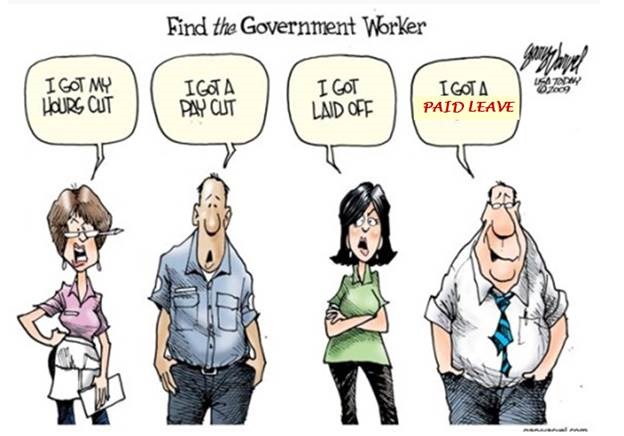
Government records show that tens of thousands of federal workers are being kept on paid leave for at least a month — and often for longer stretches that can reach a year or more — while they wait to be punished for (or cleared of ) misbehavior or are disputing a demotion.
While disputing a demotion?
=====
Here are some details that’ll make you cringe …
Since it’s tax day, I thought I’d flashback to a drill down I did on the tax system — who pays in, where does it go and who benefits …
In a prior post, we drilled down on taxes … or, as my Dem friends would say government “revenues”.
We posted that in 2012 Americans paid a tad over $5 trillion in taxes to the Feds, States and Local Governments.
Drilling down, the $5 trillion is split roughly 50%-30%-20% to the Feds, States and Locals, respectively. Note that the Federal portion is just under $2.5 trillion.

* * * * *
If these are “revenues” there must be matching services provided, right?
I found a study by the non-partisan Tax Foundation that analyzes taxes paid and benefits received.
The study is old – using 2004 data – but, in my opinion is a good starting point to calibrate the answer.
Thanks to social media, today’s teens are the first to have a complete record of their whole lives — their thoughts, their actions, and their friends.
Eric Schmidt — Google chairman and ex-CEO — worries, however, that they’ll be the first who’ll never be allowed to forget their mistakes.
Schmidt says: “People are now sharing too much.”
More specifically, privacy pundits say that it just takes your name, zip code and birth date to ID you and start linking your online and offline personal data … forever.
Now, Pew has published a research study re: teen’s online habits .

Here are the Pew results …
We’ve covering the Halo Effect in class this week, so it’s time to dust off one of my favorite posts …
======
I’ll explain the picture later, but first, the back story.
A couple of interesting dots got connected last week.

First, I started watching The Voice.
I liked the talent and the bantering among the coaches, but wondered why they used the turning chairs gimmick. You know, judges can’t see the the performers, they can just hear them.
Became apparent when Usher turned his chair and was surprised to see that the high-pitched soul singer was a big white guy.
Hmmm.
=====
Second, for the course I’m currently teaching, I’ve been reading a book called The Art of Thinking Clearly — a series of short essays on cognitive biases – those sneaky psychological effects that impair our decision-making.
This was a big week: Easter, NCAA Finals, and baseball’s opening day ….
Let’s play off those events and flashback for some yucks.
First, W and O throwing out opening day pitches.
One of them throws a strike, one of them doesn’t.
Guess …
OK, I know what you’re thinking: “He’s just picking on Obama. Everybody knows that hoops is his game”.
Hmmm.
Remember the Easter eggs festivities at the Whitehouse in 2013?
Just finished this year’s taxes.

One interesting twist ….
In 2012, like a lot of folks, I sold a bunch of stocks to beat Obama’s hike in the capital gains tax … from 15% to 23.8% (including the 3.8% ObamaCare surcharge)
As a result, my state tax bill paid in 2013 was higher than usual … Virginia’s share of the capital gains.
At first I was delighted this year.
Why?
Because, on my Federal return, I could deduct the higher-than-normal taxes that I paid to Virginia.
Unfortunately, the thrill was short-lived.
I’d forgotten about the AMT … you know, the Alternative Minimum Tax.
I’d forgotten, but TurboTax hadn’t.
Bottom line: My VA tax deduction got wiped away by the AMT calculation.
Like many folks, I had internalized that state income taxes are annoying, but no big deal since they get written off at the Federal level.
Not so if you’re among the millions of Americans who get snared in the AMT trap.
Oh, well.
At least there is one small delight I get from the AMT …
It’s not new news that the Labor Force Participation Rate has been falling .
What struck me in March’s employment stats was that the LFPR is still dropping

Many economists say it’s simply demographics — it’s old folks retiring.
Partially true, but certainly not the whole story.
Last Friday, the President was spinning the 126,000 jobs gain as a continuation of the longest consecutive period of (meager) monthly jobs gains.
OK, I added the meager part …
And, he touted how he’d added 12 million jobs to the economy since he took office.
Not to nit-pick, but it’s 10 million since he took office … 12 million since the slide bottomed out.
.
OK, so 2 million more people are working since the worst recession since the depression.
That’s pretty good, right?
Last Friday, the BLS reported that the U.S. economy added 126,000 jobs.
That’s about half of the consensus forecast (which was about the prior 12 months average).
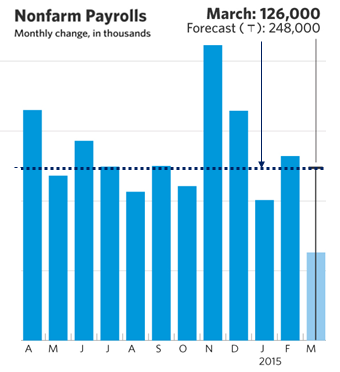
Look at the chart and tell me if your see a pattern …
I once worked for a CEO who wouldn’t stand for lemon in his water or red ink.
That is, both the red ink on a financial statement and red ink on a document.
Apparently, he was onto something with the latter.

In the UK, hundreds of schools have banned their teachers from marking in red ink.
Here’s why …
Since, I started preparing my taxes this weekend, I got curious …
Pew Research says that overall, 33% of Americans say they do their own taxes while 56% say someone else prepares their taxes.
A majority of Americans (56%) have a negative reaction to doing their income taxes 1 in 4 say they hate doing them.
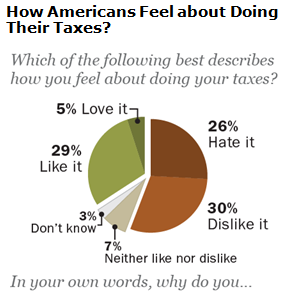
Among those who dislike or hate doing their taxes, most cite the hassles of the process or the amount of time it takes:
About a third (34%) say they either like (29%) or love (5%) doing their taxes.
Here are some details re: the “likers” and lovers …


 The Homa Files