Archive for July 30th, 2020

Why can’t online education be as engaging as Fortnite?

July 30, 2020

In prior post,  asserted that near-term, more online education is inevitable … and, in another post, we reported a WSJ study that  The Results Are In for Remote Learning: It Didn’t Work.

The headline point of the WSJ study:

Preliminary research suggests students nationwide will return to school in the fall with roughly 70% of learning gains in reading relative to a typical school year, and less than 50% in math.

We concluded:

The playing field changed: Teachers are no longer just “competing” against other teachers and subjects for students’ interest … now, they are directly competing against Fortnite and Tik Tok.

That’s not a fair fight…

A couple of loyal readers asked a reasonable question: “Fortnite? What the heck are you talking about?”

Well…

During the past couple of months, I had a unique opportunity: occasionally kid-sitting a 1st grader and a 5th grader during the Covid school shut-down.

So, I had a glimpse into the effectiveness of their online virtual classes …  and, I got to see how they spent their time with schools and sports locked down.

image

The experience was eye-opening…

(more…)

The “summer slide” meets the coronavirus…

July 30, 2020

How much “dislearning” have children experienced during the schools’ shut down?
=============

In his 2008 bestseller Outliers: The Story of Success, Malcolm Gladwell popularized the notion of an educational “summer slide”.

Referencing a tracking study of Baltimore City Public School students, Gladwell highlighted evidence that students’ standardized test scores in the fall were generally lower than their scores in the prior spring.

His observation: “Between school years, students’ accumulated learning is diminished”.

In other words, there is a statistically significant “forget factor” if learning isn’t reinforced and edged forward with summer enrichment activities (think: summer school, educational camps, field trips, parental tutoring).

The summer slide is most pronounced for poor students who lack summer enrichment opportunities … and for all students in math. 

The black line below illustrates the math score drop-off for typical 3rd, 4th and 5th graders. On average, the typical summer slide in math skills is about 2%.  That is, students are 2% less proficient in math after their summer vacations.

image
Source: WSJ

To make matters worse, note the red line on the chart … it illustrates the projected drop-off due to this year’s virus-induced school closings.

It’s estimated that students will be about 5% less proficient in math than they were when the schools closed … the combined effect of lesser learning during the schools’ shut-down period and an extended summer slide (with many schools declaring no mas in early June) .

More specifically…

(more…)

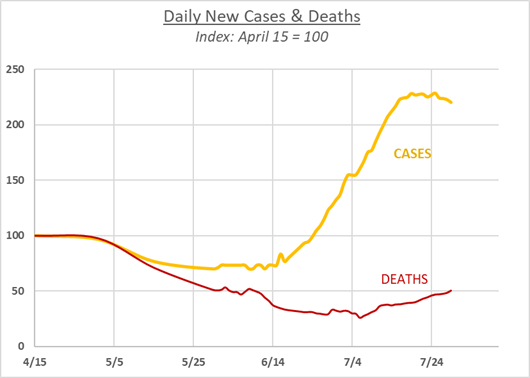
July 30: C-19 Data Dashboard

July 30, 2020

153,840  Deaths-to-Date

1,520 Daily New Deaths (peak 2,824 April 21)
> 7-day average 1,004  (peak 2.229 April 23)

66,921  New Cases
> 7-day average    66,850

image

=============
Details below…

(more…)