Archive for the ‘MARKETING’ Category

What the 2010 Census May Mean for Marketers

September 14, 2010

TakeAway:  The 2010 Census results will likely reveal the Hispanic market’s growing influence and help marketers understand they need to start focusing on this huge demographic change.  Few people realize that Hispanics are influencing the general market more than vice-versa.

* * * * *

Excerpted from AdvertisingAge, “A Look at the Numbers Behind America’s Huge Demographic Shift” By Chiqui Cartagena, August 31, 2010

With the arrival of Hispanic Heritage month, people in the media and marketing worlds have already started to talk about what the new Census results could reveal next year.  This is the key point: It’s not about the Hispanic market, it about how these demographic shifts are affecting the so-called general consumer market.

 It wasn’t really until the 2000 Census that the dominance of Hispanics became a “new phenomenon.”  By the end of 2010, there will be 30% more Hispanics (50 million) than there will be African Americans (38 million) in this country. 

 Hispanics will continue to be a driving force behind America’s changing face, not so much through immigration but rather by births, with 60% of the U.S. Hispanic market growth coming from the natural births.

So, what does this mean to you?

  • Any marketing plan targeting youths must take into account Hispanics.
  • Marketing plans must take into account that Hispanics live in multi-generational households, therefore it is critical to understand how different generations influence each other.
  • The influence of the Hispanic market goes beyond the traditional states. Over 30 markets saw the Hispanic population increase by more than 100,000 persons in the past 10 years.
  • U.S. born Hispanics will require marketing campaigns that take into account their unique cultural background. It is critical to develop marketing campaigns that go beyond language and place of birth.

Edit by AMW

* * * * *

Full Article:
http://adage.com/bigtent/post?article_id=145653

* * * * *

What per cent of Americans “always or usually” live from pay check to pay check ?

September 13, 2010

Answer:

Recent polls show that 61%of Americans “always or usually” live from pay check to pay check … up from 49% in 2008.

Source:
http://www.ft.com/cms/s/0/44d4b1c4-b52f-11df-9af8-00144feabdc0.html

Don’t change that channel.

September 13, 2010

TakeAway: With so many entertainment choices, TV faces tough competition for the attention of viewers. Even when people do watch TV, more than a third of viewers skip over commercials. 

For marketers deciding how to promote their brands, this can be troubling because TV commercials are very expensive to produce and air. 

Now, new research has examined how to keep viewers from changing the channel during commercials. 

In a very different approach than traditionally used, researchers discovered that “pulsing” repeated, brief images of the brand can significantly reduce the likelihood that viewers will “zap” it.

* * * * *

Excerpted from HBS Working Knowledge, “Improving Brand Recognition in TV Ads,” by Julia Hanna, June 7, 2010

Advertisers pay millions of dollars to air TV ads that, by some estimates, more than a third of viewers skip over with digital VCRs or by switching channels or tuning out altogether.

New research by HBS professor Thales S. Teixeira offers a simple, inexpensive solution to help marketers hold on to some of those consumer eyeballs. …

Teixeira and his coauthors show that “pulsing” repeated, brief images of the brand can significantly reduce the likelihood that viewers will zap it, as opposed to showing the brand for long periods of time at the beginning or end of the ad. …


Theories abound as to the most effective strategy for crafting a TV commercial … There are also ideas about placing the brand early in the commercial, late (the so-called mystery approach), or early and late.

“The days when you could tell a consumer what to do are long gone,” says Teixeira. “In the 1960s, the brand was onscreen all the time with a direct message: ‘Drink a Coke,’ for instance. Today, people are searching for valuable information that is relevant to them. They also want to be entertained, and the ‘hard sell’ that turns them off can be at the level of simply presenting the brand’s logo for more than a few seconds.” …

The dilemma is that our findings show that brand images cause people to zap,” Teixeira says. “But they’re a necessary evil; without the brand, viewers can’t identify what is being sold. So how do you make an ad that includes the brand without causing a high level of zapping?” …


Taken alone, brand presence automatically increases commercial avoidance. But … changing the pattern of brand exposure (without decreasing the total amount of time the brand is shown) can lower zapping rates, and that a “pulsing” strategy in which the brand is inserted briefly and intermittently throughout the commercial is most effective, resulting in an average decreased zapping of 8 to 10 percent. …


From a managers’ perspective, altering the commercials to mimic a pulsing strategy is a virtually cost-free fix for a significant payoff, with zapping rates for some commercials reduced by as much as 25 percent in a lab experiment. If a company is paying to advertise on prime-time television during a show with an estimated 5 million viewers, 50 to 60 percent of those viewers (2.5 to 3 million people) can be lost with usual zapping rates; as many as 1 million could be recaptured by using the pulsing strategy. …


Will these findings influence how advertisers craft their ads in the future? Teixeira notes that there is already some evidence of pulsing in ads, as in the award-winning “The Happiness Factory” for Coca-Cola, and various automobile commercials that briefly show the brand logo of a car from various angles as it maneuvers a winding road. …


Edit by DMG

* * * * *

Full Article
http://hbswk.hbs.edu/item/6322.html

* * * * *

A Coke by any other name would taste as sweet

September 9, 2010

TakeAway: When one brand becomes dominant enough in the marketplace, its name can become a synonym for the entire category.  In many places of the U.S. Coke simply means any cola soft drink. 

However, in India, Pepsi is the default name for a cola soft drink

This is problematic for Coke as it seeks growth opportunities outside of the mature U.S. market.  To gain some mindshare, Coke is trying to associate its name with cold as it seeks to promote a broad category of beverages in India, not just cola.

* * * * *

Excerpted from Bloomberg Businessweek, “Coca-Cola can’t speak its name in India as Pepsi enters Hindi,” by Mehul Srivastava, September 8, 2010

Coca-Cola Co. offered to buy Rajesh Yadav a refrigerator for his New Delhi store if he would sell only the company’s drinks.

He kept his part of the bargain and lines of Coke and Diet Coke cans glisten behind the glass screens of the fridge. … Yet Yadav doesn’t mention his partner when he describes his shop.

I sell Pepsi and cigarettes,” said Yadav …

Yadav isn’t reneging on his deal with Atlanta-based Coca- Cola. Pepsi became a common synonym for cola in India’s most widely spoken language after having the market to itself for three years until 1993. PepsiCo Inc.’s linguistic advantage translates into higher sales. Its cola brand’s market share is 73 percent greater than Coke’s, according to Euromonitor …


In much of the Hindi-speaking belt of northern India, home to three of the five most populous states, children begging at street corners will point to bottled juices inside cars and plead for “Pepsi.”


In addition to competition from Pepsi, Coca-Cola … has to contend with consumer preferences for other drinks. About 90 percent of India’s beverage market is composed of tea, milk and coffee-based drinks, with bottled soft drinks holding less than 5 percent … The company relies on drinks other than Coke to be the country’s top beverage seller.


While Coca-Cola uses the cola brand to drive market share in other countries, the company’s top three products in India by sales volume are Kinley bottled water, Thums Up cola, and Sprite, according to Euromonitor. …“Pepsi is bigger than Coke as a brand, but Coke as a company has very smartly introduced other brands that have done very well,” said Bijoor, [a] consultant. …

That’s Coca-Cola’s strategy, said Atul Singh, the company’s president for India and South West Asia.

“We want every part of our portfolio to grow, so that any consumer, on any occasion, anywhere in India, makes a choice to drink a Coca-Cola product” …

Coca-Cola has run an advertising campaign called “Thanda Matlab Coke,” which translates to “Cold Means Coke.” North Indians speaking in Hindi regularly use “thanda,” the word for cold, as a noun when offering someone a drink.

“It was definitely a good idea,” said Bhushi, [an] anthropologist. “If Pepsi means cola, then emphasizing that a ‘thanda’ means Coke is perhaps the best way to gain control of the vocabulary.” …

Edit by DMG

* * * * *

Full Article
http://www.businessweek.com/news/2010-09-08/coca-cola-can-t-speak-its-name-in-india-as-pepsi-enters-hindi.html

* * * * *

You Can’t Just “Shrink It and Pink It”

September 8, 2010

TakeAway: Eight years ago, sportswear maker Under Armour learned that making smaller, pinker versions of its male apparel wouldn’t simply translate to women. 

Women buy because a piece fits well and promises to help keep them cooler or drier. 

Under Armour’s founder believes women’s apparel will one day surpass its men’s apparel, so learning what women wanted was key…the consumer always comes first! 

* * * * *

Excerpted from New York Times, “Under Armour Wants to Dress Athletic Young Women” By Elizabeth Olson, August 31, 2010

Under Armour is aiming at the “team girl,” which Adrienne Lofton, head of Under Armour’s women’s apparel, defines as a female who is competitive and confident and who plays on high school or college sports teams, or who, after college, continues to work out regularly.  “The team girl is tough, intense and passionate, and she creates her own style.”

In 2003, Under Armour began marketing a line of women’s wear designed by women. Even so, women’s apparel represents only about 25 percent of the company’s nearly $800 million in annual revenue, and it wants more.  It is the only sports apparel sector where sales are forecast to grow, according to Marshal Cohen, an analyst for NPD Group, a market research group.  Part of that is due to the marketing of active wear as street wear.

Under Armour’s newly designed line, with compression shorts, a sports bra, shorts, footwear and other training gear, is being introduced Wednesday with a campaign called “Protect This House I Will,” which builds on the company’s successful we’ll-tough-it-out-together theme that it started for its men’s gear.  

Perhaps surprisingly, the 60-second television and digital spot anchoring the campaign features both male and female athletes — a choice, Mr. Battista said, shaped by focus-group research among high school and college women playing on sports teams.  Women wanted to see themselves on par with men – as athletes, not “female athletes.” 

For the campaign’s digital marketing, Under Armour is placing two- and three-minute segments it filmed of the three female athletes on a new Facebook site for women (which is not yet active) and on each athlete’s Web site.  The digital portion of the campaign will appear on MTV.com, Facebook and other teenage-oriented outlets, video sites like Hulu and CW and the high school sports site MaxPreps.  “We have been shifting more to digital,” the company’s Vice President for Brands said. “It is now 80 or 90 percent digital. Our customers are telling us they like to receive information online and prefer to shop online.”

Edit by AMW

* * * * *

Full Article:
http://www.nytimes.com/2010/09/01/business/media/01adco.html?ref=media

* * * * *

If you want kids to eat carrots, make 'em think it's junk food … huh?

September 3, 2010

TakeAway: Sometimes to beat the competition, you have to be more like the competition. 

To better compete with the $18 billion dollar salty snack food industry, a cooperative of baby carrot growers is launching a $25 million dollar advertising campaign, coupled with new packaging to mimic Doritos and other salty snacks. 

While effective promotions can create an illusion that a product delivers desired benefits, if the product cannot deliver those benefits consumers are likely to reject the product eventually. 

Kids choose salty snacks from vending machines because they like the taste. 

However, recent studies have shown that kids believe foods packaged with cartoon characters taste better than the same foods with boring packaging

It should be interesting to see if kids start to believe that these newly packaged carrots taste better than regular carrots.  Regardless though, given the choice most kids would probably still choose salty snacks over baby carrots.

* * * * *

Excerpted from brandchannel, “Baby Carrots: The Original Orange Doodle,” by Sheila Shayon, August 31, 2010


As America’s nutritionally-challenged youth head back to school, an initiative … is taking on the junk food industry with a killer snack food alternative – carrots. Baby carrots actually. In this corner – the $18 billion dollar salty snack food industry; and in this corner – the $1 billion dollar baby carrot world …

Spending some $25 million dollars … baby carrots will be packaged like Doritos, with three design choices (check them … at the campaign’s website, babycarrots.com); sold in school vending machines (already being tested in Syracuse and Cincinnati); kid-skewing slogans (“Eat ’em like junk food,” “The original orange doodles”); a mobile app featuring a crunch-powered game, now available for free download on iTunes; seasonal tie-ins such as Halloween ‘scarrots;’ a Facebook page; and TV spots that aim to portray baby carrots as hip and sexy …

… “It’s not an anti-junk-food campaign. It takes a page out of junk food’s playbook and applies it to baby carrots,” comments Jeff Dunn, Bolthouse Farms CEO and former president of Coca-Cola North America …

Can branding baby carrots as junk food really woo kids away from salty, unhealthy, high caloric snacks?

As Fast Company blogger Ariel Schwartz writes, good luck tricking kids into thinking carrots are Cheetos or Doritos, while The Atlantic‘s Derek Thompson points out that kids’ marketers have ingrained some tough-to-beat traits: “according to a recent study, most children say food packaged with cartoon characters tastes better than the same food in a boring wrapper. Seventy percent of what we taste is smell. For kids, half of what they taste is sight. Image matters, and it’s smart and overdue for veggie and fruit producers to advertise creatively.”

All the more reason why carrot growers are paying good money in the hopes that that kids can be won over

Edit by DMG

* * * * *

Full Article
http://www.brandchannel.com/home/post/2010/08/31/Baby-Carrots-The-Original-Orange-Doodle.aspx#continue

* * * * *

Is fiscal responsibility (by individuals, not the gov’t, of course) killing the economy?

September 2, 2010

Punch line: As long as consumers (and companies) continue to deleverage, the economy will continue to sputter.

And, the deleveraging is likely to continue …

* * * * *

Excerpted from RCP :Why the Recovery Lags, by Robert Samuelson, August 30, 2010

The logic of  Recovery Summer allegedly recognized that over-borrowed Americans would repay loans and replenish depleted savings, creating a temporary drop in consumer spending and economic activity.

But once savings increased and debt declined, consumer buying would strengthen. It would replace the Obama stimulus program. Hiring would improve; the recovery would become self-sustaining.

So, why is the recovery faltering?

There are many explanations: depressed housing; weaker-than-expected exports; cautious (rebellious?) corporations.

But consumers, representing 70 percent of the economy’s $14.5 trillion of spending, are the crux of the matter.

“Consumers are deleveraging (reducing debt) … and rebuilding saving faster than expected.”

In 2007, the personal savings rate (the share of after-tax income devoted to saving) was 2 percent. Now it’s about 6 percent. In the early 1980s, the savings rate averaged 10 percent.

The Federal Reserve reports that debt service — the share of income going to interest and principal payment — has decreased from almost 14 percent in early 2008 to about 12.5 percent, the lowest since 2000.

In the past decade, consumers counted rising stock and home wealth as “saving,” which rationalized high borrowing and spending.

Now, the process may work in reverse.

Since late 2007, lower home and stock values have shaved about $10 trillion from household wealth.

If Americans tried to replace most of this through more annual saving, consumer spending would remain weak for years.

Consumers are adopting a “defensive outlook,” they’re prone to “pare their debt” or increase “reserve” savings.

They aren’t “itching to resume old spending habits.”

Full article:
http://www.realclearpolitics.com/articles/2010/08/30/why_the_recovery_lags_106923.html

All MBAs are simply clones … so predictable!

September 1, 2010

Just finished reading two books that started with a similar observation – that products and brands are becoming commoditized — then prescribed radically different remedies.

In Outsmart the MBA Clones, Dan Herman argues MBA degree holders are all clones who studied the same materials, learned the same analytical techniques, and oversimplify everything.  He suggests using nuanced research to differentiate your products “at the margin” – adding distinctive features to separate from competition.

That sounded OK to me until I read Different by HBS Prof Youngme Moon.  She argues that  companies are so focused on their competitors and competitive benchmarking that all competitors quickly converge on similarity, becoming “heterogeneously homogenized” – adding superfluous product benefits that are apparent only to category expects.

Her answer: don’t get mired in all of the tradition (and predictable) research methods.  Step back and let your intuition (counter-intuition) drive big idea brands and products.

One of her notions: “reduced brands”. Stripping products of all but their potent and necessary features & benefits … and then adding back in some features or benefits that are unexpected.

Her poster child: IKEA … stripped out in-store service,and delivery, outsourced assembly to customers, and made no claims of quality or durability … but added back in the “personal journey” of finding the right product and the “personal fulfillment” of screwing the stuff together when you get it home.

So, should we be adding bells & whistles at the margin or stripping out the ones that are already there ?

I report, you decide.

“What’s this for?” … when freebies are most appreciated

August 20, 2010

Marketers know that giveaways go a long way.

In a paper published in The Journal of Consumer Research, researchers show that reactions vary widely across cultures to this kind of surprise.

Specifically, American-born consumers tended to be more pleased by unexpected freebies than were consumers in Hong Kong and Taiwan.

In one experiment, consumers from each region were equally pleased when presented with a free coffee drink that they had been told to expect.

But when the drink came unexpectedly, the Westerners were more delighted.

In other experiments, Asians tended to react better to gifts that were framed as the product of luck — the lucky ticket, say, fished out of a jar.

Westerners reacted better to gifts that were ostensibly rewards for something they did.

“In Western cultures, marketers should say something like, ‘We want to thank you for your patronage and loyalty, and that is why we are giving you this gift,’ ”

 Excerpted from NYT: Where Giveaways Are Valued Most,  July 26, 2009 
http://www.nytimes.com/2009/07/27/business/27drill.html

LEGO: Rebounding from creativity run amuck …

August 17, 2010

Punch line: In an excerpt from Design Is How It Works, former BusinessWeek staff writer Jay Greene explores Lego’s troubles and its comeback.

* * * * *

Excerpted from: How LEGO Revived Its Brand, July 23, 2010

Not many toy companies in the world have more brand power than LEGO.

Three generations of kids have built cars, cities, and spaceships with LEGO’s iconic bricks. Its logo — the red square with the rounded white letters — is immediately identifiable to most of the developed world and to a bunch of developing nations as well.

Brand power opens doors, getting kids and parents alike to consider LEGO products. But if those products don’t engage them, kids will quickly move to the next toy.

It is sometimes forgotten that LEGO struggled mightily in the early to mid-2000s.

Back then, company executives believing “being LEGO allowed us to do anything” wanted to extend the brand, venturing off on wild forays into new product development.

The prototypical example: Galidor, a legendary bomb that was all about action figures that … were little different than toys offered by scores of other manufacturers. They didn’t require building skills or much in the way of imagination, the hallmark of the more traditional LEGO construction toys.

Worse still, LEGO branched into a whole new business about which it knew little. The company co-produced a kids’ TV show called Galidor: Defenders of the Outer Dimension. The story line was meant to add detail to the action figures, giving kids more reason to buy them. But the shows sparked little interest.

Within its core construction toy business, LEGO was foundering. LEGO managers had given designers free rein to come up with ever more imaginative creations. And they took it. Left to their own devices, designers conjured up increasingly complex models, many of which required the company to make new components — the various bricks, doors, helmets, and heads that come in a rainbow of colors and fill every LEGO box. The number of components exploded, climbing from about 7,000 to 12,400 in just seven years. Of course, supply costs went through the roof, too.

Even more troubling was that the new designs weren’t resonating with kids.

“We almost did innovation suicide. We didn’t do a lot of clever components. We did a lot of stylized pieces.”

LEGO had assumed it would flourish by giving its designers whatever pieces they asked for in order to unleash their creativity. Instead, costs soared as the models veered toward the esoteric.

But, just as design pushed LEGO to the precipice, it helped bring the company back.

But here’s the paradox: Instead of giving designers free rein to conjure up their most brilliant creations to save the company, LEGO tied their hands. Gone were the days when designers could go wherever their imaginations took them.

Instead of rubber-stamping nearly every request for a new component, LEGO put each one through a systematic screening process. And it eliminated rarely used pieces, slashing the total number of components to about 7,000, the same number as in 1997.

LEGO also forced designers to come out of their cocoons and work with noncreative staff. At the earliest stages of product development, marketing managers, who had detailed research on the types of products kids wanted, helped guide development. Manufacturing personnel weighed in on production costs before a prototype ever saw the light of day.

LEGO found that design thrives with some constraints.

That might send chills up the spines of some in the design world. The idea of fencing in designers, forcing them to play in a confined space, runs counter to the notion that design needs to be set free.

“If you put guiding principles in place, you empower people to make the right decision.” 

* * * * *

From Design Is How It Works, to be published in August 2010 by Portfolio/Penguin Group.
http://www.businessweek.com/print/innovate/content/jul2010/id20100722_781838.htm

How much does a ‘for sale’ home’s list price matter?

August 13, 2010

Answer: a lot … it’s the psychological effect called anchoring.

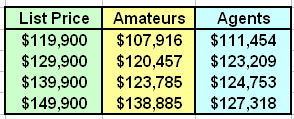
For example, researchers asked both professional real estate agents and man-off-the-street amateurs to predict the final selling price of a house.

They were all told that the current tax appraisal value of the house was $135,000.

Then, each respondent was told that the house was listed in one of four prices — ranging from $119,900 to $149,900.

The researchers found a clear positive correlation between list prices and predicted sale prices.

The amateur is responded more to the differences in list prices and the professionals — but even the pros and a $15,000 spread that can only be attributed to the differences in the list prices.

Bottom line: if you’re selling a home beach for the sky with your list price; if you’re buying a home try to ignore the list price and focus on more fundamental values like tax assessments and comparable sales

image

Source: Priceless, William Poundstone, Hill and Wang Books, 2010

How much does a ‘for sale’ home’s list price matter?

August 13, 2010

Answer: a lot … it’s the psychological effect called anchoring.

For example, researchers asked both professional real estate agents and man-off-the-street amateurs to predict the final selling price of a house.

They were all told that the current tax appraisal value of the house was $135,000.

Then, each respondent was told that the house was listed in one of four prices — ranging from $119,900 to $149,900.

The researchers found a clear positive correlation between list prices and predicted sale prices.

The amateur is responded more to the differences in list prices and the professionals — but even the pros and a $15,000 spread that can only be attributed to the differences in the list prices.

Bottom line: if you’re selling a home beach for the sky with your list price; if you’re buying a home try to ignore the list price and focus on more fundamental values like tax assessments and comparable sales

image

Source: Priceless, William Poundstone, Hill and Wang Books, 2010

In this economy, even counterfeiters are trading down …

August 6, 2010

Punch Line: It used to be that flashy names like Rolex were the ones susceptible to counterfeiting. 

Now, there’s more money in downscale brands …

* * * * *

Excerpted from NY Times: Even Cheaper Knockoffs, Jul 31,2010

After years of knocking off luxury products like $2,800 Louis Vuitton handbags, criminals are discovering there is money to be made in faking the more ordinary — like $295 Kooba bags and $140 Ugg boots.

In California, the authorities recently seized a shipment of counterfeit Angel Soft toilet paper.

The shift in the counterfeiting industry plays to recession-weary customers looking for downmarket deals.

Knockoffs of lesser-known brands, which are easy to sell on the Internet, can be priced higher than obvious fakes, and avoid the aggressive programs by the big luxury brands to protect their labels, retail companies and customs enforcement officials say.

“If it’s making money over here in the U.S., it’s going to be reverse-engineered or made overseas.”

The lesson for many counterfeiters has been that they have a better chance of getting away with it if they copy smaller brands and market them on the Internet.

Back to the Future: BP distributors consider “retro-branding”

August 1, 2010

BP  bought Amoco in 1998 and many current BP distributors used to be Amoco distributors.

Those distributors began a campaign soon after the spill started, emphasizing that BP fuel stations are locally owned and operated.

Now, some BP gas station owners in the United States want to drop the BP name and return to the Amoco brand to recover business hit by public anger over the Gulf of Mexico oil spill disaster.

Note: there’s a major complication: the Amoco brand name is owned by BP, not by the distributors.

* * * * *

Source: Reuters, US BP distributors consider reverting to Amoco brand, Aug 1, 2010 
http://www.alertnet.org/thenews/newsdesk/N01235110.htm

Is the wine fine … or just high priced ?

July 29, 2010

Peer pressure influences us …  If everyone is telling you that something is good, you’re probably going to agree — or at least that’s what your brain will try to think.

And for adults, one of the best measures of what their peers like can be found on price tags.

Researchers tested just how much the luxurious feeling that comes with using a high-priced good determines the enjoyment of that good.

People were asked to sample and rate what they were told were five different wines. In reality, there were only three wines, each with a fake price tag — a $5 wine labeled $45, for example.

The results show that those fake prices carried a lot of weight: The participants thought they tasted five different wines, and the more “expensive” the wine, the more they liked it.

And they weren’t just lying to themselves: The researchers tested parts of the participants’ brains and found that when sipping a purportedly higher-priced wine, there was more activity in the parts that experience pleasure.

Excerpted from US News: The Fine Pleasures of Paying Through the Nose.  February 28, 2008 : 
http://money.usnews.com/money/business-economy/articles/2008/02/28/the-fine-pleasures-of-paying-through-the-nose.html

Hummer: Taking the high road … huh ?

July 23, 2010

Excerpted from Canadian Business: MY HUMMER, RIGHT OR WRONG, 10/13/2009

Hummer buyers don’t hate the planet-they just love their country more

Depending on where you are sitting – or more accurately what you are sitting in – the Hummer super-SUV is either

  • a shining symbol of American consumerism gone mad, or
  • a 21st-century emblem of American frontier heritage and individualism.

It’s easy to understand the first view.

The Hummer is a hulking, slab-sided truck built by the same company that makes the Humvee military vehicles; Hummers need a gallon of gas to rumble 10 miles.

The case for the latter, according to a study in the Journal of Consumer Research, is a little more complex.

Basically, Hummer owners are aware of the criticism aimed at the vehicle but drive them anyway-not despite the critics, but to spite them.

“For Hummer owners, it is possible to claim the moral high ground.”

Hummer attitudes go beyond defending the rights of other Americans to choose, to a form of patriotism.

“They think they are particularly American by consuming this vehicle.”

Protection racket: Why do folks buy extended warranties ?

July 22, 2010

Extended warranties are often more profitable to the retailer than the product it covers.

They  generally amount to  “unnecessary and overpriced insurance” since most products don’t break within the period covered, and repairs tend to cost no more than the warranty itself.

So, why do so many consumers buy extended warranties?

Answer: Peace of mind is a benefit … especially for folks of limited means who are buying “hedonic” products.

* * * * *

Shoppers tend to agonize over the relative merits of different models of electronic goods such as digital cameras or plasma televisions.

But when they get to the till, many spend freely on something they barely think about at all: an extended warranty, which is often more profitable to the retailer than the device it covers.

Shoppers typically pay 10-50% of the cost of a product to insure it beyond the term covered by the manufacturer’s guarantee. The terms of these deals vary (and there is often a great deal of fine print).

Yet products rarely break within the period covered, and repairs tend to cost no more than the warranty itself.

That makes warranties amazingly profitable: they generate some $15 billion annually for American retailers, according to Warranty Week, a trade journal.

So why, asks a paper published in the December 2009  issue of the Journal of Consumer Research, do so many consumers still buy extended warranties?

The researchers concluded that the decision to buy a warranty had a great deal to do with a shopper’s mood.

If a customer is about to buy something fun (i.e., an iPod rather than a landline phone), he will be more inclined to pay for extra insurance because consumers value “hedonic” items over utilitarian ones.

The study also found that poorer consumers are more likely to buy “potentially unnecessary and overpriced insurance”, because they are more worried about the expense of replacing a product if it breaks.

The popularity of warranties should logically depend on the likelihood of a product’s failure … but the emotional tranquility that comes with buying a new warranty is a benefit to buyers, even if “rationally, it doesn’t make sense”.

The Economist. London: Nov 21, 2009. Vol. 393, Iss. 8658; pg. 66

* * * * *

An Angle: Extended warranties for laptops often cover the battery.  If your battery should wear out – say, right before the extended warranty is about to expire – you might be able to get a “free” replacement battery – that has a FMV about equal to the price you paid for the extended warranty.

The “denomination effect” … it’s about spending, not religion.

July 21, 2010

Punch line: If you want to control your spending, leave your credit cards at home and only carry around big bills …

* * * * *
Excerpted from NYT: A Reluctance to Break the Large Bills, March 29, 2009

A paper  published in The Journal of Consumer Research investigates the so-called denomination effect — the additional tight-fistedness people exhibit when their money is tied up in a few large-denomination bills, as opposed to many small ones.

  • In one study, 63 % of college students who had been given four quarters splurged on candy; 74% of students given a single dollar bill, pocketed it.
  • In another study, 20 percent of Chinese women given a single 100-yuan note ($14.66) chose not to spend the money on an array of shampoo, bedding and other household goods — but the rate of abstention was only 9.3 percent among women given the same amount of money in smaller notes.

“People overvalue these large bills … It’s partly a self-control mechanism — I want to hold onto it, because if I do break that big denomination, I lose track of my spending.”

The findings are especially relevant to “places like China or India that are predominantly a cash-based economy.”

Full article:
http://www.nytimes.com/2009/03/30/business/30drill.html

* * * * *

Ken’s Note: Never thought of a “single dollar bill” as a particularly big denomination …

Amazon’s “tipping point”: More e-book sales than hardcovers

July 20, 2010

WSJ, Amazon Says E-Book Sales Outpace Hardcovers, July 20, 2010 

Amazon reached a milestone, selling more e-books than hardbacks over the past three months. Over the past month, the Seattle retailer sold 180 Kindle books for every 100 hardcover books it sold, it said.

But publishers said it is still too early to gauge for the entire industry whether the growth of e-books is cannibalizing sales of paperback books, a huge and crucial market.

In a statement, Amazon’s chief executive, Jeff Bezos

  • countered the perception that sales of the company’s Kindle e-reading device had suffered due to competition from other devices, such as Apple’s iPad.
  • said the growth rate of Kindle device sales had “reached a tipping point,” having tripled since the company lowered its price
  • painted a picture of accelerating growth in sales of e-books, which can be read on the Kindle
  • said its hardback book unit sales also continued to increase.

Full story:
http://online.wsj.com/article/SB10001424052748703720504575377472723652734.html?mod=djemalertTECH

Adults Only: A Trojan horse or a Trojan for horses ?

July 19, 2010

Hate to drag HomaFiles down to this level, but this one is too good to pass up.

Punch line: Since introducing its Magnum line of plus-size condoms,  industry leader Trojan’s market share and profits have surged.

* * * * *

From Psychology Today …

Few marketers are as fortunate as condom makers, whose customers are glad to pay a premium for a product that isn’t really much bigger or better.

Trojan markets its Magnum line of condoms as “Bigger than most condoms …  designed to fit those that find normal condoms too constricting.”

Oh, yes, and then there are Magnum XL’s … an upsell version.

It’s easy to see why men fall for this particular sales pitch.

“The Magnum brand is viewed as a positive lifestyle badge and positive symbol … men are proud to show they carry a Magnum condom — the large size carries a certain cachet.”

The economics:  A box of 12 regular Trojans retails for around $5.99; a box of 12 Magnums or Magnum XLs is $7.99. That’s a 33 percent premium.

Trojan confesses that it’s hard to imagine Magnum buyers doing the math … and since Magnum condoms are only 3/10 of an inch longer than regular Trojans – and since XLs are the the same length as Magnums … all of the condoms cost about the same to make, so the Magnum’s price premium is pure profit.

As an academic observer notes: “I think the concept of having more sizes is a step forward for the industry … But you could never market them as small, medium and large, because no one would buy the small.”

Excerpted from Behavioral Economics: Monetizing the Male Ego, April 28, 2010
http://www.psychologytoday.com/blog/priceless/201004/monetizing-the-male-ego

* * * * *

Factoids

Trojan, including Magnum, commands 75 percent of the condom market, with No. 2 Durex commanding 14 percent.

The company claims Magnum is the most popular condom among African-Americans, citing internal research that indicates they account for 22 percent of all condom purchases but 40 percent of Magnum purchases.

http://www.nytimes.com/2010/04/28/business/media/28adco.html?_r=1&ref=business

Next time you open a menu … spot how they’re playing with your mind.

July 15, 2010

In his new book, Priceless: The Myth of Fair Value (and How to Take Advantage of It), author William Poundstone dissects the marketing tricks built into menus—for example, how something as simple as typography can drive you toward or away from that $39 steak.

1. The Upper Right-Hand Corner
That’s the prime spot where diners’ eyes automatically go first.

Restaurants often use it to highlight a tasteful, expensive pile of food.

2. Pictures

Generally, pictures of food are powerful motivators but also menu taboos — mostly because they’re used in downscale chains like Chili’s and Applebee’s.

Red Lobster ditched pics when it started trying to inch upscale

3. The “Anchor”
The highest priced item on the menu may not ever get ordered.  That’s ok.  It’s purpose is to make everything else near it look like a relative bargain.

4. In The Vicinity
The restaurant’s high-profit dishes tend to cluster near the anchor.  They’re items at prices that seem comparatively modest (when compared to the anchor).. They’re the items the restaurant really wants you to buy.

5. Columns Are Killers
It’s a big mistake for restaurants to list prices in a straight column. “Customers will go down and choose from the cheapest items.”

Consultants say to omit “leader dots” that connect the dish to the price; and to drop dollar signs, decimal points, and cents

6. The Benefit Of Boxes
“A box draws attention and, usually, orders.

When you see an item in a box, think “high margin”

7. Menu Siberia
That’s where low-margin dishes that the regulars like end up. They’re there, but relatively easy-to-miss  … or so the restaurant hopes..

8. Bracketing
A regular trick …  it’s when the same dish comes in different sizes.

Because youre never sure of the portion size, you’re tempted to to trade up … especially from small to “regular” size.

* * * * *

Excerpted from Priceless: The Myth of Fair Value (and How to Take Advantage of It), to be published in January by Hill & Wang, an imprint of Farrar, Straus & Giroux. © 2010 by William Poundstone.
http://nymag.com/restaurants/features/62498/

Walk clockwise around grocery stores !

July 14, 2010

Why?

Because you’ll save money.

Researchers have discovered that “shoppers open their wallets wider when moving through a store in a counter-clockwise direction.”

On average, they spend $2 more per visit.

Why??

One theory is that most shoppers are right handed … and like most basketball players, they go to their right better…. so, impulse items stocked to their right along “walls of value” are easier to grab and throw in the cart.

If you are right handed, walk clockwise and the “wall of values” will on your left,  and will be less tempting.

Source: Priceless, William Poundstone, Hill & Wang, 2010, p.149

Pricing magic: the power of a “decoy”

July 13, 2010

In a classic pricing study, researchers assigned quality levels ranging from zero to 100 to unbranded beers (think wine ratings).

For the first test a  “regular” beers was scored a 50 and offered for $1.80 per bottle, and a premium beer – scored at 70 – was offered at $2.60 per bottle.

Survey respondents opted for the premium by about 2 to 1.

In a second test, a “cheap” beer– scored at 40 out of 100 and priced at $1.60 — was added to the mix.

Though no respondent picked the cheap beer, there was a mix change.  Suddenly, the regular — now the mid-priced beer – was picked by more people..

Hmmm.

In a third test, the cheap beer was replaced by a super-premium – scored at 75 and priced at $3.40.

Now, nobody picked the regular (which was the “low end” of the 3 picks) … only 10% picked the super-premium …. 90% picked the premium.

So, by adding a “decoy” – a product that isn’t ultimately bought but which sets a high-end price impression in people’s mind – the researchers were able to get respondents to “step up” from regular to premium – and increase the “price realization” of the regular and premium beers by 16%.

The theory of the case: “Aversion to extremes” … often, people conclude that the cheapest product is, well, a cheap product … and that the highest priced product may not deliver enough added benefits to justify its higher price.  So, the safe bet is to buy the mid-priced product.

That’s pricing magic, for sure.

image

How far can a brand be extended? … Answer: it depends.

July 7, 2010

Many  successful new product introductions each year are brand extensions, such as Apple’s iPhone, Godiva coffee, and Jeep strollers.

Researchers conducted a few experiments to determine what makes a brand “elastic.” That is, having brand power that extends beyond a brand’s core product.

Their findings:

  • Consumers tend to respond more favorably to extensions that fit with their perceptions of the parent brand.
  • Consumers are more accepting of extensions into distant product categories for brands with prestige concepts (think Rolex) than brands with functional concepts (think Timex).
  • With functional brands, holistic thinkers provide more favorable responses to distant extensions than analytic thinkers.

* * * * *

Marketing Tip

Match product information with the consumer’s style of thinking.

“Adjectives induce a holistic frame by encouraging a focus on global, abstract relationships.

Verbs induce an analytic frame by encouraging focus on specific properties and details.” 

* * * * *

Source: “What Makes Brands Elastic? The Influence of Brand Concept and Styles of Thinking on Brand Extension Evaluation,” by Alokparna Basu Monga and Deborah Roedder John. Journal of Marketing, 2010.

Source article from Marketing Profs:
http://www.marketingprofs.com/short-articles/1866/all-together-now-stretch/?adref=NciW3610

Caddy’s puttin’ on the Ritz … lipstick on a pig ?

July 6, 2010

Bottom line: After years of decline, Cadillac is trying to regain its luxury aura.

But given its older and less affluent owner base, that’s an uphill battle.

* * * * *

Excerpted from BusinessWeek, What Cadillac Is Learning from the Ritz, June 17, 2010

Last year, General Motors spent $354 million on marketing for its Cadillac division — more than any other luxury car maker in the U.S.

The branding campaign was largely ineffective: In 2009 Cadillac sold all of 109,092 vehicles, its worst year since 1953.

The brand’s product lineup needs refreshing, the average age of its buyers is a less-than-youthful 62 (13 years older than typical BMW owners), and Cadillac hasn’t been the top-selling luxury auto brand in the U.S. since 1997.

What to do? Sell like the Ritz.

It’s taking a cue from the hotel chain’s attention to customer service to restore a brand that’s sorely lacking in luster

In its effort to reconnect with upscale customers, GM has brought in trainers from Ritz-Carlton to show Cadillac dealers how to create a consistent sales experience across the U.S.

Cadillac has copied Ritz’s pocket-size “Credo” cards, which explain how customers should be treated.

Ritz employees also have $2,000 that can be used to make up for a bad experience or surprise a guest with a better one.

So Cadillac service chiefs are now given greater flexibility to extend OnStar subscriptions, provide free maintenance, or even reduce service charges for customers who are unhappy.

GM also is trying to garnish the brand image. Cadillac recently removed most references to mass-market icon GM from its Web pages and e-mails.

Still, no image remake can fully succeed until Cadillac comes up with more stylish models that can attract younger buyers.

For now, the company’s image will likely remain dinged as it continues churning out land yachts which appeal mainly to buyers in their 70s.

“They don’t need another  geezer-mobile.”

Full article:
http://www.businessweek.com/magazine/content/10_26/b4184024360730.htm?chan=magazine+channel_news+-+companies+%2B+industries

Making quirky profitable … the Subaru way.

June 24, 2010

Punch line: By maintaining the quirky persona of its brand and keeping prices low, Subaru has quietly, but aggressively, increased growth … even through the recession.

* * * * *
Excerpted from: Bloomberg Business Week, At Subaru, Sharing the Love Is a Market Strategy, May 20, 2010

While much of the U.S. auto business is just beginning to emerge from retrenchment mode, sales at Subaru are climbing.

“Our customers were not affected by the recession … They have a better financial situation.”

By courting financially solid buyers with a taste for the quirky, has grown steadily and, for the first time, its unit sales exceed those of such better-known brands as BMW, Lexus, Mazda, and Volkswagen.

Subaru has long been popular with a core of professorial drivers in tweed in the Northeast and flannel-clad outdoor enthusiasts in the Northwest. Lately, however, the carmaker has been aggressively moving beyond the snowy, soggy, and mountainous regions that are its stronghold.

Subaru’s secret is that it understands the customers who drive its cars and has gotten smarter and more aggressive about reaching out to new ones who would feel at home as part of that clan.

  • The average household income of a Subaru owner is $88,000, the same as Honda Motor and $10,000 more than Toyota.
  • Subaru buyers are three years younger than the industry average and a quarter more likely to have a college degree.
  • They are a thrifty lot, traditionally buying less car than they can afford. Some 36 percent pay cash.

Much of the automaker’s marketing focuses on cementing its connection to customers.

  • Subaru’s research shows them to be an eco-friendly bunch who value the freedom to go where they want, when they want.
  • Subaru supports causes such as the American Canoe Assn. and the Leave No Trace Center for Outdoor Ethics. Unlike luxury car buyers, Subaruers are “customers who are not buying things, but experiences.”
  • “In their marketing they’ve been focusing on what creates love between the owner and the automobile.”
  • “They are basically adding people who are Subaru buyers in their hearts, but don’t know it.”

The bottom line: By maintaining the quirky persona of its brand and keeping prices low, Subaru has quietly, but aggressively, increased growth.

Full article:
http://www.businessweek.com/magazine/content/10_22/b4180018655478.htm

That American brand may be, well, Mexican.

June 23, 2010

Punch line: From Thomas’ English Muffins to Borden milk, Saks Fifth Avenue department stores to The New York Times newspaper, Mexican investors have taken advantage of low interest rates and depressed prices during the economic downturn to expand their holdings in el norte.

* * * * *

USA TODAY, Mexico invests, puts its mark on more U.S. brands, June 18, 2010 

Huge Mexican corporations are snapping up U.S. brand names, opening U.S. factories and investing millions of pesos north of the border.

  • Grupo Lala, Mexico’s largest dairy company, purchased Dallas-based National Dairy Holdings, which controls the Borden brand and 18 regional dairies selling milk under the names Flav-O-Rich, Dairy Fresh, Velda Farms, Sinton’s, Cream O’ Weber, Goldenrod and others.
  • Grupo Bimbo, Latin America’s largest baked-goods company, bought the U.S. baked-goods operations of Weston Foods for $2.4 billion, taking over 22 industrial bakeries and 4,000 distribution routes, and national brands such as Entenmann’s pastries.
  • Mexican billionaire Carlos Slim has expanded his empire into the USA. In 2008, Slim bought a 6.9% share in The New York Times and  increased his stake in the Saks Fifth Avenue department stores from 10.9% to 18%.

http://www.usatoday.com/money/world/2010-06-17-mexowned_N.htm

Submarine warfare: Quiznos tosses focus groups for “speed dining”

June 21, 2010

Punch Line: To speed time-to-market, Quiznos employs rapid-fire taste tests that help it give customers what they want, sooner.

* * * * *

Excerpted from Bloomberg Business Week: Damn the Torpedoes! Getting Quiznos, January 14, 2010

Quiznos has always positioned itself as a cut above Subway in the fast-food market — and priced its sandwiches accordingly.

While restaurant operators regularly enlist consumers for feedback, many have turned away from traditional focus groups … to avoid the peril of group think from a methodology that some experts say is “a bit dated”.

Quiznos  swear by a method called “speed-dining”.  The company  empanels as many as 25 groups in back-to-back, 90-minute tastings.

By reworking recipes based on snap reviews, Quiznos can get products from test kitchen to the market in six months … twice as fast as competitors.

Now Quiznos is gunning for upmarket consumers with two new subs priced at up to $7.49.

That may seem foolhardy, with unemployment at 10%. But Quiznos is confident.

After all, speed diners ate them up in October.

Full article:
http://www.businessweek.com/print/magazine/content/10_04/b4164054518256.htm

Smackdown: Hulk Hogan vs. the Flintstones

June 18, 2010

Punch line: Wrestling superstar Hulk Hogan says  a Cocoa Pebbles commercial degrades his image.

Gotta be stopped !  Otherwise, some jabrone will start claiming that wrestling is fake. Go Hulk !

* * * * *

Excerpted from:  Tampa Tribune: Yabba-Dabba-Sue! Hulk Hogan files suit against Cocoa Pebbles maker,  May 21, 2010

Hulk Hogan is suing the maker of Cocoa Pebbles, accusing the company of appropriating his image in commercials for the cereal.

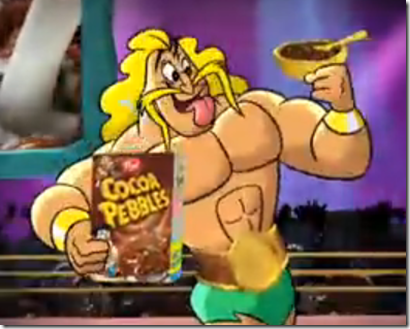
In the “Cocoa Smashdown” commercial, a cartoon character resembling Hogan easily beats Fred and Barney inside the ring. But then Bamm-Bamm steps in and pounds the blond-haired, mustachioed wrestler to bits.

Hulk, the federal lawsuit states, “is shown humiliated and cracked into pieces with broken teeth.'”

The commercial character goes by the name “Hulk Boulder,” which Hogan’s lawsuit says is a name he used early in his career until wrestling promoter Vince McMahon decided he should have an Irish name.

The wrestler contends he has been harmed by, among other things, “the unauthorized and degrading depictions.”

Source article:
http://www2.tbo.com/content/2010/may/21/211702/yabba-dabba-doo-hulk-hogan-sues-cocoa-pebbles-make/news-breaking/

* * * * *

To view commercial click pic or link below

image 
http://www.youtube.com/watch?v=E7S7KFKmYP4

Subway claims only their’s is a footlong … depends where you measure from, I guess.

June 17, 2010

Punch line: The term “footlong” has been around for decades – maybe centuries. 

But Subway, fresh off its $5 footlong promotion, is trying to claim the phrase is proprietary and suing other folks who use the term.

Come on, Subway …  go fight McDonald’s, not push-cart vendors.

* * * * *

Excerpted from BrandChannel: Did Subway Put Its Foot(long) In Its Mouth? ,  May 19, 2010

Subway successfully positioned itself via its Jared Fogle healthier eating campaign as the antithesis of “fast food.”

Launched in 2008, the chain’s $5-footlong deal has become its most successful campaign ever.

Now, Subway is moving to protect its “footlong” golden goose …

Subway is sending cease-and-desist letters to hotdog vendors using the term “footlong” to sell their wares.

In one case, Subway even targeted a hotdog vendor that has been selling “footlong” dogs for 40 years.

* * * * *

A patent attorney points out, “Federal trademark law prohibits federal trademark registrations on words which, when used in connection with the goods, are merely descriptive. A cursory Google search reveals over 6,000 uses of the words ‘footlong sandwich’ apart from the term ‘Subway.'”

Full article:
http://www.brandchannel.com/home/post/2010/05/19/Subway-Sues-Over-Footlong.aspx

Don’t call me ‘Chevy’ … my name is Chevrolet

June 15, 2010

GM thinks the name Chevy causes brand confusion – that some dolts don’t know it’s short for Chevrolet.

I guess that these guys have never ordered a Coke — a.k.a. Coca-Cola.

Talk about swimming upstream … unnecessarily. 

* * * * *

CNNMoney.com: GM dumps Chevy for Chevrolet, June 10, 2010

General Motors has banned the use of the Chevy name in all of its corporate communications.

From now on, the bow-tie brand will go by its proper name, Chevrolet.

It’s OK if you still call your car a Chevy. It’s just that GM won’t.

According to GM:  the use of two different names for one car brand — Chevy and Chevrolet — can cause confusion abroad.

While Chevy is a popular nickname for the brand in the U.S. and Canada, it’s not used in any of the other 130 or so countries where the brand is sold.

Customers in other countries who want to learn more about Chevrolet and come across the name Chevy on a U.S.-based Web site might think it refers to a separate brand.

A memo that was sent out to GM employees even asked them not to use the Chevy name in conversation. However, the ban on speaking the two-syllable word won’t be strictly enforced.

Existing advertising and corporate communications won’t be changed, he added, but the rule will be enforced in any materials produced from here on out.

* * * * *

Founded in 1911 as the Chevrolet Motor Co., Chevrolet was named for founding partner Louis Chevrolet, an early race car driver.

Full article:
http://money.cnn.com/2010/06/10/autos/gm_no_chevy/

Going where no Starbucks coffee could go before.

June 14, 2010

TakeAway: The ubiquity of Starbucks stores, combined with management resistance to further de-value the Starbucks “experience,” has left few opportunities for continued domestic growth of the Starbucks brand. 

To provide growth opportunities for shareholders, Starbucks will roll out a second brand, Seattle’s Best Coffee, targeting the mass-market crowd. 

In addition to distribution in fast-food outlets, supermarkets and coffee houses, Seattle’s Best will be sold in c-stores, coffee carts, and vending machines, places Howard Schultz would never consider for the Starbucks brand.

If successful, the venture will put Starbucks on the offensive against its fast-food rivals while minimizing cannibalization of Starbucks-brand sales.

* * * * *

Excerpted from WSJ, “Starbucks Targets Regular Joes,” by Kevin Helliker, May 12, 2010 

In a counterattack against its lower-priced fast-food rivals, Starbucks Corp. plans to roll out a second coffee brand.

By autumn, Seattle’s Best Coffee … will be sold in about 30,000 fast-food outlets, supermarkets and coffee houses. … Eventually … the brand will also be sold in convenience stores, drive-through kiosks, coffee carts, vending machines and mobile trucks. …

The new push by Starbucks is a response to the invasion of the specialty-coffee market by McDonald’s Corp., Dunkin’ Donuts and other fast-food chains, which offer espresso-based drinks at lower prices than Starbucks.

Starbucks has struggled to expand beyond a limited menu and a largely morning clientele.

… executives unveiled a new logo for Seattle’s Best, along with a new motto: “Great Coffee Everywhere.” The motto reflects the Starbucks theory that the success of McDonald’s and others in selling coffee has created a fresh opportunity to sell a mass-market brand.

Associating Starbucks with a product sold from vending machines could … damage the brand’s upscale image. And it could cannibalize Starbucks customers. …

But Seattle’s Best is intended to appeal to just this sort of Starbucks critic. For those who find Starbucks coffee too strong-tasting, Seattle’s Best is promoting the “smoothness” of its blend …. For those turned off by the prices and ambiance at Starbucks stores, Seattle’s Best is touted as “unpretentious.” …  

Pricing will vary widely. … Seattle’s Best beans will cost consumers less than Starbucks-brand beans but more than conventional brands …

Seattle’s Best helped pioneer the specialty coffee-house concept when it opened its first store in Seattle 40 years ago. … When Starbucks acquired it in 2003, Seattle’s Best had about 50 stores and a sizable supermarket presence, particularly in flavored beans, a lucrative category that Starbucks never entered.

Perhaps the most radical feature of the Starbucks strategy calls for selling Seattle’s Best from vending machines. Vending-machine coffee has long been regarded as a last resort, … But Seattle’s Best engineers have developed a coffee-making machine that Starbucks predicts will improve that image. …

Edit by DMG

* * * * *

Full Article
http://online.wsj.com/article/SB10001424052748703565804575238584204665378.html

* * * * *

Perceptual Differences: Is 68 cents per day enough to “buy” seniors’ support ?

June 10, 2010

In marketing, there’s a concept called a “perceptual difference”.

The basic notion is that something has to be sufficiently different from a comparative benchmark in order to make a difference in the way people think about it.

For example, throwing an extra 1/2 ounce of Cheerios into a 14 ounce box probably doesn’t pass the perceptual difference test. It adds to the cost of the product, but probably doesn’t motivate buyers to pay more for it.

Increasing the contents by, say 20%, probably does .  Folks are likely to notice.  Whether they’re willing to pay more for the super-size is another question …

Which brings us to Pres Obama’s push to win seniors over to his health care plan.

Keep in mind that roughly half ObamaCare’s comes from $500 billion in Medicare cuts – half from cutting waste & fraud (yeah, right) and half by eliminating Medicare Advantage – a step-up HMO version of Medicare.

$500 billion passes the perceptual difference test, and seniors are taking the cuts personally.

To partially offset the cuts, ObamaCare is “filling the doughnut hole” in Bush’s prescription drug plan – a program that supplemented Medicare to cover seniors’ prescriptions – but only up to a certain amount – and then kicked back in for extraordinary prescription drug users. The gap between “a certain amount” and “extraordinary – designed to suppress unnecessary prescriptions “at the margin” – is the “doughnut hole”.

To close the doughnut hole, Obama is sending each Medicare senior a check for $250 – the equivalent of 68 cents per day. Hardly a perceptual difference.

Does the administration really think that 68 cents a day will get old folks to think that $500 billion in cuts is good for them ?

* * * * *

Side note: The notion of perceptual differences also provides an explanation for why Obama doesn’t get credit for his “tax cut to 95% of workers”.  His “making work pay” program paid out a max of $400 to workers – that’s a little over $1 per day.  A significant perceptual difference ?

Draw your own conclusion.

Sharpen your pencil, there’s a Walmart truck at your loading dock.

June 3, 2010

Punch line: Walmart is starting to pick-up merchandiser at suppliers docks — rather than have the stuff shipped to WMT distribution centers for subsequent redistribution to stores. Three reasons:

(1) WMT can usually move the stuff cheaper because deals in economical full truck loads and has highly productive logistic processes in place

(2) WMT has the clout to command price reductions that may exceed the suppliers cost cuts

(3) For sure, suppliers will allocate more of their fixed costs to WMT competitors who don’t have the scale, interest or capability to do their own picck-ups

* * * * *

Excerpted from BBW: Why Wal-Mart Wants to Take the Driver’s Seat, May 27, 2010

Wal-Mart, the world’s largest retailer, has become famous — and at times infamous — for the power it wields over its suppliers … to create environmentally friendly packaging and exclusive product sizes, and to participate in joint advertising promotions.

Now, Wal-Mart wants to take over U.S. transportation services from suppliers in an effort to reduce the cost of hauling goods.

The goal: to handle suppliers’ deliveries in instances where Wal-Mart can do the same job for less, then use those savings to reduce prices in stores.

Wal-Mart believes it has the scale to allow it to ship everything from dog food to lawn chairs more efficiently than the companies that produce the goods.

Manufacturers would compensate Wal-Mart by giving the retailer lower wholesale prices for the goods it transports.

Until now, suppliers made most deliveries to Wal-Mart’s distribution centers. The retailer then used its fleet of 6,500 trucks and 55,000 trailers to ferry goods between the regional centers and individual stores. Under the new program Wal-Mart will pick up products directly from manufacturers’ facilities.

That will allow Wal-Mart to carry more per truck and improve on-time delivery rates … and give it  more sway in negotiating fuel prices, thanks to its larger purchasing volume.

The price cuts Wal-Mart is seeking are twice as much as the cost of transporting goods in some cases. In two instances, Wal-Mart asked for a 6 percent reduction in the price it pays for products based on its own cost calculation, while suppliers estimated the actual expense was equal to about 3 percent, the people say.

One side effect of the Wal-Mart plan is that consumer-product manufacturers may face increased transportation costs on deliveries to other retailers as they lose economies of scale on their own delivery fleets.

Suppliers may have to go along with the plan even if their other remaining transport expenses rise because Wal-Mart is so big.

The bottom line: By attempting to take over the transportation from its suppliers, Wal-Mart hopes to achieve efficiencies to cut its own prices.

Full article:
http://www.businessweek.com/magazine/content/10_23/b4181017589330.htm?chan=magazine+channel_news+-+companies+%2B+industries

The power of branding: Ally Bank

June 2, 2010

Have you seen any of the clever commercials promoting Ally Bank?

The ads show a con man  banker taking advantage of innocent children with the equivalent of typical bank practices (e.g. teaser offers, high service fees, misleading fine print).

My opinion: the campaign is very effective positioning Ally as a fair, customer-oriented bank.

Embarrassed to admit that I thought Ally was a new bank, or maybe an obscure one that I just hadn’t heard of …

Then today I picked up on an incidental mention in the WSJ:

Keeping GM alive, albeit in shrunken form, was an expensive undertaking for America’s taxpayers: about $65 billion in all, if one counts government aid to the company’s former financial arm, formerly GMAC, now renamed Ally Bank.
http://online.wsj.com/article/SB10001424052748704113504575264641145227612.html?mod=djemEditorialPage_h

How did I miss that one ?

Below is a recap of the rebranding announcement.

Re-branding is usually done out of necessity.

Sometimes an acquiring company loses the right to use a brand name  — think GE household appliances to Black & Decker.

In those instances, you see references back to the old brand – think Brinks Home Security is now Broadview Security – to transfer some of the old brand equity to the new brand.

But, who would want to be associated with GMAC these days?

So, you see Ally signaling that it’s new from scratch with no references to its original branding.

Worked on me !

* * * * *

Excerpted from USA Today: GMAC Bank re-brands itself as Ally Bank, 5/15/2009

The banking arm of ailing auto finance company GMAC is taking on a new name, hoping to smooth its image and entice new customers as it works to drive deposit growth.

GMAC has since been trying to expand its consumer banking offerings to offset sharp declines in new vehicle loan and home mortgage originations.

GMAC Bank has become Ally Bank, which will offer a variety of savings products, including no-penalty certificates of deposits, online savings accounts and money market accounts.

“We are launching a new brand with a new approach of treating customers with total transparency.”

The company settled on the name Ally after extensive interviews with customers.

“The name Ally aptly fit the character of the brand”

The re-branding of the bank, a unit of GMAC Financial Services, is a clear effort to distance itself from its troubled parents, GM and GMAC. 

Full article:
http://www.usatoday.com/money/industries/banking/2009-05-15-ally-gmac-bank_N.htm

Hawaii Five-0 … still more to the story.

May 28, 2010

I’ve got to walk back my story that CBS was doing a great job web marketing by sending rapid-fire replies to my original 5-0 post … with promo language like “the show will rock”.

Turns out that CBS had nothing to do with the replies.

Yesterday, I received this:

Oh, my!  I have to laugh at your comment that the Hawaii Five O posts came from the CBS web marketing team. 

FYI, each of those posters is a big Alex O’Loughlin fan who simply sought to answer the questions you posed. 

We are very in tune with Alex’s career and post in many, many different sites not just yours.

As a marketing guy, I guess I automatically gave too much credit, too soon to, well, other marketing guys.

Live and learn …

Pricing Baseball Tickets Like Airline Seats .. uh-oh.

May 28, 2010

For years, I’ve agreed that sports teams were pricing themselves out-of-reach for the average family. 

“Face value” on tickets staggers me.  Dealing with scalpers males me nervous.

Now, those worlds are starting to coincide: teams getting higher prices by acting like scalpers.

Play ball.

* * * * *

Excerpted from Bloomberg Business Week:Pricing Baseball Tickets Like Airline Seats, May 20, 2010

Software helps the S.F. Giants price baseball games in much the same way airlines manage seat prices to keep planes full.

The software crunches numbers on dozens of variables (e.g. the weather, the pitchers, the teams’ records, the rivalry, day of week, time if day, StubHub market price) to determine prices that will get fans into the stands and generate the highest revenue. 

Ticket prices used to be fixed before spring training; now, they’re adjusted almost daily.

The Giants say that revenues are up 12% this season and attendance has jumped 7%, even as the league has seen a slight decline.

Expect the entire league to adopt market-based pricing … and watch it spread to other sports and entertainment. 

“There’s big money out there in lost revenue from mispricing.”

Full article:
http://www.businessweek.com/magazine/content/10_22/b4180039348750.htm

Taster’s Choice: Nescafe whoops Starbucks’ Via …

May 24, 2010

Punch line: Starbucks decided to go downmarket with Via instant coffee and now finds itself in a street brawl with the potential to knife Starbucks premium image. 

* * * * *

Excerpted from BrandChannel: Nescafe Calls Starbucks’ Instant Coffee Bluff,  November 19, 2009

Under pressure from Dunkin’ Donuts and McDonald’s, and with its brand value in decline, Starbucks introduced Via instant coffee with an in-store taste-test promotion intended to prove that the new instant can’t be told apart from the store brew.

Starbucks competing against store brands ?

Not the usual way to maintain a brand that was built upon premium-quality coffee and the idea that Starbucks stores are America’s “third place” (after home and work).

To counter Via, Nescafé is setting up sampling stations for a taste tests of their own: Nescafe vs. Via. 

The Nescafe mantra: “A lot of hype. OR a lot of flavor.”

According to Nescafe, they’re winning convincingly.

Ouch.

Nescafé stands as a reminder and a warning: you can always take your brand down and compete on the low end.

But don’t expect your new competitors to take it lying down.

* * * * *

Full article:
http://www.brandchannel.com/home/post/Nescafe-Calls-Starbucks-Instant-Coffee-Bluff.aspx

Is it live or is it Memorex ?

May 19, 2010

Punch line: Some dead (and nearly dead) brands — called “zombies” — still have high residual awareness that can be leveraged for relatively low cost comebacks – and extended to adjacent categories …

* * * * *
Excerpted from Business week: Imation Brings Dead Brands Back to Life, April 1, 2010

You might think a brand is dead when stores stop selling it. Imation doesn’t think so.

Imation initially made its name on floppy disks (remember them ? ) — then became the world’s largest seller of recordable compact discs.

The company knows that consumers are skipping past data-storage media like compact discs and putting their data on flash memory, where Imation is only a minor player, or on the Net.

So, Imation has spent the last couple of years acquiring so-called “zombie brands” and leveraging their built-in consumer awareness to reincarnate them.

For example, remember Memorex and TDK?  Most consumers do.

That’s why Imation is reviving them to expand into low- and high-end audio gear Imation is using Memorex and TDK to move into higher-margin products.

Memorex was a ghost of its former self when Imation bought it in 2006 for $330 million. Sales of blank audio cassettes had been declining since Sony’s CD-playing Discman came out in 1991.  Memorex dropped its signature TV ads, with their “Is it live or is it Memorex?” tagline, more than 30 years ago. And yet, research surveys showed that 95% of U.S. consumers knew the name, even among people in their 30s.

Imation came up with new product categories to refresh the Memorex brand.

Today Imation is selling Memorex-branded iPod accessories, digital photo frames, DVD players, MP3 players, karaoke machines, and TVs at retailers such as Wal-Mart Stores  and Target.

The company unveiled a new Memorex collection of Wii accessories. Imation is also bringing back another relic from the predigital age, TDK, as a high-end line of stereo gear.

The company plans to sell speakers, turntables, and other audio gear costing as much as $500 under the label TDK brand.

Imation says: “The combination of having good solid technology along with a portfolio of brands and a goal of differentiation is going to set us apart.”

Full article:
http://www.businessweek.com/magazine/content/10_15/b4173064270743.htm?chan=innovation_branding_top+stories

Subscribers tell cellphone companies: Take your 2-year contracts and shove ‘em

May 18, 2010

Bottom line: Folks aren’t giving up their cell phones in a tough economy, but they are looking harder at hidden fees and charges for unused minutes.  More are opting for “by the drink” plans – so that they only pay for what they use.

* * * * *

Excerpted from AP:  Wireless users opt for service without commitment, May 14, 2010

Together, the seven largest U.S. wireless carriers added just 230,000 contract subscribers in the first quarter. That’s negligible compared to their entire customer base of 280 million.

Prepaid service, meanwhile, attracted about 3.1 million new subscribers to the seven largest carriers in the quarter.

This marks a sharp reversal of trends. In the same quarter just two years ago, the comparable carriers added 3 million subscribers under contract, and 2.3 million to prepaid plans.

The carriers that rank third and fourth in the U.S. by subscriber numbers, Sprint Nextel and T-Mobile USA, are losing contract customers. No. 1 Verizon Wireless and No. 2 AT&T are still adding contract customers, but at the lowest numbers in more than five years.

* * * * *

Wireless subscribers have been making a big shift away from two-year contracts toward “prepaid” cell phone service, which often costs less and does not require contracts … even though contracts are needed to get popular phones such as the iPhone and the Droid.

One out of every five Americans with a cellphone had a prepaid plan at the end of 2009. In some markets, up to 30% of subscribers are on prepaid plans.

Unlike contract plans that bill subscribers each month for the services they used the previous month, prepaid services traditionally let subscribers buy minutes in advance for around 10 cents to 20 cents each. When the minutes are used up, people “refill” their accounts as needed.

For years, such plans were marketed primarily to people who did not have the credit to qualify for plans with contracts. But as the recession forced more people to cut costs, prepaid service appealed to a broader slice of the market, and prepaid services responded by offering better deals.

Now it’s possible to make unlimited calls and text messages on a prepaid plan for $45 a month – half of what it costs a customer with a contract on Verizon Wireless.

  • The prepaid market heated up in January 2009, when Sprint began offering a prepaid plan with unlimited minutes for $50 a month under its Boost Mobile brand.
  • Tracfone, a unit of Mexico’s America Movil SA, countered with Straight Talk, which provides unlimited calling for $45 per month on Verizon Wireless’ network, sold exclusively by Wal-Mart Stores Inc.
  • MetroPCS and Leap, which sells service under the Cricket brand, have responded by eliminating add-on fees for taxes and roaming, effectively cutting prices. The price war looks like it will continue.
  • Sprint and Wal-Mart Stores Inc. announced a trial of another prepaid plan: Common Cents, which is designed for people who don’t use their phones much. Calls will cost 7 cents per minute.

The popularity of text messaging is also making some people move away from contract plans that provide a big bucket of monthly minutes that may not get used.

* * * * *

Full article:
http://www.washingtonpost.com/wp-dyn/content/article/2010/05/14/AR2010051401345_pf.html

Gatorade before, during and after … the game, that is.

May 17, 2010

TakeAway: After three years of declining sales, PepsiCo wants to regenerate the product life cycle by designing a three-step system for Gatorade consumption and targeting a niche market of elite athletes.  Particularly after a failed makeover dubbing the drink “G” last year, PepsiCo needed to find a way to regain profits for a mature product.   

*****

Excerpted from WSJ, “Gatorade: Before and After — PepsiCo’s New Ad Campaign Touts Three-Drink System for Sports Beverage” By Valerie Bauerlein, April 23, 2010

The campaign promoting the new lineup of “G Series” drinks for athletes, aims to demonstrate that Gatorade isn’t just a sports drink that replaces nutrients sweated out during the game, but a system with three steps: a carbohydrate-loaded “Prime” concentrated liquid before play; the traditional “Perform” sports drink during; and a light, protein-rich “Recover” drink after.

Gatorade’s basic “thirst quencher” message of hydration hasn’t changed much in 45 years. But PepsiCo wants the G Series to expand the Gatorade message to broader sports performance.

Teens are Gatorade’s main target.  To create the G Series line, Gatorade interviewed more than 10,000 teen athletes, parents and coaches. Many said they already ate something with carbs before a game (candy, chips), a sports drink during and something with protein afterward (sandwiches).

The three products — Prime, Perform and Recover — together will cost about $7. A 20-ounce bottle of Gatorade costs about $2.

The company also plans to reach out to adult athletes. Gatorade is launching a separate new line next month called G Series Pro, aimed at marathon runners, personal trainers and other elite athletes. The products will be sold in specialty stores such as GNC and Dick’s Sporting Goods.

Gatorade is PepsiCo’s third-biggest selling global beverage brand after Pepsi-Cola and Mountain Dew, so its 14% sales volume decline in the U.S., its biggest market, last year was a concern for executives, analysts and investors.

PepsiCo’s first-quarter earnings, released Thursday, showed that the company has yet to turbo-charge Gatorade, although sales are improving. The company posted a 26% jump in first-quarter earnings, boosted by the February acquisition of its two biggest bottlers. While quarterly revenue in the company’s Pepsi Americas Beverages business, including North America and Latin America, rose 32%, beverage volumes fell 4%.

Edit by AMW

Full article:
http://online.wsj.com/article/SB10001424052748704830404575200404277708326.html?mod=WSJ_Advertising_MIDDLETopNews

*****

Mercedes, BMW … and Lincoln?

May 14, 2010

TakeAway: Just because Ford calls Lincoln its luxury brand doesn’t make it so.  Luxury is in the eye of the beholder and Ford faces the challenging task of changing customer perceptions of its stodgy, “upscale” brand.  So far, the results have been disappointing.

The less-than-luxury perception of Lincoln is not just the result of a communications gap.  Ford has been slow to update the Lincoln product line with original designs not based on middle-market Ford-branded models.

Training Lincoln dealers to offer “high-touch” service is important for the luxury segment, but shouldn’t Ford first figure out how to get customers to the dealerships?  The new models launching this summer will tell us if they got it right.

* * * * *

Excerpted from Bloomberg Businessweek, “With Lincoln, Ford Isn’t in the Lap of Luxury,” by Keith Naughton, May 6, 2010

Business is booming in Jack Kain’s Ford dealership in London, Ky. Not so much, though, at his Lincoln showroom, where new models … go begging for buyers …

Ford is on a roll, as mainstream car buyers embrace the American brand that didn’t go bankrupt. Now that CEO Alan Mulally is unloading Volvo, however, Ford’s upscale ambitions are riding on Lincoln. Sales at the unit are down 64% from its 1990 peak and buyers average an industry-high age of 62 … “To younger generations, that’s grandpa’s car,” says auto analyst Jesse Toprak … “That doesn’t help when you’re going up against Mercedes and BMW.”

Ford is trying to give Lincoln a hip implant. It’s outfitted four new models with more-dramatic design and installed high-tech features including a voice-activated phone and entertainment system …

The new look isn’t helping much. Lincoln’s U.S. market share is stuck at a paltry 0.8% this year, while the Ford nameplate grew at its fastest rate since 1977 … Lincoln is still defined by the black Town Car that has ferried generations of business travelers to the airport,

Ford long ignored Lincoln, in part because … it bought a stable of European luxury brands that seemed to hold more potential: Jaguar, Land Rover, Aston Martin, and Volvo. But … Mulally began dismantling what he called Ford’s “house of brands,” selling off the European lines at fire sale prices. The idea was to first fix its largest franchise, the middle-market Ford brand … Lincoln, whose models are based on Ford’s mechanical platforms and built in Ford plants, would be kept and fixed later.

Ford is retiring the Town Car next year and launching new models aimed at younger buyers like the MKX sport wagon this summer. It’s infusing Lincoln advertising with Gen X-friendly music from the 1980s. And Lincoln dealers are being trained to offer the high-touch service given by some European manufacturers …

The bottom line: Ford dumped its luxe brands to focus on its core vehicles. Now it’s left with aging Lincoln just as luxury demand is set to take off.

Edit by DMG

* * * * *

Full Article
http://www.businessweek.com/magazine/content/10_20/b4178023174411.htm

* * * * *

How cool are you? …. Quick, what are the top 10 booze brands?

May 13, 2010

The World’s Most Powerful Spirits & Wine Brands, 2010
http://www.drinkspowerbrands.com/top-10.html


Smirnoff‘Smirnoff  launched a wide range of flavoured variants and a number of quality variants.

It faces fresh challenges at the top end from Absolut  and Grey Goose.

It is also being undermined from below, from the likes of Svedka – the highest new entrant in 2010 – and Eristoff. 

Johnnie WalkerJohnnie Walker has had a pretty tough year with volumes down 11%.

However, Johnnie Walker still remains the most powerful whisky brand in the world outstripping its nearest rivals by some margin – three times bigger than its nearest Scotch rival, J&B,


Bacardi

Barcardi is the rum market …

The brand leverages its relationship with music which helps drive relevance and volume in the nightclubs and bars on which it so much depends.

Martini VermouthThe sustained appeal of cocktails and Martini’s consistent association and sponsorship of glamorous events …

Positioning Martini as a versatile summer long drink and pitcher option when mixed with fruit juice will extend the brand’s relevance and opportunities for consumption.

HennessyFrench brand Hennessy is the most powerful cognac brand in the world.

The Hennessy brand remains incredibly strong and continues to be a hit with the rap community which has adopted the brand as its own. This association with some of the world’s hippest stars ensures Hennessy’s continued cultural relevance and presence among the world’s most powerful spirits brands.

Jack Daniel'sIts iconic square bottle and black and white label help differentiate Jack Daniel’s from the rest of the whiskey market.

Jack Daniel’s volumes increased slightly in one of the most difficult years for a generation, testament to the brand’s strength and loyal following.

AbsolutAbsolut has lost its status as the world’s strongest vodka brand to Smirnoff.

However, Absolut’s history of innovative marketing activities, that have given it its unique position in the market, gives the brand a solid platform from which to regain its crown.


Chivas RegalChivas Regal’s premium range of aged whisky continues to be appreciated as one of the finest in the world.

The brand’s premium status is supported with sponsorship of premium creative events such as Chivas and Cannes Film Festival.


Captain MorganCaptain Morgan reached the top 10 by entering into the spirit of social media trend, accumulating over 200,000 Facebook fans.


Ballantine'sBallentine’s  caters for different tastes, giving consumers choice without having to leave the brand.

The brand is beginning to make inroads into the lucrative cocktail market …  introducing the  brand to a new generation of loyal followers.

Source:
http://www.drinkspowerbrands.com/top-10.html

Cherry Coke is so yesterday … now, add a shot of whatever to your Coke

May 12, 2010

Coke is trying to boost its fountain business (in restaurants, etc.) by letting people add a shot of flavors to its drinks – kinda like Starbucks does.

Remember when Coke changed the basic formulation? Folks balked at New Coke. 

So, let’s dink with flavors some more and confuse people re: what a Coke tastes like.

Might work … but I resisted headlining this “adding fizz to the soda biz”.

The soda business is in need of some innovation.

Sales volume in the U.S. has slipped steadily for the past five years, and fell 2.1% in 2009 to 9.42 billion cases.

Fountain sales, which make up about a quarter of soft-drink volume, slipped 2.7%.

Coca-Cola hopes a new high-tech soda fountain will add some life to listless soft-drink sales by letting restaurant-goers mix up 104 different drinks, creating inventions such as Caffeine-Free Diet Raspberry Coke.

Coke is the giant of the fountain business, with 70% of the U.S. market.

A key to Coke’s strategy is to sell more sodas when people are dining out, presumably with family and friends.

The Freestyle is a wireless device, capable of beaming back information that helps Coke realize that sales of non-caffeinated drinks skyrocket after 3 p.m., or that a particular restaurant will need a concentrate shipment by the next week, based on usage patterns.

Although Coke is charging more for a Freestyle machine than for a traditional soda fountain, the company expects restaurants will ultimately raise the price of a drink by about 10 cents.

Excerpted from WSJ: Coke Goes High-Tech to Mix Its Sodas, May 10, 2010
http://online.wsj.com/article/SB10001424052748703612804575222350086054976.html?mod=djemMM_t

Expiration dates are for wimps …

May 7, 2010

Takeaway: Traditionally, grocers ascribed one of two categories to their food – fresh or stale – and any inventory in the latter category was discarded.

However, some retailers have recently discovered that their customers see residual value in older food and online grocers are selling these items to consumers with a lower willingness to pay than the average shopper.

As marketers maximize profits by finding new markets for these perishables, one must wonder who’s hanging out at the far end of the demand curve.
 
* * * * *
Excerpt from FastCompany, “Questionable Trend of the Week: Expired Grocery Food Trading” by Ariel Schwartz, January 22, 2010.

Fresh groceries are just so expensive. Perhaps that’s why sites that sell out-of-date items have become so popular. One British site reported a whopping 500% increase in sales from December 2008 to the same time in 2009. Most of the goods sold on these discount sites are past their “best-before dates” but not the “use-by” dates, and have been bought at knocked-down prices from wholesalers, suppliers and supermarkets.

Once consumers get past the “ick” factor, they’ll discover that expired Hershey’s chocolate or canned tuna tastes the same as the fresh stuff. Expired food is cheap, too — some analysts estimate that customers save 75% compared to average retail prices.

So far, it seems like the trend is limited to the U.K., but the U.S. has the same problem with expired-but-good food being tossed into the trash on a daily basis. Would you turn down a slightly expired cart of groceries if it would save much-needed cash?
Edit by BHC
 
* * * * *
Full Article:
http://www.fastcompany.com/blog/ariel-schwartz/sustainability/questionable-trend-week-out-date-grocery-food-trading
* * * * *

It’s your brand that determines your advertising, not the other way around

May 6, 2010

Key Takeaway: Flashy ads. Pretty packaging. Bright colors. For those who have not taken the Homa Trilogy, this may be what comes to mind when marketing is brought up in conversation.

For the well informed marketer, however, it is crucial to understand that these tactics all need to work together in order to add value to your brand (and ultimately increase profitability).

As you think about creating your next advertisement, be sure that it allows viewers to develop (or reinforce) a single, overarching, and consistent brand identity.

* * * * *

Excerpted from Businessweek, “How to Create Better Advertising” by Steve McKee, April 16, 2010

Conventional wisdom says the secret to great advertising is developing a big idea for a campaign. In reality, the trick is developing a campaign for a big idea.

As a young company takes root and expands, it begins to establish its brand. With each passing day, the things it does enhance (or detract from) the value of that brand.

The world’s best marketers understand that as valuable as their products and services are, products and services come and go. Brands, however, live on indefinitely.

Apple’s (AAPL) animating idea is innovation. Whether it’s the design of the iPhone, the functionality of iTunes, the customer experience in the Apple Store, or the light humor of the “Mac vs. PC” ads, the company is all about providing pleasant surprises to its customers. As a result, Apple has a legion of loyal followers and is able to command premium prices for its offerings.

Foundation for Lasting Success

For Wal-Mart (WMT), the idea is savings—a concept the company has so effectively owned over the past 48 years that it became the world’s largest retailer. Occasionally it loses sight of its originating idea, but it always returns to the core.

What these and other dominant companies know is that sustainable success is built on the foundation of a singular idea, around which everything they do is oriented. Advertising is just one of those things.

It’s hard to argue with happiness. It’s hard to be against happiness. And it’s hard to find anyone who doesn’t like happiness. Coke has decided to equate its brand with happiness, and orients its product, packaging, and promotion in that direction. (Ever see a “Happiness Machine”?). In a fast-paced, pressure-filled world, anyone can take a moment to “Have a Coke and a smile.” (If that old slogan sounds familiar, it only proves the point.)

Happiness. Motivation. Innovation. Performance. Imagination. Savings. These aren’t advertising ideas; they’re business ideas that have advertising implications. If you want your advertising to be more effective, ensure that it’s rooted in the idea that animates your company. If you’re not sure what that idea is, it’s probably related to why you got into business in the first place. Rediscover your animating idea, make sure it’s still sound (see “How Solid Is Your Brand?”), and orient everything you do around it—including (but not limited to) your advertising.

Edit by JMZ

* * * * *

Full Article:
http://www.businessweek.com/smallbiz/content/apr2010/sb20100416_222501.htm?chan=innovation_branding_top+stories

BP’s brand equity … it’s leaking, too.

May 5, 2010

Some Homa family members avoided Exxon stations like the plague after the Valdez accident.  My bet: they weren’t alone.

Same fate for BP (nee British Petroleum} ?

Early data says yes — BP has gone from being No. 1 in its category in a brand-loyalty index maintained by research company Brand Keys — to dead last.

Next question for BP: how to restore its brand equity ?

Good news for BP: no signifcant retail competitors except , well, Exxon.

Excerpted from BrandChannel: BP’s Brand: Is the Damage Done?, May 3, 2010

BP’s brand equity has exploded almost as quickly as its faulty well mechanism at the bottom of the Gulf. Reportedly, BP has gone from being No. 1 in its category in the brand-loyalty index maintained by Brand Keys — to dead last.

Part of BP’s long-term problem will be that the company has gone so far out of its way over the last several years to position itself as the “green” oil company, with a sunny new logo composed of green and yellow; a new slogan, “Beyond Petroleum,” and the playing up of the BP acronym instead of its name; and its boasts about alternative-energy initiatives such as wind farms.

All of that seems laughably hollow now as BP is unmasked as – gasp! – basically an oil company — drilling the world’s deepest wells in the Gulf of Mexico, scouring for oil in the Arctic, squeezing natural gas from the rocks of Oman.

British Petroleum must fight to not join the ranks of all-time corporate villains, a list that includes fellow oil giant Exxon Mobil, which achieved infamy for Alaska’s Valdez disaster in 1989.

While BP is adamant that it will clean up this spill — the bigger challenge may very well be cleaning up and restoring the BP brand.

Full article:
http://www.brandchannel.com/home/post/2010/05/03/BP-Brand-Damage.aspx

The power of branding … What does "BP" stand for ?

May 4, 2010

I’ve been a bit surprised that I haven’t heard or seen a single news report of the rig blast and oil spill that has referred to BP by its former name BRITISH PETROLEUM … or have made reference to the fact that its the UK’s largest corporation.

Now, I imagine that there have been some references that I’ve missed.  The bigger points are:

(1) Why the hush-hush ? the omission strikes me as odd — certainly the reports would be different if the company were, say, formerly known as Bush Petroleum 

(2) Why haven’t we heard a peep from the British government ?maybe because they’re in an election cycle

(3) Isn’t branding a powerful tool ?imagine if the company was still called British Petroleum.

* * * * *

For the record … right from the people’s encyclopedia:

BP is the UK’s largest corporation.

BP plc (formerly The British Petroleum Company plc then BP Amoco plc) is a British global energy company that is the third largest global energy company and the 4th largest company in the world.

The company is among the largest private sector energy corporations in the world, and one of the six “supermajors” (vertically integrated private sector oil exploration, natural gas, and petroleum product marketing companies).

The company is listed on the London Stock Exchange and is a constituent of the FTSE 100 Index.

British Petroleum merged with Amoco (formerly Standard Oil of Indiana) in December 1998, becoming BPAmoco until 2000 when it was renamed BP and adopted the tagline “Beyond Petroleum,” which remains in use today.

The company states that BP was never meant to be an abbreviation of its tagline.

Source: http://en.wikipedia.org/wiki/BP

If you’re looking for profit, don’t overlook the power of pricing

May 3, 2010

Key Takeaway: There are many ways to drive profitability for your brand. While line extensions, increased unit sales, and cost reductions may increase the ever-important bottom line, pricing strategies may be the most overlooked options.

A sound pricing strategy has the potential to improve profitability more than other tactics, as any change in price will inevitably trickle all the way down to the organization’s overall profits.

By knowing your market, establishing target prices, and giving consumers options at different price points, you will have the potential to improve profits for your existing brand or line your new business up for success.

* * * * *

Excerpted from Businessweek, “Effective Pricing Strategies to Improve Profits” by Tapan Bhatt, April 19, 2010

Current turmoil in the financial markets, highly competitive markets, and downward pressure on product prices strain the profits of companies both large and small. Now more than ever, companies must turn to the most influential, yet overlooked driver of profits: active price management.

Improve price responsiveness. To prevent margin erosion, companies should continuously fine-tune pricing across products and services so that it aligns with prevailing market conditions. Communicating prices across the network of sales reps, partners, and distributors also arms teams with the pricing data they need to compete effectively.

Address low-margin business. Companies can accurately identify low-margin business and associated root causes to make informed decisions as to whether certain deals make strategic sense despite low profitability. This way corrective action can be taken if needed.

Tighten cost-to-serve recovery. Tough economic times demand tighter cost-to-serve policies. Companies can classify customers into categories such as “strategic” and “opportunistic” to ensure appropriate cost-to-serve recovery for opportunistic customers while serving the needs of strategic customers.

Set granular pricing. Rather than using an ad hoc approach, companies should set prices and negotiation guidance according to different customer segments. Segment-specific pricing considers factors such as customer perception of product value, prevailing market conditions, and position vs. competitors.

Control “maverick” selling. The absence of guidelines on pricing negotiation, or the ability to enforce them, creates substantial variability in negotiation outcomes. Companies can increase negotiation consistency and improve margins by establishing target prices, approval levels, and floors.

Edit by JMZ

* * * * *

Full Article:
http://www.businessweek.com/smallbiz/tips/archives/2010/04/effective_prici.html

If you’re opposed to the illegal immigration law … then boycott Arizona (Tea) … huh ?

April 30, 2010

The problem: Other than its brand name, Arizona Tea has nothing to do with the state of Arizona … it’s brewed in New York. 

Ready  =>  shoot  => aim …

* * * * *

Excerpted from NY Daily News: Opponents of immigration law call for boycott of Arizona Iced Tea, April 28th 2010

Arizona’s new state law allows cops to demand citizenship papers from anyone they stop for a violation and think looks illegal.

Opponents of Arizona’s new anti-immigrant law are calling for a boycott of the state’s products – including the popular Arizona Iced Tea.

The problem: Arizona Iced Tea is actually brewed in New York.

Misguided tea fans vowed to switch to Lipton or Snapple:

  • “Dear Arizona: If you don’t change your immigration policy, I will have to stop drinking your enjoyable brand of iced tea” 
  • “It is the drink of fascists”.

Founded in Brooklyn in 1992, the firm was based in Queens before moving into a new $35 million headquarters in Nassau County last year.

Actual Arizona firms facing a boycott: Cold Stone Creamery, U-Haul and Best Western.

Full article:
 http://www.nydailynews.com/news/politics/2010/04/28/2010-04-28_ariz_law_leads_to_misfired_ire.html#ixzz0mTxCBHo1