I report, you decide …
WARNING: Fido leans right … very right.
Turn your computer’s sound on …
then click the picture or the link.

http://www.youtube.com/watch?v=XivhwO_zWWg
* * * * *
I report, you decide …
WARNING: Fido leans right … very right.
Turn your computer’s sound on …
then click the picture or the link.
http://www.youtube.com/watch?v=XivhwO_zWWg
* * * * *
According to Gallup …
Hillary Clinton lost the 2008 Democratic presidential nomination to Barack Obama, but in one respect she now ranks ahead of Obama.
The president’s current favorable rating of 56% is down 22 percentage points since January.
Over the same time span, Clinton’s favorable rating has changed little, and now, at 62%.
Advantage: Mrs. Clinton.
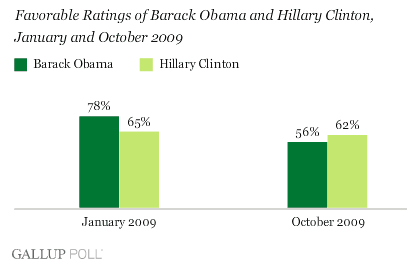
Source: Gallup, Hillary Clinton Now More Popular Than Barack Obama October 15, 2009
http://www.gallup.com/poll/123665/Hillary-Clinton-More-Popular-Barack-Obama.aspx
* * * * * *
I thought that the video linked below — using the Obama campaign as an example — did a nice job of illustrating the impact of branding — including the supporting ingredients, e.g. distinctive “brand mark”, strong visual presentations, consistent (and ubiquitous) use.

The Video Link
WARNING: The politics lean right. If you lean left, just pay more attention to the branding points being made than to the political points being raised.
It’s worth watching … really !
http://www.youtube.com/watch?v=GdtqtfXdR-c
* * * * *
Excerpted from RCP, Saving A Million Jobs at $787,000 Per Job, September 14, 2009
The White House Council of Economic Advisers is lead by three presidential appointees. Currently, these are Christina Romer, Austan Goolsbee, and Cecilia Rouse.
According to their biographies on the Council web site, these people have never held jobs outside of academia. Their positions at Princeton, Berkeley, and the University of Chicago were protected by lifetime tenure. Unemployment, to them, is a theory that cannot become a personal reality. What in their backgrounds makes them experts on the subject of job creation?
They are prize winning experts in macroeconomics. They are ambitious, articulate, well connected, and brilliant.
But, what qualifies these people to work as high level apparatchiks of a governing class determined to manage the businesses of others?
Long after these experts return to their sinecures in academia to train another generation of economists on the wisdom of central planning and Keynesian pump priming, it’s we and our children and our grandchildren who will be paying the price.
Full article:
http://www.realclearmarkets.com/articles/2009/09/14/saving_one_million_jobs_at_787000_per_job_97404.html
* * * * *
One of Team Obama’s mantras is that under government-run healthcare, payments to doctors will be made based on quality (outcomes) rather than the quantity of procedures being done.
Nice philosophically, but how to make it happen ?
Couple of observations:
I guess it’s better to bum’s rush through legislation than to give it serious thought. Disappointing.
* * * * *
This was originally posted July 23.
Six weeks later, it’s still Obama’s silver bullet for covering some added healthcare costs … but nothing has been done. If the “nut” is so juicy, go crack it already. Comprehensive healthcare reform isn’t required to root out waste and fraud in existing programs. We’ve wasted another $6.5 billion since my last post on the subject. Hmmm.
* * * * *
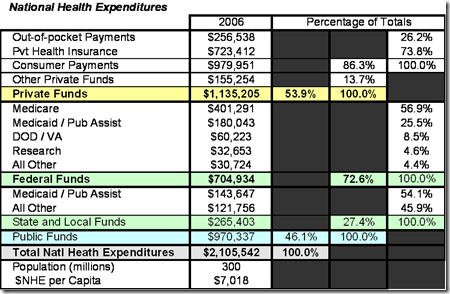
Currently, U.S. health care expenditures are about $2,1 trillion (just over $7,000 per person).
Of that, roughly half is already government administered via Medicare and Medicaid.
Would someone please explain to me:
(!) Why Obama’s crack team doesn’t fix the problem instead of just constantly whining about it ? My hunch: finding random instances of abuse is easy, but ferreting out fraud en masse is hard to do – and fixing it requires a massive overhaul of systems and procedures. If more people or resources are required, spell them out and get Congress to approve them post haste.
(2) If that half of the national healthcare budget is managed so badly by the government, why should we expect that the government will do any better with the other half if they take that over?
Ken’s Take: How about the government fix Medicare-Medicaid starting today, and when success is evident, come back and pitch to take over the other half.
* * * * *
Hard Facts
* * * * *
Earlier in the month, I posted that:
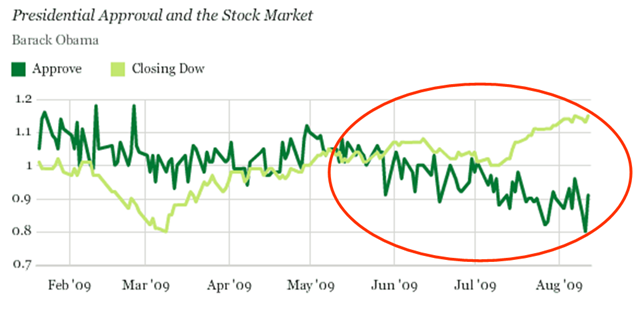
I think the recent stock market run-up is largely attributable to Pres. Obama’s declining approval ratings … and the numbers seem to corroborate the conclusion.
A team of of crack Gallup analysts has concluded that Presidential Approval shows no clear relationship to the Dow Jones Industrial Index.
Glancing at Gallup’s own chart, I ask: “Say what ?”
http://www.gallup.com/poll/122567/Presidential-Approval-Dow-No-Clear-Relationship.aspx
* * * * *
According to the LA Times …
The president’s job approval rating slipped to 50% in the latest Gallup Poll, reaching that point more quickly than all but two of his predecessors did.
President Ford slipped below 50% in his third month; President Clinton hit the mark in his fourth month.
It took President Eisenhower five years to fall below 50%. It took Presidents George H.W. Bush and George W. Bush each about three years. It took Presidents Johnson and Nixon more than two years.
Full article:LA Times, Obama’s job approval rating falls to new low, Aug 28,2009
http://www.latimes.com/news/nationworld/nation/la-na-obama-poll28-2009aug28,0,7306834.story
* * * * *

http://www.realclearpolitics.com/epolls/other/president_obama_job_approval-1044.html
* * * * *
A loyal reader replied to my original post “ You’re too focused on Obama’s disapproval ratings”, the market is reacting in a “normal” way to a Democratic president. He referenced a Forbes article by investment guru Ken Fisher.
The Obama Effect. Ken Fisher, 06.03.09
http://www.forbes.com/forbes/2009/0622/wall-street-stocks-obama-portfolio-strategy.html
“Wall Street marks down stocks before a Democrat takes office–before, in fact, he is even elected. After the inauguration there’s a good chance for a rebound.
With Democratic politicians the big fear is about how antibusiness and anticapitalist they will be.
Obama says lots of stupid, scary things. That fear hit markets early in the election cycle (and early after inauguration).
But once in office the overwhelming motivation of a left-of-center President slowly morphs toward getting reelected.
Achieving that means pandering more to the independent voters and liberal Republicans, less to the Democratic power base.
Obama’s concern now is the recession and the job creators that can take us out of it. That means slowly backing off soak-the-rich, anticorporate talk over time.
The reverse happens with Republicans. They come in riding high expectations for pro-business, pro-growth policies–and inevitably disappoint investors as they drift away from their power base. Optimism fades, depressing stocks.”
* * * * *
Ken’s Take: Rather than contradicting my original point (market buoyed as O’s disapproval increases), I think Fisher’s observation supports it.
Though O is in battle mode now to push through Cap & Tax and nationalized healthcare, the market is assuming that the increasing opposition (as indicated in the disapproval numbers) will make him come to his senses and move to the middle, i.e. start to act more like a “normal” Democratic president.
My prediction stands: if O fends off the opposition now, stays way left, and gets C&T and ObamaCare … the market will tank. We’ll see.
* * * * *
Thanks to Mike for the feedback.
* * * * *
I think the recent stock market run-up is largely attributable to Pres. Obama’s declining approval ratings … and the numbers seem to corroborate the conclusion (chart below plots O’s disapproval rating vs the DJIA).
Specifically, when O’s approval dropped below 55% (i.e. disapproval increased above 45%) in late June, the market started a big rally. Of course, correlation doesn’t necessarily connote causation. So, what’s the explanation?
Simple. The market is scared to death of Cap & Tax, Trillion $ Government Healthcare, and astronomical national debt. As O’s approval flags, odds go against T&C and ObamaCare. The market is factoring in severely watered down initiatives … or a long, long delay in the legislative process.
Pay close attention to O’s approval ratings and public support for ObamaCare. If those two related metrics gain renewed traction, the market will stall – and probably will tank again. Just watch.

* * * * *
Ken’s Take: Since Rasmussen was first to report Obama’s approval below 50%, his methodology is being questioned by mainstream media. Below is a pretty clear explanation.
Bottom line: Rasmussen samples likely voters instead of all adults and distinguishes between ‘strong’ and ‘somewhat’ approval (and disapproval).
* * * * *
From RCP,Obama Upside Down, July 24th, 2009
Rasmussen officially becomes the first poll to show the President with an upside-down approval rating. The pollster has him at 49% approve, 51% disapprove today. Rasmussen’s polls are typically spot-on in the end, but he’s been a consistent outlier on the approval rating issue.
Part of this is that Rasmussen samples likely voters, while most pollsters are sampling adults or registered voters right now. Likely voters typically skew Republican by a few points. On the one hand, it is difficult to screen for likely voters this early on, but on the other hand, this could be something of a preview of whether things will go when other pollsters begin imposing likely voter screens.
The other thing is that Rasmussen gives for options: Strongly approve, strongly disapprove, somewhat approve, and somewhat disapprove. It may well be the case that, given a simple “approve/disapprove” rubric, many people who somewhat disapprove of the job Obama is doing are unwilling to give a complete “disapprove” answer. By adding the “somewhat” nuance, Rasmussen may be nudging voters into the “disapprove” camp.
One final thought: Rasmussen typically has fewer undecideds than other pollsters. It may be that people who somewhat approve or somewhat disapprove of the President are more likely to describe themselves as “undecided.” Pushed away from the “undecided” option, these voters may then choose the “somewhat disapprove” or “somewhat approve” option; it may be that, for now, the undecideds are leaning away from Obama. This would make sense, given the general sense of approval that has surrounded Obama’s first six months, there may be a large chunk of the populace that simply isn’t willing to voice disapproval of him right now.
At any rate, an unwelcome milestone for the President.
Source article:
http://realclearpolitics.blogs.time.com/2009/07/24/obama-upside-down/
* * * * *
The Rasmussen Reports daily Presidential Tracking Poll for Friday shows that 49% of voters say they at least somewhat approve of the President’s performance. Fifty-one percent (51%) disapprove.
Today marks the first time his overall approval rating has ever fallen below 50% among Likely Voters nationwide.
30% of the nation’s voters now Strongly Approve of the way that Barack Obama is performing his role as President. Thirty-eight percent (38%) Strongly Disapprove giving Obama a Presidential Approval Index rating of -8 .
Just 25% believe that the economic stimulus package has helped the economy.
Fifty-three percent (53%) now oppose the Congressional health care reform package. That’s up eight points over the past month.

* * * * *
,
As usual, I have a different take on Obama’s press conference remark that Cambridge Mass. police acted “stupidly” by arresting a prominent black academic just because he was being disorderly.
Most press reports describe that statement as an “off the cuff” remark. I doubt it. Obama’s prior press conference outted the administration’s careful selection of questioners and their likely (or assured) questions. The mere fact that the question was last in the press conference leads me to conclude that it was orchestrated, and that the President’s answer was deliberate.
Why?
Though Obama campaigned as a grand uniter, he governs as a divider – rewarding folks he deems good guys (i.e. those who agree with him), and punishing those he considers bad guys (i.e. those who disagree with him).
RealClearPolitics observes “Obama maintains the strong support of his base … he continues to be the most polarizing modern president.”
http://www.realclearpolitics.com/articles/2009/07/23/obamas_public_support_cracking_at_6_months_97574.html
Cutting to the chase: Obama’s overall approval rating is 94% among blacks.
But 40% of whites and “others” strongly disapprove of his performance as president.
And, though his total approval among blacks remains sky high, the approval intensity is dropping. Shortly after the inauguration, over 80% of blacks strongly approved of his performance as president. That number has slipped down to 64% – still high, but eroding.
My take: Obama is a win at all costs guy. With his overall approval ratings falling and his chaotic healthcare plan faltering, he is going back to the well – revving up his core constituency – getting their intensity level back up – framing issues as “us” versus “them”. Watch that theme spill over to the healthcare debate.
Though I think he was trying to be clever, it looks like the gambit failed. Most news shows led with the “stupid white cop” story – pushing healthcare to the backburner – and stoking even greater polarization. Not good.
As the expression goes: “Too clever by half.”
* * * * *
Earlier this week, President Obama turned on a rhetorical dime and rebranded “healthcare reform” as “insurance reform”. Attacking insurance companies as profiteers and the root cause of spiraling healthcare costs.
Many naive Americans, will likely buy-in to the pitch . After all, it’s easy to hate insurance companies since they force us to give up our current doctors in favor of less costly ones, deny us the “right” to have certain procedures done, make us co-pay for drugs and services, and raise our premiums to cover the bloated medical expenses of obese smokers. Those guys are downright evil, right ?
The argument is standard liberal dribble. As typical, it falls apart when subjected to factual analysis.
Below is an analysis that I posted last fall.
Bottom line: (1) health insurance companies don’t make all that much money, and (2) if you think that insurance companies deny a lot of procedures and claims, just wait until government rationing of healthcare kicks in.
* * * * *
Originally posted 09-09-08
https://kenhoma.wordpress.com/2008/09/09/health-insurance-those-health-insurance-companies/
* * * * *
In the book Crunch, liberal economist Jared Bernstein criticizes health insurance companies, asserts that:
These are oft repeated refrains from folks who advocate government administered universal heath insurance.
* * * * *
I think this argument displays a remarkably shallow understanding of what health insurance companies do, how much money they make, and how they make it. And. it places a remarkably high level of confidence in government administered programs (think, the FDA chasing down salmonella sources).
* * * * *
First, what is the financial upside if all health insurance companies’ profits are eliminated and put in the national bank as economic cost savings.
Well, for openers, the health insurance companies — don’t make all that much money. Consider the 2007 financial results for the two biggest “pure” health insurance companies: United Health Care and Wellpoint.
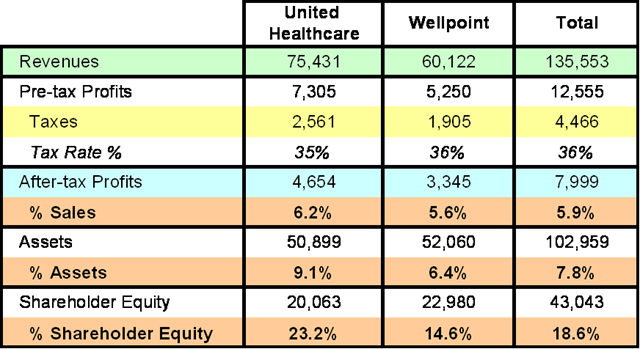
Note that pre-tax profits are about 9% of revenues [12,555 divided by135,553]. About 1/3 of the pre-tax already goes to the government in taxes; about 2/3’s (6% of revenues) drops through to the bottom line.
Currently, U.S. health care expenditures are about $2,1 trillion (just over $7,000 per person). Of that, roughly half is “sourced” from the government via Medicare and Medicaid. Of the half that is private pay, about 2/3’s ($725 billion ) goes through health insurance companies — the other 1/3 is out of patient’s pockets or “other” (e.g. charitable gifts to medical centers).
So, what’s the financial upside if all health care insurers were “disintermediated” and their profits were banked as economic cost savings to the system ?
Well, assuming that the rest of the healthcare insurance companies have profitability profiles comparable to United and Wellpoint — there’s a pre-tax profit of 9% that applies to $725 billion in revenues — or roughly $65 billion dollars.
But wait, the government is already getting about 1/3 of that in taxes.
So, the net gain is at most $40 to $45 billion, or about 2% of the $2.1 trillion in total healthcare spending. Why “at most” ?
Simple, because it assumes that the government will be able to administer the programs as efficiently as the private companies. Call me cynical, but I doubt it.
* * * * *
On the second point, that health insurance companies reject claims and refuse to authorize treatment as a means of boosting their.bottom lines.
Well, that’s at most partially true, and catches the government administration folks in a circular argument.
First, about 1/3 of health insurance companies’ transactions volume is administrative processing done in support of companies (usually big ones) that choose to self-insure. That is, the self-insuring companies take all of the risk, and only pay the insurance companies a fee (that includes profit, of course) for negotiating with health care suppliers and processing transactions — in conformance with terms, conditions, and rules dictated by the companies. There are agreed to standards that are enforced.
The other 2/3’s of their transaction volume is strictly premium based. If more treatments are authorized, costs go up and premiums go up to cover them. If treatments are denied, costs go down, and the competitive market pushes premiums down,It’s that simple.
* * * * *
Want more from the Homa Files?
Click link => The Homa Files Blog
* * * * *
Team Obama thinks that it has corporate America right where it wants it –- under its thumb.
CEOs and Boards serve at the pleasure of the President, executive compensation is overseen by a Federal czar, product lines are green-dictated by Federal czars and Task Forces, contract law is suspended at will, bankruptcy laws are changed on the fly — relegating secured creditors behind politically-favored unsecured ones, ineffective government agencies dictate to stumbling companies, unions are given jolts of legislated adrenalin.
The Administration has empowered itself to sort out good guys from bad guys, to pick marketplace winners and losers, and to destine survivors and failures, Companies (and individuals) that question government policy are ridiculed, harassed, and punished; those that oppose the policies are squashed faster than decades-old GM or Chrysler dealers.
Corporate CEOs are quaking in there boots … or are they ?
Team Obama –- which consistently demonstrates uncanny business naiveté — may be underestimating a staple of organizational behavior: the power of passive aggressive resistance. Rather than being openly insubordinate when confronted with undesirable tasks — and getting nailed by vindictive superiors — employees and organizational units will often just procrastinate and work work inefficiently, in effect, pocket vetoing the unpopular orders from above. In corporate jargon, it’scalled “slow rolling”.
Sure, corporate chieftains will tell President Obama what he wants to hear, and may even stand next to him on a stage in a faux show of support. Why risk the rath of a Presidential punishment, especially when there are other ways to skin a cat?
Specifically, with respect to continuing job cuts and rising unemployment, here’s a theory of the case.
First, you can’t let a good crisis go to waste, right? Businesses always use tough economic times to clean house. Fat builds in all organizations over time. In “normal” times, it’s difficult to get rid of dead wood. Employment laws — perhaps well-intended originally –- serve to protect slackers by making it cumbersome and difficult to fire anybody. When the economic tide rolls out, companies have the air cover they need to resize and purge under-performers en masse. The tendency is to cut deep. If some muscle gets pared too, so be it. It can be rehabilitated later.
In typical business cycles, employment is a so-called lagging indicator of an economic rebound. That is, when the economy starts to recover, jobs are usually added back very slowly. Why? Because businesses have a renewed zeal for productivity, they recommit to keeping the fat from building up again, and they want to be sure that the signs of better economic times aren’t false positives.
Eventually, open positions are filled and capacity — human and physical — is added to meet increasing demand. It may take awhile, but the system eventually gets back in balance.
If the economy is bottoming out now -– as many experts assert — employment would be expected to start rebounding in 2010. But, it won’t. Why?
Because the rules of engagement have changed. It has become far more costly and risky for companies to restore or enlarge their payrolls.
For openers, the minimum wage is scheduled to increase by over 10%, making entry level staffing more costly. Then, there is the risk that “employer mandate” will force companies to expand health insurance coverage or pay fines – again, making labor most costly. Then, there is the threat of “card check” legislation turbo-boosting the mass unionization of U.S. businesses . And now, there’s the evident risk that government will change rules and regulations on political whims, creating an unprecedented level of uncertainty.
The bottom line: businesses will resist government policies passive aggressively. Fewer jobs will get added back than history would suggest, and those that get added back will materialize later than past patterns. Businesses will add jobs as a last resort rather than trying to build capacity ahead of the economic growth curve. Why should companies increase their costs and risks any more than is absolutely necessary ? Companies will continue to off-shore jobs, but will be more clever and clandestine about it, e.g. by vertically disintegrating and simply buying goods and services from 3rd parties.
Given the Administration’s anti-corporate rhetoric, actions, and proposed game-changing rules, I doubt that many CEOs will be taking on added costs and risks to boost the administration. More likely, they will let unemployment continue to creep up, and will slow roll the process of rehiring. Corporate chieftains will sit back and watch the President squirm and spin his “4 million jobs – saved or created”. As Rev. Wright would say “the chickens will have come home to roost”. Passively aggressive resistance at its very best.
Unfortunately, that means we’ll be seeing double digit unemployment for some time – at least through the 2010 Congressional elections.
* * * * *
Top-line Numbers
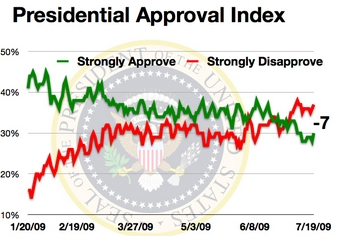
The most recent Rasmussen Poll reports that 30% of likely voters Strongly Approve of Obama’s performance as president, and 37% Strongly Disapprove. That puts his Presidential Approval Index — the difference between the percentage of likely voters who Strongly Approve and the percentage who Strongly Disapprove — at minus 7. The PAI has been negative for all of July, and it has been consistently around minus 7 for the past week or so.
* * * * *
Top-line Analysis
The generally reported story line: Obama is personally popular, but his policies are causing concern among rock hard GOP opponents and some independents “at the margin”.
But, not to worry – ratings slips are to be expected when a President pushes an aggressive agenda and the Presidential honeymoon period winds down.
But, I’ve been noticing that acquaintances who were strong Obama supporters seem less willing to pitch his case and defend his actions to date. While “buyer’s remorse” overstates the case, I am seeing some doubts and head-scratching.
So, I did some digging.
I previously posted some FD-Hotline polling results that indicated Obama is slipping among males, independents, and rural voters. Interesting, but not earth-shaking.
The “internals” from Rasmussen polling – are way more revealing. They’re under-reported – even by Rasmussen – probably because they tarnish the Obama mystique and reek of political incorrectness.
For example:
Keep reading for the drill down …
* * * * *
First Level Drill Down
Comparing Rasmussen poll results from the week of July 6-12 to the week of June 1-7
For the total sample of likely voters: Obama’s PAI (the difference between strong approvers and strong disapprovers) dropped by 10 points, from plus 3 to minus 7
Highlights from the “internals”
For males: Strong Disapproval increased by 7 points, from 35% to 42%
For females: Obama’s PAI dropped by 9 points, from plus 9 to even zero
For whites: Strong Disapproval increased by 5 points, from 36% to 41%
For blacks: Strong Approval dropped 10 points, from 70% to 60%
For “Other”: Strong Disapproval increased 16 points, from 27% to 43%
For Democrats: Strong Approval dropped 12 points, from 62% to 50%
For Republicans: Strong Disapproval increased 7 points, from 54% to 61%
For “Other”: Strong Disapproval increased 8 points, from 35% to 43%
For 18-29 olds: Strong Approval dropped 12 points, from 39% to 27% and Obama’s PAI dropped by 17 points, from plus 17 to even zero
For 30-39 olds:Strong Disapproval increased by 11 points, from 31% to 42%
For those earning between $20,000 and $40,000: Obama’s PAI dropped by 12 points, from plus 5 to minus 7
For those earning between $40,000 and $60,000: Strong Disapproval increased by 12 points, from 35% to 47%
For those earning between $75,000 and $100,000: Strong Disapproval increased by 9 points, from 35% to 44%
For more still more detail from the internals, keep reading.
* * * * *
Rasmussen June to July Internals
Comparing poll results from the week of July 6-12 to the week of June 1-7
For the total sample of likely voters:
* * * * *
Gender
For males:
For females:
* * * * *
Race
For whites:
For blacks:
For “Other”:
* * * * *
Party
For Democrats:
For Republicans:
For “Other”:
* * * * *
Age
For 18-29:
For 30-39:
* * * * *
Income
For those earning less than $20,000
For those earning between $20,000 and $40,000
For those earning between $40,000 and $60,000
For those earning between $75,000 and $100,000
* * * * *
Ken’s Take: The ballooning deficit and national debt raise two mega-worries: (1) An eventual increase in interest rates as it gets increasingly difficult to find buyers for US bonds, and (2) the increasing dependence on foreign buyers of the debt – especially China. Neither should be taken lightly …
* * * * *
Excerpted from NY Post,”The Never Ending Pork Parade”, July 4, 2009
Thanks to ongoing trade deficits and relentless borrowing, America’s financial status is deteriorating rapidly.
So while the Obama administration frets that we are dangerously dependent on foreign oil (Note: Canada sends us as much oil as the Persian Gulf region, and Mexico not much less), we are increasingly threatened by dependence on foreign bondholders who could wreak havoc on the dollar and our interest rates far more easily than OPEC could cut off our oil.
Full article:
http://www.nypost.com/seven/07042009/postopinion/opedcolumnists/the_never_ending_pork_parade_177485.htm?page=0
* * * * *
To cover the $1 trillion cost of heath care “reform”, Team Obama has proposed raising taxes by $544 billion, almost all on the “rich” — those in the top 5% of incomes.
That raises a couple of issues:
1) What if the rich “lay down” – working less as their prospective marginal take home pay gets cut? (see chart below)
2) How to inspire the next generation to bust their butts to grab for the golden ring? Maybe “doing good” will be enough motivation, but I’ll be betting “under” on that one.
3) What happens when the filthy rich are fully taxed and there’s still a big budget gap? My hunch: they’ll be coming after the rest of us.

Source: IBD, Tax Hike Comin’,July 16, 2009
http://www.ibdeditorials.com/IBDArticles.aspx?id=332637892829537
For details (local + state + federal)– all states — see Tax Foundation Report
http://www.taxfoundation.org/publications/show/24863.html
* * * * *
The Diageo/Hotline Poll of 800 U.S. registered voters conducted from July 9-13, 2009, finds that the percentage of American voters who approve of the job President Obama is doing has dropped 9points to 56%. The percentage who disapprove jumped by 7 points to 38%. So, the approve / disapprove “spread” was cut almost in half from 34% to 18%.
According to Hotline, the approval decline was primarily driven by 15 point drops among men from 61% to 46%), independents from 63% to 48%), and rural voters (from 59% to 44%). Note that a minority of voters in these 3 segments now approve of the job that Obama is doing.
Hotline also reports that 55% of voters now believe that the country is “seriously on the wrong track”; that only 11% are “very confident that Stimulus I will create new jobs”; and 40% “strongly oppose a second stimulus package”.
For all of the poll results:
http://www.diageohotlinepoll.com/documents/diageohotlinepoll/FDDiageoHotlineJulyTopline_FORRELEASE_07.15.09.pdf
* * * * *
Ok, another $1 billion government program . This one is intended to to jump-start — or as VP Biden would say “dropkick” –the car industry.
Let’s start with the basics: if the program were to work, fewer than 300, 000 cars would be sold –- about 1 weeks worth of sales. And, not all of those would be be incremental to the ones that might have bought any way. So call it 250,000.
But, not to worry, not much of this money will make its way out of Treasury’s vault.
Why?
Though there are no income limits on voucher recipients, nor restrictions on where the new cars are made — the program has lots of “small print” qualifiers.
According to Business Week:
• Vouchers of either $3,500 or $4,500 will only be given to people who trade in an older vehicle to buy a new one.
• The trade-in, or clunker, must be no older than 25 years, have average gas mileage of less than 18 miles per gallon.
• The clunker must have been owned by the seller for at least a year.
• The new car must cost less than $45,000 and get more than 22 mpg. To get the higher voucher, the new vehicle must also average 10 more miles per gallon than the old one.
• To get the higher voucher, the new vehicle must also average 10 more miles per gallon than the old one.
• For trucks—SUVs, pickups, and minivans, a improvement of at least 2 mpg between the old and new vehicles qualifies for $3,500; 5 mpg or more entitles buyers to $4,500.
Ken’s translation of the rules: good luck.
If a clunker qualifies, there are some obvious questions about whether the folks driving those clunkers are willing and able to step up to brand-new wheels.
Think about it.
The economic impact is less than the face value of the rebates. Why? Because the clunkers probably have some market value that is greater than zero – i.e. the owner can sell it as a step-up model to somebody driving a clunkier (or dead) clunker. An economist would say that only the difference between the rebate and the clunker’s fair market value counts as an incentive.
More important, people usually drive clunkers because they can’t afford any thing else. People driving clunkers often buy used cars – not new ones, and even with a $4,500 discount, they probably won’t want to take on new-car payments during a time of economic hardship.
Maybe an arbitrage market will emerge, with upscale people buying a clunker on the open market for less than its clunker program rebate, and trading it in for fancy new wheels (that they were going to buy anyway) – deducting the the clunker rebate’s full “coupon” value.
What about the rule that somebody has to have owned the car for at least 1 year? Easy: the current clunker owner uses the rebate to buy a new cay, and then immediately turns around and flips the new car to a pre-arranged “partner”. Pretty easy.
Congressional reps really should read these bills before they enact them …
Source article:
Business Week, Cash for Clunkers: What Can $1 Billion Buy?, June 24, 2009
http://www.businessweek.com/magazine/content/09_28/b4139000349712.htm
* * * * *
These guys were supposed to be the finance and economics studs in the administration, but have been practically invisible of late.
What’s up?
* * * * *
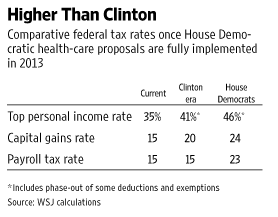
Ken’s Take: During the campaign, Candidate Obama promised repeatedly: “not one dime of new taxes if you make under $250,000” and “for the top brackets, no higher than under President Clinton”. The latter will fall by the wayside if the Rangel proposal is enacted. Think the former is far behind ?
* * * *
Excerpted from WSJ, The Small Business Surtax, July 14, 2009
Every detail isn’t known, but late last week Ways and Means Chairman Charlie Rangel disclosed that his draft bill would impose a “surtax” on individuals with adjusted gross income of more than $280,000 a year.
This would hit job creators especially hard because more than six of every 10 who earn that much are small business owners, operators or investors, according to a 2007 Treasury study.
That study also found that almost half of the income taxed at this highest rate is small business income from the more than 500,000 sole proprietorships and subchapter S corporations whose owners pay the individual rate.
In addition, many more smaller business owners with lower profits would be hit by the Rangel plan’s payroll tax surcharge. That surcharge would apply to all firms with 25 or more workers that don’t offer health insurance to their employees, and it would amount to an astonishing eight percentage point fee above the current 15% payroll levy.
Full article:
http://online.wsj.com/article/SB124753106668435899.html
* * * * *
Rasmussen Reports, Wednesday, July 08, 2009
The Rasmussen Reports daily Presidential Tracking Poll for Wednesday showed that 32% of the nation’s voters now Strongly Approve of the way that Barack Obama is performing his role as President.
The number who strongly disapprove inched up another point to 37% — the highest level measured to date.
Obama’s Presidential Approval Index rating – the difference between strong approvers and strong disapprovers — is minus 5 — the lowest level yet for Obama .
Obama’s total approval rating – the sum of strong and “somewhat” approvers – has dropped to 52% among likely voters.

* * * * *
Ken’s Take: As a “get it done” aficionado, I’m intrigued by Team Obama’s inability to make anything really happen. Banks are still holding toxic assets and foreclosing, the economy is still unstimulated, etc. Their recipe: motivating rhetoric, passed legislation, a new web site, and a declaration of victory … followed by ginned up numbers that they don’t even believe. Below is a partial explanation …
* * * * *
NY Times, “Vince Lombardi Politics”, David Brooks, June 30, 2009
There are two types of political pragmatism. There is legislative pragmatism — writing bills that can pass.
Then there is policy pragmatism — creating programs that work. These two pragmatisms are in tension, and in their current frame of mind, Democrats often put the former before the latter.
On the stimulus bill, the Democratic committee chairmen wrote a sprawling bill that incorporated the diverse wishes of hundreds of members and interest groups. But as they did so, the bill had less and less to do with stimulus. Only about 40 percent of the money in the bill was truly stimulative, and that money was not designed to be spent quickly.
For example, according to the Congressional Budget Office, only 11 percent of the discretionary spending in the stimulus will be disbursed by the end of the fiscal year. The bill passed, but it is not doing much to create jobs this year and it will not do nearly as much as it could to create jobs in 2010.
On cap and trade, the House chairmen took a relatively clean though politically difficult idea — auctioning off pollution permits — and they transformed it into a morass of corporate giveaways that make the stimulus bill look parsimonious. Permits would now be given to well-connected companies.
The bill passed the House, but would it actually reduce emissions? It’s impossible to know. A few years ago the European Union passed a similar cap-and-trade system, but because it was so shot through with special interest caveats, emissions actually rose.
The great paradox of the age is that Barack Obama, the most riveting of recent presidents, is leading us into an era of Congressional dominance. And Congressional governance is a haven for special interest pleading and venal logrolling.
When the executive branch is dominant you often get coherent proposals that may not pass. When Congress is dominant, as now, you get politically viable mishmashes that don’t necessarily make sense.
Full article:
http://www.nytimes.com/2009/06/30/opinion/30brooks.html?_r=2&ref=opinion
* * * * *
Note: “”Mulligan” is a golf term. When a golfer hits a particularly bad shot, he may petition his buddies (usually fruitlessly) for a 2nd try, a “do over”. That’s called a Mulligan
* * * * *
Ken’s Take: Washington has thrown trillions of dollars at this recession, including that famous $787 billion in more spending that was supposed to yield $1.50 in growth for every $1 spent.
The ‘stimulus’ promised a jobless peak of 8%; it’s now 9.5%.
The defense: (1) We guessed wrong (Biden), (2) Less than 20% of the stimulus has hit the economy (wasn’t it an “emergency bill” intended for this year?), (3) It’s Bush’s fault (remember him, from long ago?)
Since so little of the stimulus has been spent, let’s reclaim the dough and either bank it or do it right.
* * * * *
Extracted from WSJ, “Tilting at Windmill Jobs”, July 3, 2009
As always, a sustained expansion and job creation must come from private investment and risk-taking.
Yet as America’s entrepreneurs look at Washington they see uncertainty and higher costs from:
a $1 trillion health-care bill;
None of this inspires “animal spirits.”
The best thing Mr. Obama could do to create jobs would be to declare he’s dropping all of this and starting over.
http://online.wsj.com/article/SB124657739768489217.html
* * * * *
Sunday’s Rasmussen tracking poll showed Pres. Obama’s Presidential Approval Index at zero … 32% strongly approved of the job he’s doing as president; 32% strongly disapprove – netting to a zero.

Things get more interesting when you dive down into the numbers. Previously, I posted that virtually all blacks strongly approve; he runs about a 10 point PAI deficit among whites; and he roughly breaks even with all others.
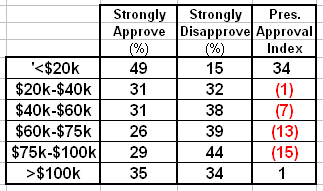
By income, low earners (under $20,000 per year) give him a plus 34 PAI; folks earning $60,000 (about where income taxes kick in these days) to $100,000 give him double digit negatives; he breaks even among the rest.
TakeAway: nation is increasingly split by taxpayers staus – if you don’t pay income taxes (or are so rich that it doesn’t matter). Obama’s likely to be your man.
* * * * *
Sunday’s Rasmussen tracking poll showed Pres. Obama’s Presidential Approval Index at zero … 32% strongly approved of the job he’s doing as president; 32% strongly disapprove – netting to a zero.
Things get more interesting when you dive down into the numbers. Previously, I posted that virtually all blacks strongly approve; he runs about a 10 point PAI deficit among whites; and he roughly breaks even with all others.
By income, low earners (under $20,000 per year) give him a plus 34 PAI; folks earning $60,000 (about where income taxes kick in these days) to $100,000 give him double digit negatives; he breaks even among the rest.
TakeAway: nation is increasingly split by taxpayers staus – if you don’t pay income taxes (or are so rich that it doesn’t matter). Obama’s likely to be your man.
* * * * *
Ken’s Take: The foreclosure program didn’t slow foreclosures, the stimulus program hasn’t stimulated anything, and the toxic asset program hasn’t bought any toxic assets. Are these guys ever going to be held accountable for their free-spending and ineffective programs?
* * * * *
WSJ, “Wary Banks Hobble Toxic-Asset Plan”, June 29, 2009
The Obama administration’s plan to enable banks to dump troubled assets is facing troubles.
In March, Treasury Secretary Geithner announced a two-pronged plan to offer favorable government financing to entice investors to buy bad loans and toxic securities from banks.
But that initiative — called the Public-Private Investment Program, or PPIP — has lost momentum.
Big banks worried about having to sell at fire-sale prices while small banks feared they would be shut out.
Potential buyers balked at the risk of doing business with the government, concerned that politicians might demonize them for making big profits.
Early this month, the Federal Deposit Insurance Corp. essentially shelved one arm of PPIP — the government-financed buying of bad bank loans.
Mr. Geithner recently said the other part — to facilitate the buying from banks of troubled securities, many backed by real-estate loans — could be scaled back because investors are “reluctant to participate.” This week, the government is expected to name investment firms to manage this securities-buying portion
Full article with lots of detail:
http://online.wsj.com/article/SB124622976702566007.html#mod=testMod
* * * * *
Ken’s Take: The foreclosure program didn’t slow foreclosures, the stimulus program hasn’t stimulated anything, and the toxic asset program hasn’t bought any toxic assets. Are these guys ever going to be held accountable for their free-spending and ineffective programs?
* * * * *
WSJ, “Wary Banks Hobble Toxic-Asset Plan”, June 29, 2009
The Obama administration’s plan to enable banks to dump troubled assets is facing troubles.
In March, Treasury Secretary Geithner announced a two-pronged plan to offer favorable government financing to entice investors to buy bad loans and toxic securities from banks.
But that initiative — called the Public-Private Investment Program, or PPIP — has lost momentum.
Big banks worried about having to sell at fire-sale prices while small banks feared they would be shut out.
Potential buyers balked at the risk of doing business with the government, concerned that politicians might demonize them for making big profits.
Early this month, the Federal Deposit Insurance Corp. essentially shelved one arm of PPIP — the government-financed buying of bad bank loans.
Mr. Geithner recently said the other part — to facilitate the buying from banks of troubled securities, many backed by real-estate loans — could be scaled back because investors are “reluctant to participate.” This week, the government is expected to name investment firms to manage this securities-buying portion
Full article with lots of detail:
http://online.wsj.com/article/SB124622976702566007.html#mod=testMod
* * * * *
Ken’s Take: First, the gov’t tossed contract and bankruptcy laws out the window and screwed the secured creditor (i.e. bondholders) by subordinating their claims beneath unsecured UAW claims.
What I missed was that the gov’t was also tossing product liability claims out, too. For example, if you’re driving a Chrysler car and the engine blows up because of a defect, your family gets zilch from the New Chrysler.
GM was trying to pull the same trick. But, since GM is bigger and folks had time to think about the details of the gov’t orchestrated settlement, a ruckus broke out.
Now, the New GM will altruistically accept responsibility for claims that might arise from Old GM cars that are still on the road. Big of them.
Question: why in the world would anybody buy a bond issued by New Chrysler and New GM, knowing that their security is, well, unsecured.
And, why would anybody take a chance buying a car from those companies. You’ve gotta have a high risk tolerance, for sure.
* * * * *
Excerpted from WSJ, “GM to Take On Future Product-Liability Claims”, June 28, 2009
GM under pressure from state attorneys general, has agreed to assume legal responsibility for injuries drivers suffer from vehicle defects after the auto maker emerges from bankruptcy protection.
The concession means consumers who are injured in car accidents after GM emerges from Chapter 11 protection will be able to bring product-liability claims against the new government-owned auto maker.
Under GM’s original bankruptcy plan, the auto maker planned to leave such liabilities behind after selling its “good” assets to a “New GM” owned by the government. That meant future GM car-accident victims who believed faulty manufacturing caused their injuries would be unable to sue the New GM. Instead, they would have been treated as unsecured creditors, fighting over the remains of GM’s old bankruptcy estate.
In court papers, GM maintained it was not legally-required to take on the claims, saying “federal-preemption” meant the bankruptcy code overrode state laws governing the rights of car-accident victims to sue the new GM. It also noted that Chrysler, which recently emerged from bankruptcy in a deal with Fiat, would not be responsible for such claims.
But the auto maker said it agreed to take on future product-liability claims “to alleviate certain concerns that have been raised on behalf of consumers.”
Full article:
http://online.wsj.com/article/SB124614495545265019.html#mod=testMod
* * * * *
Ken’s Take: The mainstream media seems to be ignoring it, but virtually nobody watched the Obama healthcare infomercial on ABC. Hmmm.
Couple of observations:
(1) Maybe, just maybe, Obama yak-yak fatigue is finally setting in
(2) So, ABC took a hit to it’s journalistic reputation without even getting a swell of viewers, That should teach the compliant networks a lesson.
(3) Imagine the ratings if Michael Jackson (may he RIP) had died a day earlier than he did
* * * *
From The Live feed, “ABC’s White House special struggled for viewers”, June 25, 2009
President Obama’s town hall meeting on health care delivered a sickly rating Wednesday evening.
The one-hour ABC News special “Primetime: Questions for the President: Prescription for America” (4.7 million viewers, 1.1 preliminary adults 18-49 rating) had the fewest viewers in the 10 p.m. hour (against NBC’s “The Philanthropist” debut and a repeat of “CSI: NY” on CBS). The special tied some 8 p.m. comedy repeats as the lowest-rated program on a major broadcast network.
The special was shot at the White House and featured the president answering questions about his health care plan. The president’s primary message was that those who like their current insurance will be able to keep it and that taking no action will result in higher health care costs.
The special drew fire from Republican leadership after refusing to allow an official opposition response, or even a paid ad. ABC also interviewed Obama on “Good Morning America” to help promote the special.
ABC points out that “Questions for the President” continued after the local news during late night on “Nightline” (4.3 million) and helped boost the news program to pull more viewers than CBS’ “Late Show” and NBC’s “Tonight Show.”
Source:
http://www.thrfeed.com/2009/06/abcs-white-house-special-struggled-for-viewers.html
* * * * *
Ken’s Take: The mainstream media seems to be ignoring it, but virtually nobody watched the Obama healthcare infomercial on ABC. Hmmm.
Couple of observations:
(1) Maybe, just maybe, Obama yak-yak fatigue is finally setting in
(2) So, ABC took a hit to it’s journalistic reputation without even getting a swell of viewers, That should teach the compliant networks a lesson.
(3) Imagine the ratings if Michael Jackson (may he RIP) had died a day earlier than he did
* * * *
From The Live feed, “ABC’s White House special struggled for viewers”, June 25, 2009
President Obama’s town hall meeting on health care delivered a sickly rating Wednesday evening.
The one-hour ABC News special “Primetime: Questions for the President: Prescription for America” (4.7 million viewers, 1.1 preliminary adults 18-49 rating) had the fewest viewers in the 10 p.m. hour (against NBC’s “The Philanthropist” debut and a repeat of “CSI: NY” on CBS). The special tied some 8 p.m. comedy repeats as the lowest-rated program on a major broadcast network.
The special was shot at the White House and featured the president answering questions about his health care plan. The president’s primary message was that those who like their current insurance will be able to keep it and that taking no action will result in higher health care costs.
The special drew fire from Republican leadership after refusing to allow an official opposition response, or even a paid ad. ABC also interviewed Obama on “Good Morning America” to help promote the special.
ABC points out that “Questions for the President” continued after the local news during late night on “Nightline” (4.3 million) and helped boost the news program to pull more viewers than CBS’ “Late Show” and NBC’s “Tonight Show.”
Source:
http://www.thrfeed.com/2009/06/abcs-white-house-special-struggled-for-viewers.html
* * * * *
Bold Endeavors: How Government Built America, and Why It Must Rebuild It Now by Felix Rohatyn
Background: Rohatyn was an investment banker with Lazard Freres before a second career in public service bailing out NYC from the brink of bankruptcy and serving as Ambassador to France under Clinton.
Central premise: “The nation is falling apart — literally. America’s roads and bridges, schools and hospitals, airports and railways, ports and dams, water lines and air control systems — the country’s entire infrastructure — is rapidly and dangerously deteriorating.
America needs to rebuild its infrastructure. It is a critical national priority, a costly long — term investment, and a visionary enterprise. It is a program that can provide tens of millions of much-needed jobs.
It is an undertaking that can only succeed if it is directed, coordinated, and largely financed by the federal government.
And, contrary to the glib reaction for many contemporary ideological naysayers, large-scale public investments can work, and with remarkable long-term success.”
Consider 10 bold endeavors that were done by the Federal government and had a
Bottom line: The above is about all that you ever need, so save your money
TakeAway: All major polls show that Obama’s approval rating is still over 50%, but showing significant recent slippage.
For the first time, Obama’s Presidential Approval Index has gone negative. Keep reading …
* * * * *
Rasmussen
Overall, 53% of voters say they at least somewhat approve of the President’s performance so far … 46% at least somewhat disapprove.
But, the Rasmussen Reports daily Presidential Tracking Poll for Sunday showed that 32% of the nation’s voters now Strongly Approve of the way that Barack Obama is performing his role as President … 34% Strongly Disapprove giving Obama a Presidential Approval Index rating of -2.
That’s the President’s lowest rating to date and the first time the Presidential Approval Index has fallen below zero for Obama.
Sorted by self-identified race, Obama’s PAI is plus 80 among blacks, minus 6 among whites, and minus 7 among all others.
By party affiliation, Obama is plus 56 among Dems, minus 50 among GOPs, and minus 6 among independents.
38% say we’re on the right track, 56% say we’re on the wrong track.
These results are consistent with recent Gallup and WSJ polls summarized below.
Gallup
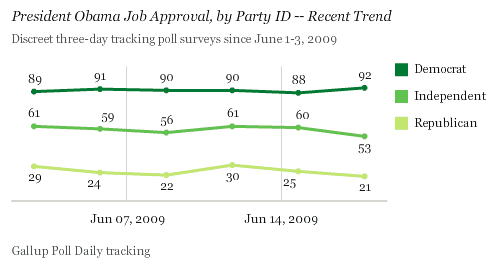
President Barack Obama’s job approval rating fell to 58% in Gallup Poll Daily tracking from June 16-18 — a new low for Obama in Gallup tracking. In the past couple of weeks, Dem approval has remained unshakable; GOP has fallen by 8 points; Independent support has fallen by a whopping 11 points.
http://www.gallup.com/poll/121028/Obama-Job-Approval-Slips-58-First-Time.aspx
* * * * *
WSJ / NBC
Since Feb., approval is down 4 or 5 points – disapproval is up 8 points – as some “not sure” have become negatively “sure”

Back on Feb. 16, I suggested a stake in the ground for measuring the success of Team Obama’s stimulus spending –- namely, the 8% to 8.5% unemployment rate that economists were predicting under a “do nothing” scenario.
Well, now that unemployment has blown past 9%, the “saved or created” math is getting pretty creative to say the least … and the shaky argument “it would have been even worse” is taking center stage.
Below is a reprise of the original post.
* * * * *
Obama’s team sets the stimulus bar at limbo level …”,
Obama says the trillion dollar pork-laden, faux stimulative program will “save or create up to 4 million jobs”.
Last week, I pointed out that “up to” provides mucho definitional cover by itself, but that the serious wiggle room comes from “jobs saved” — a comparison against some fabricated “what if” number.
Well, the fabricated “what if” number is already being planted:
Austan Goolsbee, one of Obama’s chief economic advisers, says he’ll consider the effort successful if the worst scenarios don’t come to pass, “if by the end of 2009 we aren’t looking at GDP numbers that are huge negatives, if unemployment rises to the 8% range rather than the 11% that some are predicting.”
I can’t find any non-Obama paid economist saying 11%. Most economists are saying that the unemployment rate will peak in the range of 8 to 8.5% if we do nothing. Apparently, Team Obama is prepared to declare success (i.e. claim millions of jobs saved) is the stimulus plan does about as well as doing nothing. The jobs saved will be calculated against a disaster scenario that they’ll specify, thank you.
In other words, a victory party is guaranteed …
* * * * *
Reference for Goolsbee quote:
http://money.cnn.com/2009/02/13/news/economy/easton_economicteam.fortune/index.htm?postversion=2009021310
Original post:
https://kenhoma.wordpress.com/2009/02/16/obamas-team-sets-the-stimulus-bar-at-limbo-level/
Summary: According to Rasmussen. only 26% of Americans applaud the GM bailout. (For reference, 17% favor boycotting GM cars as a form of protest.}
Why the low level of support? Perhaps because folks older than Obama remember a similar experience with Amtrak. Amtrak was supposed to turn a tidy profit, but taxpayers are still sinking billions of dollars into Amtrak—almost 40 years after buying it.
Economist James Langenfeld says the bailout of GM will be an even bigger disaster.
* * * * *
Excerpted from The daily Beast, “Is GM the New Amtrak?”. James Langenfeld, June 5, 2009
Both Congress and the Obama administration apparently believe a bailout is best for GM, and that “what’s good for General Motors” is still good for America. So we taxpayers appear to be on the brink of owning most of GM. Do we know what we are buying, how long we will own it, and what it will really cost? Perhaps we can learn some lessons from another government owned company, the National Rail Passenger Corporation—aka Amtrak. The Amtrak experience raises many issues about the future of GM.
In the 1960s, private railroads wanted to dump their unprofitable intercity passenger service and concentrate on their more-profitable freight service. So in 1971 the U.S. government obliged them by creating Amtrak.
The talk then was all about becoming profitable, but the reality has been anything but. Amtrak is now 38 years old, and shows no sign of moving out of the taxpayer’s house.
The government gives Amtrak about $1.5 billion per year, not including an additional $1.3 billion from the recently passed American Recovery and Reinvestment Act. These figures may seem small compared to the $50 billion recently plowed into GM, but Amtrak subsidies amount to $85,000 a year for each Amtrak employee, or about $35 every time Amtrak sells a ticket.
Bottom line: It costs taxpayers about $1.40 for every $1 of revenue Amtrak takes in.
President Obama and his administration seem to understand that creating another Amtrak is not promising. They speak in one voice about not wanting to run a car company, not planning on micromanaging the company, and selling the government’s stake as soon as possible. All good thoughts, but these same officials cannot provide any timetable for getting out the car business.
Moreover, there are early signs that GM may have many of the same problems that Amtrak has faced and we may very well end up with GMtrak.
http://www.thedailybeast.com/blogs-and-stories/2009-06-05/is-gm-the-new-amtrak/?cid=bs:archive4
Dr. James Langenfeld is a director at the economics consulting firm LECG and teaches at Loyola University Chicago. Previously he was a senior economist at General Motors and an analyst at Amtrak.
Last Monday, I posted that Rasmussen – the daily tracking poll that I follow – reported Obama’s PAI (Presidential Approval Index – the difference between likely voters who “strongly approve” and those who “strongly disapprove”) soared to +10,. That is, 34% strongly approved, 24% strongly disapproved. Pundits attributed the gain – up from low single digits – to a Sotomayer “bounce”.
Well, last Friday’s Rasmussen Report pegged Obama’s PAI at zero – 34% strongly approved, 34% strongly disapproved. A huge change.
While the polling data may just be statistical noise, some pundits point to the GM deal – which is only favored by about 1 in 4 people – and, the President’s Mid East tour – which gave Iran the OK for “peaceful” nuclear development and, seemed to some, to throw Israel under the bus.
Over the weekend, Obama’s PAI bounced back a little to +3 – 35% to 32%.
The PAI’s underlying demographics are interesting (and under-reported):
Obama’s PAI is plus 66 among blacks (65% to 4%), plus 13 among “others” (38% to 25%), and minus 8 among whites (29% to 37%).
Obamas’ PAI among Dems is a sky-high plus 54 (64% to 10%), minus 11 among Independents (23% to 34%), and minus 47 among GOPers (10% to 67%).
Rasmussen pegs Obama’s overall approval – the sum of strongly and somewhat approve – at 53%.
Hmmmm …. Key groups to watch: the Independents and “others”
* * * * *
Statistical note: Rasmussen surveys “likely voters”. Polls that broaden the sample to “registered voters” or “all adults” tend to be more favorable to President Obama.
Lots has been reported, and everybody has their point-of-view re: why GM slid from arguably the best run company in the world to bankruptcy.
Ken’s Take: the situation boils down to 3 critical mistakes: (1) making fatal concessions to the UAW in the 1970s (2) cost-cutting brands via shared models (3) failure to leverage the Saturn brand.
Each in turn …
* * * * *
(1) Making fatal concessions to the UAW in the 1970s
The issue: GM signed generous labor deals during the 1970s, including the right to retire after 30 years with full pension and benefits, partly because it believed the contracts would cripple its smaller competitors, Ford and Chrysler. Then along came Honda, Nissan and Toyota, which didn’t have to deal with labor contracts at all. That was the beginning of the agonizing decline.
http://online.wsj.com/article/SB124389995447074461.html
Ken’s Take: It’s popular to castigate the GM management as insular and weak-kneed. But, in the early 1970s, GM had a commanding market share and the Japanese brands were starting to gain traction with serious cars (i.e. stepped up from the early, cheap compact models). The UAW picked GM as its target company in negotiations, got militant and threatened to strike. A strike at that time would’ve given the Japanese brands a clear shot at accelerating their market development efforts. And, at the time, healthcare was relatively inexpensive and pensions were seemingly a long way off. So, management caved – making a largely unretractable and unsustainable deal with the union.
* * * * *
(2) Cost-cutting brands via shared models
The Issue:
While Henry Ford invented mass manufacturing, GM’s long-time president and chairman of the board, Alfred P. Sloan Jr., developed mass marketing: a “car for every purse and purpose,” as he put it in the company’s 1924 annual report. This meant a hierarchy of brands ranging from practical Chevrolets to prestigious Cadillacs. GM’s strategy of offering a multiplicity of brands started to fray in the 1980s. To cut costs, GM began stocking its makes with nearly identical cars. That blurred the differences between brands and made it hard for consumers to tell a Chevy from a Pontiac or a Buick.
http://online.wsj.com/article/SB124390025302374483.html
Ken’s Take: Using multiple brands to niche a market is a common strategy – and one that was very successful for GM over decades. The problem: each brand needs critical mass – enough “scale” to justify the separate overhead structures (think brand-specific plants, separate R&D centers) and to support cost-effective production. As GM lost share to the foreign brands, their scale economies deteriorated – lower sales in aggregate and by brand. Rather than dropping brands, GM tried to cost reduce itself out of the problem – taking product quality risks and marketing tweaked models (with shared components) under different brand names. The result: a blurring of brand images that undermined the niche strategies.
* * * * *
(3) Failure to leverage the Saturn brand
The issue: To confront the rising threat from foreign auto makers, GM in 1985 created an entirely new brand, Saturn, at a cost of several billion dollars. It was set up as a separate car company whose mission was to win back customers who had defected to foreign makes.
http://online.wsj.com/article/SB124390025302374483.html
Ken’s Take: I differ with most pundits on this one. They generally say that introducing Saturn was a blunder and good riddance to the brand. I think Saturn was a brilliant concept that was simply underleveraged. Again, think back in history. GM was trying to develop a radically new brand –- produced in Japanese-like factories (i.e. quality oriented with fewer union constraints), sold through a separate “no haggle” dealer network that promoted product not price, and supported with cult-like marketing (think Harley Davidson). Initially, Saturn was a huge success – remember the much ballyhooed customer picnics at the Tennessee manufacturing plant. But, there wasn’t a second wave of product to sustain momentum. Rather GM started dumping tweaked models into the Saturn line too.
I think Saturn was the platform for GM’s future, but they blew it – homogenizing it back into the GM operations and mindset.
In fact, I’m surprised that the Saturn brand isn’t being retained to market eco-friendly Obamamobiles. I bet the brand name still has some cachet, and a standalone dealer network – experienced in selling product not price — could be route for selling electric cars.
* * * * *
That’s my take …
KEH
What a difference a week makes. I gleefully report when Obama’s PAI dips into the low single digits.
But, to be even handed, I have to fess up when he builds support.
This weekend, Rasmussen (the only poll I believe in) reports that 36% of the nation’s voters now Strongly Approve of the way that Obama is performing his role as President … 26% Strongly Disapprove … giving Obama a Presidential Approval Index rating of +10 … up from +1 last weekend.
My hunch: the Sotomayer pick solidified Hispanics support. Certainly wasn’t going all in on GM …

According to the Rasmussen Survey reported on Tuesday, May 26, 2009
31% of the nation’s voters now Strongly Approve of the way that Barack Obama is performing his role as President.
30% Strongly Disapprove of the way that Barack Obama is performing his role as President.
The Presidential Approval Index (PAI) is calculated by subtracting the number who Strongly Disapprove from the number who Strongly Approve.
So, Obama’s a Presidential Approval Index rating is +1. That’s the lowest positive rating yet received by the new President (

I\Rasmussen notes that it will take several more days to determine whether these low ratings are merely statistical noise or a reflection of shifting perceptions.
Full article:
http://www.rasmussenreports.com/public_content/politics/obama_administration/daily_presidential_tracking_poll
* * * * *
Want more from the Homa Files?
Click link => The Homa Files Blog
Ken’s Take: Did anybody really expect that the pork-laden, faux stimulus package would be “transparent”?
* * * * *
According to USA TODAY:
Although President Obama has vowed that citizens will be able to track “every dime” of the $787 billion stimulus bill, a government website dedicated to the spending won’t be complete until next spring — halfway through the program,
Recovery.gov now lists programs being funded by the stimulus money, but provides no details on who received the grants and contracts.
The site currently lists total amounts available and already spent — as of last week, $72.2 billion available and $15.4 billion spent. There’s also an interactive map showing allocations for each state.
After the first data become available in October, the plan’s watchdog board will wait six to nine months for the White House Office of Management and Budget to issue new guidance on how far down the spending chain the money must be tracked.
People accustomed to getting easily searchable information quickly could be frustrated …
Executives at Onvia, which collects government contracting information for its clients, are skeptical that recovery.gov can meet the administration’s stated goals. “It’s really, really hard.”
Full article:
http://www.usatoday.com/tech/news/techpolicy/2009-05-06-stimulus_N.htm
* * * * *
Want more from the Homa Files?
Click link => The Homa Files Blog
Ken’s Take: One of my criticisms of Team Obama is their unwillingness (or inability) to think beyond proclamations and “first steps”. Think: close Gitmo, so where to put them.?
Same applies to the arbitrary raising of CAFE standards, which is guaranteed to cost lives, and arguably, will increase pollution — at least in the short-run.
If you want to cut gas consumption, slap on a gas tax — that’ll get people driving fewer miles — fewer miles = less gas, fewer deaths.
* * * * *
Excerpted from WSJ, “Light Cars Are Dangerous Cars “, May 22, 2009
Obama’s new CAFE rules could impose substantial costs in terms of urban air pollution and human life.
The great irony of Mr. Obama’s fuel efficiency proposals is that they may worsen emissions of these harmful gases.
In today’s automobile fleet, the majority of the pollution comes from the oldest, dirtiest cars. In fact, the dirtiest 10% of the cars account for more than 50% of smog and carbon monoxide. The dirtiest one-third of the fleet accounts for more than 80% of the pollution.
By the White House’s own calculation, the new rules will increase the average price of a new car by $1,300. Herein lies the problem.
If you raise the price of new cars, people will buy fewer of them or, at a minimum, put off the purchase for a year or so while they drive the old clunker for a few thousand more miles. And fewer new cars means more pollution, which can cause significant health problems.
The Obama fuel efficiency plan may also contribute to a significant increase in highway deaths as vehicles are required to quickly meet the new CAFE standard and will likely become lighter in weight as a result.
An NRC study estimated that between 1,300 and 2,600 motor vehicle crash deaths per year would not have occur if cars were as heavy as they were in 1976.
It is likely that down-weighting of cars will be an important means of meeting the new standard. And one result again could be highway deaths that might otherwise not have occurred.
One might argue, this “death effect” would not be the case if everyone drove smaller cars … but, nearly half of all car crashes are one-vehicle crashes. Put another way: If your car hits a tree or a post or a bridge abutment, you are most certainly better off in a larger car.
Full article:
http://online.wsj.com/article/SB124294901851445311.html#mod=djemEditorialPage
* * * * *
Want more from the Homa Files?
Click link => The Homa Files Blog
Is it just me, or is Team Obama having trouble getting the ball (make that balls) into the end zone?
Let’s start small: Roland Burris. Team Obama called on him to do the right thing and resign. Well, Sen. Burris is still alive and well and casting votes.
On bigger issues:
Has the rate of foreclosures slowed? Nope. Last month was they wre the highest ever.
Have toxic assets been taken off any bank books? Nope. Just a bunch of jockeying for position in the public-private partnerships.
Is credit flowing again? Nope. Despite lots of money being pumped into the system, credit is tight — very tight.
Has the economy been stimulated? Except for the tenuous logic of “jobs saved”, it sure doesn’t seem like it.
Are GM and Chrysler on the road to automaker viability? Please, get serious.
Is Gitmo shutting down? Well, Congressional Dems seem to be saying no.
Are our troops coming home? Nope. Iraq’s still on the Bush timetable, and Afghanistan (the “right war”) is shaping up as a quagmire (as it was for the Russians).
My conclusion: campaigning is way easier than governing. The issues are way more complex that the soundbites. It’s way easier to talk a good game than to play a good game.
Bold proclamations are motivating, but eventually, you gotta put some points on the board.
* * * * *
Want more from the Homa Files?
Click link => The Homa Files Blog
OK, put one in the win column: Pres. Obama fiated that passenger cars must get almost 40 MPG by 2016 … cutting dependence on foreign oil and lowering greenhouse gases.
Not so fast.
Key questions: will Americans flock to buy premium priced mini-cars that have, shall we say, safety issues?
The price premium will be taxed away — take it to the bank that there will be a taxpayer subsidy for the purchase of Obamamobiles to neutralize the economic disadvantages (and make Obama Motors Inc. look like it’s turning a profit).
My opinion, the safety issue looms large. There’ll be plenty of SUVs on the road for the next couple of years. In a collision, Smart cars aren’t going to look that smart. (Note: most policy makers think only of major metro areas, not the open roads — where hybrids have insignificant fuel advantages).
Unmentioned in the press today, is the question: will higher MPGs actually cut gas consumption. That’s not obvious to me Gas consumption is a function of MPG and miles driven. Past history says that when MPG goes up, people drive more. Why not? They can stretch their fuel budget further.
So, how to reduce gas consumption and emissions? The proven answer is a gas tax. Works in Europe. When gas prices got to $4 in the U.S., folks slowed down and drove less.
Sure, a gas tax would be a political challenge. But, isn’t Obama supposed to be the agent of bold strokes and meaningful change.
If yes, why is he simply recycling and an old idea that probably won’t make a whit of difference?
* * * * *
Want more from the Homa Files?
Click link => The Homa Files Blog
Ken’s Take: Next to the government just flat out wasting money, my worry is the burgeoning debt. Some debt – ok. But, staggering levels not ok.
When I ask students why they’re unfazed, they admit that the sums are so large that “it’s more like Monopoly money” or”payback is so far off that’s it’s not worth worrying about”.
Somebody is eventually going to have to pay the piper …
* * * * *
Excerpted from IBD, “Why No Focus On Huge Ongoing Debt?”,
May 15, 2009
Since 1961 the federal budget has run deficits in all but five years. But the resulting government debt has consistently remained below 50% of GDP; that’s the equivalent of a household with $100,000 of income having a $50,000 debt. Adverse economic effects, if any, were modest.
From 2010 to 2019, Team Obama projects deficits totaling $7.1 trillion; that’s atop the $1.8 trillion deficit for 2009.
By 2019, the ratio of publicly held federal debt to gross domestic product (GDP, or the economy) would reach 70%, up from 41% in 2008.
The CBO, using less optimistic economic forecasts, raises these estimates. The 2010-19 deficits would total $9.3 trillion; the debt-to-GDP ratio in 2019 would be 82%.
By CBO’s estimates, interest on the debt as a share of federal spending will double between 2008 and 2019, from 8% of the total to 16%.
One reason Obama is so popular is that he has promised almost everyone lower taxes and higher spending. The president doesn’t want to confront Americans with choices between lower spending and higher taxes — or, given the existing deficits, perhaps less spending and more taxes.
Closing future deficits with either tax increases or spending cuts would require gigantic changes.
Full article:
http://www.ibdeditorials.com/IBDArticles.aspx?id=327285979616580
* * * * *
Want more from the Homa Files?
Click link => The Homa Files Blog
Excerpted from WSJ, ” How Washington Rations ObamaCare: a case study in ‘cost-control”, May 19, 2009
Here’s a preview of how health care will be rationed under a nationalized plan with a federal health board making Solomonic decisions based on “comparative effectiveness research”:
Medicare’s central planners decided to deny payment for a new version of one of life’s most unpleasant routine procedures, the colonoscopy.
At issue are “virtual colonoscopies,” or CT scans of the abdomen.
Colon cancer is the second leading cause of U.S. cancer death but one of the most preventable. Found early, the cure rate is 93%, but only 8% at later stages.
Virtual colonoscopies are likely to boost screenings because they are quicker, more comfortable and significantly cheaper than the standard “optical” procedure, which involves anesthesia and threading an endoscope through the lower intestine.
Virtual colonoscopies are endorsed by the American Cancer Society and covered by a growing number of private insurers including Cigna and UnitedHealthcare.
The problem for Medicare is that if cancerous lesions are found using a scan, then patients must follow up with a traditional colonoscopy anyway. Costs would be lower if everyone simply took the invasive route, where doctors can remove polyps on the spot.
As Medicare noted in its ruling, “If there is a relatively high referral rate [for traditional colonoscopy], the utility of an intermediate test such as CT colonography is limited.” In other words, duplication would be too pricey.
One problem is that what “works best” isn’t the same for everyone and invasive procedures are often avoided — slowing early detection.
Full article:
http://online.wsj.com/article/SB124268737705832167.html
* * * * *
Want more from the Homa Files?
Click link => The Homa Files Blog
Ken’s Take: Skirting the philosophical issues, I find this interesting from a political perspective. I thought it was odd that a majority of Catholics voted for Obama given the clarity of his position on abortion rights and his track record of votes on the issue.
A few weeks after the inauguration, there was some chatter from the pulpit of our church about abortion — stimulated, I think, by Obama’s early exec directives to fund overseas abortions, etc. Iy was as is pro-life Catholics were surprised that Obama really was pro-abortion rights.
At the time. I wondered whether there would be any backlash in the polls. None seemed to materialize until this poll. Why? Apparently, the media attention surrounding the Notre Dame speech caused some folks — notably Catholics — to do a gut check.
* * * * *
Reported in the Washington Times:
According to a Gallup poll released May 15 — a majority of Americans now say they are “pro-life” than “pro-choice”. Specifically, A majority of respondents 51 percent are against the practice of abortion, while 42 percent classified themselves as being pro-choice.

“This is the first time a majority of U.S. adults have identified themselves as pro-life since Gallup began asking this question in 1995”
The findings represent “a significant shift from a year ago,” when 50 percent of the respondents were pro-choice and 44 percent pro-life.
61 percent of Democrats say they are pro-choice and 33 percent are pro-life
70 percent of Republicans say they are pro-life and 26 percent are pro-choice
In 2008, half of women were pro-choice; now the number stands at 44 percent.
Among men, the findings are more pronounced: 49 percent identified themselves as pro-choice a year ago; the number fell to 39 percent this year. A clear majority of men 54 percent are now pro-life, compared with 46 percent a year ago.
It seems a change in the White House has prompted the change of heart. The president’s position has been the most radical pro-abortion of any American president.
“With the first pro-choice president in eight years already making changes to the nation’s policies on funding abortion overseas, expressing his support for the Freedom of Choice Act, and moving toward rescinding federal job protections for medical workers who refuse to participate in abortion procedures,”
Excerpted from Wash Times
http://www.washingtontimes.com/news/2009/may/16/poll-more-americans-pro-life/print/
* * * * *
Want more from the Homa Files?
Click link => The Homa Files Blog
Ken’s Take: Skirting the philosophical issues, I find this interesting from a political perspective. I thought it was odd that a majority of Catholics voted for Obama given the clarity of his position on abortion rights and his track record of votes on the issue.
A few weeks after the inauguration, there was some chatter from the pulpit of our church about abortion — stimulated, I think, by Obama’s early exec directives to fund overseas abortions, etc. Iy was as is pro-life Catholics were surprised that Obama really was pro-abortion rights.
At the time. I wondered whether there would be any backlash in the polls. None seemed to materialize until this poll. Why? Apparently, the media attention surrounding the Notre Dame speech caused some folks — notably Catholics — to do a gut check.
* * * * *
Reported in the Washington Times:
According to a Gallup poll released May 15 — a majority of Americans now say they are “pro-life” than “pro-choice”. Specifically, A majority of respondents 51 percent are against the practice of abortion, while 42 percent classified themselves as being pro-choice.
“This is the first time a majority of U.S. adults have identified themselves as pro-life since Gallup began asking this question in 1995”
The findings represent “a significant shift from a year ago,” when 50 percent of the respondents were pro-choice and 44 percent pro-life.
61 percent of Democrats say they are pro-choice and 33 percent are pro-life
70 percent of Republicans say they are pro-life and 26 percent are pro-choice
In 2008, half of women were pro-choice; now the number stands at 44 percent.
Among men, the findings are more pronounced: 49 percent identified themselves as pro-choice a year ago; the number fell to 39 percent this year. A clear majority of men 54 percent are now pro-life, compared with 46 percent a year ago.
It seems a change in the White House has prompted the change of heart. The president’s position has been the most radical pro-abortion of any American president.
“With the first pro-choice president in eight years already making changes to the nation’s policies on funding abortion overseas, expressing his support for the Freedom of Choice Act, and moving toward rescinding federal job protections for medical workers who refuse to participate in abortion procedures,”
Excerpted from Wash Times
http://www.washingtontimes.com/news/2009/may/16/poll-more-americans-pro-life/print/
* * * * *
Want more from the Homa Files?
Click link => The Homa Files Blog
Ken’s Take: Does anybody really believe that the current and prospective gov’t spending spree won’t force broad based tax increases? Rather than hit the problem head on with individual income tax boosts, Washington appears to be going the indirect route — raising business taxes (aka “closing loopholes), capping & trading, and taxing products and services. The indirect taxes get passed along to individuals via price increases, so businesses — not government — end up looking (emphasis on “looking”) like the bad guys.
* * * * *
From IBD, “Ill-Conceived Taxes”, May 14
Rather than cut back on other programs, the Washington solution is to raise new taxes. To fund health care, the Senate Finance Committee is thinking about placing levies on soft drinks, alcoholic beverages, cigarettes, health savings accounts and junk food, and taxing, for the first time, employer-provided health care benefits.
The public needs to understand that it will be paying more for goods and services in return for national health care. Grocery bills will be higher; that bottle of wine that should go with dinner might have to be left on the store shelf instead; a cold Coke on a hot summer day would be a rare luxury rather than a frequent pleasure;guilty indulgences could simply become unaffordable to many.
Full article:
http://www.ibdeditorials.com/IBDArticles.aspx?id=327108098260411
* * * * *
Want more from the Homa Files?
Click link => The Homa Files Blog
Ken’s Take: Anybody who thinks that they’ll be untouched by massive tax hikes is likely to be disappointed. Somebody has to pay for the current and proposed spending binge — and there just aren’t enough rich guys making enough money to foot the bill. Secure your wallet.
* * * * *
According to economist Martin Feldstein:
The barrage of tax increases proposed in President Barack Obama’s budget could, if enacted by Congress, kill any chance of an early and sustained recovery.
Even if the proposed tax increases are not scheduled to take effect until 2011, households will recognize the permanent reduction in their future incomes and will reduce current spending accordingly. Higher future tax rates on capital gains and dividends will depress share prices immediately and the resulting fall in wealth will cut consumer spending further. Lower share prices will also raise the cost of equity capital, depressing business investment in plant and equipment.
The Obama budget calls for tax increases of more than $1.1 trillion over the next decade.
Mr. Obama’s biggest proposed tax increase is the cap-and-trade system of requiring businesses to buy carbon dioxide emission permits. The nonpartisan Congressional Budget Office (CBO) estimates that the proposed permit auctions would raise about $80 billion a year and that these extra taxes would be passed along in higher prices to consumers. Anyone who drives a car, uses public transportation, consumes electricity or buys any product that involves creating CO2 in its production would face higher prices.
CBO says … that the cap-and-trade price increases resulting from a 15% cut in CO2 emissions would cost the average household roughly $1,600 a year, ranging from $700 in the lowest-income quintile to $2,200 in the highest-income quintile. But while the cap-and-trade tax rises with income, the relative burden is greatest for low-income households. According to the CBO, households in the lowest-income quintile spend more than 20% of their income on energy intensive items (primarily fuels and electricity), while those in the highest-income quintile spend less than 5% on those products.
The next-largest tax increase: increasing the tax rates on the very small number of taxpayers with incomes over $250,000. The revenue estimates don’t take into account the extent to which the higher marginal tax rates would cause those taxpayers to reduce their taxable incomes — by changing the way they are compensated, increasing deductible expenditures, or simply earning less — it overstates the resulting increase in revenue.
The third major tax increase: changing the taxation of foreign-source income. While some extra revenue could no doubt come from ending the tax avoidance gimmicks that use dummy corporations in the Caribbean, most of the projected revenue comes from disallowing corporations to pay lower tax rates on their earnings in countries like Germany, Britain and Ireland. The purpose of the tax change is not just to raise revenue but also to shift overseas production by American firms back to the U.S. by reducing the tax advantage of earning profits abroad.
But, bringing production back to be taxed at the higher U.S. tax rate would raise the cost of capital and make the products less competitive in global markets. American corporations will therefore have an incentive to sell their overseas subsidiaries to foreign firms. That would leave future profits overseas, denying the Treasury Department any claim on the resulting tax revenue. And new foreign owners would be more likely to use overseas suppliers than to rely on inputs from the U.S. The net result would be less revenue to the Treasury and fewer jobs in America.
Excerpted from WSJ. May 13, 2009:
http://online.wsj.com/article/SB124217336075913063.html#mod=djemEditorialPage
* * * * *
Want more from the Homa Files?
Click link => The Homa Files Blog


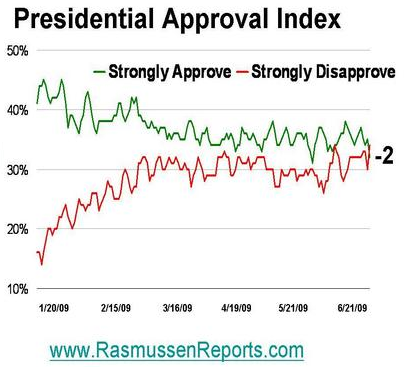
 The Homa Files