Archive for the ‘Taxes’ Category

GOP set to hand O an early Xmas present …

December 15, 2011

Let’s set the stage: The President is caught between a rock (his unions) and a hard place (his enviromentalist supporters).

So, he punts the XL pipeline decision until after the 2012 election … telling both sides not to worry that he’ll take their side when nut-cutting time comes.

Everybody with an IQ over 50 sees the move as pure politics, but Obama’s boxed.

To the rescue: the GOP … by demanding that XL be part of the payroll tax cut extension legislation.

Of course, Obama plays the Brer Rabbit card and threatens a veto.

So, the GOP hardens its position … XL has got to be part of the package.

It will be.

Why?

Because O gets off the hook.

Even he knows the pipeline is a good idea – jobs, energy independence, etc.

He’d like to sign it, but can’t because of the pressure from the environmentalists.

He can’t, unless he’s painted into a corner, say, by the GOP demanding it to pass the payroll tax cut.

So, the bill will pass with XL in it, the President will sign it, and he’ll tell the environmentalists that he had no choice.

You heard it here in the HomaFiles …

>> Latest Posts

Judge Judy for President …

December 9, 2011

Warning: This post isn’t politically correct and may offend HomaFiles left-leaning readers.

* * * * *

In a recent segment that has gone viral, Judge Judy is trying to settle a rent dispute.  A 3rd year college student is getting government aid that is specifically intended as rent money. But, he isn’t paying his rent.  JJ wants to know why and lands on a broader message that she “wants to send to Congress”.

click to view video
image

My favorite lines: “Just having me around is like me paying rent” and “I’m getting the money just for being me”.

Geez … and some people  don’t want to pay higher taxes … wonder why?

I wish that the President & Michelle would be preaching these lessons instead of Judge Judy.

>> Latest Posts

Subsidizing Chinese solar panels … ouch!

December 8, 2011

Must read piece in the WSJ today by TJ Rodgers, outspoken CEO of Cypress Semiconductor.

His Law of Misguided Subsidies:

Whenever Washington disrupts a market by dumping subsidies into it, Wall Street will find a way to pocket a majority of the money while the intended subsidy beneficiaries are harmed by the resulting market turmoil.

When President Obama says that we must subsidize our solar industry to remain competitive with the Chinese, it would be more accurate to say that we subsidize Wall Street to create employee-less corporations that buy and install Chinese solar panels in the U.S.

Illustrative economics:

Consider the current 30% federal solar energy subsidy.

A home solar system with 60 solar panels produces about 15,000 watts of power, enough to completely offset the $6,000 annual electricity bill of a typical upscale California home.

The system costs about $90,000 prior to the 30% federal income-tax credit, which reduces its cost to $63,000.

After a simple payback period of about 10 years, the homeowner literally enjoys free electricity for the remainder of the guaranteed 20-year system life, a very profitable 10 years.

The “gotcha”:

But … that $27,000 tax credit, the associated accelerated-depreciation tax savings, and most of the hefty post-payback profits [go] to Wall Street firms with a “tax appetite,” not the homeowner.

That’s just what happens with the majority of new home solar-system installations today.

Again, it’s worth reading the whole article Subsidizing Wall Street to Buy Chinese Solar Panels

>> Latest Posts

How close are you to the evil 1%?

December 8, 2011

Note: Based on 2009 tax year filing data, the Internal Revenue Service says an adjusted gross income, or AGI, of $343,927 or more will put you in the top 1 percent of taxpayers.

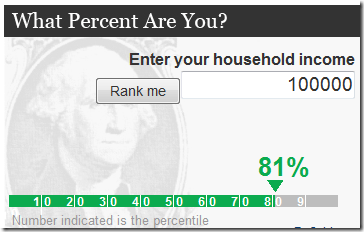
The WSJ has a cool interactive … plug in your household income (which is a higher number than AGI) and it pegs your percentile.

For example, the WSJ says …

  • $100,000 puts you in the 81st percentile
  • $150,000 puts you in the 89th percentile
  • $200,000 puts you in the 94th percentile
  • $250,000 puts you in the 96th percentile
  • $507,000 puts you in the 99th percentile

 click to plug in your number
image

>> Latest Posts

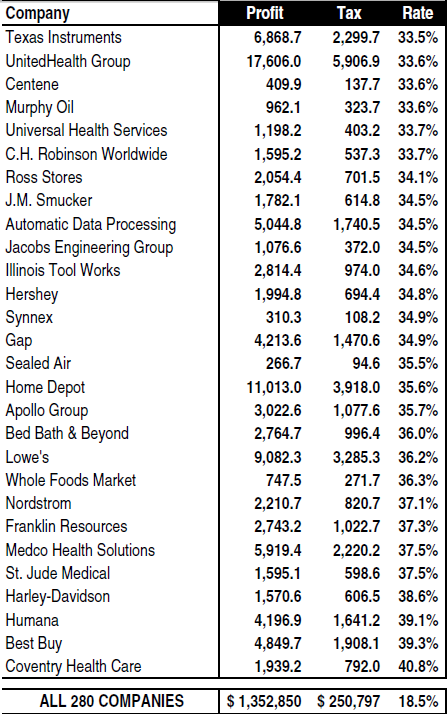
Which industries & companies pay the highest effective tax rates?

November 23, 2011

Industries:

  1. Healthcare
  2. Retail
  3. Electronics
  4. Construction

Companies:

  1. Coventry Health Care
  2. Best Buy
  3. Humana
  4. Harley-Davidson
  5. St. Jude Medical
  6. Medco Health Solutions

Aren’t those some of the industries & companies that the Feds are trying to stimulate?

Hmmm.

Pretty interesting analysis … specific company data follows the industry table.

* * * * *
Source: CTJ (Citizens for Taxpayer Justice)
“Corporate Taxpayers & Corporate Tax Dodgers, 2008-2010”

image

image

>> Latest Posts

Why 1-year employment incentives don’t move the needle ….

November 21, 2011

Obama’s jobs plan has a smorgasbord of hiring incentives … all of which are 1-time credits (e.g. for hiring veterans) or 1-year tax incentives (e.g. eliminating half of employers’ FICA match).

Corp execs’ statements that they don’t hire based on 1-year incentives keep falling on deaf ears, and the Administration keeps serving them up.

Let’s look at a specific and do some simple arithmetic.

According to the Administration’s fact sheet on the Jobs Bill, the lead provision of the bill (about 15% of the $450 billion cost) is a payroll tax cut for businesses.

The President’s plan will extend the payroll tax cut to firms by cutting in half their payroll tax on the first $5 million in payroll. Next year, instead of paying 6.2 percent on their payroll expenses, firms would pay only 3.1 percent.

For example, a firm with 50 workers earning an average of $50,000 a year – for a total payroll of $2.5 million – would receive a payroll tax cut of 3.1% of its total payroll, or about $80,000$1,500 per average employee.

By intent, the cut doesn’t do much for big businesses. The maximum benefit that could go to a big company is only  $155,000 ($5 million times 3.1%).  That’s rounding rounding error – equivalent to maybe 2 “free” hires for 1 year.

Hardly a game changer.

So let’s look at a small business.

At the margin, continuing the fact sheet’s example, a new average employee’s base salary cost is $50,000. Fringes (e.g. health insurance) add on another $10,000.  Payroll taxes (pre-credits) adds on another $3,000 … bringing the total to $63,000.

But, companies don’t hire people for 1-year.  Once they’re added to the payroll, they stay there for awhile.

How long?

Well, the BLS says that the median tenure of employees is about 4.5 years … with almost 1/3 employees having been on payrolls for more than 10 years.

Let’s take the low number, 4.5 years.

When a company hires an employee, it is implicitly making a commitment of at least $285,000 ($63,000 times 4.5 years).

The Obama plan  offsets the cost with $1,500 …  a whopping 1/2 of 1%.

Does anybody really believe that will stimulate companies to hire in uncertain times?

I’m betting the under on this one.

>> Latest Posts

Corporations that don’t pay U.S. income taxes …

November 9, 2011

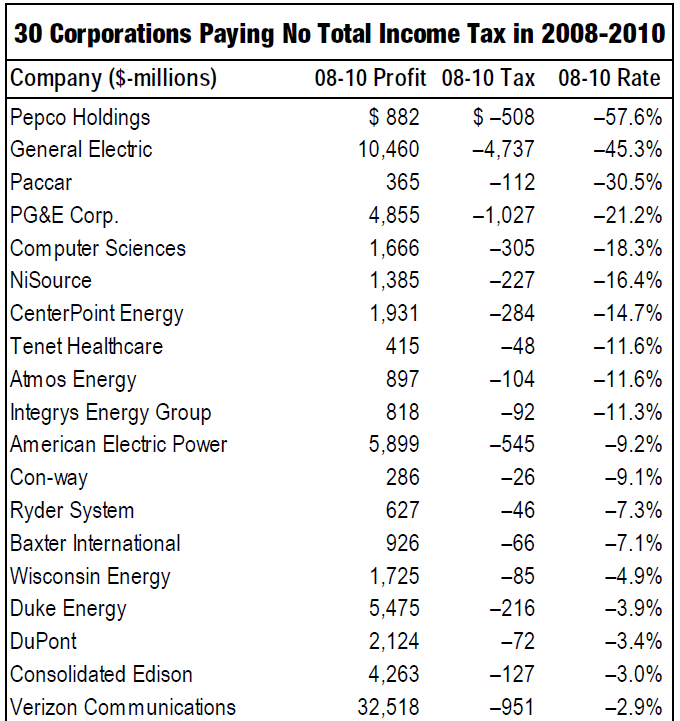
CTJ (Citizens for Taxpayer Justice) recently released a report titled “Corporate Taxpayers & Corporate Tax Dodgers, 2008-2010”

Here’s their list of the Top 30 “Tax Dodgers”  … below the table is CTJ’s decoding of how they do it

image

image

Accelerated Depreciation

In early 2008, in an attempt at economic stimulus for the flagging economy, Congress and President George W. Bush dramatically expanded depreciation tax breaks by creating a supposedly temporary “50% bonus depreciation” provision that allowed companies to immediately write off as much as 75 percent of the cost of their investments in new equipment right away.

This provision was extended and expanded through 2012 under President Barack Obama.

Stock options

Most big corporations give their executives (and sometimes other employees) options to buy the company’s stock at a favorable price in the future.

When those options are exercised, companies can take a tax deduction for the difference between what the employees pay for the stock and what it’s worth (while employees report this difference as taxable wages).

Paying executives with options took off in the mid-1990s, in part because this kind of compensation was exempt from a law enacted in 1993 that tried to reduce income inequality by limiting corporate deductions for executive pay to $1 million per executive.

Tax options were also attractive because companies didn’t have to reduce the profits they report to their shareholders by the amount that they deducted on their tax returns as the “cost” of the stock options.

Industry-specific tax breaks.

The federal tax code also provides tax subsidies to companies that engage in certain activities. For example:

  • research (very broadly defined);
  • drilling for oil and gas; providing alternatives to oil and gas;
  • making video games;
  • ethanol production;
  • not moving operations offshore;
  • maintaining railroad tracks;
  • building NASCAR race tracks;
  • making movies;

… and a wide variety of activities that special interests have persuaded Congress need to be subsidized through the tax code.

Offshore tax sheltering.

Over the past decade or so, corporations and their accounting firms have become increasingly aggressive in seeking ways to shift their U.S. profits, on paper, into offshore tax havens, in order to avoid their U.S. tax obligations.

These typically involve various artificial transactions between U.S. corporations and their foreign subsidiaries, in which revenues are shifted to low- or no-tax jurisdictions, while deductions are created in the United States.

Some companies have gone so far as to renounce their U.S. “citizenship” and reincorporate in Bermuda or other tax-haven countries to facilitate taxsheltering.

>> Latest Posts

Mickey D says he deserves a break today … a tax break, that is.

November 9, 2011

Reported in the UK Telegraph

McDonald’s CEO says: Curb spending and cut taxes

“America must cut taxes and reduce government spending in order to kick-start an economic recovery, Jim Skinner, the chief executive of McDonald’s, has warned.”

“In order to create jobs in America, you’re going to have to cut taxes… particularly in the business community.

“We pay some of the highest [corporate] taxes around the world. There needs to be some levelling.”

For the record, in 2010, McDonald’s paid the Feds $1 billion on $2.624 billion in profits … pardon the pun, but that’s a whopper: 38.9%

I think Mickey (and Ronald) may have a point …

>> Latest Posts

You may be closer to the top 1% club than you think … or, at least the top quartile.

October 31, 2011

The IRS recently released 2009 tax data.

Here are some highlights:

  • It takes $343,927 in household income to make it into the top 1%; $112,124 to make the top 10%; and $66,193 to make the top quartile … sounds to me like a reasonable reach.
  • Excluding Warren Buffett, the top 1% pays a 24% effective rate … higher than Buffett’s secretary … whew!
  • The top 10% pays 70% of Federal income taxes; the bottom half pays essentially nothing … hmmm.

Virtually all of the people in the bottom half think that people at the top should pay more … it’s called “fairness”

image

>> Latest Posts

Prediction: Obama’s midnight pardons will rock the world.

October 27, 2011

On his current campaign swing, President Obama is throwing around tax payer money to rebuild his base.

Earlier this week it was the Federal refinancing of underwater home loans.  Taxpayers will own any defaults.

Yesterday it was the announcement of an executive order to restructure, cap, and eventually forgive student loans after 20 years of payments.

That one troubles me.

Even CNN acknowledges:

The president’s focus on college loan assistance could also help him with younger voters — generally a core Democratic constituency. In 2008, Obama carried two-thirds of all voters ages 18 to 24, according to national exit polls.

Did you know that a provision of the ObamaCare law was to nationalize student loan programs?  Amazing what you can sneak into a 2,000 page unread law.

Now, the Executive branch (i.e. the Obama administration) has wide, unprecedented latitude to grant, structure and forgive student loans.

Presidents have often issued pardons and waivers during their last hours in office.  Think Bill Clinton pardoning uber-tax evader Marc Rich.

I predict that if Obama gets beat in 2012 – a 50 / 50 bet as things now stand – he will issue the mother of all pardons: forgiveness of all Federally held student loans and maybe, while he’s at it, the forgiveness of all Federally held home loans.

Far-fetched?

I don’t think so, and now, I’m on the record.

>> Latest Posts

Tech point re: charitable contributions …

October 24, 2011

I know that I said that Part 5 of my Buffett tax analysis would be my last. but …

First, I got input from a loyal reader that my analysis was wrong because “only 5% of charitable contributions can be deducted in 1040s”

That sent me back to the tax code.  Specifically to Publication 526 : Charitable Donations.

Keeping in mind that HomaFiles doesn’t offer tax or investing advice, here’s the law:

The amount of your deduction for charitable contributions is limited to 50% of your adjusted gross income, and may be limited to 30% or 20% of your adjusted gross income depending on the type of property you give and the type of organization you give it to.

Here’s the English translation.

In general, for all typical charities,e.g. churches, schools, hospitals, disease-causes, a taxpayer can deduct 100% of his charitable … but there’s a ceiling …. the total amount of charitable deductions is limited to 50% of the taxpayer’s AGI.

So, if a taxpayer had $100,000 AGI, he can write $50,000 in  checks to qualified charities and deduct all $50,000.  If he writes checks for $60,000 … he can deduct only $50,000.

The major exception: donating appreciated assets (think “stocks).  A taxpayer can claim a charitable deduction for the fair market value of the asset, pay no capital gains, and deduct up to 30% of his AGI.

Things get a bit trickier if there are both cash donations and appreciated assets in the mix.

The general  takeaway: up to a total of 50% AGI, all charitable contributions can be deducted ,,, slightly less if the donations are stock not cash.

That said, the Buffett analysis survives intact.

We estimated charitable contributions at $20 million …about 1/3 of Buffett’s $63 million AGI … so, based on our anlysis, he can deduct all of his charitable deductions, sheltering all or most of his ordinary income.

Whew.

* * * * *

Separately, I got a few emails and replies commenting on the HomaFiles-coined GBSR™ – “Give Back to Society Rate” … the sum of fed & state taxes, and charitable contributions divided by AGI.

Some of the emails said “you’re on to something”, so I’ve trademarked the metric by adding the legal “TM” super-script.

Gotta protect your intellectual property, right?

>> Latest Posts

Squeezing Buffett’s numbers … Part 5 (and done !)

October 21, 2011

OK, today should about do it.

After a recap, I’ll drop my conclusion on you … my very surprising conclusion

First. a recap to get everybody on the same page.

In Part 1, we looked hard at Buffett’s effective income tax rate (17.4%), and showed how he could get to that low rate by offsetting practically all of his ordinary income with $23 million in deductions.

This conclusion debunks the popular pundit point that he gets to the rate by having practically all of his income in capital gains and dividends.

In Part 2, we showed that about $20 million of the deductions are probably charitable contributions – a device that rich folks use to (1) do good things and (2) to manage down their tax liabilities.

Better to give to a cause that you believe in, right? Why give it to the government and have it waste the money?

In Part 3, we agreed that Buffett’s tax rate as a percentage of his taxable income is probably less than his secretary’s – partially due to his capital gains being taxed at a comparatively low rate, but mostly because he shelters his ordinary income with charitable deductions.

And, we showed how ordinary earners can get to a rate lower than Warren’s … just by donating a huge chunk of their income to charity. Not realistic, but mathematically possible.

In Part 4, we showed that Buffett’s tax rate as a percentage of AGI is only 11% …. about half of the estimated rate for our hypothetical secretary surrogates.

image

Now, my first reaction when I stared at the taxes to AGI rate was “Wow, Buffett’s right – he’s nothing but a coddled piker.”

But now, I’m not so sure.

On one hand, his paying a rate (to taxable income) that’s 5 points less than his secretary doesn’t seem fair.  Especially since he gets to the rate by exploiting some dreaded tax loopholes, aka. “deductions”.

The situation seems even worse when you consider his taxes to AGI rate – a mere 11% – less than half of his secretary’s rate (I suspect).

Gotta jack up taxes, right?

Not so fast.

Let’s construct another measure: the GBSR™ — “Give Back to Society Rate

Since I’m coining the measure, I’ll define the GBSR™ as the sum of taxes paid plus charitable contributions – since those are all money that’s supposed to be going to the common good, albeit administered by different organizations – divided by AGI.

OK, so what’s Buffett’s GBSR?

Well, based on my estimates, Buffett pays about $7 million in Federal taxes, about $3 million in state taxes, and about $20 million to charities.  ,,, for a total of $30 million … which dived by his $63 million AGI … gives a GBSR™ rate of almost 50% (47.6% to be precise).

Now, let’s pretend that Buffett’s secretary profiles like our $100,000 ordinary earner above.  Her charitable deductions would be at most $5,700.  Otherwise she wouldn’t be taking the standard deduction, she’d itemize.

So, her GBSR™ @ $100,000 AGI is 27.5%   ($5,700 + $21,709 = 27,409 / $100,0000 = 27.5%).

That means that Buffett’s GBSR™ is almost twice his secretary’s.

Hmmm.

Maybe he’s not such a bad guy and I should stop ranting about him.

And, maybe he should stop causing trouble for other folks by constantly whining about the tax code.

It just may be that the tax code is leading to the right answer.

Just have to look around the trees to see the forest.

AMEN

>> Latest Posts

Squeezing Buffett’s numbers … Part 4

October 20, 2011

In Part 1, we looked hard at Buffett’s effective income tax rate (17.4%), and showed how he could get to that low rate by offsetting practically all of his ordinary income with $23 million in deductions.

This conclusion debunks the popular pundit point that he gets to the rate by having practically all of his income in capital gains and dividends.

In Part 2, we showed that about $20 million of the deductions are probably charitable contributions – a device that rich folks use to (1) do good things and (2) to manage down their tax liabilities.

Better to give to a cause that you believe in, right? Why give it to the government and have it waste the money?

In Part 3, we agreed that Buffett’s tax rate as a percentage of his taxable income is probably less than his secretary’s – partially due to his capital gains being taxed at a comparatively low rate, but mostly because he shelters his ordinary income with charitable deductions.

And, we showed how ordinary earners can get to a rate lower than Warren’s … just by donating a huge chunk of their income to charity.  Not realistic, but mathematically possible.

Whew.

Now let’s start pulling things together.

The chart below makes the obvious clear … at least to me to me.

image

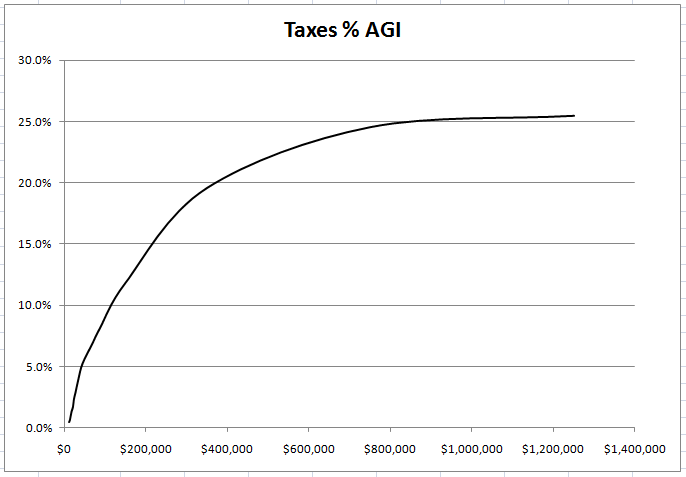
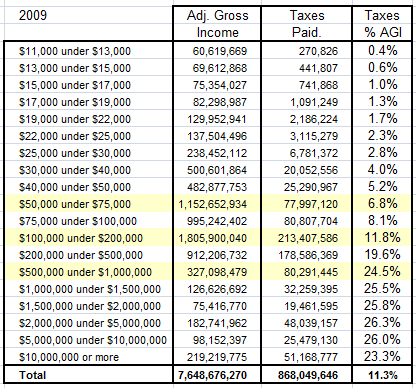
Note that Buffett’s tax rate as a percentage of AGI is only 11% …. about half of the estimated rate for our secretary surrogates.

Now that’s a gap!

But, I haven’t seen anybody in the mainstream media even notice.  They, and Chuckie Shumer, just focus on the rate to taxable income.

What’s going on?

Same story as before: Buffett shelters over a third of his AGI – and practically all of his ordinary income with charitable deductions.

Simply stated, because he gives money away to charities (e.g. the Bill Gates Foundation) he only has to give a pittance to the Feds.

Is that a good thing or a bad thing?

We’ll save that for a subsequent post.

>> Latest Posts

Squeezing Buffett’s numbers … Part 3

October 19, 2011

In Part 1, we looked hard at Buffett’s effective income tax rate (17.4%), and showed how he could get to that low rate by offsetting practically all of his ordinary income with $23 million in deductions.

This conclusion debunks the popular pundit point that he gets to the rate by having practically all of his income in capital gains and dividends.

In Part 2, we showed that about $20 million of the deductions are probably charitable contributions – a device that rich folks use to (1) do good things and (2) to manage down their tax liabilities.

Better to give to a cause that you believe in, right?  Why give it to the government and have it waste the money?

Today, let’s look at the popular headline: “Buffett’s Tax Rate Lower than His Secretary’s”

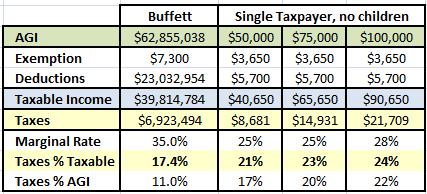
Since we don’t know his secretary’s specifics, we looked at 3 hypotheticals: a single taxpayer (i.e. not married), all ordinary income,  no dependents, standard deduction (i.e. doesn’t itemize).

The bottom line: The headline seems reasonable.  In each of 3 income scenarios ($50k, $75k and $100k) the rate to taxable income is in the lower 20s – about 5 points higher than Buffett’s rate.

But, keep reading …

image

First, these are scenarios the get to the highest possible tax rates – a joint-married filer with dependents and itemized deductions would pay less.

Nonetheless, it’s hard to imagine an ordinary person closing the gap to Warren’s rate unless they had a big mortgage deduction and played the charity angle: giving a lot to charity to shelter income down to the 15% rate.

For example, if our 50K single taxpayer had no mortgage interest and paid about 5% in state & local taxes, he could make a charitable contribution of about $10,000 and land in the 15% tax bracket (which is capped at $34,000)

Here’s the arithmetic: $50,000 less $3,650 in exemptions, less about $2,500 in state and local taxes, less $10,000 in charitable deductions is less than$34,000 – which is the top of the 15% bracket.

The charitable deduction would be 20% of AGI … which is lower than Buffett’s apparent 30% donations’ rate ($20 million / $63 million = 31.4%) … but probably not practical at that income level.

And, using the same logic, getting our $75k and $100k ordinary income earners into the 15% bracket would require a  charitable giving rate approaching 50% of AGI.

That certainly doesn’t seem practical.

What’s the point?

Buffett’s case illustrates how a completely discretionary itemized deduction – charitable contributions – can be used by folks – especially rich folks – to shelter ordinary income from taxes … and get them to a low effective tax rate.

That’s not a shot at charitable deductions – more on that in subsequent posts – just raises the point that closing the gap between Buffett and his secretary may be less a matter of raising tax rates (on capital gains) and more a matter of how deductions are allowed and applied.

More to come ..

>> Latest Posts

Squeezing Buffett’s numbers … Part 2

October 18, 2011

In Part 1, we looked hard at Buffett’s effective income tax rate (17.4%).

We tested the conventional wisdom that the rate is low because Buffett gets practically all of his income from capital gains and dividends.

Maybe and maybe not.

We showed that, in fact, almost half of Buffett’s income could be from ordinary income and he’d still pay the low rate.

Why?

Because deductions are first applied to higher taxed income (think ordinary income @ 35%) and then to lower taxed capital gains.

Buffett could, in effect, be getting his ordinary income tax-free.

Let’s dig a little deeper on Warren’s tax data.

image

The key numbers: AGI = $53 million, Deductions (aka. “loopholes”= $23, Taxable Income =$40 million, and taxes = $7 million … 17.4%

Let’s think about the deductions for a moment

Some pundits have theorized that many of the deductions are “interest on investment borrowing”, suggesting that Buffett buys a lot of his holdings on margin.

I don’t think so.

First, he’s a frugal guy who doesn’t strike me as margin kind of guy.

Second, interest rates are essentially zero … especially for a big hitter like Buffett … and zero times any balance is, well, zero.

Third, Buffett himself says it ain’t so.

He says the roughly $23 million difference between his AGI and taxable income is due largely to deductions he took for charitable giving and local taxes.

Let’s do taxes first.

Nebraska state income taxes have a max marginal rate of just under 7%.  So, Buffett probably pays about $3 million in state & local taxes.

That leaves about $20 million in charitable deductions.  It’s oft reported that many of those donations go to the Gates Foundation.

We’ll come back to the charitable deductions in a subsequent post.

We’re not saying they’re necessarily good or bad … just remember the $20 million number.

* * * * *
Next up: How does the 17.4% compare to ordinary folks?  And, is it the right  number to focus on?

>> Latest Posts

Squeezing Buffett’s numbers … Part 1

October 17, 2011

Last week Warren “Don’t Coddle Me” Buffett released some of his tax info.

Just some highlights, but enough to give fodder to some analyses.

I think I have some interesting unreported angles on the nums that I’ll be dribbling out in this and subsequent posts.

First, the facts:

  • Buffett’s adjusted gross income (AGI) was $62,855,038  last year
  • His taxable income was $39,814,784
  • His federal income tax bill came to $6,923,494, or 17.4% of his taxable income.
  • He said The roughly $23 million difference between his AGI and taxable income was due largely to deductions he took for charitable giving and local taxes
  • He paid $15,300 in payroll taxes … but, so what?

You may remember, the buzz us about how Buffett’s 17.4% is lower than his secretary’s mid-20s tax rate.

Conventional wisdom is saying that the issue stems from so much of Buffett’s income comes from capital gains and dividend (taxed at 15%) rather than ordinary earned income (taxed at 35% at the margin).

A simple analysis suggests that for Buffett to have an overall 17.4% tax rate, his $40 million in taxable  income must be split roughly $35 million from capital gains & dividends (taxed at 15%) and $5 million in ordinary income (virtually all taxed at 35%).

image

But, not so fast …

I’m not a tax adviser but …here’s something that I think is right and that I bet you didn’t know:

Mechanics for applying the tax code work to the tax payer’s advantage in at least one very import way … deductions against income aren’t applied pro-rata across tax categories – ordinary income and capital gains … rather they get applied to the highest taxed category of income first.

Said differently, deductions are first applied to ordinary income, then to capital gains (if there are any left).

That’s a big deal … for Buffett and for us ordinary folks.

What it could mean for Buffett is that the could pay his 17.4% rate with an almost 50 / 50 mix or ordinary income and capital gains.

Here are the nums:

image

So what?

Well, if I’m right then maybe Buffett’s right … he is being coddled.

But, the problem isn’t the tax rate (sorry, Chuckie Shumer) it’s those devilish loopholes.

It’s that he can generate tax deductions by giving mucho  $$$ to his buddy Gates’ foundation … and, in effect, can shelter almost all of his ordinary income from any taxes.

Now, that’s a big deal!

More in subsequent posts.  Trust me, I’m not done with this one.

>> Latest Posts

Tanning salon update: tax collections 64% below ObamaCare projections

October 14, 2011

Well, well, well.

It appears that tanning salons either don’t know about their targeted ObamaCare tax or they aren’t complying with it or the added tax has dampened demand … and the IRS is having trouble tracking the  salons down to figure out what’s going on.

So, the new federal tax on indoor tanning services isn’t bringing in as much revenue as promised.

The Treasury Inspector General for Tax Administration says the new federal tax on indoor tanning services isn’t bringing in as much revenue as hoped.

Tanning tax receipts for that nine-month period ending March 31, 2011  totaled $54.4 million, the report found.

That was below projections by the Congressional Joint Committee on Taxation, which had estimated the tax would raise $50 million per quarter.

The IRS had difficulty determining the actual number of tanning salons and the contact info for businesses required to collect the new tax from customers.

Using an April 2010 Indoor Tanning Association estimate, the IRS initially projected the tax would be due quarterly from roughly 25,000 stand-alone tanning salons, plus spas, health clubs and beauty parlors.

But the inspector general report found that actual tax returns filed for the first three quarters through March 31 averaged just above 10,300.

Source: USA Today

It’s a shocker, isn’t it ?

>> Latest Posts

Fair share revisited…

October 11, 2011

Obama’s tax plans don’t really impact , so this issue is strictly philosophical.

I’m still struggling with his “fair share” riff.

Out of 140 million tax filers, there 1,470 millionaires who pay no taxes of them.

Doesn’t sound like they’re paying their fair share, but there aren’t many of them … and, I bet each has an interesting story.

More generally, according to the IRS, folks making:
• More than $1 million pay 24% of income in taxes
•  $200,000 to $300,000 pay 17.5%
•  $100,000 to $125,000 pay 9.9%
•  $50,000 to $60,000 pay 6.3%
•  $20,000 to $30,000 pay 2.5%

And, the IRS reports that – as a % of income tax revenues:
• The top 1% pays 39%
• The top 5% pays 60%
• The top 10% pays 72%
• The bottom half pays 3%

So, what’s “fair share”?

Neither Obama nor his frontmen seem comfortable saying/

Wouldn’t you like to know?

Hmmm.

>> Latest Posts

The USPS is needed .. to deliver all of those gov’t checks.

October 7, 2011

Punch line: According to the  WSJ, nearly half of all U.S. households now receive some type of government benefit.

  • Over 1/3 of Americans lived in a household that received benefits such as food stamps, subsidized housing, cash welfare or Medicaid.
  • Almost 15% lived in homes where someone was on Medicare or Social Security, or both.

Reminder: Some 46.4% of households will pay no federal income tax this year, according to the nonpartisan Tax Policy Center. That’s up from 39.9% in 2007

My bet: All of these households think spending cuts are a bad idea …
and tax hikes on other folks are strokes of brilliance.

>> Latest Posts

Geez, all the fuss over 7,000 rich guys…

September 26, 2011

Punch line: Chasing after a couple of thousand rich dudes seems like a wild goose chase to me.

I’m more concerned about the 50% of folks who don’t have any skin in the game … who pay no taxes and think other folks should pay more.

Old refrain: “Don’t tax you, don’t tax me, tax the guy behind the tree.”

Tax Policy Center analysis reported in The Atlantic

76 million people won’t legally owe individual income taxes in 2011

The vast majority of this group is poor. They won’t owe individual income taxes because they won’t earn a lot of money to start, and various exemptions, like the earned income tax credit, will wipe out any tax liability … maybe even getting them a refundable credit – a check in the mail from the Feds.

Among families making more than $100,000, there will also be  half a million tax units that will also pay no income tax.

And, 7,000 millionaires will pay no individual income tax.

How can that be?

Couple of ways:

  • Tax-free income … think gov’t bonds
  • Catastrophic losses …  e.g. mansion gets wiped out by a hurricane, very high uninsured medical expenses
  • Discretionary deductions … think charitable deductions
  • Fraud and other shenanigans …


image

>> Latest Posts

Millionaires pay a lower tax rate than $50K teachers … not!

September 21, 2011

The press were abuzz yesterday debunking O’s key premise that millionaires pay taxes at a lower rate than teachers making $50,000.

Yesterday, we showed that a married  teacher with 2 kids who earns $50,000 pays at a 5.5% rate.  Even if you add 7.65 in payroll taxes to that, the resulting  13.15% is still less than a millionaire who pays only capital gains taxes at 15%.

That was a micro analysis.

The WSJ presented the macro analysis:

In 2008, the last year for which such data are available, the IRS reports that those who made more than $1 million in adjusted gross income paid an average income tax rate of 23.3%.

That’s slightly lower than the 24.1% rate paid by those making between $500,000 and $1 million, probably because the richest are like Mr. Buffett and earn more from capital gains and dividends.

The rate for a relative handful of the rich — 400 people — fell to 18%.

But nearly all millionaires still paid a rate that is more than twice the 8.9% average rate paid by those earning between $50,000 and $100,000, and more than three times the 7.2% average rate paid by those earning less than $50,000.

The larger point is that the claim that CEOs are routinely paying lower tax rates than their secretaries is Omaha hokum.

image

I think the President should modify his Buffett Rule to read: anybody who earns more than $1 million … and who has accumulated wealth greater than $25 billion  … and who plans to bequeath practically all of his estate to a pal’s “foundation” shall pay an effective income tax rate of 90% … unless he /she whines that they’re being  coddled, in which case the tax rate escalates to 100%.

My real recommendation: limit the charitable estate exemption to $1 million so that Buffet has to fork about half of his estate over to the government … that’ll keep him from bring coddled in the grave.

>> Latest Posts

A $50,000 teacher has a lower tax rate than a millionaire or billionaire … period !

September 19, 2011

In his speech, the President’s teleprompter hammered that millionaires and billionaires have lower tax rates than teacher’s making $50,000.

Hmm.

Let’s think about that.

A high earner who makes all of his money from dividends and capital gains pays 15%.  Maybe a tad less after deductions – but the deductions (charity, state & local taxes, mortgages) should be rounding error.  So, let’s call it 15%

What about a teacher earning $50,000 – all from his teacher’s pay?

Well, let’s assume that he’s married with 2 kids.

What does he pay in taxes?

Answer: 5.5%.

A married person filing jointly gets a standard deduction of $11,400

A married taxpayer with 2 kids gets $14,600 in exemptions (4 times $3,650)

So, the taxpayers taxable income is $24,000 ($50,000 less $11,400 less $14,600)

Taxes on $24,000 are $2,762.50  ($1,675 plus 15% of the taxable income over $16,750)

That’s an effective rate of 5.5%

You see, the standard deduction and exemptions are what analysts call statistically significant.

Come on Mr. President … at least get the numbers right !

* * * * *
Relevant Tax Facts

image

http://www.irs.gov/pub/irs-pdf/i1040tt.pdf

image

Exemptions directly reduce your taxable income. You are allowed a personal exemption for yourself, your spouse if married filing jointly, and each person you can claim as a dependent. For 2010, the exemption amount is $3,650.

>> Latest Posts

Channeling Buffett: Is Obama proposing a (substantial) hike in capital gains tax rates?

September 13, 2011

OK, I keep harping on the point, but …

At 7:25 pm last Thursday, Obama repeated the tired refrain about how Warren Buffet pays less taxes than his secretary and wants to pay more – his fair share.

Cutting to the chase: Buffett pays more in dollars, but pays at a lower rate.

Why?

Because most of Buffett’s income is “unearned income”.

English translation: capital gains and dividends.

So, there are only two ways to get Warren-the-sage on an equal rate  footing with his secretary: (1) lower marginal tax tax rates on the secretary’s earned income or (2) increase Buffett’s tax rate on his capital gains … to be taxed at the same rate as “earned income”.

Here’s the good news for Buffett: thanks to the ObamaCare bill, Warren will be paying a higher tax rate on his cap gains and dividends starting in 2013 (after the next election, of course).

So, the Buffett-secretarial gap will narrow.


image

Technical note: The ObamaCare Surtax on Investment Income takes effect Jan. 2013.

It’s a new, 3.8 percent surtax on investment income earned in households making at least $250,000 ($200,000 single).

Other unearned income includes (for surtax purposes) gross income from interest, annuities, royalties, net rents, and passive income in partnerships and Subchapter-S corporations.

Source

But, even then there still may still be a gap.

So, either the rate on earned income comes down or rate on cap gains goes up.

I’m betting the latter.

So, to stop Warren from whining, Obama will likely raise the cap gains and choke capital flows – in order to stimulate the economy.

Huh?

Or, maybe Obama doesn’t understand the implications of his applause lines.

Hmmm.

>> Latest Posts

Golub to Buffett: Here’s how you can pay higher taxes.

September 9, 2011

At the 19 minute mark of Obama’s job speech, he channeled Warren Buffett’s whine about how his (Warren’s) taxes are too low.

A week or so ago, in a WSJ op-ed, Harvey Golub – former MxKinsey partner and AMEX CEO – responded to Warren Buffett’s plea to pay higher taxes.

One of his answers: lose the estate & income tax deductions for gifts to charitable foundations – especially personal family foundations and foundations set-up by their friends.

Gifts to charities are deductible but gifts to grandchildren are not.

The super-rich could pay higher taxes if they choose.

They could voluntarily write a check or they could advocate that their gifts to foundations should be made with after-tax dollars and not be deductible.

They could also pay higher taxes if they were not allowed to set up foundations to avoid capital gains and estate taxes.

HomaFiles has been advocating such a change for quite awhile.

If Buffett thinks the gov’t works so well, let’s see him pony up …. and not just continue wield his influence under the cover of gifts to his buddy Gates

>> Latest Posts

Another reason why taxes are higher in New York… paying to stick it to da man

September 1, 2011

Punch line: New York is lone state to provide compensation in labor disputes.

So, striking Verizon union members have  filed for jobless benefits.

Excerpted from from Marketwatch

U.S. workers are usually denied jobless benefits when they go on strike. After all, they walked off the job.

Except in New York. The state is the only one in the U.S. that allows striking workers to receive unemployment benefits.

So, about 21,000 union members filed applications for unemployment compensation, according to the U.S. Labor Department.

Based on the average salary of Verizon workers, they might be eligible for the $405 maximum weekly benefit New York provides.

The costs will be borne by Verizon – which would be forced to pay more into the New York’s unemployment insurance fund — and the residents of New York. .

And, New Yorkers wonder why their taxes are so high …

Thanks to SMH for feeding the lead

>> Latest Posts

While gov’t coddles Warren, Berkshire Hathaway stiff arms gov’t … shame, shame, Mr. Buffett

August 31, 2011

Punch line: Warren “Please Make Me Pay More Taxes” Buffett has been outted by his company’s proxy statement.

Apparently, Berkshire Hathaway owes back taxes … and is fighting the Federal gov’t tooth & nail to grab some disputable deductions and favorable tax treatments.

Excerpted from NY Post: “Warren Buffett, hypocrite

This one’s truly, uh … rich: Billionaire Warren Buffett says folks like him should have to pay more taxes — but it turns out his firm, Berkshire Hathaway, hasn’t paid what it’s already owed for years.

That’s right:  The company openly admits that it owes back taxes since as long ago as 2002.

“We anticipate that we will resolve all adjustments proposed by the US Internal Revenue Service (“IRS”) for the 2002 through 2004 tax years … within the next 12 months,” the firm’s annual report says.

The company also has outstanding tax issues for 2005 through 2009.

Obvious question: If Buffett really thinks he and his “mega-rich friends” should pay higher taxes, why doesn’t his firm fork over what the IRS says it already owes under current rates?

Couldn’t have said it better myself.

Pay up, Mr. Buffett … no more coddling, right?

>> Latest Posts

Got a spare $35,000 ? … If yes, you can hear B&O tell you your taxes are too low.

August 26, 2011

It’s reported that Warren Buffett  is hosting a fund-raiser for Obama’s re-election, billed as an “economic forum,”

According to the NY Post:

Tickets for the event at New York’s Four Seasons restaurant on Sept. 30 start at $10,000 a head, with VIP tickets a budget-boosting $35,800.

Guests get an hour of “Q&A moderated by one of President Obama’s closest economic advisors, Austan Goolsbee.”

What will be discussed is Buffett’s recent highly publicized claim that the wealthy should pay higher taxes.

As one invitee reportedly sniffed, “Nothing like advocating tax equality when you are charging $35,800 a ticket.”

>> Latest Posts

What happens if there are no rich people?

August 18, 2011

Great chart in the WSJ, extracted from the latest IRS data:

image

Provokes a couple of thoughts:

  1. There aren’t that many folks earning over $1 million annually … less than 250,000 out of 150 million tax filers.
  2. The reported thresholds are AGI – before taxes … number of folks in the categories r is even smaller after-taxes or if you income average across a few years
  3. Number has shrunk during the recession … what if they all go away, e.g. move or get their $millions taxed away or stop earning
  4. Earnings & wealth … even the WSJ doesn’t seem to understand the difference between stocks and flows – earnings is a ‘flow’, wealth is a ‘stock’ … millionaire status should be based on wealth not one’s year’s earnings

This issue doesn’t impact me as long as I’m making $8.75 an hour teaching … and, I have no great interest inprotecting the so-called super rich … but, I don’t like singling out a miniscule group of citizens for targeted “attention” … today it’s them, tomorrow, it’s us.

Bad precedent.

>> Latest Posts

Re: Buffett … WSJ jumps on the HomaFiles’ bus.

August 17, 2011

On Monday (and before in 2010), the HomaFiles said:

I am serious about eliminating the estate deduction for charitable gifts.

That would get Warren Buffett whining another tune.

You see, he’s reported to be bequeathing most of his estate to his buddy & fellow fat-cat Bill Gates’ foundation.

Let’s see, he ducks a lot of estate taxes, just by channeling money to his mega-rich buddy.

Sounds like a loophole to me.

Mr. Buffett: why not pay your fair share and then ship after-tax dollars to your friend, Bill.

Today (2 days after the latest HF post on the subject), the WSJ jumped on the bus: hopped on issue:

For billionaires like Mr. Buffett, the single most important deduction in the tax code is for charitable giving. Middle-class earners can’t give nearly as much money away to reduce their overall tax burden. Yet we don’t hear Mr. Buffett calling for the elimination of that deduction in the name of fairness.

Mr. Buffett has also already sheltered the bulk of his fortune from federal taxes by putting them into a foundation that will give the money away. That’s an act of generosity, but if the government’s purposes are so vital, why doesn’t he simply give the money to the IRS?

Rebecca Quick of CNBC put that question to Mr. Buffett in 2007. His answer: “Well, that’s a choice and it’s an option . . . If I had to give it to a single individual, or make some young Buffett a multibillionaire, or give it to the government, I’d absolutely give it to the government. I think that on balance the Gates Foundation, my daughter’s foundation, my two sons’ foundations will do a better job with lower administrative costs and better selection of beneficiaries than the government.”

Mr. Buffett is no doubt right about the relative efficiency of private donors, but should billionaire philanthropists get such a large tax preference? Another case of fairness?

Coincidence?

Or, is the WSJ peeking at the HomaFiles?

>> Latest Posts

Memo to Buffett: Here’s the way I’d like to see your coddling get stopped …

August 16, 2011

Warren Buffett is back at it … whining that his taxes are too low.

In a NY Times op-ed he says:

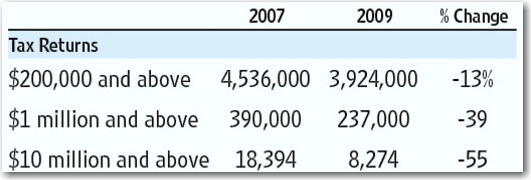
For those making more than $1 million — there were 236,883 such households in 2009 — I would raise rates immediately on taxable income in excess of $1 million, including, of course, dividends and capital gains.

And for those who make $10 million or more — there were 8,274 in 2009 — I would suggest an additional increase in rate.

My friends and I have been coddled long enough by a billionaire-friendly Congress. It’s time for our government to get serious about shared sacrifice.

Since Warren won’t just pony up extra dough to the Treasury (why not?), I suggest that:

  1. All personal wealth  (not income !) over $1 billion should be confiscated immediately.
  2. Tax-dodging charitable deductions from estates greater than, say, $5 million, should be eliminated.

No, I’m not serious about the first idea … though, it would be nice to clarify the distinction between income & wealth … and, it would be fun to see the fattest of the fat cats squirm.

I am serious about eliminating the estate deduction for charitable gifts.

That would get Warren whining another tune.

You see, he’s reported to be bequeathing most of his estate to his buddy & fellow fat-cat Bill Gates’ foundation. 

Let’s see, he ducks a lot of estate taxes, just by channeling money to his mega-rich buddy.

Sounds like a loophole to me.

Mr. Buffett: why not pay your fair share and then ship after-tax dollars to your friend, Bill.

Let’s really end the coddling …

>> Latest Posts

A breakthrough idea for generating more “revenue” …

July 28, 2011

First, a couple of tax facts …

  • Roughly 140 million individual  tax returns are filed each year … some, individual, some joint
  • Those returns report a bit over $8 trillion in AGI … about $5.3 trillion in taxable income
  • Those returns generate about $1 trillion in income tax “revenue” … that’s about 12.5% of AGI and about 19.5% of taxable income

The Federal deficit is about $!.6 trillion.

Let’s see how we can close that gap …

  • Option 1: Increase the average tax rate (on taxable income) by about 2.5 times … from 19.5% to about 45%
  • Option 2: Make every individual  filer pay an additional $1,000 – each joint filer $2,000
  • Option 3: Make everybody who voted for Obama (about 50 million people) pay an additional $3,000

I really like option 3 … since the vast majority of those folks like the job the President is doing, let them pay for it.

As long as they’re paying, I don’t care how much the President spends …

>> Latest Posts

What’s the biggest tax break?

July 21, 2011

From the Tax Policy Center, reported in the WSJ:

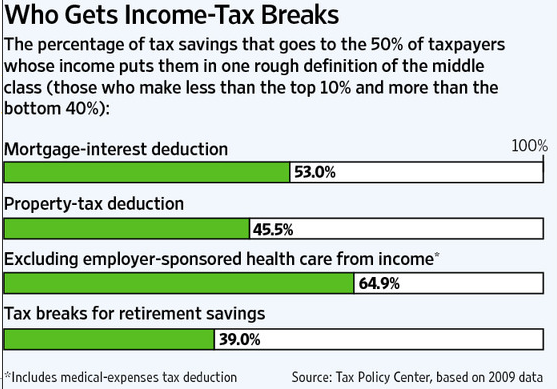
Excluding employer-provided health insurance from workers’ incomes is the single biggest benefit in the tax code … one that reduced federal revenue by $160 billion last year.

By letting Americans subtract mortgage interest from their incomes, the government gave up nearly $79.2 billion in tax revenue last year.

Letting taxpayers deduct local property taxes on their federal income-tax return reduced federal revenue by $15.1 billion last year.

image

Ken’s Take  Believe it or not – even though I benefit from all of those tax-savers – I’m a fan of eliminating them – and the deductions for charitable contributions —  as long as the tax rates are reduced.

My logic: Why should an employee with company funded health insurance get a break over a  self-employed person who has to pay for their health insurance (in after tax dollars)?  Why should a home owner get benefits that a renter doesn’t ? Why shouldn’t a person donate to a charity because it’s a good thing to do, not because they get a tax deduction?

>> Latest Posts

Flash: O’s bud Warren takes offense at corp jet slap ….

July 19, 2011

Here’s the video I’ve been waiting for…Warren Buffett – often quoted by Pres. Obama since he’s a fan of higher taxes –  defending his honor as a corporate jet owner.

Guess Buffett doesn’t like being lumped with tanning salons.

image

>> Latest Posts

“80% of Americans agree that taxes should be raised” … say, what?

July 18, 2011

Seriously, now.

To be technically precise, Pres. Obama said that “80% of Americans favor a ‘balanced’ approach” to attacking the deficit-debt problem.

For Obama, “balanced” means tax hikes.

Problem: data doesn’t seem to support the case.

According to the latest Rasmussen survey “55% Oppose Tax Hike In Debt Ceiling Deal”.

  • Most voters oppose including tax hikes in the deal.

    Just 34% think a tax hike should be included in any legislation to raise the debt ceiling; 55% disagree and say it should not.

  • There is a huge partisan divide on the question. Fifty-eight percent (58%) of Democrats want a tax hike in the deal while 82% of Republicans do not.
  • Among those not affiliated with either major political party, 35% favor a tax hike and 51% are opposed.
  • Even those who earn less than $75,000 a year are opposed to including tax hikes.

Where’s the rub?

“By a 59% to19% margin, Political Class voters favor a tax hike in the debt ceiling deal.

By a 68% to 22% margin, Mainstream voters oppose tax hike in the debt ceiling deal.”

* * * * *

Ken’s Take: I still want to see the survey that asks “Do you favor the gov’t raising YOUR taxes to reduce the national debt?”

If 80% is the over/under, I’ll bet the ranch on the under.

>> Latest Posts

“Consider the repatriation issue” …

July 15, 2011

Paul Krugman has won a Nobel prize in Economics … and he teaches at Princeton.

So, he should know what he’s talking about, right?

Not so fast …

Here’s an excerpt from his NYT op-ed rant titled “Corporate Cash Con

The subject is taxation of repatriated earnings – money that companies make outside the U.S.

Over the last two years profits have soared while unemployment has remained disastrously high.

Why should anyone believe that handing even more money to corporations, no strings attached, would lead to faster job creation?

Consider the repatriation issue.

U.S. corporations are supposed to pay taxes on the profits of their overseas subsidiaries — but only when those profits are transferred back to the parent company.

Now there’s a move afoot  to offer an amnesty under which companies could move funds back while paying hardly any taxes.

A similar tax holiday was offered in 2004. And it was a total failure.

Companies did indeed take advantage of the amnesty to move a lot of money back to the United States.

But they used that money to pay dividends, pay down debt, buy up other companies, buy back their own stock.

Indeed, there’s no evidence that the 2004 tax holiday did anything at all to stimulate the economy.

What the tax holiday did do, however, was give big corporations a chance to avoid paying taxes, because they would eventually have repatriated, and paid taxes on, much of the money they brought in under the amnesty.

And it also gave these companies an incentive to move even more jobs overseas, since they now know that there’s a good chance that they’ll be able to bring overseas profits home nearly tax-free under future amnesties.

Corporations already have plenty of cash they’re not using, why would giving them a tax break that adds to this pile of cash do anything to accelerate recovery?

Let’s pick some lint off Prof. Krugman’s argument …

First, he overlooks the fact that companies do, in fact, pay taxes to the locales where the income is booked.  It’s not tax-free … but it is usually taxed at rates that are lower than U.S. corporate tax rates … since most countries tax rates are lower.

When  earnings are brought back to the U.S., companies are obligated to pay the difference in the tax rates to the U.S. Treasury.

Second, Prof, Krugman argues that low repatriation tax rates are bad because they “give big corporations a chance to avoid paying taxes, because they would eventually have repatriated.”

Au contraire.

In the old days, the U.S. economy was the growth machine.  These days, international markets are the growth machines.  Think China and India.

The point: in the old days earnings would usually get repatriated for investment in the U.S.

These days, companies have plenty of investment opportunities outside the U.S.  They don’t need to repatriate earnings ever.

So, coaxing companies to bring some cash home via a low repatriation rate means that the U.S. Treasury gets some dough.  Since tax revenues equals the tax rate times the tax base, if the money stays off-shore, the Treasury gets nothing.

Finally, Krugman rants that companies use repatriated “money to pay dividends, pay down debt, buy up other companies, buy back their own stock.”

Is that a bad thing?

What does Krugman think that people do when they get a dividend check?

My hunch: they spend it … creating demand and stimulating the economy.

I learned that at Princeton, Prof. Krugman.

>> Latest Posts

Reprise: Dogbert for President – His Tax Plan

July 12, 2011

This was originally posted July 30, 2008 as the Presidential campaigns were heating up … and has recently been one of the Homa Files most popular posts.

Since it’s particularly relevant during the current deficit debates… here it is again…

* * * * *

A few years ago I stumbled on a Dogbert cartoon. At the time it made me smile.

Today, the cartoon makes me nervous — very nervous.

Of course, the source of my angst is the Obama tax plan. But, my specific concerns aren’t the ones that most pundits dwell on.

* * * * *

Buying Votes

True, Obama did hijack Dogbert’s campaign strategy and plans to raise tax rates on the top 3% of income earners (individuals and couples earning over $250,000 annually) and to redistribute the “savings” via a new tax credit of $500 per person, or $1,000 per working family.

Cynics point out that in the good old days, Mayor Daley’s Chicago political machine could deliver a vote for a the price of a pack of cigarettes. Apparently the price of a vote has gone up more than the price of gasoline. At least votes are now “marked to market”. The Obama plan clearly sets the price at $500 (cash) per vote, with a perpetuity value of about $10,000 @ 5%.

* * * * *

Buying Old Folk’s Votes

And, Obama promises zero Federal taxes for seniors over 65 on income up to $50,000 .

Mark Penn, Hillary Clinton’s former chief strategist says: “The Obama camp hit a bull’s-eye with this proposal, which has little economic justification but is great politics.”
http://www.politico.com/news/stories/0708/12117.html

* * * * *

Upping High Bracket Marginal Rates

In a WSJ op-ed, Stanford economics professor Michael Boskin opines that despite the rhetoric to the contrary, Obama’s increases don’t just hit “rich” individuals. They also impact lot of small businesses and two-earner households in high cost-of-living areas.

Specifically, Obama would raise the top marginal rates from 35% to 39.6%, increase the tax rate on capital gains and dividends, and uncap Social Security taxes (which currently are levied on the first $102,000 of earnings).

When payroll and state income taxes are thrown in, Boskin estimates that the high bracket marginal rate goes to over 60% – with almost $2 of every $3 earned at the margin, going to the government for services and redistribution.

click to make table bigger

click to make table bigger

http://online.wsj.com/article/SB121728762442091427.html?mod=opinion_main_commentaries

* * * * *

Redistributing $131 Billion Annually

An analysis done by the Tax Foundation — a self-proclaimed non-partisan think tank – indicates that Obama’s plan — as proposed — would redistribute about $131 billion each year. Taking money from the undeserving rich, and giving it directly to the financially besieged middle (and lower) class).

Tax Foundation - Tax Policy Center Estimate
Source: Tax Foundation – Tax Policy Center Estimate

“Hard Numbers on Obama’s Tax Redistribution Plan
http://www.taxfoundation.org/publications/show/23319.html

* * * * *

My POV

1. On a philosophical level, I agree that the grossly uneven distribution of earning power in the US is a serious problem that needs to be fixed.

2. But, I don’t think that the problem of income inequality should be fixed via a tax system — which was originally intended to “tax & spend” efficiently on necessary common services — not to “grab and redistribute”. Direct transfers from one citizen’s pockets to another’s (e.g. refundable tax credits) are certainly the latter.

3. Except for the impact on small businesses, I can’t get too riled over marginal rate increases that start at $350,000; but I do think a “doughnut hole” payroll tax schedule is wacky and I think raising capital gains taxes during an economic slowdown is dangerous.

4 . My real issue: The numbers say that in Obama World, a minority of voting age Americans will be paying income taxes. That scares me. What’s to stop an income tax-free majority from continually voting to raise taxes on the tax-paying minority to fund an ever increasing potpourri of benefits or add to the redistribution pot.

>> Latest Posts

Raising taxes on low- and middle-income families … what?

July 11, 2011

AP is reporting …

Debt reduction proposals under consideration include raising taxes on small business owners and potentially low- and middle-income families.

You won’t hear about that from Obama.

Instead the president focuses on the very rich, and oil companies.

Full article

Ken’s Take Perhaps the President will reveal these considerations in his press conference today … along with his specific plan for cutting the costs of Medicare, Medicaid, and Social Security … he said they’re “on the table” … let’s hear the specifics.

>> Latest Posts

Still more about corp jets … a bit hypocritical?

July 7, 2011

I vowed to myself that there wouldn’t be another corp-jet post …

But, during Pres Obama’s Twitter Town Hall, he keep harping on those evil, greedy corporate jet owners.

His harping reminded me of 2 stories that highlight the silliness and hypocrisy of the issue.

1) Remember Barack & Michelle’s date night in New York CIty?  Air Force One (kinda like a corp jet) to JFK, Marine One (kinda like a corp helicopter, but nicer), Limo to the theater and dinner … then back to DC.

2) Or, did you hear that the Federal limo fleet increased 73% under Obama administration

Jets, helicopters, limos … does that make Obama an evil, greedy person, too?

I guess those trans-modes are only required for business when you’re the POTUS.

Just looking for a bit of consistency …

>> Current Posts

* * * * *

American people want higher taxes … oh, really?

July 7, 2011

The drivel just won’t stop.

A pundit named Froma Harrop says:

Poll after poll shows that the American people want higher taxes. That’s not the same as liking higher taxes. The people have simply concluded that higher taxes are preferable to the alternative

A Quinnipiac poll found that 69 percent, including nearly half of Republicans, want taxes raised on households making more than $250,000.

Let’s think about that for a moment.

About 2% of Americans are in households making over $250,000.

About 70% of Americans – who presumably earn less than $250,00 – say that taxes should be hiked on the top 2% so that they don’t lose any government handouts.

That doesn’t surprise me.

What does surprise me is that 28% of Americans say – don’t raise taxes on other people just so I can keep my handouts.

Wonder why they don’t poll people on the question: “Do you want YOUR taxes to be jacked up to support out-of-control government spending?”

I bet that fewer than 70% say “sign me up”.

It’s a lot easier to support taxing the other guy …

* * * * *

More re: corp jets … Are they really slipping through a“loophole” ?

July 6, 2011

In an earlier post, we pointed out the irony regarding Pres. Obama’s poli-rants against “corporate jet owners”:

  • HR 4853– the Tax Relief, Unemployment Insurance Reauthorization and Job Creation Act of 2010 – was initiated in the lame duck Pelosi-controlled Democratic House, passed by the Reid-controlled Democratic lame duck Senate, and signed by President Obama – ostensibly to create J-O-B-S.

A HomaFiles reader replied to the post with a relevant clarification:

“A tax break is not a loophole.

HR4853 purposely included this incentive to produce an outcome.

Only unintended tax outcomes that reduce taxes are loopholes.

It is amazing to see the amount of misinformation provided by the press and believed by democrats …”

Good point.

* * * * *

More re: Corp Jets … new nums and a touch of irony

July 5, 2011

Last week, we analyzed Pres Obama’s new target: corporate jet owners.

We said that the “loophole” was that corporate jets get depreciated over 5 years, whereas commercial aircraft (like Southwest’s) get depreciated over 7 years. So, the “loophole” is 2 years of accelerated depreciation … which is monetarily equivalent to about a 1% discount on the purchase price of of the jet. See the original post for the analysis.

But. a loyal HomaFiles reader quickly corrected my tax facts.

Turns out that in December, HR 4853 — the Tax Relief, Unemployment Insurance Reauthorization and Job Creation Act of 2010 – was passed.

HR4853 allows businesses 100 percent accelerated depreciation of investments in capital assets — including new aircraft — through December 31, 2011, retroactive to September 4, 2010.

That changes the numbers …

The difference between depreciating a jet 100% in the first year and depreciating it over 7 years is monetarily equivalent to about a 3.3% discount on the purchase price of of the jet.

Example (table below): Assuming a million dollar capital expenditure, the NPV of the tax benefit of 100% accelerated depreciation is about $250,000 (@ an average corporate  tax rate of 25%) …  the NPV of the tax benefit depreciating the capital asset over 7 years is $214,489 … the difference is $33,011, which is 3.3% of the purchase price.

* * * * *

Here’s the irony …

HR 4853–  the Tax Relief, Unemployment Insurance Reauthorization and Job Creation Act of 2010 – was initiated in the lame duck Pelosi-controlled Democratic House, passed by the Reid-controlled Democratic lame duck Senate, and signed by President Obama – ostensibly to create J-O-B-S.

Six months later, the President turns around and starts attacking a tax law that he and fellow Democrats enacted.

Then, they wonder why corporate America is sitting on $2 trillion in cash.

It goes beyond corporate jets.

They can’t keep changing the rules every couple of months just to score some cheap political points.

* * * * *

image

* * * * *

First, tanning salons … now, corporate jets … here are some nums.

July 1, 2011

Talk about playing small ball …

In Wednesday’s press conference, Pres. Obama turned the spotlight on the “tax loophole for corporate jets”.  He mentioned them 6 times in the press conference.

Must be a big deal, right?

Wrong.

I’m not a big fan of corporate jets, but that’s beside the point.

I’m more intrigued by the numbers … and so far, I haven’t heard any pundits nail them.

First, what’s the “loophole”?

Well, corporate jets get depreciated over 5 years; commercial aircraft (like Southwest’s) get depreciated over 7 years.

The “loophole” is 2 years of accelerated depreciation.

Nobody seems to be disputing that corporate aircraft are deductible as a business expense.

The only question is whether the cost gets booked over 5 years or 7 years.

What’s the difference?

Well, let’s assume – for round numbers —  that a jet costs $1 million.

If it’s a business jet, the company can deduct $200,000 for 5 years ($1 million divided by 5).; if it’s a commercial jet, the airline can deduct $142,857 for 7 years ($1 million divided by 7).

Note that the aggregate nominal deduction doesn’t  change — it is $1 million in both cases.  Just the depreciation period is different.

So, to figure the impact of the different depreciation periods, let’s calculate  the NPV of the 2 depreciation streams  (see table below) …

  • A 5 year stream of $200,000 per year – discounted by 5% per year – has a $909,190 NPV.
  • A 7 year stream of $142,857 per year – discounted by 5% per year – has a $867,956 NPV.
  • The difference is in NPVs is $41,234.

But, $41,234 is the NPV of the tax deduction … not the NPV of the incremental taxes that the gov’t collects.

Assuming a 25% average corporate  tax rate, the deduction has a tax NPV of about $10,000  ($41,234 times 25%) … about 1% of the plane’s purchase price.

Said differently, this Obama game-changer is equivalent to putting a 1% excise tax on new corporate jets.

That’s how Obama’s is going to attack the deficit ???  That’s his big idea ???

Geez.

Only upside I see is that one of Warren Buffett’s dreams will come true since NetJets —  his corporate jet leasing company — will take a direct hit.

Maybe Buffett will stop whining about his taxes being too low.

Maybe.

* * * * *

image

* * * * *

Section 199 – Domestic Production Activities Deduction … a loophole for big oil … huh?

May 12, 2011

An editorial by former Congressman Harold Ford aroused my curiosity …

The subject was President Obama’s opposition to domestic oil drilling.

The part that caught my eye had to do with the “tax loopholes” that Obama was repealed because oil company profits – and gas prices — are rising.

Ford says:

“Why, when gas prices are climbing, would any elected official call for new taxes on energy? And characterizing legitimate tax credits as “subsidies” or “loopholes” only distracts from substantive treatment of these issues.

Lawmakers misrepresent the facts when they call the manufacturing deduction known as Section 199—passed by Congress in 2004 to spur domestic job growth—a “subsidy” for oil and gas firms.

The truth is that all U.S. manufacturers, from software producers to filmmakers and coffee roasters, are eligible for this deduction.

WSJ, Washington vs. Energy Security, MAY 11, 2011

What’s the loophole”?

Sec. 199 is officially the Domestic Production Activities Deduction.

It says that a business engaged in a qualifying production activity is eligible to take a tax deduction of  9%.

What’s a qualifying production activity?

Qualified domestic production activities include: “the production of electricity, natural gas or potable water in the U.S. and the manufacture, production, growth or extraction of tangible personal property, computer software,, including the development of video games, or sound recordings or qualified films “

Hmmm.

Why isn’t the President talking about the tax loopholes for CDs, films and video games?

Take the tax advantage away from oil companies, but preserve it for video game makers.

You just can’t make this stuff up …

News Flash: Nearly half of US households escape fed income tax … psst, I told you so (July 31, 2008)

May 10, 2011

Since the taxing and spending debate will be revving up again soon, it’s time to reprise a HomaFiles post that never gets old …

Punch line: “While some may applaud the fact that millions of low- and middle-income families pay no income taxes, there is a threat to the fabric of our democracy when so many Americans are not only disconnected from the costs of government but are net consumers of government benefits. The conditions are ripe for social conflict if these voters begin to demand more government benefits because they know others will bear the costs.”

* * * * *

Original Post

Last week, there was a flurry of news activity over a report that nearly half of all U.S. households will pay no federal income taxes for 2009.

It was treated as new news.  Geez.

Homa Files were all over this as far back as July 31, 2008.

For all the wonky facts & a complete analysis see:
Under Obama, Tax Payers Will be a Minority !

Note: This is the Homa Files post with all-time record for most hits.

I hate to be an “I told you so” (yeah, right) … but hears the AP report … almost 2 years later.

As President Obama likesto say “Elections have consequences”.

* * * * *

Excerpted from AP: Nearly half of US households escape fed income tax, April 9, 2010

The federal income tax is the government’s largest source of revenue, raising more than $900 billion — or a little less than half of all government receipts .

So, Tax Day is a dreaded deadline for millions, but for nearly half of U.S. households it’s simply somebody else’s problem.

About 47 percent will pay no federal income taxes at all for 2009 … up from 38% in 2007.

Either their incomes were too low, or they qualified for enough credits, deductions and exemptions to eliminate their liability.

In recent years, credits for low- and middle-income families have grown so much that a family of four making as much as $50,000 will owe no federal income tax.

Tax cuts enacted in the past decade have been generous to wealthy taxpayers making them a target for President Barack Obama and Democrats in Congress.

Less noticed were tax cuts for low- and middle-income families, which were expanded when Obama signed the massive economic recovery package last year.

The result is a tax system that exempts almost half the country from paying for programs that benefit everyone, including national defense, public safety, infrastructure and education. It is a system in which the top 10 percent of earners paid about 73 percent of the income taxes collected by the federal government.

The bottom 40 percent, on average, make a profit from the federal income tax … the government sends them a payment. Not just a refund of of excess withholding — so-called “refundable credits”.

“We have almost 50 percent of families who are getting something for nothing.”

Some of the blame goes to former President George Bush.  In 2008, he signed a law providing most families with rebate checks of $300 to $1,200.

Last year, Obama signed the economic recovery law that expanded some tax credits and created others.

Obama’s Making Work Pay credit provides as much as $800 to couples and $400 to individuals. The expanded child tax credit provides $1,000 for each child under 17. The Earned Income Tax Credit provides up to $5,657 to low-income families with at least three children.

There are also tax credits for college expenses, buying a new home and upgrading an existing home with energy-efficient doors, windows, furnaces and other appliances.

Many of the credits are refundable, meaning if the credits exceed the amount of income taxes owed, the taxpayer gets a payment from the government for the difference.

Obama has pushed tax cuts for low- and middle-income families and tax increases for the wealthy, arguing that wealthier taxpayers fared well in the past decade, so it’s time to pay up. The nation’s wealthiest taxpayers did get big tax breaks under Bush, with the top marginal tax rate reduced from 39.6 percent to 35 percent, and the second-highest rate reduced from 36 percent to 33 percent.

But income tax rates were lowered at every income level. The changes made it relatively easy for families of four making $50,000 to eliminate their income tax liability.

Here’s how they do it, according to Deloitte Tax:

The family was entitled to a standard deduction of $11,400 and four personal exemptions of $3,650 apiece, leaving a taxable income of $24,000. The federal income tax on $24,000 is $2,769.

With two children younger than 17, the family qualified for two $1,000 child tax credits. Its Making Work Pay credit was $800 because the parents were married filing jointly.

The $2,800 in credits exceeds the $2,769 in taxes, so the family makes a $31 profit from the federal income tax. That ought to take the sting out of April 15.

Full article:
http://finance.yahoo.com/news/Nearly-half-of-US-households-apf-1105567323.html?x=0&.v=1

* * * * *

Why it matters

The Tax Foundation — a nonpartisan tax research group – has repeatedly warned that

“While some may applaud the fact that millions of low- and middle-income families pay no income taxes, there is a threat to the fabric of our democracy when so many Americans are not only disconnected from the costs of government but are net consumers of government benefits.

The conditions are ripe for social conflict if these voters begin to demand more government benefits because they know others will bear the costs.”

http://www.taxfoundation.org/research/show/1111.html

So far this year, the economy has added 768,000 jobs … here’s why.

May 9, 2011

The jobs report on Friday said that so far this year, the economy has added 768,000 jobs.

The administration shills (think Goolsbee) are proclaiming that recent job growth is proof-positive that  Obama’s economic policies are working.

They imply that the results are a delayed reaction to the trillion dollars of stimulus paybacks .

Gimme a break.

What the administration and the mainsteam media seem to have forgotten is that in December 2010, President Obama signed into law a 2-year extension of the George W. Bush tax plan and cutting payroll taxes by 2%.

Washington Post, Obama signs bill to extend Bush-era tax cuts for two more years, December 17, 2010

President Obama signed into law the most significant tax bill in nearly a decade … to continue for two more years tax breaks enacted under president George W. Bush.

The $858 billion package prevents taxes from rising … for virtually every American household.

And it includes … a two-percentage-point reduction in the Social Security payroll tax that would let workers keep as much as $2,136.

Well, well, well.

Once businesses (and individuals) had at least 2 years of tax plan certainty … with relatively low tax rates for all … companies started adding jobs.

Surprise, surprise, surprise.

Bush was so stupid … except for job-creating economic incentives and security-intelligence infrastructures.

Hmmm.

About all those billionaire loopholes …

April 26, 2011

Since tax hikes are back in the news, I’ve been poking away at the data – just to try to understand – and to separate fact from fiction.

First stop: a look at deductions.

Below is a recap of AGI, and taxable income – right from the IRS site. The difference between the two is made up of deductions and exemptions – the so-called “loopholes”.

Note that millionaires – defined as tax filers with AGIs > $1 million – only shelter about 10% of their AGI.  Sure, that accounts for a pile of dollars, but I expected the number to be a lot higher.

Also note that for low income folks, taxable income is a very small portion of their AGI.  Said differently, practically all of their AGI is sheltered by exemptions and the standard deduction. That’s not surprising.

In the middle brackets, tax filers are sheltering about 1/3 of their AGI in exemptions, and deductions such as mortgage interest, local taxes and charitable contributions.

My bet: those are the folks who will get caught in the crossfire when deductions get eliminated.

image

About those millionaire & billionaire tax rates … now, this is interesting.

April 26, 2011

I’ve been doing some data searching to understand all of the gibberish being spouted about tax rates (from both the left and the right).

Here’s the scoop.

Below is a graph showing the actual taxes paid (per the IRS site) divided by AGI (adjusted gross income) across income ranges (the way the IRS reports them).  Below the graph is the tabular data.

Note that:

Rates are ‘average’ at 11.8% between $100,000 and $200,000.

The rates move up quickly to about 20% of AGI in the range between $200,000 and $500,000

Then – and this is where things get interesting — starting at about $750,000 in income, the % of AGI paid in taxes hits about 25% and hangs there. 

  • Note: On the table you can see that there’s a very small dip in the percentage for folks reporting more than $10 million – probably because of a high proportion of cap gains and dividends.

Again, these numbers are right off the IRS site … they’re not confused by tax tables or annoying reports that Warren Buffet pays less than his secretary.  They’re not zero as ‘progressives’ would lead us to believe …  and they’re not 100% as ‘conservatives’ would lead to believe.  The fact-based answer: 25%.

So what?

Reasonable people can differ (a little) on what rate constitutes a person’s “fair share”.

My view: 25% sounds about right.

What do you think?

image

image

About those corporate tax loopholes …

April 19, 2011

Punch line: After adjusting for so-called “loopholes” and consolidating all tax returns, U.S. companies (including GE)  pay 40% higher income taxes than foreign-based companies.

How do you spell competitiveness?

According to Portfolio.com

American businesses have long complained that our 35 percent corporate tax rate — the second-highest in the developed world—makes them less competitive globally.

Critics respond that most U.S. corporations pay much less than that to Uncle Sam — in General Electric’s case, reportedly nothing — because of various loopholes.

The Business Roundtable released a study on the average effective tax rates for the world’s 2,000 largest corporations. The effective tax rate is the share of global pretax income that actually is paid in taxes to various levels of government in the U.S. and abroad.

The study, conducted by PricewaterhouseCoopers, found that U.S. corporations paid an average effective tax rate of 27.7 percent from 2006 to 2009, compared with an average of 19.5 percent for foreign-based corporations.  The U.S. effective tax rate was the sixth-highest among the 61 countries that are home to large corporations, behind Japan, Morocco, Italy, Indonesia, and Germany. 

Thanks to SMH for feeding the lead

BHO declares war on the wealthy (again) …

April 14, 2011

In yesterday’s pitch, the President reaffirmed his position that the makers should give more of their $$$ to the takers.

That’s one he can win, since there are increasing number of takers.

Robert Samuels points out in Newsweek:

We in America have created suicidal government; the threatened federal shutdown and stubborn budget deficits are but symptoms.

By suicidal, I mean that government has promised more than it can realistically deliver and, as a result, repeatedly disappoints by providing less than people expect or jeopardizing what they already have. But government can’t easily correct its excesses, because Americans depend on it for so much that any effort to change the status arouses a firestorm of opposition that virtually ensures defeat.

Government’s very expansion has brought it into disrepute, paralyzed politics and impeded it from acting in the national interest.

For example, the Census Bureau reports that in 2009 almost half (46.2 percent) of the 300 million Americans received at least one federal benefit:

  • 46.5 million, Social Security;
  • 42.6 million, Medicare;
  • 42.4 million, Medicaid;
  • 36.1 million, food stamps;
  • 12.4 million, housing subsidies.

There are a lot of voters in the stack …

Another reason that New Yorkers are glad they don’t live in Alaska …

April 14, 2011

State & Local tax rates.

New data from the Census Bureau showcases the usual suspects on the list of high tax states.

I’m glad I’m domiciled in Virginia.

image

http://www.taxfoundation.org/research/show/27181.html