In this economy, even counterfeiters are trading down …

August 6, 2010

Punch Line: It used to be that flashy names like Rolex were the ones susceptible to counterfeiting. 

Now, there’s more money in downscale brands …

* * * * *

Excerpted from NY Times: Even Cheaper Knockoffs, Jul 31,2010

After years of knocking off luxury products like $2,800 Louis Vuitton handbags, criminals are discovering there is money to be made in faking the more ordinary — like $295 Kooba bags and $140 Ugg boots.

In California, the authorities recently seized a shipment of counterfeit Angel Soft toilet paper.

The shift in the counterfeiting industry plays to recession-weary customers looking for downmarket deals.

Knockoffs of lesser-known brands, which are easy to sell on the Internet, can be priced higher than obvious fakes, and avoid the aggressive programs by the big luxury brands to protect their labels, retail companies and customs enforcement officials say.

“If it’s making money over here in the U.S., it’s going to be reverse-engineered or made overseas.”

The lesson for many counterfeiters has been that they have a better chance of getting away with it if they copy smaller brands and market them on the Internet.

Melting down … despite “The View”.

August 5, 2010

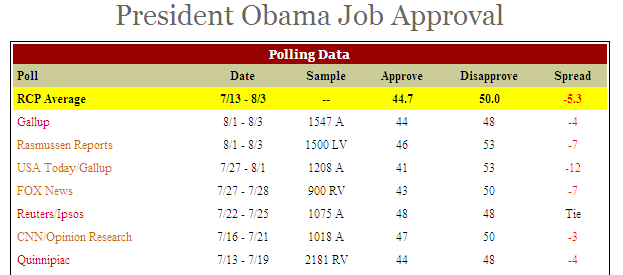
For the first time a majority in the Real Clear Politics poll-of-polls disapprove of the way President Obama is handling his job.

And, for the first time, his averaged approval rating has dipped below 45%.

image

image

More education means more work … so who’s the smart one ?

August 5, 2010

People tend to assume that education opens doors.

That may be true in a lot of cases, but for some American men in the past 20 years, more education has meant less leisure time.

But since 1985, a leisure-time gap has developed among men: Less educated men have devoted more time to leisure, while more educated guys have kept their shoulders to the wheel.

What’s the main explanation?

It could be that as men get more education — and thus more earning power — it becomes more rewarding for them to spend time working.

After all, they’re making more money.

Sourced from US News: Why Relax When You Can Work?, April 9, 2008
http://money.usnews.com/money/business-economy/articles/2008/04/09/why-relax-when-you-can-work.html

History repeats … here’s evidence

August 4, 2010

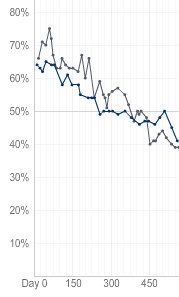
In the most recent Gallup — USA Today presidential tracking poll, Pres. Obama’s approval dropped to 41% — just above the political “Mendoza Line ”.

More interesting (to me), is the remarkable similarity between Obama’s approval decline and that of the President  to which he is most often compared (by conservatives) — Jimmy Carter.

  • Note: Jimmy Carter’s line is the one with the initial spike.

Anybody see a pattern ?

image

http://www.usatoday.com/news/washington/presidential-approval-tracker.htm

Fore: It’s not the first 300 yards of a hole that kill you …

August 4, 2010

Punch Line: It’s something you don’t hear much about, but it’s making a comeback — the par-three golf course.

* * * * *

WSJ: Why We Need More Par-Three Courses, July 24, 2010

The golf industry is struggling, and many people in the game cite the same reasons:

  • a round takes too long; the game is hard;
  • maintenance budgets are through the roof;
  • there are no places for beginners to play while they learn.

One remedy: more short courses.

For the experienced player, they provide a great practice session under game conditions. 

Improving your game around the greens is the best way to cut five strokes from your score; two or three hours at a short course is more valuable than whaling away with your driver on the range.

For the beginner, the shorter holes mean less frustration and more success.

“Most people play short courses for fun … and with a short course, you’re eliminating the longest and most unpredictable shots.”

Full article:
http://online.wsj.com/article/SB10001424052748703467304575382941326891262.html?mod=WSJ_hps_MIDDLEForthNews

Why didn’t they just name it Edsel ?

August 3, 2010

Punch line: The Chevy (oops, I meant to say Chevrolet) Volt will have a  $41,000 sticker price while offering the performance and interior space of a $15,000 economy car.

Maybe nobody will notice …

* * * * *

Excerpted from NYT: G.M.’s Electric Lemon, July 29, 2010

GM introduced America to the Chevrolet Volt at the 2007 Detroit Auto Show as a low-slung concept car that would someday be the future of motorized transportation. It would go 40 miles on battery power alone, after which it would create its own electricity with a gas engine.

Oops.

For starters, G.M.’s vision turned into a car that costs $41,000 before relevant tax breaks (projected to be about $7,500 per car). Tthe Volt’s main competition, the Nissan Leaf ends up costing $8,000 less as a result.

And instead of a sleek coupe , the Volt looks suspiciously similar to a Toyota Prius.

It also requires premium gasoline, seats only four people (the battery runs down the center of the car, preventing a rear bench) and has less head and leg room than the $17,000 Chevrolet Cruze, which is more or less the non-electric version of the Volt.

In short, the Volt appears to be exactly the kind of green-at-all-costs car that some opponents of the bailout feared the government might order G.M. to build.

Though President Obama’s task force reported in 2009 that the Volt “will likely be too expensive to be commercially successful in the short term,” it didn’t cancel the project.

So the future of General Motors (and the $50 billion taxpayer investment in it) now depends on a vehicle that costs $41,000 but offers the performance and interior space of a $15,000 economy car.

If G.M. were honest, it would market the car as a personal donation for, and vote of confidence in, the auto bailout. Unfortunately, that’s not the kind of cross-branding that will make the Volt a runaway success.

Full article:
http://www.nytimes.com/2010/07/30/opinion/30neidermeyer.html?_r=1&ref=opinion

Is that a Mercedes in the Dollar General parking lot?

August 3, 2010

Punch line: Americans are broke and depressed — and also swilling $3 lattes and waiting in line for iPhones.

Go figure.

* * * * *
Highlights from Bloomberg Business Week:The New Abnormal, July 29, 2010

The new abnormal has given rise to a nation of schizophrenic consumers — dollar stores and luxury. They splurge on high-end discretionary items and cut back on brand-name toothpaste and shampoo.

Companies like Apple and Starbucks  are thriving. Mercedes-Benz is having a record sales year.

The irony is that it is often the same people juggling iPhones and venti lattes who are open to switching to off-brand laundry detergents — abandoning Ivory soap and Crest toothpaste for generic brands.

They may also be sneaking into discount retailers for these deals.

The dollar store is the new Target … You go in there to buy shampoo for a buck so you can go to Starbucks and justify spending $3 for a coffee … you buy cheap towels there before hitting a pricey spa.”

What’s going on?

“Some consumers are probably liquidity-constrained … and aren’t buying iPads.

But 90 percent of Americans do have a job, and maybe 70 percent are confident about them. And maybe half of those have liquidity.”

“Consumers’ brains lack a line that separates spending from saving. Instead they practice a certain amount of thrift to justify blowing a large sum frivolously.”

People are saying, ‘There is still risk. I gotta cut back … but life has to have some normalcy. I have to have some luxuries.”

Full article:
http://www.businessweek.com/magazine/content/10_32/b4190050473272_page_4.htm

The economy: Light at the end of the tunnel ?

August 2, 2010

Nope.  Not according to the AP’s survey of leading economists.

That’s confusing (to me) since the President said on the view that he’s got this one under control.

Who to believe ?

* * * * *

Excerpted from: AP survey: A bleaker outlook for economy into 2011, July 29,2010

The U.S. economic recovery will remain slow deep into next year, held back by shoppers reluctant to spend and employers hesitant to hire, according to an Associated Press survey of leading economists.

Economists have turned gloomier in the past three months as “we hit an air pocket in consumer spending,”  They foresee weaker growth – less than 3% — and higher unemployment than they did before.

Growth would have to equal 5 percent for a full year to drive the unemployment rate down by 1 percentage point. Neither the economists in the AP survey nor the Obama administration expects that to happen.

More specifically, economists  forecast:

  • Economic growth the rest of this year and early next year will weaken, to less than 3 percent. From January through May, the economy grew at roughly a 3.5 percent pace.
  • The unemployment rate will be no lower at the end of the year than it is now — 9.5 percent. It will be 2015 or later before the rate falls to a historically normal 5 percent.
  • State budget shortfalls pose a “significant” or “severe” risk to the national economy. The loss of tax revenue has forced state and local governments to cut services and lay off workers. State and local governments cut their spending in the first three months of this year by 3.8%. The drop in state and local government spending shaved about half a percentage point off the U.S. gross domestic product in the first three months of this year.

Full article:
http://www.google.com/hostednews/ap/article/ALeqM5ioRXliVfpQrwlEITOiWDGlofCQfAD9H8FSJ80

“Make no mistake, we’re headed in the right direction” … oh, yeah ?

August 2, 2010

Ken’s Take: Q2 GDP growth was 2.4% … 3% is required to hold the unemployment rate constant … that means that next week’s unemployment rate will tick up … unless more unemployeds get discouraged, stop looking for work and don’t get counted in the denominator.

Doesn’t sound like the right direction to me …

* * * * *

Highlights from WSJ: The 2.4% Recovery, July 31, 2010

Savings by households also increased again, to above 6%, which is back to the range of the early 1990s and is a healthy sign.

The great deleveraging that began with business last year is now continuing with consumers.

While some economists fret that this is bad for consumer “demand,” savings don’t vanish from the economy. They are recycled into lending and investment that can drive future growth if businesses see the right opportunities and have enough confidence.

Ken’s Note: the savings do “vanish” if repaid lenders are also shoring up their balance sheets, i.e. holding the capital in reserve – by law or by desire.

* * * * *

The Obama Administration, in its Keynesian confusion, is simultaneously saying the economy is so weak it needs more spending “stimulus” but also strong enough to absorb a huge tax increase.

The message of 2.4% second quarter growth is closer to the opposite: The epic government stimulus has failed to produce the robust expansion the White House promised, and the prospect of higher taxes and more regulation is inhibiting the private animal spirits needed for growth to accelerate.

Ken’s Note: the fight over the Bush tax cuts will be fun to watch … my bet: it’ll be another GITMO … lots of rhetoric, but Bush had it right.

* * * * *

Full article:
http://online.wsj.com/article/SB10001424052748703999304575399490468359832.html?mod=WSJ_Opinion_LEADTop

Voters’ shifting ideology …

August 2, 2010

Today …

  • 58 percent of voters see Democrats as liberal or very liberal, while 56 percent see Republicans as conservative or very conservative
  • 60 percent of Democrats place the Republican Party to the right of where they place themselves
  • 42 percent of Democrats self-identify as liberal or very liberal
  • 24 percent of Democrats describe themselves as conservative or very conservative
  • 83 percent of Republicans see the Democratic Party as more liberal than they themselves are
  • 65 percent of Republicans think of themselves as conservative or very conservative
  • 5 percent of Republicans call themselves liberal or very liberal

In 2005 …

  • 51 percent of Independents thought that the Republican Party was more conservative than they themselves were
  • 36 percent thought that the Democratic Party was more liberal.
  • Independents considered the Republican Party to be twice as distant from them ideologically as the Democratic Party.

Today …

  • 56 percent of Independents see the Democratic Party as more liberal than they themselves are
  • 39 percent see the Republican Party as more conservative.
  • Independents see the Democratic Party as three times farther away from them ideologically as the Republican Party.

How Americans’ Shifting Political Ideologies Threaten the Democrats, July 28, 2010
http://www.tnr.com/blog/william-galston/76631/democrats-republicans-popularity-new-demographics

Back to the Future: BP distributors consider “retro-branding”

August 1, 2010

BP  bought Amoco in 1998 and many current BP distributors used to be Amoco distributors.

Those distributors began a campaign soon after the spill started, emphasizing that BP fuel stations are locally owned and operated.

Now, some BP gas station owners in the United States want to drop the BP name and return to the Amoco brand to recover business hit by public anger over the Gulf of Mexico oil spill disaster.

Note: there’s a major complication: the Amoco brand name is owned by BP, not by the distributors.

* * * * *

Source: Reuters, US BP distributors consider reverting to Amoco brand, Aug 1, 2010 
http://www.alertnet.org/thenews/newsdesk/N01235110.htm

Smackdown: Obama versus business …

July 30, 2010

At a recent cocktail party, in a lightning strike occurrence, I brushed up to a real, live CEO. 

He’s a member of the Business Roundtable, so I said “glad to see you guys speaking out on Obama’s policies”.

He said “yeah, we figured he’s going to screw us any way, so we might as well speak out”.

He also said Obama sent some communications flunky to address the group – she said “you gotta understand, it’s good politics for us to beat up on you guys.”

She should have added “now, go out there and save or create some jobs for us.”

Might work …

* * * * *

Excerpted from FT: Obama needs to stop baiting business, Mort Zuckerman, July 26 2010

The growing tension between the Obama administration and business is a cause for national concern.

The president has lost the confidence of employers, whose worries over taxes and the increased costs of new regulation are holding back investment and growth. The government must appreciate that confidence is an imperative if business is to invest, take risks and put the millions of unemployed back to productive work.

One unfortunate pattern that has emerged in the past 18 months is to lay all the blame for our difficulties on the business community and the financial world. This quite ignores the role of Congress in many areas, most glaringly in forcing Fannie Mae, Freddie Mac and the Federal Housing Administration to make loans to people who could not afford them. Then there is the Securities and Exchange Commission, which raised acceptable levels of leverage for financial institutions.

The predilection to blame business was manifest in one of President Barack Obama’s recent speeches.

He was supposed to be seeking the support of the business community for a doubling of exports over the next five years. Instead he lashed out at “unscrupulous and underhanded businesses, who are unencumbered by any restriction on activities that might harm the environment, take advantage of middle-class families, or, as we’ve seen, threaten to bring down the entire financial system.”

This kind of gratuitous and overstated demonization – widely seen in the business community as a resort to economic populism on the part of Mr Obama to shore up the growing weakness in his political standing – is exactly the wrong approach.

It ignores his disappointing stimulus program, which was ill-designed to produce the jobs the president promised. It also undermines the confidence that business needs to find if it is to invest in the face of a new generation of regulations, increased bureaucracy and higher taxes.

Disillusion has spread to the Business Roundtable, the US Chamber of Commerce and the National Federation of Independent Business, which represents small businesses.

The chief economist of the NFIB recently wrote: “Business owners do not trust the economic policies in place or proposed … the US economy faces hurricane-force headwinds and the government is at the center of the storm, making an economic recovery very difficult.”

Full article:
http://www.ft.com/cms/s/0/a18bd9a2-98e6-11df-9418-00144feab49a.html

German idea: Don’t tax the rich … tax the fat.

July 30, 2010

Excerpted from AOL News: Germany Weighs Tax on the Obese, July 23, 2010

Germany, famed for its beer, pork and chocolates, is one of the fattest countries in Europe. Twenty-one percent of German adults were obese in 2007, and the  cost of treating obesity-related illnesses is about $21.7 billion, a year.

Germany’s health system is paid for by a series of mandatory health insurance funds, all of which are reporting serious deficits as the system is overused.

A conservative member of parliament said it is unfair and unsustainable for the taxpayer to carry the entire cost of treating obesity-related illnesses in the public health system.

“I think that it would be sensible if those who deliberately lead unhealthy lives would be held financially accountable for that.”

A health economist called for Germany to tackle the problem of fattening snacks in order to raise money and reduce obesity.

“One should, as with tobacco, tax the purchase of unhealthy consumer goods at a higher rate  … that applies to alcohol, chocolate or risky sporting equipment such as hang-gliders.”

The German teachers association recently called for school kids to be weighed each day,

The fat kids could then be reported to social services, who could send them to health clinics.

A professor of nutrition at the Harvard School of Public Health, described the idea of a fat tax as “not humane … since lifestyle is not the only factor in obesity, with both genetics and urban environments playing major roles … Most people who are obese would prefer not to be so.”

Full article:
http://www.aolnews.com/world/article/germany-considers-tax-on-the-obese/19566425

Corporate profits are up … jobs, not so much.

July 29, 2010

We’ve been hammering the corporate resistance to hiring for over a year.

Reich raises a couple of good points, but his ideology blinds him to the Administration’s anti-business policies and their impact on employment. 

* * * * *

Excerpted from Robert Reich’s blog: The Great Decoupling of Corporate Profits from Jobs, July 26, 2010

Corporate profits are up. And big American companies are sitting on a gigantic pile of money.

So with all this money and profit, they’ll start hiring again, right? Wrong – for three reasons.

First, lots of their profits are coming from their overseas operations. So that’s where they’re investing and expanding production.

GM now sells more cars in China than it does in the US, but makes most of them there. The company now employs 32,000 hourly workers in China. But only 52,000 GM hourly workers remain in the United States – down from 468,000 in 1970.

Second, big U.S. businesses are investing their cash in labor-saving technologies. This boosts their productivity, but not their payrolls.

But due to labor-saving technologies, Ford now has half as many employees as it did a decade ago.

Wall Street analysts are happy with Ford’s “commitment to keeping capacity in check.”

“Keeping capacity in check” is the Street’s way of saying “no new hiring.” In fact, the Street is advising investors to sell the stocks of companies that talk openly of expanding capacity.

Third, corporations are using their pile of money to pay dividends to their shareholders and buy back their own stock – thereby pushing up share prices.

Last Friday, GE announced it would raise its dividend by 20 percent and reinstate its share-buyback plan. It’s GE’s first dividend increase since the company cut its dividend in early 2009. As a result, GE shares are up more than 5% in the past few days.

Bottom line: Higher corporate profits no longer lead to higher employment.  We’re witnessing a great decoupling of company profits from jobs. 

The reality is this: Big American companies may never rehire large numbers of workers.

Full article:
http://robertreich.org/post/863304269/the-great-decoupling-of-corporate-profits-from-jobs

Is the wine fine … or just high priced ?

July 29, 2010

Peer pressure influences us …  If everyone is telling you that something is good, you’re probably going to agree — or at least that’s what your brain will try to think.

And for adults, one of the best measures of what their peers like can be found on price tags.

Researchers tested just how much the luxurious feeling that comes with using a high-priced good determines the enjoyment of that good.

People were asked to sample and rate what they were told were five different wines. In reality, there were only three wines, each with a fake price tag — a $5 wine labeled $45, for example.

The results show that those fake prices carried a lot of weight: The participants thought they tasted five different wines, and the more “expensive” the wine, the more they liked it.

And they weren’t just lying to themselves: The researchers tested parts of the participants’ brains and found that when sipping a purportedly higher-priced wine, there was more activity in the parts that experience pleasure.

Excerpted from US News: The Fine Pleasures of Paying Through the Nose.  February 28, 2008 : 
http://money.usnews.com/money/business-economy/articles/2008/02/28/the-fine-pleasures-of-paying-through-the-nose.html

He may not pay attention to the polls, but we do …

July 28, 2010

President Obama is bumping against a couple of threshold numbers.

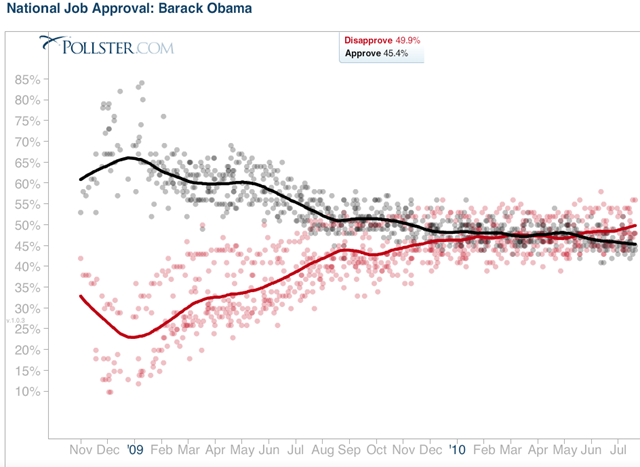
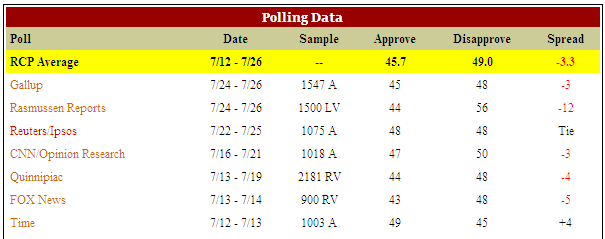
According to the Pollster.com’s poll-of-polls:

  • 49.9% of Americans now disapprove of the job that Obama is doing as President
  • Less than 46% of Americans now approve of the job that he’s doing.

The numbers are comparable in the RealClearPolitics.com poll-of-polls. 

Both Pollster and RCP are displayed below ….

image

image

image

He may not pay attention to the polls, but we do …

July 28, 2010

President Obama is bumping against a couple of threshold numbers.

According to the Pollster.com’s poll-of-polls:

  • 49.9% of Americans now disapprove of the job that Obama is doing as President
  • Less than 46% of Americans now approve of the job that he’s doing.

The numbers are comparable in the RealClearPolitics.com poll-of-polls. 

Both Pollster and RCP are displayed below ….

image

image

image

Celebrating success: Georgetown ranked #9

July 28, 2010

No, not hoops or b-school rankings, we’re talking the Most Gang-Affiliated Hats in Sports.

According to Complex.com, here are the top 10:

#10 Oakland A’s
Adopted by: Almighty Ambrose Nation (Chicago), Orchestra Albany (Chicago), Spanish Cobras (Chicago)
Why: The Ambrose and the Albany share the same first letter as the Athletics, while the Spanish Cobras rock the green A’s caps to represent their primary color.

#9 Georgetown Hoyas
Adopted by: Gangster Disciples (Chicago), Folk Nation (Chicago)
Why: GD members started rocking Georgetown gear to honor founder Larry Hoover, with Hoyas standing for “Hoover’s On Your Ass.”

#8 Minnesota Twins
Adopted by: Maniac Latin Disciples (Chicago)
Why: The M stands for “Maniac Latin Disciples”.

#7 Detroit Tigers
Adopted by: Gangster Disciples (Chicago)
Why: The “D” stands for Disciple and the GD colors are black and blue.

#6 Houston Astros
Adopted by: The Bloods (L.A.), Folk Nation (Chicago)
Why: The red cap is an easy color identifier for the Bloods. For the Folk Nation, the five-point star represents their symbol.

#5 Los Angeles Kings
Adopted by: Latin Kings (Chicago, NYC), People Nation (Chicago)
Why: The word “Kings” makes it easy to identify the largest Hispanic gang in the U.S. For other gangs within the People Nation alliance, the “Kings” stands for “Kill Inglewood Nasty Gangsters.”

#4 Chicago Bulls
Adopted by: Vice Lords (Chicago), Latin Counts (Mexico, Chicago), Mickey Cobras (Chicago), Black P. Stone Nation (Chicago), The Bloods (L.A.)
Why: The Vice Lords, Latin Counts, and Mickey Cobras share the Bulls’ colors of red and black. The P. Stones and the Bloods were a little more creative however: For the former, “Bulls” stands for “Boy U Look Like Stone” and for the Bloods, it stands for “Bloods Usually Live Life Strong/Smart.”

#3 Los Angeles/Oakland Raiders
Adopted by: People Nation (Chicago), Folk Nation (Chicago)
Why: For the Folk Nation, “Raiders” stands for “Ruthless Ass Insane Disciples Running Shit.” For the People Nation, it stands for “Raggedy Ass Iced Donuts Everywhere Running Scared.” Ha!

#2 Cincinnati Reds
Adopted by: 4 Corner Hustlers (Chicago), The Bloods (L.A.)
Why: The Bloods wear it for color association. The Hustlers put a “4” next to the “C” and an “H” inside the “C.”

#1 Los Angeles Dodgers
Adopted by: The Crips (L.A.), Gangster Disciples (Chicago), Latin Aspects (various)
Why: The Crips use it for color association. For the GDs, the “D” stands for Disciple. For the Aspects, the “LA” stands for Latin Aspects.

Full article:
http://www.complex.com/blogs/2010/07/23/rep-yo-set-the-10-most-gang-affiliated-hats-in-sports/

Most Americans want the Bush tax cuts made permanent …

July 27, 2010

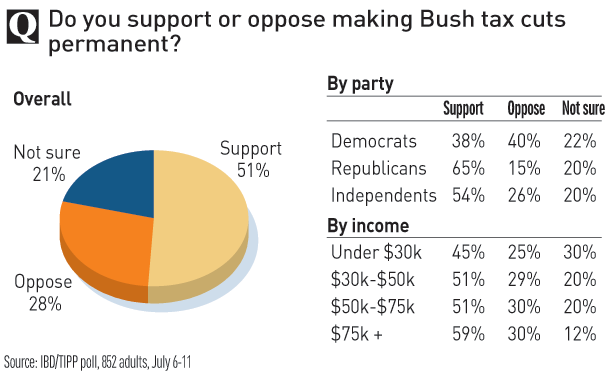
According to IBD /TIPP …

  • 51% percent of Americans favor making the Bush cuts permanent vs. 28% who didn’t.
  • Republicans were more than 4 to 1 and Independents more than 2 to 1 in favor.
  • Only Democrats were opposed, but only by 40% to 38%.

The cuts also proved popular among all income groups — despite the Democrats’ oft-heard assertion that Bush merely provided “tax breaks for the wealthy.”

image

* * * * *

As of midnight Dec. 31 , if the Bush tax cuts aren’t extended …

  • The death tax returns — at a rate of 55% on estates of $1 million or more.
  • The lowest bracket for the personal income tax moves up 50% — to 15% from 10%.
  • The next lowest bracket — 25% — will rise to 28%, and the old 28% bracket will be 31%.
  • At the higher end, the 33% bracket is pushed to 36% and the 35% bracket becomes 39.6%.
  • The marriage penalty makes a comeback … e.g. the standard deduction for couples is fixed at the same level as it is for single filers.
  • The capital gains tax will jump 33% — to 20% from 15%.
  • The tax on dividends will go all the way from 15% to 39.6% — a 164% increase.
  • Other tax hikes include: halving the child tax credit to $500 from $1,000

Source IBD: The Tax Tsunami On The Horizon, 07/21/2010
http://www.investors.com/NewsAndAnalysis/Article.aspx?id=541131

The “Paradox of Thrift”… explains a lot.

July 27, 2010

Here’s why much of Stimulus has been ineffective in actually stimulating the economy …

The meltdown occurred largely because consumers (and businesses) were over-leveraged. That is, they were carrying too much debt – way too much debt.

When asset values plummeted (think home prices) panic understandably set in.

So, any “free cash” that flows in (think gov’t rebate checks) goes to retiring debt (i.e. deleveraging) instead of consumption.  That’s good for balance sheets, but doesn’t stimulate the economy.

Economists call it the “paradox of thrift.”

^ ^ ^ ^ ^

Excerpted from Minyanville.com: Why There’s No Case for Healthy Economic Growth, Jul 23, 2010

The consumer is simply carrying too much debt.

In the US, consumption represents 70% of GDP, but the consumers’ debt/GDP ratio, which spurted from 100% in 2001 to more than 135% in 2008, still stands at 126%, nearly three years after the recession began.

Much of the nine-percentage-point decline is due to financial institution write-offs as opposed to debt repayment, so it appears that the consumer has a long way to go to even get back to the 100% ratio. The next healthy economic upswing must await the healing of household balance sheets.

Unfortunately, to get a healthy consumer balance sheet, savings must increase to repay the debt, which leaves less for consumption.

Lower consumption means slower economic growth with all the attendant implications for employment.

This is known in the economics profession as “the paradox of thrift.”

Unfortunately, the politicians are promoting ill-conceived schemes that wind up only prolonging the agony — like “Cash for Clunkers” and the “homebuyer tax credit.” These programs promote more debt which will have to be reduced in the future

The need to work off debt together with the loss of retirement income by the baby boomers will cause them to put off retirement for several years.

This will trickle down to the younger generation who will find it increasingly difficult to find satisfactory employment.

We’ll see the U6 unemployment measure (which counts the underemployed) continue to stay high – very high.

Full article:
http://www.minyanville.com/businessmarkets/articles/overconsumption-economy-consumers-finance-investors-economcy/7/23/2010/id/29290

Policy dispute results in 50,000 cattle guards being fired …

July 27, 2010

This is being internet-blasted  … unlikely, but funny …

* * * * *

A few months ago, President Obama received a report that there were over 100,000 cattle guards in Colorado .

Colorado ranchers had protested some proposed government imposed changes in grazing policies, so the President ordered the Secretary of the Interior to fire half of the “cattle guards” immediately!!

Before the Secretary of the Interior could respond and presumably try to straighten him out, Vice-President, Joe Biden, intervened with a request that … before any “cattle guards” were fired, they be given six months of retraining.

At least they didn’t file a lawsuit against the Colorado cattle.

* * * * *

For those of you who have never traveled to the west, or southwest, cattle guards are horizontal steel rails placed at fence openings, in dug-out places in the roads adjacent to highways (sometimes across highways), to prevent cattle from crossing over that area. For some reason the cattle will not step on the “guards,” probably because they fear getting their feet caught between the rails.

image001_1


Economy’s weak, so let’s spend and tax … huh ?

July 26, 2010

I continue to be dismayed by the Administration’s lack of business savvy, economic unorthodoxy (despite lack of success), and steaming contradictions …

* * * * *

Excerpted from WSJ: Liberal Tax Revolt, July 23, 2010

Only in the age of Obama have Democrats convinced themselves that the best “stimulus” is higher spending and higher taxes.

There’s nothing like the prospect of an electoral rout to concentrate the incumbent mind, and so all of a sudden rank-and-file Democrats in Congress are saying maybe they shouldn’t let the 2003 tax rates expire after all.

The revelation that “as a general rule, you don’t want to be  raising taxes in the midst of a downturn.” tax increases has recently been heard from Senators Evan Bayh of Indiana, Ben Nelson of Nebraska, and, most surprising, even from Kent Conrad of North Dakota. On a scale of unlikely events, this is like the Pope coming out against celibacy.

These are hardly supply-side conversions, but they’re a start.

As for  Pelosi,  Geithner and Obama, they remain prisoners of their spend-and-tax dogma.

Geithner declared that the tax increases will arrive as scheduled.

So the same Mr. Geithner who says the economy is weak enough that we must have new spending “stimulus” says it is strong enough to endure a huge tax increase.

Go figure.

* * * * *

New data from, of all places, the Democratic-run Joint Committee on Taxation show that in 2011 roughly 750,000 taxpayers with net business income will pay the highest marginal rate of 39.6% or the next highest bracket of 36% (up from 33%) – that’s a higher rate than Goldman Sachs will be paying.

About half of the roughly $1 trillion of total net business income will also be reported on those returns.

In a stroke, that will make tens of billions of dollars unavailable to invest or to hire new workers.

* * * * *

Full article:
http://online.wsj.com/article/SB10001424052748703467304575383233009284878.html?mod=WSJ_newsreel_opinion

Why folks are feeling down …

July 26, 2010

Punch line: This has been the most egalitarian of all the 11 recessions since World War II.

In various ways, it has touched every social class through job loss, pay cuts, depressed home values, shrunken stock portfolios, eroded retirement savings, grown children returning home — and anxiety about all of the above.

* * * * *
Excerpted from RCP: The Great Stranglehold, Robert Samuelson, July 12, 2010 

A new study from the Pew Research Center  confirms that Americans have become more frugal and changed life plans:

  • 71 percent say they’re buying less expensive brands
  • 57 percent say they’ve trimmed or eliminated vacations
  • 28 percent of Americans under 65 borrowed money from family or friends
  • 11 percent say they’ve postponed marriage or children
  • 9 percent have moved back with parents.

The economic and spiritual damage extends much further, for many reasons.

First, the huge job loss: By most measures (length of unemployment, permanent firings versus temporary layoffs), joblessness is the worst since World War II.  Younger workers change jobs more often and have higher jobless rates.)

Second, pay cuts: These have affected almost a quarter of workers, including nearly a fifth of those with family incomes exceeding $75,000. Some workers also have had to take unpaid leave or part-time work.

Third, the loss of housing and stock market wealth: This decline (more than 25 percent at its peak on an annual basis) has been concentrated among higher-income Americans, who own a disproportionate share of the wealth. A reverse wealth effect has gripped the upper middle class. Feeling poorer, people saved more and spent less. Their reluctance to make major purchase commitments (a new car or home) validates their pessimism by retarding recovery.

Full article:
http://www.realclearpolitics.com/articles/2010/07/12/the_great_stranglehold_106258.html

Shocker: Folks think concert tickets are too expensive …

July 26, 2010

Seventy percent (70%) of adults think concert ticket prices are too high

…  and they’re voting with their wallets

… only 35% say they have attended a music concert in the last year.

Source: Rasmussen Reports, 70% Say Concert Tickets Cost Too Much, July 25, 2010
http://www.rasmussenreports.com/public_content/lifestyle/entertainment/july_2010/70_say_concert_tickets_cost_too_much

The thrill is gone … or at least going.

July 23, 2010

From the just released CNN poll …

Headline: Obama’s approval drops to 47% (from 51%)

I was most intrigued by the the following question:

How do you personally feel about the fact that Barack Obama is president?

If you had to choose one of the following descriptions, would you say you feel thrilled, happy, don’t care, unhappy or depressed?

* * * * *

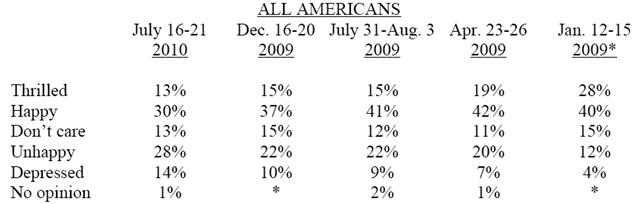
Among all Americans, more are depressed that Obama is President than are thrilled – 14% (up from 4%) to 13% (down from 28%)

click table to enlarge

image

* * * * *

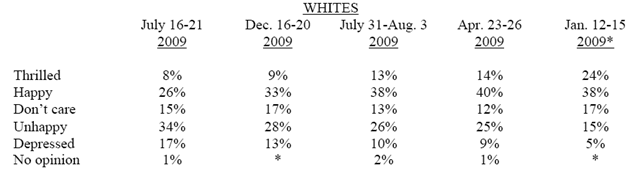
Among whites, more half are unhappy or depressed that Obama is President  …

click table to enlarge

image

* * * * *

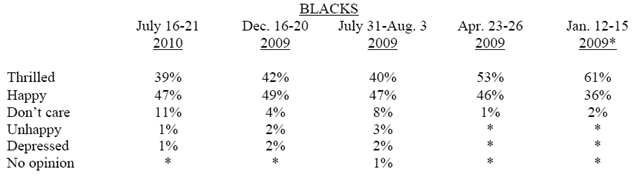
Among blacks, 39% are thrilled … down from 61% on Inauguration Day.

Note: Still, over 90% of Blacks approve of the job Pres. Obama is doing … but, given the decline in those thrilled, the intensity of the approval is diminishing.

click table to enlarge

image

http://i2.cdn.turner.com/cnn/2010/images/07/22/rel10a9b.pdf

The thrill is gone … or at least going.

July 23, 2010

From the just released CNN poll …

Headline: Obama’s approval drops to 47% (from 51%)

I was most intrigued by the the following question:

How do you personally feel about the fact that Barack Obama is president?

If you had to choose one of the following descriptions, would you say you feel thrilled, happy, don’t care, unhappy or depressed?

* * * * *

Among all Americans, more are depressed that Obama is President than are thrilled – 14% (up from 4%) to 13% (down from 28%)

click table to enlarge

image

* * * * *

Among whites, more half are unhappy or depressed that Obama is President  …

click table to enlarge

image

* * * * *

Among blacks, 39% are thrilled … down from 61% on Inauguration Day.

Note: Still, over 90% of Blacks approve of the job Pres. Obama is doing … but, given the decline in those thrilled, the intensity of the approval is diminishing.

click table to enlarge

image

http://i2.cdn.turner.com/cnn/2010/images/07/22/rel10a9b.pdf

Hummer: Taking the high road … huh ?

July 23, 2010

Excerpted from Canadian Business: MY HUMMER, RIGHT OR WRONG, 10/13/2009

Hummer buyers don’t hate the planet-they just love their country more

Depending on where you are sitting – or more accurately what you are sitting in – the Hummer super-SUV is either

  • a shining symbol of American consumerism gone mad, or
  • a 21st-century emblem of American frontier heritage and individualism.

It’s easy to understand the first view.

The Hummer is a hulking, slab-sided truck built by the same company that makes the Humvee military vehicles; Hummers need a gallon of gas to rumble 10 miles.

The case for the latter, according to a study in the Journal of Consumer Research, is a little more complex.

Basically, Hummer owners are aware of the criticism aimed at the vehicle but drive them anyway-not despite the critics, but to spite them.

“For Hummer owners, it is possible to claim the moral high ground.”

Hummer attitudes go beyond defending the rights of other Americans to choose, to a form of patriotism.

“They think they are particularly American by consuming this vehicle.”

For Obama, the chasm gets wider …

July 22, 2010

The headline from yesterday’s Quinnipiac University National Poll:
Obama Approval Drops To Lowest Point Ever
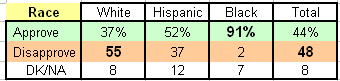
… 44% approve,  48% disapprove

And, when asked:  If the 2012 election for President were being held today, do you think you would vote for Barack Obama the Democratic candidate, or the Republican candidate? The unnamed ‘any’ GOP candidate beat Obama 39% to 36%. That can’t be good for the President.

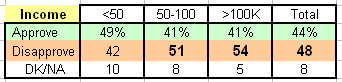
Still, the bigger deal is the split by race, age, and income …

* * * * *

Approval among Blacks is still a sky high 91%,
but approval among whites has slipped below 40%
… a 54 point difference — that’s big.

image

* * * * *

Approval among young Americans has dipped below 50%
… approval among old folks like me has slipped below 40%

image

* * * * *

Approval among young Americans has stayed around 50%
…  a majority of those earning more than $50,000 (think “pay income taxes”) disapprove

 image


http://www.quinnipiac.edu/x1295.xml?ReleaseID=1478

When the estate tax hits real people …

July 22, 2010

Last week, I posted an entry regarding how George Steinbrenner saved his heirs $500 million by dying in 2010 – when there are no estate taxes.

My intent was a chuckle, but a thoughtful reader reminded that the estate tax hits real people in some harmful ways …

When my last grandparent passed in 2005 she left behind a family farm consisting of 1,000 acres in NC.

In order for my father to receive the land he had to pay ~1 years salary in inheritance taxes. 

Not so he could really improve his livelihood, but so he could retain the land that was in the family since the 1800s.

Folks can talk about only taxing the ‘rich’ in society but they’re not the ones having to look my father in the eye while he’s attempting to pull together cash to pay the IRS.

An excellent reminder …. it’s not just the fat cats who get nabbed !

Protection racket: Why do folks buy extended warranties ?

July 22, 2010

Extended warranties are often more profitable to the retailer than the product it covers.

They  generally amount to  “unnecessary and overpriced insurance” since most products don’t break within the period covered, and repairs tend to cost no more than the warranty itself.

So, why do so many consumers buy extended warranties?

Answer: Peace of mind is a benefit … especially for folks of limited means who are buying “hedonic” products.

* * * * *

Shoppers tend to agonize over the relative merits of different models of electronic goods such as digital cameras or plasma televisions.

But when they get to the till, many spend freely on something they barely think about at all: an extended warranty, which is often more profitable to the retailer than the device it covers.

Shoppers typically pay 10-50% of the cost of a product to insure it beyond the term covered by the manufacturer’s guarantee. The terms of these deals vary (and there is often a great deal of fine print).

Yet products rarely break within the period covered, and repairs tend to cost no more than the warranty itself.

That makes warranties amazingly profitable: they generate some $15 billion annually for American retailers, according to Warranty Week, a trade journal.

So why, asks a paper published in the December 2009  issue of the Journal of Consumer Research, do so many consumers still buy extended warranties?

The researchers concluded that the decision to buy a warranty had a great deal to do with a shopper’s mood.

If a customer is about to buy something fun (i.e., an iPod rather than a landline phone), he will be more inclined to pay for extra insurance because consumers value “hedonic” items over utilitarian ones.

The study also found that poorer consumers are more likely to buy “potentially unnecessary and overpriced insurance”, because they are more worried about the expense of replacing a product if it breaks.

The popularity of warranties should logically depend on the likelihood of a product’s failure … but the emotional tranquility that comes with buying a new warranty is a benefit to buyers, even if “rationally, it doesn’t make sense”.

The Economist. London: Nov 21, 2009. Vol. 393, Iss. 8658; pg. 66

* * * * *

An Angle: Extended warranties for laptops often cover the battery.  If your battery should wear out – say, right before the extended warranty is about to expire – you might be able to get a “free” replacement battery – that has a FMV about equal to the price you paid for the extended warranty.

Where are Obama’s approval ratings highest ? … and lowest ?

July 21, 2010

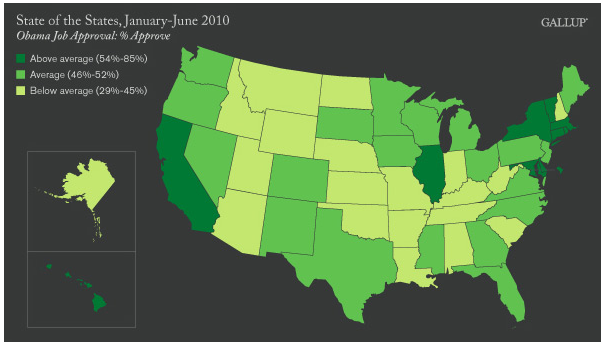
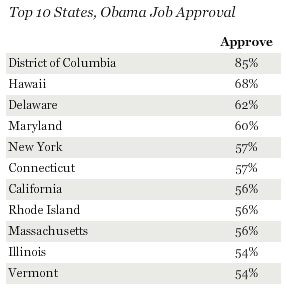
Interesting recap by Gallup …

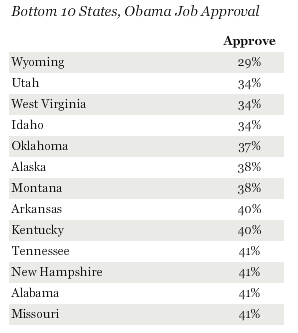
DC leads with a sky high 85% approval  … Wyoming’s 29% is the lowest.

image

image

image

http://www.gallup.com/poll/141428/Obama-Highest-Half-Year-Approval-Ratings-Hawaii.aspx

“Every economist agrees that the Stimulus worked” … oh, really ?

July 21, 2010

That’s what the President keeps saying.

Michael Boskin – a senior professor of economics at Stanford University – disagrees … as do dozens of his colleagues.

* * * * *

Excerpted from WSJ: Obama’s Economic Fish Stories, July 21, 2010

President Obama says “every economist who’s looked at it says that the Recovery Act has done its job” — i.e., the stimulus bill has turned the economy around.

That’s nonsense.

Opinions differ widely and many leading economists believe that its impact has been small.

Why?

The expectation of future spending and future tax hikes to pay for the stimulus and Mr. Obama’s vast expansion of government are more than offsetting any direct short-run expansionary effect. That is standard in all macroeconomic theories.

So, as I and others warned, the permanent government expansion and higher tax rate agenda is a classic example of what not to do during bad economic times.

The president does not say that economists agree that the high future taxes to finance the stimulus will hurt the economy.

Mr. Obama’s economic statements are increasingly divorced not only from competing viewpoints but from those of his own economic advisers, e.g. he claims that the stimulus bill was several times more potent than his chief economic adviser estimates.

The stimulus bill has assumed certain mystic powers in administration discourse, but revoking the laws of arithmetic shouldn’t be one of them.

At the very least, his staff needs to avoid putting these exaggerations on the teleprompter.

It undermines confidence and raises concerns about competence. It’s doing nobody any good—not the economy and certainly not Mr. Obama.

Full article:
http://online.wsj.com/article/SB10001424052748703724104575378751776758256.html

The “denomination effect” … it’s about spending, not religion.

July 21, 2010

Punch line: If you want to control your spending, leave your credit cards at home and only carry around big bills …

* * * * *
Excerpted from NYT: A Reluctance to Break the Large Bills, March 29, 2009

A paper  published in The Journal of Consumer Research investigates the so-called denomination effect — the additional tight-fistedness people exhibit when their money is tied up in a few large-denomination bills, as opposed to many small ones.

  • In one study, 63 % of college students who had been given four quarters splurged on candy; 74% of students given a single dollar bill, pocketed it.
  • In another study, 20 percent of Chinese women given a single 100-yuan note ($14.66) chose not to spend the money on an array of shampoo, bedding and other household goods — but the rate of abstention was only 9.3 percent among women given the same amount of money in smaller notes.

“People overvalue these large bills … It’s partly a self-control mechanism — I want to hold onto it, because if I do break that big denomination, I lose track of my spending.”

The findings are especially relevant to “places like China or India that are predominantly a cash-based economy.”

Full article:
http://www.nytimes.com/2009/03/30/business/30drill.html

* * * * *

Ken’s Note: Never thought of a “single dollar bill” as a particularly big denomination …

Told you so: Closing auto dealers cost jobs without saving GM any money …

July 20, 2010

Punch line: A government watchdog slammed the Obama administration’s handling of auto dealer closings that were pushed through last year to speed the bankruptcy proceedings of Chrysler and General Motors.

This is neither new news, nor surprising.

HomaFiles reported on these dealer closings when they were going down.

A local dealer told us at the time:

  1. There would be no savings to the car companies since the bulk of their dealer support costs are variable costs, e.g. cooperative marketing programs
  2. In fact, the companies would lose “floor plan” inventory – the cars that dealers have to buy, finance, and keep on their lots.  Fewer dealers translates to fewer cars on lots.
  3. The major criteria for closing were political … dealers who opposed Obama’s plan were warned … and if they continued to make waves, they were put on the “to be closed” list.
  4. Surviving car dealers might become more profitable since fewer dealers means less price competition
  5. The biggest impact of dealer closings would be the dealerships’ employees.  As the guy told me:
    ”I’ll still have my foreign nameplate stores … may have to sell one of my beach houses … but that’s no big deal.  I worry about th 50 to 100 employees per store … some have been with me for 30 years …  I can’t absorb them into my other stores … and I don’t think any surviving dealers will pick many of them up.

* * * * *

Excerpted from Dow Jones: Watchdog Criticizes Treasury’s Role In Auto Dealer Closures, July 18, 2010

The decision by Treasury’s auto task force to reject the companies’ plans for gradual dealer closures in favor of an accelerated process may have exacerbated job losses in the midst of a recession.

The office of special inspector general Neil Barofsky, set up to monitor the $700 billion financial bailout known as TARP, took the administration to task for failing to sufficiently oversee the closures and weigh the broader economic impact of its decisions.

“Treasury made a series of decisions that may have substantially contributed to the accelerated shuttering of thousands of small businesses and thereby potentially adding tens of thousands of workers to the already lengthy unemployment rolls — all based on a theory and without sufficient consideration of the decisions’ broader economic impact.” 

The audit said “only time will tell” whether the accelerated closures will help the companies’ profitability. But Treasury should have “taken every reasonable step” to ensure the closures were necessary and that the benefits to the companies outweighed the economic costs of “potentially tens of thousands of accelerated job losses” 

But many dealers and their congressional representatives said the process by which GM and Chrysler chose which dealerships to cut was arbitrary.

Full article:
http://online.wsj.com/article/BT-CO-20100718-703295.html

Amazon’s “tipping point”: More e-book sales than hardcovers

July 20, 2010

WSJ, Amazon Says E-Book Sales Outpace Hardcovers, July 20, 2010 

Amazon reached a milestone, selling more e-books than hardbacks over the past three months. Over the past month, the Seattle retailer sold 180 Kindle books for every 100 hardcover books it sold, it said.

But publishers said it is still too early to gauge for the entire industry whether the growth of e-books is cannibalizing sales of paperback books, a huge and crucial market.

In a statement, Amazon’s chief executive, Jeff Bezos

  • countered the perception that sales of the company’s Kindle e-reading device had suffered due to competition from other devices, such as Apple’s iPad.
  • said the growth rate of Kindle device sales had “reached a tipping point,” having tripled since the company lowered its price
  • painted a picture of accelerating growth in sales of e-books, which can be read on the Kindle
  • said its hardback book unit sales also continued to increase.

Full story:
http://online.wsj.com/article/SB10001424052748703720504575377472723652734.html?mod=djemalertTECH

Satellite Radio: one step forward, half-a-step back …

July 20, 2010

When launched – almost a decade ago – satellite radio was going to revolutionize the radio airwaves … like DirecTV and cable did for TV.

While the subscriber base continues to inch up, new “adds” are being neutralized by high cancellation rates … only about half of new subscribers end up renewing their contracts.

Why?

It’s hard to compete against free … especially with a product that doesn’t have a killer app.

* * * * *

When satellite-radio customers are asked whether they will keep their subscriptions, they answer differently depending on whether they have sought out the service or received it free through radios already installed in new or leased cars.

66% of the people who buy radios to replace the non-sat radios in their current cars say they’ll keep the service when their current contract term expires

Only 40% of people who bought a car with a sat-radio already installed and who got a free promotional trial subscription – say that they will “absolutely keep” the service when the trial expires

Source: NYT, Staying in the Orbit of Satellite Radio,  April 21, 2008
http://www.nytimes.com/2008/04/21/technology/21drill.html?scp=21&sq=%22drilling%20down%22&st=Search

“A Whale” turns out to be a minnow …

July 19, 2010

OK, I was sucked in by the hype.

The super-skimmer “A Whale” – whose deployment was delayed by the union-protecting Jones Act — was supposed to be capable of pulling 50,000 barrels of oil from the Gulf waters every day.

In tests, it skimmed approximately no oil from the Gulf.

‘All we found in the tanks was water … it was very ineffective.’

Bummer.

* * * * *

Excerpted from Reuters: ‘Super skimmer’ a giant bust in Gulf cleanup, July 16, 2010

A Taiwanese-owned “super skimmer” sent to help clean up the Gulf of Mexico oil spill has been a bust, the U.S. Coast Guard said after tests on the ship.

“While its stature is impressive, ‘A Whale’ is not ideally suited to the needs of this response.”

The tanker collected virtually no oil in two weeks of tests.

“All we found in the tanks was water, so it was very ineffective.”

Full article:
http://www.msnbc.msn.com/id/38283782/ns/disaster_in_the_gulf/

Adults Only: A Trojan horse or a Trojan for horses ?

July 19, 2010

Hate to drag HomaFiles down to this level, but this one is too good to pass up.

Punch line: Since introducing its Magnum line of plus-size condoms,  industry leader Trojan’s market share and profits have surged.

* * * * *

From Psychology Today …

Few marketers are as fortunate as condom makers, whose customers are glad to pay a premium for a product that isn’t really much bigger or better.

Trojan markets its Magnum line of condoms as “Bigger than most condoms …  designed to fit those that find normal condoms too constricting.”

Oh, yes, and then there are Magnum XL’s … an upsell version.

It’s easy to see why men fall for this particular sales pitch.

“The Magnum brand is viewed as a positive lifestyle badge and positive symbol … men are proud to show they carry a Magnum condom — the large size carries a certain cachet.”

The economics:  A box of 12 regular Trojans retails for around $5.99; a box of 12 Magnums or Magnum XLs is $7.99. That’s a 33 percent premium.

Trojan confesses that it’s hard to imagine Magnum buyers doing the math … and since Magnum condoms are only 3/10 of an inch longer than regular Trojans – and since XLs are the the same length as Magnums … all of the condoms cost about the same to make, so the Magnum’s price premium is pure profit.

As an academic observer notes: “I think the concept of having more sizes is a step forward for the industry … But you could never market them as small, medium and large, because no one would buy the small.”

Excerpted from Behavioral Economics: Monetizing the Male Ego, April 28, 2010
http://www.psychologytoday.com/blog/priceless/201004/monetizing-the-male-ego

* * * * *

Factoids

Trojan, including Magnum, commands 75 percent of the condom market, with No. 2 Durex commanding 14 percent.

The company claims Magnum is the most popular condom among African-Americans, citing internal research that indicates they account for 22 percent of all condom purchases but 40 percent of Magnum purchases.

http://www.nytimes.com/2010/04/28/business/media/28adco.html?_r=1&ref=business

OK, let’s pretend the Stimulus worked … the math (continued)

July 16, 2010

Yesterday, we pointed out that taking Obama’s numbers at face value, i.e. the Stimulus “saved or created” 3.5 million jobs … almost $250k was (or will be spent) for each job saved or created.

A couple of loyal readers replied that “only half of the Stimulus money has been spent so the cost is only about $125k per job saved or created”.

First, $125k is still a lot of money per job.

More important, all of the money will eventually be spent and the total claim for jobs saved or created is 3.5 million … so we’re back to the $250k number.

Most important, let’s merge the 2 ideas: Romer says 3 million jobs saved or created are in the books … since $425 billion has been spent (1/2 of the total Stimulus) … that means that the spending per job has been just under $150k.

But, the next $425 billion will only save or create 500,000 jobs … that works out to about $850,000 per job.

It’s called “diminishing returns” … and it illustrates – using Obama’s own numbers – why throwing more stimulus money at the problem is a bad idea.

image

Timing is everything: Steinbrenner’s biggest coup …

July 16, 2010

… was, of course, dying in 2010.

Why ?

No estate taxes.

Steinbrenner’s estate is estimated to be north of $1 billion.

By dying this year, his heirs will pay no Federal estate taxes.

If he had hung on until next, the Feds take would have been about $500 million – assuming that Obama ditches the Bush tax program

Timing is everything.

Full article:
http://dealbook.blogs.nytimes.com/2010/07/14/steinbrenner-heirs-may-save-millions-on-estate-tax/

Almost 10% of unemployment benefits are fraudulent … and Congress wants to ramp ‘em up … OUCH !

July 16, 2010

While many Americans are feeling the pain of expired unemployment benefits, some have gotten a good chunk more than they were legally eligible for.

Preliminary estimates released by the Department of Labor find that, in 2009, states paid $76.8 billion in unemployment benefits … more than $7.1 billion (over 9%) were overpayments in unemployment insurance

Fraud accounted for $1.55 billion in estimated overpayments last year, while errors by state agencies were blamed for $2.27 billion, according to the Labor Department.

Assistant Secretary for Employment and Training Jane Oates testified before Congress in May that the top cause for overpayments was people returning to work and continuing to claim benefits.

Other overpayments are often the result of the unemployed errantly claiming that they were laid off instead of fired for cause — the latter of which typically disqualifies a person for benefits.

Excerpted from ABC NEWS: Labor Dept. Estimates $7.1 Billion in Overpayments to Unemployed, July 9, 2010 
http://abcnews.go.com/Business/underemployed-overpaid-states-shell-unemployment/story?id=11118137

OK, let’s pretend the stimulus worked … but let’s do some math

July 15, 2010

Yesterday, as part of the Recovery Summer Tour, Obama’s CEA Chief Christina Romer cheerfully pitched that the Stimulus worked ever better then they (her and Biden-economist Jared Bernstein) said it would … that 3 million jobs have already been saved or created and another 600,000 will materialize before the end of 2010.

It’s easy to quibble since actual employment has fallen by 2.5 million since the Stimulus was enacted … and it’s well-traveled that the same same Ms. Romer said the unemployment rate would rise to 9% without the Stimulus, but would get capped at 8% if the gov’t threw a cool trillion dollars  at the problem.  Oops.

 image

The Job Impact of the American Recovery and Reinvestment Plan, Romer & Bernstein, January 2009
http://www.economy.com/mark-zandi/documents/The_Job_Impact_of_the_American_Recovery_and_Reinvestment_Plan.pdf

But, HomaFiles aren’t in to cheap shots, so we’ll assume that Ms. Romer has gotten smarter and has crafted a more refined econometric model.

And, we’ll assume that she’s an honest person and isn’t just ginning up numbers for political purposes.

Let’s do some simple arithmetic.

Assuming Romer’s right, then – in the best case — each job saved or created cost almost $250,000 !

I don’t know about you, but that strikes me as a pretty big number.

And, keep in mind that the Stimulus just funds jobs temporarily …. when the Stimulus is expended, somebody else has to pick up the tab or the saved and create jobs vanish again.


image

From passive aggressive to active aggressive behavior … Business groups tell Obama: “Let’s rumble …”

July 15, 2010

In a couple of posts dating back to last year, we’ve pointed to the passive aggressive behavior of corporations and their CEOs.  Knowing that the vindictive Administration would be all over them if they openly opposed the Obama agenda, they kept quiet and simply kept their employment offices closed.

Well, now the passive aggressive stage is becoming active aggressive.  The Chamber of Commerce led the way (and got dis-invited from the White House).  The Business Roundtable went public a couple of weeks ago with a 60 page list of grievances.

Now, the U.S. Chamber of Commerce, the Business Roundtable and the National Federation of Independent Businesses — are forming a united front  in their confrontation with the Obama administration over economic policy, calling on the White House to cut taxes, expand royalty-earning oil drilling and timber harvesting, sign stalled trade agreements  and curb its regulatory over-reach.

Business groups’  list of concerns is summarized in an open letter to the President that reads in part:

The congressional leadership and your administration have taken their eyes off the ball.

They neglected America’s number one priority — creating the more than 20 million jobs we need over the next 10 years for those who lost their jobs, have left the job market, or were cut to part-time status—as well as new entrants into our workforce.

Instead of continuing their partnership with the business community and embracing proven ideas for job creation, they vilified industries while embarking on an ill-advised course of government expansion, major tax increases, massive deficits, and job-destroying regulations.

This approach has failed to return our economy to a path of robust growth, which is a critical prerequisite to significant private sector job growth.

In some cases, wrong policy choices are actually eliminating good job opportunities for American workers.

By straying from the proven principles of American free enterprise, policymakers are needlessly prolonging the economic agony of the recession for millions of Americans and their families

Today, more than 16% of American workers are unemployed, underemployed, or have simply given up looking for a job.

Consumer confidence remains low, housing prices are still depressed, the stock market has trended downward, the global recovery is sputtering, and there are growing concerns about the prospects of a double-dip recession.

Through their legislative and regulatory proposals — some passed, some pending, and others simply talked about— the congressional majority and the administration have injected tremendous uncertainty into economic decision making and business planning. This is why

  • Banks are reluctant to lend
  • American corporations are sitting on well over a trillion dollars in cash
  • America’s small businesses and entrepreneurs, the engines of innovation and job creation, are starving for capital and are either struggling
    to survive or unable to expand.

The business community shares the view of most Americans that the current approaches are not working.

We are offering an achievable road map to greater economic growth and more jobs, and we don’t care who gets the credit.

Full letter to the President (worth reading):
https://createpdf.adobe.com/cgi-pickup.pl/FINAL%20-%20READY%20FOR%20LAYOUT%20-%20Open_Letter-%207%2012%2010.pdf?BP=IE&LOC=en_US&CUS=64b295f11e9e6c402b22f65989ef84df&CDS=4C3D49A7-0917-28BB03

From passive aggressive to active aggressive behavior … Business groups tell Obama: “Let’s rumble …”

July 15, 2010

In a couple of posts dating back to last year, we’ve pointed to the passive aggressive behavior of corporations and their CEOs.  Knowing that the vindictive Administration would be all over them if they openly opposed the Obama agenda, they kept quiet and simply kept their employment offices closed.

Well, now the passive aggressive stage is becoming active aggressive.  The Chamber of Commerce led the way (and got dis-invited from the White House).  The Business Roundtable went public a couple of weeks ago with a 60 page list of grievances.

Now, the U.S. Chamber of Commerce, the Business Roundtable and the National Federation of Independent Businesses — are forming a united front  in their confrontation with the Obama administration over economic policy, calling on the White House to cut taxes, expand royalty-earning oil drilling and timber harvesting, sign stalled trade agreements  and curb its regulatory over-reach.

Business groups’  list of concerns is summarized in an open letter to the President that reads in part:

The congressional leadership and your administration have taken their eyes off the ball.

They neglected America’s number one priority — creating the more than 20 million jobs we need over the next 10 years for those who lost their jobs, have left the job market, or were cut to part-time status—as well as new entrants into our workforce.

Instead of continuing their partnership with the business community and embracing proven ideas for job creation, they vilified industries while embarking on an ill-advised course of government expansion, major tax increases, massive deficits, and job-destroying regulations.

This approach has failed to return our economy to a path of robust growth, which is a critical prerequisite to significant private sector job growth.

In some cases, wrong policy choices are actually eliminating good job opportunities for American workers.

By straying from the proven principles of American free enterprise, policymakers are needlessly prolonging the economic agony of the recession for millions of Americans and their families

Today, more than 16% of American workers are unemployed, underemployed, or have simply given up looking for a job.

Consumer confidence remains low, housing prices are still depressed, the stock market has trended downward, the global recovery is sputtering, and there are growing concerns about the prospects of a double-dip recession.

Through their legislative and regulatory proposals — some passed, some pending, and others simply talked about— the congressional majority and the administration have injected tremendous uncertainty into economic decision making and business planning. This is why

  • Banks are reluctant to lend
  • American corporations are sitting on well over a trillion dollars in cash
  • America’s small businesses and entrepreneurs, the engines of innovation and job creation, are starving for capital and are either struggling
    to survive or unable to expand.

The business community shares the view of most Americans that the current approaches are not working.

We are offering an achievable road map to greater economic growth and more jobs, and we don’t care who gets the credit.

Full letter to the President (worth reading):
https://createpdf.adobe.com/cgi-pickup.pl/FINAL%20-%20READY%20FOR%20LAYOUT%20-%20Open_Letter-%207%2012%2010.pdf?BP=IE&LOC=en_US&CUS=64b295f11e9e6c402b22f65989ef84df&CDS=4C3D49A7-0917-28BB03

Next time you open a menu … spot how they’re playing with your mind.

July 15, 2010

In his new book, Priceless: The Myth of Fair Value (and How to Take Advantage of It), author William Poundstone dissects the marketing tricks built into menus—for example, how something as simple as typography can drive you toward or away from that $39 steak.

1. The Upper Right-Hand Corner
That’s the prime spot where diners’ eyes automatically go first.

Restaurants often use it to highlight a tasteful, expensive pile of food.

2. Pictures

Generally, pictures of food are powerful motivators but also menu taboos — mostly because they’re used in downscale chains like Chili’s and Applebee’s.

Red Lobster ditched pics when it started trying to inch upscale

3. The “Anchor”
The highest priced item on the menu may not ever get ordered.  That’s ok.  It’s purpose is to make everything else near it look like a relative bargain.

4. In The Vicinity
The restaurant’s high-profit dishes tend to cluster near the anchor.  They’re items at prices that seem comparatively modest (when compared to the anchor).. They’re the items the restaurant really wants you to buy.

5. Columns Are Killers
It’s a big mistake for restaurants to list prices in a straight column. “Customers will go down and choose from the cheapest items.”

Consultants say to omit “leader dots” that connect the dish to the price; and to drop dollar signs, decimal points, and cents

6. The Benefit Of Boxes
“A box draws attention and, usually, orders.

When you see an item in a box, think “high margin”

7. Menu Siberia
That’s where low-margin dishes that the regulars like end up. They’re there, but relatively easy-to-miss  … or so the restaurant hopes..

8. Bracketing
A regular trick …  it’s when the same dish comes in different sizes.

Because youre never sure of the portion size, you’re tempted to to trade up … especially from small to “regular” size.

* * * * *

Excerpted from Priceless: The Myth of Fair Value (and How to Take Advantage of It), to be published in January by Hill & Wang, an imprint of Farrar, Straus & Giroux. © 2010 by William Poundstone.
http://nymag.com/restaurants/features/62498/

Savvy corporations are keeping their powder dry …

July 14, 2010

Corporate cash has been piling up.

3,000 non-financial firms have $1.641 trillion dollars in cash and equivalents.

More important, the 500 largest non-financial firms have $1.8 trillions dollars in cash.

  • The top 50 firms account for over half of this dollar amount, accounting for $823.642 billion dollars.
  • The top 20 firms, ranging from Berkshire to United Health Group account for most of this — $635.386 billion dollars.
  • Berkshire & GE have almost 15% of the cash …


Source: Corporate Cash: Top 20 Firms = $635 Billion,   By Barry Ritholtz , July 12th, 2010
http://www.ritholtz.com/blog/2010/07/corporate-cash-top-20-firms-635-billion/

Thanks to Tags for feeding the lead.

Walk clockwise around grocery stores !

July 14, 2010

Why?

Because you’ll save money.

Researchers have discovered that “shoppers open their wallets wider when moving through a store in a counter-clockwise direction.”

On average, they spend $2 more per visit.

Why??

One theory is that most shoppers are right handed … and like most basketball players, they go to their right better…. so, impulse items stocked to their right along “walls of value” are easier to grab and throw in the cart.

If you are right handed, walk clockwise and the “wall of values” will on your left,  and will be less tempting.

Source: Priceless, William Poundstone, Hill & Wang, 2010, p.149

Balancing local budgets on the back of teachers, firemen, and police … huh?

July 13, 2010

Every time a local school tax levy comes to a vote, the shrill is the same: we’ll have to eliminate football, band, and AP classes – those things that parents hold dear.

Borrowing the argument, budget-deficited locales are now claiming that the only way to balance their budgets is to cut policemen, firemen, and teachers.

Q1: Why not cut overpaid paper-shuffling bureaucrats instead ?  We’d never know they’re gone.

Q2: Why not cut back on the oversized pensions and healthcare that gov’t retirees get ? In the old days, I’d say “because a contract is a contract”.  But, once Team Obama disregarded contract law in the GM deal by elevating the claims of unsecured unions over secured bond holders, I say “what contacts ?”

Q3: If teachers have to be cut, why not the underperformers – the ones who aren’t contributing anyway ?  Think the NY public schools “rubber rooms” where officially tagged worthless teachers report each day to read papers, chat on their cells and draw a paycheck.

The WSJ article highlighted below raises an irritating  twist to the story.

In Milwaukee, the teachers union is resisting contract givebacks that teachers are willing to take to save jobs … instead, the union would rather threaten layoffs and count on Obama to rush in with bailout dough to “save teachers’ jobs.” 

Win-win for Milwaukee – lose-lose for fiscally responsible states. 

* * * * *

Excerpted from WSJ: A Case Study in Teacher Bailouts, July 7, 2010

The Obama administration is pressuring Congress to spend $23 billion to rehire the more than 100,000 teachers who have been laid off across the country.

Wisconsin is a microcosm of the union intransigence that’s fueling the school funding crisis in so many cities and states and leading to so many pink slips. It also shows why a federal bailout is a mistake. Milwaukee shows that unions will keep resisting concessions if Washington rides to the rescue.

Because of declining tax collections and falling enrollment, Milwaukee’s school board announced in June that 428 teachers were losing their jobs — including Megan Sampson, who was just awarded a teacher-of-the-year prize.

Yet the teachers union, the Milwaukee Teachers Education Association, had it within its power to avert almost all of the layoffs.

The teachers’ current health plan costs taxpayers $26,844 per family, compared to the typical $14,500 cost for a private employer family plan. The plan does not require teachers to pay any premiums toward the cost of the health plan.

In the spring, the school board offered a new health plan that would reduce costs to $17,172 per family. The plan would have saved money by requiring co-pays.

Shifting teachers to the plan offered by the school board could have saved $47.2 million.

This would have prevented, according to the report, the lay offs of “approximately 480 teachers” — more than the number that ultimately lost their jobs.

But when union officials were presented the option, they chose to allow their members to be dismissed.

Many Milwaukee teachers have been quoted in the local press complaining that union officials never offered them a choice to make health-care concessions, and many say they would have been willing to go with reduced benefits to avoid the firings.

So why were these teachers considered expendable by the people who are supposed to protect their jobs?

The Milwaukee Teachers Education Association was immovable on benefits in part because it placed a bet on its Democratic friends in Washington rushing to the rescue.

Milwaukee’s experience suggests that the $23 billion bailout fund is meant to provide a federal life raft to keep afloat the unsustainable, gold-plated compensation packages that unions negotiated when states and cities were flush with cash.

It is hardly sensible to force taxpayers in Mississippi, Colorado, New Hampshire and elsewhere to step in and save the union’s bacon.

A federal bailout only further entrenches bad policies — especially unaffordable benefit packages — that led to the school funding crisis in the first place and leave every child behind.

Full article:
http://online.wsj.com/article/SB10001424052748704535004575348980568232888.html?KEYWORDS=moore+milwaukee+school

Pricing magic: the power of a “decoy”

July 13, 2010

In a classic pricing study, researchers assigned quality levels ranging from zero to 100 to unbranded beers (think wine ratings).

For the first test a  “regular” beers was scored a 50 and offered for $1.80 per bottle, and a premium beer – scored at 70 – was offered at $2.60 per bottle.

Survey respondents opted for the premium by about 2 to 1.

In a second test, a “cheap” beer– scored at 40 out of 100 and priced at $1.60 — was added to the mix.

Though no respondent picked the cheap beer, there was a mix change.  Suddenly, the regular — now the mid-priced beer – was picked by more people..

Hmmm.

In a third test, the cheap beer was replaced by a super-premium – scored at 75 and priced at $3.40.

Now, nobody picked the regular (which was the “low end” of the 3 picks) … only 10% picked the super-premium …. 90% picked the premium.

So, by adding a “decoy” – a product that isn’t ultimately bought but which sets a high-end price impression in people’s mind – the researchers were able to get respondents to “step up” from regular to premium – and increase the “price realization” of the regular and premium beers by 16%.

The theory of the case: “Aversion to extremes” … often, people conclude that the cheapest product is, well, a cheap product … and that the highest priced product may not deliver enough added benefits to justify its higher price.  So, the safe bet is to buy the mid-priced product.

That’s pricing magic, for sure.

image

Recovery Summer Update: “I’m pro-business, sucka”

July 12, 2010

OK, those weren’t Obama’s exact words.

The President’s “Recovery Summer” Tour continues.

Now, he has replaced the silly “well, at least unemployment isn’t 12% or 14%” with “make no mistake about it, we’re headed in the right direction.”

Couple of points:

  1. Even I have figured out that the loose translation of “make no mistake about it” is “brace yourself, here comes a whopper”
  2. Almost 2/3s of Americans beg to differ … they think we’re headed in the wrong direction.image
  3. The recent economic data isn’t even equivocal … any recovery that night have been taking place is stalled … with an increasing number of pundits looking for a double-dipper … why ?

Consider the WSJ comments of PIMCO CEO El-Erian:

High unemployment has historically induced companies and countries to become more inwardly oriented.

Many firms have already moved to a “self-insurance” mode, including holding large cash balances rather than investing in equipment and hiring people.

Internally, the economy is adapting to an environment of lower credit, general deleveraging, higher regulation and future tax increases.

Externally, it is adjusting to the impact of emerging economies like China, and the fact that certain European countries are facing increasingly unsustainable debts and deficits.

To remain successful, firms have no choice but to adapt.

Many have begun to adapt by resizing their cost structure, increasing cash balances, and altering how they use new earnings.

For companies, this is a prudent response to the uncertainty associated with national and global policy changes.

But to governments, firms come across as unresponsive to stimulus policies.

WSJ:  The Real Tragedy of Persistent Unemployment,  July 9, 2010
http://online.wsj.com/article/SB10001424052748704111704575354792743173672.html?mod=djemEditorialPage_h

Now, Team Obama says “What uncertainty ? President Obama is just misunderstood by business leaders”

And, the RST (Recovery Summer Tour) rolls on  ….. promoting our pro-business president :

The big political news out of Washington yesterday is that the White House wants you to know that President Obama is not antibusiness.

White House aides say that they have launched “a coordinated campaign to push back against the perception” that its agenda is hostile to business.

“And it is more than just politics: Obama’s aides believe confidence in the general direction of White House policy has an effect on the willingness of corporations to hire, invest and push the economy toward a more solid recovery.”

You think?

We suppose it’s progress if Democrats are figuring out that business confidence is crucial to nurturing a fragile economic recovery into a durable expansion.

U.S. companies have an estimated $2 trillion in cash that they could deploy to create new jobs or buy equipment, but they aren’t about to do so until they know what their costs will be. There’s a  “capital strike.”

The problem for Mr. Obama at this stage is that business will need more than words to conclude there’s been a real political change.

WSJ: Our pro-businesss president, July 9, 2010
http://online.wsj.com/article/SB10001424052748704111704575355413601768820.html?mod=WSJ_newsreel_opinion