Highest level of domestic oil production in history … (just kidding)

May 11, 2011

The Campaigner-in-Chief has been at it again, claiming that (thanks to him) domestic oil production is at a historic high.

Au contraire, mon friere …

According to the Dept. of Energy, U.S. oil production is about half of what it was in the 1970’s.

Yes, there has been a turn upward in the past year or so, as wells approved by the Bush administration come on line.

Hmmm.

Is the President misinformed or misleading?

image

News Flash: Nearly half of US households escape fed income tax … psst, I told you so (July 31, 2008)

May 10, 2011

Since the taxing and spending debate will be revving up again soon, it’s time to reprise a HomaFiles post that never gets old …

Punch line: “While some may applaud the fact that millions of low- and middle-income families pay no income taxes, there is a threat to the fabric of our democracy when so many Americans are not only disconnected from the costs of government but are net consumers of government benefits. The conditions are ripe for social conflict if these voters begin to demand more government benefits because they know others will bear the costs.”

* * * * *

Original Post

Last week, there was a flurry of news activity over a report that nearly half of all U.S. households will pay no federal income taxes for 2009.

It was treated as new news.  Geez.

Homa Files were all over this as far back as July 31, 2008.

For all the wonky facts & a complete analysis see:
Under Obama, Tax Payers Will be a Minority !

Note: This is the Homa Files post with all-time record for most hits.

I hate to be an “I told you so” (yeah, right) … but hears the AP report … almost 2 years later.

As President Obama likesto say “Elections have consequences”.

* * * * *

Excerpted from AP: Nearly half of US households escape fed income tax, April 9, 2010

The federal income tax is the government’s largest source of revenue, raising more than $900 billion — or a little less than half of all government receipts .

So, Tax Day is a dreaded deadline for millions, but for nearly half of U.S. households it’s simply somebody else’s problem.

About 47 percent will pay no federal income taxes at all for 2009 … up from 38% in 2007.

Either their incomes were too low, or they qualified for enough credits, deductions and exemptions to eliminate their liability.

In recent years, credits for low- and middle-income families have grown so much that a family of four making as much as $50,000 will owe no federal income tax.

Tax cuts enacted in the past decade have been generous to wealthy taxpayers making them a target for President Barack Obama and Democrats in Congress.

Less noticed were tax cuts for low- and middle-income families, which were expanded when Obama signed the massive economic recovery package last year.

The result is a tax system that exempts almost half the country from paying for programs that benefit everyone, including national defense, public safety, infrastructure and education. It is a system in which the top 10 percent of earners paid about 73 percent of the income taxes collected by the federal government.

The bottom 40 percent, on average, make a profit from the federal income tax … the government sends them a payment. Not just a refund of of excess withholding — so-called “refundable credits”.

“We have almost 50 percent of families who are getting something for nothing.”

Some of the blame goes to former President George Bush.  In 2008, he signed a law providing most families with rebate checks of $300 to $1,200.

Last year, Obama signed the economic recovery law that expanded some tax credits and created others.

Obama’s Making Work Pay credit provides as much as $800 to couples and $400 to individuals. The expanded child tax credit provides $1,000 for each child under 17. The Earned Income Tax Credit provides up to $5,657 to low-income families with at least three children.

There are also tax credits for college expenses, buying a new home and upgrading an existing home with energy-efficient doors, windows, furnaces and other appliances.

Many of the credits are refundable, meaning if the credits exceed the amount of income taxes owed, the taxpayer gets a payment from the government for the difference.

Obama has pushed tax cuts for low- and middle-income families and tax increases for the wealthy, arguing that wealthier taxpayers fared well in the past decade, so it’s time to pay up. The nation’s wealthiest taxpayers did get big tax breaks under Bush, with the top marginal tax rate reduced from 39.6 percent to 35 percent, and the second-highest rate reduced from 36 percent to 33 percent.

But income tax rates were lowered at every income level. The changes made it relatively easy for families of four making $50,000 to eliminate their income tax liability.

Here’s how they do it, according to Deloitte Tax:

The family was entitled to a standard deduction of $11,400 and four personal exemptions of $3,650 apiece, leaving a taxable income of $24,000. The federal income tax on $24,000 is $2,769.

With two children younger than 17, the family qualified for two $1,000 child tax credits. Its Making Work Pay credit was $800 because the parents were married filing jointly.

The $2,800 in credits exceeds the $2,769 in taxes, so the family makes a $31 profit from the federal income tax. That ought to take the sting out of April 15.

Full article:
http://finance.yahoo.com/news/Nearly-half-of-US-households-apf-1105567323.html?x=0&.v=1

* * * * *

Why it matters

The Tax Foundation — a nonpartisan tax research group – has repeatedly warned that

“While some may applaud the fact that millions of low- and middle-income families pay no income taxes, there is a threat to the fabric of our democracy when so many Americans are not only disconnected from the costs of government but are net consumers of government benefits.

The conditions are ripe for social conflict if these voters begin to demand more government benefits because they know others will bear the costs.”

http://www.taxfoundation.org/research/show/1111.html

So far this year, the economy has added 768,000 jobs … here’s why.

May 9, 2011

The jobs report on Friday said that so far this year, the economy has added 768,000 jobs.

The administration shills (think Goolsbee) are proclaiming that recent job growth is proof-positive that  Obama’s economic policies are working.

They imply that the results are a delayed reaction to the trillion dollars of stimulus paybacks .

Gimme a break.

What the administration and the mainsteam media seem to have forgotten is that in December 2010, President Obama signed into law a 2-year extension of the George W. Bush tax plan and cutting payroll taxes by 2%.

Washington Post, Obama signs bill to extend Bush-era tax cuts for two more years, December 17, 2010

President Obama signed into law the most significant tax bill in nearly a decade … to continue for two more years tax breaks enacted under president George W. Bush.

The $858 billion package prevents taxes from rising … for virtually every American household.

And it includes … a two-percentage-point reduction in the Social Security payroll tax that would let workers keep as much as $2,136.

Well, well, well.

Once businesses (and individuals) had at least 2 years of tax plan certainty … with relatively low tax rates for all … companies started adding jobs.

Surprise, surprise, surprise.

Bush was so stupid … except for job-creating economic incentives and security-intelligence infrastructures.

Hmmm.

Keeping MBA Moms in the workplace …

May 9, 2011

Yesterday’s Washington Post front page article  “Movement to keep moms working is remaking the workplace featured MSB-MBA rockstar alum Jennifer Folsom — a partner with Momentum Resources – a staffing service for MBAs.

Punch line: New mothers with MBAs, abandon the workforce at levels higher than graduates of any other advanced-degree program.  One study found that 15 years after graduating, nearly 30 percent of mothers with MBAs had quit the workforce. That compares with only 4% of non-mother MBA females.

Many mothers are willing to give up income if that means taking control of their schedules, and, perhaps most important, doing meaningful, challenging work in their chosen professions rather than what they see as the less interesting work of the often-stigmatized “mommy track.”

So, there is  a movement to close that gap.

How?

By coaching companies to move to a more results-oriented workforce … and  to support mom-MBA friendly flexible scheduling and work-at-home venues.

As Jennifer says: “ Face time is so five years ago.”

Full article

In-Store Marketing Reaches In…To Your Home

May 6, 2011

TakeAway: As shoppers research their grocery lists online before going to the store, shopper marketing begins at home.   In-store marketing traditionally consisted of flashy product displays, special promotions at the end of the aisle and attention-grabbing packaging on the shelf. 

No longer. 

Given how inundated consumers are with information via multiple media, the right marketing mix is even more challenging.

* * * * *

Excerpted from WSJ, “In-Store Sales Begin at Home By Ellen Byron, April 25, 2011

Determined to find the best deals, more shoppers are researching their grocery lists online before going to the store. For marketers, that means big changes in how and when they tempt consumers to buy.

It’s well known that consumers research expensive products like electronics online, but coming out of the recession, consumers are more scrupulous about researching their everyday products such as diapers and detergent, too. More than a fifth of them also research food and beverages, nearly a third research pet products and 39% research baby products, even though they ultimately tend to buy those products in stores, according to WSL Strategic Retail, a consulting firm.   That has led retailers and brands to target customers via blogs, social-media sites such as Facebook and Twitter and campaigns on retail sites, in addition to in-store campaigns.

A 2010 campaign for Procter & Gamble Co.’s new CoverGirl "Smoky Eye Look" makeup kit illustrates the more complex route marketers are taking.  To drum up hype for the product launch online, P&G, with Saatchi X, shipped the packs of mascara, eyeliner and eye shadow to makeup bloggers before they were available in stores. The "Makeup Master" kit also included application instructions, blogging tips, product photographs and a CoverGirl-emblazoned director’s chair.  Inside stores, CoverGirl drew attention to its kits with live product demonstrations, its co-branded print ads with Wal-Mart Stores and cardboard trays that carried the kits on the shelf while highlighting the product’s features.  After a purchase, shoppers were encouraged via Facebook and other online campaigns to write a review of the product, thus spreading the word to more customers researching makeup online.

The digital shift is a particular challenge for food and household-product companies, which typically aren’t as advanced online as their electronics and apparel counterparts. They have been deterred by the cost of shipping bulky but low-value items like paper towels, detergent and canned soup, especially given the ubiquity of brick-and-mortar stores selling the products for about the same price.

Wal-Mart is banking on the trend to accelerate. Lately, it has made its online circulars more user-friendly. It is also developing ways to offer more customizable circulars online, based on a shopper’s interests or needs.

To be sure, the shift hasn’t eliminated the need for effective campaigns inside stores. In-store marketing gained appeal and sophistication amid the fragmentation of television and print audiences, and accelerated during the recession, when marketers believed cash-strapped shoppers made even more purchasing decisions when looking at the store shelf.

Edit by AMW 

* * * * *

“Don’t forget what I inherited when I took this job”

May 5, 2011

Those are the words that I want Obama to utter tonite at Ground Zero.

Channeling Bart Simpson, the President belabors his inheritance to explain away all things he does that don’t work.

Think tillion dollar stimulus package,

But, when legacy initiatives work out well, he likes to act like he created them out of whole cloth — from a standing start.

Think TARP — a program I disagreed with — that sure seems to have worked.

Think what you may about Bush & Cheney, but in the final analysis, they kept the homeland safe post-9/11 and put in place an effective intelligence infrastructure.

Would be nice if Obama explicitly said that at Ground Zero.

Except for maybe a vague parenthetical reference, I’m betting the under.

We’ll see …

Obama: “We don’t need to spike the ball” … then heads to Ground Zero to start victory lap … W. says “Count me out”

May 5, 2011

Couple of head scratchers:

President Obama caused a stir in the Muslim world by authorizing the release of pictures of alleged abuse by American soldiers.  But, he’s not releasing the UBL photos because they might cause a stir in the Muslim world.

Hmmm.

His rationale: “We don’t need to spike the football.”

Then he started packing his bags for his first trip as President to Ground Zero” … that is, starting his personal victory lap.

He invited President Bush to join him, but got a regrets card back.

Pundits say it’s because Bush now prefers staying out of the spotlight.

I have a further explanation …

Remember when Obama invited Rep. Paul Ryan to sit in the front row at his budget speech and then proceeded to excoriate Ryan in public.  Calling him names and accusing him of going after autistic children.

Bush probably realized that if he went to Ground Zero with Obama he (1) would  probably end up is some of Obama’s campaign videos and (2) would have to listen to Obama rake him over the coals for enhanced interrogations, Gitmo, etc.

Maybe W isn’t that dumb after all.

PS Late word: President Clinton also got an invite … and sent his regrets.

Social media and the dearth of analytic skills among business leaders …

May 5, 2011

TakeAway:  IBM thinks so.  That is why, IBM recently announced a new product, Cognos Consumer Insight, to analyze social media data to see how a firm and its products are fairing among consumers. 

IBM has also partnered with the Yale School of Management to address the gap of data analytical skills among business leaders …

* * * * *

Excerpted from Gigaom, “IBM targets the future of social media analytics,” April 28, 2011

IBM announced a new product, Cognos Consumer Insight, to help customers perform sentiment analysis of social media data and a new program with the Yale School of Management’s Center for Customer Insight to train students in advanced data analysis skills.

With businesses increasingly using social media as a way of connecting with customers, and with an industry-wide need for analytics skills, both the product and project are well-timed …

According to Deepak Advani, IBM’s VP of predictive analytics, there’s a lot of value in performing text analytics on data derived from Twitter, Facebook and other social forums to determine how companies or their products are faring among consumers.

Cognos lets customers view sentiment levels over time to determine how efforts are working, and skilled analysts can augment their Cognos Consumer Insight usage with IBM’s SPSS product to bring predictive analytics into the mix.

The partnership with Yale is designed to address the current dearth of analytic skills among business leaders … Advani explained that within many organizations they’re not using analytics at the point of decision or across all their business processes. Advani says partnerships like those with Yale will help instill the thought process of using mathematical algorithms instead of gut feeling…

We’ve been talking about the need for advanced analytics capabilities for a while now — highlighted by the high demand for data scientists — but the need spans all levels of business users … U.S. Bureau of Labor has said analytics jobs will increase 24 percent over the next eight years.

Edit by KJM

How does Holder (and his boss) reconcile this one?

May 4, 2011

Again, I agree with the UBL action and outcome.  Period.

But, I’m eager to see how Obama and Holder finesse this one:

Just a couple of months ago, they were fighting to have KSM — #2 on the al-Quaeda org chart — properly lawyered up and given a civil trial in New York City.

But, this week, they were comfortable with violating a country’s sovereign rights and fatally shooting an unarmed (but resisting) UBL.

How the heck do these guys reconcile the positions?

I guess that they’ve concluded that  “rule of law” is situation-specific.

The good news: maybe they’ll quit lecturing  us on morality and the rule of law. 

Maybe.  But I’m betting the under.

#1 Mom? Moms not feeling the love on Mother’s Day…

May 4, 2011

TakeAway: As brands aim to offer new ways to please moms on Mother’s Day, many moms feel neglected, and even hate their presents. 

While Americans expect to spend more this year on Mother’s day, nearly $140,  some Moms would just prefer time off from housework and a homemade card … 

* * * * *

Excerpted from MediaPost.com, “Brands reach out to moms, yet they feel dissed,” April 28, 2011

With Mother’s Day a few weeks off, marketers are doing their best to offer novel ways to remember her.

Lowe’s is targeting outdoor DIY projects as the ideal way to please her, offering plenty of mom-friendly ambience and lots of bright flowers. The retailer is even connecting it to a mom-friendly cause, selling Susan G. Komen Plant for the Cure plants.

Hallmark is getting some buzz for an extensive line of postage-paid greeting cards.

But … moms aren’t exactly feeling the love. A new survey from the Mom Complex reports that 30% of moms say they typically get honored for no more than 5 to 10 minutes on Mother’s Day. In fact, 40% feel their husband and children come first on Mother’s Day, and 12% feel they don’t even make the list.

Oh, and they hate their presents. What moms really want is time off from housework (57%) and a homemade gift or card. While 42% want that, only 28% got it last year …

… Americans will be spending more on mom this year — even if it’s not on the things she wants. The National Retail Federation reports that Americans are planning to spend $140.73 on gifts, up from $126.90 last year … Total spending is expected to reach $16.3 billion …

… The biggest change is in electronics with 13.3% planning to get mom an electronic gift, a 48% jump from last year. Jewelry is expected to be popular, with 31.2% percent of celebrants planning to buy mom silver, gold or diamonds — a 19% increase. …. it will likely be one of the biggest holidays of the year for restaurants, with 54.7% treating mom to dinner or brunch. About 65% will buy flowers.

Edit by KJM

* * * * *

Q&A: Why didn’t UBL hear the helicopters ?

May 3, 2011

We live close to CIA headquarters in Langley, and  we often hear loud (make that VERY loud) gov’t copters over head. 

So, I wondered: why didn’t UBL hear the helicopters coming and tunnel his way out of the complex?

A military analyst on Fox broke the code.

First, the copters have a ‘low noise’ mode that dampens some of the sound.  Dampens the sound, but doesn’t silence it.

The real key was where UBL’s digs were situated.

Since the mansion was in the middle of 3 miltary complexes, it was common for copters to be flying in the area at all times of the day and night.

So, UBL probably assumed that they were friendly Paki copters — not US Navy copters.

Then, the landing and engagement were so quick that UBL didn’t have time to do anything but grab the women he used as shield.

In the words of the analyst: “UBL and the Pakis were too clever by half  by situating in the military area.  It gave the copters the cover they needed to breach the airspace undetected.”

Pretty interesting , huh?

5 tips to make mobile work for your brand

May 3, 2011

TakeAway: The rapid growth of mobile technology has forced marketers to think about ways to connect with consumers through a new channel: Mobile phones.

In order to make sure your mobile strategies are working make sure you know your customer and are able to give them what they want, when they want.

Don’t be afraid to move first and correct later. 

* * * * *

Excerpted from AdAge, “Making Mobile Work for Your Brand: Five Expert Tips” by Manuela Zoninsein , April 6, 2011

Mobile technology has, …created deeper interactions between people and brands. It’s not always easy to get it right, but with mobile internet usage expected to outnumber desktop connections in the next few years, marketers can’t wait to craft mobile strategies. …

Here, five tips on how mobile can work for your brand:

1) Get data: “You can deepen relationships with data,” …

By gathering and reviewing data, the company can chart user activity by criteria such as time of day and category. For example, it’s been found that dinner-time and food-related updates are most common. Using this information, marketers “can start to predict behaviors” and “use data to figure out where people are and will be at different times…”

2) Know what your consumer wants

“Deliver better experiences based on what you know about a person or interaction,” … experimenting with curating purchasing experiences for customers based on history and preferences. … Once the customer “bumps,” identifying himself, the retailer becomes aware of key facts about him. Perhaps he is a vegetarian, and always likes to buy organic products. He can make an order from a menu of regular options and pay right away, without standing in line.

3) Gratify. Instantly: “The hardest challenge… is giving instant gratification, instant value, to the user.”

Social sharing enters real time; so if people traveling together want to share photos, or a new song, they can do so without connecting over another platform such as email or Skype.

4) Go global

Get rid of U.S.-based mentalities. … “Bump’s” fastest-growing user bases residing in Hong Kong and South Korea. Similarly,

Foursquare’s usage map was notably global, with a strong footprint not just in the developed world (U.S., Europe, Japan) but also in Southeast Asia, the Middle East (Israel, most prominently) and pockets of South America.

5) Move first

A lot of these lessons came by way of experimentation, but that’s not an excuse to sit back and watch the market perfect itself…. “getting customers a few years from now will be more difficult,” so there’s a real need “to be creative and more aggressive.”

Though the technology is not perfect, it works well enough and it’s important to learn as it evolves. … “What you think you know about your users is wrong, and you won’t know until they tell you. So why waste time?”

Edit by HH

* * * * *

Obama gets the goal, Bush gets the assist, Seals get the win …

May 2, 2011

My take on the UBL situation

First, is there anybody who doesn’t have respect for the Navy Seals and job they did? I feel safer knowing that they and the rest of the U.S. military are on our side. They get a win on this one, for sure.

Second, even I have to hat-tip Obama on this one.  It was a gutsy decision to send the Seals in instead of just bombing the mansion.  Obvious reasons: no collateral damage and ability to positively identify the bastard.  More ‘subtle’: a bomb would have been instantaneous — there’s a certain “just dues” that UBL’s last couple minutes were frightful — and a  bullet between the eyes seems like the right punishments.

Third, imagine if Bush was a wuss and didn’t authorize waterboarding KSM … UBL would still be kicking back in his $ million pad.

Amazing.

Question: What do you imagine that Quadaffi is thinking today …. tick, tick, tick.

Quick question re: Obama’s taxes

May 2, 2011

President Obama was bummed that the space shuttle flight got delayed from last week.

A short blurb on the news said that he was carting Malia and Natsha along with him, so they were bummed, too.

Quite understandable.

But, it aroused my curiosity re: Obama’s tax return. So, I took a peek.

His listing for wages and other W-2 items was $395,188.

At first blush, that sounds about right since the Presidential salary is usually reported to be around  $400,000.

But …

From my biz days, I know that the IRS is finicky about “personal use of company aircraft” by execs who are traveling for personal reasons and for exec’s’ friends & family when they’re part of the posse.

Specifically, the IRS says: “Non-business use by an employee is generally considered a taxable fringe benefit. The value of the flight, or a portion thereof, must be included in the employee’s income. Whenever an employee’s guests (including family members of the employee) uses a company airplane, the flight is taxable to the employee.”

Hmmm.

In the biz world, the ‘imputed wages’ are usually the cost of a first class airline seat.

So, how come Obama doesn’t have his vacation trips with his family show up on his W-2?

Just wondering …  a loophole, perchance?

P.S. It really irks me when he drags along his mother-in-law.

Brands: Making ghosts powerful (again)

May 2, 2011

TakeAway: Kraft is on a mission to keep its myriad products from becoming ghost brands — once-prominent pantry staples that fade into obscurity through a lack of consumer interest brought on by a lack of advertising support. 

It is common during economic downturns for marketers to see if any brands they own can be renewed or revived because it can cost less to bring ghost brands back to life than develop new ones.

To forestall that fate for other brands, Kraft executives are initiating a project called Operation Spark, meant to help consumers reconnect with products that are not part of what Kraft calls its roster of “power brands,” which includes behemoths like Planters, Oreo, Ritz and Trident.

* * * * *

Excerpted from the NYTimes, “Rescuing ‘Ghost’ Brands From Grocery Limbo By Stuart Elliott, April 12, 2011

This is also a propitious time for Kraft to assess its product lineup because consumers who are still watching their spending are eating at home more often, making them more receptive to pitches for packaged foods.

If ghost brands cannot be reclaimed, marketers usually have to give up the ghost, selling or discontinuing them to concentrate on larger, livelier holdings. For instance, Kraft stopped making its Postum grain beverage, which dated to 1895, and sold off products like Log Cabin syrups.

The brands the executives hope to keep from the ghostly ranks include the Athenos line of Greek-style dips, spreads and yogurt; dairy products that are sold in the East under the Breakstone’s name and in the West as Knudsen; and Stove Top stuffing. 

Those brands are getting new campaigns and other promotional support, including television commercials for Breakstone’s and Knudsen that began on Monday. The brands also all have new agencies. 

A central element of Operation Spark is to pair the smaller brands with creative agencies that have outstanding reputations for effective, rule-breaking advertising — and have not previously worked for Kraft.

Edit by AMW 

* * * * *

Line drawn in sand: Obama won’t show transcripts … 3 reasons why he should.

April 29, 2011

OK, Trump got the birth certificate out of hiding.

Now, he’s pushing for Obama to reveal his college transcripts.

Go, Donald.

I’d like to see the transcripts for 3 reasons:

1) The liberal media hounded Bush for his transcripts. Why? Because they would prove that Bush was dumb.

Well, turned out that Bush didn’t challenge for valedictorian, but he was a B-C student. 

And, oh yeah, when John Kerry – intelligentsia personified – had to cough up his transcripts, it was revealed that dumb old Bush had better grades.

Hmmm.

Which leads directly to reason #2.

2)  Valerie Jarrett – one of O’s hitwoman – said yesterday:

“He’s almost 50 years old and he’s president of the United States and I don’t think anybody would debate his intelligence and so now we need to get serious … let’s just get serious and get back to focusing on what’s important,”

Sorry, Valerie, but I’m unimpressed with his intellect.

I’ve worked with dozens of people with more compelling intellects.

To be more specific, have you noticed the number of “ums” and “ahs” when the teleprompter is turned off?  Or, have you noticed how often the unplugged Obama steps in “it”.  Think: “cops acted stupidly” or “just go buy a hybrid van”.   To me, those are indicators of how well (or how poorly) a guy thinks on his feet.  Pure intellect – not dramatic reading skills.

I’d love to see him debate Paul Ryan on the budget mano-a-mano … or see him go one-on-one with Newt Gingrich on practically any issue. He’d get mopped.

Neither will happen, so if he flashes a string of straight As on a transcript, I’ll get off the case.

And, finally …

3) I’m curious re: how many courses the dude has taken in economics or business. 

The over/under is one … and I’ve taken the under on a couple of bets.  I can’t collect until the transcripts are made public.

So, I hope that the Trumpster keeps razzing Obama from bench until we see the transcripts …

* * * * *

P.S. to Valerie: “focusing on what’s important” … Isn’t the Oprah interview already in the can? Gimme a break.

For max effectiveness, place your commercials in a program’s “sweet spot” …

April 29, 2011

TakeAway:  New research done from viewership of shows on DVRs have found that — depending on the type of show — certain placement of the ad leads to better returns for recall and remembering of the ad.  

* * * * *

Excerpted from AdAge, “Finding the ‘Sweet Spot’ for ads in your favorite TV shows” by Brian Steinberg , April 11, 2011

Analysis of second-by-second viewing data from Tivos/DVRs suggests that shows have a  “sweet spot” for advertisers — a particular moment where commercials running in the program were more effective and received better by the audiences watching them?

Among the findings…:

  • Attention paid to the ads accompanying initial segments of many CBS procedurals — including “CSI: Miami,” “NCIS” and “Criminal Minds” — is more substantial than that accorded ad breaks during other parts of the programs. …CBS’s programming is consumed …by viewers wanting to sample the opening segment of the show. …where a crime is committed (and, oftentimes, comes with gore or violence) and viewers are likely trying to see if they like the set-up or if they’ve seen the episode in the past, ….
  • Viewers of NBC’s “Law & Order: SVU” paid the most attention during the last ad break in the show.
  • Heavy attention is paid to different moments in different sitcoms. Viewers of ABC’s “Modern Family” and NBC’s “30 Rock” paid the most attention during the last ad breaks in the programs (which often come before quick, funny segments that run alongside credits), while viewers of CBS’s “Big Bang Theory” paid the most attention to the first ad break in the half-hour comedy.
  • Viewers pay the most attention to the last ad break of many serial dramas … the ad breaks that precede segments in which networks tantalize viewers by offering scenes from the next episode.

Studies also indicate that DVR users tend to focus more intently on the show they’ve recorded and may not multitask.

Edit by HH

* * * * *

Carnival barkers cry ‘foul’ over Obama’s derogatory reference.

April 29, 2011

When President Obama released his birth certificate on Wednesday morning, he remarked: “We’re not going to be able to solve our problems if we get distracted by sideshows and carnival barkers.”

In the process, Obama ended up starting a new controversy  — with America’s carnival barkers

According to the Huffington Post:

Many in the carnival community were not amused by the mention of their industry.

The editor of Carnival Warehouse.com, a website dealing with the industry, thought the president should be more sensitive about singling out groups when making disparaging comments.

“I think what Obama said is the same type of stereotype that has been placed on African Americans.”

“You wouldn’t expect those comments from someone who is a minority and has faced prejudice.”

Citing need for focus, Obama releases birth certificate … then jets to Chicago to tape Oprah

April 27, 2011

Yielding to the Trumpster, President Obama finally coughed up his official birth certificate,

Why now?

Citing the serious economic challenges that face the nation and the need to stay focused , Obama said:

“We do not have time for this silliness. We’ve got better stuff to do. I’ve got better stuff to do. We’ve got big problems to solve.”

Then, getting back to the serious business of being the President, Obama boarded Air Force 1.

According to USA Today: 

It’s a busy travel day for President Obama, who left this morning for Chicago and a taping of Oprah Winfrey’s talk show. First lady Michelle Obama will also appear on the program that airs Monday.

Then it’s off to New York City, where Obama speaks at three fundraisers for the Democratic National Committee.

The president is scheduled to return to the White House after midnight.

USA Today, Obama’s day: Oprah and the Big Apple, April 27, 2011

Thank goodness that the silliness is over and the man can focus on the important issues again.

Obama’s union paybacks … tell me again why companies aren’t hiring.

April 27, 2011

During GM’s faux-bankruptcy proceedings, the Obama administration forced a law-evading reprioritization of claims: secured creditors were pushed down the totem pole – below unsecured UAW members.

That was an omen of things to come.

This week, there have been two government salvos fired.

First, the pro-union NLRB filed suit against Boeing, claiming that they were trying to escape the unions in Washington by building a plant in South Carolina – a right to work state.

The redress the NLRB is seeking: make Boeing close the new SC plant (which cost over $2 billion), fire the non-union workers, and hire union workers in Washington.

The NY Times thinks that’s a nice idea.

Are you kidding me?

Today, the NLRB announced that it’s filing suits against the states of Arizona and South Dakota.

Their crime?

Citizens in those state voted to preserve the use of secret ballots in union elections.

Unions (and Obama) want “card check”.

English translation: no secret ballots … rather, a union thug gets to look over a workers shoulder to check on the way he’s filling out his ballot.

All is the spirit of accuracy, of course.

Wonder why companies aren’t hiring …

Take that, Starbucks … McDonalds coffee drinkers are more loyal.

April 27, 2011

TakeAway: A new study found that fickle coffee drinkers are more loyal to Mickey D’s than they are to Starbucks or Dunkin Donuts. 

Winning customers and keeping them loyal is increasingly important for restaurant chains in the U.S. With little room for expansion, difficulty attracting diners hurt by the economic downturn and pressure from rising commodity costs, competitors are focused on battling for market share.

* * * * *

Excerpted from WSJ, “Tracking the Loyalty of Coffee Drinkers By Julie Jargon, April 14, 2011

The contest for coffee drinkers intensified about three years ago, when McDonald’s introduced specialty coffee drinks nationwide.

Now, in addition to Egg McMuffins and hash browns, McDonald’s customers can order cappuccinos, lattes and mochas, while Starbucks and Dunkin’ Donuts have added a variety of breakfast foods to their menus.

Coffee sales at Starbucks, which garners the bulk of its revenue from beverages, still outstrip those at McDonald’s, which claims 6% of its U.S. revenue from coffee drinks.

McDonald’s may be more attractive because it generally offers lower prices than its rivals.

For example, in Chicago McDonald’s charges $1 for any size of brewed coffee, while the smallest size at Dunkin’ costs 75 cents more, and 50 cents more at Starbucks.

Edit by AMW 

* * * * *

About all those billionaire loopholes …

April 26, 2011

Since tax hikes are back in the news, I’ve been poking away at the data – just to try to understand – and to separate fact from fiction.

First stop: a look at deductions.

Below is a recap of AGI, and taxable income – right from the IRS site. The difference between the two is made up of deductions and exemptions – the so-called “loopholes”.

Note that millionaires – defined as tax filers with AGIs > $1 million – only shelter about 10% of their AGI.  Sure, that accounts for a pile of dollars, but I expected the number to be a lot higher.

Also note that for low income folks, taxable income is a very small portion of their AGI.  Said differently, practically all of their AGI is sheltered by exemptions and the standard deduction. That’s not surprising.

In the middle brackets, tax filers are sheltering about 1/3 of their AGI in exemptions, and deductions such as mortgage interest, local taxes and charitable contributions.

My bet: those are the folks who will get caught in the crossfire when deductions get eliminated.

image

About those millionaire & billionaire tax rates … now, this is interesting.

April 26, 2011

I’ve been doing some data searching to understand all of the gibberish being spouted about tax rates (from both the left and the right).

Here’s the scoop.

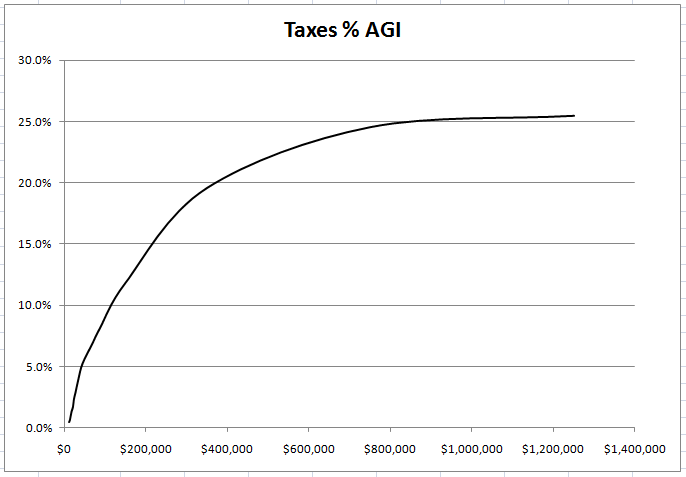
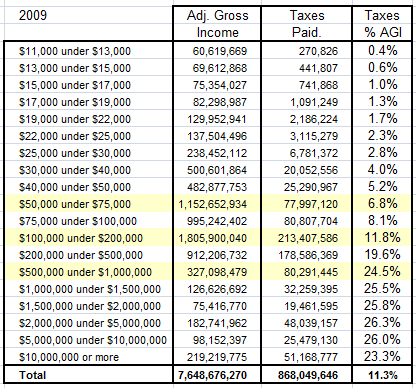
Below is a graph showing the actual taxes paid (per the IRS site) divided by AGI (adjusted gross income) across income ranges (the way the IRS reports them).  Below the graph is the tabular data.

Note that:

Rates are ‘average’ at 11.8% between $100,000 and $200,000.

The rates move up quickly to about 20% of AGI in the range between $200,000 and $500,000

Then – and this is where things get interesting — starting at about $750,000 in income, the % of AGI paid in taxes hits about 25% and hangs there. 

  • Note: On the table you can see that there’s a very small dip in the percentage for folks reporting more than $10 million – probably because of a high proportion of cap gains and dividends.

Again, these numbers are right off the IRS site … they’re not confused by tax tables or annoying reports that Warren Buffet pays less than his secretary.  They’re not zero as ‘progressives’ would lead us to believe …  and they’re not 100% as ‘conservatives’ would lead to believe.  The fact-based answer: 25%.

So what?

Reasonable people can differ (a little) on what rate constitutes a person’s “fair share”.

My view: 25% sounds about right.

What do you think?

image

image

Most Published Research Findings Are False

April 26, 2011

I didn’t say it, the New Yorker magazine did, setting off a buzz in the halls of academia.

The theme of the New Yorker article –- titled “Truth Wears Off” –was that most (academic) research was flawed and not able to be replicated.  This is, the results were at best true under some special circumstances at a specific point in time, but can’t be replicated. At worst, they’re just plain bull.

Hmmm.

Challenging the integrity of publication-driven academics?

Turns out that the New Yorker wasn’t the first mag on the beat.

There was an article in 2005 titled “Why Most Published Research Findings Are False” published in a medical journal that said point blank: “ It can be proven that most claimed research findings are false.”

According to the study, there are several reasons why.

My favorites:

  • Claimed research findings may often be simply accurate measures of the prevailing bias … that is, telling audiences what they want to hear
  • The hotter a scientific field, the less likely the research findings are to be true … that is, rushing to ride the wave
  • The greater the financial and other interests and prejudices in a scientific field, the less likely the research findings are to be true … no kidding?

Geez, if you can’t trust stuff printed in academic journals, what can you trust?

Grab your wallet … Ticketmaster going to “dynamic pricing”.

April 26, 2011

Punch line: Ticketmaster  plans to develop “dynamic pricing” systems that would adjust the cost of sports and concert tickets in response to demand, a strategy airlines and hotels have long used to maximize profits …  TM expects sports teams  to adopt the new system before concert promoters or Broadway producers.

* * * * *

Excerpted from WSJ, Ticketmaster to Tie Prices to Demand 

Dynamic pricing a key element in Ticketmaster’s strategy to revive sales of concert tickets, which have been stagnant or declining for years.

Last year was brutal for the concert industry, with ticket sales plunging 12% despite a modest decline in average prices. Recent price drops follow more than a decade of steady increases, a trend that helped mask fundamental problems.

“2010 taught us we have real challenges as an industry,” Mr. Hubbard said. “One of them is pricing.”

A frustration throughout the concert industry: the best seats appear to be consistently priced below what fans are willing to pay, leading to a multibillion-dollar “secondary market” in which scalpers can reap profits by reselling tickets above face value.

At the same time, he said, 40% of concert tickets sit unsold industry-wide, meaning that the ostensibly cheap seats for many shows are simply not cheap enough.

Thanks to JD for feeding the lead

Groupon rejects Google’s $6 billion offer … so, here come daily-deals from Google. Let the games begin.

April 26, 2011

TakeAway: After having its acquisition bid rebuffed by Groupon, Google is  launching its own daily-deal service offering, Google Offers, in NYC, the Bay area, and Portland.  Google aims to snatch market share from Groupon (No. 1) and LivingSocial (No. 2) … 

Ken’s Bet: Google will be a force in this market and hug Groupon for rejecting its almost $6 billion offer …

* * * * *

Excerpted from WSJ, “Google’s Groupon Rival Launches in NYC, Bay Area,” , April 21, 2011

Google’s rival to daily-deal services such as Groupon and LivingSocial, called Google Offers, officially launched today in New York City, the Bay Area and Portland.

Like its competitors … Google Offers will alert consumers to local-business deals on things like restaurant meals, promising “50% off or more” than the regular price “at places you’ll love.” …

Google Offers, which became public in January, comes several months after Google failed to acquire Groupon for more than $5 billion.  Meanwhile, Groupon is planning a public offering of its shares later this year …  between $15 billion and $20 billion.

… a Google spokeswoman said, “Today we launched a marketing campaign inviting Portlanders to sign up for a test of Google Offers — to get great deals delivered right to their inboxes. Offers is part of an ongoing effort at Google to make new services that give consumers great deals while helping connect businesses with customers in new ways.”

Edit by KJM

Re: gas prices … President mocks (other) politicians and their 3-point plans … and offers up his 4-point plan

April 25, 2011

In his weekly radio address, speaking on fast rising gas prices, Obama said:

“Whenever gas prices shoot up, like clockwork, you see politicians racing to the cameras, waving three-point plans for two dollar gas.”

Literally in the next paragraph, he offered up his 4-point plan.

  • Safe and responsible production of oil at home
  • Rooting out cases of fraud or manipulation in the oil markets
  • Ending the subsidies given to oil and gas companies
  • Investing in tomorrow’s clean, renewable energy sources: hybrids and electric cars

Whew!

Finally a game-changing 4-point plan … albeit with a couple of holes:

  • Domestic production … Obama has capitalized on the BP blowout to stop practically all new US domestic oil production
  • Fraud & abuse … just like the fraud & abuse being rooted out of the healthcare system.  I’ll take the under bet.
  • Oil company subsidies … strip the oil companies of subsidies and they’ll lower prices at the pump …  hmmm, so that’s how business works
  • Electric cars … birth to date, about 1,000 Chevy Volts have been sold.  Not exactly the iPad adoption rate.

Ken’s Plan: Start drilling, release strategic reserves and, most important, stop devaluing the dollar.

Skating through B-school …

April 25, 2011

Punch line: The NY Times reports that b-school students are slackers … especially those specializing in management and marketing.

Ouch.

* * * * *

From the N.Y. Times

The family of majors under the business umbrella — including finance, accounting, marketing, management and “general business” — accounts for just over 20 percent, or more than 325,000, of all bachelor’s degrees awarded annually in the United States, making it the most popular field of study.

But, all evidence suggests that student “disengagement” is at its worst in  business education.

Business majors spend less time preparing for class than do students in any other broad field: nearly half of seniors majoring in business say they spend fewer than 11 hours a week studying outside class.

Business majors have the weakest gains during the first two years of college on a national test of writing and reasoning skills. And when business students take the GMAT, the entry examination for M.B.A. programs, they score lower than students in every other major.

You’ll hear pervasive anxiety about student apathy, especially in “soft” fields like management and marketing, which account for the majority of business majors.

Scholars in the field point to three sources of trouble.

First,  too many business students chose their majors “by default.”

“Business education has come to be defined in the minds of students as a place for developing elite social networks and getting access to corporate recruiters.”

Second, in management and marketing, no strong consensus has emerged about what students ought to learn or how they ought to learn it.

Third, group assignments — a staple of management and marketing education —  are one of the elements of business that make it easy to skate through college.

A business professor at the University of Denver, studied group projects at his institution and found a perverse dynamic: the groups that functioned most smoothly were often the ones where the least learning occurred. That’s because students divided up the tasks in ways they felt comfortable with. The math whiz would do the statistical work, the English minor drafted the analysis. And then there’s the most common complaint about groups: some shoulder all the work, the rest do nothing.

Without some kind of hard constraint — like the licensure tests that accounting and finance students must face — courses inexorably become less rigorous.

Thanks to GB for feeding the lead.

>> Latest Posts

GM’s Volt need a jolt …

April 22, 2011

One of Gov’t Motor’s main focuses has been the Obama-sponsored Chevy Volt, but …

  • Consumer Reports says GM’s hybrid “just doesn’t make a lot of sense.” … ouch.
  • More important, it isn’t selling — only 1,210 Volts have sold this year through the end of March … double ouch

In technical marketing jargon, the dogs ain’t eating the dogfood …

Full article: NY Post, ‘Government motors’ is still a lemon, April 18, 2011

LivingSocial Gains on Groupon … but analysts say neither may be a long-term bet.

April 22, 2011

TakeAway:  Today, LivingSocial — the No. 2 player in the rapidly expanding market for online discounts — is still David battling Goliath (i.e. Groupon).

But the great chasm between the companies is narrowing, as the upstart gains more subscribers and collects more cash.  At the same time, it is trying to differentiate its brand.

* * * * *

Excerpted from the NYTimes, “In Race With Groupon, LivingSocial Raises $400 Million By Evelyn Rusli, April 4, 2011

In recent months, LivingSocial, which like its larger competitor serves daily deals to subscribers based on their location, has started to roll out new features. LivingSocial Instant, a mobile application that delivers time-sensitive discounts to users on the go, is a product that is currently only available in the Washington, D.C., area, where the company is based.  It has also introduced Escapes, a dedicated page for travel deals, an area on which Groupon has not focused heavily.

In its marketing campaigns, the company retains a youthful attitude with an “approachable sophistication,” said the company’s vice president for marketing.

Since the beginning of 2011, LivingSocial’s staff has roughly doubled to 1,300 employees, scattered across 250 markets in about a dozen countries. The number of LivingSocial subscribers now exceeds 26 million, about a third of Groupon’s audience.

One deal in January, a national promotion for a discount Amazon gift card for $10, attracted 1.3 million purchases in one day, or about $13 million in sales. Those returns surpassed Groupon’s first national deal with Gap in August, which generated about $11 million.  By the CEO’s estimates, LivingSocial is on track to reach 400 markets in 2011, with a staff of 3,000 people. In the last few weeks, he has also doubled his revenue goal, to $1 billion.

But as LivingSocial’s statistics climb, some analysts warn the industry may not have a big upside over the long term.

Several local vendors have publicly expressed dissatisfaction with daily deal services, which often attract discount-seekers instead of repeat visitors.

Edit by AMW

>> Current Posts

Gov’t Motors’ shares hit new low… even gov’t is bailing

April 21, 2011

Where are the lemon laws when you need them?

Here’s a shocker: even a reconstituted company that’s stuck with the UAW doesn’t do very well.

GM had been showing some life, largely on the back of fuel guzzling pick-ups and SUVs.  But, increasing gas prices have (again) slowed that market down.

Surprise, surprise, surprise.

* * * * *

Excerpted from WSJ: U.S. Hurries to Sell GM Stake, April 19, 2011,

The U.S. government plans to sell a significant share of its remaining stake in GM. this summer despite the disappointing performance of the auto maker’s stock.

A sale within the next several months would almost certainly mean U.S. taxpayers will take a loss on their $50 billion rescue of the Detroit auto maker in 2009.

To break even, the U.S. Treasury would need to sell its remaining stake — about 500 million shares—at $53 apiece.

GM closed at $29.59 in trading Tuesday, hitting a new low since its $33-a-share November initial public offering.

image

Analysts say that GM shares have been hurt by rising fuel prices, industry production disruptions and management turnover.

GM share price could become further depressed after investors holding bonds of the now-bankrupt “old-GM” receive warrants and stock for existing GM shares. That will happen April 21.

Pizza, pizza … recent trends.

April 21, 2011

A new Rasmussen Reports national survey reports …

  • 18% of American Adults say they eat pizza at least once a week
  • 3% eat pizza more than once a week
  • 17% rarely or never eat pizza 
  • Adults ages 30 to 49 eat pizza more regularly than those in other age groups
  • 26% of Americans age 50 and older say they rarely or never touch the stuff.

Among those who eat pizza …

  • 58% have a favorable opinion of Pizza Hut … 18%  Very Favorable
  • 54% have a favorable opinion of opinion Papa John’s … 20% Very Favorable
  • 48% have a favorable opinion of Domino’s … 8% Very Favorable opinion.

The last time they ate pizza, the respondents …

  • 25% made the pizza at home
  • 23% picked it up to eat at home
  • 16% ate it at a restaurant
  • 15% had it delivered.

Getting hungry?  I am …

Uh-oh: GAO dogs turned loose on ObamaCare

April 20, 2011

Punch line: Buried in the $38.5 billion (or, was it $526 million) budget reduction compromise were provisions for the GAO to start looking at ObamaCare’s waivers, effect on insurance premiums, and “comparative effectiveness” panels.

* * * * *

According to Michael Barone writing in RealClearPolitics

The Continuing Resolution (i.e. budget) covering the rest of fiscal year 2011 … contains some details that threaten ObamaCare

Most important, the CR requires the General Accounting Office to conduct an audit of the waivers from the Democrats’ health care bill that are being issued in large numbers by the secretary of health and human services.

This will raise an uncomfortable question. If Obamacare is so great, why are so many trying to get out from under it? And, more specifically, why are so many Democratic groups trying to get out from under it?

The fact is that HHS Secretary Kathleen Sebelius has granted more than 1,000 waivers from Obamacare. Many have been granted to labor unions.  One was granted to the entire state of Maine.

The GAO has also been ordered to produce audits on the effect of Obamacare on health insurance premiums. This is likely to reveal that the president did not keep his promise that you could keep your current health insurance if you want to.

And there will be an audit of the comparative effectiveness bureaucracy established in the 2009 stimulus package. Comparative effectiveness is supposedly an objective study of which medical techniques are most effective. But anyone who looks closely finds that the experts are constantly changing their minds, which suggests that this is more alchemy than science — and maybe political favoritism, as well.

All of which tends to undercut the thrust of Obama’s obviously-aimed-at-the-2012-campaign message: We can continue to fund Medicare and Medicaid indefinitely if we just tax rich people a little more.

RCP, President Whatever Finds Things Not Going His Way, April 18, 3011

I agree with Barney Frank … did I really say that?

April 20, 2011

Punch line: Rep. Barney Frank says the Administration is  ‘wasting time’ with online poker crackdown

From TheHill.com

The Obama administration is wasting time and resources by targeting online poker sites, according to Rep. Barney Frank (Mass.), the senior Democrat on the House Financial Services Committee.

“What an incredible waste of resources.”

Frank mocked the seizures as the administration “protecting the public from the scourge of inside straights,” and lamented that the Justice Department is more focused on prosecuting online poker sites than those responsible for the mortgage crisis and financial meltdown.

Go after the people responsible for empty houses, not full houses.”

The crackdown has disrupted the lives of the thousands of individuals that rely on online poker for part or all of their income.

That group includes not only professional gamblers but also programmers who create analytics and other tools as well as the backers who finance many of the full-time players.

About those corporate tax loopholes …

April 19, 2011

Punch line: After adjusting for so-called “loopholes” and consolidating all tax returns, U.S. companies (including GE)  pay 40% higher income taxes than foreign-based companies.

How do you spell competitiveness?

According to Portfolio.com

American businesses have long complained that our 35 percent corporate tax rate — the second-highest in the developed world—makes them less competitive globally.

Critics respond that most U.S. corporations pay much less than that to Uncle Sam — in General Electric’s case, reportedly nothing — because of various loopholes.

The Business Roundtable released a study on the average effective tax rates for the world’s 2,000 largest corporations. The effective tax rate is the share of global pretax income that actually is paid in taxes to various levels of government in the U.S. and abroad.

The study, conducted by PricewaterhouseCoopers, found that U.S. corporations paid an average effective tax rate of 27.7 percent from 2006 to 2009, compared with an average of 19.5 percent for foreign-based corporations.  The U.S. effective tax rate was the sixth-highest among the 61 countries that are home to large corporations, behind Japan, Morocco, Italy, Indonesia, and Germany. 

Thanks to SMH for feeding the lead

Tanning salons say thanks to S&P …

April 19, 2011

Can you imagine the amount of government scrutiny and pressure that will be laser-focused on S&P after the ratings agency responded to Obama’s “in your eye” speech by putting the United States of America on a rightly deserved credit watch?

It’ll be interesting to watch what Moody’s does.  On one hand, Moody’s completely missed the mortgage meltdown, so I’d expect them to be conservative and follow suit.

On the other hand, Obama’s BFF —  Warren “Please let me pay more taxes” Buffett — owns a big stake of Moody’s.  So, I’d expect some respectful crony capitalism.

For now, the tanning salons are finally out of the spotlight. 

First, the poker sites … now S&P.

Been a good week for the salons …

Carlsberg Beer: “Brand recognition is good, but sales are better” … call in the brand repo guys

April 19, 2011

TakeAway: Carlsberg Beer is repositioning its brand and widening its distribution channels to boost sales in the competitive beer market.

* * * * *

Excerpted from BrandChannel.com, “Carlsberg calls for New Brand Positioning,” by Barry Silverstein, April 5, 2011

Carlsberg, arguably one of the world’s premium beer brands, is getting its most significant makeover since the beer’s origination in 1847…

In the beer category, the world’s four largest brewers account for over half the global market for beer. Denmark’s Carlsberg is number four, behind Anheuser-Busch InBev, SAB Miller, and Heineken…

Khalil Younes, SVP of Global, Sales, Marketing and Innovation, says, “Carlsberg is a fantastic brand, but the brand has even more potential that can be cultivated…

Carlsberg is introducing a new tagline that the company says will celebrate the brand’s heritage and values, while connecting it with today’s “active, adventurous” generation of beer drinkers.

The brand proposition encourages consumers to ‘step up and do the right thing,” rewarding themselves with a Carlsberg for their deeds. Hence the tagline: “That calls for a Carlsberg.”…

The Carlsberg logo…has been refreshed and modernized. The Danish Royal crown has been made more simple and distinctive. The dominant green has been made more vibrant.

The brand’s logo now carries three elements: the Brewer’s Star, the Hope Leaf, and the inclusion of “Copenhagen 1847,” indicating where and when the beer was first brewed… New packaging is currently being rolled out this year across all 140 markets…

Carlsberg’s CEO says that while Carlsberg’s famous green logo is known all over the world, its sales simply do not measure up to its brand recognition.

“Although international recognition is good, it is not enough. We are investing significantly in the Carlsberg brand, widening our distribution channels and making every effort to get closer to our customers and consumers.”

The company says “by 2015, Carlsberg anticipates that the Carlsberg brand will have doubled its profits.”

Really? Well if it happens, that definitely calls for a Carlsberg.

Edit by KJM


Fewer are working … instead, they’re asking for more from those who do. Uh-oh.

April 18, 2011

According to  USA TODAY

The share of the population that is working fell to its lowest level in three decades. 

Only 45.4% of Americans had jobs in 2010, the lowest rate since 1983 and down from a peak of 49.3% in 2000.

The bad economy, an aging population and a plateau in women working are contributing to changes that pose serious challenges for financing the nation’s social programs.

Job troubles appear to have slowed a trend of people working later in life, putting more pressure on Social Security.

“No matter how wealthy you are, you have a problem if half the population is not working and depending on those who are.”

“Seismic event”: Feds “call” poker sites … Tanning salons sigh relief

April 18, 2011

Punch line: After whacking tanning salons with higher taxes, the Obama administration has turned its guns on another culture-crippling endeavor: online poker.

Porous borders: no problem.

Online poker: must be stopped.

If it weren’t so funny, it would be sad.

* * * * *

According to the WSJ:

Eleven people, including the founders of three of the largest online poker companies doing business in the U.S., have been charged in the largest crackdown on Internet poker by U.S. authorities.

Those charged Friday include the online poker websites PokerStars, Full Tilt Poker and Absolute Poker.

The charges set up a long-awaited showdown between the sites, which claim millions of U.S. players and billions in revenue, and the federal government, which has long alleged that their operations are illegal.

Federal prosecutors have targeted the three largest online poker companies doing business in the U.S., charging their founders with money laundering and bank fraud and seizing five of the companies’ domain names.

This is seismic,” said James Kilsby, an editor for Gambling Compliance, a website which tracks regulatory issues. “It’s a game changer.”

* * * * *

The charges are likely to disrupt a fragile ecosystem that involves millions of players in the United States who play poker for money.

PokerScout, a website that tracks online poker, estimates that almost 2 million people played poker for money in the U.S. last year, representing $16 billion in wagers.

Why work when you can just wait for the mailman?

April 15, 2011

Punch line: Men are disappearing from the workplace in ways that don’t always register on the official unemployment rate 

Excerpted from Business Week, The Hidden Job Crisis for American Men, April 7, 2011

The March jobs report released on Apr. 1 seemed like the best in years. Behind the headlines, though, statistics on jobs are far less encouraging.

Yes, job growth has picked up somewhat. Yet an equally important reason for the lower jobless rate is that many people, men in particular, have simply given up looking for work and are no longer counted among the unemployed.

Some sit at home. Rather than paying taxes on labor income, they are drawing government benefits, or relying on family and friends for support.

There is an ominous trend of disengagement for male workers that stretches back six decades. The share of American men aged 16 to 64 who are employed has fallen, from nearly 85 percent in the early 1950s to less than 65 percent now.

A Bureau of Labor Statistics study found that many older workers who lose jobs never go back to work again. Of those aged 55-64 who were displaced from 2007 through 2009, 21 percent were out of the labor force as of January 2010.

Typically the unemployment rate stays flat or even rises when the economy begins to recover. People reenter the labor force. There is no flood of reentrants this time, at least not yet.

P&G Sheds Pringles, its Last Food Brand

April 15, 2011

TakeAway:  In announcing the sale of Pringles to Diamond Foods for $2.35B, P&G concluded what had been a tumultuous, sometimes zany, 50-year experiment in engineered food.  P&G also refocused on its core product lines.

* * * * *

Excerpted from the NYTimes, “Once a Great Flop, Now Sold for Billions By Andrew Martin, April 5, 2011

The company’s expertise in edible oils was used widely by the potato chip industry in the 1950s and 1960s, and shaped the invention of Pringles. Company officials still aren’t sure how the chips got their name.  Pringles are basically dehydrated potato flakes that are rolled and then fried, but they were not universally loved initially.  The product was such a dud in its early years that some called for P&G to dump the brand. The brand did not take off until the company tweaked the flavor in 1980 and introduced the “Fever for the Flavor of Pringles” advertising campaign.  By the late 1990s, Pringles had become a $1 billion a year brand.

The sale of Pringles was not unexpected, as Procter has refocused its attention on the core businesses of beauty, grooming and household care.

In the 1950s, roughly 25% of the company’s sales were in food, particularly in shortening and other cooking oils.  But P&G lacked a distribution network to ship perishable bags of chips to grocery stores, so it directed its researchers to come up with a longer-lasting chip that could be distributed with P&G’s existing distribution network.  P&G wanted to create a perfect chip to address consumer complaints about broken and stale chips and air in the bags.

Officially, Pringles are called crisps rather than chips, the result of a long-ago fracas between competitors and regulators over what could be called a potato chip.

Edit by AMW 

* * * * *

Con job: Gross = $38.5 billion, Net = $352 million … Boehner should resign!

April 14, 2011

The National Journal Reports

A Congressional Budget Office analysis of the fiscal 2011 spending deal that Congress will vote on Thursday concludes that it would cut spending this year by less than one-one hundredth of what both Republicans or Democrats have claimed.

A comparison prepared by the CBO shows that the omnibus spending bill, advertised as containing some $38.5 billion in cuts, will only reduce federal outlays by $352 million below 2010 spending rates. The nonpartisan budget agency also projects that total outlays are actually some $3.3 billion more than in 2010, if emergency spending is included in the total.

The astonishing result, according to CBO, is the result of several factors: increases in spending included in the deal, especially at the Defense Department; decisions to draw over half of the savings from recissions, cuts to reserve funds, and mandatory-spending programs; and writing off cuts from funding that might never have been spent.

* * * * *

Ken’s Take: Either Boehner was in on the con, or he’s so stupid that he was had.

Either way, he should resign as Speaker of the House,

That’s what I think …

BHO declares war on the wealthy (again) …

April 14, 2011

In yesterday’s pitch, the President reaffirmed his position that the makers should give more of their $$$ to the takers.

That’s one he can win, since there are increasing number of takers.

Robert Samuels points out in Newsweek:

We in America have created suicidal government; the threatened federal shutdown and stubborn budget deficits are but symptoms.

By suicidal, I mean that government has promised more than it can realistically deliver and, as a result, repeatedly disappoints by providing less than people expect or jeopardizing what they already have. But government can’t easily correct its excesses, because Americans depend on it for so much that any effort to change the status arouses a firestorm of opposition that virtually ensures defeat.

Government’s very expansion has brought it into disrepute, paralyzed politics and impeded it from acting in the national interest.

For example, the Census Bureau reports that in 2009 almost half (46.2 percent) of the 300 million Americans received at least one federal benefit:

  • 46.5 million, Social Security;
  • 42.6 million, Medicare;
  • 42.4 million, Medicaid;
  • 36.1 million, food stamps;
  • 12.4 million, housing subsidies.

There are a lot of voters in the stack …

Another reason that New Yorkers are glad they don’t live in Alaska …

April 14, 2011

State & Local tax rates.

New data from the Census Bureau showcases the usual suspects on the list of high tax states.

I’m glad I’m domiciled in Virginia.

image

http://www.taxfoundation.org/research/show/27181.html

LaHood: “I wouldn’t want anybody in my family driving a Chevy Cruze”

April 13, 2011

Just dreaming …

Remember when the Secretary of Transportation took to the airwaves to to tell people not to buy or drive Toyotas because they were unsafe?

Turned out that the problem was an auto service guy sticking the wrong floor mat in a car and a couple of folks hitting the accelerator instead of the brake.

But, since the gov’t owned GM —  one of Toyota’s main competitors —  LaHood just let it fly.

Now the plot thickens.

The Chevy Cruze is being recalled because its steering wheel comes off.

That’s right. it steering wheel can become detached.

No driver error.  No servicing mistake.

The steering wheel comes off.

Oops.

Do you think LaHood will issue another driver’s alert?

I’m betting ‘no’.

Not sure what to get? How about an experiential gift card?

April 13, 2011

TakeAway: People are starting to turn away from stuff and turn to experiences and memories.

The rise of “experiential gift cards” has shown that you can do more with just an old gift card. Gone are the days of unwanted toasters or even gift cards to stores you don’t frequent. 

Gift cards loaded with a value that covers a variety of different activities are becoming the new rage.

* * * * *

Excerpted from AdAge, “New Gift-Card Trend Swaps Stuff for ‘Social Capital'” , March 28, 2011

“Experiential gift cards” …are becoming more popular, because they allow creativity for the giver and flexibility for the recipient.

“People aren’t looking for ‘stuff’ anymore, they’re looking for experiences,” … You can post pictures of your African-safari experience, but you can’t put up a picture of your Mercedes. That’s tacky.”

Smartbox offers gift-card boxes that retail from $49 to $369 … Inside the box is the card, of course, but also a book of the possible choices for such experiences as dinner for two in New York City (50 choices for $99); adventures like white-water rafting and surfing in California (100 choices for $69); and upscale getaways in the Great Lakes (35 choices for $369).

Experiential gifts, … are relatively nascent in the U.S. compared to the other places in the world such as the U.K. and Australia.

“In the U.S., this is really new, especially at retail, …The growth is really happening now”

Smartbox …has pushed out an aggressive public-relations campaign and more recently begun spreading its message via social media. …partnership with Zagat Smartbox Table for Two, and was marketed at Valentine’s Day with PR and a social-media promotion. …

“All happiness research points to the fact that it’s not the things you have that make you happy, it’s the experiences you have,” …”The lag in experience gifts and the lag in consumers recognizing it was an option surprised me, but marketers are catching on now.”

Gift experiences have the added bonus of making the giver more memorable. You won’t remember who gave you socks or a sweater, but you’ll probably recall who gave you an experience where a memory was created,…”A gift is a connection between me and you, and things have far less meaning than experiences.”

Edit by HH


About those 800,000 non-essential gov’t employees …

April 12, 2011

Perhaps the biggest win from last week’s possible government shut-down is that (apparently) all gov’t departments had to scrub their employment lists to classify employees as essential or non-essential.

Now, if gov’t were a business, somebody (think Jack Welch – or, better yet, Chainsaw Al Dunlop) would start scouring the list … to re-classify some of the non-essentials to ‘former employees’.

I’m taking the under on that bet.

The non-essentials will likely continue doing their non-essential “work” … on our dollar.

Ouch.

What do Houston, Newark, and Dallas have in common?

April 12, 2011

Answer: high air fares.

Great analysis in one of the New York Times blogs

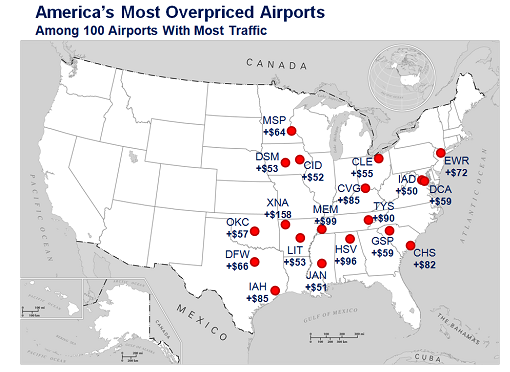
The writer wanted to figure out why, say, an average passenger flying out of Newark Liberty Airport pays about 25 percent more than someone flying out of John F. Kennedy International for an equivalent seat on an equivalent flight.

So, he cranked some nums re: airline pricing, and sorted airports as ‘relatively overpriced’ or ‘competitively priced’.

He modeled airport prices based on distance to destinations,  size of market (how much ‘traffic’),  and competitive structure – i.e. the market share at the origin and destination airports held collectively by the five “legacy carriers” (United, American, Delta, Continental and US Air); the market share held by Southwest Airlines; and the market share held by the largest single carrier at that airport (for instance, Delta and its affiliates are responsible for about 66 percent of all traffic at Atlanta).

He concluded that prices are higher where:

  • Legacy airlines dominate an airport
  • Southwest has a large share as opposed to other low-cost carriers like AirTran and JetBlue.
  • One airline dominates an airport, regardless of whether it is a legacy carrier or a low-cost one.

Here are overpriced airports:

image

image

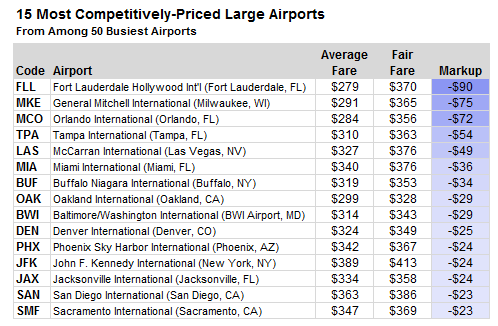
For ‘competitively priced’ airports, the “unifying theme”  is that many are warm-weather vacation destinations, like Las Vegas and pretty much anywhere in Florida.

Why?

Leisure travelers are more price-sensitive than business travelers since they, not their company, are paying for the ticket. To keep them flying, prices have to be relatively low,

Here are the bargains:

image

A very clever analysis … Worth reading the details:
http://fivethirtyeight.blogs.nytimes.com/2011/04/06/which-airports-have-the-most-unfair-fares/

Thanks to BM for feeding the lead.

Budget deal revives DC school vouchers … Dems and DC mayor cry “unfair”

April 11, 2011

Punch line: The budget deal to fund the federal government for the next five months includes money to revive the DC’s school voucher program, which subsidizes private school tuition for needy students with federal funds.

Demonstrating their hypocrisy towards improving the quality of education for inner city kids, some teacher union-backed Dems and the Mayor of DC cry “unfair”.

To whom?  you ask.

The teachers’ union, of course.

The GOP-led House voted to reinstate the DC school voucher program last month. But the bill had little chance to go any further with the Obama administration opposed to vouchers.

However, the Republicans were able to get the initiative included in Friday night’s deal that cut spending by $38.5 billion.

Congress eliminated the voucher program in 2009. Critics of vouchers, including teachers unions, say it draws money away from public schools.

Under the program, which began in 2004, more than 3,700 students, mostly black or Hispanic, have won scholarships which provide up to $7,500 in private-school tuition.

In a Saturday morning tweet, Mayor Vincent Gray called the rider a "shameful violation of our right to govern ourselves."

Gray called on all D.C. residents to voice their opposition to the "colonial status of the District of Columbia."

AP, Budget Deal Revives DC School Voucher Program, April 09, 2011

Major business school reviewing “enrollment procedures and criteria”

April 11, 2011

The following email was recently sent by the Dean of Northwestern’s Kellogg School of Management.

In a nutshell: oops !

Subject: Message from the Dean

Dear Kellogg community –

I wanted to personally write to you about a situation that has received some attention.

During a visit to the U.S. two months ago, Khamis Gaddafi, son of Muammar Gaddafi, attended a non-degree executive course at Kellogg from Feb. 9 – 11 at the Allen Center.

The U.S. State Department was aware of his visit, which occurred prior to the uprising in Libya and before the recent, very troubling allegations against him surfaced.

Our community shares a commitment to respecting human dignity and the integrity of our learning environment.

The Office of the Dean plans to actively review all of our enrollment procedures and criteria, and will determine any changes that need to be made.

Dean, Kellogg School of Management
Northwestern University

Bottom line: Sons of tyrants will no longer be given admissions preference.

My, how the world is changing.

Thanks to RM for feeding the lead.